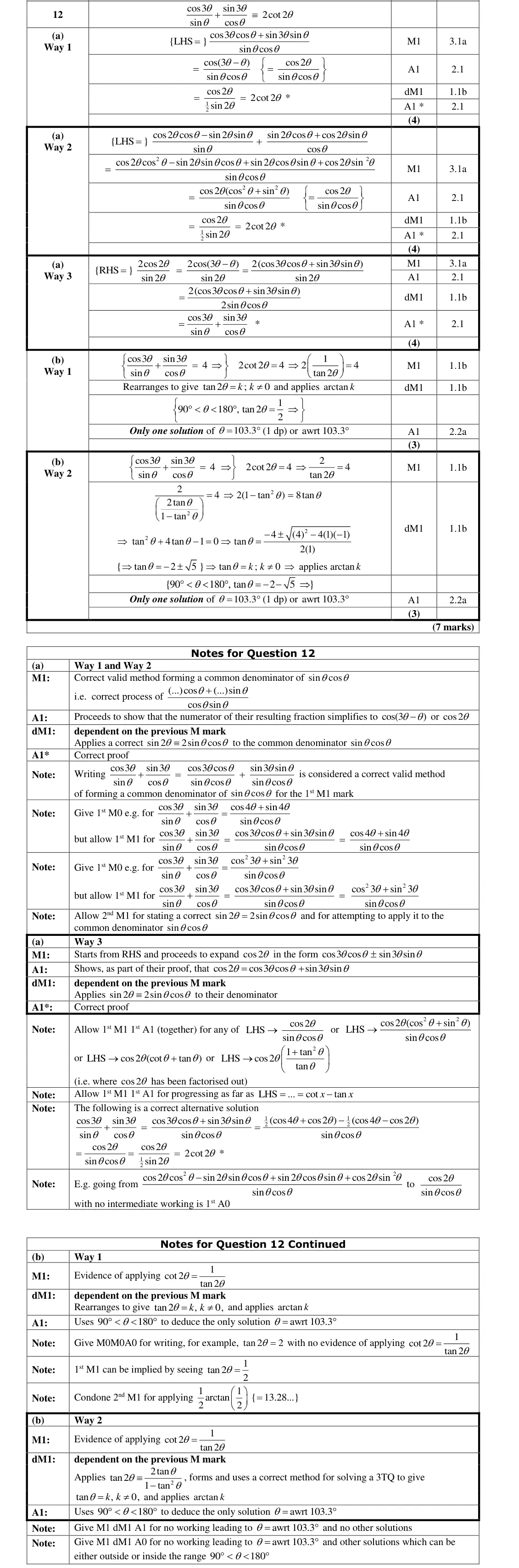
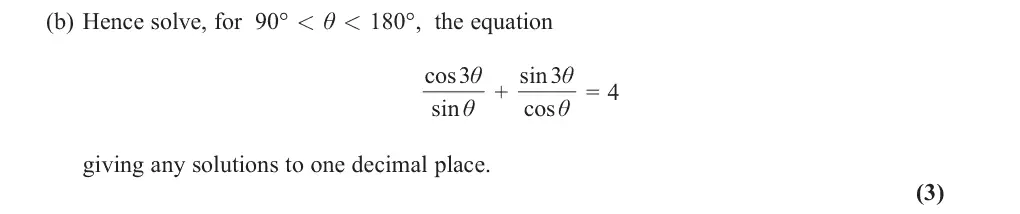
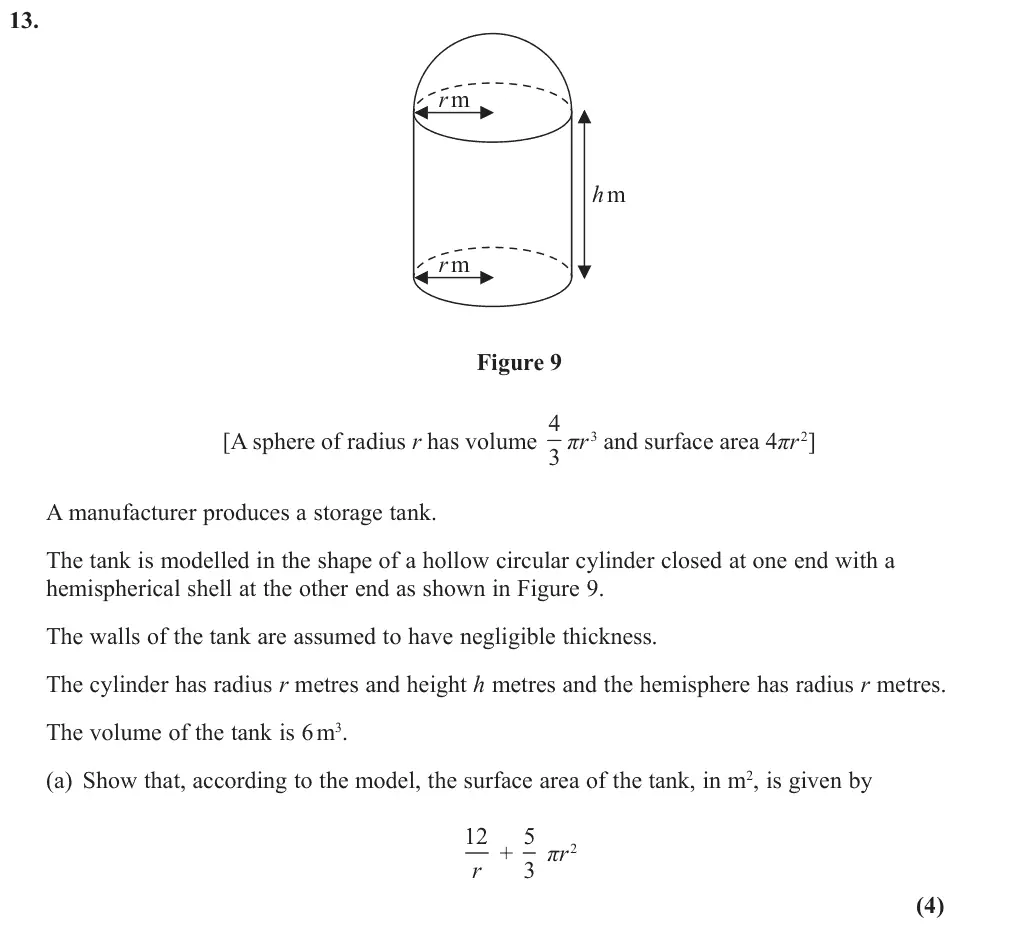
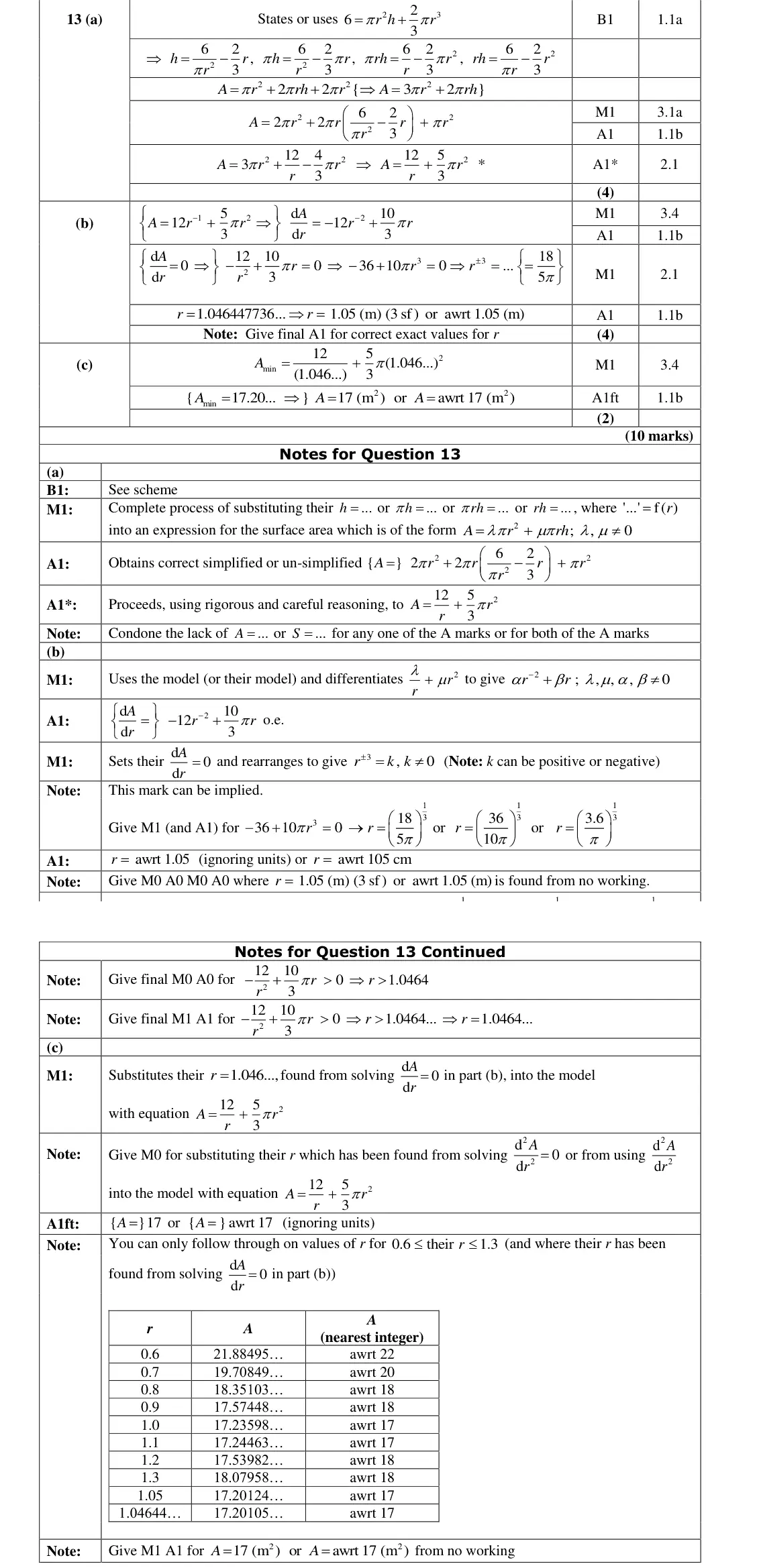
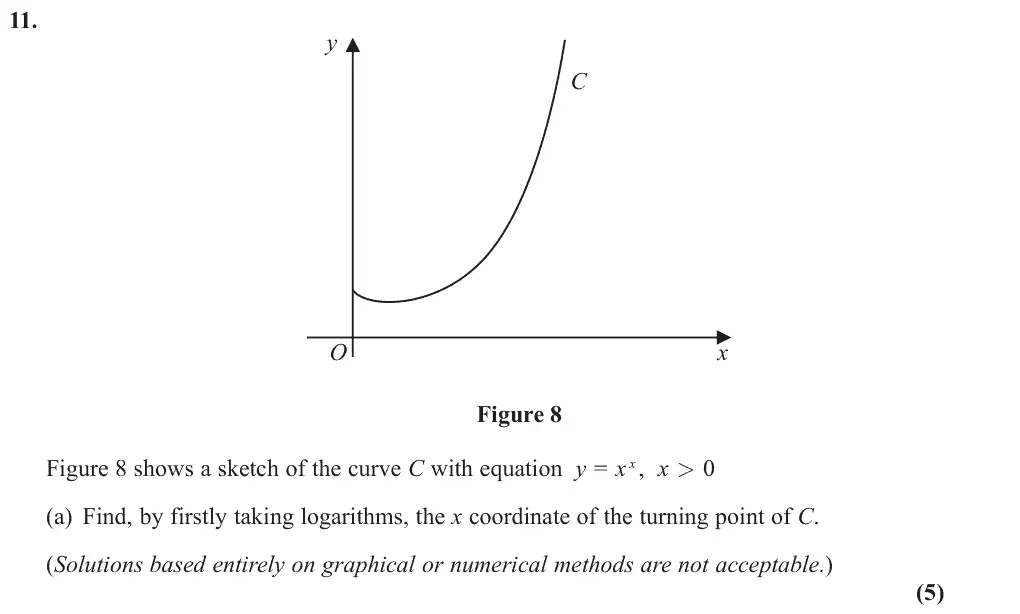
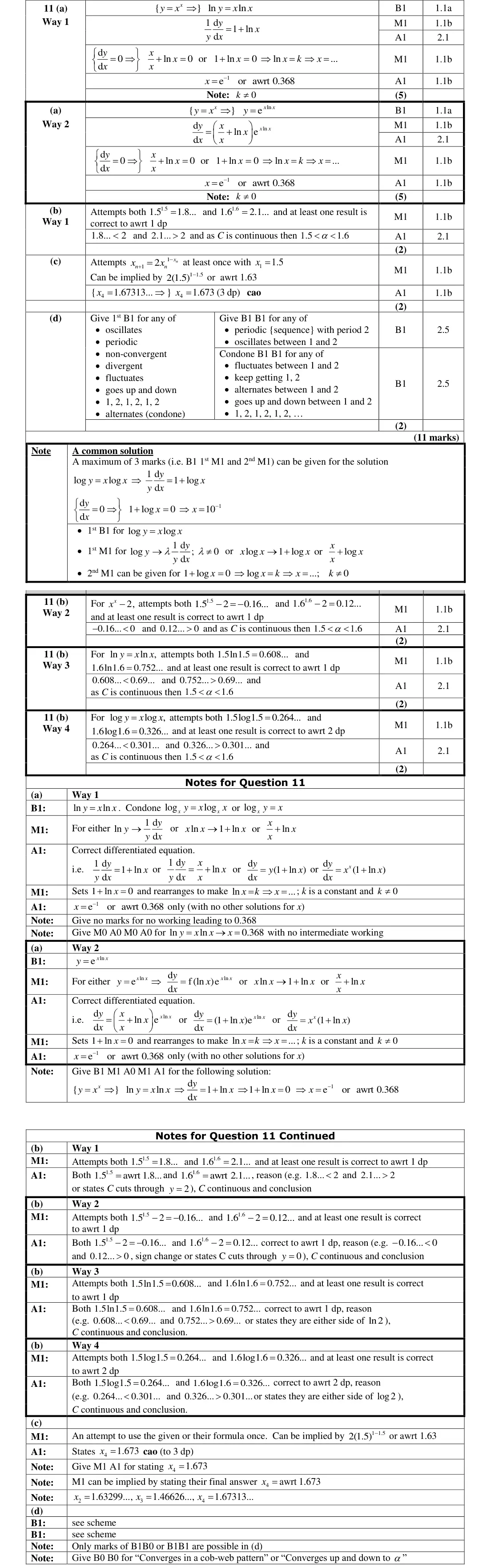
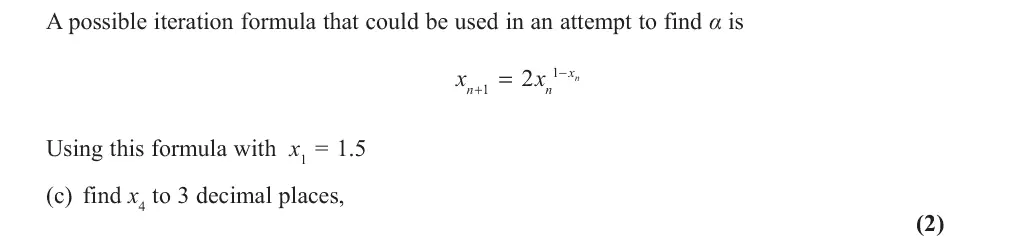
Mark scheme (whole question; this part is marked with the orange bar)
Examiner's comment
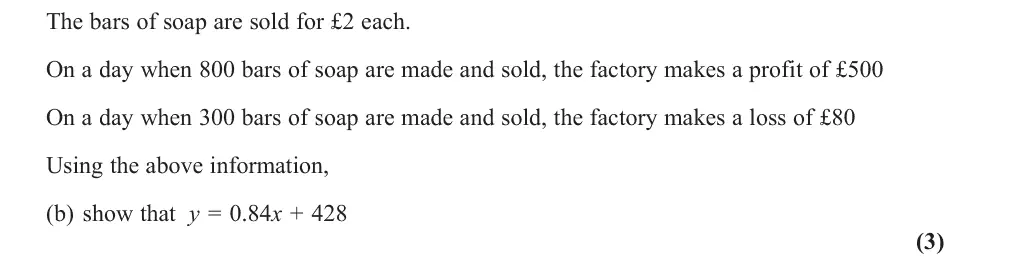
Q01 proved challenging for a significant number of candidates. This was probably because of the more open-ended nature of the question, allowing candidates to select their own problem-solving strategy to express y as a function of x. It was not apparent to most candidates that y could be expressed as a linear function of x. More able candidates, however, were able to provide a concise solution. Other candidates were still able to achieve full marks but expressed y as a more complicated function of x. A few candidates attempted to express x as a function of y, suggesting a lack of understanding of the terminology. It appeared that most candidates failed to realise that Q01 could be solved purely using indices. Instead, most candidates chose to immediately take logarithms as their first step towards a solution. A correct first step, e.g. 1 log(2 4 ) log , 2 2 x y was rewarded by the mark scheme. Unfortunately, some candidates combined taking logarithms with an incorrect application of the addition law for logarithms as their first step, therefore gaining no marks. E.g. 2 4 log2 log4 . x y x y Most candidates who had a correct first step of work went on to achieve full marks, with some only failing to do so by making an arithmetic error. Q01 highlighted some candidates’ weaker algebraic, indices and logarithms skills. Common errors included 2 4 8 , x y xy 2 4 8 , x y x y 1 1 , 2 2 2 4 2 x x or 1 2 2 4 4 . 2 2 2 2 x x y y The most common correct answers were 1 2 2 log log(2 ) , log4 x y 4 1 log 2 2 2 x y or 1 2 2 2 ln . ln 4 x y Only a minority of candidates obtained a correct 1 3. 2 4 y x
Common mistakes
- write both sides as powers of 2: 2^(x + 2y) = 2^(−3/2), so y = −½x − ¾
- taking logs is longer and log(2ˣ × 4ʸ) wrongly split as log2ˣ × log4ʸ or 2ˣ × 4ʸ = 8^(x + y)
- answer must be y in terms of x, not x in terms of y













![12. (a) Prove cos3 theta + sin3 theta theta theta { 2cot 2ș ș z (90n)°, n ] sin cos (4)](/img/JUN19_9MA002/JUN19_9MA002_12(a).webp)