1.08b Integrate xⁿ where n ≠ −1 and related sums, differences and…
Section
1.08 Integration
Level
AS & A level
Statement
Be able to integrate xⁿ where n ≠ −1 and related sums, differences and constant multiples.
Guidance
Learners should also be able to solve problems involving the evaluation of a constant of integration e.g. to find the equation of the curve through (−1, 2) for which dy/dx = 2x + 1.
Most candidates answered this fairly routine integration question well, with the majority achieving 3/3. A small number of candidates made an error in their integration (which, provided a cubic was obtained, could still score M1M1 if used correctly) but candidates who did not integrate (e.g. differentiated or did not change powers) scored M0M0 as the scheme required a cubic in order to gain the mark for substituting limits. The ‘Determine’ instruction indicated that candidates were expected to show ‘working where appropriate’ as detailed in the scheme and most candidates did this very well. Candidates who just gave the correct answer without any justification would have scored zero marks in this question, but this was very rarely seen. A small number of candidates substituted the given limits for a instead of for x.
Key points and common errors
[ax³/3 − x² + 4x] from 0 to 5 = 125a/3 − 5 = 45
a = 6/5
substitute limits for x not a
June 2025 · AS Paper 2 · Q7(b)6 marksMedium
Show the start of this question
Mark scheme for this part
Examiner's comment
There were a lot of complete attempts to this part, although some did not get full marks only because they did not provide an exact answer or a justification for their answer. Many gained the first 3 marks, and the limit work was usually well done too, but some had them the wrong way round and -100/3 rather than +100/3 was used on the left hand side. In this instance, credit was given even if a = 0 was not given. Unfortunately, a small number of candidates started by differentiating.
Key points and common errors
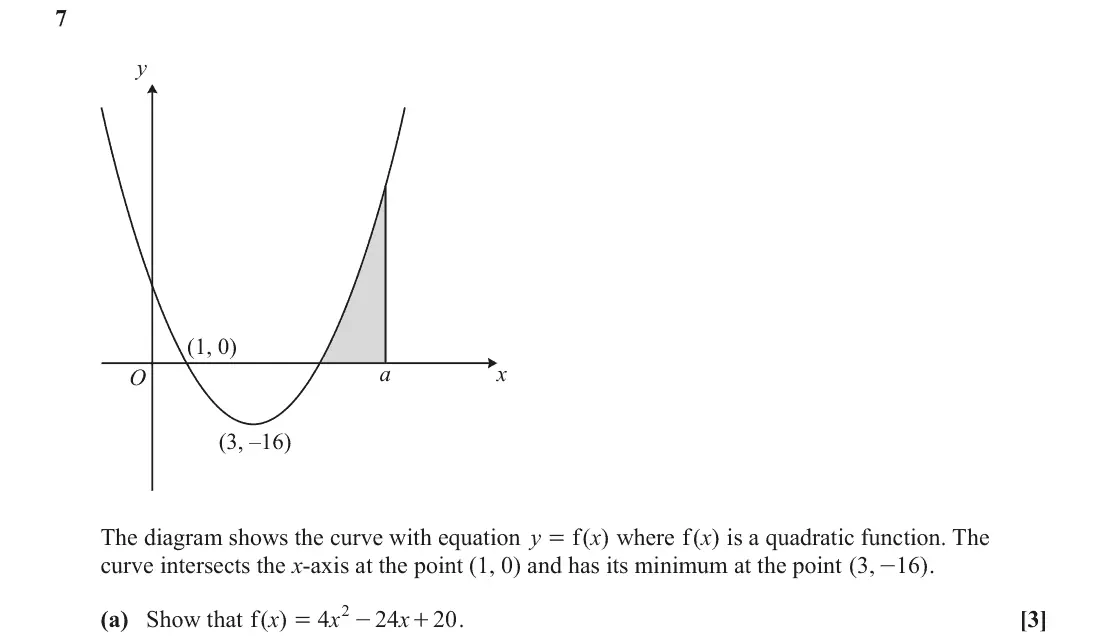
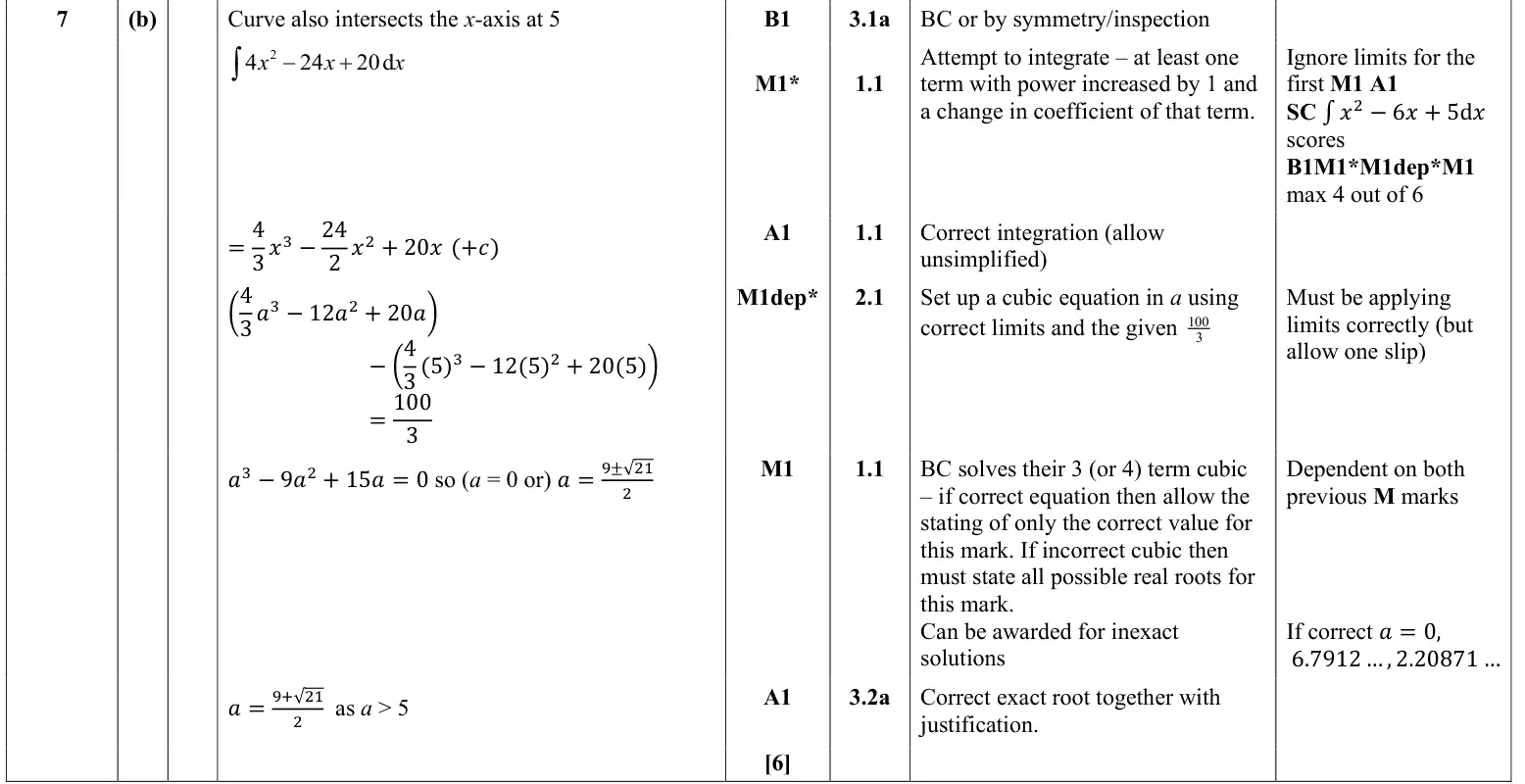
curve also crosses at x = 5 (symmetry)
∫ from 5 to a of (4x² − 24x + 20) dx = 100/3
a³ − 9a² + 15a = 0
a = (9 + √21)/2 with justification a > 5
exact answer needed
limits the wrong way round
June 2025 · Paper 3 · Q96 marksEasy
Mark scheme for this part
Examiner's comment
This was probably the best answered question in the mechanics section with many candidates scoring all 6 marks. As this part required DR many did not gain a mark for not showing the explicit substituting of 𝑡= 10 into their integrated expression to find the required distance travelled. The most common errors seen by examiners were those candidates who implied that 𝑠= d𝑡 and/or 𝑎= ∫𝑣 d𝑡, and some incorrectly used the equations of constant acceleration even though the acceleration was variable. required detailed reasoning. The candidate has given no explicit indication of where the answer of 370 came from (as they have not shown the limits of 0 and 10 being applied to the cubic expression) and so 1 of the 6 marks could not be awarded.
Key points and common errors
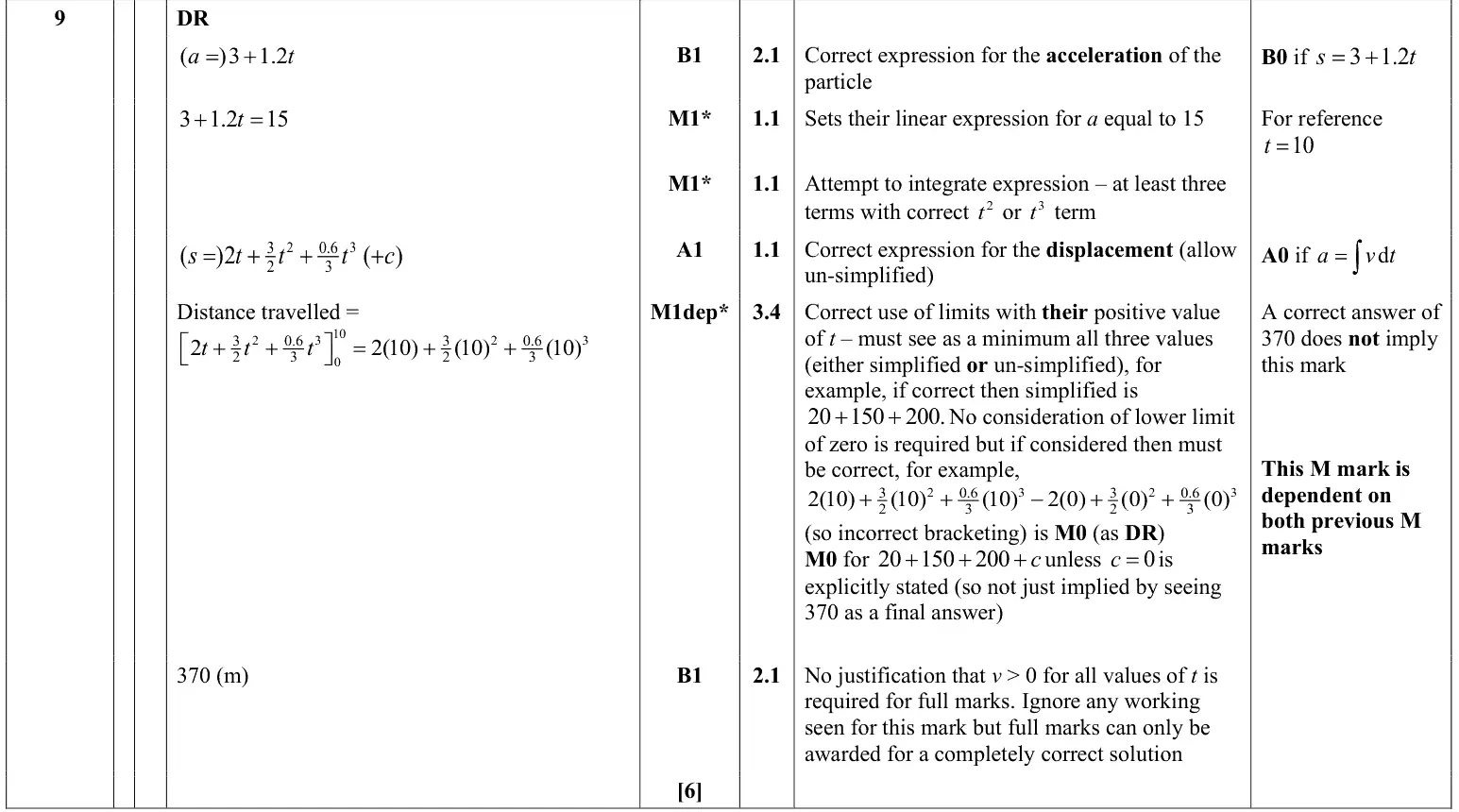
a = 3 + 1.2t = 15 gives t = 10
s = 2t + 1.5t² + 0.2t³
substitute t = 10 explicitly: 370 m
DR needs the substitution shown
June 2024 · AS Paper 1 · Q67 marksMedium
Mark scheme for this part
Examiner's comment
Most candidates made a good attempt at this question, although relatively few received all 7 marks. The majority of candidates were able to score 2 or 3 of the first 3 marks from integrating (although a few omitted the constant and therefore received 0 as they could not progress). As this question was ‘Determine’ candidates were required to show working for forming and solving their quadratic. A Special Case was included here for candidates who provided answers unsupported by working in the second part, but this should not be assumed for future exam series. Errors in deducing c were common, but candidates who obtained the correct equation were mostly able to correctly deduce that they needed to set this = 2x and solve the resulting quadratic for x. Some candidates obtained y = 12 or y = −12 instead of y = −6 where x = −3.
Key points and common errors
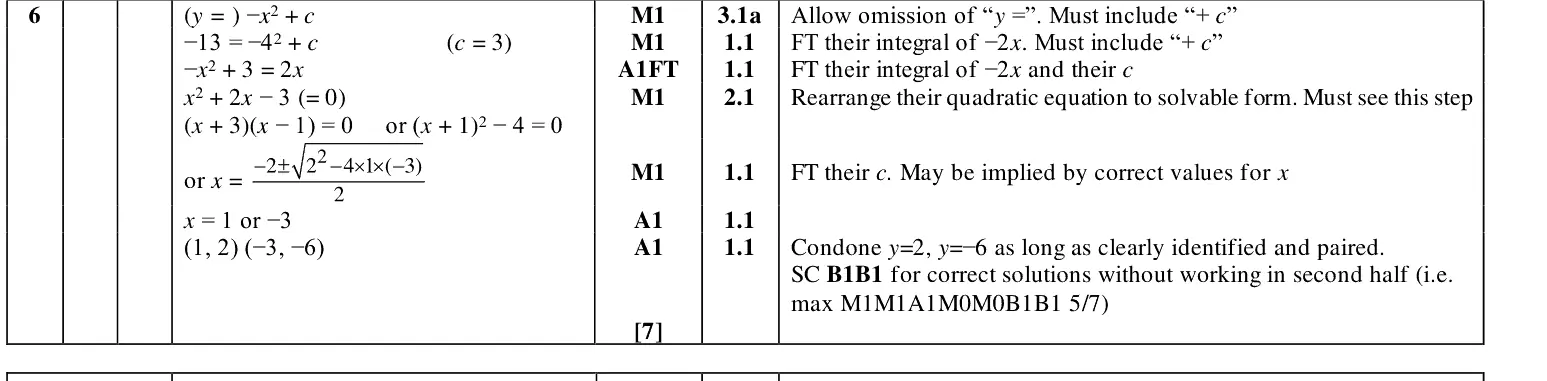
y = −x² + c
c = 3 from (4, −13)
−x² + 3 = 2x so (x + 3)(x − 1) = 0
(1, 2) and (−3, −6)
omitting + c blocks progress
show working for the quadratic
June 2024 · AS Paper 2 · Q67 marksMedium
Mark scheme for this part
Examiner's comment
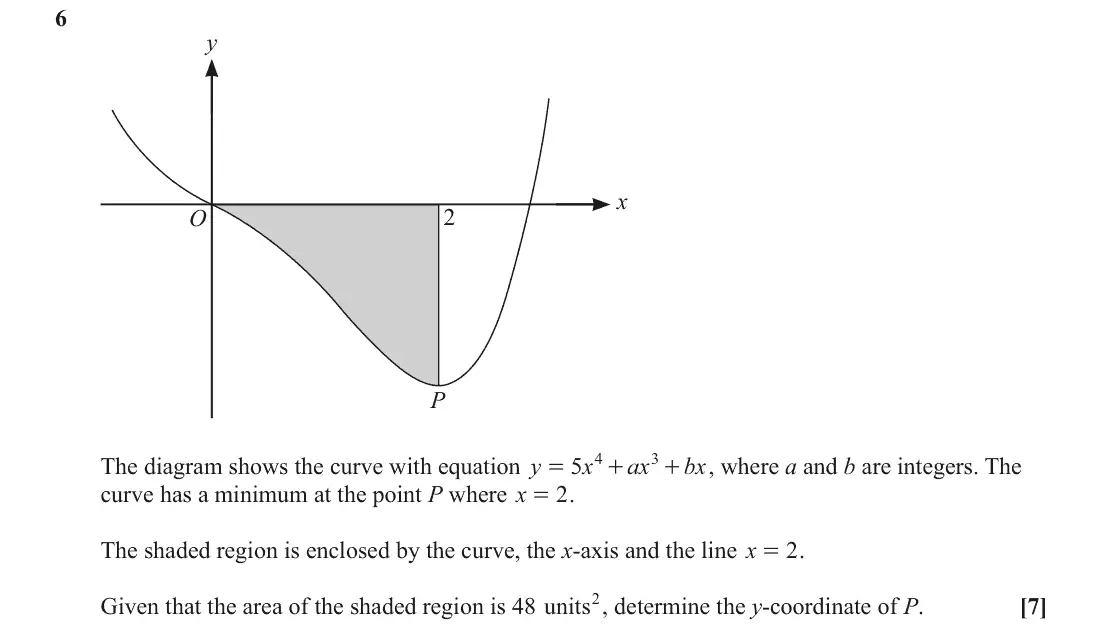
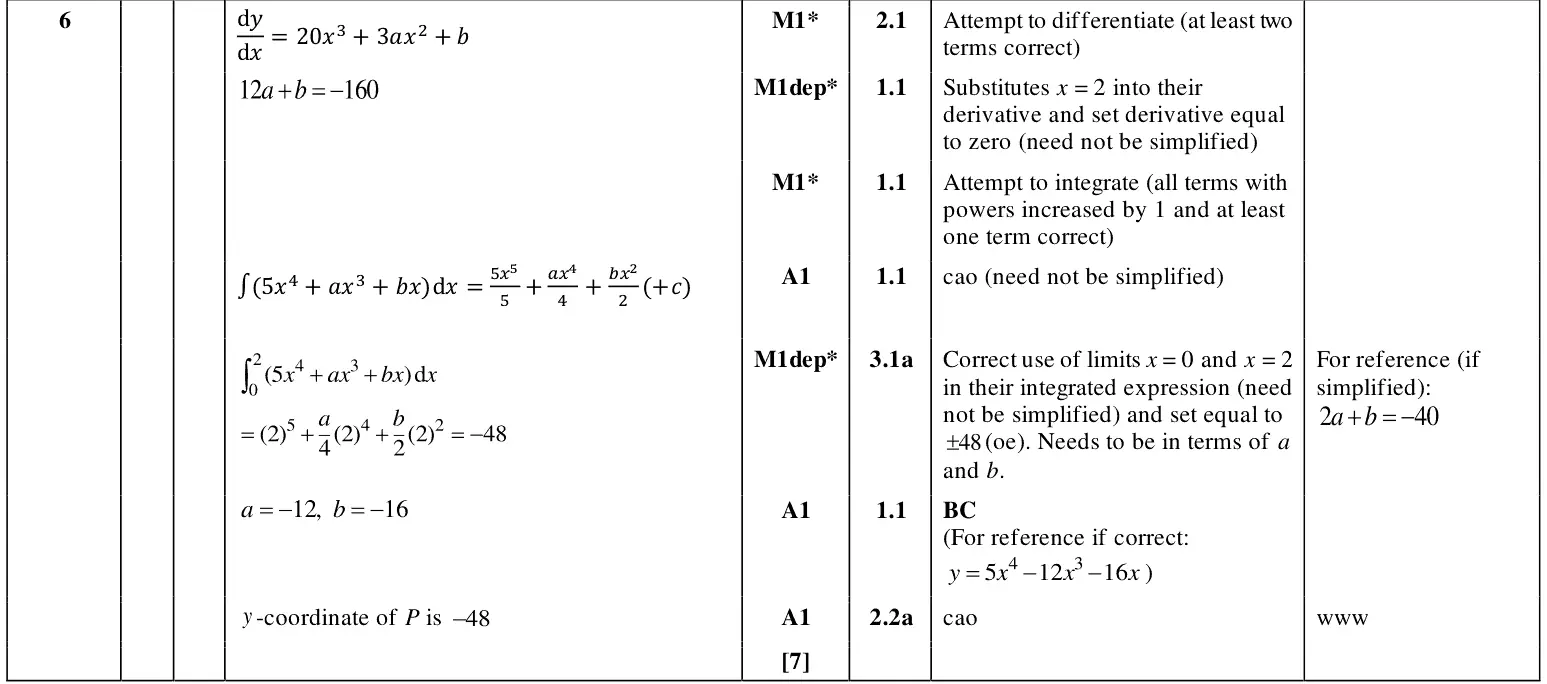
Those who recognised the need to differentiate and integrate generally did it well. A lot of candidates dropped 2 marks because they used 48 rather than -48 in their working. Quite a few unnecessarily found the second derivative; some then ignored it, but others substituted x = 2, set it to zero and obtained a value for a. The poorer efforts generally either didn’t differentiate or didn’t integrate, but most efforts gained at least 2 marks.
Key points and common errors
dy/dx = 0 at x = 2 gives 12a + b = −160
area below the axis so integral from 0 to 2 equals −48, giving 2a + b = −40
a = −12, b = −16
y-coordinate of P is −48
using +48 is the common error
June 2024 · AS Paper 2 · Q11(a)5 marksMedium
Mark scheme for this part
Examiner's comment
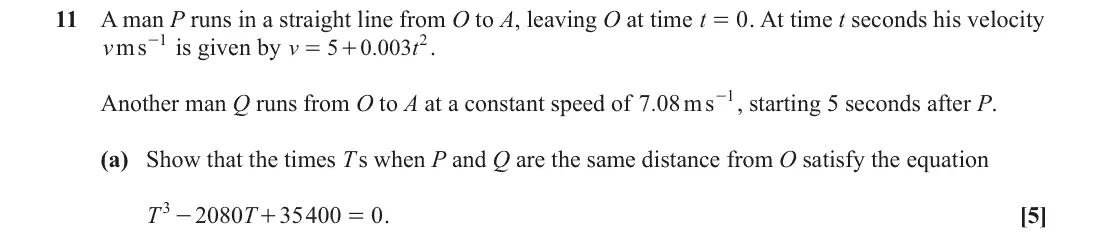
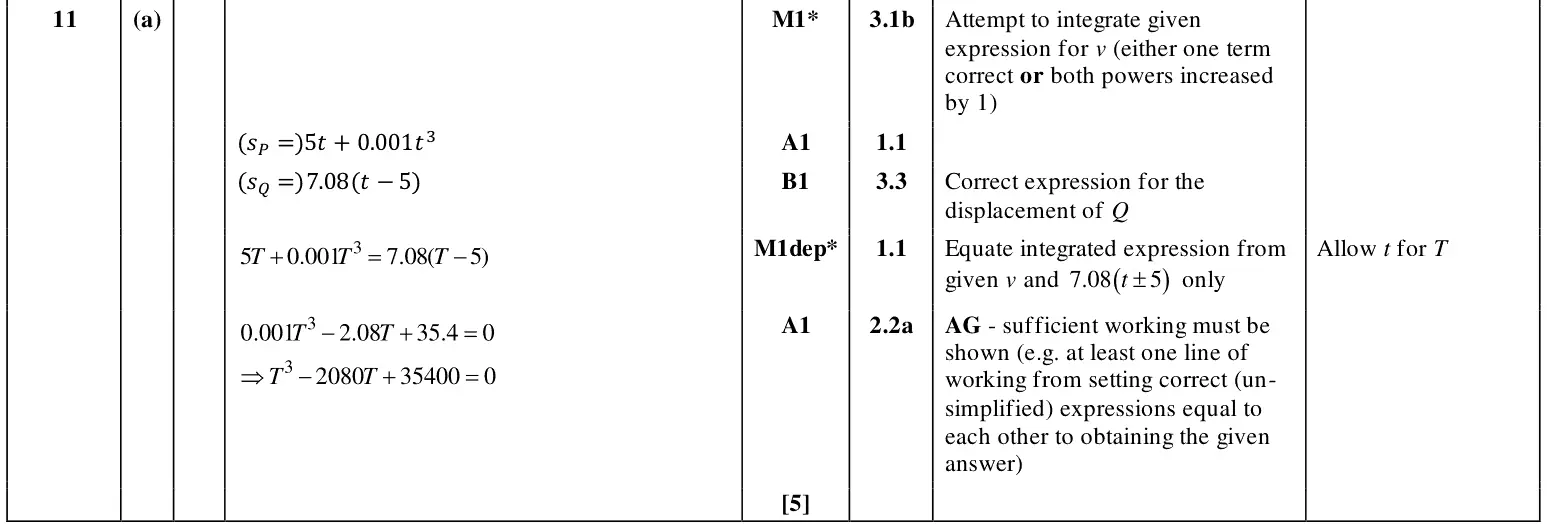
The need to integrate to find sp was appreciated by many and often these were the only 2 marks given. A few tried sp = vt. For Q, sQ = 7.08t was more common than the correct result. Because the final answer was given, examiners looked for a convincing argument leading to it; a sudden appearance of 35.4 in the working that looked as if it had been worked back from the given answer could not be given marks. For the final mark we wanted to see exactly what was given on the question paper (correctly obtained), so T rather than t and ‘= 0’.
Key points and common errors
integrate v: s_P = 5t + 0.001t³
s_Q = 7.08(t − 5)
equate and multiply by 1000 to reach the given cubic with T and '= 0'
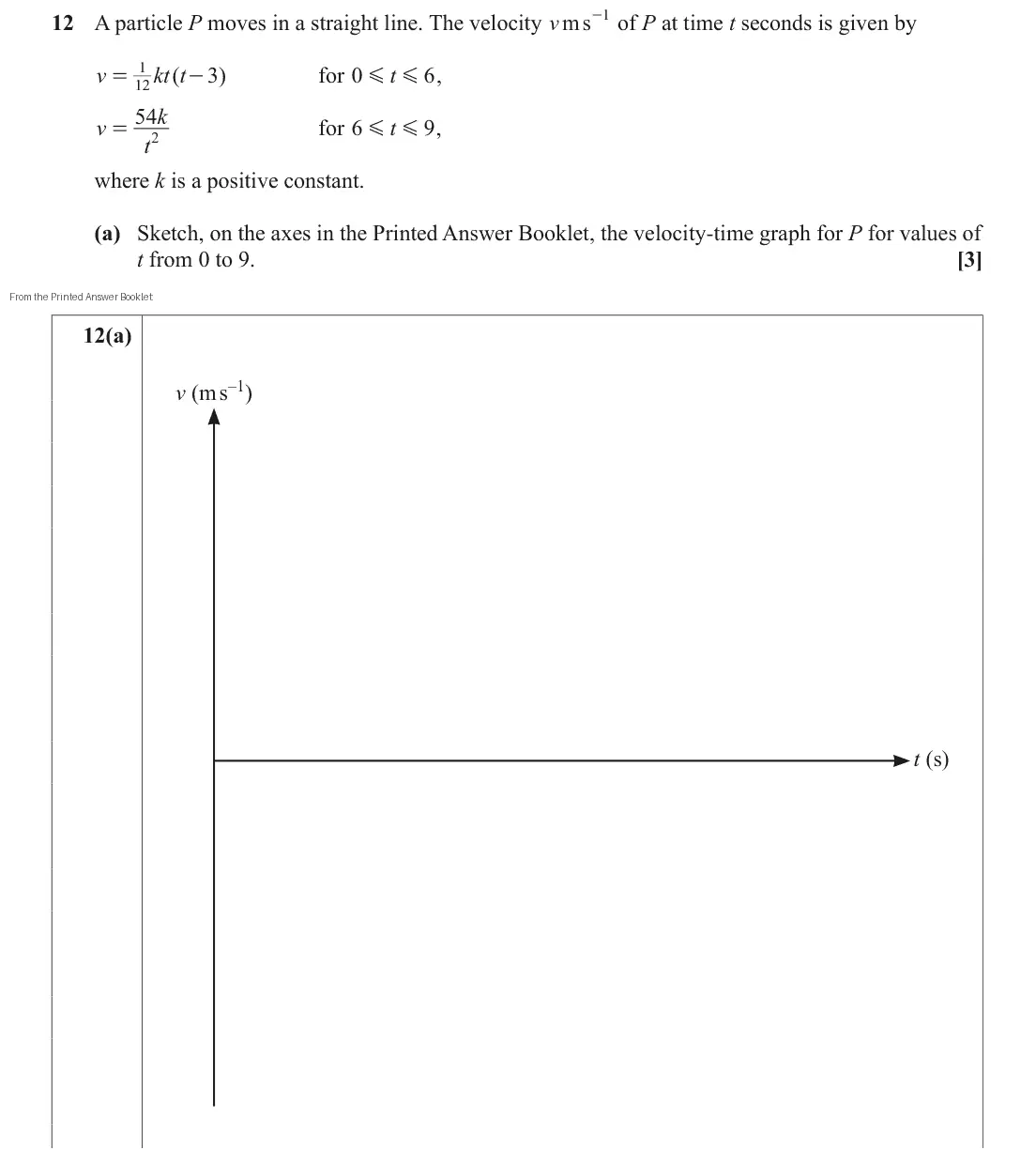
June 2024 · Paper 3 · Q12(c)6 marksHard
Show the start of this question
Mark scheme for this part
Examiner's comment
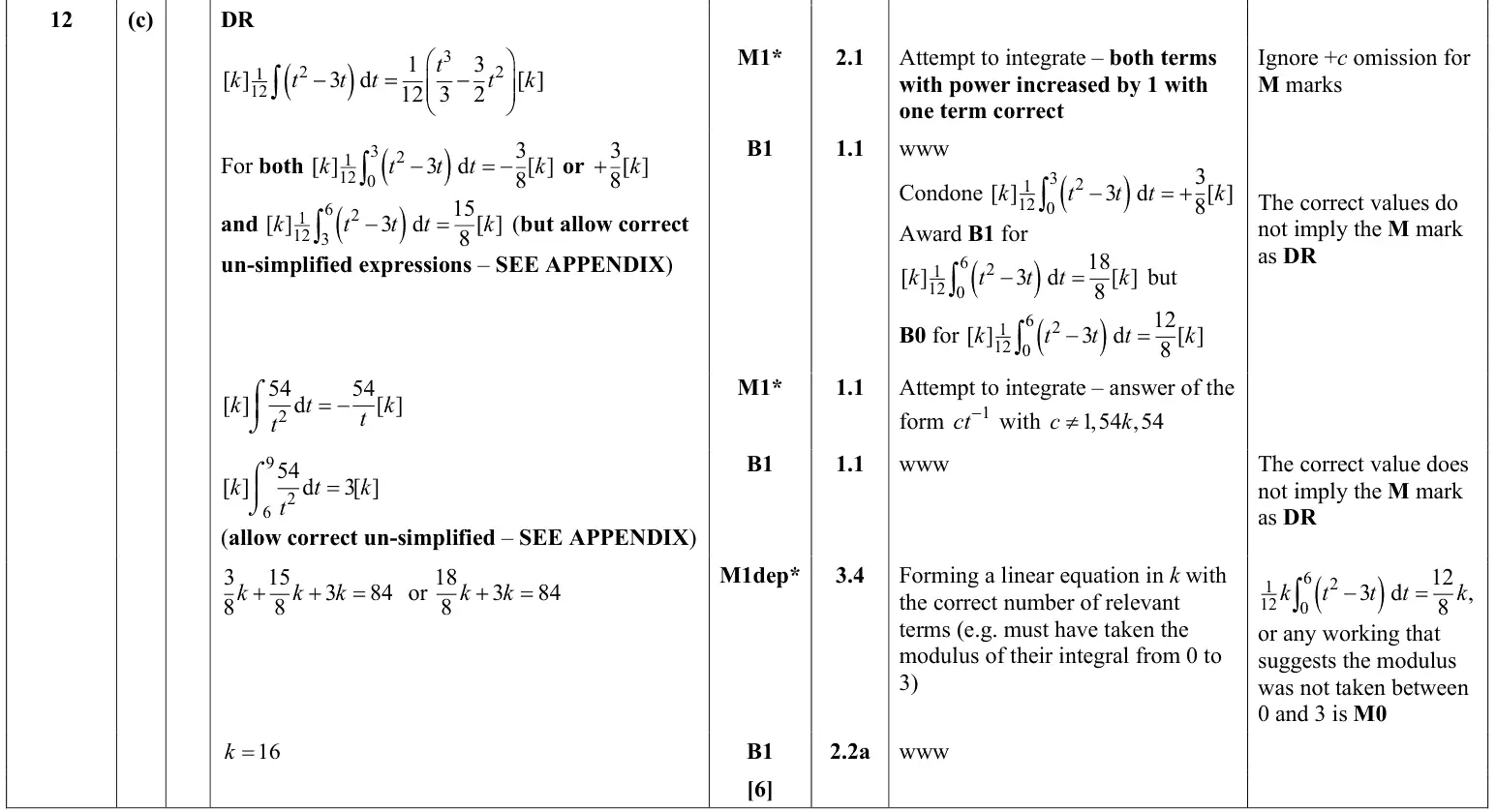
Many of the candidates who had drawn a correct velocity-time graph in part (a) did not realise the significance of the fact that part of this graph (between the times of 0 and 3) was below the 𝑡-axis and so therefore considered incorrect limits on their first integral i.e. ∫ . Some candidates seemed 12 𝑘𝑡(𝑡−3)d𝑡 to use the trapezium rule (or other non-calculus method) in this part. It was rare for candidates to set up the correct equation for 𝑘 as −∫ 12 𝑘𝑡(𝑡−3)d𝑡 12 𝑘𝑡(𝑡−3)d𝑡+ . + ∫ ∫ 𝑡2 d𝑡= 84 This candidate highlights the most common error seen by examiners in this part, which is considering the integral from 0 to 6 instead of considering the two integrals from 0 to 3 and from 3 to 6 separately. This response scored 3 of the 6 marks available.
Key points and common errors
distance: v < 0 for 0 < t < 3 so take the modulus: 3k/8 + 15k/8 + 3k = 84
k = 16
integrating 0 to 6 in one go gives displacement
June 2023 · AS Paper 2 · Q87 marksMedium
Mark scheme for this part
Examiner's comment
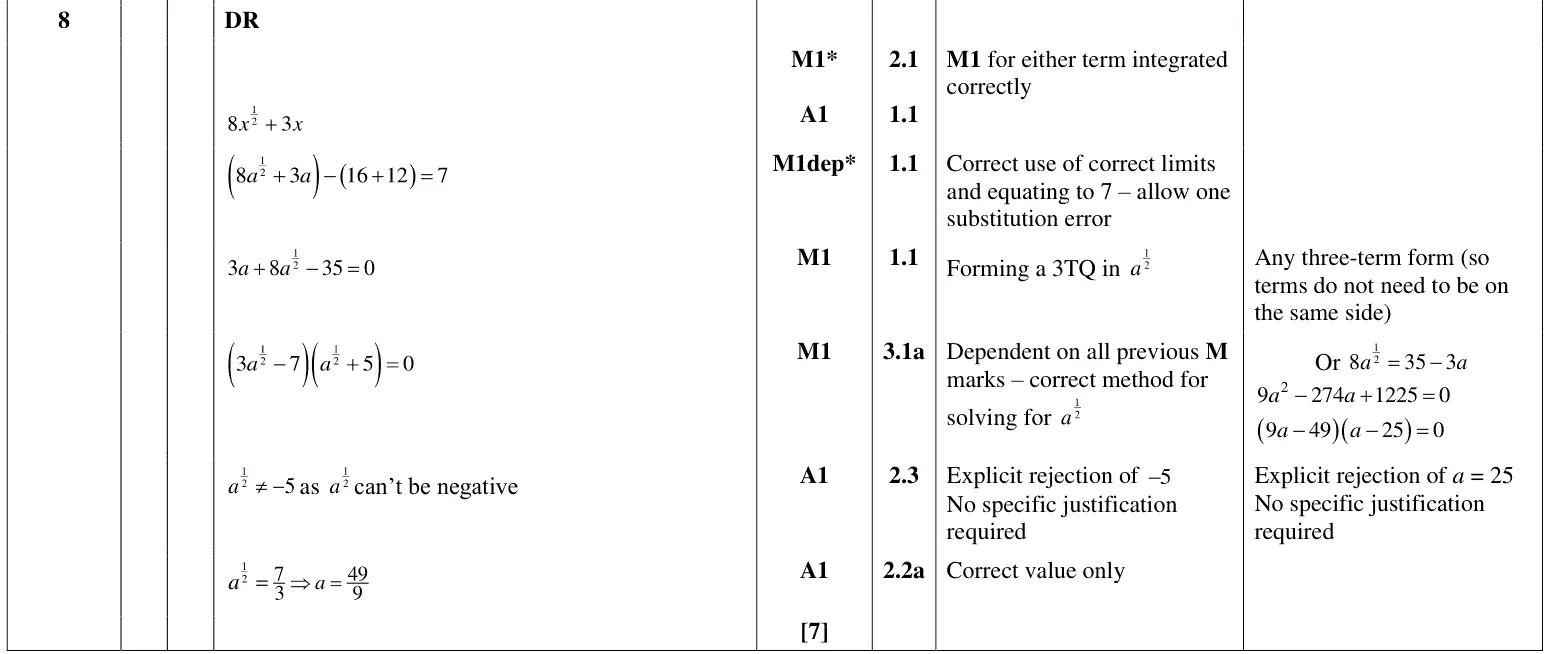
The majority of responses gained the first method mark, but there was some careless work with powers when dealing with 4x-½. Some candidates used 4x-1 or 4x½, which was costly. After integration, 2x½ + 3x spoiled some efforts. A few embarked on the question without integrating at all. The use of limits was generally good, with only the occasional candidate having the wrong order or adding terms. The majority of candidates that reached the ‘hidden’ quadratic did identify it, but as this is a DR question, we did want to see how this quadratic was solved; those who did it by calculator without showing working lost the last method mark (the ‘Assessment for learning’ comment above for Question 2 is relevant again here). We expected the final answer to be exact.
Key points and common errors
integrate to 8x^½ + 3x
(8a^½ + 3a) − 28 = 7
quadratic in a^½: (3a^½ − 7)(a^½ + 5) = 0
reject a^½ = −5 explicitly
a = 49/9
errors with 4x^(−½)
June 2023 · AS Paper 2 · Q10(a)3 marksEasy
Mark scheme for this part
Examiner's comment
This question was answered very well, with the integration generally correct. A few candidates omitted ‘+ c’. Using v = (4t – 9)t was given M0.
Key points and common errors
v = ∫(4t − 9) dt = 2t² − 9t + c
v = 2 at t = 1 gives c = 9
v = (4t − 9)t gains nothing
June 2023 · Paper 1 · Q3(b)3 marksEasy
Show the start of this question
Mark scheme for this part
Examiner's comment
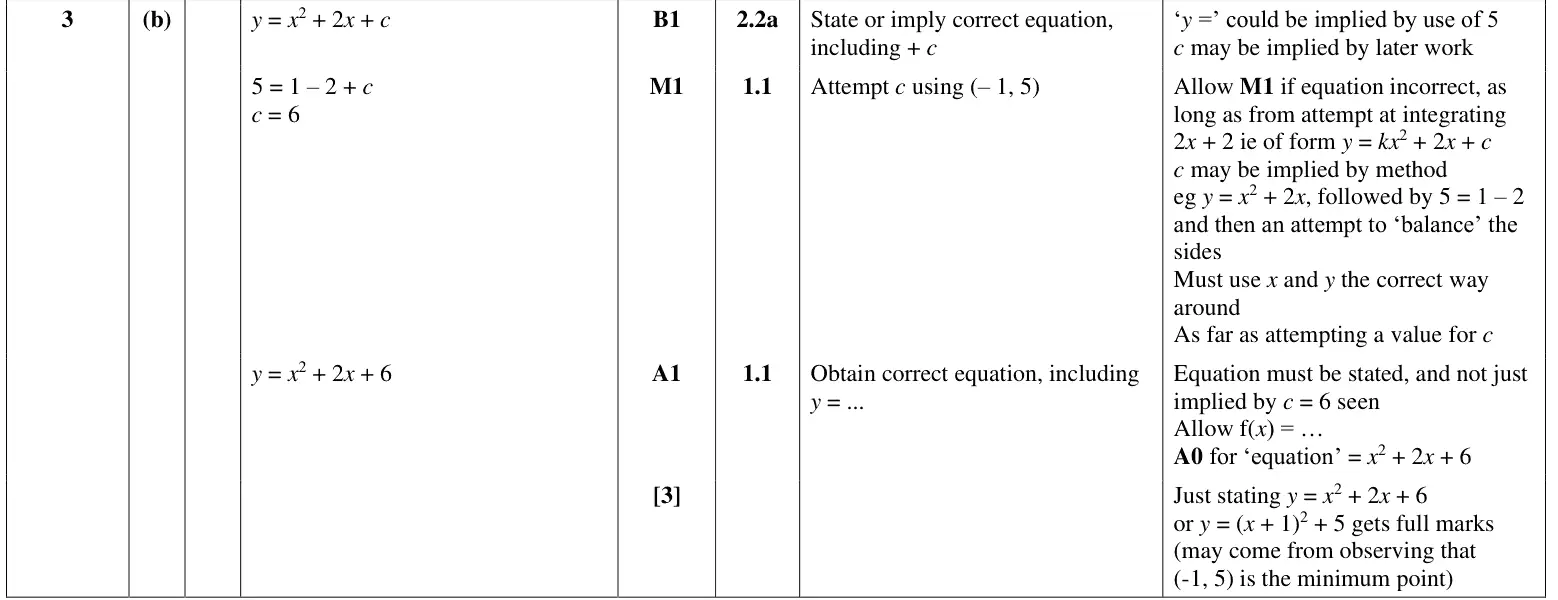
This part of the question was very well answered with the majority of candidates gaining full credit, either from noticing the link with part (a) or by starting the question anew.
Key points and common errors
y = x² + 2x + c
c = 6 from (−1, 5)
equation must be stated with y =
June 2023 · Paper 3 · Q12(d)6 marksMedium
Show the start of this question
Mark scheme for this part
Examiner's comment
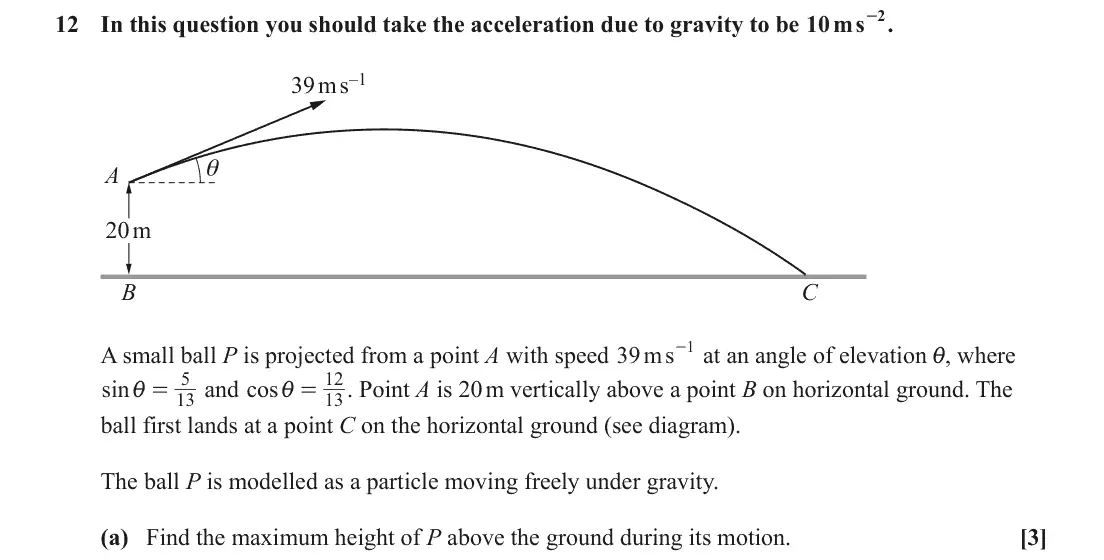
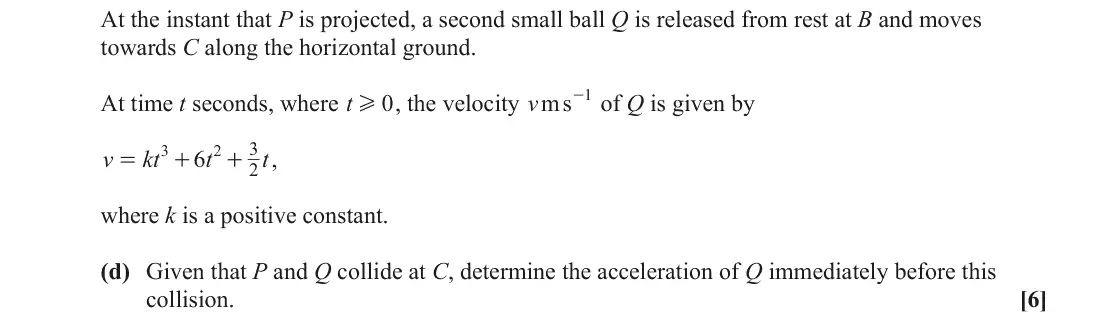
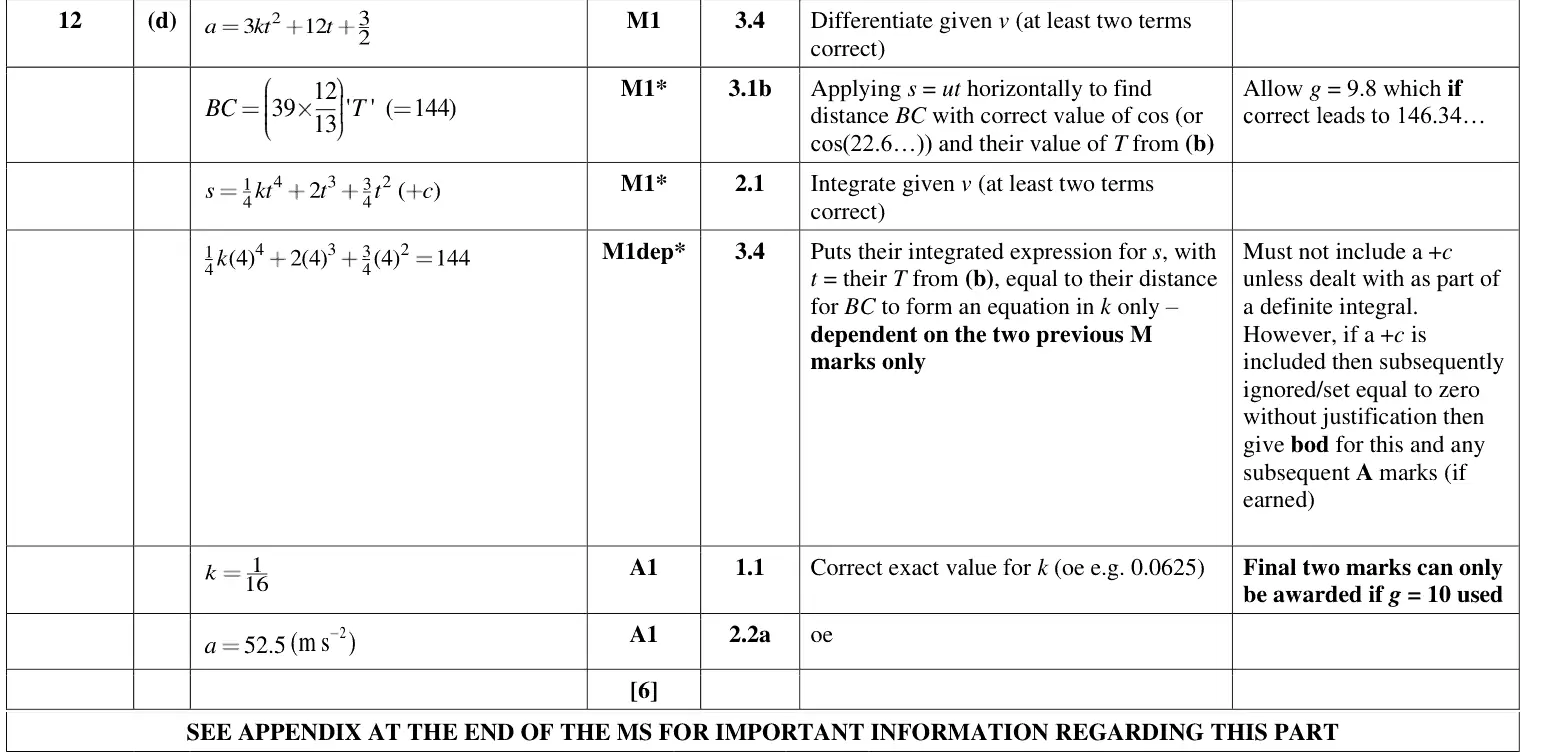
The responses to this part were mixed with some candidates making little progress apart from differentiating the given expression for v to obtain an expression for a in terms of t. Those candidates who realised that they had to use the value of T found in part (b) to find the horizontal distance BC and then integrate to set up an equation to find the value of k were usually successful. Although not penalised in the first two parts of the question, using an incorrect value of g meant that neither of the 2 accuracy marks (for finding k and then the required acceleration) could be awarded in this part. It was surprising how many candidates used equations for constant acceleration in this part to model the motion of Q.
Key points and common errors
BC = 39 × 12/13 × 4 = 144
integrate v: ¼kt⁴ + 2t³ + ¾t² = 144 at t = 4 gives k = 1/16
a = 3kt² + 12t + 3/2 = 52.5 m s⁻²
final marks need g = 10
June 2022 · AS Paper 1 · Q5(a)4 marksMedium
Mark scheme for this part
Examiner's comment
Most candidates recognised the need to integrate, although a few differentiated. Some omitted the arbitrary constant. Some found the correct polynomial but omitted “y = ”. A few candidates obtained the x 3 x correct integral, but then wrote − + 2 = 0 , and stated that this was the required equation of the 3 2 curve. An unusual, but interesting, incorrect method was as follows: When x = 6, d y = 18. The curve passes d x through (6, 20) hence the equation is y – 20 = 18(x − 6).
Key points and common errors
integrate: y = x³/3 − 3x²/2 + c
(6, 20) gives c = 2
include 'y ='
some differentiated or used a tangent line
June 2022 · AS Paper 1 · Q5(b)4 marksMedium
Show the start of this question
Mark scheme for this part
Examiner's comment
Many candidates did not carry out a second integration but substituted the limits into their answer to part (a). Some of those who used a correct method made an arithmetical error in obtaining the constant term. It is worth noting that this question required the ability to carry out a definite integral without the use of the relevant calculator function.
Key points and common errors
integrate the curve again: [x⁴/12 − x³/2 + 2x] from 1 to p = p⁴/12 − p³/2 + 2p − 19/12
many substituted limits into the answer to (a)
no calculator
June 2022 · Paper 2 · Q3(a)1 markMedium
Mark scheme for this part
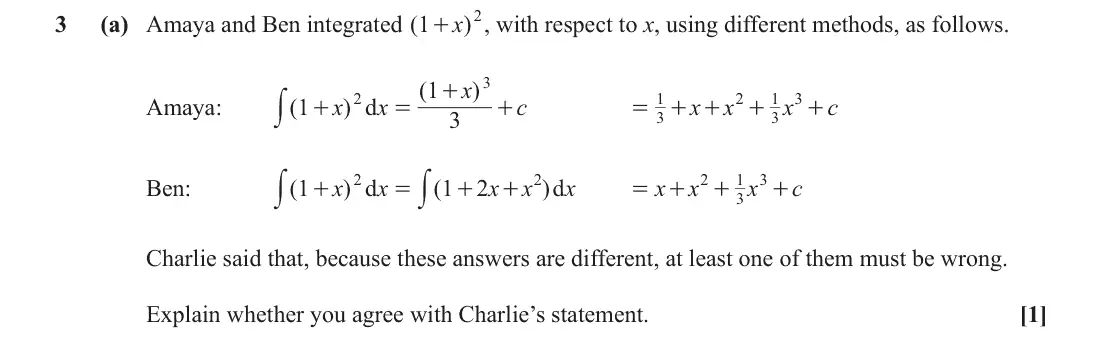
Examiner's comment
Many candidates saw the point and made reasonable comments about the arbitrary constant. Some wrote that both methods were correct, with no further explanation. These responses did not score the mark. Other candidates stated that Amaya’s (or Ben’s) method was incorrect.
Key points and common errors
disagree: the answers differ only by a constant (1/3 absorbed into c)
'both correct' with no reason gains nothing
June 2022 · Paper 2 · Q3(b)(i)3 marksEasy
Mark scheme for this part
Examiner's comment
This question was answered well by many candidates. Some correctly obtained 1 1 , but either −+ 2 1 a omitted the simplification (presumably not having read the question carefully) or made an algebraic error when attempting the simplification. A small number of candidates substituted the limits the wrong way round. Others substituted the limits, but then added instead of subtracting. Many candidates gave incorrect answers involving either (1 + a)−3 or ln(1 + x), and a few candidates attempted to use partial A B fractions (of the form + ) before integrating. 2 (1 + x ) (1 + x )
Key points and common errors
∫(1 + x)⁻² dx = −(1 + x)⁻¹
1/2 − 1/(1 + a) = (a − 1)/(2(a + 1)) as a single fraction
limits order
ln(1 + x) wrong
June 2022 · Paper 2 · Q87 marksHard
Mark scheme for this part
Examiner's comment
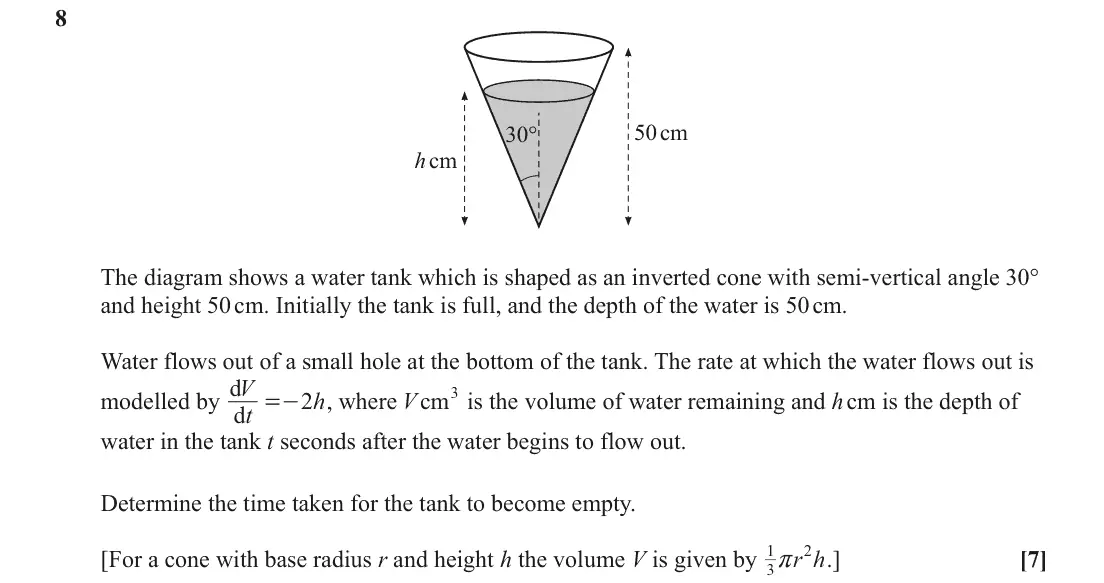
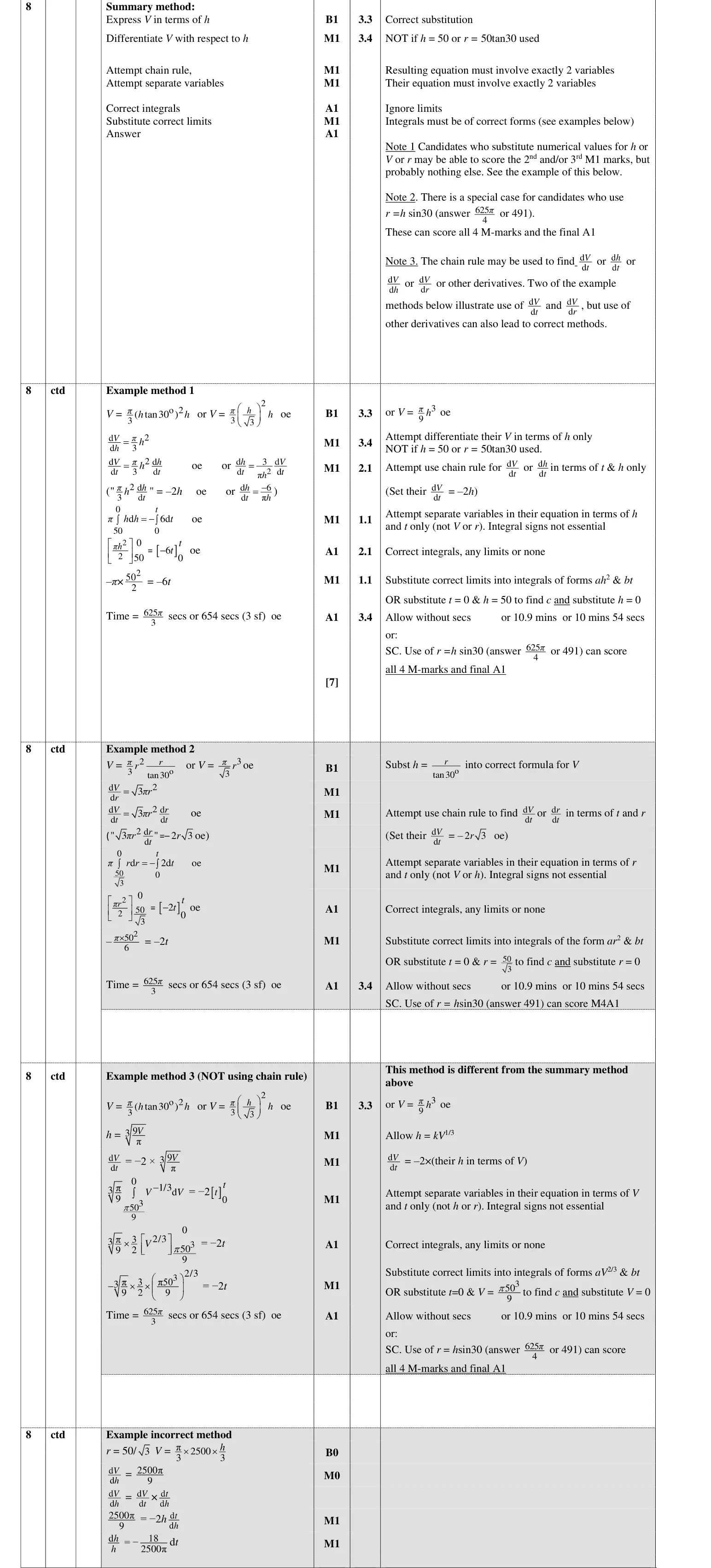
This differential equation question is of a fairly standard type, found in many text books. So one might reasonably expect candidates to be familiar with questions of this type. Despite this, responses were, on the whole, disappointing. In fact, about half the candidates scored 0 marks on this question. However, there were also a good number of excellent solutions. A few candidates thought that r = hsin 30°, but gave an otherwise completely correct solution. These candidates scored 5 marks out of 7. The main difficulty faced by candidates was that there were more than two variables involved (V, h, t and r). Most candidates obtained an equation in three variables, but then attempted to differentiate or integrate, treating one of the variables as a constant. For example: d V d V 1 2 1 3 πr2h ⇒ V = d r = 3 πrh (or d h = 3 πr2). d V h = −2t ⇒ dV = −2tdh ⇒ V = −2th. d Some candidates avoided this trap by using a numerical value for one of the variables, e.g. h = 50 or 50 3 3 r = , thus rendering their equation incorrect. Some candidates appreciated the need to use the chain rule but, while doing so, made one of the above d V d V d t d V d t 1 1 3 πr2 ⇒ h ⇒ d h = d t × d h , but d h = 3 πr2 = (−2t) × d errors. Thus a typical solution was as follows. 2 2 50 3 50 3 π d t 1 ∫ d h 2500 3 3 3 3 π = −2t d h ⇒ = −2tdt ⇒ 9 h = −2t + c. Then use h = 50 when t = 0 to find c and finally substitute h = 0 to find t. Finally, some candidates used a different, correct method that did not require the use of the chain rule. It did, however, involve some rather awkward substitution of a limit. This method can be found on the published mark scheme, Question 8, Example method 3.
Key points and common errors
r = h tan30° so V = πh³/9
dV/dt = (dV/dh)(dh/dt) = −2h
separate variables
t = 625π/3 s ≈ 654 s
r = h sin30° is a common error
about half scored 0
June 2022 · Paper 3 · Q12(d)5 marksMedium
Show the start of this question
Mark scheme for this part
Examiner's comment
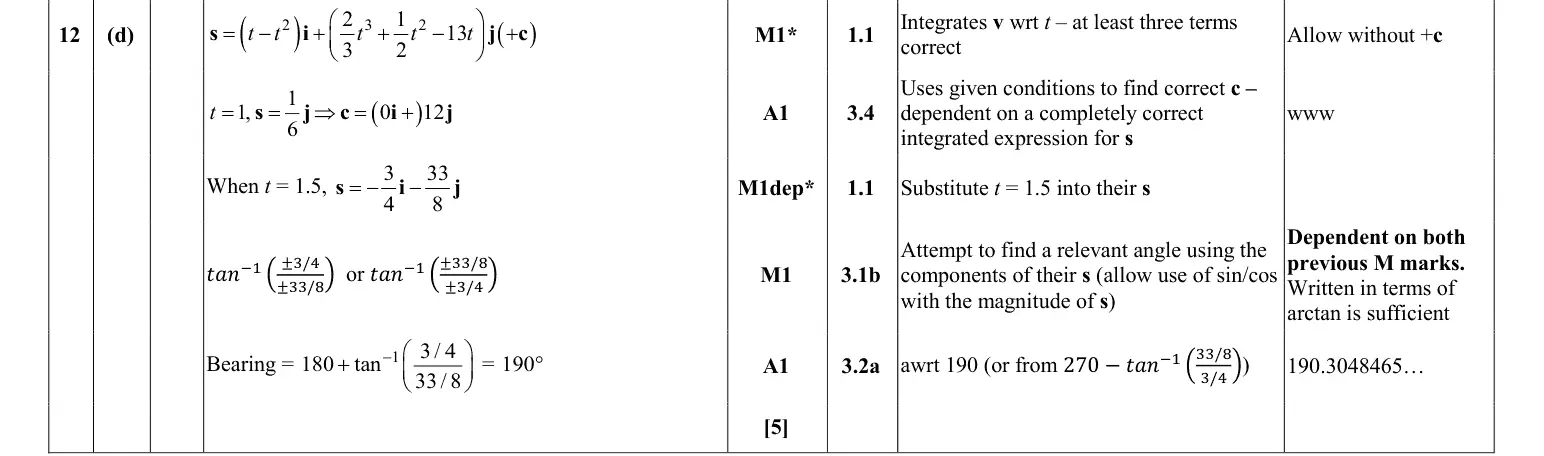
This question was much better answered than part (c) with many candidates correctly integrating the velocity vector to obtain the corresponding displacement vector. Some candidates did not include a vector constant of integration (and some just automatically assumed that it would be a zero vector). 3 33 However, many correctly found the displacement at time 1.5 as − − j and although many used the i 4 8 tan ratio to work out a suitable angle only some correctly found the required bearing.
Key points and common errors
integrate v with vector constant
c = 12j from s(1) = j/6
s(1.5) = −3/4 i − 33/8 j
bearing 190°
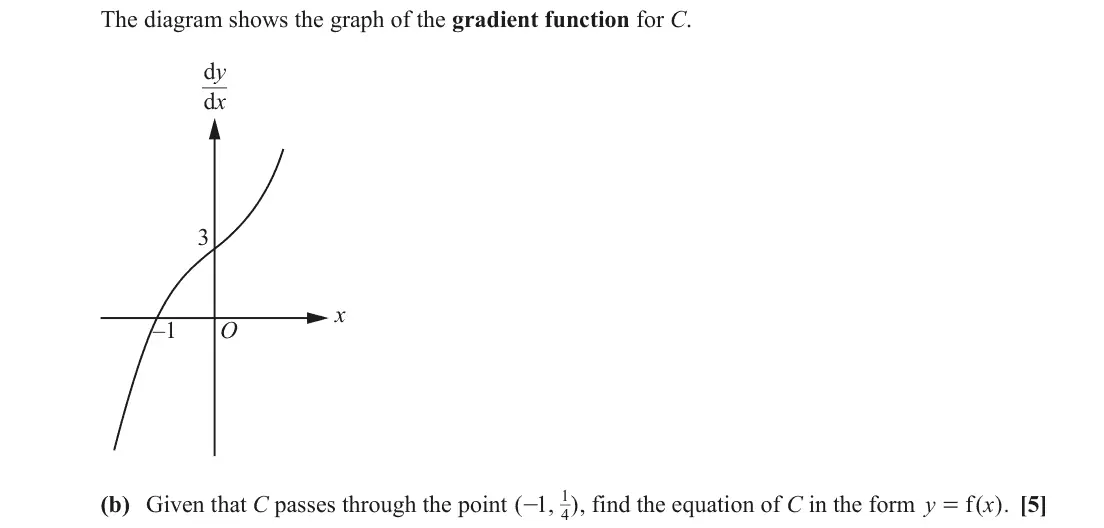
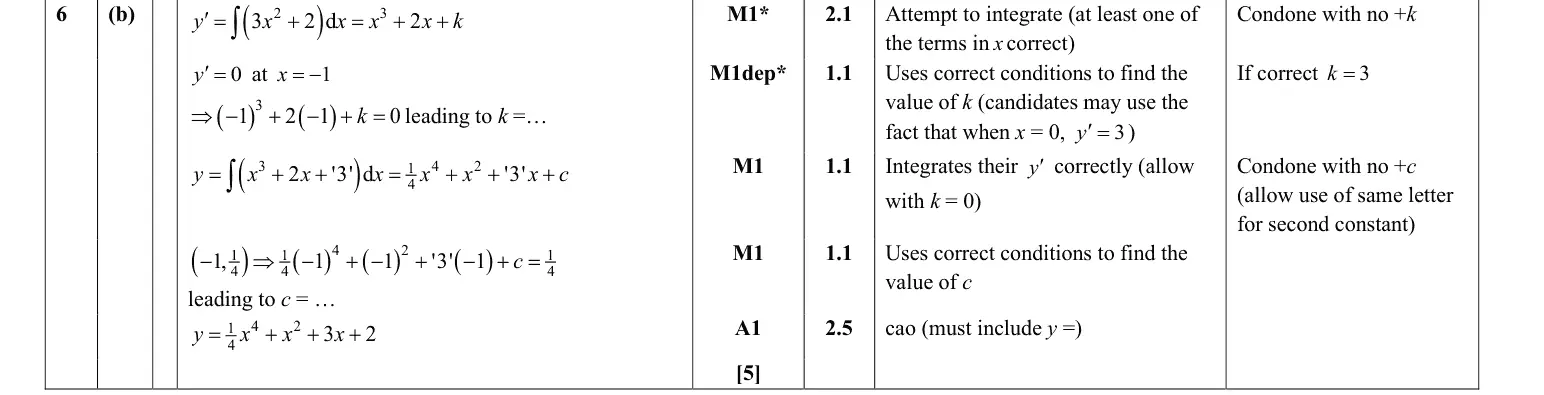
Autumn 2021 · AS Paper 2 · Q6(b)5 marksMedium
Show the start of this question
Mark scheme for this part
Key points and common errors
integrate: dy/dx = x³ + 2x + k
graph gives dy/dx = 0 at x = −1 (or 3 at x = 0) so k = 3
integrate again and use (−1, ¼): y = ¼x⁴ + x² + 3x + 2
include 'y ='
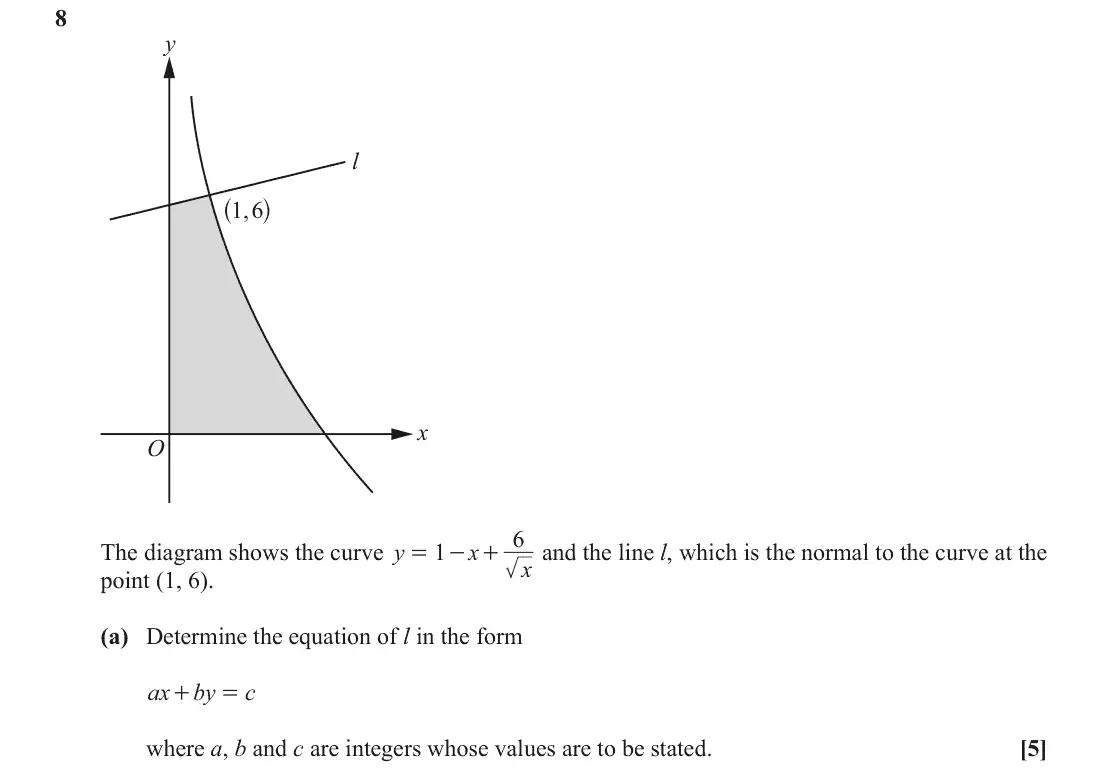
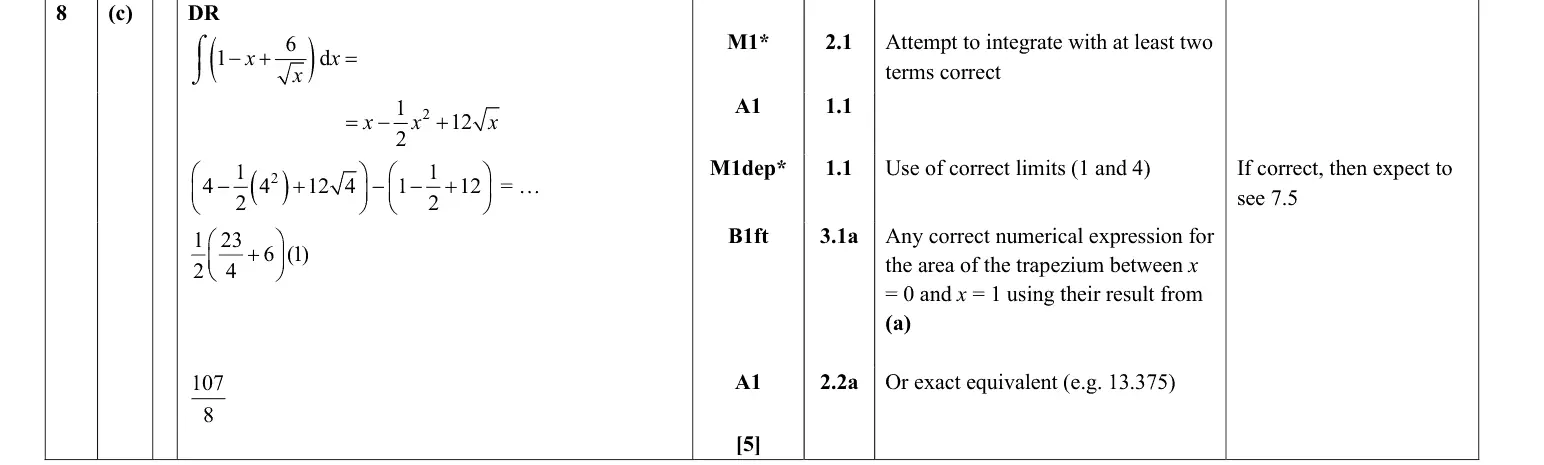
Autumn 2021 · AS Paper 2 · Q8(c)5 marksMedium
Show the start of this question
Mark scheme for this part
Key points and common errors
∫ from 1 to 4 of (1 − x + 6x^(−1/2)) dx = 7.5
trapezium from x = 0 to 1 under l: ½(23/4 + 6) = 47/8
total 107/8
Autumn 2021 · Paper 1 · Q12(a)(ii)2 marksMedium
Show the start of this question
Mark scheme for this part
Key points and common errors
θ = −3.5t + c
θ = 160 − 3.5t using (0, 160) and (10, 125)
Autumn 2021 · Paper 3 · Q13(b)6 marksMedium
Show the start of this question
Mark scheme for this part
Examiner's comment
(From the general report) Question 9 states constant acceleration so ‘suvat’ can be used, whereas Question 13 has a variable force term so calculus must be used.
Key points and common errors
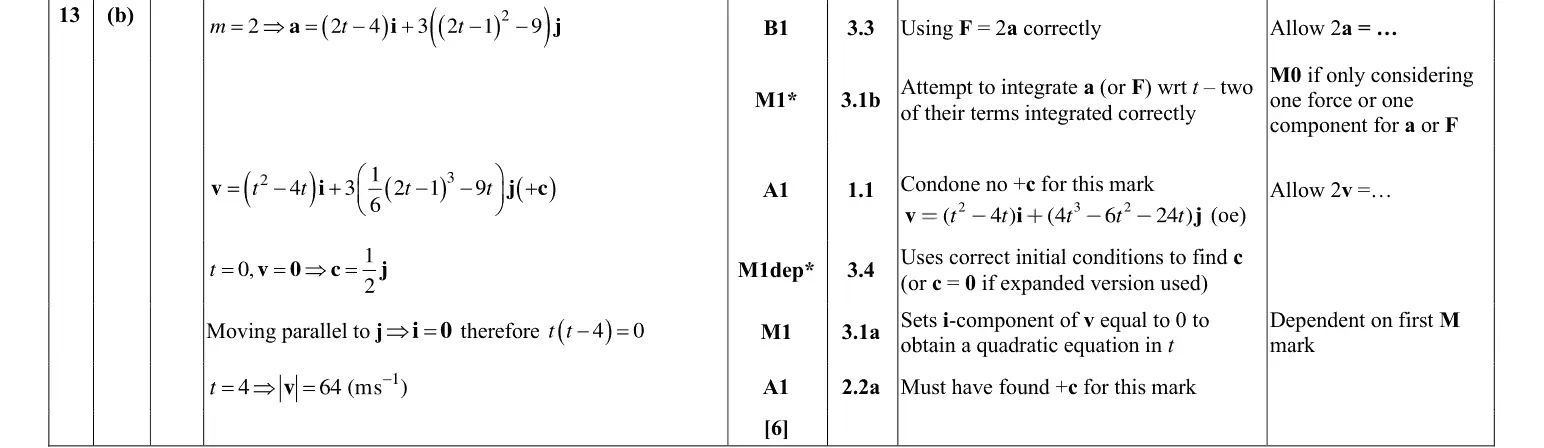
a = F/2
integrate for v with constant from v = 0 at t = 0
moving due north means i-component zero: t = 4
speed 64 m s⁻¹
variable force so calculus not suvat
Autumn 2021 · Paper 3 · Q13(c)5 marksMedium
Show the start of this question
Mark scheme for this part
Examiner's comment
(From the general report) Question 9 states constant acceleration so ‘suvat’ can be used, whereas Question 13 has a variable force term so calculus must be used.
Key points and common errors
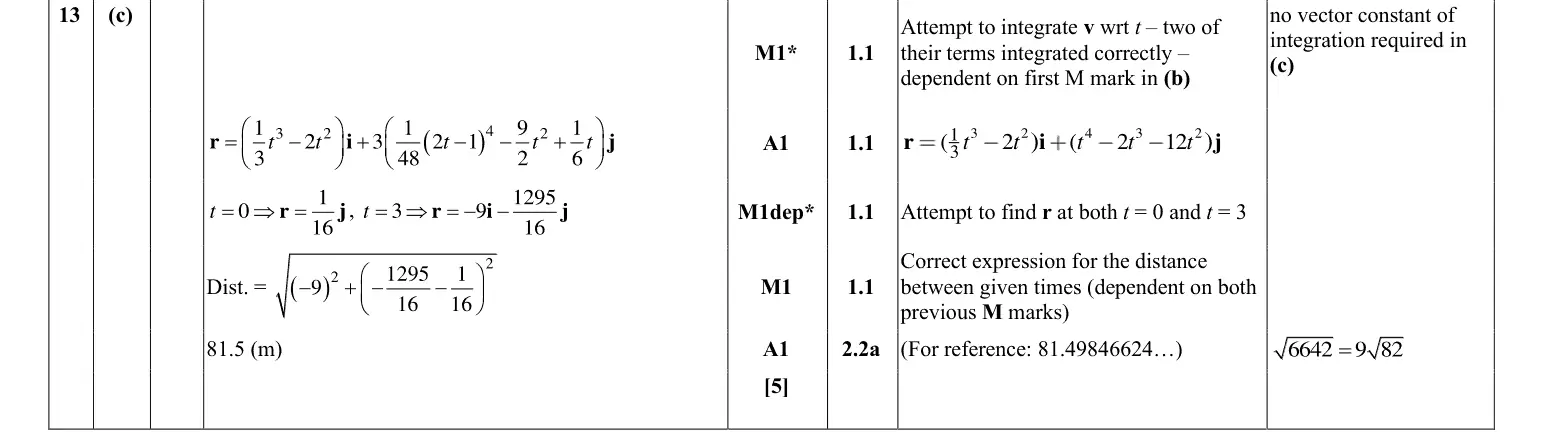
integrate v for r
evaluate at t = 0 and t = 3
distance √6642 = 81.5 m
Autumn 2020 · AS Paper 1 · Q1(b)3 marksMedium
Mark scheme for this part
Key points and common errors
2x³ + x⁻² + c
− 2/x³ integrates to + 1/x²
+ c needed
Autumn 2020 · Paper 2 · Q1(c)2 marksMedium
Mark scheme for this part
Examiner's comment
(From the general report) This is in contrast to Questions 1(c) and 3(a)(i) where the command word is “Find”.
Key points and common errors
integrate 6x − 5 then use (1, 3) to find c
y = 3x² − 5x + 5 including 'y ='
June 2019 · AS Paper 1 · Q1(c)3 marksEasy
Mark scheme for this part
Examiner's comment
Here again, many correct responses were seen. The most common error was the omission of "+ c". As with parts (a) and (b), some candidates made errors in the negative index. Some used incorrect notation, with either " "∫ or "dx", or both, appearing in the response.
Key points and common errors
3x²/2 + 5x⁻²/2 + c
+ c often omitted
negative index errors
keep ∫ and dx notation correct
June 2019 · AS Paper 2 · Q78 marksHard
Mark scheme for this part
Examiner's comment
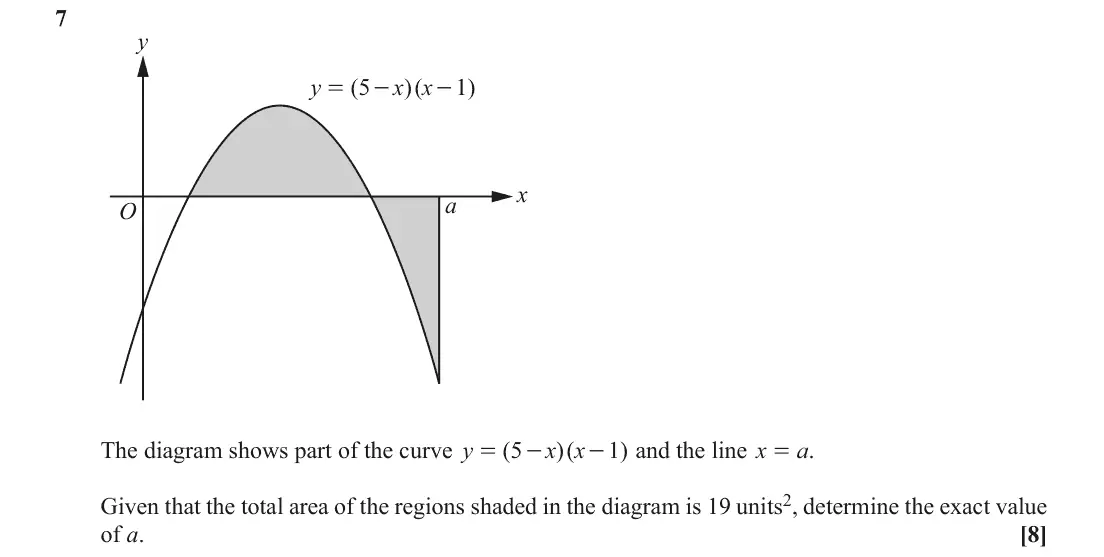
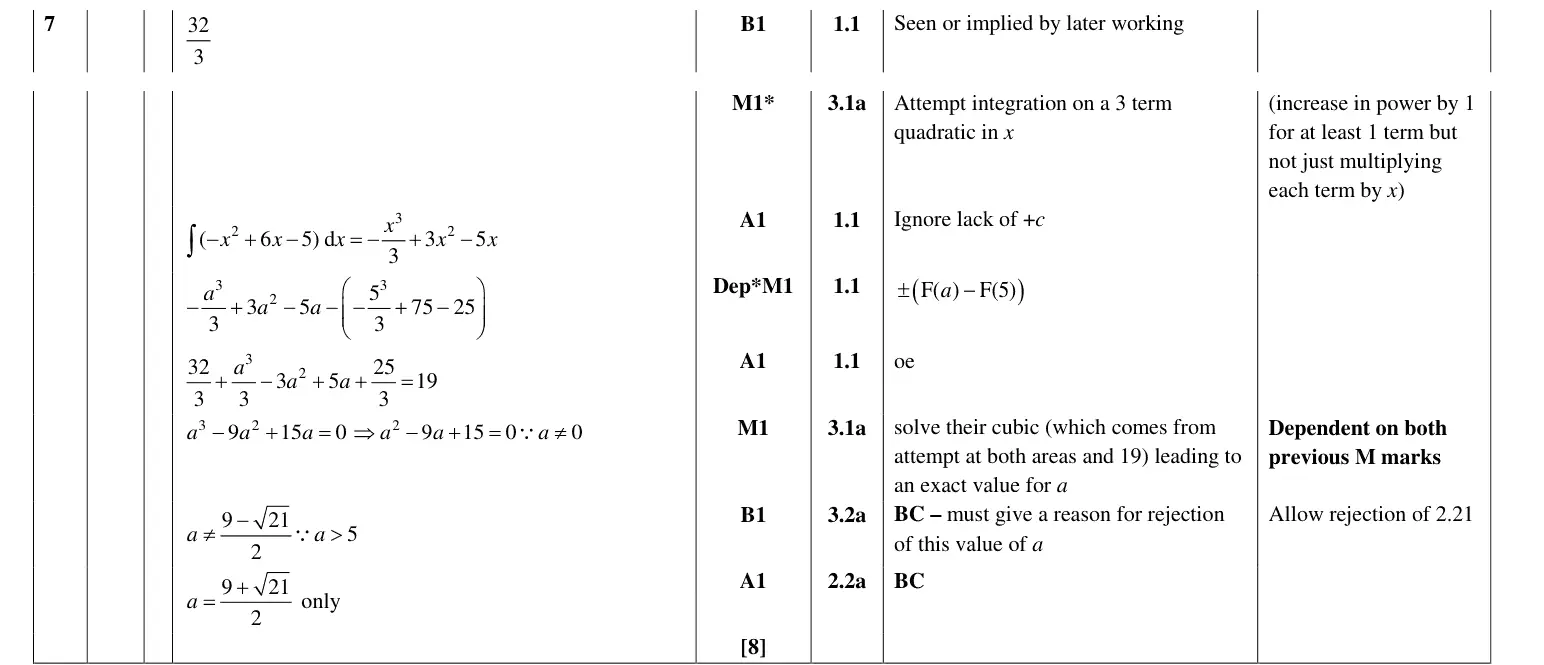
For a fully successful attempt, candidates needed to demonstrate an understanding that areas were both above and below the x-axis, with the sign consequences, and algebraic accuracy was vital. Although the integral between 1 and 5 could be done on the calculator, many did not do this and evaluated it incorrectly, often because ( 5 )( 1 ) was expanded incorrectly. Then the integral between 5 and a − x x − needed to be carefully done before putting everything together with the correct signs. Many cubics were wrong, so getting an exact solution proved impossible. Some obtained the correct cubic fortuitously from wrong working (which was penalised) but if all was fine by this stage we then wanted a clear explanation for the rejection of the negative root and an exact answer as requested.
Key points and common errors
area 1 to 5 is 32/3
region 5 to a is below the axis so take its magnitude
cubic a³ − 9a² + 15a = 0 gives a = (9 + √21)/2, reject (9 − √21)/2 since a > 5
expansion errors in (5 − x)(x − 1)
June 2019 · Paper 3 · Q610 marksHard
Mark scheme for this part
Examiner's comment
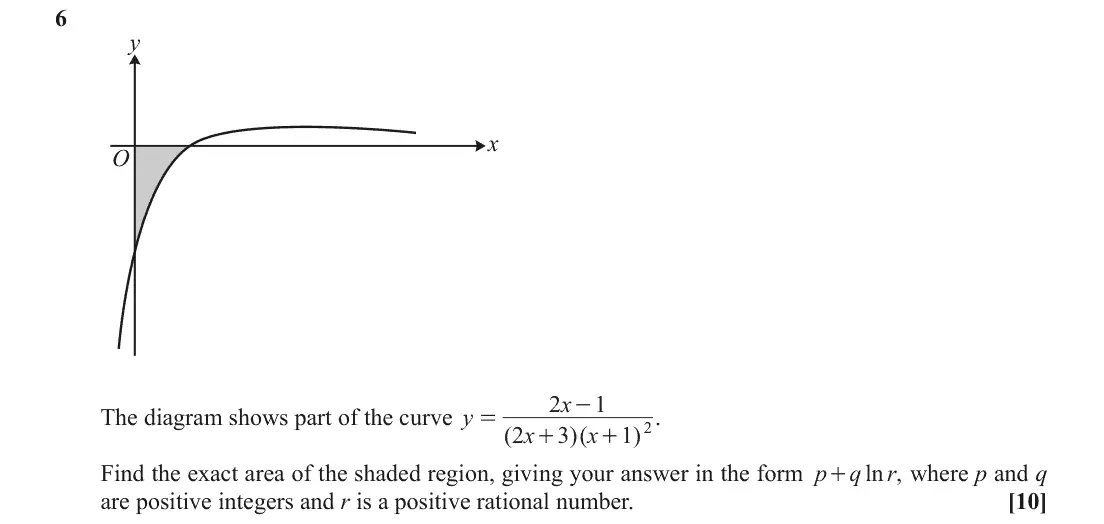
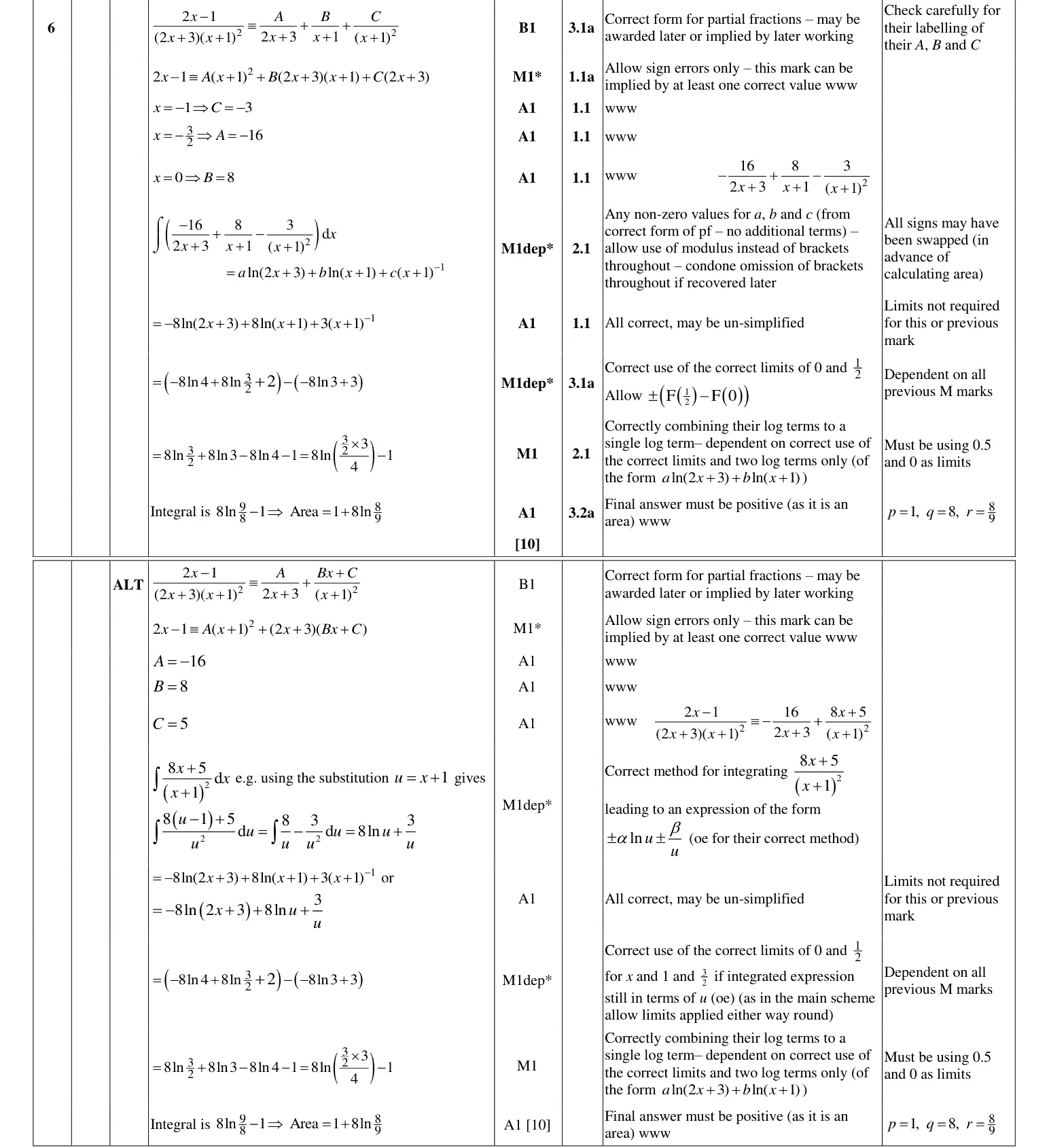
Many candidates made a good attempt at this question with most realising that to integrate 2 x − 1 A B C , partial fractions of the form + + were required, and many used a ( 2 3 )( 1 ) 2 x + 3 x + 1 ( 1 ) x + x + x + 16 8 3 correct method to obtain an answer of − + − (and so scored the first five marks in 2 x + 3 x + 1 ( ) x + 1 this part). It was the subsequent integration that most candidates found difficult with many believing that dx 1 all three integrated expressions involved the natural log function or that ∫ Of those = − . ( ) ( ) x + 1 x + 1 that integrated correctly and used the correct limits of 0.5 and 0 it was pleasing to note that many obtain a correct value for the integral as 8ln −. However, most candidates who had got this far did not 1 realise that this was not of the required form as stated in the question (and so therefore this was not an expression for the exact area of the shaded region). Only the most able of candidates realised that the area of the shaded region was in fact 1 + 8ln . This response scored the first nine marks. The candidate provided an almost perfect solution to the problem but due to the nature of their exact answer the candidate has not realised that their answer is negative (and therefore not the exact area of the shaded region). Even though the question explicitly said that the answer should be given in the form p + q r ln with p as a positive integer many candidates ( ) failed to realise that the required area was in fact 1 + 8ln .
Key points and common errors
A/(2x + 3) + B/(x + 1) + C/(x + 1)²: −16, 8, −3
∫3/(x + 1)² is not a log
limits 0 to ½
area 1 + 8ln(8/9) as a positive value
June 2019 · Paper 3 · Q10(b)4 marksEasy
Show the start of this question
Mark scheme for this part
Examiner's comment
This part was answered extremely well with many candidates correctly realising that they had to use integration to find an expression for the displacement in terms of t. However, many ignored the vector constant of integration that would arise from the corresponding indefinite integral and some incorrectly integrated q as 2 q instead of as qt.
Key points and common errors
integrate v and use s = 2i − 3j at t = 0: s = (−t³ − 3t²/2 + 2)i + (4t² + qt − 3)j
vector constant omitted
integrating q as q²
June 2018 · AS Paper 1 · Q4(ii)5 marksEasy
Mark scheme for this part
Examiner's comment
Many candidates answered this question correctly. A few candidates omitted "+ c". 3 1 − A few obtained x 2 correctly, but with an incorrect coefficient. Some thought that 4 x meant 4 x 2 1 32 or 4x–2 or x 4 . A few candidates "integrated" 3 to become 2 or "integrated" 4 x to become 2 ( x ) 4 . Some candidates integrated correctly and then attempted to find the value of c. 2
Key points and common errors
√x = x^½
3x − (8/3)x^(3/2) + c
omitted + c
wrong coefficient
June 2018 · AS Paper 2 · Q89 marksMedium
Mark scheme for this part
Examiner's comment
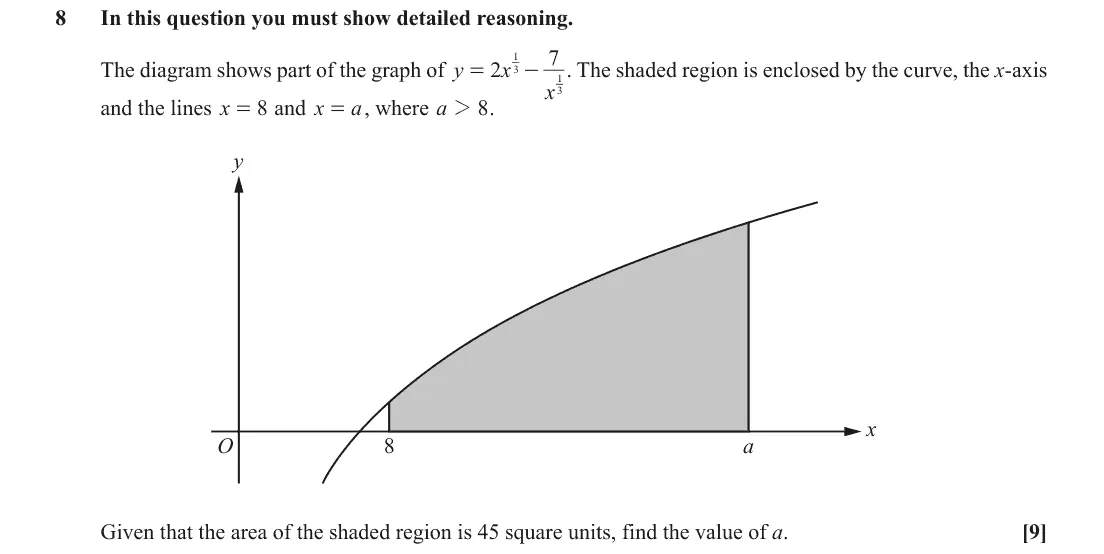
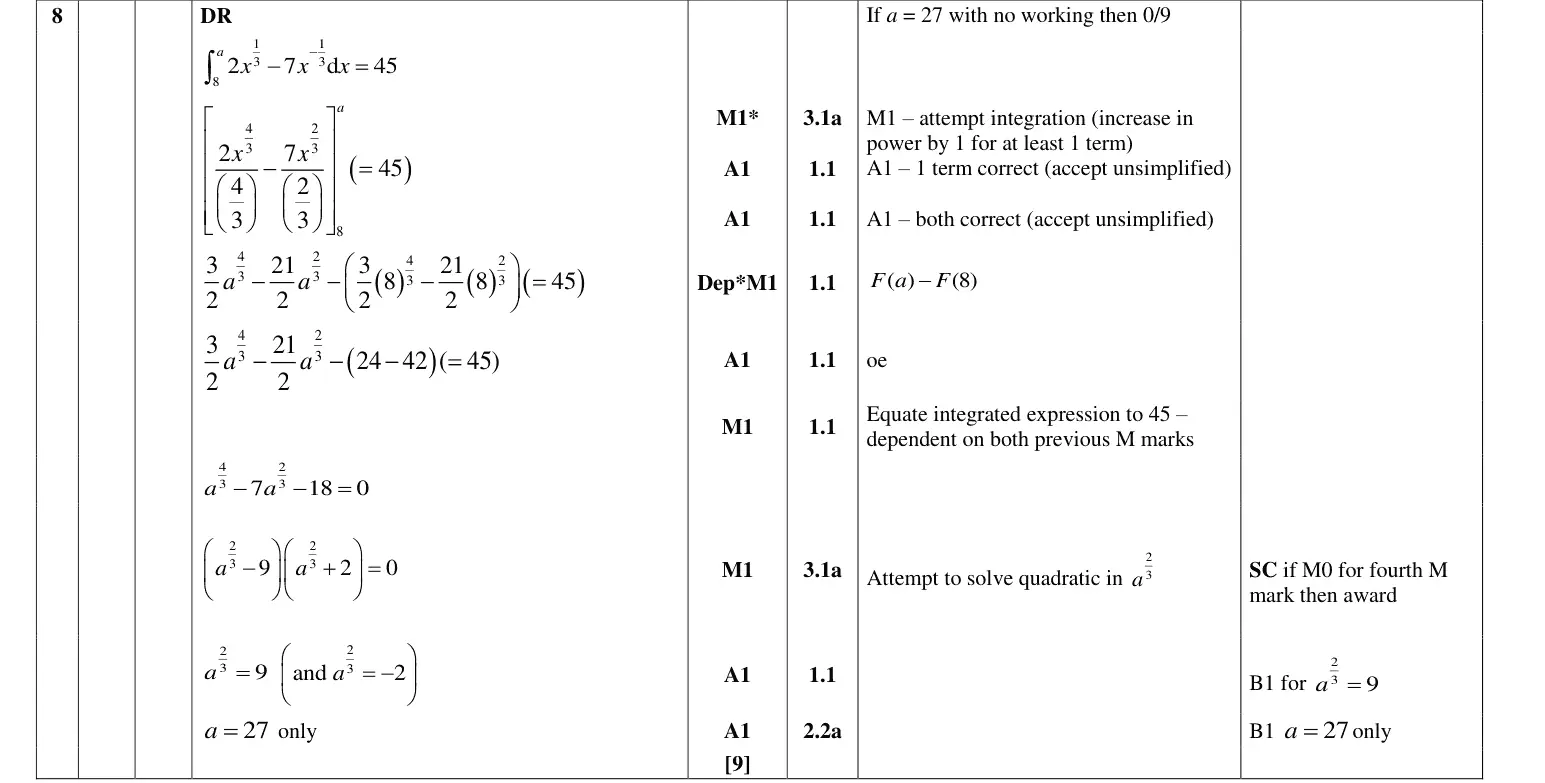
There were some encouraging attempts at this question, with the integration done accurately. Sign errors sometimes lead to the wrong quadratic, but many realised there was a ‘hidden’ quadratic. This question asked for detailed reasoning so we expected to see some working to show how the quadratic solutions were obtained, either factors or some working with the formula or completing the square. A few candidates found F(8) – F(a) when integrating from 8 to a and some integrated from a to 8 from the start. Those who obtained a = 27 from their calculator with no justification/detailed reasoning scored zero, although if they checked by showing the integral from 8 to 27 was equal to 45, then the first three marks were possible. There was a significant minority of candidates that attempted to differentiate rather than integrate to find the area under the curve. Section B
Key points and common errors
integrate to (3/2)x^(4/3) − (21/2)x^(2/3)
F(a) − F(8) = 45 gives a^(4/3) − 7a^(2/3) − 18 = 0, a quadratic in a^(2/3)
a^(2/3) = 9 so a = 27 only
calculator answer with no working scores 0
June 2018 · Paper 3 · Q79 marksMedium
Mark scheme for this part
Examiner's comment
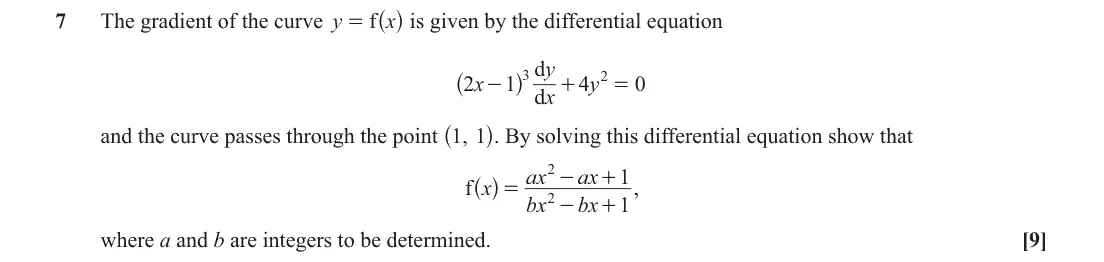
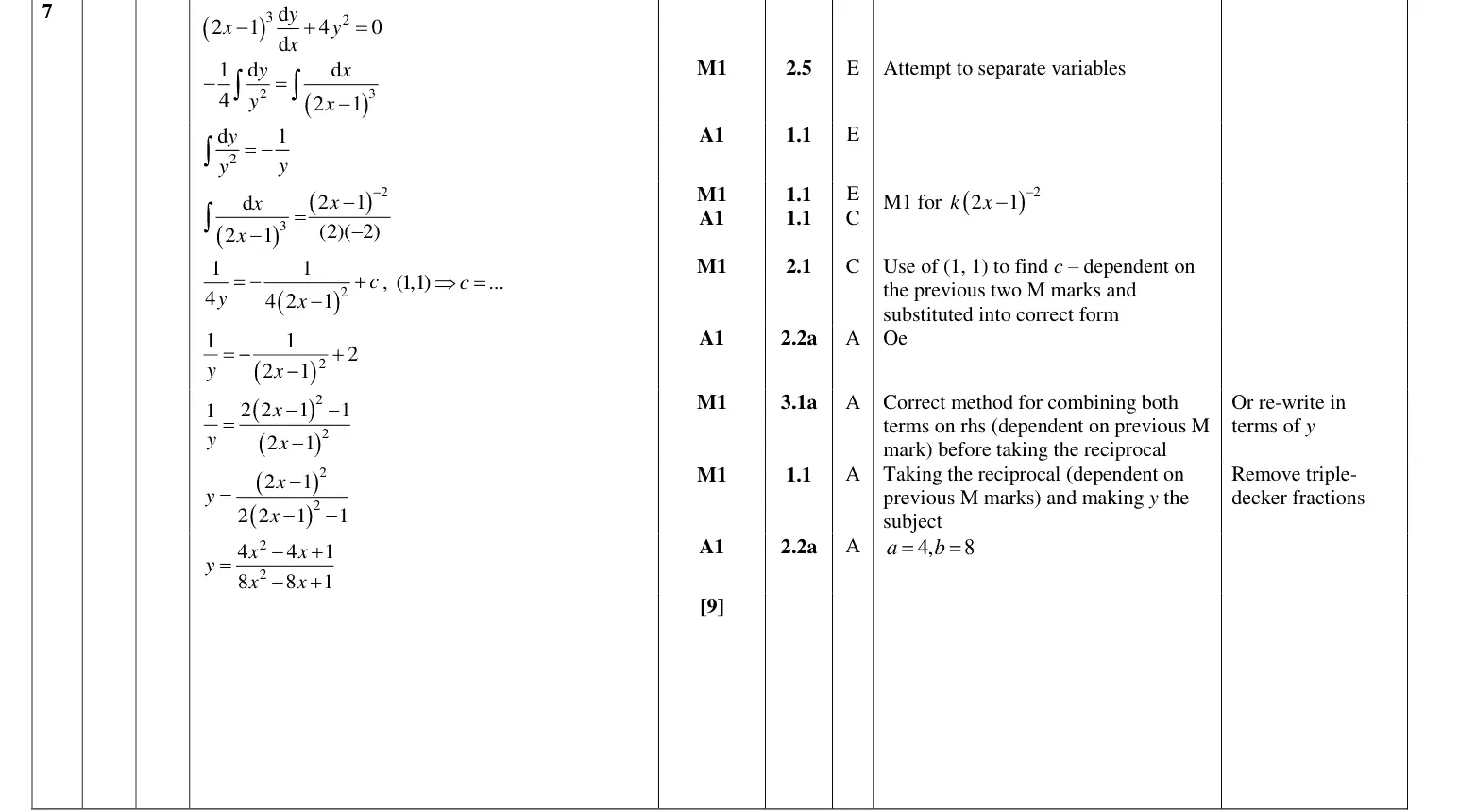
The responses to this final question in the pure section were mixed with examiners reporting a mixture of excellent responses followed by those that struggled with both the integration and the resulting algebraic manipulation required to obtain the answer in the required form. While most correctly separated the 1 d y d x variables and wrote − ∫ = ∫ many candidates had issues with the placement of the fraction 4 y ( ) 2 x − 1 on the left-hand side with examiners reporting that frequently this became a 4 rather than remaining as a quarter. While many candidates correctly integrated and remembered to include an arbitrary constant many decided to re-arrange their equation before attempting to find this constant; candidates are advised that in the majority of situations it is probably wisest to work out the +c immediately. Of those 1 1 that obtained a correct particular solution to this differential equation, for example, = − + 2 y ( 2 x − 1 ) many did not know the correct method for obtaining the result for f(x) in the required form. Many candidates took the reciprocal of each term separately rather than combining all relevant fractions first before taking the reciprocal and then expanding the brackets.
Key points and common errors
separate: −¼∫y⁻² dy = ∫(2x − 1)⁻³ dx
1/(4y) = −1/(4(2x − 1)²) + c
(1, 1) gives c
combine into a single fraction then take the reciprocal: a = 4, b = 8
June 2018 · Paper 3 · Q11(ii)7 marksEasy
Show the start of this question
Mark scheme for this part
Examiner's comment
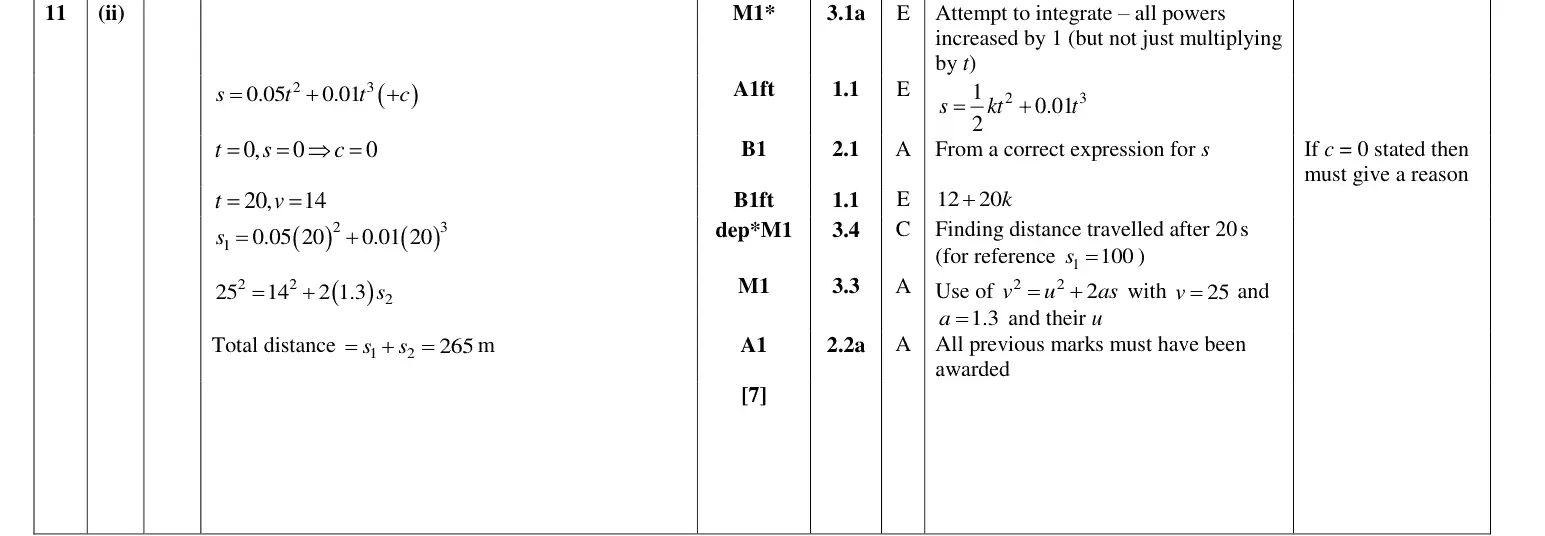
This part was answered extremely well with many candidates correctly finding the total distance that car had travelled when its speed had reached 25 ms-1. Many correctly realised that they had to use integration to find an expression for the displacement in terms of t which they could then use to find the distance travelled by the car in the first 20 seconds. However, many ignored the constant of integration that would arise from the corresponding indefinite integral; even though this constant was zero it is mathematically incorrect to simply ignore it (and for full marks candidates either had to consider this displacement expressed as a definite integral or explain why the constant was zero). Most candidates then used the SUVAT equations to work out the remaining distance travelled when the speed increased from 14 to 25 and correctly calculated the total distance as 265 m.
Key points and common errors
s = 0.05t² + 0.01t³ (c = 0) gives 100 m in the first 20 s
v = 14 at t = 20
25² = 14² + 2(1.3)s₂
total 265 m
Find an A-level maths tutor
Stuck on this? Book a trial session with an A-level maths tutor.