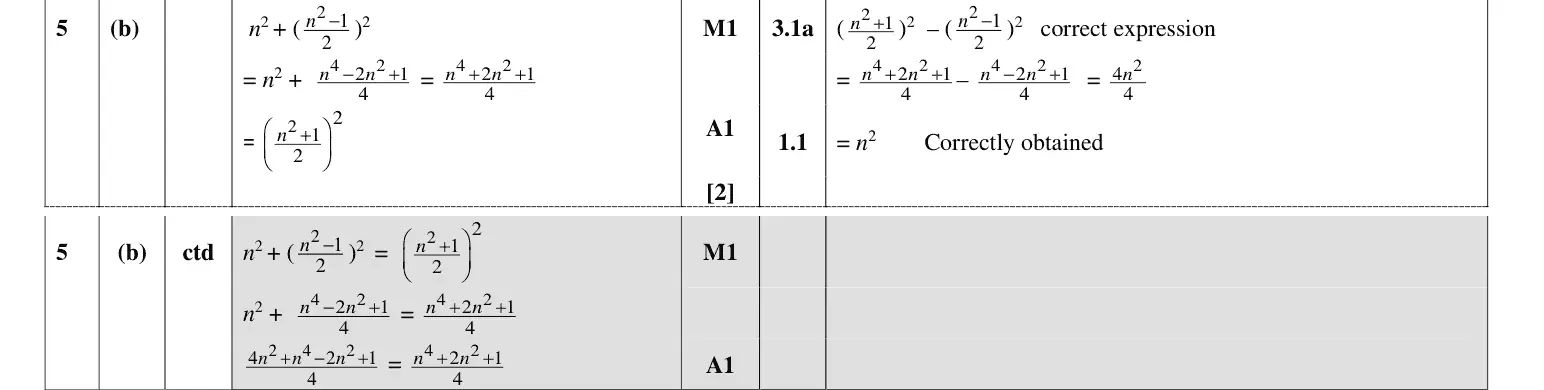
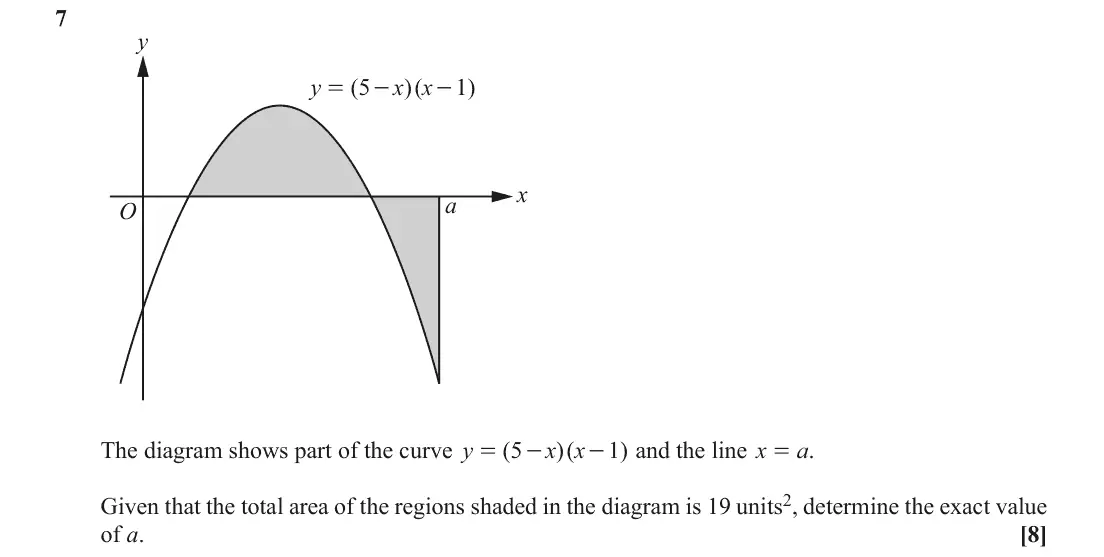
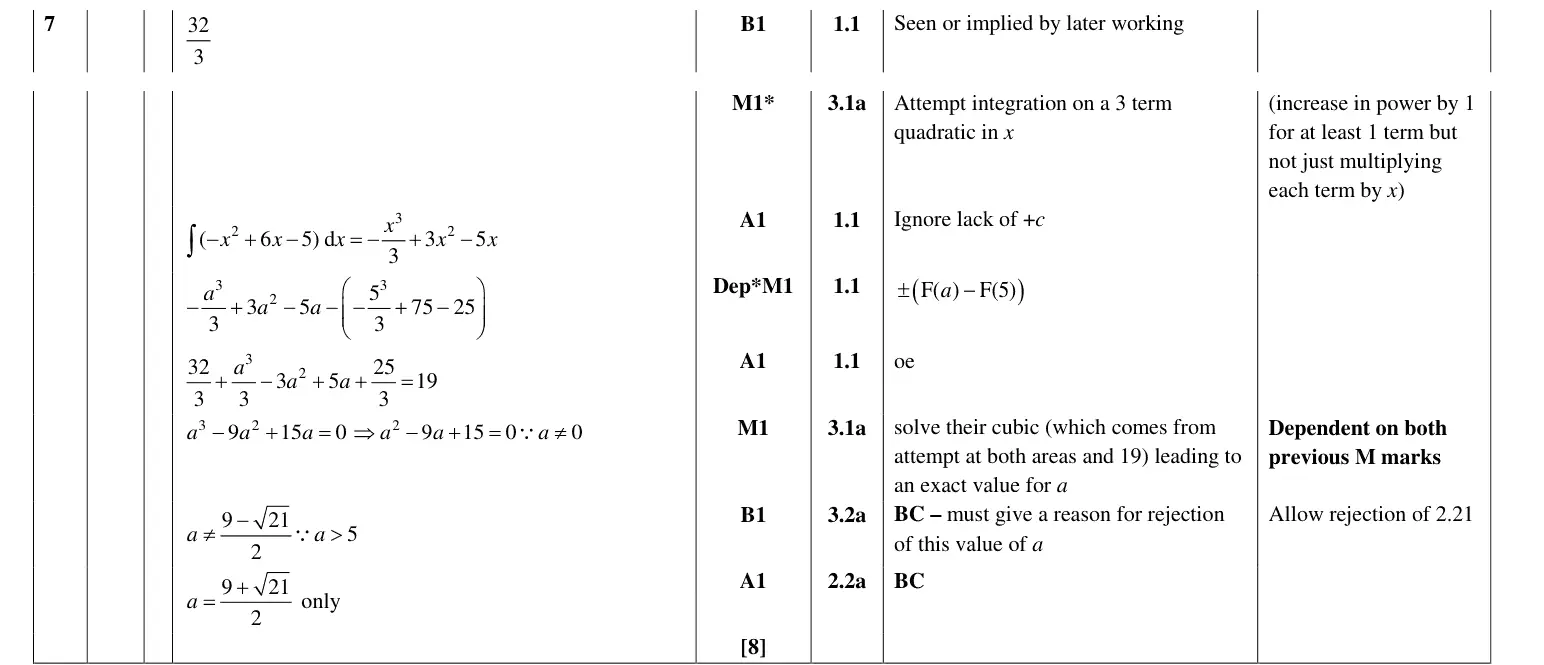
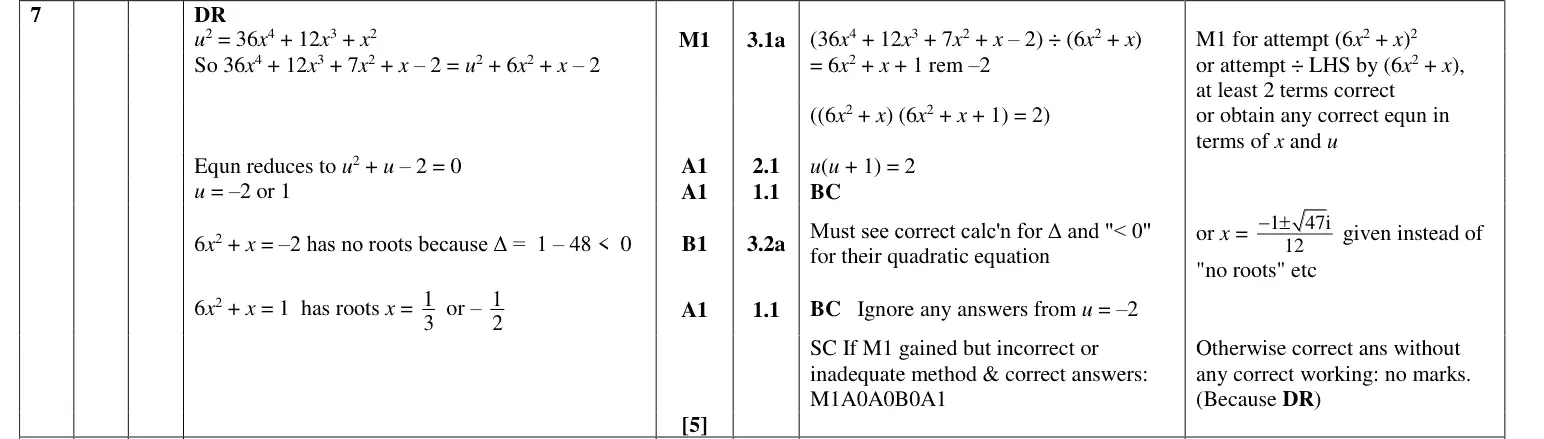
Includes expanding brackets, collecting like terms, factorising, simple algebraic division and use of the factor theorem. Learners should be familiar with the terms "quadratic", "cubic" and "parabola". Learners should be familiar with the factor theorem as: 1. f(a) = 0 ⇔ (x − a) is a factor of f(x); 2. f(b/a) = 0 ⇔ (ax − b) is a factor of f(x). They should be able to use the factor theorem to find a linear factor of a polynomial normally of degree ≤ 3. They may also be required to find factors of a polynomial, using any valid method, e.g. by inspection.
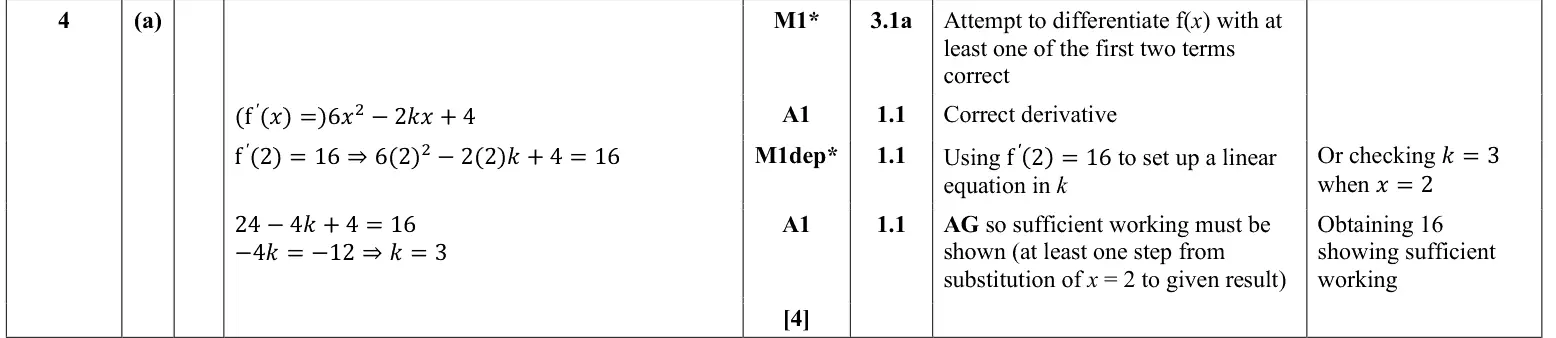
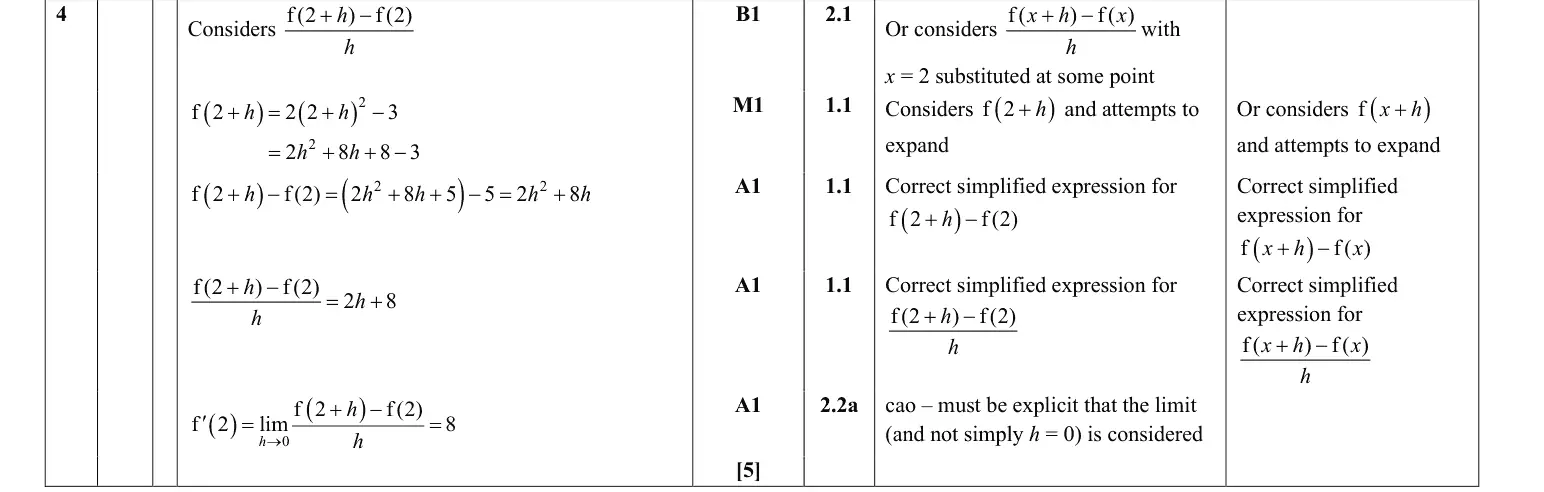
This question was very well done with many fully correct solutions seen. Once again it was a ‘Show that….’ question but it was rare not to see sufficient working. A common error in less successful responses was to use f(2) =16.
Key points and common errors
f′(x) = 6x² − 2kx + 4
f′(2) = 28 − 4k = 16 so k = 3
using f(2) = 16 is a common error
June 2025 · AS Paper 2 · Q4(b)2 marksEasy
Show the start of this question
Mark scheme for this part
Examiner's comment
The majority of candidates who knew what the factor theorem was calculated f(-½) to be zero, but we wanted a conclusion to be stated and some did not do this satisfactorily and just gained M1. Again the question said ‘….to show that…’ so candidates should expect to give more than just f(½) = 0. Some used long division, ignoring the instruction to use the factor theorem.
Key points and common errors
f(−½) = 0 so (2x + 1) is a factor
conclusion must be stated
long division ignores the instruction
June 2025 · AS Paper 2 · Q4(c)4 marksMedium
Show the start of this question
Mark scheme for this part
Examiner's comment
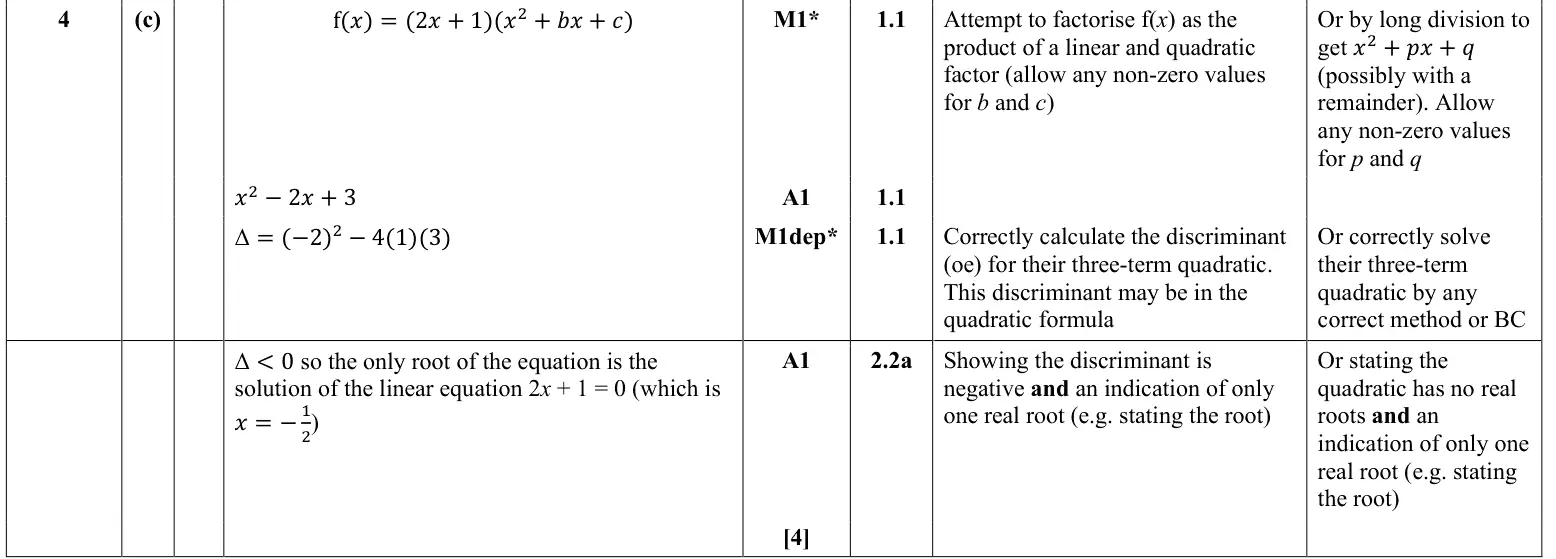
Most did long division here (generally accurately) to obtain the factor x2 – 2x + 3, with comparatively few factorising and the occasional comparing coefficients. The discriminant was well done, only a few writing -22 - 4(1)(3) = - 4 – 12. Once again a conclusion was required and those who referred to (2x + 1) as the one real root were penalised. This part says ‘Hence’ so examiners needed to see some use of the factor (2x + 1) in this part. A small number of candidates attempted this part with a graphical approach, just producing a sketch of the cubic from their calculator for example. This generally scored no marks. Also some tried to show that the cubic had no turning points and deduce one real root from this, but unless the factor (2x + 1) was involved in the argument somehow, credit was not awarded.
Key points and common errors
f(x) = (2x + 1)(x² − 2x + 3)
discriminant 4 − 12 < 0 so the quadratic has no real roots
only root x = −½
conclusion required
June 2025 · AS Paper 2 · Q55 marksHard
Mark scheme for this part
Examiner's comment
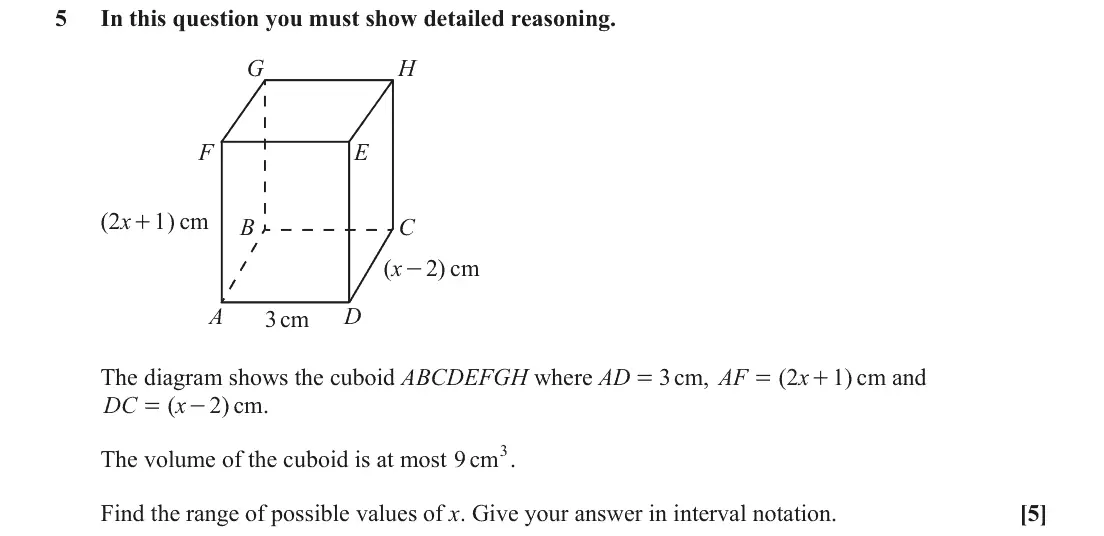
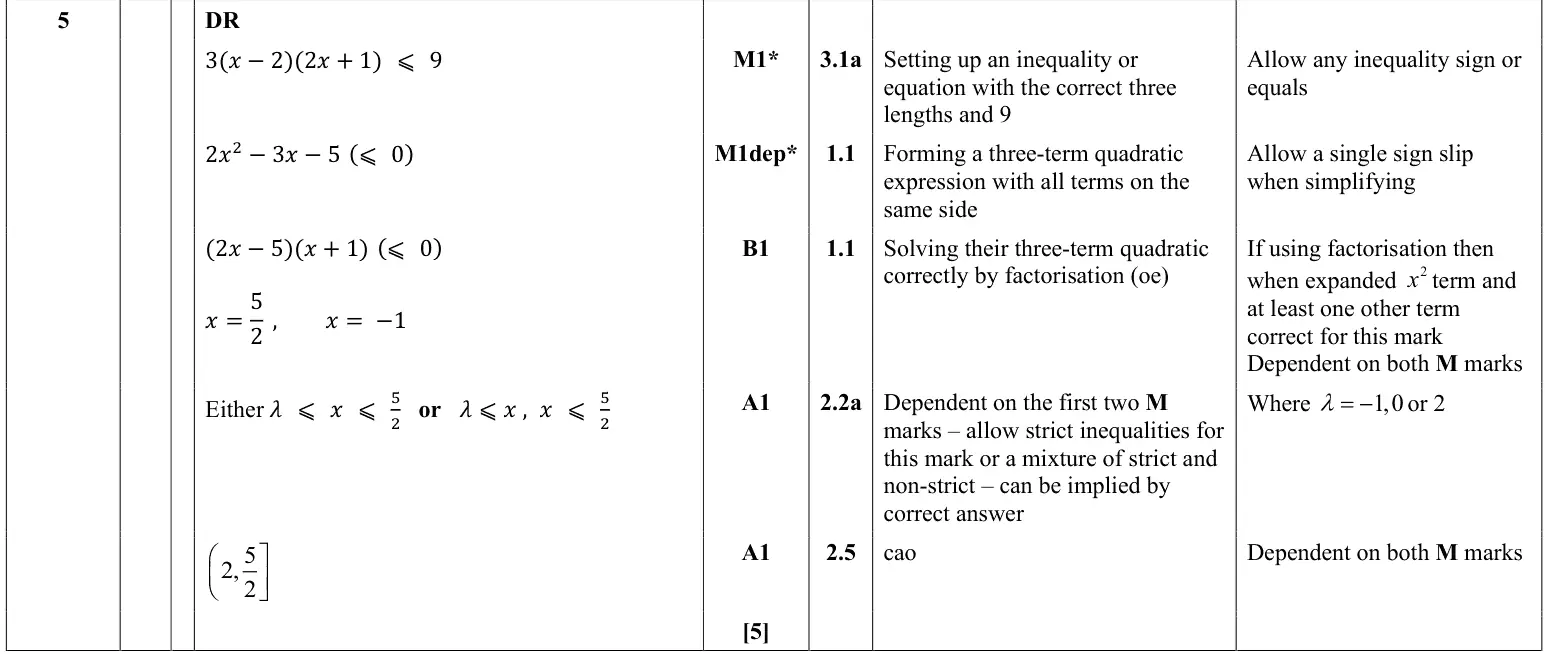
Very few candidates scored full marks in this question since ‘interval notation’ did not seem to be well understood, with many candidates giving set notation in the final answer instead. Also many missed the significance of ‘2’. Many good attempts scored just the first 4 marks, usually with -1 ≤ x ≤ 2.5 getting the fourth mark. This was the second DR question on the paper. In this question candidates were expected provide the method used for solving the quadratic equation – as this is a skill required on the Specification, just doing it with the calculator scored B0. The DR instruction helps to indicate to candidates when this is required, and it is good practice to include working for all steps in a DR question. The other 4 marks were still available. Some candidates did not use the 9cm3 at all, just giving the volume as a quadratic, simplifying this and then re-factorising and solving to produce - ½ and 2.
Key points and common errors
volume 3(x − 2)(2x + 1) ≤ 9
2x² − 3x − 5 ≤ 0 so −1 ≤ x ≤ 5/2
lengths positive needs x > 2
interval notation (2, 5/2], not set notation
June 2025 · AS Paper 2 · Q7(b)6 marksMedium
Show the start of this question
Mark scheme for this part
Examiner's comment
There were a lot of complete attempts to this part, although some did not get full marks only because they did not provide an exact answer or a justification for their answer. Many gained the first 3 marks, and the limit work was usually well done too, but some had them the wrong way round and -100/3 rather than +100/3 was used on the left hand side. In this instance, credit was given even if a = 0 was not given. Unfortunately, a small number of candidates started by differentiating.
Key points and common errors
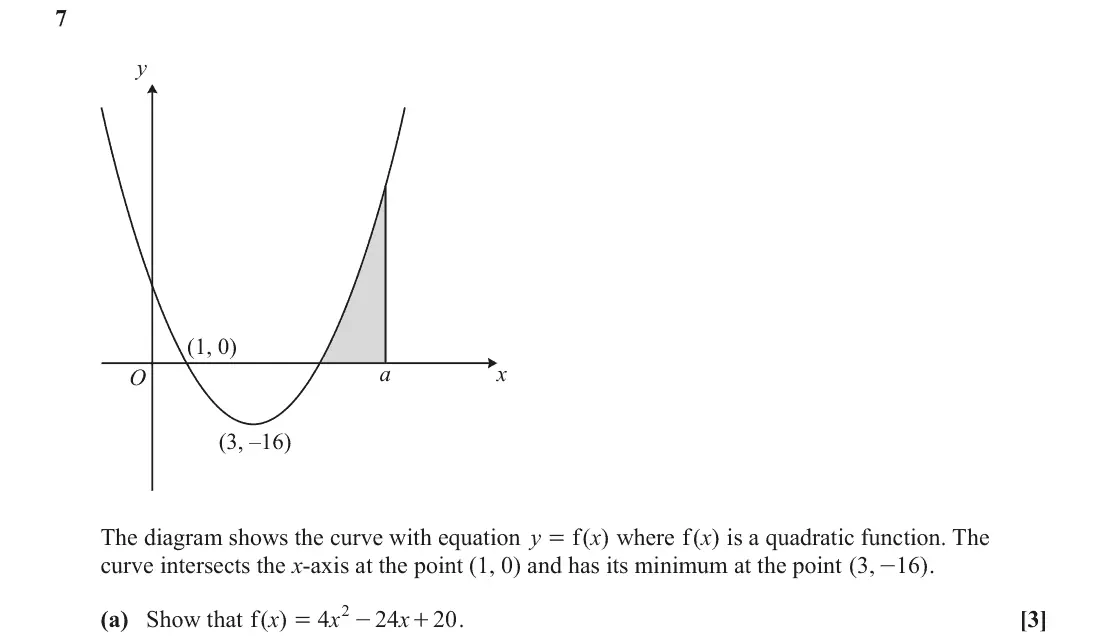
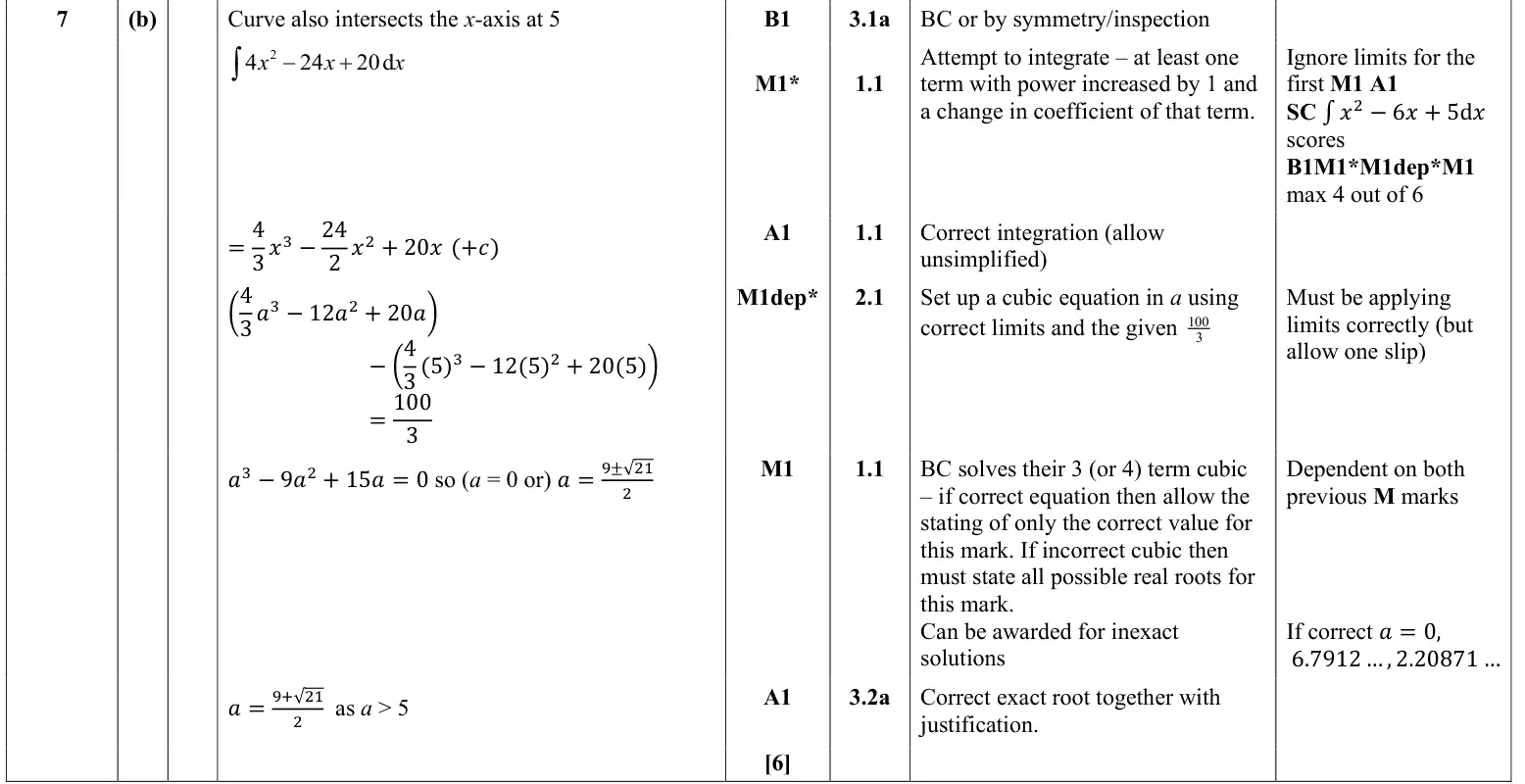
curve also crosses at x = 5 (symmetry)
∫ from 5 to a of (4x² − 24x + 20) dx = 100/3
a³ − 9a² + 15a = 0
a = (9 + √21)/2 with justification a > 5
exact answer needed
limits the wrong way round
June 2025 · Paper 1 · Q2(c)1 markMedium
Show the start of this question
Mark scheme for this part
Examiner's comment
Many candidates were able to make a good attempt at this question, but some answers were subsequently spoilt by changing the sign on their final answer in the mistaken belief that -9a was negative which did not match the given diagram.
Key points and common errors
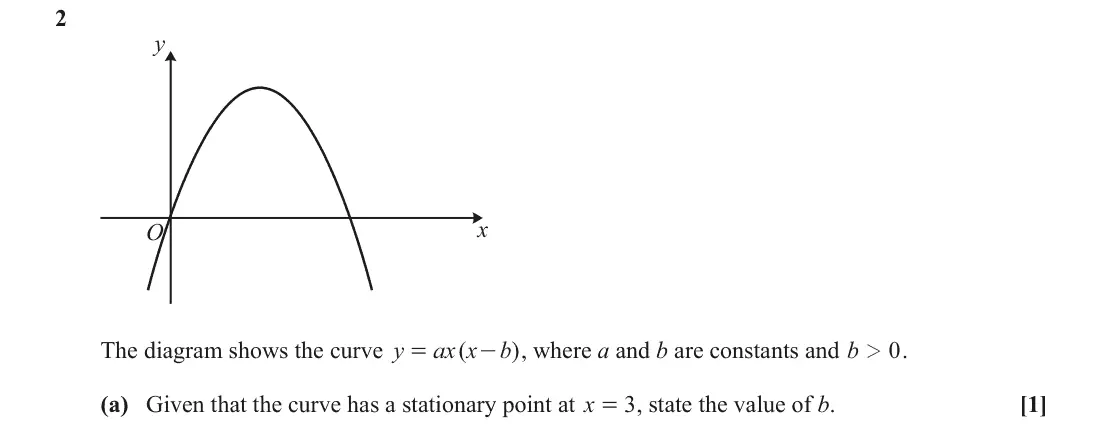
y = −9a
some changed the sign believing −9a is negative
June 2025 · Paper 1 · Q7(b)4 marksMedium
Show the start of this question
Mark scheme for this part
Examiner's comment
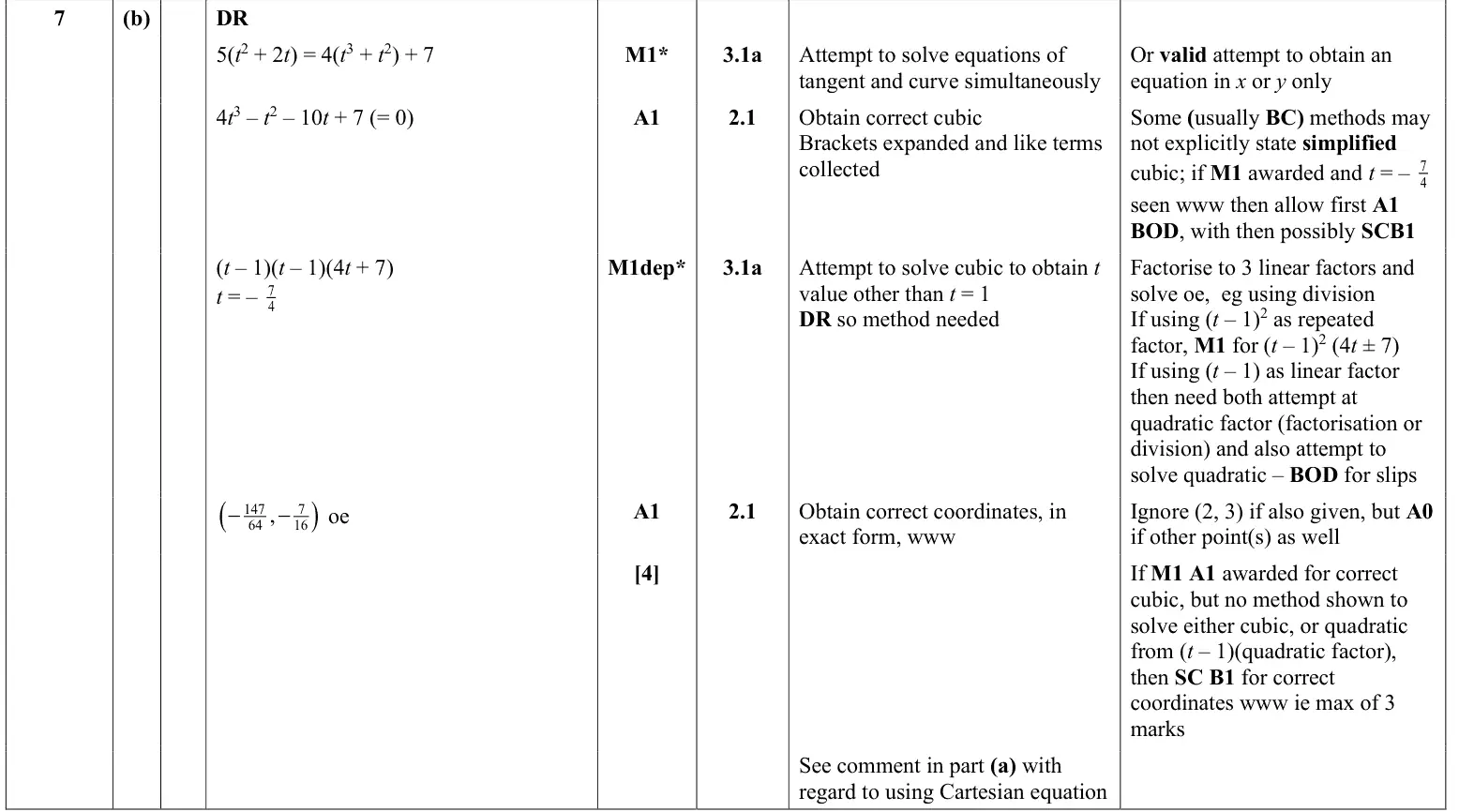
It was expected that candidates would attempt to solve the equations of the tangent and the curve simultaneously to obtain an equation in t only, and many were able to do so. It was then expected that candidates would recognise that the tangent should have a repeated root at t = 1, and use this to solve the cubic equation to find the other t-value. Candidates should appreciate that method needs to be shown, as the command word used was ‘determine’ along with a ‘detailed reasoning’ instruction for the entire question. Many candidates were indeed able to show a convincing method, through repeated division by (t – 1), inspection or an equivalent method, all of which tended to be effective. A number of candidates seemingly solved the cubic equation on their calculator instead. Some candidates simply stated the t-values whereas others did try to work backwards to produce the required factors but this was rarely successful due to the calculator not identifying a repeated root. Having found the other t-value, through whatever method used, candidates were then usually able to give the correct coordinates in an exact form although a few did instead give a rounded decimal value. A surprisingly common error was to equate the gradient of the curve, in terms of t, to the gradient of the tangent i.e. attempting to find other points on the curve that would have tangents parallel to the one already found. A minority of candidates attempted to first find a Cartesian equation for the curve, either in this part of the question or continuing with an equation attempted in part (a). This was rarely successful, and candidates should consider the most effective and efficient method when attempting a question. While some previous questions on parametric equations may have requested the Cartesian equation, this is usually the final part of the question as opposed to the starting point.
Key points and common errors
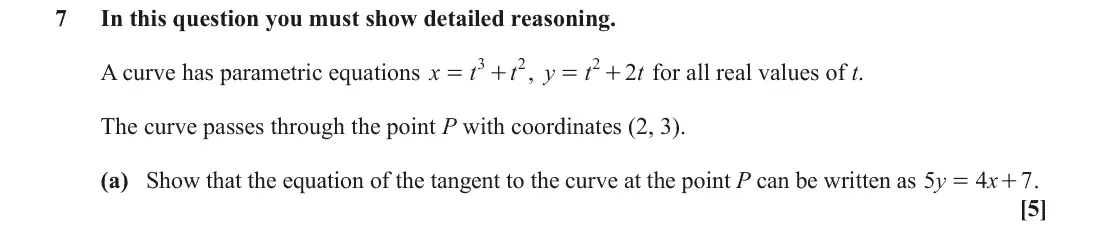
substitute parametric x, y into tangent: 4t³ − t² − 10t + 7 = 0
(t − 1) is a repeated factor
t = −7/4 gives (−147/64, −7/16)
method must be shown
June 2025 · Paper 2 · Q13 marksEasy
Mark scheme for this part
Examiner's comment
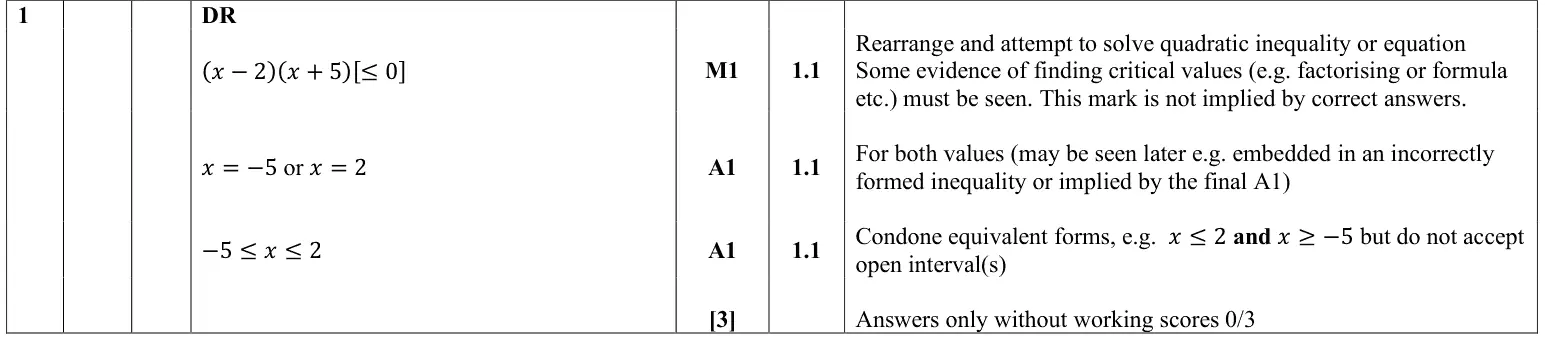
Most candidates answered this part correctly. The ‘In this question you must show detailed reasoning’ (DR) instruction here meant that candidates needed to show a fully complete method, with each step clearly evidenced. In this case this meant that the method shown to find the critical values (i.e. to solve the implied quadratic equation) needed to be seen – this was usually by factorising, but of course other methods such as using the formula were acceptable. Candidates who wrote down solutions unsupported by working could not score any marks. Most candidates went on to write down the correct (closed) interval, although some candidates gave the complement (M1A1A0) or gave the interval as two parts – which could not score the final mark unless some indication of the intersection (e.g. ‘and’) was seen. There were several questions on this paper where candidates needed to solve a quadratic as part of the solution. Candidates should be reminded that, where a question has the instruction ‘determine’ or ‘show detailed reasoning’ they should show their working in full in order to demonstrate understanding. This means that candidates should always be advised (in these questions) to show the method used to solve a quadratic equation. This does not (and, in general, the DR instruction is not) restrict candidates’ use of a calculator to check or verify these solutions, but it does mean that – as was the case here – mark schemes will require candidates to show these steps of working. Candidates who included a sketch (and appeared to have used this to help determine the correct interval to use) were much less likely to write down the wrong interval.
Key points and common errors
critical values x = −5 and x = 2 must come from shown working (factorise or formula)
−5 ≤ x ≤ 2, not open interval
answer only scores 0
June 2025 · Paper 2 · Q2(c)4 marksEasy
Show the start of this question
Mark scheme for this part
Examiner's comment
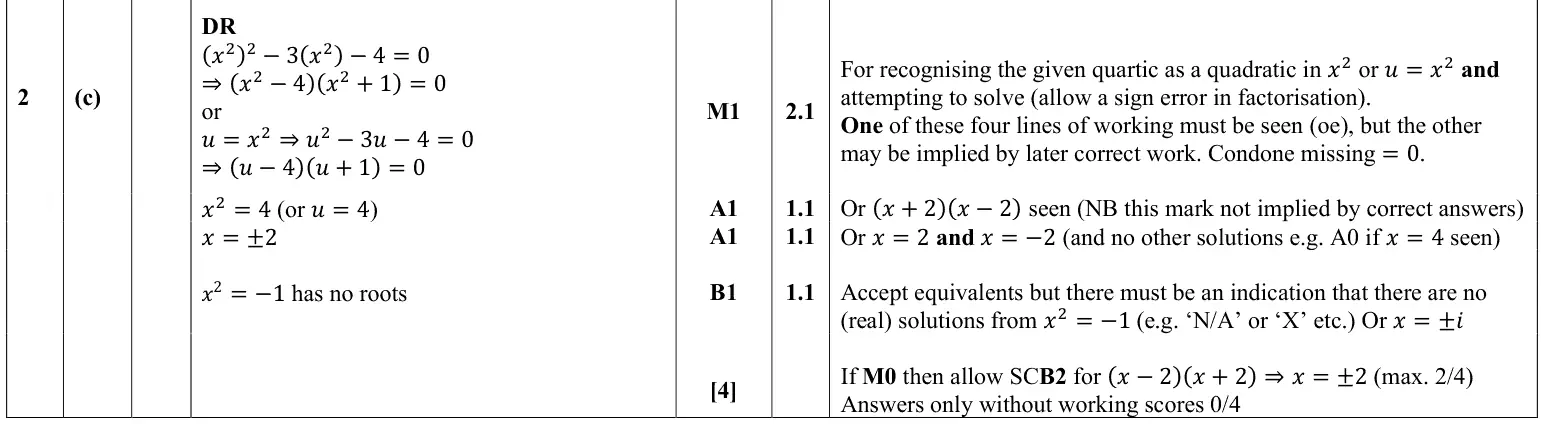
Most candidates scored at least 3 marks in this part. Most correctly identified the form of the given equation as an ‘embedded’ quadratic and either made an appropriate substitution (e.g. 𝑢= 𝑥2) or solved directly as a quadratic in 𝑥2. As this question was DR, candidates needed to show their method in full, including the ‘intermediate’ values before the final answers. A small number of candidates used the invalid notation 𝑥= 𝑥2 which, although sometimes recovered, typically led to candidates writing down an apparent additional solution 𝑥= 4 which meant that they could not score full marks. Candidates should be reminded to show every step of their working when the question includes the DR instruction.
Key points and common errors
quadratic in x² (or u = x²)
x² = 4 gives x = ±2
must state x² = −1 has no real roots
invalid notation x = x² led to extra x = 4
June 2025 · Paper 2 · Q6(a)(ii)2 marksEasy
Show the start of this question
Mark scheme for this part
Examiner's comment
As in part (i), most candidates answered this part correctly. The question asked candidates to ‘find’ so the scheme did not require candidates to show working – which typically involved using the factor theorem to deduce one or both of the roots. Some candidates solved by inspection (or using their calculator) – this was also acceptable in this context. Some candidates went on to find the corresponding y-values, which were not needed here.
Key points and common errors
set dy/dx = 0
factor theorem or calculator gives x = 1 and x = −1 only
y-values not needed
June 2025 · Paper 3 · Q4(a)5 marksMedium
Mark scheme for this part
Examiner's comment
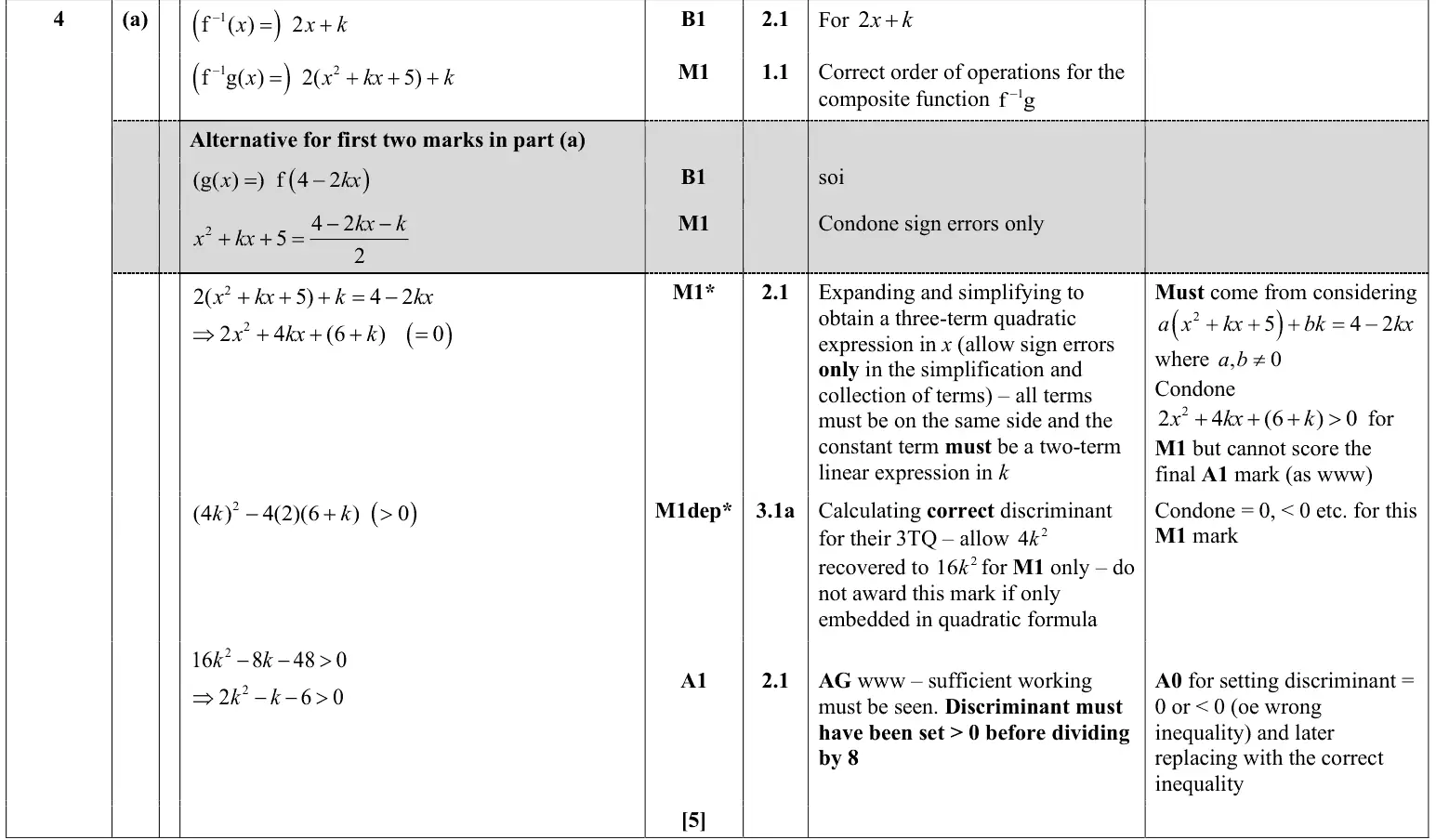
Most candidates correctly found the inverse of f and applied the correct order of operations to obtain f −1g(𝑥) = 2𝑥2 + 2𝑘𝑥+ 10 + 𝑘 although some candidates incorrectly found fg(𝑥) and then attempted to find the inverse of this, or simply equated fg(𝑥) to 4 −2𝑘𝑥. A significant number of candidates incorrectly considered the equation f −1g(𝑥) = 0. Of those that did consider f −1g(𝑥) = 4 −2𝑘𝑥 most obtained the correct three-term quadratic in 𝑥 and were successful in deriving the given inequality by considering the discriminant > 0. As this was a given answer any incorrect working seen (or setting the discriminant > 0 after dividing by 8) meant that the final accuracy mark could not be awarded.
Key points and common errors
f⁻¹(x) = 2x + k
f⁻¹g(x) = 2(x² + kx + 5) + k
set equal to 4 − 2kx and collect: 2x² + 4kx + 6 + k = 0
discriminant > 0 gives 2k² − k − 6 > 0
fg or f⁻¹g = 0 are common errors
June 2024 · AS Paper 1 · Q7(a)1 markMedium
Mark scheme for this part
Examiner's comment
As this question was ‘Detailed reasoning’ and a ‘Show that’ (where the answer is given) candidates needed to provide a convincing demonstration of the result with no errors or missing steps. Although only 1 mark, candidates needed to show a fully convincing method and the correct conclusion. A number of candidates lost the mark because their working did not adequately support the given result – for instance, omitting the final ‘-16’ or claiming equivalence between two lines of working that are not equivalent. Candidates should be encouraged to show their method in full and – if they choose to multiply out terms separately – to recombine these in a logical way so that it is absolutely clear their working leads to the given answer and is not reverse-engineered. ‘Show that’ and Detailed Reasoning questions Where the answer is given, candidates should be encouraged to take extra care to make sure that their working leads clearly and unambiguously to this answer. Answers where this isn’t clear (e.g. if a term is missing and ‘reappears’ just before the final answer) are unlikely to be credited. When working with complex algebraic expressions (as in Question 7 (a) on this paper), it’s entirely acceptable to split the expression and consider parts of it separately. However, if candidates do this then the ‘recombining’ must be clear and unambiguous (for instance, vague arrows leading to the given answer are unlikely to be sufficient).
Key points and common errors
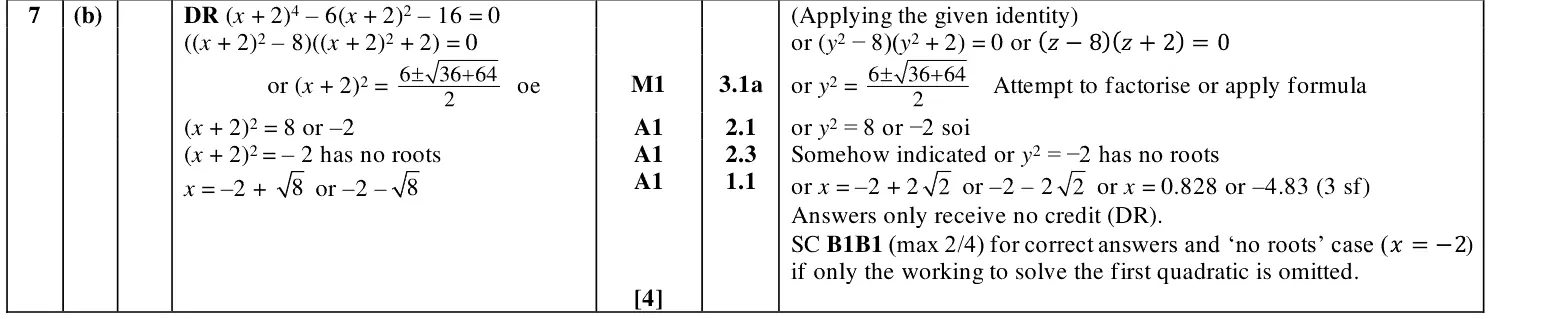
expand (x + 2)⁴ and 6(x + 2)² fully, include the −16, reach the given quartic with no missing steps
June 2024 · AS Paper 1 · Q7(b)4 marksHard
Show the start of this question
Mark scheme for this part
Examiner's comment
Many candidates did not appear to know how to approach this question, despite the LHS of the equation being in identical form to the identity given in part (a). Some attempted long division without applying the given identity, which was not fruitful. Candidates should be reminded that the instruction ‘Hence’ means that the result from the previous part must be used (and, as in this case, it is helpful to do so). A number of candidates (not noting the Detailed Reasoning instruction) gave the solutions without working (from their calculator) or ‘retro-fitted’ incorrect working to try and justify these. Neither could be credited. As a reminder, the Detailed Reasoning instruction means that all steps in the working must be shown, and that calculators may be used to check or verify results only. Candidates who attempted an analytical method were generally successful, with relatively few errors seen – a few candidates did not provide state that the (𝑥𝑥+ 2)2 = −2 case leads to no solutions, and a few made an error generating false extra sufficient justification of the quadratic form (and were marked under the Special Case), others did not solutions.
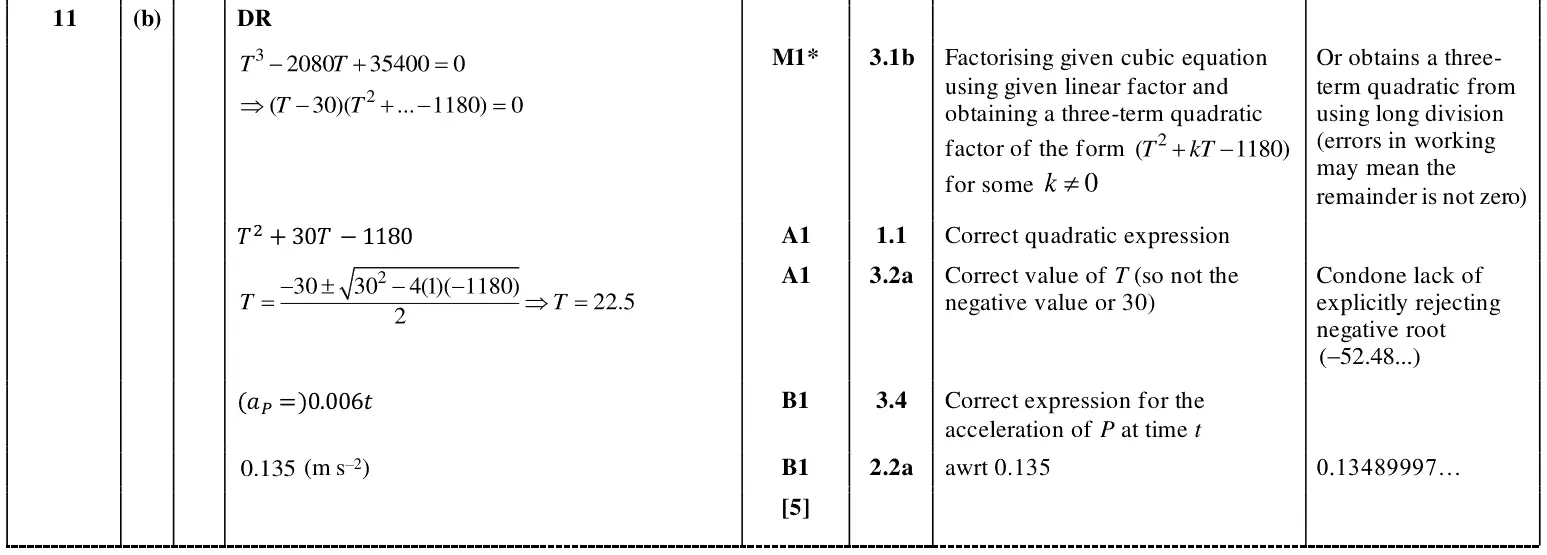
This part requested detailed reasoning, so we expected to see the method clearly presented; in very many cases this did not happen. As soon as candidates see this instruction they should think carefully about how they are going to use the calculator (see Exemplar 3 below and its commentary). To gain the M mark (and so potentially the next 2 marks also), we wanted to see clear evidence of factorising or long division. For the A mark allocated to T = 22.5, we wanted to see how this value had been obtained, for example evidence of the quadratic formula. Many candidates just gained the last 2 marks, as seen in cubic given in (a). This is not sufficient following a ‘show detailed reasoning’ request and earned M0. Note that the last B mark could still be given in such cases.
Key points and common errors
factorise using T = 30: T² + 30T − 1180 = 0
formula gives T = 22.5 (reject negative)
a = 0.006t so 0.135 m s⁻²
DR so factorising and formula must be shown
June 2024 · Paper 1 · Q3(c)4 marksHard
Mark scheme for this part
Examiner's comment
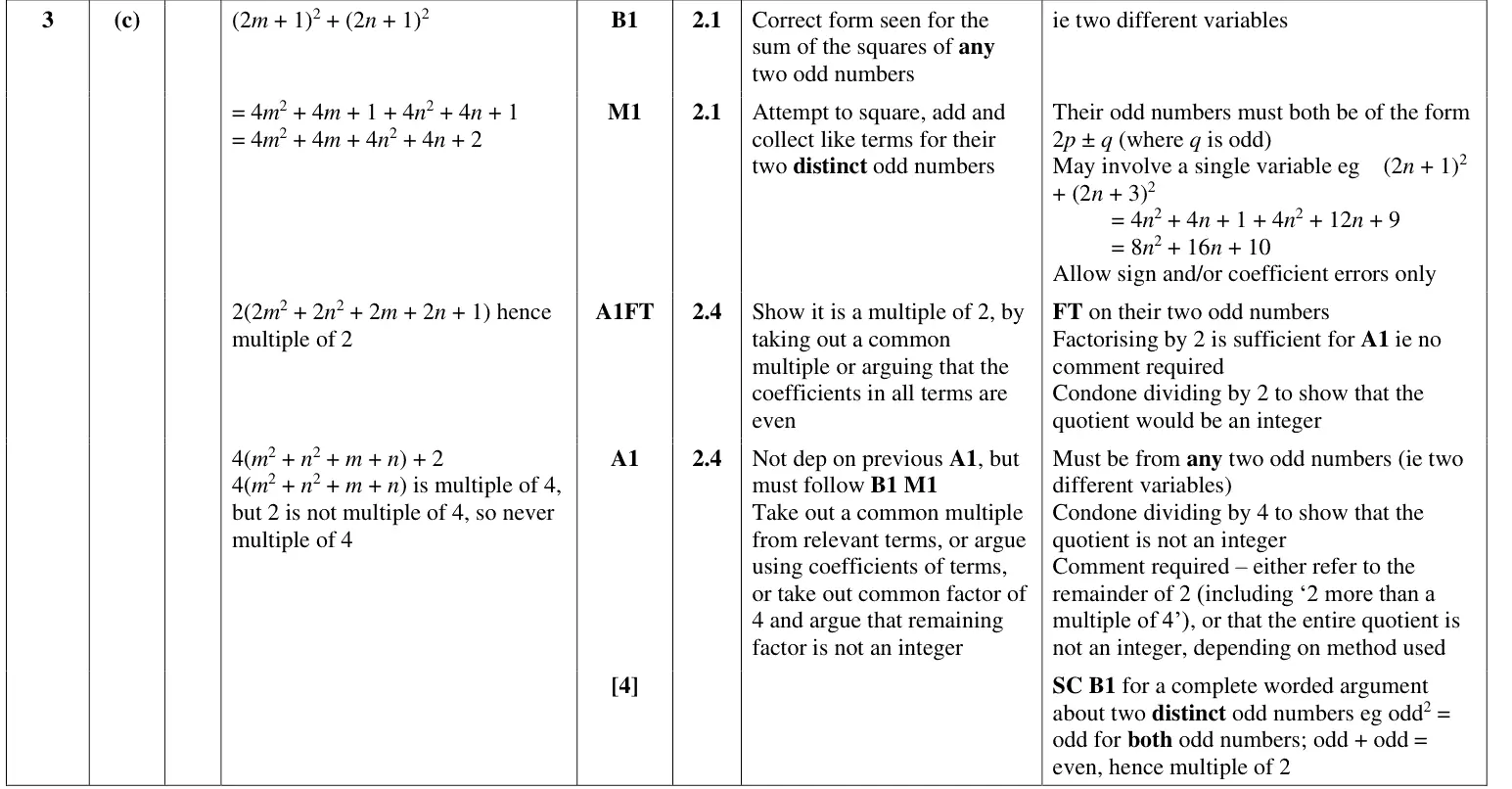
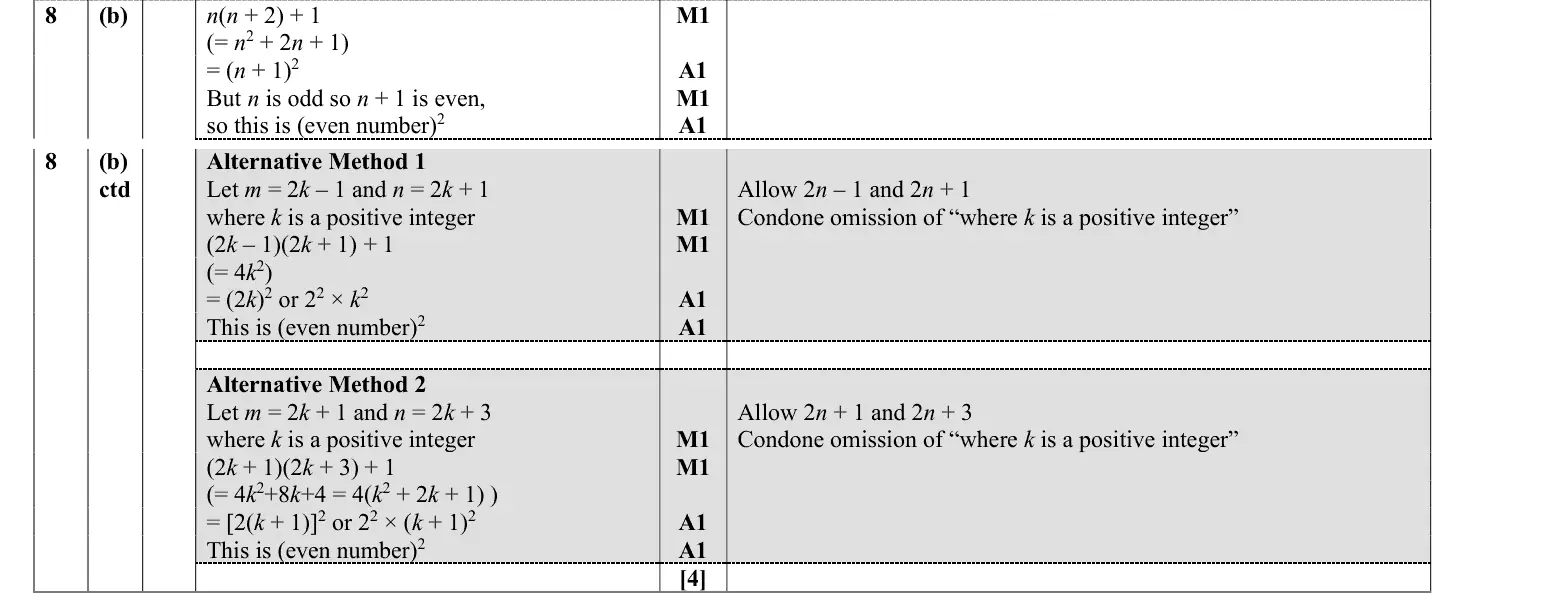
Many candidates either did not notice or did not realise the significance of ‘any’ being in bold and gave examples of two consecutive, or otherwise related, odd numbers thus limiting themselves to a maximum of 2 marks. Some used the same expression for both odd numbers, which scored no marks. From those that did use different variables, many lost the last accuracy mark because they thought it was enough to factorise the 4 out and say they have shown it is not a multiple of 4 without explaining why. Examiners expected to see some comment about there being a remainder of 2 when 4 was factorised out. Alternatively, that the value left after factorisation or division was not an integer.
Key points and common errors
'any': two different variables (2m + 1)² + (2n + 1)²
= 2(…) so a multiple of 2
= 4(m² + n² + m + n) + 2 so remainder 2, never a multiple of 4
consecutive odd numbers max 2 marks
comment needed
June 2024 · Paper 1 · Q6(a)1 markEasy
Mark scheme for this part
Examiner's comment
Almost all candidates got this correct, with many just showing minimalistic working with the ¼ substituted in followed by = 0.
Key points and common errors
evaluate f(¼) with working shown to get 0
'f(0.25) = 0' alone is B0
June 2024 · Paper 1 · Q6(b)3 marksEasy
Show the start of this question
Mark scheme for this part
Examiner's comment
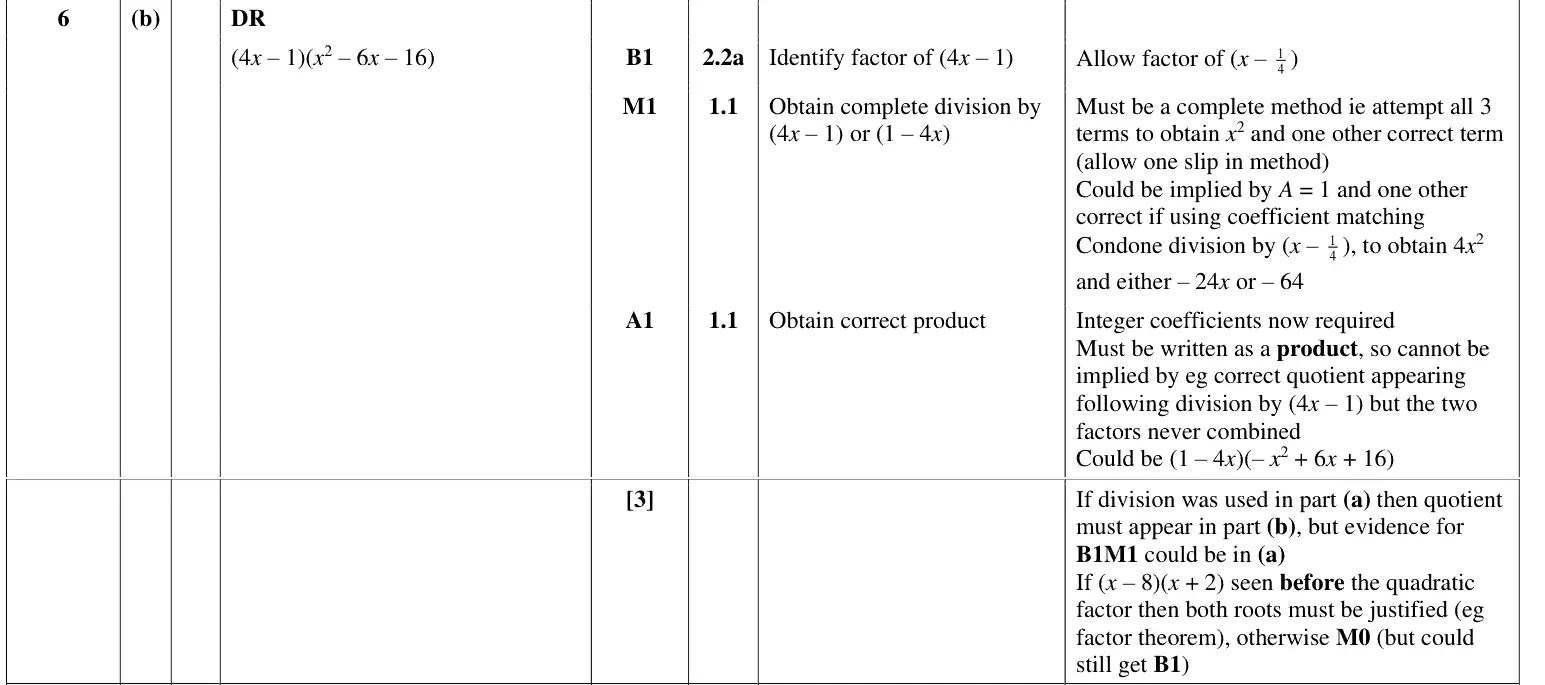
There were many correct answers to this question either using inspection to find the correct product or using long division. A few gave their product without integer coefficients so lost the accuracy mark. Very few made errors in their division, usually sign errors in the 2nd or 3rd term. Some candidates dividing by (x – ¼) did so correctly but then when changing this to (4x – 1) did not recognise the need to also change the other factor.
Key points and common errors
(4x − 1)(x² − 6x − 16) by division or inspection
integer coefficients needed
adjust the quadratic factor when changing (x − ¼) to (4x − 1)
June 2024 · Paper 1 · Q6(c)4 marksEasy
Show the start of this question
Mark scheme for this part
Examiner's comment
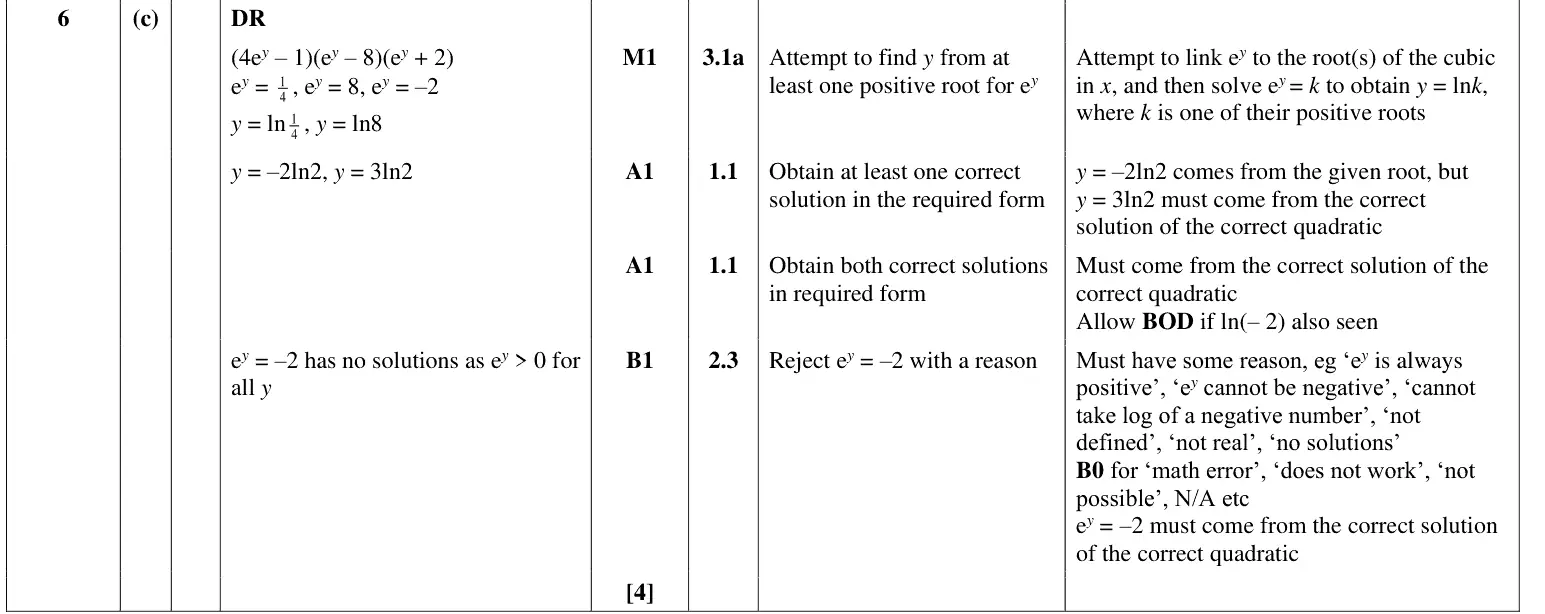
The question was very well answered with many candidates getting full marks on this question. Most candidates made the connection with the previous parts. The most commonly lost mark was the B mark for explaining why 𝑒𝑦= −2 did not result in a solution. It is important in detailed reasoning questions that candidates explain why rejected answers are not used; ‘not possible’ is not enough and incorrect statements like ‘negative logs are not possible’ are not given credit. Some candidates realised there was a connection to part (b) but unfortunately, thought it was an equation in 𝑒3𝑦 instead of 𝑒𝑦. This is a good solution to Question 6 (c), in that it provides clear evidence as to how the solutions are obtained and gives detailed reasoning on why one solution has been rejected.
Key points and common errors
x = e^y: (4e^y − 1)(e^y − 8)(e^y + 2) = 0
y = −2ln2, 3ln2
reject e^y = −2 since e^y > 0
'not possible' is not a reason
June 2024 · Paper 2 · Q3(a)1 markEasy
Mark scheme for this part
Examiner's comment
Nearly all candidates achieved this mark. A few omitted the ‘=0’ which was required as a (minimal) conclusion.
Key points and common errors
f(3) = 0 must be shown with the conclusion '= 0'
June 2024 · Paper 2 · Q3(b)2 marksEasy
Show the start of this question
Mark scheme for this part
Examiner's comment
Almost all candidates correctly factorised the cubic expression. Long division was probably the most popular method, and a few errors were seen in the final response (for instance giving (𝑥+ 1)(𝑥−1))).
Key points and common errors
(x − 3)(x + 1)²
errors in the final factors after division
June 2024 · Paper 2 · Q3(c)3 marksMedium
Show the start of this question
Mark scheme for this part
Examiner's comment
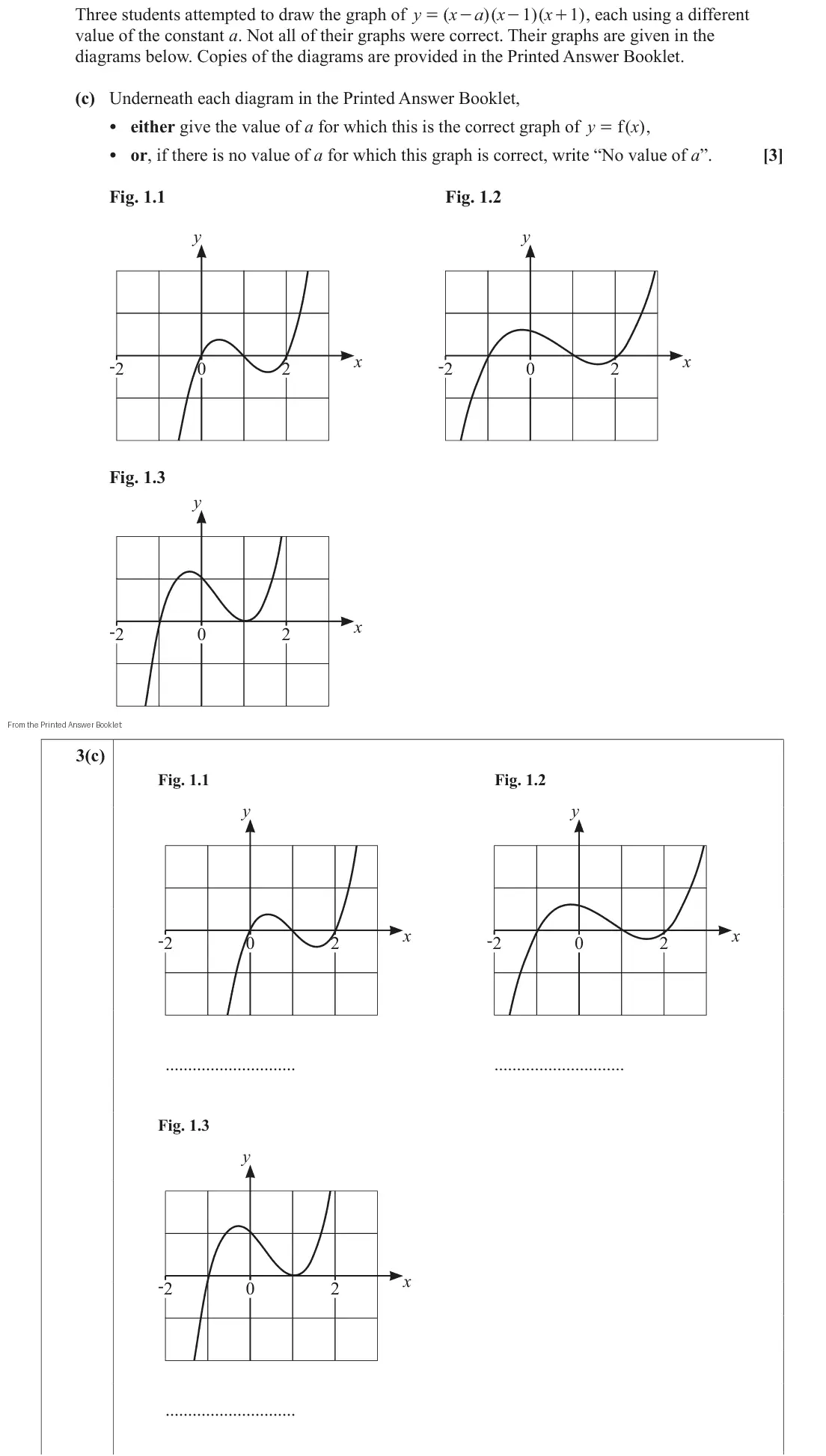
Around half of candidates scored all 3 marks here. Most correctly identified that Fig 1.1 had ‘no value of a’, the most common errors were with Fig 1.3 – giving either ‘no value’ or ‘𝑎= −1’ incorrectly.
Key points and common errors
Fig 1.1 no value
Fig 1.2 a = 2
Fig 1.3 a = 1 (repeated root)
common error a = −1 for Fig 1.3
June 2024 · Paper 2 · Q6(b)(i)1 markEasy
Mark scheme for this part
Examiner's comment
Almost all candidates scored the B1 mark for this question, correctly multiplying out. Candidates should be reminded (especially in a DR question) to make sure that their working clearly leads to the given response. A small number of candidates lost this mark following correct work because they did not give a conclusion. Ideally candidates should demonstrate that their multiplied-out form simplifies to the given response (and write this out) although in this case an equivalent statement such as ‘QED’ or ‘Shown’ was condoned. Detailed Reasoning Candidates should be reminded that the instruction ‘In this question you must show Detailed Reasoning’ sets a higher bar for the level and detail of working that will be required to support responses. It is an explicit instruction to candidates to demonstrate that they have fully understood the method that leads to the answer by showing all the steps, and credit will not normally be given for responses that are unsupported by correct working in these questions. A full list of command words can be found on pages 10-15 in the specification. There is also a command words poster that can be printed and displayed in the classroom.
Key points and common errors
multiply out fully and reach the given cubic
June 2024 · Paper 2 · Q6(b)(ii)2 marksEasy
Show the start of this question
Mark scheme for this part
Examiner's comment
This part was also well answered, with almost all candidates deducing the first root of 𝑥= −√2 2 . Many candidates went on (e.g. using the quadratic formula) to find the other two solutions correctly. Some candidates made sign errors (e.g. applying +/- to the wrong term). In some cases, candidates’ writing meant that their solutions were ambiguous: for instance writing or implying ± √2+√6 (when in fact the +/- should apply to the √6 only. Candidates should be reminded to make sure (especially in a DR question) that their responses are clearly written using correct, unambiguous notation.
Key points and common errors
x = −√2/2 from the linear factor
quadratic formula for (√2 ± √6)/4
June 2024 · Paper 2 · Q6(c)2 marksMedium
Show the start of this question
Mark scheme for this part
Examiner's comment
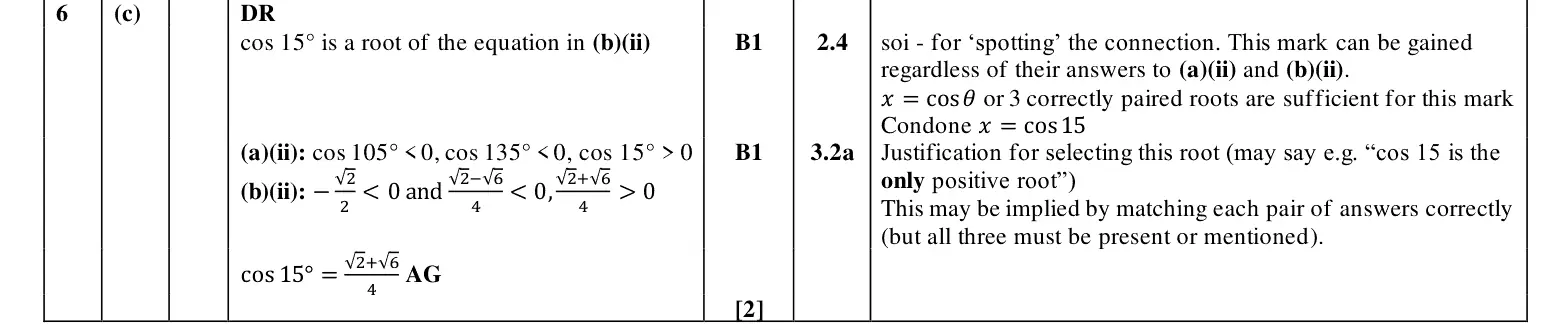
In this part candidates needed to (as guided by the question) deduce the connection between parts (a) and (b) and use this to reach the given result. For the first B1 mark, candidates needed to show that they had understood and used this connection - for instance by writing 𝑥= cos 𝜃. For the second, candidates needed to unambiguously show that cos 15° = √2+√6 . As this response was given it was not enough just to write this statement down, candidates needed to show this - either by deducing that cos 15 must be the only positive root (because cos 105° and cos 135° are negative) or by explicitly matching each root for the equation in x with a value of from part (a). Many candidates did not do this with sufficient rigour, and so could not be given this mark. Candidates should be reminded that, where a response is given, they need to clearly demonstrate that they have reached this by providing clear working. Reading and following the sequence of the question carefully This was a structured question designed, with appropriate scaffolding, to guide students through several different approaches to related problems in order to demonstrate their knowledge of different techniques. While candidates can of course answer the questions in any order they choose, many candidates did not score as many marks as they could have because they did not follow instructions such as “Use this result” or “Hence” which direct the candidate to use a specific method.
Key points and common errors
x = cos θ links the two equations
select the only positive root to match cos 15°
June 2024 · Paper 3 · Q1(b)2 marksEasy
Mark scheme for this part
Examiner's comment
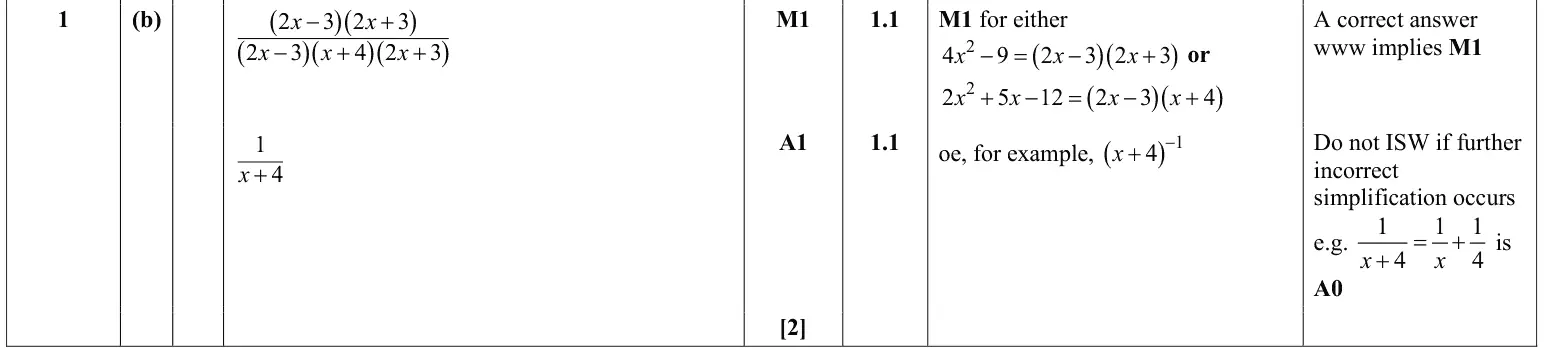
Most candidates appreciated the need to factorise the quadratic expression in both the numerator and denominator and then simplify accordingly. Examiners noted that some candidates attempted to use partial fractions, but these attempts generally were not successful. It was pleasing to note that most candidates left their answer as 𝑥+4 and did not try to simplify this expression further.
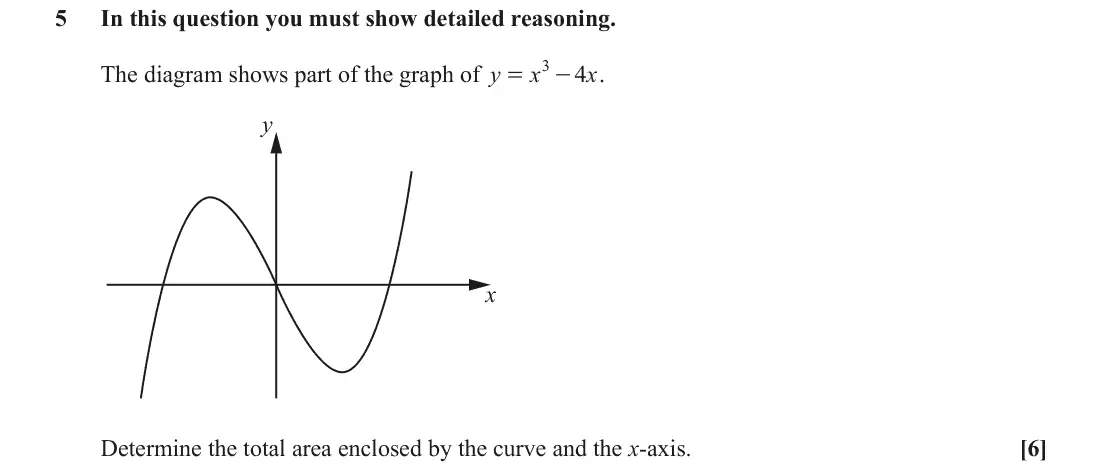
This was a ‘detailed reasoning’ question, so appropriate working throughout was required to gain full marks. Quite a number of candidates did not show any working when finding the roots, which meant that they could not be given the first B mark (in a ‘detailed reasoning’ question, some evidence of the method used is required). Some candidates showed a valid factorisation, but did not state the roots explicitly (because of the nature of this question, the second B mark was given if the roots were seen to be ‘used’ later, but candidates should be reminded of the importance of showing detailed reasoning). Candidates were required to show clear evidence of recognising and correctly handling the negative area for full marks. Some candidates switched the limits to ‘handle’ the negative area, which was permissible as long as their responses were consistent with their limits. Similarly for candidates who used modulus signs to ‘handle’ negative area (as long as it was clear what they had done). In general candidates should be encouraged to show all their working and clearly indicate negative areas, then explicitly handle (rather than going back and retrospectively adjust their working to remove or introduce - signs). The majority of candidates were good at showing the integrated expression but the substitution of limits was not always clearly shown. Centres should advise candidates to be careful not to write mathematically incorrect statements. In this case notation such as -4 = 4 or -8 = 8 was condoned, and the final M mark could be given for candidates who recognised the need to ‘match’ the signs of the area, (e.g. -4 + (-4) = -8), but the final A mark required a correct, positive answer from fully correct working. Relatively few candidates used the symmetry of the curve to find the other half area (which was an acceptable method as long as it was done clearly). A1= ∫൫x3 - 4x൯dx = -4 gives an area of 4 sq units below the x-axis. Simply changing a negative sign to a Care should be taken with the negative integral, e.g. a clear modulus sign used or comment that positive sign (A1= ∫൫x3 - 4x൯dx = +4) was penalised. consider the two areas separately and it was rare to see the single integral ∫൫x3 - 4x൯dx The main errors were dealing with signs in the integrals. Most candidates recognised the need to = 0 as an answer. This candidate has split the area correctly, but did not provide any working to support their roots (so could not be given the first B mark). They have correctly integrated the given expression and then handled the negative area correctly. Ideally we would have seen a more explicit recognition of the negative area (for instance showing –(-4) + 4 before the penultimate line), but this was sufficient for the remaining marks. This was awarded 5/6.
Key points and common errors
roots 0, ±2 by factorising (working required)
∫₀² (x³ − 4x) dx = −4
total area 2 × 4 = 8
∫ from −2 to 2 = 0 is not the area
June 2023 · AS Paper 1 · Q7(a)(i)1 markEasy
Mark scheme for this part
Examiner's comment
The majority of candidates answered this part correctly, but there were a number of errors, primarily from not interpreting the question correctly. A common incorrect response was for the square of the mean.
Key points and common errors
(a² + b²)/2 and ((a + b)/2)²
common error giving the square of the mean twice
June 2023 · AS Paper 1 · Q7(a)(ii)3 marksHard
Show the start of this question
Mark scheme for this part
Examiner's comment
Very few candidates provided a fully correct solution to this part. The alternative method in the scheme was much more common than the ‘difference’ method. However, many candidates made errors when multiplying out the (‘squared’) brackets. A good number of candidates (who multiplied out correctly) reached a valid inequality, but very few spotted the need to factorise to (a - b)2 to prove that this was true by showing it > 0. Candidates should be encouraged to approach ‘Prove’ or ‘Show that’ questions (even those for relatively few marks) with appropriate rigour, for instance noting that they are writing an inequality that they seek to prove, rather than assuming that the given result is true. Many candidates used specific values to demonstrate the result, which gained no marks.
Key points and common errors
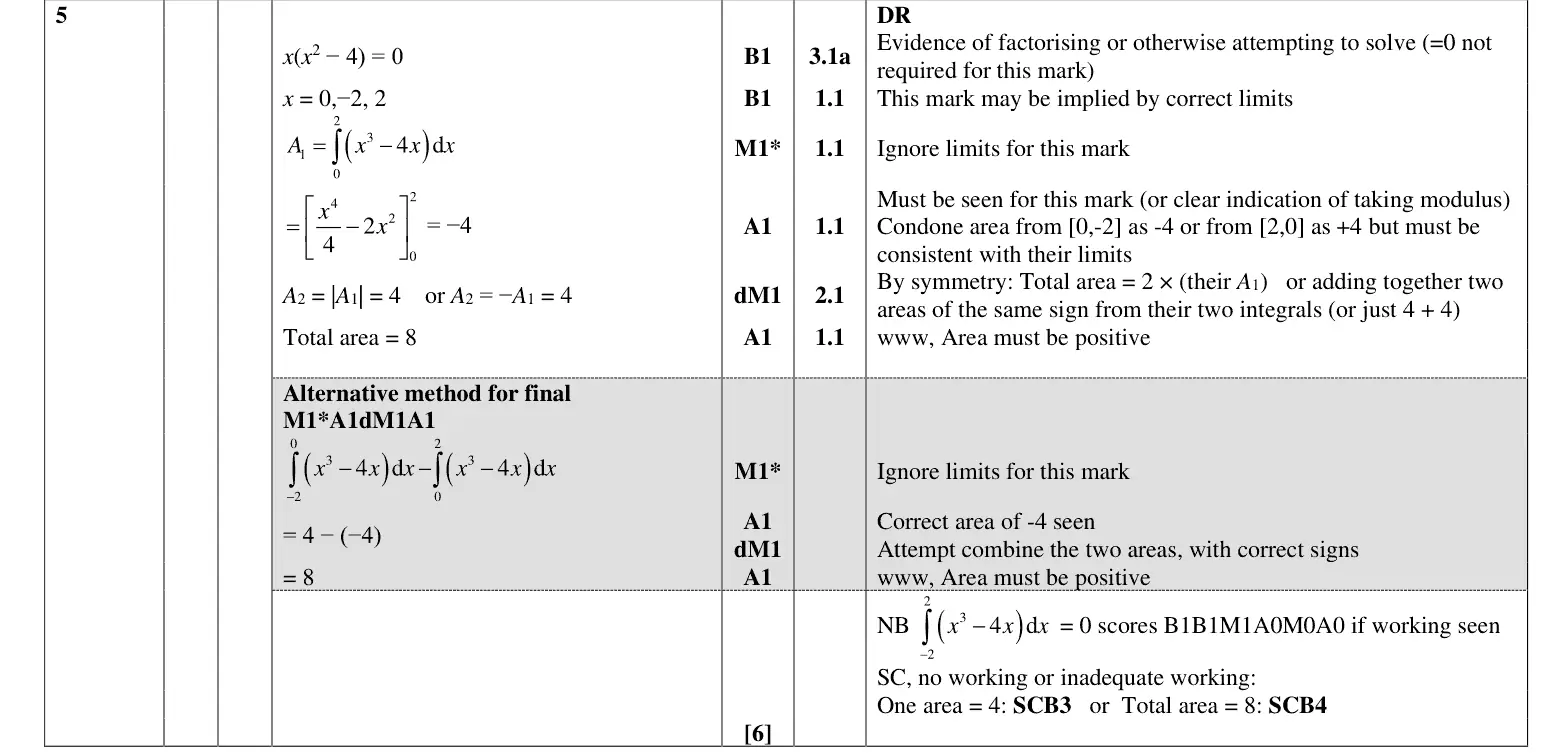
difference = (a − b)²/4 ≥ 0
very few factorised to (a − b)²
errors expanding brackets
June 2023 · AS Paper 2 · Q24 marksMedium
Mark scheme for this part
Examiner's comment
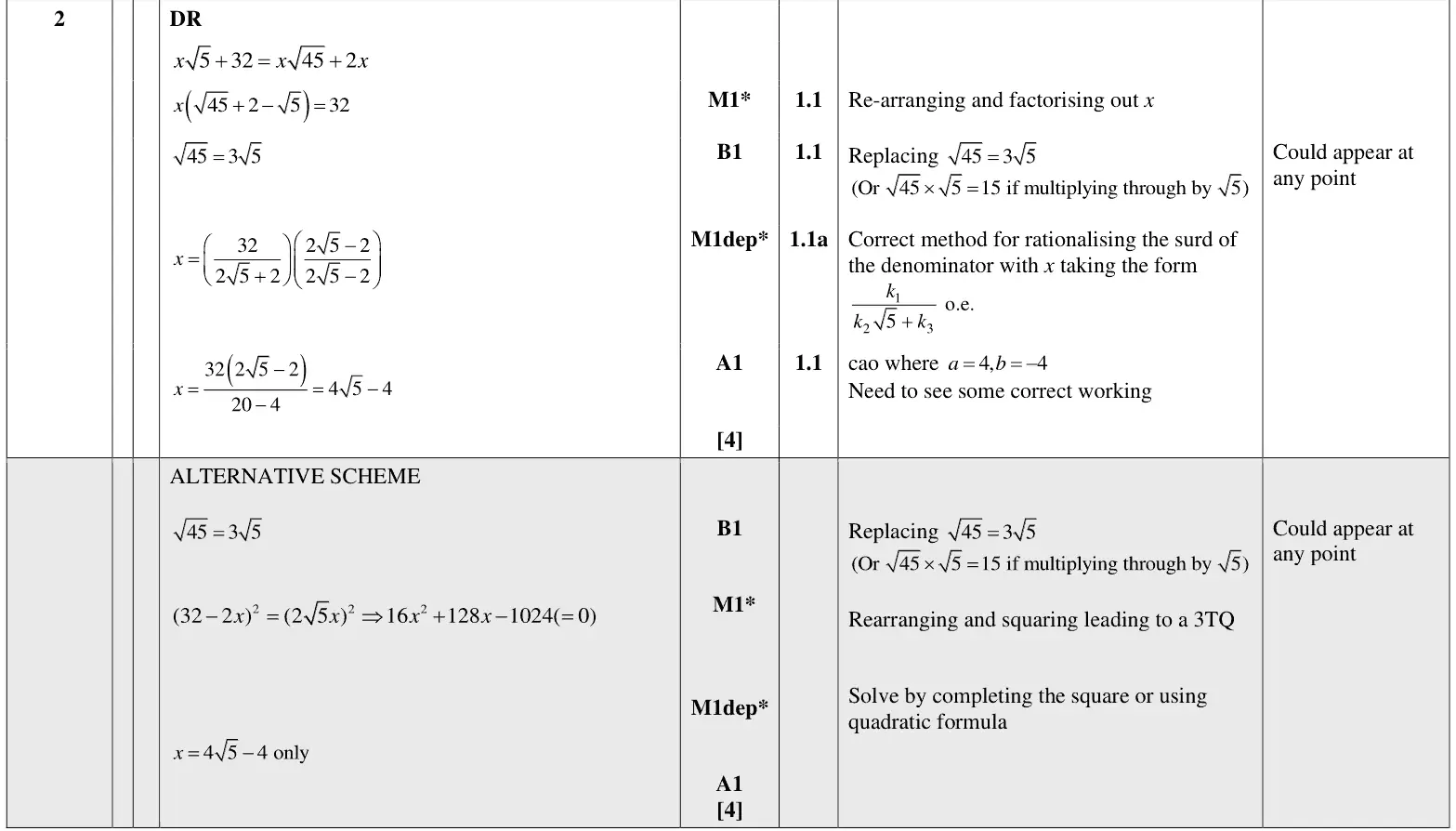
Many candidates gained the B1 mark. Some solutions then floundered because the need to factorise out x was not understood. Those who did this however usually reached the correct answer, but it was important to show how this was achieved (note the comments below); the rationalising process needed to be clear and we expected to see some working before the final answer. The alternative scheme was rarely seen. This exemplar illustrates the point raised above. The candidate does not indicate how they have reached ‘x = -4 + 4√5’ from the preceding line, which is not sufficient for the M1dep* to be given.
Key points and common errors
√45 = 3√5
factorise out x: x(2√5 + 2) = 32
rationalise the denominator to get 4√5 − 4
rationalising must be shown
June 2023 · Paper 1 · Q10(b)2 marksMedium
Show the start of this question
Mark scheme for this part
Examiner's comment
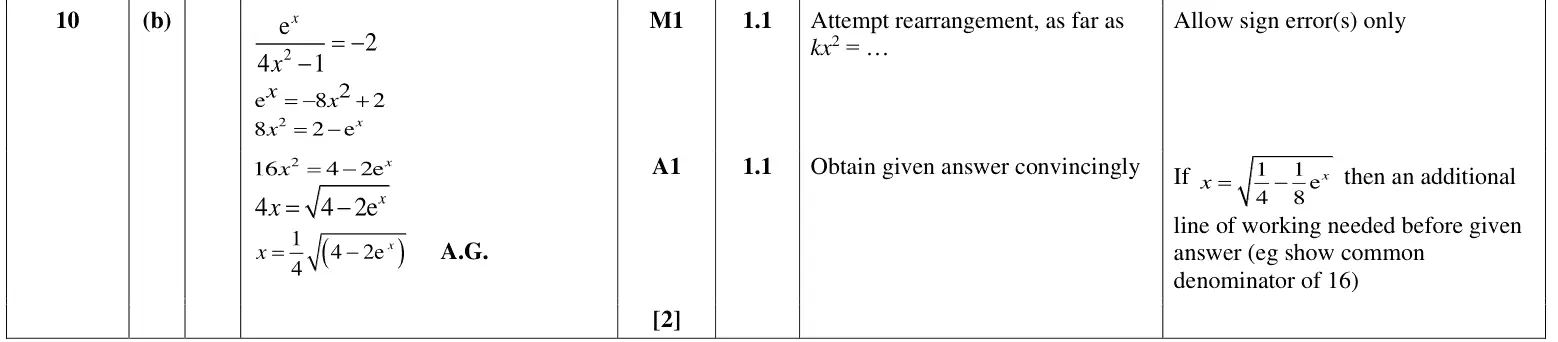
Most candidates were able to gain at least 1 mark for rearranging as far as making kx2 the subject of the equation. To gain full marks, the given answer had to be obtained convincingly and many candidates were able to do so. Some candidates gained the first method mark, and then jumped straight to the final answer either because they were unable to complete the proof or because they did not see the need to detail all steps.
Key points and common errors
rearrange to 16x² = 4 − 2eˣ
show enough steps to the given answer
June 2023 · Paper 3 · Q3(a)(ii)2 marksEasy
Show the start of this question
Mark scheme for this part
Examiner's comment
ignore the most straightforward method of applying the factor theorem directly as 23 + 2𝑝𝑝+ 𝑞𝑞= 0 (and Similarly, to part (a) (i) this part was answered extremely well. However, many candidates seemed to solving for q using their value of p from (i)) and instead used methods of factorisation or long division (with mixed success).
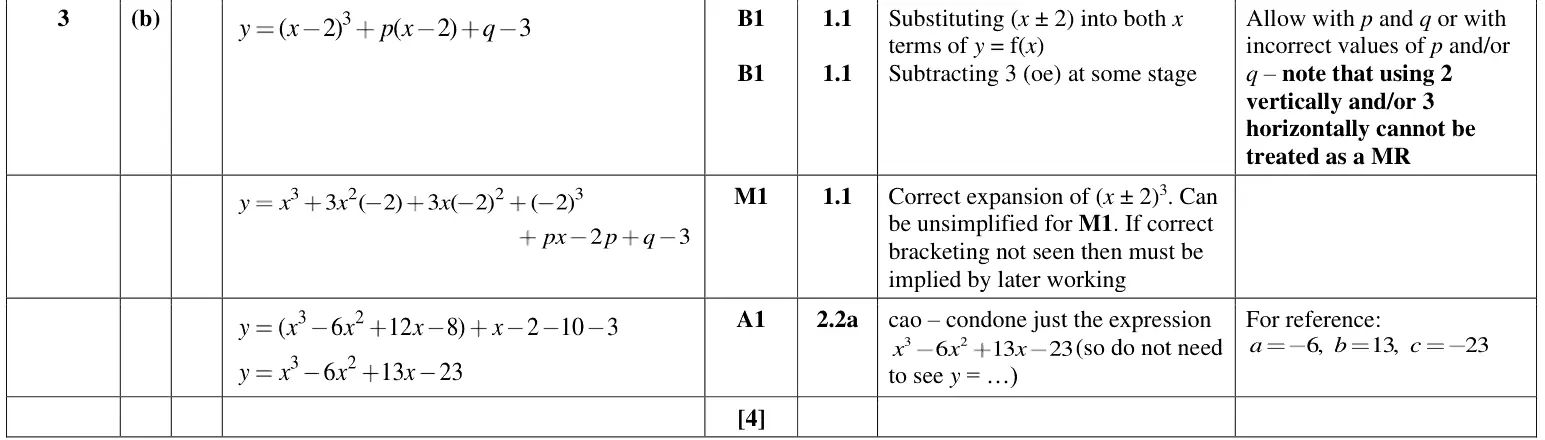
equation 𝑦𝑦= (𝑥𝑥−2)3 + 𝑝𝑝(𝑥𝑥−2) + 𝑞𝑞−3 some candidates incorrectly added the 3, or considered the Although most candidates realised that the given translation meant that the new curve would have the horizontal translation as (𝑥𝑥+ 2). Some then struggled to expand (𝑥𝑥−2)3 correctly or did not give their final answer as an equation of ‘𝑦𝑦= ⋯’ (and simply left their answer as 𝑥𝑥3 −6𝑥𝑥2 + 13𝑥𝑥−23).
Most candidates answered this question successfully. A few lost the minus sign. Some chose the much longer method of dividing f(x) by (x − 2) and equating coefficients. Many of these candidates made errors.
Most candidates found the quadratic factor by long division. Some did it by inspection. Any method was acceptable, so long as the relevant method was shown. Some candidates wrote down, without working, the solutions to the equation f(x) = 0 and derived the factors from these. Because of the “detailed reasoning” instruction, these candidates scored no marks.
Key points and common errors
divide by (x − 2) to get 5x² + 6x + 1
f(x) = (x − 2)(5x + 1)(x + 1)
writing down roots from a calculator scores 0 under DR
June 2022 · Paper 3 · Q5(a)5 marksMedium
Mark scheme for this part
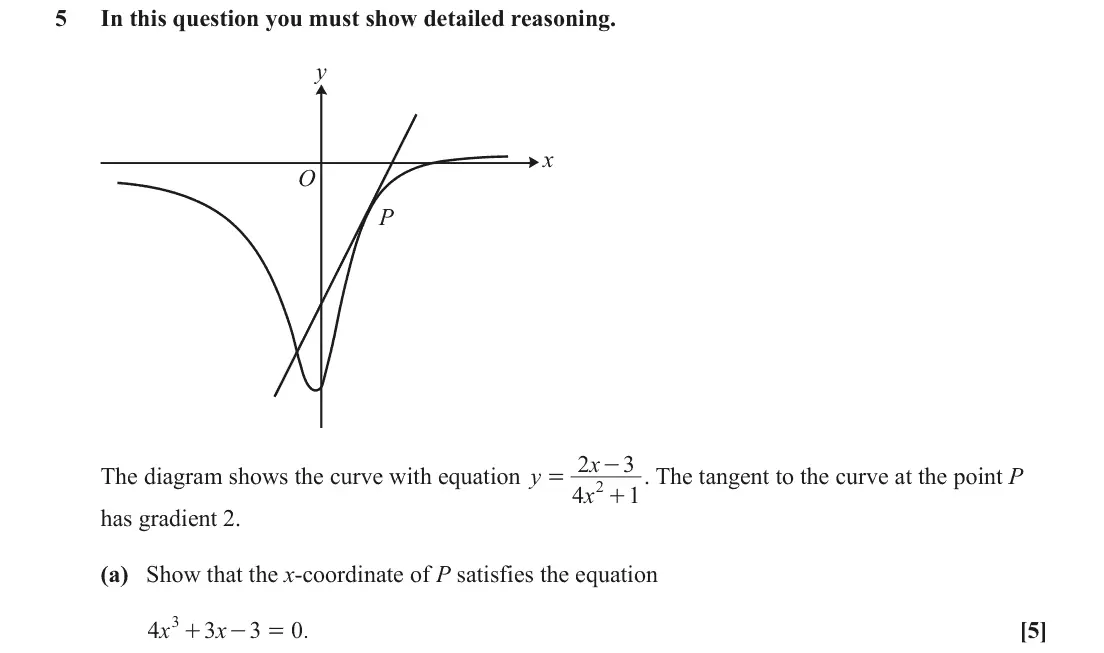
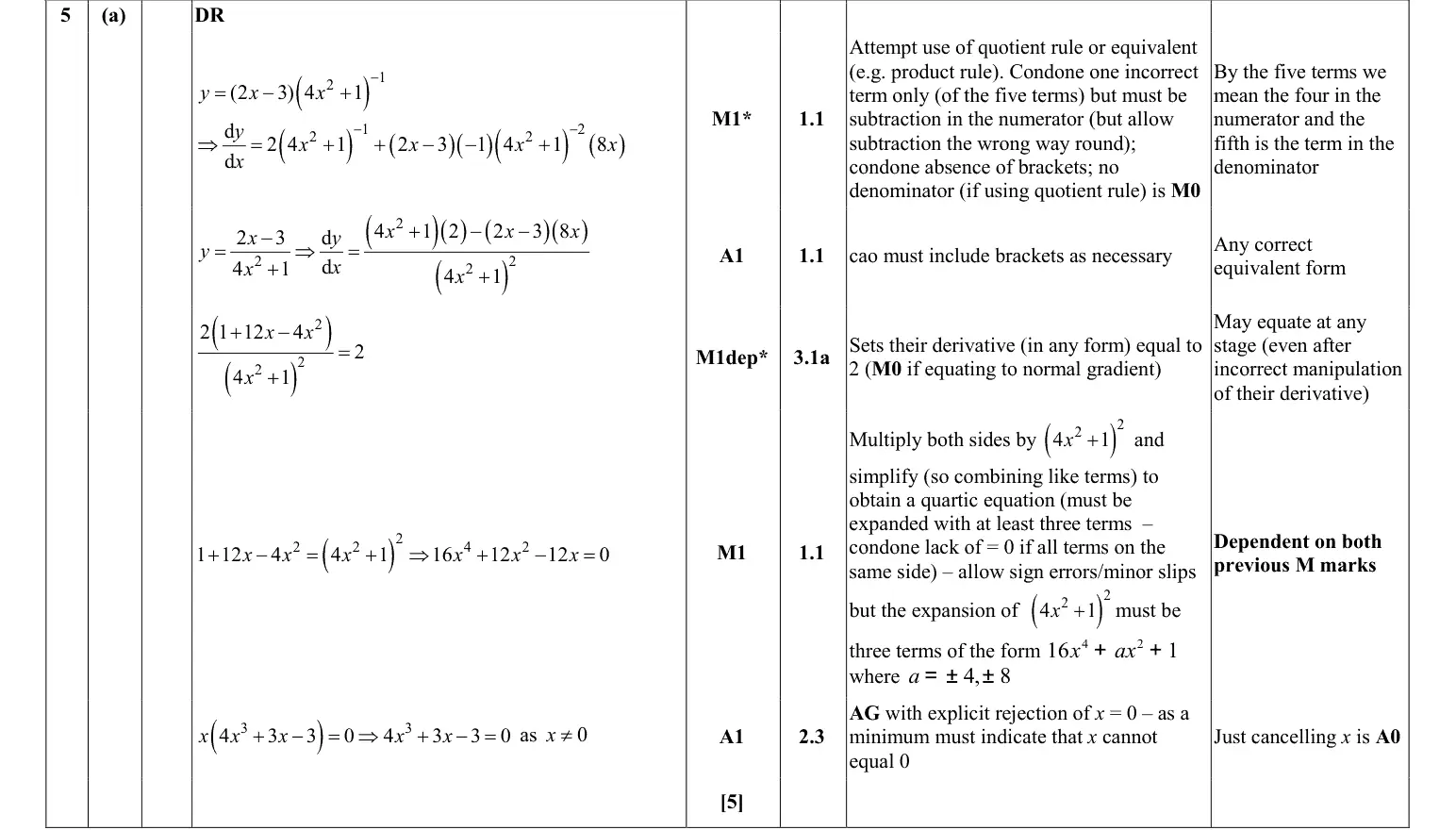
Examiner's comment
It was very pleasing that most candidates correctly applied the quotient rule to the given equation and put the resulting derivative equal to 2 (although examiners did note that on occasion the derivative was set equal to zero). Most candidates then removed the fraction(s) and bracket(s) successfully and derived the equation 16 x + 12 x − 12 x = 0 (or a multiple of this). However, the question required ‘detailed reasoning’, and it was evident that a large number of candidates simply cancelled anx from each term of their equation believing that this was sufficient to show the required result. Only the most successful responses made any reference to the given diagram which showed that the x-coordinate of point P could not be equal to zero. This response scored 4 (of the 5) marks. This was a very common response seen by examiners. The candidate has correctly applied the quotient rule and set the derivative equal to 2. They have then removed the fraction, expanded and simplified to a correct quartic equation in x ( ) + − = 4 x 3 x 3 x 0 . However, no justification is given by the candidate for why it is acceptable to cancel the x’s when simplifying the quartic equation to the required cubic equation which is why they did not achieve full marks.
Key points and common errors
quotient rule
set dy/dx = 2 (not 0)
16x⁴ + 12x² − 12x = 0
must explicitly reject x = 0 before dividing by x
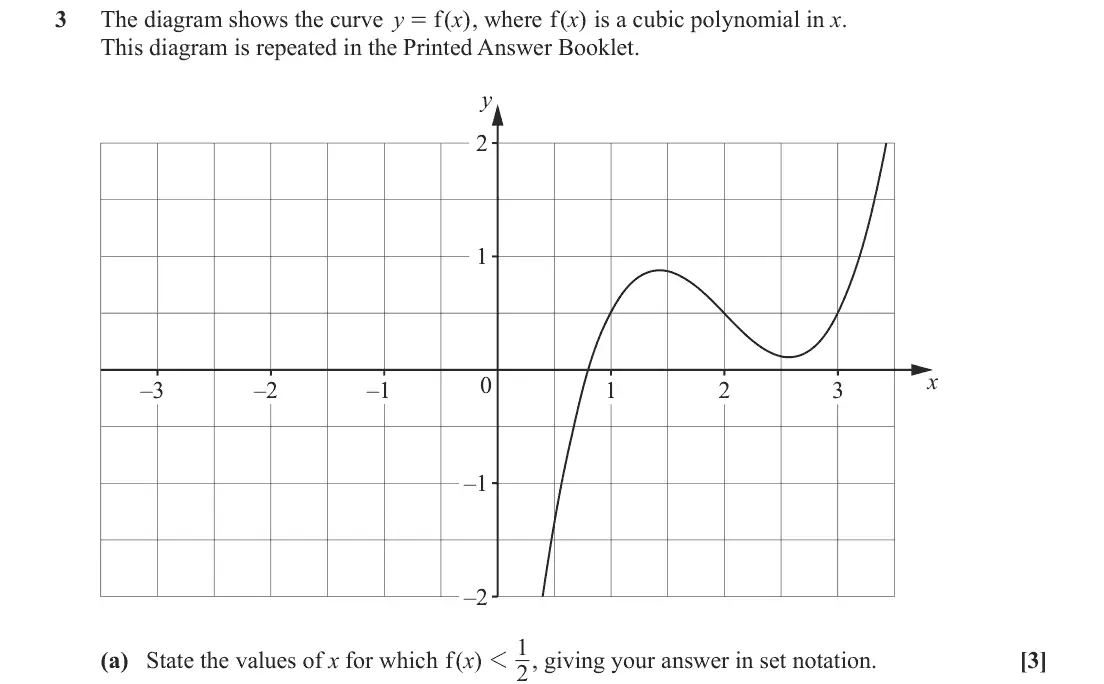
Autumn 2021 · AS Paper 1 · Q3(c)1 markMedium
Show the start of this question
Mark scheme for this part
Key points and common errors
the curve meets the x-axis only once so f(x) = 0 has only one real root
the limit must be shown explicitly, not just h = 0
Autumn 2021 · Paper 1 · Q4(a)1 markMedium
Mark scheme for this part
Examiner's comment
(From the general report) In the final part of Question 4 one root of the cubic polynomial could not be further pursued to find a value for y, and a similar situation occurred in Question 8(c).
Key points and common errors
evaluate f(0.5) and show it equals 0
just stating f(0.5) = 0 gets B0
must use factor theorem
Autumn 2021 · Paper 1 · Q4(b)3 marksMedium
Show the start of this question
Mark scheme for this part
Examiner's comment
(From the general report) In the final part of Question 4 one root of the cubic polynomial could not be further pursued to find a value for y, and a similar situation occurred in Question 8(c).
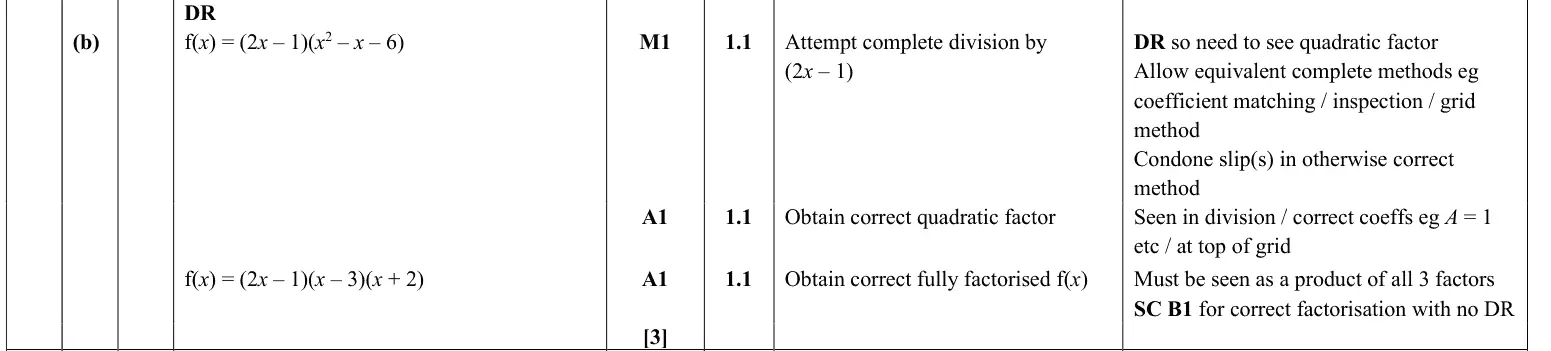
Key points and common errors
divide by (2x − 1) to get x² − x − 6
(2x − 1)(x − 3)(x + 2)
DR so the quadratic factor must be seen
Autumn 2021 · Paper 1 · Q4(c)3 marksMedium
Show the start of this question
Mark scheme for this part
Examiner's comment
(From the general report) Common misconceptions Candidates should appreciate that merely discarding a value that cannot be pursued is not sufficient; a reason is also required e.g., in Question 4(c) 2y = -2 has no solution as 2y is always positive.
Key points and common errors
recognise x = 2^y
y = −1 and y = log₂3
must give a reason for rejecting 2^y = −2 (2^y > 0 for all y), not just discard it
Autumn 2021 · Paper 2 · Q8(a)1 markMedium
Mark scheme for this part
Key points and common errors
b = −1, c = 1: (n + 1)(n² − n + 1)
Autumn 2021 · Paper 2 · Q8(b)5 marksHard
Show the start of this question
Mark scheme for this part
Examiner's comment
(From the general report) Question 8(b): Many candidates missed the point of this question – namely that part (a) provides two factors of K. Question 8(b): Many candidates misinterpreted the question.
Key points and common errors
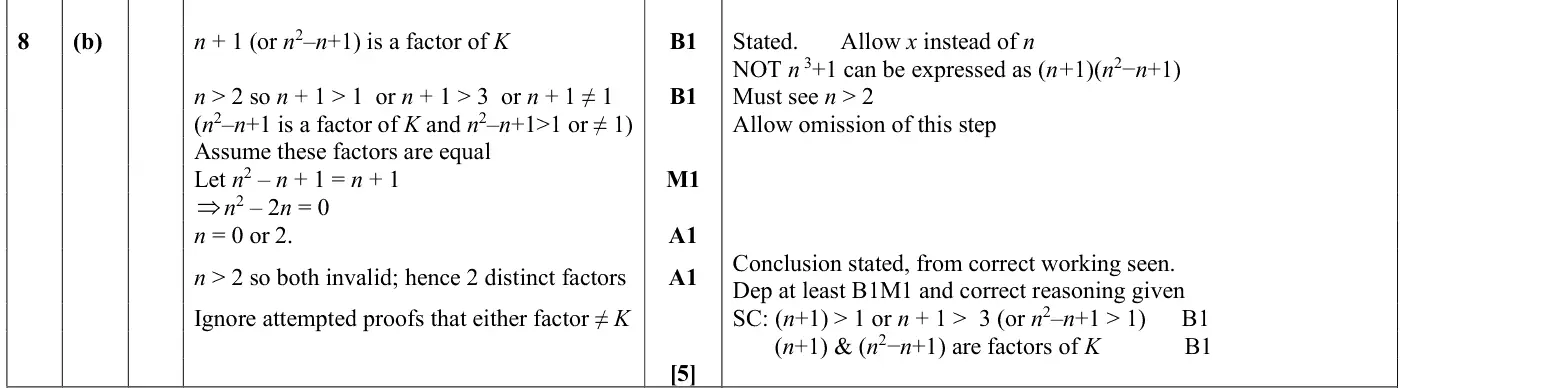
n + 1 and n² − n + 1 are factors of K, both > 1 since n > 2
equal only if n² − 2n = 0, n = 0 or 2, so distinct
many missed that part (a) gives the factors
Autumn 2020 · AS Paper 1 · Q5(b)2 marksMedium
Show the start of this question
Mark scheme for this part
Key points and common errors
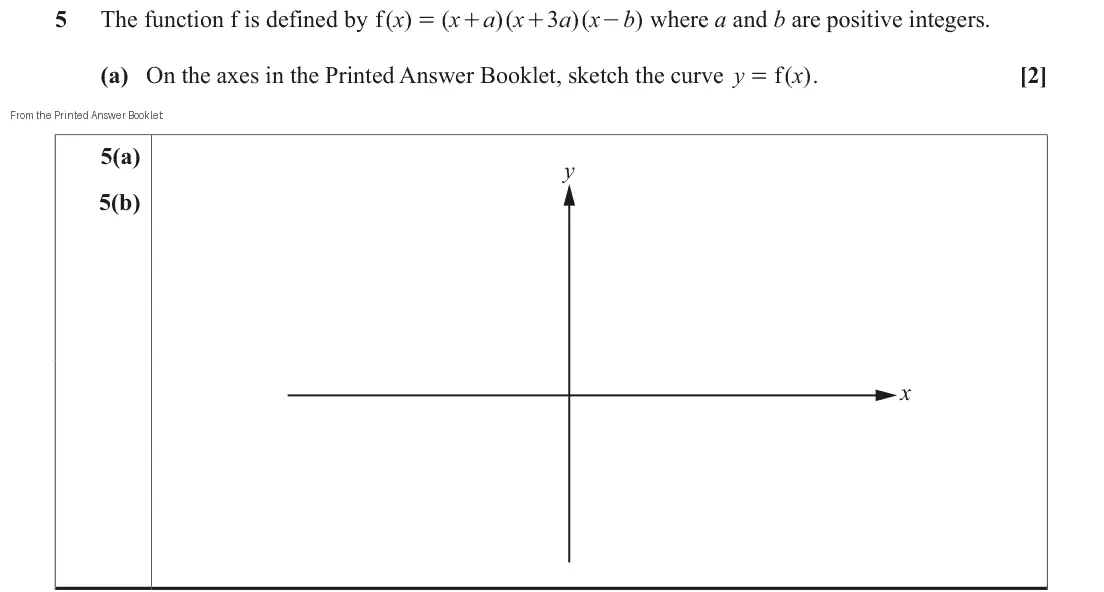
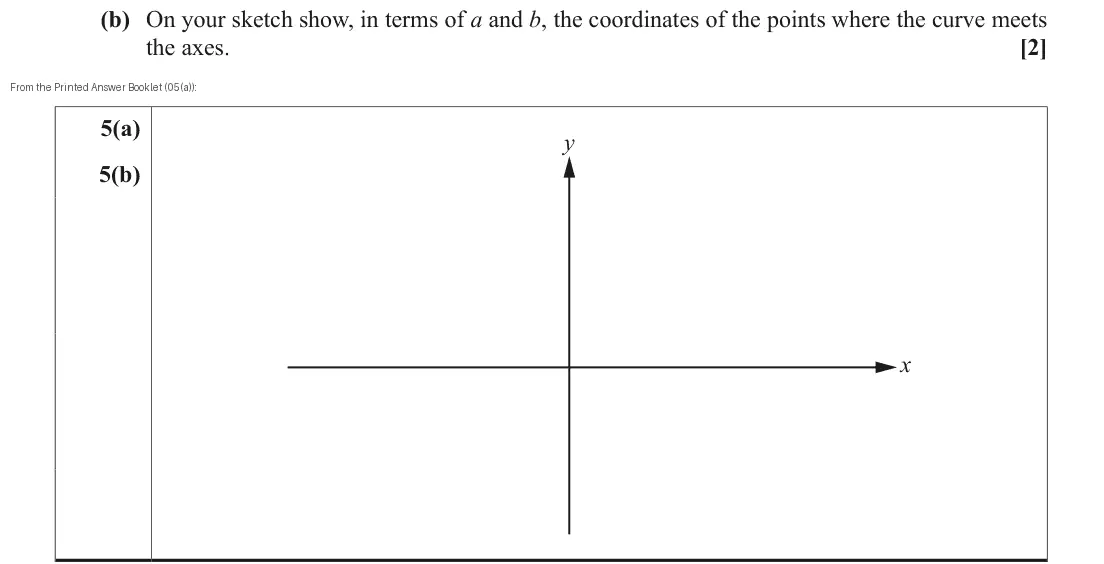
(−3a, 0), (−a, 0), (b, 0) and (0, −3a²b)
Autumn 2020 · AS Paper 1 · Q5(c)4 marksMedium
Show the start of this question
Mark scheme for this part
Key points and common errors
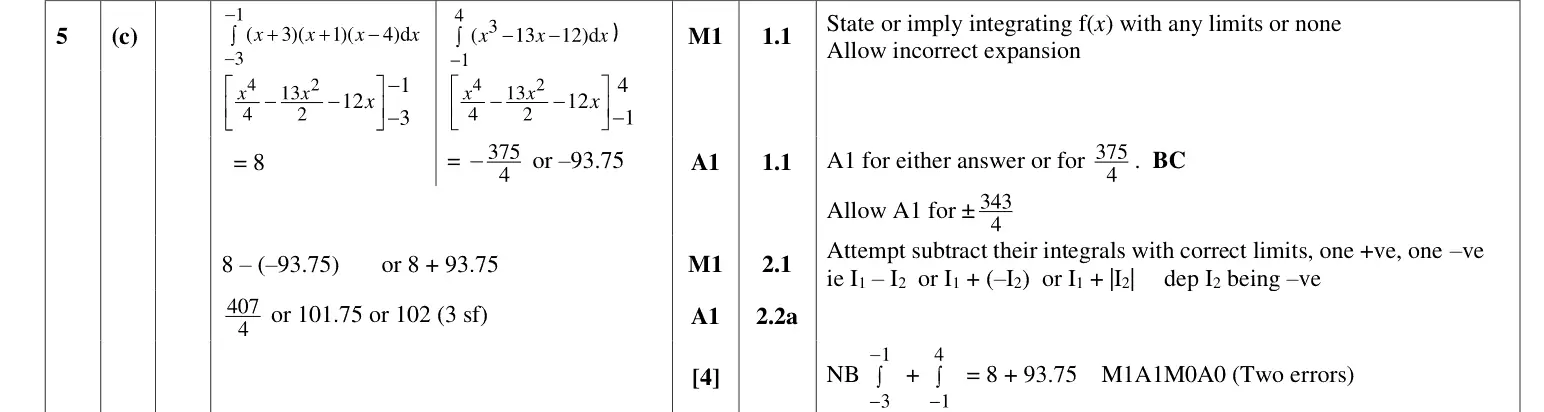
expand (x + 3)(x + 1)(x − 4) = x³ − 13x − 12
integrate −3 to −1 gives 8 and −1 to 4 gives −375/4
total 407/4 = 101.75
do not combine signed areas
Autumn 2020 · AS Paper 2 · Q4(a)2 marksMedium
Mark scheme for this part
Examiner's comment
(Comment on Question 04 as a whole) Part (a) - Long division was seen here, ignoring the request for the factor theorem. This gained no credit because of the instruction ‘Use the factor theorem’. Note that only the statement f(½) = 0 so k = -37 was not enough working because of DR and AG. Part (b) - DR so evidence for the factorisation was required. Candidates that just quoted their answer, possibly obtained from the polynomial solve function on the calculator scored M0. Part (c) - Only candidates who did well on this paper seemed to understand what was required. NR was not uncommon.
Key points and common errors
f(½) = 0 gives k = −37
must use factor theorem (long division scores nothing)
show intermediate working
Autumn 2020 · AS Paper 2 · Q4(b)3 marksMedium
Show the start of this question
Mark scheme for this part
Examiner's comment
(Comment on Question 04 as a whole) Part (a) - Long division was seen here, ignoring the request for the factor theorem. This gained no credit because of the instruction ‘Use the factor theorem’. Note that only the statement f(½) = 0 so k = -37 was not enough working because of DR and AG. Part (b) - DR so evidence for the factorisation was required. Candidates that just quoted their answer, possibly obtained from the polynomial solve function on the calculator scored M0. Part (c) - Only candidates who did well on this paper seemed to understand what was required. NR was not uncommon.
calculator polynomial solver answers without working score nothing
Autumn 2020 · Paper 1 · Q129 marksEasy
Mark scheme for this part
Examiner's comment
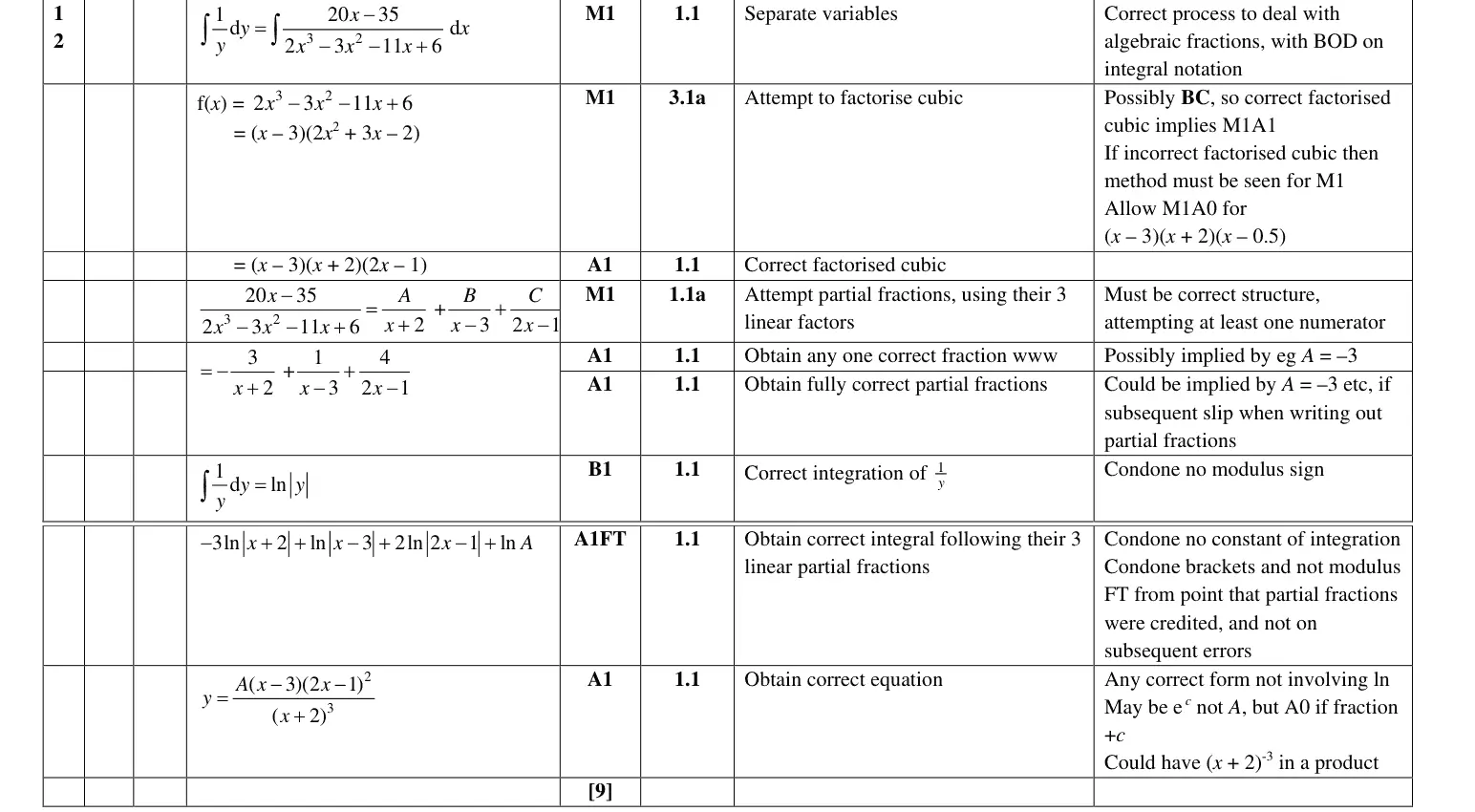
Question 12 was the final question on the paper and was generally well answered, with a number of candidates able to make good progress in this unstructured, multi-step question. As the question did not require ‘detailed reasoning’, calculator use to find the roots of the cubic denominator was acceptable. However, when then working backwards from the roots to the factors, it was fairly common to lose the lead coefficient of 2 with the expected factor of ( ) being given as ( ) 2 x − 1 x − 0 5. but with no compensation in the other factors. Candidates who took the longer method of identifying a factor, carrying out algebraic long division and then finding the other two linear factors were usually more successful. This demonstrates the need for candidates to know how to use the calculator functions effectively and accurately. The remainder of the question was generally well attempted, although only the most able candidates gained the final mark for correctly dealing with both the indices and the constant of integration when removing the logarithms to make y the subject. Common misconceptions One common misconception was commenting on the model in Question 7; a number of candidates commented on why the revision programme may be difficult for the student to implement (e.g. may get bored and not want to revise) as opposed to why it may not be realistic. Key teaching and learning points – comments on improving performance Candidates need to be aware of the command words that are used, and the implication for the detail in their solutions. ‘Determine’ was used in a number of questions and candidates should appreciate that this indicates that justification should be given; just stating the answer is unlikely to attract much, if any, credit. When commenting on the reliability of a model, or how realistic it may be, candidates are expected to give a sensible, specific reason; vague comments that refer just to ‘other factors’ are insufficient. It is essential that candidates are familiar with all areas of the specification; on this paper a number of candidates seemed less confident on topic areas that did not feature on the legacy 7890 specification, namely small angle approximations, proof by contradictions and upper and lower bounds. Guidance on using this paper as a mock When marking the mock examination, teachers should pay close attention to the additional guidance in the mark scheme to make sure that lack of sufficient detail in a solution is clearly identified and feedback given to the candidates as to what additional detail was required.
Some candidates used their calculators to solve the equation obtained by setting the numerator equal to 0. This was an acceptable method where the command word is ‘Simplify’, however, many candidates 3 and did not replace it by the correct factor of( ) kept a factor of x + 2 x + 3 . Some candidates 2 attempted long division of the cubic numerator by one of the factors of the quadratic denominator, however sign errors were often seen. It is worth noting that the neatest way to factorise a cubic is probably to use the factor theorem (with perhaps the calculator solve function used to identify values), rather than either of the two methods mentioned above. Had the question contained the “detailed reasoning” instruction, or the command word "determine" then a written mathematical argument to confirm the factors would need to be seen.
Key points and common errors
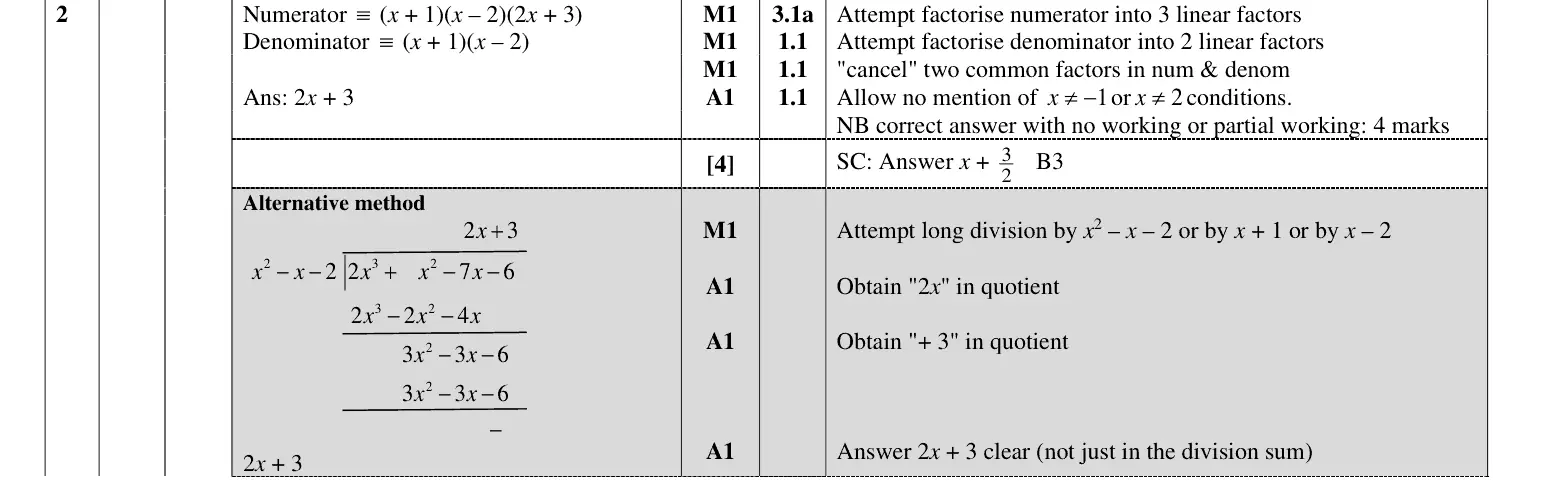
factorise numerator (x + 1)(x − 2)(2x + 3) using the factor theorem
Almost all candidates answered this question correctly.
Key points and common errors
f(1) = 2 + 3 − 8 + 3 = 0 with working shown
June 2019 · AS Paper 1 · Q3(a)(ii)4 marksEasy
Show the start of this question
Mark scheme for this part
Examiner's comment
Question 3 contained the instruction "In this question you must show detailed reasoning". In this part it was apparent that some candidates used their calculators to obtain the answers and then attempted to add some sort of explanation to disguise this fact. For example, factors (x–1)(x + 3)(x – 1 2 ) were sometimes seen without being preceded by (x – 1)(x + 3)(2x – 1). In some cases the correct responses were seen, but were preceded by "fudged" working. However, the majority of candidates did show detailed reasoning and were able to obtain full marks. Most candidates used the help provided in part (a) and began with the factor (x – 1). Interestingly, the most common method for obtaining the quadratic factor was algebraic long division. Others used the equating coefficients method. These rather laborious methods usually produced the correct result, but took far more time than the inspection method which was used by a minority of candidates.
Key points and common errors
(x − 1) is a factor
(x − 1)(2x² + 5x − 3) = (x − 1)(2x − 1)(x + 3)
x = 1, 1/2, −3
calculator answers without working gain only B1
June 2019 · AS Paper 2 · Q4(b)3 marksHard
Show the start of this question
Mark scheme for this part
Examiner's comment
This part was found to be much more challenging. We wanted to see evidence of the expansion of ( ) 1 + ax and the multiplication to give two relevant terms in x , then connected to the given 48, but this requirement was not always recognised.
Key points and common errors
(1 + 2ax + …)(32 − 400x + …): x coefficient 64a − 400 = 48 so a = 7
show the two contributing terms
June 2019 · AS Paper 2 · Q78 marksHard
Mark scheme for this part
Examiner's comment
For a fully successful attempt, candidates needed to demonstrate an understanding that areas were both above and below the x-axis, with the sign consequences, and algebraic accuracy was vital. Although the integral between 1 and 5 could be done on the calculator, many did not do this and evaluated it incorrectly, often because ( 5 )( 1 ) was expanded incorrectly. Then the integral between 5 and a − x x − needed to be carefully done before putting everything together with the correct signs. Many cubics were wrong, so getting an exact solution proved impossible. Some obtained the correct cubic fortuitously from wrong working (which was penalised) but if all was fine by this stage we then wanted a clear explanation for the rejection of the negative root and an exact answer as requested.
Key points and common errors
area 1 to 5 is 32/3
region 5 to a is below the axis so take its magnitude
cubic a³ − 9a² + 15a = 0 gives a = (9 + √21)/2, reject (9 − √21)/2 since a > 5
expansion errors in (5 − x)(x − 1)
June 2019 · Paper 2 · Q64 marksHard
Mark scheme for this part
Examiner's comment
k − and Not many candidates answered this successfully, although many at least began by writing 2 1 thereby gained a mark. Some gained another mark by factorising this expression correctly, but very few went on to show that neither factor was equal to 1. Many candidates misinterpreted the question to mean: "Prove that the following statement is not true: n is an even number greater than 2 ⇒2n – 1 is prime." They then disproved this statement by assuming it to be true and quoting a numerical example that contradicted it and claimed to have answered the question using Proof by Contradiction. Some candidates calculated 22 – 1, 24 – 1, 26 – 1, 28 – 1 etc., up to about 220 – 1 and noted that in each case the result is not prime, and incorrectly assumed that the result has been proved by "Proof by exhaustion". A few candidates (who presumably were studying Further Maths) gave a proof by induction, proving that, for n even and greater than 2, 2n – 1 is divisible by 3.
Key points and common errors
n = 2k: 2²ᵏ − 1 = (2ᵏ − 1)(2ᵏ + 1)
must show both factors > 1
many disproved the converse with an example instead
June 2019 · Paper 2 · Q75 marksMedium
Mark scheme for this part
Examiner's comment
Candidates who started by finding u were generally successful. Many other candidates started by dividing the left hand side of the given equation by 6x + . Those who handled the remainder correctly x generally went on to be successful. Many, however, after dividing and finding a remainder of 2, said that ( )( ) 2 36 x + 12 x + 7 x + x − 2 = 6 x + x 6 x + x + 1 − , which is incorrect. 6 x + x Some candidates arrived correctly at the two equations 6 x + x − 1 = 0 and 6 x + x + 2 = 0 . However, because this question contains the instruction "In this question you must show detailed reasoning", candidates needed to show (not just state) that the second equation has no real roots. Many candidates lost a mark by failing to do this. This question did prove to be challenging for many candidates, with a range of attempts involving a great deal of algebraic manipulation, in terms of x and u. Some used their calculator to find the roots directly, and then used these in a "fudged" attempt to provide some justification. Whilst the use of calculators to check work should be encouraged, this question required the explicit use of the substitution to be seen in order to gain credit.
Key points and common errors
equation becomes u² + u − 2 = 0, u = 1 or −2
6x² + x = −2 has no real roots (discriminant < 0 must be shown)
x = 1/3 or −1/2
wrong handling of the remainder after division
June 2018 · AS Paper 1 · Q2(ii)2 marksMedium
Mark scheme for this part
Examiner's comment
Many candidates were unable to deal with the signs. Some wrote (x – 3)(x + 2) > 0 or (–x – 3)(x + 2) > 0. Many eventually obtained either {x < –2 and x > 3} or {–3 < x < 2}. A few candidates gave correct working, but gave their solution as two separate regions: x > –2, x < 3.
Key points and common errors
(3 − x)(2 + x) > 0 so −2 < x < 3
sign errors
wrong regions x < −2 and x > 3
June 2018 · AS Paper 1 · Q55 marksMedium
Mark scheme for this part
Examiner's comment
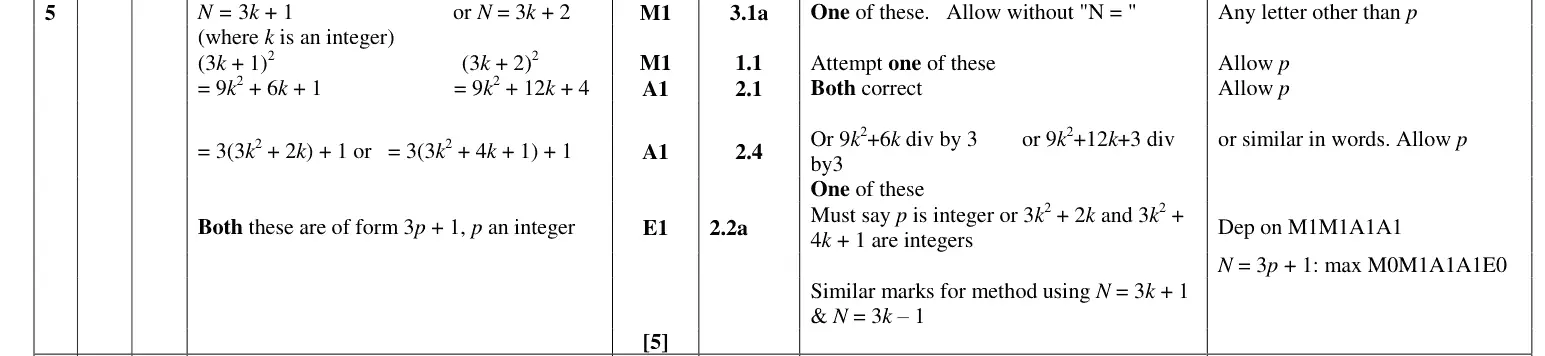
This question tests "proof by exhaustion" as included in paragraph 1.01a of the specification. This method of proof involves either considering all possible values or all possible categories of values. This question tests the latter. It was not well answered on the whole. Many candidates started with, for example, N = 3k + 1 and gave a partly correct argument based on this (although most omitted to say "where k is an integer"). Then many of these omitted to consider either N = 3k + 2 or N = 3k – 1 as well. Some candidates started with N = 3p + 1 and gave an otherwise correct argument, ignoring the use of "p" in the question. Some candidates tried to work from N2 = 3p + 1. These all failed. Some verified the result in a few numerical cases. These scored no marks.
Key points and common errors
proof by exhaustion: N = 3k + 1 or 3k + 2
squares 3(3k² + 2k) + 1 and 3(3k² + 4k + 1) + 1
both cases and a conclusion needed
June 2018 · AS Paper 1 · Q6(ii)5 marksMedium
Mark scheme for this part
Examiner's comment
Some candidates attempted the inefficient method of differentiating and finding the stationary points. Others factorised incorrectly or ignored the factor of x. Algebraic "long division" was sometimes seen and it is worth noting that this long and ugly method is totally unnecessary. Some candidates factorised correctly but then drew the curve touching the x-axis at x = 0 instead of x = 3. A few drew the curve upside down. The use of calculator “table function” could be used to check that the sketch represents the actual numbers.
Key points and common errors
factorise x(x − 3)²: through origin, touches x-axis at (3, 0)
differentiation unnecessary
repeated root drawn at 0
June 2018 · Paper 1 · Q6(i)3 marksEasy
Mark scheme for this part
Examiner's comment
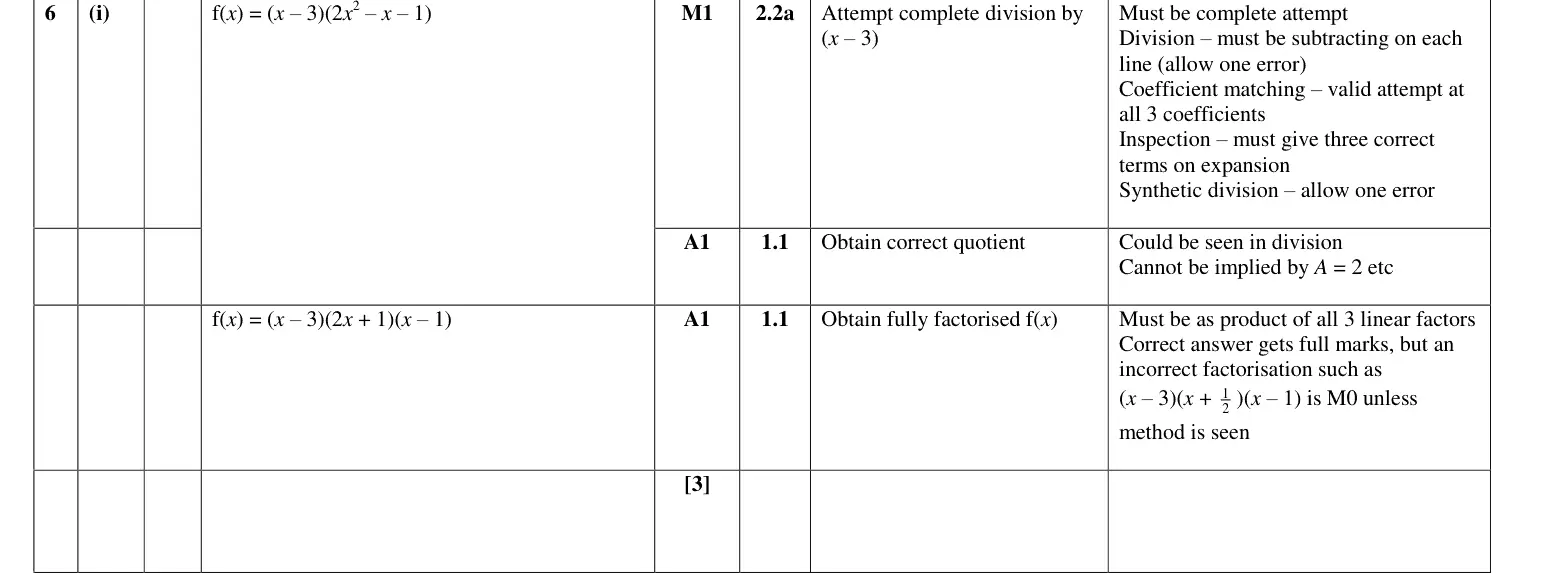
Most candidates correctly found the quadratic quotient, with the most common methods being algebraic long division and the grid method, which tended to be equally successful. They could then factorise the quadratic quotient correctly. The question asks for f(x) to be given in fully factorised form, so candidates were expected to give their final answer as the product of three factors. A few candidates found the roots from their calculator and then attempted to work backwards but no correct solutions were seen as the factor was given as (x + 0.5) rather than the correct factorised form (2x + 1) or 2(x + 0.5).
Key points and common errors
divide by (x − 3) to get 2x² − x − 1
(x − 3)(2x + 1)(x − 1)
(x + ½) factor is wrong
June 2018 · Paper 2 · Q5(iii)4 marksHard
Show the start of this question
Mark scheme for this part
Examiner's comment
Some candidates recognised that the starting point was m – n = 1. Most of these proceeded to obtain the correct answer (although a few squared 427 instead of 426). Many candidates, however, did not appreciate the link with part (ii) and attempted trial and improvement, without success.
Key points and common errors
use the link to (ii): m − n = 1 and m + n = 853 so n = 426, S = 181476
trial and improvement rarely succeeded
some squared 427
June 2018 · Paper 3 · Q4(ii)6 marksMedium
Show the start of this question
Mark scheme for this part
Examiner's comment
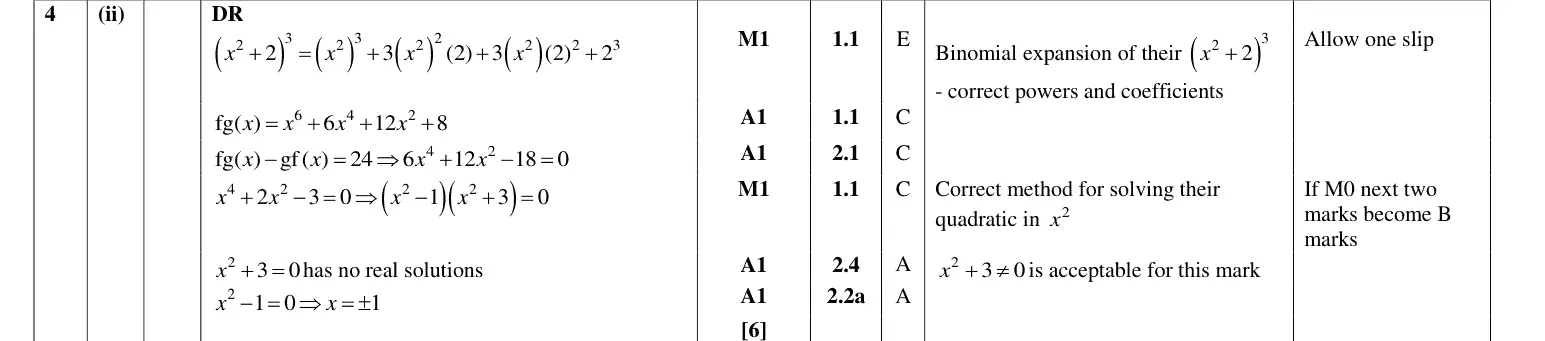
There were a significant number of candidates that did not employ correct bracketing and mistakenly wrote( ) rather than( ) ( ) ( ) x + 2 − x + 2 = 24 x + 2 − x + 2 = 24 ⇒ x + 2 − x − 2 = 24 . The majority of candidates went for expanding ( ) x + 2 by writing out the bracket three times rather than using the binomial expansion of ( a + b ) . While the majority rearranged their quartic into the form ( ) + 6 x 12 x − 18 = 0 there were a number of candidates did not show sufficient working in solving this quartic, even though the full question required detailed reasoning. Finally, it is expected at this level that as part of the detailed reasoning candidates should justify why x + 3 = 0 did not provide any solutions.
Key points and common errors
expand (x² + 2)³ = x⁶ + 6x⁴ + 12x² + 8
brackets needed when subtracting gf(x)
6x⁴ + 12x² − 18 = 0
(x² − 1)(x² + 3) = 0
reject x² = −3 explicitly
x = ±1
Find an A-level maths tutor
Stuck on this? Book a trial session with an A-level maths tutor.