Evaluate definite integrals; use a definite integral to find the area under a curve and the area between two curves.
Guidance
Students will be expected to be able to evaluate the area of a region bounded by a curve and given straight lines, or between two curves. This includes curves defined parametrically. For example, find the finite area bounded by the curve y = 6x – x² and the line y = 2x. Or find the finite area bounded by the curve y = x² – 5x + 6 and the curve y = 4 – x².
A-level only
the area between two curves; curves defined parametrically
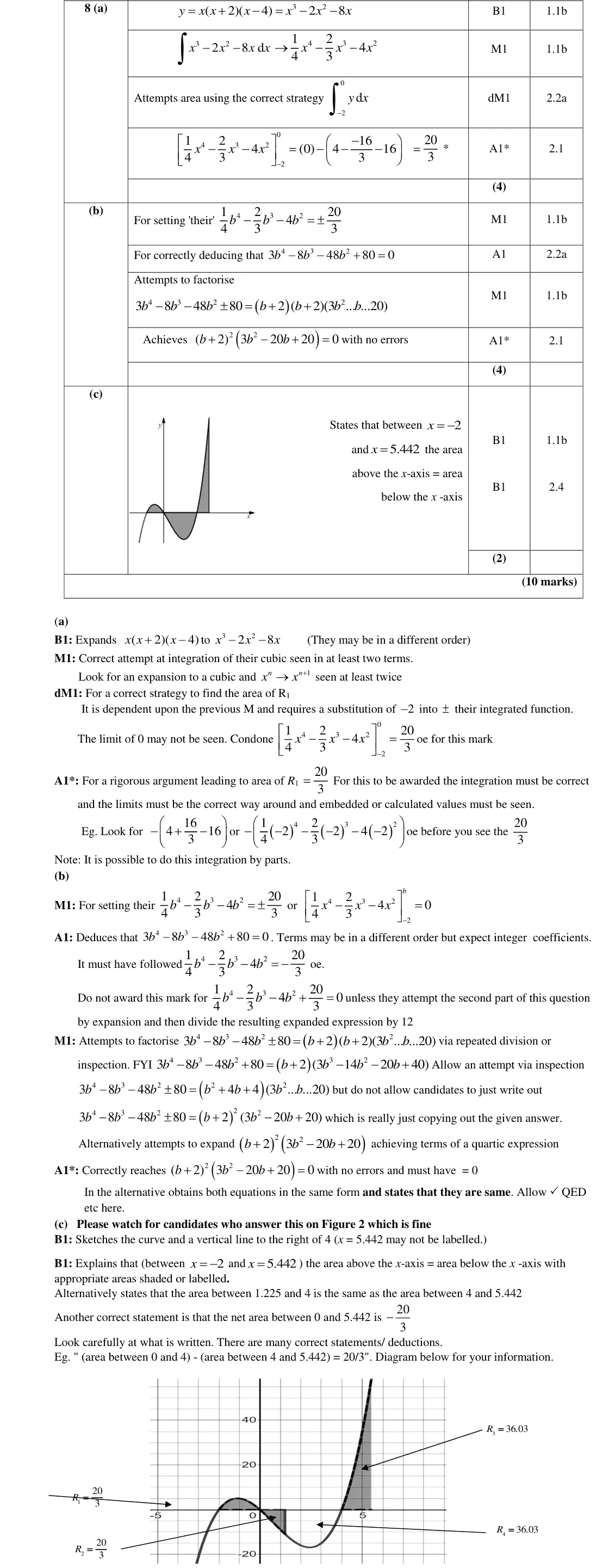
Mark scheme (whole question; this part is marked with the orange bar)
Examiner's comment
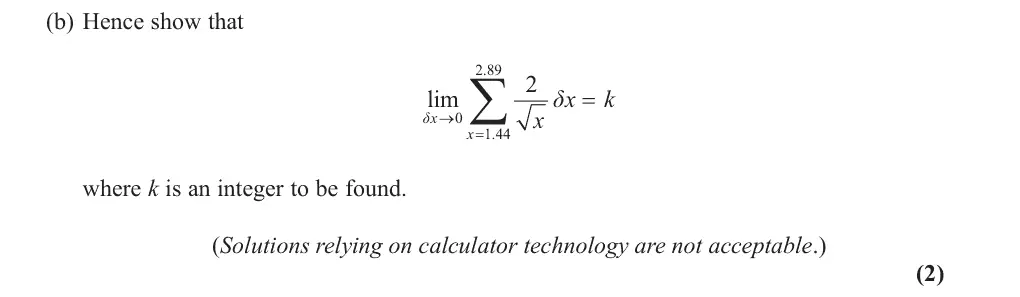
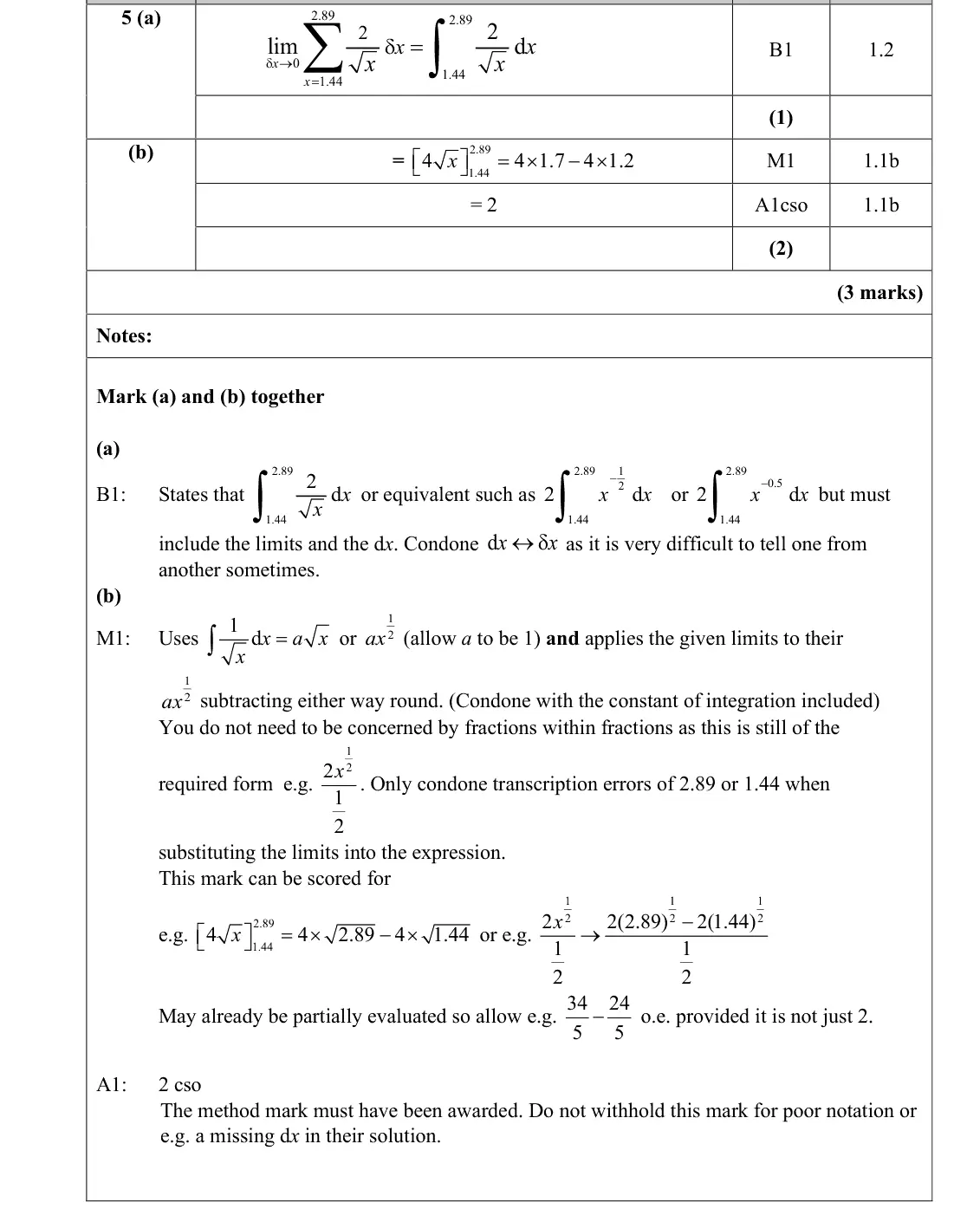
This question was well attempted by the vast majority of learners. Part (b) of the question was also usually answered successfully. This question was a show that and included the warning they solutions relying on calculator technology were not acceptable, so it was required that learners showed all steps of their working. Most understood the method and showed appropriate integration followed by correct substitution of limits and correct answer. There were sometimes errors with the coefficient, the most common being 1 2 2 x x rather than 2 1 2 x . Other errors when integrating usually occurred with the power (converting 2 x to 1 2 2x then integrating or differentiating instead of integrating) or the use of ln ax . A small number of responses integrated correctly but then proceeded straight to the final answer without any evidence of substitution of the given limits and so were unable to gain any marks. Those who had the incorrect limits such as using 0 were also unable to score either mark, although transcription errors of 2.89 and1.44 were condoned for the method mark. There were many cases of poor notation such as retaining the integral symbol after integrating and include c + within the calculation but these were condoned on this occasion. 9
Common mistakes
integrate 2x^(−1/2) to 4√x and show the limits substituted: 4 × 1.7 − 4 × 1.2 = 2
Mark scheme (whole question; this part is marked with the orange bar)
Examiner's comment
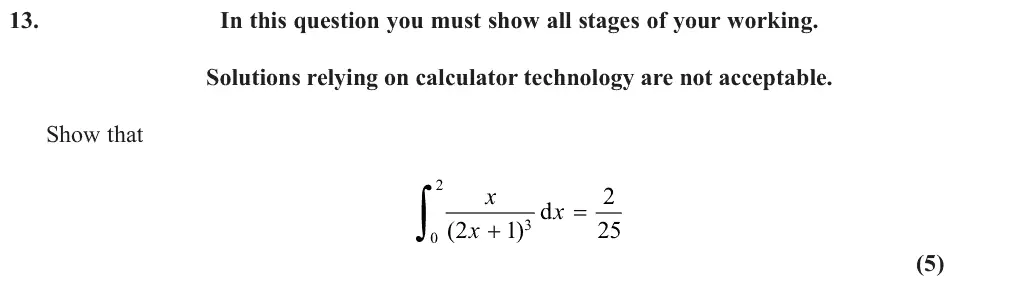
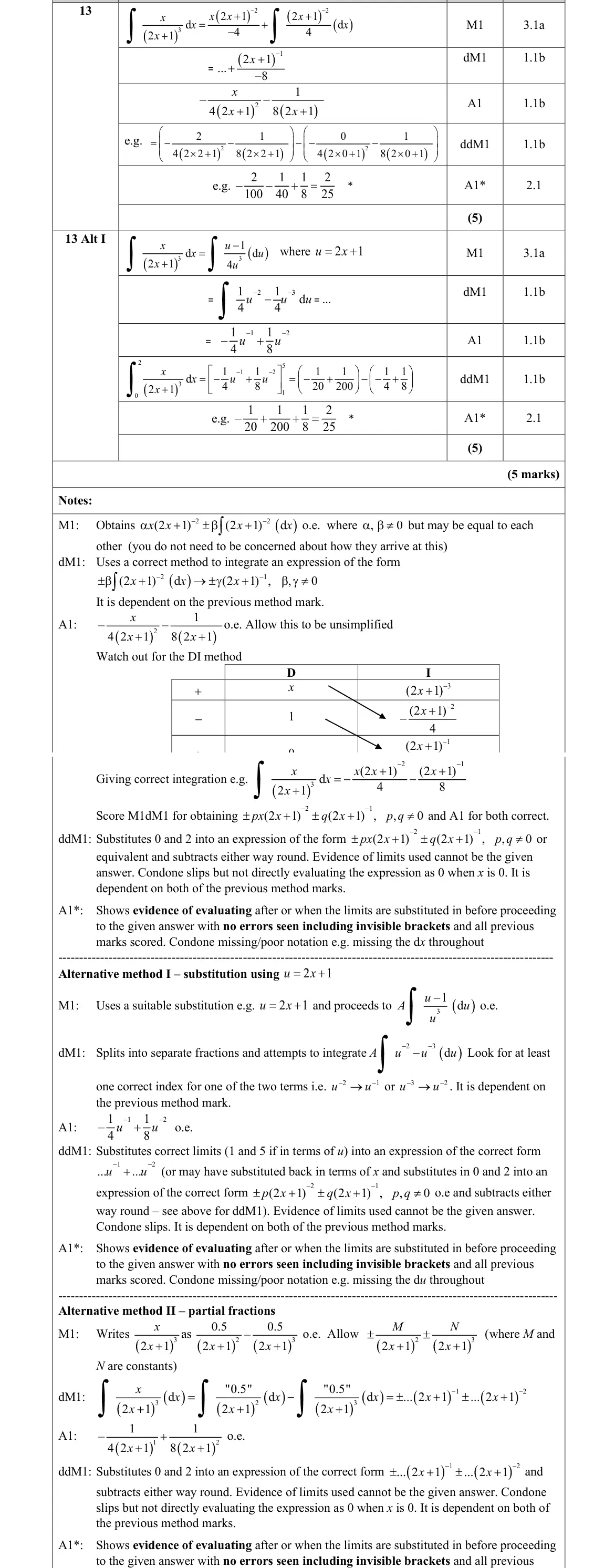
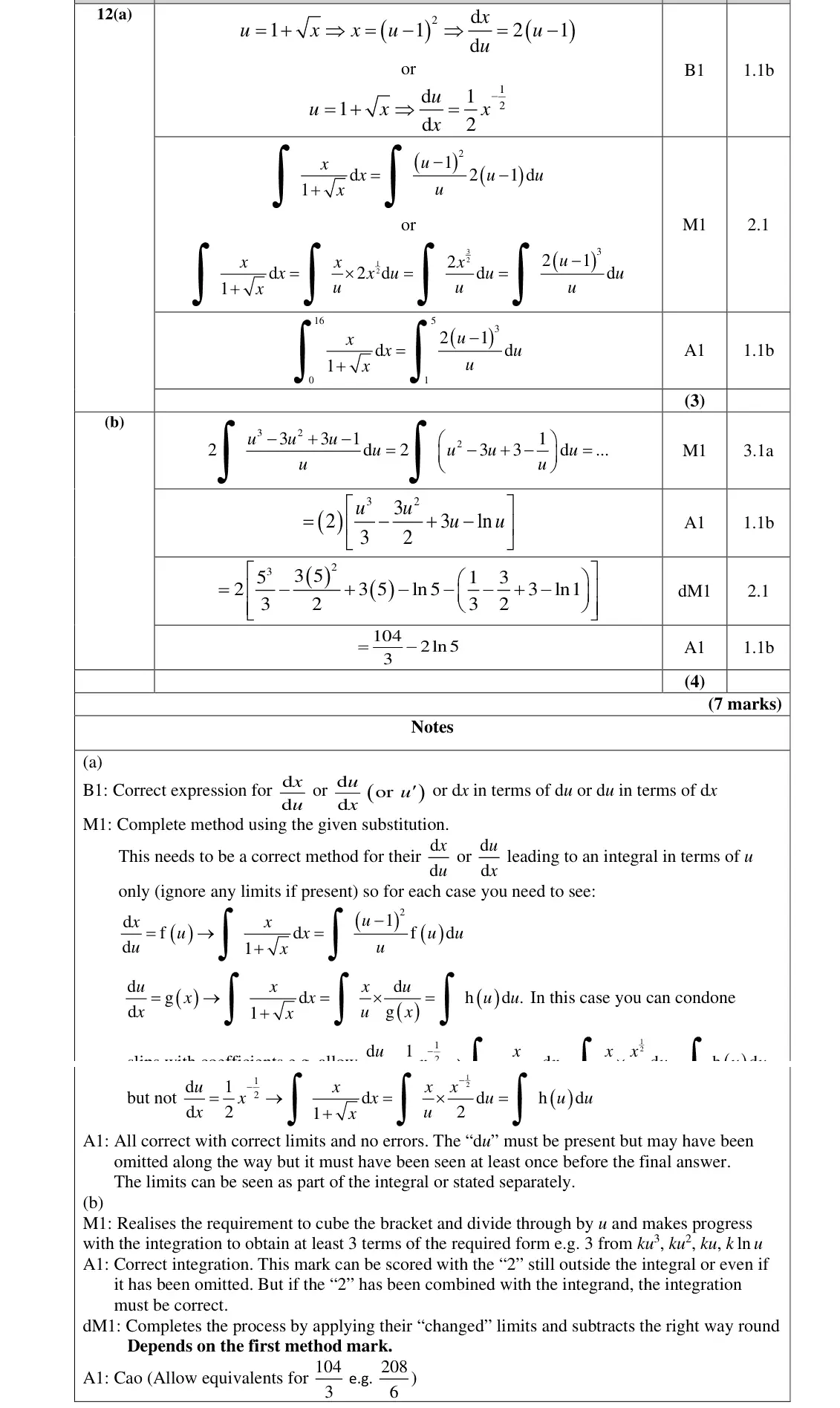
This unstructured question required learners to evaluate a definite integral and it was approached in a wide variety of ways with varying degrees of success. The question included a calculator warning which made it clear that solutions relying on calculator technology were not acceptable. Integration by substitution and integration by parts were the most common methods by far and seen in roughly equal measure. For the substitution method, most learners chose to use 2 1 u x = + . A few proceeded no further than rewriting the integral fully in terms of u as they did not recognise that the resulting expression could be split up into two distinct terms which could be integrated directly. Successful attempts using integration by parts required u x = and ( ) 3 d 2 1 d v x x - = + . Some learners who rely on acronyms and found that the “LATE” method to decide the choice of u and d d v x did not help them in this instance. Many chose to restart the question when they realised that they were not making any progress. Most responses that executed these methods and mistakes in the early stages tended to be made with their coefficients rather than the powers. Less commonly seen was first splitting the integrand into partial fractions or using a less efficient substitution such as 3 (2 1) u x = + or even a trigonometric substitution. Some responses negated to heed the calculator warning and jumping to the given answer without any evaluation of limits. Overall, whilst most learners could begin the question by a viable method, sustained accuracy and attention to fine detail were required in order to achieve full marks, many had to restart their solutions or amend earlier work which made it very challenging at times to determine what work was credible, or which solution they wanted to be marked. Due to no errors being allowed for the final mark learners risked not being awarded this mark by not clearly identifying their final attempt. 20
Common mistakes
by parts with u = x, dv/dx = (2x + 1)^(−3), or substitution u = 2x + 1 (limits 1 and 5) splitting into u^(−2) − u^(−3)
the LATE rule misleads here
show the limits substituted before 2/25
coefficient slips
several restarts made work hard to follow
June 2025 · Paper 1 · Q16(a)4 marks
Mark scheme (whole question; this part is marked with the orange bar)
Examiner's comment
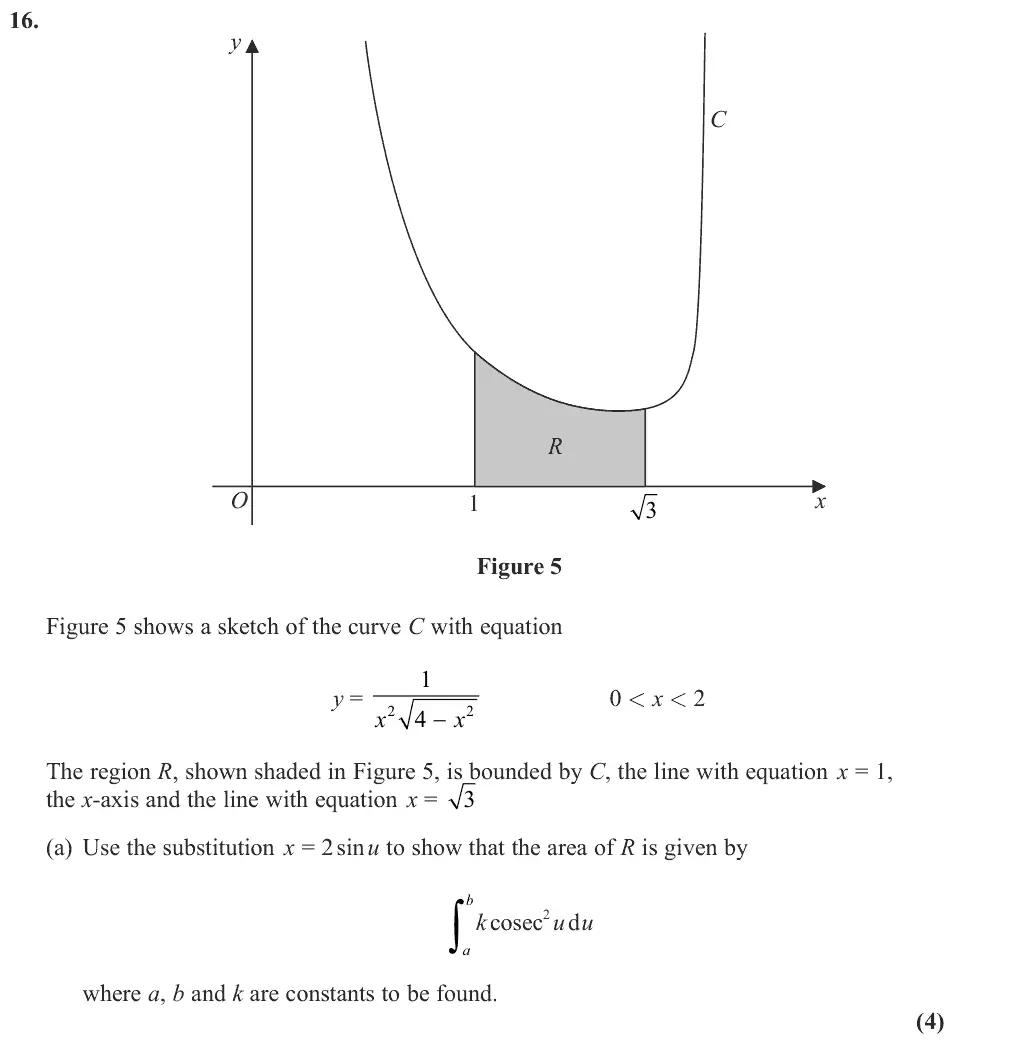
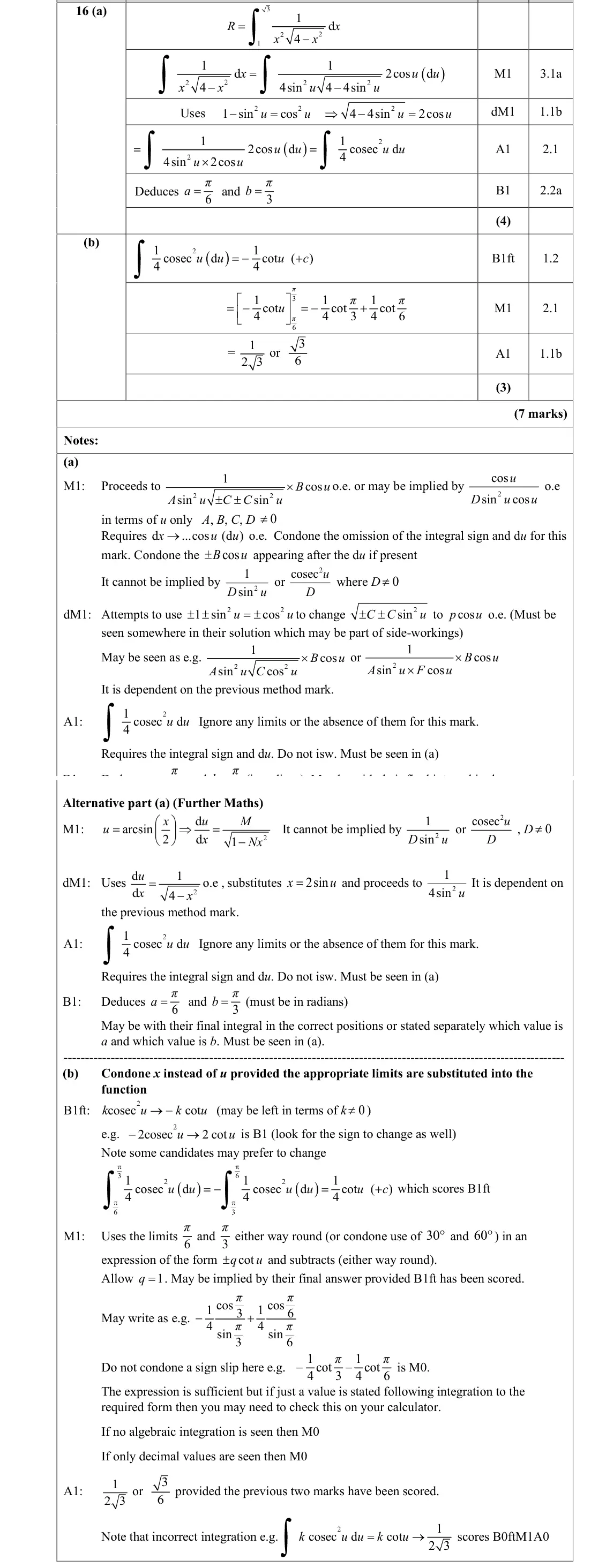
This proved to be a challenging question demanding good algebraic skills and attention to detail. For a final question on a paper, most made an attempt. In part (a), many responses did not successfully manage to fully substitute for all elements of the integral. The main issue was the correct substitution for dx. Responses commonly successfully substituted u in everything except the ‘du’, with some omitting it. Additionally, many did not achieve marks because they did not successfully substitute and achieve 2cosu in the denominator with others attempting to substitute d d 2cos u x u = . Many responses were not presented in a logical structure and did not gain marks because they did not bring together the elements of the substitution into a single expression which showed the progress of the substitution, the manipulation and simplification to the required result. This occasionally resulted in just amending to the result because they knew what the required form was but did not know how to get there. A large proportion did not spot the need to use the identity 2 2 sin cos 1 x x + = and often just square rooted all the values in the bracket achieving (2 2sin )x - . Some learners misapplied identities, using for example cos2x . Those who did use the identity correctly tended to go on to also gain the accuracy mark, but a few had 2 1 4sin u and ended with 2 4cosec u . Those who did compete the full substitution often did it in stages leaving the substitution for dx until the final stage of their proof which was condoned but should not be encouraged. A good proportion also changed the limits into angles in degrees and so did not gain the mark for changing the limits. The limits were often given as 30 degrees and 60 degrees, costing the final mark.
Common mistakes
substitute every part including dx = 2cos u du
√(4 − 4sin²u) = 2cos u using sin² + cos² = 1 (not √4 − √(4sin²u))
simplify to ∫ ¼cosec²u du
limits in radians π/6 and π/3, not 30° and 60°
June 2025 · Paper 1 · Q16(b)3 marks
Mark scheme (whole question; this part is marked with the orange bar)
Examiner's comment
This proved to be a challenging question demanding good algebraic skills and attention to detail. For a final question on a paper, most made an attempt. In part (b), it was notable that those who did not reach a correct answer in part (a) often did not go on to attempt this, even though these marks were available to them. Even though they were told that the integral was a multiple of 2 cosec u some learners tried unsuccessfully to integrate their very complex answers to (a). A large number did not appear to know the integral of 2 cosec u or did not use the formula booklet correctly and some attempted very convoluted methods of integration. Those that did not score at all got muddled in the initial stage, choosing to use ln or some other given integration from the formula book that they had misread or misinterpreted. A significant number got confused between the integral of 2 cosec u andcosec u , which meant they ended up with expressions involving ln(tan ) u or ln(cosec cot ) u u + . However, several responses obtained the correct answer of 1 cot 4 u - , although a few omitted the negative sign, and others 23 stated the answer was 1 cot . 4 u There was a proportion who did not include the negative sign and consequently amended the resulting negative in their final answer. 24
Common mistakes
∫cosec²u du = −cot u (sign often lost
confused with ∫cosec u)
−¼cot(π/3) + ¼cot(π/6) = 1/(2√3) = √3/6
can be attempted even if (a) was not completed
June 2025 · Paper 2 · Q15(c)3 marks
Mark scheme (whole question; this part is marked with the orange bar)
Examiner's comment
The final question, which involved differentiation, integration by substitution and trigonometric identities, provided challenge in dealing with the algebra but, given its layout, proved accessible. The majority of learners attempted at least part of this question with some success due to the restart opportunities available. Part (c) proved to be more accessible for many learners, with many making an attempt after struggling with the earlier sections. Those who attempted this part often successful, regardless of their performance in parts (a) and (b). Common errors were with the coefficient, usually given as 1 2 - or 2, or when substituting the limits. Some tried to use double angle formulae to change the form of the integrand and therefore did not make progress with this part of the question, not realising that the given form in part (b) was designed to help them complete the integration. Despite the question asking the candidate to show all stages of their working, some responses did not show the substitution and so did not gain the last two marks.
Common mistakes
∫cos 2θ dθ = ½ sin 2θ (not −½ or 2)
substitute the θ limits, not ±1
area 1
the substitution must be shown (calculator answer alone scores 0)
June 2024 · AS Paper 1 · Q8(c)5 marks
Mark scheme (whole question; this part is marked with the orange bar)
Examiner's comment
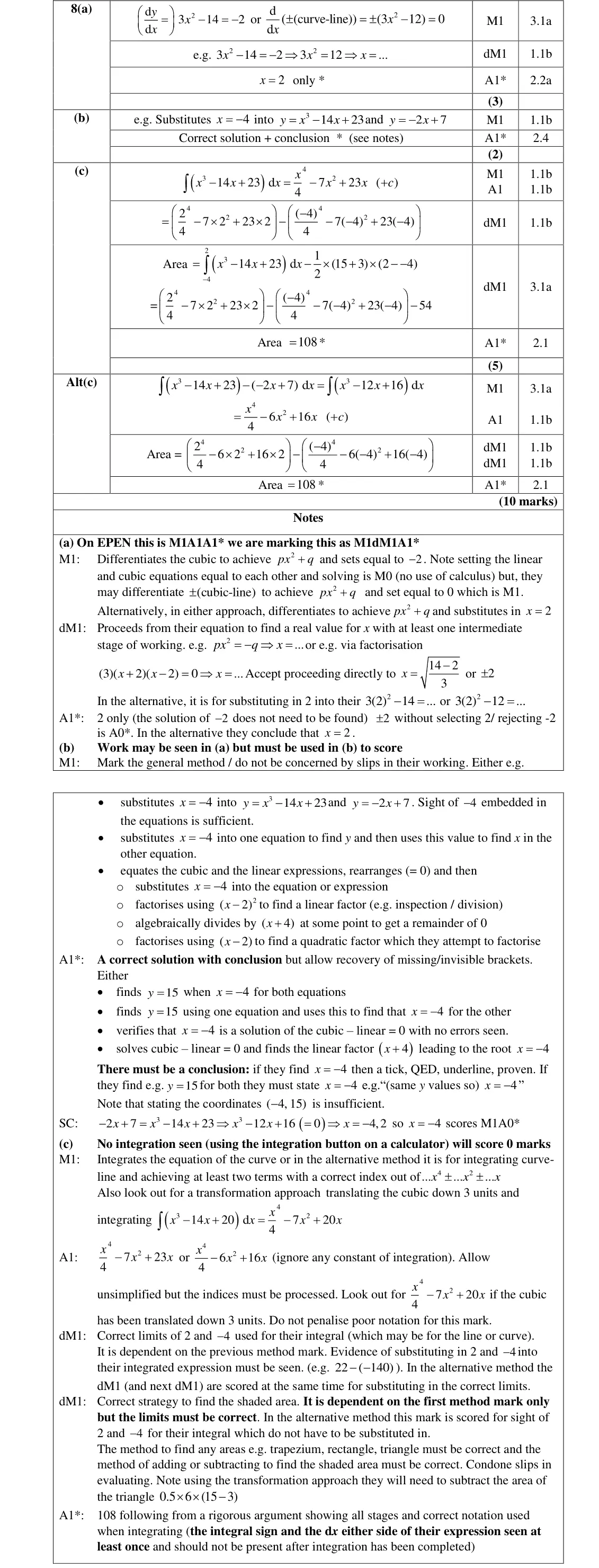
Marks awarded in this question were generally quite varied. Often candidates made progress in (c) only, by attempting some integration with little correct work seen in (a) or (b). Each part of this question presented a given answer, and candidates who failed to observe the warning in the question about showing all stages of their working, or relying entirely on calculator technology, often lost marks. In part (c) candidates generally knew that they needed to proceed with integration, and often the first two marks were scored for correctly integrating even if they made no further progress. Successful candidates usually attempted to evaluate 2 3 4 14 23 d x x x - - + and then subtracted 2 4 2 7 d x x -- + . Some used the area of a trapezium to give 1 (3 15) 6 2 + instead of integrating the equation of the line. Alternatively, some attempted to evaluate 2 3 4 12 16 d x x x - - + reaching the required area of 108 in one step. Candidates were required to make their method clear, including showing the use of the limits 4 - and 2. Some failed to do so, clearly relying on calculator technology to evaluate the integrals. Others failed to show the complete correct strategy for finding the area and often incorrectly identified the trapezium as a triangle. Also, correct notation was required and appropriate use of the integral sign and the ‘dx’ on either side.
Common mistakes
∫ from −4 to 2 of (x³ − 14x + 23) dx minus the trapezium ½(15 + 3) × 6 = 54, or ∫(x³ − 12x + 16) dx
correct limits 2 and −4
integral sign and dx needed
calculator integration scores 0
June 2024 · AS Paper 2 (Statistics) · Q3(c)3 marks
Mark scheme (whole question; this part is marked with the orange bar)
Examiner's comment
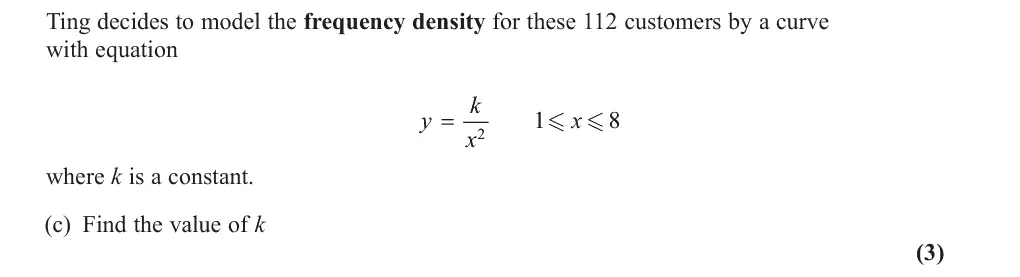
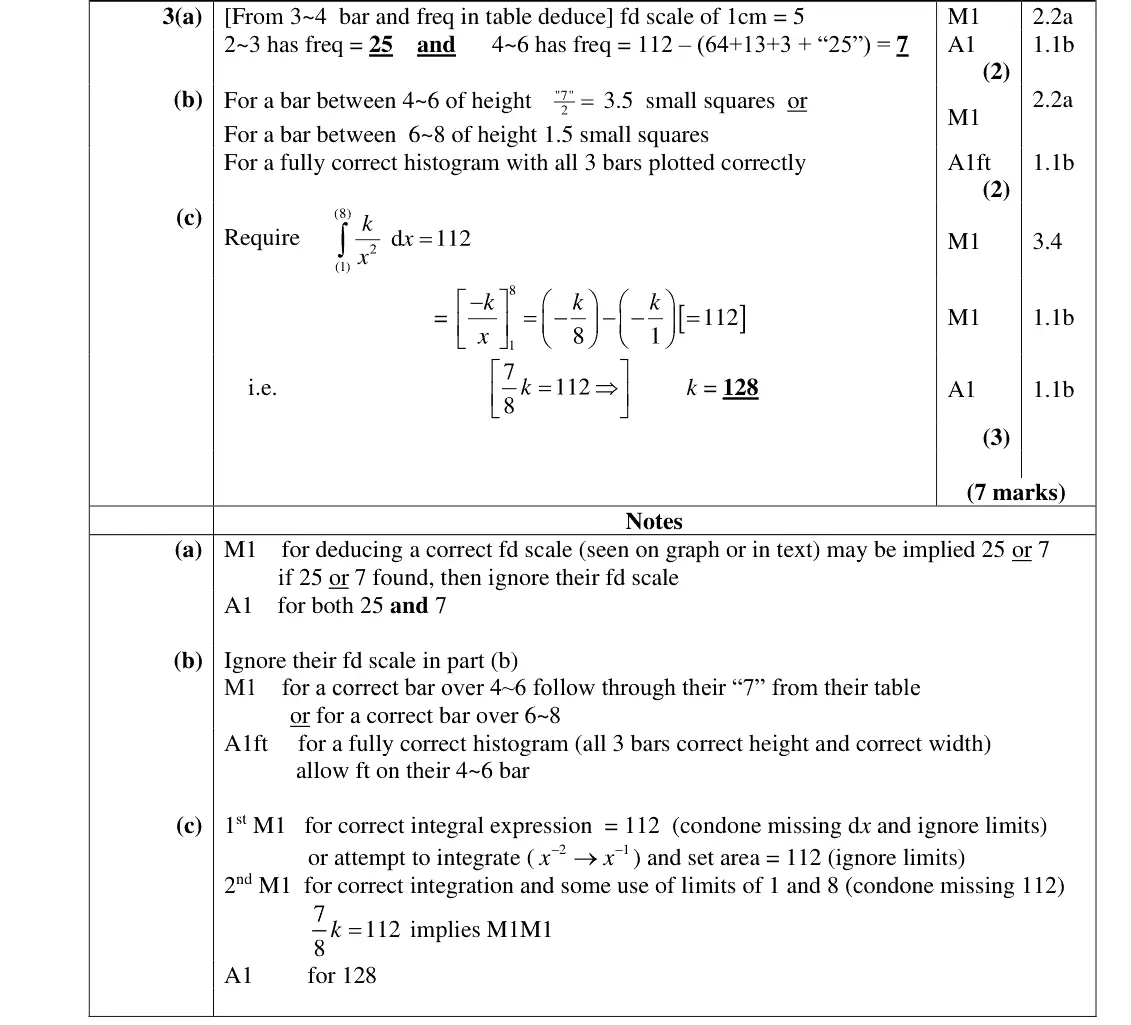
Part (c) was not well done and quite often no attempt was made. Some students substituted one or more values of x, setting the result equal to the frequency (or frequency density). When integration was used, it was often done well. It was, however, surprising to see that even when the correct integration was equated to 112, many were unable to accurately solve the equation. Many students made slips with the negative signs, and some were unable to solve the equation, multiplying one side by 8 to get rid of the fraction but failing to multiply 112 by 8 at the same time.
Common mistakes
area under the frequency density curve is the total frequency: ∫ from 1 to 8 of k/x² dx = 112
(7/8)k = 112 gives k = 128
substituting x values instead of integrating
sign slips with −k/x
June 2024 · AS Paper 2 (Mechanics) · Q2(b)4 marks
Mark scheme (whole question; this part is marked with the orange bar)
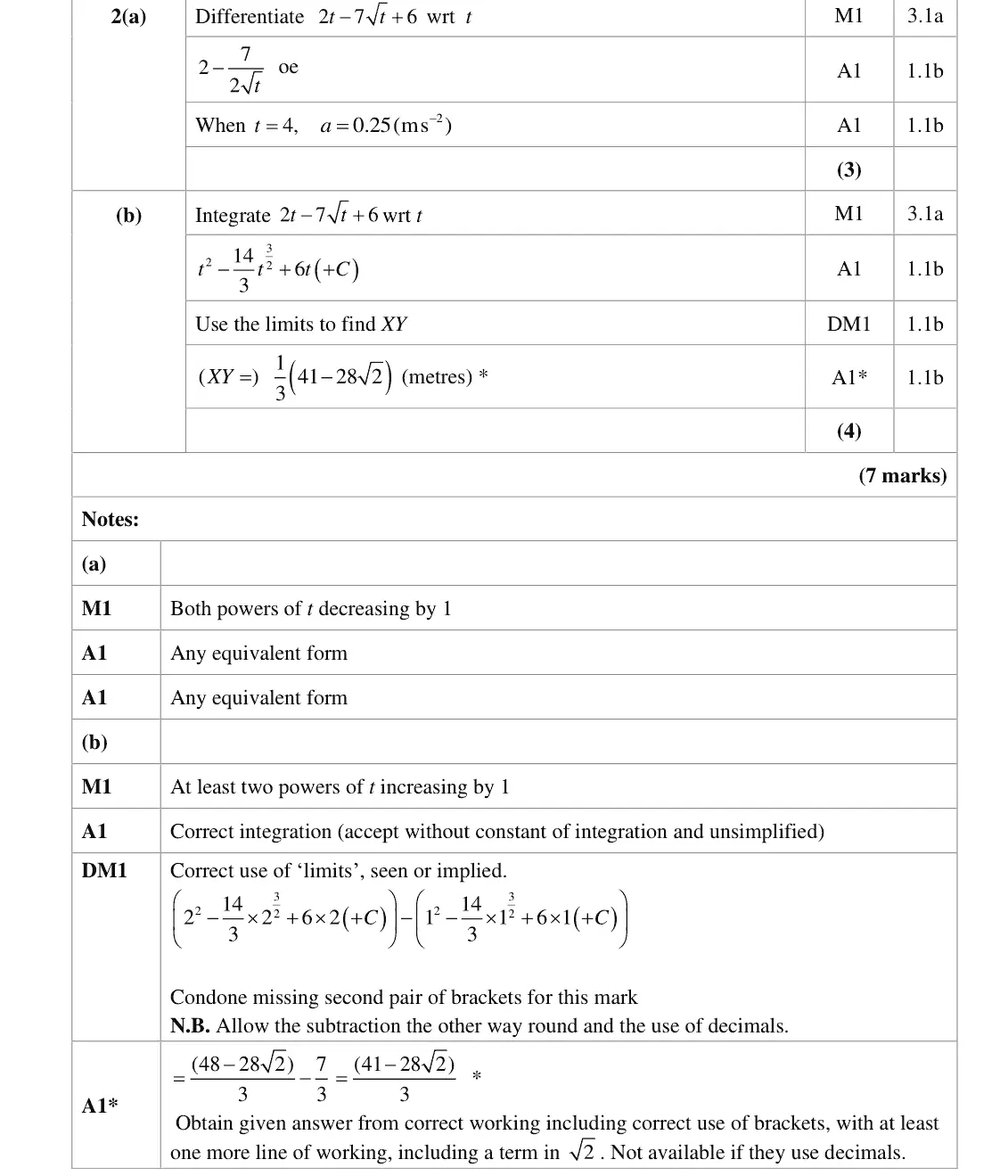
Examiner's comment
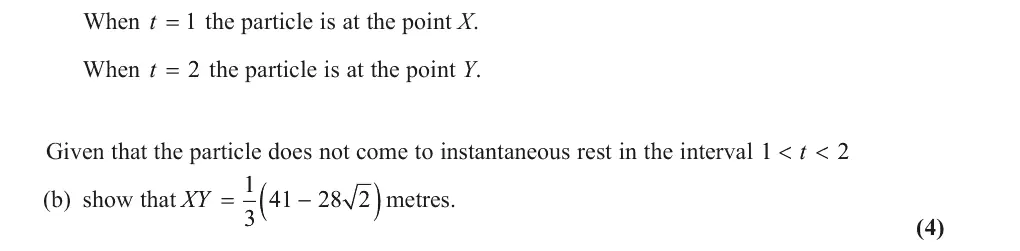
In part (b), successful candidates integrated the expression for v with respect to t and were usually able to obtain a correct, unsimplified expression for the displacement of the particle at time t. There were then occasional errors with the simplification often due to incorrect coefficients. There was no penalty for not including a constant of integration. Successful candidates then used the limits of t = 1 and t = 2 to calculate the distance XY. A surprising number of candidates thought that finding XY meant that they then had to multiply these two values. Since there was a printed answer, candidates needed to clearly show all stages of their working including the use of surds to get to the required form of the answer. Of those that tried to use surds, some struggled to reach the given answer whilst others did not show enough working to gain the final A mark. Ignoring the instructions at the top of the question, many candidates used calculators and decimals appeared in their solutions which resulted in the solutions being incomplete and losing the final mark. Very few candidates used differentiation in this part.
Common mistakes
integrate v: t² − (14/3)t^(3/2) + 6t
XY = s(2) − s(1) (no change of direction so displacement = distance)
keep surds: 2^(3/2) = 2√2 to reach (41 − 28√2)/3
decimals lose the final mark
multiplying the two values
June 2024 · Paper 1 · Q10(c)5 marks
Mark scheme (whole question; this part is marked with the orange bar)
Examiner's comment
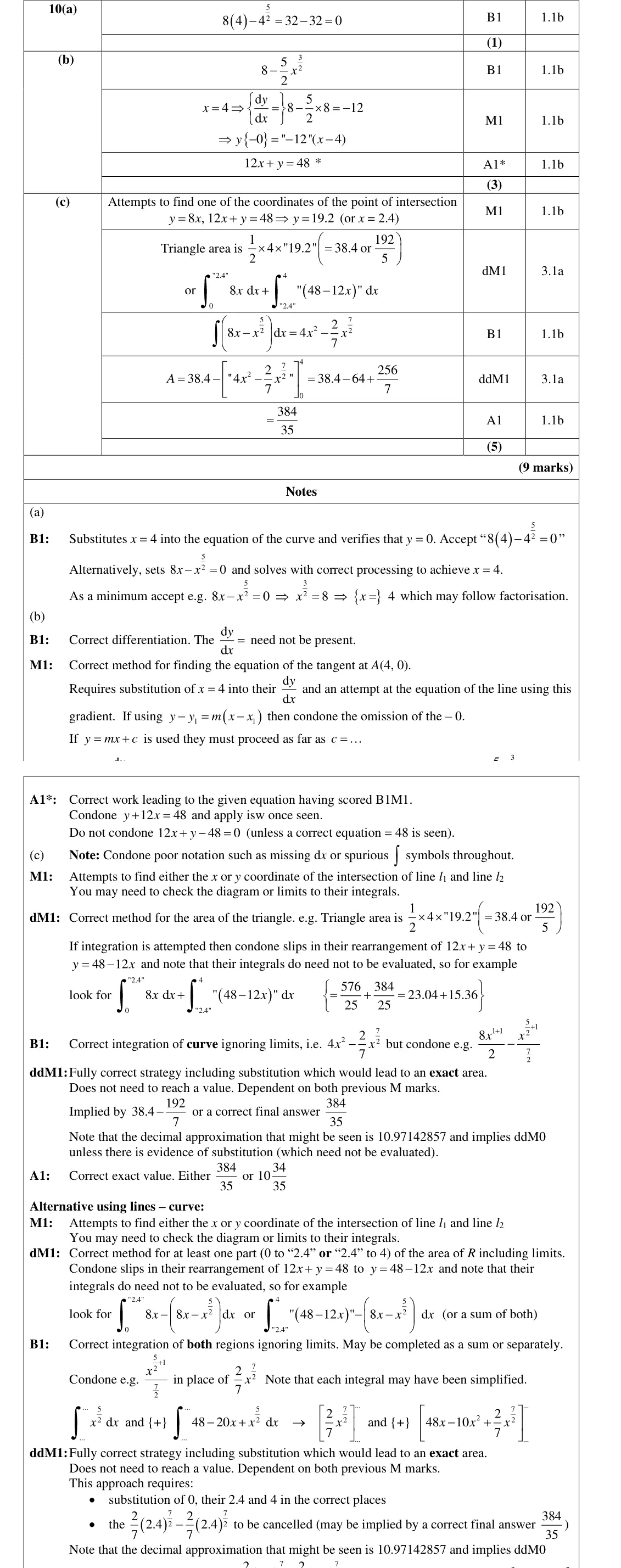
part (c). The final part of the question proved more challenging and differentiated between the candidates, with many producing concise and fully correct answers. Most candidates realised it required the use of integration and often scored the B mark for integrating the curve. Many candidates failed to note that the question required an exact answer and use of algebraic integration. This meant that using a calculator to provide a decimal approximation was insufficient for the final method mark. The quality of notation in this part of the question was very varied with the dx often missing from integrals and spurious integral signs included throughout working. 1 = The majority of successful candidates used or integration to find the area of A bh 2 the triangle and then subtracted the area under the curve. However, a significant proportion of candidates made the question much more difficult than necessary, using a mixture of Pythagoras and trigonometry to find the area of the triangle-this often led to errors or premature rounding. Other common errors when finding the area of the triangle included assuming the triangle was isosceles, and therefore that the intersection x = point was at , or splitting the triangle into two right-angled triangles and assuming 2 they both had the same area. Candidates attempting to use the alternative method using lines – curve were more likely to make errors with signs, brackets or limits. They were also required to correctly 2 2.4 7 ( ) cancel the terms to find an exact answer and so most often were unable to 2 7 score the final method and accuracy marks. The most common invalid method was attempting to combine the lines and curve before integrating using the limits 0 and 4, and this scored no marks unless the point of intersection had been found.
Common mistakes
l1 and l2 meet at (2.4, 19.2)
triangle 38.4 minus ∫₀⁴ (8x − x^(5/2)) dx = 192/7
exact 384/35 (calculator decimal loses marks)
triangle is not isosceles
missing dx
June 2024 · Paper 1 · Q13(b)4 marks
Mark scheme (whole question; this part is marked with the orange bar)
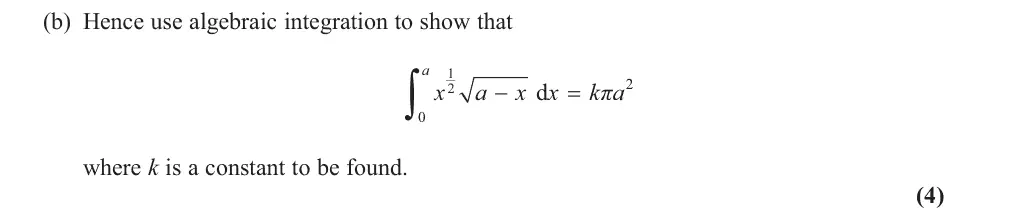
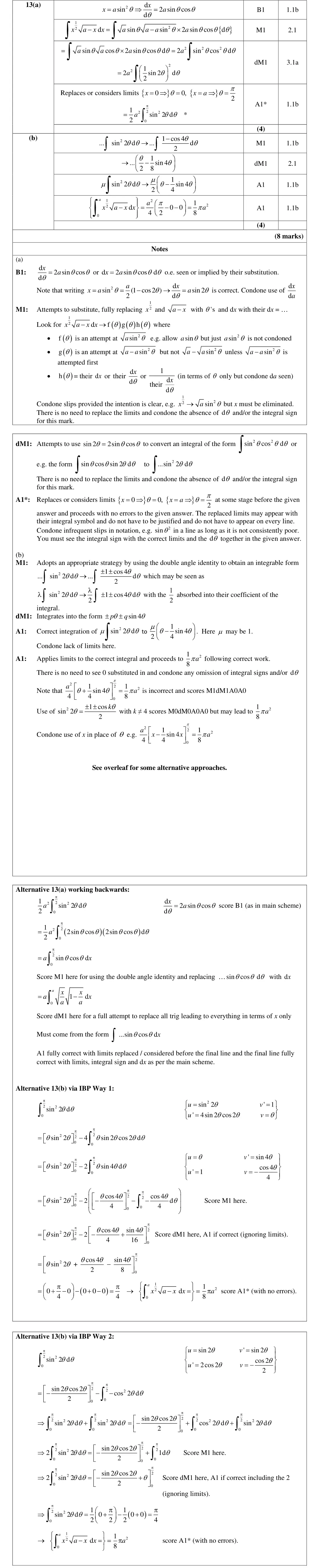
Examiner's comment
failed to prove the result in part (a) then went on to omit part (b) and missed out on this opportunity. However, it was not uncommon to see full marks in part (a) followed by no marks in part (b), and vice versa. Most candidates who attempted part (a) recognised the requirement to find d x and d squared trigonometric function were generally successful in part (b) of this question. - 1 cos2 = Occasionally candidates struggled to deal with 2 correctly, with 2 sin 2 2 seen all too frequently. These candidates scored no marks following incorrect use of the double angle identity. The other main errors in this part were in sign errors in the double cos4 - angle identity and in the integration of the trigonometric term: commonly was 1 sin 4 + integrated to , and despite this still leading to the correct answer it was at the 4 expense of the two accuracy marks. A significant proportion of candidates incorrectly sin . Some 3 attempted to increase the power and divide leading to a term in 1 1 ( ) - by parts were also seen. x a x unsuccessful attempts at restarting and integrating 2 2 There was also a significant proportion of candidates who attempted integration by parts which generally gained no credit. Candidates who were successful in using integration and at this point 2 cos 2 by parts often had a succinct approach, while many reached realised the use of double angle identity would help, where it would have been more concise to use the double angle identities in the first place.
Common mistakes
sin²2θ = (1 − cos 4θ)/2 (sign or angle errors common)
∫cos 4θ = ¼ sin 4θ
k = 1/8
by parts is long
June 2024 · Paper 2 · Q115 marks
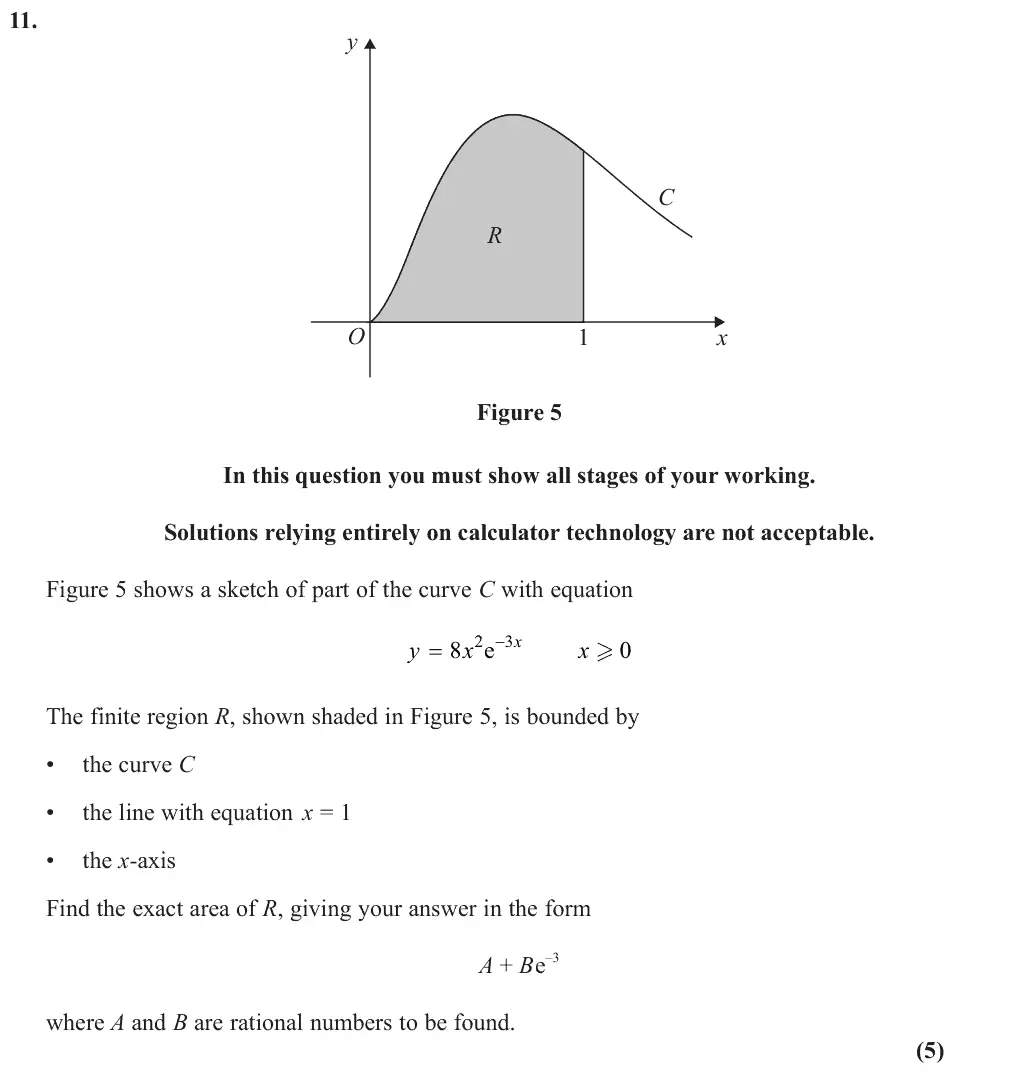
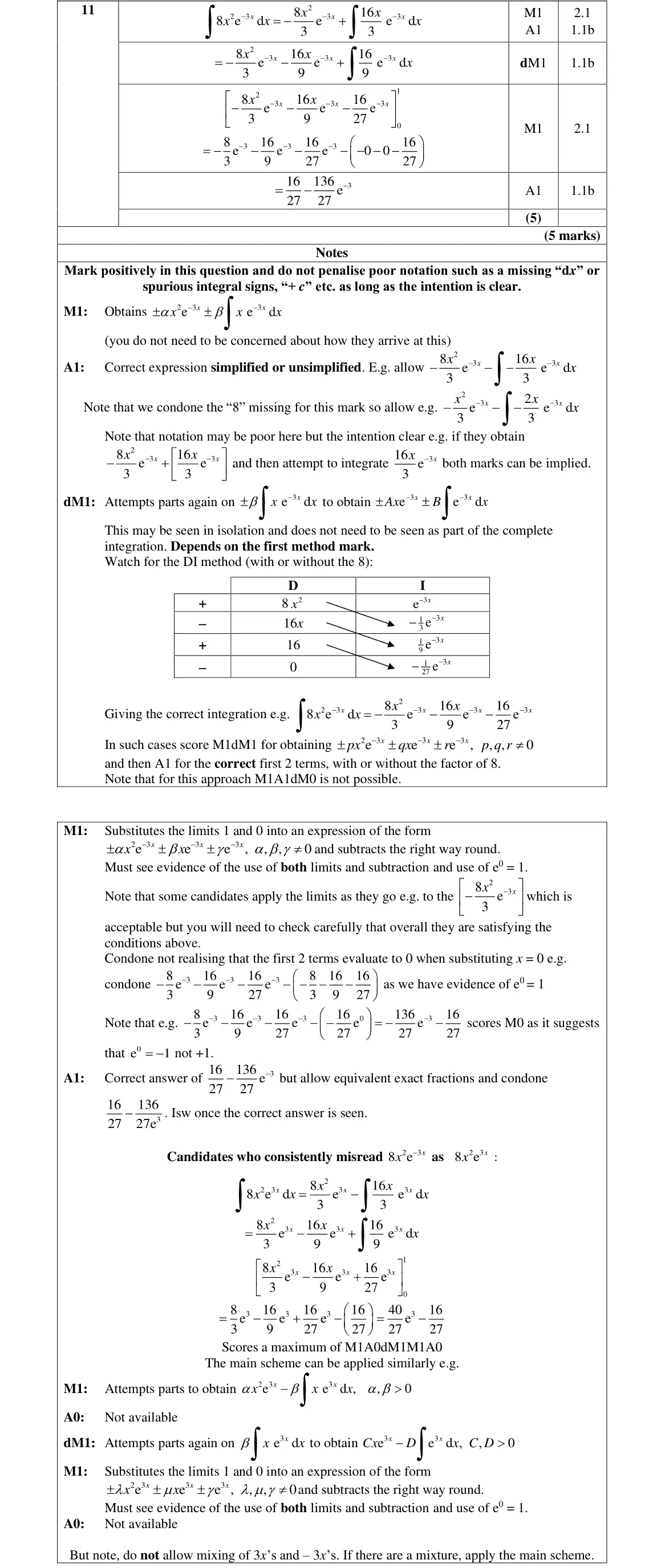
Mark scheme (whole question; this part is marked with the orange bar)
Examiner's comment
Almost all candidates recognised that this question required integration and were able to correctly identify that integration by parts was needed to access any of the marks in this question. The most common method was for candidates to apply by parts twice using the formula given in the formula book, although this did frequently result in candidates getting signs wrong for their terms. A number of candidates used the “DI method” which tended to be more successful and less complicated for those candidates who tried this approach. The word LATE or ILATE written on scripts which serves to assess the priority of the first function was also seen. This seemed to be helpful for candidates to identify which function should be differentiated. A small number of candidates used a substitution, usually u = -3x, with varying degrees of success. Although this resulted in fewer minus signs to manipulate, it did not simplify the processing. For most candidates the first step of by parts was generally correct, although coefficient and sign errors were common. A few integrated the 2 8x which led to incorrect forms. Of those candidates who got the correct form for the first step most got the second stage into the correct form though many made errors with signs. It was disappointing to see how few candidates simplified double negatives. Candidates who completed the integration to a correct form generally understood the substitution of the limits although again errors in signs occasionally cost candidates the final method mark as their working did not imply use of 0e 1 = . Candidates should be encouraged to fully show their working when applying limits so that it is clear that the lower limit is being subtracted. Most responses culminated with an attempt at an answer in its exact form but candidates that obtained the correct values for A and B were in the minority. Although not penalised if the intention was clear, some notation was poor with missing dx’s and spurious or missing integral signs.
Common mistakes
integration by parts twice (differentiate 8x²)
sign errors with e^(−3x) common, DI method helps
limits 0 and 1 with e⁰ = 1 shown and lower limit subtracted
exact answer 16/27 − (136/27)e^(−3)
June 2023 · AS Paper 1 · Q55 marks
Mark scheme (whole question; this part is marked with the orange bar)
Examiner's comment
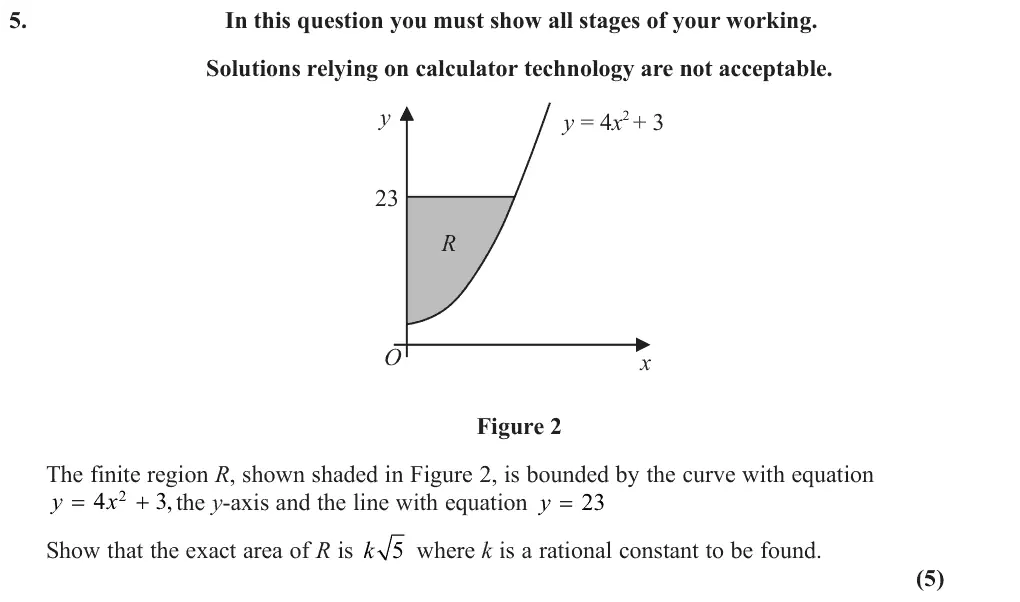
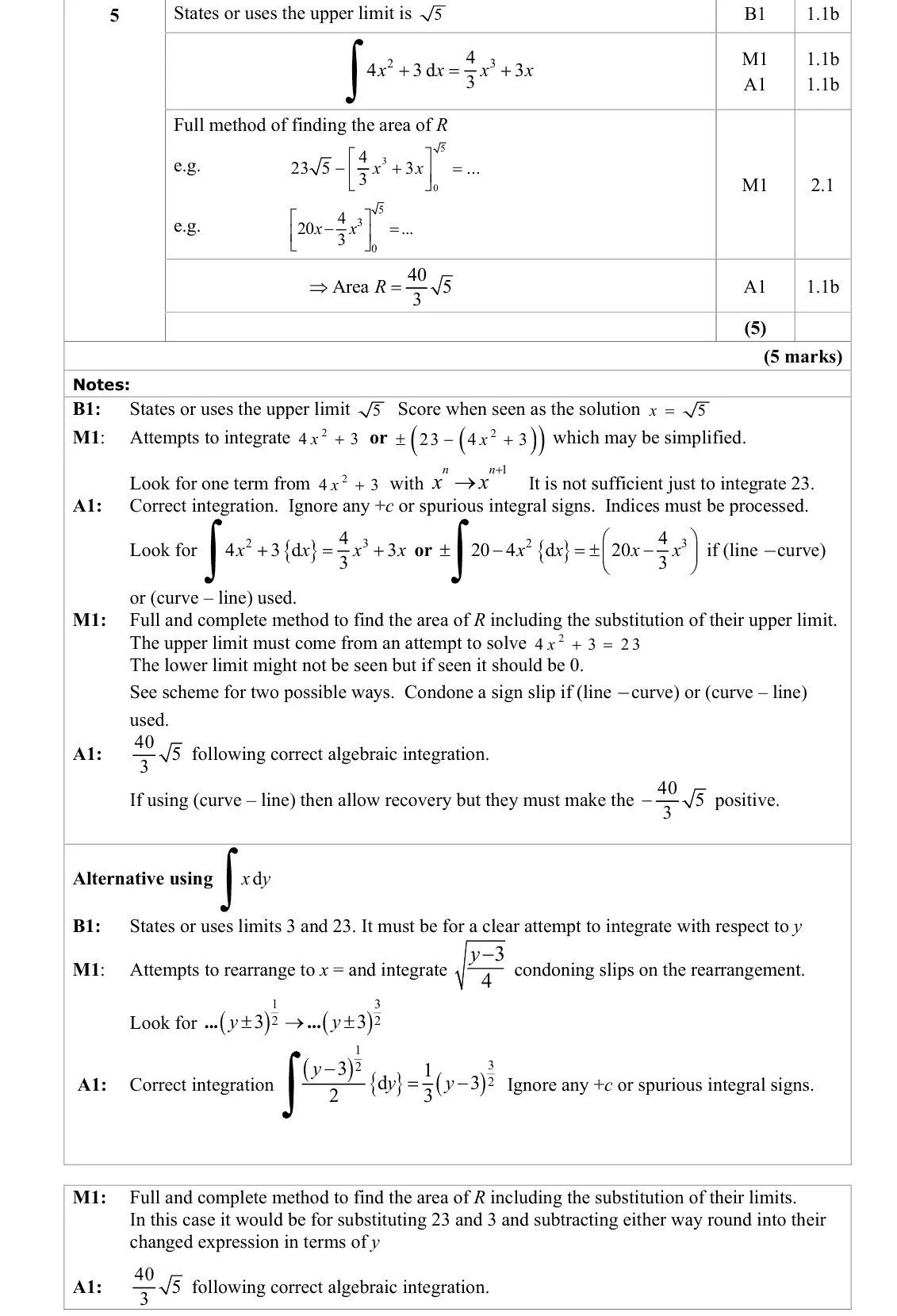
Most candidates recognised the need and were able to solve the equation 2 4 3 23 x + = to determine the upper limit, 5 x = , although some candidates did not use the diagram to discard the 5 x = - and ended up integrating between the incorrect limits. It was also very common to see the limits 3 and 23 being used, with these candidates unclear about the area that is found through an integration strategy. The most successful strategy for finding the area under the curve was through finding ( ) 5 2 0 4 3 d x x + and then subtracting that from the area of the rectangle. However, there were plenty of candidates that failed to subtract the area under the curve 29 5 3 from the rectangle, and these candidates generally scored 3 marks out of 5. Those candidates that elected to find the difference between the curve function and the line y = 23 and then integrated their expression were more likely to have slips in their working: some failed to subtract correctly, resulting in ( ) 5 2 0 23 4 3 d x x - + ; while others subtracted the wrong way round, leading to a negative answer that some failed to recover to a positive answer. However, in both cases, once the integrand was determined, the majority of candidates using this strategy were able to achieve method mark for being able to perform integration of at least a term in the integrand. There were very few candidates that tried to integrate the function bounded by the y-axis and those that did were generally unsuccessful: often their rearrangement to make x the subject was poorly done and in these cases they often lacked the experience of Year 2 integration to be able to integrate function of the form ( ) n ax b + , where n is a fraction.
Common mistakes
upper limit x = √5 from 4x² + 3 = 23 (reject −√5)
limits 3 and 23 are y values, not x limits
area = rectangle 23√5 minus ∫(4x² + 3)dx, or ∫(20 − 4x²)dx
forgetting to subtract from the rectangle
k = 40/3
June 2023 · AS Paper 2 (Mechanics) · Q3(c)4 marks
Mark scheme (whole question; this part is marked with the orange bar)
Examiner's comment
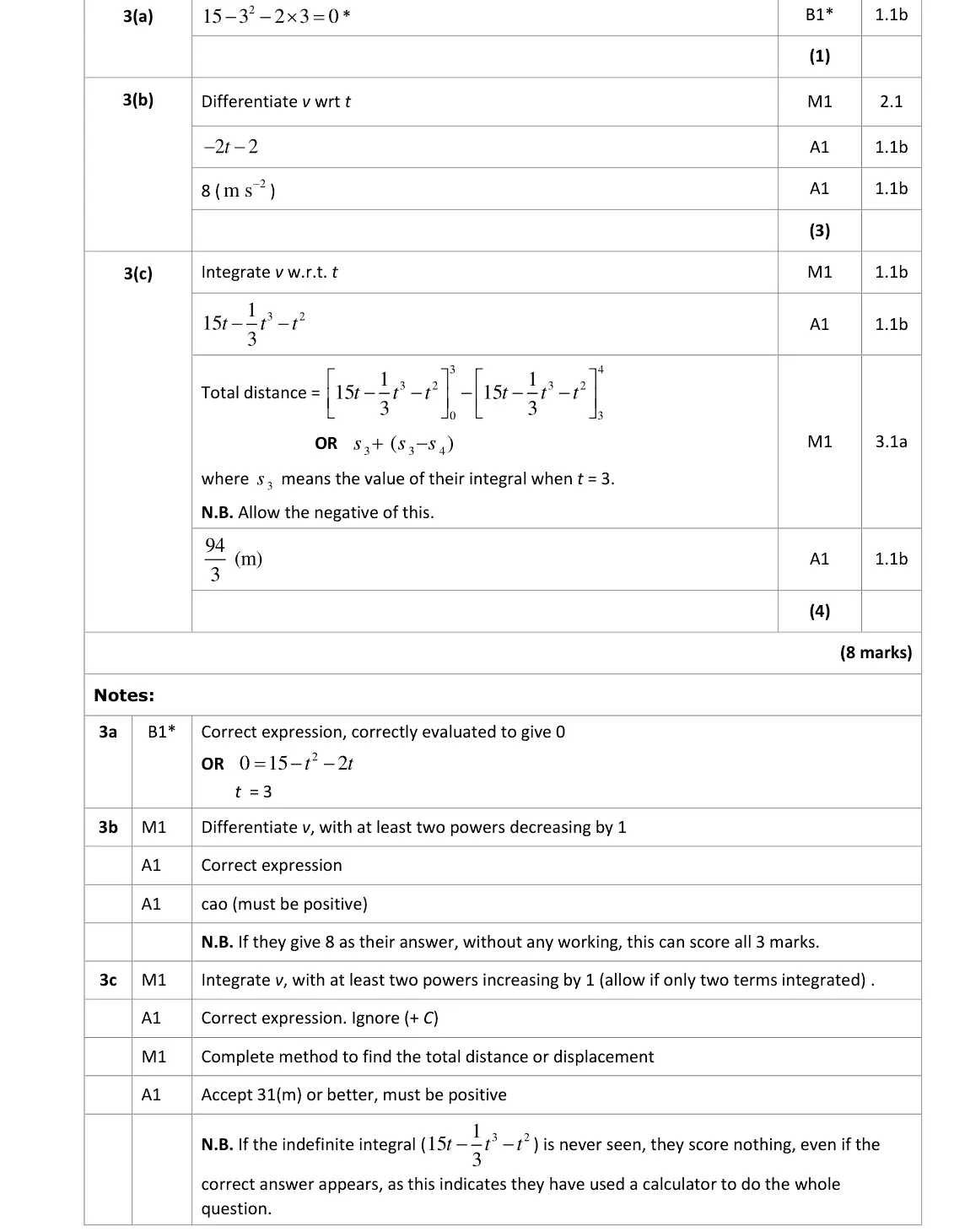
Pythagoras and so either sqrt (82 + 82) or even sqrt (82 + 32) was sometimes seen. In part (c), most integrated correctly and scored the first two marks. Very few got the differentiating and integrating the wrong way round this year. But after that, the majority just found the value of the integral at t = 4 (with or without subtracting the value at t = 0). Some realised that they had to split the integral into from 0 to 3 then 3 to 4 but several of these then added the two components instead of subtracting them. Those who drew a v-t graph were generally more successful when seeing the area below the axis seemed to help. There were relatively few correct answers to this part.
Common mistakes
integrate to 15t − t³/3 − t² (must be seen: calculator-only answers score 0)
P turns at t = 3, so distance = s(3) + (s(3) − s(4)) = 94/3 m
most just evaluated at t = 4
adding the two parts instead of subtracting the negative one
a v-t sketch helps
June 2023 · Paper 2 · Q10(b)4 marks
Mark scheme (whole question; this part is marked with the orange bar)
Examiner's comment
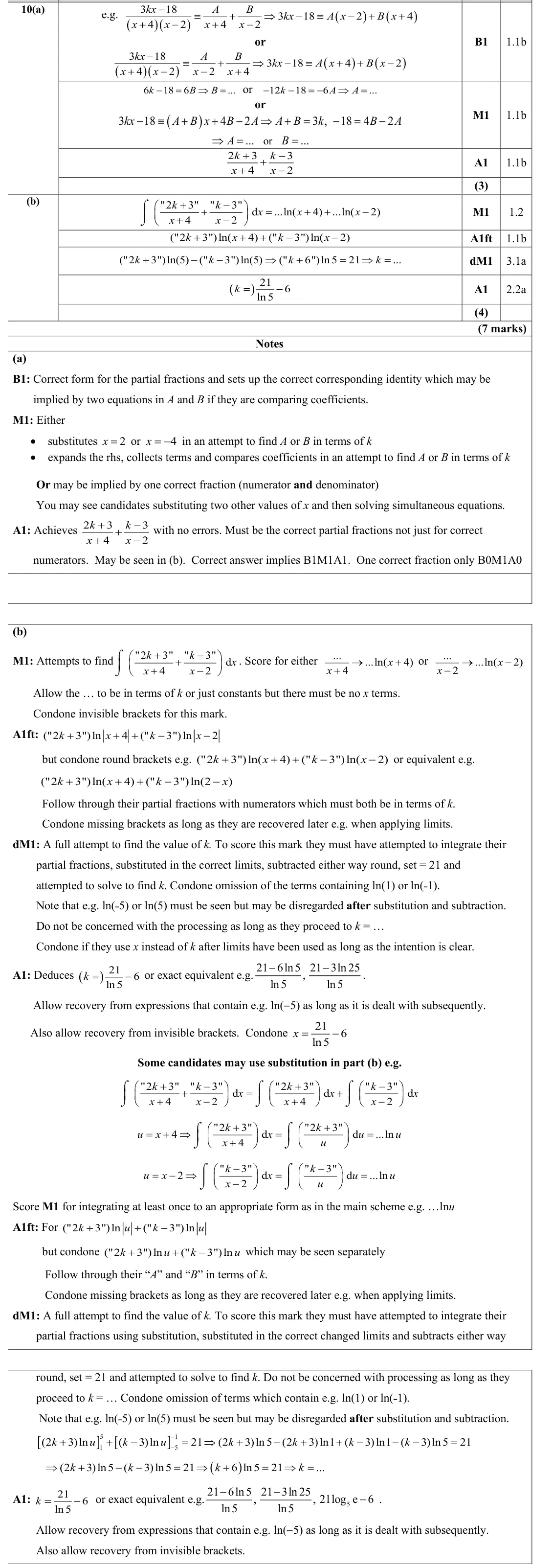
Very few candidates managed full marks in part (b), although the majority did gain the first method mark for integrating to obtain …ln(x + 4) or …ln(x 2). Those who did not recognise the logarithmic form for the integration were unable to score any marks in this part. Some achieved the correct form after first using a formal substitution. Of those who integrated their partial fractions successfully, the vast majority were far from strict in their use of the modulus symbol and many lost marks due to lack of appreciation of its importance. Use of modulus notation for integrating reciprocal functions should be picked up by centres as a teaching point with future cohorts. Students who had written the incorrect term ( ) ( ) 3 ln 5 k - - - or even the correct term ( ) 3 ln 5 k - - - after applying the limit 3 x = -, went on to indicate that they believed this term was zero or could just be ignored. Another example of poor practice was missing brackets around the coefficients e.g. ( ) ( ) 2 3ln 4 3ln 2 k x k x + + + - - being surprisingly common. The “invisible” brackets were sometimes recovered but in many cases were not. There were also examples where the brackets around the (x + 4) and the (x 2) were also missing. Those with a systematic well-laid out approach for the substitution of limits in both terms and identifying clear subtraction of the lower limit, went on to score 3 or 4 marks in part (b) and commonly full marks for the question. Many candidates however were hampered by their own layout making the correct interpretation of ln ( 5) as ln |5| even more challenging. The perhaps unfamiliar, exact form needed for k also proved a challenge for even the best candidates. There were some elaborate attempts to achieve an expression for k, some using exponentials, but many gave up along the way. There were, however some very elegant and correct solutions to this question and some different forms of the exact equivalent answer were seen, for example 5 21log e 6 - but most correct answers were given as 21 6. ln5 -
Common mistakes
(2k + 3)ln(modulus of x + 4) + (k − 3)ln(modulus of x − 2)
use modulus signs (ln of a negative)
brackets round the coefficients
(k + 6)ln5 = 21 so k = 21/ln5 − 6
terms in ln1 vanish but ln(5) from the second term does not
June 2023 · Paper 2 · Q13(b)4 marks
Mark scheme (whole question; this part is marked with the orange bar)
Examiner's comment
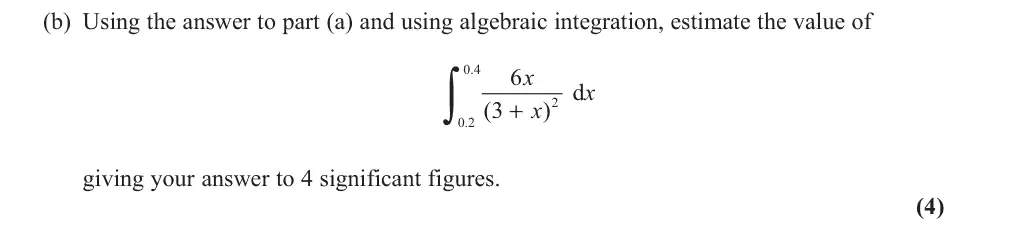
In part (b), many candidates correctly multiplied their expansion by 6x and then integrated using the limits of 0.2 and 0.4 reaching 0.03304, gaining full marks. A common error, however, was not giving the final answer to the required accuracy of four significant figures, thus losing the final accuracy mark. Those candidates who had expanded part (a) to more than three terms also lost this final accuracy mark as it led to a different approximation. A more complicated and unnecessary method involving integration by parts was used by a small minority of candidates. Candidates also often tried inappropriate approaches like dividing 6x by their expansion followed by a logarithmic integral. A minority of candidates, despite the warning at the start of the question, clearly used calculator technology to obtain 0.032865, rather than the answer of 0.03304 required. Others made inappropriate attempts at the trapezium rule, thus gaining no credit as algebraic integration was required.
Common mistakes
multiply the expansion by 6x, integrate term by term and use limits 0.2 and 0.4: 0.03304 (4 s.f.)
calculator value 0.032865 or trapezium rule scores 0
extra terms give a different estimate
June 2023 · Paper 2 · Q13(c)5 marks
Mark scheme (whole question; this part is marked with the orange bar)
Examiner's comment
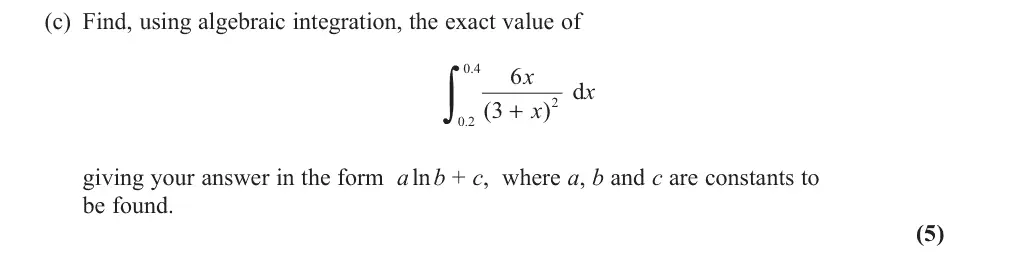
In part (c), the commonest methods of integration adopted were substitution, using either u = x + 3 or u = (x + 3)2 , integration by parts, integration after applying partial fractions and integration using the reverse chain rule after writing the integrand in appropriate form. Candidates had varying success with all of these approaches, gaining a variety of marks. Integration by parts seemed to lead to most arithmetical mistakes. Errors resulted from using parts ‘the wrong way round’ and others integrated the ( ) 2 3 x - + term incorrectly. When integrating by substitution some students incorrectly thought that 2 18 u - would integrate to a natural logarithm. There was some confusion with the limits; some candidates did not change the limits to “u” values and other who did evaluate new limits for their substitution switched back to an expression in x before substituting their changed limits. When using partial fractions some students struggled with the initial format for the partial fractions and it was not uncommon to see partial fractions of the form 3 3 A B x x + + + . There was a number of candidates who either did not attempt this part of the question at all or who lacked a correct strategy. There were responses where students attempted to integrate numerator and denominator separately, e.g. 6x to 3x2 and ( ) 2 1 3 x + to a variation of ( ) 2 ln 3 x + , and proceeded to multiply both results. A number of candidates were awarded just the first mark as their overall problem solving strategy was correct despite the fact they were unable to fully implement it. There were also many candidates who could carry out the work in this part completely successfully.
Common mistakes
substitution u = 3 + x (change limits to 3.2 and 3.4), parts, or partial fractions 6/(3 + x) − 18/(3 + x)²
result 6ln(17/16) − 45/136
18/u² does not integrate to a log
switching back to x but using u limits
June 2023 · Paper 3 (Statistics) · Q6(c)4 marks
Mark scheme (whole question; this part is marked with the orange bar)
Examiner's comment
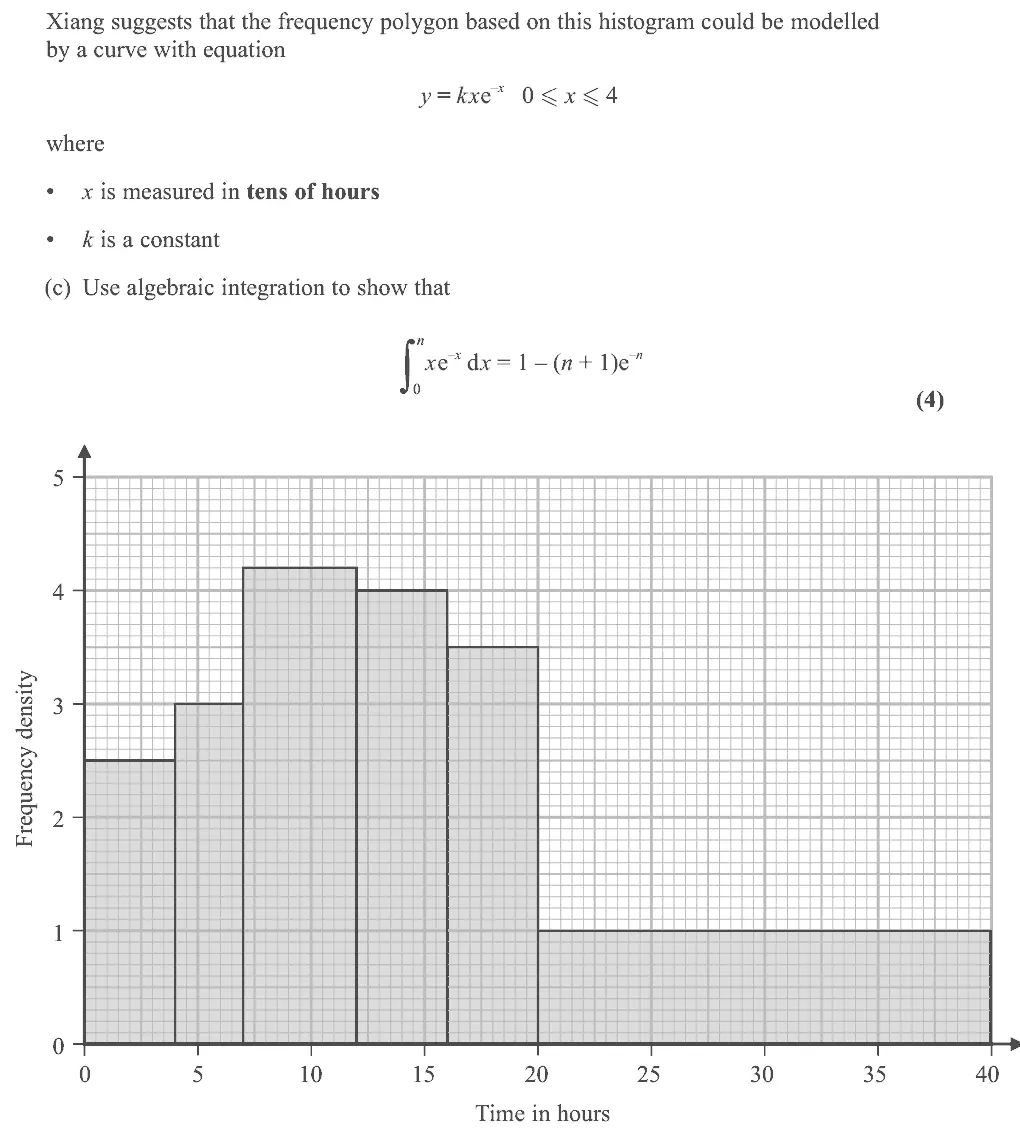
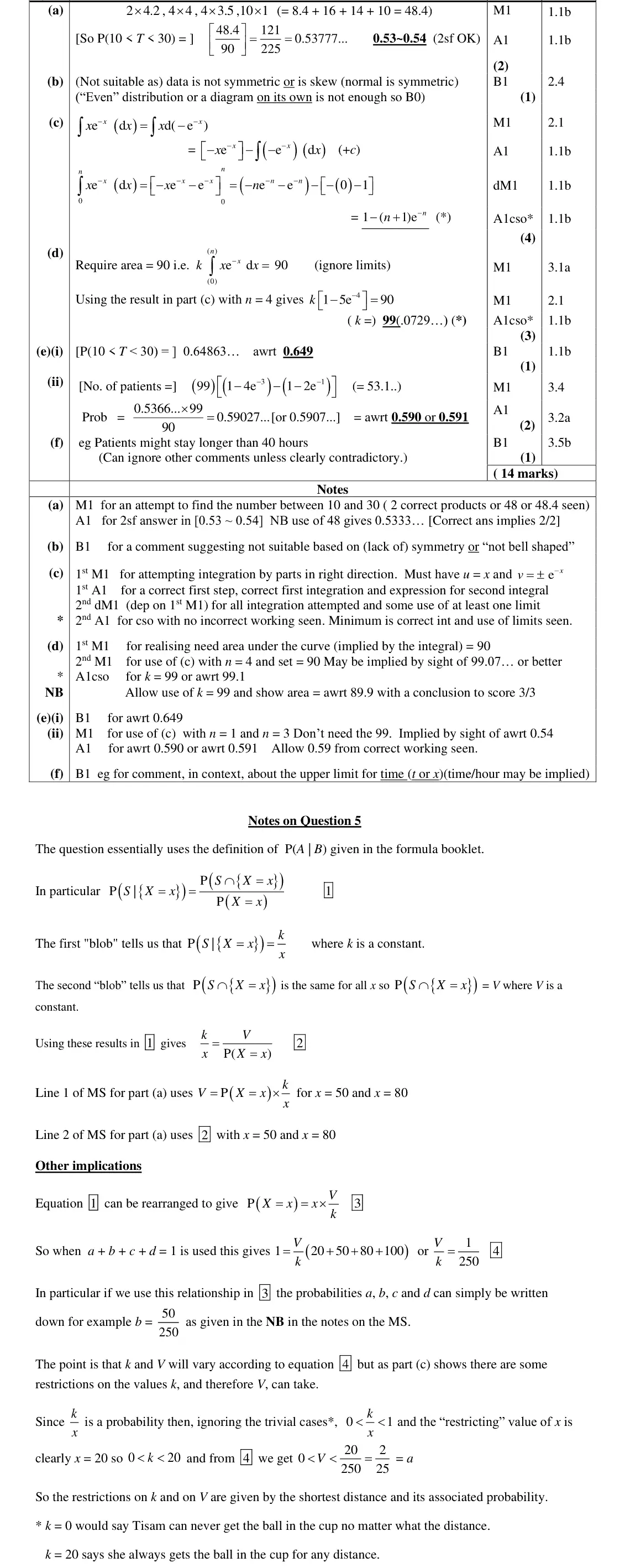
This question also proved to be quite challenging. (c). Some started the wrong way around (using u = e – x) and soon realised they were not heading for the given answer and there was some muddling over the signs when applying the limits. Part (d) was not answered so well with only a minority of students realising to apply the answer to part (c) though some used n = 40 rather than n = 4. The first part of (e) was often answered well and some realised that the answer to part (c) could be used to answer (e)(ii) but some tried using n = 10 and 30 and others stopped after find an estimate for the number of patients as 53.1 and failed to complete the question to find the required probability. In part (f) only a small number of candidates realised that
Common mistakes
integration by parts with u = x, dv/dx = e^(−x) (starting with u = e^(−x) fails)
sign errors when applying the limits
June 2023 · Paper 3 (Statistics) · Q6(d)3 marks
Mark scheme (whole question; this part is marked with the orange bar)
Examiner's comment
This question also proved to be quite challenging. the limits. Part (d) was not answered so well with only a minority of students realising that the area under the curve should equal 90. Those who did realise this were often able to apply the answer to part (c) though some used n = 40 rather than n = 4.
Common mistakes
total area under the curve = 90 patients
use (c) with n = 4 (x in tens of hours, not n = 40)
June 2023 · Paper 3 (Statistics) · Q6(e)(ii)2 marks
Mark scheme (whole question; this part is marked with the orange bar)
Examiner's comment
This question also proved to be quite challenging.
Common mistakes
use (c) with n = 3 and n = 1 (not 30 and 10) to get 53.1 patients, then divide by 90 for the probability 0.590
June 2022 · AS Paper 1 · Q10(b)5 marks
Mark scheme (whole question; this part is marked with the orange bar)
Examiner's comment
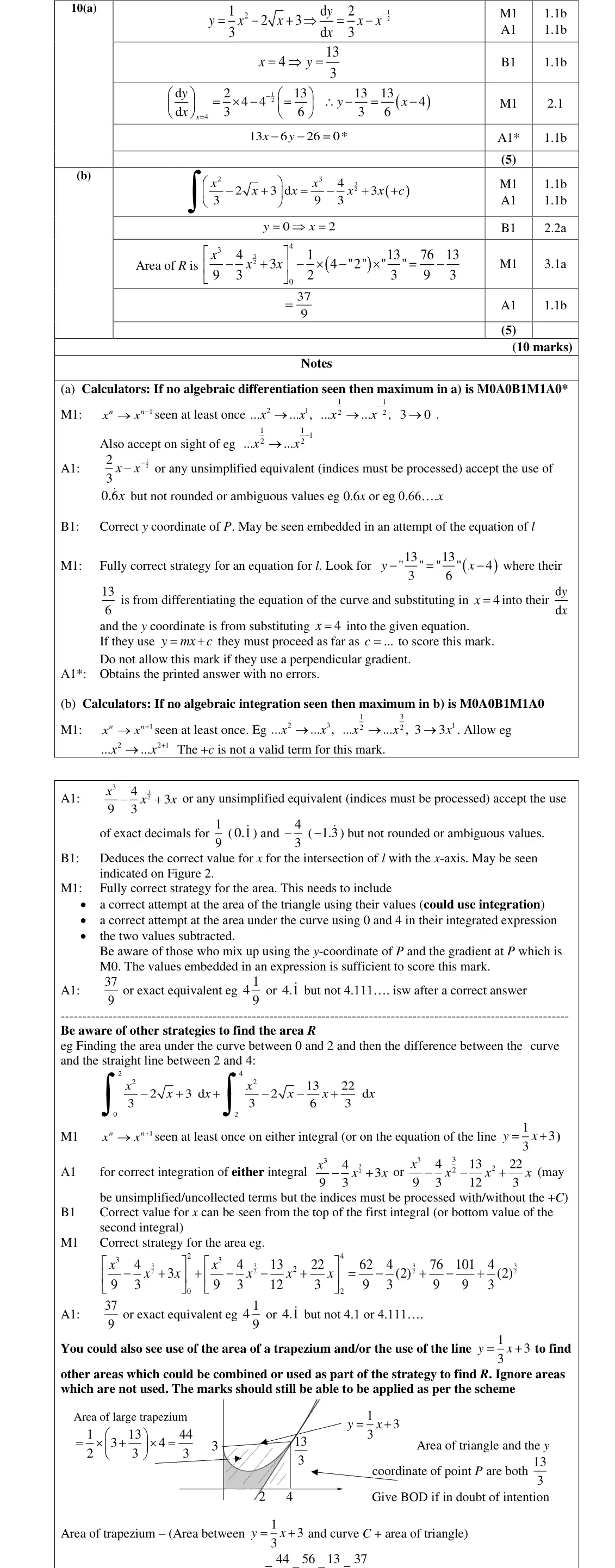
This question was, on the whole, well-attempted and provided some differentiation between candidates. Most candidates made an attempt at part (b), and many were able to undertake some integration correctly. There were sometimes slips on the fractional powers and the coefficients. This question was effective at differentiating between those candidates who were able to clearly identify a strategy to determine the required area and many were successful in doing so. Most who were successful, employed the main mark scheme approach of determining the area under the curve between x = 0 and x = 4 followed by subtracting the area of the triangle however there were a number of different approaches seen, including finding the area under the curve from x = 0 to x = 2 together with the area between the curve and line between x = 2 and x = 4. Errors were perhaps a little more common in the second of these two approaches perhaps due sign errors when subtracting the two equations. Unfortunately, though, a number of candidates were not clear on the strategy required and so it was not uncommon to see attempts which stopped after calculating the area under the curve between x = 0 and x = 4 and thus a value of 76 9 was a fairly common incorrect final answer. Others using one of the alternative approaches simply found the integral of the difference between the two equations between x = 0 and x = 4 or between x = 0 and x = 2 and failed to go on the find the area under the curve separately. Most candidates had few issues identifying the intercept of the tangent with the x-axis but there was sometimes confusion in identifying the base and/or the height of the triangle when this was required to find the area. Some candidates lost the final A mark in this question by not giving the exact answer, giving it as a rounded decimal instead.
Common mistakes
area under C from 0 to 4 (76/9) minus the triangle from x = 2 to 4 with height 13/3
stopping at 76/9 is common
confusing the y-coordinate 13/3 with the gradient 13/6
exact answer 37/9
June 2022 · AS Paper 2 (Statistics) · Q3(b)3 marks
Mark scheme (whole question; this part is marked with the orange bar)
Examiner's comment
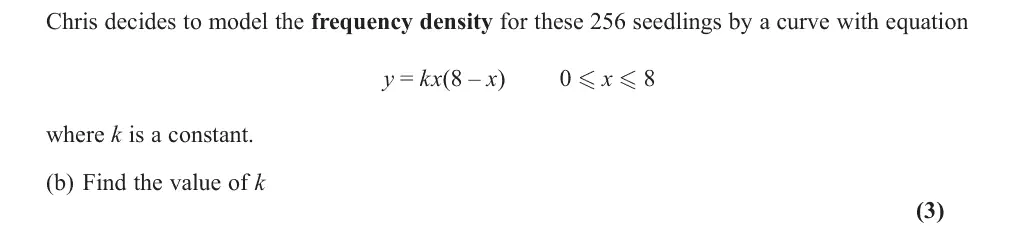
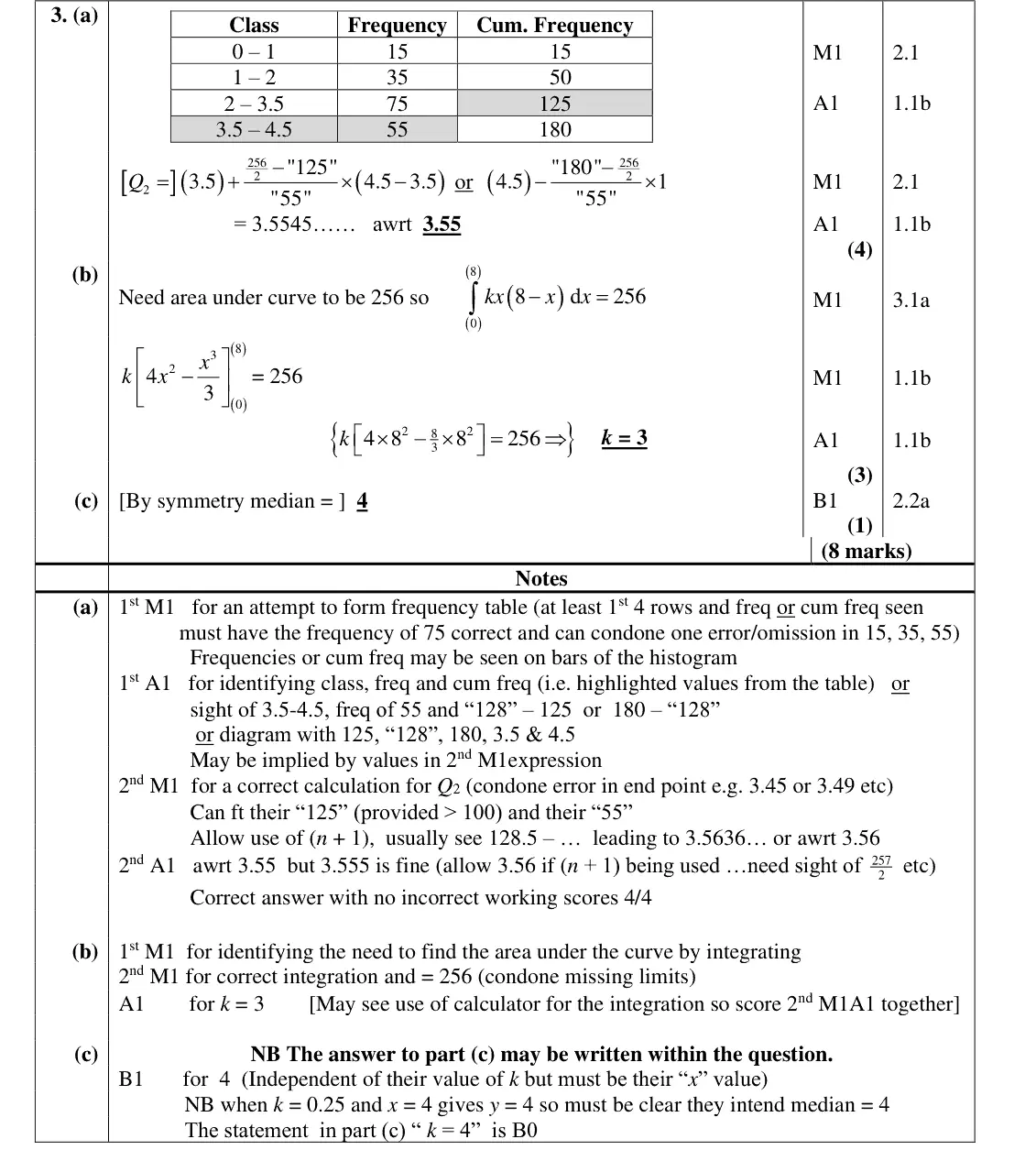
Part (b) sadly defeated almost all candidates. This was the first time we had attempted to assess the part of the specification dealing with “connect(ion) (of histograms) to probability distributions” (section 2.1). A small minority of candidates realised they needed to integrate and set the area under the curve to 256 and they often went onto achieve the correct value of k but most attempts involved differentiating the curve or solving a quadratic equation and made no progress. A few could use the symmetry of the model in part (c) to write down the median but most were completely lost after part
Common mistakes
area under the frequency-density curve = total frequency 256, so integrate kx(8 − x) from 0 to 8
k = 3
most differentiated or solved a quadratic instead
June 2022 · Paper 1 · Q4(b)2 marksEasy
Mark scheme (whole question; this part is marked with the orange bar)
Examiner's comment
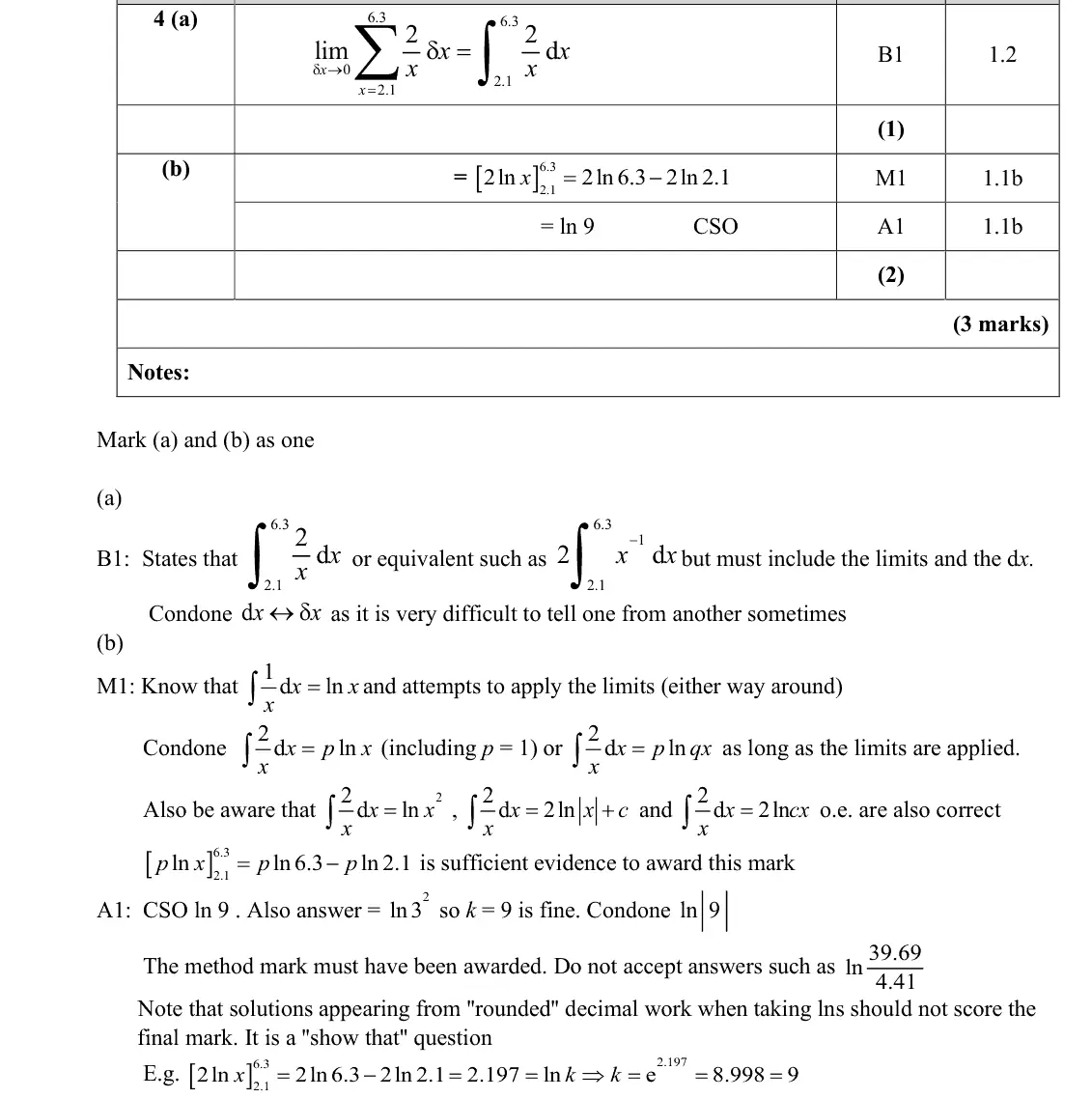
Candidates who had attempted part (a) generally went on to attempt part (b). Most candidates provided a fully correct solution and gained both marks. Where errors were made, this was usually at the last mark. Common errors seen were; • incorrectly integrating the expression to ln x or ln 2x differentiating 2 • x rather than integrating it • leaving the answer as 2ln3 rather than ln9
Common mistakes
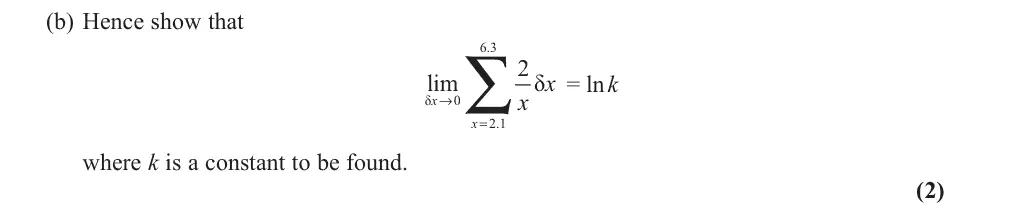
[2 ln x] from 2.1 to 6.3 = 2 ln 3 = ln 9, so k = 9
integrating to ln x², ln 2x or differentiating instead
leaving 2 ln 3
rounded decimal work loses the A mark
June 2022 · Paper 1 · Q125 marksEasy
Mark scheme (whole question; this part is marked with the orange bar)
Examiner's comment
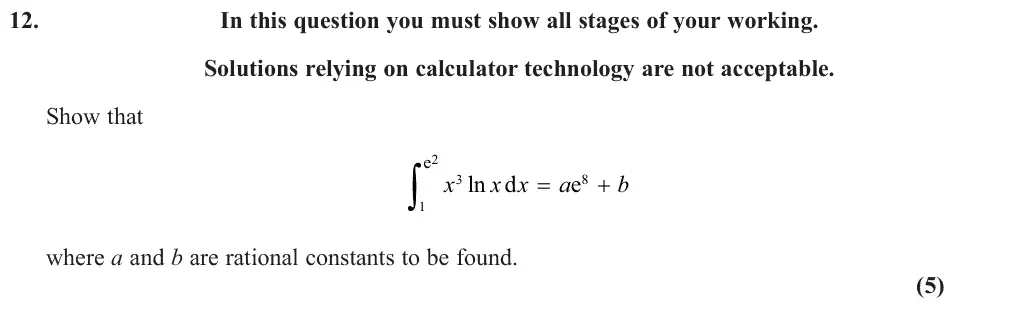
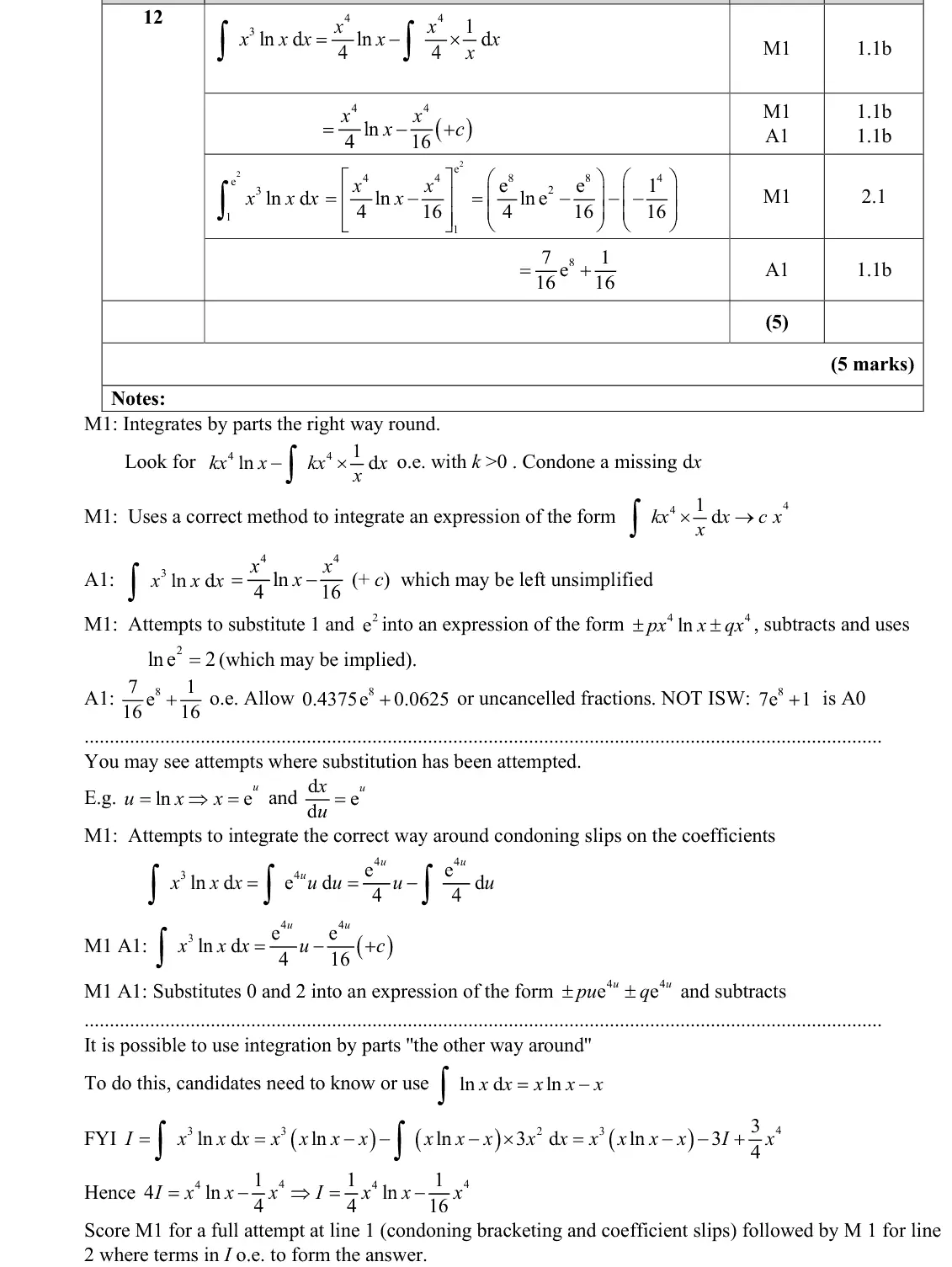
This was a very straight forward question on integration by parts with 40% of the candidates scoring full marks. On the reverse side there were also a sizeable number, some 30%, who did not know how to begin and failed to score any marks. Those candidates who knew the method nearly always scored 3, 4 or 5 marks. Reasons for these candidates dropping 1 or 2 marks nearly always centred around • a failure to integrate the term 4 1 4 x x x correctly, many times to 4 12 x • failing to correctly apply the limits, usually achieving 8 7 1 e 16 16 - • achieving a correct answer of 8 7 1 e 16 16 + then inexplicably ''simplifying'' this to 8 7e 1 + Low scoring candidates who attempted the question, usually resorted to integrating each term of the integrand or else having made a good start, disappointingly integrating the 4 1 4 x x x term to 5 ln 20 x x x
Common mistakes
by parts with u = ln x: (x⁴/4) ln x − x⁴/16
ln e² = 2
answer (7/16)e⁸ + 1/16
x⁴/4 × 1/x integrated wrongly
"simplifying" to 7e⁸ + 1
June 2022 · Paper 1 · Q16(a)5 marksHard
Mark scheme (whole question; this part is marked with the orange bar)
Examiner's comment
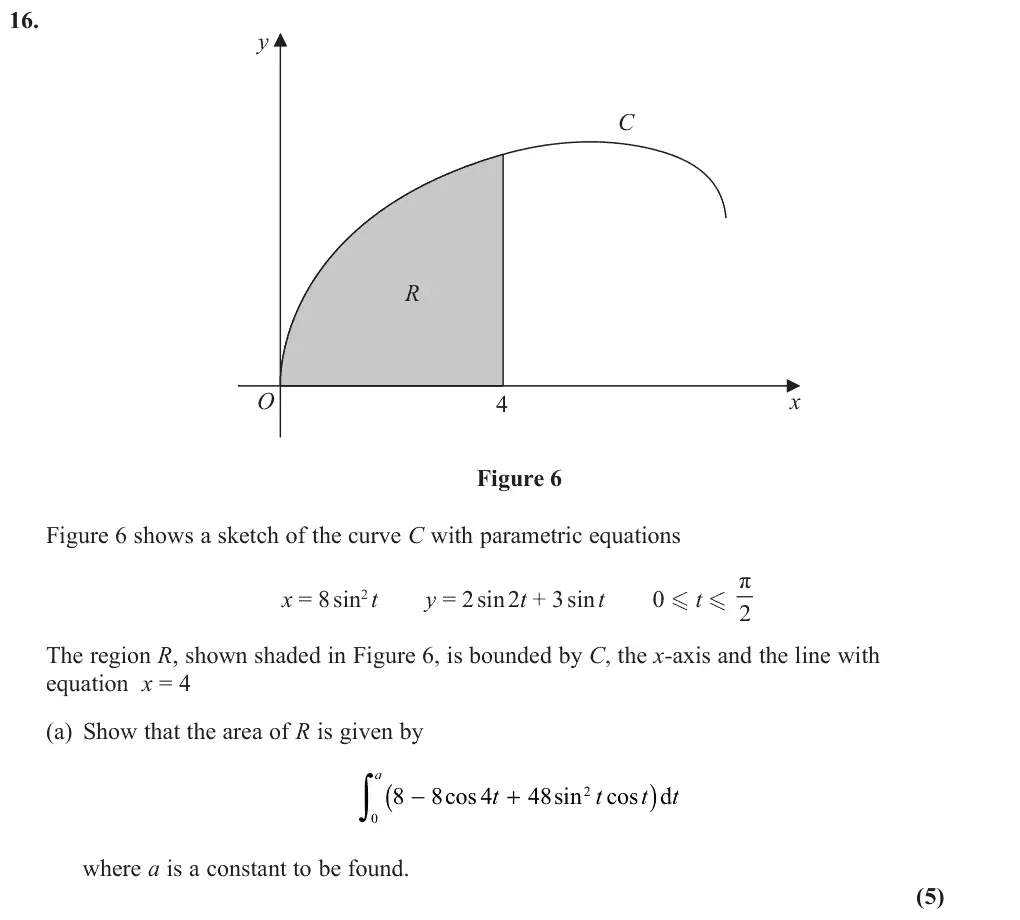
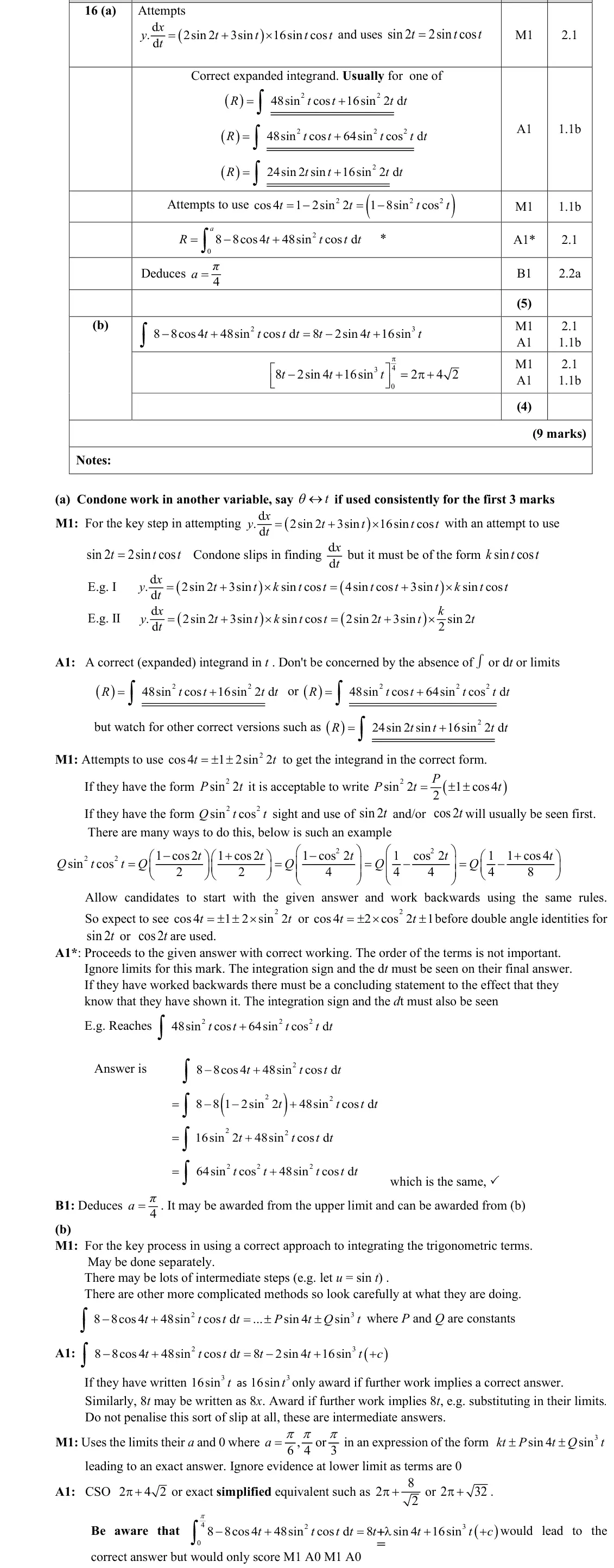
The final question on the paper proved to be a challenge for many candidates and there were several blank responses seen. It is possible that this was due to time management. Some candidates attempted unsuccessfully to change to a Cartesian equation, suggesting that possibly parametric integration had not been covered. In part (a), candidates who recognised the need to use parametric integration were usually able to differentiate correctly to find d d x t , multiply this by y and then use the double angle formulae to find an acceptable expression for d d x y t . It was common for candidates to score the first two marks. The next two marks were more elusive, and it was common to see candidates perform a lot of onerous manipulation without making any significant progress. Those who were most likely to be successful were the ones who had an expression in terms of 2 sin 2t and then spotting the need to use the double angle formula to form a term in cos 4t. For many candidates the mark for the upper limit was all that was achieved in part (a). However, some failed to achieve it as they left it as 4 (value for x not t) or 45 (degrees).
Common mistakes
area = integral of y dx/dt dt with dx/dt = 16 sin t cos t
sin 2t = 2 sin t cos t
cos 4t = 1 − 2sin²2t
x = 4 gives sin²t = ½ so a = π/4
changing to Cartesian fails
June 2022 · Paper 1 · Q16(b)4 marksHard
Mark scheme (whole question; this part is marked with the orange bar)
Examiner's comment
The final question on the paper proved to be a challenge for many candidates and there were several blank responses seen. It is possible that this was due to time management. Some candidates attempted unsuccessfully to change to a Cartesian equation, suggesting that possibly parametric integration had not been covered. It was good to see students who were unsuccessful at part (a) still attempting part (b), and in some cases scoring full marks. Most candidates were able to integrate the first two terms correctly, but a significant proportion were unable to integrate the third term to get an expression in 3 sin .t The majority of correct solutions came from the use of the reverse chain rule for the final term. Those who attempted to use integration by substitution or by parts were usually unsuccessful. Candidates who had successfully completed the integration often went on to score full marks.
Common mistakes
8t − 2 sin 4t + 16 sin³t by reverse chain rule on 48 sin²t cos t (by parts/substitution rarely worked)
limits 0 and π/4: 2π + 4√2 exact
June 2022 · Paper 2 · Q5(b)3 marks
Mark scheme (whole question; this part is marked with the orange bar)
Examiner's comment
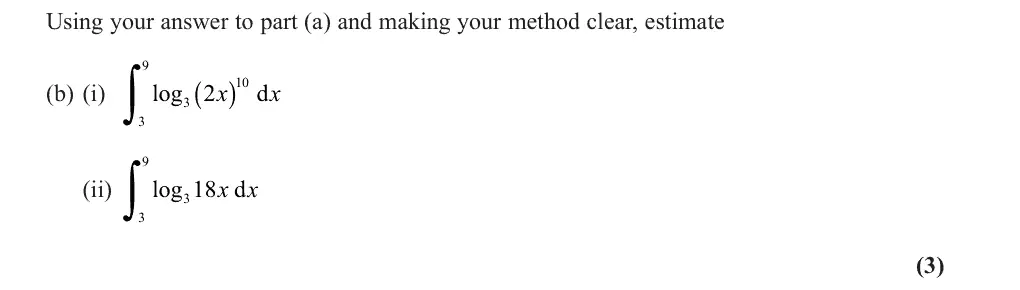
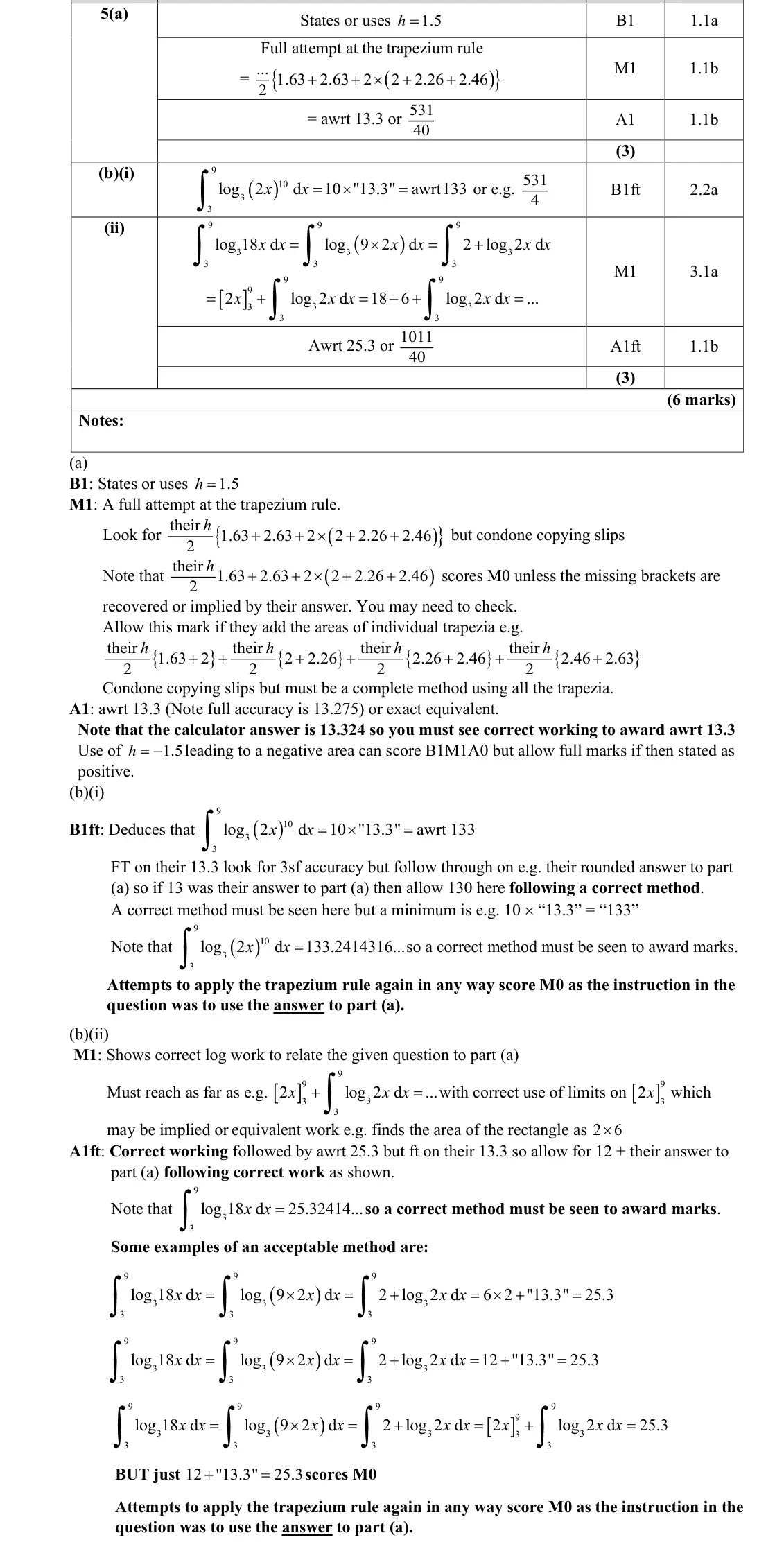
Part (b) of the question clearly stated that the result from part (a) was to be used and that the method used was to be made clear. Thus, candidates who proceeded to use the Trapezium Rule again with revised values of y received no credit. In (b)(i) many realised that the power law of logs had to be used and realised that their answer to part (a) had to be multiplied by 10, so achieving a correct answer. Many on the other hand unfortunately raised their answer to part (a) by a power of 10.
Common mistakes
(i) power law: 10 × 13.3 = 133, not 13.3¹⁰
(ii) log₃18x = 2 + log₃2x, so 12 + 13.3 = 25.3 with the ∫2 dx = 12 shown
reusing the trapezium rule scores 0
June 2022 · Paper 2 · Q86 marks
Mark scheme (whole question; this part is marked with the orange bar)
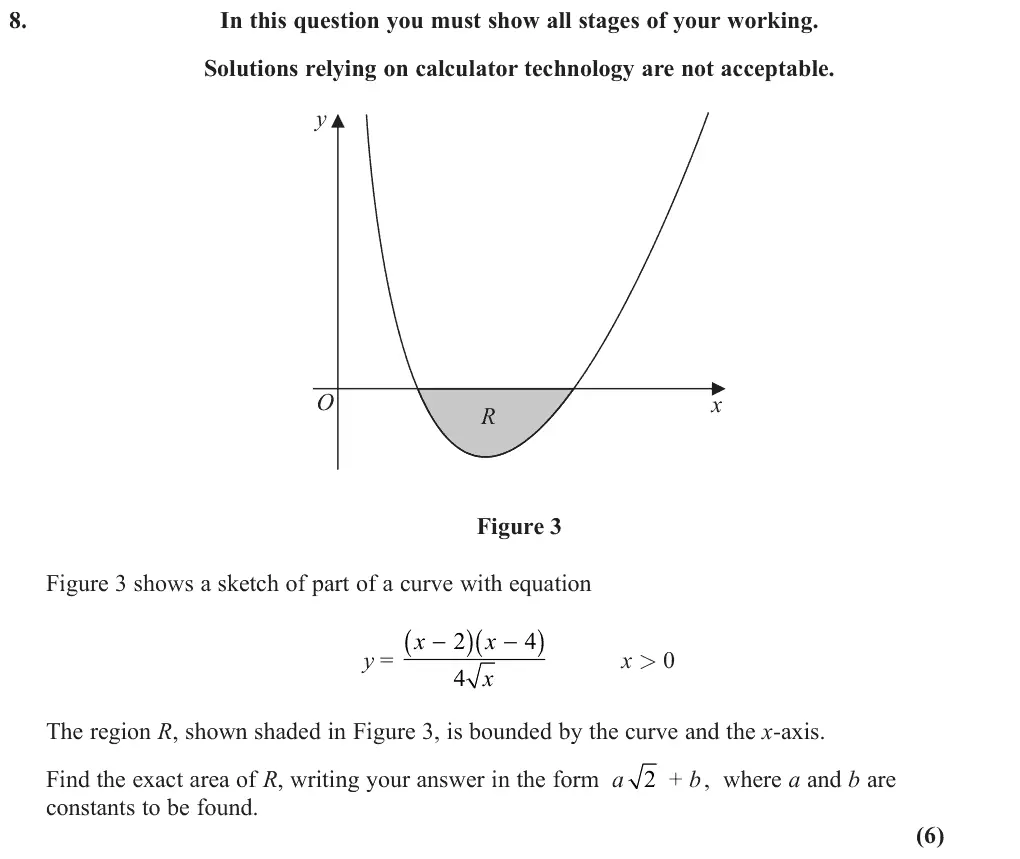
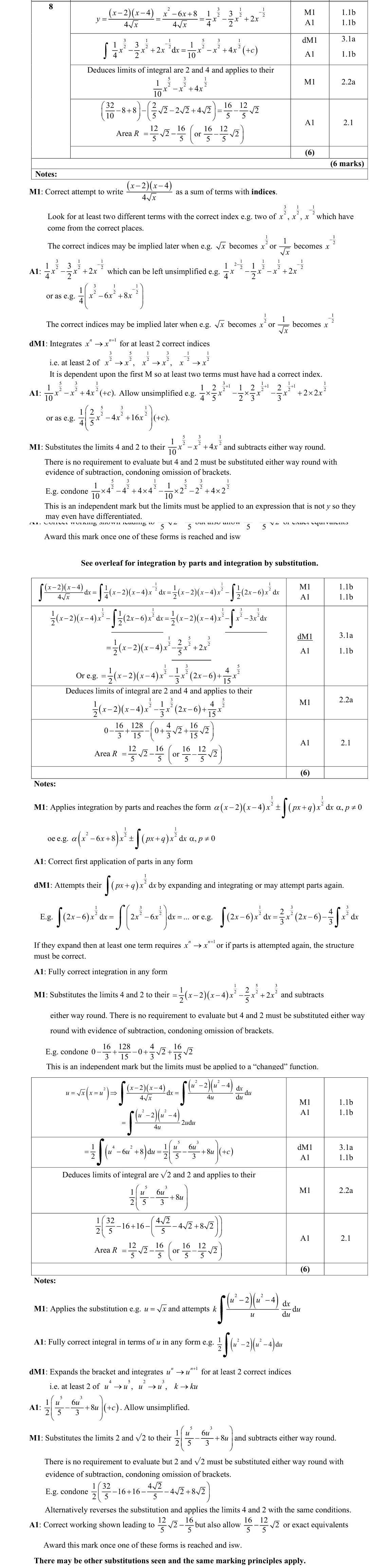
Examiner's comment
Most students knew that this question was to be solved by integration although a very small number thought that the question was about partial fractions, differentiation or a mixture of differentiation with integration. There were multiple approaches to solving this question including integrating a function with simplified indices, integrating by parts and integrating by substitution. The most common and the simplest method seen was multiplying out and simplifying indices. For the candidates who recognised that 4 sqrt x in the denominator should be rewritten as ¼ x -½ in the numerator there was a lot of success on this question. However, there were many candidates who brought the 4 to the top and left it as 4 rather than ¼ and earned a maximum of 3/6. Some wrote 4x½ in the numerator multiplying out to give incorrect powers and losing the first two method marks. Finding the correct limits and substituting them in a changed function was done by most leading to quite a few correct answers. Quite a few gave part or all of the final answer as a decimal, this was not surprising as most were using their calculators to do the final evaluation and calculator use did not leave the result of e.g. ( sqrt 2)5 as a surd. Some candidates recognised that the area needed to be positive, however the final answer was permissible even with a negative area. There were often errors in solutions constructed using integration by parts. There were mistakes made using the formula correctly, some bracketing errors, and some attempted parts the other way round getting harder expressions in the integral which mostly resulted for them a maximum of 1 mark (3rd M mark) obtained. There were a few incorrect substitutions selected for integration by substitution approaches, however candidates who chose u = sqrt x or u = 4 sqrt x were generally successful. A few candidates who set e.g. u = x – 2 in a substitution method scored few marks, if any, as such attempts did not progress the candidate towards a function they could integrate. In substitution method a few candidates made arithmetic errors in finding the new limits or did not attempt to change them at all.
Common mistakes
write as ¼x^(3/2) − (3/2)x^(½) + 2x^(−½) (4√x becomes ¼x^(−½), not 4x^(½))
limits 2 and 4 from the roots
exact answer (12/5)√2 − 16/5, not a decimal
by parts is much harder
Oct 2021 · AS Paper 1 · Q94 marks
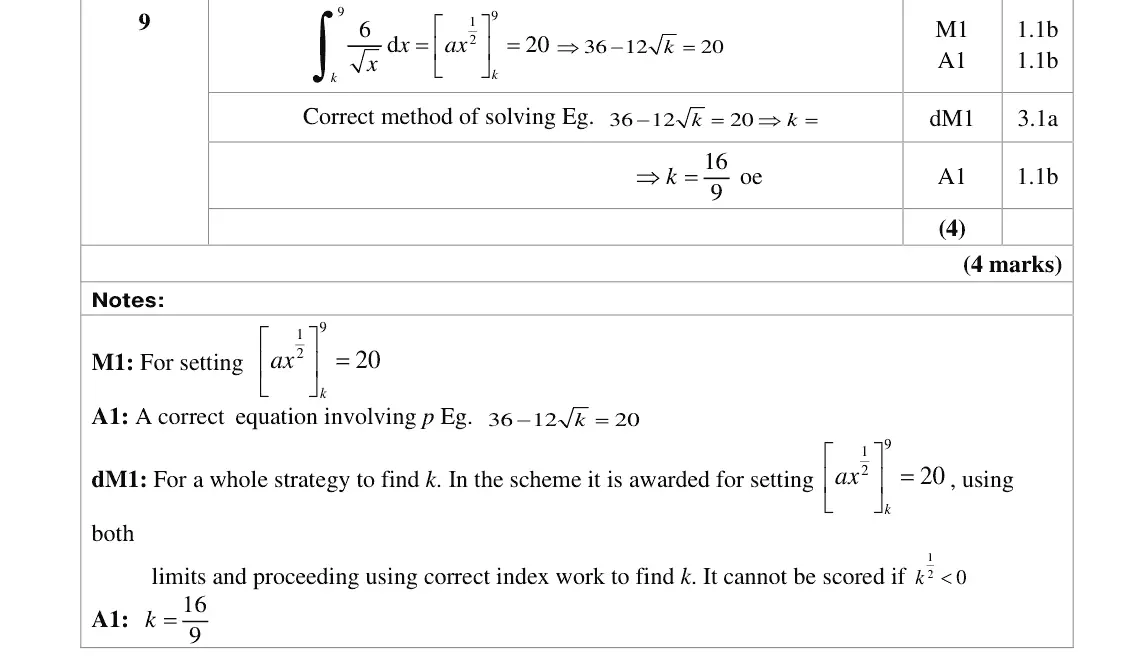
Mark scheme (whole question; this part is marked with the orange bar)
Examiner's comment
This question was typically answered well by most candidates and was possibly the most successful question on the paper. Candidates typically were able to manipulate the integral to achieve 1 2 ...x - , although those who omitted the negative did not score any marks on this question. Some candidates made errors dealing with the coefficient, but they were typically able to score half of the available marks on the paper. Whilst most proceeded to the correct answer, some incorrectly square rooted to find k rather than squaring.
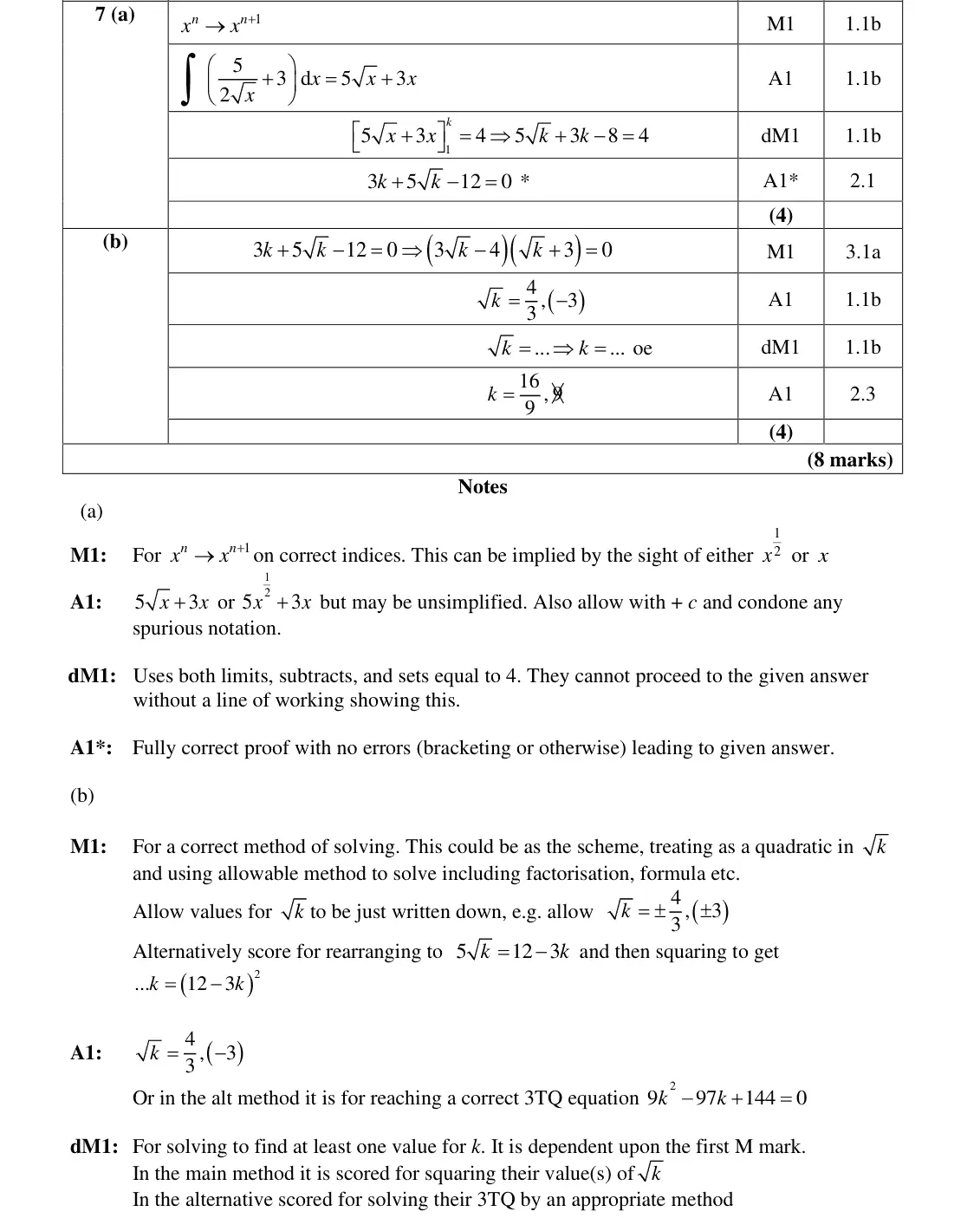
Common mistakes
6x^(−½) integrates to 12x^(½) (sign of the index)
36 − 12√k = 20 so √k = 4/3
square, do not square root: k = 16/9
Oct 2021 · AS Paper 1 · Q14(c)5 marks
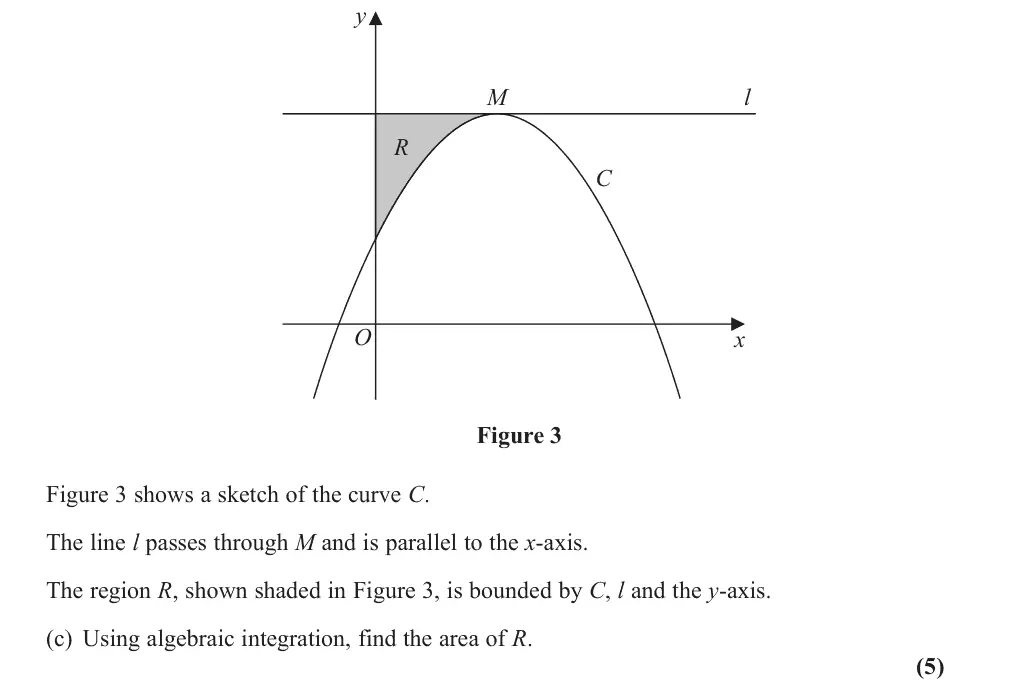
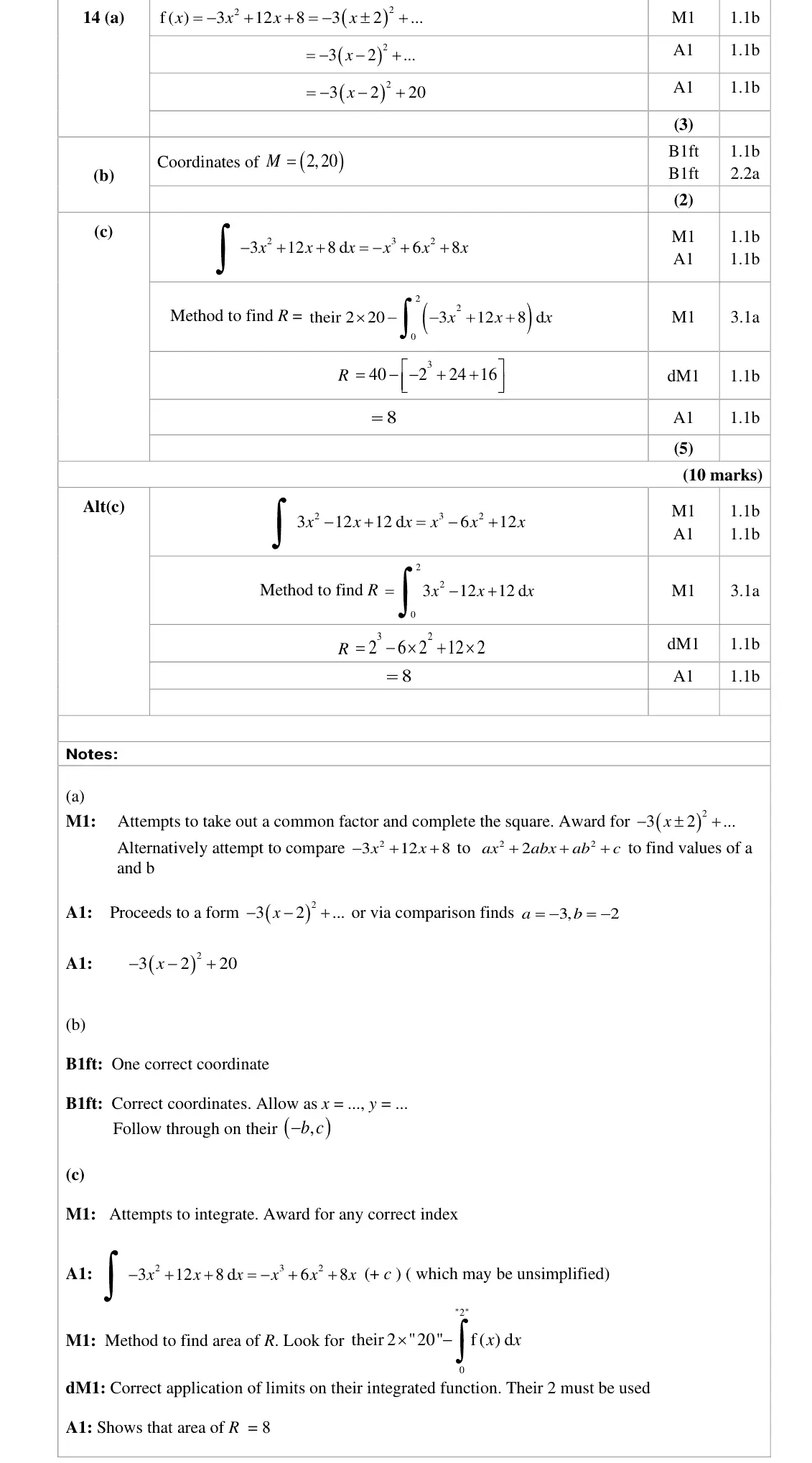
Mark scheme (whole question; this part is marked with the orange bar)
Examiner's comment
This question was one of the most successful on the paper. It tested aspects such as completing the square, simple integration to find an area and finding a turning point which candidates seemed comfortable finding in nearly all cases. Part (c) was typically completed correctly. Candidates usually opted to integrate the curve and find the area between 0 x = and 2 x = and then subtracted this area from 40. Those candidates who tried to form a single integral to solve the problem were the ones were errors typically occurred. Some candidates equated the line 20 y = to the curve and rearranged to one side and integrated this expression. This method can work, although some responses did not appear that the candidates were that sure as to why they had achieved a negative value for the integral if they collected terms on the wrong side. In addition, errors in collecting terms resulted in an incorrect integrated expression and, ultimately, an incorrect final answer.
sign errors if integrating 20 − f(x) as a single integral
Oct 2021 · AS Paper 2 (Mechanics) · Q2(c)4 marks
Mark scheme (whole question; this part is marked with the orange bar)
Examiner's comment
(c) Some candidates knew that they needed to integrate v but a few tried to use suvat equations, losing all the marks and some did not substitute a numerical value for k. The last two marks were rarely scored as the change of direction was not appreciated.
Common mistakes
integrate v (suvat is invalid: acceleration not constant)
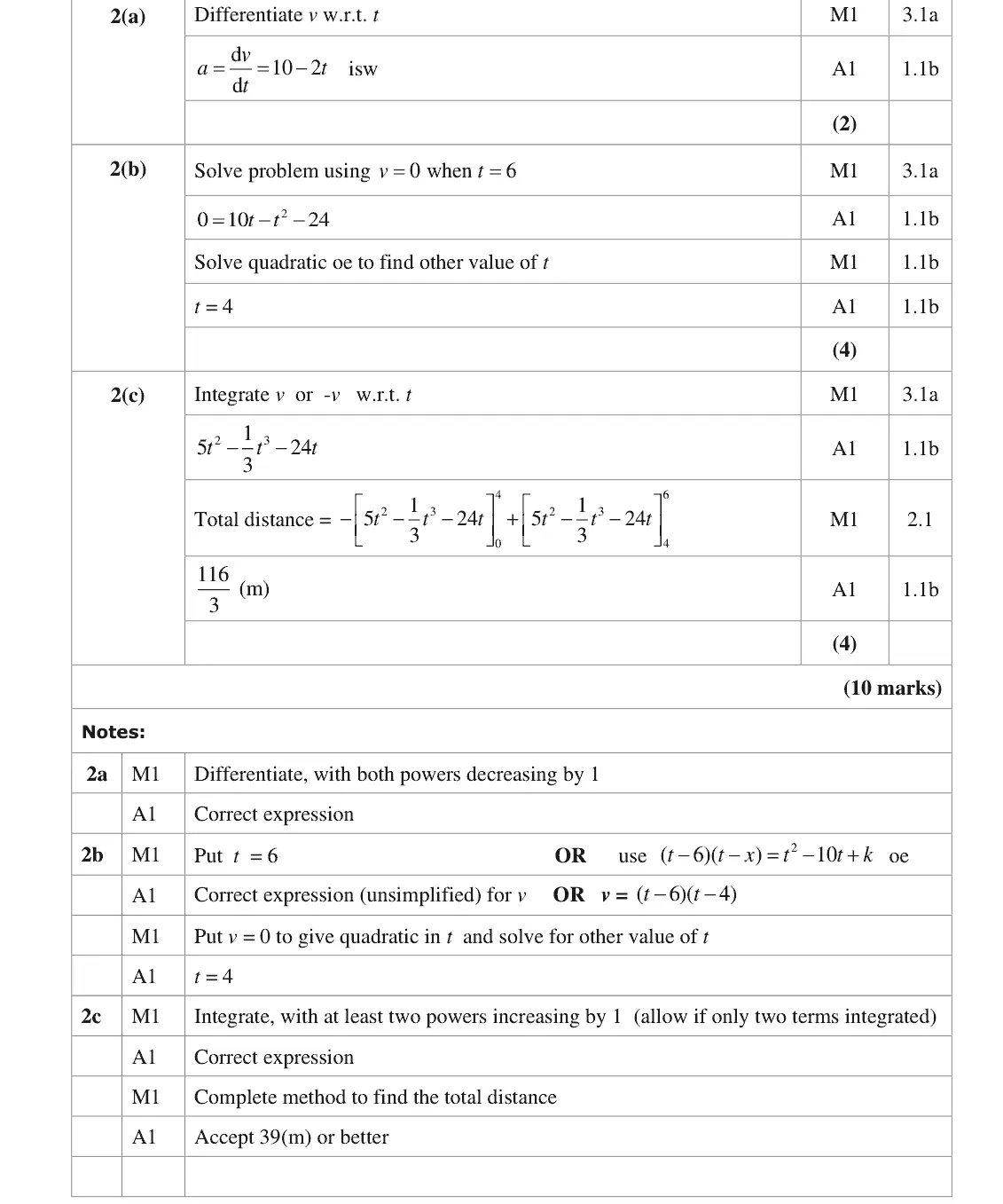
v changes sign at t = 4 so split the integral 0 to 4 and 4 to 6 and add magnitudes: 116/3 m
substitute k = 24 first
Oct 2021 · Paper 1 · Q11(b)5 marks
Mark scheme (whole question; this part is marked with the orange bar)
Examiner's comment
The modal mark here was 3, most likely due to the accessibility of part (a). Marks in part (b) were only really awarded to the highest scoring candidates on this exam. In part (b) many candidates failed to recognise that integration by parts was needed to make progress. Several students, who made progress and correctly applied ‘integration by parts’ twice, unfortunately lost the final accuracy mark due to sign or coefficient errors that had crept in. Most who integrated appropriately applied the correct limits and applied ln(4) = 2ln(2). Errors were many and varied here and included • Candidates who believed that ( ) ( ) 2 3 1 d 3 ln x x ln x = ∫ • Candidates who believed that ( ) 2 2 ln x ln x = Candidates who used the substitution ln u x = seemed to more easily recognise 2e d u u u ∫ as integration by parts twice.
Common mistakes
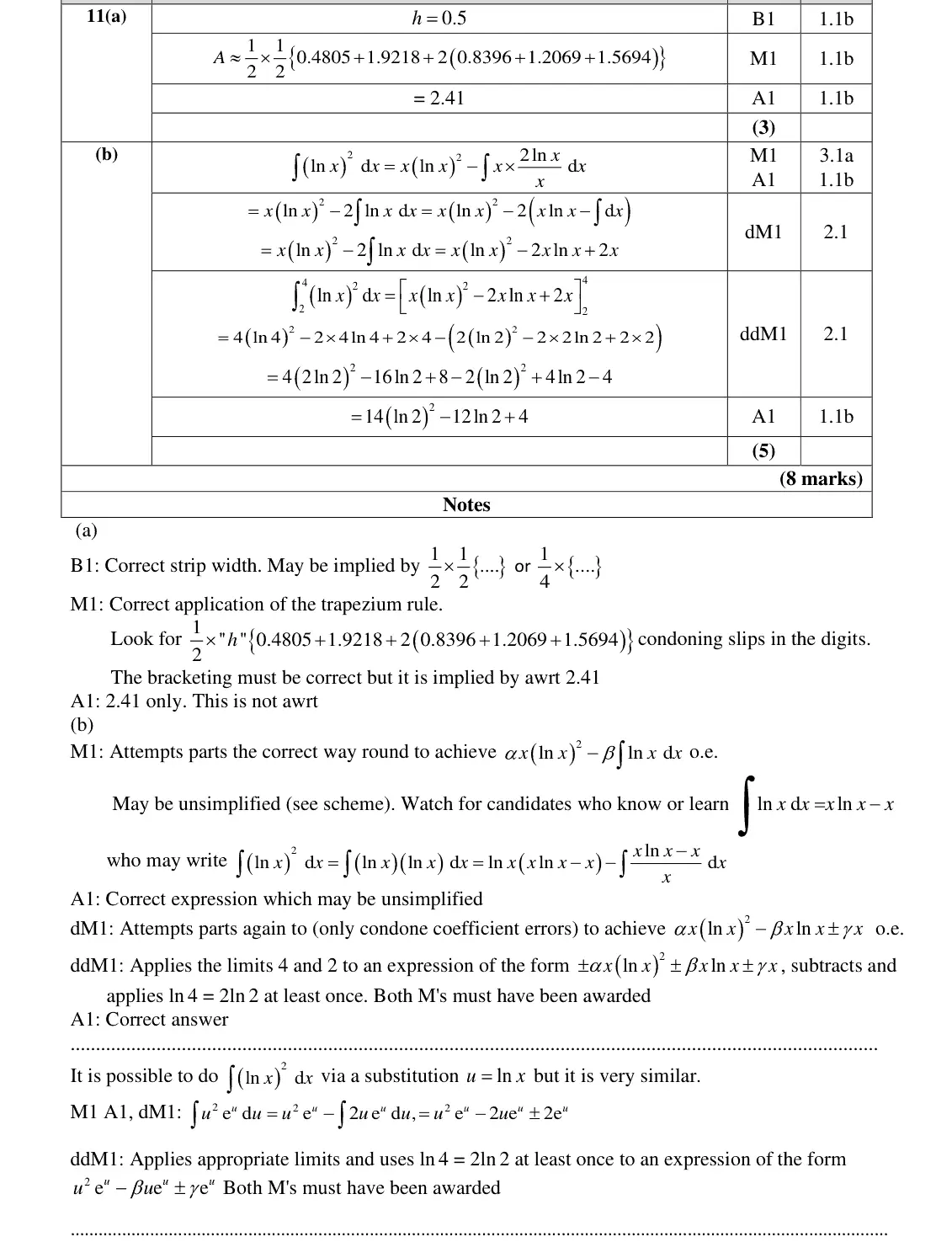
integration by parts twice (u = (ln x)², then ∫ln x dx = x ln x − x)
14(ln 2)² − 12 ln 2 + 4 using ln 4 = 2 ln 2
∫(ln x)² is not (ln x)³/3 and (ln x)² is not 2 ln x
sign and coefficient errors
Oct 2021 · Paper 2 · Q7(c)4 marks
Mark scheme (whole question; this part is marked with the orange bar)
Examiner's comment
Most students were able to gain some marks in part (c) but a score of two out of four was common. Those who got this, generally integrated the curve, obtaining a correct area of 455/12, but then failed to go any further. Very few students used the area of a trapezium formula, instead preferring to integrate the (2x – 23) or to split the area into a rectangle and triangle. Of those who attempted the area of the trapezium a number struggled to get the correct dimensions. Fully correct solutions using a trapezium were rare. A few students translated the curve and line upwards correctly by 23 units and often scored full marks using this method. Those students who attempted the curve minus the line, often struggled with the constant 23, or incorrectly collected like terms (e.g. an x term with an 𝑥𝑥2 term).
Common mistakes
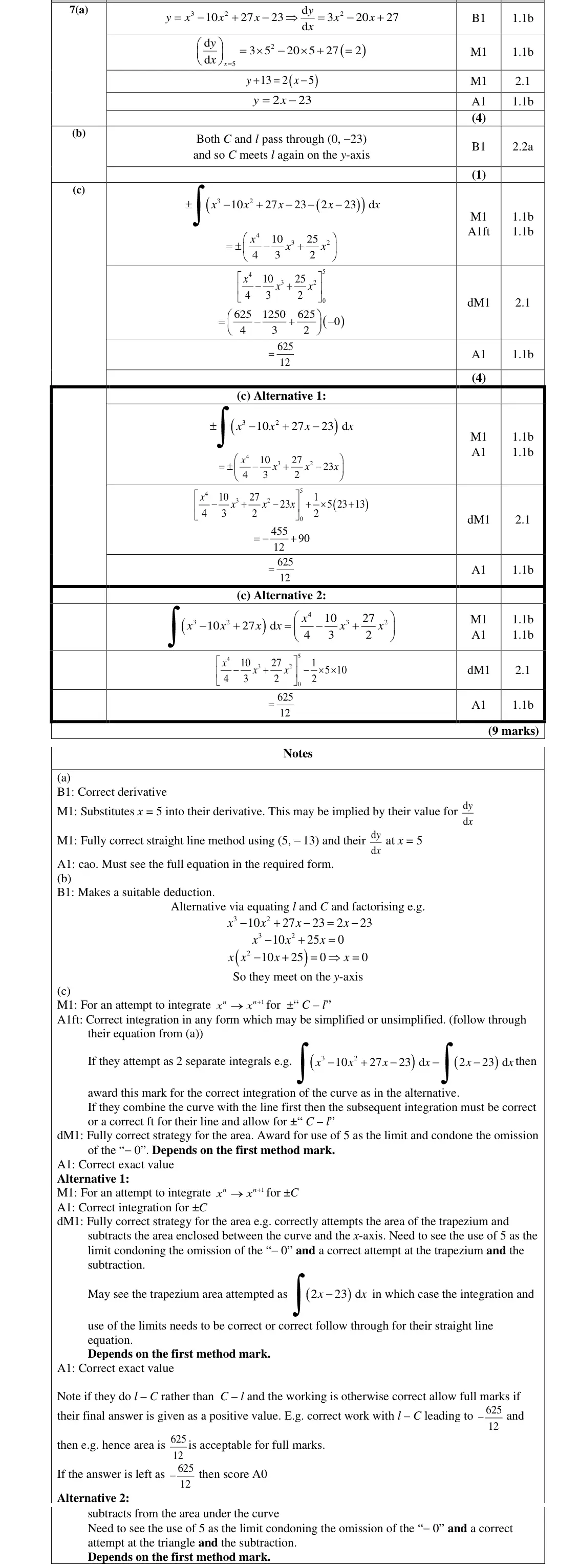
integrate (curve − line) from 0 to 5 = 625/12
455/12 is only the curve part, the trapezium must be subtracted
sign of l − C must end positive
Oct 2021 · Paper 2 · Q12(b)4 marks
Mark scheme (whole question; this part is marked with the orange bar)
Examiner's comment
This question discriminated well with weaker students generally able to pick up 2 marks and many able students were able to gain full marks. In part (b) it was good to see many students recognised that “hence” meant that the answer in part (a) must be used and proceeded with the correct method of expanding the cubic and dividing by u, proceeding correctly to the correct answer. If this was done correctly these students would usually go on to successfully apply the limits correctly and gain full marks. Unfortunately, a number of students attempted a method of integration by parts or some kind of product rule and therefore gained no marks here. Unfortunately a few did not take heed of the “hence” and proceeded to integrate the original expression scoring no marks in this part. Some weaker students split the integral into an incorrect sum of 2 fractions eg 2 𝑢𝑢+ (𝑢𝑢-1)3 𝑢𝑢 and then used integration by parts which they tended to give up on half way through. The method most successful was to take the 2 outside the integral, then integrate. Those that multiplied by 2 were more likely to make slips on the value of the coefficients for the 3rd and 4th term. Several students lost the final 2 marks as they used incorrect limits either 16 and 0 or 5 and 0.
Common mistakes
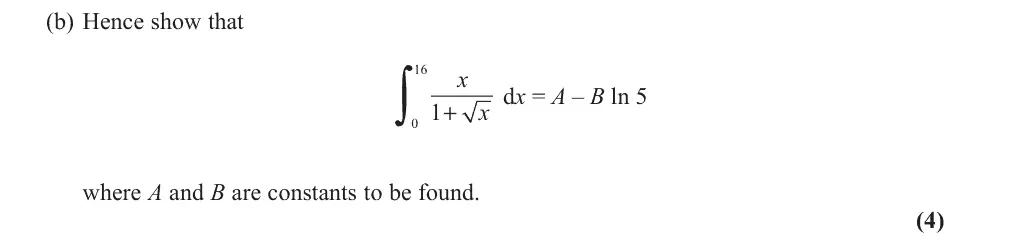
expand (u − 1)³ and divide by u before integrating
not by parts
apply limits 5 and 1
104/3 − 2 ln 5
Oct 2020 · AS Paper 1 · Q7(a)4 marks
Mark scheme (whole question; this part is marked with the orange bar)
Examiner's comment
7 The first part of this question was generally answered well with many candidates scoring full marks, but the second part proved to be more challenging for a disappointing number of them. In part (a), some candidates struggled with either rearranging the 5 2 x term to the form 1 2 5 2 x - or with getting the correct coefficient when integrating this to 1 2 5x . However, the majority of candidates were then confident in substituting both limits into their expression, subtracting and setting their result equal to 4, then rearranging correctly to get the required equation.
Common mistakes
write 5/(2√x) as (5/2)x^(−½) and integrate to 5√x
substitute both limits and set equal to 4
Oct 2020 · AS Paper 1 · Q7(b)4 marks
Mark scheme (whole question; this part is marked with the orange bar)
Examiner's comment
7 The first part of this question was generally answered well with many candidates scoring full marks, but the second part proved to be more challenging for a disappointing number of them. In part (b), some candidates struggled with identifying the given equation as a hidden three term quadratic, with a few trying unsuccessfully to simplify by multiplying every term by k, for example. Some candidates tried to square both sides but were mostly let down in this approach by mistakes in expanding out the brackets or simply squaring individual terms. Those candidates who were successful often proceeded by setting y k = , for example, and proceeding correctly to two values, which they then squared, but a number did not realise that they needed to discard the solution of 3 k = -. Some candidates confused themselves by setting k k = to produce a three term quadratic in k but then failed to realise they had not found the actual value for k.
Common mistakes
quadratic in √k: (3√k − 4)(√k + 3) = 0
reject √k = −3 so k = 9 is not a solution
square to get k = 16/9 (not √k)
Oct 2020 · AS Paper 1 · Q10(c)4 marks
Mark scheme (whole question; this part is marked with the orange bar)
Examiner's comment
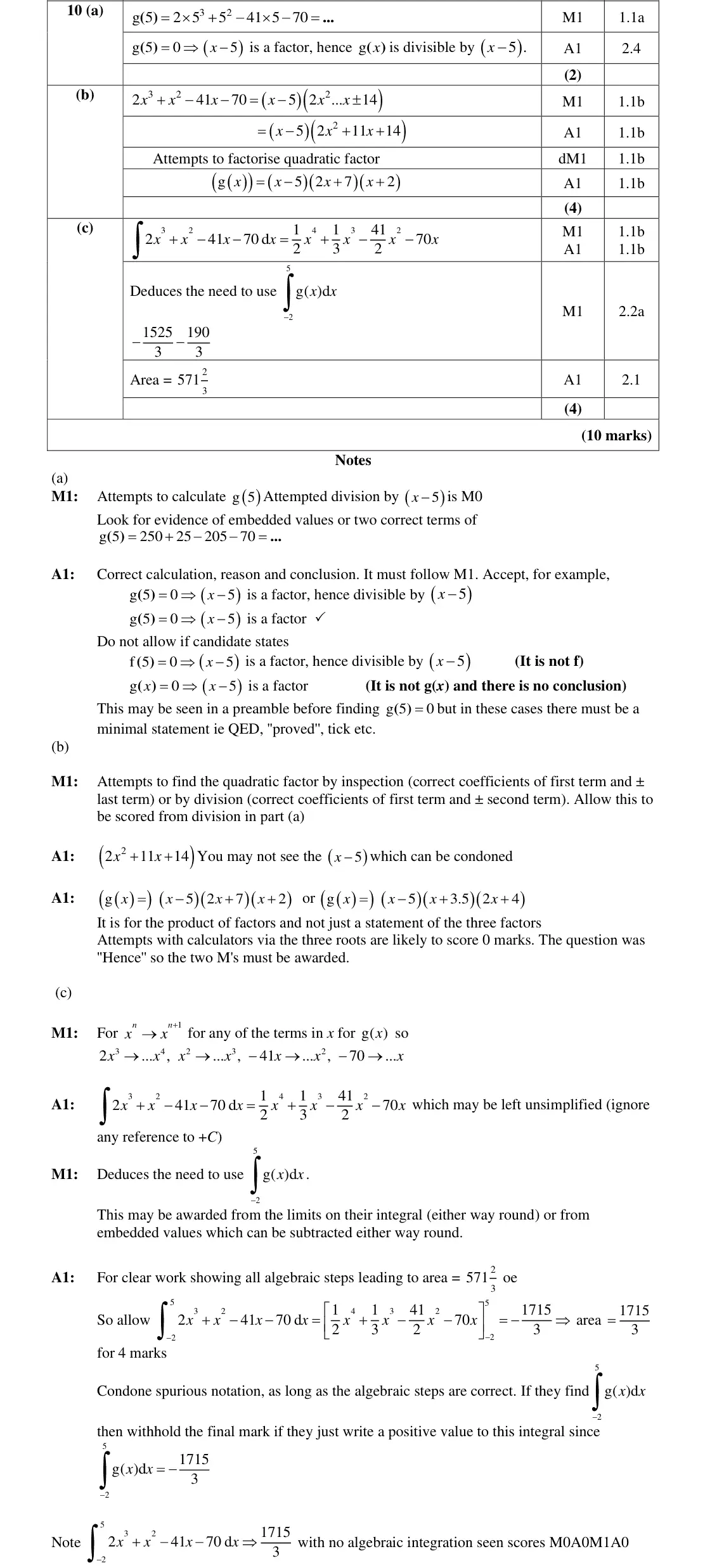
This question was answered well by the majority of candidates. However, the question highlights the need for detail in proof and ‘show that’ questions which candidates are clearly still getting used to; it appeared to be even the more able candidates were neglecting to state facts that were needed. Candidates should be encouraged to make sure they provide sufficient reasoning when demonstrating a result or writing a proof. The final part requiring integration, whilst not penalised, brought out a lot of poor notation. Candidates were able to score most marks, however. Those who understood the nature of the curve and the importance of the factors and roots found earlier were able to choose the correct bounds and, usually, go on to achieve full marks. In part (c), those who attempted the question typically integrated correctly; however, it was very mixed when it came to evaluating. There were a number of poor graph sketches and some did not recognise which area they were actually finding and chose the wrong bounds for the integral. When evaluating the integral there were solutions lacking brackets which resulted in sign errors. Although the integral evaluates to be negative, the area is the magnitude of this. If the bounds were used in ascending order, then it was expected to see the negative answer before the positive solution. It was acceptable, following candidates carrying out algebraic integration visibly, that they used their calculator to substitute in their limits and could still score full marks. 10
Common mistakes
limits −2 and 5 from the factors (region below the axis)
brackets when substituting
integral is −1715/3 so area is 571⅔ (do not just write the positive value)
Oct 2020 · Paper 2 · Q6(b)4 marks
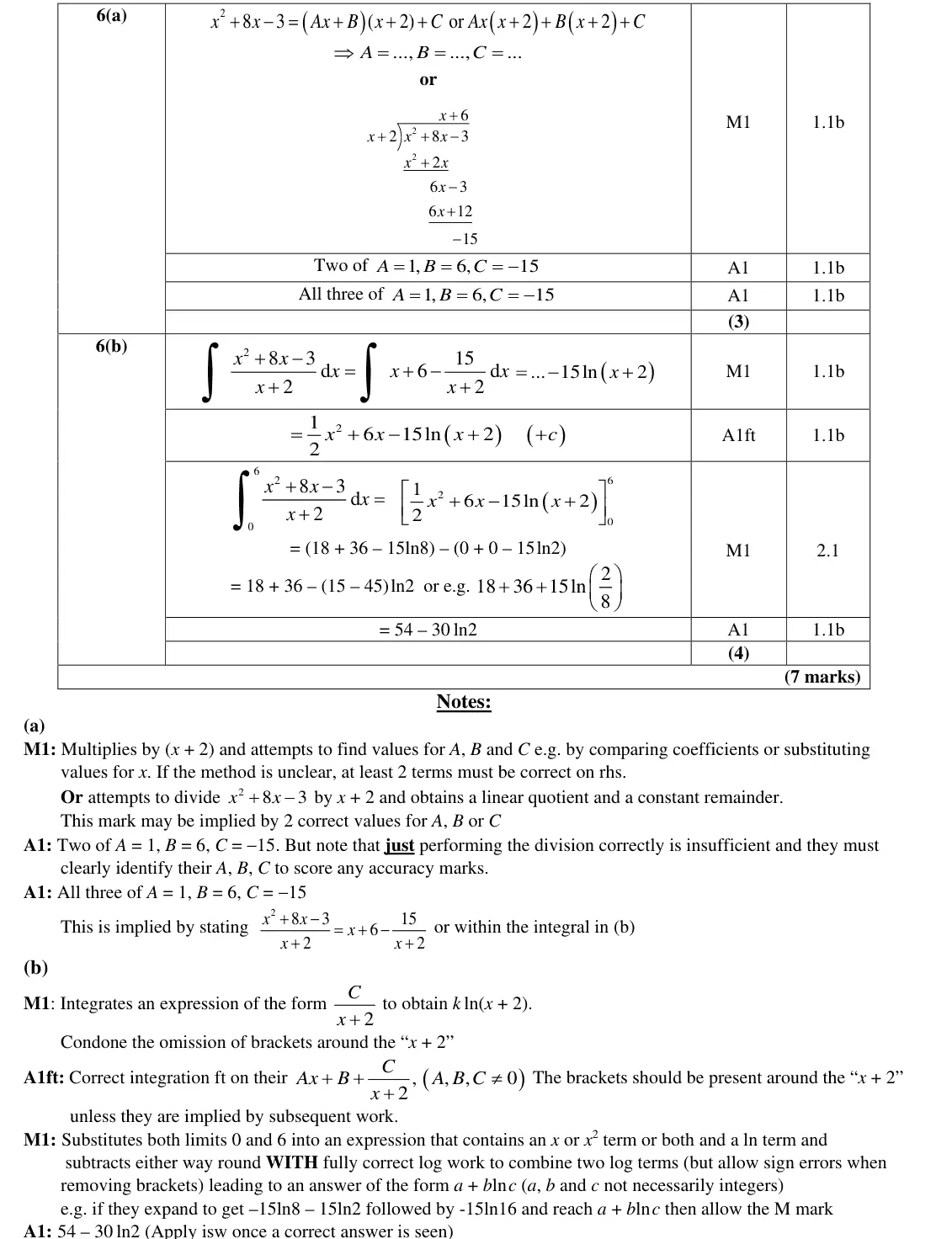
Mark scheme (whole question; this part is marked with the orange bar)
Examiner's comment
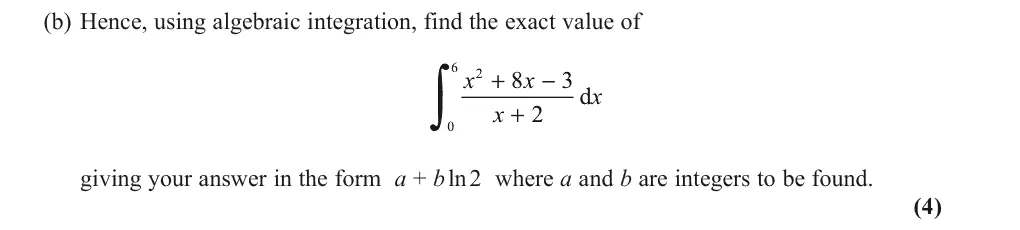
As would be hoped, most candidates scored some marks on this question. Many found part the accuracy marks. There were many more errors seen when students attempted to values of 𝑥𝑥 to substitute in, any errors usually cost both accuracy marks. In comparison, multiply (Ax + B) by (x + 2) and compare the numerators, and when candidates selected (-3 - +12 = 9 being a common slip) and so secure the first accuracy mark. those who used long division were more likely to make an error only in the remainder In part (b), a pleasingly high number of candidates who had found values for A, B and C were able to successfully integrate to gain the first two marks, often aided by the follow through mark that was available. Candidates generally substituted the limits correctly and there was occasional sign errors. The most common being “-15ln 8 -(-15 ln 2) = -15ln 8 - also a relatively good use of the laws of logarithms to combine their terms, albeit with 15 ln 2”. It was not uncommon for a candidate to then incorrectly combine this to get " - 15ln 8 2”. Most success was seen where candidates changed the ln (8) into ln (23) and then 3 ln(2) before combining the two ln 2 terms.
Common mistakes
integral of 15/(x + 2) is 15ln(x + 2)
−15ln8 + 15ln2 = −30ln2 (write ln8 = 3ln2), not −15ln(8 − 2) or −15ln16
answer 54 − 30ln2
Oct 2020 · Paper 2 · Q12(a)(i)3 marks
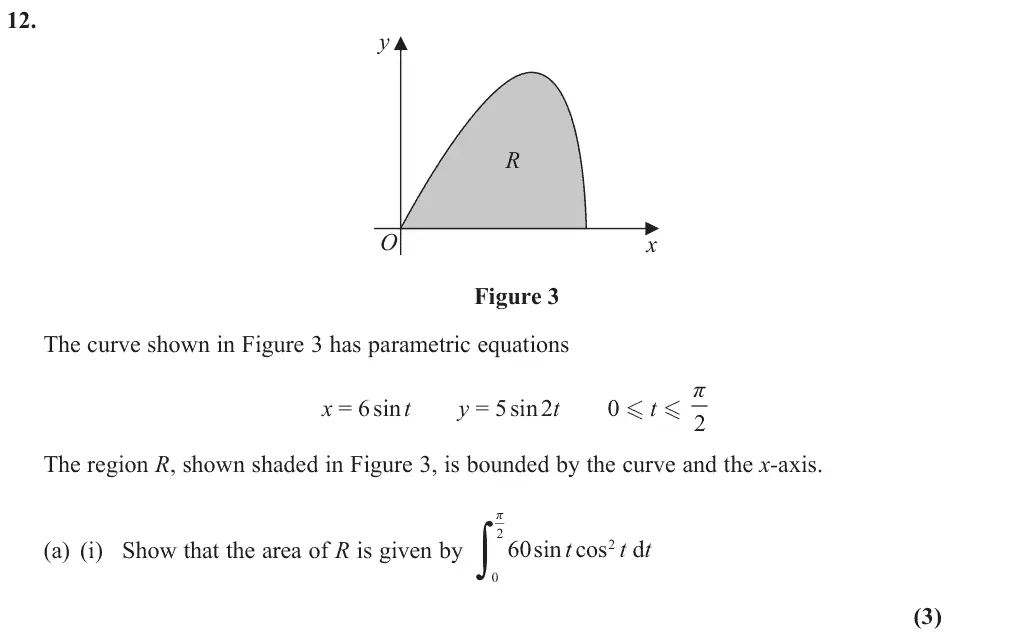
Mark scheme (whole question; this part is marked with the orange bar)
Examiner's comment
Many candidates left the entire question or parts of this question completely blank and clearly found it difficult to access the content being assessed here, perhaps due to a lack of familiarity with integration using parametric equations. Many tried to establish the Cartesian equation to answer various parts. That said, there were many candidates who provided clear and concise solutions to each part. In part (a)(i), most candidates recalled the formula for integrating parametric equations and knew to find 𝑑𝑑𝑑𝑑 𝑑𝑑𝑑𝑑. Awareness of the double angle formula for sin2t was good. The main problem caused for these candidates was a lack of “dt” throughout their work, and only included this in the final line, losing the final accuracy mark. There was a significant proportion of candidates who attempt ed some differentiation using the chain rule: 𝑑𝑑𝑑𝑑 𝑑𝑑𝑑𝑑= 𝑑𝑑𝑑𝑑 𝑑𝑑𝑑𝑑 x 𝑑𝑑𝑑𝑑 𝑑𝑑𝑑𝑑 , scoring no marks. In part (b) many candidates who had found part (a) difficult gave up and lost the opportunity of scoring some easier marks. Many candidates who scored no marks elsewhere were still able to access at least the first two marks in part (b) by setting sin2t = 4.2 5 and solving, frequently getting at least one correct angle; but too many of these found their second value of t by subtracting their first value from pi instead of calculating pi – 𝑠𝑠𝑠𝑠𝑠𝑠-1( 0.84) before dividing by 2. The following mark was for finding two values of x, but many simply substituted their first value in to find x, thinking that this gave them the width of the walkway. Too many marks were lost by approximating too soon and hence not having values with the required accuracy. A few lost the last mark because they omitted the units.
Common mistakes
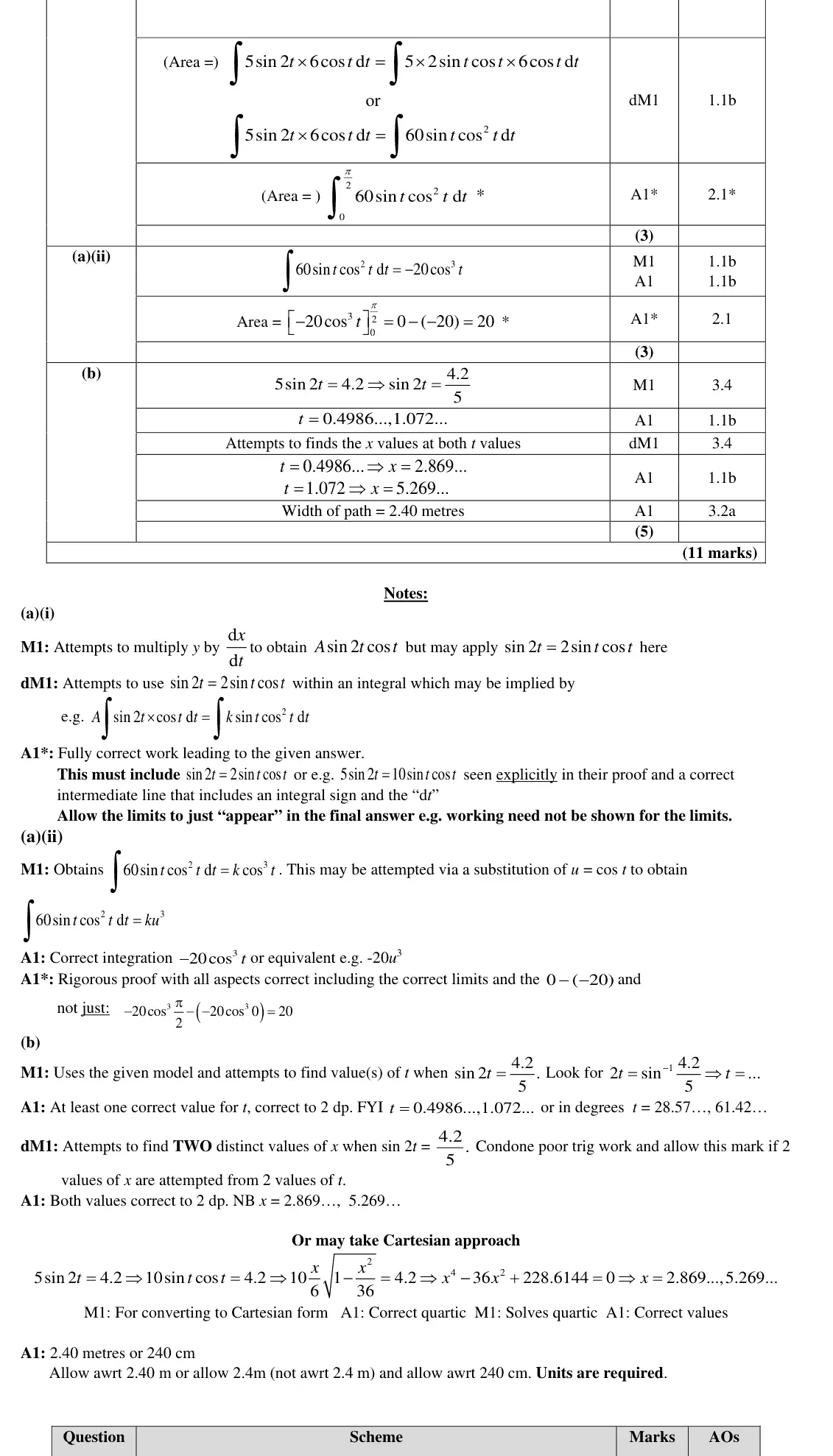
area = integral of y (dx/dt) dt
sin 2t = 2sin t cos t must be seen explicitly
keep dt throughout
dy/dx by the chain rule is the wrong method
Oct 2020 · Paper 2 · Q12(a)(ii)3 marks
Mark scheme (whole question; this part is marked with the orange bar)
Examiner's comment
Many candidates left the entire question or parts of this question completely blank and clearly found it difficult to access the content being assessed here, perhaps due to a lack of familiarity with integration using parametric equations. Many tried to establish the Cartesian equation to answer various parts. That said, there were many candidates who provided clear and concise solutions to each part. In part (a)(ii), many knew that the integral was a multiple of cos3 t but had trouble getting to the printed answer of 20 with correct steps. As the answer was given, it was a requirement to see the limits calculated separately as 0 – ( -20 ) = 20. Integration by parts was a common approach for unsuccessful candidates, while others attempted to use a substitution, often not using the necessary u = cosx. Those candidates with an understanding of the integration of f’(x)[f(x)]n were generally very successful here. Some lost the penultimate accuracy mark usually due to a sign error.
Common mistakes
reverse chain rule (or u = cos t) gives −20cos³t
limits must be shown as 0 − (−20) = 20
by parts is the wrong approach
June 2019 · AS Paper 1 · Q3(b)3 marksEasy
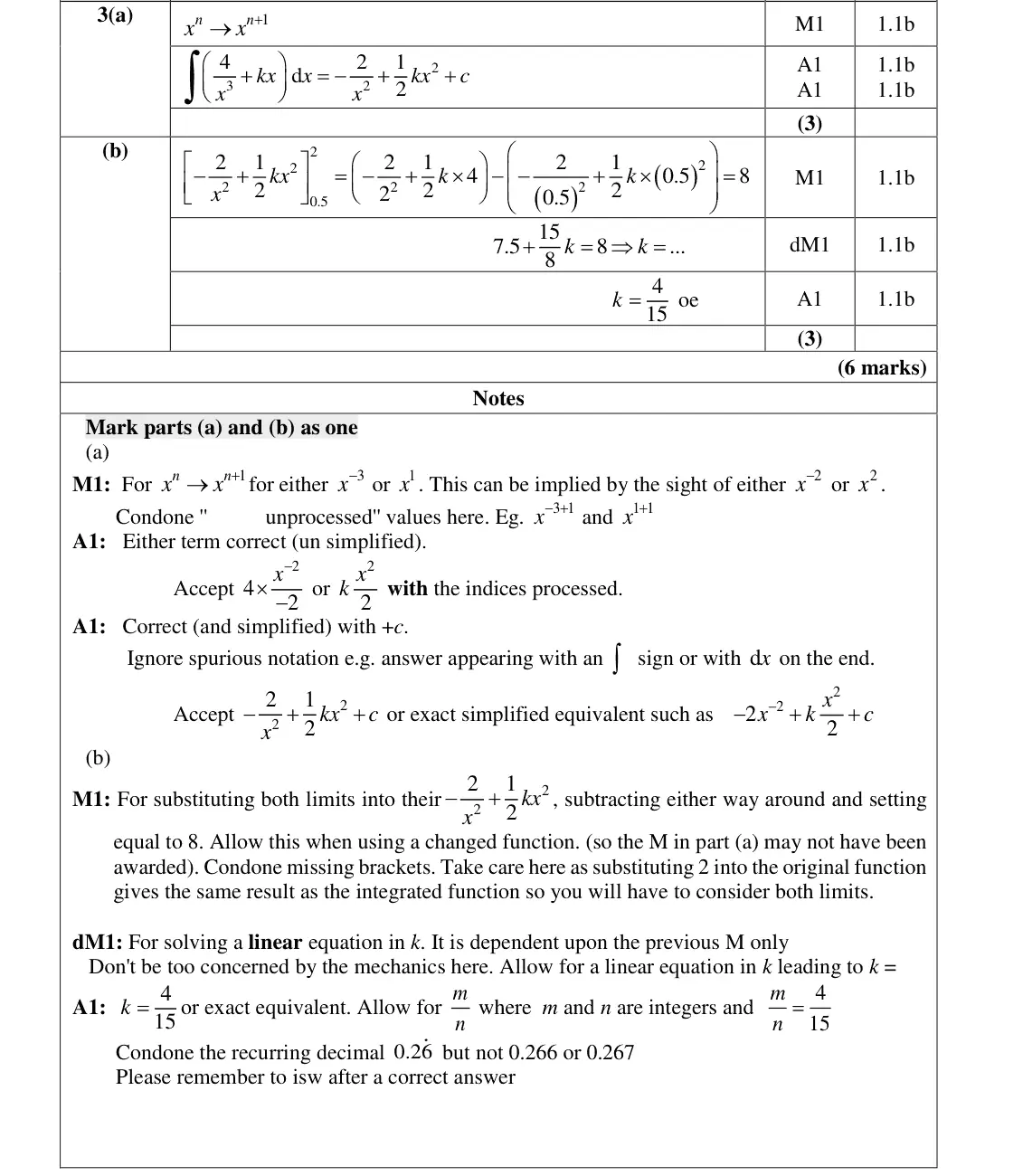
Mark scheme (whole question; this part is marked with the orange bar)
Examiner's comment
present but the coefficient was sometimes left unsimplified or the index ‘increased’ to 4. In part (b) most candidates were able to substitute the correct limits into their result from part (a) in an attempt to find k from the resulting linear equation. Common errors in part (b) consisted of a lack of bracketing when substituting in 0.5 equating their integrated expression equal to 0 algebraic slips in solving their linear equation in k.
Common mistakes
substitute both limits 2 and 0.5 with brackets and subtract
do not set the integral to 0
solve the linear equation 7.5 + (15/8)k = 8 to k = 4/15
June 2019 · AS Paper 1 · Q137 marksEasy
Mark scheme (whole question; this part is marked with the orange bar)
Examiner's comment
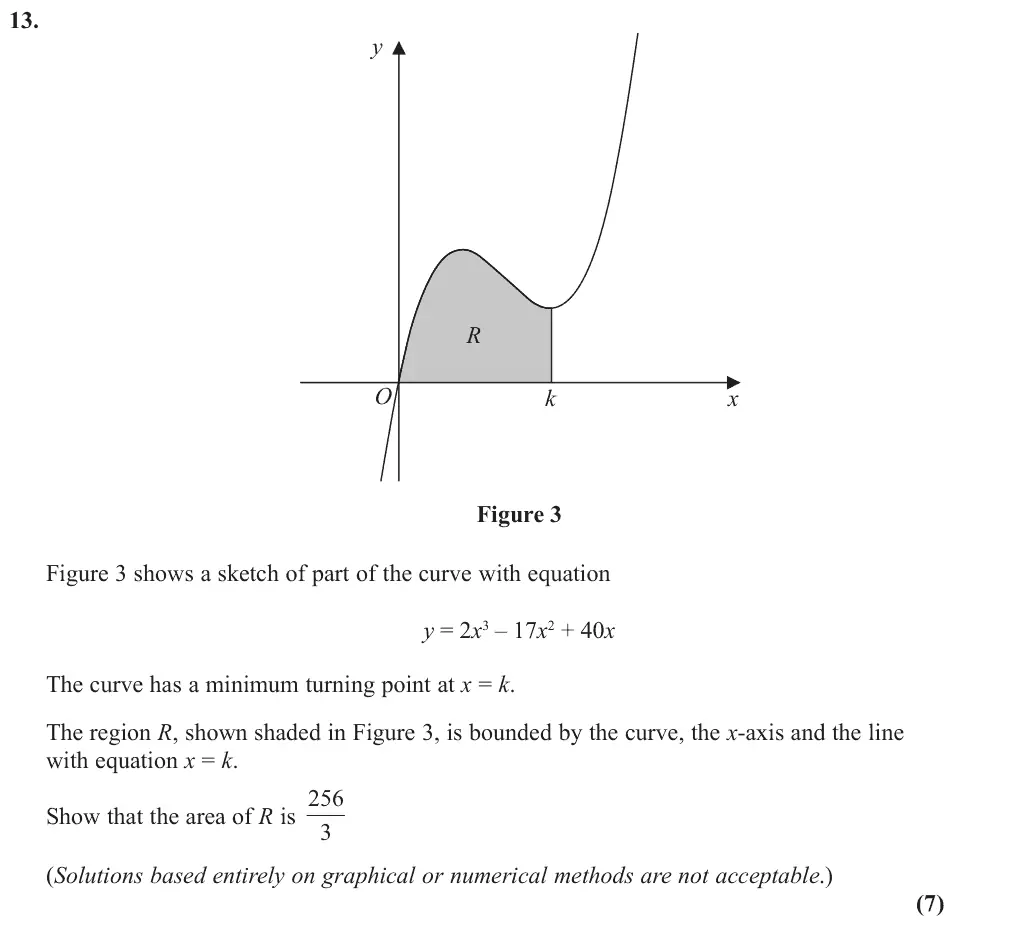
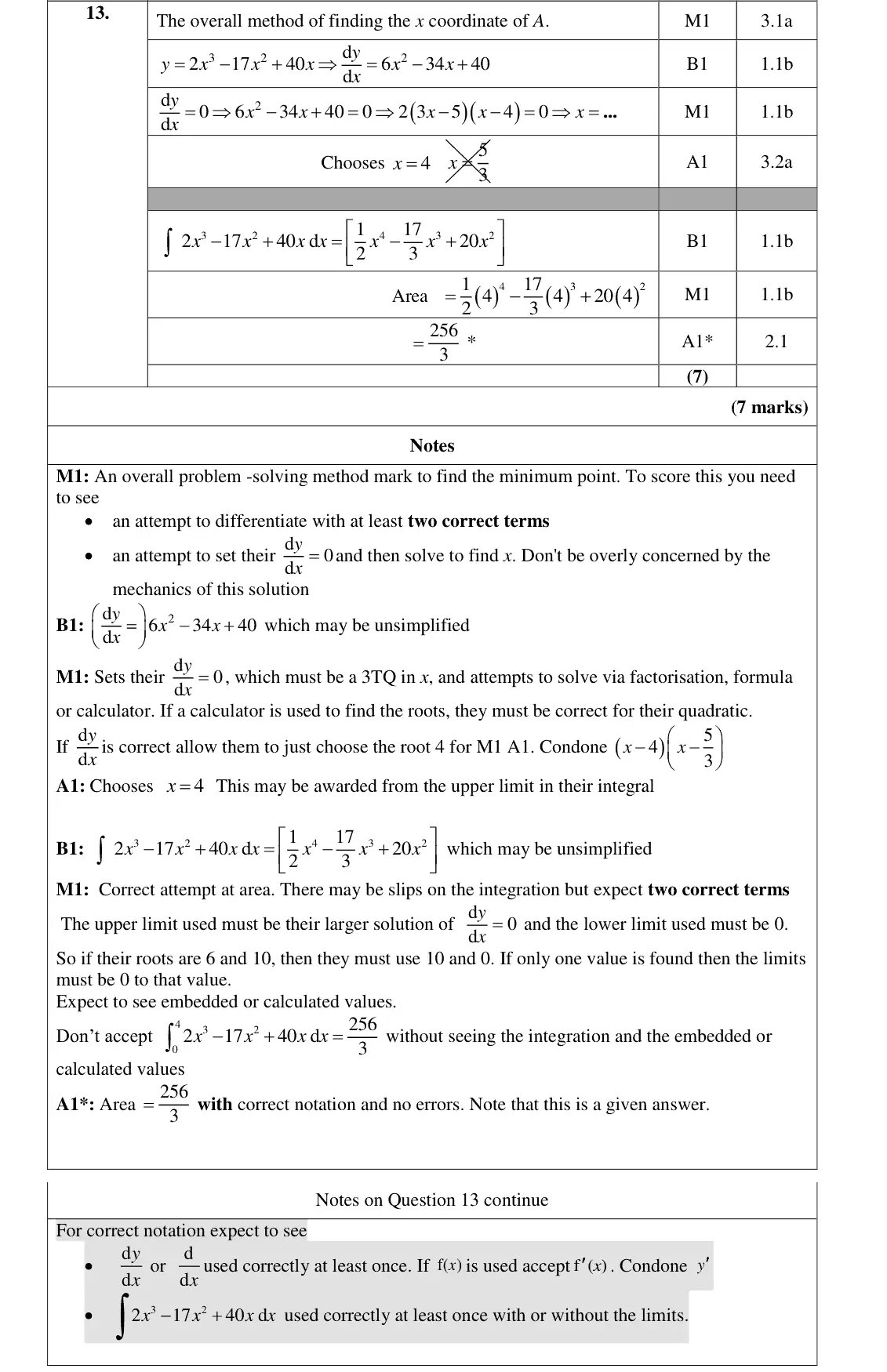
f 4 4 2 3 x x x x f 0 x 4 x 0 , 2 This was an open ended question, types of which are expected in the new specification. Almost all candidates were able to achieve some credit in this question. Poor notation (usually the omission of dx from the integral) caused many to forfeit the final mark. Some candidates seemed unaware that it was unacceptable to rely entirely on a calculator and that they needed to show detailed working in this “show that” question. Many candidates attempted to integrate (usually correctly) but with no other work of any value, some using 0 and k as limits and some even showing the substitution of k and 0 and subtracting. But without a value of k found via differentiation, only the second B mark was available to them. Other candidates thought they could find k by finding the roots of the original cubic despite it being clear from the diagram that the origin was the only root. Of those who realised differentiation was required, most arrived at x = 5/3, 4. Some of these candidates spotted from the graph that k = 4, but many wasted time, either by finding the corresponding y- coordinates (and using the x value corresponding to the lower of these) or using the second differential (where d2y/dx2 > 0) to determine which was k. A few candidates having found the second differential, equated this to zero and erroneously used the resulting value as k. Occasional mistakes with limits included using 5/3 instead of 0 as the bottom limit and subtracting the wrong way round (or even adding) after substituting. Some candidates forfeited the final two marks for failing to show intermediate working.
Common mistakes
find k by dy/dx = 0: 6x² − 34x + 40 = 0 gives x = 5/3 or 4, choose k = 4 (the minimum, not a root of the cubic)
integrate from 0 to 4 showing substituted values
dx and correct notation needed for the given answer
June 2019 · AS Paper 2 (Mechanics) · Q3(b)3 marks
Mark scheme (whole question; this part is marked with the orange bar)
Examiner's comment
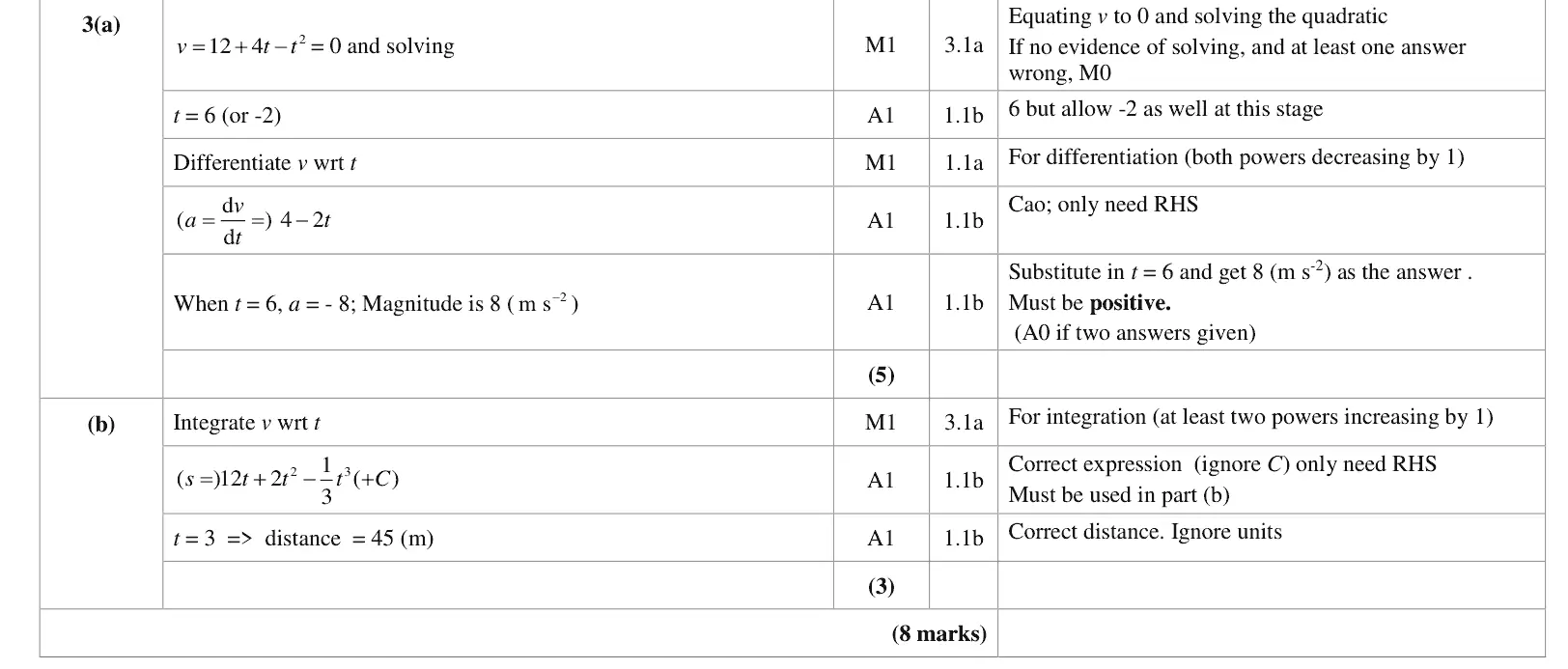
Most candidates knew they had to integrate for part (b) which they did mostly successfully and many went on to substitute t = 3 as required to find the distance travelled. There were a few numerical slips in carrying out the substitution but there were many correct solutions seen to this part of the question.
Common mistakes
integrate v: s = 12t + 2t² − t³/3
v > 0 for 0 ≤ t ≤ 3 so distance = s(3) = 45 m
June 2019 · Paper 1 · Q8(a)4 marksMedium
Mark scheme (whole question; this part is marked with the orange bar)
Examiner's comment
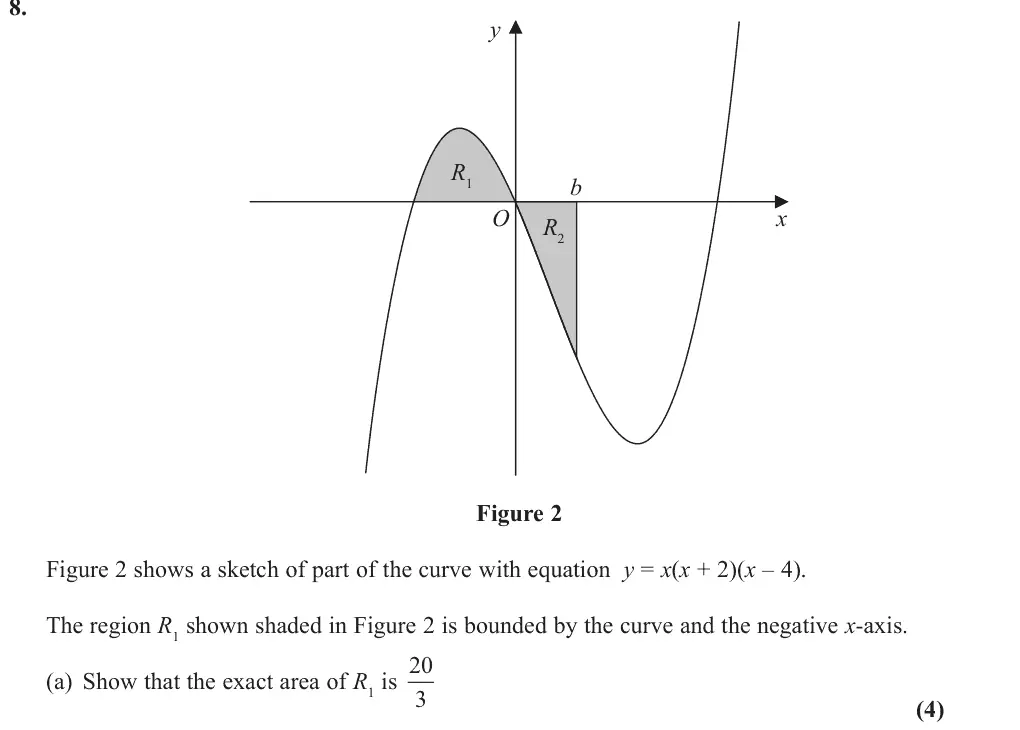
The first six marks in this question relating the definite integral with the area under the curve were straightforward. Only the best candidates were able to access the last four with many struggling to explain the significance of the root 5.442. Most students gained all 4 marks in part (a). Some unnecessarily complicated their proof by attempting integration by parts but in the main, all calculations were accurately performed.
Common mistakes
expand to x³ − 2x² − 8x before integrating (by parts is unnecessary)
limits −2 to 0
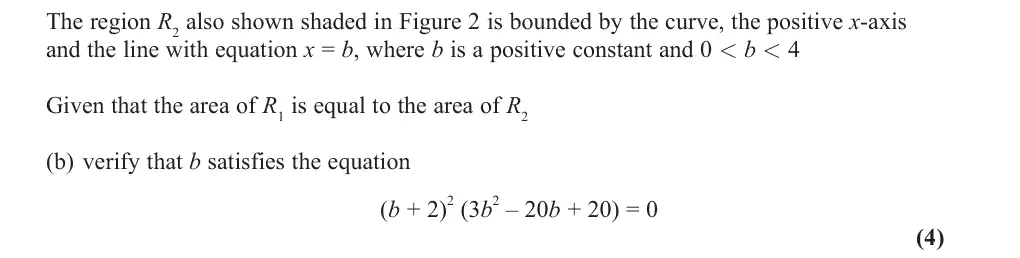
June 2019 · Paper 1 · Q8(b)4 marksMedium
Mark scheme (whole question; this part is marked with the orange bar)
Examiner's comment
The first six marks in this question relating the definite integral with the area under the curve were straightforward. Only the best candidates were able to access the last four with many struggling to explain the significance of the root 5.442. As with all proofs, part (b) proved to be very discriminating. Many candidates picked up the first mark for setting 4 3 2 1 2 20 4 4 3 3 b b b but there was much confusion as to the sign of 20 3 on the right hand side. Most students attempted to proceed by the method shown in the scheme. It should be noted that division by 2 4 4 b b was much easier and faster than dividing by ( 2) b twice. Fully correct solutions to (b) were rare with many picking up 2 out of the 4 marks.
Common mistakes
integral from 0 to b equals −20/3 (sign confusion common)
3b⁴ − 8b³ − 48b² + 80 = 0
dividing by b² + 4b + 4 is quicker than by (b + 2) twice
June 2019 · Paper 1 · Q8(c)2 marksMedium
Mark scheme (whole question; this part is marked with the orange bar)
Examiner's comment
The first six marks in this question relating the definite integral with the area under the curve were straightforward. Only the best candidates were able to access the last four with many struggling to explain the significance of the root 5.442. In part (c) many candidates realised that 5.442 was to the right of 4 on the x- axis and shaded an appropriate area, scoring one mark. Full explanations as to its significance were rare and confined to the best candidates. Any suitable statement that alluded to the fact that the area above the curve is equal to the area below the curve (between 2 and 5.442) was acceptable.
Common mistakes
between x = −2 and x = 5.442 the area above the x-axis equals the area below
shading the region beyond x = 4 alone scores 1
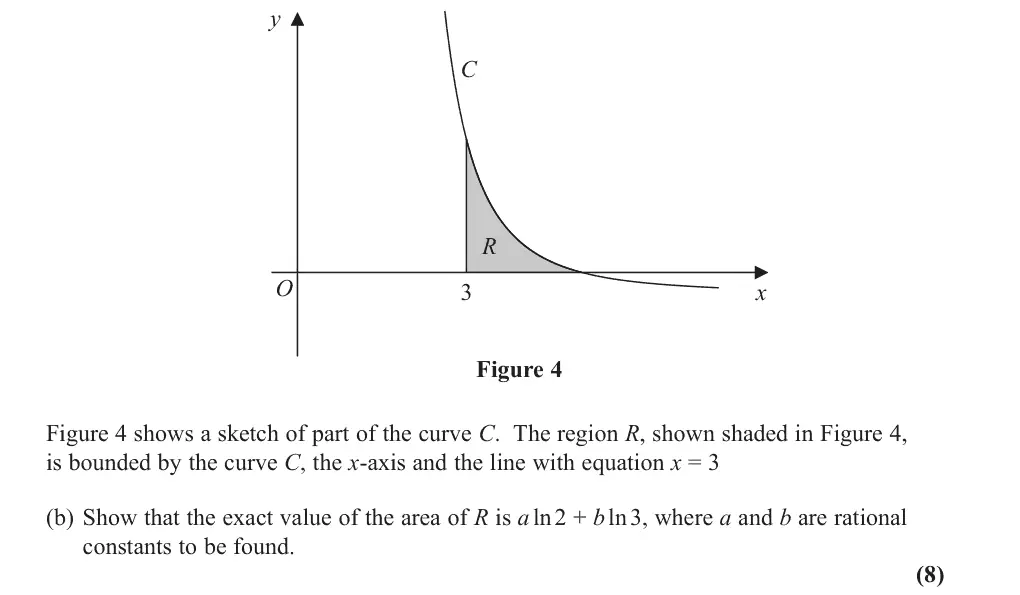
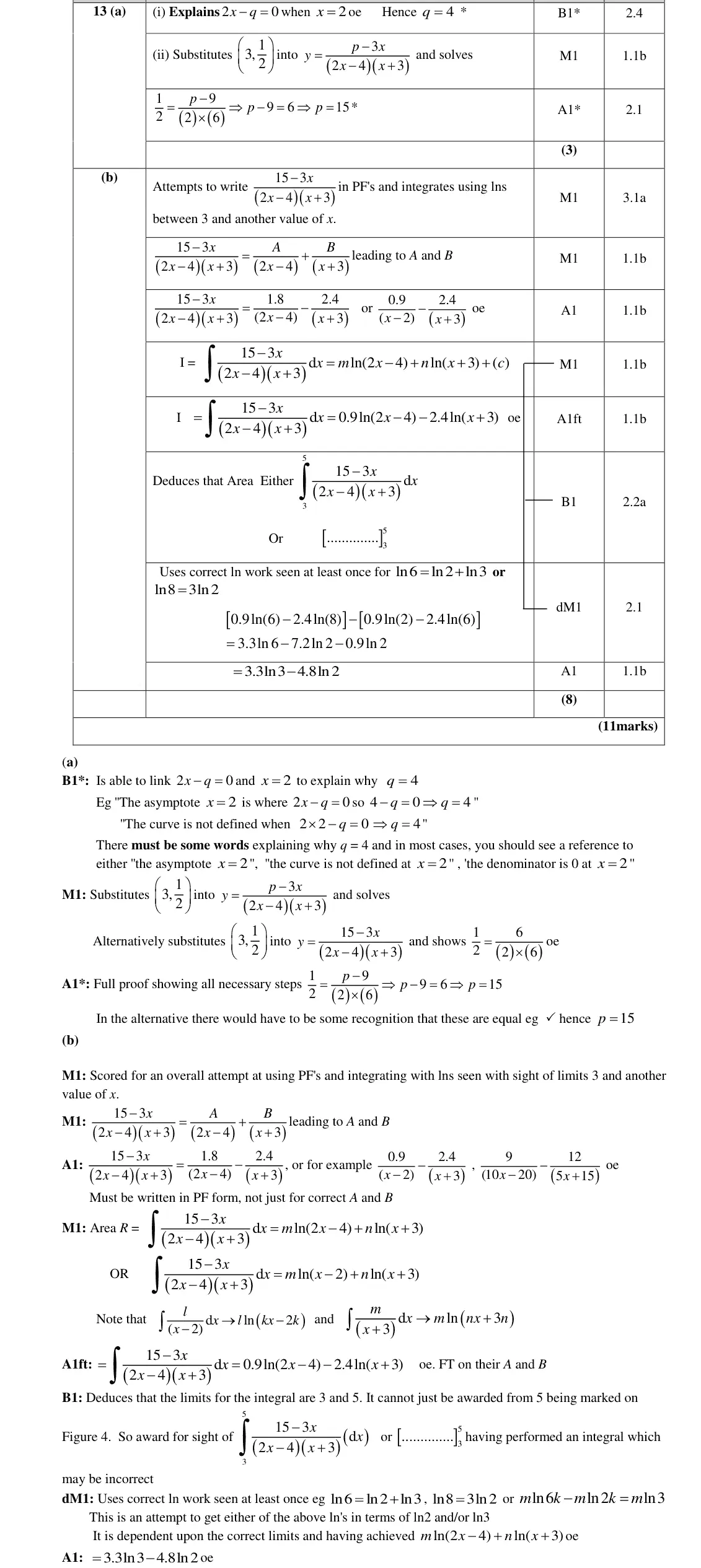
June 2019 · Paper 1 · Q13(b)8 marksMedium
Mark scheme (whole question; this part is marked with the orange bar)
Examiner's comment
Only the strongest candidates scored all 11 marks here, with the majority losing at least 1 mark, usually the first mark in (a) or the last mark in (b). In part (b) the vast majority of students knew they had to use partial fractions to attempt the question with many achieving the correct expression and correct integration. The most common error was in simplifying the final logarithmic expression with many candidates leaving some of their answers in terms of ln (3/4) or ln (4/3) for example. It was uncommon therefore to see a fully correct solution in the required form.
Common mistakes
partial fractions 0.9/(x − 2) − 2.4/(x + 3)
upper limit 5 from 15 − 3x = 0
ln 6 = ln 2 + ln 3, ln 8 = 3 ln 2
final 3.3 ln 3 − 4.8 ln 2, not left with ln(3/4)
June 2019 · Paper 2 · Q53 marks
Mark scheme (whole question; this part is marked with the orange bar)
Examiner's comment
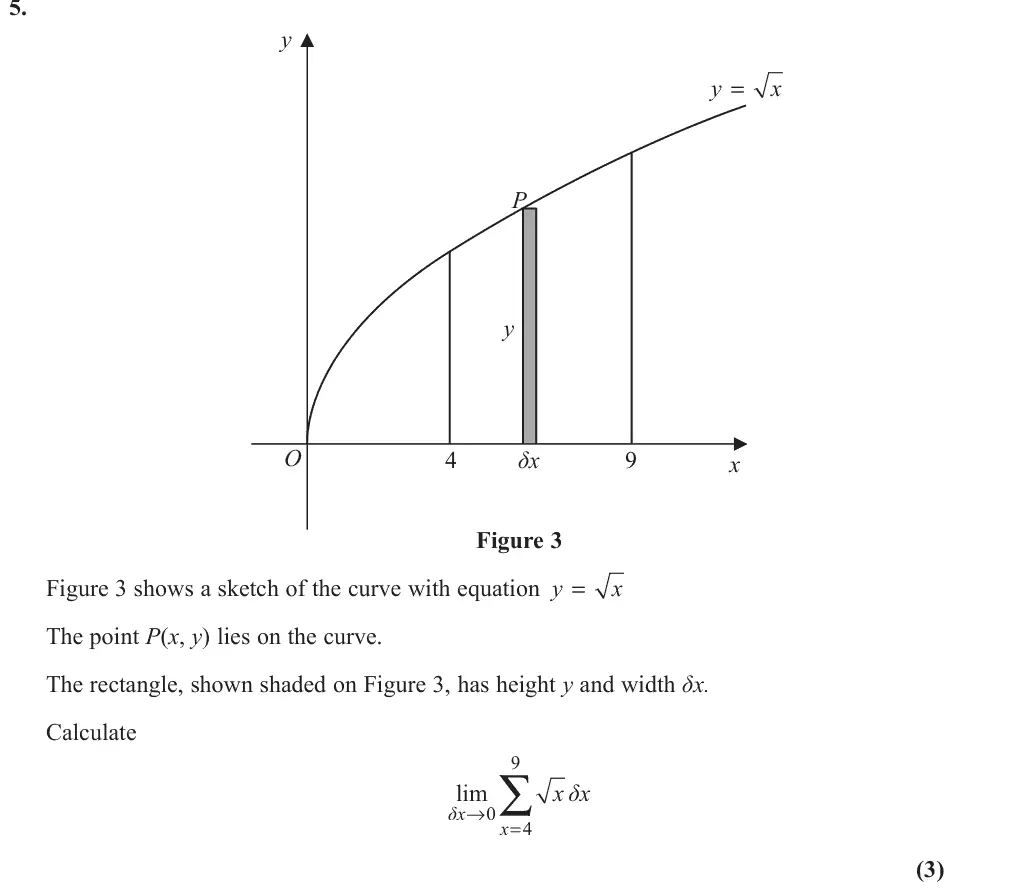
Q05 proved challenging for many candidates and some candidates were unfamiliar with the notation that was used. Most candidates scored either all three marks or zero marks in this question. There were a substantial number of blank responses. It is noted that section 8.4 (guidance) of the Pure Specification states ‘Recognise 0 f( )d lim f( ) b b x a x a x x x x ’. It is also noted that a similar question had not appeared on the 9MA0 June 2018 papers, the SAMs, the specimen papers or the mock papers. Those candidates who recognised that 9 0 4 lim x x x x was another way of writing 9 4 d x x generally produced a correct solution to score all 3 marks. Only a few made errors in their integration of x or in the application of the limits 4 and 1. Most candidates, however, made no creditable progress. Some applied the trapezium rule with 1, h but did not link their trapezium rule attempt with a stated 9 4 d . x x Other candidates attempted to sum x using integer values from 4 x to 9, x resulting in 4 5 6 ... 9 ( 15.1597...). Some candidates mistakenly interpreted ‘ x ’ as a trigger to differentiate , x with a few of these candidates attempting to differentiate x from first principles. A few candidates applied the incorrect method 9 4 4 5 6 ... 9 d x x to give an answer of 2.49 to 3 significant figures.
Common mistakes
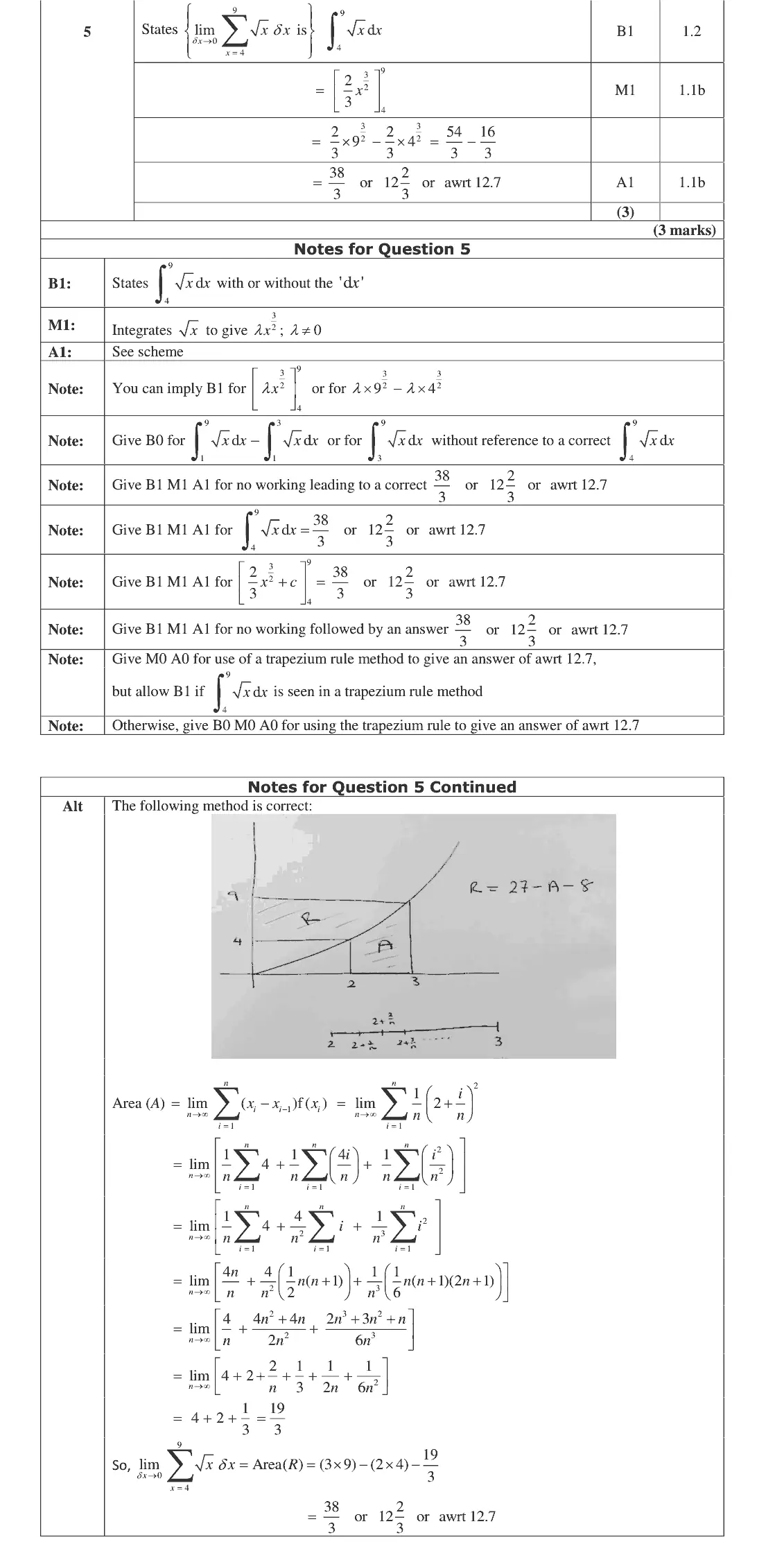
recognise the limit of the sum as ∫₄⁹ √x dx = 38/3
unfamiliar notation – many blank or used the trapezium rule or summed √4 + … + √9
δx is not a cue to differentiate
June 2018 · AS Paper 1 · Q1510 marks
Mark scheme (whole question; this part is marked with the orange bar)
Examiner's comment
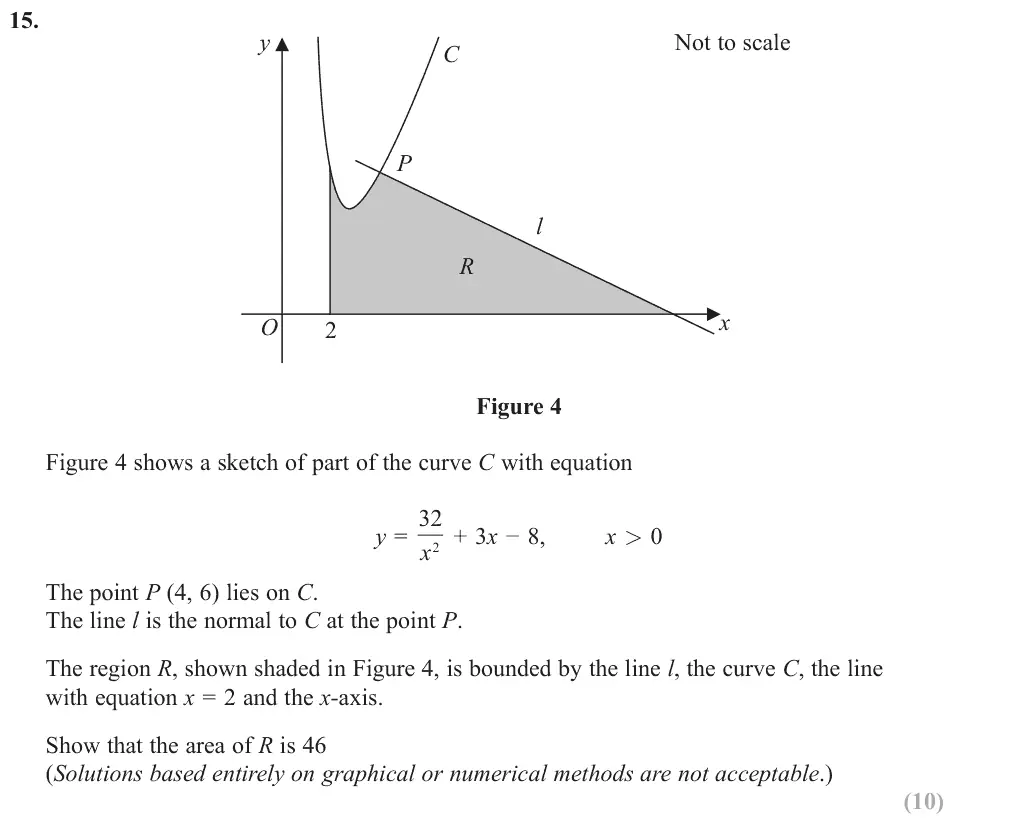
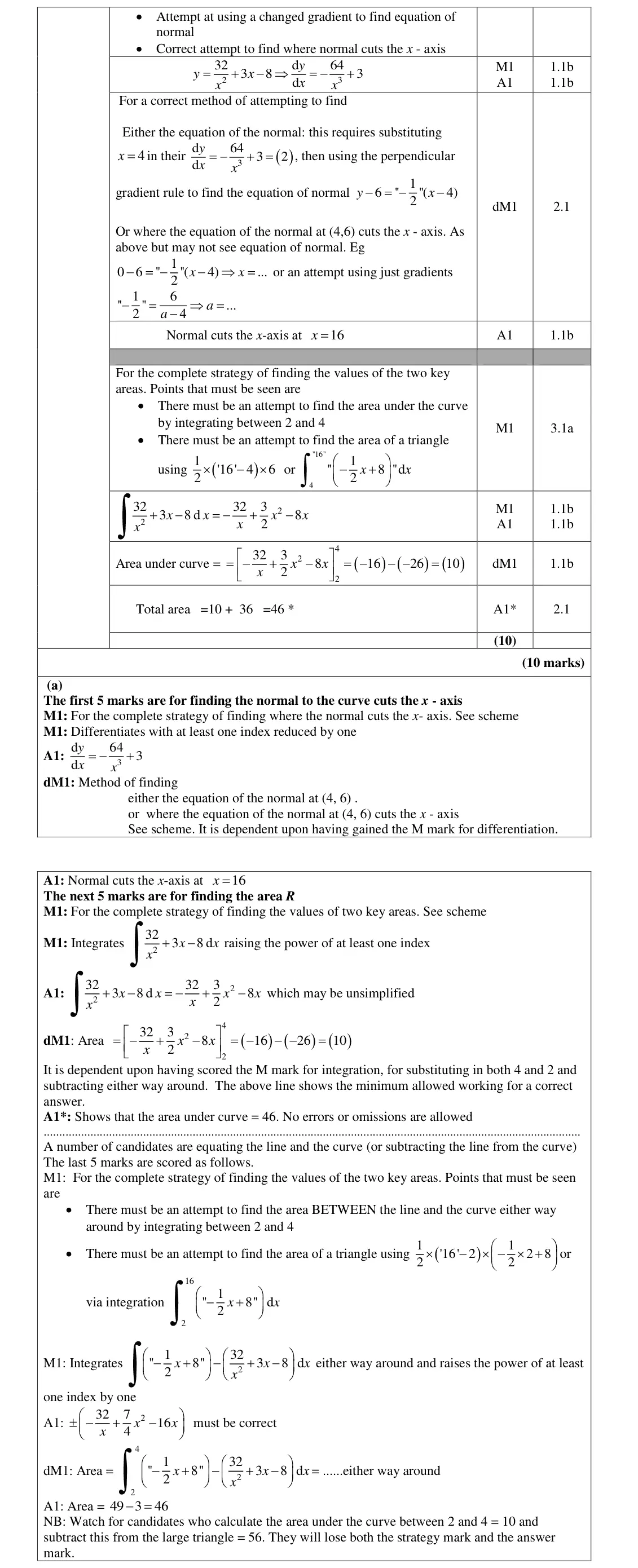
Some students were clearly running out of time when they reached this question, as there were many unfinished answers and some blanks. However, there were a great many accurate, concise and well written solutions. Few attempts at the line minus the curve approach were seen. This was an unstructured question in which the students were required to find their own route through the problem. There were two discrete elements to the solution, one via differentiation and one via integration that were required to be tied together to show the given answer. A good number completed the differentiation part correctly. There were slips in the differentiation of 2 x , but generally the method of finding the equation of a normal was well known. An equal number completed the integration part finding the area under the curve between 2 and 4. Similar slips were made on the integration of 2 x . Tying up these two techniques into finding the area of R was less well done. Standard errors seen here involved: (1) attempting the area of a triangle between 2 and 16 (2) integrating under the curve from 2 to 16 (3) finding the equation of the tangent to the curve at P.
Common mistakes
dy/dx = −64/x³ + 3 gives gradient 2 at P, so the normal has gradient −½ and meets the x-axis at x = 16
area under the curve from 2 to 4 = 10
triangle ½ × 12 × 6 = 36
total 46
slips differentiating and integrating 32/x²
many ran out of time
June 2018 · Paper 1 · Q7(a)4 marks
Mark scheme (whole question; this part is marked with the orange bar)
Examiner's comment
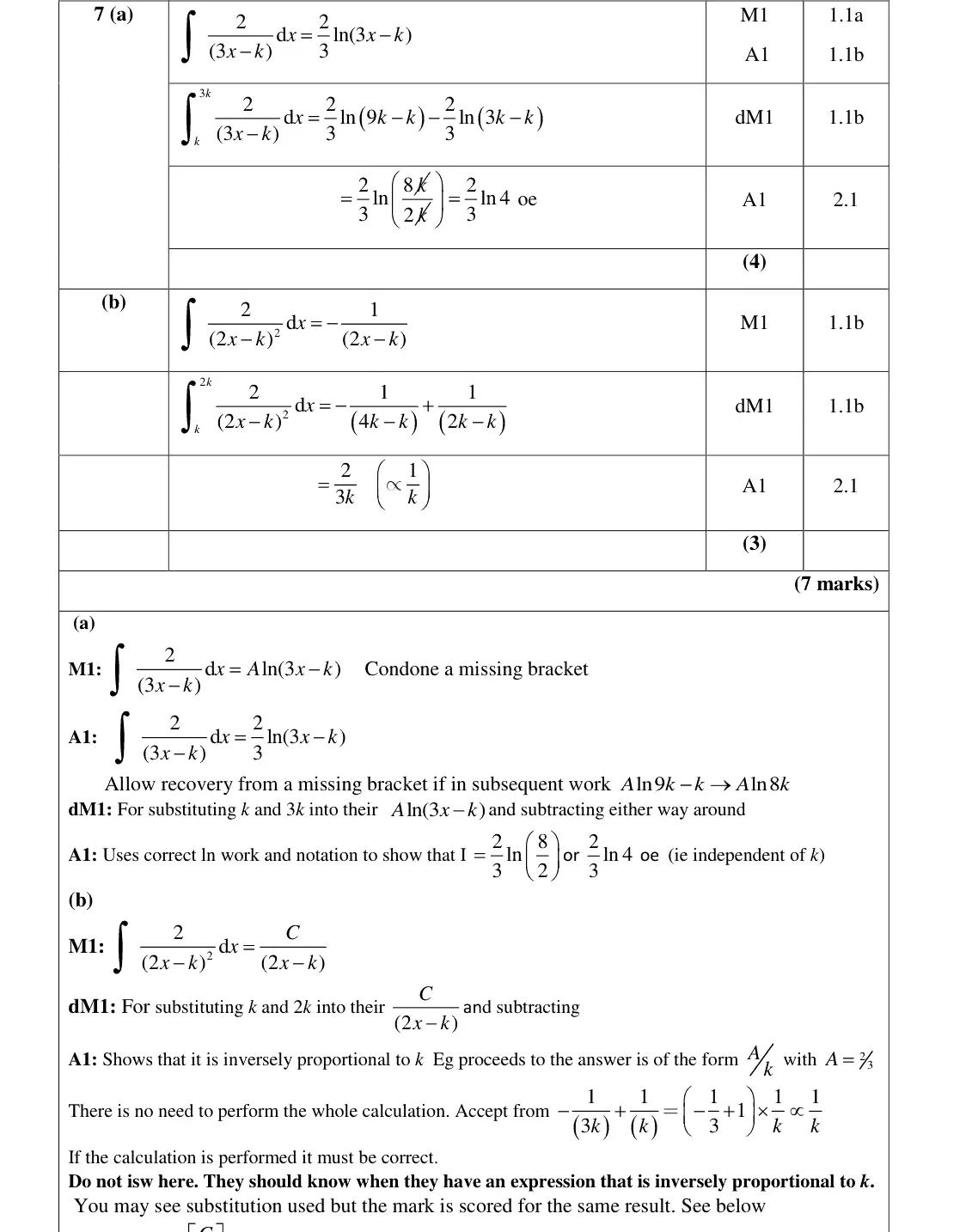
Both parts of this question were answered well, allowing students to demonstrate their confidence in integrating fractional expressions in x and working with unknown constants. The majority of students failed to make any statement regarding the integral in (a) being independent of k, or in (b) inversely proportional to k. Whilst not a requirement for the final part (b) as well as part (a). Additionally, despite the successful implementation of limits, some careless and disappointing algebra was seen in simplifying their final expressions in an attempt to answer the question. A more unusual but not uncommon error was related to the fact that ‘k’ occurred both in the integral and in the limits. Some students integrated with respect to k whilst others substituted the limits for the term in k rather than the term in x. Other unusual attempts were seen by students attempting to use partial fractions within part (b).
Common mistakes
∫2/(3x − k) dx = (2/3)ln(3x − k)
substitute the limits into x, not into k (some integrated w.r.t. k)
(2/3)ln(8k/2k) = (2/3)ln4 and state independent of k
June 2018 · Paper 1 · Q7(b)3 marks
Mark scheme (whole question; this part is marked with the orange bar)
Examiner's comment
Both parts of this question were answered well, allowing students to demonstrate their confidence in integrating fractional expressions in x and working with unknown constants. independent of k, or in (b) inversely proportional to k. Whilst not a requirement for the final A mark in either part, the logical completion of the question would have been to make these conclusions and show an understanding of these mathematical terms. Common method errors in this question included integrating to obtain a natural logarithm in part (b) as well as part (a). Additionally, despite the successful implementation of limits, some careless and disappointing algebra was seen in simplifying their final expressions in an attempt to answer the question. A more unusual but not uncommon error was related to the fact that ‘k’ occurred both in the integral and in the limits. Some students integrated with respect to k whilst others substituted the limits for the term in k rather than the term in x. Other unusual attempts were seen by students attempting to use partial fractions within part (b).
Common mistakes
integrate to −1/(2x − k), not a logarithm
limits 2k and k into x
2/(3k) is of the form A/k so inversely proportional (do not isw)
partial fractions not needed
June 2018 · Paper 1 · Q137 marks
Mark scheme (whole question; this part is marked with the orange bar)
Examiner's comment
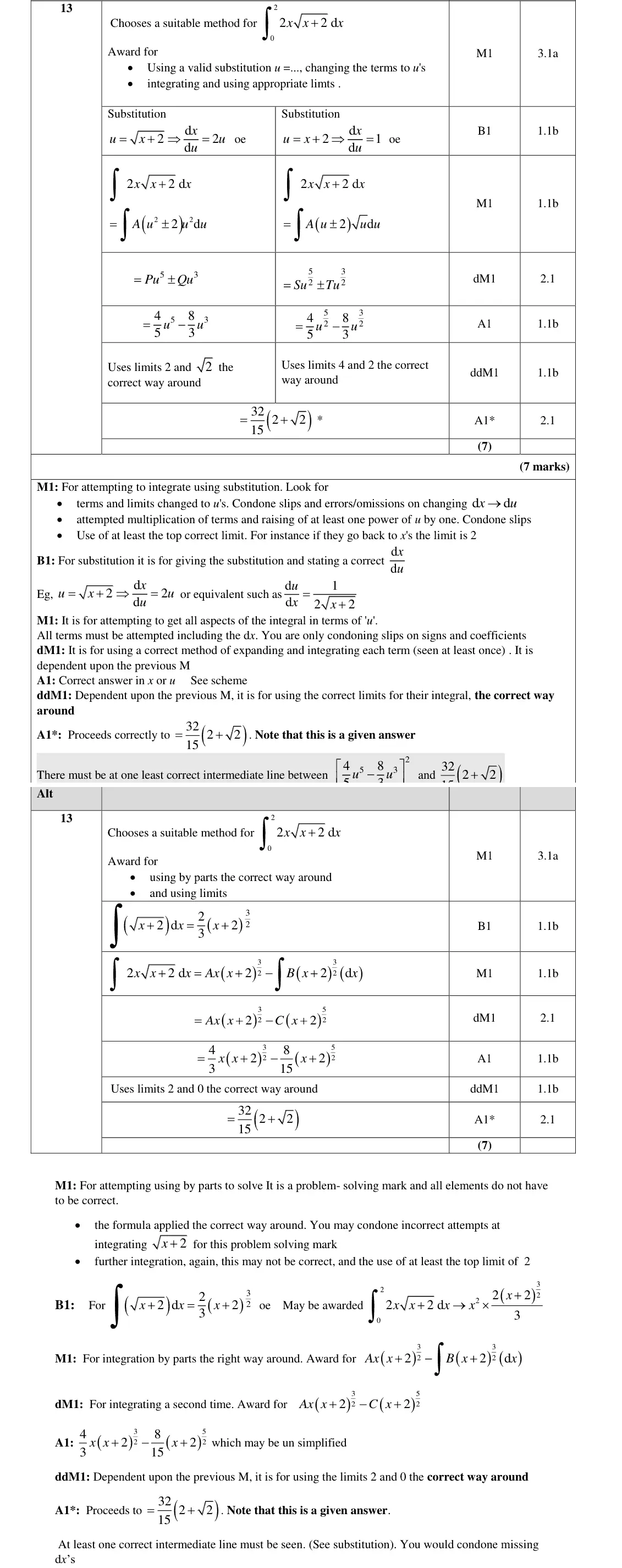
This was an open ended question on integration. The three most common methods seen are shown the mark scheme, two methods using substitution and one using integration by parts. Integration by parts was popular and well understood by the majority of students. Most knew that 3 2 2 2d 2 3 x x x and were able to integrate to an expression of the form 3 5 2 2 2 2 Ax x C x Slips in the values of the constants A and C were rare. However, as with earlier questions, there was a lack of clarity in moving from 2 3 5 2 2 0 4 8 2 2 3 15 x x x to the given answer of 32 2 2 15 Substitution was also well understood with 2 u x more common than 2. u x Errors here included the omission of finding dxin terms of d ,u poor expansion of expressions such as 2( 2) u u within the integral, and, as with parts, a lack of acceptable working shown when proceeding to the given answer.
Common mistakes
choose u = x + 2 (or u = √(x + 2)) or integration by parts
change dx to du and change the limits
expansion slips such as 2(u − 2)√u
at least one correct line before the given answer
June 2018 · Paper 2 · Q1310 marks
Mark scheme (whole question; this part is marked with the orange bar)
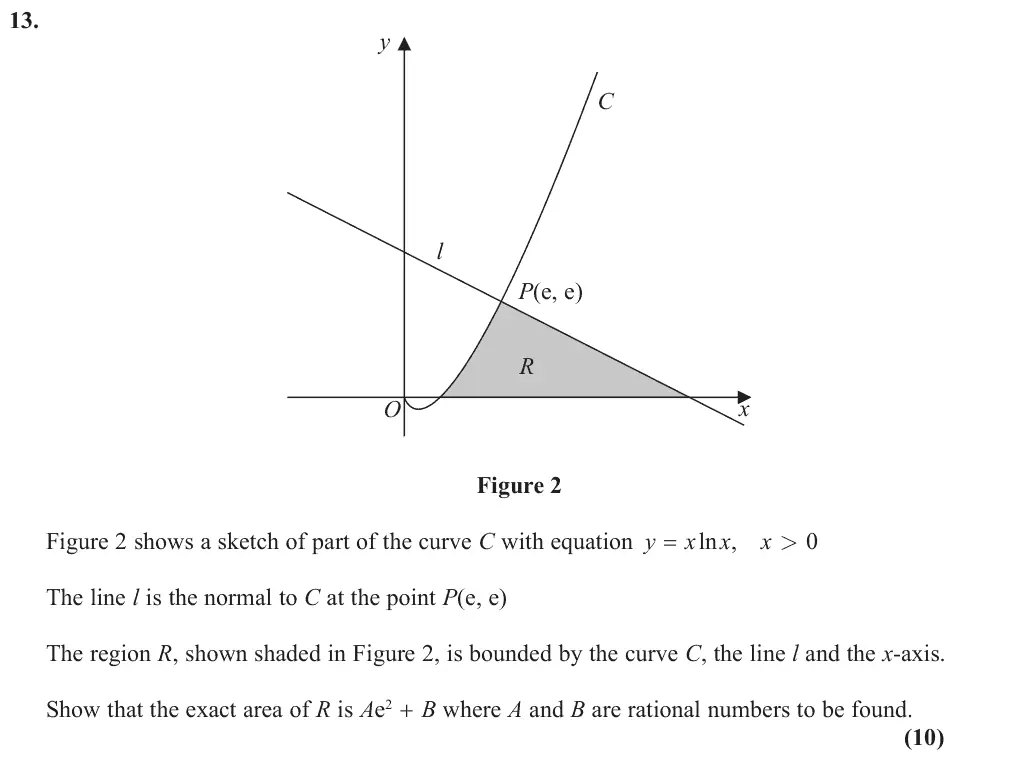
Examiner's comment
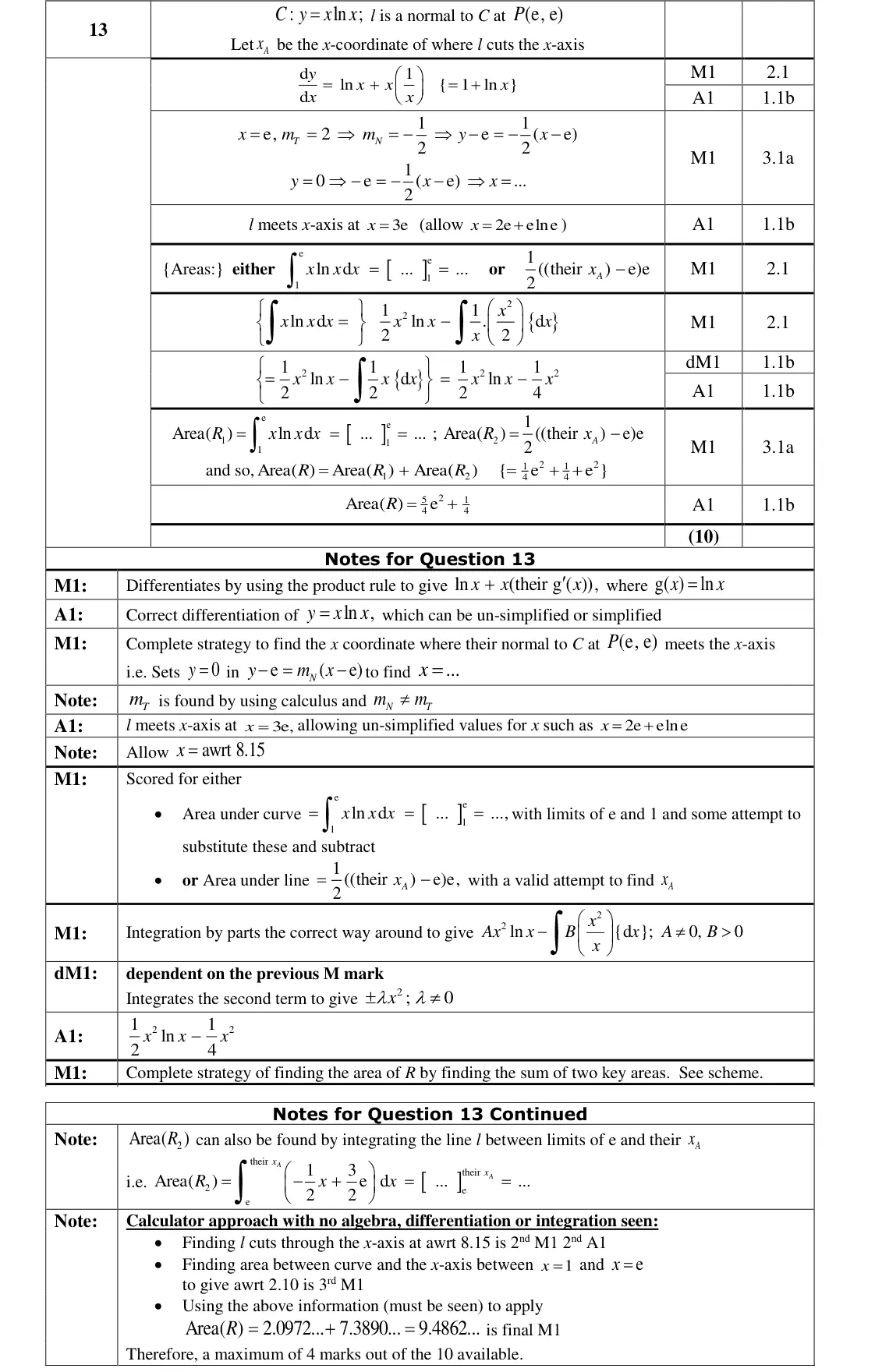
This question, despite being unstructured, proved accessible, with many students scoring at least 7 out of the 10 marks available. Those students who annotated the diagram were generally more successful in formulating a correct strategy to find the area of the region R. Most students differentiated ln y x x by using the product rule to give the correct d 1 ln . d y x x A few students found the correct d ln d y x x x x and simplified this incorrectly to give d ln . d y x x Many students used a complete method to find the x-value where the normal to C at (e, e) cuts through the x-axis, with the majority finding the correct 3e. x Most students integrated ln y x x correctly by using integration by parts to give 2 2 1 1 ln . 2 4 x x x Many students applied the correct limits of e and 1 to obtain a correct 2 1 1 e 4 4 with some making a bracketing error when applying the limit of 1 to obtain the incorrect 2 1 1 e . 4 4 The majority of students attempted to find the area of the triangle by using the formula 1 (base)(height). 2 While some students applied the formula correctly to give 1 (3e e)(e), 2 there was a considerable number that applied a base length of 3e by writing 1 (3e)(e). 2 A few students used the equation of the normal to find the area of the triangle by applying the correct 3e e 1 3 e d , 2 2 x x but not many evaluated this to arrive at the correct answer of 2e . Several incorrect strategies were seen such as trying to evaluate e 0 ln d , x x x 3e 1 ln d x x x or even 3e 1 1 3 ln e d . 2 2 x x x x Only a minority of students applied the calculation 2 2 1 1 e e 4 4 to achieve the correct 2 5 1 e . 4 4
Common mistakes
product rule dy/dx = 1 + ln x
normal gradient −½ meets x-axis at 3e
∫ x ln x dx by parts = ½x² ln x − ¼x² with limits 1 and e (bracketing error at x = 1)
triangle base 3e − e not 3e
area = 5e²/4 + 1/4
Find an Edexcel maths tutor
Stuck on this? Book a trial session with an Edexcel specialist.