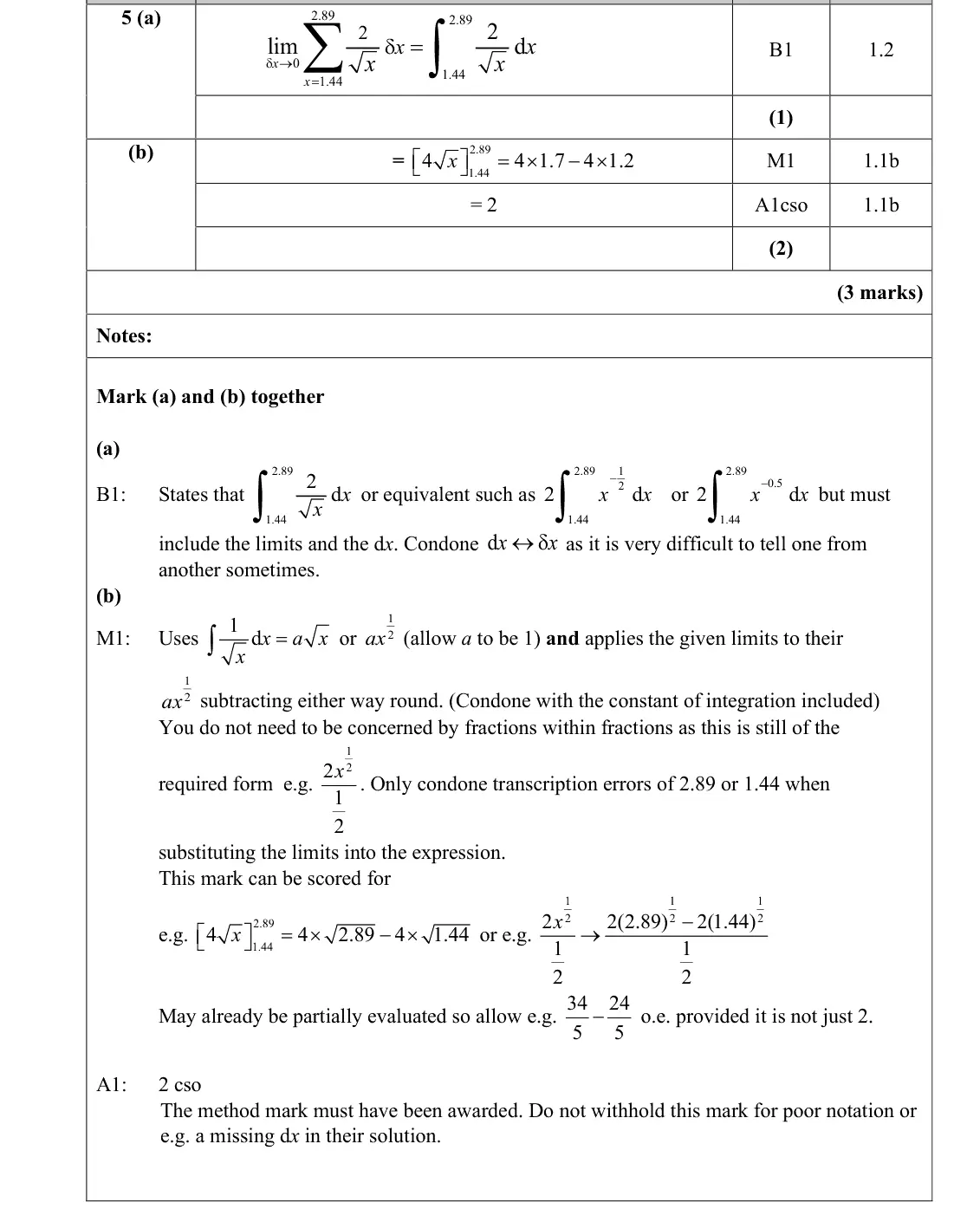
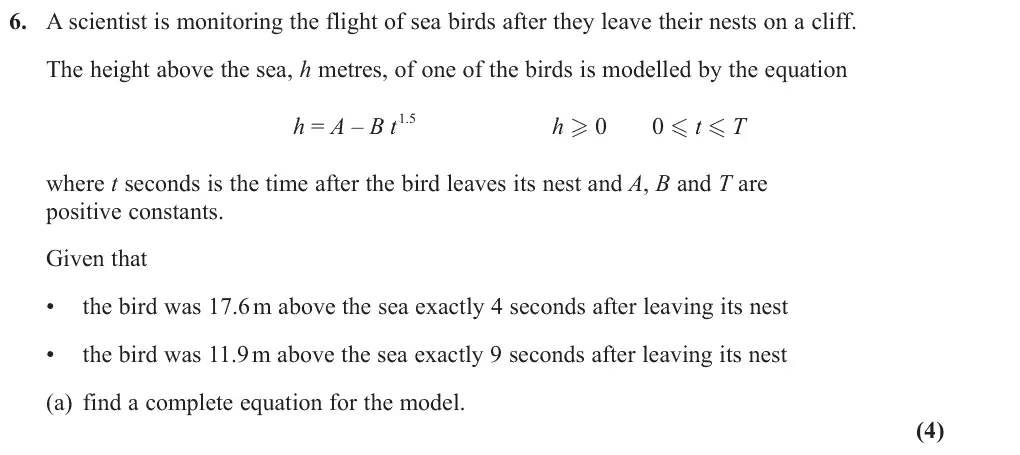
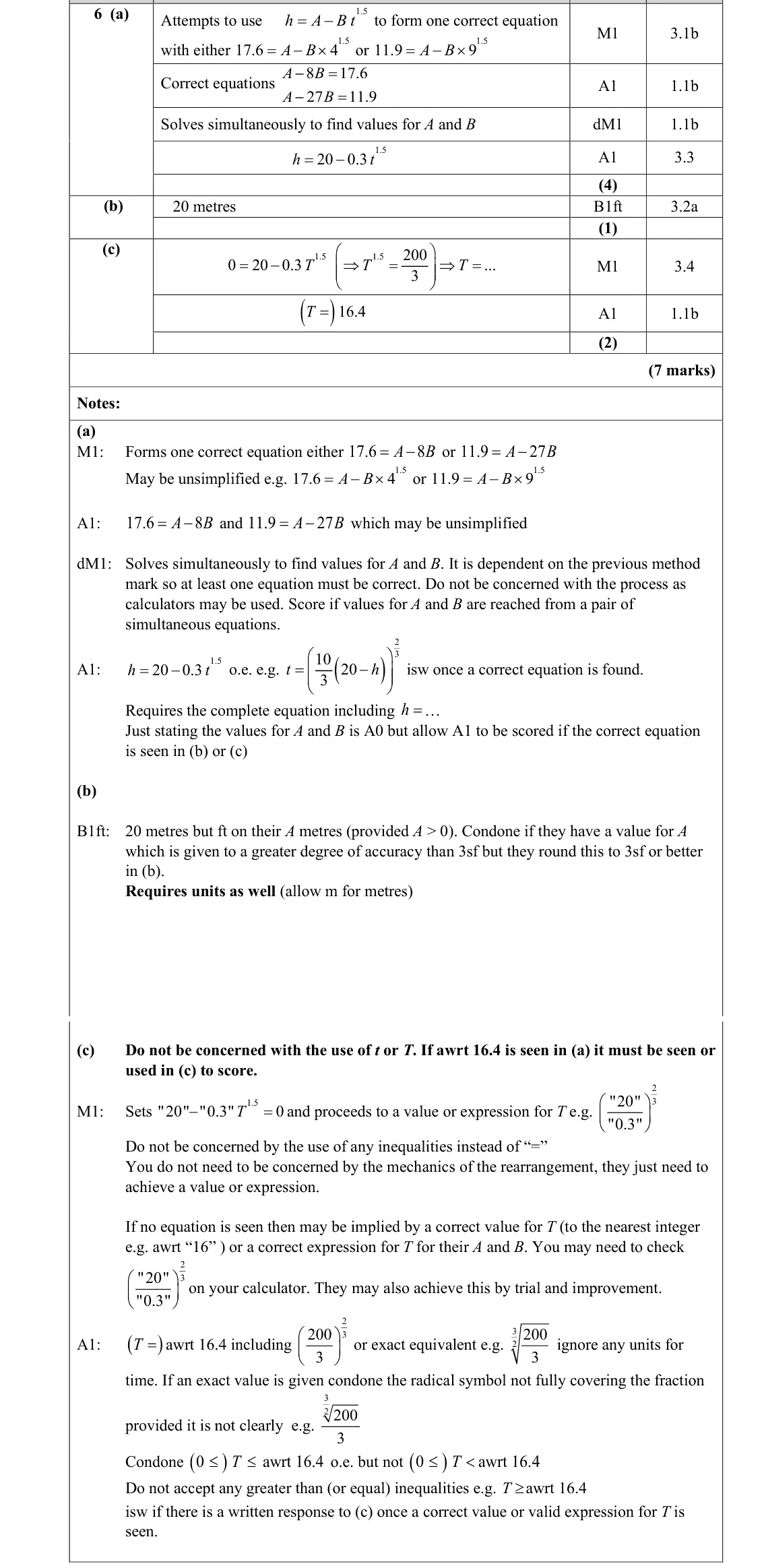
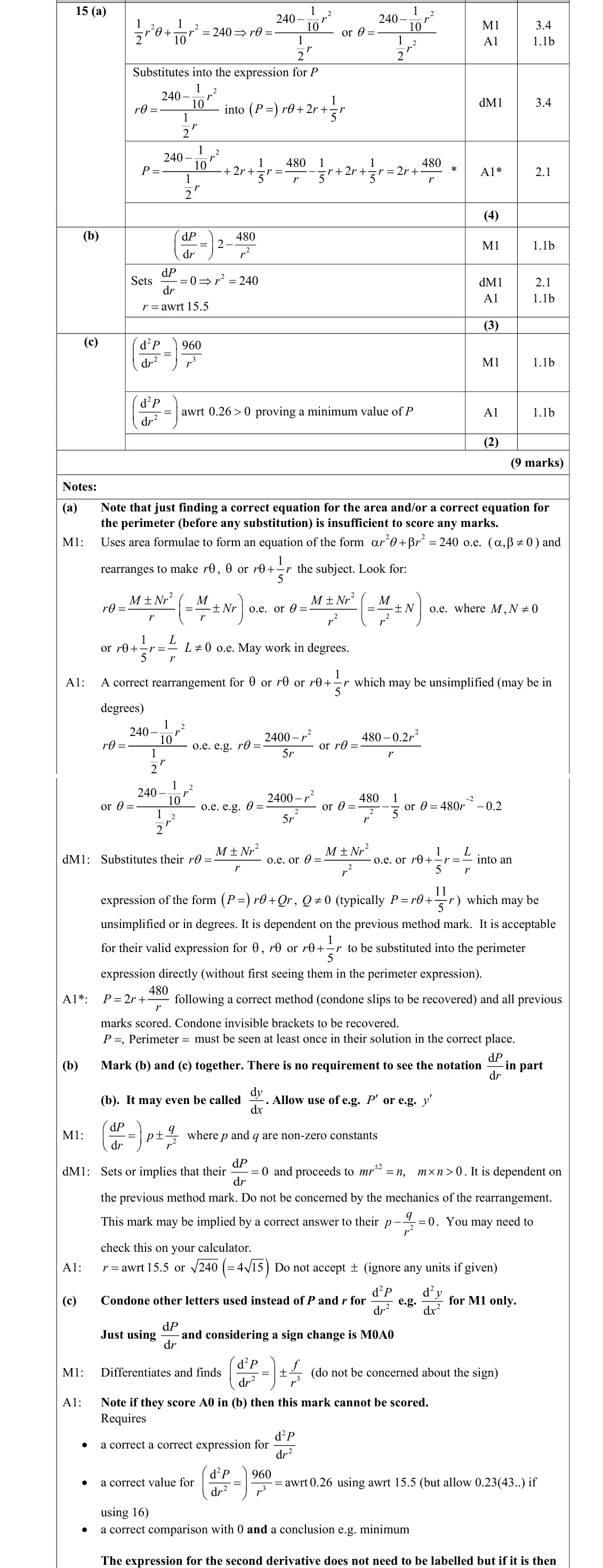
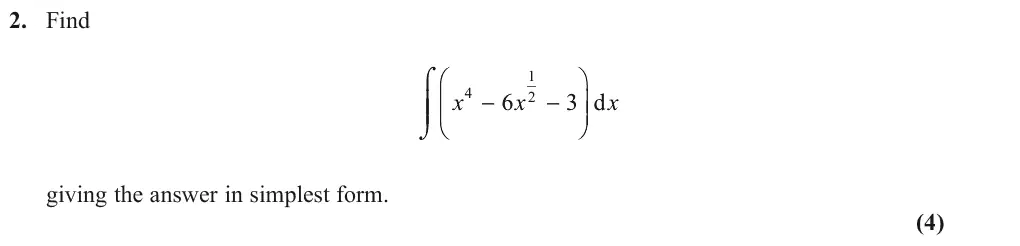
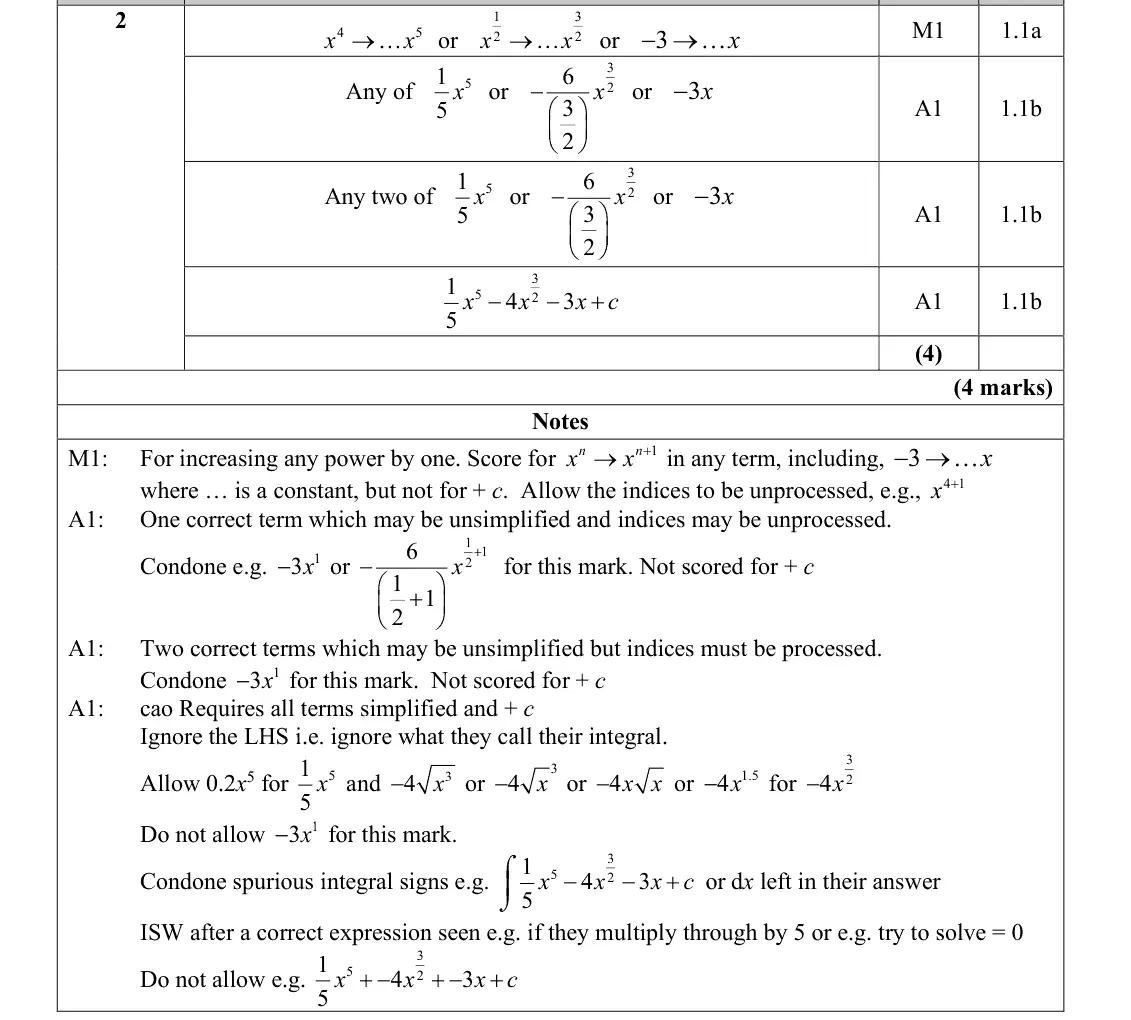
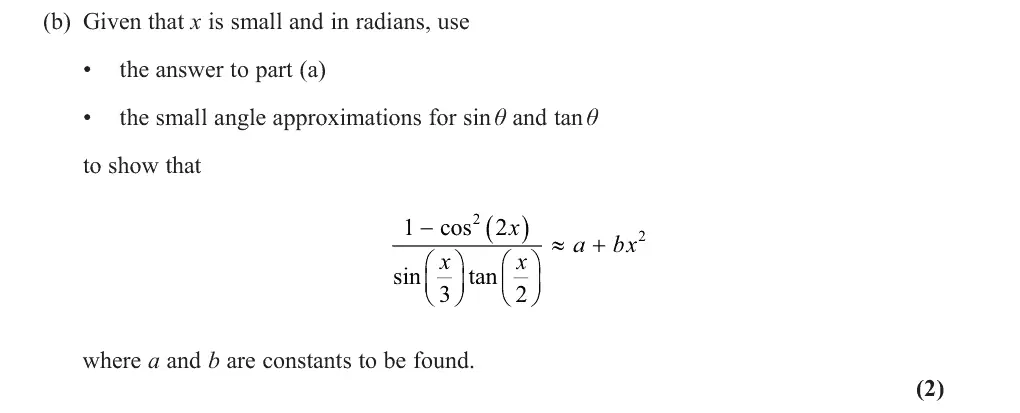
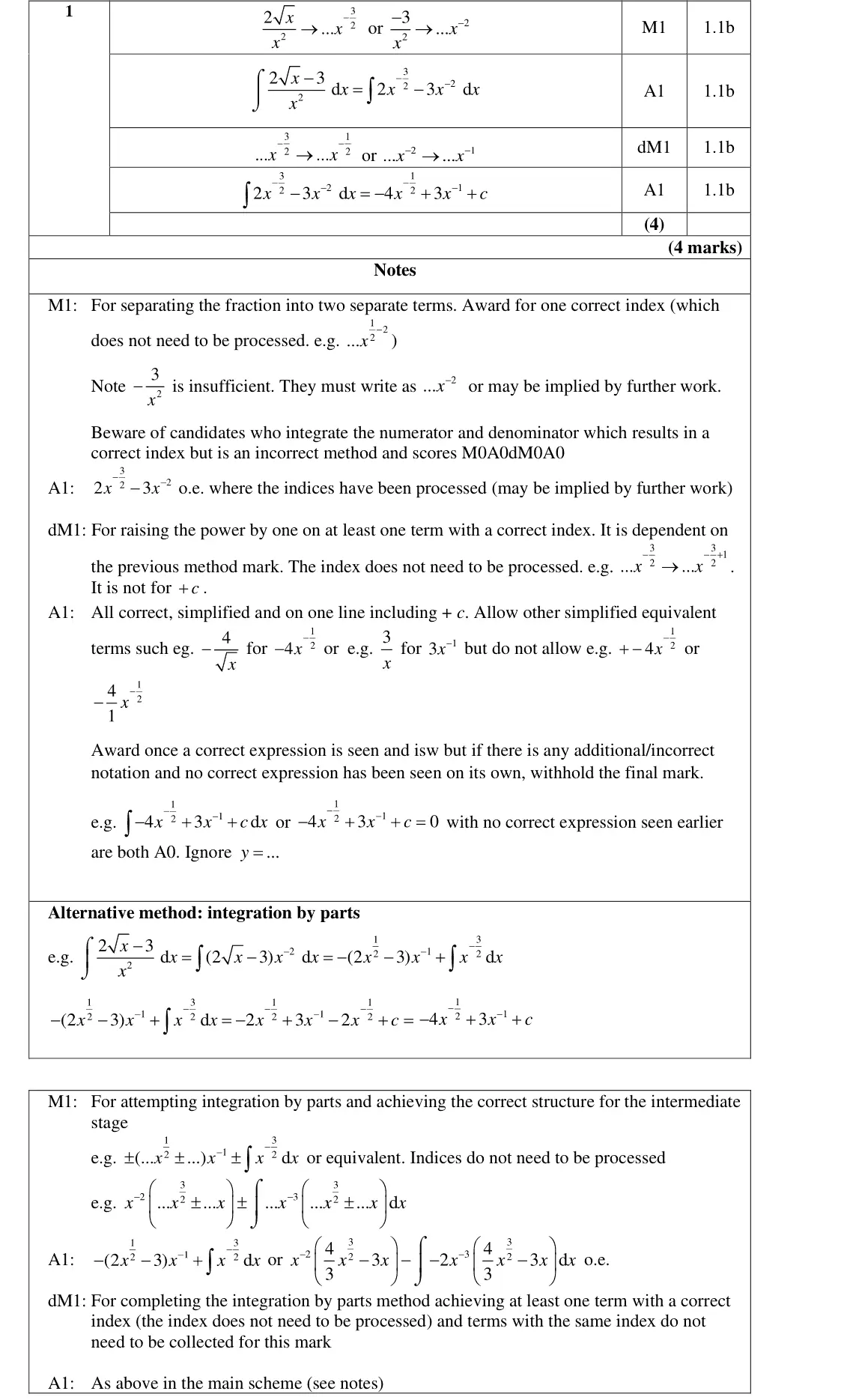
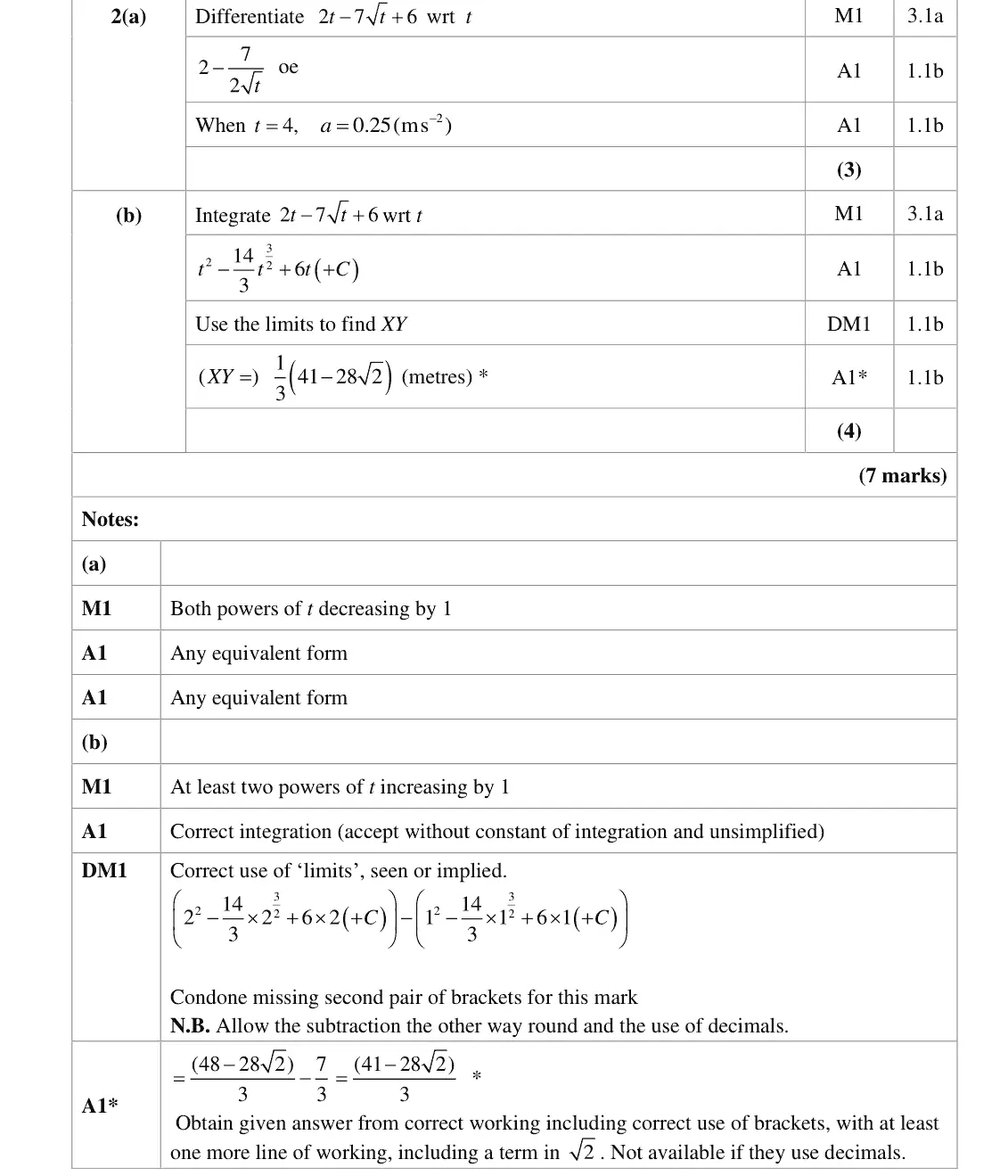
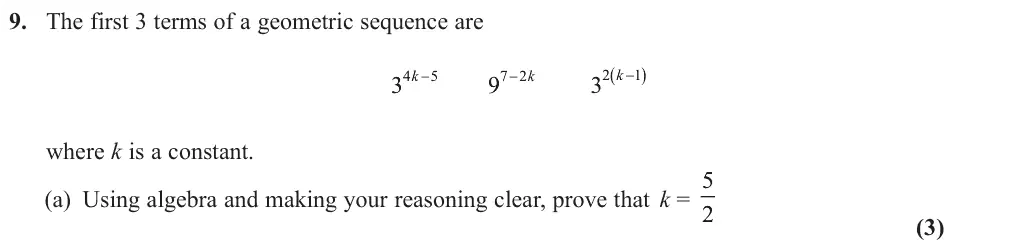
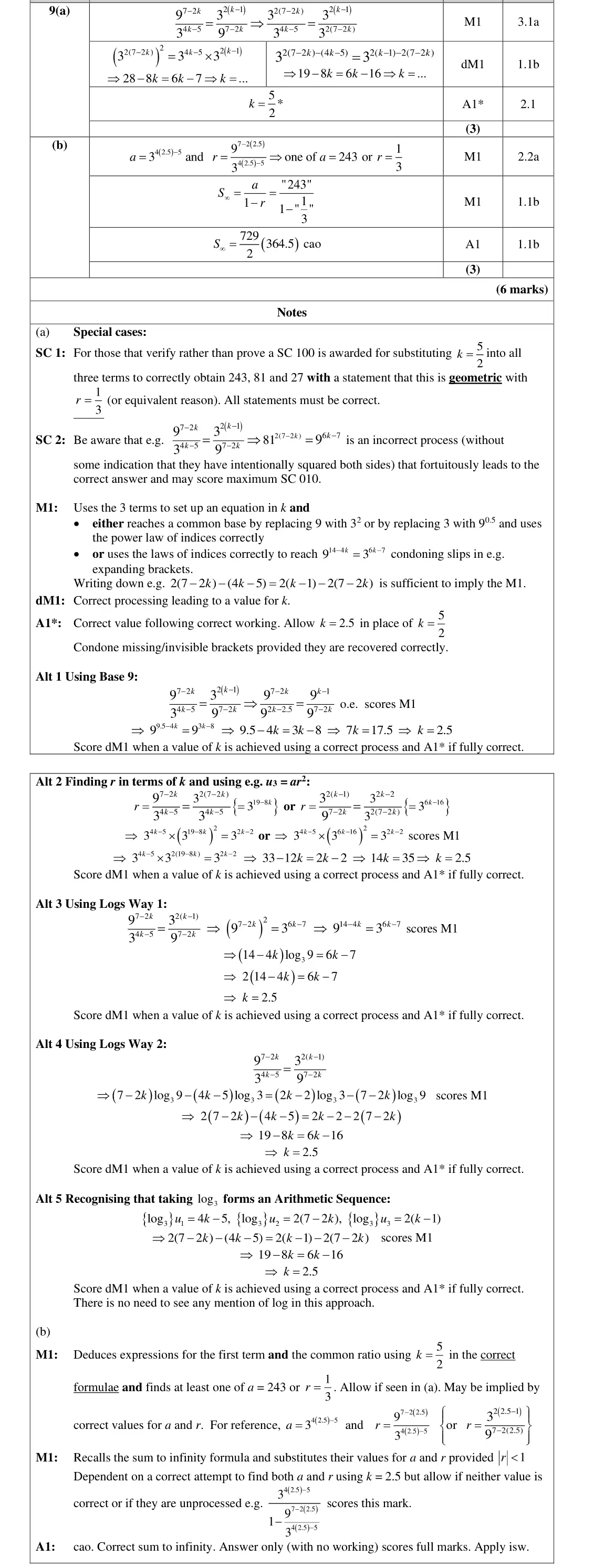
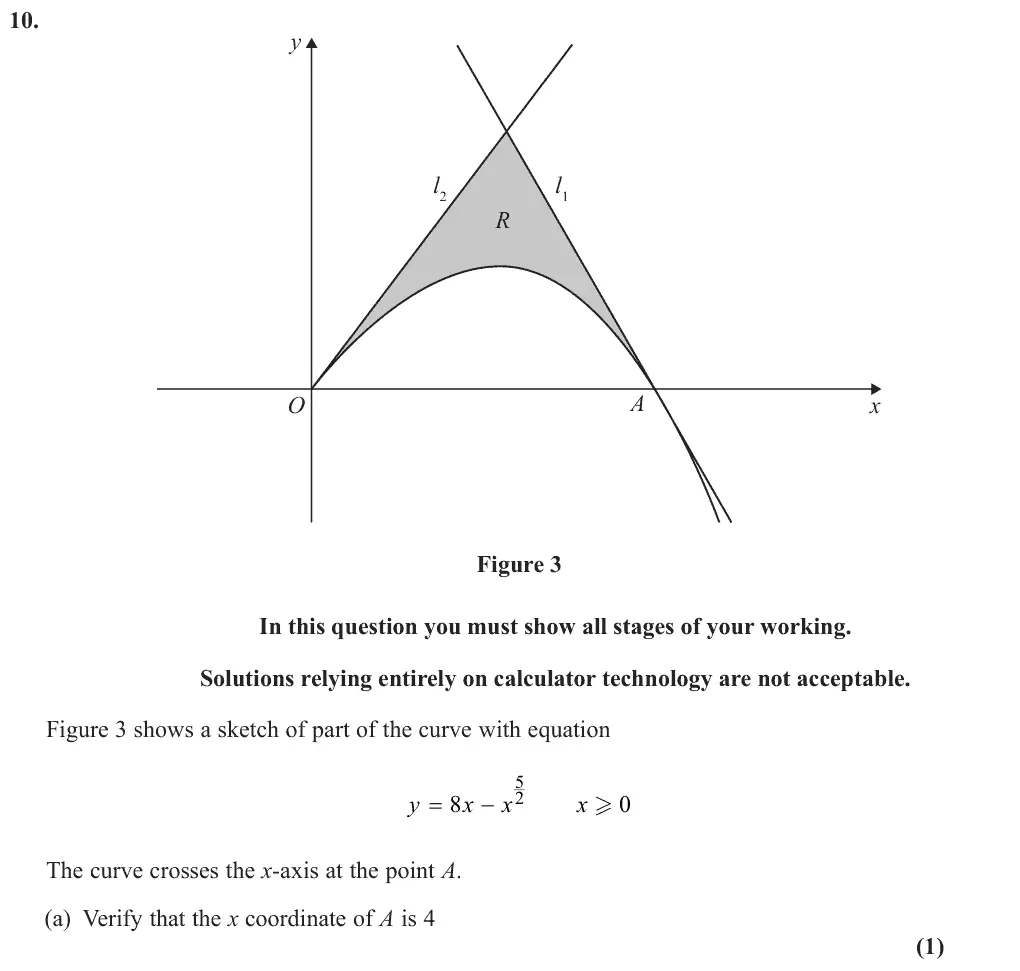
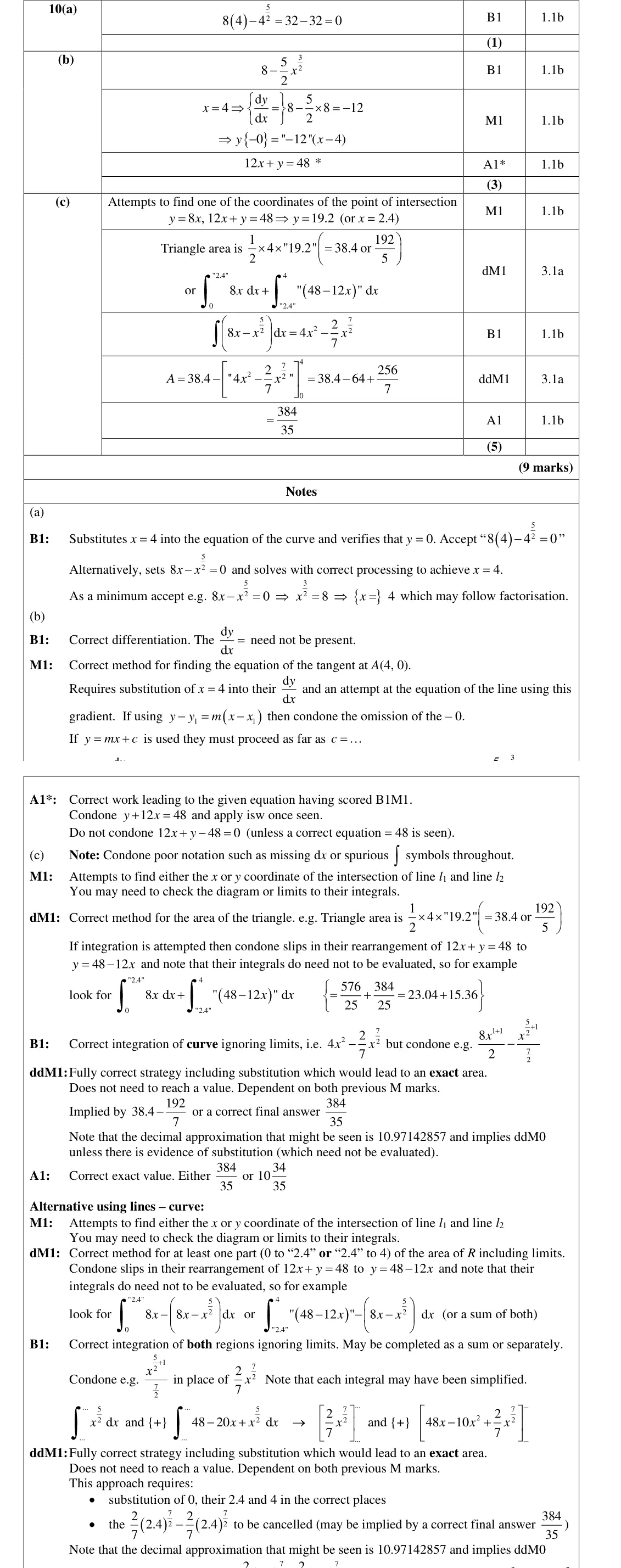
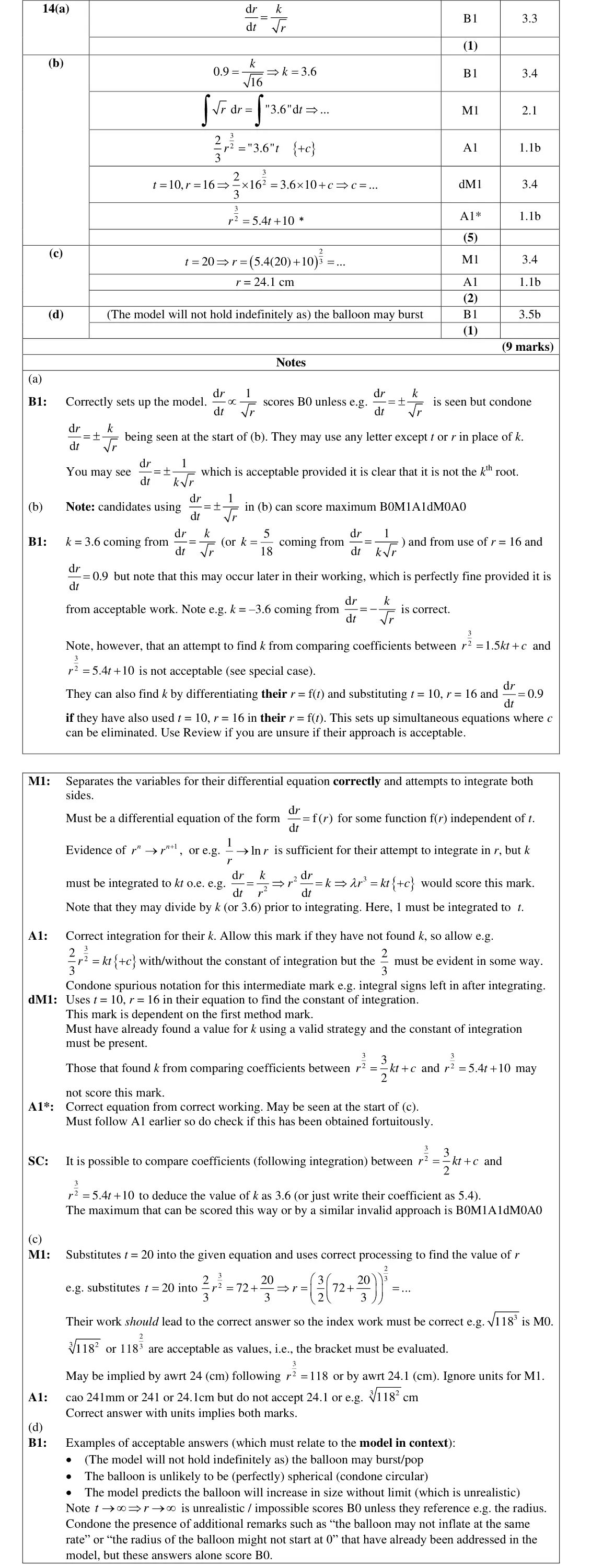
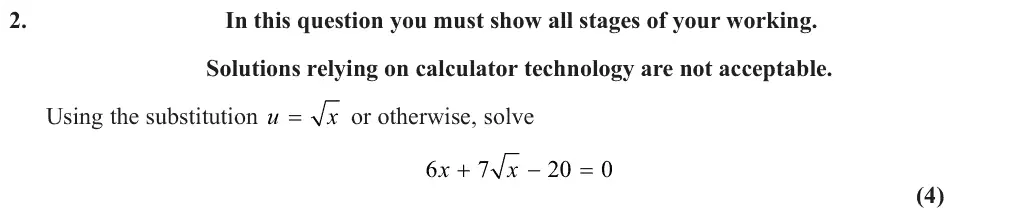
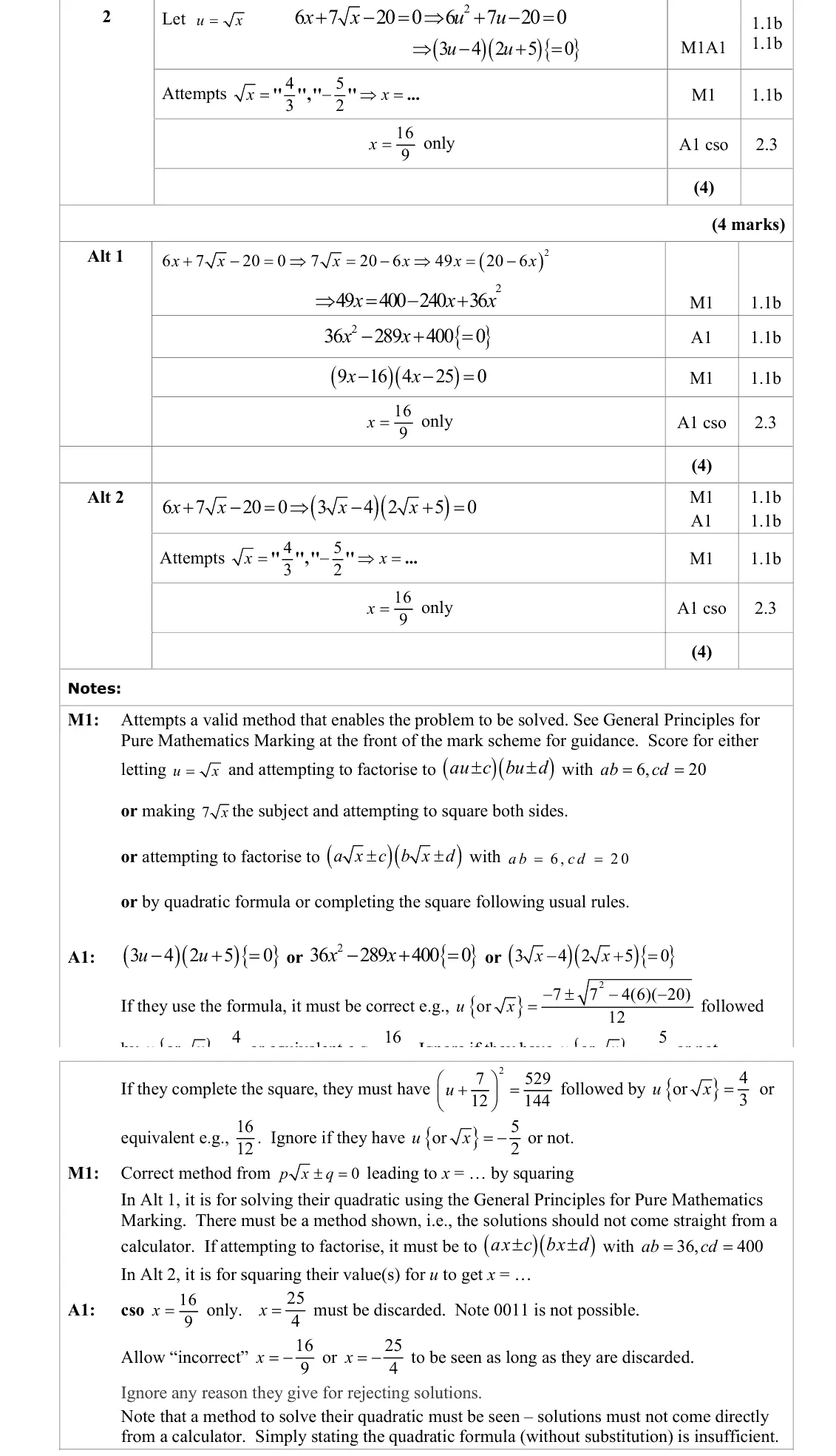
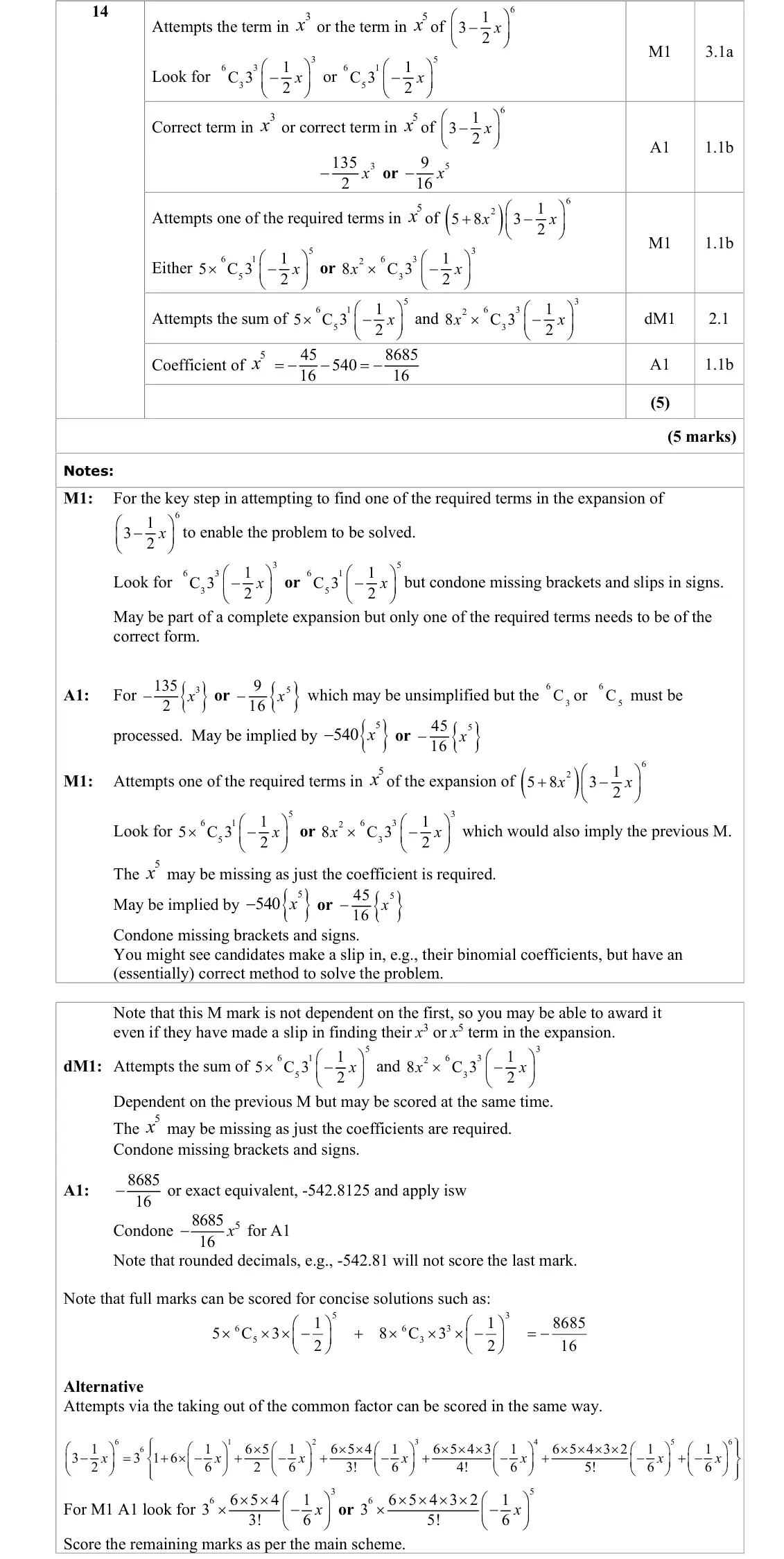
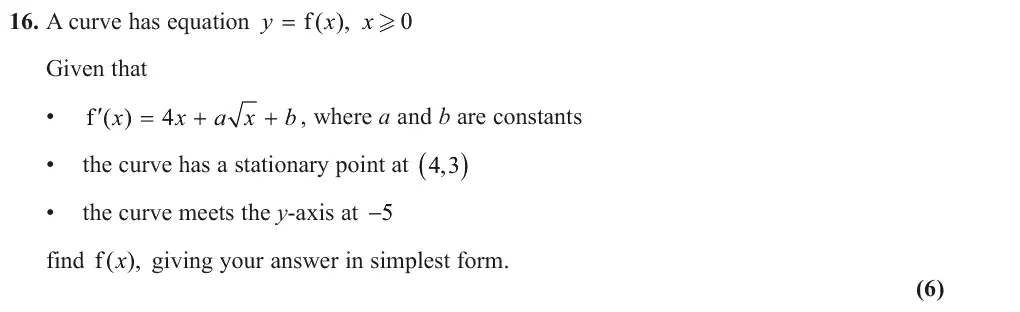
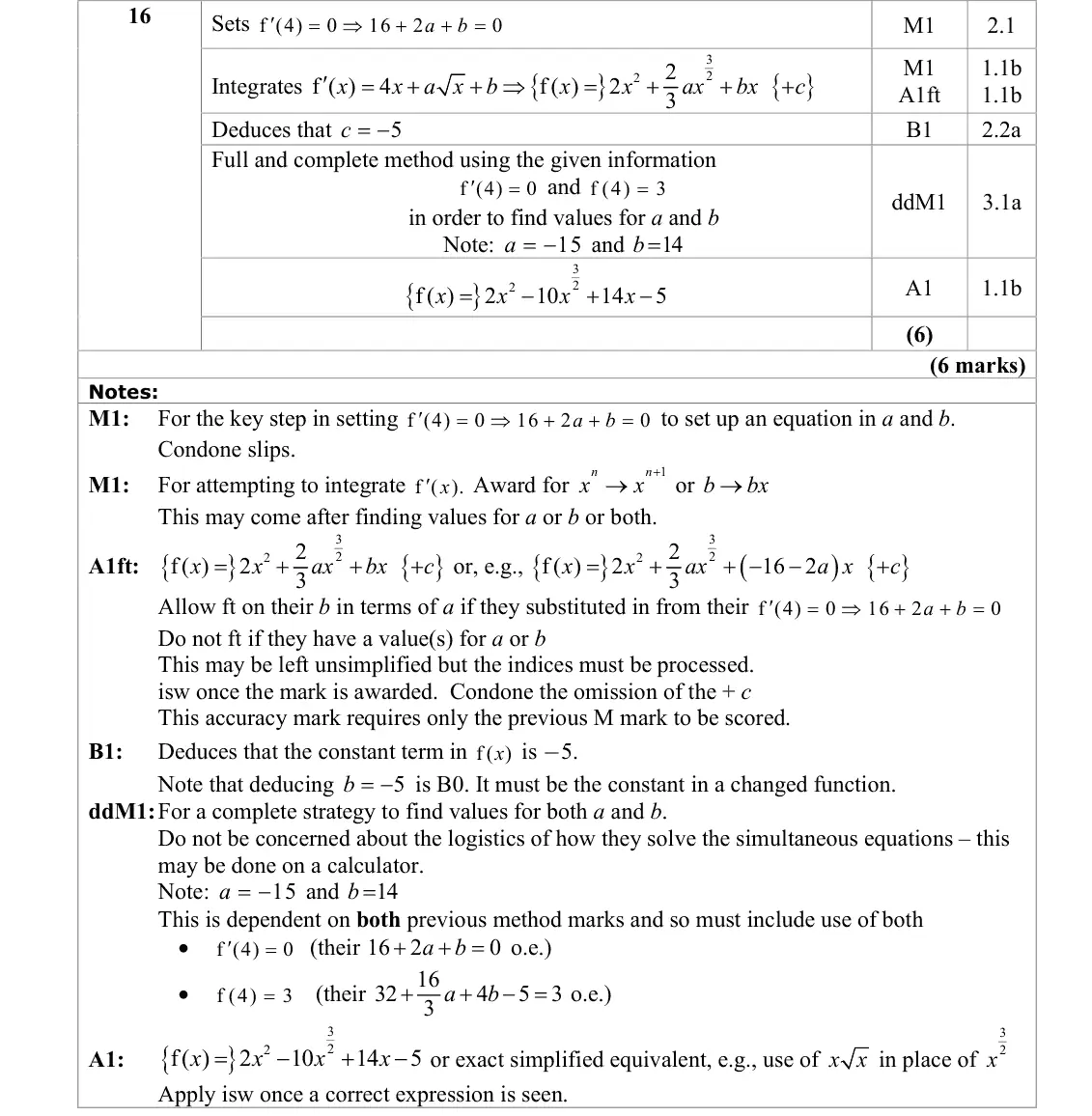
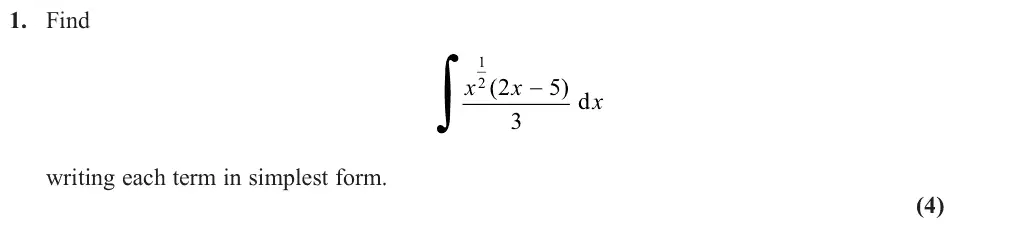
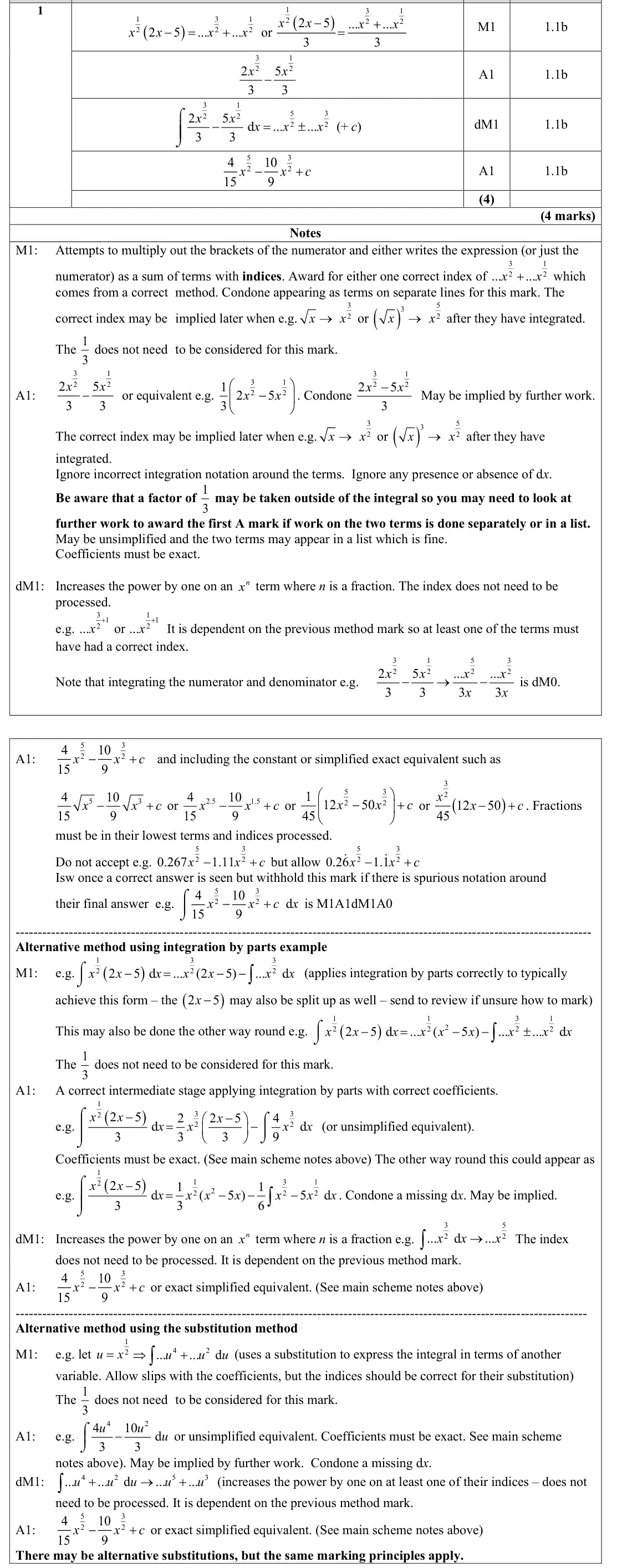
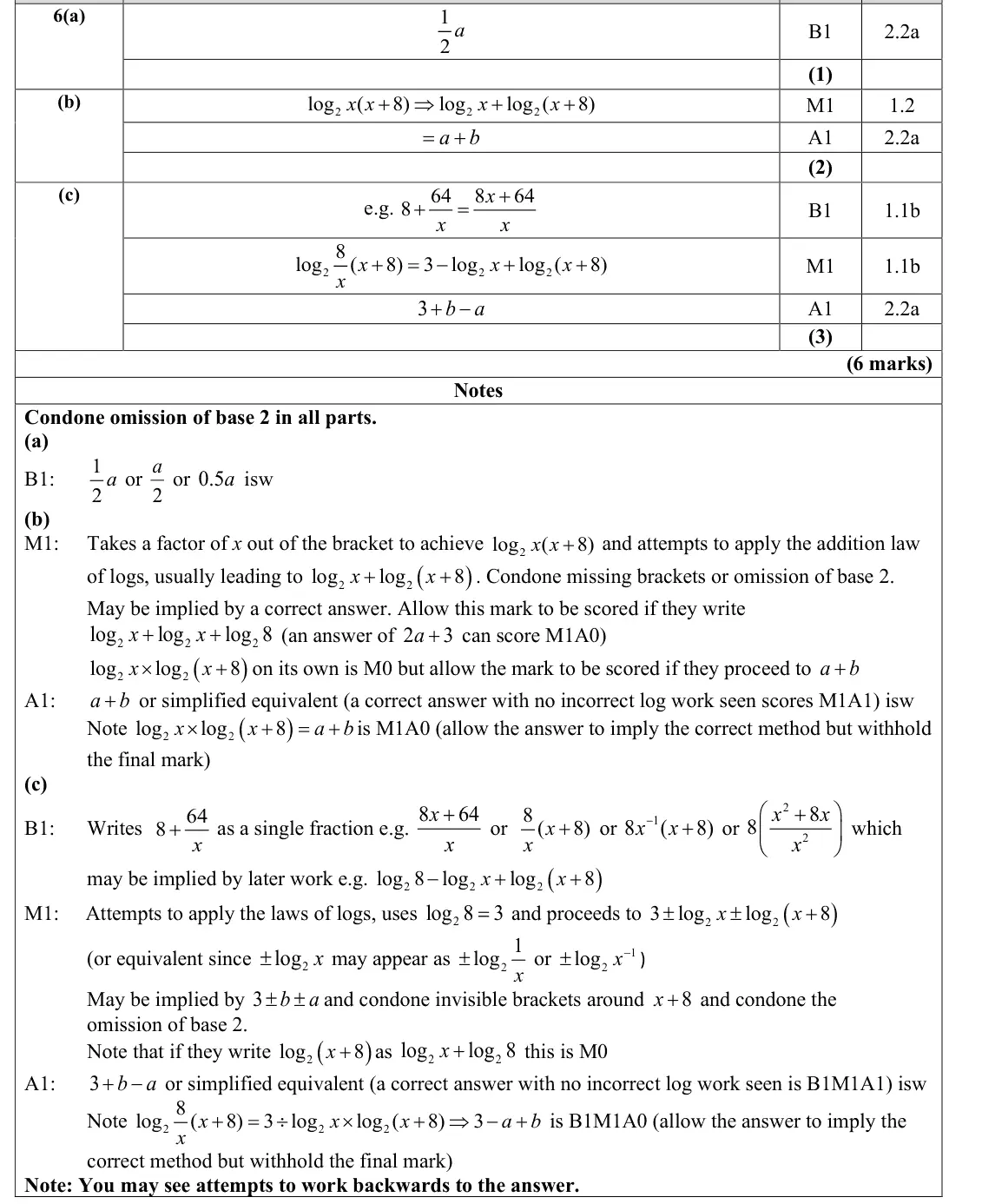
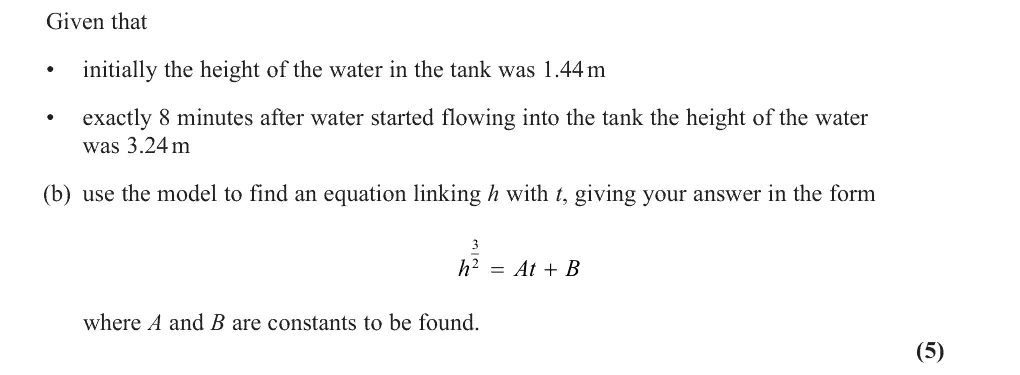
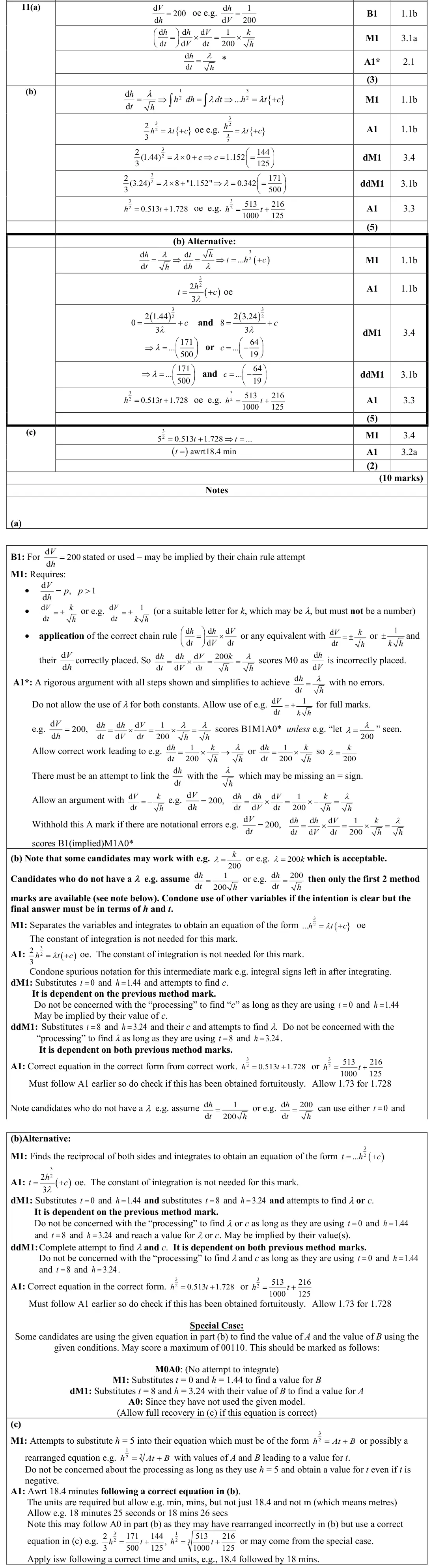
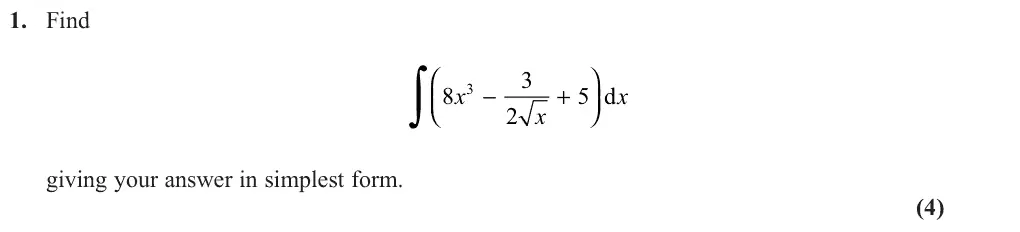
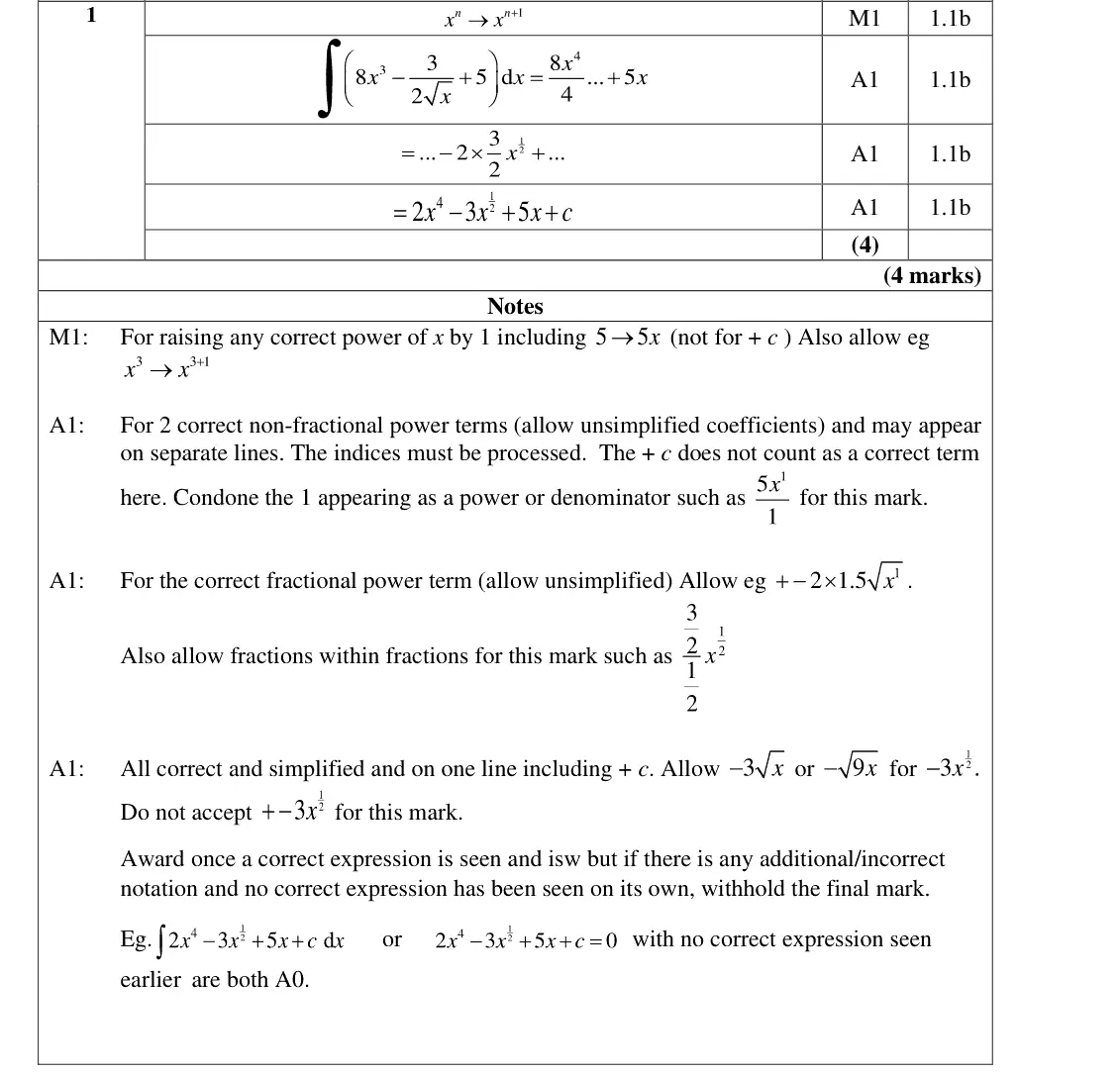
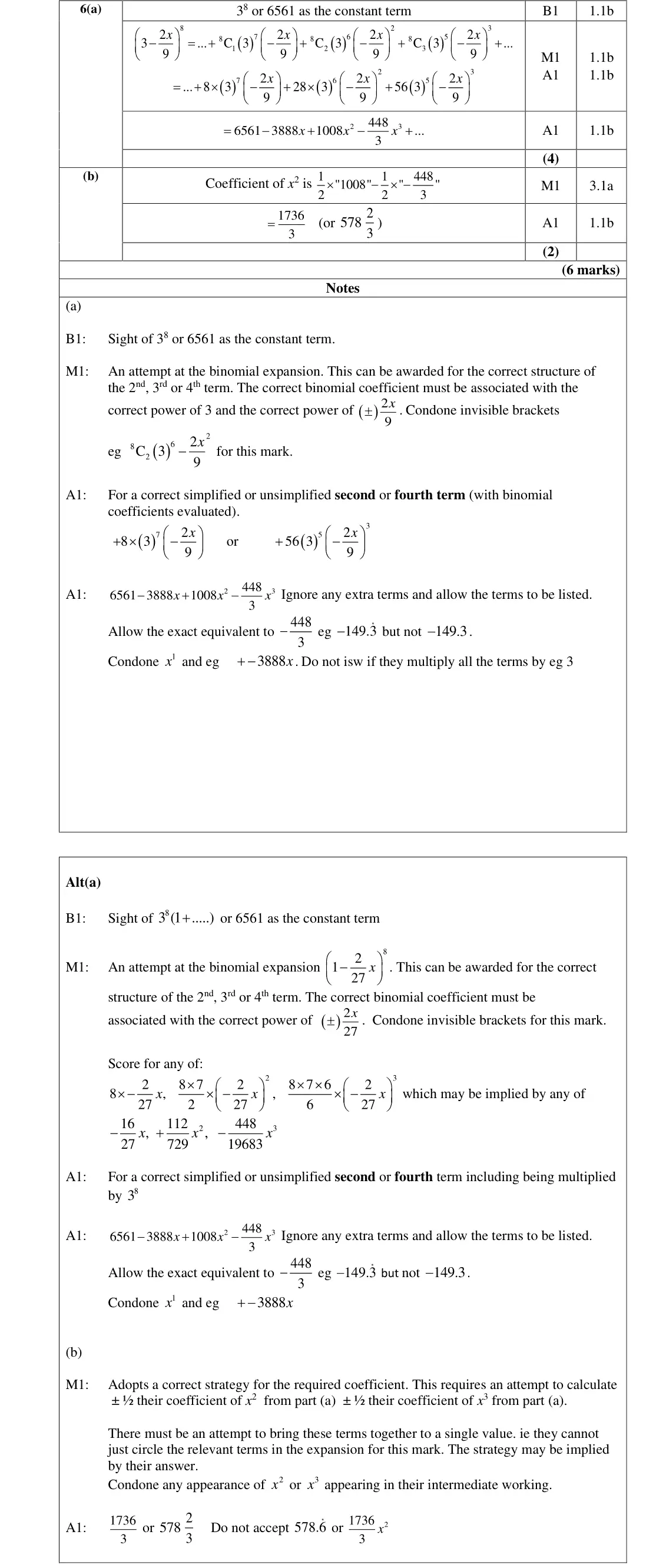
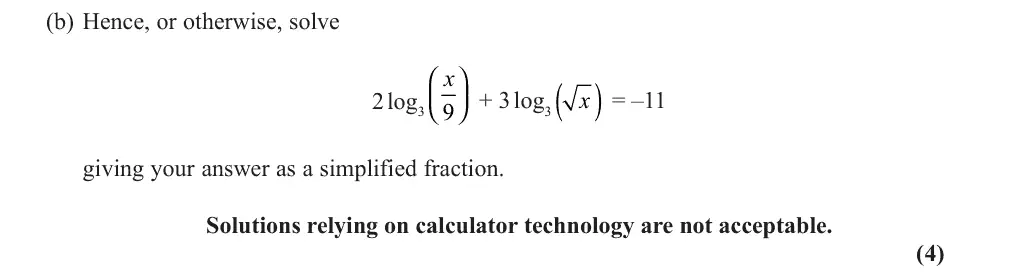
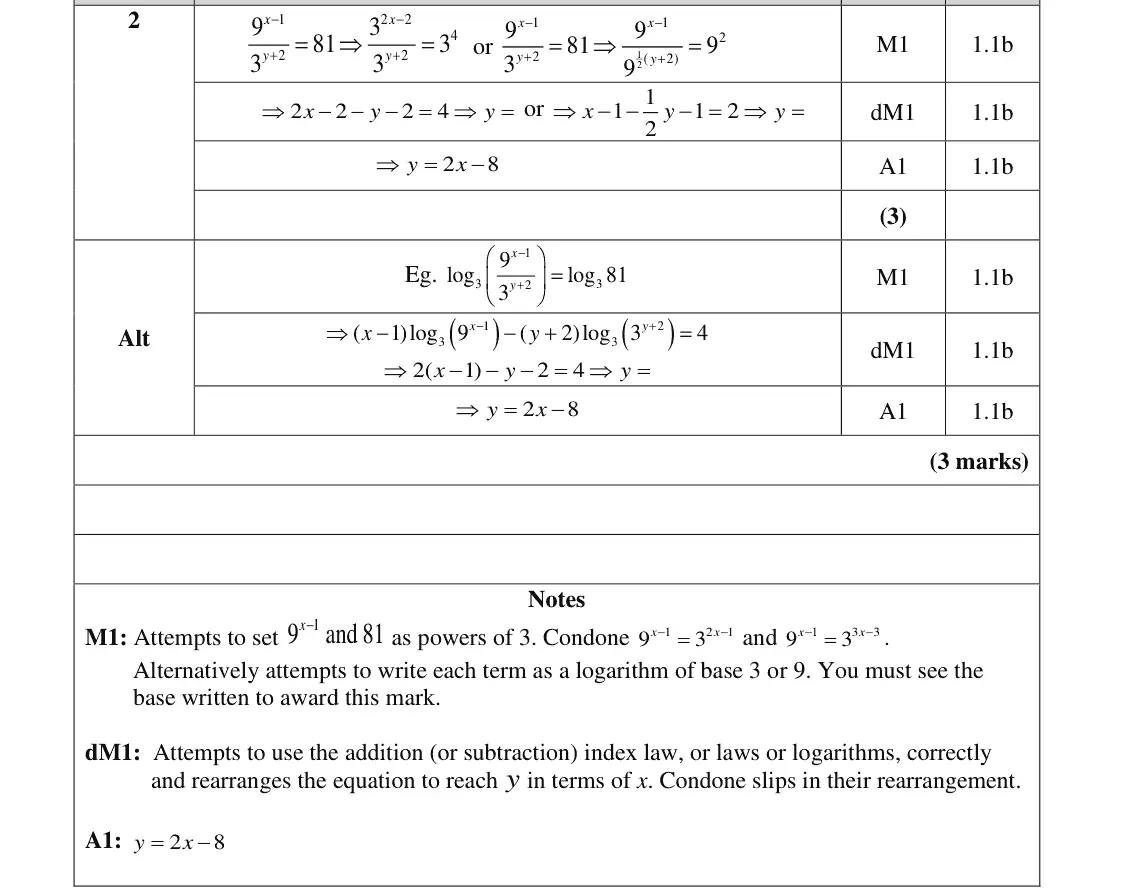
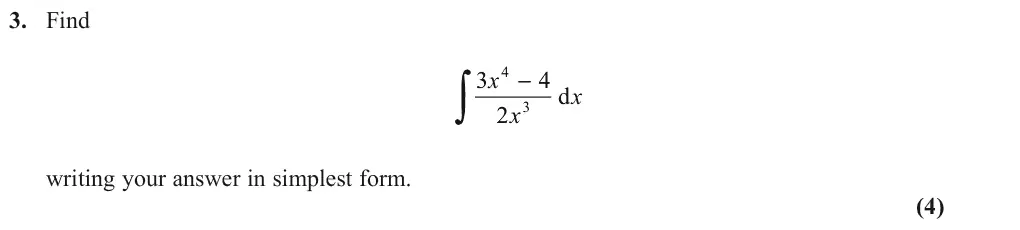
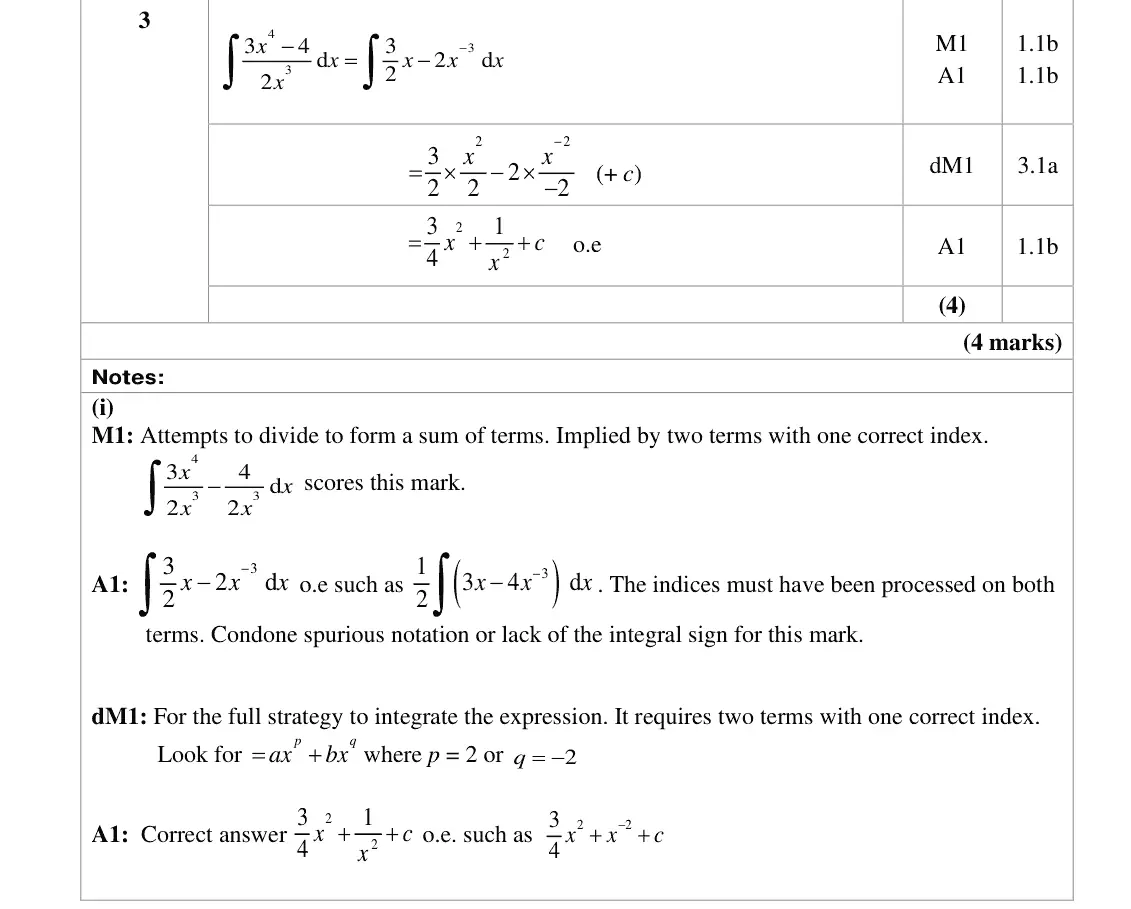
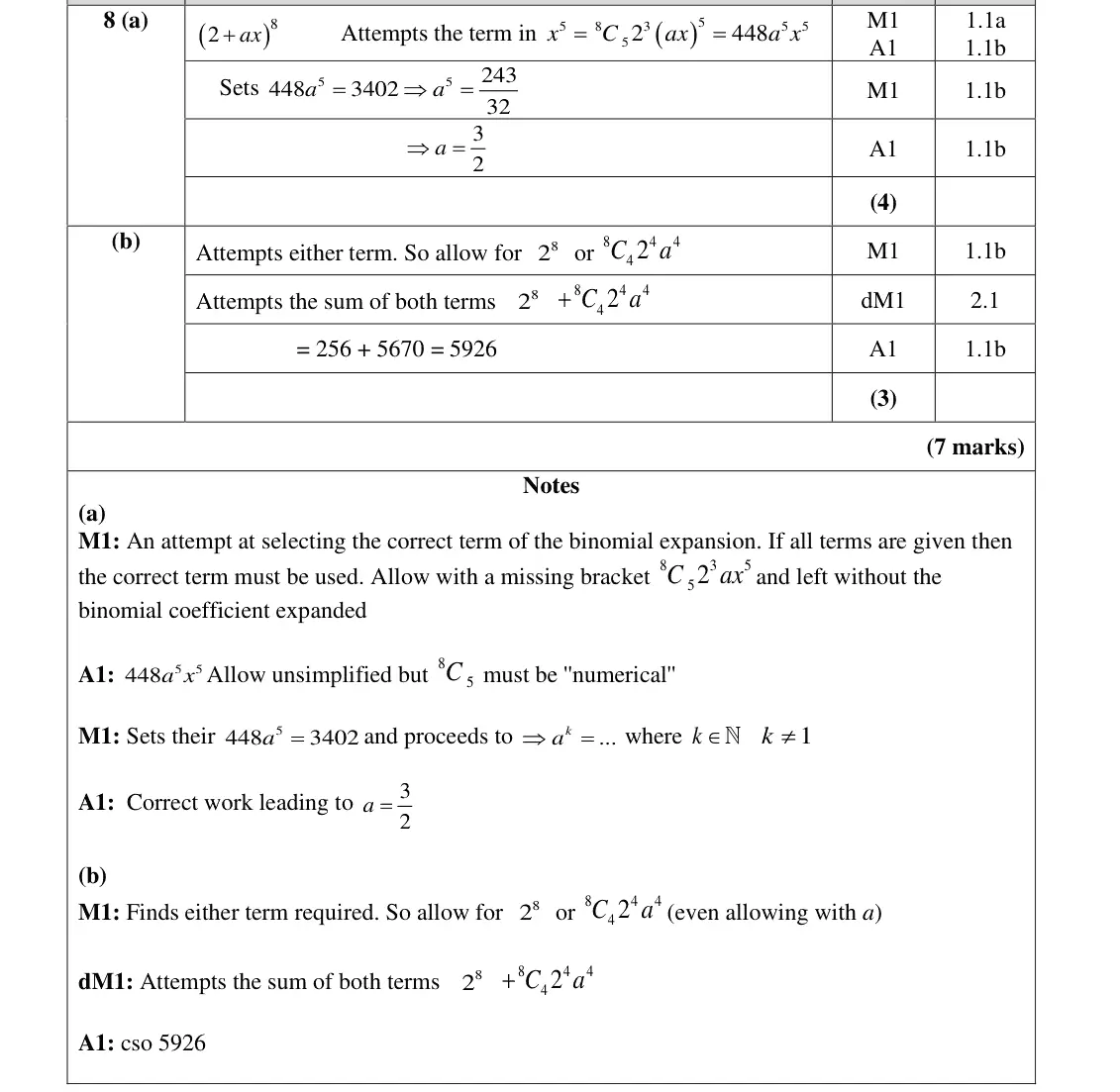
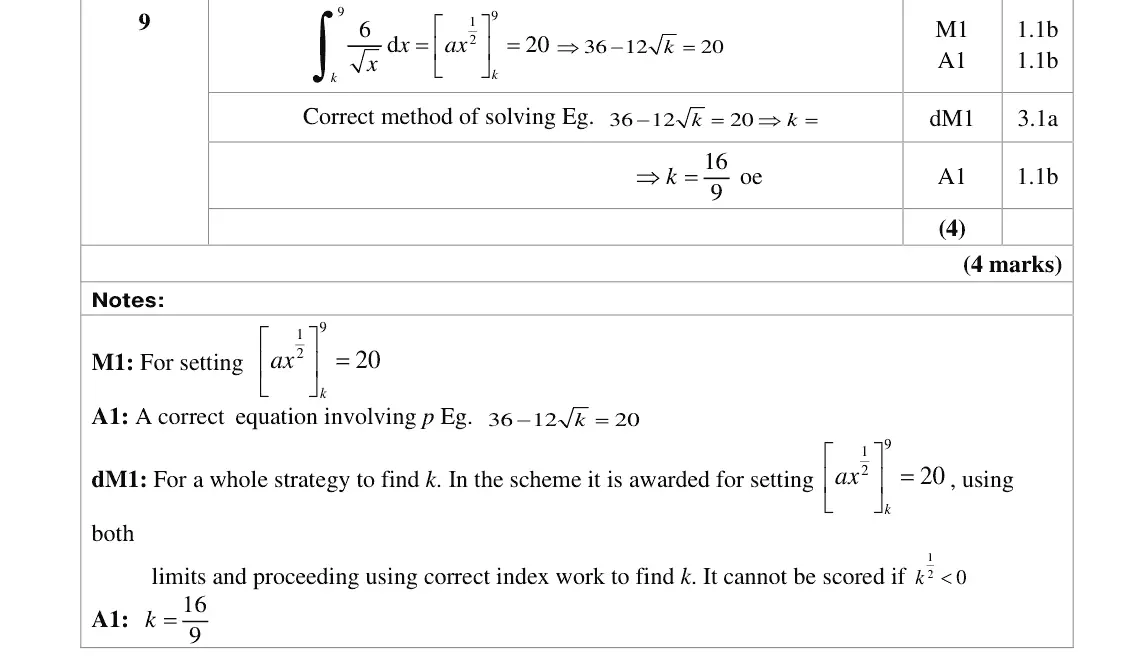
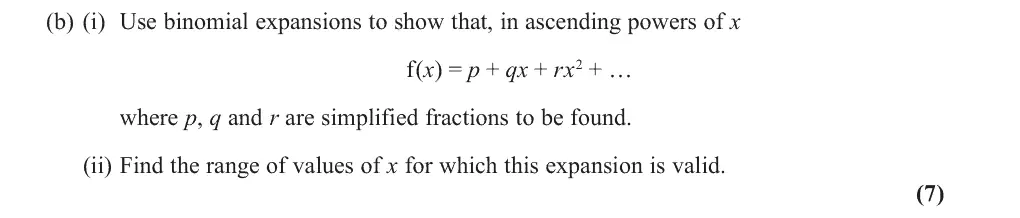
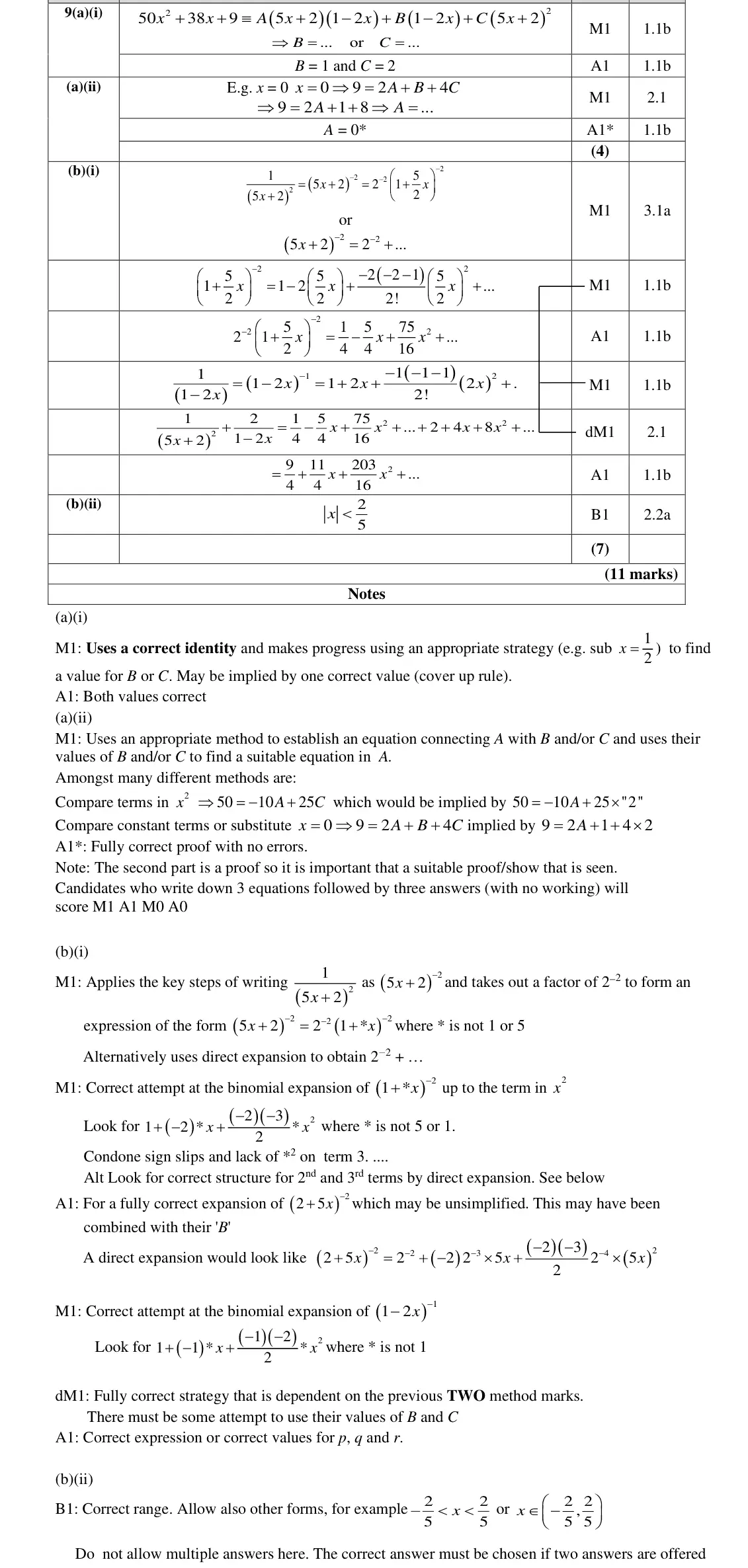
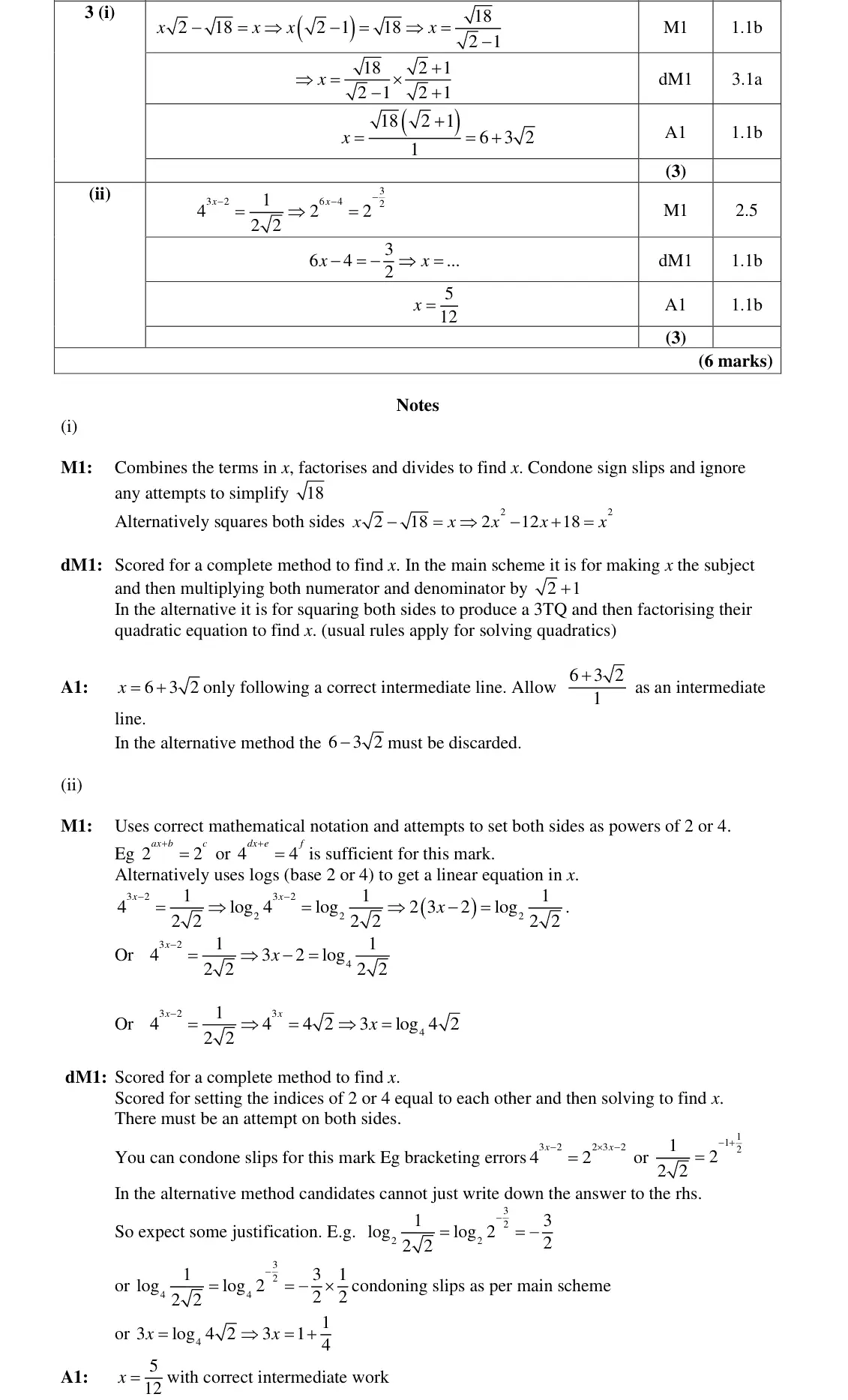
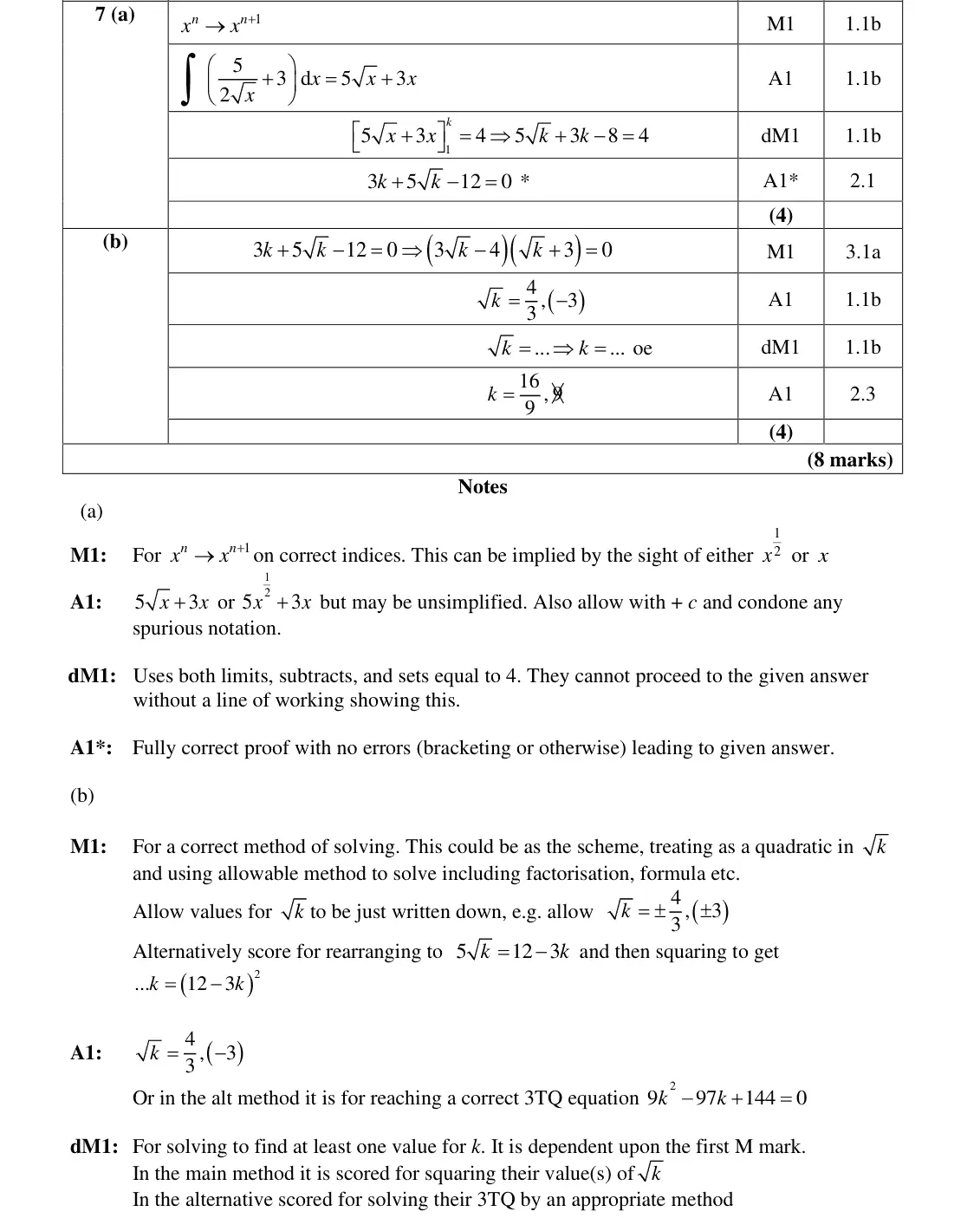
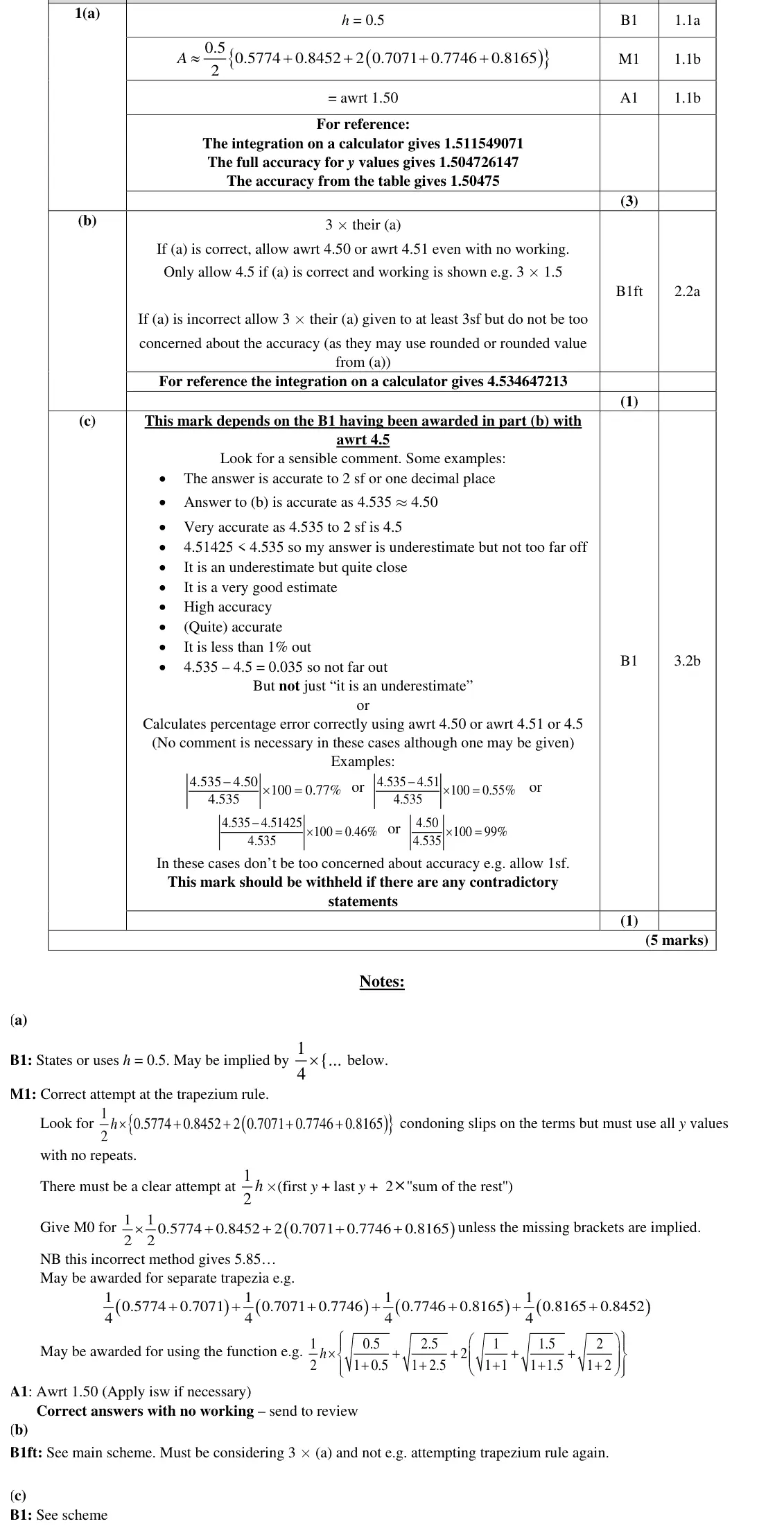
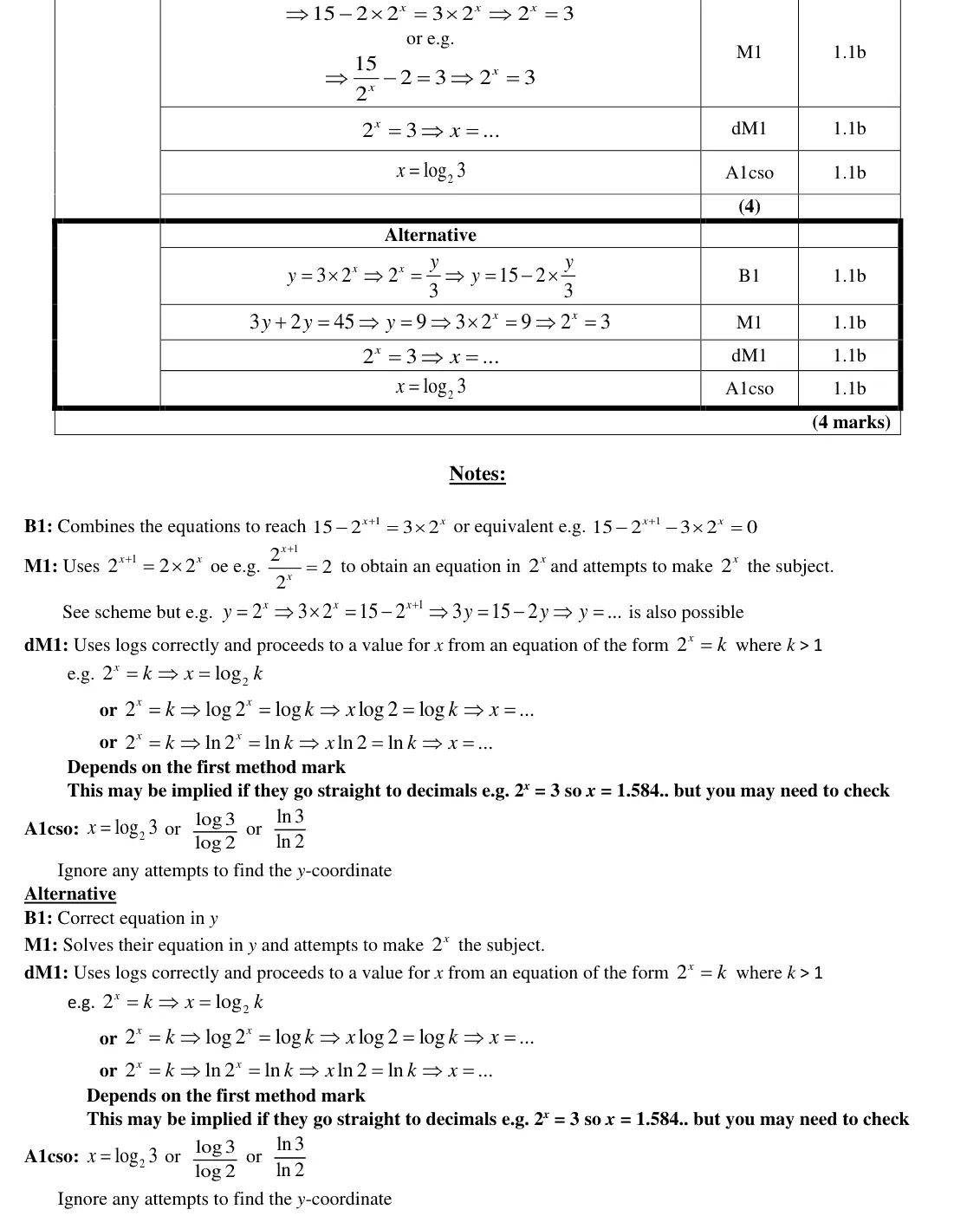
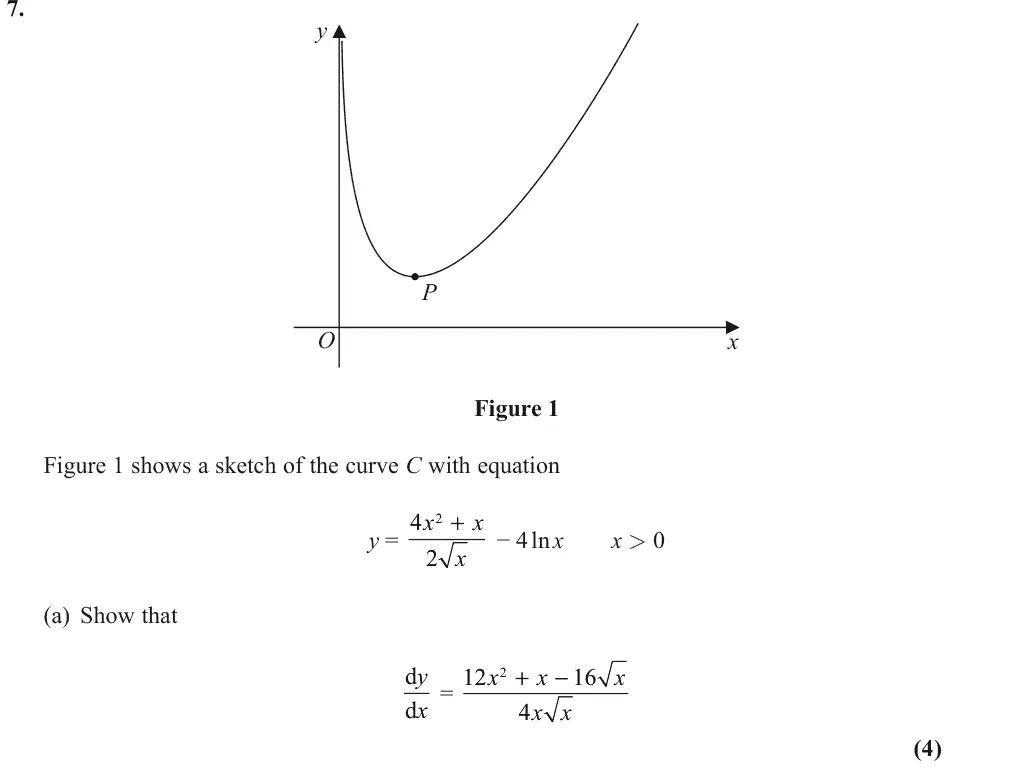
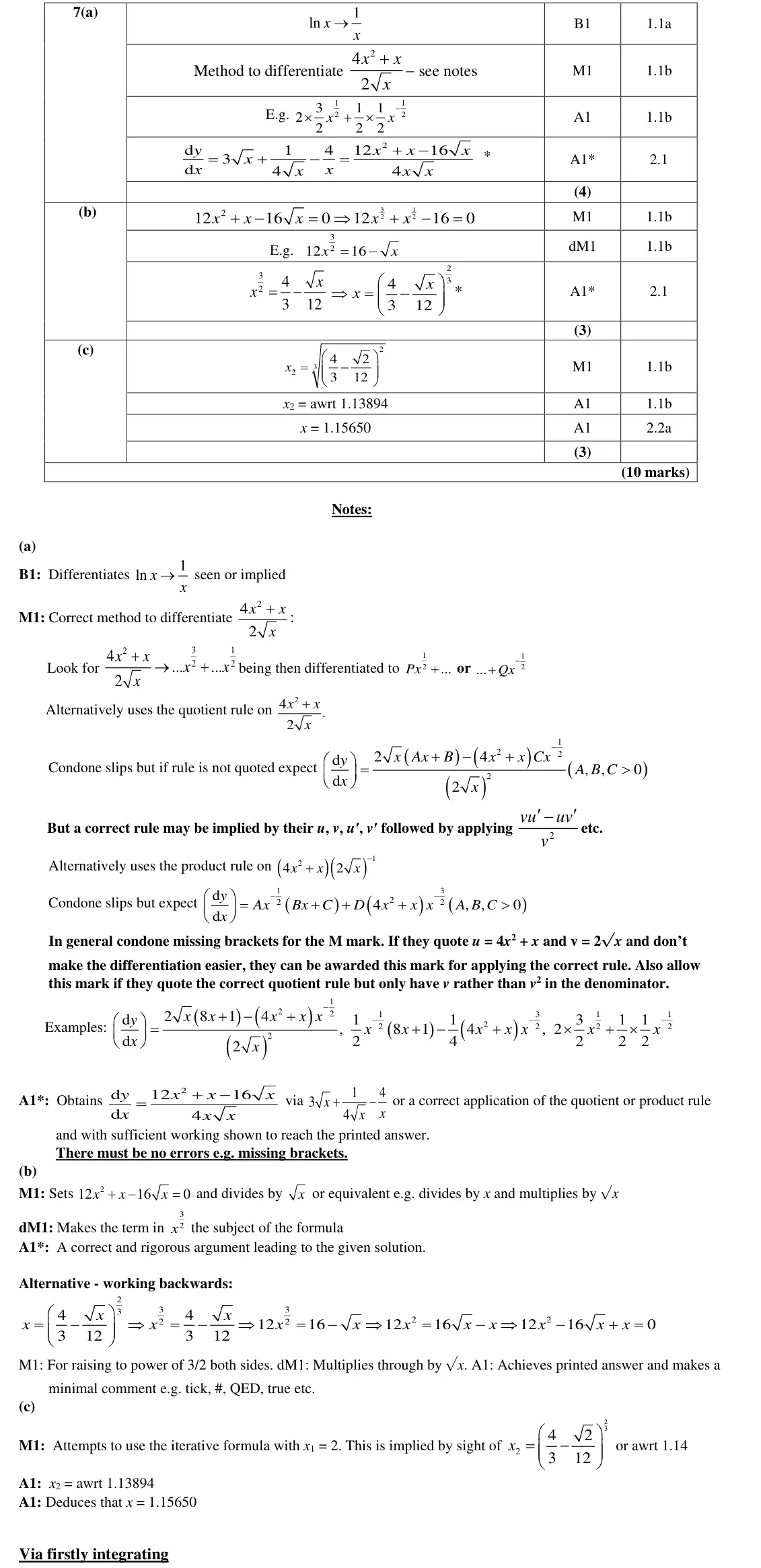
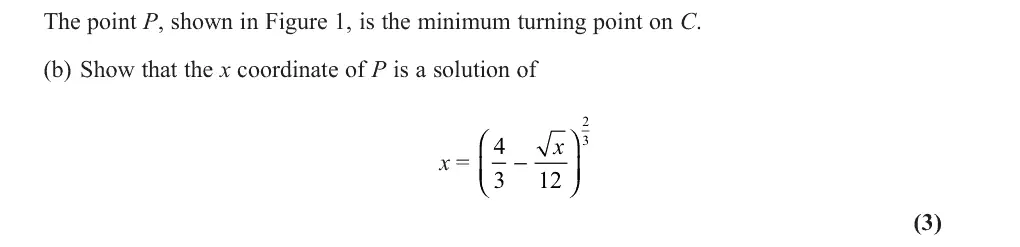
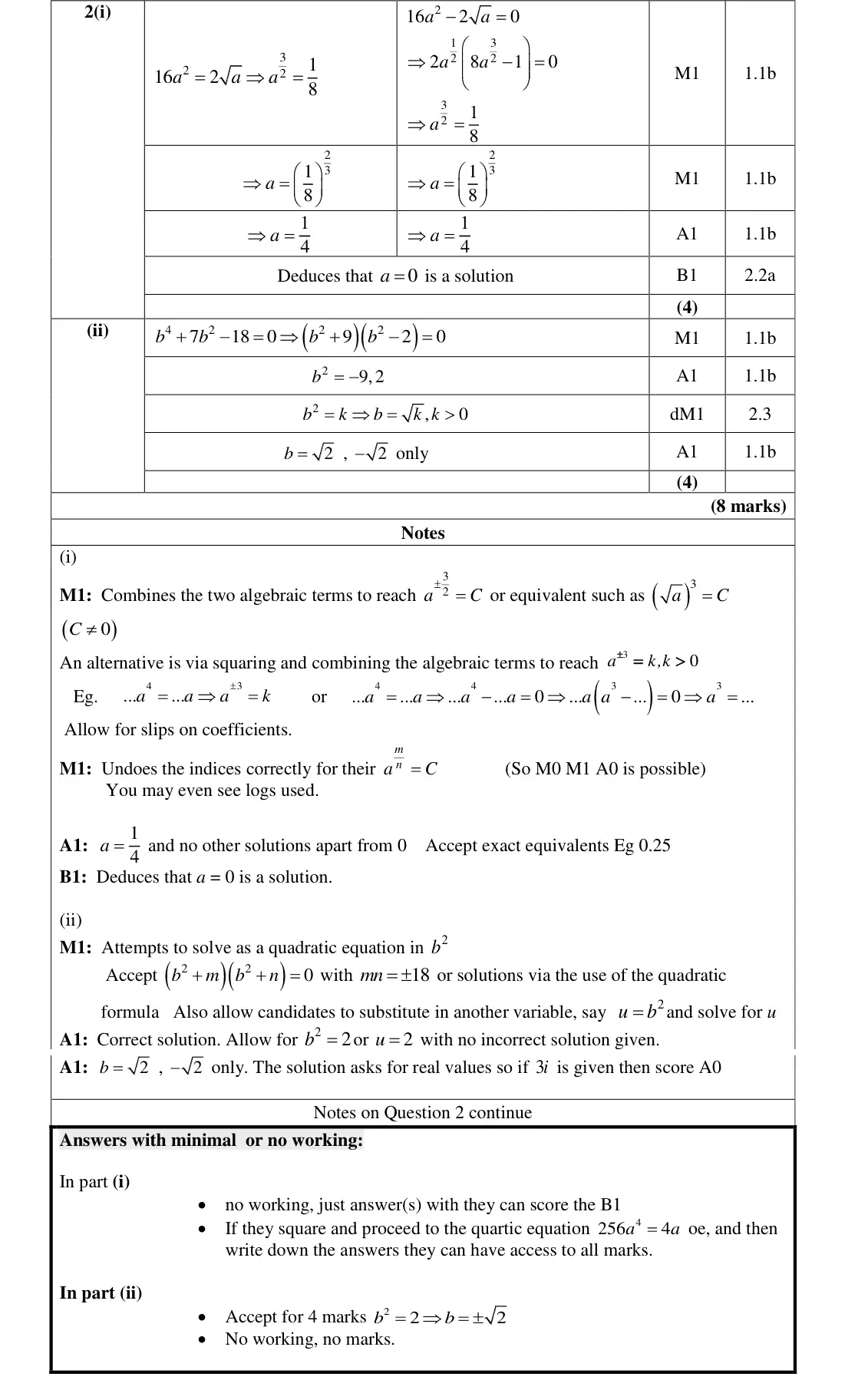
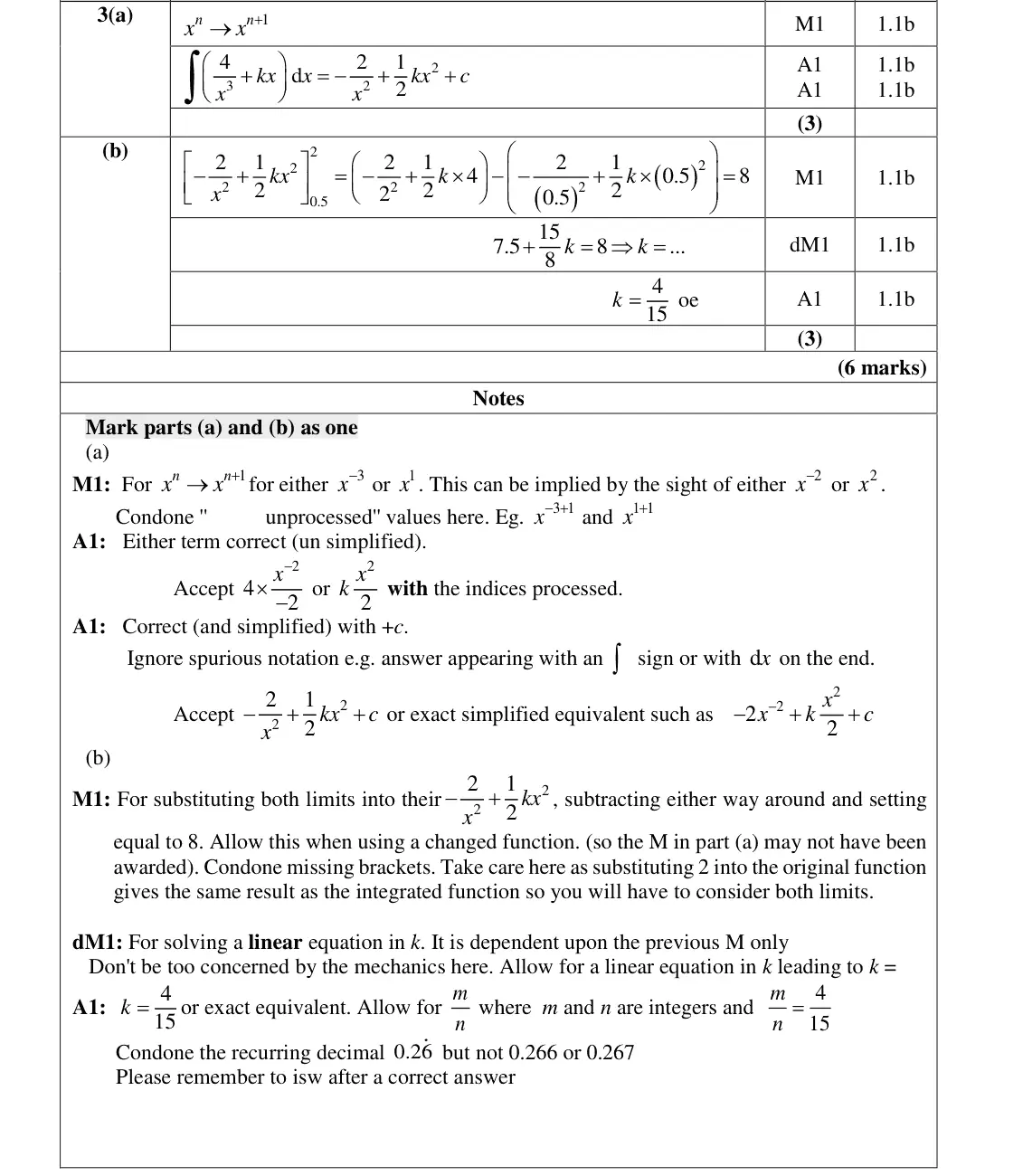
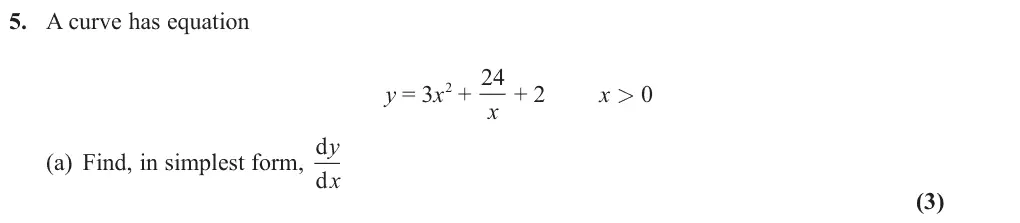
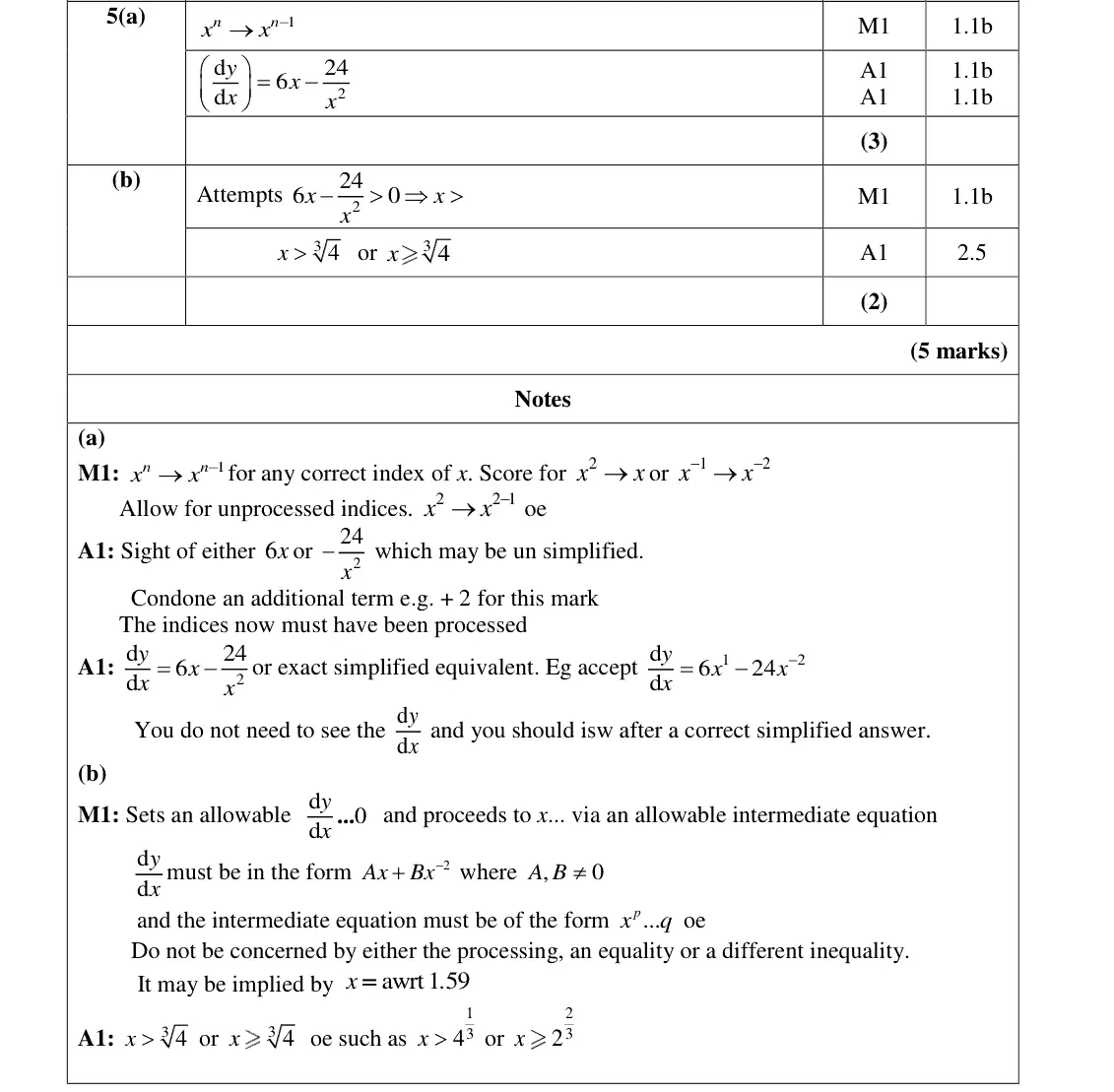
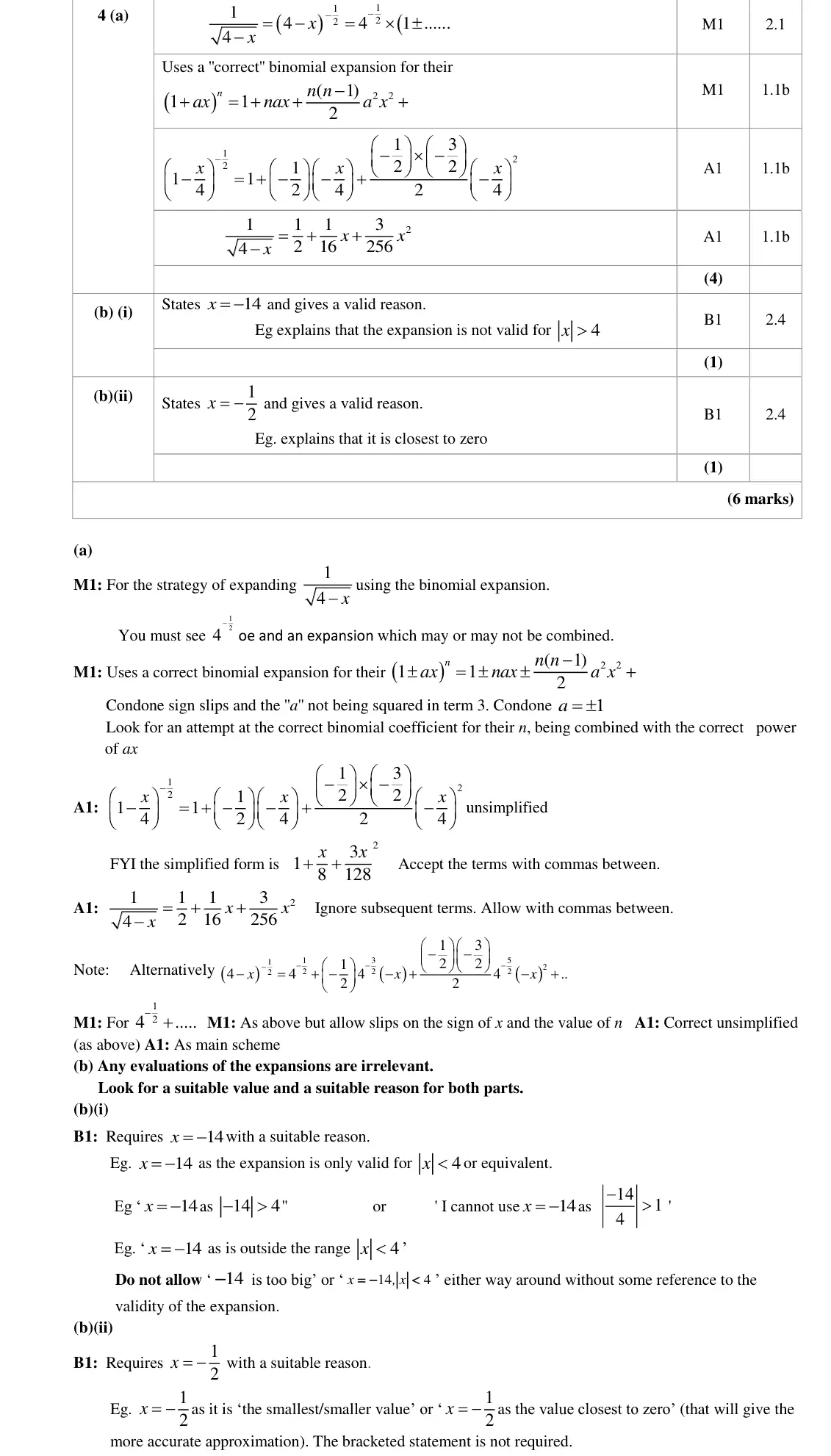
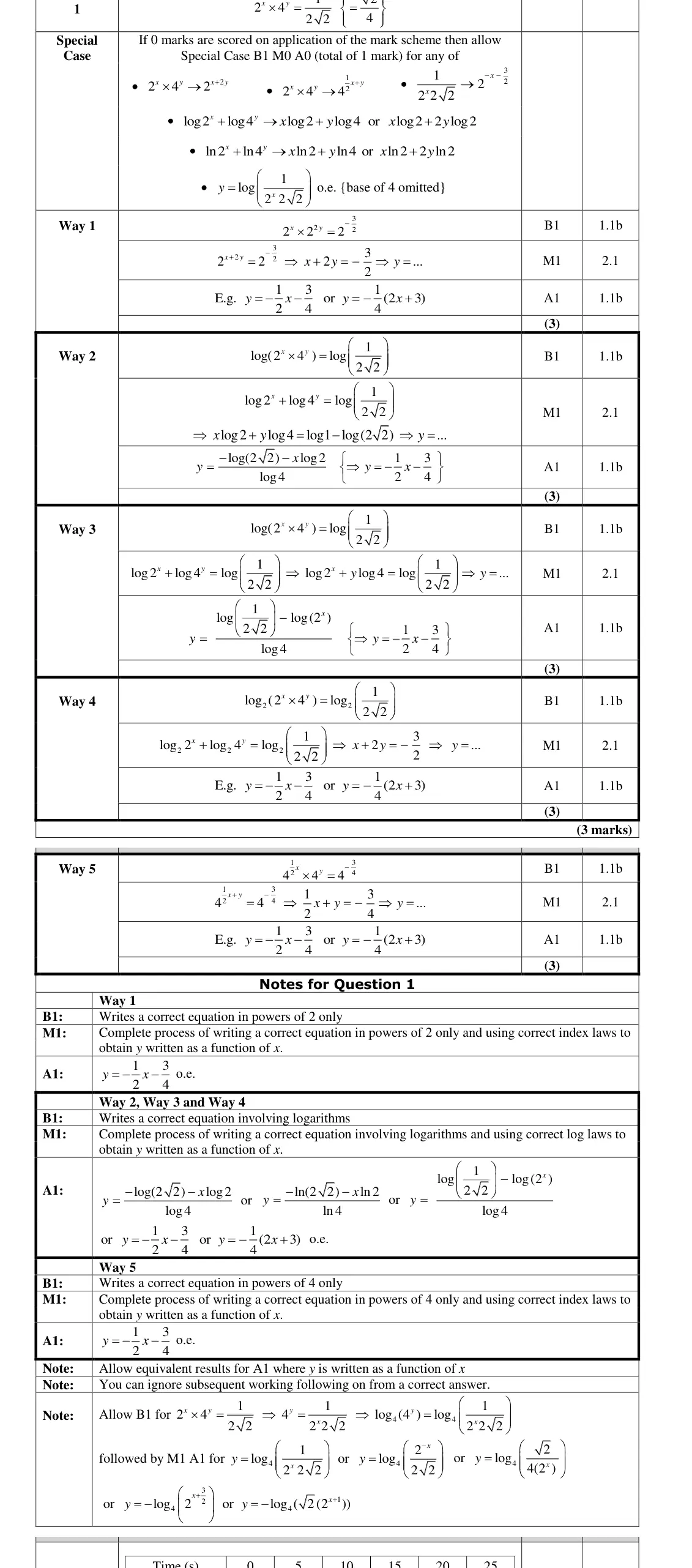
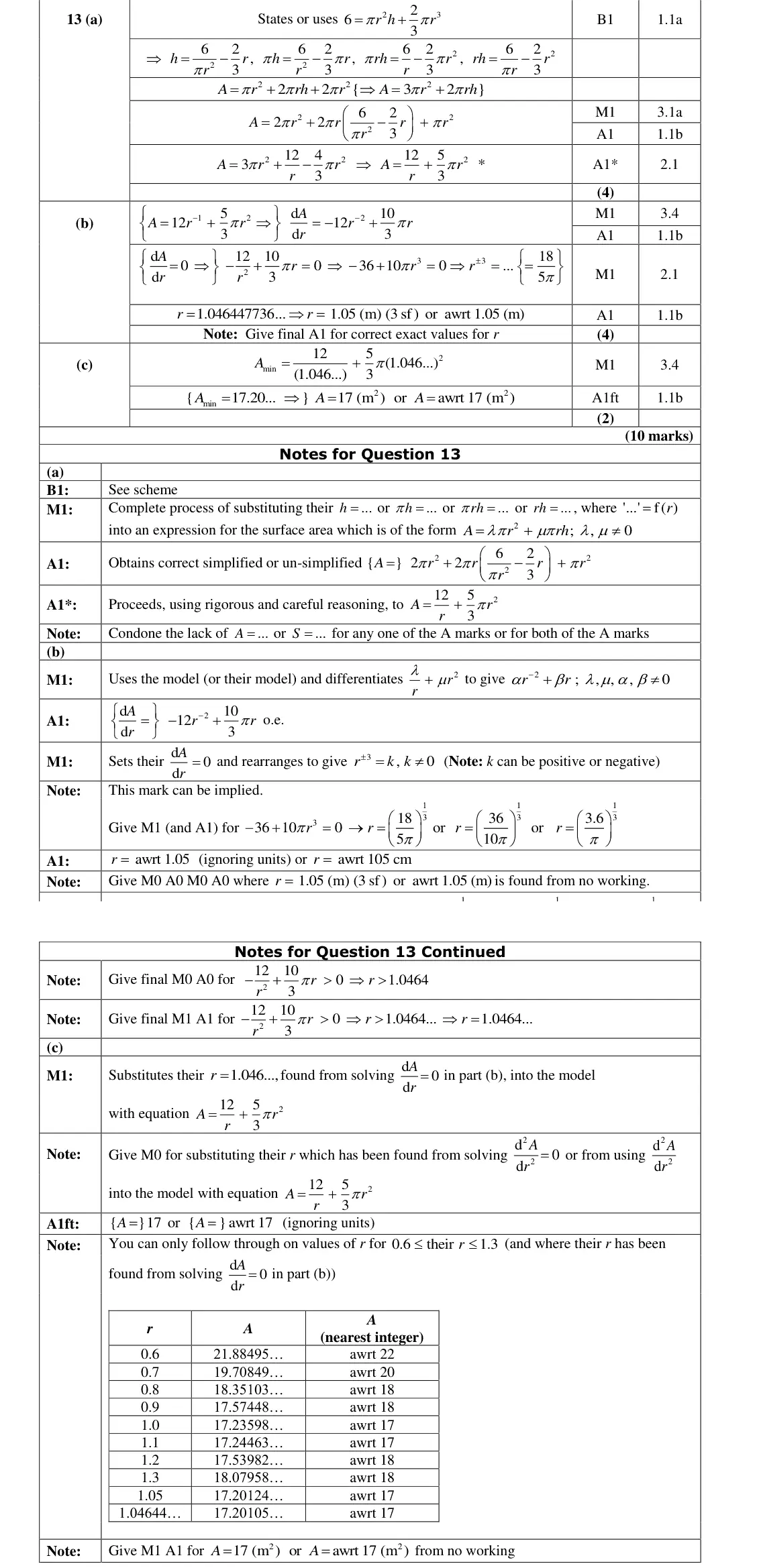
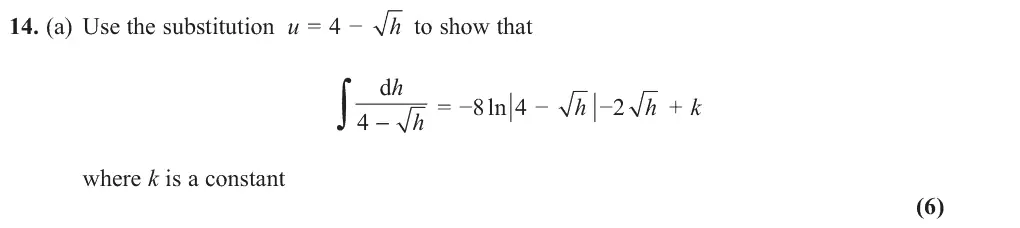
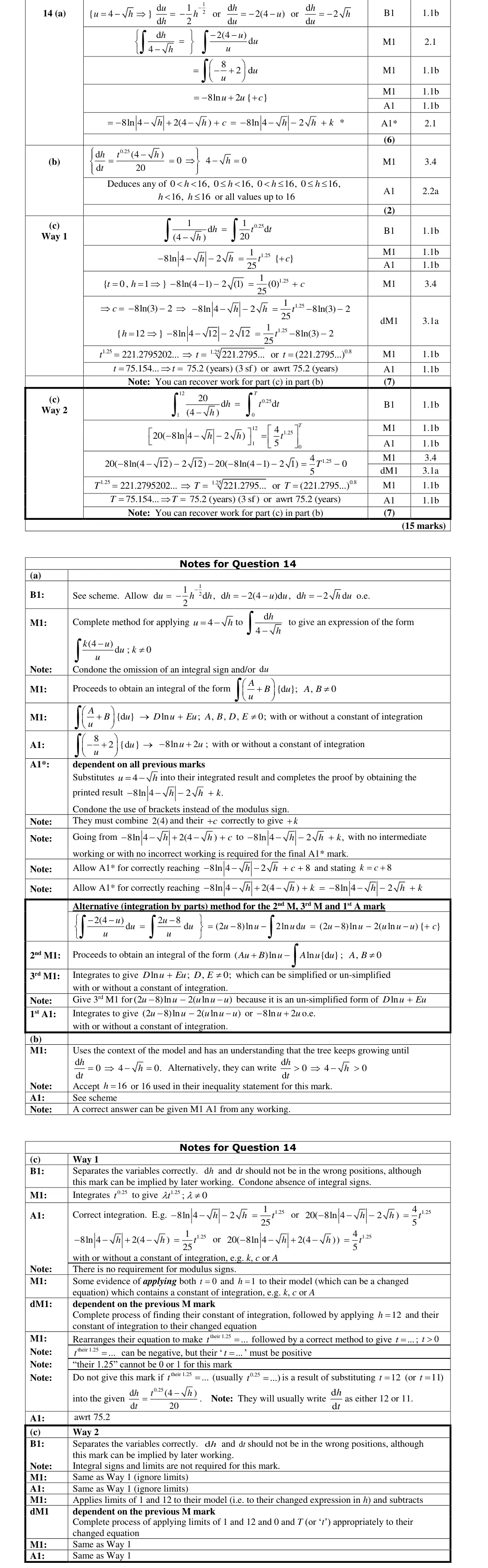
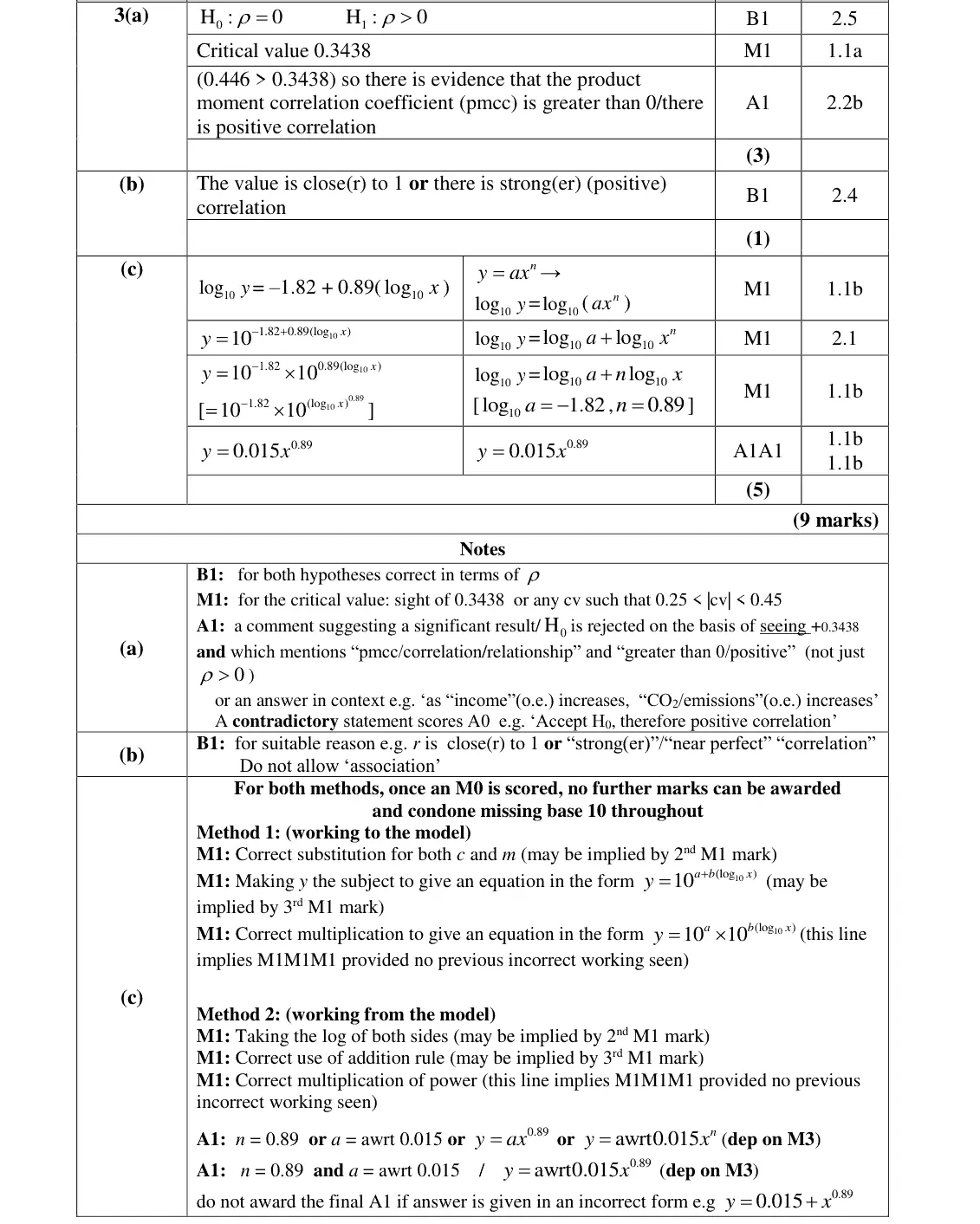
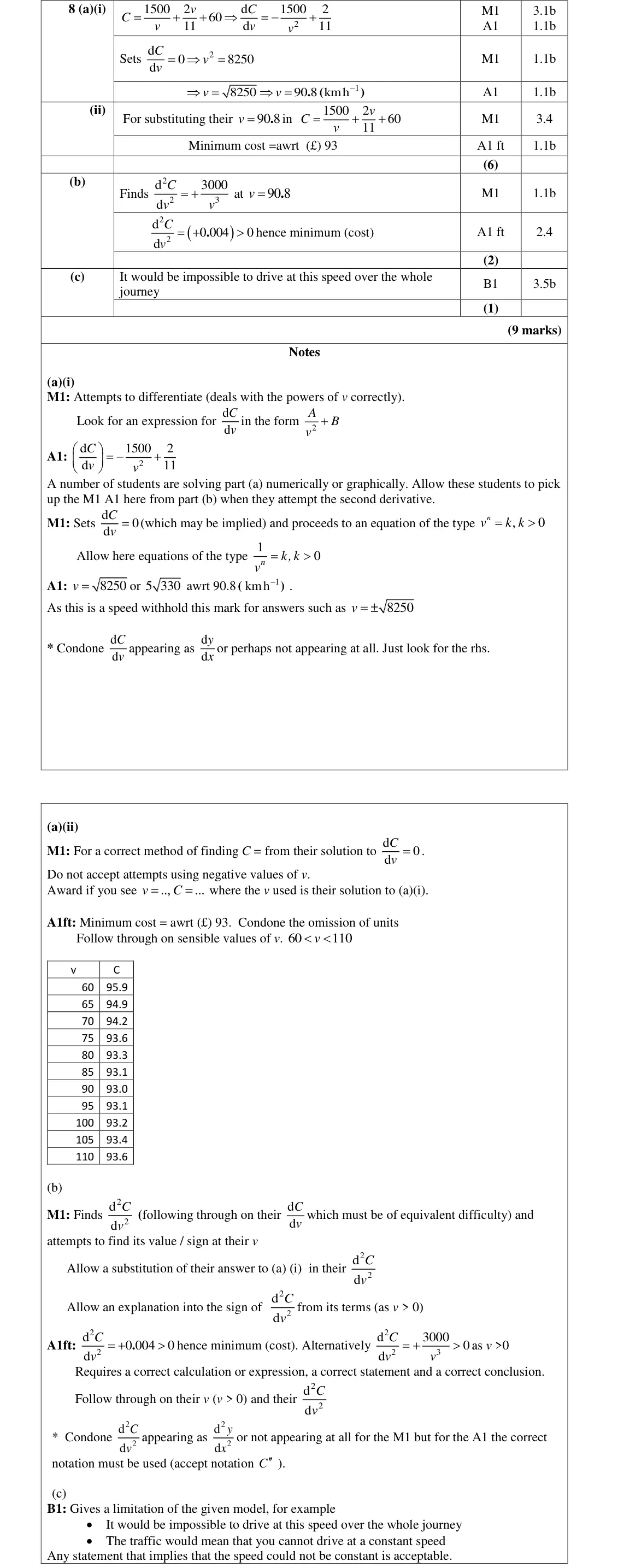
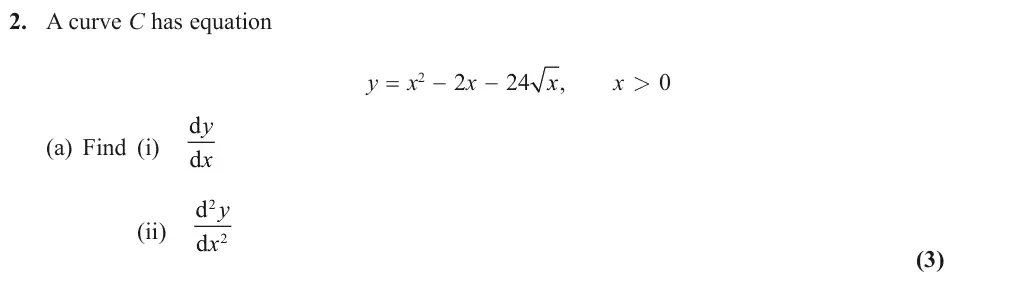
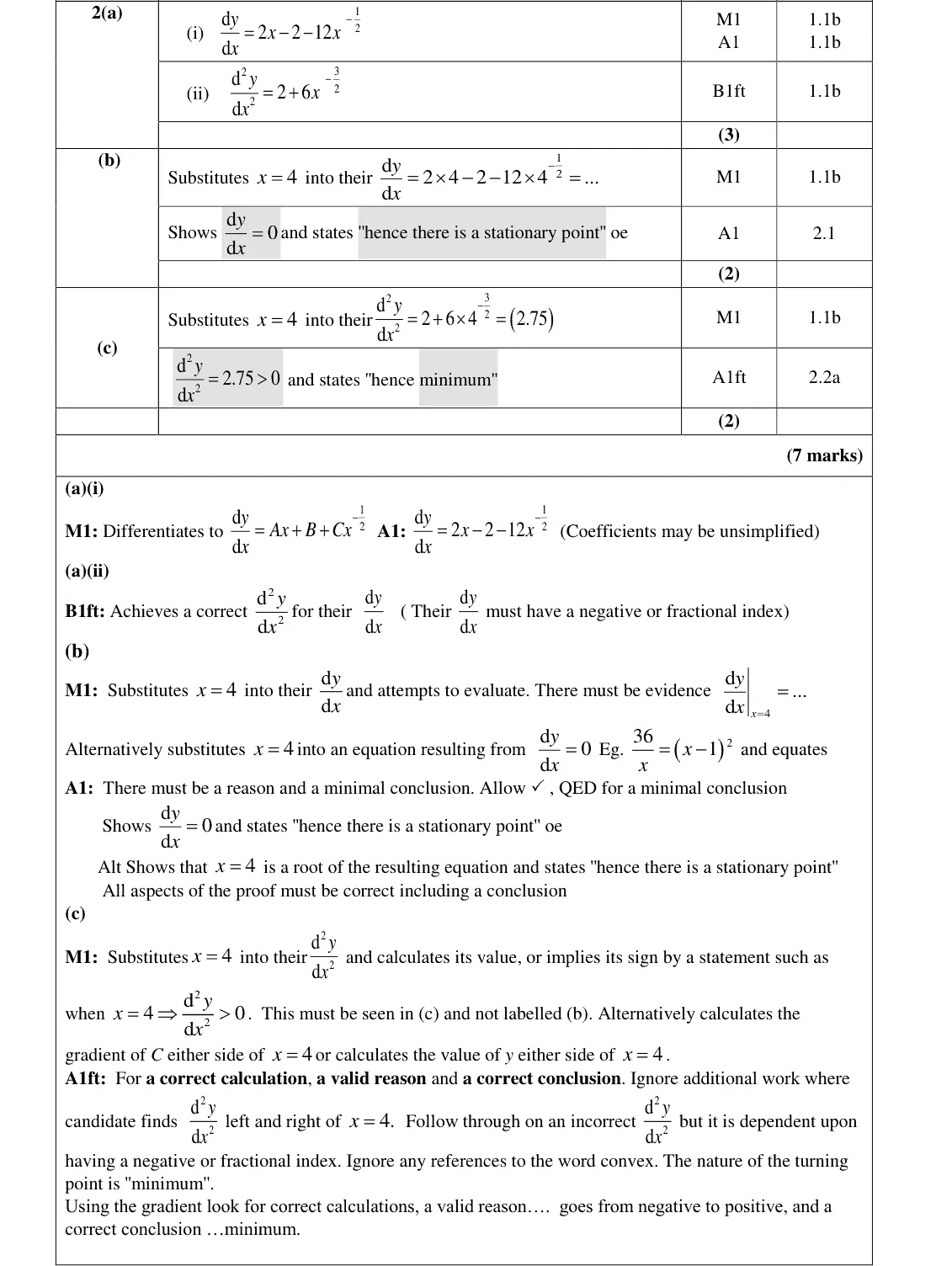
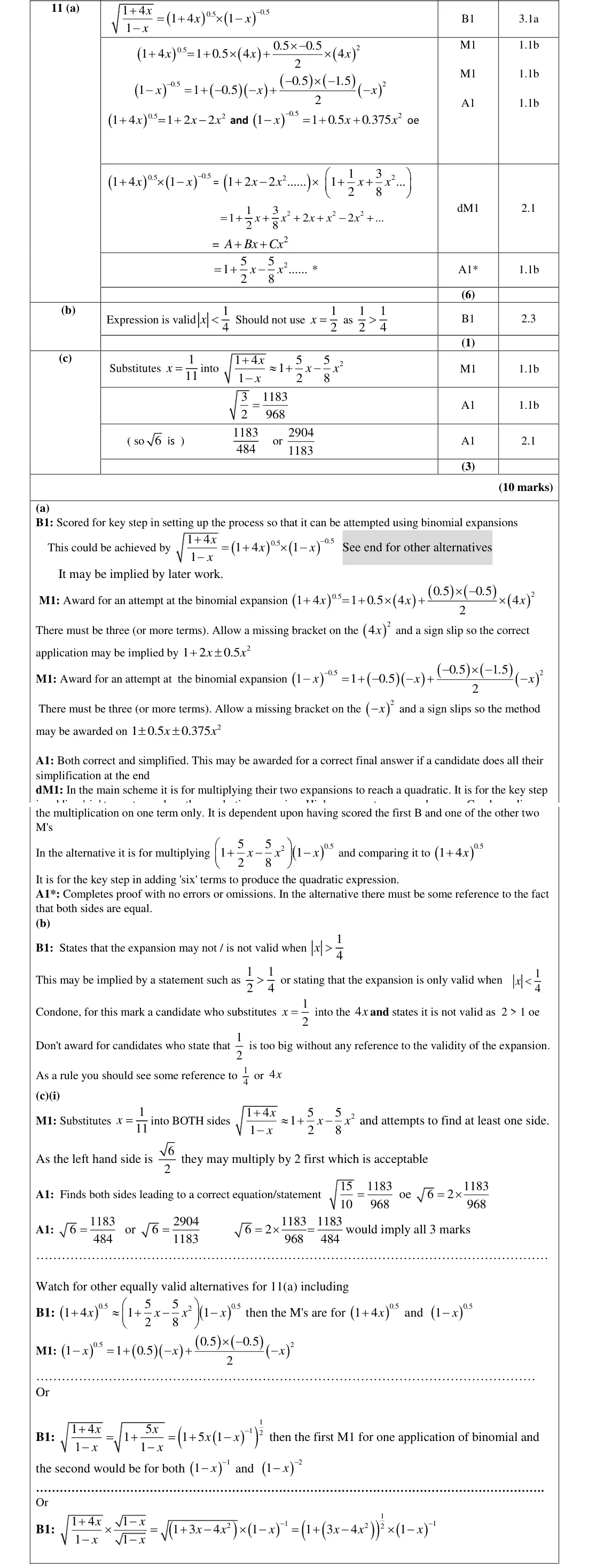
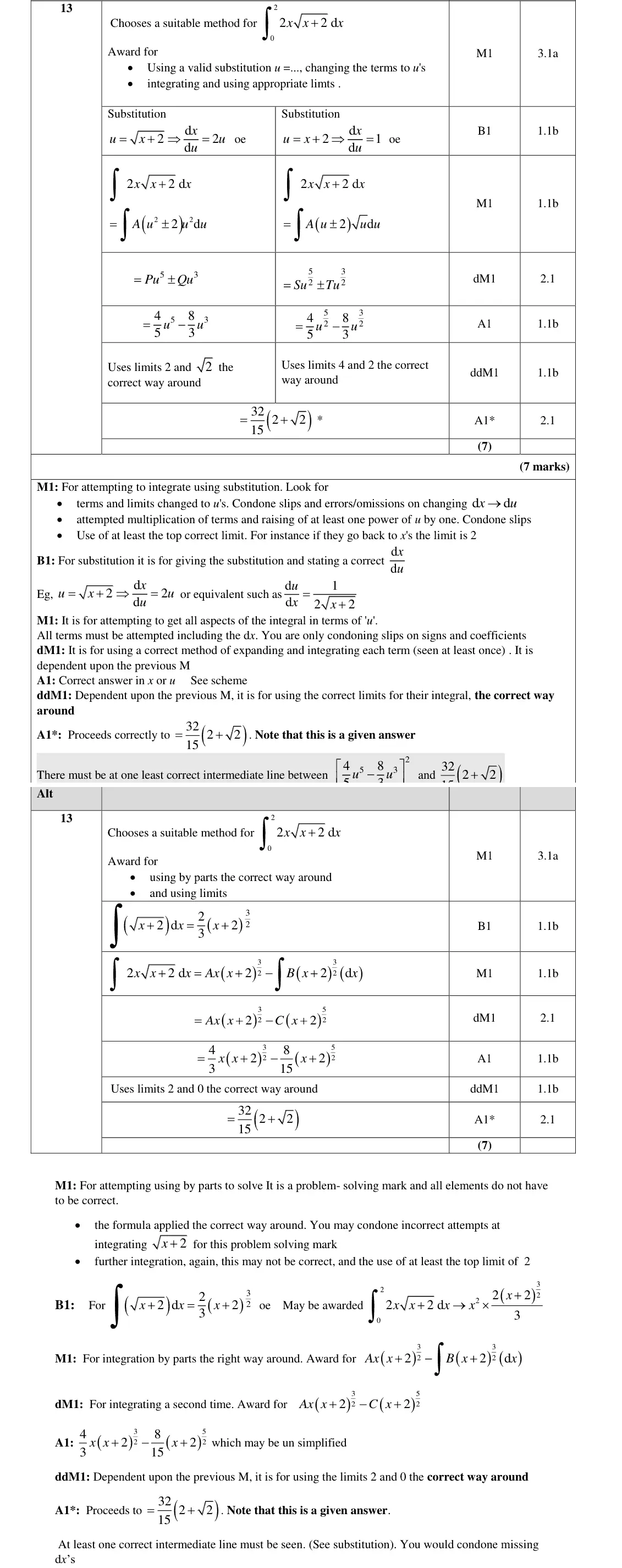
Mark scheme (whole question; this part is marked with the orange bar)
Examiner's comment
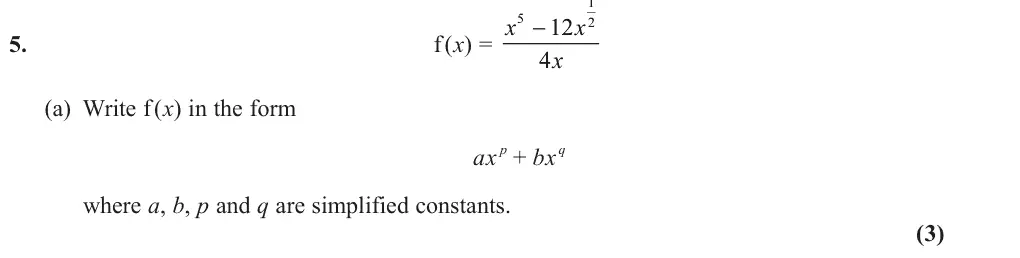
In general, this question was a good source of marks for many candidates. In part (a), many scored at least 2 out of the 3 marks. Some candidates were unable to eliminate the denominator at all and scored no marks. Others tried, but ended up with, incorrect coefficients. The most common mistake was to multiply each of the coefficients in the numerator by 1 4x- instead of 1 1 4 x- resulting in correct indices, but incorrect coefficients and this error would cost them both A marks in this part. Some achieved the correct answer and then multiplied through by some value to achieve a different expression. ISW was not applied in these cases. A successful approach for many students was to split the fraction into two separate fractions (some using division signs) and simplify each one. However, separating an algebraic fraction was problematic for some candidates.
Common mistakes
divide each term by 4x: ¼x⁴ − 3x^(−½)
multiplying by 4x⁻¹ instead of ¼x⁻¹ gives wrong coefficients
do not then multiply through (no isw)
June 2025 · AS Paper 1 · Q5(b)3 marks
Mark scheme (whole question; this part is marked with the orange bar)
Examiner's comment
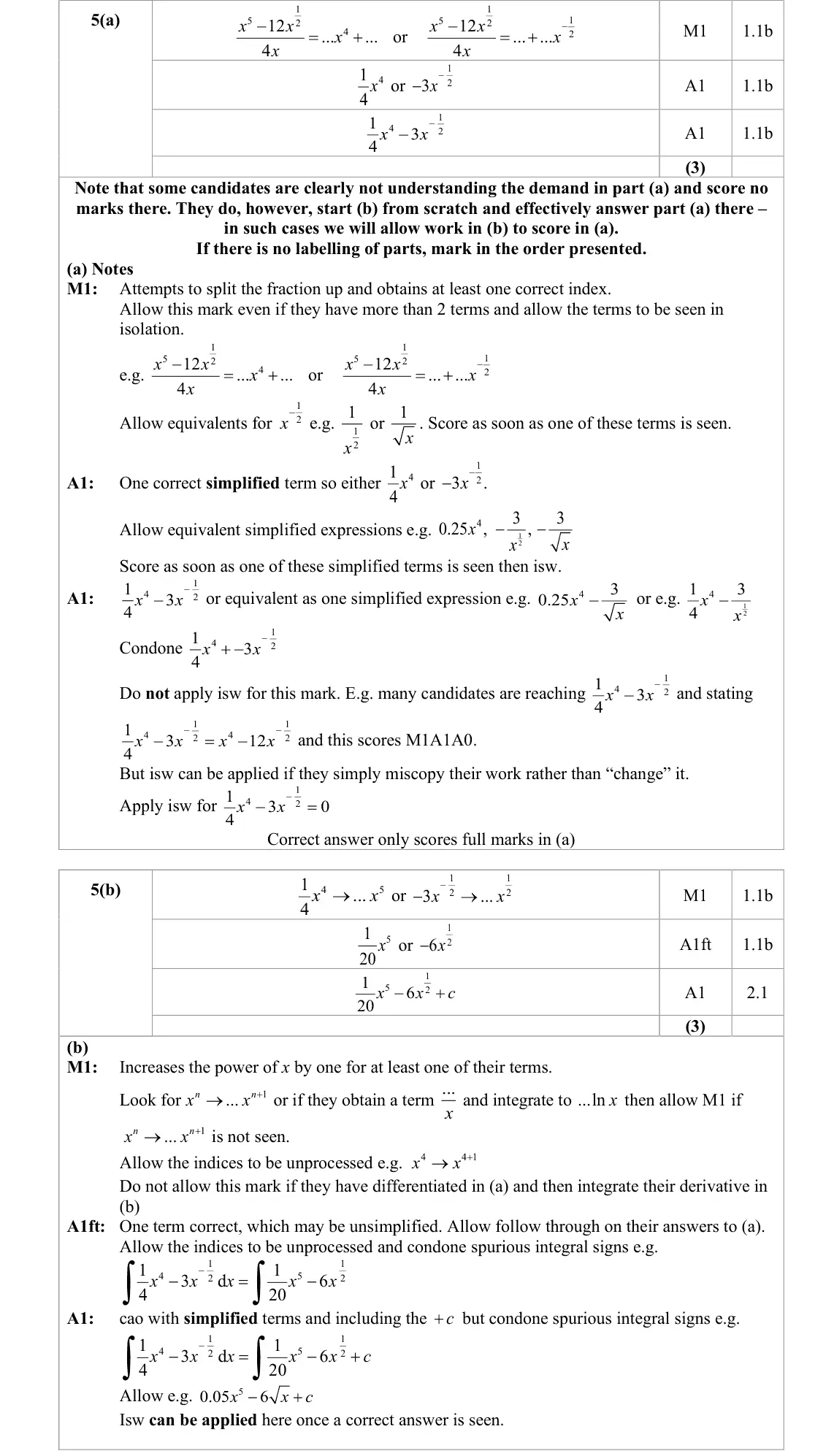
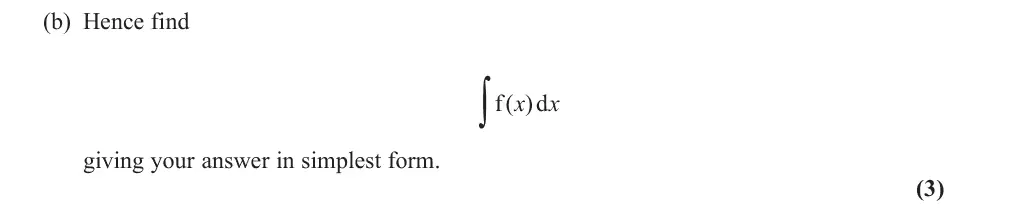
In general, this question was a good source of marks for many candidates. In part (b), most candidates were able to integrate at least one term correctly, even if they had the wrong expression from part (a). Many students scored full marks here, especially those with full marks in part (a). 2 marks was common if their answer to part (a) was incorrect, with the first A mark often awarded as a follow-through. Common mistakes included: • forgetting to include “+ c” • achieving 5 4 or 4 5 instead of 1 20 when simplifying fractions • obtaining an incorrect power for the second term when attempting add 1 to 1 2 - Again, some candidates achieved the correct answer and then attempted to multiply through by some value to achieve a different expression, but this was not penalised in part (b). Those who had done less well on part (a) often managed to pick up the first two marks (M1A1) despite earlier errors with their fractions or indices. However, even amongst those scoring well, there was some poor notation e.g. spurious integration signs, though these were not penalised.
Common mistakes
raise each power by 1 and divide: (1/20)x⁵ − 6x^(½) + c
forgetting + c
5/4 or 4/5 instead of 1/20
wrong power from −½ + 1
June 2025 · AS Paper 1 · Q11(a)4 marks
Mark scheme (whole question; this part is marked with the orange bar)
Examiner's comment
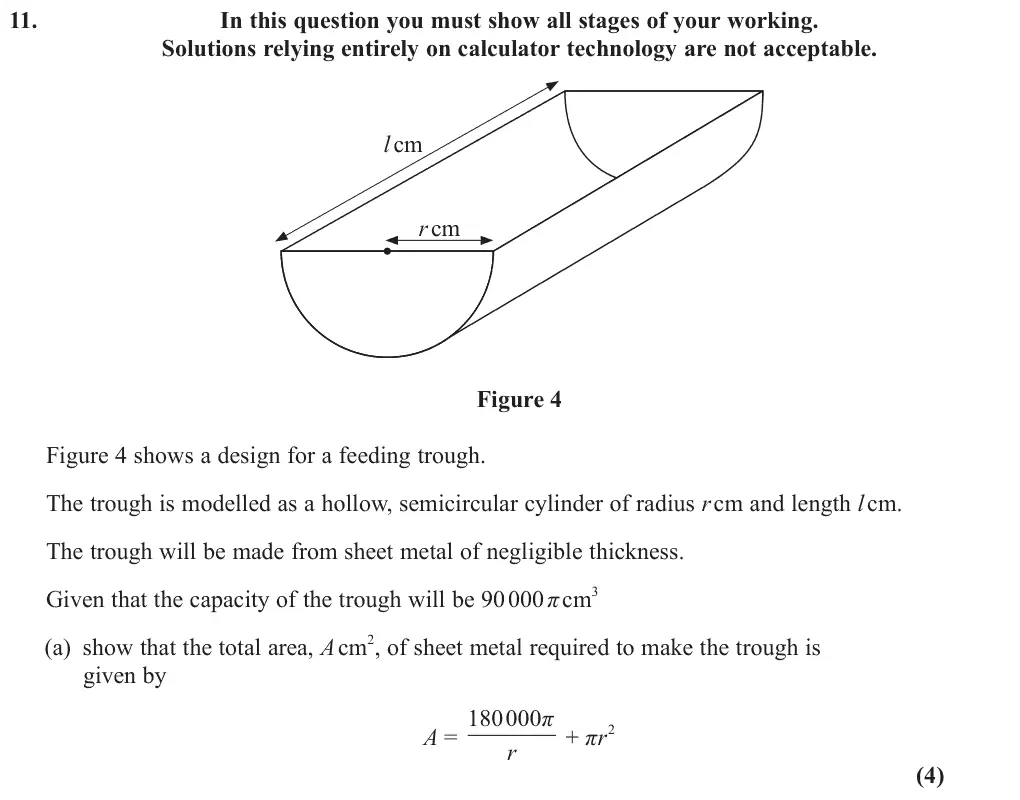
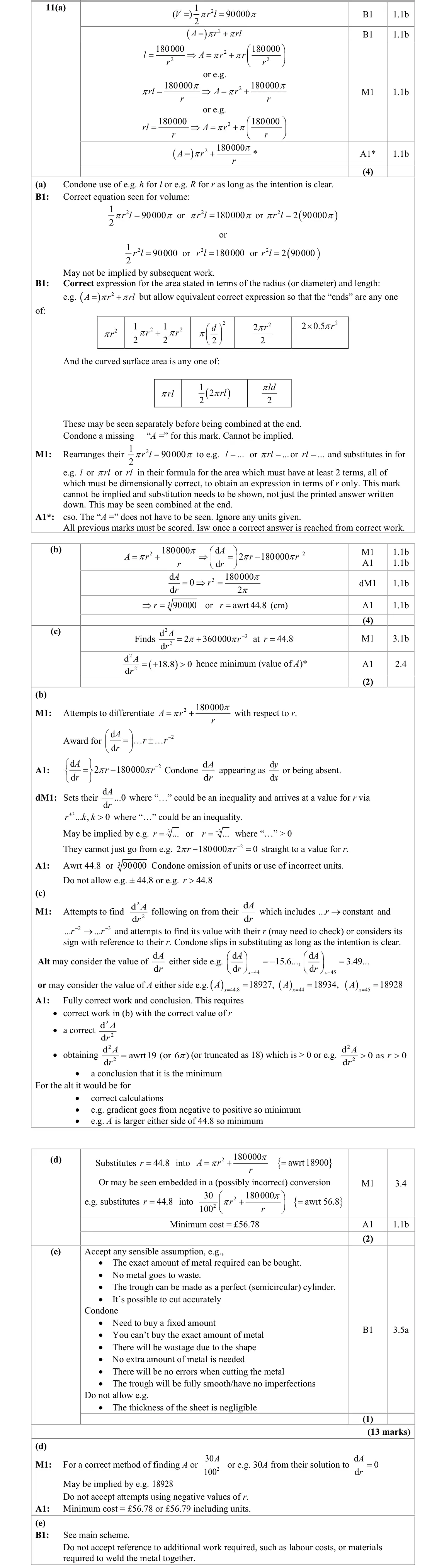
A small minority of candidates did not attempt this question at all. Some candidates attempted part (a) and then did not go on to attempt the remaining parts (generally when they were unable to complete part a)). In part (a), a common error in the first B mark was to miss out the pi for 90000 pi . Some candidates used an incorrect formula but most who wrote the correct formula, rearranged this into a different format to use later. For the second B mark, this was less well scored. Some candidates had the formula for a complete cylinder and some candidates did not write down this formula (it was often implied with later working but this resulted in the loss of both the second B mark and the A mark as this was a proof question). Where candidates had gained the first three marks, they often went on to simplify the formula and gain the final accuracy mark.
Common mistakes
V = ½πr²l = 90 000π (π often missed)
A = πr² (two semicircular ends) + πrl (curved surface), not a whole cylinder
formula for A must be written down
substitute l from V before reaching the given answer
June 2025 · AS Paper 1 · Q11(b)4 marks
Mark scheme (whole question; this part is marked with the orange bar)
Examiner's comment
A small minority of candidates did not attempt this question at all. Some candidates attempted part (a) and then did not go on to attempt the remaining parts (generally when they were unable to complete part a)). Most candidates who attempted part (b) were able to differentiate correctly to gain the first mark. A common error was to miss out the pi , thus resulting in the wrong value for r. Most candidates who attempted to differentiate often achieved the correct value for r from a cubic expression.
Common mistakes
dA/dr = 2πr − 180 000πr⁻²
set = 0: r³ = 90 000, r = 44.8 cm
losing the π
not ±44.8
June 2025 · AS Paper 1 · Q13(a)4 marks
Mark scheme (whole question; this part is marked with the orange bar)
Examiner's comment
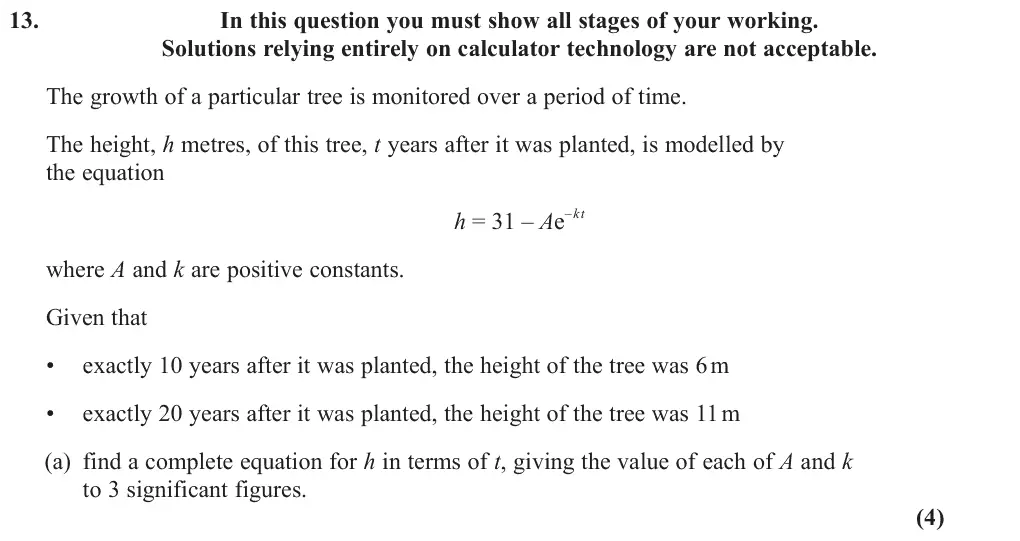
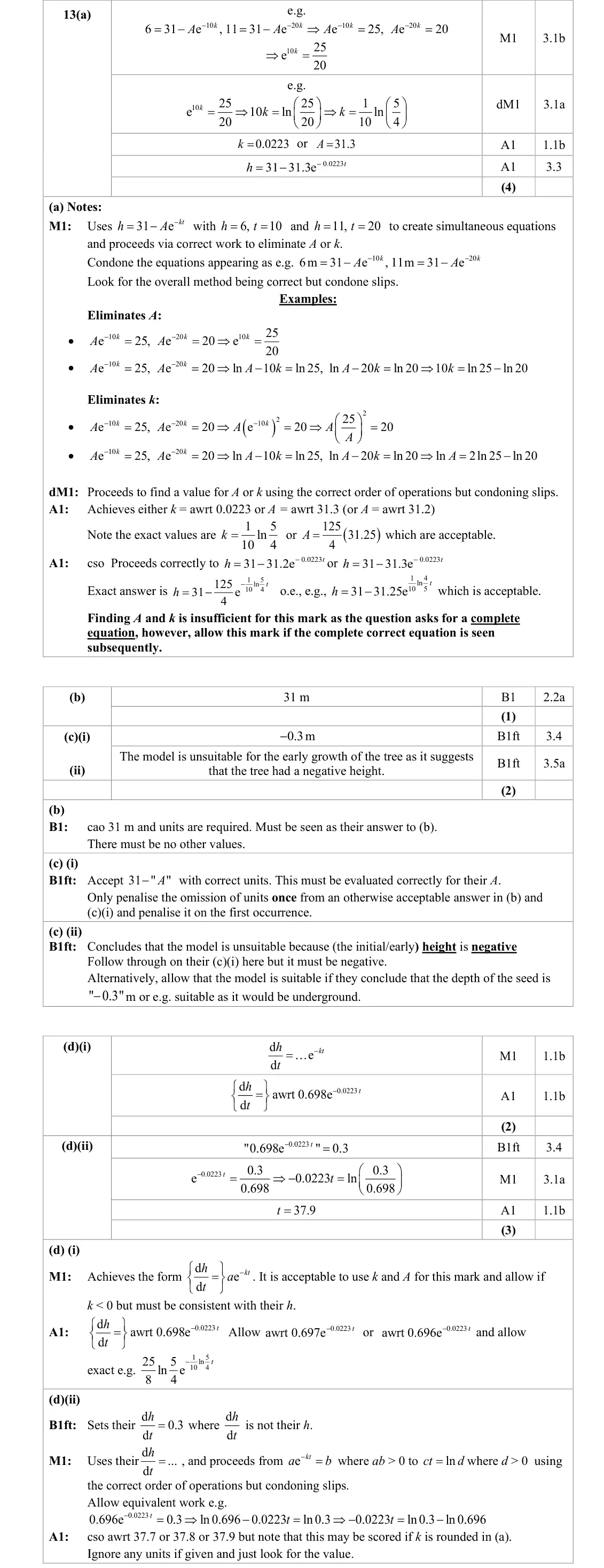
Candidates’ performances in this exponential modelling question were varied with some able to obtain full or nearly full marks, whilst others made very little progress. Candidates who did fail to score marks in (a) were often able to gain credit later in the question. Units were required in the answers to (b) and (c)(i), and the omission of these were penalised the first time it In part (a), candidates who had the necessary algebra skills successfully used the given equation and information to set up simultaneous equations in A and k and correctly solved them to reach 0.0223 31 31.3e t - h or a similar acceptable equation. Candidates often, however, made major = - algebraic mistakes after initially setting up the correct equations, often involving the use of incorrect log or indices work, and made no progress in (a). Others failed to appreciate that the question was asking for an exponential model and attempted to use the given information to set up a linear model instead. A number of candidates failed to write down the complete equation of the model and just gave the values of A and k, losing the final mark in (a). Many candidates realised that in (b) the required limit to the height of the tree was 31m,
Common mistakes
form Ae^(−10k) = 25 and Ae^(−20k) = 20 and divide: e^(10k) = 5/4, k = 0.0223, A = 31.3
log or index errors
must give the complete equation h = 31 − 31.3e^(−0.0223t)
June 2025 · Paper 1 · Q5(b)2 marks
Mark scheme (whole question; this part is marked with the orange bar)
Examiner's comment
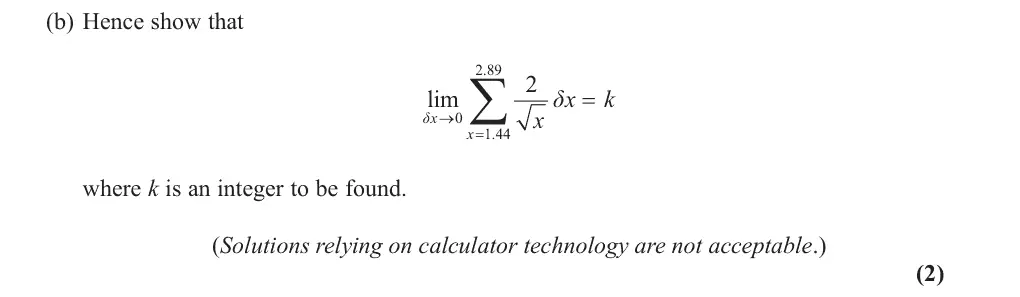
This question was well attempted by the vast majority of learners. Part (b) of the question was also usually answered successfully. This question was a show that and included the warning they solutions relying on calculator technology were not acceptable, so it was required that learners showed all steps of their working. Most understood the method and showed appropriate integration followed by correct substitution of limits and correct answer. There were sometimes errors with the coefficient, the most common being 1 2 2 x x rather than 2 1 2 x . Other errors when integrating usually occurred with the power (converting 2 x to 1 2 2x then integrating or differentiating instead of integrating) or the use of ln ax . A small number of responses integrated correctly but then proceeded straight to the final answer without any evidence of substitution of the given limits and so were unable to gain any marks. Those who had the incorrect limits such as using 0 were also unable to score either mark, although transcription errors of 2.89 and1.44 were condoned for the method mark. There were many cases of poor notation such as retaining the integral symbol after integrating and include c + within the calculation but these were condoned on this occasion. 9
Common mistakes
integrate 2x^(−1/2) to 4√x and show the limits substituted: 4 × 1.7 − 4 × 1.2 = 2
Mark scheme (whole question; this part is marked with the orange bar)
Examiner's comment
This was the first modelling question on the paper. In part (a), most learners demonstrated a strong grasp of the initial requirements, successfully forming and solving the correct pair of simultaneous equations to determine the values of A and B. However, a minority of responses overcomplicated their approach by unnecessarily introducing logarithms or misapplying algebraic techniques, leading to errors. Common mistakes included arithmetic slips, particularly with decimal values such as 17.6 or 11.9, and confusion between addition and subtraction within algebraic manipulation. It was observed that learners relying on calculators tended to achieve more accurate results than those attempting manual algebraic solutions, with the latter occasionally making sign errors or misplacing powers. Some responses applied the power of 1.5 to B instead of t, or incorrectly simplified expressions such as 41.5 and 91.5. The final mark was sometimes not awarded due to omission of the complete model equation as their answer, or by not checking that their solution met the question’s requirement for B to be a positive constant. A small number disregarded the model altogether and adopted a linear approach.
Common mistakes
17.6 = A − 8B and 11.9 = A − 27B give A = 20, B = 0.3
must state the complete equation h = 20 − 0.3t^1.5
some put the power on B or used a linear model
June 2025 · Paper 1 · Q6(c)2 marks
Mark scheme (whole question; this part is marked with the orange bar)
Examiner's comment
This was the first modelling question on the paper. In part (c), many responses identified the conceptual constraint that the height cannot be negative and explained this convincingly in words. However, fewer responses set up and solved an equation to find the critical value of T where the height is zero. Those who attempted to find the value of T were generally successful, though some struggled with the algebra or worked by trial and error to estimate the boundary. Issues included inconsistent use of inequalities when rounding and a tendency to provide descriptive rather than numerical responses. 10
Common mistakes
h ≥ 0 so solve 20 − 0.3T^1.5 = 0: T = (200/3)^(2/3) = 16.4, i.e. T ≤ 16.4 (not T ≥)
many explained h cannot be negative but did not find the value
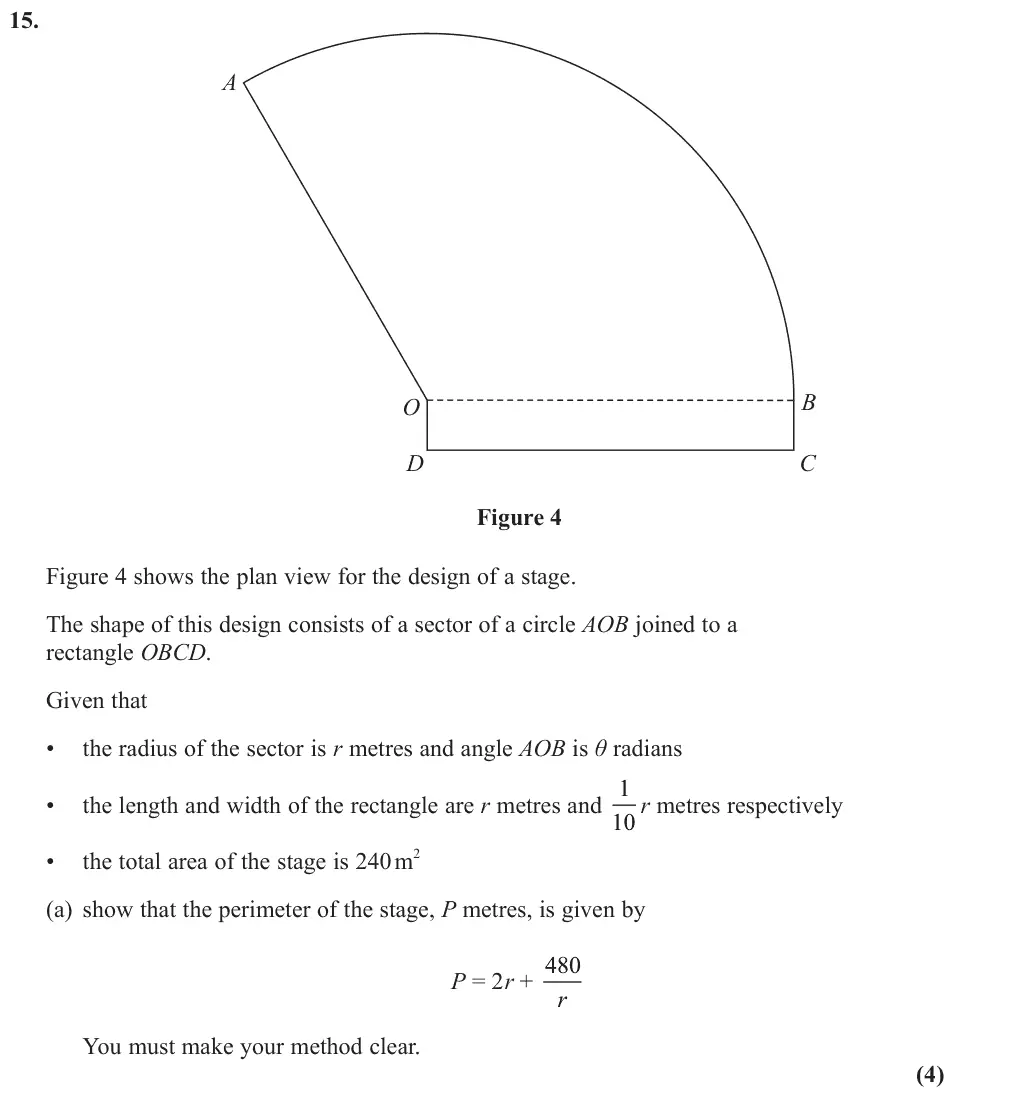
June 2025 · Paper 1 · Q15(a)4 marks
Mark scheme (whole question; this part is marked with the orange bar)
Examiner's comment
This question using differentiation to find a minimum was generally answered well. It was usually part (a) which provided most challenge, often resulting in work which was difficult to follow. In part (a), learners were required to use the given information about the area of the composite shape and show that the perimeter could be expressed in a specific form. The majority of responses formed a correct equation for the area of the shape, although there were some that omitted the rectangular area and others made an error with the sector area. Some responses used a longer approach of considering the sector as a proportion of a whole circle rather than using the more succinct sector area formula. The formula for the perimeter was also correctly stated by the majority, although the sides of the rectangle were sometimes omitted or internal sides were included. There were a variety of approaches which were successful in eliminating theta from the perimeter. The most common approach was to make theta the subject of the area and then substitute into the perimeter. A few unsuccessful attempts involved making r the subject of the area and substituting into the perimeter. There were some neat, logical solutions to this problem. However, there were also many very poorly presented solutions. It was common to see work jumping around the page and arrows being used to try to link the parts of the equations. There were responses that made errors in their algebra and when realising that they could not achieve the given form, worked back to track their error. These learners should be praised for checking their work and trying to identify the error, but this does lead to messy and unclear work, so the learners should be encouraged to rewrite the solution should they have time to make sure that they have a clear argument.
Common mistakes
area ½r²θ + r²/10 = 240
make rθ (or θ) the subject and substitute into P = rθ + 2r + r/5 (sector arc, two radii minus shared side plus rectangle sides)
omitting the rectangle area or including internal sides
work must be clearly set out
June 2025 · Paper 1 · Q15(b)3 marks
Mark scheme (whole question; this part is marked with the orange bar)
Examiner's comment
This question using differentiation to find a minimum was generally answered well. It was usually part (a) which provided most challenge, often resulting in work which was difficult to follow. Part (b) required the use of algebraic differentiation to find a stationary value. Since the equation of the perimeter was given in the question, this task was accessible to all learners regardless of their success in (a). Differentiation was generally accurately carried out, although there were a few incorrect attempts which confused differentiation with integration and tried to introduce logs. The majority of the learners recognised the need to equate the derivative to zero to find the stationary point. Although most were successful finding a value, errors were made in the rearranging to make r the subject.
Mark scheme (whole question; this part is marked with the orange bar)
Examiner's comment
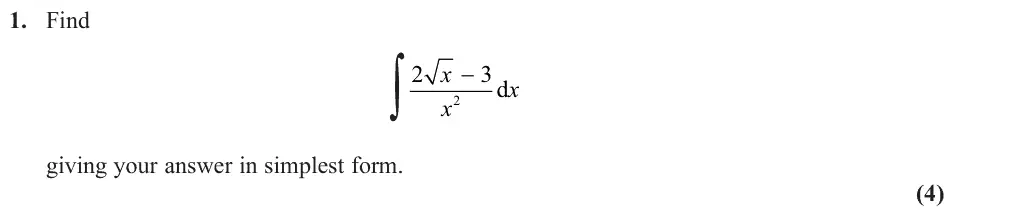
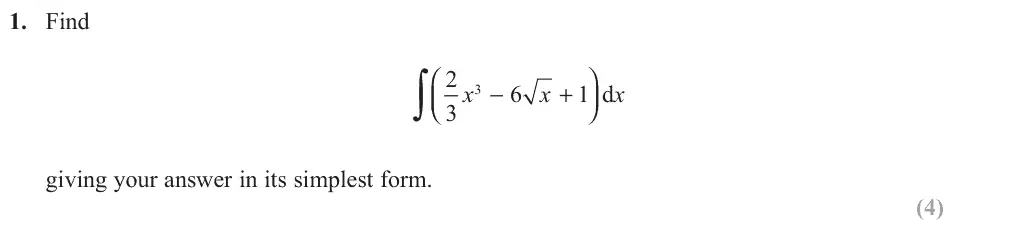
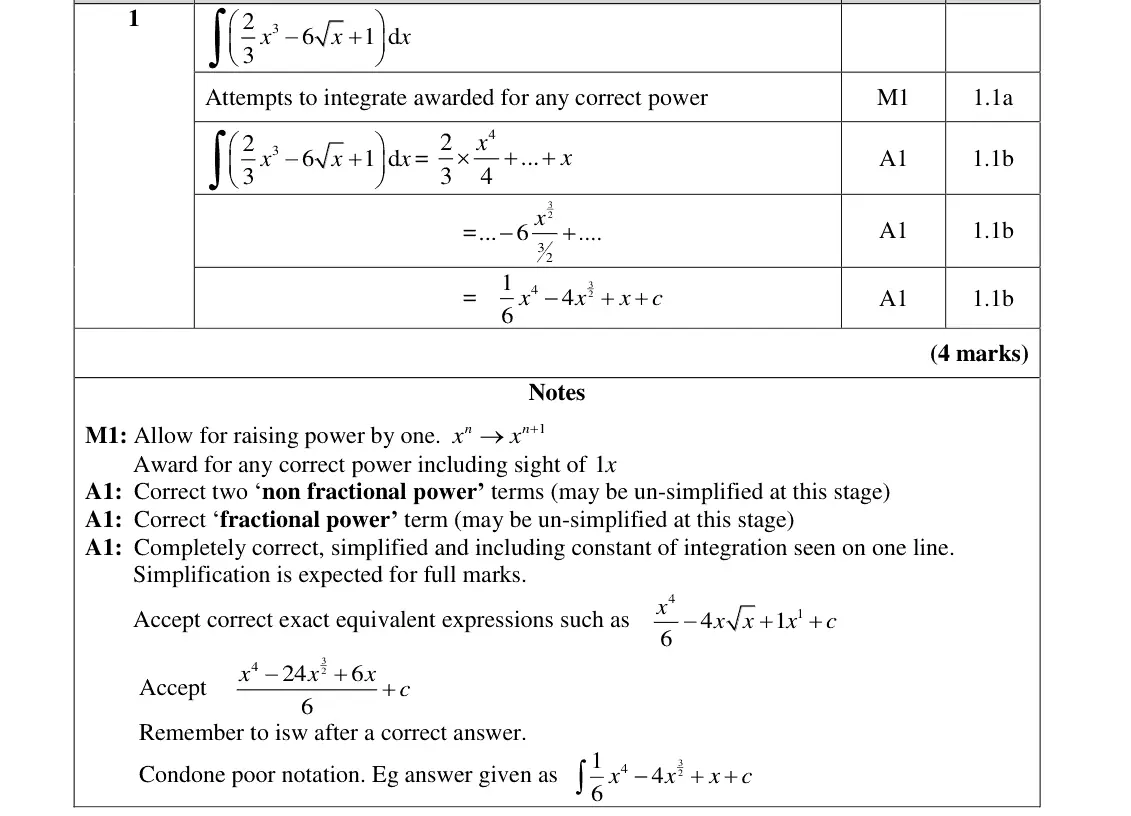
This routine question on indefinite integration was completed very well in almost all responses, with the majority demonstrating familiarity and confidence in dealing with this type of question. It was rare that this question was not attempted, and for many it proved to be a confidence boosting start to the paper. Learners were mostly efficient in their methods, with the majority knowing the steps for integration and applying them successfully. Of those achieving full marks, many did not need a working step but proceeding directly to the correct answer. The common errors were mostly small, such as omitting the constant of integration (+c) or making arithmetic mistakes when simplifying fractions, particularly when dividing by 3 2 . These errors were often due to confusion during the simplification process. A small number of responses mistakenly differentiated rather than integrated, which led to significant errors. This was a rare issue but still notable. Several responses that achieved a correct answer then went on to do further, often incorrect work with their integrated function, such as multiplying by 5 or setting it equal to 0 and attempting to solve. While this was not mathematically correct, subsequent work was ignored to ensure they were not penalised for these errors. Some responses seen confused the integral notation, either retaining the integral symbol and dx in their answer or including square brackets as if they were expecting to substitute in values, but again, this was condoned.
Common mistakes
−6x^½ → −4x^(3/2) (dividing by 3/2 causes slips)
forgetting + c
differentiating instead of integrating
June 2025 · Paper 2 · Q6(b)2 marks
Mark scheme (whole question; this part is marked with the orange bar)
Examiner's comment
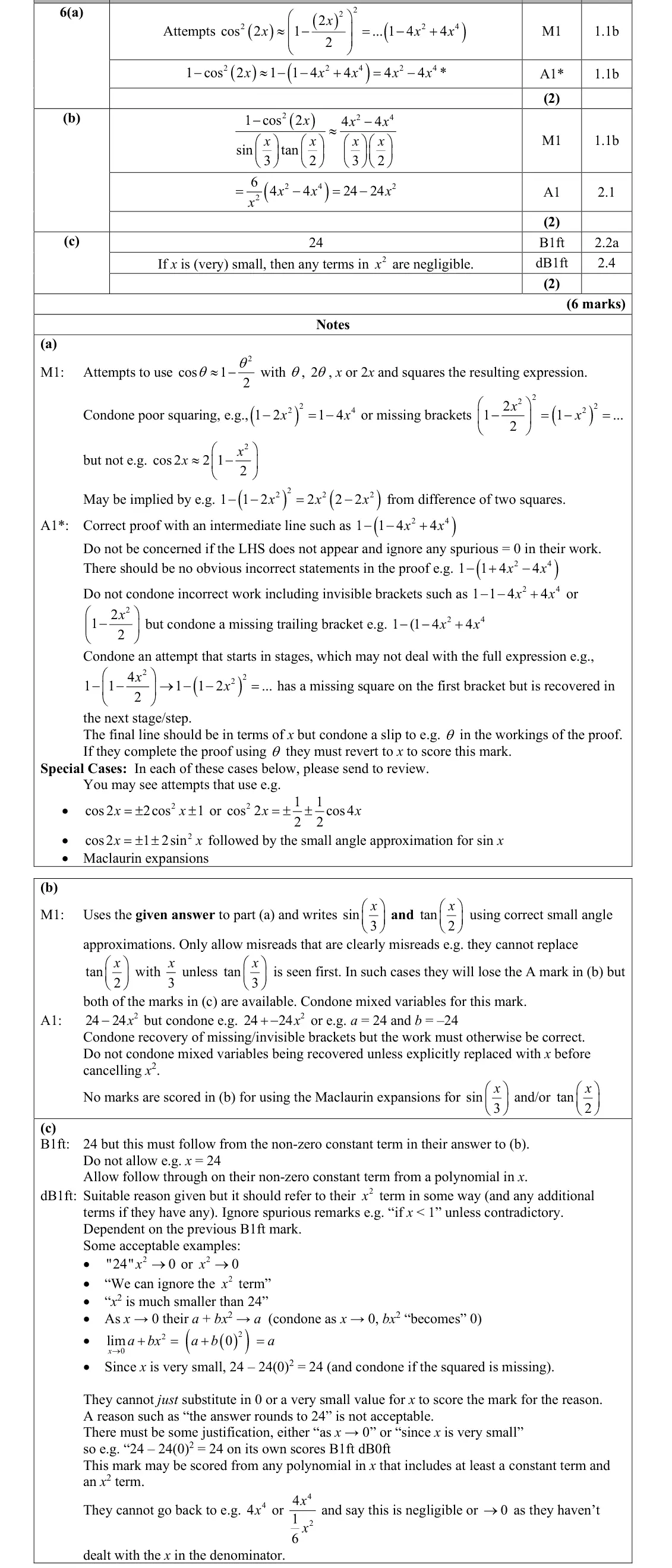
This question tested learners’ knowledge and understanding of small angle approximations, More successful responses in part (b), made good use of the restart opportunity available here. Most used the small angle approximations and the given answer to part (a) correctly. 2 24 24 0 x part (b) approached 0. This resulted in many learners setting and solving to - = x = ± . obtain 1 For both B marks follow-through was allowed on their answer to part (b). Most learners did succeed in deducing that the answer to part (c) was their constant term from part (b), and this was sufficient for the first B1 mark. However, a lot of responses did not adequately explain this, so the dB1 mark was frequently not awarded. 2 bx as x tended The most common form of correct answer was to discuss the behaviour of 2 24 24 24 2 x towards zero, for example “as so ”. 0, 24 0 - → x x → - → A significant minority missed the word “hence” and, as a result, some attempted to substitute ( ) 2 1 cos 2 x - 0 or a very small value into the expression , which scored no marks. x x sin tan 3 2
Common mistakes
use the given answer to (a) over (x/3)(x/2) = x²/6
multiply, do not add, x/3 and x/2
24 − 24x² (dividing by 6 instead of multiplying gives 2/3 − 2/3x²)
June 2025 · Paper 3 (Mechanics) · Q4(a)1 mark
Mark scheme (whole question; this part is marked with the orange bar)
Examiner's comment
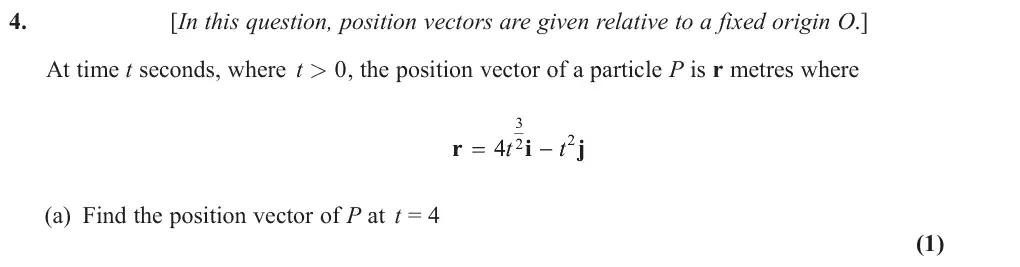
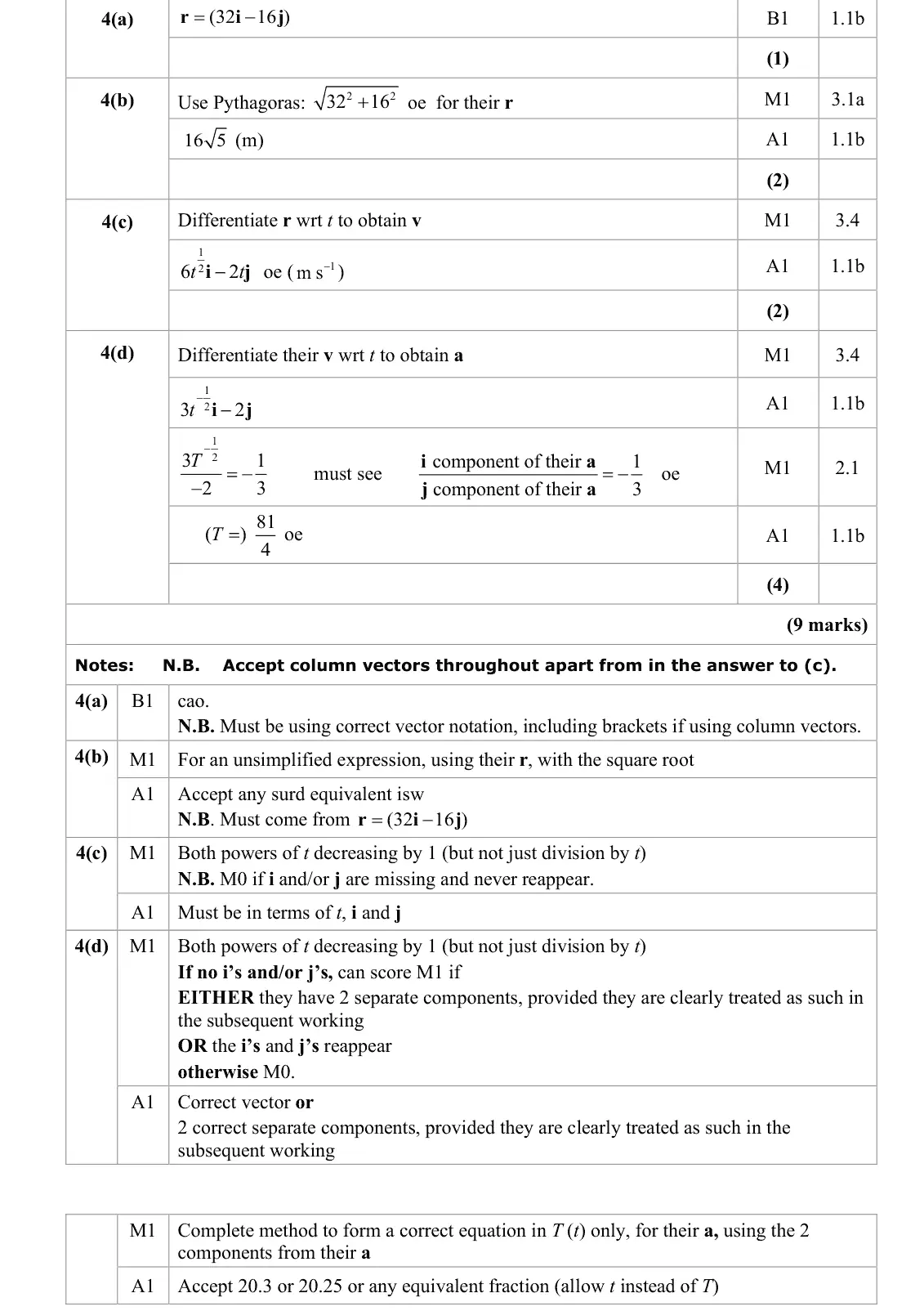
In part (a) almost all responses substituted t = 4 into the given position vector and obtained the correct answer. Occasionally there was a sign error in the j term or the answer was not stated in proper vector notation, for example including i and j in a column vector, but such instances were rare.
Common mistakes
4 × 4^(3/2) = 32
watch the sign of the j term
correct vector notation
June 2024 · AS Paper 1 · Q14 marks
Mark scheme (whole question; this part is marked with the orange bar)
Examiner's comment
This was a very accessible question on integration to start the paper and most candidates were able to score well. Most candidates attempted to separate the fraction into two terms and achieved at least one correct index. The first term caused problems for some with errors such as 5 3 1 2 2 2 , , x x x - . A few ended up with three terms as they had added or subtracted 2 x-. A few tried to integrate the numerator and denominator or wrote 2 (2 3) x x- - but did not expand the brackets and integrated both inside and outside separately. Those who had scored the first M1 usually were able to raise the power by one on at least one term with a correct index and score the next method mark. Several made errors when processing the indices and ended up subtracting by one on at least one of the terms. A few made errors with the coefficients. The most common mistake was to forget the + c.
Common mistakes
split into 2x^(−3/2) − 3x^(−2) before integrating (writing −3/x² is not enough)
integrating numerator and denominator separately scores nothing
index slips such as x^(−5/2) or subtracting 1
forgetting + c is the most common error
answer on one line, simplified
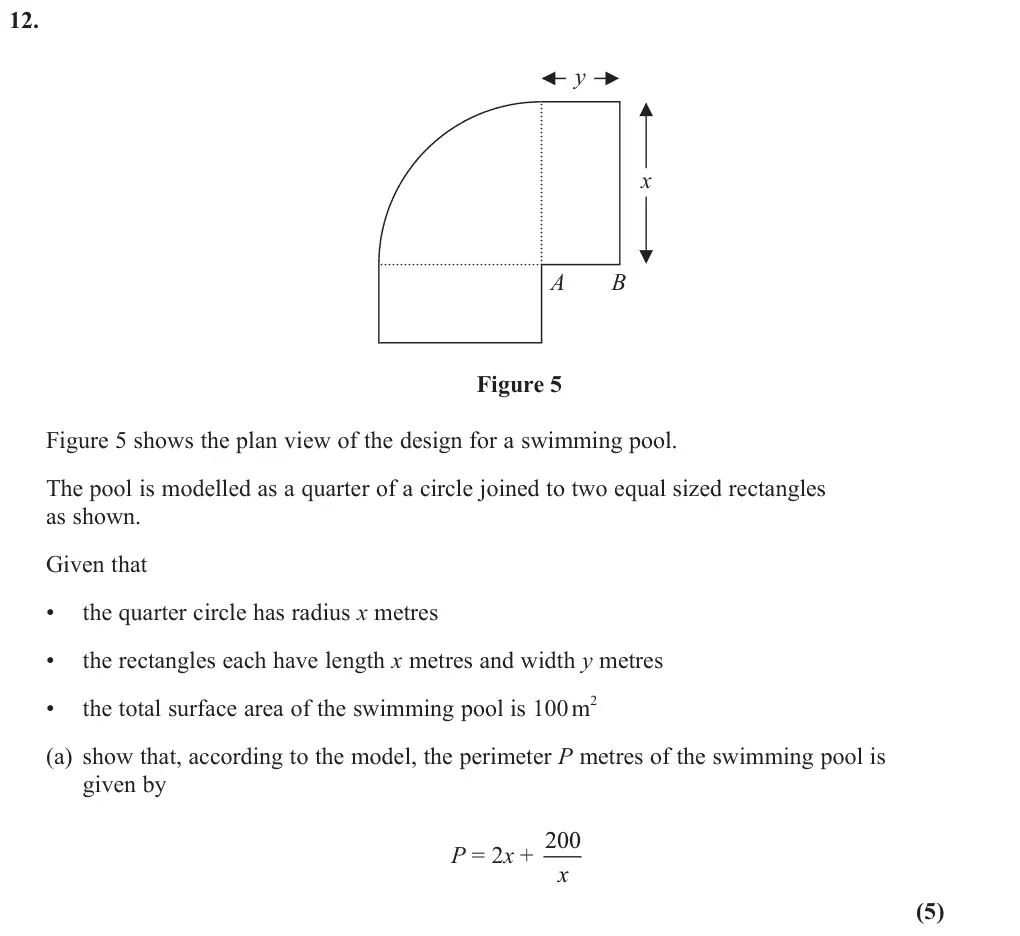
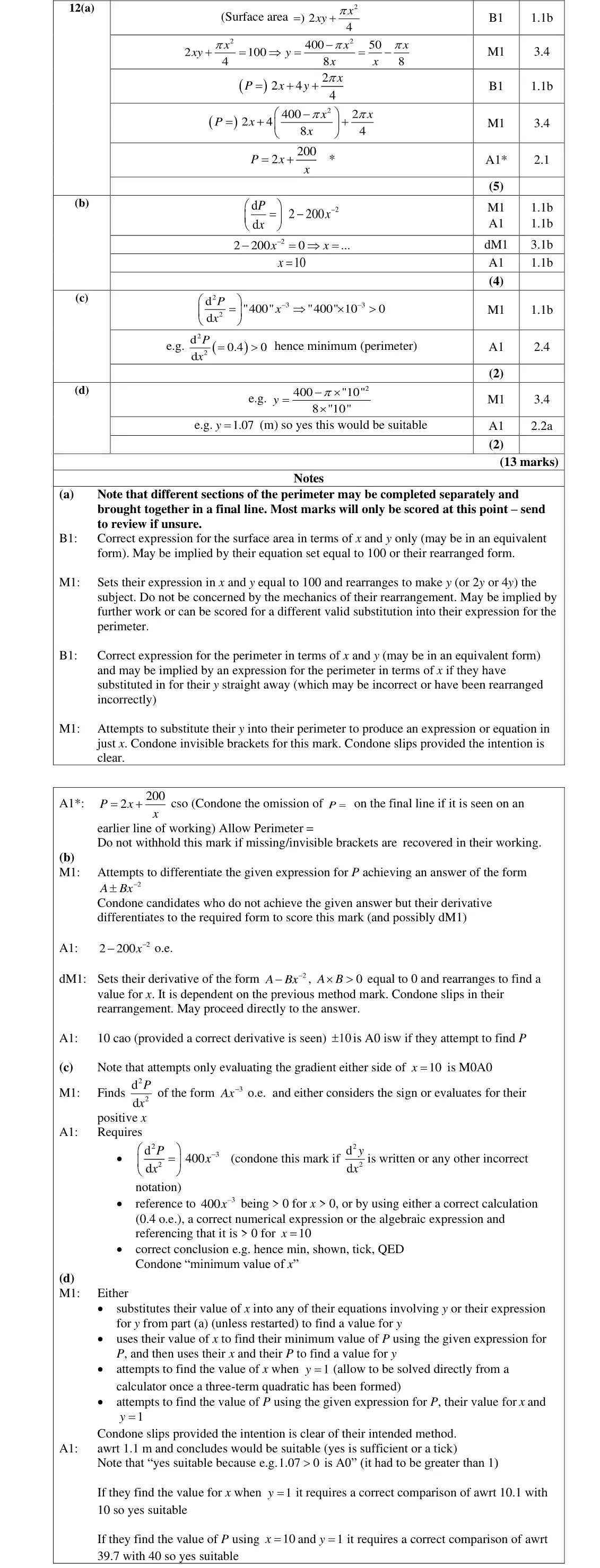
June 2024 · AS Paper 1 · Q12(a)5 marks
Mark scheme (whole question; this part is marked with the orange bar)
Examiner's comment
coming unstuck on part (a) without an attempt at later parts. This was a shame particularly as later parts of the question provided a good source of marks for many candidates. In part (a) attempts to find expressions for the surface area and perimeter of the given shape were often successful, although errors and slips were not uncommon. A correct expression for the perimeter was perhaps more often successfully achieved than a correct expression for the area. A relatively common error was in setting x as the diameter of the sector rather than the radius. A significant number of candidates found expressions in terms of r and could earn no marks until r was replaced by x. A minority of candidates equated the perimeter, rather than the area, to 100, but the vast majority made an attempt at the key step of rearranging their equation to find an expression for y in terms of x. Some candidates were more unusual in their choice of substitution: rather than finding an expression for y or 2y, they used effective and efficient substitutions for functions such as 100 x . Once the critical substitution was achieved, most candidates went on to successfully obtain the required result, although occasionally marks were lost due to arithmetical and/or sign errors, or for the omission of ‘P =.’ y using their value of x and the relationship derived in part (a), to determine whether y was greater than the required lower limit of 1. This approach was usually the most successful. Slightly more circuitous routes were also seen which involved employing the given expression for P to determine the minimum perimeter and then an additional y = and either x = 1 expression for P in terms of x and y, used with (to find P) or 10 P = (to find x). Often this approach fell slightly short of being complete as a final 40 comparison of x with the value 10, or a comparison of P with the value 40 was required to justify whether the swimming pool dimensions were suitable. Some candidates tried to draw conclusions but gave insufficient supporting statements such as ‘10.8 is close to 10, so suitable’, or ‘10.8 > 0, so suitable’ rather than the relevant ‘10.8 > 10, so suitable’. Other candidates were unable to gain marks here for irrelevant statements unsupported by calculation such as ‘suitable, although the pool might be a bit small.’ Others were x = confused about what value of x they should use and erroneously substituted (the 0.4 x = result value of the second derivative at ) into either their expression for y or their 10 expression for P.
Common mistakes
area 2xy + πx²/4 = 100 gives y = (400 − πx²)/8x
perimeter 2x + 4y + 2πx/4
substitute to reach P = 2x + 200/x
x is the radius, not the diameter
equating perimeter to 100
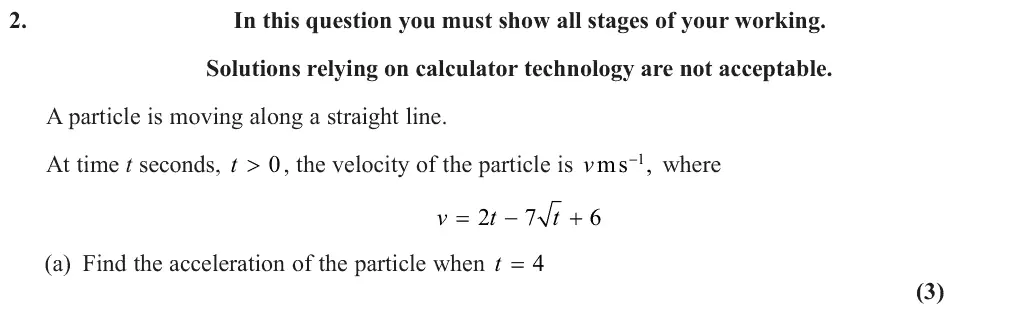
June 2024 · AS Paper 2 (Mechanics) · Q2(a)3 marks
Mark scheme (whole question; this part is marked with the orange bar)
Examiner's comment
In part (a), most differentiated the given expression for v with respect to t to get to an expression for their acceleration. Candidates usually handled the powers correctly but there were the occasional errors in the coefficients or an error in the substitution of t = 4. Some tried to use suvat formulae to find the acceleration and a few integrated rather than differentiated.
Common mistakes
a = dv/dt = 2 − 7/(2√t), so a = 0.25 m s⁻² at t = 4
integrating instead of differentiating
suvat cannot be used (acceleration not constant)
June 2024 · Paper 1 · Q9(a)3 marks
Mark scheme (whole question; this part is marked with the orange bar)
Examiner's comment
Part (a) was a discriminatory question with many different approaches seen; the mix of algebraic indices coupled with a geometric sequence caused problems for many candidates and often work lacked structure. It was evident that many candidates are not as familiar with the laws of indices as they should be and are not practised in the set-up of proof questions. The layout of candidates work varied enormously and they should be encouraged to practice showing a proof that flows and that is not interrupted by their thought processes. Despite the challenges many faced in part (a), the majority of candidates found part (b) to be accessible due to the given answer in (a) providing a restart opportunity. In part (a), many candidates were able to achieve full marks by setting up an appropriate equation, changing to the common base of 3 and using the index laws to form a linear equation in k and then solving. The most common (and successful) method was using 2 ar ar a ar = and then changing to the common base of 3, using the power law of indices and, either subtracting the indices or by cross-multiplying and then adding the indices. The most common error, which was highly prevalent, was incorrect use of the division/subtraction law of indices – whereby they divided indices rather than subtracted and then formed quadratic equations in k, resulting in no further marks being awarded. Most initial difficulties arose from not understanding how to use the power law correctly for 7 2 9 k - or failing to notice that the bases needed changing at all and many simply subtracted the indices regardless of the differing bases. Changing the base to 9 was rarely seen and attempts at using logarithms were mostly unsuccessful as again, the laws were not generally adhered to. Some candidates demonstrated a lack of understanding of indices by multiplying the bases but adding the indices to achieve ( ) 2 7 2 6 7 81 9 k k - - = . These were given some benefit of doubt and awarded one mark by a special case in the mark scheme, provided the rest of their processing was correct. Other candidates tried to verify the sequence being geometric by substituting in the given value of k, which did not satisfy the demand of the question. These attempts were allowed to score a maximum of 1 mark but were often unsuccessful as not enough of a conclusion was made. It is also worth noting that candidates should pay attention to the form of the given value and realise that this is what is required; an equivalent fraction 35 14 k = was not accepted for the final mark.
Common mistakes
equate ratios (u₂² = u₁u₃)
write 9 as 3² and use index laws to get a linear equation in k
index-law errors very common
verifying k = 5/2 earns only a special case
June 2024 · Paper 1 · Q9(b)3 marks
Mark scheme (whole question; this part is marked with the orange bar)
Examiner's comment
Part (b) was well attempted and generally candidates were highly successful even if part (a) was poorly attempted or not attempted at all. The majority of candidates were able to evaluate both a and r having used k to find the terms in the sequence first, they then used the sum to infinity formula correctly to achieve the answer, resulting in 3 marks. Unfortunately, some candidates found the reciprocal of the ratio which gave them a value of 3 and some mistakenly thought that 5 2 r = , neither of these values met the limitations of the infinite sum formula but this was not spotted by candidates.
Common mistakes
a = 243, r = ⅓, S∞ = a/(1 − r) = 729/2
r = 3 (reciprocal) or 5/2 is invalid since modulus of r must be < 1
June 2024 · Paper 1 · Q10(a)1 mark
Mark scheme (whole question; this part is marked with the orange bar)
Examiner's comment
Part (a) was accessible to most candidates although many did not recognise the difference between being asked to “verify” as opposed to “solve”. The most efficient y = x = 0 method was to substitute and verify that and most did this succinctly. It 4 5 - = 8 x 0 x was equally common to see candidates attempt to solve . Correct processing 2 3 x = x = 8 to leading to was required for the mark. This approach was far less likely 4 2 to score the mark due to errors with indices or incomplete processing.
Common mistakes
verify: substitute x = 4 to get 32 − 32 = 0 rather than solve
June 2024 · Paper 1 · Q14(c)2 marks
Mark scheme (whole question; this part is marked with the orange bar)
Examiner's comment
This question involved a balloon modelled as a sphere such that its radius was increasing at a rate that was inversely proportional to the square root of the radius. full marks in parts (c) and (d). this question to go on and successfully answer part (c). This question was generally very well attempted, and most candidates used correct processing to calculate the correct value. However, some failed to do so with the required accuracy or made an error in unit conversion. Many did not give the correct units, or any units, forfeiting the final 3 r = 118 mark. There was a significant minority who, having progressed to , failed to 2 3 118 and did not score use correct processing to solve the equation, incorrectly finding 2 the method mark as a result. A single mark was available in part (d), for suggesting a limitation to the model, and for
Common mistakes
r = 118^(2/3) = 24.1 cm (nearest mm), units needed
index errors e.g. √118³
June 2024 · Paper 3 (Mechanics) · Q4(c)4 marks
Mark scheme (whole question; this part is marked with the orange bar)
Examiner's comment
(c) Many of those who differentiated in (b), successfully differentiated their velocity vector to obtain the acceleration vector. However, a significant number of candidates did not know how to proceed from there and the second stage of the process proved to be a discriminator. It was only the stronger candidates who realised that their acceleration vector had to be a multiple of the given vector. Those who did make this link generally were able to complete the question successfully. A number of unsuccessful candidates just set the i-component of the acceleration equal to -1 (or more rarely to -27). Most of k -- those who compared a to ( 27 ) i j were able to reach an equation in t only which they then tried to solve. Fewer candidates used a ratio approach but a significant minority of these used the reciprocal of the correct ratio but were still able to score the method mark. Having reached a correct equation in t or T only, some then struggled to obtain the correct answer. There were a few candidates who tried to use a suvat approach for this part not realising that this was not a constant acceleration situation and scored nothing.
Common mistakes
a = −(3/4)t^(−3/2)i − (3/4)j must be a multiple of (−i − 27j): use the ratio of components (not the reciprocal)
setting the i component equal to −1 is wrong
T = 9
June 2023 · AS Paper 1 · Q24 marks
Mark scheme (whole question; this part is marked with the orange bar)
Examiner's comment
This question was generally not particularly well answered, especially as it appeared early in the paper, with the majority scoring two or fewer marks out of the available four marks. The majority of candidates identified that a quadratic equation needed to be solved to progress, although some struggled to reach a suitable equation. It was notable that significant proportion of candidates ignored the question’s requirement to show all stages of their work, directly solving their quadratic in u with their calculator. They immediately, therefore, forfeited the first two marks which required candidates to demonstrate that they can solve a quadratic without reliance on a calculator. Those who did show their method and attempted to factorise, generally did so successfully and reached solutions in terms of u. Another common error, however, was then to forget to square their values of u so they did not reach values of x. Furthermore, candidates very often also did not reject the invalid 25 4 x = , which resulted from 5 2 x = - , so that the majority of candidates did not score the final mark. While factorising was by far the most common approach to solve the quadratic, other approaches included use of completing the square or the quadratic formula, and a very few squared the original equation and attempted to solve 36x2 – 289x + 400 = 0.
Common mistakes
form 6u² + 7u − 20 = 0 and show a method (factorise, formula or completing the square), not calculator roots
square u = 4/3 to get x = 16/9
reject u = −5/2 (√x cannot be negative), so x = 25/4 must be discarded
June 2023 · AS Paper 1 · Q145 marks
Mark scheme (whole question; this part is marked with the orange bar)
Examiner's comment
This question required candidates to isolate the required terms from the binomial expansion of 6 1 3 2 x - and is a reasonably familiar question from previous papers, but this was less structured to those that candidates have seen before. Many candidates elected to attempt the first few terms of the binomial expansion of 6 1 3 2 x - despite there being no requirement to do so, probably due to it being the most common first step of these questions. For those that took this approach, most candidates managed to begin the expansion correctly, but there were a lot of instances where the brackets were missing around 1 2 - . Often this was recovered and either one or both of the required terms were found correctly. A significant proportion of the candidates who got so far progressed either to multiply the 5x term by 5 and/or the 3x term by 8 and gained the second method mark, but often only one of the two required terms were found, scoring a maximum of 3 out of 5. Many candidates who achieved a ‘correct’ answer had left in the 5x and were only able to achieve full marks because the mark scheme condoned this. Candidates in future series must ensure that they fulfil the demand of the question and select the coefficient required. There were, however, a pleasing number of concise solutions in which candidates decided which terms were needed at the outset and elected only to find those that were required. These were often fully correct.
Common mistakes
only terms in x³ and x⁵ of (3 − x/2)⁶ are needed: ⁶C₃3³(−x/2)³ = −135x³/2 and ⁶C₅3(−x/2)⁵ = −9x⁵/16
multiply by 8x² and 5 and add: −8685/16
missing brackets on −1/2
finding only one of the two terms
June 2023 · AS Paper 1 · Q166 marks
Mark scheme (whole question; this part is marked with the orange bar)
Examiner's comment
Generally, the candidates that made a full attempt at this question did very well by achieving full marks or at least 4 out of 6. However, many failed to use the information in the second bullet point fully (that the curve has a stationary point at ( ) 4,3 ). The majority of the candidates achieved the first mark by understanding that the stationary point at ( ) 4,3 meant that the first derivative must be equal to zero at 4 x = , arriving at 16 2 0 a b + + = . Again, the majority went on to perform the integration of the gradient function ( ) 4 d x a x b x + + to achieve ( ) 3 2 2 2 f 2 3 x x ax bx c = + + + with the majority able to determine that 5 c = -. A common error was to achieve 3 2 3 2 ax following integration, although those who had written the unsimplified 3 2 3 2 ax were still able to access the intermediate accuracy mark. Common problems were for candidates to misinterpret the information about the stationary point, either using ( ) f 4 3 = or ( ) f 4 0 = , or to miss out a constant of integration, which often resulted in concluding that b was 5 -. It was fairly common to see candidates substitute a rearranged 16 2 0 a b + + = into their integrated expression (usually for b) and this typically did not hinder further progress, although it did result in some sign errors that meant their final expression ( ) f x was incorrect.
Common mistakes
stationary at (4, 3) means f′(4) = 0 (16 + 2a + b = 0) and f(4) = 3, not f′(4) = 3
integrate a√x to (2/3)ax^(3/2)
+ c with c = −5 (b = −5 is wrong)
a = −15, b = 14
f(x) = 2x² − 10x^(3/2) + 14x − 5
June 2023 · Paper 1 · Q14 marks
Mark scheme (whole question; this part is marked with the orange bar)
Examiner's comment
This was an accessible question for virtually all candidates. The fractional index had already been given to avoid any misconceptions. However, for the first question on the exam paper, this was frequently done poorly compared to previous years. Candidates may have anticipated a tougher start to the paper and wanted to demonstrate one of the more advanced integration techniques. Candidates who spotted that you needed to expand the brackets usually went on to score full marks. The most common reason for losing the final answer mark was forgetting the constant of integration. Many candidates failed to notice the simpler method in the main mark scheme and instead attempted to use integration by parts, with either part taken as u. If a candidate chose to set 2 5 u x = -, they did not always expand the brackets in their integration formula to achieve a form which was ready to integrate where the indices had been combined correctly. Candidates who set 1 2 u x = were more successful, as there was less working to do to allow access to the marks. Candidates who chose to do integration by parts did not always combine the terms in their answer, losing the final mark. Many candidates would divide both their u and 'v by 3, leading to final answers that were 1 3 as large as they should have been. Integration by substitution was occasionally seen, but rarely successfully completed. Most attempts involved setting 2 5 u x = -, and this resulted in a tougher integral that required further work; candidates rarely progressed to a point which would have been worthy of a mark. Across the various methods, a common error seen was initially to factorise out the 1 3 , work through the solution without it, but then to forget to reintroduce it. This error meant that neither of the two accuracy marks were available.
Common mistakes
multiply out first, then integrate term by term (by parts or substitution is much harder and rarely successful)
integrating numerator and denominator separately scores nothing
forgetting + c
taking out the 1/3 and not putting it back
June 2023 · Paper 1 · Q6(a)1 mark
Mark scheme (whole question; this part is marked with the orange bar)
Examiner's comment
This was again another accessible question with a total of 6 marks split between 3 different sub-parts. However, this topic continues to be one which candidates struggle with and in all parts of this question. It was not uncommon to see candidates attempting to use rules of indices rather than logarithms, starting off with 2a x = , 2 8 b x = + and attempting (usually incorrectly) to substitute these into the expressions given. Where this was successful candidates generally failed to remove 2 log 2 resulting in them losing one mark per part. Part (a) was a B mark for achieving the correct answer. Several candidates got as far as 2 0.5log x without substituting a into this and so gained no credit. Others could not apply the index log law to the square root of x correctly and so ended up with the answer square root of a often written as 1 2 a
Common mistakes
answer must be in terms of a (½a), not ½log₂x
√a is a common wrong answer
June 2023 · Paper 2 · Q11(b)5 marks
Mark scheme (whole question; this part is marked with the orange bar)
Examiner's comment
Many candidates found this question challenging and there were a significant number of blank responses. Approaches to part (b) of the question were very mixed. Many candidates failed to realise that, as the question said, ‘use the model to find an equation’, they were expected to, for example, separate the variables and use calculus to solve the differential equation. As they were asked to give their answer in a specific form, a large number started from this and found the constants A and B using the given values of t and h. Fortunately, they were able to gain two marks from the h , although special case. Candidates who used calculus rarely had problems integrating 3 h or in dealing with the 2 2 errors were seen later when substituting into when rearranging the 3 equation. Candidates who started this part with the 𝜆 were generally more successful. Some candidates correctly found c and 𝜆, and then rearranged. Others rearranged before making substitutions, stating 3 and 3 = = A 2 c B . A minority lost the second accuracy mark as they 2 did not give the final equation in the correct form. Some candidates who had correctly found d 1 h k k = solved the differential equation using 200 in place of 𝜆, in most cases d 200 t h successfully, although the algebraic manipulation was more tricky. Some candidates who had made an incorrect attempt at (a) continued with their answer, usually d 1 1 h = , in this d 200 t h part. As they only had one constant, the ‘c’, in their expression, they could only attain the first two method marks. It was rare to see the constant of integration missed and basic arithmetical errors when finding either 𝜆 and c or A and B were also relatively infrequent. The alternative approach, rearranging to give d t h or 200 h = was seen on a few occasions. d h k The majority of candidates who had a correct form of the equation in part (b) made a good attempt at part (c) and were generally able to gain the method mark. Relatively few lost the
Common mistakes
separate variables: ∫√h dh = ∫λ dt gives (2/3)h^(3/2) = λt + c
t = 0, h = 1.44 gives c = 1.152
t = 8, h = 3.24 gives λ = 0.342
h^(3/2) = 0.513t + 1.728
starting from the given form without integrating scores only 2 marks
June 2022 · AS Paper 1 · Q14 marks
Mark scheme (whole question; this part is marked with the orange bar)
Examiner's comment
The vast majority scored M1 for either 2x4 or 5x. The most common error was dealing with coefficient of 1 2 x with a substantial number of candidates who were unable to process the fractional power. Many candidates rewrote the term as 1 2 3 2 x while others made mistakes with the coefficient and rewrote it as 1 2 6x or 1 2 6x -. A few attempted to integrate both the top and bottom of the fraction. Of those who had rewritten the term correctly as 1 2 3 2 x -some made mistakes when simplifying the coefficient of the integrated term. 1 2 3 4 x was seen several times. Sometimes the correct unsimplified expression was seen first but several candidates just wrote down their answer without showing their workings. Quite a few omitted + c following 3 correct terms and lost the final A1. Some candidates still lack confidence with notation such as an integral sign or dx appearing on the final line which resulted in the final mark being lost.
Common mistakes
write 3/(2√x) as (3/2)x^(−½) first (fractional power errors common)
coefficient −3x^½ (−¾ and 6 seen)
5 integrates to 5x
forgetting + c
integral sign or dx left on the final line loses the last mark
June 2022 · AS Paper 1 · Q6(b)2 marks
Mark scheme (whole question; this part is marked with the orange bar)
Examiner's comment
The binomial question was fairly typical in its structure, so most candidates were able to make a lot of progress in part (a), but part (b) proved to be much more challenging. Part (b) on the other hand was misunderstood by many candidates. Several simply stated the coefficient of the 2x term in their expansion, or attempted to multiply the bracket by their coefficient of 2x , leading to variations of ( ) 2 3 504 504 x x x - . A significant minority understood what was being asked of them, but incorrectly wrote 1 2x as 1 2x- instead of 1 1 2 x-.
Common mistakes
(x − 1)/(2x) = ½ − 1/(2x), so the x² coefficient is ½(1008) − ½(−448/3) = 1736/3
quoting 1008 or multiplying the bracket by the coefficient is wrong
1/(2x) is ½x^(−1), not 2x^(−1)
June 2022 · AS Paper 1 · Q9(b)4 marks
Mark scheme (whole question; this part is marked with the orange bar)
Examiner's comment
Candidates still find working with logs a challenge and this type of question requires a careful approach to applying the laws of logarithms and making use of the “hence” which linked the two parts together. In part (b), a pleasing number of the candidates received full marks with the majority not connecting part (a) to part (b), often starting again from the original equation and using laws of logarithms. Those candidates that did see the link often went on to find 2 p = - and thus 1 3 x = . However, a significant number stopped after finding the value of p rather than x. Those that had the linear terms correct in part (a) found this part easy and many proceeded to gain full marks. Overall, there were far too many candidates unable to make any progress with this question on logs and many indicated a lack of understanding of the relationship 3 log 3p p x x = =
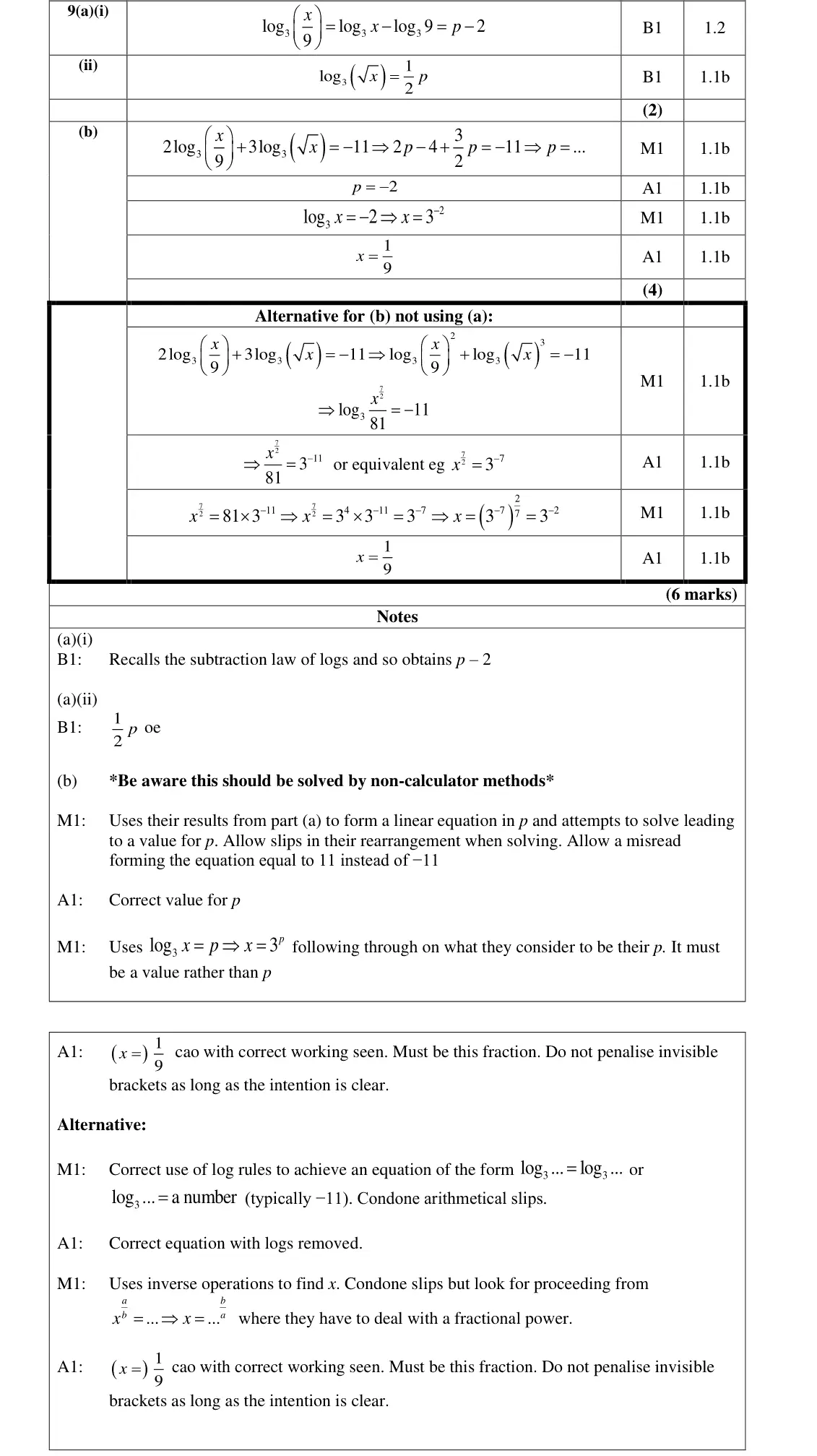
Common mistakes
use (a): 2(p − 2) + (3/2)p = −11, p = −2
then x = 3^p = 3⁻² = 1/9 (many stopped at p)
a fully log-laws method from scratch also works
June 2022 · AS Paper 1 · Q10(a)5 marks
Mark scheme (whole question; this part is marked with the orange bar)
Examiner's comment
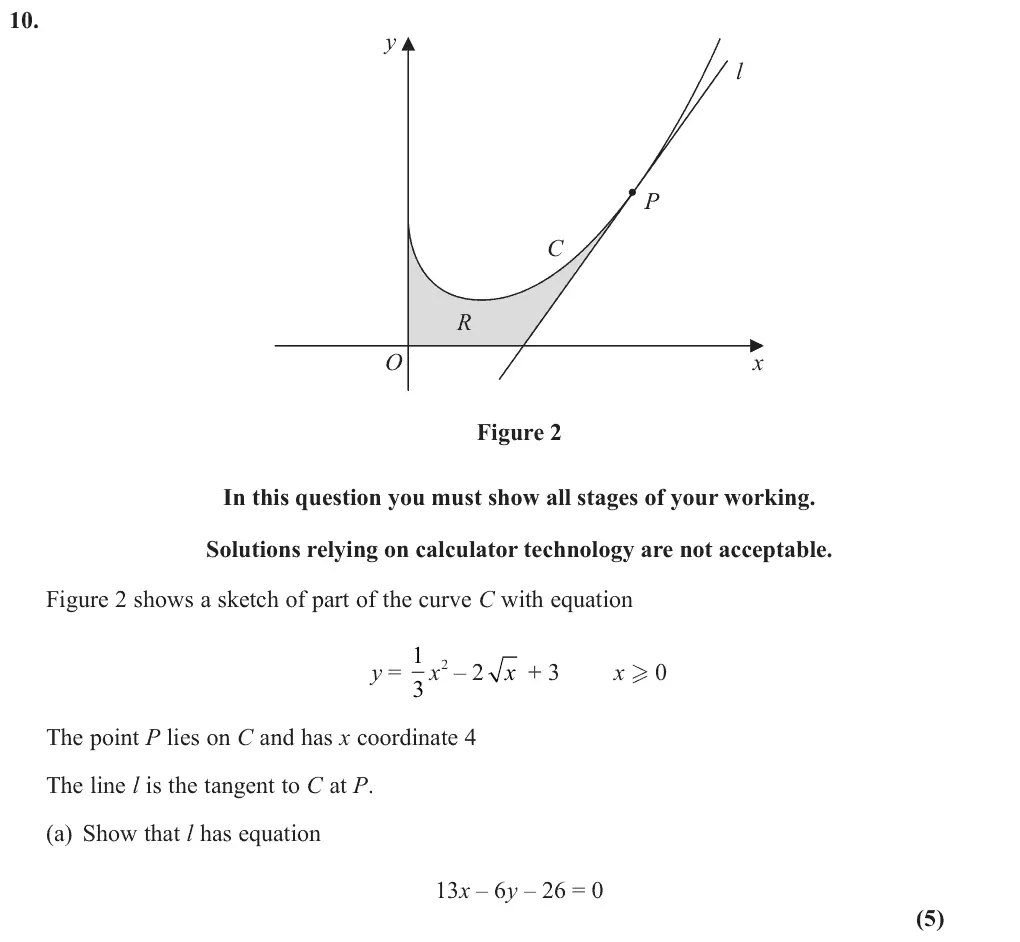
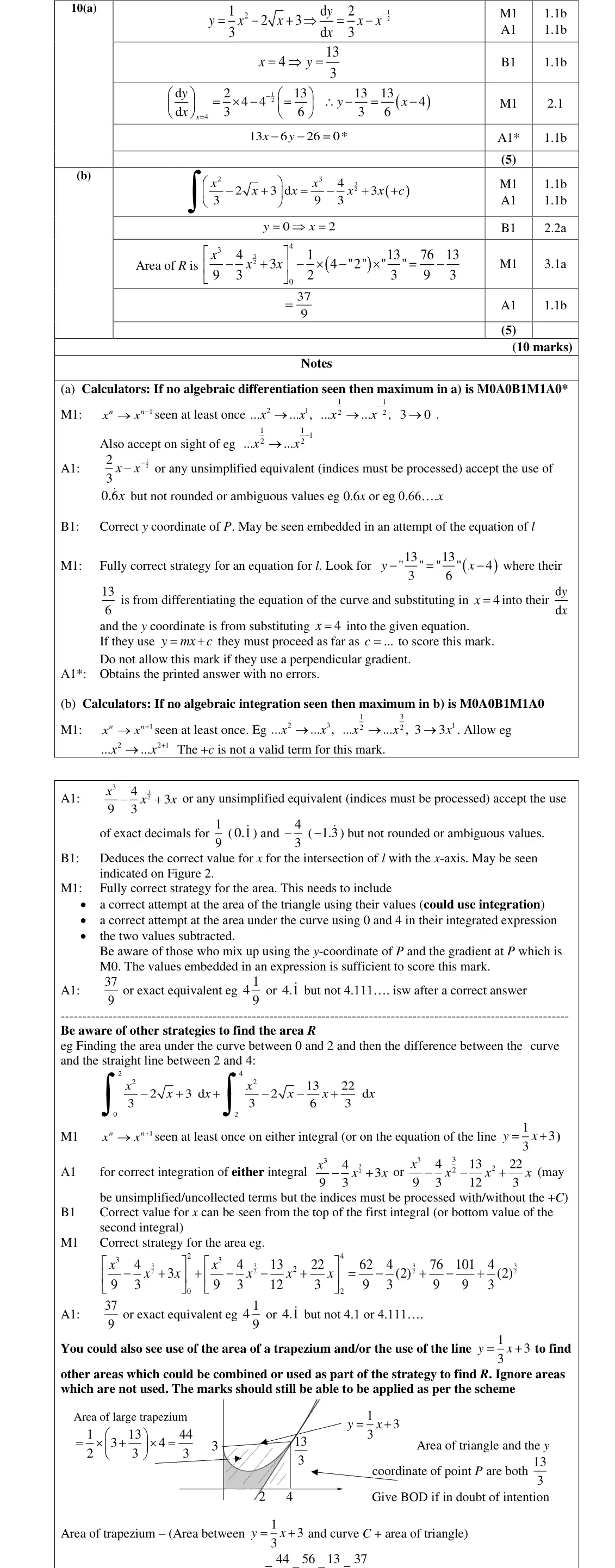
This question was, on the whole, well-attempted and provided some differentiation between candidates. In part (a), the majority of candidates were able to correctly work through the steps required to derive the equation of the tangent to curve C. The vast majority were able to successfully and accurately differentiate the equation of the curve and to evaluate it at x = 4 to find the gradient. Most were then able to determine the y coordinate of P (although some candidates appeared to use the equation of the tangent to find this value rather than the equation of the curve). Most were confident and well prepared to correctly find the equation of the tangent, commonly using 1 1 ( ) y y m x x - = - but also often y mx c = + equally successfully. A small number of candidates incorrectly worked with the gradient of the normal rather than the gradient of the tangent and there was sometimes confusion between the value of the gradient and the value of the y coordinate at P: 13 6 and13 3 respectively. There were a small number of 9 candidates who worked from the equation of the tangent and who appeared to be attempting to verify this equation rather than deriving it.
Common mistakes
dy/dx = (2/3)x − x^(−½), gradient 13/6 at x = 4
y = 13/3 from the curve (not from the line)
tangent not normal
derive the equation rather than verify it
June 2022 · AS Paper 1 · Q12(a)4 marks
Mark scheme (whole question; this part is marked with the orange bar)
Examiner's comment
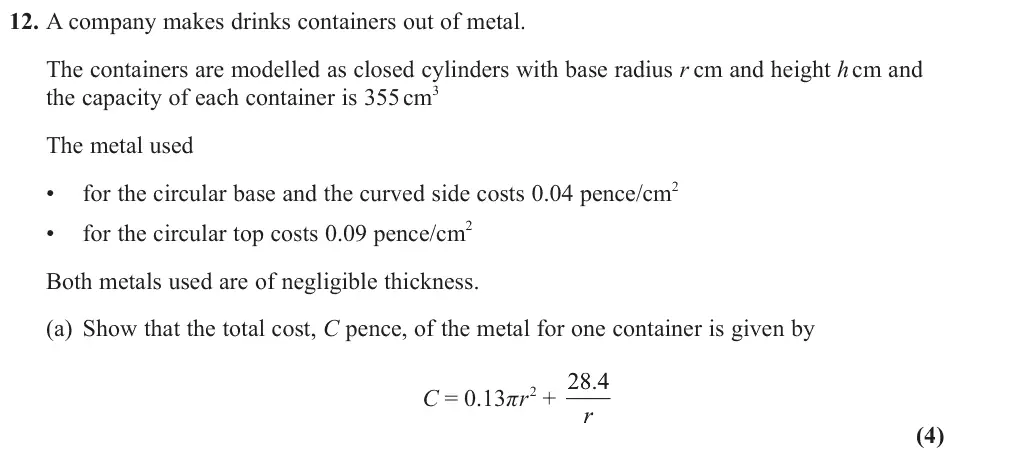
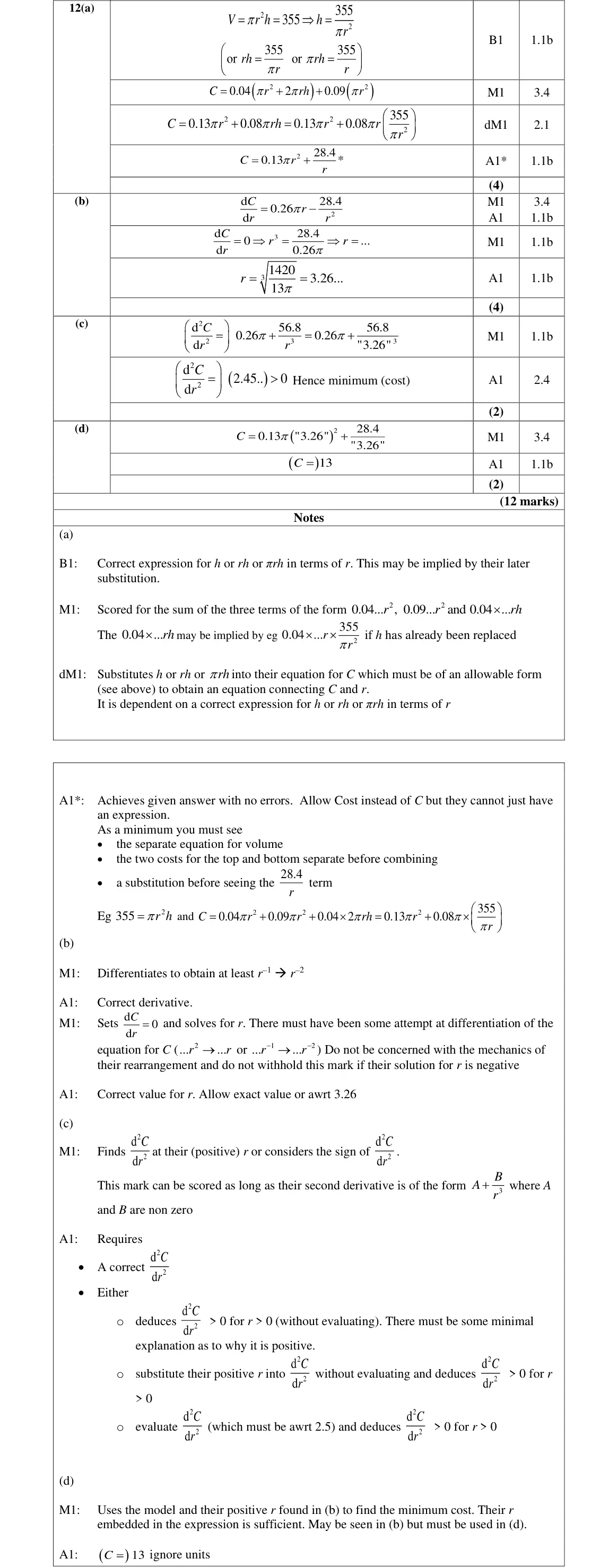
10 This was one of the most challenging questions on the paper for candidates, although it was a familiar structure to this type of problem and there was access to later parts as part (a) was a “show” question. Many candidates struggled with part (a). A few were able to gain the first B mark or make an attempt to sum the areas of the component parts, but many were unsure what to do with the 0.04 and 0.09. A significant number equated these to the expressions for area. Better candidates were able to clearly identify the two circular ends and the curved surface, attaching the correct costing to each and eliminating the h. The small minority of candidates then scored 3/4 as they omitted to use C = or Cost = . Although the answer was given for part (a) numerous candidates made no attempts in the later parts or failed to differentiate part (b) and so made no progress with part (c) or part (d).
Common mistakes
πr²h = 355 gives h
C = 0.04(πr² + 2πrh) + 0.09πr²
substitute for h and simplify
show the volume equation, the separate top and bottom costs and the substitution
write C =
June 2022 · AS Paper 1 · Q12(b)4 marks
Mark scheme (whole question; this part is marked with the orange bar)
Examiner's comment
10 This was one of the most challenging questions on the paper for candidates, although it was a familiar structure to this type of problem and there was access to later parts as part (a) was a “show” question. Most candidates achieved at least a method mark in (b) for attempting to differentiate. A significant number of candidates set the second derivative equal to 0 and solved, instead of the first derivative.
Common mistakes
dC/dr = 0.26πr − 28.4/r²
set the first derivative (not the second) to 0
r = ∛(1420/13π) = 3.26
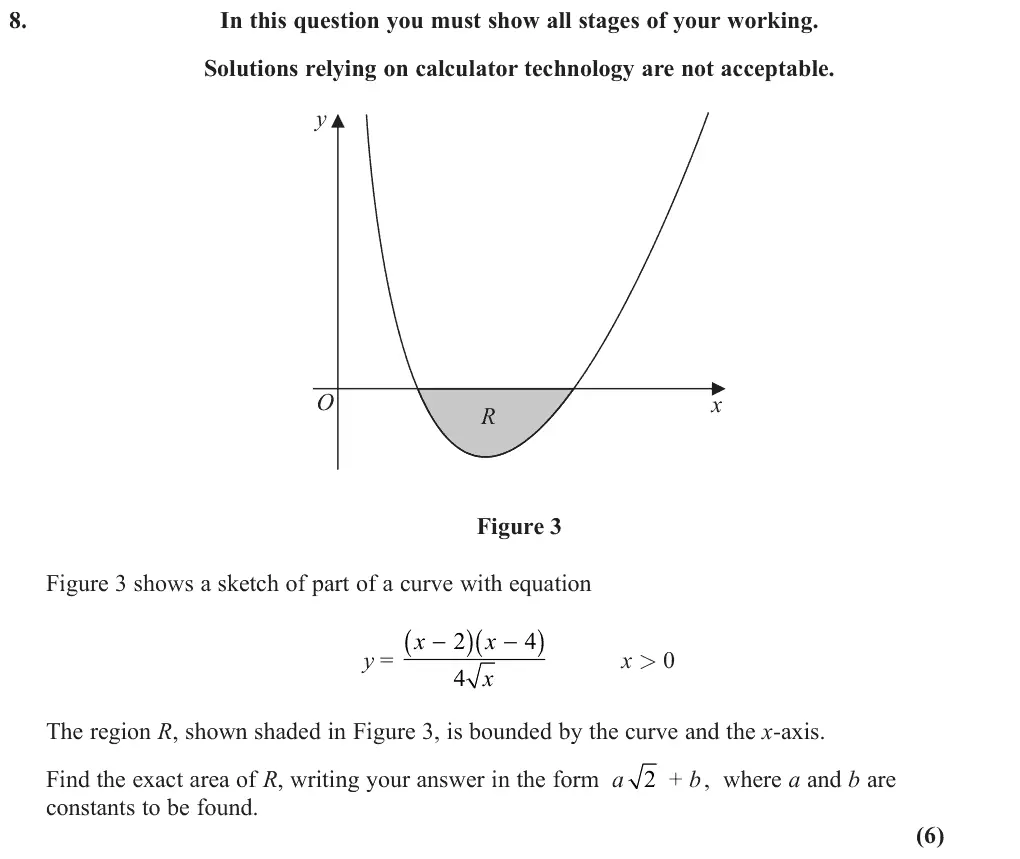
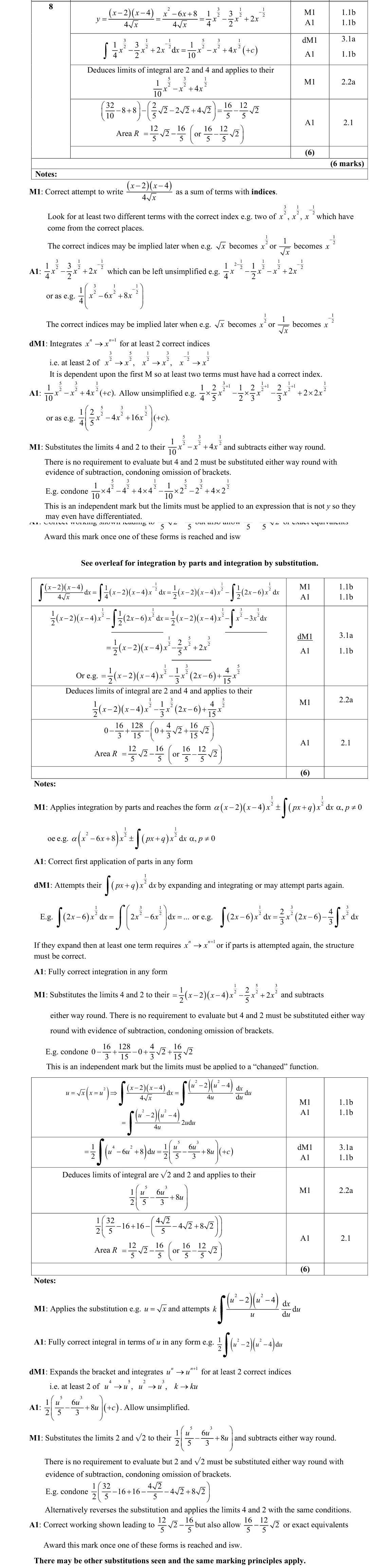
June 2022 · Paper 2 · Q86 marks
Mark scheme (whole question; this part is marked with the orange bar)
Examiner's comment
Most students knew that this question was to be solved by integration although a very small number thought that the question was about partial fractions, differentiation or a mixture of differentiation with integration. There were multiple approaches to solving this question including integrating a function with simplified indices, integrating by parts and integrating by substitution. The most common and the simplest method seen was multiplying out and simplifying indices. For the candidates who recognised that 4 sqrt x in the denominator should be rewritten as ¼ x -½ in the numerator there was a lot of success on this question. However, there were many candidates who brought the 4 to the top and left it as 4 rather than ¼ and earned a maximum of 3/6. Some wrote 4x½ in the numerator multiplying out to give incorrect powers and losing the first two method marks. Finding the correct limits and substituting them in a changed function was done by most leading to quite a few correct answers. Quite a few gave part or all of the final answer as a decimal, this was not surprising as most were using their calculators to do the final evaluation and calculator use did not leave the result of e.g. ( sqrt 2)5 as a surd. Some candidates recognised that the area needed to be positive, however the final answer was permissible even with a negative area. There were often errors in solutions constructed using integration by parts. There were mistakes made using the formula correctly, some bracketing errors, and some attempted parts the other way round getting harder expressions in the integral which mostly resulted for them a maximum of 1 mark (3rd M mark) obtained. There were a few incorrect substitutions selected for integration by substitution approaches, however candidates who chose u = sqrt x or u = 4 sqrt x were generally successful. A few candidates who set e.g. u = x – 2 in a substitution method scored few marks, if any, as such attempts did not progress the candidate towards a function they could integrate. In substitution method a few candidates made arithmetic errors in finding the new limits or did not attempt to change them at all.
Common mistakes
write as ¼x^(3/2) − (3/2)x^(½) + 2x^(−½) (4√x becomes ¼x^(−½), not 4x^(½))
limits 2 and 4 from the roots
exact answer (12/5)√2 − 16/5, not a decimal
by parts is much harder
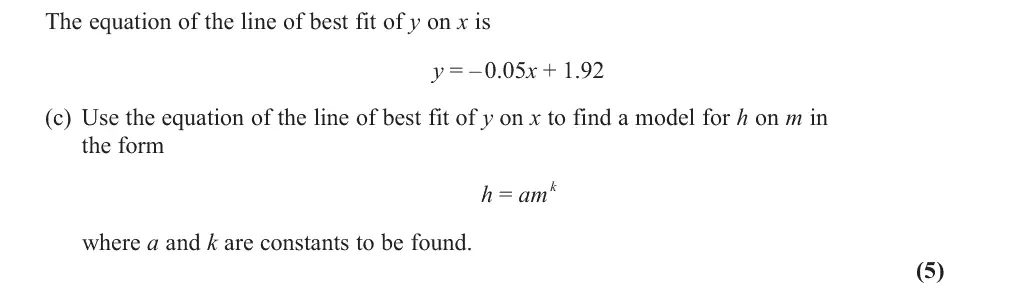
June 2022 · Paper 3 (Statistics) · Q6(c)5 marks
Mark scheme (whole question; this part is marked with the orange bar)
Examiner's comment
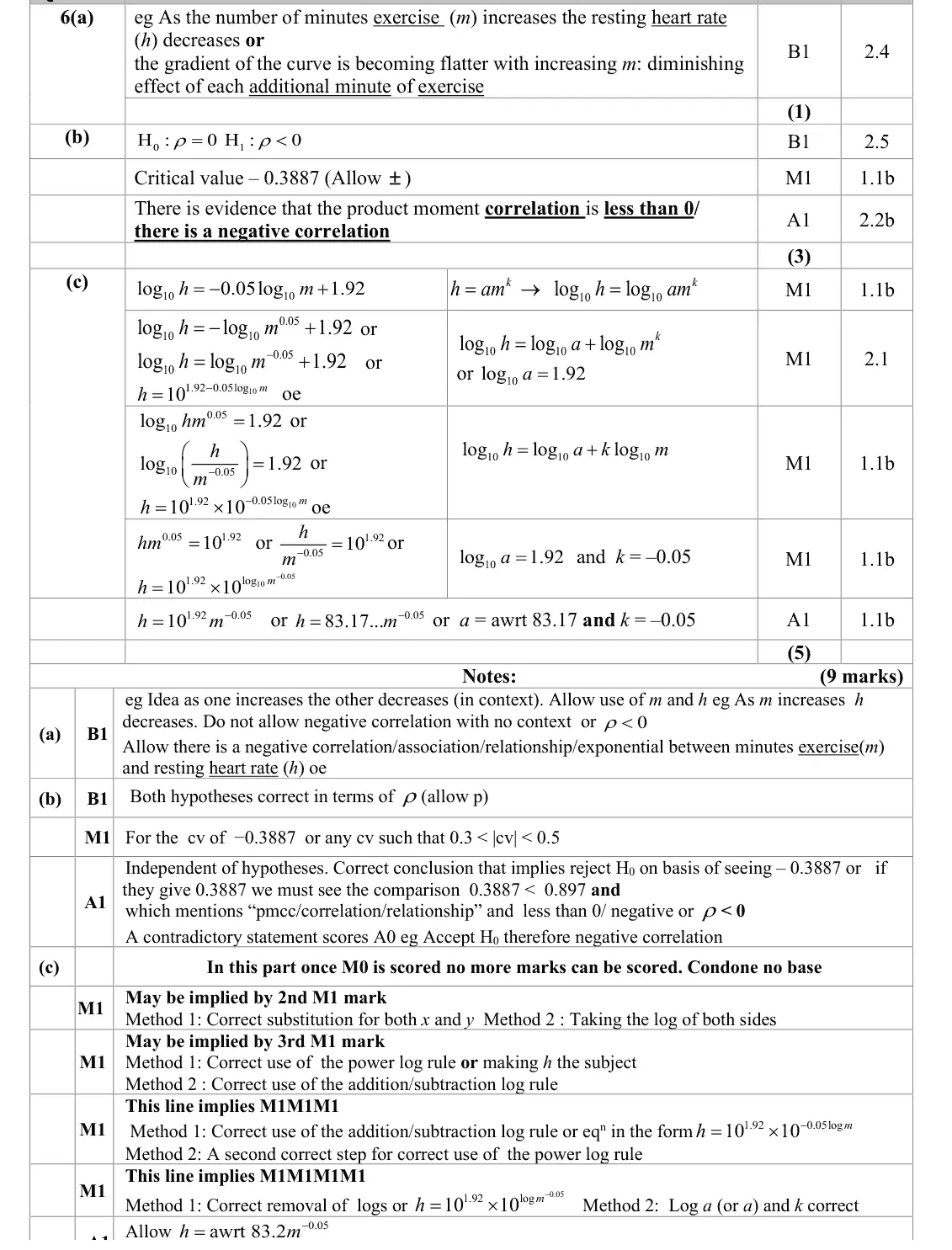
In part (a) a large number of students simply wrote ‘negative correlation’, with no context. The word Interpret in the question hints that context is required. Of the students that did try to truly interpret the correlation in a contextual statement, the vast majority were successful. Whilst many students realised that one- tailed hypotheses were needed in part (b) few used ρ for the parameter. Most students had ± the correct CV but the final A1 was lost by many students, as they compared the positive value 0.3887 to the negative test statistic. This showed these students were unfamiliar with the meaning of the CV/CR and how it related to their test statistic. Part (d) differentiated well between students with basic knowledge and those with deeper understanding. The majority of students scored 5/5 on this part. Almost all used the LH approach on the MS. This was usually well done, though a good number made errors with the laws of indices and maintained a + between the two terms after making the equation into powers of 10. The students knew their log rules, but many did only so to a basic degree, and came unstuck during their working. Sometimes this was to such an extent that they lost the marks. A surprisingly high number of students used natural logarithms and hence the exponential function in this question showing a less secure grip of this topic.
Common mistakes
substitute x = log₁₀m, y = log₁₀h
power and addition log laws
h = 10^1.92 × m^−0.05 = 83.2m^−0.05
keep the plus inside the log, not between powers of 10
use log base 10, not ln
June 2022 · Paper 3 (Mechanics) · Q1(a)2 marks
Mark scheme (whole question; this part is marked with the orange bar)
Examiner's comment
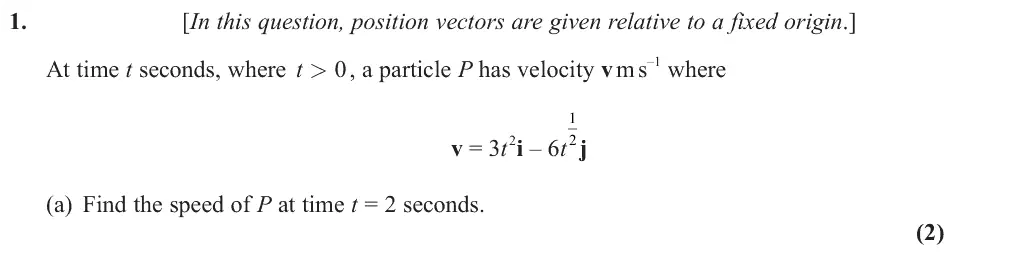
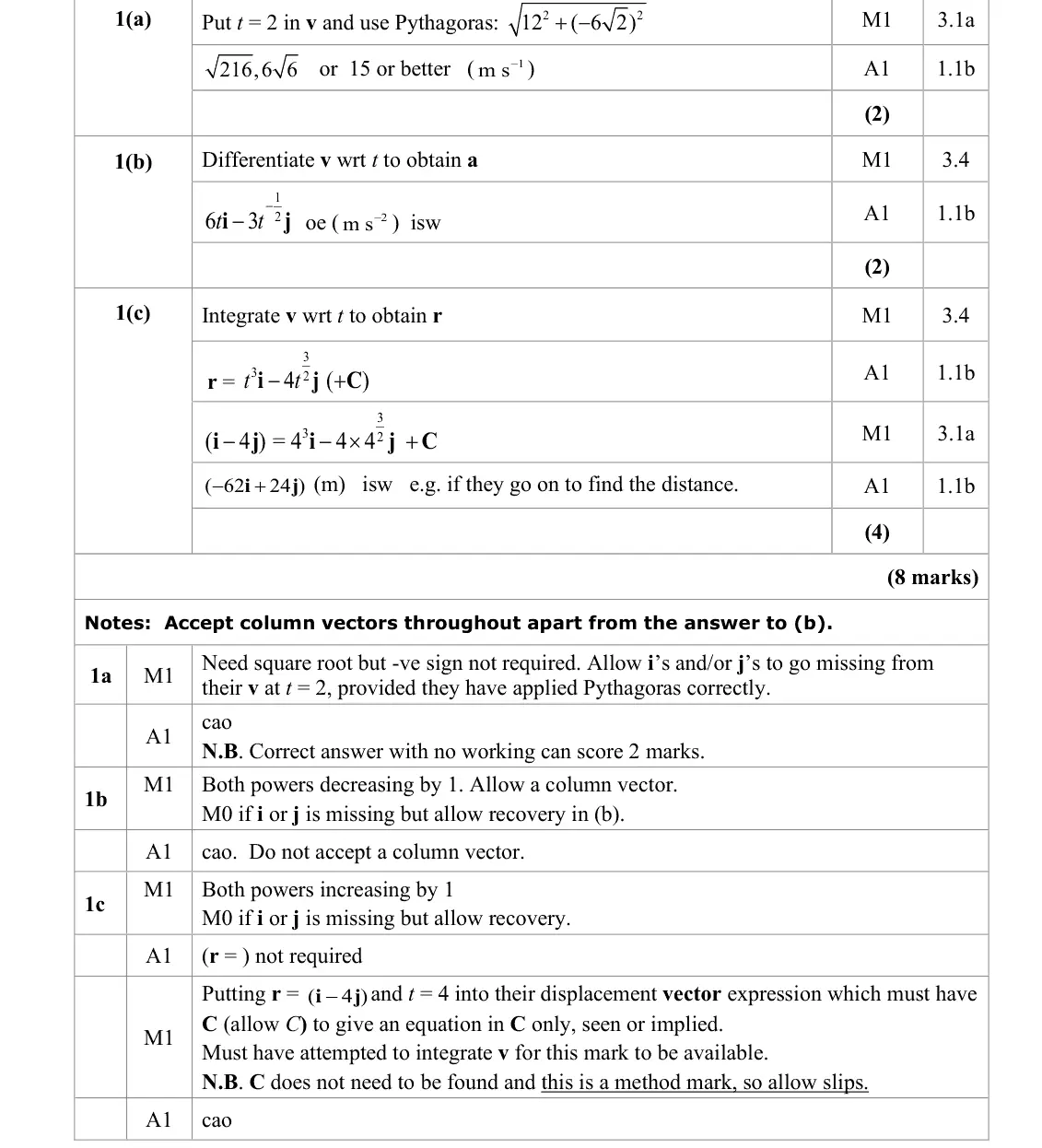
In part (a) most candidates correctly substituted t = 2 into the expression for the velocity and went on to use Pythagoras correctly to find an exact answer or an answer correct to the i and j and then finding 12-6 sqrt 2 rather than apply Pythagoras. A small number 2sf or better. Common mistakes were to stop once the velocity had been found, losing subtracted the squared values rather than adding in their Pythagoras. In the second part, most candidates identified that this was variable acceleration and differentiated correctly
Common mistakes
substitute t = 2 then use Pythagoras for speed (6√6, about 14.7)
stopping at the velocity vector
finding 12 − 6√2 instead of the magnitude
subtracting the squares
June 2022 · Paper 3 (Mechanics) · Q1(b)2 marks
Mark scheme (whole question; this part is marked with the orange bar)
Examiner's comment
and went on to use Pythagoras correctly to find an exact answer or an answer correct to the i and j and then finding 12-6 sqrt 2 rather than apply Pythagoras. A small number 2sf or better. Common mistakes were to stop once the velocity had been found, losing subtracted the squared values rather than adding in their Pythagoras. In the second part, most candidates identified that this was variable acceleration and differentiated correctly to find the acceleration vector. Common mistakes were losing either or both i and j and not recovering, integrating instead of differentiating and, despite the question specifying the answer was to be given in i j form, final answers given in column vector form were occasionally seen. Many candidates integrated to achieve the first two marks in part (c),
Common mistakes
variable acceleration so differentiate v (not integrate, not suvat)
keep both i and j
answer 6ti − 3t^(−1/2)j in i, j form, not a column vector
June 2022 · Paper 3 (Mechanics) · Q1(c)4 marks
Mark scheme (whole question; this part is marked with the orange bar)
Examiner's comment
occasionally seen. Many candidates integrated to achieve the first two marks in part (c), but not all used the displacement at t = 4 to find the constant of integration. Those that found a vector equation containing a constant of integration C, went on to find C and then substituted t = 1 to reach the correct answer although some responses contained numerical errors involving the negative signs. A common error was to use suvat formulae or r = r0 + vt. rather than integrate.
Common mistakes
integrate v and use r = i − 4j at t = 4 to find the constant vector C
suvat or r = r₀ + vt is invalid (acceleration not constant)
sign slips
answer −62i + 24j
Oct 2021 · AS Paper 1 · Q23 marks
Mark scheme (whole question; this part is marked with the orange bar)
Examiner's comment
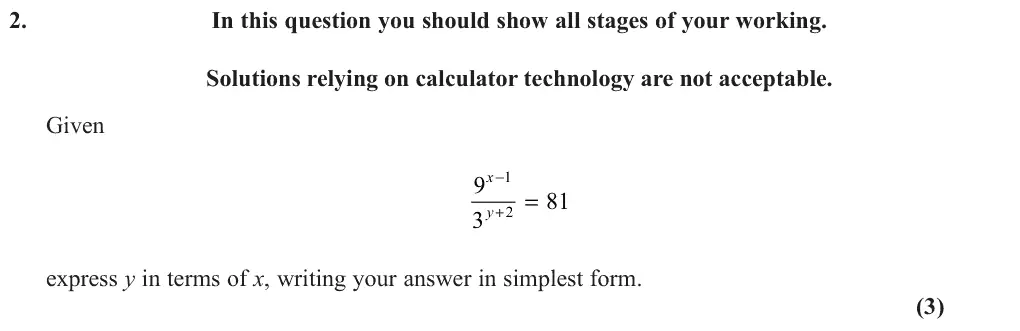
This question proved to be one of the most challenging questions on the paper. Most were able to score one mark, however, it was very rare for a candidate to achieve the correct final answer. A good number appreciated the need to make each of the terms as a 3 to the power of something. However, errors were often made in multiplying the power together on 2( 1) 3 x- or 9 was written as 33 . Others opted to try and log both sides, but those who did not state the base were unable to score as working in base 10 would not be possible without a calculator. Those who selected a suitable base were often able to score at least one mark, although a significant number of candidates either applied index laws or laws of logarithms incorrectly. It was disappointing that several candidates rearranged by multiplying both sides by 2 3y+ such that the left-hand side became 4 8 243 y+ thinking that the two base numbers could be multiplied together and that the powers would also be multiplied. Those who did achieve an equation where all the terms were 3 to the power of something were typically able to equate the powers and proceed to find an equation for y in terms of x. 4 However, some poor rearrangements by applying incorrect inverse operations meant that a correct final answer was rarely seen.
Common mistakes
write 9^(x − 1) and 81 as powers of 3: 3^(2x − 2) (not 3^(2x − 1))
81 = 3⁴, not 3³
equate powers 2x − 2 − (y + 2) = 4 so y = 2x − 8
if taking logs the base 3 or 9 must be stated
9 ÷ 3 cannot be combined into one base by multiplying
Oct 2021 · AS Paper 1 · Q34 marks
Mark scheme (whole question; this part is marked with the orange bar)
Examiner's comment
This question was very accessible; however, it was surprising that the majority were unable to score full marks on this question. This should have been a very straight forward question for those who had understood integration. However, a significant number thought that you could integrate the numerator and denominator of the fraction. Another significant number made errors when splitting the fraction into two separate terms. Errors often occurred in dealing with the 2 on the denominator and, as such, this restricted the maximum marks to 2 out of 4. Those who were able to separate the fraction correctly, were often able to score 3 out of 4, with typically the omission of the constant of integration being the reason for not scoring full marks.
Common mistakes
divide each term by 2x³ first: (3/2)x − 2x⁻³
integrating numerator and denominator separately scores nothing
errors with the 2 in the denominator
answer (3/4)x² + x⁻² + c
forgetting + c
Oct 2021 · AS Paper 1 · Q8(a)4 marks
Mark scheme (whole question; this part is marked with the orange bar)
Examiner's comment
The binomial expansion question proved to be very accessible to begin with, but for many, part (b) was too challenging so full marks was extremely rare on this question. In part (a), candidates were usually very successful in finding that 3 2 a = . Candidates typically wrote out all the terms up to the coefficient for 5x , although some did proceed straight to the required term. The small minority made errors with the correct binomial coefficient. Candidates were often able to equate their coefficient for 5x to the coefficient given in the question, although bracket errors meant that the most frequent error was not achieving 5a so no further marks could be scored in this part as they had simplified the question.
Common mistakes
term in x⁵ is ⁸C₅ 2³ (ax)⁵ = 448a⁵x⁵
brackets needed so a is raised to the 5th power
a⁵ = 243/32 gives a = 3/2
Oct 2021 · AS Paper 1 · Q94 marks
Mark scheme (whole question; this part is marked with the orange bar)
Examiner's comment
This question was typically answered well by most candidates and was possibly the most successful question on the paper. Candidates typically were able to manipulate the integral to achieve 1 2 ...x - , although those who omitted the negative did not score any marks on this question. Some candidates made errors dealing with the coefficient, but they were typically able to score half of the available marks on the paper. Whilst most proceeded to the correct answer, some incorrectly square rooted to find k rather than squaring.
Common mistakes
6x^(−½) integrates to 12x^(½) (sign of the index)
36 − 12√k = 20 so √k = 4/3
square, do not square root: k = 16/9
Oct 2021 · Paper 1 · Q9(b)7 marksMedium
Mark scheme (whole question; this part is marked with the orange bar)
Examiner's comment
This question was answered with varying degrees of success. Around 28% of the candidates failed to score any marks here at all, which was very suprising. There were however, many well formed and accurate solutions by careful candidates. In part (b)(i) it was rare to see fully correct expansions. Good candidates often lost the final mark due to an error in adding the required terms. A common error was forgetting to use their value for C and only adding the expansion for (1-2x)-1 rather than C(1-2x)-1. A few were unable to extract 2-1 correctly from (5x+2)-2 (usually having this as 2). Other errors seen involved an expansion of (1 + 2/5 x)-2 or else (1 + 5/2 x) 2 rather than (1 + 5/2 x) -2. Very few correct answers were seen for part (b)(ii) and this was very often not attempted. Those who did write a correct range sometimes also gave a second range which therefore did not gain the B mark here.
Common mistakes
write (5x + 2)⁻² as ¼(1 + 5x/2)⁻², not (1 + 2x/5)⁻² or a factor of 2
multiply (1 − 2x)⁻¹ by C = 2
f(x) = 9/4 + 11x/4 + 203x²/16
valid for modulus of x < 2/5 (the stricter range only
two ranges scores B0)
Oct 2020 · AS Paper 1 · Q3(ii)3 marks
Mark scheme (whole question; this part is marked with the orange bar)
Examiner's comment
This question really highlighted the dependence on calculators amongst candidates. Part (a) required simple rationalisation of a denominator and part (b) wanted candidates to work with indices/bases. In part (a) they perhaps did not fully appreciate the wording at the top of the question ‘Solutions relying on calculator technology are not acceptable’, whilst in part (b) they did not have the algebra skills to solve on their own. In part (a), when squaring both sides many candidates squared each individual term before 2x ; they seemed happier factorising the x out when the coefficients were combining the rational numbers. In a similar vein, many instead simplified the 18 and then factored out a common 2 , leaving multiple x terms in the equation. Some candidates opted to square both sides. Where a correct quadratic was built and solved, candidates gave both roots and lost the final mark. Where x was found with an irrational denominator, most candidates then went on to rationalise the denominator, but neglected to show the steps. In many cases it was clear they had typed into the calculator and read off the simplified display. When the question says ‘not relying on calculator technology’ candidates should be showing each step to secure the marks. The 18 must also be simplified when writing in simplest form. In part (b) log base 10 or natural logs were commonly used, and these could only be evaluated on the calculator. These scored no marks. Even where attempts were made to use 1 logs to base 4 or 2 there was an over reliance on calculators to find . The most log 4 2 2 common approach was to immediately take log base 4 and simplify the left-hand side. There 3 1 - log was then often little evidence of how they got from to . 4 4 2 2 Those who chose to rewrite as common bases more often led to full marks; base 2 was most common. Whilst the use of calculator technology is encouraged on the new specification, candidates should make sure that they are confident of working without one when required. 5
Common mistakes
write both sides as powers of 2 (2^(6x − 4) = 2^(−3/2)) or use logs base 2 or 4 with working
log₁₀ or ln needs a calculator and scores nothing
x = 5/12
Oct 2020 · AS Paper 1 · Q7(a)4 marks
Mark scheme (whole question; this part is marked with the orange bar)
Examiner's comment
7 The first part of this question was generally answered well with many candidates scoring full marks, but the second part proved to be more challenging for a disappointing number of them. In part (a), some candidates struggled with either rearranging the 5 2 x term to the form 1 2 5 2 x - or with getting the correct coefficient when integrating this to 1 2 5x . However, the majority of candidates were then confident in substituting both limits into their expression, subtracting and setting their result equal to 4, then rearranging correctly to get the required equation.
Common mistakes
write 5/(2√x) as (5/2)x^(−½) and integrate to 5√x
substitute both limits and set equal to 4
Oct 2020 · AS Paper 1 · Q7(b)4 marks
Mark scheme (whole question; this part is marked with the orange bar)
Examiner's comment
7 The first part of this question was generally answered well with many candidates scoring full marks, but the second part proved to be more challenging for a disappointing number of them. In part (b), some candidates struggled with identifying the given equation as a hidden three term quadratic, with a few trying unsuccessfully to simplify by multiplying every term by k, for example. Some candidates tried to square both sides but were mostly let down in this approach by mistakes in expanding out the brackets or simply squaring individual terms. Those candidates who were successful often proceeded by setting y k = , for example, and proceeding correctly to two values, which they then squared, but a number did not realise that they needed to discard the solution of 3 k = -. Some candidates confused themselves by setting k k = to produce a three term quadratic in k but then failed to realise they had not found the actual value for k.
Common mistakes
quadratic in √k: (3√k − 4)(√k + 3) = 0
reject √k = −3 so k = 9 is not a solution
square to get k = 16/9 (not √k)
Oct 2020 · Paper 2 · Q1(b)1 mark
Mark scheme (whole question; this part is marked with the orange bar)
Examiner's comment
Success in part (b) was mixed, with around half the candidates multiplying their answer by 3 and the others multiplying by 9. A minority of candidates restarted, losing access to marks in this question.
Common mistakes
the square root of 9x/(1 + x) is 3 times the original integrand, so multiply (a) by 3 (multiplying by 9 is the common error)
do not restart with the trapezium rule
Oct 2020 · Paper 2 · Q54 marks
Mark scheme (whole question; this part is marked with the orange bar)
Examiner's comment
Nearly all candidates combined the equations correctly and gained the first mark. Many then struggled to progress further. A few made mistakes with the indices such as changing 3(2x) into 6x but the most common mistake was attempting to take logs incorrectly, usually log15 - log(2(2x)) or log(15 - 2x+1 ) being wrongly expanded to arrive at log15 - (x + 1)log2. Those who realised 2x+1 = 2(2x) usually went on to solve correctly, giving a correct exact answer and therefore gain full marks. Candidates need to understand that seeing an equation with an unknown index does not automatically mean that it is a question involving logarithms.
Common mistakes
write 2^(x+1) as 2 × 2^x to get 2^x = 3
taking logs of 15 − 2^(x+1) term by term is wrong
exact answer log₂3
Oct 2020 · Paper 2 · Q7(a)4 marks
Mark scheme (whole question; this part is marked with the orange bar)
Examiner's comment
In part (a), most candidates used a correct method to differentiate, the majority using the quotient rule. A few applied the rule the wrong way round (uv’ – vu’)/v2. Candidates who initially wrote the quotient as 2𝑥𝑥 3 2 + 1 2 𝑥𝑥 1 2 were often more successful with the differentiation. A few candidates forgot about the 4lnx term but most dealt with this correctly. Errors from missing brackets or when simplifying their differentiated expression, in particular dealing with the powers, meant that many did not gain full marks in this part.
Common mistakes
split into 2x^(3/2) + ½x^(1/2) before differentiating (or quotient rule the right way round)
ln x differentiates to 1/x
no missing brackets in a show that
Oct 2020 · Paper 2 · Q7(b)3 marks
Mark scheme (whole question; this part is marked with the orange bar)
Examiner's comment
In part (b), although almost all candidates made dy/dx = 0 and reached 12x2 + x - 16 sqrt x = 0 the majority then failed to make progress and did not gain any marks. Several made no attempt to rearrange this equation and others made x2, x or sqrt x the subject but did not make the key step of dividing by sqrt x first.
Common mistakes
set dy/dx = 0, then divide by the square root of x first (key step usually missed)
make 12x^(3/2) the subject before raising to the power 2/3
June 2019 · AS Paper 1 · Q2(i)4 marksMedium
Mark scheme (whole question; this part is marked with the orange bar)
Examiner's comment
(i) Many candidates approached this question well and were able to manipulate the indices correctly to achieve a = 0.25. Several candidates who derived a fractional index of x on one side of the equation were unable to successfully ‘undo’ the index e.g. x3/2 = k often became x = sqrt (k3). Few managed to deduce a =0 due to cancelling a factor of a instead of factorising it out. Many candidates squared both sides of the given equation to have integer indices, though they frequently did not square the coefficients as well. Depending on how they processed their equation was key to whether they got both solutions. Those who factorised or used calculator methods to solve the quartic equation were more likely to get both solutions. A significant number of candidates displayed very poor algebra skills when attempting to isolate a in this part and for the most part the same candidates also tackled (ii) poorly. (ii) Many candidates were able to spot the quadratic equation in b2 which then led to correct factorising and the elimination of the imaginary solutions. Reasons for losing marks were: 2 2 giving only , instead of the full solution 3i including the imaginary solutions so losing the final mark. solving the equation using their calculator, a method forbidden by the question.
Common mistakes
a^(3/2) = 1/8 so a = (1/8)^(2/3) = ¼
a = 0 is lost by dividing by a or √a instead of factorising it out
squaring without squaring the coefficients
June 2019 · AS Paper 1 · Q3(a)3 marksEasy
Mark scheme (whole question; this part is marked with the orange bar)
Examiner's comment
In part (a) the majority of candidates found this part straightforward, although the omission of +c remains a common flaw. Errors tended to lie with the first term; the minus sign was almost always present but the coefficient was sometimes left unsimplified or the index ‘increased’ to 4. In part (b) most candidates were able to substitute the correct limits into their result from part (a) in an attempt to find k from the resulting linear equation. Common errors in part (b) consisted of
Common mistakes
write 4/x³ as 4x⁻³
−2x⁻² not 4x⁻⁴/−4 unsimplified or index raised to 4
+ c needed
June 2019 · AS Paper 1 · Q5(a)3 marksEasy
Mark scheme (whole question; this part is marked with the orange bar)
Examiner's comment
Almost all candidates were able to access some of the marks available in this question with many gaining full marks in (a). However, (b) was done with much less confidence with many candidates making little or no attempt. (a) The majority of candidates achieved the first two marks (for the 6x), with very few integrating instead of differentiating. Common errors with the 24/x term included rewriting the term as +24x or 24x1/2 before differentiating. A few wrote the term correctly as 24x-1 but differentiated to -24.
Common mistakes
write 24/x as 24x⁻¹ (not 24x or 24x^½)
derivative −24x⁻², not −24
June 2019 · AS Paper 1 · Q5(b)2 marksEasy
Mark scheme (whole question; this part is marked with the orange bar)
Examiner's comment
Almost all candidates were able to access some of the marks available in this question with many gaining full marks in (a). However, (b) was done with much less confidence with many candidates making little or no attempt. (b) Some candidates seemed unfamiliar with what was meant by an increasing function and did not attempt to use dy/dx > 0. Common incorrect attempts included finding d2y/dx2 or treating the original function as a quadratic with attempts to complete the square or find the discriminant. Of those who constructed the correct inequality, a number lacked the algebraic manipulation skills to deal with inequalities with both positive and negative powers of x. Candidates should ensure they provide answers in the form requested by the question. It was very common to see final answers given as rounded decimals only, when an exact answer was required.
Common mistakes
increasing means dy/dx > 0 (not d²y/dx² or the discriminant)
6x − 24/x² > 0 gives x³ > 4
exact answer x > ∛4, not a rounded decimal
June 2019 · Paper 1 · Q4(a)4 marksMedium
Mark scheme (whole question; this part is marked with the orange bar)
Examiner's comment
The vast majority of candidates did well in part (a), securing most or all of the marks available. They appreciated the need to rewrite the expression with a negative power and dealt confidently with the factorisation. The binomial expansion itself was also correctly executed and careful working ensured that there were relatively few slips in powers or signage. Common errors included 2 2 x x bracketing errors seen with in the third term rather than 4 4 1 2 3 x x 1 4 failing to correctly combine the factored out with the expansion 2 8 128
Common mistakes
take out 4^(−½) = ½ to get (1 − x/4)^(−½)
bracket (−x/4)²
½ + x/16 + 3x²/256
June 2019 · Paper 2 · Q13 marks
Mark scheme (whole question; this part is marked with the orange bar)
Examiner's comment
Q01 proved challenging for a significant number of candidates. This was probably because of the more open-ended nature of the question, allowing candidates to select their own problem-solving strategy to express y as a function of x. It was not apparent to most candidates that y could be expressed as a linear function of x. More able candidates, however, were able to provide a concise solution. Other candidates were still able to achieve full marks but expressed y as a more complicated function of x. A few candidates attempted to express x as a function of y, suggesting a lack of understanding of the terminology. It appeared that most candidates failed to realise that Q01 could be solved purely using indices. Instead, most candidates chose to immediately take logarithms as their first step towards a solution. A correct first step, e.g. 1 log(2 4 ) log , 2 2 x y was rewarded by the mark scheme. Unfortunately, some candidates combined taking logarithms with an incorrect application of the addition law for logarithms as their first step, therefore gaining no marks. E.g. 2 4 log2 log4 . x y x y Most candidates who had a correct first step of work went on to achieve full marks, with some only failing to do so by making an arithmetic error. Q01 highlighted some candidates’ weaker algebraic, indices and logarithms skills. Common errors included 2 4 8 , x y xy 2 4 8 , x y x y 1 1 , 2 2 2 4 2 x x or 1 2 2 4 4 . 2 2 2 2 x x y y The most common correct answers were 1 2 2 log log(2 ) , log4 x y 4 1 log 2 2 2 x y or 1 2 2 2 ln . ln 4 x y Only a minority of candidates obtained a correct 1 3. 2 4 y x
Common mistakes
write both sides as powers of 2: 2^(x + 2y) = 2^(−3/2), so y = −½x − ¾
taking logs is longer and log(2ˣ × 4ʸ) wrongly split as log2ˣ × log4ʸ or 2ˣ × 4ʸ = 8^(x + y)
answer must be y in terms of x, not x in terms of y
June 2019 · Paper 2 · Q13(b)4 marks
Mark scheme (whole question; this part is marked with the orange bar)
Examiner's comment
Q13 discriminated well between the medium and higher ability candidates. Lower ability candidates, however, struggled to gain any creditable progress. It was obvious that some candidates had been well prepared for this ‘optimisation’ question and the quality of their responses reflected this. candidates who attempted this question generally found Q13(b) and Q13(c) accessible but some struggled to complete the proof in Q13(a). In a few cases, candidates who scored zero marks in Q13(a) went on to achieve full marks in the remainder of Q13 by using the given result for the surface area. There were, however, many instances where candidates who struggled with Q13(a) then gave up and did not attempt the remainder of the question. In Q13(a), successful candidates followed a correct strategy of forming an equation for the volume of the tank, rearranging their equation to give an expression for h in terms of r and substituting their expression for h into their formula for the surface area of the tank. Some candidates did not halve the given sphere formulae so that they could use these for the hemispherical shell. This led to errors in both their volume equation and surface area expression. Other candidates did not include the area of the circular base in their surface area expression. These errors led to an incorrect volume equation 4 2 3 2 and incorrect surface area expressions and 6 r h r 5 2 A r rh 3 2 In other cases, bracketing errors, manipulation errors, or using 2 2 . A r rh incorrect formulae for the curved surface area of a cylinder, prevented candidates from achieving the given result. In Q13(b), many candidates who attempted this part applied a complete method to find their value of r for which d A r r 0. Most successful candidates found metres, 1.05 d 3 18 r with a few giving an exact answer metres, which was condoned. Some 5 candidates differentiated A incorrectly to give d 10 A 12ln , r r while others used d 3 r 12 10 0. r incorrect algebra when solving the correct equation A few 2 3 r 2 d A 0. candidates used the incorrect method of finding a value of r for which 2 d r In Q13(c), most candidates who attempted this part correctly substituted their value of r, found from solving d A 12 5 r 2 0, , A r into the model with equation with d 3 r 2 17m . A few candidates, who many obtaining a correct minimum surface area of 2 d A 0, made no creditable progress, substituted their value for r, found from solving 2 d r into the model for A.
Common mistakes
dA/dr = −12r⁻² + 10πr/3 = 0 gives r³ = 18/(5π), r = 1.05 m
not d²A/dr² = 0
12/r does not integrate/differentiate to 12 ln r
June 2019 · Paper 2 · Q14(a)6 marks
Mark scheme (whole question; this part is marked with the orange bar)
Examiner's comment
Q14 discriminated well between the higher ability candidates. Lower and medium ability candidates, however, found this question demanding with most of these candidates scoring no more than two marks. There were a few candidates who made no attempt at this question, either because the question was too demanding, or because their time had run out. Most higher ability candidates made good progress in Q14(a) and Q14(c) but they often struggled to make progress in Q14(b). 4 u h In Q14(a), most candidates who attempted this part differentiated to give a 1 d 1 u with a few finding a correct d h u , h 2(4 ) u correct and some 2 d d 2 h 1 d 1 u . h differentiating incorrectly to give At this stage, some candidates failed to 2 d 2 h make further creditable progress. Many candidates struggled to apply the substitution (4 ) d , k u completely to give an integral of the form with some making sign errors u u in the numerator of this integral. Those who progressed this far generally went on to A divide each term in the numerator by u to give an integral of the form d , B u u 8 with many of them obtaining a correct Most integrated correctly and 2 d .u u 4 u h applied to obtain a correct Some 8ln 4 2(4 ) . h h c candidates could not deal with the transition from 8 c to k to achieve the given and a large number of these candidates incorrectly stated 8ln 4 2 , h h k 2 8 d u k u Those few candidates who applied integration by parts on rarely 8. u progressed to give a correct solution to this part. In Q14(b), some candidates correctly set d h t 0 but only a few deduced the equation d h 4 0. h Some candidates used to state a correct allowable answer such as 16 h h 4 0 16, h 16. or A common mistake was to solve to give 0 16 h h 2. Material for Q14(c) was sometimes seen in Q14(b). Most candidates who attempted 0.25 t Q14(c) separated the variables correctly. Some candidates integrated incorrectly 1 5 0.25 0.75 1.25 , t t 4 t to give or while others integrated without reference to (4 ) h to find their constant of 0, 1 t h the result from Q14(a). Many candidates applied integration. Common errors at this stage included not applying a constant of integration to find their constant of integration. Most 0, 0 t h 1, 1 t h and using either or candidates who progressed this far applied a complete process of substituting their h constant of integration and into their integrated equation and solving this 12 equation to find their value for t. In many cases, sign errors, bracketing errors, manipulation errors or an incorrect method of solving a correct 1.25 221.2795202..., t t prevented candidates from obtaining the correct answer years. 75.2
Common mistakes
du/dh = −½h^(−½) so dh = −2(4 − u)du
split −2(4 − u)/u into −8/u + 2
−8ln u + 2u + c, then replace 8 + c by k
sign errors in the numerator
June 2019 · Paper 3 (Statistics) · Q3(c)5 marks
Mark scheme (whole question; this part is marked with the orange bar)
Examiner's comment
This was the second most successful question on the paper with nearly a quarter of candidates A variety of approaches were taken to answer part (c). Those that opted to take method 2 (working from the model) on the whole were usually more successful, as many could jump . A common error was to give n = 7.762… .0.89 log log log y a n x straight to 10 10 10 10 Those candidates that struggled with this question were able to score the first mark as many log 1.82 0.89(log ) y x could state but then failed to make y the subject. Even those 10 10 candidates that could deal with logarithms often lost the final mark as did not evaluate their 10 1.82 value of a (too many left this as ).
Common mistakes
log y = −1.82 + 0.89 log x
make y the subject: y = 10^−1.82 × x^0.89 = 0.015x^0.89
evaluate a (not left as 10^−1.82)
n = 0.89 not 10^0.89
June 2018 · AS Paper 1 · Q14 marks
Mark scheme (whole question; this part is marked with the orange bar)
Examiner's comment
A good starting question. Almost all students attempted this question with some success. Students who scored no marks often differentiated instead of integrating. A significant number of students scored full marks. For students who integrated, the majority scored at least one mark for increasing one of the powers by one. The most common error was to forget the '+c'. Other errors included: (1) Incorrect simplification of the coefficients with the first term having a coefficient of 8/3 or the second term having a coefficient of 9 (2) Incorrect index work especially on term two (3) Incorrect sign on term two.
Common mistakes
forgetting + c is the most common error
differentiating instead of integrating
coefficient slips (8/3 on the first term, 9 on the second)
index errors on 6√x (x^(3/2) ÷ 3/2 gives −4x^(3/2))
answer must be simplified
June 2018 · AS Paper 1 · Q5(b)3 marks
Mark scheme (whole question; this part is marked with the orange bar)
Examiner's comment
in (b). The error in line 2 caused the most problems with many students failing to mention the x log 3 should be 23 not 32 was more successfully dealt with. It is subtraction law. The second error 2 really important in questions such as these that a full explanation is given. Students were much more successful in part (b). Log work, in general, remains a difficult topic for less able students.
Common mistakes
combine to log₂(x²/√x) = 3 or (3/2)log₂x = 3
undo the log: x^(3/2) = 2³ so x = 4
at least one intermediate step must be shown
giving only the answer scores 1 mark
June 2018 · AS Paper 1 · Q8(a)6 marks
Mark scheme (whole question; this part is marked with the orange bar)
Examiner's comment
This proved to be a challenge and a large number of students did not recognise that it was a differentiation problem until asked to find the second derivative in (b). In (a), the common error was to set C = 0 and solve the resulting quadratic equation. A few tried to start with 1500/v + 2v/11 =0. Some used trial and improvement to find the minimum cost, even arriving at v = 91 and C=93; this achieved no marks as the question did state that ‘Solutions based entirely on graphical or numerical methods are not acceptable’. Many of those who did differentiate struggled with the negative index. In (a)(ii), students usually recognised the need to substitute their value of v into the original equation. Some obtained unrealistic values from (i) and did not consider their answer in the context of the question. (e.g. v = 0.06 km/h). It was not uncommon to find this part omitted even by good students; perhaps they had not read the question carefully enough.
Common mistakes
differentiate: dC/dv = −1500/v² + 2/11
set = 0: v² = 8250, v = 90.8 km/h
minimum cost awrt £93
setting C = 0 is wrong
trial and improvement scores 0
errors with the negative index
June 2018 · Paper 1 · Q2(a)3 marks
Mark scheme (whole question; this part is marked with the orange bar)
Examiner's comment
Part (a) of this question allowed the demonstration of good skills in differentiation and was well answered by the majority of students. A small minority made careless errors on the indices, for example writing x as 2 x , leading to the loss of both marks as their derivative was not of the required form. Others dealt with the index correctly, but made arithmetic errors on the coefficient when differentiating the term. The second derivative was almost always either correct, or a correct follow through, from the students first derivative.
Common mistakes
write 24√x as 24x^½ before differentiating
dy/dx = 2x − 2 − 12x^(−½)
second derivative 2 + 6x^(−3/2)
index and coefficient slips
June 2018 · Paper 1 · Q11(a)6 marks
Mark scheme (whole question; this part is marked with the orange bar)
Examiner's comment
This question on the binomial expansion was well attempted by many students, although showing sufficient detail to prove the given result in part (a) and providing a comprehensive explanation in part (b) proved difficult. In part (a), the majority of students started by attempting to expand 0.5 0.5 . As mentioned in previous years, it is good 1 4 1 x x practice to give the unsimplified version (of each expansion) before attempting to find the simplified form. Those who did find the correct simplified forms of both expansions often lost the last two marks as many proceeded to just write down the given answer. This is a show that question and there was a requirement to show the six key terms that when collected together formed the given expression. Strangely there were a number of cases where the correct expansions were added, and in other cases divided, in an attempt to find the given answer. As with other ''explain'' questions on this paper, (b) was the worst attempted part of the
Common mistakes
write as (1 + 4x)^½ × (1 − x)^(−½)
expand each to x² (square the 4x, sign of −x)
multiply and show the key terms before the given answer
adding or dividing the expansions is wrong
June 2018 · Paper 1 · Q137 marks
Mark scheme (whole question; this part is marked with the orange bar)
Examiner's comment
This was an open ended question on integration. The three most common methods seen are shown the mark scheme, two methods using substitution and one using integration by parts. Integration by parts was popular and well understood by the majority of students. Most knew that 3 2 2 2d 2 3 x x x and were able to integrate to an expression of the form 3 5 2 2 2 2 Ax x C x Slips in the values of the constants A and C were rare. However, as with earlier questions, there was a lack of clarity in moving from 2 3 5 2 2 0 4 8 2 2 3 15 x x x to the given answer of 32 2 2 15 Substitution was also well understood with 2 u x more common than 2. u x Errors here included the omission of finding dxin terms of d ,u poor expansion of expressions such as 2( 2) u u within the integral, and, as with parts, a lack of acceptable working shown when proceeding to the given answer.
Common mistakes
choose u = x + 2 (or u = √(x + 2)) or integration by parts
change dx to du and change the limits
expansion slips such as 2(u − 2)√u
at least one correct line before the given answer
Find an Edexcel maths tutor
Stuck on this? Book a trial session with an Edexcel specialist.