June 2018: Paper 2: Pure Mathematics 2

100 marks · 33 question parts · Question paper, mark scheme and examiner's report on Pearson's site

Question by question

QTopicMarksDifficulty
1(a) Functions, composite and inverse functions, modulus 2 —
1(b) Functions, composite and inverse functions, modulus 1 —
1(c) Functions, composite and inverse functions, modulus, Algebraic methods: polynomials, factor theorem and division 3 —
2(a) Vectors 2 —
2(b) Vectors, Quadratics and the discriminant 3 —
3(a) Proof, including contradiction 2 —
3(b) Graphs and transformations, Proof, including contradiction 3 —
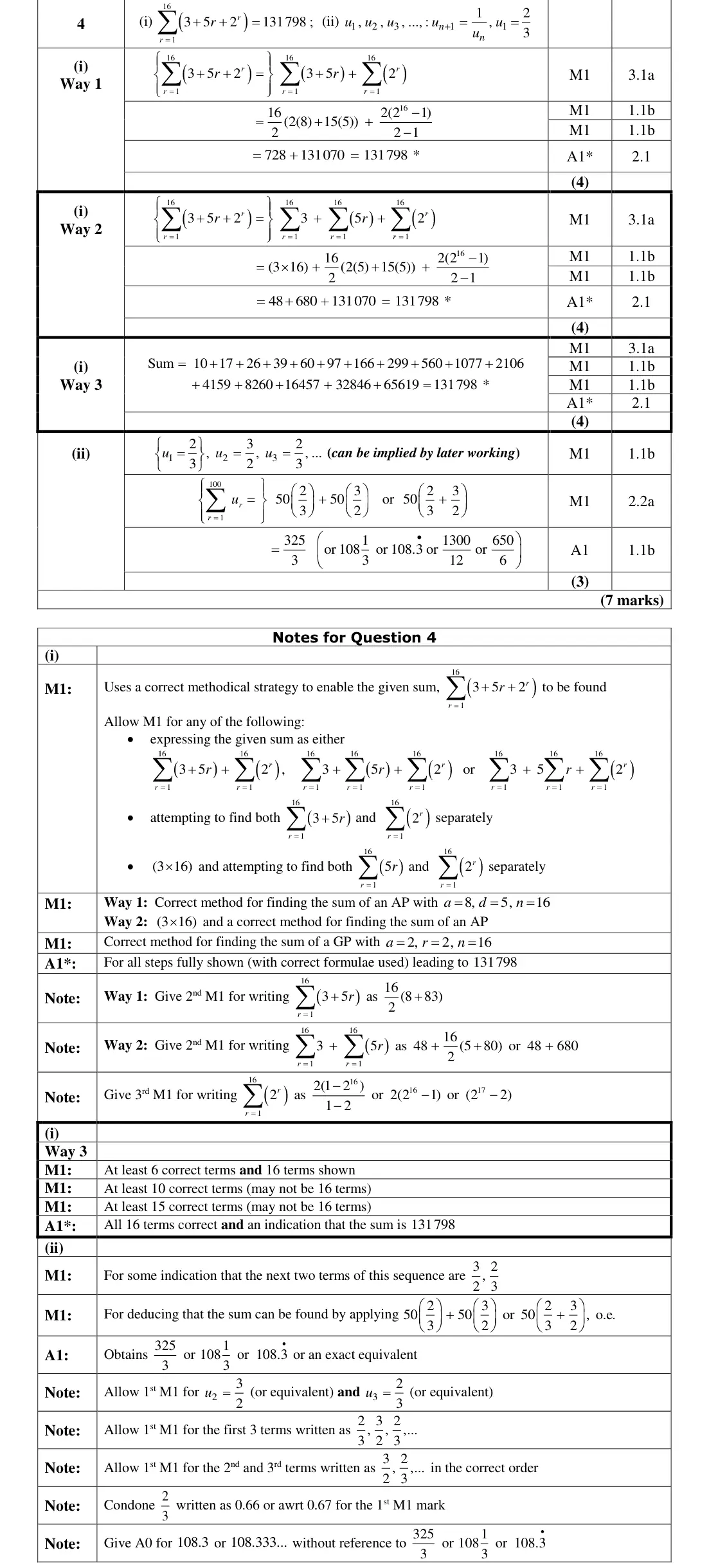
4(i) Sequences and series 4 —
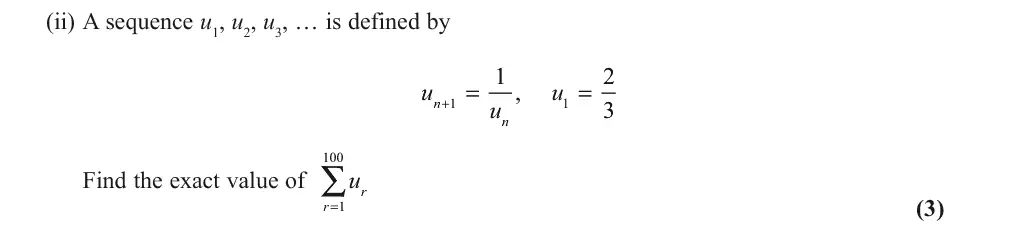
4(ii) Sequences and series 3 —
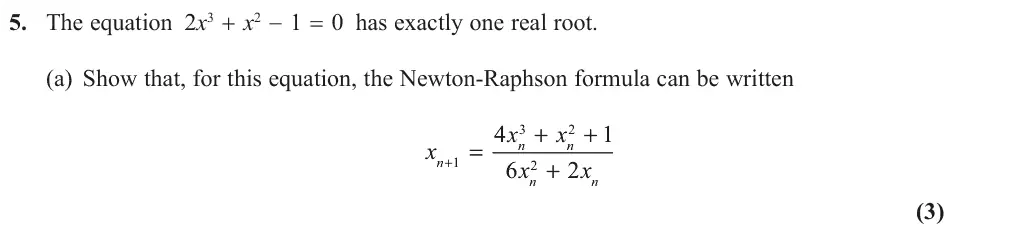
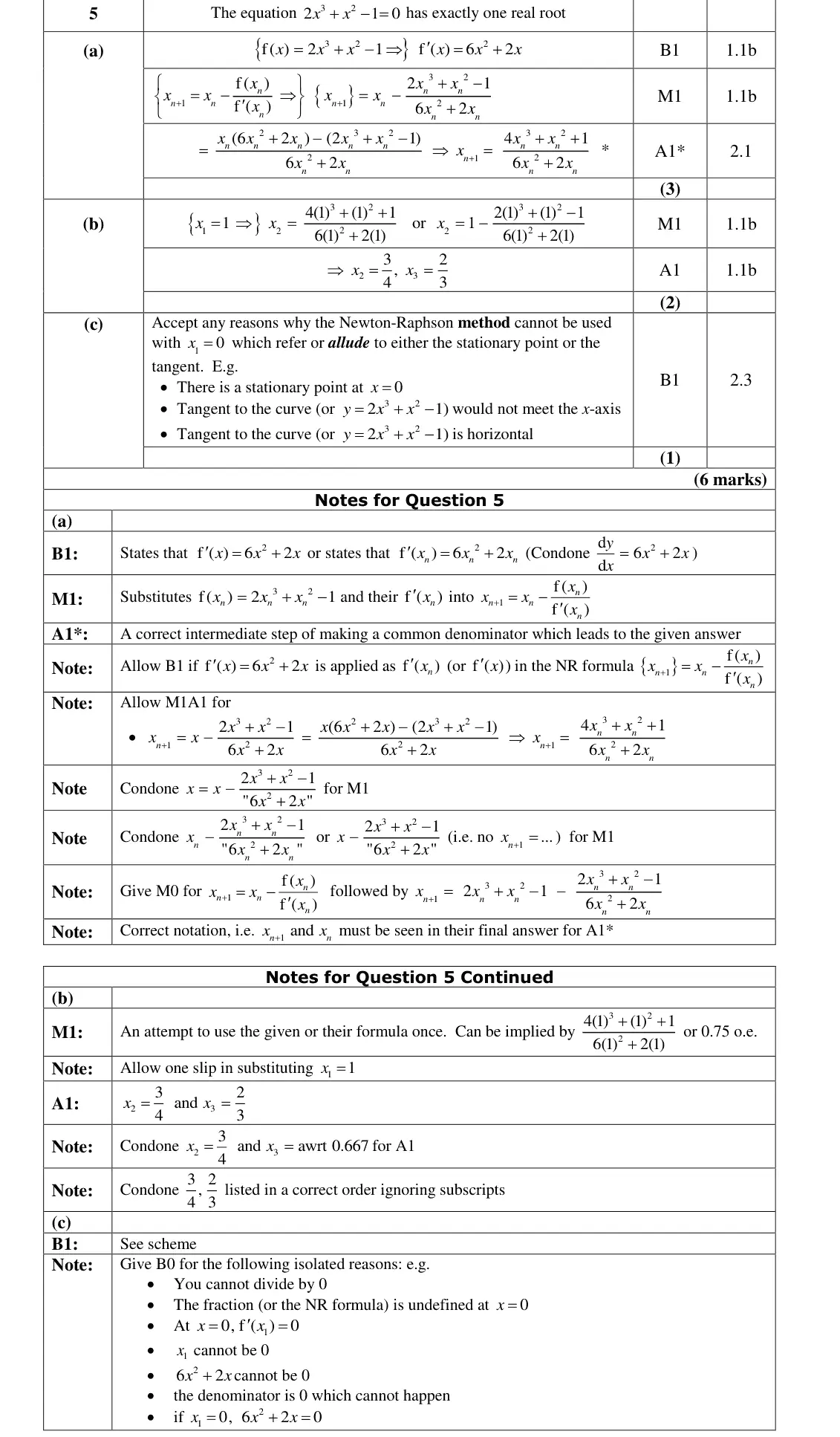
5(a) Numerical methods: roots, iteration and Newton–Raphson, Differentiation: first principles, gradients, stationary points, Algebraic methods: polynomials, factor theorem and division 3 —
5(b) Numerical methods: roots, iteration and Newton–Raphson 2 —
5(c) Numerical methods: roots, iteration and Newton–Raphson, Differentiation: first principles, gradients, stationary points 1 —
6(a) Algebraic methods: polynomials, factor theorem and division 3 —
6(b) Quadratics and the discriminant, Proof, including contradiction, Algebraic methods: polynomials, factor theorem and division 2 —
6(c) Trigonometric ratios, graphs, radians and the sine and cosine rules, Solving trigonometric equations, Algebraic methods: polynomials, factor theorem and division 1 —
7(i) Addition and double-angle formulae, harmonic form, Reciprocal and inverse trigonometric functions, Solving trigonometric equations 4 —
7(ii) Addition and double-angle formulae, harmonic form, Solving trigonometric equations, Trigonometric identities and proofs 5 —
8(a) Functions, composite and inverse functions, modulus, Quadratics and the discriminant 3 —
8(b) Functions, composite and inverse functions, modulus, Quadratics and the discriminant 3 —
8(c) Functions, composite and inverse functions, modulus 1 —
9 Differentiation: first principles, gradients, stationary points, Addition and double-angle formulae, harmonic form, Proof, including contradiction 5 —
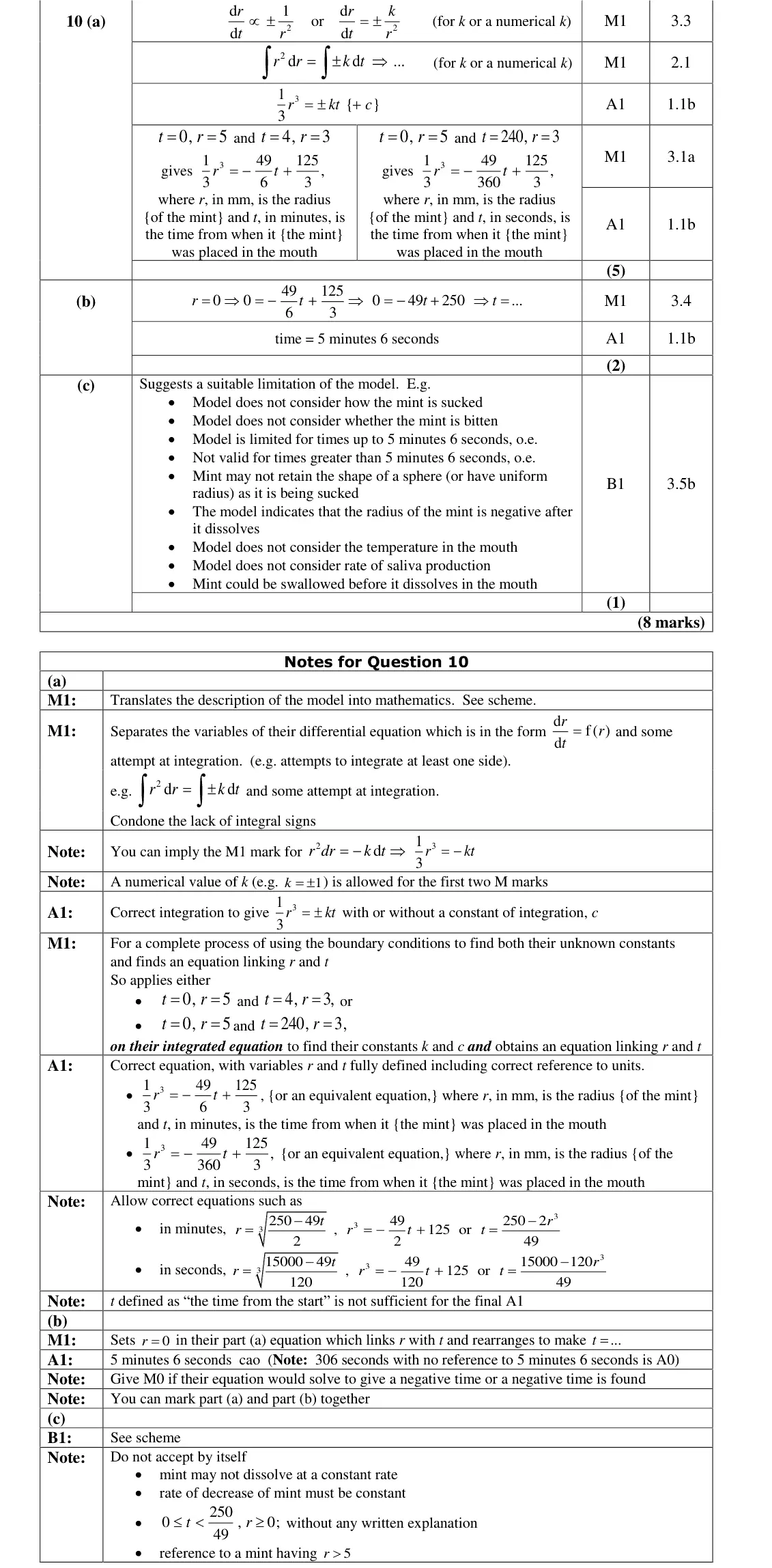
10(a) Differential equations, Integration: standard integrals, definite integrals and areas 5 —
10(b) Differential equations 2 —
10(c) Differential equations 1 —
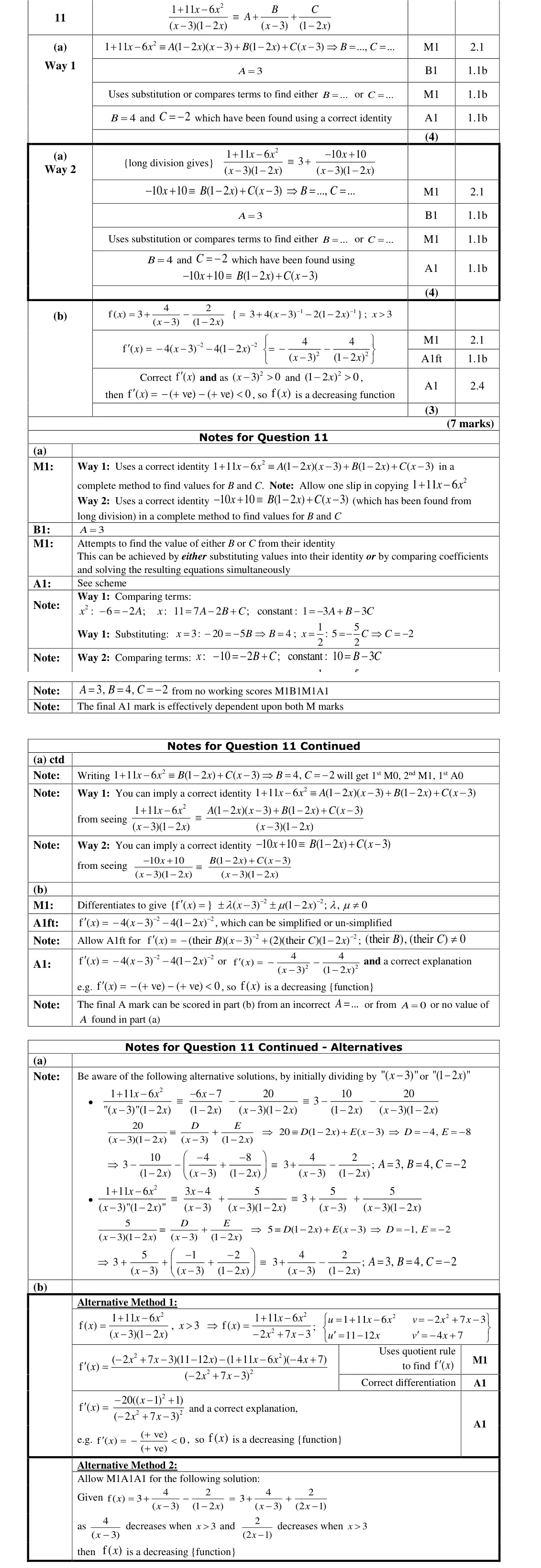
11(a) Partial fractions, Algebraic methods: polynomials, factor theorem and division 4 —
11(b) Differentiation: first principles, gradients, stationary points, Chain, product and quotient rules; connected rates of change, Partial fractions 3 —
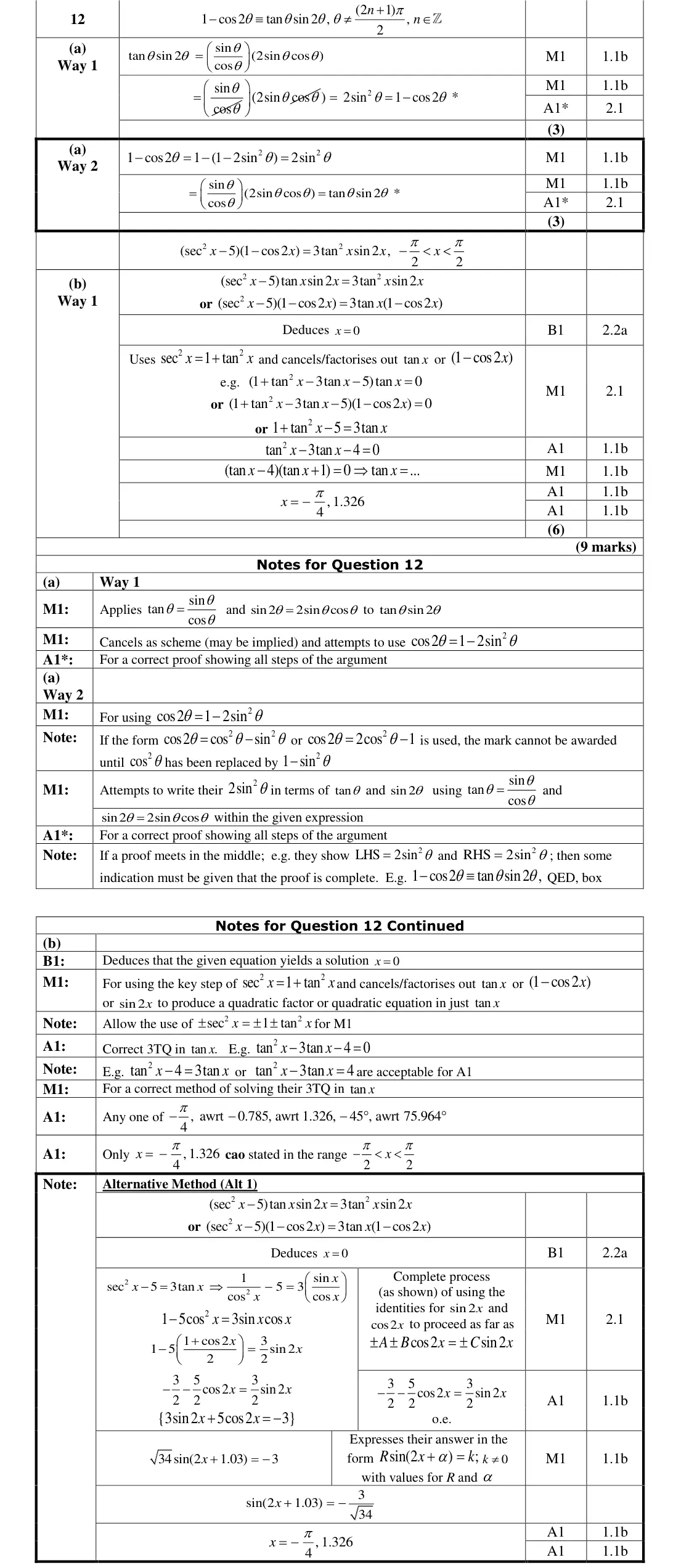
12(a) Trigonometric identities and proofs, Addition and double-angle formulae, harmonic form 3 —
12(b) Solving trigonometric equations, Quadratics and the discriminant, Trigonometric identities and proofs 6 —
13 Integration: standard integrals, definite integrals and areas, Differentiation: first principles, gradients, stationary points, Chain, product and quotient rules; connected rates of change, Integration by parts and by substitution, Straight lines 10 —
14(a) Exponential growth, decay and modelling 1 —
14(b) Chain, product and quotient rules; connected rates of change, Differentiation: first principles, gradients, stationary points, Exponential growth, decay and modelling 4 —
14(c) Differentiation: first principles, gradients, stationary points, Quadratics and the discriminant, Exponentials and logarithms, Exponential growth, decay and modelling 4 —
14(d) Exponential growth, decay and modelling 1 —

The questions

1(a)1(b)1(c)2(a)2(b)3(a)3(b)4(i)4(ii)5(a)5(b)5(c)6(a)6(b)6(c)7(i)7(ii)8(a)8(b)8(c)910(a)10(b)10(c)11(a)11(b)12(a)12(b)1314(a)14(b)14(c)14(d)
June 2018 · Paper 2 · Q1(a) 2 marks functions
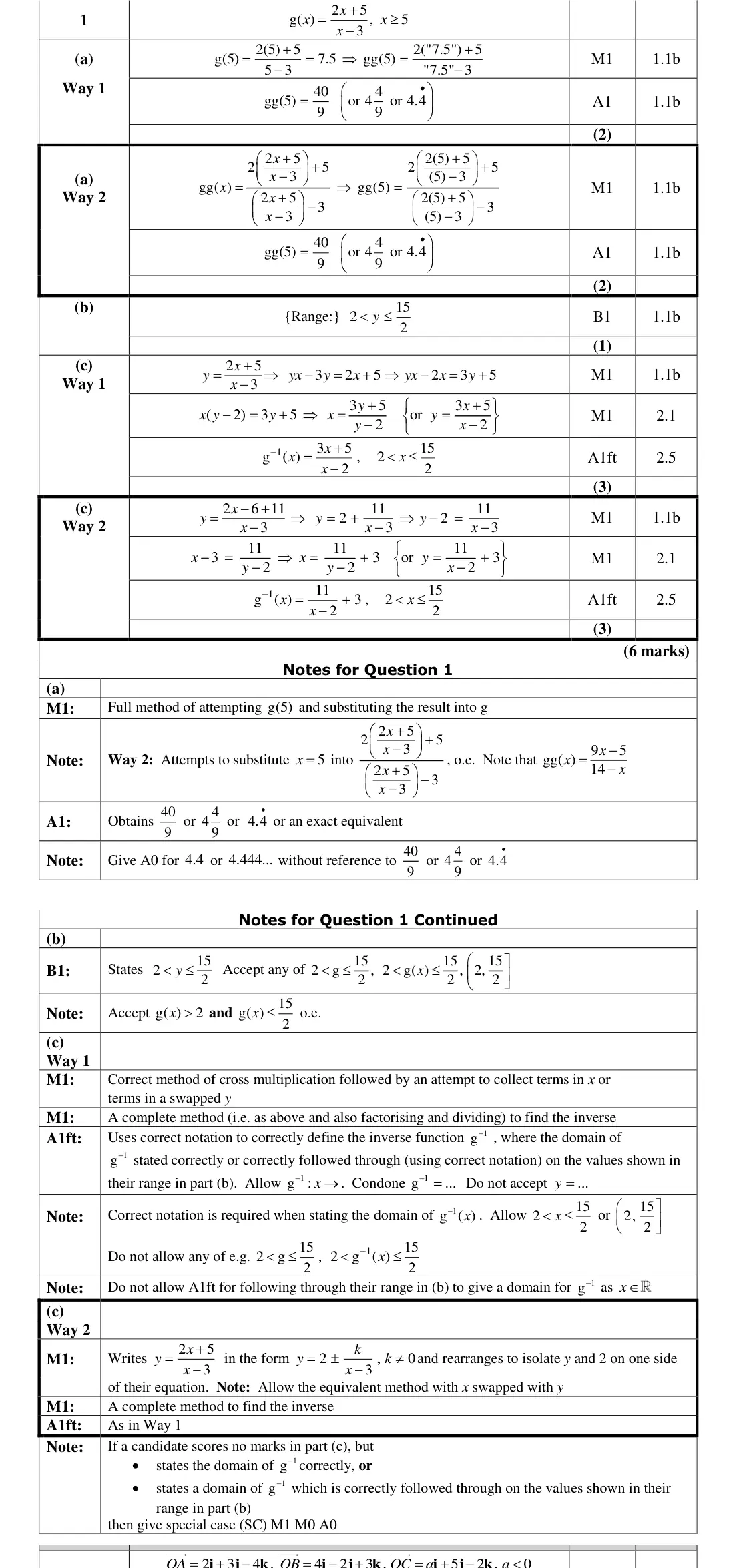
1. x + g(x) = 2 x 5 x - (a) Find gg(5). (2)
June 2018 · Paper 2 · Q1(b) 1 mark functions
(b) State the range of g. (1)
June 2018 · Paper 2 · Q1(c) 3 marks functionsalgebraic methods
(c) Find g-1(x), stating its domain. (3)
June 2018 · Paper 2 · Q2(a) 2 marks vectors
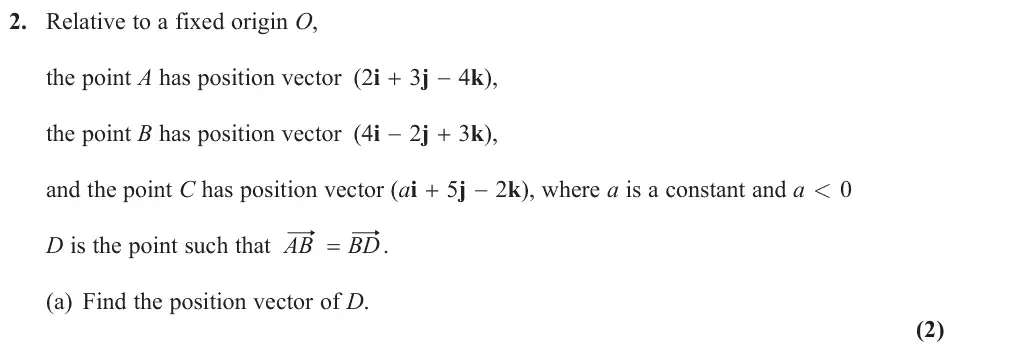
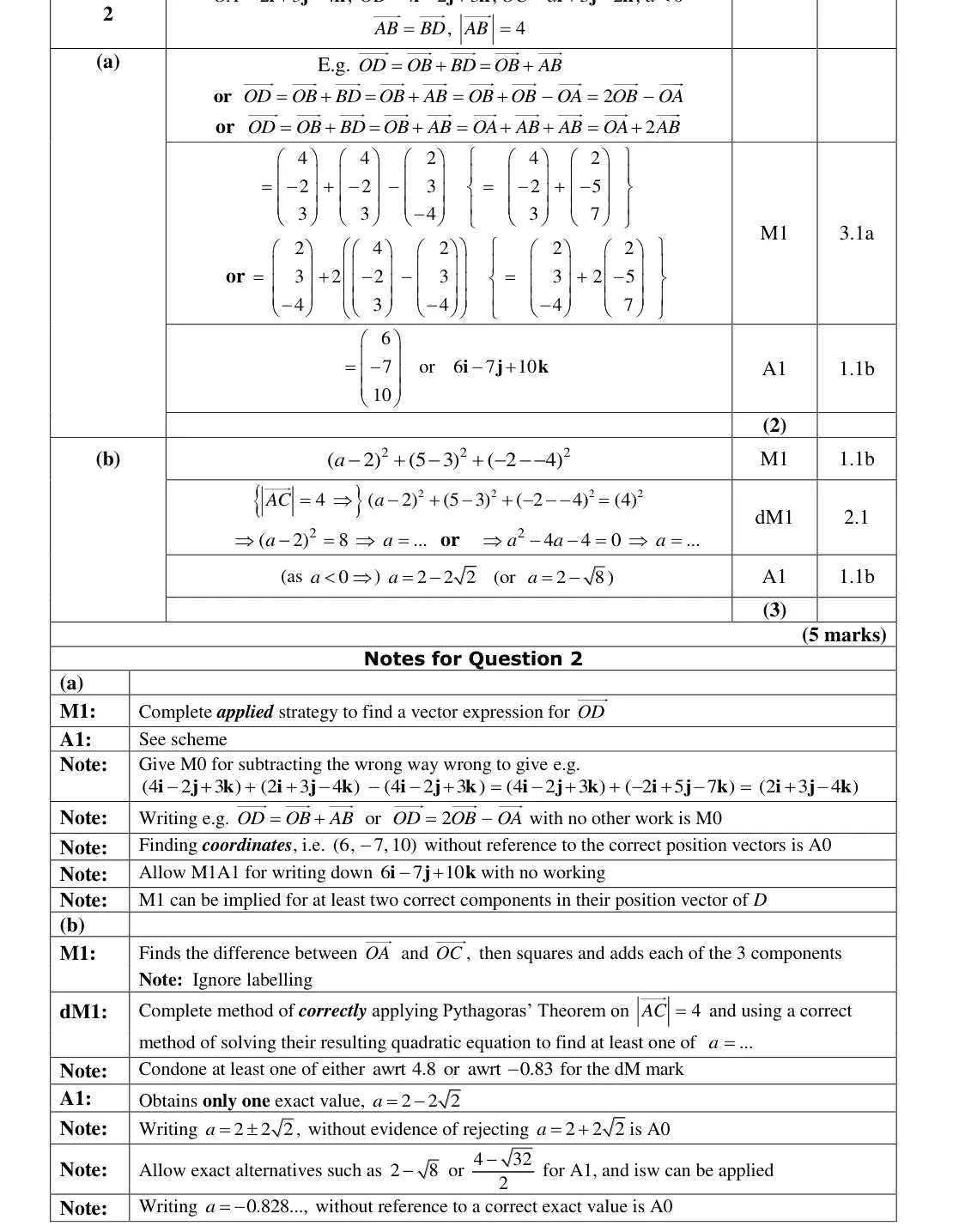
2. Relative to a fixed origin O, the point A has position vector (2i + 3j - 4k), the point B has position vector (4i - 2j + 3k), and the point C has position vector (ai + 5j - 2k), where a is a constant and a < 0 = BD . D is the point such that AB (a) Find the position vector of D. (2)
June 2018 · Paper 2 · Q2(b) 3 marks vectorsquadratics
| = 4 Given |AC (b) find the value of a. (3)
June 2018 · Paper 2 · Q3(a) 2 marks proof
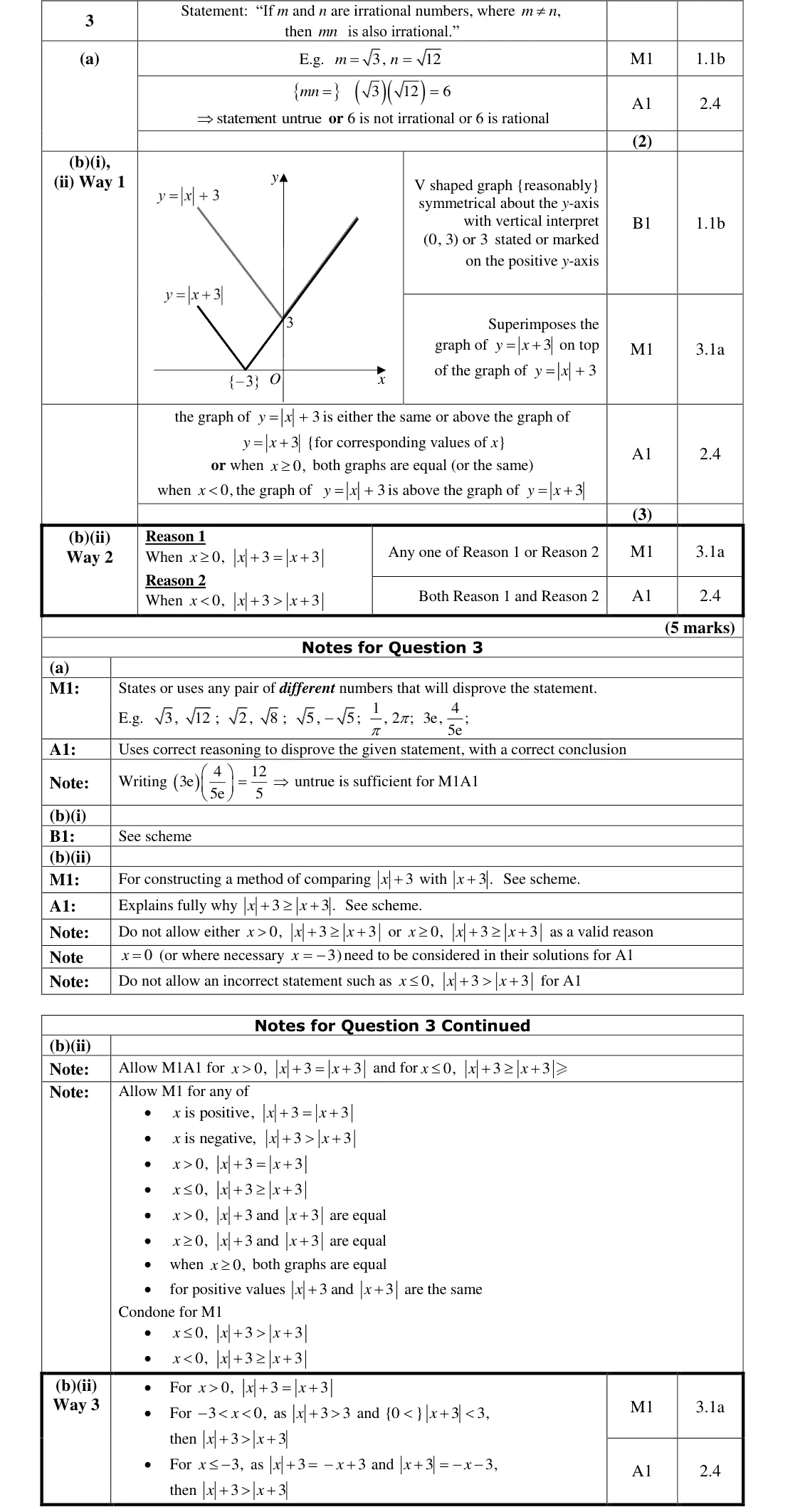
3. (a) “If m and n are irrational numbers, where m ≠ n, then mn is also irrational.” Disprove this statement by means of a counter example. (2)
June 2018 · Paper 2 · Q3(b) 3 marks graphs and transformationsproof
(b) (i) Sketch the graph of y = |x| + 3 (ii) Explain why |x| + 3 |x + 3| for all real values of x. (3)
June 2018 · Paper 2 · Q4(i) 4 marks sequences and series
=∑ ( ) = 4. (i) Show that + r + r 131798 (4) r
June 2018 · Paper 2 · Q4(ii) 3 marks sequences and series
(ii) A sequence u1, u2, u3, … is defined by u u + = = , n u n r=∑ Find the exact value of ur (3)
June 2018 · Paper 2 · Q5(a) 3 marks numerical methodsdifferentiationalgebraic methods
5. The equation 2x3 + x2 - 1 = 0 has exactly one real root. (a) Show that, for this equation, the Newton-Raphson formula can be written x + x + x + = n n n x + x n n (3)
June 2018 · Paper 2 · Q5(b) 2 marks numerical methods
Using the formula given in part (a) with x1 = 1 (b) find the values of x2 and x3 (2)
June 2018 · Paper 2 · Q5(c) 1 mark numerical methodsdifferentiation
(c) Explain why, for this question, the Newton-Raphson method cannot be used with x1 = 0 (1)
June 2018 · Paper 2 · Q6(a) 3 marks algebraic methods
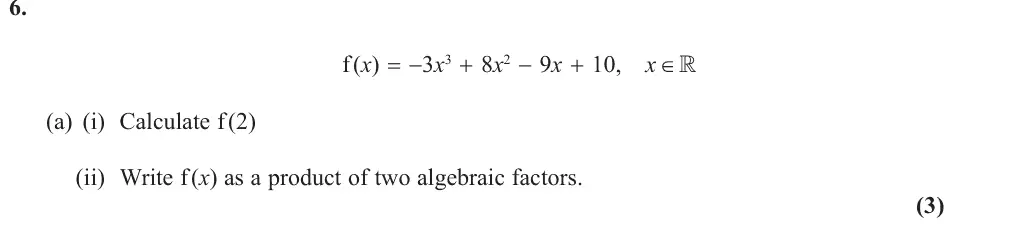
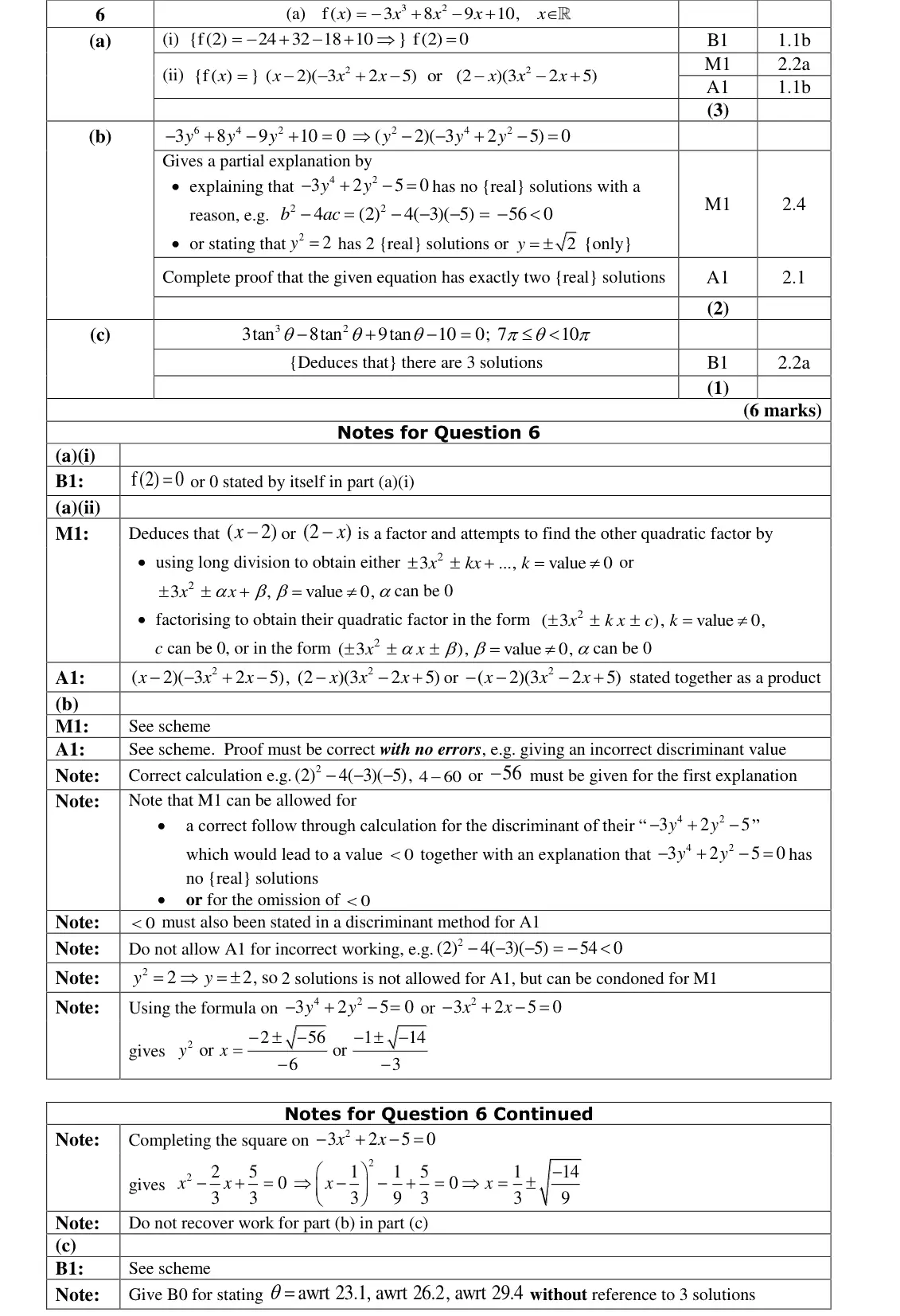
6. f (x) = -3x3 + 8x2 - 9x + 10, x ∈ ℝ (a) (i) Calculate f (2) (ii) Write f (x) as a product of two algebraic factors. (3)

June 2018 · Paper 2 · Q6(b) 2 marks quadraticsproofalgebraic methods
Using the answer to (a)(ii), (b) prove that there are exactly two real solutions to the equation -3y 6 + 8y 4 - 9y 2 + 10 = 0 (2)
(c) deduce the number of real solutions, for 7 pi theta < 10 pi , to the equation 3 tan3 theta - 8 tan2 theta + 9 tan theta - 10 = 0 (1)
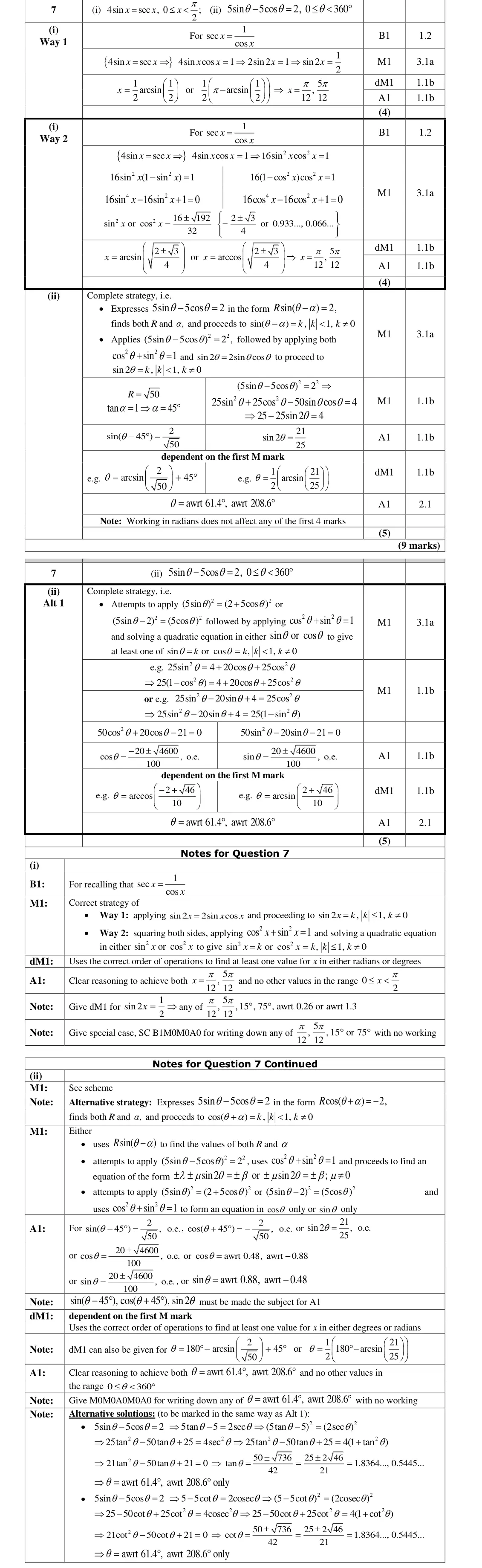
pi , the equation 7. (i) Solve, for 0 x < 2 4 sin x = sec x (4)
June 2018 · Paper 2 · Q7(ii) 5 marks double angle formulaetrigonometric equationstrig identities
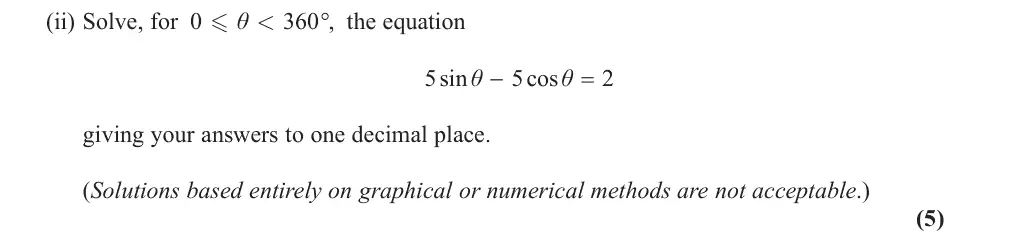
(ii) Solve, for 0 theta < 360°, the equation 5 sin theta - 5 cos theta = 2 giving your answers to one decimal place. (Solutions based entirely on graphical or numerical methods are not acceptable.) (5)
June 2018 · Paper 2 · Q8(a) 3 marks functionsquadratics
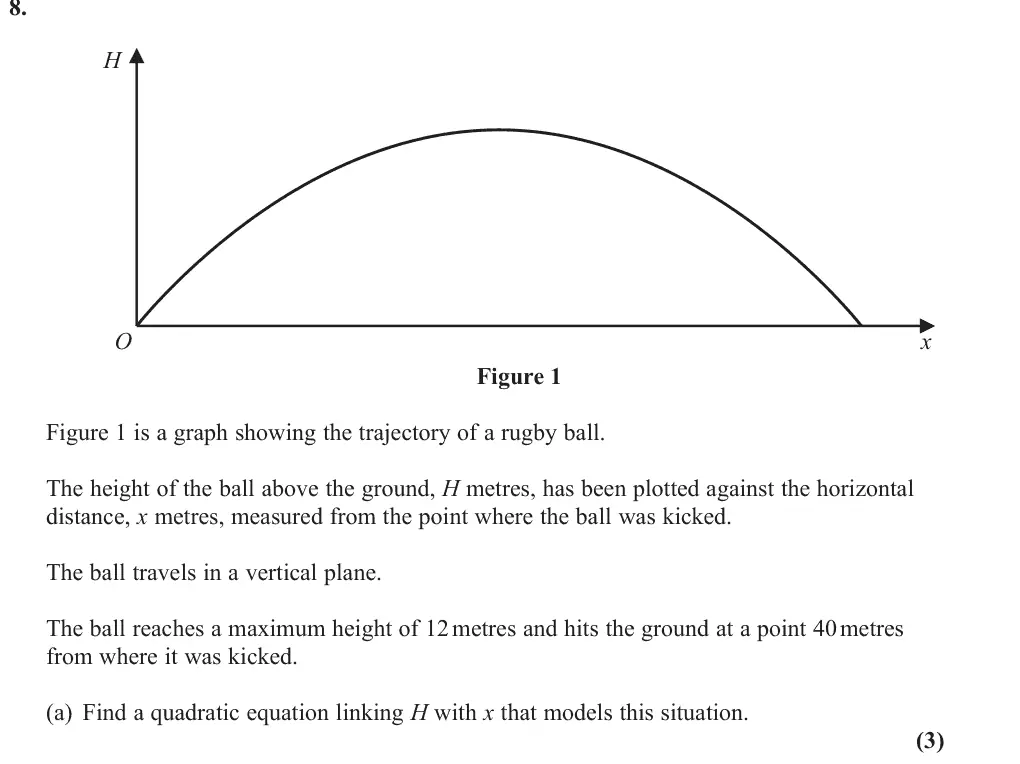
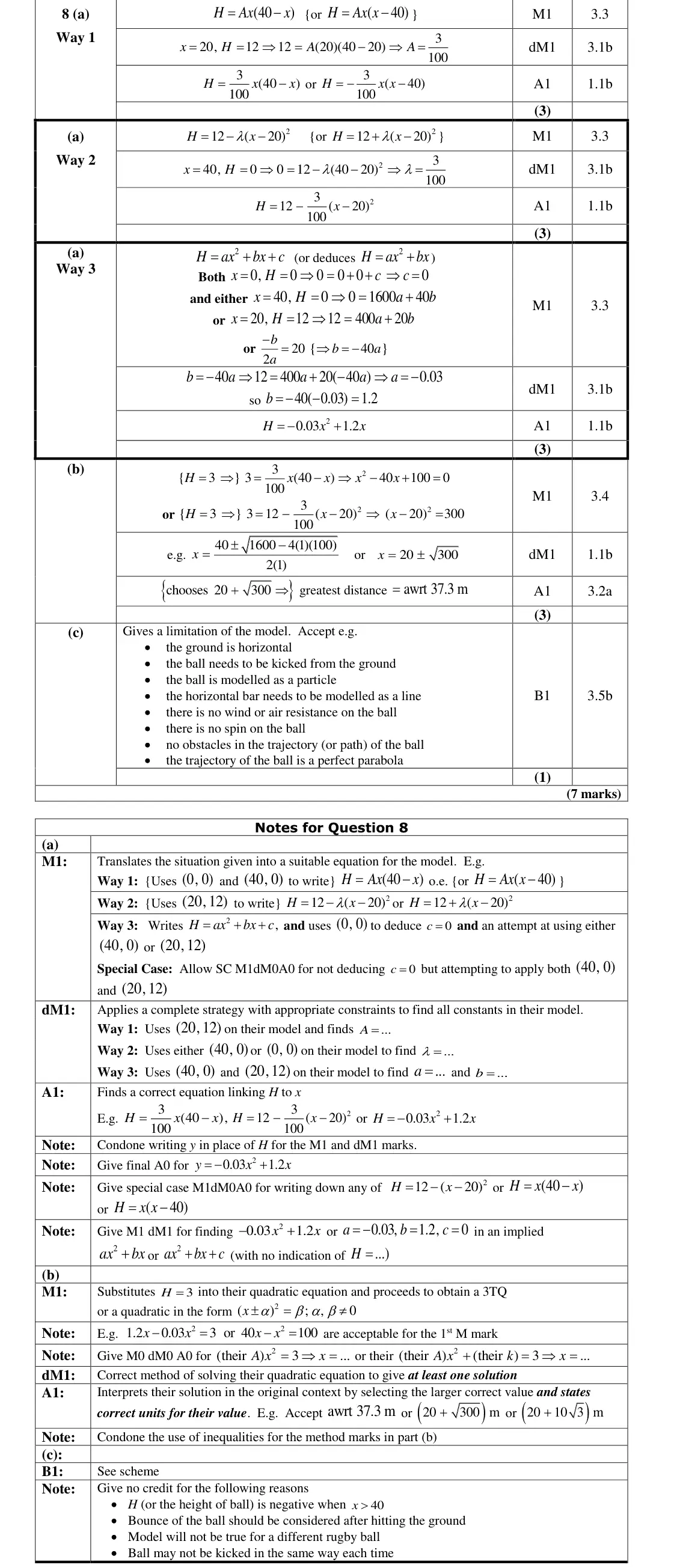
8. H x Figure 1 Figure 1 is a graph showing the trajectory of a rugby ball. The height of the ball above the ground, H metres, has been plotted against the horizontal distance, x metres, measured from the point where the ball was kicked. The ball travels in a vertical plane. The ball reaches a maximum height of 12 metres and hits the ground at a point 40 metres from where it was kicked. (a) Find a quadratic equation linking H with x that models this situation. (3)
June 2018 · Paper 2 · Q8(b) 3 marks functionsquadratics
The ball passes over the horizontal bar of a set of rugby posts that is perpendicular to the path of the ball. The bar is 3 metres above the ground. (b) Use your equation to find the greatest horizontal distance of the bar from O. (3)
June 2018 · Paper 2 · Q8(c) 1 mark functions
(c) Give one limitation of the model. (1)
June 2018 · Paper 2 · Q9 5 marks differentiationdouble angle formulaeproof
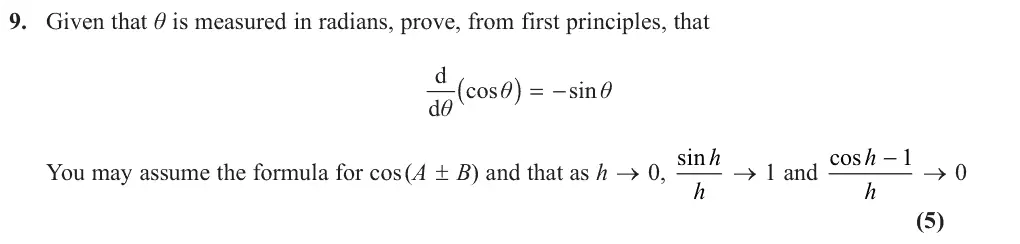
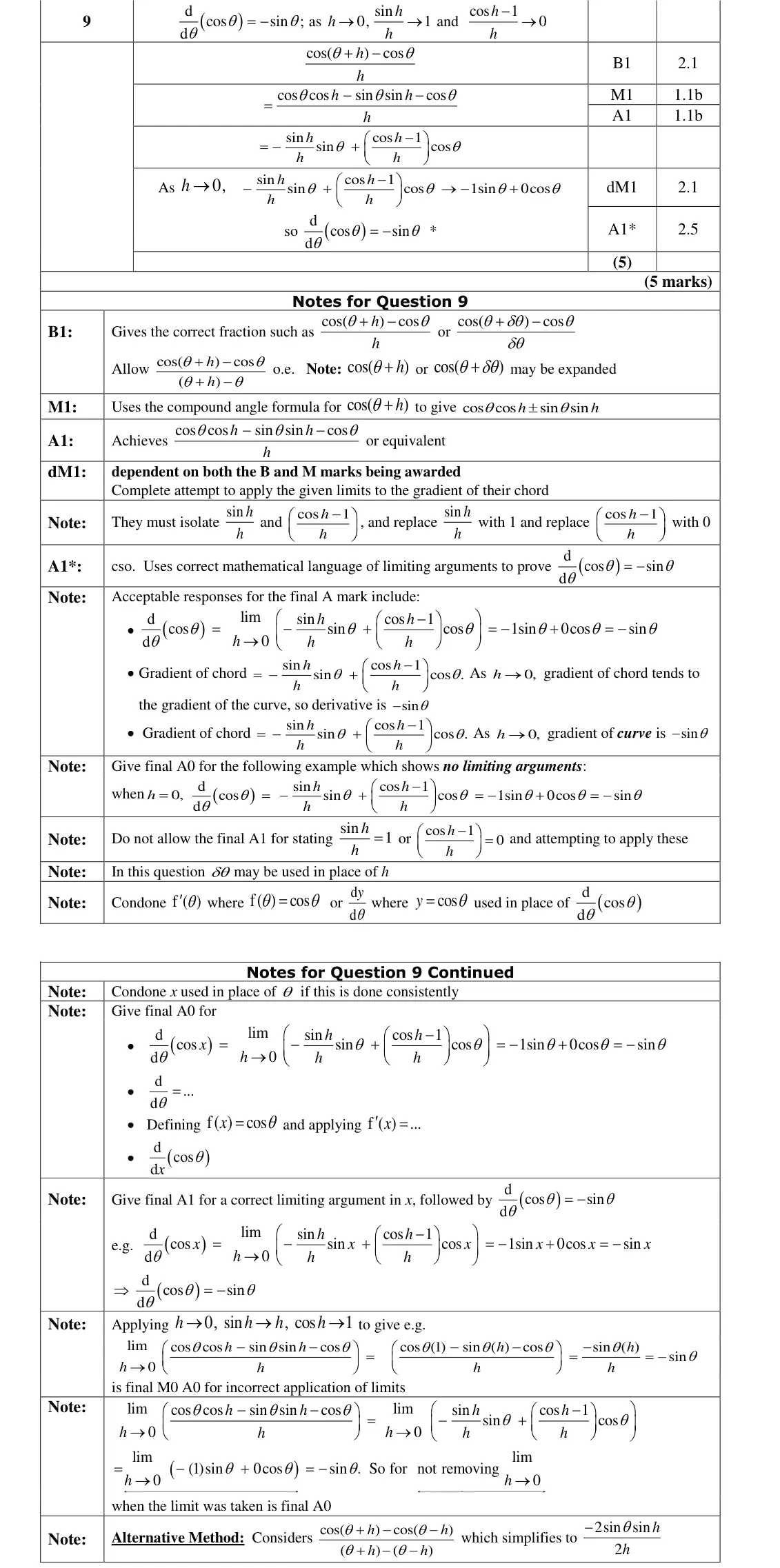
9. Given that theta is measured in radians, prove, from first principles, that d ( ) cos theta = - sin theta d theta You may assume the formula for cos (A ± B) and that as h → 0, sin h → 1 and cosh -1 → 0 h h (5)
June 2018 · Paper 2 · Q10(a) 5 marks differential equationsintegration
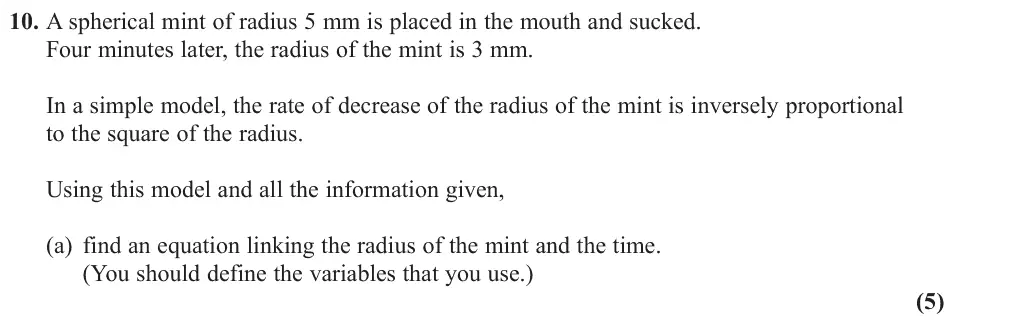
10. A spherical mint of radius 5 mm is placed in the mouth and sucked. Four minutes later, the radius of the mint is 3 mm. In a simple model, the rate of decrease of the radius of the mint is inversely proportional to the square of the radius. Using this model and all the information given, (a) find an equation linking the radius of the mint and the time. (You should define the variables that you use.) (5)
June 2018 · Paper 2 · Q10(b) 2 marks differential equations
(b) Hence find the total time taken for the mint to completely dissolve. Give your answer in minutes and seconds to the nearest second. (2)
June 2018 · Paper 2 · Q10(c) 1 mark differential equations
(c) Suggest a limitation of the model. (1)
June 2018 · Paper 2 · Q11(a) 4 marks partial fractionsalgebraic methods
11. + x - x B C ≡ A + + x - - x x - - x ( 3 1 )( ) ( ) ( ) (a) Find the values of the constants A, B and C. (4)
June 2018 · Paper 2 · Q11(b) 3 marks differentiationdifferentiation rulespartial fractions
+ x - x f (x) = 1 ) x > 3 x - - x ( 3 1 )( (b) Prove that f (x) is a decreasing function. (3)
June 2018 · Paper 2 · Q12(a) 3 marks trig identitiesdouble angle formulae
12. (a) Prove that n pi 1 - cos 2 theta ≡ tan theta sin 2 theta , theta ≠ (2 + 1) , n ∈ (3)
June 2018 · Paper 2 · Q12(b) 6 marks trigonometric equationsquadraticstrig identities
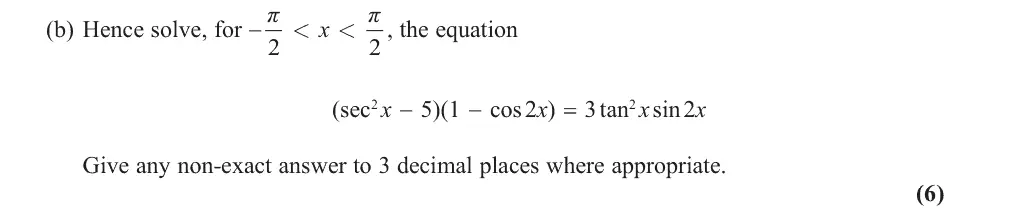
pi < x < 2 pi , the equation (b) Hence solve, for -2 (sec2 x - 5)(1 - cos 2x) = 3 tan2 x sin 2x Give any non-exact answer to 3 decimal places where appropriate. (6)
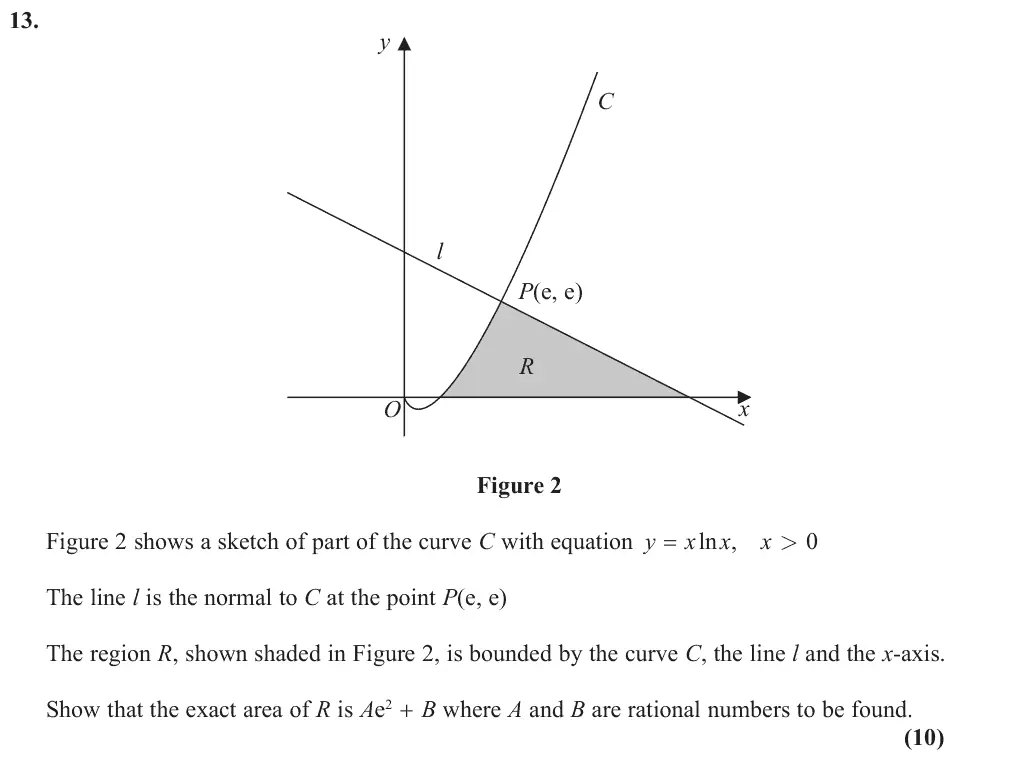
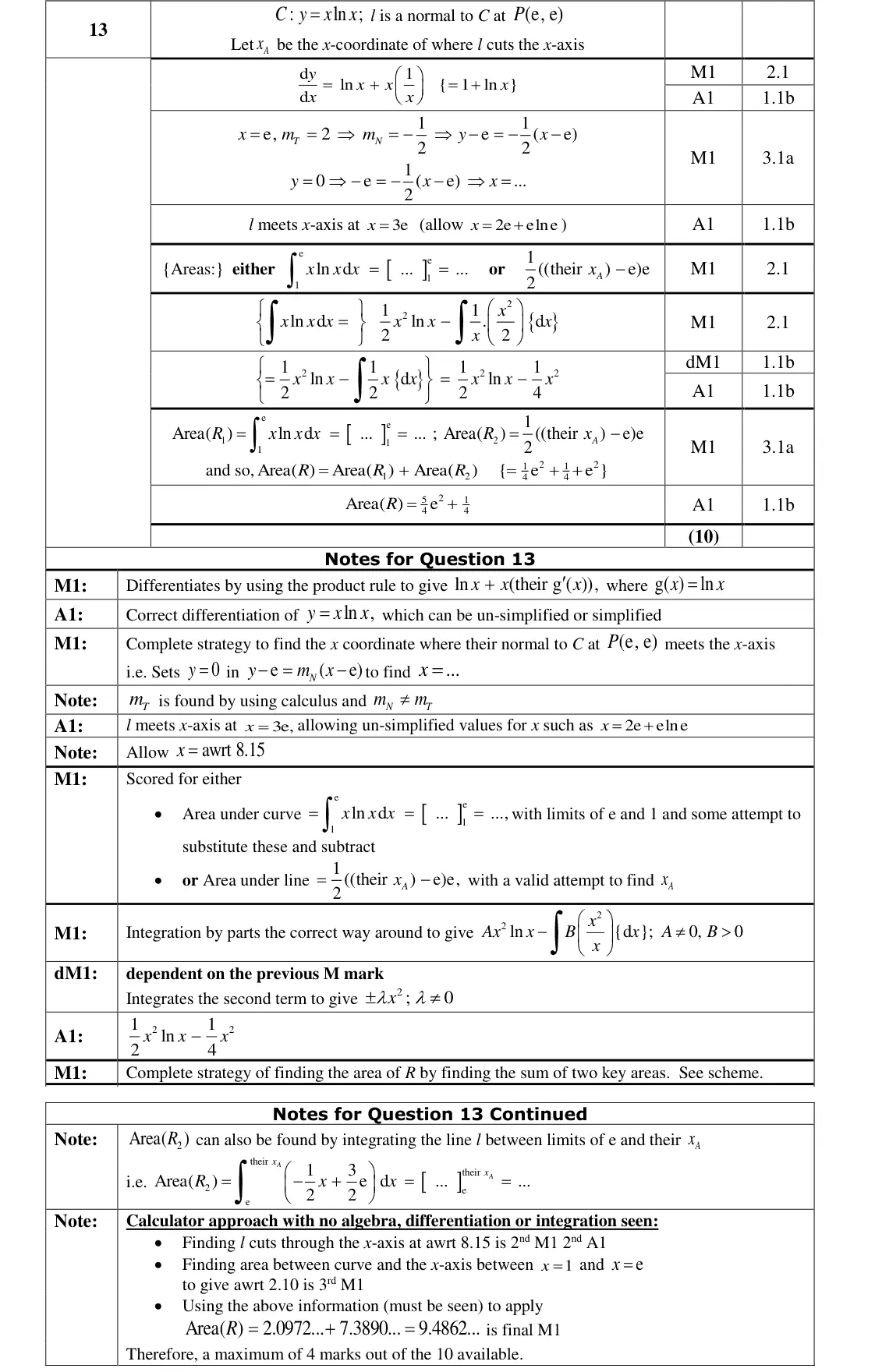
13. y C l P(e, e) R x Figure 2 Figure 2 shows a sketch of part of the curve C with equation y = x ln x, x > 0 The line l is the normal to C at the point P(e, e) The region R, shown shaded in Figure 2, is bounded by the curve C, the line l and the x-axis. Show that the exact area of R is Ae2 + B where A and B are rational numbers to be found. (10)
June 2018 · Paper 2 · Q14(a) 1 mark exponential modelling
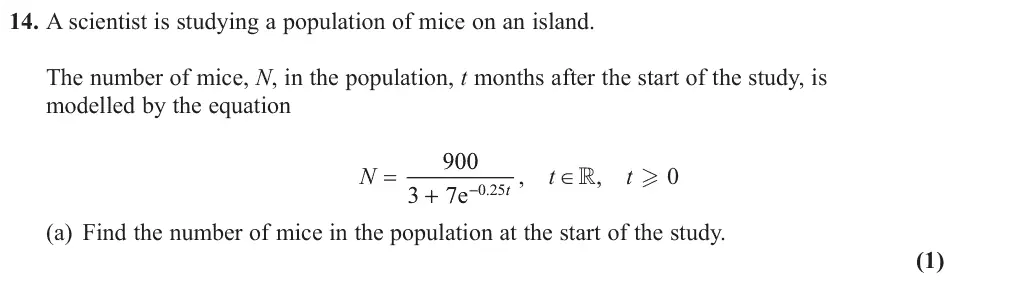
14. A scientist is studying a population of mice on an island. The number of mice, N, in the population, t months after the start of the study, is modelled by the equation t , t ∈ ℝ, t 0 N = + - 0 25 e (a) Find the number of mice in the population at the start of the study. (1)
June 2018 · Paper 2 · Q14(b) 4 marks differentiation rulesdifferentiationexponential modelling
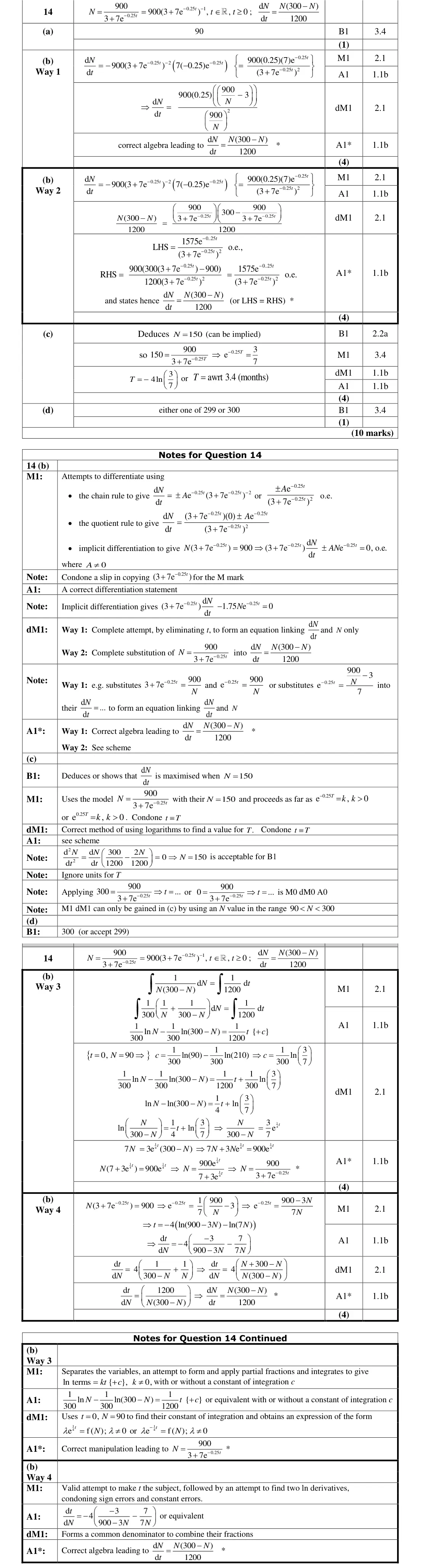
(b) Show that the rate of growth d N t is given by d N t = N N - ( ) d d 1200 (4)
The rate of growth is a maximum after T months. (c) Find, according to the model, the value of T. (4)
June 2018 · Paper 2 · Q14(d) 1 mark exponential modelling
According to the model, the maximum number of mice on the island is P. (d) State the value of P. (1)

Find an Edexcel maths tutor

Want this paper marked and gone through with you? Message us.

Prefer email? Send an enquiry

If you are under 18, please include a parent's contact details. Enquiries go to enquiries@mathsaleveltutor.com and are deleted once handled.