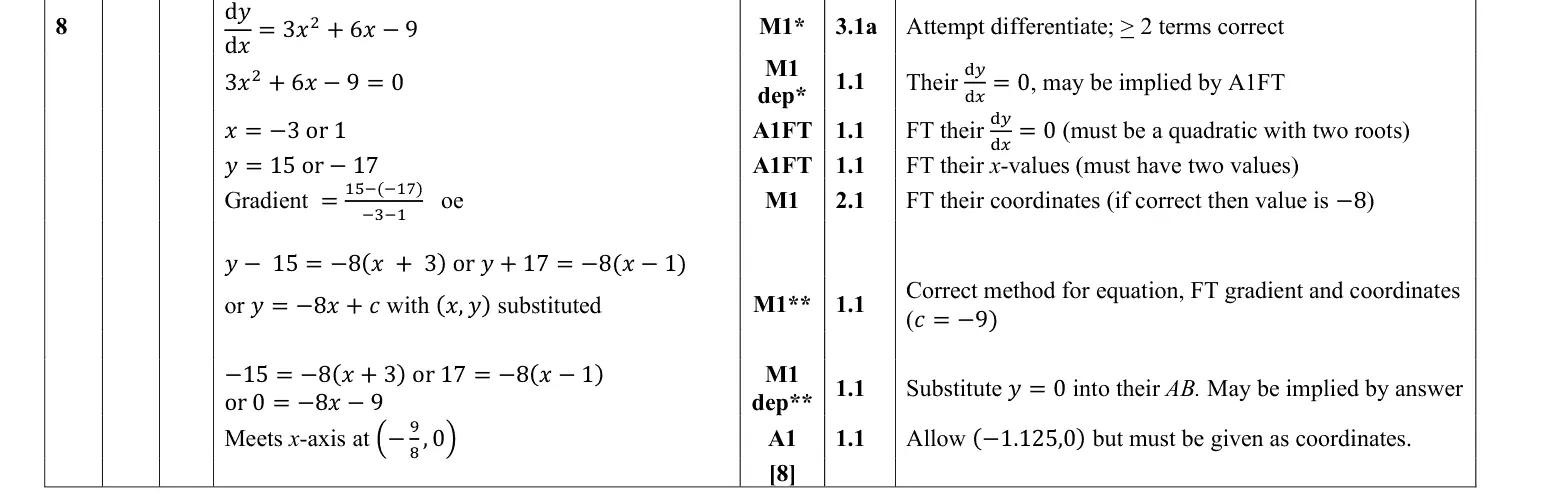
This question was generally very well answered. Almost all candidates were able to differentiate, set =0 and solve to obtain two values of x for M1M1A1. Some candidates made a numerical error in finding the corresponding values of y, but were still able to go on obtaining the subsequent method marks. Most candidates identified the need to find the gradient, equation and then set 𝑦= 0 although some instead solved for 𝑥= 0, etc. A few candidates stopped after the first four marks. Notice that (in contrast with Question 1 (b) as there is no DR instruction here, candidates were not required to show the working to solve their quadratic d𝑦 d𝑥= 0 but it remains best practice to do so. The question asked for the ‘coordinates of the point’ so 𝑥= − 8 was not sufficient as a final answer. This was a common omission and led to candidates receiving 7/8. This candidate has made a good start, scoring M1M1A1 for their differentiation and correct values of x for the turning points. They then make an error in finding one of the corresponding values of y (A0) but go on to work correctly with their values, scoring M1M1M1. The final answer is incorrect (A0) so this response scored 6/8.
Key points and common errors
dy/dx = 3x² + 6x − 9 = 0: A(−3, 15), B(1, −17)
gradient −8
y = −8x − 9 meets the x-axis at (−9/8, 0)
give coordinates, not just x
June 2025 · AS Paper 2 · Q9(b)3 marksMedium
Mark scheme for this part
Examiner's comment
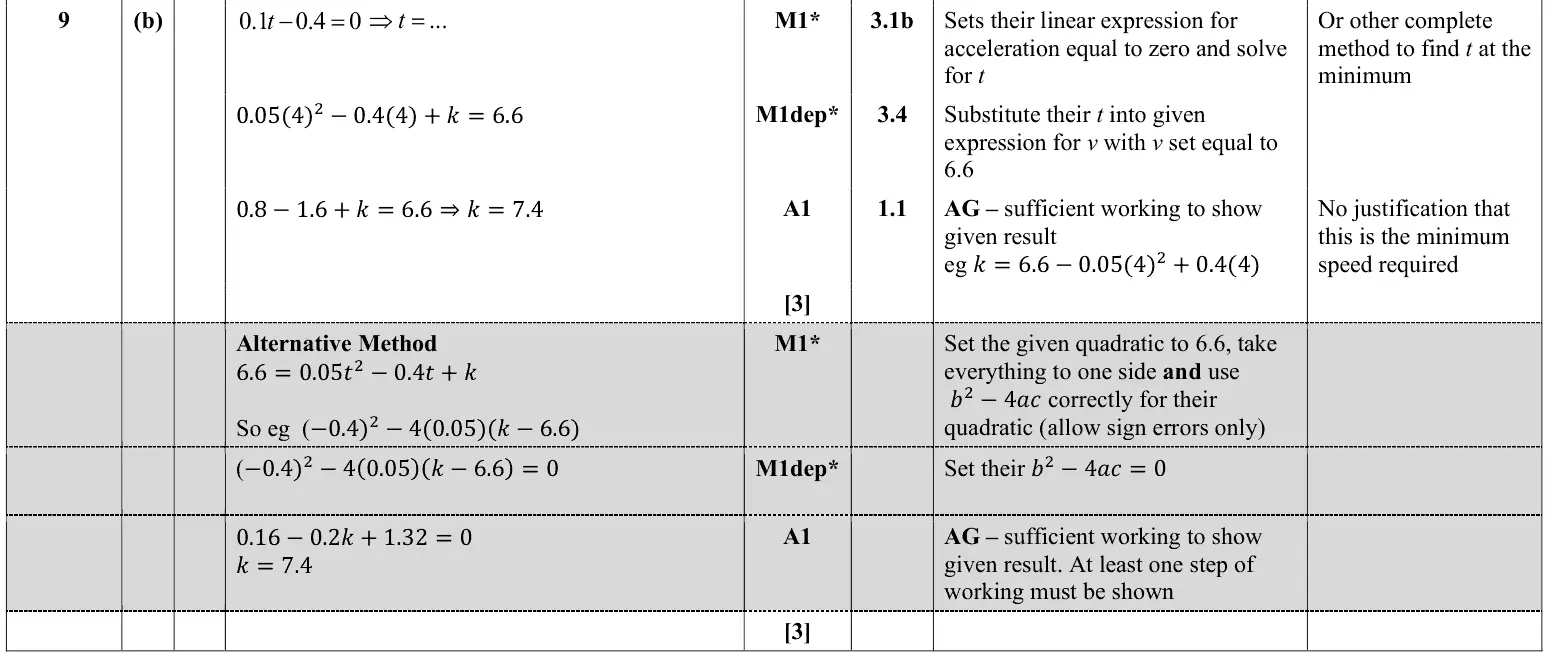
Usually t = 4 was found from the acceleration, but some completed the square. If this stage was successful, full marks generally followed provided sufficient working was shown – this was needed as the question gave the answer. A few solved the quadratic with 6.6 and the given k = 7.4 to get t = 4, but unless the significance of t = 4 was discussed (and it normally was not) no marks were given. Substitution of t = 6 into v in an attempt to find k was seen. The alternative method was seen less frequently but when seen, was largely successful.
Key points and common errors
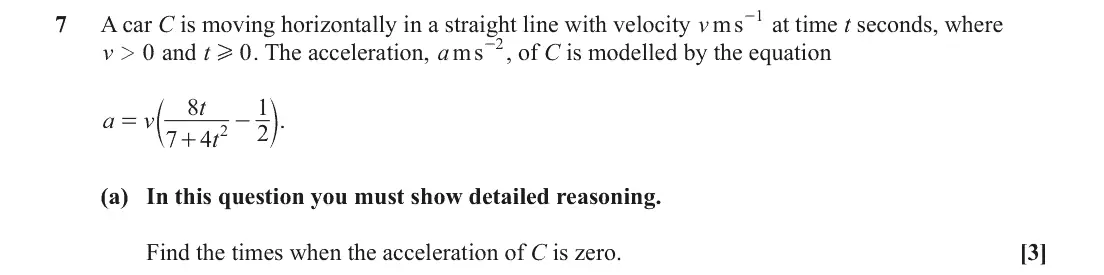
minimum velocity when a = 0 so t = 4
0.05(16) − 1.6 + k = 6.6 gives k = 7.4
must show why t = 4
June 2025 · Paper 1 · Q2(b)1 markEasy
Show the start of this question
Mark scheme for this part
Examiner's comment
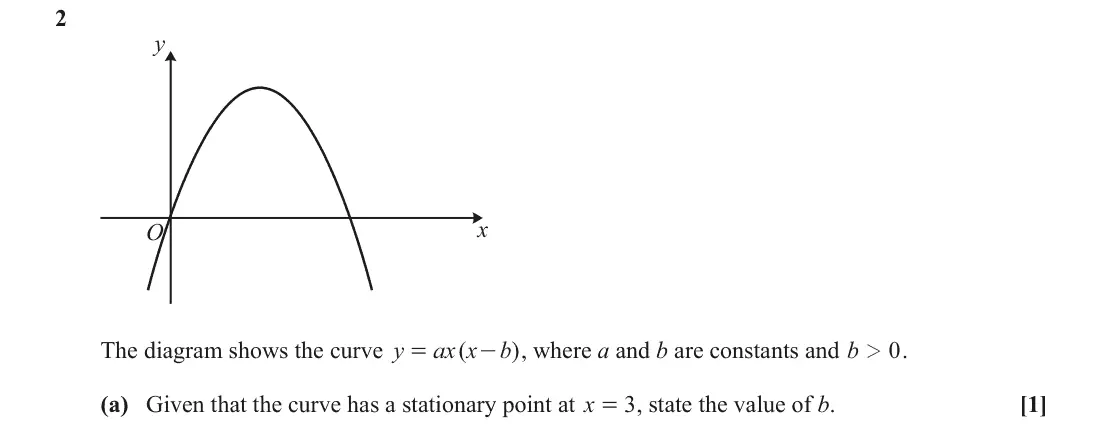
By contrast, in this part of the question many candidates were able to state a correct deduction about the value of a, but some did still consider the second derivative before correctly concluding.
Key points and common errors
a < 0 (not a ≤ 0)
June 2025 · Paper 2 · Q6(a)(ii)2 marksEasy
Show the start of this question
Mark scheme for this part
Examiner's comment
As in part (i), most candidates answered this part correctly. The question asked candidates to ‘find’ so the scheme did not require candidates to show working – which typically involved using the factor theorem to deduce one or both of the roots. Some candidates solved by inspection (or using their calculator) – this was also acceptable in this context. Some candidates went on to find the corresponding y-values, which were not needed here.
Key points and common errors
set dy/dx = 0
factor theorem or calculator gives x = 1 and x = −1 only
y-values not needed
June 2025 · Paper 3 · Q11(b)3 marksMedium
Show the start of this question
Mark scheme for this part
Examiner's comment
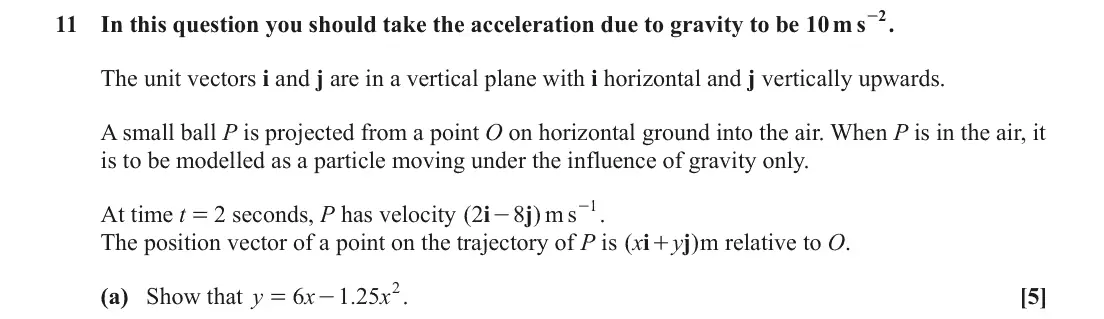
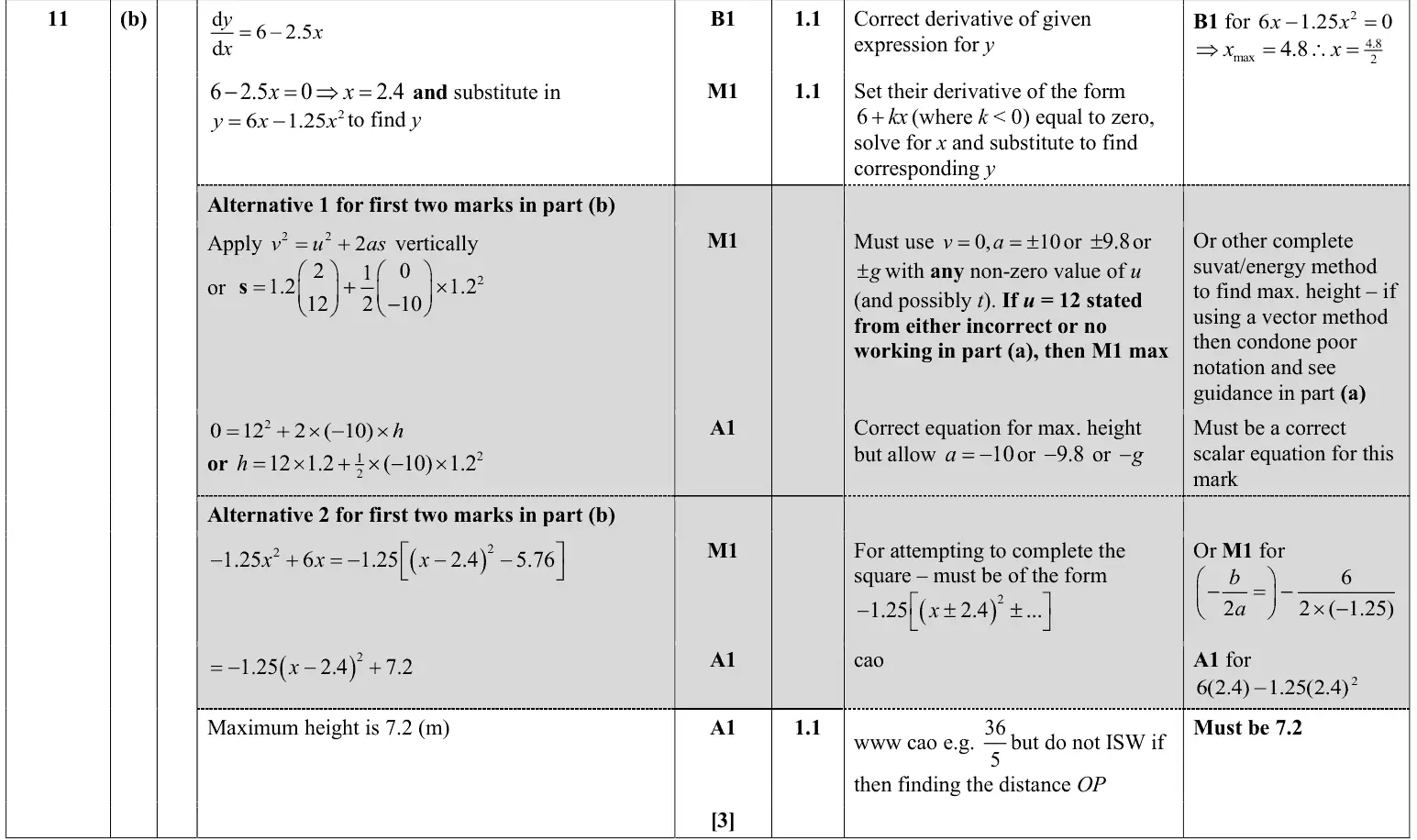
It was surprising how many candidates did not use the given result from part (a) and instead went back to the suvat equations to find the maximum height of P above the ground during its motion. Of those that did use the equation from part (a), those that used calculus rather than completing the square were far more successful.
Key points and common errors
dy/dx = 6 − 2.5x = 0 at x = 2.4
max height 7.2 m
use the given equation rather than restarting
June 2024 · AS Paper 1 · Q5(a)5 marksMedium
Mark scheme for this part
Examiner's comment
This question was again ‘Determine’, requiring candidates to show their working in full – answers obtained without this (e.g. from a calculator) could not be credited. Most candidates who showed working were able to differentiate the given equation correctly and set this equal to zero, going on to find the coordinates of the stationary point. Some candidates who had the correct solutions for x did not find the correct y value as required for the final A1.
Key points and common errors
dy/dx = 8x − x⁻² = 0
x = ½, y = 3
'Determine' so working required
y-value sometimes wrong
June 2024 · AS Paper 1 · Q5(b)2 marksHard
Show the start of this question
Mark scheme for this part
Examiner's comment
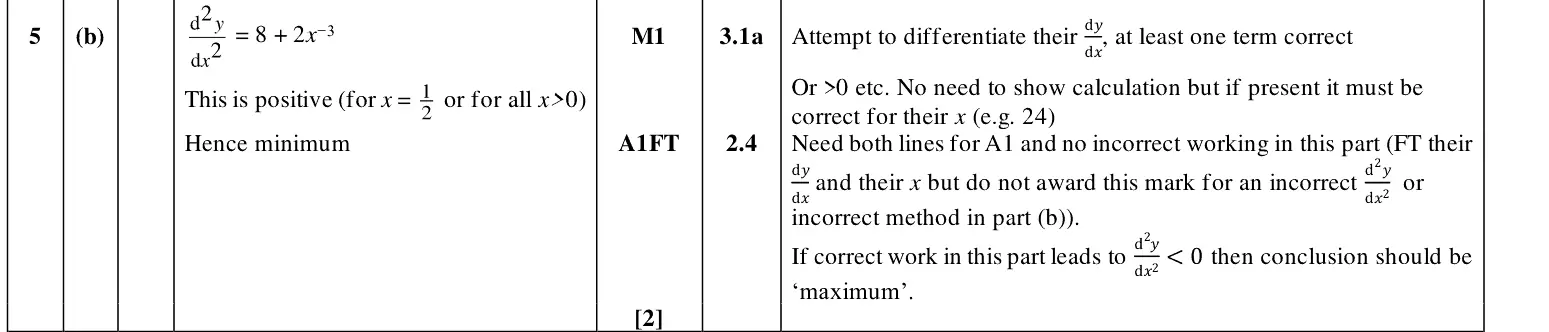
This ‘Determine’ question was generally not well answered. Most candidates who had made progress in part (a) were also able to gain the method mark for attempting to find the second differential. However, they could only be given the accuracy mark if this – and their subsequent method to deduce the nature d𝑥𝑥2 = 0 and attempted to solvethis new of the stationary point – was fully correct, including specific consideration of the sign of the second derivative. A number of candidates confused the method and set equation.
Key points and common errors
d²y/dx² = 8 + 2x⁻³ > 0 at x = ½ so minimum
sign must be considered explicitly
setting d²y/dx² = 0 is wrong
June 2024 · AS Paper 2 · Q67 marksMedium
Mark scheme for this part
Examiner's comment
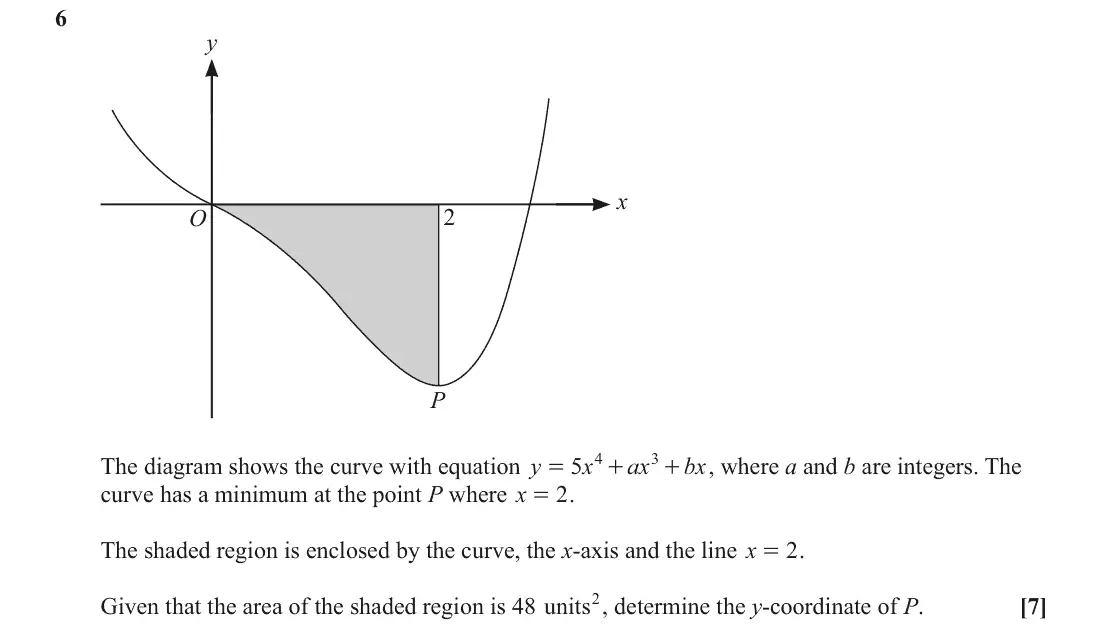
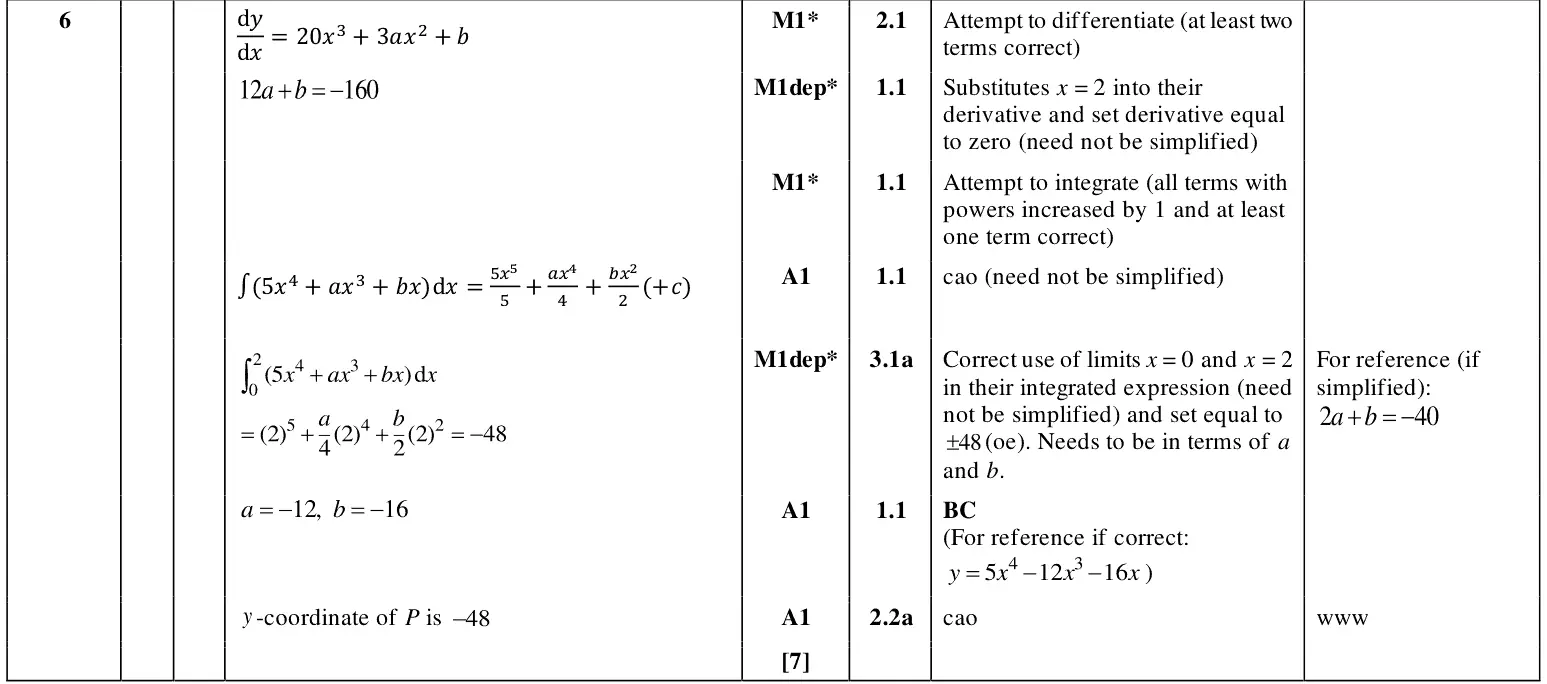
Those who recognised the need to differentiate and integrate generally did it well. A lot of candidates dropped 2 marks because they used 48 rather than -48 in their working. Quite a few unnecessarily found the second derivative; some then ignored it, but others substituted x = 2, set it to zero and obtained a value for a. The poorer efforts generally either didn’t differentiate or didn’t integrate, but most efforts gained at least 2 marks.
Key points and common errors
dy/dx = 0 at x = 2 gives 12a + b = −160
area below the axis so integral from 0 to 2 equals −48, giving 2a + b = −40
a = −12, b = −16
y-coordinate of P is −48
using +48 is the common error
June 2024 · Paper 1 · Q11(b)4 marksMedium
Show the start of this question
Mark scheme for this part
Examiner's comment
The differentiation of the logarithmic function was reasonably well done with the correct derivative often seen. Many did not produce a non-zero value for x when seeking the required stationary point. The most common incorrect answers given were 𝑥= 0 and 𝑥= 𝜋. The correct y-value often came from an incorrect x value and so was not given credit.
Key points and common errors
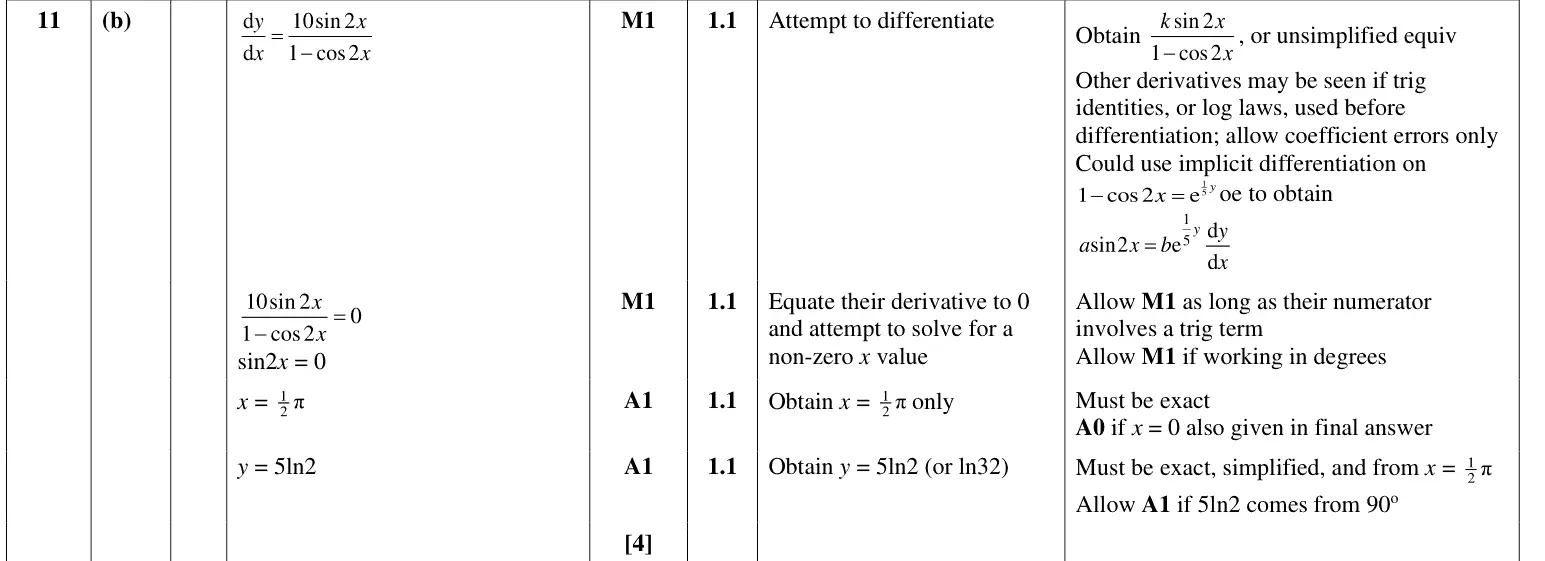
dy/dx = 10sin2x/(1 − cos2x)
sin2x = 0, smallest positive x = π/2
y = 5ln2
x = 0 or π common errors
June 2024 · Paper 1 · Q11(c)(ii)1 markHard
Show the start of this question
Mark scheme for this part
Examiner's comment
This was not well answered and was often left blank. Quite a few candidates who deduced that the stationary points must all be maxima did not give sufficient reasoning.
Key points and common errors
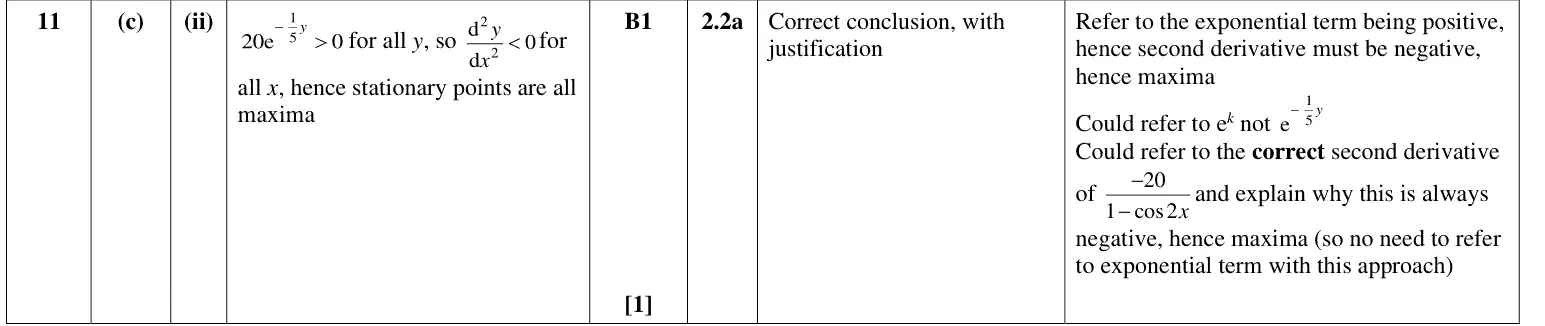
20e^(−y/5) > 0 so d²y/dx² < 0 for all x: every stationary point is a maximum
reason required
June 2024 · Paper 2 · Q4(b)3 marksEasy
Show the start of this question
Mark scheme for this part
Examiner's comment
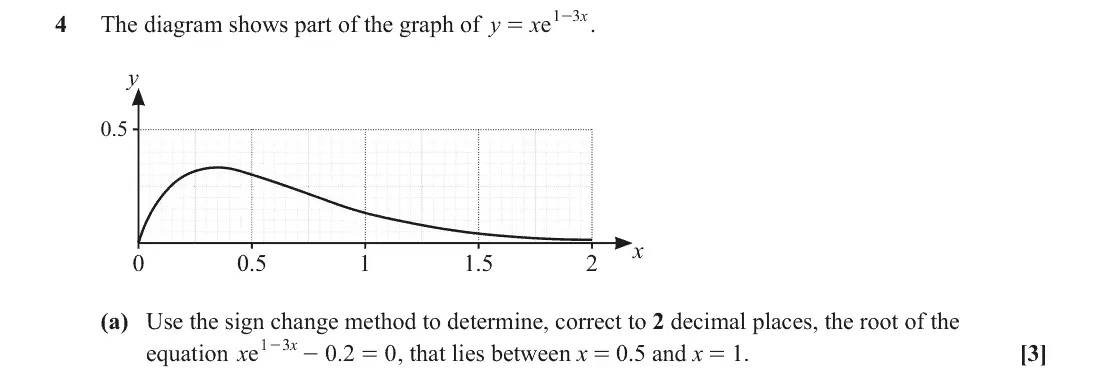
This question was well answered. Most candidates made an acceptable attempt at differentiating the given expression and noticed that they needed to use the product rule to do so (those who didn’t scored M0). Of those who differentiated correctly, most were able to go on to solve =0 and reach the required response for A1. Relatively few candidates explicitly considered (and excluded) further roots from 𝑒1−3𝑥= 0 but the B1 mark could be implied by only giving a single value for x from the other factor. Some candidates attempted to find a further root (or incorrectly deduced x=0) which meant they scored B0. Other candidates attempted the second derivative and mistakenly set this equal to zero.
Key points and common errors
product rule needed
e^(1−3x) is never 0 so x = 1/3
June 2023 · AS Paper 1 · Q6(b)4 marksMedium
Show the start of this question
Mark scheme for this part
Examiner's comment
Most candidates successfully differentiated the given expression. However, many did not show the process of setting this = 0 and solving (e.g. dividing through by a factor of 7 to obtain the equation from (a)). Again the command word ‘Determine’ means that working is required; some candidates appeared to simply assume that the answers would be the x-values from part (a). While most candidates were able to correctly calculate the corresponding y-values, some candidates missed this instruction and so were unable to access the final A mark.
Key points and common errors
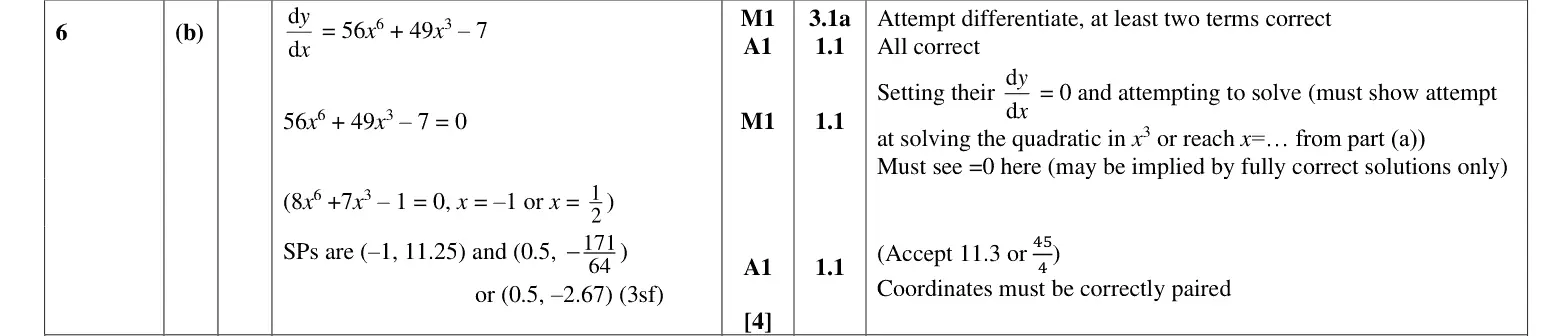
dy/dx = 56x⁶ + 49x³ − 7 = 0 is 7 × the equation in (a)
points (−1, 11.25) and (½, −171/64)
must show setting = 0 and find y-values
June 2023 · AS Paper 1 · Q6(c)4 marksMedium
Show the start of this question
Mark scheme for this part
Examiner's comment
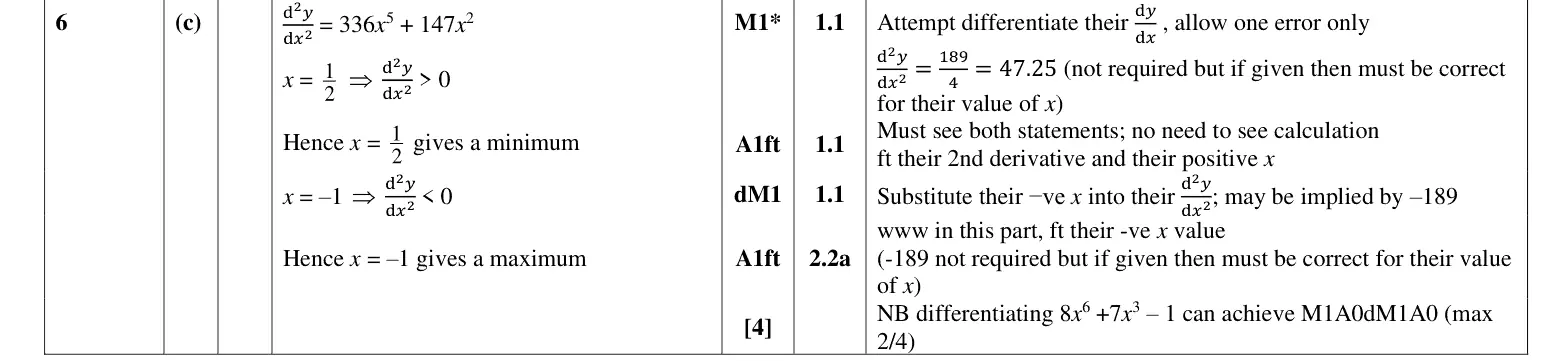
Most candidates obtained a reasonable second derivative (FT was allowed here from their first derivative in part (b)). Note that the question asked candidates to ‘use the value’ of the second derivative, so we needed to see an explicit statement that this was < or > 0 at each point before concluding whether each point was a local minimum or maximum. If values were given, they needed to be correct. FT was allowed from candidates’ second derivative and/or their values of x. Some candidates misinterpreted the question and differentiated the equation from part (a) (8x6 + … ), which if done correctly was awarded M1A0M1A0.
Key points and common errors
d²y/dx² = 336x⁵ + 147x²
positive at x = ½ (minimum), negative at x = −1 (maximum)
must state the sign explicitly
June 2023 · AS Paper 2 · Q7(b)3 marksHard
Show the start of this question
Mark scheme for this part
Examiner's comment
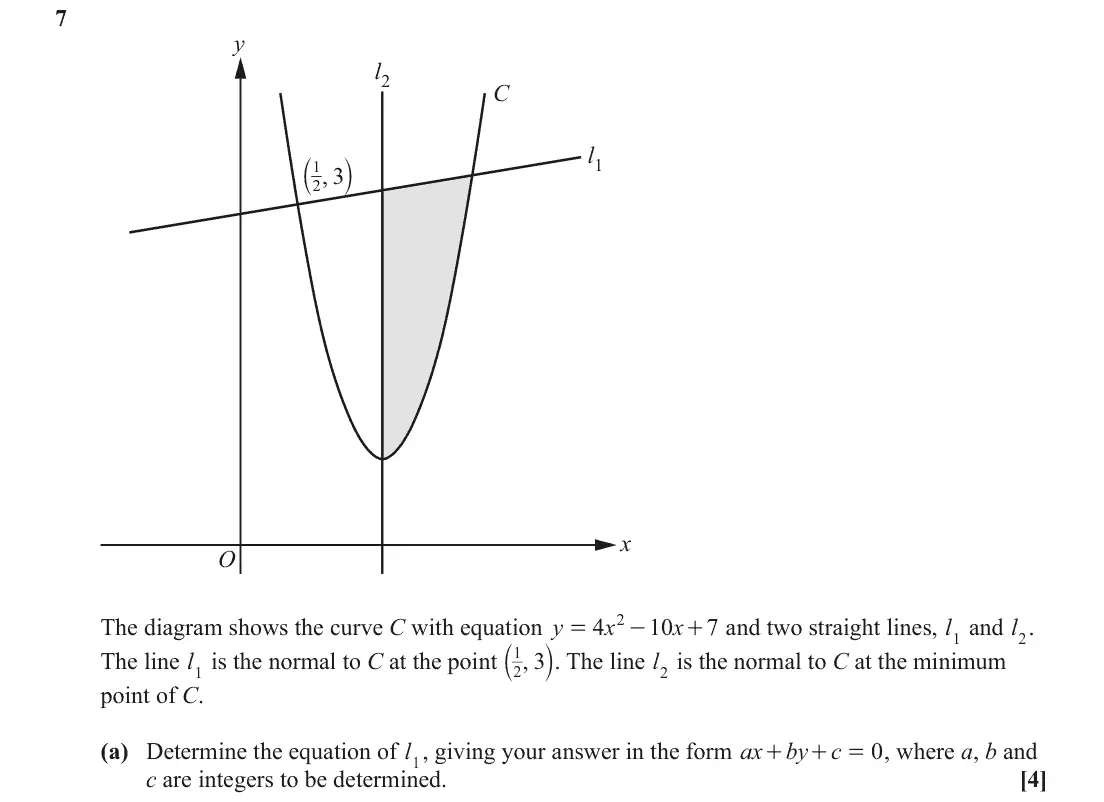
This part proved challenging. x ≥ 1.25 appeared most often, sometimes as the only inequality given. Candidates felt more comfortable obtaining an inequality from their normal when it had been written ‘y =….’. Some used strict inequalities. Less successful responses had inequalities involving the labels l1, l2 and C.
Key points and common errors
l₂ is x = 1.25 (min point)
x ≥ 1.25, y ≥ 4x² − 10x + 7, 2x − 12y + 35 ≥ 0
non-strict inequalities for boundaries
labels l₁ etc. not acceptable
June 2023 · Paper 1 · Q6(a)4 marksEasy
Mark scheme for this part
Examiner's comment
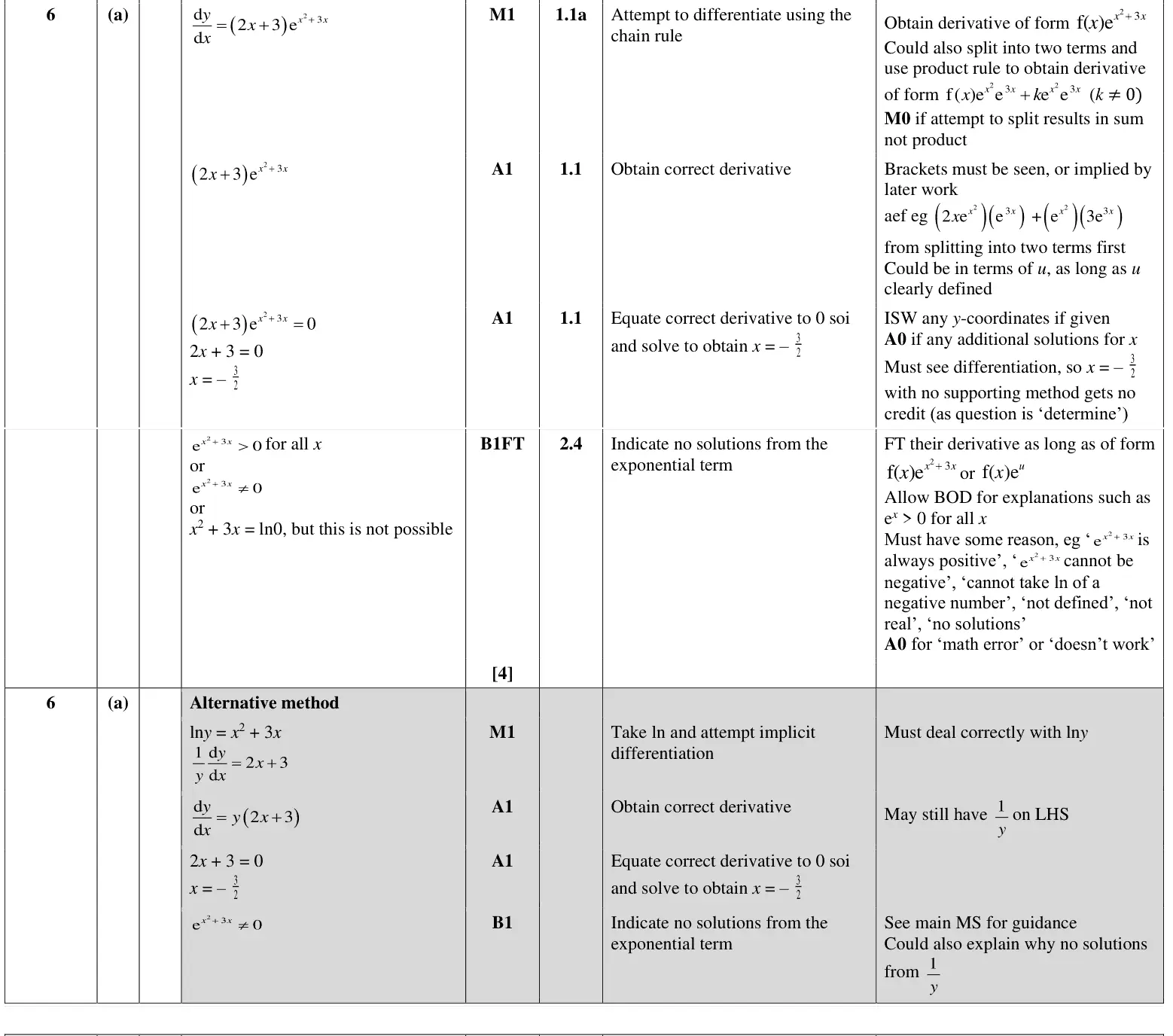
This part of the question was generally well answered, with candidates providing detailed and convincing solutions. Most were able to differentiate the given function using the chain rule, whereas a few first introduced logs and then used implicit differentiation. Candidates then had to equate the derivative to 0, solve to find x = −1.5 and explain why the exponential term would not give any solutions when equated to 0.
Key points and common errors
chain rule (2x + 3)e^(x² + 3x)
x = −3/2
must state e^(x² + 3x) ≠ 0
June 2023 · Paper 3 · Q7(d)1 markHard
Show the start of this question
Mark scheme for this part
Examiner's comment
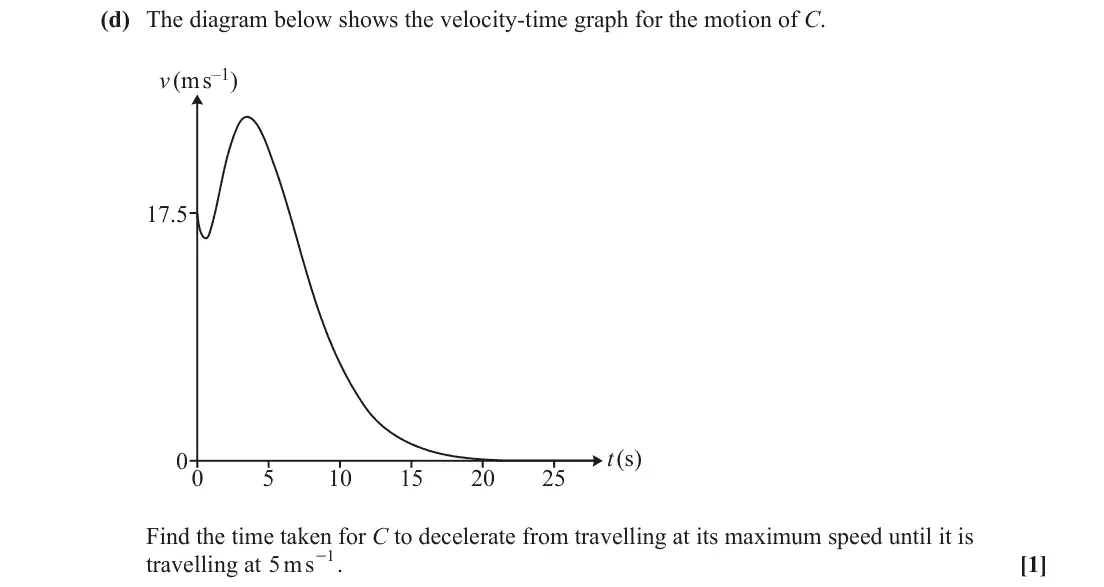
Very few candidates used the given velocity-time graph correctly, together with the answers from parts (a) and (c) to obtain the correct answer of 7.51 in this part.
Key points and common errors
maximum speed at t = 3.5 from (a)
speed 5 at T = 11.01 from (c)
11.01 − 3.5 = 7.51 s
June 2022 · AS Paper 2 · Q5(b)1 markMedium
Show the start of this question
Mark scheme for this part
Examiner's comment
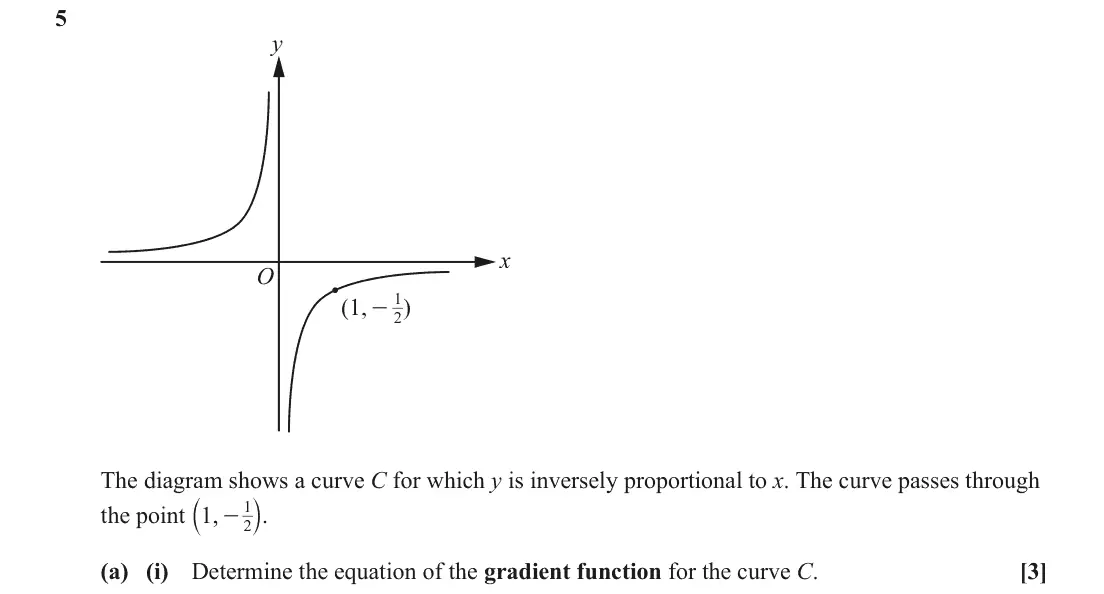
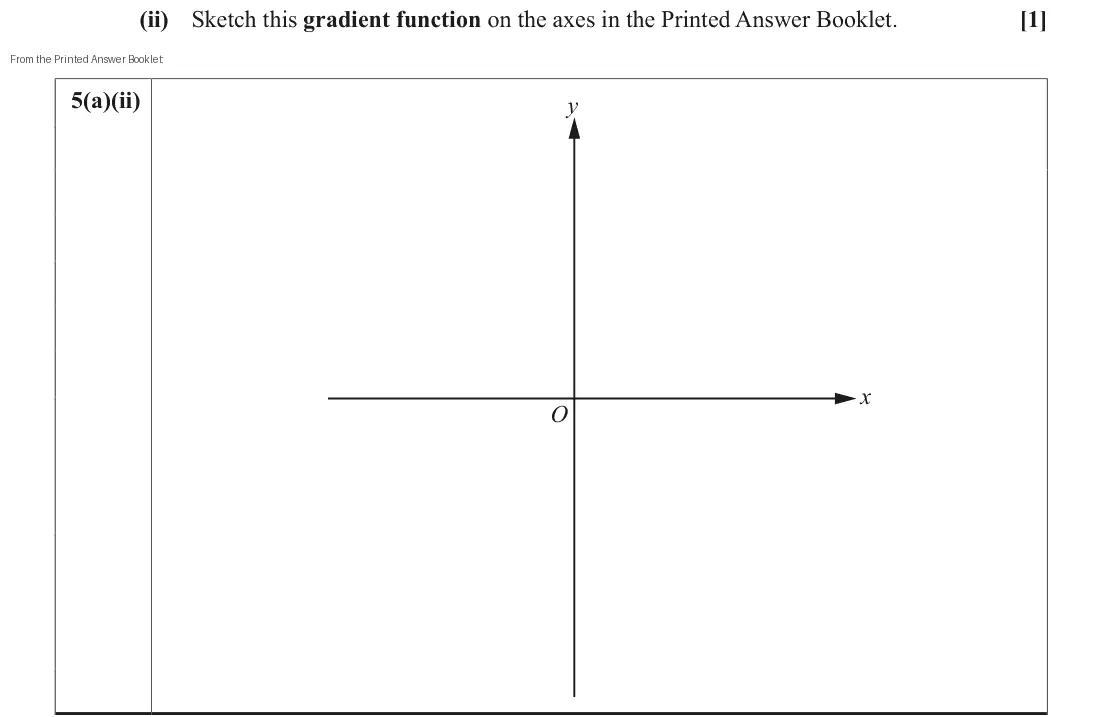
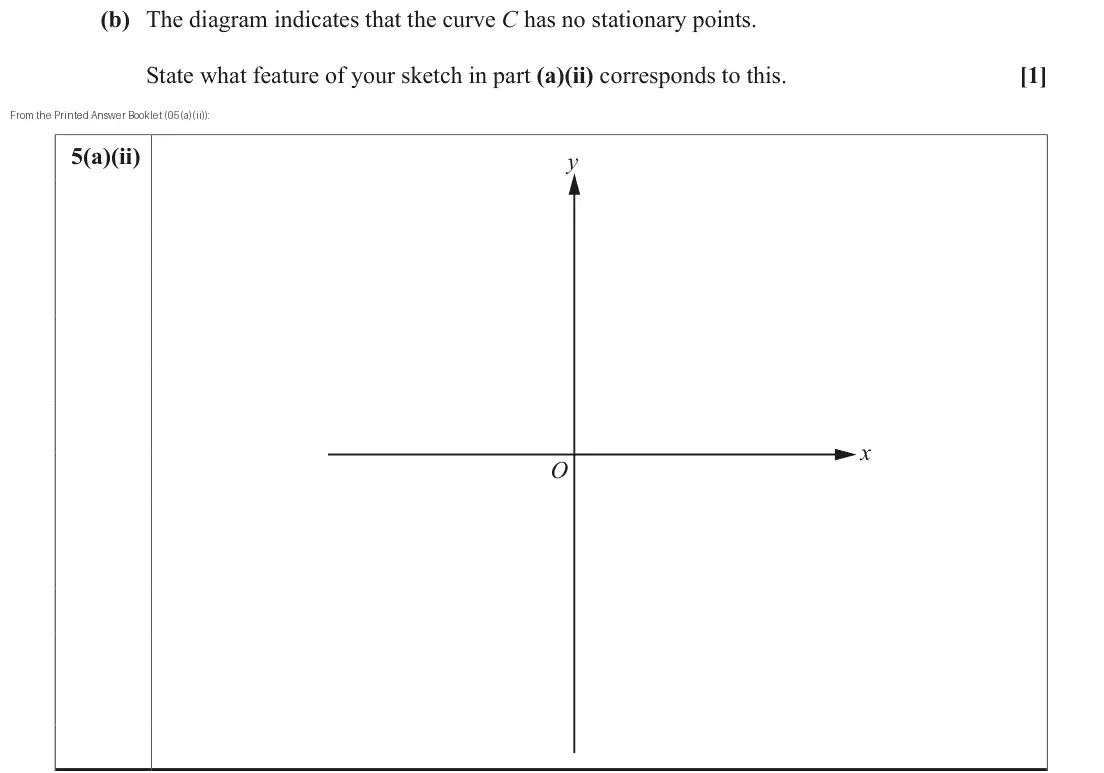
k There were too many vague answers here. We only gave credit for graphs of the form y = and x wanted candidates to simply focus on the graph not intersecting with the x-axis.
Key points and common errors
the gradient-function graph never meets the x-axis
vague answers not credited
June 2022 · Paper 2 · Q5(a)2 marksEasy
Mark scheme for this part
Examiner's comment
Almost all candidates differentiated and equated d y x to 0. A few made errors in the differentiation. Many d obtained the correct equation, 3x2 − 6x + 4 = 0. Because this is a “detailed reasoning” question, it was essential to show working to demonstrate that this equation has no real roots in order to gain the second mark. Most did so successfully using either the discriminant or completing the square. However, some candidates just stated that there were no real solutions, without justification. A few gave an incorrect justification such as “this equation won’t factorise so there are no solutions”. More seriously, a few candidates used the coefficients from the cubic expression for y to obtain a bogus “discriminant” and showed that it was negative.
Key points and common errors
dy/dx = 3x² − 6x + 4 = 0
discriminant −12 < 0 or 3(x − 1)² + 1 > 0 so no real roots
justification required
Autumn 2021 · AS Paper 1 · Q5(b)4 marksMedium
Show the start of this question
Mark scheme for this part
Key points and common errors
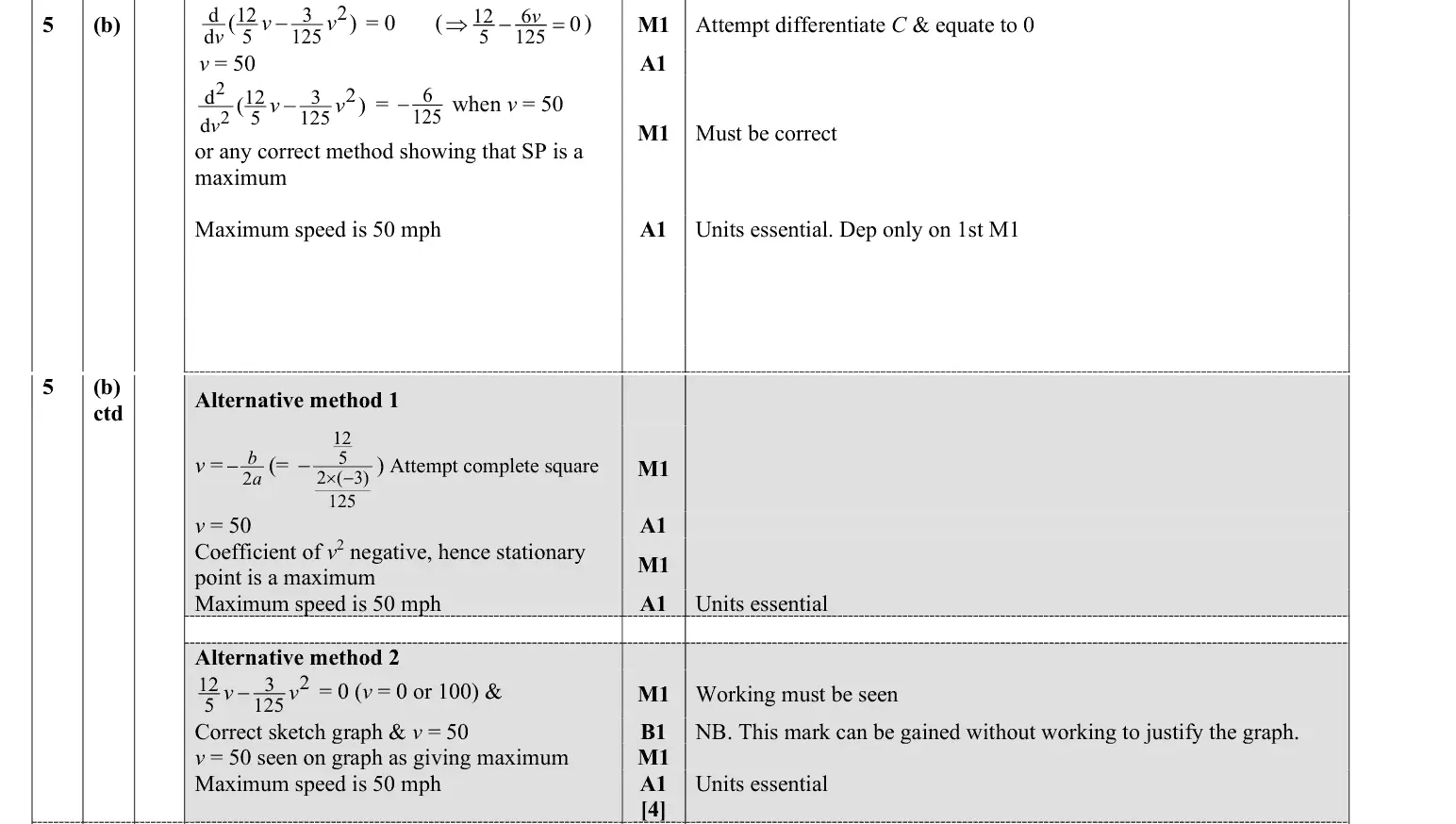
dC/dv = 12/5 − 6v/125 = 0 gives v = 50
show maximum (second derivative −6/125 or negative v² coefficient)
answer 50 mph with units
Autumn 2021 · AS Paper 2 · Q6(a)1 markMedium
Mark scheme for this part
Key points and common errors
d²y/dx² = 3x² + 2 > 0 for all x so the stationary point is a minimum
Autumn 2021 · AS Paper 2 · Q6(b)5 marksMedium
Show the start of this question
Mark scheme for this part
Key points and common errors
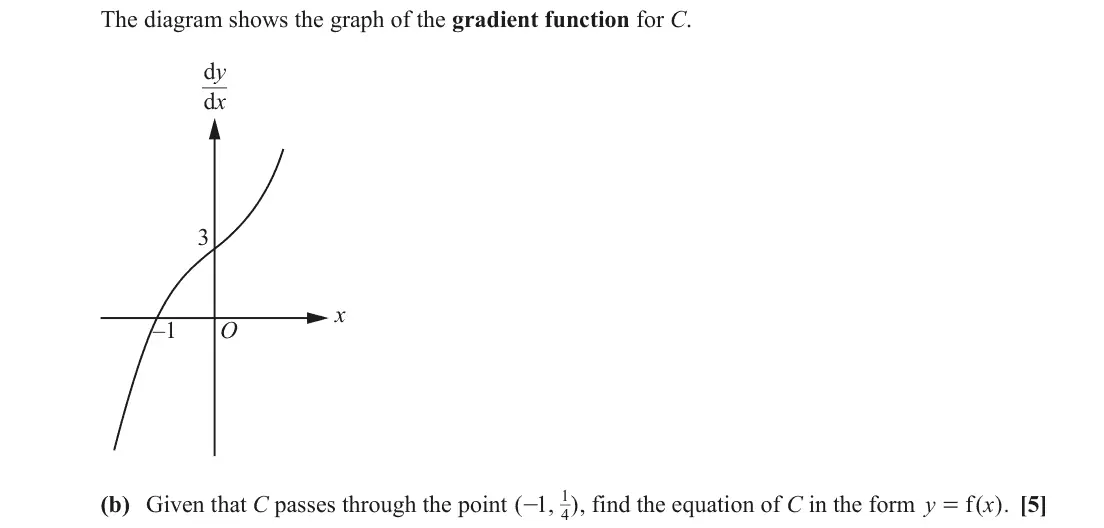
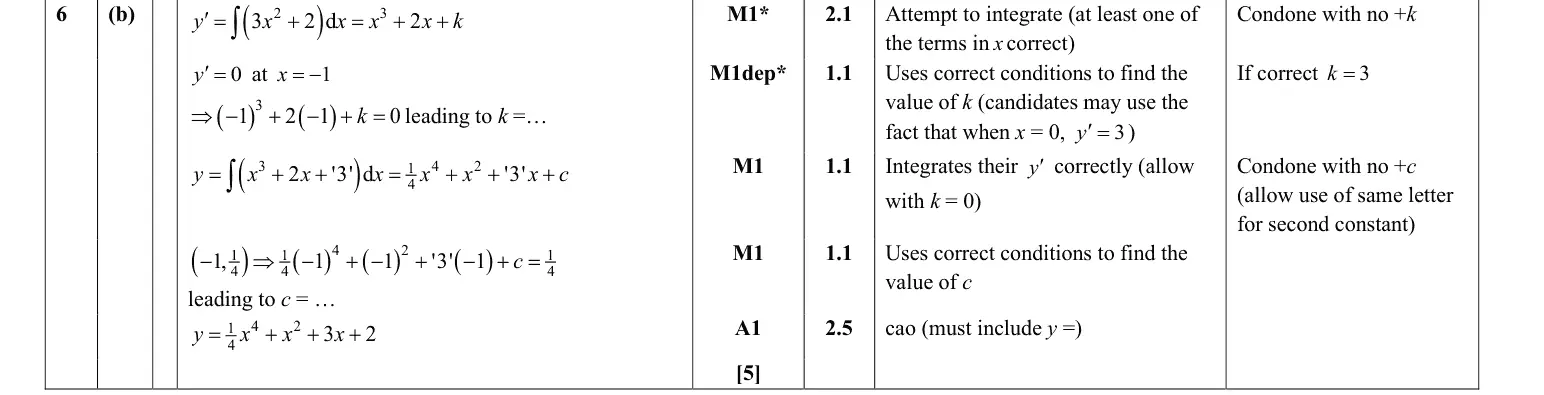
integrate: dy/dx = x³ + 2x + k
graph gives dy/dx = 0 at x = −1 (or 3 at x = 0) so k = 3
integrate again and use (−1, ¼): y = ¼x⁴ + x² + 3x + 2
include 'y ='
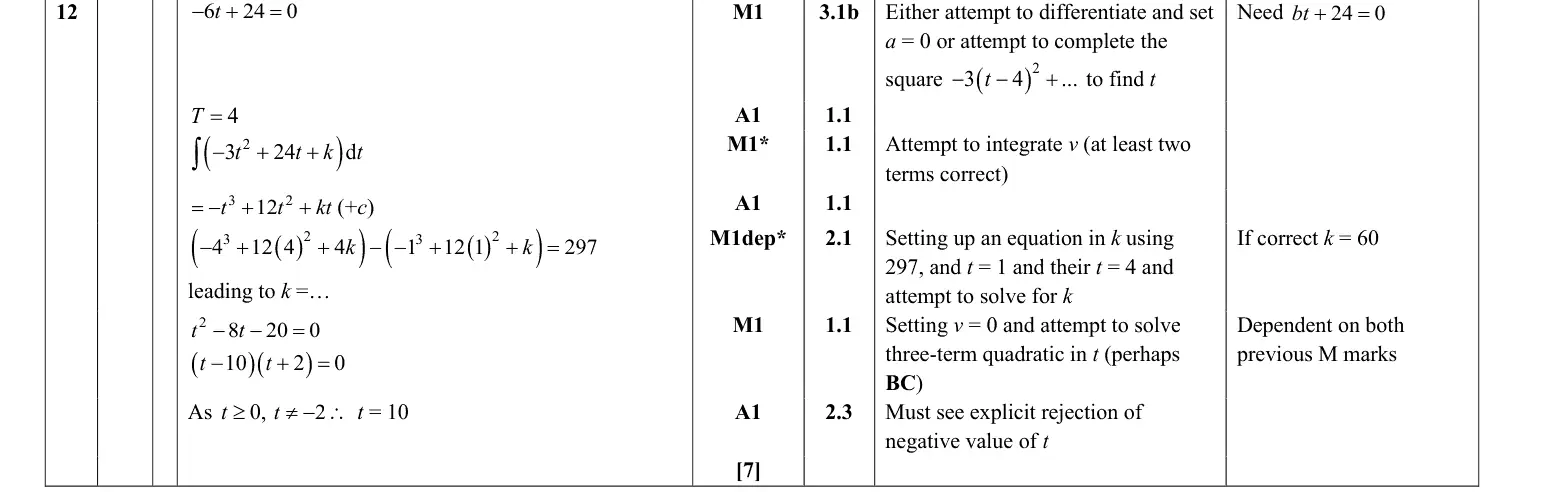
Autumn 2021 · AS Paper 2 · Q127 marksMedium
Mark scheme for this part
Key points and common errors
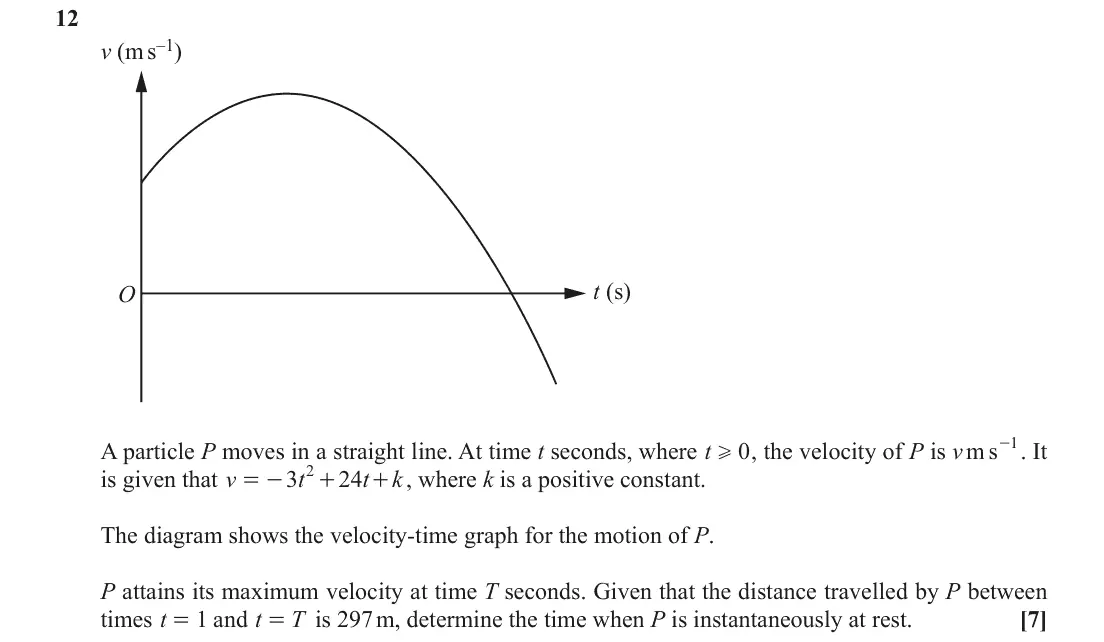
maximum velocity when a = −6t + 24 = 0, T = 4
s = −t³ + 12t² + kt
distance from t = 1 to 4 equals 297 gives k = 60
v = 0: t² − 8t − 20 = 0, t = 10 (reject −2 explicitly)
Autumn 2021 · Paper 1 · Q5(b)(i)1 markMedium
Mark scheme for this part
Examiner's comment
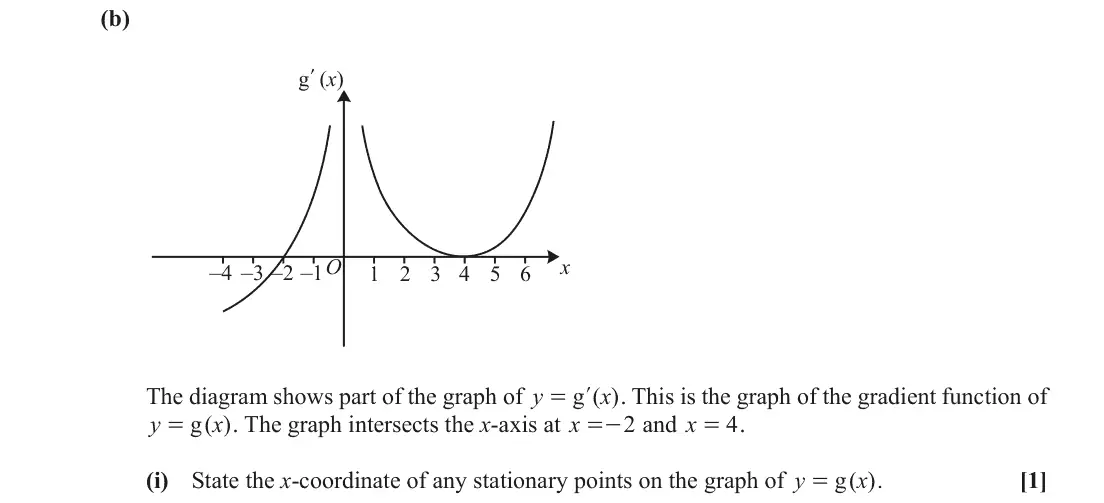
(From the general report) The graph in Question 5(b) was clearly identified as a gradient function graph, yet several candidates did not interpret it as such. On Question 5(b) the common misconception was that the graph showed a function rather than a gradient function.
Key points and common errors
graph is g′(x) not g(x): stationary points where g′(x) = 0, x = −2 and x = 4
common misconception treating it as the function itself
Autumn 2021 · Paper 1 · Q7(a)2 marksMedium
Mark scheme for this part
Examiner's comment
(From the general report) The first part of Question 7 was a ‘show that’ question and candidates were expected to provide sufficient detail to be convincing, including expressing the derivative equated to 0 before dealing with the fractional term.
Key points and common errors
product rule: 2x ln x + (x² − 2)/x
must equate to 0 before clearing the fraction
Autumn 2021 · Paper 1 · Q7(d)2 marksMedium
Show the start of this question
Mark scheme for this part
Examiner's comment
(From the general report) The first part of Question 7 was a ‘show that’ question and candidates were expected to provide sufficient detail to be convincing, including expressing the derivative equated to 0 before dealing with the fractional term.
Key points and common errors
continue iterating to converge
(1.206, −0.102) to 3 d.p.
Autumn 2020 · AS Paper 2 · Q7(b)4 marksHard
Show the start of this question
Mark scheme for this part
Examiner's comment
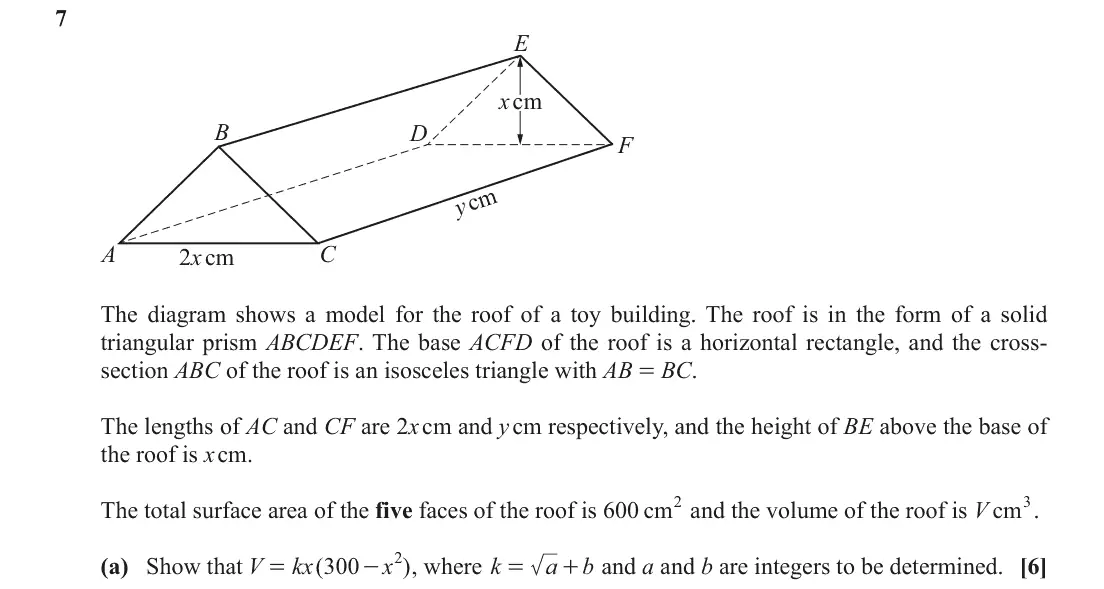
(Comment on Question 07 as a whole) Part (a) - V = 2x2y was seen and often the required result for the surface area was incorrect, although many candidates managed to find at least 3 correct faces and gain M1. Replacing y in V and the subsequent rationalising was rarely seen. Part (b) - M1 A1 earned, with k often used, but few completed. Full credit could have been gained here even if no k had been obtained earlier. Second derivatives appeared sometimes. Part (c) and (d) were commonly not attempted.
Key points and common errors
dV/dx = k(300 − 3x²) = 0 gives x = 10
full credit possible without k
Autumn 2020 · AS Paper 2 · Q7(c)1 markHard
Show the start of this question
Mark scheme for this part
Examiner's comment
(Comment on Question 07 as a whole) Part (a) - V = 2x2y was seen and often the required result for the surface area was incorrect, although many candidates managed to find at least 3 correct faces and gain M1. Replacing y in V and the subsequent rationalising was rarely seen. Part (b) - M1 A1 earned, with k often used, but few completed. Full credit could have been gained here even if no k had been obtained earlier. Second derivatives appeared sometimes. Part (c) and (d) were commonly not attempted.
Key points and common errors
V = 828 cm³
Autumn 2020 · AS Paper 2 · Q11(c)3 marksHard
Show the start of this question
Mark scheme for this part
Examiner's comment
(Comment on Question 11 as a whole) Part (a) - s = 16t used – the need for t – 1.5 was generally not understood. This then led to t = 0 and t = 8 from a two term quadratic and thus gained only M1 A1. Candidates did not seem to realise that t = 0 could not be one of the required times given the problem. t + 1.5 was seen in some working. Part (c) - Most candidates made no useful progress with this part. Common misconceptions Key teaching and learning points – comments on improving performance The following, some of which have been mentioned in previous reports, remain pertinent. 1. Candidates should understand the implication of the ‘In this question you must show detailed reasoning’ instruction. Generally, this means examiners will expect to see how results have been obtained. So, for example, in Question 6 on this paper the method for solving the simultaneous equations was expected and those just doing it on the calculator earned M0 for this skill. 2. BC – a result achieved ‘by calculator’ – can encourage candidates to show little, if any, evidence of how their answer has been produced. To be fair, where this appears on the mark scheme (in Question 10) candidates generally adopted the ‘old-fashioned’ algebraic route but no doubt this will change over time. Inevitably examiners will find it difficult to know where an incorrect answer, presented alone, has come from and it may be hard to credit. It may be wise to encourage candidates to provide some evidence of what they are doing, especially in cases where more than one mark is available. 3. The front cover instructions state ‘Give non-exact numerical answers correct to 3 significant figures unless a different degree of accuracy is specified in the question.’ This should be stressed – some final answers were correct to 2 significant figures only. This may result in a loss of accuracy marks. 4. A question may require units in an answer to gain full credit. It is best to make candidates aware of this and urge them to always include units in answers where relevant. 5. The front cover instruction state ‘When a numerical value is needed use g = 9.8 unless a different value is specified in the question’. This now seems to be well recognised. Guidance on using this paper as a mock This paper covers the following topics : Cosine rule, ½absinC with area of a segment, curve sketching and interpretation of the algebraic solution of an equation graphically, finding the normal to a curve, the factor theorem and factorisation, quadratic functions and graphical transformations, properties of the circle and the circle equation, a maximisation problem with rationalising and algebraic manipulation, use of the laws of logarithms, forces in vector notation in equilibrium, Newton’s second law, variable acceleration and suvat equation use. The Pure section introduces the calculus and various other ideas which require a secure grasp of basic algebra and in the Mechanics section students need a sound understanding of kinematics with both uniform and non-uniform acceleration and Newton’s laws.
Key points and common errors
gap 16(t − 1.5) − 2t² maximum at t = 4 (midpoint)
8 m
little useful progress made
Autumn 2020 · Paper 1 · Q3(b)6 marksMedium
Show the start of this question
Mark scheme for this part
Examiner's comment
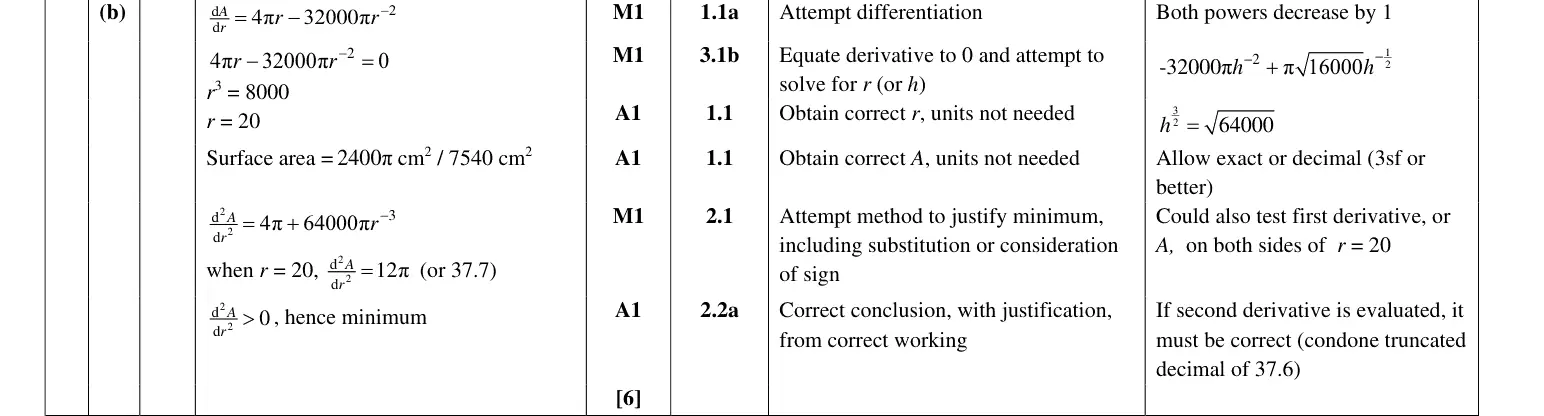
(Comment on Question 03 as a whole) The first part of Question 3 required candidates to show the derivation of the given equation. On questions such as this, where the request is to ‘show that’ a given answer is correct, it is important that sufficient detail is given to provide a convincing solution. Examiners expected to see an equation for the volume, an expression for the total surface area and then clear substitution and manipulation to arrive at the given answer. In the second part of the question, a surprisingly common error was to find the radius but then omit to find the minimum surface area. Candidates should review a question to make sure that it is fully answered before moving on; other strategies such as highlighting or underlining key words and phrases within a question may also be helpful.
Key points and common errors
dA/dr = 4πr − 32000πr⁻² = 0 gives r = 20
A = 2400π cm²
second derivative 12π > 0 so minimum
common error: finding r but not the minimum area
June 2019 · AS Paper 1 · Q4(a)4 marksEasy
Mark scheme for this part
Examiner's comment
Many correct responses were seen. Some candidates made arithmetical errors in finding the values of y. A few candidates did not differentiate but attempted to solve x3 – 6x2 + 9x = 0. This can lead to finding one turning point, but not the other. In this case it was fortuitous for them that the minimum was identifiable in the form of a repeated root.
Key points and common errors
dy/dx = 3x² − 12x + 9 = 0
x = 1 or 3
(1, 4) and (3, 0) paired
June 2019 · Paper 2 · Q5(b)5 marksMedium
Show the start of this question
Mark scheme for this part
Examiner's comment
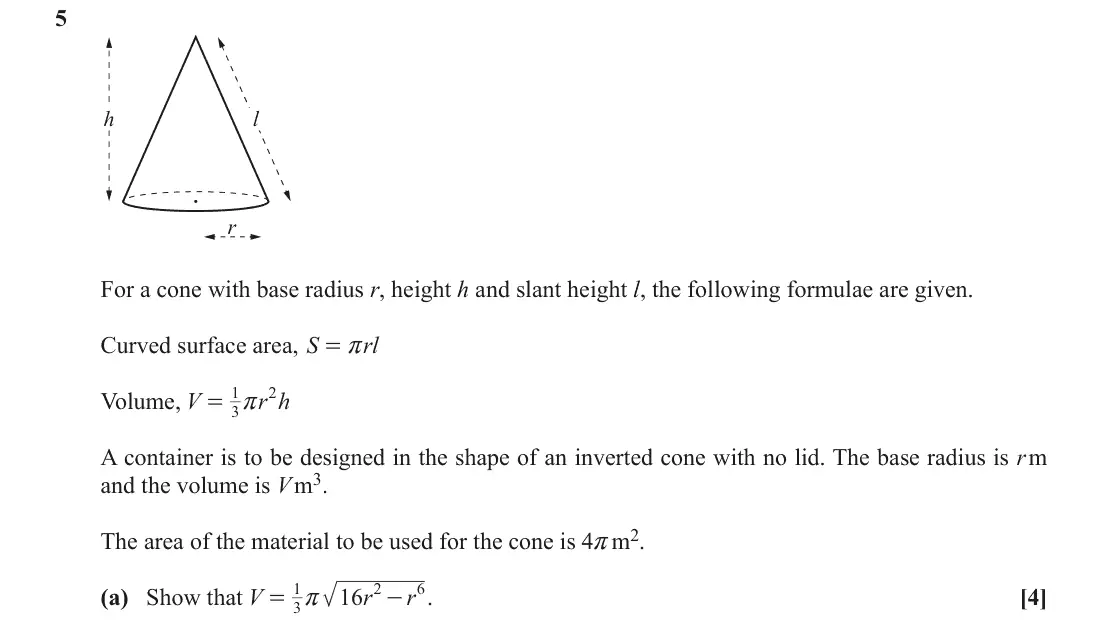
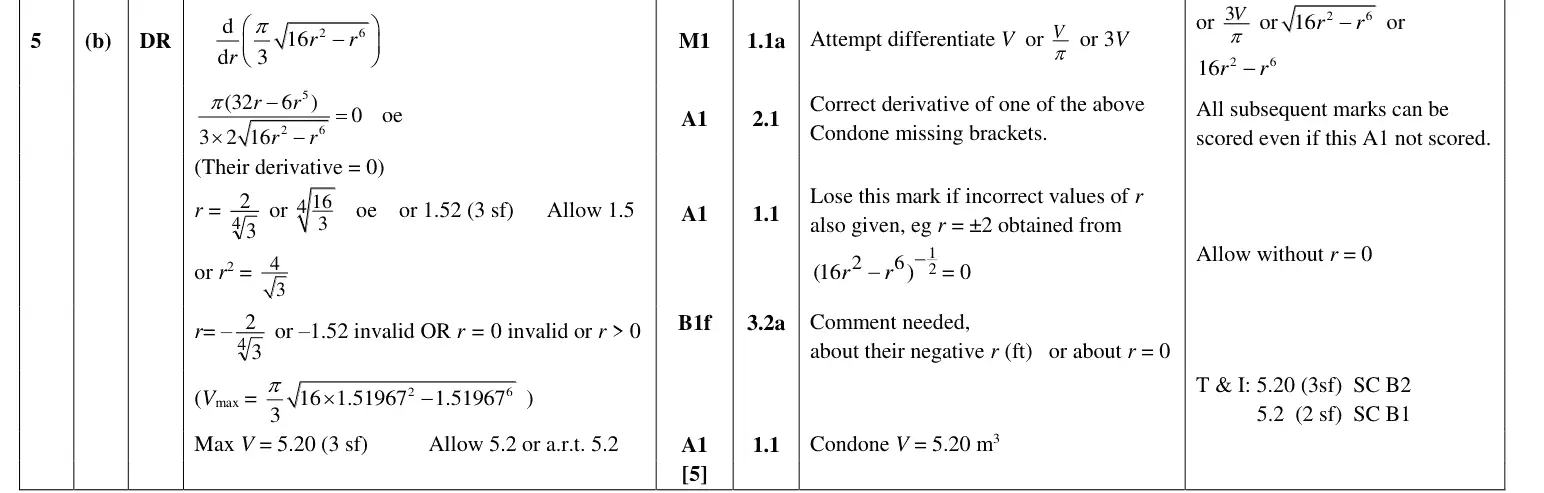
Most attempted to differentiate V, with varying levels of success. Some made arithmetical errors. Others ( ) 0.5 ( ) π π d V 2 6 5 had = 16 r − r × 32 r − 6 r or 32 r − 6 r . Some differentiated correctly, but then d r 6 6 (incorrectly) set 16 r − r = 0 , as well as (correctly) setting 32 r − 6 r = 0 . The ‘Detailed reasoning’ instruction indicates that the solution must lead to a conclusion by showing a detailed and complete analytical method; this meant that candidates were expected to give a reason for 2 rejecting one or both of r = 0 and r = − . Similarly, a ‘Trial and Improvement’ method to identify 4 3 r = 1 52 . , seen by a few candidates, was not considered an adequate method for full credit.
Key points and common errors
differentiate √(16r² − r⁶) by chain rule
32r − 6r⁵ = 0 gives r⁴ = 16/3
must reject r = 0 and negative r
V = 5.20
trial and improvement not enough
June 2019 · Paper 3 · Q4(a)3 marksMedium
Mark scheme for this part
Examiner's comment
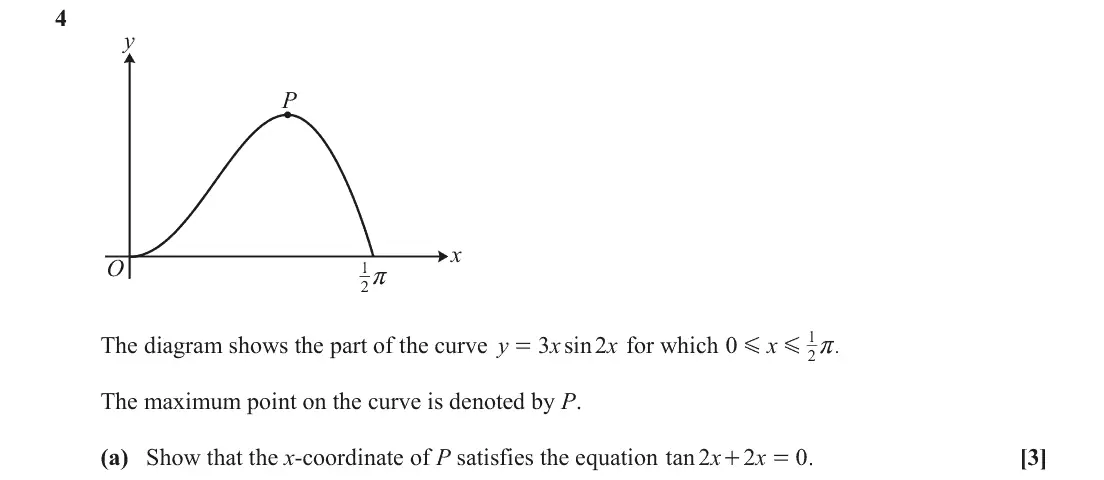
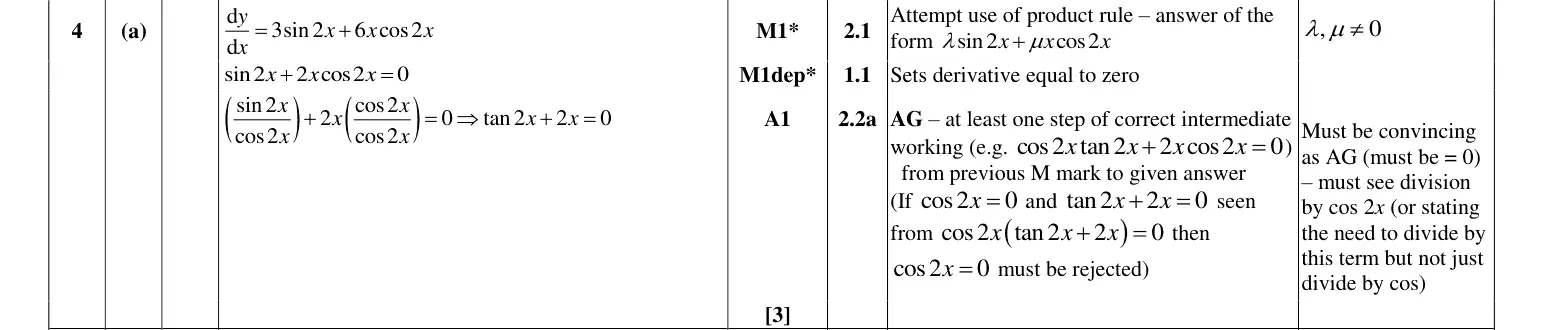
While most candidates differentiated y correctly (using the product rule) and obtained 3sin2 x + 6 cos2 x x = 0 many candidates did not show enough working to convince examiners that they had derived and not simply stated the given result. For example, sin 2 x + 2 cos 2 x x = 0 ⇒ tan 2 x + 2 x = 0 scored A0. sin2 x But sin2 x + 2 cos2 x x = 0 ⇒ + 2 x = 0 ⇒ tan2 x + 2 x = 0 scored A1. cos2 x
Key points and common errors
product rule: 3sin2x + 6xcos2x = 0
divide by cos 2x explicitly to reach tan2x + 2x = 0
insufficient working
June 2018 · Paper 1 · Q10(ii)2 marksMedium
Show the start of this question
Mark scheme for this part
Examiner's comment
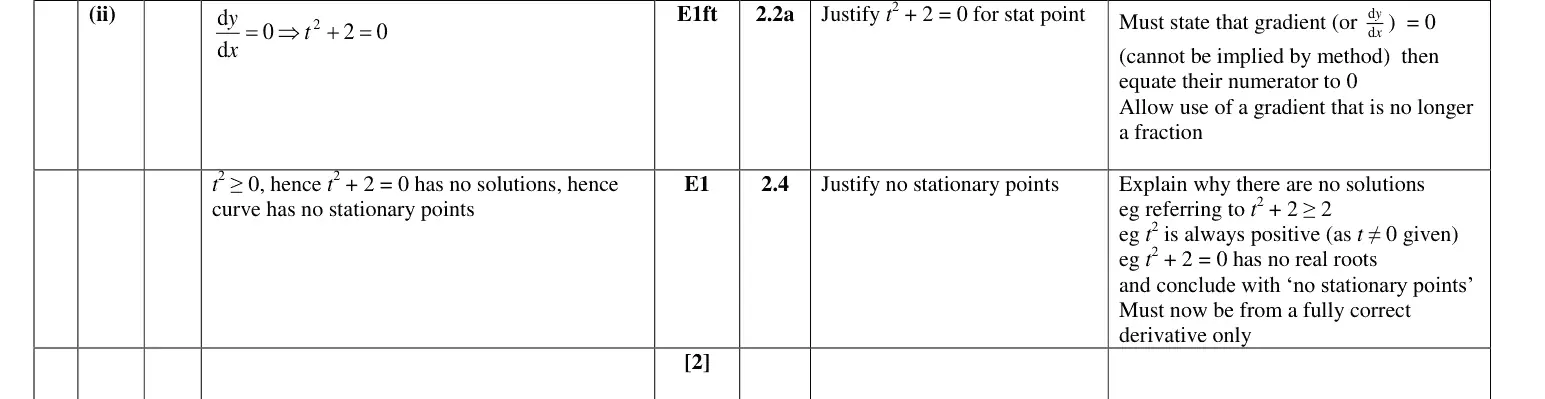
Whilst most candidates were able to attempt the correct method, many did not give sufficient detail of their reasoning. Rather than just equating the derivative to 0 examiners expected to see some justification for this, such as a statement that the gradient is 0 at a stationary point. Candidates were then expected to explain why the equation t 2 + 2 = 0 had no real roots before concluding that this meant there were no stationary points.
Key points and common errors
stationary point needs dy/dx = 0 so t² + 2 = 0
no real solutions since t² ≥ 0
justification required
June 2018 · Paper 2 · Q6(iii)4 marksEasy
Show the start of this question
Mark scheme for this part
Examiner's comment
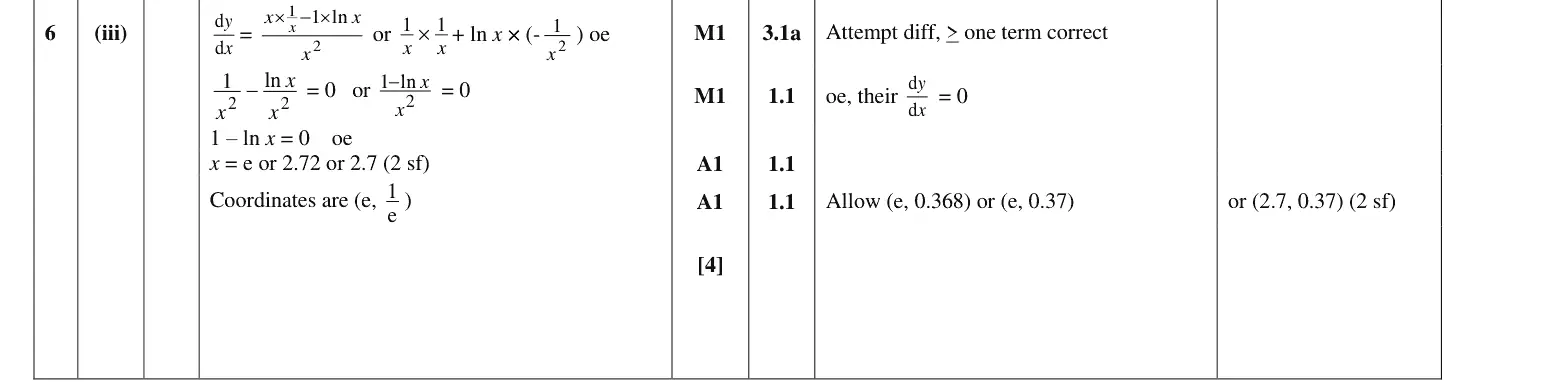
This question was well answered. A few candidates did not find the y-coordinate. Some made mistakes in the differentiation.
Key points and common errors
quotient rule: (1 − ln x)/x² = 0 so x = e
coordinates (e, 1/e)
some omitted the y-coordinate
June 2018 · Paper 2 · Q6(iv)5 marksMedium
Show the start of this question
Mark scheme for this part
Examiner's comment
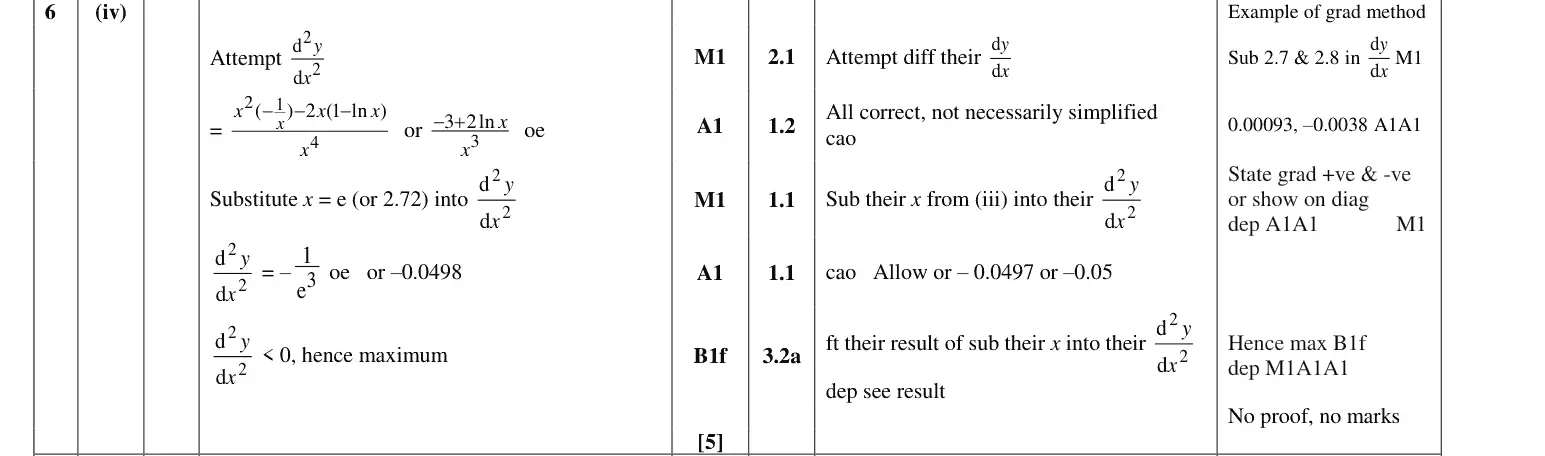
Most candidates attempted a correct method. Some made mistakes in the differentiation. Others made 2 d y 2 d x numerical errors when substituting x = e into . Some considered the gradient on either side of the turning point, generally correctly. In both this part and part (iii), candidates who used "e" throughout, rather than its approximate decimal value, produced neater and more efficient solutions.
Key points and common errors
d²y/dx² = (2ln x − 3)/x³ = −1/e³ < 0 so maximum
working with e rather than decimals is neater
gradient either side also accepted
Find an A-level maths tutor
Stuck on this? Book a trial session with an A-level maths tutor.