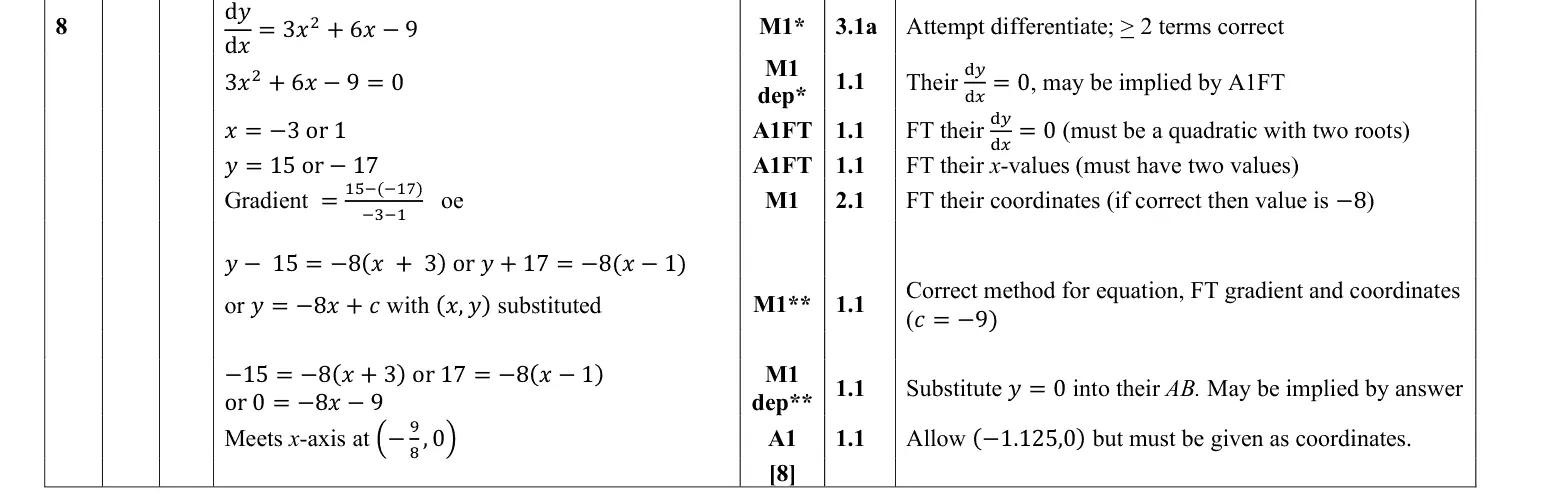
This question was generally very well answered. Almost all candidates were able to differentiate, set =0 and solve to obtain two values of x for M1M1A1. Some candidates made a numerical error in finding the corresponding values of y, but were still able to go on obtaining the subsequent method marks. Most candidates identified the need to find the gradient, equation and then set 𝑦= 0 although some instead solved for 𝑥= 0, etc. A few candidates stopped after the first four marks. Notice that (in contrast with Question 1 (b) as there is no DR instruction here, candidates were not required to show the working to solve their quadratic d𝑦 d𝑥= 0 but it remains best practice to do so. The question asked for the ‘coordinates of the point’ so 𝑥= − 8 was not sufficient as a final answer. This was a common omission and led to candidates receiving 7/8. This candidate has made a good start, scoring M1M1A1 for their differentiation and correct values of x for the turning points. They then make an error in finding one of the corresponding values of y (A0) but go on to work correctly with their values, scoring M1M1M1. The final answer is incorrect (A0) so this response scored 6/8.
Key points and common errors
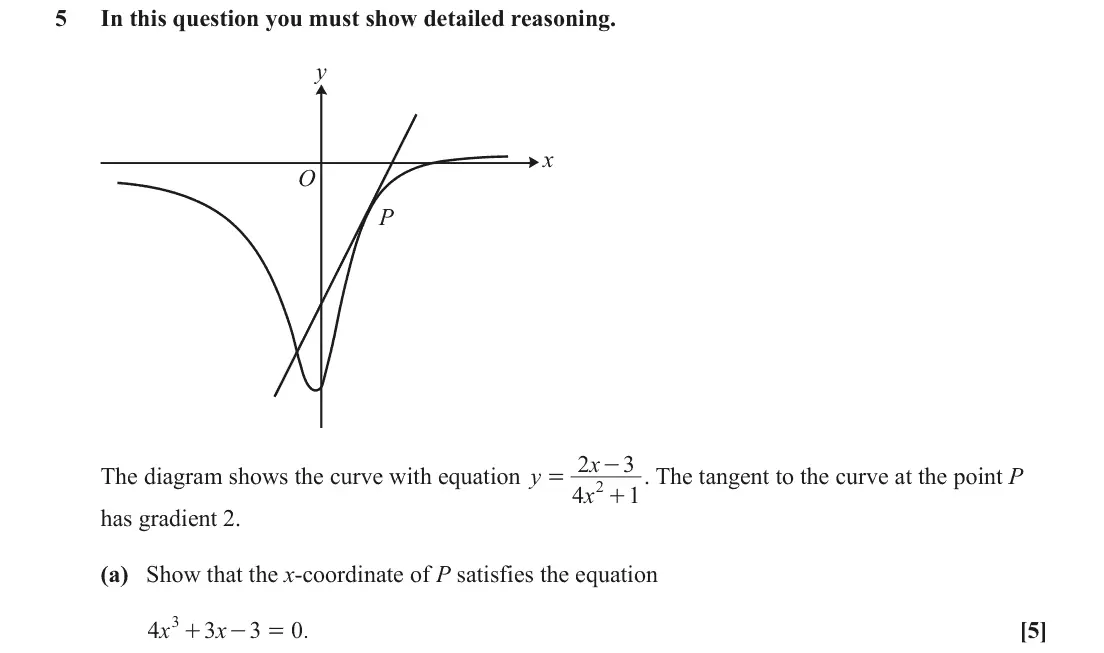
dy/dx = 3x² + 6x − 9 = 0: A(−3, 15), B(1, −17)
gradient −8
y = −8x − 9 meets the x-axis at (−9/8, 0)
give coordinates, not just x
June 2025 · AS Paper 2 · Q4(a)4 marksEasy
Mark scheme for this part
Examiner's comment
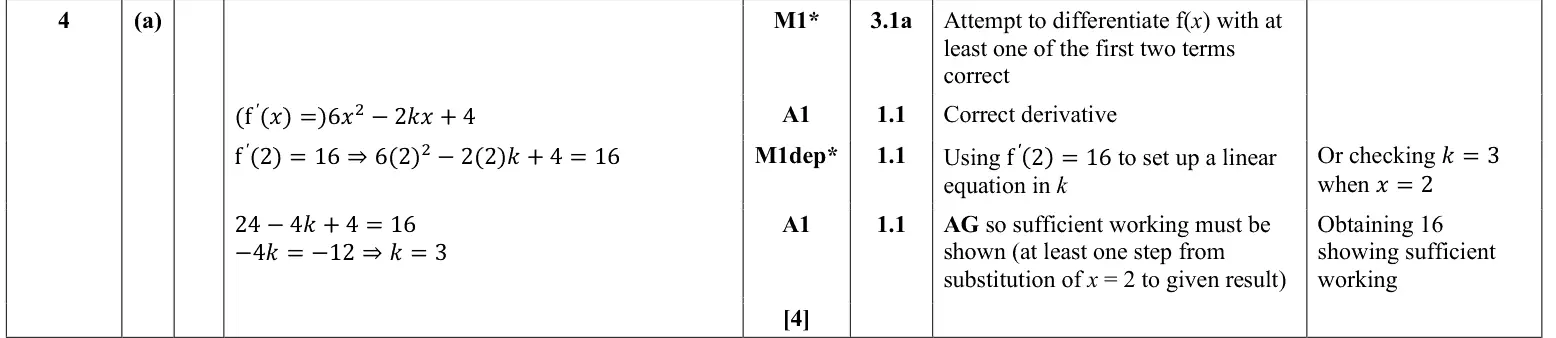
This question was very well done with many fully correct solutions seen. Once again it was a ‘Show that….’ question but it was rare not to see sufficient working. A common error in less successful responses was to use f(2) =16.
Key points and common errors
f′(x) = 6x² − 2kx + 4
f′(2) = 28 − 4k = 16 so k = 3
using f(2) = 16 is a common error
June 2025 · AS Paper 2 · Q9(a)2 marksEasy
Mark scheme for this part
Examiner's comment
This was very well done with many candidates getting the correct acceleration.
Key points and common errors
a = dv/dt = 0.1t − 0.4 = 0.2 m s⁻² at t = 6
June 2025 · Paper 2 · Q6(a)(i)2 marksEasy
Mark scheme for this part
Examiner's comment
Almost all candidates answered this part correctly. A few candidates, perhaps misreading the question, went on to start to solve d𝑥= 0 which was not required in this part.
Key points and common errors
dy/dx = 12x³ − 12x² − 12x + 12
June 2025 · Paper 3 · Q96 marksEasy
Mark scheme for this part
Examiner's comment
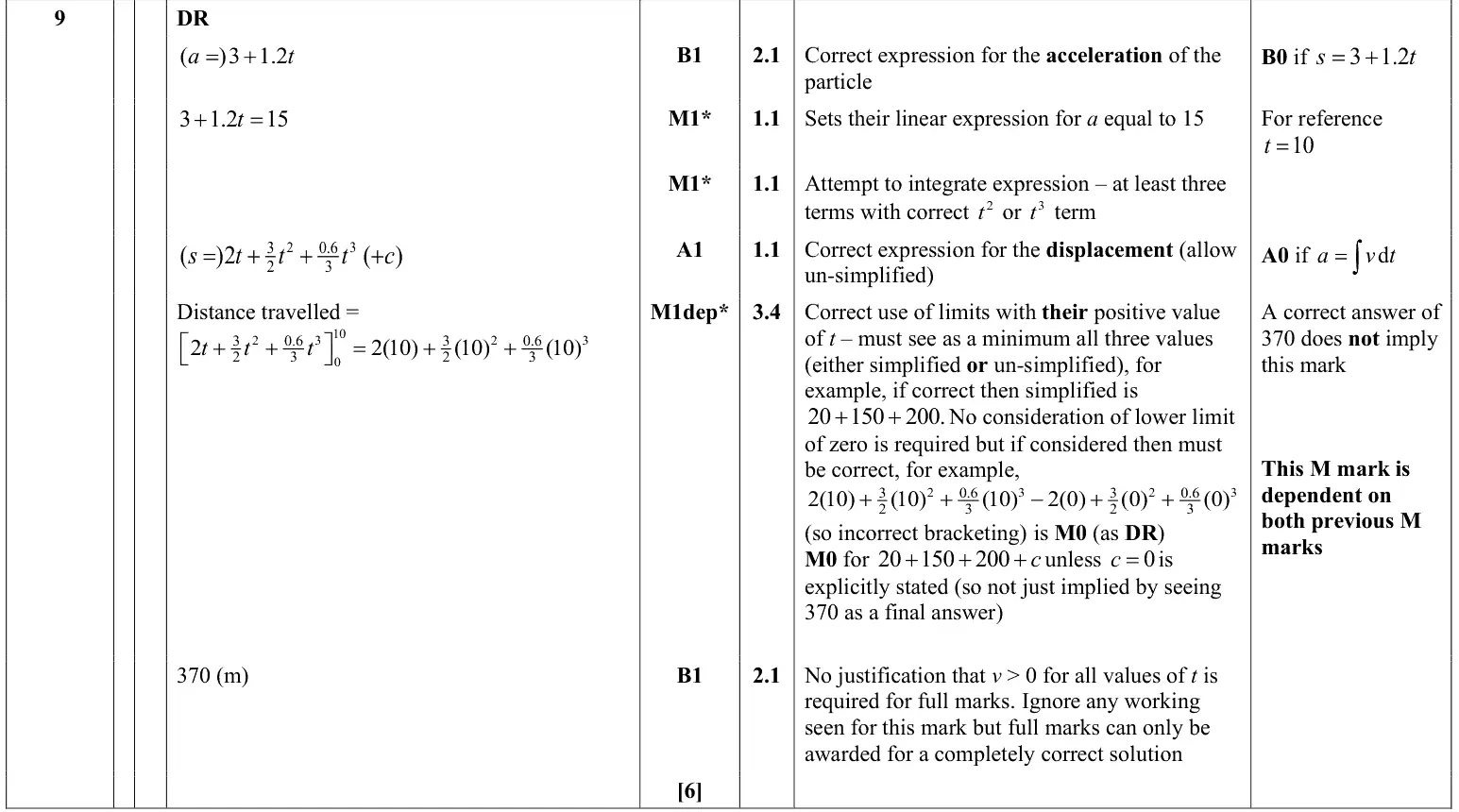
This was probably the best answered question in the mechanics section with many candidates scoring all 6 marks. As this part required DR many did not gain a mark for not showing the explicit substituting of 𝑡= 10 into their integrated expression to find the required distance travelled. The most common errors seen by examiners were those candidates who implied that 𝑠= d𝑡 and/or 𝑎= ∫𝑣 d𝑡, and some incorrectly used the equations of constant acceleration even though the acceleration was variable. required detailed reasoning. The candidate has given no explicit indication of where the answer of 370 came from (as they have not shown the limits of 0 and 10 being applied to the cubic expression) and so 1 of the 6 marks could not be awarded.
Key points and common errors
a = 3 + 1.2t = 15 gives t = 10
s = 2t + 1.5t² + 0.2t³
substitute t = 10 explicitly: 370 m
DR needs the substitution shown
June 2024 · AS Paper 1 · Q5(a)5 marksMedium
Mark scheme for this part
Examiner's comment
This question was again ‘Determine’, requiring candidates to show their working in full – answers obtained without this (e.g. from a calculator) could not be credited. Most candidates who showed working were able to differentiate the given equation correctly and set this equal to zero, going on to find the coordinates of the stationary point. Some candidates who had the correct solutions for x did not find the correct y value as required for the final A1.
Key points and common errors
dy/dx = 8x − x⁻² = 0
x = ½, y = 3
'Determine' so working required
y-value sometimes wrong
June 2024 · AS Paper 2 · Q67 marksMedium
Mark scheme for this part
Examiner's comment
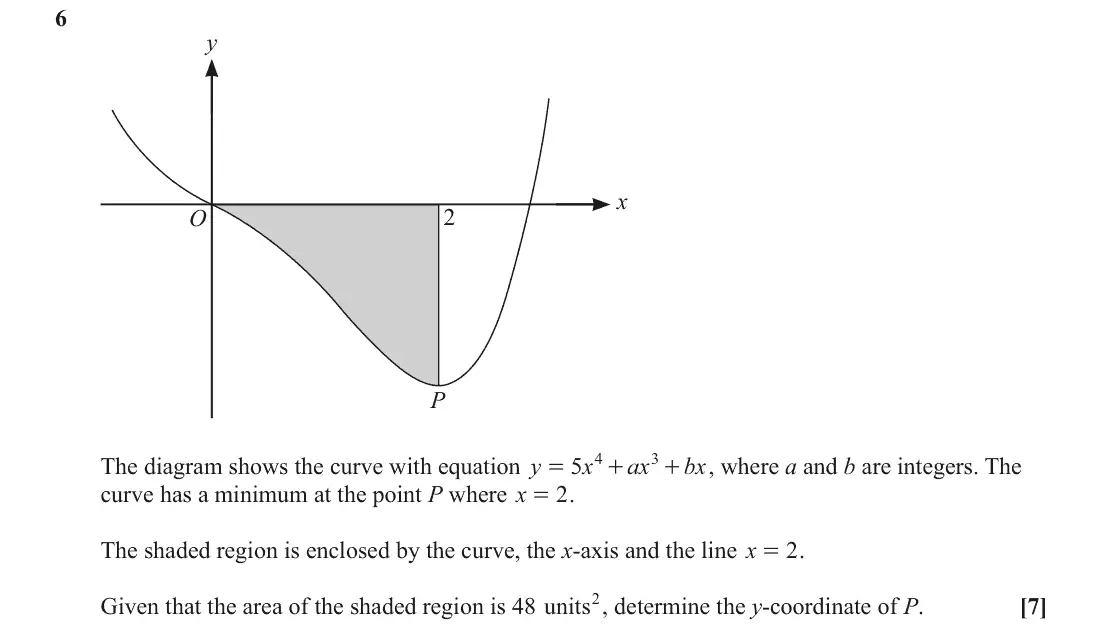
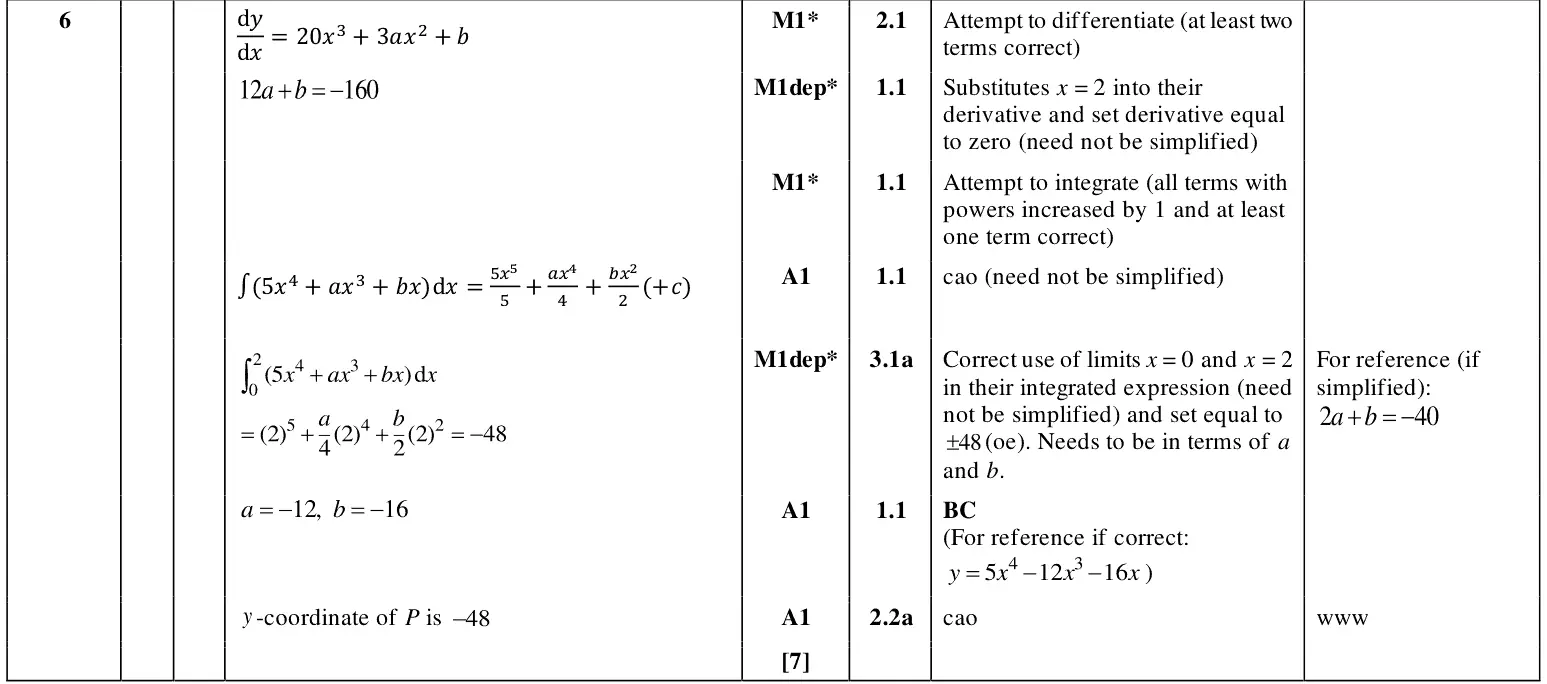
Those who recognised the need to differentiate and integrate generally did it well. A lot of candidates dropped 2 marks because they used 48 rather than -48 in their working. Quite a few unnecessarily found the second derivative; some then ignored it, but others substituted x = 2, set it to zero and obtained a value for a. The poorer efforts generally either didn’t differentiate or didn’t integrate, but most efforts gained at least 2 marks.
Key points and common errors
dy/dx = 0 at x = 2 gives 12a + b = −160
area below the axis so integral from 0 to 2 equals −48, giving 2a + b = −40
a = −12, b = −16
y-coordinate of P is −48
using +48 is the common error
June 2024 · AS Paper 2 · Q11(b)5 marksHard
Show the start of this question
Mark scheme for this part
Examiner's comment
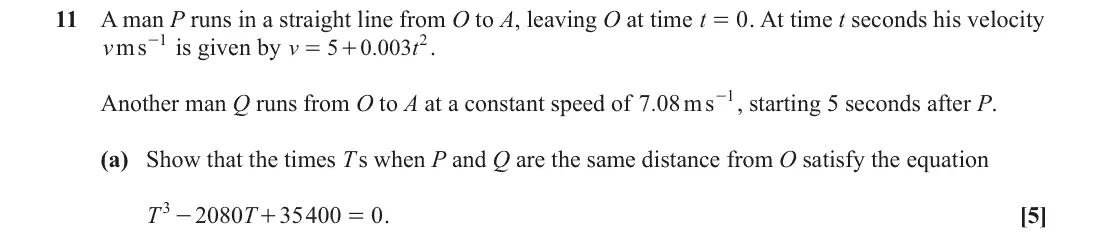
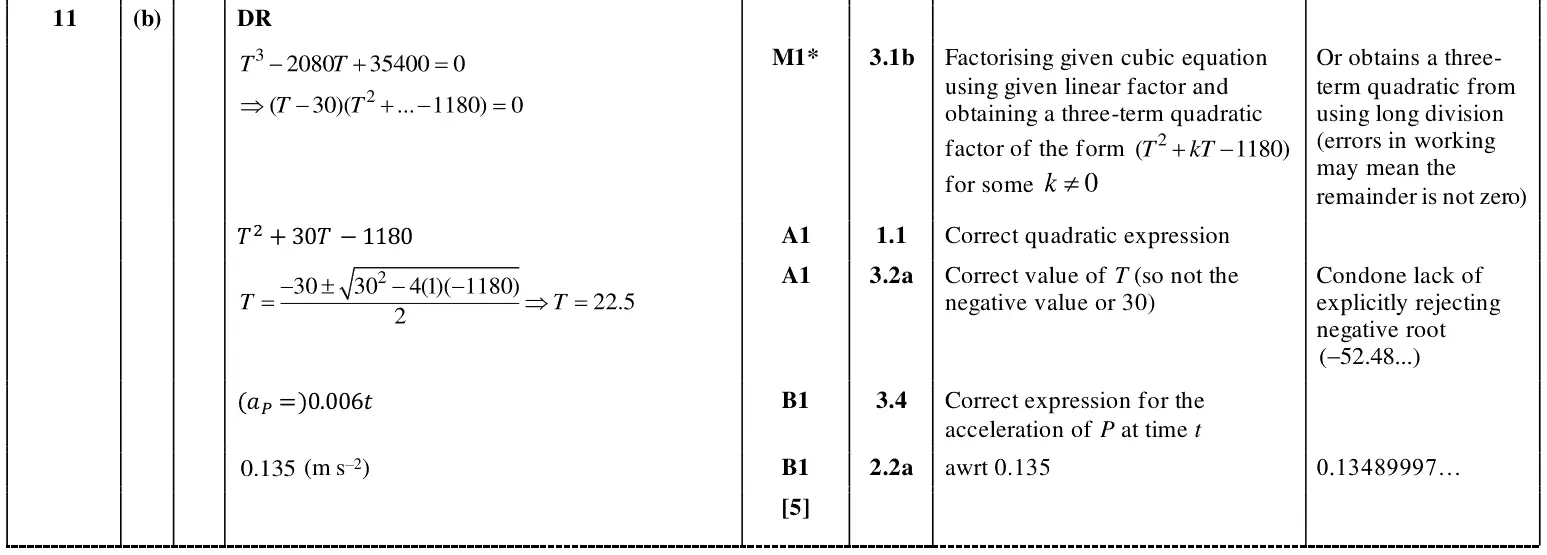
This part requested detailed reasoning, so we expected to see the method clearly presented; in very many cases this did not happen. As soon as candidates see this instruction they should think carefully about how they are going to use the calculator (see Exemplar 3 below and its commentary). To gain the M mark (and so potentially the next 2 marks also), we wanted to see clear evidence of factorising or long division. For the A mark allocated to T = 22.5, we wanted to see how this value had been obtained, for example evidence of the quadratic formula. Many candidates just gained the last 2 marks, as seen in cubic given in (a). This is not sufficient following a ‘show detailed reasoning’ request and earned M0. Note that the last B mark could still be given in such cases.
Key points and common errors
factorise using T = 30: T² + 30T − 1180 = 0
formula gives T = 22.5 (reject negative)
a = 0.006t so 0.135 m s⁻²
DR so factorising and formula must be shown
June 2024 · Paper 1 · Q58 marksEasy
Mark scheme for this part
Examiner's comment
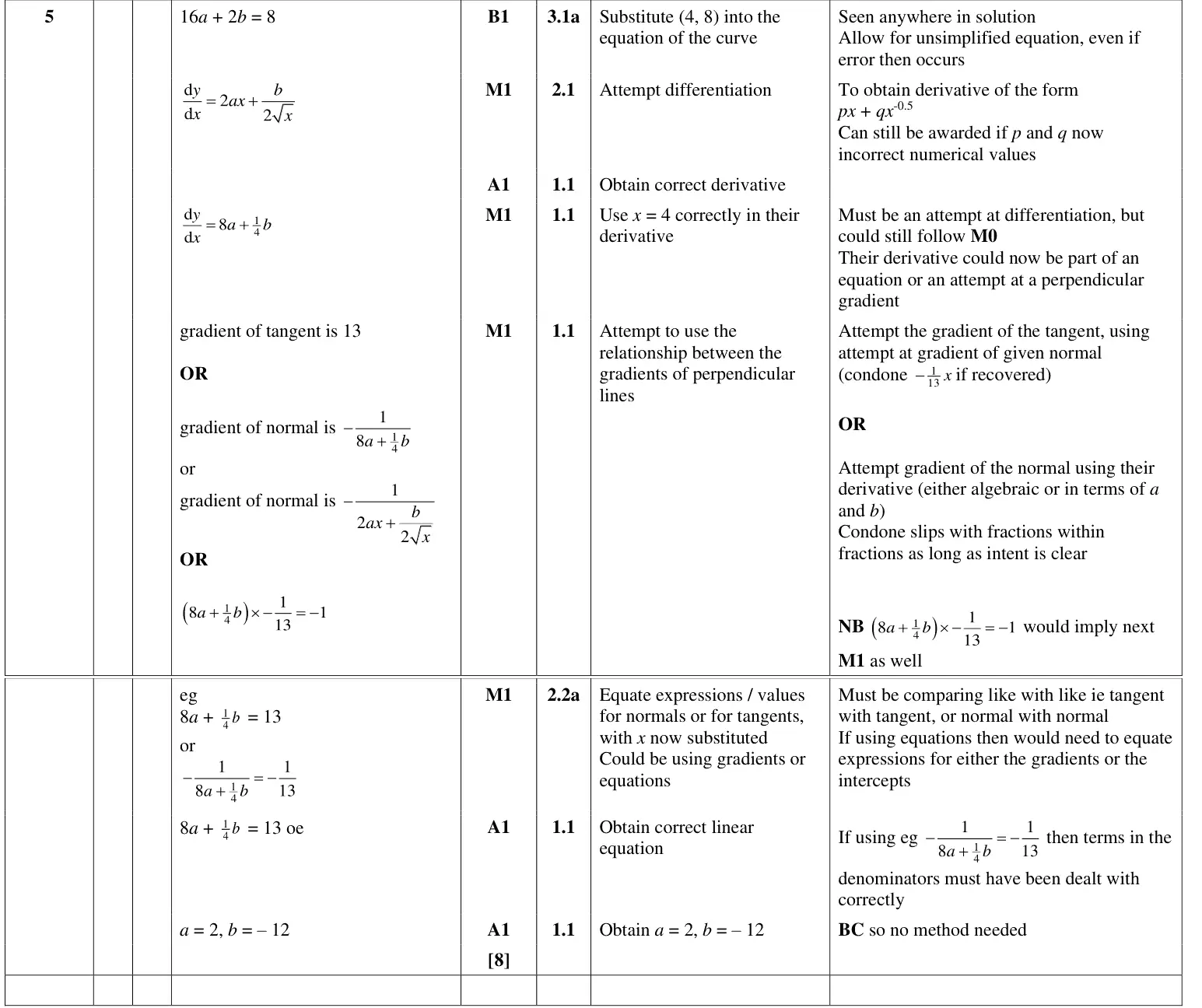
This longer unstructured question was generally well attempted. Quite a few neat, elegant and completely correct solutions were seen. Some unnecessary work was also seen, with quite a few candidates obtaining the equation of the tangent with some trying to solve that with the given equation. Only a very small number of candidates did not realise differentiation was involved. When the differentiation was attempted, it was invariably correct with the fractional powers well handled. Those candidates who substituted x = 4 into their algebraic expression for the gradient of the tangent, were more likely to score full marks compared to those who went on to form an algebraic expression for the gradient of the normal. Most candidates were able to find the numerical value for the gradient of the tangent from the equation of the normal, although not everyone was able to use this information to produce a correct equation in a and b only. A few candidates confused the gradients of the tangent and normal. Some candidates often omitted substituting (4,8) into the equation of the curve, failing to produce a second independent equations in a and b. Solving these two equations simultaneously could be completed by using a calculator for the final mark. This is a good solution to Question 5 with efficient and clear working.
Key points and common errors
(4, 8) on curve: 16a + 2b = 8
dy/dx = 2ax + b/(2√x) = 8a + b/4 at x = 4
normal gradient −1/13 so tangent gradient 13
a = 2, b = −12
finding the tangent equation is unnecessary
June 2024 · Paper 2 · Q1(a)2 marksEasy
Mark scheme for this part
Examiner's comment
Almost all candidates answered this correctly, scoring both marks. Occasionally candidates made an error in reducing the power -2 to -1 or attempted to integrate instead.
Key points and common errors
rewrite 2/x² as 2x⁻²
errors reducing the power −2
some integrated instead
June 2024 · Paper 2 · Q1(b)2 marksEasy
Mark scheme for this part
Examiner's comment
A majority of candidates answered this correctly, scoring both marks. A very small number did not differentiate the ‘9’ term, scoring B1 only.
Key points and common errors
write √x as x^½
the constant −9 differentiates to 0
June 2024 · Paper 3 · Q12(b)1 markHard
Show the start of this question
Mark scheme for this part
Examiner's comment
The most common incorrect answer in this part was 6 with the correct value of 1.5 rarely seen. Of those that did correctly attempt this part many used calculus techniques instead of considering their graph from part (a).
Key points and common errors
acceleration zero at the minimum of the quadratic: t = 1.5 only
6 a common wrong answer
June 2023 · AS Paper 1 · Q6(b)4 marksMedium
Show the start of this question
Mark scheme for this part
Examiner's comment
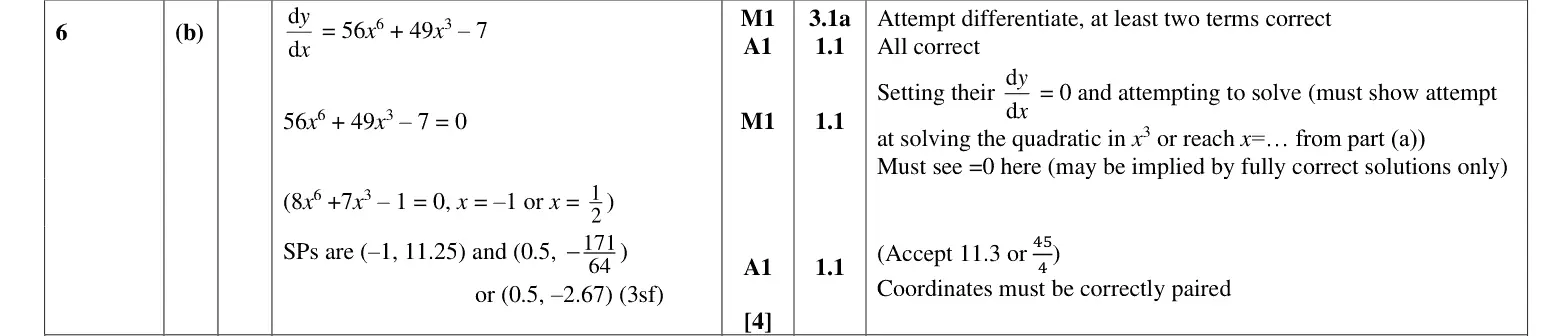
Most candidates successfully differentiated the given expression. However, many did not show the process of setting this = 0 and solving (e.g. dividing through by a factor of 7 to obtain the equation from (a)). Again the command word ‘Determine’ means that working is required; some candidates appeared to simply assume that the answers would be the x-values from part (a). While most candidates were able to correctly calculate the corresponding y-values, some candidates missed this instruction and so were unable to access the final A mark.
Key points and common errors
dy/dx = 56x⁶ + 49x³ − 7 = 0 is 7 × the equation in (a)
points (−1, 11.25) and (½, −171/64)
must show setting = 0 and find y-values
June 2023 · AS Paper 2 · Q7(a)4 marksEasy
Mark scheme for this part
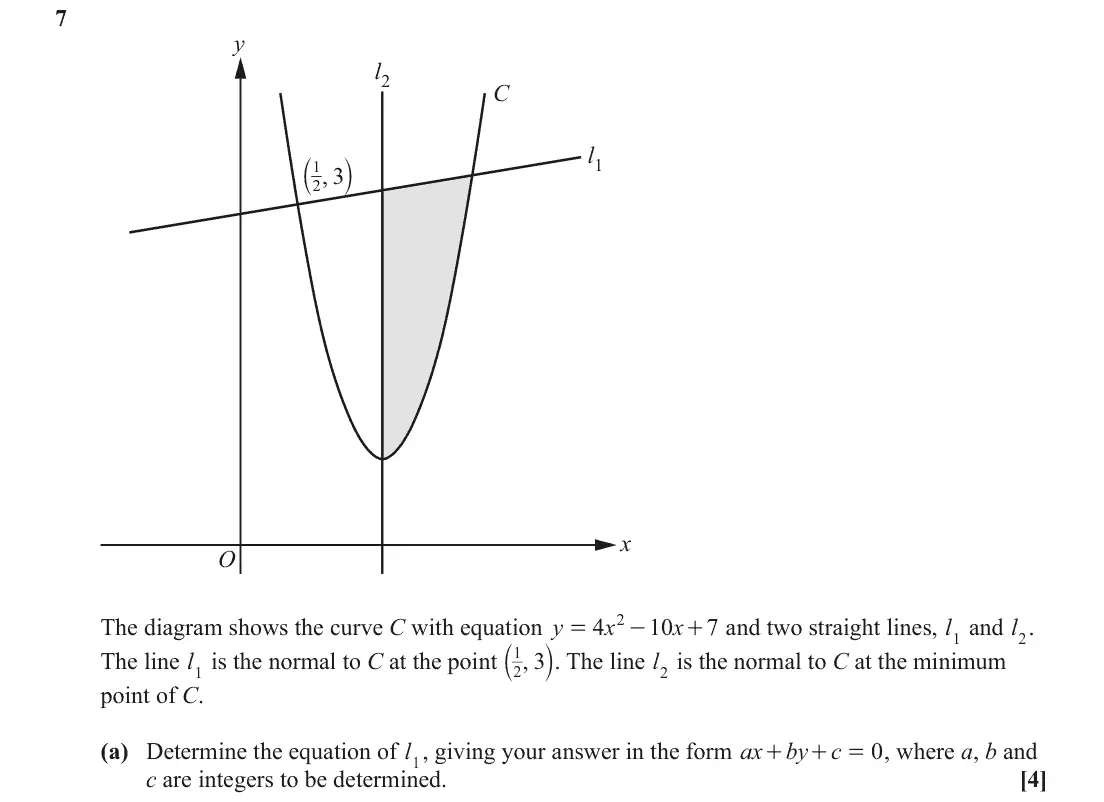
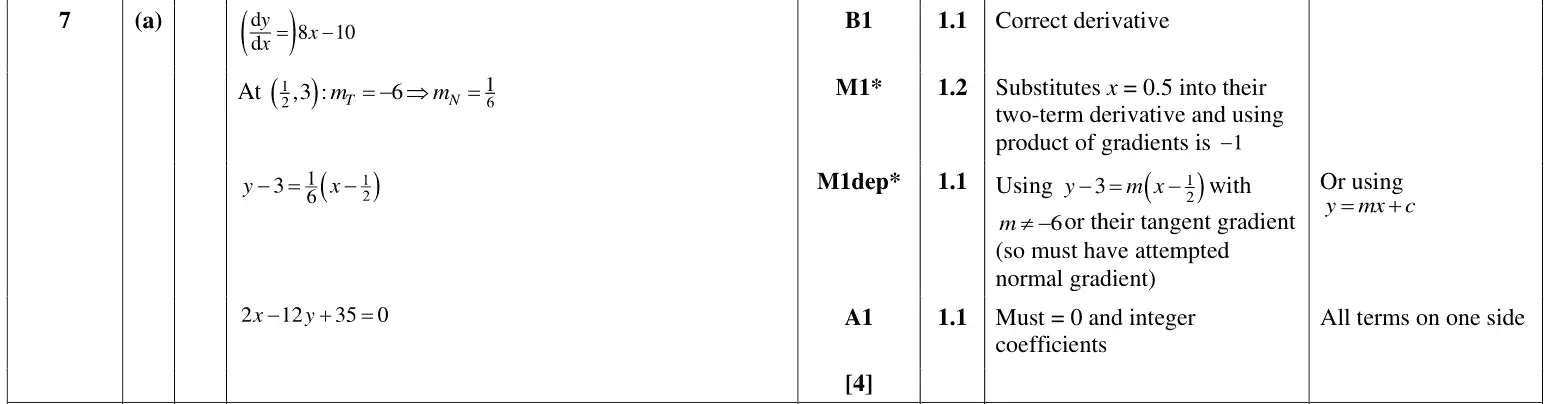
Examiner's comment
The majority of candidates obtained the correct derivative (i.e. 8x – 10) and those who used it correctly with the given point mainly scored full marks. As was the case elsewhere, a few lost the final mark by not giving their answer in the requested form (e.g. x – 6y + 17.5 = 0, from candidates either not spotting or misunderstanding the request for integers). A significant number of responses took the gradient of l1 to 10 be 8 straight from the derivative, or 8 (from setting their derivative to 0) and then finding the negative reciprocal. Using y = mx + c to find the normal was popular.
Key points and common errors
dy/dx = 8x − 10 = −6 at x = ½
normal gradient 1/6
2x − 12y + 35 = 0 with integer coefficients
June 2023 · Paper 2 · Q4(a)6 marksEasy
Mark scheme for this part
Examiner's comment
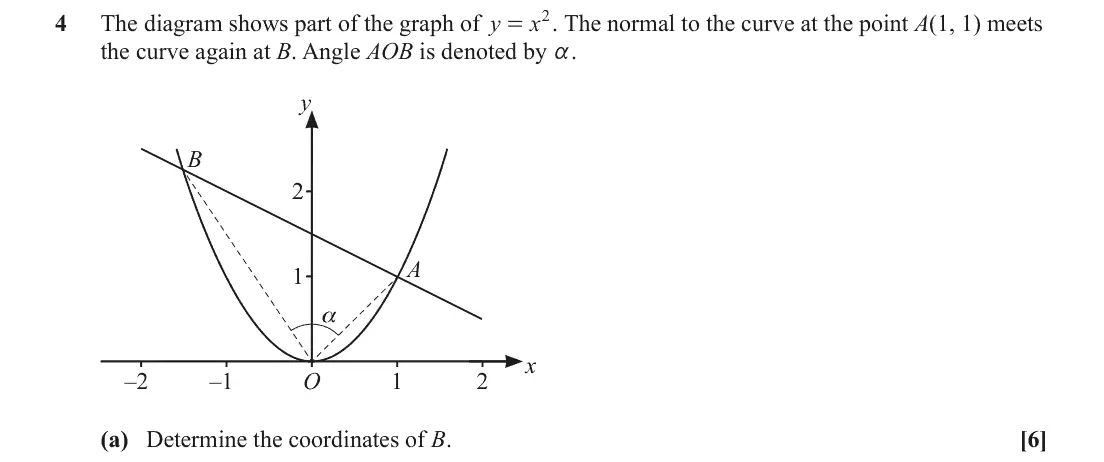
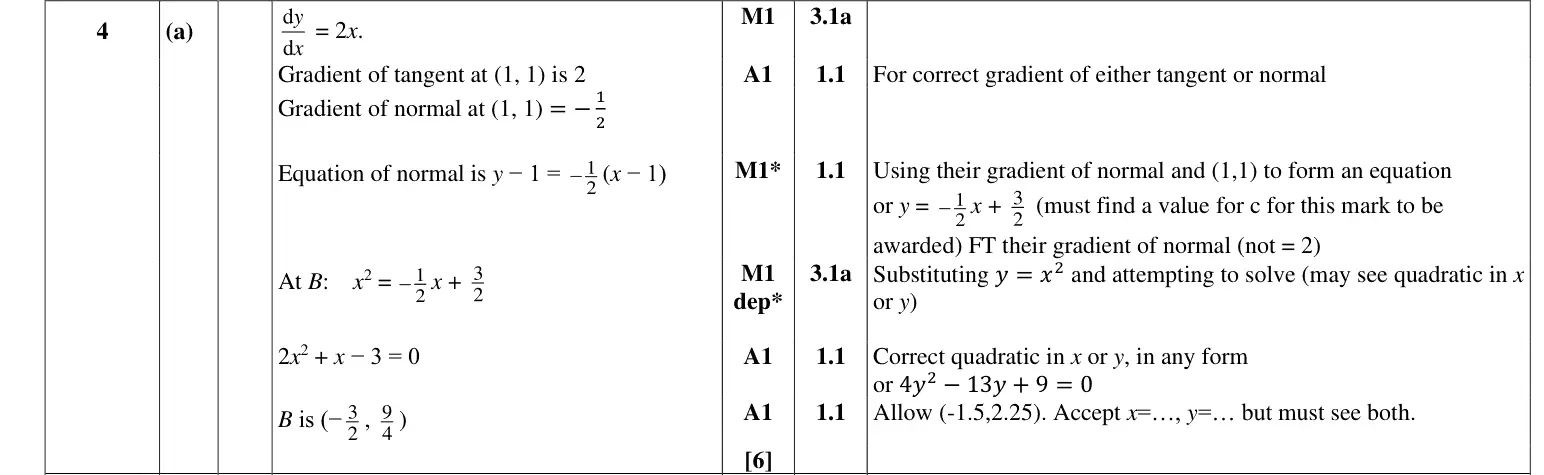
This question was very well answered, with the majority of candidates reaching the required answer. However, again some candidates did not heed the ‘Determine’ instruction and gave minimal working, or an answer only (BC) without working. Where the command word is ‘Determine’ working is required to support the answer, even if it can be done on a calculator. Many candidates found the equation of the normal correctly but then did not show any working for how this led to the coordinates of B, which meant the final 3 marks could not be given – even for a correct answer. This candidate’s response shows all of the required working to justify their (correct) answer. They have shown how the equation of the normal is obtained and then correctly substituted to solve for the coordinates required.
Key points and common errors
gradient 2 at A so normal gradient −1/2
y = −x/2 + 3/2
solve x² = −x/2 + 3/2 to get B(−3/2, 9/4)
working needed for Determine
June 2023 · Paper 3 · Q3(a)(i)2 marksEasy
Mark scheme for this part
Examiner's comment
This part was answered extremely well with almost all candidates obtaining the correct answer of 𝑝𝑝= 1. The most common (rare) error in this part was a slip when differentiating 𝑥𝑥3.
Key points and common errors
f′(x) = 3x² + p
f′(2) = 13 gives p = 1
June 2023 · Paper 3 · Q12(d)6 marksMedium
Show the start of this question
Mark scheme for this part
Examiner's comment
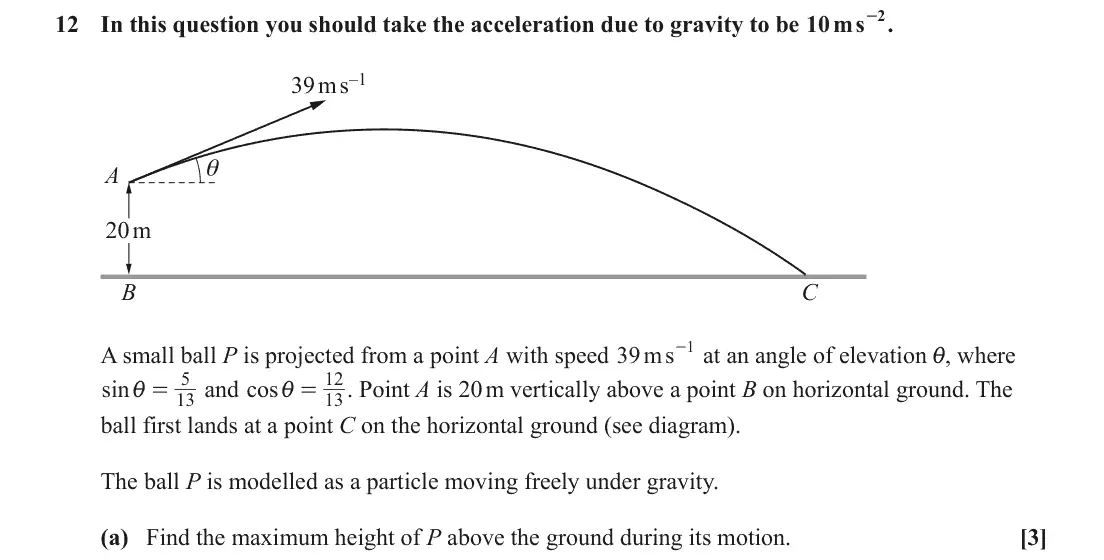
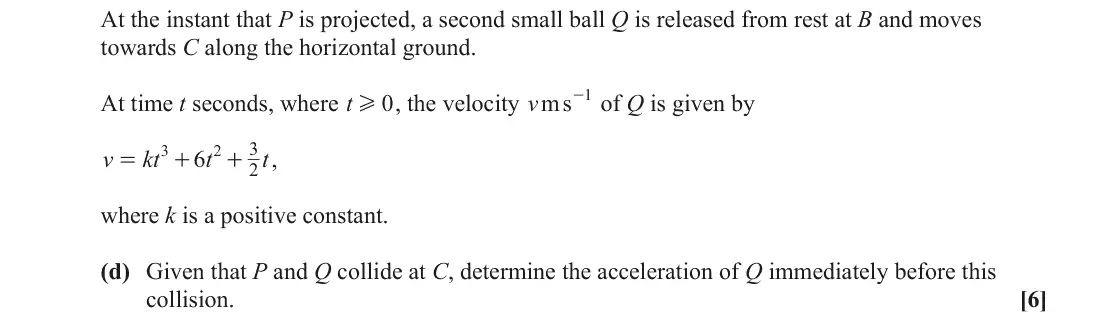
The responses to this part were mixed with some candidates making little progress apart from differentiating the given expression for v to obtain an expression for a in terms of t. Those candidates who realised that they had to use the value of T found in part (b) to find the horizontal distance BC and then integrate to set up an equation to find the value of k were usually successful. Although not penalised in the first two parts of the question, using an incorrect value of g meant that neither of the 2 accuracy marks (for finding k and then the required acceleration) could be awarded in this part. It was surprising how many candidates used equations for constant acceleration in this part to model the motion of Q.
Key points and common errors
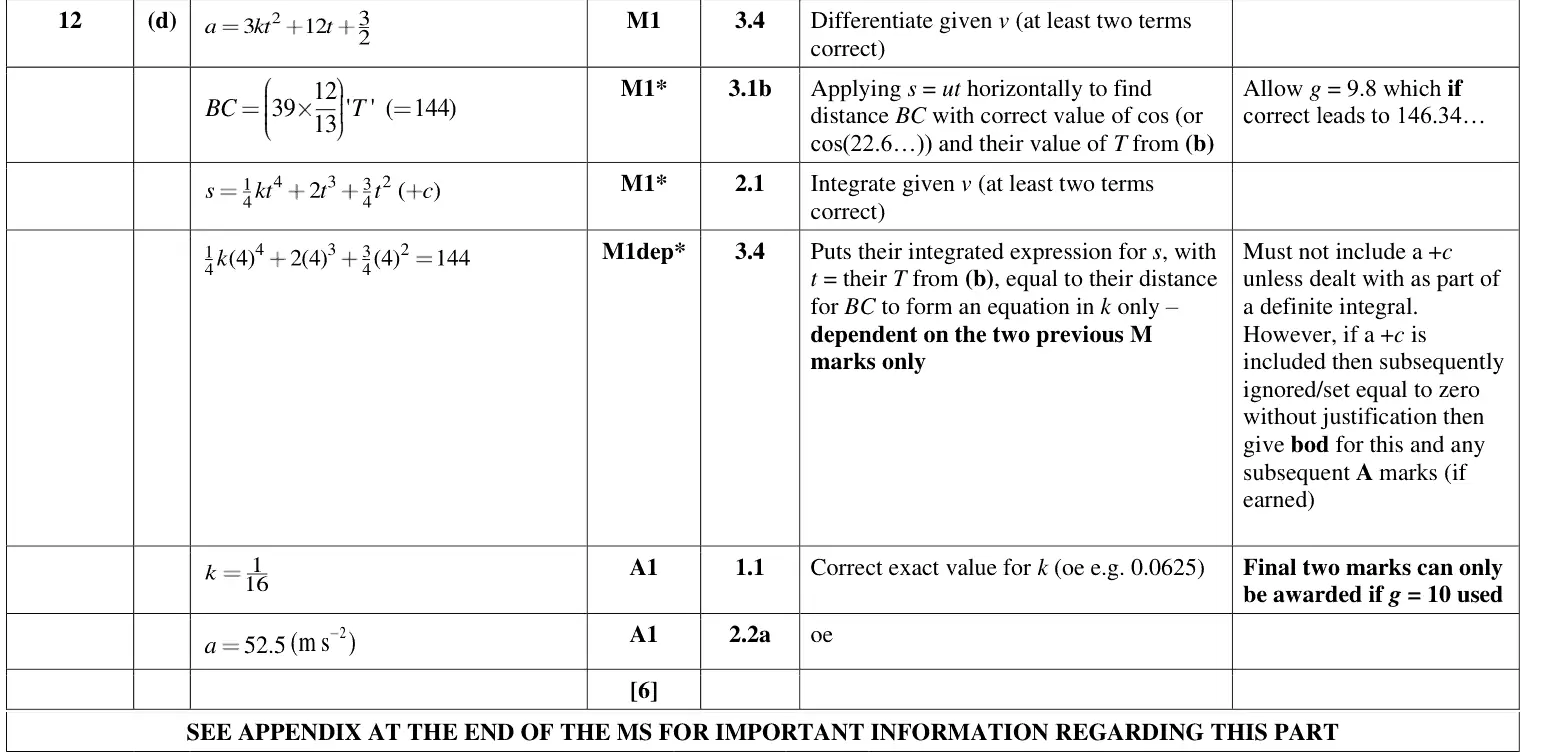
BC = 39 × 12/13 × 4 = 144
integrate v: ¼kt⁴ + 2t³ + ¾t² = 144 at t = 4 gives k = 1/16
a = 3kt² + 12t + 3/2 = 52.5 m s⁻²
final marks need g = 10
June 2022 · AS Paper 2 · Q5(a)(i)3 marksMedium
Mark scheme for this part
Examiner's comment
k y = was quite well understood, and k then accurately found. Less successful attempts started by x 1 = quoting y or even y = mx + c. A few thought they had to find the equation of the tangent when x asked for the gradient function. This request was overlooked.
Key points and common errors
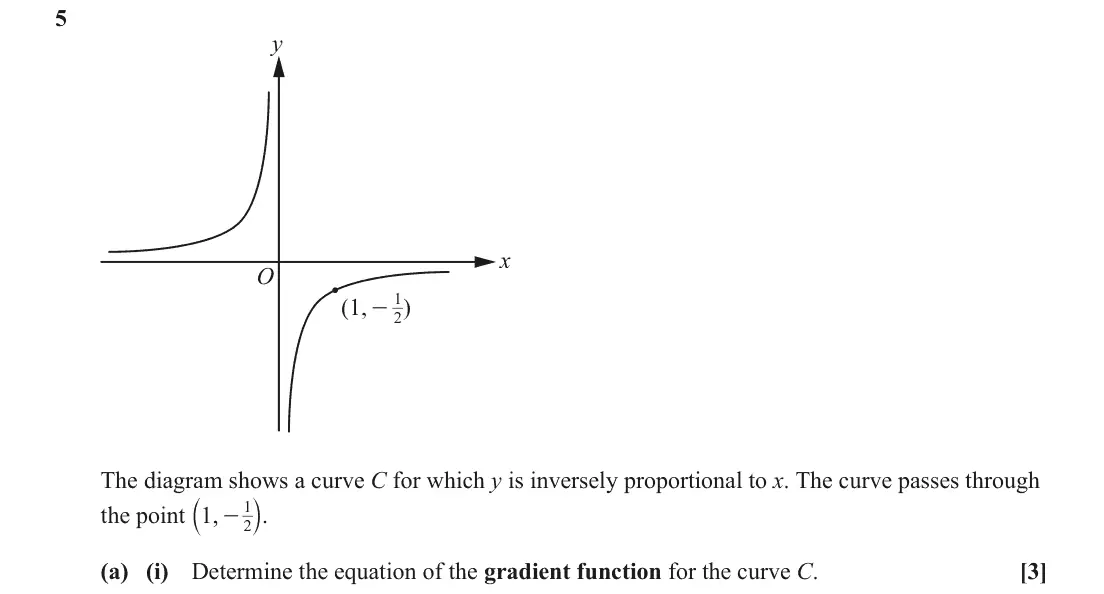
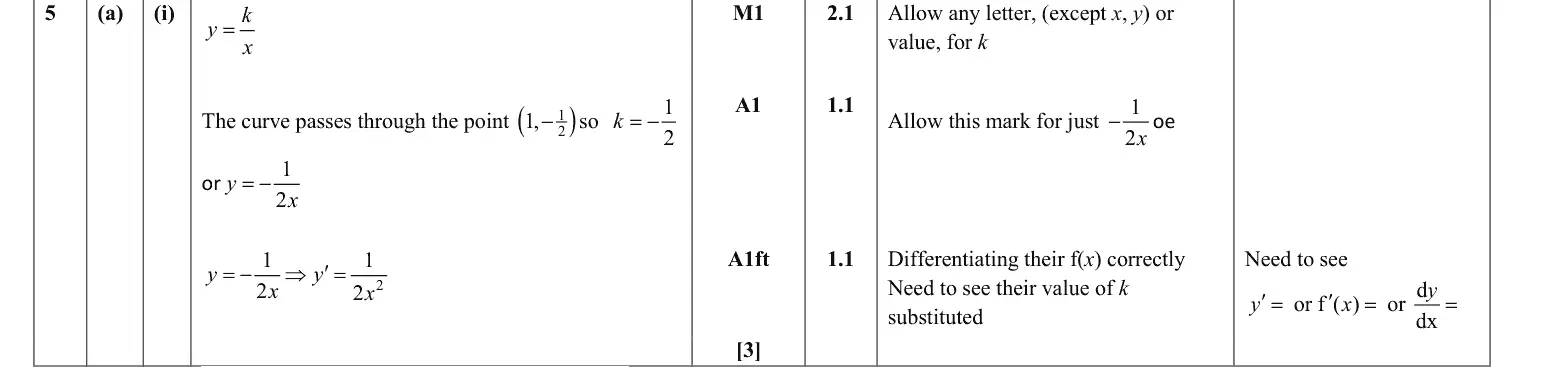
y = k/x through (1, −½) gives y = −1/(2x)
gradient function y′ = 1/(2x²)
some found a tangent instead
June 2022 · AS Paper 2 · Q11(b)5 marksMedium
Show the start of this question
Mark scheme for this part
Examiner's comment
Candidates generally knew how to answer this question. It is another detailed reasoning (DR) question so, as in Question 2, we wanted to see how the quadratic equation had been solved. Many did not provide this evidence so 3/5 was a common mark. We also expected to see a valid reason for the rejection of T = 4/3.
Key points and common errors
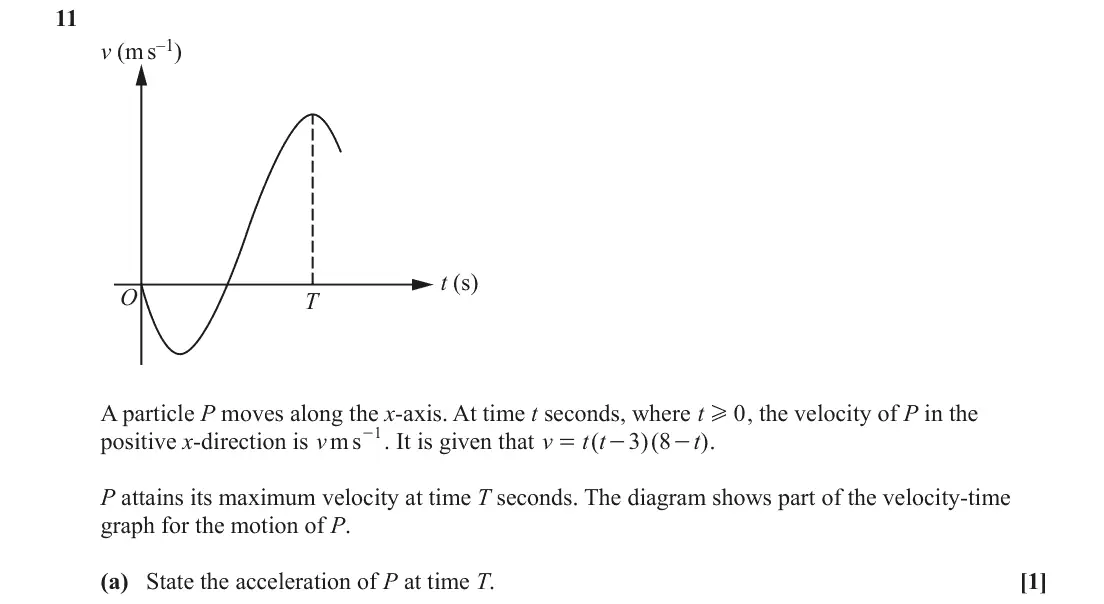
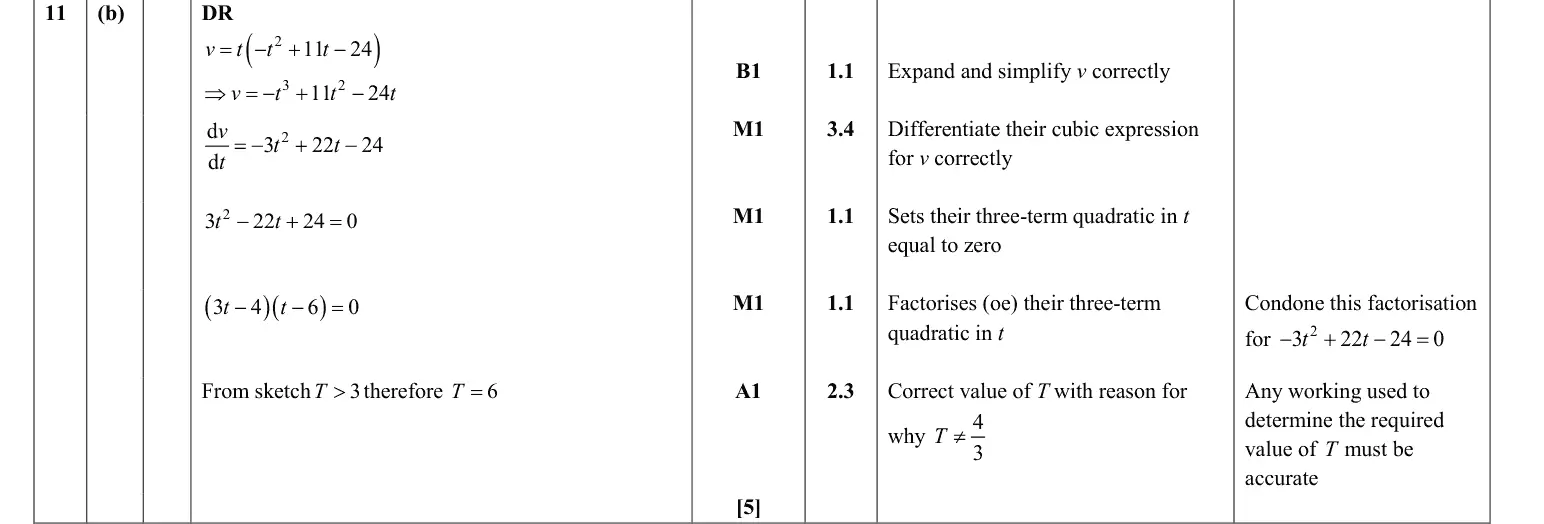
v = −t³ + 11t² − 24t
dv/dt = −3t² + 22t − 24 = 0
(3t − 4)(t − 6) = 0
T = 6 since T > 3 from the graph, rejecting 4/3 with a reason
solving must be shown
June 2022 · Paper 2 · Q5(a)2 marksEasy
Mark scheme for this part
Examiner's comment
Almost all candidates differentiated and equated d y x to 0. A few made errors in the differentiation. Many d obtained the correct equation, 3x2 − 6x + 4 = 0. Because this is a “detailed reasoning” question, it was essential to show working to demonstrate that this equation has no real roots in order to gain the second mark. Most did so successfully using either the discriminant or completing the square. However, some candidates just stated that there were no real solutions, without justification. A few gave an incorrect justification such as “this equation won’t factorise so there are no solutions”. More seriously, a few candidates used the coefficients from the cubic expression for y to obtain a bogus “discriminant” and showed that it was negative.
Key points and common errors
dy/dx = 3x² − 6x + 4 = 0
discriminant −12 < 0 or 3(x − 1)² + 1 > 0 so no real roots
justification required
June 2022 · Paper 3 · Q5(c)2 marksHard
Show the start of this question
Mark scheme for this part
Examiner's comment
This was probably the least well answered question on the whole paper with most candidates scoring zero marks (with many just showing that the given iteration did not converge for a number of different starting values). Only the most able realised what was required in this part. Of those that did calculate ( ) ( ) F x x + = F x , where very few could correctly articulate that as the x-coordinate of P lies in the ( ) −for all values of where F 1 interval (0.5, 1) and (0.5,1), then this implies that the given iteration cannot converge to the x-coordinate of P whatever starting value is used.
Key points and common errors
h′(x) = −4x², so h′(α) < −1 for α in (0.5, 1)
hence cannot converge
trying starting values gains nothing
June 2022 · Paper 3 · Q12(b)1 markEasy
Show the start of this question
Mark scheme for this part
Examiner's comment
This question was almost always answered correctly by differentiating the expression given in the stem to part (a). Only occasionally did examiners report cases of candidates using either constant acceleration formulae or integration.
Key points and common errors
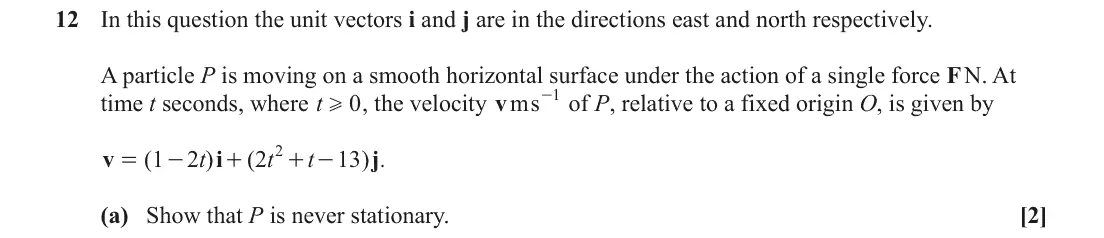
a = −2i + (4t + 1)j
Autumn 2021 · AS Paper 1 · Q24 marksMedium
Mark scheme for this part
Key points and common errors
write 5000/t as 5000t⁻¹
dn/dt = −5000t⁻²
at t = 5 the rate of change is −200
Autumn 2021 · AS Paper 1 · Q5(b)4 marksMedium
Show the start of this question
Mark scheme for this part
Key points and common errors
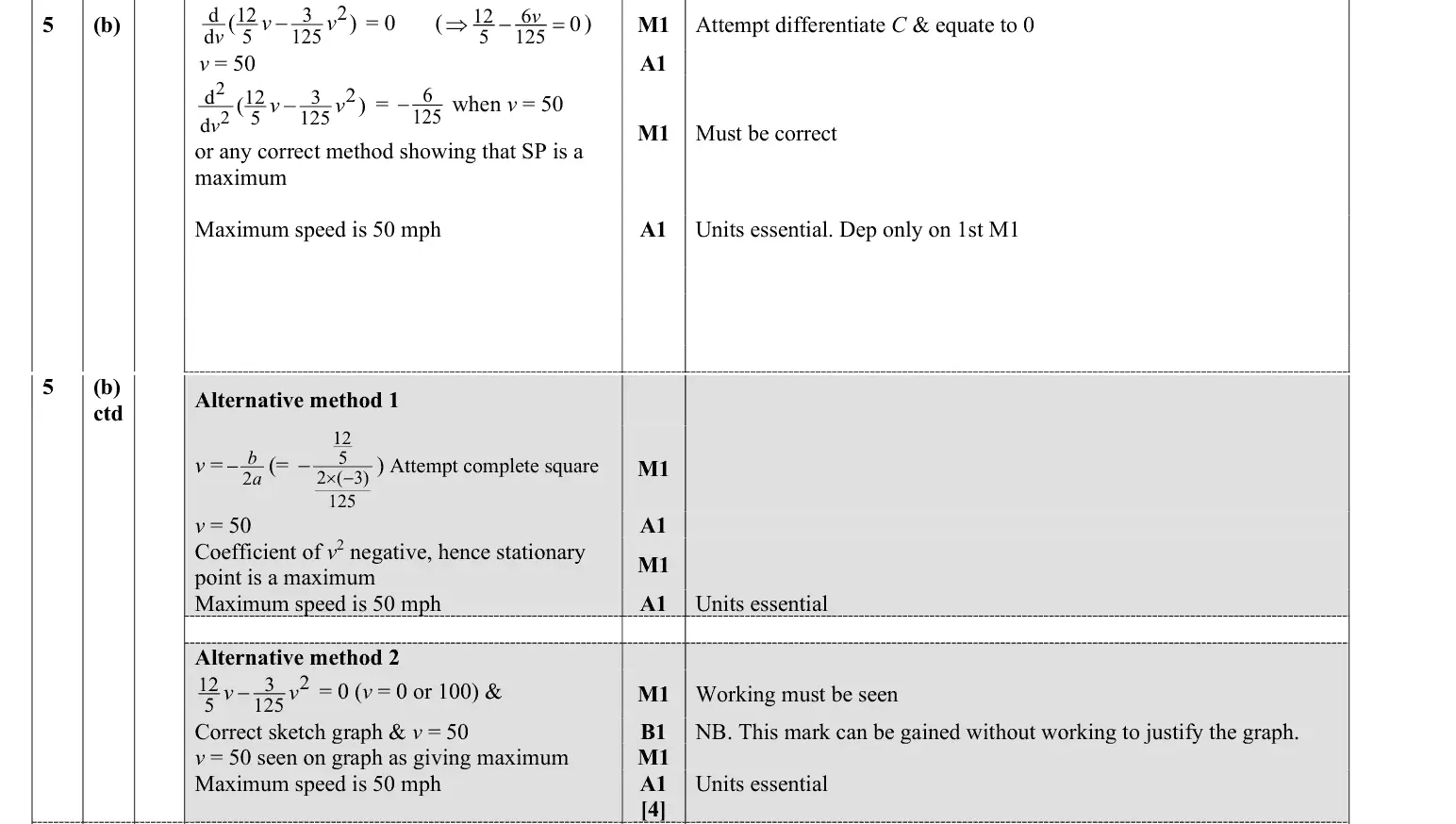
dC/dv = 12/5 − 6v/125 = 0 gives v = 50
show maximum (second derivative −6/125 or negative v² coefficient)
answer 50 mph with units
Autumn 2021 · AS Paper 2 · Q8(a)5 marksMedium
Mark scheme for this part
Key points and common errors
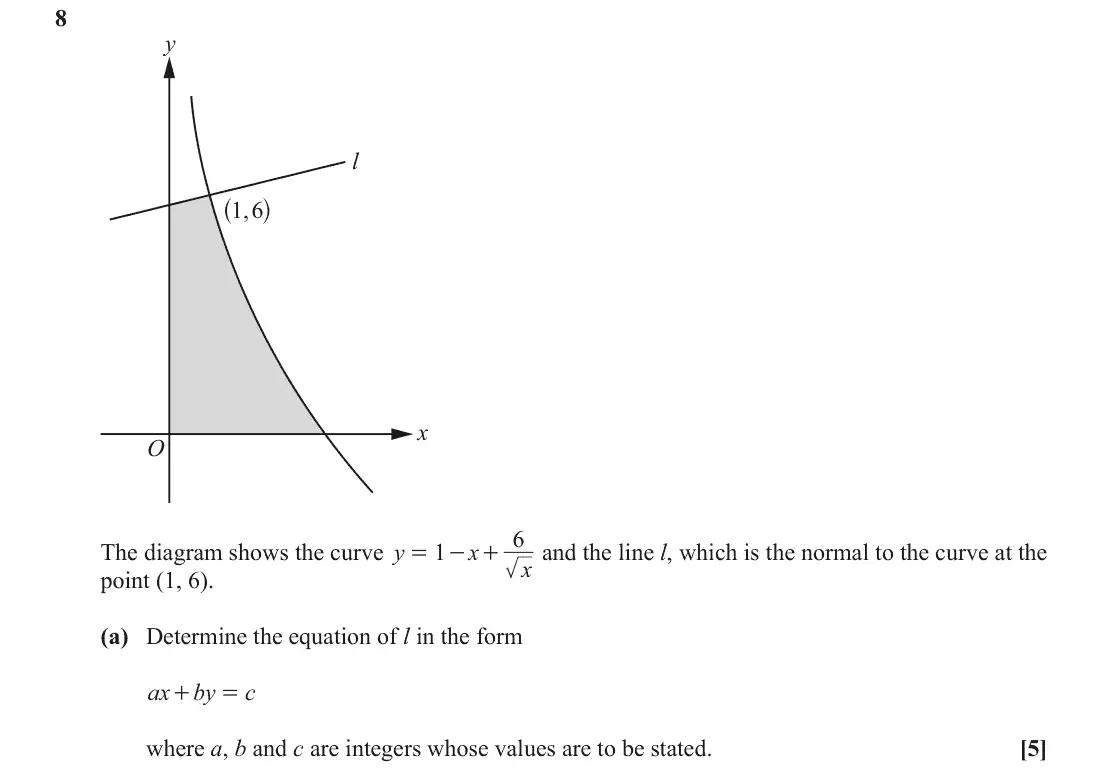
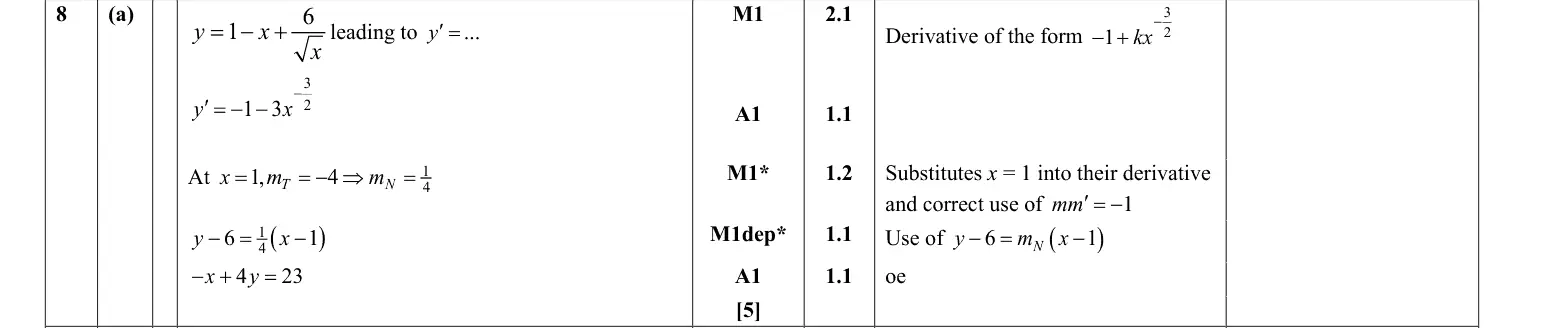
y′ = −1 − 3x^(−3/2)
tangent gradient −4 at x = 1 so normal gradient ¼
−x + 4y = 23 with integers
Autumn 2020 · AS Paper 1 · Q1(a)3 marksMedium
Mark scheme for this part
Key points and common errors
write 5/x² as 5x⁻²
3x² − 3 − 10x⁻³
Autumn 2020 · AS Paper 2 · Q37 marksMedium
Mark scheme for this part
Examiner's comment
(From the general report) Note that ‘find’ was used in Question 3 and Question 6 with the instruction to show detailed reasoning, which now means evidence is vital.
Key points and common errors
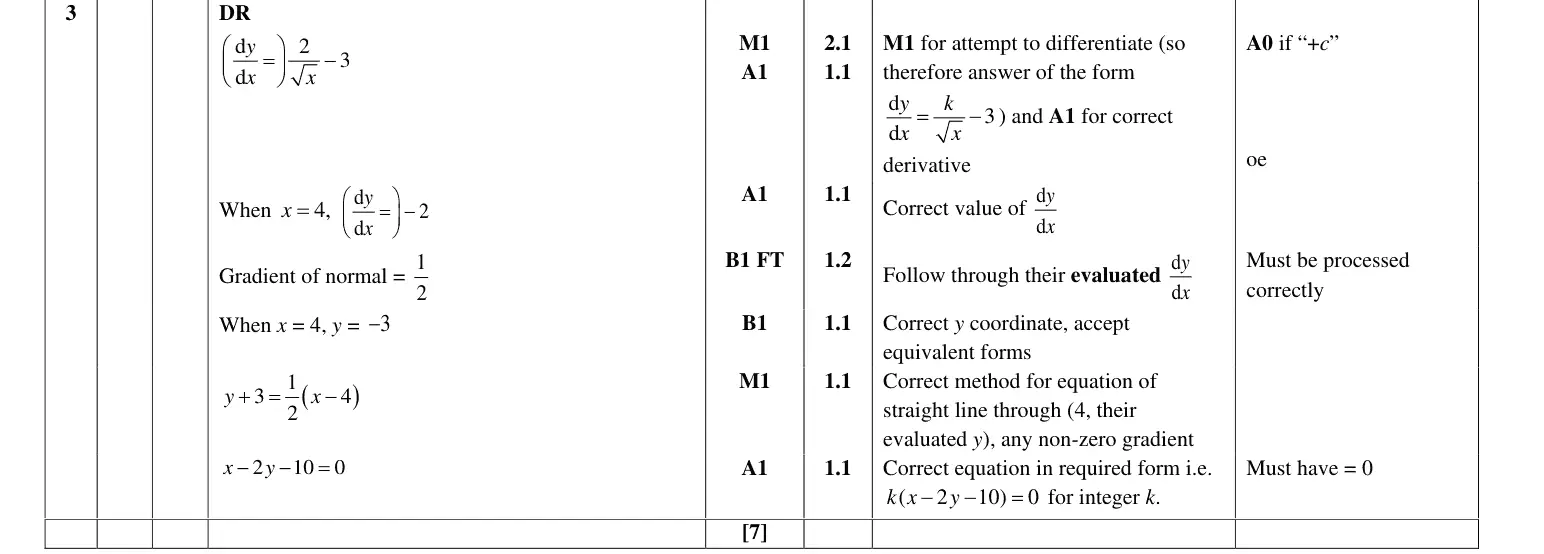
dy/dx = 2/√x − 3 = −2 at x = 4
normal gradient ½ through (4, −3)
x − 2y − 10 = 0 with integer coefficients
Autumn 2020 · AS Paper 2 · Q7(b)4 marksHard
Show the start of this question
Mark scheme for this part
Examiner's comment
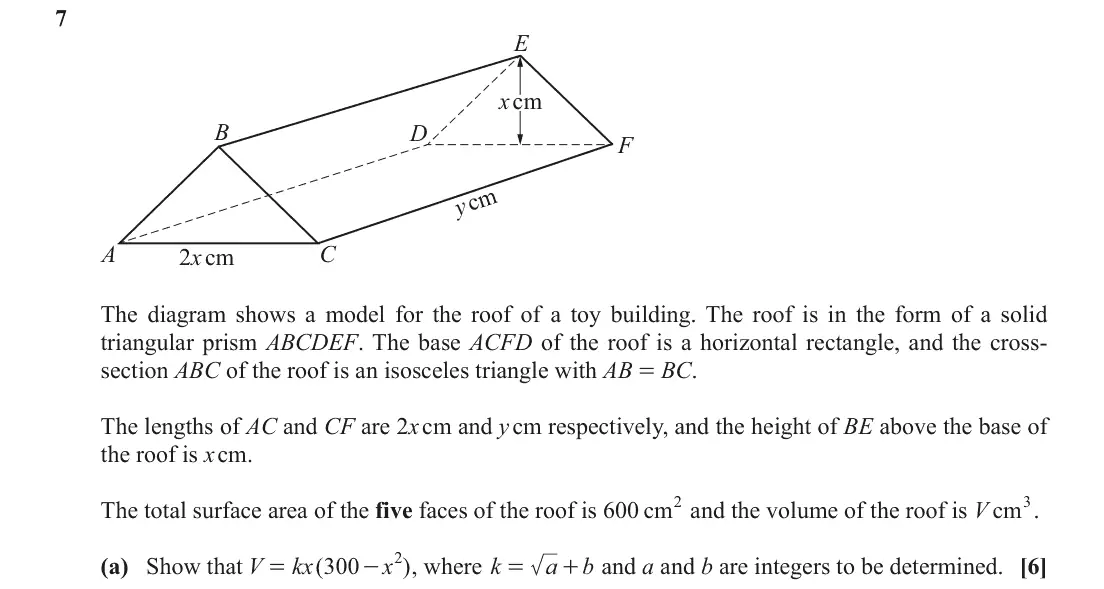
(Comment on Question 07 as a whole) Part (a) - V = 2x2y was seen and often the required result for the surface area was incorrect, although many candidates managed to find at least 3 correct faces and gain M1. Replacing y in V and the subsequent rationalising was rarely seen. Part (b) - M1 A1 earned, with k often used, but few completed. Full credit could have been gained here even if no k had been obtained earlier. Second derivatives appeared sometimes. Part (c) and (d) were commonly not attempted.
Key points and common errors
dV/dx = k(300 − 3x²) = 0 gives x = 10
full credit possible without k
Autumn 2020 · AS Paper 2 · Q10(a)2 marksMedium
Mark scheme for this part
Examiner's comment
(Comment on Question 10 as a whole) Part (c) - Most just considered t = 0 to t = 4 without realising the importance of t = 3, even though (b) was almost always correct.
Key points and common errors
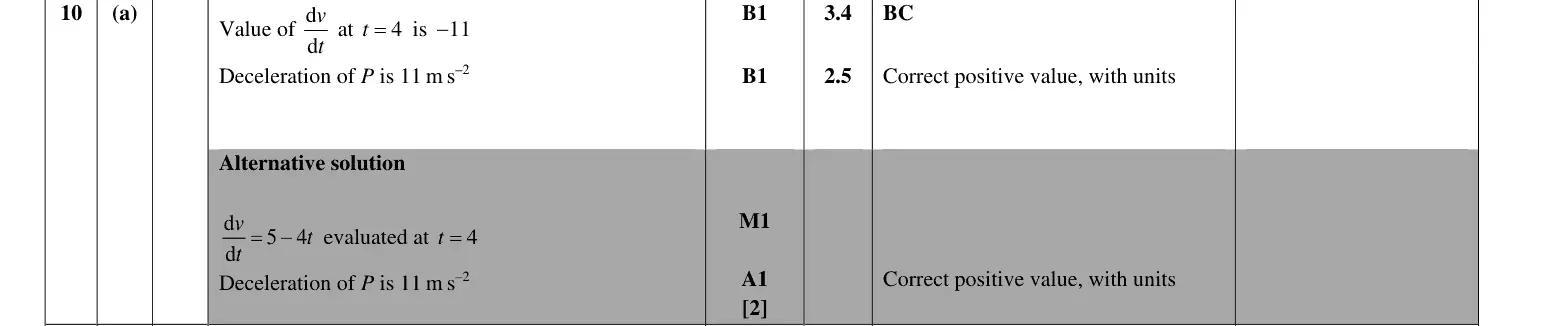
dv/dt = 5 − 4t = −11 at t = 4
deceleration 11 m/s² as a positive value
Autumn 2020 · Paper 1 · Q3(b)6 marksMedium
Show the start of this question
Mark scheme for this part
Examiner's comment
(Comment on Question 03 as a whole) The first part of Question 3 required candidates to show the derivation of the given equation. On questions such as this, where the request is to ‘show that’ a given answer is correct, it is important that sufficient detail is given to provide a convincing solution. Examiners expected to see an equation for the volume, an expression for the total surface area and then clear substitution and manipulation to arrive at the given answer. In the second part of the question, a surprisingly common error was to find the radius but then omit to find the minimum surface area. Candidates should review a question to make sure that it is fully answered before moving on; other strategies such as highlighting or underlining key words and phrases within a question may also be helpful.
Key points and common errors
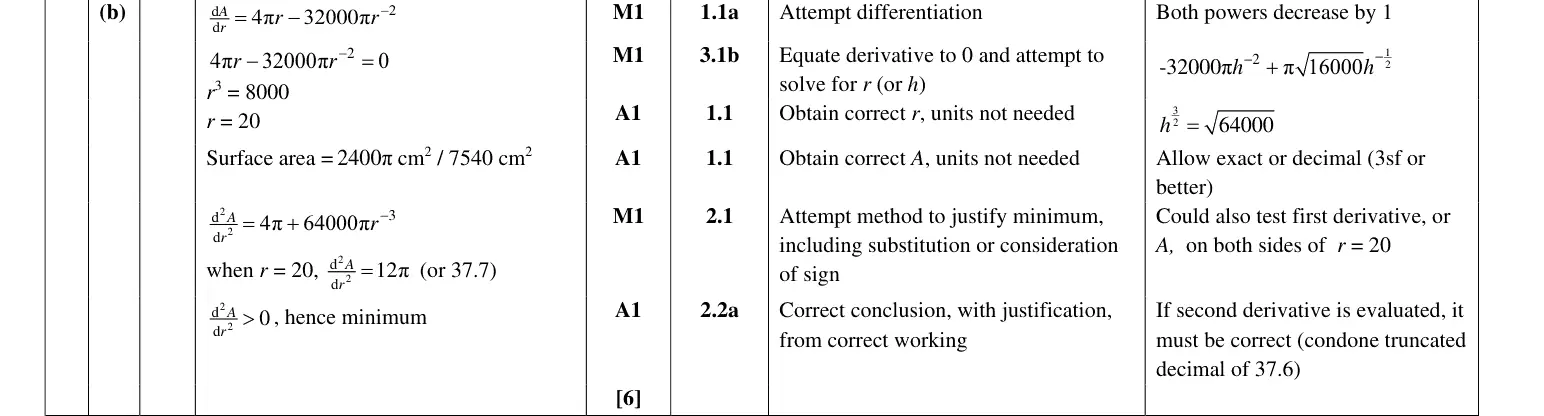
dA/dr = 4πr − 32000πr⁻² = 0 gives r = 20
A = 2400π cm²
second derivative 12π > 0 so minimum
common error: finding r but not the minimum area
Autumn 2020 · Paper 2 · Q1(a)(i)2 marksMedium
Mark scheme for this part
Key points and common errors
chain rule: 7 × 2 × (2x + 3)⁶ = 14(2x + 3)⁶
missing the factor 2
Autumn 2020 · Paper 2 · Q1(a)(ii)3 marksMedium
Mark scheme for this part
Key points and common errors
product rule: 3x² ln x + x²
sign errors in the rule
Autumn 2020 · Paper 3 · Q8(b)4 marksEasy
Show the start of this question
Mark scheme for this part
Examiner's comment
(Comment on Question 08 as a whole) This question was also completed well, although a significant number attempted to use the ‘suvat’ equations. Part (a) was answered correctly on almost 100% of the scripts. Part (b) was also answered well. Unfortunately, some candidates ignored the negative sign needed for deceleration, which meant only 3 out of the 4 marks were available. Part (c) was a ‘Find’ question, so an answer obtained directly from the calculator was expected, although some candidates did show a fully integrated expression first. Some candidates dropped marks when they used the incorrect limits and some attempted to use ‘suvat’, even if they had used calculus in the earlier parts.
Key points and common errors
dv/dt = 2at + b = −0.12 at t = 5
v(18) = 2.96
a = −0.02, b = 0.08
deceleration needs the minus sign
suvat is invalid
June 2019 · AS Paper 1 · Q1(a)3 marksEasy
Mark scheme for this part
Examiner's comment
Many candidates answered this question correctly. A few gave 3 + 15x–2 or 3 – 15x–4. The most common difficulty was handling the negative index.
Key points and common errors
write 5/x³ as 5x⁻³
f′(x) = 3 + 15x⁻⁴
errors with the negative index (15x⁻², −15x⁻⁴)
June 2019 · AS Paper 1 · Q1(b)2 marksEasy
Show the start of this question
Mark scheme for this part
Examiner's comment
This question was also answered well by many candidates. As in part (a) the most common difficulty was handling the negative index.
Key points and common errors
f″(x) = −60x⁻⁵
constant differentiates to 0
June 2019 · AS Paper 1 · Q4(a)4 marksEasy
Mark scheme for this part
Examiner's comment
Many correct responses were seen. Some candidates made arithmetical errors in finding the values of y. A few candidates did not differentiate but attempted to solve x3 – 6x2 + 9x = 0. This can lead to finding one turning point, but not the other. In this case it was fortuitous for them that the minimum was identifiable in the form of a repeated root.
Key points and common errors
dy/dx = 3x² − 12x + 9 = 0
x = 1 or 3
(1, 4) and (3, 0) paired
June 2019 · AS Paper 2 · Q10(a)5 marksMedium
Mark scheme for this part
Examiner's comment
Many candidates managed to gain some credit on this question. r = 18 was often spotted and v = 9 at t = 5 well applied. Some then stated v = 9 at t = 10 also, and floundered. Pleasingly, those who realised they needed the acceleration generally differentiated and were accurate.
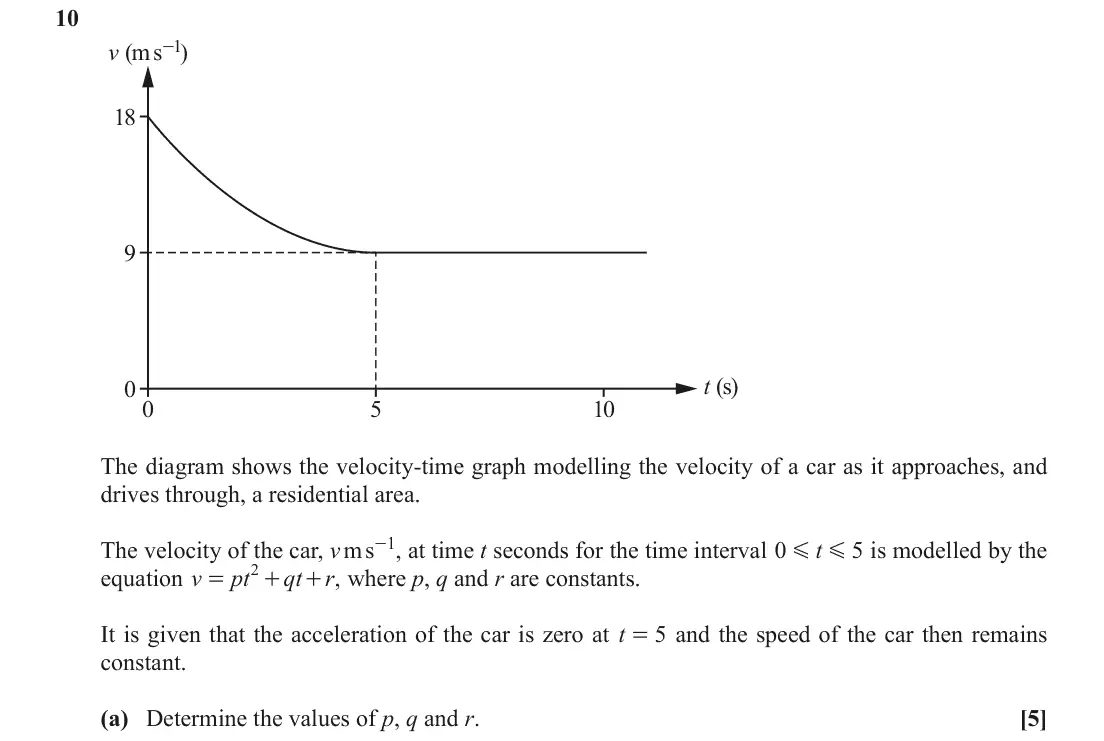
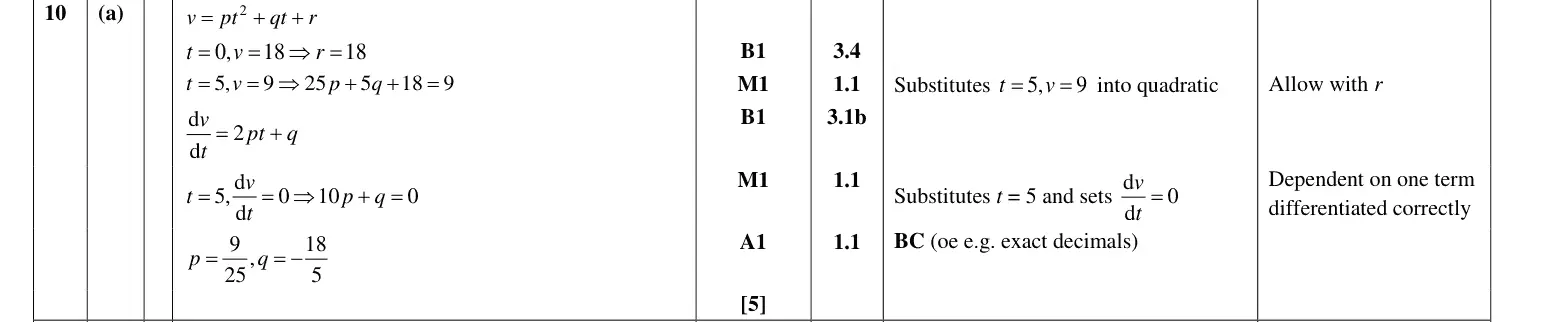
Key points and common errors
v = 18 at t = 0 gives r = 18
v = 9 and dv/dt = 0 at t = 5 give 25p + 5q = −9 and 10p + q = 0
p = 9/25, q = −18/5
v = 9 at t = 10 is not new information
June 2019 · Paper 3 · Q10(a)6 marksMedium
Mark scheme for this part
Examiner's comment
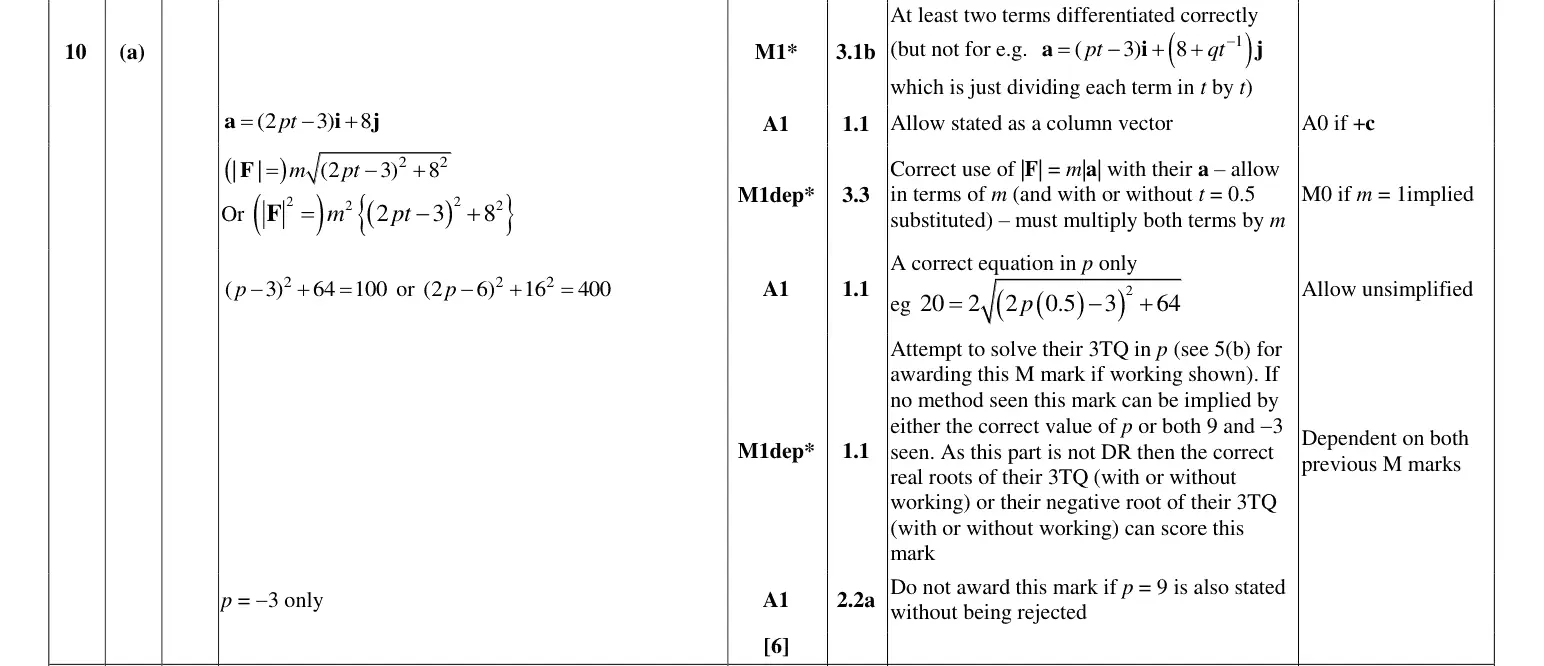
( ) Nearly all candidates correctly differentiated v and obtained a = 2 pt − 3 i + 8 j Unfortunately many . candidates then made careless slips in applying F = m a to obtain an equation in p only with the most common errors being forgetting the mass completely or only multiplying the i component by the value of m. Candidates are one again reminded to read the question carefully as while many had a correct equation in p e.g. ( p − 3 ) + 64 = 100 many solved and gave the positive root even though the question specifically said that p was negative. This response scored the first five marks. An almost perfect response let down by the fact that the candidate did not read the question carefully enough and assumed that the value of p could not be negative.
Key points and common errors
a = (2pt − 3)i + 8j
F = 2a with magnitude 20 at t = 0.5
(p − 3)² + 64 = 100
p = −3 only since p < 0
forgetting mass
June 2018 · AS Paper 1 · Q4(i)(a)2 marksEasy
Mark scheme for this part
Examiner's comment
(Comment on Question 04(i) as a whole) Almost all candidates answered this question correctly. A significant minority of candidates appeared not to understand what is meant by "increasing". Some did not appreciate that they could use their answer to part (i), and started from scratch. Some of these found the minimum point, but could not proceed from this to the answer. Some common incorrect answers were x < –1.5, x < –1.5 and x > 1.5. A few found the second derivative, but did not know how to proceed.
Key points and common errors
2x + 3
June 2018 · AS Paper 2 · Q3(i)1 markMedium
Mark scheme for this part
Examiner's comment
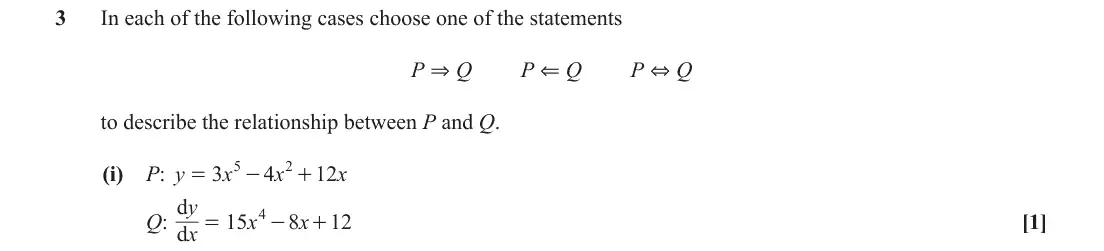
The most common error was to give P ⇔ Q. P → Q was condoned.
Key points and common errors
P ⇒ Q: differentiating gives Q but Q does not fix the constant
common error P ⇔ Q
June 2018 · AS Paper 2 · Q11(iii)5 marksHard
Show the start of this question
Mark scheme for this part
Examiner's comment
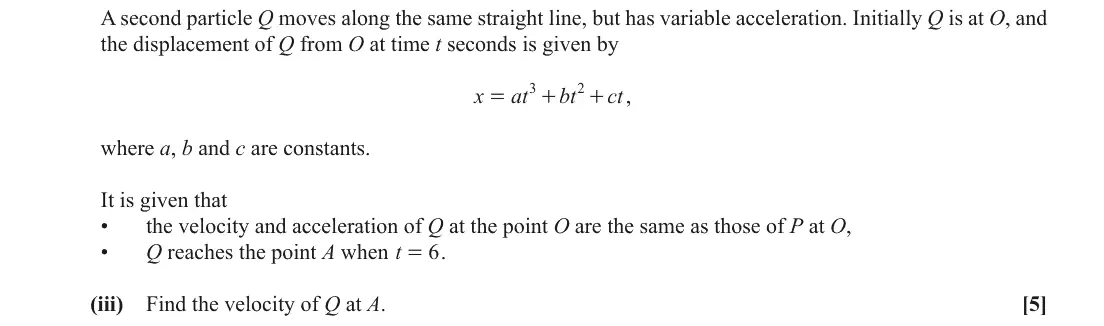
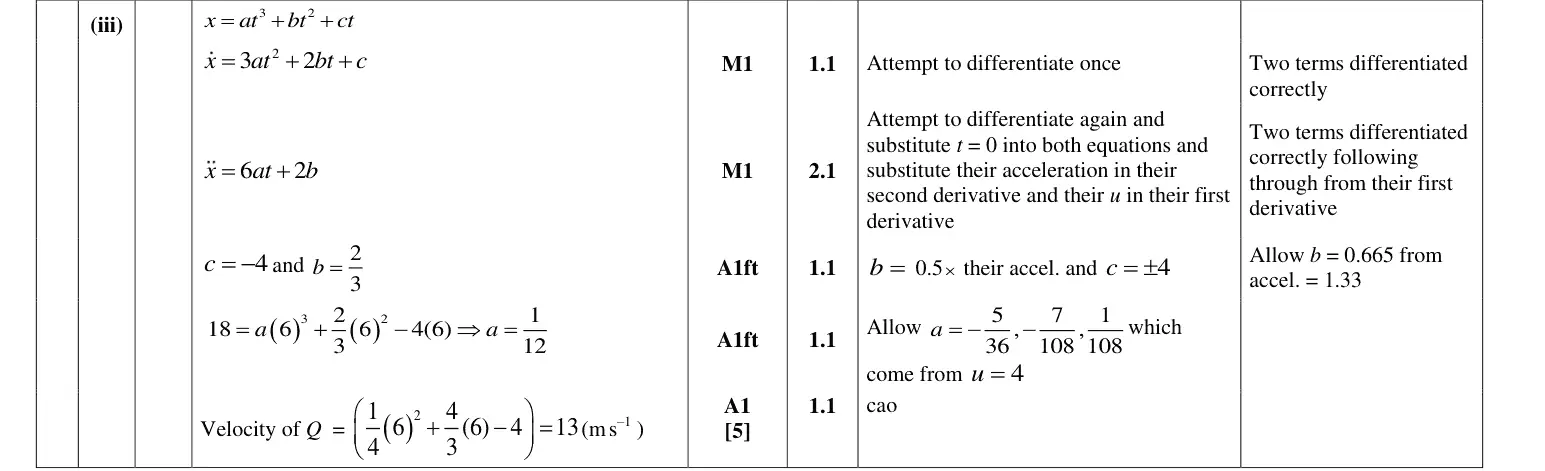
Few fully correct solutions were seen to this part. Many just earned one mark for differentiating the given displacement equation, seemingly not understanding that t = 0 needed to be used in the work to find b and c (not t = 6) and then t = 6 needed to obtain a. A number of candidates attempted to solve this part using the constant acceleration formulae.
Key points and common errors
differentiate twice
at t = 0 velocity −4 and acceleration 4/3 give c = −4, b = 2/3
x = 18 at t = 6 gives a = 1/12
velocity at A is 13 m/s
constant acceleration formulae do not apply
June 2018 · Paper 1 · Q10(i)4 marksMedium
Mark scheme for this part
Examiner's comment
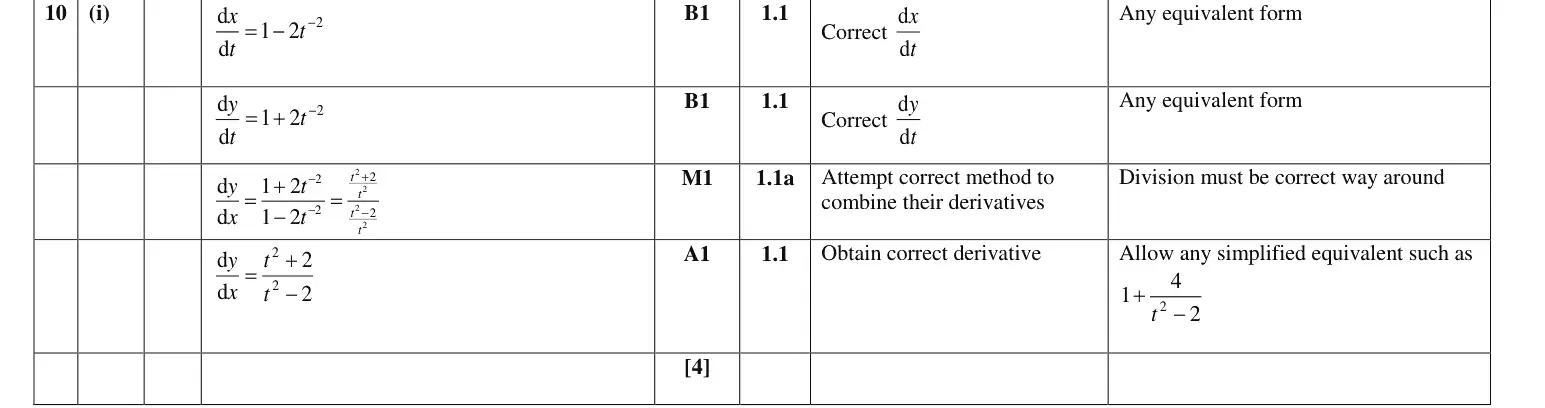
Most candidates gained at least 3 marks for obtaining a correct expression for the derivative, but the subsequent simplification proved to be more challenging. Candidates who worked with fractions tended to be more successful than those who worked with negative indices. The most common error was ‘cancelling’ just a single term in the numerator and denominator.
Key points and common errors
dx/dt = 1 − 2t⁻², dy/dt = 1 + 2t⁻²
dy/dx = (t² + 2)/(t² − 2)
common error cancelling single terms
June 2018 · Paper 3 · Q11(i)3 marksEasy
Mark scheme for this part
Examiner's comment
Nearly all candidates correctly differentiated the expression for v and correctly obtained the value of k as 0.1.
Key points and common errors
a = k + 0.06t
k + 1.2 = 1.3 so k = 0.1
Find an A-level maths tutor
Stuck on this? Book a trial session with an A-level maths tutor.