1.05f The sine, cosine and tangent functions, their graphs, symmetries…
Section
1.05 Trigonometry
Level
AS & A level
Statement
Understand and be able to use the sine, cosine and tangent functions, their graphs, symmetries and periodicities.
Guidance
Includes knowing and being able to use exact values of sin θ and cos θ for θ = 0°, 30°, 45°, 60°, 90°, 180° and multiples thereof and exact values of tan θ for θ = 0°, 30°, 45°, 60°, 180° and multiples thereof.
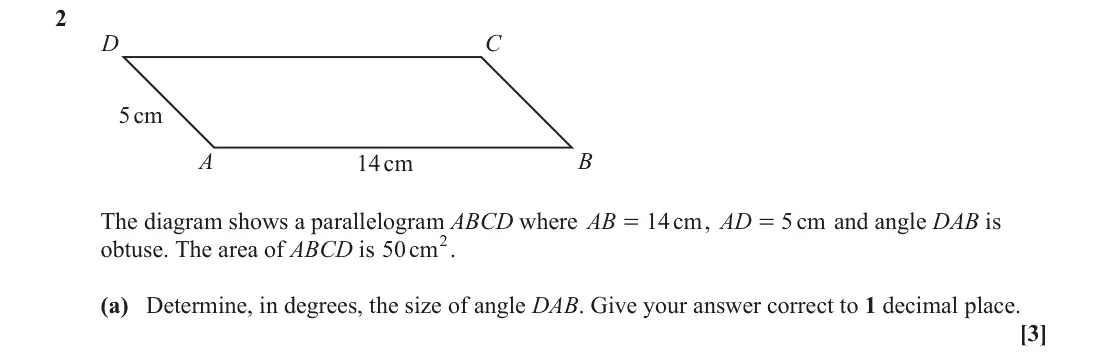
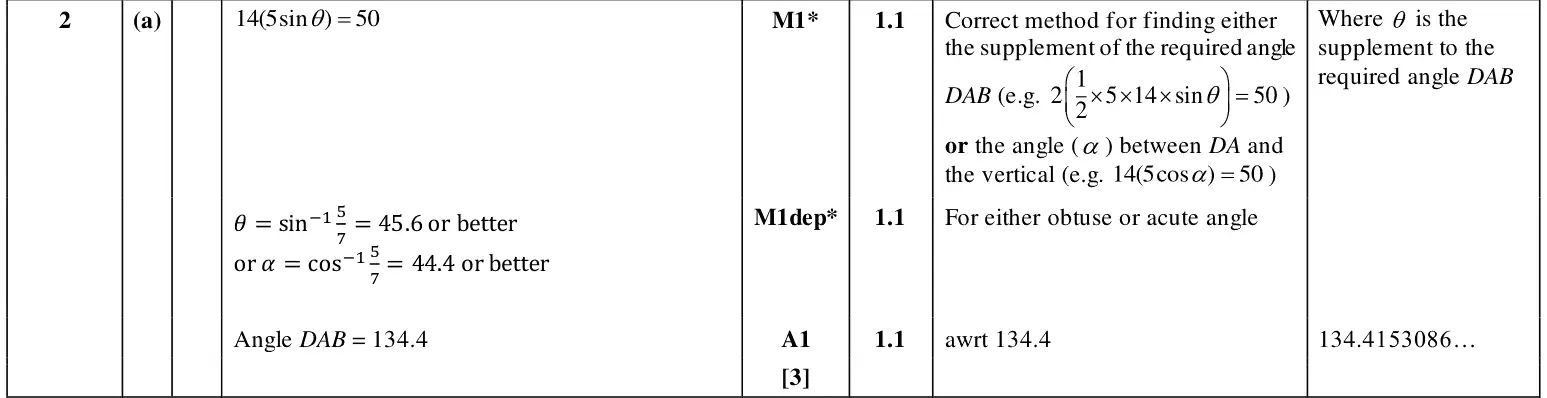
Both methods outlined in the mark scheme were seen and applied well. Despite being told in the stem of the question (and shown in the diagram) that DAB was obtuse, quite a few candidates gave an acute angle as the final answer. The last mark required 134.4° or better to be seen.
Key points and common errors
area 14 × 5 sin θ = 50 gives 45.6°
DAB is obtuse so 134.4°
acute answer is wrong
June 2024 · AS Paper 2 · Q7(a)(i)1 markEasy
Mark scheme for this part
Examiner's comment
There were many correct answers. We also saw 6.5, 1 and 6 occasionally.
Key points and common errors
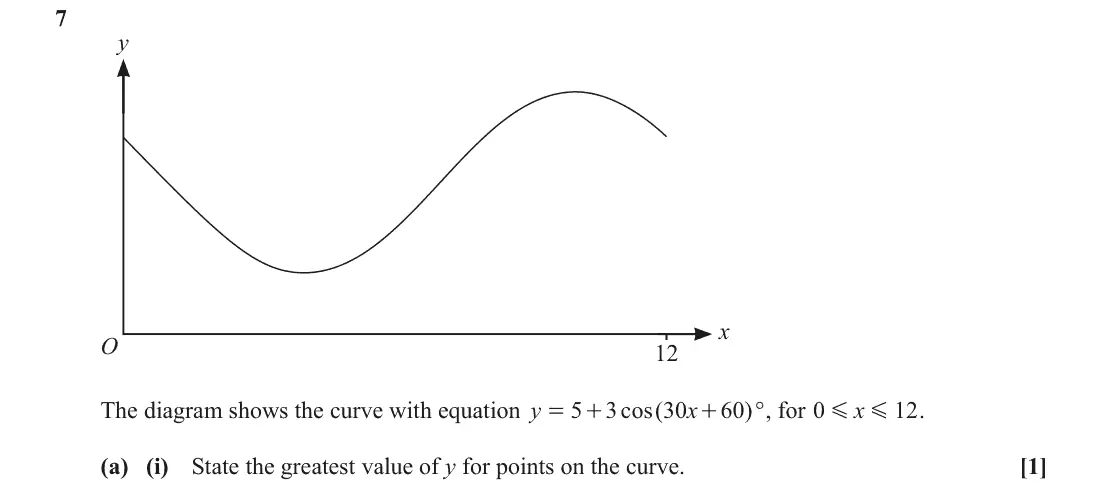
maximum of cos is 1 so y = 8
June 2024 · AS Paper 2 · Q7(a)(ii)3 marksMedium
Show the start of this question
Mark scheme for this part
Examiner's comment
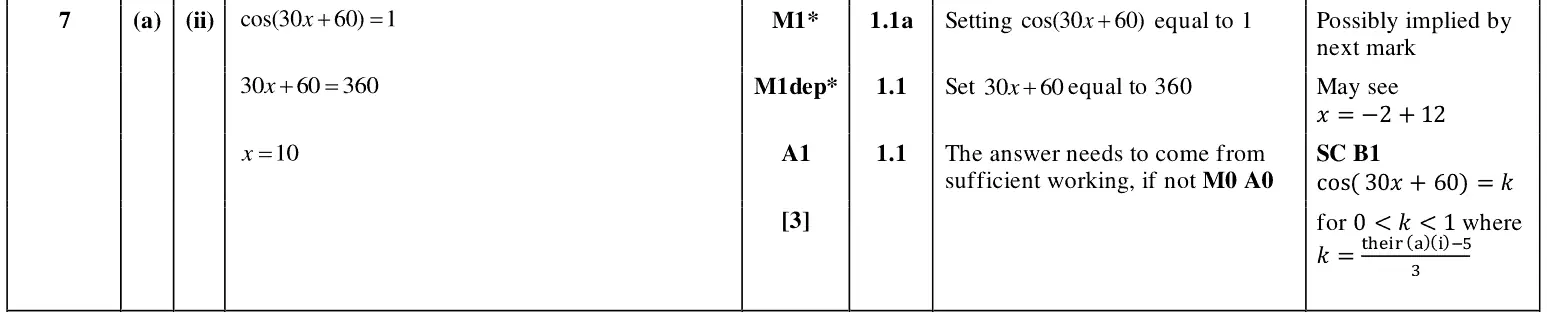
A lot of candidates obtained x = 10, many starting from the equation 8 = 5 + 3cos(30x + 60)° rather than just stating cos(30x + 60)° = 1 immediately. The command word ‘Determine’ indicated that we wanted to see justification of how x = 10 was obtained and sufficient evidence was required for full marks; a few just wrote x = 10 and were given M0. Some did not convincingly show the 360° idea and just got M1. The poorer efforts involved cos30x + cos60.
Key points and common errors
cos(30x + 60)° = 1 so 30x + 60 = 360
x = 10
working needed for 'determine'
June 2024 · AS Paper 2 · Q7(b)5 marksMedium
Show the start of this question
Mark scheme for this part
Examiner's comment
This part stated ‘Determine’ again, so we expected to see sufficient justification of results and typically it was provided. There were a fair number of fully correct solutions given, but final answers of x = −0.394 and x = 8.39 were also not unusual. x = 8.4 were given A0 unless a better value was seen in the 42 58 working; the ‘exact’ values of 5 and 5 (or equivalent) obtained from 312° and 408° respectively also both earned A0. Candidates should be encouraged to work to a sufficient degree of accuracy, given the front cover rubric. Again, efforts were seen involving cos30x + cos60.
Key points and common errors
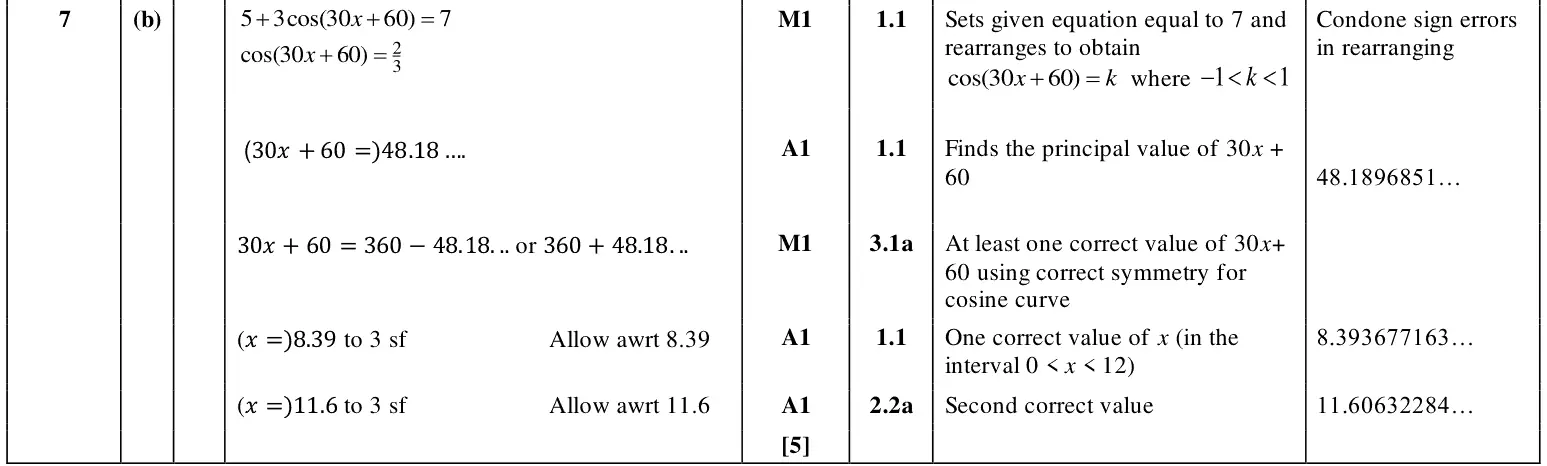
cos(30x + 60)° = ⅔
principal value 48.19°
30x + 60 = 311.8° or 408.2°
x = 8.39 and 11.6 to 3 s.f.
June 2024 · Paper 1 · Q3(b)(iii)1 markEasy
Show the start of this question
Mark scheme for this part
Examiner's comment
(From the general report) Question 3 (b) (i), (ii) and (iii) Most candidates used the correct type of arrows, although a single stemmed arrow was condoned. (iii) was the most commonly correct answer and (i) the least commonly correct answer of the three.
Key points and common errors
x° = 45° ⇒ tan x° = 1 (225° also gives 1)
most often correct
June 2024 · Paper 1 · Q9(a)(i)1 markMedium
Mark scheme for this part
Examiner's comment
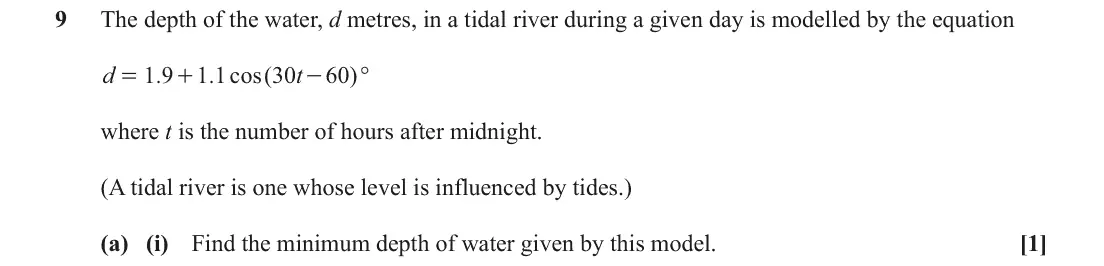
Although 1.9m and 2.45m were commonly seen errors, most candidates could successfully find the minimum depth value of 0.8. A large proportion gave no units, and so did not gain the mark for the question.
Key points and common errors
1.9 − 1.1 = 0.8 m
units required
June 2024 · Paper 1 · Q9(b)5 marksHard
Show the start of this question
Mark scheme for this part
Examiner's comment
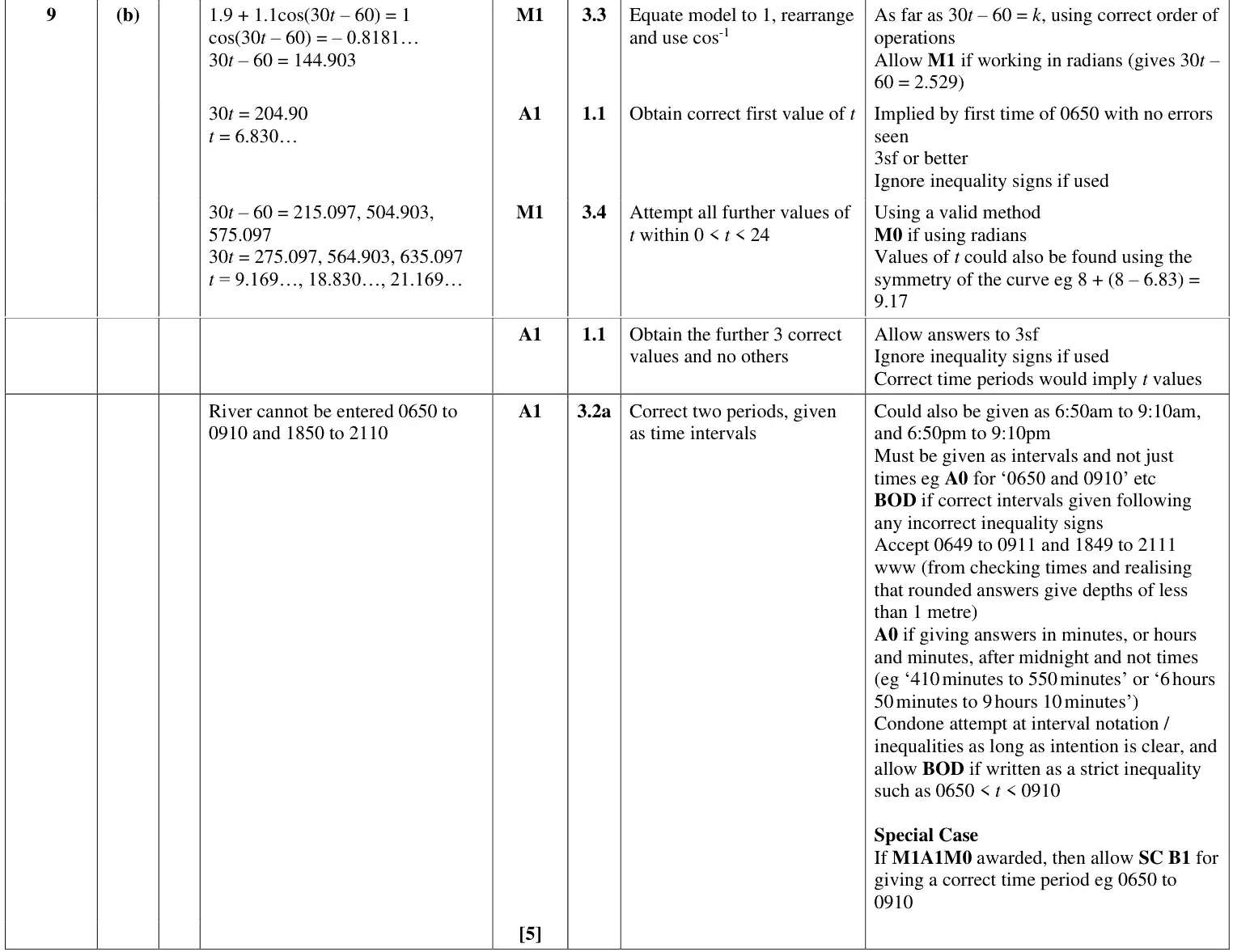
Most candidates scored the first 2 marks in this question, substituting d = 1 into the equation and rearranging to find the first value of t correctly. Many went on to find the second value of t. Very few candidates understood that this was a full day and that they should find all four values of t within the 24- hour period, with many giving only one period of time. Those who converted these values into times of the day and gave a single correct time period earned 3 out of the 5 marks. Some candidates completed the question, sometimes by using symmetry rather than all the values of t. Often candidates lost marks because they did not write their answers as ‘periods of time’ with many leaving their answers in minutes or hours/minutes after midnight. Key Point – Time The question asked for ‘periods of time during the day’. We were therefore looking for answers given as times of the day. For example. ‘The boat would be unable to sail between 6.50am and 9.10am’.
Key points and common errors
1.9 + 1.1cos(30t − 60) = 1 so cos = −0.818
t = 6.830, 9.169, 18.830, 21.169
periods 0650–0910 and 1850–2110
very few found all four values in the 24 hours
June 2024 · Paper 1 · Q11(a)2 marksHard
Mark scheme for this part
Examiner's comment
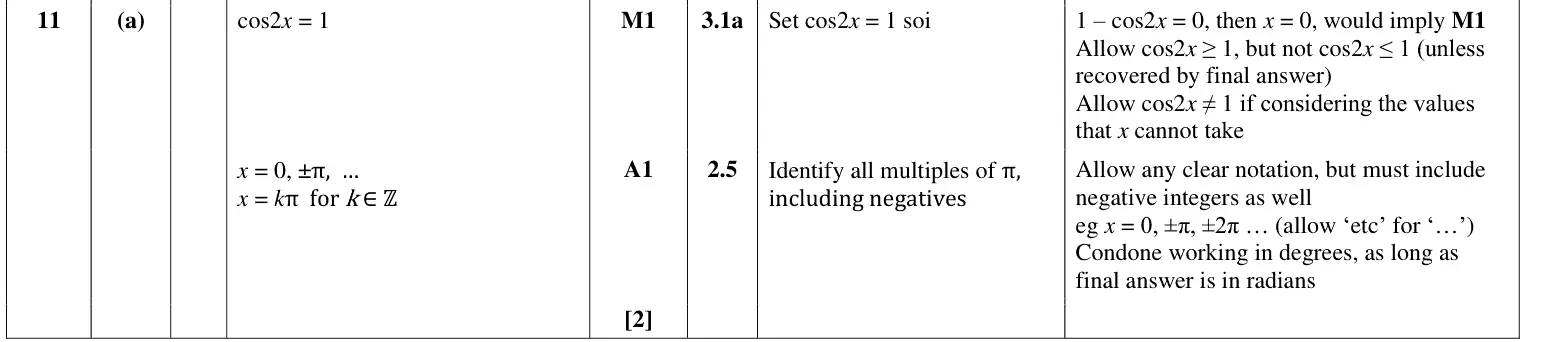
This proved to be a challenging question as although the vast majority recognised when the logarithmic function is undefined and related cos 2x to 1 in some way, very few were able to identify the full set of values. Candidates seem comfortable solving a trigonometric equation in a given range, so most simply proceeded to give an incomplete answer with negative values of x rarely considered.
Key points and common errors
ln undefined when 1 − cos2x = 0 (cannot be negative): cos2x = 1, x = kπ for all integers k including negatives
very few gave the full set
June 2024 · Paper 2 · Q24 marksEasy
Mark scheme for this part
Examiner's comment
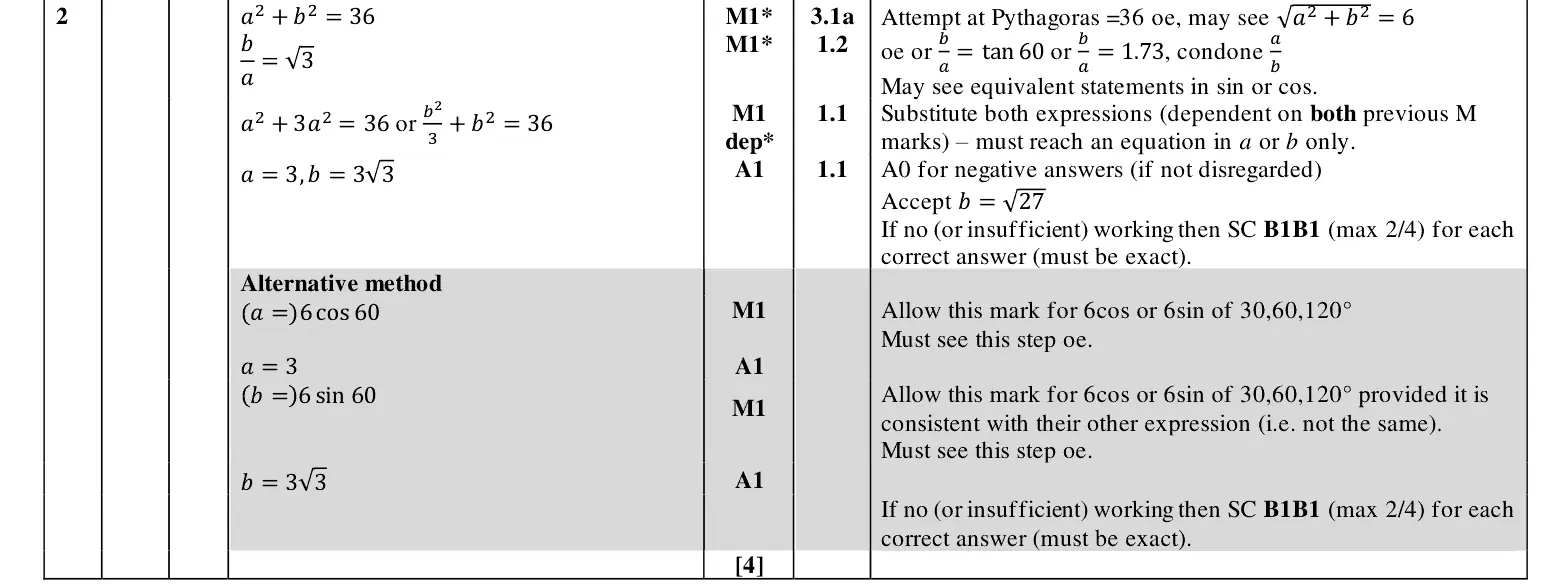
This question was well answered by most candidates. The alternative method using cos and sin was most popular, with many candidates immediately writing down the two correct expressions for a and b as required and calculating the values correctly. A small number of candidates gave a and b the wrong way around or did not label them (neither of which could be given accuracy marks). Of those who used the main method (Pythagoras, etc.), most of the responses were successful, but quite a few candidates made an error when combining their two expressions to solve (for instance, square rooting both terms separately). There were others that used a mixture of both methods, which was acceptable provided sufficient working was shown (noting the ‘Determine’ instruction).
Key points and common errors
a = 6cos60° = 3, b = 6sin60° = 3√3
must be exact
A0 for negative values
June 2024 · Paper 2 · Q6(a)(ii)3 marksMedium
Show the start of this question
Mark scheme for this part
Examiner's comment
This question was fairly well answered, with many candidates correctly observing that cos 3𝜃= √2 2 and proceeding to solve. However, quite a few candidates (not heeding the DR instruction) jumped directly to solutions for theta without showing an intermediate step - this could only score a maximum of 2/3 marks (assuming all three solutions in the range were present). Candidates should be reminded that DR means that all steps in the working need to be clearly shown and that, while computation can (and should) still be offloaded to a calculator, the mark scheme will still reflect this. A small number of candidates only gave two of the required three solutions. Some candidates (perhaps from looking ahead to later parts of the question) attempted to find values of by another method (for instance, matching the roots of the equation in x as in part (c)). This was rarely successful but, in any event, could not be given marks because the question specified ‘Use this result…’ so the method starting with 3 needed to be seen.
Key points and common errors
cos3θ = √2/2 so 3θ = 45°, 315°, 405°
θ = 15°, 105°, 135°
DR: working must be shown
June 2024 · Paper 2 · Q6(c)2 marksMedium
Show the start of this question
Mark scheme for this part
Examiner's comment
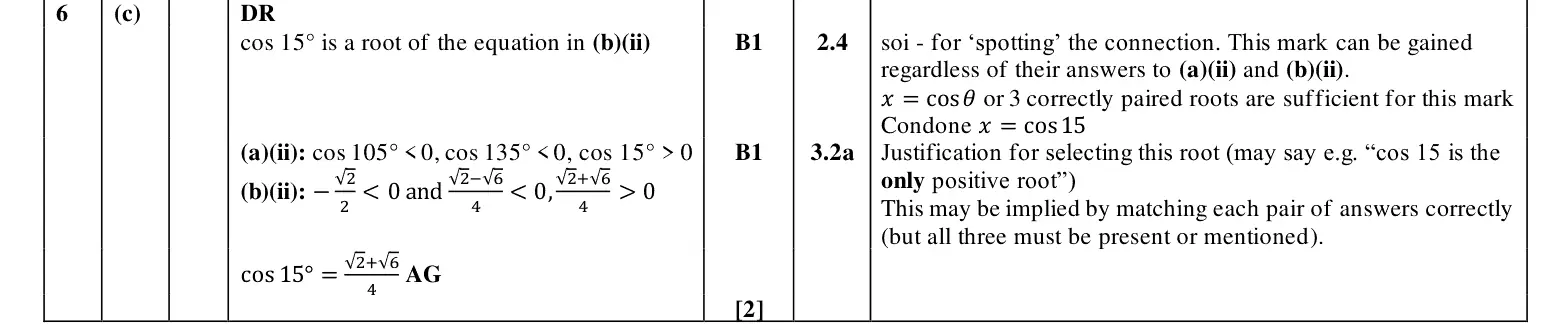
In this part candidates needed to (as guided by the question) deduce the connection between parts (a) and (b) and use this to reach the given result. For the first B1 mark, candidates needed to show that they had understood and used this connection - for instance by writing 𝑥= cos 𝜃. For the second, candidates needed to unambiguously show that cos 15° = √2+√6 . As this response was given it was not enough just to write this statement down, candidates needed to show this - either by deducing that cos 15 must be the only positive root (because cos 105° and cos 135° are negative) or by explicitly matching each root for the equation in x with a value of from part (a). Many candidates did not do this with sufficient rigour, and so could not be given this mark. Candidates should be reminded that, where a response is given, they need to clearly demonstrate that they have reached this by providing clear working. Reading and following the sequence of the question carefully This was a structured question designed, with appropriate scaffolding, to guide students through several different approaches to related problems in order to demonstrate their knowledge of different techniques. While candidates can of course answer the questions in any order they choose, many candidates did not score as many marks as they could have because they did not follow instructions such as “Use this result” or “Hence” which direct the candidate to use a specific method.
Key points and common errors
x = cos θ links the two equations
select the only positive root to match cos 15°
June 2024 · Paper 3 · Q9(a)6 marksMedium
Mark scheme for this part
Examiner's comment
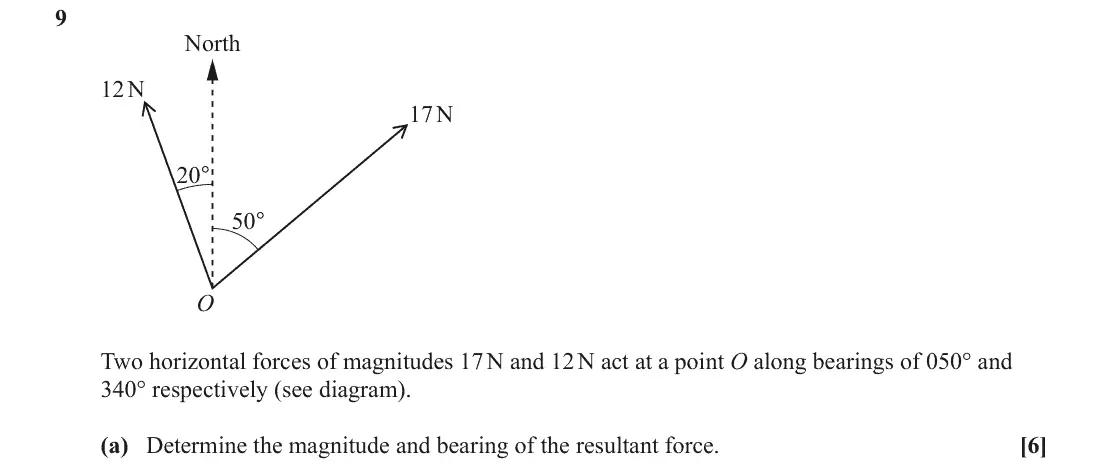
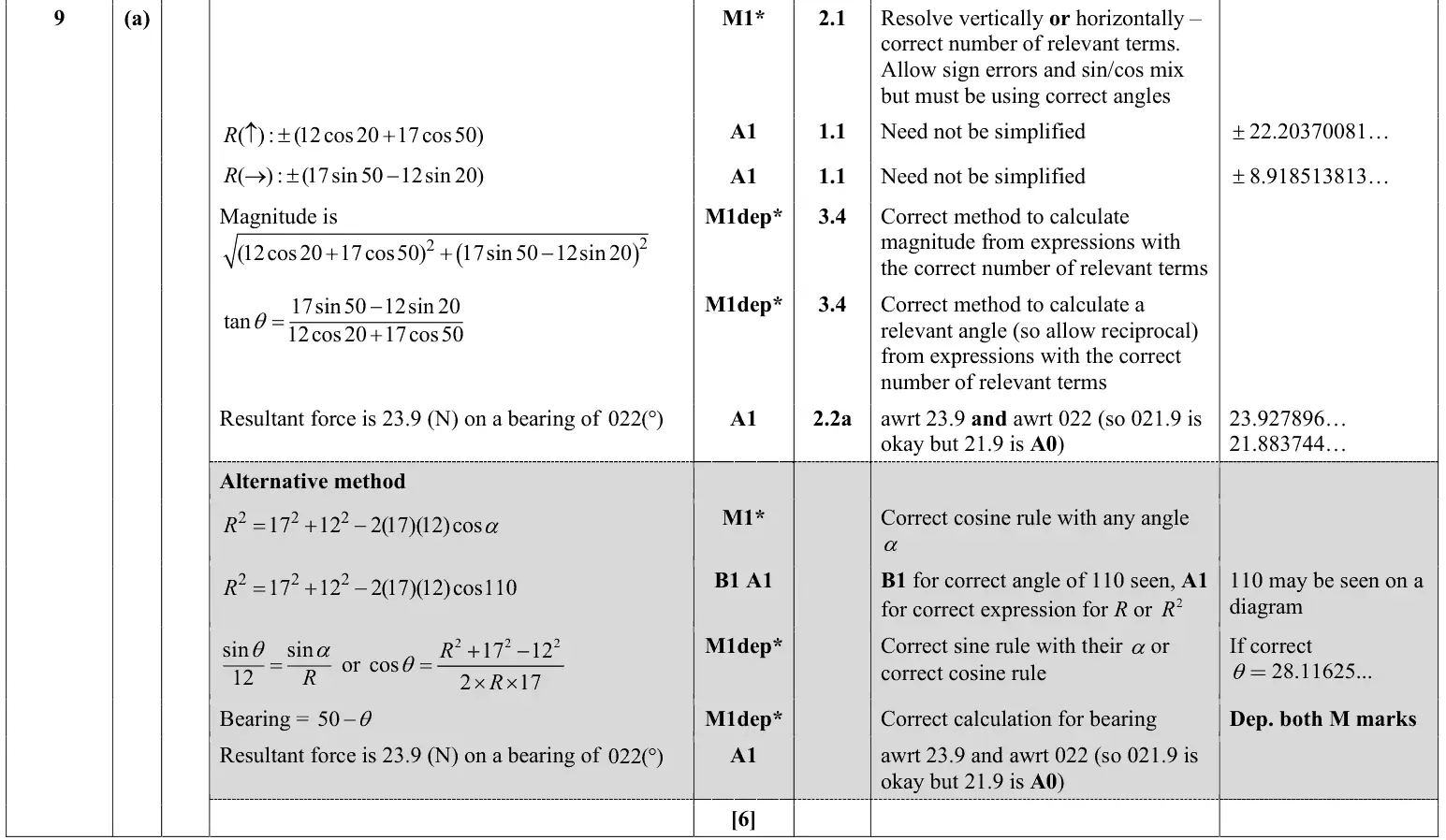
Most candidates resolved in a northerly and easterly direction in their attempts to find the magnitude and bearing of the resultant force (although attempts using a triangle of forces and the sine/cosine rules were just as successful). While many resolved correctly there were the usual sin/cos confusion and sign errors. It was surprising how many candidates, who found the magnitude correctly, did not find the correct bearing (and many who did not give the bearing in a correct three-figure form even though an example of a three-figure bearing was given in the question).
Key points and common errors
resolve N: 12cos20 + 17cos50 = 22.20
E: 17sin50 − 12sin20 = 8.92
R = 23.9 N on bearing 022°
or cosine rule with 110°
many found the magnitude but not the bearing
June 2024 · Paper 3 · Q10(a)3 marksEasy
Mark scheme for this part
Examiner's comment
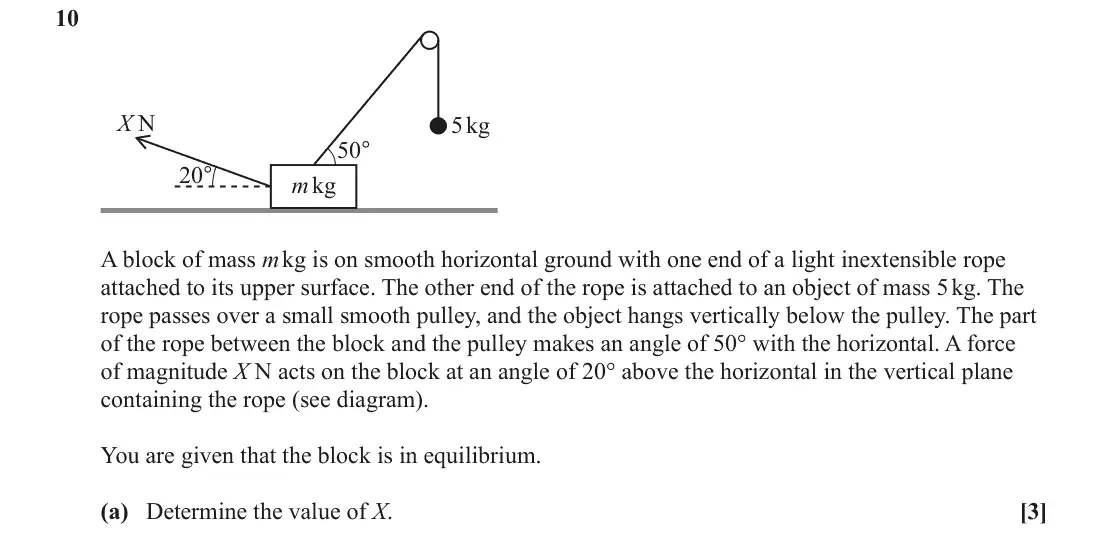
This part was answered very well with most candidates resolving vertically for the object (so obtaining the tension in the rope as 5𝑔), and then resolving horizontally for the block to obtain the correct value for 𝑋.
Key points and common errors
object: T = 5g
block horizontally: T cos50 = X cos20
X = 33.5
June 2024 · Paper 3 · Q10(b)3 marksMedium
Show the start of this question
Mark scheme for this part
Examiner's comment
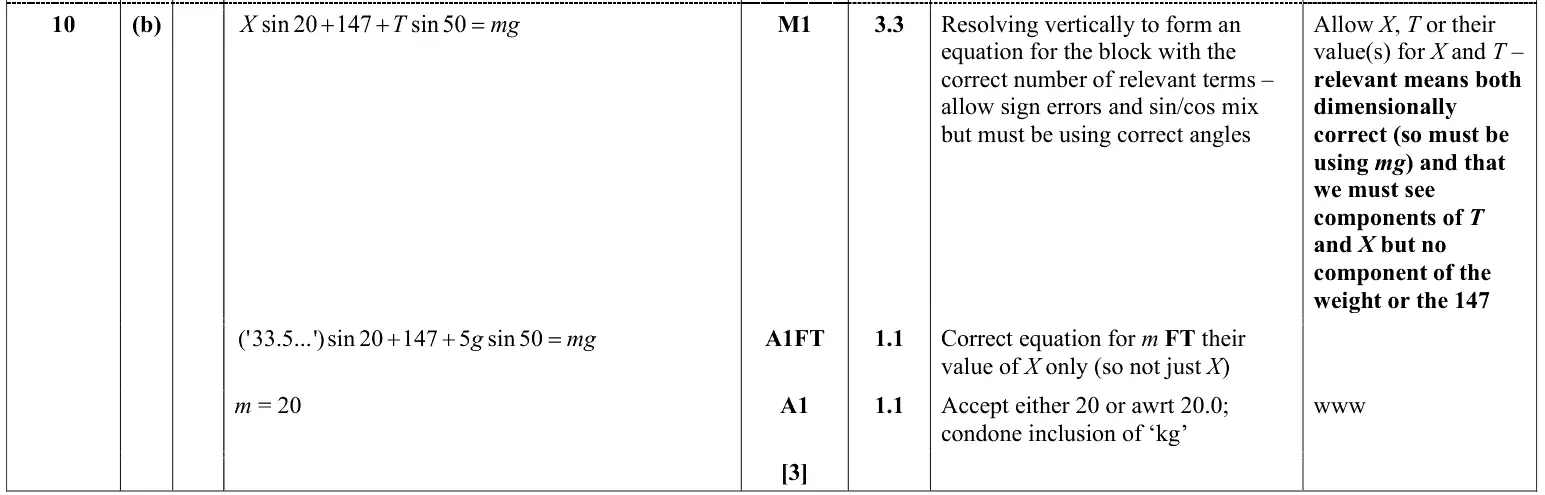
The responses to this part were more mixed with many candidates either making sign errors or failing, when resolving vertically for the block, to include all four forces that were required to find the correct value of 𝑚. It was also common to see some candidates forgetting the 𝑔 and therefore only having the mass (and not the weight) as one of the terms in their equation.
Key points and common errors
vertically on block: X sin20 + 147 + T sin50 = mg
m = 20
all four forces needed
weight mg not m
June 2024 · Paper 3 · Q13(a)6 marksHard
Mark scheme for this part
Examiner's comment
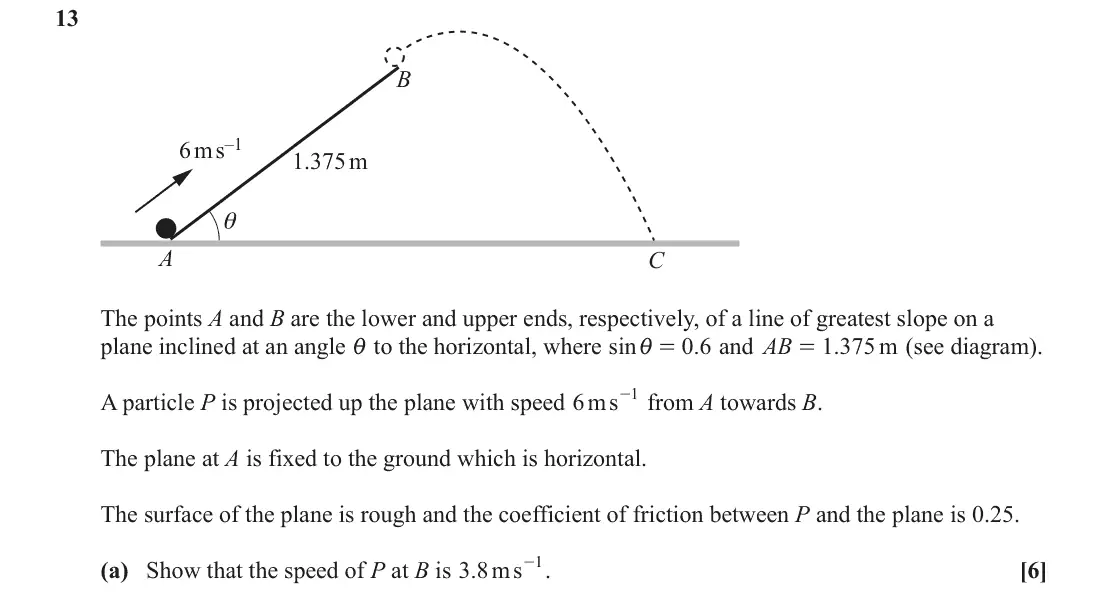
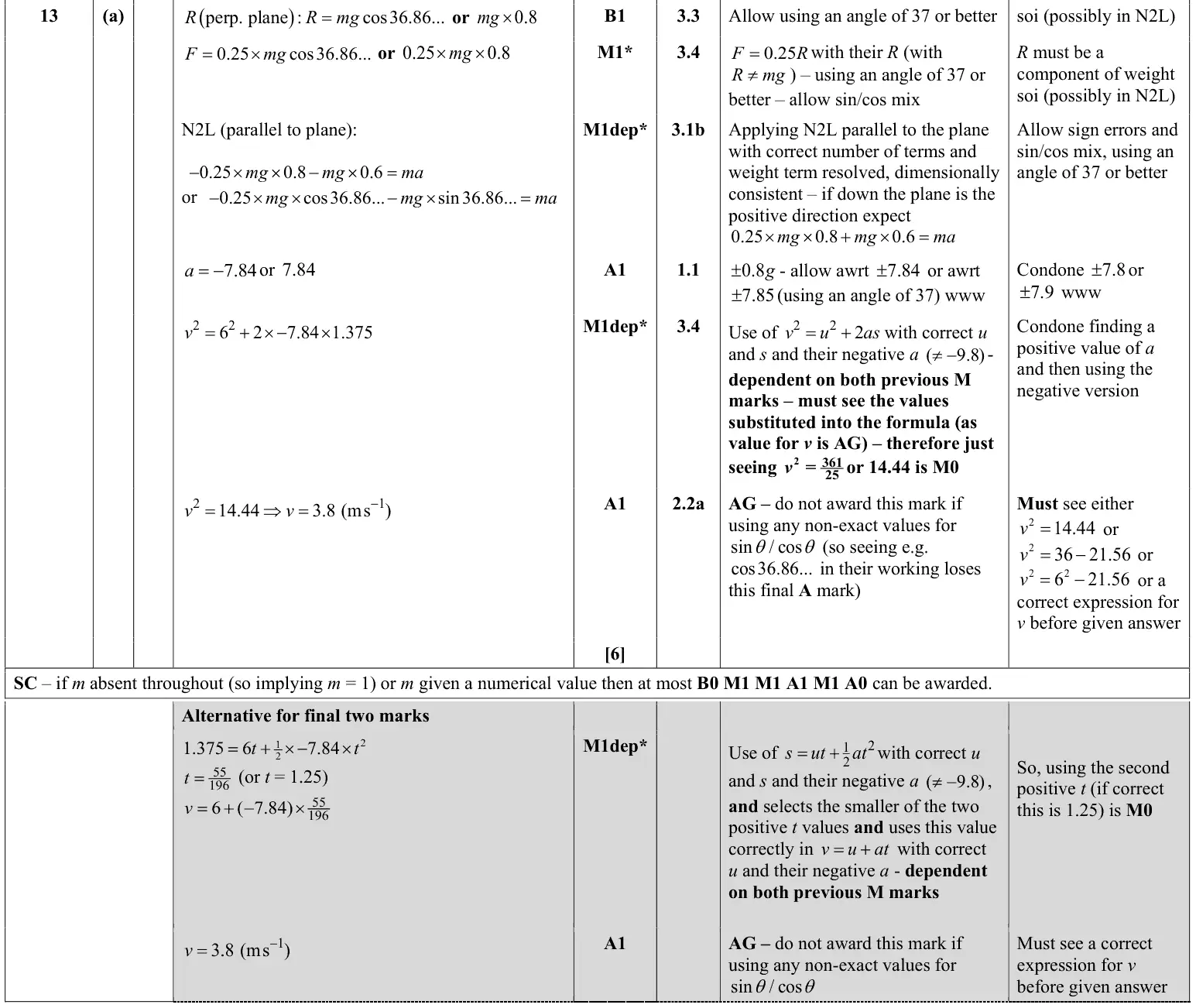
The responses to this part were mixed. Many candidates did not make any significant progress towards the given answer as they seemed to believe that the entire question could be solved by only applying the equations of constant acceleration. Very few candidates applied Newton’s second law parallel to the plane correctly (with the correct number of relevant terms) to find the acceleration of 𝑃 as it moved up the plane from 𝐴 to 𝐵. While some did correctly state that 𝑎= −0.25𝑔cos 𝜃−𝑔sin𝜃 many gave no indication of where the value of −7.84 for the acceleration came from; as this is a ‘show that’ question candidates were expected to substitute the given values of sin𝜃= 0.6 and therefore cos𝜃= 0.8 into this equation to make it clear that they hadn’t simply worked backwards to find the acceleration from the given final speed. Some candidates calculated 𝜃 as 36.8… and so therefore did not show that the speed of 𝑃 at 𝐵 was the exact (given) value of 3.8. This candidate made very good progress in showing that the speed of 𝑃 at 𝐵 was 3.8. The only issue was one of accuracy in that the candidate used an approximate value for the angle (in this case using 36.87) which leads to an inaccurate value of −7.8400113 … for the acceleration and therefore they could not score the final accuracy mark (and so instead scored 5 of the 6 marks available).
Key points and common errors
R = 0.8mg
F = 0.25R
N2L up the plane a = −0.8g = −7.84
v² = 36 − 2 × 7.84 × 1.375 = 14.44 so v = 3.8
exact sin/cos values
many used suvat only
June 2023 · AS Paper 2 · Q3(a)(i)1 markMedium
Mark scheme for this part
Examiner's comment
An incorrect response of 15 m was not uncommon.
Key points and common errors
greatest height 15 + 14 = 29 m (cos = −1)
15 m is a common error
June 2023 · AS Paper 2 · Q3(a)(ii)1 markEasy
Mark scheme for this part
Examiner's comment
Most candidates answered this correctly, with 0 m being the most common alternative.
Key points and common errors
least height 15 − 14 = 1 m
0 m is a common error
June 2023 · AS Paper 2 · Q3(b)2 marksMedium
Show the start of this question
Mark scheme for this part
Examiner's comment
It was not unusual to see cos(150k) = 1 lead to 150k = 0 and confusion. Elsewhere, cos(150k) = 0 14 appeared too, from 14 = 0 and occasionally cos(150k) = -1 from sign errors. Those who had 0 m as their 15 answer in (a)(ii) got cos(150k) = 14 and often stopped there. Another error was candidates evaluating cos(150k) as 150cosk or kcos150.
Key points and common errors
first return to lowest point after one period: 150k = 360 so k = 2.4
errors: 150k = 0, treating cos(150k) as 150 cos k
June 2023 · AS Paper 2 · Q3(c)4 marksMedium
Show the start of this question
Mark scheme for this part
Examiner's comment
A correct response here required candidates’ value for k from (b), but those who were unsuccessful in (b) usually did not attempt this part. Candidates who had found a value for k were often able to pick up the first 2 marks here, but many found just one value for t and gave this as the final answer. Sign errors 5 sometimes led to cos(kt) = 14.
Key points and common errors
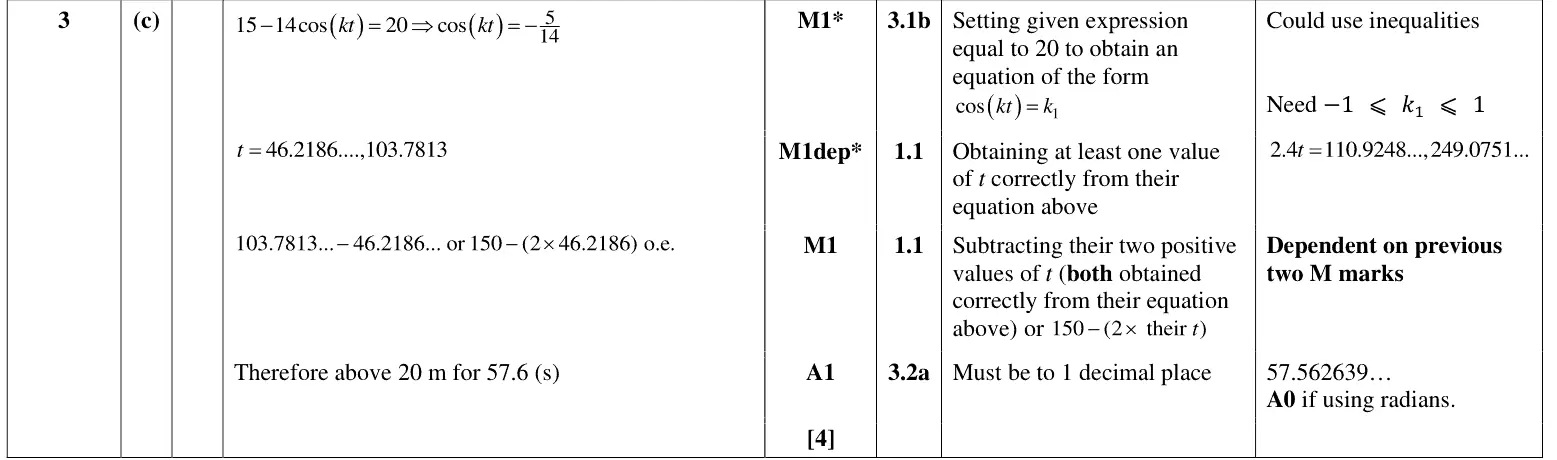
15 − 14cos(2.4t) = 20 gives cos(2.4t) = −5/14
t = 46.2 and 103.8
time above 20 m = 57.6 s (degrees, 1 d.p.)
many gave one value of t only
June 2023 · Paper 1 · Q7(a)2 marksHard
Mark scheme for this part
Examiner's comment
It was a minority of candidates who could both identify the need to replace B with – B, and also provide suitable justification for the final answer.
Key points and common errors
replace B by −B
must state cos(−B) = cos B and sin(−B) = −sin B
June 2023 · Paper 1 · Q7(b)3 marksEasy
Mark scheme for this part
Examiner's comment
This part of the question was very well answered, with many fully correct solutions seen. Candidates who used the exact trigonometric values in the two separate identities before expanding the brackets tended to be more successful than those who expanded first.
Key points and common errors
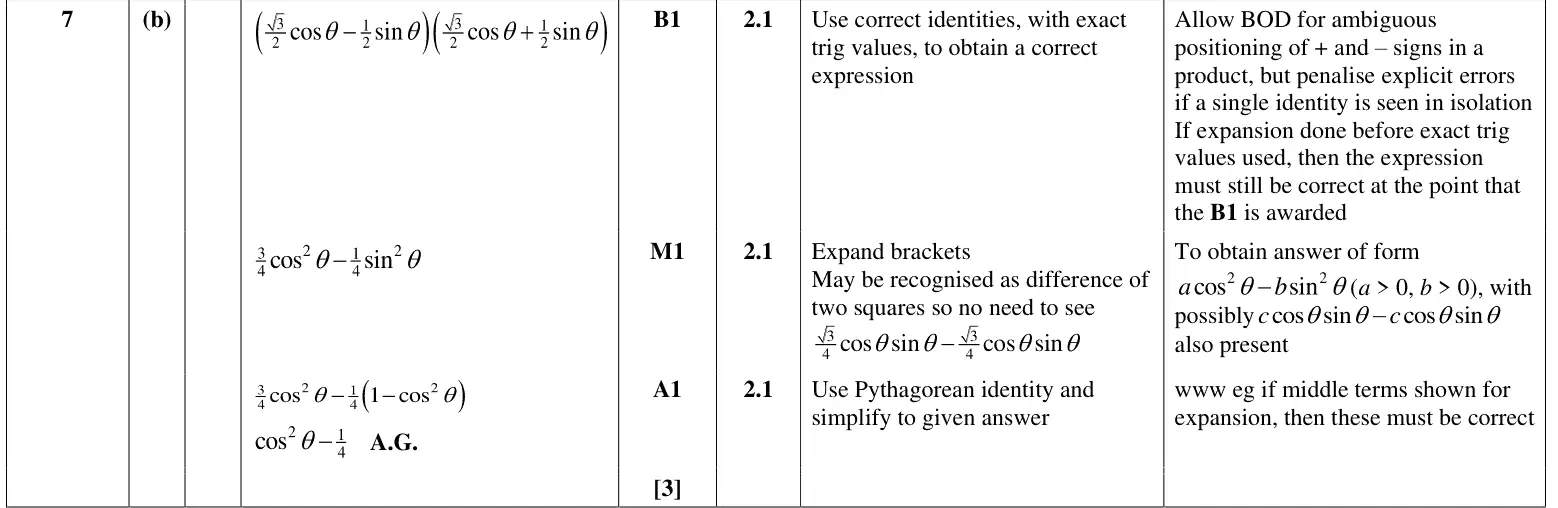
use exact values √3/2 and 1/2 before expanding
difference of two squares
sin²θ = 1 − cos²θ
June 2023 · Paper 1 · Q7(c)(i)2 marksMedium
Show the start of this question
Mark scheme for this part
Examiner's comment
Most candidates were able to identify that the maximum value would be 0.75, but finding the angle for which it occurred proved to be more challenging. A number of candidates did not appreciate that 0 is not positive. Even if 0⁰ was discounted, a number of candidates gave the angle as 360⁰. It was only the more astute candidates who realised that 180⁰ would also give a maximum value.
Key points and common errors
max 3/4 when cos²θ = 1
smallest positive θ = 180° (0° not positive
360° not smallest)
June 2023 · Paper 1 · Q7(c)(ii)2 marksMedium
Show the start of this question
Mark scheme for this part
Examiner's comment
In general candidates found it more difficult to identify the minimum value compared to the maximum in the previous part of the question. However, once – 0.25 had been found, the angle was also invariably correct.
Key points and common errors
min −1/4 when cos θ = 0
θ = 90°
June 2023 · Paper 3 · Q9(b)5 marksMedium
Show the start of this question
Mark scheme for this part
Examiner's comment
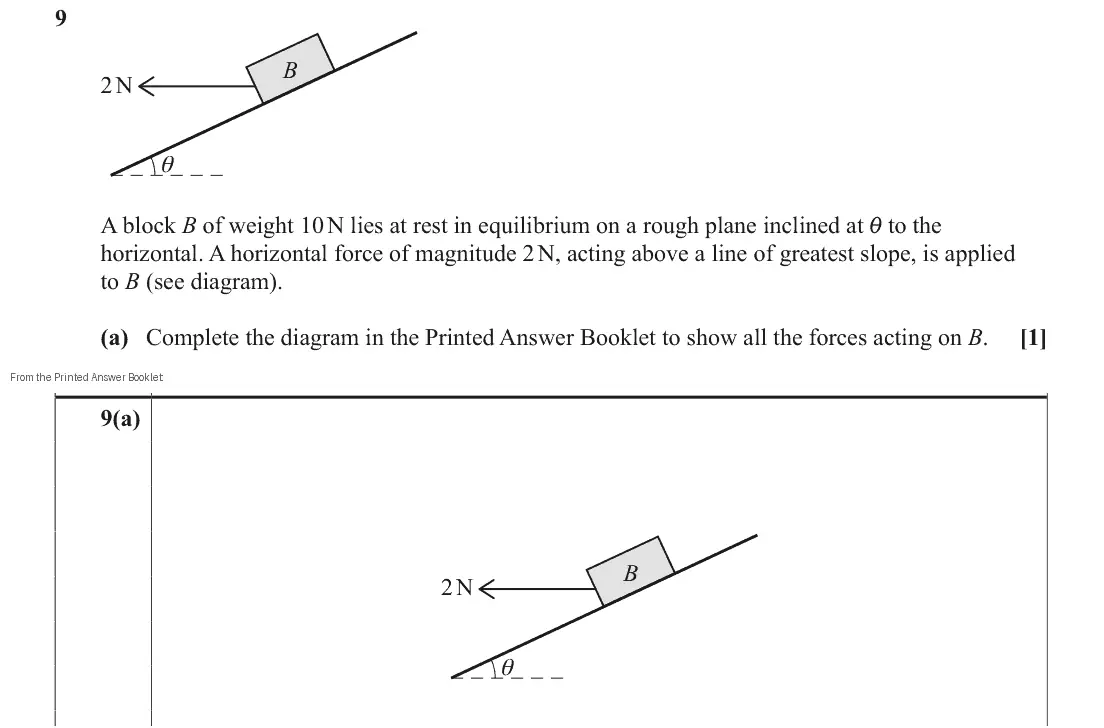
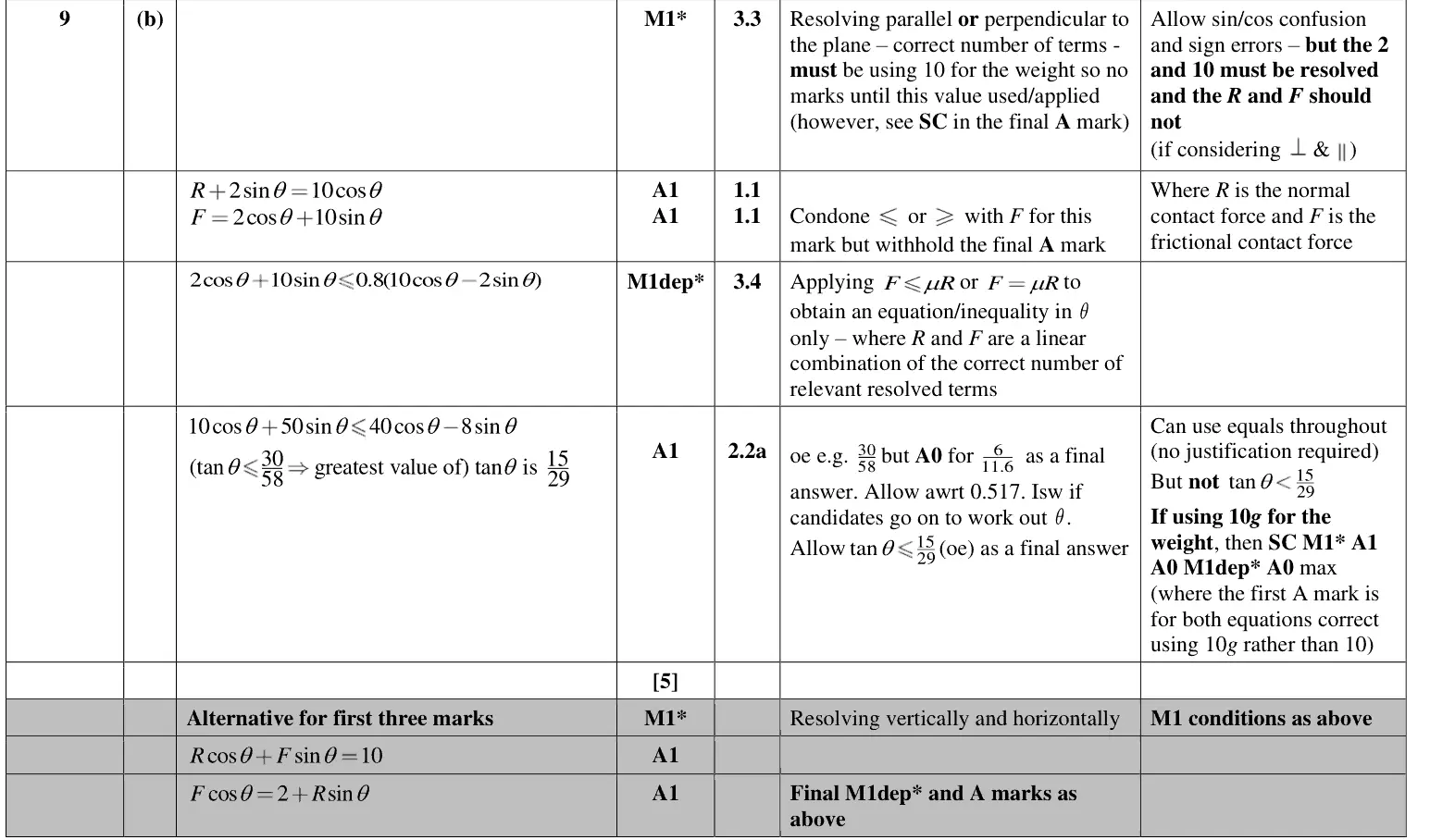
Most candidates attempted to resolve parallel and perpendicular to the plane for B but they were not candidates stated the correct expression for the friction component, namely, 2cos𝜃𝜃+ 10sin𝜃𝜃 but always successful. Aside from the usual sin/cos confusion and sign errors it was surprising how many incorrectly stated the normal contact force as 10cos𝜃𝜃 only (or vice-versa). Those candidates who did resolve in both directions correctly usually went on to apply 𝐹𝐹= 𝜇𝜇𝜇𝜇 correctly and obtain the greatest value of tan𝜃𝜃. While some candidates attempted to resolve vertically and horizontally (rather than perpendicular and parallel to the plane) these responses were rarely successful. This response scored 2 marks. This candidate has derived a correct expression for the normal contact force but their corresponding expression for the frictional contact force only contains a component of the terms the second method mark for applying 𝐹𝐹= 𝜇𝜇𝜇𝜇 could not be awarded. weight (and not the 2 N force too). As their expression for F does not contain the correct number of
Key points and common errors
R = 10cos θ − 2sin θ, F = 2cos θ + 10sin θ
F ≤ 0.8R gives tan θ ≤ 15/29
errors R = 10cos θ only, sin/cos confusion
June 2023 · Paper 3 · Q11(a)3 marksHard
Mark scheme for this part
Examiner's comment
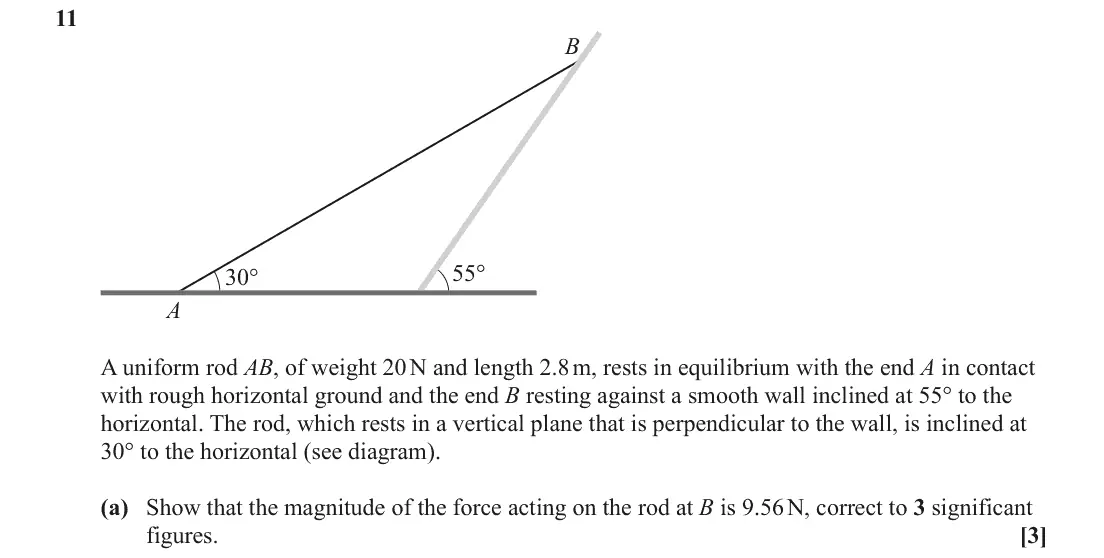
Although most candidates realised that the best way to find the magnitude of the force acting on the rod at B was to take moments about point A, many struggled with the corresponding geometry of the was given by 1.4(20cos30), most could not deal with the corresponding moment for the force acting at B situation. Although most candidates correctly realised that the expression for the moment of the weight with many having either an angle of 30, 60, 35 or 55.
Key points and common errors
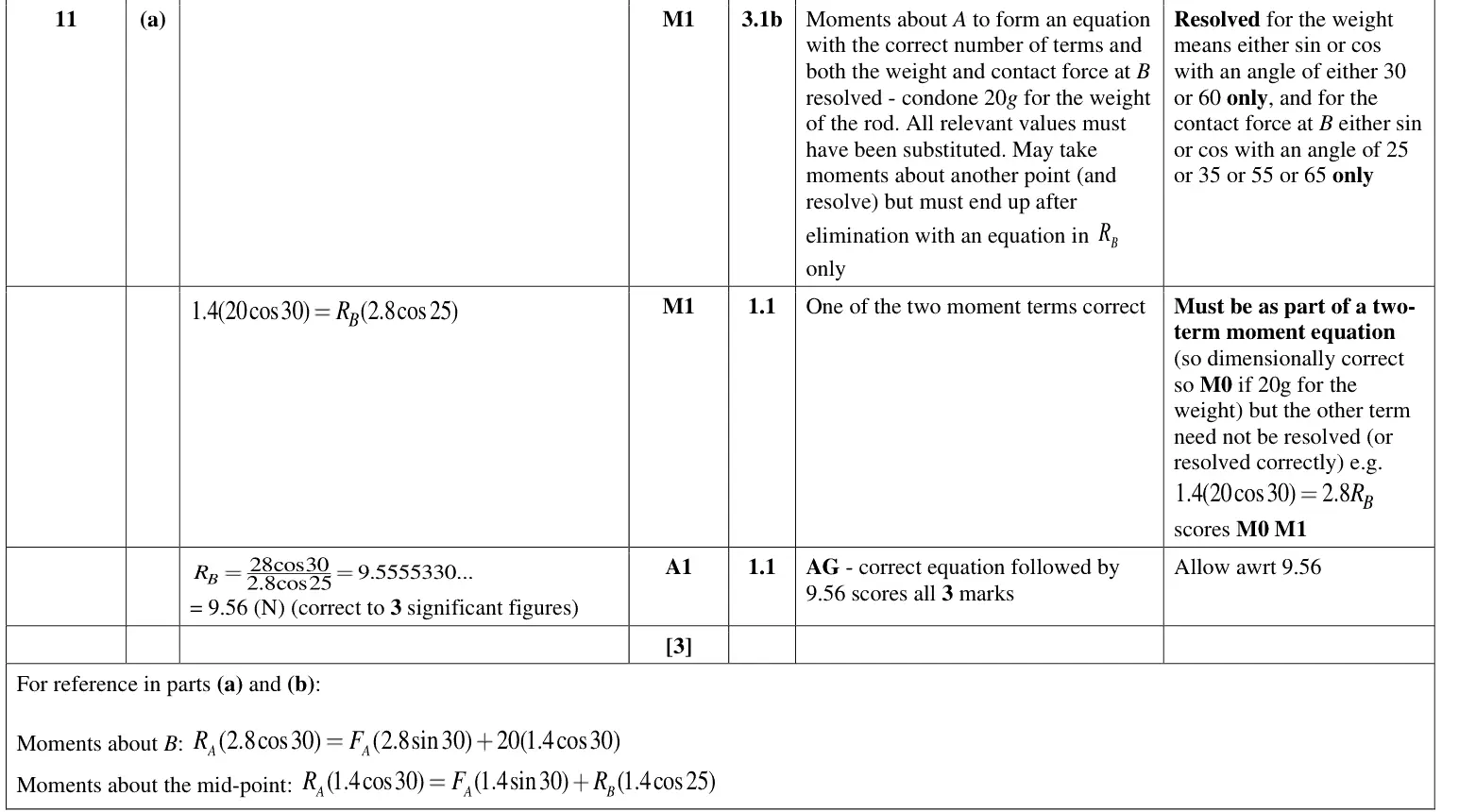
moments about A: 1.4 × 20cos30° = R_B × 2.8cos25°
R_B = 9.56 N
reaction at B is perpendicular to the wall so the angle with AB is 65°/25°
wrong angles 30, 60, 35, 55
June 2023 · Paper 3 · Q11(b)5 marksHard
Show the start of this question
Mark scheme for this part
Examiner's comment
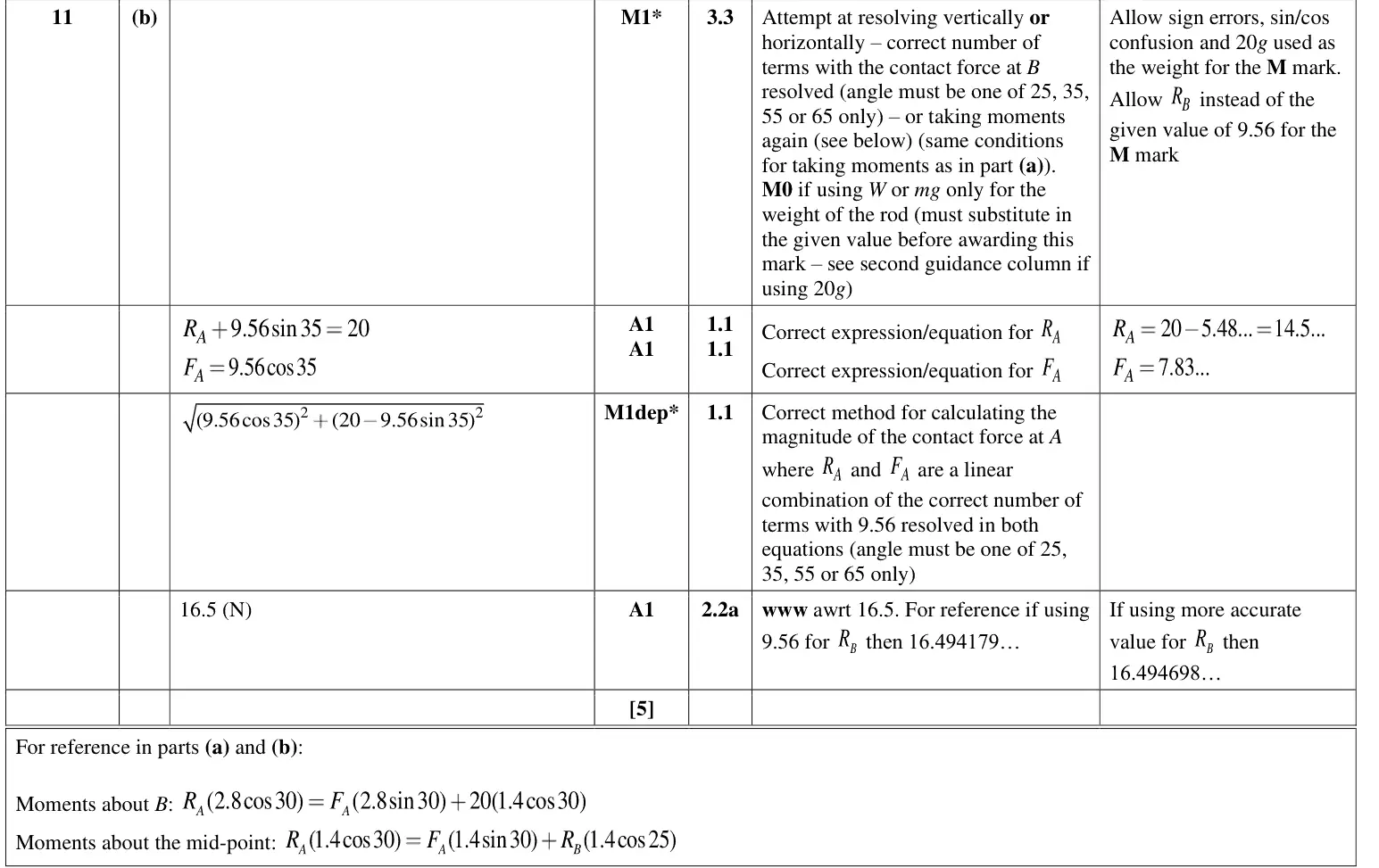
There was a common misconception here that that the ‘magnitude of the contact force between the rod and the ground’ was just referring to the normal contact force at the ground and not the frictional force too. The same issue in part (a) was evident in this part too as many could not deal with the geometry when resolving vertically and horizontally (again it was common to see angles of 30 and 60 being used in this part even from those candidates who had the correct angle of either 25 or 65 in part (a)). Some candidates attempted to take moments again (most commonly about B) or resolved parallel and perpendicular to the rod but these attempts were rarely successful (as in most cases one or more forces were missing).
Key points and common errors
resolve: R_A + 9.56sin35° = 20, F_A = 9.56cos35°
contact force = √(F_A² + R_A²) = 16.5 N
must include friction, not just the normal reaction
June 2023 · Paper 3 · Q13(a)7 marksMedium
Mark scheme for this part
Examiner's comment
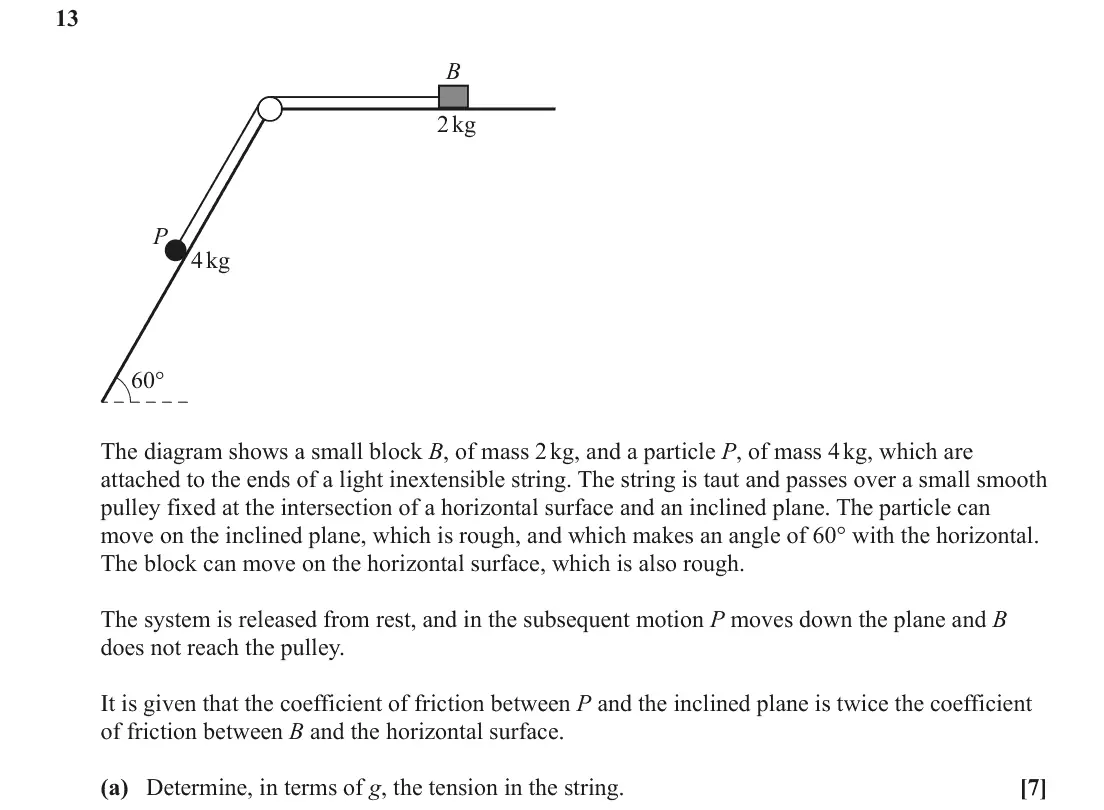
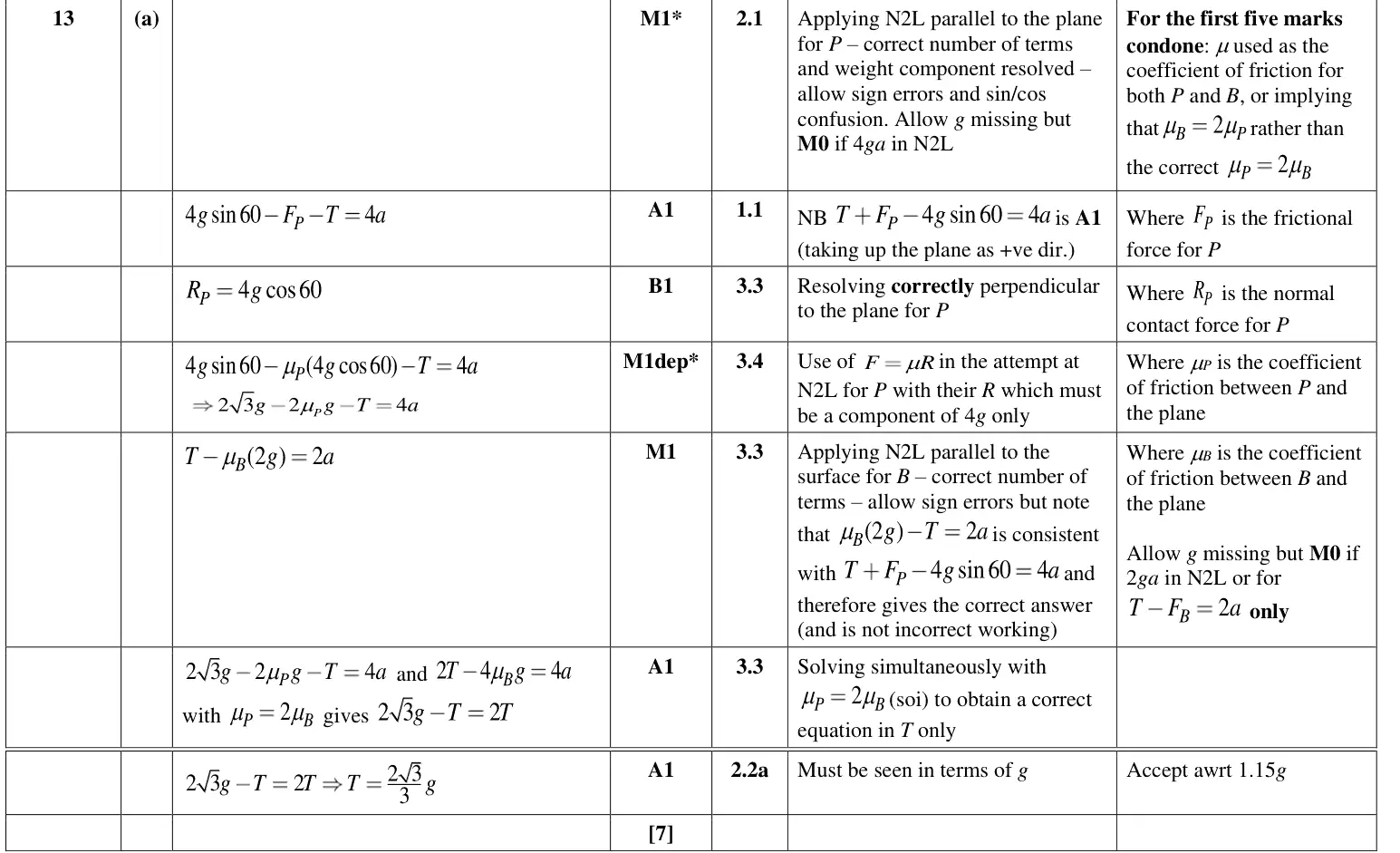
Most candidates in this part attempted to apply Newton’s second law for the motion of P and B the coefficients of friction of P and B. If done correctly this resulted in the equations: 4𝑔𝑔𝑔𝑔𝑔𝑔𝑔𝑔60 − separately to obtain two equations relating the tension in the string, the acceleration of the system and 𝜇𝜇𝑃𝑃(4𝑔𝑔𝑔𝑔𝑔𝑔𝑔𝑔60) −𝑇𝑇= 4𝑎𝑎 and 𝑇𝑇−𝜇𝜇𝐵𝐵(2𝑔𝑔) = 2𝑎𝑎. It was surprising therefore how many candidates derived eliminating 𝑎𝑎, and use the given result that 𝜇𝜇𝑃𝑃= 2𝜇𝜇𝐵𝐵, to find the required tension in the string. Apart from these two equations correctly (and so scored the first 5 marks) but did not complete the problem by acceleration of the system was zero or assuming that as 𝜇𝜇𝑃𝑃= 2𝜇𝜇𝐵𝐵 then this implied that 𝐹𝐹𝑃𝑃= 2𝐹𝐹𝐵𝐵 (which the common sign errors and sine/cosine confusion other errors seen in this part were assuming that the although true in this particular case it could not be assumed to be true without evidence of considering the relevant normal contact forces). This response scored the first 5 marks. This candidate has set their working out in a clear and logical manner (and included a diagram to assist them in setting up the required equations of motion). The candidate manages to set up both equations for P and B correctly but then makes an error when they write sin 30 rather than sin 60 which leads to an incorrect expression for the tension in the string.
Key points and common errors
N2L for P down the plane: 4g sin60° − μ_P(4g cos60°) − T = 4a
for B: T − μ_B(2g) = 2a
use μ_P = 2μ_B and eliminate a and μ: T = (2√3/3)g
many stopped after the two equations
June 2022 · AS Paper 1 · Q4(a)3 marksEasy
Mark scheme for this part
Examiner's comment
This question was correctly answered by most candidates. Some candidates made a sign error. tan 3 Others found . A few correctly obtained 56.3o, but then either gave no other answer or gave the 2 correct 180 + 56.3o together with the incorrect 180o − 56.3o and/or 360o − 56.3o.
Key points and common errors
tan x = 3/2
x = 56.3° and 236.3°
no extra values such as 180° − 56.3°
June 2022 · Paper 1 · Q2(b)(i)1 markMedium
Mark scheme for this part
Examiner's comment
The best solutions either identified an additional possible value for x, such as 1500, or explained that sin was a many to one function. Some candidates lacked precision in their answer; comments such as ‘other values are possible’ were not fully convincing. Incorrect statements, such as sin-10.5 = 30o and 150o were penalised.
Key points and common errors
sin150° = 0.5 as well (sine is many-to-one) so ⇐ fails
vague 'other values are possible' is not enough
June 2022 · Paper 1 · Q4(c)3 marksHard
Show the start of this question
Mark scheme for this part
Examiner's comment
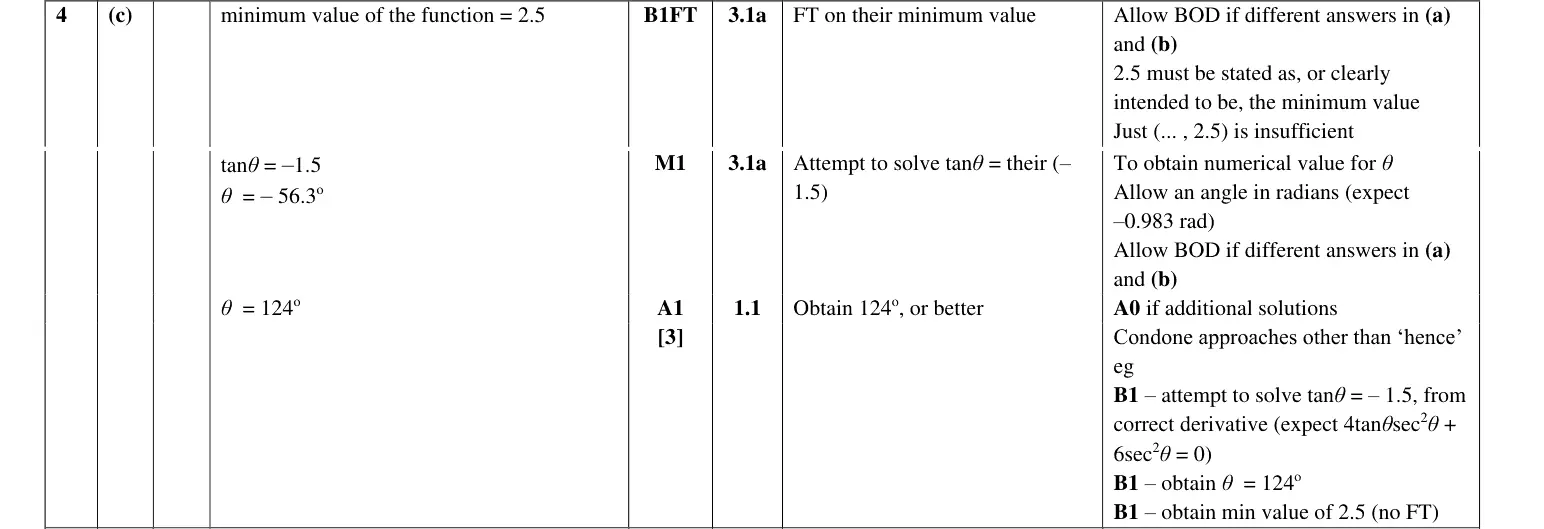
This final part of the question proved to be challenging, with a number of candidates not appreciating the link with work already done and struggling to make progress. A number did try to relate tanθ to their minimum point, with a common error being to attempt tan-1 of both the x and the y value. Despite the structure of the question making the two requests clear, quite a few candidates only attempted the angle and not the minimum value of the given function.
Key points and common errors
quadratic in tanθ: minimum 2.5 when tanθ = −1.5
smallest positive θ = 124° (not −56.3°)
error taking tan⁻¹ of both coordinates
both answers needed
June 2022 · Paper 3 · Q7(b)5 marksHard
Show the start of this question
Mark scheme for this part
Examiner's comment
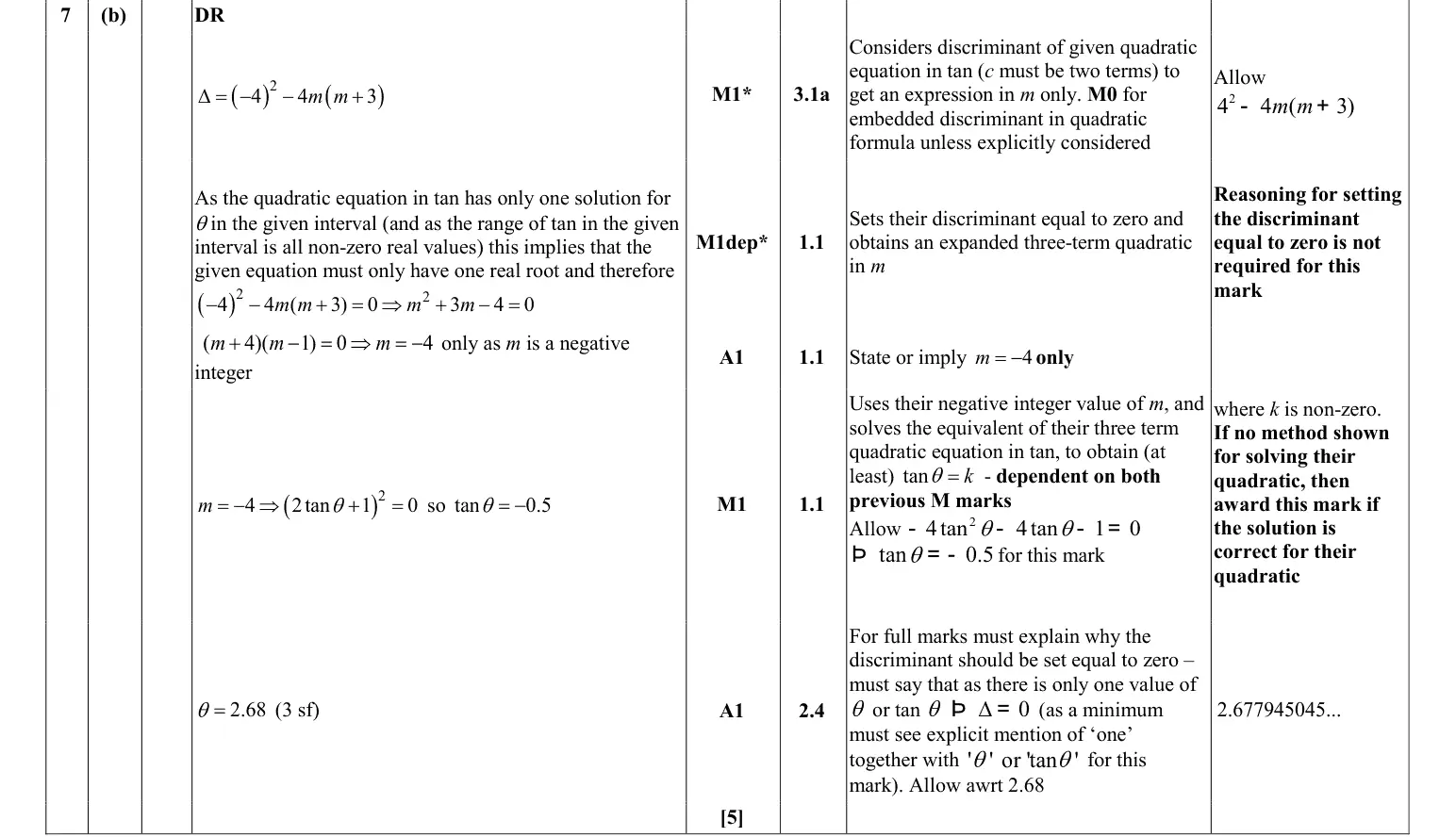
While it was pleasing that most candidates realised that the equation derived in part (a) was a quadratic equation in tanand hence they should consider the discriminant (of this equation) it was then disappointing how many candidates simplified the equation( ) ( ) − − + = 4 4 m m 3 0 to 16 − 4 m + 12 m = 0. Of those that did obtain the correct quadratic in m and hence found the corresponding value of as 2.68 (correct to 3 significant figures) many did not give suitable ‘detailed reasoning’ and therefore very few explained why the discriminant should be set equal to zero in the first place. This response scored 4 (of the 5) marks. Although the candidate has correctly found the value of they have not given the required ‘detailed reasoning’ of why they considered the discriminant of the quadratic equation in tan equal to zero and so did not score the final accuracy mark.
Key points and common errors
one solution in (0, π) so discriminant 16 − 4m(m + 3) = 0
m² + 3m − 4 = 0, m = −4
(2tan θ + 1)² = 0, θ = 2.68
must explain why Δ = 0
June 2022 · Paper 3 · Q82 marksEasy
Mark scheme for this part
Examiner's comment
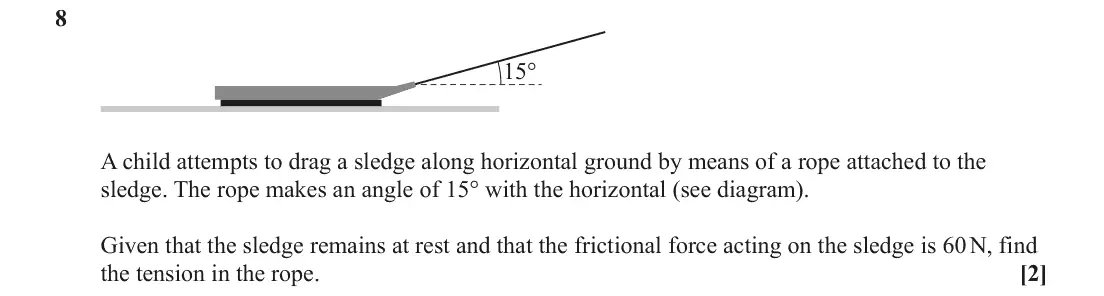
This was answered extremely well with nearly all candidates correctly resolving horizontally and T cos15 = 60. obtaining the correct value for tension in the rope from the equation The most common errors were to either use sine rather than cosine or to use an inequality rather than equals when finding the required tension.
Key points and common errors
resolve horizontally T cos15° = 60
T = 62.1 N
errors: sine, inequality
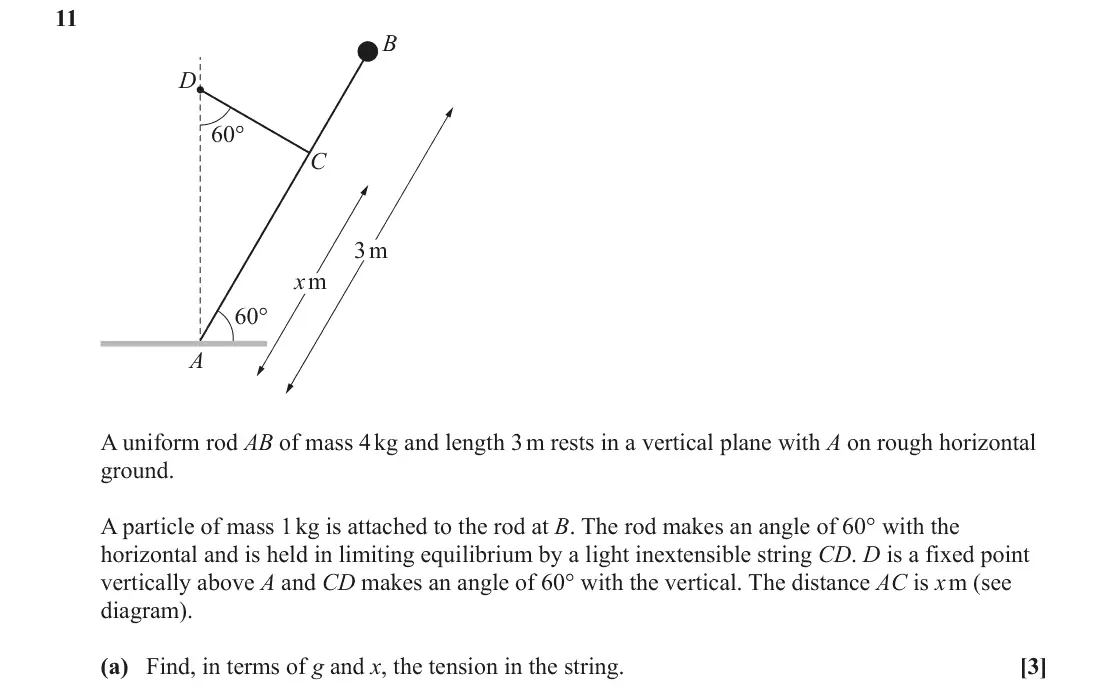
June 2022 · Paper 3 · Q11(a)3 marksMedium
Mark scheme for this part
Examiner's comment
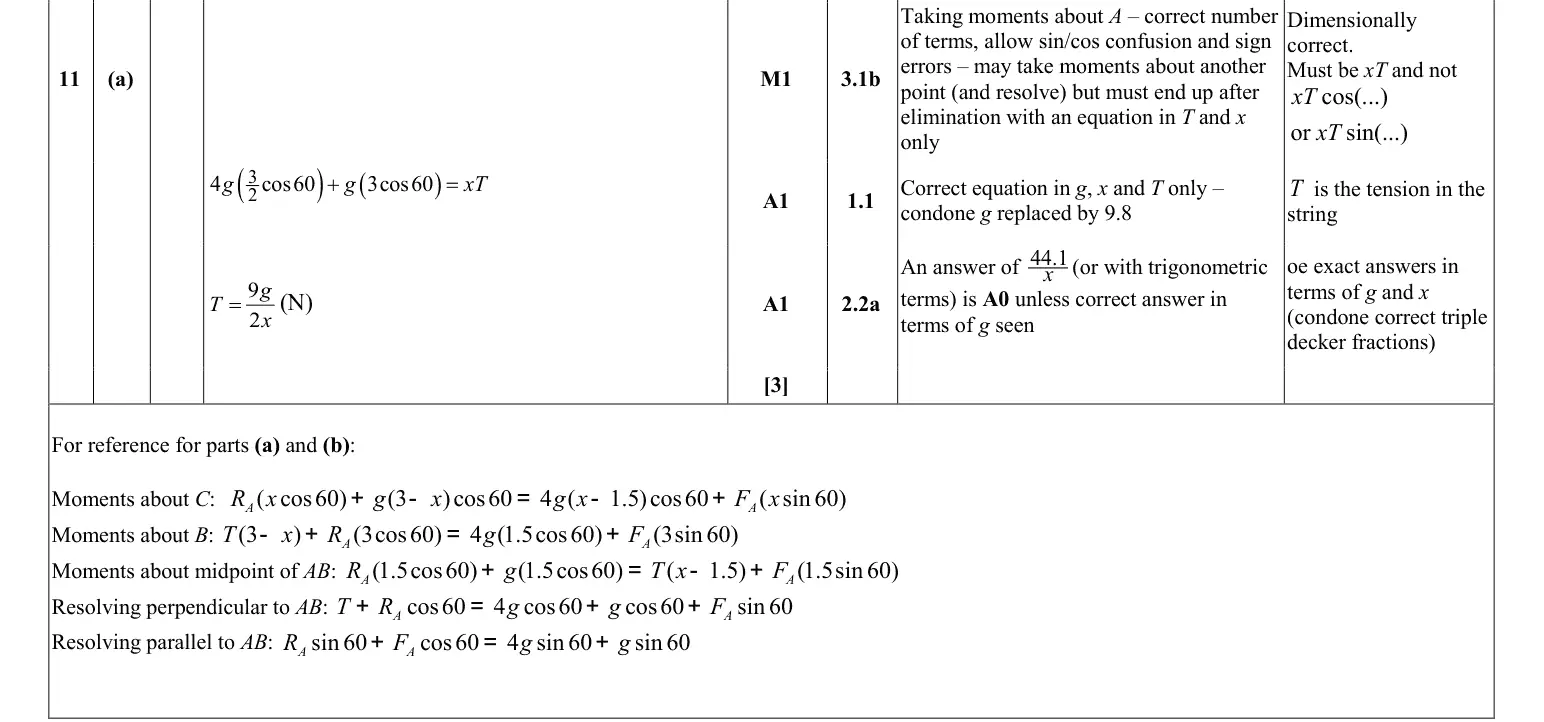
Although most candidates realised that the best way to find the tension in the string was to take moments about point A for the rod, many struggled with the corresponding geometry of the situation. ( ) ( ) xT = 4 g cos60 + g 3cos60 Although many did obtain the correct equation a number of candidates left their response either in terms of cos(60) or gave their response as 44.1 even though the question x specifically asked for a response in terms of g and x.
Key points and common errors
moments about A: 4g(1.5cos60°) + g(3cos60°) = xT
T = 9g/(2x)
answer in terms of g and x
June 2022 · Paper 3 · Q11(b)4 marksHard
Show the start of this question
Mark scheme for this part
Examiner's comment
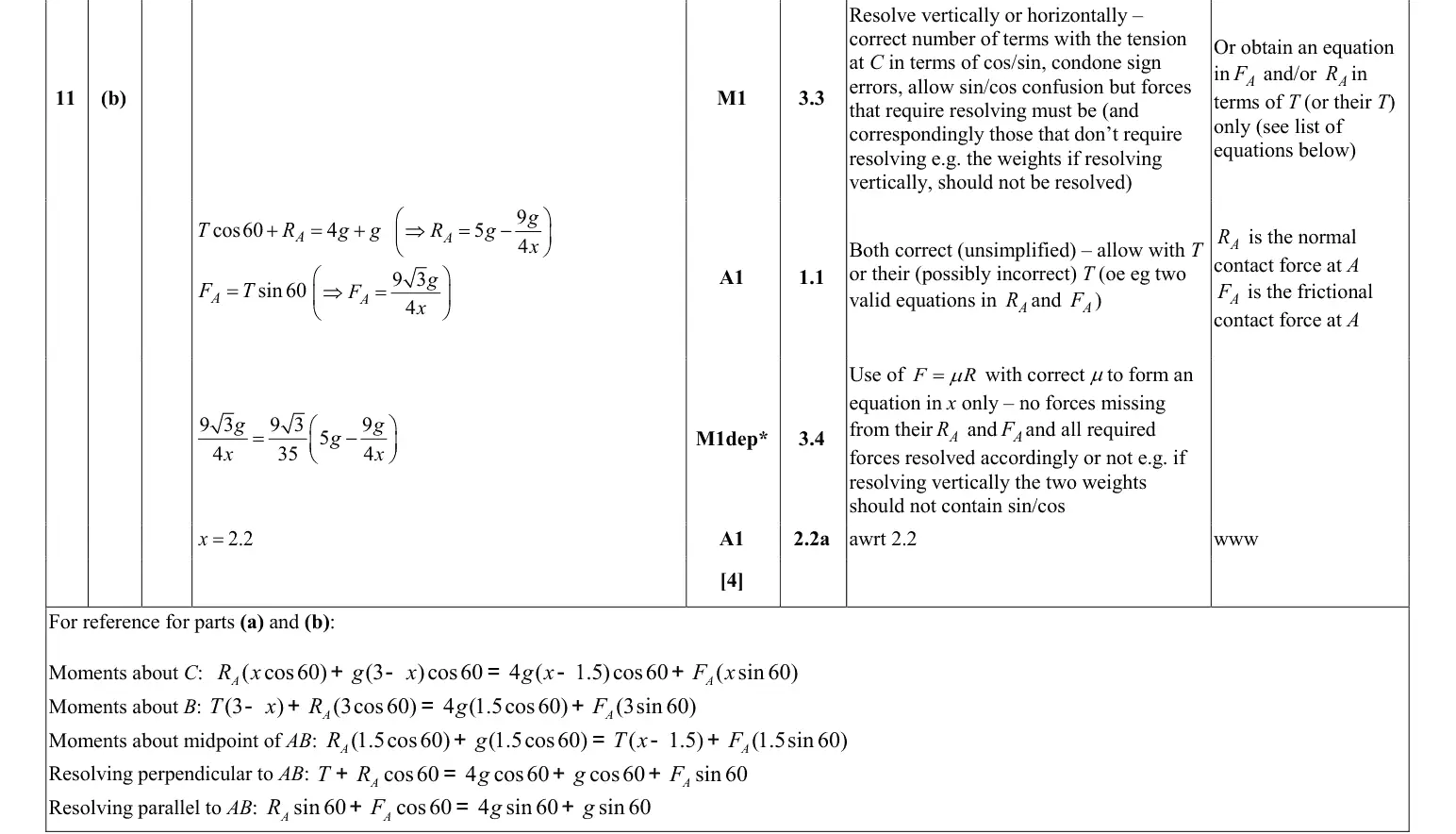
Many struggled with this part and even those candidates who realised that the most efficient way of determining the value of x was to resolve vertically and horizontally for the rod (and then apply F = ) R many could not cope with the mechanics of the situation or the corresponding algebraic demands.
Key points and common errors
resolve: R = 5g − T cos60°, F = T sin60°
F = μR with μ = 9√3/35
x = 2.2
Autumn 2021 · AS Paper 1 · Q1(a)2 marksMedium
Mark scheme for this part
Key points and common errors
area = ½ × 3 × 4 × sin 30° = 3
Autumn 2021 · AS Paper 2 · Q5(b)6 marksMedium
Show the start of this question
Mark scheme for this part
Key points and common errors
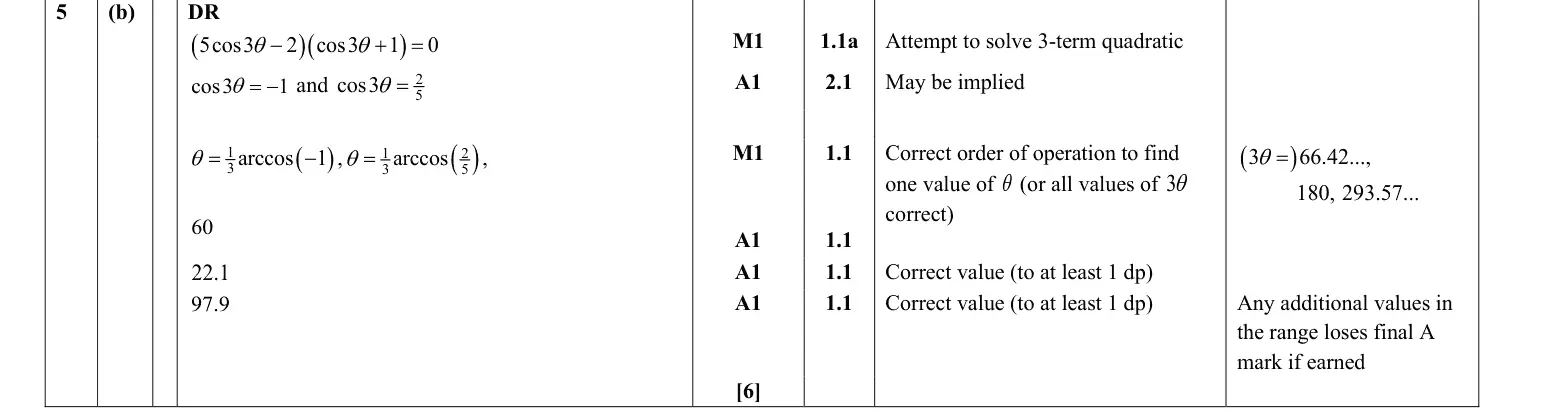
(5cos3θ − 2)(cos3θ + 1) = 0
cos3θ = −1 or 2/5
3θ = 66.42°, 180°, 293.57°
θ = 22.1°, 60°, 97.9°
divide by 3 after finding 3θ
Autumn 2021 · Paper 1 · Q10(b)5 marksMedium
Mark scheme for this part
Key points and common errors
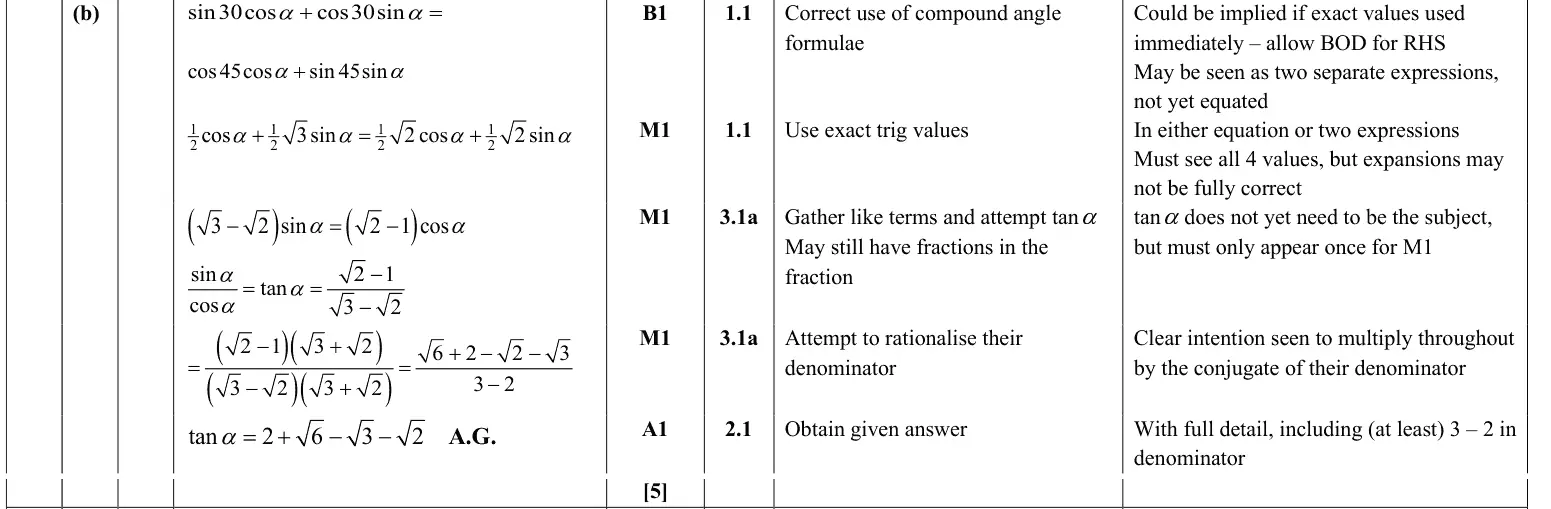
expand both compound angles and use exact values
collect to tan α = (√2 − 1)/(√3 − √2)
rationalise the denominator to reach 2 + √6 − √3 − √2
Autumn 2021 · Paper 2 · Q4(a)1 markMedium
Mark scheme for this part
Examiner's comment
(From the general report) Question 4(a): Some candidates assumed that, because P = 5000 − some quantity, the maximum size of P is 5000.
Key points and common errors
cos(30t)° has minimum −1 so P max = 6000
error: assuming the maximum is 5000
Autumn 2021 · Paper 2 · Q4(b)1 markMedium
Show the start of this question
Mark scheme for this part
Key points and common errors
6000 − 4000 = 2000
Autumn 2021 · Paper 2 · Q4(c)1 markMedium
Show the start of this question
Mark scheme for this part
Key points and common errors
oscillates or goes up and down periodically
'increases then decreases' not enough
Autumn 2021 · Paper 2 · Q4(d)2 marksMedium
Show the start of this question
Mark scheme for this part
Key points and common errors
period: 30t = 360 so t = 12 months
Autumn 2021 · Paper 2 · Q4(e)4 marksMedium
Show the start of this question
Mark scheme for this part
Key points and common errors
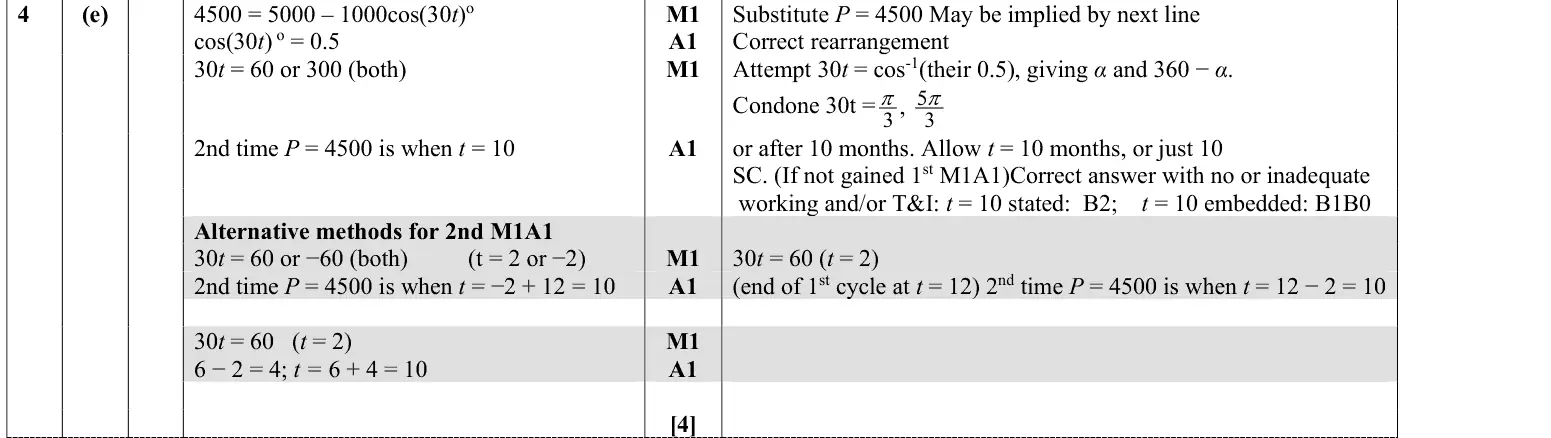
cos(30t)° = 0.5
30t = 60 or 300
second occasion t = 10 months
Autumn 2021 · Paper 3 · Q14(a)7 marksMedium
Mark scheme for this part
Examiner's comment
Candidates are reminded to read the question carefully as the question asked candidates to find an equation involving , a and g , many instead tried to find an inequality involving a and g only.
Key points and common errors
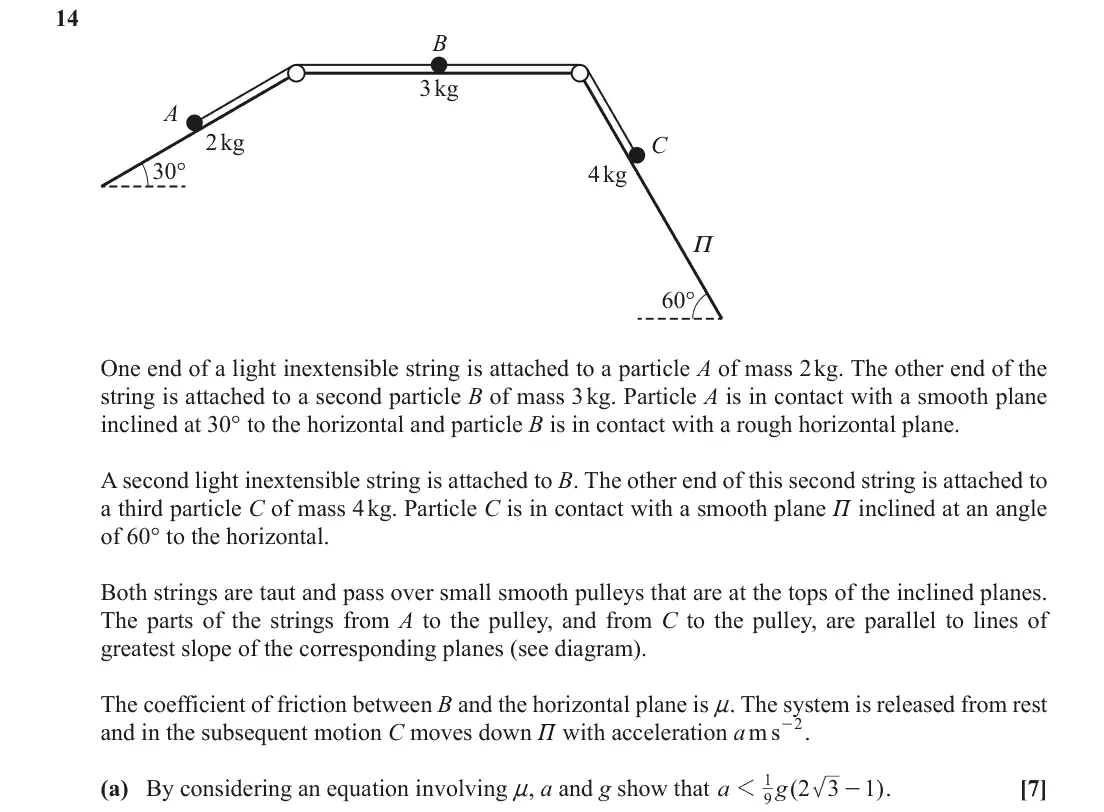
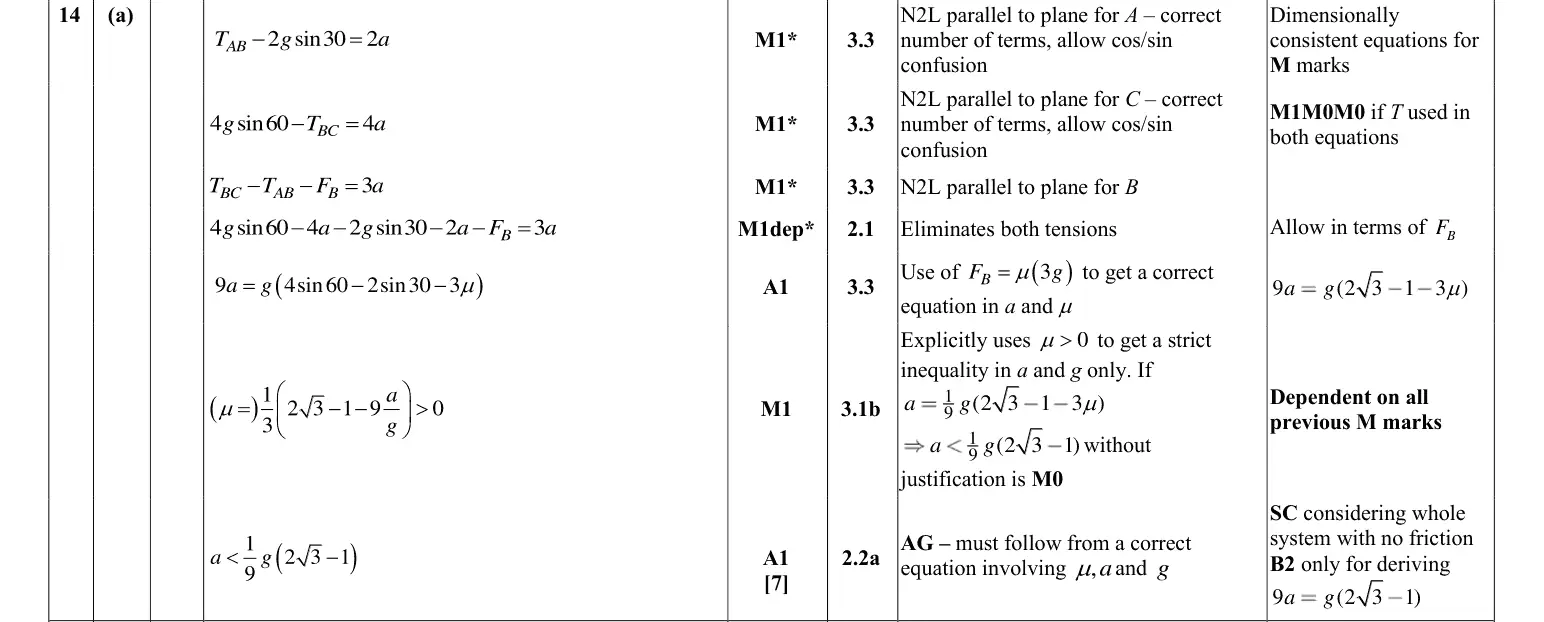
N2L for A, B and C separately
eliminate tensions
F_B = 3μg gives 9a = g(2√3 − 1 − 3μ)
use μ > 0 for the strict inequality
must find an equation involving μ, a and g first
Autumn 2020 · Paper 2 · Q63 marksEasy
Mark scheme for this part
Examiner's comment
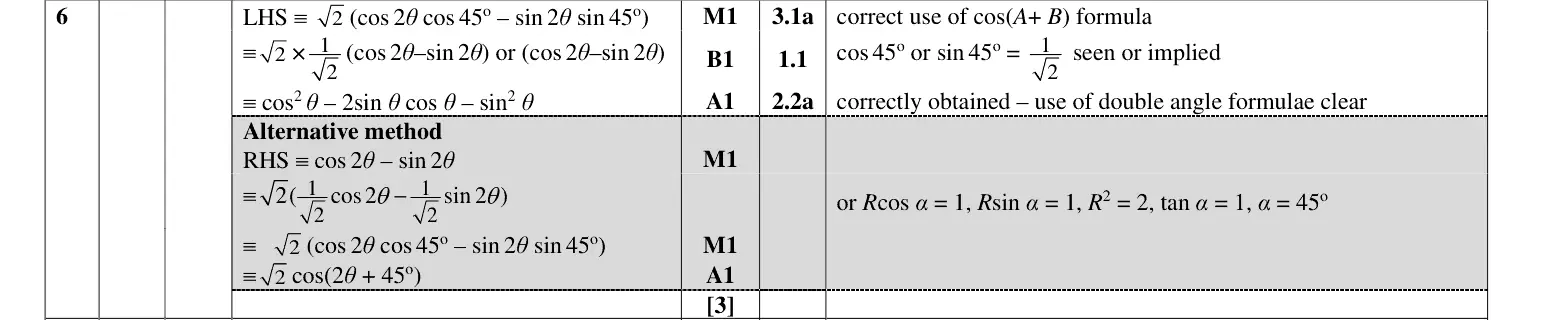
This question was very well answered by most candidates. A few had an incorrect sign in their trigonometric identities, despite these being given on the question paper. A few also did not make use of 1 the fact that cos 45 sin 45 , perhaps not spotting that in this question θ was measured in ° = ° = 2 degrees.
Key points and common errors
expand cos(2θ + 45°) with cos45° = sin45° = 1/√2
then double angle formulae for cos 2θ and sin 2θ
sign errors in the identities
Autumn 2020 · Paper 3 · Q9(c)5 marksMedium
Show the start of this question
Mark scheme for this part
Examiner's comment
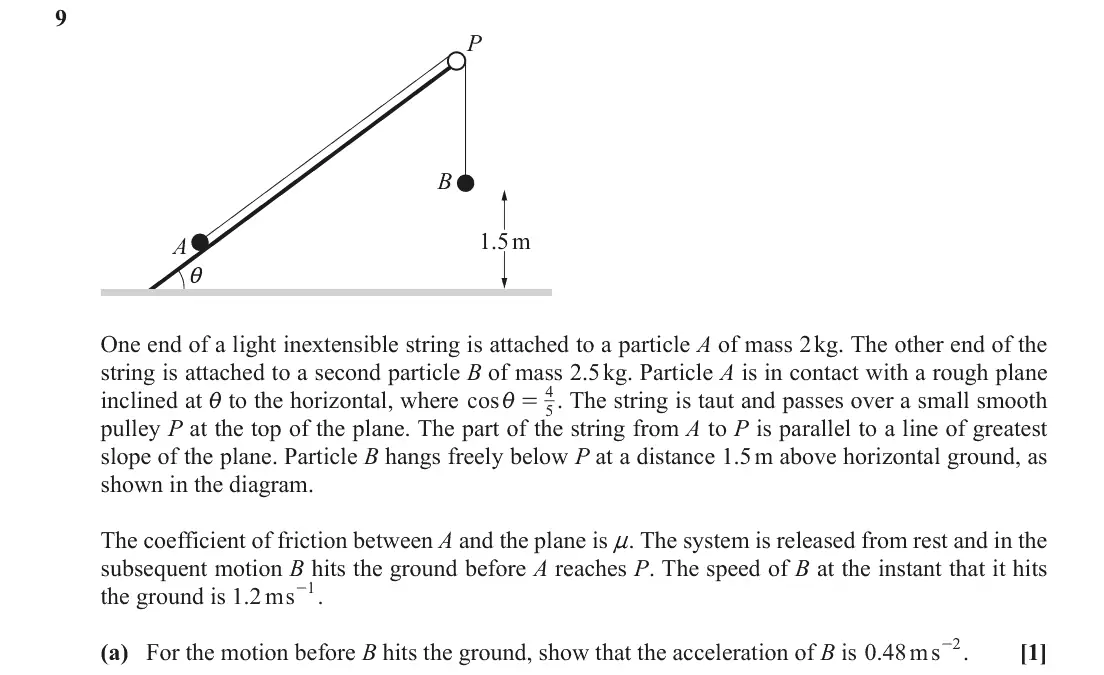
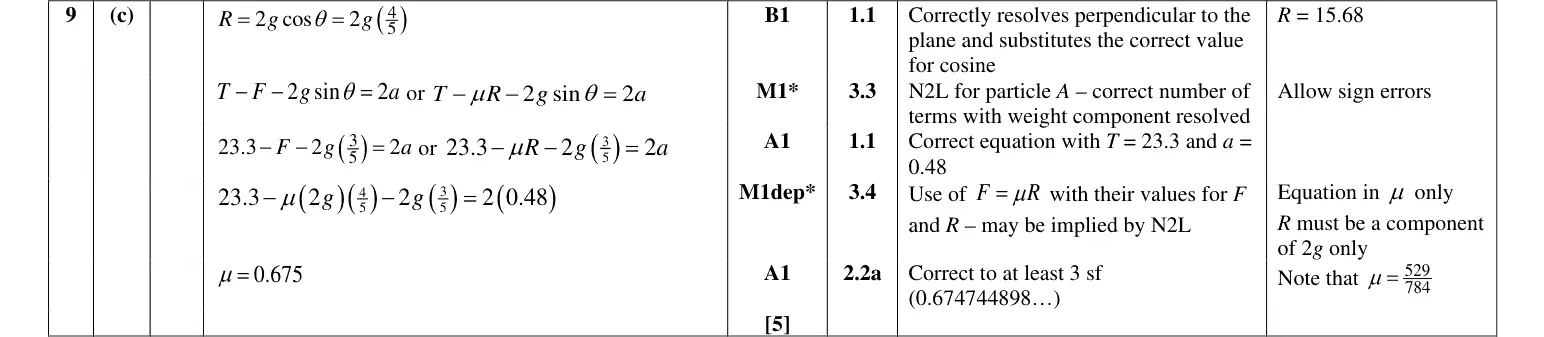
(Comment on Question 09 as a whole) 4 In this question the angle θ was defined as cosθ = . Candidates should resist the temptation to 5 calculate the decimal approximation for θ and instead use their knowledge of Pythagoras Triples to state the exact values for sinθ (and tanθ if required). The exact values have been chosen to make the arithmetic easier. Similarly, some questions will use the values of θ that candidates are expected to know the exact values for, and these should be used rather than the decimal approximation. If the examiner wants the decimal approximations to be used, then the angle θ will simply be defined as a numerical value. Most candidates showed sufficient working using for part (a). There was evidence that most candidates understood how to obtain the given answer in part (b), but some responses did not fully justify their working. A few students used mass rather than weight and did not include g in their equations. Part (c) was attempted by all candidates but one or more of the following mistakes were made: ● Assumed a = 0 . ● Used rather than using components. R = 2g ● Sine/Cosine confusion when stating the components of any force. 4 3 ● Rounding errors with calculated values of θ rather than using cosθ = and sinθ = . 5 5 ● Incorrect directions used leading to sign errors. ● Under-specifying the final answer given to less than 3 sf. Although a fairly standard question, part (d) is traditionally expected to be a challenge for most candidates. For this reason, it was pleasing to see the number of fully correct answers. Common mistakes included: ● Tension was still applied. ● Incorrect acceleration; either the same a = 0 48 . , or a > 0 , or even a = 9 8. . ● Distance = speed × time used rather than ‘suvat’.
Key points and common errors
R = 2g cos θ = 15.68 with cos θ = 4/5, sin θ = 3/5 exactly
T − μR − 2g sin θ = 2a
μ = 0.675
errors: a = 0, R = 2g, sin/cos confusion, rounding θ
Autumn 2020 · Paper 3 · Q10(a)4 marksMedium
Mark scheme for this part
Examiner's comment
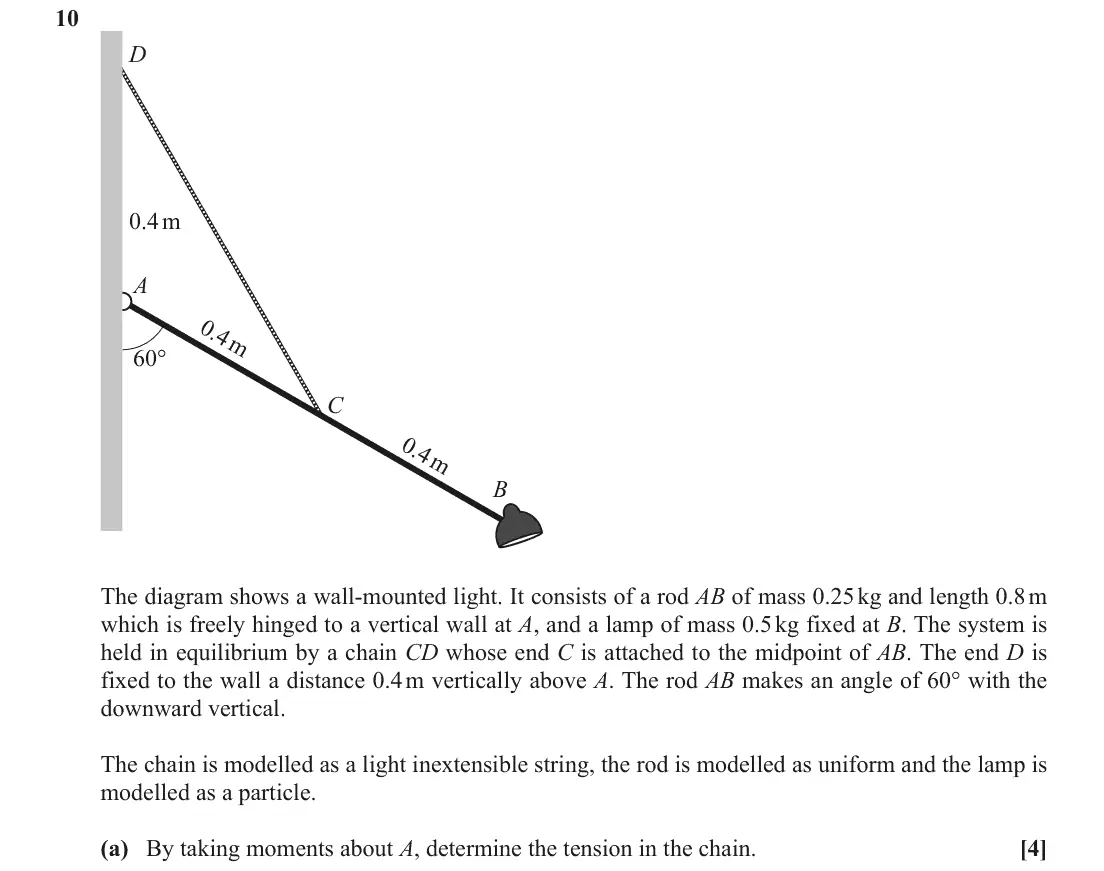
(Comment on Question 10 as a whole) A significant number of candidates did not follow the instruction to take moments about point A in part (a). It was also common to see candidates use mass rather than weight or miss some of the terms. Mixing sine and cosine was also common. In part (b) (i) it was mathematically easier to work with vertical and horizontal components of the force exerted on the rod at A rather than components parallel and perpendicular to the rod. Candidates that picked up marks on this question generally provided an annotated sketch with some degree of success. Part (b) (ii) was generally answered well by those that attempted it from their work on part (b) (i). However, of those, a few did not score both marks due to not clearly indicating what their angle was measured from (below the horizontal or measured from the downward vertical).
Key points and common errors
moments about A: 0.4(0.25g sin 60°) + 0.8(0.5g sin 60°) = T(0.4 sin 30°)
T = 21.2 N
must use weights
many did not take moments about A
Autumn 2020 · Paper 3 · Q10(b)(i)4 marksMedium
Show the start of this question
Mark scheme for this part
Examiner's comment
(Comment on Question 10 as a whole) A significant number of candidates did not follow the instruction to take moments about point A in part (a). It was also common to see candidates use mass rather than weight or miss some of the terms. Mixing sine and cosine was also common. In part (b) (i) it was mathematically easier to work with vertical and horizontal components of the force exerted on the rod at A rather than components parallel and perpendicular to the rod. Candidates that picked up marks on this question generally provided an annotated sketch with some degree of success. Part (b) (ii) was generally answered well by those that attempted it from their work on part (b) (i). However, of those, a few did not score both marks due to not clearly indicating what their angle was measured from (below the horizontal or measured from the downward vertical).
Key points and common errors
resolve horizontally and vertically: X = T cos 60°, Y = T sin 60° − 0.75g
magnitude 15.3 N
an annotated sketch helps
June 2019 · AS Paper 1 · Q3(b)5 marksMedium
Show the start of this question
Mark scheme for this part
Examiner's comment
Most candidates recognised the significance of the word "hence" and used their response to the previous part. Most were successful. Many lost a mark, however, because they simply ignored the root sin θ = –3, without comment, or just placed a cross beside this response. Because of the "detailed reasoning" instruction, some explanation was required such as " sin θ only takes values between –1 and 1" or "sin θ = –3 is impossible". A few gave an incorrect explanation such as that sin θ = –3 is invalid because it is negative. A few candidates gave extra solutions such as 210o or 270o or 180o.
Key points and common errors
sin θ = 1 or 1/2 gives θ = 90°, 30°, 150°
must state sin θ = −3 has no solution with a reason
June 2019 · AS Paper 1 · Q6(a)2 marksEasy
Mark scheme for this part
Examiner's comment
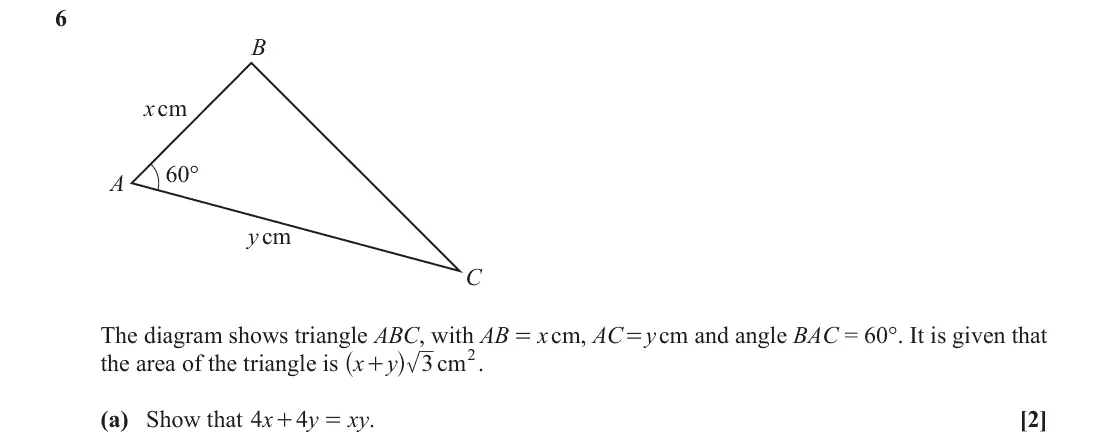
Most candidates answered this question correctly. A few used a verification method, rather than a linear proof, which was accepted if the mathematical argument was clear. In general it is worth noting that for questions involving "Show that . . " using the given answer as a starting point is not guaranteed to gain 3 3 3 full marks. Some candidates made errors such as 1 2 xy 2 = 4 x × 4 y , but attempted to "fudge" the remaining steps to arrive at the given equation.
Key points and common errors
½xy sin60° = (x + y)√3 gives 4x + 4y = xy
show enough working for the given answer
June 2019 · AS Paper 1 · Q6(b)4 marksMedium
Show the start of this question
Mark scheme for this part
Examiner's comment
Many candidates recognised that angle ABC = 900 and some of these went on to obtain a correct y x trigonometrical equation involving x and y. (Some gave it in the form = rather than the o o sin 30 sin 90 simpler cos 600 = x y ). Many then went on to use the result from part (a) and obtained the correct 3 responses. Others started again, substituting y = 2x into 1 2 xy 2 = (x + y)√3. Some of these candidates made subsequent algebraic or arithmetical errors. Candidates who used the result proved in part (a) were more often successful. The command word ‘Determine’ was used in this question; indicating that justification should be given for any results found. A trial and improvement approach gained only one mark if the correct responses were seen. There were also many candidates who attempted wholly incorrect methods using, for example πr2.
Key points and common errors
angle in a semicircle: ABC = 90°, so cos60° = x/y, y = 2x
substitute into 4x + 4y = xy
x = 6, y = 12
June 2019 · AS Paper 2 · Q6(b)5 marksHard
Show the start of this question
Mark scheme for this part
Examiner's comment
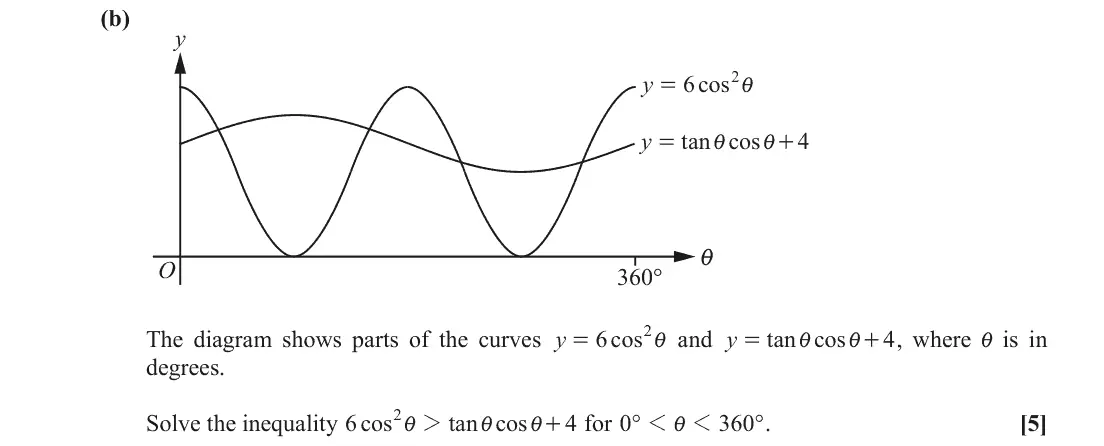
A fully correct solution was rare. Many candidates recognised the quadratic but just found values for θ and made no effort to relate them to the given graph and form inequalities. Because this is a detailed reasoning question we expected to see how the quadratic was solved and penalised those who just produced the two roots from their calculator. Often use of inequality signs was slack and recognising which quadrants angles need to be in was sometimes confused. Notice that the ‘detailed reasoning’ does not restrict the use of the quadratic solve function, in this exemplar the candidate has ‘Let sin θ = X ’ with 6 X + X − 2 = 0 and the substitution of the roots back in terms of θ to provide the required reasoning for this part of their answer. This candidate avoided any potential inequality pitfalls when identifying the required three regions by utilising the initial graph provided in the question. As in many cases, the subsequent marks are not achieved due to confusions with the inequalities.
Key points and common errors
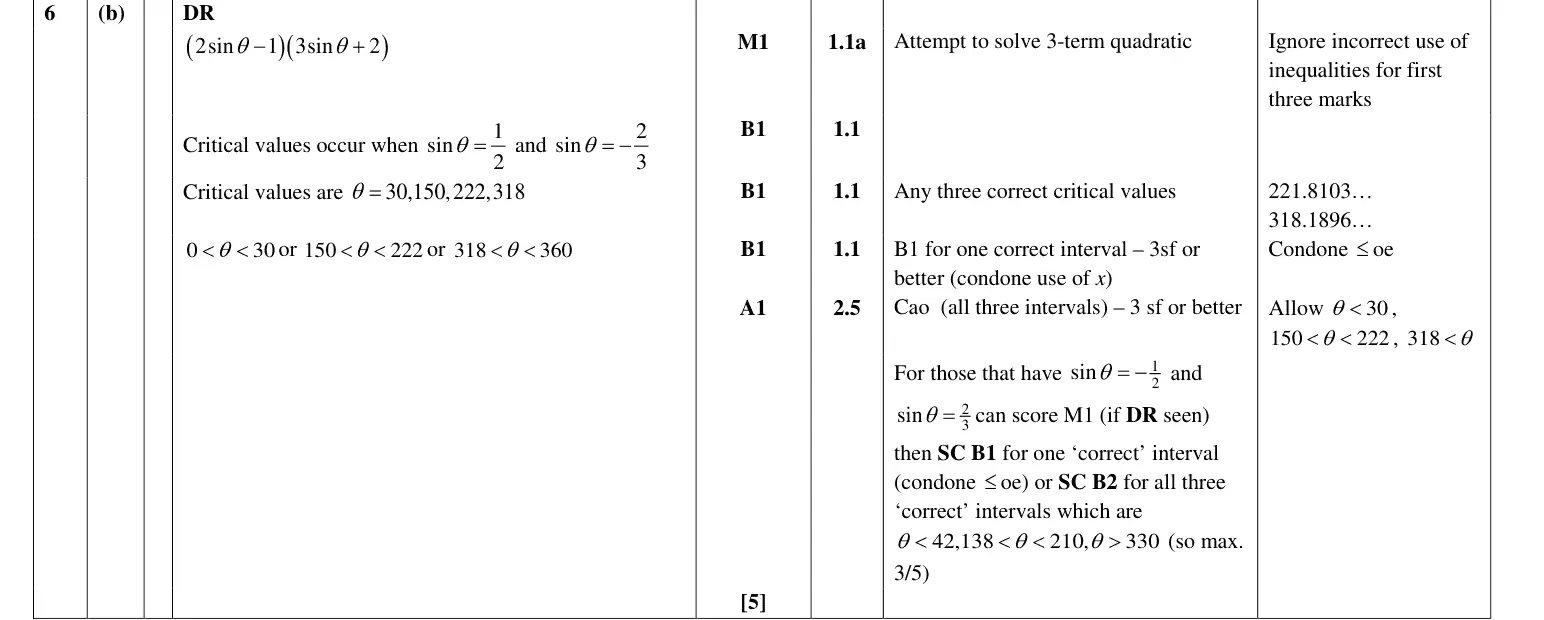
(2sinθ − 1)(3sinθ + 2) = 0
critical values 30°, 150°, 221.8°, 318.2°
use the graph: 0 < θ < 30, 150 < θ < 222, 318 < θ < 360
many gave only the critical values
June 2019 · Paper 1 · Q2(a)(ii)3 marksMedium
Show the start of this question
Mark scheme for this part
Examiner's comment
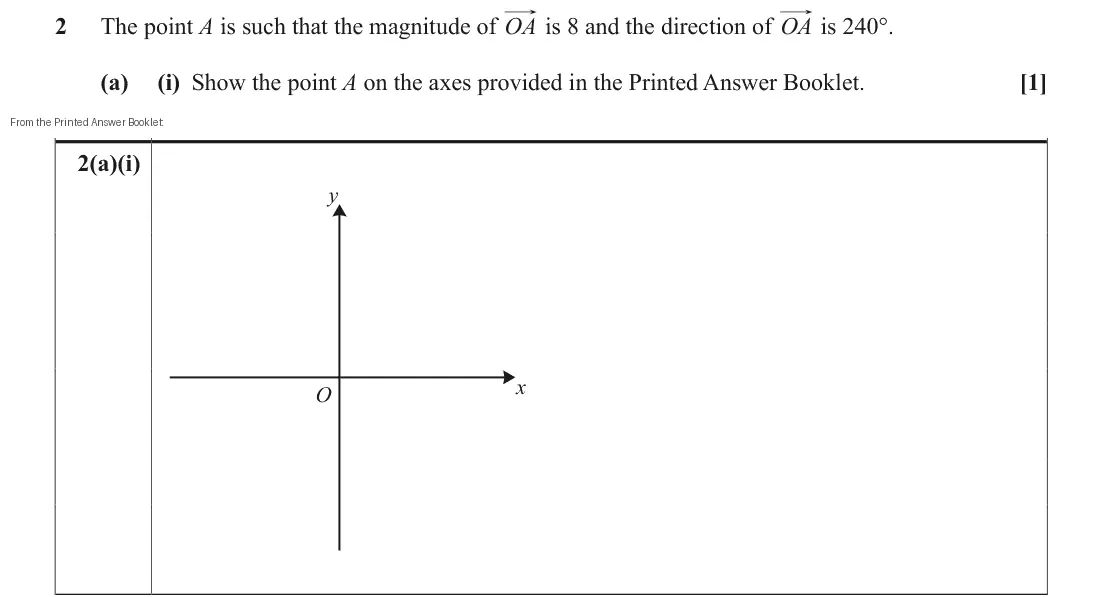
Most candidates were able to make some attempt at finding the components of the position vector, with some using basic trigonometry and others setting up, and solving, simultaneous equations using Pythagoras’ theorem and invtan. However, the incorrect positioning of the point A in the previous part of the question inevitably limited the marks gained in this part for many of the candidates.
Key points and common errors
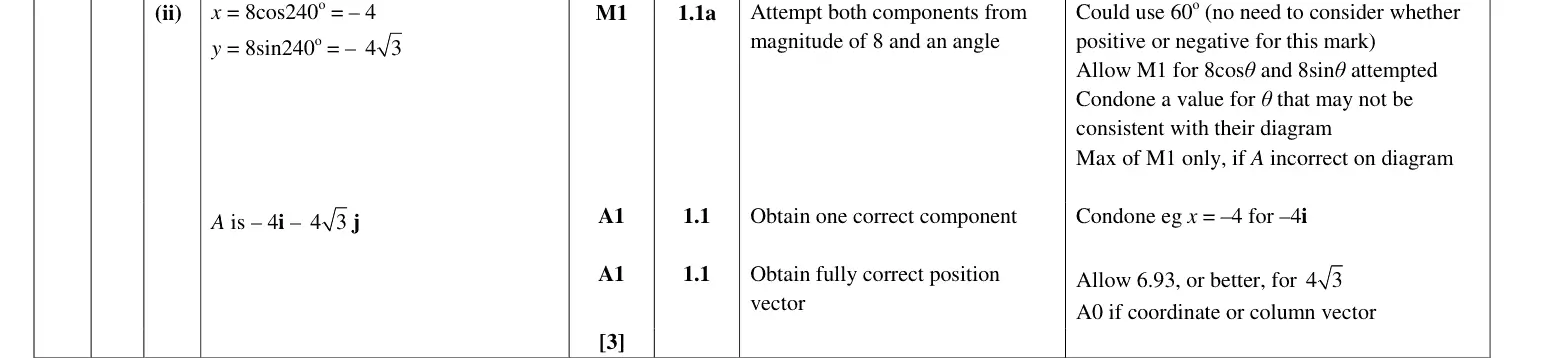
8cos240° = −4, 8sin240° = −4√3 so −4i − 4√3j
marks limited by a wrongly placed A
not a coordinate or column vector
June 2019 · Paper 1 · Q9(b)4 marksHard
Show the start of this question
Mark scheme for this part
Examiner's comment
This part of the question proved to be much more challenging, and fully correct solutions were in the minority. Barely a third of the candidates could identify the three transformations and describe them using the correct terminology and only the most able could also give them in the correct order. There were some candidates who could use informal language to convey their intention (such as ‘shift’ and ‘compression’) and other explanations were ambiguous (for example ‘a stretch in the x-axis’). There was however a number of candidates who did not appreciate the link with part (a) and gave descriptions that involved a translation of 7sin3x. Candidates should always consider whether earlier parts of a question have been posed to give them assistance with later parts.
Key points and common errors
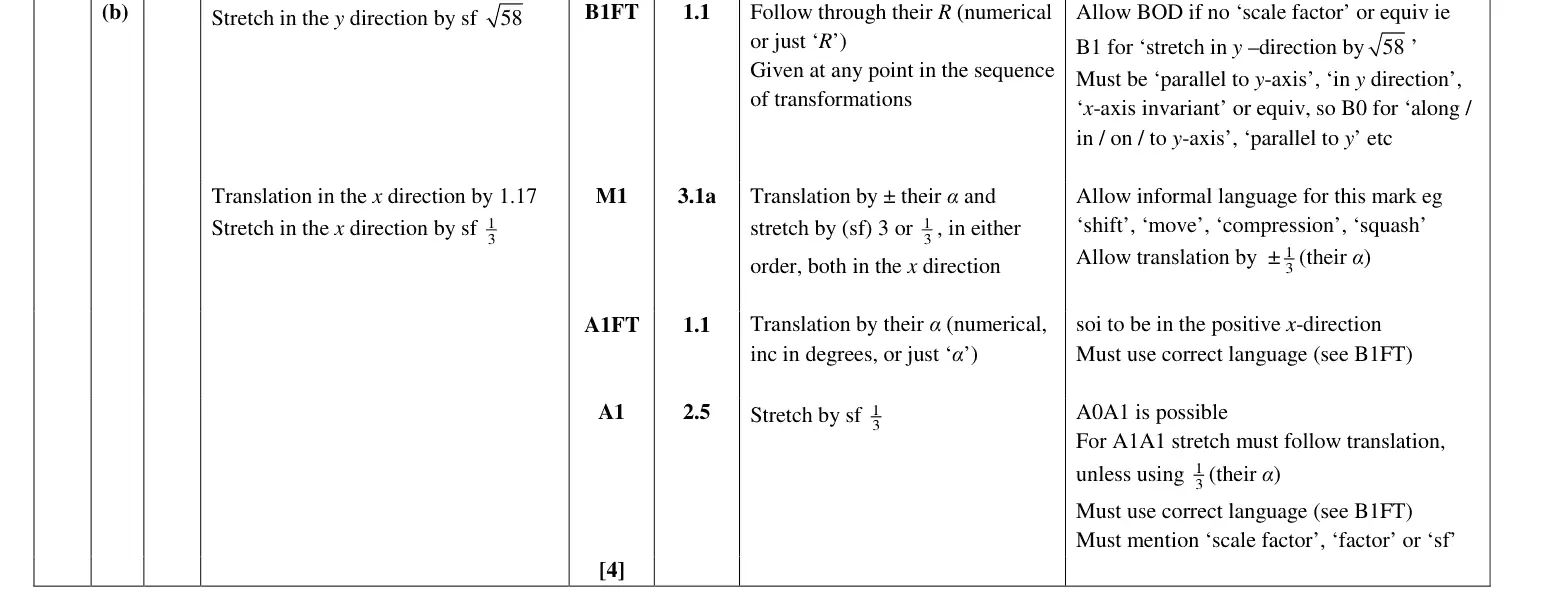
stretch parallel to y-axis sf √58
translation 1.17 in the positive x-direction then stretch parallel to x-axis sf 1/3 (order matters)
precise language needed, not 'shift' or 'squash'
June 2018 · AS Paper 1 · Q3(i)3 marksMedium
Mark scheme for this part
Examiner's comment
Many candidates omitted sin θ = –0.5, usually obtaining 30o but not always 150o. Some of those who included sinθ = –0.5 only gave one of the two other answers. Some candidates found sin–1(0.25) = 14.5o. Some of these then found 14.52 or 14.5 .
Key points and common errors
sin θ = ±0.5: θ = 30°, 150°, 210°, 330°
sin θ = −0.5 often omitted
sin⁻¹(0.25) used
June 2018 · AS Paper 1 · Q3(ii)3 marksMedium
Mark scheme for this part
Examiner's comment
Most candidates obtained 3ϕ = 60o but not all included 3ϕ = 240o. A few started with tanϕ = and 3 hence ϕ = 30. Some thought that tan–1( 3 ) = 30o. Some gave extraneous answers obtained by, for example, (180o – 60o) ÷ 3. Others gave answers outside the given domain. Some gave answers in radians.
Key points and common errors
3φ = 60°, 240° (range 0 to 270°) so φ = 20°, 80°
240° often missed
extraneous answers or radians
June 2018 · AS Paper 2 · Q1(i)4 marksMedium
Mark scheme for this part
Examiner's comment
The need to use the sine rule was well recognised, with the required acute angle often appearing. The possibility of a related obtuse angle was seen less often. Many just left one answer. Some thought the third angle in the triangle was what was expected. For full credit the two angles were needed correct to 1 decimal place as requested in the question.
Key points and common errors
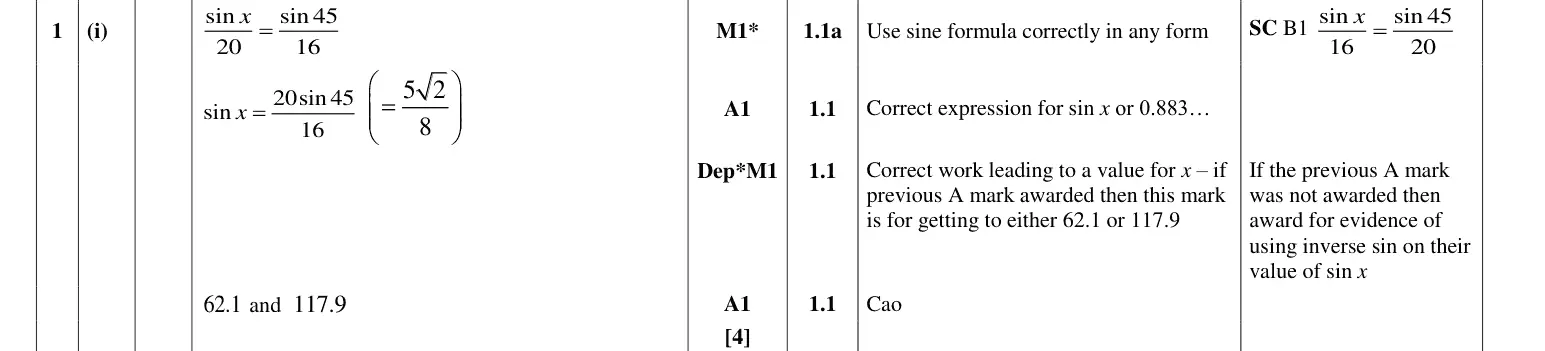
sine rule: sin C = 20sin45°/16 = 5√2/8
acute 62.1° and obtuse 117.9° both needed to 1 d.p.
many gave only one angle
June 2018 · AS Paper 2 · Q7(ii)5 marksMedium
Show the start of this question
Mark scheme for this part
Examiner's comment
This part starts with the word ‘Hence’ and what we expect from this is clear in the Specification Document. Most did start by solving a quadratic, not always producing two angles in the end. To gain full credit the two angles had to be given correct to 1 decimal place as requested. 144.8ᵒ was not uncommon. Some did not grasp the significance of 2θ and left the answer as 70.5ᵒ.
Key points and common errors
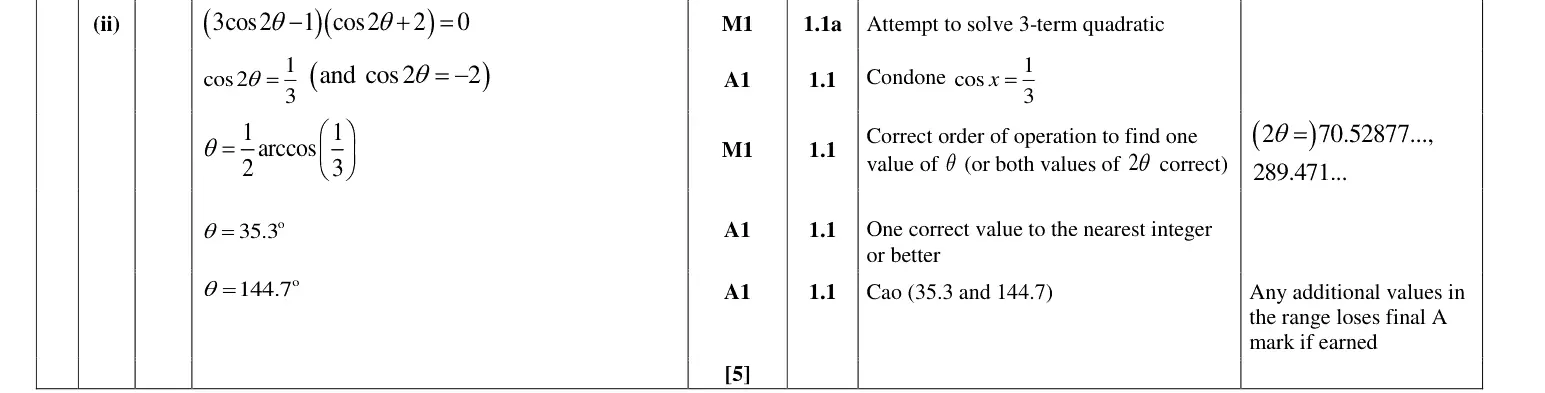
(3cos2θ − 1)(cos2θ + 2) = 0 so cos2θ = 1/3 only
2θ = 70.5° or 289.5° so θ = 35.3°, 144.7°
leaving 70.5° as the answer
Find an A-level maths tutor
Stuck on this? Book a trial session with an A-level maths tutor.