11 question parts, 22 marks, each rated Easy, Medium or Hard from the wording of the examiners' report
Notes, worked examples and practice for this topic are being written by our tutors. The past-paper questions below are ready now: work each one on paper, then open the mark scheme and the examiner's comment.
Tap a question to zoom it. Mark scheme and examiner's comment open under each question.
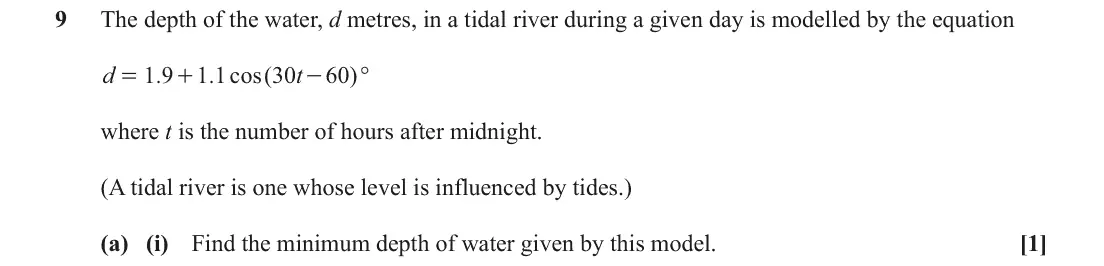
June 2024 · Paper 1 · Q9(a)(i)1 markMedium
Mark scheme for this part
Examiner's comment
Although 1.9m and 2.45m were commonly seen errors, most candidates could successfully find the minimum depth value of 0.8. A large proportion gave no units, and so did not gain the mark for the question.
Key points and common errors
1.9 − 1.1 = 0.8 m
units required
June 2024 · Paper 1 · Q9(a)(ii)2 marksEasy
Show the start of this question
Mark scheme for this part
Examiner's comment
While most candidates correctly identified where the minimum occurred, and as a result obtained the correct answer of 8 hours, some candidates incorrectly set cos(30t ─ 60) = 0, resulting in the incorrect answer of 5 hours. Some also made errors when solving 30t – 60 = 180, with 30t = 120 and then t = 4 seen.
Key points and common errors
cos(30t − 60) = −1 so 30t − 60 = 180, t = 8
cos = 0 giving t = 5 is wrong
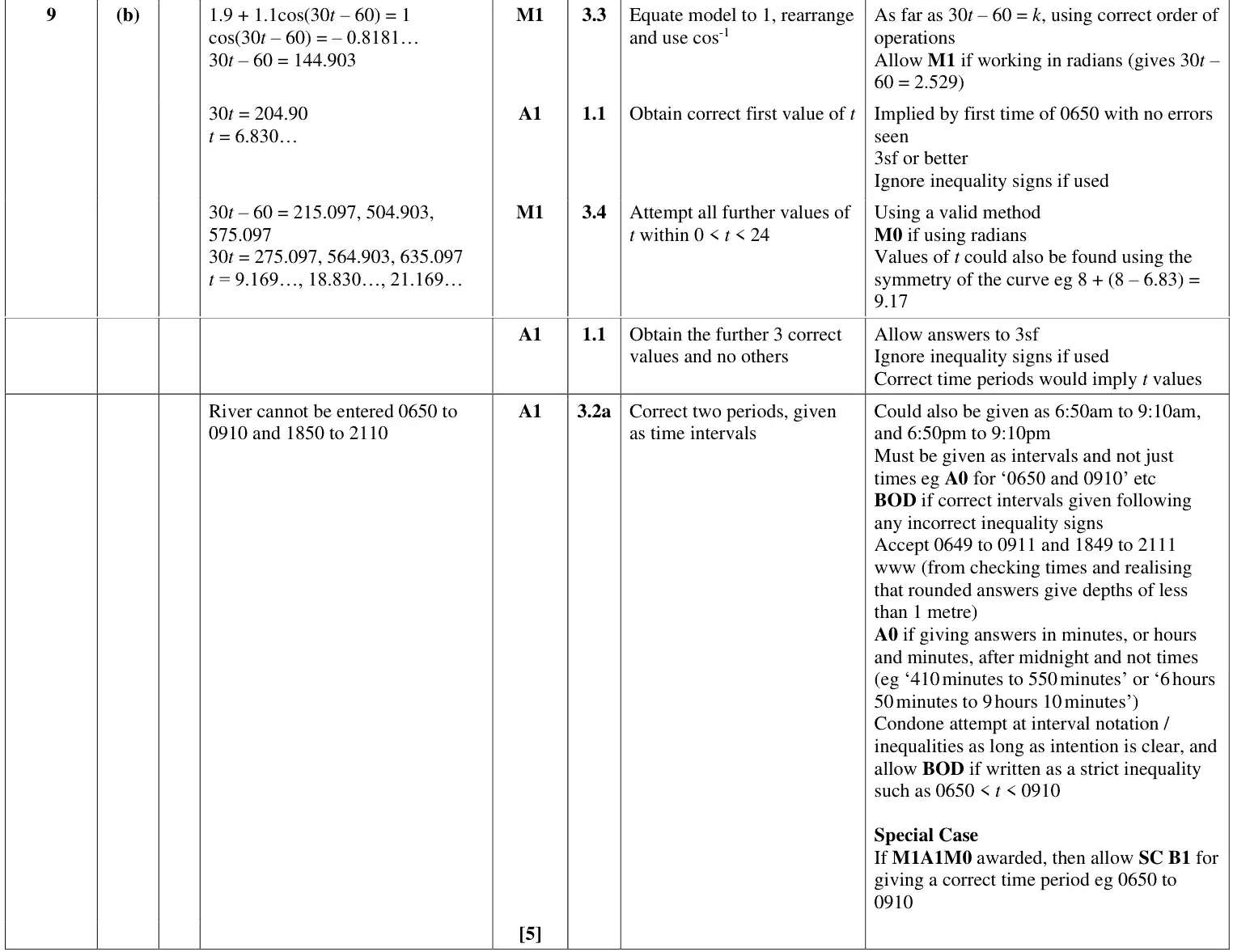
June 2024 · Paper 1 · Q9(b)5 marksHard
Show the start of this question
Mark scheme for this part
Examiner's comment
Most candidates scored the first 2 marks in this question, substituting d = 1 into the equation and rearranging to find the first value of t correctly. Many went on to find the second value of t. Very few candidates understood that this was a full day and that they should find all four values of t within the 24- hour period, with many giving only one period of time. Those who converted these values into times of the day and gave a single correct time period earned 3 out of the 5 marks. Some candidates completed the question, sometimes by using symmetry rather than all the values of t. Often candidates lost marks because they did not write their answers as ‘periods of time’ with many leaving their answers in minutes or hours/minutes after midnight. Key Point – Time The question asked for ‘periods of time during the day’. We were therefore looking for answers given as times of the day. For example. ‘The boat would be unable to sail between 6.50am and 9.10am’.
Key points and common errors
1.9 + 1.1cos(30t − 60) = 1 so cos = −0.818
t = 6.830, 9.169, 18.830, 21.169
periods 0650–0910 and 1850–2110
very few found all four values in the 24 hours
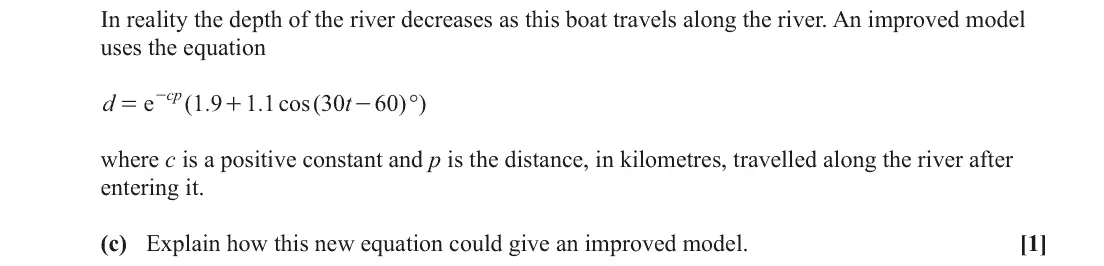
June 2024 · Paper 1 · Q9(c)1 markHard
Show the start of this question
Mark scheme for this part
Examiner's comment
While many candidates correctly identified that 𝑒−𝑐𝑝 would reduce the depth equation as the boat travelled along the river, very few correctly linked this to a reduction in the difference between maximum and minimum depths.
Key points and common errors
as p increases e^(−cp) decreases, so depths and the difference between max and min depths decrease (damping)
restating 'river gets shallower' gains nothing
Autumn 2021 · Paper 2 · Q4(a)1 markMedium
Mark scheme for this part
Examiner's comment
(From the general report) Question 4(a): Some candidates assumed that, because P = 5000 − some quantity, the maximum size of P is 5000.
Key points and common errors
cos(30t)° has minimum −1 so P max = 6000
error: assuming the maximum is 5000
Autumn 2021 · Paper 2 · Q4(b)1 markMedium
Show the start of this question
Mark scheme for this part
Key points and common errors
6000 − 4000 = 2000
Autumn 2021 · Paper 2 · Q4(c)1 markMedium
Show the start of this question
Mark scheme for this part
Key points and common errors
oscillates or goes up and down periodically
'increases then decreases' not enough
Autumn 2021 · Paper 2 · Q4(d)2 marksMedium
Show the start of this question
Mark scheme for this part
Key points and common errors
period: 30t = 360 so t = 12 months
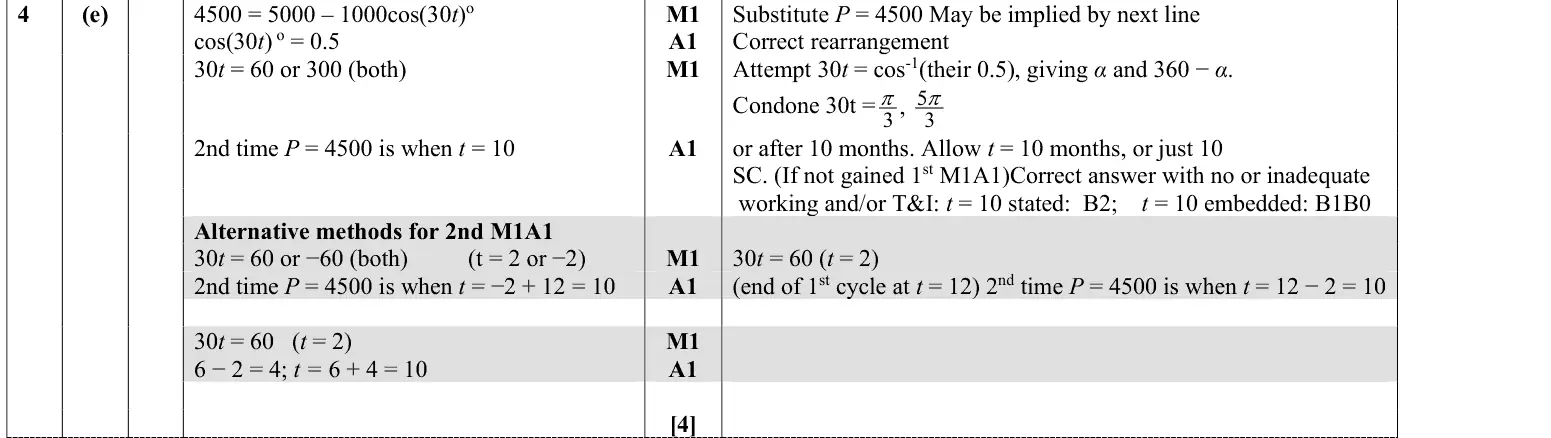
Autumn 2021 · Paper 2 · Q4(e)4 marksMedium
Show the start of this question
Mark scheme for this part
Key points and common errors
cos(30t)° = 0.5
30t = 60 or 300
second occasion t = 10 months
Autumn 2021 · Paper 2 · Q4(f)1 markMedium
Show the start of this question
Mark scheme for this part
Examiner's comment
(From the general report) Question 4(f): Some candidates appeared not to understand how to address some aspects of Assessment Objective AO3 (please see section ‘3b.
Key points and common errors
damp the oscillation: P = 5000 − 1000e^(−kt)cos(30t)° (k > 0) or divide the amplitude by t
AO3 refinement
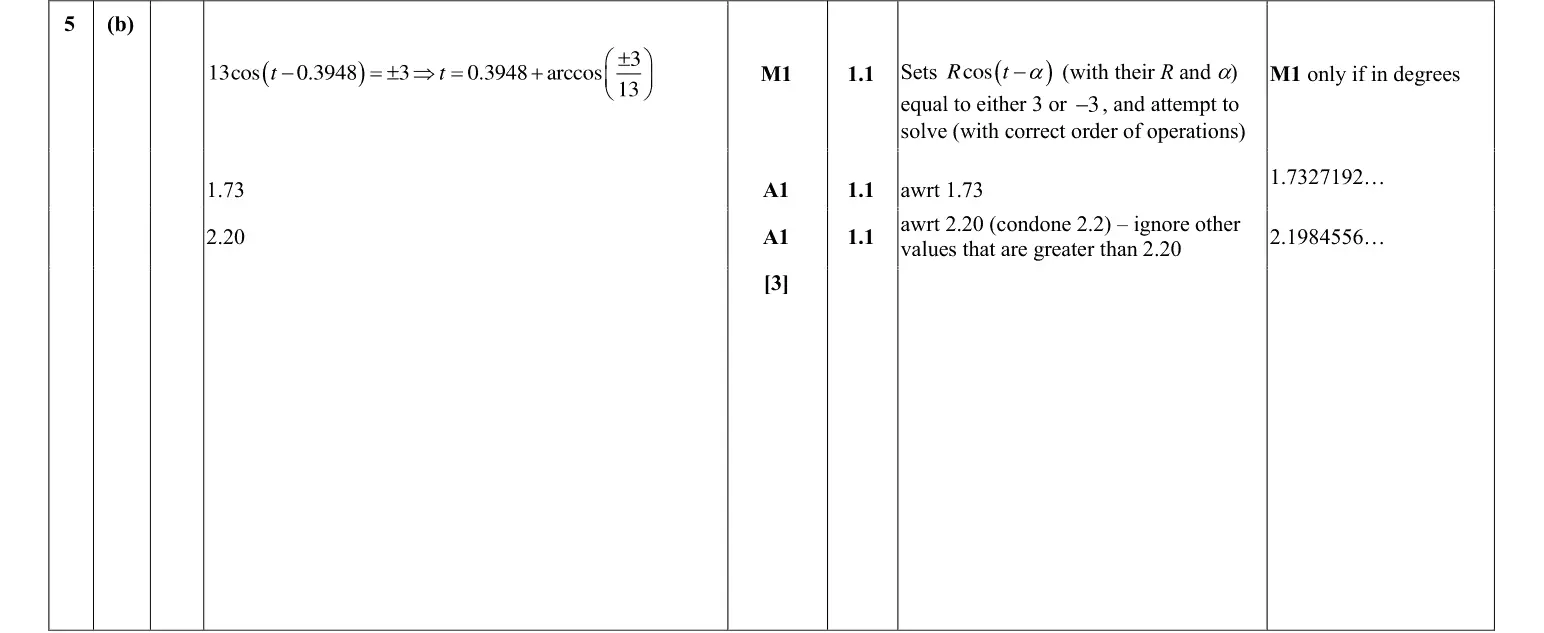
Autumn 2021 · Paper 3 · Q5(b)3 marksMedium
Show the start of this question
Mark scheme for this part
Key points and common errors
speed 3 means v = ±3
13cos(t − 0.3948) = ±3
t = 1.73 and 2.20
work in radians
Find an A-level maths tutor
Stuck on this? Book a trial session with an A-level maths tutor.