1.02a The laws of indices for all rational exponents
Section
1.02 Algebra and Functions
Level
AS & A level
Statement
Understand and be able to use the laws of indices for all rational exponents.
Guidance
Includes negative and zero indices. Problems may involve the application of more than one of the following laws: x^a × x^b = x^(a+b), x^a ÷ x^b = x^(a−b), (x^a)^b = x^(ab), x^(−a) = 1/x^a, x^(m/n) = ⁿ√(x^m), x^0 = 1.
Most candidates showed sufficient working here (noting that, with the DR instruction, the requirement in the specification is that ‘Their solution should contain sufficient detail to allow the line of their argument to be followed’. Here, this meant that working equivalent to the first line in the mark scheme needed to be seen – this work could not be ‘implied’ by correct answers. Almost all candidates interpreted this instruction correctly and showed adequate working. Many candidates scored 2/2 but quite a few candidates omitted the second square root (-6) scoring M1A0. Some candidates made an error in rearranging the equation leading to √14 – which also scored M1A0.
Key points and common errors
square both sides: x² − 11 = 25, x = ±6
common error omitting −6
June 2025 · AS Paper 1 · Q1(c)2 marksEasy
Mark scheme for this part
Examiner's comment
This question was very well answered by the majority of candidates. Many candidates gave quite lengthy working (often including logs) before obtaining the required linear equation in z, which scored the M1. In this case, the mark scheme allowed candidates to leave numerical (i.e. not in z) log terms in the final step before their answer so, e.g. 𝑧= was acceptable for the M1. However, in general candidates should show a complete method where the DR instruction is given.
Key points and common errors
16 = 2⁴ so 3z − 10 = 4, z = 14/3
June 2025 · AS Paper 1 · Q6(b)3 marksHard
Show the start of this question
Mark scheme for this part
Examiner's comment
Here, in contrast to Question 1 and Question 6 (a), many candidates did not show sufficient working to gain full credit under the DR instruction. For three marks, candidates needed to demonstrate appropriate understanding by removing the log (M1), simplifying to a solvable form (M1) and obtaining the correct answer (A1). Candidates should be reminded that the DR instruction is ‘not a restriction on a candidate’s use of a calculator’ – and, here, a calculator is likely to be useful to check the final answer – but ‘it is a restriction on what will be accepted as evidence of a complete method’ and so candidates who ‘jumped’ to the final answer without an appropriate intermediate step could not score full marks. Some candidates omitted the 𝑦 and so did not obtain an appropriate solvable form.
Key points and common errors
y^(−3/2) = 1/8 so y^(3/2) = 8, y = 4
an intermediate step must be seen
many jumped to the answer
June 2025 · Paper 1 · Q1(a)1 markEasy
Mark scheme for this part
Examiner's comment
This proved to be a straightforward start to the paper, with the vast majority of candidates stating a correct expression.
Key points and common errors
2x^(−1/4)
fourth root as power ¼, reciprocal gives negative index
June 2025 · Paper 1 · Q1(b)2 marksEasy
Show the start of this question
Mark scheme for this part
Examiner's comment
This was also very well answered. The more successful approach was to first write the expression in brackets in index form, and then cube this, whereas others first expanded the brackets and then attempted to combine terms. Candidates nearly always obtained the correct power of x, but some forgot to also cube the 5.
Key points and common errors
write x√x as x^(3/2) first, then cube: 125x^(9/2)
forgetting to cube the 5
June 2025 · Paper 1 · Q1(c)2 marksEasy
Show the start of this question
Mark scheme for this part
Examiner's comment
This was another routine question on manipulating surds. The more successful candidates first combined the two expressions as a single surd before simplifying, and this inevitably resulted in the correct answer. Candidates who attempted to initially simplify the two surds separately tended to be less successful.
Key points and common errors
combine as √(16x⁸) = 4x⁴
simplifying the surds separately less successful
June 2025 · Paper 1 · Q1(d)3 marksEasy
Show the start of this question
Mark scheme for this part
Examiner's comment
This final part of the question was also very well answered, with nearly all of the candidates gaining full credit. Candidates who made an initial error when attempting the cube root of 27x6 were still able to gain partial credit, as long as there was sufficient detail of each step shown in their method.
Key points and common errors
(27x⁶)^(1/3) = 3x², then 3x⁷
June 2025 · Paper 1 · Q10(b)1 markHard
Mark scheme for this part
Examiner's comment
This part of the question proved to be more challenging, with just less than half of the candidates gaining the mark available. Those who were successful appreciated the need to rewrite the given equation in the form y = aebx, so as to address the information given in the question, and could then identify the magnitude of the stretch in the y-direction, giving the answer in an exact form.
Many candidates answered this part well, scoring 3/3 marks. The whole of Q2 was also DR, meaning that candidates needed to show a fully complete method to obtain the two required values of x. The most common error seen was candidates omitting the -3 value (usually scoring M1A1A0 if correct working seen first). Most candidates handled the power in a single step. A small number of candidates gave implausible working (e.g. multiplying up to a polynomial of degree 6) before writing down the correct answers. Alternative methods that are equivalent and within the instruction in the question will always be credited, but candidates should be advised not to write down over-complex working before simply applying the ‘solve’ function from their calculator – the method needs to demonstrate how the solution was obtained.
Key points and common errors
raise both sides to power 2/3: x² − 5 = 4
x = ±3
most common error omitting −3
June 2024 · AS Paper 1 · Q13 marksHard
Mark scheme for this part
Examiner's comment
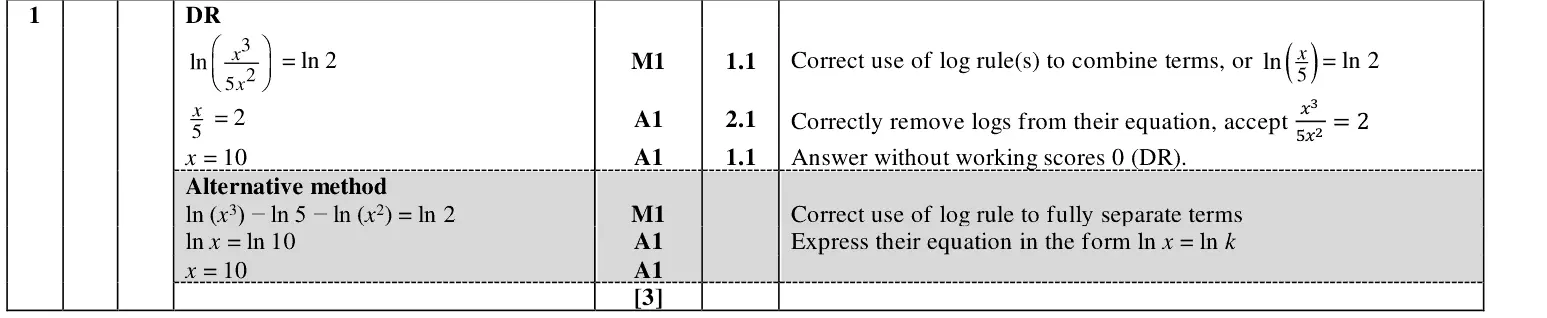
question challenging. Common errors include ln 5𝑥𝑥2 = 2 ln 5𝑥𝑥 and mixing up log rules for This question was only answered correctly by a minority of candidates – who seemed to find this subtracting/dividing. A number of candidates gave 𝑥𝑥= 0 as an extra solution without noting that the question specified 𝑥𝑥> 0 – on this occasion this was not penalised but in general candidates should specifically exclude solutions outside the given range. Candidates who attempted to combine terms were side correctly a small, but significant, number of candidates did not notice that ln 5 = ln 2 → 5 = 2 can be generally more successful than those who attempted to ‘split’. However, having combined the left-hand implied directly.
Key points and common errors
ln(x³/(5x²)) = ln 2 so x/5 = 2, x = 10
errors: ln 5x² = 2ln 5x, mixing up subtraction/division rules
answer without working scores 0
June 2024 · AS Paper 1 · Q5(a)5 marksMedium
Mark scheme for this part
Examiner's comment
This question was again ‘Determine’, requiring candidates to show their working in full – answers obtained without this (e.g. from a calculator) could not be credited. Most candidates who showed working were able to differentiate the given equation correctly and set this equal to zero, going on to find the coordinates of the stationary point. Some candidates who had the correct solutions for x did not find the correct y value as required for the final A1.
Key points and common errors
dy/dx = 8x − x⁻² = 0
x = ½, y = 3
'Determine' so working required
y-value sometimes wrong
June 2024 · AS Paper 1 · Q95 marksHard
Mark scheme for this part
Examiner's comment
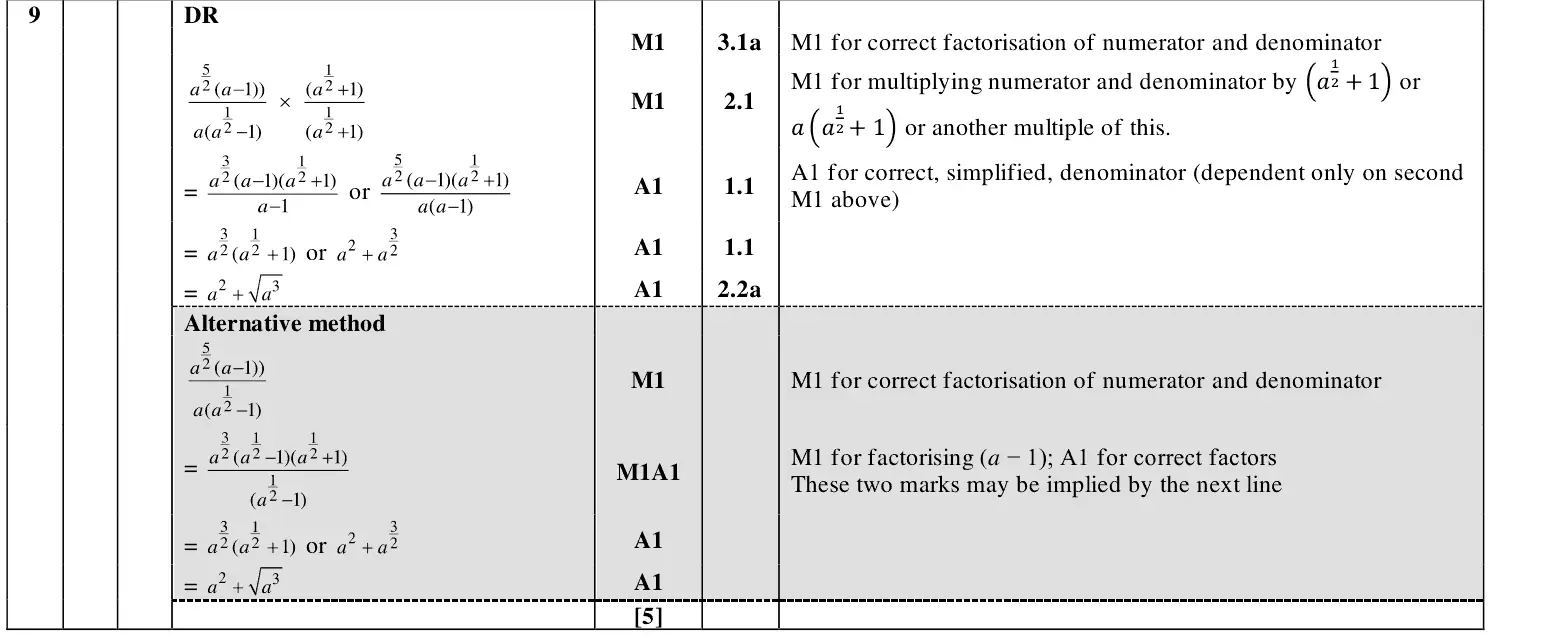
Very few candidates obtained more than 1–2 marks on this question. Some candidates were able to correctly ‘rationalise’ the denominator and simplify to the required form but rarely progressed beyond there (typically because they did not spot the common factor that allowed simplification). Many candidates attempted to find a shortcut to the given form, which was rarely successful. Trying to complete multiple steps of working in one go will often lead to mistakes. Unusually in this case, dividing the first term in the numerator by the first term in the denominator (and again for the second terms) happened to give the final answer, but clearly this incorrect method could not be credited. Candidates should be reminded that it is best practice to be showing full working at every step. The alternative method from the mark scheme was seen relatively rarely but, when attempted, was often correct. This candidate has made an incorrect attempt to simplify the given expression, and then divided the first term in the numerator by the first in the denominator (etc.) to obtain an answer of the correct form, but from wrong working. This is incorrect work and so was not credited, scoring 0. Section B Most candidates scored well in the first questions of the Statistics (Section B), however candidates obtained fewer marks in Q12.
Key points and common errors
factorise a^(5/2)(a − 1)/(a(a^(1/2) − 1))
multiply by (a^(1/2) + 1) or factorise a − 1
= a^(3/2)(a^(1/2) + 1) = a² + √(a³)
shortcuts rarely successful
June 2024 · Paper 1 · Q2(a)(i)2 marksHard
Mark scheme for this part
Examiner's comment
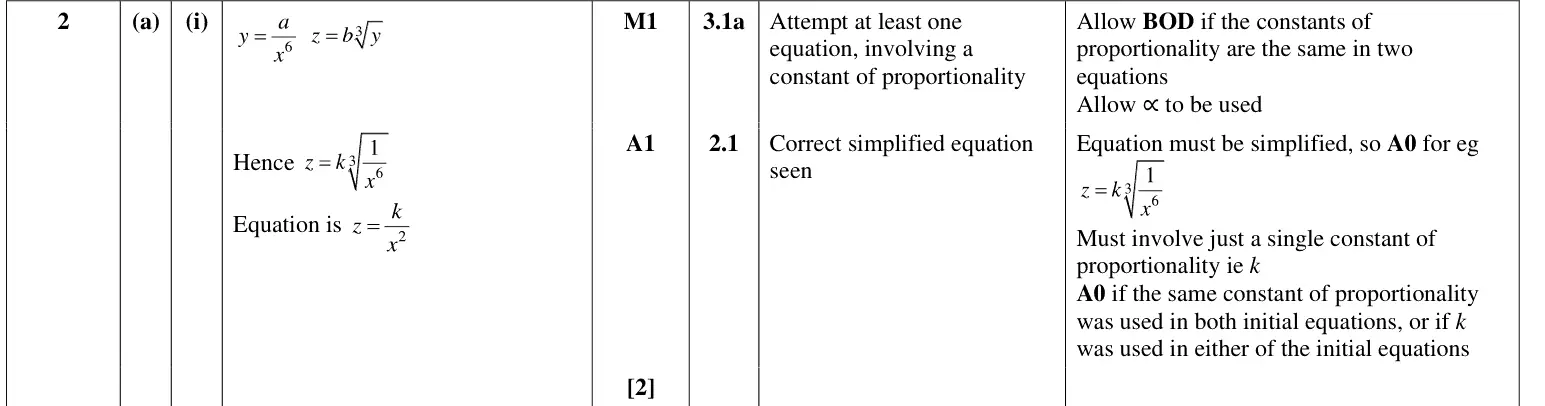
Most candidates only achieved the method mark because they used the same constant k for every constant of proportionality. Some candidates correctly used three different constants of proportionality, and a few worked with proportional statements until they achieved a relationship between z and x. Of those candidates using different constants of proportionality, some often still lost the accuracy mark by failing to simplify the indices.
Key points and common errors
y = a/x⁶ and z = b∛y give z = k/x²
using the same constant in both equations loses A1
indices must be simplified
June 2024 · Paper 1 · Q2(b)3 marksMedium
Show the start of this question
Mark scheme for this part
Examiner's comment
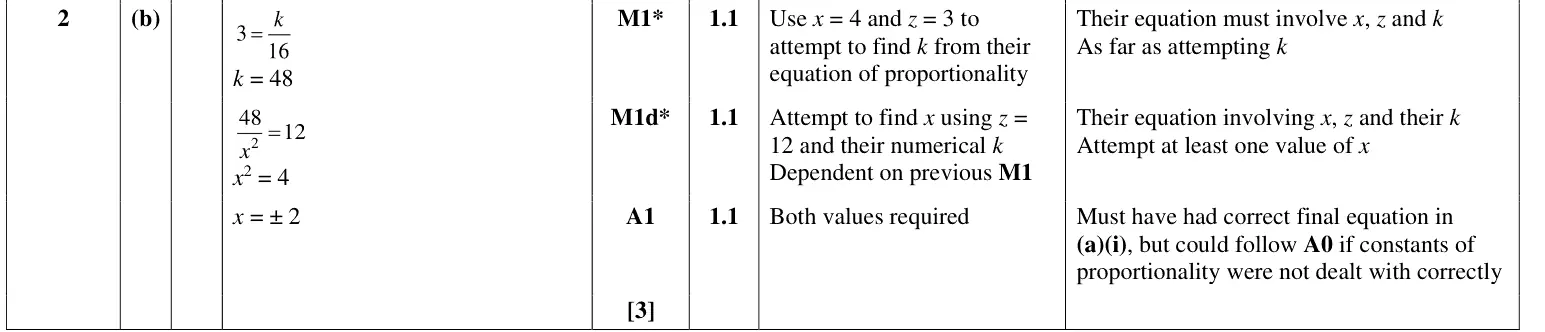
Many candidates got at least one of the values of x correct, although some forgot the negative solution. Even those who had an incorrect expression in part (a)(i) were usually able to achieve some credit for manipulating their expression to find a k value and attempt to solve for x when z = 12. Note that the question asked candidates to ‘determine the values of x’, so they were required to show working.
Key points and common errors
3 = k/16 so k = 48
48/x² = 12
x = ±2
the negative root is often forgotten
June 2024 · Paper 1 · Q58 marksEasy
Mark scheme for this part
Examiner's comment
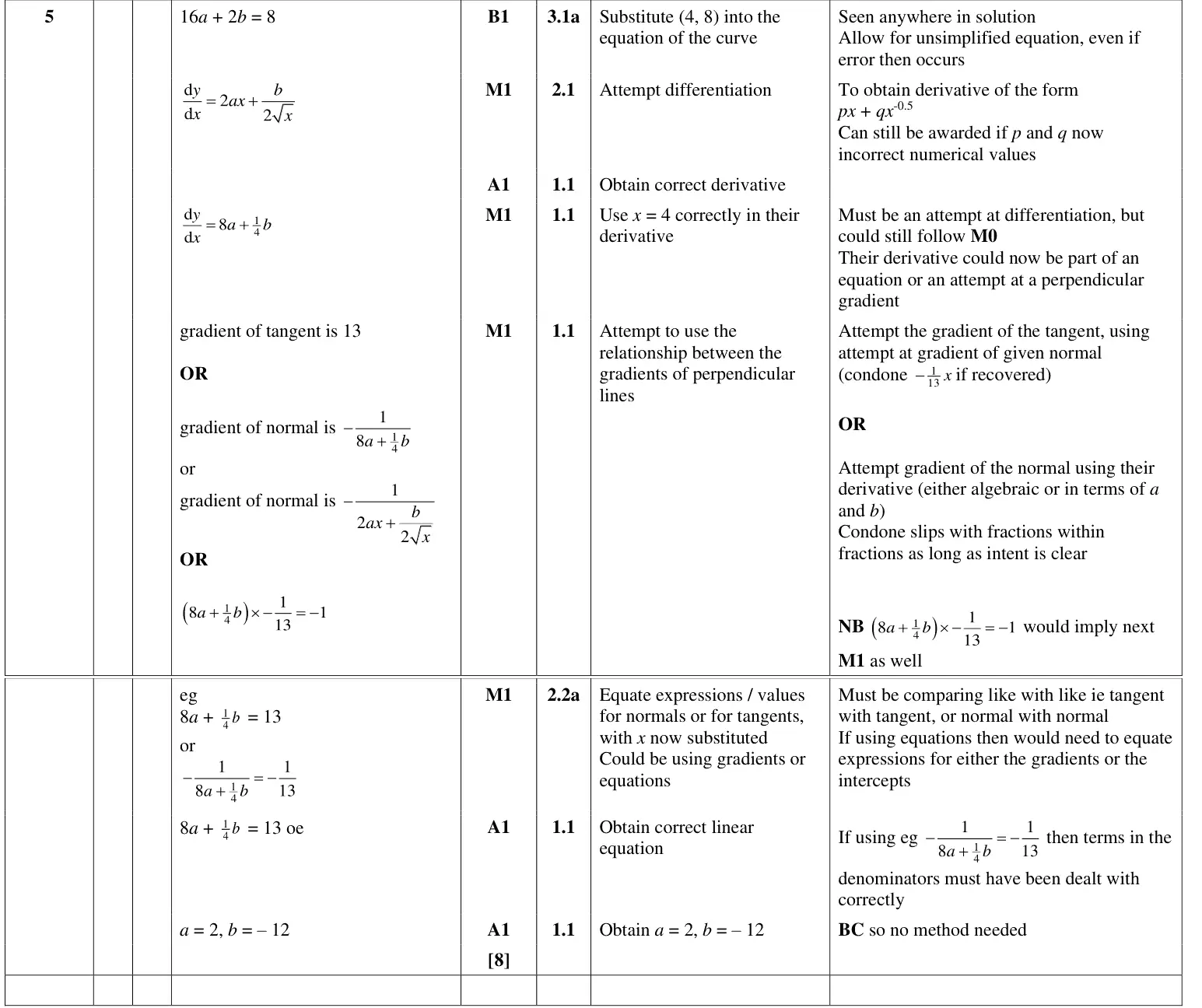
This longer unstructured question was generally well attempted. Quite a few neat, elegant and completely correct solutions were seen. Some unnecessary work was also seen, with quite a few candidates obtaining the equation of the tangent with some trying to solve that with the given equation. Only a very small number of candidates did not realise differentiation was involved. When the differentiation was attempted, it was invariably correct with the fractional powers well handled. Those candidates who substituted x = 4 into their algebraic expression for the gradient of the tangent, were more likely to score full marks compared to those who went on to form an algebraic expression for the gradient of the normal. Most candidates were able to find the numerical value for the gradient of the tangent from the equation of the normal, although not everyone was able to use this information to produce a correct equation in a and b only. A few candidates confused the gradients of the tangent and normal. Some candidates often omitted substituting (4,8) into the equation of the curve, failing to produce a second independent equations in a and b. Solving these two equations simultaneously could be completed by using a calculator for the final mark. This is a good solution to Question 5 with efficient and clear working.
Key points and common errors
(4, 8) on curve: 16a + 2b = 8
dy/dx = 2ax + b/(2√x) = 8a + b/4 at x = 4
normal gradient −1/13 so tangent gradient 13
a = 2, b = −12
finding the tangent equation is unnecessary
June 2024 · Paper 1 · Q12(b)6 marksHard
Show the start of this question
Mark scheme for this part
Examiner's comment
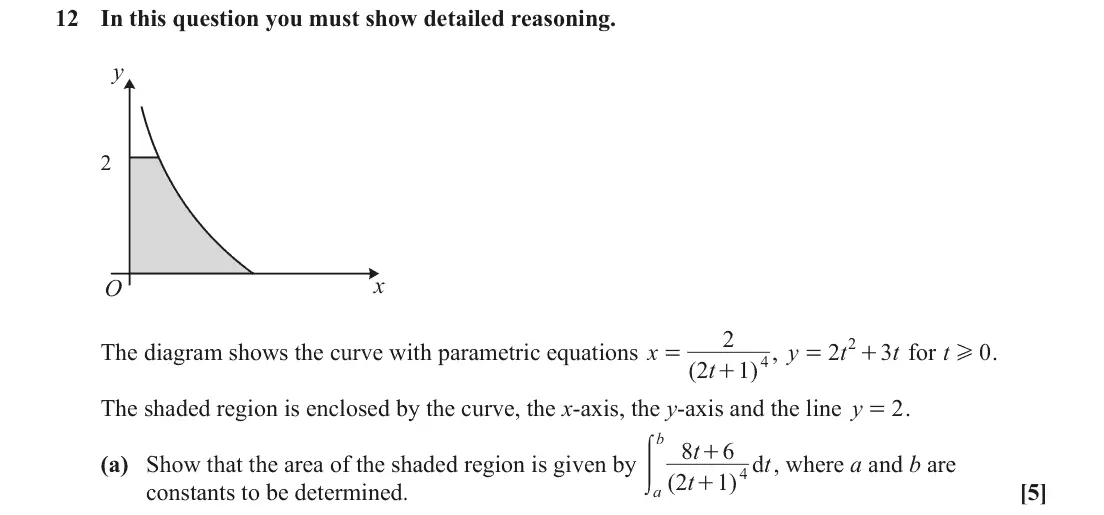
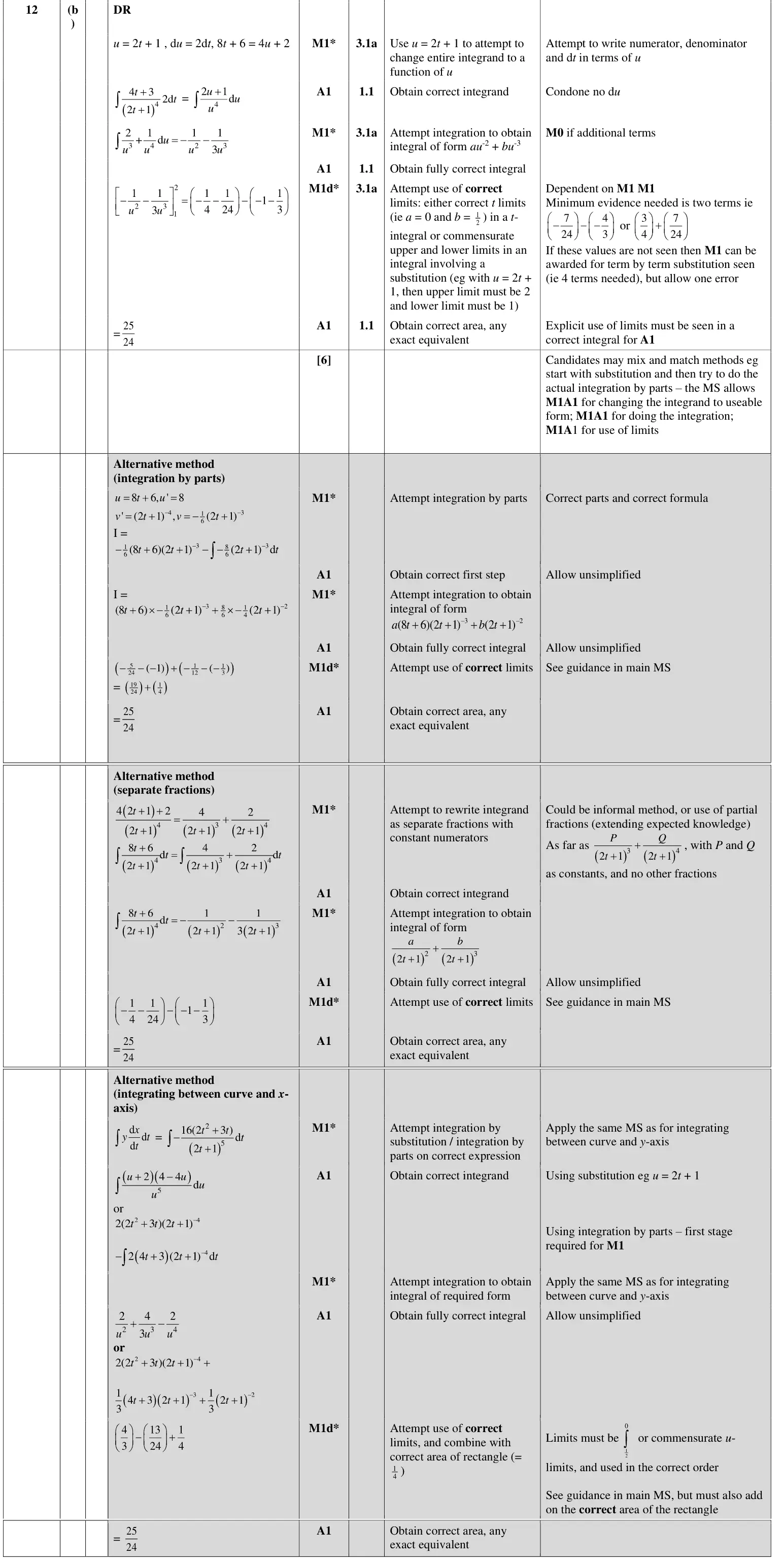
This question proved challenging for many candidates. There may be some indication that time management was a problem as there were a significant proportion of blank responses. However, there were many strong responses covering a variety of methods, most commonly substitution and integration by parts, and these were the most successful. Those not determining the correct limits from part (a) were unable to access the last two marks of this part. Some candidates attempted to use their knowledge on partial fractions but had mixed success in doing so. There were also many candidates that used a combination of methods, the most common being separate fractions and then integration by parts. This is a good and efficient solution to Question 12 (b).
Key points and common errors
u = 2t + 1: ∫(2u + 1)/u⁴ du = [−1/u² − 1/(3u³)] from 1 to 2 = 25/24
or by parts or separate fractions
limits must match the variable
June 2024 · Paper 2 · Q1(a)2 marksEasy
Mark scheme for this part
Examiner's comment
Almost all candidates answered this correctly, scoring both marks. Occasionally candidates made an error in reducing the power -2 to -1 or attempted to integrate instead.
Key points and common errors
rewrite 2/x² as 2x⁻²
errors reducing the power −2
some integrated instead
June 2024 · Paper 2 · Q1(b)2 marksEasy
Mark scheme for this part
Examiner's comment
A majority of candidates answered this correctly, scoring both marks. A very small number did not differentiate the ‘9’ term, scoring B1 only.
Key points and common errors
write √x as x^½
the constant −9 differentiates to 0
June 2024 · Paper 3 · Q1(a)2 marksEasy
Mark scheme for this part
Examiner's comment
While most candidates answered this question correctly it was common to see (2𝑎2)3 evaluated incorrectly as either 2𝑎6 or with an incorrect power of 5.
Key points and common errors
(2a²)³ = 8a⁶
× ¾a⁻¹ = 6a⁵
errors: 2a⁶ or a wrong power of 5
June 2024 · Paper 3 · Q3(a)4 marksEasy
Mark scheme for this part
Examiner's comment
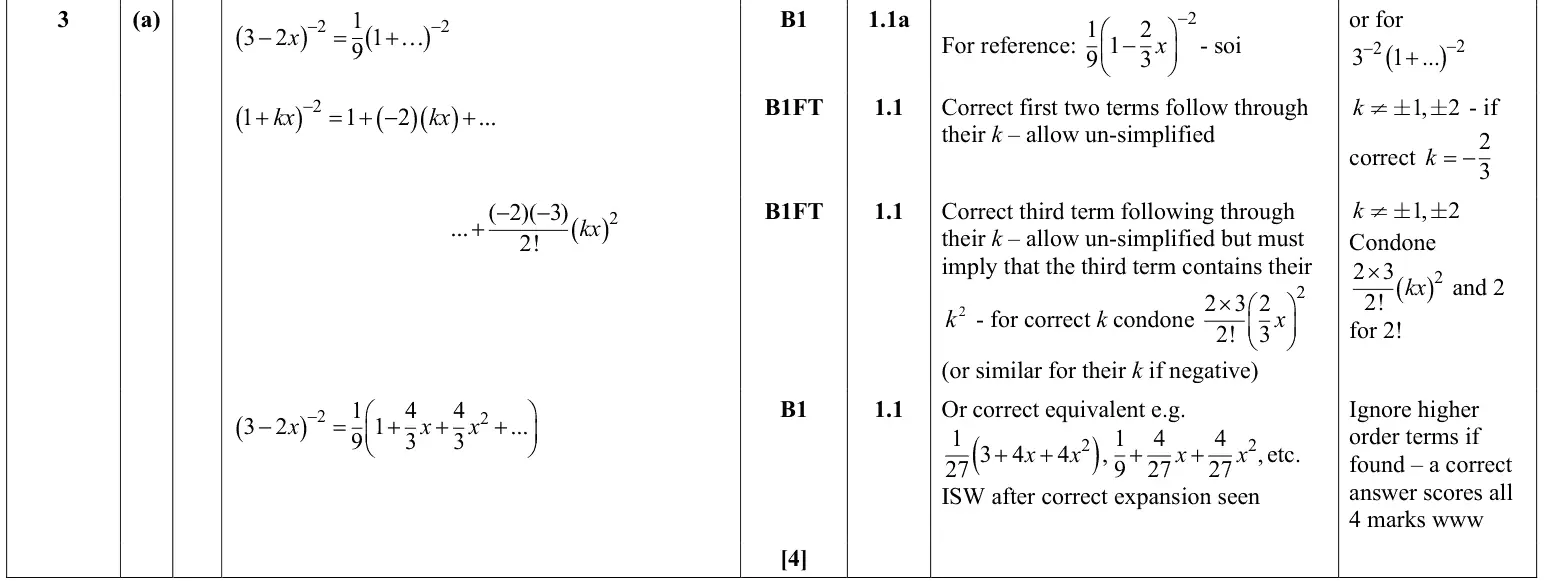
This part was answered well with almost all candidates knowing the correct method for binomially expanding expressions of the form (1 + 𝑥)𝑛 where 𝑛∉𝕫+. The most common errors were not taking out the correct factor of 9 or sign errors when evaluating either (−2) (− 3 𝑥) or . (− 3 𝑥)
Key points and common errors
(3 − 2x)⁻² = (1/9)(1 − ⅔x)⁻²
1/9 + 4x/27 + 4x²/27
errors: factor of 9, signs in (−⅔x) terms
June 2023 · AS Paper 2 · Q5(a)2 marksMedium
Mark scheme for this part
Examiner's comment
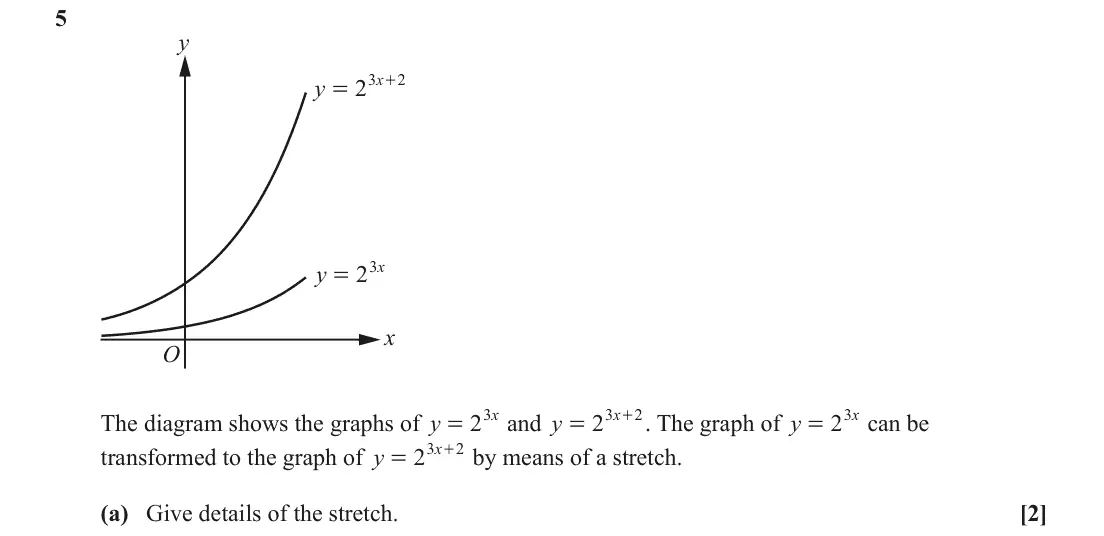
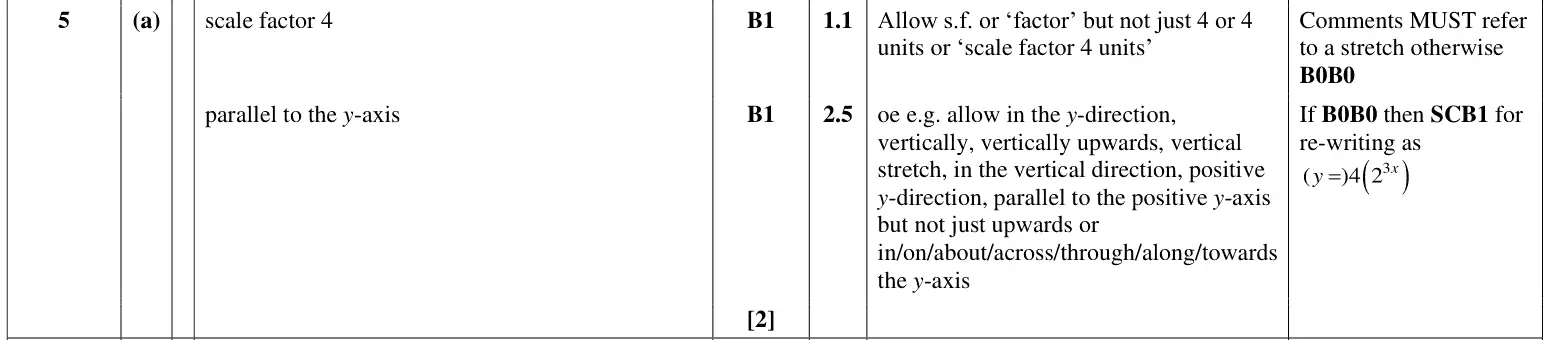
The mark scheme gives comprehensive detail about the wording that was accepted and this is well 1 worth studying carefully. Giving the scale factor as 2 or 2 was fairly common, as was ‘in the y-axis’.
Key points and common errors
2^(3x + 2) = 4 × 2^(3x): stretch scale factor 4 parallel to the y-axis
s.f. 2 or ½ and 'in the y-axis' are common errors
June 2023 · AS Paper 2 · Q5(b)3 marksHard
Show the start of this question
Mark scheme for this part
Examiner's comment
Most attempts gained 1 mark, for finding the correct equation in x. Using 23x+2 = 4(23x) to obtain the equation 23x = 12 was very rare. The exemplar below shows the typical next step in many solutions. Less successful efforts did not involve 36 at all. Taking logs like this was very prevalent and often led to the solution being abandoned quickly (presumably because x disappears). Incorrect use of the logarithm laws was frequent in this question.
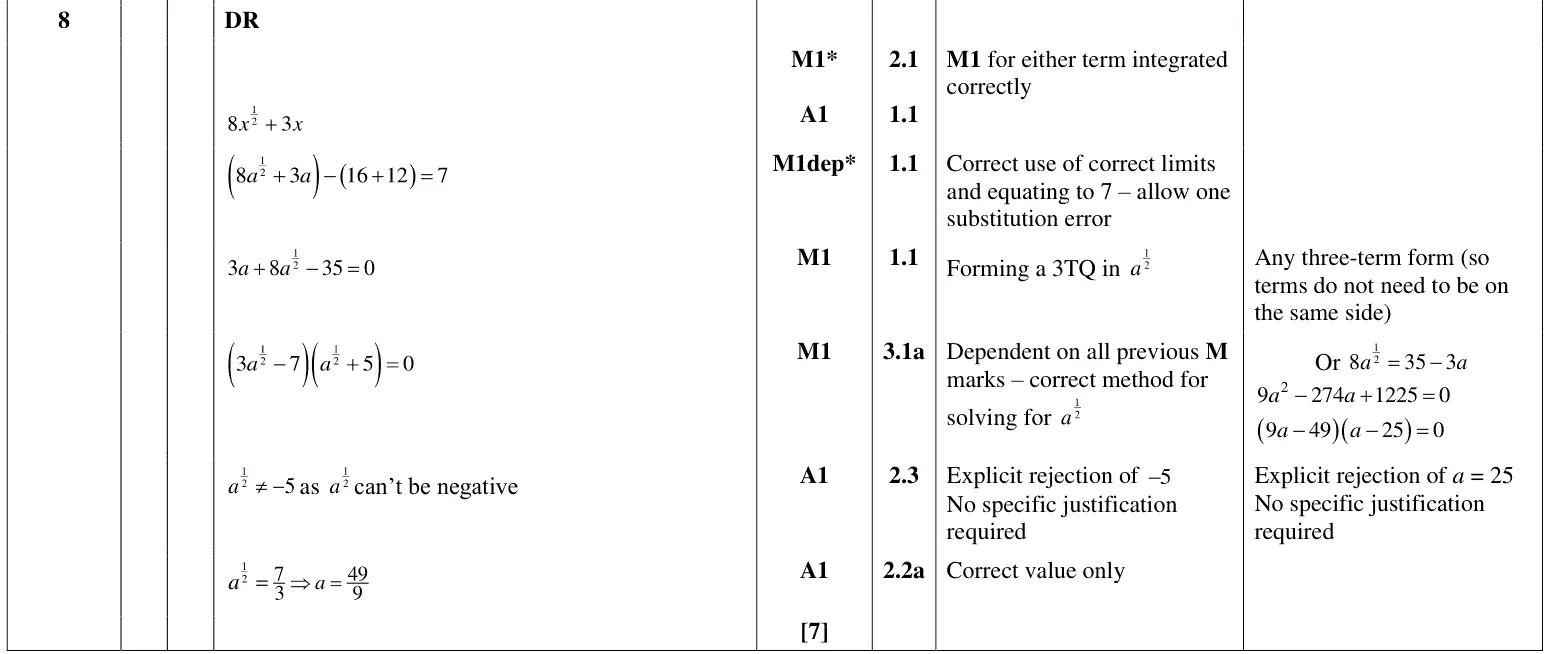
The majority of responses gained the first method mark, but there was some careless work with powers when dealing with 4x-½. Some candidates used 4x-1 or 4x½, which was costly. After integration, 2x½ + 3x spoiled some efforts. A few embarked on the question without integrating at all. The use of limits was generally good, with only the occasional candidate having the wrong order or adding terms. The majority of candidates that reached the ‘hidden’ quadratic did identify it, but as this is a DR question, we did want to see how this quadratic was solved; those who did it by calculator without showing working lost the last method mark (the ‘Assessment for learning’ comment above for Question 2 is relevant again here). We expected the final answer to be exact.
Key points and common errors
integrate to 8x^½ + 3x
(8a^½ + 3a) − 28 = 7
quadratic in a^½: (3a^½ − 7)(a^½ + 5) = 0
reject a^½ = −5 explicitly
a = 49/9
errors with 4x^(−½)
June 2022 · AS Paper 2 · Q24 marksMedium
Mark scheme for this part
Examiner's comment
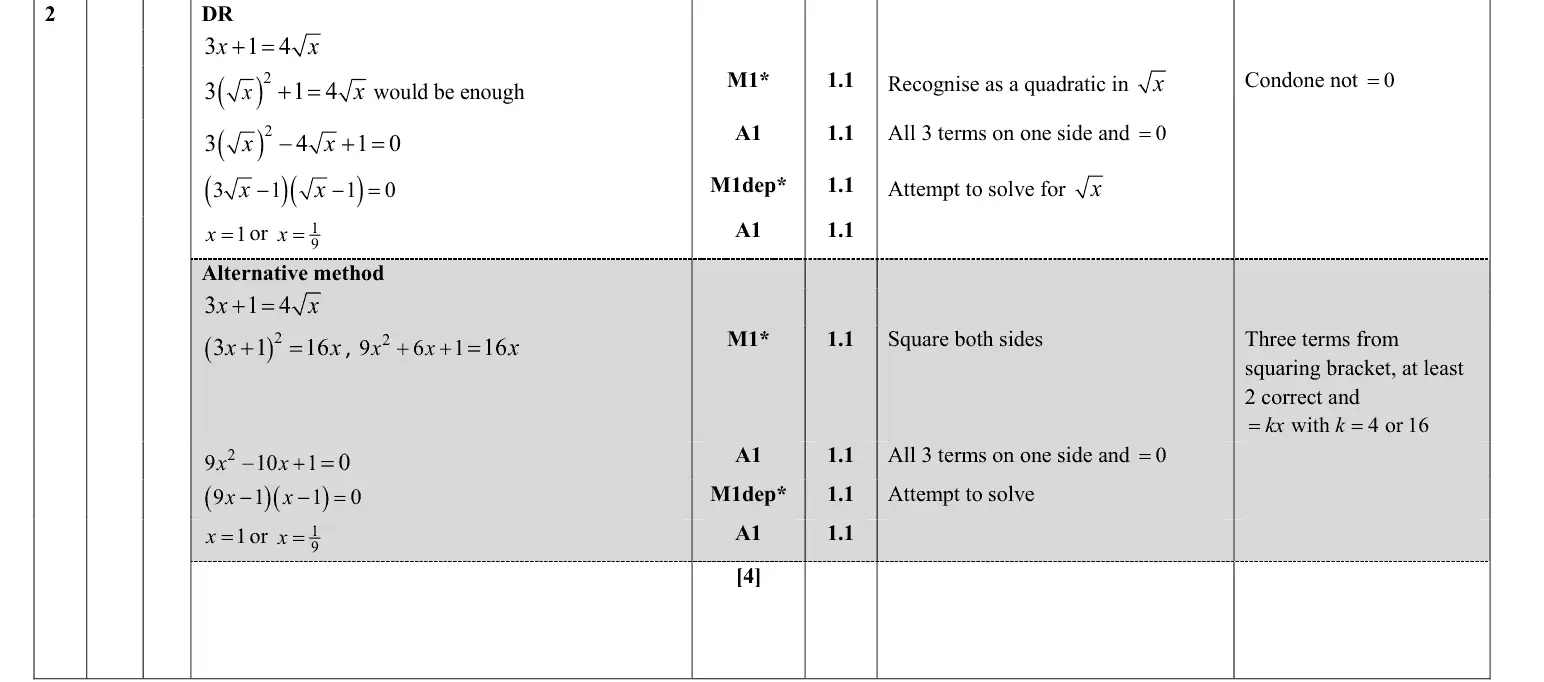
This question starts with the instruction ‘In this question you must show detailed reasoning’. This should be a warning to candidates to show sufficient evidence and detail in their solution. In this question candidates were therefore expected to show the method for solving the quadratic equation, not simply the roots stated from calculator work. The method using the ‘disguised quadratic’ was more popular, with the correct values of x appearing quite often. Some candidates, however, did not provide values for x by squaring their quadratic solutions, instead taking the square root of them. In the alternative method, (3x + 1)2 = 9x2 + 1 was not uncommon, likewise forgetting to square the 4 on the right-hand side of the given equation. The guidance in the mark scheme shows what we expected from candidates after their attempt to square before we allowed credit. This exemplar illustrates well the point raised under ‘Assessment for learning’. The quadratic equation here has seemingly been solved by calculator, (BC) and this is not sufficient in this question. Only the first 2 marks were given. Note the introduction of +/- in the final answers.
Key points and common errors
quadratic in √x: (3√x − 1)(√x − 1) = 0 so x = 1 or 1/9 (square, not square root)
or square both sides: 9x² − 10x + 1 = 0
method of solving must be shown
(3x + 1)² errors
June 2022 · Paper 1 · Q5(a)(ii)2 marksHard
Mark scheme for this part
Examiner's comment
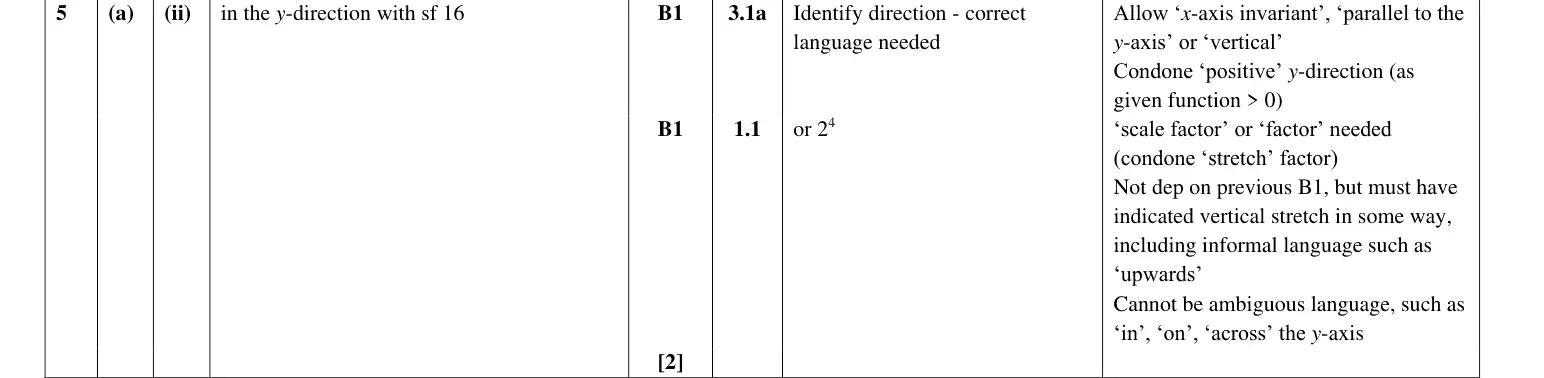
This part proved to be more challenging, with around half of the candidates being able to identify both the correct direction and the correct scale factor. Once again, incorrect language was all too common.
Key points and common errors
2^(x+4) = 16 × 2ˣ: stretch parallel to the y-axis, scale factor 16
correct language needed
June 2022 · Paper 2 · Q1(b)3 marksMedium
Mark scheme for this part
Examiner's comment
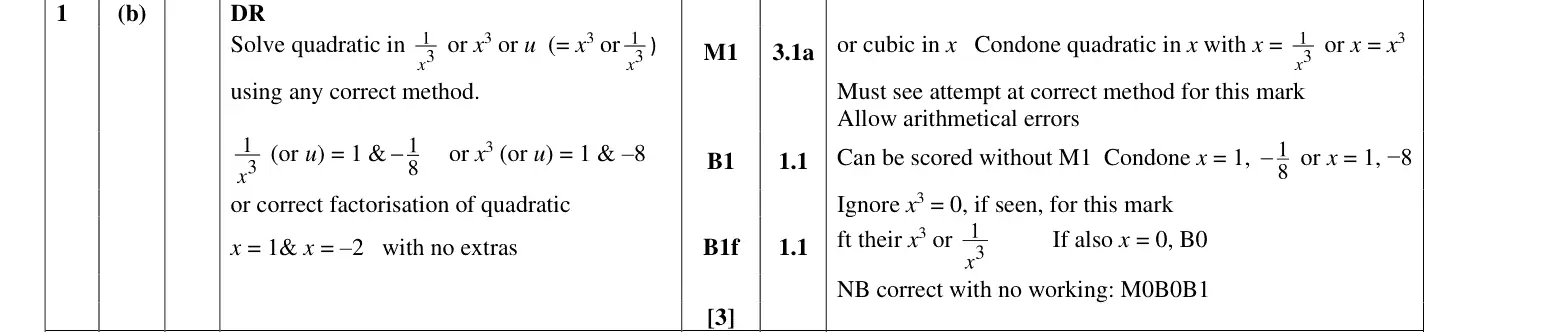
Most candidates formed a quadratic equation, either in x3 or in 3 . Some then used a substitution, while x others solved the equation as it was. Most were successful. A few candidates stated that x3 = −8 gave no solution. Many candidates lost a mark because they did not show a method for obtaining the roots of the quadratic equation. Some multiplied the equation by x9 throughout, and eventually obtained an extra (incorrect) answer of x = 0. A minority of candidates could not solve the quadratic equation, giving working such as 6 8 7 8 7 7 x 1 0 1 0 − −= ⇒ − −= ⇒ 8 1 −= ⇒ 7 = 7x3 ⇒ x = 1, or 6 5 6 5 3 x x x x x 8 − 7x3 = x9 ⇒ 8 = x9 − 7x3 ⇒ 8 = x3(x3 − 7) ⇒ x3 = 7 ⇒ x = 3 7 .
Key points and common errors
quadratic in 1/x³ (or x³): roots 1 and −1/8 (x³ = 1, −8)
x = 1 and x = −2
method for the quadratic must be shown
x³ = −8 does have a solution
June 2022 · Paper 2 · Q1(c)2 marksEasy
Mark scheme for this part
Examiner's comment
This question was well answered by most candidates. A wide variety of methods was seen, some involving logs, others involving manipulation of indices. Some candidates omitted the ± in their answer. A few candidates showed lacking understanding of logs, such as x2 − 7 = ln 1 243 , or of indices, such as 1 2 1 x = . 7 243 3
Key points and common errors
1/243 = 3⁻⁵ so x² − 7 = −5
x = ±√2
± often omitted
Autumn 2021 · AS Paper 1 · Q24 marksMedium
Mark scheme for this part
Key points and common errors
write 5000/t as 5000t⁻¹
dn/dt = −5000t⁻²
at t = 5 the rate of change is −200
Autumn 2021 · AS Paper 2 · Q8(a)5 marksMedium
Mark scheme for this part
Key points and common errors
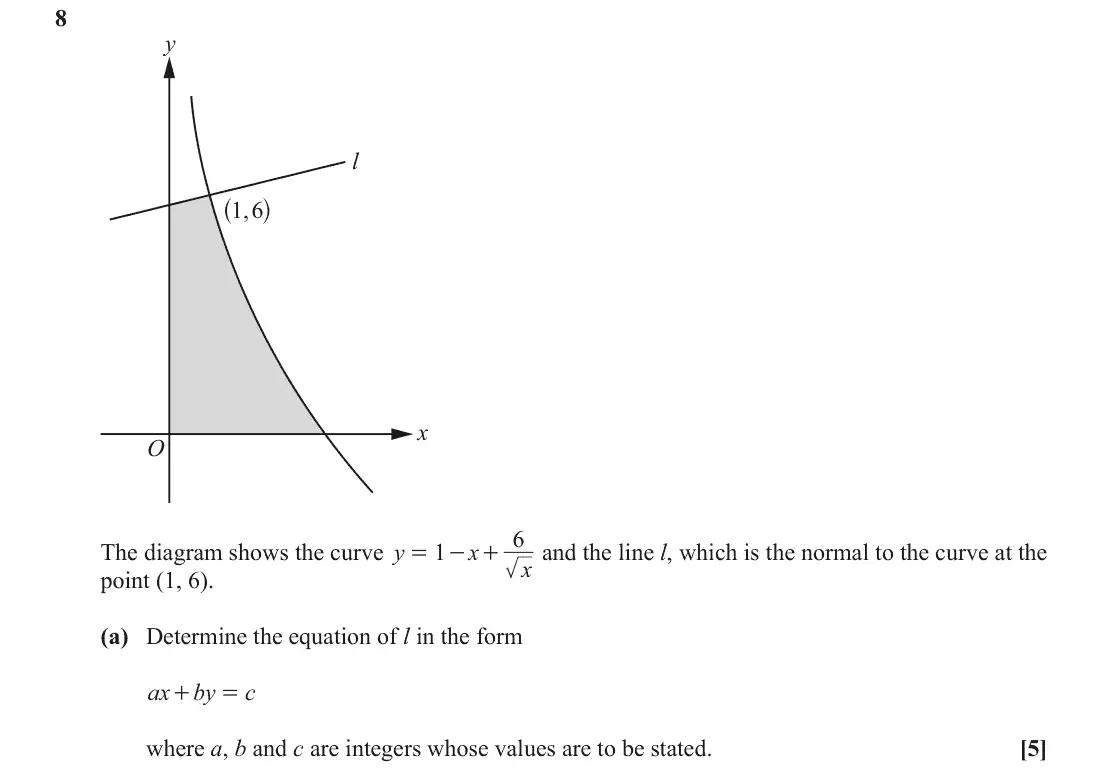
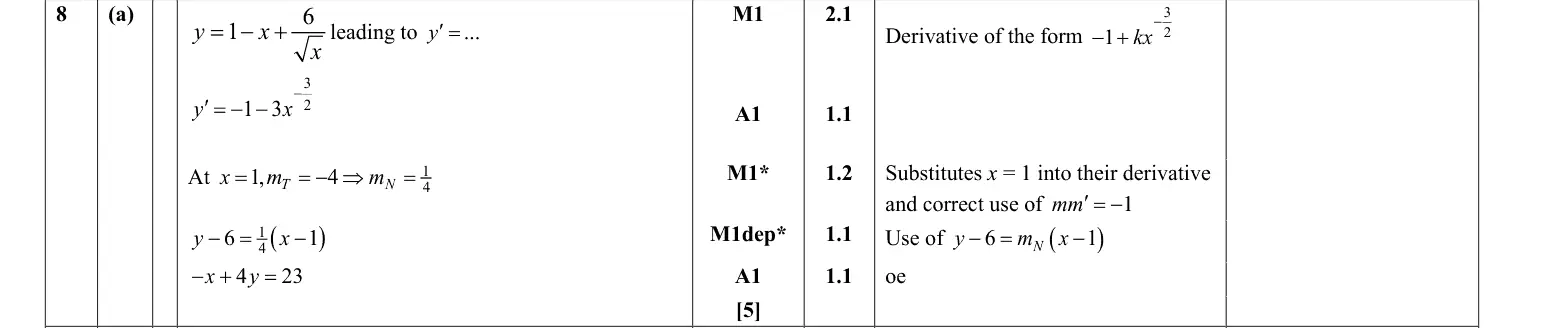
y′ = −1 − 3x^(−3/2)
tangent gradient −4 at x = 1 so normal gradient ¼
−x + 4y = 23 with integers
Autumn 2021 · AS Paper 2 · Q8(b)1 markMedium
Show the start of this question
Mark scheme for this part
Key points and common errors
x = 4: y = 1 − 4 + 6/√4 = 0
must show = 0
Autumn 2021 · Paper 1 · Q4(c)3 marksMedium
Show the start of this question
Mark scheme for this part
Examiner's comment
(From the general report) Common misconceptions Candidates should appreciate that merely discarding a value that cannot be pursued is not sufficient; a reason is also required e.g., in Question 4(c) 2y = -2 has no solution as 2y is always positive.
Key points and common errors
recognise x = 2^y
y = −1 and y = log₂3
must give a reason for rejecting 2^y = −2 (2^y > 0 for all y), not just discard it
Autumn 2021 · Paper 1 · Q6(a)4 marksEasy
Mark scheme for this part
Examiner's comment
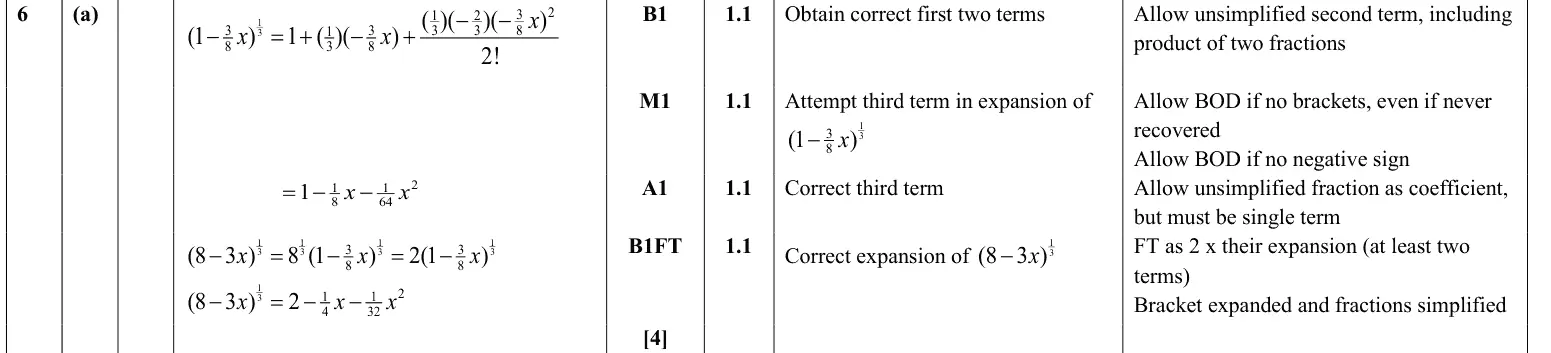
(From the general report) Question 6(a) was a routine question, and many candidates were able to provide clear and correct solutions.
Key points and common errors
take out 8^(1/3) = 2: 2(1 − 3x/8)^(1/3)
2 − x/4 − x²/32
bracket the −3x/8 term
Autumn 2021 · Paper 1 · Q11(a)5 marksHard
Mark scheme for this part
Examiner's comment
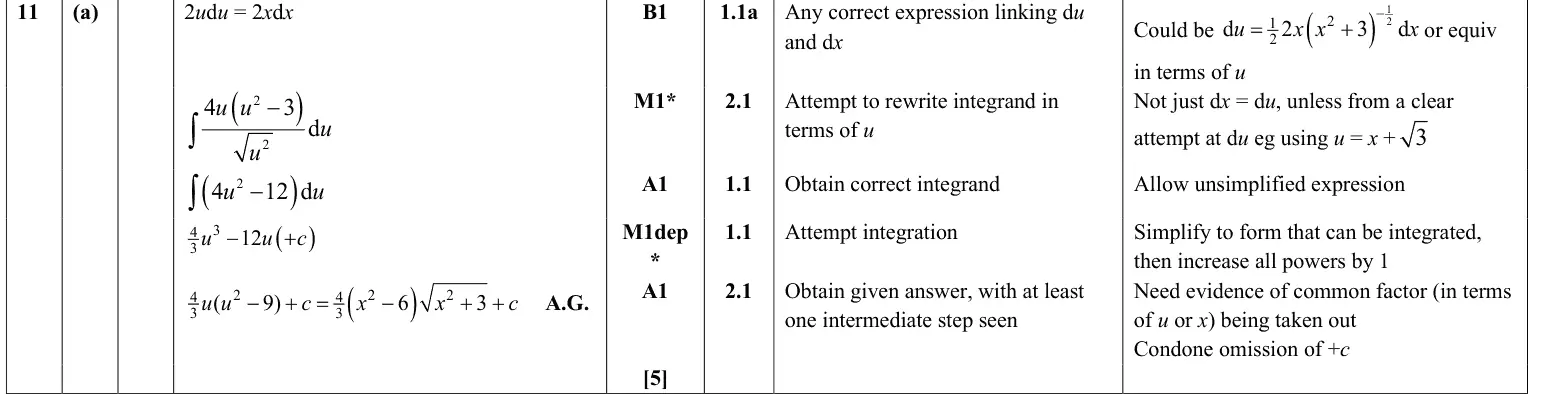
(From the general report) Despite being given the substitution in Question 11(a) this question proved to be challenging for many.
Key points and common errors
2u du = 2x dx
integrand becomes 4u² − 12
(4/3)u³ − 12u
take out common factor to reach given answer
Autumn 2020 · AS Paper 1 · Q1(a)3 marksMedium
Mark scheme for this part
Key points and common errors
write 5/x² as 5x⁻²
3x² − 3 − 10x⁻³
Autumn 2020 · AS Paper 1 · Q1(b)3 marksMedium
Mark scheme for this part
Key points and common errors
2x³ + x⁻² + c
− 2/x³ integrates to + 1/x²
+ c needed
Autumn 2020 · AS Paper 1 · Q4(b)4 marksHard
Show the start of this question
Mark scheme for this part
Examiner's comment
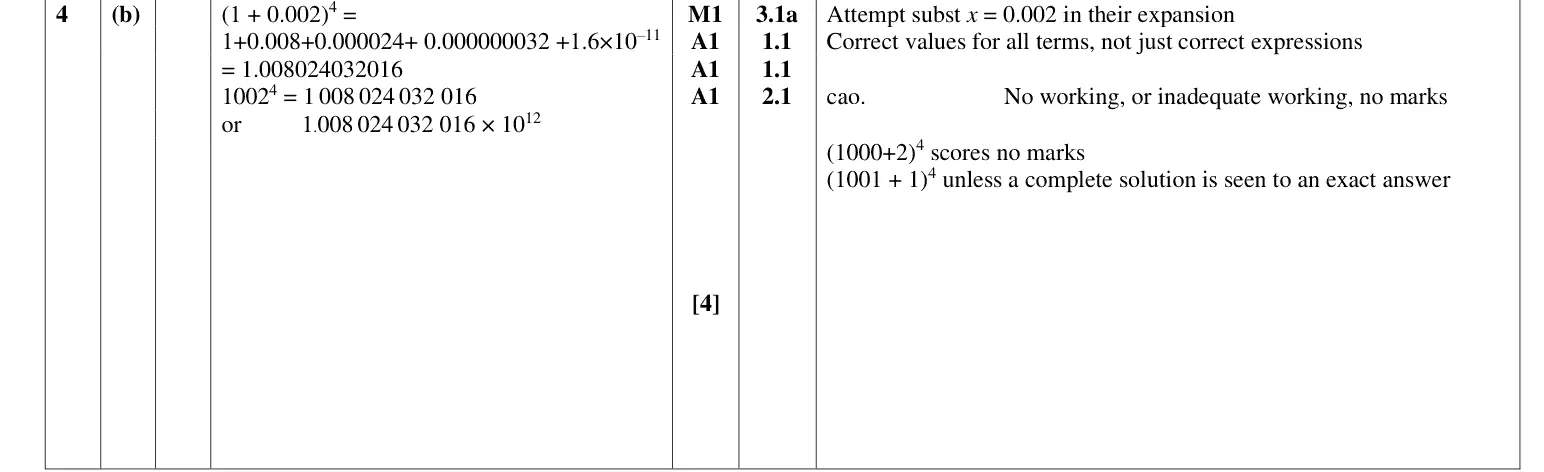
Almost no candidates realised the need to use (1 + 0.002)4. Most tried to use (1 + 1001)4.
Key points and common errors
1002⁴ = 10¹²(1 + 0.002)⁴
x = 0.002
1 008 024 032 016 exact
(1 + 1001)⁴ or (1000 + 2)⁴ do not use the expansion
Autumn 2020 · AS Paper 1 · Q6(b)4 marksMedium
Mark scheme for this part
Key points and common errors
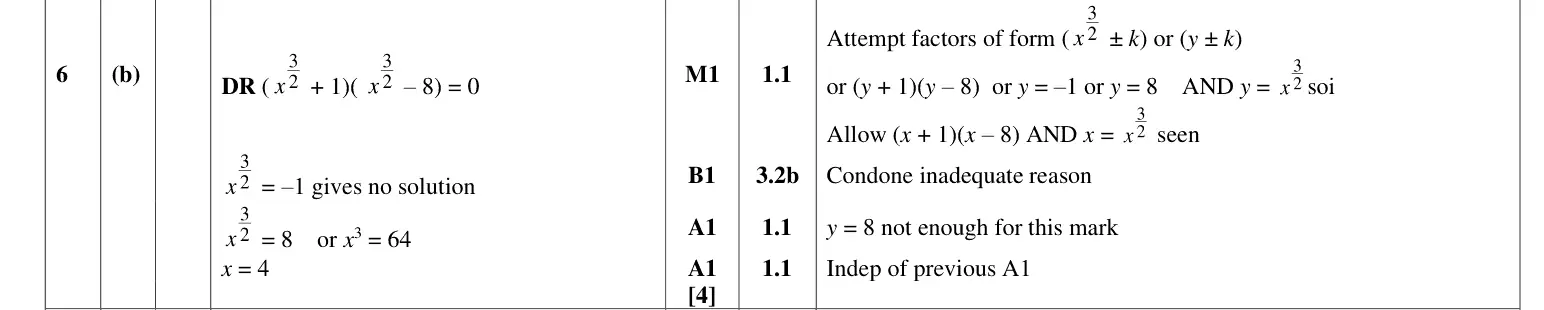
quadratic in x^(3/2): (x^(3/2) + 1)(x^(3/2) − 8) = 0
x^(3/2) = −1 has no solution
x³ = 64, x = 4
Autumn 2020 · AS Paper 1 · Q6(c)5 marksMedium
Mark scheme for this part
Key points and common errors
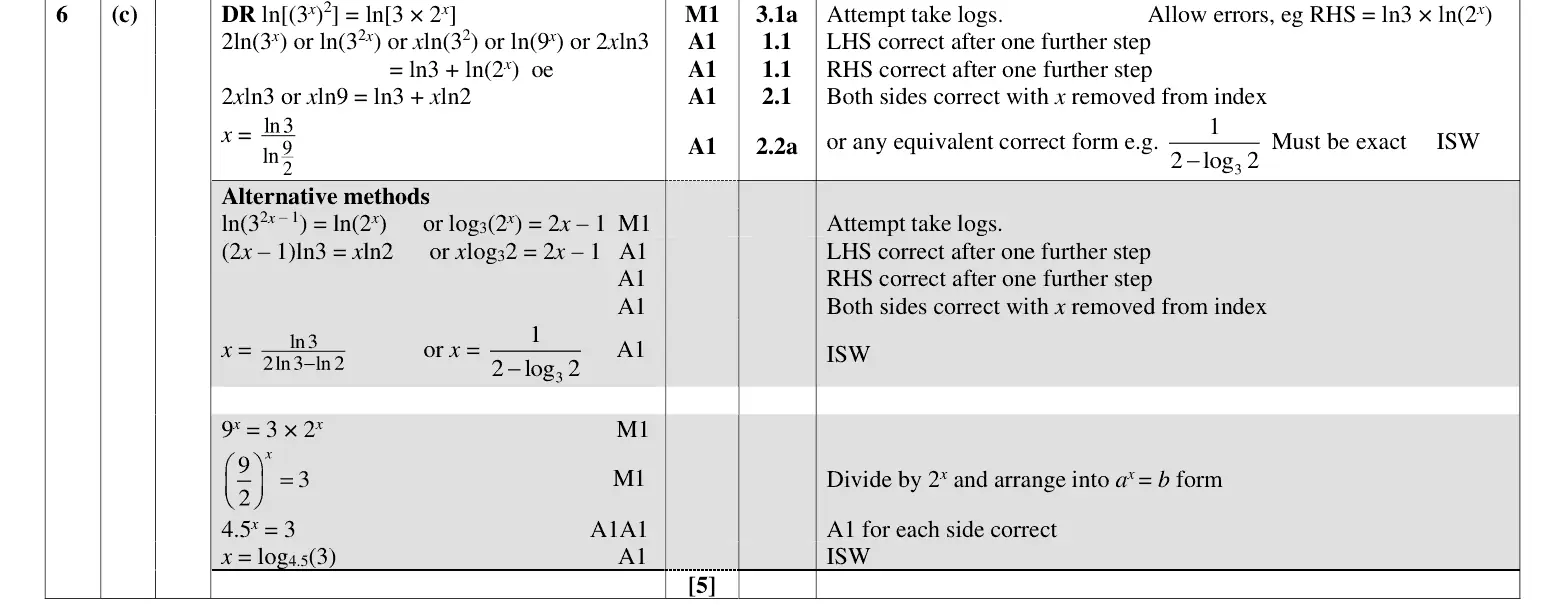
9ˣ = 3 × 2ˣ so (9/2)ˣ = 3, or take logs: 2x ln3 = ln3 + x ln2
x = ln3/ln(9/2) exact
Autumn 2020 · AS Paper 2 · Q37 marksMedium
Mark scheme for this part
Examiner's comment
(From the general report) Note that ‘find’ was used in Question 3 and Question 6 with the instruction to show detailed reasoning, which now means evidence is vital.
Key points and common errors
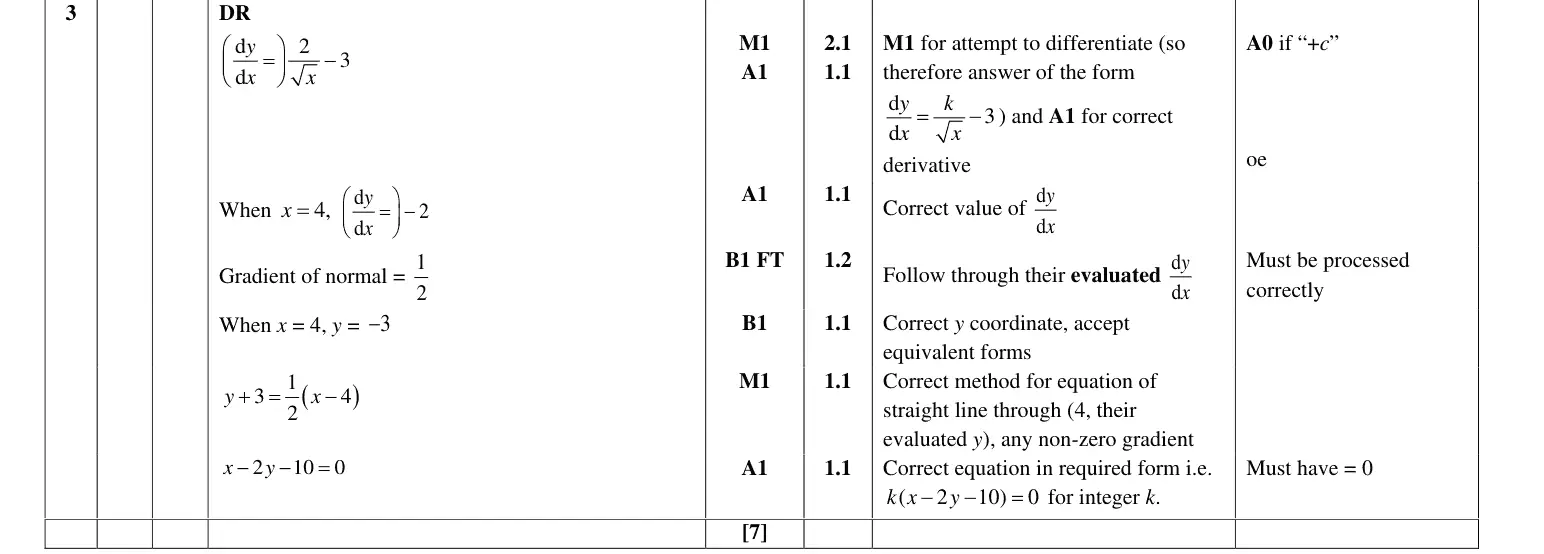
dy/dx = 2/√x − 3 = −2 at x = 4
normal gradient ½ through (4, −3)
x − 2y − 10 = 0 with integer coefficients
Autumn 2020 · AS Paper 2 · Q7(a)6 marksHard
Mark scheme for this part
Examiner's comment
(Comment on Question 07 as a whole) Part (a) - V = 2x2y was seen and often the required result for the surface area was incorrect, although many candidates managed to find at least 3 correct faces and gain M1. Replacing y in V and the subsequent rationalising was rarely seen. Part (b) - M1 A1 earned, with k often used, but few completed. Full credit could have been gained here even if no k had been obtained earlier. Second derivatives appeared sometimes. Part (c) and (d) were commonly not attempted.
Key points and common errors
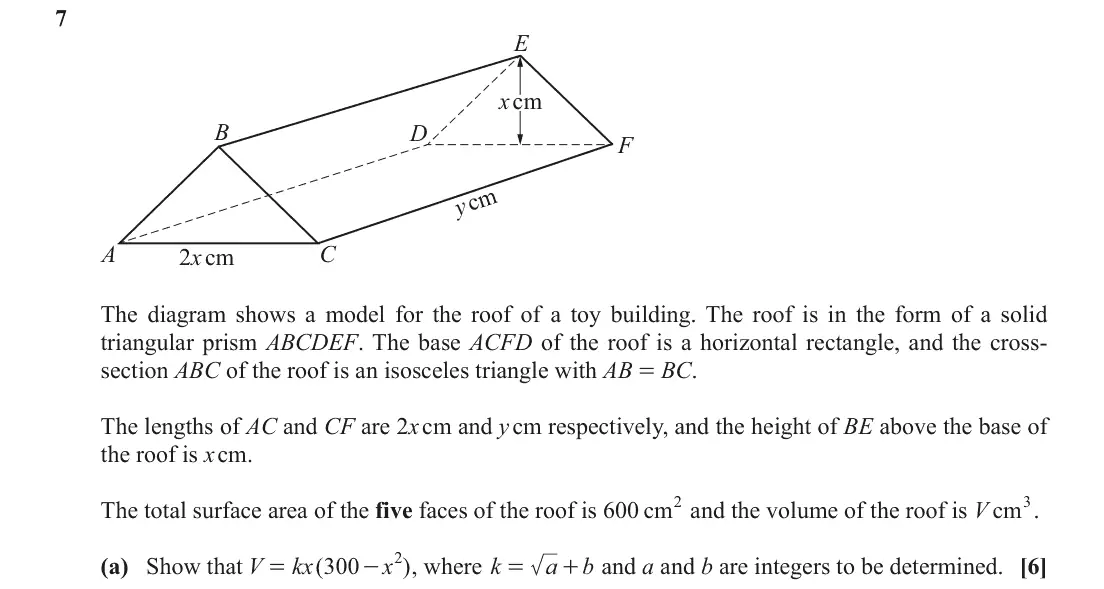
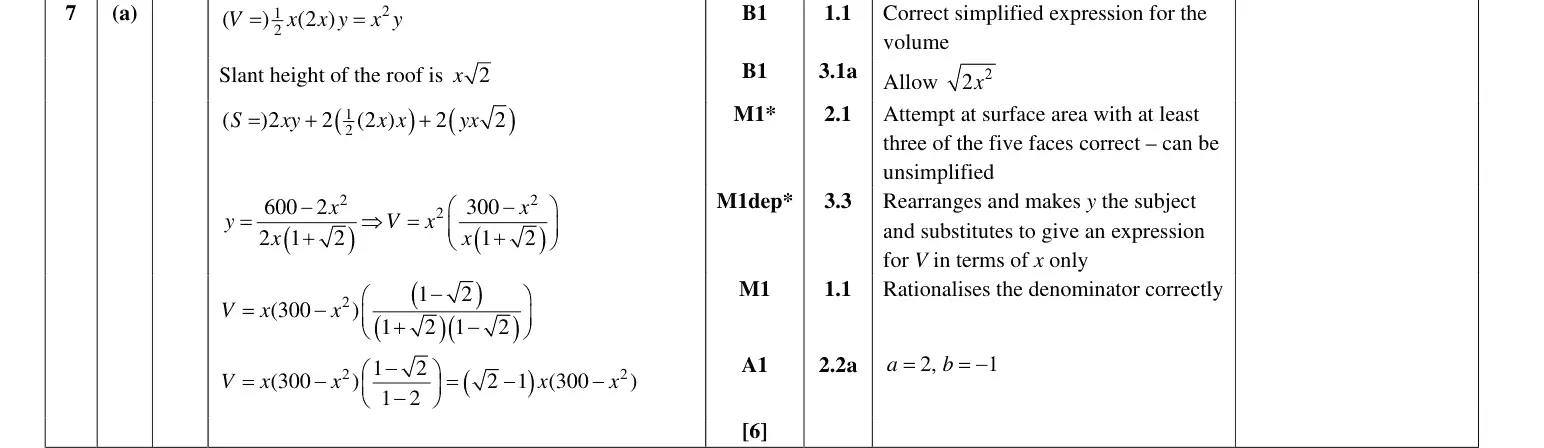
V = x²y
slant height x√2
S = 2xy + 2x² + 2√2xy = 600
substitute y and rationalise: V = (√2 − 1)x(300 − x²), a = 2, b = −1
rationalising rarely seen
Autumn 2020 · Paper 1 · Q2(a)2 marksMedium
Mark scheme for this part
Key points and common errors
combine as a single surd √(36a⁶) = 6a³
Autumn 2020 · Paper 1 · Q2(b)2 marksMedium
Mark scheme for this part
Key points and common errors
(64b³)^(1/3) = 4b
(4b⁴)^(−1/2) = 1/(2b²)
2/b
Autumn 2020 · Paper 1 · Q2(c)4 marksMedium
Mark scheme for this part
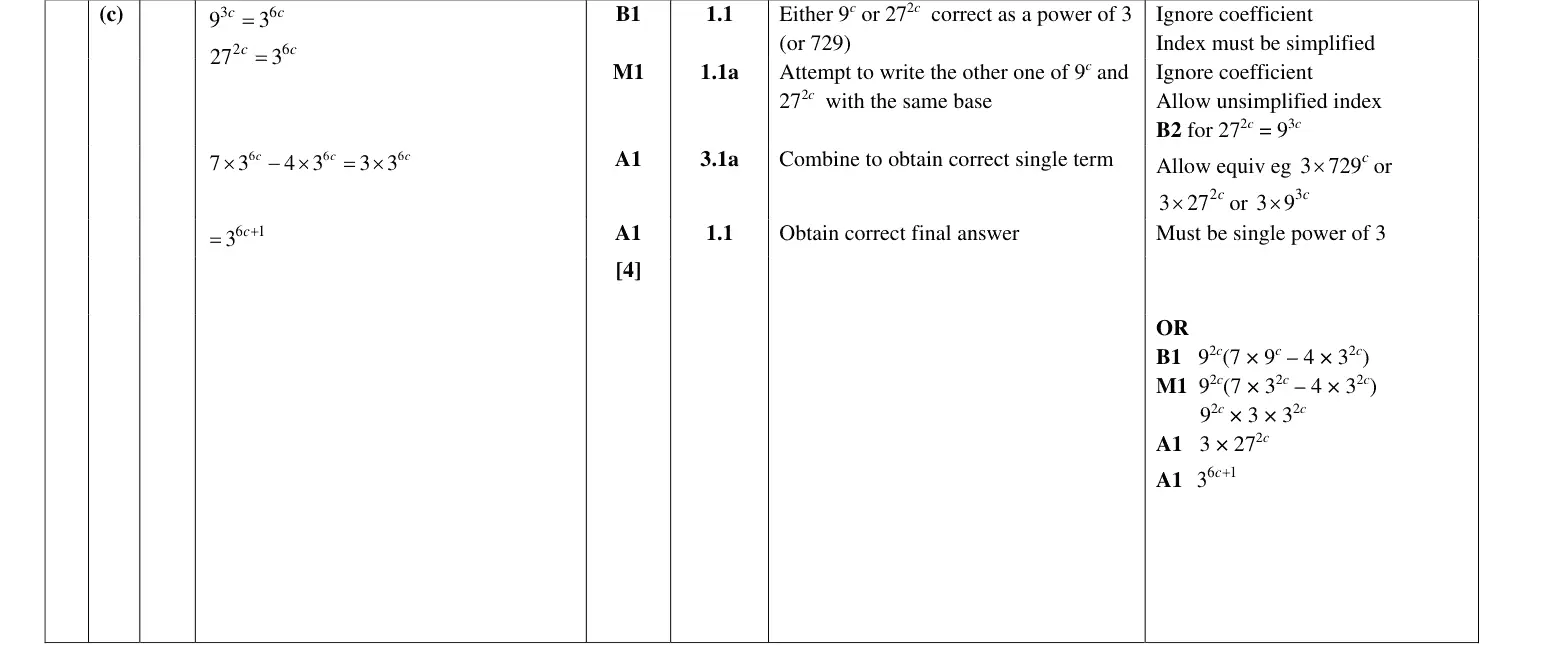
Key points and common errors
write both as powers of 3: 9^(3c) = 3^(6c), 27^(2c) = 3^(6c)
7 × 3^(6c) − 4 × 3^(6c) = 3^(6c+1)
answer must be a single power of 3
Autumn 2020 · Paper 1 · Q3(a)4 marksMedium
Mark scheme for this part
Examiner's comment
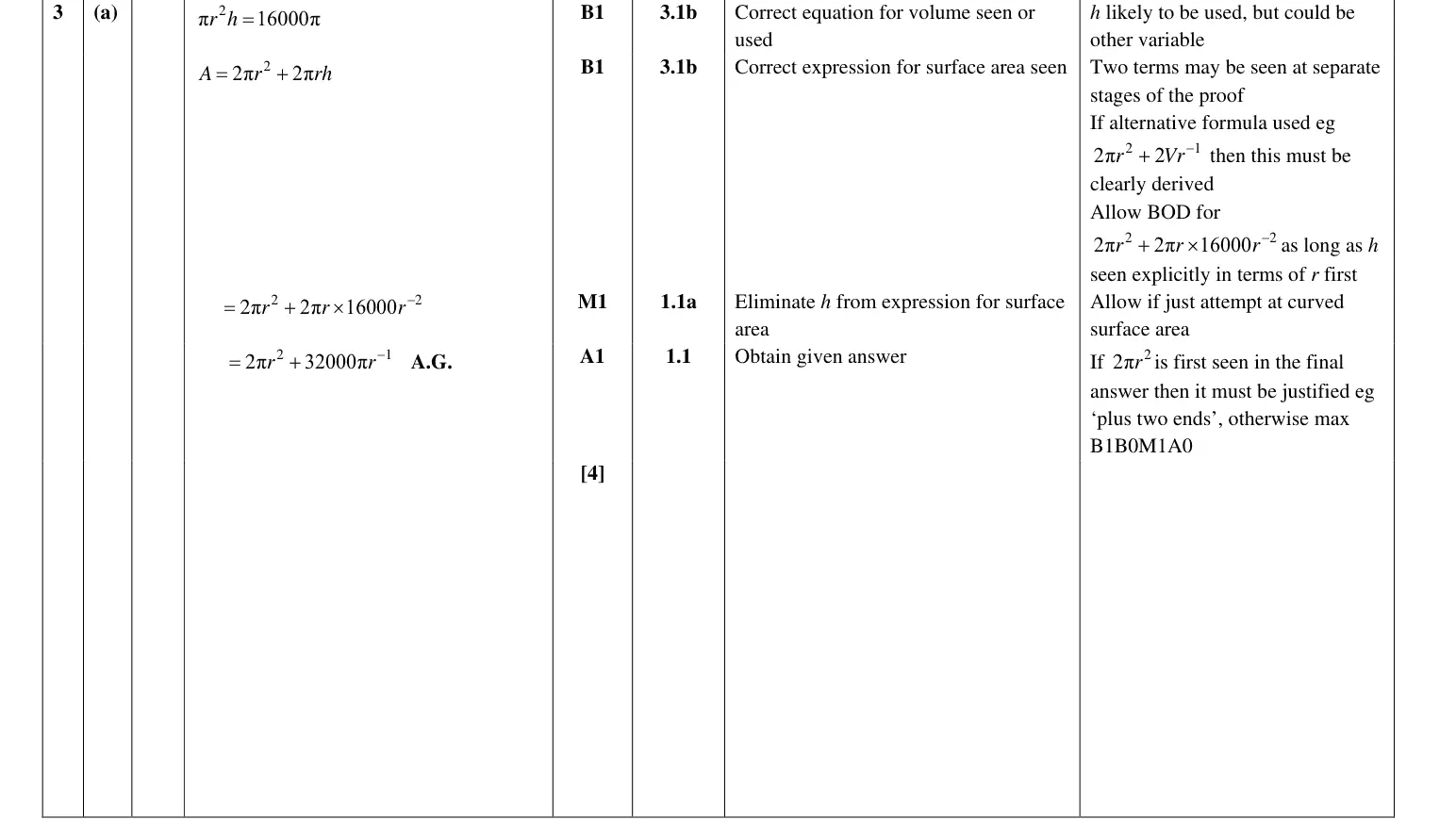
(Comment on Question 03 as a whole) The first part of Question 3 required candidates to show the derivation of the given equation. On questions such as this, where the request is to ‘show that’ a given answer is correct, it is important that sufficient detail is given to provide a convincing solution. Examiners expected to see an equation for the volume, an expression for the total surface area and then clear substitution and manipulation to arrive at the given answer. In the second part of the question, a surprisingly common error was to find the radius but then omit to find the minimum surface area. Candidates should review a question to make sure that it is fully answered before moving on; other strategies such as highlighting or underlining key words and phrases within a question may also be helpful.
Key points and common errors
πr²h = 16000π
A = 2πr² + 2πrh
eliminate h
the 2πr² for the two ends must be justified
June 2019 · AS Paper 1 · Q1(a)3 marksEasy
Mark scheme for this part
Examiner's comment
Many candidates answered this question correctly. A few gave 3 + 15x–2 or 3 – 15x–4. The most common difficulty was handling the negative index.
Key points and common errors
write 5/x³ as 5x⁻³
f′(x) = 3 + 15x⁻⁴
errors with the negative index (15x⁻², −15x⁻⁴)
June 2019 · AS Paper 1 · Q1(c)3 marksEasy
Mark scheme for this part
Examiner's comment
Here again, many correct responses were seen. The most common error was the omission of "+ c". As with parts (a) and (b), some candidates made errors in the negative index. Some used incorrect notation, with either " "∫ or "dx", or both, appearing in the response.
Key points and common errors
3x²/2 + 5x⁻²/2 + c
+ c often omitted
negative index errors
keep ∫ and dx notation correct
June 2019 · Paper 1 · Q8(b)4 marksMedium
Show the start of this question
Mark scheme for this part
Examiner's comment
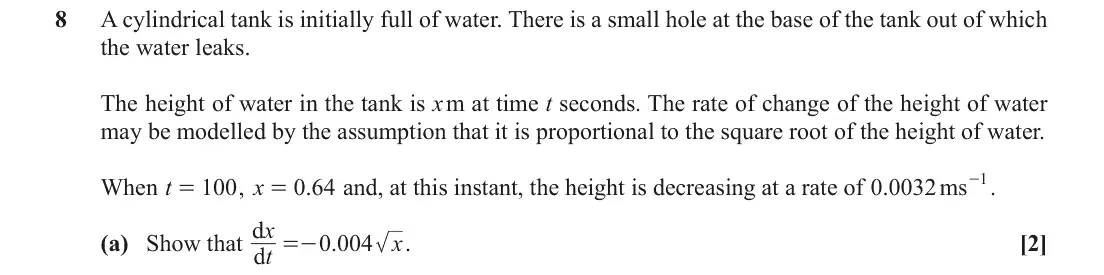
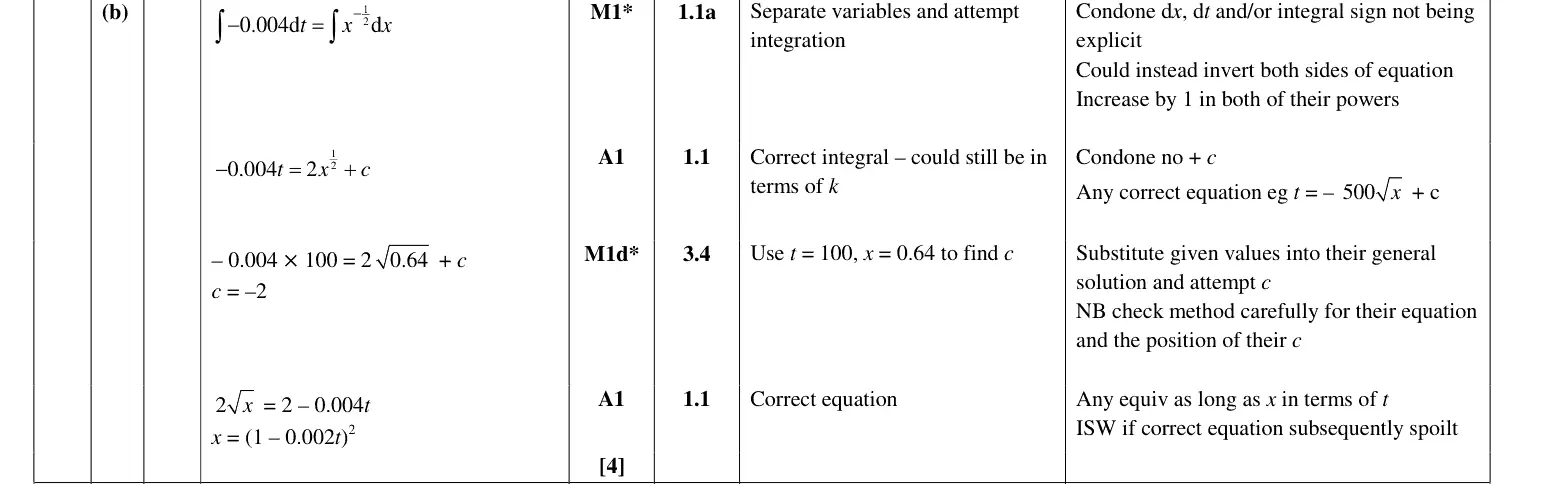
Most candidates could make an attempt to solve the given differential equation, usually by separating the variables but sometimes by inverting the equation and integrating. The integration was usually correct, and candidates could then use the given initial conditions to find a value for their constant of integration. Candidates were not always successful in finding an expression for x in terms of t; some omitted to attempt this and others either squared term by term or square rooted rather than squaring the function of t.
Key points and common errors
separate variables: 2√x = −0.004t + c
t = 100, x = 0.64 gives c = 2
x = (1 − 0.002t)²
errors squaring term by term
June 2019 · Paper 2 · Q1(b)4 marksMedium
Mark scheme for this part
Examiner's comment
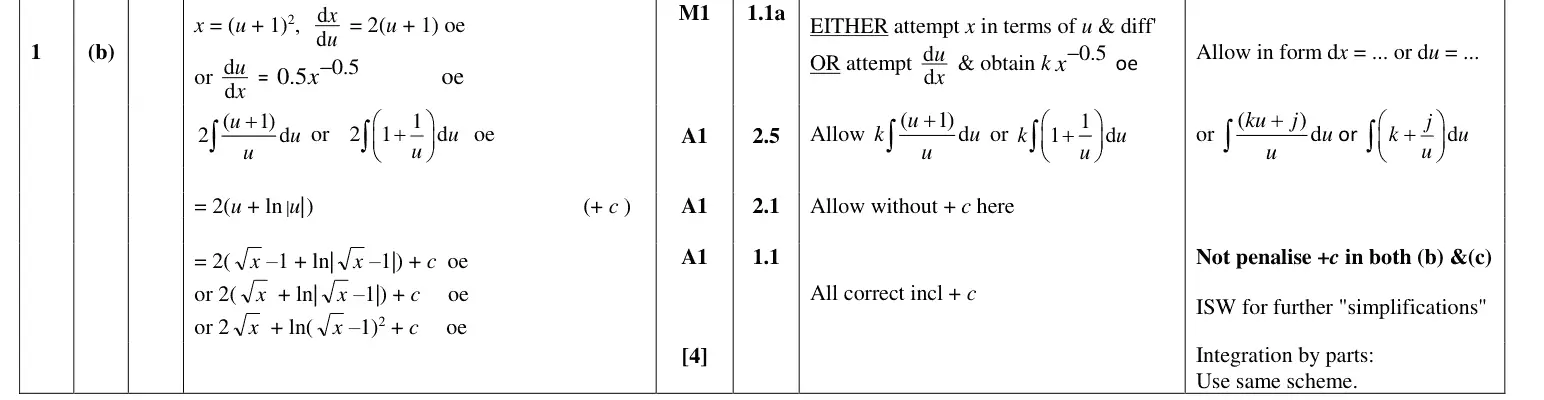
d u The majority of candidates found = 0 5 . x and attempted to express x− in terms of u . Many of d x 1 these candidates made mistakes in the algebra. Some found 2 x u∫ d u . Candidates who found x in terms of u and then found d x u were much less likely to make algebraic errors. Some candidates d substituted u for the denominator, but then just replaced dx by du . A few omitted the " + c ".
Key points and common errors
x = (u + 1)², dx/du = 2(u + 1)
2∫(1 + 1/u) du
algebra errors expressing dx in u
replacing dx by du
omitted + c
June 2019 · Paper 2 · Q5(a)4 marksMedium
Mark scheme for this part
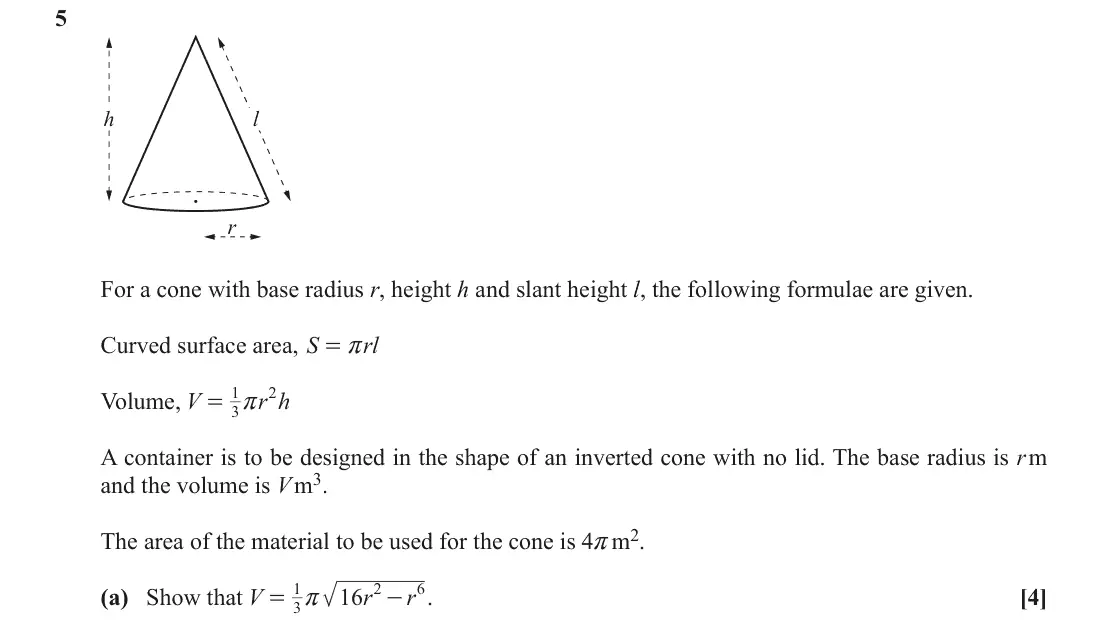
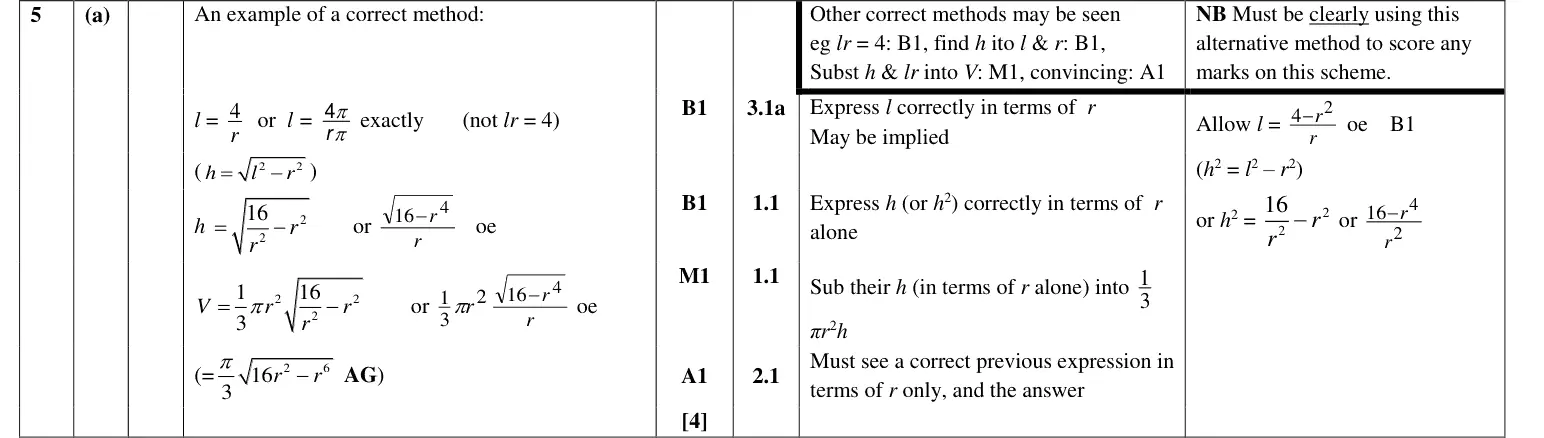
Examiner's comment
Many candidates gave convincing answers, showing sufficient steps to gain the marks. A particularly neat method, that was seen, involved finding h in terms of l and r, noting that lr = 4, and substituting both these into the formula for V. 2 16 4 However, a great deal of incorrect algebra was seen, for example − r = − r and 2 r r 2 16 2 4 r − r = 16 − r . Some candidates gave incorrect working and then "fudged" their working in 2 r order obtain the given answer. Many candidates did not appear to be aware of the fact that the key was to express everything in terms of r.
Key points and common errors
πrl = 4π gives l = 4/r
h² = l² − r²
substitute into V = ⅓πr²h
express everything in r
incorrect algebra and fudging to the given answer
June 2018 · AS Paper 1 · Q1(i)2 marksEasy
Mark scheme for this part
Examiner's comment
Many candidates answered this question correctly. A few made a correct first step, for example 3 , but could not continue correctly. Some candidates gave the correct answer with no working or with incorrect working. These scored no marks.
Key points and common errors
3^(7/2) = 3³√3 = 27√3
an intermediate step must be shown (DR) or no marks
June 2018 · AS Paper 1 · Q4(ii)5 marksEasy
Mark scheme for this part
Examiner's comment
Many candidates answered this question correctly. A few candidates omitted "+ c". 3 1 − A few obtained x 2 correctly, but with an incorrect coefficient. Some thought that 4 x meant 4 x 2 1 32 or 4x–2 or x 4 . A few candidates "integrated" 3 to become 2 or "integrated" 4 x to become 2 ( x ) 4 . Some candidates integrated correctly and then attempted to find the value of c. 2
Key points and common errors
√x = x^½
3x − (8/3)x^(3/2) + c
omitted + c
wrong coefficient
June 2018 · AS Paper 2 · Q3(ii)1 markMedium
Mark scheme for this part
Examiner's comment
The most common error was P ⇒ Q. P ↔ Q was condoned.
Key points and common errors
P ⇔ Q: x = 2 is the only real fifth root of 32
common error P ⇒ Q
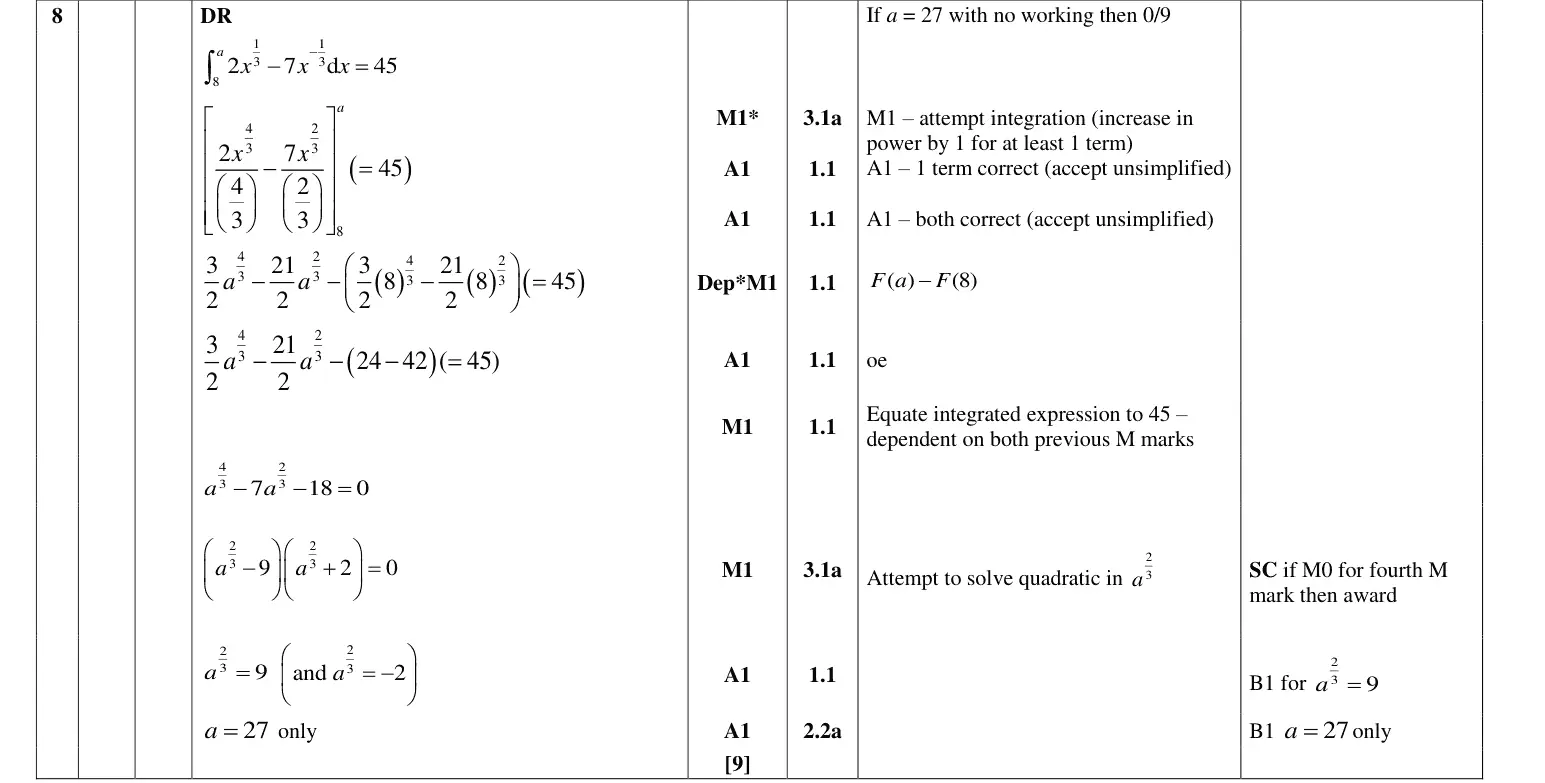
June 2018 · AS Paper 2 · Q89 marksMedium
Mark scheme for this part
Examiner's comment
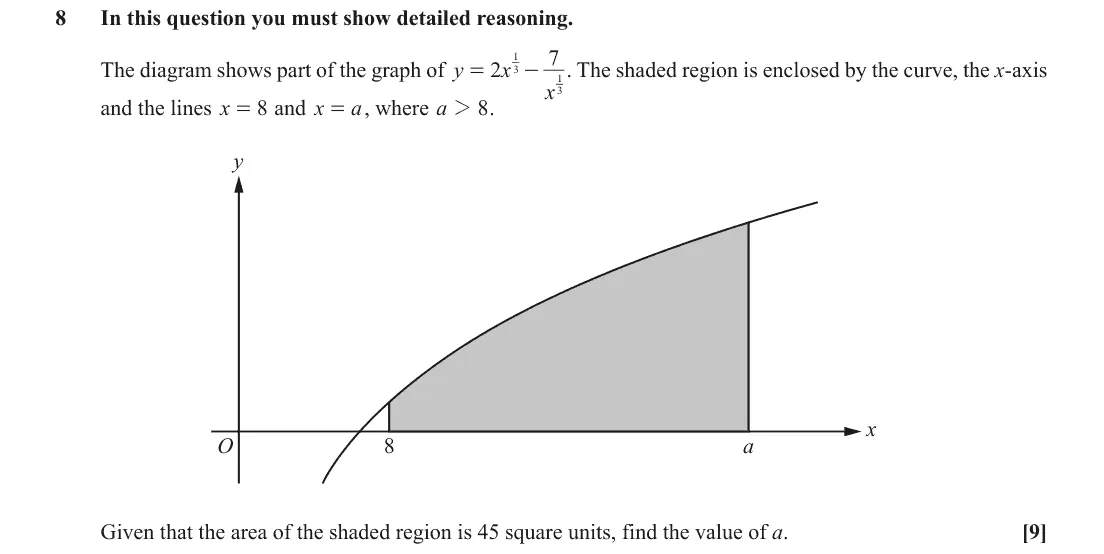
There were some encouraging attempts at this question, with the integration done accurately. Sign errors sometimes lead to the wrong quadratic, but many realised there was a ‘hidden’ quadratic. This question asked for detailed reasoning so we expected to see some working to show how the quadratic solutions were obtained, either factors or some working with the formula or completing the square. A few candidates found F(8) – F(a) when integrating from 8 to a and some integrated from a to 8 from the start. Those who obtained a = 27 from their calculator with no justification/detailed reasoning scored zero, although if they checked by showing the integral from 8 to 27 was equal to 45, then the first three marks were possible. There was a significant minority of candidates that attempted to differentiate rather than integrate to find the area under the curve. Section B
Key points and common errors
integrate to (3/2)x^(4/3) − (21/2)x^(2/3)
F(a) − F(8) = 45 gives a^(4/3) − 7a^(2/3) − 18 = 0, a quadratic in a^(2/3)
a^(2/3) = 9 so a = 27 only
calculator answer with no working scores 0
June 2018 · Paper 2 · Q13(ii)3 marksHard
Show the start of this question
Mark scheme for this part
Examiner's comment
Some candidates appeared not to understand the definition of Tr and Tr+ 1. Many candidates omitted the relevant powers of 0.85 in their expressions for Tr and Tr + 1. Some wrote the correct expressions for both Tr and Tr+ 1, but were unable to find any common factors to cancel. Many attempted to expand the given binomial expression, but did not include a general term. Some candidates "fudged" the answers giving, for example, Tr = 0.85(r + 1) and Tr + 1 = 0.15(50 – r) etc.
Key points and common errors
Tᵣ = ⁵⁰Cᵣ 0.15ʳ 0.85^(50−r)
cancel factorials to (r + 1)/(50 − r) × 0.85/0.15
many omitted the powers of 0.85
Find an A-level maths tutor
Stuck on this? Book a trial session with an A-level maths tutor.