Understand and use the sine, cosine and tangent functions; their graphs, symmetries and periodicity. Know and use exact values of sin and cos for 0, π/6, π/4, π/3, π/2, π and multiples thereof, and exact values of tan for 0, π/6, π/4, π/3, π and multiples thereof.
Guidance
Knowledge of graphs of curves with equations such as y = sin x, y = cos(x + 30°), y = tan 2x is expected.
A-level only
exact values of sin, cos and tan (given in radians)
Mark scheme (whole question; this part is marked with the orange bar)
Examiner's comment
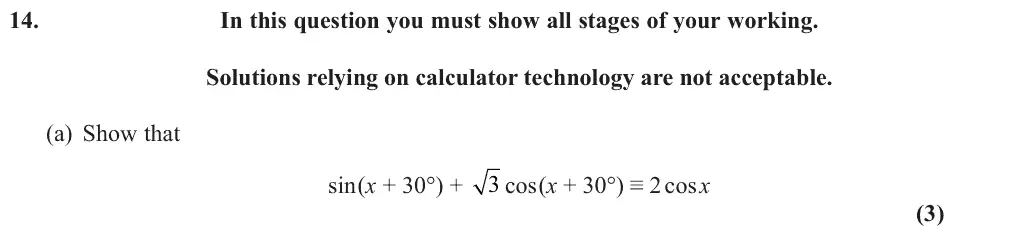
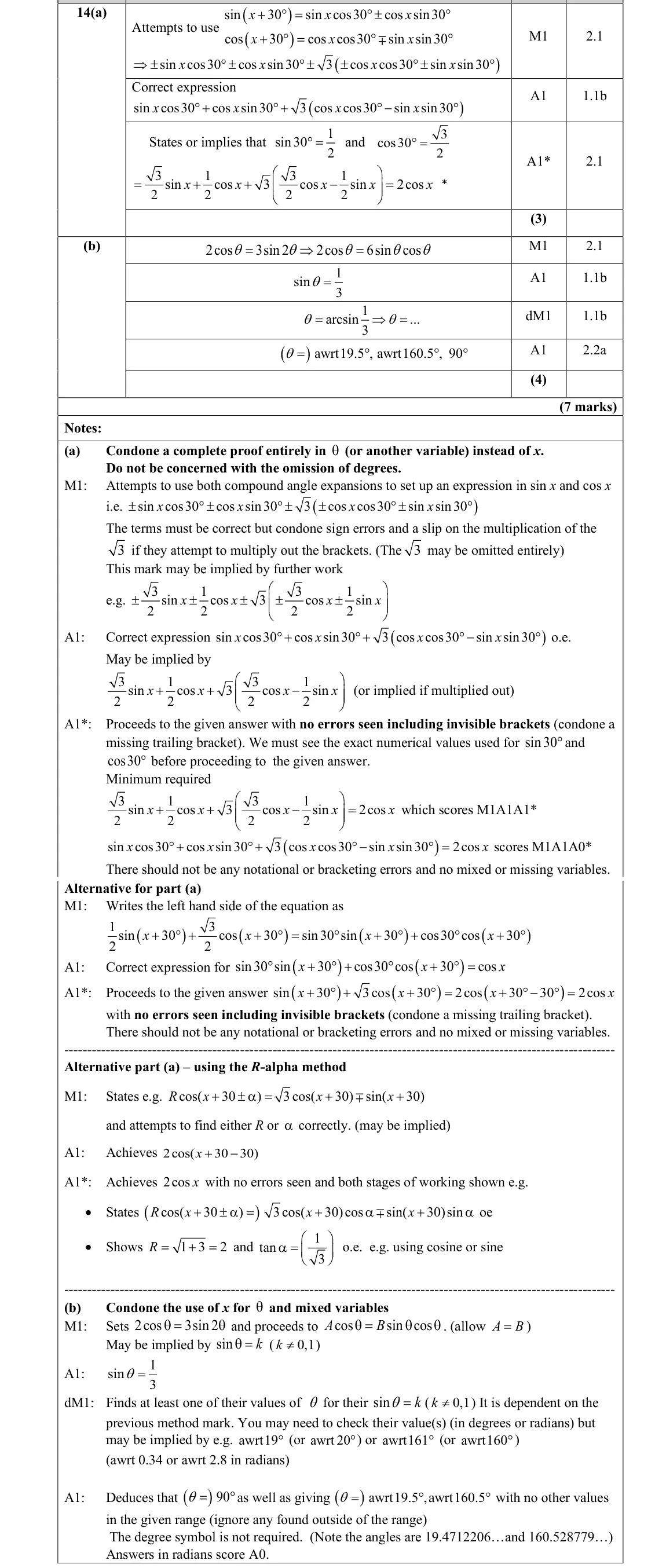
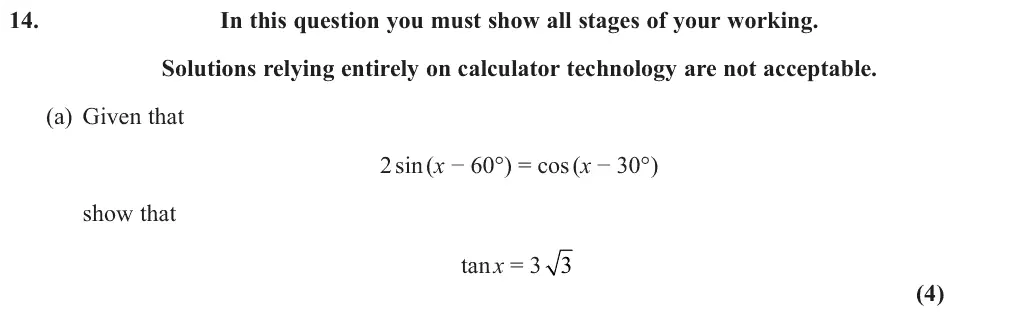
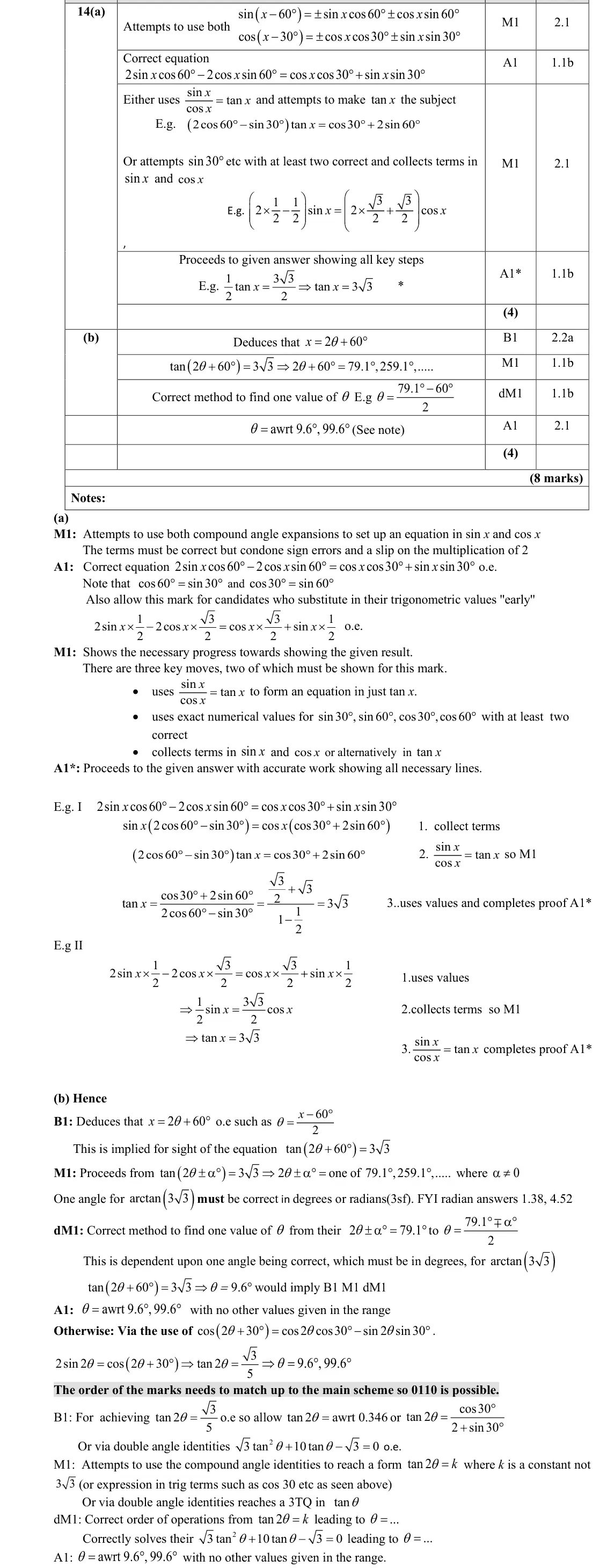
This question was a good differentiator at the later end of the paper. Success with this question was somewhat mixed, with some learners scoring most marks in part (b), whilst part (a) proved to be more challenging as it tested not only their knowledge of trigonometric identities but also their algebraic manipulation skills. In part (a), most responses attempted the proof by using both compound angle expansions to reach an expression in sin x and cos x, usually gaining the method mark and in most cases also the first accuracy mark. Once a correct expression was achieved, some stronger responses reached the given result by simplifying the terms. The most common mistakes committed while implementing this approach, were sign errors, especially for the compound angle expansion of ( ) cos 30 x + ° , incorrect multiplication by 3 and bracketing errors, which were not condoned in this ‘show’ question. A smaller proportion of responses used the R-alpha method with ( ) cos 30 R x + °± alpha , which required learners to find both R and alpha correctly to reach ( ) 2cos 30 30 2cos x x + °- ° = as requested.
Common mistakes
expand both compound angles (sign of cos(x + 30°) expansion), use sin 30° = ½ and cos 30° = √3/2 exactly
bracket errors not condoned
R-alpha method needs R = 2 and the angle
June 2025 · Paper 1 · Q16(b)3 marks
Mark scheme (whole question; this part is marked with the orange bar)
Examiner's comment
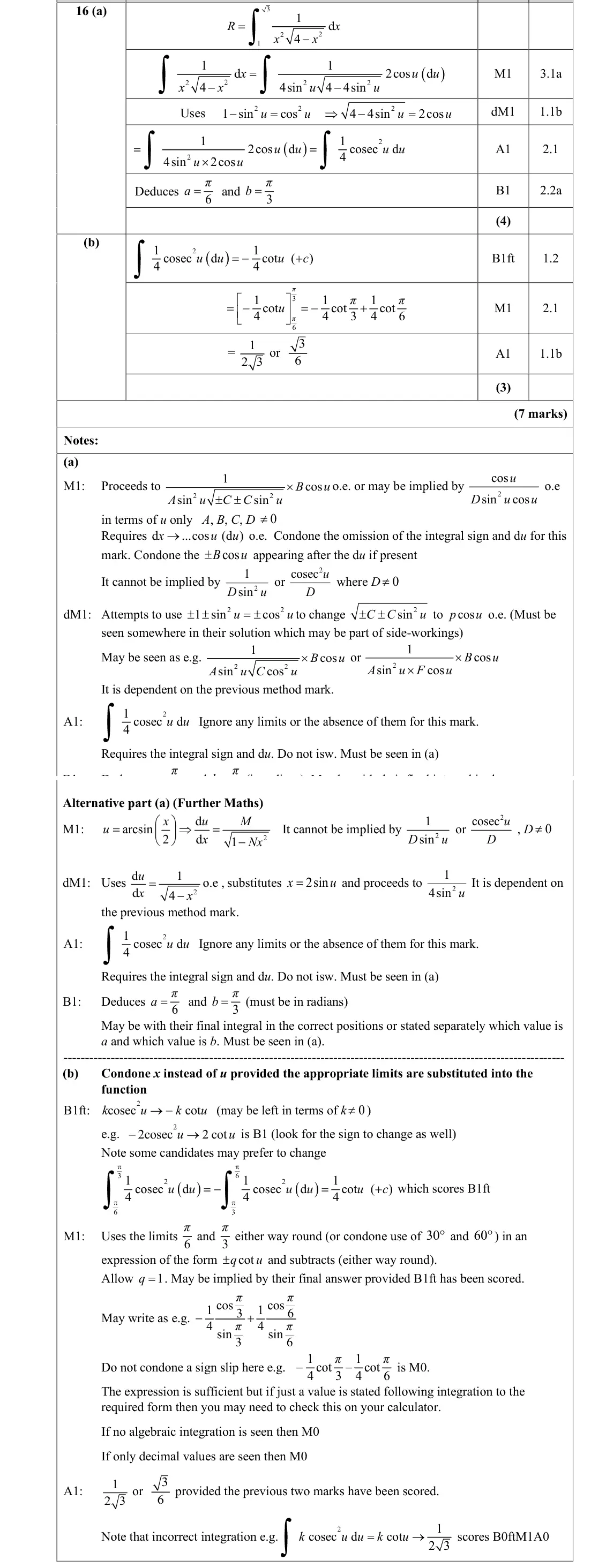
This proved to be a challenging question demanding good algebraic skills and attention to detail. For a final question on a paper, most made an attempt. In part (b), it was notable that those who did not reach a correct answer in part (a) often did not go on to attempt this, even though these marks were available to them. Even though they were told that the integral was a multiple of 2 cosec u some learners tried unsuccessfully to integrate their very complex answers to (a). A large number did not appear to know the integral of 2 cosec u or did not use the formula booklet correctly and some attempted very convoluted methods of integration. Those that did not score at all got muddled in the initial stage, choosing to use ln or some other given integration from the formula book that they had misread or misinterpreted. A significant number got confused between the integral of 2 cosec u andcosec u , which meant they ended up with expressions involving ln(tan ) u or ln(cosec cot ) u u + . However, several responses obtained the correct answer of 1 cot 4 u - , although a few omitted the negative sign, and others 23 stated the answer was 1 cot . 4 u There was a proportion who did not include the negative sign and consequently amended the resulting negative in their final answer. 24
Common mistakes
∫cosec²u du = −cot u (sign often lost
confused with ∫cosec u)
−¼cot(π/3) + ¼cot(π/6) = 1/(2√3) = √3/6
can be attempted even if (a) was not completed
June 2025 · Paper 2 · Q13(i)1 mark
Mark scheme (whole question; this part is marked with the orange bar)
Examiner's comment
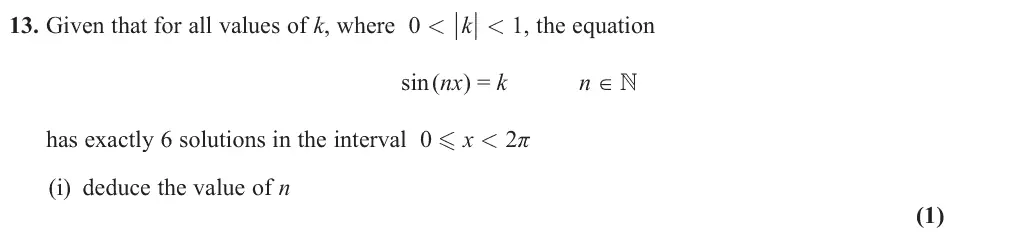
This question, which required an understanding of transformation and periodicity of trigonometric functions, gave learners the opportunity to think carefully and demonstrate a strong understanding of the topic. Part (i) was generally well answered with many responses evidencing use of graphs to help 1 deduce that n was 3. The most common incorrect answer was , even though the n = 3 question specified that n was a natural number. Learners would be well advised to pay careful attention to the constraints placed on unknowns in all questions. In part (ii), a good number of responses demonstrated that there were 30 solutions to the equation, although fewer were able to communicate their reasoning well enough. A significant minority arrived incorrectly at 30 by mistakenly assuming that there were 15 solutions to sin(nx) = k and 15 solutions to sin(nx) = –k, or sometimes 18 and 12 solutions respectively (the correct number of solutions being 16 and 14 respectively). Such responses scored one of the two available marks. An uncommon but elegant approach was to rewrite the quadratic in sin3x as a linear equation in cos6x, making it easier to explain why there are 30 solutions in the given interval. Another was to identify 2 3 as the period of sin2 3x and then scale up accordingly, which demonstrated an excellent understanding of periodicity. A small number did not realise that n was still equal to 3 in part (ii), and gave an answer in terms of n. A common incorrect approach involved the misapprehension that squaring sinx would also square the number of solutions, leading to an incorrect answer of 36. Many did not take the negative solutions into account and simplify multiplied 6 by 2.5 to obtain the incorrect answer of 15. More learners would have benefited from a well-drawn and labelled graph to support their thinking and reasoning.
Common mistakes
sin(nx) has n cycles in 0 to 2π, 2 solutions each, so n = 3
n = 1/3 is not a natural number
June 2025 · Paper 2 · Q13(ii)2 marks
Mark scheme (whole question; this part is marked with the orange bar)
Examiner's comment
This question, which required an understanding of transformation and periodicity of trigonometric functions, gave learners the opportunity to think carefully and demonstrate a strong understanding of the topic. Part (i) was generally well answered with many responses evidencing use of graphs to help 1 deduce that n was 3. The most common incorrect answer was , even though the n = 3 question specified that n was a natural number. Learners would be well advised to pay careful attention to the constraints placed on unknowns in all questions. In part (ii), a good number of responses demonstrated that there were 30 solutions to the equation, although fewer were able to communicate their reasoning well enough. A significant minority arrived incorrectly at 30 by mistakenly assuming that there were 15 solutions to sin(nx) = k and 15 solutions to sin(nx) = –k, or sometimes 18 and 12 solutions respectively (the correct number of solutions being 16 and 14 respectively). Such responses scored one of the two available marks. An uncommon but elegant approach was to rewrite the quadratic in sin3x as a linear equation in cos6x, making it easier to explain why there are 30 solutions in the given interval. Another was to identify 2 3 as the period of sin2 3x and then scale up accordingly, which demonstrated an excellent understanding of periodicity. A small number did not realise that n was still equal to 3 in part (ii), and gave an answer in terms of n. A common incorrect approach involved the misapprehension that squaring sinx would also square the number of solutions, leading to an incorrect answer of 36. Many did not take the negative solutions into account and simplify multiplied 6 by 2.5 to obtain the incorrect answer of 15. More learners would have benefited from a well-drawn and labelled graph to support their thinking and reasoning.
Common mistakes
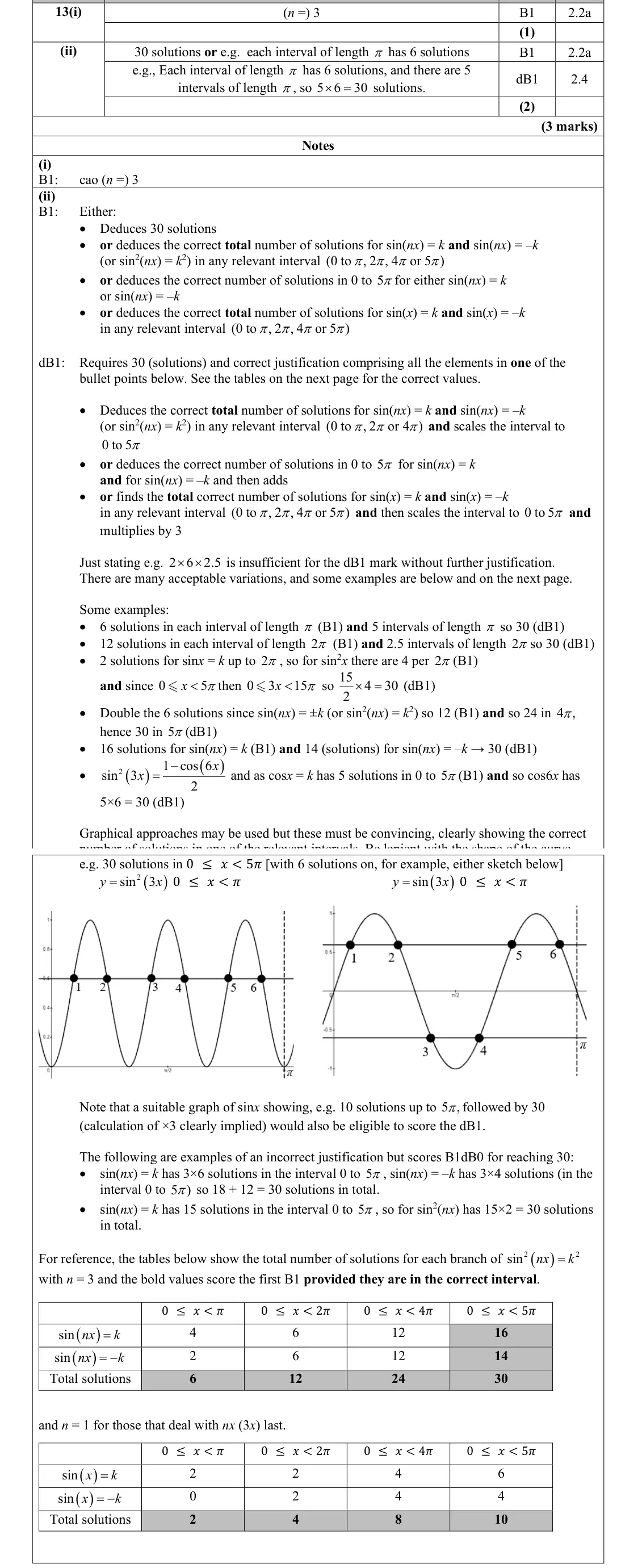
sin²(3x) = k² means sin 3x = ±k: 6 solutions per interval of length π, 5 intervals gives 30
justification needed (16 + 14, not 15 + 15 or 18 + 12)
36 and 15 are common wrong answers
a labelled sketch helps
June 2025 · Paper 2 · Q15(c)3 marks
Mark scheme (whole question; this part is marked with the orange bar)
Examiner's comment
The final question, which involved differentiation, integration by substitution and trigonometric identities, provided challenge in dealing with the algebra but, given its layout, proved accessible. The majority of learners attempted at least part of this question with some success due to the restart opportunities available. Part (c) proved to be more accessible for many learners, with many making an attempt after struggling with the earlier sections. Those who attempted this part often successful, regardless of their performance in parts (a) and (b). Common errors were with the coefficient, usually given as 1 2 - or 2, or when substituting the limits. Some tried to use double angle formulae to change the form of the integrand and therefore did not make progress with this part of the question, not realising that the given form in part (b) was designed to help them complete the integration. Despite the question asking the candidate to show all stages of their working, some responses did not show the substitution and so did not gain the last two marks.
Common mistakes
∫cos 2θ dθ = ½ sin 2θ (not −½ or 2)
substitute the θ limits, not ±1
area 1
the substitution must be shown (calculator answer alone scores 0)
June 2024 · AS Paper 1 · Q13(c)1 mark
Mark scheme (whole question; this part is marked with the orange bar)
Examiner's comment
The trigonometric equation, again, demonstrated how candidates are usually successful in solving these types of equations, however, they often struggle with the manipulation to show a given result. Part (c) was usually poorly attempted with the vast majority not evidencing an understanding of graph transformations and just adding 63.4 to 720 or multiplying 243.4 by 4 as this would give an angle in the required range.
Mark scheme (whole question; this part is marked with the orange bar)
Examiner's comment
This question involving the use of trigonometric identities and solving a trigonometric equation was generally very well answered with the exception of part (c). There were very few blank scripts. Part (c) was much less successful, with only a small number of candidates gaining any marks. Most candidates only identified one of the adaptations to the question: either the stretch or the increase in the range. The most common incorrect answer resulted from them multiplying their number of solutions by 5 to achieve a total of 10 solutions. Of those candidates who realised there were 30 solutions nearly all were able to give a satisfactory explanation.
Common mistakes
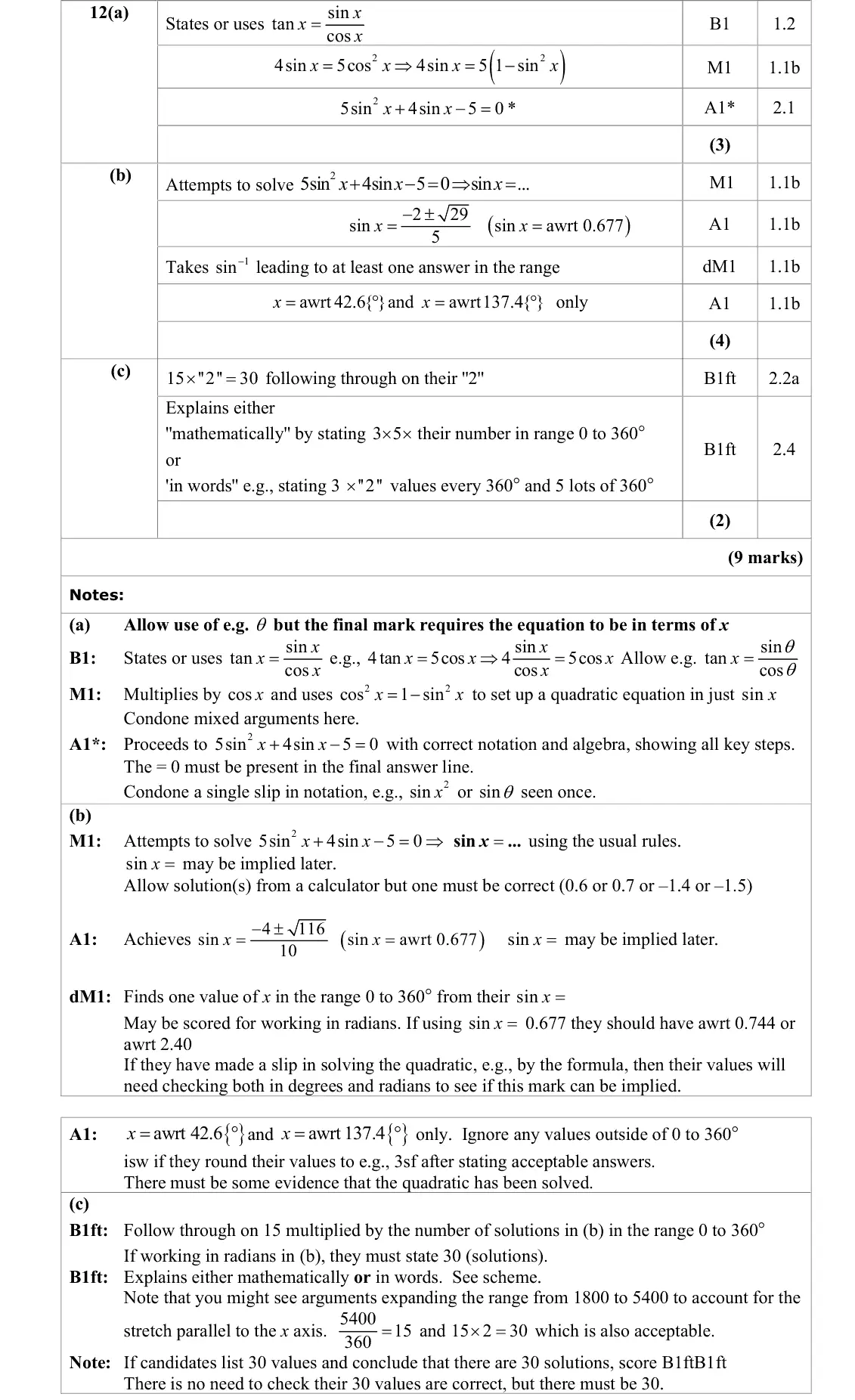
3x stretches: 3 periods per 360° and 1800° is 5 lots of 360°, so 15 × 2 = 30 solutions
multiplying by 5 only (10) is the common error
explanation required
June 2023 · Paper 1 · Q13(c)2 marks
Mark scheme (whole question; this part is marked with the orange bar)
Examiner's comment
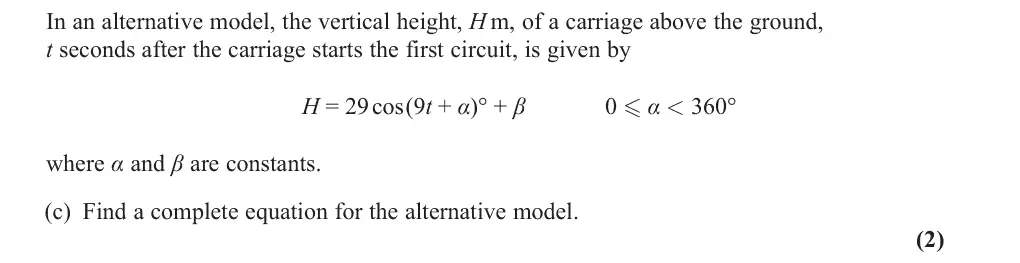
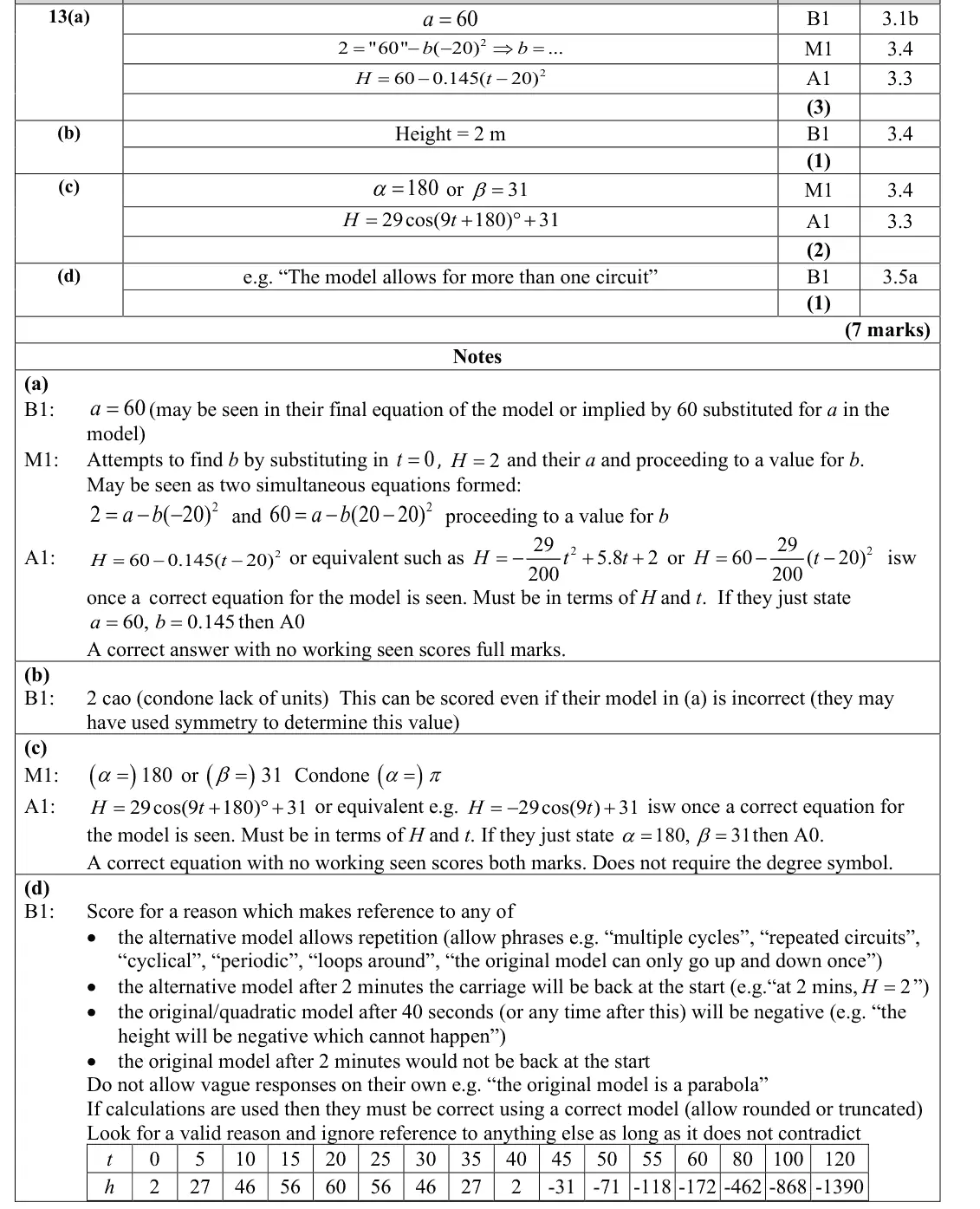
A significant number of candidates found this question very challenging, with a fair proportion of blank answers, and another significant number working with various substitutions in (a) that were quickly abandoned. Those who were able to work with both the quadratic and trigonometric models confidently were able to score highly and demonstrated a good understanding of how mathematics can be used to model real life contextual problems. In part (c), a significant number of candidates had no real idea how to start this. Many attempts involved fruitlessly expanding cos(9 ) t + but most candidates who successfully found and did not do this. The candidates who realised that when 60 H = , cos(9 ) 1 t + = which meant 31 = had the most success. Candidates who did this typically then substituted 20 t = into cos(9 ) 1 t + = to find a value of . Candidates who found one value typically found the other. There were a number of candidates who found the two values that did not ‘find a complete equation’ as the question required. However, there were a pleasing number of fully correct solutions, and almost all candidates who found and continued to give the full model.
Common mistakes
β = 31 (mid-height), α = 180 so that H = 2 at t = 0
June 2023 · Paper 2 · Q2(a)3 marks
Mark scheme (whole question; this part is marked with the orange bar)
Examiner's comment
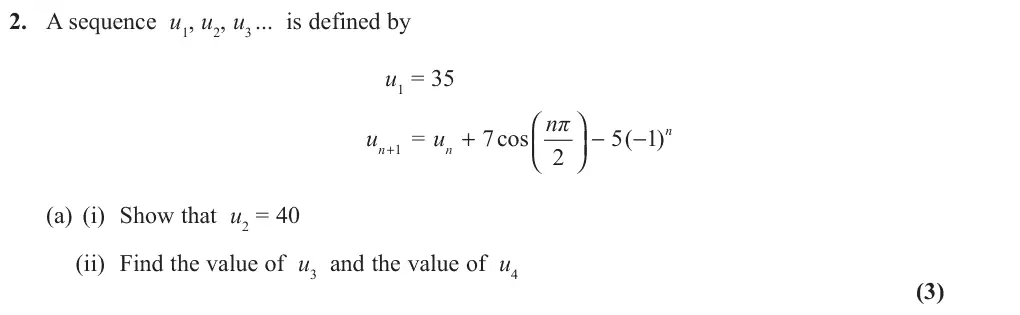
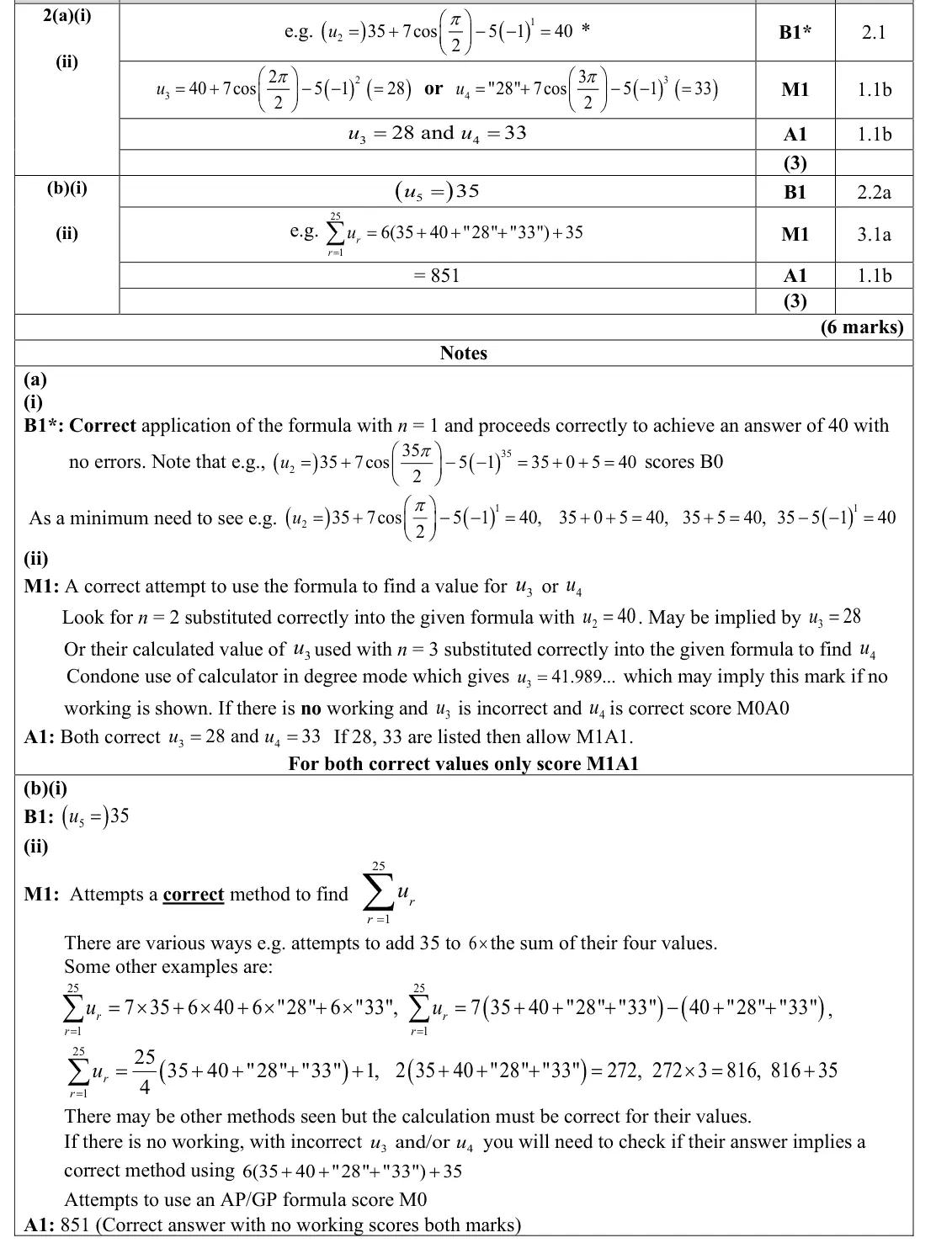
For the most part candidates answered this question well. This was dependent on whether they correctly understood the iteration formula. In part (a) (i), although many scored this first mark, there was a common misunderstanding of how a recurrence relationship works with confusion as to the meaning of n. Rather than term position, it was often confused with 𝑢𝑛 so that the incorrect calculation ( ) 35 2 35 35 7cos 5 1 2 u = + - - was often seen, giving the correct answer but obviously not scoring the B mark. Also not uncommonly seen was n replaced by 1 n u + , with candidates stating ( ) 40 2 40 40 7cos 5 1 2 u = + - - . The errors stated above also affected the performance of some candidates in part (ii). Furthermore, a minority of candidates had difficulty with accuracy in the sign of the final term, struggling with the odd/even power of -1 . For example, when calculating 3 u , ( ) 2 3 2 40 7cos 5 1 40 7 5 38 2 u = + - - = - + = , was not uncommon. Occasionally, candidates were seen to be working with degrees rather than radians, also leading to loss of the accuracy mark. In part (ii) many candidates recognised how to construct the arithmetic calculation to find the required sum. The most common of these attempts were: ( ) 1 2 3 4 1 6 u u u u u + + + + and ( ) 2 3 4 1 6 7 u u u u + + + Credit was given to candidates who used such ideas with incorrect values from earlier in the question for 3 u and 4 u , although those who had a wrong answer in (a)(i) who used their incorrect value for 2 u (rather than the given 2 40 u = ), lost both marks. It is important that centres make candidates aware that they must use the ‘show that’ answer in subsequent calculations no matter what they achieve in their working. Occasionally, candidates used ( ) 25 1 2 3 4 1 6.25 r r u u u u u = = + + + but these usually did not add 1 to give a fully correct method. Some also incorrectly tried summing the series as though the terms formed an arithmetic progression. Some candidates incorrectly multiplied (u1 + u2 + u3 + u4) by 4 instead of by 6. A minority forgot to add 35 to their total. A very small minority of candidates generated all the terms of the whole sequence and added them together.
Common mistakes
n is the term position: u₂ = 35 + 7cos(π/2) − 5(−1)¹ = 40 (using n = 35 scores 0 even though it gives 40)
u₃ = 28, u₄ = 33
work in radians
sign of (−1)ⁿ
June 2023 · Paper 2 · Q8(b)3 marks
Mark scheme (whole question; this part is marked with the orange bar)
Examiner's comment
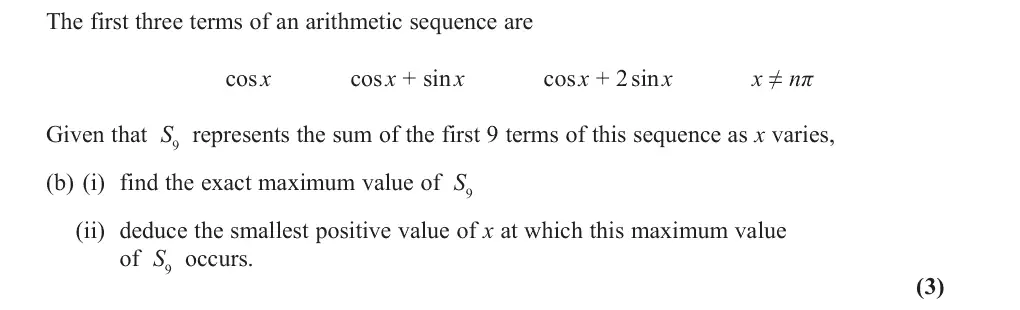
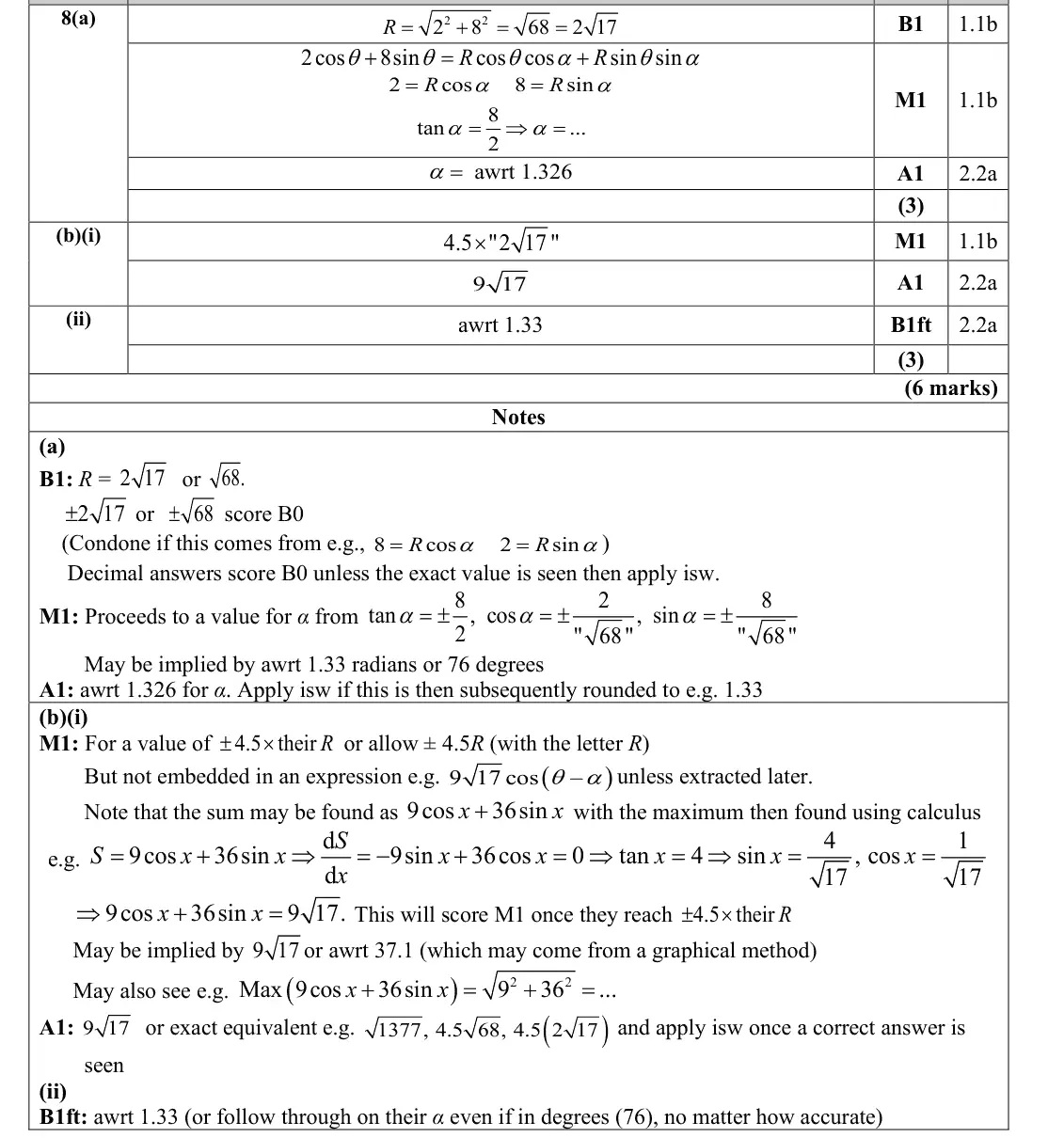
Candidates found part (b) more challenging, with many failing to link areas of mathematics, in this case trigonometry and series. Even where a candidate successfully found the sum, 9cos 36sin S x x = + , many did not relate it to part (a). Those who did recognise the form were usually able to get 4.5 " " R , usually 4.5 2 17 for part (i). Some seemed to misread the question and stated the minimum value, so lost the accuracy mark. A significant number of candidates found a correct expression in harmonic form but lost both the M1 and A1 as they kept a correct 9 17 embedded in their expression.
Common mistakes
common difference sin x: S₉ = 9cos x + 36sin x = 4.5(2cos x + 8sin x), so max = 4.5R = 9√17 (not left embedded in an expression)
occurs when x = α ≈ 1.33
many did not link to (a)
giving the minimum
June 2023 · Paper 2 · Q14(b)4 marks
Mark scheme (whole question; this part is marked with the orange bar)
Examiner's comment
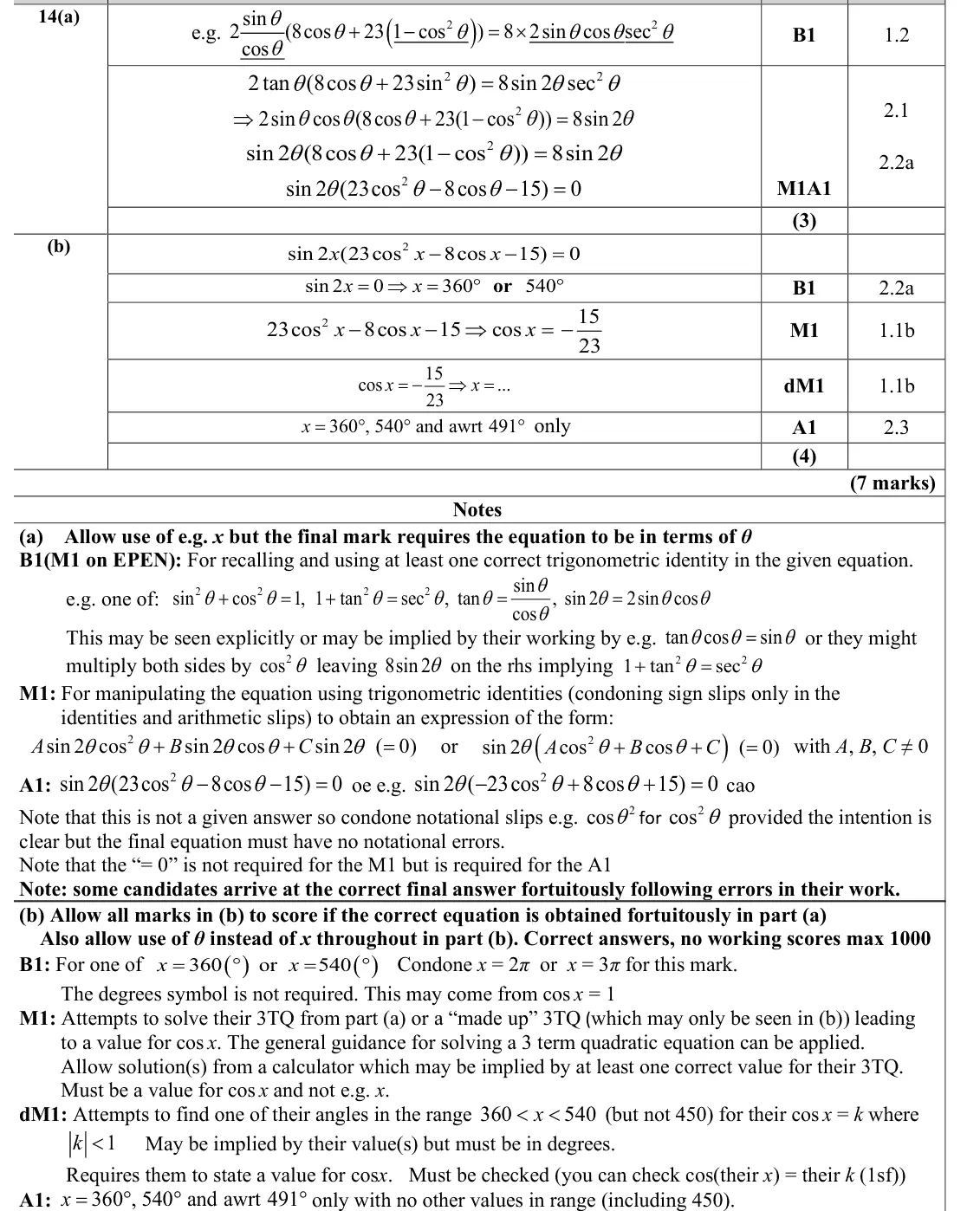
Part (b) was generally done well by the candidates who managed to obtain a quadratic in part (a), with many candidates correctly solving to get 360 or 540, and then solving their quadratic. Those who found a solution to their quadratic also tended to find solutions based on that within the specified set of values. Where marks were lost, it was often by incorrectly including extra values,in particular the value of 450 degrees which had been specifically excluded in the question.
Common mistakes
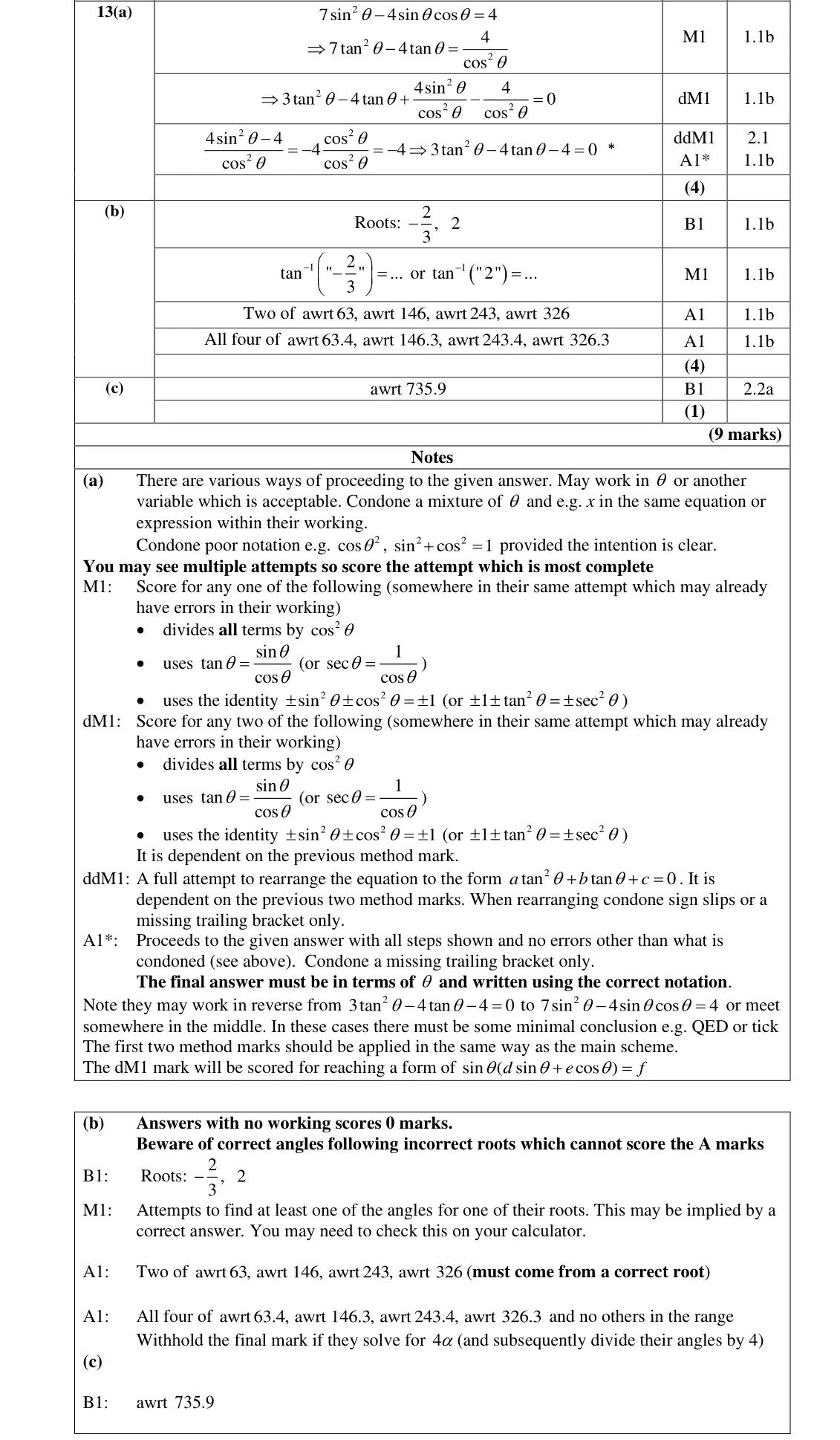
sin2x = 0 gives 360° and 540° (450° is excluded: tan x undefined)
the quadratic factorises as (23cos x + 15)(cos x − 1), cos x = −15/23 gives 491°
answers 360°, 491°, 540° only, including 450° is the common error
June 2023 · Paper 2 · Q153 marks
Mark scheme (whole question; this part is marked with the orange bar)
Examiner's comment
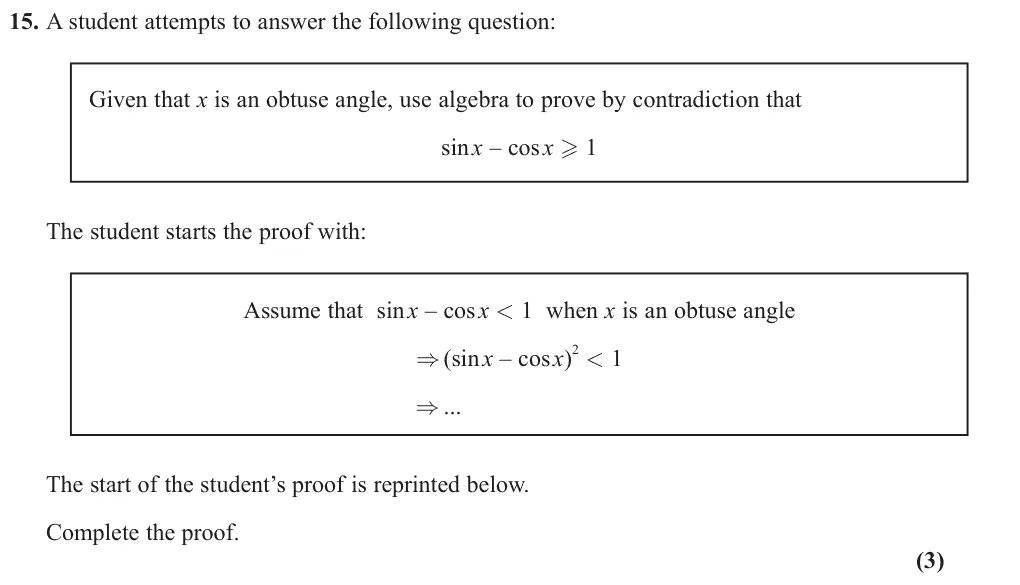
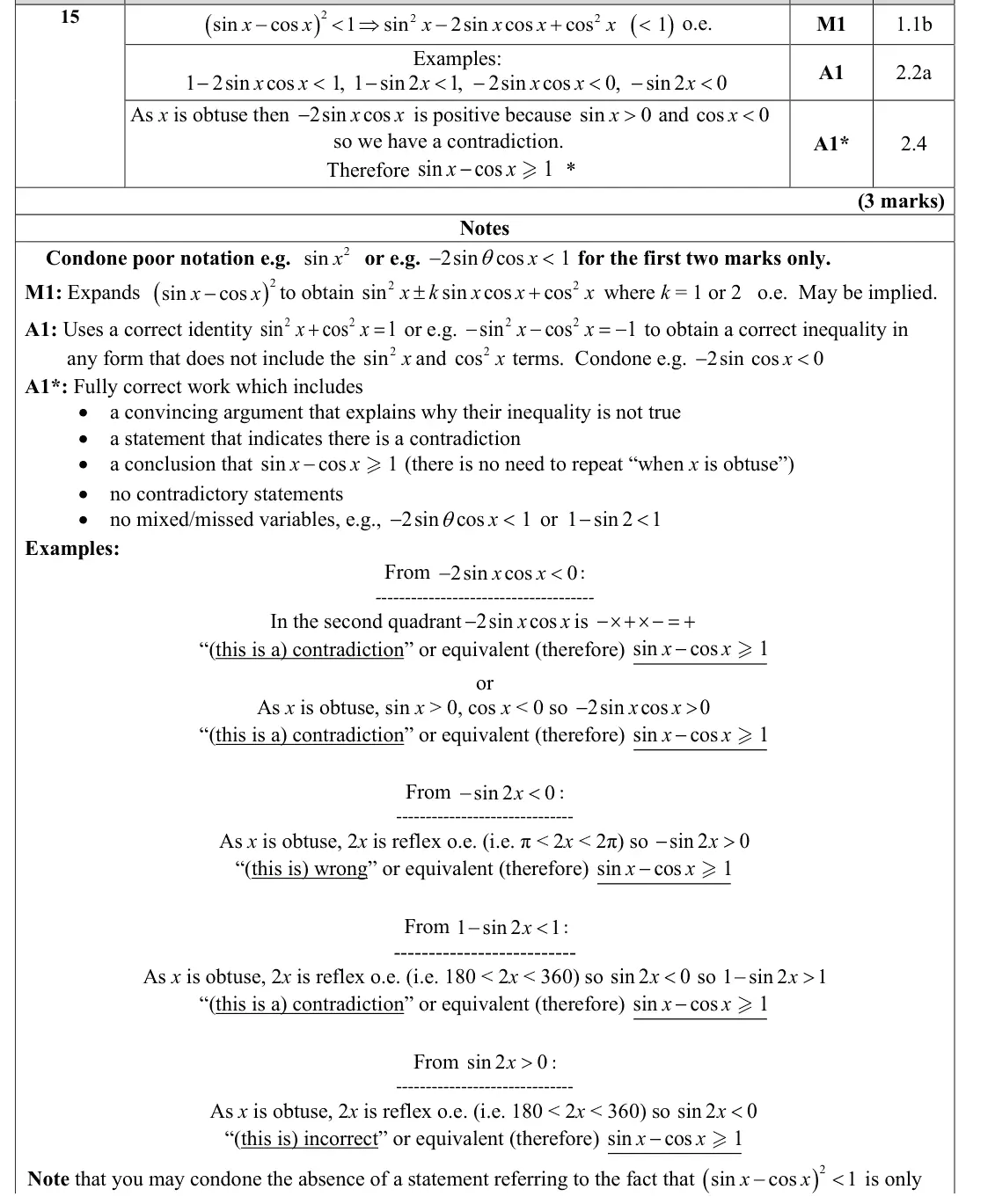
A number of candidates lost all marks on this question by not attempting any solution. Most candidates correctly expanded the given expression and used sin2 x + cos2 x = 1 to simplify and score the first two marks. A small number incorrectly used (sin x - cos x)2 = sin2 x - cos2 x, scoring no marks. Others attempted to substitute values of 90 and 180 into the given expression instead of using algebraic manipulation. Whilst most candidates scored the first two marks, only the very best were able to score the final mark, with most candidates failing to offer a convincing reason for a contradiction. Candidates who drew a graph of sin x and cos x or sin 2x to support their understanding tended to score well. Successful candidates typically explained that 2x must be between 180 and 360, and hence sin 2x must be negative, which is a contradiction with their inequality. Those that worked with sin x cos x were generally more successful in achieving this mark than those who chose to use sin2x. However, it was clear that not all students understood what an obtuse angle was. Another typical correct conclusion involved candidates stating if x is obtuse, sin x must be positive and cos x must be negative, leading to a negative product and a contradiction. Of those who were able to offer a reason for the contradiction, some still lost the final A mark for failing to then reach a conclusion that the original statement was true or because of errors in the proof such as missing x’s or mixed variables.
Common mistakes
expand (sin x − cos x)² = sin²x − 2sinxcosx + cos²x (not sin²x − cos²x)
use sin²x + cos²x = 1 to get −2sinxcosx < 0
obtuse so sin x > 0, cos x < 0 (or 180° < 2x < 360°, sin2x < 0): contradiction, so sin x − cos x ≥ 1
substituting 90° and 180° is not a proof
many did not explain the contradiction
June 2022 · Paper 1 · Q14(a)4 marksMedium
Mark scheme (whole question; this part is marked with the orange bar)
Examiner's comment
This question was another big discriminator. Good candidates found it familiar and accessible with some 25% scoring full marks. Strangely, for candidates who dropped marks, they seemed to be able to do either part (a) or part (b), but not both. For those candidates who attempted part (a) most recognised the need to use the compound angle expansions. Carelessness with the multiplication by 2, signs and use of the formulas was seen in a small minority of the scripts. Students who attempted to use sin (A+B) and cos (A+B) with a negative angle B, often introduced sign errors; it is clear that such a method is not to be recommended. Substituting exact numerical values was usually correct, however candidates occasionally fudged their working to get the given answer.
Common mistakes
expand both compound angles
exact values of sin/cos 30° and 60°
collect terms and use tan x = sin x/cos x
doubling slips and fudging to the given answer
June 2022 · Paper 1 · Q16(b)4 marksHard
Mark scheme (whole question; this part is marked with the orange bar)
Examiner's comment
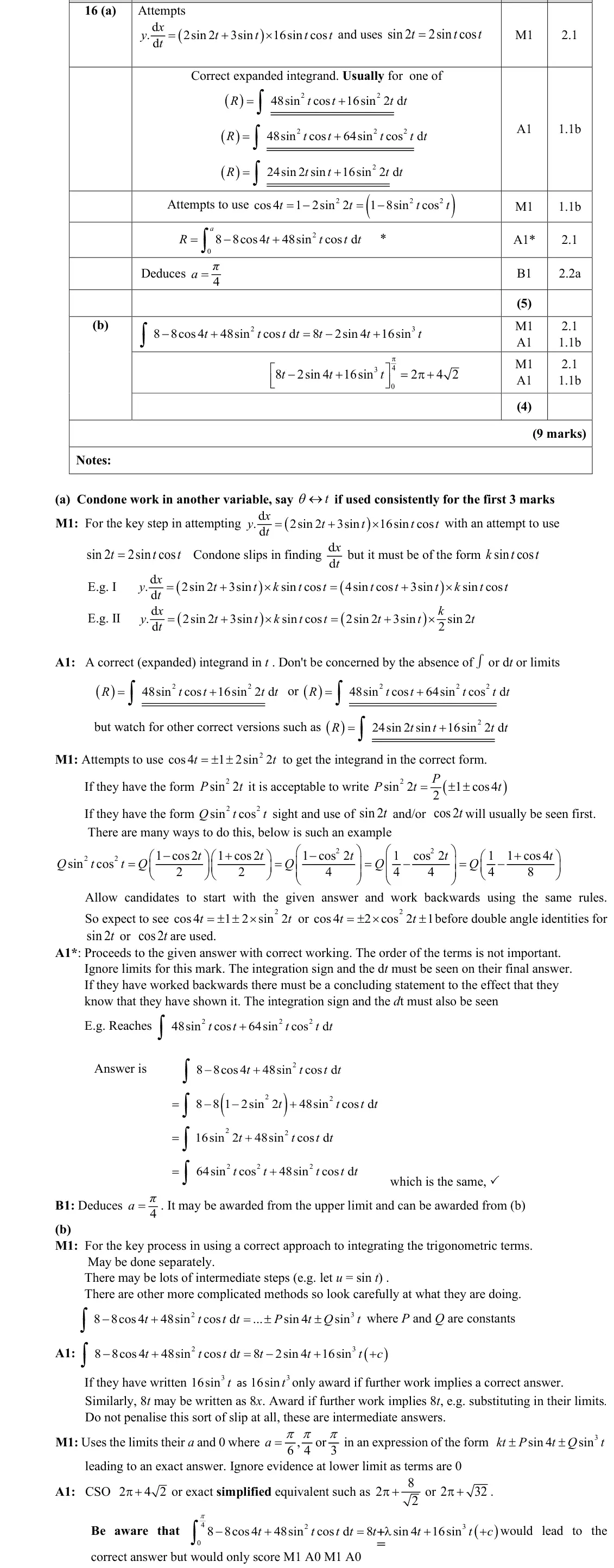
The final question on the paper proved to be a challenge for many candidates and there were several blank responses seen. It is possible that this was due to time management. Some candidates attempted unsuccessfully to change to a Cartesian equation, suggesting that possibly parametric integration had not been covered. It was good to see students who were unsuccessful at part (a) still attempting part (b), and in some cases scoring full marks. Most candidates were able to integrate the first two terms correctly, but a significant proportion were unable to integrate the third term to get an expression in 3 sin .t The majority of correct solutions came from the use of the reverse chain rule for the final term. Those who attempted to use integration by substitution or by parts were usually unsuccessful. Candidates who had successfully completed the integration often went on to score full marks.
Common mistakes
8t − 2 sin 4t + 16 sin³t by reverse chain rule on 48 sin²t cos t (by parts/substitution rarely worked)
limits 0 and π/4: 2π + 4√2 exact
June 2022 · Paper 2 · Q6(a)4 marks
Mark scheme (whole question; this part is marked with the orange bar)
Examiner's comment
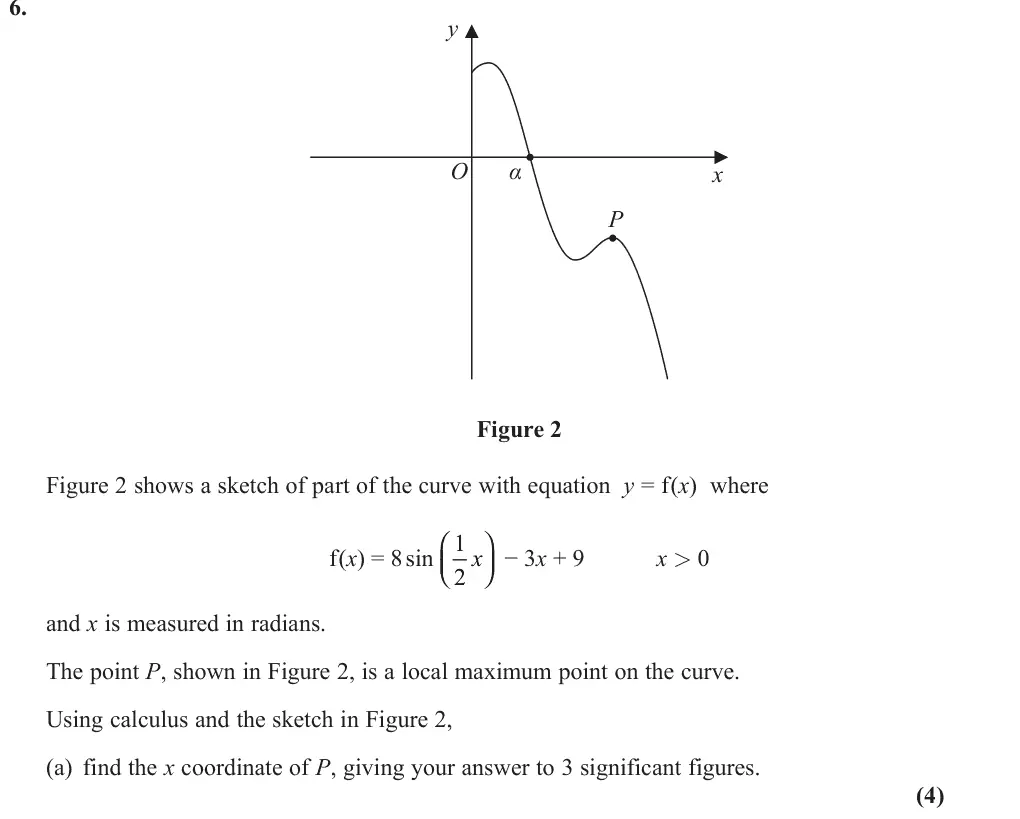
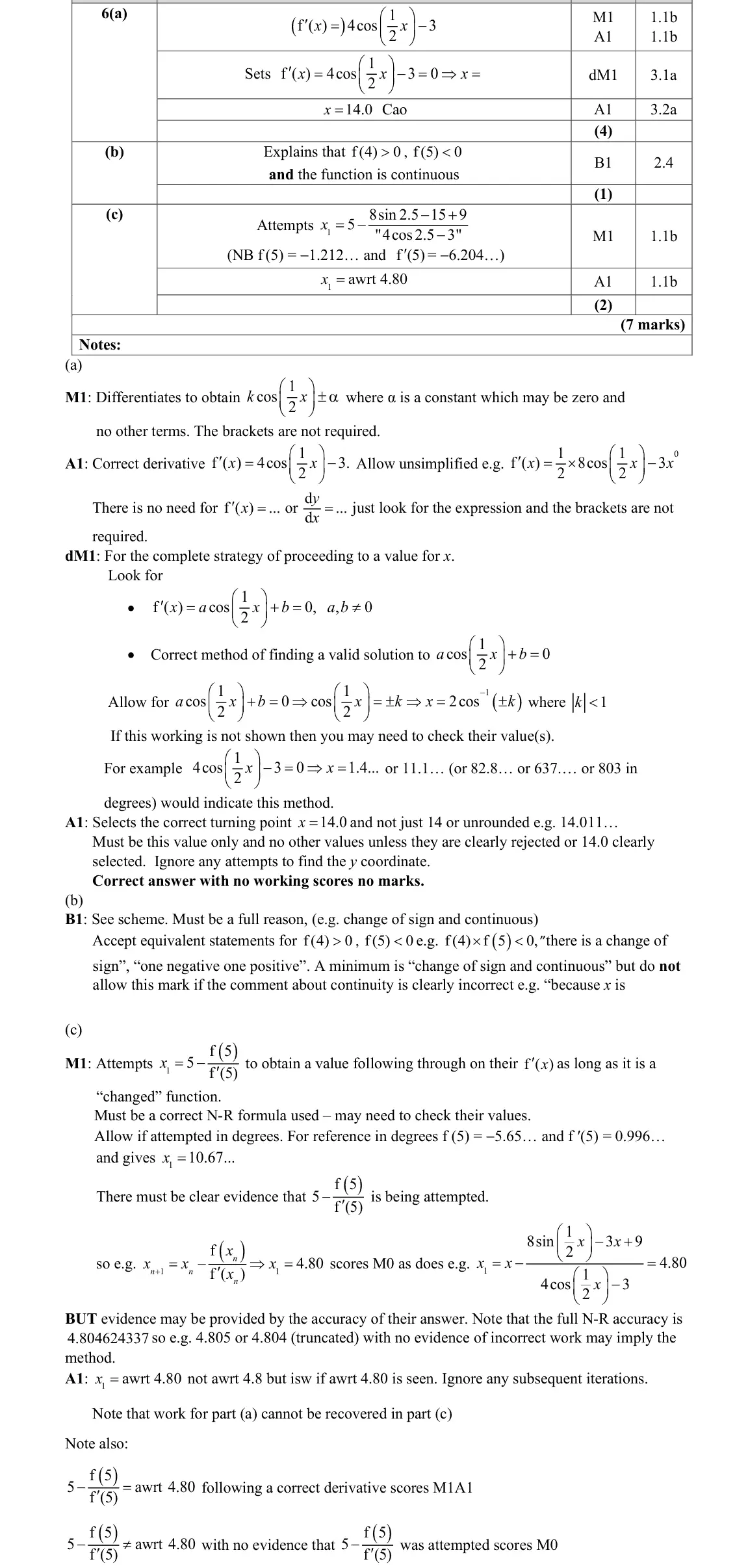
Part (a) was generally well done with many candidates scoring 3 out of 4 but very few scoring 4 out of 4. Candidates generally understood that the question required an initial differentiation and this was done correctly on the whole. However, incorrect attempts at differentiation included: • 16cosቀ 1 2 𝑥𝑥ቁ-3 • 8cosቀ 1 2 𝑥𝑥ቁ-3 • -4cos ቀ 1 2 𝑥𝑥ቁ-3 Candidates also understood that they had to set their derivative to zero which required a combination of manipulating the algebra, applying arccos, and doubling their answer. The difficulty encountered in this part was the recognition that it was the 3rd solution which was required and most gave either the 1st or 2nd turning point. As a diagram was given in the question, candidates should use this to help them understand what is required. Some students who gave the 1st turning point also checked by further differentiation that their point was a maximum. A few candidates unnecessarily found the corresponding y value for their x value. In establishing their value of x, it was disappointing to see all of the following: • candidates halving instead of doubling • using degrees • arriving at a correct answer but leaving it as 14.01 instead of 14.0
Common mistakes
f′(x) = 4cos(½x) − 3 (not 8cos or 16cos)
cos(½x) = ¾, double (not halve) the angle
use the sketch to pick the third turning point x = 14.0 (not 1.45 or 11.1)
radians
14.0 not 14 or 14.01
June 2022 · Paper 2 · Q9(a)4 marks
Mark scheme (whole question; this part is marked with the orange bar)
Examiner's comment
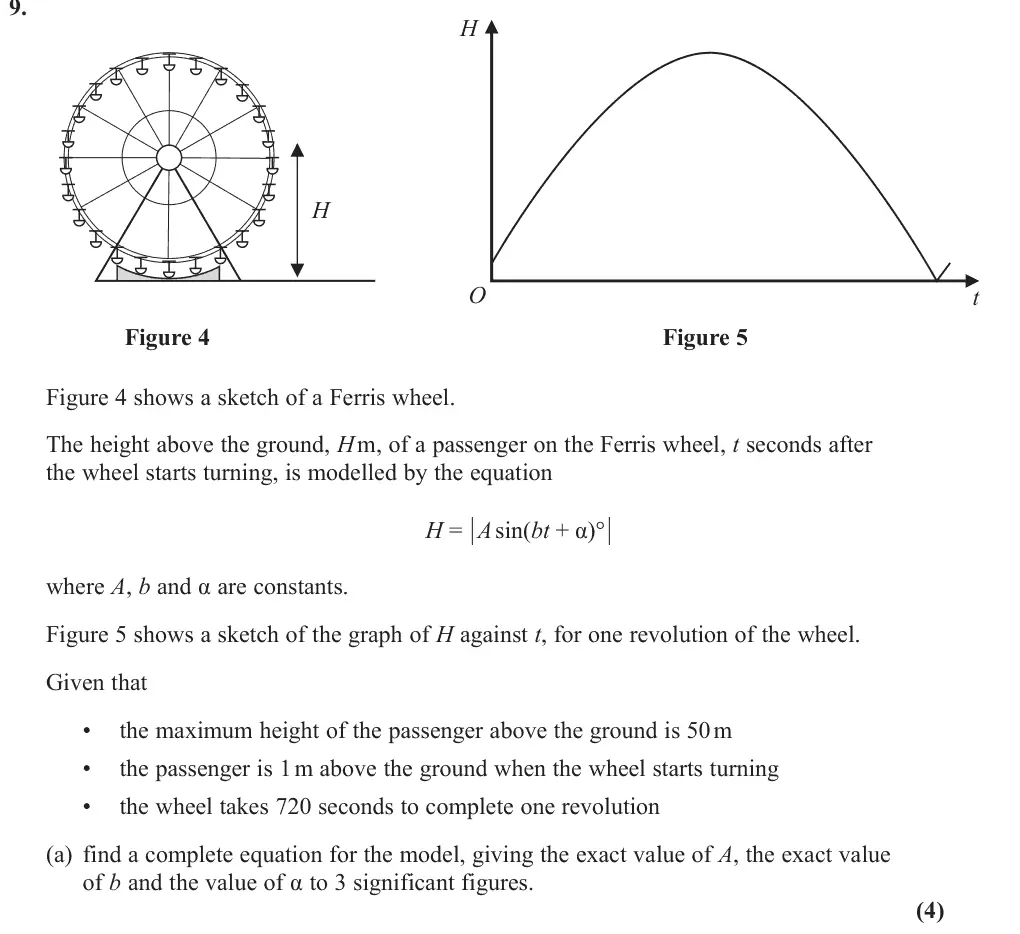
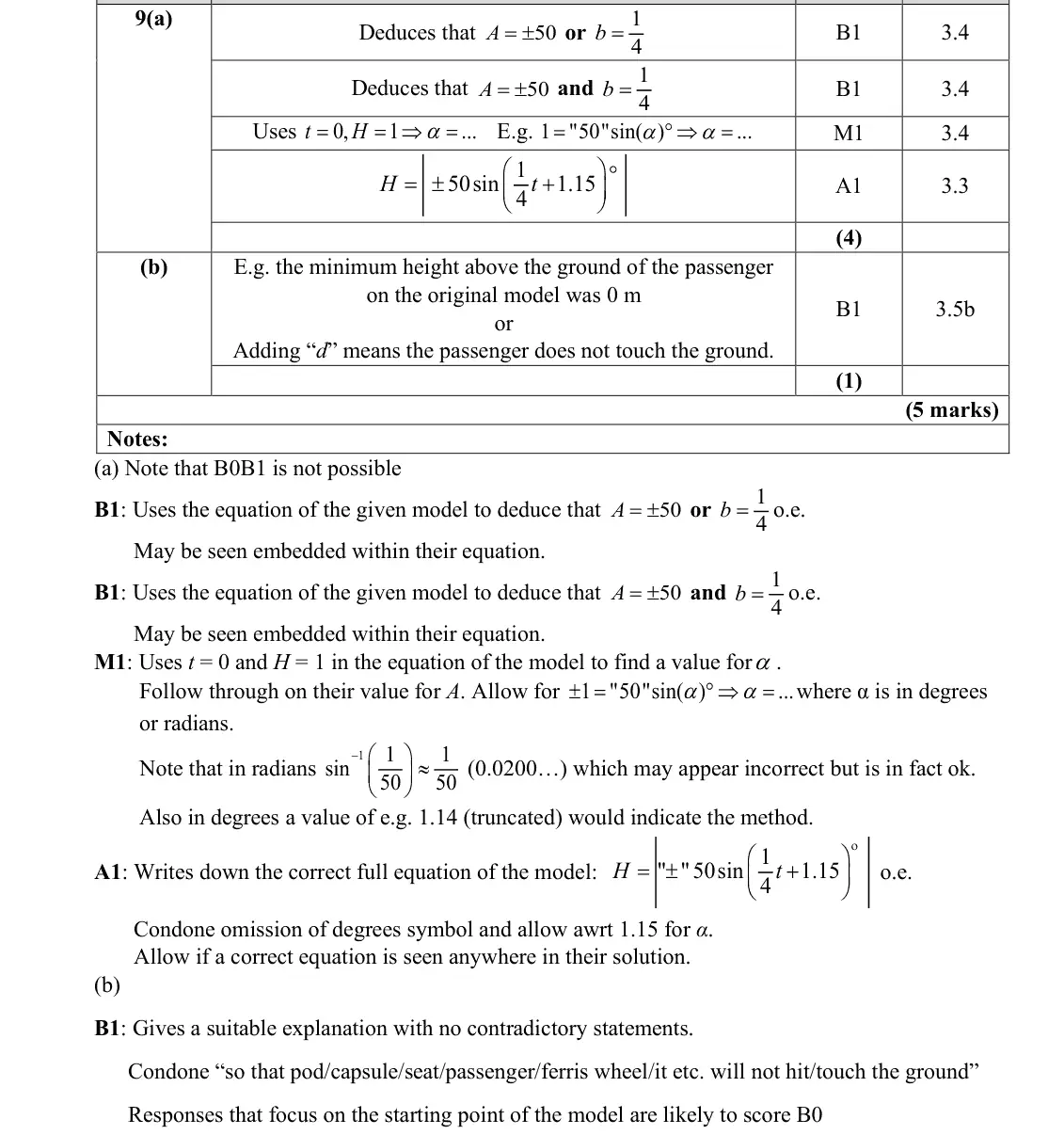
This was a challenging question for the majority of the candidates with very few scoring most 1 or 2 marks. These were the initial B1 mark for realising that 𝐴𝐴= 50, however all four of the marks in part (a). For those that attempted the question, most scored at many wrote that 𝐻𝐻= 50 and did not relate that 𝐻𝐻 meant 𝐴𝐴. The second B mark for finding a value for 𝑏𝑏 was very poorly answered, with many not realising a simple 720 was needed and attempted to use an ‘𝑅𝑅-𝛼𝛼’ method or failed to take 180 calculation of d𝐻𝐻 into account transformations of the sine function, showing a lack of understanding of d𝑡𝑡 with very limited success. A the properties of the sine wave. Some also tried to use small minority of students achieved b = 1/4. The best answers tended to use transformation arguments, recognising that the full cycle depicted must represent a scale factor of 4 though many students attempting this approach did not appreciate the effect of the modulus in determining the value of b, obtaining instead a value of b = ½. A common incorrect method came from consideration of the wheel taking 720 seconds to complete 1 revolution leading candidates to solve the equation 720b + 1.15 = 180 or from thinking that the maximum occurs at t = 360 leading to 360b + 1.15 = 90. Of those 𝜋𝜋 2𝜋𝜋 that managed to access the question, few mixed radians with degrees and managed to 720 or 720, which scored no marks. 1010 was the most common mark profile for this question, as a significant number of students went on to find 𝛼𝛼 correctly give an answer as (albeit occasionally in radians) as they were able to spot that at 𝑡𝑡= 0, 𝐻𝐻= 1. Sadly, a few that did achieve all three elements did not conclude with an equation of the model and so lost the (easy) last mark, with this final mark being scored very rarely, at less than 5% of the cohort (the second least commonly scored mark in the paper). In part (b), many candidates incorrectly referred to the fact that the passenger was 1 m above the ground and related the value of 𝑑𝑑 to this fact, for the most part because they had not appreciated that the original model already took this into account. Some responses referred to the fact that the height needed to be a positive value or could not There were many attempts at part (b) without any attempt at part (a). It was unfortunately quite common that responses to this part were very difficult to read and centres need to stress to candidates that work cannot be awarded marks if it is illegible.
Common mistakes
A = 50
the modulus means one revolution is half a sine period, so 180/b = 720 gives b = ¼ (not ½ or 1/720)
α from 1 = 50 sin α, α = 1.15 (degrees)
give the full equation H = modulus of 50 sin(¼t + 1.15)°
June 2022 · Paper 2 · Q15(b)2 marks
Mark scheme (whole question; this part is marked with the orange bar)
Examiner's comment
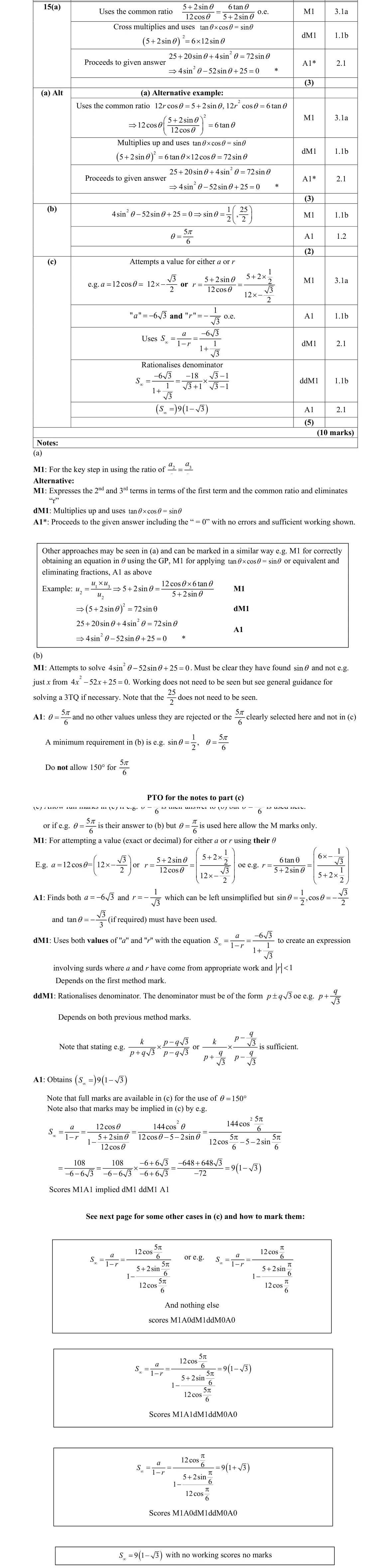
The majority of candidates found this question accessible and were able to score consistently throughout. Where marks were lost they were usually in parts (b) and (c). 12𝑐𝑐𝑐𝑐𝑐𝑐𝑐𝑐= 5+2𝑠𝑠𝑠𝑠𝑠𝑠𝑠𝑠 6𝑡𝑡𝑎𝑎𝑎𝑎𝑎𝑎 Part (a) was attempted successfully by most candidates, starting usually with 5+2𝑠𝑠𝑠𝑠𝑠𝑠𝑠𝑠. Candidates then successfully cross multiplied and used the was 6𝑡𝑡𝑡𝑡𝑡𝑡𝑡𝑡= 12𝑐𝑐𝑐𝑐𝑐𝑐𝑐𝑐ቀ 12𝑐𝑐𝑐𝑐𝑐𝑐𝑐𝑐ቁ 2 5+2𝑠𝑠𝑠𝑠𝑠𝑠𝑠𝑠 appropriate identity to reach the required result. Another starting point regularly seen . Errors in the proof were rare if candidates started from a correct statement. Occasionally the “ = 0” was carelessly missing. 𝜋𝜋 In part (b) most candidates correctly solved the equation either by factorising or using 6 rather than the required 5𝜋𝜋 5𝜋𝜋 calculator technology, but many reached the acute angle 6 . Others found a number of solutions but failed to identify 6 as the obtuse angle of 𝜋𝜋 required answer. A few candidates worked in degrees and again lost the accuracy mark. 6 in (b) then usually carried this error into (c) and 𝜋𝜋 Those who had obtained an angle of 6 in (c) often would reach 9൫1 + sqrt 3൯, but did not seem to worry that this did not match the required answer were in a position only to earn the method marks. Candidates using format given in the question. There were many attempts, however, to use the correct formula for the sum to infinity with appropriate values for the first term and the (often incorrectly) algebraic expressions for the sum to infinity involving 𝜃𝜃, without common ratio. Some candidates unfortunately put effort into finding and rearranging 𝑎𝑎 1+𝑟𝑟 incorrectly as the formula substituting an angle in, gaining no credit, and others used for the sum to infinity. The most common mistake in (c) was failure to show the steps 3 ൰ straight into their calculators to obtain 9 -9 sqrt 3 losing the last two marks in -6 sqrt 3 where the denominator was rationalised. Many candidates clearly typed an expression 1-൬- sqrt 3 like the question.
Common mistakes
sinθ = ½ (25/2 impossible)
θ obtuse so 5π/6, not π/6 or 150°
June 2022 · Paper 2 · Q15(c)5 marks
Mark scheme (whole question; this part is marked with the orange bar)
Examiner's comment
The majority of candidates found this question accessible and were able to score consistently throughout. Where marks were lost they were usually in parts (b) and (c). 12𝑐𝑐𝑐𝑐𝑐𝑐𝑐𝑐= 5+2𝑠𝑠𝑠𝑠𝑠𝑠𝑠𝑠 6𝑡𝑡𝑎𝑎𝑎𝑎𝑎𝑎 Part (a) was attempted successfully by most candidates, starting usually with 5+2𝑠𝑠𝑠𝑠𝑠𝑠𝑠𝑠. Candidates then successfully cross multiplied and used the was 6𝑡𝑡𝑡𝑡𝑡𝑡𝑡𝑡= 12𝑐𝑐𝑐𝑐𝑐𝑐𝑐𝑐ቀ 12𝑐𝑐𝑐𝑐𝑐𝑐𝑐𝑐ቁ 2 5+2𝑠𝑠𝑠𝑠𝑠𝑠𝑠𝑠 appropriate identity to reach the required result. Another starting point regularly seen . Errors in the proof were rare if candidates started from a correct statement. Occasionally the “ = 0” was carelessly missing. 𝜋𝜋 In part (b) most candidates correctly solved the equation either by factorising or using 6 rather than the required 5𝜋𝜋 5𝜋𝜋 calculator technology, but many reached the acute angle 6 . Others found a number of solutions but failed to identify 6 as the obtuse angle of 𝜋𝜋 required answer. A few candidates worked in degrees and again lost the accuracy mark. 6 in (b) then usually carried this error into (c) and 𝜋𝜋 Those who had obtained an angle of 6 in (c) often would reach 9൫1 + sqrt 3൯, but did not seem to worry that this did not match the required answer were in a position only to earn the method marks. Candidates using format given in the question. There were many attempts, however, to use the correct formula for the sum to infinity with appropriate values for the first term and the (often incorrectly) algebraic expressions for the sum to infinity involving 𝜃𝜃, without common ratio. Some candidates unfortunately put effort into finding and rearranging 𝑎𝑎 1+𝑟𝑟 incorrectly as the formula substituting an angle in, gaining no credit, and others used for the sum to infinity. The most common mistake in (c) was failure to show the steps 3 ൰ straight into their calculators to obtain 9 -9 sqrt 3 losing the last two marks in -6 sqrt 3 where the denominator was rationalised. Many candidates clearly typed an expression 1-൬- sqrt 3 like the question.
Common mistakes
a = −6√3, r = −1/√3 (modulus less than 1)
S∞ = a/(1 − r) and rationalise the denominator to 9(1 − √3)
using θ = π/6 gives 9(1 + √3), which does not match the given form
steps must be shown, not calculator
Oct 2021 · AS Paper 1 · Q7(a)3 marks
Mark scheme (whole question; this part is marked with the orange bar)
Examiner's comment
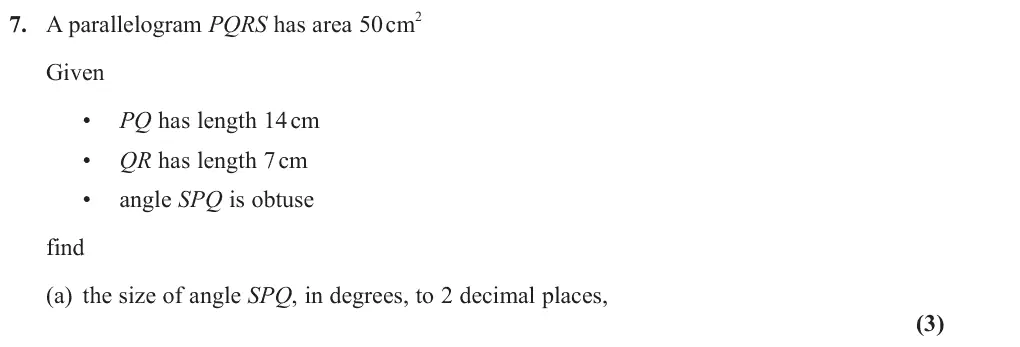
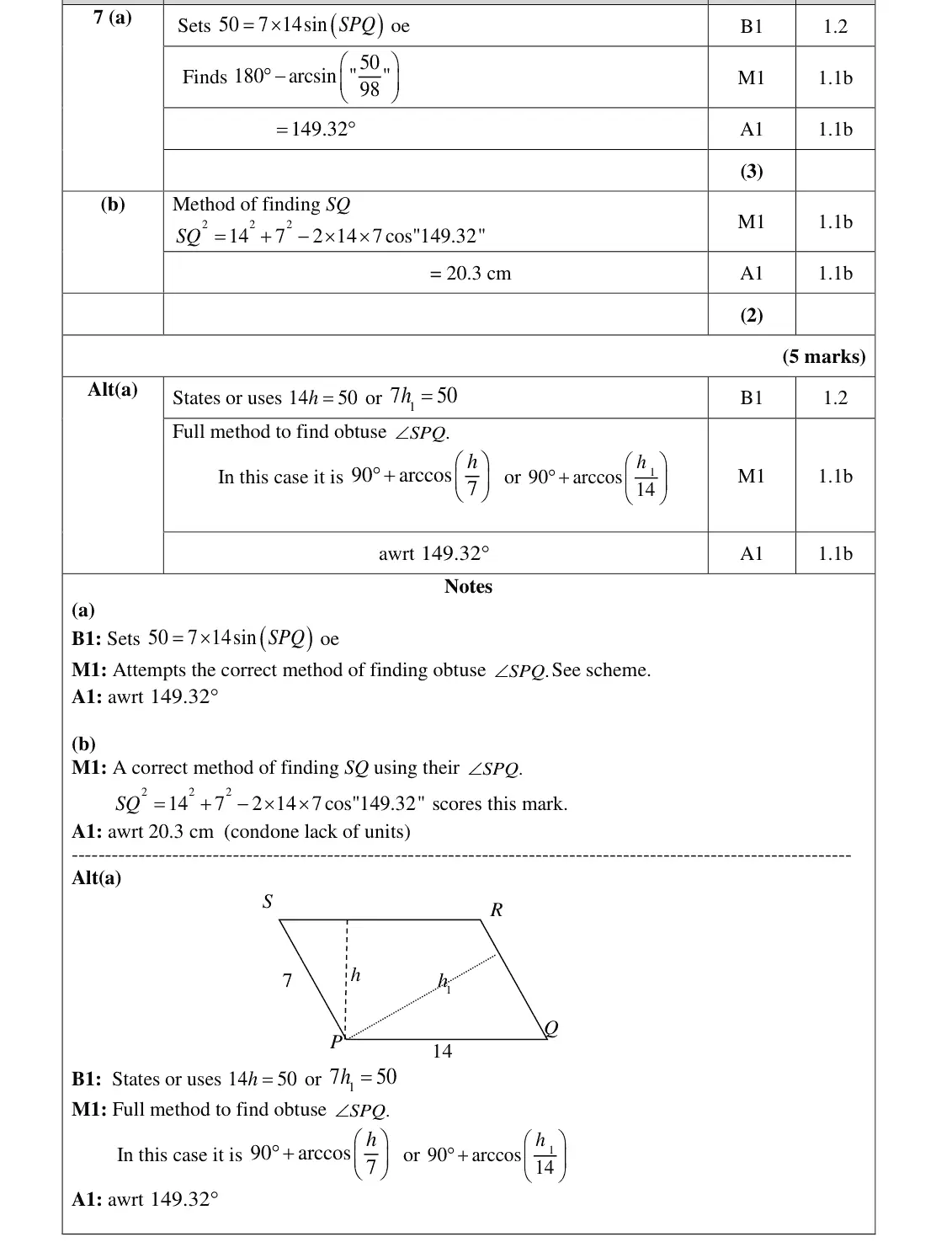
Question 7 was testing a candidate’s ability to apply trigonometry to solve a problem relating to a parallelogram. This was one of the most challenging questions on the paper and was largely as a result of the candidates having to draw their own diagram. In part (a) there were many incorrect diagrams to begin with, which included incorrect labelling of the vertices. Some tried to find the required angle by splitting the parallelogram into a rectangle and two triangles. However, they made little progress with this and often just stopped. Other candidates who did correctly set up an equation using the sine rule, then forgot to find the obtuse angle. Some subtracted the acute angle from 360°.
Common mistakes
draw your own diagram
area of parallelogram = 14 × 7 × sin SPQ = 50 (not ½ab sin C)
obtuse angle is 180° − arcsin(50/98) = 149.32°
not 360° minus the acute angle
Oct 2021 · AS Paper 1 · Q12(ii)(b)2 marks
Mark scheme (whole question; this part is marked with the orange bar)
Examiner's comment
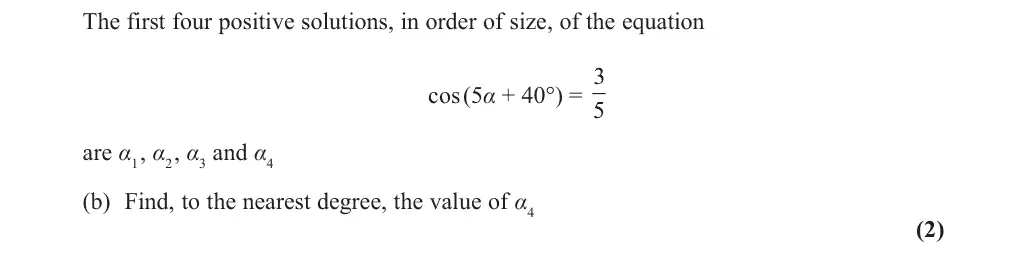
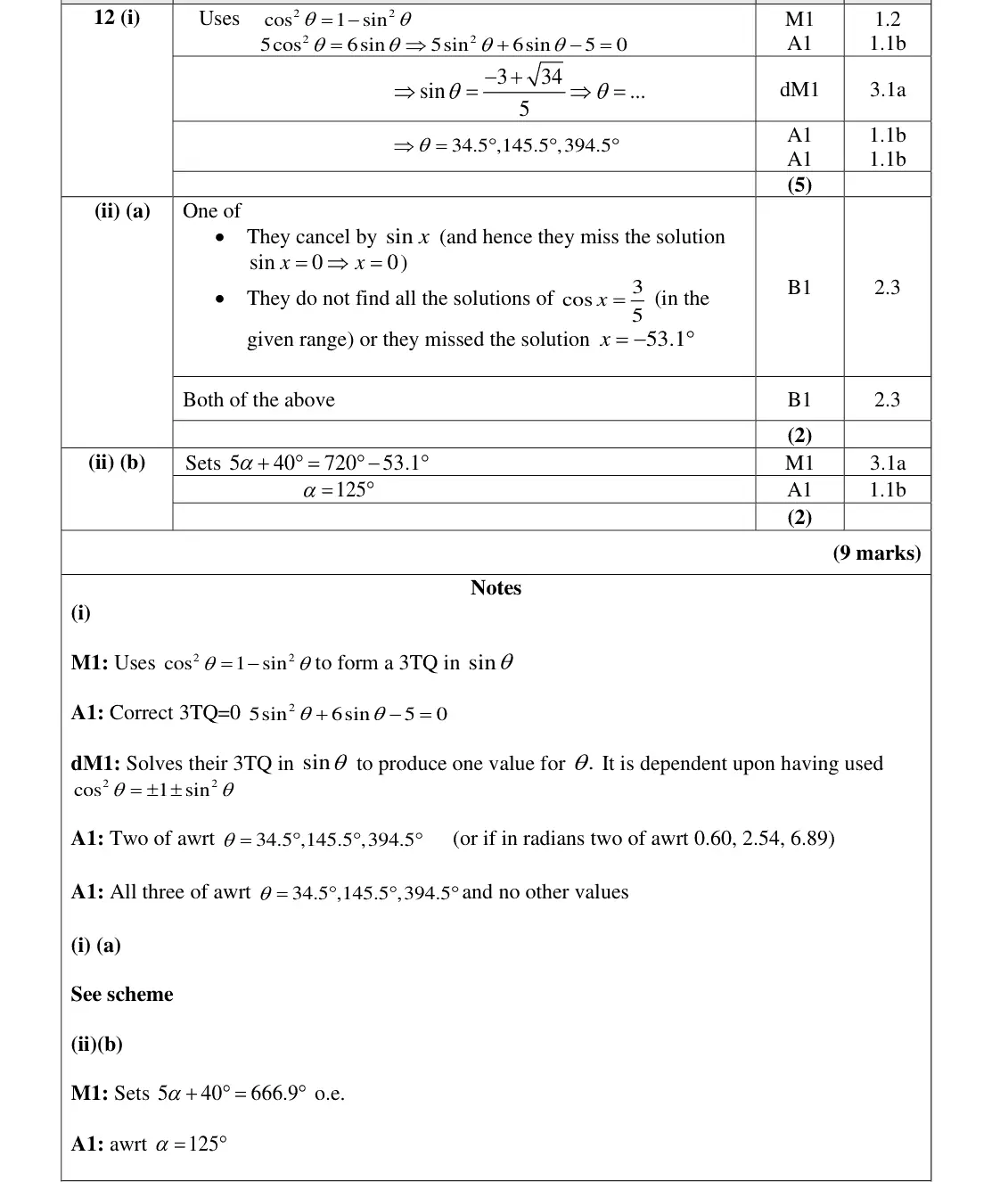
Candidates were usually able to make good progress on the first half of this question on solving trigonometric equations, but they tended to run into problems halfway through. It was rare for full marks to be scored, although most were able to score around half of the available marks. In part (i), nearly all candidates were able to proceed to the correct quadratic in sin , although the occasional candidate tried to incorrectly substitute sin into the right- = - 1 cos hand side of the equation. Most candidates were able to apply the quadratic formula and proceed to finding all three angles. Some found additional angles, which even if they are outside the range, prevent full marks from being scored. Most candidates seemed to opt for sketching trigonometric graphs to find the other angles as opposed to using the CAST diagram. Part (ii)(a) was poorly answered, however. Most candidates failed to score either mark, although those who did were usually able to make some reference to cancelling out sin x . Just stating that not all the angles had been found was insufficient explanation as to the errors made so candidates should be encouraged to provide greater detail if they are able to do so. Part (ii)(b) was attempted by most candidates, with many able to equate to the correct angle, rearrange and proceed to the correct answer. There were a number who equated to several angles, but either did not make their final answer clear, or did not rearrange to find the required angle. 8
Common mistakes
5α + 40° = 720° − 53.1° for the fourth positive solution, giving α = 125°
list the solutions in order and rearrange for α
make the final answer clear
Oct 2021 · Paper 1 · Q10(b)4 marks
Mark scheme (whole question; this part is marked with the orange bar)
Examiner's comment
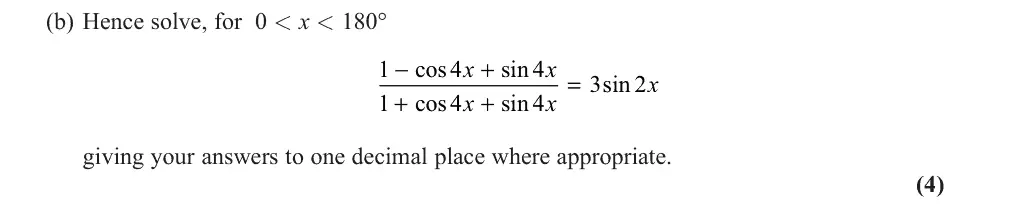
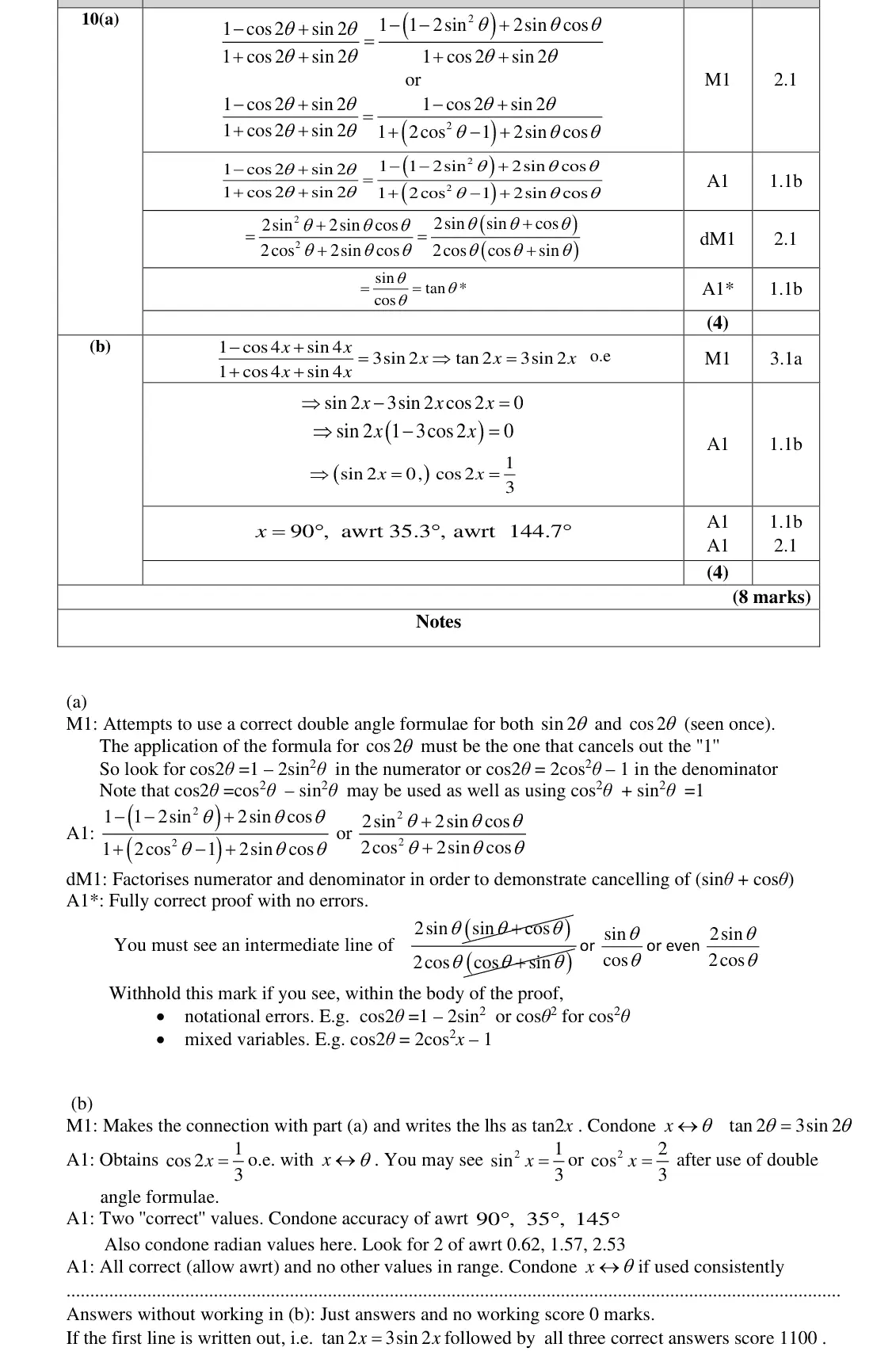
This was found to be another discriminating question. Those who were familiar with the topic made good progress yet there were many other attempts that scored no marks at all. Part (b) A significant number of candidates used the result of (a) correctly and started their solution with tan2x=3sin2x. However, it was also the case that tanx =3 sin2x was seen several times as well. Of those candidates who started correctly with tan2x = 3sin2x, the significant majority simply cancelled out the resulting factor of sin2x and in so doing neglected to consider the possibility that sin2x=0 and in so doing the solution x = 90° was omitted from the fully correct list of three answers. Many candidates however, did state that cos2x =⅓ and went on to get 35.3° and 144.7° and so only one mark was lost.
Common mistakes
replace θ by 2x: tan 2x = 3 sin 2x (not tan x)
factorise sin 2x(1 − 3cos 2x) = 0, do not cancel sin 2x (loses x = 90°)
x = 35.3°, 90°, 144.7°
Oct 2021 · Paper 2 · Q93 marks
Mark scheme (whole question; this part is marked with the orange bar)
Examiner's comment
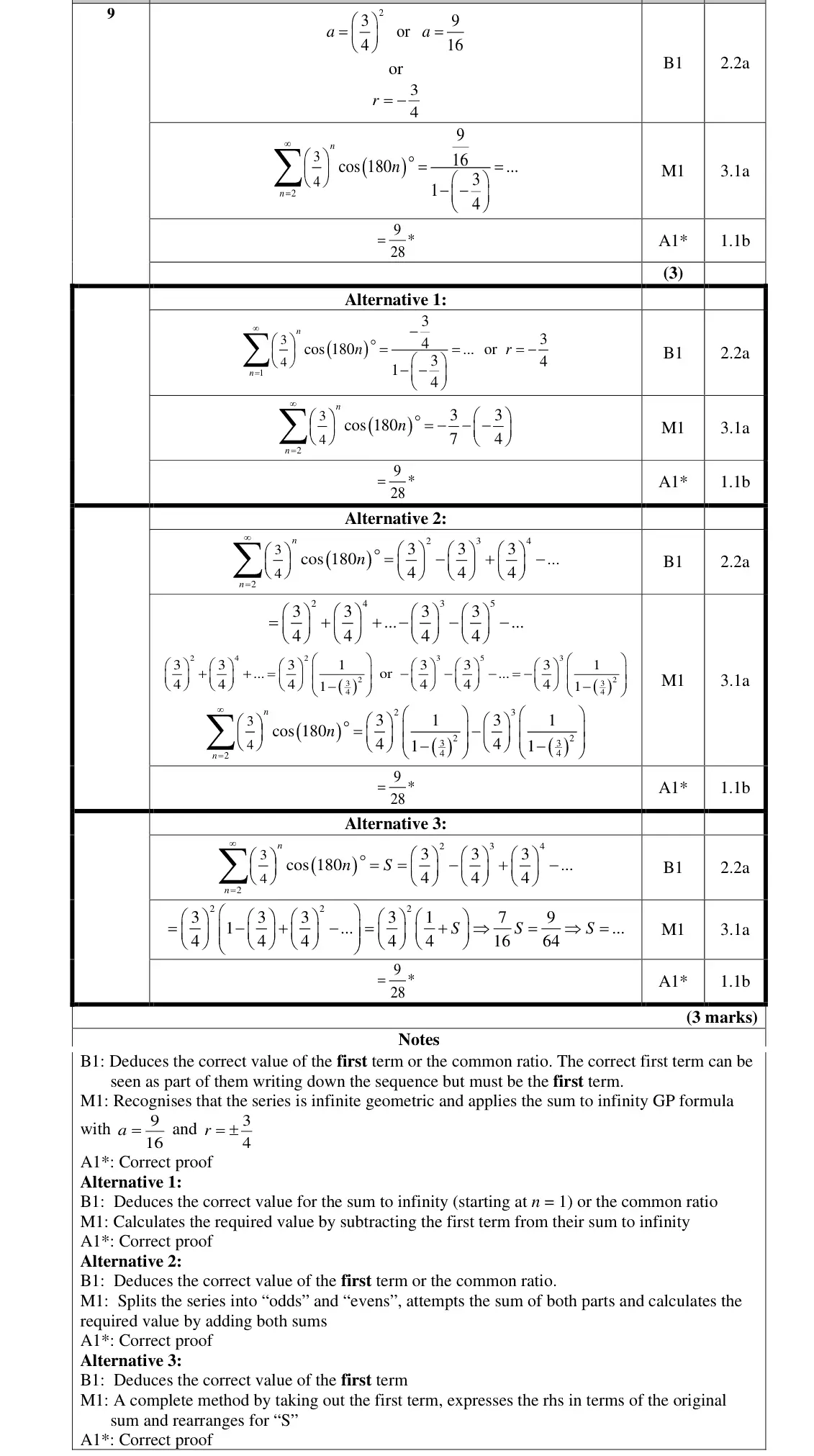
This question was fairly well answered by a number of candidates, who understood the need to use the sum to infinity formula, but a sizeable majority made little or no progress, not realising for example, that the sum started from n = 2 and not n =1 – hence they often did not get the first mark for a correct first term and/or common ratio. 9/16 was seen fairly often, but not always attributed to the first term, with some candidates thinking this was the value of the sum. One candidate misread the infinity symbol as an 8 and applied the sum to 8 terms correctly, but was obviously not able to score any marks. A number of students found the sum to infinity, using n = 1 to infinity and then subtracting the first term. This was done well by candidates who went down this route. Unfortunately, many students achieved no marks on this part due to a wide variety of errors at the beginning. Calculating cos (360) on the calculator in radians instead of degrees was seen. Some tried to split the summation incorrectly into ∑ ቀ 3 4ቁ 𝑛𝑛 ∞ 2 x ∑ cos 180𝑛𝑛 ∞ 1 and find the sum to infinity of the trigonometric terms separately. A few wrote ( 3 4)2cos (360) but did not evaluate the cos(360). There were some very good solutions but in many responses there was often a lack of clear structure to their proof.
Common mistakes
cos(180n)° = (−1)ⁿ so r = −3/4
first term is (3/4)² = 9/16 because the sum starts at n = 2
calculator in radians gives wrong values
do not split into two separate sums
Oct 2021 · Paper 2 · Q13(b)3 marks
Mark scheme (whole question; this part is marked with the orange bar)
Examiner's comment
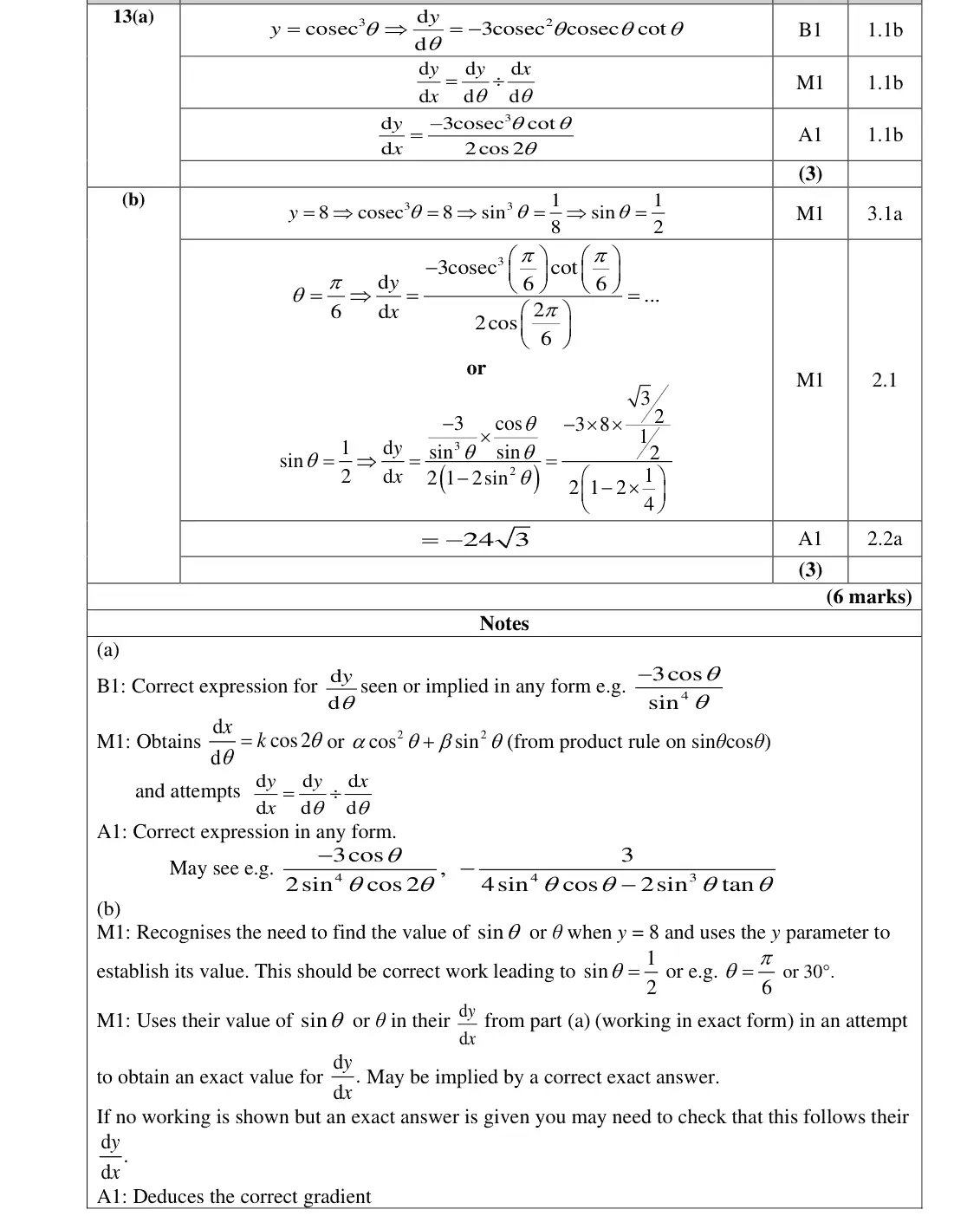
This question involving differentiation of parametric equations was found to be challenging by the majority of students, particularly the differentiation of 𝑦𝑦= cosec3 𝜃𝜃 and part (b). Part (b) proved more challenging for many candidates, with some unable to make a start as they were unable to process 8 = cosec3 𝜃𝜃 to arrive at either a value for sin 𝜃𝜃 or 𝜃𝜃. Of those that did arrive at a value for sin 𝜃𝜃 or 𝜃𝜃, many were able to work in exact form using their value to find an exact value for their 𝑑𝑑𝑑𝑑 𝑑𝑑𝑑𝑑, others were unable to proceed or attempted to give a decimal answer. 24 sqrt 3 and 8 sqrt 3 were common incorrect final answers. There were, however, some excellent and concise responses to this question.
Common mistakes
cosec³θ = 8 gives sinθ = ½, θ = π/6
work in exact values
−24√3 (not 24√3 or 8√3)
Oct 2021 · Paper 2 · Q15(b)3 marks
Mark scheme (whole question; this part is marked with the orange bar)
Examiner's comment
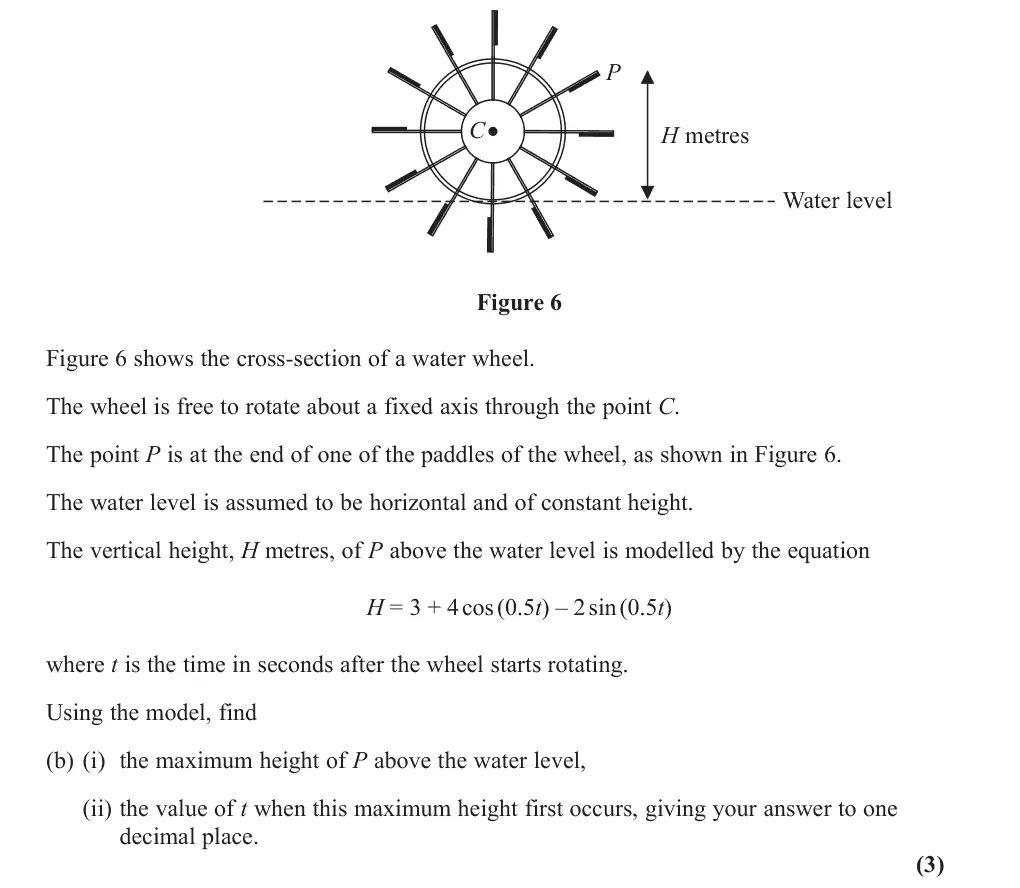
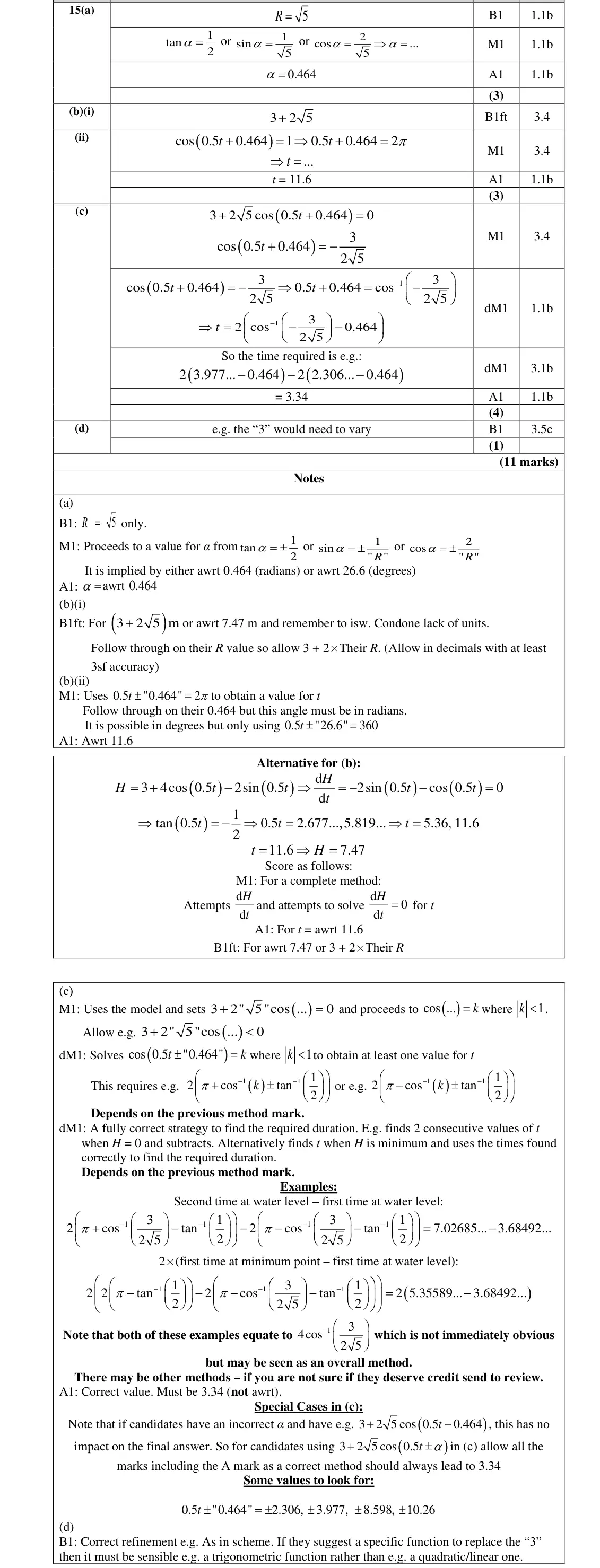
This question discriminated well between candidates that got this far, but it did appear that many candidates had simply run out of time, perhaps indicative of a generally lower understanding than in a June series because of it being a resit paper following the pandemic. Part (b)(i) was usually well attempted by those who had answered part (a), however, some candidates did not recognise the need to double 𝑅𝑅 and arrived at 3 + 𝑅𝑅 rather than 3 + 2𝑅𝑅 instead. Others simply assumed that the maximum was 3, 5 or 7, from a poor understanding of combining two trigonometric functions and the purpose of using the compound angle formulae to combine these two functions. Part (b)(ii) proved to cause problems for many candidates, with the majority incorrectly assuming that 0.5𝑡𝑡+ 𝛼𝛼= 0, and proceeded to ignore that this equation results in a negative value of 𝑡𝑡 (usually -0.9) by simply making this value of 𝑡𝑡 positive. They had failed to recognise that the first maximum would occur when 0.5𝑡𝑡+ 𝛼𝛼= 2𝜋𝜋. Perhaps the use of a sketch or graphical calculators would have helped these candidates. An alternative approach to part (b) required candidates to differentiate 𝐻𝐻, either in its original form or having used part (a) and solve the equation d𝐻𝐻 d𝑡𝑡= 0. This approach was more complicated and resulted in needing to solve tan(0.5𝑡𝑡) = - 1 2 and find the third solution, in order to avoid finding the maximum when 𝑡𝑡< 0 or the first minimum. Generally, candidates taking this approach were unsuccessful in scoring the accuracy mark, although the method mark was scored reasonably frequently.
Common mistakes
H = 3 + 2√5 cos(0.5t + 0.464), so maximum 3 + 2R = 7.47 m (not 3 + R)
first maximum when 0.5t + α = 2π (0 gives negative t)
t = 11.6
Oct 2020 · AS Paper 1 · Q9(a)1 mark
Mark scheme (whole question; this part is marked with the orange bar)
Examiner's comment
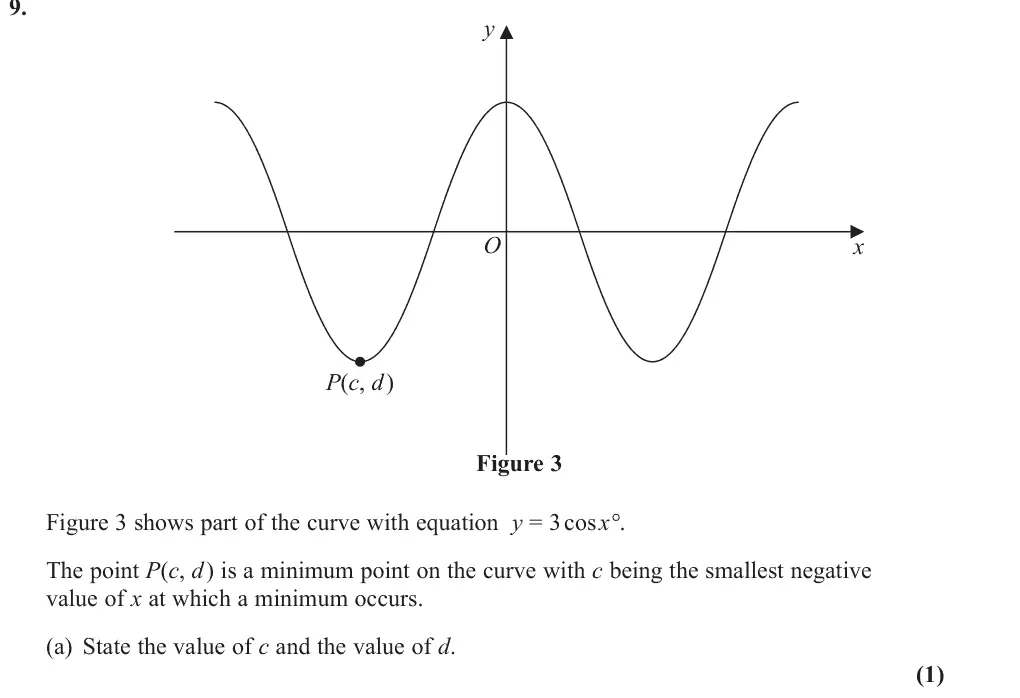
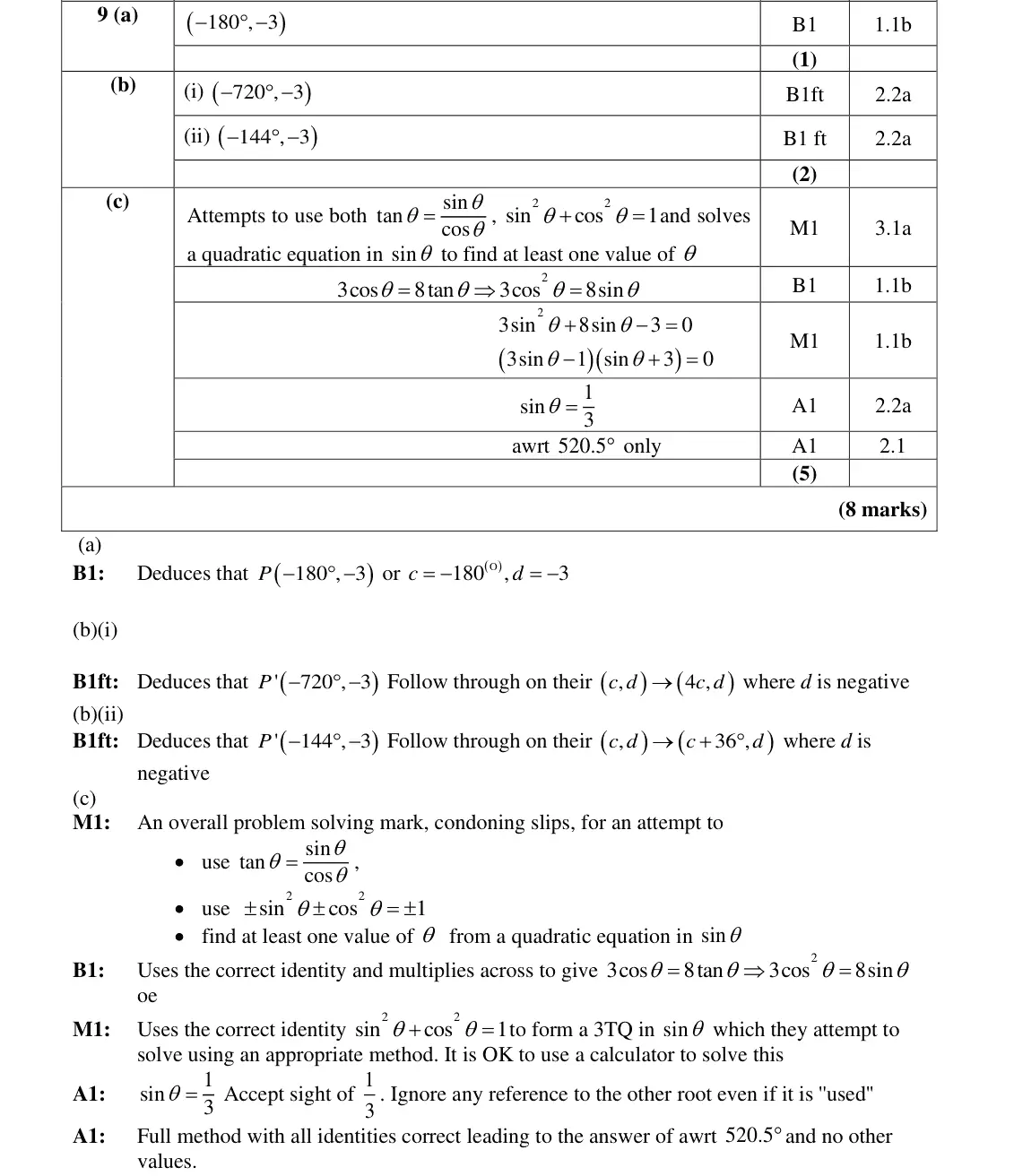
This question was attempted by most candidates with many being able to secure nearly all the marks in part (c). It was rare, however, for full marks to be scored overall, with most struggling with the transformations in part (b). In part (a), candidates occasionally got their signs mixed up, or did not appreciate the vertical stretch of scale factor 3 and therefore 1 d = -. Some even had their d being positive, despite the diagram showing that P was below the horizontal axis.
Common mistakes
(−180, −3): stretch factor 3 gives d = −3
c is negative
Oct 2020 · AS Paper 1 · Q9(b)2 marks
Mark scheme (whole question; this part is marked with the orange bar)
Examiner's comment
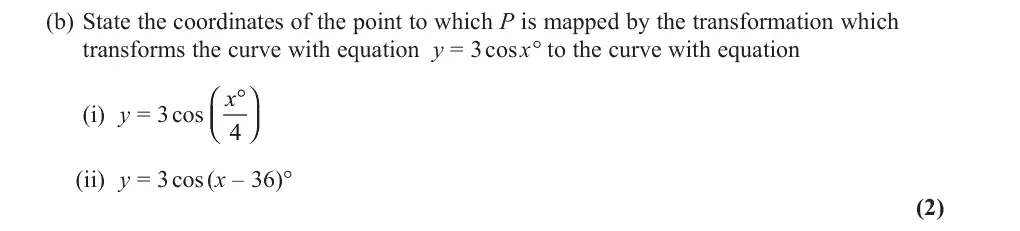
This question was attempted by most candidates with many being able to secure nearly all the marks in part (c). It was rare, however, for full marks to be scored overall, with most struggling with the transformations in part (b). In part (b), candidates could still score marks for acceptable follow throughs as long as d was a negative value. This enabled some candidates to score usually one of the marks. Some mixed up the horizontal stretch of scale factor 4 and scale factor 1 4 in part (i) and mixed up a translation of 36 units in the positive x-direction with 36 units in the negative x-direction. There were some candidates who only stated the x coordinate whereas the question asked for the coordinates, so they were unable to score in this part.
Common mistakes
(i) x/4 is a horizontal stretch factor 4: (−720, −3) (not ¼)
(ii) translation +36 in x: (−144, −3)
give both coordinates
Oct 2020 · Paper 1 · Q6(b)1 mark
Mark scheme (whole question; this part is marked with the orange bar)
Examiner's comment
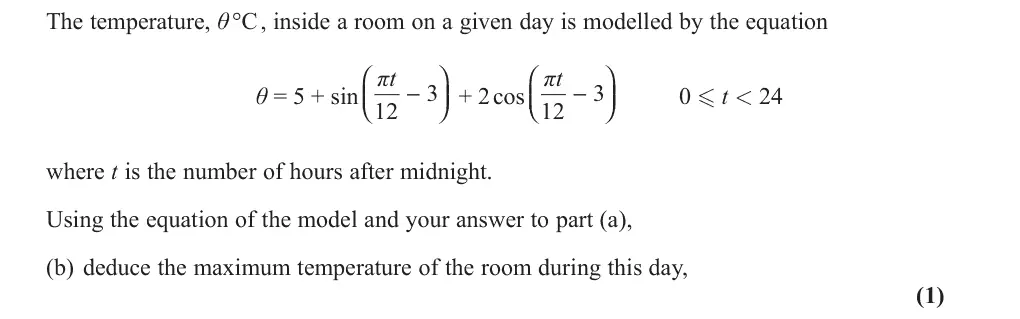
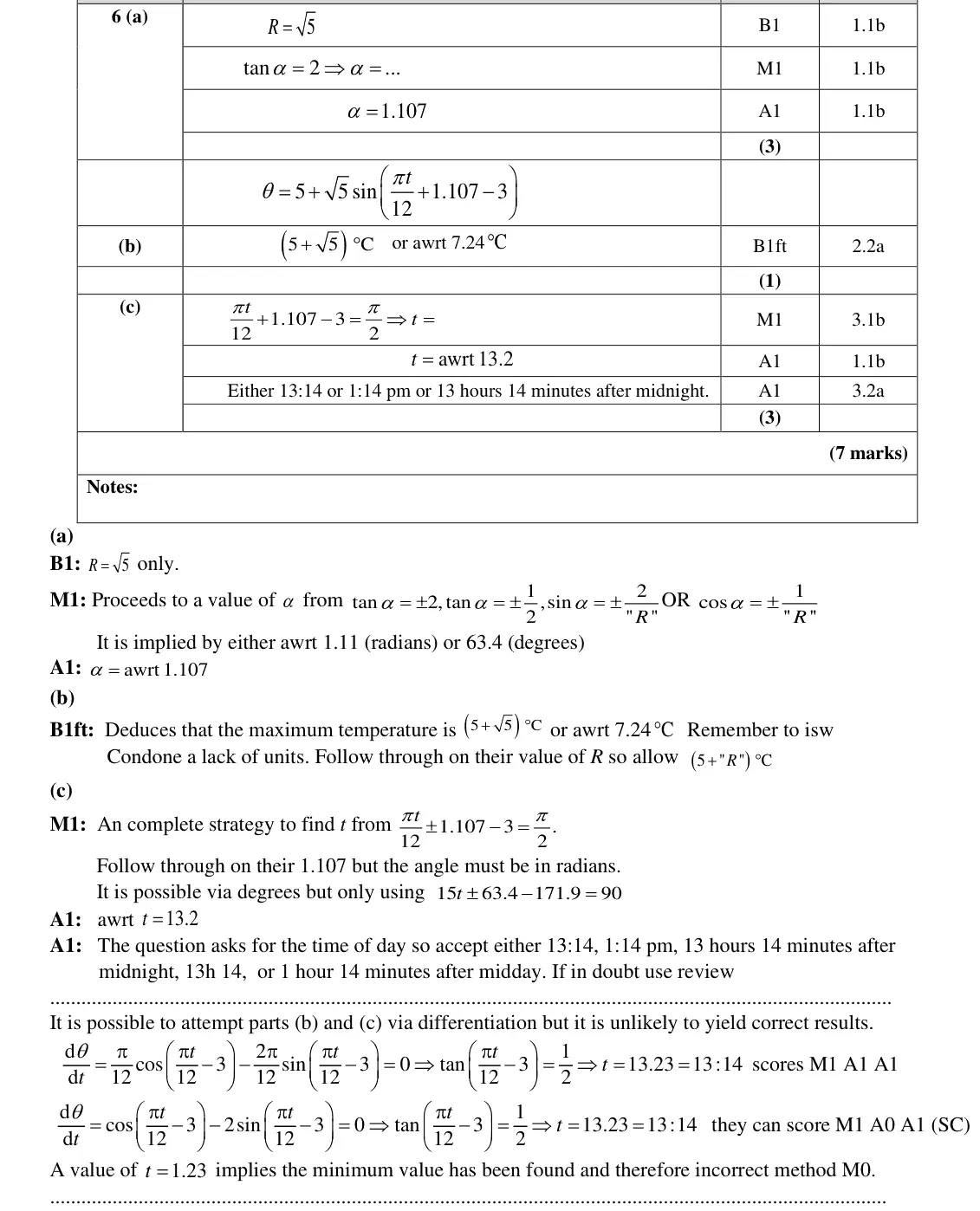
This was the second modelling question on the paper. Part (b) was also well done with most of those candidates giving the exact answer for the temperature. Occasionally candidates obtained an answer of 8° C from 5 + 1 + 2, which they obtained from taking the maximum values of sin and cos.
Common mistakes
θ = 5 + √5 sin(πt/12 + 1.107 − 3), so maximum 5 + √5 = 7.24 °C
adding the maxima of sin and cos separately (5 + 1 + 2 = 8) is wrong
Oct 2020 · Paper 1 · Q12(b)5 marks
Mark scheme (whole question; this part is marked with the orange bar)
Examiner's comment
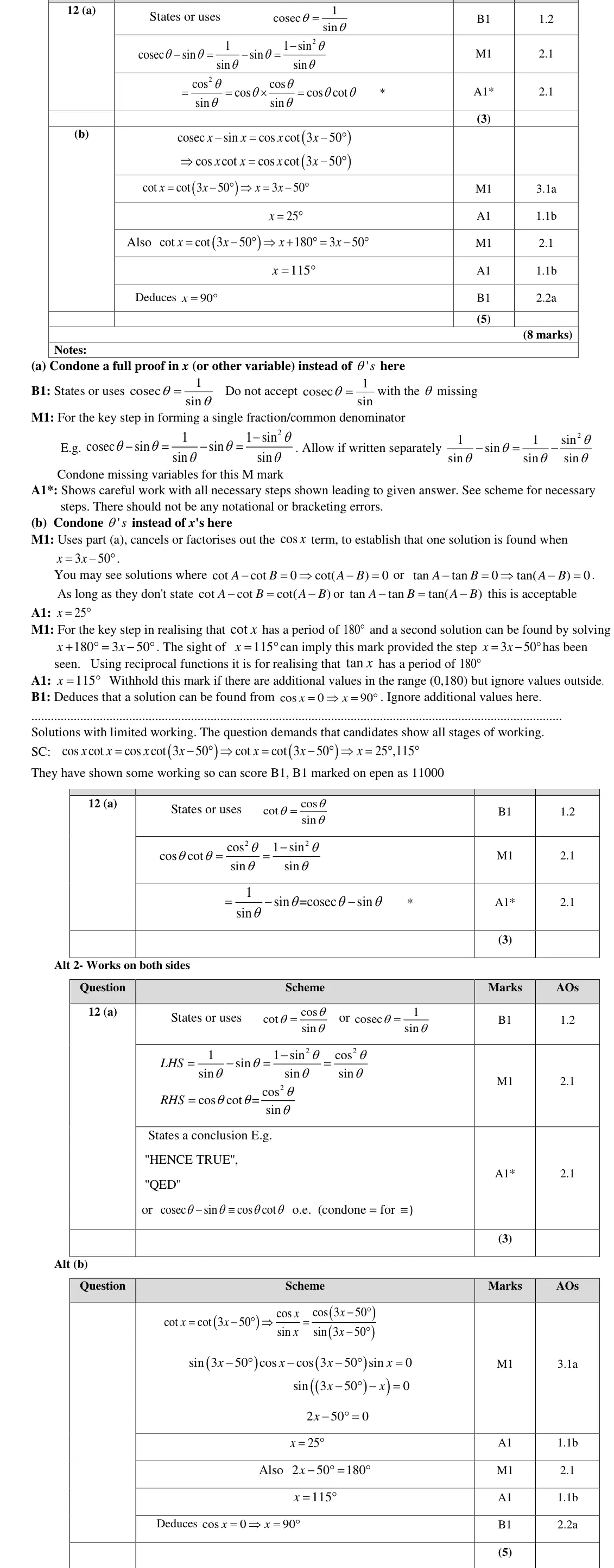
Part (b), however was very often left completely blank. Many who attempted it failed to see the connection with (a) and got lost in complicated trig expansions which led nowhere. Of those who did use part (a) to answer part (b), the most common solution was simply 𝑥𝑥=25 after cos 𝑥𝑥 had been cancelled, thus losing the solution given by cos 𝑥𝑥 =0. Only a small minority of the most able found all 3 solutions.
Common mistakes
use (a) to get cos x cot x = cos x cot(3x − 50°)
do not cancel cos x without cos x = 0 (x = 90°)
cot x = cot(3x − 50°) gives x = 25° and, as cot has period 180°, x = 115°
three solutions
Oct 2020 · Paper 2 · Q12(a)(ii)3 marks
Mark scheme (whole question; this part is marked with the orange bar)
Examiner's comment
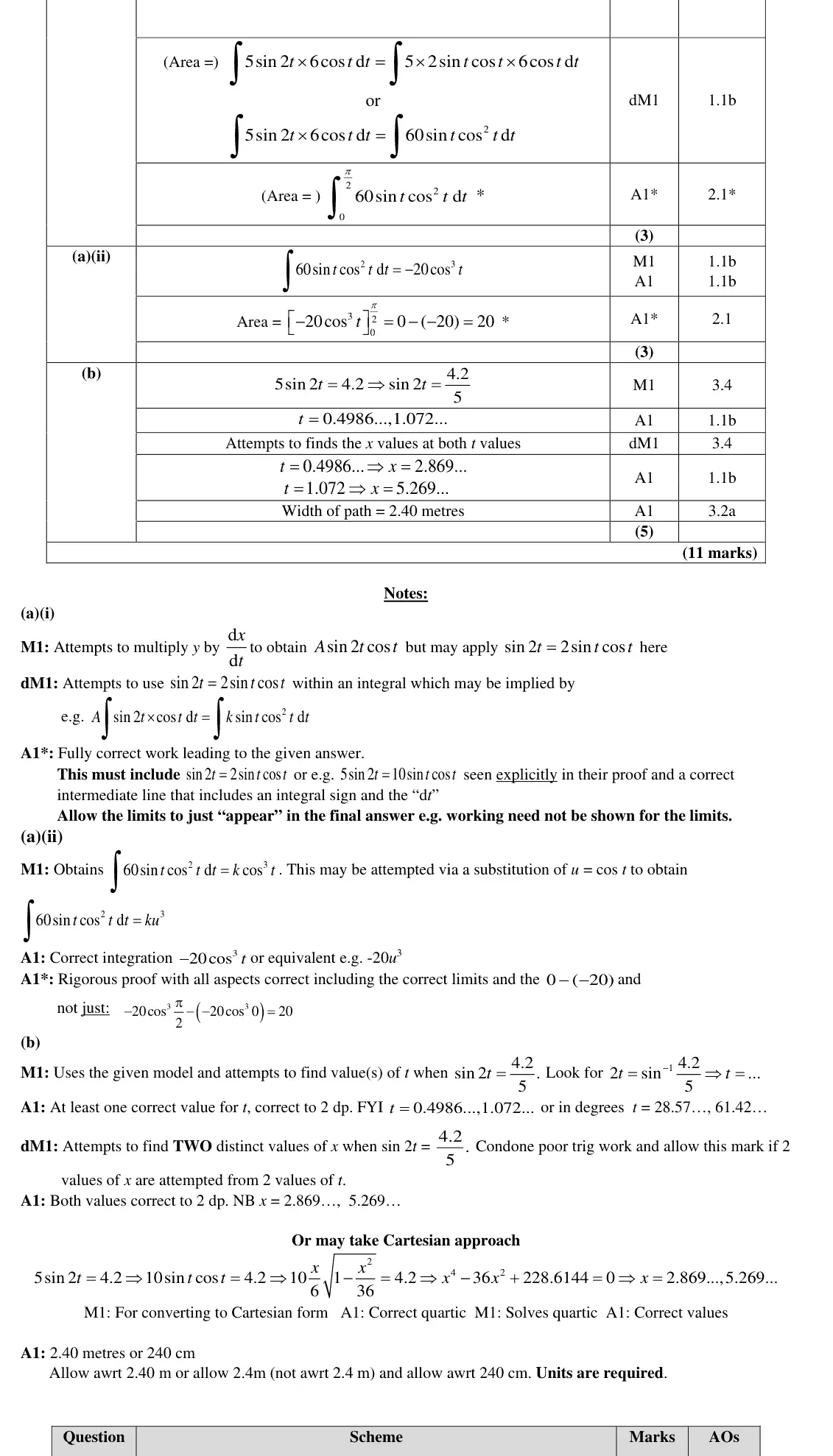
Many candidates left the entire question or parts of this question completely blank and clearly found it difficult to access the content being assessed here, perhaps due to a lack of familiarity with integration using parametric equations. Many tried to establish the Cartesian equation to answer various parts. That said, there were many candidates who provided clear and concise solutions to each part. In part (a)(ii), many knew that the integral was a multiple of cos3 t but had trouble getting to the printed answer of 20 with correct steps. As the answer was given, it was a requirement to see the limits calculated separately as 0 – ( -20 ) = 20. Integration by parts was a common approach for unsuccessful candidates, while others attempted to use a substitution, often not using the necessary u = cosx. Those candidates with an understanding of the integration of f’(x)[f(x)]n were generally very successful here. Some lost the penultimate accuracy mark usually due to a sign error.
Common mistakes
reverse chain rule (or u = cos t) gives −20cos³t
limits must be shown as 0 − (−20) = 20
by parts is the wrong approach
June 2019 · Paper 1 · Q2(a)2 marksMedium
Mark scheme (whole question; this part is marked with the orange bar)
Examiner's comment
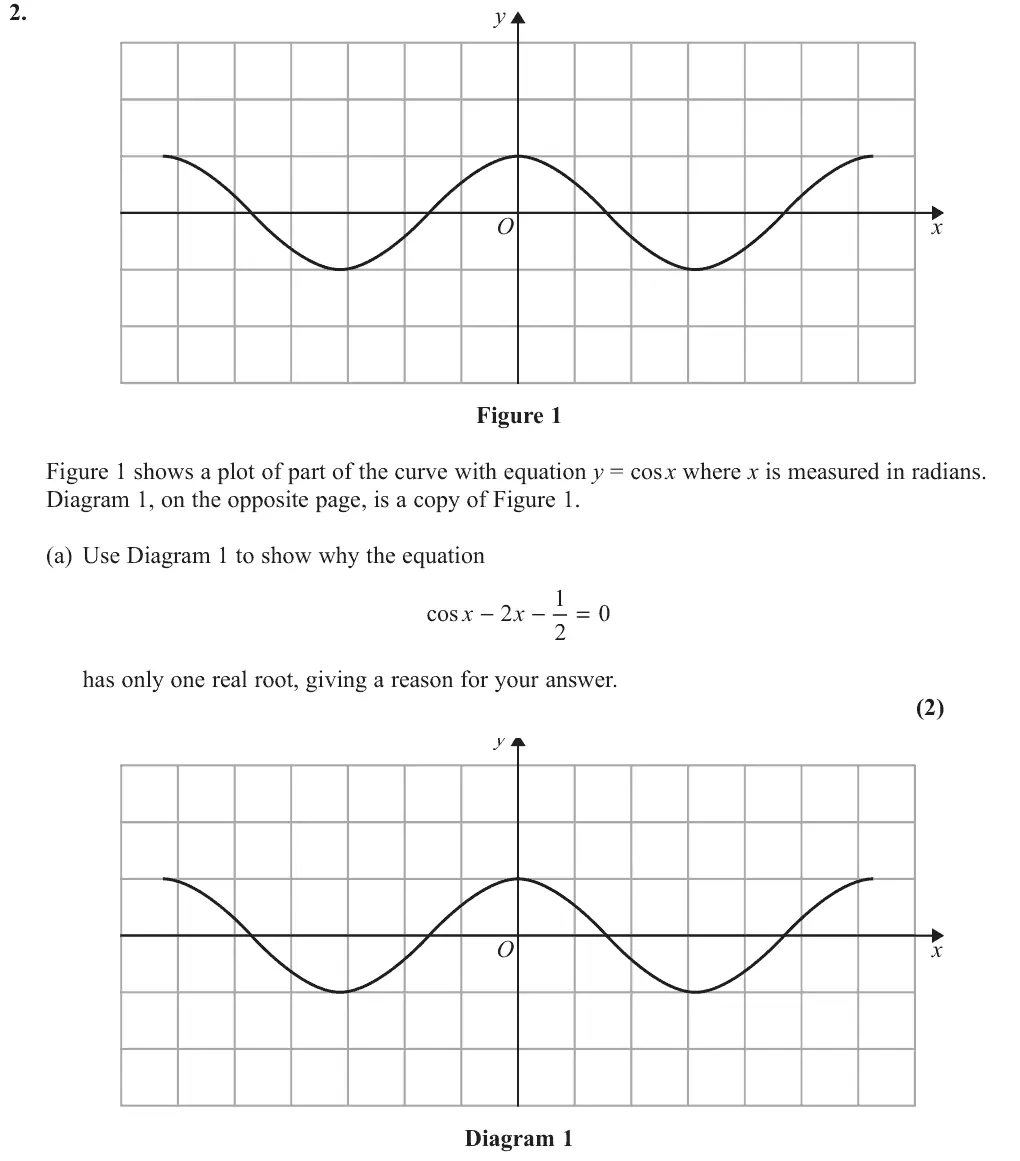
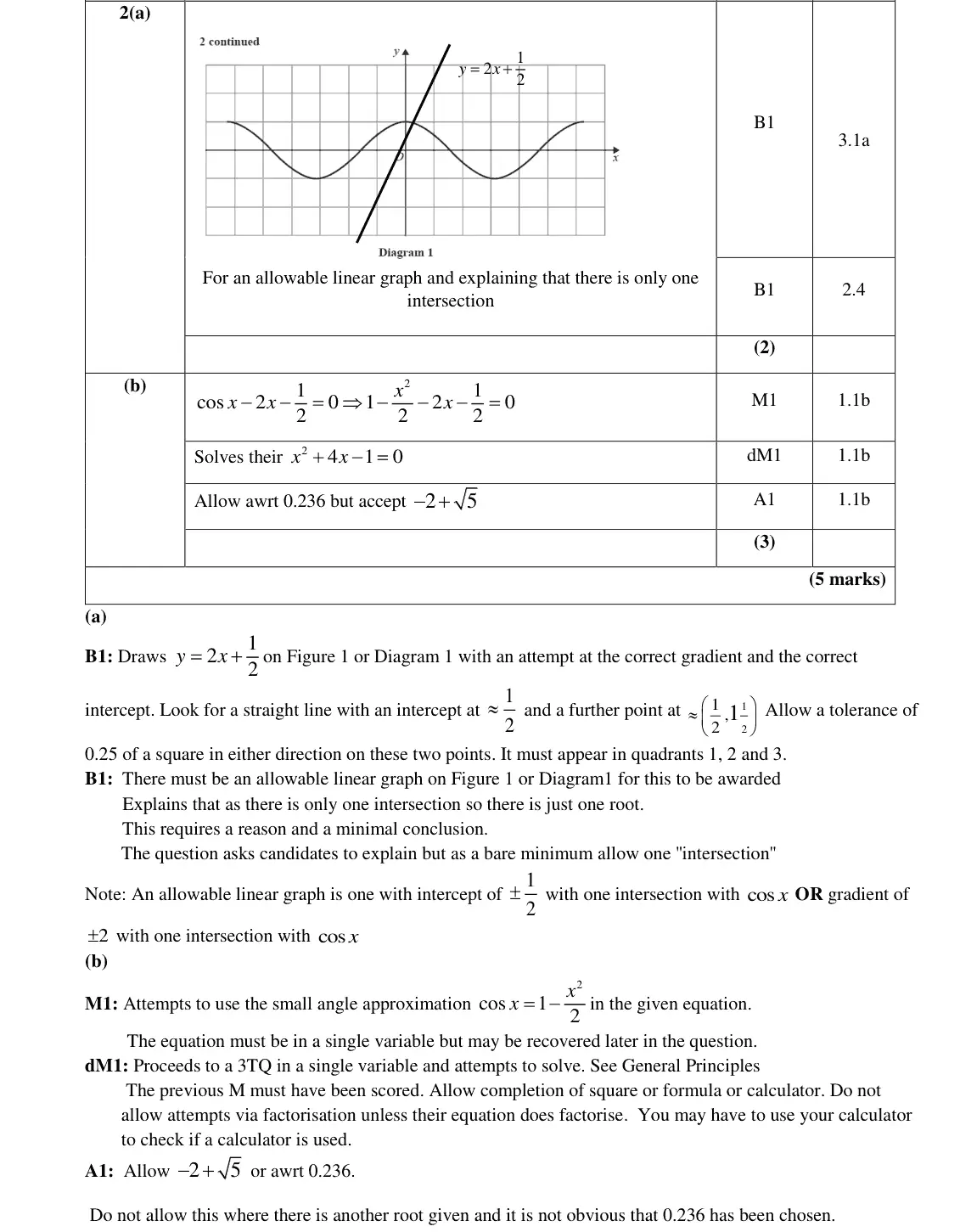
This question proved to be more challenging for a number of candidates although many were still able to score full marks. In part (a) it was important for candidates to pay attention to the scale of the graph. Most candidates who did draw a straight-line graph were able to make the link between one point of intersection and one real root to the equation, however, a significant minority of these were unable to construct the correct straight-line graph with enough accuracy to gain both marks for this part of the question.
Common mistakes
rearrange to cos x = 2x + ½ and draw that line (intercept ½, gradient 2: watch the scale)
one intersection so one root, a reason is needed
June 2018 · Paper 1 · Q10(b)1 mark
Mark scheme (whole question; this part is marked with the orange bar)
Examiner's comment
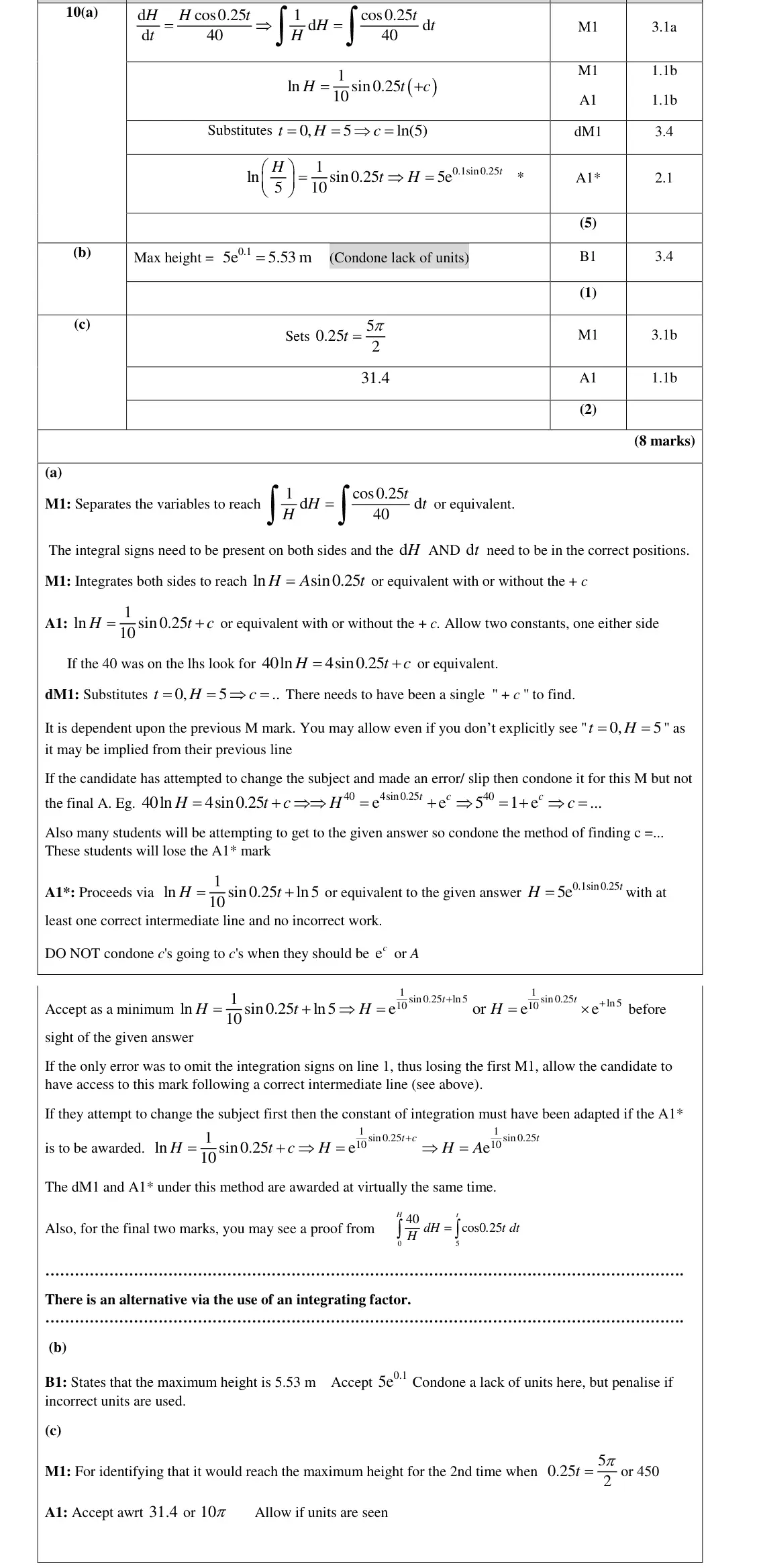
This was another modelling question, this time modelling the height of a roller coaster above Part (b) was found by almost all students, even those who could not attempt part (a). In this case the exact answer 5e 0.1 was accepted as well as 5.53 metres. Fewer students scored both t marks in (c), but many were aware that it would occur when sin(0.25 ) The most 1.
Common mistakes
maximum when sin(0.25t) = 1: 5e^0.1 = 5.53 m (exact 5e^0.1 accepted)
June 2018 · Paper 1 · Q10(c)2 marks
Mark scheme (whole question; this part is marked with the orange bar)
Examiner's comment
This was another modelling question, this time modelling the height of a roller coaster above t marks in (c), but many were aware that it would occur when sin(0.25 ) The most 1. or else use 450 rather than 5 thus , , common errors were to find the first value using 2 2 arriving at the incorrect answer of 1800 seconds.
Common mistakes
second maximum when 0.25t = 5π/2 (radians), T = 10π ≈ 31.4 s
using π/2 (first maximum) or 450 in degrees (giving 1800) is wrong
June 2018 · Paper 1 · Q14(b)3 marks
Mark scheme (whole question; this part is marked with the orange bar)
Examiner's comment
part (b) scoring one out of the three marks. Those who managed to sketch the correct part of the parabola rarely were able to explain why the domain (and range) were restricted. Stating that ''because 0 2 t '' was not enough to explain why for instance 1 5 x . The best then 3 2sint students were able to explain that as 1 sin 1 t would have a maximum and a minimum value of 3 2 value of 3 2 5 1.
Common mistakes
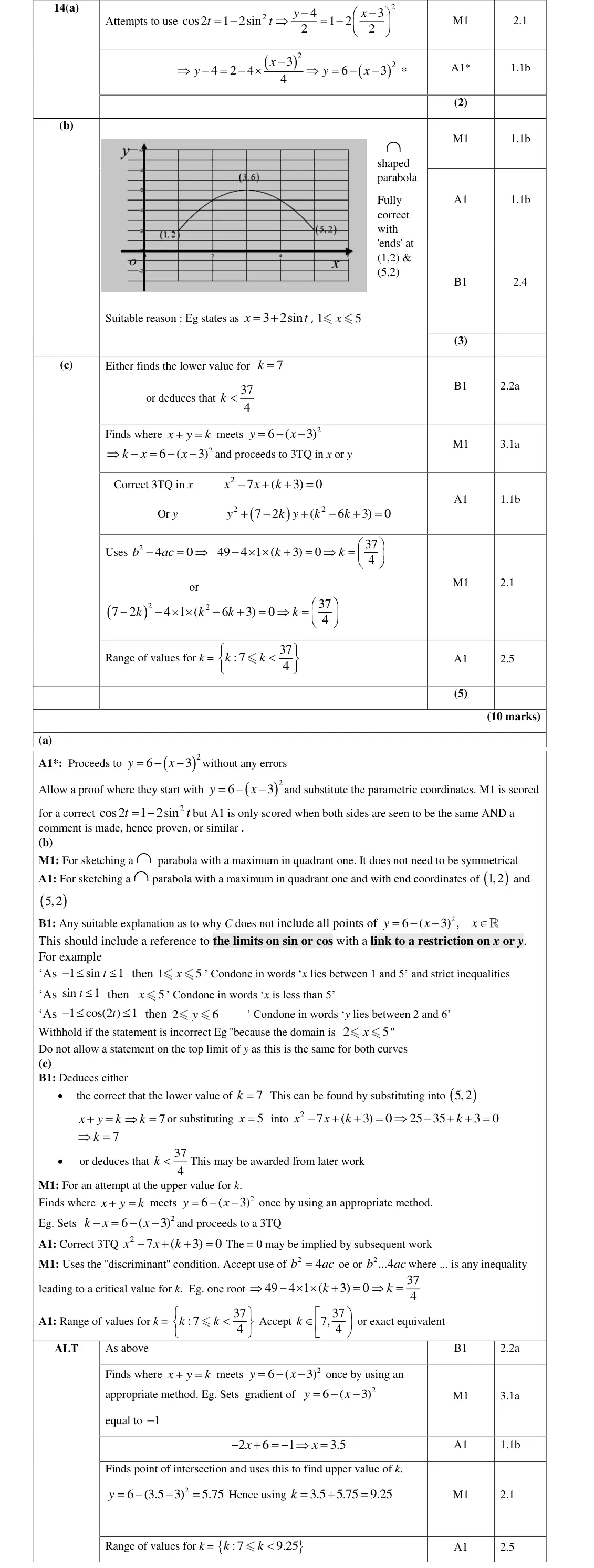
sketch only the arc from (1, 2) to (5, 2) with maximum (3, 6), not the whole parabola
reason: −1 ≤ sin t ≤ 1 so 1 ≤ x ≤ 5 ("0 ≤ t < 2π" alone is not enough)
June 2018 · Paper 2 · Q6(c)1 mark
Mark scheme (whole question; this part is marked with the orange bar)
Examiner's comment
In part (c), some students correctly deduced that the given equation had 3 real solutions for 7 10 , with a few students incorrectly deducing that there were 6 real solutions. Most students misunderstood the requirement of the question by finding 23.1, 26.2, 29.4, with those students who did not go on to state that there were 3 real solutions losing the mark for this part.
Common mistakes
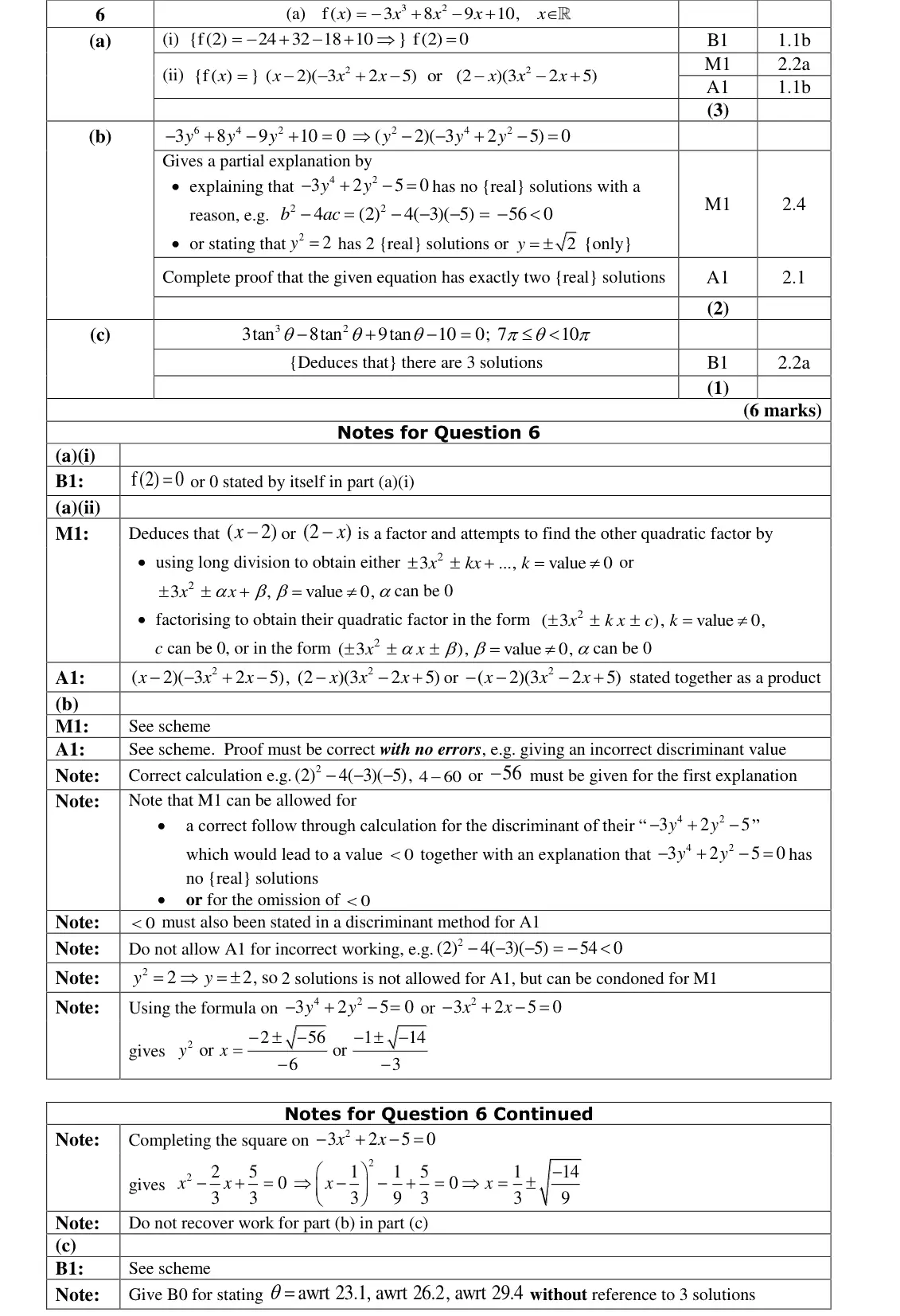
equation is −f(tan θ) = 0 so tan θ = 2 only
one solution per period π gives 3 solutions in 7π ≤ θ < 10π
listing 23.1, 26.2, 29.4 without stating 3 scores B0
6 is a common wrong answer
Find an Edexcel maths tutor
Stuck on this? Book a trial session with an Edexcel specialist.