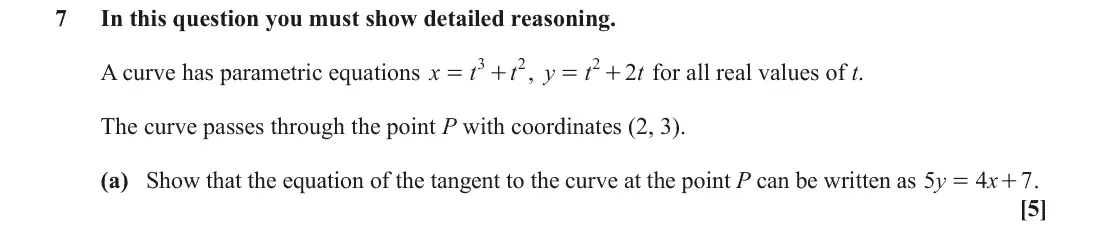
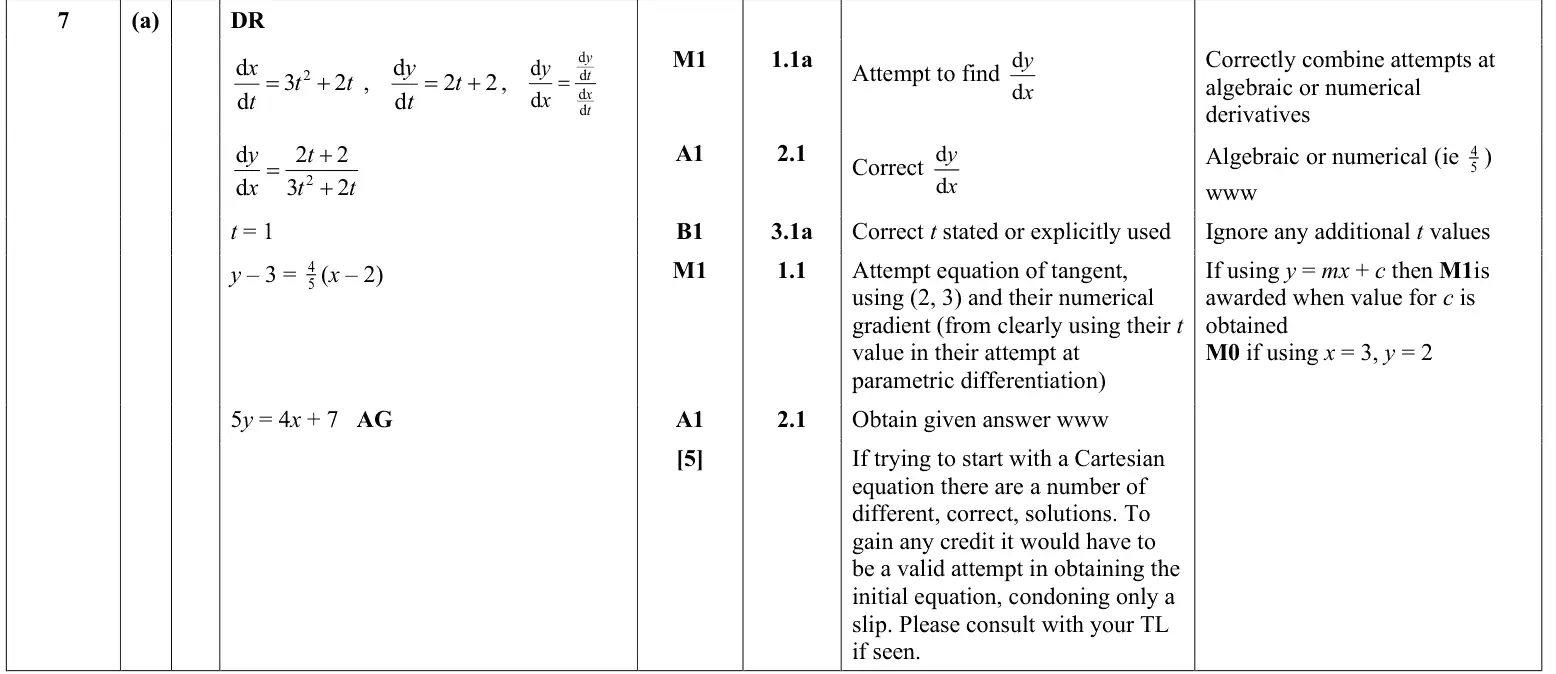
This part of the question was very well answered, with the majority of candidates gaining full credit. They were able to accurately use parametric differentiation to find an expression for the derivative. Candidates were then able to find the correct t-value using a variety of different approaches, and most also justified why any other t-values found were not valid. In ‘show that’ questions it is important that candidates show sufficient method so as to be convincing, especially when the answer is given. Most candidates did show explicit method of using the correct t-value in the correct derivative to obtain the correct gradient However some candidates attempted to work backwards from the given answer and they generally struggled to a provide any evidence that could gain credit. When attempting the equation of a tangent, candidates should be using a numerical gradient which did not always happen.
Key points and common errors
dy/dx = (2t + 2)/(3t² + 2t)
t = 1 at P, gradient 4/5
5y = 4x + 7
justify the t value
June 2025 · Paper 1 · Q10(c)4 marksEasy
Mark scheme for this part
Examiner's comment
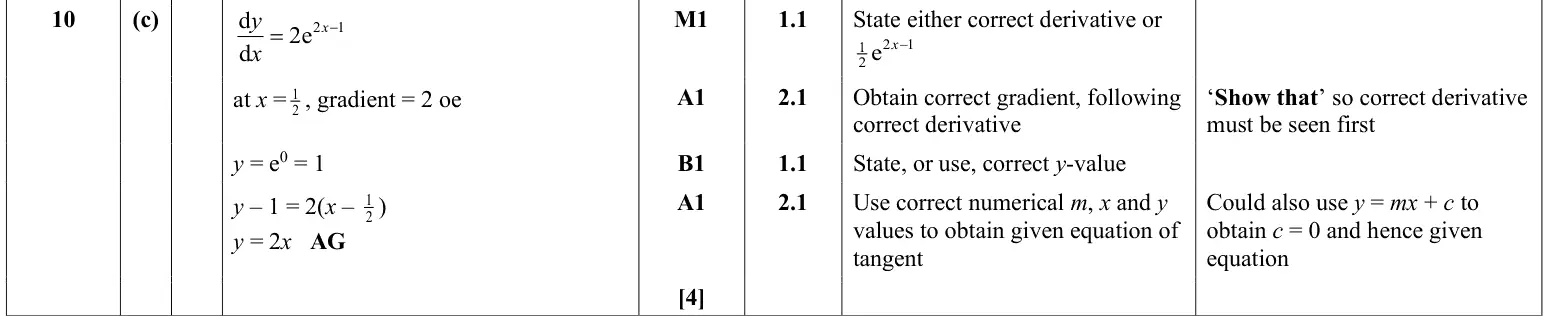
Nearly all of the candidates were able to find the correct y-value, but some then simply stated that y = 2x based on the now known (x, y) value with no further consideration of the question posed. However the majority of candidates could then correctly state the derivative of the given equation, and most then evaluated this at x = 0.5 and proceeded to find the given equation convincingly. As with previous questions involving the equation of a straight line some candidates still attempted to use an algebraic gradient when attempting the tangent, so equations such as y = (2e2x – 1)x + 0, resulting in y = 2x, were penalised even if the gradient had previously been shown to be 2. When attempting the equation of a straight line (e.g. a tangent or normal) candidates should be using a numerical (as opposed to variable) value for the gradient.
Key points and common errors
dy/dx = 2e^(2x − 1), gradient 2 at x = ½, point (½, 1)
tangent y = 2x
algebraic gradient used in line equation
June 2025 · Paper 3 · Q1(c)1 markHard
Show the start of this question
Mark scheme for this part
Examiner's comment
Many candidates struggled to realise that the equation of the normal to the curve at its minimum point was equivalent to asking for the equation of the line of symmetry. Many candidates unsuccessfully attempted to use the result 𝑦−𝑦1 = − f′(𝑥1) (𝑥−𝑥1) to find this equation (even though the command was to ‘state’ and there only being 1 mark available). The most common incorrect answer seen by examiners was 𝑦= 5 (which was the equation of the tangent to the curve at its minimum point).
Key points and common errors
the normal at the minimum point is vertical: x = 2 (the line of symmetry)
must be an equation
the formula y − y₁ = −(x − x₁)/f′(x₁) fails here
June 2025 · Paper 3 · Q11(c)5 marksMedium
Show the start of this question
Mark scheme for this part
Examiner's comment
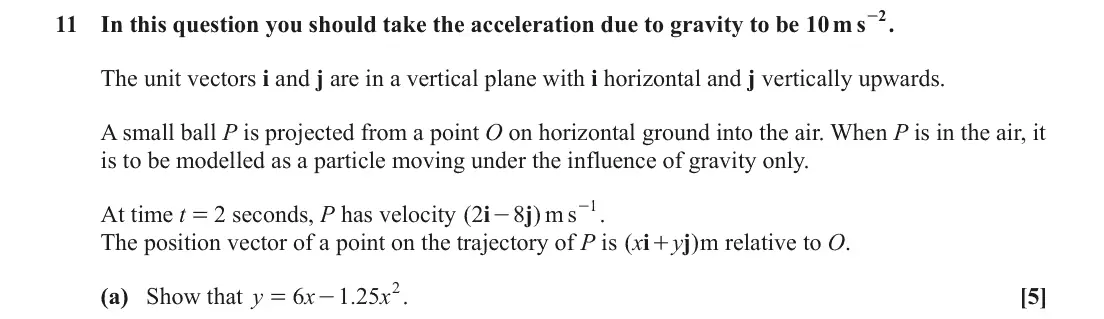
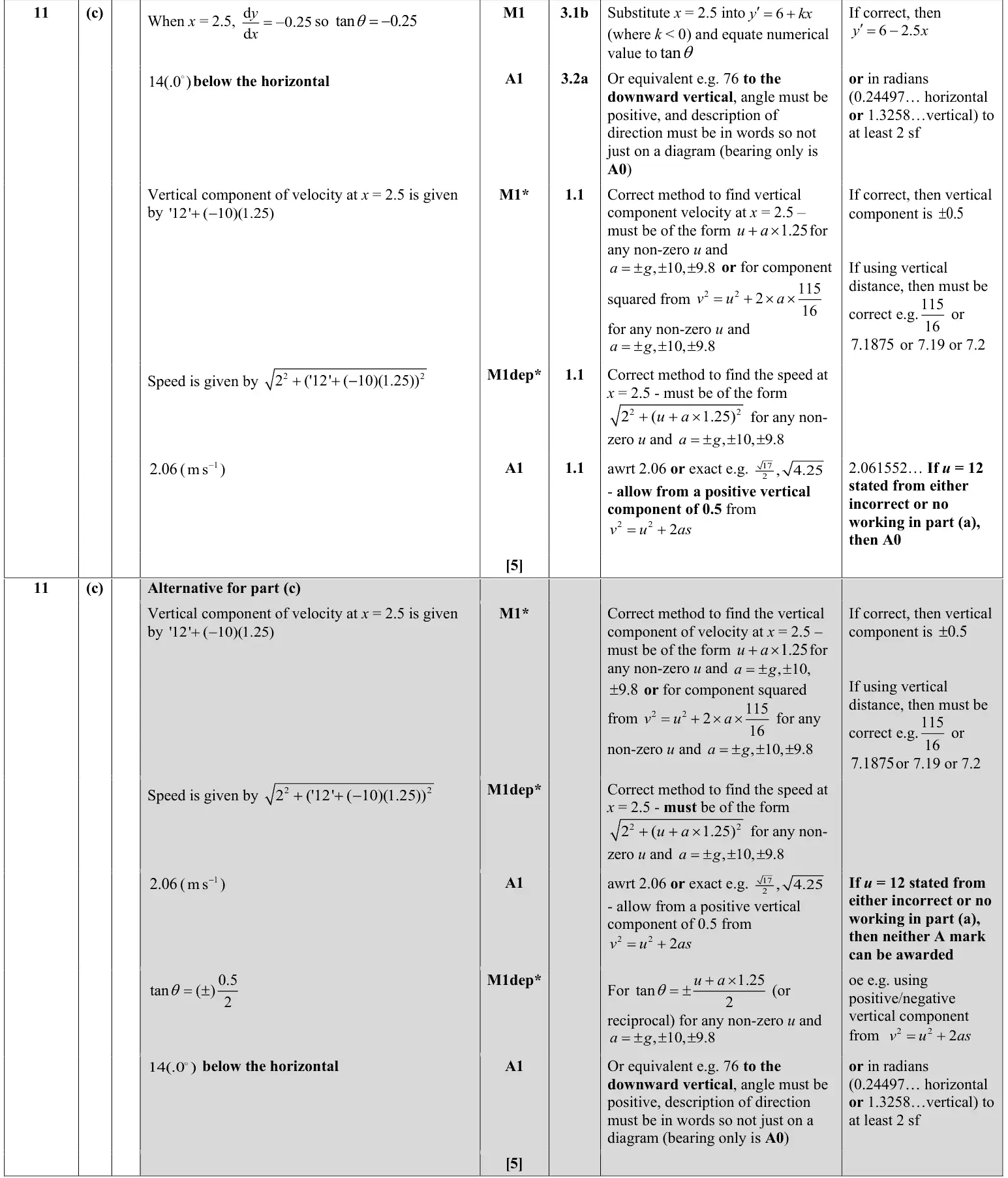
The responses to this part were mixed with many candidates believing that both the speed and direction of motion could be found by considering the vertical and horizontal displacement of P when 𝑥= 2.5. Of those that did use the velocity components many did not give sufficient detail when it came to the direction of motion; an angle alone was not sufficient as it needed to be clear if the angle was below or above the horizontal (or equivalently to the upward or downward vertical).
Key points and common errors
gradient at x = 2.5 is −0.25 so direction 14° below the horizontal
vertical velocity 12 − 10 × 1.25 = −0.5
speed √4.25 = 2.06 m/s
displacement gives neither
direction needs 'below the horizontal'
June 2024 · AS Paper 2 · Q5(a)4 marksMedium
Mark scheme for this part
Examiner's comment
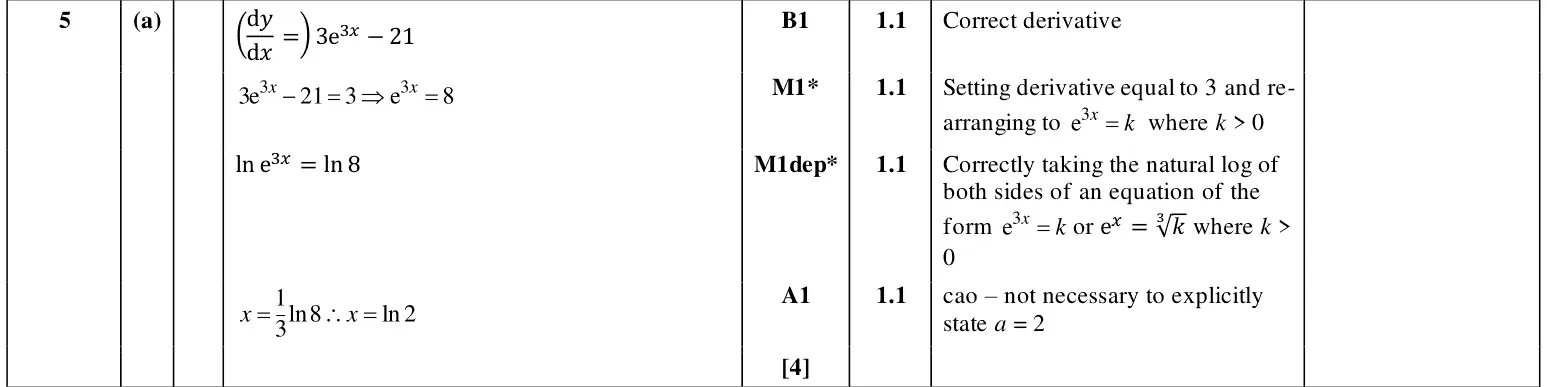
A lot of good responses lost the final mark because the answer was left as 3ln8, ignoring the instruction to give the answer in the form lna. Those who differentiated e3x to 3xe3x, 3xe3x - 1, e2x or similar were 1 given no marks. A small number set their differential equal to − 3. Understanding of the log laws still needs strengthening. Some did not attempt differentiation, but started with things like lny = lne3x − ln21x − ln8.
Key points and common errors
dy/dx = 3e^(3x) − 21 = 3 gives e^(3x) = 8
x = ⅓ln 8 = ln 2 (must be in the form ln a)
June 2024 · AS Paper 2 · Q5(b)3 marksHard
Show the start of this question
Mark scheme for this part
Examiner's comment
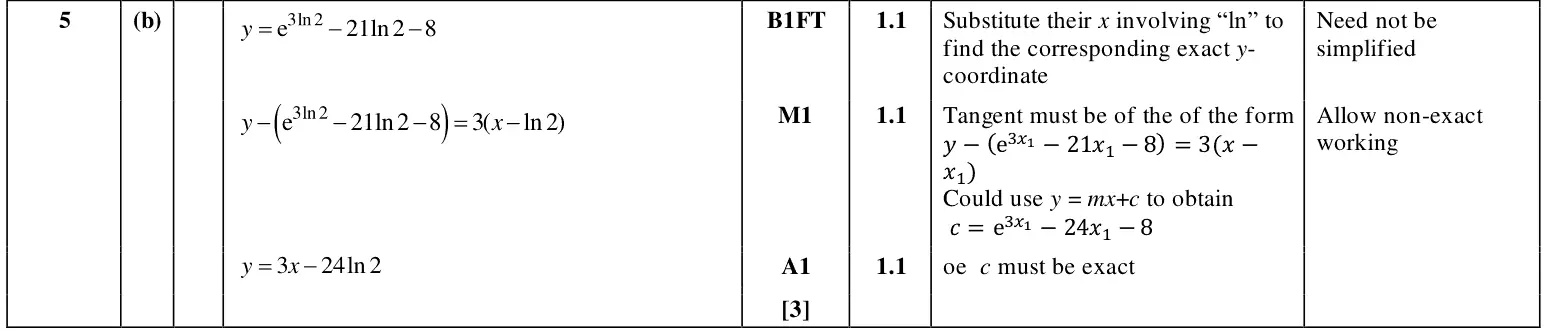
This part was not well done. Those who did not find an x in (a) made no progress. Those who had an x often responded with a decimal, ignoring the request for an exact c (particularly those who had 1 responded with 3ln8 in the previous part).
Key points and common errors
y = e^(3ln2) − 21ln2 − 8 = −21ln2
y = 3x − 24ln2
c must be exact
June 2024 · Paper 1 · Q58 marksEasy
Mark scheme for this part
Examiner's comment
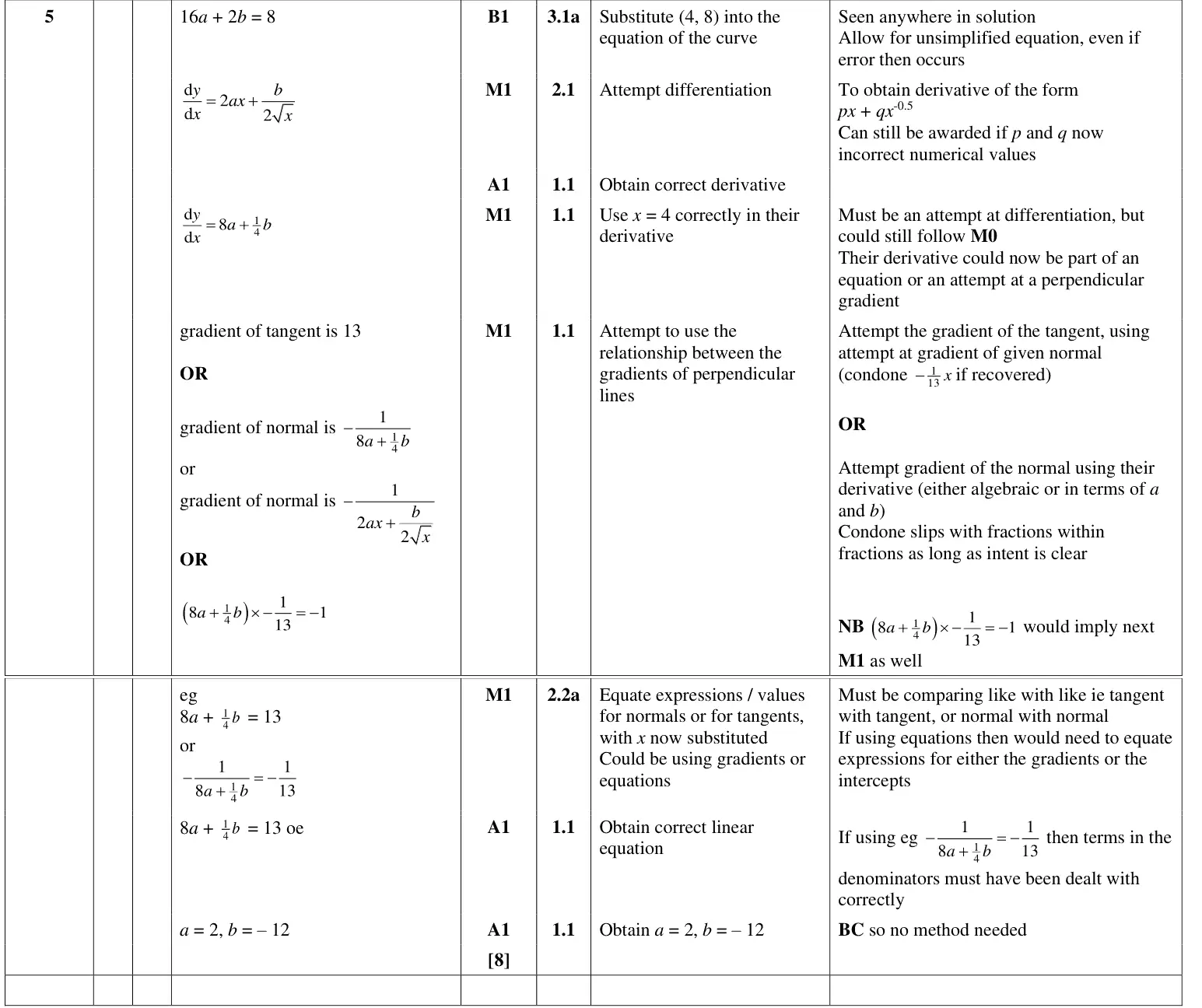
This longer unstructured question was generally well attempted. Quite a few neat, elegant and completely correct solutions were seen. Some unnecessary work was also seen, with quite a few candidates obtaining the equation of the tangent with some trying to solve that with the given equation. Only a very small number of candidates did not realise differentiation was involved. When the differentiation was attempted, it was invariably correct with the fractional powers well handled. Those candidates who substituted x = 4 into their algebraic expression for the gradient of the tangent, were more likely to score full marks compared to those who went on to form an algebraic expression for the gradient of the normal. Most candidates were able to find the numerical value for the gradient of the tangent from the equation of the normal, although not everyone was able to use this information to produce a correct equation in a and b only. A few candidates confused the gradients of the tangent and normal. Some candidates often omitted substituting (4,8) into the equation of the curve, failing to produce a second independent equations in a and b. Solving these two equations simultaneously could be completed by using a calculator for the final mark. This is a good solution to Question 5 with efficient and clear working.
Key points and common errors
(4, 8) on curve: 16a + 2b = 8
dy/dx = 2ax + b/(2√x) = 8a + b/4 at x = 4
normal gradient −1/13 so tangent gradient 13
a = 2, b = −12
finding the tangent equation is unnecessary
June 2023 · AS Paper 1 · Q4(b)2 marksMedium
Show the start of this question
Mark scheme for this part
Examiner's comment
Most candidates recognised the need to differentiate and the majority of these got the correct derivative. Common errors included -3e2x, 3xe3x or getting y = e6 and then gradient = 6e5. Some candidates seemed unsure about the degree of accuracy required (with many giving their response to 2dp or similar); as per the rubric on the front cover, 3sf is the default unless otherwise stated.
Key points and common errors
dy/dx = 3e³ˣ
at x = 2 gradient 3e⁶ = 1210
errors 3xe³ˣ, −3e²ˣ
June 2023 · AS Paper 2 · Q7(a)4 marksEasy
Mark scheme for this part
Examiner's comment
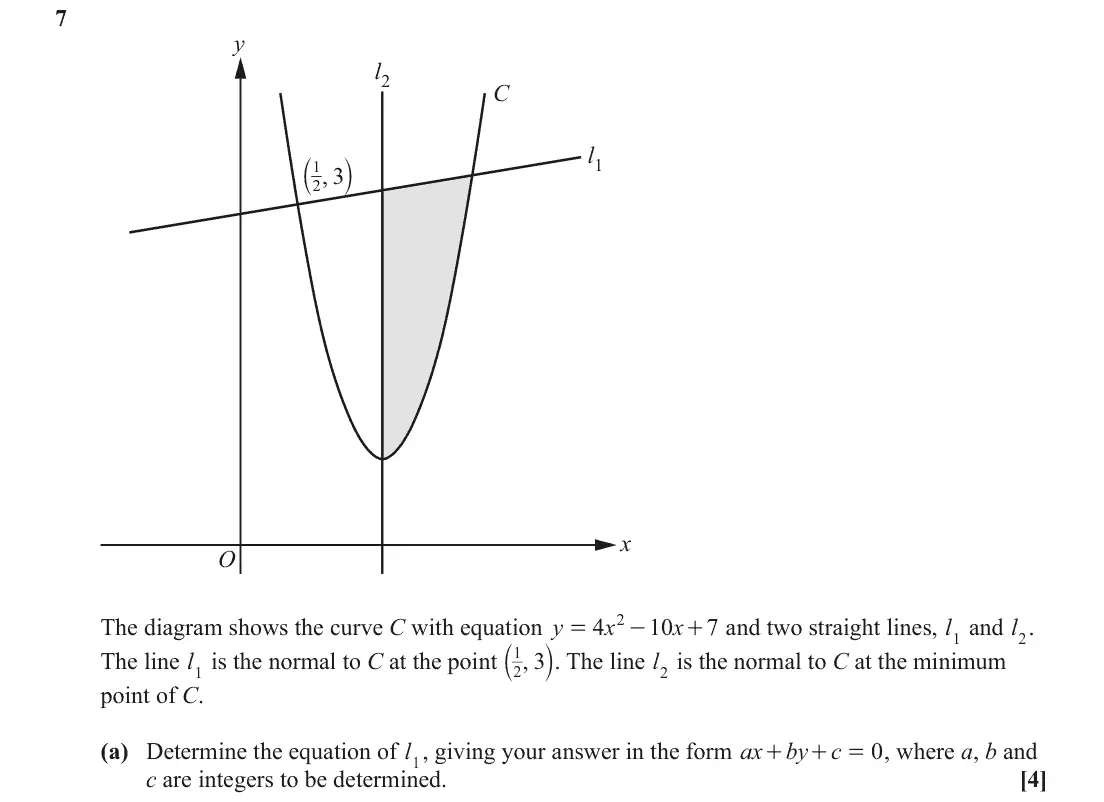
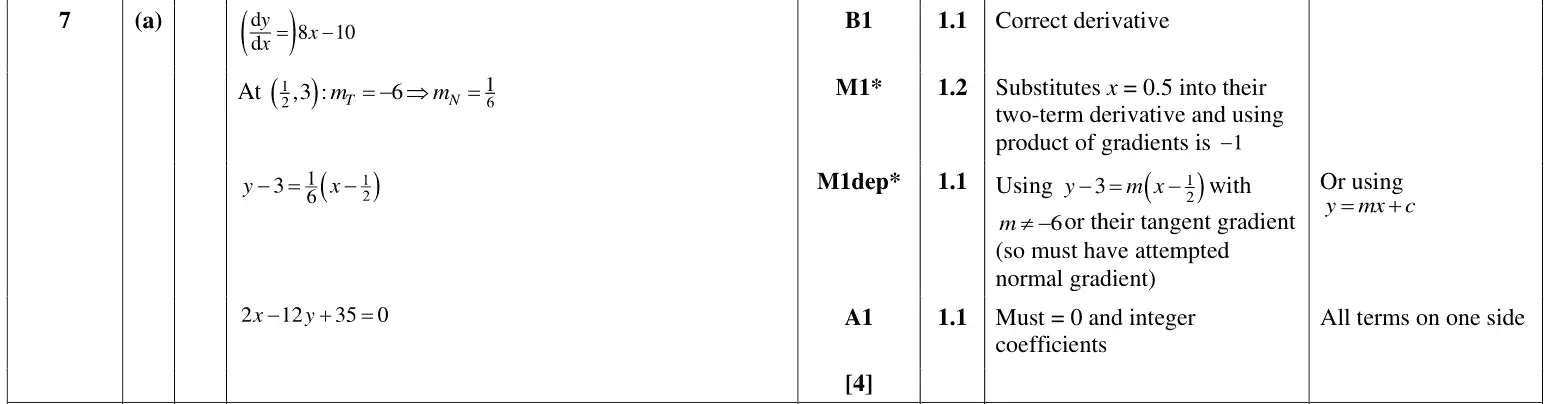
The majority of candidates obtained the correct derivative (i.e. 8x – 10) and those who used it correctly with the given point mainly scored full marks. As was the case elsewhere, a few lost the final mark by not giving their answer in the requested form (e.g. x – 6y + 17.5 = 0, from candidates either not spotting or misunderstanding the request for integers). A significant number of responses took the gradient of l1 to 10 be 8 straight from the derivative, or 8 (from setting their derivative to 0) and then finding the negative reciprocal. Using y = mx + c to find the normal was popular.
Key points and common errors
dy/dx = 8x − 10 = −6 at x = ½
normal gradient 1/6
2x − 12y + 35 = 0 with integer coefficients
June 2023 · Paper 2 · Q4(a)6 marksEasy
Mark scheme for this part
Examiner's comment
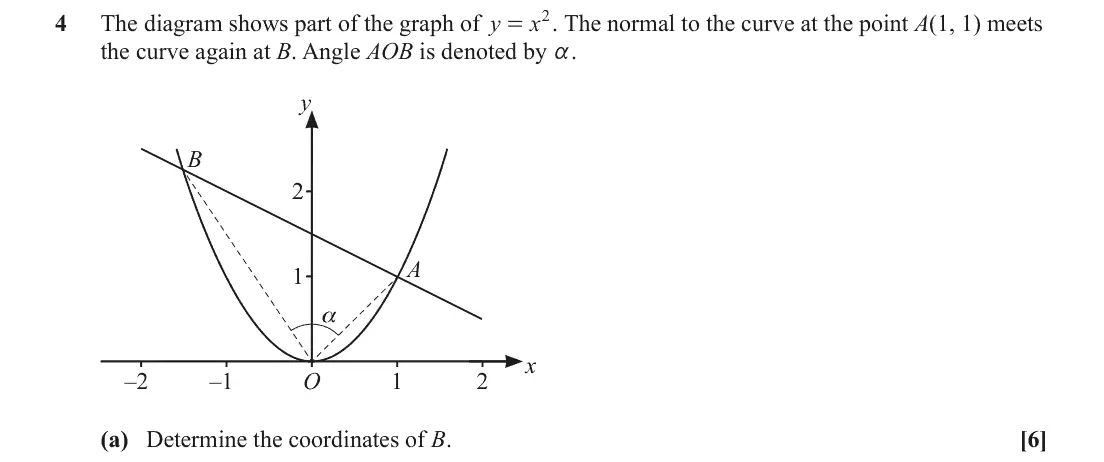
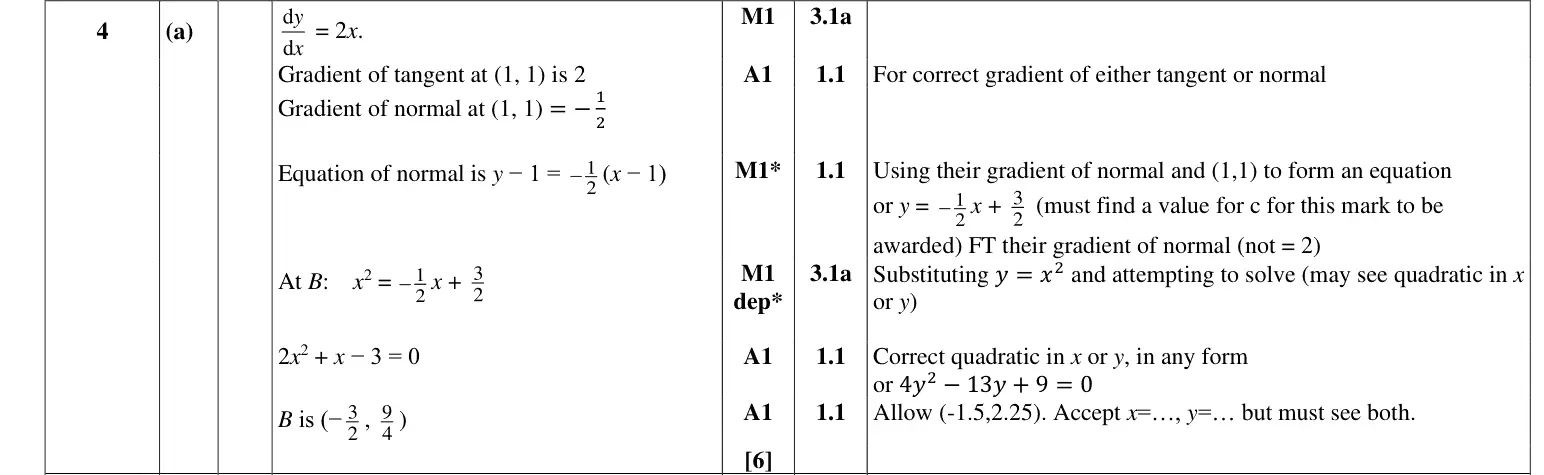
This question was very well answered, with the majority of candidates reaching the required answer. However, again some candidates did not heed the ‘Determine’ instruction and gave minimal working, or an answer only (BC) without working. Where the command word is ‘Determine’ working is required to support the answer, even if it can be done on a calculator. Many candidates found the equation of the normal correctly but then did not show any working for how this led to the coordinates of B, which meant the final 3 marks could not be given – even for a correct answer. This candidate’s response shows all of the required working to justify their (correct) answer. They have shown how the equation of the normal is obtained and then correctly substituted to solve for the coordinates required.
Key points and common errors
gradient 2 at A so normal gradient −1/2
y = −x/2 + 3/2
solve x² = −x/2 + 3/2 to get B(−3/2, 9/4)
working needed for Determine
June 2022 · AS Paper 2 · Q8(b)7 marksMedium
Show the start of this question
Mark scheme for this part
Examiner's comment
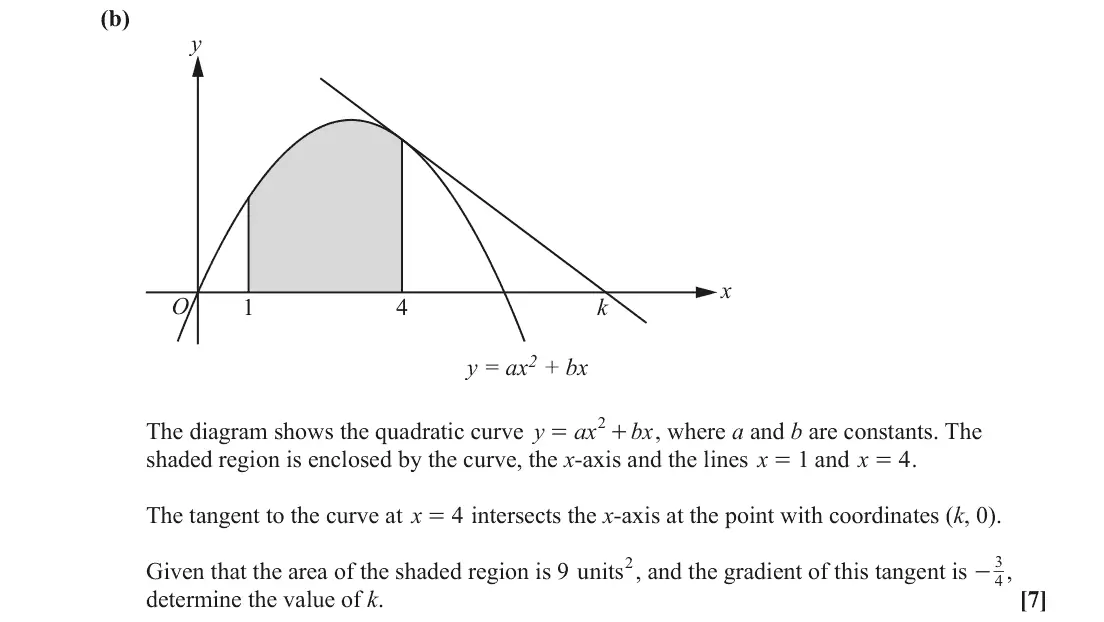
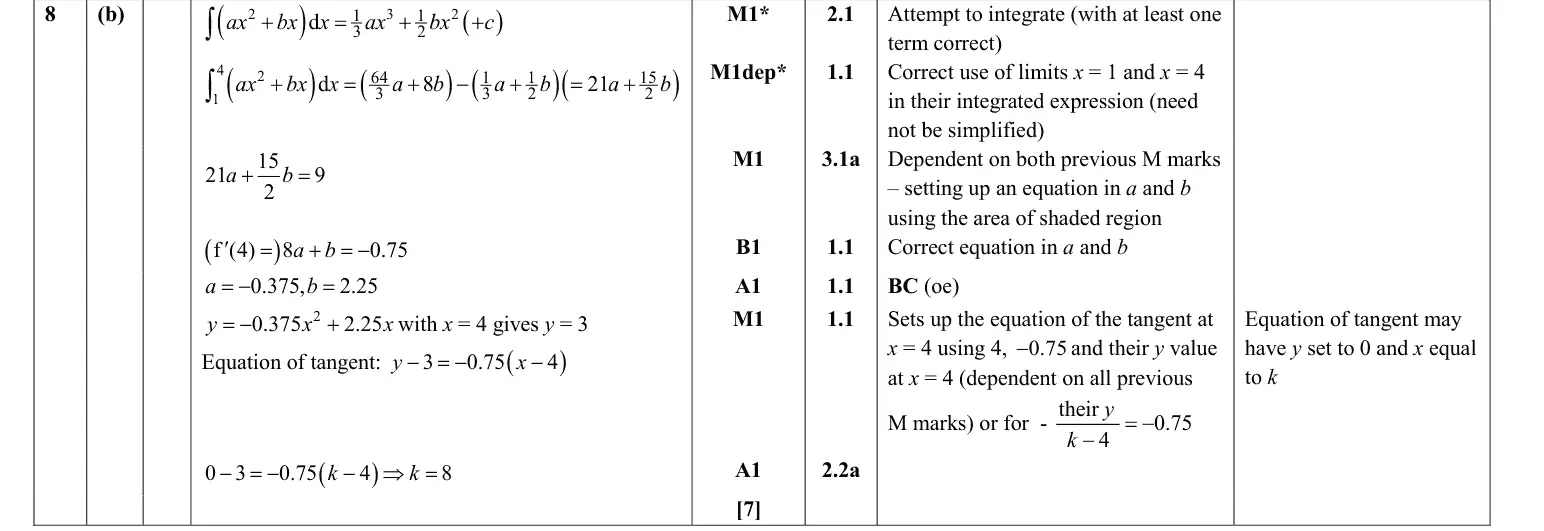
Many candidates earned the first 3 method marks here, most integrating correctly, a few making a sign error when evaluating the limits. Less successful was recognising where the second equation in a and b came from, and hence not finding their values. Those who managed this often produced a complete solution, but not all provided the correct method to find k. Some thought y = 2ax +b was the equation of the tangent. Only a few started this question by differentiating y = ax2 + bx rather than integrating it.
Key points and common errors
∫₁⁴ (ax² + bx) dx = 21a + 7.5b = 9
f′(4) = 8a + b = −0.75
a = −0.375, b = 2.25
tangent at (4, 3): y − 3 = −0.75(x − 4) gives k = 8
second equation often missed
June 2022 · Paper 1 · Q12(a)4 marksEasy
Mark scheme for this part
Examiner's comment
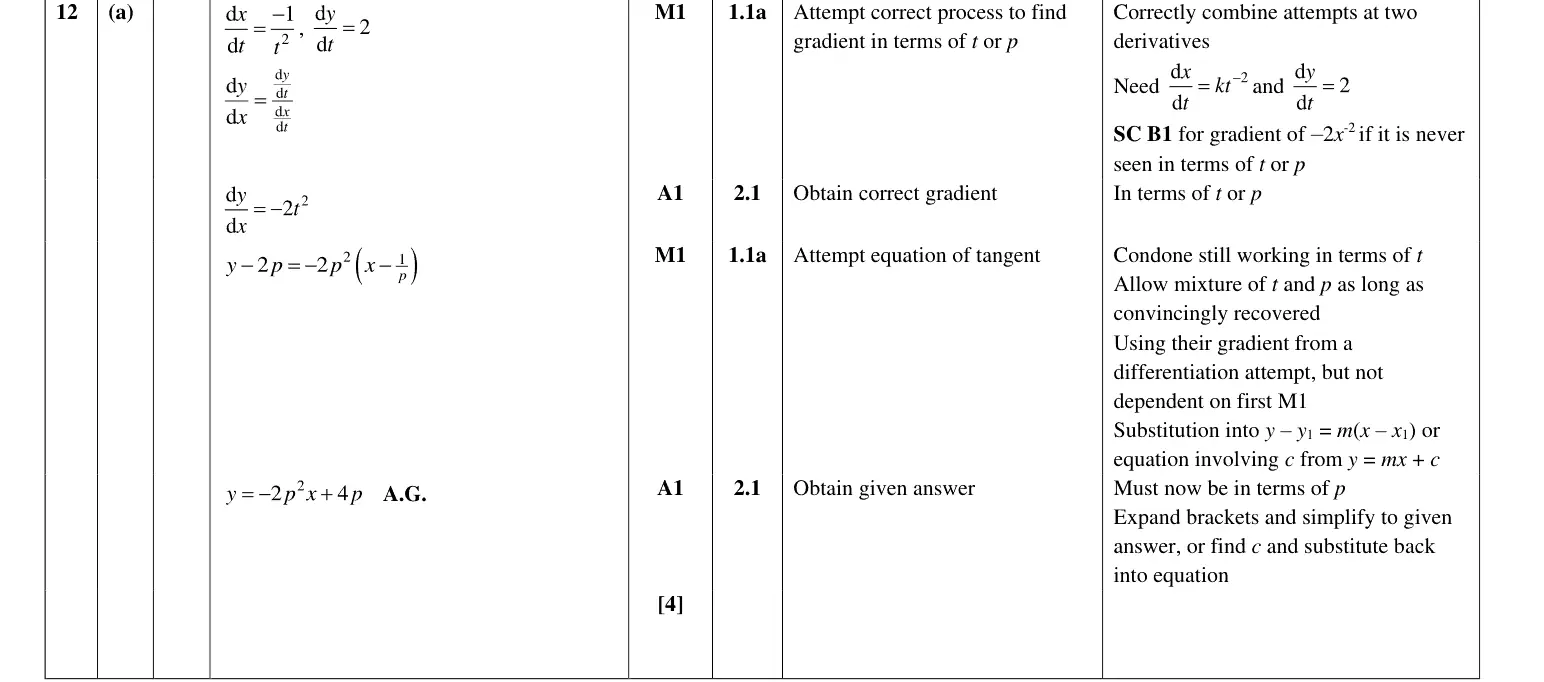
The majority of candidates gained full marks on this part of the question, and it was only a small minority that made no progress. The first 2 marks could be gained by finding a correct expression for the gradient, either in terms of t or p. Most candidates could then attempt the equation of the tangent, but a number struggled to use the same parameter consistently. With a given answer, there is an expectation that method is clearly shown, and most candidates did so.
Key points and common errors
dy/dx = (dy/dt)/(dx/dt) = −2t²
tangent at P: y − 2p = −2p²(x − 1/p) gives y = −2p²x + 4p
use one parameter consistently
June 2022 · Paper 1 · Q12(b)8 marksHard
Show the start of this question
Mark scheme for this part
Examiner's comment
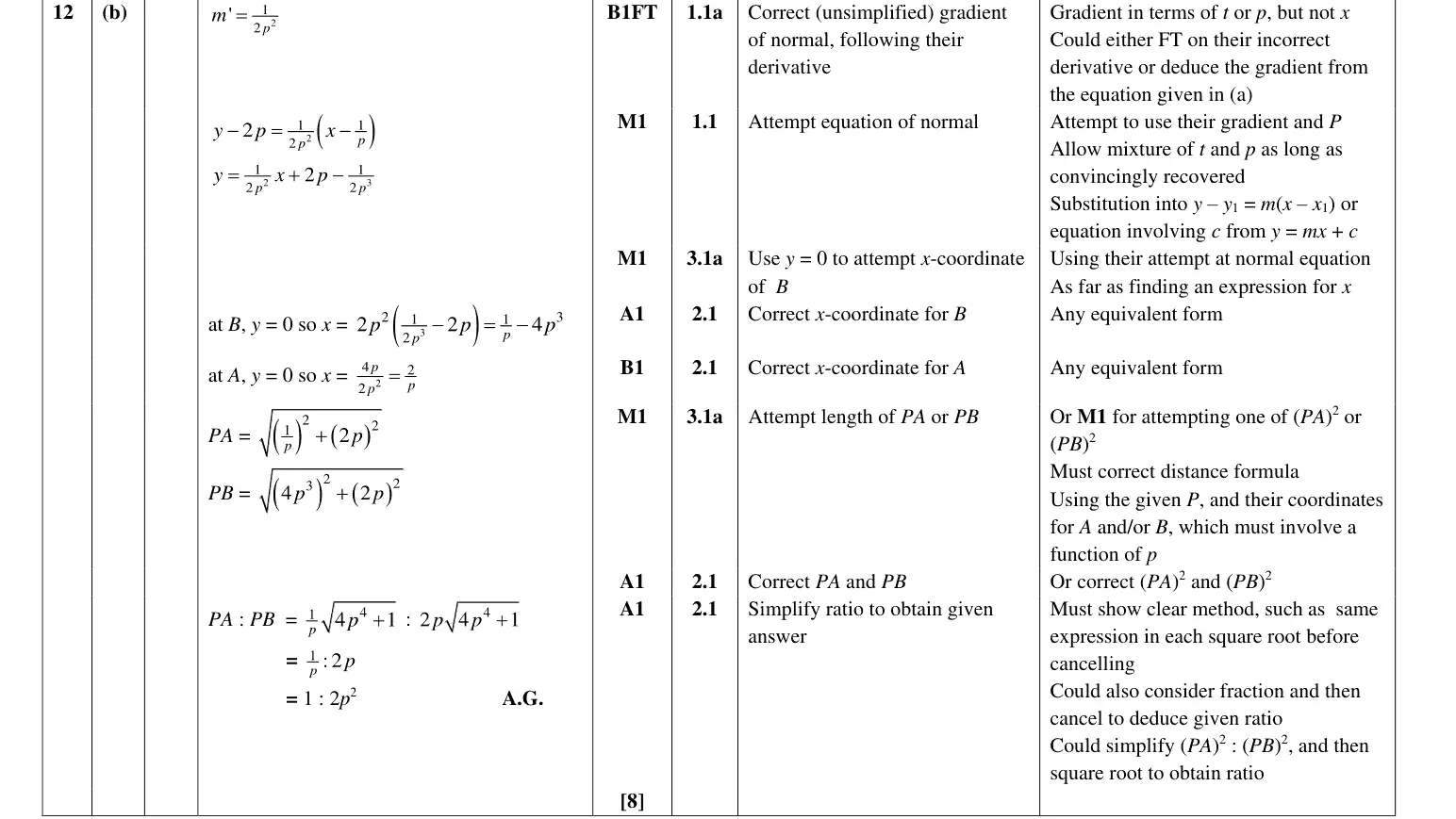
This proved to be a suitable challenging end to the paper, and fully correct solutions were in the minority. A number of candidates made no attempt at all at this part of the question, although it was unclear whether they were lacking inspiration or had run out of time. Of the remainder, most were able to make a reasonable attempt at finding the coordinates of A and B, though a number struggled with the algebraic manipulation required. Some candidates did not realise that it was the ratio of lengths that was required, and made no progress on the final 3 marks. When attempting the ratio, some candidates simplified both surds to a common factor, others attempted a division or demonstrated the veracity of the given answer, all with convincing use of algebra.
Key points and common errors
normal gradient 1/(2p²)
A at x = 2/p, B at x = 1/p − 4p³
PA = (1/p)√(4p⁴ + 1), PB = 2p√(4p⁴ + 1) so PA:PB = 1:2p²
ratio of lengths, not coordinates
June 2022 · Paper 3 · Q5(a)5 marksMedium
Mark scheme for this part
Examiner's comment
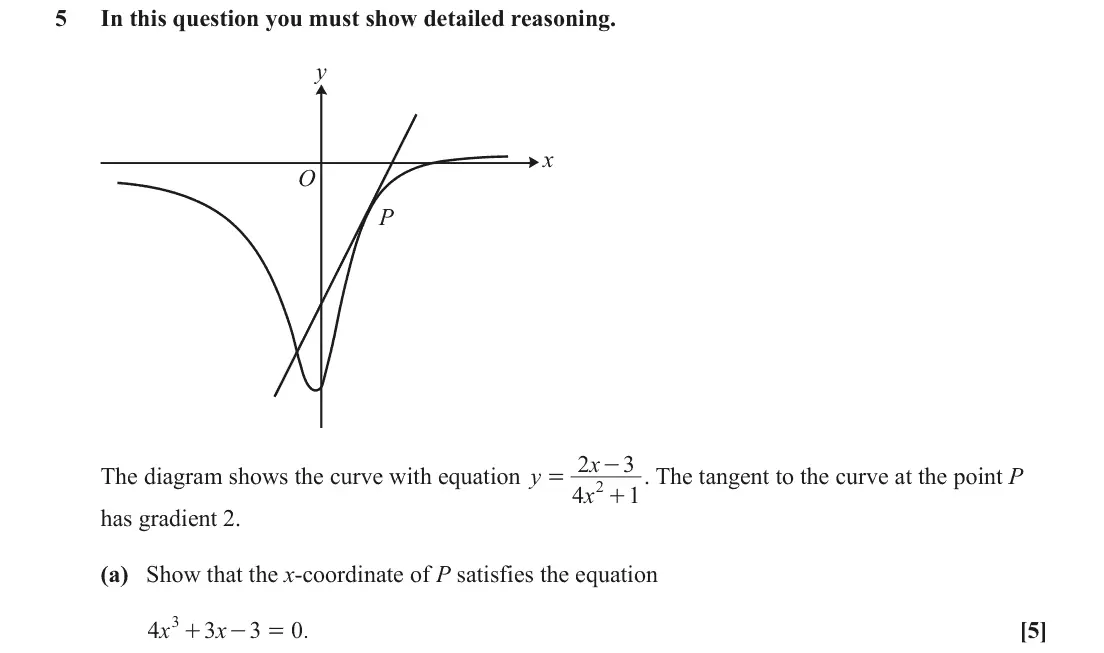
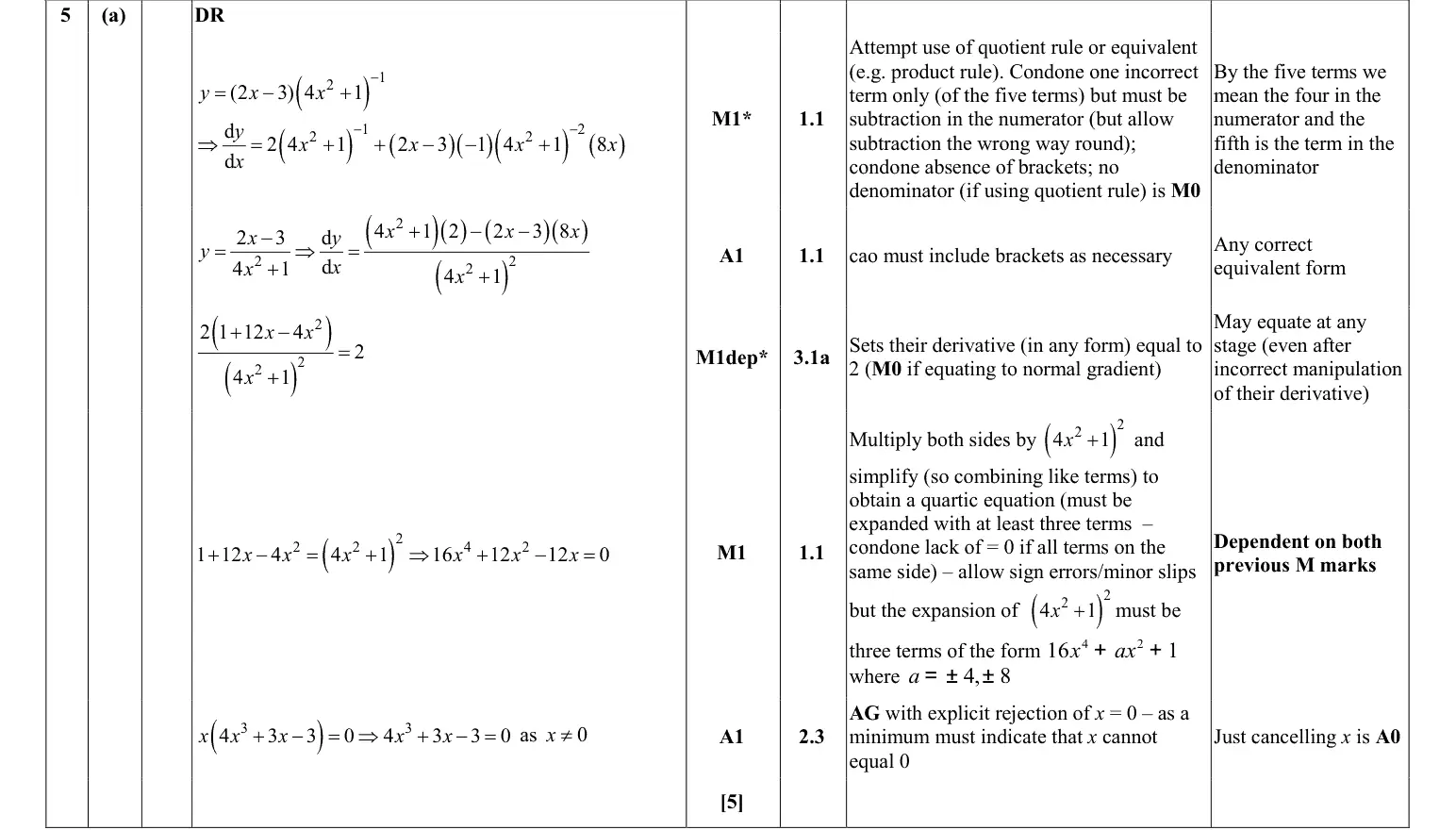
It was very pleasing that most candidates correctly applied the quotient rule to the given equation and put the resulting derivative equal to 2 (although examiners did note that on occasion the derivative was set equal to zero). Most candidates then removed the fraction(s) and bracket(s) successfully and derived the equation 16 x + 12 x − 12 x = 0 (or a multiple of this). However, the question required ‘detailed reasoning’, and it was evident that a large number of candidates simply cancelled anx from each term of their equation believing that this was sufficient to show the required result. Only the most successful responses made any reference to the given diagram which showed that the x-coordinate of point P could not be equal to zero. This response scored 4 (of the 5) marks. This was a very common response seen by examiners. The candidate has correctly applied the quotient rule and set the derivative equal to 2. They have then removed the fraction, expanded and simplified to a correct quartic equation in x ( ) + − = 4 x 3 x 3 x 0 . However, no justification is given by the candidate for why it is acceptable to cancel the x’s when simplifying the quartic equation to the required cubic equation which is why they did not achieve full marks.
Key points and common errors
quotient rule
set dy/dx = 2 (not 0)
16x⁴ + 12x² − 12x = 0
must explicitly reject x = 0 before dividing by x
Autumn 2021 · AS Paper 1 · Q96 marksMedium
Mark scheme for this part
Key points and common errors
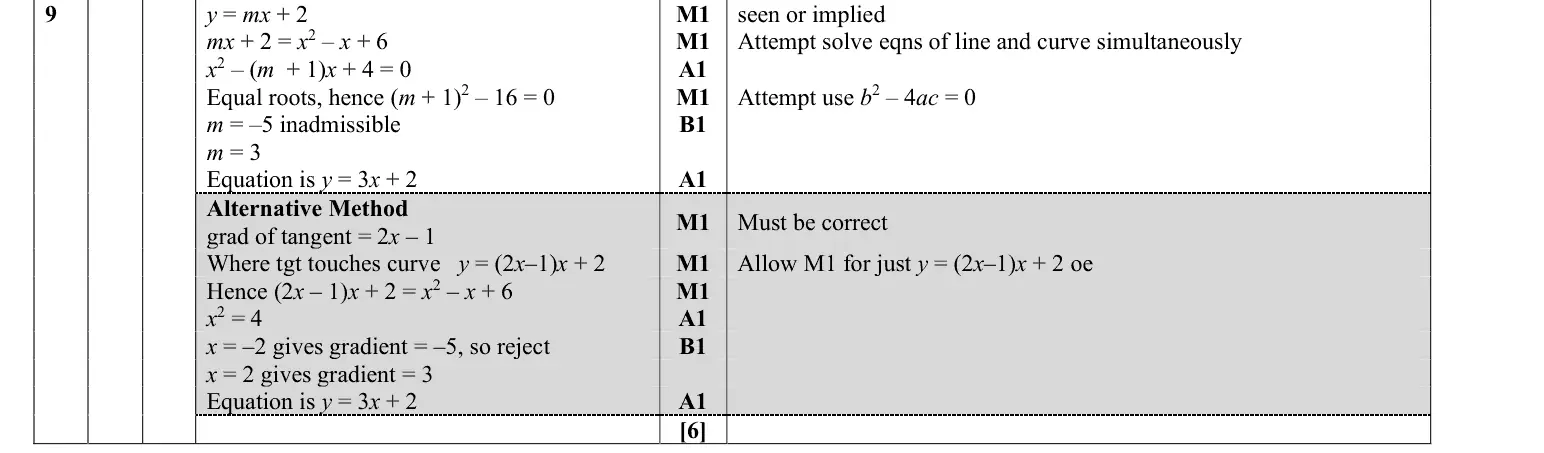
y = mx + 2
x² − (m + 1)x + 4 = 0
equal roots so (m + 1)² − 16 = 0
m = 3 (reject −5)
y = 3x + 2
alt: tangent gradient 2x − 1 gives x² = 4
Autumn 2021 · AS Paper 2 · Q8(a)5 marksMedium
Mark scheme for this part
Key points and common errors
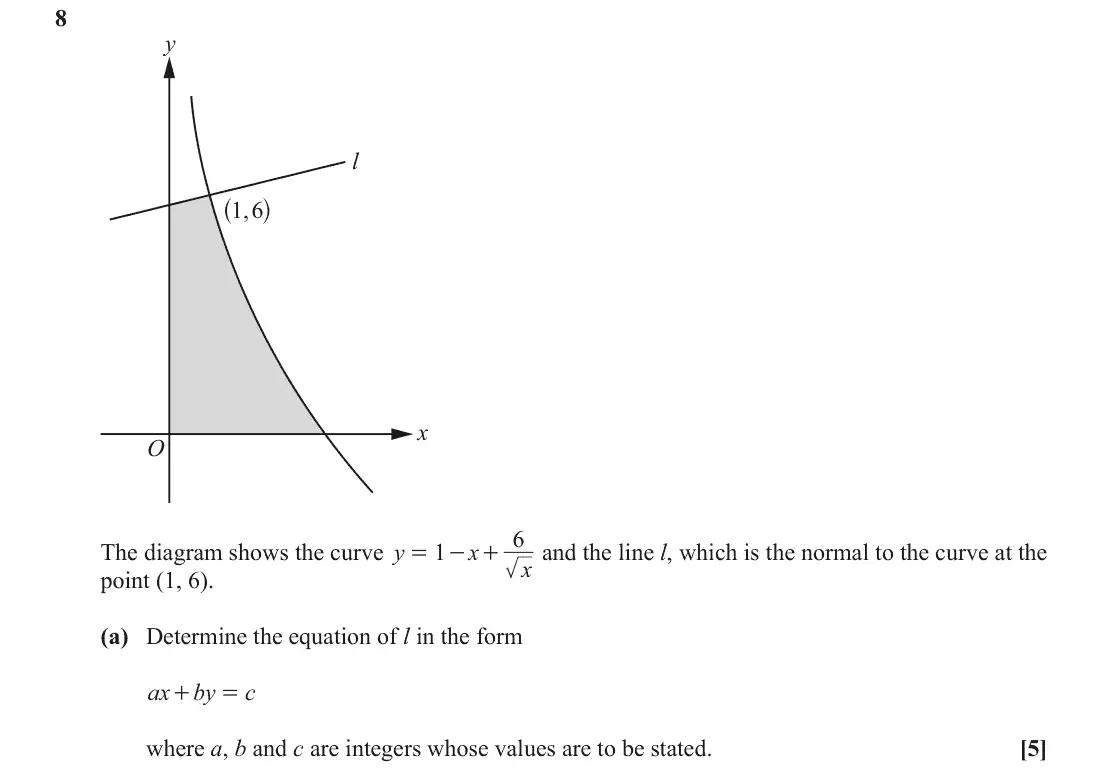
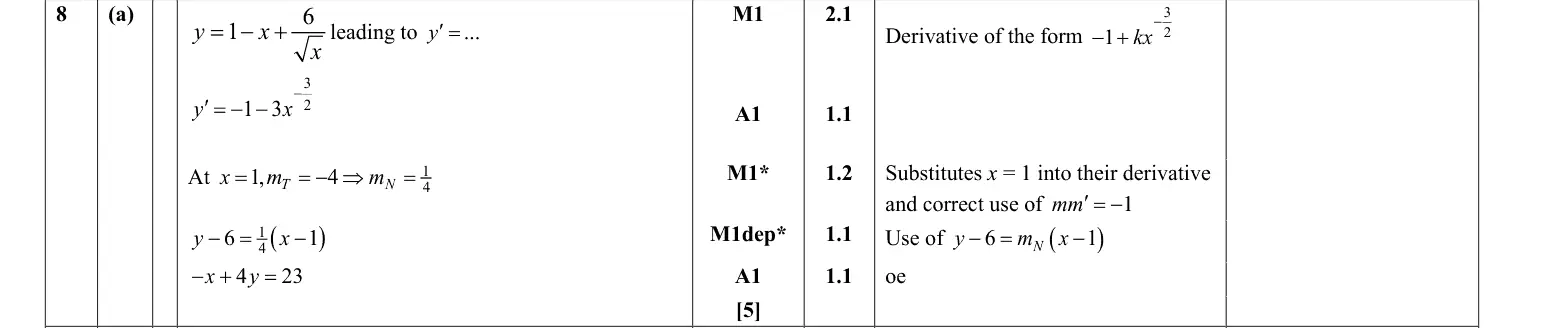
y′ = −1 − 3x^(−3/2)
tangent gradient −4 at x = 1 so normal gradient ¼
−x + 4y = 23 with integers
Autumn 2021 · Paper 1 · Q11(b)7 marksMedium
Show the start of this question
Mark scheme for this part
Examiner's comment
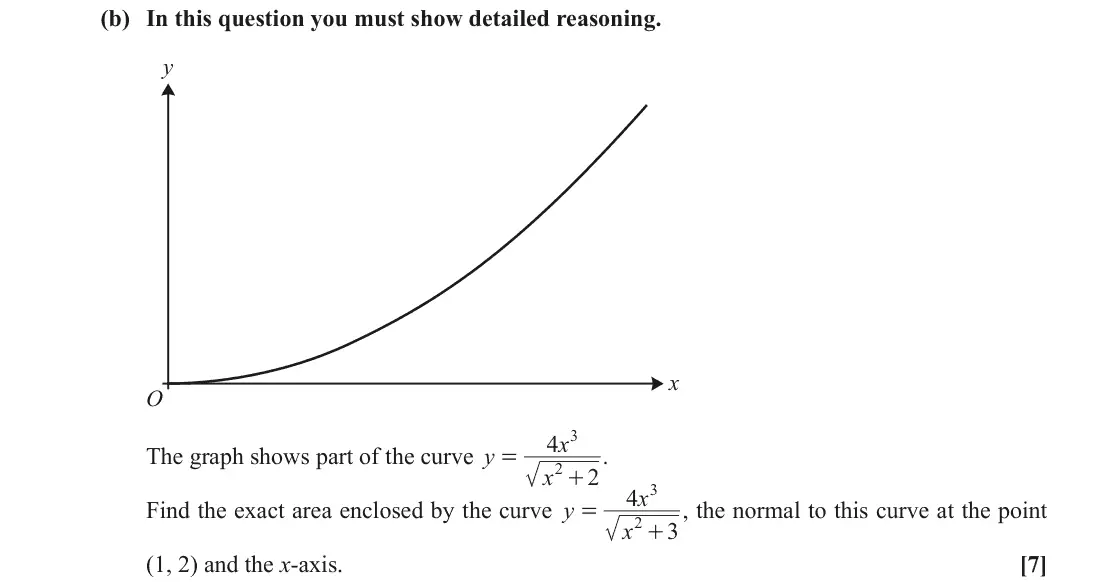
(From the general report) Teachers should make sure that they use an amended version of the question paper, correcting the 4 x description of the graph in Question 11(b) as “part of the curve y = ” to match the information in x + 3 the rest of the question.
Key points and common errors
paper misprint: graph label should read √(x² + 3)
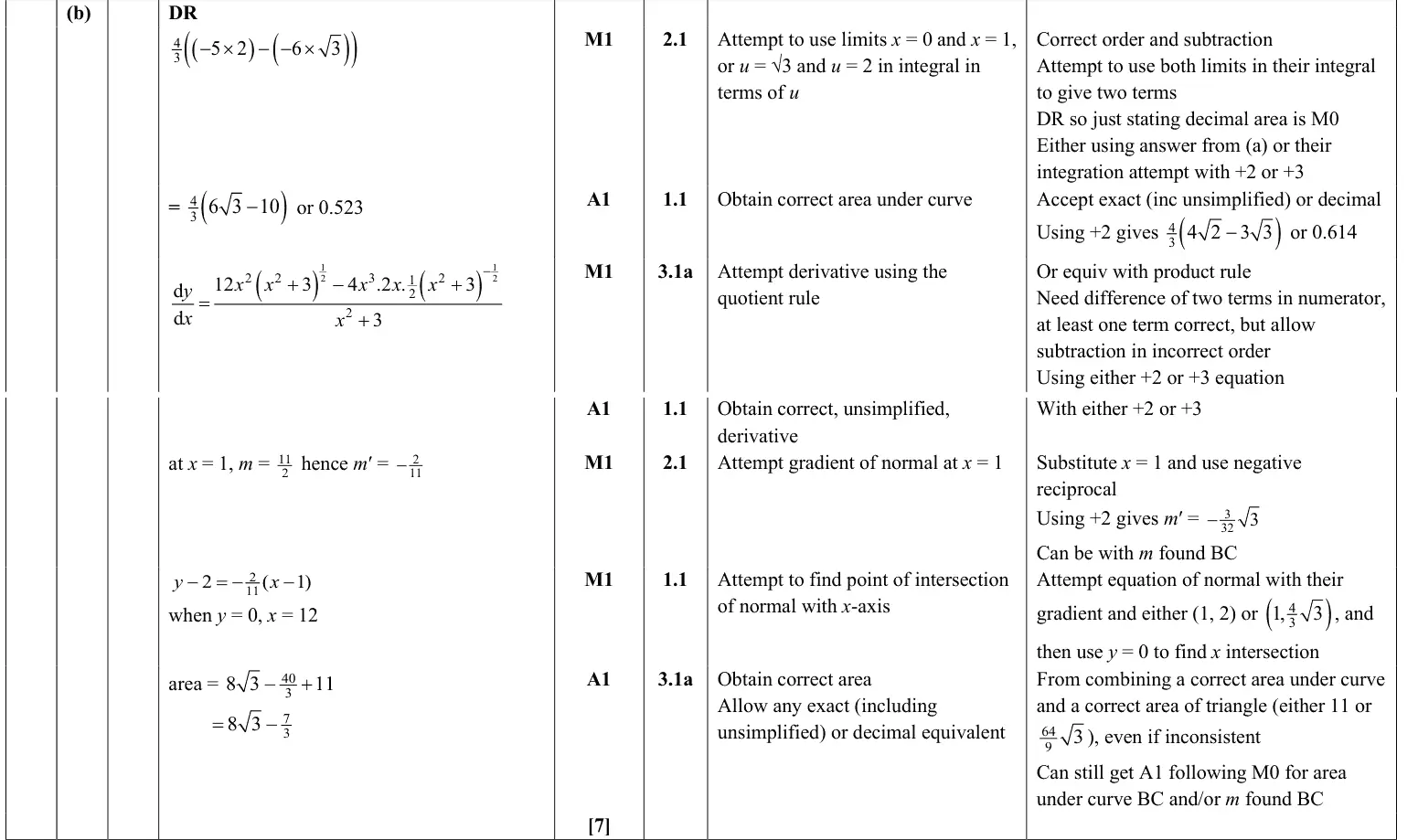
area under curve (4/3)(6√3 − 10)
quotient rule gives gradient 11/2 at x = 1 so normal gradient −2/11
normal meets x-axis at x = 12, triangle area 11
total 8√3 − 7/3
Autumn 2020 · AS Paper 2 · Q37 marksMedium
Mark scheme for this part
Examiner's comment
(From the general report) Note that ‘find’ was used in Question 3 and Question 6 with the instruction to show detailed reasoning, which now means evidence is vital.
Key points and common errors
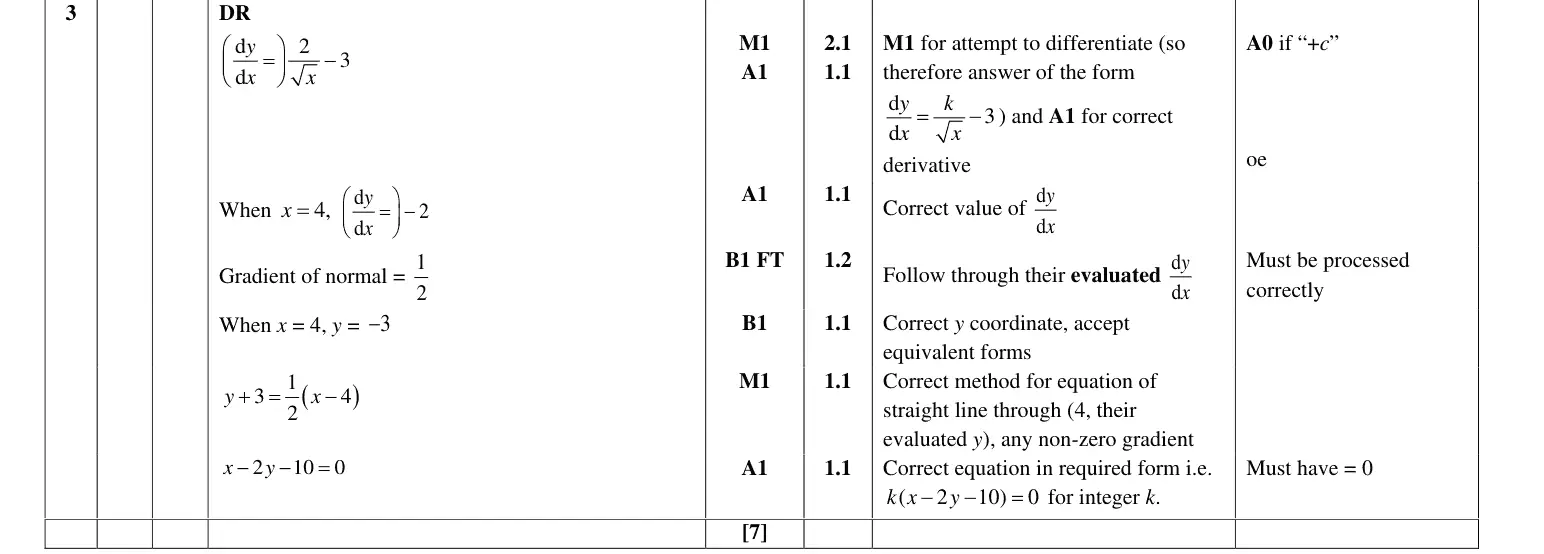
dy/dx = 2/√x − 3 = −2 at x = 4
normal gradient ½ through (4, −3)
x − 2y − 10 = 0 with integer coefficients
June 2019 · AS Paper 1 · Q7(b)4 marksMedium
Show the start of this question
Mark scheme for this part
Examiner's comment
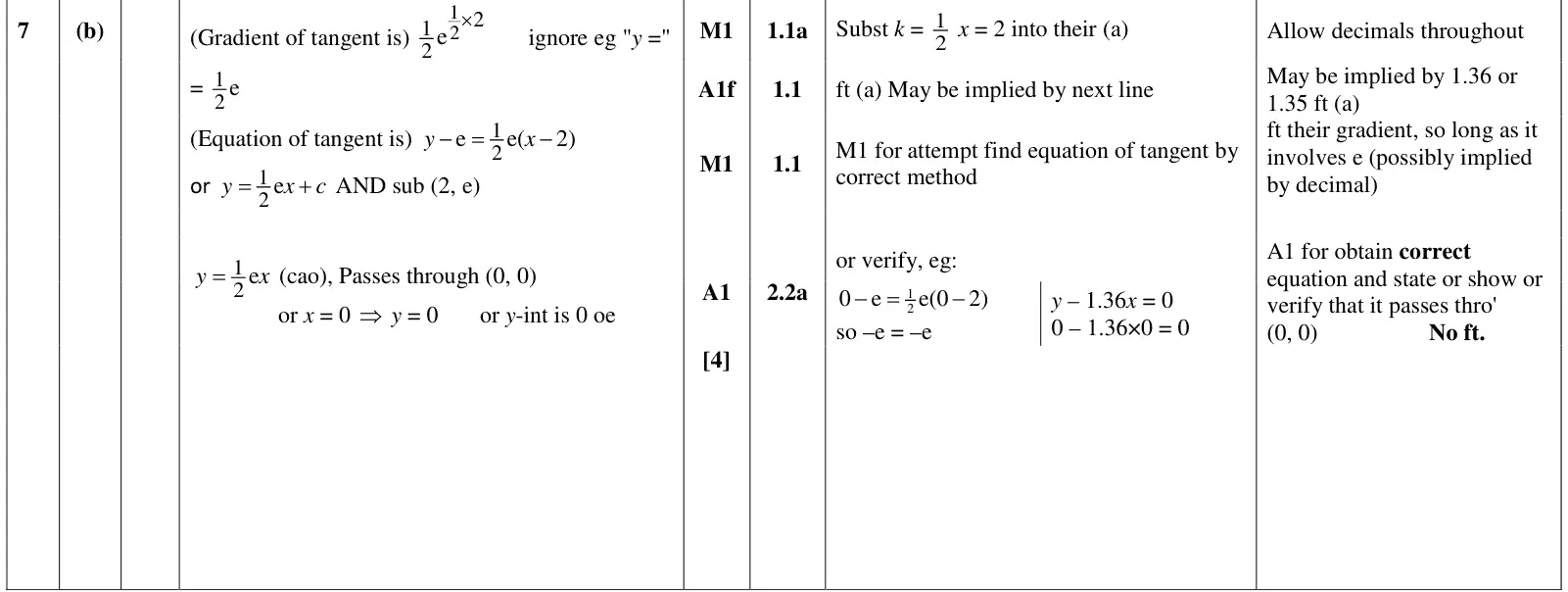
Many candidates correctly used their response to part (b) to find the gradient of the curve at x = 2. But then a large minority found the negative reciprocal and used this as the gradient of the tangent. Most candidates used one of the two usual methods for the equation a straight line. Some used the form y = mx + c, although a few found c = 0 without stating explicitly the equation of the tangent. This was not regarded as an adequate response to the instruction "Show that . . .” Others found the equation correctly and stated (rather than showed) that the line passed through O. These were allowed the final mark because the equation concerned was so simple. However, in similar questions in the future, the corresponding mark might be withheld if no explanation is given. 2 into their d y Some candidates, having differentiated correctly in part (a), substituted k = 1 x , but did not d substitute x = 2. In some cases, they went on to try to find the equation of the tangent, with their gradient 1 x 1 2 e 2 still given as a function of x; thus: y – e = (x – 2). Other candidates appeared not to recognise that their response to part (a) could be used in part (b), and they started from scratch. A common error was to find the gradient, not of the tangent, but of the line joining the origin to the point where x = e. The relevant marks were not gained despite the fact that these are, fortuitously, the same line.
Key points and common errors
gradient at x = 2 is e/2 (not the normal)
y − e = (e/2)(x − 2) gives y = ex/2, which passes through (0, 0)
June 2019 · AS Paper 2 · Q2(c)1 markHard
Show the start of this question
Mark scheme for this part
Examiner's comment
‘State’ again, with the same implication as in 2(c). This part was the least successful. A significant number of candidates found the tangent y = − 17 rather than the requested normal x = 2 .
Key points and common errors
normal at the minimum is vertical: x = 2
common error the tangent y = −17
June 2019 · Paper 1 · Q5(b)4 marksEasy
Show the start of this question
Mark scheme for this part
Examiner's comment
This part of the question was also very well answered, with the majority of the candidates gaining full credit. The most successful candidates found a numerical value for the gradient of the tangent and from this found the gradient, and hence the equation, of the normal. Attempts to find the negative reciprocal algebraically tended to be less successful, and some candidates even used this algebraic expression in their equation of the normal.
Key points and common errors
dy/dx = 9 at (1, 2), normal gradient −1/9
x + 9y = 19
use a numerical gradient, not an algebraic one
June 2019 · Paper 1 · Q12(b)4 marksMedium
Show the start of this question
Mark scheme for this part
Examiner's comment
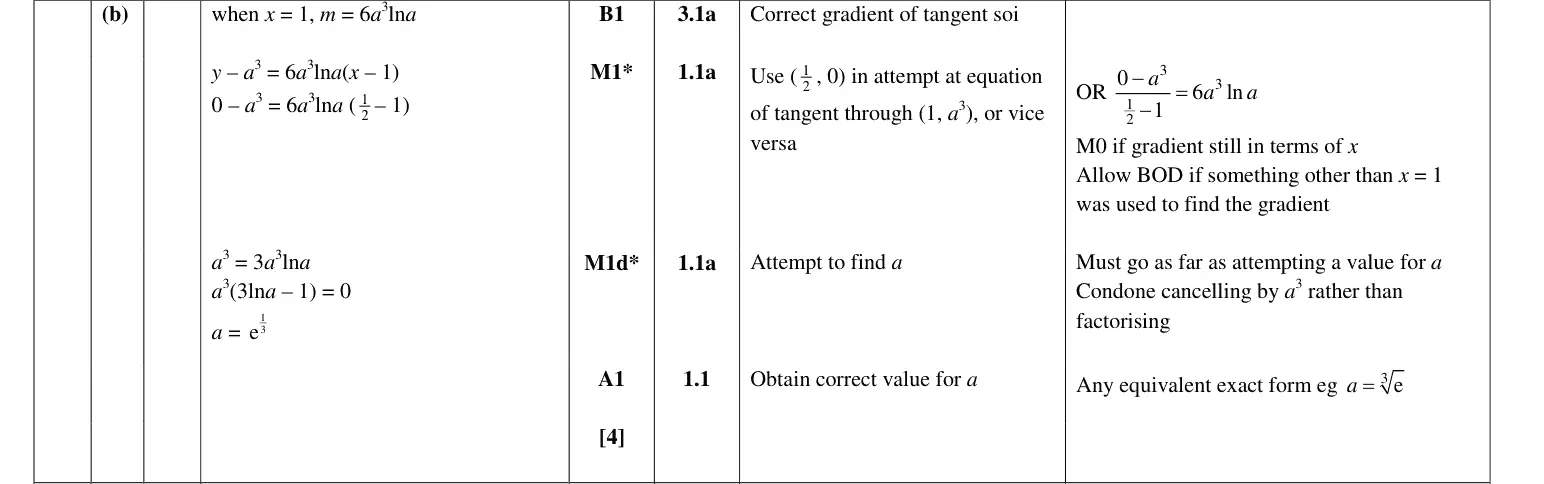
A number of candidates were able to make a good attempt at this question, producing fully correct solutions. The most common approach was to find a general equation for the tangent and then substitute in the given points, sometimes to give an equation that could be then solved and other times to set up two simultaneous equations. The less common, but more efficient, method was to use the two given points to find an expression for the gradient that was then equated to the derivative. Some candidates did not read the question carefully and used the wrong point when finding the gradient of the tangent, and others attempted to use both points in the derivative. A common misconception was to use the derivative in terms of x as the gradient rather than appreciating that a straight line must have a constant gradient.
Key points and common errors
gradient 6a³ln a at x = 1
tangent through (½, 0) gives a³ = 3a³ln a so a = e^(1/3)
using the wrong point for the gradient
June 2019 · Paper 2 · Q3(b)6 marksMedium
Mark scheme for this part
Examiner's comment
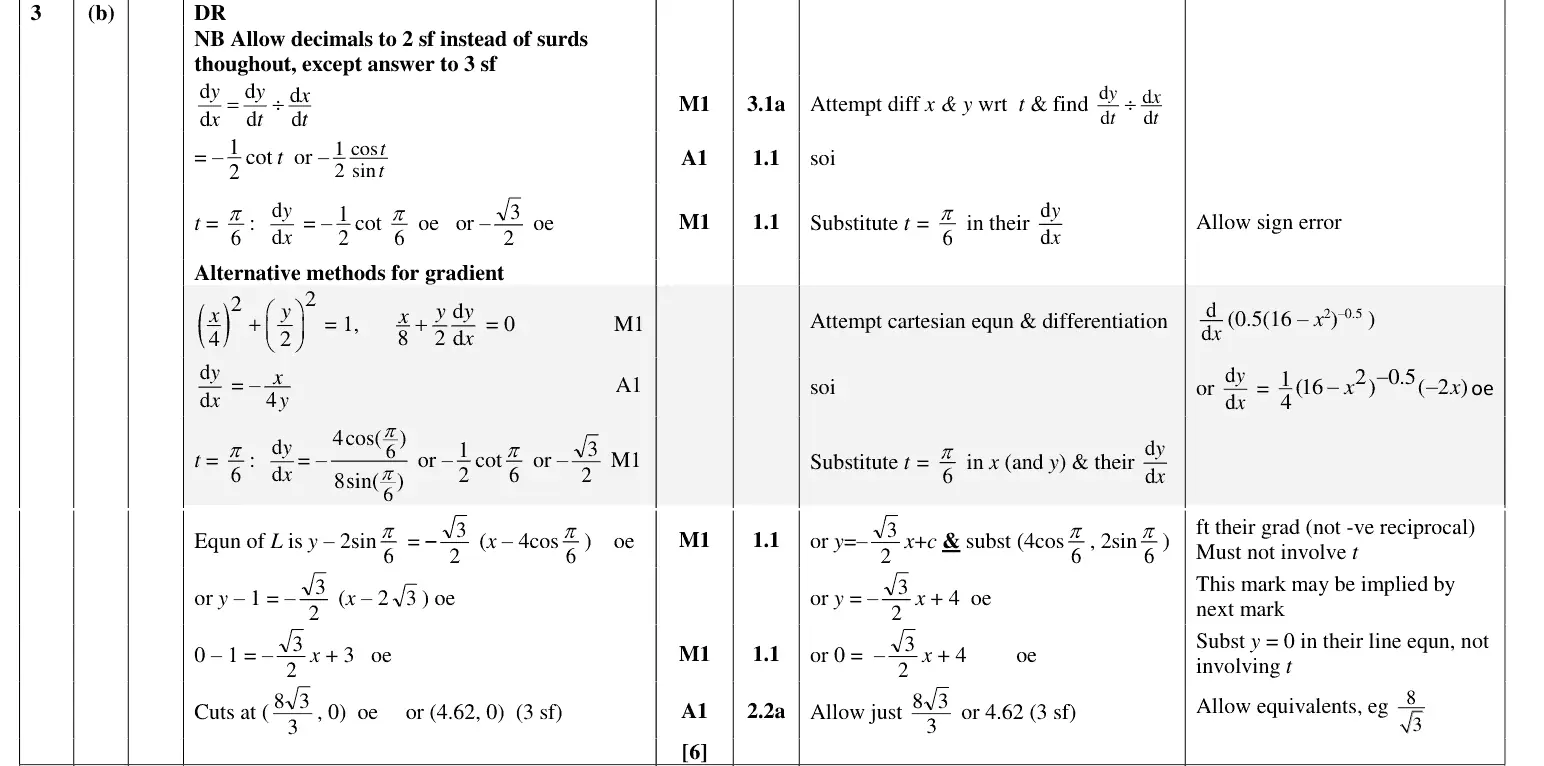
Most candidates recognised that the starting point was to find the gradient of the curve at the relevant point. Most of these successfully found d x by dividing d y y t by d x t . A few made errors while substituting d d d π t = , such as omitting the "–" sign. Many candidates carried out the next two steps (finding the 6 equation of the line and substituting y = 0) correctly. However, arithmetical errors were legion. It is worth noting that some candidates combined these steps into one, not giving explicitly the equation of the line before substituting y = 0. This is not incorrect and was not penalised, but it possibly led to more errors than would otherwise have occurred. It also certainly made the marking more difficult, and sometimes marks could not be awarded because candidates' working was not clear enough. Some candidates found the gradient of the normal and used this as the gradient of the tangent. π Some candidates retained "t " in their working until a late stage, only substituting t = at the end. This 6 led to working being more complex and confusing than necessary, and sometime led to errors along the way. A few candidates found the point where the curve cuts the x-axis, instead of where the line cuts the x- axis.
Key points and common errors
dy/dx = (dy/dt)/(dx/dt) = −½cot t
at t = π/6 gradient −√3/2
tangent through (2√3, 1)
cuts x-axis at 8√3/3
arithmetic errors common
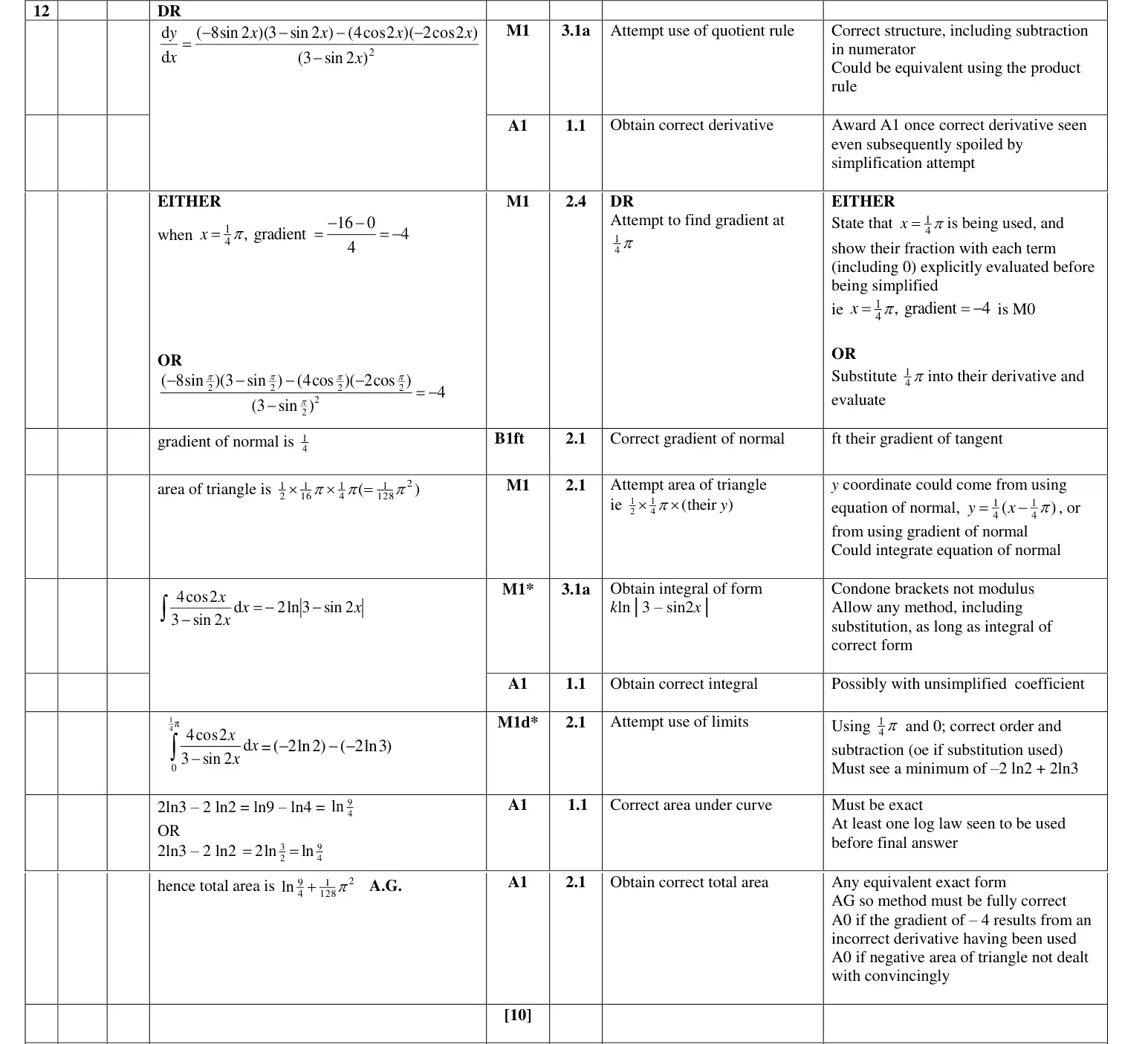
June 2018 · Paper 1 · Q1210 marksMedium
Mark scheme for this part
Examiner's comment
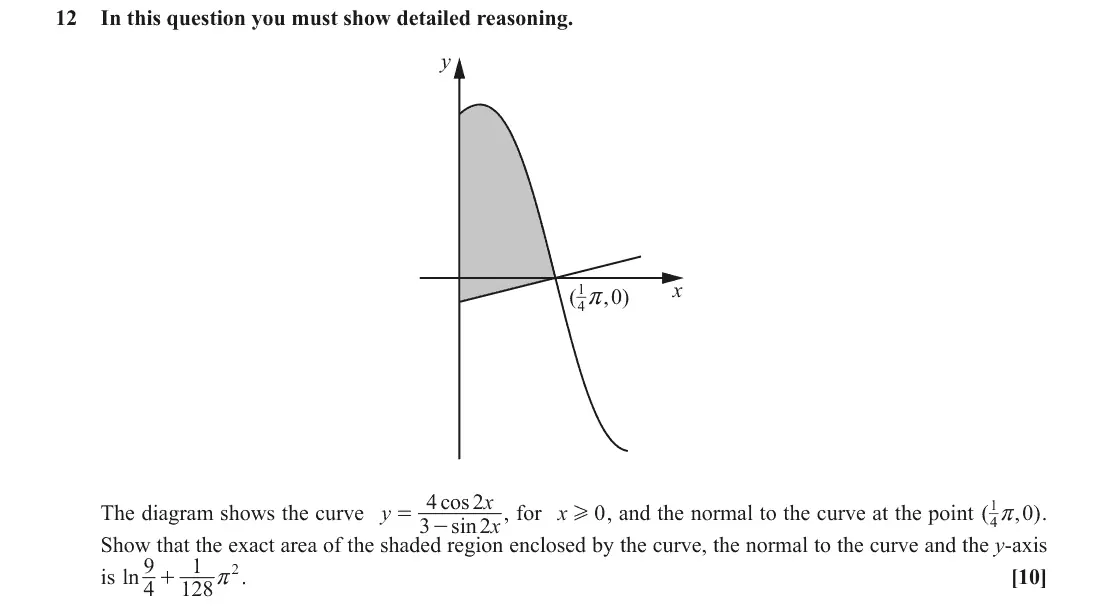
This was a question requiring detailed reasoning, so candidates were expected to show sufficient evidence of method throughout which not seen on all scripts. Candidates were generally successful when using the quotient rule to find the gradient of the curve. They were then expected to show evidence of finding the gradient at the given point; whilst some showed clear detail, others just stated the gradient with no justification. There were a variety of methods seen when finding the area of the triangle; the most common was to find the y intercept from the equation of the normal whereas others used integration. Some candidates identified that the 128π in the given answer must be the area of the triangle and attempted to fudge their answer to obtain this, in some cases deleting correct work and replacing it with a solution that was now worth less credit. Most candidates were able to correctly integrate the equation of the curve, some by inspection and others by using a substitution of their choosing. The limits were usually used correctly, but not all candidates provided sufficient evidence of use of logarithms before the appearance of ln 9 4 . This response gained full credit for a correct solution with sufficient justification seen throughout. The derivative is correct, and there is clear evidence of substitution to find the gradient at x = 1 4 π . Had the gradient of – 4 just been stated, but with no evidence, then this would have been penalised. The equation of the normal is used to find the intercept on the y-axis, and this is used to find the area of the triangle. The integration is also correct and limits are used correctly. There is then clear evidence of at least one log law being used to obtain the correct area under the curve. The two areas are then summed to justify the given answer.
Key points and common errors
quotient rule
gradient −4 at x = ¼π shown explicitly, normal gradient ¼
triangle area π²/128
∫4cos2x/(3 − sin2x) = −2ln(3 − sin2x)
area under curve ln(9/4)
handle the triangle below the axis convincingly
Find an A-level maths tutor
Stuck on this? Book a trial session with an A-level maths tutor.