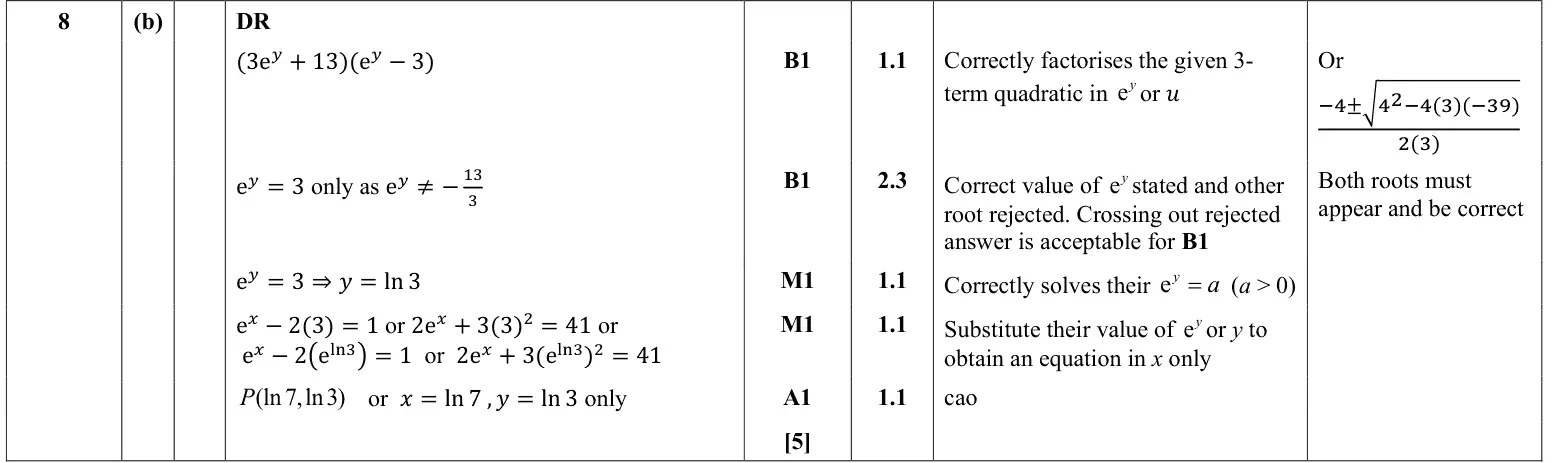
This was the third DR question. The given equation was widely recognised as a quadratic and well solved (see note below). The negative root was often rejected with a good reason provided. We expected exact answers to be seen for full marks. Those who did not use a quadratic tended to write things like ln(3e2y) + ln(4ey) = ln(39) and not make any further progress.
Key points and common errors
quadratic in eʸ: (3eʸ + 13)(eʸ − 3) = 0
reject eʸ = −13/3 with reason
y = ln 3, eˣ = 7 so P(ln 7, ln 3) exact
logging term by term fails
June 2025 · Paper 2 · Q2(b)2 marksEasy
Show the start of this question
Mark scheme for this part
Examiner's comment
This part was very well answered. Most candidates showed at least the required step of working and wrote down the correct, exact answer (although the decimal equivalent could also be credited). A few candidates appeared unsure as to whether they were taking log10 or ln – which was sometimes recovered but often led to an incorrect answer.
Key points and common errors
take ln of both sides: 3y = ln 2, y = (1/3)ln 2
confusion between log10 and ln
June 2025 · Paper 3 · Q3(c)3 marksMedium
Show the start of this question
Mark scheme for this part
Examiner's comment
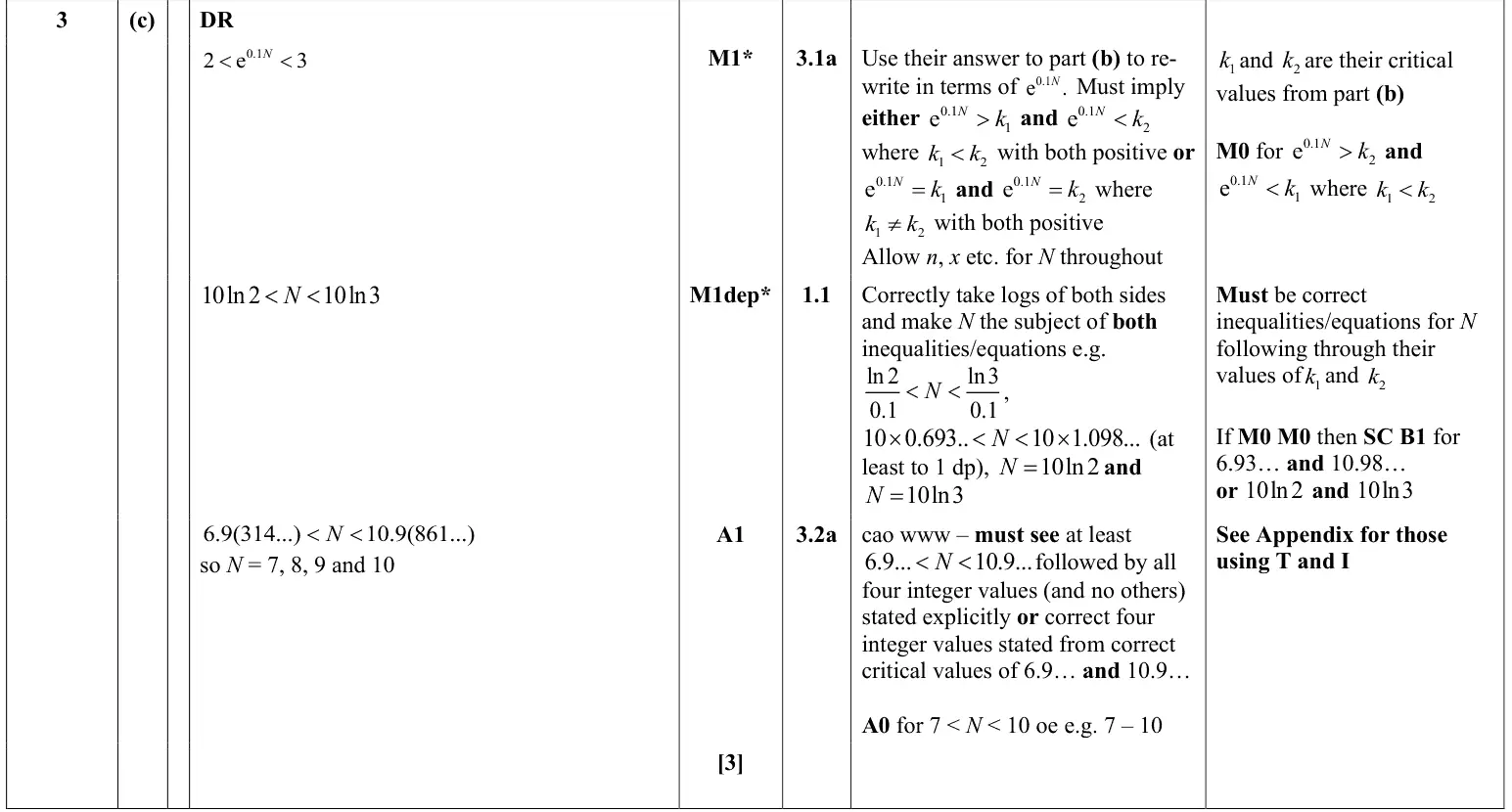
Although most candidates realised that importance of their answer to part (b) and started by stating that 2 < e01.𝑁< 3, many re-started in this part or did not see the significance of the previous part. While many candidates correctly stated that 10ln2 < 𝑁< 10ln3 many did not read the question carefully and either left this as their final answer or gave an answer in a form that did not make it explicitly clear what positive integers satisfied the given inequality (e.g. an answer of 7 ≤𝑁≤10 was far too common). Finally, as this question required detailed reasoning (DR) many went straight from 10ln2 < 𝑁< 10ln3 to N = 7, 8, 9 and 10 without first showing the critical values of 6.93… and 10.98….
Key points and common errors
replace x by e^(0.1N): 2 < e^(0.1N) < 3
10 ln 2 < N < 10 ln 3 i.e. 6.93 < N < 10.99
integers N = 7, 8, 9, 10
many stopped at the log inequality
June 2025 · Paper 3 · Q5(b)4 marksMedium
Show the start of this question
Mark scheme for this part
Examiner's comment
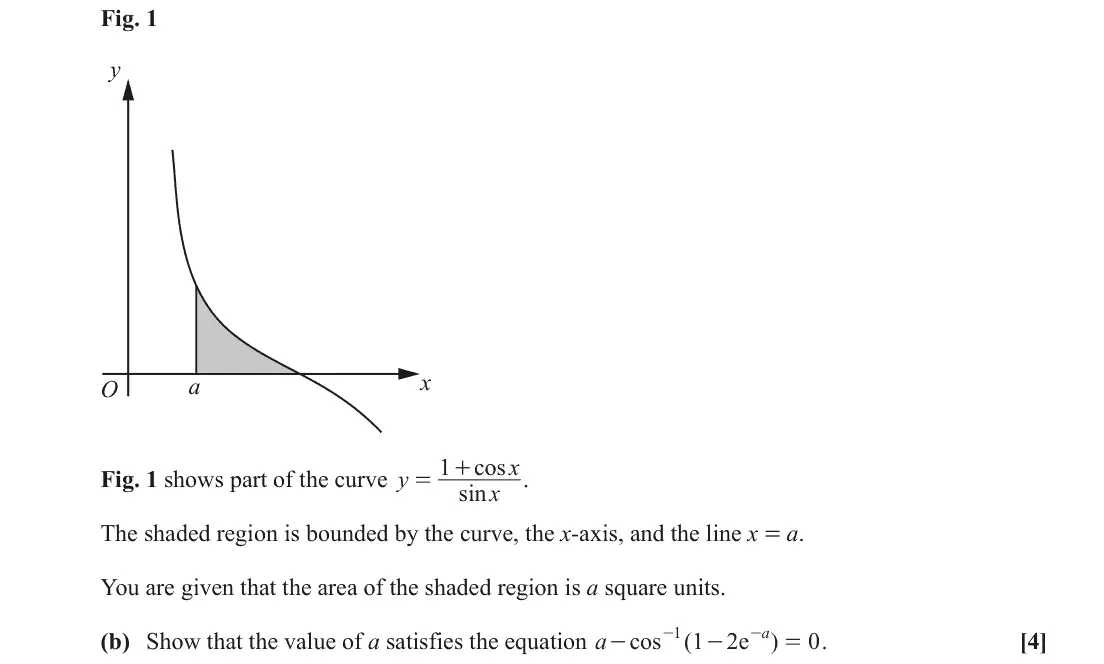
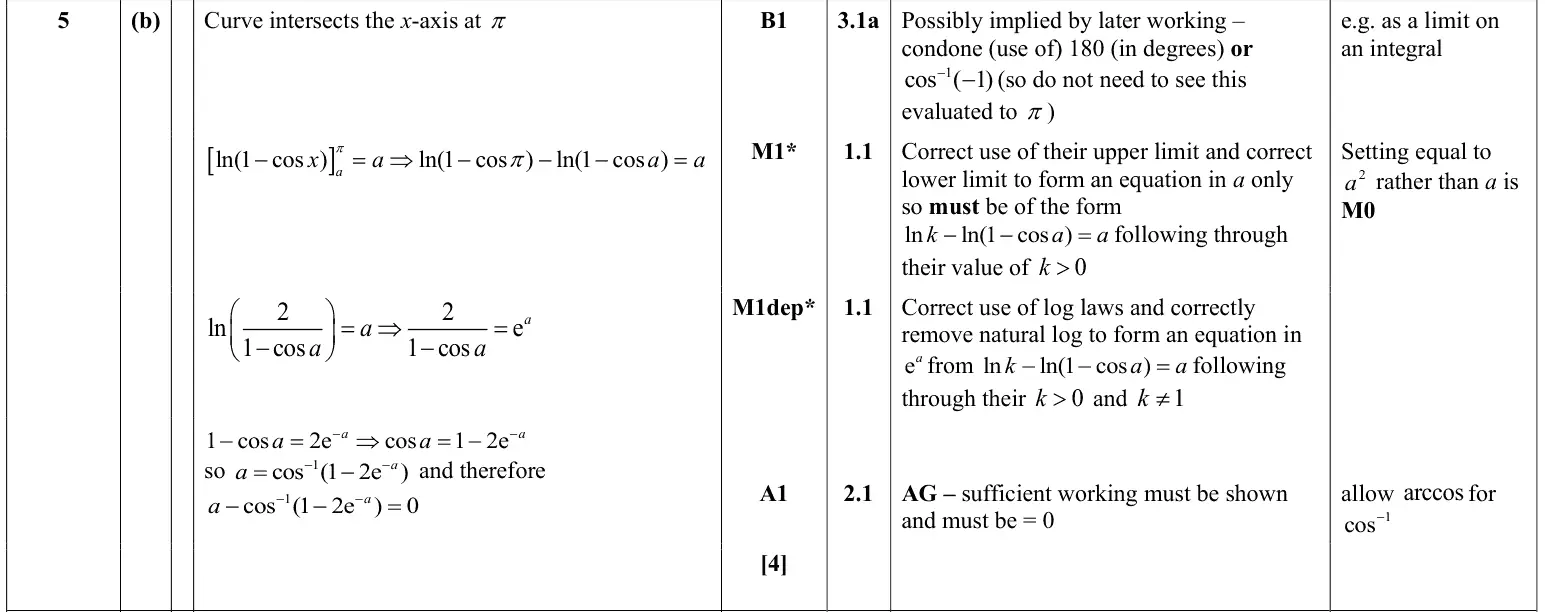
While many candidates correctly found that the curve intersected the 𝑥-axis at 𝜋, some struggled with applying the limits correctly to the given answer from part (a), and a number of candidates incorrectly thought that the shaded region had an area of 𝑎2. Of those that did correctly obtain the equation ln2 − ln(1 −𝑎) = 𝑎 many struggled with the associated log work required to get the answer in the given form with many incorrect replacing ln2 −ln(1 −𝑎) = 𝑎 with 2 −(1 −𝑎) = e𝑎.
Key points and common errors
curve meets the x-axis at π
ln 2 − ln(1 − cos a) = a
2/(1 − cos a) = eᵃ so a = cos⁻¹(1 − 2e^(−a))
area is a, not a²
June 2024 · AS Paper 2 · Q5(a)4 marksMedium
Mark scheme for this part
Examiner's comment
A lot of good responses lost the final mark because the answer was left as 3ln8, ignoring the instruction to give the answer in the form lna. Those who differentiated e3x to 3xe3x, 3xe3x - 1, e2x or similar were 1 given no marks. A small number set their differential equal to − 3. Understanding of the log laws still needs strengthening. Some did not attempt differentiation, but started with things like lny = lne3x − ln21x − ln8.
Key points and common errors
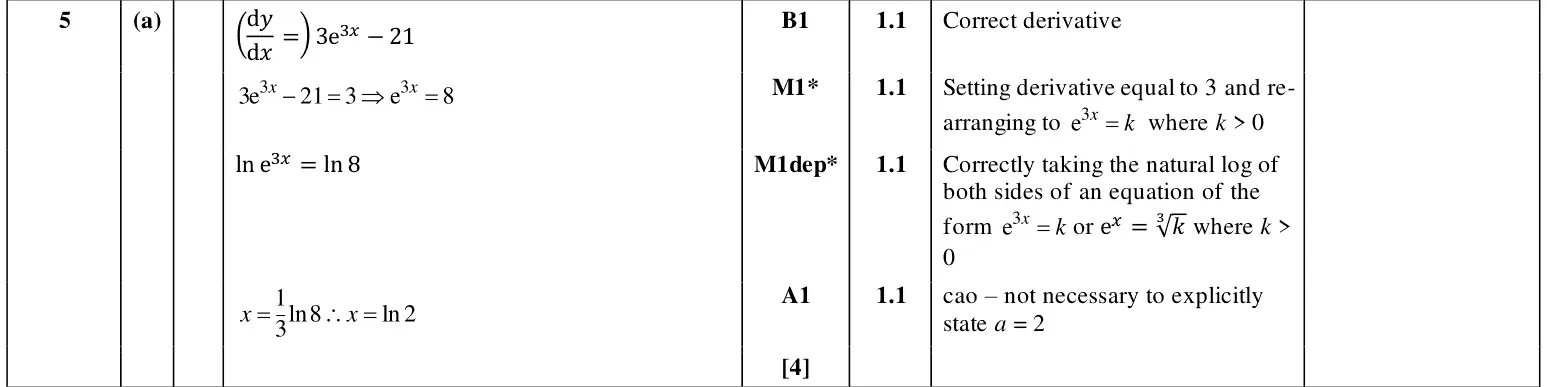
dy/dx = 3e^(3x) − 21 = 3 gives e^(3x) = 8
x = ⅓ln 8 = ln 2 (must be in the form ln a)
June 2024 · Paper 1 · Q6(c)4 marksEasy
Show the start of this question
Mark scheme for this part
Examiner's comment
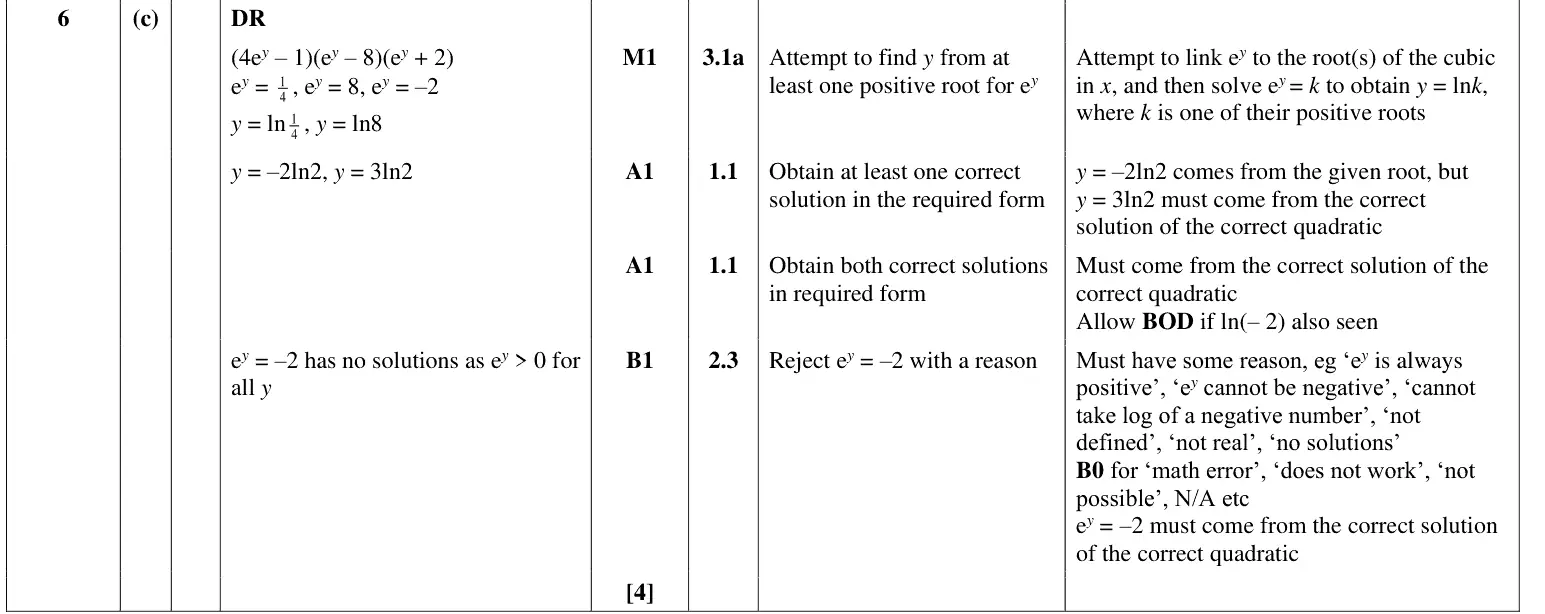
The question was very well answered with many candidates getting full marks on this question. Most candidates made the connection with the previous parts. The most commonly lost mark was the B mark for explaining why 𝑒𝑦= −2 did not result in a solution. It is important in detailed reasoning questions that candidates explain why rejected answers are not used; ‘not possible’ is not enough and incorrect statements like ‘negative logs are not possible’ are not given credit. Some candidates realised there was a connection to part (b) but unfortunately, thought it was an equation in 𝑒3𝑦 instead of 𝑒𝑦. This is a good solution to Question 6 (c), in that it provides clear evidence as to how the solutions are obtained and gives detailed reasoning on why one solution has been rejected.
Key points and common errors
x = e^y: (4e^y − 1)(e^y − 8)(e^y + 2) = 0
y = −2ln2, 3ln2
reject e^y = −2 since e^y > 0
'not possible' is not a reason
June 2024 · Paper 1 · Q11(c)(i)5 marksMedium
Show the start of this question
Mark scheme for this part
Examiner's comment
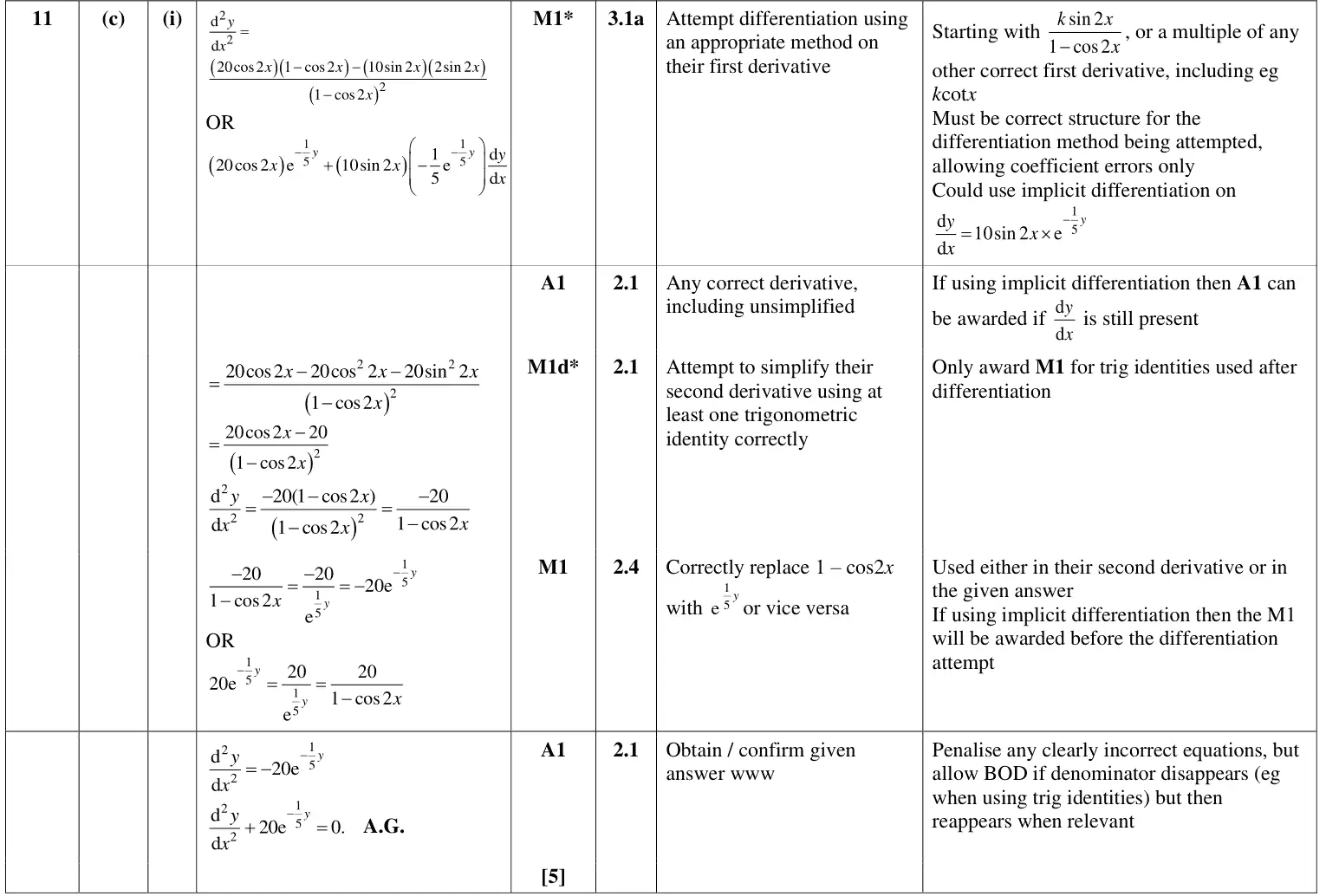
The attempts at the second derivative were very good when a correct first derivative had been obtained in part (b). The majority used the quotient rule rather than the product rule, the latter of which proved trickier for candidates to manipulate correctly to secure full marks. With a given answer, there is an expectation that method is clearly shown, and many candidates were able to simplify their second derivative by using a trigonometric identity but often struggled to obtain a fully correct solution. Those who struggled with part (b) often did not make progress with this part.
Key points and common errors
quotient rule on 10sin2x/(1 − cos2x)
simplify with sin² + cos² = 1 to −20/(1 − cos2x)
replace 1 − cos2x by e^(y/5)
given answer so full method needed
June 2023 · AS Paper 1 · Q4(a)2 marksEasy
Mark scheme for this part
Examiner's comment
This was well answered by the majority of candidates, with most being able to correctly take logs of both sides and reach the required answer. Note that as a ‘Determine’ question some working was required and most candidates followed this instruction adequately. Quite a few candidates rounded incorrectly (giving 0.767 or 0.77 as their final response), but most of these had reached an exact form in their working first so few lost marks for this error.
Key points and common errors
3x = ln 10, x = (1/3) ln 10 = 0.768
rounding errors
June 2022 · AS Paper 1 · Q6(a)(ii)2 marksEasy
Show the start of this question
Mark scheme for this part
Examiner's comment
This question was answered correctly by most candidates. Some started correctly with 100et = 9000 but went on to write et = 900.
Key points and common errors
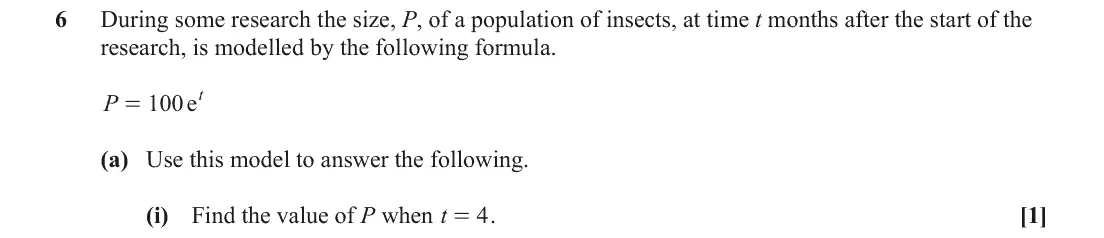
100eᵗ = 9000 so t = ln 90 = 4.50
error eᵗ = 900
June 2022 · Paper 1 · Q8(b)(i)3 marksEasy
Show the start of this question
Mark scheme for this part
Examiner's comment
This question was very well answered, with the majority of candidates gaining full marks for setting their model equal to 80 and solving for t. A surprisingly common error was to start with the correct equation, but then miscopy it from one line to the next with the index invariably becoming – 0.55t. In all questions, candidates would be well advised to check their working for copying errors.
Key points and common errors
160e^(−0.055t) = 80 so t = ln2/0.055 = 12.6 minutes
miscopying the index as −0.55t
June 2022 · Paper 1 · Q11(b)3 marksHard
Show the start of this question
Mark scheme for this part
Examiner's comment
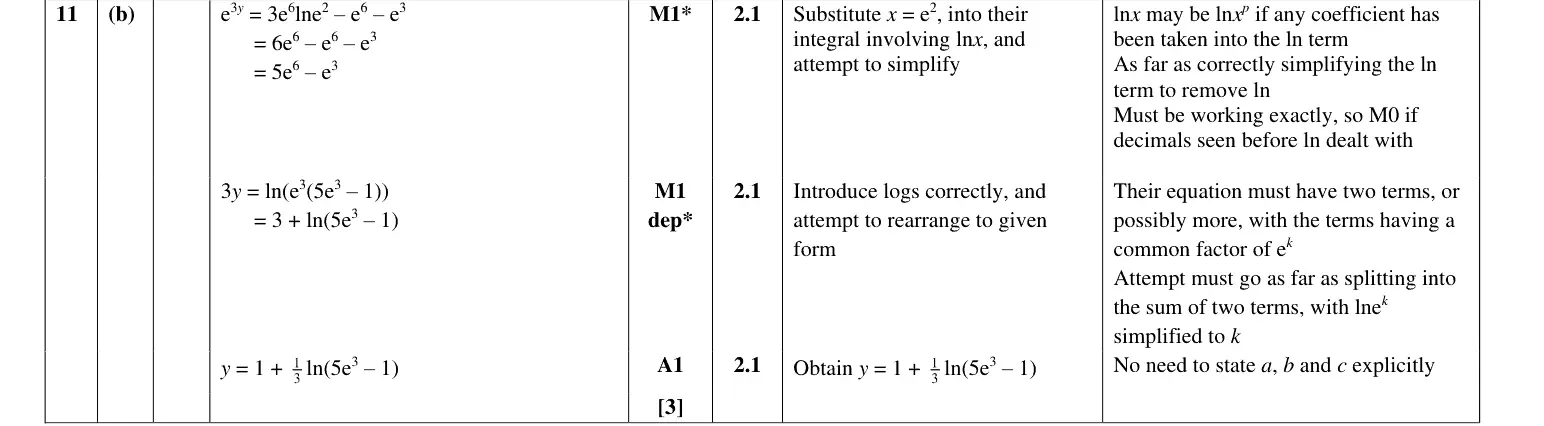
Many candidates were able to make an attempt to use x = e2, and simplify the ensuing expression which did require a term involving ln to still be present. Rearranging the expression to the given form proved to be more challenging and only the more astute candidates were able to attempt this, either by splitting into the sum of two terms or by taking out a factor of e3 and combining this with the exponential term.
Key points and common errors
x = e²: e^(3y) = 5e⁶ − e³ = e³(5e³ − 1) so y = 1 + ⅓ln(5e³ − 1)
work exactly
rearranging was the hard step
June 2022 · Paper 3 · Q68 marksEasy
Mark scheme for this part
Examiner's comment
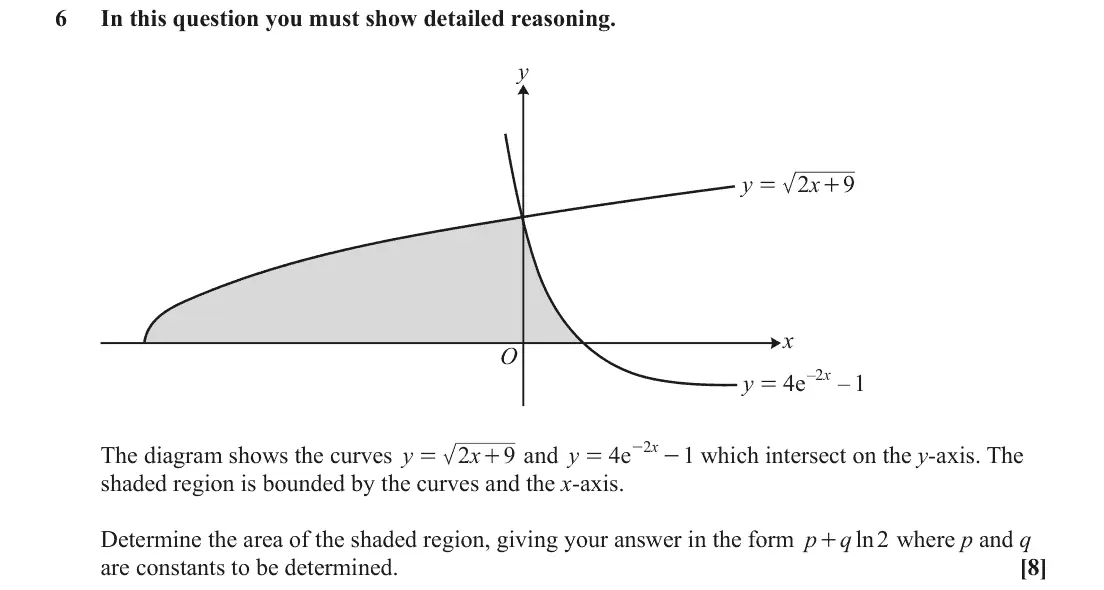
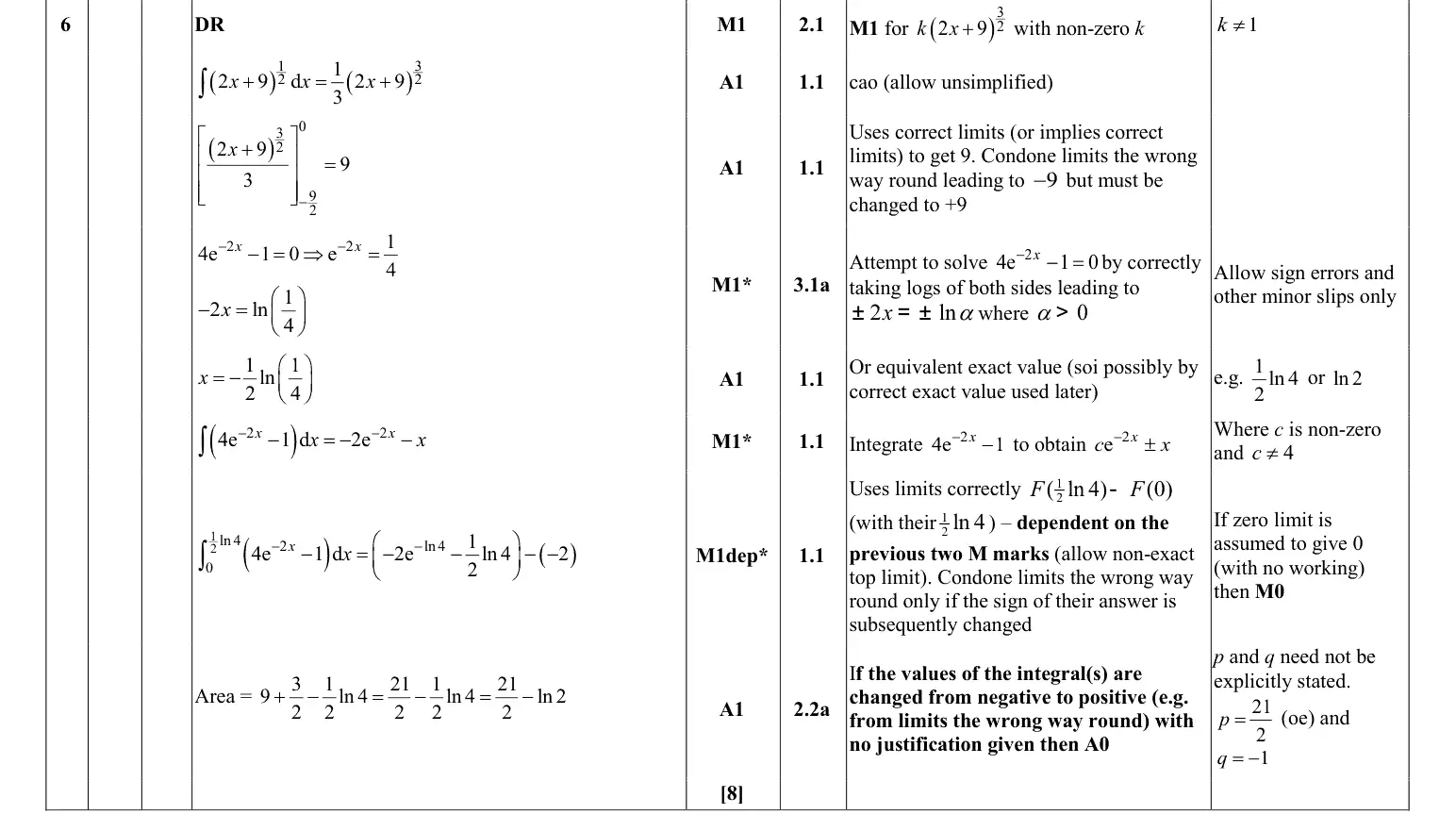
This question was answered extremely well with many candidates scoring all 8 marks for correctly determining the required shaded area of the given region. As this was a DR question it was not 0 2 ( ) + = acceptable to simply state that x 9 d x 9 or to apply the limits the wrong way round and then − to 9 without suitable justification. Some candidates struggled to solve the change a response of 9 −= 4e − 1d . x equation 4e 1 0 exactly or to find the required upper limit for the integral Furthermore, some had difficulty with evaluating this indefinite integral (it was common for examiners to report that this was often integrated to − 8e − x ). Many candidates struggled to evaluate − − accurately 2e x even though they had access to calculators which would have enabled them to check their response.
Key points and common errors
∫ from −9/2 to 0 of √(2x + 9) = 9
4e^(−2x) − 1 = 0 at x = ½ln4
∫(4e^(−2x) − 1) = 3/2 − ½ln4
area 21/2 − ln2
correct limit order needed under DR
Autumn 2021 · Paper 1 · Q9(b)2 marksHard
Show the start of this question
Mark scheme for this part
Examiner's comment
(From the general report) Question 9, covering aspects of parametric equations, proved challenging for a significant proportion of candidates. Question 9 highlighted confusion about when to use x = 0 or y = 0 when investigating the path of a particle defined parametrically.
Key points and common errors
crossing y-axis means x = 0 (confusion with y = 0 common)
(eᵗ − 1)(eᵗ − 3) = 0
t = 0 and t = ln 3
ln 1 must be simplified
Autumn 2021 · Paper 1 · Q12(b)(ii)6 marksMedium
Show the start of this question
Mark scheme for this part
Key points and common errors
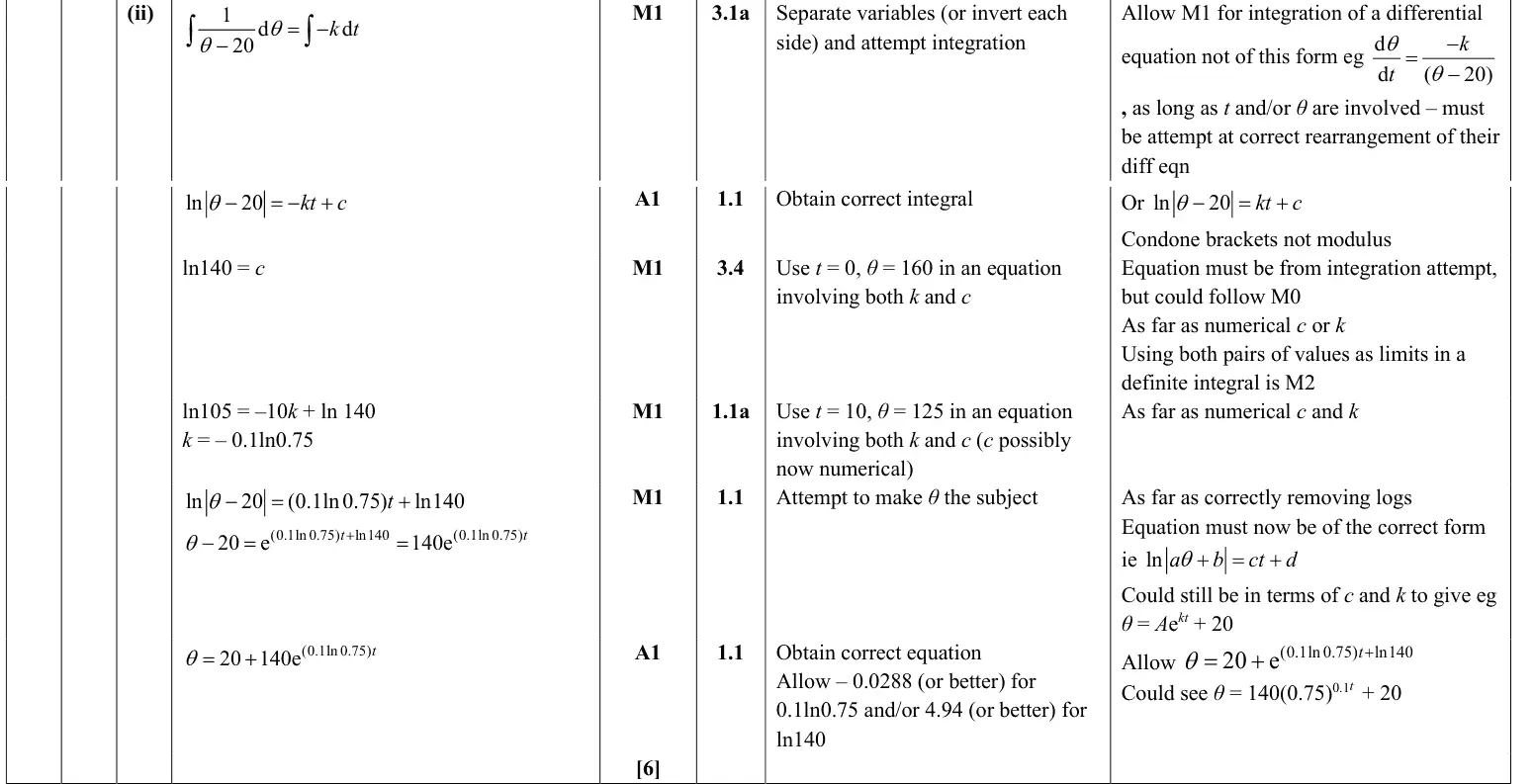
separate variables: ln abs(θ − 20) = −kt + c
c = ln 140
k = −0.1 ln 0.75
θ = 20 + 140e^(0.1 ln 0.75 t)
Autumn 2021 · Paper 1 · Q12(c)2 marksMedium
Show the start of this question
Mark scheme for this part
Key points and common errors
θ = 25 in both: 38.6 and 115.8 minutes
difference 77 minutes
Autumn 2021 · Paper 3 · Q7(b)4 marksMedium
Show the start of this question
Mark scheme for this part
Key points and common errors
separate: ln(y − 2) = 3ln(x − 3) + c
(4, 3) gives c = 0
y = (x − 3)³ + 2
Autumn 2020 · AS Paper 2 · Q4(c)(i)2 marksHard
Show the start of this question
Mark scheme for this part
Examiner's comment
(Comment on Question 04 as a whole) Part (a) - Long division was seen here, ignoring the request for the factor theorem. This gained no credit because of the instruction ‘Use the factor theorem’. Note that only the statement f(½) = 0 so k = -37 was not enough working because of DR and AG. Part (b) - DR so evidence for the factorisation was required. Candidates that just quoted their answer, possibly obtained from the polynomial solve function on the calculator scored M0. Part (c) - Only candidates who did well on this paper seemed to understand what was required. NR was not uncommon.
Key points and common errors
equation is f(e⁻ᵗ) = 0 so e⁻ᵗ = ½, 5/3, 4
t = −ln(½), −ln(5/3), −ln 4
Autumn 2020 · Paper 2 · Q8(a)7 marksHard
Mark scheme for this part
Examiner's comment
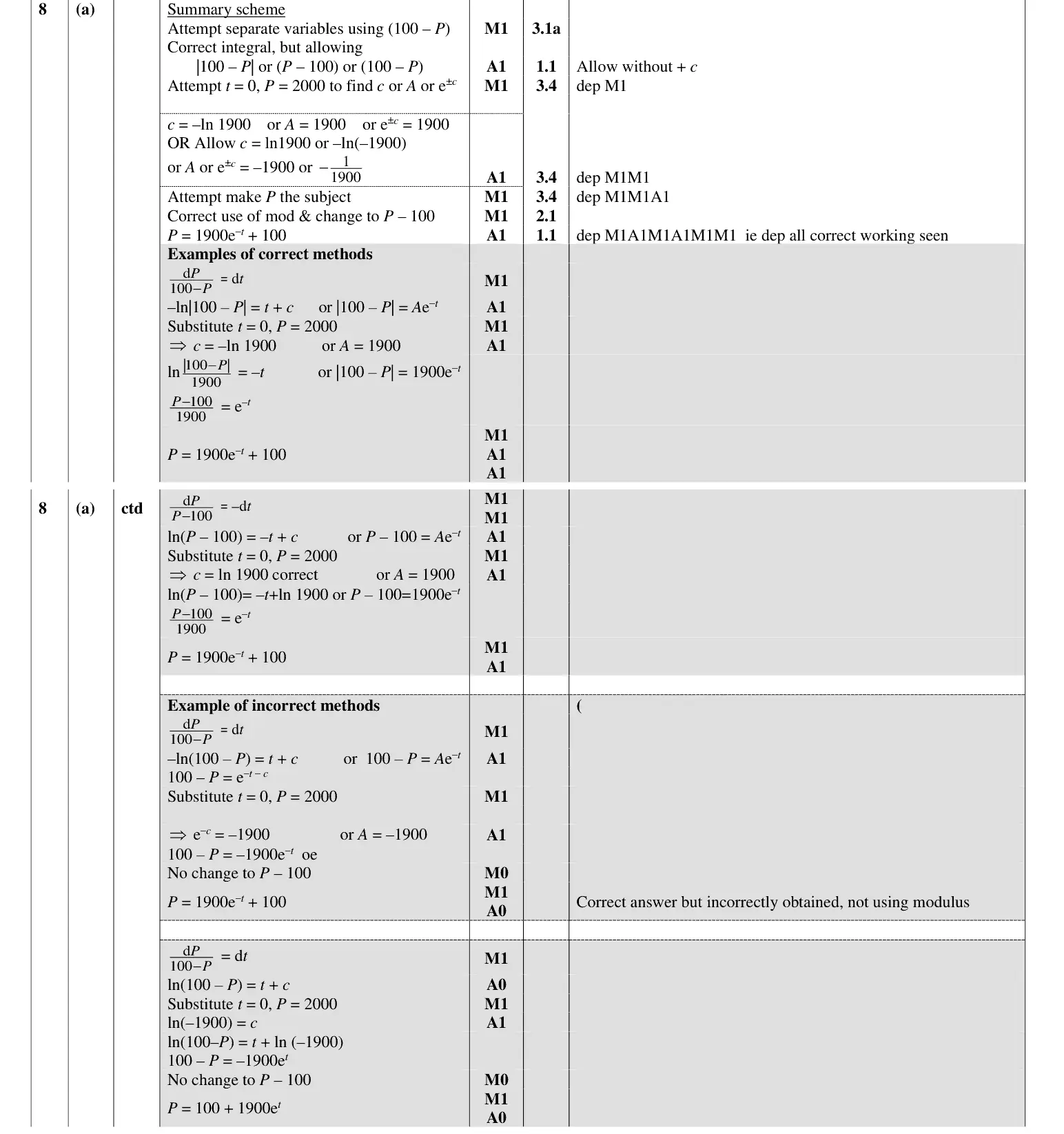
(Comment on Question 08 as a whole) This differential equation was difficult in that a correct solution depended on the correct use of the modulus sign when integrating . The majority of candidates either did not include the modulus sign or included it but then just ignored it. These candidates then obtained an impossible value for the ec = − constant of integration, such as ln ( 1900 ) or . Some noticed this and just dropped the c = − 1900 negative sign, while others ploughed on, seemly unaware of that this was a problem. Candidates who made errors such as these could, nevertheless, score 5 marks out of 7 if they made no other errors. A few candidates made no attempt to separate the variables and "integrated" to obtain equations such as . P = 100 t − Pt Section B: Statistics
Key points and common errors
separate variables: −ln(mod(100 − P)) = t + c
the modulus matters since P > 100: P = 1900e⁻ᵗ + 100
majority omitted or ignored the modulus giving impossible c = −ln 1900
June 2019 · AS Paper 1 · Q7(c)6 marksHard
Mark scheme for this part
Examiner's comment
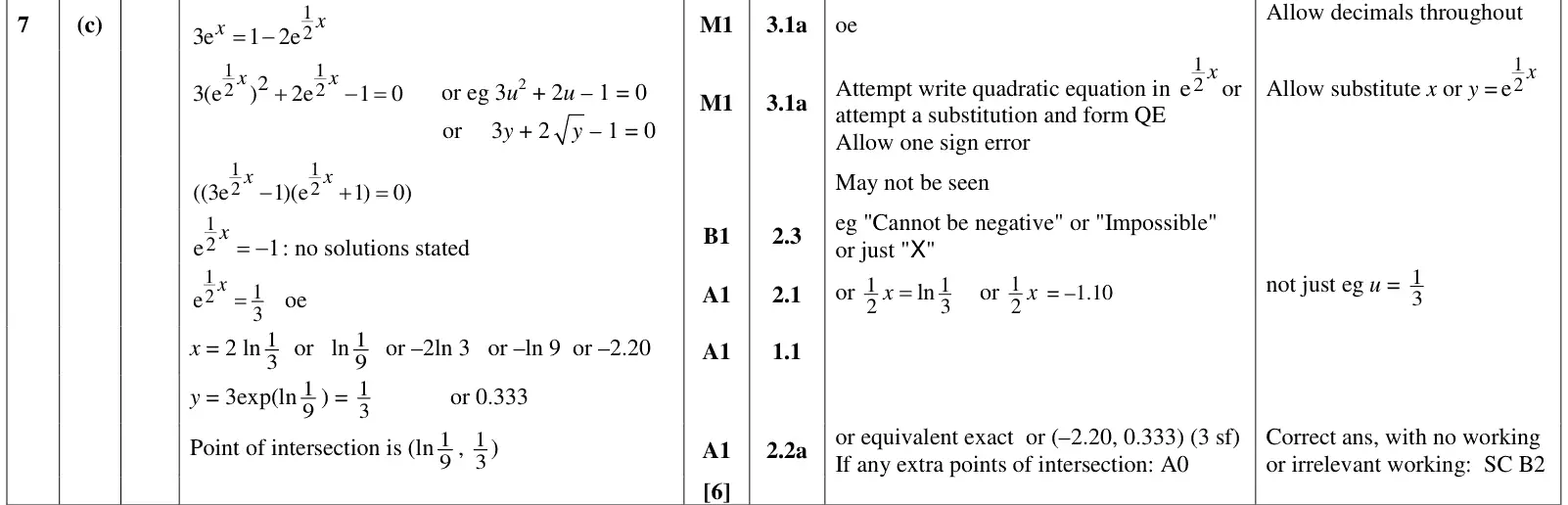
Erratum notice 1 2e x , but then proceeded to attempt to The majority of candidates wrote a correct equation, 3ex = 1 – 2 take the logarithms of both sides. Their attempts were invariably incorrect. A few candidates wrote a correct first equation but then attempted to combine the exponential terms, obtaining equations such as 3 5e x = 1. 2 Some candidates recognised the "hidden" quadratic equation. Of these candidates, some did not 1 x 2e x – 1 = 0 and generally succeeded. However, many 1 2 2 substitute, but obtained the equation 3 (e ) + 2 e x , often made errors such as obtaining 2u2 + 3u – 1 = 0 or 1 who substituted, for example u = 2 (3u)2 + 2u – 1 = 0. 1 e x = 1 The correct method leads to 2 3 or –1. To gain full marks candidates had to indicate in some way 1 e x = –1 has no solutions. that the equation 2 Some candidates used a graphical calculator either from the start or after abandoning the incorrect logarithm method. In some cases, correct responses were seen, but preceded by incorrect working. Because the command word in this question is "Determine" rather than "Find", answers obtained in this way, without working equivalent to that shown in the mark scheme, were not given full credit. They scored 2 marks (out of 6 marks), if correct to 3 significant figures The best solutions worked with exact values, expressed in terms of e. Working in terms of decimals was accepted, but the final response needed to be correct to 3 significant figures. It is worth noting that similar questions in the future might explicitly require candidates to work with exact values and in such questions, working and/or responses in terms of rounded decimals would be penalised.
Key points and common errors
3eˣ = 1 − 2e^(x/2) is a quadratic in e^(x/2): (3u − 1)(u + 1) = 0
reject e^(x/2) = −1
x = ln(1/9), y = 1/3
taking logs of both sides fails
June 2019 · Paper 1 · Q12(b)4 marksMedium
Show the start of this question
Mark scheme for this part
Examiner's comment
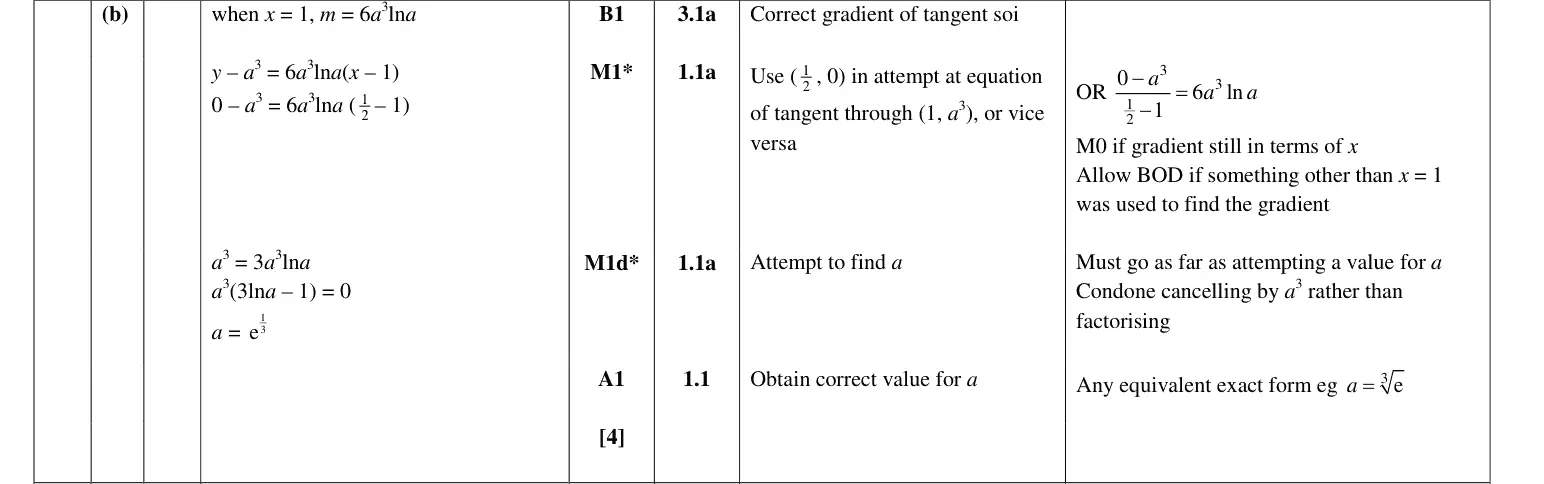
A number of candidates were able to make a good attempt at this question, producing fully correct solutions. The most common approach was to find a general equation for the tangent and then substitute in the given points, sometimes to give an equation that could be then solved and other times to set up two simultaneous equations. The less common, but more efficient, method was to use the two given points to find an expression for the gradient that was then equated to the derivative. Some candidates did not read the question carefully and used the wrong point when finding the gradient of the tangent, and others attempted to use both points in the derivative. A common misconception was to use the derivative in terms of x as the gradient rather than appreciating that a straight line must have a constant gradient.
Key points and common errors
gradient 6a³ln a at x = 1
tangent through (½, 0) gives a³ = 3a³ln a so a = e^(1/3)
using the wrong point for the gradient
June 2018 · AS Paper 2 · Q6(iv)3 marksHard
Show the start of this question
Mark scheme for this part
Examiner's comment
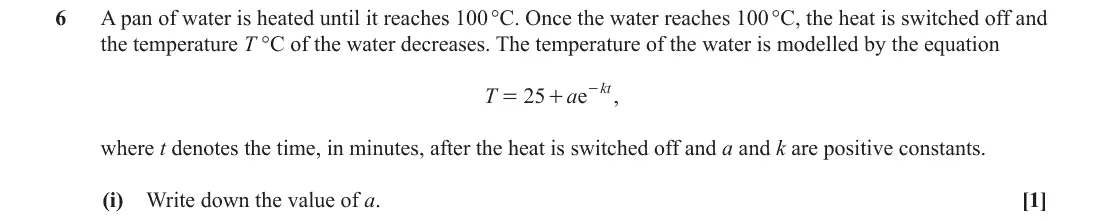
Inevitably those who did not obtain a value of a and/or k were unable to make progress in this part. Those who had incorrect values seemed to understand the method. A few set T = 55. Because of the difficulties encountered in (iii) very few correct answers were seen. Note that here units were expected to be mentioned (cf AO3.2a) and candidates need to be aware that these are important, particularly in modelling questions.
Key points and common errors
45 = 25 + 75e^(−t/5) so t = −5ln(4/15) = 6.6 minutes
units required
June 2018 · Paper 1 · Q11(i)3 marksEasy
Mark scheme for this part
Examiner's comment
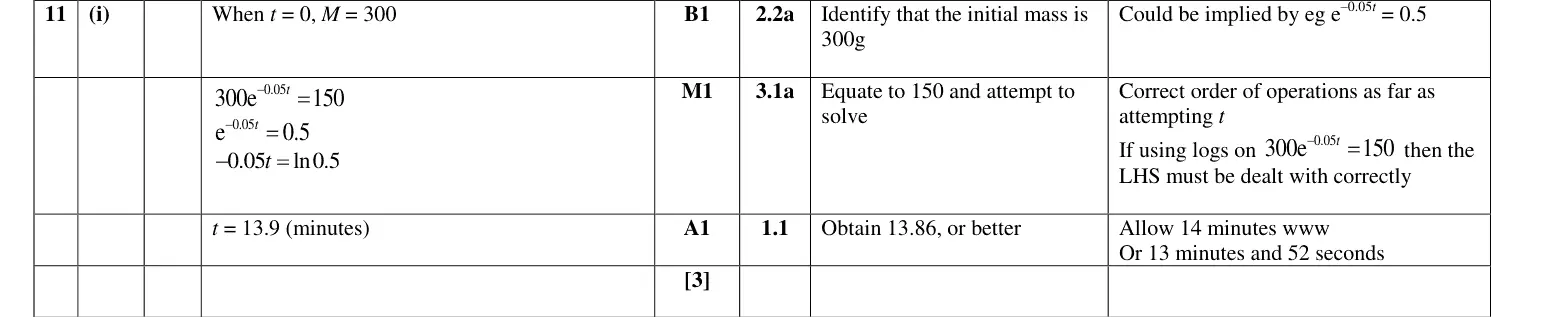
This question was very well answered with candidates identifying the initial mass, and then setting up and solving a relevant equation. Most candidates worked exactly throughout to provide a sufficiently accurate final answer.
Key points and common errors
initial mass 300
e^(−0.05t) = 0.5
t = 13.9 minutes
June 2018 · Paper 1 · Q11(ii)8 marksMedium
Show the start of this question
Mark scheme for this part
Examiner's comment
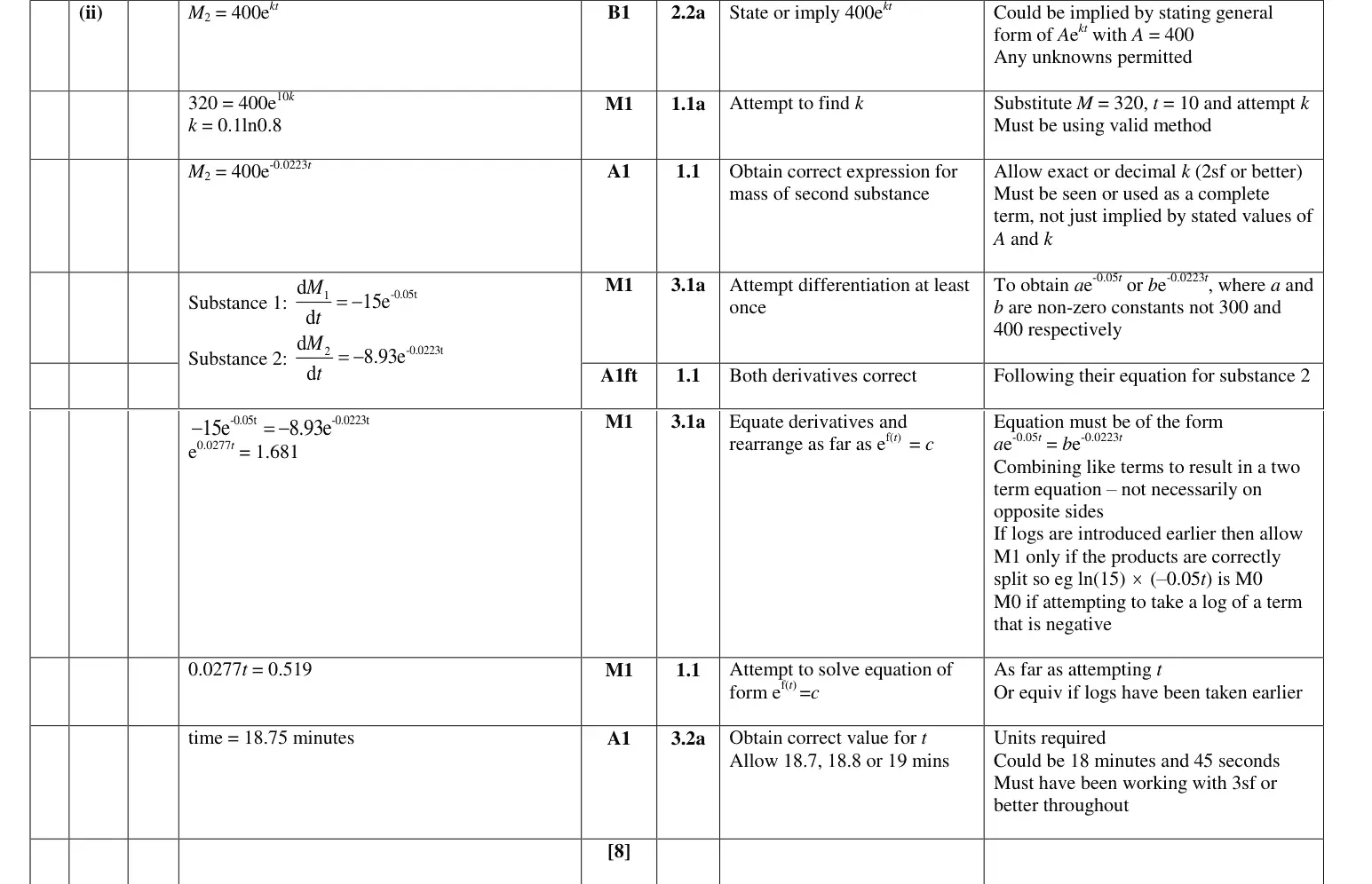
The vast majority of candidates were able to make some progress on this question, and a number of fully correct solutions were seen. Candidates appreciated the need to find an expression for the mass of the second substance, and were able to make a good attempt at finding the two parameters. As the substance was decaying, some candidates used an initial structure of M = Ae-kt, but sign errors were relatively common when substituting back for k. A few candidates simply equated the two expressions for the mass, but most realised that it was the derivatives that should be equated and made a reasonable attempt to do so. Solving the ensuing equation was found to be challenging. Some attempted to rearrange first whereas others introduced logarithms straightaway. Sign errors were common, especially in solutions where candidates were working exactly as the coefficient of 0.1ln0.8 is not obviously negative. Some candidates spoilt an otherwise correct solution by not working to a sufficient degree of accuracy throughout their solution resulting in an incorrect final answer.
Key points and common errors
M₂ = 400e^(kt) with k = 0.1 ln 0.8
differentiate both
equate rates (not masses)
t = 18.75 minutes
June 2018 · Paper 2 · Q6(i)2 marksEasy
Mark scheme for this part
Examiner's comment
This question was well answered.
Key points and common errors
ln x = 0 so x = 1
Find an A-level maths tutor
Stuck on this? Book a trial session with an A-level maths tutor.