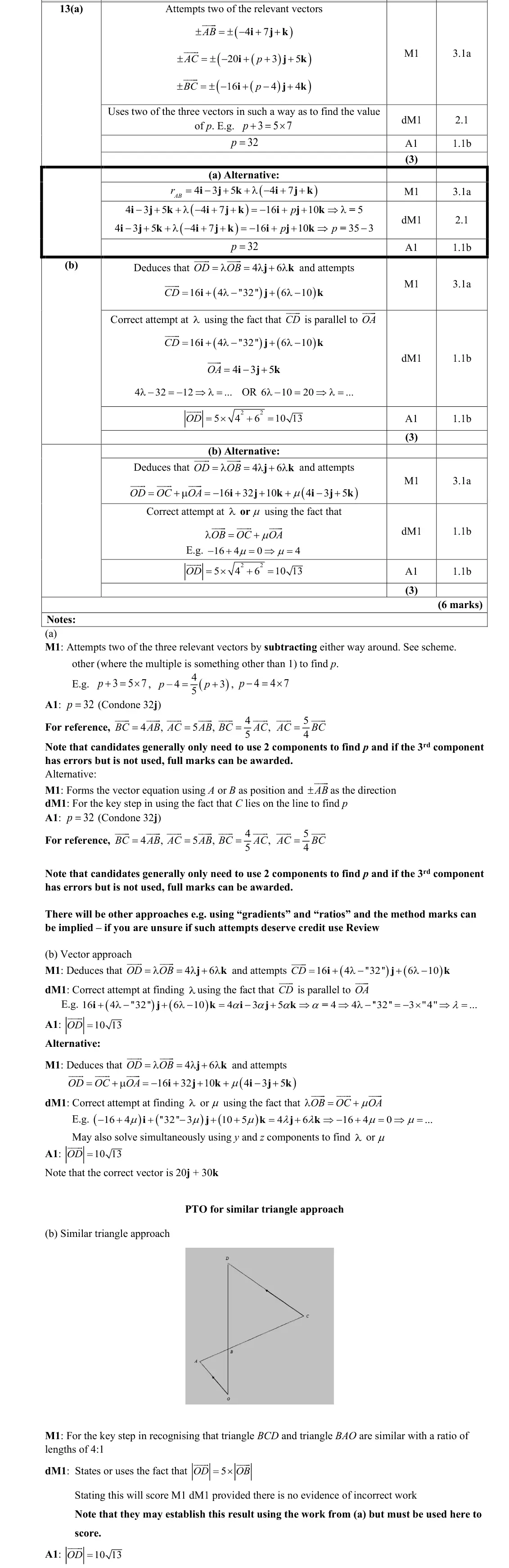
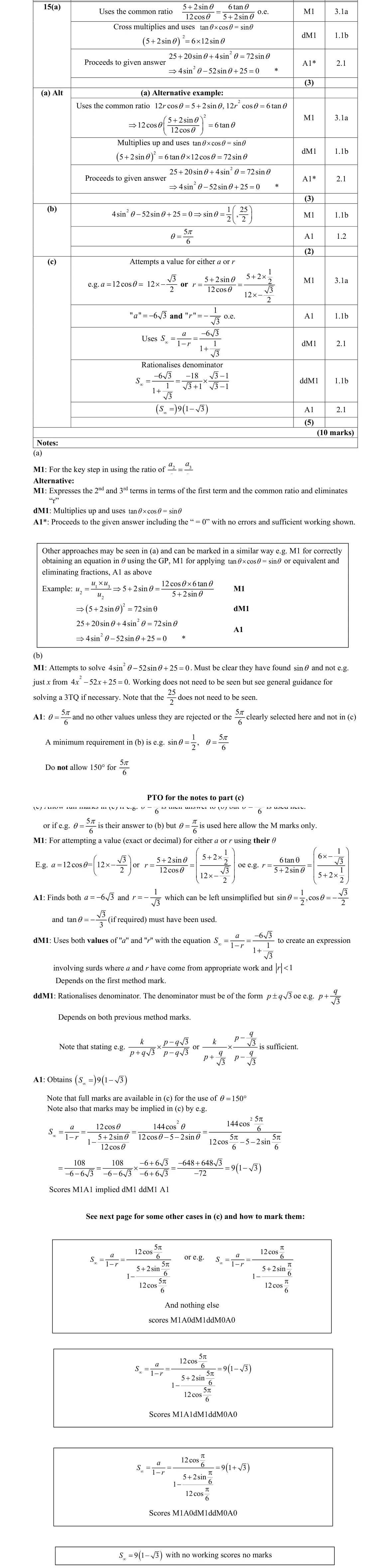
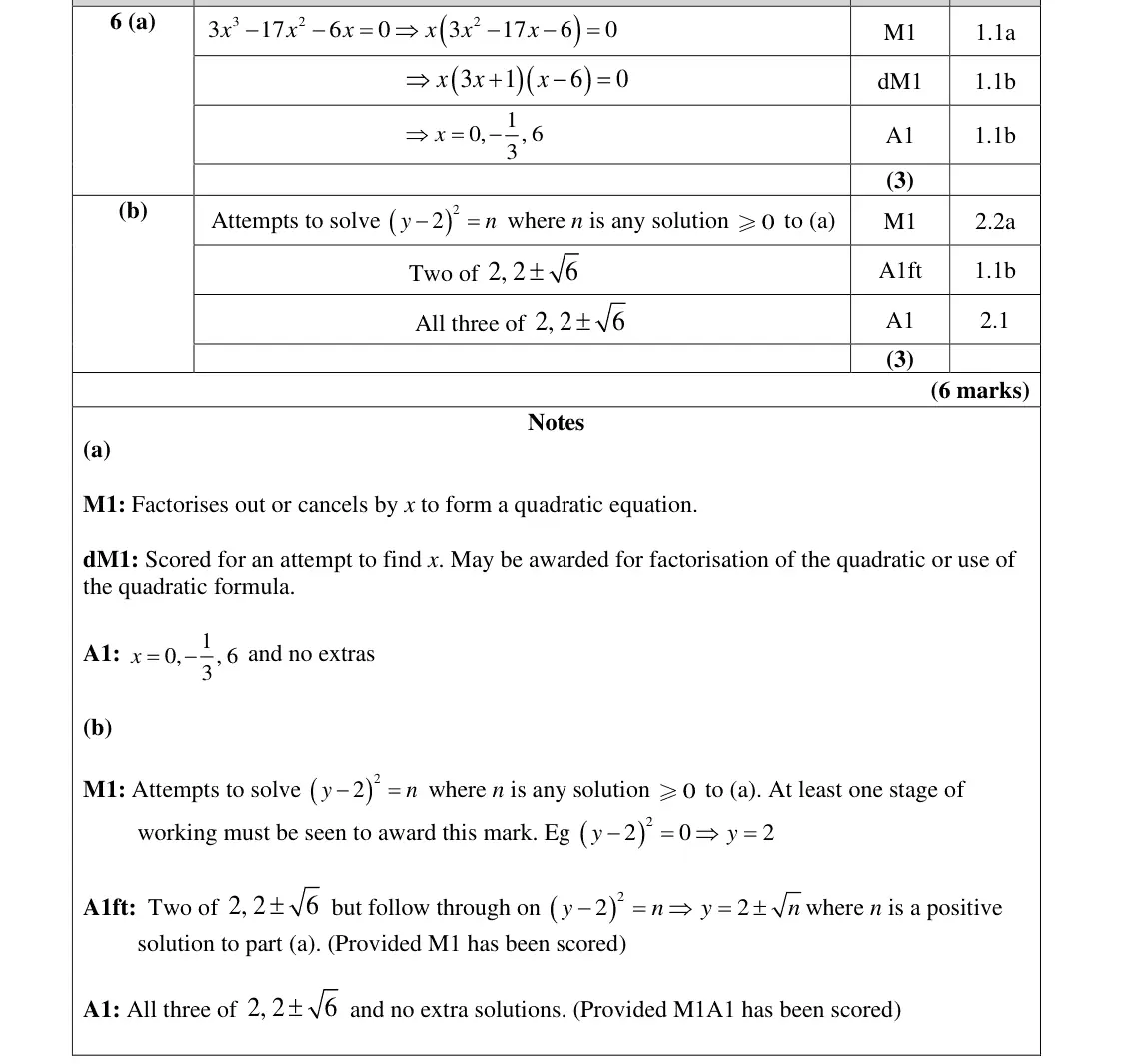
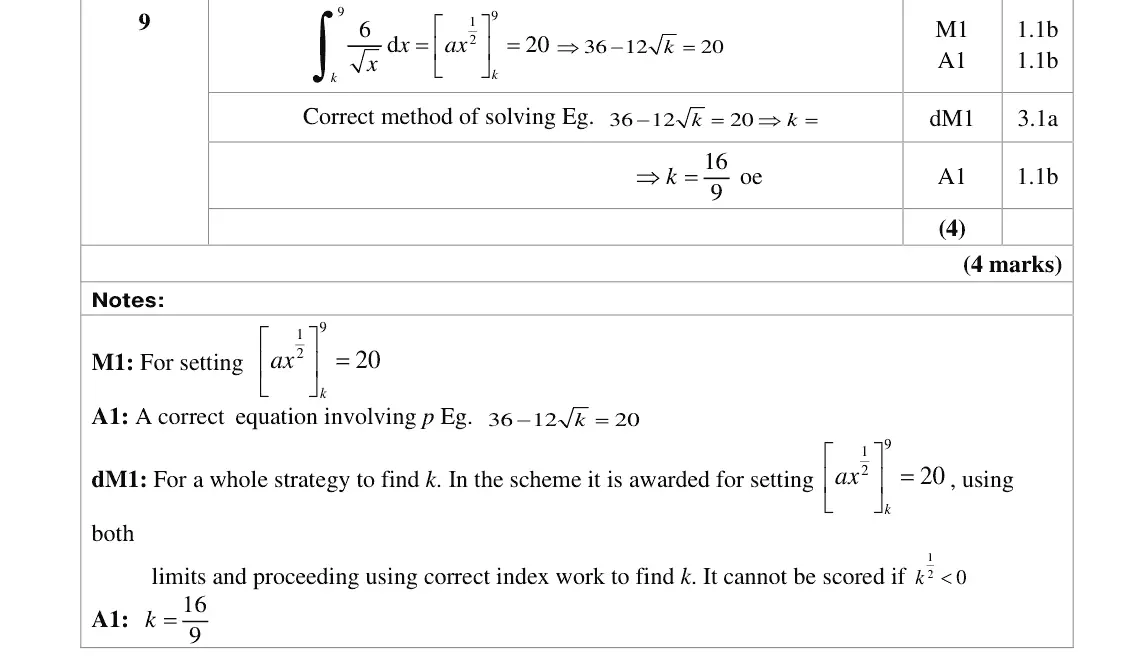
Mark scheme (whole question; this part is marked with the orange bar)
Examiner's comment
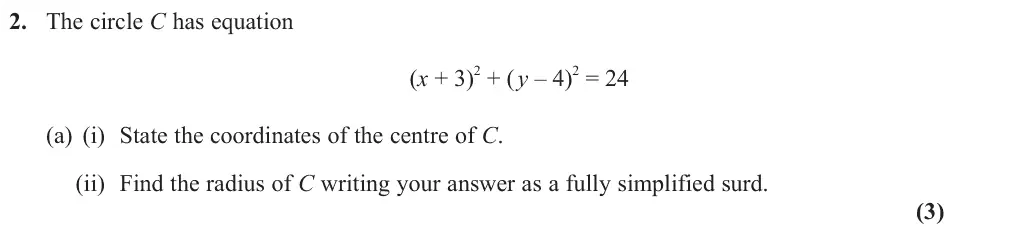
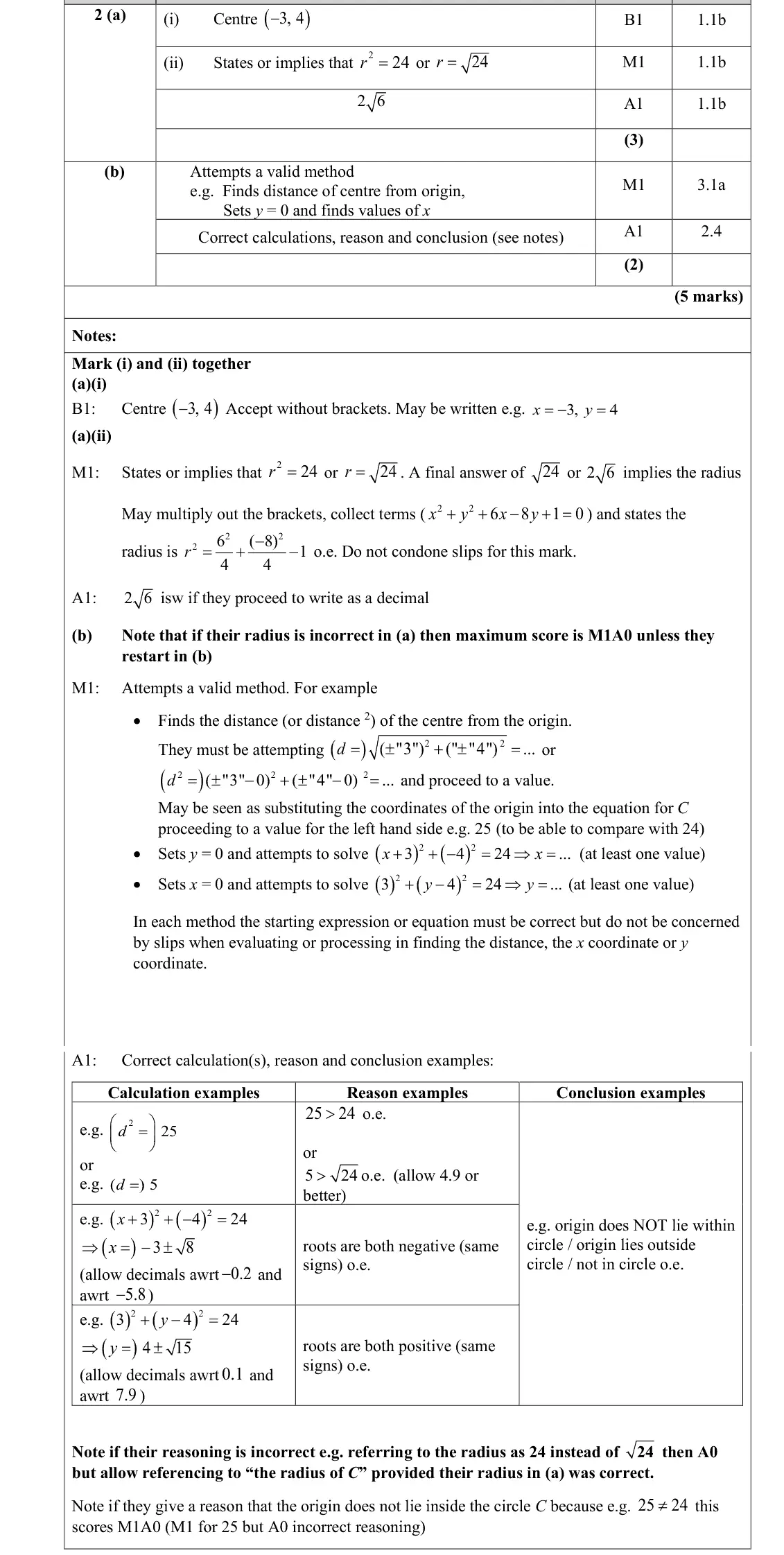
This question on circles was usually well answered with most learners able to score full marks. Part (a) was answered well, with most responses able to identify the coordinates of the centre for the first mark and deduce the exact value of the radius. Only a few responses did not score the first mark, mainly due to an incorrect sign or by swapping the x coordinate and y coordinate around. The most common mistakes seen in this part of the question were related to not writing the value of the radius as a fully simplified surd.
Common mistakes
centre (−3, 4) (sign errors or swapped coordinates)
radius √24 must be fully simplified to 2√6
June 2025 · Paper 3 (Mechanics) · Q4(b)2 marks
Mark scheme (whole question; this part is marked with the orange bar)
Examiner's comment
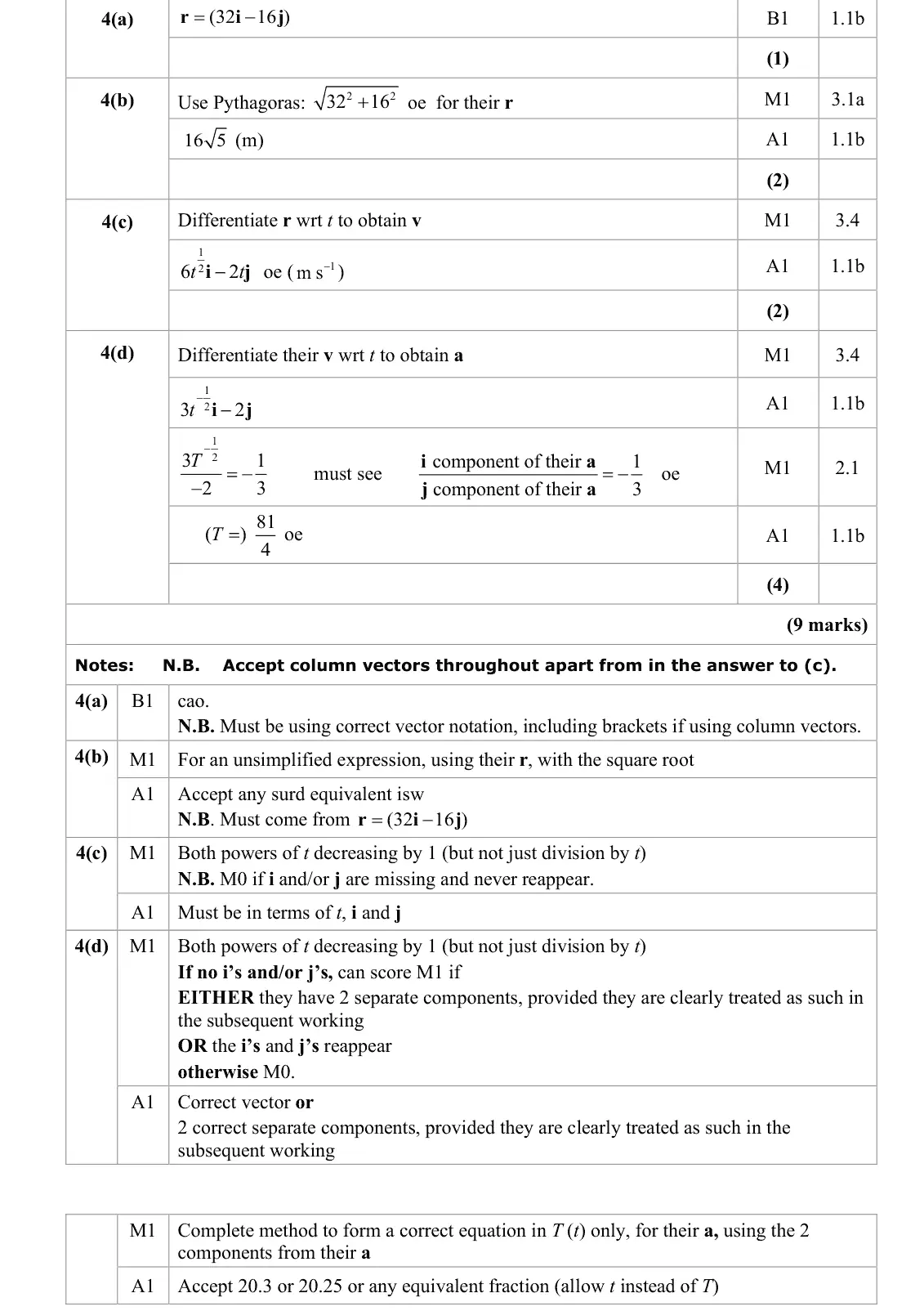
In part (b) Pythagoras’ Theorem was generally applied correctly to find the magnitude. An exact (surd) answer was required so those who only stated a decimal approximation did not sqrt 322 -162 thereby not gaining both marks. gain the accuracy mark. A few did not account properly for the negative sign and evaluated In the third part the majority of learners recognised the requirement to differentiate to find the
Common mistakes
exact answer 16√5 needed (decimal loses A1)
square the −16 correctly, not √(32² − 16²)
June 2024 · AS Paper 2 (Mechanics) · Q2(b)4 marks
Mark scheme (whole question; this part is marked with the orange bar)
Examiner's comment
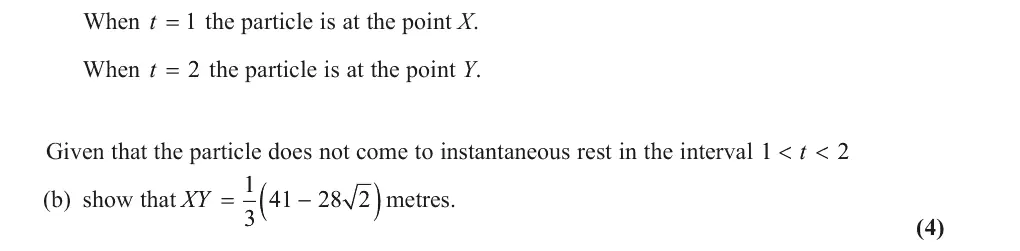
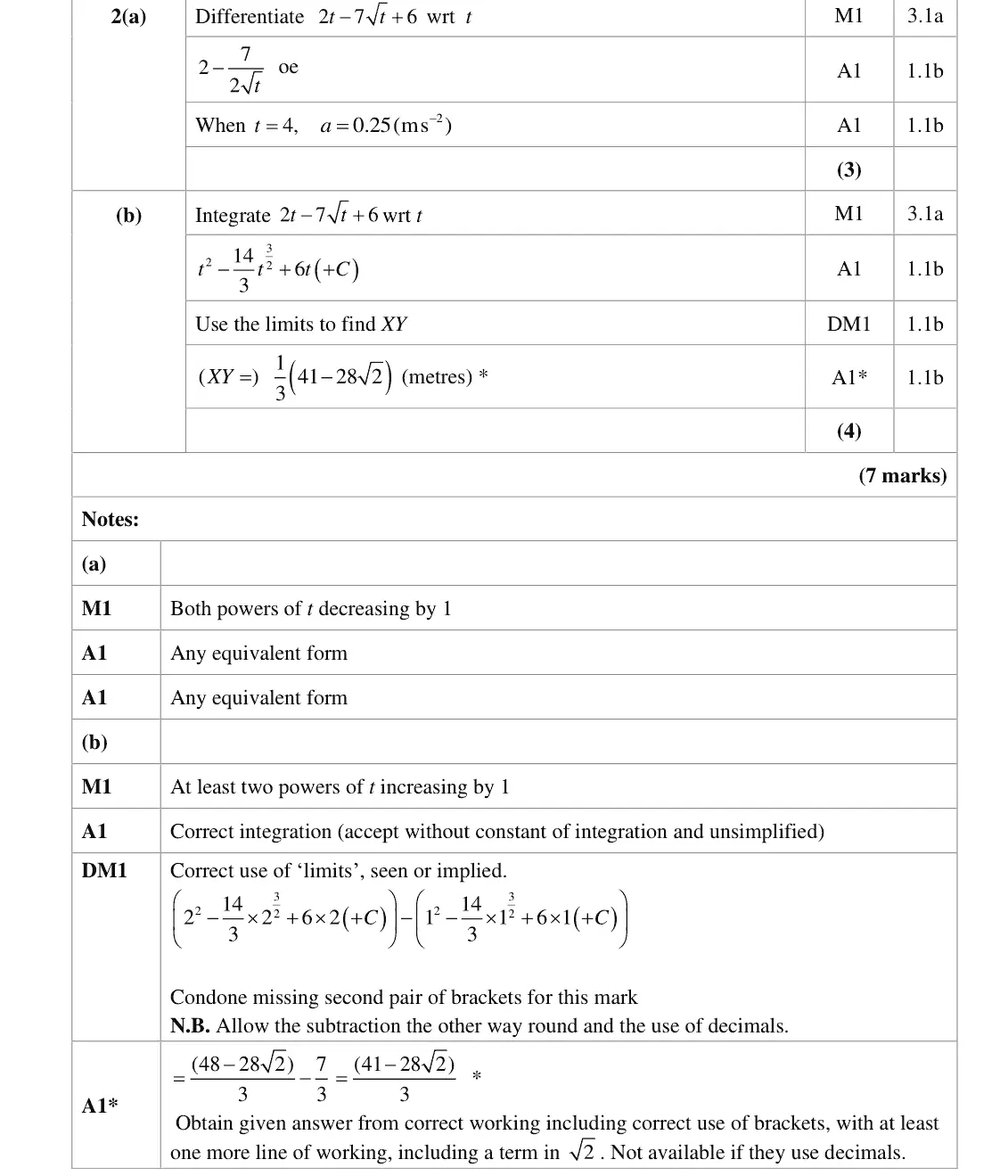
In part (b), successful candidates integrated the expression for v with respect to t and were usually able to obtain a correct, unsimplified expression for the displacement of the particle at time t. There were then occasional errors with the simplification often due to incorrect coefficients. There was no penalty for not including a constant of integration. Successful candidates then used the limits of t = 1 and t = 2 to calculate the distance XY. A surprising number of candidates thought that finding XY meant that they then had to multiply these two values. Since there was a printed answer, candidates needed to clearly show all stages of their working including the use of surds to get to the required form of the answer. Of those that tried to use surds, some struggled to reach the given answer whilst others did not show enough working to gain the final A mark. Ignoring the instructions at the top of the question, many candidates used calculators and decimals appeared in their solutions which resulted in the solutions being incomplete and losing the final mark. Very few candidates used differentiation in this part.
Common mistakes
integrate v: t² − (14/3)t^(3/2) + 6t
XY = s(2) − s(1) (no change of direction so displacement = distance)
keep surds: 2^(3/2) = 2√2 to reach (41 − 28√2)/3
decimals lose the final mark
multiplying the two values
June 2023 · AS Paper 1 · Q55 marks
Mark scheme (whole question; this part is marked with the orange bar)
Examiner's comment
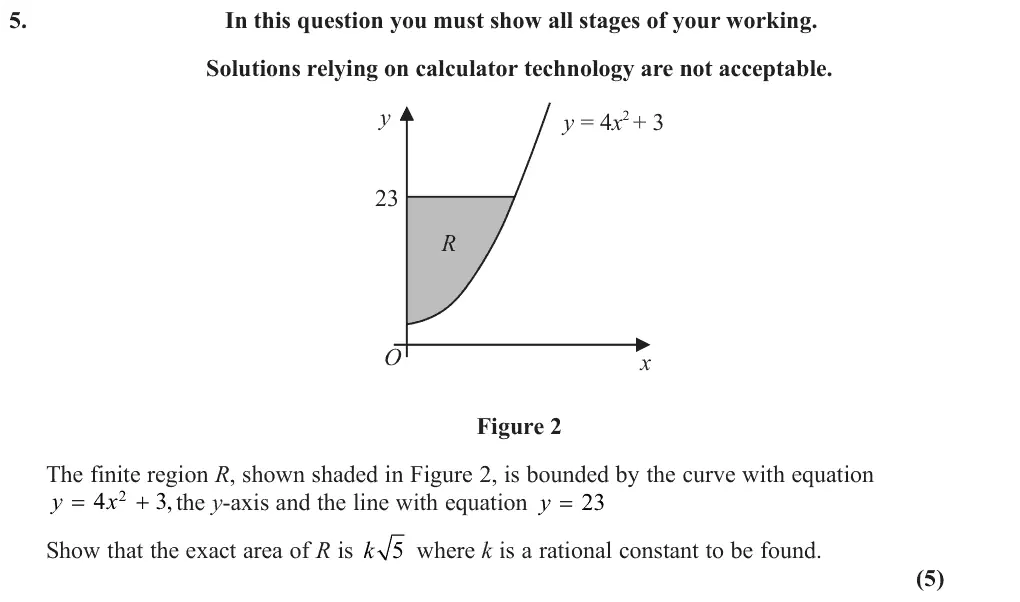
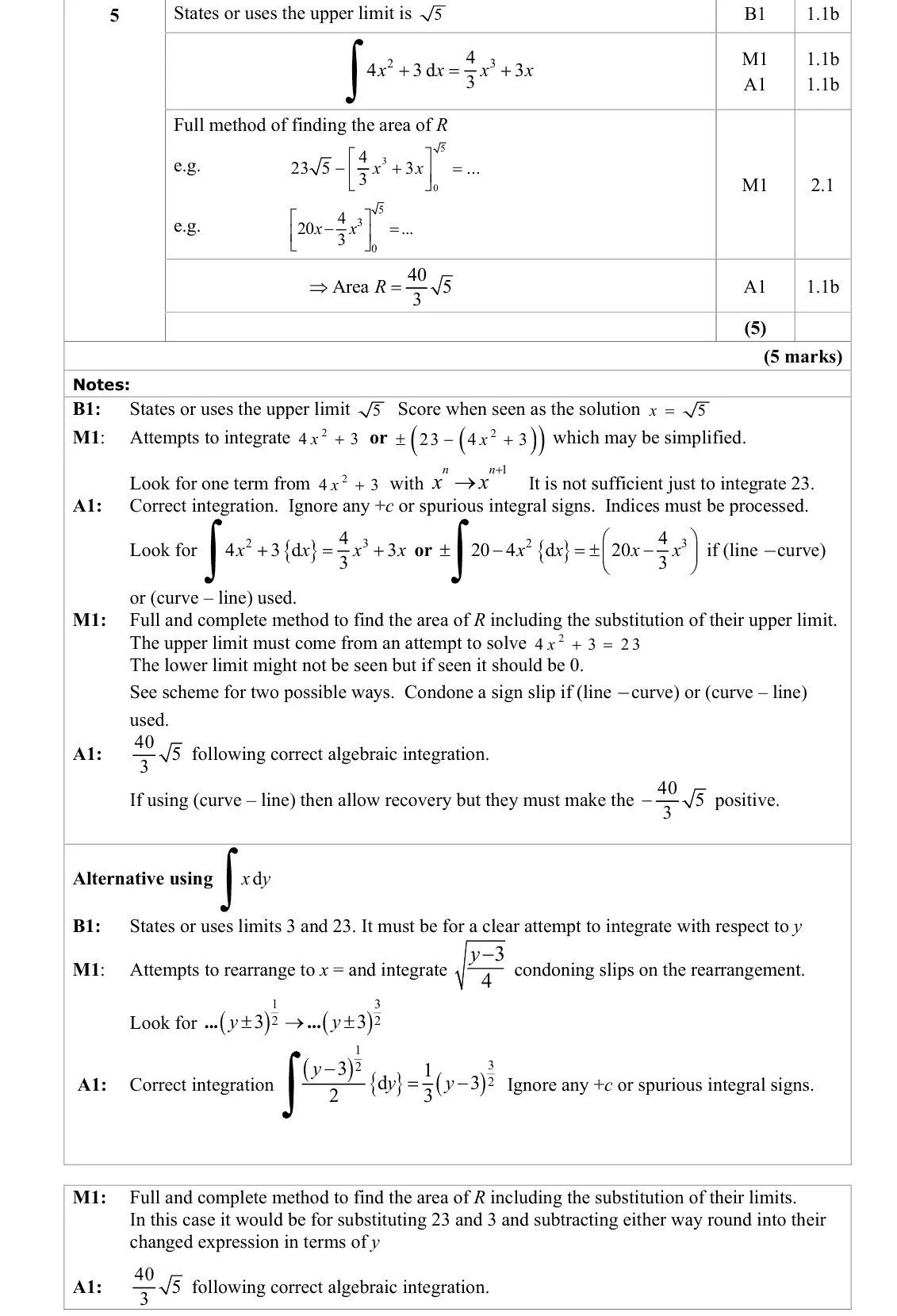
Most candidates recognised the need and were able to solve the equation 2 4 3 23 x + = to determine the upper limit, 5 x = , although some candidates did not use the diagram to discard the 5 x = - and ended up integrating between the incorrect limits. It was also very common to see the limits 3 and 23 being used, with these candidates unclear about the area that is found through an integration strategy. The most successful strategy for finding the area under the curve was through finding ( ) 5 2 0 4 3 d x x + and then subtracting that from the area of the rectangle. However, there were plenty of candidates that failed to subtract the area under the curve 29 5 3 from the rectangle, and these candidates generally scored 3 marks out of 5. Those candidates that elected to find the difference between the curve function and the line y = 23 and then integrated their expression were more likely to have slips in their working: some failed to subtract correctly, resulting in ( ) 5 2 0 23 4 3 d x x - + ; while others subtracted the wrong way round, leading to a negative answer that some failed to recover to a positive answer. However, in both cases, once the integrand was determined, the majority of candidates using this strategy were able to achieve method mark for being able to perform integration of at least a term in the integrand. There were very few candidates that tried to integrate the function bounded by the y-axis and those that did were generally unsuccessful: often their rearrangement to make x the subject was poorly done and in these cases they often lacked the experience of Year 2 integration to be able to integrate function of the form ( ) n ax b + , where n is a fraction.
Common mistakes
upper limit x = √5 from 4x² + 3 = 23 (reject −√5)
limits 3 and 23 are y values, not x limits
area = rectangle 23√5 minus ∫(4x² + 3)dx, or ∫(20 − 4x²)dx
forgetting to subtract from the rectangle
k = 40/3
June 2023 · AS Paper 1 · Q13(b)2 marks
Mark scheme (whole question; this part is marked with the orange bar)
Examiner's comment
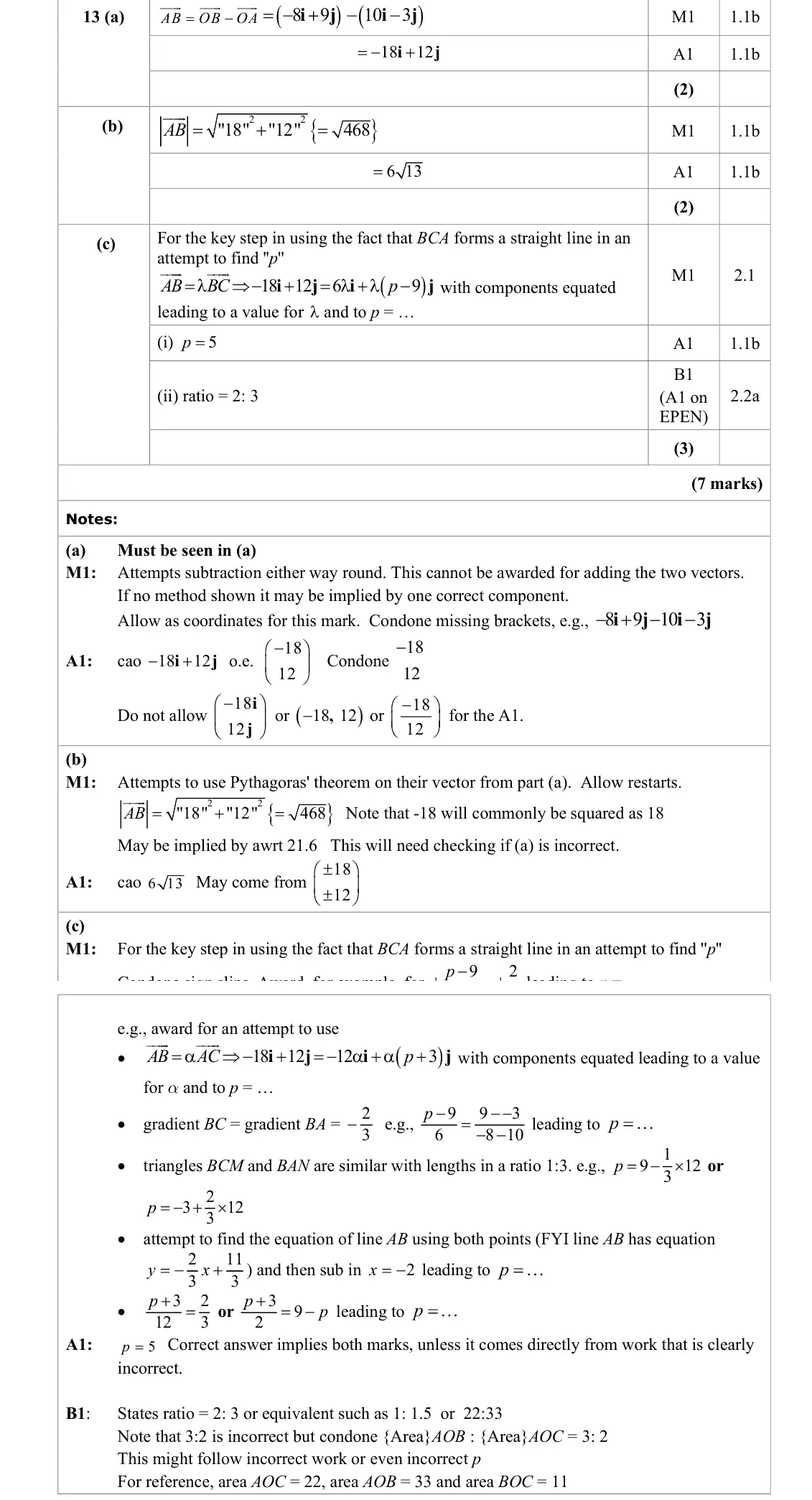
Given that candidates often find vector problems quite challenging, this question proved to be quite accessible, and most candidates made good progress through parts (a) and (b) of this question, with part (c) more mixed. Most were then able to calculate |AB| in (b) using their answer from (a), and many correctly reached 6 13 , which was allowed even if candidates had achieved an incorrect vector in (a), e.g., 18 12 + i j Attempted methods in (c)(i) were many and varied but most did not use vectors. The most common method was to establish the equation of the straight line through A and B, and this was then used with 2 x = - to find 5 p = . Other methods simply looked logically at the information given and found the appropriate scaling factor between, for example, the vectors AB and BC . Methods like this were often poorly written down but were clearly correct and gained full marks.
Common mistakes
√(18² + 12²) = √468 = 6√13, fully simplified surd
June 2023 · AS Paper 1 · Q15(b)5 marks
Mark scheme (whole question; this part is marked with the orange bar)
Examiner's comment
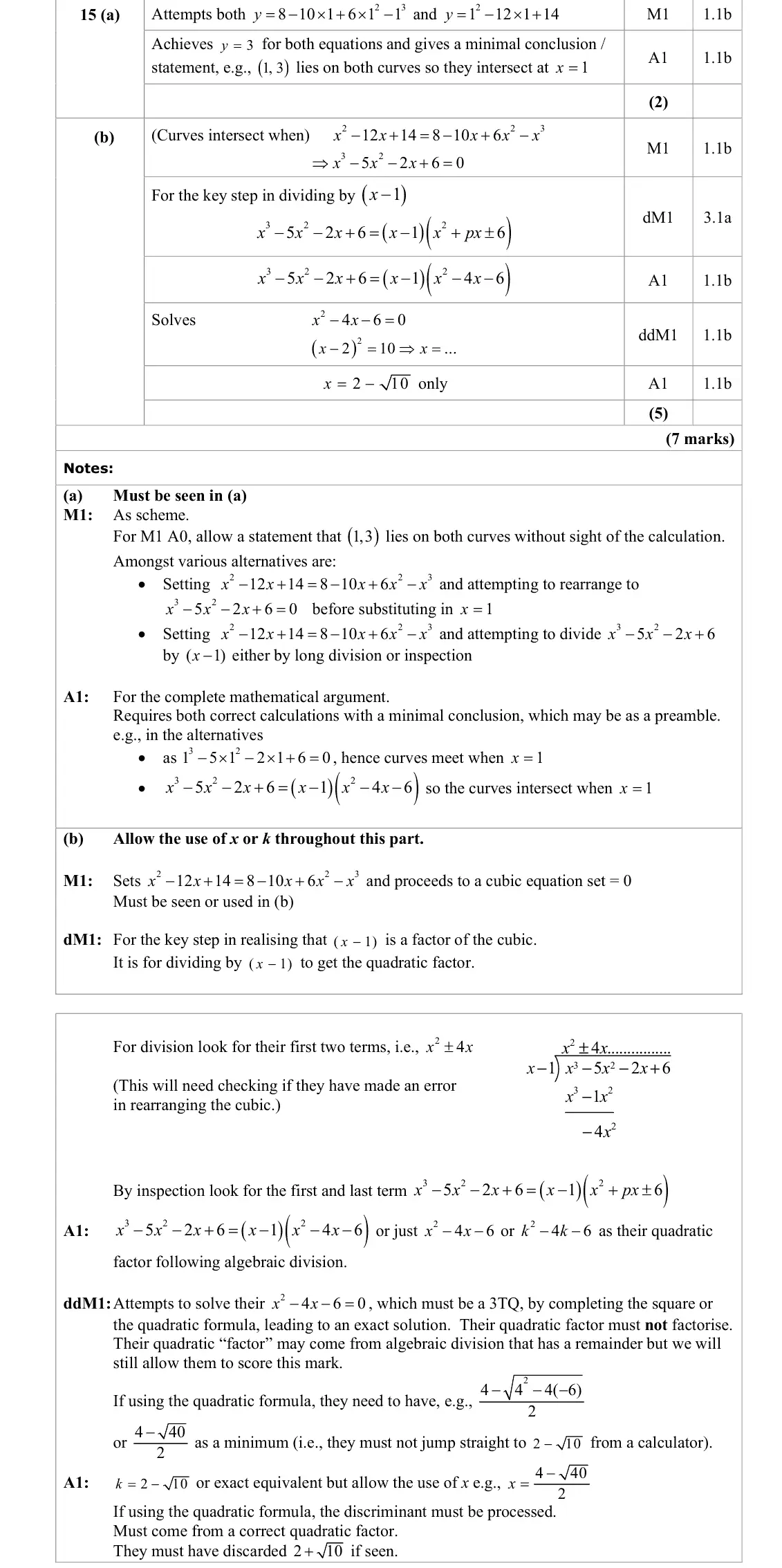
This question began with the familiar calculator warning which was unfortunately ignored by a significant proportion of candidates. As mentioned previously, candidates must be clear on what is allowed when these warnings are stated, or they risk losing a number or marks. In part (b), the vast majority of candidates achieved the cubic equation required by equating the two given equations and rearranging to set equal to 0, but a significant proportion ignored the guidance at the top of the question and proceeded to solve the question directly on their calculator, resulting in a maximum mark of 1 out of 5. For those that proceeded further, many used inspection to factorise the cubic using the given factor ( ) 1 x - , while others attempted algebraic division, generally very successfully, achieving the correct quadratic 2 4 6 x x - -. Occasionally, the rearrangements that candidates used resulted in a negative cubic, but despite making the division more challenging it was pleasing that candidates were still generally able to complete this part successfully. However, having arrived at a suitable quadratic, another significant proportion relied on their calculator to solve the resulting equation (set equal to 0) and forfeited the final two marks. For those that showed full working, many assumed that 0 k and chose the incorrect solution, despite often writing 0 k as their justification for rejecting (the correct) 2 10 - . As a result, there were very few candidates who achieved full marks for this question.
Common mistakes
equate to get x³ − 5x² − 2x + 6 = 0
(x − 1) is a factor from (a): divide to get x² − 4x − 6
solve exactly by completing the square or formula, not calculator
k < 0 so k = 2 − √10 (2 + √10 is positive)
June 2023 · Paper 1 · Q7(d)2 marks
Mark scheme (whole question; this part is marked with the orange bar)
Examiner's comment
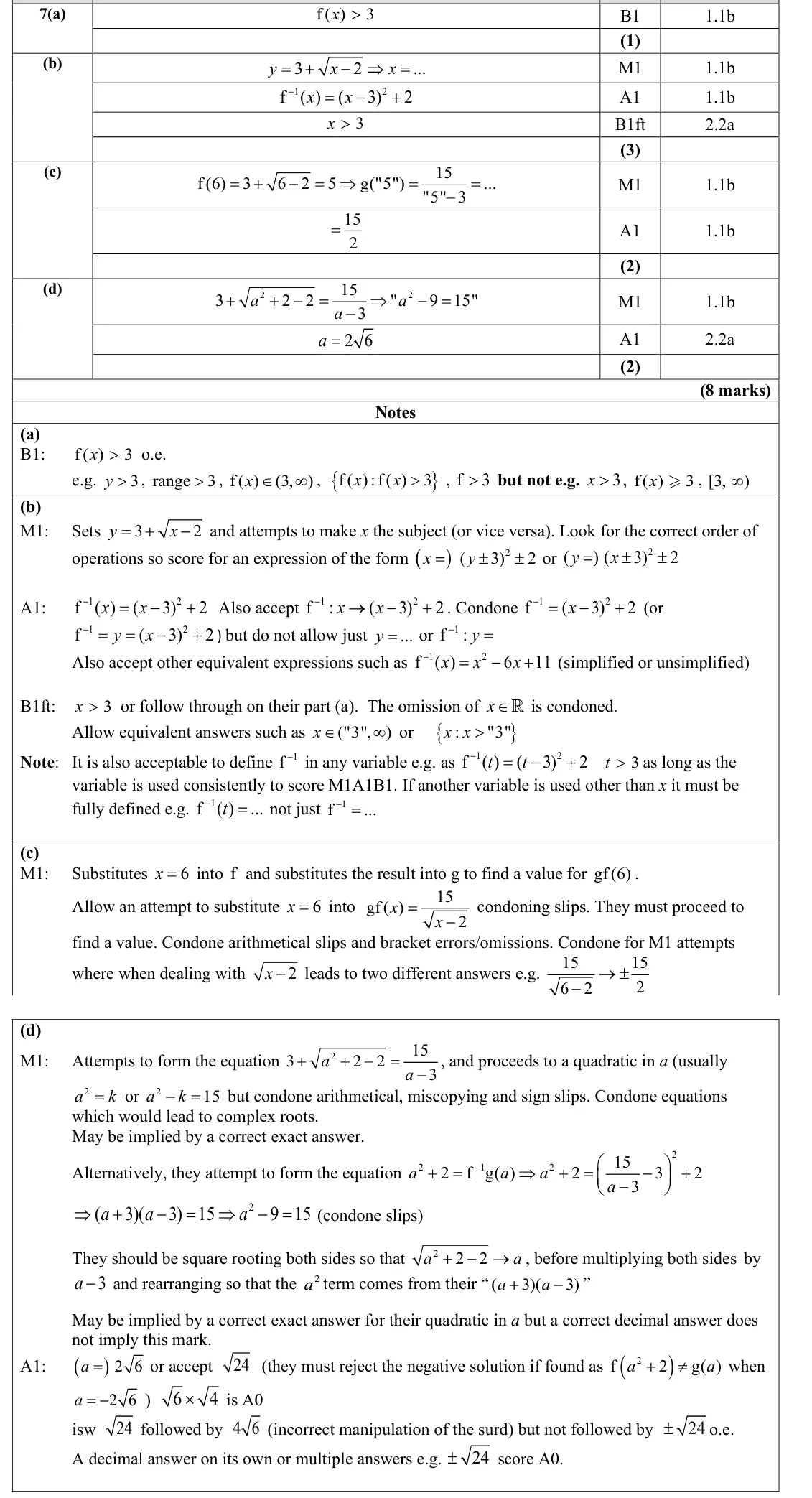
Overall, this was an accessible question on functions which allowed candidates to attempt all sections of it even when they found parts (a) or (b) particularly challenging. A large number of candidates scored the first mark in part (d) as they correctly formed the equation ( 3)(3 ) 15 a a - + = and proceeded to a quadratic in a. Several candidates failed to spot that 2 a a = , or that 2 2 2 2 a a + - = . Some candidates that found 2 6 a = did not reject the negative solution losing the last A mark. Some candidates possibly rejected the negative solution by seeing that the domain of f had to be greater than 2 and fortuitously scored the final mark. However, others may have considered that the ( ) 2 2 6 2 - + also satisfied this domain resulting in ( ) ( ) 2 f 2 6 2 0 - + , but that ( ) g 2 6 0 - so this negative solution had to be rejected. Other errors included writing decimal answers only. On several occasions 2 9 15 a - = incorrectly became 2 6 a = . A number of candidates were not able to obtain the quadratic equation needed (hence, did not score any marks) because they got confused by 2 3 a + and not realising that this was actually3 a + . Others tried to manipulate the equation leading to a quartic equation and usually solved via a calculator (and successfully in a few cases), however those who had proceeded along this route typically were expected to apply algebraic division or the factor theorem to find the quadratic factor, having introduced other solutions from squaring and the complexity of their expressions meant it was rare for the method mark to be scored.
Common mistakes
√((a² + 2) − 2) = a gives a² − 9 = 15
exact answer 2√6 only (reject −2√6)
June 2022 · AS Paper 1 · Q3(b)2 marks
Mark scheme (whole question; this part is marked with the orange bar)
Examiner's comment
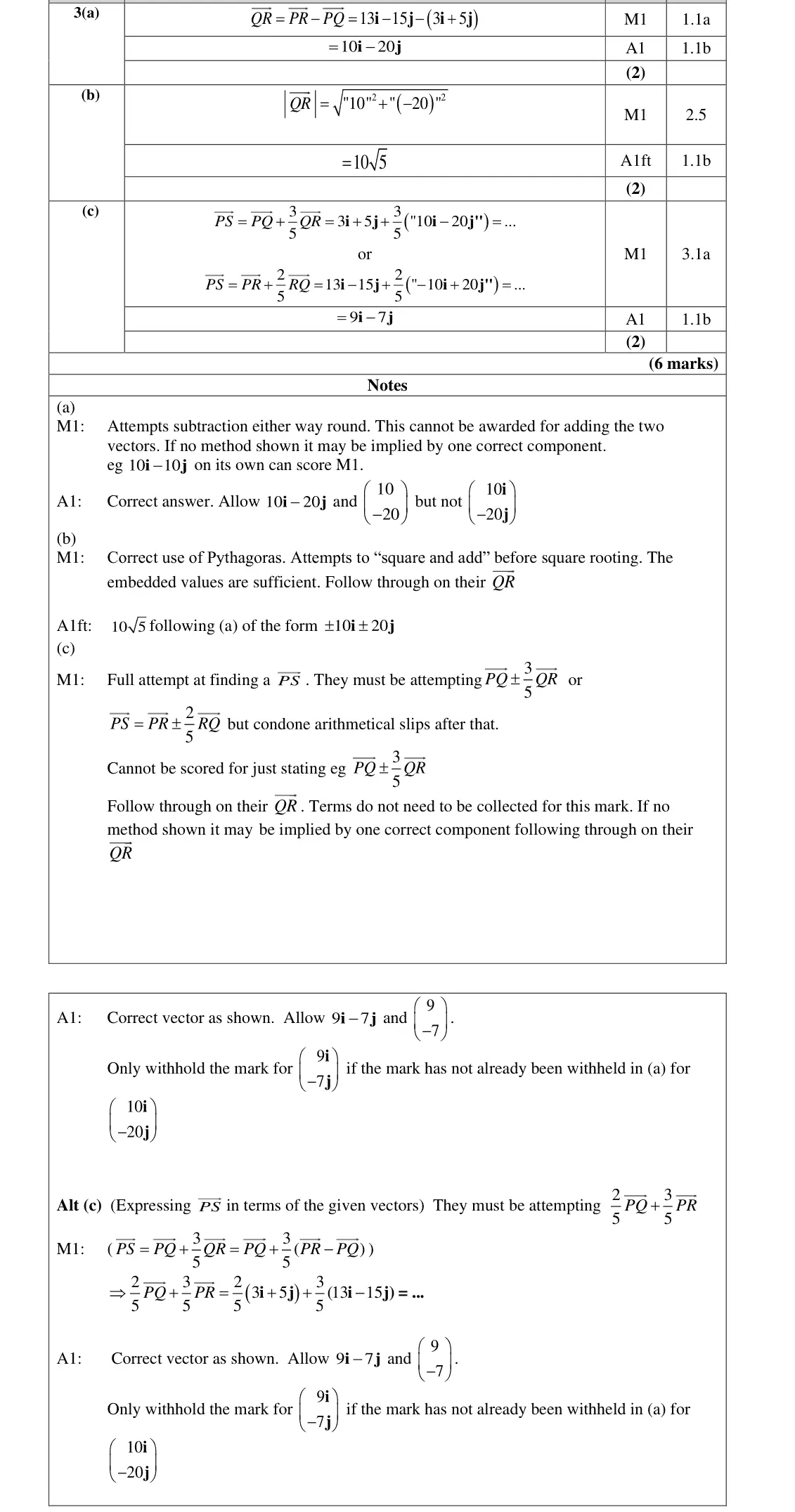
Many candidates tackled this question well, scoring full marks. Only a few made either no attempt or scored 0 for their efforts. The use of diagrams was widespread and seemed to aid those candidates in parts (a) and (c) to clarify their work. In part (b), the concept and calculation of the magnitude of a vector was clearly understood by the vast majority and this was evaluated with very few errors seen; the A mark was usually only being lost by candidates with a component error in (a). A minority of candidates attempted to construct a scale drawing: most of these were unsuccessful at providing sufficient evidence to score the method mark.
Common mistakes
square and add before square rooting
simplified surd 10√5
scale drawing is not a method
June 2022 · AS Paper 1 · Q7(c)3 marks
Mark scheme (whole question; this part is marked with the orange bar)
Examiner's comment
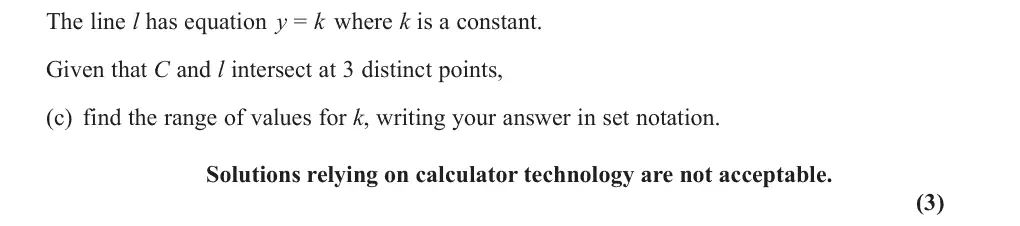
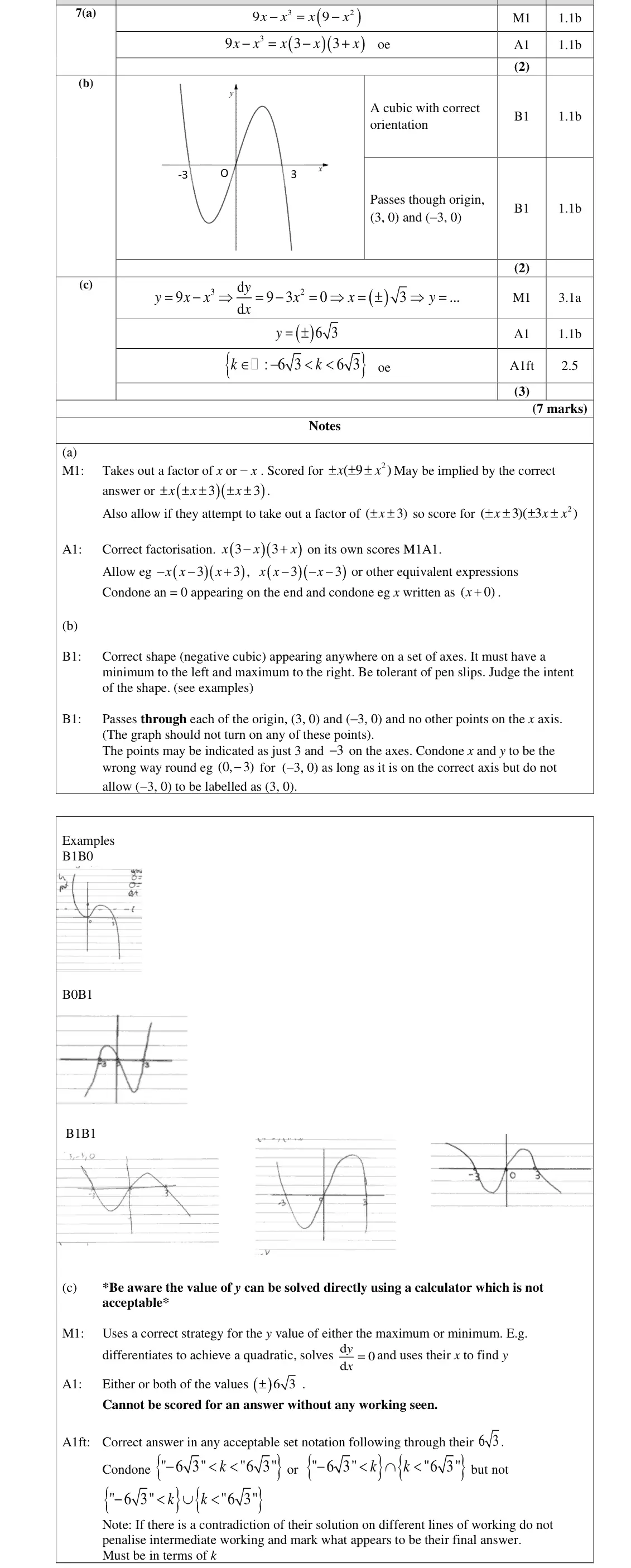
Generally, candidates scored well in the first two parts of this question, by factorising the cubic expression and drawing a graph. The final part, however, where the candidates were required to find a range, was very poorly answered, with few gaining any marks and very few reaching the correct final answer. Part (c) proved to be very challenging. Candidates were unable to identify the need to differentiate with many of them treating the equation as if it were quadratic and attempting to find the discriminant. Candidates who recognised the need to differentiate generally went on to find the x coordinates successfully, however, it was common for these candidates to write an inequality in terms of x rather than moving forward to find the associated y coordinates. It appears many candidates are not truly confident in the specific meaning of the terms “domain” and “range”. Of the relatively few candidates who did correctly calculate the y coordinate of the turning points, some still lost the final mark by failing to use correct set notation. A few responses were seen where decimal approximations to 6 3 had clearly been obtained from calculator technology alone and these gained no credit.
Common mistakes
three intersections means k lies between the turning values: dy/dx = 9 − 3x² = 0, x = ±√3, y = ±6√3
using a discriminant is wrong (cubic)
answer in k, not x
set notation {k : −6√3 < k < 6√3} (union is wrong)
calculator decimals score nothing
June 2022 · Paper 1 · Q3(b)2 marksEasy
Mark scheme (whole question; this part is marked with the orange bar)
Examiner's comment
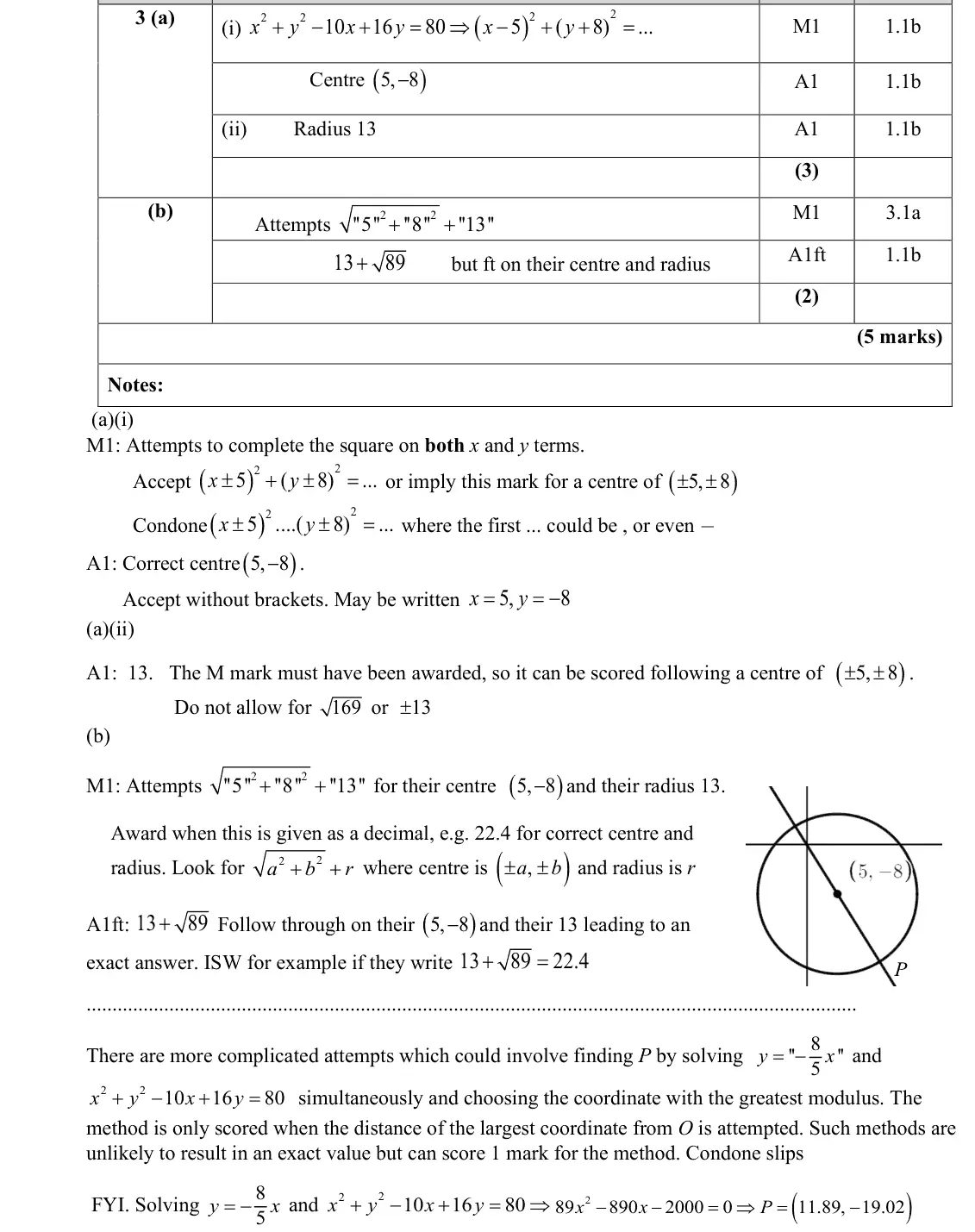
This question on the geometry of a circle had standard bookwork in part (a) followed by problem solving in part (b). Success in part (b) was usually achieved by candidates who drew a diagram. In part (b), there was full follow through on the centre and radius, which allowed many candidates to score full marks despite errors in part (a). Candidates who drew a diagram worked out that they need to find the distance of the centre from the origin and add on the radius. One lengthy method involved finding the intersection of the circle with the line through O and C, but this was unlikely to give the requested exact answer, and some candidates gave up at the point where the quadratic had to be solved as it had unpleasant coefficients. A common error was based on simply doubling the radius, either as 26 or finding the length of the vector (10, -16) as 2 Ö89.
Common mistakes
OP = distance from O to the centre + radius = √89 + 13 (exact)
draw a diagram
doubling the radius (26) or 2√89 are common errors
intersecting the line OC with the circle is long and rarely exact
June 2022 · Paper 2 · Q86 marks
Mark scheme (whole question; this part is marked with the orange bar)
Examiner's comment
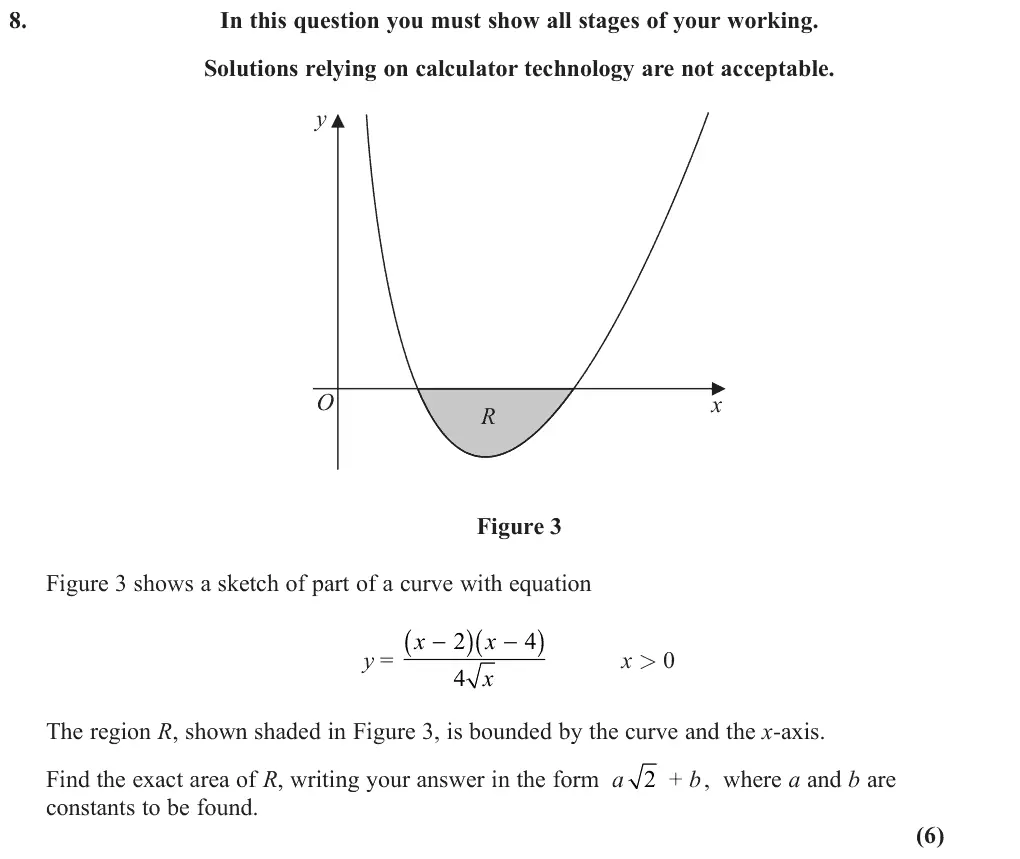
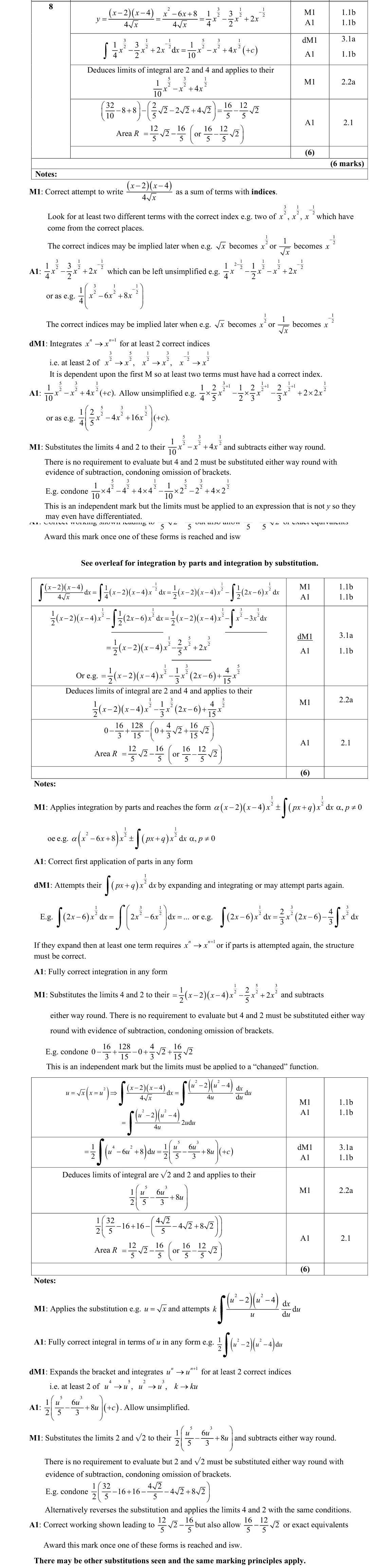
Most students knew that this question was to be solved by integration although a very small number thought that the question was about partial fractions, differentiation or a mixture of differentiation with integration. There were multiple approaches to solving this question including integrating a function with simplified indices, integrating by parts and integrating by substitution. The most common and the simplest method seen was multiplying out and simplifying indices. For the candidates who recognised that 4 sqrt x in the denominator should be rewritten as ¼ x -½ in the numerator there was a lot of success on this question. However, there were many candidates who brought the 4 to the top and left it as 4 rather than ¼ and earned a maximum of 3/6. Some wrote 4x½ in the numerator multiplying out to give incorrect powers and losing the first two method marks. Finding the correct limits and substituting them in a changed function was done by most leading to quite a few correct answers. Quite a few gave part or all of the final answer as a decimal, this was not surprising as most were using their calculators to do the final evaluation and calculator use did not leave the result of e.g. ( sqrt 2)5 as a surd. Some candidates recognised that the area needed to be positive, however the final answer was permissible even with a negative area. There were often errors in solutions constructed using integration by parts. There were mistakes made using the formula correctly, some bracketing errors, and some attempted parts the other way round getting harder expressions in the integral which mostly resulted for them a maximum of 1 mark (3rd M mark) obtained. There were a few incorrect substitutions selected for integration by substitution approaches, however candidates who chose u = sqrt x or u = 4 sqrt x were generally successful. A few candidates who set e.g. u = x – 2 in a substitution method scored few marks, if any, as such attempts did not progress the candidate towards a function they could integrate. In substitution method a few candidates made arithmetic errors in finding the new limits or did not attempt to change them at all.
Common mistakes
write as ¼x^(3/2) − (3/2)x^(½) + 2x^(−½) (4√x becomes ¼x^(−½), not 4x^(½))
limits 2 and 4 from the roots
exact answer (12/5)√2 − 16/5, not a decimal
by parts is much harder
June 2022 · Paper 2 · Q13(b)3 marks
Mark scheme (whole question; this part is marked with the orange bar)
Examiner's comment
This question was a good differentiator, with the majority of candidates gaining some credit, but only the strongest achieving full marks. Overall, candidates often demonstrated good reasoning skills and were rewarded with good marks on this question but a significant number of candidates struggled with this topic. Throughout, methods of solution were many and varied, and often involved non vector approaches that were sometimes difficult to follow. Part (b) was found to be challenging by most candidates, with few gaining any marks and with many not attempting it. Many candidates again worked with magnitudes of vectors and made no progress. Those candidates who did gain credit usually used the fact that 𝑘𝑘𝑂𝑂𝑂𝑂 ሬሬሬሬሬ⃗-𝑂𝑂𝑂𝑂 ሬሬሬሬሬ⃗= ൭ 16 4𝑘𝑘-𝑝𝑝 6𝑘𝑘-10 ൱ was parallel to 𝑂𝑂𝑂𝑂 ሬሬሬሬሬ⃗ to find 𝑘𝑘= 5 giving 𝑂𝑂𝑂𝑂 ሬሬሬሬሬሬ⃗= ൭ 0 20 30 ൱. Many candidates failed to realise that 𝑂𝑂𝑂𝑂 ሬሬሬሬሬሬ⃗= 𝑘𝑘൭ 0 4 6 ൱, and made no progress, whilst others incorrectly assumed that ൭ 16 4𝑘𝑘-𝑝𝑝 6𝑘𝑘-10 ൱= 𝑂𝑂𝑂𝑂 ሬሬሬሬሬ⃗. Candidates often drew diagrams to visualise the problem but full marks in this part were rarely awarded. A significant number of candidates who had found the correct vector, failed to find its magnitude.
Common mistakes
OD = λOB and CD = OD − OC parallel to OA gives λ = 5, OD = 20j + 30k
modulus 10√13 (fully simplified)
CD is not equal to OA
many stopped at the vector
June 2022 · Paper 2 · Q15(c)5 marks
Mark scheme (whole question; this part is marked with the orange bar)
Examiner's comment
The majority of candidates found this question accessible and were able to score consistently throughout. Where marks were lost they were usually in parts (b) and (c). 12𝑐𝑐𝑐𝑐𝑐𝑐𝑐𝑐= 5+2𝑠𝑠𝑠𝑠𝑠𝑠𝑠𝑠 6𝑡𝑡𝑎𝑎𝑎𝑎𝑎𝑎 Part (a) was attempted successfully by most candidates, starting usually with 5+2𝑠𝑠𝑠𝑠𝑠𝑠𝑠𝑠. Candidates then successfully cross multiplied and used the was 6𝑡𝑡𝑡𝑡𝑡𝑡𝑡𝑡= 12𝑐𝑐𝑐𝑐𝑐𝑐𝑐𝑐ቀ 12𝑐𝑐𝑐𝑐𝑐𝑐𝑐𝑐ቁ 2 5+2𝑠𝑠𝑠𝑠𝑠𝑠𝑠𝑠 appropriate identity to reach the required result. Another starting point regularly seen . Errors in the proof were rare if candidates started from a correct statement. Occasionally the “ = 0” was carelessly missing. 𝜋𝜋 In part (b) most candidates correctly solved the equation either by factorising or using 6 rather than the required 5𝜋𝜋 5𝜋𝜋 calculator technology, but many reached the acute angle 6 . Others found a number of solutions but failed to identify 6 as the obtuse angle of 𝜋𝜋 required answer. A few candidates worked in degrees and again lost the accuracy mark. 6 in (b) then usually carried this error into (c) and 𝜋𝜋 Those who had obtained an angle of 6 in (c) often would reach 9൫1 + sqrt 3൯, but did not seem to worry that this did not match the required answer were in a position only to earn the method marks. Candidates using format given in the question. There were many attempts, however, to use the correct formula for the sum to infinity with appropriate values for the first term and the (often incorrectly) algebraic expressions for the sum to infinity involving 𝜃𝜃, without common ratio. Some candidates unfortunately put effort into finding and rearranging 𝑎𝑎 1+𝑟𝑟 incorrectly as the formula substituting an angle in, gaining no credit, and others used for the sum to infinity. The most common mistake in (c) was failure to show the steps 3 ൰ straight into their calculators to obtain 9 -9 sqrt 3 losing the last two marks in -6 sqrt 3 where the denominator was rationalised. Many candidates clearly typed an expression 1-൬- sqrt 3 like the question.
Common mistakes
a = −6√3, r = −1/√3 (modulus less than 1)
S∞ = a/(1 − r) and rationalise the denominator to 9(1 − √3)
using θ = π/6 gives 9(1 + √3), which does not match the given form
steps must be shown, not calculator
Oct 2021 · AS Paper 1 · Q6(b)3 marks
Mark scheme (whole question; this part is marked with the orange bar)
Examiner's comment
This was a question which was completed to a high degree of accuracy by a pleasing number of candidates. There seemed to be more notice taken by many candidates regarding showing all stages of their working. Part (b) proved to be a good discriminator. Some candidates tackled this part well recognising the link from (a) and showing sufficient working of using their solutions to proceed to correct ones in (b). However, a significant number came unstuck with this part and tried to multiply out the brackets and start again. Some also tried to set 2 ( 2) y - equal to their solution, but then multiplied out the brackets and solve using the formula or factorising a new quadratic, rather than just square rooting and adding 2. It was rare for candidates to just use their calculator which could not score. Some squared rather than square rooted, and some forgot the negative solution from square rooting. Others thought you could square root a negative.
Common mistakes
spot the structure: (y − 2)² = 0, −1/3, 6 from (a)
reject the negative value (no real root)
y = 2, 2 ± √6 (remember the ± and do not square instead of square root)
multiplying out the brackets and starting again wastes time
Oct 2021 · AS Paper 1 · Q94 marks
Mark scheme (whole question; this part is marked with the orange bar)
Examiner's comment
This question was typically answered well by most candidates and was possibly the most successful question on the paper. Candidates typically were able to manipulate the integral to achieve 1 2 ...x - , although those who omitted the negative did not score any marks on this question. Some candidates made errors dealing with the coefficient, but they were typically able to score half of the available marks on the paper. Whilst most proceeded to the correct answer, some incorrectly square rooted to find k rather than squaring.
Common mistakes
6x^(−½) integrates to 12x^(½) (sign of the index)
36 − 12√k = 20 so √k = 4/3
square, do not square root: k = 16/9
Oct 2021 · Paper 1 · Q7(a)4 marks
Mark scheme (whole question; this part is marked with the orange bar)
Examiner's comment
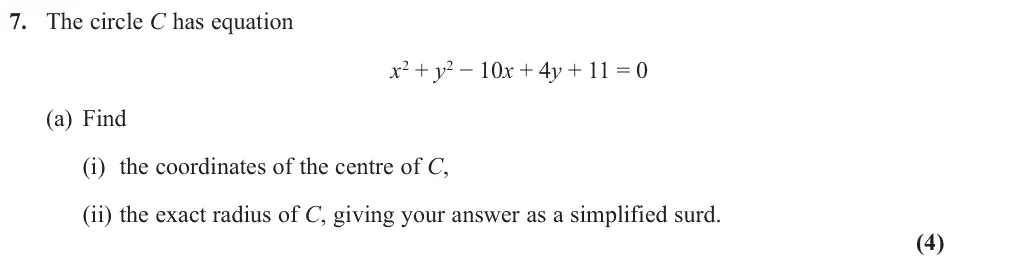
The first few marks in this question were very accessible but the final part of the question proved to be a useful discriminator especially around grade C and below. Part(a) The majority of candidates achieved full marks in this part. Sign errors were responsible for most errors, although failure to halve was also seen with either or both of (x ±10)2 and (y ± 4)2 being seen. Having achieved (x-5)2+(y+2)2 = 18, it rare to see the centre or radius not found correctly.
Common mistakes
complete the square: (x − 5)² + (y + 2)² = 18
centre (5, −2)
r = 3√2, not ±3√2 or √18
halving errors
Oct 2021 · Paper 1 · Q7(b)5 marks
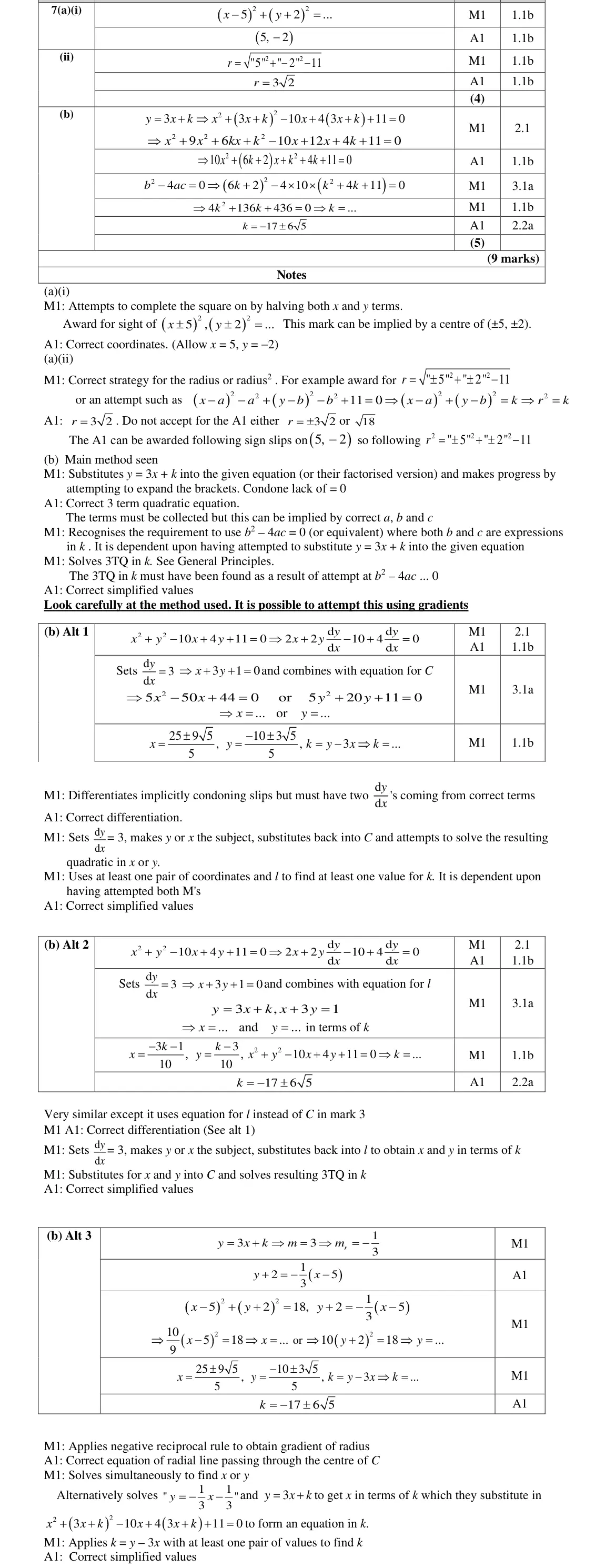
Mark scheme (whole question; this part is marked with the orange bar)
Examiner's comment
The first few marks in this question were very accessible but the final part of the question proved to be a useful discriminator especially around grade C and below. Part (b) This part was found to be discriminating with complete solutions seen from only the most competent of candidates. The most common approach was to substitute y = 3x + k into the circle equation to find a quadratic in x (with coefficients in terms of k) for the points of intersection. Errors mostly arose when (3x + k +2)2 was expanded incorrectly or the 2x + 6kx terms not being gathered together. Many solutions then stopped after the substitution and expansion step, as candidates did not seem to appreciate what to do with an equation of this complexity in two variables. Application of b 2 = 4ac to find equal roots was used on many occasions but errors frequently occurred. Only a very few solutions involved attempts via b2 - 4ac > 0. It was not always obvious to see how a student had solved their quadratic (formula not quoted and values for a, b and c not seen) but a limited number of correct solutions were seen. Using a calculator quadratic solver was frequent and acceptable. Several attempts started by using implicit differentiation on the circle equation. Although this is a possible method, it did not often go beyond using dy/dx = 3 to get x+3y+1= 0. Another method seen several times was to find the equation of the normal ( i.e. the radius ) to try to make progress towards finding values of k, but this method also seldom went further than the equation of the line.
Common mistakes
substitute y = 3x + k into the circle to get 10x² + (6k + 2)x + k² + 4k + 11 = 0
tangent means b² − 4ac = 0
k = −17 ± 6√5
alternatives via the radius gradient −1/3 or implicit differentiation rarely completed
Oct 2021 · Paper 1 · Q144 marks
Mark scheme (whole question; this part is marked with the orange bar)
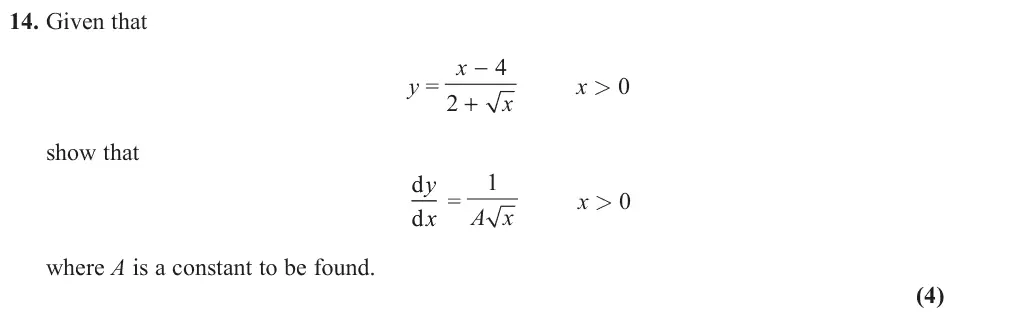
Examiner's comment
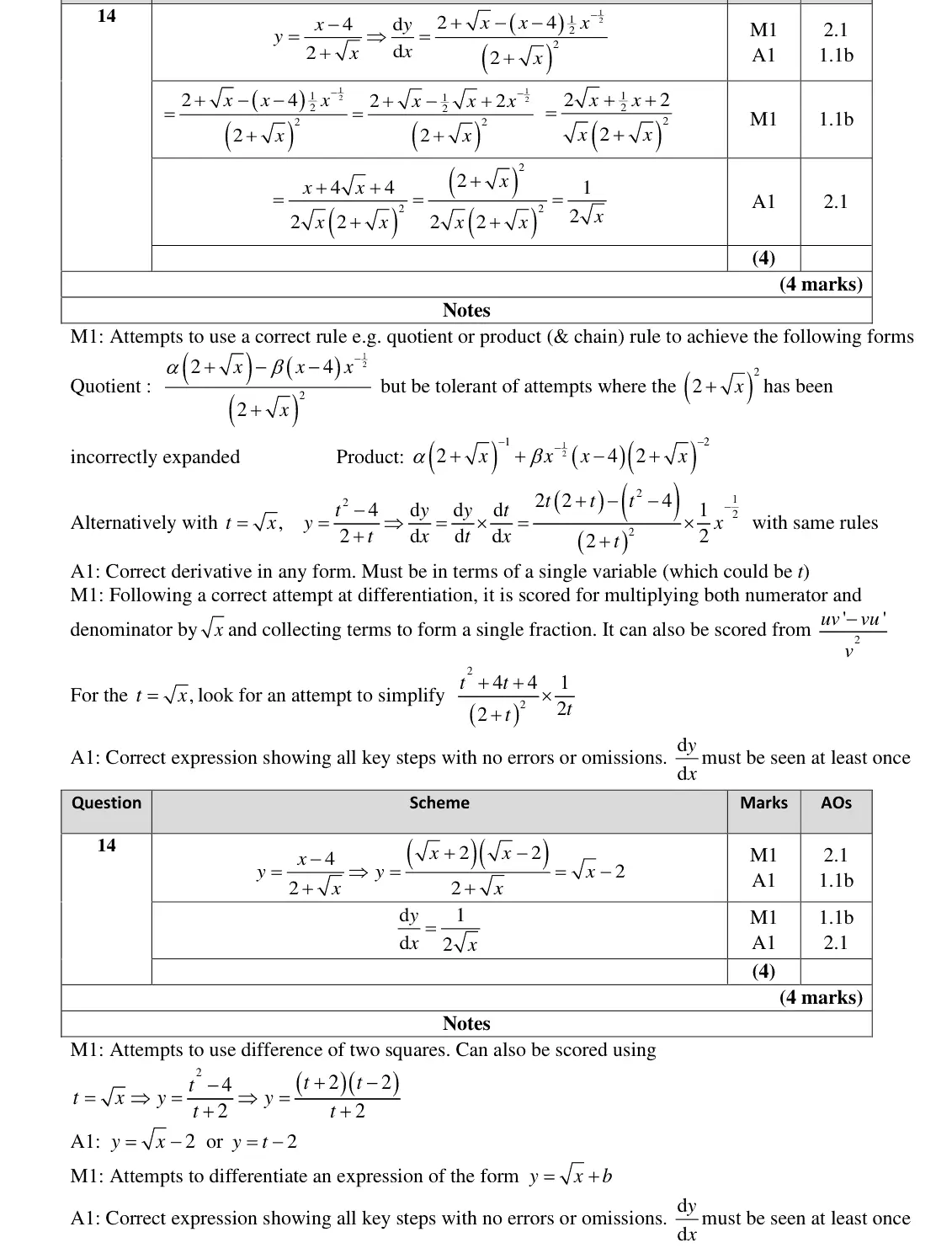
This question proved equally challenging and very few fully correct solutions were seen. The modal mark achieved here was 2, scored by over 40% of the candidates, most often for a fully correct attempt at dy/dx. Most solutions seen used the quotient rule although incorrect application of the rule often meant that no marks could be awarded. The most common errors were subtracting the wrong way round on the numerator, or else adding the two expressions on the numerator. Differentiation of sqrt x suprisingly caused a few problems as well. Product rule expansions seldom got past the first expression. The ability to manipulate the ensuing algebraic expression was often lacking, with fractional terms within a fraction, the main cause for failure. Alternative methods which might have simplified the algebra were seen, but only rarely. Only a handful spotted that a difference of two squares method applied to the numerator would have made this a very simple problem.
Common mistakes
quotient rule numerator the right way round
multiply through by √x to simplify to 1/(2√x), A = 2
spotting x − 4 = (√x + 2)(√x − 2) gives y = √x − 2 directly
dy/dx must be seen
Oct 2020 · AS Paper 1 · Q3(i)3 marks
Mark scheme (whole question; this part is marked with the orange bar)
Examiner's comment
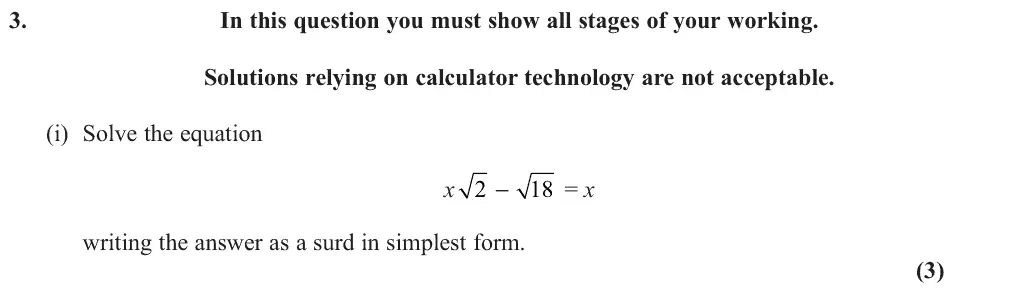
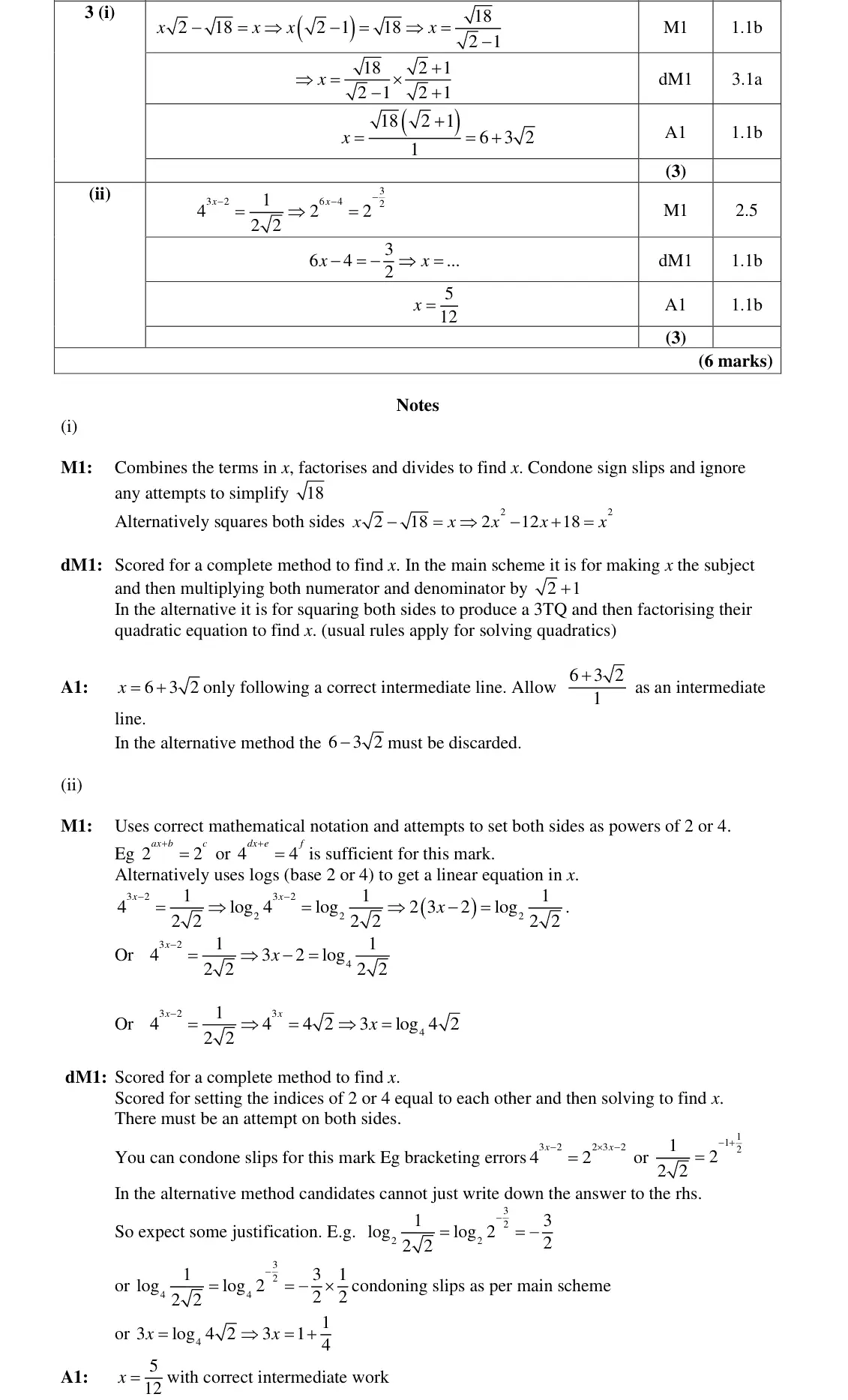
This question really highlighted the dependence on calculators amongst candidates. Part (a) required simple rationalisation of a denominator and part (b) wanted candidates to work with indices/bases. In part (a) they perhaps did not fully appreciate the wording at the top of the question ‘Solutions relying on calculator technology are not acceptable’, whilst in part (b) they did not have the algebra skills to solve on their own. In part (a), when squaring both sides many candidates squared each individual term before 2x ; they seemed happier factorising the x out when the coefficients were combining the rational numbers. In a similar vein, many instead simplified the 18 and then factored out a common 2 , leaving multiple x terms in the equation. Some candidates opted to square both sides. Where a correct quadratic was built and solved, candidates gave both roots and lost the final mark. Where x was found with an irrational denominator, most candidates then went on to rationalise the denominator, but neglected to show the steps. In many cases it was clear they had typed into the calculator and read off the simplified display. When the question says ‘not relying on calculator technology’ candidates should be showing each step to secure the marks. The 18 must also be simplified when writing in simplest form. In part (b) log base 10 or natural logs were commonly used, and these could only be evaluated on the calculator. These scored no marks. Even where attempts were made to use 1 logs to base 4 or 2 there was an over reliance on calculators to find . The most log 4 2 2 common approach was to immediately take log base 4 and simplify the left-hand side. There 3 1 - log was then often little evidence of how they got from to . 4 4 2 2 Those who chose to rewrite as common bases more often led to full marks; base 2 was most common. Whilst the use of calculator technology is encouraged on the new specification, candidates should make sure that they are confident of working without one when required. 5
Common mistakes
factorise x(√2 − 1) = √18 (squaring every term is wrong)
rationalise the denominator with every step shown
simplify √18 = 3√2
x = 6 + 3√2
Oct 2020 · AS Paper 1 · Q3(ii)3 marks
Mark scheme (whole question; this part is marked with the orange bar)
Examiner's comment
This question really highlighted the dependence on calculators amongst candidates. Part (a) required simple rationalisation of a denominator and part (b) wanted candidates to work with indices/bases. In part (a) they perhaps did not fully appreciate the wording at the top of the question ‘Solutions relying on calculator technology are not acceptable’, whilst in part (b) they did not have the algebra skills to solve on their own. In part (a), when squaring both sides many candidates squared each individual term before 2x ; they seemed happier factorising the x out when the coefficients were combining the rational numbers. In a similar vein, many instead simplified the 18 and then factored out a common 2 , leaving multiple x terms in the equation. Some candidates opted to square both sides. Where a correct quadratic was built and solved, candidates gave both roots and lost the final mark. Where x was found with an irrational denominator, most candidates then went on to rationalise the denominator, but neglected to show the steps. In many cases it was clear they had typed into the calculator and read off the simplified display. When the question says ‘not relying on calculator technology’ candidates should be showing each step to secure the marks. The 18 must also be simplified when writing in simplest form. In part (b) log base 10 or natural logs were commonly used, and these could only be evaluated on the calculator. These scored no marks. Even where attempts were made to use 1 logs to base 4 or 2 there was an over reliance on calculators to find . The most log 4 2 2 common approach was to immediately take log base 4 and simplify the left-hand side. There 3 1 - log was then often little evidence of how they got from to . 4 4 2 2 Those who chose to rewrite as common bases more often led to full marks; base 2 was most common. Whilst the use of calculator technology is encouraged on the new specification, candidates should make sure that they are confident of working without one when required. 5
Common mistakes
write both sides as powers of 2 (2^(6x − 4) = 2^(−3/2)) or use logs base 2 or 4 with working
log₁₀ or ln needs a calculator and scores nothing
x = 5/12
Oct 2020 · Paper 1 · Q1(b)2 marks
Mark scheme (whole question; this part is marked with the orange bar)
Examiner's comment
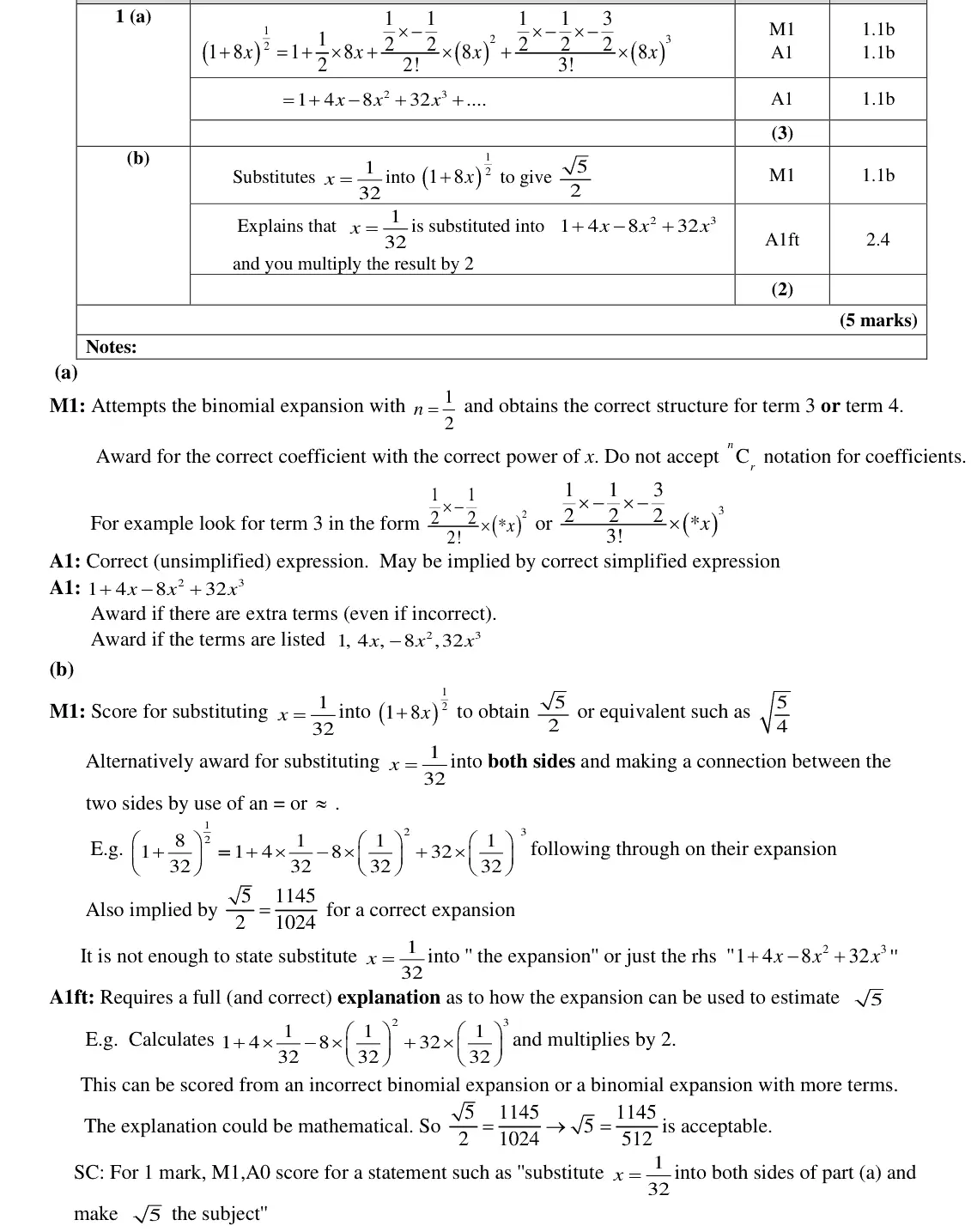
As hoped for, this proved to be a gentle and accessible start to the paper. The majority mainly seen in the failure not to square the 8 of ( ) 2 Part (b) was found to be more 8 . x 1 1 into ( ) 1 8x demanding. Successful students substituted and noted that the x = + 2 32 5 . result was It then became a simple task of stating that you merely needed to 2 1 into the expansion in (a) and multiply the result by 2. Concise substitute x = 32
Common mistakes
x = 1/32 makes (1 + 8x)^½ = √(5/4) = √5/2, so substitute into 1 + 4x − 8x² + 32x³ and multiply by 2
"substitute into the expansion" alone is not enough
Oct 2020 · Paper 2 · Q14(b)4 marks
Mark scheme (whole question; this part is marked with the orange bar)
Examiner's comment
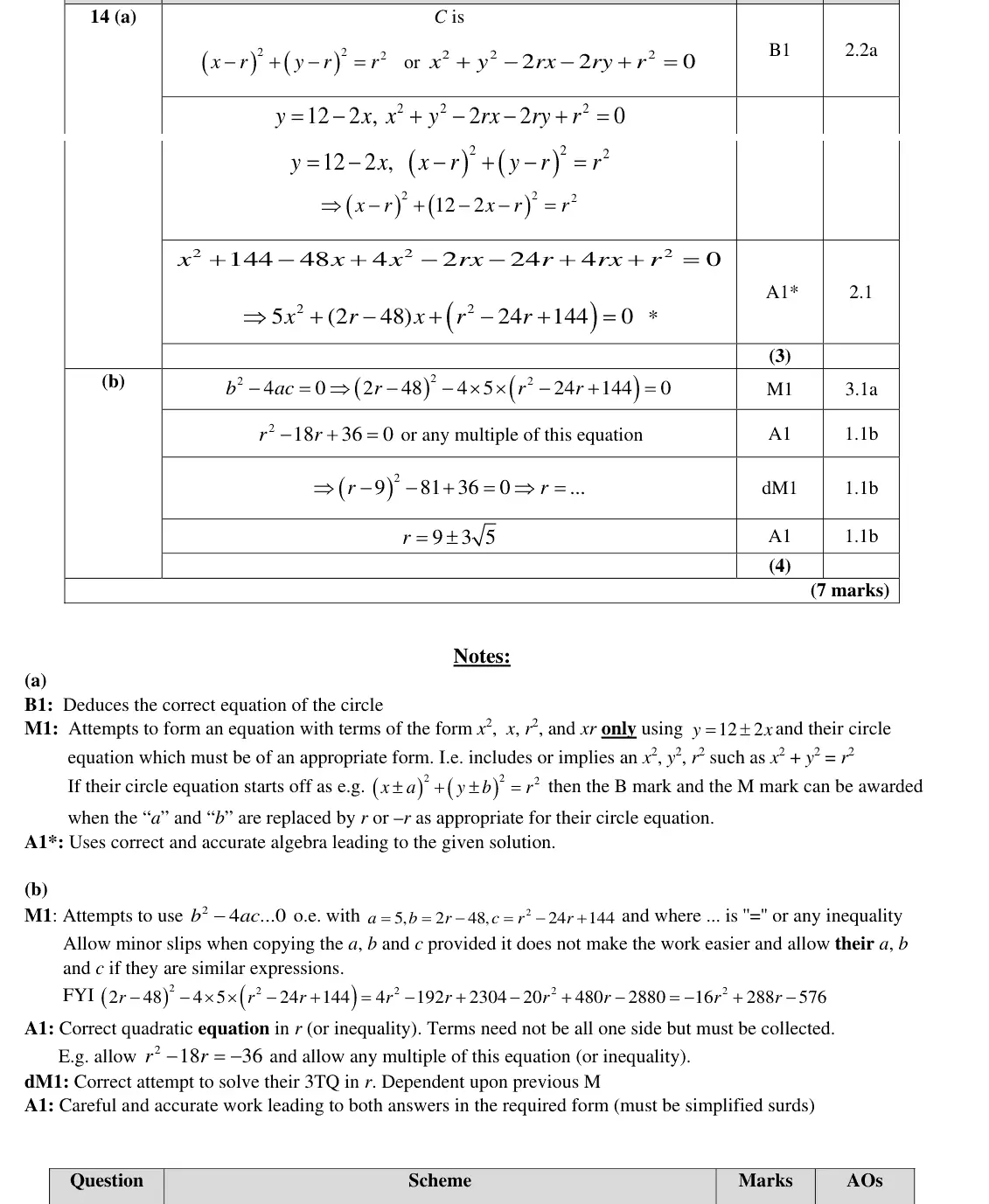
Part (b) proved to be more accessible to most candidates. Many recognised the need to use the discriminant and equate to zero, though poor algebraic manipulation often cost them the accuracy marks. Almost all candidates used a calculator to solve the quadratic, though there were examples of the quadratic formula being used, mainly correctly. A small number resorted to calculus to find a gradient, but very few successfully attempted to differentiate their equation and set the gradient to -2. A few tried to use the idea of gradient or even equate the equation with 12 – 2𝑥𝑥.
Common mistakes
tangent so b² − 4ac = 0
simplifies to r² − 18r + 36 = 0
r = 9 ± 3√5 as simplified surds
June 2019 · AS Paper 1 · Q6(a)3 marksEasy
Mark scheme (whole question; this part is marked with the orange bar)
Examiner's comment
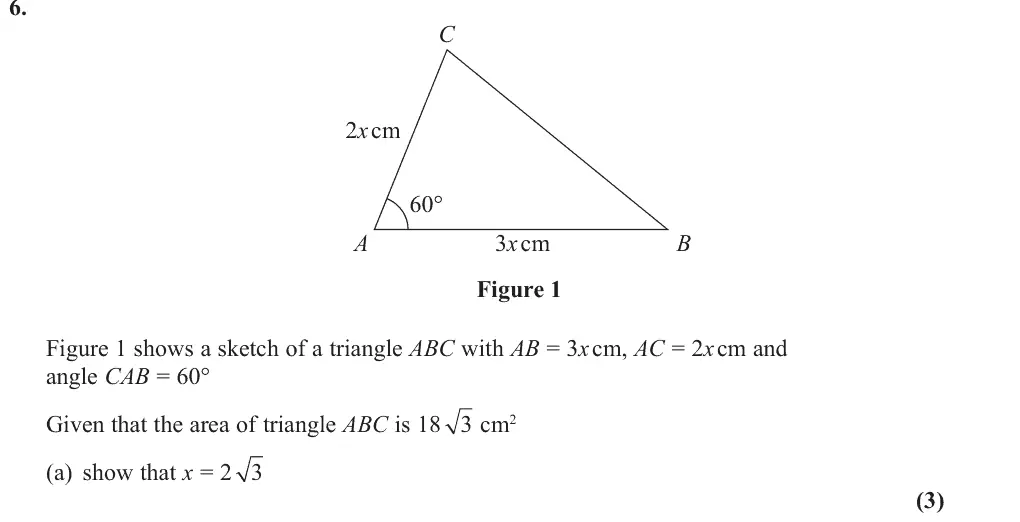
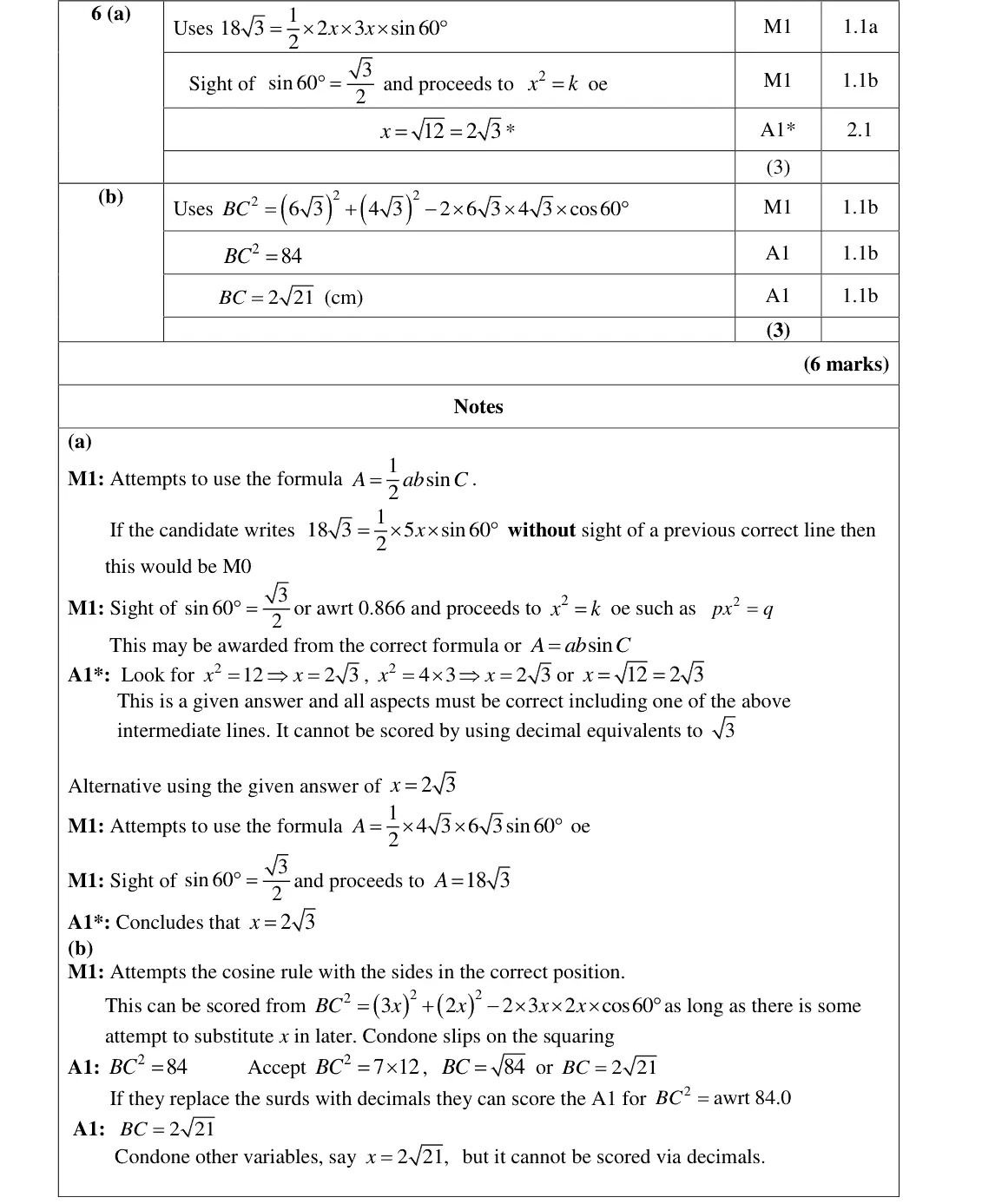
This question was accessible to the vast majority of candidates, most of whom were able to, at the least, make a start in both part a) and part b). In part a), most candidates could recall the correct formula for the area of a triangle. After a correct initial statement for the area of the triangle, a number of candidates lost a factor of 𝑥, simplifying 1 .2 .3 x x to 3x thus obtaining a linear equation in 𝑥 rather than a quadratic. 2 The rigour demanded in a ‘show that’ question tended to cost some candidates marks when they failed to demonstrate the individual steps in their calculations. In particular, it was quite common for 3 sin60 candidates to fail to demonstrate that they had used within their calculation. Candidates 2 should be made aware that for questions such as these where they are asked to ‘show that’, it is imperative that they demonstrate each step of their method on paper. Part b) tended to be less problematic and candidates were often more successful here than in part a). The vast majority of candidates were able to correctly quote and use the cosine rule. Occasionally, candidates became confused with the side lengths and errors arose in the substitution of 2 became 3(2 sqrt 3) 2 x into the cosine formula. Other errors arose in the squaring, sometimes (3 x 2 sqrt 3) for example. Finally, and worryingly, a very common mistake was not knowing about ‘order of frequently seen operations’ with 156 144cos60 12cos60
Common mistakes
½ × 2x × 3x × sin 60° = 18√3 (keep both x's: 3x² not 3x)
sin 60° = √3/2 must be seen
x² = 12 so x = √12 = 2√3
June 2019 · AS Paper 1 · Q6(b)3 marksEasy
Mark scheme (whole question; this part is marked with the orange bar)
Examiner's comment
This question was accessible to the vast majority of candidates, most of whom were able to, at the least, make a start in both part a) and part b). In part a), most candidates could recall the correct formula for the area of a triangle. After a correct initial statement for the area of the triangle, a number of candidates lost a factor of 𝑥, simplifying 1 .2 .3 x x to 3x thus obtaining a linear equation in 𝑥 rather than a quadratic. 2 The rigour demanded in a ‘show that’ question tended to cost some candidates marks when they failed to demonstrate the individual steps in their calculations. In particular, it was quite common for 3 sin60 candidates to fail to demonstrate that they had used within their calculation. Candidates 2 should be made aware that for questions such as these where they are asked to ‘show that’, it is imperative that they demonstrate each step of their method on paper. Part b) tended to be less problematic and candidates were often more successful here than in part a). The vast majority of candidates were able to correctly quote and use the cosine rule. Occasionally, candidates became confused with the side lengths and errors arose in the substitution of 2 became 3(2 sqrt 3) 2 x into the cosine formula. Other errors arose in the squaring, sometimes (3 x 2 sqrt 3) for example. Finally, and worryingly, a very common mistake was not knowing about ‘order of frequently seen operations’ with 156 144cos60 12cos60
Common mistakes
cosine rule with sides 6√3 and 4√3
(3 × 2√3)² squared correctly
order of operations: 156 − 72 = 84, not (156 − 144)cos 60°
BC = 2√21
June 2019 · Paper 2 · Q13 marks
Mark scheme (whole question; this part is marked with the orange bar)
Examiner's comment
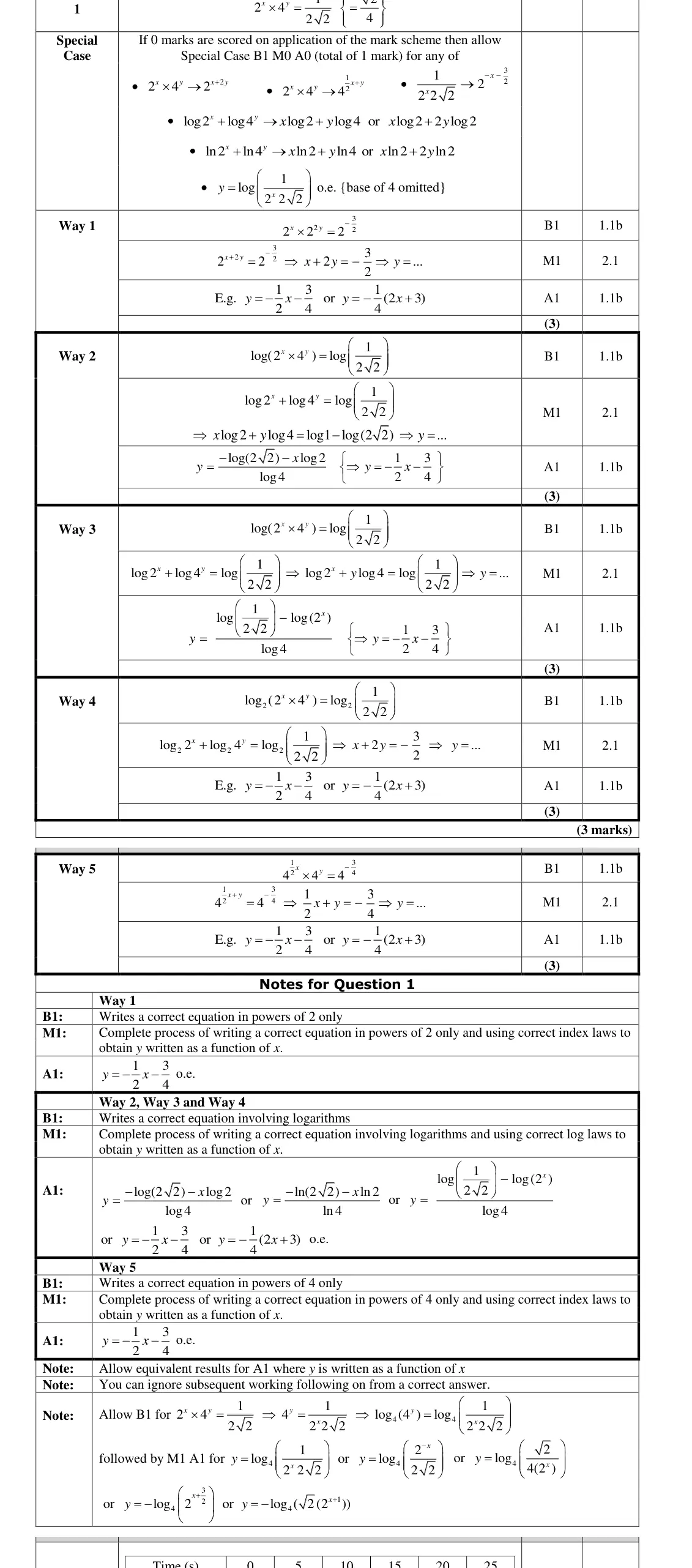
Q01 proved challenging for a significant number of candidates. This was probably because of the more open-ended nature of the question, allowing candidates to select their own problem-solving strategy to express y as a function of x. It was not apparent to most candidates that y could be expressed as a linear function of x. More able candidates, however, were able to provide a concise solution. Other candidates were still able to achieve full marks but expressed y as a more complicated function of x. A few candidates attempted to express x as a function of y, suggesting a lack of understanding of the terminology. It appeared that most candidates failed to realise that Q01 could be solved purely using indices. Instead, most candidates chose to immediately take logarithms as their first step towards a solution. A correct first step, e.g. 1 log(2 4 ) log , 2 2 x y was rewarded by the mark scheme. Unfortunately, some candidates combined taking logarithms with an incorrect application of the addition law for logarithms as their first step, therefore gaining no marks. E.g. 2 4 log2 log4 . x y x y Most candidates who had a correct first step of work went on to achieve full marks, with some only failing to do so by making an arithmetic error. Q01 highlighted some candidates’ weaker algebraic, indices and logarithms skills. Common errors included 2 4 8 , x y xy 2 4 8 , x y x y 1 1 , 2 2 2 4 2 x x or 1 2 2 4 4 . 2 2 2 2 x x y y The most common correct answers were 1 2 2 log log(2 ) , log4 x y 4 1 log 2 2 2 x y or 1 2 2 2 ln . ln 4 x y Only a minority of candidates obtained a correct 1 3. 2 4 y x
Common mistakes
write both sides as powers of 2: 2^(x + 2y) = 2^(−3/2), so y = −½x − ¾
taking logs is longer and log(2ˣ × 4ʸ) wrongly split as log2ˣ × log4ʸ or 2ˣ × 4ʸ = 8^(x + y)
answer must be y in terms of x, not x in terms of y
June 2018 · AS Paper 1 · Q3(b)2 marks
Mark scheme (whole question; this part is marked with the orange bar)
Examiner's comment
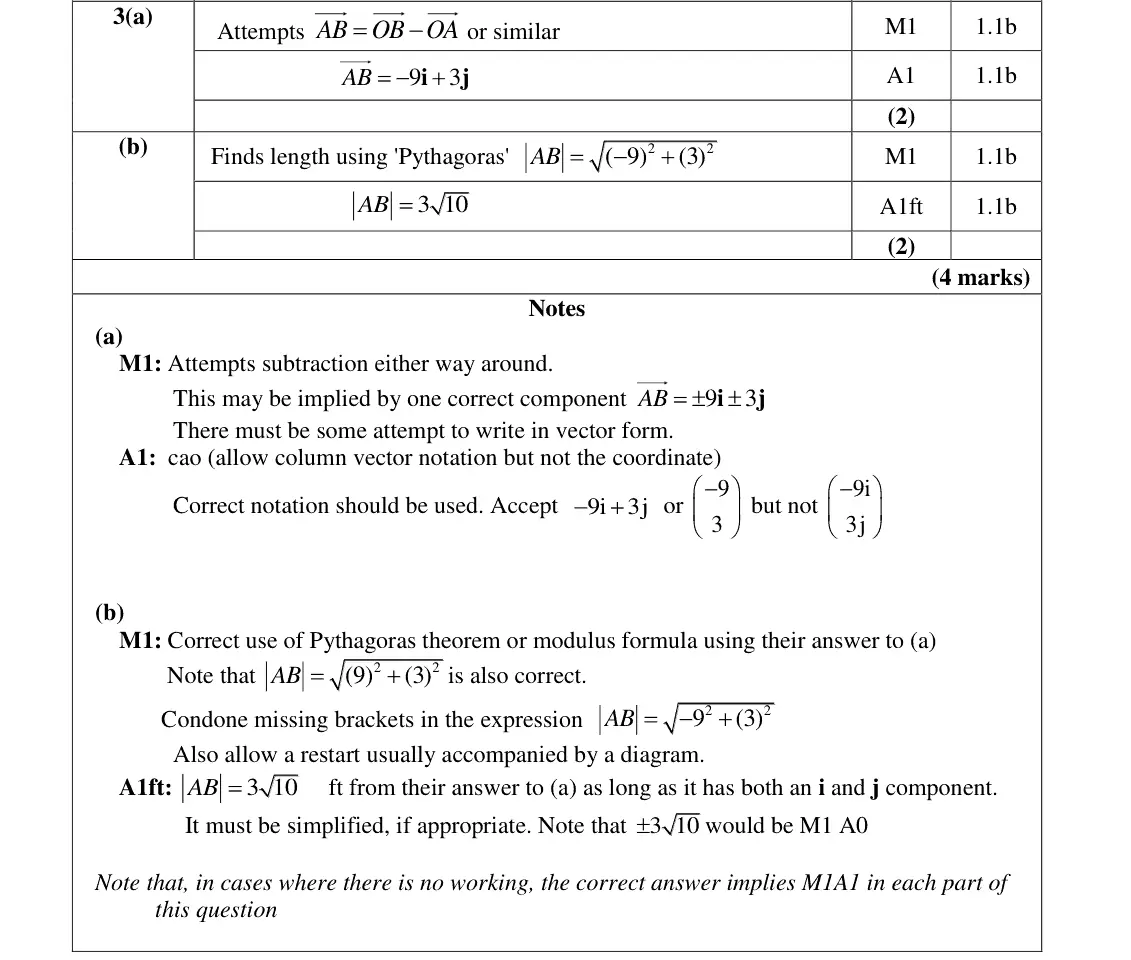
This question was very accessible to the vast majority of students with many scoring full marks. Part (b) was more successful with the vast majority of students knowing how to calculate the length of a vector and simplify the surd. A follow through on their vector from part (a) enabled most students access to both marks.
Common mistakes
modulus √((−9)² + 3²) = √90 = 3√10 as a simplified surd
±3√10 loses the A mark
June 2018 · Paper 1 · Q9(b)5 marks
Mark scheme (whole question; this part is marked with the orange bar)
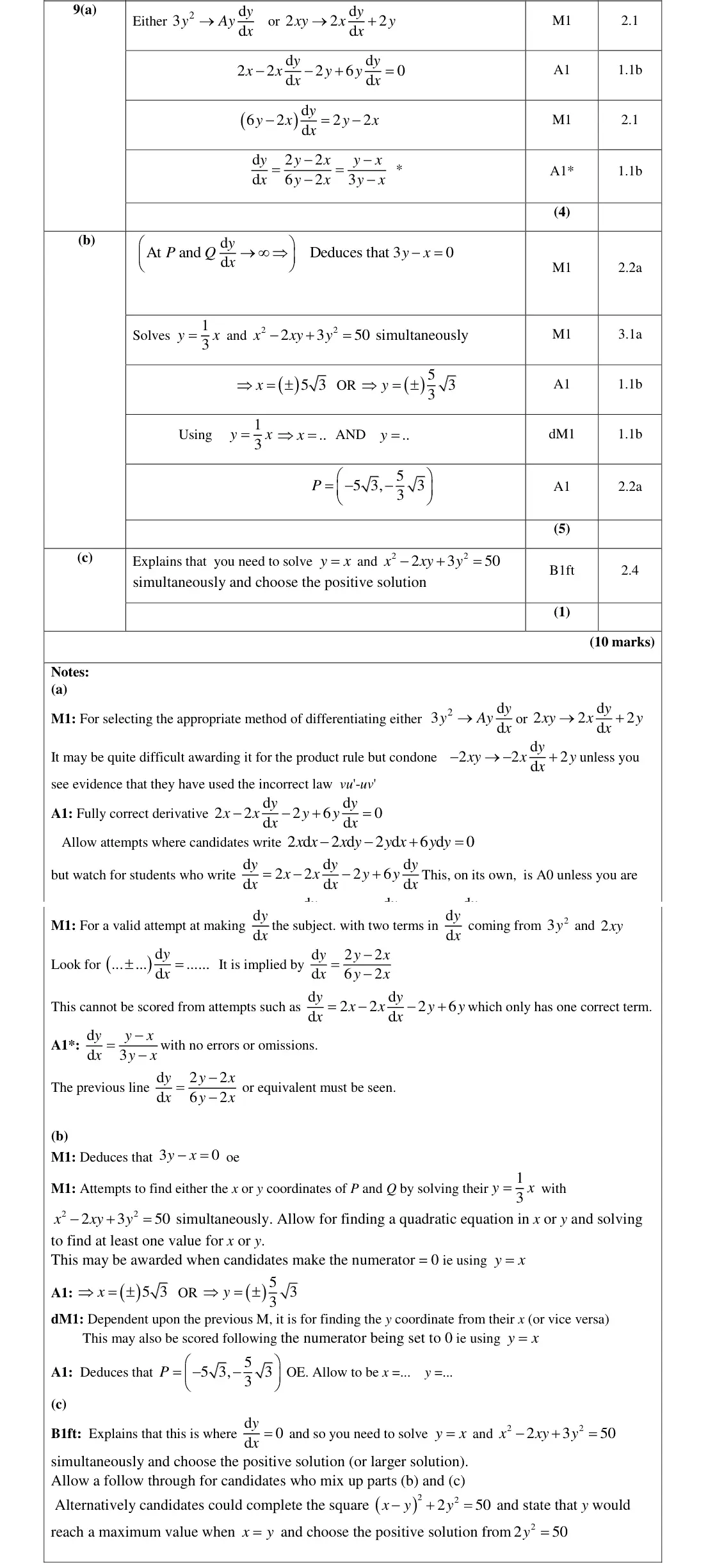
Examiner's comment
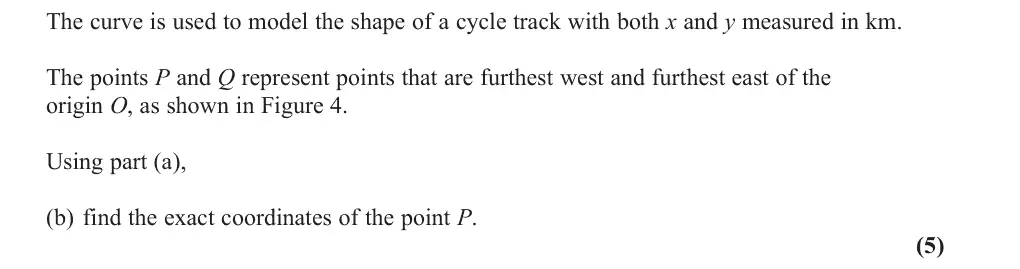
Question 9(a) was well answered. Students generally demonstrated a good understanding of implicit differentiation as well as the chain and product rules. Most reached the given result scoring all 4 marks. In question 9(b) however, many made the numerator of the fraction equal zero (i.e. y = x) instead of the denominator (x = 3y). This kind of error usually resulted in only two of the five marks being scored. There were however many full and accurate solutions, with very few students unable to pick out the coordinates of the point P from the two solutions to their simultaneous equations. Only a small number of students gained the B1 mark in question 9(c). They simply needed to state that the point furthest north can be found by substituting y= x into the equation of the curve and picking out the positive solution. Explanations tended to be incorrect or x y 0 incomplete, with many stating that it could be found by putting either or 0.
Common mistakes
furthest west/east means vertical tangent: denominator 3y − x = 0, not numerator (y = x is a common error)
solve with the curve, x = ±5√3
choose P = (−5√3, −(5/3)√3), exact
June 2018 · Paper 1 · Q11(c)3 marks
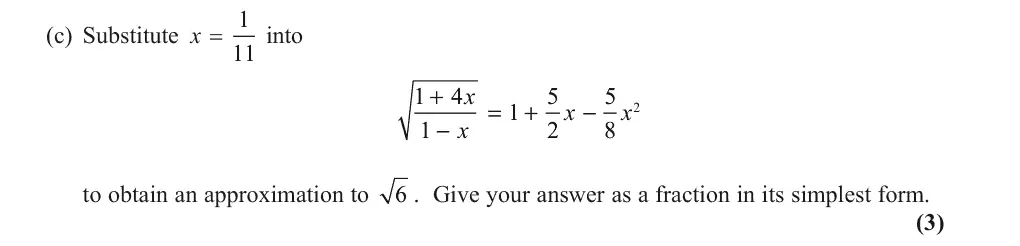
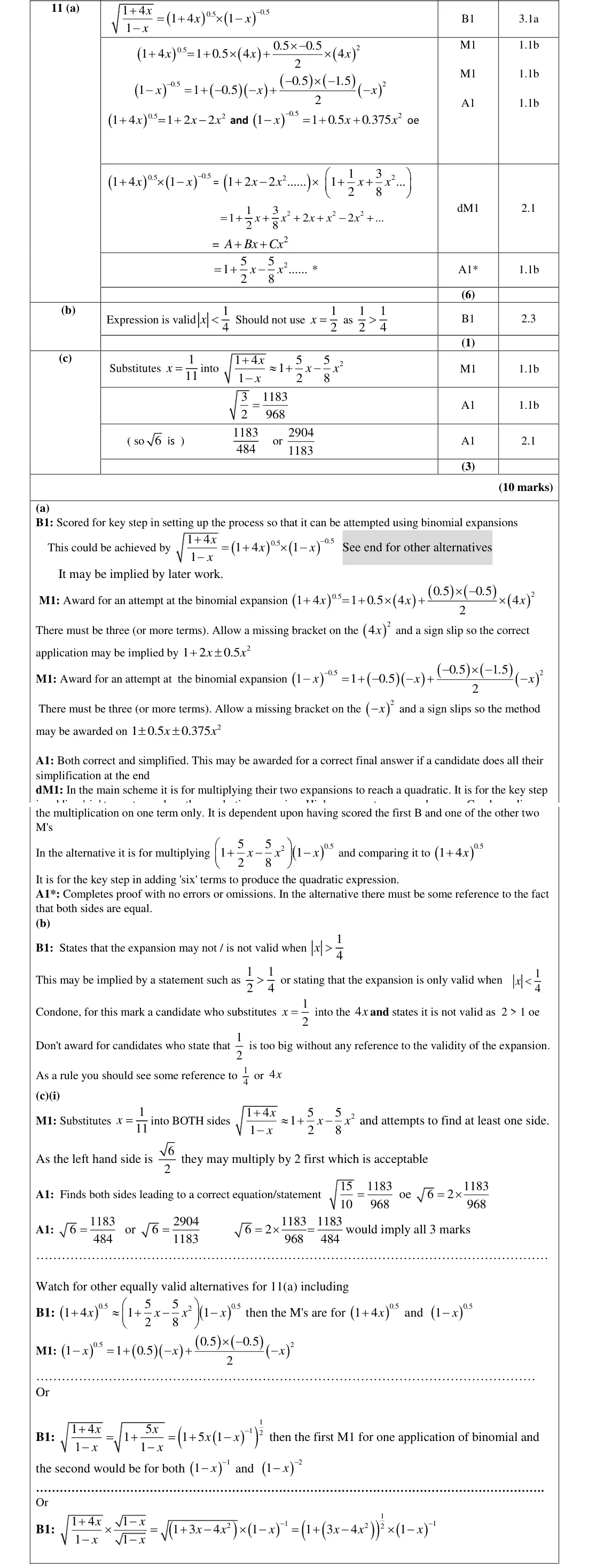
Mark scheme (whole question; this part is marked with the orange bar)
Examiner's comment
This question on the binomial expansion was well attempted by many students, although
Common mistakes
substitute into BOTH sides: LHS √(15/10) = √6/2, RHS 1183/968
√6 ≈ 1183/484 (or 2904/1183) in simplest form
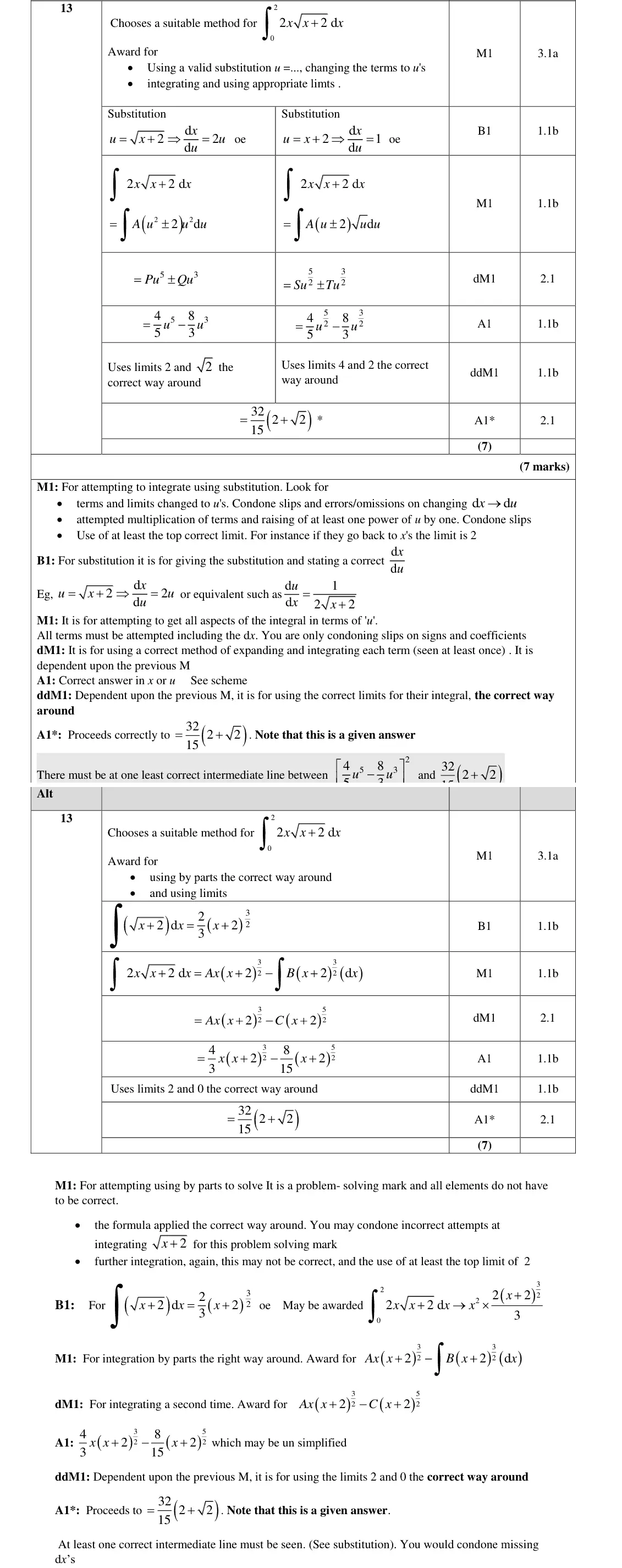
June 2018 · Paper 1 · Q137 marks
Mark scheme (whole question; this part is marked with the orange bar)
Examiner's comment
This was an open ended question on integration. The three most common methods seen are shown the mark scheme, two methods using substitution and one using integration by parts. Integration by parts was popular and well understood by the majority of students. Most knew that 3 2 2 2d 2 3 x x x and were able to integrate to an expression of the form 3 5 2 2 2 2 Ax x C x Slips in the values of the constants A and C were rare. However, as with earlier questions, there was a lack of clarity in moving from 2 3 5 2 2 0 4 8 2 2 3 15 x x x to the given answer of 32 2 2 15 Substitution was also well understood with 2 u x more common than 2. u x Errors here included the omission of finding dxin terms of d ,u poor expansion of expressions such as 2( 2) u u within the integral, and, as with parts, a lack of acceptable working shown when proceeding to the given answer.
Common mistakes
choose u = x + 2 (or u = √(x + 2)) or integration by parts
change dx to du and change the limits
expansion slips such as 2(u − 2)√u
at least one correct line before the given answer
Find an Edexcel maths tutor
Stuck on this? Book a trial session with an Edexcel specialist.