June 2018: Paper 3: Statistics and Mechanics

100 marks · 39 question parts · Question paper, mark scheme and examiner's report on Pearson's site

Question by question

QTopicMarksDifficulty
1(a) Discrete distributions and the binomial distribution, The large data set 2 —
1(b) Discrete distributions and the binomial distribution, The large data set 1 —
1(c) Discrete distributions and the binomial distribution, Normal distribution 1 —
1(d) Discrete distributions and the binomial distribution, Normal distribution, The large data set 1 —
2(a) Hypothesis testing 3 —
2(b) Correlation and regression 1 —
2(c) Hypothesis testing, Correlation and regression 1 —
2(d) Correlation and regression 1 —
2(e) Correlation and regression 1 —
3(a) Discrete distributions and the binomial distribution, Normal distribution 2 —
3(b) Discrete distributions and the binomial distribution 1 —
3(c) Probability, including conditional probability 2 —
3(d) Discrete distributions and the binomial distribution, Sequences and series 4 —
3(e) Discrete distributions and the binomial distribution 1 —
3(f) Probability, including conditional probability 1 —
4(a) Sampling 1 —
4(b) Sampling 2 —
4(c) Sampling 1 —
4(d) Data presentation: histograms, box plots, measures and outliers 1 —
4(e) Data presentation: histograms, box plots, measures and outliers 3 —
4(f) Data presentation: histograms, box plots, measures and outliers 2 —
4(g) Data presentation: histograms, box plots, measures and outliers 3 —
5(a) Normal distribution 1 —
5(b) Normal distribution, Probability, including conditional probability 5 —
5(c) Probability, including conditional probability, Normal distribution 3 —
5(d) Hypothesis testing, Normal distribution 5 Easy
6 Variable acceleration, Vectors, Integration: standard integrals, definite integrals and areas 6 —
7(a) Friction, resultant forces and motion in a plane, Forces, Newton's laws and connected particles, Trigonometric ratios, graphs, radians and the sine and cosine rules 6 —
7(b) Friction, resultant forces and motion in a plane, Forces, Newton's laws and connected particles 2 —
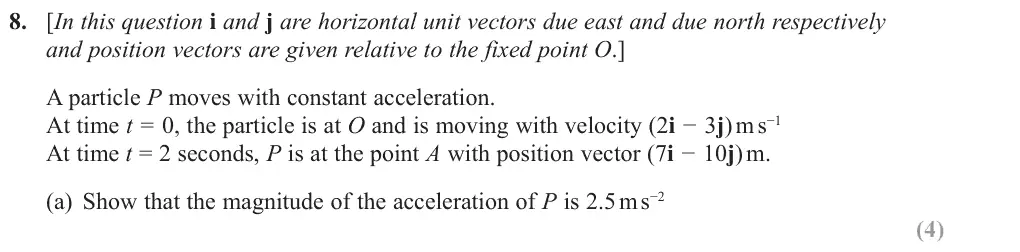
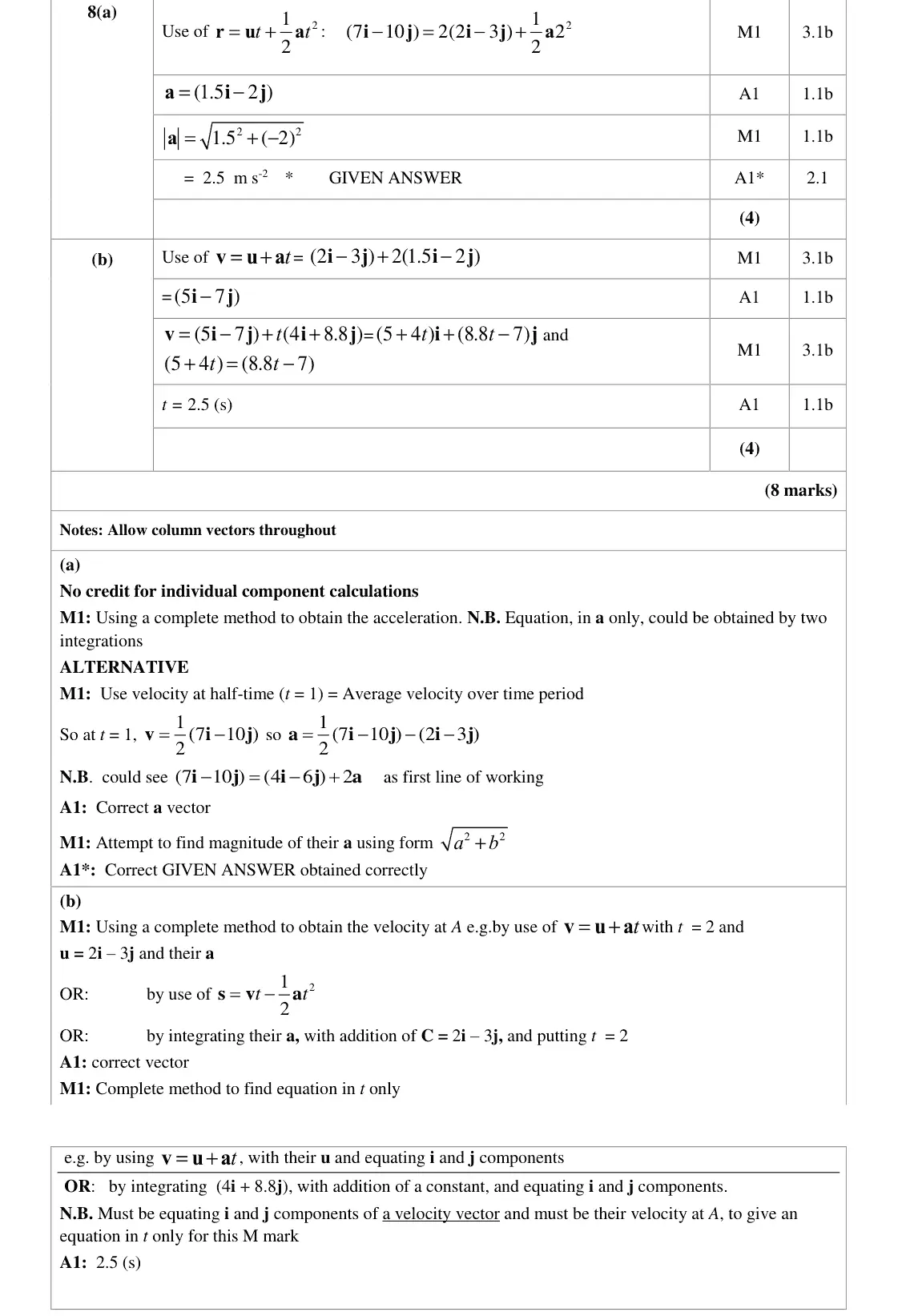
8(a) Constant acceleration (SUVAT), Vectors 4 —
8(b) Constant acceleration (SUVAT), Vectors 4 —
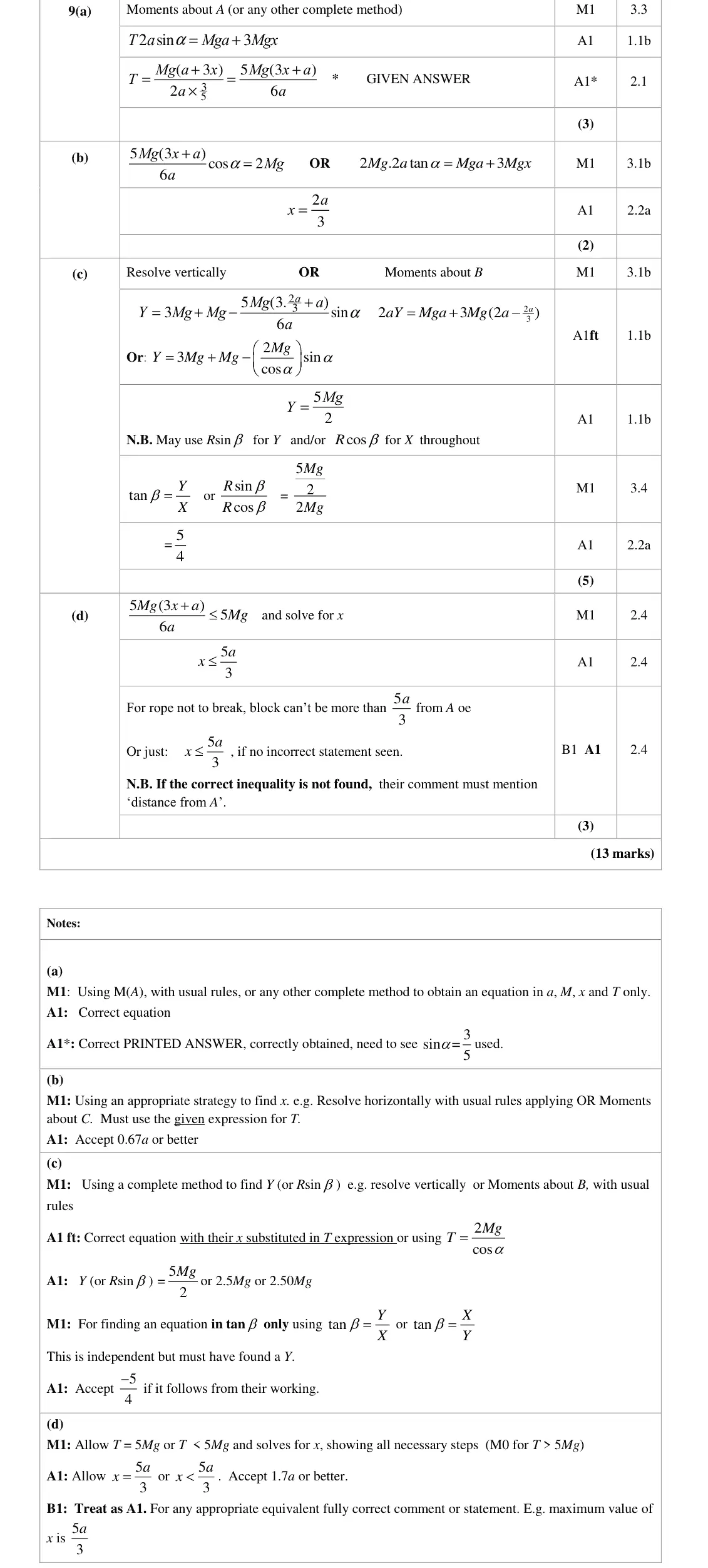
9(a) Moments, Trigonometric ratios, graphs, radians and the sine and cosine rules 3 —
9(b) Moments, Forces, Newton's laws and connected particles, Trigonometric ratios, graphs, radians and the sine and cosine rules 2 —
9(c) Moments, Forces, Newton's laws and connected particles, Trigonometric ratios, graphs, radians and the sine and cosine rules 5 —
9(d) Moments, Inequalities 3 —
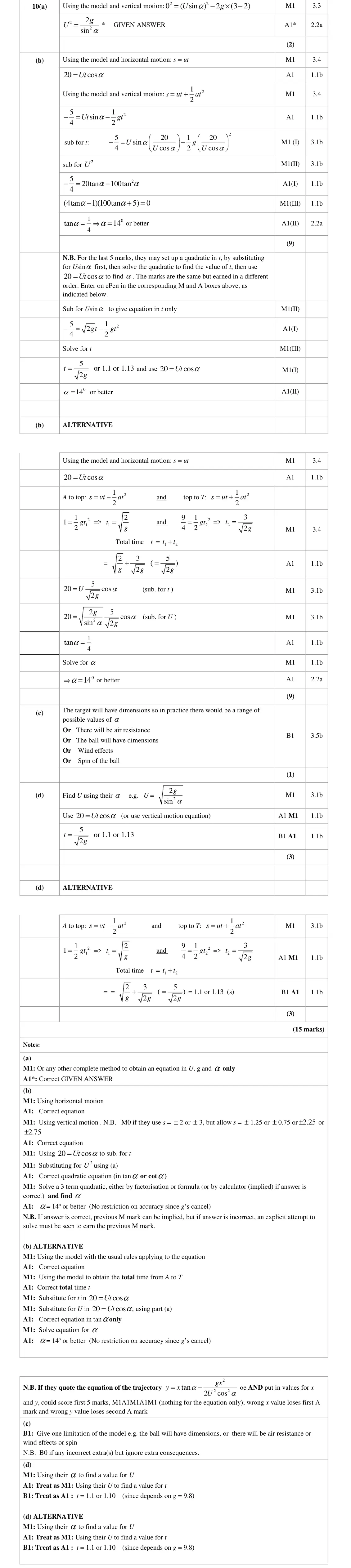
10(a) Projectiles, Trigonometric ratios, graphs, radians and the sine and cosine rules 2 —
10(b) Projectiles, Quadratics and the discriminant, Trigonometric identities and proofs 9 —
10(c) Projectiles 1 —
10(d) Projectiles 3 —

The questions

1(a)1(b)1(c)1(d)2(a)2(b)2(c)2(d)2(e)3(a)3(b)3(c)3(d)3(e)3(f)4(a)4(b)4(c)4(d)4(e)4(f)4(g)5(a)5(b)5(c)5(d)67(a)7(b)8(a)8(b)9(a)9(b)9(c)9(d)10(a)10(b)10(c)10(d)
June 2018 · Paper 3 · Q1(a) 2 marks binomial distributionlarge data set
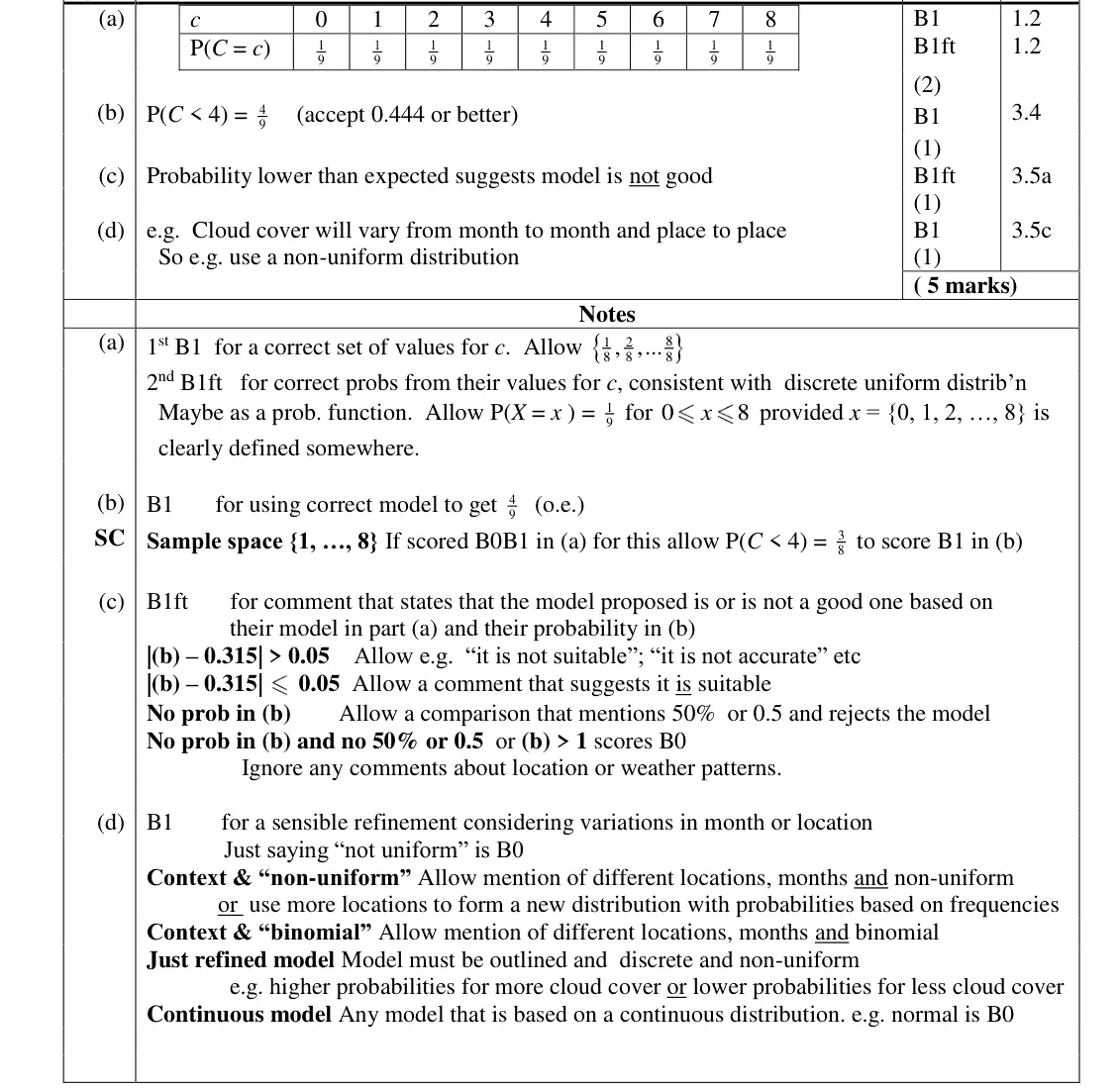
1. Helen believes that the random variable C, representing cloud cover from the large data set, can be modelled by a discrete uniform distribution. (a) Write down the probability distribution for C. (2)
June 2018 · Paper 3 · Q1(b) 1 mark binomial distributionlarge data set
(b) Using this model, find the probability that cloud cover is less than 50% (1)
June 2018 · Paper 3 · Q1(c) 1 mark binomial distributionnormal distribution
Helen used all the data from the large data set for Hurn in 2015 and found that the proportion of days with cloud cover of less than 50% was 0.315 (c) Comment on the suitability of Helen’s model in the light of this information. (1)
June 2018 · Paper 3 · Q1(d) 1 mark binomial distributionnormal distributionlarge data set
(d) Suggest an appropriate refinement to Helen’s model. (1)
June 2018 · Paper 3 · Q2(a) 3 marks hypothesis testing
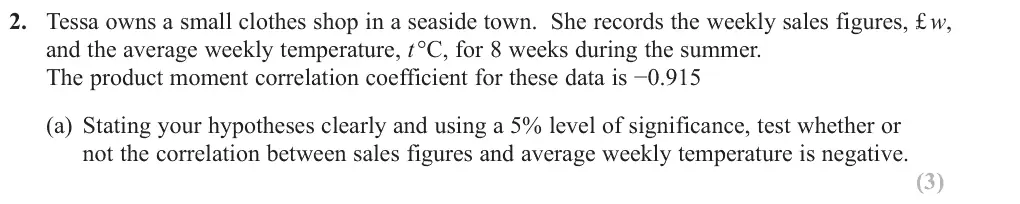
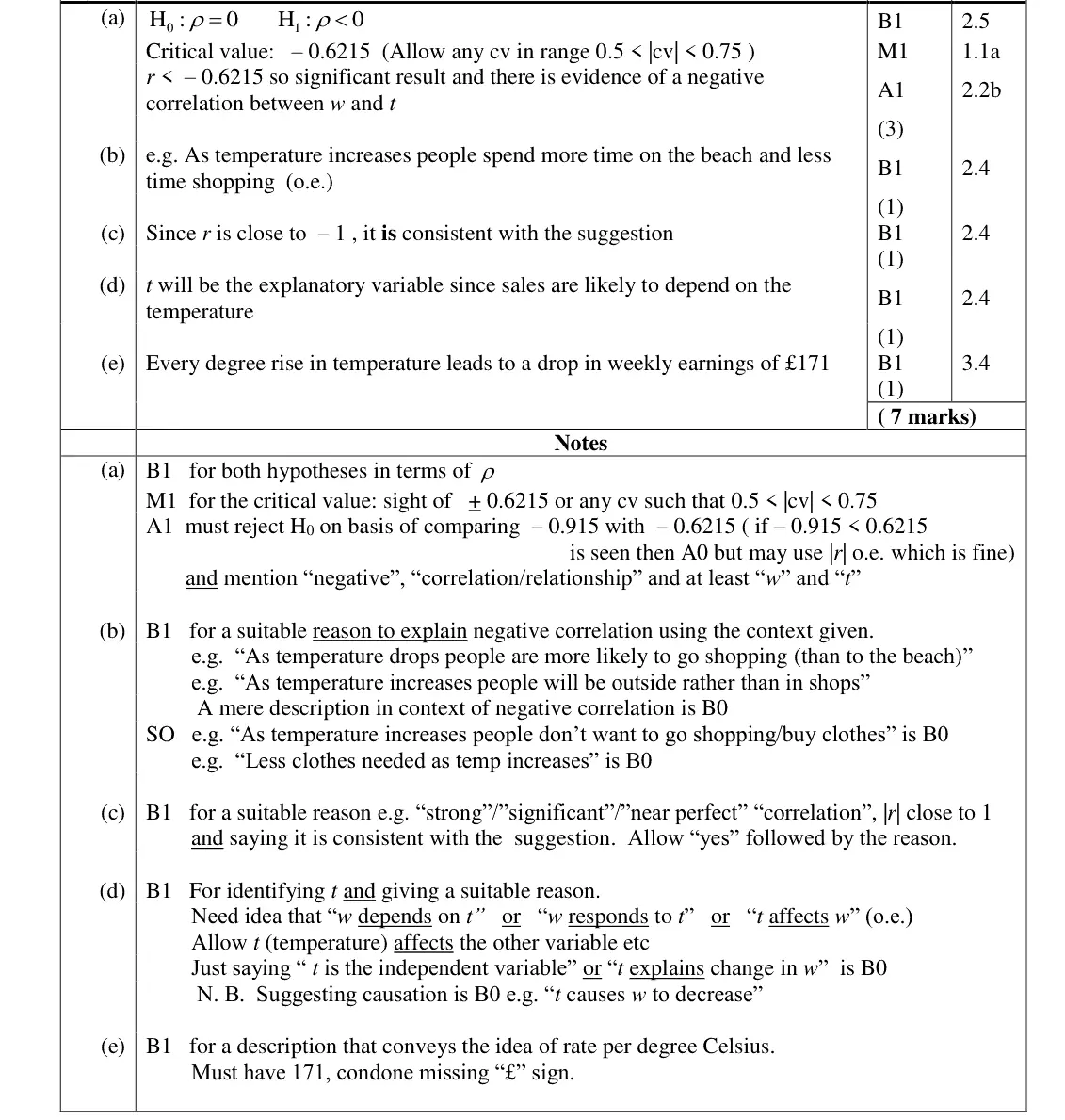
2. Tessa owns a small clothes shop in a seaside town. She records the weekly sales figures, £ w, and the average weekly temperature, t °C, for 8 weeks during the summer. The product moment correlation coefficient for these data is -0.915 (a) Stating your hypotheses clearly and using a 5% level of significance, test whether or not the correlation between sales figures and average weekly temperature is negative. (3)
June 2018 · Paper 3 · Q2(b) 1 mark correlation and regression
(b) Suggest a possible reason for this correlation. (1)
June 2018 · Paper 3 · Q2(c) 1 mark hypothesis testingcorrelation and regression
Tessa suggests that a linear regression model could be used to model these data. (c) State, giving a reason, whether or not the correlation coefficient is consistent with Tessa’s suggestion. (1)
June 2018 · Paper 3 · Q2(d) 1 mark correlation and regression
(d) State, giving a reason, which variable would be the explanatory variable. (1)
June 2018 · Paper 3 · Q2(e) 1 mark correlation and regression
Tessa calculated the linear regression equation as w = 10 755 – 171t (e) Give an interpretation of the gradient of this regression equation. (1)
June 2018 · Paper 3 · Q3(a) 2 marks binomial distributionnormal distribution
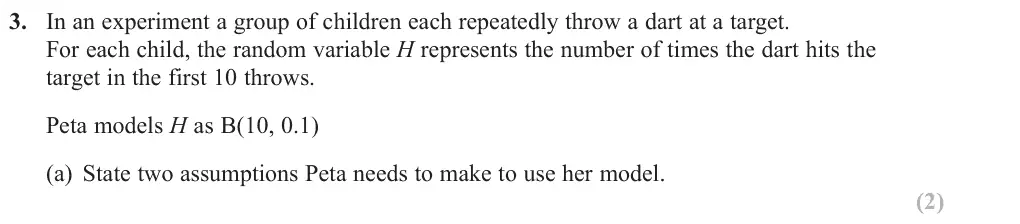
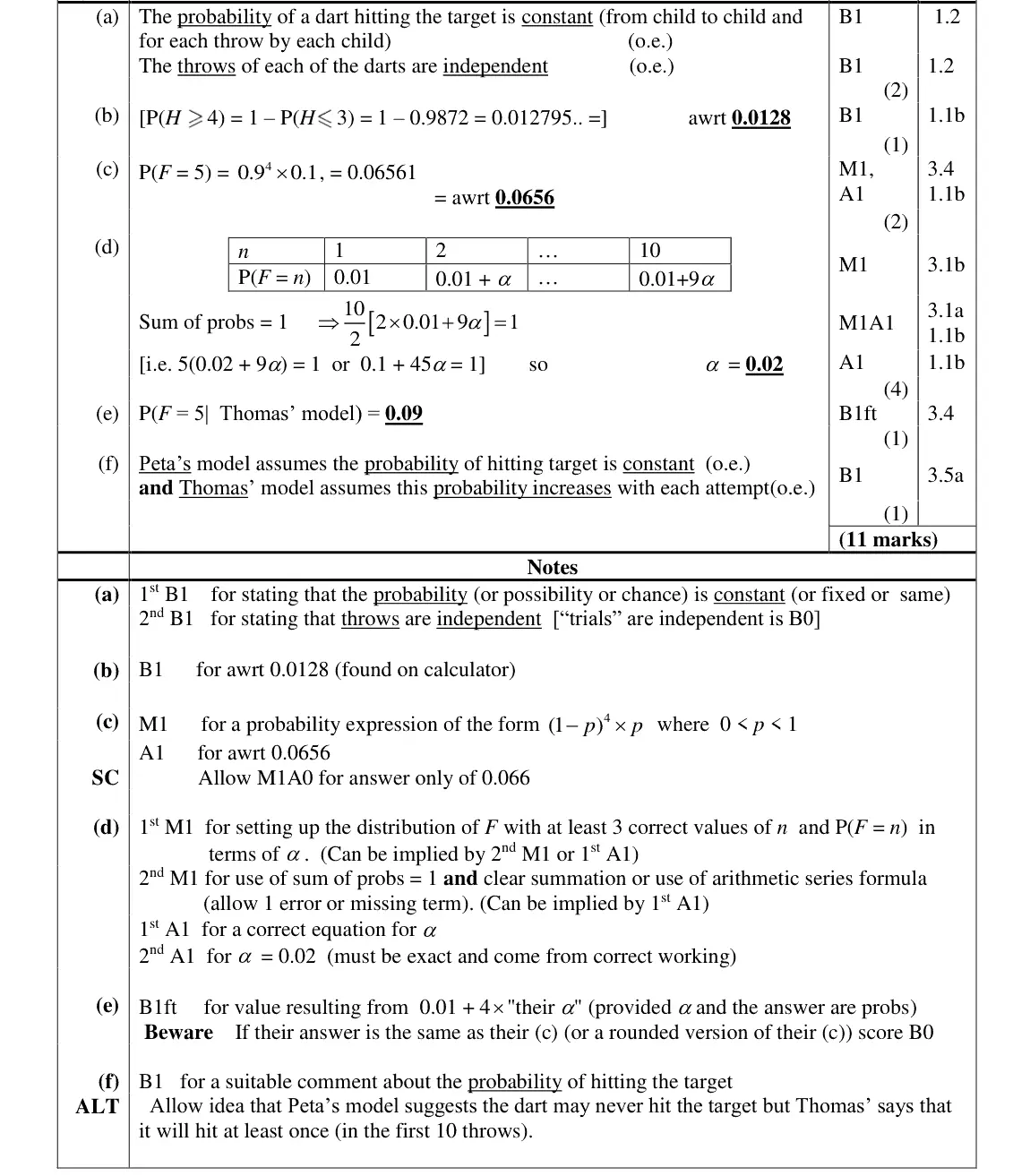
3. In an experiment a group of children each repeatedly throw a dart at a target. For each child, the random variable H represents the number of times the dart hits the target in the first 10 throws. Peta models H as B(10, 0.1) (a) State two assumptions Peta needs to make to use her model. (2)
June 2018 · Paper 3 · Q3(b) 1 mark binomial distribution
(b) Using Peta’s model, find P(H 4) (1)
June 2018 · Paper 3 · Q3(c) 2 marks probability
For each child the random variable F represents the number of the throw on which the dart first hits the target. Using Peta’s assumptions about this experiment, (c) find P(F = 5) (2)
June 2018 · Paper 3 · Q3(d) 4 marks binomial distributionsequences and series
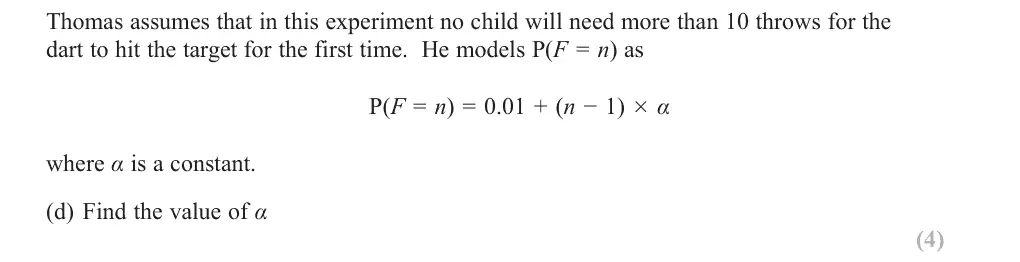
Thomas assumes that in this experiment no child will need more than 10 throws for the dart to hit the target for the first time. He models P(F = n) as P(F = n) = 0.01 + (n - 1) x alpha where alpha is a constant. (d) Find the value of alpha (4)

June 2018 · Paper 3 · Q3(e) 1 mark binomial distribution
(e) Using Thomas’ model, find P(F = 5) (1)
June 2018 · Paper 3 · Q3(f) 1 mark probability
(f) Explain how Peta’s and Thomas’ models differ in describing the probability that a dart hits the target in this experiment. (1)
June 2018 · Paper 3 · Q4(a) 1 mark sampling
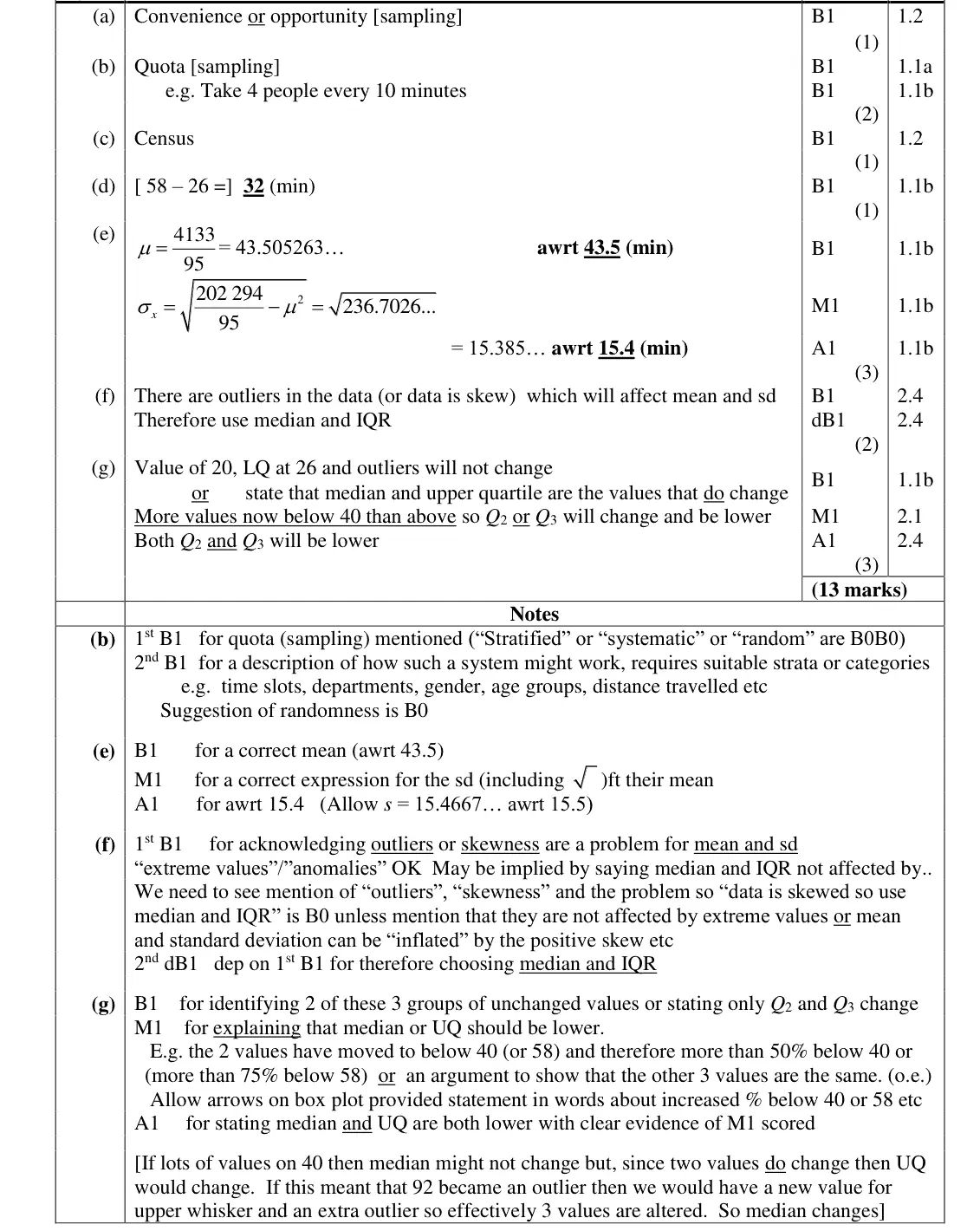
4. Charlie is studying the time it takes members of his company to travel to the office. He stands by the door to the office from 08 40 to 08 50 one morning and asks workers, as they arrive, how long their journey was. (a) State the sampling method Charlie used. (1)
June 2018 · Paper 3 · Q4(b) 2 marks sampling
(b) State and briefly describe an alternative method of non-random sampling Charlie could have used to obtain a sample of 40 workers. (2)
June 2018 · Paper 3 · Q4(c) 1 mark sampling
Taruni decided to ask every member of the company the time, x minutes, it takes them to travel to the office. (c) State the data selection process Taruni used. (1)
June 2018 · Paper 3 · Q4(d) 1 mark data presentation
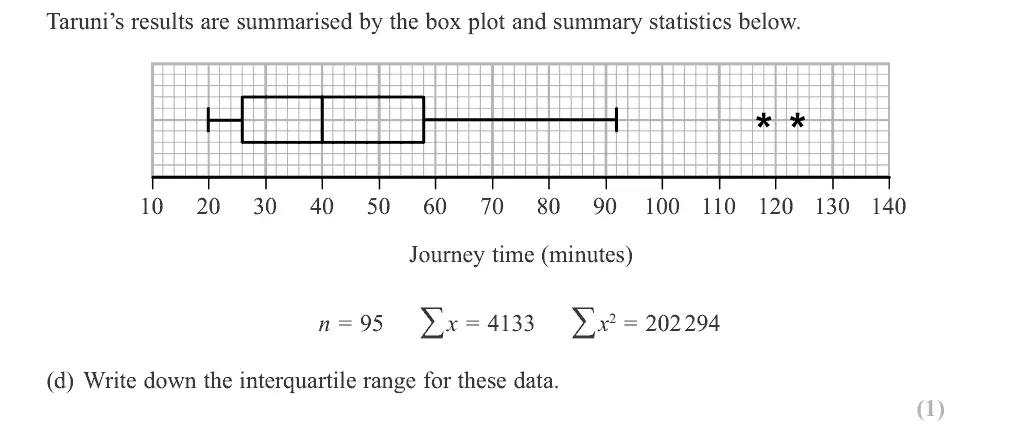
Taruni’s results are summarised by the box plot and summary statistics below. Journey time (minutes) n = 95 ∑ x = 4133 ∑ x2 = 202 294 (d) Write down the interquartile range for these data. (1)
June 2018 · Paper 3 · Q4(e) 3 marks data presentation
(e) Calculate the mean and the standard deviation for these data. (3)
June 2018 · Paper 3 · Q4(f) 2 marks data presentation
(f) State, giving a reason, whether you would recommend using the mean and standard deviation or the median and interquartile range to describe these data. (2)
June 2018 · Paper 3 · Q4(g) 3 marks data presentation
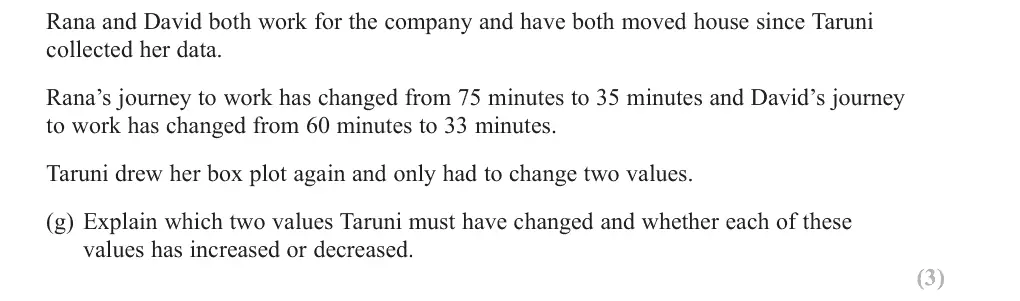
Rana and David both work for the company and have both moved house since Taruni collected her data. Rana’s journey to work has changed from 75 minutes to 35 minutes and David’s journey to work has changed from 60 minutes to 33 minutes. Taruni drew her box plot again and only had to change two values. (g) Explain which two values Taruni must have changed and whether each of these values has increased or decreased. (3)
June 2018 · Paper 3 · Q5(a) 1 mark normal distribution
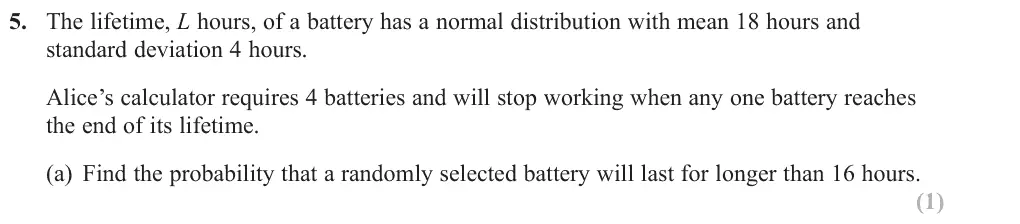
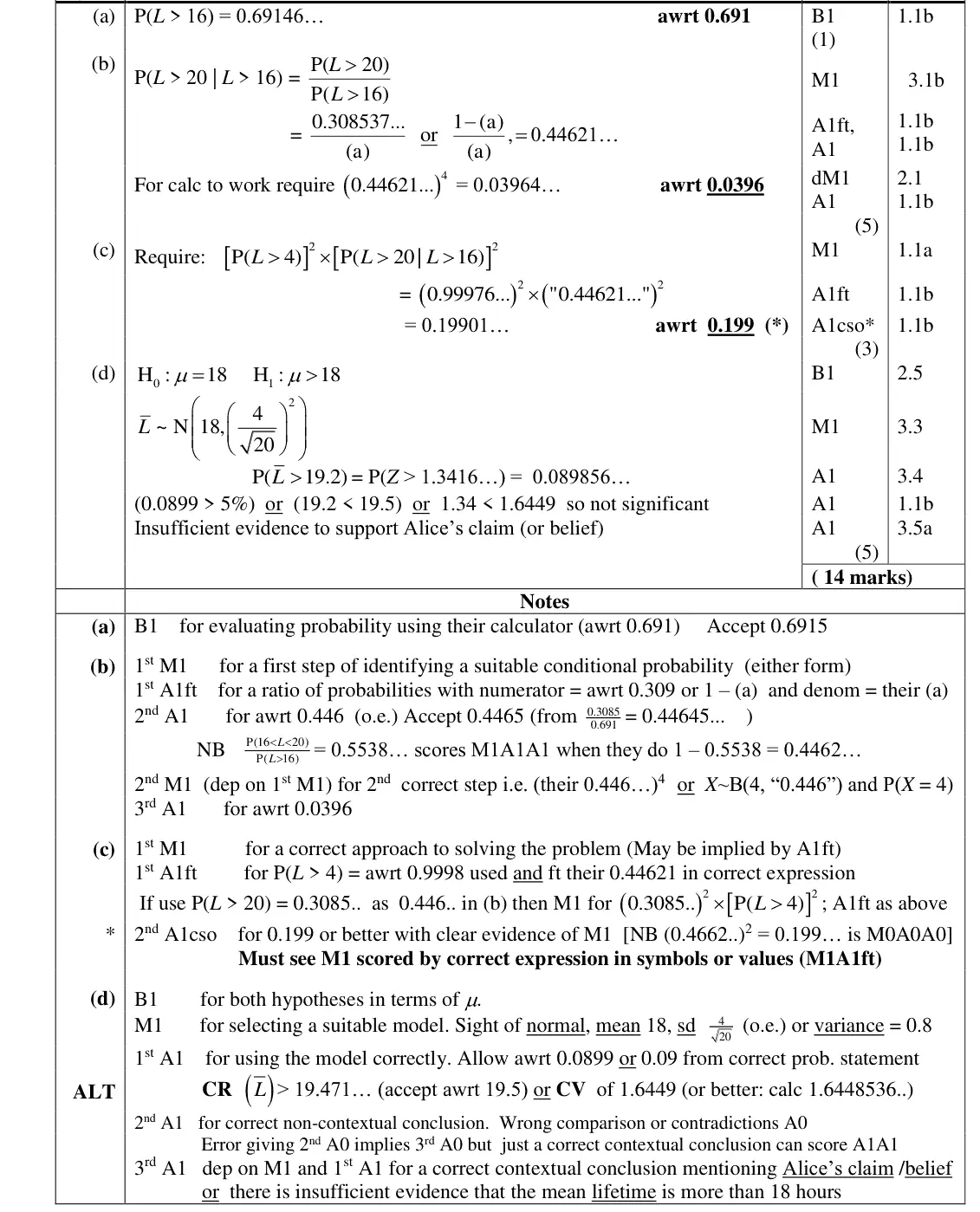
5. The lifetime, L hours, of a battery has a normal distribution with mean 18 hours and standard deviation 4 hours. Alice’s calculator requires 4 batteries and will stop working when any one battery reaches the end of its lifetime. (a) Find the probability that a randomly selected battery will last for longer than 16 hours. (1)
June 2018 · Paper 3 · Q5(b) 5 marks normal distributionprobability
At the start of her exams Alice put 4 new batteries in her calculator. She has used her calculator for 16 hours, but has another 4 hours of exams to sit. (b) Find the probability that her calculator will not stop working for Alice’s remaining exams. (5)
June 2018 · Paper 3 · Q5(c) 3 marks probabilitynormal distribution
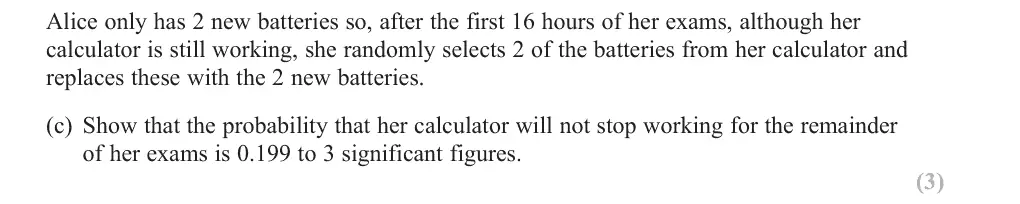
Alice only has 2 new batteries so, after the first 16 hours of her exams, although her calculator is still working, she randomly selects 2 of the batteries from her calculator and replaces these with the 2 new batteries. (c) Show that the probability that her calculator will not stop working for the remainder of her exams is 0.199 to 3 significant figures. (3)
June 2018 · Paper 3 · Q5(d) 5 marks Easy hypothesis testingnormal distribution
After her exams, Alice believed that the lifetime of the batteries was more than 18 hours. She took a random sample of 20 of these batteries and found that their mean lifetime was 19.2 hours. (d) Stating your hypotheses clearly and using a 5% level of significance, test Alice’s belief. (5)
June 2018 · Paper 3 · Q6 6 marks variable accelerationvectorsintegration
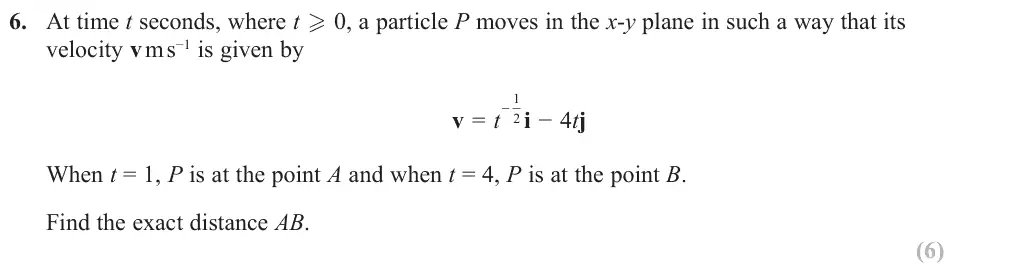
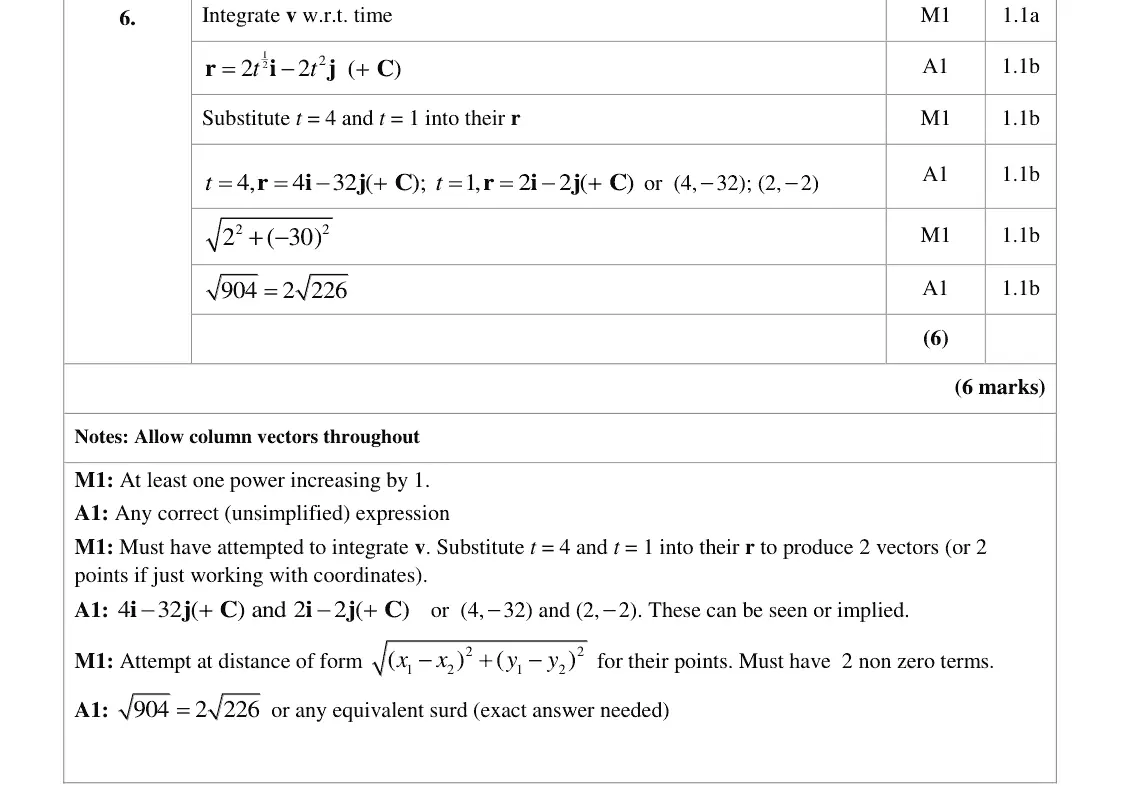
6. At time t seconds, where t 0, a particle P moves in the x-y plane in such a way that its velocity v m s-1 is given by -1 2 i - 4tj v = t When t = 1, P is at the point A and when t = 4, P is at the point B. Find the exact distance AB. (6)
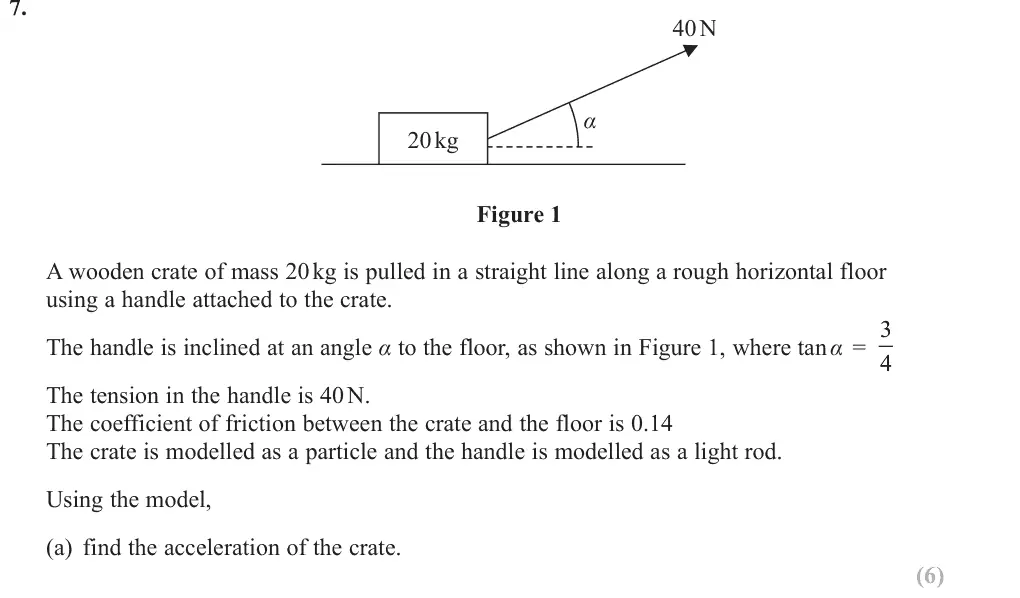
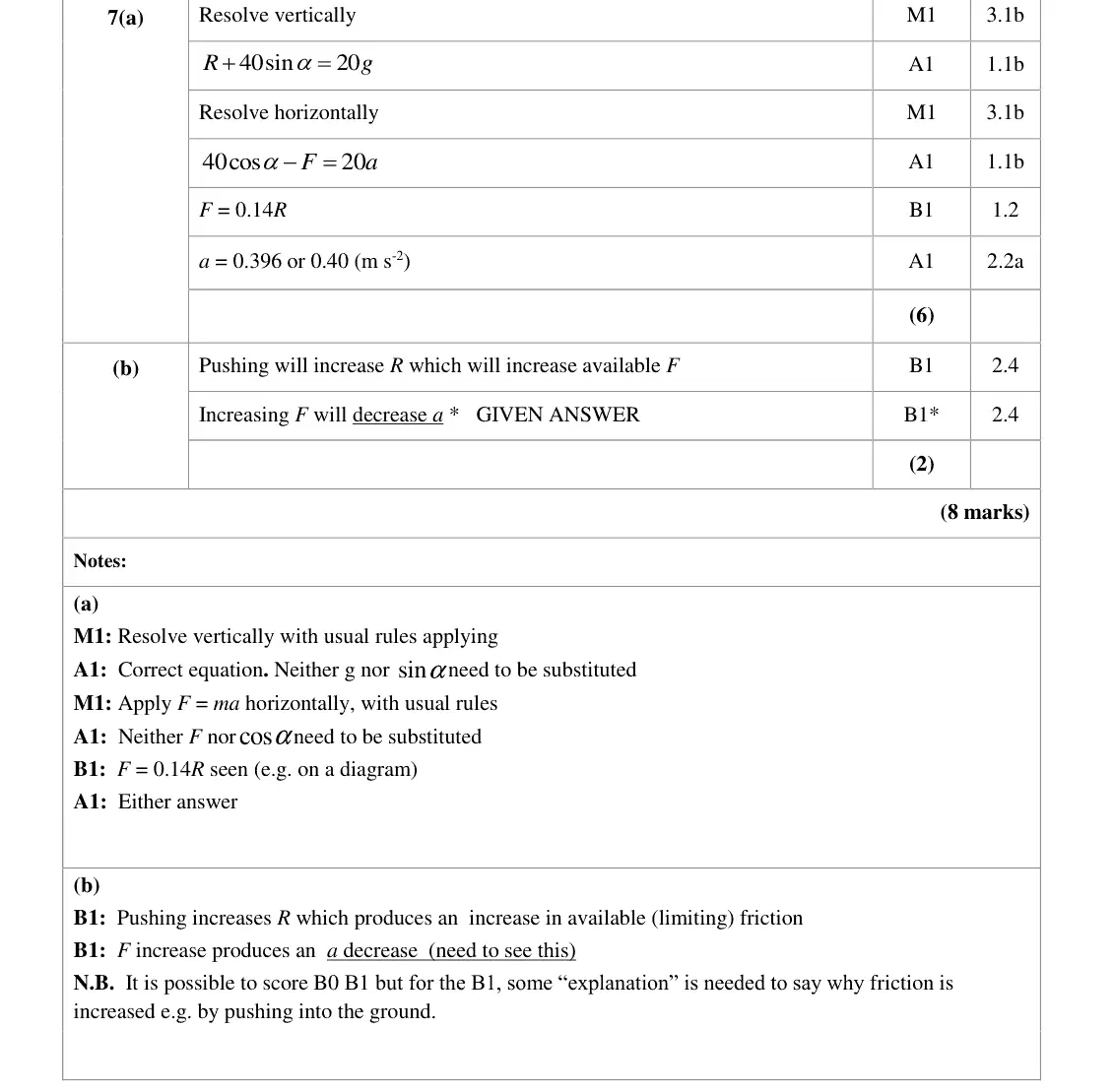
7. 40 N alpha 20 kg Figure 1 A wooden crate of mass 20 kg is pulled in a straight line along a rough horizontal floor using a handle attached to the crate. The handle is inclined at an angle alpha to the floor, as shown in Figure 1, where tan alpha = 3 The tension in the handle is 40 N. The coefficient of friction between the crate and the floor is 0.14 The crate is modelled as a particle and the handle is modelled as a light rod. Using the model, (a) find the acceleration of the crate. (6)
June 2018 · Paper 3 · Q7(b) 2 marks friction and forces in a planeforces and newtons laws
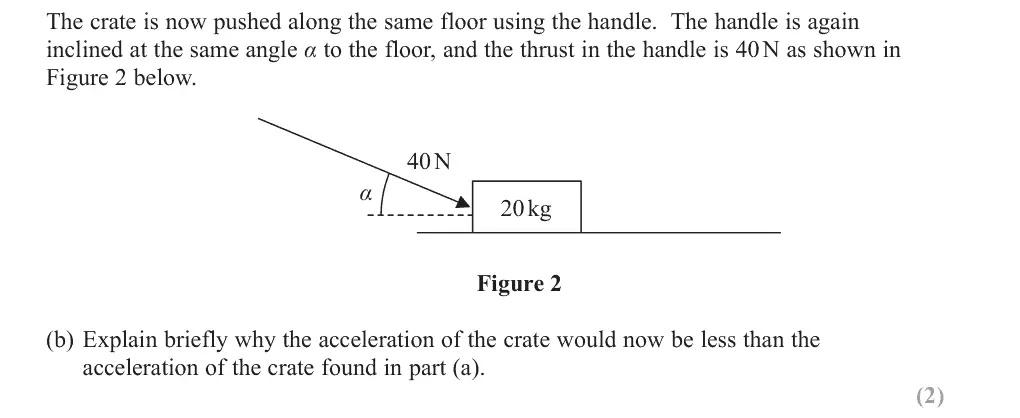
The crate is now pushed along the same floor using the handle. The handle is again inclined at the same angle alpha to the floor, and the thrust in the handle is 40 N as shown in Figure 2 below. 40 N alpha 20 kg Figure 2 (b) Explain briefly why the acceleration of the crate would now be less than the acceleration of the crate found in part (a). (2)
June 2018 · Paper 3 · Q8(a) 4 marks constant accelerationvectors
8. [In this question i and j are horizontal unit vectors due east and due north respectively and position vectors are given relative to the fixed point O.] A particle P moves with constant acceleration. At time t = 0, the particle is at O and is moving with velocity (2i - 3j) m s-1 At time t = 2 seconds, P is at the point A with position vector (7i - 10j) m. (a) Show that the magnitude of the acceleration of P is 2.5 m s-2 (4)
June 2018 · Paper 3 · Q8(b) 4 marks constant accelerationvectors
At the instant when P leaves the point A, the acceleration of P changes so that P now moves with constant acceleration (4i + 8.8j) m s-2 At the instant when P reaches the point B, the direction of motion of P is north east. (b) Find the time it takes for P to travel from A to B. (4)
June 2018 · Paper 3 · Q9(a) 3 marks momentstrigonometric ratios
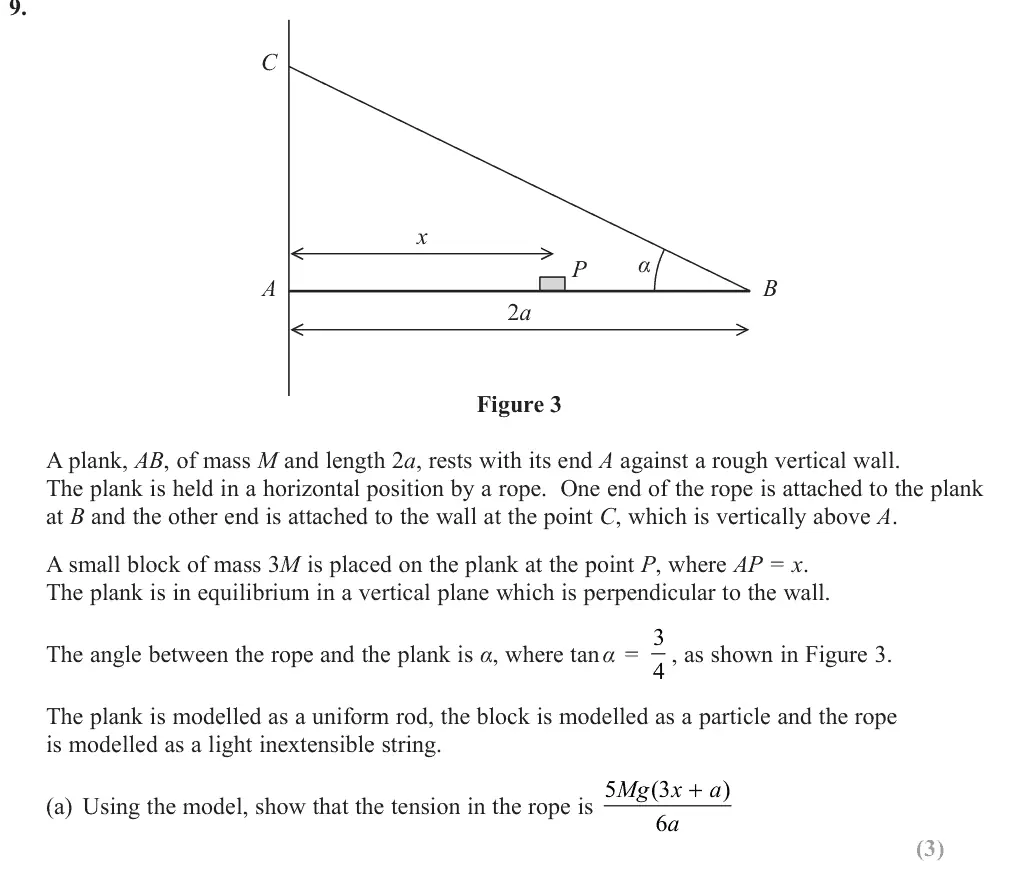
9. C x alpha P A B 2a Figure 3 A plank, AB, of mass M and length 2a, rests with its end A against a rough vertical wall. The plank is held in a horizontal position by a rope. One end of the rope is attached to the plank at B and the other end is attached to the wall at the point C, which is vertically above A. A small block of mass 3M is placed on the plank at the point P, where AP = x. The plank is in equilibrium in a vertical plane which is perpendicular to the wall. The angle between the rope and the plank is alpha , where tan alpha = 3 4 , as shown in Figure 3. The plank is modelled as a uniform rod, the block is modelled as a particle and the rope is modelled as a light inextensible string. (a) Using the model, show that the tension in the rope is 5 Mg ( x + a ) a (3)
June 2018 · Paper 3 · Q9(b) 2 marks momentsforces and newtons lawstrigonometric ratios
The magnitude of the horizontal component of the force exerted on the plank at A by the wall is 2 Mg. (b) Find x in terms of a. (2)
June 2018 · Paper 3 · Q9(c) 5 marks momentsforces and newtons lawstrigonometric ratios
The force exerted on the plank at A by the wall acts in a direction which makes an angle beta with the horizontal. (c) Find the value of tan beta (5)
June 2018 · Paper 3 · Q9(d) 3 marks momentsinequalities
The rope will break if the tension in it exceeds 5 Mg. (d) Explain how this will restrict the possible positions of P. You must justify your answer carefully. (3)
June 2018 · Paper 3 · Q10(a) 2 marks projectilestrigonometric ratios
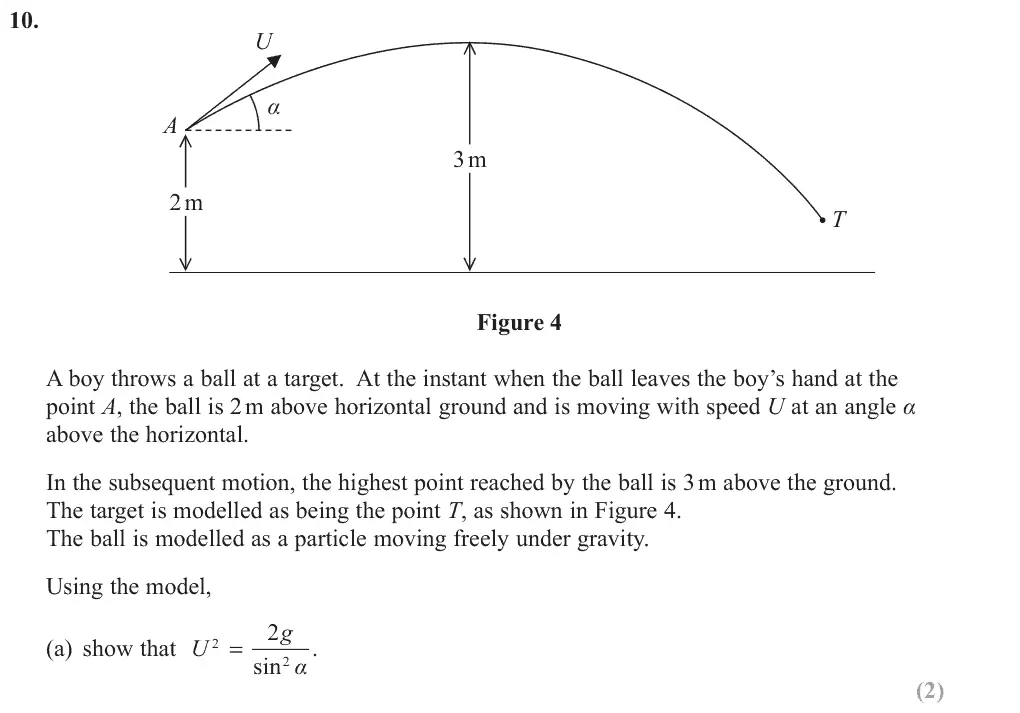
10. U alpha A 3 m 2 m T Figure 4 A boy throws a ball at a target. At the instant when the ball leaves the boy’s hand at the point A, the ball is 2 m above horizontal ground and is moving with speed U at an angle alpha above the horizontal. In the subsequent motion, the highest point reached by the ball is 3 m above the ground. The target is modelled as being the point T, as shown in Figure 4. The ball is modelled as a particle moving freely under gravity. Using the model, g (a) show that U = alpha sin (2)
June 2018 · Paper 3 · Q10(b) 9 marks projectilesquadraticstrig identities
The point T is at a horizontal distance of 20 m from A and is at a height of 0.75 m above the ground. The ball reaches T without hitting the ground. (b) Find the size of the angle alpha (9)
June 2018 · Paper 3 · Q10(c) 1 mark projectiles
(c) State one limitation of the model that could affect your answer to part (b). (1)
June 2018 · Paper 3 · Q10(d) 3 marks projectiles
(d) Find the time taken for the ball to travel from A to T. (3)

Find an Edexcel maths tutor

Want this paper marked and gone through with you? Message us.

Prefer email? Send an enquiry

If you are under 18, please include a parent's contact details. Enquiries go to enquiries@mathsaleveltutor.com and are deleted once handled.