Forces, Newton's laws and connected particles Mechanics
Papers
Paper 2, Paper 2 (Mechanics), Paper 3, Paper 3 (Mechanics)
Level
AS and A level
Spec
M8.1, M8.2, M8.3, M8.4
Booklet
Nothing is given.
Since 2018
98 question parts, 271 marks, 3 with a difficulty rating from the examiner's report
Notes, worked examples and practice for this topic are being written by our tutors. The past-paper questions below are ready now: work each one on paper, then open the mark scheme and the examiner's comment.
Tap a question to zoom it. Mark scheme and examiner's comment open under each question.
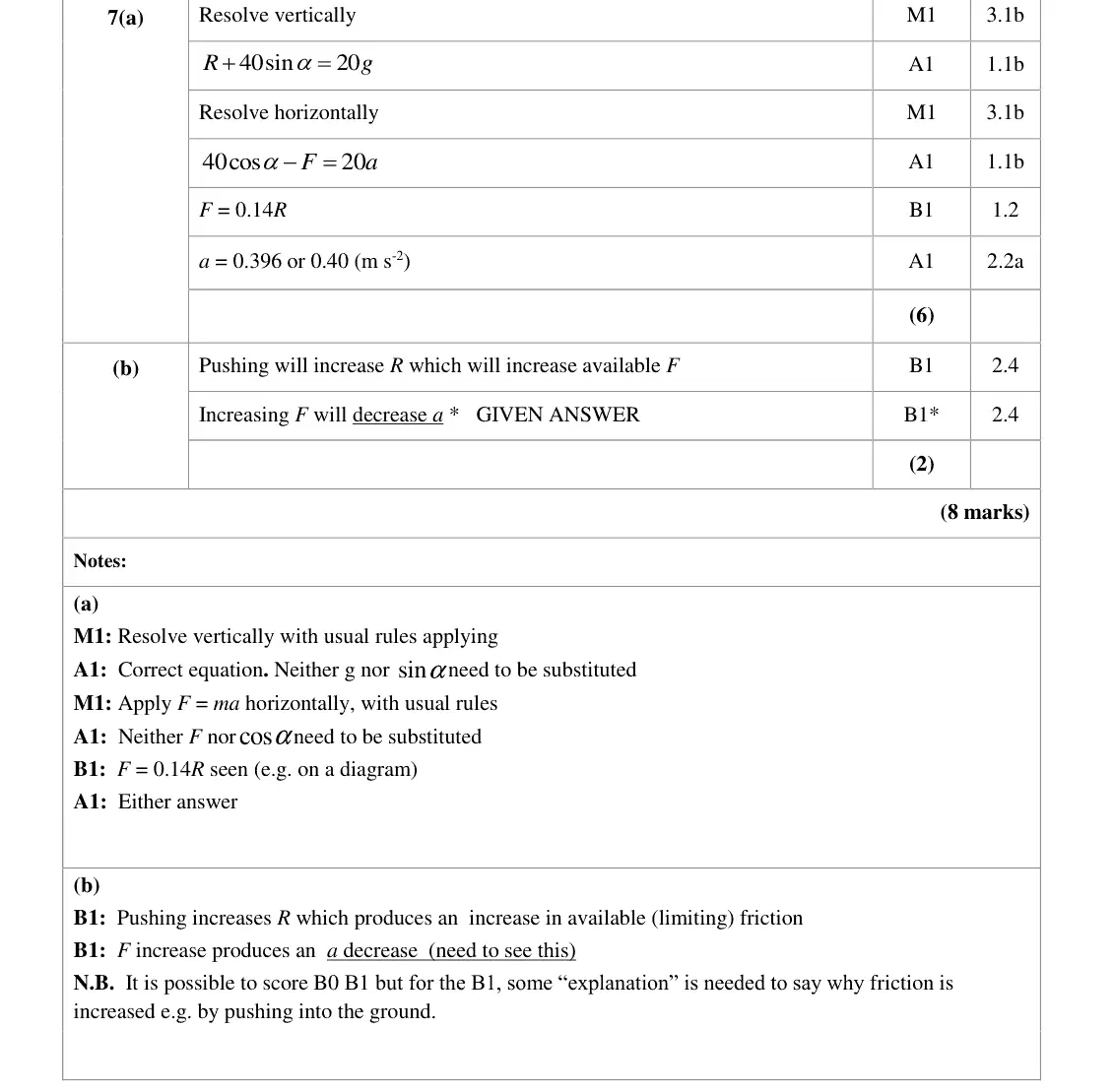
June 2025 · AS Paper 2 (Mechanics) · Q2(a)1 mark
Mark scheme (whole question; this part is marked with the orange bar)
Examiner's comment
Part (a) was mostly correctly answered, but some candidates were confused as to whether to add or subtract the forces, with 9i + 14j being the most common incorrect answer. This was usually carried through to part (b) but then often replaced in part (c) with the correct answer of 3i – 4j. Many candidiates worked with column vectors but most gave the answer in the required format. Very occasionally the answer was seen in (xi, yj) format or the column vector form of this.
Common mistakes
add the force vectors: (−3i + 4j) N
9i + 14j (subtracting) was the most common error
answer must be in i, j form
June 2025 · AS Paper 2 (Mechanics) · Q2(b)3 marks
Mark scheme (whole question; this part is marked with the orange bar)
Examiner's comment
In part (b), most candidates used Pythagoras correctly but failed to use Newton’s 2nd Law. A significant number, of those that did, multiplied the resultant force by 0.25 instead of dividing it by 0.25.
Common mistakes
Newton's second law F = ma with m = 0.25 then Pythagoras: magnitude of a = 4 × 5 = 20 m s⁻²
most used Pythagoras but forgot F = ma, or multiplied by 0.25 instead of dividing
20 then "√20" loses the A mark
June 2025 · AS Paper 2 (Mechanics) · Q2(c)1 mark
Mark scheme (whole question; this part is marked with the orange bar)
Examiner's comment
Part (c) not always correct even if the rest of the question was and often left blank. There was the occasional correct follow through from part (a).
Common mistakes
constant velocity means the resultant force is zero (Newton's first law), so F3 = −(their (a)) = (3i − 4j) N
often left blank
June 2025 · AS Paper 2 (Mechanics) · Q3(a)2 marks
Mark scheme (whole question; this part is marked with the orange bar)
Examiner's comment
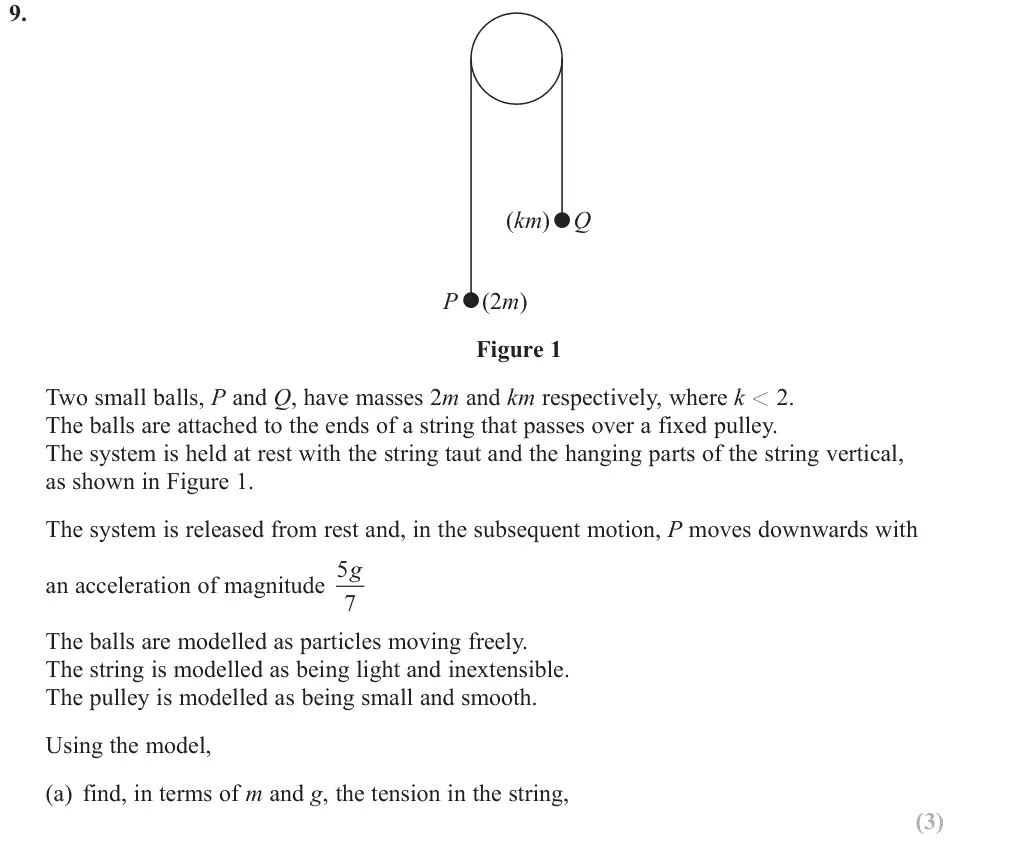
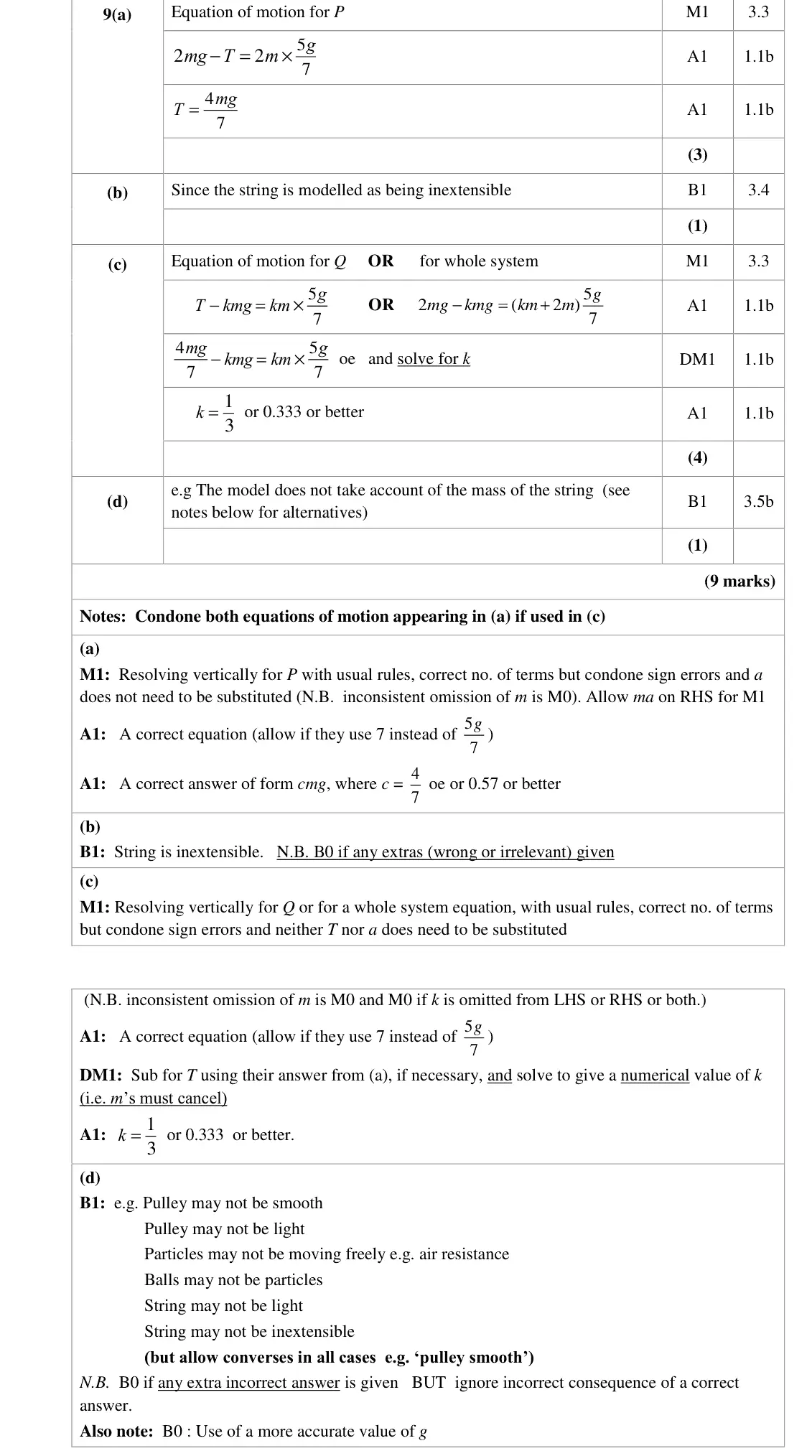
In part (a), there were many correct answers seen for the equation of motion of Q. However, a significant number of candidates did not seem to know what constituted an equation of motion, sometimes making an attempt at a suvat equation, despite then using it correctly in part (b).
Common mistakes
Q: 3g − T = 3a (two terms on the left, weight in g)
a suvat equation is not an equation of motion
including m (3mg − T = 3ma) loses the A mark
June 2025 · AS Paper 2 (Mechanics) · Q3(b)3 marks
Mark scheme (whole question; this part is marked with the orange bar)
Examiner's comment
The most common error in part (b) was to include a weight term in the horizontal equation of motion for P i.e. writing T-2g = 2a rather than T = 2a. Sometimes the direction of the acceleration was not treated consistently in the two equations resulting in a sign error in one of them. A relatively small number of candidates used a whole system approach but the requirement to use a combined mass in the ‘ma’ term ruled out some attempts.
Common mistakes
P on the horizontal table: T = 2a (no weight term: T − 2g = 2a was the most common error)
or whole system 3g = 5a with combined mass 5
a = 3g/5 = 5.9 m s⁻² (2 or 3 s.f.)
inconsistent directions in the two equations
June 2025 · AS Paper 2 (Mechanics) · Q3(c)2 marks
Mark scheme (whole question; this part is marked with the orange bar)
Examiner's comment
Part (c) was generally well attempted with the majority of candidates using v2 = u2+2as to find the required speed. Although most used their acceleration found in part (b) as required, a small minority substituted a = g despite it not following from previous work. A few confused u and v by assuming the final velocity when Q hit the ground was zero, but such instances were rare. The answer was required to 2 or 3 significant figures following the use of g = 9.8 ms-2.
Common mistakes
v² = 2 × their a × 0.4 gives 2.2 m s⁻¹ (2 or 3 s.f.)
use their a from (b), not g
v is not 0 at the floor
June 2025 · AS Paper 2 (Mechanics) · Q3(d)2 marks
Mark scheme (whole question; this part is marked with the orange bar)
Examiner's comment
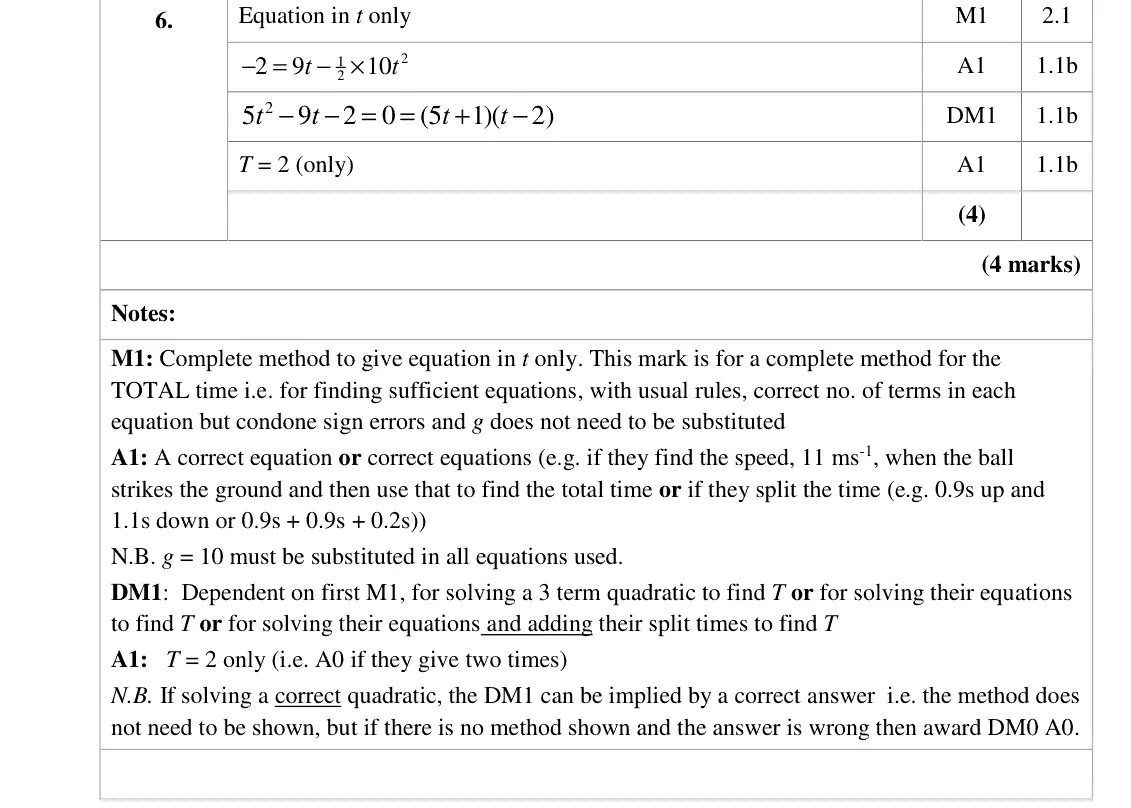
Part (d) required finding the time taken by P to move across the table to the pulley once Q had hit the ground. This proved to be the most challenging part on the paper and few valid approaches were seen. A significant number used the acceleration from the first stage of the motion, or even g, in a suvat equation without realising that P would now travel with constant velocity since the table was modelled as smooth and there was no longer a tension acting. Other common errors seen were to use the distance as 1.2 m, 0.4 m or even 1.6 m rather than 0.8 m. This again showed a lack of appreciation of the mechanics of the situation.
Common mistakes
after Q hits the floor the rope is slack and the table smooth, so P moves at constant speed 2.17 m/s for 1.2 − 0.4 = 0.8 m: K = 0.8/2.17 = 0.37
common errors: using the earlier acceleration or g, distance 1.2, 0.4 or 1.6 m
hardest part on the paper
June 2025 · AS Paper 2 (Mechanics) · Q3(e)1 mark
Mark scheme (whole question; this part is marked with the orange bar)
Examiner's comment
In part (e), almost all candidates stated, with a reason, that the acceleration would be less as a result of including a resistance. Those who lost the mark tended to not give a reason or omit this part.
Common mistakes
acceleration is less, with a reason (resistance opposes the motion, reducing the resultant force)
no reason scores 0
June 2025 · AS Paper 2 (Mechanics) · Q3(f)1 mark
Mark scheme (whole question; this part is marked with the orange bar)
Examiner's comment
Again, part (f) was generally answered well. The assumptions of the model were clearly stated as bullet points in the question. To gain credit, any suggested refinement had to relate specifically to one of those, and common valid responses included considering the mass of the ropes or modelling the particles with dimensions. Using a more accurate value for g was not credited as it was not a given modelling assumption. A further refinement was required so including resistance/friction or air resistance also did not gain the mark.
Common mistakes
refine one of the listed assumptions: packages not particles (dimensions), mass/weight or friction of the pulley, mass or elasticity of the rope
a more accurate g, "make it 3D", or air resistance/table friction are not credited
June 2025 · Paper 3 (Mechanics) · Q1(b)2 marks
Mark scheme (whole question; this part is marked with the orange bar)
Examiner's comment
In part (b), most responses scored both marks by correctly finding the value of the driving force of the engine. Many started by quoting F = ma and working with a complete equation. These responses were generally successful, although some made an arithmetic slip when rearranging their formula to make D the subject. Others did not start by formally stating the equation but approached it in a fragmented manner. These responses were far more likely to demonstrate the common error of subtracting the 400 N force from their ‘ma’ term instead of adding it, leading to an incorrect answer of 1200 N. A few responses included g with the mass of 800 in their calculations possibly due to confusion of mass and weight.
Common mistakes
form the full equation D − 400 = 800 × 2 first
common error 1200 (subtracting 400 instead of adding)
mass not weight, no g in the ma term
June 2025 · Paper 3 (Mechanics) · Q2(a)3 marks
Mark scheme (whole question; this part is marked with the orange bar)
Examiner's comment
Part (a) was generally well done with some making good use of the diagram. After identifying the three forces, successful responses resolved vertically to form an equation with the vertical component of 5 N clearly found. This was a ‘Show that…’ question and so those who just wrote ‘3’ down, with no supporting evidence of how it had been obtained, received no reward. Very occasionally cosine was used instead of sine and a few learners used the value of g as 9.81, which meant that the accuracy mark was not awarded.
Common mistakes
resolve vertically: 5 sin α + R = 2g
the vertical component 5 × 3/5 = 3 must be shown, just writing 3 scores nothing
sin/cos confusion
g = 9.8 not 9.81
June 2025 · Paper 3 (Mechanics) · Q2(b)1 mark
Mark scheme (whole question; this part is marked with the orange bar)
Examiner's comment
In part (b), most responses gave a good description of the motion ‘as decelerating to a stop or slowing down’. However, a significant number thought that the box would stop immediately or continue at a constant speed.
Common mistakes
the box decelerates to rest (friction still acts)
wrong: stops immediately or continues at constant speed
any incorrect extra loses the mark
June 2025 · Paper 3 (Mechanics) · Q2(c)1 mark
Mark scheme (whole question; this part is marked with the orange bar)
Examiner's comment
Part (c) was well answered and the correct result of 2g or 19.6 (N) was stated for the magnitude of the reaction once the force of 5 N had been removed. Common incorrect answers were 2 or 16.6.
Common mistakes
R = 2g = 19.6 N once the 5 N force is removed
common wrong answers 2 and 16.6
June 2025 · Paper 3 (Mechanics) · Q2(d)4 marks
Mark scheme (whole question; this part is marked with the orange bar)
Examiner's comment
In part (d), learners needed to plan their method carefully. Most responses gained the mark for finding the value of the friction as 𝐹𝐹𝑚𝑚𝑚𝑚𝑚𝑚= 𝜇𝜇𝜇𝜇= 0.2 x 19.6. Successful responses then applied Newton’s 2nd law, ±𝐹𝐹= 𝑚𝑚𝑚𝑚= 2𝑎𝑎 and then used a suvat approach to arrive at the distance as 4.1 or 4.08(m) to 2 or 3 s.f. Leaving the final answer to more than 3 s.f resulted in the final mark not being awarded. Errors were mainly in the 𝐹𝐹= 𝑚𝑚𝑚𝑚 equation when the force was incorrectly formed. Use of a = 0.4g or a mu = - were common mistakes. Fractional answers, after the use of g = 9.8, were not acceptable.
Common mistakes
F = 0.2 × 19.6 (use the new reaction, not 16.6)
−F = 2a gives a = −0.2g
wrong a = μ or 0.4g
then v² = u² + 2as
answer 4.1 or 4.08 m to 2 or 3 s.f., not 40/g
June 2025 · Paper 3 (Mechanics) · Q3(a)1 mark
Mark scheme (whole question; this part is marked with the orange bar)
Examiner's comment
In part (a) most responses scored the first mark by using F = ma with the given mass and acceleration vector. A few responses omitted the mass. The question stipulated that the answer should be given in terms of i’s and j’s and most learners did so correctly.
Common mistakes
F = ma = 0.5(2i − 2.4j) = i − 1.2j
omitting the mass
final answer must be simplified in i and j
June 2025 · Paper 3 (Mechanics) · Q5(a)5 marks
Mark scheme (whole question; this part is marked with the orange bar)
Examiner's comment
In part (a) there were many excellent responses seen. Most responses gave an expression or an actual value for t by considering the horizontal motion and then substituted it into their equation for vertical motion. Many gained full marks, but some used a heavily rounded value for t and lost accuracy. Others were not clear whether they were taking upwards or downwards as positive in the vertical direction and this led to two common errors. The first was that both terms in their expression for vertical displacement had the same sign. The second was, if they were taking upwards as positive as most did, they replaced ‘s’ with H in their equation and erroneously reached the result H = 30 - and then just wrote H = 30 which resulted in not gained the final accuracy mark. Other errors included poor substitution into formulae, forgetting to resolve the velocity into its components and sin/cos confusion. Quoting and using the equation of the path was rarely seen. Some responses erroneously used half of their time from part (a), treating the motion as if it were symmetrical and gained no marks. The energy solution was rarely seen.
Common mistakes
sin θ = 1/√5, cos θ = 2/√5
t from horizontal motion 14cos θ × t = 40, then vertical motion
keep a consistent positive direction (H = −30 must become 30 correctly)
do not halve the time (not symmetrical)
premature rounding of t
June 2025 · Paper 3 (Mechanics) · Q6(a)1 mark
Mark scheme (whole question; this part is marked with the orange bar)
Examiner's comment
In part (a) most wrote down the correct answer of 3Mg for the reaction force using vertical resolution. The most common error was omitting the weight term for the rod and a few included trigonometric functions in their resolutions.
Common mistakes
resolve vertically: R = Mg + 2Mg = 3Mg
omitting the weight of the rod
no trig needed
June 2025 · Paper 3 (Mechanics) · Q6(b)3 marks
Mark scheme (whole question; this part is marked with the orange bar)
Examiner's comment
In part (b) the most popular and simplest approach was to take moments about A to derive the given expression for the normal reaction at B. The angle was given between the vertical and the rod, rather than the possibly more familiar case of between the horizontal plane and the rod. Although this was not a problem for the vast majority, a significant number used (90o - alpha ) for their angle which sometimes led to confusion, particularly for those who did not recognise the equivalence with sin alpha /cos alpha and instead tried to use the addition formula to write this in terms of alpha only. In addition to sin/cos confusion, errors seen included total omission or inconsistent inclusion of a, slips in copying from one line to the next and occasional omission of the weight of the rod. Since the requirement was to ‘show that tan S Mg ’ it was essential that working was complete and correct to achieve all the alpha = marks. A very small minority attempted to take moments about B but they often did not complete their solution by resolving forces in order to eliminate F and R. In the third part although many learners recognised that R (with no friction acting at B) was take moments about A, to follow from the work in part (b). Responses that did this usually scored some marks for their horizontal and/or vertical resolutions even if their moments equation was incorrect. Occasionally the reaction at the wall was considered to be perpendicular to the rod rather than to the wall which generally resulted in no marks being achieved. Errors in the moments equation included sin/cos confusion, inconsistent inclusion of a and incorrect perpendicular distances. Some omitted the weight of the rod leading to a missing term in both the moments equation and the vertical resolution. Fragmented respondes, simplifying terms before writing down a full moments equation, sometimes made slips in the process. Those who attempted to take moments about B often achieved the mark for their vertical resolution but often did not gain all the marks for their moments equation. Attempts to resolve parallel or perpendicular to the rod were rare and tended to have a term missing. Nevertheless, there were a fair number of entirely correct solutions seen with clear and concise working.
Common mistakes
moments about A: S × 2a cos α = Mga sin α + 2Mg × 0.5a sin α
angle is with the wall, not the ground (using 90° − α causes errors)
sin/cos confusion
inconsistent a
at least one line of working before the given answer
June 2025 · Paper 3 (Mechanics) · Q6(c)1 mark
Mark scheme (whole question; this part is marked with the orange bar)
Examiner's comment
In the third part although many learners recognised that R (with no friction acting at B) was greater than R1 (with friction acting at B), the explanations were not always clear. Those who 3 R Mg used equations generally performed better and gained the mark e.g. and = 3 so R is greater. Some learners thought that the frictional force would act R Mg F = - 1 downwards concluding that R1 was greater whilst others either just stated ‘because of friction’ or did not state that friction acted upwards (or in the same direction as R1).
Common mistakes
friction at a rough wall acts upward, so R1 + F = 3Mg and R is greater
"because of friction" alone or friction acting downward scores nothing
June 2025 · Paper 3 (Mechanics) · Q6(d)6 marks
Mark scheme (whole question; this part is marked with the orange bar)
Examiner's comment
Part (d) was the most challenging part of the question. It was often left blank or multiple half- finished attempts were seen with little clear structure. The most common approach was to take moments about A, to follow from the work in part (b). Responses that did this usually
Common mistakes
include the 3M particle at B: N = 6Mg (not R from (a))
moments about A give the wall reaction P = 2Mg = F
limiting equilibrium so F = μN
reaction at the wall is perpendicular to the wall, not the rod
omitting the rod's weight
incorrect perpendicular distances
June 2024 · AS Paper 2 (Mechanics) · Q35 marks
Mark scheme (whole question; this part is marked with the orange bar)
Examiner's comment
This was a challenging question for many candidates since forces were given as vectors, but the acceleration was given as a scalar. Although most realised that the two forces needed to be combined to produce a resultant, some subtracted the components rather than adding, thererby failing to achieve the first mark. This also required the i and j terms to be collected to enable an expression for the magnitude to be found. A common starting point was to equate the vector sum of the forces to a scalar ‘ma’ term often leading to no further valid progress. Those who attempted to work in scalars sometimes equated the magnitude of their resultant to sqrt 5 (acceleration) rather than 2 sqrt 5 (ma term) and managed to secure one of the two available method marks. Where a correct unsimplified equation in c was reached, processing errors such as not squaring each side or in expanding brackets sometimes led to incorrect answers. The few who found the acceleration vector and equated the magnitude to sqrt 5 or the square of the magnitude to 5 tended to do so successfully despite the slightly harder algebra.
Common mistakes
resultant force (2 + c)i + 2j (add, not subtract, the components)
F = ma with magnitudes: (2 + c)² + 2² = (2√5)² = 20, or acceleration vector with magnitude √5
c = 2 or c = −6
equating a vector to the scalar ma
using √5 instead of 2√5 for ma
June 2024 · AS Paper 2 (Mechanics) · Q4(a)3 marks
Mark scheme (whole question; this part is marked with the orange bar)
Examiner's comment
In part (a), those candidates who attempted to produce an equation of motion for the whole system were mostly successful in finding the resistance on the car, possibly helped by the fact that it was a given answer. Some used equations for the car and trailer separately, often finding the tension from the trailer equation and using it in the car equation to find R.
Common mistakes
whole system: 1740 − 400 − R = (800 + 600) × 0.6 gives R = 500
or car and trailer separately (T = 860)
all terms needed
brackets around 600 + 800
June 2024 · AS Paper 2 (Mechanics) · Q4(b)3 marks
Mark scheme (whole question; this part is marked with the orange bar)
Examiner's comment
Part (b) required the tension to be found. Either the car or the trailer equation could be used, and some did both just to confirm their answer. However, there was confusion evident in many attempts with either extra or incorrect terms included or the wrong mass in the ma term. Some even included weight terms which were not relevant since the motion was horizontal. Few scored the mark in part (c). Although often a correct equation was used to find a = 5/6 or
Common mistakes
car: 1740 − T − 400 = 800 × 0.6, or trailer: T − 500 = 600 × 0.6
T = 860
wrong mass in the ma term, extra or missing forces, weight terms included
June 2024 · AS Paper 2 (Mechanics) · Q4(c)1 mark
Mark scheme (whole question; this part is marked with the orange bar)
Examiner's comment
Few scored the mark in part (c). Although often a correct equation was used to find a = 5/6 or a = -5/6, it was not always made explicitly clear that 5/6 was the deceleration. Those who had achieved few marks in the previous parts of the question were sometimes able to use a correct suvat method in part (d) to find the distance travelled by the trailer once the
Common mistakes
after the break only resistance acts on the trailer: 500 = 600a so a = 5/6
must state explicitly that the deceleration is 5/6 (a = −5/6 alone is not enough)
June 2024 · AS Paper 2 (Mechanics) · Q4(d)3 marks
Mark scheme (whole question; this part is marked with the orange bar)
Examiner's comment
to use a correct suvat method in part (d) to find the distance travelled by the trailer once the tow bar had broken. Occasionally the acceleration from before the break was used but generally this was well done with the correct numerical value obtained. The question required the value of ‘d’ so some indication was expected that the calculated distance was actually d.
Mark scheme (whole question; this part is marked with the orange bar)
Examiner's comment
In part (e), it was fairly rare to see two acceptable correct reasons for why the distance was likely to be different from that calculated. Many scored one mark for ‘resistance unlikely to be constant’ or ‘deceleration not constant’; however, these are not independent factors, so they were not credited as different reasons. Other common correct responses included that the mass of the broken tow bar was not considered, and the trailer would be unbalanced. The most common incorrect responses involved claiming that the model did not consider friction or air resistance. Also, some explanations included the car whereas this part was specifically about the trailer. It should be remembered that two reasons were asked for and if a candidate listed more than two then incorrect extra answers were penalised.
Common mistakes
two different reasons: resistance not constant (or more air resistance out of the car's slipstream), mass of the towbar ignored, trailer may not travel in a straight line, uneven road, trailer unstable/tips
"resistance not constant" and "deceleration not constant" count as one reason
answers about the car or "model ignores friction/air resistance" are wrong
extra wrong answers are penalised
June 2024 · Paper 3 (Mechanics) · Q1(a)1 mark
Mark scheme (whole question; this part is marked with the orange bar)
Examiner's comment
This proved to be a very friendly starter. (a) The vast majority of candidates were able to score the mark, with answers of 0.5g or 4.9 being the most common. The most common error was to omit the g whilst a few used g = 9.81 or gave a fractional answer, both of which were penalised once for the whole question. A few, seeing the word ‘magnitude’, squared and/or square rooted their answer. for (a) by 2 7 which earned the M mark and then realised that X had to be the same value. A significant number lost the A mark after having found the correct value of F for not stating a value for X, as the question required.
Common mistakes
R = weight = 0.5g = 4.9 N (vertical equilibrium)
omitting g
using g = 9.81 or a fraction 49/10 is penalised once
squaring or square-rooting because of "magnitude"
June 2024 · Paper 3 (Mechanics) · Q1(b)2 marks
Mark scheme (whole question; this part is marked with the orange bar)
Examiner's comment
This proved to be a very friendly starter. (b) Most candidates found the value of the limiting friction by multiplying their answer for (a) by 2 7 which earned the M mark and then realised that X had to be the same value.
Common mistakes
limiting friction F = μR = (2/7) × 4.9 = 1.4 N and X equals F (horizontal equilibrium)
finding F but not stating X
fraction answer A0
June 2024 · Paper 3 (Mechanics) · Q3(a)2 marks
Mark scheme (whole question; this part is marked with the orange bar)
Examiner's comment
A very well answered question with many candidates using a clearly labelled force diagram and gaining full marks for (a) and (b). It is always good exam technique to annotate the diagram to support the answer. (a) Most candidates were able to resolve perpendicular to the plane to obtain R=mgcos and then replacecos to obtain the required answer. A few multiplied by sin instead of cos but this still earned the M mark. However, those who used tan or divided by sin or cos lost both marks. A few responses chose to use a decimal approximation for the angle which could score both marks in this part.
Common mistakes
resolve perpendicular to the plane R = mg cos α = 12mg/13 with cos α = 12/13 from tan α = 5/12
using tan or dividing by sin or cos scores nothing
June 2024 · Paper 3 (Mechanics) · Q3(b)4 marks
Mark scheme (whole question; this part is marked with the orange bar)
Examiner's comment
A very well answered question with many candidates using a clearly labelled force diagram and gaining full marks for (a) and (b). It is always good exam technique to annotate the diagram to support the answer. (b) This was a “show that” question, so full and accurate working was required. The vast - = sin mg F ma majority wrote down an equation of motion parallel to the plane, and then used their answer from (a) to replace F, cancelled the m’s and factorised to obtain the given answer. Note that when there is a printed answer to show, candidates must give their answer in exactly the same form to guarantee earning all the marks. Common errors = mg sin F were setting , using an incorrect trigonometrical ratio, missing m’s or g’s, 5 using 𝜇= 12 .
Common mistakes
mg sin α − F = ma with F = μ × (12mg/13)
setting mg sin α = F (no acceleration)
using μ = 5/12
missing m or g
both trig ratios substituted as fractions before the given answer
June 2024 · Paper 3 (Mechanics) · Q3(c)1 mark
Mark scheme (whole question; this part is marked with the orange bar)
Examiner's comment
A very well answered question with many candidates using a clearly labelled force (c) This was worth one mark, so the answer needed to be clear e.g. the particle does not move, it remains at rest. Some candidates went on to try to justify their answer, but this was not required. A considerable number said it would slide down more slowly, or more worryingly, it would slide up the slope. Stating only that the acceleration was zero or that the forces were in equilibrium did not score the mark, as the particle could still be travelling at constant speed. However, stating that the acceleration was zero or that the forces were in equilibrium and that the particle remained at rest did earn the mark.
Common mistakes
P stays at rest (does not move)
"zero acceleration" or "in equilibrium" alone is B0 (could move at constant speed)
not "slides more slowly" or "slides up"
June 2024 · Paper 3 (Mechanics) · Q6(b)6 marks
Mark scheme (whole question; this part is marked with the orange bar)
Examiner's comment
(b) Many candidates scored all six marks in this part. Resolving vertically and horizontally was the most common and the most successful method. There were few errors apart from sin and cos confusion. Taking moments about C to give an equation in R and F and then resolving was the next most common method, but candidates were more likely to make errors using this approach, either by confusing sin with cos or by omitting a force entirely. Very few candidates resolved parallel and perpendicular to the rod and most of those who used this method failed to arrive at the correct answer due to the more challenging algebra. Occasionally candidates wrote dimensionally inconsistent equations by failing to include lengths in all of their moment terms or, more rarely, erroneously including lengths in their force terms. Errors included missing a g where there should have been one or not having the correct number of terms in a moment or a resolution equation. A surprisingly common error was for students to confuse the reaction force S 2 = F Mg with the reaction force at A, resulting in the incorrect equation Some 5 candidates lost method marks by resolving forces that did not need resolving (for and ). Whichever method Mg sin example, by writing an equation with both cos S was used, early substitution for F into their solutions was often seen, with almost all candidates realising that they needed to use F = μR. Some candidates clearly still incorrectly believe that μ cannot be greater than 1 and were ‘dismissive’ when their value was. It was not uncommon to see very messy responses, with multiple attempts and work crossed out. Many candidates made a good attempt at solving for mu , but this was often impeded by the lack of clarity over the previous equations. The mark scheme enabled candidates who used a correct method but who made sign errors, confused sin and cos or used incorrect distances to score half marks (generally, M1A0M1A0M1A0), while those with more fundamental misunderstandings were prevented from accessing the dependent method mark; this seemed to sort out the candidates well. When mu was found, most candidates gave the answer as a fraction or to an appropriate degree of accuracy.
Common mistakes
resolve horizontally F = S sin θ and vertically R = Mg − S cos θ, then F = μR: μ = 8/19 ≈ 0.42
confusing S with the reaction at A
sin/cos confusion
resolving forces that need no resolving
μ may be greater than 1 in general
June 2023 · AS Paper 2 (Mechanics) · Q2(a)3 marks
Mark scheme (whole question; this part is marked with the orange bar)
Examiner's comment
In part (a), there were surprisingly few diagrams seen and this would have helped candidates to understand the situation. The most common error was to set v = 0 leading to a height of 78.4 m. A few used t = 5 s or t = 10 s for both the up part and the down part of the motion. The most successful approach was the “whole motion” one, possibly because it is only the most able students who ever really grasp this. A significant number of candidates gave a negative answer. Many candidates, in the second part, managed to stumble across 2.5 s for half the time m s- or to treat this speed as a height. Some candidates 1 distance from part (a) along with 24.5 didn’t seem to realise that the speed of the stone reduced as it went upwards. In part (c), “air
Common mistakes
whole-motion s = ut + ½at² with u = 39.2, a = −9.8, t = 10 gives s = −98, height 98 m (must be positive)
setting v = 0 gives 78.4 (height above O only)
up-and-down method needs 78.4 and 176.4 combined
a diagram helps
June 2023 · AS Paper 2 (Mechanics) · Q2(b)3 marks
Mark scheme (whole question; this part is marked with the orange bar)
Examiner's comment
answer. Many candidates, in the second part, managed to stumble across 2.5 s for half the time but then failed to either find the other half or to double it. Some of the better candidates found t =1.5 s and t = 6.5 s and then subtracted which showed a clear understanding of the situation. Some successfully combined the various elements of times up and times down but the most successful approach was to find half the time and double it. A common error was to use the m s- or to treat this speed as a height. Some candidates 1 distance from part (a) along with 24.5
Common mistakes
speed ≤ 24.5 either side of the top: 0 = 24.5 − 9.8t gives 2.5 s, double to 5 s (or times 1.5 and 6.5 s and subtract)
forgetting to double
treating 24.5 as a height
June 2023 · AS Paper 2 (Mechanics) · Q2(c)1 mark
Mark scheme (whole question; this part is marked with the orange bar)
Examiner's comment
didn’t seem to realise that the speed of the stone reduced as it went upwards. In part (c), “air resistance” was the most common response, followed by “use a more accurate value of g”. A common error was not to reference the model at all, so answers about how accurately the time was measured or throwing the stone indoors to stop the wind having an effect were seen, as well as “consider the mass/weight of the stone”. Some wrongly gave the negative “there is no resistance”.
Common mistakes
include air resistance, or a more accurate value of g, spin, shape or size of the stone
must refer to the model
negatives ("there is no air resistance") and mass/weight of the stone score 0
June 2023 · AS Paper 2 (Mechanics) · Q4(a)5 marks
Mark scheme (whole question; this part is marked with the orange bar)
Examiner's comment
Many candidates made no attempt at part (a). Those who did mostly realised that they needed to use F=ma although many were unable to use the correct combination of forces in their car/trailer/whole system equations. Some never substituted T = 2400 and others omitted the R terms or had extra R’s in their equations of motion. Sign errors in solving their two simultaneous equations were common, especially when solving by substitution. Most who answered the second part were successful although some tied themselves up in knots explaining
Common mistakes
car: 7400 − 2R − 2400 = 1200a
trailer: 2400 − R = 400a (or whole system 7400 − 3R = 1600a)
a = 0.5
missing or extra R terms, not using T = 2400, sign errors solving simultaneously
June 2023 · AS Paper 2 (Mechanics) · Q4(b)1 mark
Mark scheme (whole question; this part is marked with the orange bar)
Examiner's comment
answered the second part were successful although some tied themselves up in knots explaining their answer even though no reason was asked for. There was a surprisingly large number of candidates who made no attempt at this part. The most common error in the final part was to
Common mistakes
a₁ is less than a (more mass to accelerate)
no reason needed
June 2023 · AS Paper 2 (Mechanics) · Q4(c)1 mark
Mark scheme (whole question; this part is marked with the orange bar)
Examiner's comment
candidates who made no attempt at this part. The most common error in the final part was to make no reference to the modelling of the resistance. Comments about friction and air resistance abounded, along with ones about the rope not being light/inextensible, tyres, road surfaces (which at least had an inkling of the right idea) and the weather. Relatively few scored this final mark.
Common mistakes
the resistance is unlikely to be constant (e.g. varies with speed)
must refer to the resistance model
friction/air resistance, rope, tyres or weather comments score 0
June 2023 · Paper 3 (Mechanics) · Q2(a)1 mark
Mark scheme (whole question; this part is marked with the orange bar)
Examiner's comment
The vast majority were able to score the mark in part (a), with answers of 5g or 49 being the most common. A few candidates used g = 9.81 but were not penalised here. There were very many correct answers for the second part also, but some ignored the 28N force
Common mistakes
resolve vertically: R = 5g = 49 N
must be positive, no m in the answer
June 2023 · Paper 3 (Mechanics) · Q2(b)2 marks
Mark scheme (whole question; this part is marked with the orange bar)
Examiner's comment
were very many correct answers for the second part also, but some ignored the 28N force = completely and gave 5 1.4 , as their answer or made a sign error and ended up with 7 = F = 35. In the final part, F was very well known, and this was a follow through R mark on their answers to (a) and (b). However, some left their answer as a fraction or didn’t give it to 2 sf and lost the mark anyway.
Common mistakes
28 − F = 5 × 1.4 gives F = 21
ignoring the 28 N force (F = 7) or a sign error (F = 35)
June 2023 · Paper 3 (Mechanics) · Q6(a)1 mark
Mark scheme (whole question; this part is marked with the orange bar)
Examiner's comment
In the first part, the majority of candidates stated that the frictional force would act towards the right on the diagram and many gave a satisfactory reason. A minority gave the reason that the friction had to balance the reaction force at the wall which acted to the left. Most mentioned that it prevented the rod from slipping to the left. Those who did not achieve the mark often used language that implied the rod was actually moving. A small number thought that the direction was left or gave no reason at all. In part (b), the question
Common mistakes
friction acts to the right (towards the wall) to balance the reaction at B / stop the rod slipping
wording implying the rod is moving scores B0
June 2023 · Paper 3 (Mechanics) · Q6(c)5 marks
Mark scheme (whole question; this part is marked with the orange bar)
Examiner's comment
symbols in the same order, to achieve the final mark. Part (c) required a calculation of the coefficient of friction. There were many fully correct solutions involving vertical and horizontal resolution but many incorrect responses were also seen. The majority who tried other approaches, such as moments about B or resolving parallel and perpendicular to the rod, were usually unsuccessful as they would often miss out a term or there would be a sin/cos error. Some candidates attempted to resolve vertically and horizontally but included an extra force. It was not uncommon for the horizontal resolution F = S to be correct but an extra force would appear in the vertical resolution. Almost all recalled F = mu R and tried to use it in some way. Part (d) involved finding the magnitude of the many who, having made an error in part (c), were still able to apply Pythagoras’ theorem correctly with their values of F and S. However, some candidates did not understand what was required with R = mg, or an attempt to just combine R and F by adding, seen quite often. A small number failed to deal properly with the square root making an error with the simplification in terms of mg in an otherwise correct solution. In the final part, the
Common mistakes
resolve vertically R = Mg and horizontally F = S
F = μR in limiting equilibrium
μ = 2/3
extra forces in the vertical resolution
moments about B or resolving along the rod often lose a term
June 2022 · AS Paper 2 (Mechanics) · Q1(a)3 marks
Mark scheme (whole question; this part is marked with the orange bar)
Examiner's comment
Candidates who had not read the question and used g as 9.8 or 9.81 were few and far between. Part (a) was generally well done with most candidates using the figures 10, 10 and 1.8 in a correct constant acceleration formula to obtain the given ‘U = 8’. Occasionally there was a sign error and although the correct answer was quoted, it did not actually follow from the working. A few used 0 as opposed to 10 for the final velocity. Some considered the motion ‘up’ and ‘down’ separately and used the distances to successfully derive the value of ‘U’. The most common approach in part (b) was to write down a quadratic equation in t and to solve it using
Common mistakes
v² = u² + 2as with v = 10, s = 1.8 down and g = 10 (not 9.8)
consistent sign convention
using 0 for the final velocity
U = 8 only
June 2022 · AS Paper 2 (Mechanics) · Q1(c)1 mark
Mark scheme (whole question; this part is marked with the orange bar)
Examiner's comment
Candidates who had not read the question and used g as 9.8 or 9.81 were few and far between. answer. In part (c), correct refinements seemed to be in the majority but only just. A more accurate value of gravity (9.8) was the most common correct response but wind, spin and dimensions of the stone were also seen. Many reasoned that due to air resistance the acceleration was smaller making the velocity smaller. Very few considered how changing the value of a in the equation they used would affect their answer for U. Weight/mass and force were the most common incorrect answers, often being given as an incorrect extra answer to what would have been a correct one, and as a result losing the B mark. In the final part, correct
Common mistakes
more accurate value of g (9.8), wind, spin, size/shape of stone (not a particle)
weight, mass or force as an extra loses the mark
June 2022 · AS Paper 2 (Mechanics) · Q1(d)1 mark
Mark scheme (whole question; this part is marked with the orange bar)
Examiner's comment
Candidates who had not read the question and used g as 9.8 or 9.81 were few and far between. what would have been a correct one, and as a result losing the B mark. In the final part, correct answers were in the minority, with most candidates failing to appreciate that if there was air resistance, the stone would have to be projected faster in order to still hit the ground at 10 ms-1.
Common mistakes
U would be greater: the stone must be projected faster to still hit the ground at 10 m/s
"smaller" was the usual wrong answer
June 2022 · AS Paper 2 (Mechanics) · Q4(a)3 marks
Mark scheme (whole question; this part is marked with the orange bar)
Examiner's comment
Although fully correct answers were seen, it was clear that many candidates had little experience of answering this type of question. In particular, there were many equations seen helped some candidates, but these were not often forthcoming. In part (a), many candidates gained all 3 marks. The most common error occurred where the direction of travel had been mixed up. For those who set up an equation of motion for the cage and block together, the most common mistake was ' 50g - T = 50 x 0.2' (as if it was accelerating downwards). Some students attempted 'F = ma' for the cage, but omitted 'R', scoring zero marks as there were an incorrect number of terms. There were instances of numerical mistakes in calculating '50 x 0.2' ('25' being a common one). Most students used the correct value of 9.8 for g. There were a few cases where g was omitted from the weight or added incorrectly in the 'ma' term. In part (b), few students who had made a good attempt in part (a). For students who knew what to do here, there were a few instances of '10g - R = 10 x 0.2'. Some students attempted 'F = ma' for the cage rather than the block, but omitted 'T' or they tried to combine the cage and the block. For those students scoring zero marks for Q4, their responses were either completely blank, or they tried to equate forces, ignoring the fact that the cage and block were accelerating.
Common mistakes
whole system: T − 50g = 50 × 0.2 gives T = 500 N (g = 9.8)
direction of motion mixed up (50g − T = 50 × 0.2)
g omitted from weight or put in the ma term
June 2022 · AS Paper 2 (Mechanics) · Q4(b)3 marks
Mark scheme (whole question; this part is marked with the orange bar)
Examiner's comment
Although fully correct answers were seen, it was clear that many candidates had little experience of answering this type of question. In particular, there were many equations seen with an incorrect number of terms, particularly in part (b). Clear force diagrams would have helped some candidates, but these were not often forthcoming. In part (a), many candidates where g was omitted from the weight or added incorrectly in the 'ma' term. In part (b), few candidates gained the full 3 marks. Some failed to identify the forces which were acting on the block; others considered the forces acting on the cage rather than the block. A common error was to get the direction of motion mixed up. There were quite a few blanks here, even by students who had made a good attempt in part (a). For students who knew what to do here,
Common mistakes
block alone: R − 10g = 10 × 0.2 gives 100 N (or cage: T − 40g − R = 40 × 0.2)
wrong number of terms, e.g. omitting R or including T for the block
draw a force diagram
June 2022 · Paper 3 (Mechanics) · Q2(a)(i)3 marksMedium
Mark scheme (whole question; this part is marked with the orange bar)
Examiner's comment
Almost a quarter of the candidates scored zero whilst 21% scored full marks on this question. In part (a) the most common approach was to resolve perpendicular and parallel to the plane to first find a value for X (49) before finding a value for the friction. Very few used the most efficient method and resolved vertically. The resolving was generally done well with most candidates resolving all the forces that needed to be resolved and most without sin/cos confusion and sign errors. Many who reached the correct value for friction were able to give the correct direction of the force, including those that had assumed that it acted up the plane and had obtained a negative answer. Not all remembered to give the magnitude of the force and numerical calculation errors were seen in some working. mu R was seen in some responses which lost the last mark as friction is not limiting in this part of the question. Part (b) was generally done well, even by those that had struggled with the first part, with many candidates writing down a correct F = ma equation. The most common mistake was to take R as 68.6N, the value given in part (a), and not resolve to find the new value of R. Those that resolved perpendicular to the plane generally went on to use F = mu R correctly and then accurately calculate the acceleration of the block. A few candidates did not remove the force X. It was noticeable that candidates who produced well labelled diagrams and who presented their solutions in a logical, neat and concise manner often continued to produce a correct solution in both parts.
Common mistakes
resolving vertically is quickest (most found X = 49 first)
sin α = 3/5, cos α = 4/5
friction is not limiting here so μR is wrong
F = 9.8 N must be positive
sin/cos interchanged gives 9.8 in the wrong direction
June 2022 · Paper 3 (Mechanics) · Q2(a)(ii)1 markHard
Mark scheme (whole question; this part is marked with the orange bar)
Examiner's comment
Almost a quarter of the candidates scored zero whilst 21% scored full marks on this
Common mistakes
down the plane (a negative F from assuming up the plane means down)
must be stated as the answer, not only shown on the diagram
June 2022 · Paper 3 (Mechanics) · Q2(b)6 marksMedium
Mark scheme (whole question; this part is marked with the orange bar)
Examiner's comment
Almost a quarter of the candidates scored zero whilst 21% scored full marks on this is not limiting in this part of the question. Part (b) was generally done well, even by those that had struggled with the first part, with many candidates writing down a correct F =
Common mistakes
X removed so R must be re-resolved: R = 5g cos α, not 68.6
do not reuse F = 9.8 from (a)
F = 0.5R
5g sin α − F = 5a gives a = 1.96 m s⁻²
June 2022 · Paper 3 (Mechanics) · Q3(b)5 marks
Mark scheme (whole question; this part is marked with the orange bar)
Examiner's comment
answer. In the second part, many candidates were able to find the resultant force and acceleration vectors. Some candidates found the magnitude of the force or acceleration at this stage and proceeded correctly with suvat formulae from there, while others continued with vectors. A number of candidates did not identify the initial velocity as zero, reading back to the information given at the start of the question being important here, so failed to use suvat formulae correctly. Use of u = 3i + j was not uncommon. Although most used suvat formulae, some successfully integrated the constant acceleration to find the velocity and displacement vectors. The majority of candidates knew how to find the magnitude of a vector using Pythagoras. The most significant errors seen included finding the resultant force but then using it as a displacement or velocity, showing a lack of understanding of the situation. A small number of candidates found an incorrect value for mu when substituting λ and there was occasional use of only one of the forces.
Common mistakes
μ = 3 so resultant 6i + 2j and a = (6i + 2j)/4
u = 0 as P starts at rest (u = 3i + j is wrong)
using the force as a displacement
using only one force
AB = √160 = 4√10 ≈ 12.6 m
June 2022 · Paper 3 (Mechanics) · Q4(a)1 mark
Mark scheme (whole question; this part is marked with the orange bar)
Examiner's comment
In part (a), very few candidates gave a fully correct reason for why the frictional force must act to the right on the diagram. Many stated that friction must oppose the direction of motion, saying that the rod would otherwise slip to the left. Some did mention it opposing the horizontal component of the tension but then failed to include that friction was the only other horizontal force in the system which was a key part of the argument. In the second part, it was required to derive a given expression for T (tension). Although
Common mistakes
horizontal component of T acts to the left and friction is the only other horizontal force
"friction opposes motion" scores nothing
June 2022 · Paper 3 (Mechanics) · Q4(c)3 marks
Mark scheme (whole question; this part is marked with the orange bar)
Examiner's comment
leading to a missing term. Part (c) was generally well answered by those candidates who resolved vertically, substituted for T and re-arranged to obtain the given answer thereby gaining full marks in a few lines of working. Candidates who used alternative equations as a starting point were generally unsuccessful, usually a result of a missing term in one or both equations used, this often involving friction. In part (d) those candidates who
Common mistakes
resolve vertically R + T cos θ = 3Mg with T = 2Mg cos θ and cos θ = 3/5
other equations need F eliminated and often miss a term
June 2022 · Paper 3 (Mechanics) · Q4(d)4 marks
Mark scheme (whole question; this part is marked with the orange bar)
Examiner's comment
or both equations used, this often involving friction. In part (d) those candidates who resolved horizontally to give F = T sinƟ usually managed to score all four marks for deriving the exact value of the coefficient of friction. There were a variety of equations, resolving or taking moments, which would have led directly to a value for F since the tension and normal reaction were known at that stage; however, these involved more working and therefore greater opportunity for error. Nevertheless, successful solutions by these methods were seen on occasion. Most of those candidates who found an expression for F were able to achieve the independent method mark for the use of F = μR even if their method for finding F was incorrect. Since all the answers were given in this question, candidates needed to ensure that they showed sufficient detail in their working to warrant being awarded all the available marks. In particular, candidates should be encouraged to state their resolved forces and moments as equations, rather than considering them in isolation, and to ensure the substitution stages are shown.
Common mistakes
resolve horizontally F = T sin θ (sin θ = 4/5)
F = μR with R = 57Mg/25 must be used, not just quoted
show substitution as the answer is given
Oct 2021 · AS Paper 2 (Mechanics) · Q1(a)2 marks
Mark scheme (whole question; this part is marked with the orange bar)
Examiner's comment
(a) Many candidates just found the time to the top, losing both marks.
Common mistakes
displacement 0 at time T: 0 = 14.7T − 4.9T² gives T = 3
finding only the time to the top (1.5 s) scores nothing
use g = 9.8
Oct 2021 · AS Paper 2 (Mechanics) · Q1(b)4 marks
Mark scheme (whole question; this part is marked with the orange bar)
Examiner's comment
(b) There were very few fully correct answers because most candidates did not realise that they had to consider the change in direction and just put t = 4 into a suvat equation. Some found the distance to the top and then used t = 2.5 to find the remaining distance but then did not round the answer to 2 or 3 sf following use of g = 9.8. A few used g = 9.81 or 10 despite the clear instruction on the front of the paper.
Common mistakes
distance, not displacement: the stone changes direction at t = 1.5, so add 11.025 up and 30.625 down = 41.7 m
substituting t = 4 into one suvat equation gives the displacement (19.6) only
2 or 3 s.f. after g = 9.8
Oct 2021 · AS Paper 2 (Mechanics) · Q1(c)1 mark
Mark scheme (whole question; this part is marked with the orange bar)
Examiner's comment
(c) Candidates had very little idea – considering the mass was the most frequent incorrect response. Some quoted air resistance even though that had been specifically excluded in the question.
Common mistakes
e.g. take account of the size of the stone (spin), do not model it as a particle, use a more accurate value of g
air resistance is excluded
"mass" is wrong
incorrect extra refinements score B0
Oct 2021 · AS Paper 2 (Mechanics) · Q3(a)4 marks
Mark scheme (whole question; this part is marked with the orange bar)
Examiner's comment
(a) There were many completely correct answers and those who took the acceleration to be positive in a different direction could also score full marks. Some had no idea where g should go so answers like ‘T – 2m = 2mga’ were sometimes seen. The mass m was occasionally left out also. A few quoted suvat equations, connecting time and distance, instead of equations of motion for P and Q but if they went on to use correct equations of motion in part (b) they scored the marks for part (a). Some had no idea at all and T never appeared.
Common mistakes
T − 2mg = 2ma for P and 5mg − T = 5ma for Q
g placed wrongly (e.g. T − 2m = 2mga)
m omitted
suvat equations are not equations of motion
Oct 2021 · AS Paper 2 (Mechanics) · Q3(b)7 marks
Mark scheme (whole question; this part is marked with the orange bar)
Examiner's comment
motion for P and Q but if they went on to use correct equations of motion in part (b) they scored the marks for part (a). Some had no idea at all and T never appeared. (b)Those who had correct equations of motion generally went on to find the acceleration but some missed g in their answer. Not many progressed successfully after this - some found T because that is what is usually required but in this question, it was not necessary. Some calculated the time taken for Q to reach the ground and used it in an equation for P, not realising that they had to find the velocity that P had acquired. Of those who did make progress, some missed the h in their answer for v, and others only added 2h instead of 3h in the final step.
Common mistakes
a = 3g/7
P's speed when Q lands from v² = 2ah (P has risen h)
then P moves freely under gravity: H = 3h/7
total height 2h + h + H = 24h/7
T is not needed
adding only 2h, or using the time Q takes to fall, are common errors
Oct 2021 · AS Paper 2 (Mechanics) · Q3(c)1 mark
Mark scheme (whole question; this part is marked with the orange bar)
Examiner's comment
(c) A very small number answered correctly. Mass was again a common response.
Common mistakes
the distance Q falls to the ground would not be exactly h (size of the balls)
"mass" is a common wrong answer
incorrect extras score B0
Oct 2021 · AS Paper 2 (Mechanics) · Q3(d)1 mark
Mark scheme (whole question; this part is marked with the orange bar)
Examiner's comment
(d) Again, there was a very small number of correct responses, some of which were spoilt by saying that the reason for the accelerations being different was that the tensions were different because of friction at the pulley.
Common mistakes
the accelerations of P and Q would not have equal magnitude
saying the tensions differ because of friction at the pulley is wrong
Oct 2021 · Paper 3 (Mechanics) · Q2(a)2 marks
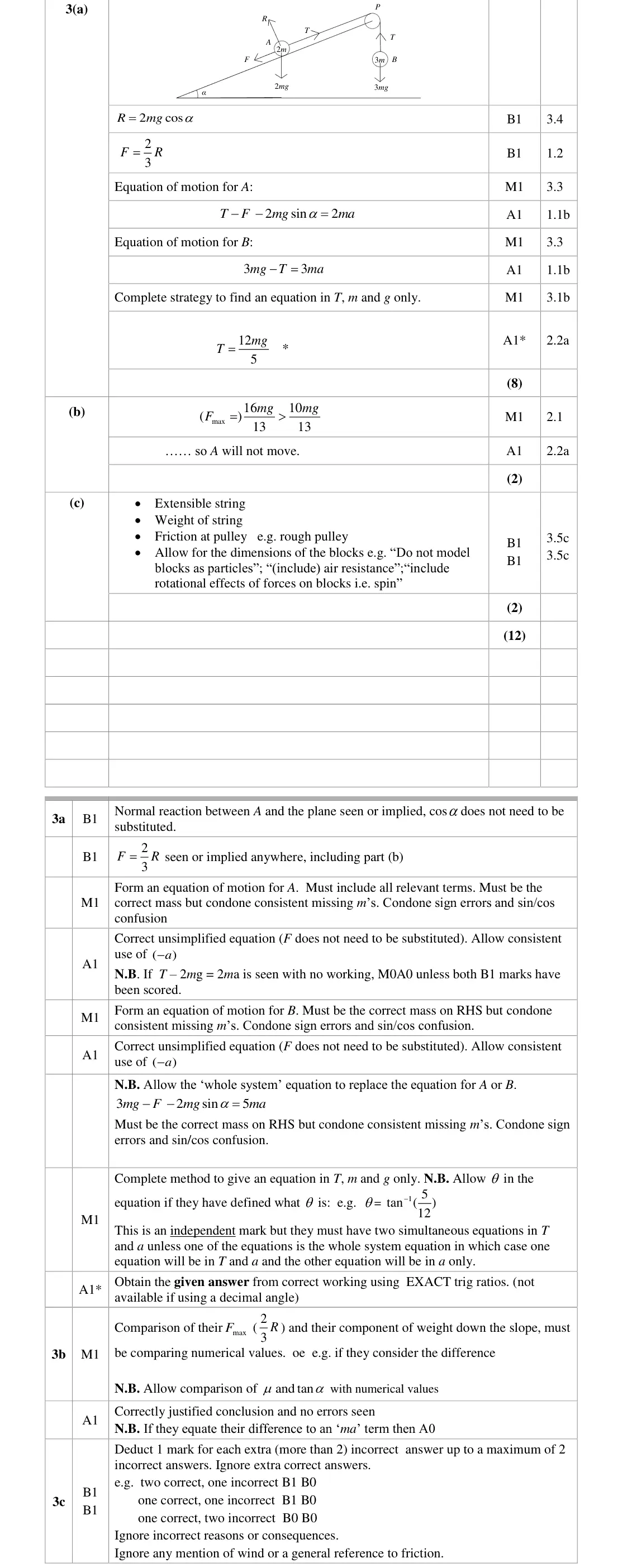
Mark scheme (whole question; this part is marked with the orange bar)
Examiner's comment
Candidates need to make sure that they read and then answer questions carefully. In part (a) an equation of motion for A was required. Most realized that this required the use of Newton’s second law on the 3m mass. However, some ignored this requirement and went straight to a whole system approach to the problem. Errors in part (a) were mainly due to the omission of a relevant force or a misunderstanding of direction. It was essential that the frictional force on A and the tension were in the same direction i.e. had the same sign in the equation. In part (b) either an equation of motion for B was required or an equation
Common mistakes
equation for A only (not the whole system): 3mg sin α − F − T = 3ma
friction and tension both act up the slope (same sign)
missing a force or wrong direction
Oct 2021 · Paper 3 (Mechanics) · Q2(b)7 marks
Mark scheme (whole question; this part is marked with the orange bar)
Examiner's comment
Candidates need to make sure that they read and then answer questions carefully. In part in the equation. In part (b) either an equation of motion for B was required or an equation of motion for the whole system. This was generally well answered provided that the 1 reaction force from the plane on A had been found and used with F to give F R = R mu = 6 . The question was a “Show that” question so full marks were only awarded if there was a fully correct solution, with all the steps included. Errors involved sin/cos confusion, the omission of g, an incorrect direction for the reaction force, omission of a force in an equation of motion or an incorrect reaction such as R = 3mg. Some candidates did make algebraic errors in solving their equations. A few candidates assumed that the tension in the string was mg. Those candidates who attempted a whole system approach were mostly successful. In part (c), most of the graphs given were correct but there are still candidates which asked for “ how this would affect the working in part (b)”. Those who referred to how it would affect the answer received no credit.
Common mistakes
R = 3mg cos α (not 3mg)
F = R/6
sin α = 3/5, cos α = 4/5 (sin/cos confusion)
T − mg = ma for B or whole-system equation
tension is not mg
full working needed for the given answer
Oct 2021 · Paper 3 (Mechanics) · Q2(c)2 marks
Mark scheme (whole question; this part is marked with the orange bar)
Examiner's comment
Candidates need to make sure that they read and then answer questions carefully. In part successful. In part (c), most of the graphs given were correct but there are still candidates who add a solid vertical line at the end of the graph and this lost the mark. However, the second mark here was frequently lost. All that was required was a comment that the acceleration was constant. For the final part, candidates needed to answer the question
Common mistakes
straight line from the origin
no vertical line at the end (loses the mark)
the explanation (acceleration is constant) was often omitted
Oct 2021 · Paper 3 (Mechanics) · Q2(d)1 mark
Mark scheme (whole question; this part is marked with the orange bar)
Examiner's comment
Candidates need to make sure that they read and then answer questions carefully. In part acceleration was constant. For the final part, candidates needed to answer the question which asked for “ how this would affect the working in part (b)”. Those who referred to
Common mistakes
tensions on A and B would be different in the two equations
say how the working changes, not the answer
incorrect extras score B0
Oct 2021 · Paper 3 (Mechanics) · Q3(a)5 marks
Mark scheme (whole question; this part is marked with the orange bar)
Examiner's comment
Part (a) required candidates “ To show that…”. Consequently, full marks were only awarded if there was a fully correct solution, with all the steps included. Thus successful candidates needed one moments equation together with a vertical resolution and/or a horizontal resolution, depending on which point they had used for their moments equation. These equations, combined with F , could then lead to full marks being R mu <= earned. Many candidates assumed that the beam was in limiting equilibrium i.e. that , produced an equation and then changed it to the required inequality. These F R mu = candidates lost the final mark. Other errors included omission of g, sin/cos confusion in moments equations and assuming that the reaction at A and the reaction at B were the same. Candidates tended to be more successful in part (b), where a similar strategy was
Common mistakes
one moments equation (e.g. about A: mga cos θ = 2Sa sin θ) plus resolving R = mg, F = S
use F ≤ μR to get the inequality (assuming limiting F = μR and then switching to ≥ loses the final mark)
omitting g
sin/cos confusion
reactions at A and B are not equal
Oct 2021 · Paper 3 (Mechanics) · Q3(b)5 marks
Mark scheme (whole question; this part is marked with the orange bar)
Examiner's comment
same. Candidates tended to be more successful in part (b), where a similar strategy was required, together with F , since the beam was now in limiting equilibrium. A R = mu common error was to have the friction force acting towards the wall. This lead to a k value of – 0.1 and the negative sign should have flagged up an error to candidates.
Common mistakes
limiting so F = μR = ½mg
friction now acts away from the wall (friction towards the wall gives k = −0.1, a negative k should flag the error)
moments equation plus horizontal resolution N = kmg − F
k = 0.9
Oct 2021 · Paper 3 (Mechanics) · Q4(c)1 mark
Mark scheme (whole question; this part is marked with the orange bar)
Examiner's comment
Candidates were instructed to use g = 10 in this question but were only penalised once if theorem and calculate the actual speed of 75 m s-. For part (c), there were several 1 possible answers, and candidates should always focus their attention on refining the model that has been used, in this case g = 10 and the stone being modelled as a particle i.e. the dimensions of the particle ignored (not the mass of the particle, which was a common wrong answer). Candidates should note that they should concentrate on giving a single correct answer to this type of question as extra incorrect answer(s) will lose the mark. The most common correct answer was ‘to use a more accurate value for g’.
Common mistakes
e.g. g = 10 is approximate (use a more accurate g), dimensions/shape/spin of the stone, wind
mass of the stone is a common wrong answer
incorrect extras score B0
Oct 2020 · AS Paper 2 (Mechanics) · Q1(a)2 marks
Mark scheme (whole question; this part is marked with the orange bar)
Examiner's comment
Part (a) was well answered with most candidates using one equation but a few found the maximum height first. There were a variety of methods seen for the second part, with the most common being use of v = u + at, but a significant
Common mistakes
v² = u² + 2as with s = 16.8 down and g = 10 (not 9.8)
sign convention for U and 19 consistent
allow verification
Oct 2020 · AS Paper 2 (Mechanics) · Q1(e)1 mark
Mark scheme (whole question; this part is marked with the orange bar)
Examiner's comment
part (e), it was very rare not to see lesser, with the vast majority not realising that for the ball to hit the ground with the given speed of 19.6 ms-1, it would need to be projected with a greater speed to overcome air resistance. In the final part,
Common mistakes
U would be greater because air resistance slows the ball, so a bigger projection speed is needed to reach 19 m/s
"lesser" was the usual wrong answer
Oct 2020 · AS Paper 2 (Mechanics) · Q1(f)1 mark
Mark scheme (whole question; this part is marked with the orange bar)
Examiner's comment
to be projected with a greater speed to overcome air resistance. In the final part, correct refinements were just in the majority. A more accurate value of g was the most common correct response with weight/mass being the most common incorrect answer. It should be remembered that, when only one refinement of the model is required, any extra answers given would all have to be correct for the mark to be awarded.
Common mistakes
more accurate value of g, spin, wind, not a particle
weight/mass is wrong
any incorrect extra loses the mark
Oct 2020 · AS Paper 2 (Mechanics) · Q2(a)8 marks
Mark scheme (whole question; this part is marked with the orange bar)
Examiner's comment
In part (a), the equations of motion were mostly correct when attempted. A significant number of candidates obviously did not understand the model or that T was required and stopped at that point. There were a few with missing m’s but this was quite rare as were sign errors. A very small number of candidates obtained the equations but then completely misunderstood the situation and replaced a by g and lost all the marks. Only a handful realised that 2T was required to find the force exerted on the pulley by the string. The second part was
Common mistakes
4mg − T = 4ma and T − 3mg = 3ma give T = 24mg/7
force on the pulley is 2T = 48mg/7 (few realised)
omitting m loses the M mark
do not replace a by g
Oct 2020 · AS Paper 2 (Mechanics) · Q2(b)1 mark
Mark scheme (whole question; this part is marked with the orange bar)
Examiner's comment
to find the force exerted on the pulley by the string. The second part was reasonably well answered but, as in question 1(f), it should be remembered that, when only one limitation of the model is required, any extra answers given would all have to be correct for the mark to be awarded.
Common mistakes
string has weight or is extensible, or pulley not smooth
any incorrect extra loses the mark
Oct 2020 · Paper 3 (Mechanics) · Q1(a)2 marks
Mark scheme (whole question; this part is marked with the orange bar)
Examiner's comment
The first part was well done by the majority of candidates who resolved perpendicular to the plane to give a correct expression for the normal reaction. In part (b), most resolved
Common mistakes
resolve perpendicular to the plane: R = mg cos α = 4mg/5 with cos α = 4/5 from tan α = 3/4
mg cos 36.86° (decimal angle) is A0
sin/cos confusion
Oct 2020 · Paper 3 (Mechanics) · Q1(b)4 marks
Mark scheme (whole question; this part is marked with the orange bar)
Examiner's comment
the plane to give a correct expression for the normal reaction. In part (b), most resolved parallel to the plane and then used F= mu R to derive the given answer for mu . There was occasional sin/cos confusion seen in the relevant equations but this was fairly rare. Horizontal resolution was an alternative valid approach. The third part was found to be
Common mistakes
resolve parallel to the plane F = mg sin α (or horizontally R sin α = F cos α)
F = μR must be used, not just stated, to reach the given 3/4
limiting friction acts up the plane (on the point of sliding down)
Oct 2020 · Paper 3 (Mechanics) · Q1(c)1 mark
Mark scheme (whole question; this part is marked with the orange bar)
Examiner's comment
Horizontal resolution was an alternative valid approach. The third part was found to be much more challenging. Those who realised that m cancels out of the resolution equation parallel to the plane achieved the one mark available very easily but such instances were rare. Most attempted to explain the situation in words. A common response was that as m increases, R increases and so F increases to a larger value than before, meaning that the brick will remain in equilibrium, with no consideration of the component of weight acting down the plane. It was essential to the argument that either the friction and the force pulling it down the plane increase by the same amount or that the friction and weight component increase in the same proportion; just stating that both increase was not deemed sufficient. In part (d), few were able to relate their earlier work to help them answer this
Common mistakes
the mass cancels: friction increases in the same proportion as the weight component down the plane
saying only that R and F increase (ignoring the weight component) scores nothing
no calculation needed
Oct 2020 · Paper 3 (Mechanics) · Q1(d)2 marks
Mark scheme (whole question; this part is marked with the orange bar)
Examiner's comment
sufficient. In part (d), few were able to relate their earlier work to help them answer this question and the majority of candidates failed to realise that the brick would continue to move down the plane with a constant speed since there would be no resultant force. Most thought it would move with acceleration because of weight/gravity or with deceleration because of friction. A few just stated it would move slowly down the plane.
Common mistakes
Q slides down with constant speed because there is no resultant force (Newton's first law)
most wrongly said it accelerates (gravity) or decelerates (friction)
must say constant
Oct 2020 · Paper 3 (Mechanics) · Q4(b)7 marks
Mark scheme (whole question; this part is marked with the orange bar)
Examiner's comment
A significant number of candidates made little or no progress with this question; a number of responses showed a complete lack of understanding of the nature and directions of the used and this invalidated the method. The most straightforward approach for part (b) was to resolve horizontally and vertically. Some candidates chose to take moments about various points or to resolve perpendicular and/or parallel to the ladder. These methods often led to errors including missing terms and incorrect distances. Some thought the normal reaction at C was horizontal. Those who attempted to use a reaction perpendicular to the ladder generally used this in F= mu R and were unaware that this is only valid for a normal reaction. Confusion between sin/cos in resolving the reaction at C horizontally and vertically was surprisingly common. There were, nevertheless, some well-expressed fully correct solutions seen.
Common mistakes
resolve horizontally F = (9Mg/25) sin α and vertically R + (9Mg/25) cos α = Mg
the reaction at C is perpendicular to the ladder, not horizontal
F = μR only with the normal reaction at A (not 9Mg/25)
sin/cos confusion
μ = 18/49 ≈ 0.37
June 2019 · AS Paper 2 (Mechanics) · Q1(a)1 mark
Mark scheme (whole question; this part is marked with the orange bar)
Examiner's comment
The first part was well done by the majority of candidates who used a suvat equation to find the required speed after 3 seconds.
Common mistakes
free fall from rest with g = 10: v = 0 + 10 × 3 = 30 m s⁻¹
June 2019 · AS Paper 2 (Mechanics) · Q1(d)1 mark
Mark scheme (whole question; this part is marked with the orange bar)
Examiner's comment
Part (d) required recognition of the fact that including the effect of air resistance would lead to an increased value of T. Although this was widely understood, some candidates commented that ‘it would take longer’ which did not answer the question as stated.
Common mistakes
air resistance reduces the speed before the parachute opens, so the new value of T is bigger
must refer to T ("takes longer" alone is B0)
June 2019 · AS Paper 2 (Mechanics) · Q1(e)1 mark
Mark scheme (whole question; this part is marked with the orange bar)
Examiner's comment
Part (e) required a suggestion for a further refinement of the model. There were many possible acceptable answers with using a more accurate value for g, considering wind effects and allowing time for the parachute to open being some of the more popular options. A common suggestion which was not credited was to include the mass of the parachutist. If two or more answers were offered they all had to be correct to achieve the mark; this was to avoid rewarding candidates who were ‘hedging their bets’ by listing everything they could think of.
Common mistakes
e.g. more accurate g, wind, time for the parachute to open, dimensions of the parachutist, deceleration not constant
mass of the parachutist, upthrust, air resistance or terminal velocity are B0
all suggestions offered must be correct
June 2019 · AS Paper 2 (Mechanics) · Q2(a)5 marks
Mark scheme (whole question; this part is marked with the orange bar)
Examiner's comment
Although the first part of this question was well done by some candidates, a significant minority failed to write down an equation of motion of the correct structure for each mass. Some included a weight term in the equation for the particle moving horizontally whilst others showed no real understanding of what was required and confused equations of motion with suvat equations or omitted this part completely. Those who managed to produce two valid equations generally had no difficulty in deriving the given answer for the acceleration. Since it was a ‘show that’ question, it was important that the final answer followed from sufficient and entirely correct working; those who went straight from the two simultaneous equations to writing down the answer were not awarded the final mark. Such instances were, however, fairly rare. Some attempted a ‘whole system’ approach which was equivalent to writing down just one equation with the tension eliminated. This was deemed not sufficient for a complete method and scored a maximum of two marks.
Common mistakes
separate equations of motion: Q: 0.6g − T = 0.6a, P: T = 0.8a (no weight term for P on the horizontal table)
solve to a = 4.2 showing working
a whole-system equation alone is incomplete
June 2019 · AS Paper 2 (Mechanics) · Q2(b)6 marks
Mark scheme (whole question; this part is marked with the orange bar)
Examiner's comment
Part (b) was also completed with mixed degrees of success. To solve the problem it was necessary to split the motion into two stages, before and after one mass hits the ground. Those who attempted to use a single suvat equation to cover the whole motion could achieve no credit. Some successfully found the time it took for Q to fall to the ground but were then unsure how to proceed. Those who calculated the speed with which Q hit the ground generally used this in considering the subsequent motion of P as it continued to move across the table. However, the most common error at this stage was in not realising that P would move with constant speed since there was no tension and the table surface was smooth; some included an acceleration of 4.2 ms-2 (or even 9.8 ms-2) in the relevant suvat equation or, more 1 commonly, used s = 2 (u + v)t with v = 0. These candidates generally scored three out of a possible six marks. The final part required the identification of a possible limitation of the model. The assumptions of this
Common mistakes
two stages: 0.4 = ½ × 4.2 × t₁² gives t₁ = 0.436 and v = 1.83
after Q hits the floor the rope is slack and the table smooth, so P moves at constant speed for the remaining 1.1 m (not with a = 4.2 or 9.8, and not v = 0 at the pulley)
total time 1.04 s
June 2019 · AS Paper 2 (Mechanics) · Q2(c)1 mark
Mark scheme (whole question; this part is marked with the orange bar)
Examiner's comment
The final part required the identification of a possible limitation of the model. The assumptions of this model were listed in the question and so any one of these (such as smooth pulley, light string, inextensible string, modelling the balls as particles) could be used in describing such a limitation. Often other factors were identified which were not part of the specified assumptions for this model and so were not awarded the mark.
Common mistakes
choose an assumption stated in the question: rope light or inextensible, pulley smooth or small, balls as particles
factors outside the stated model are not credited
June 2019 · Paper 3 (Mechanics) · Q3(a)8 marks
Mark scheme (whole question; this part is marked with the orange bar)
Examiner's comment
In part (a), many candidates earned the first mark for correctly finding R, but there were a number who resolved incorrectly, using sin instead of cos . Almost all candidates obtained the second mark, 2 F R very often from simply stating somewhere on their paper. Most candidates who found the 3 equations of motion correctly did proceed to find T. The most successful methods were either adding the two initial equations to eliminate T, finding a and substituting back into one of the equations or setting both equations to 6ma and finding T directly. Candidates who rearranged their equations to give a and then equated the quotients more frequently made errors when solving for T. Common errors were inconsistent use or loss of m, including an extra g in the acceleration term or forgetting to include g in their weight and, on the RHS of the equation, putting 3a and 2a rather than 3ma and 2ma. A significant number of candidates set their equation of motion to zero, finding the tension which would keep A at rest on the slope and received little credit. It was surprising how many candidates simply wrote 12 mg T at the end of their incorrect working, assuming it would not be checked. In the second part, who didn’t score well in parts (a) and (b) were often able to gain a mark or two in (c) with correct refinements of the model.
Common mistakes
R = 2mg cos α (not sin α)
F = ⅔R
separate equations for A and B (or whole system) with 2ma and 3ma, not 2a, 3a or = 0
exact trig ratios from tan α = 5/12 (no decimal angle)
do not just write the given answer
June 2019 · Paper 3 (Mechanics) · Q3(b)2 marks
Mark scheme (whole question; this part is marked with the orange bar)
Examiner's comment
12 mg T at the end of their incorrect working, assuming it would not be checked. In the second part, 5 many candidates tried to describe what would happen without any supporting calculations. Many talked about the continued motion of A, ignoring the actual question. Others simply said that it would continue moving as B had more mass than A, ignoring the effects of the plane. Many who showed calculations did successfully compare the component of the weight acting down the slope with the maximum friction, although others continued to include tension or actually compared friction with tension, ignoring the weight altogether. A few candidates showed a deeper understanding of the problem and simply Some candidates did not notice that the terms required were available from the compared and tan . equation of motion for A. Some candidates did not read the question carefully and considered what happened immediately after B reached the ground, rather than when block A came to rest. Some used an equation of motion rather than considering forces separately. A minority showed their lack of understanding by using tension in their explanation. The final part was generally well done, although who didn’t score well in parts (a) and (b) were often able to gain a mark or two in (c) with correct refinements of the model.
Common mistakes
compare Fmax = 16mg/13 with weight component down the slope 10mg/13 (or μ with tan α) numerically
no tension once B has landed
consider A at rest, not just after B lands
June 2019 · Paper 3 (Mechanics) · Q3(c)2 marks
Mark scheme (whole question; this part is marked with the orange bar)
Examiner's comment
understanding by using tension in their explanation. The final part was generally well done, although candidates still persist in giving more answers than are required, which very often means that they include a wrong one and so lose marks. A few just restated the model – “light string” etc. Candidates who didn’t score well in parts (a) and (b) were often able to gain a mark or two in (c) with correct refinements of the model.
Common mistakes
e.g. extensible or heavy string, rough pulley, blocks not particles, air resistance
restating the model (light string) scores nothing
extra wrong answers are penalised
June 2019 · Paper 3 (Mechanics) · Q4(a)1 mark
Mark scheme (whole question; this part is marked with the orange bar)
Examiner's comment
In part (a), the majority of candidates either produced a geometric reason for the reaction acting perpendicular to the ramp (such as the ramp being tangential to the circular drum) or gave an argument about action being equal and opposite to reaction. Many seemed to think that a reaction is, by definition, at right angles to the surface. Very few recognised the significance of the drum being smooth with the consequence that there is no frictional force and hence only a normal component of the reaction. The second part involved finding the components of the resultant force on the ramp at the point of contact
Common mistakes
the drum is smooth so there is no friction at C
"tangent to the circle" or "action and reaction" alone is not the reason
June 2019 · Paper 3 (Mechanics) · Q4(b)9 marks
Mark scheme (whole question; this part is marked with the orange bar)
Examiner's comment
second part involved finding the components of the resultant force on the ramp at the point of contact with the ground and hence its magnitude. This proved challenging for many and some made little valid progress. A clearly labelled diagram would have helped to identify forces and distances. Most used a normal reaction and a horizontal frictional force at A; however, the latter was sometimes omitted which significantly reduced the number of marks available for subsequent equations. Some employed components parallel and perpendicular to the ramp; such attempts were rare but generally successful. A variety of resolution and moments equations were attempted but sometimes components were omitted, forces not resolved or perpendicular distances not used. Working was often difficult to decipher. Those who attempted vertical and horizontal resolutions and a ‘moments about A’ equation tended to be the more successful although a significant number stopped when they had found the normal reaction only. Some introduced a coefficient of friction which was not necessary to answer the question (even giving it the value 2 from the previous question). Occasionally those who completed a correct solution by 3 squaring and adding components to find the magnitude of the resultant failed to achieve the final accuracy mark for not rounding to 2 or 3 significant figures following the use of g = 9.8 m s-2. Some who had achieved very few marks for the rest of the question managed to secure the mark in part (c)
Common mistakes
friction at A is horizontal and must be included
at least one moments equation (e.g. M(A): 20g × 4cos θ = 5N) with perpendicular distances
three equations then magnitude √(F² + R²) ≈ 67 N (2 or 3 s.f. after g = 9.8)
μ is not needed
stopping at R
June 2018 · AS Paper 2 · Q64 marks
Mark scheme (whole question; this part is marked with the orange bar)
Examiner's comment
This proved to be a reasonably accessible starter to the Mechanics section with a modal mark of 4 out of 4, achieved by just over a third of the students. There were various possible approaches to this question which involved a ball moving up and down freely under gravity. Those who attempted a solution using one suvat equation generally included appropriate terms, but sign errors were very common. If the resulting quadratic equation was incorrect an explicit method (such as factorising or using the quadratic formula) was required for the second method mark. Some split the motion into two or three separate stages with a fair degree of success. Again, however, sign errors (showing a lack of understanding of how to incorporate directions) were often seen. Those who just found the time to the greatest height or to the same horizontal level received no credit, and use of g = 9.8 m s-2 rather than 10 m s-2 as specified in the question was penalised as an accuracy error.
Common mistakes
one suvat for the whole flight with up positive: −2 = 9t − 5t², so 5t² − 9t − 2 = 0 and T = 2 only (reject −0.2)
sign errors are common
use g = 10 as given (9.8 is penalised)
time to greatest height alone scores 0
June 2018 · AS Paper 2 · Q9(a)3 marks
Mark scheme (whole question; this part is marked with the orange bar)
Examiner's comment
In part (a), most students had some idea that it was necessary to write down an equation of motion for P in an attempt to find the value of the tension in this pulley question. Some wrote down equations for both particles at this stage. Sign errors and missing ‘m’ from terms were fairly common. Those who reached the correct expression ‘ T = 2mg – 10mg/7 ‘ often failed to simplify further or made errors when attempting to do so. An answer in terms of m and g was required and so use of g = 9.8 m s-2 lost the final mark. The only acceptable answer for part (b) was that the accelerations are the same because the string is not just in part (a). Attempts to eliminate T and solve for k often revealed some poor algebraic processing. There were several possible acceptable answers to part (d). The assumptions of the model were listed
Common mistakes
equation of motion for P: 2mg − T = 2m × 5g/7, so T = 4mg/7 in terms of m and g (substituting g = 9.8 loses the A mark)
sign errors and missing m are common
June 2018 · AS Paper 2 · Q9(b)1 mark
Mark scheme (whole question; this part is marked with the orange bar)
Examiner's comment
The only acceptable answer for part (b) was that the accelerations are the same because the string is inextensible. Extra irrelevant or incorrect comments relating to, for example, light string, smooth pulley, constant tension etc. were penalised. In part (c) there were some reasonable attempts at an
Common mistakes
because the string is inextensible
any extra or irrelevant reason (light string, smooth pulley, constant tension) scores 0
June 2018 · AS Paper 2 · Q9(c)4 marks
Mark scheme (whole question; this part is marked with the orange bar)
Examiner's comment
pulley, constant tension etc. were penalised. In part (c) there were some reasonable attempts at an equation of motion for Q and, to gain credit, it had to be seen or used in this part of the question and not just in part (a). Attempts to eliminate T and solve for k often revealed some poor algebraic
Common mistakes
equation for Q: T − kmg = km × 5g/7 (or whole system 2mg − kmg = (2m + km) × 5g/7)
substitute T = 4mg/7 so m cancels: k = 1/3
the equation must be seen in this part
poor algebra
June 2018 · AS Paper 2 · Q9(d)1 mark
Mark scheme (whole question; this part is marked with the orange bar)
Examiner's comment
There were several possible acceptable answers to part (d). The assumptions of the model were listed in the question and any one of these (such as smooth pulley, light string, modelling the balls as particles) could therefore be used to describe a limitation of the model. Reference to the accuracy of g = 9.8 m s-2 (a numerical value was not required for the question) was not credited.
Common mistakes
any listed assumption: pulley not smooth or light, string not light or not inextensible, balls not particles, air resistance
a more accurate value of g scores 0
an extra wrong answer scores 0
June 2018 · Paper 3 · Q7(a)6 marks
Mark scheme (whole question; this part is marked with the orange bar)
Examiner's comment
Part (a) was well done by the majority of students. Virtually all attempted to resolve vertically and then use ‘F = ma’ horizontally to find the acceleration. A few omitted the vertical component of the tension when finding the reaction which simplified the problem and resulted in the loss of 3 of the available 6 marks. ‘F = 0.14R’ was almost invariably used to deduce the value of the acceleration. Full marks were often achieved for this part of the question. In the second part, many clear and concise explanations were seen for why the acceleration would be
Common mistakes
resolve vertically R + 40 sin α = 20g (vertical component of tension often omitted, losing 3 marks)
40 cos α − F = 20a with F = 0.14R
a = 0.40 m s⁻²
June 2018 · Paper 3 · Q7(b)2 marks
Mark scheme (whole question; this part is marked with the orange bar)
Examiner's comment
In the second part, many clear and concise explanations were seen for why the acceleration would be less if the brush were pushed rather than pulled. To achieve both marks it was necessary to comment on the pushing down increasing the normal reaction, which in turn causes an increase in the available friction and a consequent decrease in acceleration. Those who failed to refer explicitly to the reaction or, more commonly, failed to draw the final conclusion about the acceleration achieved one of the two available marks. Occasionally, there was some confusion between the ‘reaction’ force and the ‘resultant’ force. Further calculations were not required here although some included them in their explanations.
Common mistakes
pushing increases R so the available friction increases, so acceleration decreases
must mention R and conclude about a
confusion of reaction with resultant
June 2018 · Paper 3 · Q9(b)2 marks
Mark scheme (whole question; this part is marked with the orange bar)
Examiner's comment
sufficient and accurate but generally this was well done. In part (b), most used a horizontal resolution and the given expression for T to calculate a value of x. Errors in the straightforward algebraic manipulation were surprisingly common, sometimes leading to a dimensionally incorrect value. The most popular approach to part (c) was to resolve vertically to find the vertical component of the
Common mistakes
resolve horizontally T cos α = 2Mg using the given T (or moments about C)
x = 2a/3
algebra slips often gave a dimensionally wrong answer
June 2018 · Paper 3 · Q9(c)5 marks
Mark scheme (whole question; this part is marked with the orange bar)
Examiner's comment
most popular approach to part (c) was to resolve vertically to find the vertical component of the reaction. Occasionally a weight was omitted or the tension was not resolved, but there were a fair number of valid attempts. Again, slips in simplifying the expression were fairly prevalent and sometimes an incorrect value of x was being carried forward. Those who reached an answer which was a multiple of Mg generally gained the final method mark for dividing the components of reaction to find tan beta . Although there were some entirely correct solutions seen, there was evidence of confusion and lack of a systematic approach in other attempts.
Common mistakes
resolve vertically (or moments about B) to find Y = 5Mg/2
tan β = Y/X with X = 2Mg gives 5/4
errors: omitting a weight, not resolving T
Find an Edexcel maths tutor
Stuck on this? Book a trial session with an Edexcel specialist.
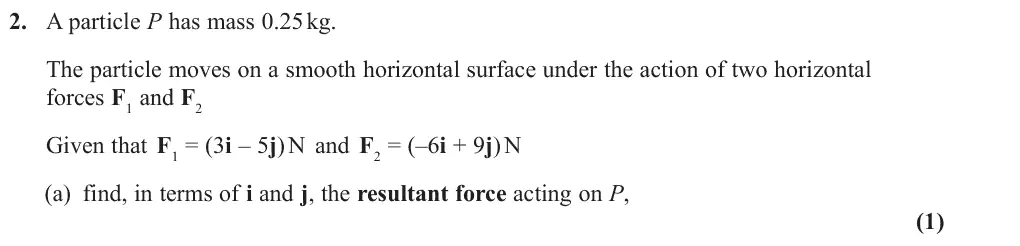
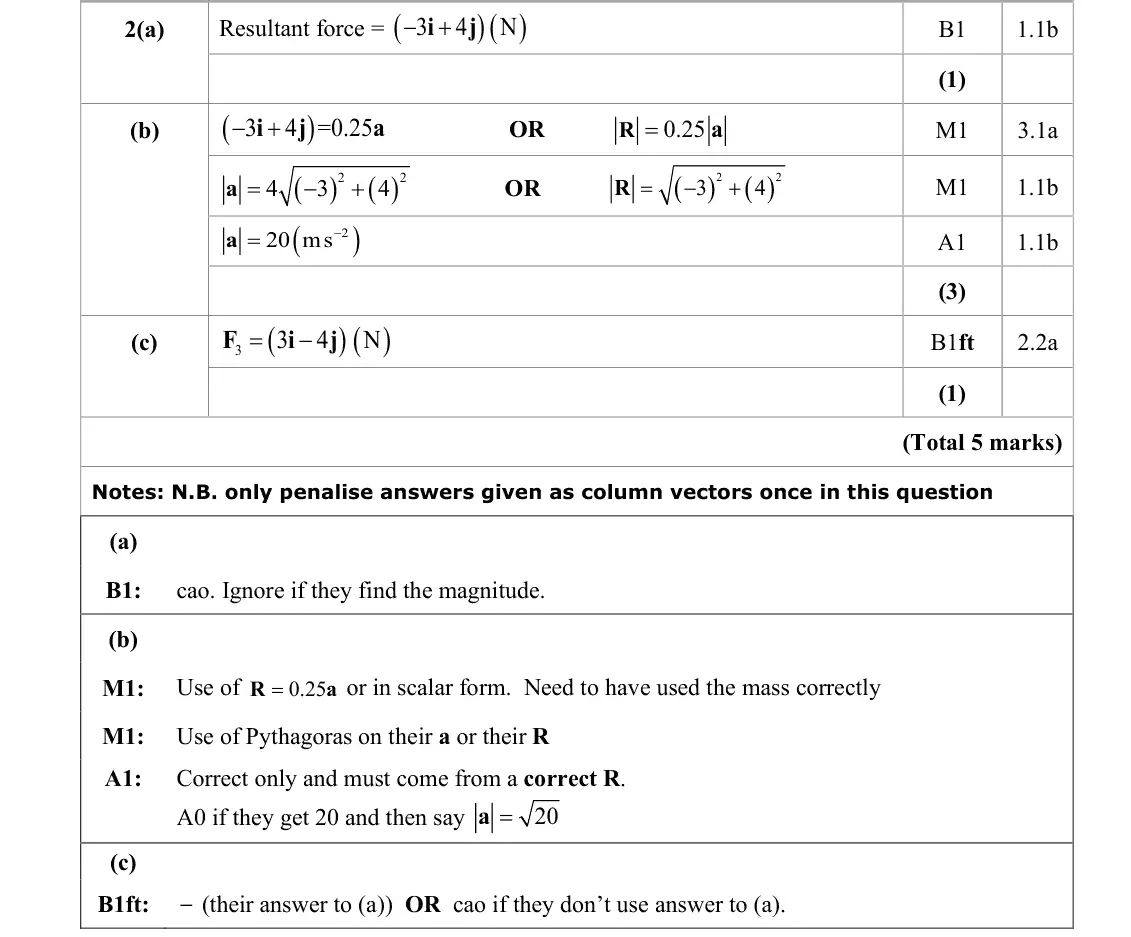


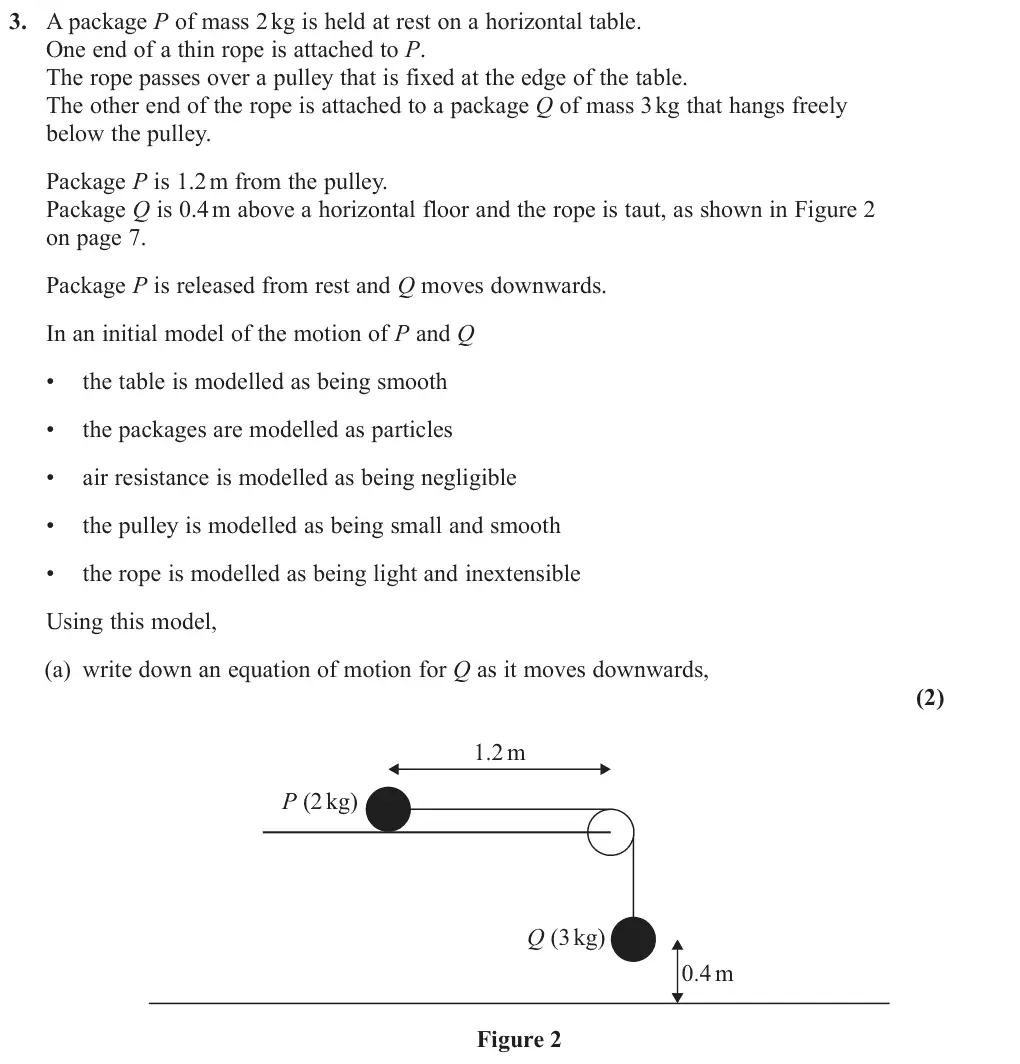
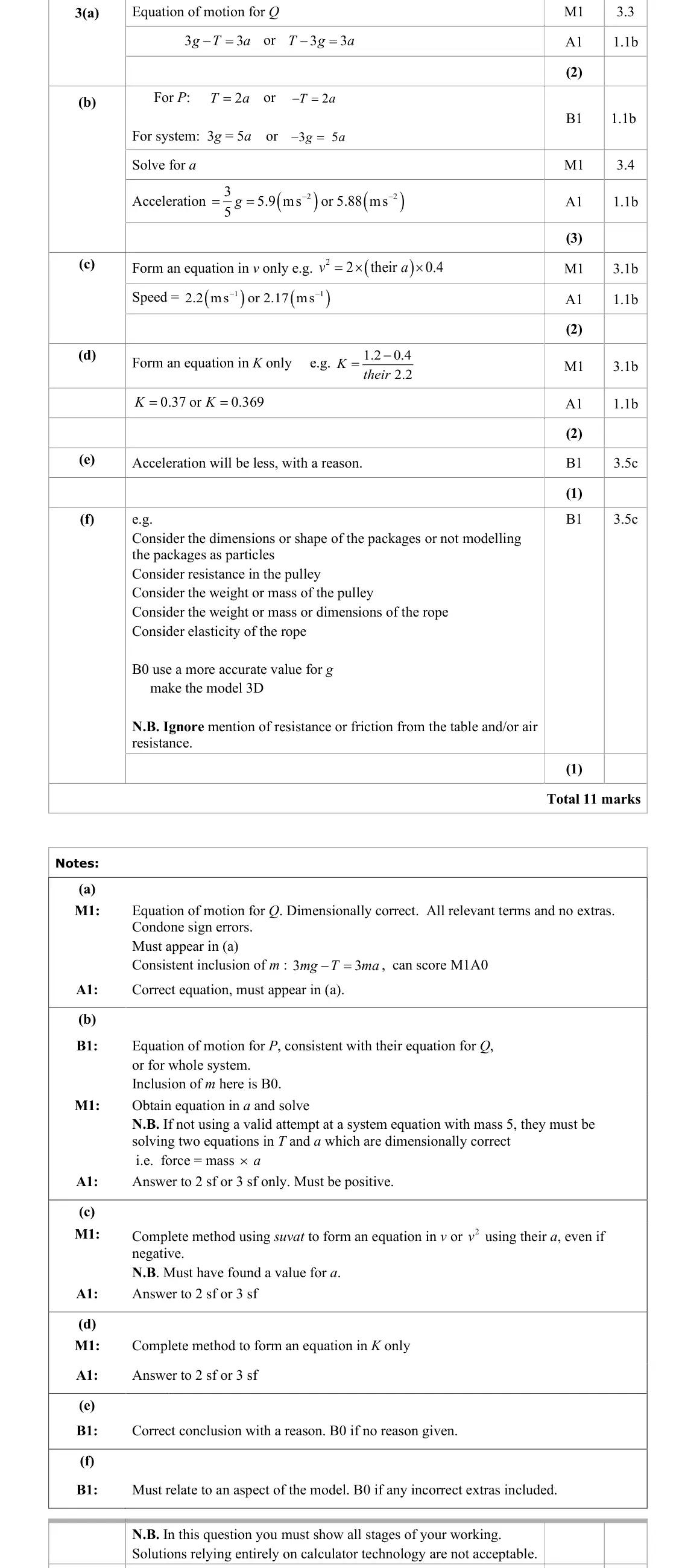





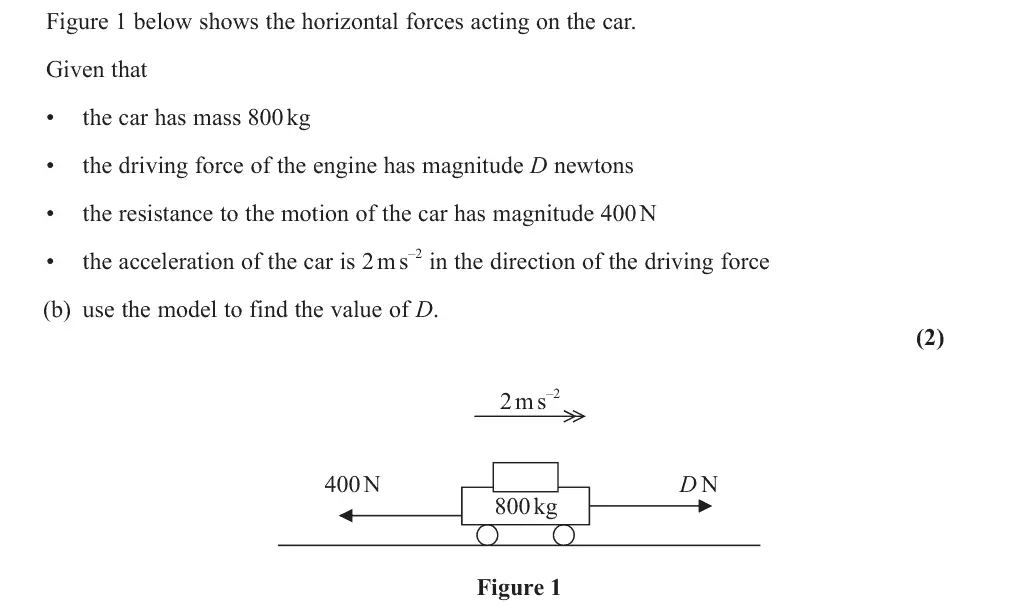
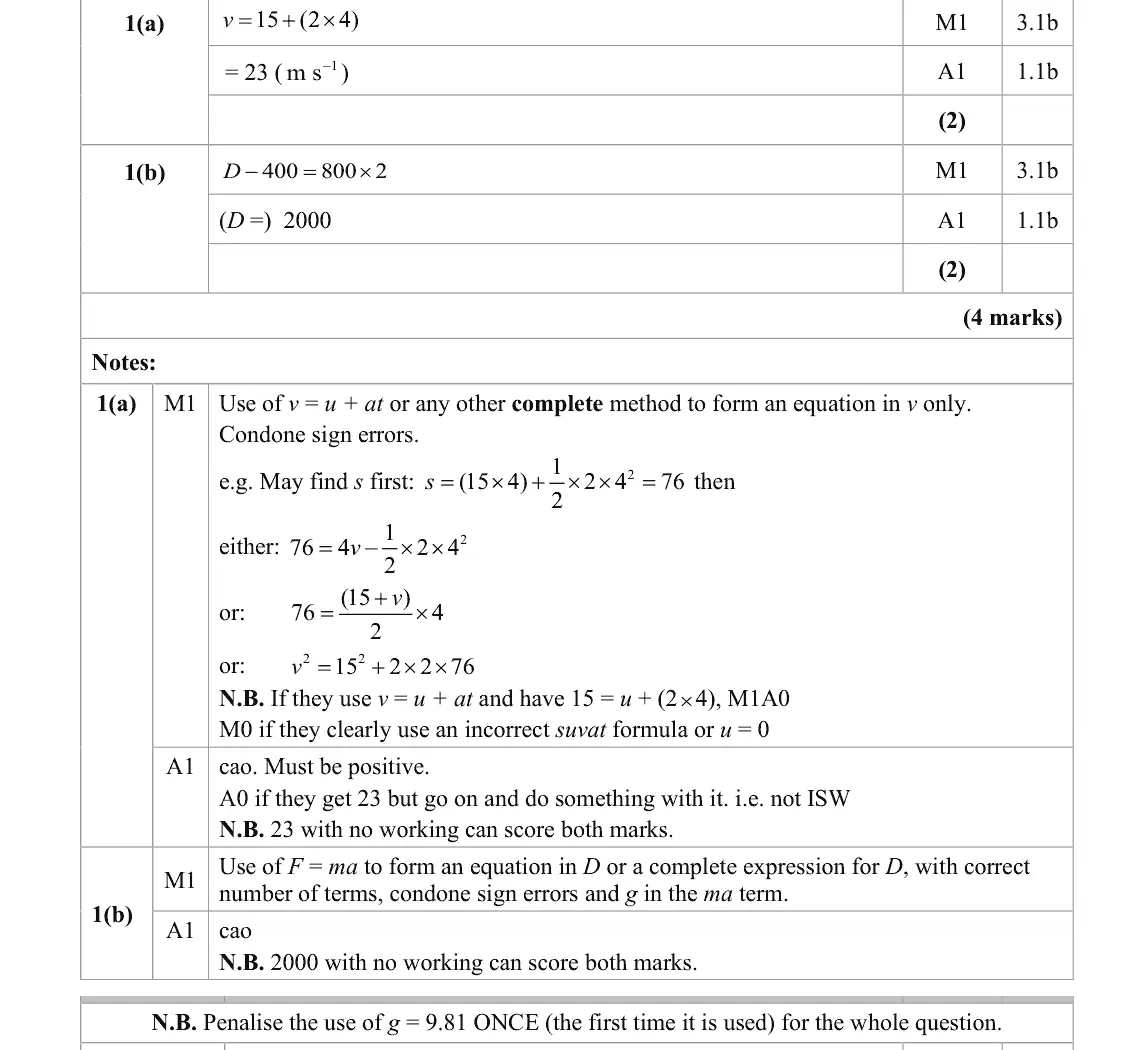
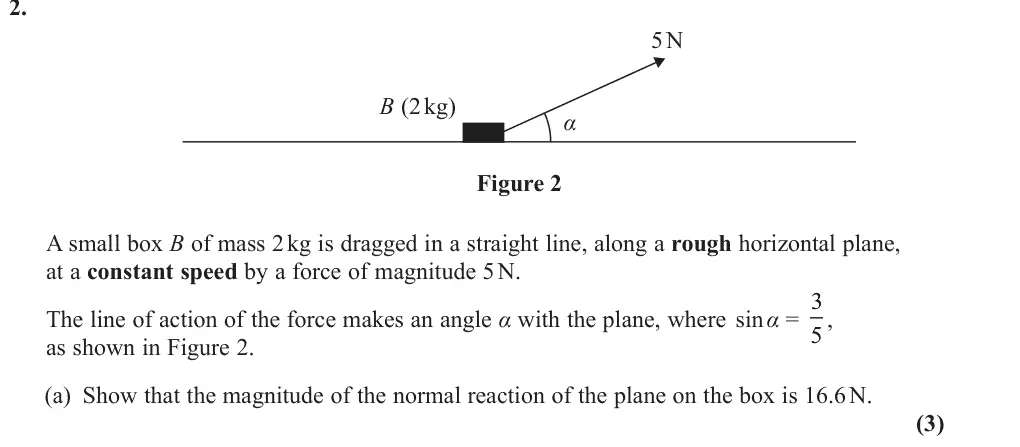
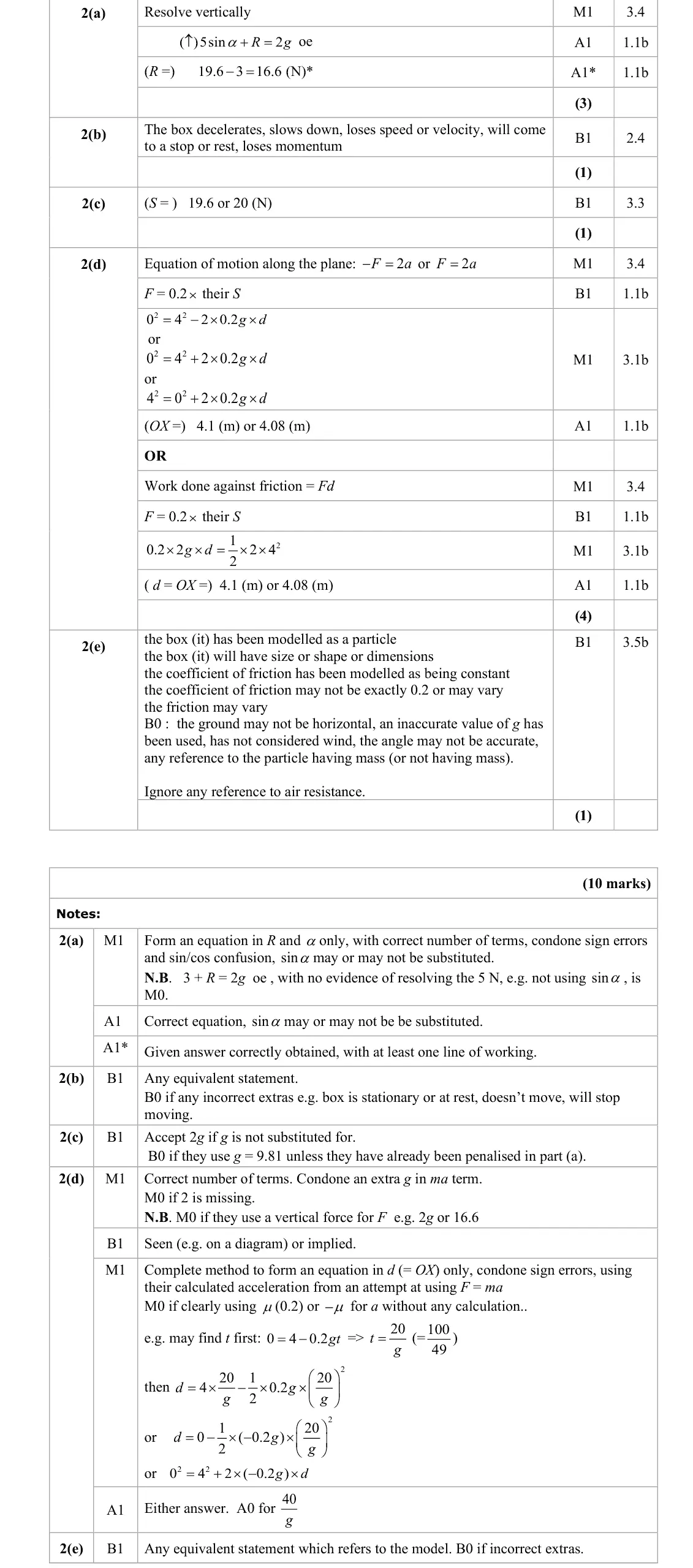


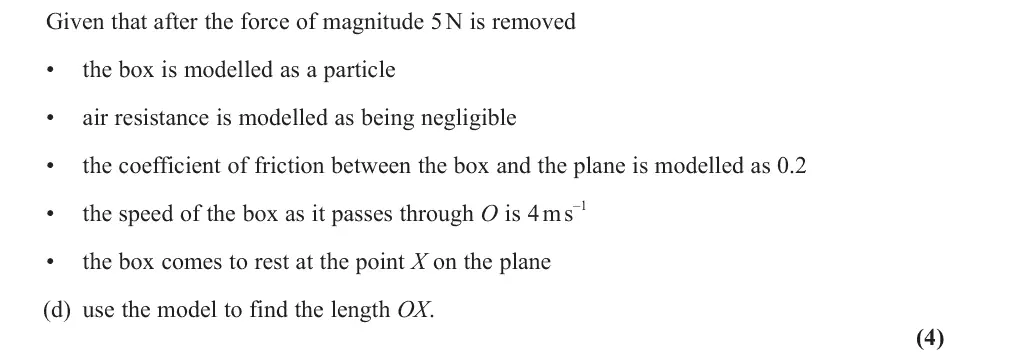

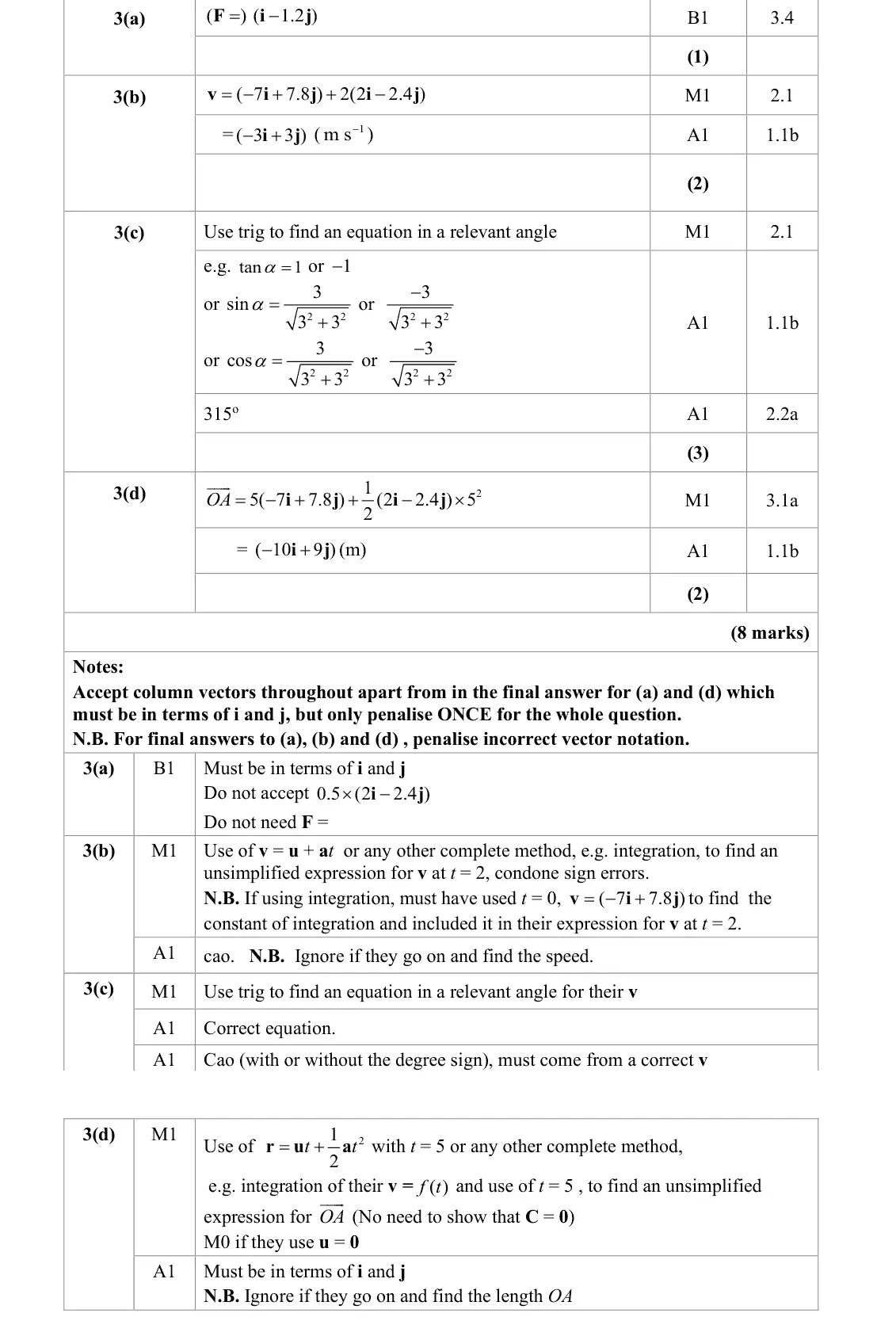
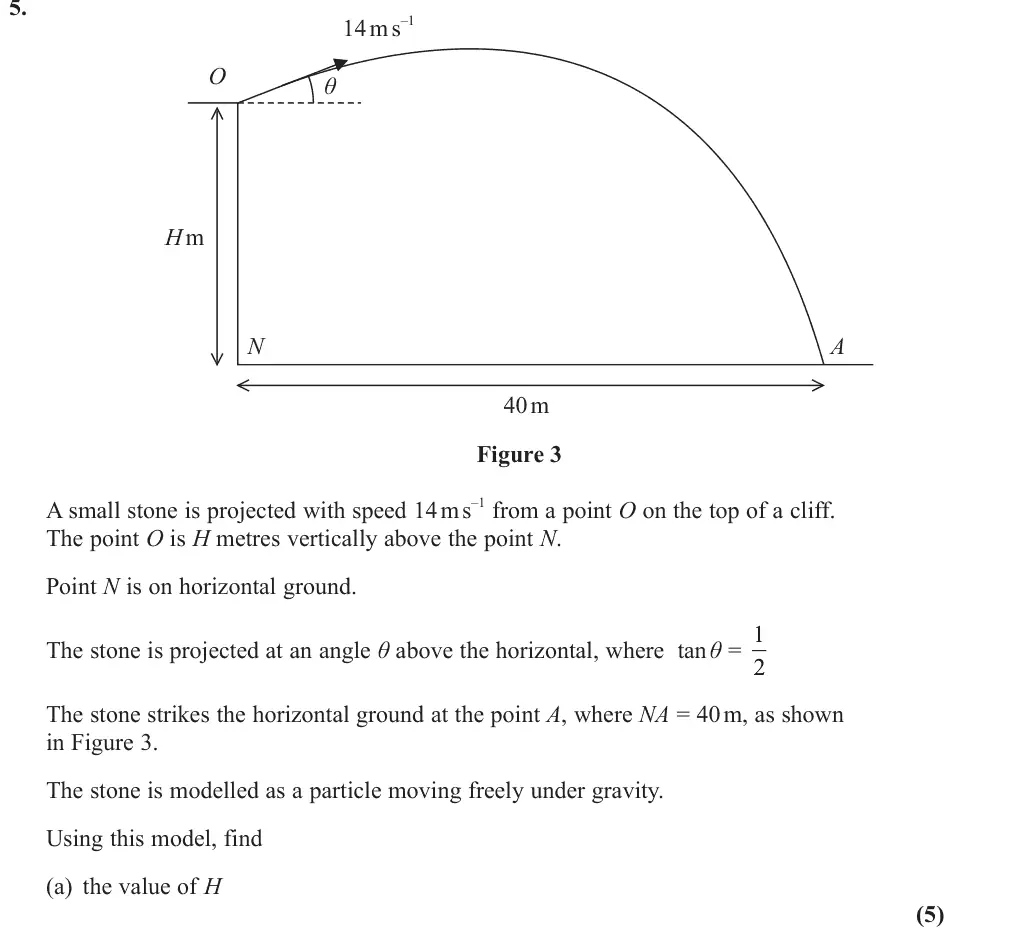
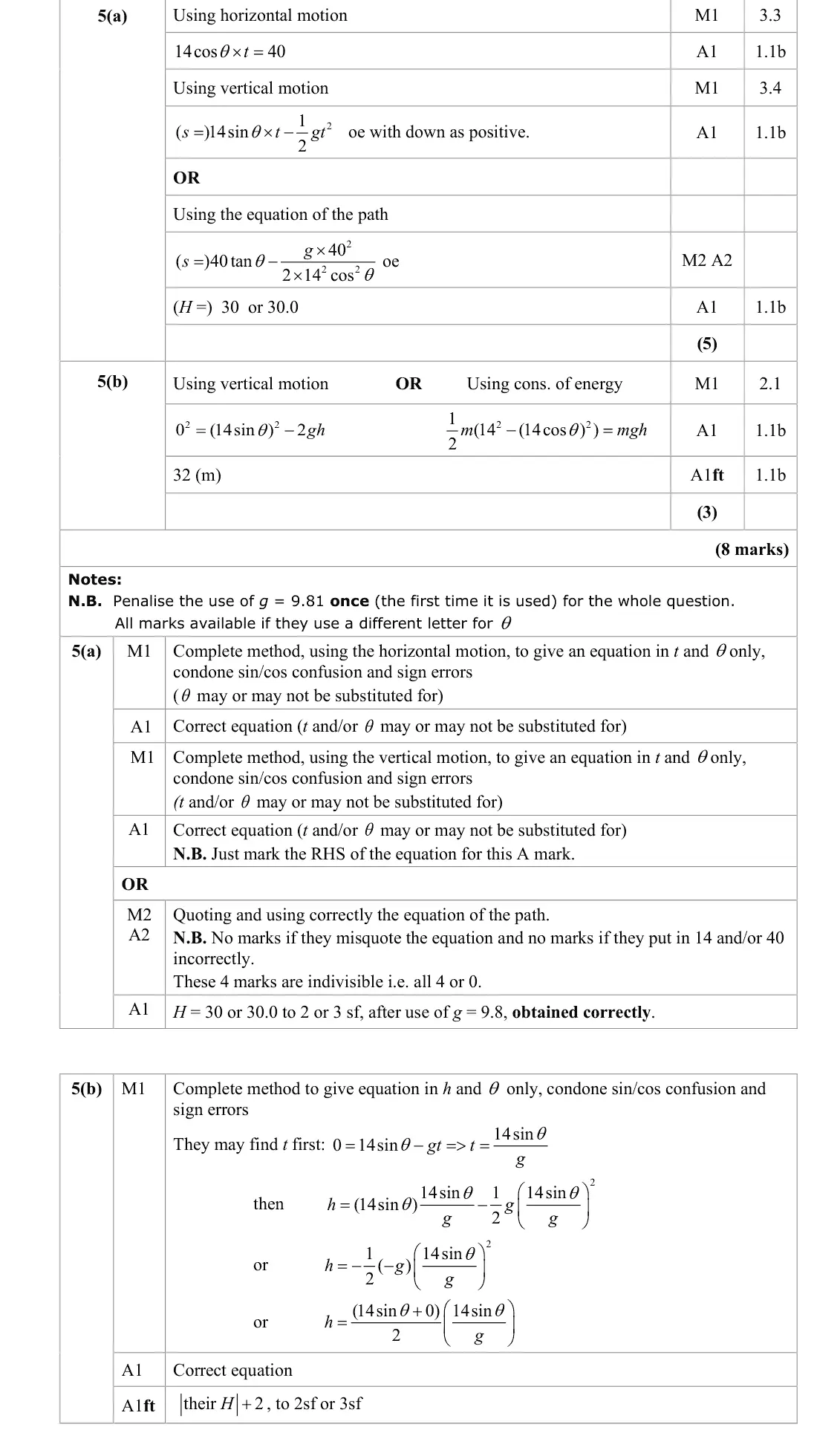
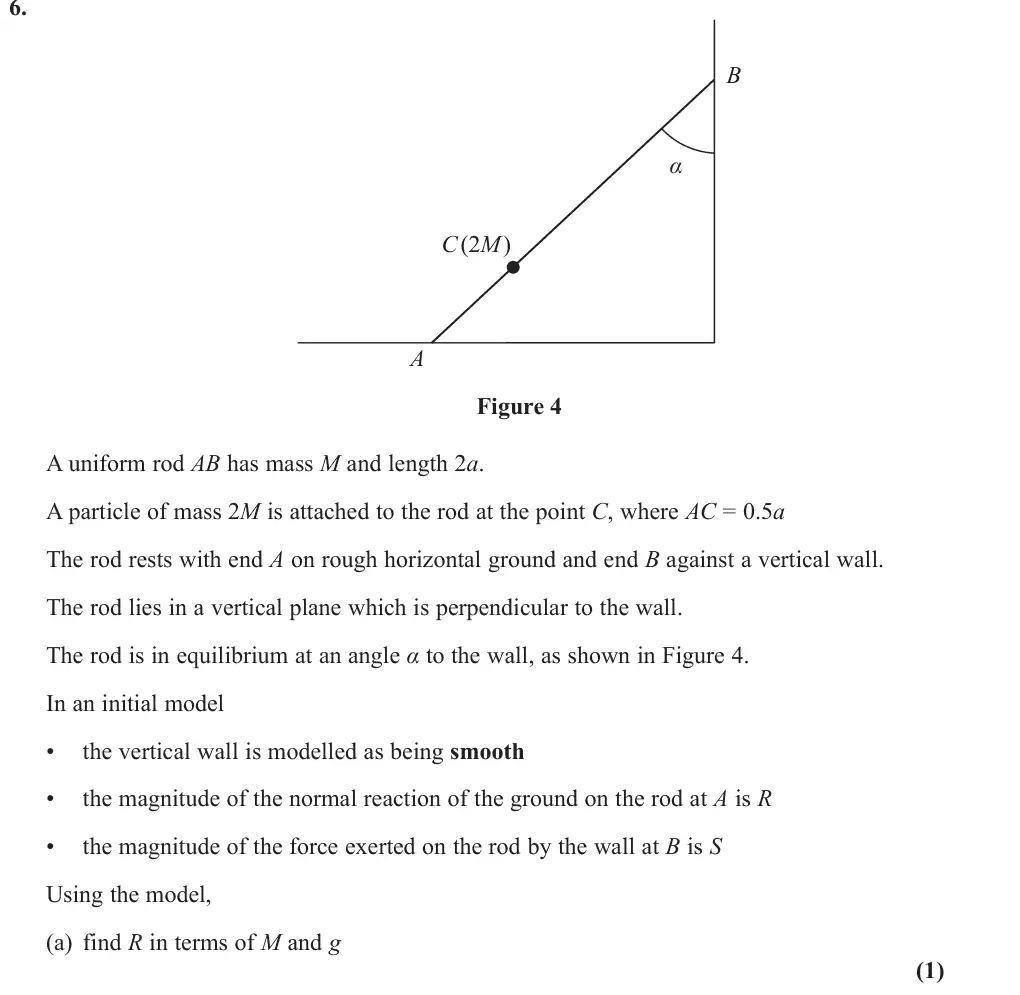


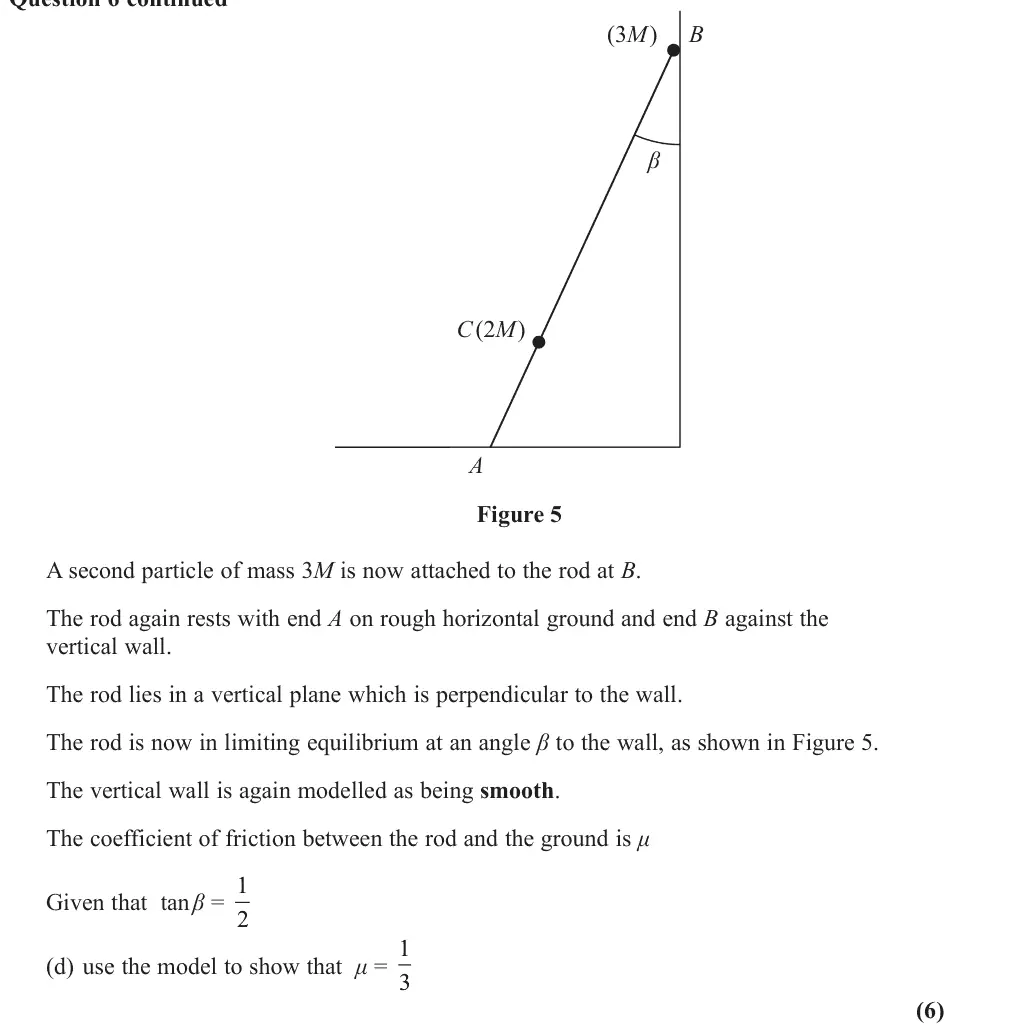
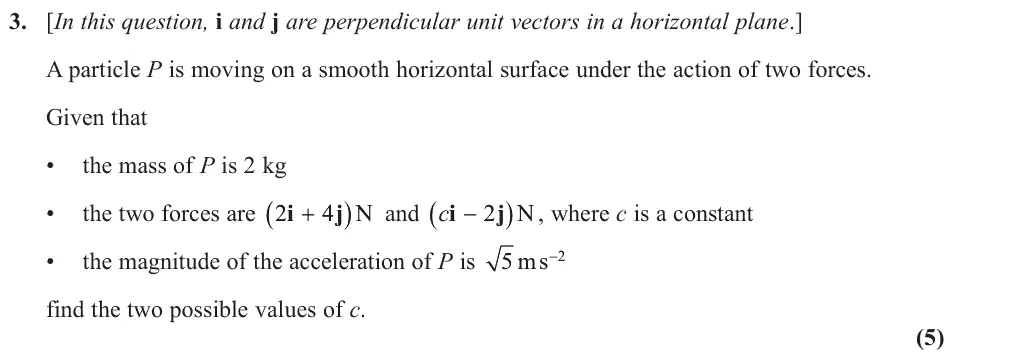
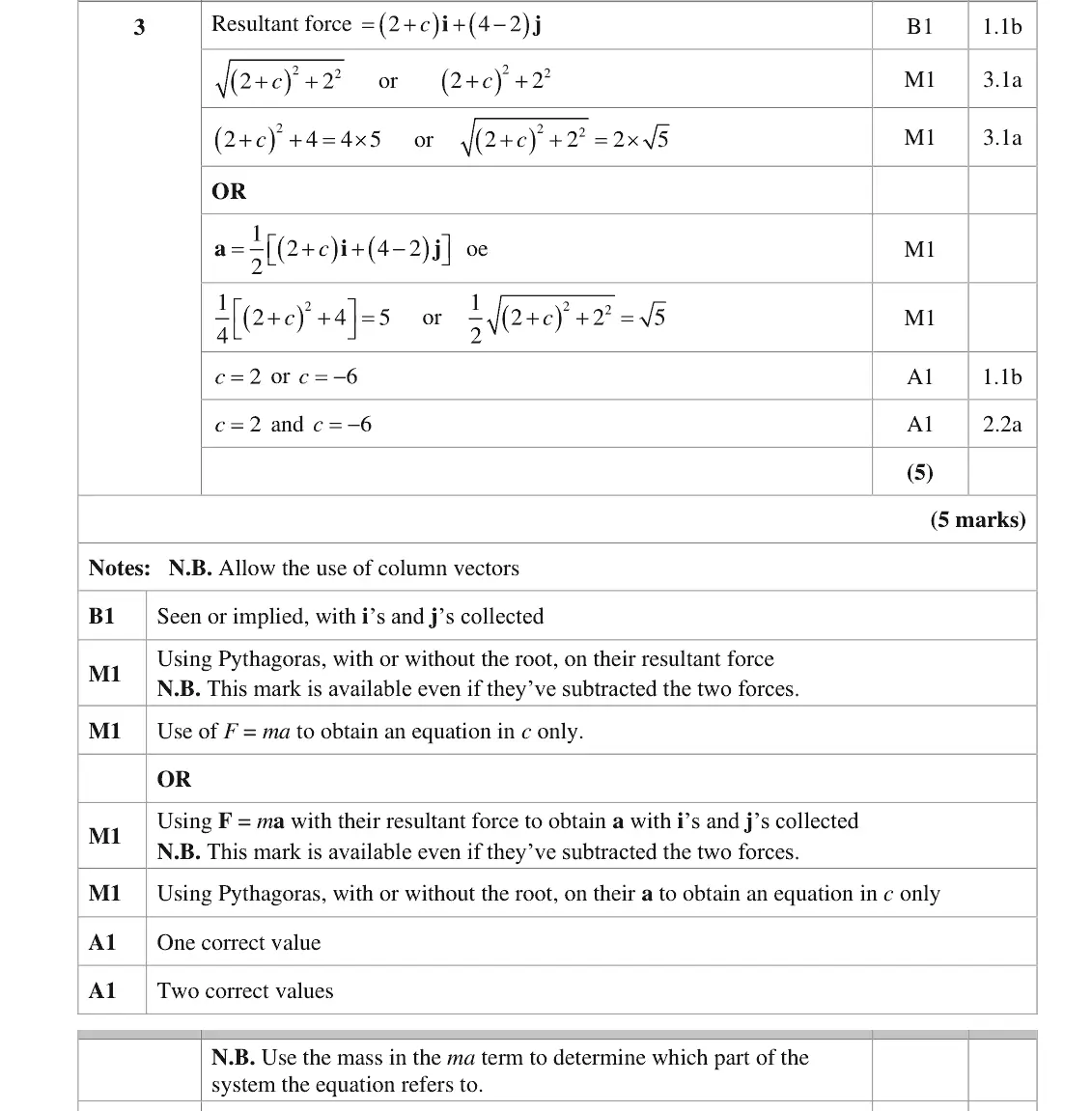
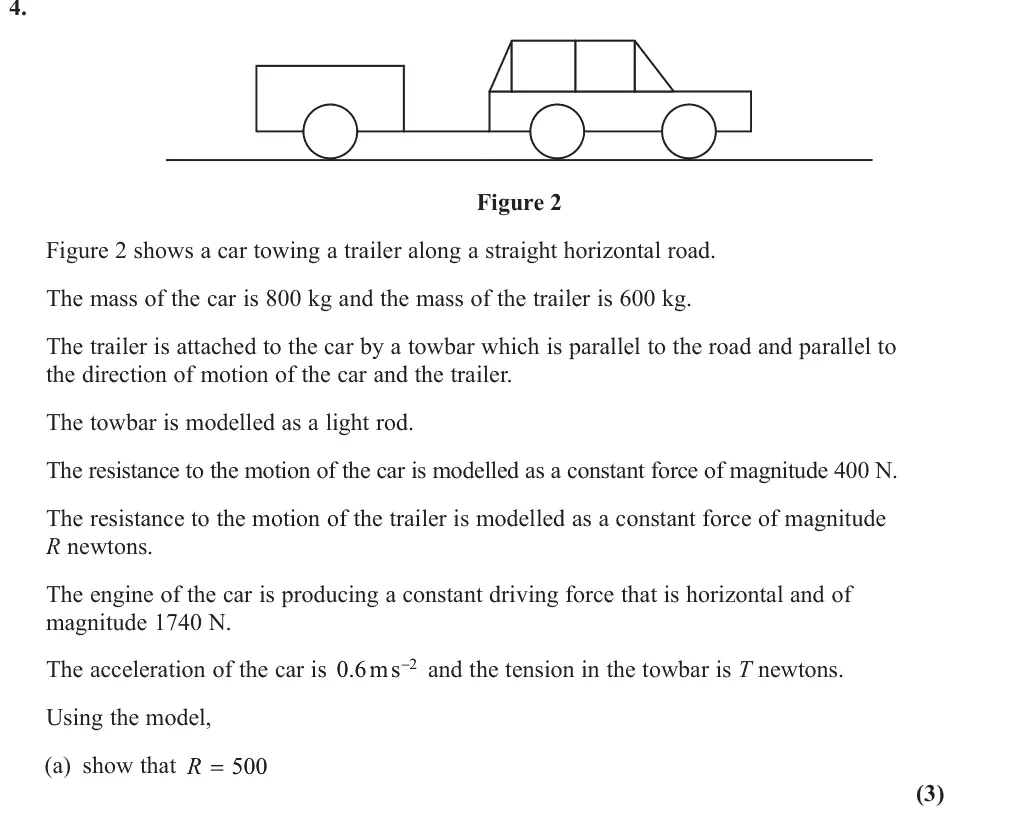
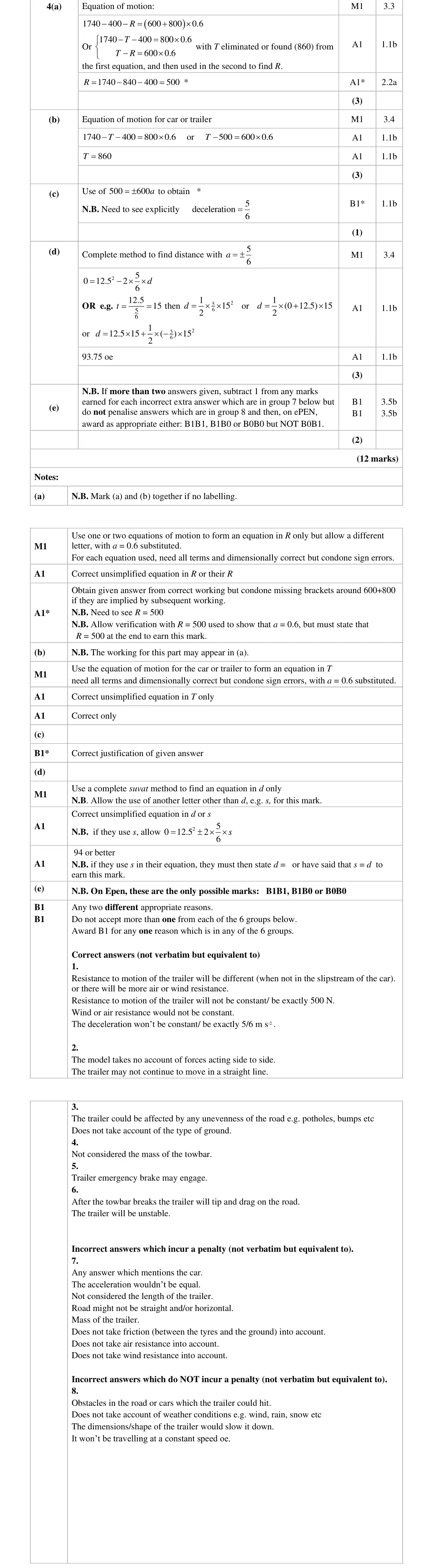

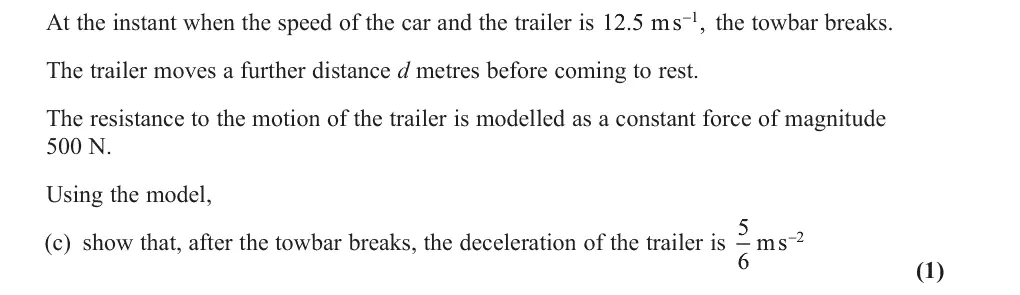


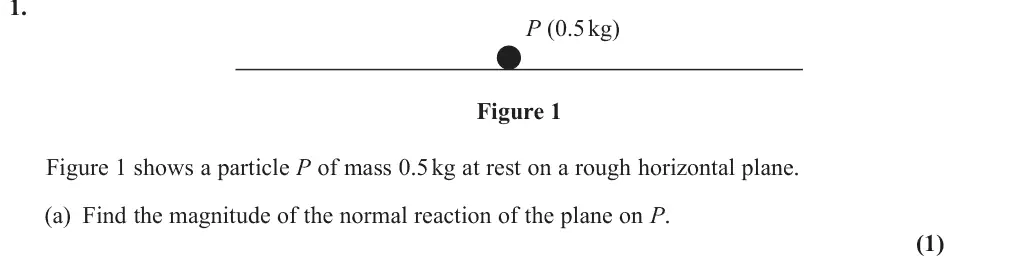
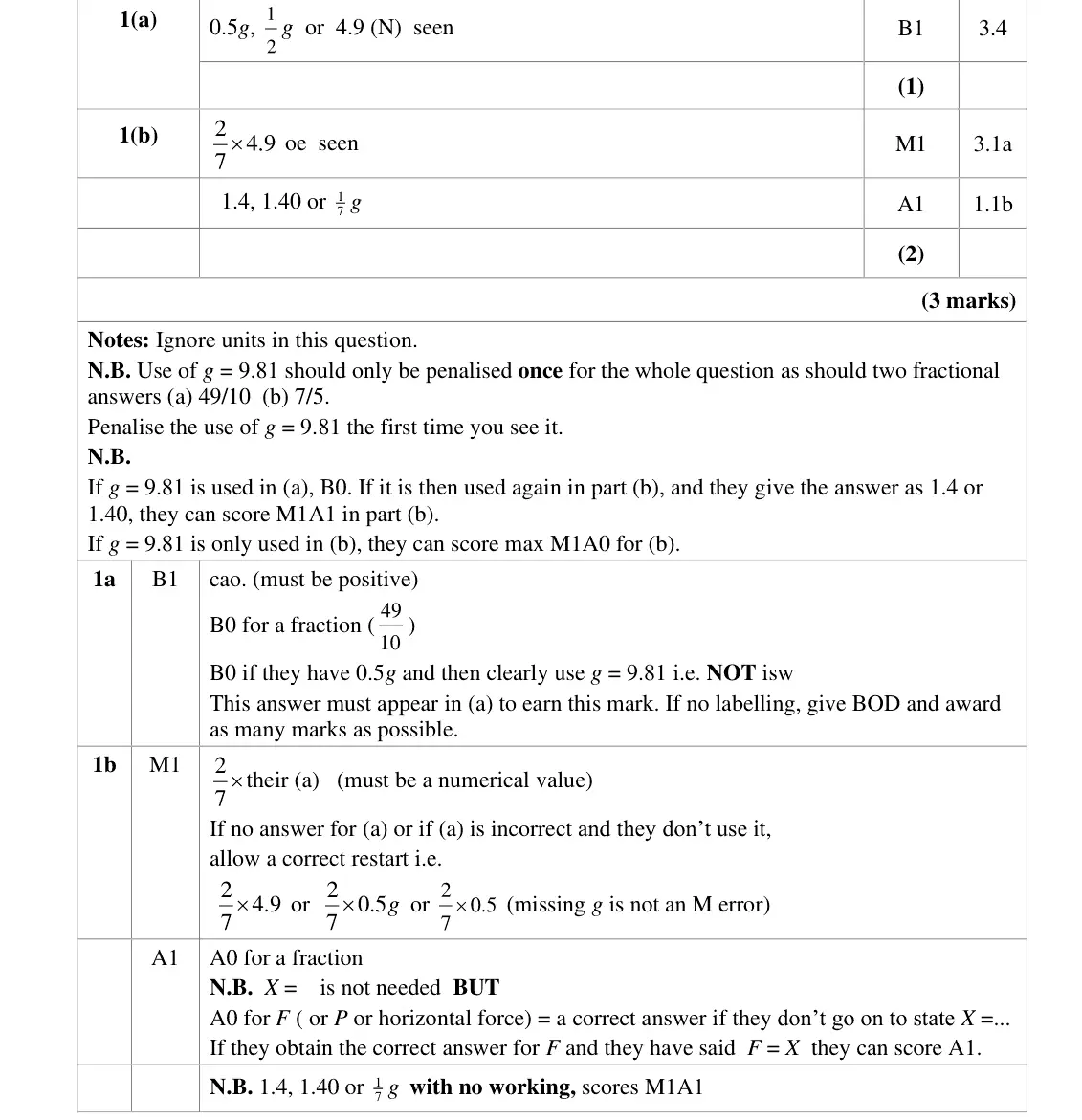
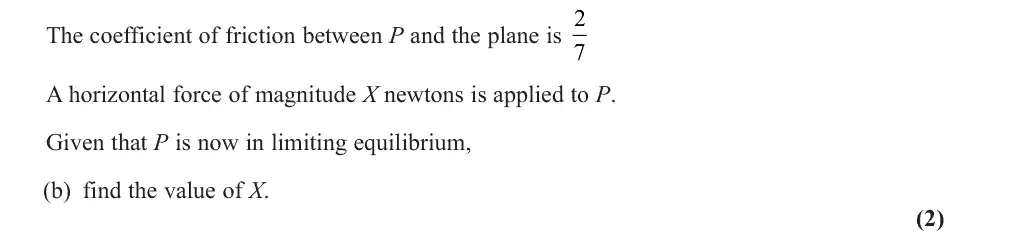
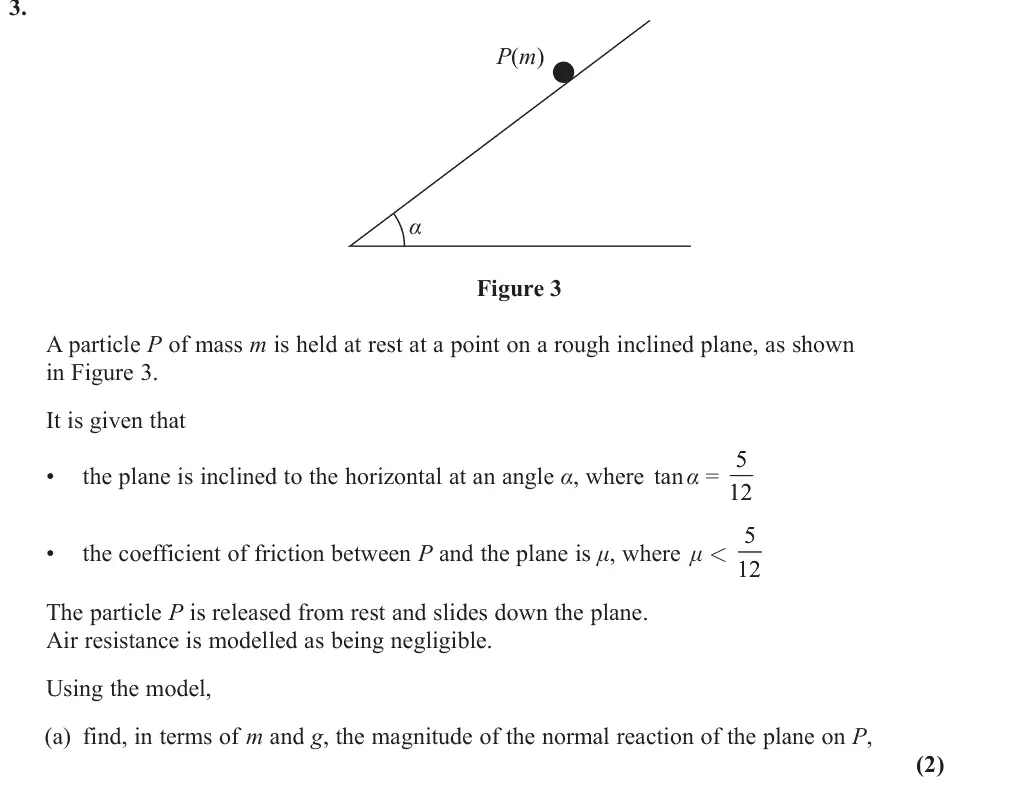
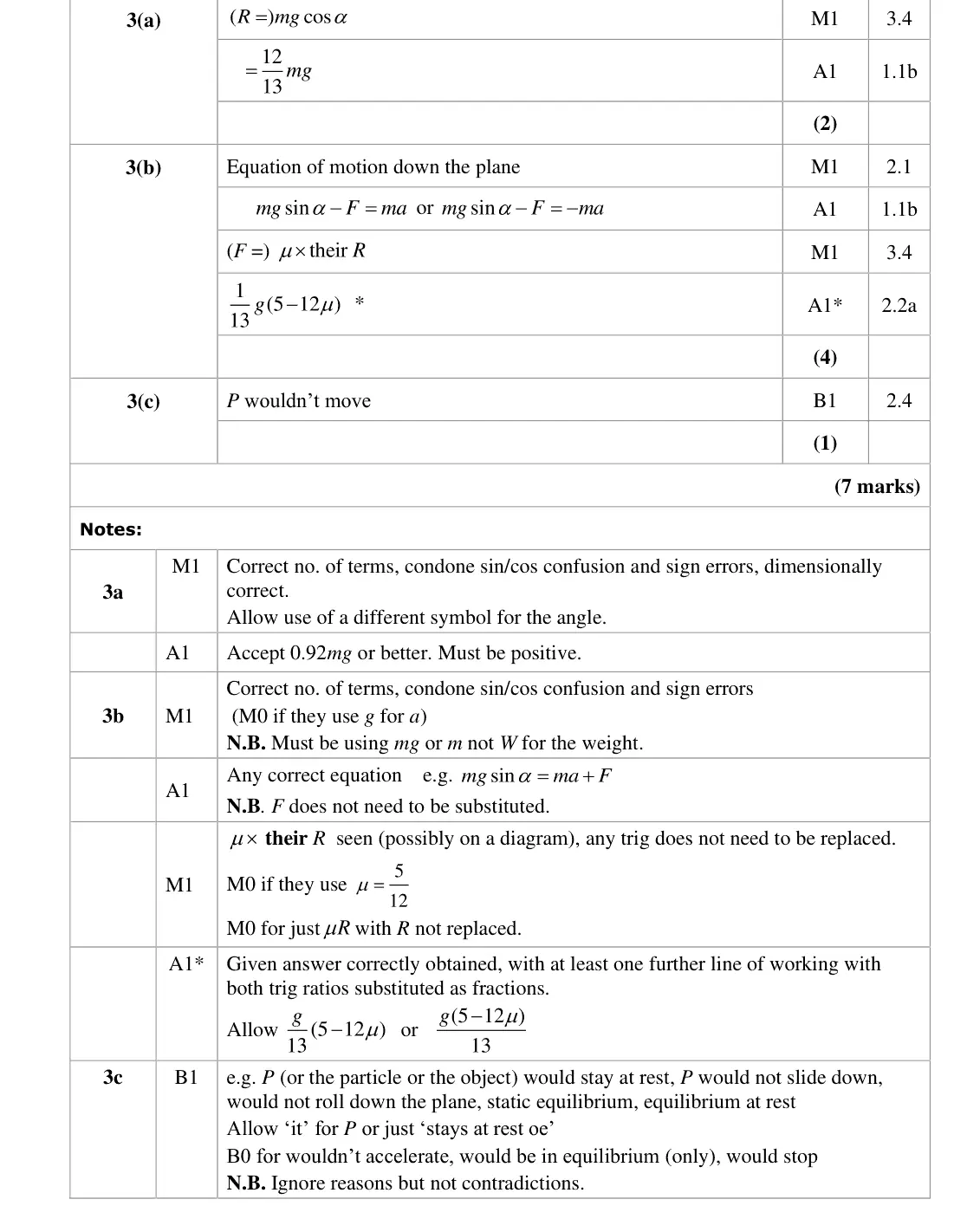



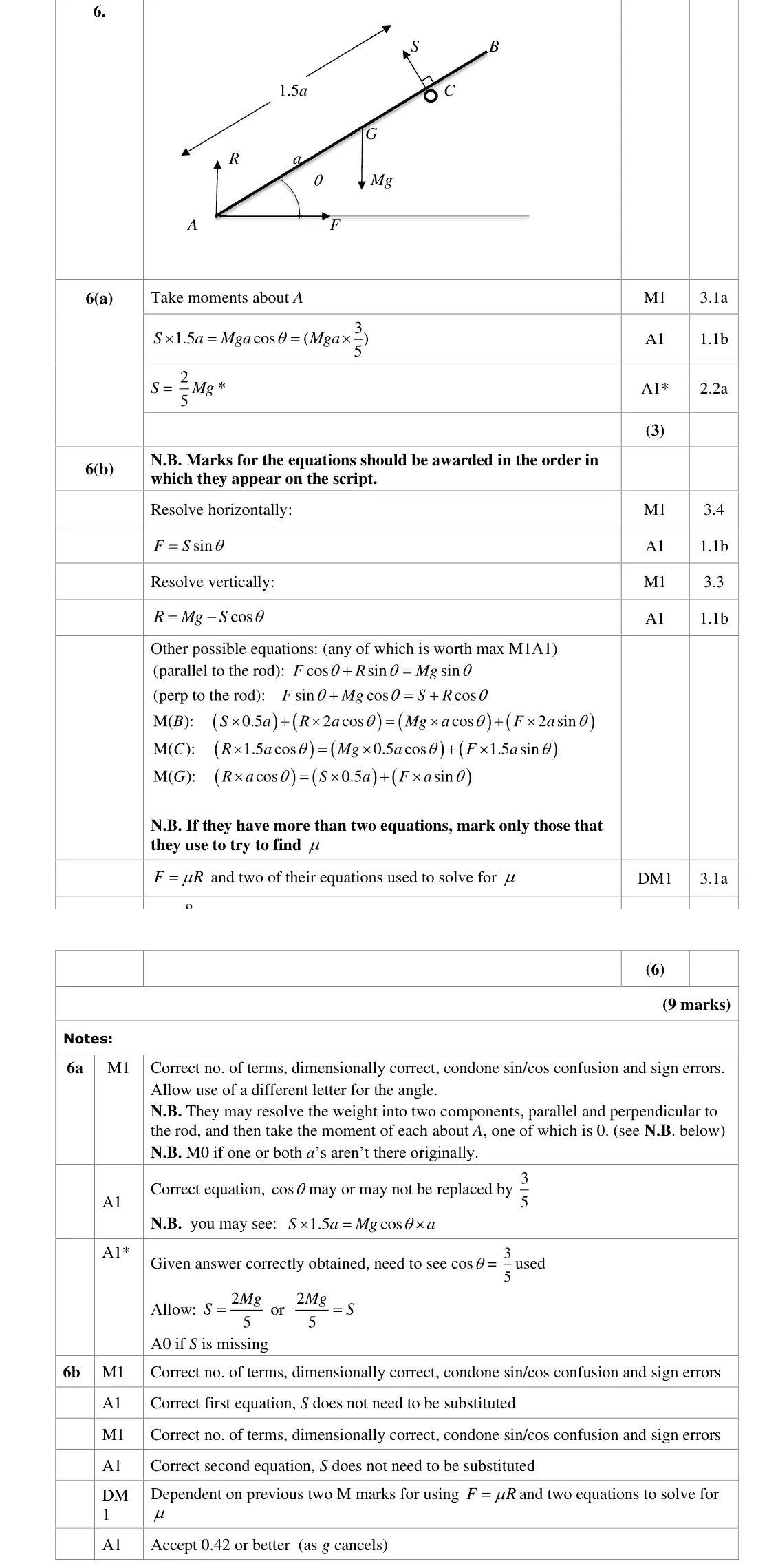
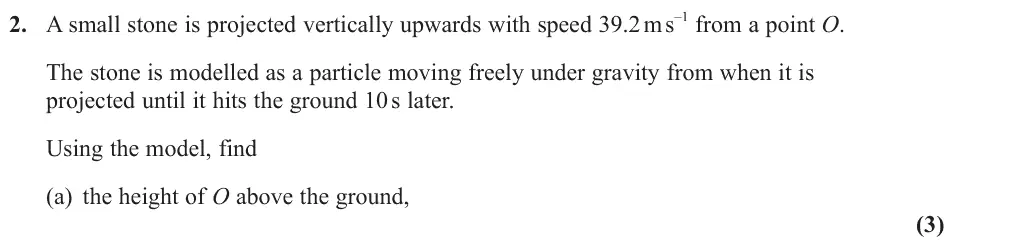
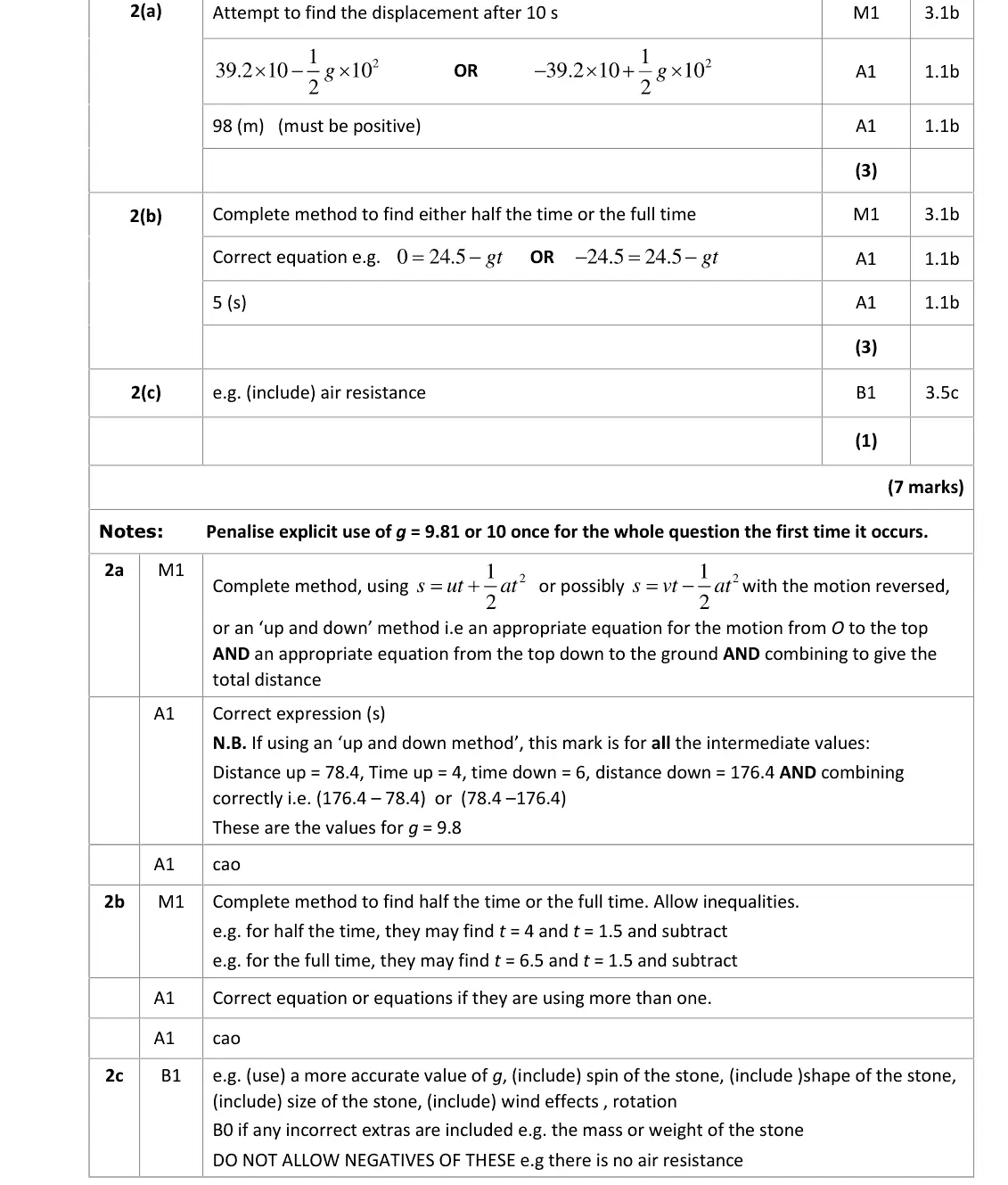


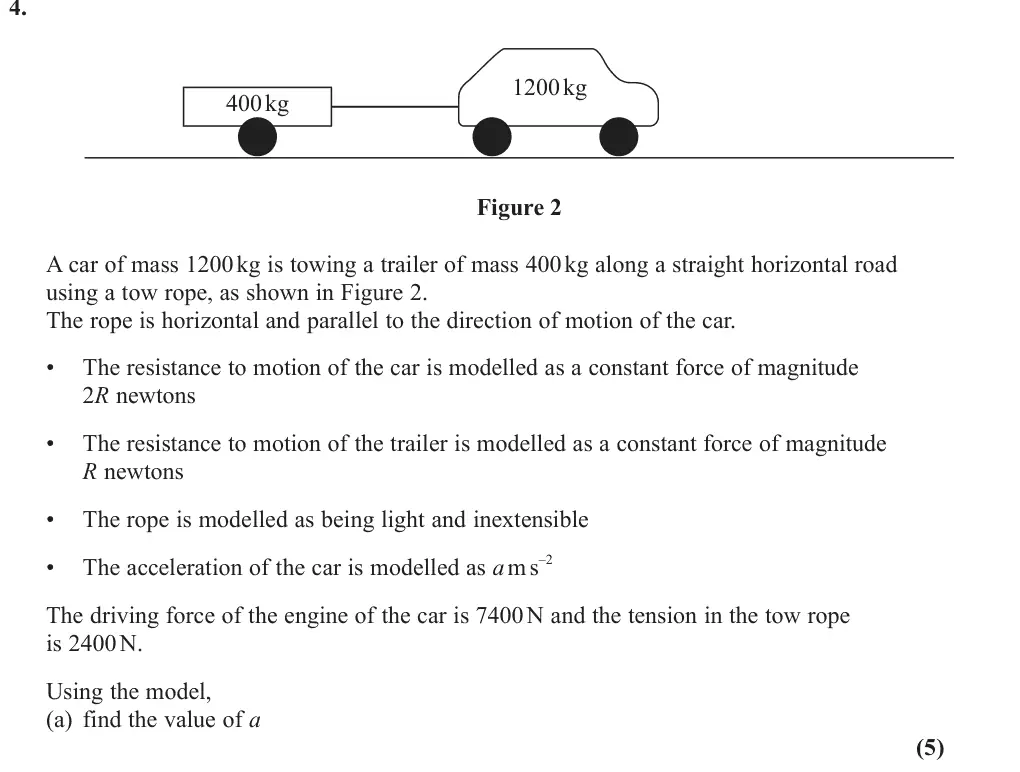
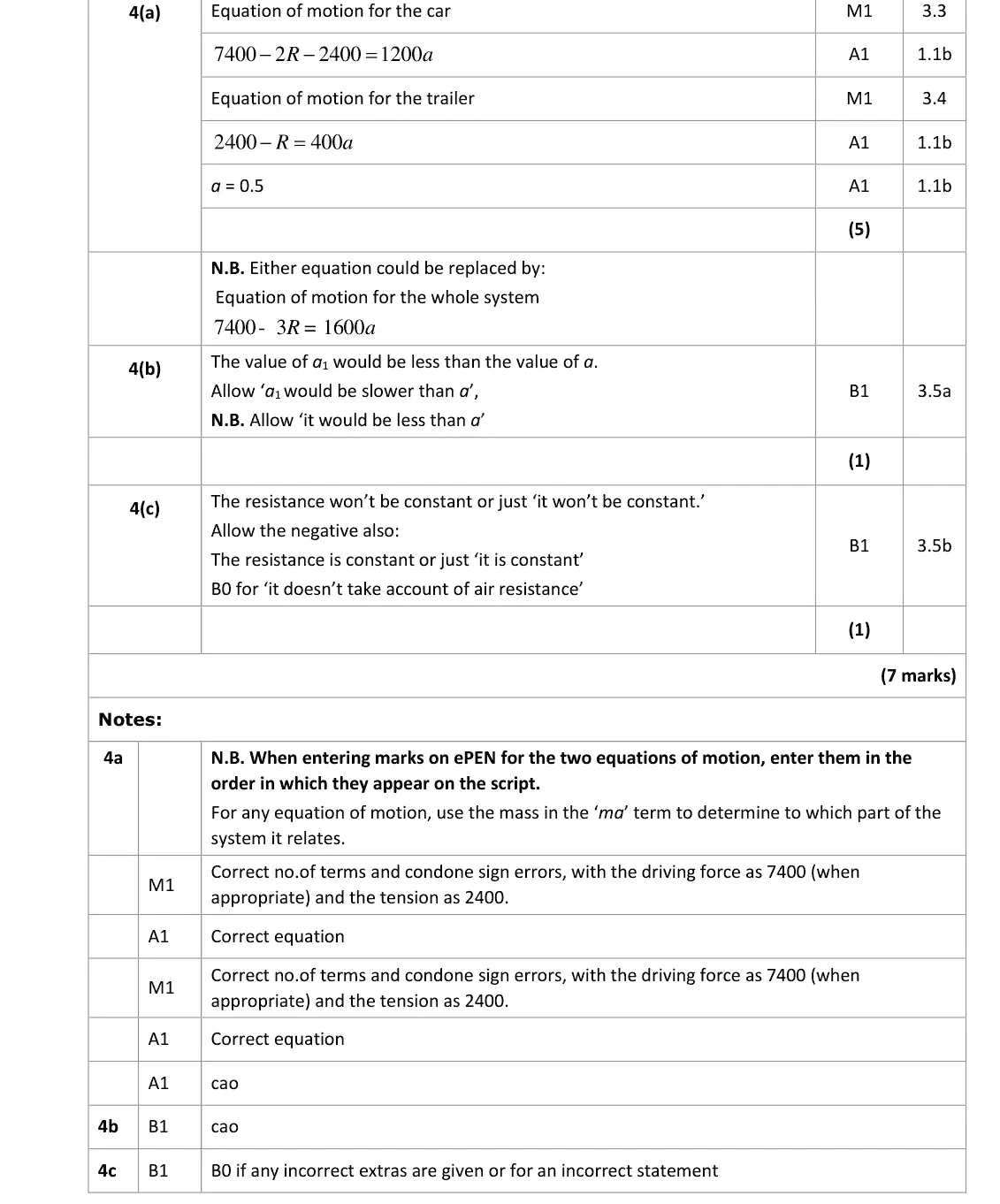


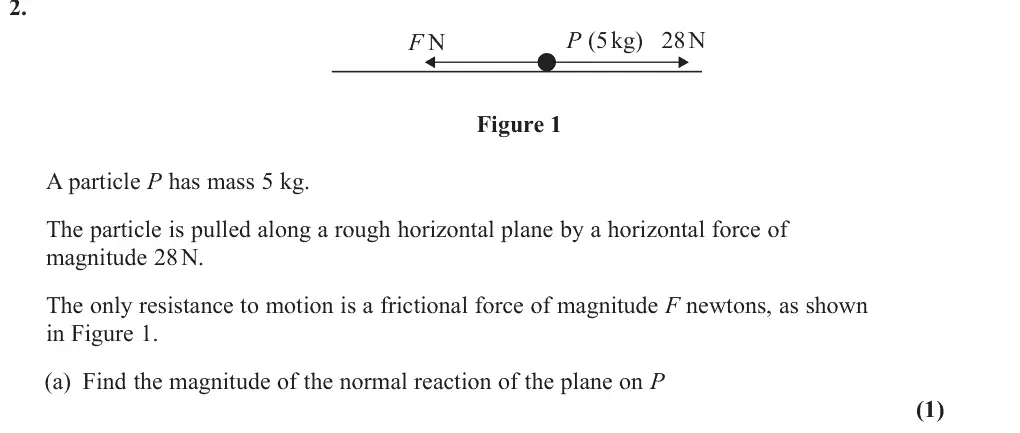
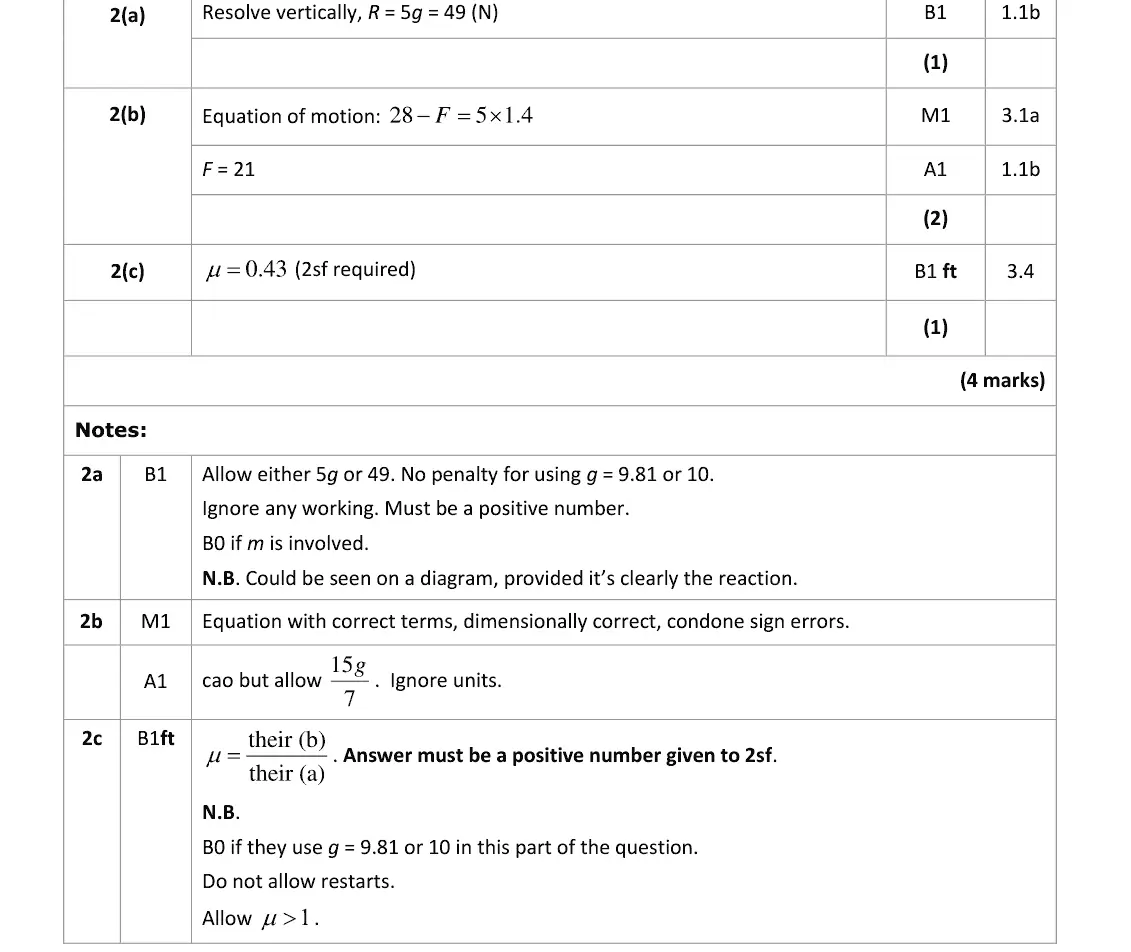

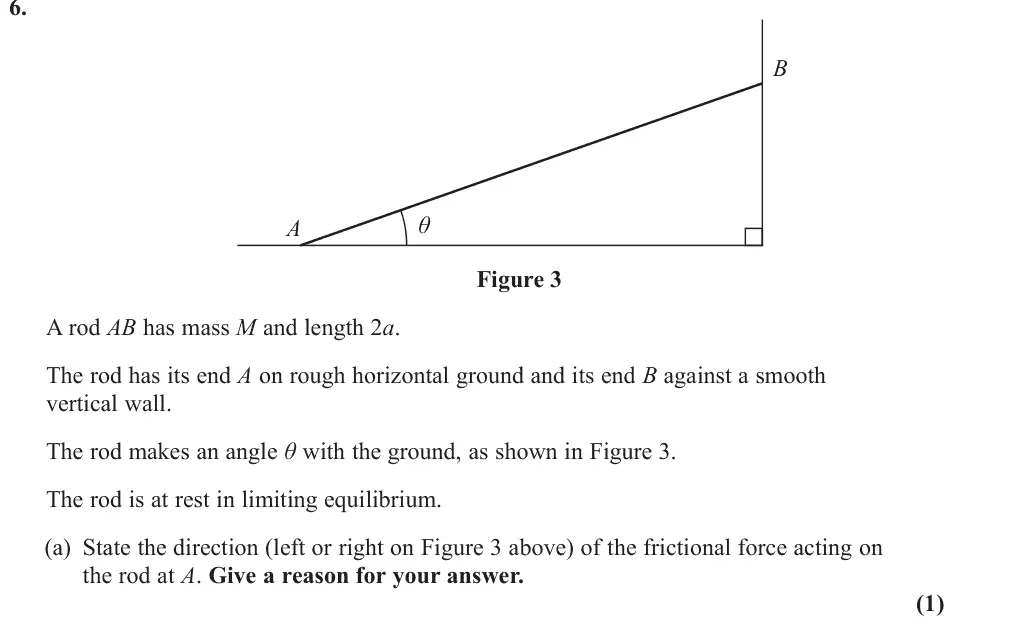
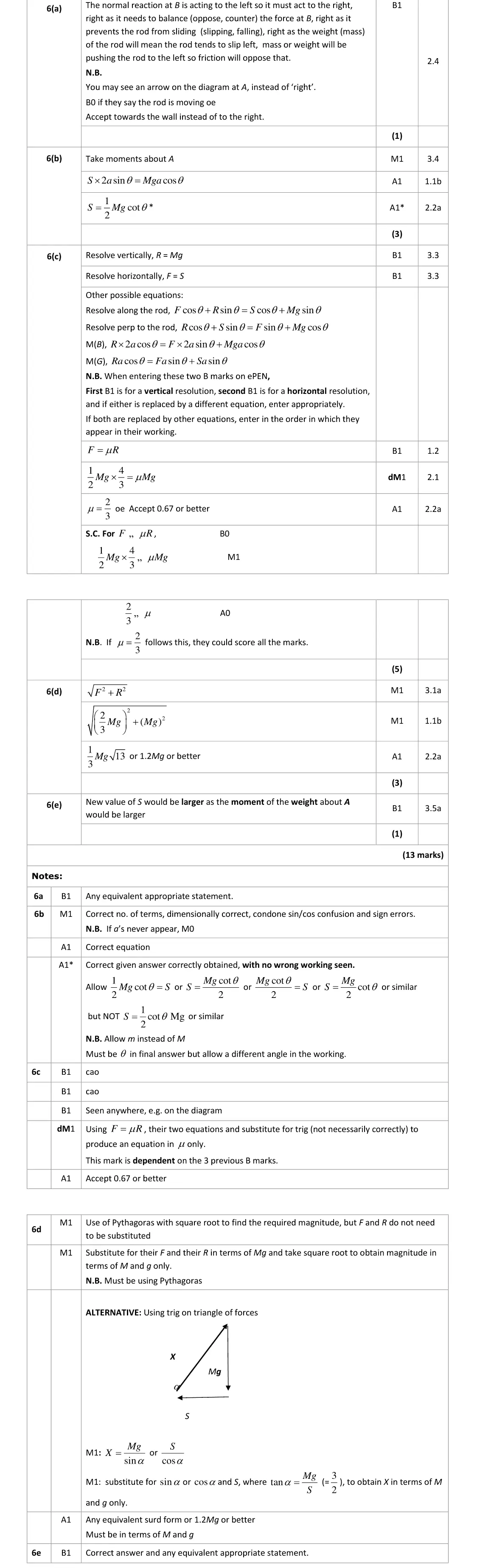

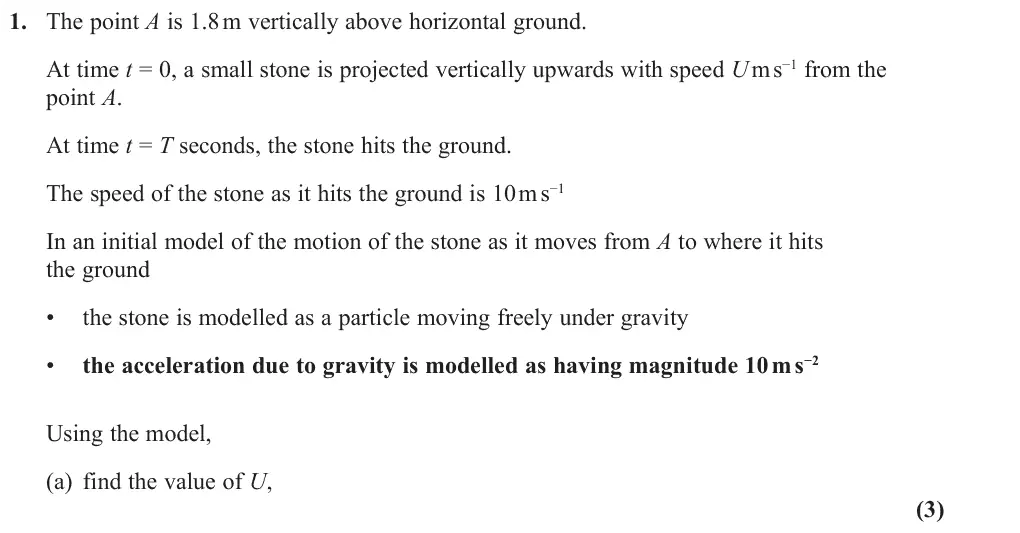
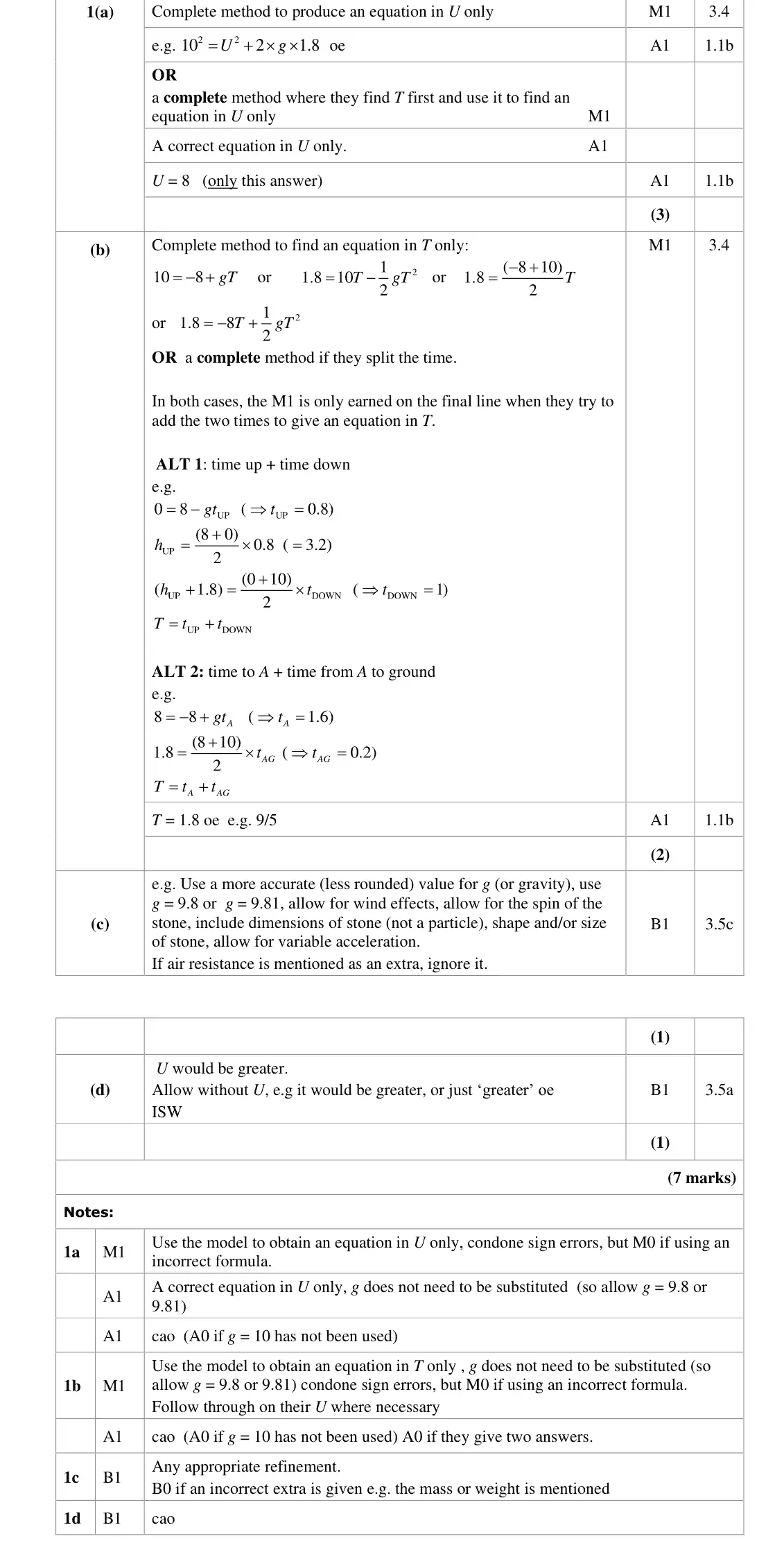


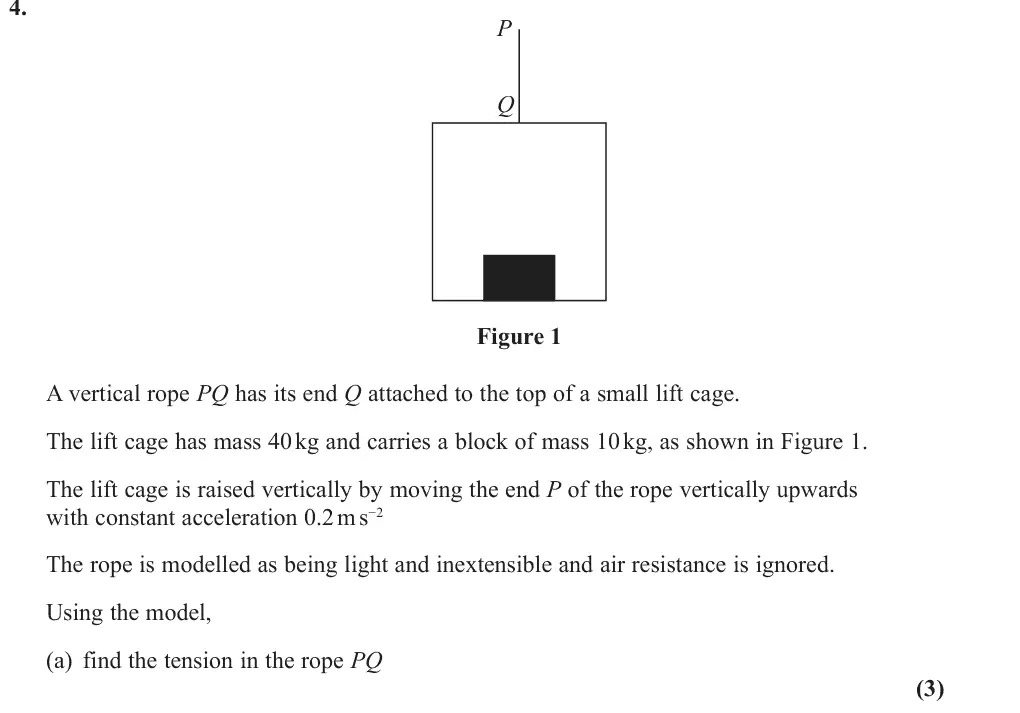
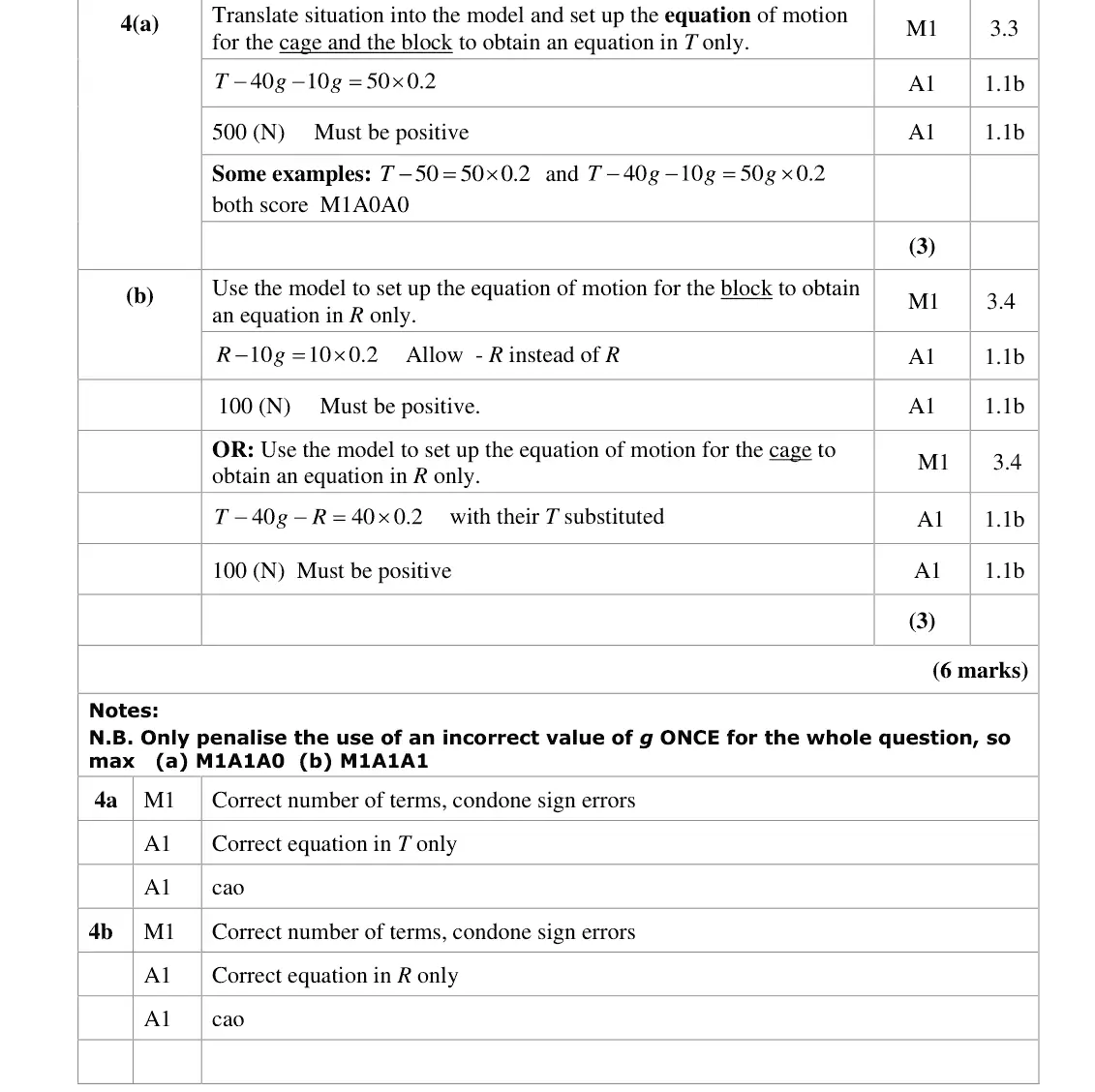

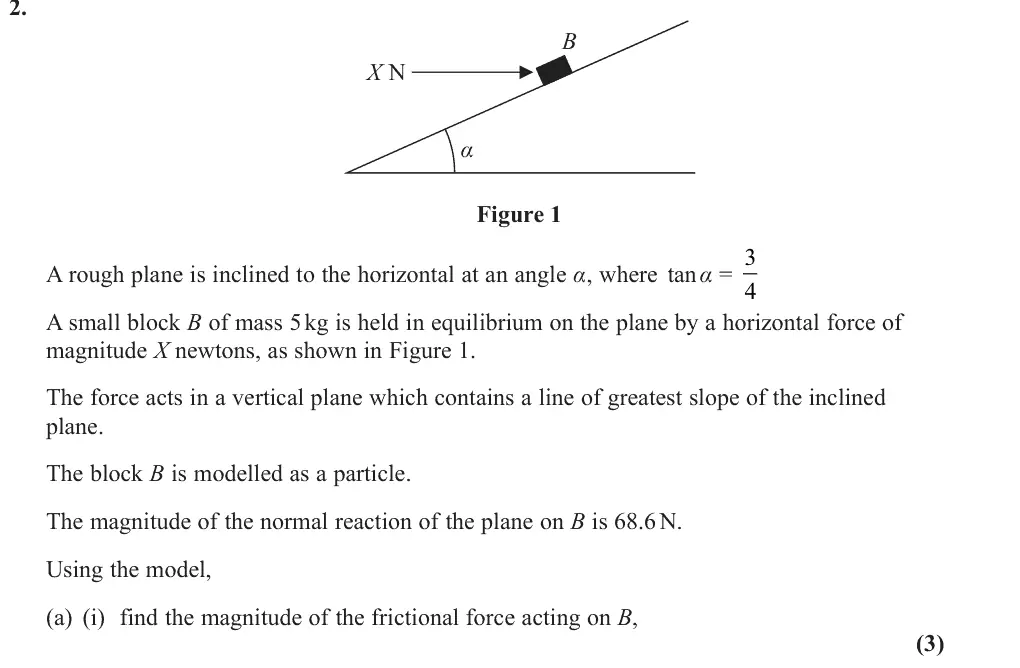
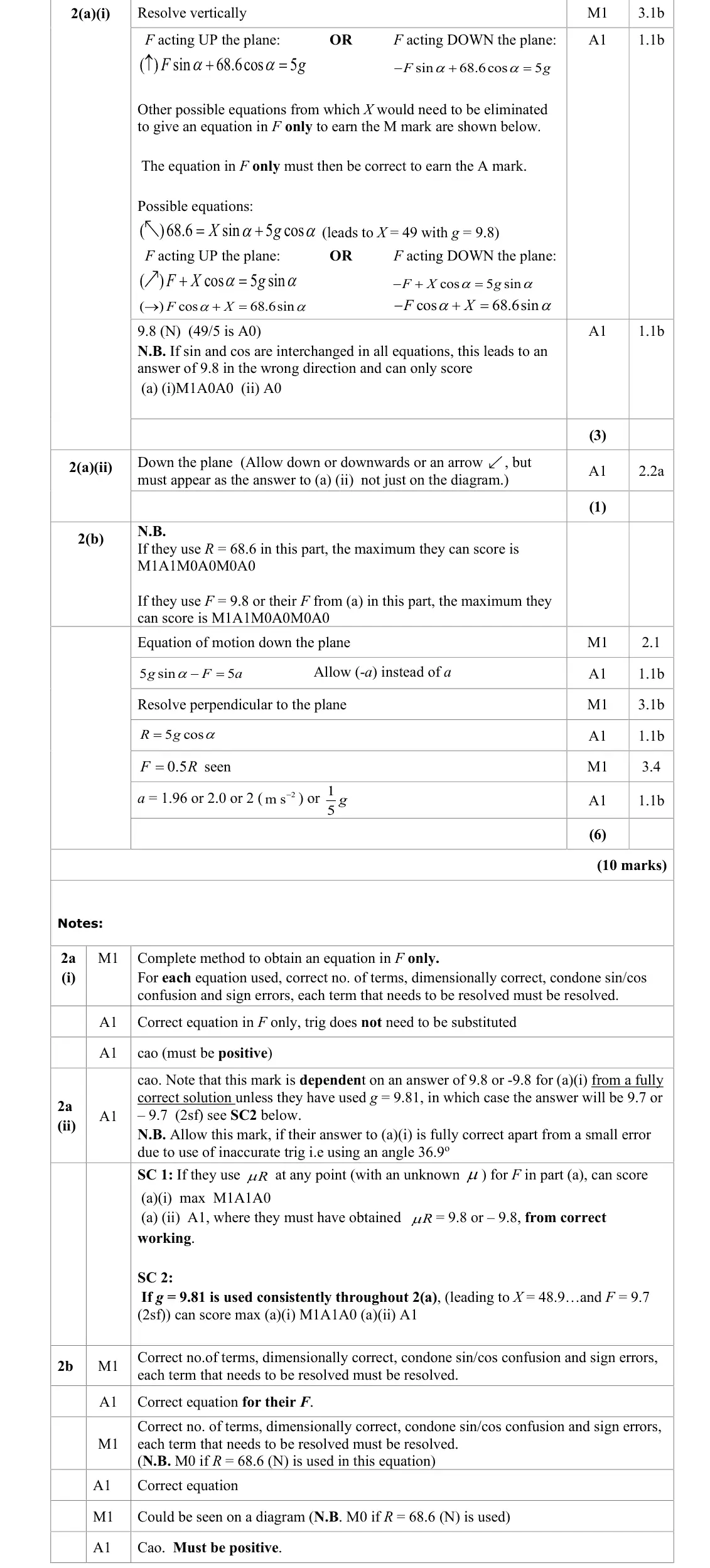



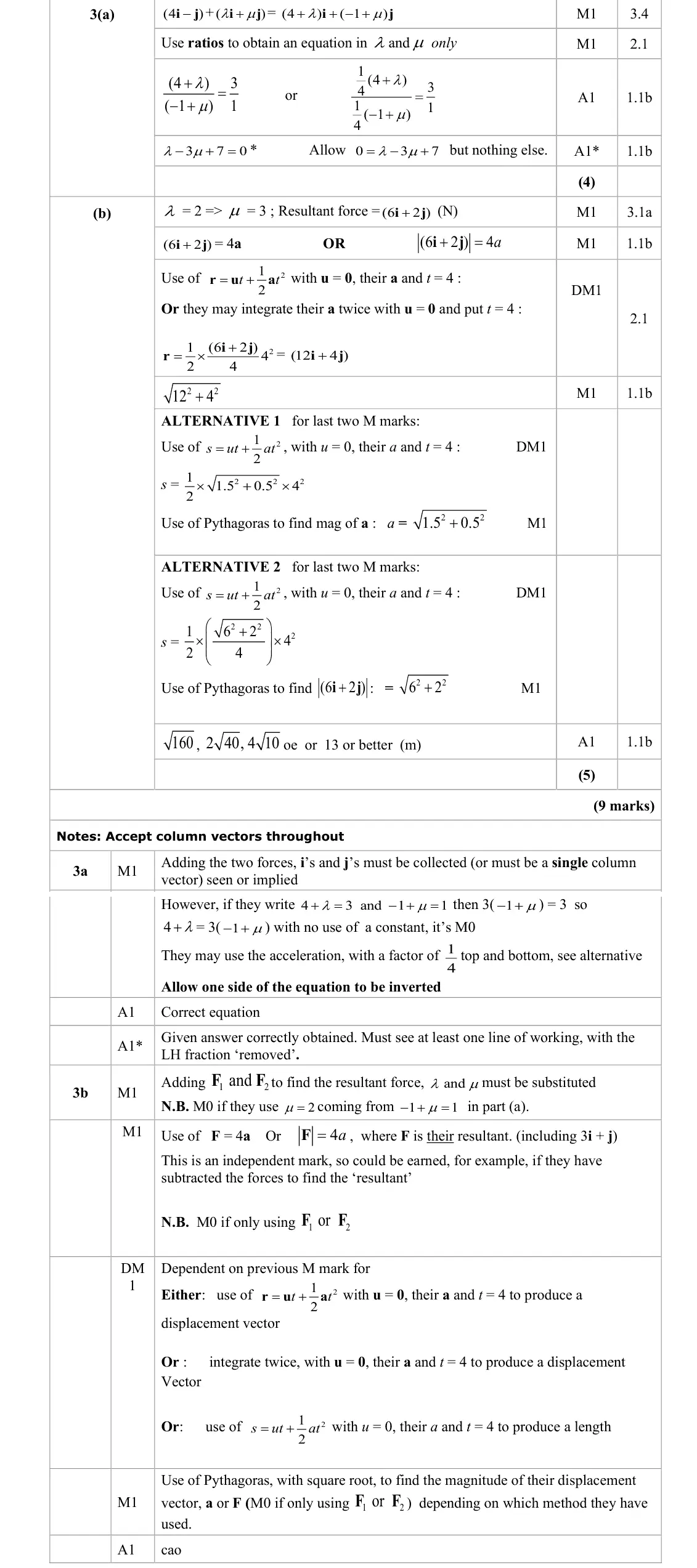
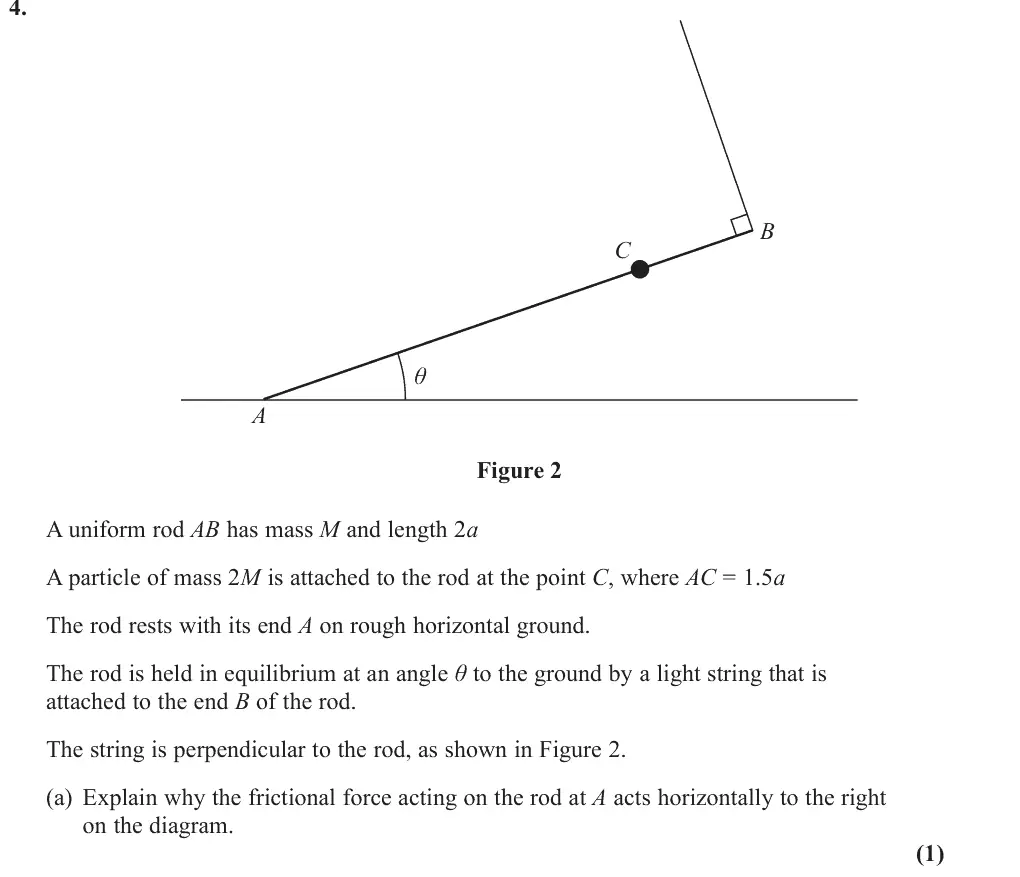
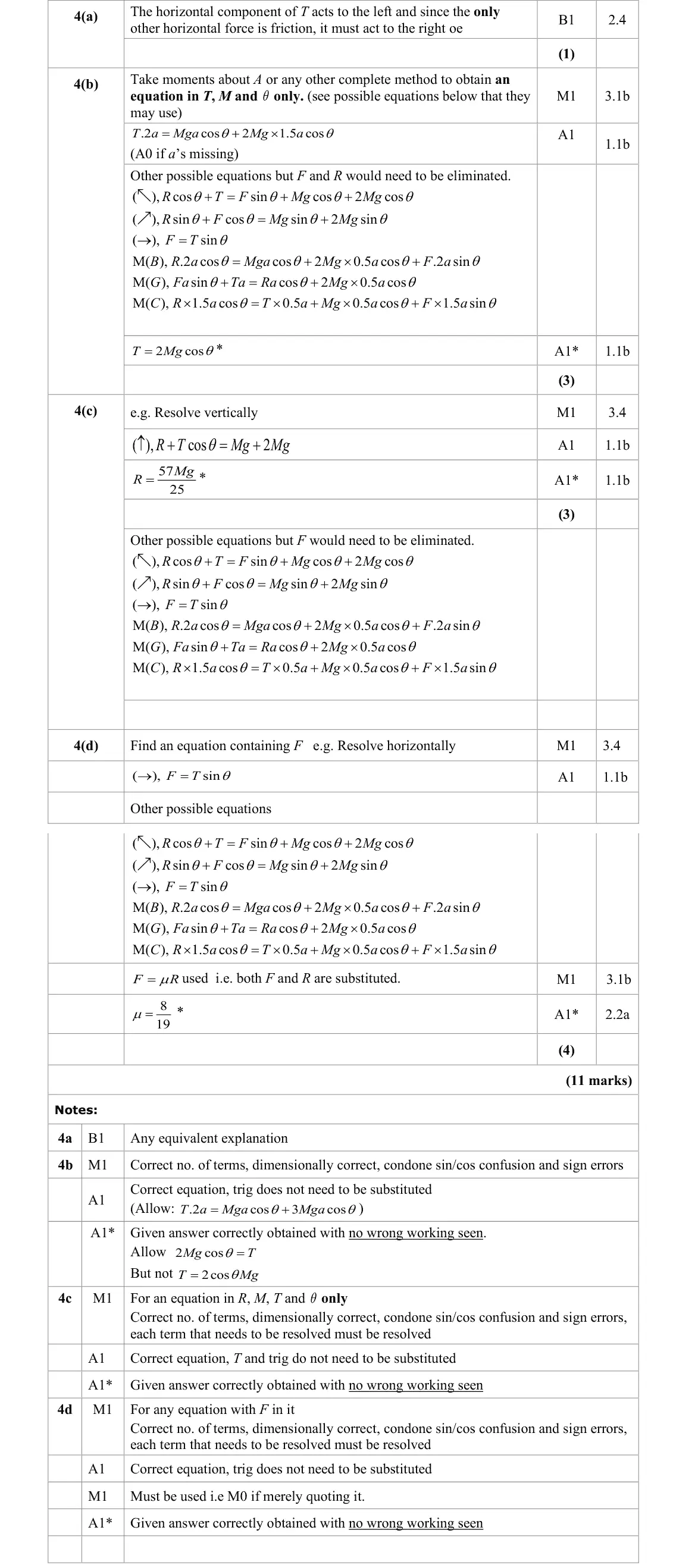


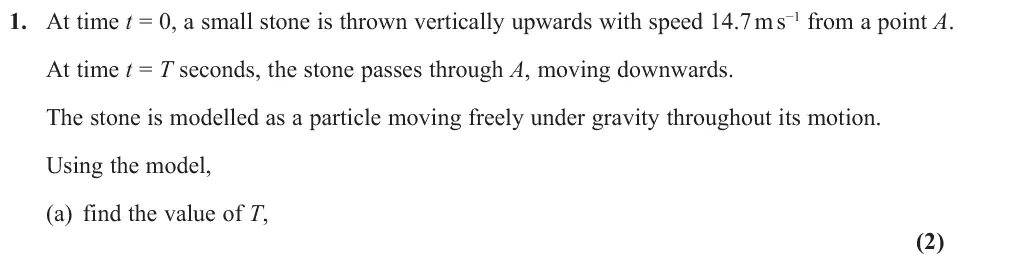
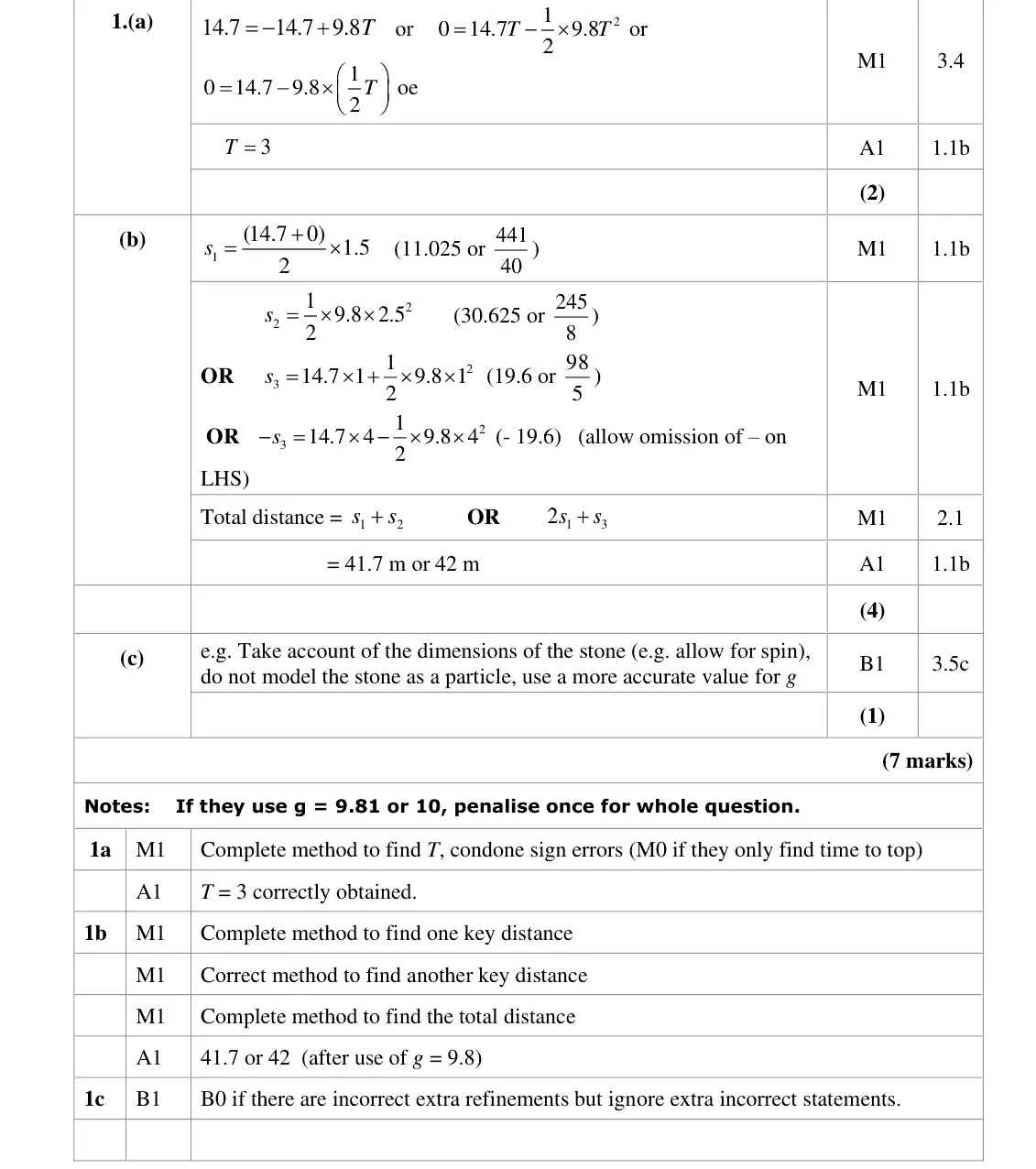


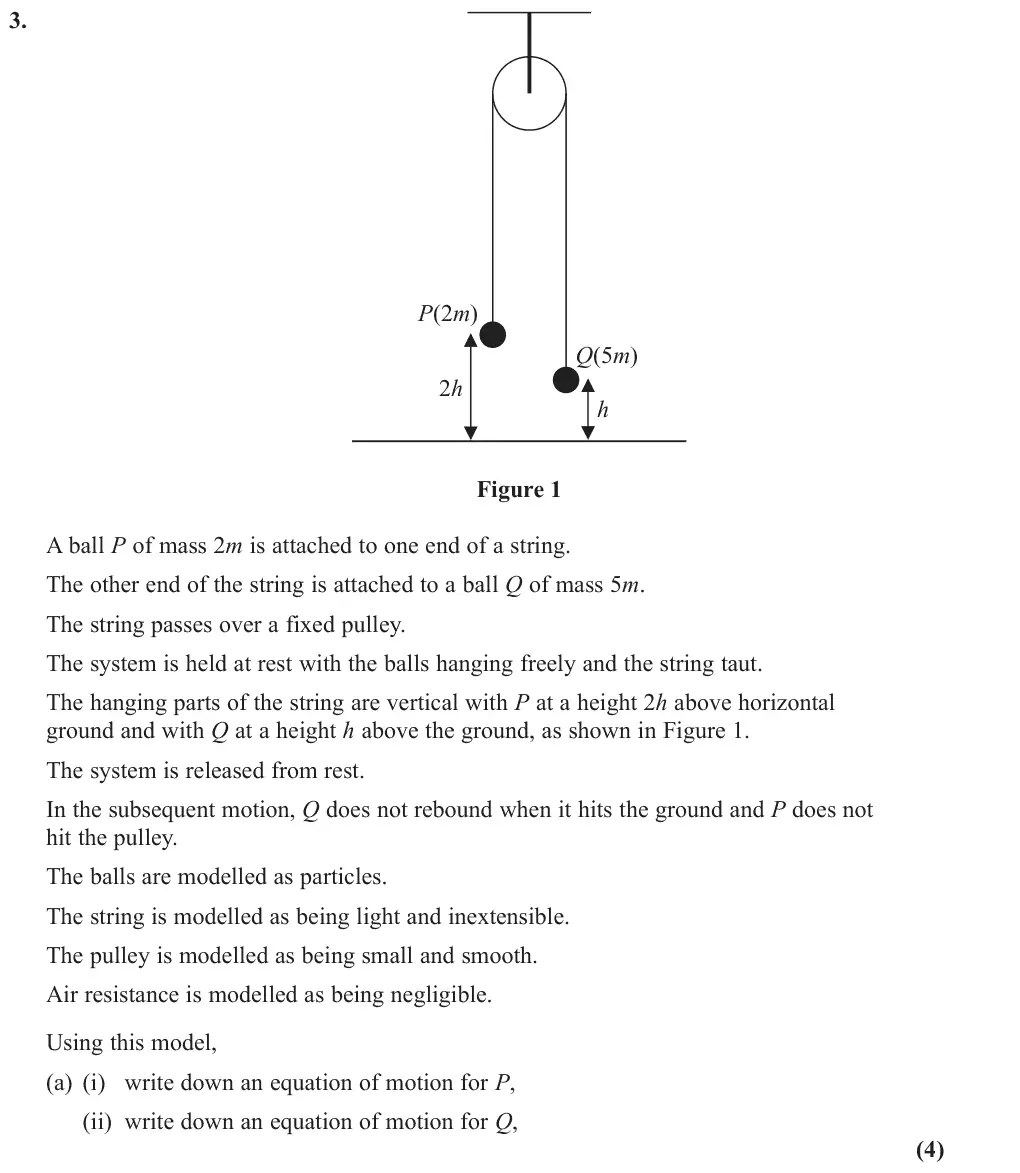
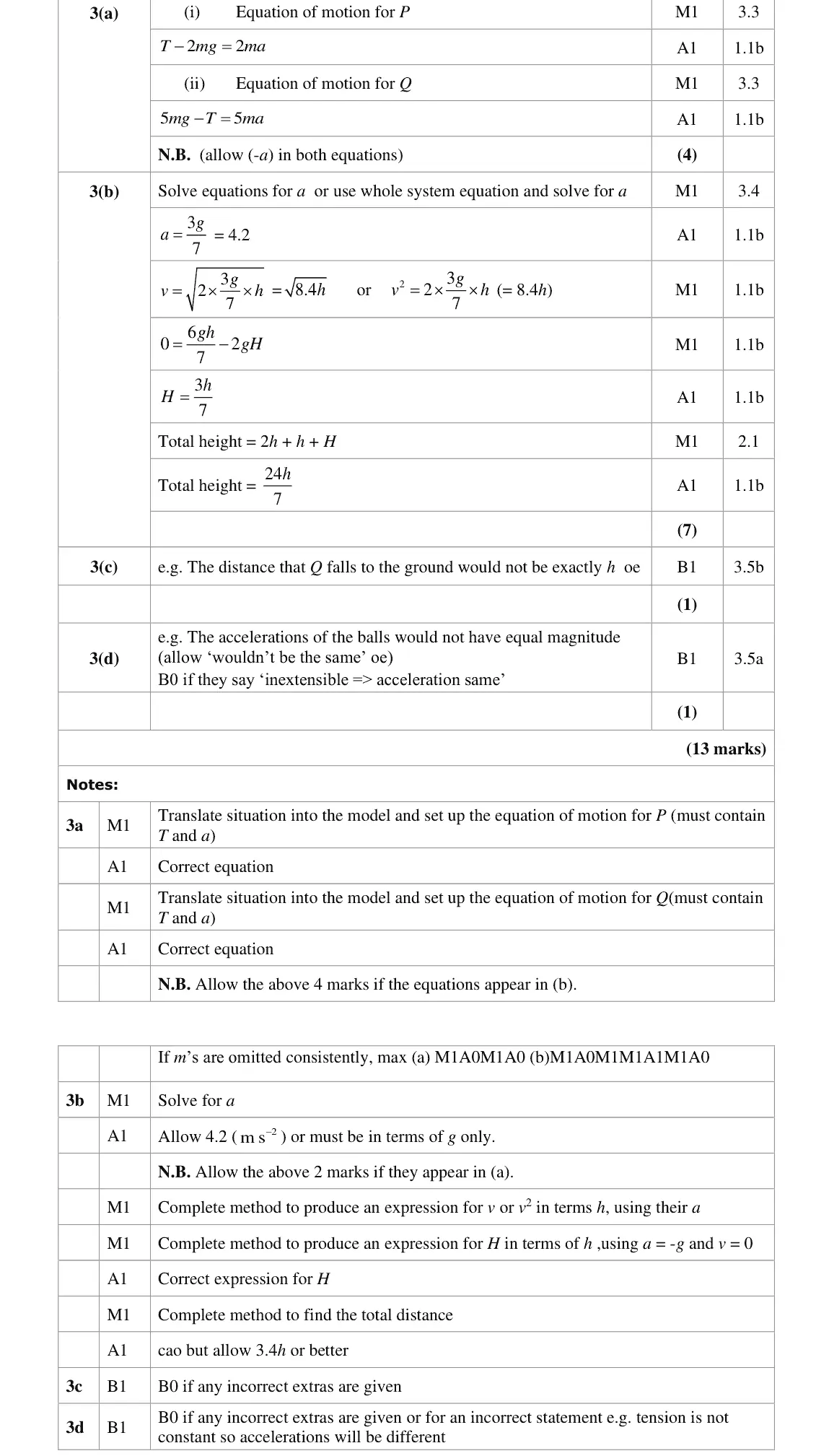



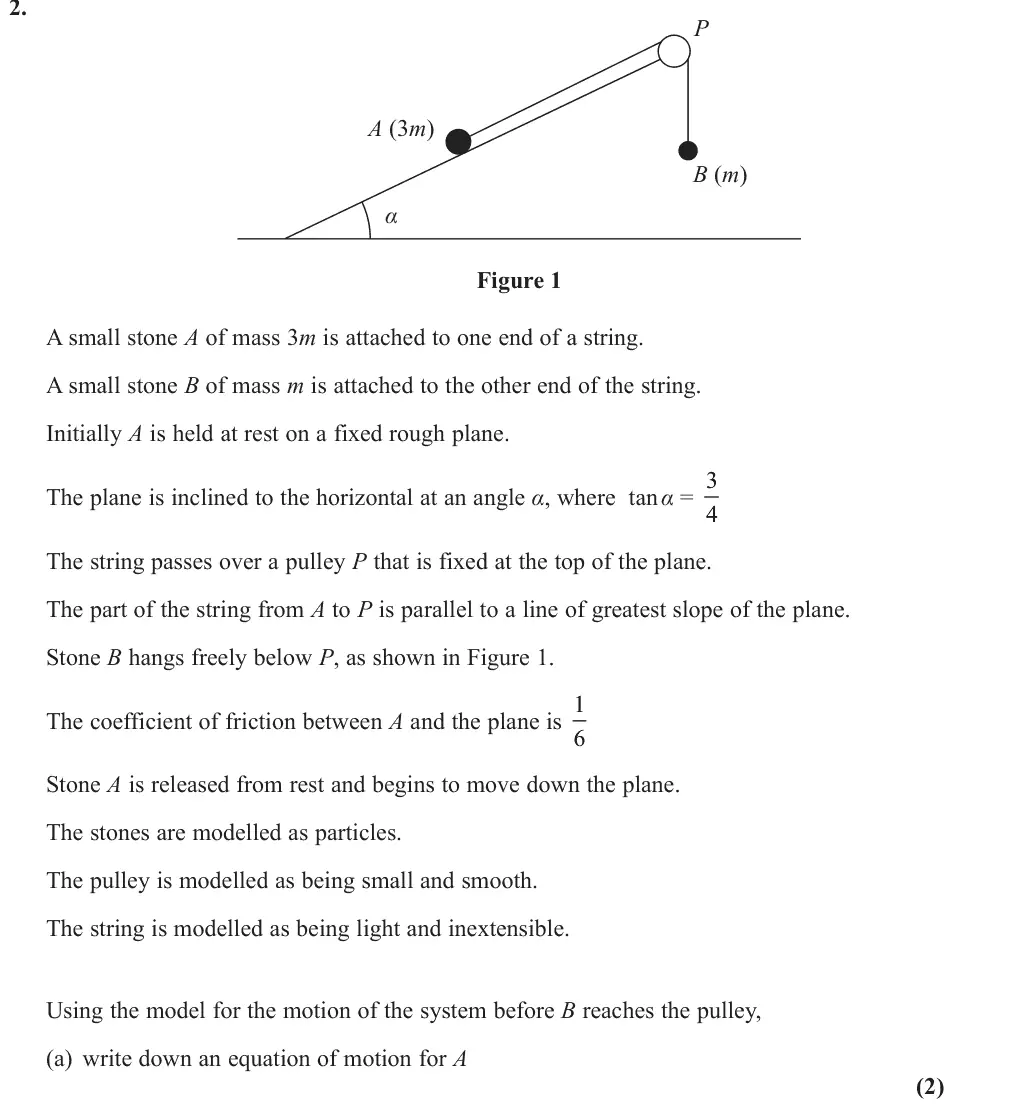
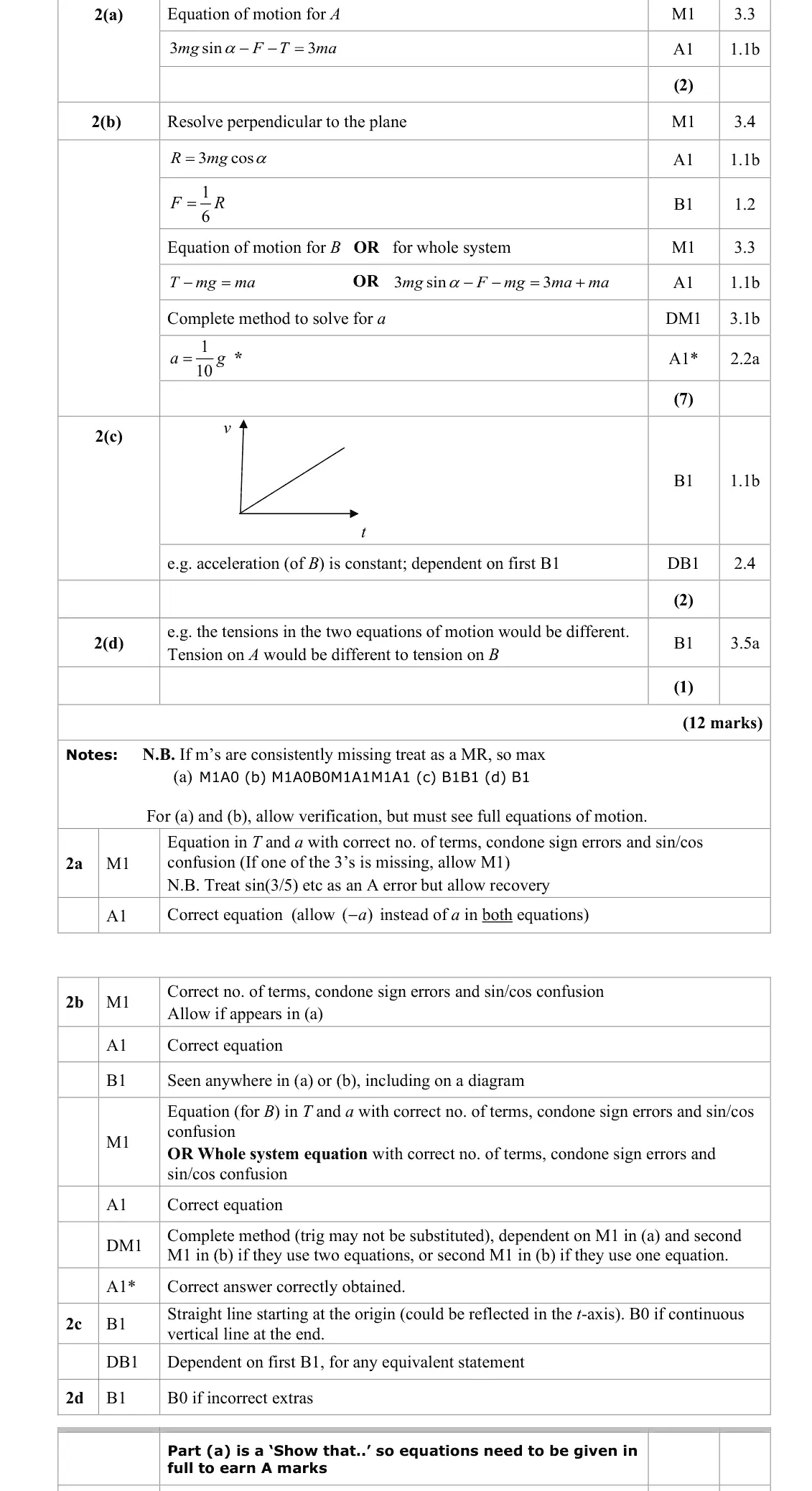



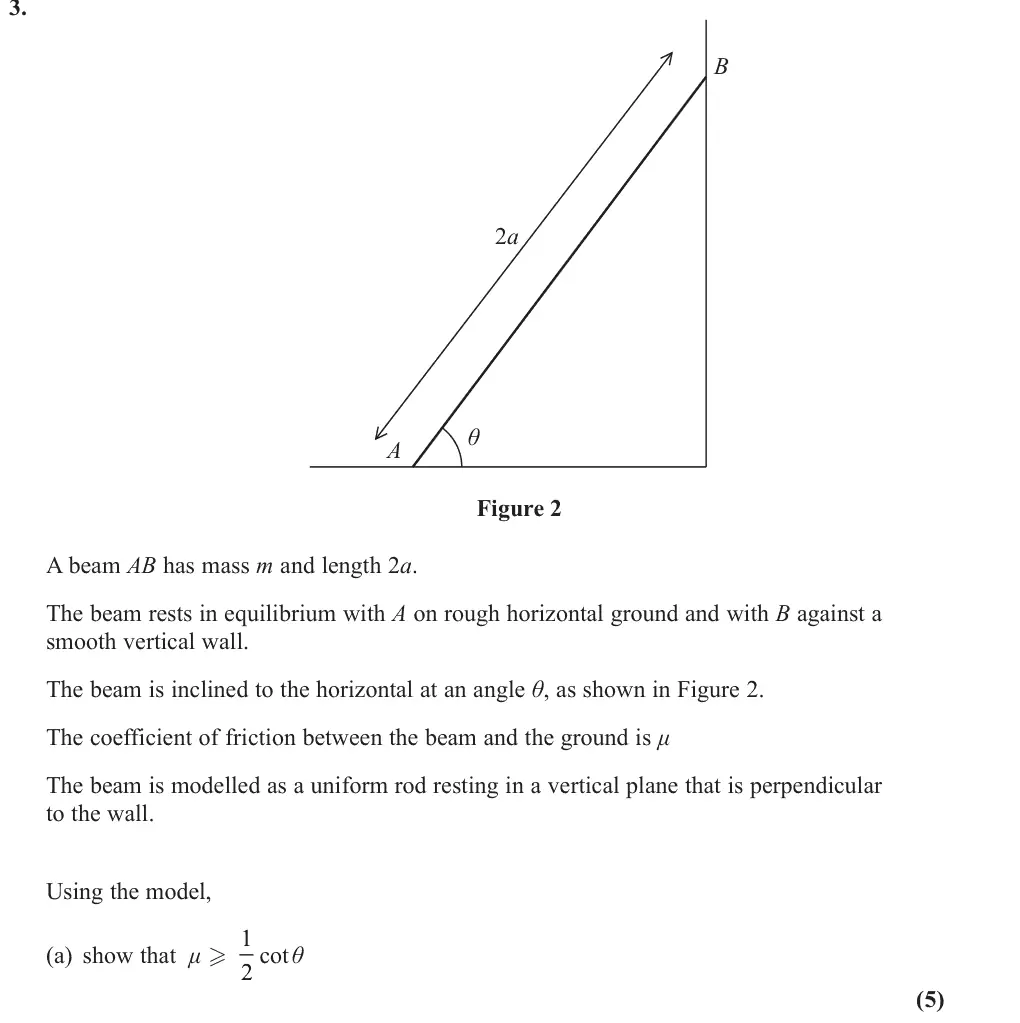
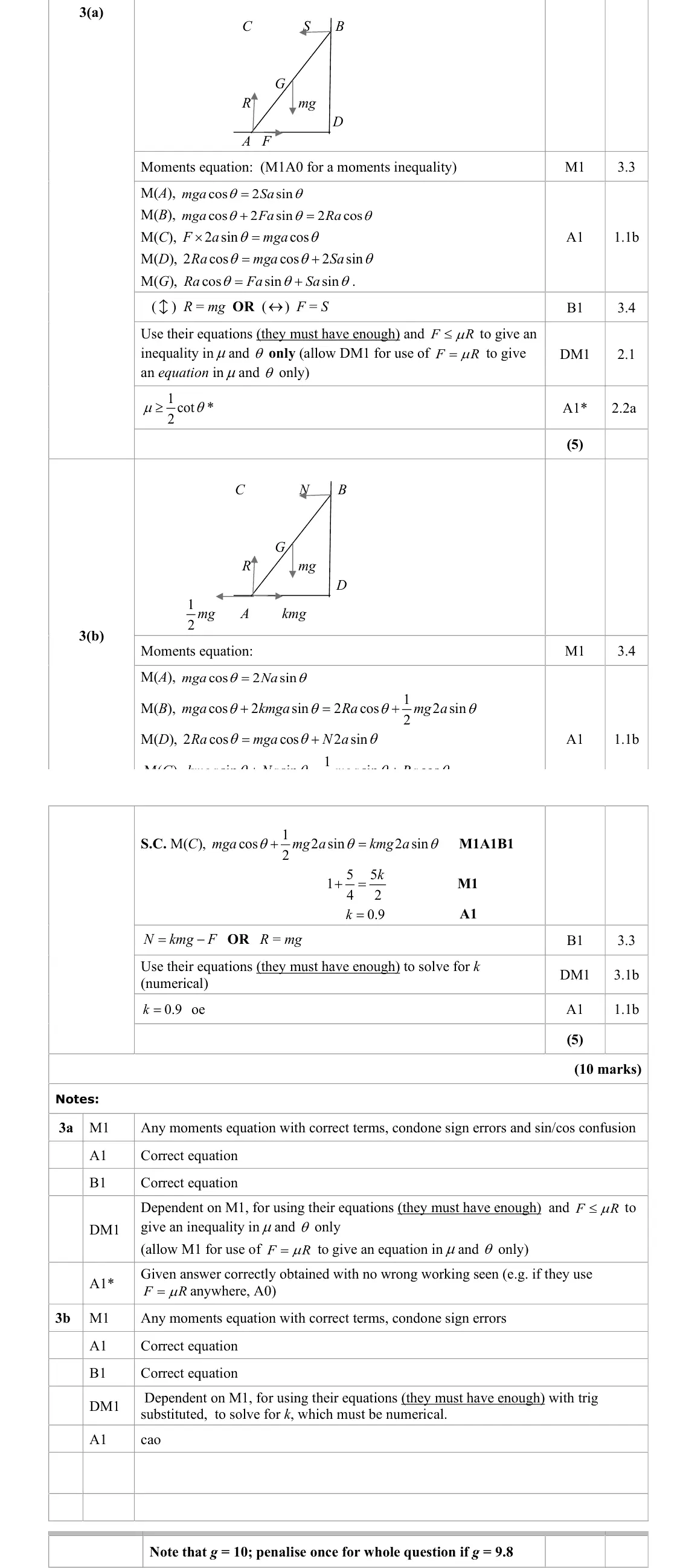
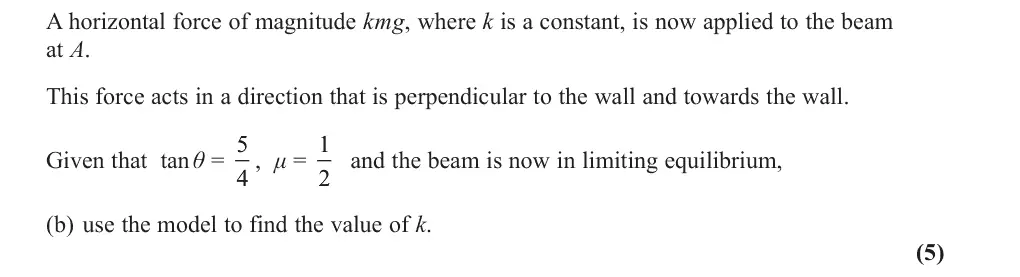

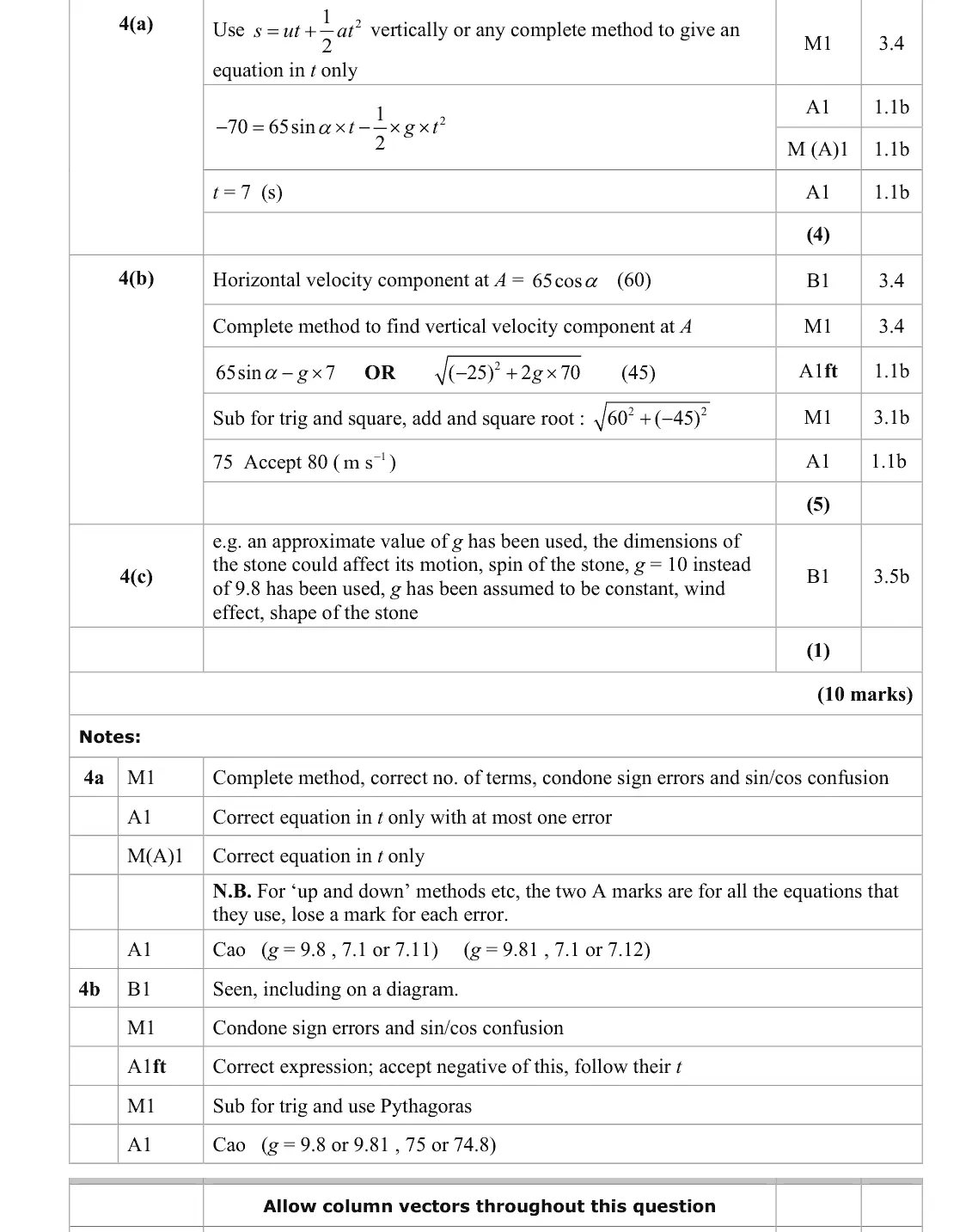
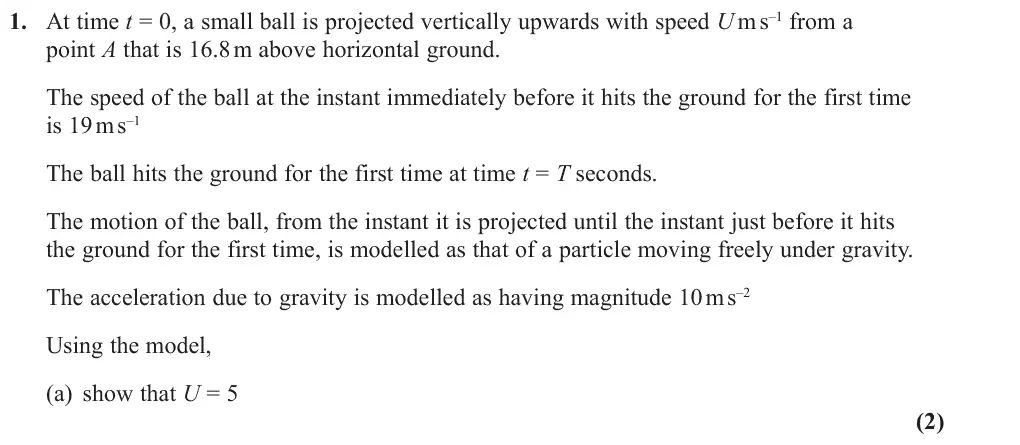
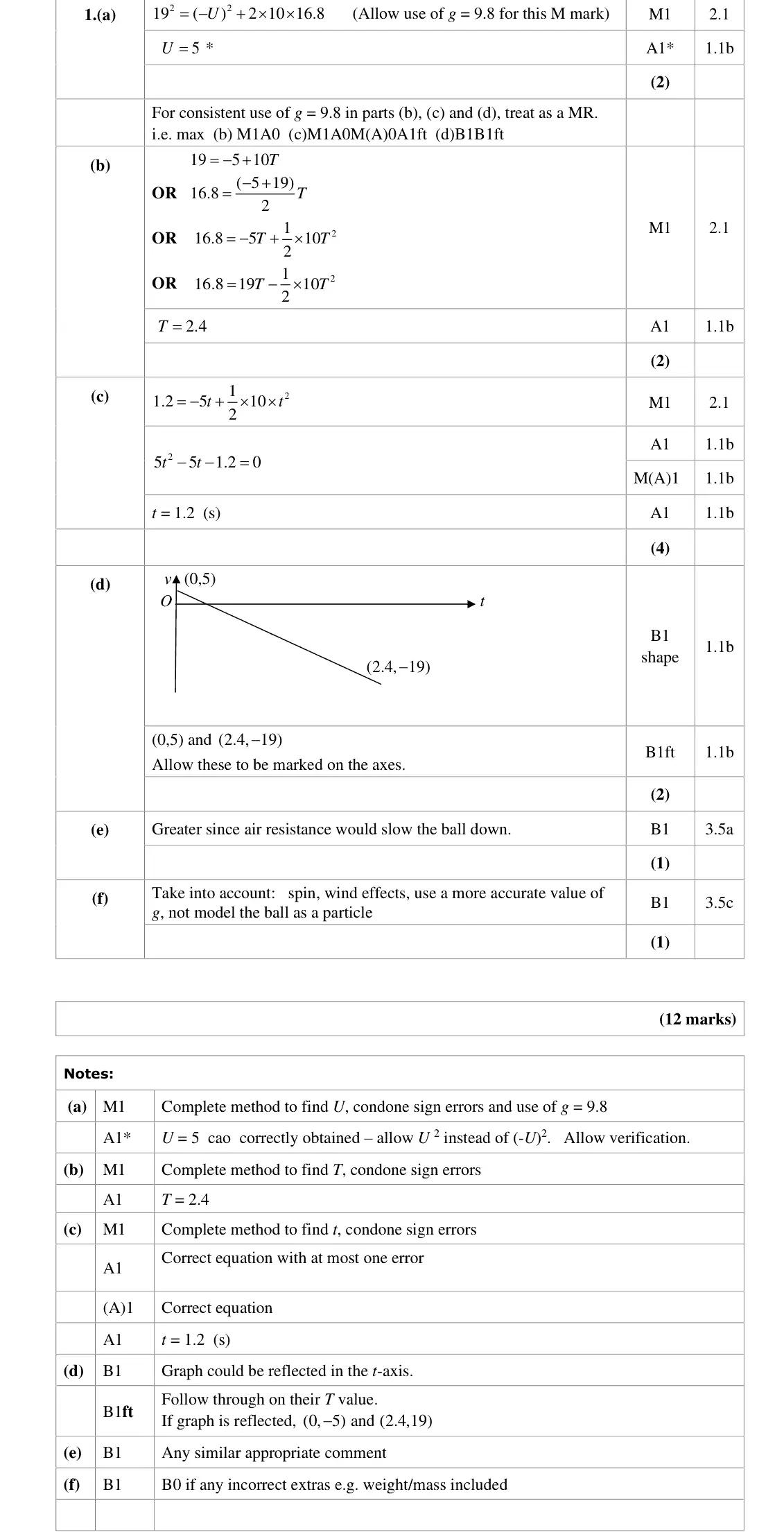


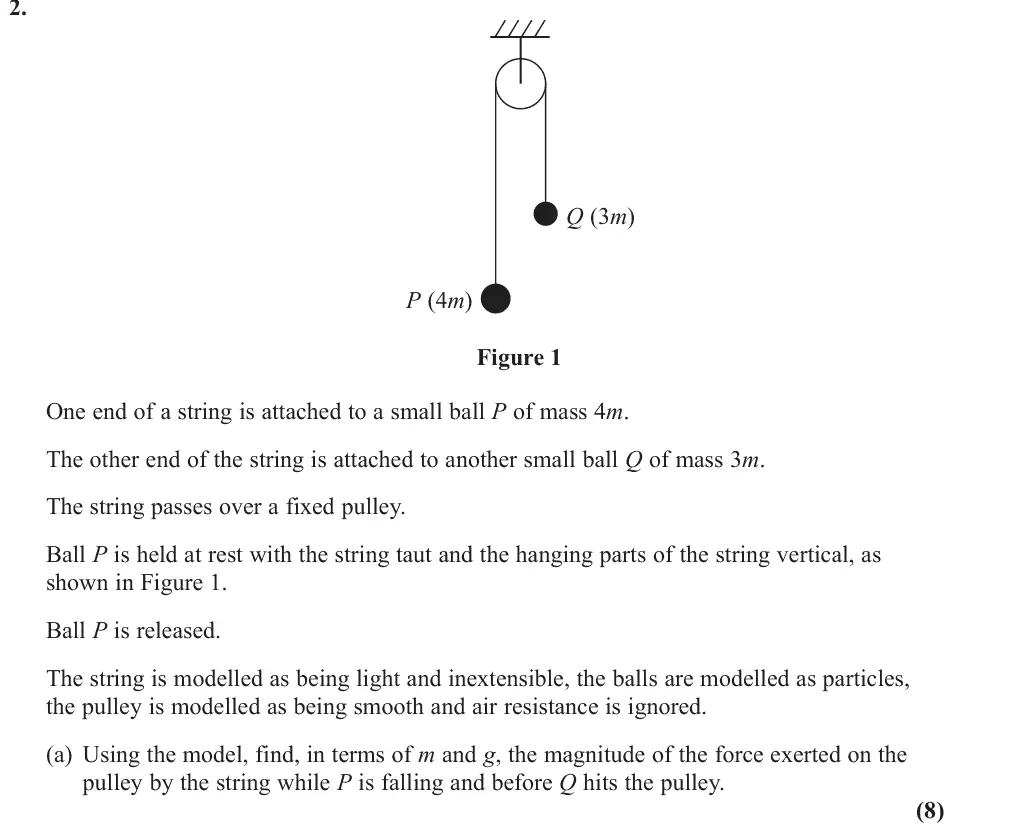
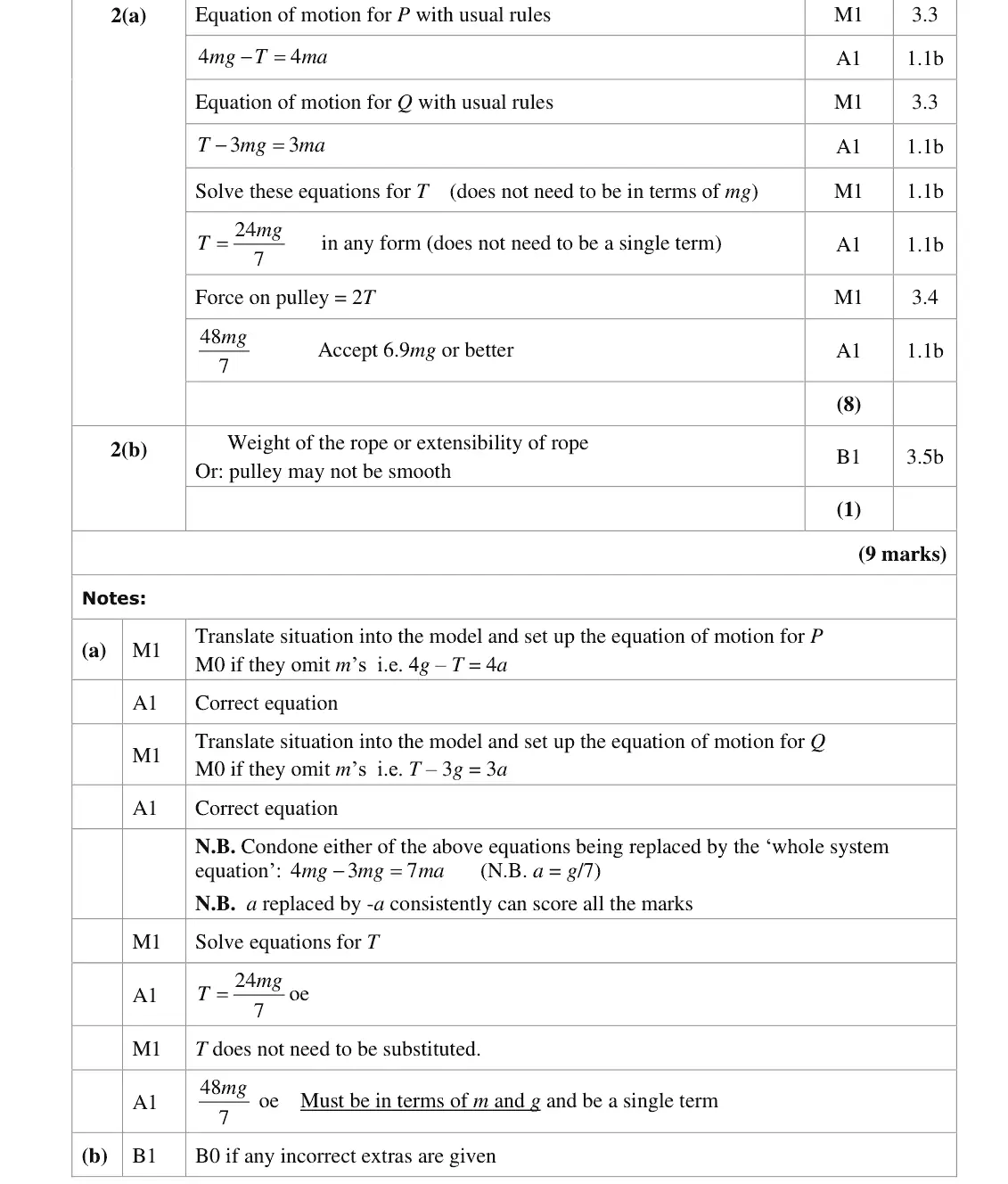

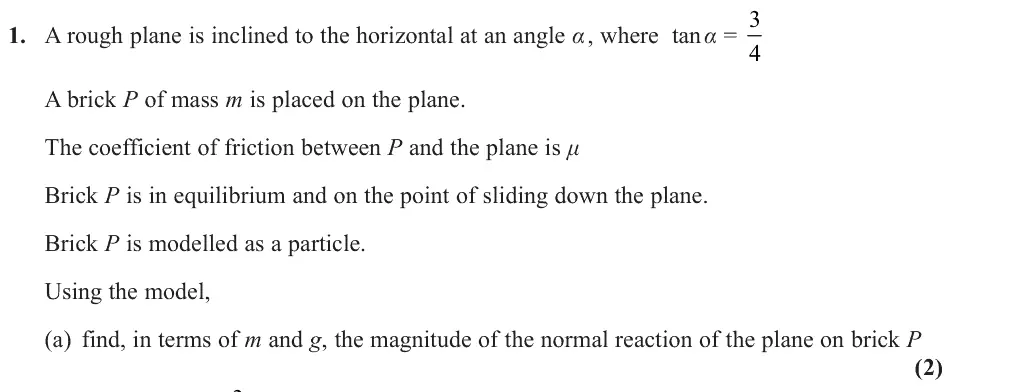
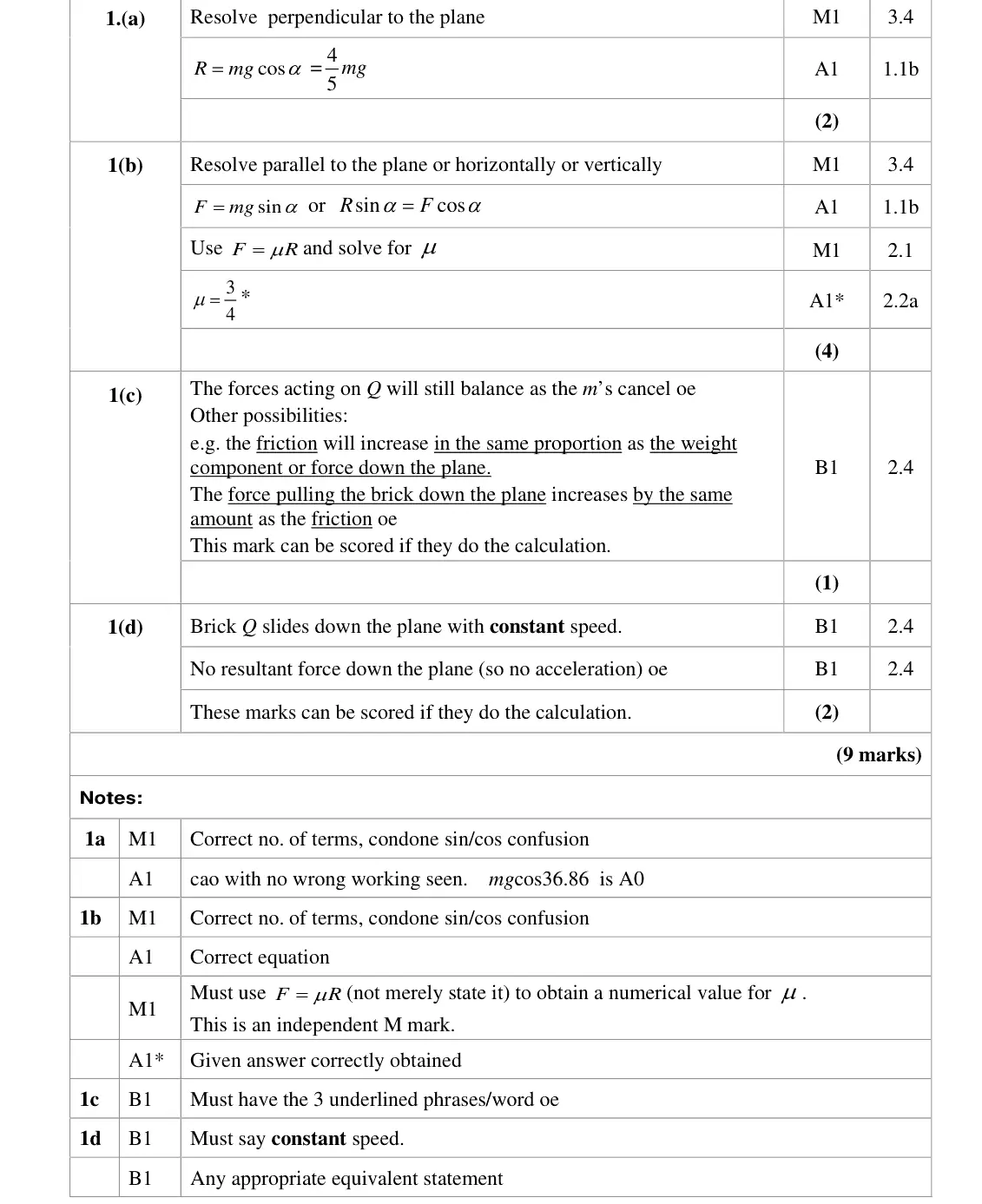

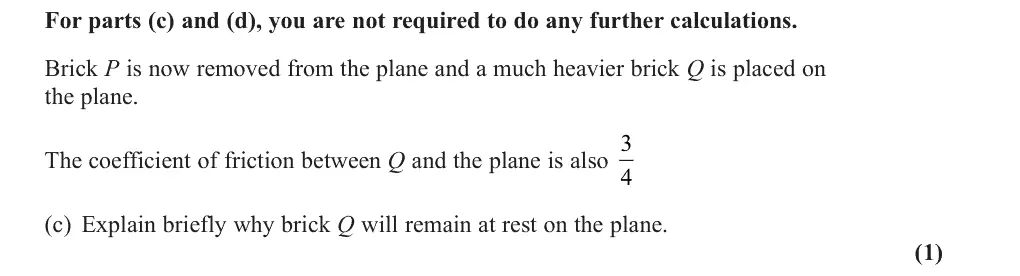
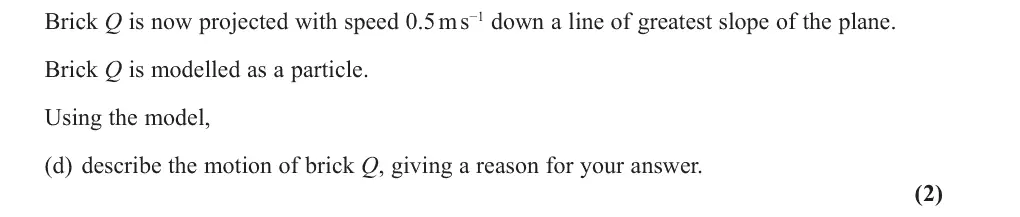

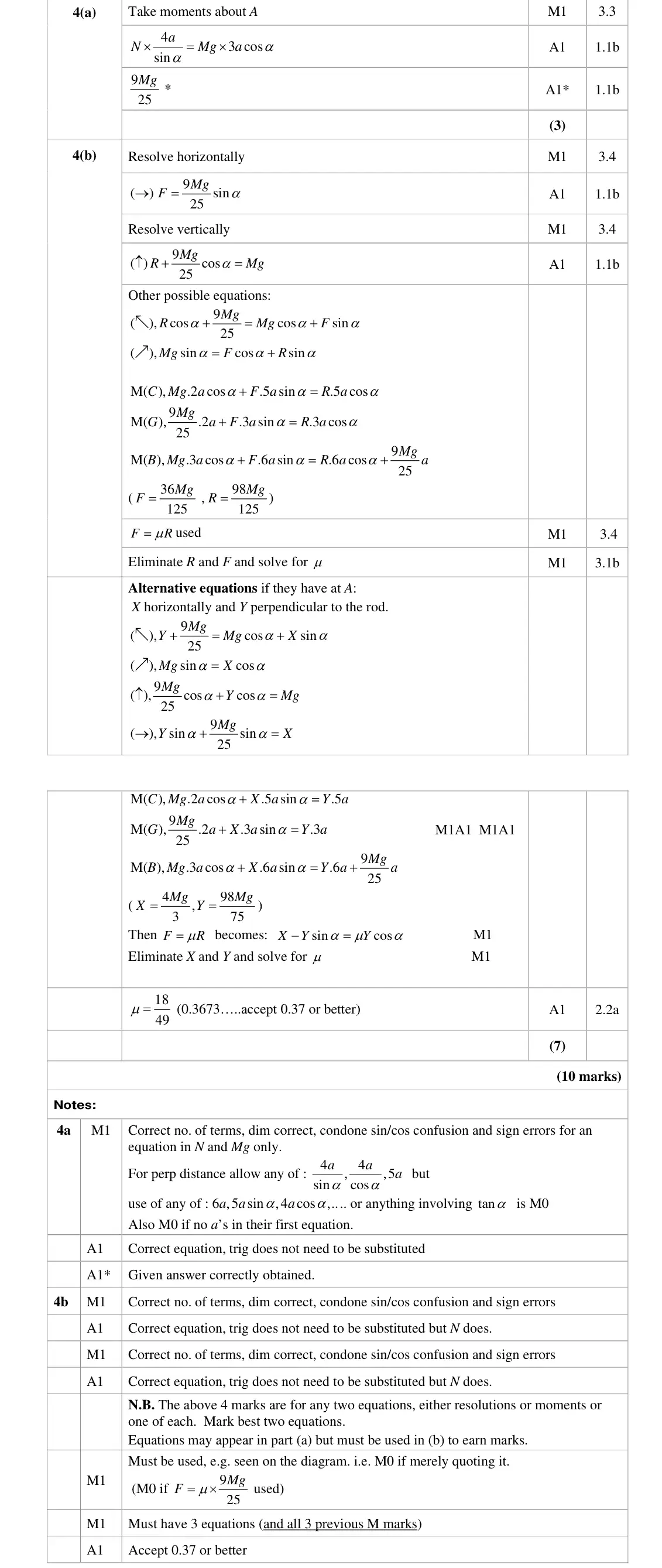
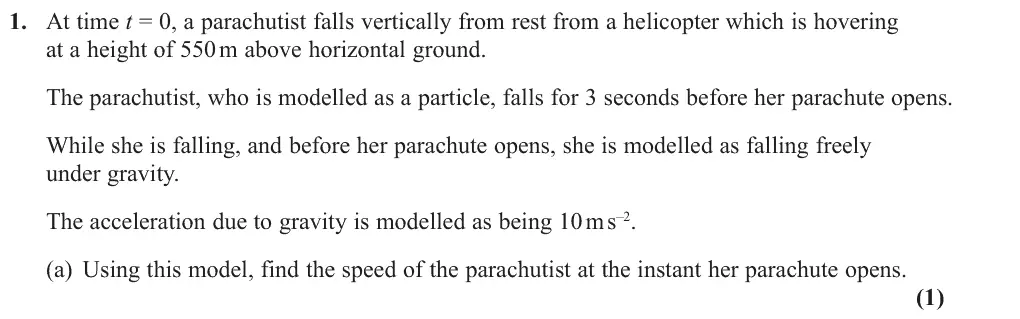
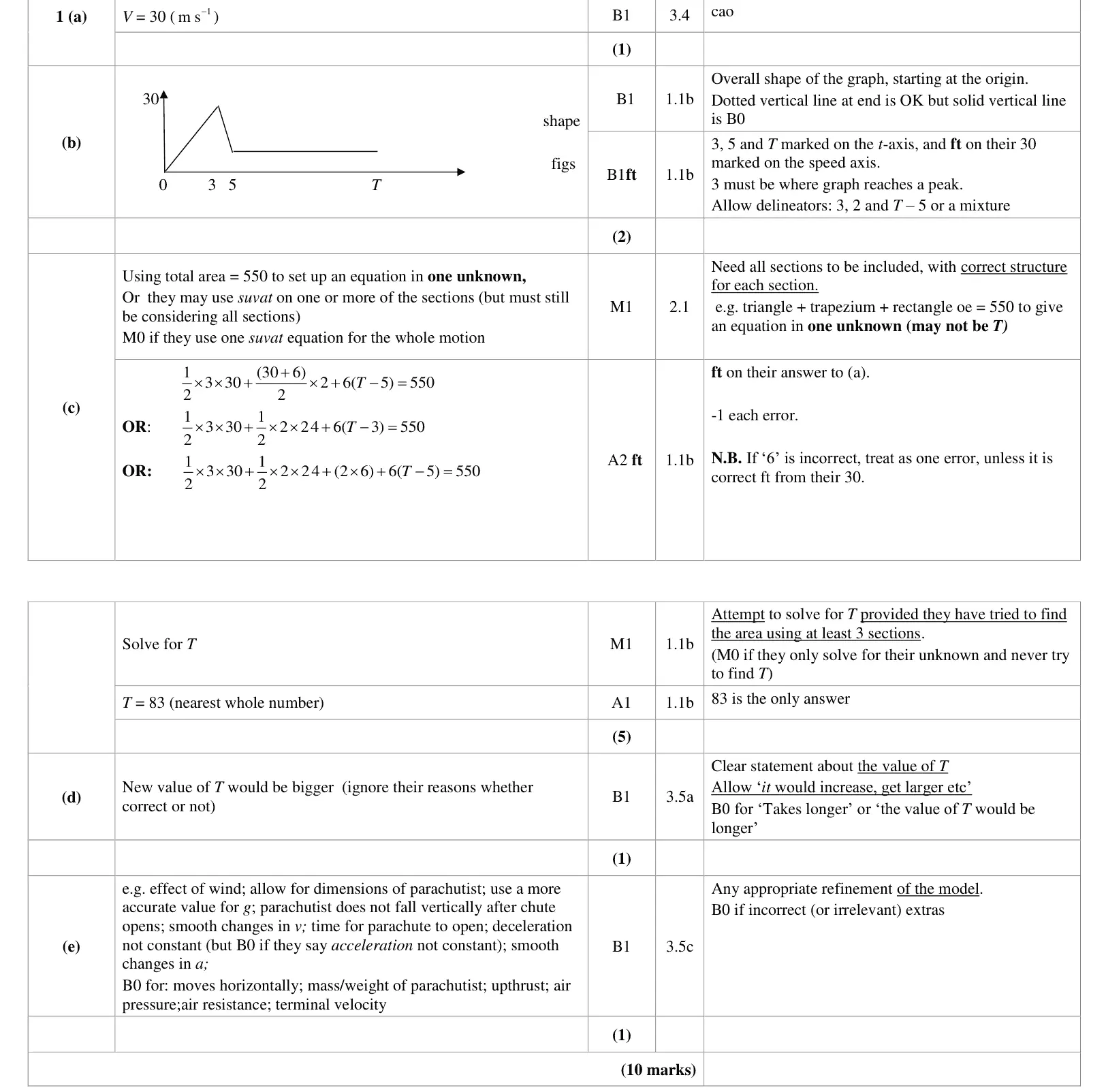


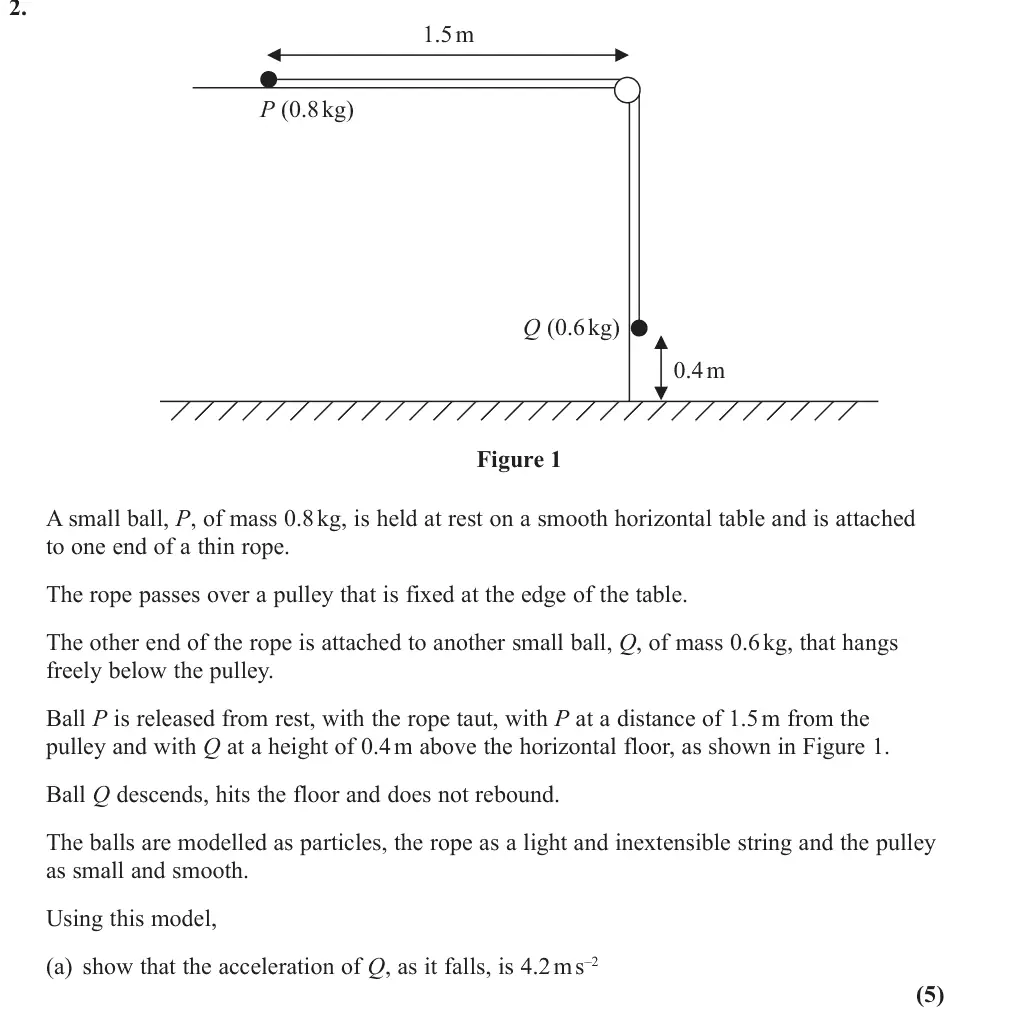
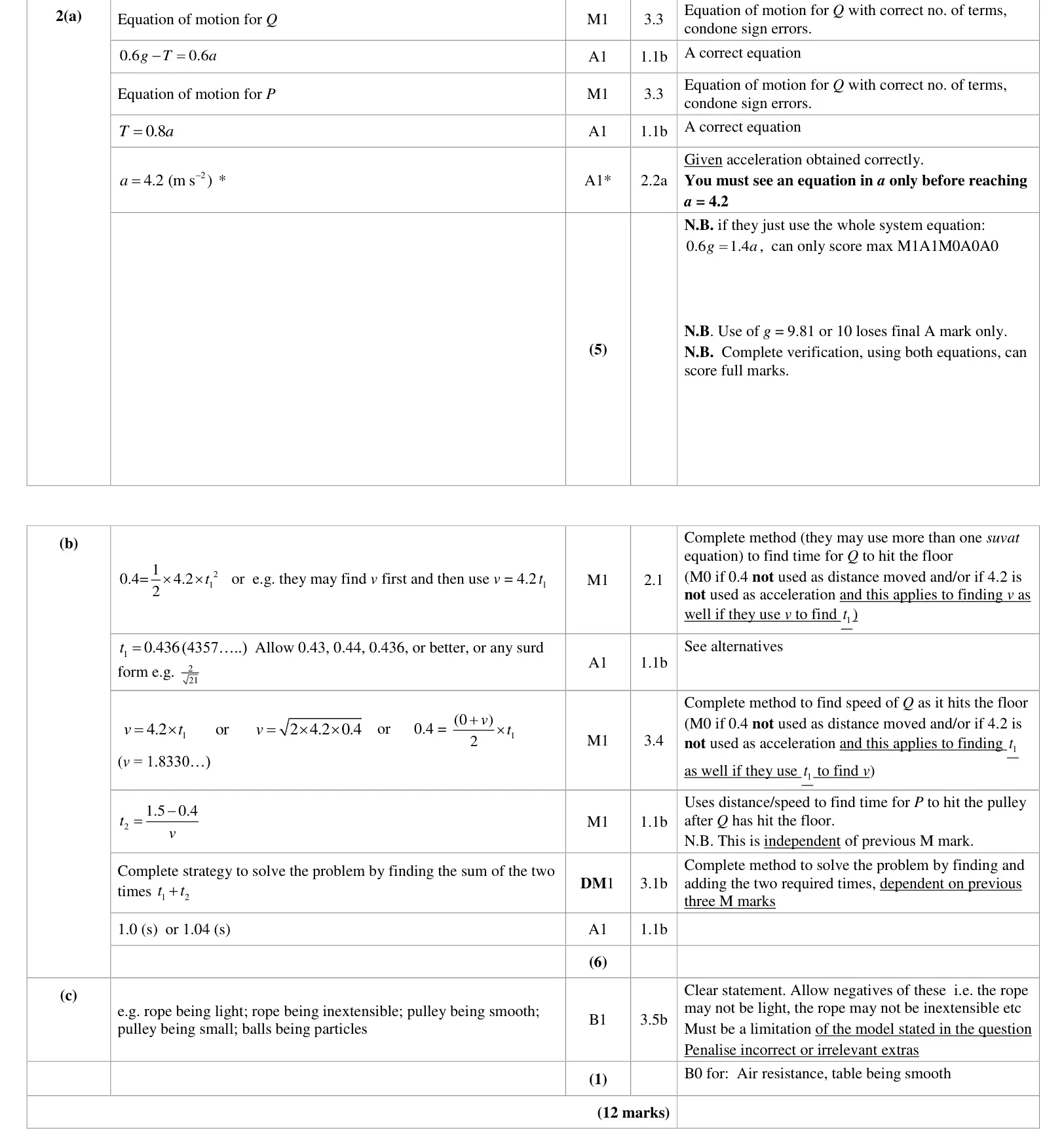


![3. P =a S A eas Bin] 8 NG ; Figure 1 Two blocks, A and B, of masses 2m and 3m respectively, are attached to the ends of a light string. Initially A is held at rest on a fixed rough plane. The plane is inclined at angle a to the horizontal ground, where tana = D The string passes over a small smooth pulley, P, fixed at the top of the plane. The part of the string from A to P is parallel to a line of greatest slope of the plane. Block B hangs freely below P, as shown in Figure 1. 5 The coefficient of friction between A and the plane is 3 The blocks are released from rest with the string taut and A moves up the plane. The tension in the string immediately after the blocks are released is 7. The blocks are modelled as particles and the string is modelled as being inextensible. 12mg (a) Show that 7 = a (8)](/img/JUN19_9MA032/JUN19_9MA032_03(a).webp)