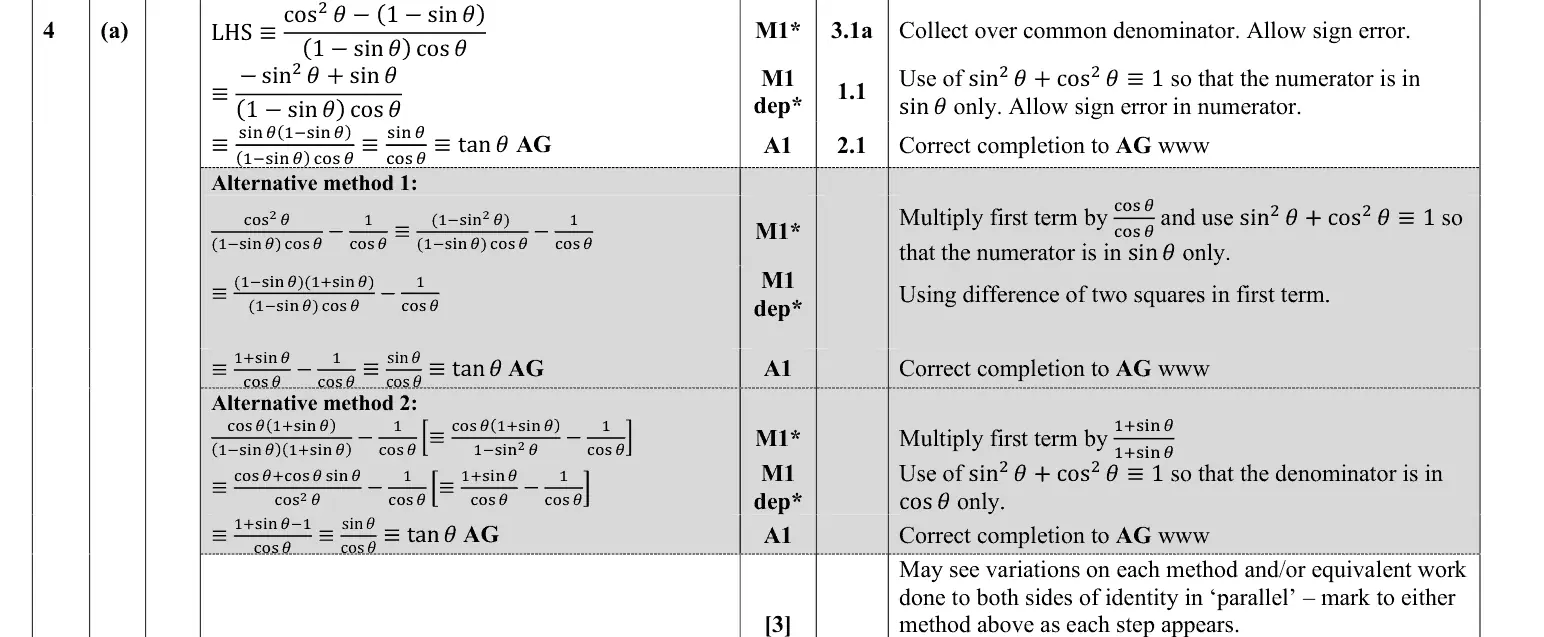
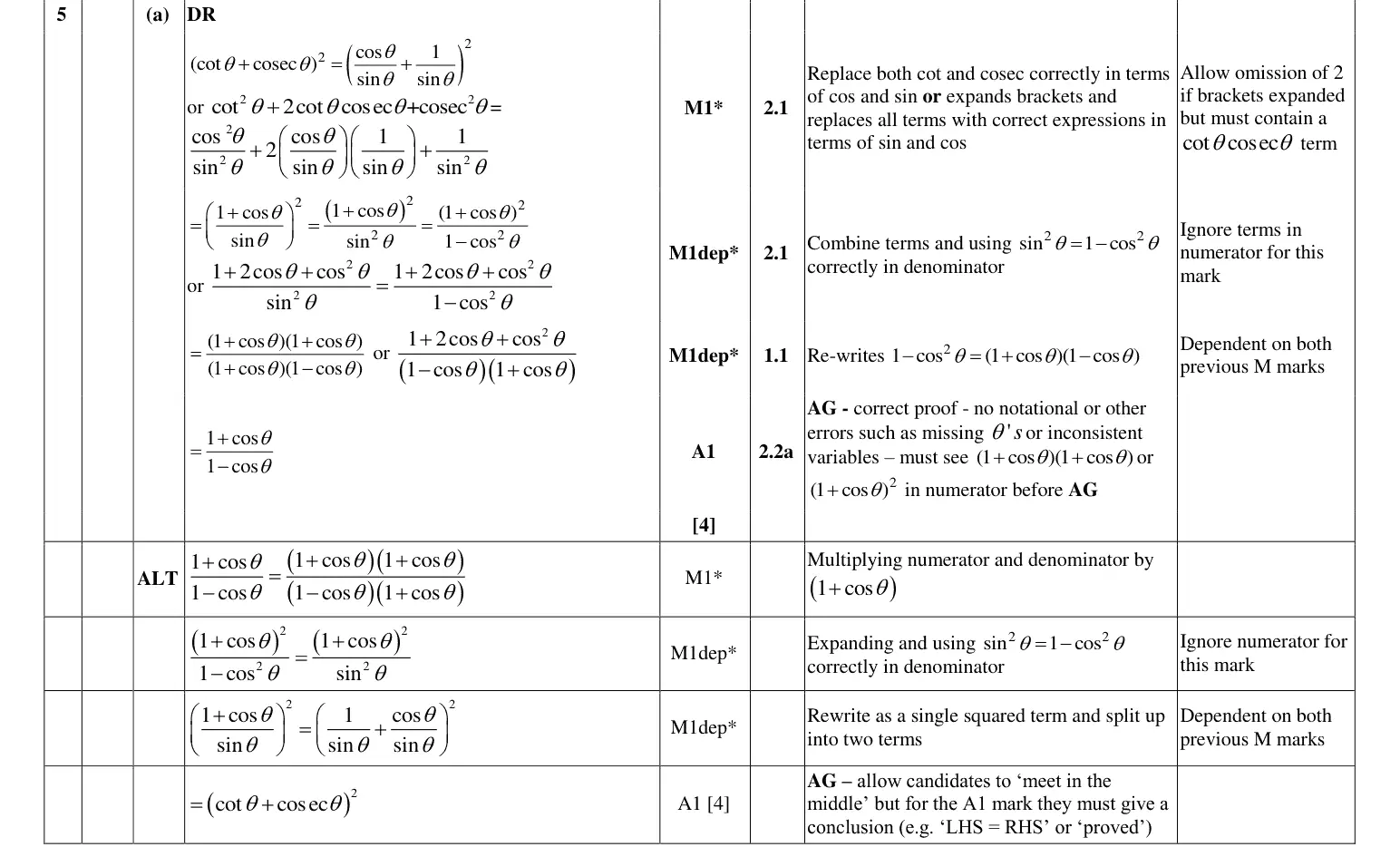
A minority of candidates made no progress with this question, offering either ‘circular’ working or misquoting identities (e.g. suggesting that sin 𝜃+ cos 𝜃= 1). Of those who did make progress, most used the main method in the scheme (combining the two terms over a common denominator) and this was generally successful. The two alternative methods were seen less often, although both provide neat routes to the answer. As is often the case, this proof required candidates to use both of the trigonometric identities on this specification. It might be helpful to remind candidates that these two identities are available to them, and that a good starting point is often looking for opportunities to use them. Some candidates attempted to combine the two fraction terms without first finding a common denominator, scoring M0M0. Candidates who attempted to ‘work backwards’ from the RHS of the given identity rarely obtained a creditable proof. This is of course an acceptable method (as is working on both sides of the identity in ‘parallel’) but candidates should be reminded to demonstrate every step of their working so that their proof is sufficiently rigorous. As is typical on these questions, an error in the working leading to the answer resulted in A0 for the final mark. This is a good response of a candidate who (after some crossed-out working on the left-hand side) obtains full marks for a correct and complete proof. All of the required working is seen, and each step is clear in the candidate’s working. This received 3/3 marks.
Key points and common errors
common denominator (1 − sin θ)cos θ
cos²θ = 1 − sin²θ gives sin θ(1 − sin θ) in the numerator
tan θ
misquoted identities or combining fractions without a common denominator
June 2025 · AS Paper 2 · Q3(b)2 marksHard
Show the start of this question
Mark scheme for this part
Examiner's comment
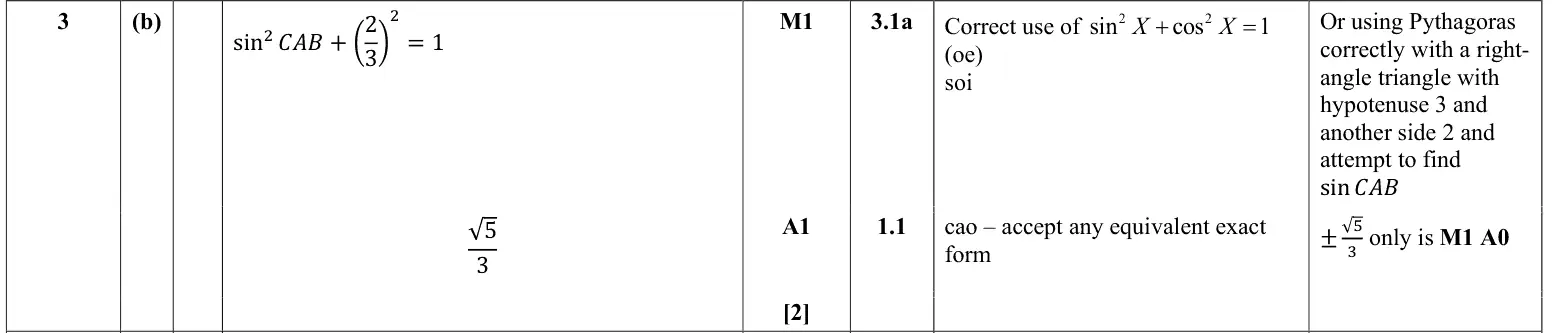
This part was found to be more challenging. Those who knew how to obtain an exact answer were generally successful. An answer of only √5/3 scored A0. Many used their calculator to obtain a decimal value, gaining no credit.
Key points and common errors
sin²A = 1 − 4/9 so sin CAB = √5/3 exact
±√5/3 or decimals from a calculator gain no answer mark
June 2025 · Paper 2 · Q4(a)2 marksEasy
Mark scheme for this part
Examiner's comment
This question asked candidates to complete two, related, trigonometric proofs. This part, the first, was more straightforward and most candidates scored both marks. Some candidates did not fully complete their proof (i.e. not fully simplifying to the RHS form given having started with the LHS of the given identity) or made errors, e.g. writing 1 + 2 sin 2𝜃. In both parts, many candidates offered working that did not constitute a clear, logical argument. The scheme allowed candidates to score marks where, to some extent, these steps had been shown in an illogical order, but candidates should be reminded that a question with the instruction ‘prove’ or ‘show that’ requires a clear, convincing argument that demonstrates the given result without any skipped steps or ‘fudges’. It is best practice, when proving an identity, to start from one side and work sequentially to demonstrate the other. Candidates may of course choose to work on ‘bits’ of an expression separately – for instance, when simplifying terms or ‘testing out’ some thinking – this is not at all discouraged but candidates should make sure that, if they choose to ‘split up’ the identity and work on part of it, that it is clear that they have done so and clear when they bring everything back together. This might be as simple as using arrows to indicate this. An increasing number of candidates choose to write down the given identity in its entirety and manipulate both sides until an ‘obvious’ result (e.g. 1=1) is reached. This is permitted (although not encouraged) and the mark scheme will generally follow ‘down’ one side and then ‘up’ the other. However, candidates who worked this way were (in both parts) more likely to omit an important step or make an error which meant their proof was not complete.
Key points and common errors
expand and use sin²θ + cos²θ = 1 and sin2θ = 2sinθcosθ
must reach the RHS
error 1 + 2sin2θ
June 2025 · Paper 2 · Q4(b)4 marksEasy
Show the start of this question
Mark scheme for this part
Examiner's comment
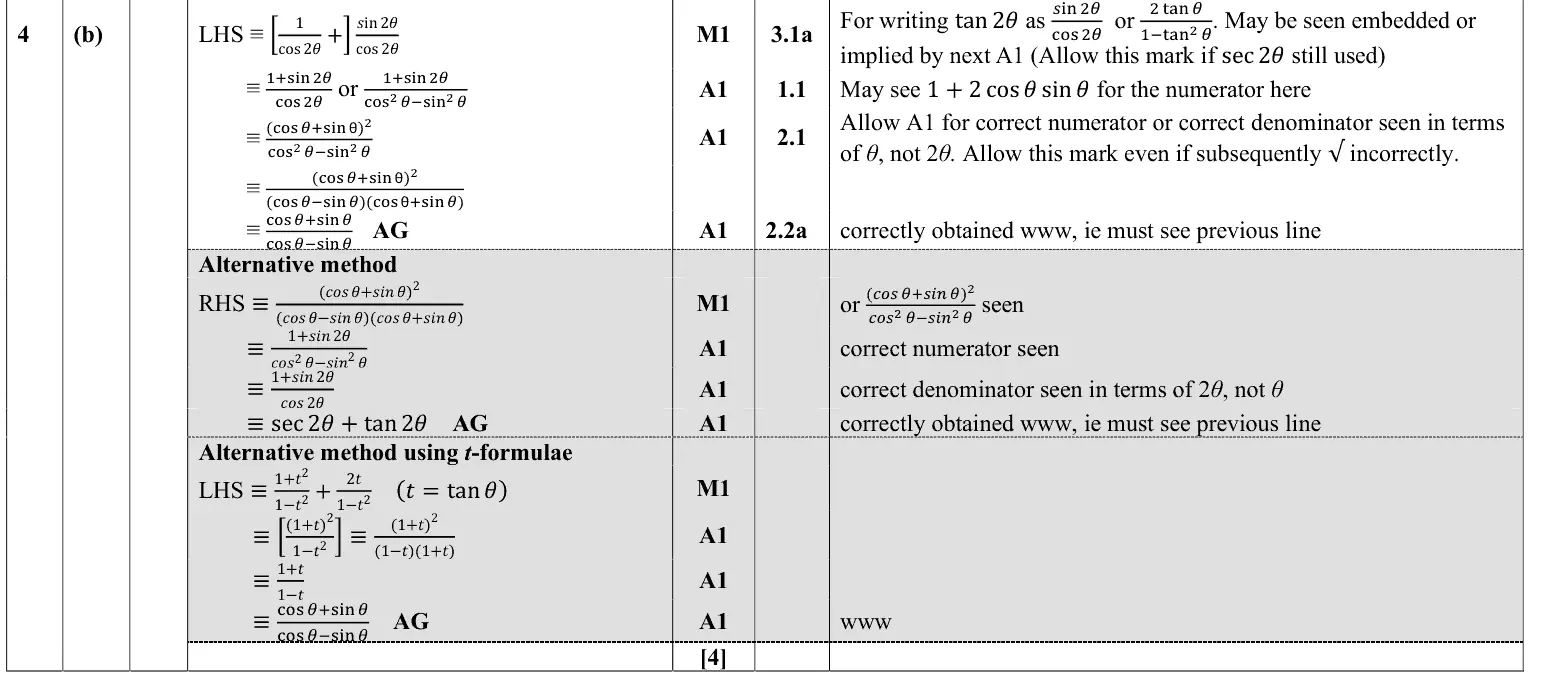
This part was also well answered by most candidates, with many scoring at least 3 of the 4 marks available. Most candidates started well, noticing that they needed to use an identity to write tan 2𝜃 in terms of sin 2𝜃 and cos 2𝜃 or to turn the statements in 2𝜃 into expressions in 𝜃 only. As noted above, some proofs were insufficiently rigorous. The scheme documents several different approaches (although others were seen and credited if correct and complete). The most common omission was not showing how (in the main method on the scheme) line 3 leads to the RHS of the given identity by factorising the denominator as a difference of two squares. The question included the instruction ‘hence or otherwise’ – most candidates identified that the identity from part (a) would be helpful although some candidates inadvertently proved this again as part of their work in this part.
Key points and common errors
write sec2θ + tan2θ as (1 + sin2θ)/cos2θ
use (a) for numerator and cos²θ − sin²θ as difference of squares
must show the factor cancelling
June 2025 · Paper 3 · Q5(a)4 marksMedium
Mark scheme for this part
Examiner's comment
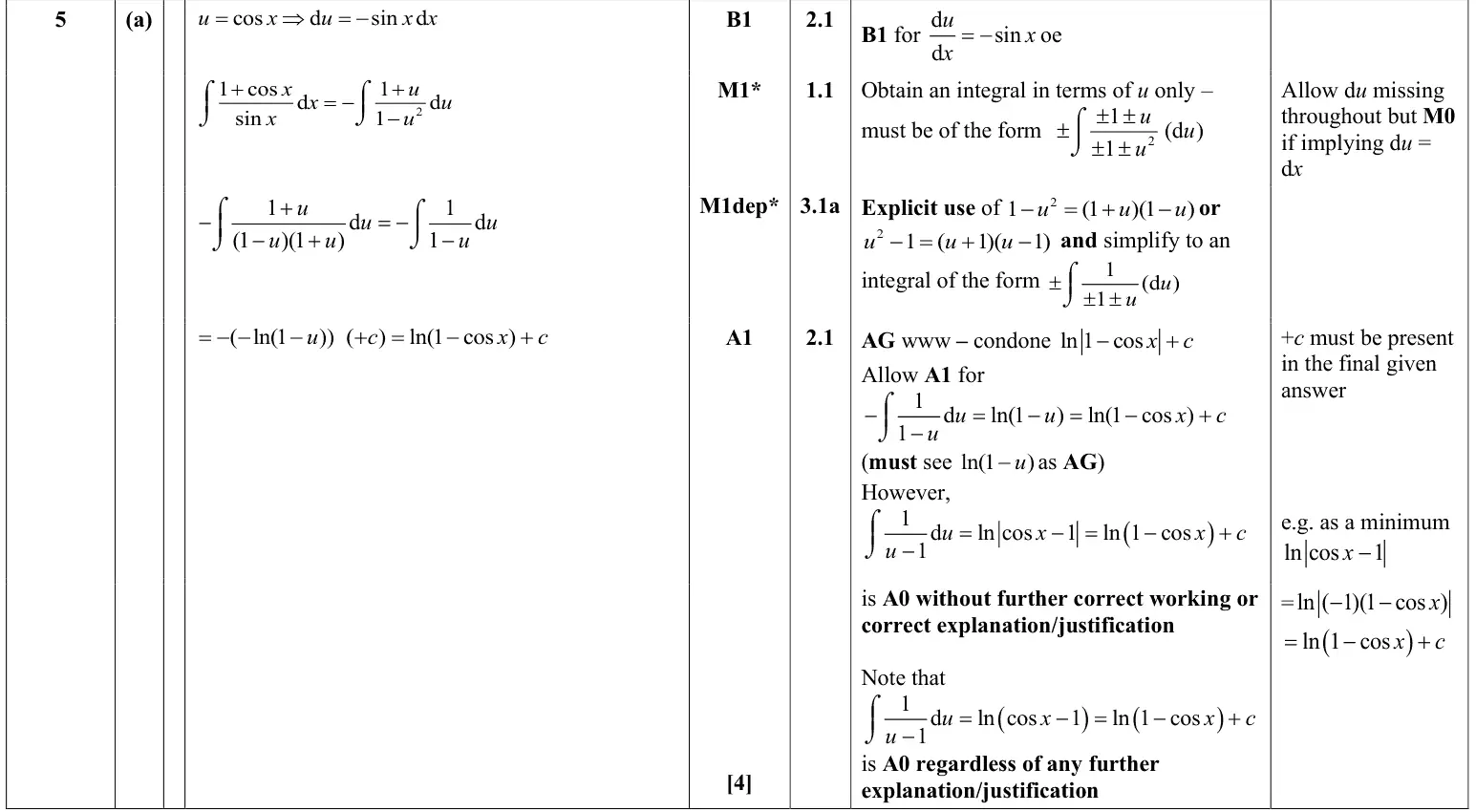
This part was answered relatively well with many candidates scoring the first 3 marks for correctly applying the given substitution and obtaining −∫ 1−𝑢d𝑢 from −∫ 1−𝑢2 d𝑢 (by using a difference of two squares). When errors occurred, they were usually down to sign errors from applying the identity sin2𝑥+ cos2𝑥= 1 when simplifying the denominator, or from incorrect differentiating cos 𝑥 as sin𝑥. Those candidates who left the integral as −∫ 1−𝑢d𝑢 were much more successful in obtaining the given answer than those who re-wrote this as ∫ 𝑢−1 d𝑢. It was common in this part for many candidates to incorrectly claim that ∫ 1−𝑢d𝑢= ln(1 −𝑢) + 𝑐. As discussed earlier, this exemplar illustrates the issues faced by candidates if they re-wrote the integral as ∫ 𝑢−1 d𝑢. It was not acceptable to simply replace |ln(cos 𝑥−1)| + 𝑐 with the given answer without some comment of why it was appropriate to do so.
Key points and common errors
du = −sin x dx
−∫(1 + u)/(1 − u²) du = −∫1/(1 − u) du via difference of two squares
ln(1 − cos x) + c
sign errors from sin²x = 1 − cos²x
June 2024 · AS Paper 1 · Q35 marksHard
Mark scheme for this part
Examiner's comment
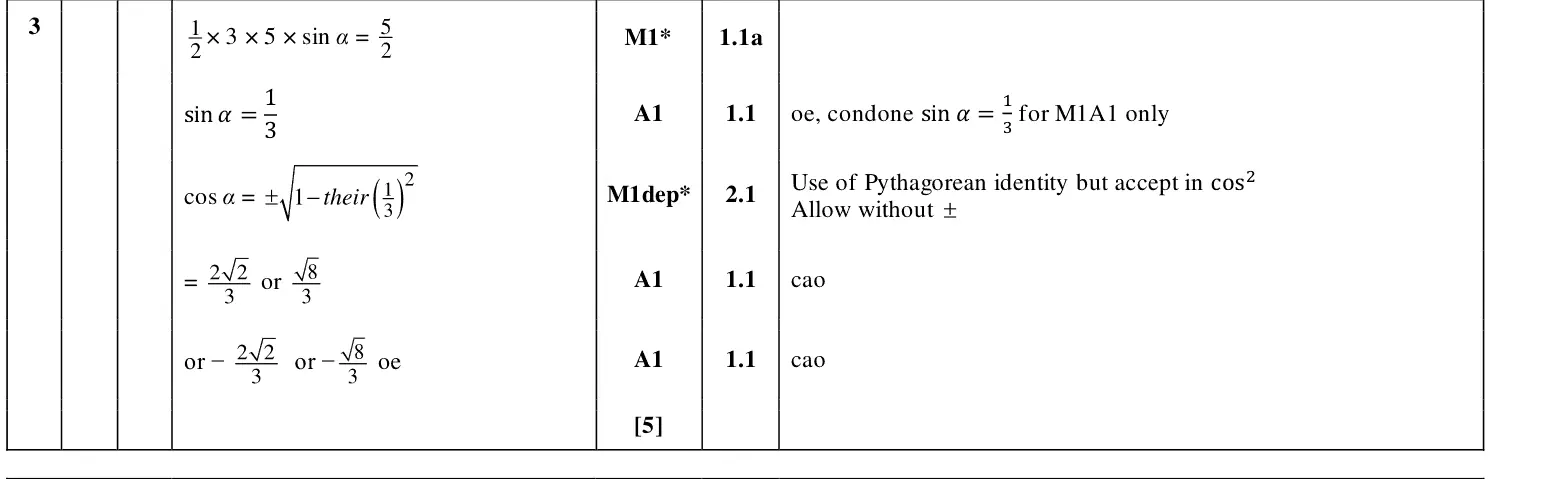
2 𝑎𝑎𝑎𝑎sin𝐶𝐶 to form an equation in alpha, although some The majority of candidates correctly applied both common). Of those who had the equation correct, most reached the equation sin𝛼𝛼= candidates made errors when recalling this formula (writing cos instead of sin, or omitting the ½ were 3 but very few proceeded correctly beyond this point. Noting that the instruction on this question was ‘Determine’ and their calculator to find an (inexact) value for cos (sin−1 ቀ 3ቁ). Some candidates used a triangle with that exact answers were required, none of the final three marks could be given to candidates who used opposite side 1 and hypotenuse 3 to correctly deduce the required answer. This is a typical example of a candidate who has completed the first few steps in the working correctly, but then uses their calculator to obtain an inexact pair of values, scoring M0A0A0 for the final three marks.
Key points and common errors
½ × 3 × 5 sin α = 5/2 so sin α = ⅓
cos α = ±√(1 − 1/9) = ±2√2/3 (acute and obtuse)
very few progressed beyond sin α
exact working required
June 2024 · Paper 1 · Q11(c)(i)5 marksMedium
Show the start of this question
Mark scheme for this part
Examiner's comment
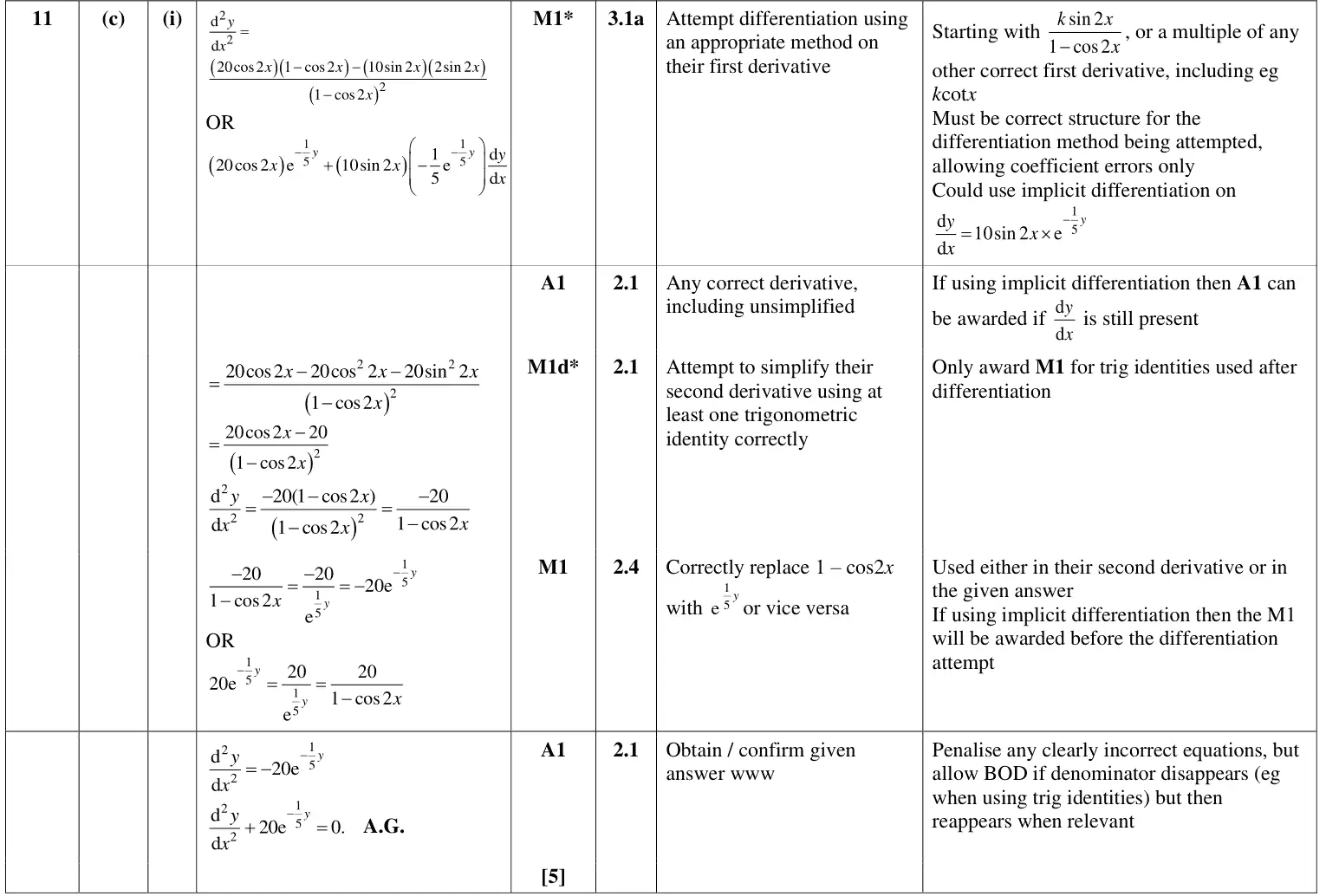
The attempts at the second derivative were very good when a correct first derivative had been obtained in part (b). The majority used the quotient rule rather than the product rule, the latter of which proved trickier for candidates to manipulate correctly to secure full marks. With a given answer, there is an expectation that method is clearly shown, and many candidates were able to simplify their second derivative by using a trigonometric identity but often struggled to obtain a fully correct solution. Those who struggled with part (b) often did not make progress with this part.
Key points and common errors
quotient rule on 10sin2x/(1 − cos2x)
simplify with sin² + cos² = 1 to −20/(1 − cos2x)
replace 1 − cos2x by e^(y/5)
given answer so full method needed
June 2024 · Paper 2 · Q6(a)(i)2 marksEasy
Mark scheme for this part
Examiner's comment
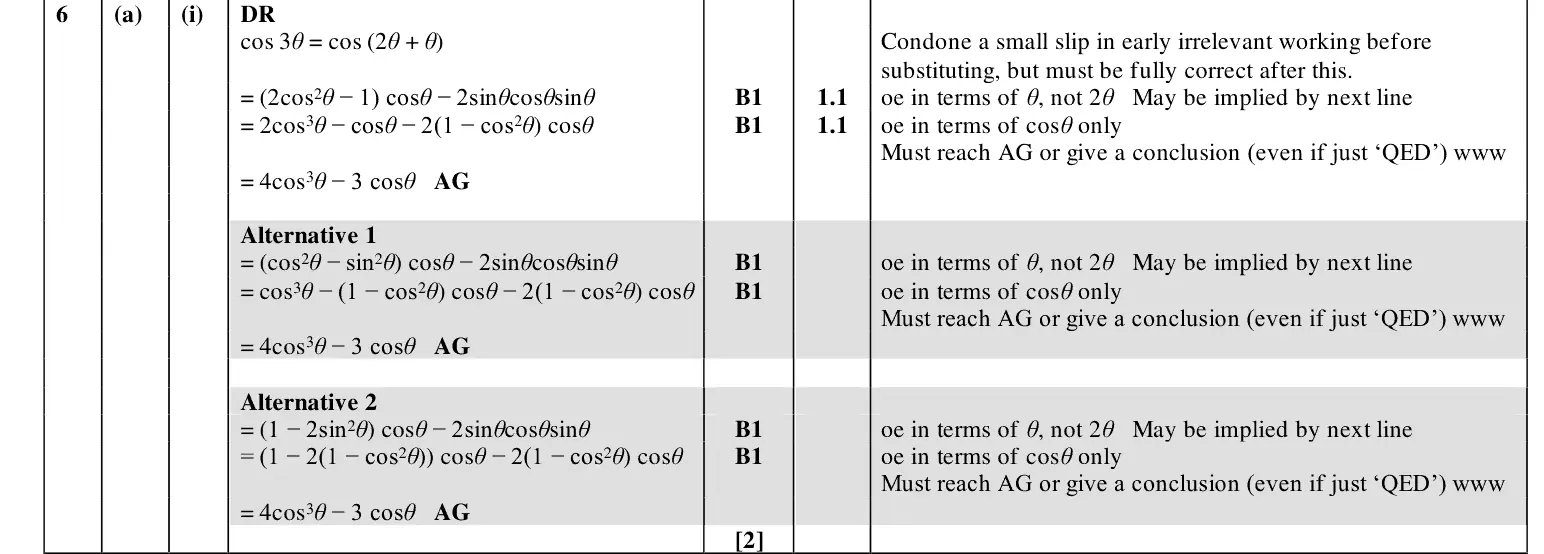
This part was well answered, with most candidates completing the proof successfully and almost all gaining at least the first B1 for using identities to rewrite in terms of theta only. Noting the DR instruction, quite a few candidates lost the second mark for making an error (e.g. omitting a bracket) in their working or by ‘jumping’ to the given response. Candidates should be reminded that ‘Detailed Reasoning’ means that every step in the working needs to be clearly shown.
Key points and common errors
cos3θ = cos(2θ + θ)
express in cos θ only
reach the given answer
June 2024 · Paper 3 · Q4(a)3 marksMedium
Mark scheme for this part
Examiner's comment
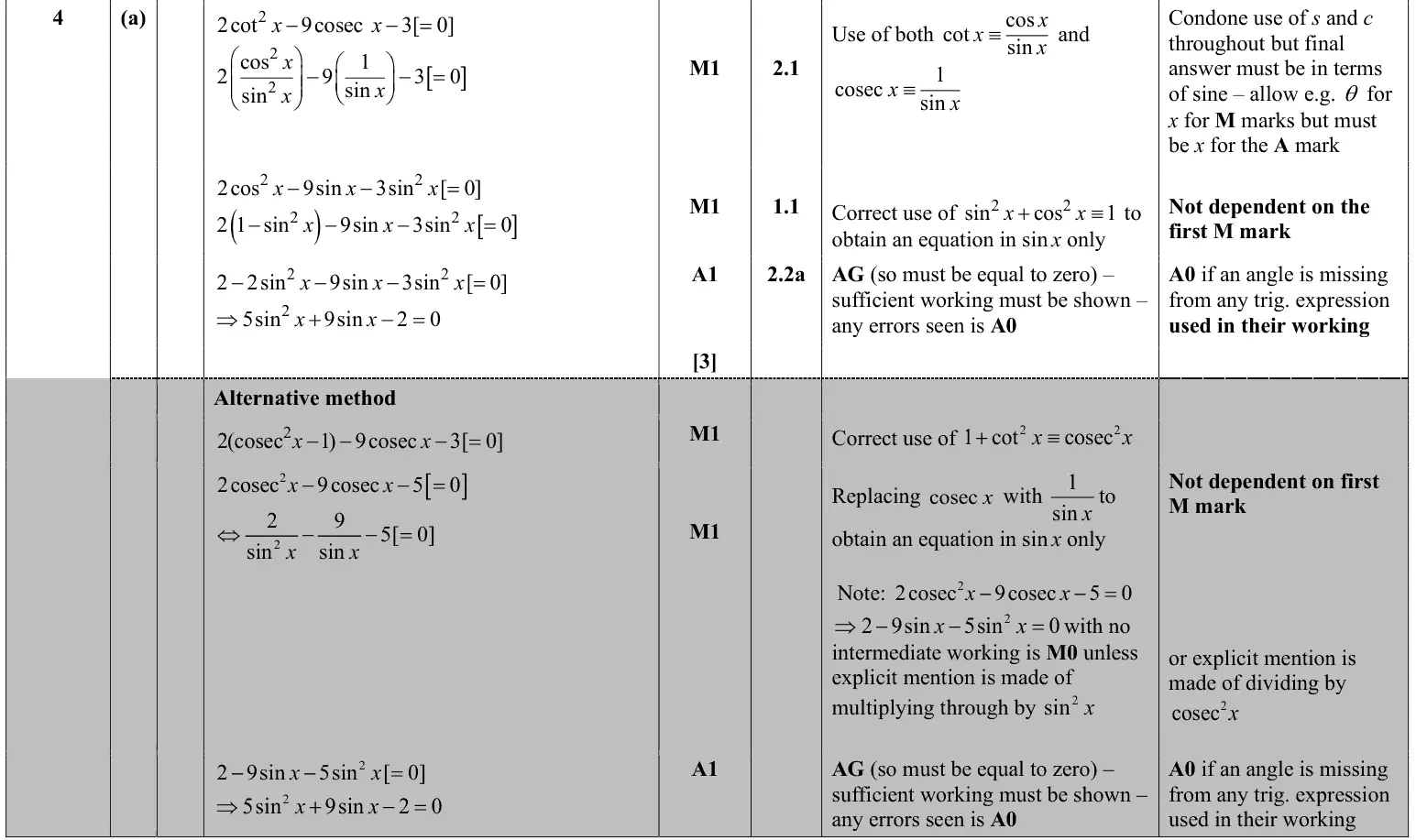
Candidates were almost equally split between the two possible methods to derive the given result. The first method was to re-write the given equation (using cot 𝑥= sin𝑥 and cosec 𝑥= sin𝑥) as 2cos2𝑥− 9 sin 𝑥−3sin2𝑥= 0 and then use the result that cos2𝑥= 1 −sin2𝑥 to obtain the required equation in sine. The second method was to use the identity 1 + cot2𝑥= cosec2𝑥 to obtain 2cosec2𝑥−9cosec𝑥−5 = 0 and then use cosec𝑥= sin 𝑥 to obtain the given result. The only issue that examiners reported with the second method was that a number of candidates gave no indication of how they went directly from 2cosec2𝑥−9cosec𝑥−5 = 0 to 2 −9 sin 𝑥−5sin2𝑥= 0 which considering this was a ‘show that’ question meant that full credit could not be given. Furthermore, as this was a given answer all working needed to be correct as any errors seen meant that the final accuracy mark could not be given.
Key points and common errors
cot x = cos x/sin x and cosec x = 1/sin x, then cos²x = 1 − sin²x
or 1 + cot²x = cosec²x
given answer so '= 0' and full working needed
June 2024 · Paper 3 · Q6(a)2 marksHard
Mark scheme for this part
Examiner's comment
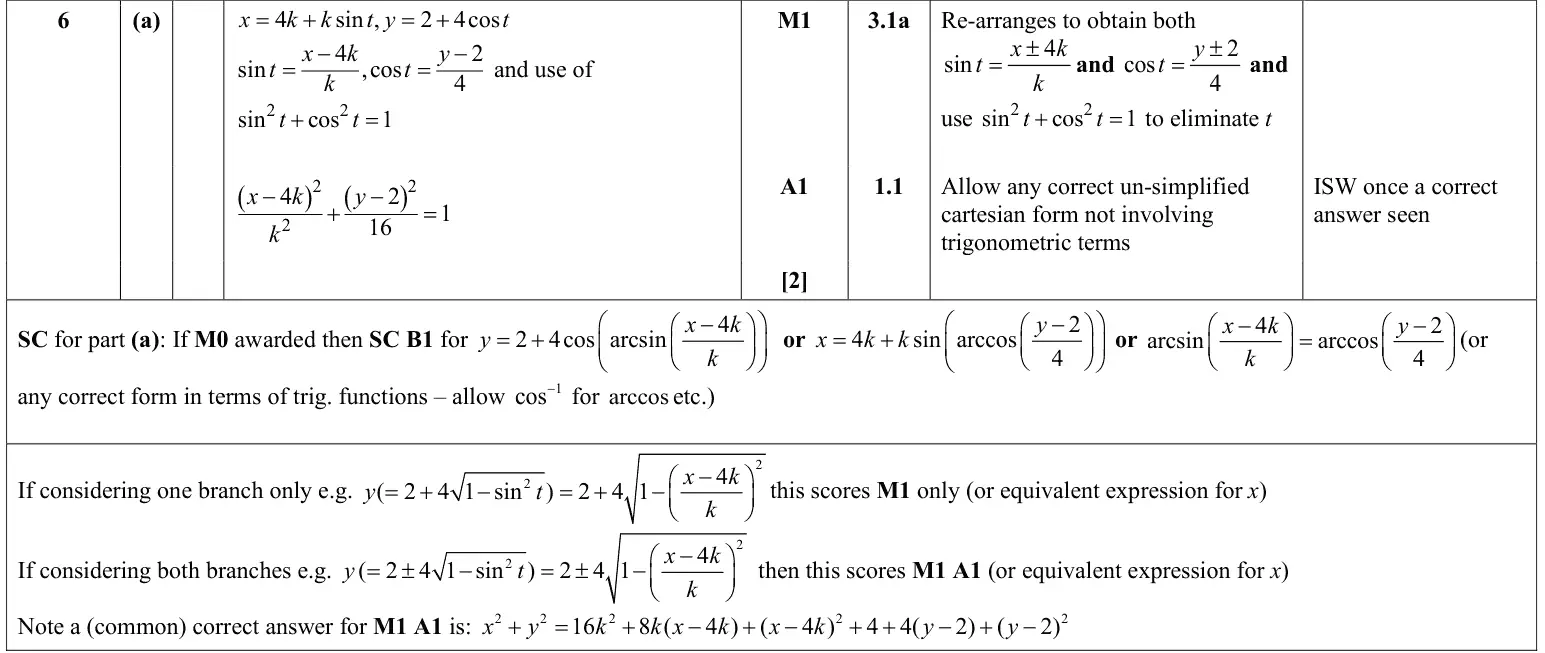
Question 6 was the least well-answered question on the paper (most likely due to the unfamiliarity of applying parametric equations in such a context). It was rare to see candidates adopting the correct method of applying sin2𝑡+ cos2𝑡= 1 to obtain the cartesian equation = 1. Most + candidates, who did obtain a cartesian equation, usually included one of arcsin or arccos, e.g. 𝑦= 2 + 4 cos (arcsin( 𝑘)) which gained some credit but could not score full marks as these forms did not fully define the curve 𝐶.
Key points and common errors
sin t = (x − 4k)/k, cos t = (y − 2)/4 and sin²t + cos²t = 1: (x − 4k)²/k² + (y − 2)²/16 = 1
arcsin/arccos forms only SC
least well answered question
June 2023 · AS Paper 1 · Q1(a)3 marksEasy
Mark scheme for this part
Examiner's comment
This question was generally well answered by most candidates. Some candidates showed a lack of rigour by writing down the given identity and manipulating one or both sides. This was permitted as long as it was clear what they were doing (e.g. multiplying both sides by cos(x) needed to be clearly shown). Some candidates wrote the given identity followed by the Pythagorean identity with no intermediate working, which could not be credited. In ‘Show that’ and proof questions, students should be encouraged to start with one side and manipulate to reach the other, and indicate clearly when they have reached a conclusion. More candidates used the alternative method in the mark scheme than attempted to combine terms on the LHS over a common denominator. Some candidates’ notation was unclear, for example sin x2 instead of sin2 x. Another common error was using sin + cos = 1 (which is missing the squares).
Key points and common errors
write tan x = sin x/cos x, common denominator, sin²x + cos²x = 1
jumping from the identity to the answer with no intermediate working gains nothing
June 2023 · AS Paper 1 · Q1(b)2 marksMedium
Mark scheme for this part
Examiner's comment
The majority of candidates were able to correctly manipulate this equation. However, of those who obtained the correct equation for the first M1, many either did not square root or forgot to consider more than one solution. Some missed the second solution in the given interval (achieving M1A0), while others gave additional solutions outside the interval.
Key points and common errors
tan²x = ½ so tan x = ±1/√2
x = 35.3°, 145°
common errors not square rooting or missing the second solution
June 2023 · Paper 1 · Q7(b)3 marksEasy
Mark scheme for this part
Examiner's comment
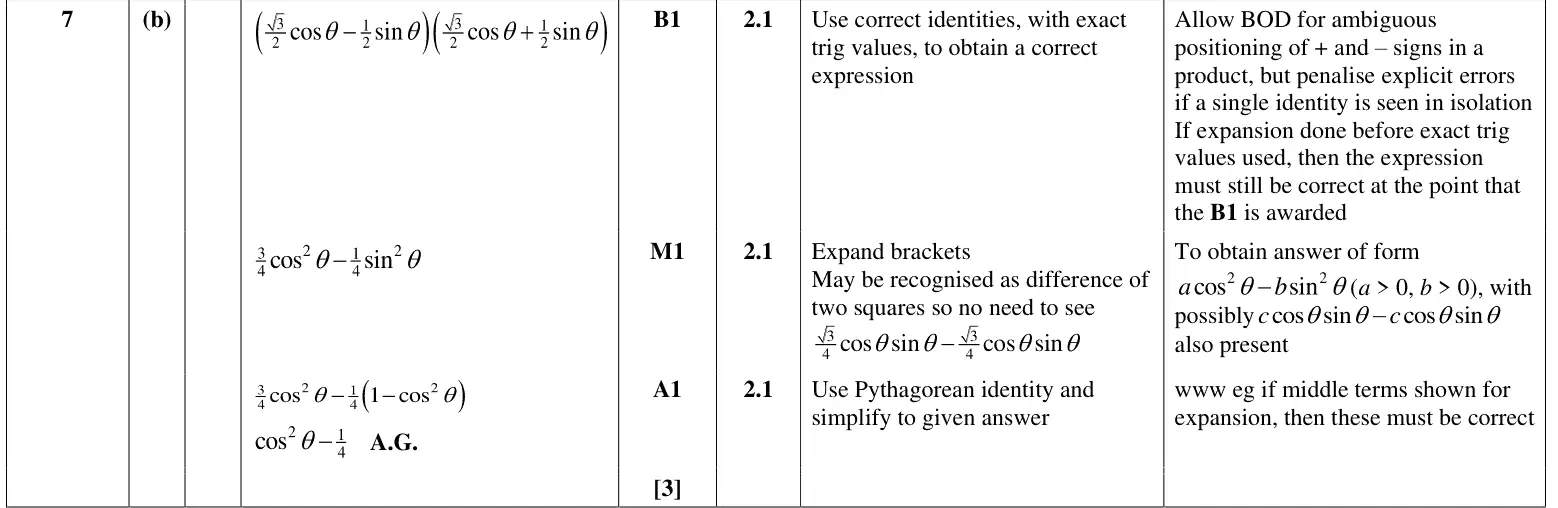
This part of the question was very well answered, with many fully correct solutions seen. Candidates who used the exact trigonometric values in the two separate identities before expanding the brackets tended to be more successful than those who expanded first.
Key points and common errors
use exact values √3/2 and 1/2 before expanding
difference of two squares
sin²θ = 1 − cos²θ
June 2023 · Paper 3 · Q5(a)3 marksHard
Mark scheme for this part
Examiner's comment
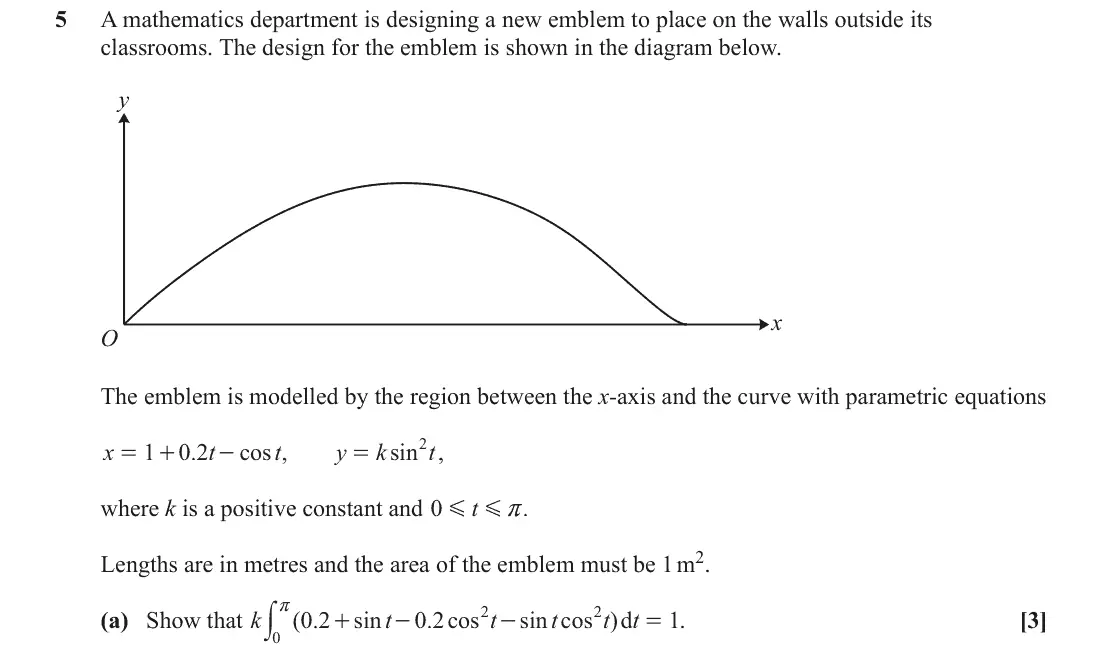
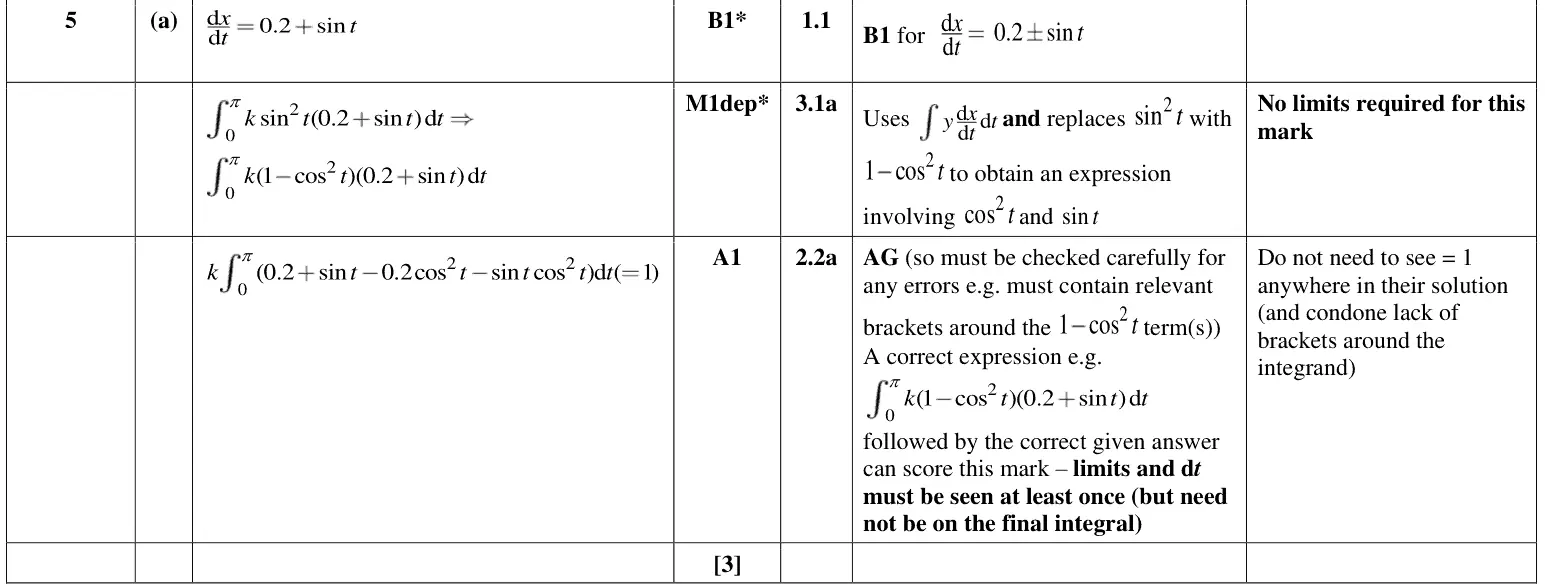
Candidates struggled with both parts of this question with examiners noting that many candidates gave the impression that they were unsure what either part of this question required of them. Some d𝑡𝑡 but only the most able could apply ∫𝑦𝑦 d𝑡𝑡d𝑡𝑡 correctly and derive the given result. candidates in part (a) made a correct start by finding the correct expression for
Key points and common errors
area = ∫ y (dx/dt) dt with dx/dt = 0.2 + sin t and limits 0 to π
replace sin²t by 1 − cos²t
reach the given integral with limits and dt
June 2023 · Paper 3 · Q6(a)3 marksEasy
Mark scheme for this part
Examiner's comment
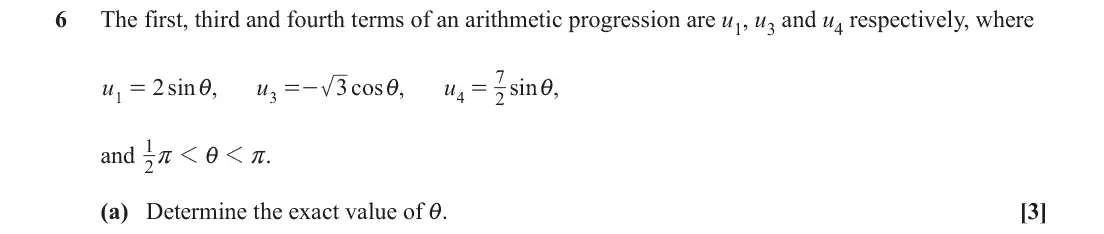
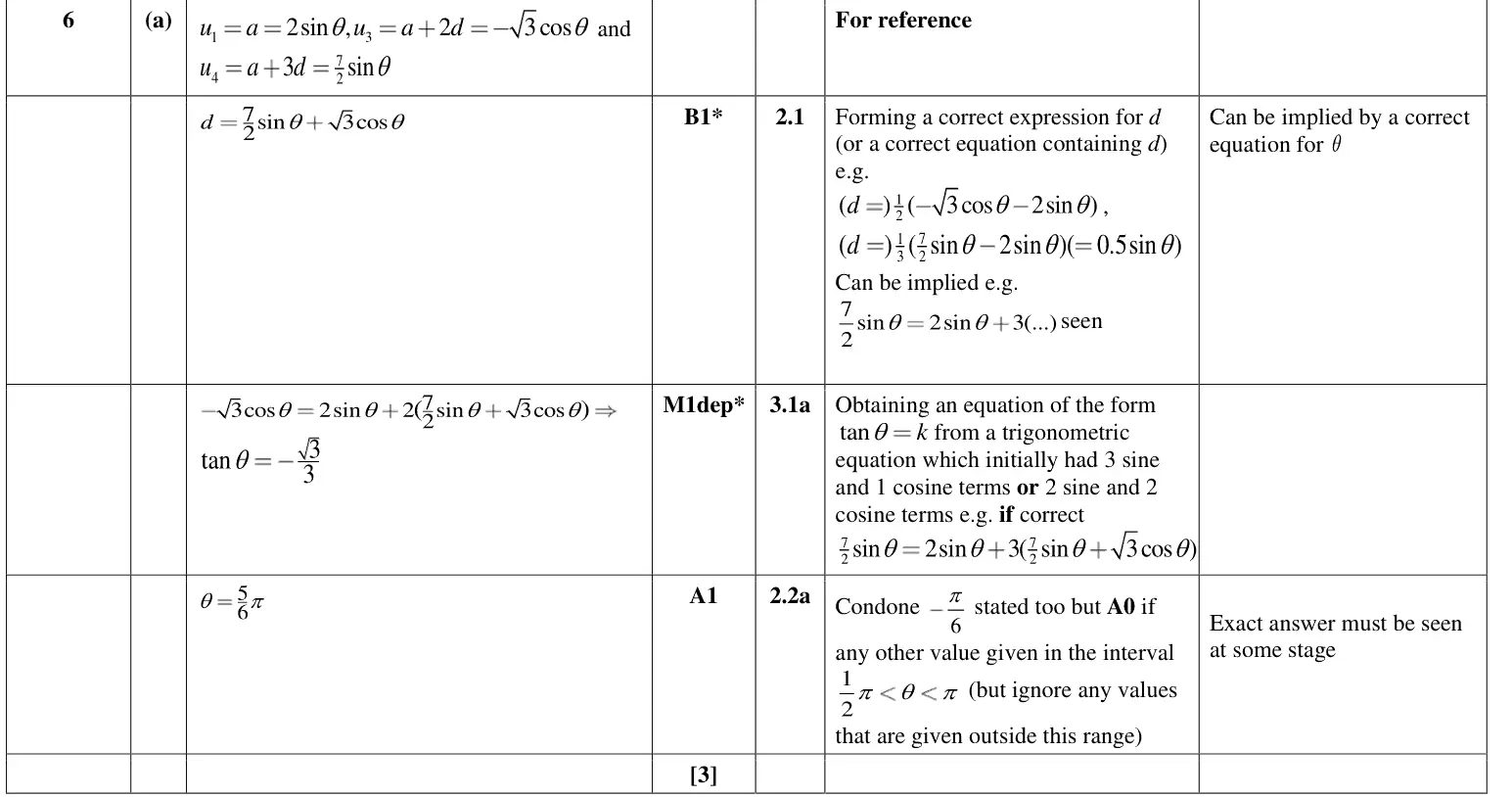
and cosine using the fact that 2(𝑢𝑢4 −𝑢𝑢3) = 𝑢𝑢3 −𝑢𝑢1. Most solved this equation correctly using tan and This part was answered particularly well with most candidates correctly setting up an equation in sine obtained the correct value of 𝜃𝜃. The most common error was to misread the question as giving the first three terms of an AP and not the first, third and fourth terms.
Key points and common errors
u₃ − u₁ = 2(u₄ − u₃) gives tan θ = −√3/3
θ = 5π/6 in the given interval
misreading as the first three terms
June 2022 · AS Paper 1 · Q4(b)5 marksMedium
Mark scheme for this part
Examiner's comment
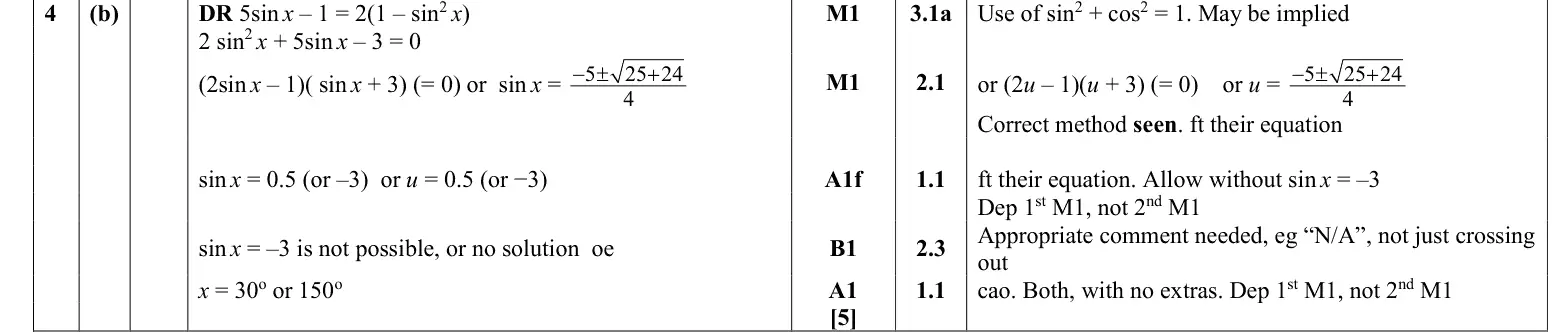
Many candidates used a correct method, gaining two method marks, but some made arithmetical or algebraic slips and so lost the two accuracy marks. Many candidates lost a mark because they omitted the working for the solution of the relevant quadratic equation. Others lost a mark because they did not indicate why they were rejecting the solution sin x = −3. Some candidates correctly used the identity + = sin x cos x 1 but appeared not to recognise that the resulting equation was a quadratic equation in sin x. Two examples of the subsequent incorrect work were as follows: 5sin x + 2sin2 x = 3 sin2 x = 3 7 and 5sinx − 1 = 2 − 2sin2x 4 = 2 − 2sin x. A few candidates attempted a solution without the use of the identity sin2 x + cos2 x = 1. These candidates did not make any progress.
Key points and common errors
use cos²x = 1 − sin²x: 2sin²x + 5sin x − 3 = 0
(2sin x − 1)(sin x + 3) = 0
reject sin x = −3 with a reason
x = 30°, 150°
working for the quadratic must be shown
June 2022 · AS Paper 2 · Q7(b)2 marksHard
Show the start of this question
Mark scheme for this part
Examiner's comment
Many candidates did not seem to understand what exact value meant as far as an acceptable solution was concerned. So often we saw sin100.3° given as a decimal only. Exact working was uncommon. Candidates should be reminded of what is required when an exact value is requested in a question. See section 2d of the specification for a list of command word explanations.
Key points and common errors
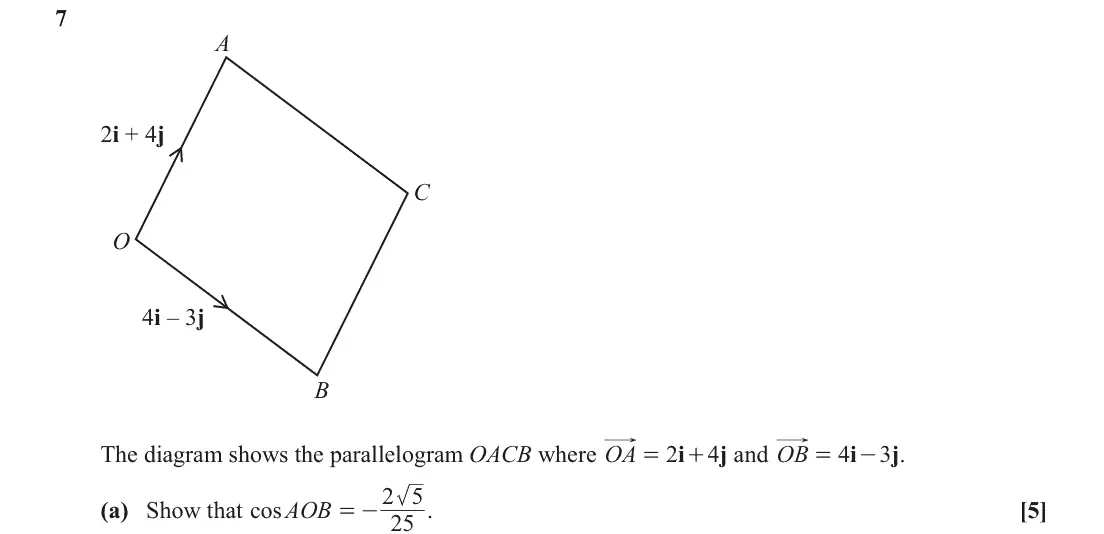
sin²AOB = 1 − cos²AOB = 121/125
sin AOB = 11√5/25 exact
decimals only gain nothing
exact working uncommon
June 2022 · Paper 1 · Q97 marksHard
Mark scheme for this part
Examiner's comment
This proved to be a surprisingly challenging question, and the full range of marks was seen. The majority did attempt to use the given substitution, with only a few continuing to work in terms of x. Most appreciated the need to attempt the integrand in terms of θ, and attempted to do so. The most common errors were for an incorrect variable of u to be introduced, and for the simplification of the square root to be incorrect, with √(4 – 4sin2θ) becoming 2 – 2sinθ. Of the candidates who did obtain the correct integrand, most were able to select the correct identity and then usually produced a fully correct solution.
Key points and common errors
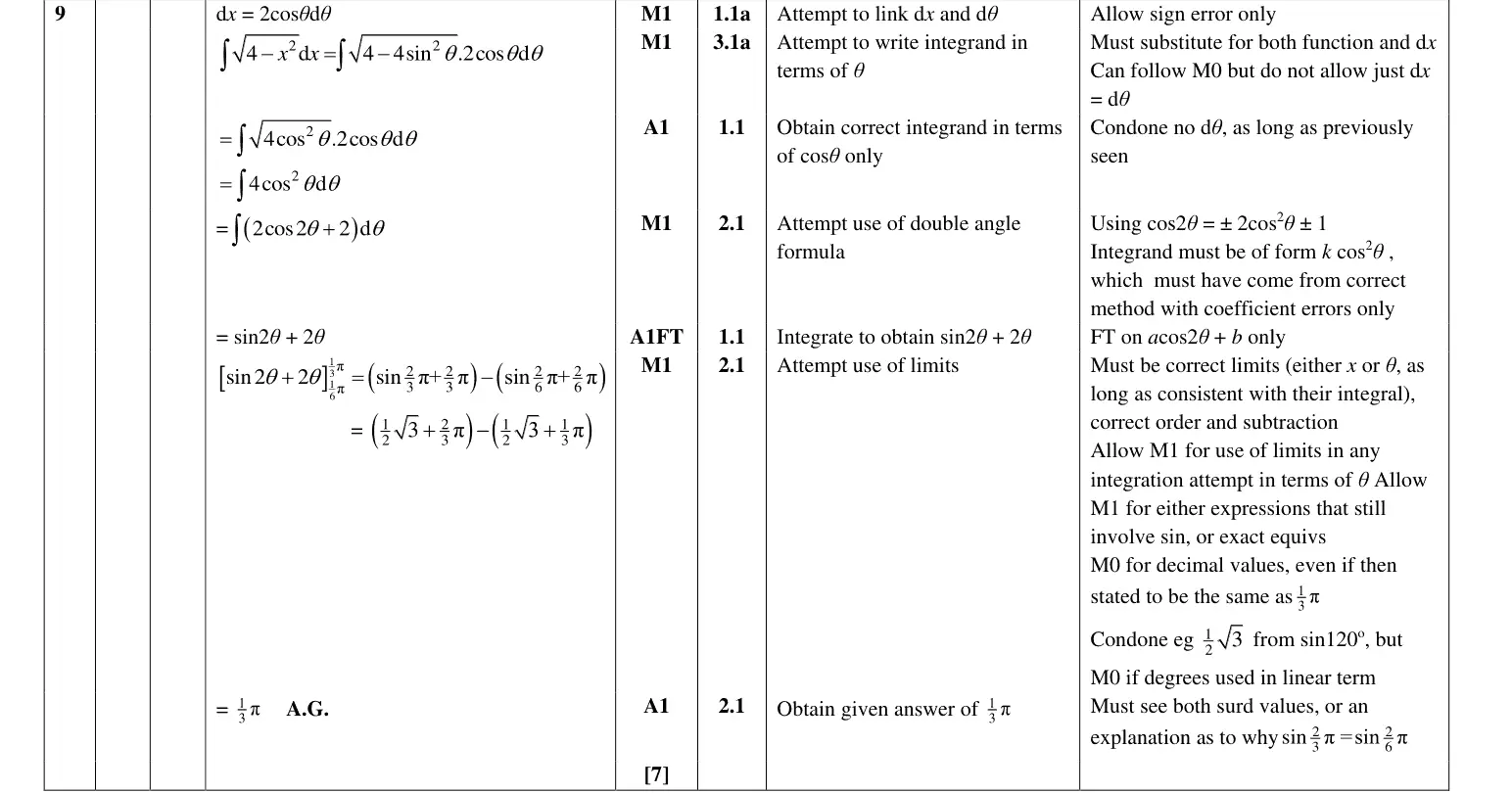
dx = 2cosθ dθ
√(4 − 4sin²θ) = 2cosθ (not 2 − 2sinθ)
∫4cos²θ dθ = sin2θ + 2θ via the double angle formula
limits π/6 to π/3 give π/3
exact values needed
Autumn 2021 · AS Paper 2 · Q5(a)3 marksMedium
Mark scheme for this part
Key points and common errors
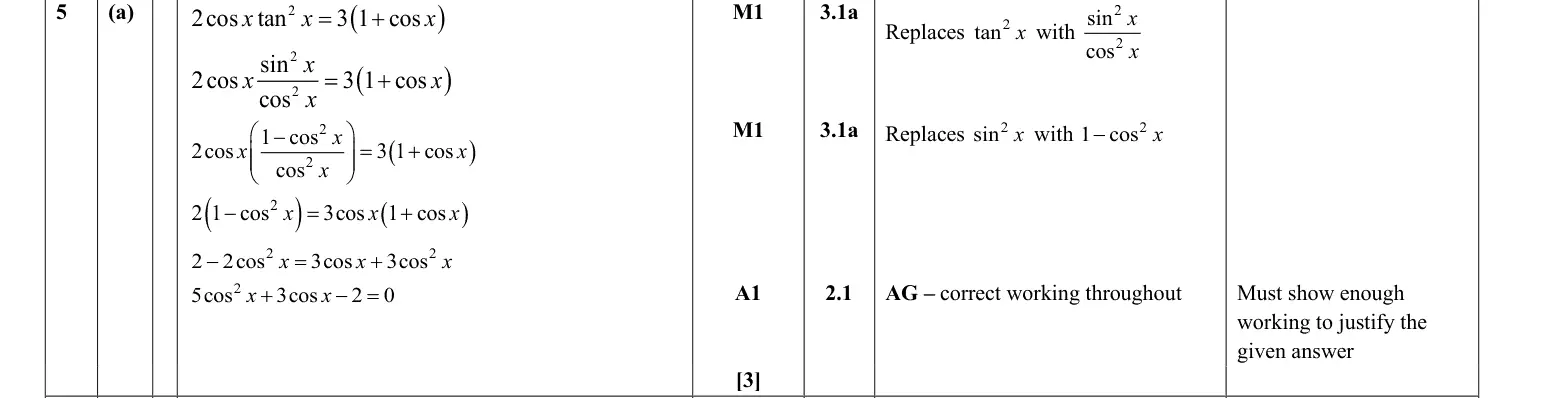
tan²x = sin²x/cos²x, sin²x = 1 − cos²x
rearrange to 5cos²x + 3cos x − 2 = 0 with full working
Autumn 2020 · AS Paper 1 · Q3(a)5 marksMedium
Mark scheme for this part
Examiner's comment
Most candidates made a good start by using tan θ = sin θ θ . However, the majority of candidates did not cos see that it was then possible to divide both sides by sin2 θ. These candidates went on to use sin2 θ + cos2 θ = 1, and obtained a quartic equation in either sin θ or cos θ. Although some candidates did this correctly, it took far longer, and gave greater opportunity for errors, than the more straightforward method.
Key points and common errors
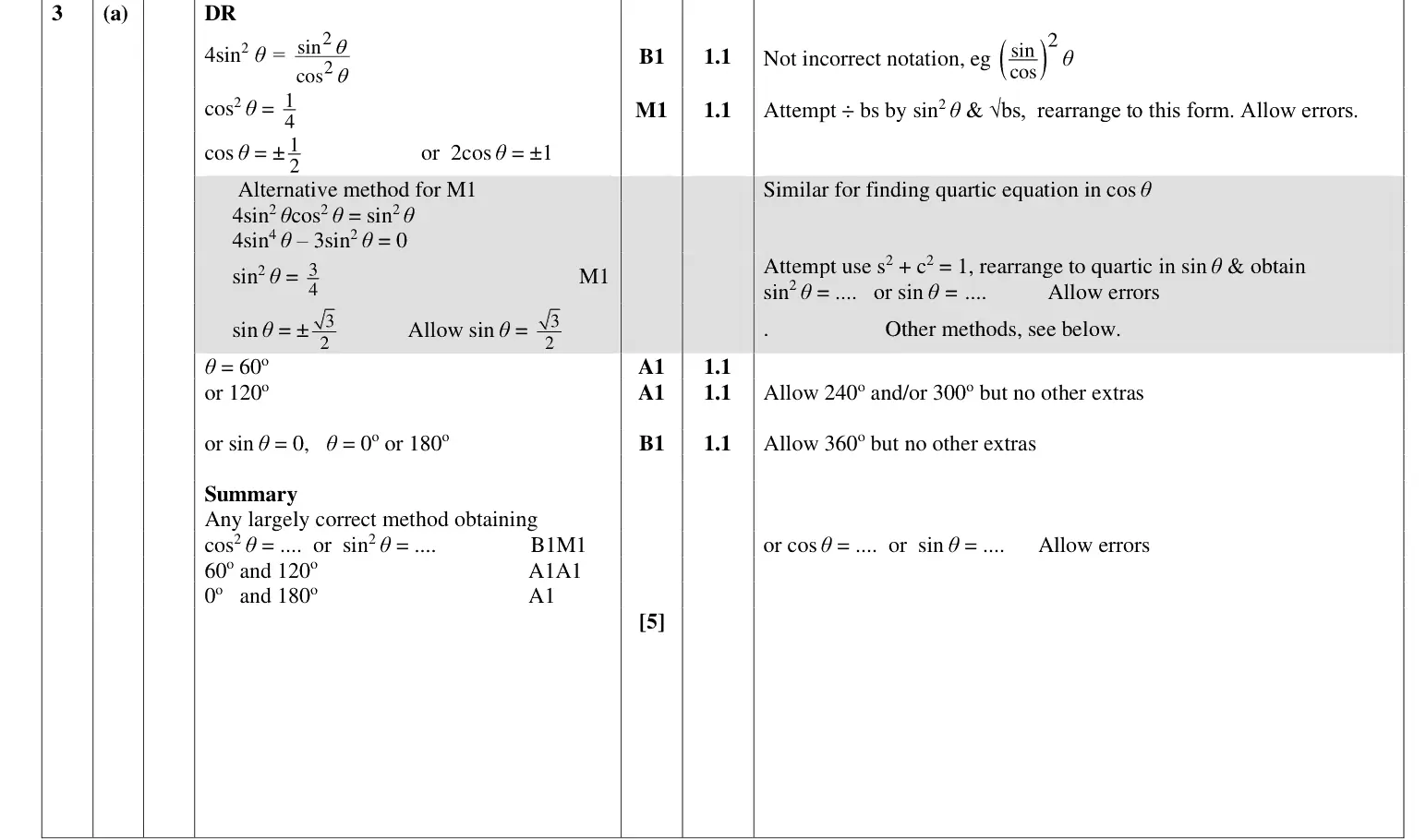
tan²θ = sin²θ/cos²θ
divide by sin²θ: cos²θ = 1/4, θ = 60°, 120°
also sin θ = 0 gives 0°, 180°
dividing by sin²θ loses these roots
quartic route is longer
Autumn 2020 · AS Paper 1 · Q3(b)3 marksHard
Mark scheme for this part
Examiner's comment
There was a great deal of incorrect ‘cancelling’ by simply crossing out a pair of terms, one in the numerator and one in the denominator.
Key points and common errors
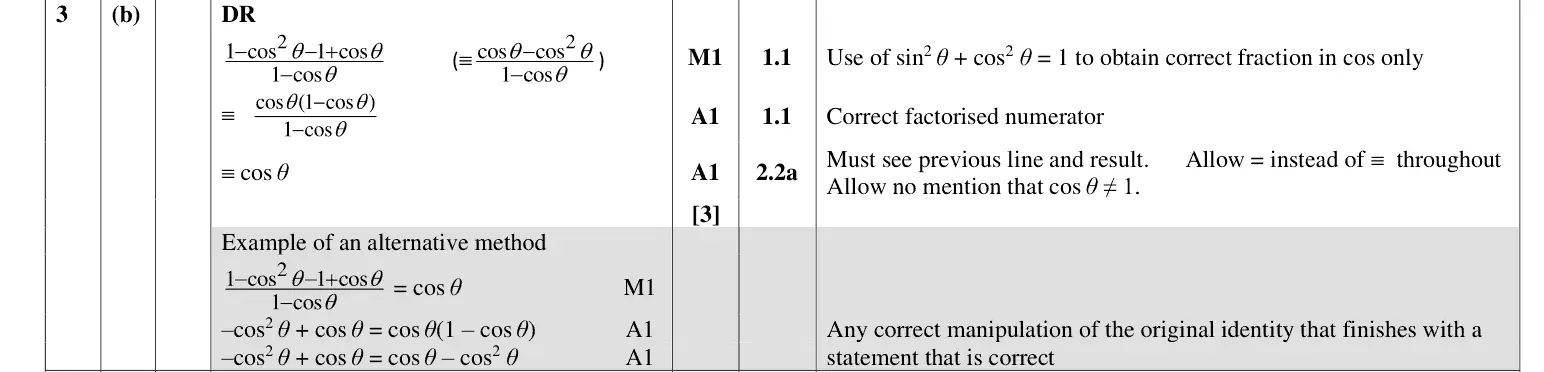
sin²θ = 1 − cos²θ
numerator cos θ − cos²θ = cos θ(1 − cos θ)
cancel with the denominator
crossing out terms is not cancelling
June 2019 · AS Paper 2 · Q6(a)2 marksMedium
Mark scheme for this part
Examiner's comment
Another question requiring detailed reasoning, so examiners scrutinised the notation carefully and expected precision in presentation. For example, cosθ or just cos was penalised as was the omission of ‘ ’ in the final answer. To score fully candidates needed to make explicit use of trigonometric = 0 identities, for example just replacing tanθcosθ with sinθ without justification of sin θ cos θ was not cos θ considered sufficient reasoning.
Key points and common errors
use cos²θ = 1 − sin²θ and tanθ = sinθ/cosθ explicitly
reach 6sin²θ + sinθ − 2 = 0 with '= 0'
precise notation required
June 2019 · Paper 2 · Q3(a)(i)2 marksMedium
Mark scheme for this part
Examiner's comment
Many candidates found the standard cartesian form of the equation, although a few made sign errors. Some began with ( ) ( ) x − a + y − b = r and attempted to find the values of a, b and r. Some found a and b correctly, but not r. x − 3 y + 4 Other candidates gave clumsy, but correct, alternative forms such as cos = sin 2 2 x − 3 x − 3 or y = −+ 4 2sin cos or y = −+ 4 2 1 − . 2 2 Some candidates gave answers that were correct equations in themselves, but involved a mixture of x , ( ) y and θ , for example y = x − 3 tan θ − 4 or x − 3 − 2cos θ = y + 4 − 2sin θ Some candidates started by finding x + y , which unfortunately leads nowhere. Disappointingly, many of these candidates also squared incorrectly, such as ( 3 + 2cos θ ) = 9 + 4cos θ A significant number of candidates did not recognise that the key to this problem is the identity sin θ + cos θ = 1 . Some candidates (perhaps a reflex triggered by anything involving parametric equations) found d y x by dividing d y by d x . d dθ dθ
Key points and common errors
use cos²θ + sin²θ = 1: (x − 3)² + (y + 4)² = 4
sign errors
answers mixing x, y and θ
June 2019 · Paper 3 · Q5(a)4 marksMedium
Mark scheme for this part
Examiner's comment
There were many ways of tackling this proof, but the most efficient method was to realise that the right- hand side only contained cosines and so therefore it would be prudent to re-write the left-hand side as cos θ 1 ( ) cot θ + cosec θ = + , combine the two fractions and then use the fact that sin θ sin θ θ to obtain ( ) 1 + cos θ sin θ = 1 − cos . For many candidates who got to this stage some did not show 1 − cos θ sufficient working and simply wrote down that ( ) 1 + cos θ 1 cos + θ = without showing the intermediate 1 − cos θ 1 − cos θ ( ) 1 + cos θ step of Those candidates who started by trying to work from the right to left-hand . ( )( ) 1 + cos θ 1 − cos θ side or began by expanding ( ) cot θ + cosec θ as cot θ + 2cot θ cosec +cosec θ θ were not usually successful.
Key points and common errors
write cot θ and cosec θ in sin and cos: (1 + cos θ)²/sin²θ
sin²θ = 1 − cos²θ = (1 − cos θ)(1 + cos θ)
intermediate cancelling step must be shown
June 2018 · AS Paper 2 · Q7(i)3 marksEasy
Mark scheme for this part
Examiner's comment
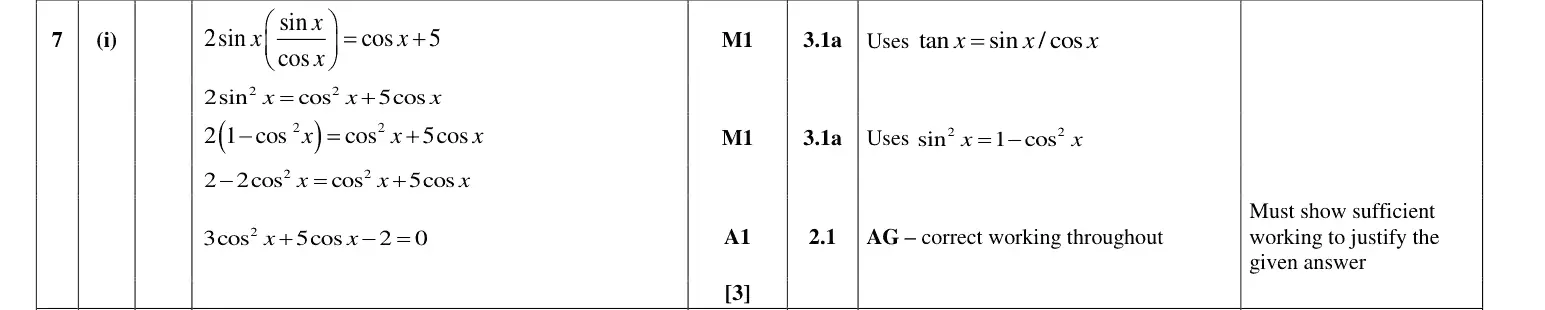
This question was done well by many. Because the answer aimed for was given, examiners paid close attention to the written detail and expected fully accurate working for the answer mark. Removing the denominator sometimes led to error, with cos2x + 5 appearing on the RHS, and less regularly 2sinxcosxsinx on the LHS.
Key points and common errors
tan x = sin x/cos x then sin²x = 1 − cos²x gives 3cos²x + 5cos x − 2 = 0
full working for the given answer
errors clearing the denominator
Find an A-level maths tutor
Stuck on this? Book a trial session with an A-level maths tutor.