1.02d Work with quadratic functions and their graphs, and the…
Section
1.02 Algebra and Functions
Level
AS & A level
Statement
Be able to work with quadratic functions and their graphs, and the discriminant (D or Δ) of a quadratic function, including the conditions for real and repeated roots.
Guidance
i.e. Use the conditions: 1. b² − 4ac > 0 ⇒ real distinct roots; 2. b² − 4ac = 0 ⇒ repeated roots; 3. b² − 4ac < 0 ⇒ roots are not real; to determine the number and nature of the roots of a quadratic equation and relate the results to a graph of the quadratic function.
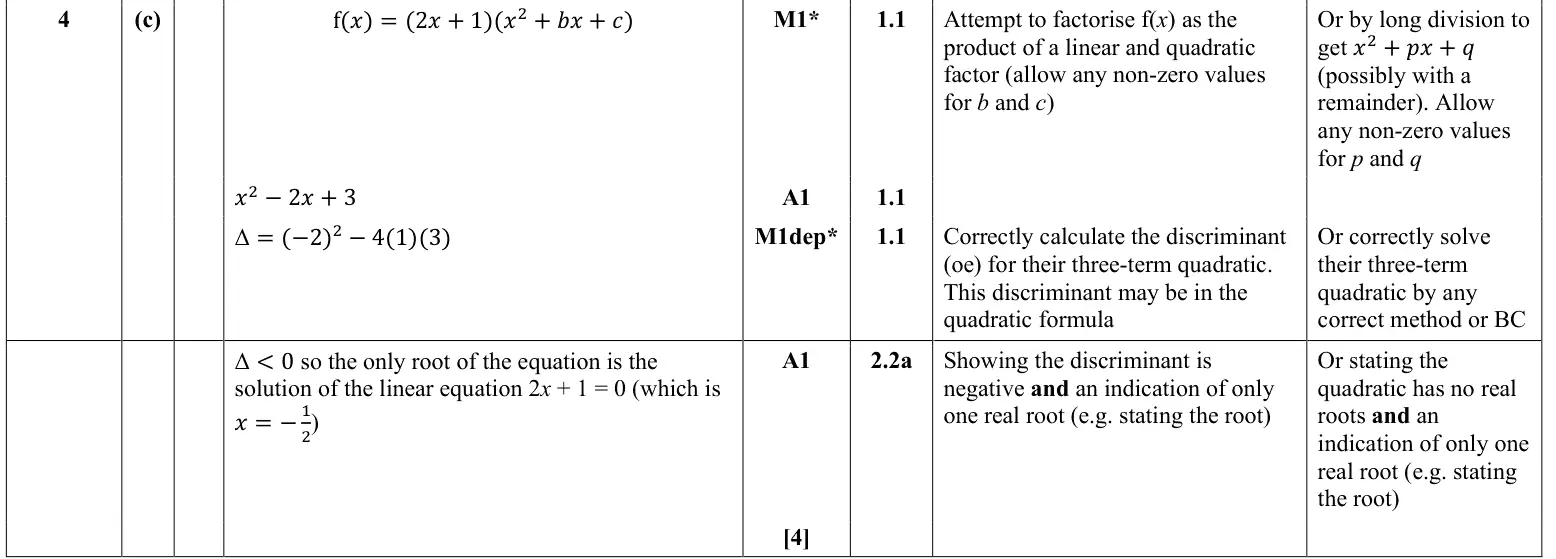
Most did long division here (generally accurately) to obtain the factor x2 – 2x + 3, with comparatively few factorising and the occasional comparing coefficients. The discriminant was well done, only a few writing -22 - 4(1)(3) = - 4 – 12. Once again a conclusion was required and those who referred to (2x + 1) as the one real root were penalised. This part says ‘Hence’ so examiners needed to see some use of the factor (2x + 1) in this part. A small number of candidates attempted this part with a graphical approach, just producing a sketch of the cubic from their calculator for example. This generally scored no marks. Also some tried to show that the cubic had no turning points and deduce one real root from this, but unless the factor (2x + 1) was involved in the argument somehow, credit was not awarded.
Key points and common errors
f(x) = (2x + 1)(x² − 2x + 3)
discriminant 4 − 12 < 0 so the quadratic has no real roots
only root x = −½
conclusion required
June 2025 · Paper 1 · Q2(a)1 markMedium
Mark scheme for this part
Examiner's comment
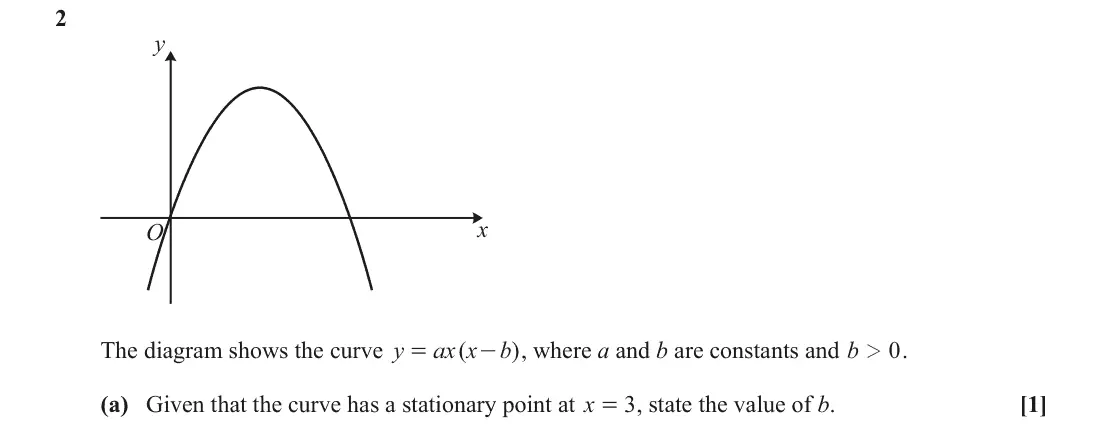
It was expected that candidates would use the symmetry of a quadratic curve to be able to write down the correct value for b, hence the command word ‘state’ and the limited space in the Printed Answer Booklet. While some candidates did indeed do so, many more embarked on a method involving the use of calculus, with varying degrees of success.
Key points and common errors
roots 0 and b, symmetry of the quadratic gives b = 6
many used calculus instead of stating
June 2025 · Paper 3 · Q4(a)5 marksMedium
Mark scheme for this part
Examiner's comment
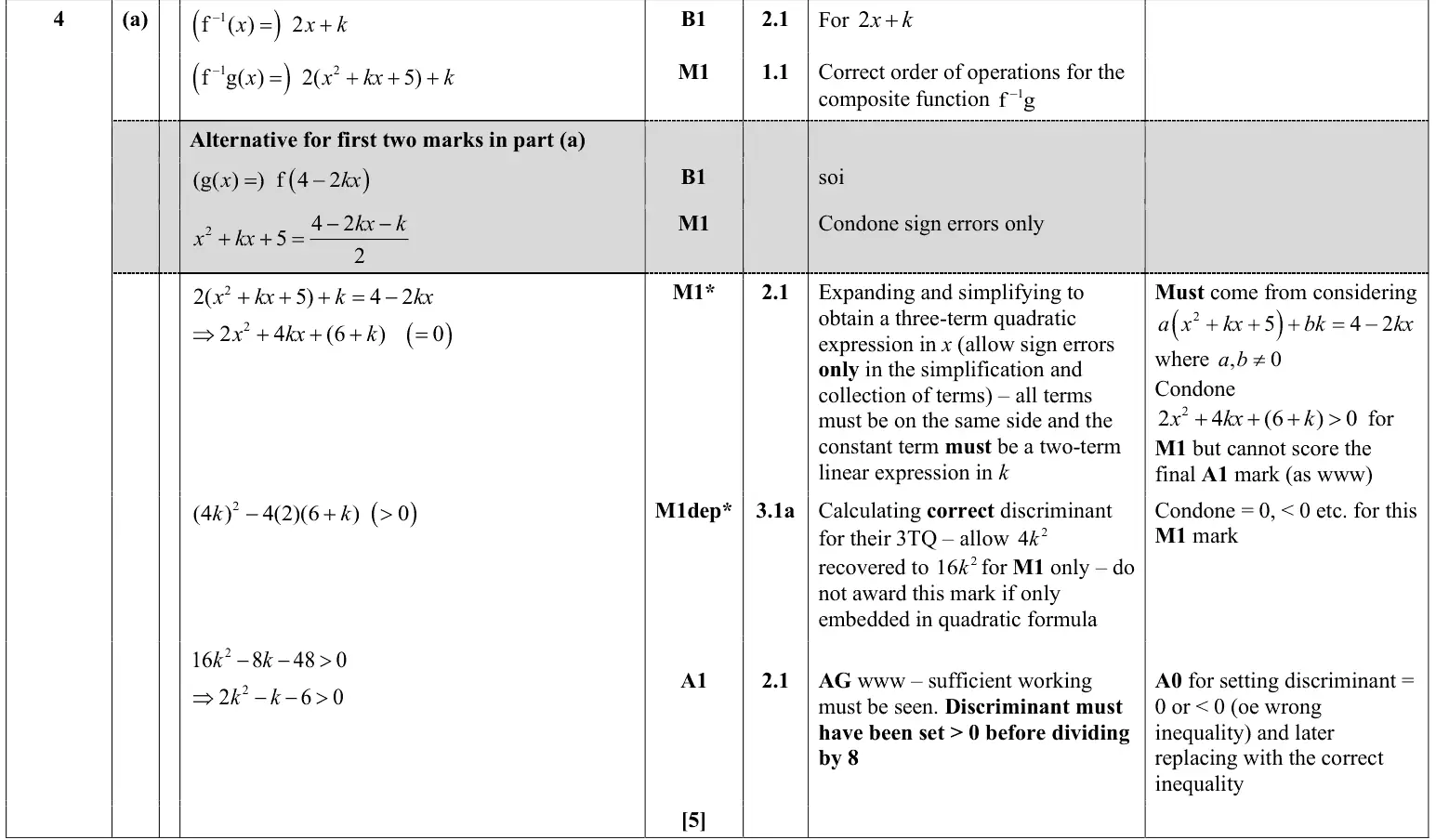
Most candidates correctly found the inverse of f and applied the correct order of operations to obtain f −1g(𝑥) = 2𝑥2 + 2𝑘𝑥+ 10 + 𝑘 although some candidates incorrectly found fg(𝑥) and then attempted to find the inverse of this, or simply equated fg(𝑥) to 4 −2𝑘𝑥. A significant number of candidates incorrectly considered the equation f −1g(𝑥) = 0. Of those that did consider f −1g(𝑥) = 4 −2𝑘𝑥 most obtained the correct three-term quadratic in 𝑥 and were successful in deriving the given inequality by considering the discriminant > 0. As this was a given answer any incorrect working seen (or setting the discriminant > 0 after dividing by 8) meant that the final accuracy mark could not be awarded.
Key points and common errors
f⁻¹(x) = 2x + k
f⁻¹g(x) = 2(x² + kx + 5) + k
set equal to 4 − 2kx and collect: 2x² + 4kx + 6 + k = 0
discriminant > 0 gives 2k² − k − 6 > 0
fg or f⁻¹g = 0 are common errors
June 2024 · AS Paper 2 · Q3(a)4 marksMedium
Mark scheme for this part
Examiner's comment
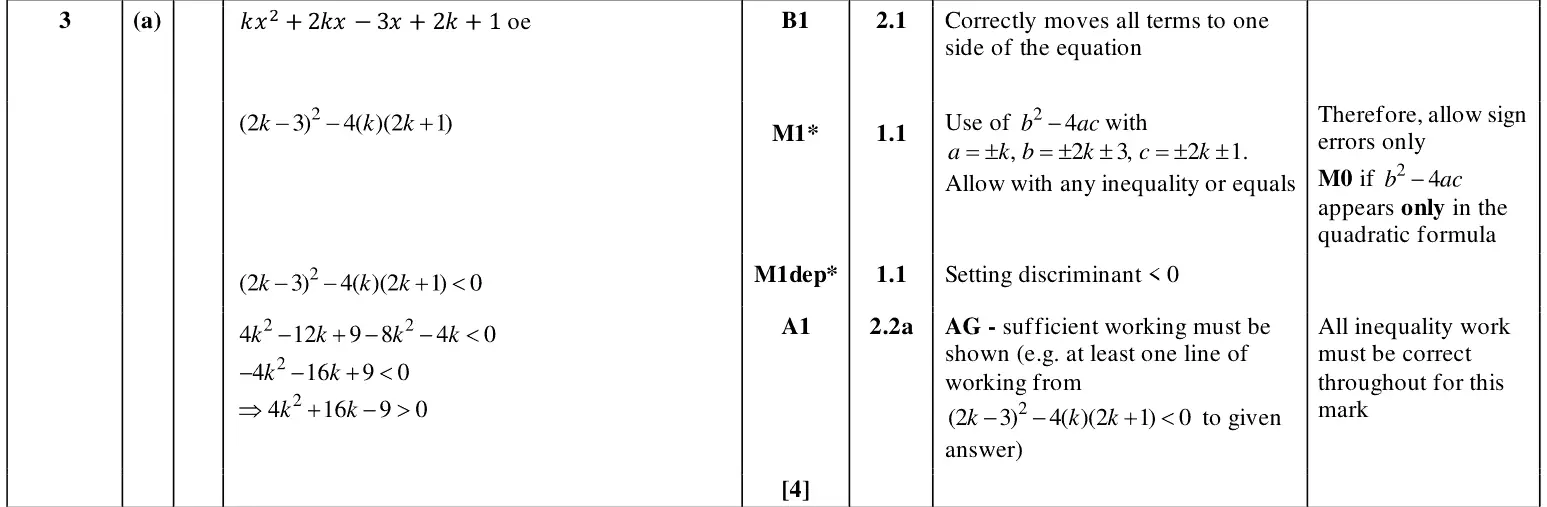
There were a significant number of fully correct solutions to this problem, but also a fair number of attempts marred by sign errors at various stages in the working. These errors occurred either in the initial rearrangement, or subsequent algebraic work on b2 − 4ac, or both. Use of b2 – 4ac > 0 leading to the given answer was something examiners checked for (the mark scheme has the abbreviation ‘AG’ (‘answer given’) to remind examiners that the answer is given), as was incorrect algebra leading to the answer. Weaker attempts applied b2 − 4ac to the left-hand side of the given equation and floundered. When an answer is given, examiners are conscious that candidates will sometimes finish their working with the correct answer, even though the working does not lead to it. Exemplar 1 is a case in point. There are sign errors in the working and full marks are not earned.
Key points and common errors
rearrange to kx² + (2k − 3)x + 2k + 1 = 0
no real roots so (2k − 3)² − 4k(2k + 1) < 0
reach 4k² + 16k − 9 > 0
sign errors common
June 2024 · Paper 1 · Q7(c)6 marksEasy
Show the start of this question
Mark scheme for this part
Examiner's comment
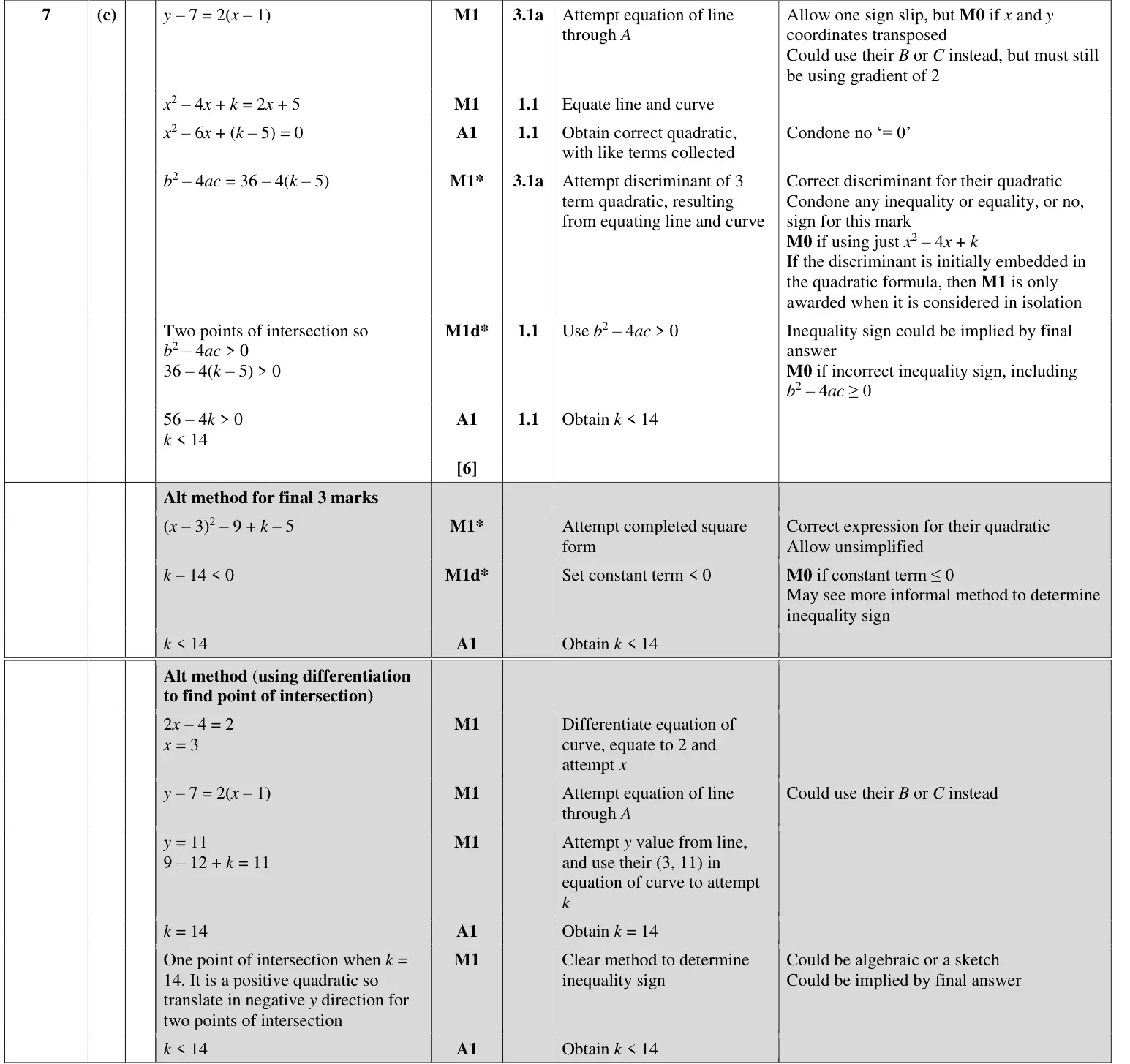
Most candidates found the equation of the line and equated it to the curve to get a quadratic equation in x for the points of intersection. The majority then used the discriminant property to get an inequality for k, although some lost a minus sign in calculating the discriminant or in dealing with the inequality while others made slips in expanding brackets. A few candidates used ‘completing the square’ to find the values of k for which the quadratic had two roots.
Key points and common errors
line y = 2x + 5
x² − 6x + (k − 5) = 0
b² − 4ac = 36 − 4(k − 5) > 0
k < 14
sign errors in discriminant
June 2024 · Paper 3 · Q77 marksMedium
Mark scheme for this part
Examiner's comment
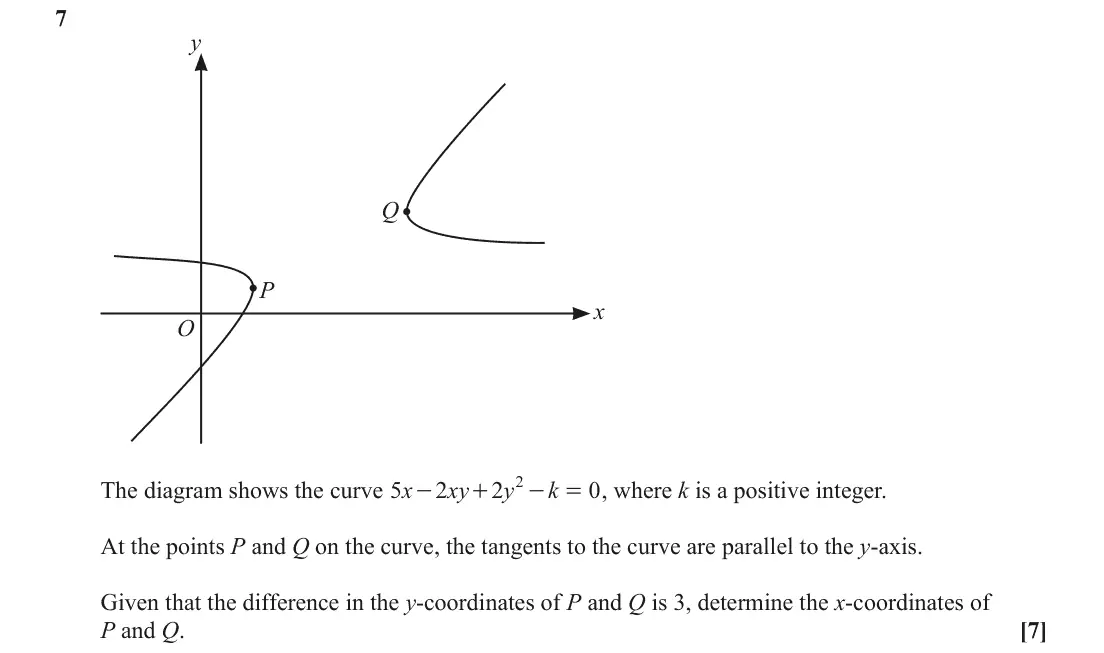
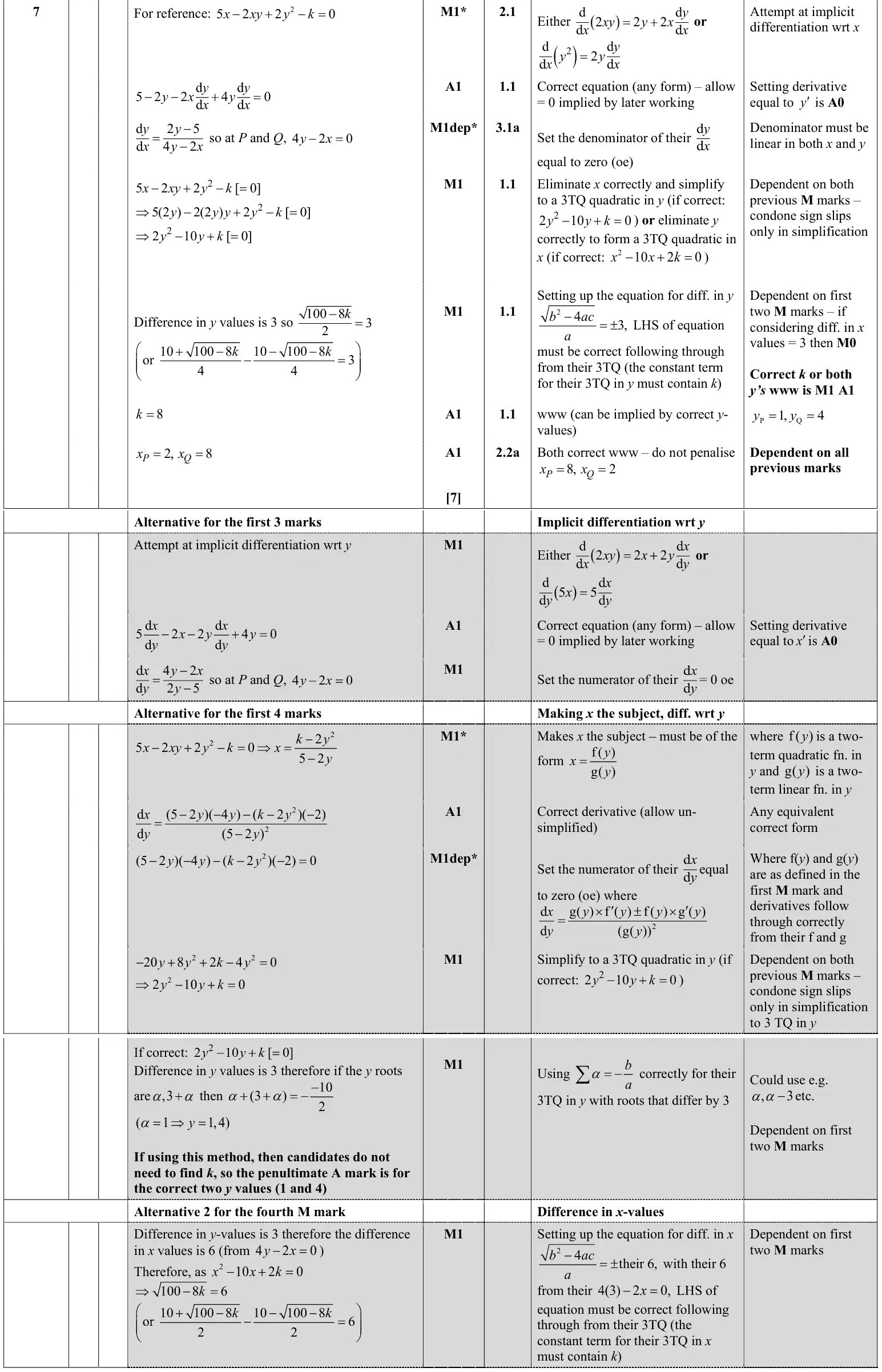
The vast majority of candidates made a good start to this unstructured problem and used implicit differentiation to correctly differentiate the given expression with respect to either 𝑥 or 𝑦. When errors occurred with this differentiation it was usually sign errors when differentiating −2𝑥𝑦 (using the product rule). Most candidates then found an expression for d𝑥 and were then almost equally split between either correctly setting the denominator equal to zero or incorrectly setting the numerator equal to zero. From there it was noted that while many candidates either obtained a correct quadratic equation in either 𝑦 (e.g. 2𝑦2 −10𝑦+ 𝑘= 0) or 𝑥 (e.g. 𝑥2 −10𝑥+ 2𝑘= 0) very few could use the given condition that the difference in the 𝑦-coordinates was 3 (or equivalently the difference in 𝑥-coordinates was 6) to find the correct 𝑥-coordinates of 𝑃 and 𝑄. This candidate scored 4 out of the 7 marks available for correctly differentiating implicitly and obtaining the correct relationship that 4𝑦−2𝑥= 0. They then went on to obtain a correct quadratic equation in 𝑥 but then did not make any further progress. This was relatively common as many candidates did not then realise how they could use the fact that the difference in the 𝑦 values was 3 to find the required 𝑥 coordinates. Section B Overview One general point with regard to the answering of certain mechanics questions should be made in this overview. This is that unless told otherwise the value that candidates should use for the acceleration due to gravity, g, is 9.8 and not 10 or 9.81 (and this value is stated explicitly on the front cover of the examination paper).
Most candidates realised that the discriminant of the quadratic equation needed to be considered. Many knew that Δ < 0 was needed, although the first 2 marks were potentially available from Δ = 0 or Δ > 0. 2 3 Critical values of ± 3 and ± 4 were seen and it was not uncommon to only see a positive critical value. The 3 2, or -3 3 2 and we did not give A1 if ‘and’ was used in final response was sometimes given as k > ± 2 < k < the final statement, regarding this as equivalent to the set notation Ո.
Key points and common errors
Δ = 9 − 4k² < 0
critical values ±3/2
k < −3/2 or k > 3/2
often only the positive critical value
'k > ±3/2' is wrong
June 2023 · Paper 2 · Q1(b)2 marksMedium
Show the start of this question
Mark scheme for this part
Examiner's comment
Although some candidates may have been able to deduce that k = −5 is the required value, the question stated ‘Determine’ which meant that some working or reasoning was required. The most common method was to use the discriminant, setting b2 − 4ac = 0 and, where attempted, this was generally well done. Some candidates made an error in solving and obtained k = 5, other candidates confused this with the range of values of k for which there were any real roots, and lost the final mark by using > instead of =. Unless candidates went on to finish with a statement of equality k = −5 this could not obtain the final accuracy mark.
Key points and common errors
b² − 4ac = 0 (or use the completed square) gives k = −5
using > instead of =
k = 5 from a slip
Determine needs working
June 2023 · Paper 2 · Q6(b)(ii)1 markHard
Show the start of this question
Mark scheme for this part
Examiner's comment
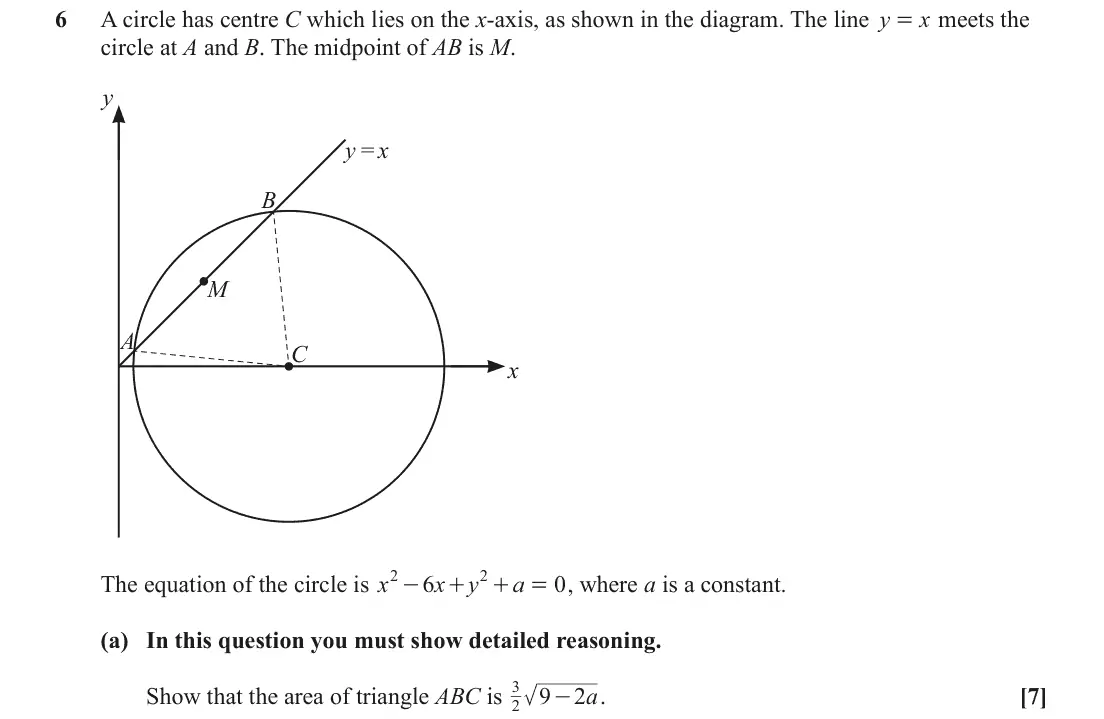
This (and part (c) below) was much less well answered. Many candidates attempted to compute either the area or radius (which was not required, and not sufficient). Relatively few candidates provided the required geometric explanation, with many making deductions like ‘there are no solutions’ or ‘area is invalid’, which were not acceptable. A few candidates stated that A and B are coincident, without explaining that therefore y = x is a tangent to the circle, which was acceptable.
Key points and common errors
y = x is a tangent to the circle (A and B coincide)
'no solutions' or 'invalid' gains nothing
June 2023 · Paper 2 · Q6(c)1 markHard
Show the start of this question
Mark scheme for this part
Examiner's comment
As in part (b) (ii), many candidates gave an insufficient (or non-geometric) explanation. Lots of candidates simply stated that this case is ‘impossible’ or ‘invalid’ without explaining that this is because the line does not meet the circle.
Key points and common errors
a = 5 makes 9 − 2a negative: the line y = x does not meet the circle
'impossible' alone gains nothing
June 2022 · AS Paper 1 · Q7(a)5 marksMedium
Mark scheme for this part
Examiner's comment
Many candidates began this question by rearranging the equation into the form (x − a)2 + (y − b)2 = r2. This was unnecessary, although full marks could still be scored using this form. Some candidates attempted some sort of algebraic solution that did not involve substituting mx for y in the second equation. They were not able to make any progress. Many candidates, however, did make the substitution, but some did not know how to proceed from there. A good number of candidates did attempt to form the discriminant, although some candidates’ discriminant was in terms of both x and m, which is incorrect. Those candidates who formed the discriminant in terms of m only were generally successful, although some made minor errors in the algebra. A few candidates found the correct critical values of m but lost the final mark by giving an incorrect final answer such as [ −1 2 < m < 2] or [m < −1 2 and m > 2].
Key points and common errors
substitute y = mx: (1 + m²)x² − (6 + 2m)x + 5 = 0
discriminant ≥ 0 gives −16m² + 24m + 16 ≥ 0
−1/2 ≤ m ≤ 2
discriminant must be in m only
June 2022 · AS Paper 1 · Q7(b)3 marksMedium
Show the start of this question
Mark scheme for this part
Examiner's comment
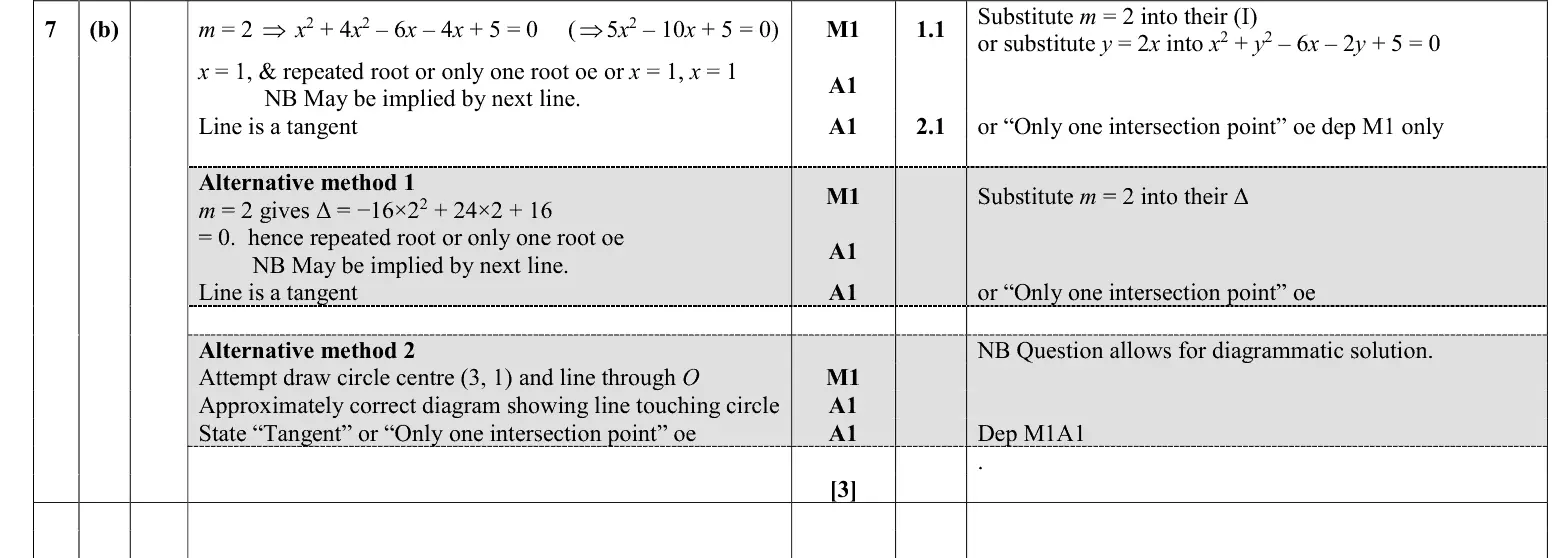
Many candidates did not appreciate what a “geometrical interpretation” involves. Some just solved the equations in the case where m = 2, and gave the solution x = 1, without commenting on the fact that this was a repeated solution. Some attempted to draw a sketch of a circle and a line. Although their circle was roughly correct in many cases, the line was often incorrect, not even passing through the origin. Many candidates used a different approach, substituting m = 2 into their expression for the discriminant. If their expression was correct, this led to a value of 0, and most drew the correct conclusion that the line was a tangent to the circle.
Key points and common errors
m = 2 gives 5x² − 10x + 5 = 0, repeated root x = 1 (discriminant 0) so the line is a tangent to the circle
just solving for x is not an interpretation
June 2022 · Paper 1 · Q78 marksHard
Mark scheme for this part
Examiner's comment
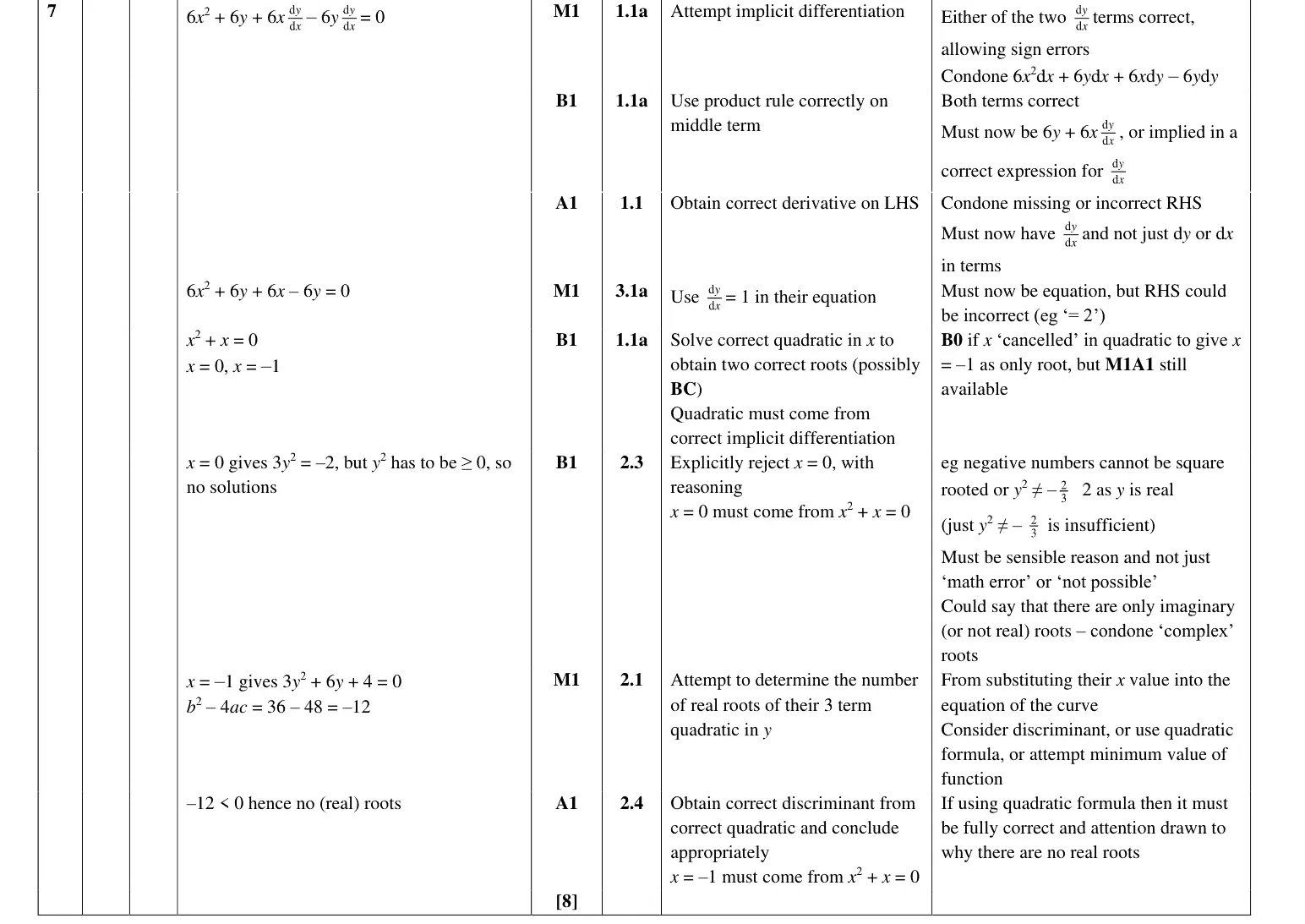
Most candidates could make progress on this question by recognising that it was an implicit equation and making a good attempt to differentiate it. The derivative was usually correct, but the modal mark on this question was 3 marks as many candidates were unsure as to how to then proceed. While a number did set the derivative equal to 1, a common error was to substitute y = x into their derivative. The correct quadratic of x2 + x = 0 was often seen, but there was often some uncertainty as to how to solve this and only the more able candidates were able to obtain both correct roots. Some candidates found just one of the roots by inspection and others, having obtained x2 = – x, observed that a square cannot be negative hence this equation has no roots at all. To gain full credit, examiners expected to see sufficient detail as to why neither root would yield solutions when substituted back into the original equation. While the substitution was seen, the explanations were often lacking in detail. Just stating that 3y2 = – 2 was impossible was not enough and, when considering x = – 1, it was not sufficient to just say that the ensuing quadratic had no roots; this needed to be demonstrated, most typically through considering the discriminant. compelling reasons whenever a solution is discarded. A good solution to Question 7, with clear reasons given as to why neither root will give a valid solution.
Key points and common errors
implicit differentiation with product rule on 6xy
set dy/dx = 1 (not y = x) to get x² + x = 0
x = 0 gives y² = −2/3 impossible
x = −1 gives 3y² + 6y + 4 = 0 with discriminant −12 < 0
June 2022 · Paper 2 · Q5(a)2 marksEasy
Mark scheme for this part
Examiner's comment
Almost all candidates differentiated and equated d y x to 0. A few made errors in the differentiation. Many d obtained the correct equation, 3x2 − 6x + 4 = 0. Because this is a “detailed reasoning” question, it was essential to show working to demonstrate that this equation has no real roots in order to gain the second mark. Most did so successfully using either the discriminant or completing the square. However, some candidates just stated that there were no real solutions, without justification. A few gave an incorrect justification such as “this equation won’t factorise so there are no solutions”. More seriously, a few candidates used the coefficients from the cubic expression for y to obtain a bogus “discriminant” and showed that it was negative.
Key points and common errors
dy/dx = 3x² − 6x + 4 = 0
discriminant −12 < 0 or 3(x − 1)² + 1 > 0 so no real roots
justification required
June 2022 · Paper 3 · Q7(b)5 marksHard
Show the start of this question
Mark scheme for this part
Examiner's comment
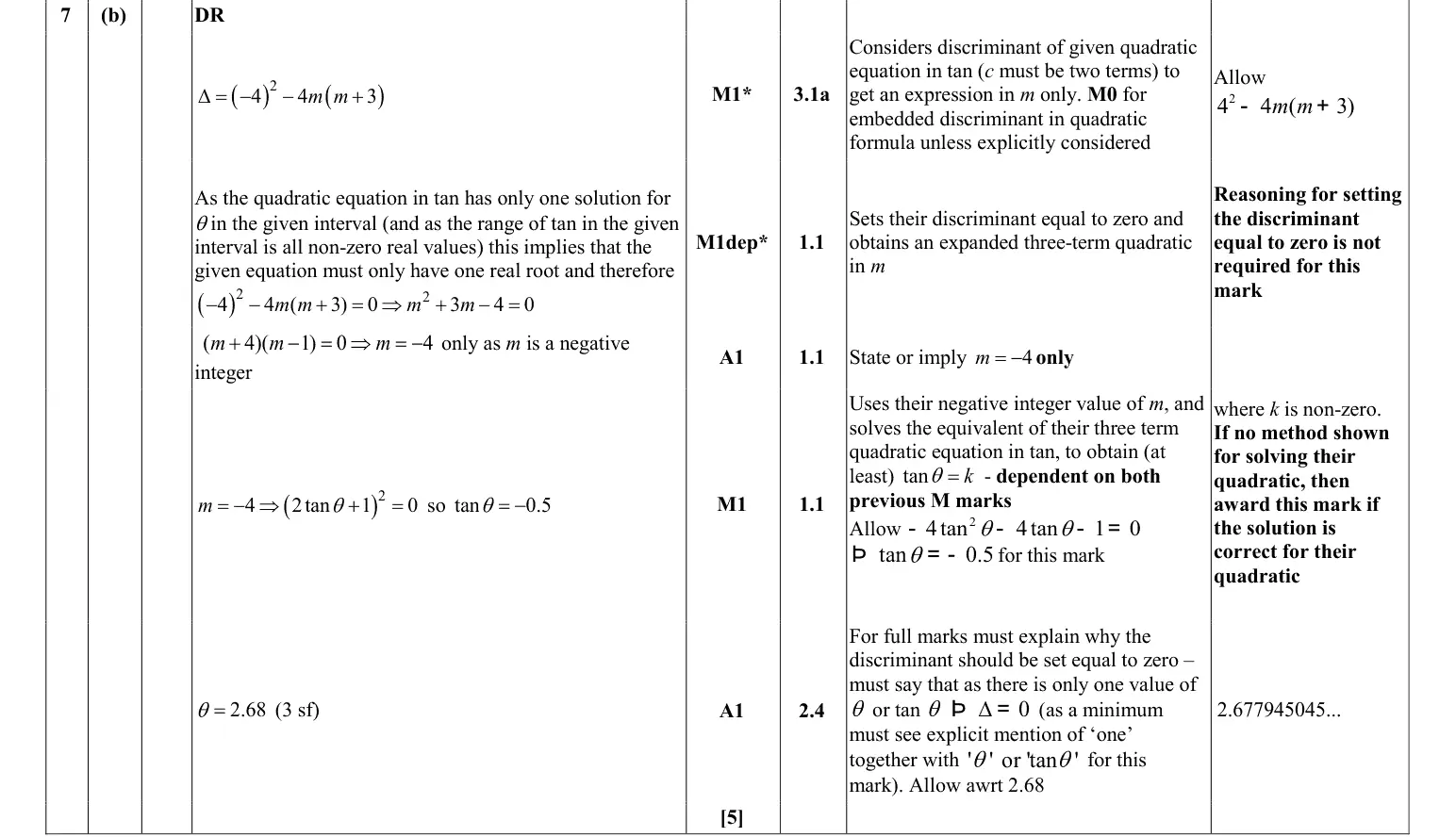
While it was pleasing that most candidates realised that the equation derived in part (a) was a quadratic equation in tanand hence they should consider the discriminant (of this equation) it was then disappointing how many candidates simplified the equation( ) ( ) − − + = 4 4 m m 3 0 to 16 − 4 m + 12 m = 0. Of those that did obtain the correct quadratic in m and hence found the corresponding value of as 2.68 (correct to 3 significant figures) many did not give suitable ‘detailed reasoning’ and therefore very few explained why the discriminant should be set equal to zero in the first place. This response scored 4 (of the 5) marks. Although the candidate has correctly found the value of they have not given the required ‘detailed reasoning’ of why they considered the discriminant of the quadratic equation in tan equal to zero and so did not score the final accuracy mark.
Key points and common errors
one solution in (0, π) so discriminant 16 − 4m(m + 3) = 0
m² + 3m − 4 = 0, m = −4
(2tan θ + 1)² = 0, θ = 2.68
must explain why Δ = 0
Autumn 2021 · AS Paper 1 · Q5(a)1 markMedium
Mark scheme for this part
Key points and common errors
maximum speed of the car or speed limit
model gives negative consumption for large v
Autumn 2021 · AS Paper 1 · Q5(c)1 markMedium
Show the start of this question
Mark scheme for this part
Key points and common errors
v = 0 gives C = k ≠ 0 but a car at 0 mph covers no miles
Autumn 2021 · AS Paper 1 · Q96 marksMedium
Mark scheme for this part
Key points and common errors
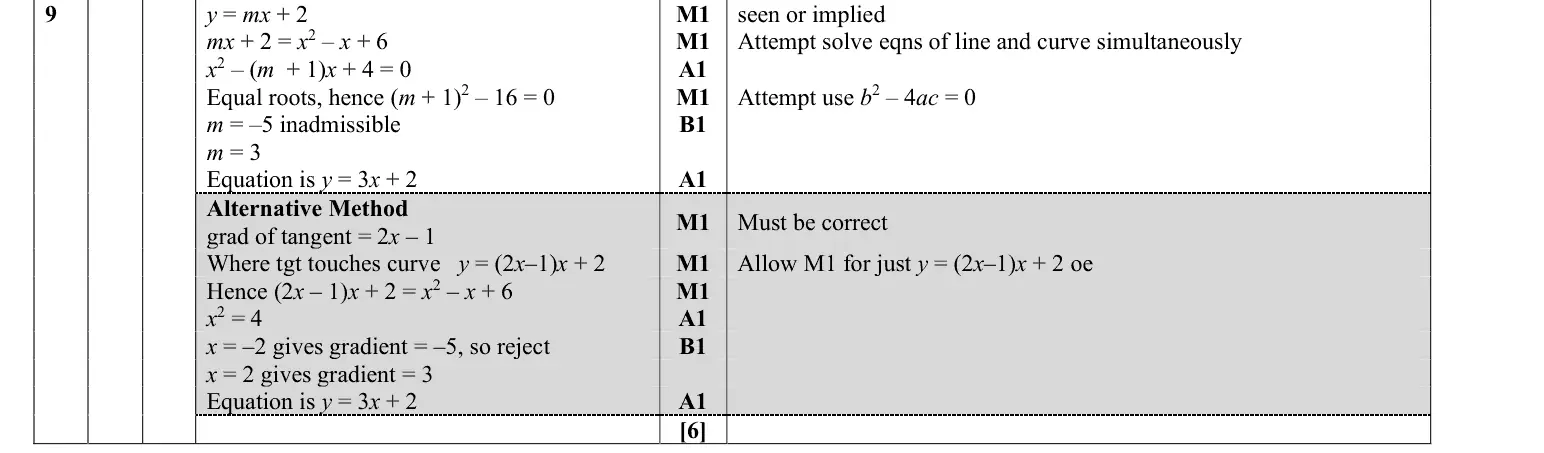
y = mx + 2
x² − (m + 1)x + 4 = 0
equal roots so (m + 1)² − 16 = 0
m = 3 (reject −5)
y = 3x + 2
alt: tangent gradient 2x − 1 gives x² = 4
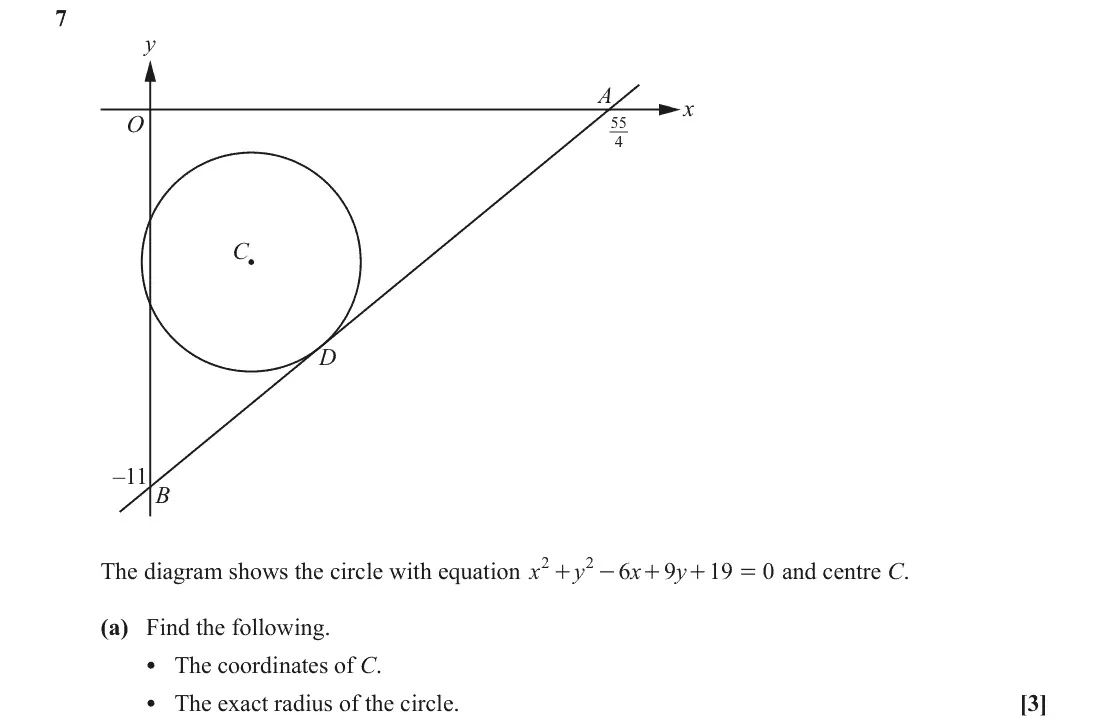
Autumn 2021 · AS Paper 2 · Q7(b)6 marksMedium
Show the start of this question
Mark scheme for this part
Key points and common errors
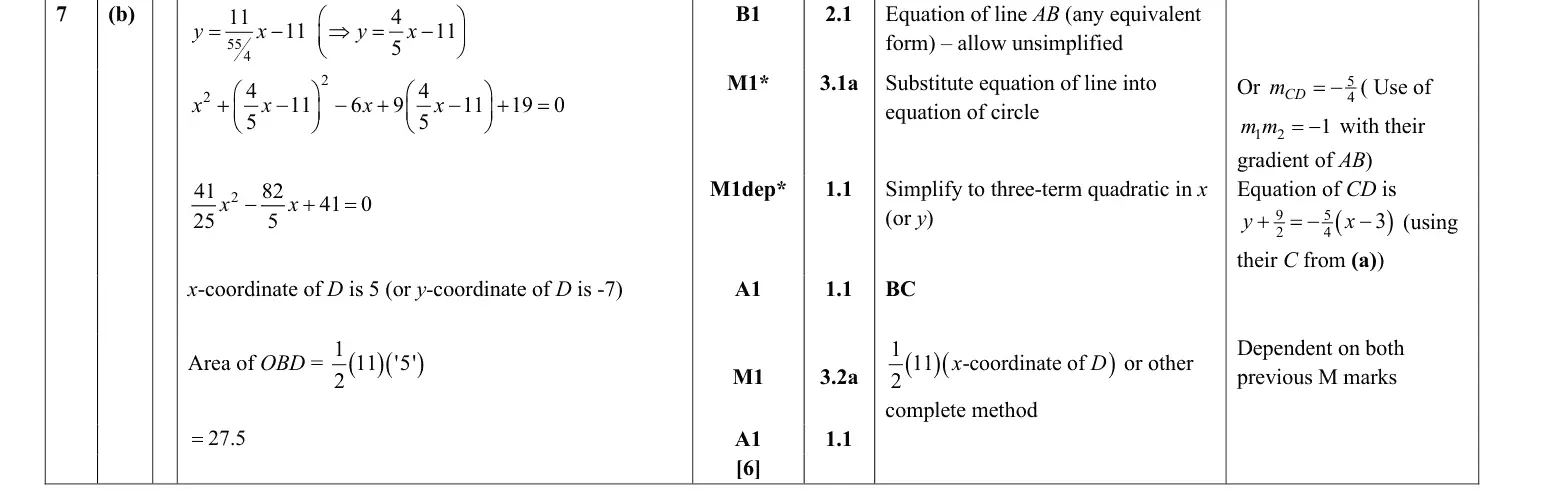
line AB: y = (4/5)x − 11
substitute into the circle to get a repeated root x = 5 (or use CD perpendicular to AB)
area OBD = ½ × 11 × 5 = 27.5
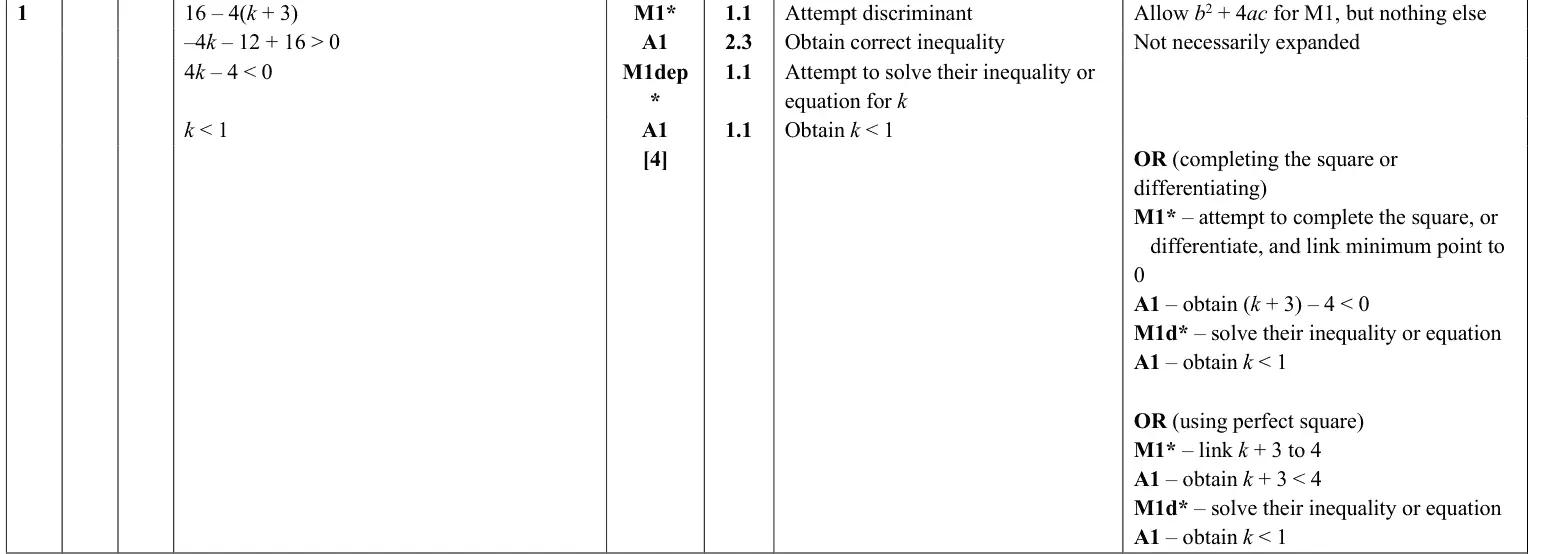
Autumn 2021 · Paper 1 · Q14 marksMedium
Mark scheme for this part
Examiner's comment
(From the general report) Question 1 required candidates to use the conditions for real distinct roots and Question 3 examined proportional relationships.
Key points and common errors
two distinct real roots needs b² − 4ac > 0
16 − 4(k + 3) > 0 gives k < 1
b² + 4ac earns nothing
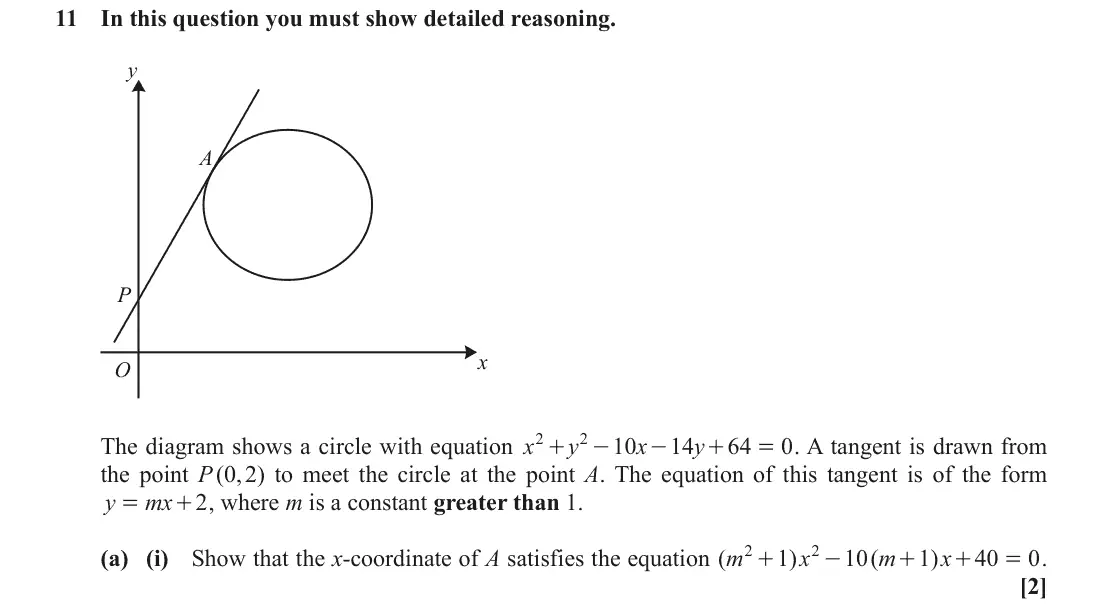
Autumn 2020 · Paper 1 · Q11(a)(ii)4 marksHard
Show the start of this question
Mark scheme for this part
Examiner's comment
(Comment on Question 11 as a whole) Question 11 was the only ‘In this question you must show detailed reasoning’ question on the paper, and candidates were expected to show a detailed and complete analytical method. Part (a)(i) was generally very well answered, but the remainder of the question proved challenging. Part (ii) is a good example of where candidates have to link different topic areas – they are considering a quadratic equation and the fact that the line is tangential should indicate that the required strategy is to equate the discriminant to 0. Candidates struggled with the non-standard aspect of part (b), although some were able to gain some credit for working out relevant lengths and a relevant trigonometric ratio. Of the few that were so far successful, they were expected to continue to work in exact values to justify the request in the question, which not all candidates appreciated.
Key points and common errors
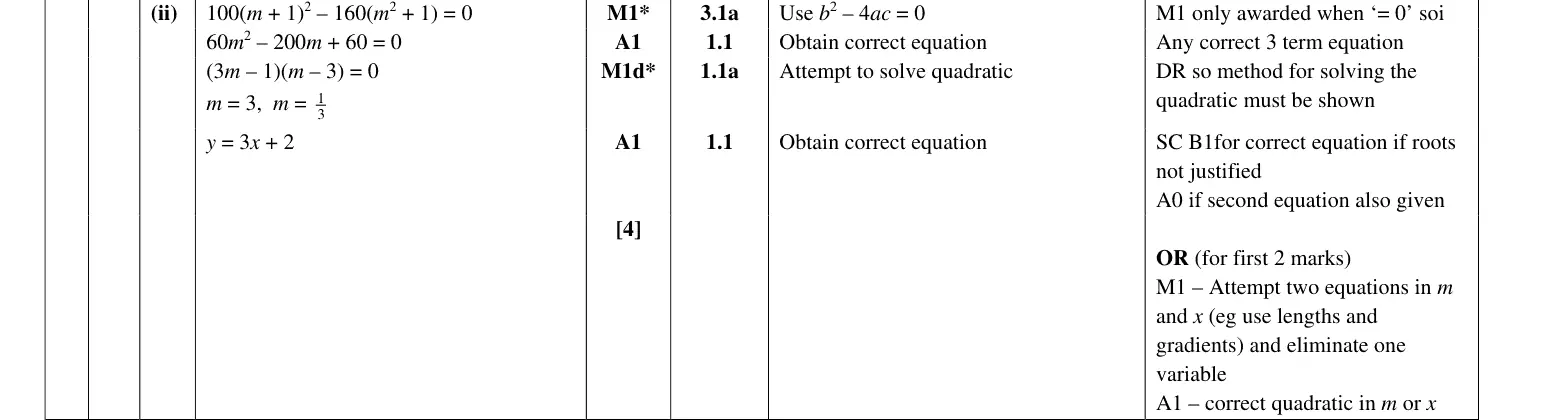
tangent so discriminant = 0: 60m² − 200m + 60 = 0
m = 3 or ⅓
m > 1 so y = 3x + 2
June 2019 · AS Paper 2 · Q8(b)4 marksHard
Show the start of this question
Mark scheme for this part
Examiner's comment
Many recognised the need for ‘ − 4 ’, but this was sometimes carelessly applied to give b ac 64 k − 32 = 0 , − 8 k − 32 = 0 or some such, and many more accurate tries only gave the positive value of k . Often the attempt stopped at the value for k with no effort to find x . Presumably candidates thought k was the root. We expected a valid reason for why the negative value for x was rejected. Simply stating x > 0 was not sufficient as they needed to explain that log x is only defined for x > 0 (not that log x cannot be negative).
Key points and common errors
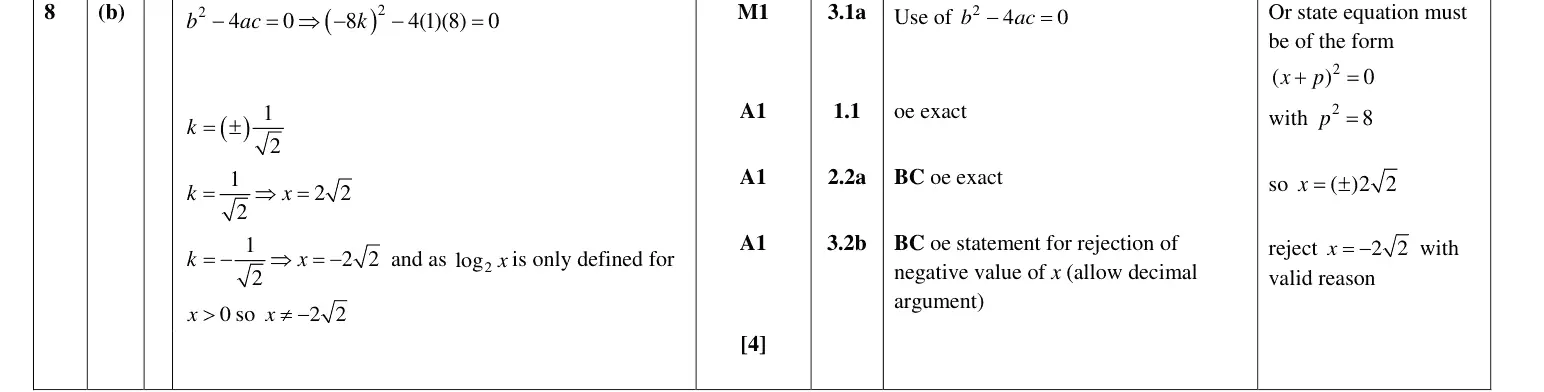
one root: 64k² − 32 = 0 so k = ±1/√2
x = ±2√2
reject −2√2 because log₂x needs x > 0
many stopped at k
June 2019 · Paper 2 · Q75 marksMedium
Mark scheme for this part
Examiner's comment
Candidates who started by finding u were generally successful. Many other candidates started by dividing the left hand side of the given equation by 6x + . Those who handled the remainder correctly x generally went on to be successful. Many, however, after dividing and finding a remainder of 2, said that ( )( ) 2 36 x + 12 x + 7 x + x − 2 = 6 x + x 6 x + x + 1 − , which is incorrect. 6 x + x Some candidates arrived correctly at the two equations 6 x + x − 1 = 0 and 6 x + x + 2 = 0 . However, because this question contains the instruction "In this question you must show detailed reasoning", candidates needed to show (not just state) that the second equation has no real roots. Many candidates lost a mark by failing to do this. This question did prove to be challenging for many candidates, with a range of attempts involving a great deal of algebraic manipulation, in terms of x and u. Some used their calculator to find the roots directly, and then used these in a "fudged" attempt to provide some justification. Whilst the use of calculators to check work should be encouraged, this question required the explicit use of the substitution to be seen in order to gain credit.
Key points and common errors
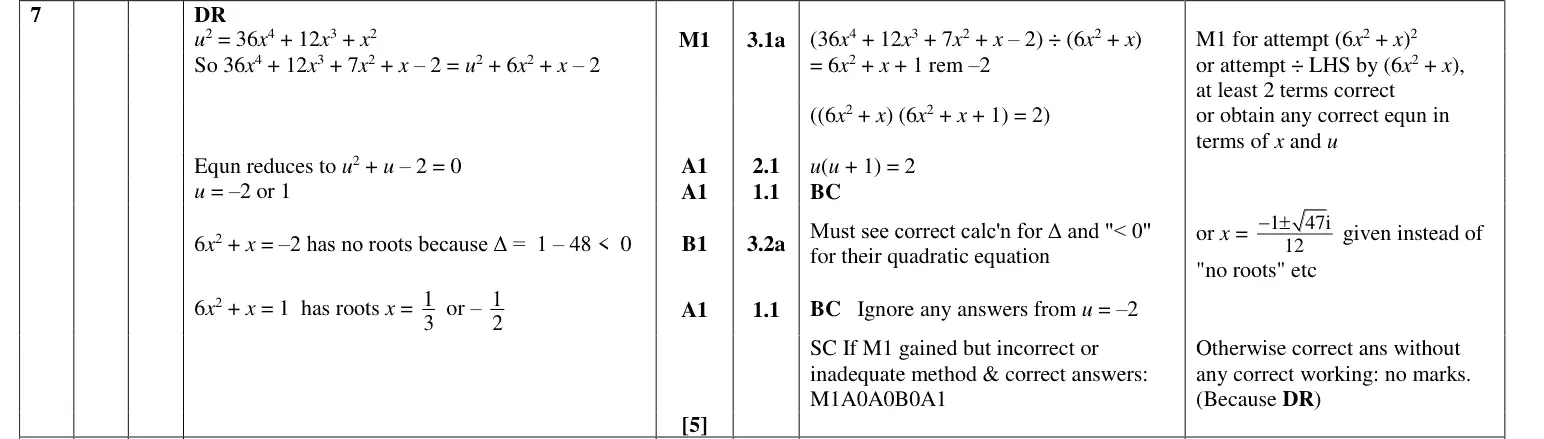
equation becomes u² + u − 2 = 0, u = 1 or −2
6x² + x = −2 has no real roots (discriminant < 0 must be shown)
x = 1/3 or −1/2
wrong handling of the remainder after division
June 2019 · Paper 3 · Q2(b)5 marksMedium
Show the start of this question
Mark scheme for this part
Examiner's comment
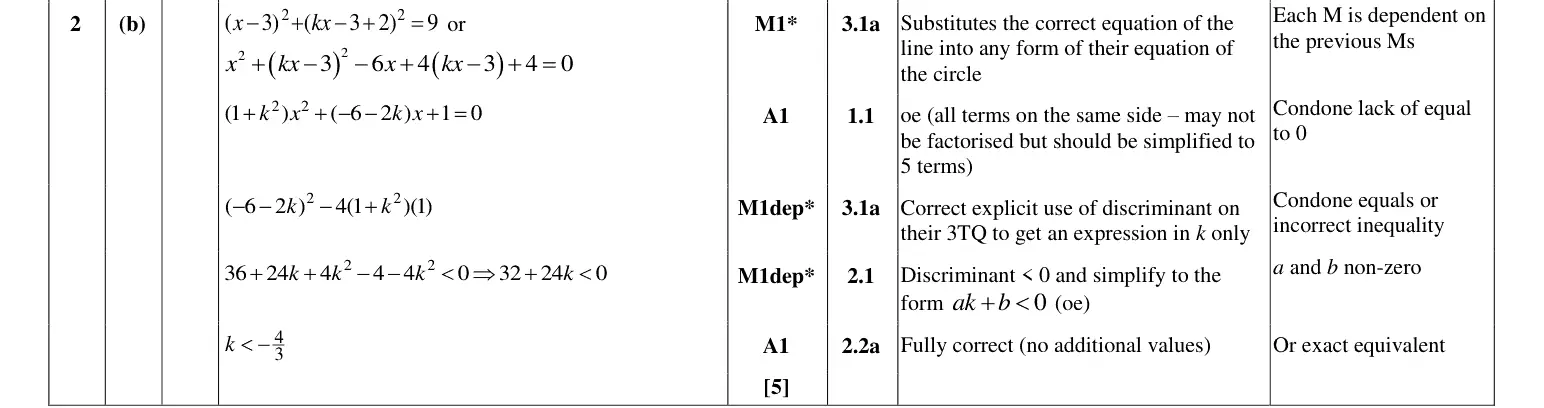
Although examiners did note that some candidates left this part blank, many candidates did start this problem correctly by eliminating y and obtaining( ) ( ) 1 + k x + −− 6 2 k x + 1 = 0 , but then many did not realise that if the line and circle did not intersect (or touch) then the discriminant of this quadratic in x would be negative. Of those that did realise this fact it was only arithmetical or algebraic errors that meant that the candidates could not determine that < − k .
This question was answered well. Use of the discriminant was the more popular approach, but some candidates used the "completing the square" method. . A few candidates started with 9 – 4k > 0. Others used b2 + 4ac. In general the “completing the square” method was less successfully applied, with mistakes in the algebraic manipulation more common.
Key points and common errors
repeated roots: 3² − 4k = 0 so k = 9/4
errors 9 − 4k > 0 or b² + 4ac
June 2018 · AS Paper 2 · Q4(ii)1 markMedium
Show the start of this question
Mark scheme for this part
Examiner's comment
Many candidates did this by evaluating the discriminant rather than using the result they had just obtained. ‘State’ indicates neither working nor justification is required (cf Specification Document).
Key points and common errors
no real roots, read from (i) (minimum value 2 > 0)
'State' needs no working
June 2018 · AS Paper 2 · Q4(iii)2 marksHard
Show the start of this question
Mark scheme for this part
Examiner's comment
This part proved less successful. Many candidates were not able to start an argument. Some attempted to evaluate b2 – 4ac but this was rarely done accurately. Those who recognised how to use the given form of the equation made the most progress, occasionally confusing the r > 0 and r < 0 cases.
Key points and common errors
r < 0 two real roots, r = 0 one repeated root, r > 0 no real roots (since p > 0)
using b² − 4ac rarely accurate
r > 0 and r < 0 cases confused
June 2018 · AS Paper 2 · Q55 marksMedium
Mark scheme for this part
Examiner's comment
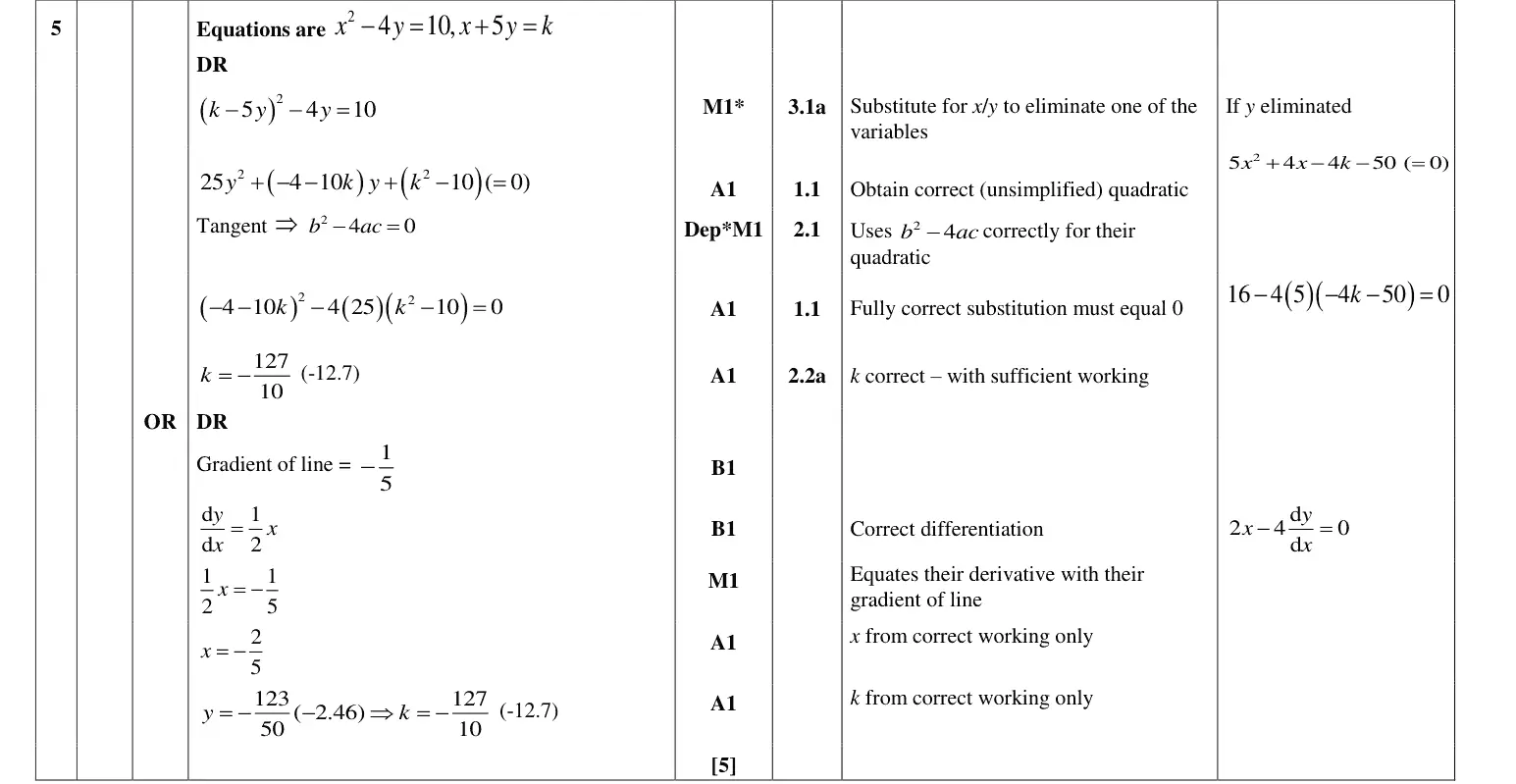
The instruction requesting detailed reasoning did not prove to be an issue in this question. The two methods outlined in the mark scheme were both seen fairly often, with perhaps the ‘substitution’ route more popular. This required accurate algebraic work for complete success, but sign errors in the working were quite common and some petered out at the ‘b2 – 4ac’ stage. In the ‘gradient’ approach, candidates who worked from y = x2/4 – 10 or y = -x/5 + k to the correct value were not given full credit.
Key points and common errors
substitute x = k − 5y: 25y² − (10k + 4)y + k² − 10 = 0
tangent so b² − 4ac = 0
k = −12.7
or gradient method: x/2 = −1/5
sign errors common
June 2018 · AS Paper 2 · Q11(ii)4 marksHard
Show the start of this question
Mark scheme for this part
Examiner's comment
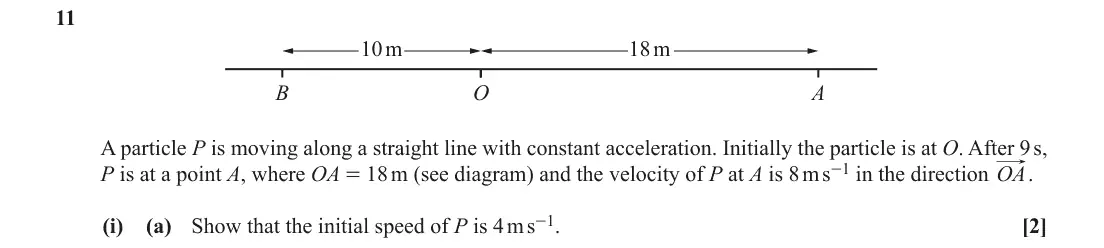
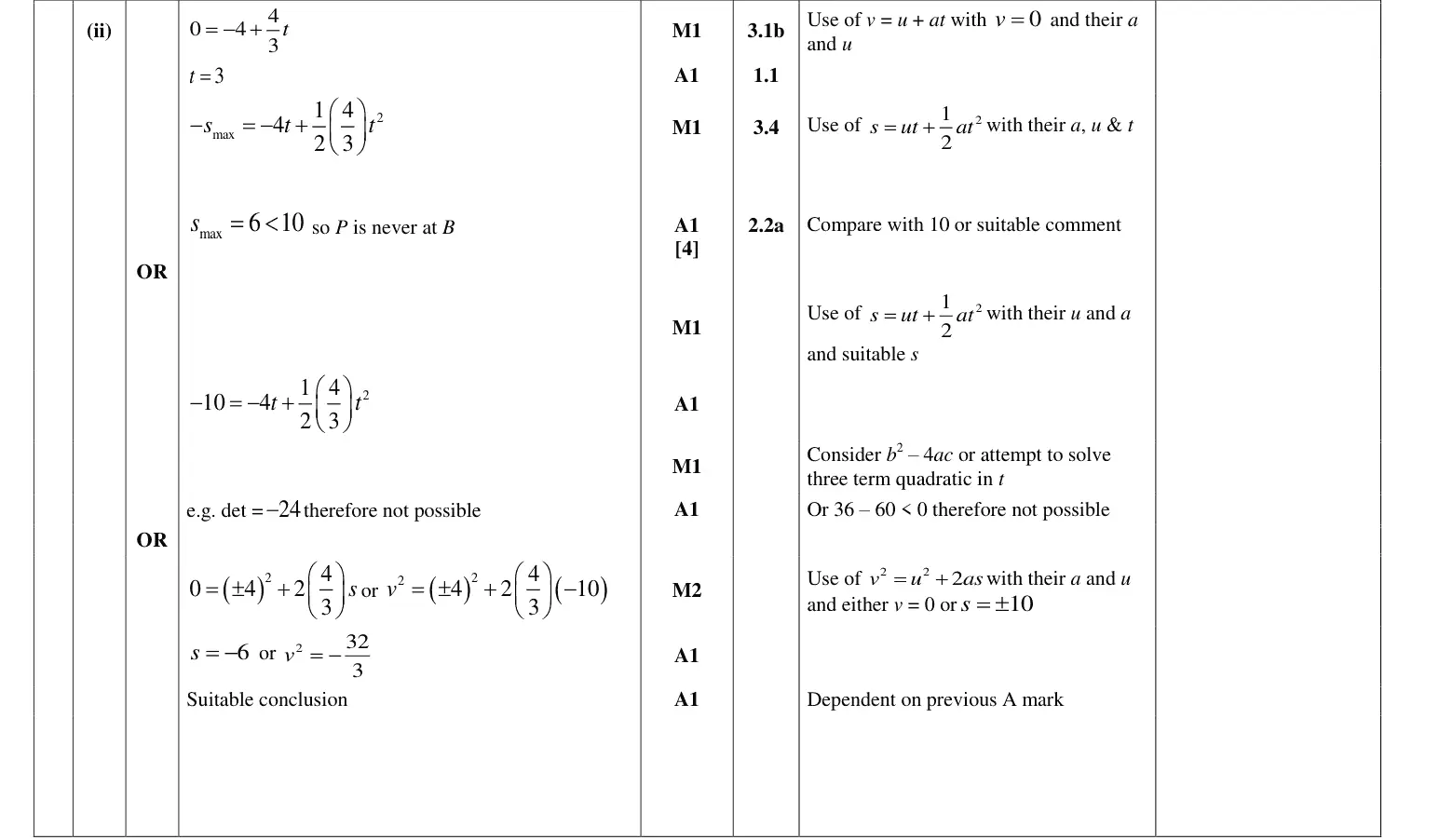
This part proved to be a challenge and, although there are various ways of solving the problem, candidates did not always make their intentions easy to follow. Were they considering the motion from O or B? Some even appeared to be considering A. Those trying s = ut + ½at2 once again had sign difficulties, with u = 4 and/or s = 10 used quite widely.
Key points and common errors
P stops when t = 3
furthest point is 6 m from O on the B side, and 6 < 10 so never at B
or −10 = −4t + ⅔t² has no real roots
sign errors with u and s
June 2018 · Paper 2 · Q1(ii)1 markEasy
Show the start of this question
Mark scheme for this part
Examiner's comment
Most candidates answered this correctly. Some of those who discussed the turning point lost a mark because they merely stated that it is a minimum, rather than showing that this is so.
Key points and common errors
2(x − 3)² + 5 > 0 always so no real roots
must use (i), not the discriminant
stating a minimum without showing it loses the mark
June 2018 · Paper 2 · Q1(iii)2 marksEasy
Mark scheme for this part
Examiner's comment
This question was very well answered.
Key points and common errors
repeated roots: 12² − 8k = 0 or 2(x − 3)² gives k = 18
Find an A-level maths tutor
Stuck on this? Book a trial session with an A-level maths tutor.