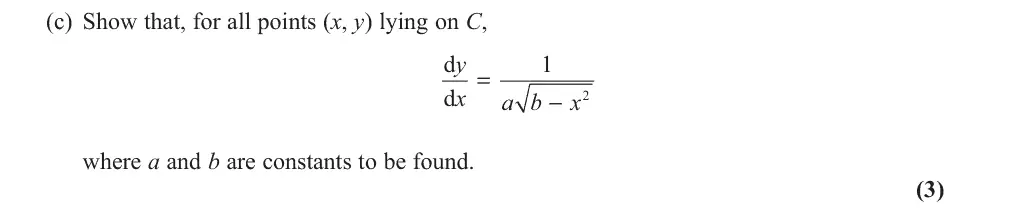
Mark scheme (whole question; this part is marked with the orange bar)
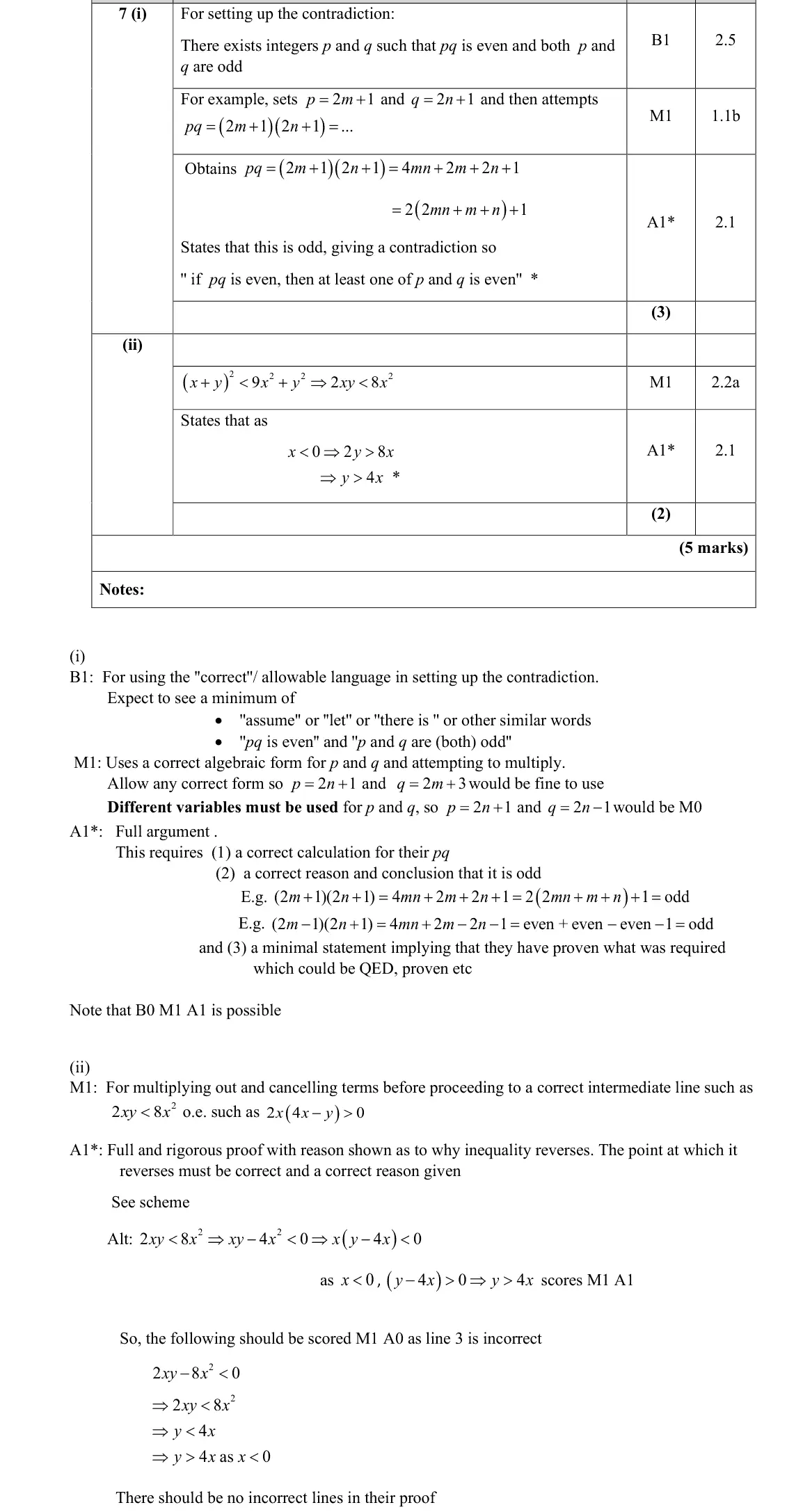
Examiner's comment
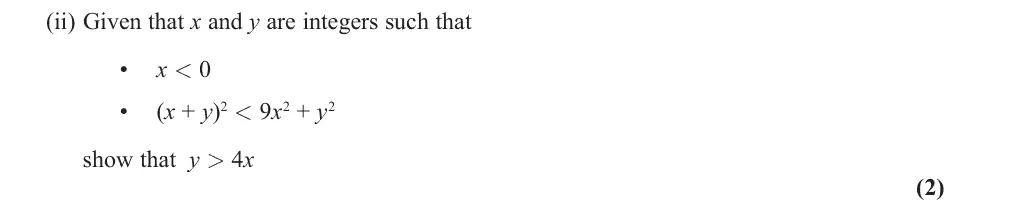
This question, on two different kinds of proof, proved more demanding than expected. As a result, there were very few completely correct solutions to both parts of this question. In part (i) candidates were often unable to set up a proof by contradiction using appropriate language, failing to use words such as 'assume', 'there exists' or 'let' . Others simply set up a contradiction such as 'assume p and q are odd' without any reference to pq being even. Many candidates also failed to use different variables for their odd numbers p and q, implying that p and q were either the same odd number, or two consecutive odd numbers such as 2n+1 and 2n+3. Candidates who managed to write p and q using different variables were generally able to multiply out pq correctly and write it in the form 2(.....)+1. If this stage was reached, the conclusion was generally correct and an acceptable sentence was written down. A mark of 011 was possible from the mark scheme. In part (ii) most candidates expanded the left hand side and cancelled terms getting to 2xy < 8x2 or equivalent for the method mark. Many then lost the second mark by failing to identify the point at which the inequality reverses, simply writing down y < 4x followed by 'so y > 4x'. Other candidates did reverse the inequality at the right point but didn't give an explanation as to why, and so lost the final mark.
Common mistakes
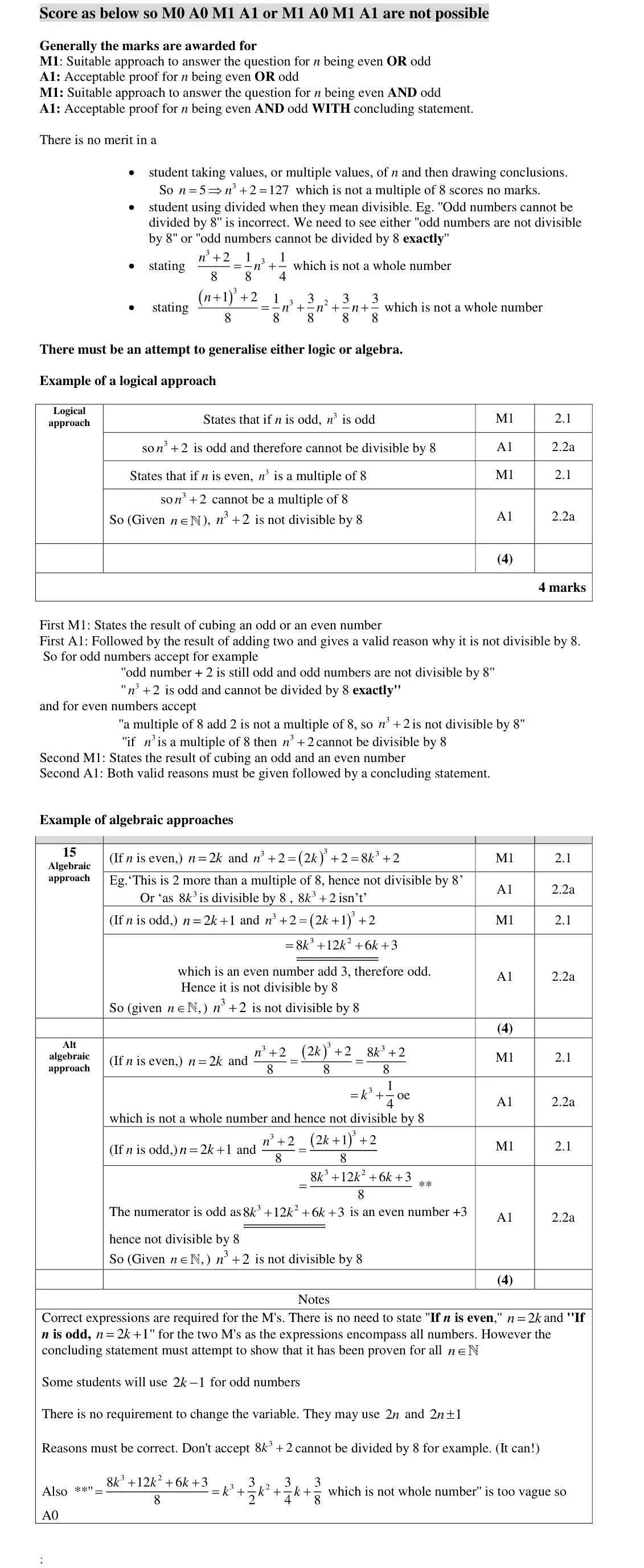
- assume pq even AND p, q both odd ("assume/there exists")
- different variables p = 2m + 1, q = 2n + 1
- pq = 2(2mn + m + n) + 1 is odd, contradiction, then conclude