Differentiate using the product rule, the quotient rule and the chain rule, including problems involving connected rates of change and inverse functions.
Guidance
Differentiation of cosec x, cot x and sec x. Differentiation of functions of the form x = sin y, x = 3tan 2y and the use of dy/dx = 1 / (dx/dy). Use of connected rates of change in models, e.g. dV/dt = dV/dr × dr/dt. Skill will be expected in the differentiation of functions generated from standard forms using products, quotients and composition, such as 2x⁴ sin x, e^(3x)/x, cos²x and tan²2x.
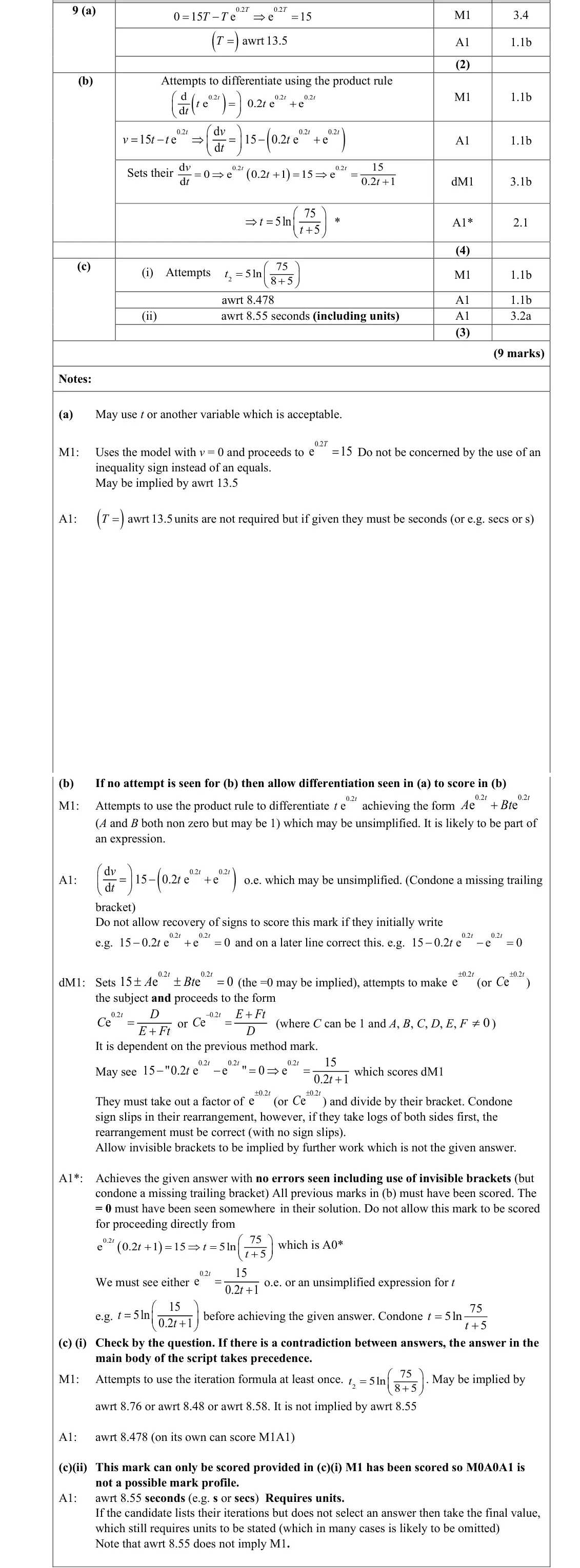
Mark scheme (whole question; this part is marked with the orange bar)
Examiner's comment
This question was generally well-answered, with most learners demonstrating a good grasp of the concepts. However, some common pitfalls were noted, particularly in differentiation and the inclusion of units. Part (b) involved differentiating the given model, setting this equal to zero and rearranging to the given form. This was generally well-answered, however a significant number of learners lost all the marks by not using the product rule. Accuracy marks were typically not awarded due to sign errors as a result of not using brackets correctly. Learners who wrote out the product rule separately before substitution were more likely to avoid such errors. In addition, some learners struggled with algebraic manipulation after differentiation, particularly when taking natural logarithms too early or when simplifying fractions.
Common mistakes
product rule on te^(0.2t): dv/dt = 15 − (0.2te^(0.2t) + e^(0.2t)) = 0 (many did not use the product rule
bracket/sign errors)
factor e^(0.2t)(0.2t + 1) = 15 then take logs to reach the given t = 5 ln(75/(t + 5))
June 2025 · Paper 2 · Q5(c)3 marks
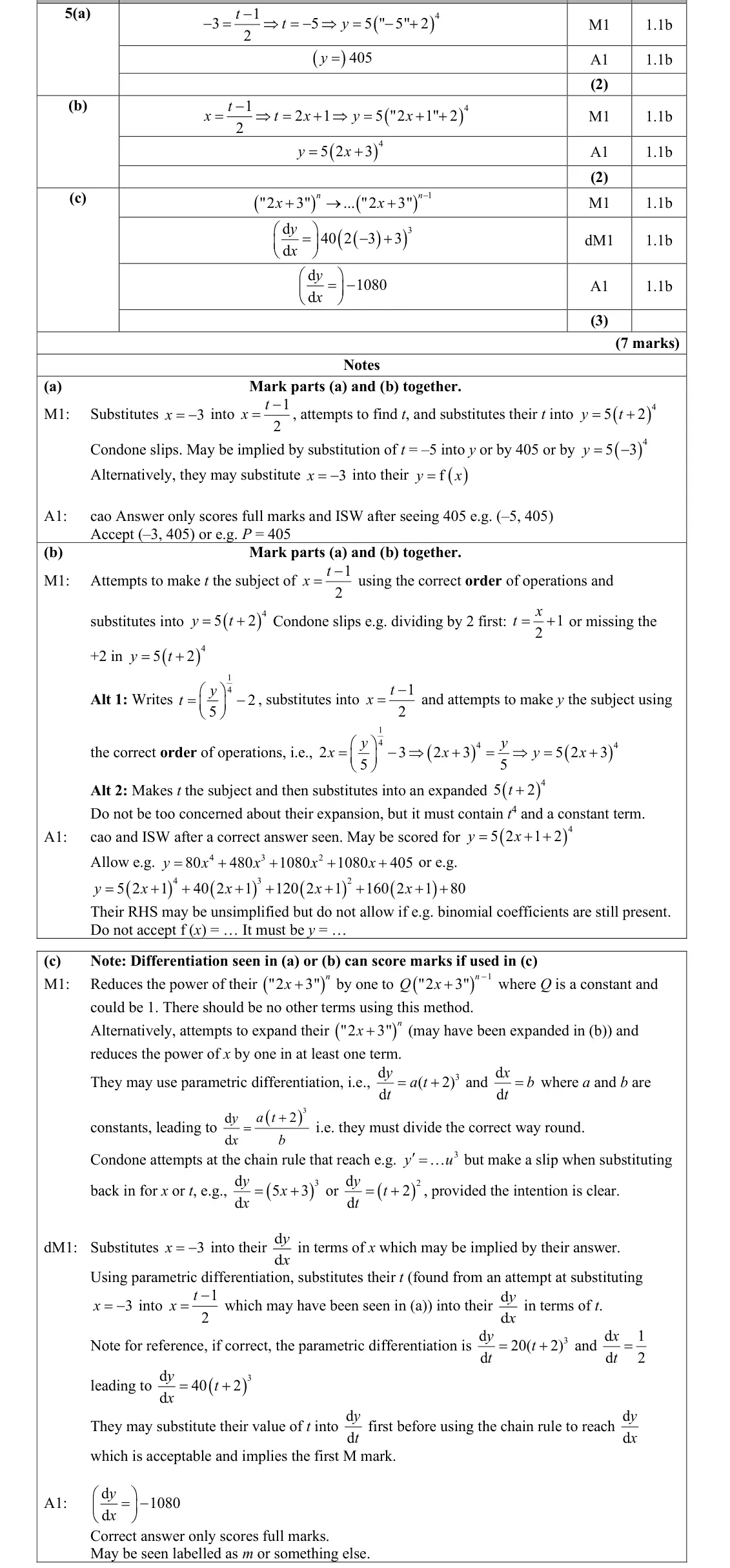
Mark scheme (whole question; this part is marked with the orange bar)
Examiner's comment
This question involved a simple parametric equation, and learners generally performed very well across all three parts. The structure of the question offered a steady progression through substitution, rearranging and then differentiating, with each part building on the previous one. This allowed learners to approach each part confidently, with the majority performing well in parts (a) and (b), even if they did encounter difficulties with part (c). Part (c) was the most variable in terms of performance. Learners who applied the chain rule to differentiate the Cartesian equation generally did well. Those who attempted parametric differentiation were more prone to errors, especially in dividing derivatives in the wrong order d d d d x y t t ÷ or multiplying by 1 2 instead of dividing by 1 2 or substituting x = -3 instead of the correct t value. Responses that tried to expand their cartesian equation from (b) tended to make errors in accuracy in their expansion. Quite a few responses did not recognise that x was a simple linear function of t and used approaches such as the quotient rule, often incorrectly. A very small number did not link the idea of finding the gradient to differentiation at all and instead attempted to use a linear method such as y = mx + c, which gained no credit.
Common mistakes
chain rule on 5(2x + 3)⁴ then x = −3
parametric route: dy/dx = (dy/dt) ÷ (dx/dt) = 40(t + 2)³ with t = −5, not x = −3
dividing the wrong way round or multiplying by ½
answer −1080
June 2025 · Paper 2 · Q15(a)5 marks
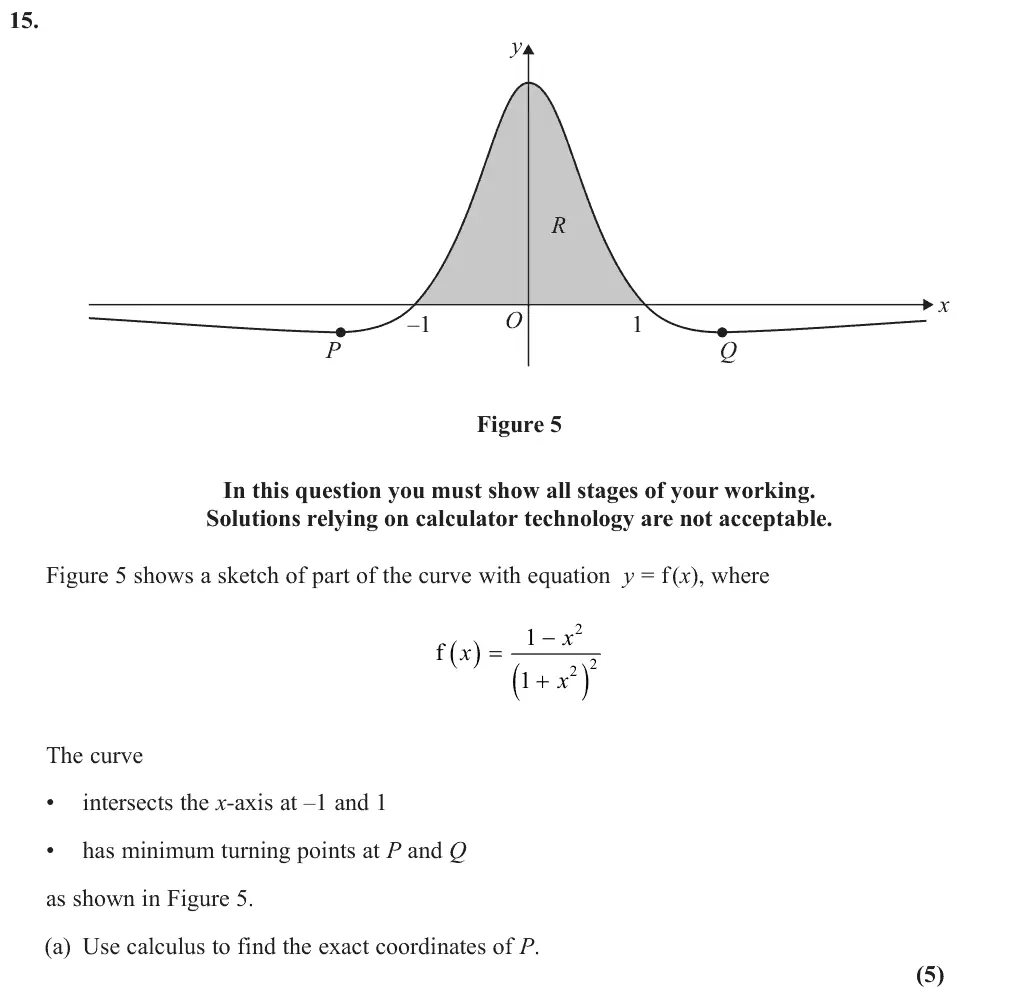
Mark scheme (whole question; this part is marked with the orange bar)
Examiner's comment
The final question, which involved differentiation, integration by substitution and trigonometric identities, provided challenge in dealing with the algebra but, given its layout, proved accessible. The majority of learners attempted at least part of this question with some success due to the restart opportunities available. In part (a), learners were generally able to apply the quotient rule correctly, with a smaller number attempting to apply the product rule. A few responses attempted a substitution, usually 2 1 u x = + , and this need approach often resulted in a succinct and concise solution. Sign slips were quite common, while failing to square the denominator when applying the quotient rule was also seen fairly frequently. This was probably a reflection of the fact that the denominator in the question was already squared so required a bit of extra thought and was easily missed. These errors sometimes meant that they could not make progress due to the form that they achieved. Simplifying the expression and finding the correct coordinate proved quite challenging. Responses often defaulted to unnecessary algebra, such as expanding brackets, when the expression could have been simplified more directly. The number of terms in the expression seemed to be a barrier for many learners. Of those who reached a 3-term hidden quadratic in x2, a significant number turned to the calculator for a solution despite the question stating that solutions relying on calculator technology were not acceptable. Of the responses that obtained a value of x, the vast majority were able to identify that 3 x = - was the correct value to use and then go on to find a correct, corresponding value of y. There were some, however, that found a value for x but stopped there, not attempting to find a value for y.
Common mistakes
quotient rule with the denominator (1 + x²)⁴
cancel a factor (1 + x²) to get 2x(x² − 3)
solve without a calculator
P has x = −√3 (not 0 or √3) and y = −1/8
June 2024 · Paper 1 · Q5(a)3 marks
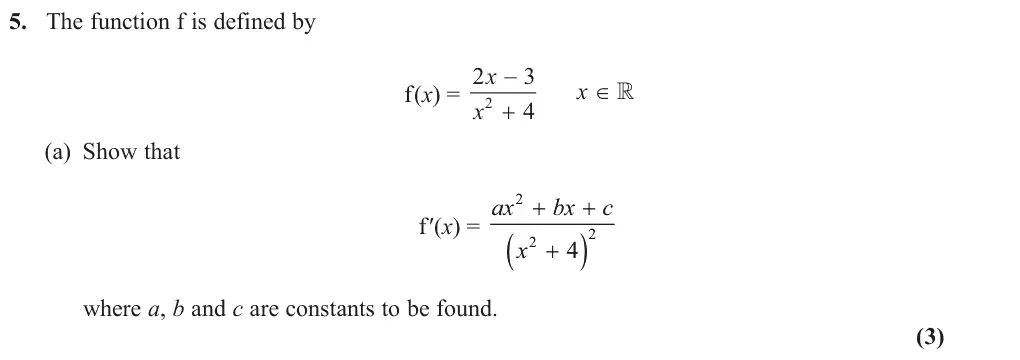
Mark scheme (whole question; this part is marked with the orange bar)
Examiner's comment
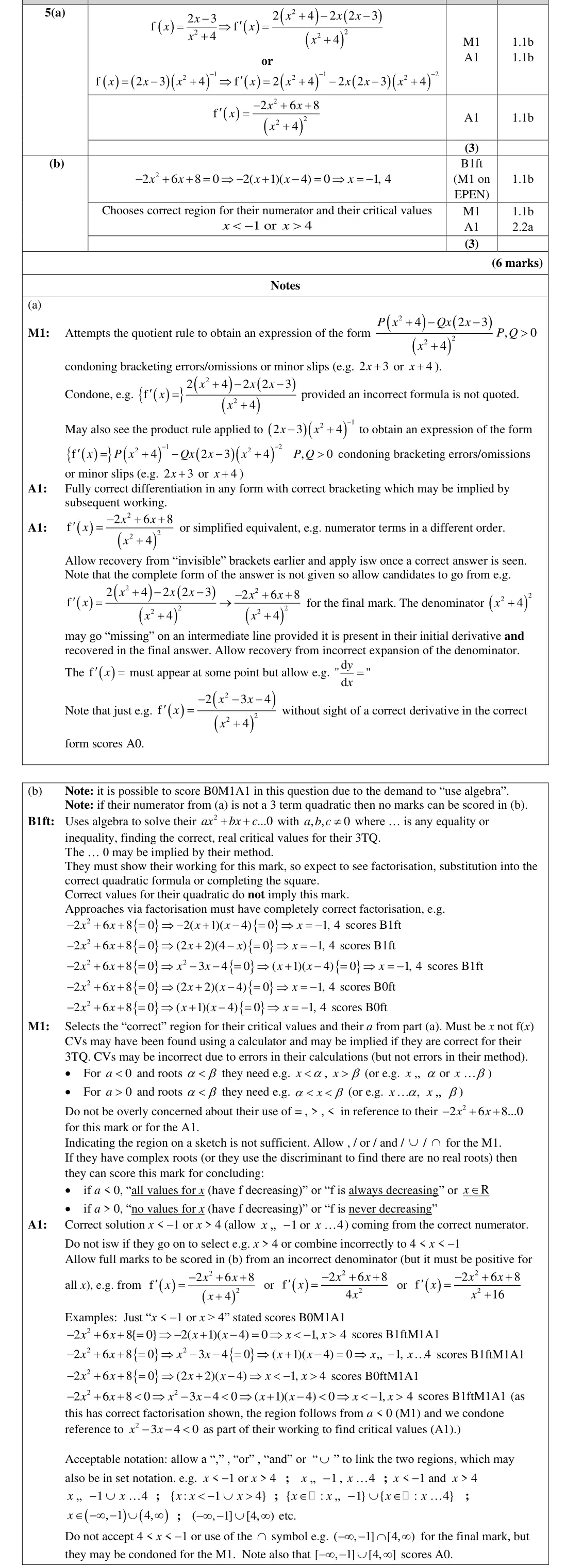
Most candidates attempted the differentiation in part (a) via the quotient rule and this was generally correctly applied with the majority scoring at least 2 marks out of the available 3. While many candidates were able to score full marks in this part of the question, a significant number of candidates lost the final accuracy mark due to either a ( ) - →- - 2 sign error from expanding brackets (most commonly this was ) 2 2 x x 3 4 x 6 x ( ) f ' x = or equivalent, a requirement for this ‘show that’ question. or to missing the Candidates are advised to carefully check that their final result matches the one that they were asked to show. There were a very small number of candidates who incorrectly quoted the quotient rule and were unable to score any marks in this part of the question. A small proportion attempted to use the product rule, and while a good proportion managed this successfully, others made errors when rearranging to the required form. Some candidates broke down the original function into the sum of two fractions before differentiating and in this case a common error was a sign error between the two fractions.
Common mistakes
quotient rule
sign error expanding −2x(2x − 3) is the common slip
f′(x) = (−2x² + 6x + 8)/(x² + 4)²
June 2024 · Paper 2 · Q6(a)2 marks
Mark scheme (whole question; this part is marked with the orange bar)
Examiner's comment
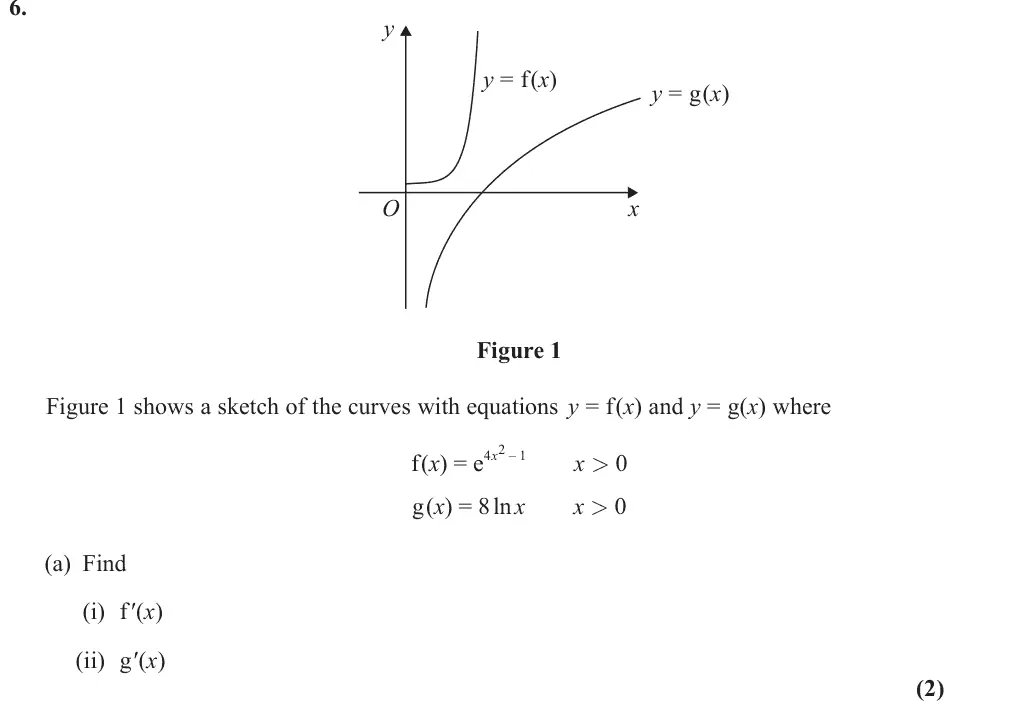
In part (a) candidates struggled with the differentiation of the exponential function and were much more confident in dealing with the natural logarithm. For the exponential function, the most successful candidates often wrote an intermediate step such as and then used the chain rule. Common incorrect responses seen in (a)(i) were 2 4 1 e x A -(A was often 4 or 8 when this was seen), ( ) 2 2 4 1 4 1 e x x - - (with or without brackets), 2 2 4 1 4 e x x -and expressions involving 2 4e . x Common incorrect responses seen in (a)(ii) were 1 8x and 1 . x In (a)(ii) a few candidates wrote 8 8ln ln x x = first and achieved the correct alternative . It was disappointing to see a sizeable number of candidates confused between the “dash” notation for differentiation and inverses. So, it was fairly common to see attempts at the inverse of each function, resulting in no marks for parts (a) or (b).
Mark scheme (whole question; this part is marked with the orange bar)
Examiner's comment
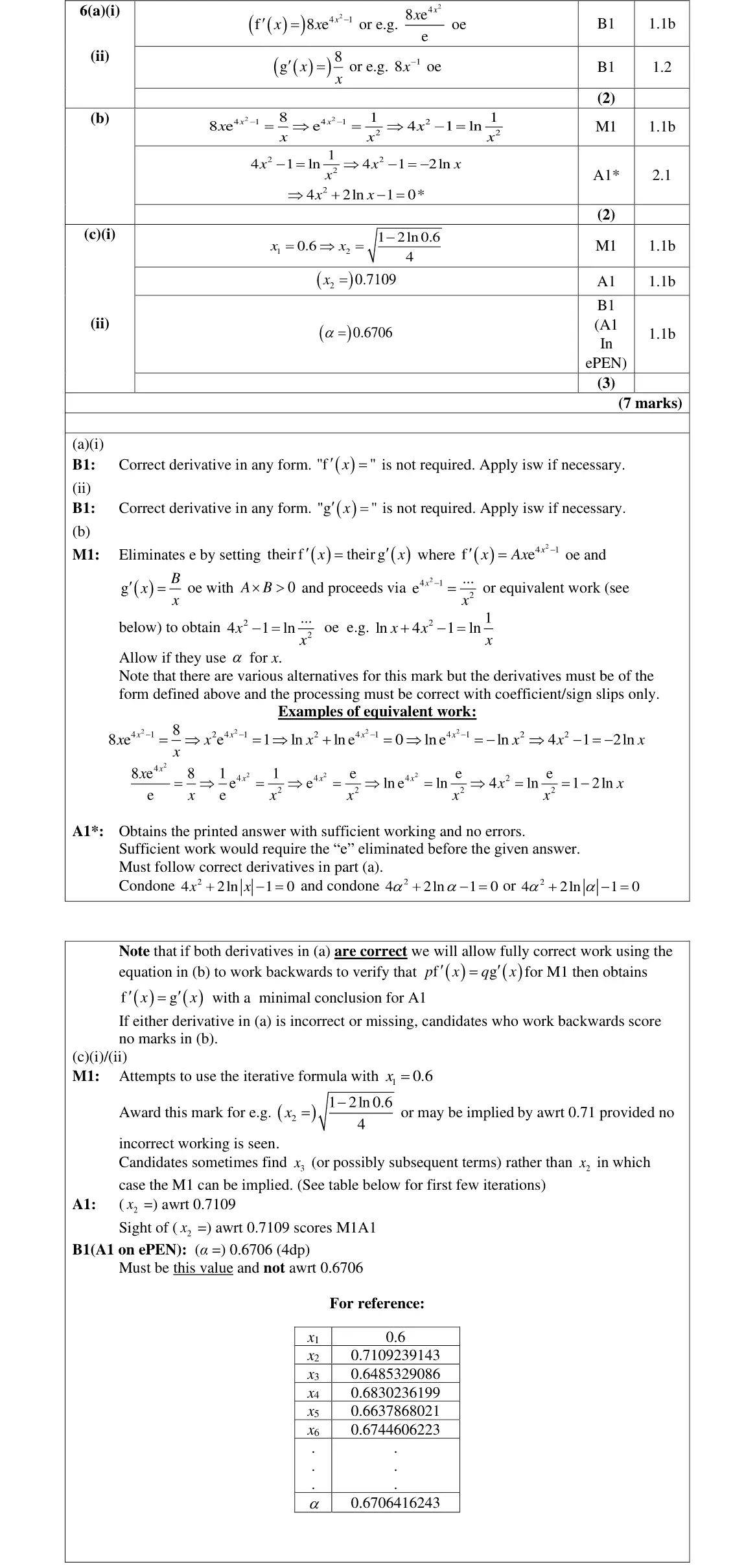
Success in part (b) was dependent on having the correct forms of the derivatives in part (a). 2 4 1 u x = - 7 8 8x x There were often mistakes in using log rules (e.g. ) and some did not know what to do with 2 1 ln x . As with question 4, of those who proceeded correctly, some forgot to include the “= 0”. Generally, candidates did whatever they could to manipulate their working, and many wrote down the given answer following completely incorrect work.
Common mistakes
equate 8x e^(4x² − 1) = 8/x, take ln to eliminate e
ln(1/x²) = −2ln x
must end with "= 0"
working backwards only credited with correct derivatives
June 2024 · Paper 2 · Q10(a)5 marks
Mark scheme (whole question; this part is marked with the orange bar)
Examiner's comment
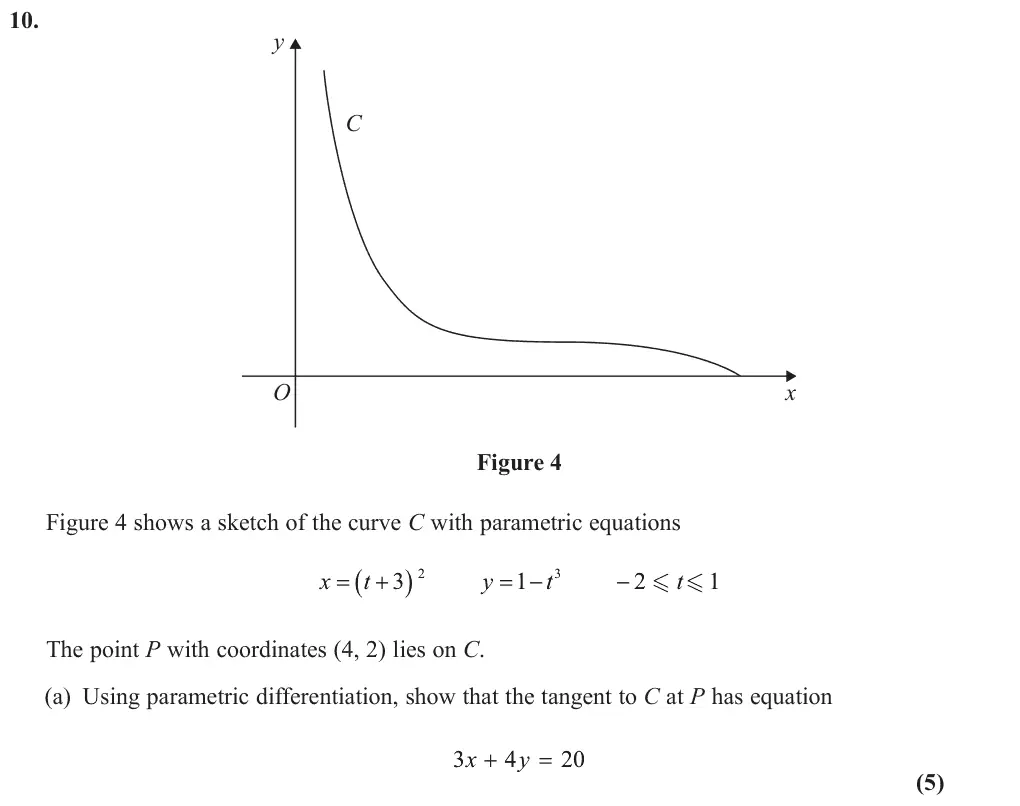
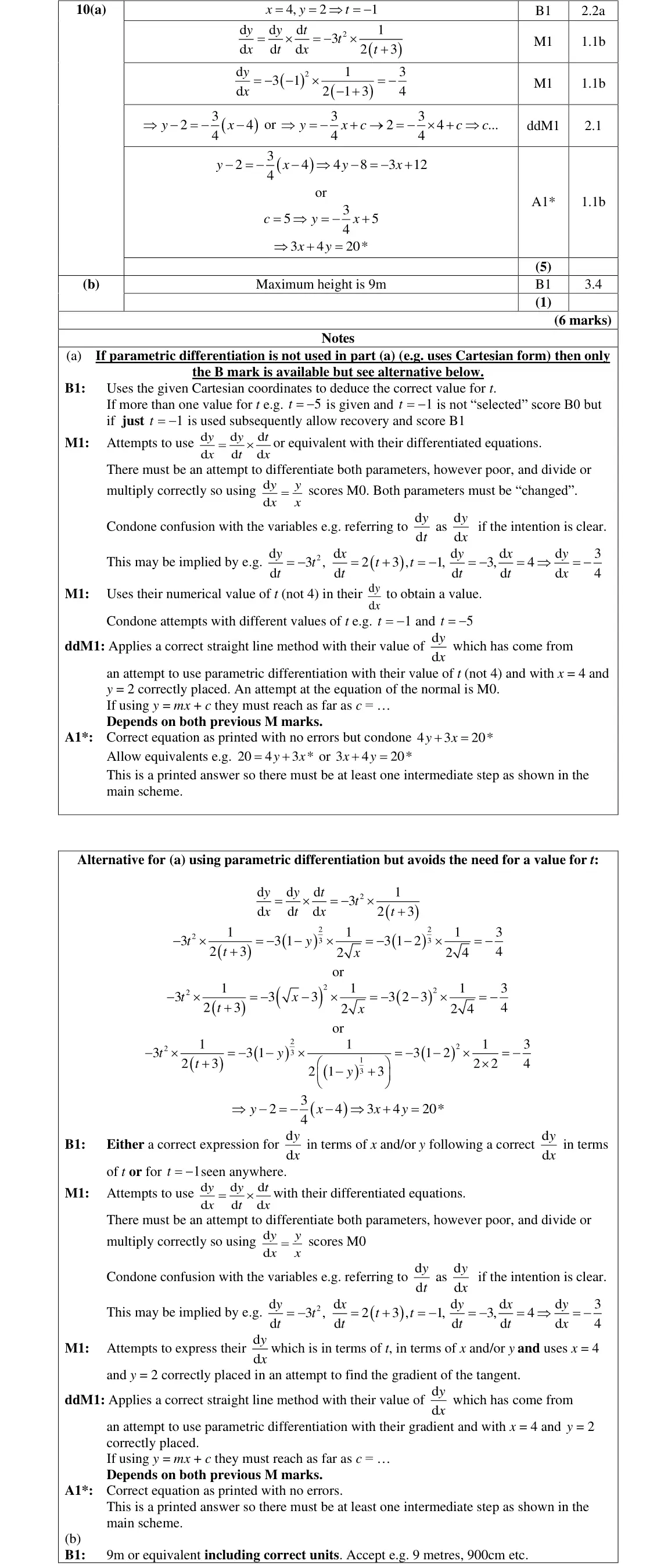
Most candidates were successful in this question, showing that parametric differentiation was overall well understood by candidates. In part (a), many candidates successfully found the given equation of the tangent using parametric differentiation as specified in the question. By far, the most common approach seen involved finding the value of t and then substituting it into an expression for d d y x obtained by using d d d d d d y y t x t x = and then using standard coordinate geometry to find the equation of the tangent. There were a number of careless slips and algebraic errors, with 2(t + 3) = 2t + 3 being disappointingly common. Once the numerical gradient had been obtained, there were usually no issues in finding the equation of the tangent in the required form, showing at least one intermediate step as this was a given answer. Most candidates achieved the equation of the tangent via the Point-Slope form although a large number went via the Slope-Intercept form. A few candidates made coefficient and/or sign errors when manipulating their equation to obtain the given answer and unfortunately lost the final accuracy mark. Those candidates who gained few, if any, marks in this question often failed to see the need to find the value of the parameter ‘t’ for the given point P (4, 2) and were unsuccessful in using the alternative method to continue to find a value for d d y x . Some candidates used an incorrect value of ‘t’, usually t = -5 rather than t = -1, as they either did not note the restrictions for t given in the question, or did not find the t value for the y coordinate of P. A few gave two equations for each value of t found. The attempted use of the Chain Rule was not always completed accurately. Some candidates converted their gradient from the use of the Chain Rule into the gradient of the normal which resulted in an inappropriate equation. When finding the value of d d y x , some candidates substituted 4 for their value of t, confusing it with the x coordinate of point P. Some candidates did not follow the instructions stating that the question had to be answered ‘using parametric differentiation’ and, consequently, scored no marks even though they achieved the required result by obtaining the Cartesian equation of the curve. Some candidates tried to complete the question by unnecessarily converting their d d d d y t t x in terms of t to be in terms of x and/or y which often led to incorrect solutions due to algebraic and/or differentiation errors. There were many candidates who initially went wrong and restarted the question. A number of these ran out of space and incorrectly used the back pages of their answer booklet to continue this question rather than using supplementary paper.
Common mistakes
find t = −1 from P(4, 2) (t = −5 is outside −2 ≤ t ≤ 1)
dy/dx = −3t²/(2(t + 3)) = −3/4
must use parametric differentiation (Cartesian scores only B1)
2(t + 3) ≠ 2t + 3
tangent not normal
show an intermediate step to 3x + 4y = 20
June 2024 · Paper 2 · Q15(a)5 marks
Mark scheme (whole question; this part is marked with the orange bar)
Examiner's comment
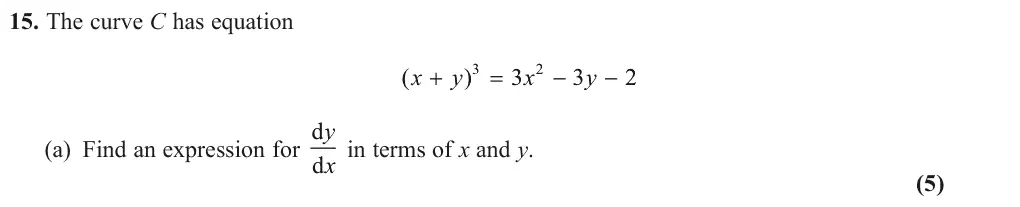
This question provided a challenge to most candidates and was in general a good discriminator. In part (a), it was perhaps disappointing, although not unexpected, to see that so many candidates’ instinctive first step was to multiply out the brackets rather than realising that a simpler, quicker and more accurate method was available. In part (a), the use of the chain rule and factorisation could greatly reduce the required effort and the potential for making mistakes. Those candidates with a good understanding of the chain rule and implicit differentiation were able to use this efficient method quickly to accumulate the 5 marks available. However, a common error of omitting the 1 in (1 + d d y x ) was seen many times. Furthermore, a significant proportion of candidates who differentiated the left-hand side using the chain rule, often chose to expand the derivative, nonetheless, thus complicating the remainder of the question. Unfortunately, the majority of candidates chose to first expand ( ) 3 x y + before attempting to differentiate. Whilst this was, in many cases, completed correctly there was of course an inherent time penalty. A significant proportion of candidates made errors when expanding and displayed a lack of algebraic fluency and poor application of the binomial expansion. Common errors that were seen included missing out terms in the expansion and poor understanding of indices. Once the brackets had been expanded, there were clearly some gaps in understanding of how to successfully carry out the implicit differentiation, particularly for terms that also required application of the product rule. It was quite common to see for example 2 3x y going to d 6 d y x x and 2 3xy going to d 6 d y x . Overall, the right-hand-side was dealt with correctly although the constant term -2 was sometimes retained following differentiation and sometimes d 6 d y y x was seen. When candidates attempted to move all terms over to one side of the equation, there were sometimes sign errors or slips in copying terms. Upon completion of the process of differentiation, almost all candidates seemed to understand that the task was to gather the d d y x terms together, factorise and divide in order to isolate the d d y x , and the majority who reached this stage were able to earn credit here provided their differentiation had been sufficiently structurally correct to produce sufficient terms in d d y x . It was very rare to see a spurious d d y x term retained which has been an issue in previous sessions.
Common mistakes
chain rule on (x + y)³: 3(x + y)²(1 + dy/dx) (the 1 often missed)
expanding first is slower and error-prone (product rule on 3x²y, 3xy²)
−2 differentiates to 0
collect dy/dx terms and factorise
June 2023 · Paper 1 · Q15(a)5 marks
Mark scheme (whole question; this part is marked with the orange bar)
Examiner's comment
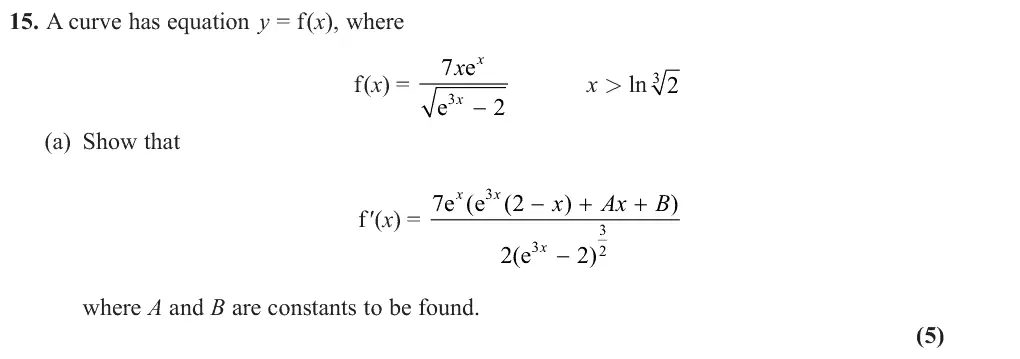
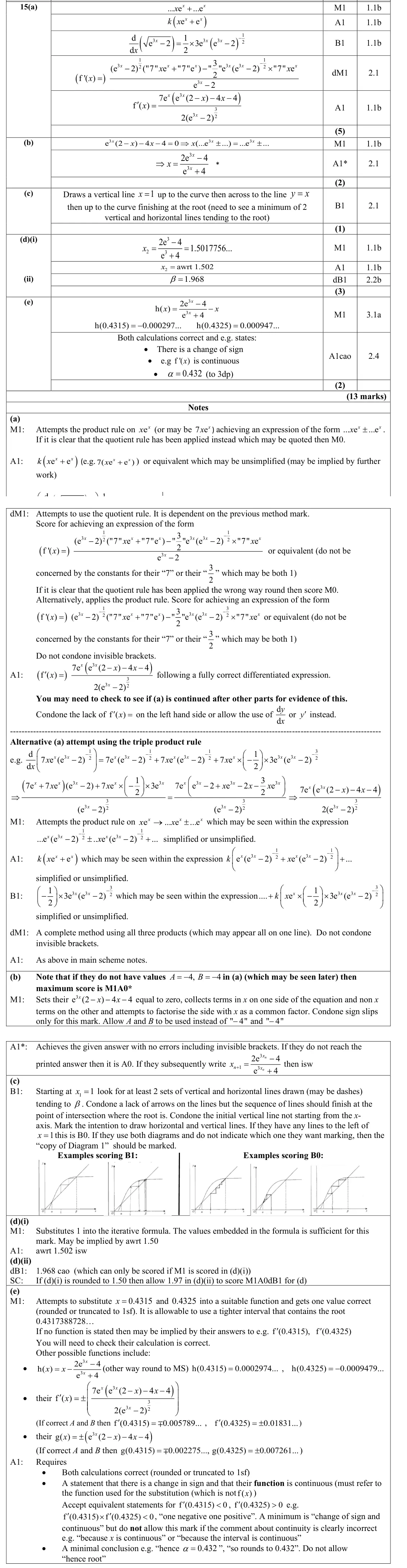
This question brought together a variety of topics and was appropriately placed at the end of the paper. This was very good at discriminating between candidates at the higher end, but it was also pleasing to see a good number of weaker candidates who were still able to attempt later parts such as part (c) and part (d) to a pleasing degree of success. In part (a) a significant proportion of candidates understood that they needed to use the product rule on 7 ex x and most candidates who did, applied it correctly. A common error was just to write 7ex or 7 ex x . Most candidates were unable to achieve the B1 mark, with most not applying the chain rule and so missing terms or making errors with powers. Candidates usually used their expressions correctly with the quotient rule, but few candidates scored the final method mark due to not having the correct expressions. Most candidates chose to use the quotient rule method, but those who used product rule instead, and initially rewrote the denominator as ( ) 1 3 2 e 2 x - - , were generally successful in achieving the first four marks. Some, however, omitted brackets in their expression which lost the final two marks. The final A1 mark was achieved by very few candidates as most did not complete the rearrangement process. Some candidates adjusted their answer by using the given answer in part (b) to work out what the values of A and B should be. Whilst candidates should not typically use later information in earlier parts, this was condoned, as in some cases it would have been too difficult to determine whether this had been done so the benefit of the doubt was given. To achieve the correct form in part (a) from correct differentiation deserved full credit, regardless of the route to the final form required. It should be noted, however, that there were a few who integrated instead of differentiating.
Common mistakes
product rule on 7xeˣ, chain rule on √(e³ˣ − 2), then quotient rule
A = −4, B = −4
June 2023 · Paper 1 · Q15(b)2 marks
Mark scheme (whole question; this part is marked with the orange bar)
Examiner's comment
This question brought together a variety of topics and was appropriately placed at the end of the paper. This was very good at discriminating between candidates at the higher end, but it was also pleasing to see a good number of weaker candidates who were still able to attempt later parts such as part (c) and part (d) to a pleasing degree of success. In part (b) very few candidates attempted a solution having not completed a solution to part (a). Some determined candidates attempted a solution using A and B and so were able to achieve the method mark. Some candidates attempted a solution by using the given solution to work out what the values of A and B should be and then attempted a solution with those values. A minority of candidates who attempted a solution did not show all the steps required for a show that question.
Common mistakes
set the numerator = 0, collect the x terms and factorise
June 2023 · Paper 2 · Q7(a)4 marks
Mark scheme (whole question; this part is marked with the orange bar)
Examiner's comment
had been unsuccessful in part (a). The least successful approach for calculation of the gradient of the normal tended to involve an attempt to rearrange the expression for d y d x - prior to into d x d y substitution and this seem to be more error-prone than the alternative of substituting in values as a first. Some candidates did not spot that point P on the curve had been given in the question and so didn’t use this point in order to find the equation of the line. In some cases, candidates found the equation of the tangent rather than the normal whilst others made arithmetical slips and lost the accuracy mark. Occasionally candidates did not state their equation in the required form which was a shame when it followed correct work.
Mark scheme (whole question; this part is marked with the orange bar)
Examiner's comment
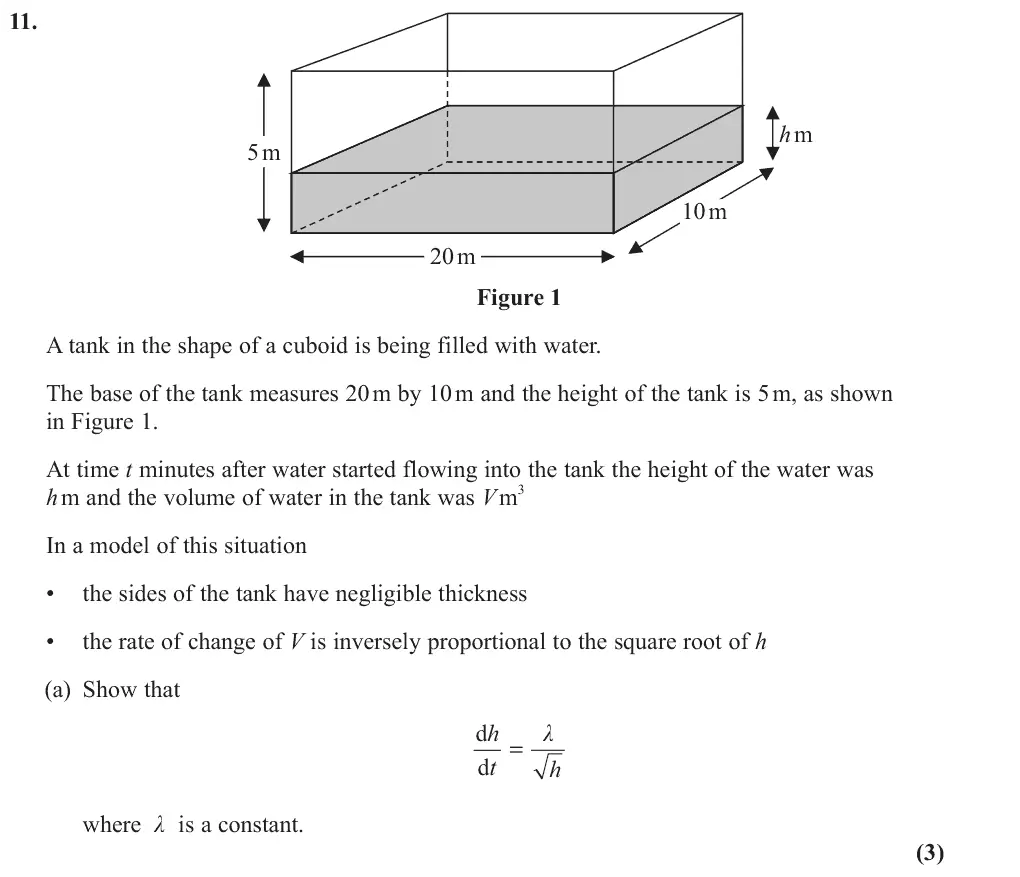
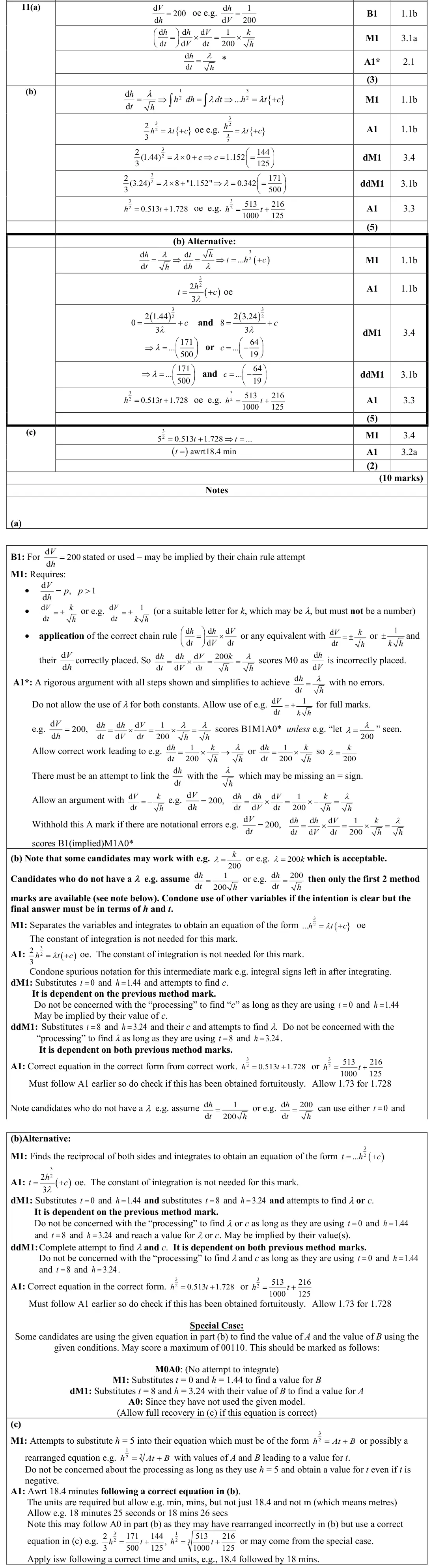
Many candidates found this question challenging and there were a significant number of blank responses. Candidates found part (a) particularly challenging, with many attaining either no marks or the first mark only. The concept of connected rates of change is one that candidates frequently struggle with. A good number found an expression for V and successfully differentiated to get d V h = 200 , although some confused the volume of water with the volume of the tank. Many d candidates failed to recognise that d V 1 and hence d V k = . Of those who had some d t d t h h concept of the rate being d V , many misunderstood the idea of inverse proportion and others d t missed the constant of proportionality. Even where candidates had correct expressions for both d and d V V , they often failed to use the chain rule correctly to find d h . Many candidates d h d t d t who did link their expressions correctly, achieving d 1 h k = d 200 t h , with k = or equivalent, stated that this could be expressed as and so gained all 200 h three marks. Others made no reference to 𝜆 and so lost the accuracy mark. A less common, but ( ) d 200 h d V = correct, approach used d d t t Approaches to part (b) of the question were very mixed. Many candidates failed to realise that,
Common mistakes
V = 200h so dV/dh = 200
dV/dt = k/√h (inverse proportion with a constant)
chain rule dh/dt = dh/dV × dV/dt = k/(200√h), then λ = k/200 must be defined
using λ for both constants loses the A mark
June 2022 · Paper 1 · Q8(b)4 marksMedium
Mark scheme (whole question; this part is marked with the orange bar)
Examiner's comment
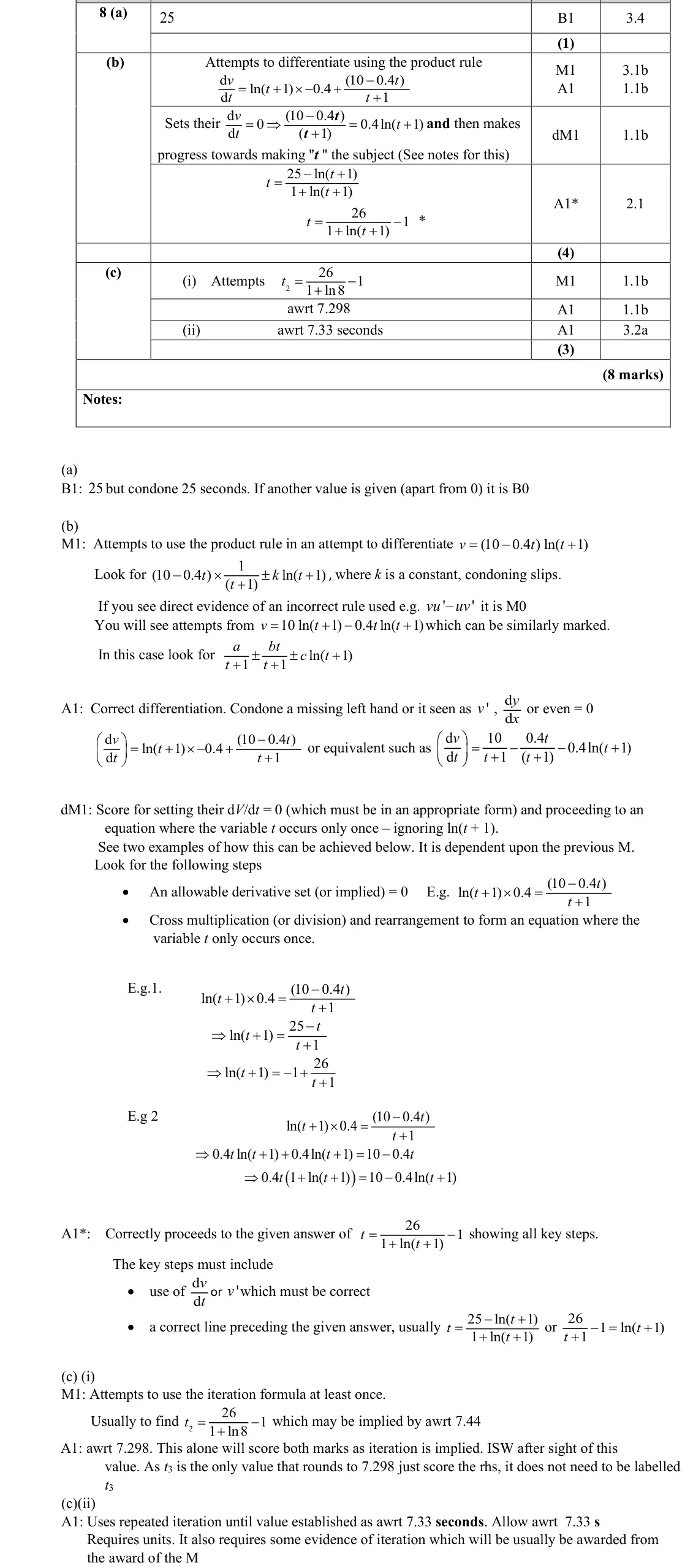
This was the second modelling question on the paper. The given equation modelled the speed of a car as it travelled between a pair of traffic lights. Many weaker candidates missed out part (b) and scored marks in the more accessible parts (a) and (c). The first two marks in part (b) were often achieved by those who attempted it. Using the product rule to find d v t and then setting this = 0 gave them one form of the given equation. The final two marks were only achieved d by the best of students. In reality, all that was required was to make t the subject of the formula, but it was beyond most.
set = 0 and make t appear once: t = (25 − ln(t + 1))/(1 + ln(t + 1))
the rearrangement defeated most
June 2022 · Paper 2 · Q12(a)3 marks
Mark scheme (whole question; this part is marked with the orange bar)
Examiner's comment
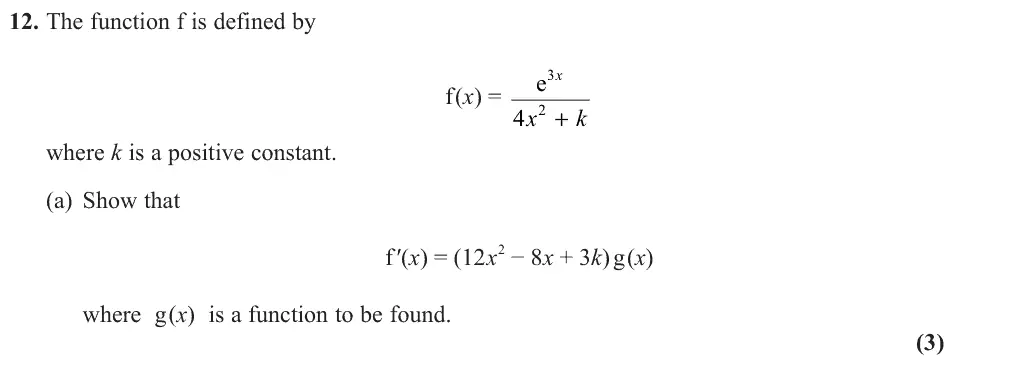
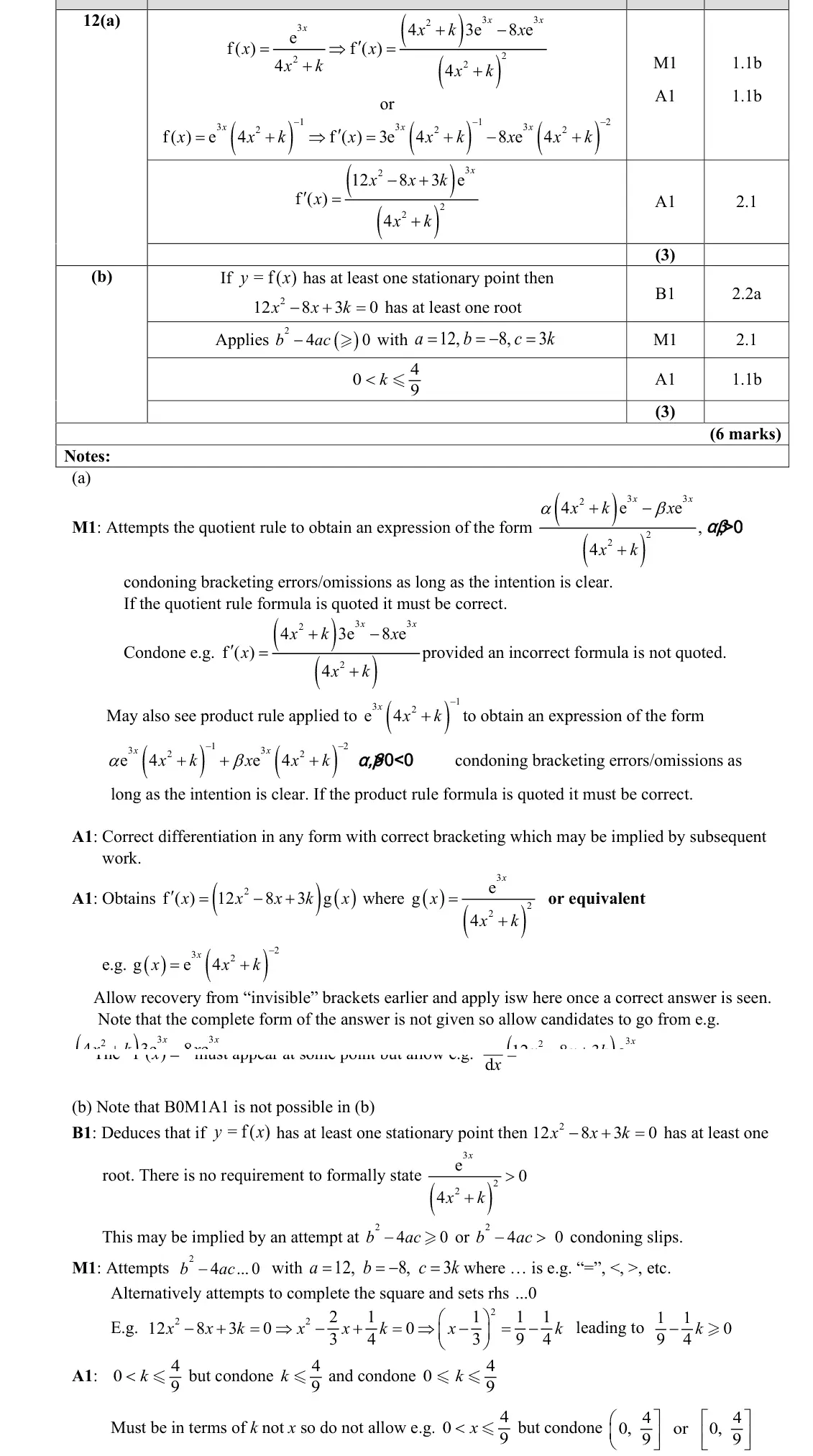
Part (a) was generally well answered. The quotient rule was usually applied correctly for the first two marks and, given the quadratic factor was given, most candidates were able to arrive at the correct expression for g(𝑥𝑥). Some used the product rule instead and usually gained the first two marks although it was a little more difficult to get the final answer and some algebraic errors were made. Although most candidates gained the M mark in (a) their brackets were very often incorrect or missing. This was usually recovered in later steps allowing full marks to be obtained. When differentiating 4x2 + k, some candidates left k in the answer, or differentiated to 8x + 1, gaining no marks. Occasionally the terms on the numerator were reversed and these attempts gained no marks in (a) as in incorrect method was implied. Some missed the 3 when differentiating e3x using the chain rule. Most candidates understood there was no need to expand the denominator. Where they did so, they generally did it correctly and no marks were lost. This was a “Show that” question so “f′(x) =” or “ d d y x = ” needed to be seen and was sometimes missing, losing the final A mark.
Common mistakes
quotient rule numerator the right way round
d/dx e³ˣ = 3e³ˣ, d/dx(4x² + k) = 8x
g(x) = e³ˣ/(4x² + k)²
f′(x) = must be seen
June 2022 · Paper 2 · Q16(a)5 marks
Mark scheme (whole question; this part is marked with the orange bar)
Examiner's comment
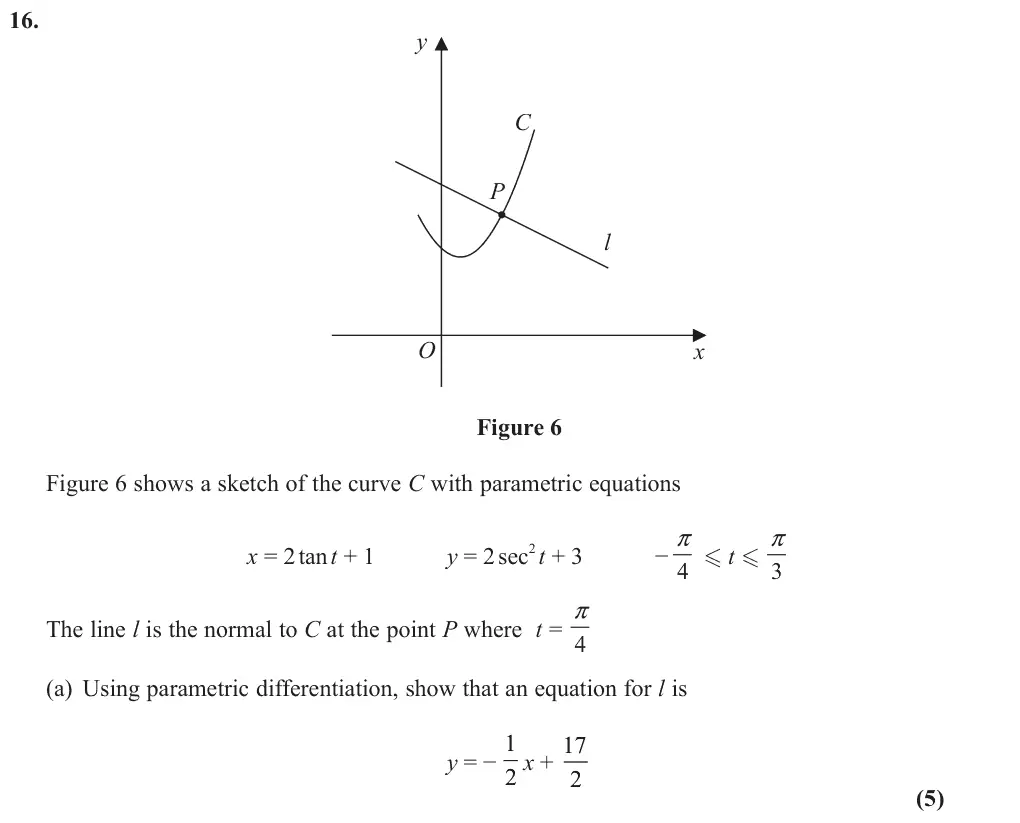
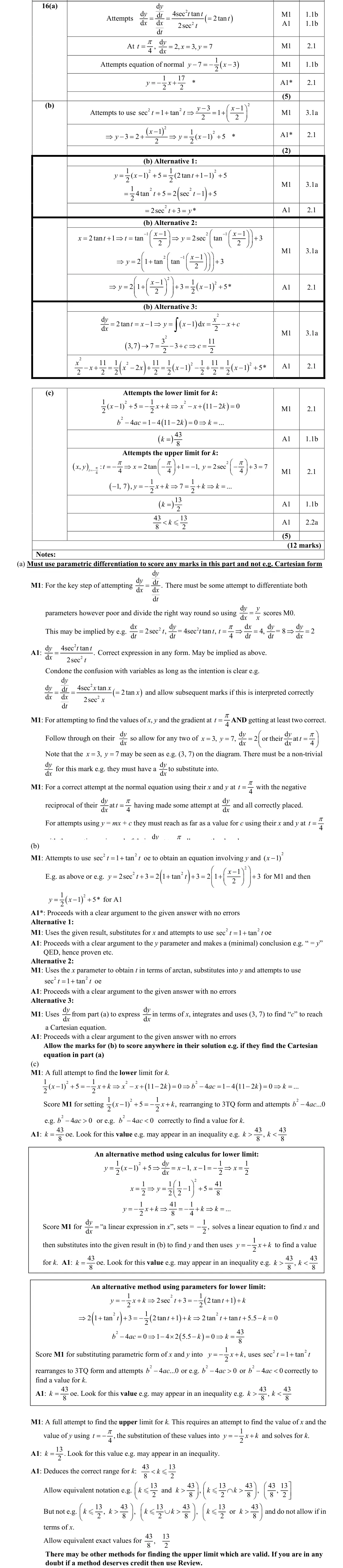
This question proved to be a good differentiator between candidates. It provided a challenge for many candidates but equally there were a number of accessible marks here. Most candidates attempted part (a), many attempted part (b) and at least partially attempted part (c), usually attempting to find the lower limit for k. There were, however, very few completely correct answers to this question and a substantial minority made no attempt at any part, perhaps having run out of time by the time they reached the last question on the paper. Part (a) was mostly approached correctly with a good number scoring full marks. Candidates generally noticed the instruction to use parametric differentiation. Whilst d𝑥𝑥 d𝑡𝑡 was most often correct, d𝑦𝑦 d𝑡𝑡 proved a challenge for many who struggled to differentiate sec2𝑡𝑡. Many did not seem to know that these functions were standard derivatives presented in the formula booklet and instead there were some long-winded and overly complex attempts to convert to sine or cosine functions and such approaches often led to errors. However, even some of the most inefficient approaches managed to persevere through lengthy algebra to obtain a correct d𝑦𝑦 d𝑥𝑥 eventually. Almost all who attempted d𝑥𝑥 d𝑡𝑡 and d𝑦𝑦 d𝑡𝑡 knew and attempted d𝑦𝑦 d𝑥𝑥= d𝑦𝑦 d𝑡𝑡 ÷ d𝑥𝑥 d𝑡𝑡. Those who made errors when determining d𝑦𝑦 d𝑥𝑥 often exhibited an over-reliance on trying to match the printed result and thus ‘adjusted’ their d𝑦𝑦 d𝑥𝑥 in an attempt to obtain the required value for the normal gradient. Often this meant the loss of a method mark. Candidates would be better advised to utilise a correct method rather than incorrectly manipulating their answers to match the result they are attempting to achieve and caution should always be advised when working backwards from a given answer. Nonetheless, application of negative reciprocals and equations of lines was generally successfully attempted, and candidates were clearly confident in these areas. There were a few attempts at a Cartesian approach in part (a) which gained zero marks as the question had specified the use of parametric differentiation.
Common mistakes
must use parametric differentiation
dy/dt = 4sec²t tan t (sec²t is a standard result), dy/dx = 2tan t = 2 at t = π/4
P(3, 7)
normal gradient −½
do not fudge dy/dx to fit the given answer
Oct 2021 · Paper 1 · Q4(a)4 marks
Mark scheme (whole question; this part is marked with the orange bar)
Examiner's comment
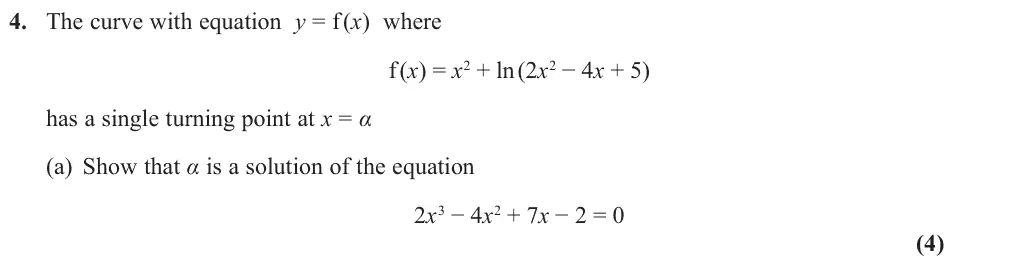
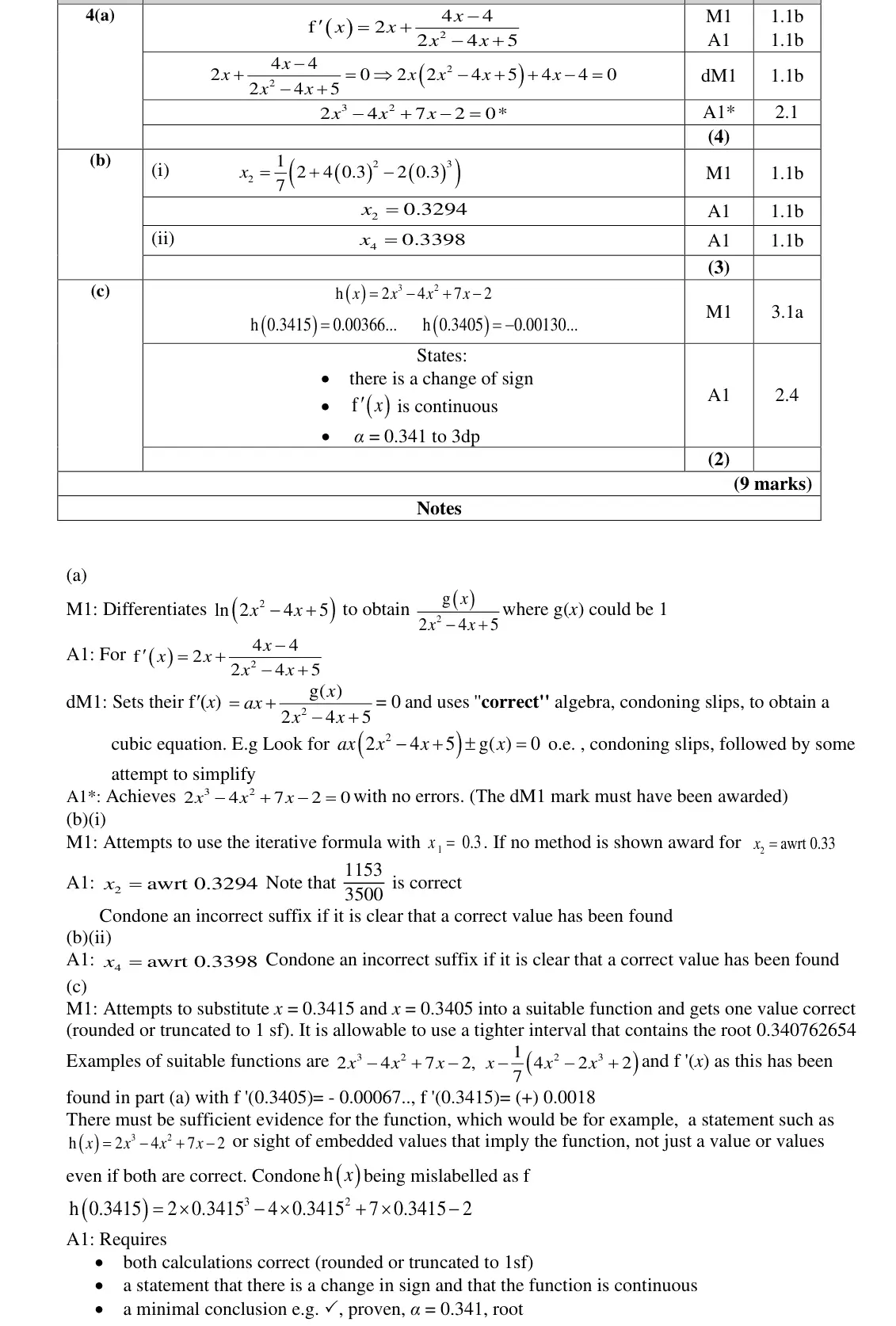
Aspects of this question proved to be more demanding than expected, but overall good marks were scored by candidates with most achieving over half marks in this question. Part(a) Almost all candidates identified the need to differentiate and set their expression equal to zero. Although the derivative was often accurately found – the chain rule aspect of the log expression was omitted by some so that the expression 4x-4 was not seen as the numerator of the required fraction. Some numerators seen included 2x-2, 2x- 4 or most often 1. Manipulating their equation into the desired form was also an issue for some, with sign errors causing problems, whilst others could not properly convert their equation involving fractions into one not involving fractions.
Common mistakes
chain rule on ln(2x² − 4x + 5) gives numerator 4x − 4 (not 1 or 2x − 2)
set f′(x) = 0 and multiply through by the quadratic
sign errors
Oct 2021 · Paper 1 · Q144 marks
Mark scheme (whole question; this part is marked with the orange bar)
Examiner's comment
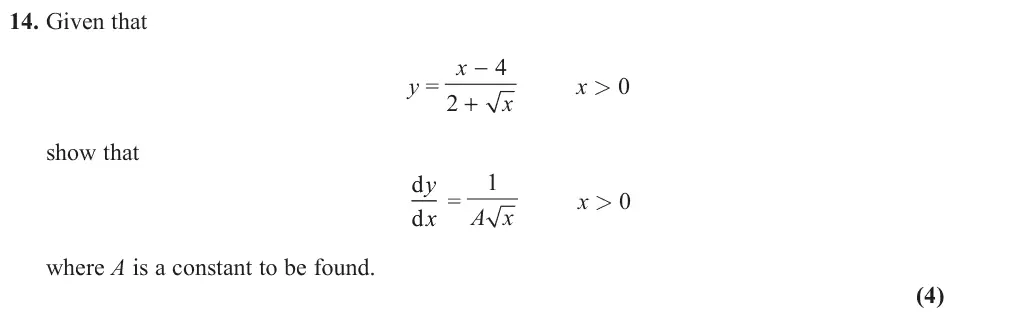
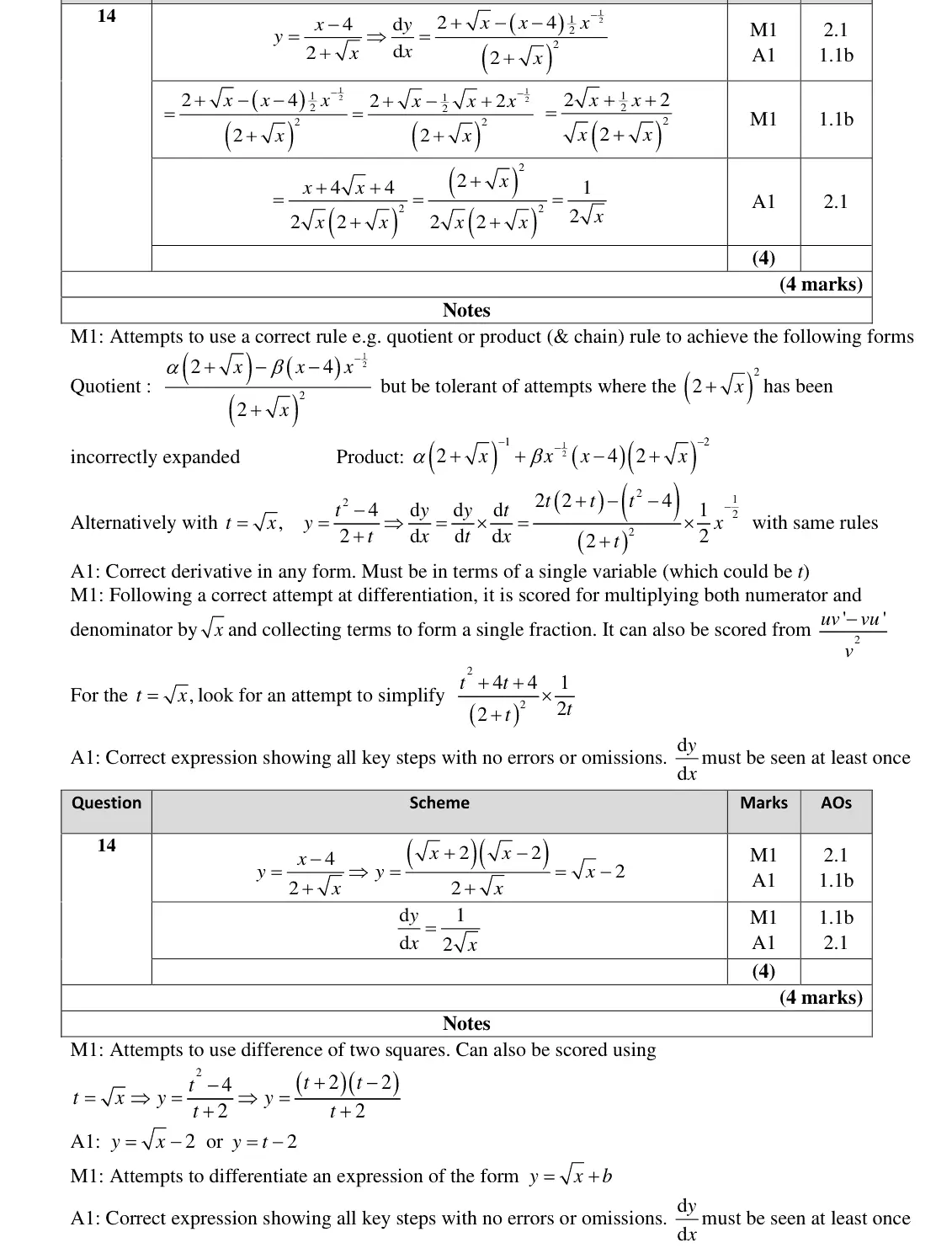
This question proved equally challenging and very few fully correct solutions were seen. The modal mark achieved here was 2, scored by over 40% of the candidates, most often for a fully correct attempt at dy/dx. Most solutions seen used the quotient rule although incorrect application of the rule often meant that no marks could be awarded. The most common errors were subtracting the wrong way round on the numerator, or else adding the two expressions on the numerator. Differentiation of sqrt x suprisingly caused a few problems as well. Product rule expansions seldom got past the first expression. The ability to manipulate the ensuing algebraic expression was often lacking, with fractional terms within a fraction, the main cause for failure. Alternative methods which might have simplified the algebra were seen, but only rarely. Only a handful spotted that a difference of two squares method applied to the numerator would have made this a very simple problem.
Common mistakes
quotient rule numerator the right way round
multiply through by √x to simplify to 1/(2√x), A = 2
spotting x − 4 = (√x + 2)(√x − 2) gives y = √x − 2 directly
dy/dx must be seen
Oct 2021 · Paper 2 · Q8(a)4 marks
Mark scheme (whole question; this part is marked with the orange bar)
Examiner's comment
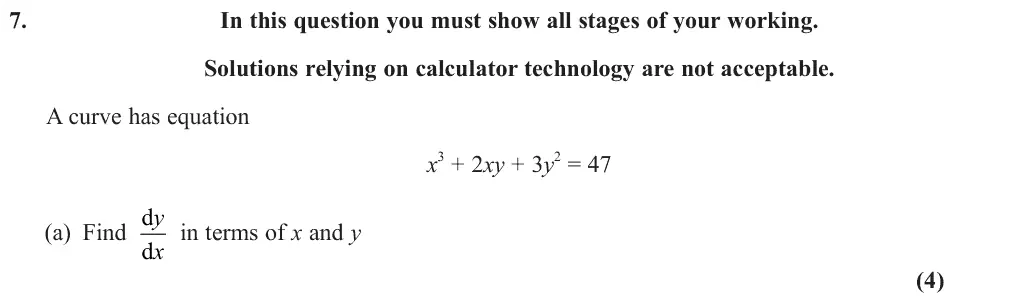
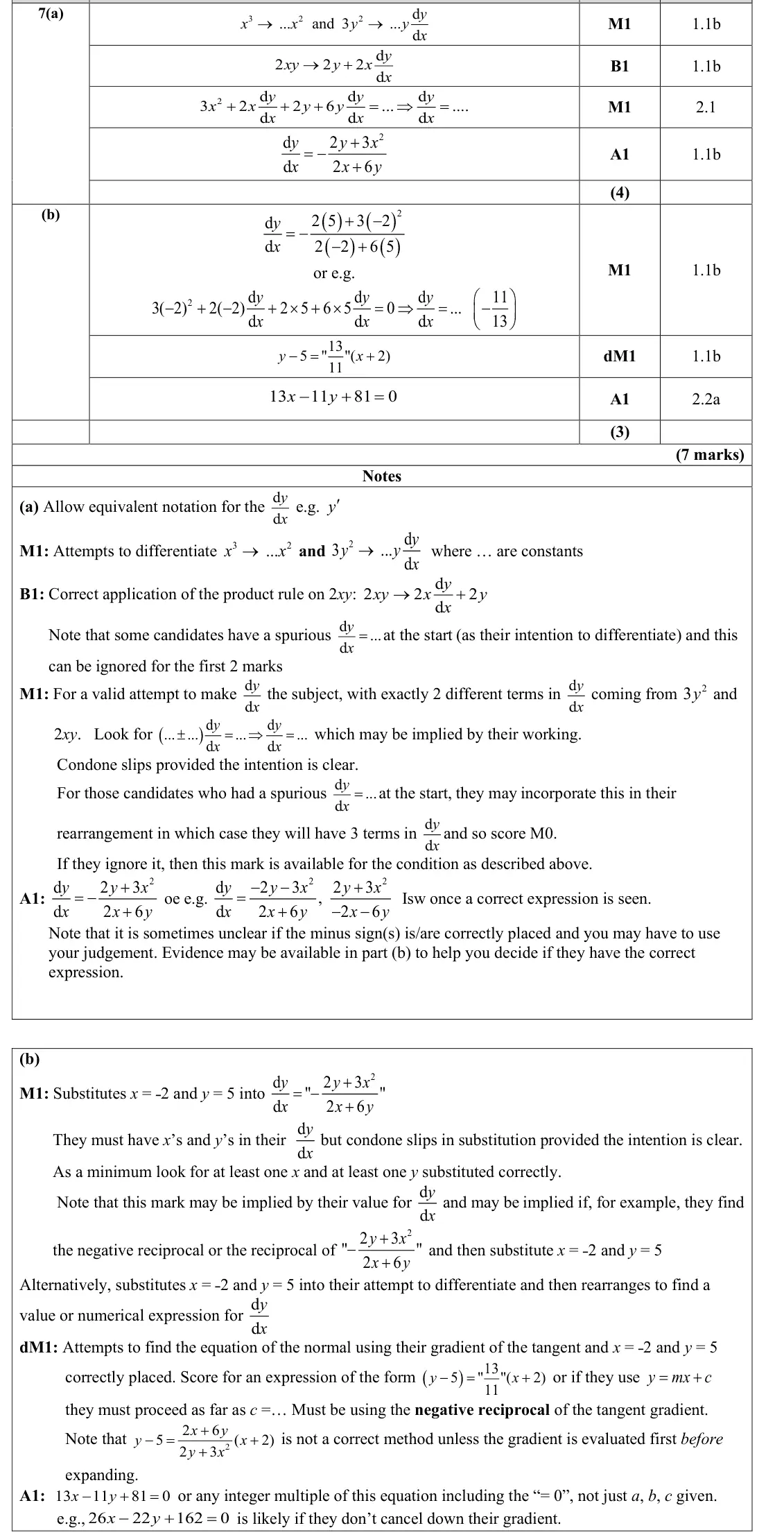
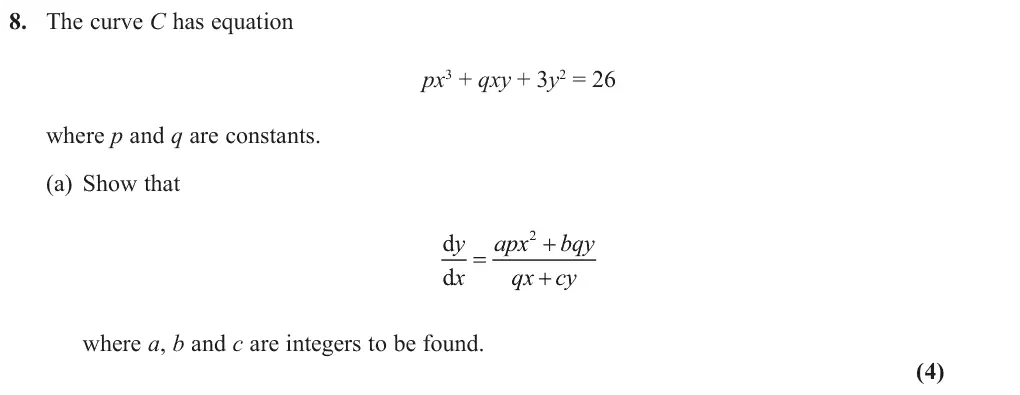
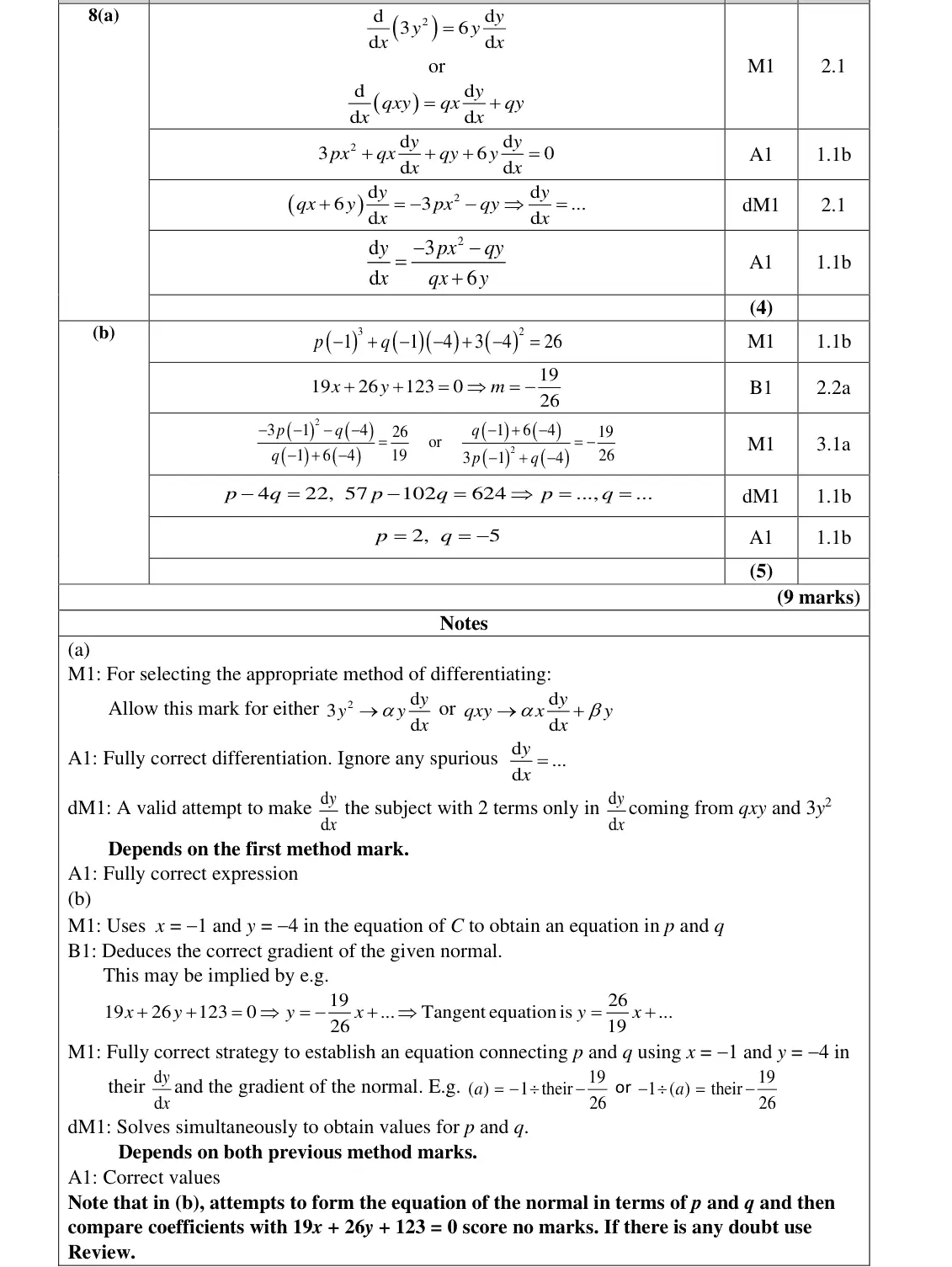
Many candidates gained some credit in this question but few gained full marks. Part (a) was relatively well answered. Most candidates identified that implicit differentiation was required and made good progress by correctly differentiating the given equation. When mistakes happened at this stage, they usually appeared in the differentiation of rather than in the differentiation of or . There were a few candidates, however, who clearly were not able to employ implicit differentiation and who gained no marks. Once a differentiated expression had been obtained, many were able to rearrange correctly to make the subject, obtaining the required answer of . A common mistake, however, was to make sign errors in the rearranging process and incorrect answers like and were surprisingly common following correct differentiation.
Common mistakes
product rule on qxy
d/dx(3y²) = 6y dy/dx
sign errors when rearranging
dy/dx = (−3px² − qy)/(qx + 6y)
Oct 2021 · Paper 2 · Q13(a)3 marks
Mark scheme (whole question; this part is marked with the orange bar)
Examiner's comment
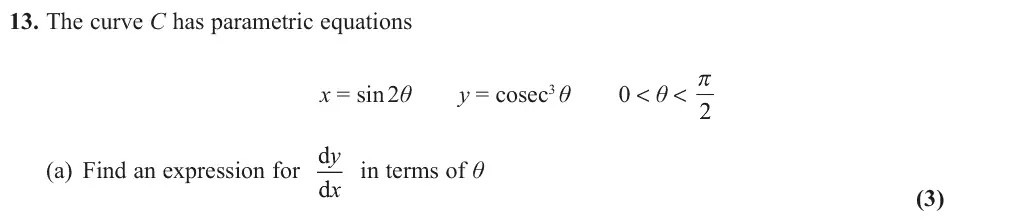
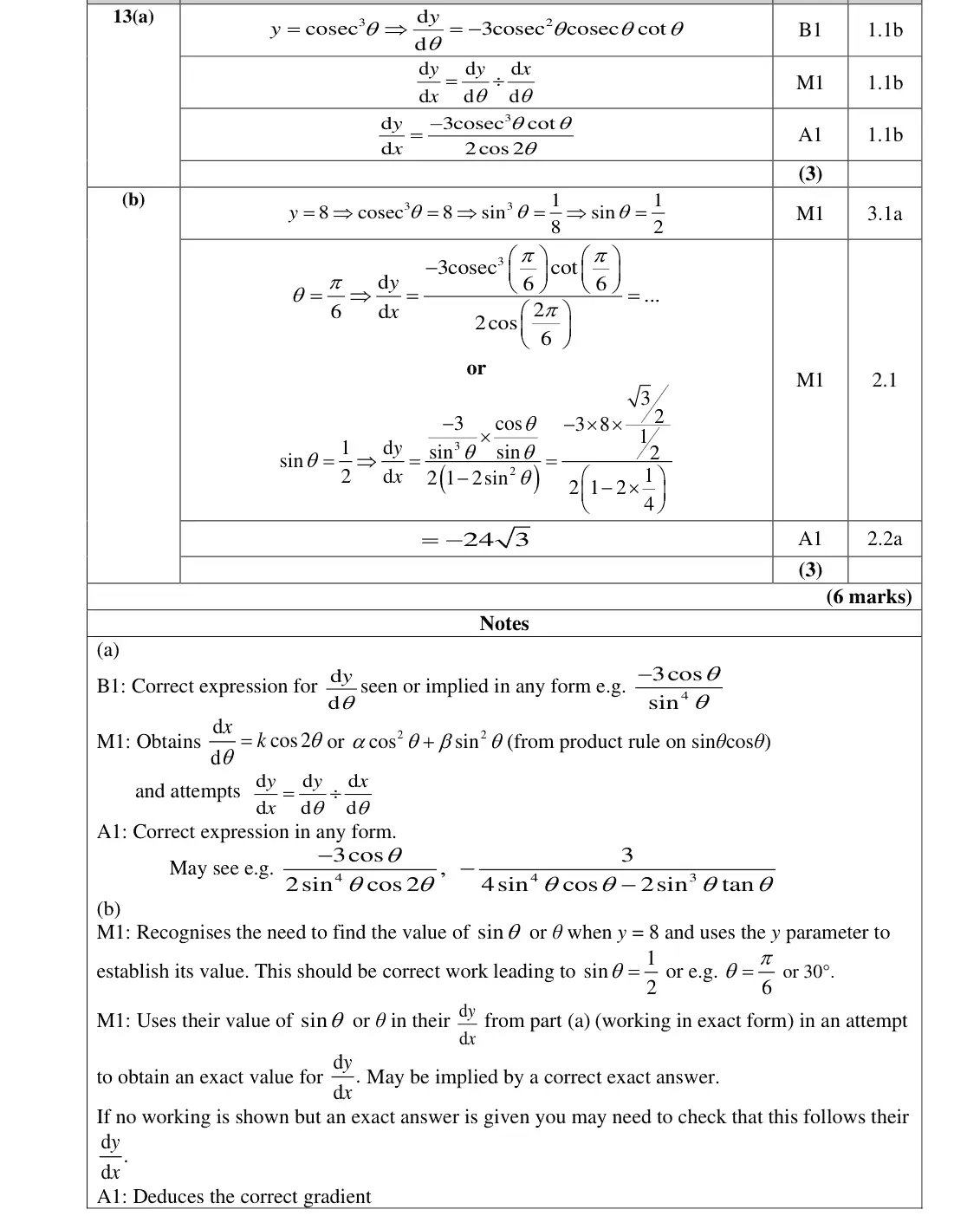
This question involving differentiation of parametric equations was found to be challenging by the majority of students, particularly the differentiation of 𝑦𝑦= cosec3 𝜃𝜃 and part (b). The majority of candidates knew what was expected in part (a) and proceeded to attempt to use the chain rule to find d𝑦𝑦 d𝑥𝑥, however they found differentiating 𝑦𝑦= cosec3 𝜃𝜃 challenging. Some did not check in the formula book that the derivative of cosec theta was negative, or omitted the constant 3, and this cost 3 of the 6 marks available in the whole question. For those that attempted to write 𝑦𝑦= sin-3 𝜃𝜃 and use either the chain rule or the quotient rule success was mixed. Other common incorrect derivatives included d𝑦𝑦 d𝜃𝜃= (cosec3 𝜃𝜃cot3 𝜃𝜃) and variants of this. Differentiating 𝑥𝑥= sin 2𝜃𝜃 proved less troublesome, with most doing so correctly. There was a proportion of candidates that rewrote sin 2𝜃𝜃 as 2 sin 𝜃𝜃cos 𝜃𝜃 and used the product rule, creating more work but ultimately doing so successfully in most cases. The method mark was scored by the majority of candidates as a result, although there were a few candidates who tried to write 𝑦𝑦 in terms of 𝑥𝑥 and differentiate, with no marks being scored for this approach. A number of candidates, having found a correct derivative, proceeded to attempt to tidy this up, unfortunately using time that could have been spent elsewhere in the paper.
Common mistakes
dy/dθ = −3cosec³θ cotθ (chain rule
derivative of cosec is negative
keep the 3)
dx/dθ = 2cos 2θ
Oct 2021 · Paper 2 · Q14(a)4 marks
Mark scheme (whole question; this part is marked with the orange bar)
Examiner's comment
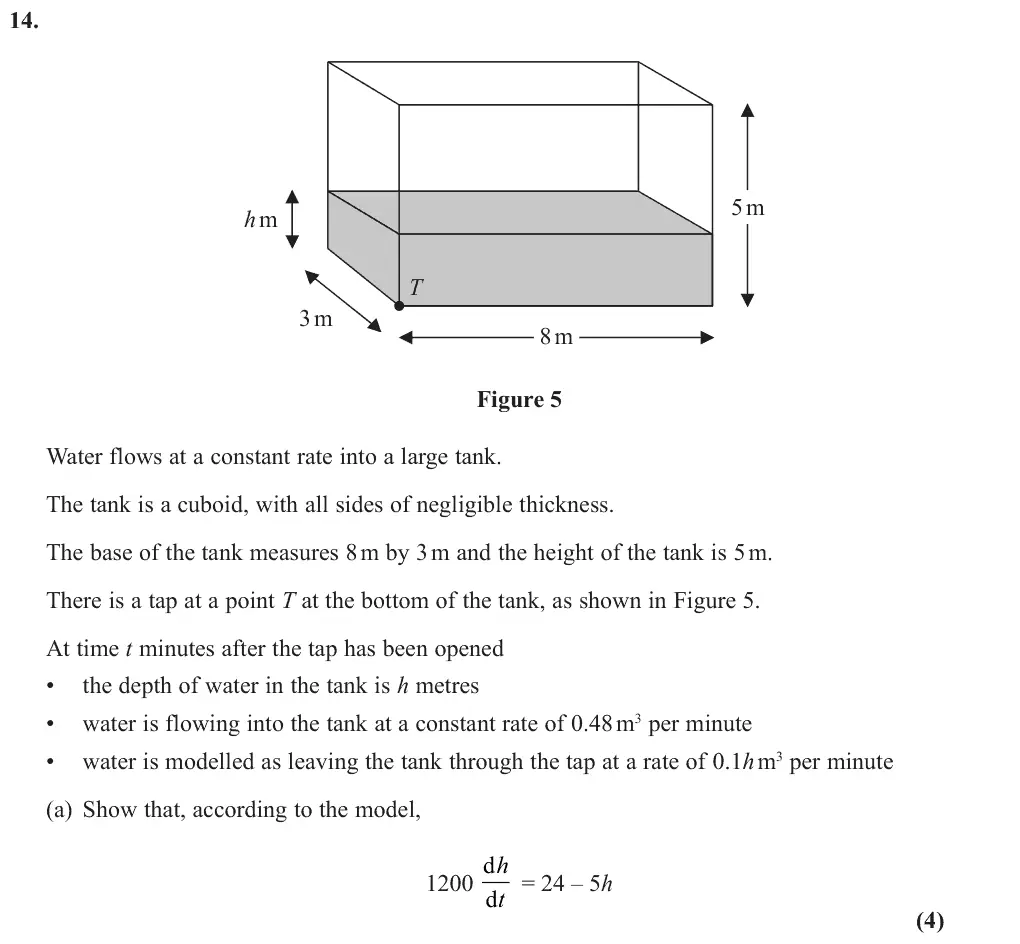
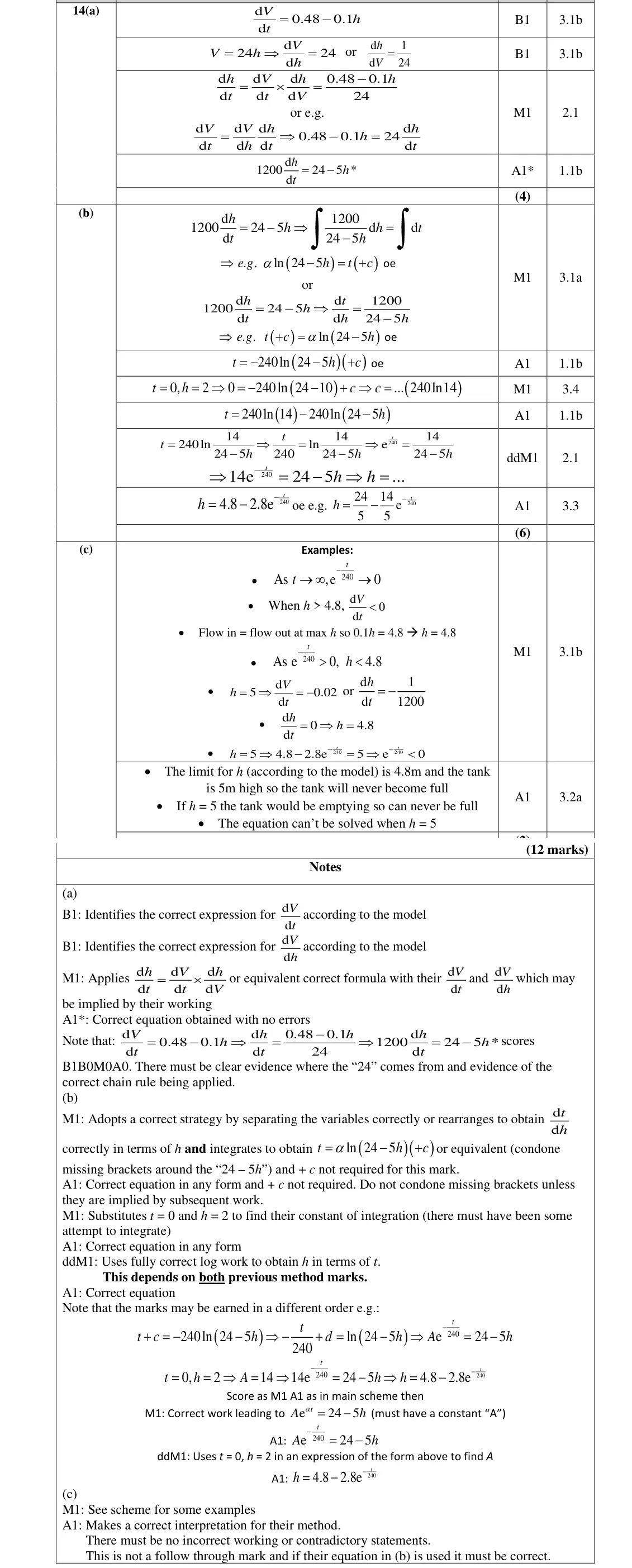
This question proved challenging for the majority of candidates, with many not answering it at all. For those that did attempt a response, part (a) was reasonably well answered, with many candidates gaining at least one of the B marks but quite a few then failing to correctly apply the chain rule and complete the proof. Some weaker candidates recognised they had to consider "flow in - flow out” but didn’t identify this as d d V t , with d 0.48 0.1 d h h t = - sometimes seen. It was also not uncommon to see d d V t = 0.48 or d d V t = 'uncombined' in some responses. Some candidates even started with and “differentiated” to get the printed result. Responses to part (b) were mixed. Some candidates failed to separate the variables correctly or did not recognise the logarithmic form for the integration. It was not unusual for the “+c” to be missed completely, but if it was included candidates were able to gain the 2nd method mark despite poor integration. Some candidates changed to , making their following working much harder. There was some occasional use of Further Maths methods (e.g. integrating factors), potentially gaining full marks. Candidates who did not answer (a) rarely attempted (b), perhaps not realising (b) could be answered independently using the printed differential equation.
Common mistakes
dV/dt = 0.48 − 0.1h (flow in − flow out)
V = 24h so dV/dh = 24
must show the chain rule and where 24 comes from
Oct 2020 · Paper 1 · Q9(a)3 marks
Mark scheme (whole question; this part is marked with the orange bar)
Examiner's comment
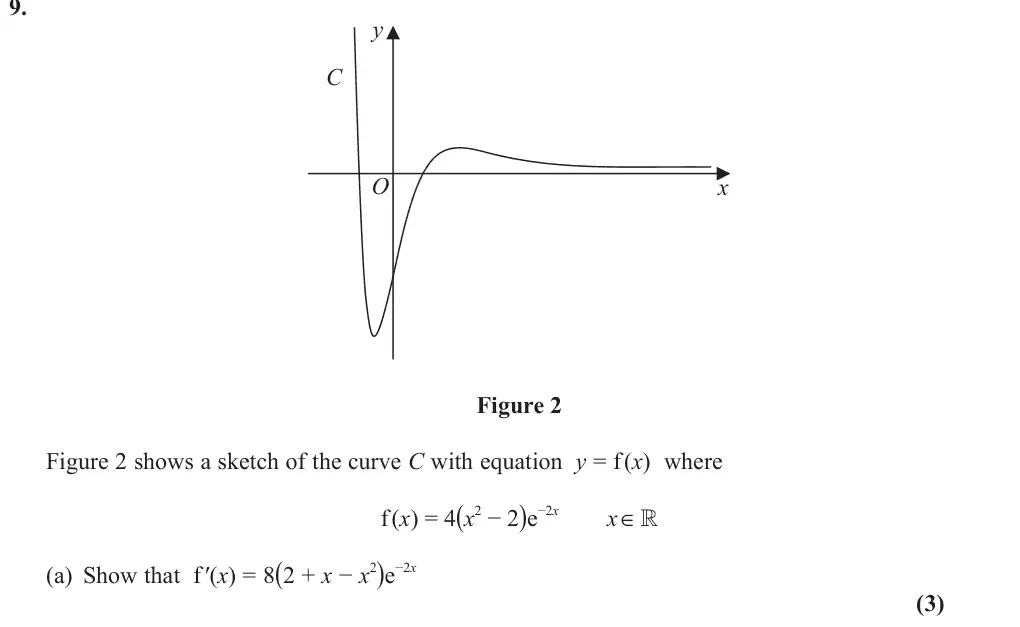
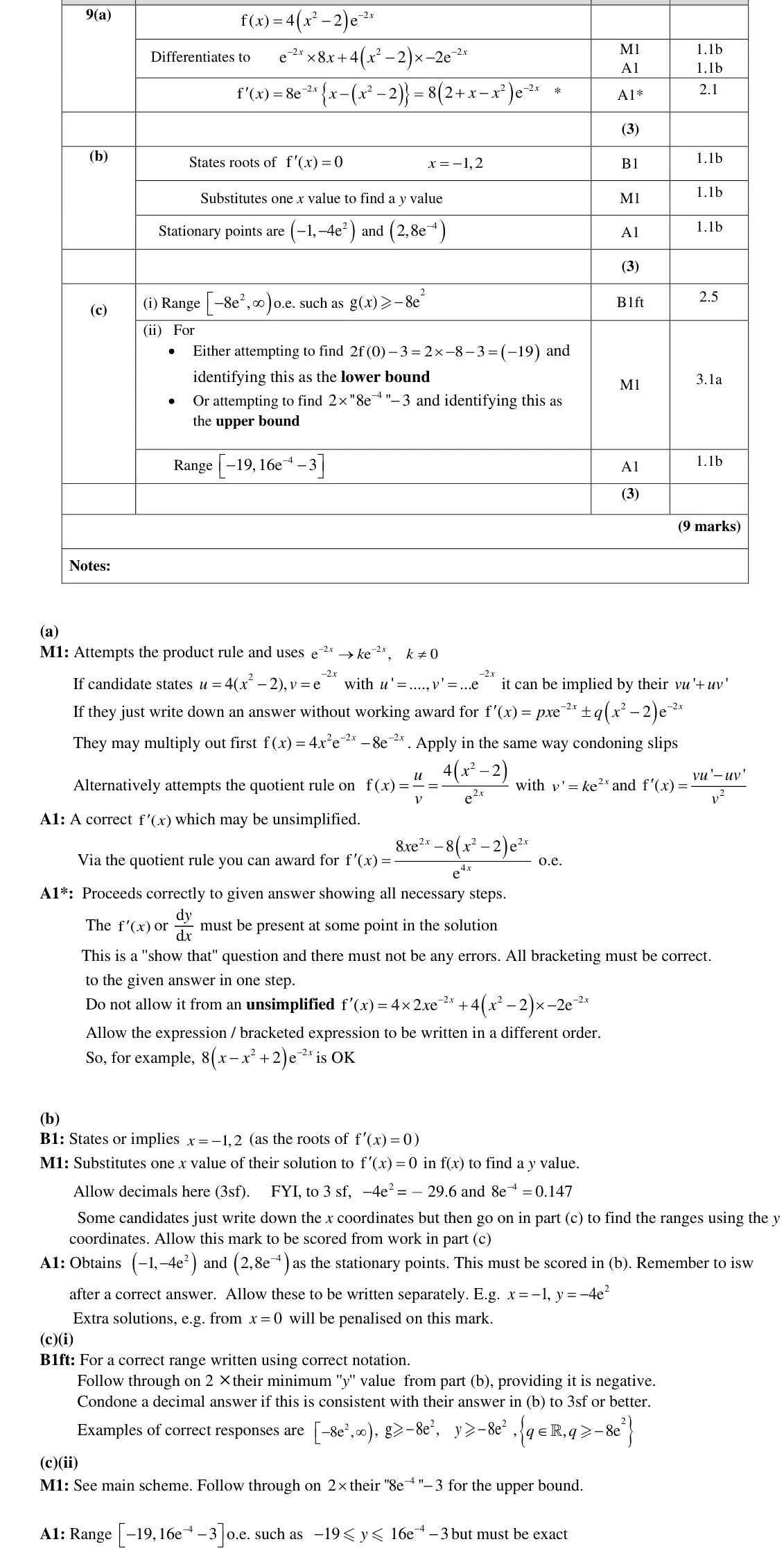
Parts (a) and (b) of question 9 were standard bookwork involving the product rule of differentiation using an exponential function. Well rehearsed candidates were very successful here scoring the majority of marks. The diagram should have helped in determining the maximum and minimum points of the function.
Common mistakes
product rule with d/dx e^(−2x) = −2e^(−2x)
f′(x) must appear
no bracketing errors on the way to the given answer
Oct 2020 · Paper 1 · Q14(a)3 marks
Mark scheme (whole question; this part is marked with the orange bar)
Examiner's comment
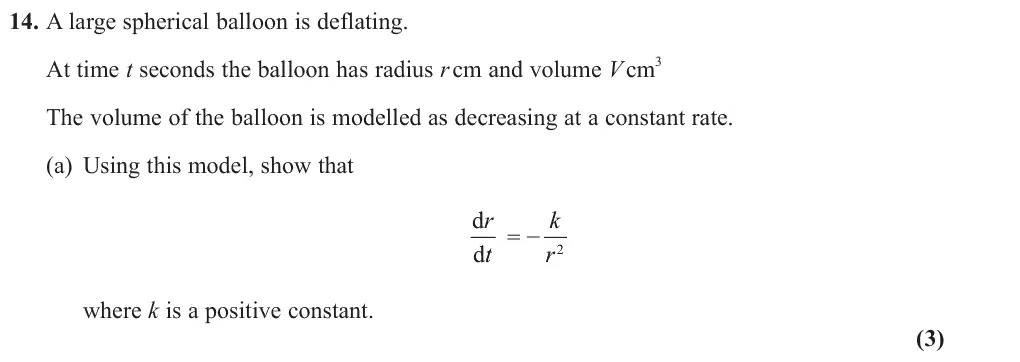
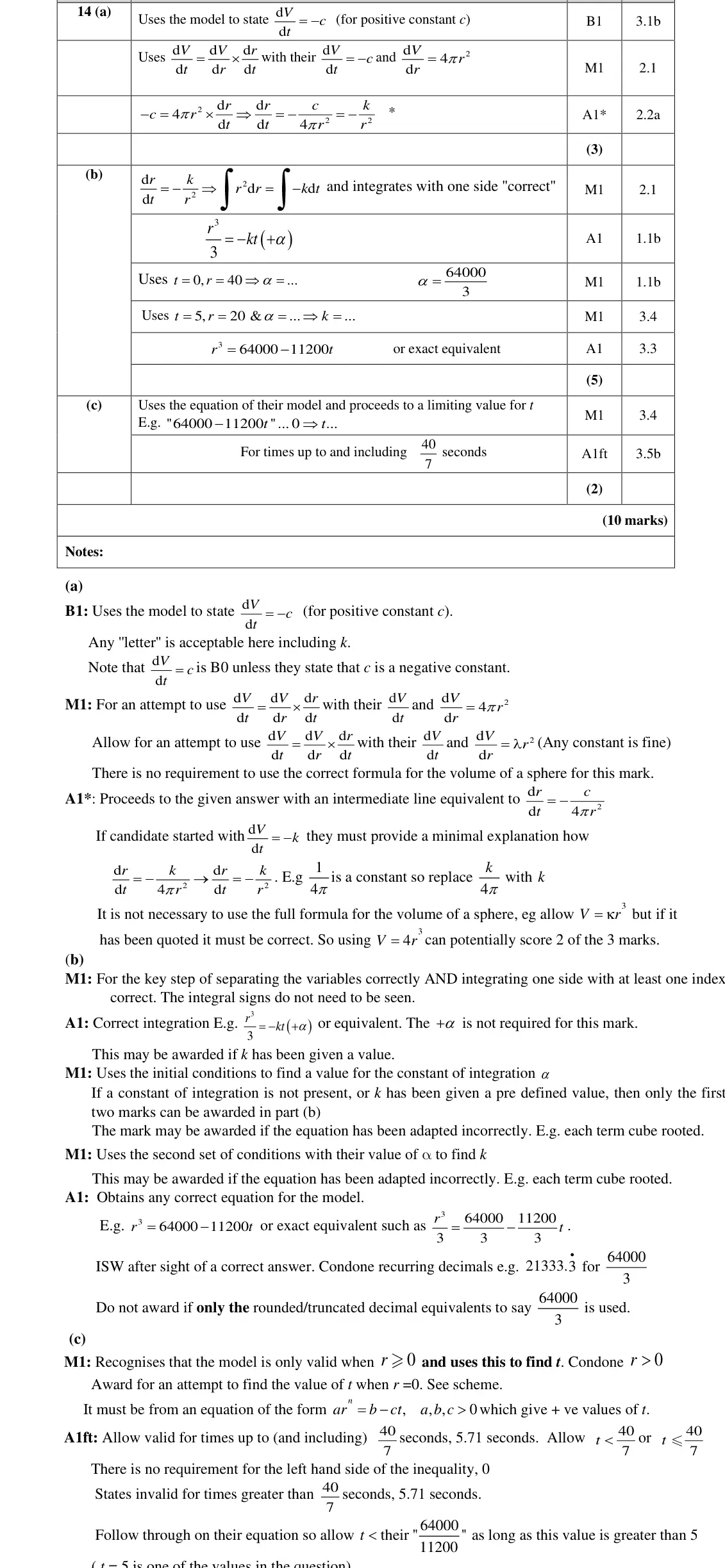
Students found aspects of this question difficult despite the fact that the differential equation to be solved in (b) was not too demanding. Only high scoring candidates tended to make any significant progress in this question. In part (a) many candidates failed to use the chain rule d d d d d d V V r t r t = x with an acceptable d d V t and d . d V r It was possible to proceed to the given answer without knowing the formula for a sphere, using 3 V r = λ but errors and blank solutions were common. Common errors were; • stating d d V k t = -, and then failing to provide a minimal explanation of how their k/4𝜋𝜋 was replaced with k. • quoting an incorrect formula for the volume of a sphere. Attempts included V = pi r3 , 2 pi r3 , 4 pi r3 and even 4 pi r2.
Mark scheme (whole question; this part is marked with the orange bar)
Examiner's comment
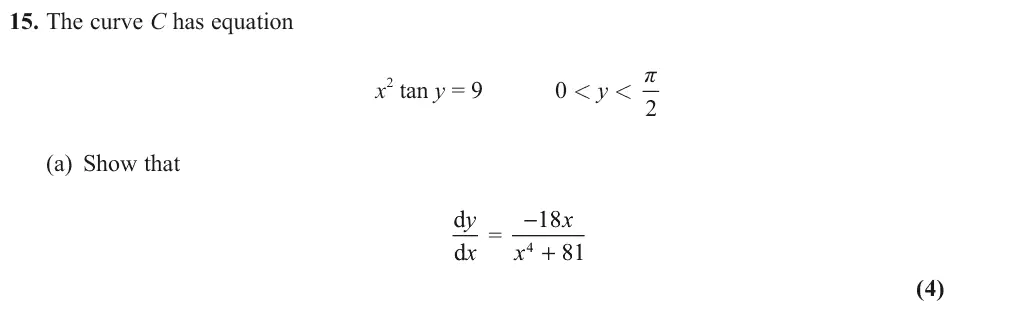
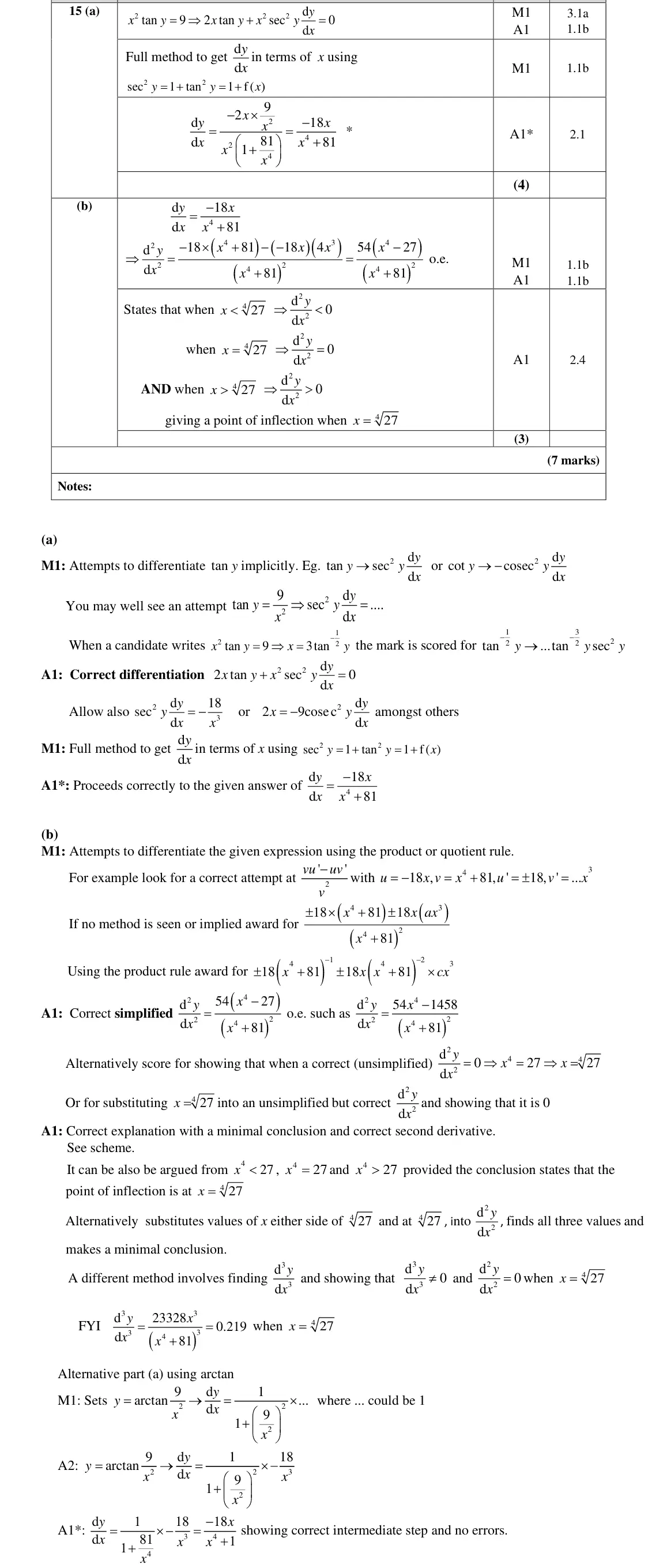
Although fully correct solutions to this question were very rare, many candidates were able to score marks from both parts. In part (a) the first two marks for the implicit differentiation were very accessible for the prepared candidate. Proceeding to the required result for the second two marks proved a little more challenging. Only high achieving students noticed the relationship could be 2 2 proven via the trigonometric identity 1 tan sec . y y + =
Common mistakes
implicit differentiation 2x tan y + x² sec²y dy/dx = 0
use sec²y = 1 + tan²y = 1 + 81/x⁴ to get dy/dx in terms of x only
Oct 2020 · Paper 1 · Q15(b)3 marks
Mark scheme (whole question; this part is marked with the orange bar)
Examiner's comment
Although fully correct solutions to this question were very rare, many candidates were able to score marks from both parts. In (b) candidates often scored the M1 for an unsimplified second derivative or a correct structure with a sign incorrect. Where the first A1 was scored in (b), it was usually 2 2 d d y y 4 27 awarded for a correct simplified , or solving to get 0 x = x = 2 2 d d x 2 d y Very few candidates seemed aware that they needed to show a change in sign of 2 d x 4 27 either side of to show a point of inflection. x =
Common mistakes
quotient rule: d²y/dx² = 54(x⁴ − 27)/(x⁴ + 81)²
d²y/dx² = 0 alone is not enough: show the sign change either side of x = ⁴√27 and conclude
Oct 2020 · Paper 2 · Q7(a)4 marks
Mark scheme (whole question; this part is marked with the orange bar)
Examiner's comment
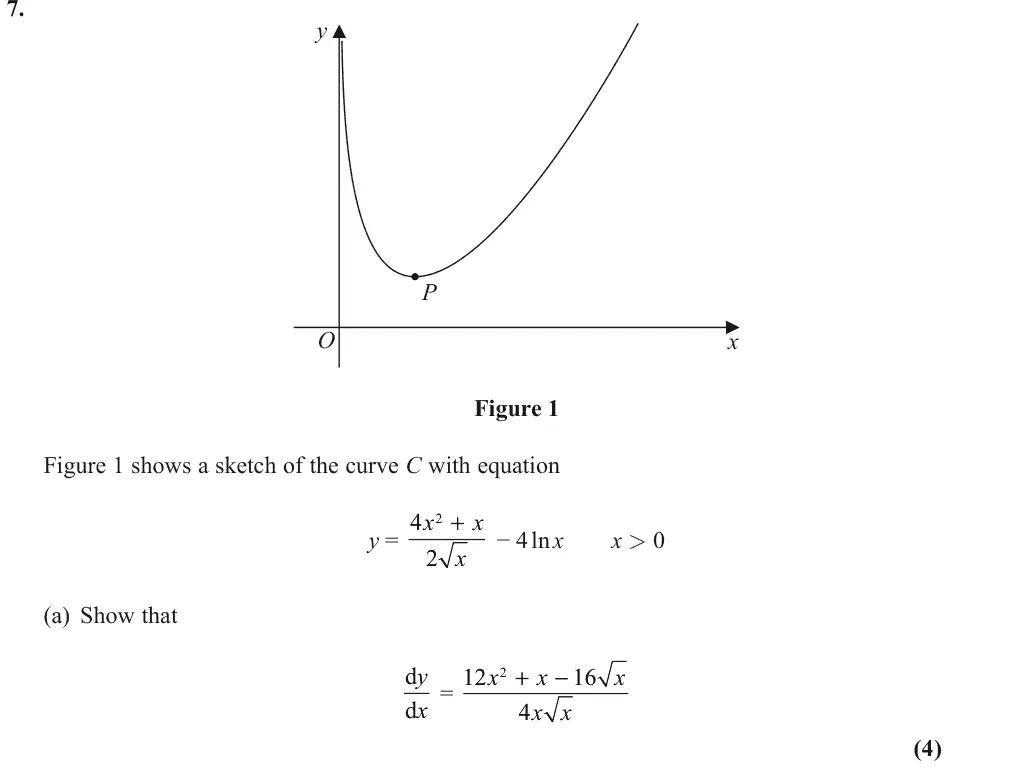
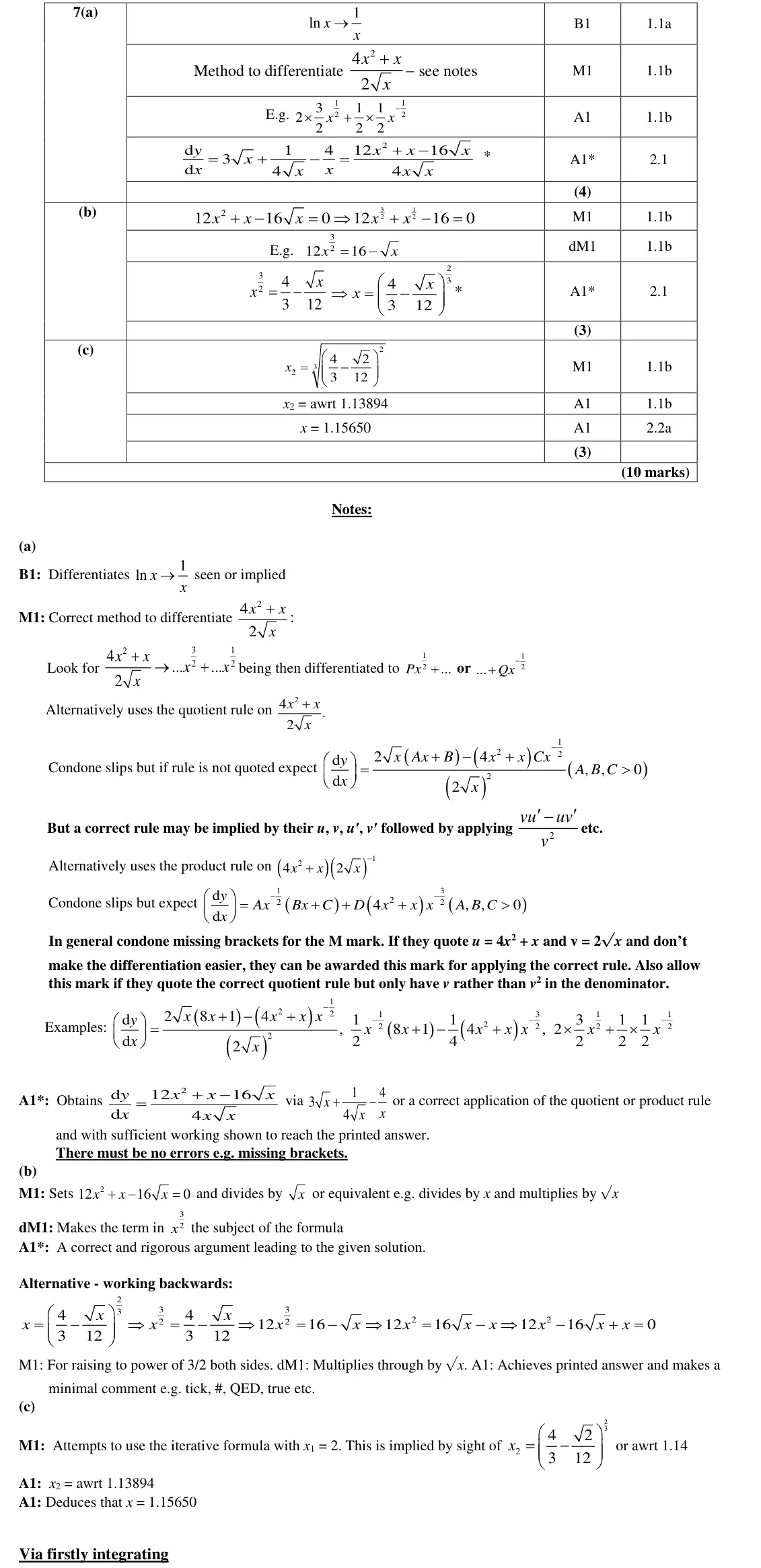
In part (a), most candidates used a correct method to differentiate, the majority using the quotient rule. A few applied the rule the wrong way round (uv’ – vu’)/v2. Candidates who initially wrote the quotient as 2𝑥𝑥 3 2 + 1 2 𝑥𝑥 1 2 were often more successful with the differentiation. A few candidates forgot about the 4lnx term but most dealt with this correctly. Errors from missing brackets or when simplifying their differentiated expression, in particular dealing with the powers, meant that many did not gain full marks in this part.
Common mistakes
split into 2x^(3/2) + ½x^(1/2) before differentiating (or quotient rule the right way round)
ln x differentiates to 1/x
no missing brackets in a show that
Oct 2020 · Paper 2 · Q13(b)3 marks
Mark scheme (whole question; this part is marked with the orange bar)
Examiner's comment
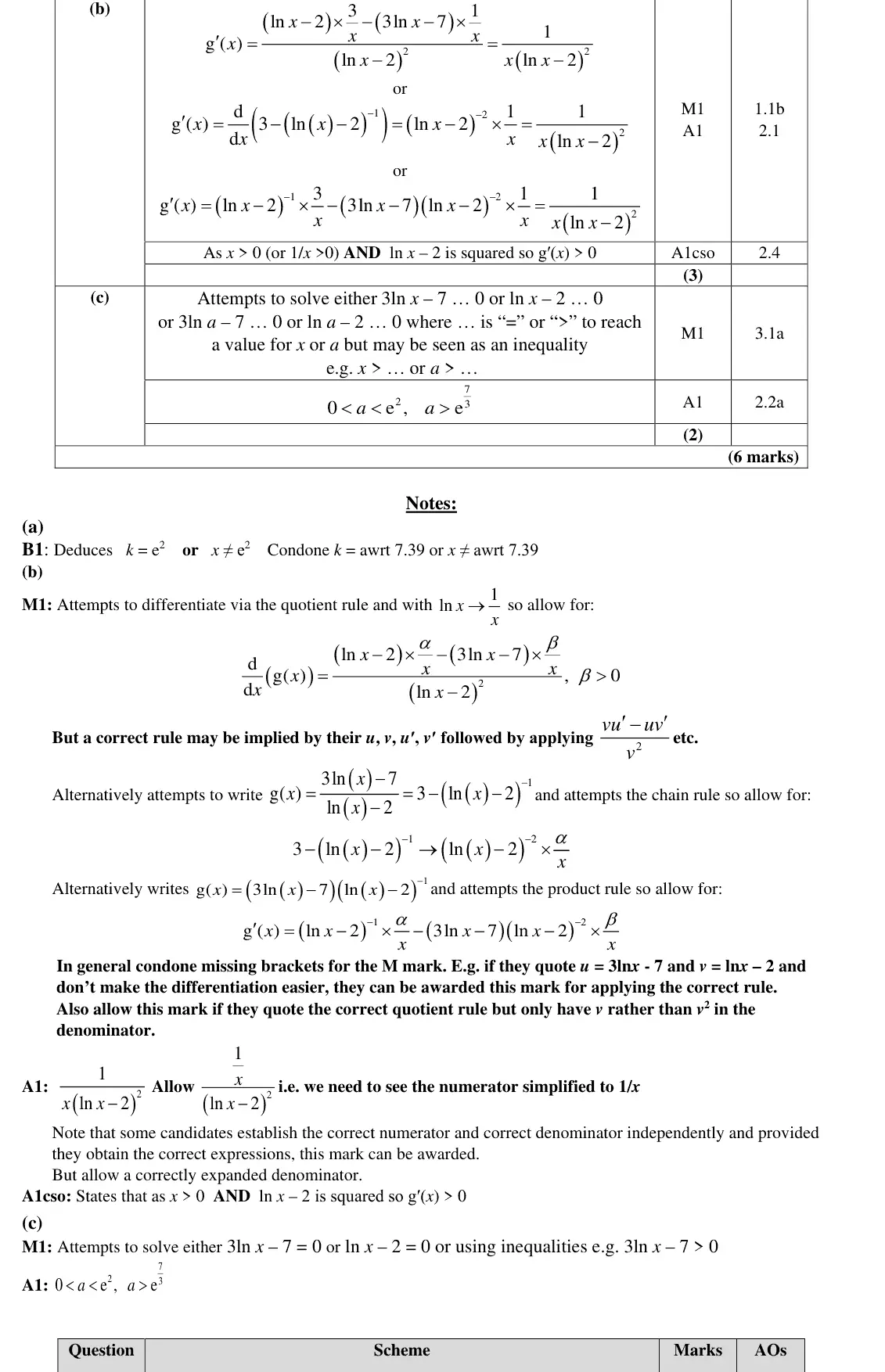
Part (b) was attempted by most candidates although it was not uncommon to see attempts to find the inverse of g(𝑥𝑥) instead of differentiating. The differentiation in part (b) was however correctly carried out by many candidates, with the majority using the quotient rule. Those who stated the correct formula and the individual components of u, v, u’ and v’ were often more successful. A few used ቀ 𝑑𝑑𝑑𝑑 𝑑𝑑𝑑𝑑ቁ 2 instead of 𝑣𝑣2 in the denominator, while others made slips on expanding the bracket 3(𝑙𝑙𝑙𝑙(𝑥𝑥) - 2). Some attempted the product rule, usually with less success. Many candidates did not attempt to simplify the numerator of g′(x). Often those that did made slips and it was frustrating to see candidates losing marks due to missing brackets and sign errors when expanding. It was common to see numerators incorrectly simplified to –13 𝑥𝑥 or 5 𝑥𝑥 although many did manage the correct simplification to 1 𝑥𝑥. Some candidates unnecessarily expanded the denominator, sometimes incorrectly writing ln (𝑥𝑥2) instead of (ln 𝑥𝑥)2. Candidates who managed to correctly simplify their expression for g′(x) argued correctly why g′(x) > 0 for all 𝑥𝑥 in the domain, but some simply stated this with no reason or gave an incomplete argument of “𝑥𝑥> 0 so g′(𝑥𝑥) > 0” and lost the final mark in this part.
Common mistakes
quotient rule with v² in the denominator
numerator simplifies to 1/x
conclude g′(x) > 0 because x > 0 AND (ln x − 2)² > 0
June 2019 · Paper 1 · Q3(a)4 marksMedium
Mark scheme (whole question; this part is marked with the orange bar)
Examiner's comment
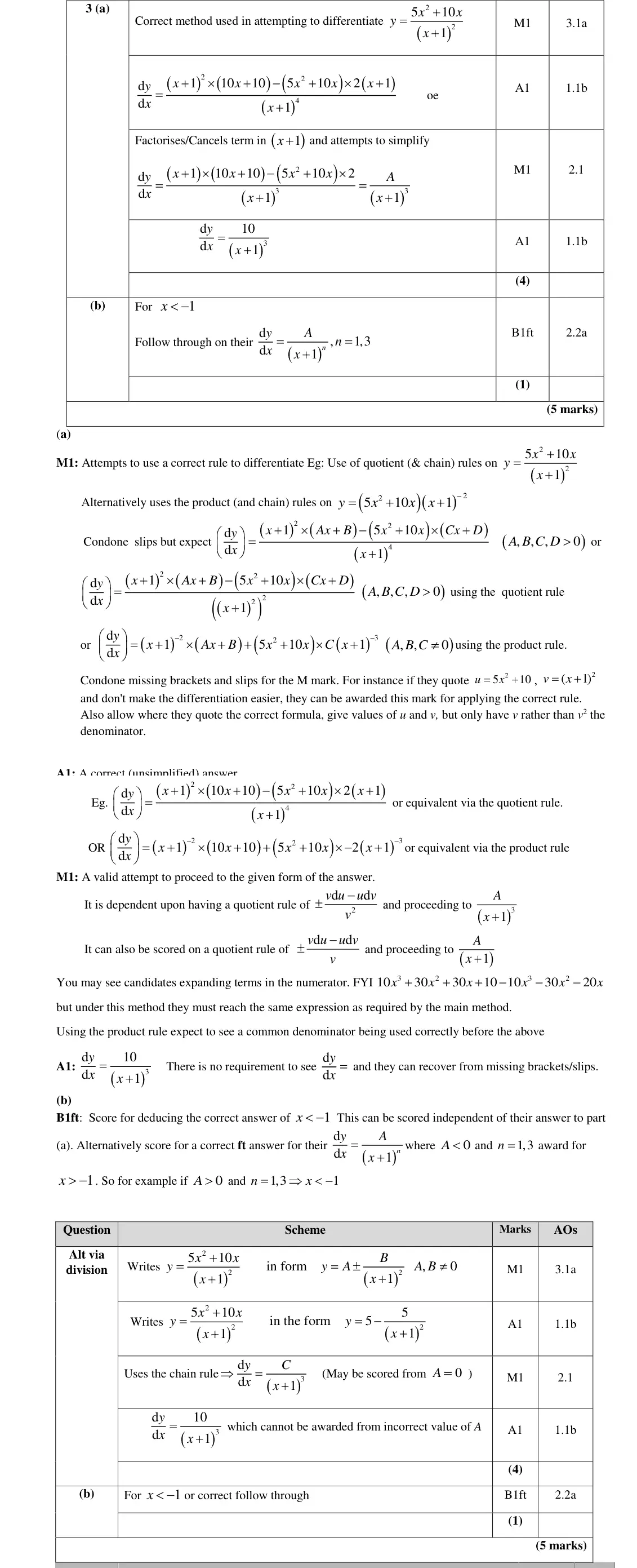
This was an accessible question for most students, but the second half of part (a) did discriminate at all levels. In part (a) students generally recognised the need to use the quotient or product rule and were successful at differentiating for the first 2 marks. The most common mistake was forgetting to square the denominator, with incorrect order of terms in the numerator being less common. Students should also be reminded to quote a formula before attempting to use it, as they may still gain method marks for this, even if there are slips in its application. Omission of brackets in terms in the numerator was also common, but often recovered in working. However, it would benefit students to be careful in the use of brackets. Having achieved a derivative, attempting to simplify to the required form proved difficult for many students. Many did not realise that they could factorise the (x+1) out early and instead expanded fully, simplified then factorised again to cancel in the last step. This wasted valuable time and it was during this process that errors usually occurred. The alternative method of simplifying the fraction before differentiating was less common, with usually poor attempts at partial fractions being applied leading to error. Those who successfully simplified the fraction almost always went to achieve the correct answer. Nearly all students who were correct in part (a) achieved the mark for part (b), including many who had failed to cancel the (x+1). Indeed, there were many cases where a correct answer to part (b) was seen following incorrect work in (a), presumably due to the use of a calculator to plot and inspect the graph.
Common mistakes
quotient rule: forgetting to square the denominator
factorise and cancel (x + 1) early rather than expanding
A = 10, n = 3
June 2019 · Paper 1 · Q12(a)4 marksMedium
Mark scheme (whole question; this part is marked with the orange bar)
Examiner's comment
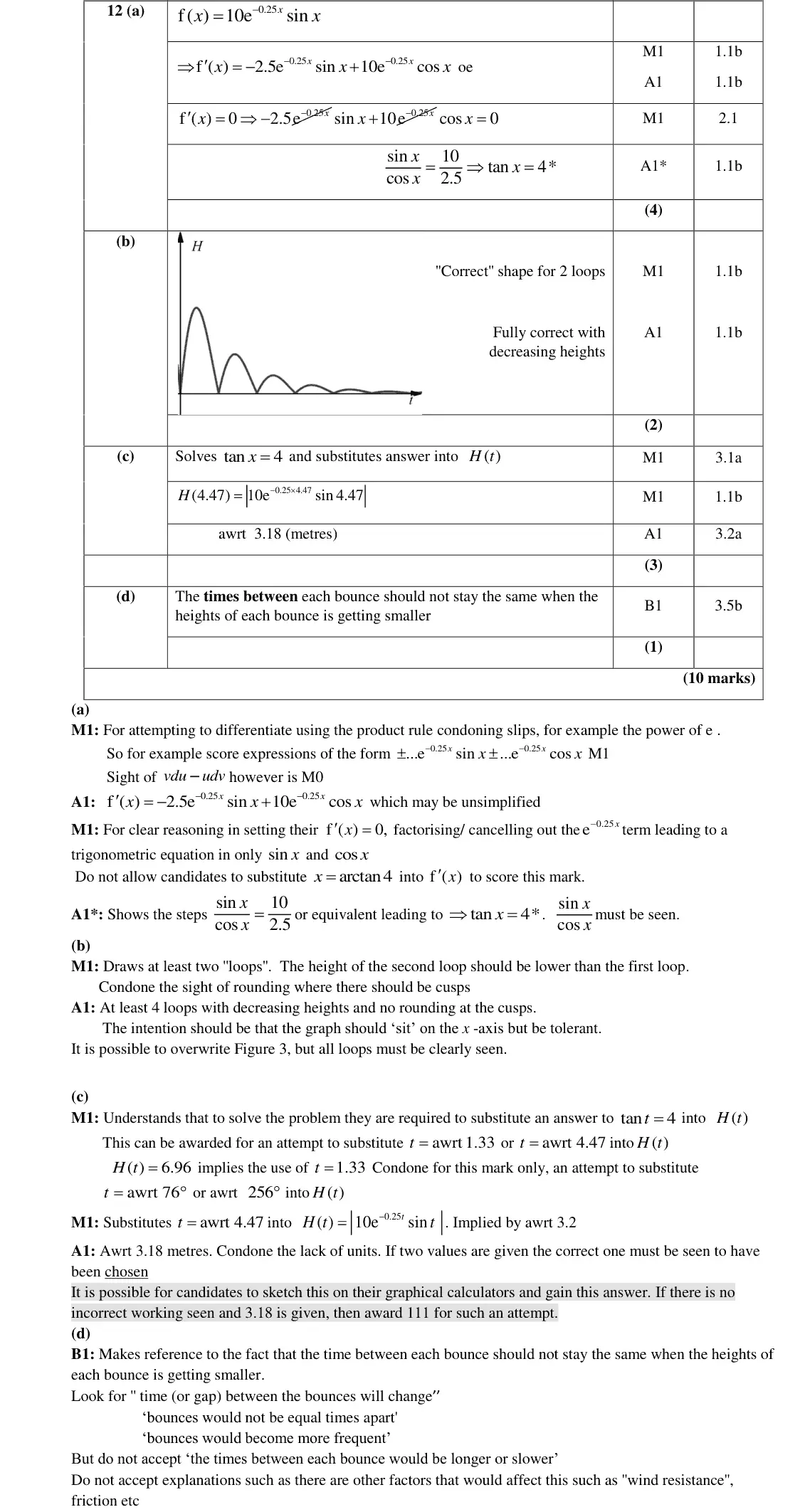
This question discriminated well between students of all abilities with part (a) and (b) more accessible to students compared to part (c) and (d). In part (a) most students were successful at using the product rule and setting dy/dx equal to 0 (though the latter was implied rather than being explicit in many cases). Missing the -0.25 factor when differentiating the e(-0.25x) was fairly common, but the differentiation was mostly correctly carried out. A few students failed to use the product rule correctly, instead multiplying the derivatives of each term, but these were in the minority. Having attempt the derivative the majority did set the result equal to zero (possibly implied) and proceeded to cancel the exponentials. Reasoning for the cancellation was usually not given, but in this instance there was no requirement for such reasoning. However it might be well noted that such explanations may be required under the new specification. Many students lost the final accuracy mark as they did not state or show division by cos x. Students need to be clear that in a ‘show that’ question all steps need to be shown.
Common mistakes
product rule
missing the −0.25 from differentiating e^(−0.25x)
set f′(x) = 0, cancel the exponential and show division by cos x
June 2019 · Paper 1 · Q14(a)2 marksHard
Mark scheme (whole question; this part is marked with the orange bar)
Examiner's comment
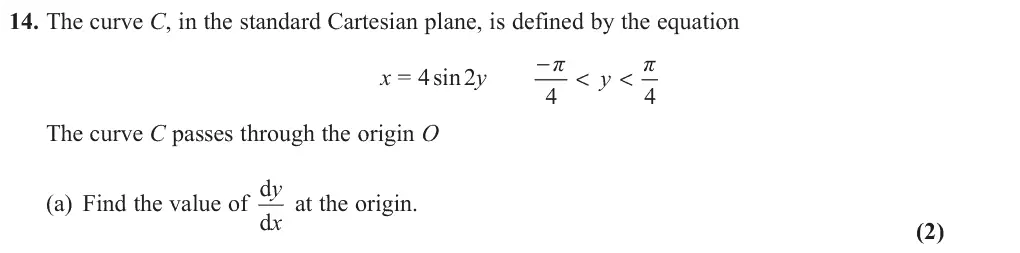
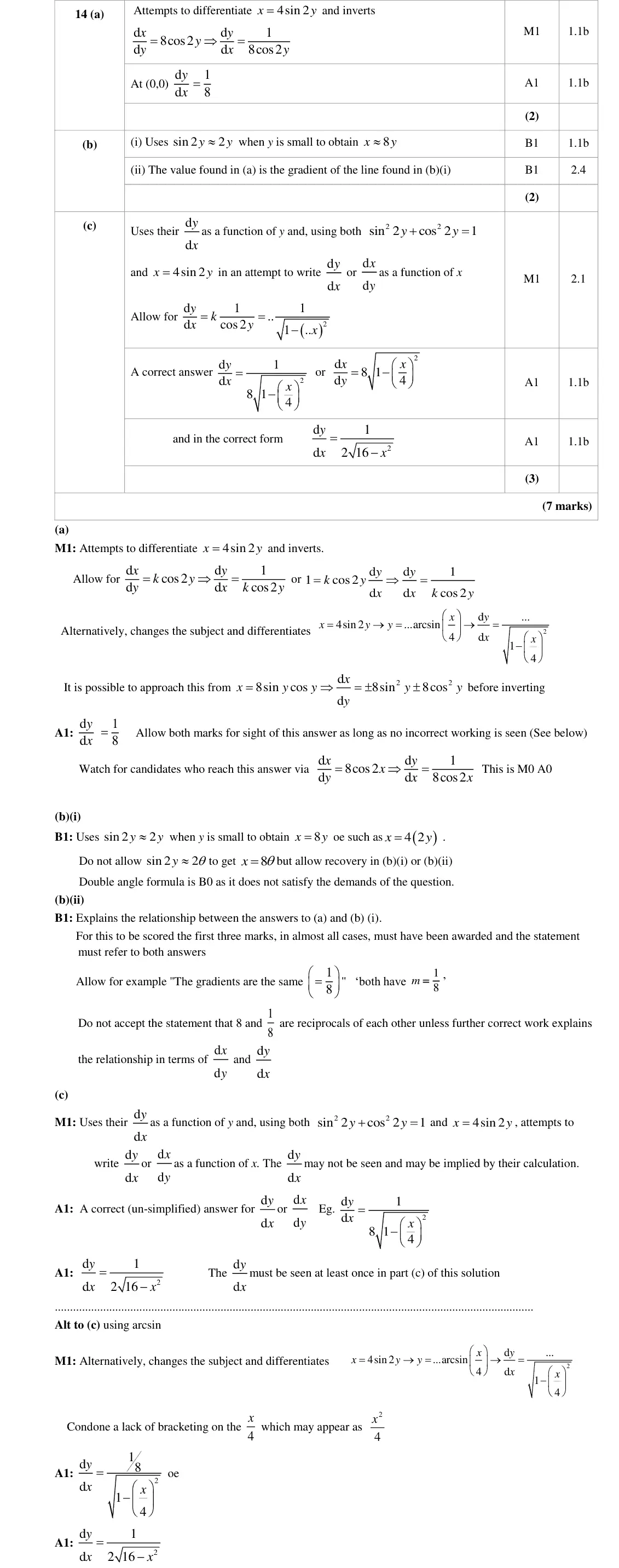
A number of candidates did not attempt this question. Whether this was due to lack of understanding or time constraints is unknown. Part (a) was generally well done with a surprising proportion using implicit differentiation. A good number who found d d y x correctly failed to substitute in y =0 to find the value of d d y x at the origin. Candidates who tried to expand sin2y using the double angle formulae and then differentiating using the product rule often went wrong.
Common mistakes
dx/dy = 8cos 2y then invert
substitute y = 0 to get 1/8 (often omitted)
June 2019 · Paper 1 · Q14(c)3 marksHard
Mark scheme (whole question; this part is marked with the orange bar)
Examiner's comment
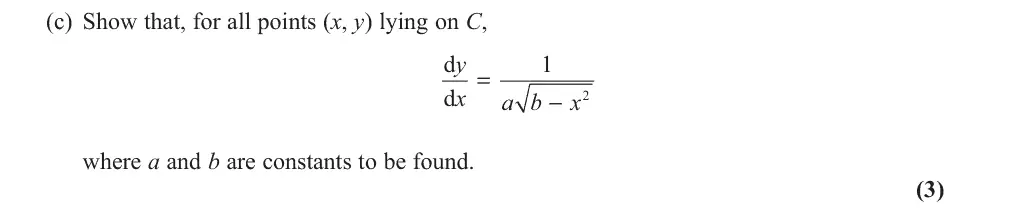
A number of candidates did not attempt this question. Whether this was due to lack of understanding or time constraints is unknown. Only a small percentage of candidates were able to secure full marks for part (c) and it was not uncommon to see the whole question left unanswered. This type of question was common on Core 3 and usually well answered.
Common mistakes
cos 2y = √(1 − (x/4)²) from sin² + cos² = 1
dy/dx = 1/(2√(16 − x²)), a = 2, b = 16
June 2019 · Paper 2 · Q11(a)5 marks
Mark scheme (whole question; this part is marked with the orange bar)
Examiner's comment
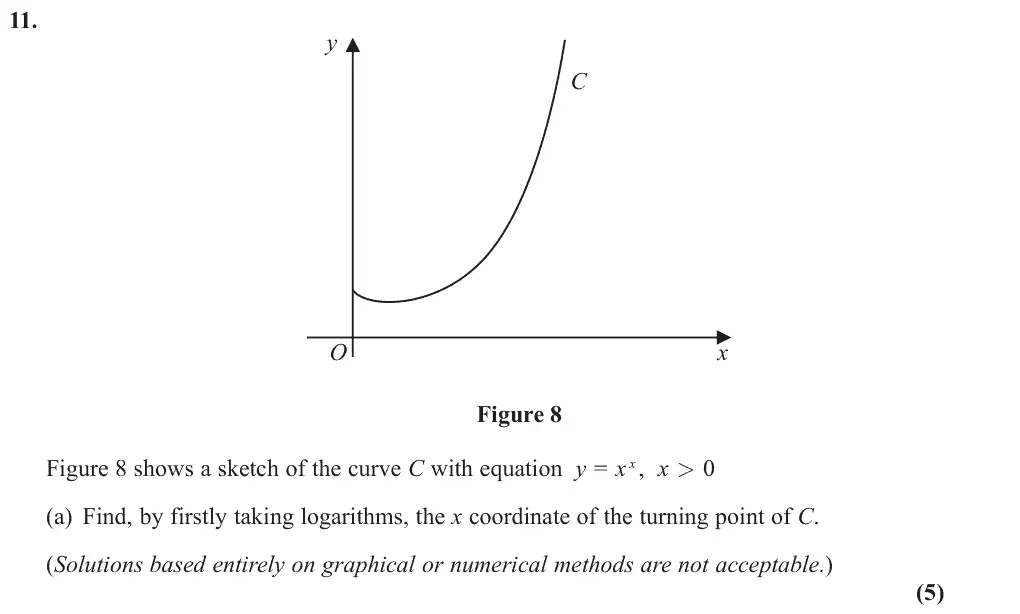
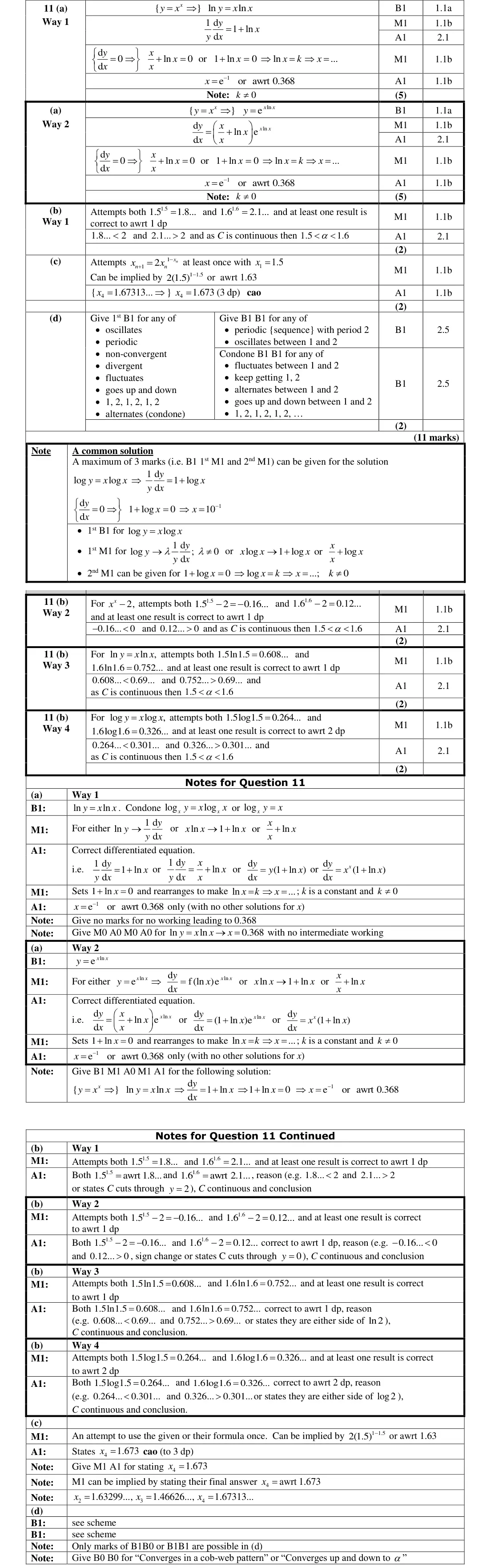
In general, Q11 discriminated well between candidates of all abilities. Q11(a) was demanding with most candidates scoring no more than one mark. Q11(b), Q11(c) and Q11(d) proved accessible to candidates of all abilities. In Q11(a), most candidates took logs, as advised by the question, and many obtained either ln ln y x x or log log . y x x At this point a significant number of candidates made no further creditable progress. Some candidates used a complete method of applying the product rule on x and implicit differentiation to obtain a correct ln x Most of these candidates then applied d y 1 d y x 1 y x e . x 0 to obtain Some 1 ln . x d d x log ’ method to obtain candidates, who received partial credit, used a ‘ after 0.1, 10 1 d y x finding A few candidates used logarithms without reference to a 1 log . x 10 d y x base. Those who proceeded to obtain received partial credit and those who 0.1 1 e x obtained were allowed full marks. There were some alternative methods employed by a few candidates in Q11(a). A few d y y x ln e x x x ln x x y x candidates rewrote as and applied to give a (1 ln )e 0 x d 1 e . x Others differentiated both sides of the equation ln ln y x x correct with 1 e . x respect to y and usually proceeded to find A very few candidates applied the ln y , x quotient rule to the equation but were rarely successful with this method. ln x xx x x xx or 2 1.6. In Q11(b), most candidates evaluated either at both and 1.5 Many candidates compared their values with either 2 or 0 (depending on whether they xx xx or 2 ). Although many of these concluded that 1.5 1.6, evaluated only a few made any reference to the curve being continuous in this interval. A few candidates, x who made no creditable progress, used values of x outside the given range, e.g. 1.4 x x 1.6. and Very few candidates used values within the range e.g. and 1.51 x 1.59, which meant that they were able to earn both marks. x 1.673, 4x In Q11(c), most candidates found a correct although a few did not state 4 , x x and 3x as part of their correct to 3 decimal places. Some wrote down the iterates 1 2 4x with no intermediate work. solution, while others stated In Q11(d), some candidates gave correct descriptions such as ‘sequence oscillates between 1 and 2’ or ‘the sequence is periodic with period 2’. Other descriptions such as ‘alternates between 1 and 2’, ‘keep getting 1 and 2’ or ‘fluctuates between 1 and 2’ were condoned. Some credit was given for partial explanations such as ‘sequence is non-convergent’, ‘sequence oscillates’ or ‘sequence is divergent’.
Common mistakes
ln y = x ln x, implicit differentiation with product rule: (1/y)dy/dx = 1 + ln x
set = 0 so x = e⁻¹ (0.368)
using log₁₀ to get x = 0.1 max 3 marks
no marks without working
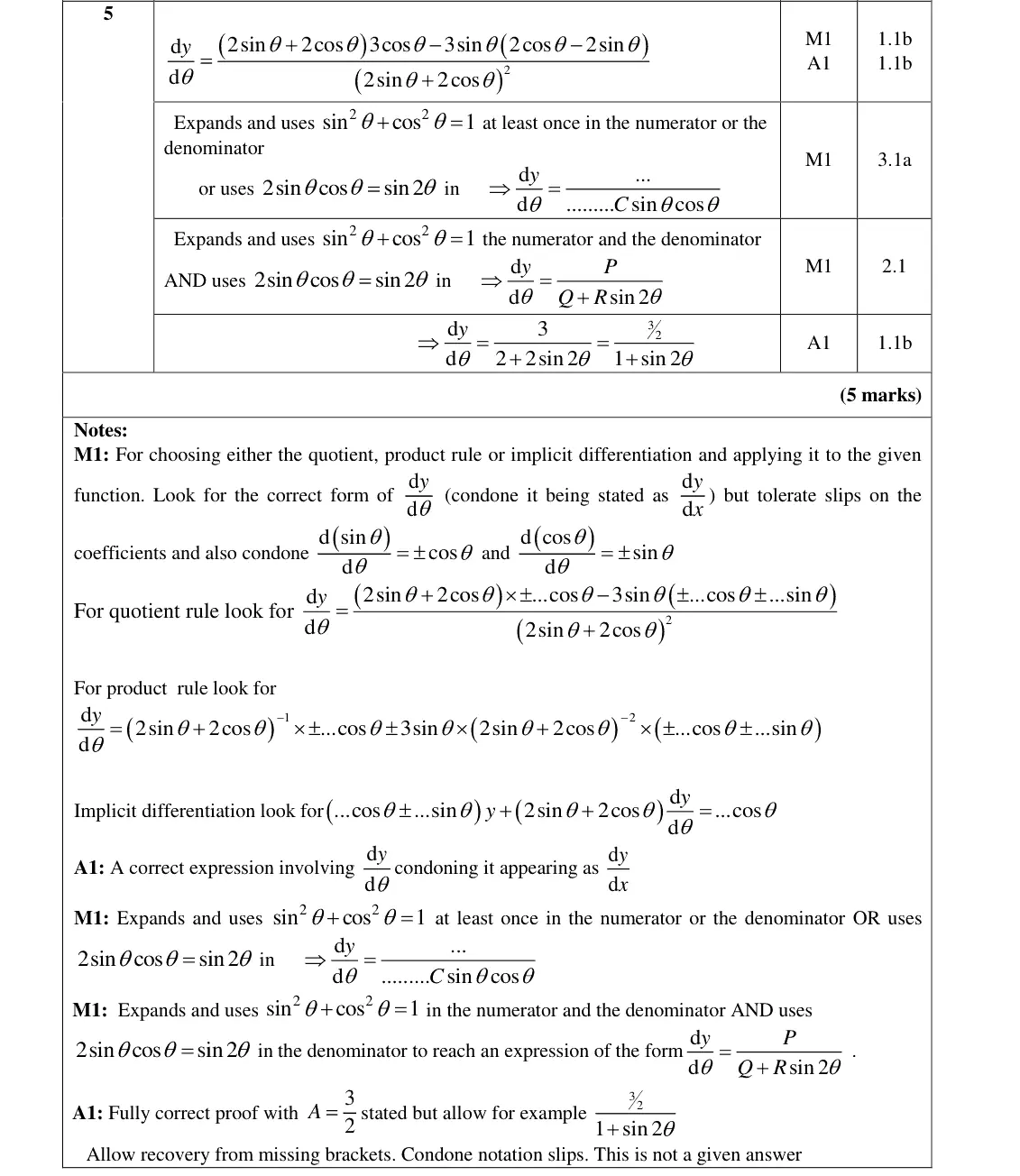
June 2018 · Paper 1 · Q55 marks
Mark scheme (whole question; this part is marked with the orange bar)
Examiner's comment
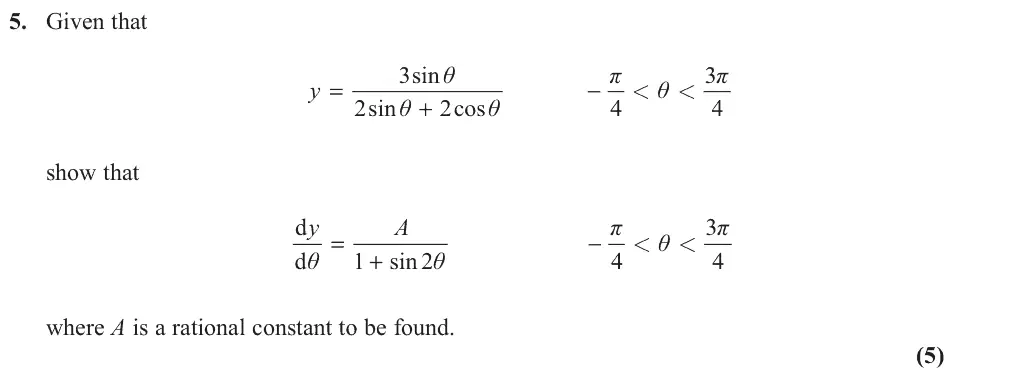
The majority of students knew to use the quotient rule in this question, although the slips on signs and bracketing in the terms of the numerator were commonplace. We would encourage all students to state the formula being used, with their expressions for ‘u’ ‘v’ ‘du’ and ‘dv’, to ensure that their method is made clear to examiners. Getting a correct derivative into the required form using trigonometric identities proved to be more challenging than the differentiation in this question. Students recognised the need to use the Pythagorean identity for sine and cosine to simplify their numerator and denominator but were less confident when applying the double angle formula for sine, and it was not uncommon for a final answer to be left as 3 2 2sin 2 , or for there to be errors in an attempt to write this fraction in the required form.
Common mistakes
quotient rule – sign and bracket slips in the numerator
use sin²θ + cos²θ = 1 in numerator and denominator and 2sinθcosθ = sin2θ
A = 3/2 (not left as 3/(2 + 2sin2θ))
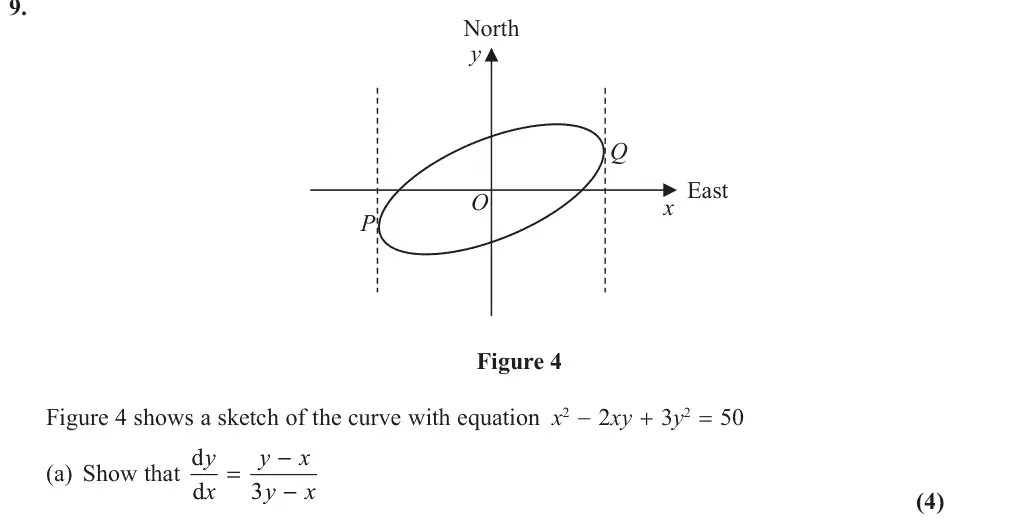
June 2018 · Paper 1 · Q9(a)4 marks
Mark scheme (whole question; this part is marked with the orange bar)
Examiner's comment
Question 9(a) was well answered. Students generally demonstrated a good understanding of implicit differentiation as well as the chain and product rules. Most reached the given result scoring all 4 marks. In question 9(b) however, many made the numerator of the fraction equal zero (i.e. y = x) instead of the denominator (x = 3y). This kind of error usually resulted in only two of the five marks being scored. There were however many full and accurate solutions, with very few students unable to pick out the coordinates of the point P from the two solutions to their simultaneous equations. Only a small number of students gained the B1 mark in question 9(c). They simply needed to state that the point furthest north can be found by substituting y= x into the equation of the curve and picking out the positive solution. Explanations tended to be incorrect or x y 0 incomplete, with many stating that it could be found by putting either or 0.
Common mistakes
product rule on 2xy and chain rule on 3y²
collect dy/dx terms and cancel the 2 to reach the given answer
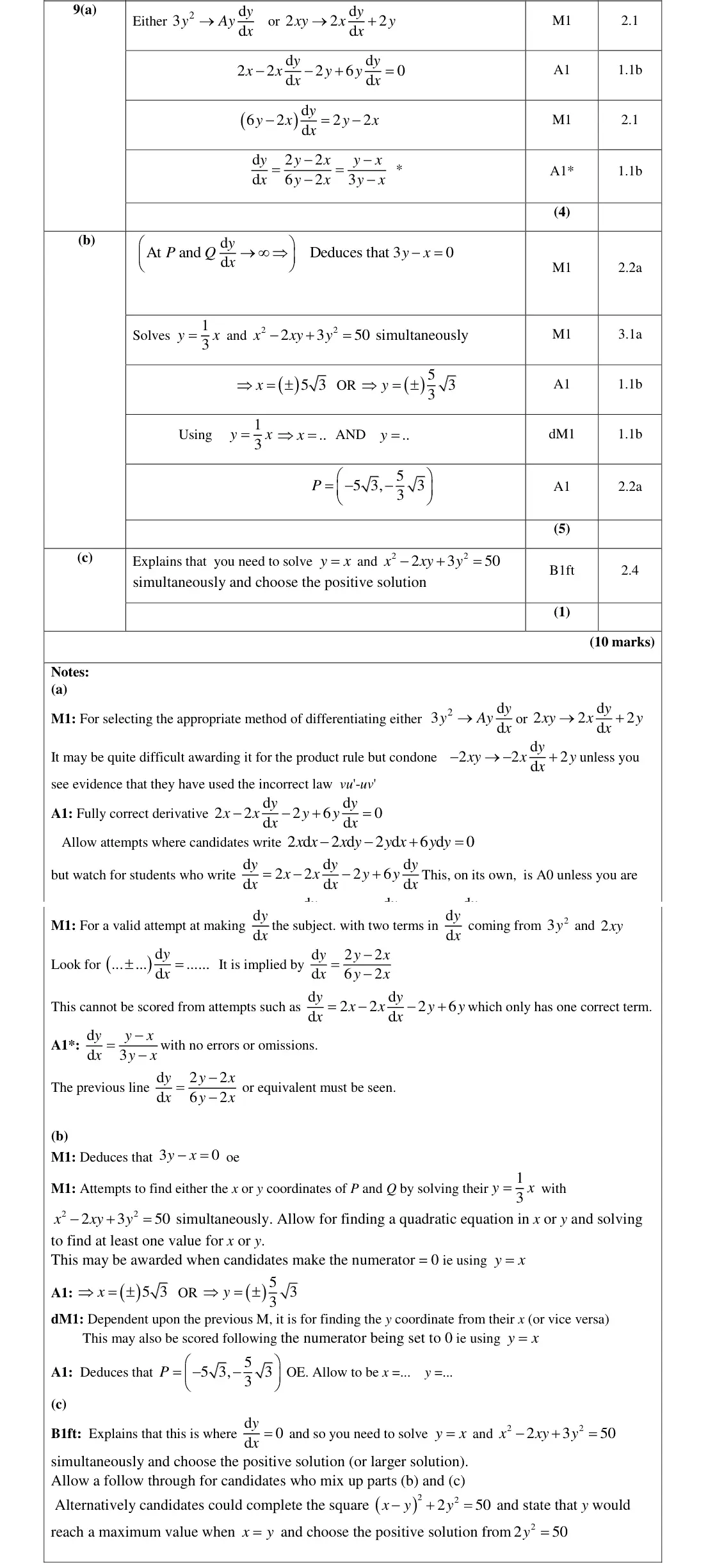
June 2018 · Paper 2 · Q11(b)3 marks
Mark scheme (whole question; this part is marked with the orange bar)
Examiner's comment
In part (b), a minority of students struggled to make any creditable progress. These students usually evaluated f ( )x for increasing x-values and concluded that the corresponding values for f ( )x were continually decreasing. The majority used the chain rule to differentiate f( ). x A common error at this stage was for students to differentiate 1 2(1 2 )x to give 2 2(1 2 ) , x while other students tried to apply an incorrect method of showing f ( ) 0. x Only a few of the students who obtained a correct 2 2 f ( ) 4( 3) 4(1 2 ) x x x provided an acceptable explanation detailing why f ( ) 0. x
Common mistakes
use the partial fractions: f(x) = 3 + 4(x − 3)⁻¹ − 2(1 − 2x)⁻¹
Mark scheme (whole question; this part is marked with the orange bar)
Examiner's comment
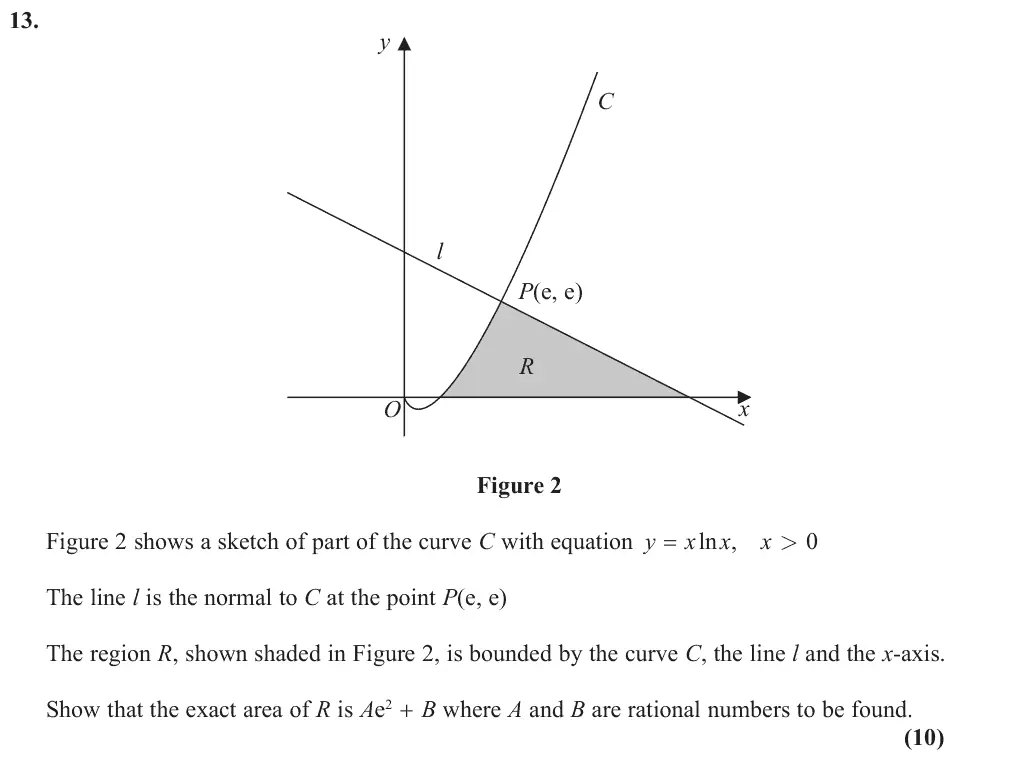
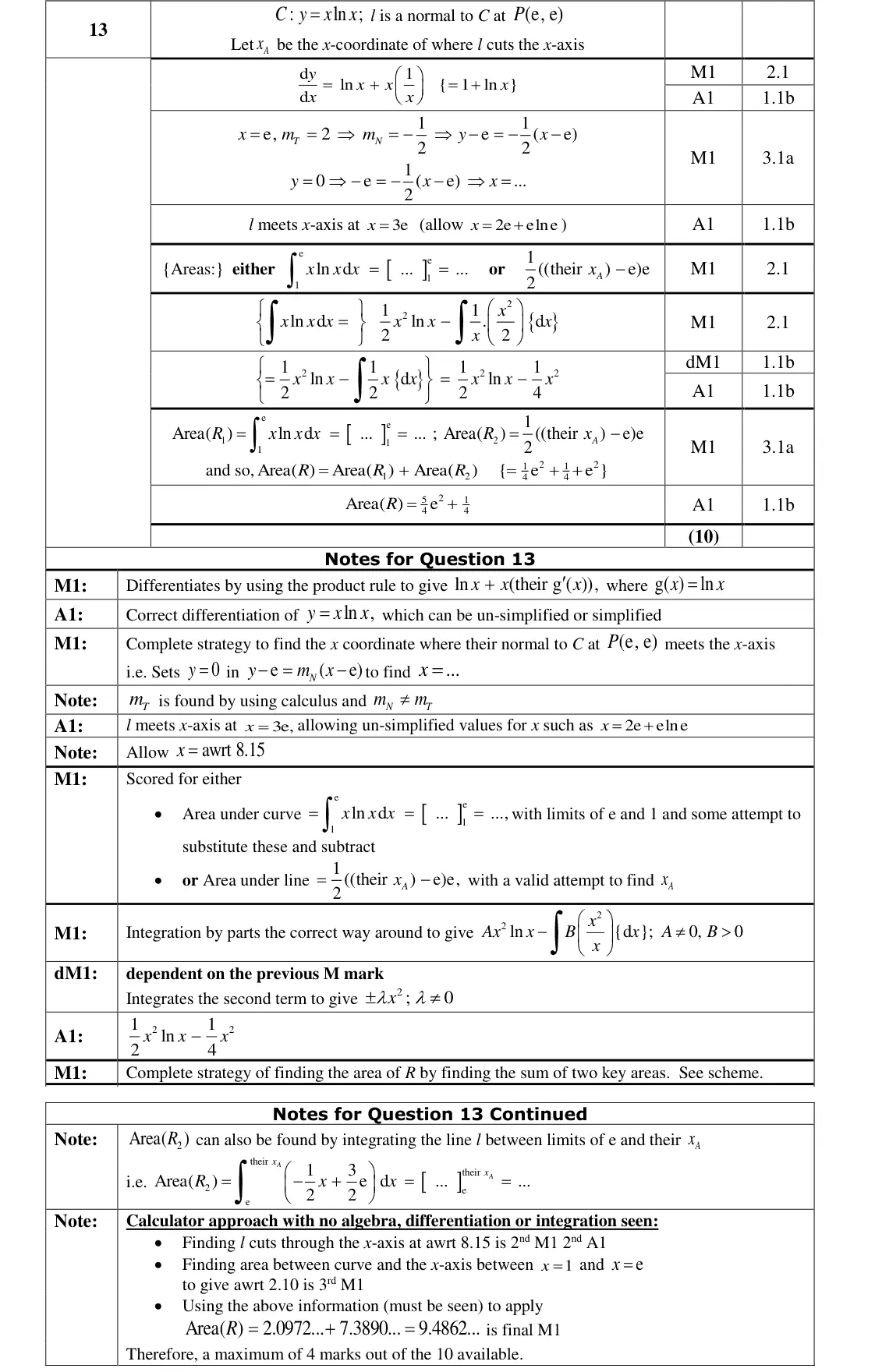
This question, despite being unstructured, proved accessible, with many students scoring at least 7 out of the 10 marks available. Those students who annotated the diagram were generally more successful in formulating a correct strategy to find the area of the region R. Most students differentiated ln y x x by using the product rule to give the correct d 1 ln . d y x x A few students found the correct d ln d y x x x x and simplified this incorrectly to give d ln . d y x x Many students used a complete method to find the x-value where the normal to C at (e, e) cuts through the x-axis, with the majority finding the correct 3e. x Most students integrated ln y x x correctly by using integration by parts to give 2 2 1 1 ln . 2 4 x x x Many students applied the correct limits of e and 1 to obtain a correct 2 1 1 e 4 4 with some making a bracketing error when applying the limit of 1 to obtain the incorrect 2 1 1 e . 4 4 The majority of students attempted to find the area of the triangle by using the formula 1 (base)(height). 2 While some students applied the formula correctly to give 1 (3e e)(e), 2 there was a considerable number that applied a base length of 3e by writing 1 (3e)(e). 2 A few students used the equation of the normal to find the area of the triangle by applying the correct 3e e 1 3 e d , 2 2 x x but not many evaluated this to arrive at the correct answer of 2e . Several incorrect strategies were seen such as trying to evaluate e 0 ln d , x x x 3e 1 ln d x x x or even 3e 1 1 3 ln e d . 2 2 x x x x Only a minority of students applied the calculation 2 2 1 1 e e 4 4 to achieve the correct 2 5 1 e . 4 4
Common mistakes
product rule dy/dx = 1 + ln x
normal gradient −½ meets x-axis at 3e
∫ x ln x dx by parts = ½x² ln x − ¼x² with limits 1 and e (bracketing error at x = 1)
triangle base 3e − e not 3e
area = 5e²/4 + 1/4
June 2018 · Paper 2 · Q14(b)4 marks
Mark scheme (whole question; this part is marked with the orange bar)
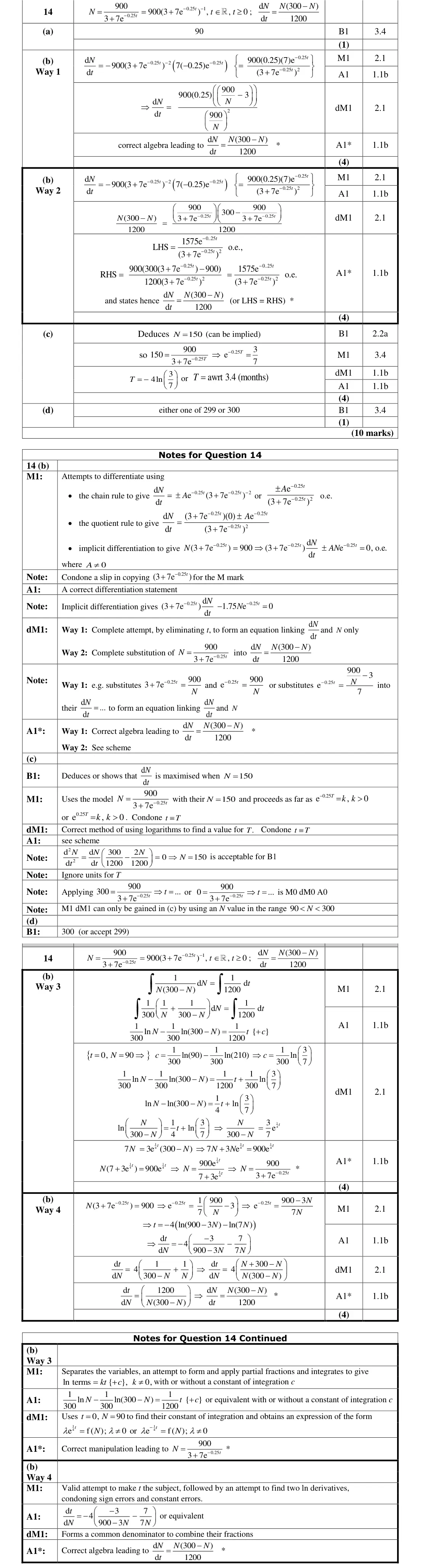
Examiner's comment
This was the most demanding question on the paper. Parts (a) and (d) were accessible to many students. Most students made some creditable progress in part (b), but many students found it difficult to access the demanding material in part (c). In part (b), most students used either the chain rule or the quotient rule in their attempt to find an expression for d . d N t There were many incorrect attempts at the chain rule such as 0.25 0.25 2 d 6300e (3 7e ) d t t N t or 0.25 2 d 1575(3 7e ) d t N t while the most common incorrect attempt at the quotient rule was 0.25 0.25 0.25 2 d (3 7e )(1) 1575e . d (3 7e ) t t t N t Although some impressive algebra was seen in manipulating a correct 0.25 0.25 2 d 1575e d (3 7e ) t t N t to achieve d (300 ) d 1200 N N N t , many students were unsuccessful in their attempts at eliminating t or the 0.25 e t term. Some students substituted 0.25 900 3 7e t N into d (300 ) d 1200 N N N t and used algebra to give 0.25 0.25 2 d 1575e d (3 7e ) t t N t , and provided some indication that their proof was complete. Some students differentiated N by using implicit differentiation while other students attempted to rearrange the given equation for N to make t the subject before finding an expression for d . d t N A few students were successful in applying an alternative method of solving the differential equation d (300 ) d 1200 N N N t to give 0.25 900 . 3 7e t N
Common mistakes
chain rule on 900(3 + 7e^(−0.25t))⁻¹ (common errors in the chain or quotient rule)
eliminate e^(−0.25t) using N
alternatively substitute N into RHS and show LHS = RHS with a conclusion
Find an Edexcel maths tutor
Stuck on this? Book a trial session with an Edexcel specialist.