P7.1 Derivative, first principles, 2nd derivative, convexity
Section
P7 Differentiation
Level
Partly A level only
Statement
Understand and use the derivative of f(x) as the gradient of the tangent to the graph of y = f(x) at a general point (x, y); the gradient of the tangent as a limit; interpretation as a rate of change; sketching the gradient function for a given curve; second derivatives; differentiation from first principles for small positive integer powers of x and for sin x and cos x. Understand and use the second derivative as the rate of change of gradient; connection to convex and concave sections of curves and points of inflection.
Guidance
Know that dy/dx is the rate of change of y with respect to x. The notation f′(x) may be used for the first derivative and f″(x) for the second derivative. Given, for example, the graph of y = f(x), sketch the graph of y = f′(x) using given axes and scale; this could relate speed and acceleration, for example. For first principles, students should be able to use, for n = 2 and n = 3, the gradient expression lim (h → 0) ((x + h)ⁿ − xⁿ)/h; students may use δx or h. Use the condition f″(x) > 0 implies a minimum and f″(x) < 0 implies a maximum for points where f′(x) = 0. Know that at an inflection point f″(x) changes sign. Consider cases where f″(x) = 0 and f′(x) = 0 where the point may be a minimum, a maximum or a point of inflection (e.g. y = xⁿ, n > 2).
A-level only
first principles for sin x and cos x; second derivative as rate of change of gradient, convex/concave sections and points of inflection
Mark scheme (whole question; this part is marked with the orange bar)
Examiner's comment
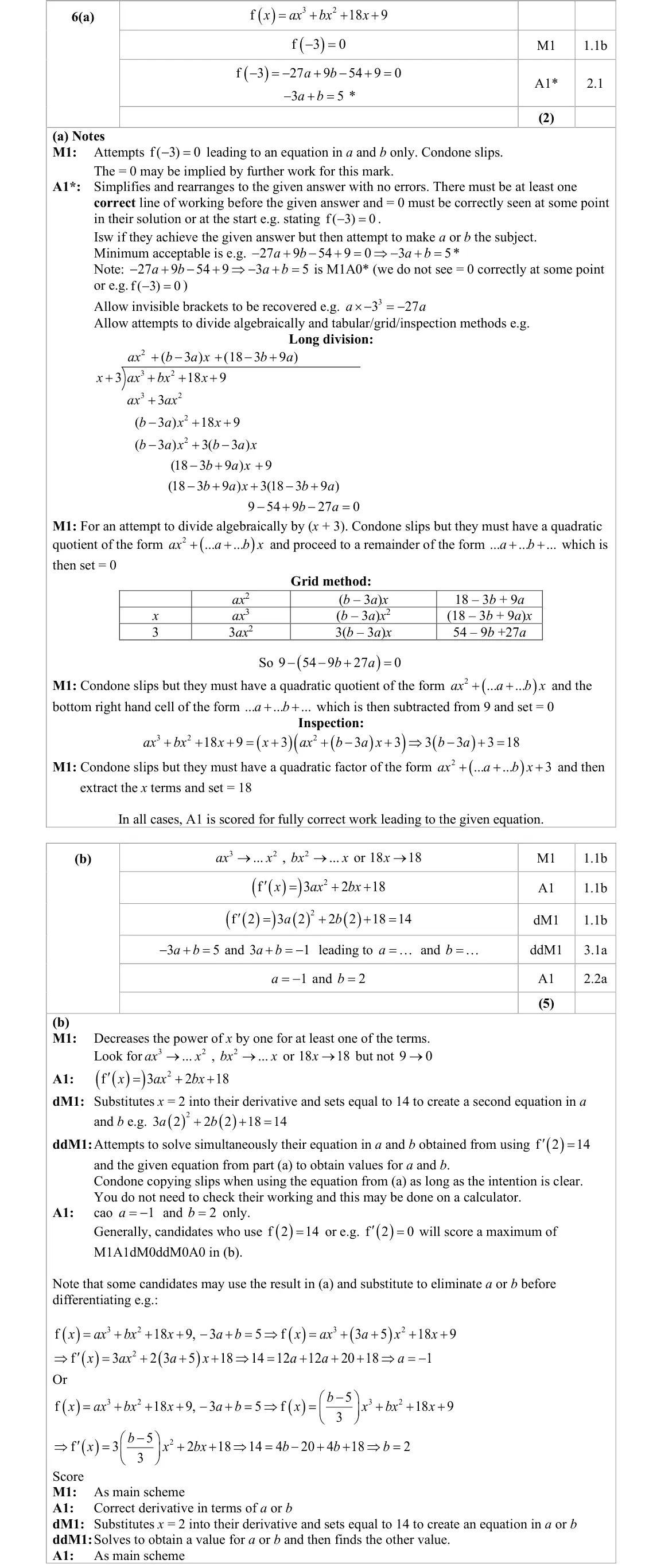
Although the skills involved in part (b) were quite fundamental, the understanding of the demand of the question differentiated the candidates. Pleasingly the majority were able to differentiate correctly, substitute 2 into their derivative and set equal to 14, then solve the two equations simultaneously. On occasion those candidates who solved algebraically, as opposed to using their calculator, lost the final accuracy mark. Arithmetical errors were also seen in rearranging the second equation. A number of candidates achieved the first two marks for correctly differentiating however they then went on to set f ′(2) = 0. Other candidates achieved no marks as there was no attempt to differentiate and instead attempted f (2) = 0 or f (2) = 14 or integrated instead of differentiating. In all cases there was very minimal evidence of candidates checking that their solutions to a and b satisfied the given conditions.
Common mistakes
differentiate f′(x) = 3ax² + 2bx + 18, then f′(2) = 14 gives 3a + b = −1
solve with −3a + b = 5: a = −1, b = 2
using f(2) = 14, f′(2) = 0 or integrating scores little
June 2025 · AS Paper 1 · Q11(c)2 marks
Mark scheme (whole question; this part is marked with the orange bar)
Examiner's comment
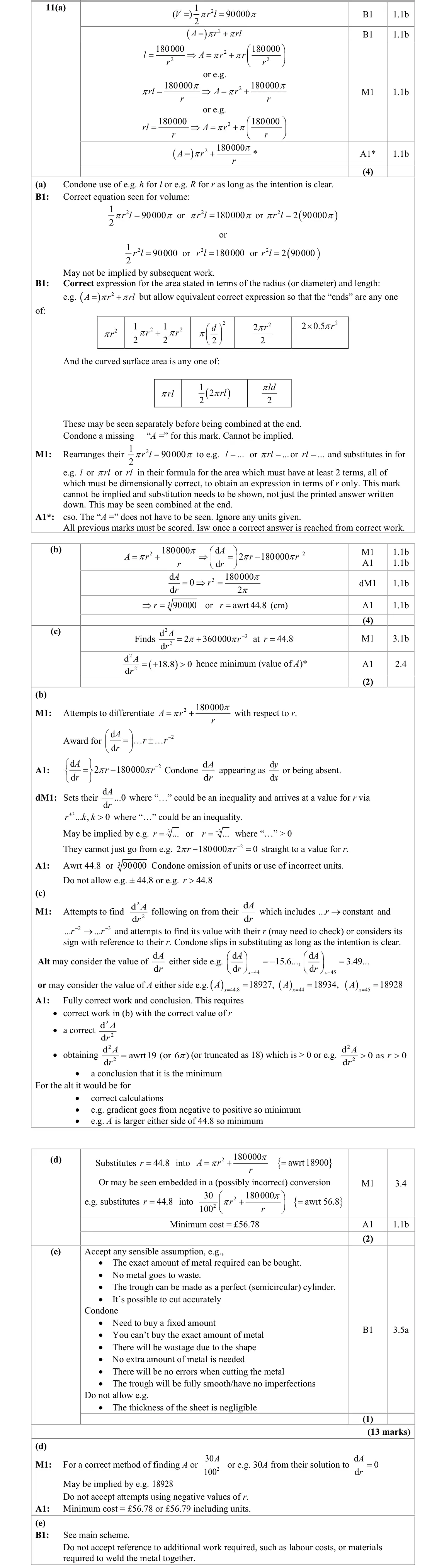
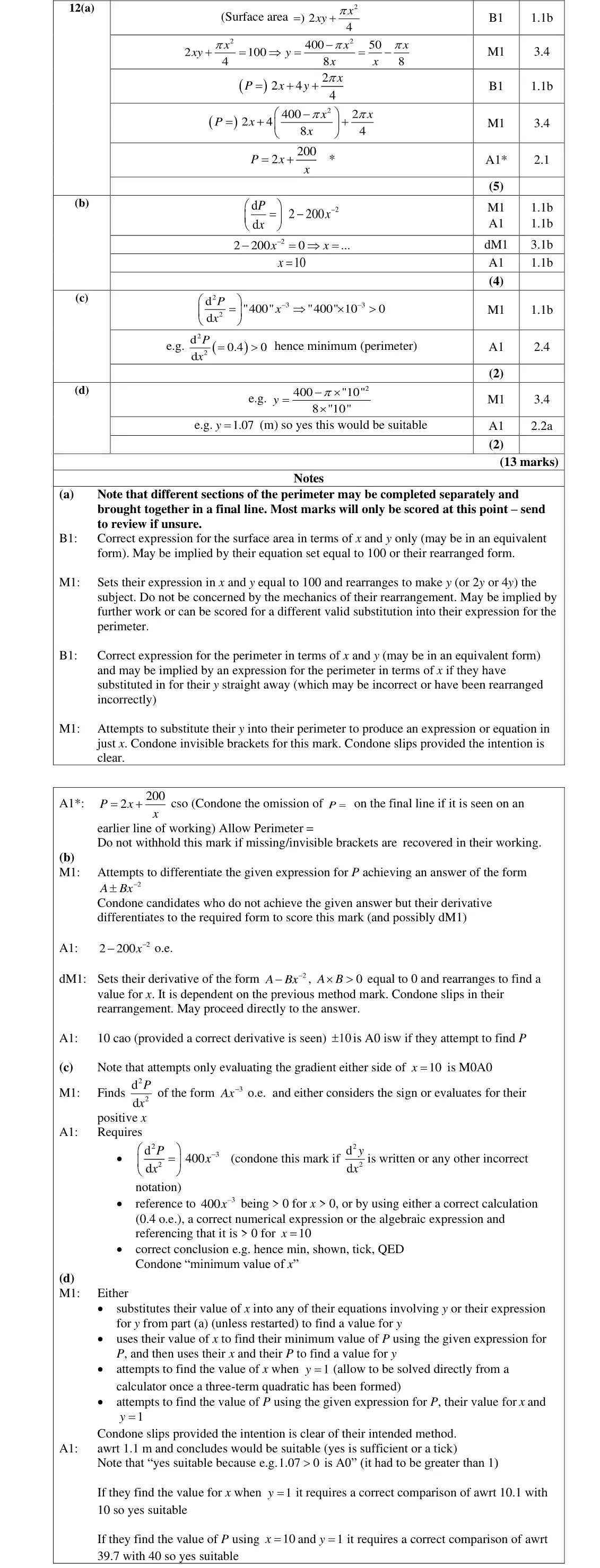
A small minority of candidates did not attempt this question at all. Some candidates attempted part (a) and then did not go on to attempt the remaining parts (generally when they were unable to complete part a)). Part (c) was less well answered and some candidates made errors with the differentiation. A small minority of candidates differentiated the 2 r - correctly but did not include the differentiation of the 2 pi r to get 2 pi . Most candidates recognised the need to substitute their value from part (b) into the second derivative to achieve a number greater than zero. A common error was to mix up parts (b) and (c). Some candidates found the first derivative (often correctly) then found the second derivative and put this equal to zero (rather than the first derivative), thus losing marks from parts (b), (c) and (d).
Mark scheme (whole question; this part is marked with the orange bar)
Examiner's comment
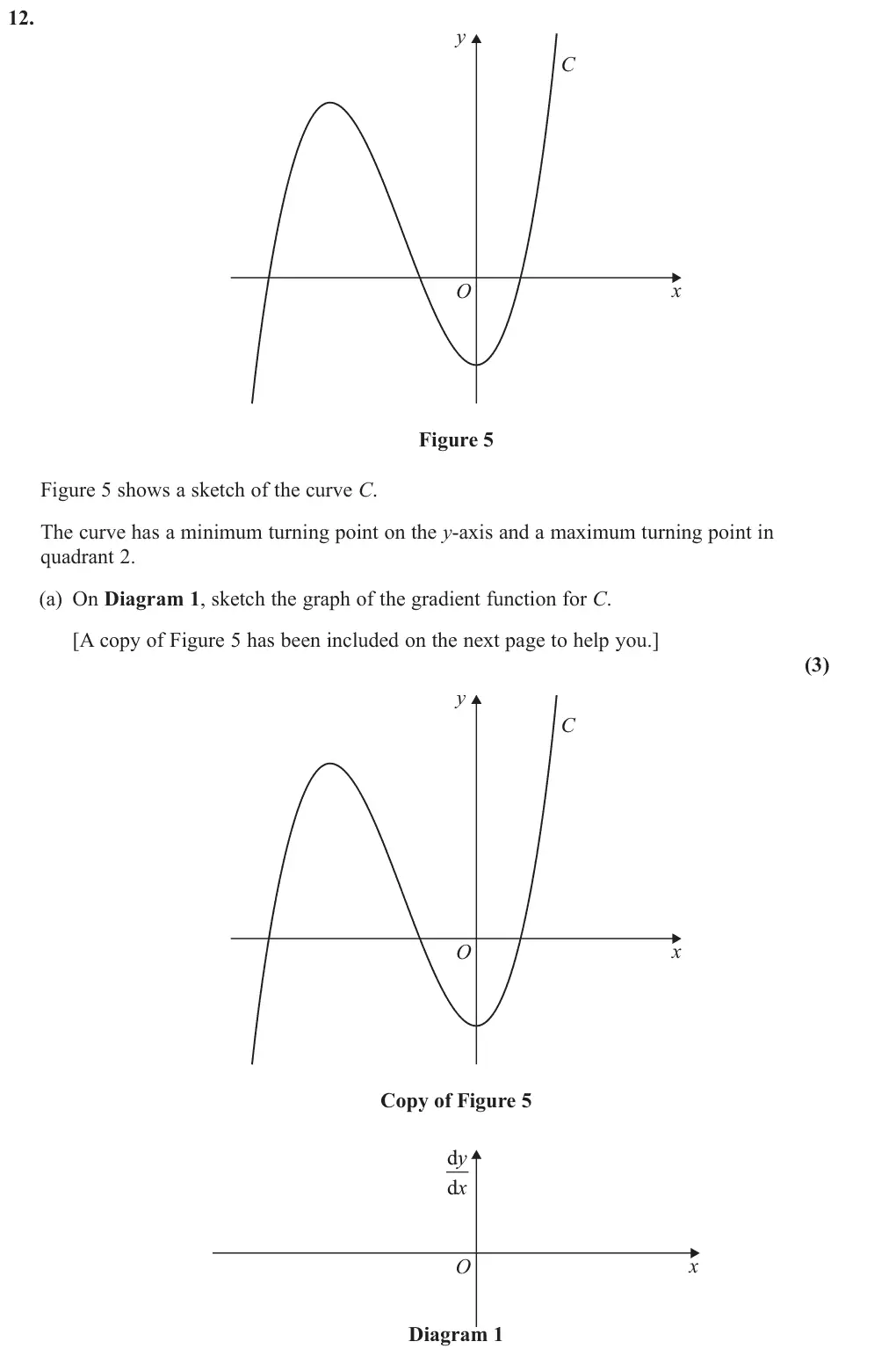
This question was met with mixed success. Whilst many candidates made a reasonable attempt at sketching the quadratic graph in part (a), part (b) proved more challenging, particularly in selecting the correct gradient function and providing adequate justification. Part (a) was generally better attempted, with many candidates recognising the need to draw a U-shaped (positive quadratic) graph. Common errors included: • drawing a cubic curve rather than a quadratic • drawing a straight line • sketching a quadratic that did not cross the x-axis or with incorrect roots, such as crossing the positive x-axis instead of the origin and negative x-axis Some candidates left the sketch blank or attempted part (b) without completing part (a). Despite these issues, most candidates gained at least 1 mark for showing some correct features, such as a U-shape or one correct root.
Common mistakes
gradient function is a U-shaped quadratic crossing the x-axis at the origin (minimum on the y-axis) and on the negative x-axis (maximum in quadrant 2)
drawing a cubic or a straight line
roots on the wrong side
June 2025 · AS Paper 1 · Q12(b)2 marks
Mark scheme (whole question; this part is marked with the orange bar)
Examiner's comment
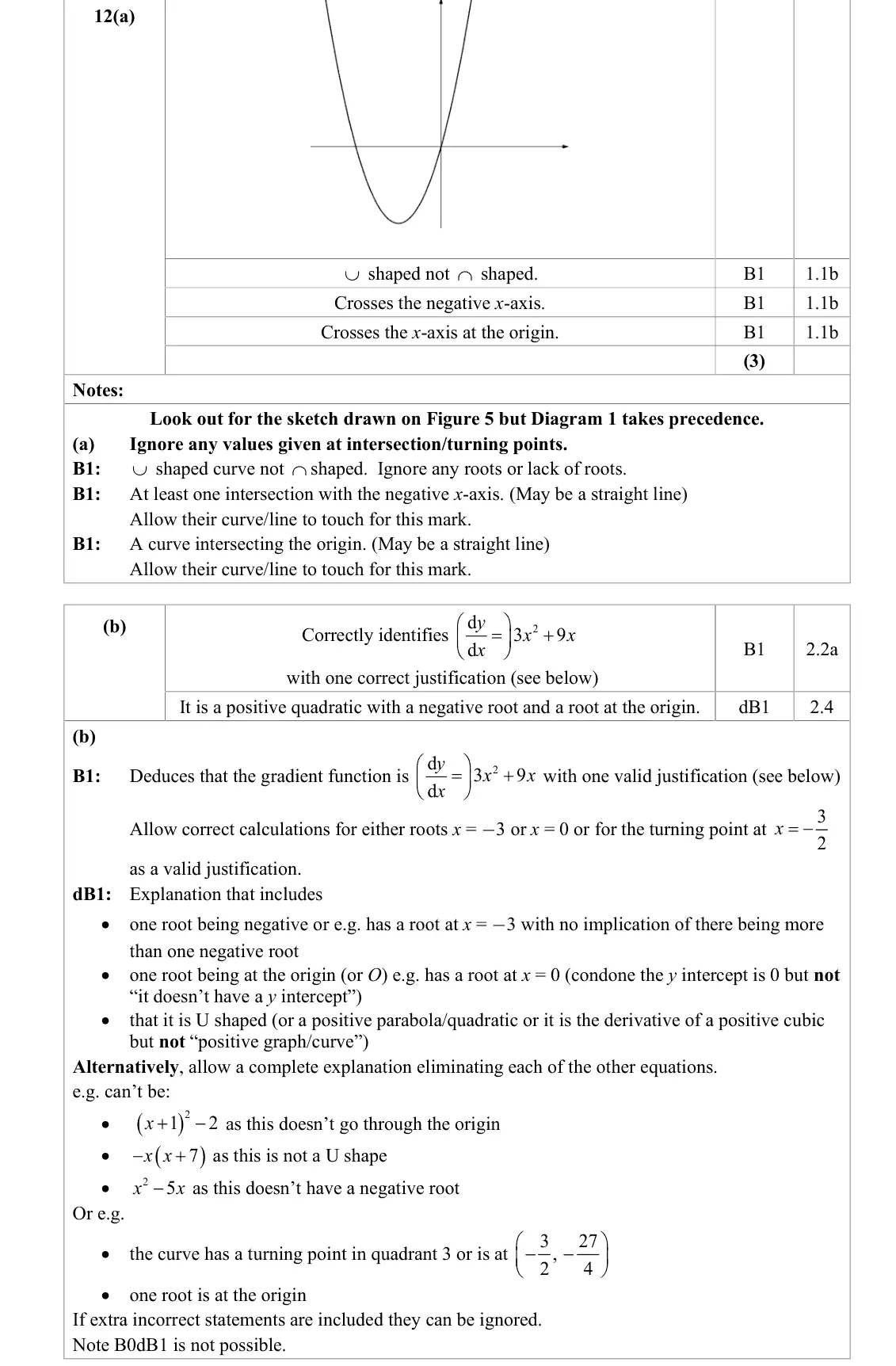
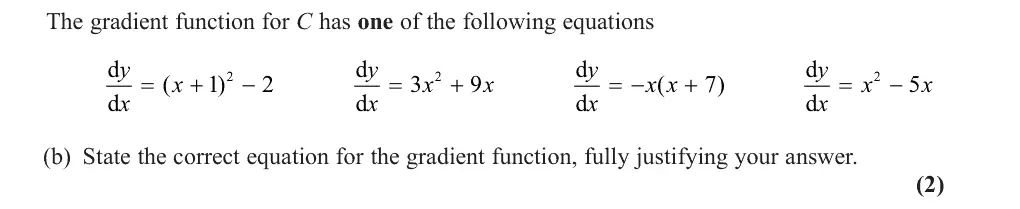
This question was met with mixed success. Whilst many candidates made a reasonable attempt at sketching the quadratic graph in part (a), part (b) proved more challenging, particularly in selecting the correct gradient function and providing adequate justification. Part (b) was less well answered. While some identified the correct function, many failed to justify their choice clearly or accurately. Common issues included: • no justification or vague explanations such as "it’s a cubic" (which applies to all the given options) • stating that it was correct because of the roots, but without explaining the link between the function and its derivative • attempting to integrate each option instead of recognising it as a derivative • incorrectly assuming a connection between the coefficient of 2x being 3 and the original curve being cubic Some selected the correct function but gave ambiguous or incorrect reasons, which prevented them from accessing full marks. A wide range of incorrect gradient choices were also seen. Stronger responses either correctly linked all the required aspects or ruled out the incorrect options through logical reasoning, demonstrating good understanding. Overall, this question differentiated well between candidates.
Common mistakes
dy/dx = 3x² + 9x: positive quadratic with a root at 0 and a negative root (−3)
"it's a cubic" or vague root comments are not a justification
integrating each option
June 2025 · Paper 1 · Q7(a)2 marks
Mark scheme (whole question; this part is marked with the orange bar)
Examiner's comment
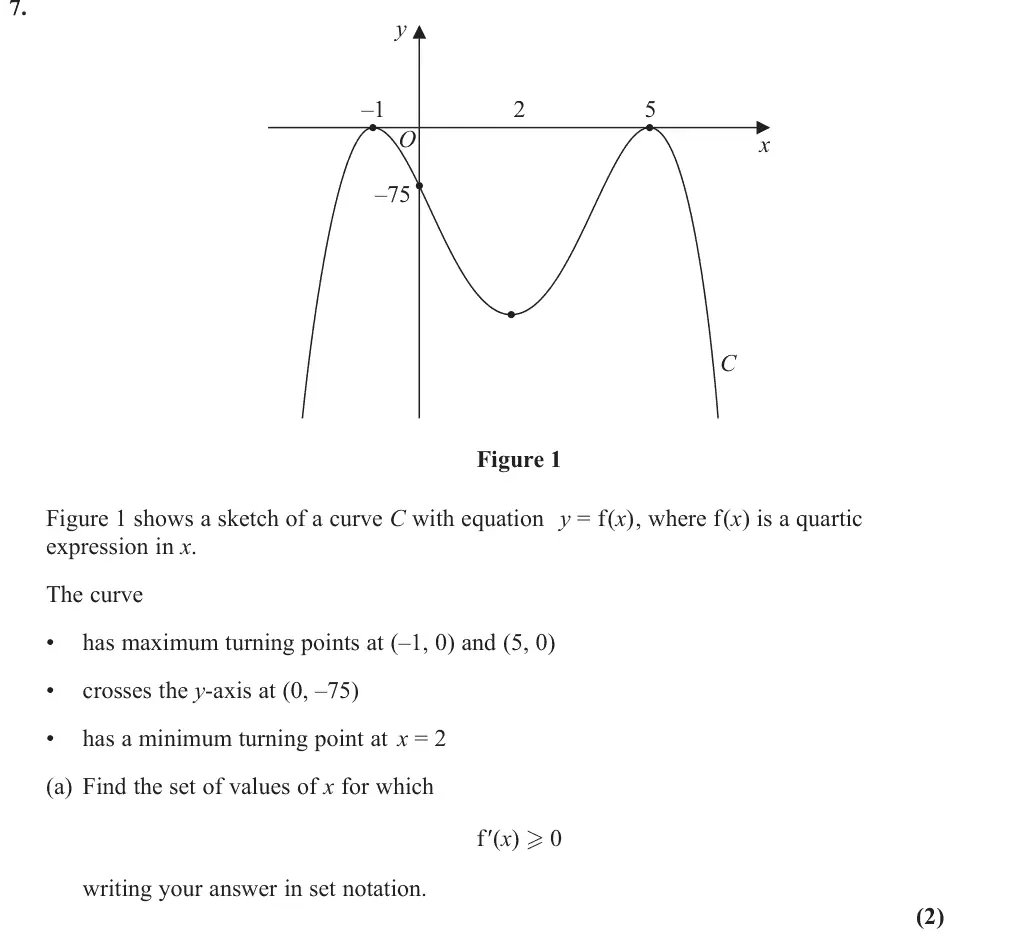
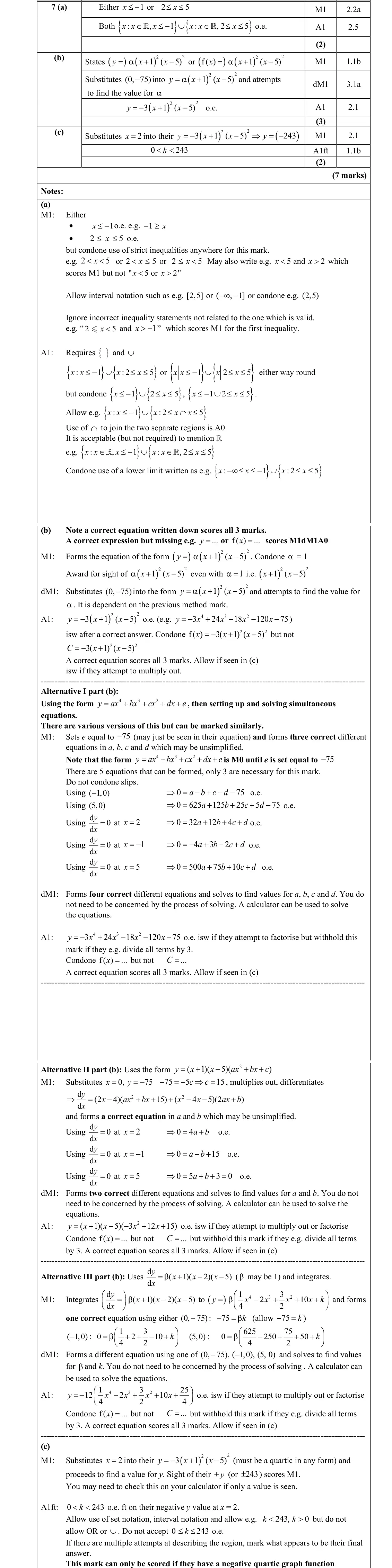
This was the first question on the paper where there was wide discrimination between the marks of responses, and many struggled with knowing how to handle a quartic function. Part (a) involved using the given information and the figure to find the set of values that satisfied f ( ) 0 x ′ and to represent this in set notation. Most identified the critical values that formed the boundaries of the regions where f ( ) 0 x ′ . In general, these critical values were used within a relevant inequality although these were often strict rather than inclusive. Some learners incorrectly interpreted the function giving incorrect inequalities or just considering the region between the two local maxima. Presenting the regions in set notation was done to varying degrees of success. Although a large proportion were able to present their solution in an acceptable form including the brackets { } and the union, ∪, there were many errors seen including intersection signs, no link between the regions, interval notation and strict inequalities. The majority used x as the variable within the inequalities but ( ) f , x ( ) f x ′ and k were all seen. Of those using a correct form of set notation, very few mentioned x was a real number although this was not specifically required on this occasion. It was clear that a significant proportion of learners did not appreciate what was required for set notation.
Common mistakes
f is increasing (or stationary) for x ≤ −1 and 2 ≤ x ≤ 5 (inclusive inequalities)
set notation needs { } and the union, not intersection or interval notation
June 2025 · Paper 1 · Q15(c)2 marks
Mark scheme (whole question; this part is marked with the orange bar)
Examiner's comment
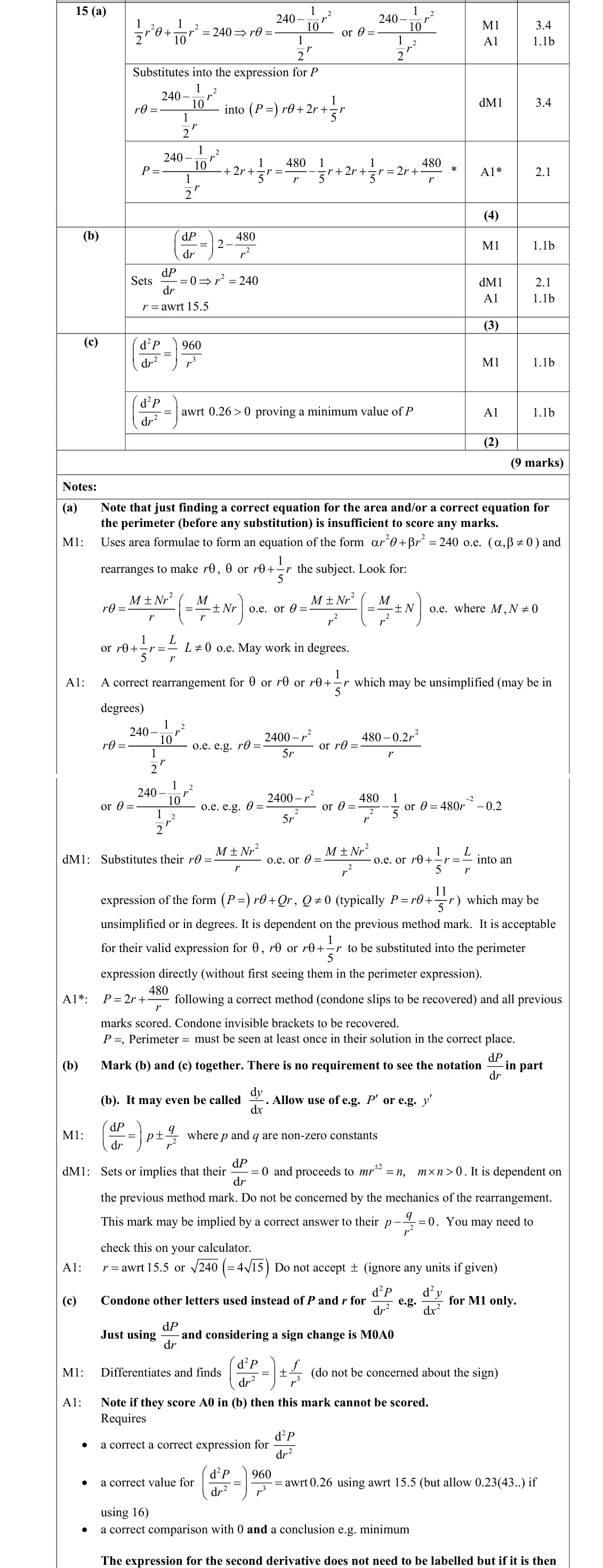
This question using differentiation to find a minimum was generally answered well. It was usually part (a) which provided most challenge, often resulting in work which was difficult to follow. In part (c), learners were asked to prove by further differentiation that the value of r found gave the minimum perimeter. Most were able to make some progress and find the correct second derivative. The criteria for a minimum value was less well applied. Some responses did not use a correct inequality whilst others did not correctly evaluate their second derivative at the value of r. Incorrect second derivative notation was also not credited. 22
Common mistakes
d²P/dr² = 960/r³ = 0.26 > 0 so minimum
must evaluate at r = 15.5 and compare with 0, with a conclusion
sign-change or d²y/dx² in the conclusion not credited
June 2024 · AS Paper 1 · Q12(c)2 marks
Mark scheme (whole question; this part is marked with the orange bar)
Examiner's comment
In part (c), differentiation to obtain the second derivative was commonly successfully achieved. However, it was surprising that a significant minority of candidates felt that determining the second derivative was sufficient, neither evaluating it for their value of x, nor reasoning why it was positive for all positive x. Others lost the final mark in this part for a lack of conclusion. A number of approaches to part (d) were observed. Most commonly, candidates evaluated
Common mistakes
d²P/dx² = 400x^(−3) = 0.4 > 0 at x = 10 so minimum
a conclusion is needed
just finding the second derivative is not enough
checking the gradient either side scores 0
June 2024 · Paper 1 · Q43 marks
Mark scheme (whole question; this part is marked with the orange bar)
Examiner's comment
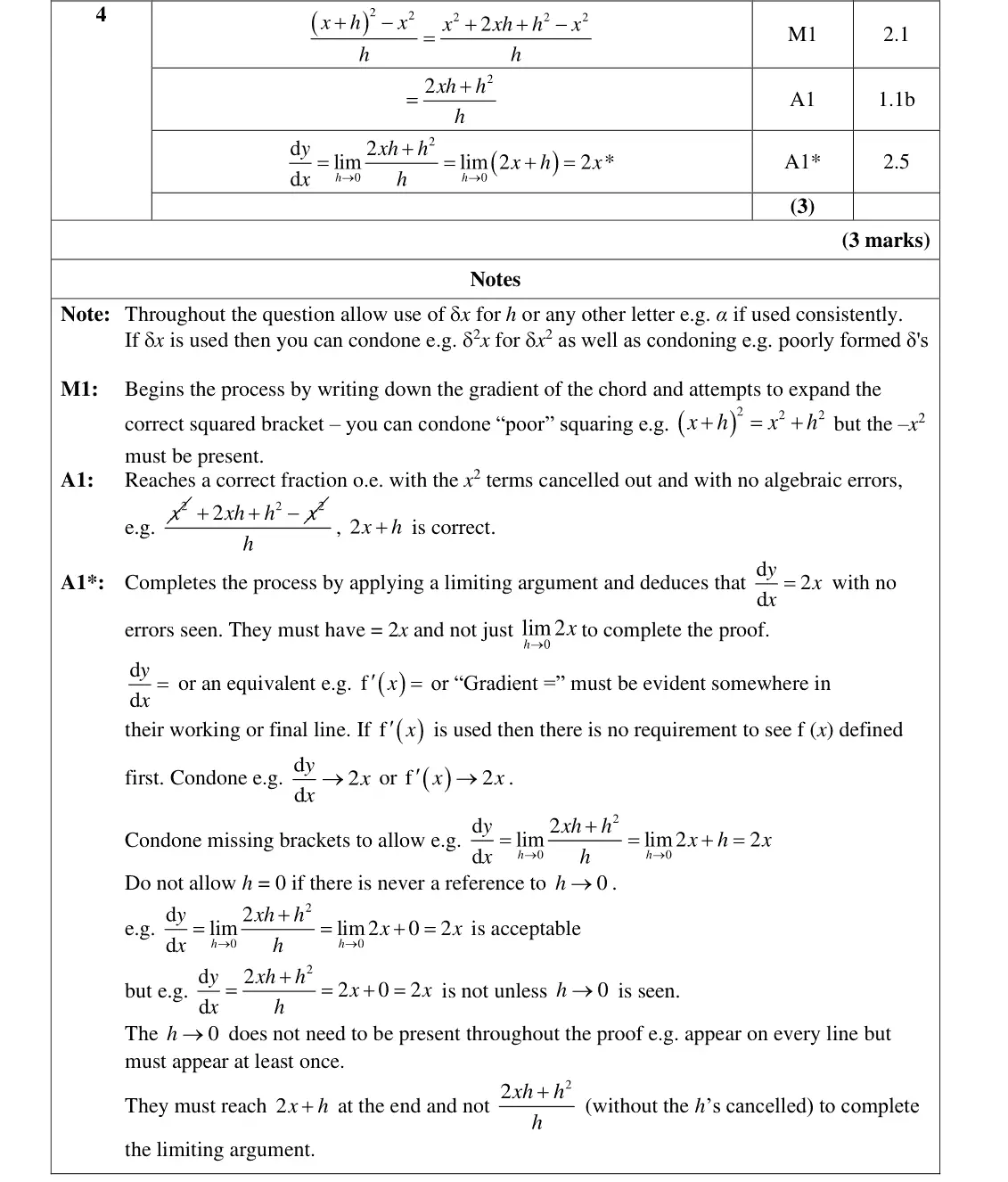
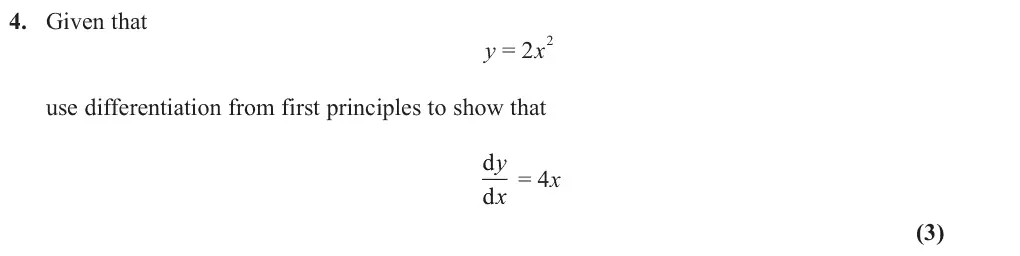
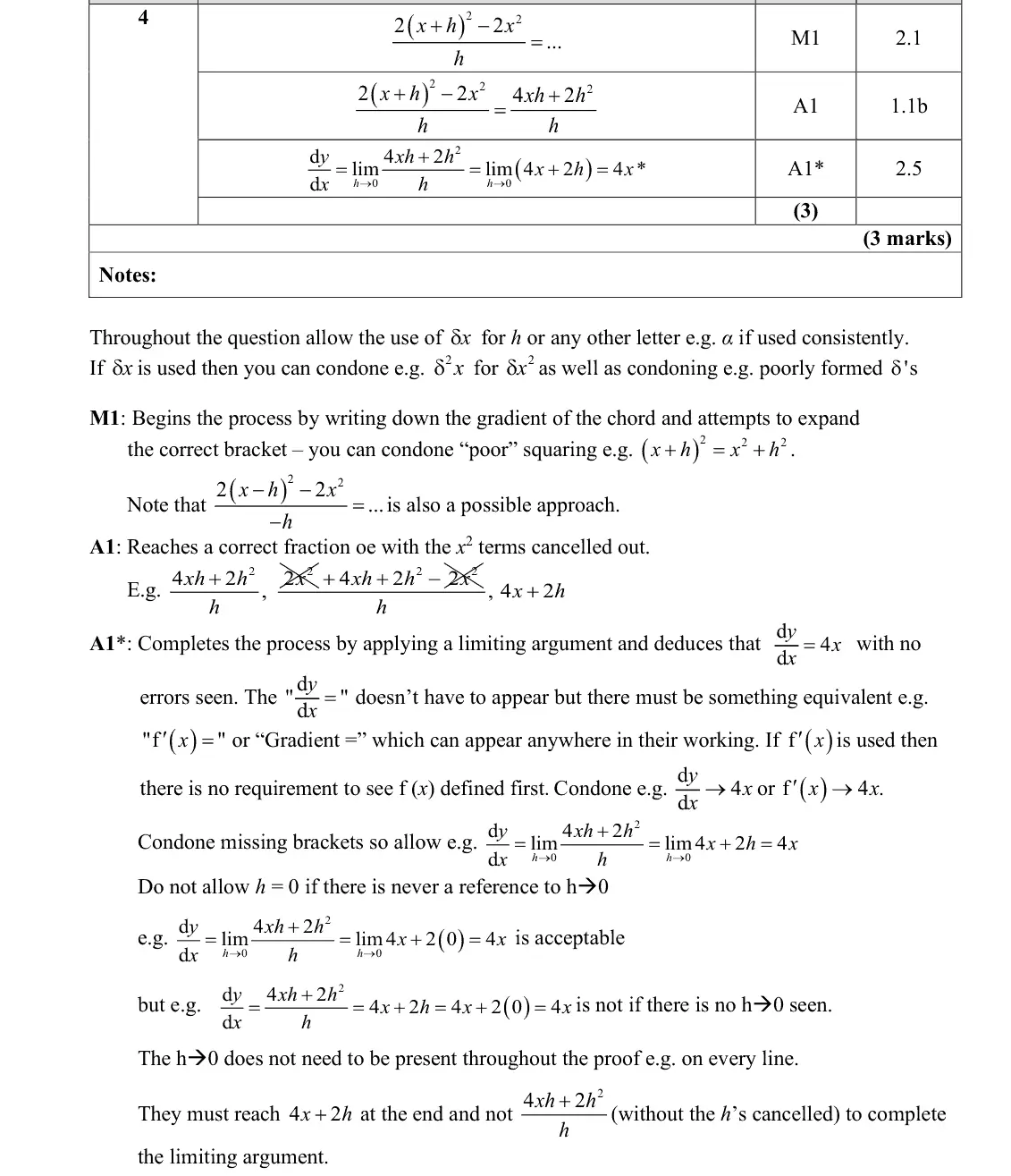
This question was very similar to previous differentiation from first principles questions and many candidates scored full marks, being much better prepared than in previous series. Most candidates used ( ) ( ) f f x h x h + - to find the gradient of the chord, although a small number of candidates attempted to use ( ) ( ) f f x x h - + but failed to change the denominator to .h - Misunderstanding the definition of the derivative led to some candidates losing some or all of the marks, by writing, for example ( ) ( ) f ^2 f x ^2 x h h + - or ( ) ( ) f ^2 f x^2 x h h + - . Slips when expanding ( ) 2 x h + were condoned for the method mark but the 2x - was required. Most candidates were able to correctly expand and proceed to 2 2xh h h + or 2x h + to score the first two marks. Common errors included incorrectly simplifying the fraction, failure to cancel h correctly or an incomplete limiting argument (e.g. stopping at 0 lim2 h x → ), each of which led to the loss of the final accuracy mark. Notation was generally good, and most candidates included a reference to 0 h → somewhere in their working. A significant minority of candidates failed to include d d y x = or equivalent anywhere in their answer despite being asked to show d 2 d y x x = in the question, thereby losing the final mark.
Common mistakes
gradient of chord ((x + h)² − x²)/h with the −x² kept
cancel h to 2x + h
limit h → 0 must be written and must end "= 2x"
dy/dx = must appear
June 2024 · Paper 2 · Q1(a)3 marks
Mark scheme (whole question; this part is marked with the orange bar)
Examiner's comment
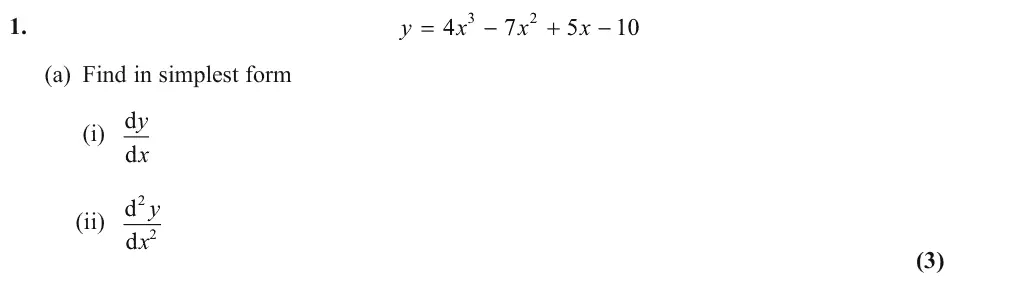
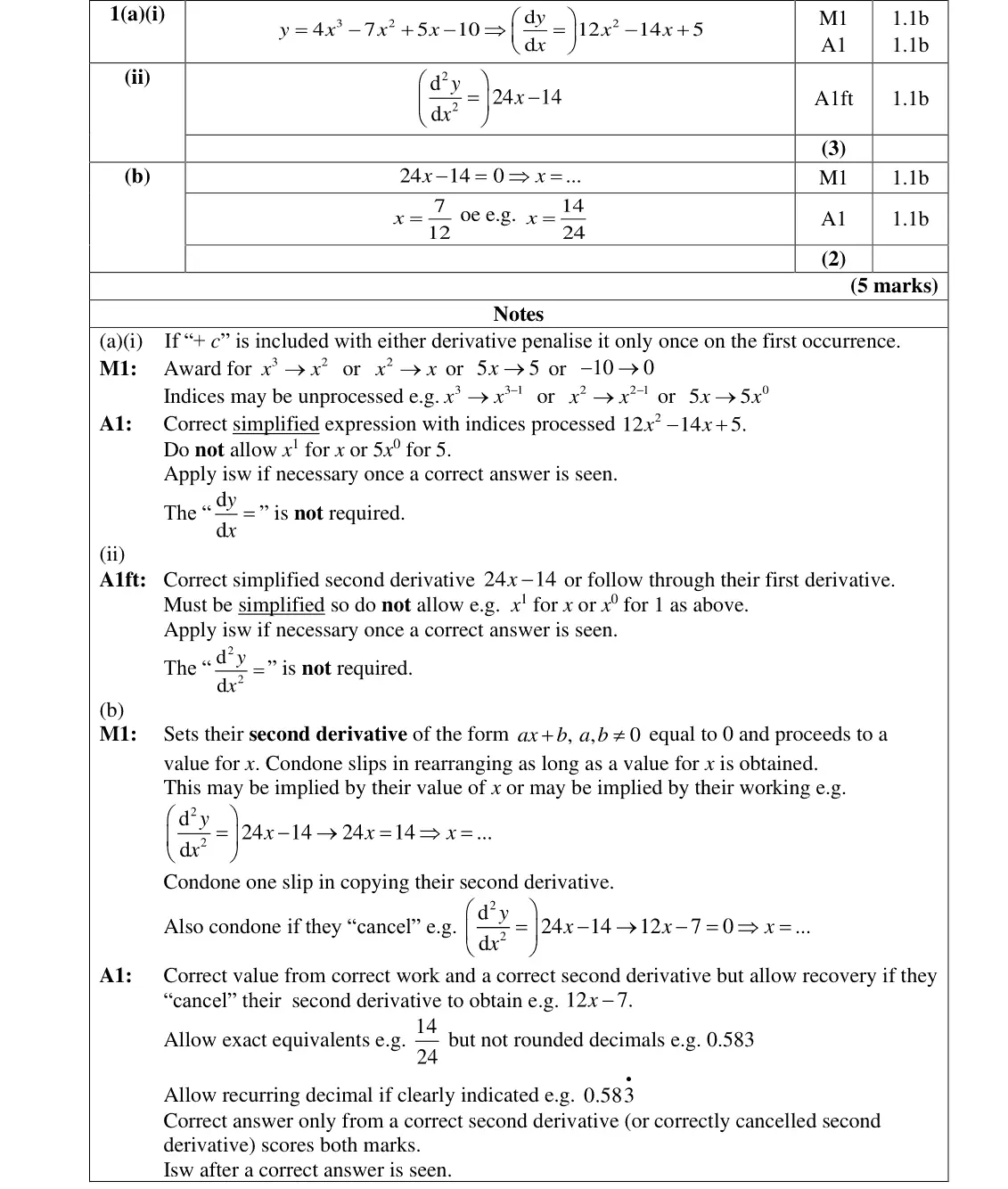
This question was very accessible with the vast majority obtaining full marks on all three parts. In part (a), a few candidates integrated the expression and hence obtained no marks as they did not have a linear equation to solve in part (b), but this was a rarity. One of the more common reasons to lose a mark was the inclusion of a spurious “+ c” with one or both derivatives. A few candidates attempted the differentiation but made mistakes with the coefficients (usually resulting from dividing by rather than multiplying by the index). Another error seen was to “simplify” the second derivative from 24x - 14 to 12x - 7.
Common mistakes
multiply by the index (not divide)
no "+ c" on a derivative
simplify (no x¹ or x⁰)
integrating instead scores 0
second derivative 24x − 14
June 2024 · Paper 2 · Q1(b)2 marks
Mark scheme (whole question; this part is marked with the orange bar)
Examiner's comment
This question was very accessible with the vast majority obtaining full marks on all three parts. In part (b) candidates could access the first mark for setting their linear second derivative equal to 0 and solving for x. There were a few candidates who lost the accuracy mark by giving a value of 24 14 instead of 14 24 and there were a surprising number of candidates who went from 24x = 14 to 1 2 x = .
Common mistakes
set the second derivative 24x − 14 = 0
exact x = 7/12 (not 0.583 rounded)
14/24 inverted to 24/14
24x = 14 does not give x = ½
June 2023 · AS Paper 1 · Q11(b)3 marks
Mark scheme (whole question; this part is marked with the orange bar)
Examiner's comment
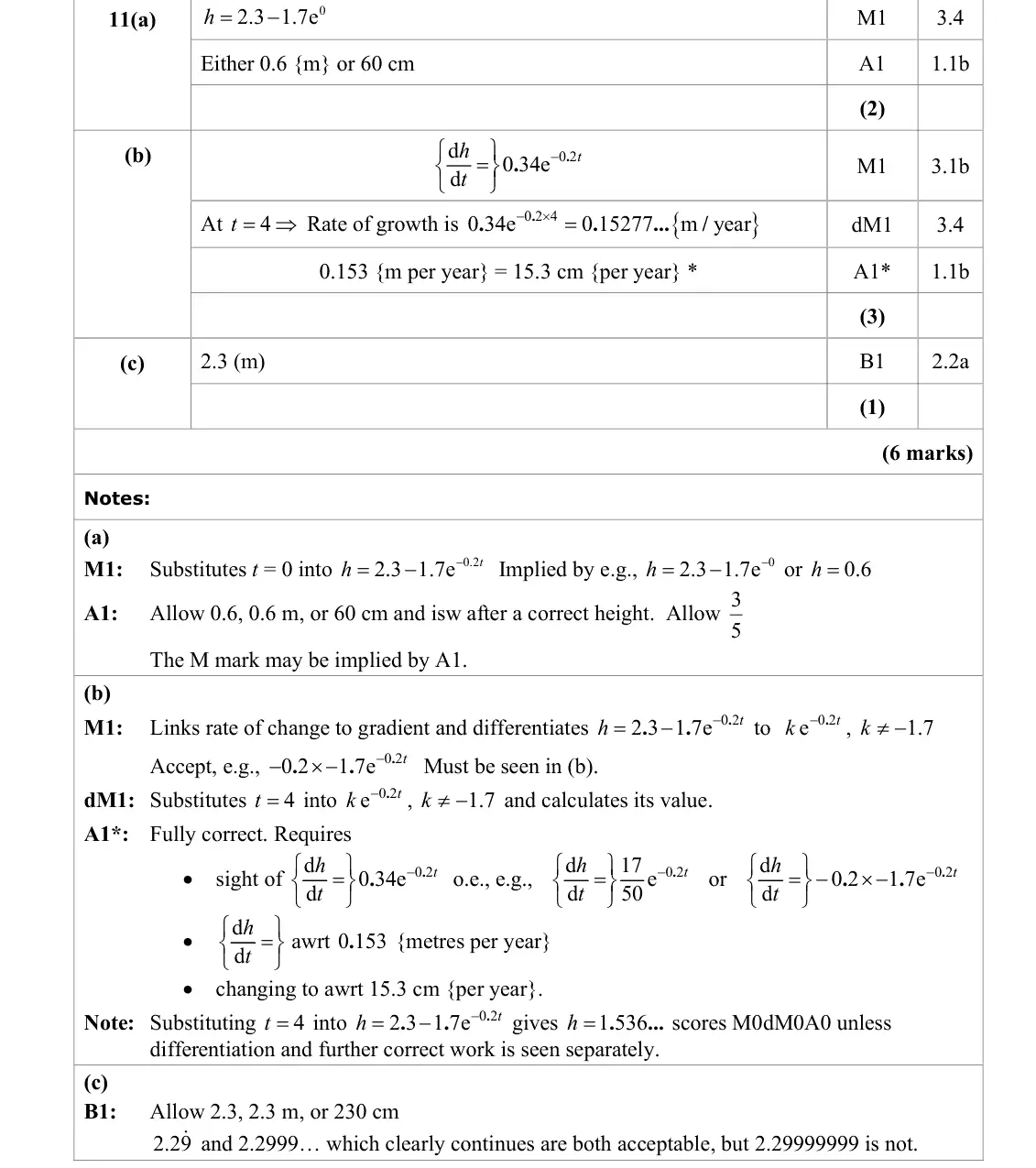
This question on exponential functions caused problems for the majority in part (b), as they failed to recognise that differentiation was required. However, generally parts (a) and (c) were answered well. In part (b), the majority of candidates failed to recognise that the 15.3 cm per year meant that they were required to differentiate to obtain a rate of change, and attempted instead to substitute t = 4 into the expression for h. This answer resembled 15.3 cm, so many incorrectly assumed that they had answered the question, even though the subsequent conversion from metres to cm made no sense. Some attempted to divide this value by 4, showing some appreciation for the units given in the question, but lacking an appreciation that the information given provided an instantaneous rate of change and not an average rate over the four years. Without an attempt at differentiation no marks could be scored in (b) but those candidates who did differentiate generally successfully answered this part of the question.
Common mistakes
rate of growth means dh/dt = 0.34e^(−0.2t), not h at t = 4 (1.536 m) or h/4
0.153 m per year = 15.3 cm per year
June 2023 · Paper 1 · Q125 marks
Mark scheme (whole question; this part is marked with the orange bar)
Examiner's comment
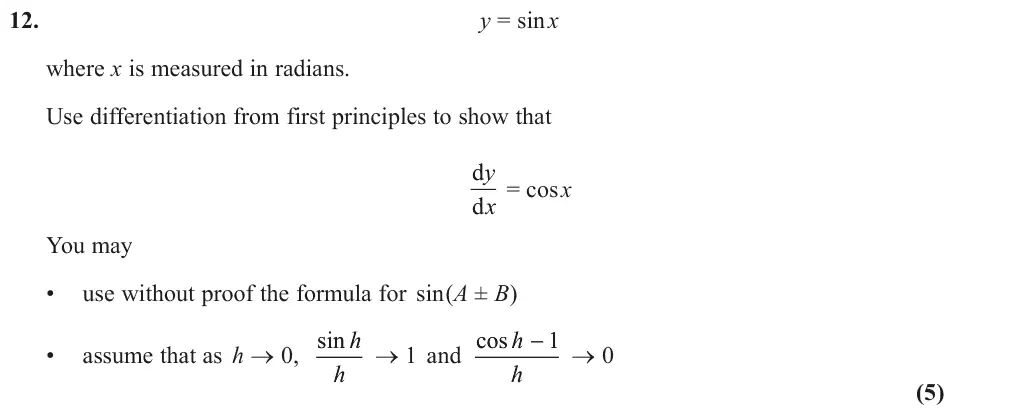
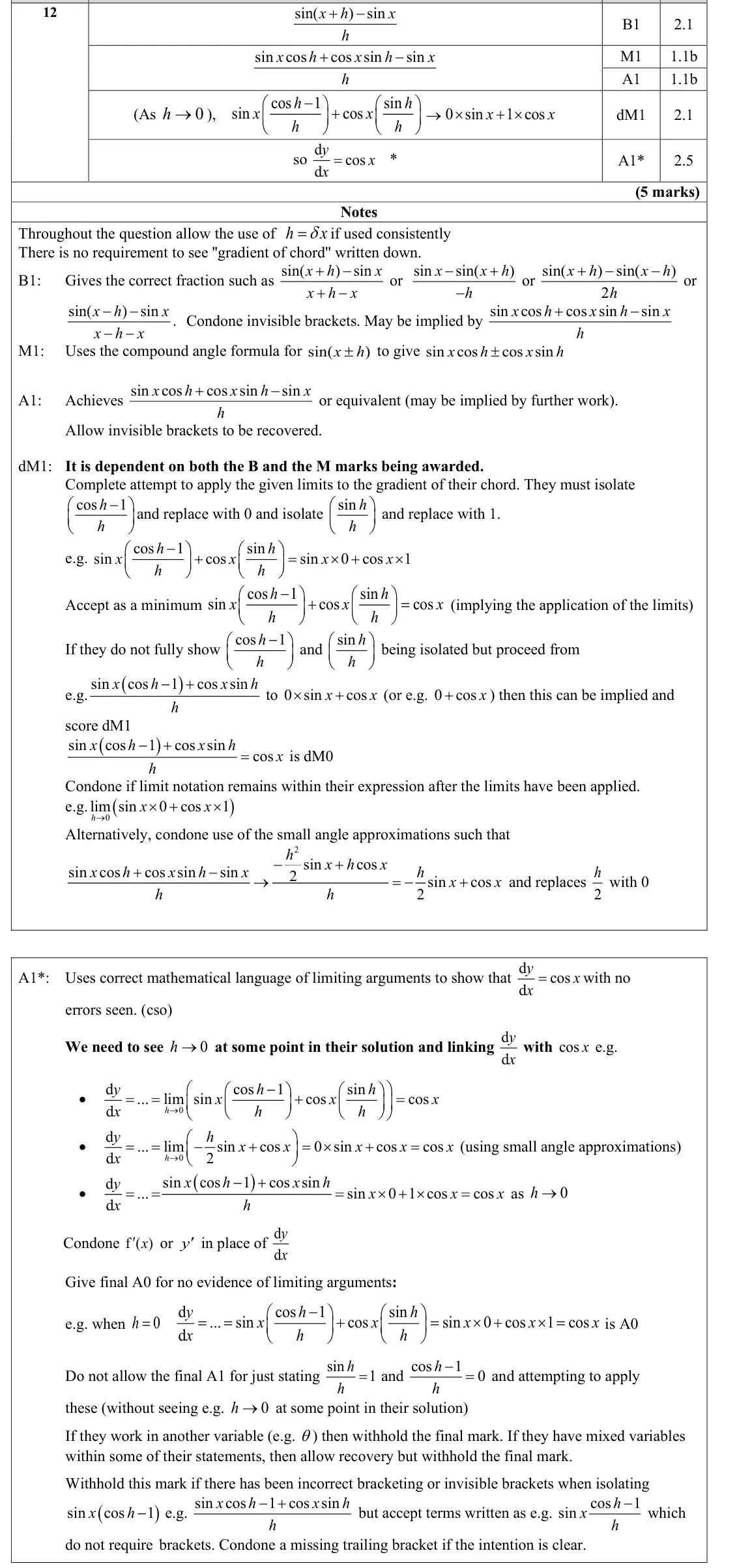
This differentiation from first principles question was similar to the one that appeared in 2018 and candidates demonstrated a much greater confidence with the way in which they should approach this topic. The limits were provided in the question and the accessibility was evident as it was very rare to see a completely blank script, which is not always true for a differentiating from first principles question. Most candidates were able to obtain the first 3 marks of this question, with very few sign errors seen when using the addition formula. Most correctly started with the fraction for the gradient of the chord f( ) f( ) x h x h + - as given in the formula booklet. Occasionally all a candidate would attempt was the addition formula in terms of A and B, but more often than not it was in the correct format and correct. Scoring the last two marks was not as common, but still achieved more often than not. There were a variety of layouts used for the candidates to justify the replacement of terms with 0 and 1. If candidates lost marks here, it was often because they failed to separate their terms in h correctly. Some candidates introduced extra h’s, forming expressions likecos sin xh hh . At other times, candidates simply tried to cancel terms incorrectly or stopped. Notation was generally good with limiting arguments correct. The main mistakes that resulted in lost marks were either failing to isolate the required expressions and jumping to the answer or trying to replace each of the 3 terms separately, failing to spot the common factor of sin x in two of them. There were also several candidates incorrectly splitting up the product of each term resulting in an extra h in the denominators. Incorrect notation resulted in the loss of the final mark, in particular the limit notation was often seen right through to the end, in the final answer, even after the limits had been used. A small number of candidates proceeded by using the small angle formula which was generally done well; where errors were seen it was generally not cancelling correctly. One surprising thing to note was the number of candidates who felt it acceptable to not clearly identify the numerator of the fraction by using very small fraction lines, resulting in their solution looking like only one term was being divided by h. Many candidates failed to write d cos d y x x = at the end, despite this being what they had been asked to show. If f ( )x had not been acceptable as an answer, then many candidates would have lost the final A mark. Only a very small handful of candidates used small angle approximations.
Common mistakes
gradient of chord (sin(x + h) − sin x)/h
compound angle formula
isolate (cos h − 1)/h and (sin h)/h
h → 0 must be seen
June 2023 · Paper 2 · Q1(a)2 marks
Mark scheme (whole question; this part is marked with the orange bar)
Examiner's comment
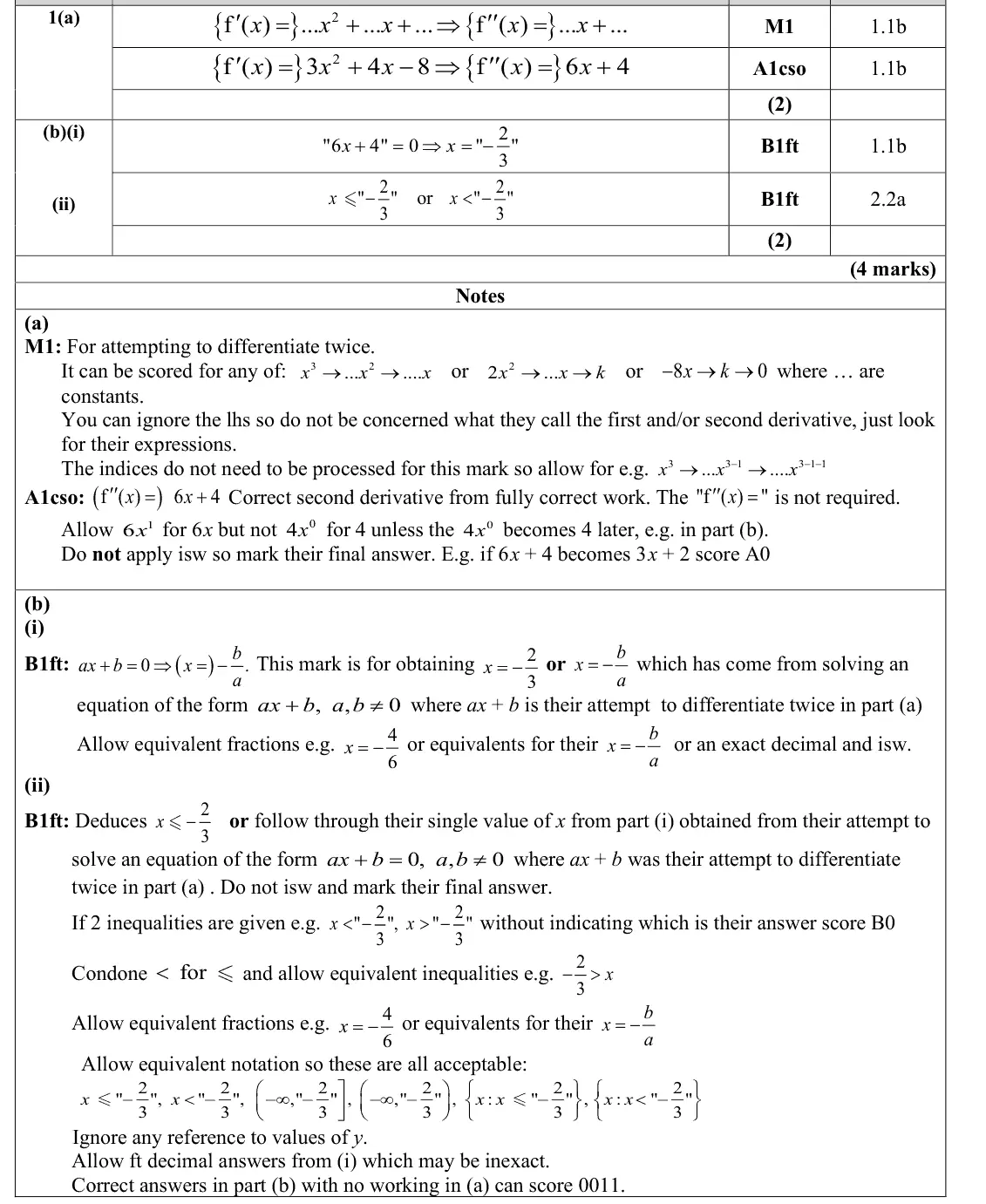
This question provided an accessible start to the paper for the vast majority of candidates, most of whom picked up at least some of the marks available. In part (a) most candidates were able to differentiate f (x) twice and were able to earn both marks. If candidates did lose marks it was mainly due to arithmetic or processing errors such as differentiating 3x2 to 5x. The most common error was a slip in the final coefficient of x.
Mark scheme (whole question; this part is marked with the orange bar)
Examiner's comment
This question provided an accessible start to the paper for the vast majority of candidates, most of whom picked up at least some of the marks available. In (b) part (i), most candidates were able to make a successful attempt to solve f ′′(x) = 0 for x. The mark in this part was sometimes lost due to sign errors when rearranging. It was surprisingly common to see 6x + 4 = 0 leading to 2 3 x = . A significant number of candidates did not simplify their answer, but this was condoned as were values which followed correctly from an incorrect second derivative of the correct form. Part (ii) proved to more of a challenge and many responses highlighted a lack of understanding or awareness of the condition for a function to be concave. A number of blank responses were seen here. Many who attempted this part of the question deduced, or guessed, that it was necessary to consider the sign of the second derivative but were often confused about which sign was required. Others attempted incorrect calculations setting f ′(x) = 0 and solving the resulting quadratic in x. Occasionally, candidates attempted sketches of f (x) and/or f ′(x) in order to determine the range of f (x) which was not required. Others attempted to demonstrate a sign change in attempt to prove that the solution from part (i) was an inflection point. For those employing the correct method, both strict and non-strict inequalities were accepted.
Common mistakes
(i) x = −2/3 (sign slips give 2/3)
(ii) concave where f''(x) ≤ 0, so x ≤ −2/3 (< condoned)
confusion over which sign of f'' means concave
setting f'(x) = 0 instead
giving both inequalities without choosing scores 0
June 2022 · AS Paper 1 · Q8(c)2 marks
Mark scheme (whole question; this part is marked with the orange bar)
Examiner's comment
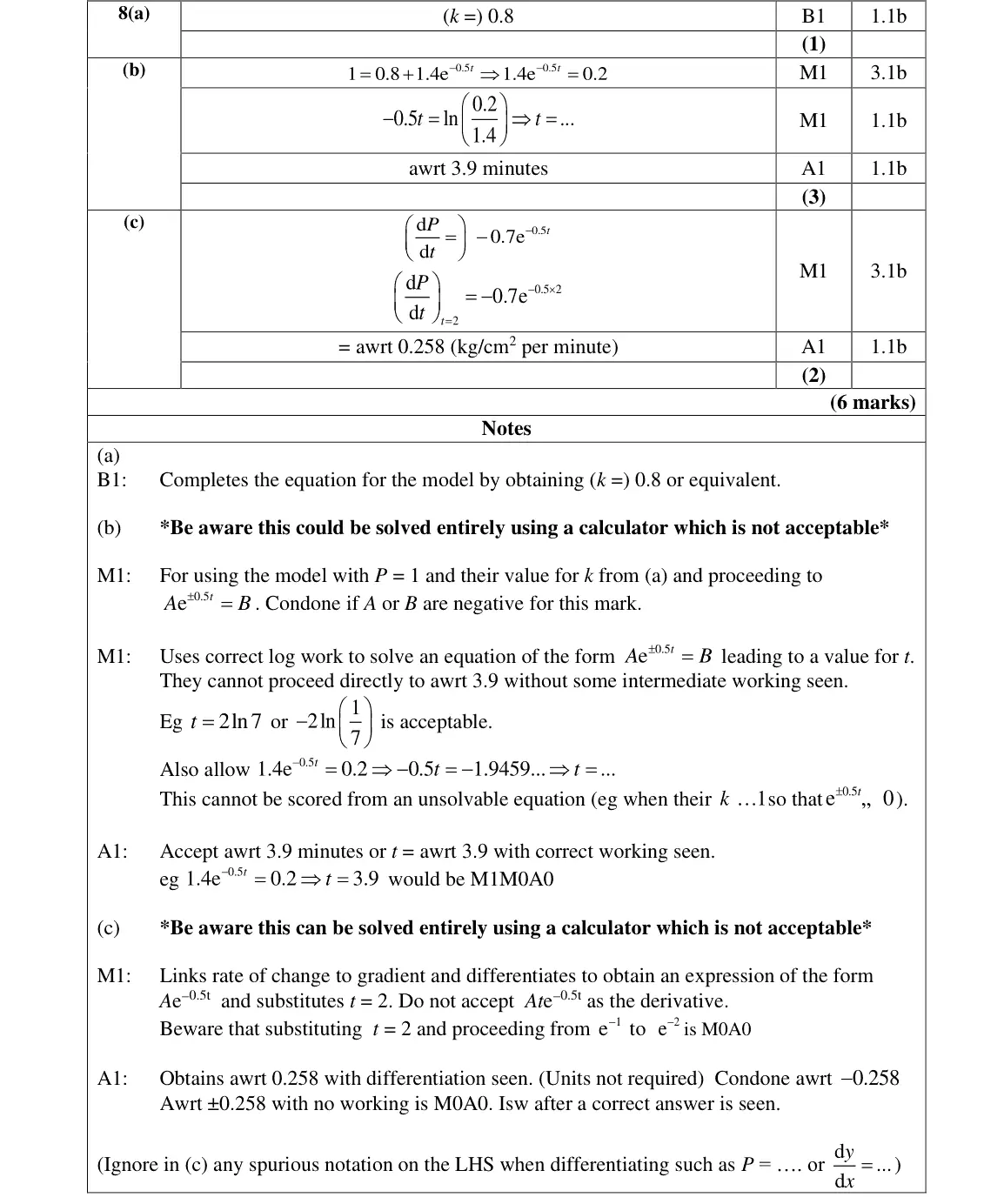
This question was reasonably well attempted. Logs continue to be an area of challenge for many candidates but despite this, a significant proportion were able to earn a good number of marks here. Part (c) of this question was a good differentiator and was a challenge to many candidates. For a significant proportion of candidates, “rate” did not signal the need for rate of change 8 and hence differentiation. It was common to see candidates simply substituting in t = 2 into their equation for P to obtain P = 1.32. Of those candidates who did attempt to find d d P t many seemed to struggle with the chain rule. Some candidates obtained results of the form Ate-0.5t, whilst others retained the constant term 0.8 when differentiating. Others began by substituting in t = 2 and then proceeded from e-2 to e-1 or ‘differentiated’ e-1 to get e-2. It was common for candidates who were able to progress to a correct value to give the final answer of -0.258 rather than 0.258 but this was condoned.
Common mistakes
rate means dP/dt = −0.7e^(−0.5t) (the constant k disappears
not Ate^(−0.5t))
substituting t = 2 into P is wrong
0.258 kg/cm² per minute
June 2022 · AS Paper 1 · Q12(c)2 marks
Mark scheme (whole question; this part is marked with the orange bar)
Examiner's comment
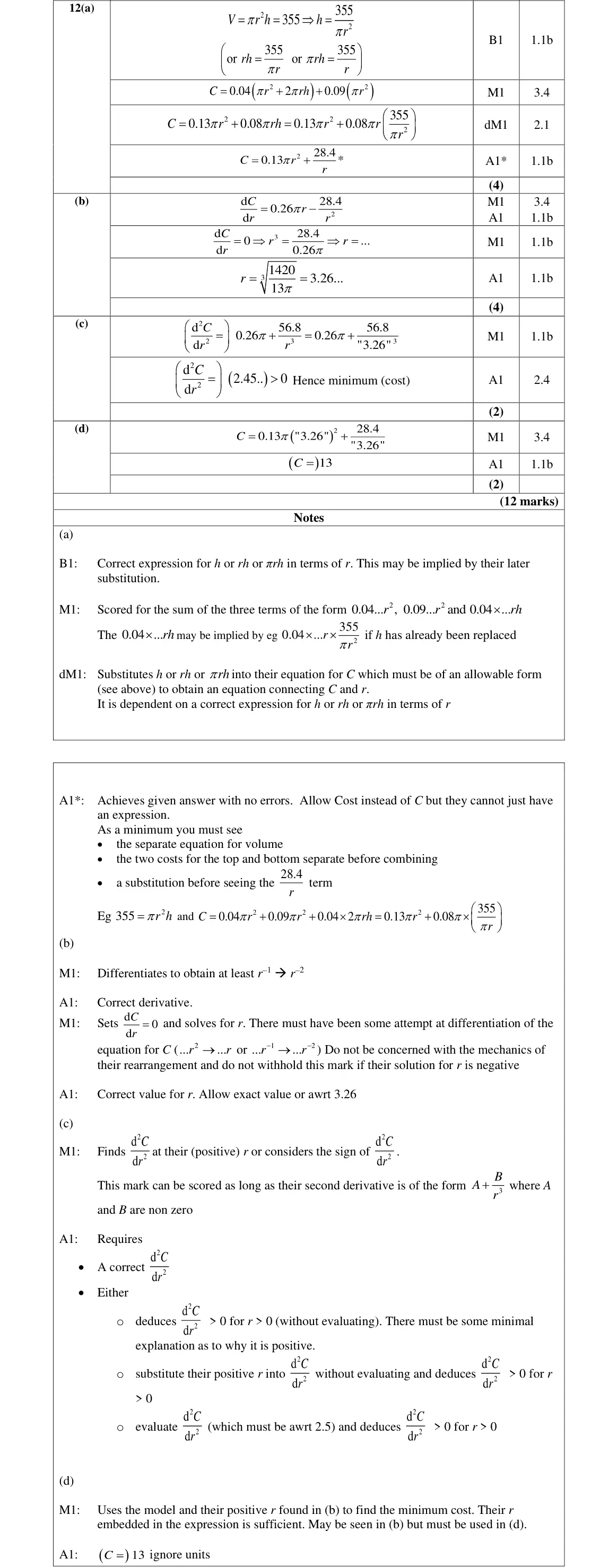
10 This was one of the most challenging questions on the paper for candidates, although it was a familiar structure to this type of problem and there was access to later parts as part (a) was a “show” question. In part (c), it was common for many of those who had understood the demands in part (b), to progress and find the second derivative. A lot were unsure what to do with it at this point, however, with a significant number equating it to zero and solving (sometimes when they had already solved correctly for 3.26 in (b)). Of those who achieved a positive answer in (b), most were able to substitute into the model for M1 here.
Common mistakes
d²C/dr² = 0.26π + 56.8/r³ > 0 for r > 0 (≈ 2.45), hence minimum
setting the second derivative to 0 is wrong
June 2022 · Paper 1 · Q6(a)1 markMedium
Mark scheme (whole question; this part is marked with the orange bar)
Examiner's comment
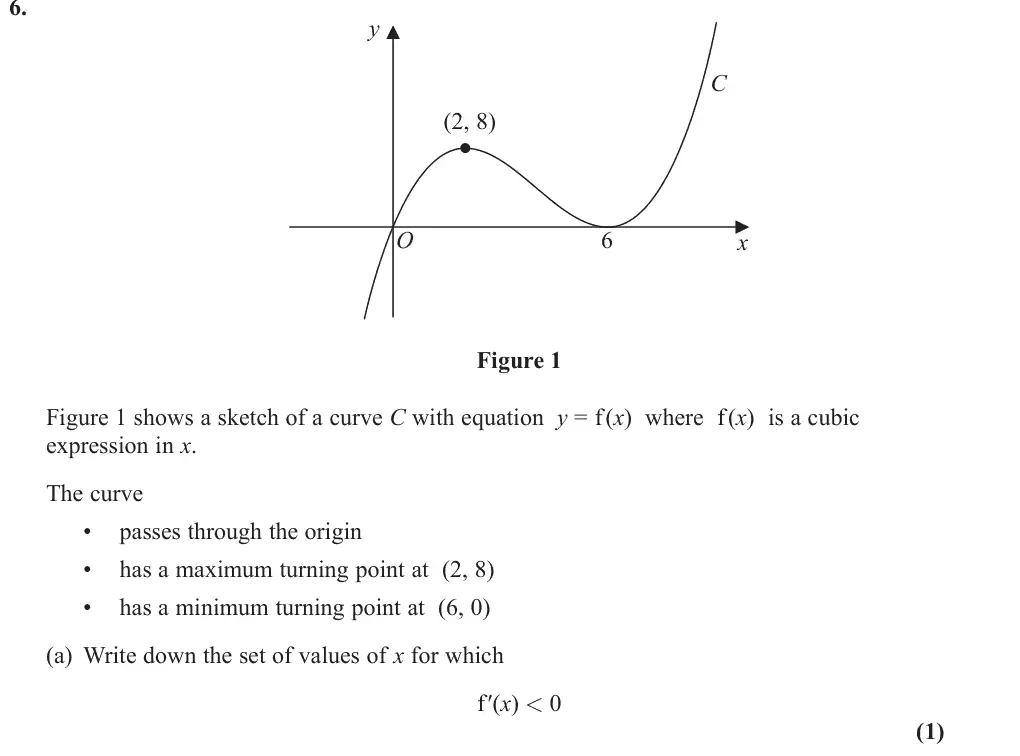
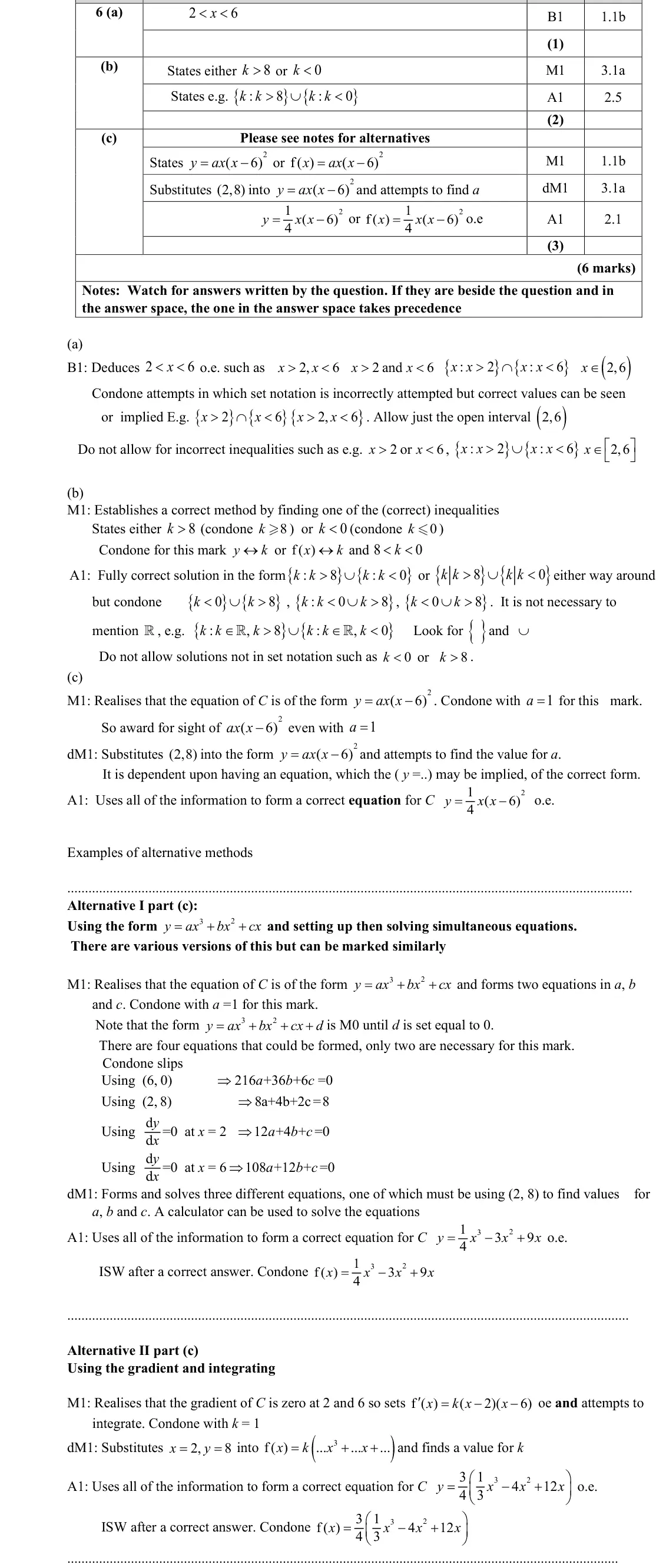
There was a very mixed response to this question on a cubic function with only one in eight candidates scoring all 6 marks. Part (a) was for finding the set of values of x for which f ' (x) < 0. Candidates generally knew what to do and most scored this B mark. Marks were lost when candidates gave the inequality as or else 2 < . ′ f ( ) 6 2 6 x x <
Common mistakes
f′(x) < 0 where the curve is decreasing: 2 < x < 6 (strict inequalities)
June 2022 · Paper 1 · Q15(c)2 marksMedium
Mark scheme (whole question; this part is marked with the orange bar)
Examiner's comment
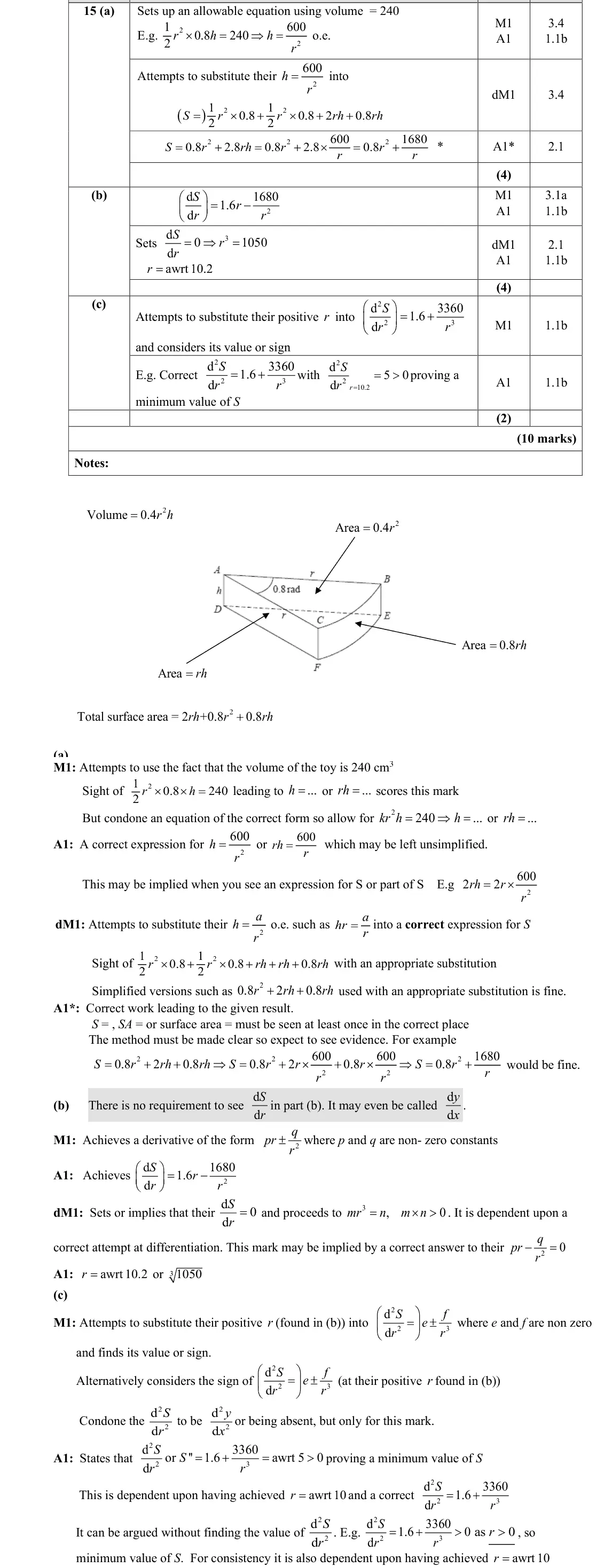
This question, based on the minimum surface area of a children's toy proved to be a useful source of marks so late in the paper. In fact 25% of the cohort achieved full marks. Many Most candidates were able to find the second derivative correctly in part (c). How it should be used was confused in much of the work seen. Common reasons for a loss of marks here were; 2 d S • candidates solving the equation = 0 2 d r 2 2 d d S y and • use of incorrect notation including 2 2 d d r x • incomplete solutions with calculations or conclusions missing
Common mistakes
d²S/dr² = 1.6 + 3360/r³ = 5 > 0 at r = 10.2 so minimum
solving d²S/dr² = 0
notation d²y/dx²
conclusion needed
June 2022 · Paper 2 · Q43 marks
Mark scheme (whole question; this part is marked with the orange bar)
Examiner's comment
This question on differentiation from first principles saw good scoring and the method was widely recalled. A small number of slips with the algebra were seen and some replaced f (x + h) with 2x2 + h or (2x + h)2 or 2(x2 + h) instead of 2(x + h)2. There was the occasional poor squaring and mishandling of the “2”s e.g. expanding 2(x + h)2 to get 2x2 + 2xh + h2 was surprisingly common. Some leeway was afforded to the students with notation here although use of h = 0 instead of h 0 was penalised if no indication of the limiting process was seen. A small number of responses did not have an “f′(x) =” or equivalent and so forfeited the final mark.
Common mistakes
gradient of chord (2(x + h)² − 2x²)/h
expand 2(x + h)² correctly (not 2x² + 2xh + h²)
reach 4x + 2h and show h → 0 (not h = 0)
dy/dx = or f′(x) = must appear
Oct 2021 · AS Paper 1 · Q5(b)3 marks
Mark scheme (whole question; this part is marked with the orange bar)
Examiner's comment
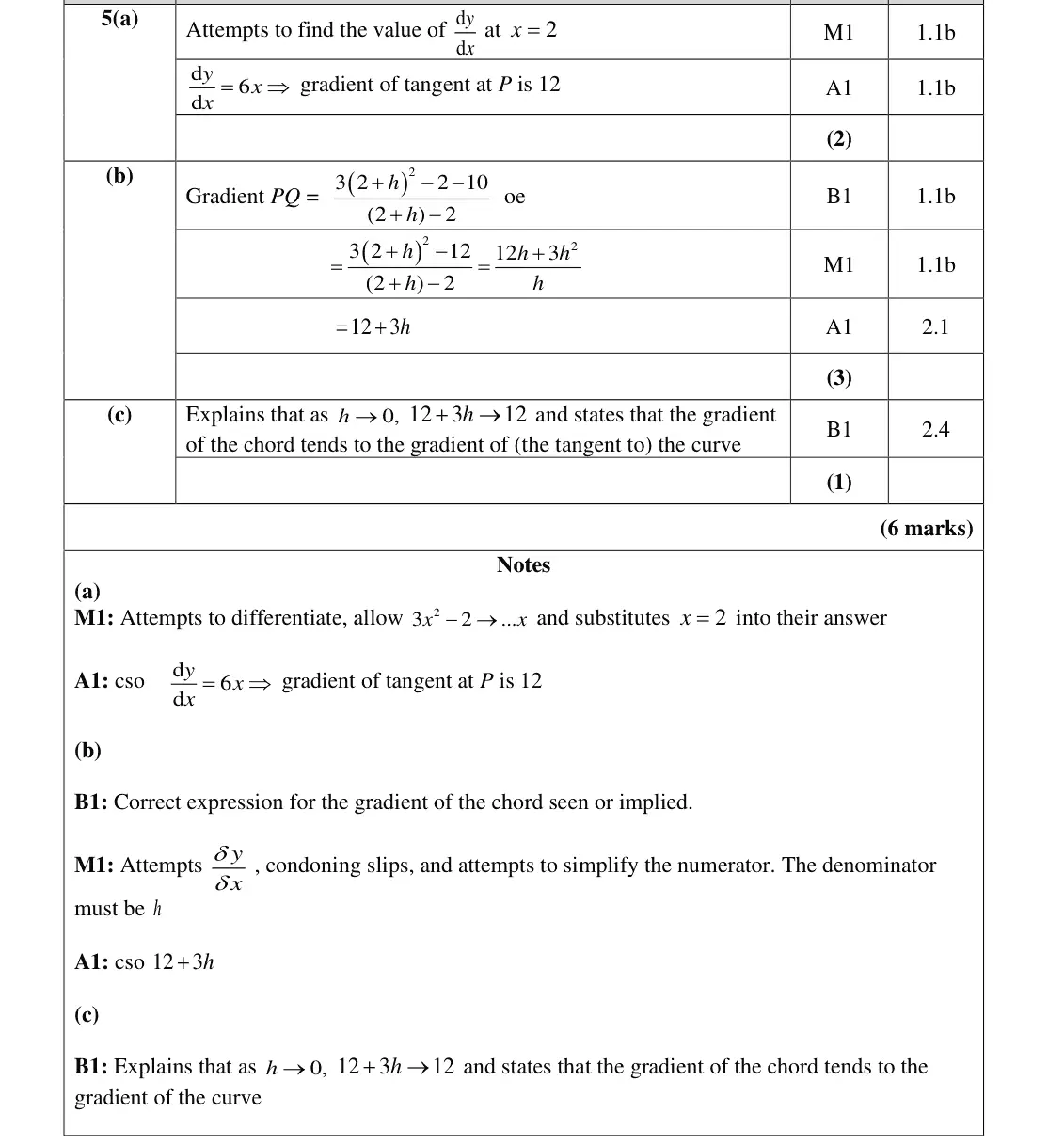
This question was generally well attempted, although it was rare for candidates to score full marks. Part (b) was completed to a high degree of success. Candidates are clearly more comfortable with the idea of finding the gradient of a chord in terms of h and most were able to proceed to the correct answer. Some made slips in their multiplying out of the brackets and there was the occasional response where the candidate had differentiated again and substituted in 2 h + which could not score.
Mark scheme (whole question; this part is marked with the orange bar)
Examiner's comment
This question was generally well attempted, although it was rare for candidates to score full marks. In part (c) candidates still struggled with bringing the concept of the gradient of a chord tending to the gradient at a point on a curve it was extremely rare to see a correct response, although this could be due to candidates having made an error in (a) or (b) so they were unable to see clearly what the link was between them anyway.
Common mistakes
as h → 0, 12 + 3h → 12: the gradient of the chord PQ tends to the gradient of the tangent at P
correct responses were extremely rare
Oct 2021 · Paper 2 · Q5(a)3 marks
Mark scheme (whole question; this part is marked with the orange bar)
Examiner's comment
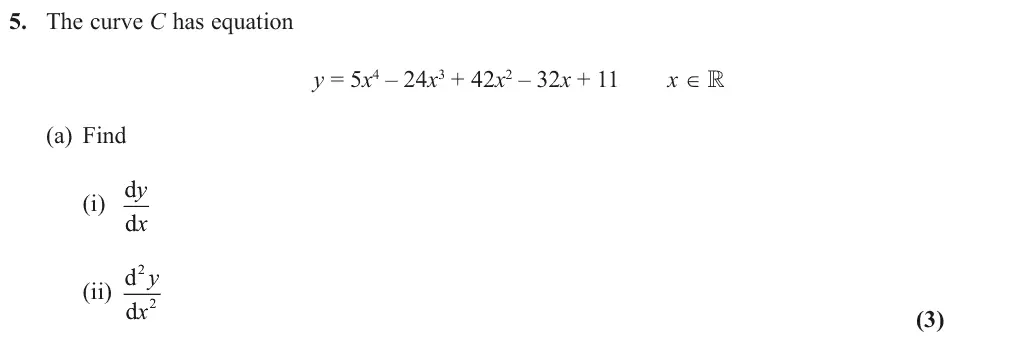
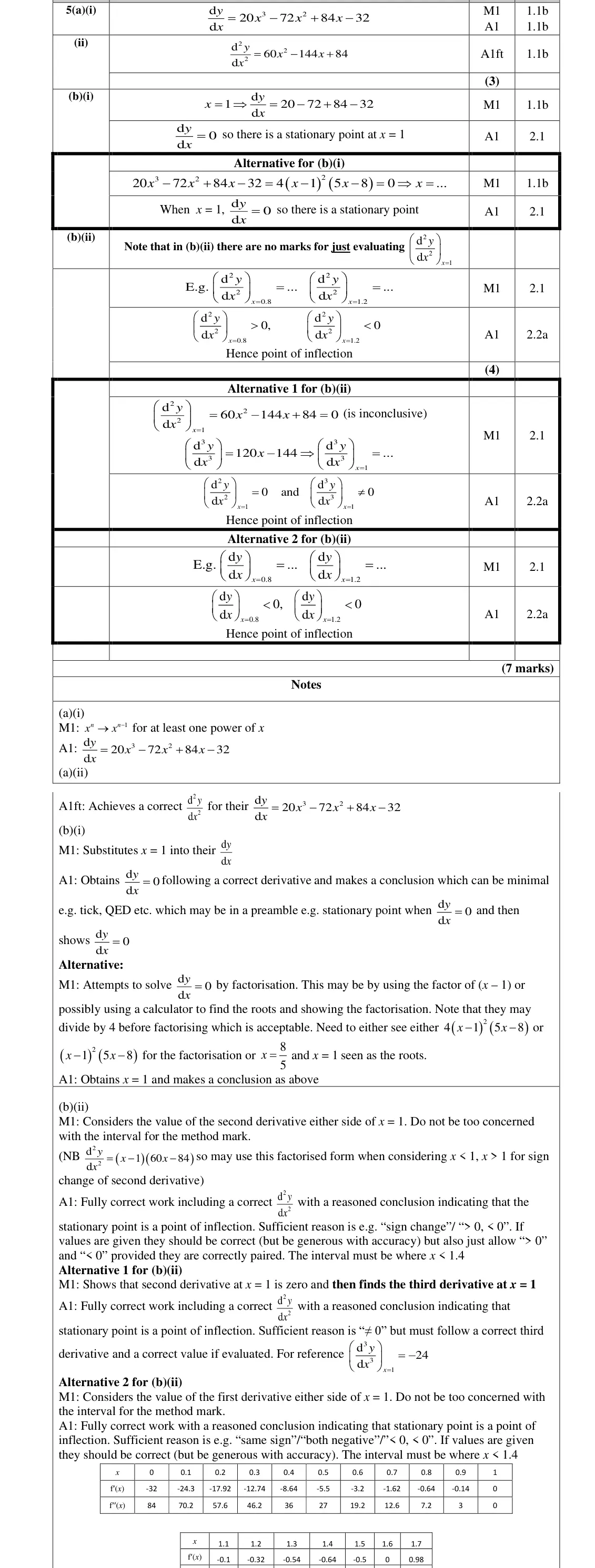
This question was accessible to the majority of students however part (b) proved to be a good discriminator with only the most able gaining all 7 marks. The majority of students gained the first three marks of this questions by correctly differentiating the expression twice. A few arithmetic errors were seen occasionally, although if this was the case then students would only lose 1 out of the three marks. Part (b) differentiated out the students to a greater extend. Most students could identify the correct method to find the stationary point, although there were a disappointing number of students who failed to follow this up with a concluding statement or preamble. A number of students got confused between parts (i) and (ii) and tried to use the second derivative to identify stationary points. The most common method to identify the stationary point was using the first derivative and substituting the value x = 1, although there were a significant number who chose to deduce the value x = 1 by factorising their cubic expression. Both approaches tended to lead to a positive outcome, and full marks. Part (ii) was much more mixed in response. A significant number of students gained no marks on this part as they assumed that when both first and second derivative equal zero then the point is a point of inflection. Of those students who successfully answered this question there were an equal number of students who considered the first derivative as those that considered the second derivative. Most of these students considered an appropriate intervals to gain full marks here, however a significant number of students considered inappropriate intervals such as 0 and 2 or 1.5 and so were unable to gain the accuracy mark.
Common mistakes
dy/dx = 20x³ − 72x² + 84x − 32
second derivative 60x² − 144x + 84
Oct 2021 · Paper 2 · Q5(b)4 marks
Mark scheme (whole question; this part is marked with the orange bar)
Examiner's comment
This question was accessible to the majority of students however part (b) proved to be a good discriminator with only the most able gaining all 7 marks. The majority of students gained the first three marks of this questions by correctly differentiating the expression twice. A few arithmetic errors were seen occasionally, although if this was the case then students would only lose 1 out of the three marks. Part (b) differentiated out the students to a greater extend. Most students could identify the correct method to find the stationary point, although there were a disappointing number of students who failed to follow this up with a concluding statement or preamble. A number of students got confused between parts (i) and (ii) and tried to use the second derivative to identify stationary points. The most common method to identify the stationary point was using the first derivative and substituting the value x = 1, although there were a significant number who chose to deduce the value x = 1 by factorising their cubic expression. Both approaches tended to lead to a positive outcome, and full marks. Part (ii) was much more mixed in response. A significant number of students gained no marks on this part as they assumed that when both first and second derivative equal zero then the point is a point of inflection. Of those students who successfully answered this question there were an equal number of students who considered the first derivative as those that considered the second derivative. Most of these students considered an appropriate intervals to gain full marks here, however a significant number of students considered inappropriate intervals such as 0 and 2 or 1.5 and so were unable to gain the accuracy mark.
Common mistakes
substitute x = 1 into dy/dx and conclude
f″(1) = 0 alone is not enough: check the sign of f″ either side (interval within x < 1.4) or a third derivative
reasoned conclusion needed
Oct 2020 · AS Paper 1 · Q14(b)2 marks
Mark scheme (whole question; this part is marked with the orange bar)
Examiner's comment
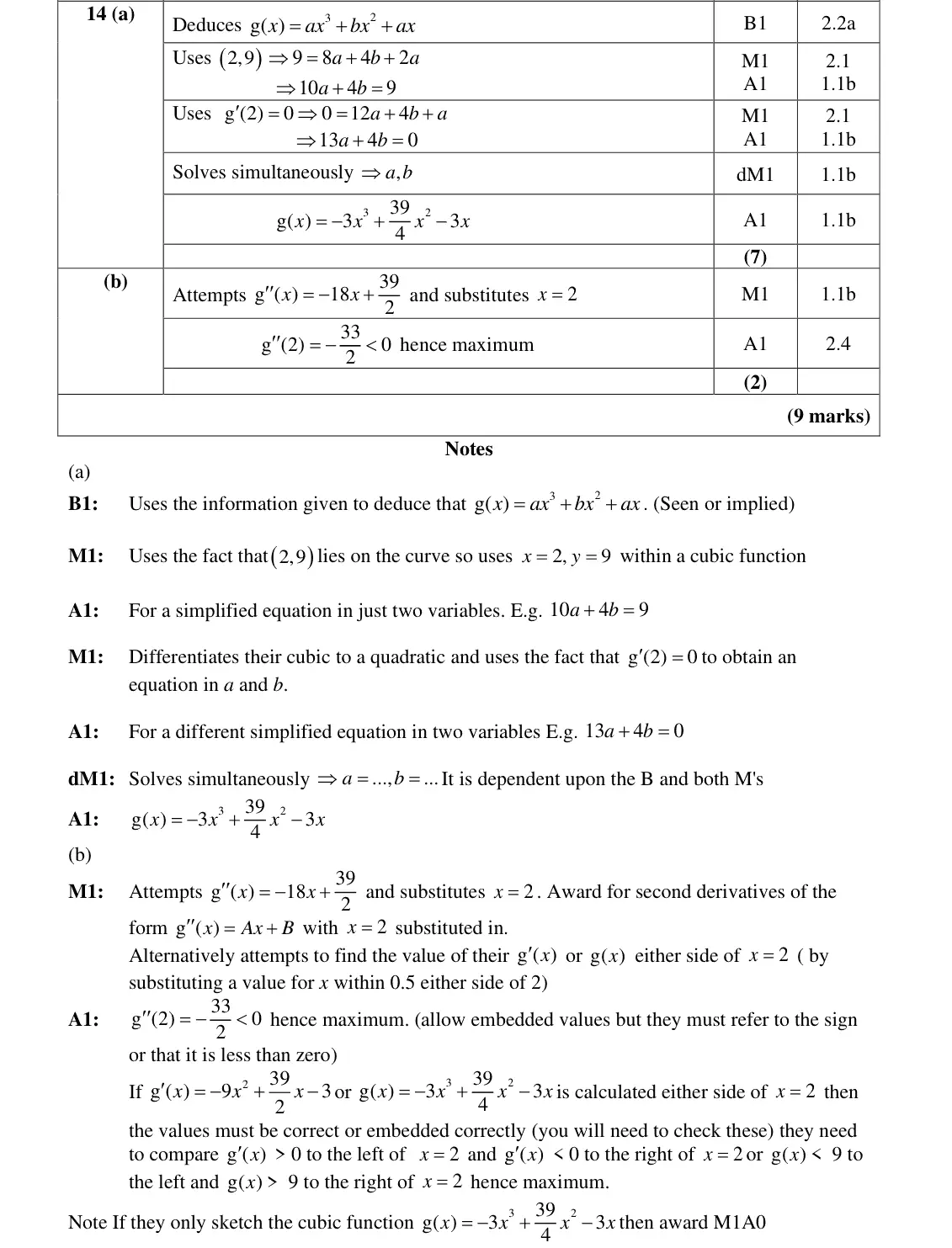
The final question was not attempted in a significant number of cases. This may have been due to the demand of the question for the majority of candidates. Of those candidates who did attempt this question, it was rare for full marks to be achieved. In part (b), if candidates were able to come up with a cubic for part (a), they usually appreciated the need to differentiate to find the second derivative and substitute in 2 x = . Their knowledge on second derivatives meant they knew it would need to be negative to prove it was a maximum. However, there were a number of candidates who had incorrect derivatives or evaluated incorrectly and still stated they had a maximum, even though their answer would have been positive. This, for some, should have prompted further investigation into their earlier work. Some candidates still substituted in a value of x either side of 2 x = into either g(x) or g ( )x . This was far more working to score both marks, so candidates should be encouraged with this type of question to prove the nature of the turning points using second derivatives.
Common mistakes
g″(2) = −33/2 < 0 so maximum
state the sign
checking either side takes longer
Oct 2020 · Paper 1 · Q15(b)3 marks
Mark scheme (whole question; this part is marked with the orange bar)
Examiner's comment
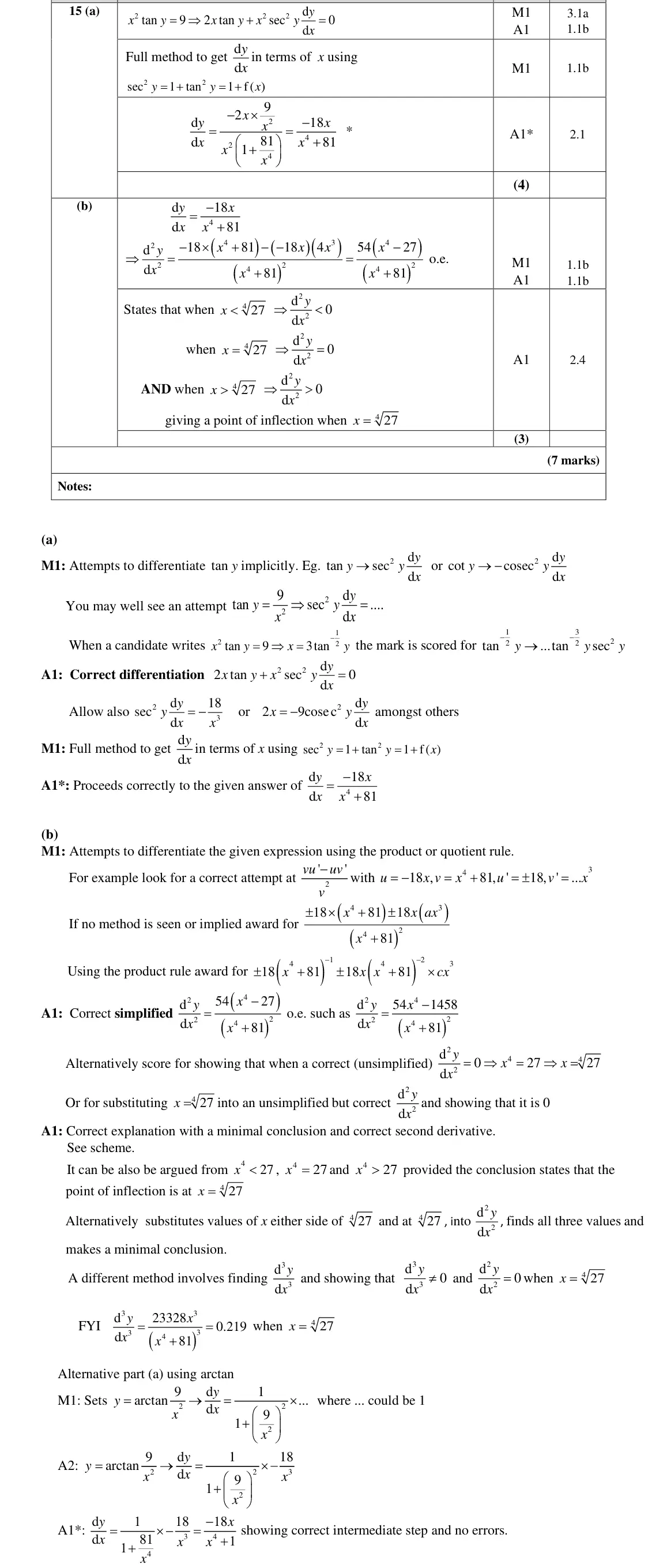
Although fully correct solutions to this question were very rare, many candidates were able to score marks from both parts. In (b) candidates often scored the M1 for an unsimplified second derivative or a correct structure with a sign incorrect. Where the first A1 was scored in (b), it was usually 2 2 d d y y 4 27 awarded for a correct simplified , or solving to get 0 x = x = 2 2 d d x 2 d y Very few candidates seemed aware that they needed to show a change in sign of 2 d x 4 27 either side of to show a point of inflection. x =
Common mistakes
quotient rule: d²y/dx² = 54(x⁴ − 27)/(x⁴ + 81)²
d²y/dx² = 0 alone is not enough: show the sign change either side of x = ⁴√27 and conclude
June 2019 · Paper 1 · Q14(b)2 marksHard
Mark scheme (whole question; this part is marked with the orange bar)
Examiner's comment
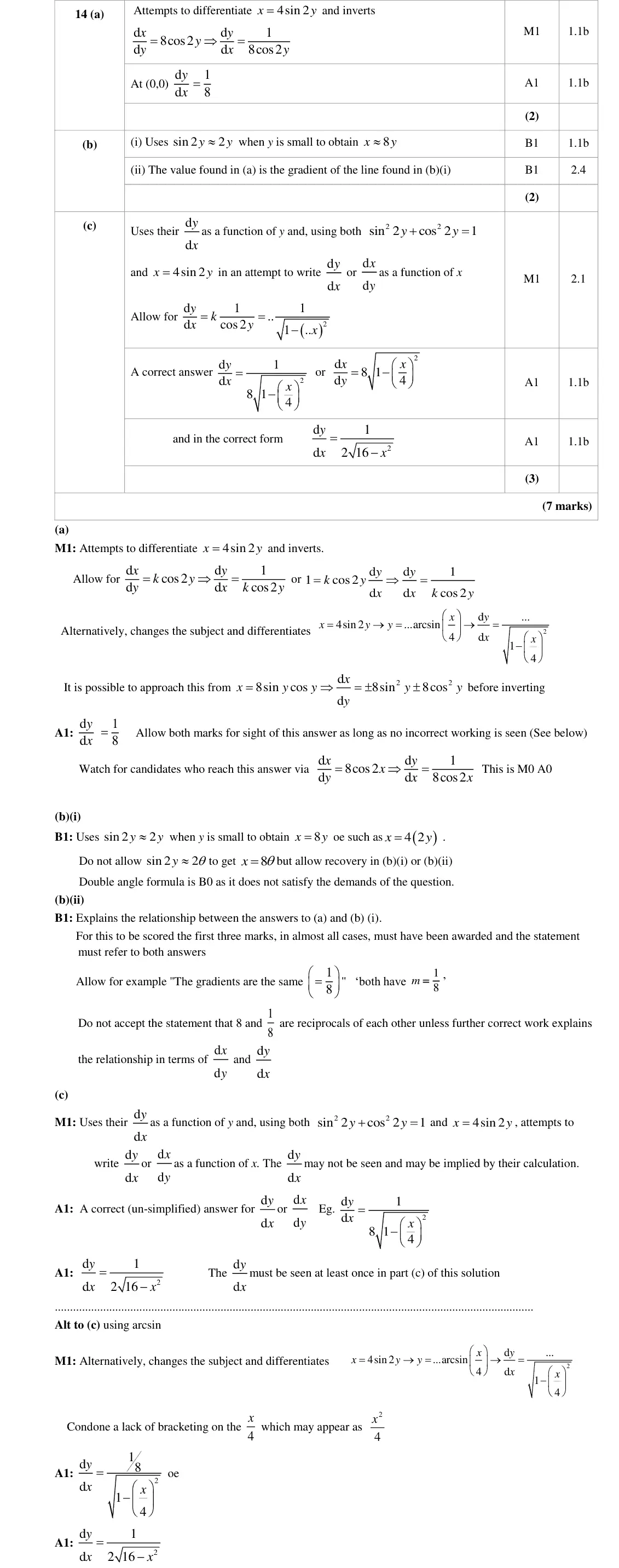
A number of candidates did not attempt this question. Whether this was due to lack of understanding or time constraints is unknown. The small angle approximation in (b) part (i) was also well handled. Most settled for the form 8 x y although some rearranged to y = . Marks were generally lost when sin 2y was replaced by 2 instead of 2y. Many candidates failed to see the link between (a) and (b)(i) even though they had both answers correct. They were unable to see that the gradients were the same or else failed to explain themselves coherently.
Common mistakes
sin 2y ≈ 2y (not 2θ) gives x = 8y
the gradient of x = 8y is 1/8, the same as (a)
"8 and 1/8 are reciprocals" alone not enough
June 2019 · Paper 2 · Q2(a)3 marks
Mark scheme (whole question; this part is marked with the orange bar)
Examiner's comment
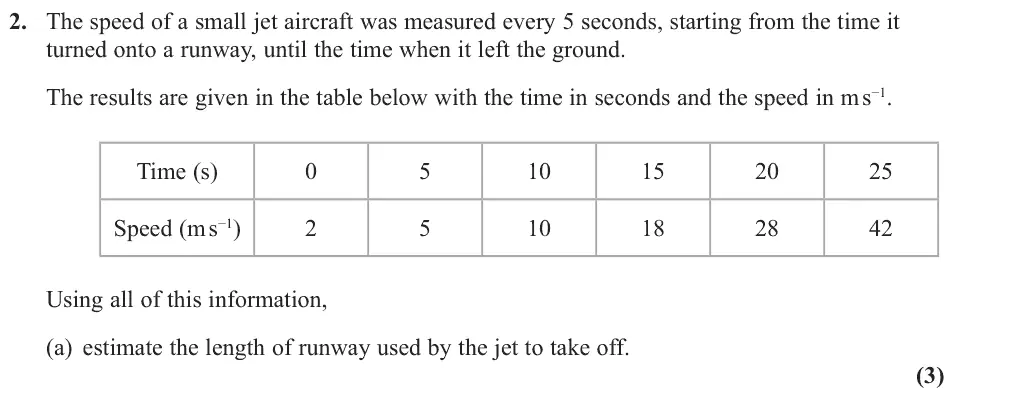
Q02 proved to be challenging, with a significant number of candidates struggling to realise that the length of the runway could be estimated by the area under the speed- time curve generated from the table of values given in the question. In Q02(a), only a minority of candidates estimated the length of the runway by applying the trapezium rule, which was considered the most appropriate method, with many of these giving the correct answer of 415m. While the table of values clearly shows an b a h n 5, h interval width the application of the formula with instead of 6 n 25. h n led some candidates to use an incorrect strip width Other candidates 5 6 made calculation errors, bracketing errors or transcription errors. Some candidates used the equations of motion with constant acceleration (i.e. the suvat equations) to estimate the length. Many of the candidates who used this method applied the calculation 2 42 (25) to obtain an estimate of 550m. A few used v u at 2 1 2 s ut at to find the acceleration, followed by to estimate the length. Some 2 u candidates used in their suvat calculations, in contradiction to the table of values 0 A few candidates used a method which was 1 2 ms . which indicated an initial speed of equivalent to the trapezium rule, of applying suvat to each of the 5 time-intervals, to give the correct answer of 415m. Other methods seen included: summing up the area of rectangles which enclosed the area above the curve for each of the 5 time intervals; summing up areas of rectangles which enclosed the area below the curve for each of the 5 time intervals; and applying (average speed) (total time). The most common methods which were deemed incorrect included 25 42 1050; 1 (25)(42) (speed)(time) (0)(2) (5)(5) (10)(10) ... (25)(42) 2005; 525; 2 or a 6 rectangle approach (instead of 5 rectangles). As for Q02(b), while many candidates who used a trapezium rule or suvat method in Q02(a) identified their estimate of the length as an overestimate, some found difficulty in articulating a reason for this. Those who were most successful drew a diagram which showed clearly the extra area generated by the trapezium rule in relation to the curve. Some candidates sketched the speed-time curve and explained that the curve was convex or that the acceleration was continually increasing. Only a few candidates who used a rectangle method were able to give a correct reason. Some candidates answered Q02(b) by finding an alternative estimate and comparing it with their estimate in Q02(a). For example, some found 415 in Q02(a) and 550 in Q02(b), and then concluded that ‘415 must be an underestimate’. Other candidates, who also received no credit, gave physical explanations about friction, air resistance or the shape of the aircraft, while others stated that ‘the jet accelerated smoothly’.
Common mistakes
distance = area under the speed-time graph
trapezium rule with h = 5 (not 25/6, 6 strips): 415 m
suvat with constant acceleration (550) earns the method mark only
25 × 42 or a sum of speed × time scores nothing
June 2019 · Paper 2 · Q2(b)1 mark
Mark scheme (whole question; this part is marked with the orange bar)
Examiner's comment
Q02 proved to be challenging, with a significant number of candidates struggling to realise that the length of the runway could be estimated by the area under the speed- time curve generated from the table of values given in the question. In Q02(a), only a minority of candidates estimated the length of the runway by applying the trapezium rule, which was considered the most appropriate method, with many of these giving the correct answer of 415m. While the table of values clearly shows an b a h n 5, h interval width the application of the formula with instead of 6 n 25. h n led some candidates to use an incorrect strip width Other candidates 5 6 made calculation errors, bracketing errors or transcription errors. Some candidates used the equations of motion with constant acceleration (i.e. the suvat equations) to estimate the length. Many of the candidates who used this method applied the calculation 2 42 (25) to obtain an estimate of 550m. A few used v u at 2 1 2 s ut at to find the acceleration, followed by to estimate the length. Some 2 u candidates used in their suvat calculations, in contradiction to the table of values 0 A few candidates used a method which was 1 2 ms . which indicated an initial speed of equivalent to the trapezium rule, of applying suvat to each of the 5 time-intervals, to give the correct answer of 415m. Other methods seen included: summing up the area of rectangles which enclosed the area above the curve for each of the 5 time intervals; summing up areas of rectangles which enclosed the area below the curve for each of the 5 time intervals; and applying (average speed) (total time). The most common methods which were deemed incorrect included 25 42 1050; 1 (25)(42) (speed)(time) (0)(2) (5)(5) (10)(10) ... (25)(42) 2005; 525; 2 or a 6 rectangle approach (instead of 5 rectangles). As for Q02(b), while many candidates who used a trapezium rule or suvat method in Q02(a) identified their estimate of the length as an overestimate, some found difficulty in articulating a reason for this. Those who were most successful drew a diagram which showed clearly the extra area generated by the trapezium rule in relation to the curve. Some candidates sketched the speed-time curve and explained that the curve was convex or that the acceleration was continually increasing. Only a few candidates who used a rectangle method were able to give a correct reason. Some candidates answered Q02(b) by finding an alternative estimate and comparing it with their estimate in Q02(a). For example, some found 415 in Q02(a) and 550 in Q02(b), and then concluded that ‘415 must be an underestimate’. Other candidates, who also received no credit, gave physical explanations about friction, air resistance or the shape of the aircraft, while others stated that ‘the jet accelerated smoothly’.
Common mistakes
overestimate: the curve is convex (acceleration increasing) so the tops of the trapezia lie above it
a diagram showing the extra area is best
comparing with another estimate, friction/air resistance or "accelerated smoothly" scores nothing
June 2018 · AS Paper 1 · Q8(b)2 marks
Mark scheme (whole question; this part is marked with the orange bar)
Examiner's comment
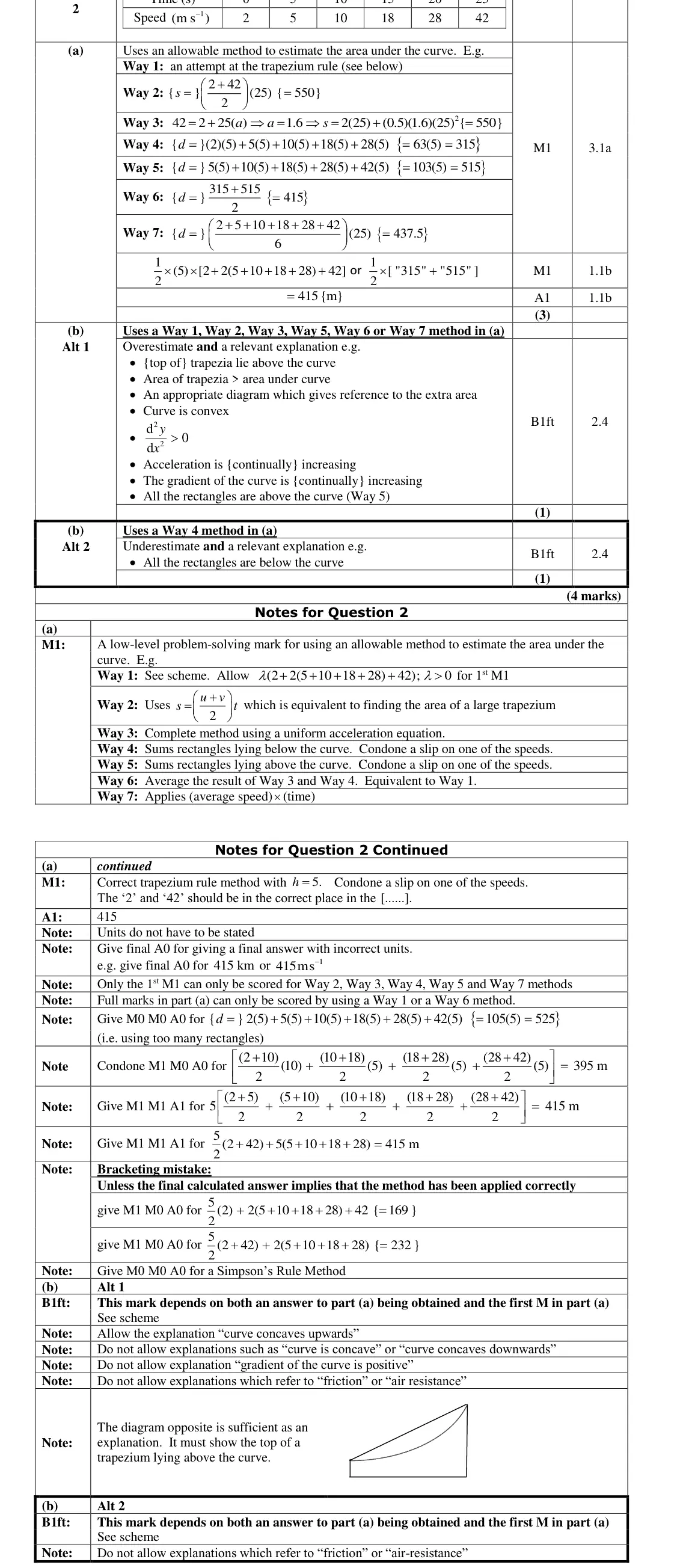
This proved to be a challenge and a large number of students did not recognise that it was a differentiation problem until asked to find the second derivative in (b). In (b), it was disappointing to see so many students successfully find the second derivative but gain no marks as they failed to find a value for it at their v or establish that it would be positive.
Common mistakes
d²C/dv² = 3000/v³
must evaluate it (≈ +0.004) or argue its sign at their v and conclude > 0 so minimum
finding d²C/dv² without a value or sign scores nothing
correct notation needed for the A mark
June 2018 · AS Paper 1 · Q104 marks
Mark scheme (whole question; this part is marked with the orange bar)
Examiner's comment
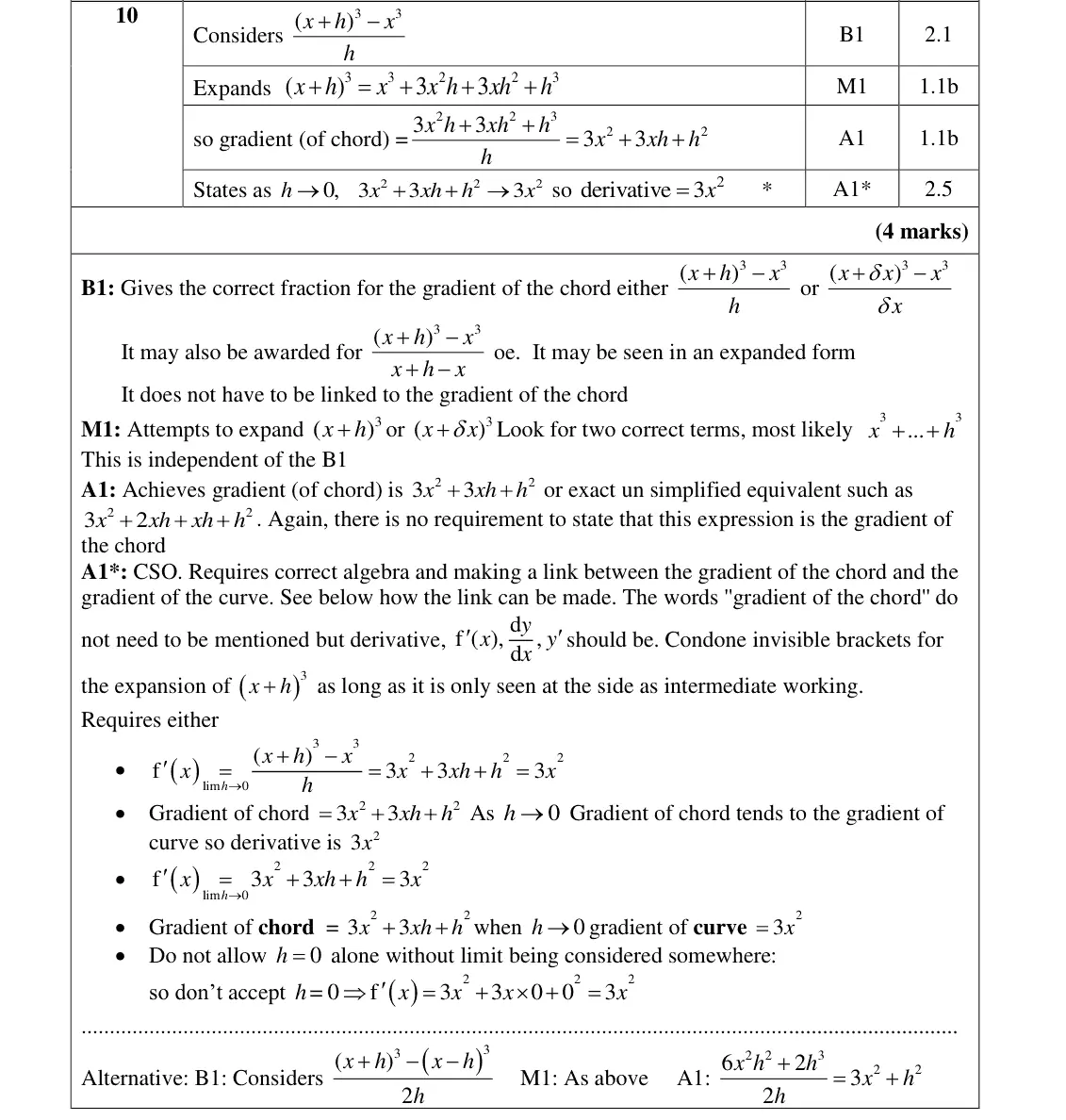
This is a new topic on the specification. There were some very good solutions, showing full understanding of limits with all necessary steps shown. However, several students did not understand what was meant by ‘prove from first principles’ and simply stated and applied the general rule: if y=xn, dy/dx= nxn-1 or wrote comments such as ‘multiply by the power and subtract one from it’. Those who knew what was required usually gained the first two marks but poor algebra often cost the third (and hence the fourth) mark. The final mark was frequently lost by failing to link the gradient of the chord and the gradient of the curve in some way.
Common mistakes
consider ((x + h)³ − x³)/h
expand (x + h)³ correctly
gradient of chord 3x² + 3xh + h²
state h → 0 and link the gradient of the chord to the derivative
quoting dy/dx = nxⁿ⁻¹ scores 0
June 2018 · Paper 1 · Q2(c)2 marks
Mark scheme (whole question; this part is marked with the orange bar)
Examiner's comment
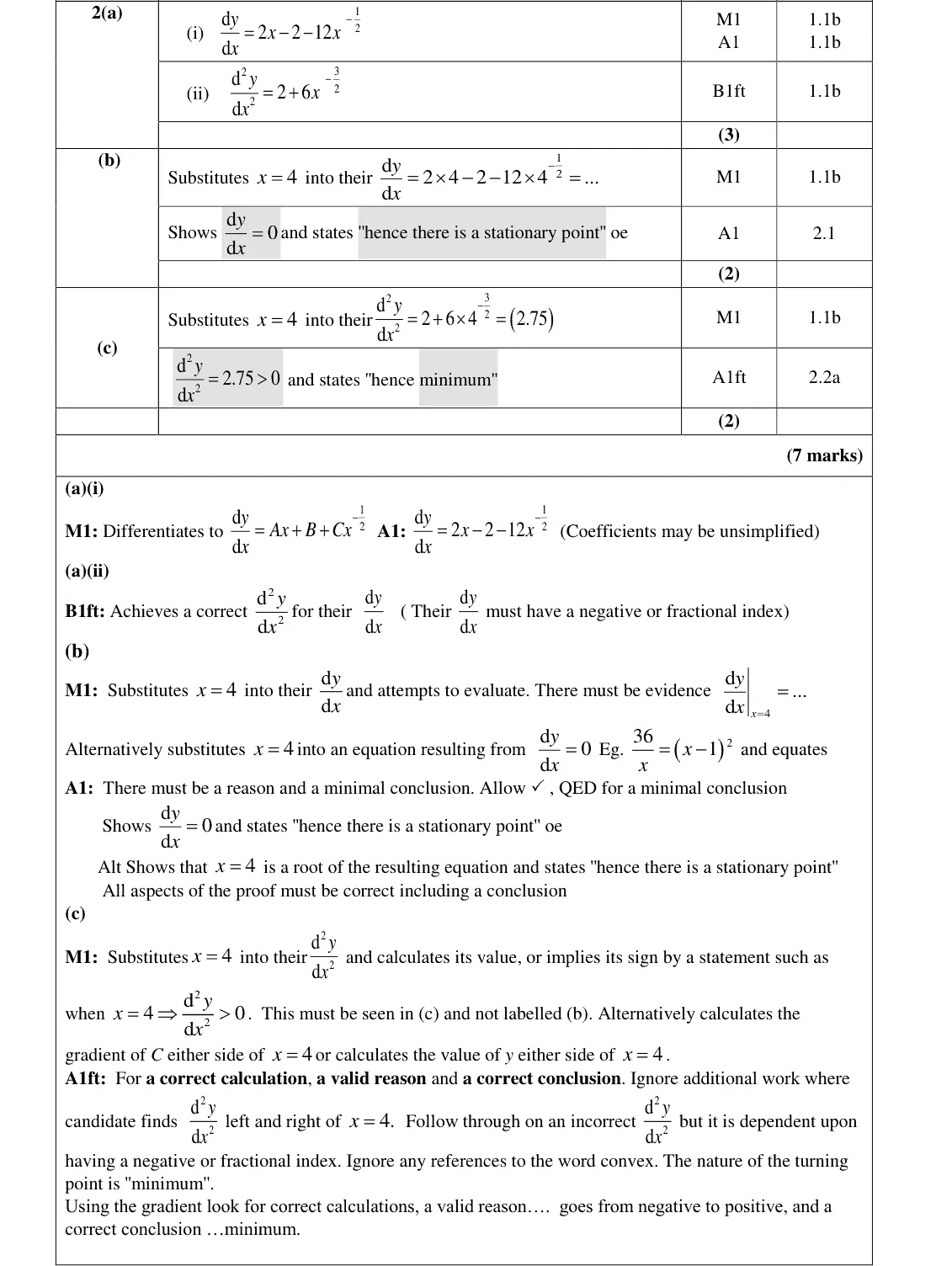
For part (c) there was a little more variation. Most students were aware of the need to substitute 4 x into their second derivative and evaluate its sign, although some failed to do this and instead considered the sign of either y, dy/dx and/or d2y/dx2 either side of 4 x (usually at 4.1 and 3.9). A follow through mark enabled students with an incorrect negative or fractional index from part (a) to achieve both marks in the last part of the question. A significant proportion of students seemed unable to interpret what they had proven from their calculations, and many seemed to think they were looking for an inflection point, or else determining that the curve was either convex or concave. As with part (b), the most common source of lost marks was therefore a lack of correct reasoning before making a conclusion.
Common mistakes
substitute x = 4 into the second derivative: 2.75 > 0 hence minimum
need calculation, reason and conclusion
not a point of inflection or convexity question
June 2018 · Paper 2 · Q95 marks
Mark scheme (whole question; this part is marked with the orange bar)
Examiner's comment
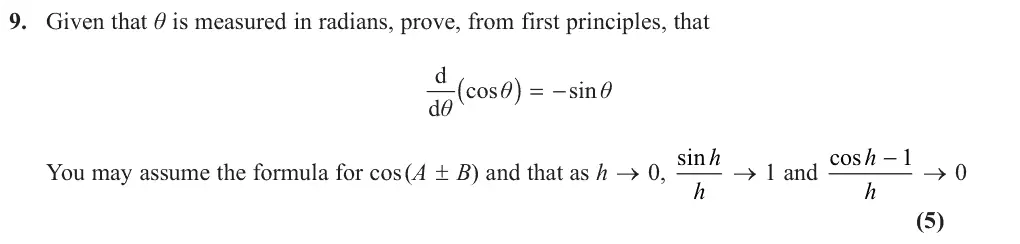
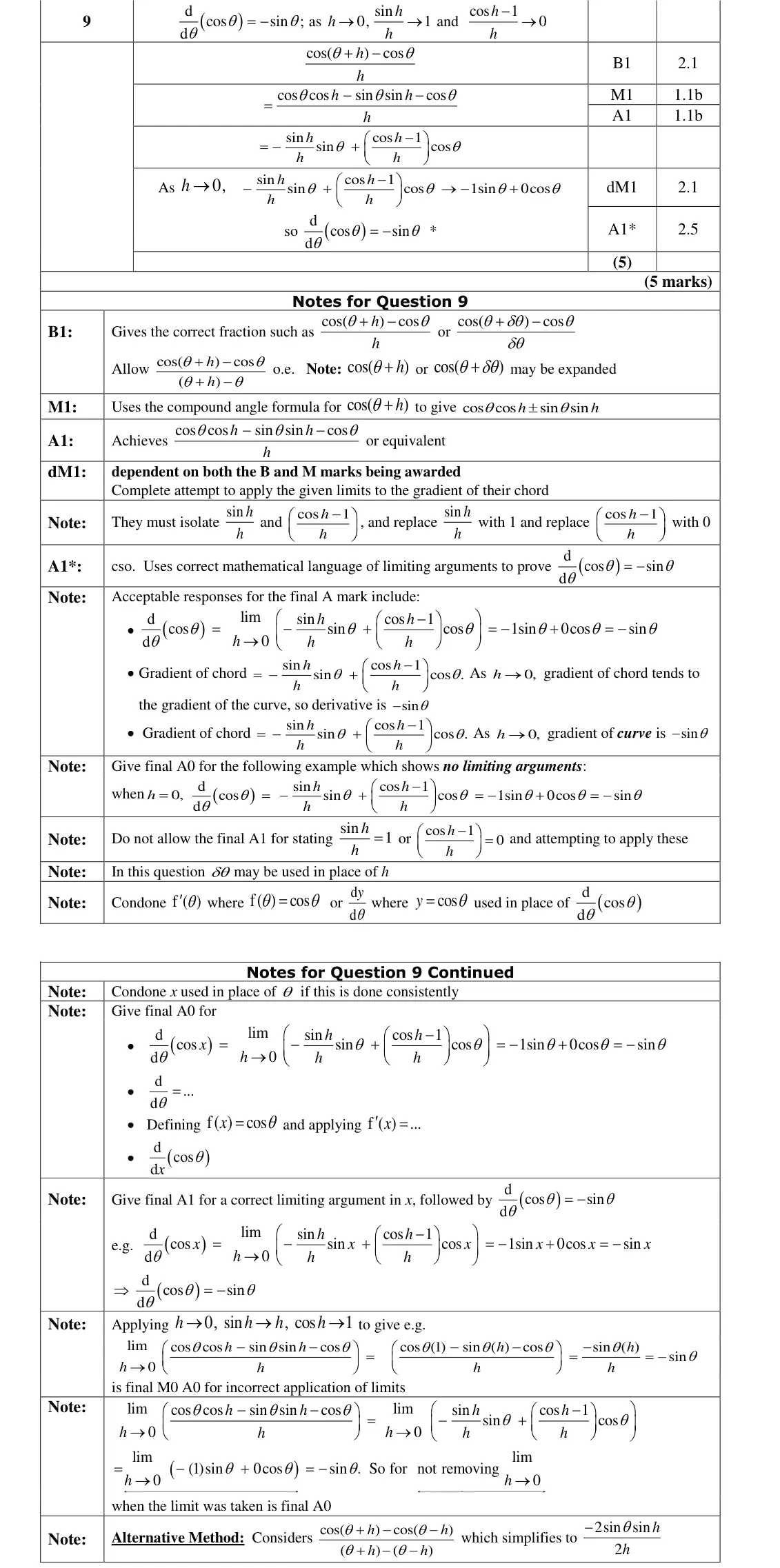
This was a well-answered question considering that this was the first time that differentiation from first principles has been tested on the new specification. Most students wrote down a correct expression for the gradient of the chord joining the points ( , cos ) and ( , cos( )) h h for a small value h. Many students simplified their gradient expression to give a correct sin cos 1 sin cos h h h h and applied the limiting arguments given in the question to deduce that d cos sin . d Some students lost the final mark for not applying limiting arguments correctly. Common errors included: stating that sin cos 1 1, 0 h h h h ; not using a limiting argument; or applying the limiting argument inconsistently. Other students lost the final mark for the use of inconsistent notation in their proof. These students, who usually referred to both x and in their proof, wrote incorrect statements such as d cos sin dx or f( ) cos . x
Common mistakes
gradient of chord (cos(θ + h) − cos θ)/h
compound angle formula
isolate (sin h)/h and (cos h − 1)/h
limit h → 0 must be applied correctly and notation kept consistent (θ not x)
Find an Edexcel maths tutor
Stuck on this? Book a trial session with an Edexcel specialist.