Oct 2021: AS AS Paper 1: Pure Mathematics

100 marks · 36 question parts · Question paper, mark scheme and examiner's report on Pearson's site

Question by question

QTopicMarksDifficulty
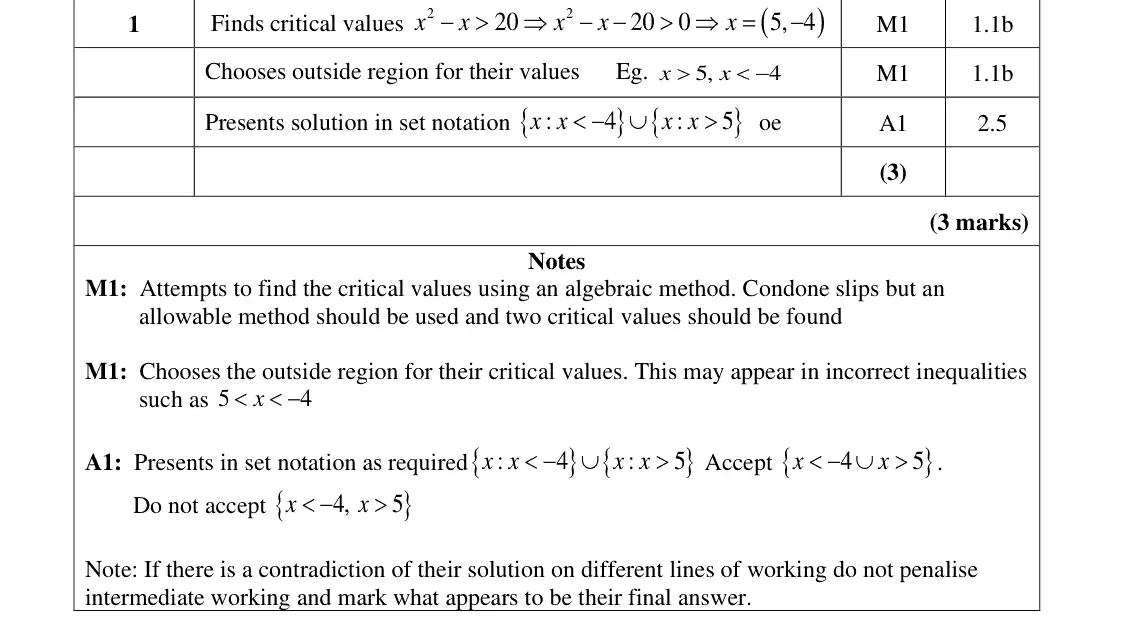
1 Inequalities, Quadratics and the discriminant 3 —
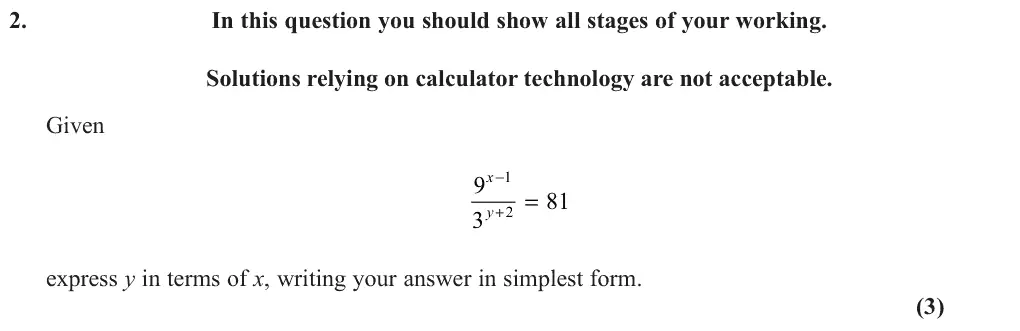
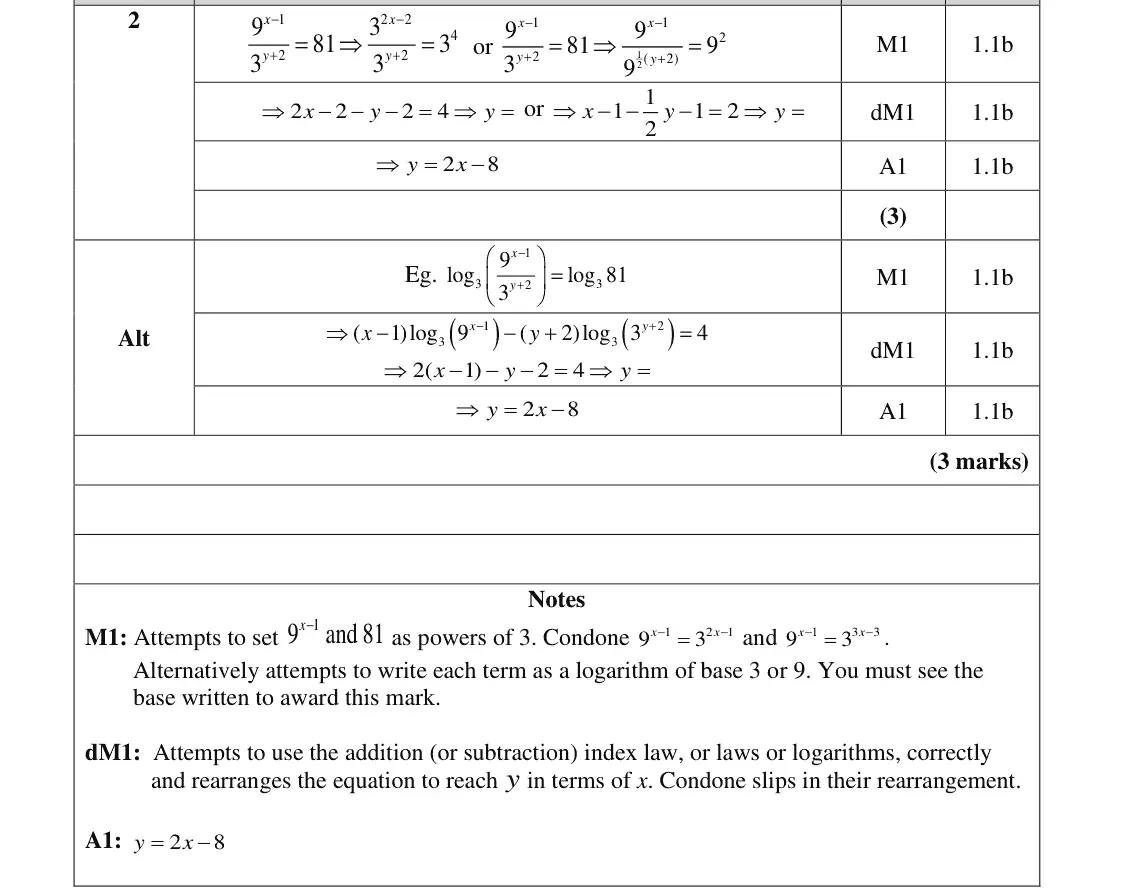
2 Indices and surds, Exponentials and logarithms 3 —
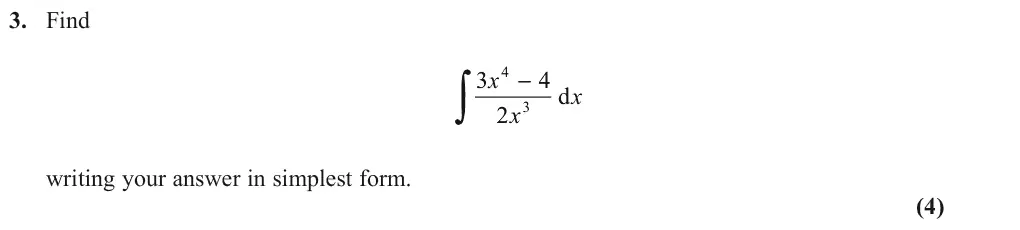
3 Integration: standard integrals, definite integrals and areas, Indices and surds 4 —
4(a) Vectors 2 —
4(b) Vectors 3 —
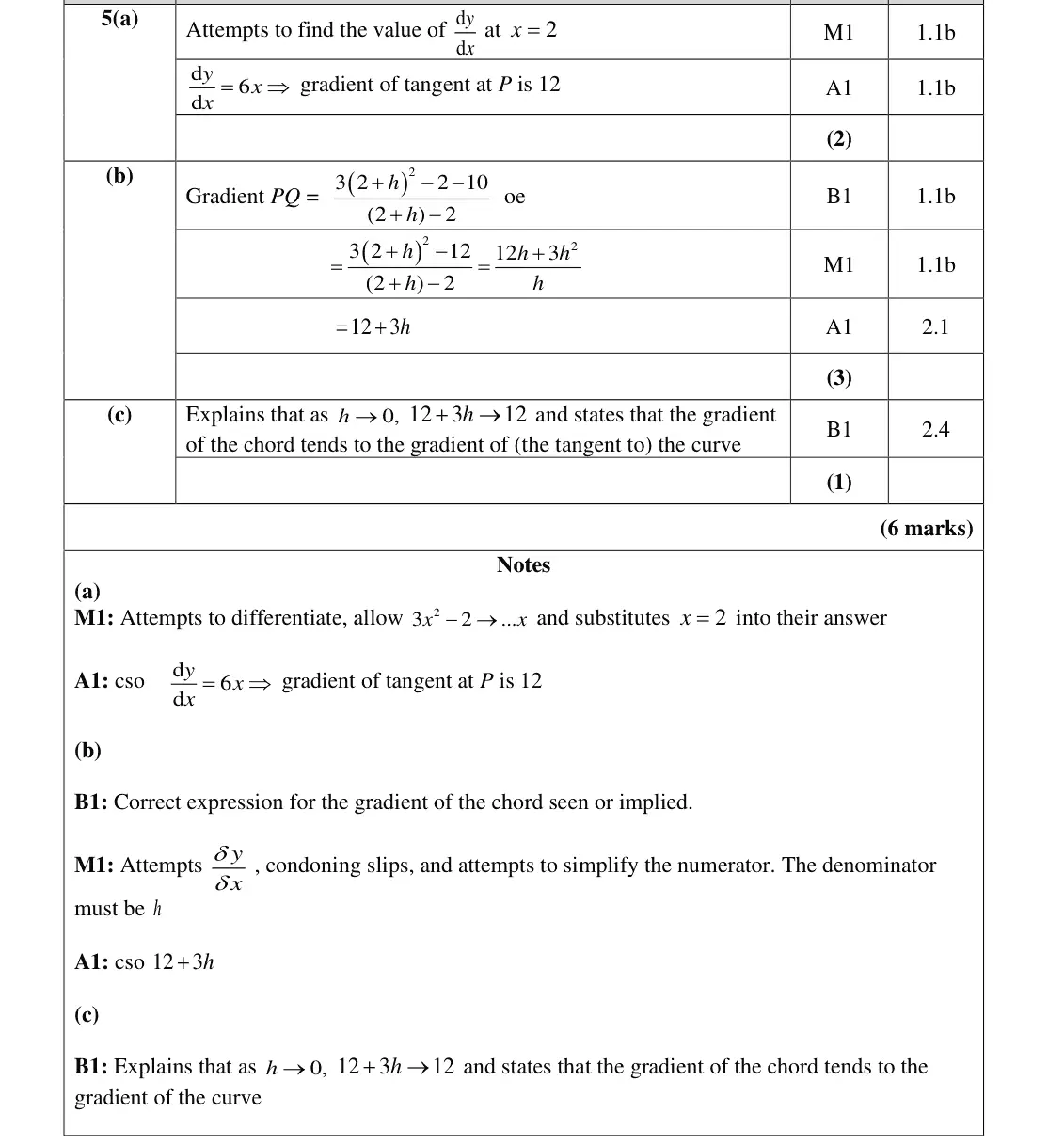
5(a) Differentiation: first principles, gradients, stationary points 2 —
5(b) Differentiation: first principles, gradients, stationary points, Algebraic methods: polynomials, factor theorem and division, Straight lines 3 —
5(c) Differentiation: first principles, gradients, stationary points 1 —
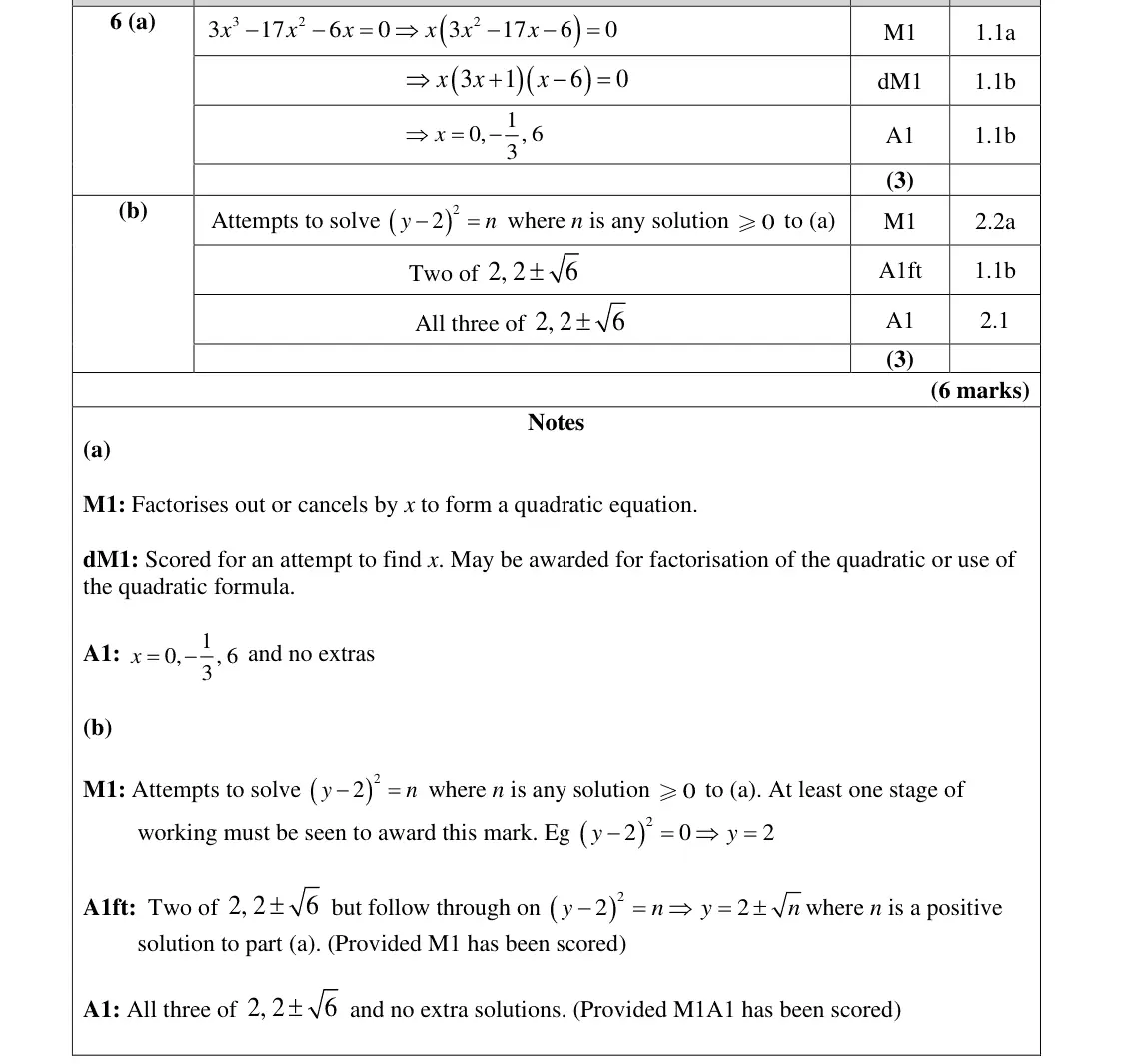
6(a) Algebraic methods: polynomials, factor theorem and division, Quadratics and the discriminant 3 —
6(b) Quadratics and the discriminant, Indices and surds 3 —
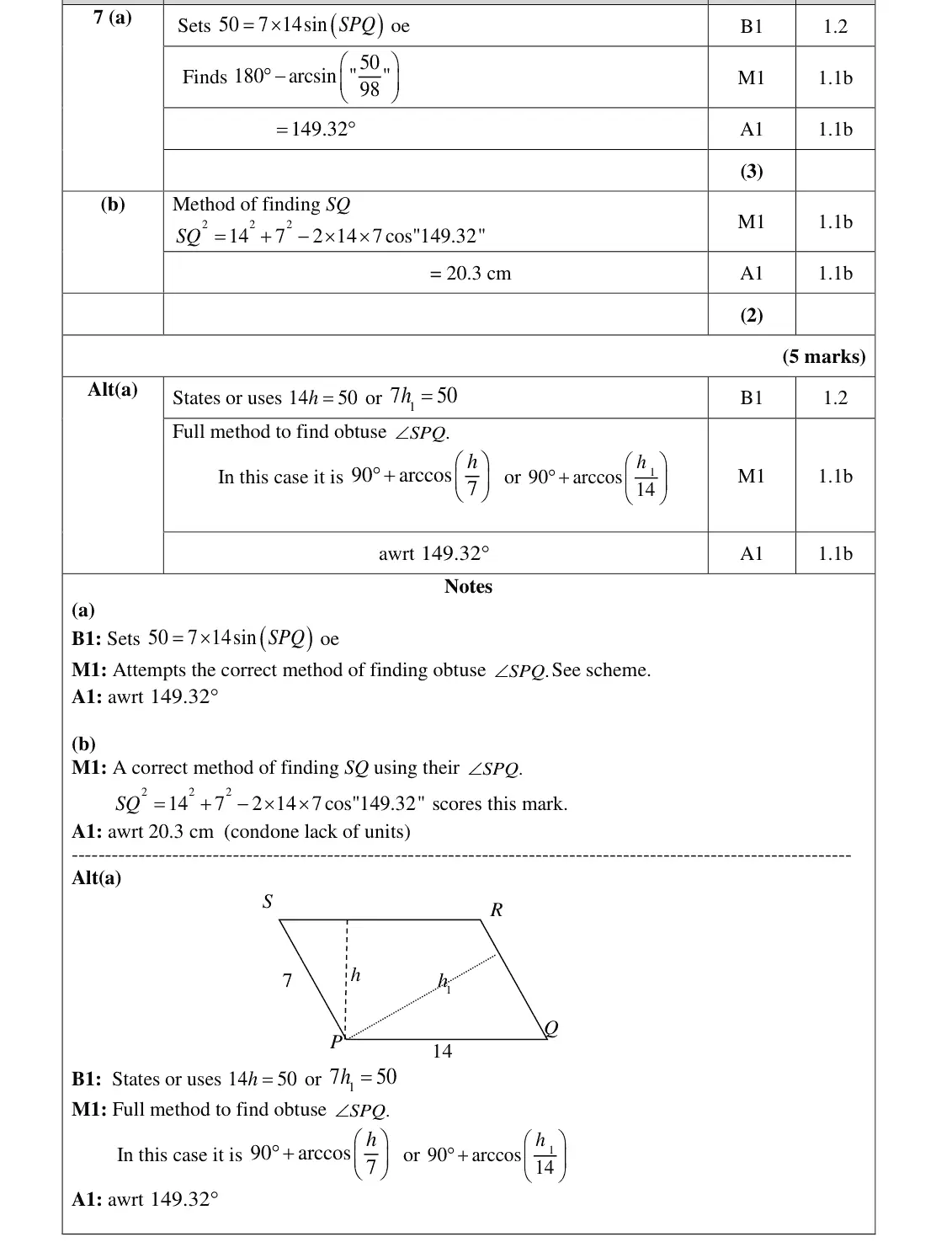
7(a) Trigonometric ratios, graphs, radians and the sine and cosine rules 3 —
7(b) Trigonometric ratios, graphs, radians and the sine and cosine rules 2 —
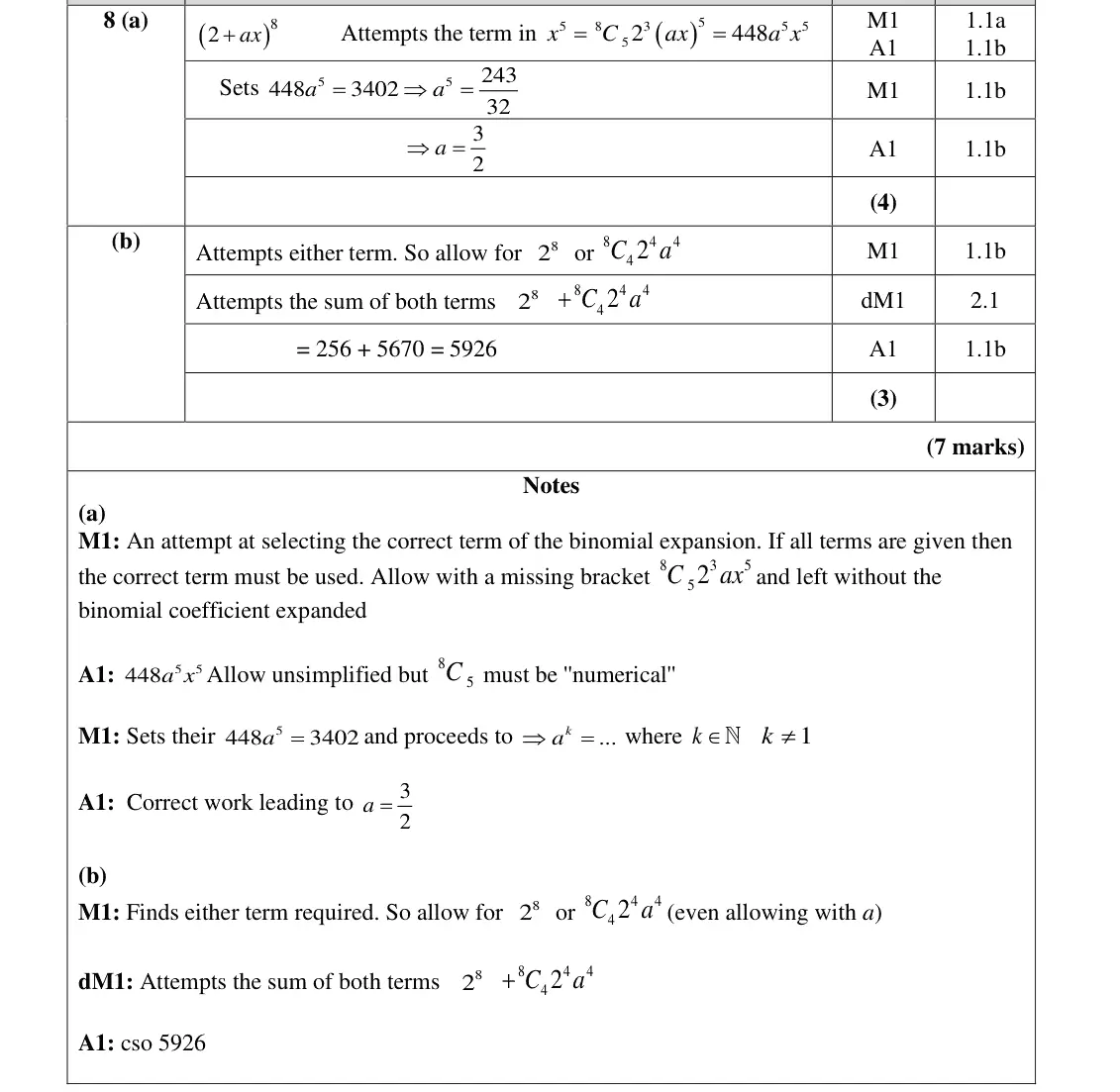
8(a) Binomial expansion, Indices and surds 4 —
8(b) Binomial expansion 3 —
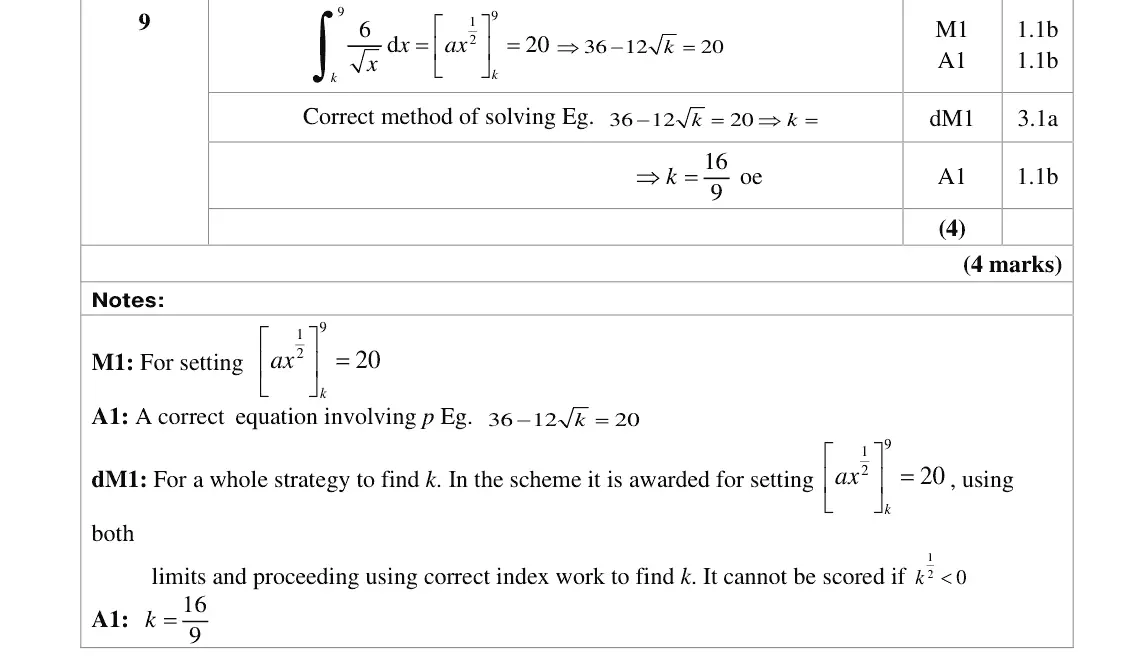
9 Integration: standard integrals, definite integrals and areas, Indices and surds 4 —
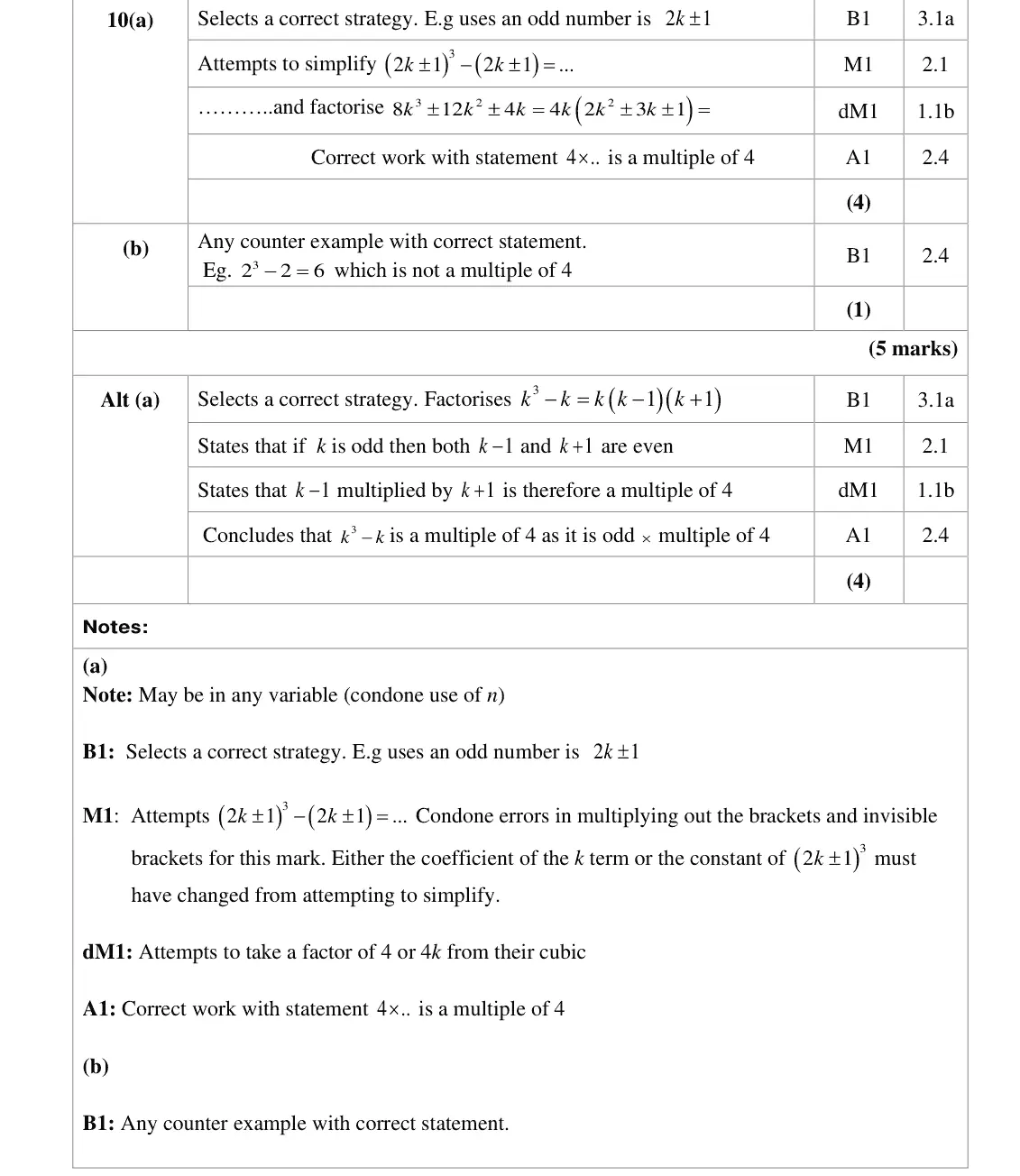
10(a) Proof, including contradiction, Algebraic methods: polynomials, factor theorem and division 4 —
10(b) Proof, including contradiction 1 —
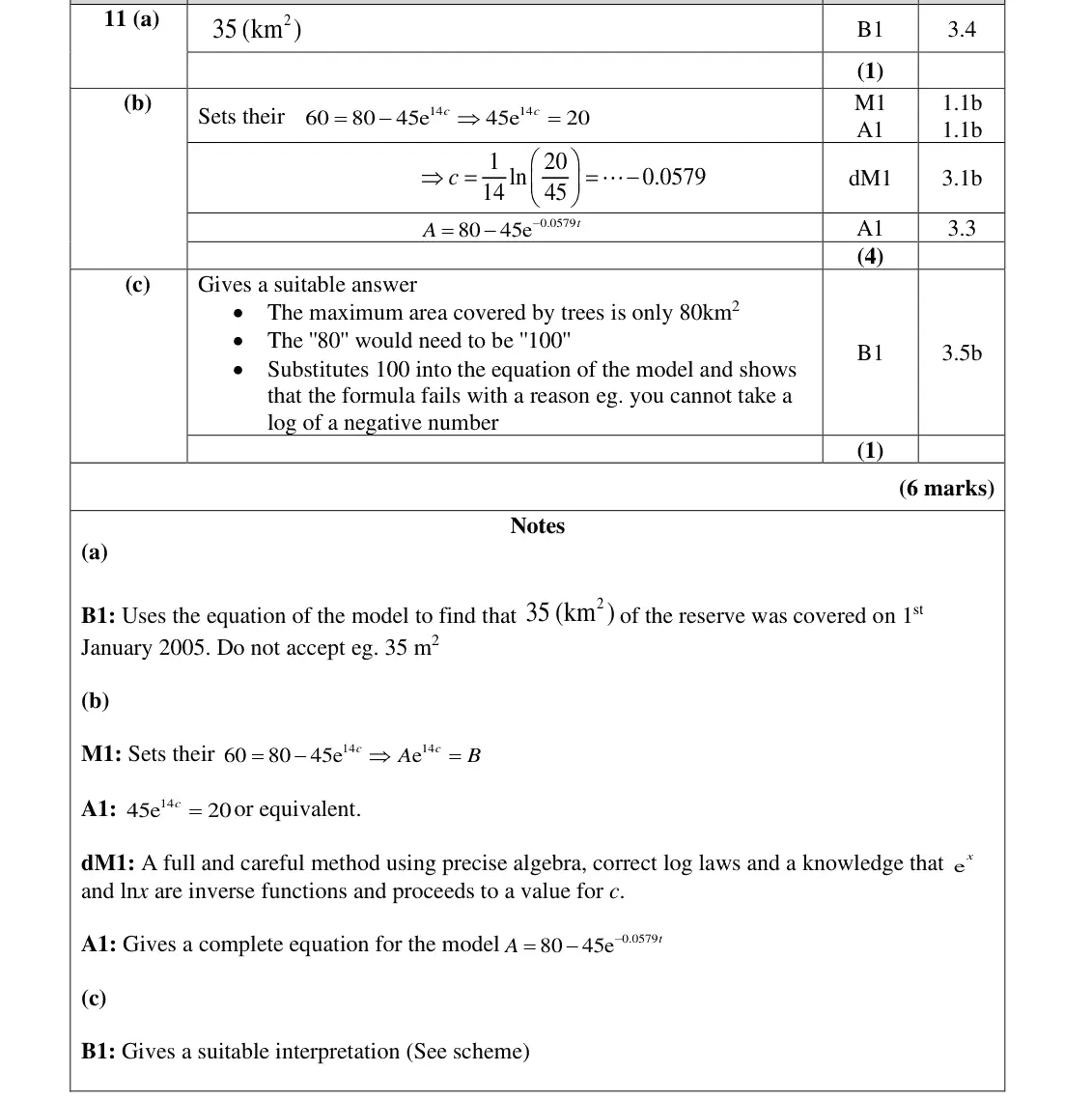
11(a) Exponential growth, decay and modelling, Exponentials and logarithms 1 —
11(b) Exponential growth, decay and modelling, Exponentials and logarithms 4 —
11(c) Exponential growth, decay and modelling 1 —
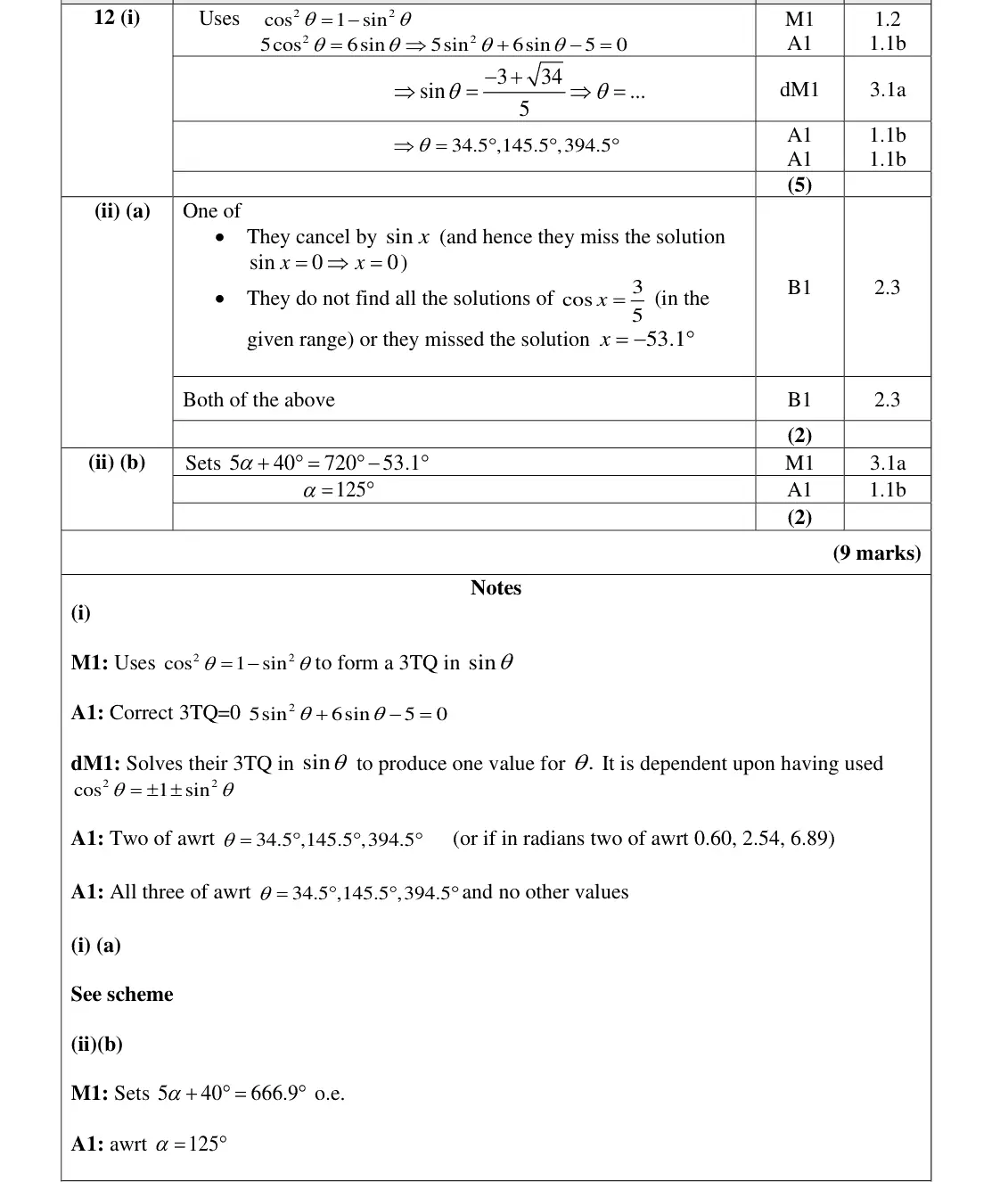
12(i) Solving trigonometric equations, Trigonometric identities and proofs, Quadratics and the discriminant 5 —
12(ii)(a) Solving trigonometric equations, Trigonometric identities and proofs 2 —
12(ii)(b) Solving trigonometric equations, Trigonometric ratios, graphs, radians and the sine and cosine rules 2 —
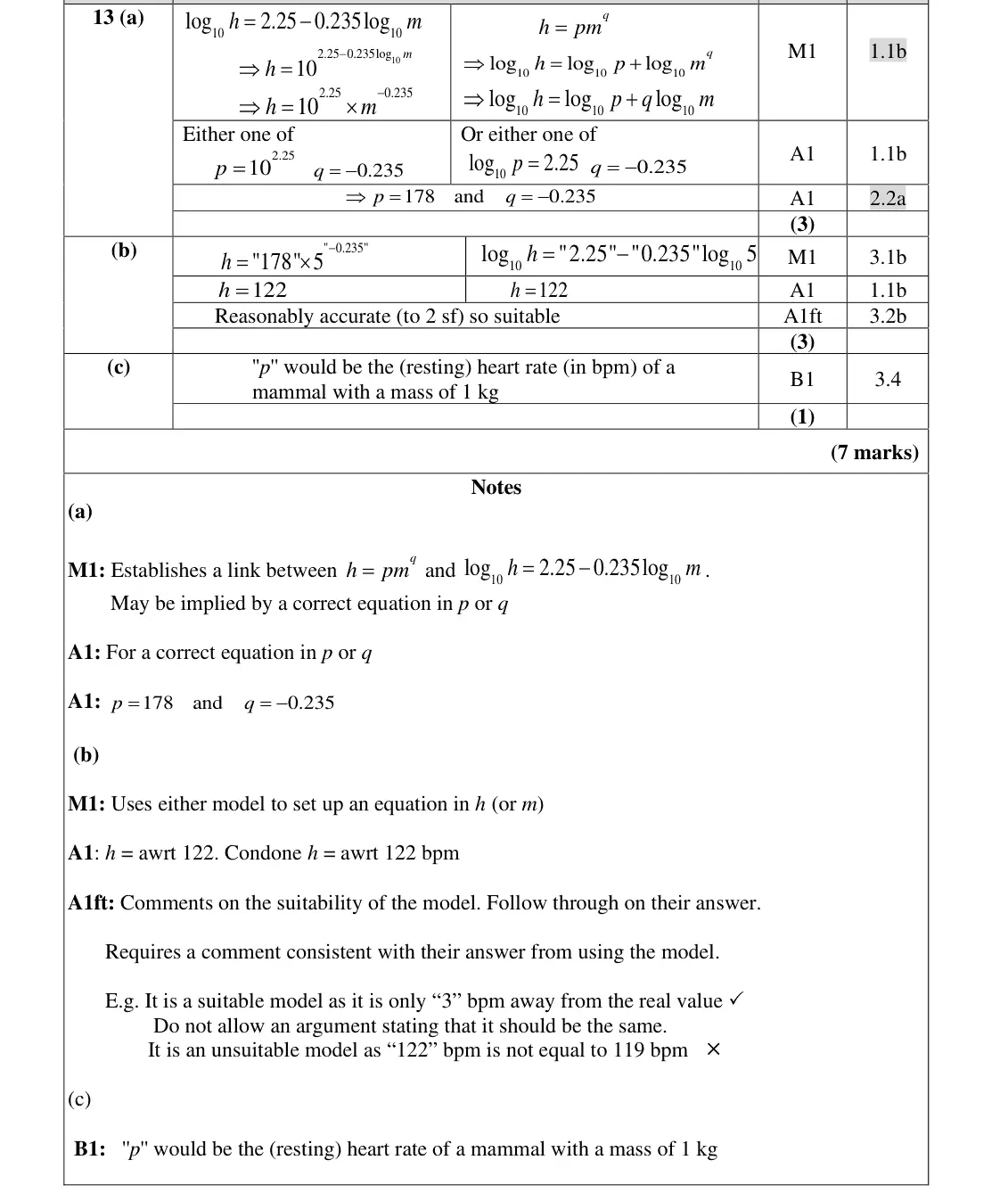
13(a) Exponentials and logarithms 3 —
13(b) Exponentials and logarithms, Exponential growth, decay and modelling 3 —
13(c) Exponentials and logarithms, Exponential growth, decay and modelling 1 —
14(a) Quadratics and the discriminant 3 —
14(b) Quadratics and the discriminant, Differentiation: first principles, gradients, stationary points 2 —
14(c) Integration: standard integrals, definite integrals and areas, Quadratics and the discriminant 5 —
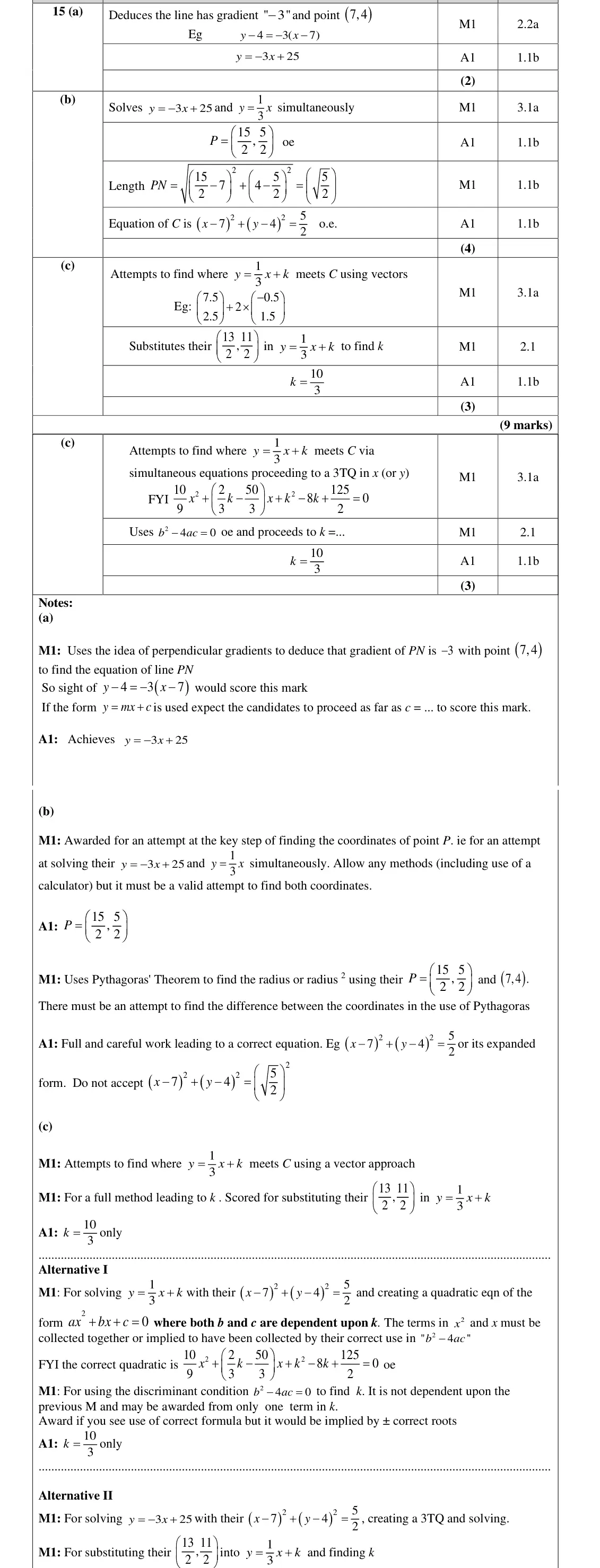
15(a) Straight lines, Circles 2 —
15(b) Circles, Simultaneous equations, Straight lines 4 —
15(c) Circles, Straight lines, Vectors, Quadratics and the discriminant, Simultaneous equations 3 —
16(a) Differentiation: first principles, gradients, stationary points, Simultaneous equations 4 —
16(b) Differentiation: first principles, gradients, stationary points, Quadratics and the discriminant 3 —
16(c) Algebraic methods: polynomials, factor theorem and division 2 —
16(d) Graphs and transformations, Algebraic methods: polynomials, factor theorem and division, Quadratics and the discriminant 2 —

The questions

1234(a)4(b)5(a)5(b)5(c)6(a)6(b)7(a)7(b)8(a)8(b)910(a)10(b)11(a)11(b)11(c)12(i)12(ii)(a)12(ii)(b)13(a)13(b)13(c)14(a)14(b)14(c)15(a)15(b)15(c)16(a)16(b)16(c)16(d)
Oct 2021 · AS Paper 1 · Q1 3 marks inequalitiesquadratics
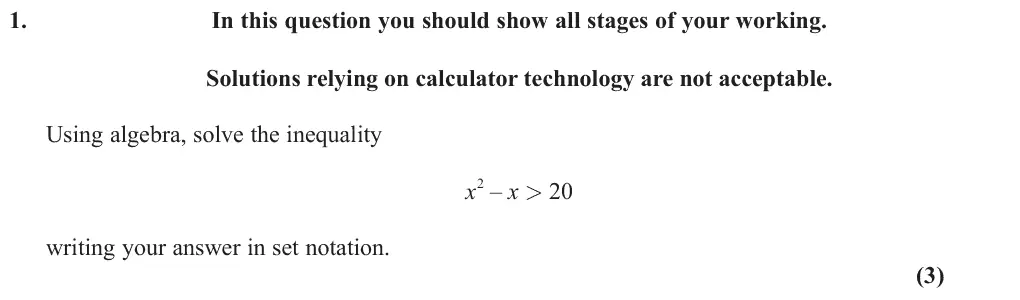
1. In this question you should show all stages of your working. Solutions relying on calculator technology are not acceptable. Using algebra, solve the inequality 2 – x > 20 x writing your answer in set notation. (3)
Oct 2021 · AS Paper 1 · Q2 3 marks indices and surdsexponentials and logs
2. In this question you should show all stages of your working. Solutions relying on calculator technology are not acceptable. Given x - = y + express y in terms of x, writing your answer in simplest form. (3)
Oct 2021 · AS Paper 1 · Q3 4 marks integrationindices and surds
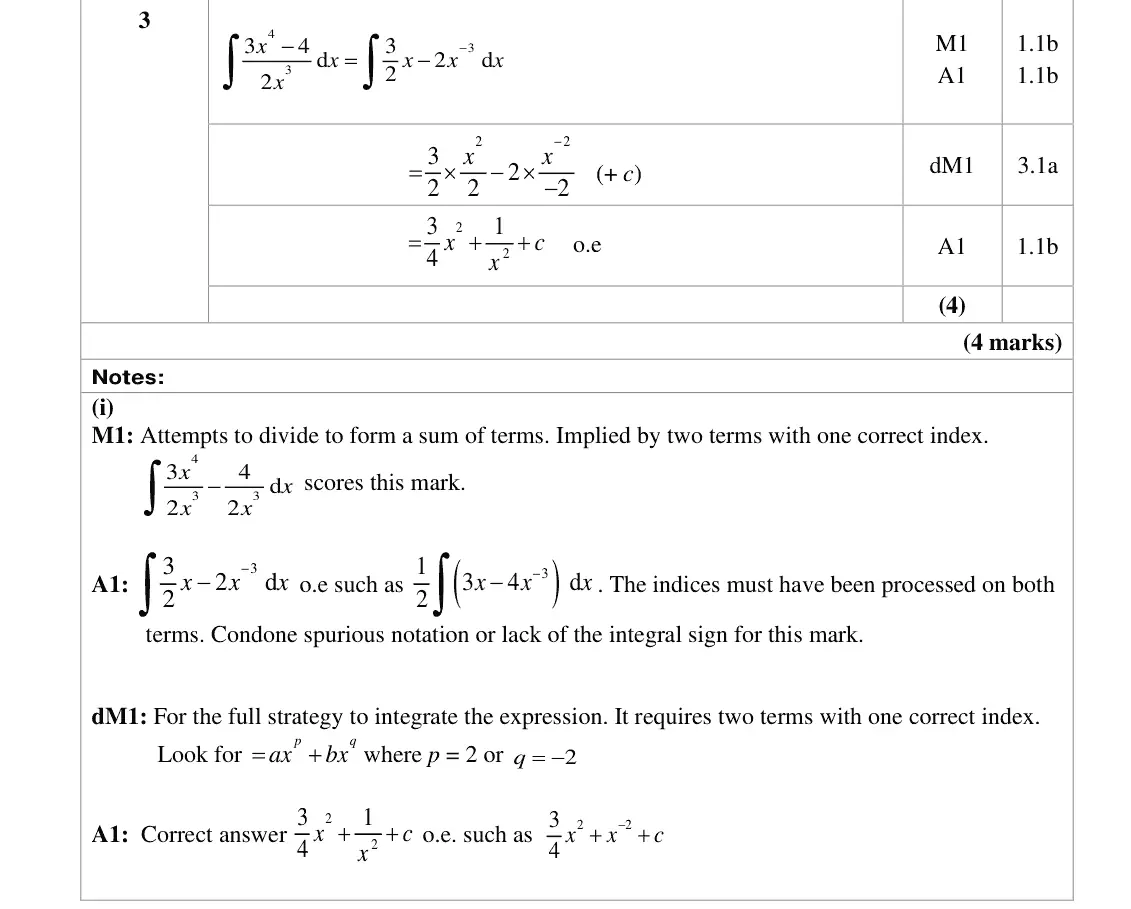
3. Find x - ∫ x d x writing your answer in simplest form. (4)
Oct 2021 · AS Paper 1 · Q4(a) 2 marks vectors
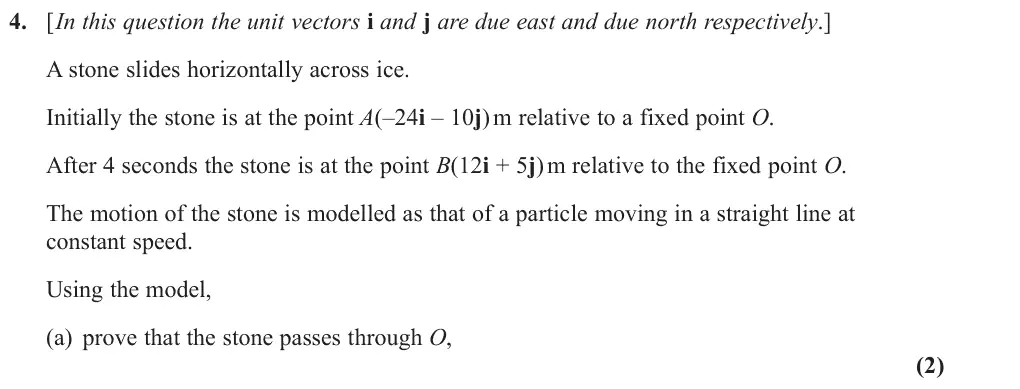
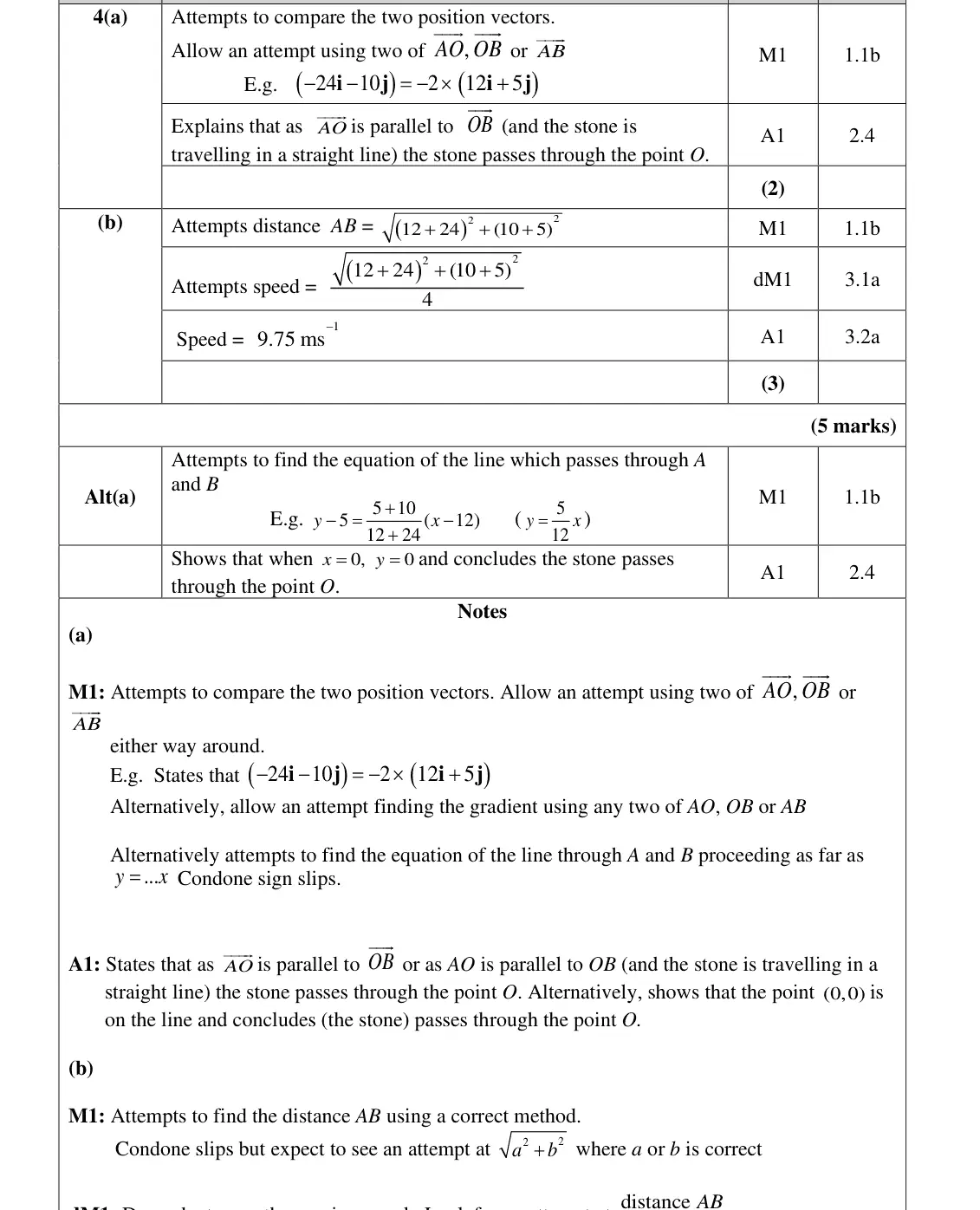
4. [In this question the unit vectors i and j are due east and due north respectively.] A stone slides horizontally across ice. Initially the stone is at the point A(–24i – 10j) m relative to a fixed point O. After 4 seconds the stone is at the point B(12i + 5j) m relative to the fixed point O. The motion of the stone is modelled as that of a particle moving in a straight line at constant speed. Using the model, (a) prove that the stone passes through O, (2)
Oct 2021 · AS Paper 1 · Q4(b) 3 marks vectors
(b) calculate the speed of the stone. (3)
Oct 2021 · AS Paper 1 · Q5(a) 2 marks differentiation
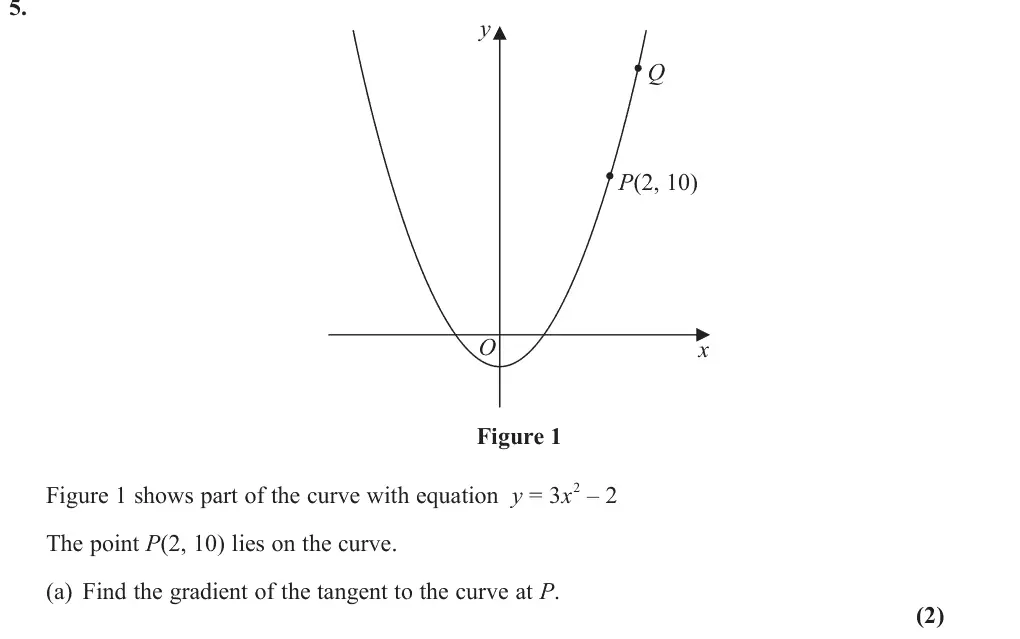
5. y Q P(2, 10) x Figure 1 Figure 1 shows part of the curve with equation y = 3x 2 – 2 The point P(2, 10) lies on the curve. (a) Find the gradient of the tangent to the curve at P. (2)
Oct 2021 · AS Paper 1 · Q5(b) 3 marks differentiationalgebraic methodsstraight lines
The point Q with x coordinate 2 + h also lies on the curve. (b) Find the gradient of the line PQ, giving your answer in terms of h in simplest form. (3)
Oct 2021 · AS Paper 1 · Q5(c) 1 mark differentiation
(c) Explain briefly the relationship between part (b) and the answer to part (a). (1)
Oct 2021 · AS Paper 1 · Q6(a) 3 marks algebraic methodsquadratics
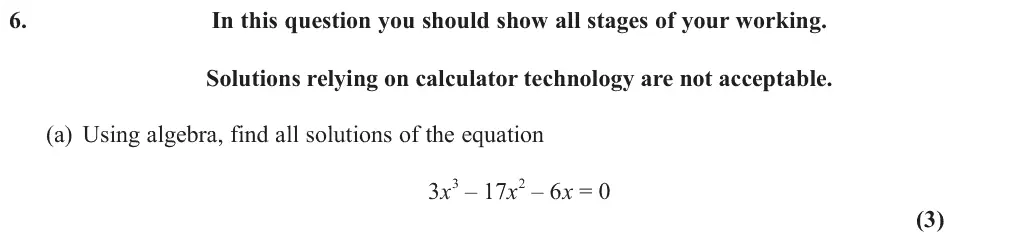
6. In this question you should show all stages of your working. Solutions relying on calculator technology are not acceptable. (a) Using algebra, find all solutions of the equation 3 – 17x 2 – 6x = 0 3x (3)
Oct 2021 · AS Paper 1 · Q6(b) 3 marks quadraticsindices and surds
(b) Hence find all real solutions of 3(y – 2) 6 – 17(y – 2) 4 – 6(y – 2) 2 = 0 (3)
Oct 2021 · AS Paper 1 · Q7(a) 3 marks trigonometric ratios
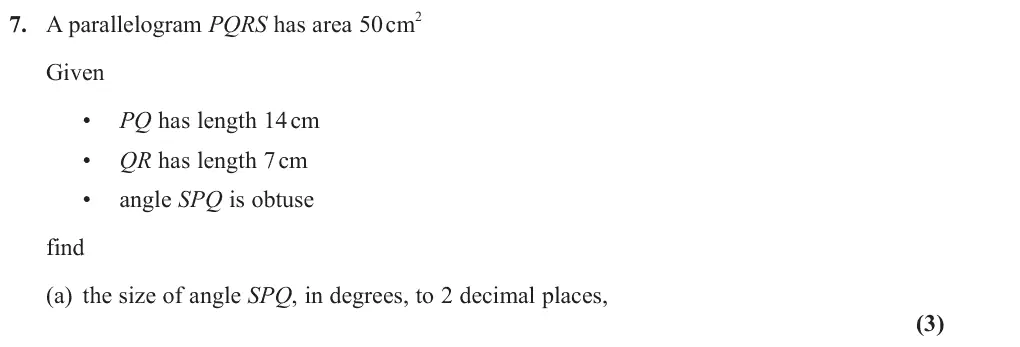
7. A parallelogram PQRS has area 50 cm Given • PQ has length 14 cm • QR has length 7 cm • angle SPQ is obtuse find (a) the size of angle SPQ, in degrees, to 2 decimal places, (3)
Oct 2021 · AS Paper 1 · Q7(b) 2 marks trigonometric ratios
(b) the length of the diagonal SQ, in cm, to one decimal place. (2)
Oct 2021 · AS Paper 1 · Q8(a) 4 marks binomial expansionindices and surds
8. g(x) = (2 + ax) 8 where a is a constant Given that one of the terms in the binomial expansion of g(x) is 3402x (a) find the value of a. (4)
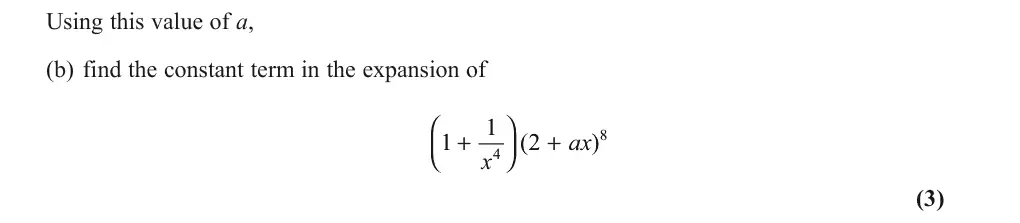
Oct 2021 · AS Paper 1 · Q8(b) 3 marks binomial expansion
Using this value of a, (b) find the constant term in the expansion of + + ax ( ) x (3)
Oct 2021 · AS Paper 1 · Q9 4 marks integrationindices and surds
9. Find the value of the constant k, 0 < k < 9, such that ∫ x = d x k (4)
Oct 2021 · AS Paper 1 · Q10(a) 4 marks proofalgebraic methods
10. A student is investigating the following statement about natural numbers. 3 – n is a multiple of 4 ” “ n (a) Prove, using algebra, that the statement is true for all odd numbers. (4)
Oct 2021 · AS Paper 1 · Q10(b) 1 mark proof
(b) Use a counterexample to show that the statement is not always true. (1)
Oct 2021 · AS Paper 1 · Q11(a) 1 mark exponential modellingexponentials and logs
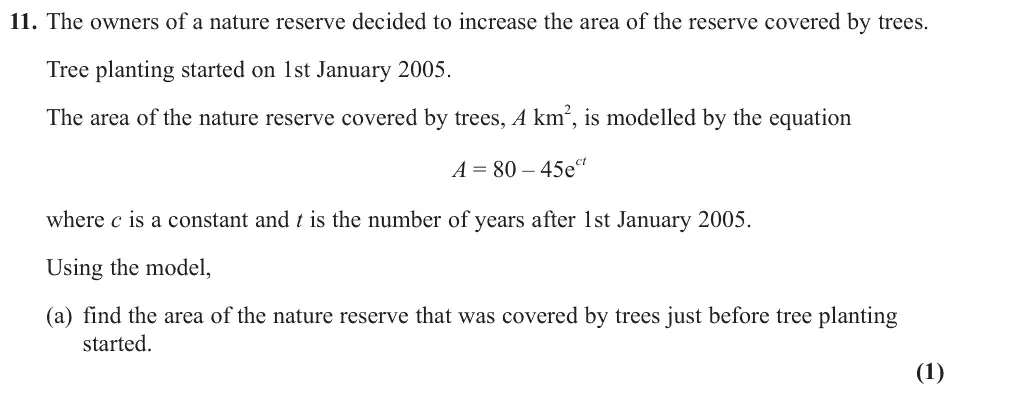
11. The owners of a nature reserve decided to increase the area of the reserve covered by trees. Tree planting started on 1st January 2005. The area of the nature reserve covered by trees, A km 2, is modelled by the equation A = 80 – 45e ct where c is a constant and t is the number of years after 1st January 2005. Using the model, (a) find the area of the nature reserve that was covered by trees just before tree planting started. (1)

Oct 2021 · AS Paper 1 · Q11(b) 4 marks exponential modellingexponentials and logs
On 1st January 2019 an area of 60 km 2 of the nature reserve was covered by trees. (b) Use this information to find a complete equation for the model, giving your value of c to 3 significant figures. (4)
Oct 2021 · AS Paper 1 · Q11(c) 1 mark exponential modelling
On 1st January 2020, the owners of the nature reserve announced a long-term plan to have 100 km 2 of the nature reserve covered by trees. (c) State a reason why the model is not appropriate for this plan. (1)
Oct 2021 · AS Paper 1 · Q12(i) 5 marks trigonometric equationstrig identitiesquadratics
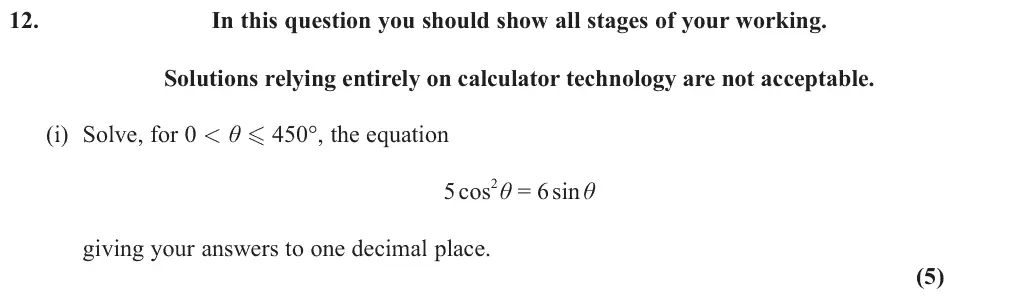
12. In this question you should show all stages of your working. Solutions relying entirely on calculator technology are not acceptable. (i) Solve, for 0 < theta 450°, the equation 2 theta = 6 sin theta 5 cos giving your answers to one decimal place. (5)
Oct 2021 · AS Paper 1 · Q12(ii)(a) 2 marks trigonometric equationstrig identities
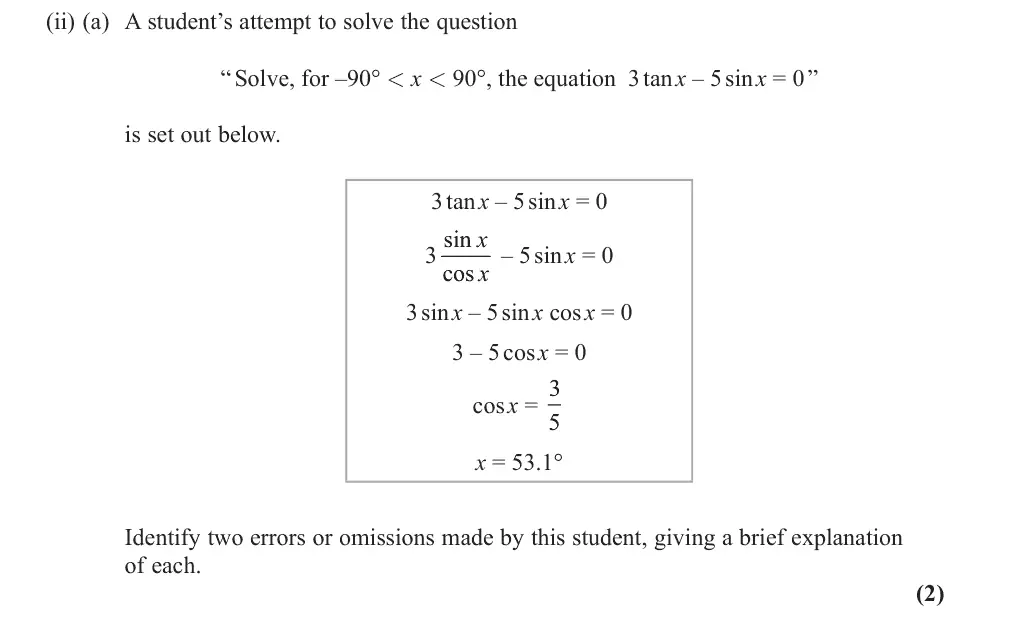
(ii) (a) A student’s attempt to solve the question “ Solve, for –90° < x < 90°, the equation 3 tan x – 5 sin x = 0 ” is set out below. 3 tan x – 5 sin x = 0 x 3 sin x – 5 sin x = 0 cos 3 sin x – 5 sin x cos x = 0 3 – 5 cos x = 0 cos x = 3 x = 53.1° Identify two errors or omissions made by this student, giving a brief explanation of each. (2)
Oct 2021 · AS Paper 1 · Q12(ii)(b) 2 marks trigonometric equationstrigonometric ratios
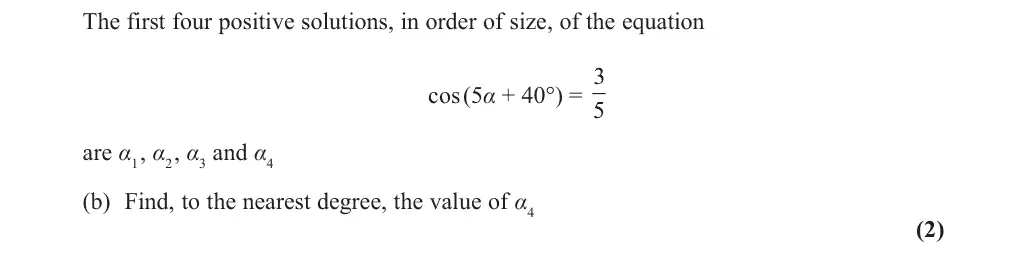
The first four positive solutions, in order of size, of the equation cos (5 alpha + 40°) = 3 are alpha 1 , alpha 2 , alpha 3 and alpha 4 (b) Find, to the nearest degree, the value of alpha 4 (2)
Oct 2021 · AS Paper 1 · Q13(a) 3 marks exponentials and logs
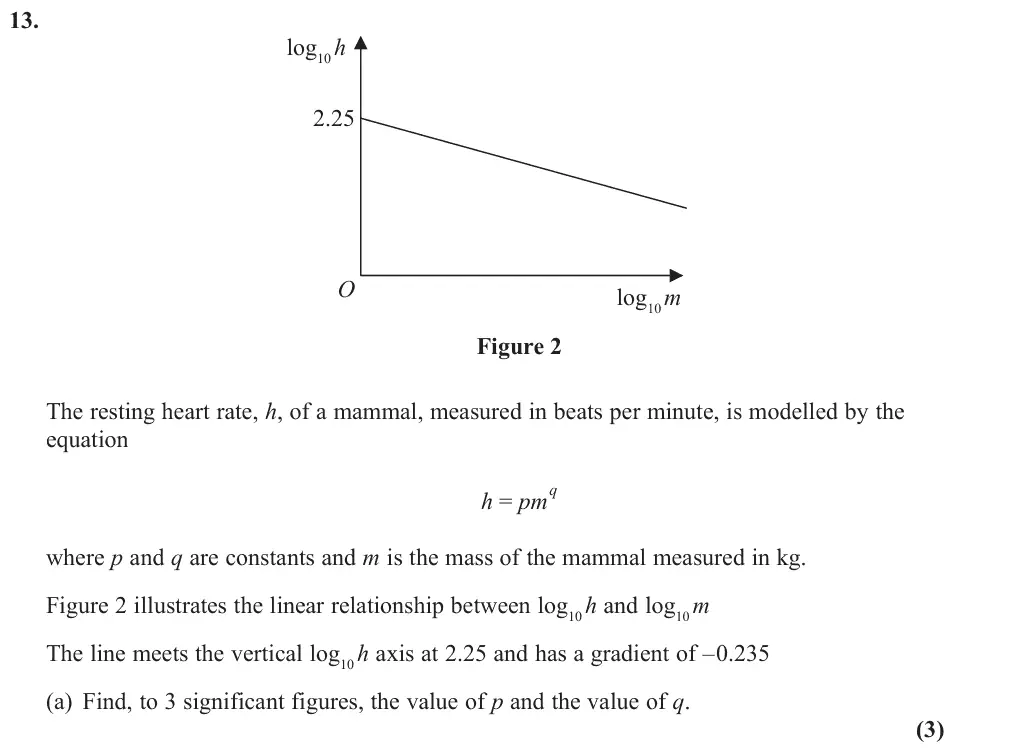
13. log10 h 2.25 log10 m Figure 2 The resting heart rate, h, of a mammal, measured in beats per minute, is modelled by the equation q h = pm where p and q are constants and m is the mass of the mammal measured in kg. Figure 2 illustrates the linear relationship between log10 h and log10 m The line meets the vertical log10 h axis at 2.25 and has a gradient of –0.235 (a) Find, to 3 significant figures, the value of p and the value of q. (3)
Oct 2021 · AS Paper 1 · Q13(b) 3 marks exponentials and logsexponential modelling
A particular mammal has a mass of 5 kg and a resting heart rate of 119 beats per minute. (b) Comment on the suitability of the model for this mammal. (3)
Oct 2021 · AS Paper 1 · Q13(c) 1 mark exponentials and logsexponential modelling
(c) With reference to the model, interpret the value of the constant p. (1)
Oct 2021 · AS Paper 1 · Q14(a) 3 marks quadratics
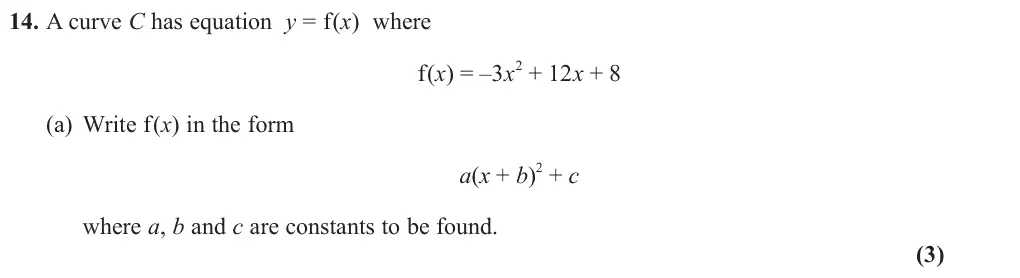
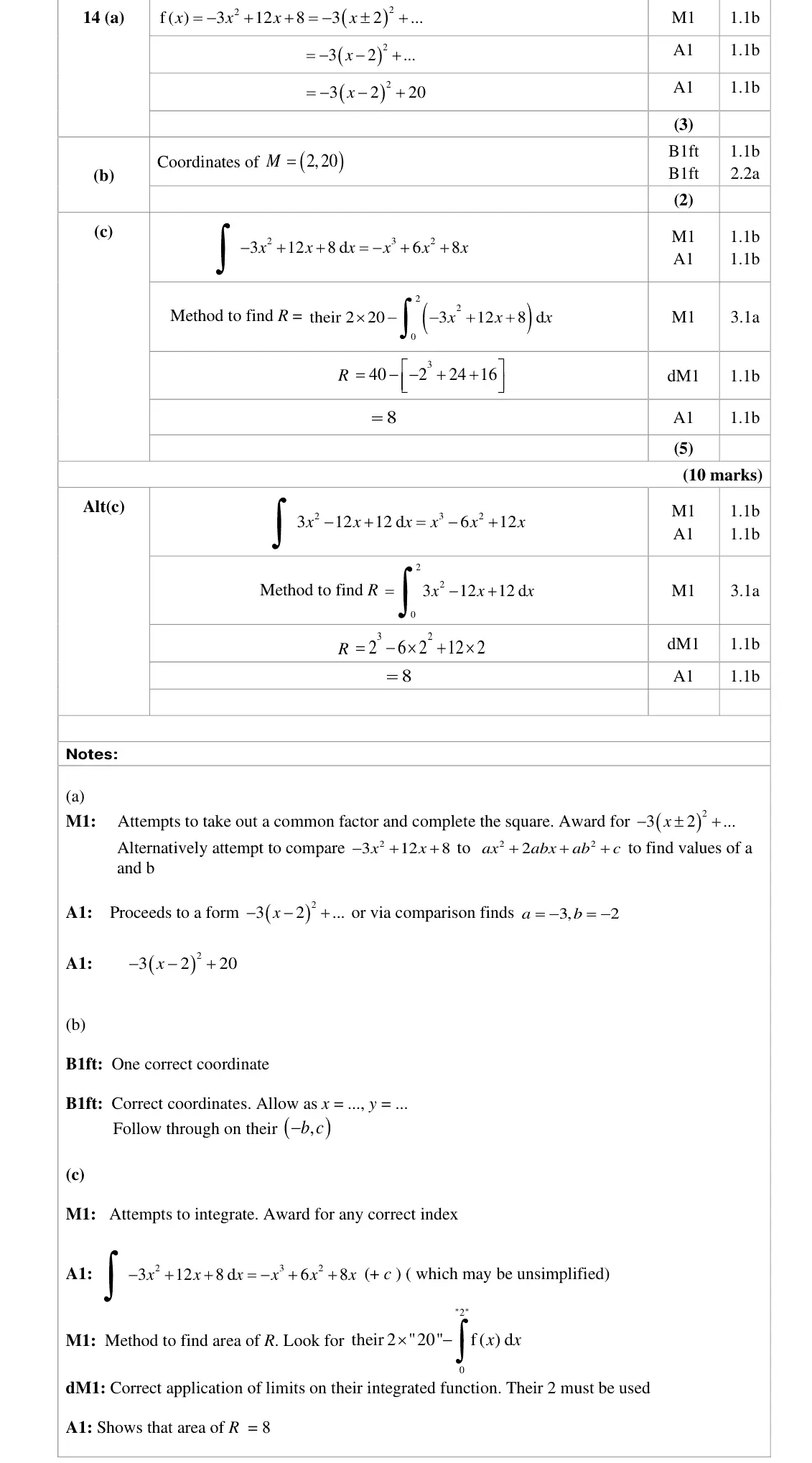
14. A curve C has equation y = f(x) where f(x) = –3x 2 + 12x + 8 (a) Write f(x) in the form a(x + b) 2 + c where a, b and c are constants to be found. (3)
Oct 2021 · AS Paper 1 · Q14(b) 2 marks quadraticsdifferentiation
The curve C has a maximum turning point at M. (b) Find the coordinates of M. (2)
Oct 2021 · AS Paper 1 · Q14(c) 5 marks integrationquadratics
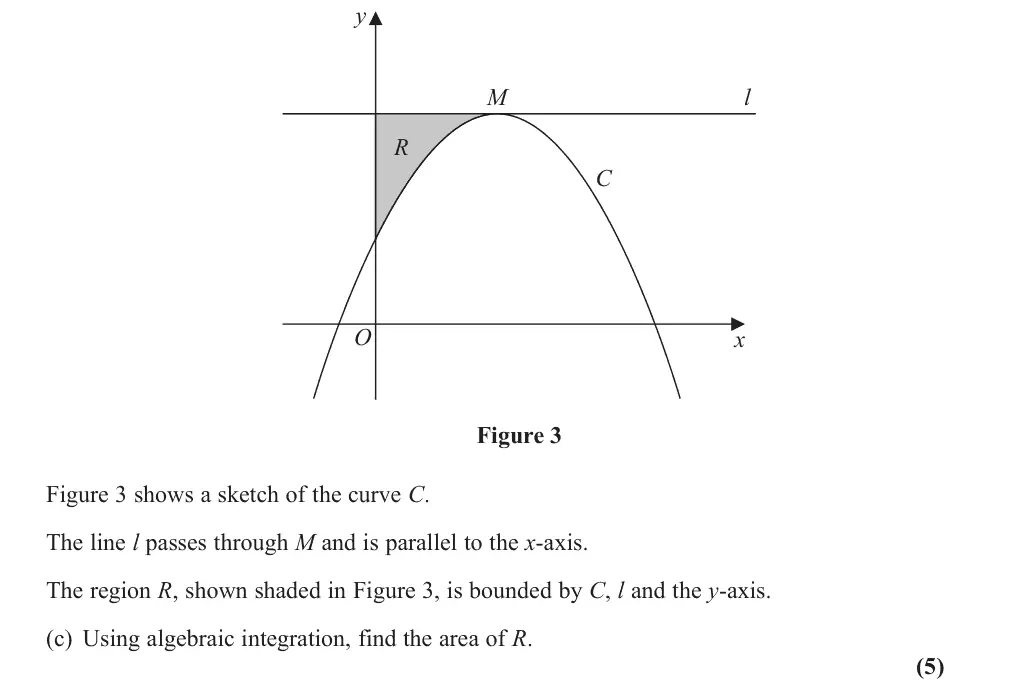
y M l R C x Figure 3 Figure 3 shows a sketch of the curve C. The line l passes through M and is parallel to the x-axis. The region R, shown shaded in Figure 3, is bounded by C, l and the y-axis. (c) Using algebraic integration, find the area of R. (5)
Oct 2021 · AS Paper 1 · Q15(a) 2 marks straight linescircles
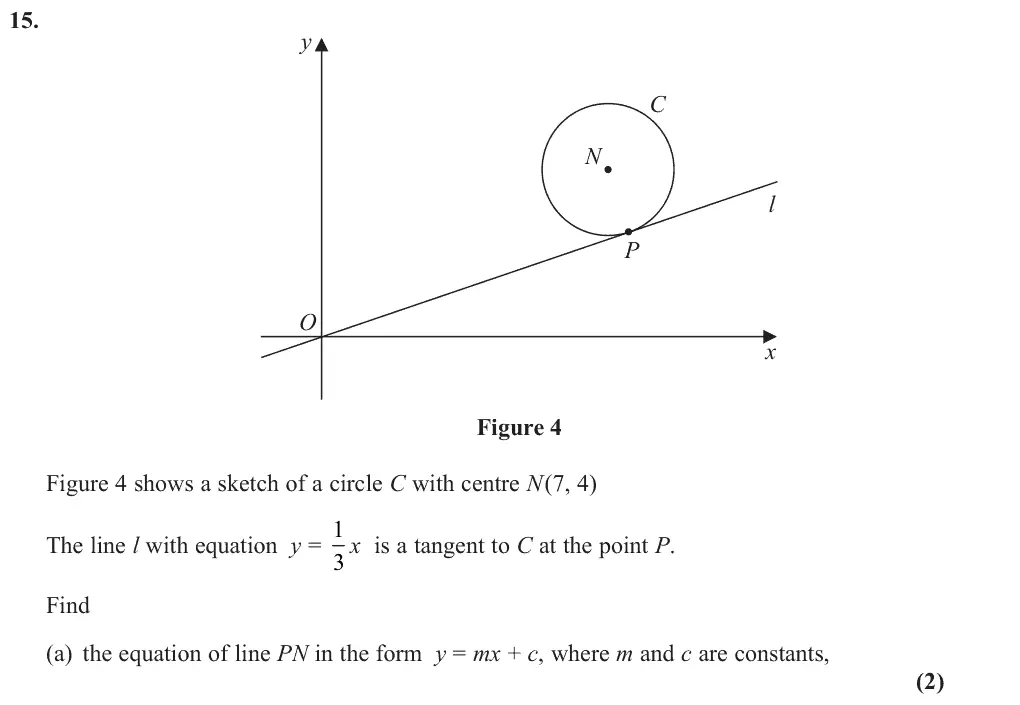
15. y C N l P x Figure 4 Figure 4 shows a sketch of a circle C with centre N(7, 4) The line l with equation y = 1 3 x is a tangent to C at the point P. Find (a) the equation of line PN in the form y = mx + c, where m and c are constants, (2)
Oct 2021 · AS Paper 1 · Q15(b) 4 marks circlessimultaneous equationsstraight lines
(b) an equation for C. (4)
Oct 2021 · AS Paper 1 · Q15(c) 3 marks circlesstraight linesvectorsquadraticssimultaneous equations
The line with equation y = 1 3 x + k, where k is a non-zero constant, is also a tangent to C. (c) Find the value of k. (3)
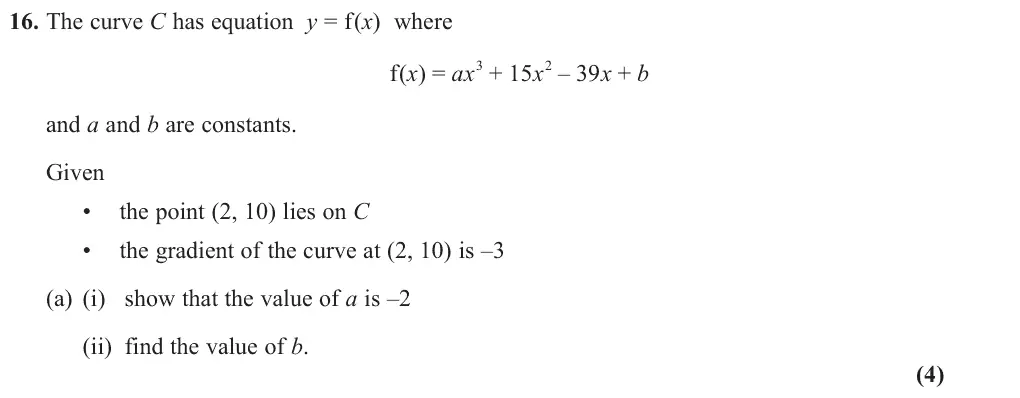
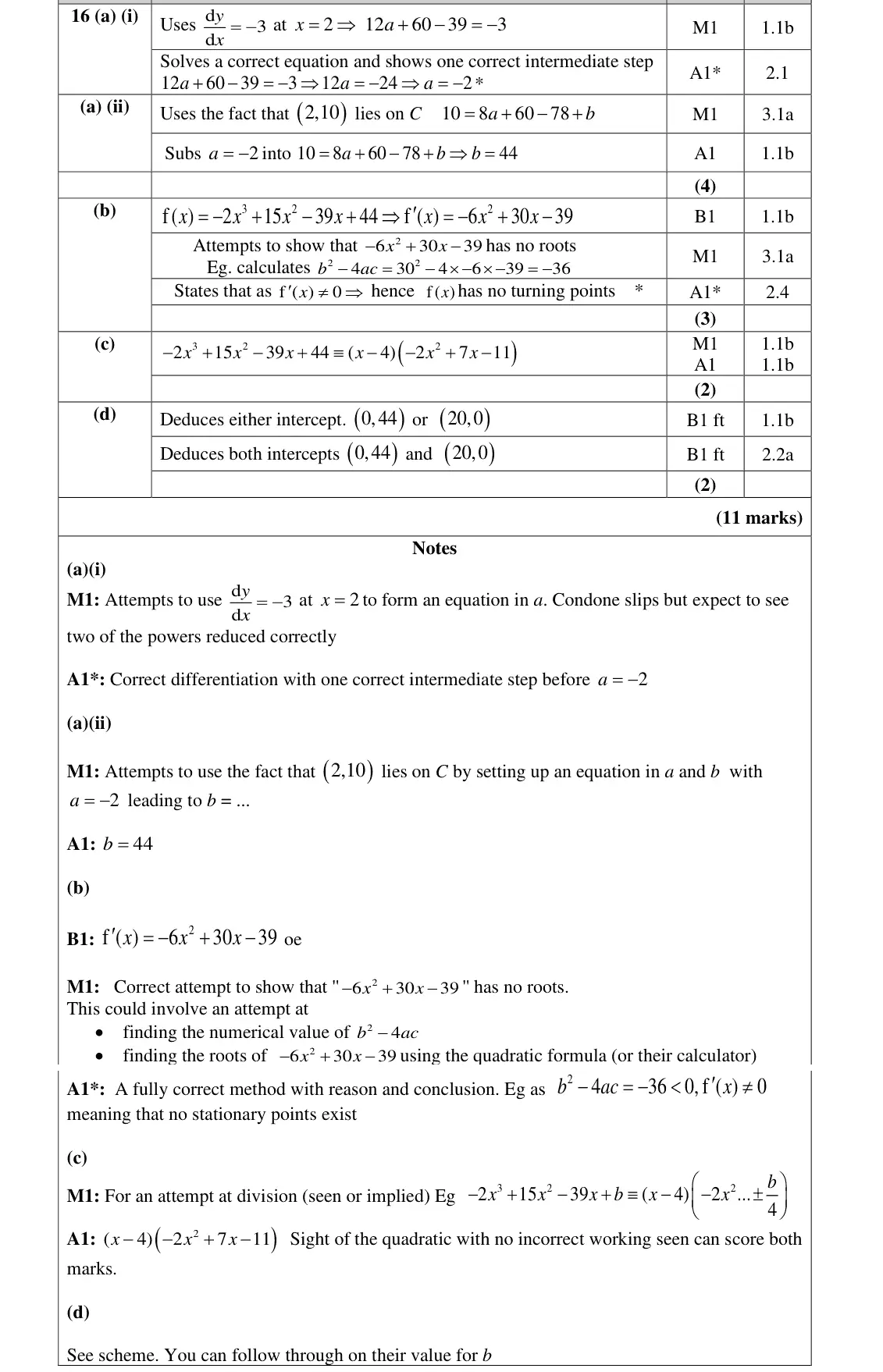
Oct 2021 · AS Paper 1 · Q16(a) 4 marks differentiationsimultaneous equations
16. The curve C has equation y = f(x) where f(x) = ax 3 + 15x 2 – 39x + b and a and b are constants. Given • the point (2, 10) lies on C • the gradient of the curve at (2, 10) is –3 (a) (i) show that the value of a is –2 (ii) find the value of b. (4)
Oct 2021 · AS Paper 1 · Q16(b) 3 marks differentiationquadratics
(b) Hence show that C has no stationary points. (3)
Oct 2021 · AS Paper 1 · Q16(c) 2 marks algebraic methods
(c) Write f(x) in the form (x – 4)Q(x) where Q(x) is a quadratic expression to be found. (2)
Oct 2021 · AS Paper 1 · Q16(d) 2 marks graphs and transformationsalgebraic methodsquadratics
(d) Hence deduce the coordinates of the points of intersection of the curve with equation y = f(0.2x) and the coordinate axes. (2)

Find an Edexcel maths tutor

Want this paper marked and gone through with you? Message us.

Prefer email? Send an enquiry

If you are under 18, please include a parent's contact details. Enquiries go to enquiries@mathsaleveltutor.com and are deleted once handled.