Oct 2020: AS AS Paper 1: Pure Mathematics

100 marks · 32 question parts · Question paper, mark scheme and examiner's report on Pearson's site

Question by question

QTopicMarksDifficulty
1 Differentiation: first principles, gradients, stationary points, Straight lines 5 —
2(a) Vectors, Trigonometric ratios, graphs, radians and the sine and cosine rules 3 —
2(b) Vectors 3 —
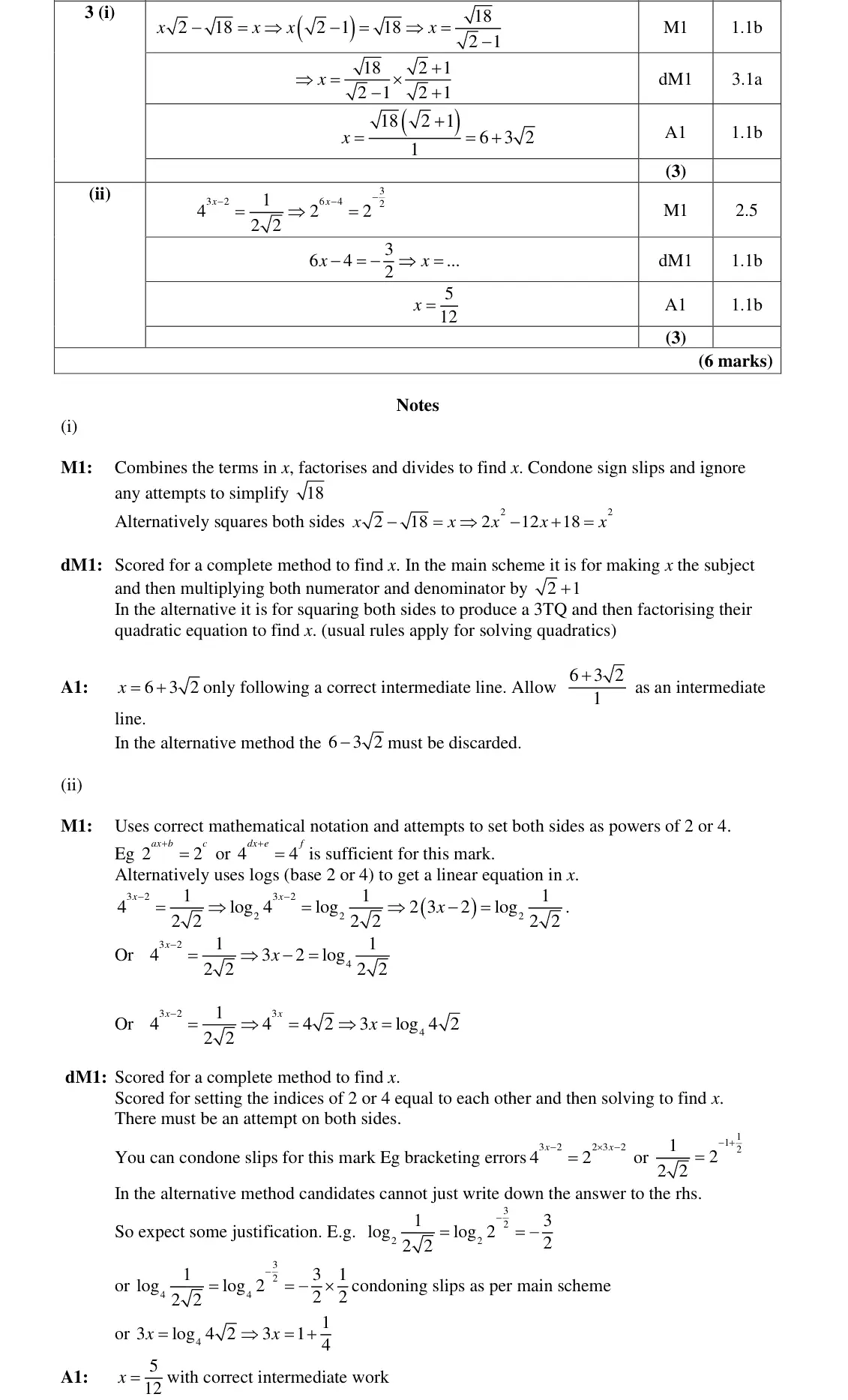
3(i) Indices and surds, Algebraic methods: polynomials, factor theorem and division 3 —
3(ii) Indices and surds, Exponentials and logarithms 3 —
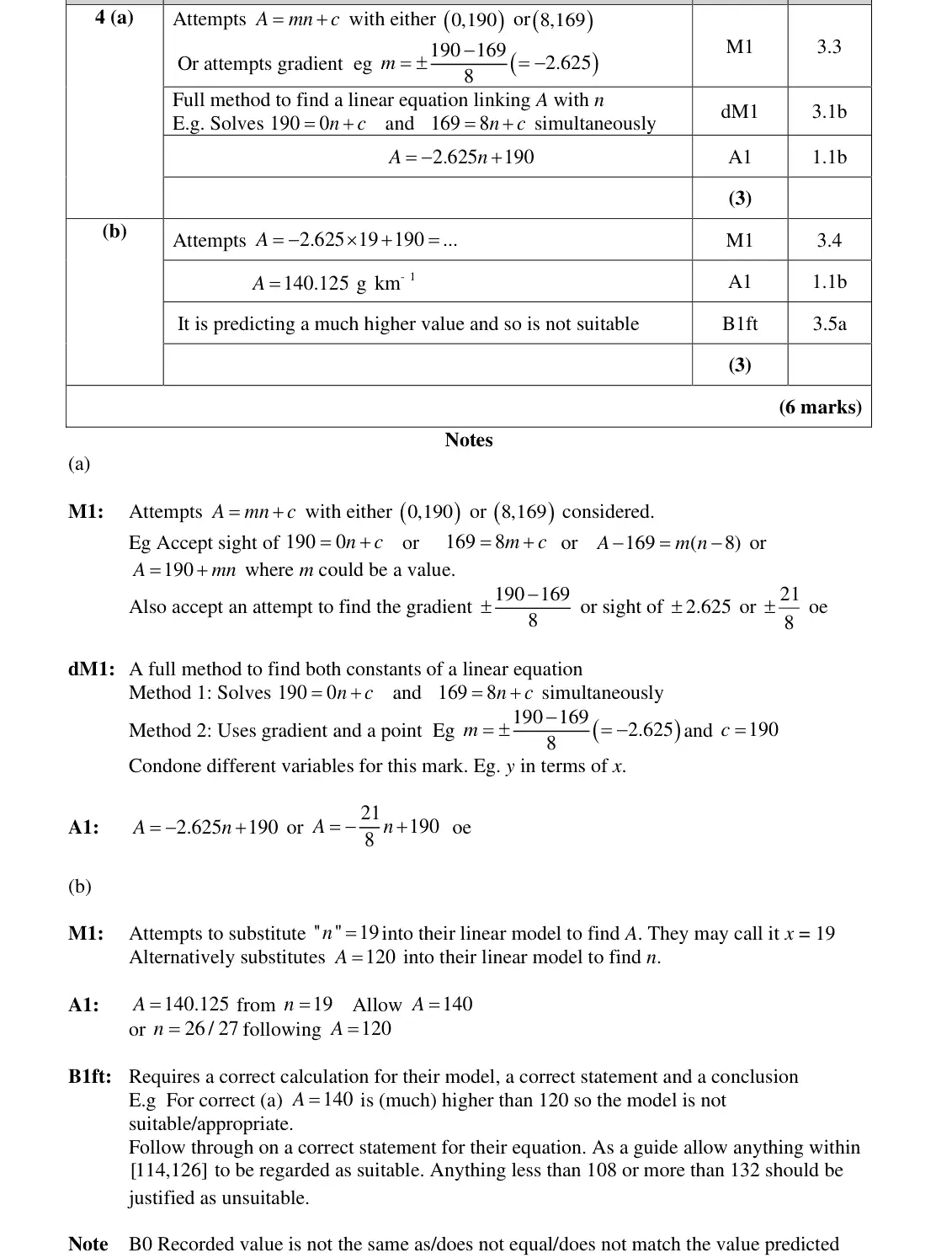
4(a) Straight lines 3 —
4(b) Straight lines 3 —
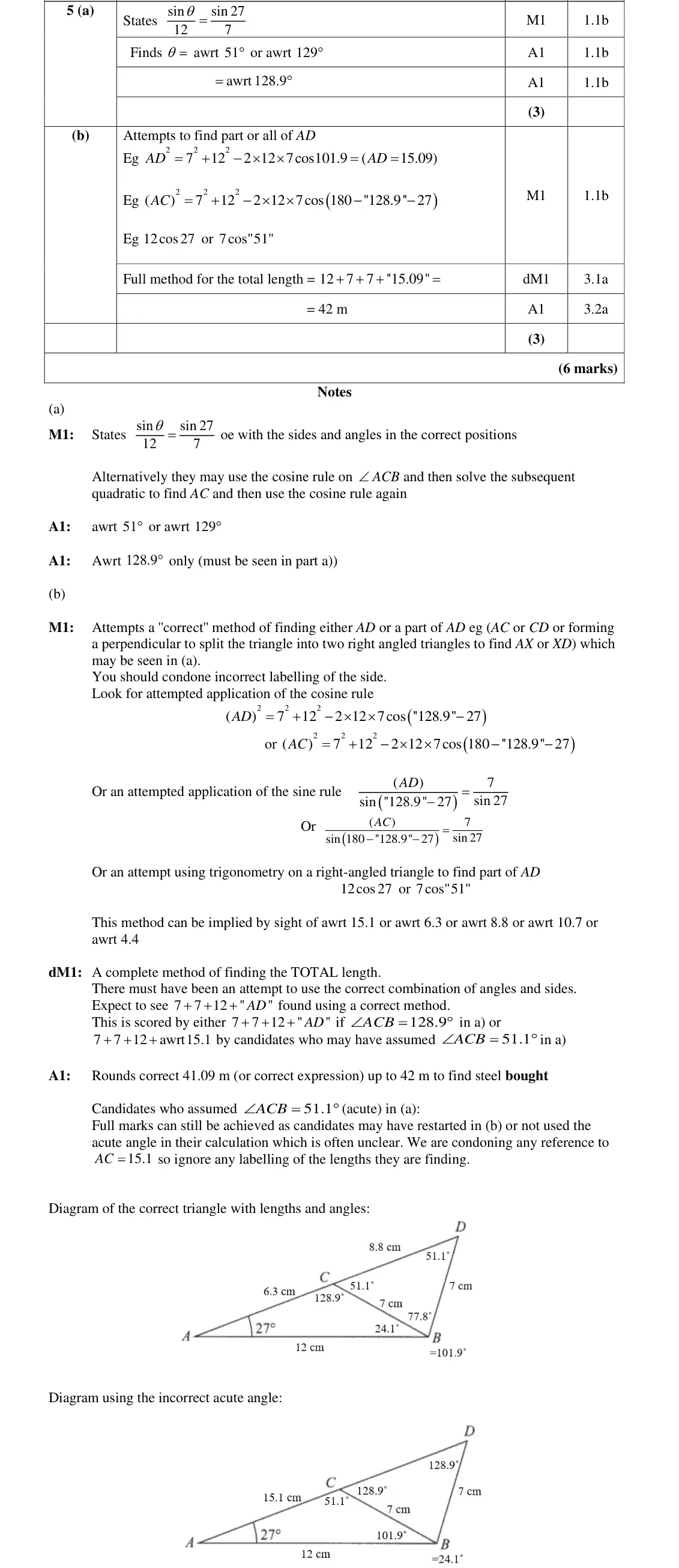
5(a) Trigonometric ratios, graphs, radians and the sine and cosine rules 3 —
5(b) Trigonometric ratios, graphs, radians and the sine and cosine rules 3 —
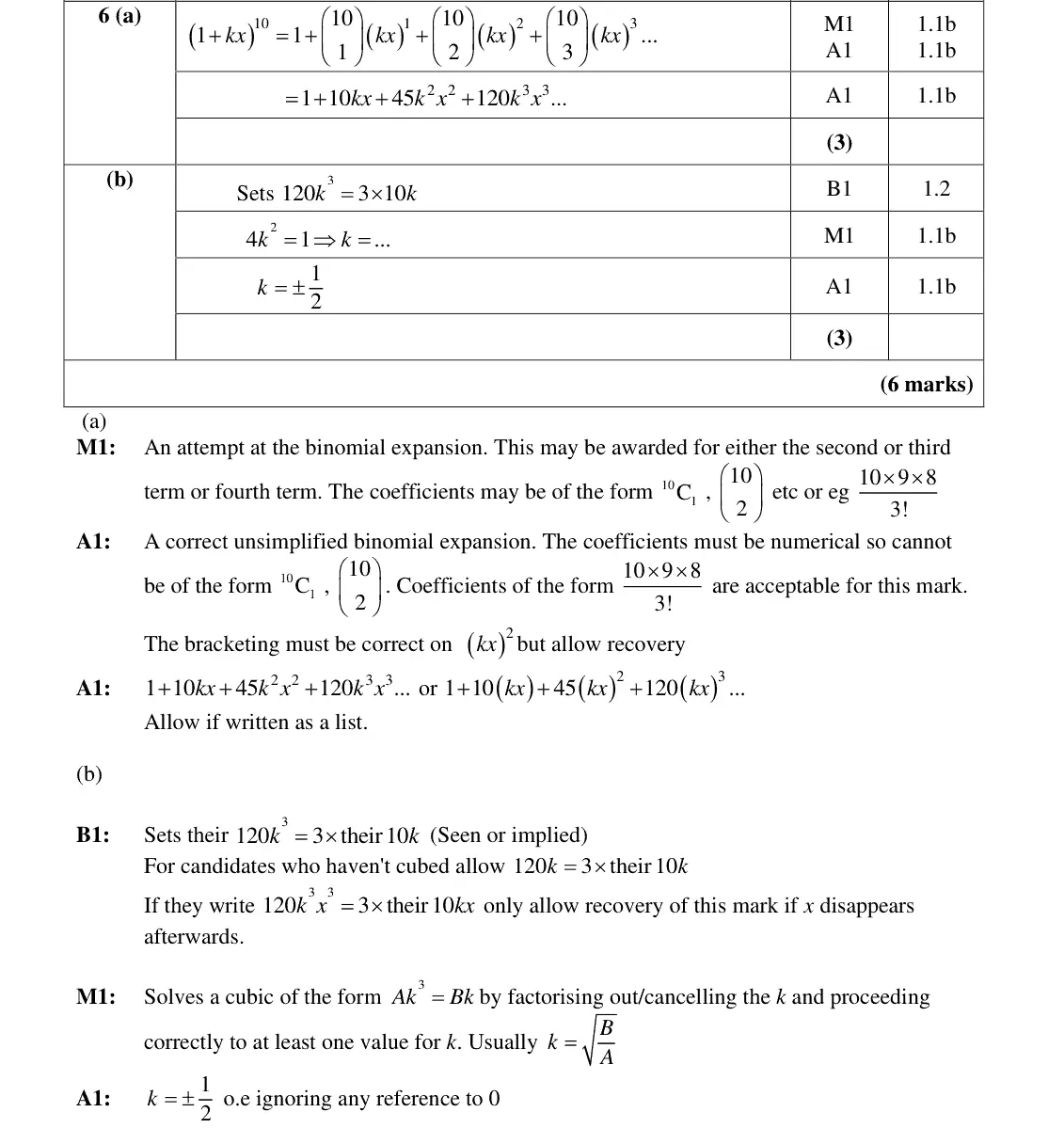
6(a) Binomial expansion 3 —
6(b) Binomial expansion, Quadratics and the discriminant, Algebraic methods: polynomials, factor theorem and division 3 —
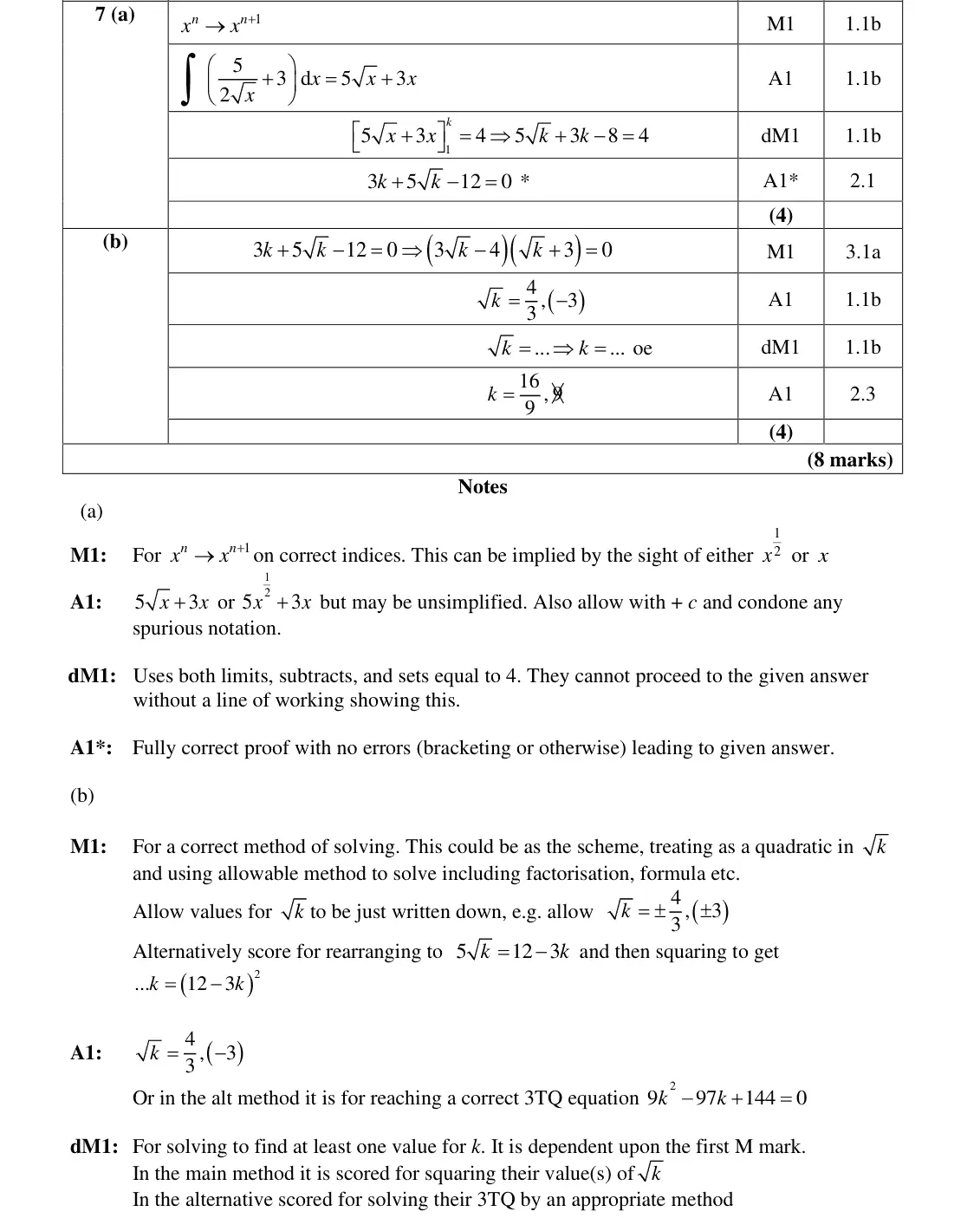
7(a) Integration: standard integrals, definite integrals and areas, Indices and surds 4 —
7(b) Quadratics and the discriminant, Indices and surds, Integration: standard integrals, definite integrals and areas 4 —
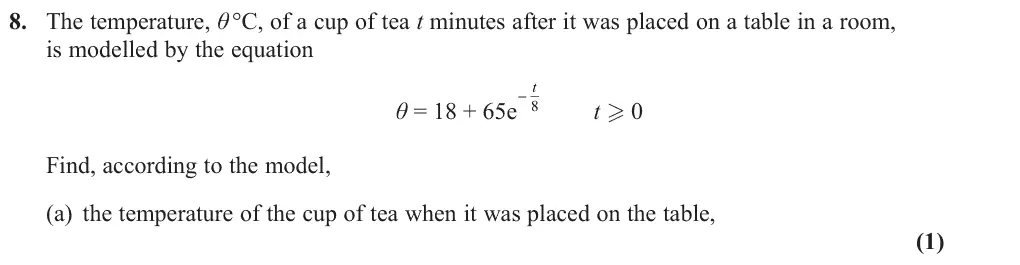
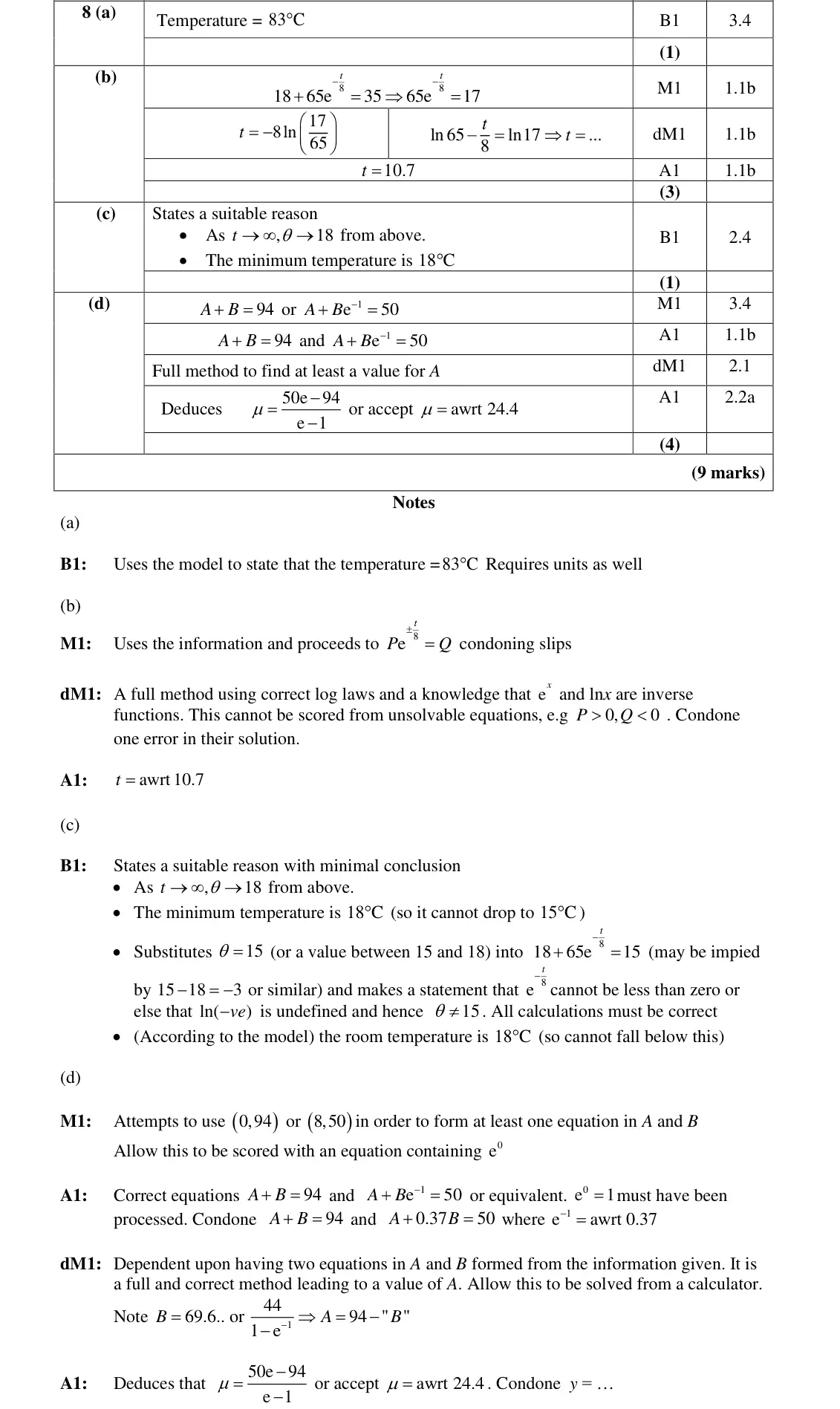
8(a) Exponential growth, decay and modelling, Exponentials and logarithms 1 —
8(b) Exponential growth, decay and modelling, Exponentials and logarithms 3 —
8(c) Exponential growth, decay and modelling, Exponentials and logarithms 1 —
8(d) Exponential growth, decay and modelling, Simultaneous equations, Exponentials and logarithms 4 —
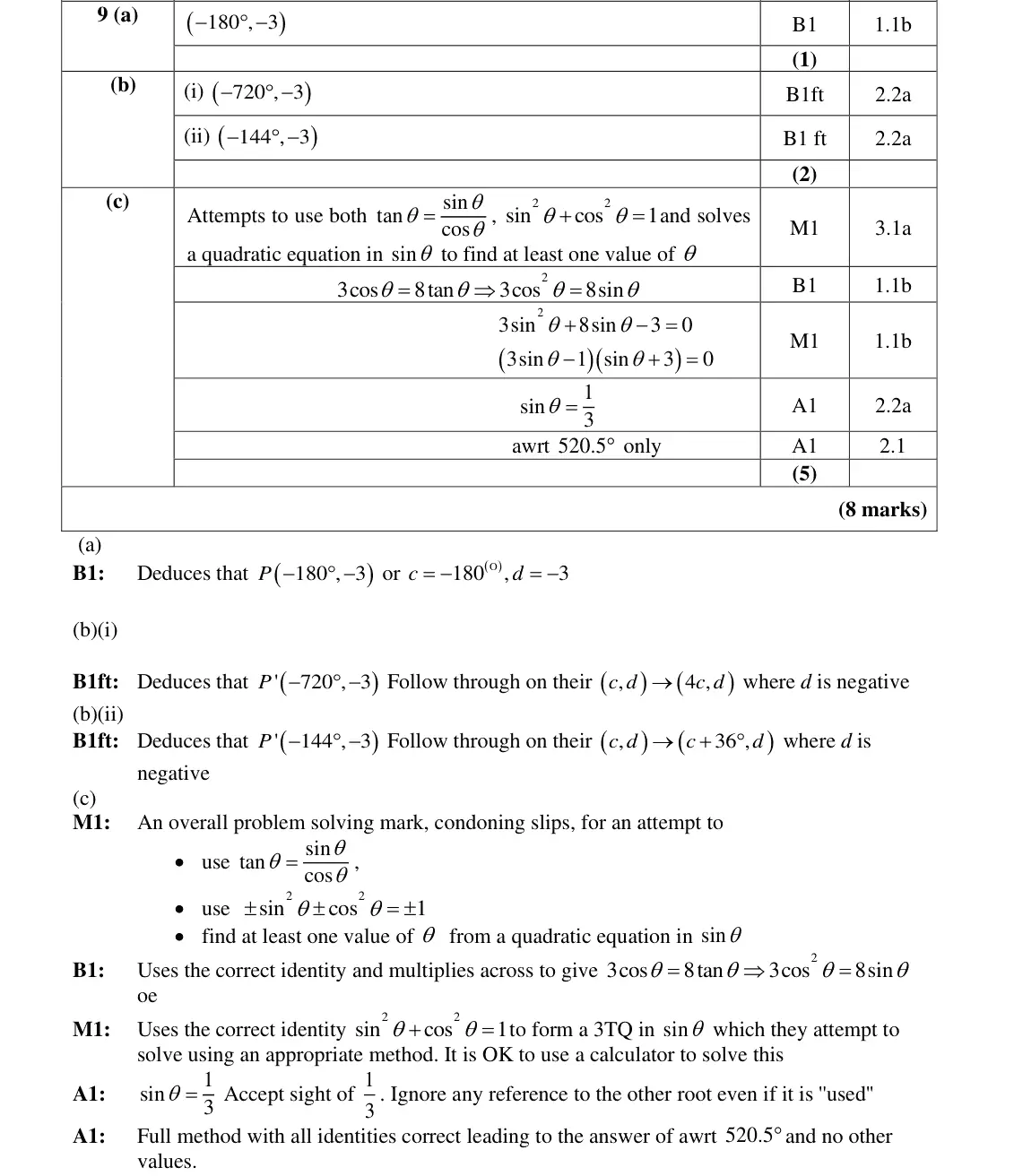
9(a) Trigonometric ratios, graphs, radians and the sine and cosine rules 1 —
9(b) Graphs and transformations, Trigonometric ratios, graphs, radians and the sine and cosine rules 2 —
9(c) Solving trigonometric equations, Trigonometric identities and proofs, Quadratics and the discriminant 5 —
10(a) Algebraic methods: polynomials, factor theorem and division 2 —
10(b) Algebraic methods: polynomials, factor theorem and division 4 —
10(c) Integration: standard integrals, definite integrals and areas, Algebraic methods: polynomials, factor theorem and division, Graphs and transformations 4 —
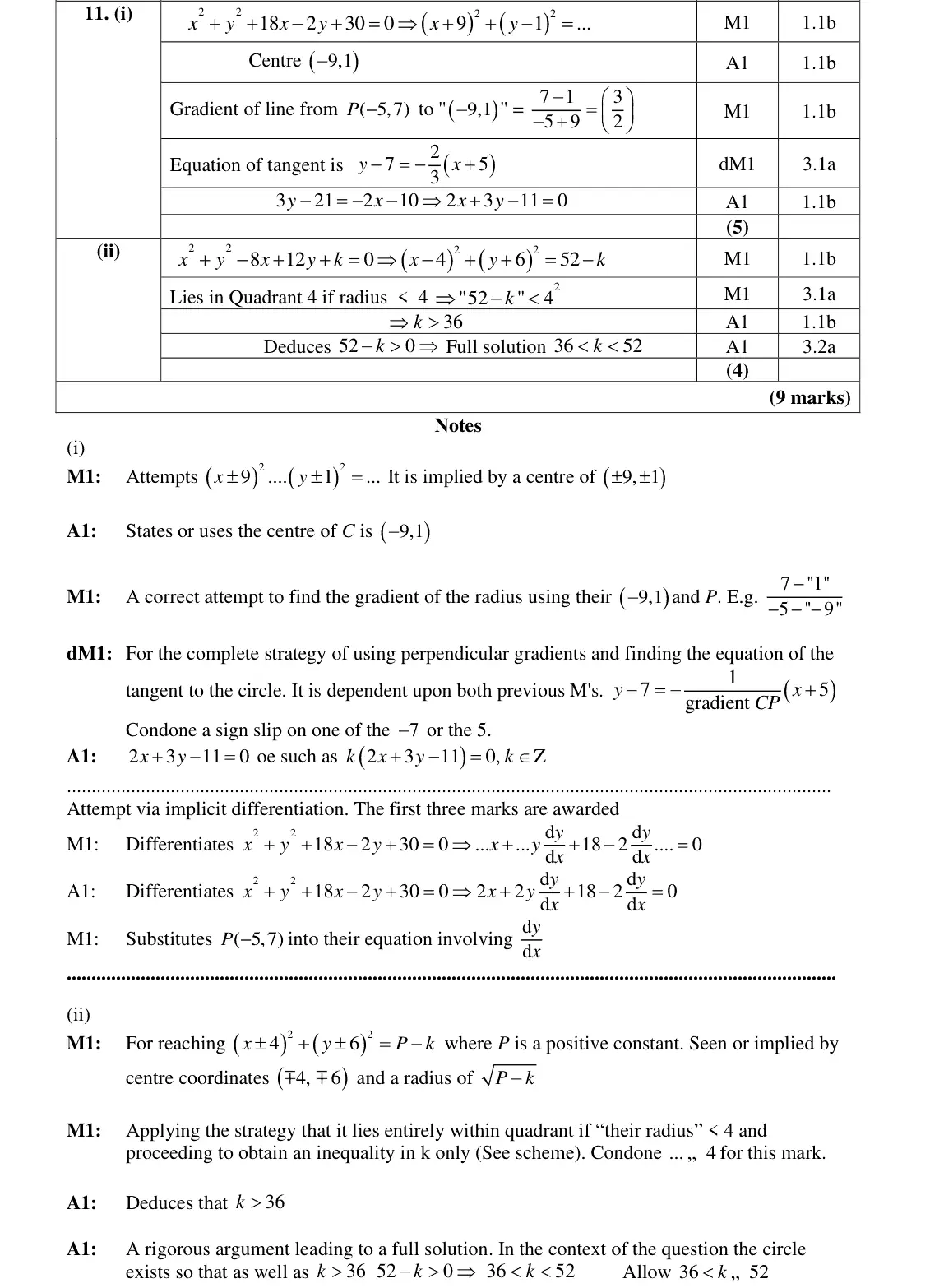
11(i) Circles, Straight lines, Quadratics and the discriminant 5 —
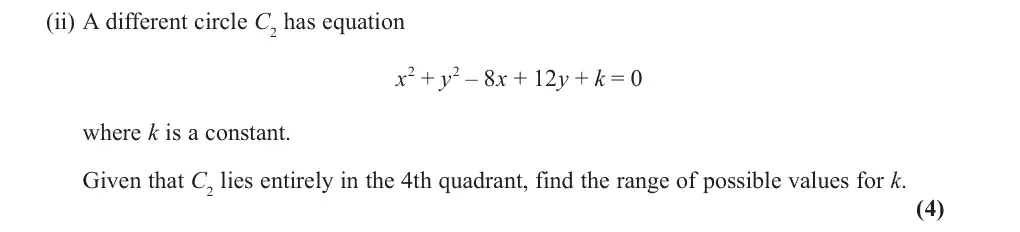
11(ii) Circles, Inequalities, Quadratics and the discriminant 4 —
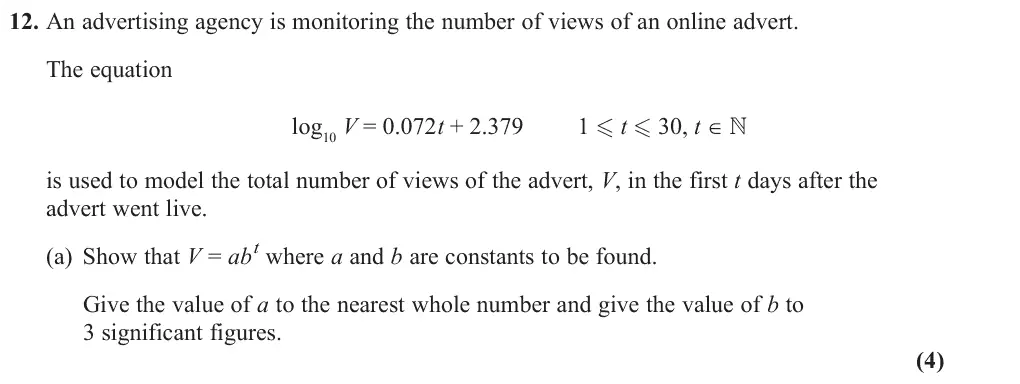
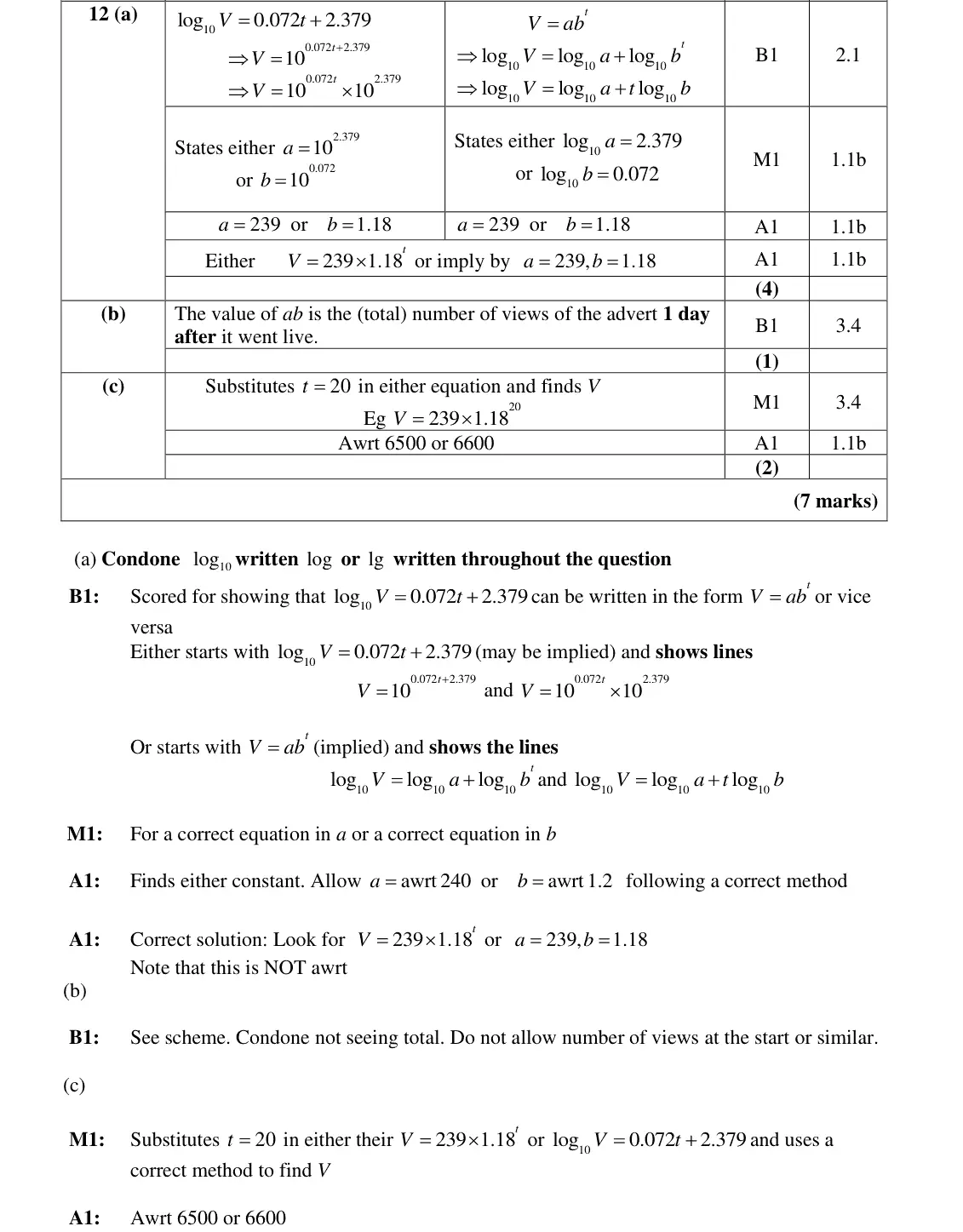
12(a) Exponentials and logarithms, Exponential growth, decay and modelling 4 —
12(b) Exponential growth, decay and modelling, Exponentials and logarithms 1 —
12(c) Exponential growth, decay and modelling, Exponentials and logarithms 2 —
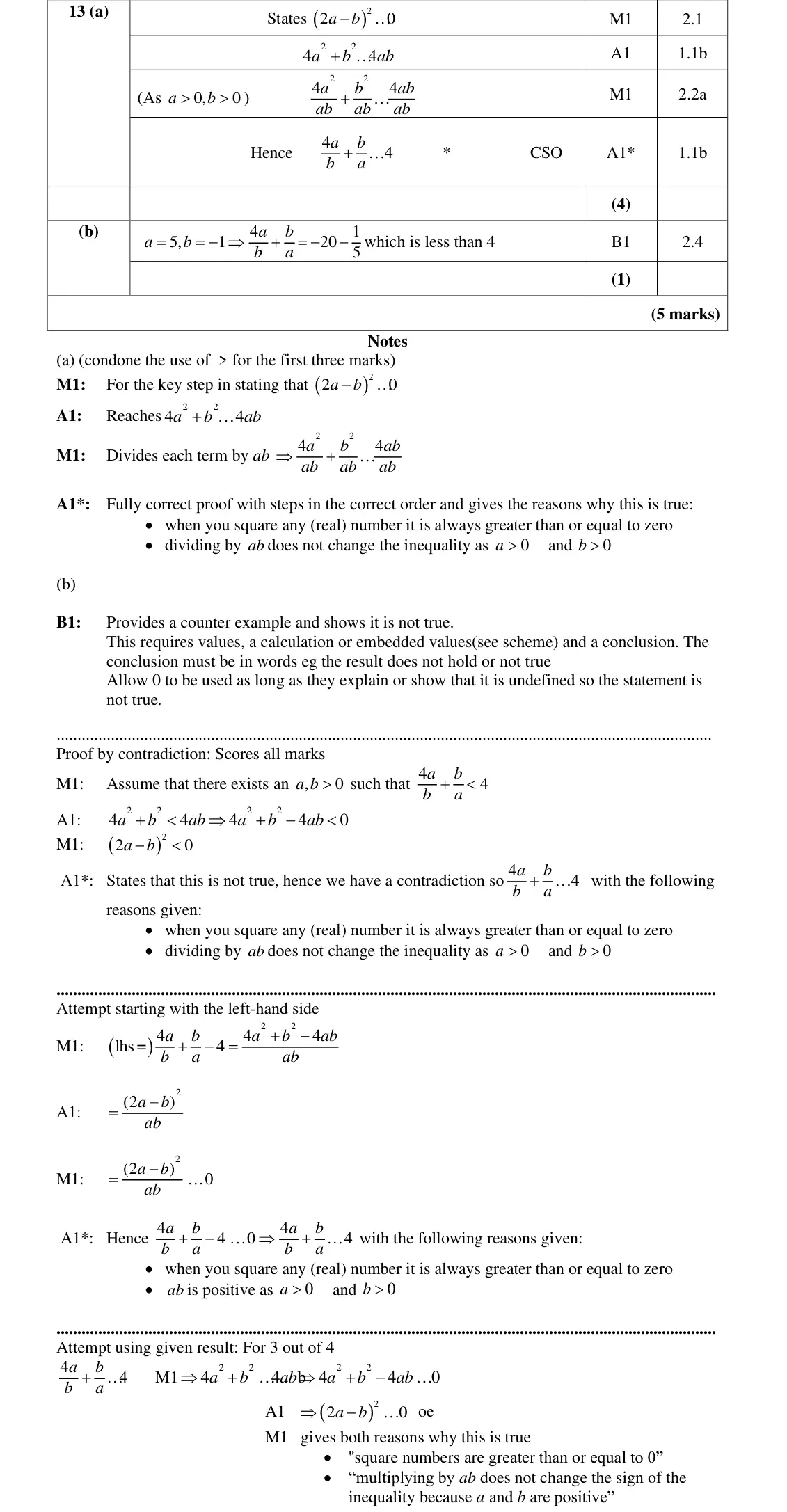
13(a) Proof, including contradiction, Algebraic methods: polynomials, factor theorem and division 4 —
13(b) Proof, including contradiction 1 —
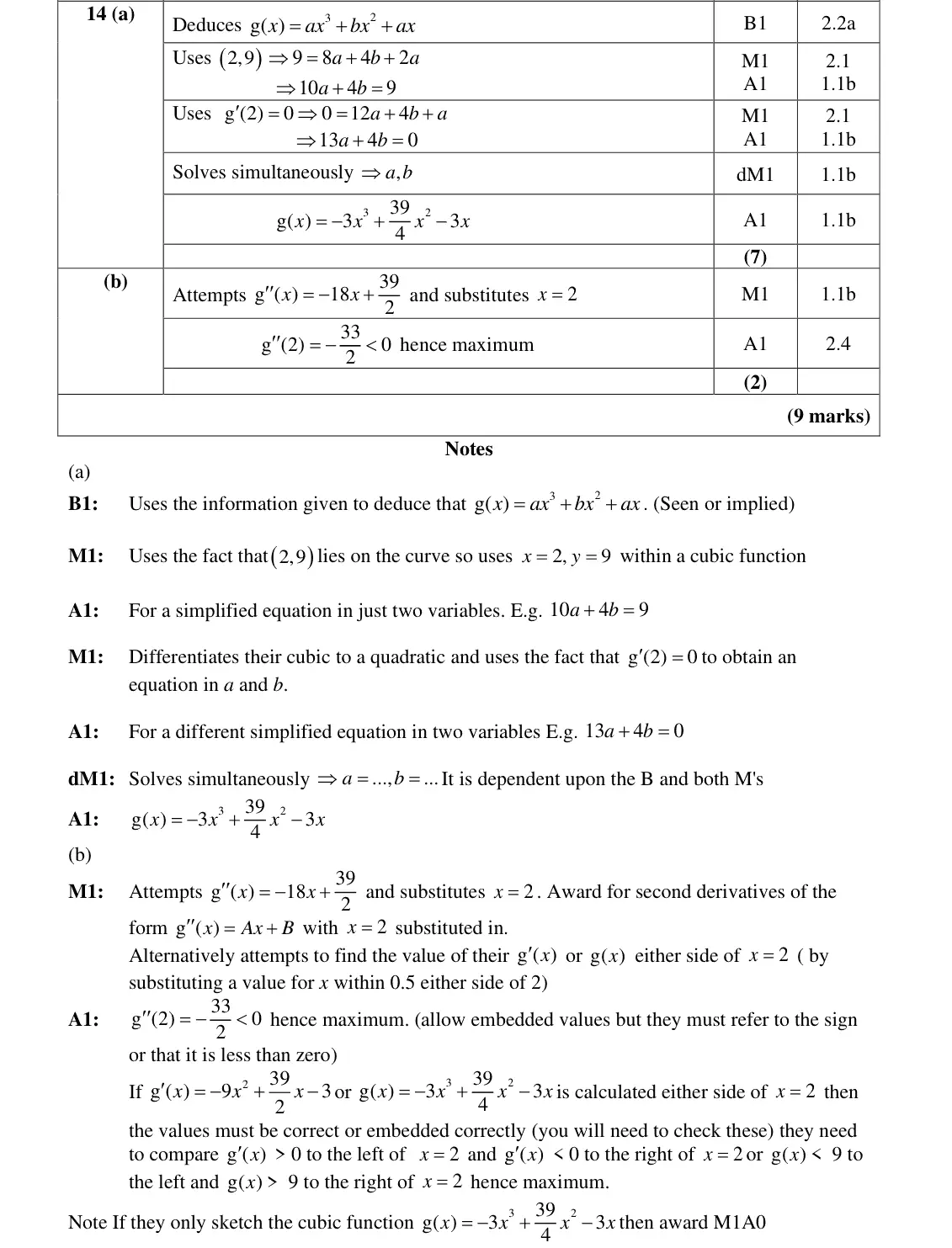
14(a) Differentiation: first principles, gradients, stationary points, Simultaneous equations 7 —
14(b) Differentiation: first principles, gradients, stationary points 2 —

The questions

12(a)2(b)3(i)3(ii)4(a)4(b)5(a)5(b)6(a)6(b)7(a)7(b)8(a)8(b)8(c)8(d)9(a)9(b)9(c)10(a)10(b)10(c)11(i)11(ii)12(a)12(b)12(c)13(a)13(b)14(a)14(b)
Oct 2020 · AS Paper 1 · Q1 5 marks differentiationstraight lines
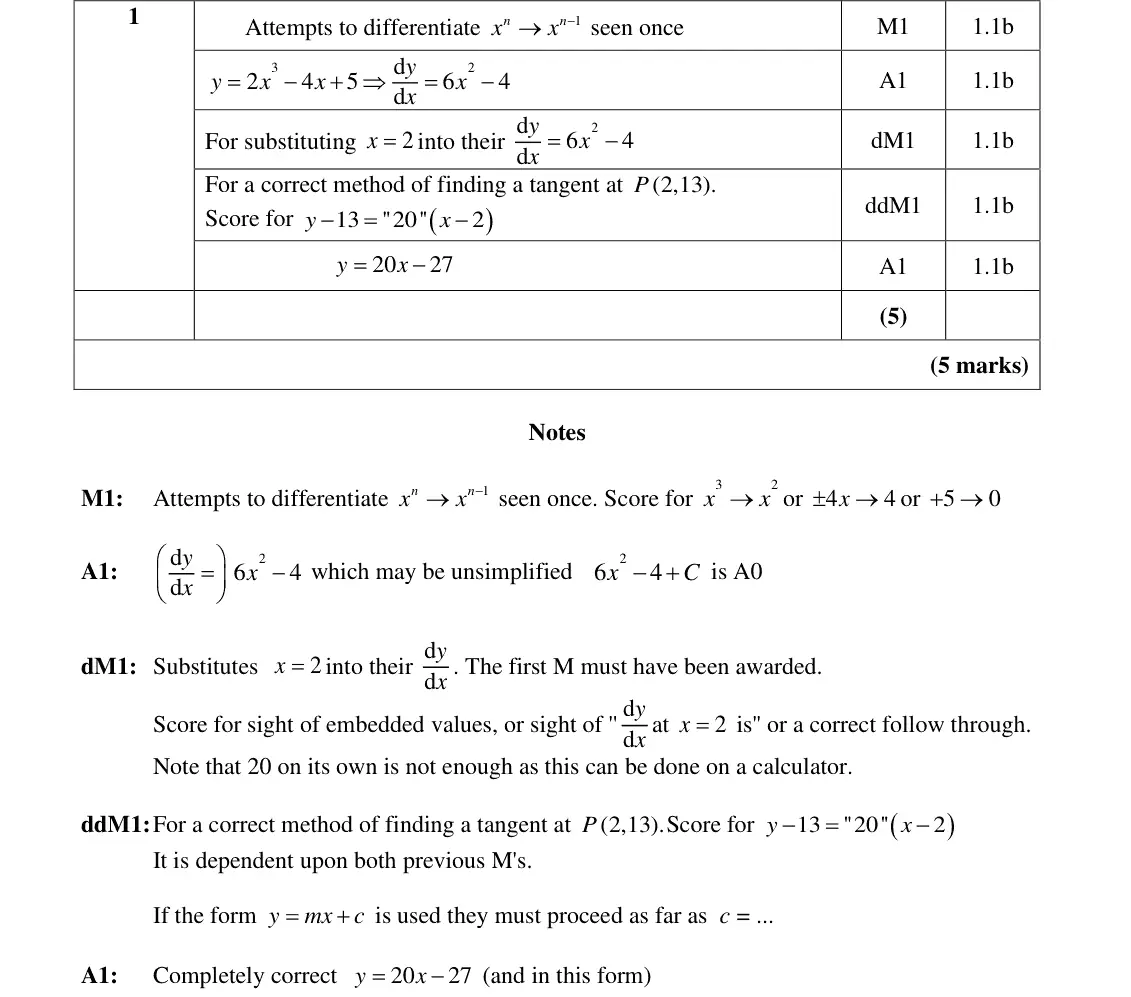
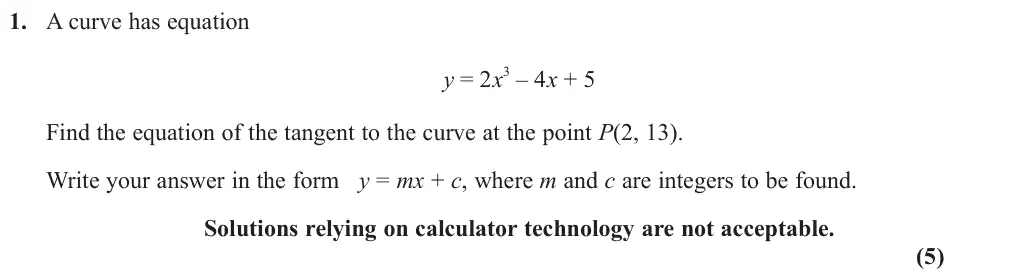
1. A curve has equation y = 2x3 – 4x + 5 Find the equation of the tangent to the curve at the point P(2, 13). Write your answer in the form y = mx + c, where m and c are integers to be found. Solutions relying on calculator technology are not acceptable. (5)
Oct 2020 · AS Paper 1 · Q2(a) 3 marks vectorstrigonometric ratios
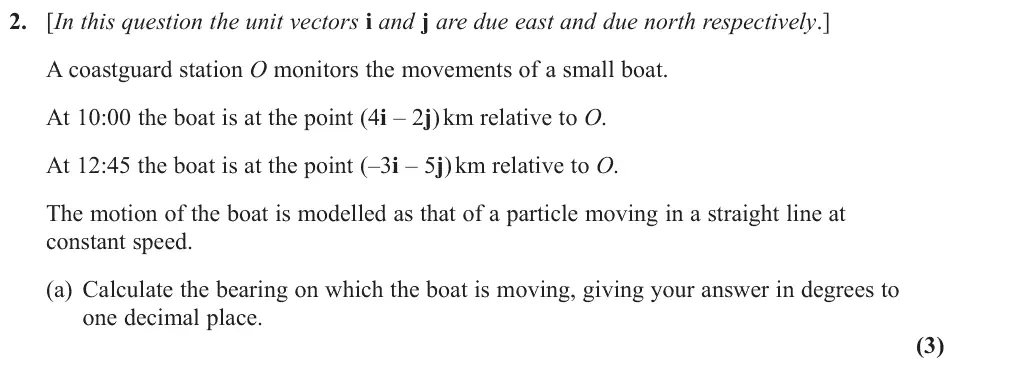
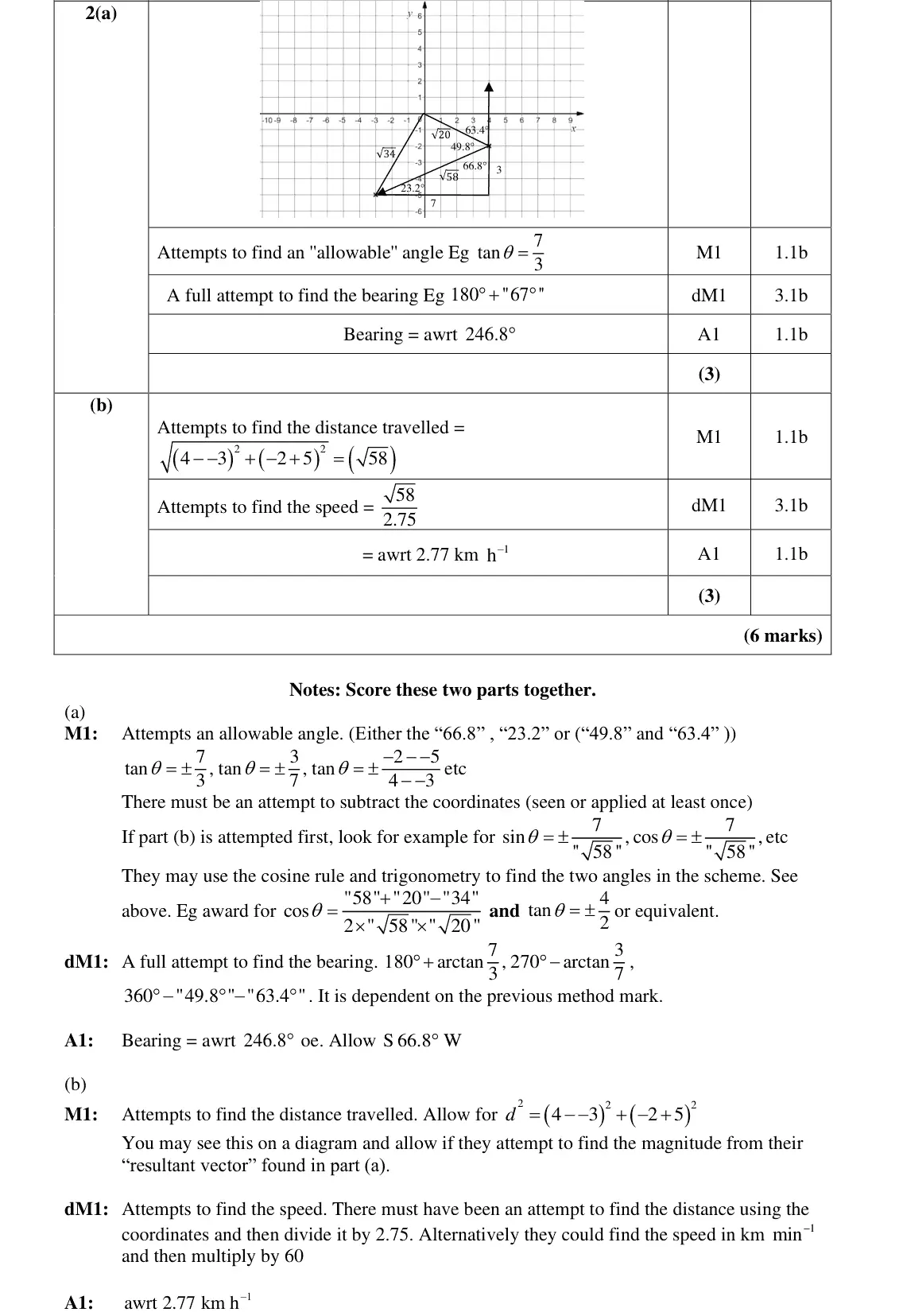
2. [In this question the unit vectors i and j are due east and due north respectively.] A coastguard station O monitors the movements of a small boat. At 10:00 the boat is at the point (4i – 2j) km relative to O. At 12:45 the boat is at the point (–3i – 5j) km relative to O. The motion of the boat is modelled as that of a particle moving in a straight line at constant speed. (a) Calculate the bearing on which the boat is moving, giving your answer in degrees to one decimal place. (3)
Oct 2020 · AS Paper 1 · Q2(b) 3 marks vectors
(b) Calculate the speed of the boat, giving your answer in km h–1 (3)
Oct 2020 · AS Paper 1 · Q3(i) 3 marks indices and surdsalgebraic methods
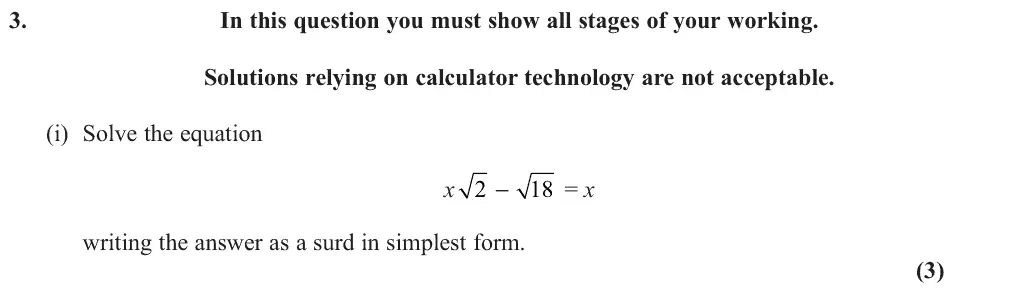
3. In this question you must show all stages of your working. Solutions relying on calculator technology are not acceptable. (i) Solve the equation = x x - writing the answer as a surd in simplest form. (3)
Oct 2020 · AS Paper 1 · Q3(ii) 3 marks indices and surdsexponentials and logs
(ii) Solve the equation 3x – 2 = 2 2 (3)
Oct 2020 · AS Paper 1 · Q4(a) 3 marks straight lines
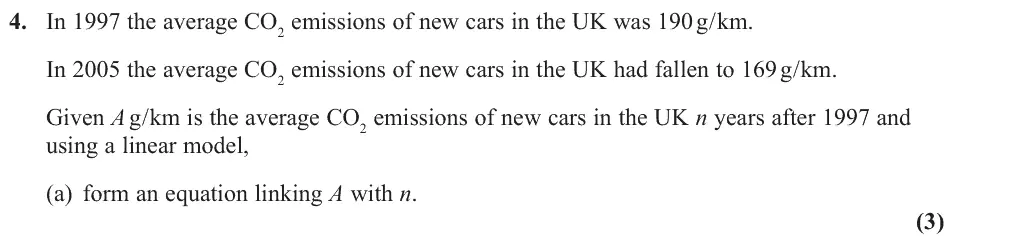
4. In 1997 the average CO2 emissions of new cars in the UK was 190 g/km. In 2005 the average CO2 emissions of new cars in the UK had fallen to 169 g/km. Given A g/km is the average CO2 emissions of new cars in the UK n years after 1997 and using a linear model, (a) form an equation linking A with n. (3)
Oct 2020 · AS Paper 1 · Q4(b) 3 marks straight lines
In 2016 the average CO2 emissions of new cars in the UK was 120 g/km. (b) Comment on the suitability of your model in light of this information. (3)
Oct 2020 · AS Paper 1 · Q5(a) 3 marks trigonometric ratios
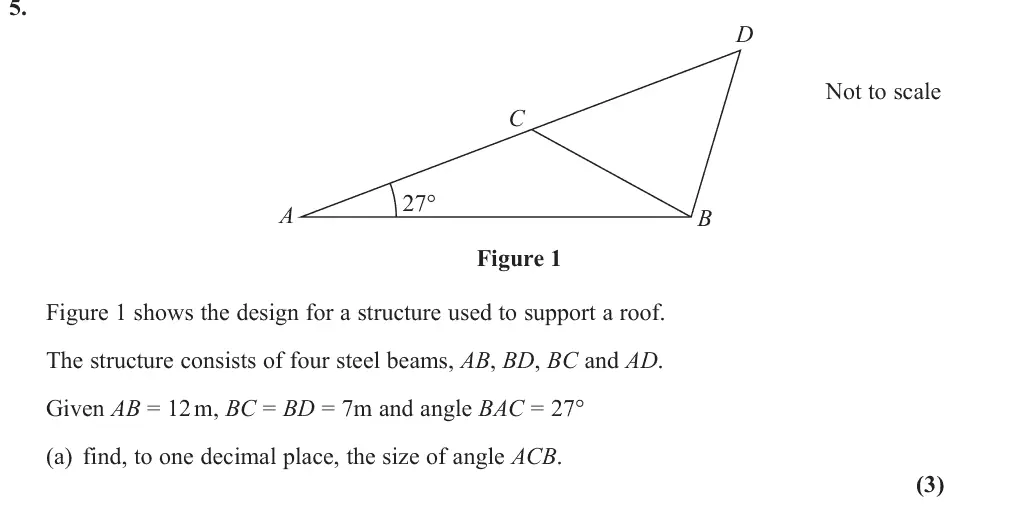
5. Not to scale C 27° A B Figure 1 Figure 1 shows the design for a structure used to support a roof. The structure consists of four steel beams, AB, BD, BC and AD. Given AB = 12 m, BC = BD = 7m and angle BAC = 27° (a) find, to one decimal place, the size of angle ACB. (3)
Oct 2020 · AS Paper 1 · Q5(b) 3 marks trigonometric ratios
The steel beams can only be bought in whole metre lengths. (b) Find the minimum length of steel that needs to be bought to make the complete structure. (3)
Oct 2020 · AS Paper 1 · Q6(a) 3 marks binomial expansion
6. (a) Find the first 4 terms, in ascending powers of x, in the binomial expansion of (1 + kx)10 where k is a non-zero constant. Write each coefficient as simply as possible. (3)
Oct 2020 · AS Paper 1 · Q6(b) 3 marks binomial expansionquadraticsalgebraic methods
Given that in the expansion of (1 + kx)10 the coefficient x3 is 3 times the coefficient of x, (b) find the possible values of k. (3)
Oct 2020 · AS Paper 1 · Q7(a) 4 marks integrationindices and surds
k ∫ 7. Given that k is a positive constant and + x = d x (a) show that 3k + 5 k – 12 = 0 (4)
Oct 2020 · AS Paper 1 · Q7(b) 4 marks quadraticsindices and surdsintegration
(b) Hence, using algebra, find any values of k such that k ∫ x + = d x (4)
Oct 2020 · AS Paper 1 · Q8(a) 1 mark exponential modellingexponentials and logs
8. The temperature, theta °C, of a cup of tea t minutes after it was placed on a table in a room, is modelled by the equation -t theta = 18 + 65e 8 t 0 Find, according to the model, (a) the temperature of the cup of tea when it was placed on the table, (1)
Oct 2020 · AS Paper 1 · Q8(b) 3 marks exponential modellingexponentials and logs
(b) the value of t, to one decimal place, when the temperature of the cup of tea was 35 °C. (3)
Oct 2020 · AS Paper 1 · Q8(c) 1 mark exponential modellingexponentials and logs
(c) Explain why, according to this model, the temperature of the cup of tea could not fall to 15 °C. (1)
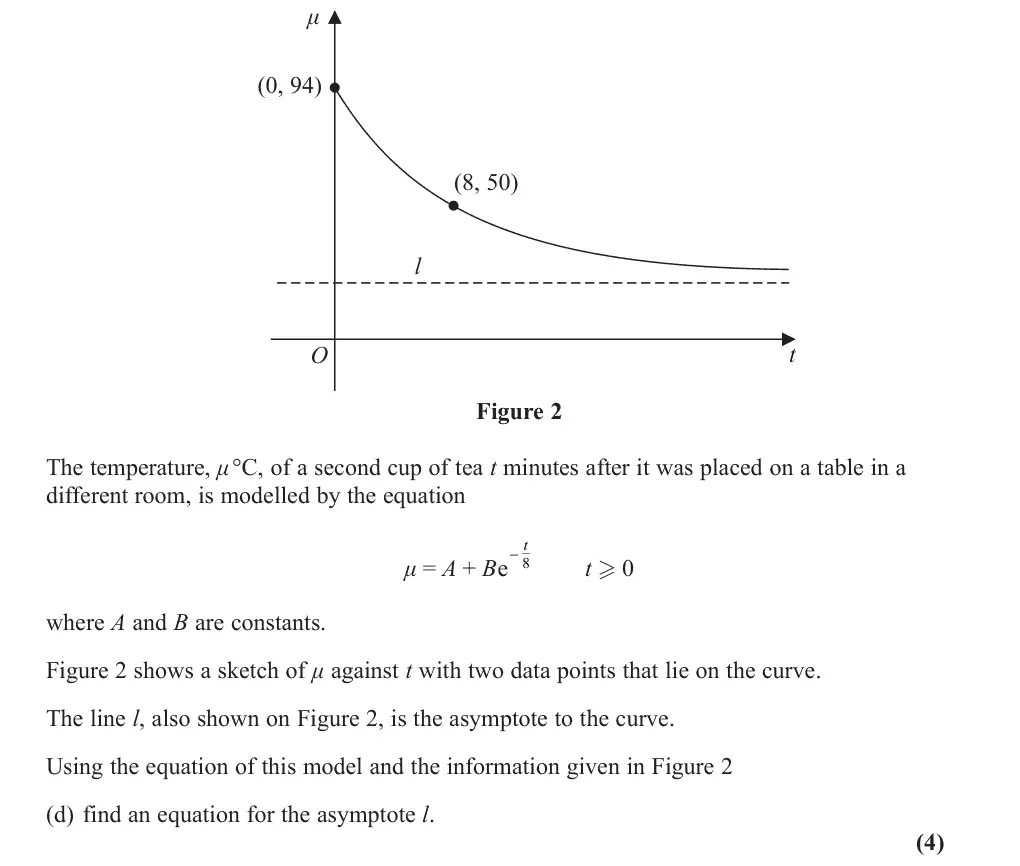
μ (0, 94) (8, 50) l t Figure 2 The temperature, μ °C, of a second cup of tea t minutes after it was placed on a table in a different room, is modelled by the equation -t μ = A + Be 8 t 0 where A and B are constants. Figure 2 shows a sketch of μ against t with two data points that lie on the curve. The line l, also shown on Figure 2, is the asymptote to the curve. Using the equation of this model and the information given in Figure 2 (d) find an equation for the asymptote l. (4)
Oct 2020 · AS Paper 1 · Q9(a) 1 mark trigonometric ratios
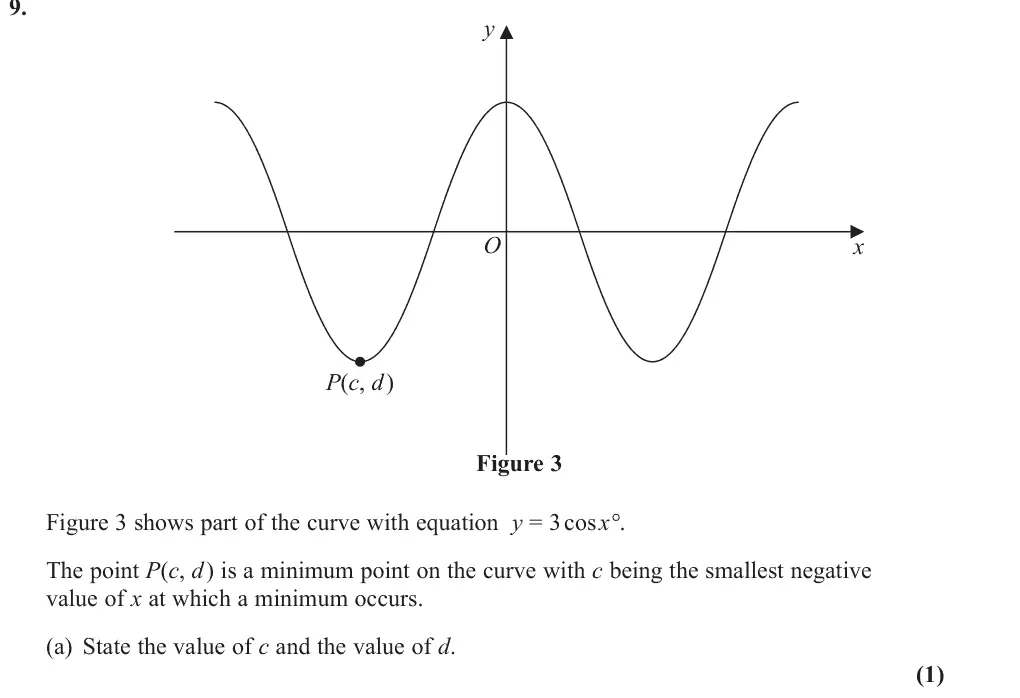
9. y x P(c, d) Figure 3 Figure 3 shows part of the curve with equation y = 3 cos x°. The point P(c, d) is a minimum point on the curve with c being the smallest negative value of x at which a minimum occurs. (a) State the value of c and the value of d. (1)
Oct 2020 · AS Paper 1 · Q9(b) 2 marks graphs and transformationstrigonometric ratios
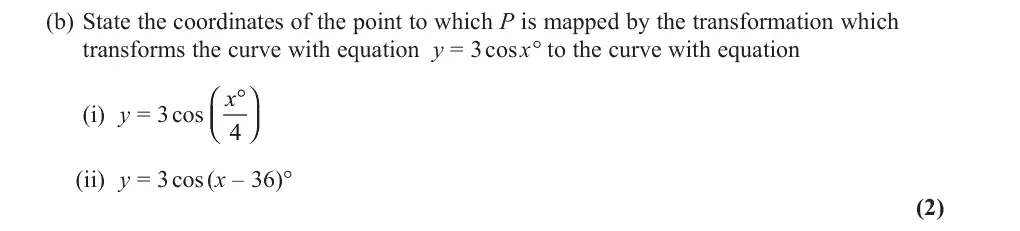
(b) State the coordinates of the point to which P is mapped by the transformation which transforms the curve with equation y = 3 cos x° to the curve with equation (i) y = 3 cos x° (ii) y = 3 cos (x – 36)° (2)
Oct 2020 · AS Paper 1 · Q9(c) 5 marks trigonometric equationstrig identitiesquadratics
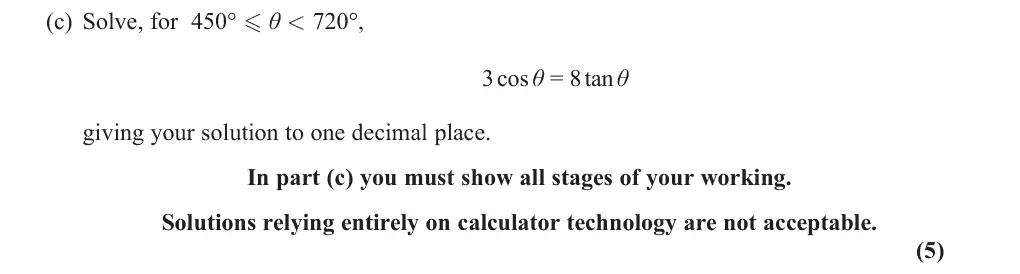
(c) Solve, for 450° theta < 720°, 3 cos theta = 8 tan theta giving your solution to one decimal place. In part (c) you must show all stages of your working. Solutions relying entirely on calculator technology are not acceptable. (5)
Oct 2020 · AS Paper 1 · Q10(a) 2 marks algebraic methods
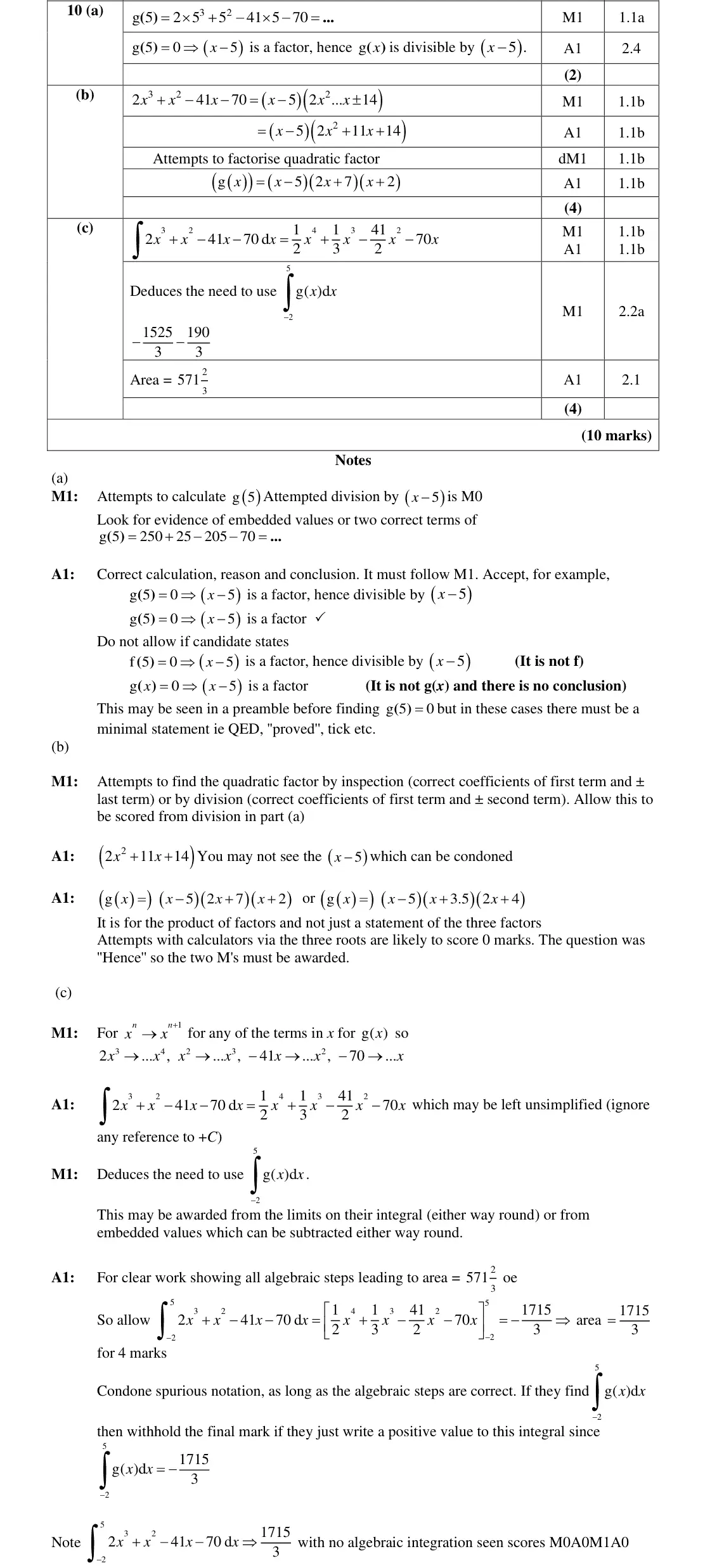
10. g(x) = 2x3 + x2 – 41x – 70 (a) Use the factor theorem to show that g(x) is divisible by (x – 5). (2)
Oct 2020 · AS Paper 1 · Q10(b) 4 marks algebraic methods
(b) Hence, showing all your working, write g(x) as a product of three linear factors. (4)
Oct 2020 · AS Paper 1 · Q10(c) 4 marks integrationalgebraic methodsgraphs and transformations
The finite region R is bounded by the curve with equation y = g(x) and the x‑axis, and lies below the x‑axis. (c) Find, using algebraic integration, the exact value of the area of R. (4)
Oct 2020 · AS Paper 1 · Q11(i) 5 marks circlesstraight linesquadratics
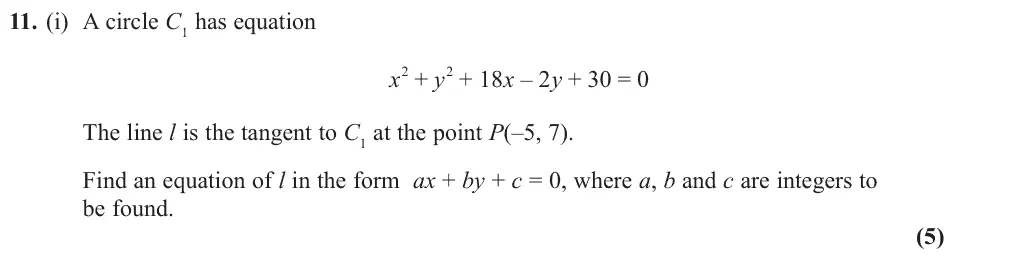
11. (i) A circle C1 has equation x2 + y2 + 18x – 2y + 30 = 0 The line l is the tangent to C1 at the point P(–5, 7). Find an equation of l in the form ax + by + c = 0, where a, b and c are integers to be found. (5)
Oct 2020 · AS Paper 1 · Q11(ii) 4 marks circlesinequalitiesquadratics
(ii) A different circle C2 has equation x2 + y2 – 8x + 12y + k = 0 where k is a constant. Given that C2 lies entirely in the 4th quadrant, find the range of possible values for k. (4)
Oct 2020 · AS Paper 1 · Q12(a) 4 marks exponentials and logsexponential modelling
12. An advertising agency is monitoring the number of views of an online advert. The equation log10 V = 0.072t + 2.379 1 t 30, t ∈ is used to model the total number of views of the advert, V, in the first t days after the advert went live. (a) Show that V = abt where a and b are constants to be found. Give the value of a to the nearest whole number and give the value of b to 3 significant figures. (4)
Oct 2020 · AS Paper 1 · Q12(b) 1 mark exponential modellingexponentials and logs
(b) Interpret, with reference to the model, the value of ab. (1)
Oct 2020 · AS Paper 1 · Q12(c) 2 marks exponential modellingexponentials and logs
Using this model, calculate (c) the total number of views of the advert in the first 20 days after the advert went live. Give your answer to 2 significant figures. (2)
Oct 2020 · AS Paper 1 · Q13(a) 4 marks proofalgebraic methods
13. (a) Prove that for all positive values of a and b 4a b 4 + b a (4)
Oct 2020 · AS Paper 1 · Q13(b) 1 mark proof
(b) Prove, by counter example, that this is not true for all values of a and b. (1)
Oct 2020 · AS Paper 1 · Q14(a) 7 marks differentiationsimultaneous equations
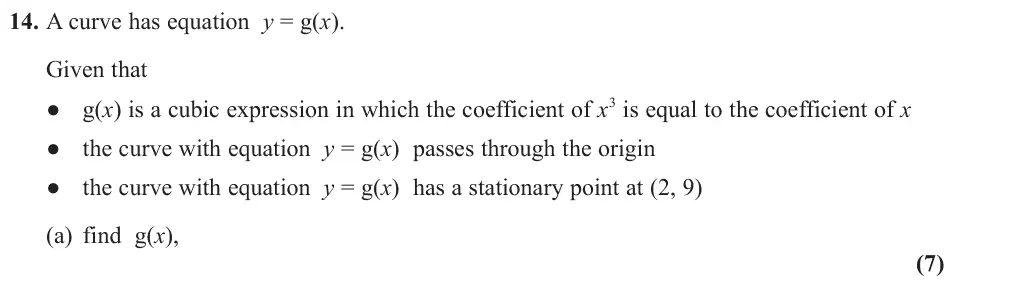
14. A curve has equation y = g(x). Given that ● g(x) is a cubic expression in which the coefficient of x3 is equal to the coefficient of x ● the curve with equation y = g(x) passes through the origin ● the curve with equation y = g(x) has a stationary point at (2, 9) (a) find g(x), (7)
Oct 2020 · AS Paper 1 · Q14(b) 2 marks differentiation
(b) prove that the stationary point at (2, 9) is a maximum. (2)

Find an Edexcel maths tutor

Want this paper marked and gone through with you? Message us.

Prefer email? Send an enquiry

If you are under 18, please include a parent's contact details. Enquiries go to enquiries@mathsaleveltutor.com and are deleted once handled.