June 2025: AS AS Paper 1: Pure Mathematics

100 marks · 35 question parts · Question paper, mark scheme and examiner's report on Pearson's site

Question by question

QTopicMarksDifficulty
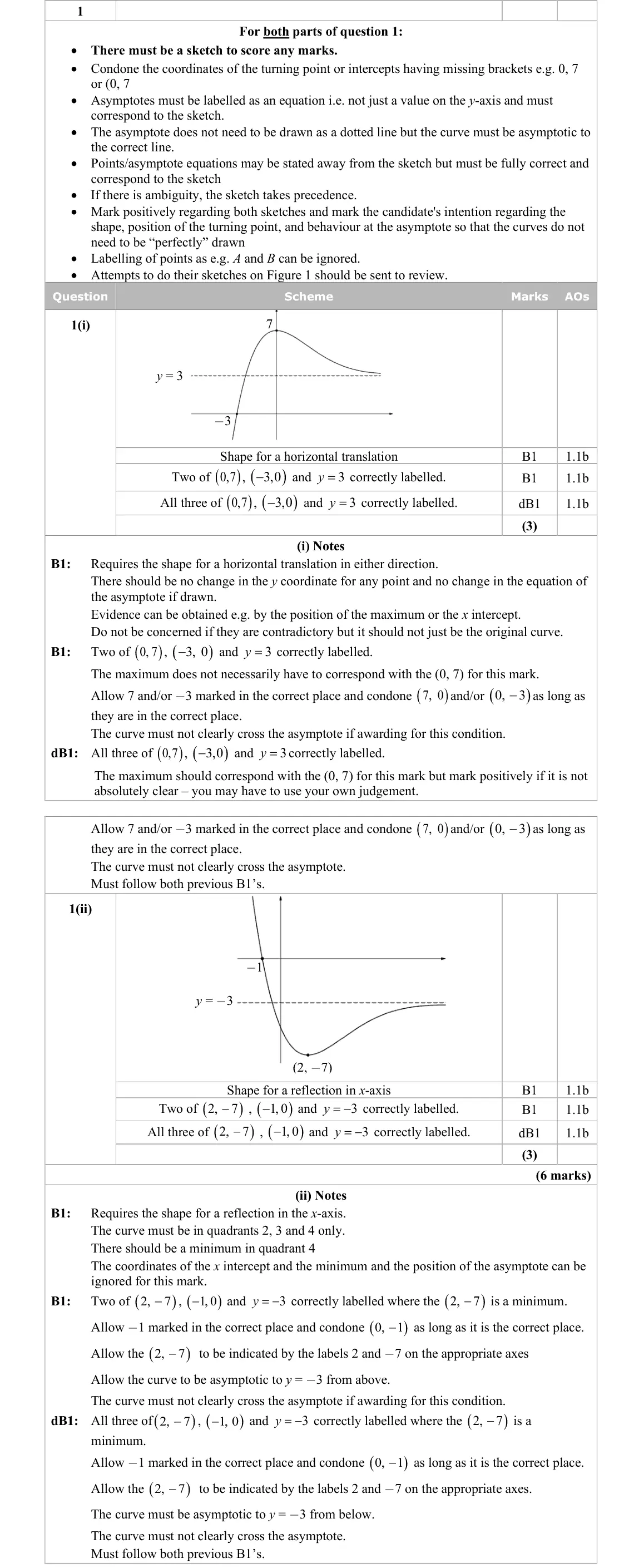
1(i) Graphs and transformations 3 —
1(ii) Graphs and transformations 3 —
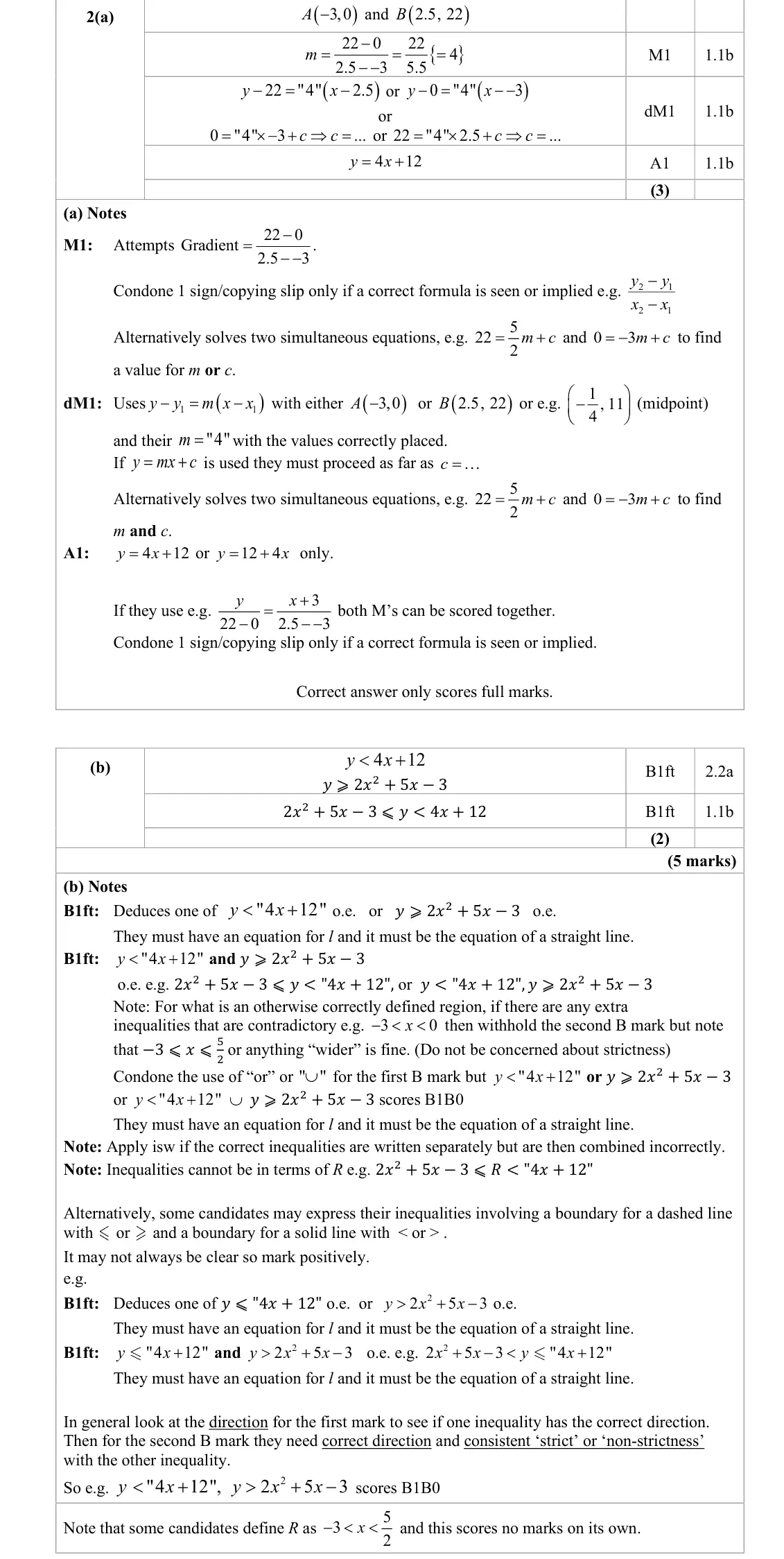
2(a) Straight lines 3 —
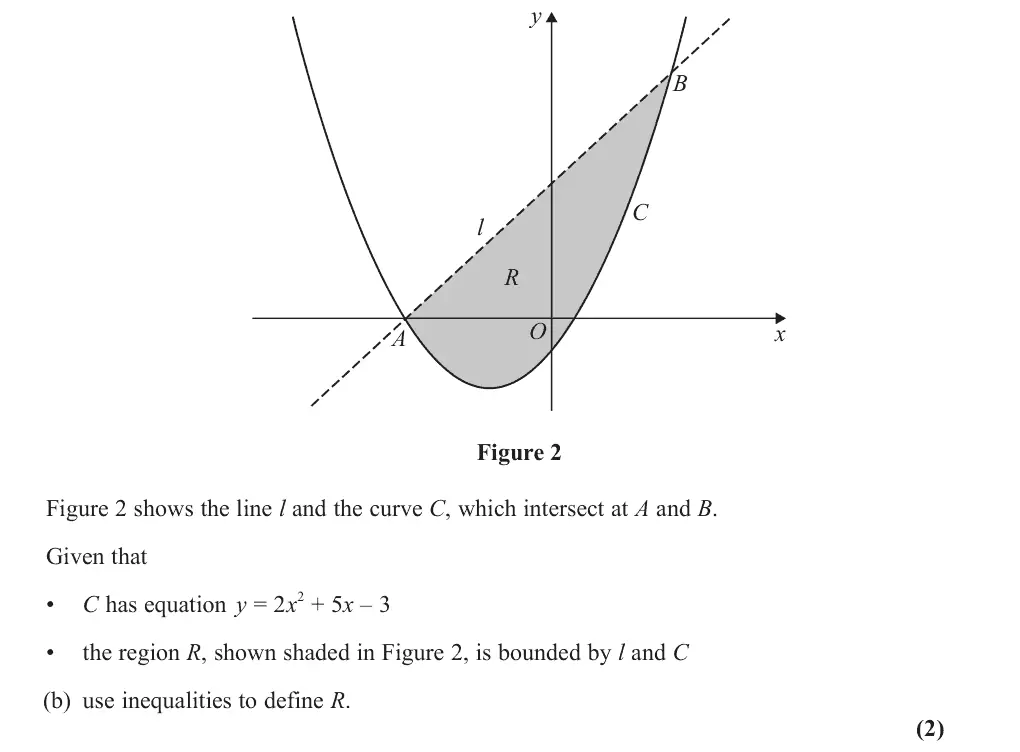
2(b) Inequalities, Straight lines 2 —
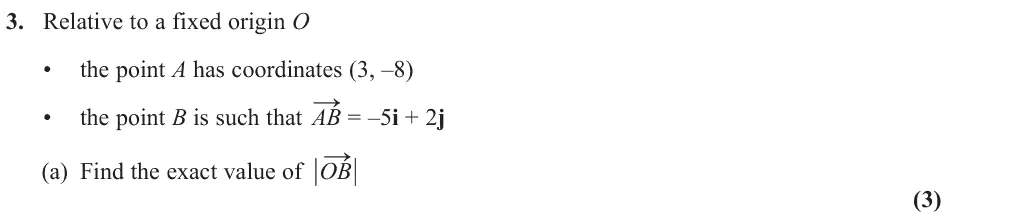
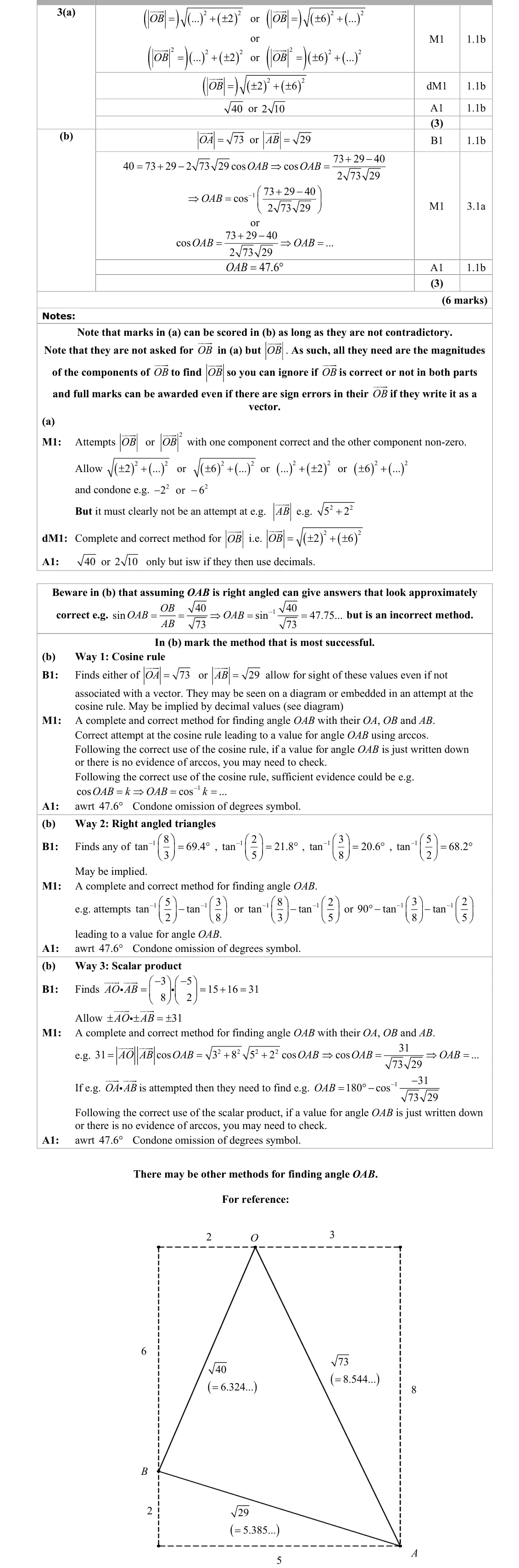
3(a) Vectors 3 —
3(b) Trigonometric ratios, graphs, radians and the sine and cosine rules, Vectors 3 —
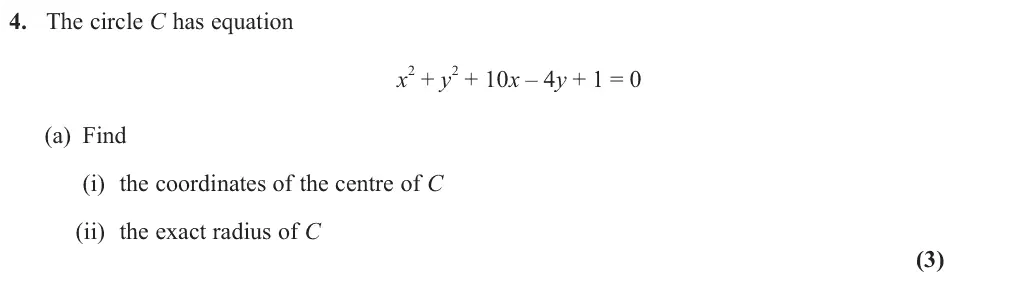
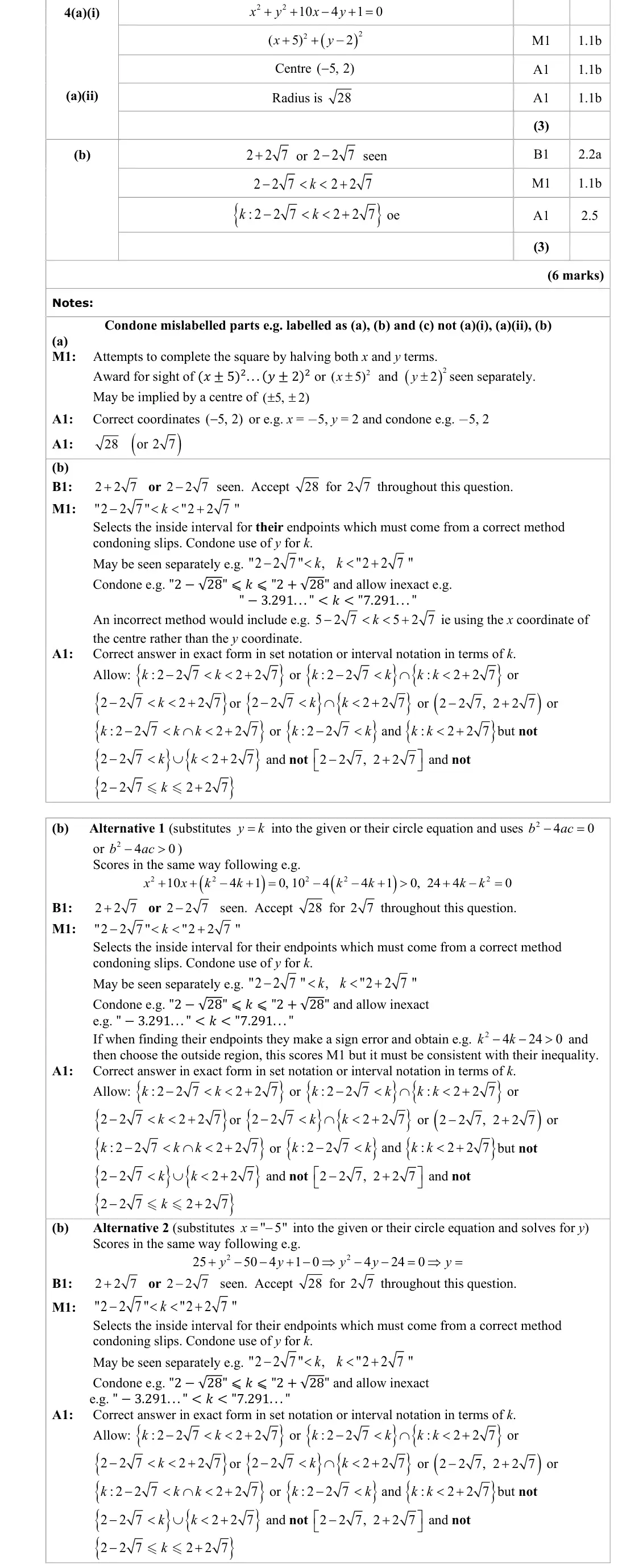
4(a) Circles, Quadratics and the discriminant 3 —
4(b) Circles, Inequalities, Quadratics and the discriminant 3 —
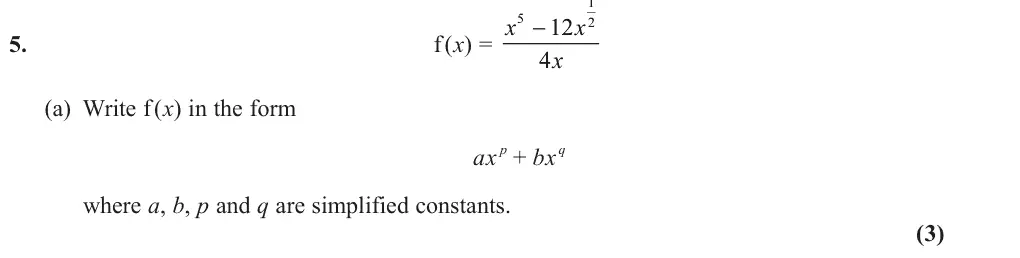
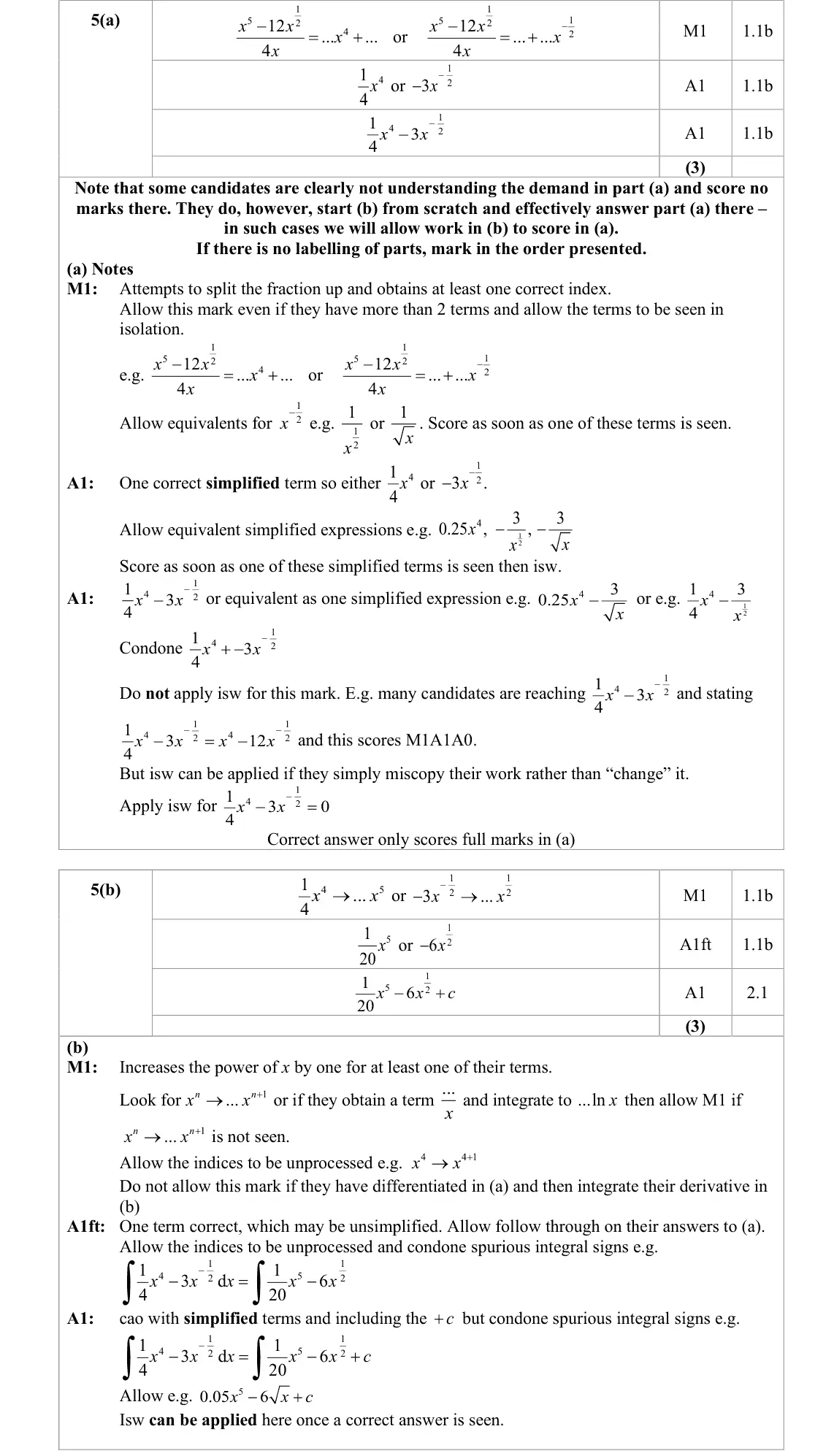
5(a) Indices and surds 3 —
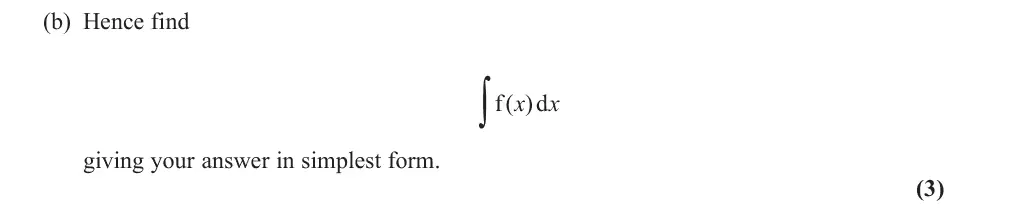
5(b) Integration: standard integrals, definite integrals and areas, Indices and surds 3 —
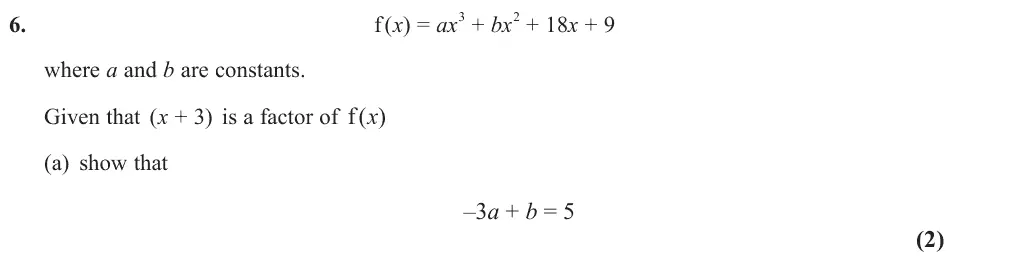
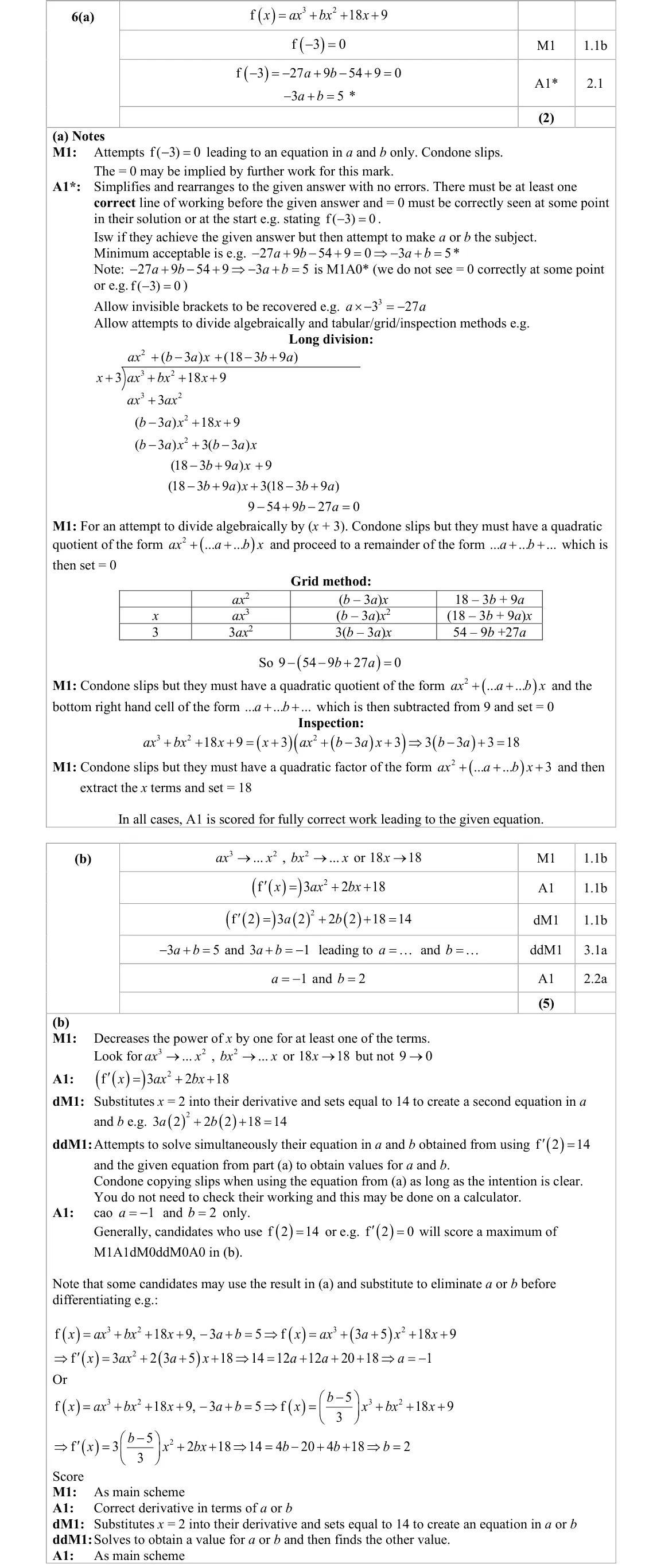
6(a) Algebraic methods: polynomials, factor theorem and division 2 —
6(b) Differentiation: first principles, gradients, stationary points, Simultaneous equations 5 —
7(a) Quadratics and the discriminant, Functions, composite and inverse functions, modulus 2 —
7(b) Quadratics and the discriminant, Inequalities, Functions, composite and inverse functions, modulus 3 —
7(c) Quadratics and the discriminant, Functions, composite and inverse functions, modulus 3 —
7(d) Quadratics and the discriminant, Functions, composite and inverse functions, modulus 2 —
8 Trigonometric identities and proofs, Solving trigonometric equations, Quadratics and the discriminant 5 —
9 Quadratics and the discriminant 3 —
10 Exponentials and logarithms, Quadratics and the discriminant 5 —
11(a) Differentiation: first principles, gradients, stationary points, Indices and surds, Algebraic methods: polynomials, factor theorem and division 4 —
11(b) Differentiation: first principles, gradients, stationary points, Indices and surds 4 —
11(c) Differentiation: first principles, gradients, stationary points 2 —
11(d) Differentiation: first principles, gradients, stationary points 2 —
11(e) Differentiation: first principles, gradients, stationary points 1 —
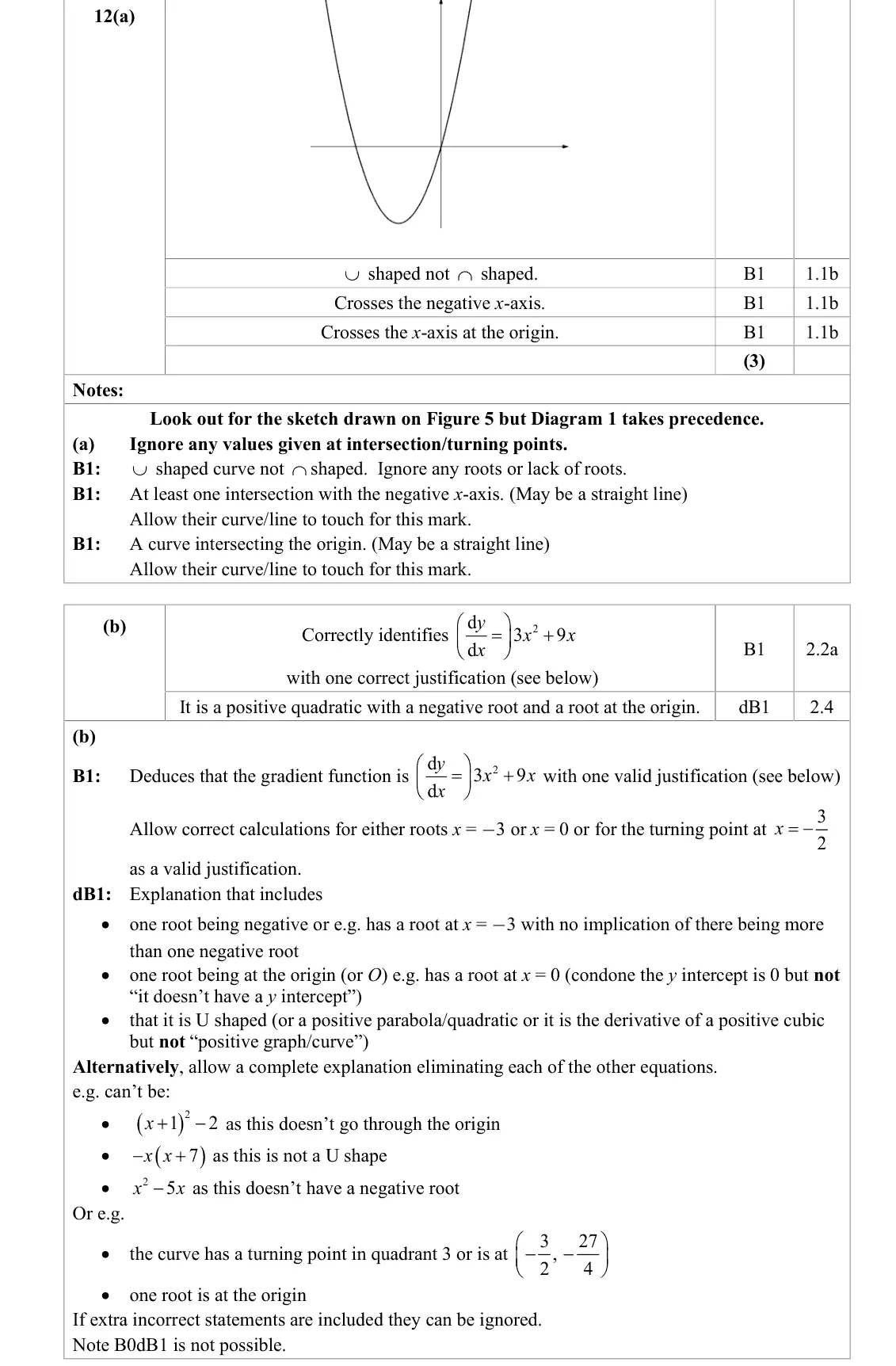
12(a) Differentiation: first principles, gradients, stationary points 3 —
12(b) Differentiation: first principles, gradients, stationary points, Quadratics and the discriminant, Graphs and transformations 2 —
13(a) Exponential growth, decay and modelling, Exponentials and logarithms, Indices and surds 4 —
13(b) Exponential growth, decay and modelling, Exponentials and logarithms 1 —
13(c) Exponential growth, decay and modelling 2 —
13(d)(i) Exponentials and logarithms, Differentiation: first principles, gradients, stationary points 2 —
13(d)(ii) Exponential growth, decay and modelling, Exponentials and logarithms 3 —
14(a) Binomial expansion 2 —
14(b) Binomial expansion, Quadratics and the discriminant, Simultaneous equations, Algebraic methods: polynomials, factor theorem and division 5 —
15(a) Proof, including contradiction, Algebraic methods: polynomials, factor theorem and division 2 —
15(b) Proof, including contradiction, Algebraic methods: polynomials, factor theorem and division 2 —

The questions

1(i)1(ii)2(a)2(b)3(a)3(b)4(a)4(b)5(a)5(b)6(a)6(b)7(a)7(b)7(c)7(d)891011(a)11(b)11(c)11(d)11(e)12(a)12(b)13(a)13(b)13(c)13(d)(i)13(d)(ii)14(a)14(b)15(a)15(b)
June 2025 · AS Paper 1 · Q1(i) 3 marks graphs and transformations
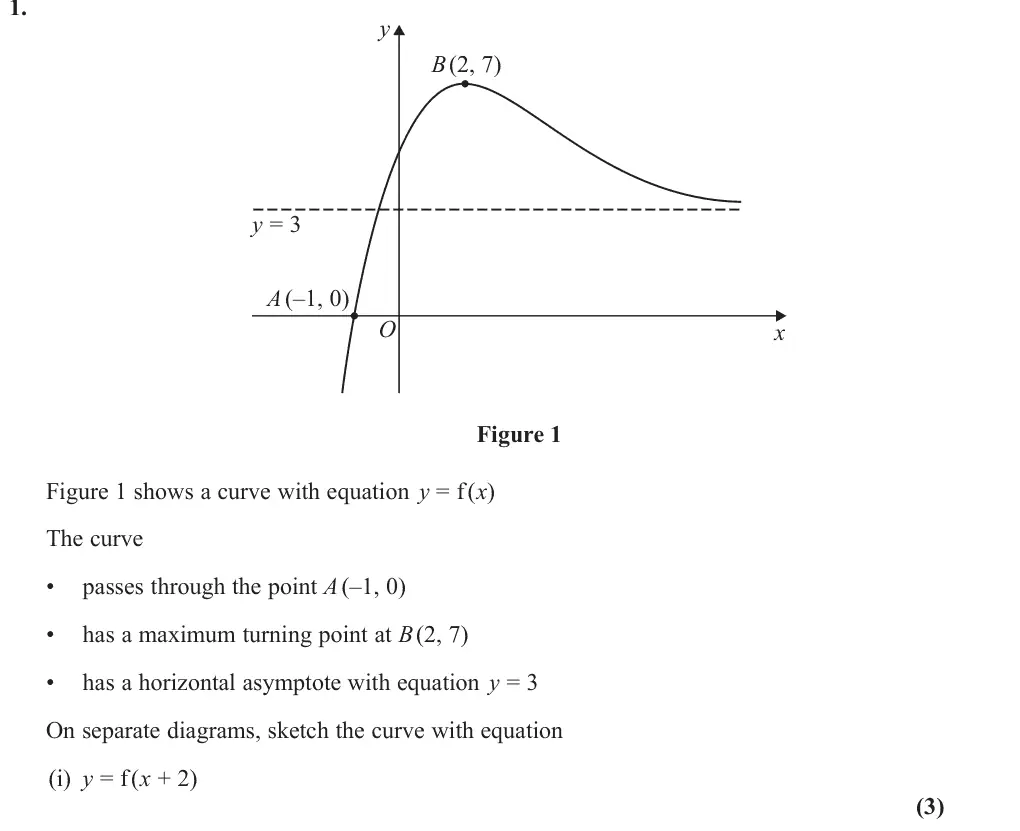
1. y B (2, 7) y = 3 A (–1, 0) x Figure 1 Figure 1 shows a curve with equation y = f (x) The curve • passes through the point A (–1, 0) • has a maximum turning point at B (2, 7) • has a horizontal asymptote with equation y = 3 On separate diagrams, sketch the curve with equation (i) y = f (x + 2) (3)
June 2025 · AS Paper 1 · Q1(ii) 3 marks graphs and transformations
(ii) y = –f (x) (3)
June 2025 · AS Paper 1 · Q2(a) 3 marks straight lines
< 2. The line l passes through the points A (–3, 0) and B 5 ;: 2 22 , (a) Find the equation of l giving your answer in the form y = mx + c where m and c are constants. (3)
June 2025 · AS Paper 1 · Q2(b) 2 marks inequalitiesstraight lines
y B C l R x A Figure 2 Figure 2 shows the line l and the curve C, which intersect at A and B. Given that 2 + 5x – 3 • C has equation y = 2x • the region R, shown shaded in Figure 2, is bounded by l and C (b) use inequalities to define R. (2)
June 2025 · AS Paper 1 · Q3(a) 3 marks vectors
3. Relative to a fixed origin O • the point A has coordinates (3, –8) → = –5i + 2j • the point B is such that AB →½ (a) Find the exact value of ½OB (3)
June 2025 · AS Paper 1 · Q3(b) 3 marks trigonometric ratiosvectors
(b) Find the size of angle OAB, giving your answer in degrees to one decimal place. (3)
June 2025 · AS Paper 1 · Q4(a) 3 marks circlesquadratics
4. The circle C has equation 2 + y 2 + 10x – 4y + 1 = 0 x (a) Find (i) the coordinates of the centre of C (ii) the exact radius of C (3)
June 2025 · AS Paper 1 · Q4(b) 3 marks circlesinequalitiesquadratics
The line with equation y = k, where k is a constant, cuts C at two distinct points. (b) Find the range of values for k, giving your answer in set notation. (3)
June 2025 · AS Paper 1 · Q5(a) 3 marks indices and surds
f (x) = x - x 5. x (a) Write f (x) in the form p + bx q ax where a, b, p and q are simplified constants. (3)
June 2025 · AS Paper 1 · Q5(b) 3 marks integrationindices and surds
(b) Hence find ∫f (x) dx giving your answer in simplest form. (3)
June 2025 · AS Paper 1 · Q6(a) 2 marks algebraic methods
6. f (x) = ax 3 + bx 2 + 18x + 9 where a and b are constants. Given that (x + 3) is a factor of f (x) (a) show that –3a + b = 5 (2)
June 2025 · AS Paper 1 · Q6(b) 5 marks differentiationsimultaneous equations
Given also that f′ (2) = 14 (b) find the value of a and the value of b. (5)
June 2025 · AS Paper 1 · Q7(a) 2 marks quadraticsfunctions
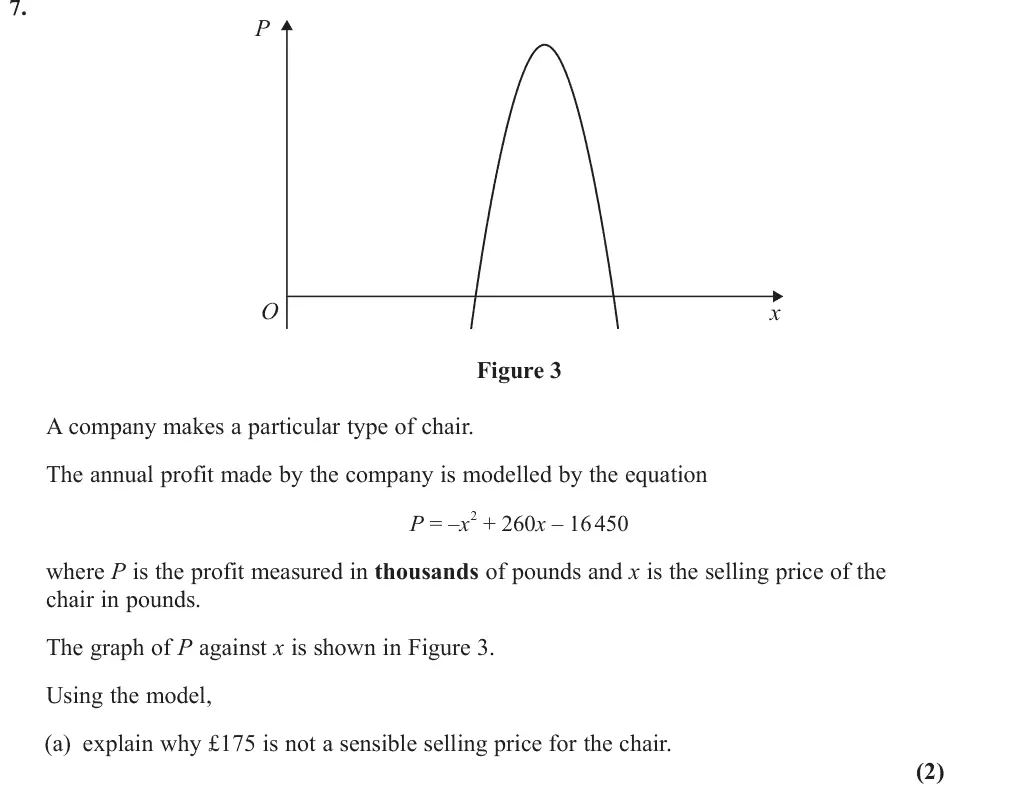
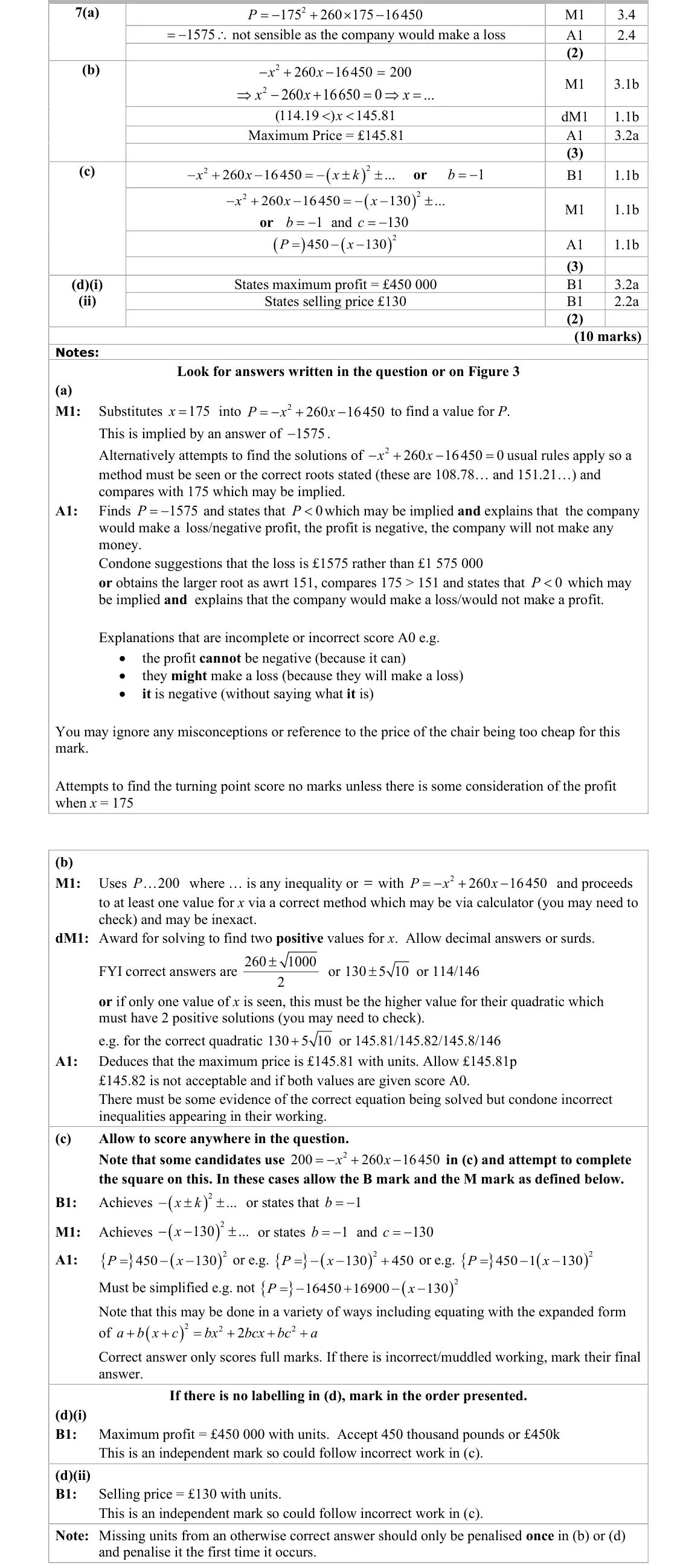
7. P x Figure 3 A company makes a particular type of chair. The annual profit made by the company is modelled by the equation 2 + 260x – 16 450 P = –x where P is the profit measured in thousands of pounds and x is the selling price of the chair in pounds. The graph of P against x is shown in Figure 3. Using the model, (a) explain why £175 is not a sensible selling price for the chair. (2)
June 2025 · AS Paper 1 · Q7(b) 3 marks quadraticsinequalitiesfunctions
Given that the company made an annual profit of more than £200 000 (b) find, according to the model, the highest possible selling price for the chair. You must show your working clearly. (3)
June 2025 · AS Paper 1 · Q7(c) 3 marks quadraticsfunctions
(c) Show that P = a + b (x + c) where a, b and c are constants to be found. (3)
June 2025 · AS Paper 1 · Q7(d) 2 marks quadraticsfunctions
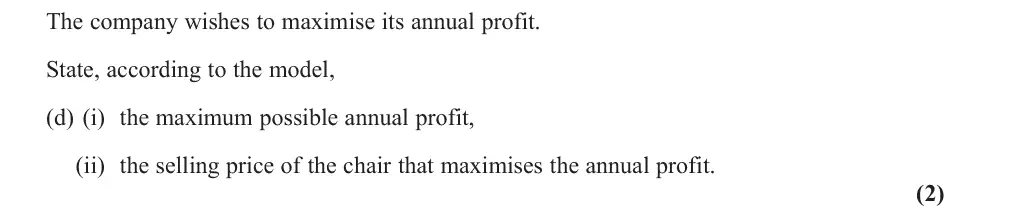
The company wishes to maximise its annual profit. State, according to the model, (d) (i) the maximum possible annual profit, (ii) the selling price of the chair that maximises the annual profit. (2)
June 2025 · AS Paper 1 · Q8 5 marks trig identitiestrigonometric equationsquadratics
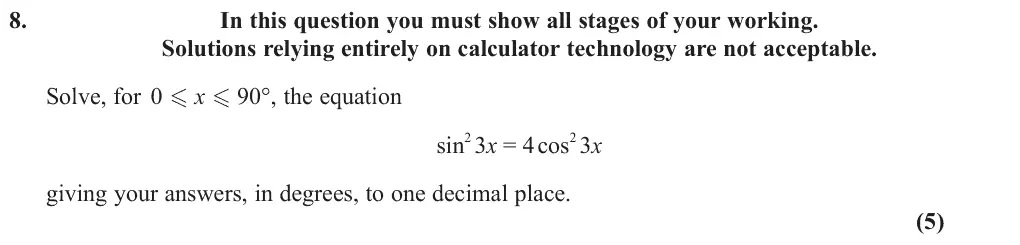
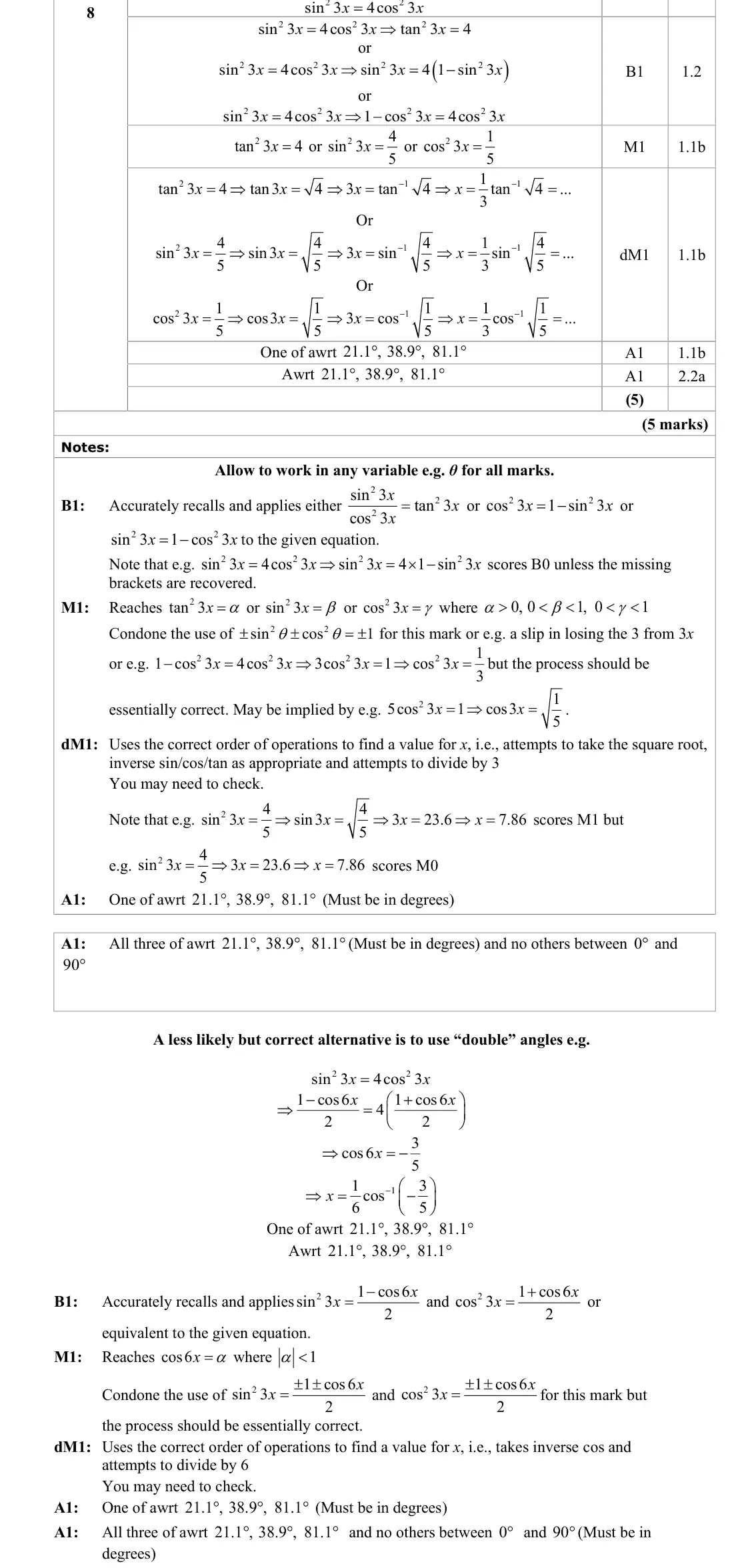
8. In this question you must show all stages of your working. Solutions relying entirely on calculator technology are not acceptable. Solve, for 0 x 90°, the equation 2 3x = 4 cos 2 3x sin giving your answers, in degrees, to one decimal place. (5)
June 2025 · AS Paper 1 · Q9 3 marks quadratics
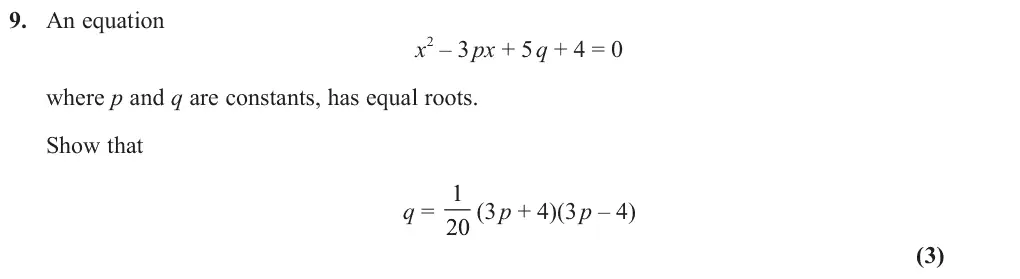
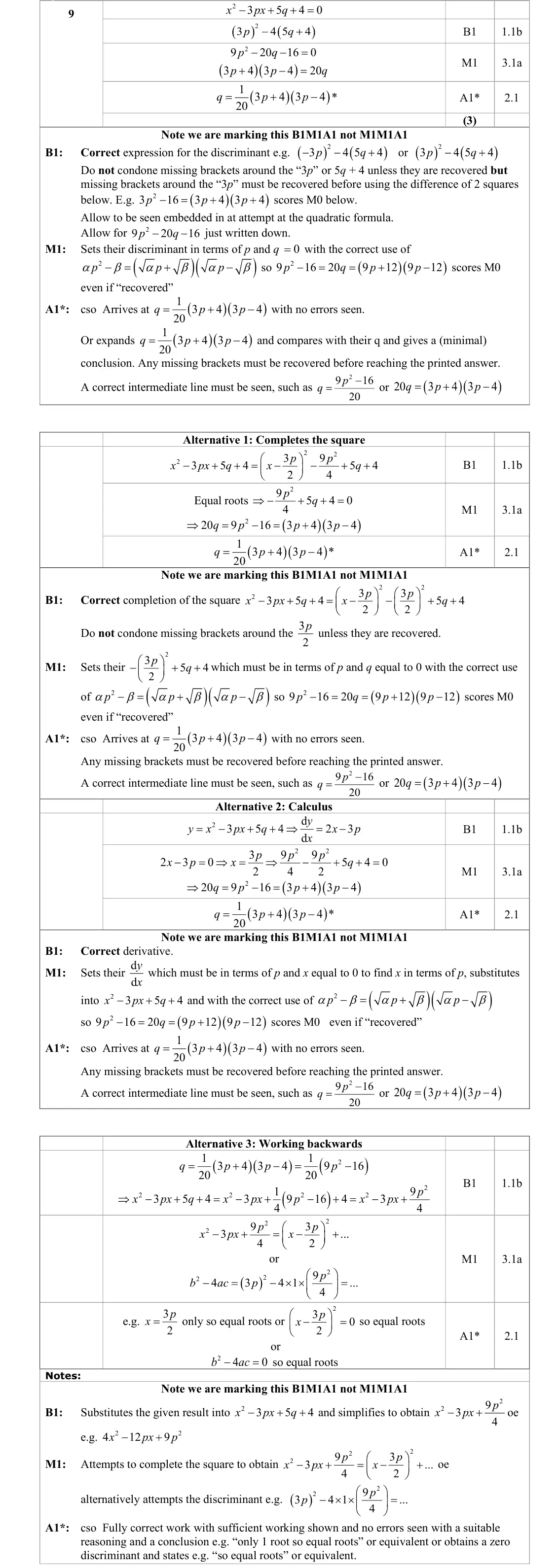
9. An equation 2 – 3 px + 5 q + 4 = 0 x where p and q are constants, has equal roots. Show that q = 1 20 (3 p + 4)(3 p – 4) (3)

June 2025 · AS Paper 1 · Q10 5 marks exponentials and logsquadratics
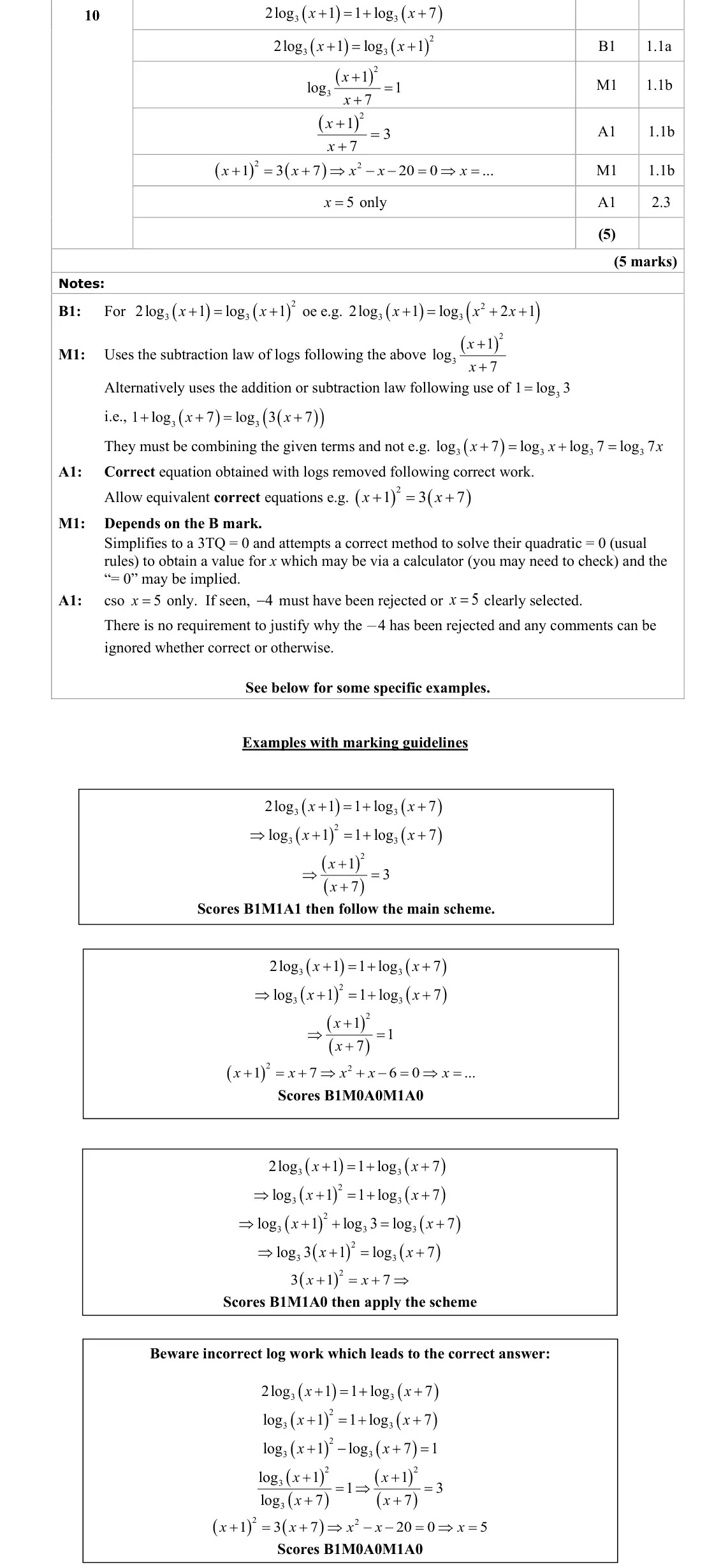
10. In this question you must show all stages of your working. Solutions relying entirely on calculator technology are not acceptable. Solve the equation 2 log3 (x + 1) = 1 + log3 (x + 7) (5)

June 2025 · AS Paper 1 · Q11(a) 4 marks differentiationindices and surdsalgebraic methods
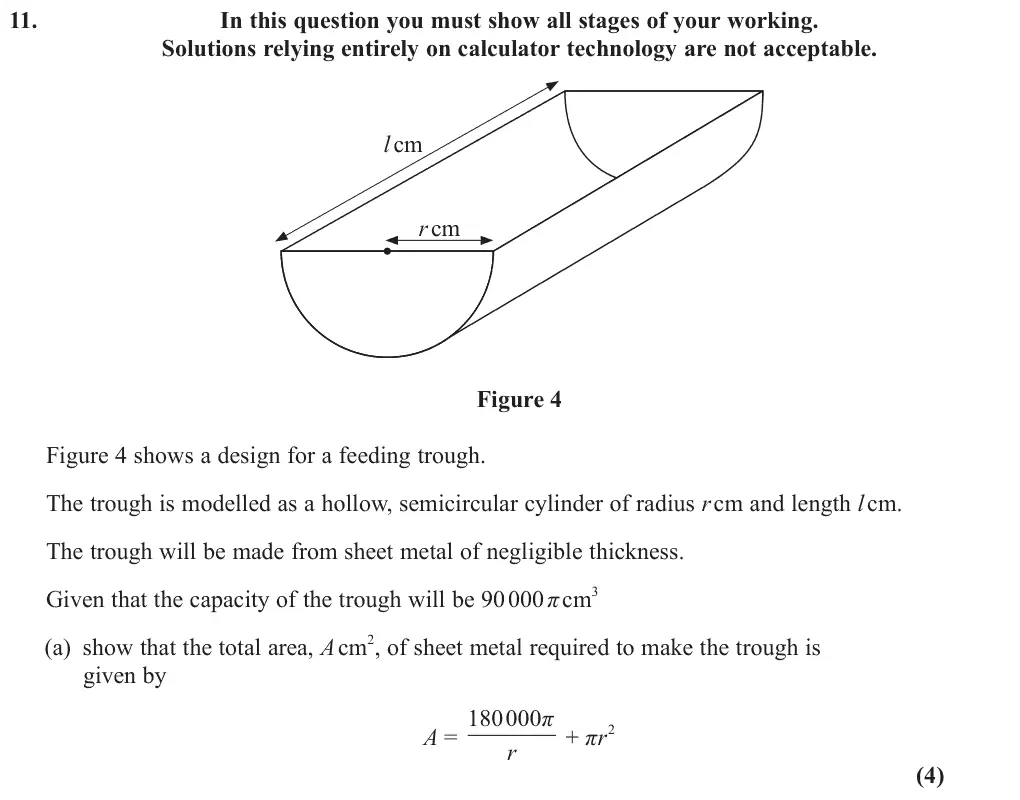
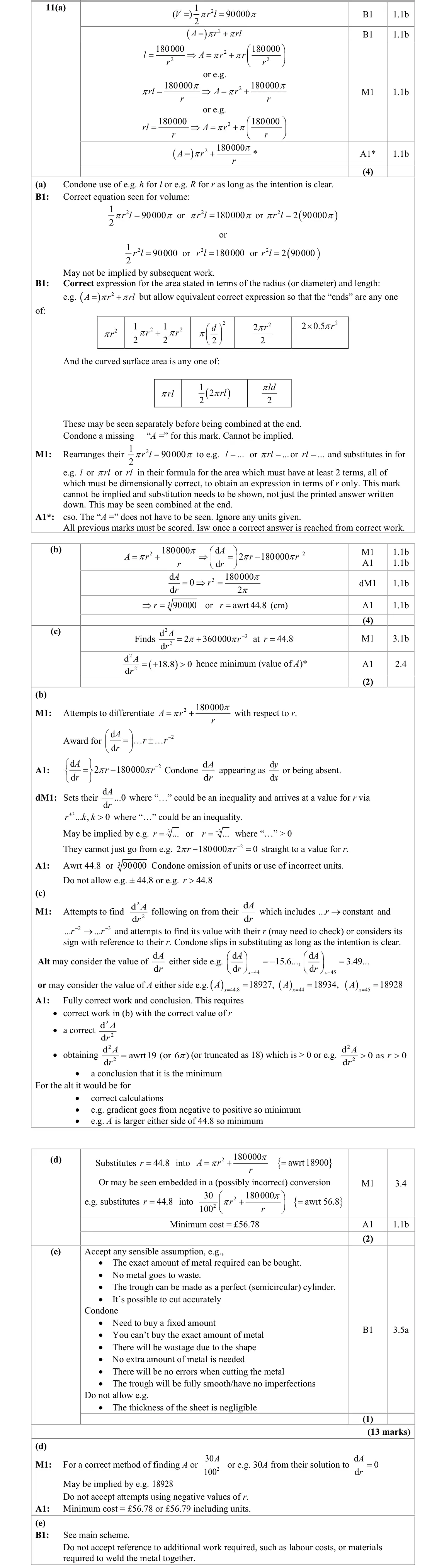
11. In this question you must show all stages of your working. Solutions relying entirely on calculator technology are not acceptable. l cm r cm Figure 4 Figure 4 shows a design for a feeding trough. The trough is modelled as a hollow, semicircular cylinder of radius r cm and length l cm. The trough will be made from sheet metal of negligible thickness. Given that the capacity of the trough will be 90 000 pi cm 2, of sheet metal required to make the trough is (a) show that the total area, A cm given by A = 180000 pi + pi r r (4)
June 2025 · AS Paper 1 · Q11(b) 4 marks differentiationindices and surds
(b) Use calculus to find the radius of the trough for which A is a minimum. (4)
June 2025 · AS Paper 1 · Q11(c) 2 marks differentiation
(c) Show that the radius found in part (b) gives the minimum value of A. (2)
June 2025 · AS Paper 1 · Q11(d) 2 marks differentiation
Given that the sheet metal costs £30 per square metre (d) calculate the minimum cost of sheet metal required to make one trough. (2)
June 2025 · AS Paper 1 · Q11(e) 1 mark differentiation
(e) State one assumption you have made in calculating your answer to part (d). (1)
June 2025 · AS Paper 1 · Q12(a) 3 marks differentiation
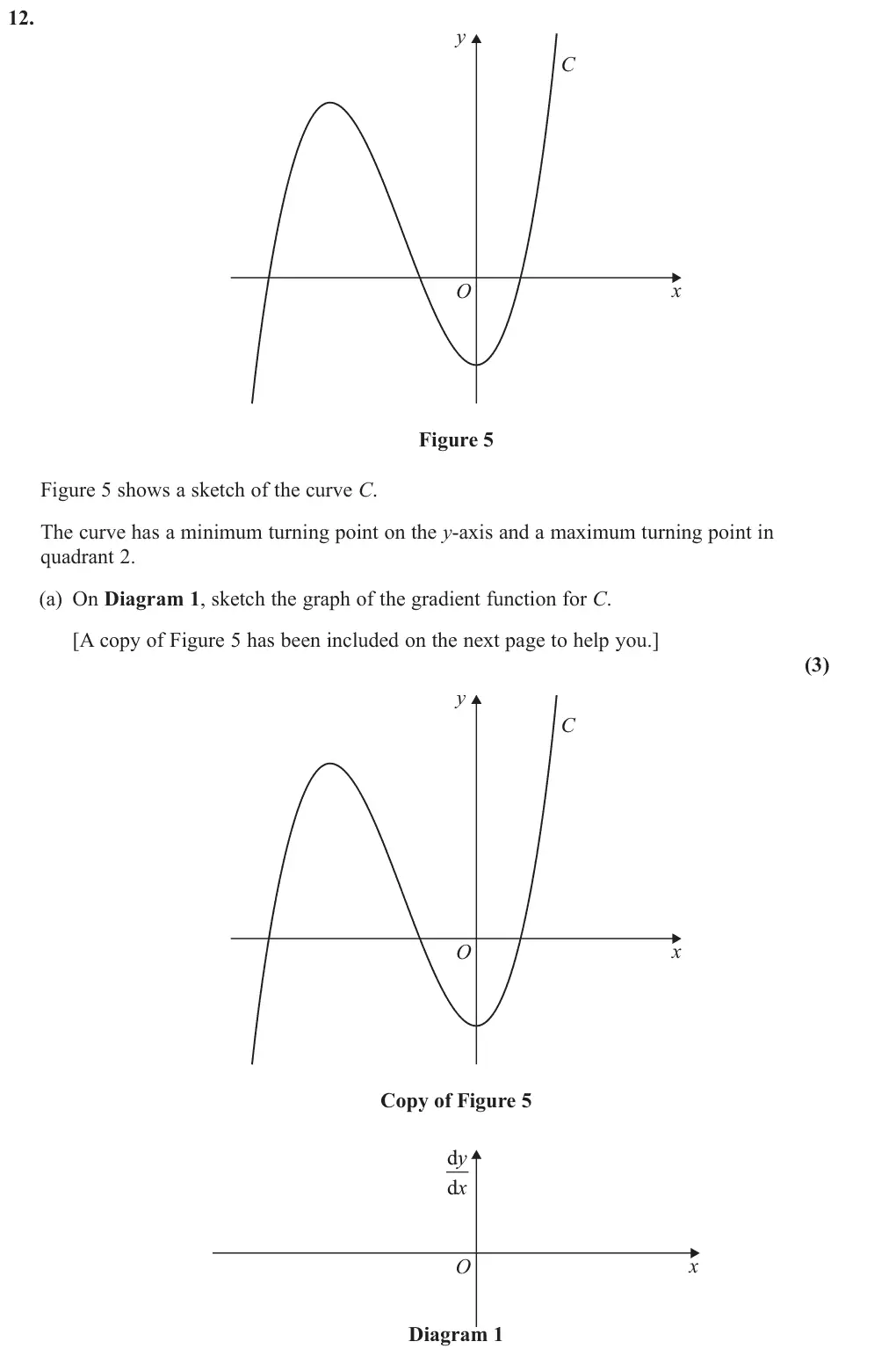
12. y C x Figure 5 Figure 5 shows a sketch of the curve C. The curve has a minimum turning point on the y-axis and a maximum turning point in quadrant 2. (a) On Diagram 1, sketch the graph of the gradient function for C. [A copy of Figure 5 has been included on the next page to help you.] (3)
June 2025 · AS Paper 1 · Q12(b) 2 marks differentiationquadraticsgraphs and transformations
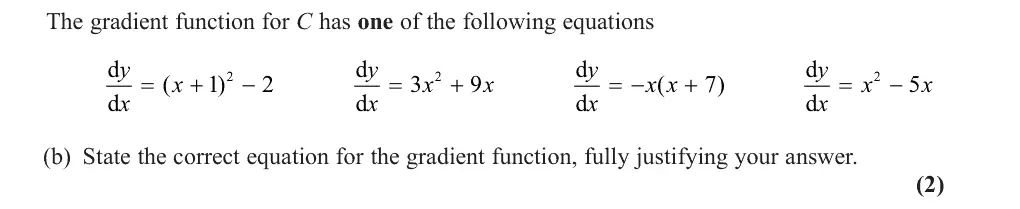
The gradient function for C has one of the following equations y y y y d d d d x x x O 3 x x x x ( )1 ( ) x x x x d d d d (b) State the correct equation for the gradient function, fully justifying your answer. (2)

June 2025 · AS Paper 1 · Q13(a) 4 marks exponential modellingexponentials and logsindices and surds
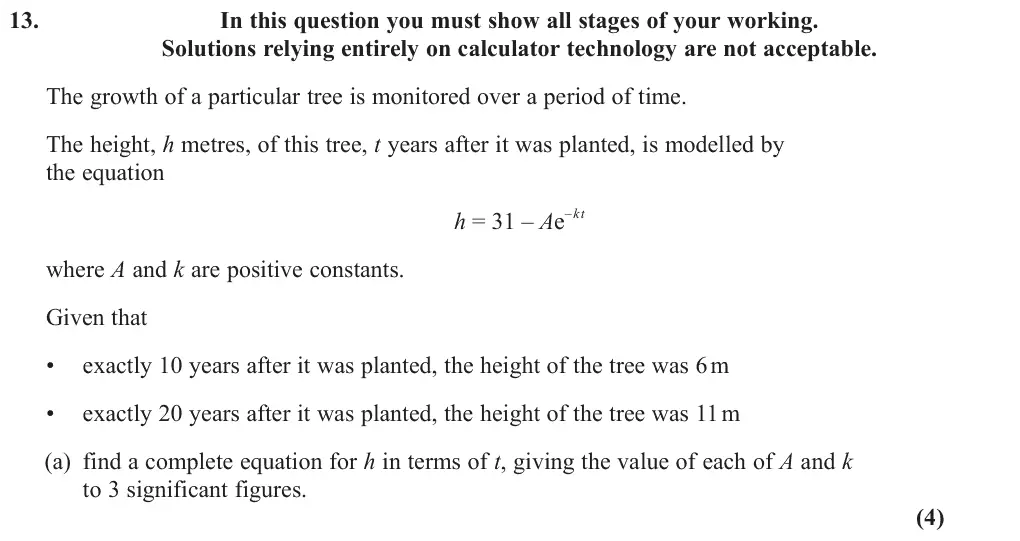
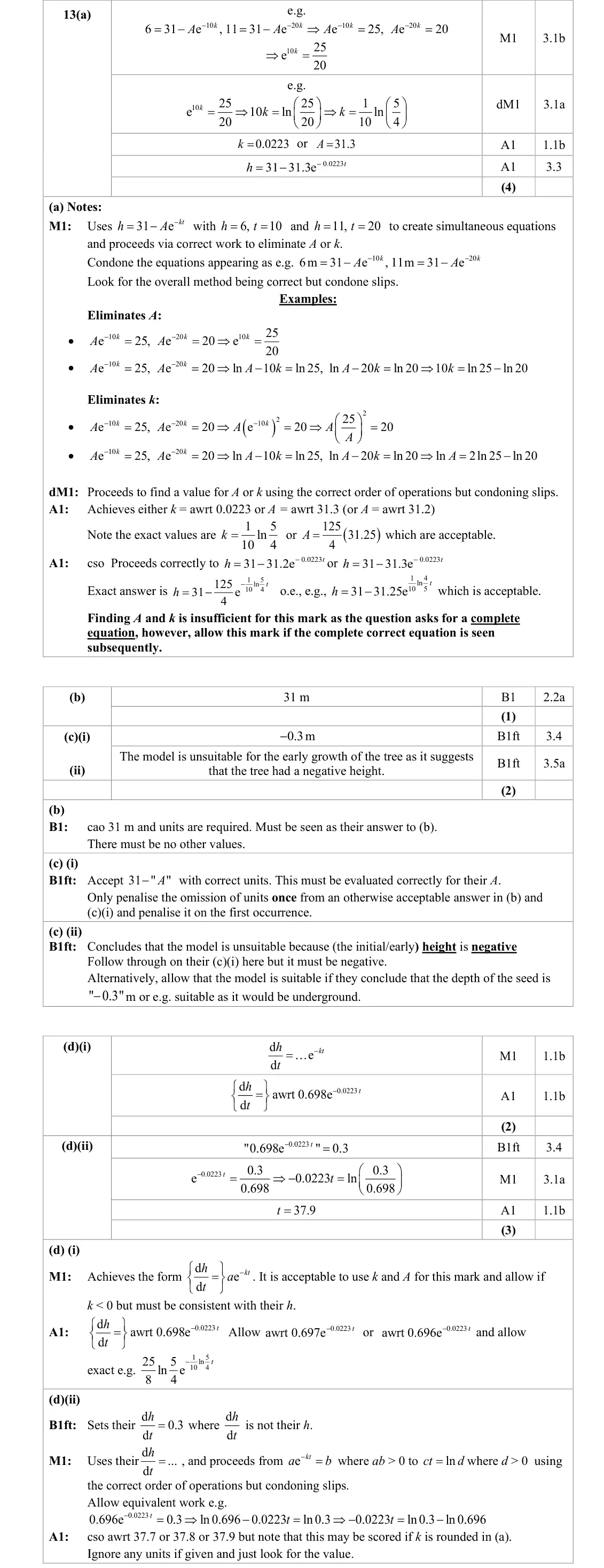
13. In this question you must show all stages of your working. Solutions relying entirely on calculator technology are not acceptable. The growth of a particular tree is monitored over a period of time. The height, h metres, of this tree, t years after it was planted, is modelled by the equation –kt h = 31 – Ae where A and k are positive constants. Given that • exactly 10 years after it was planted, the height of the tree was 6 m • exactly 20 years after it was planted, the height of the tree was 11 m (a) find a complete equation for h in terms of t, giving the value of each of A and k to 3 significant figures. (4)

June 2025 · AS Paper 1 · Q13(b) 1 mark exponential modellingexponentials and logs
Use the equation of the model to answer parts (b), (c) and (d). According to the model, there is a limit to the height to which this tree can grow. (b) Deduce this limit. (1)
June 2025 · AS Paper 1 · Q13(c) 2 marks exponential modelling
(c) (i) Find the initial height of the tree. (ii) Hence explain whether this is a suitable model for the early growth of the tree. (2)
June 2025 · AS Paper 1 · Q13(d)(i) 2 marks exponentials and logsdifferentiation
(d) (i) Find d h t , giving your answer in simplest form. d (2)
June 2025 · AS Paper 1 · Q13(d)(ii) 3 marks exponential modellingexponentials and logs
(ii) Hence find the value of t for which the height of the tree is increasing at a rate of 30 cm per year. (3)
June 2025 · AS Paper 1 · Q14(a) 2 marks binomial expansion
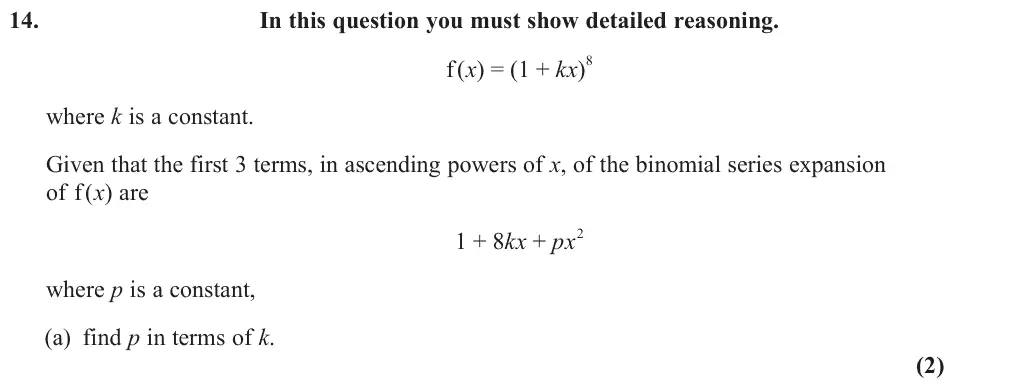
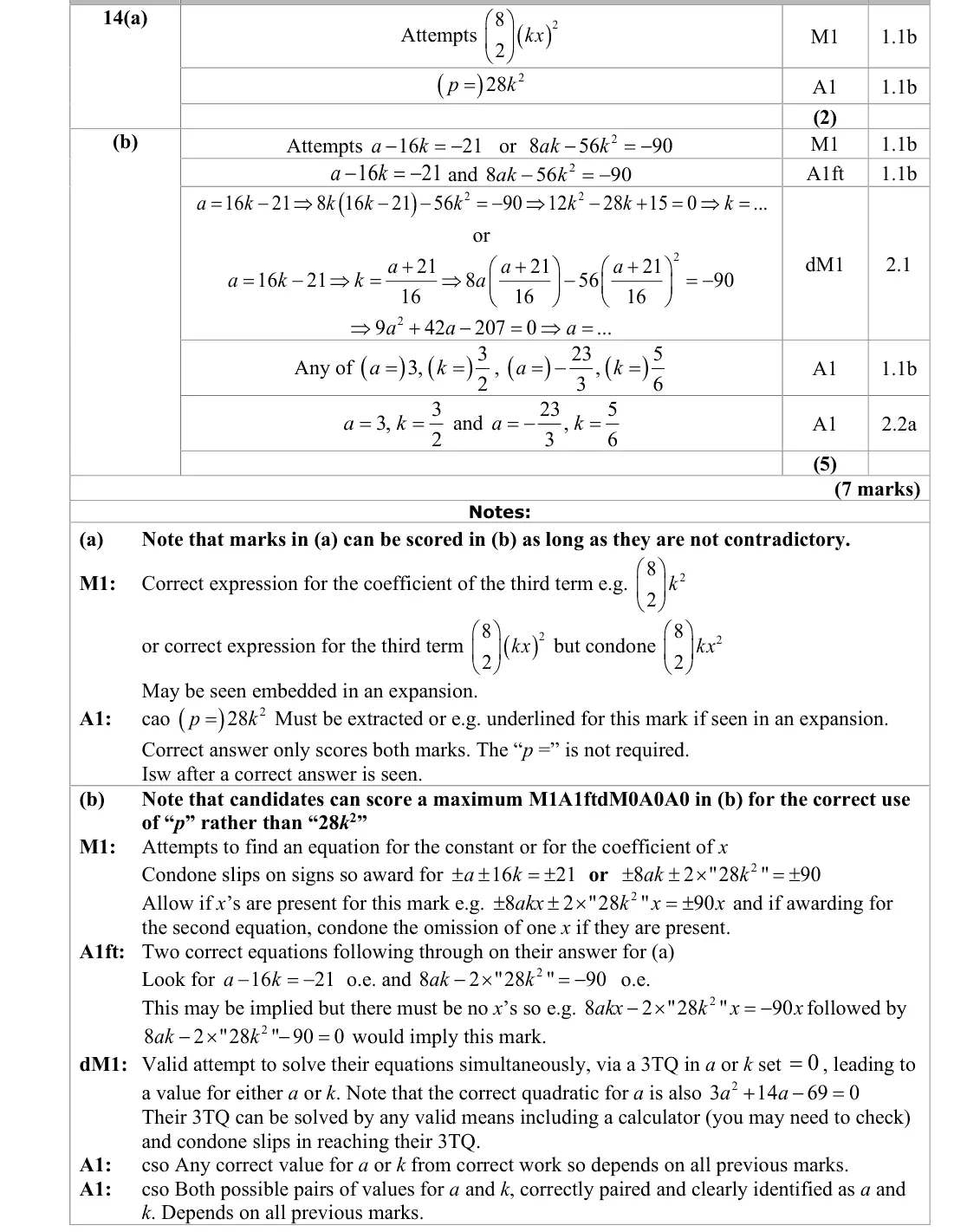
14. In this question you must show detailed reasoning. f (x) = (1 + kx) where k is a constant. Given that the first 3 terms, in ascending powers of x, of the binomial series expansion of f (x) are 1 + 8kx + px where p is a constant, (a) find p in terms of k. (2)

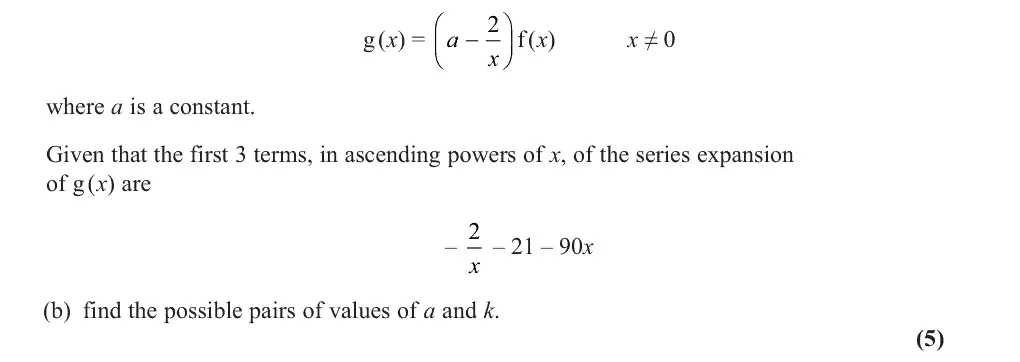
2 f (x) x ≠ 0 ; g (x) = a :9 x where a is a constant. Given that the first 3 terms, in ascending powers of x, of the series expansion of g (x) are – 2 x – 21 – 90x (b) find the possible pairs of values of a and k. (5)
June 2025 · AS Paper 1 · Q15(a) 2 marks proofalgebraic methods
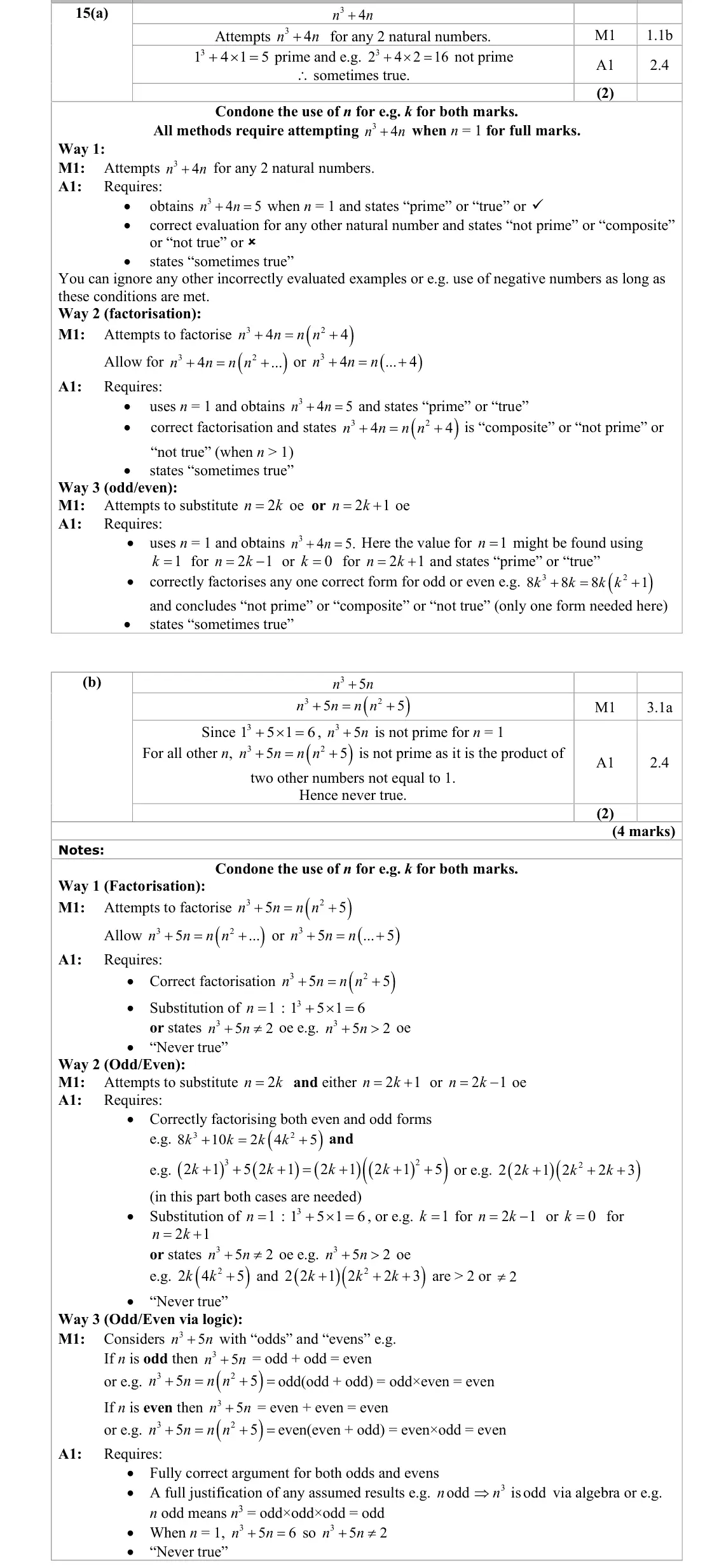
15. 3 + 4n is prime for n ∈ ” “n (I) (a) Determine whether statement (I) is always true, sometimes true or never true. You must fully justify your answer. (2)
June 2025 · AS Paper 1 · Q15(b) 2 marks proofalgebraic methods
3 + 5n is prime for n ∈ ” “n (II) (b) Determine whether statement (II) is always true, sometimes true or never true. You must fully justify your answer. (2)

Find an Edexcel maths tutor

Want this paper marked and gone through with you? Message us.

Prefer email? Send an enquiry

If you are under 18, please include a parent's contact details. Enquiries go to enquiries@mathsaleveltutor.com and are deleted once handled.