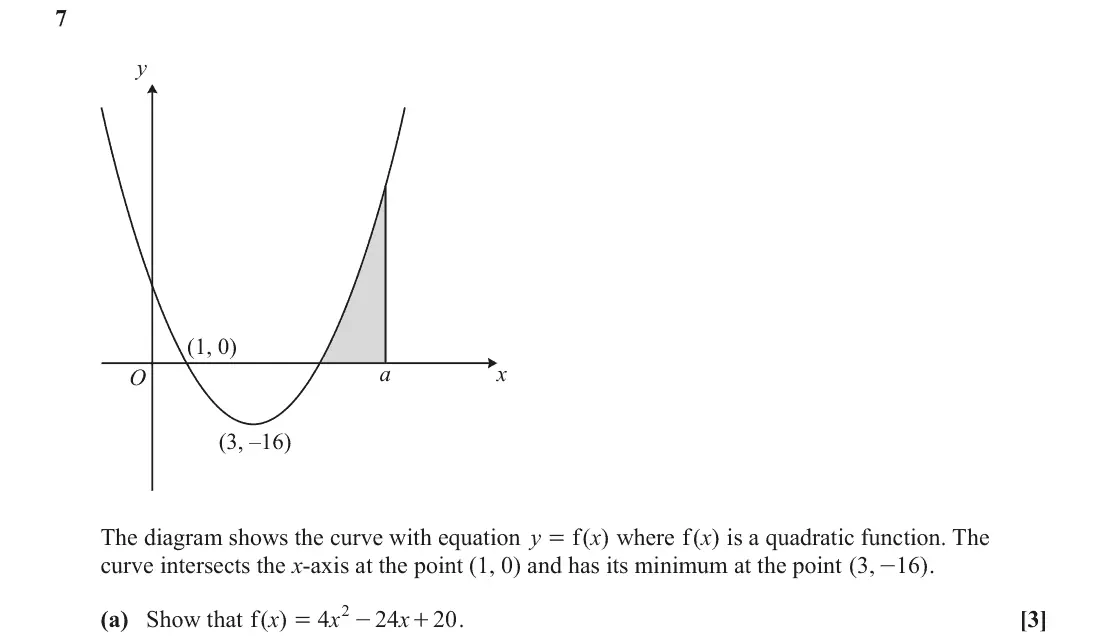
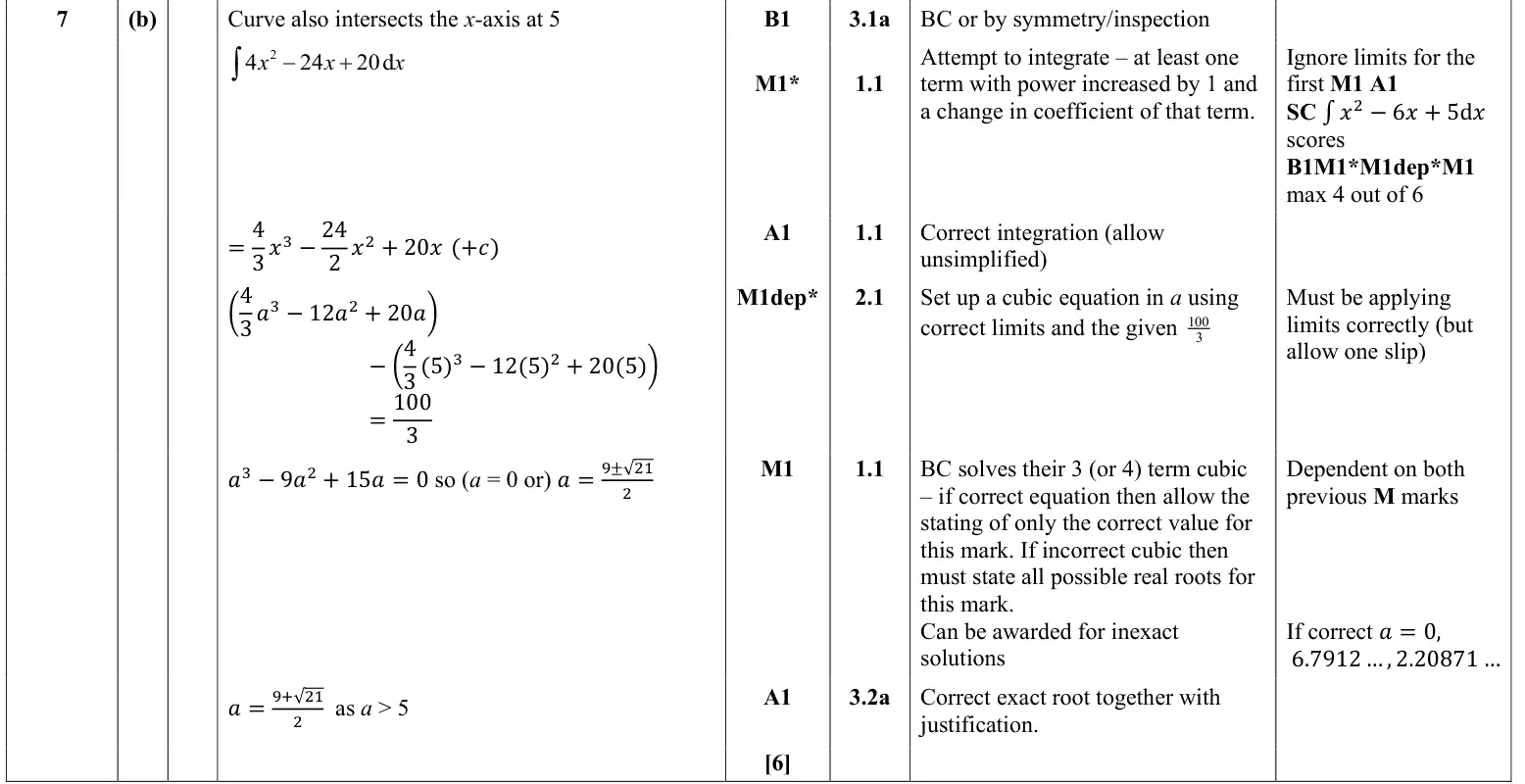
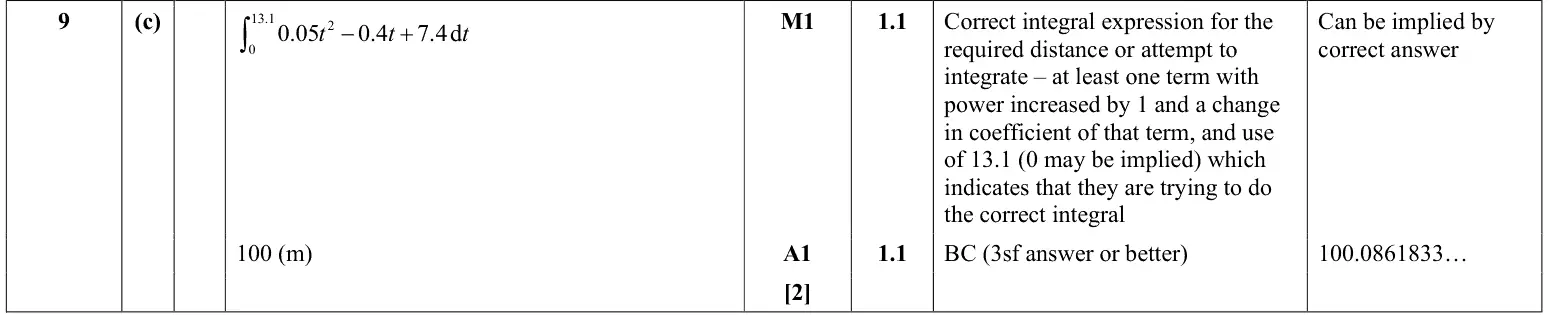
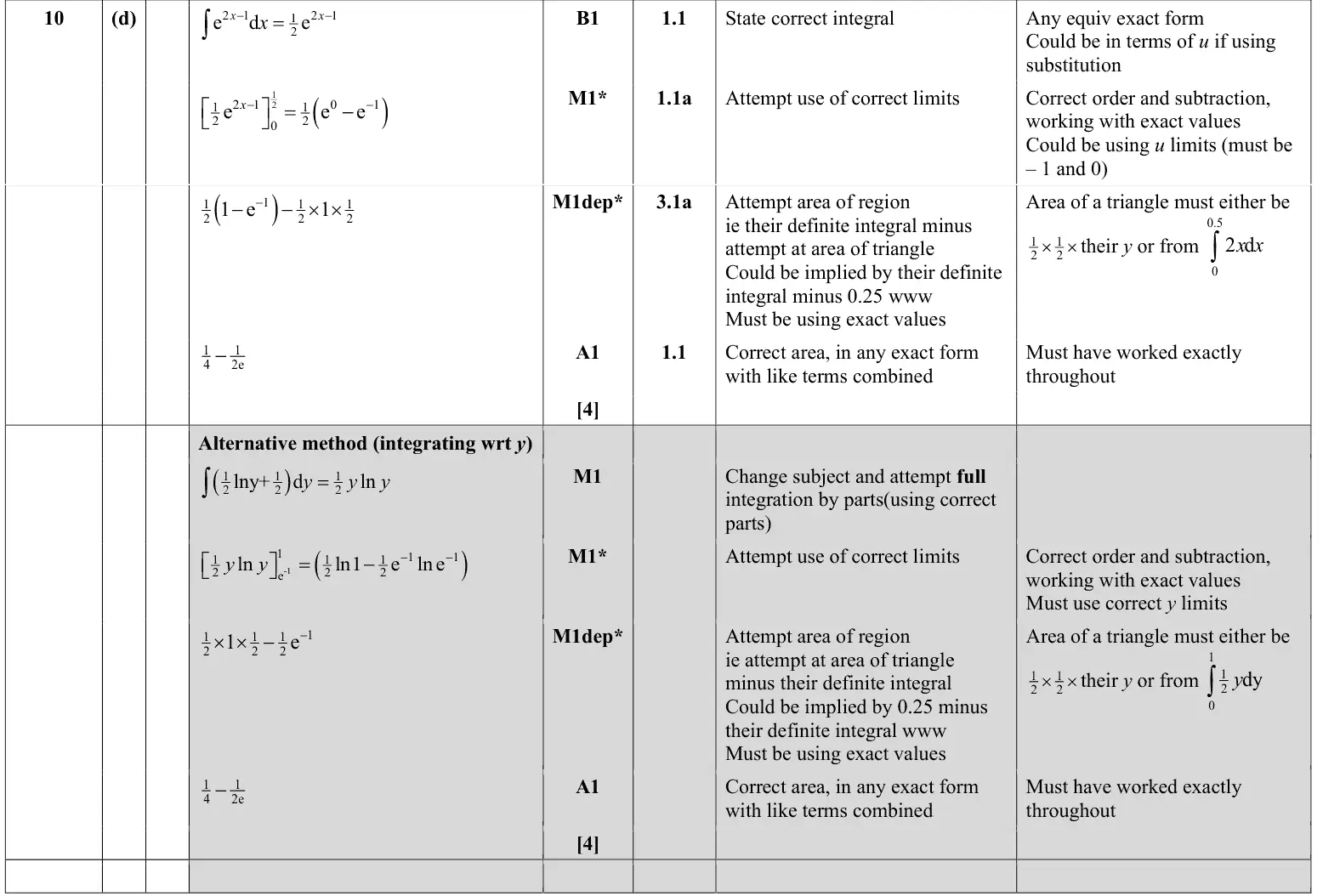
Most candidates answered this fairly routine integration question well, with the majority achieving 3/3. A small number of candidates made an error in their integration (which, provided a cubic was obtained, could still score M1M1 if used correctly) but candidates who did not integrate (e.g. differentiated or did not change powers) scored M0M0 as the scheme required a cubic in order to gain the mark for substituting limits. The ‘Determine’ instruction indicated that candidates were expected to show ‘working where appropriate’ as detailed in the scheme and most candidates did this very well. Candidates who just gave the correct answer without any justification would have scored zero marks in this question, but this was very rarely seen. A small number of candidates substituted the given limits for a instead of for x.
Key points and common errors
[ax³/3 − x² + 4x] from 0 to 5 = 125a/3 − 5 = 45
a = 6/5
substitute limits for x not a
June 2025 · AS Paper 2 · Q7(b)6 marksMedium
Show the start of this question
Mark scheme for this part
Examiner's comment
There were a lot of complete attempts to this part, although some did not get full marks only because they did not provide an exact answer or a justification for their answer. Many gained the first 3 marks, and the limit work was usually well done too, but some had them the wrong way round and -100/3 rather than +100/3 was used on the left hand side. In this instance, credit was given even if a = 0 was not given. Unfortunately, a small number of candidates started by differentiating.
Key points and common errors
curve also crosses at x = 5 (symmetry)
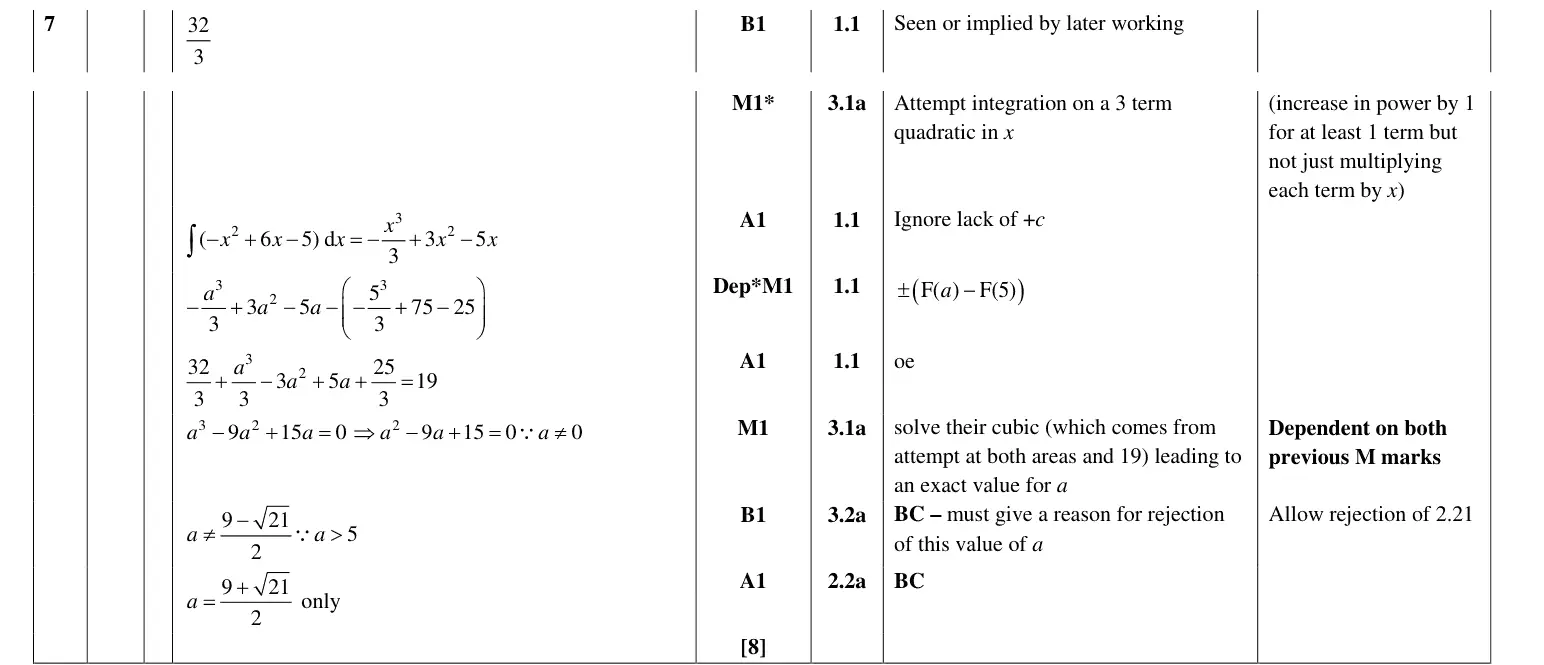
∫ from 5 to a of (4x² − 24x + 20) dx = 100/3
a³ − 9a² + 15a = 0
a = (9 + √21)/2 with justification a > 5
exact answer needed
limits the wrong way round
June 2025 · AS Paper 2 · Q9(c)2 marksMedium
Show the start of this question
Mark scheme for this part
Examiner's comment
In this instance, candidates could answer this question part by calculator, but many instead showed integration. A fair proportion did not recognise variable acceleration, despite having (a) correct in the majority of cases, and worked with suvat equations or d = vt .
Most candidates were able to correctly integrate the given equation, and many could then apply the correct limits of 0.5 and 0, while still working exactly. To gain the third mark candidates needed to attempt a correct method to find the required area, and the most successful attempts made good use of a diagram. The most common errors were to assume that the area being requested was simply the area between the curve and the x-axis, or to quote decimal values from the calculator as opposed to working exactly. Some candidates attempted to integrate with respect to y instead, but this was rarely successful. The candidate makes good use of diagrams to devise an appropriate strategy to find the requested area, working exactly throughout and simplifying the final answer.
Key points and common errors
∫₀^½ e^(2x − 1) dx = ½(1 − e⁻¹) minus triangle ¼: area ¼ − 1/(2e)
area under curve only
decimals instead of exact
June 2025 · Paper 2 · Q85 marksMedium
Mark scheme for this part
Examiner's comment
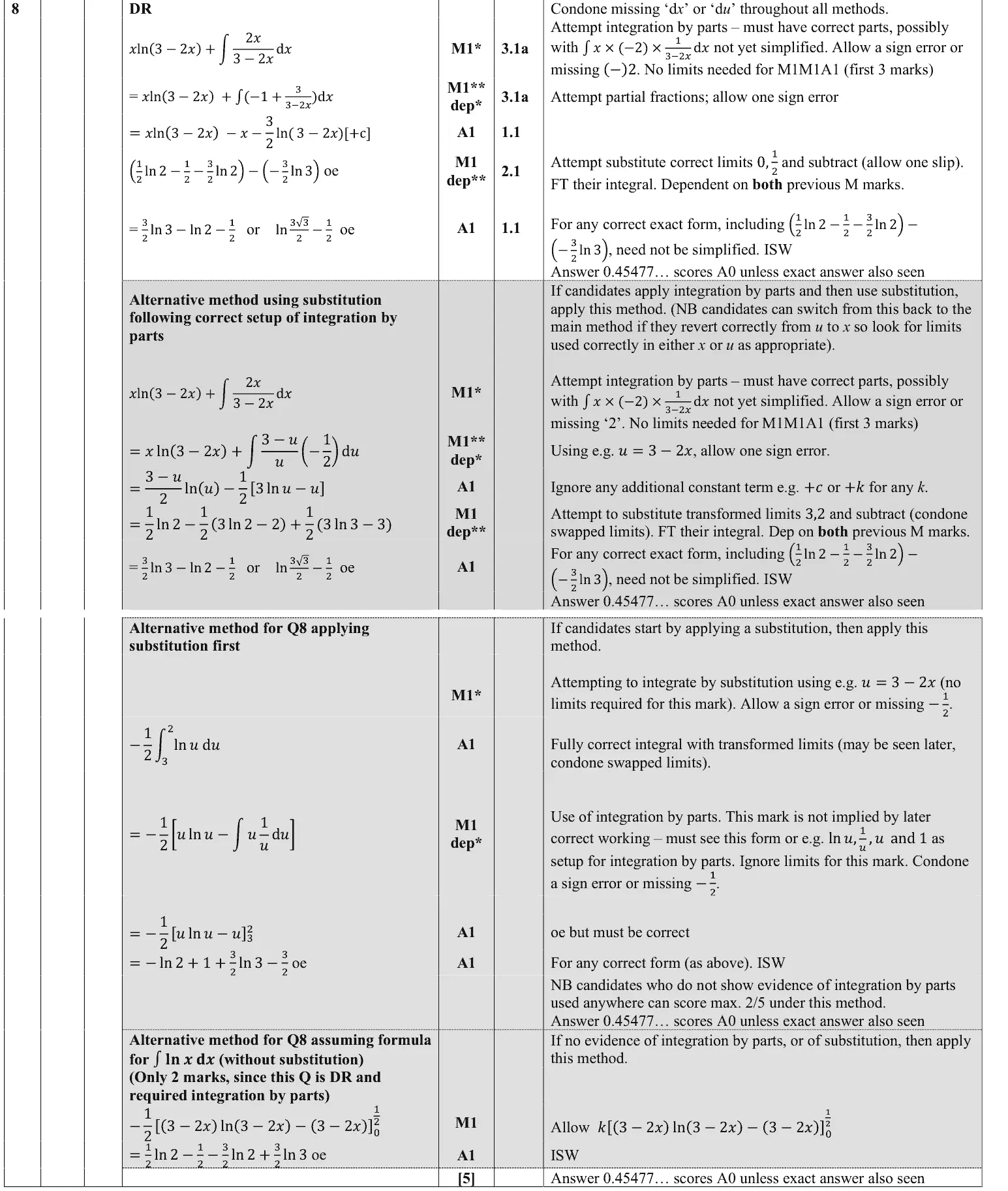
Many candidates scored at least 3 marks in this question, and some very good answers were seen, although a significant number of candidates made no progress beyond the initial setup (typically scoring M1 only). The question specified the use of integration by parts, so answers which did not use this technique anywhere could not score full marks (see the third alternative method in the scheme). Most candidates applied ‘by parts’ directly to the given integral and then proceeded via either partial fractions or substitution on the resulting second integral as shown in the first two methods on the scheme. A few candidates made an error in setting up their ‘by parts’ (resulting in an inconsistent statement). Some candidates, perhaps in trying to solve the resulting integral, went backwards by attempting ‘by parts’ again and undoing their initial setup – which normally resulted in no further progress being made. The second alternative method was quite often seen, with candidates starting by applying a substitution (which is a logical way to approach the given integral). Candidates still needed to demonstrate the use of ‘by parts’ in their working in order to be eligible for full marks– as shown in the scheme. In all methods, sign errors were very common – often meaning that the method marks were scored but one or both of the accuracy marks were not. For candidates who used a substitution, some did not ‘translate’ the limits at the point of applying the substitution. This was often recovered (especially for candidates who reversed the substitution later) and some candidates even chose to work in a mixture of variables (i.e. keeping the first term of the ‘by parts’ in x and substituting within the second integral to, e.g. u). The scheme was deliberately flexible to accommodate this, but candidates should be reminded that, when using a substitution on a definite integral, it is important that the limits are adjusted at the point the substitution is made so that the integral remains correct throughout. This is particularly important when working under a DR instruction – which means there is greater emphasis on fully correct working leading to the answer. In a few cases (whether from substitution or sign errors) candidates inadvertently recovered to the correct final answer, but the final mark could not be awarded for answers that arose from incorrect working. This is an excellent example of a fully correct solution to this question. This candidate correctly sets up the integration by parts and proceeds to use a substitution to evaluate the ‘new’ integral (as shown in the first alternative method on the scheme). They do this correctly and revert to the original form in x before applying the appropriate limits correctly, leading to the correct final answer, 5/5.
Key points and common errors
by parts with u = ln(3 − 2x), v = x
second integral by division or substitution
exact answer (3/2)ln3 − ln2 − 1/2
sign errors common
change limits when substituting
by parts must be used
June 2025 · Paper 3 · Q5(b)4 marksMedium
Show the start of this question
Mark scheme for this part
Examiner's comment
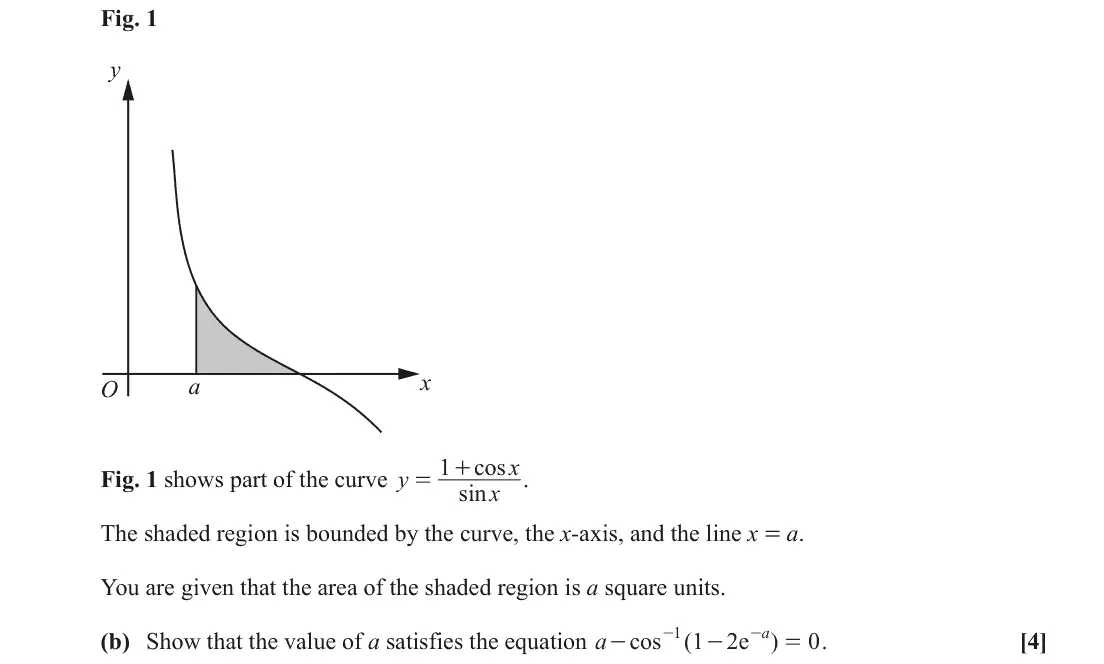
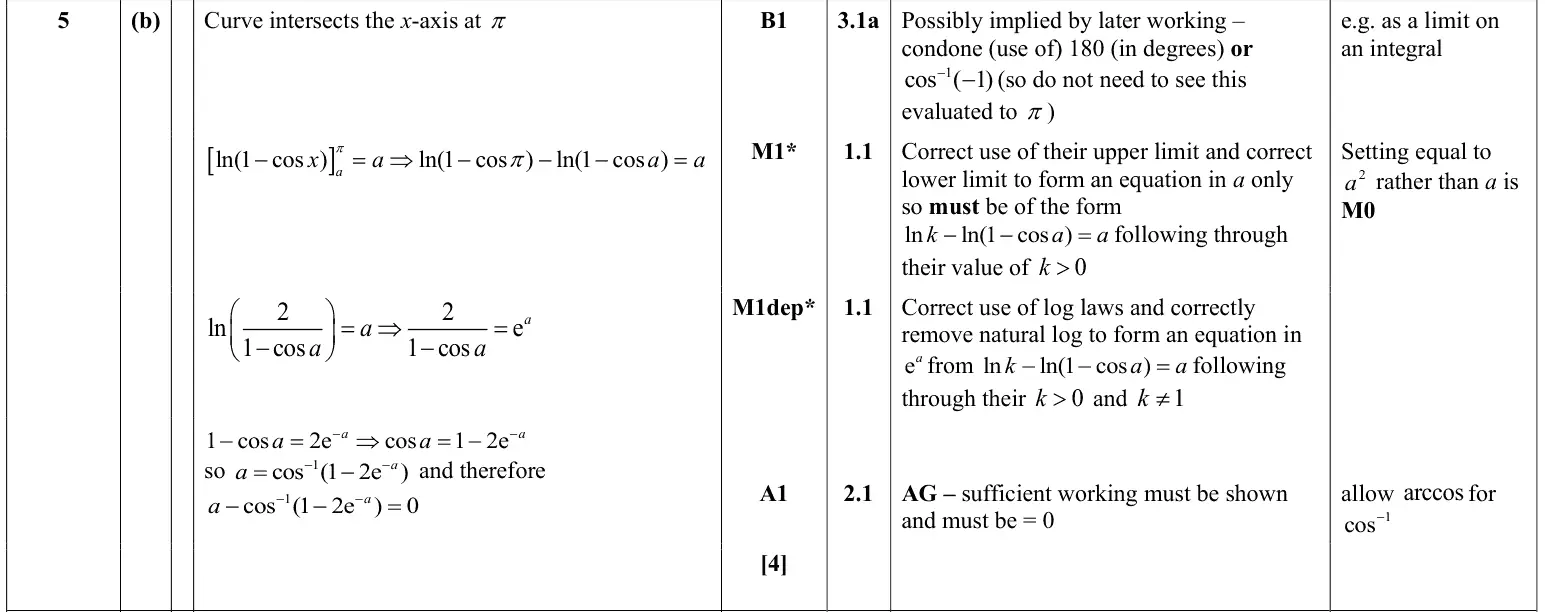
While many candidates correctly found that the curve intersected the 𝑥-axis at 𝜋, some struggled with applying the limits correctly to the given answer from part (a), and a number of candidates incorrectly thought that the shaded region had an area of 𝑎2. Of those that did correctly obtain the equation ln2 − ln(1 −𝑎) = 𝑎 many struggled with the associated log work required to get the answer in the given form with many incorrect replacing ln2 −ln(1 −𝑎) = 𝑎 with 2 −(1 −𝑎) = e𝑎.
Key points and common errors
curve meets the x-axis at π
ln 2 − ln(1 − cos a) = a
2/(1 − cos a) = eᵃ so a = cos⁻¹(1 − 2e^(−a))
area is a, not a²
June 2025 · Paper 3 · Q96 marksEasy
Mark scheme for this part
Examiner's comment
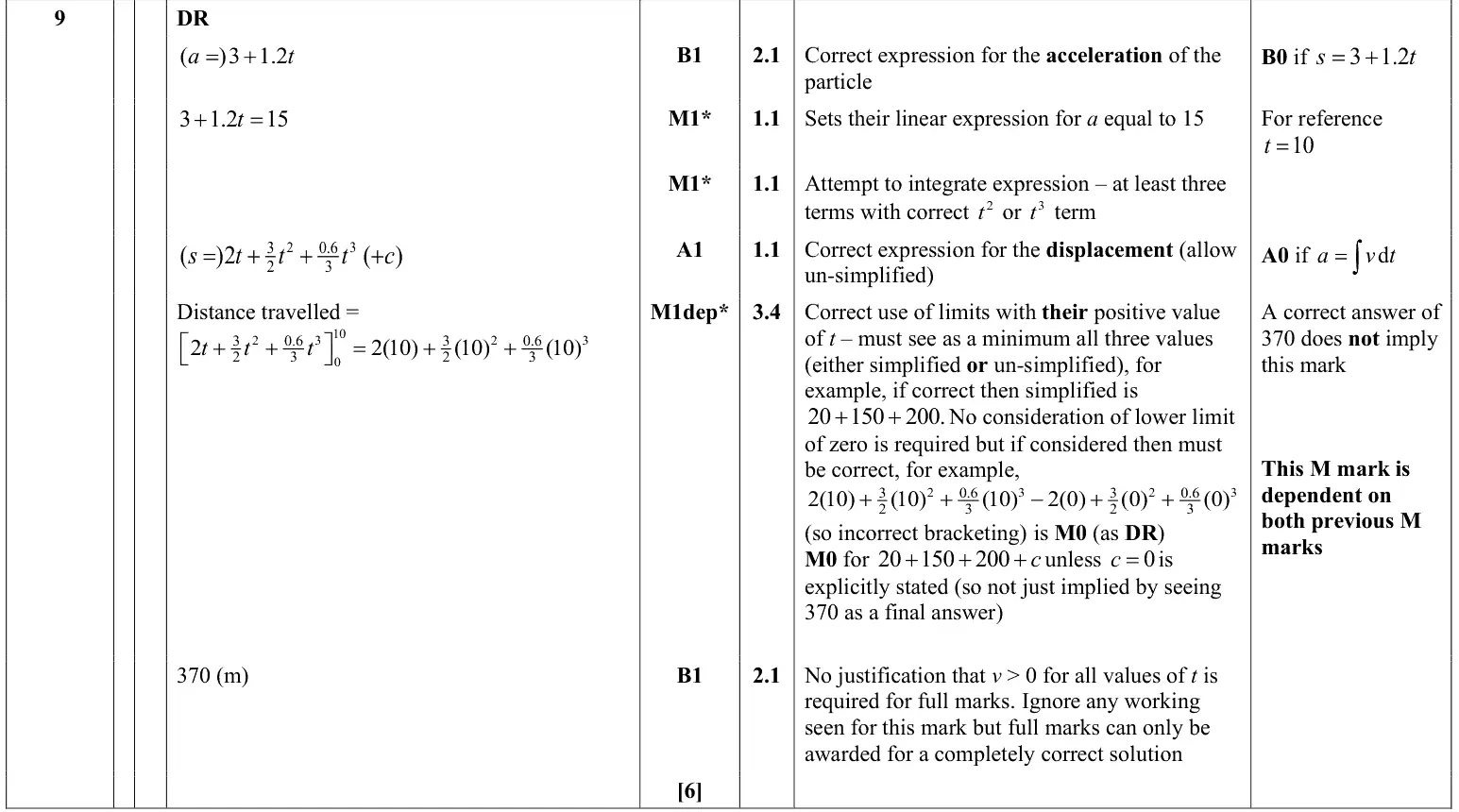
This was probably the best answered question in the mechanics section with many candidates scoring all 6 marks. As this part required DR many did not gain a mark for not showing the explicit substituting of 𝑡= 10 into their integrated expression to find the required distance travelled. The most common errors seen by examiners were those candidates who implied that 𝑠= d𝑡 and/or 𝑎= ∫𝑣 d𝑡, and some incorrectly used the equations of constant acceleration even though the acceleration was variable. required detailed reasoning. The candidate has given no explicit indication of where the answer of 370 came from (as they have not shown the limits of 0 and 10 being applied to the cubic expression) and so 1 of the 6 marks could not be awarded.
Key points and common errors
a = 3 + 1.2t = 15 gives t = 10
s = 2t + 1.5t² + 0.2t³
substitute t = 10 explicitly: 370 m
DR needs the substitution shown
June 2024 · AS Paper 2 · Q67 marksMedium
Mark scheme for this part
Examiner's comment
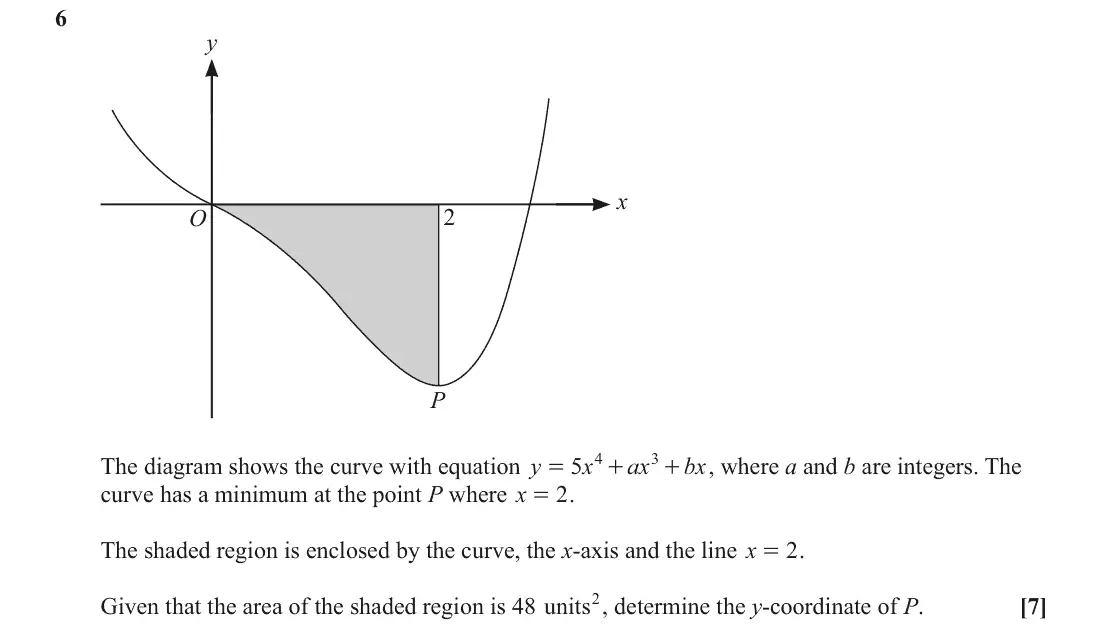
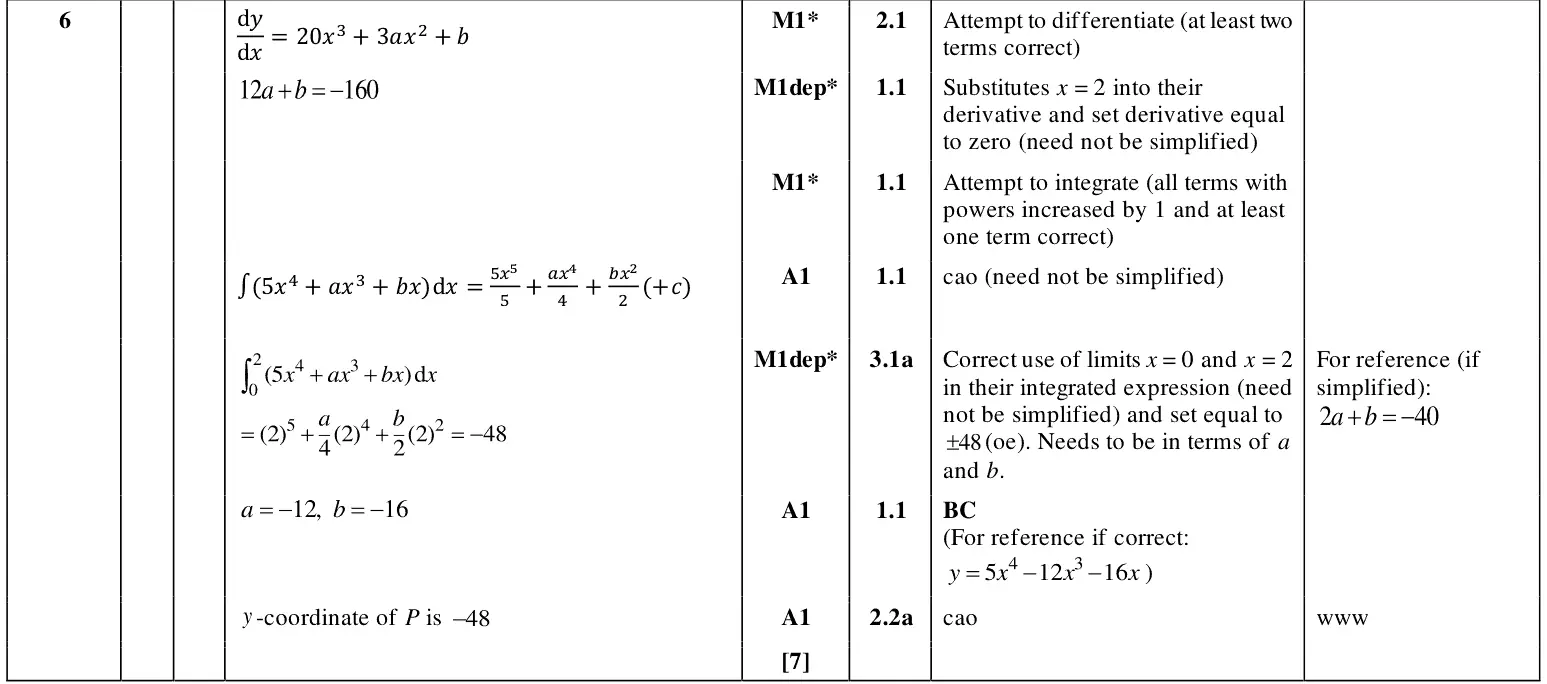
Those who recognised the need to differentiate and integrate generally did it well. A lot of candidates dropped 2 marks because they used 48 rather than -48 in their working. Quite a few unnecessarily found the second derivative; some then ignored it, but others substituted x = 2, set it to zero and obtained a value for a. The poorer efforts generally either didn’t differentiate or didn’t integrate, but most efforts gained at least 2 marks.
Key points and common errors
dy/dx = 0 at x = 2 gives 12a + b = −160
area below the axis so integral from 0 to 2 equals −48, giving 2a + b = −40
a = −12, b = −16
y-coordinate of P is −48
using +48 is the common error
June 2024 · Paper 1 · Q12(b)6 marksHard
Show the start of this question
Mark scheme for this part
Examiner's comment
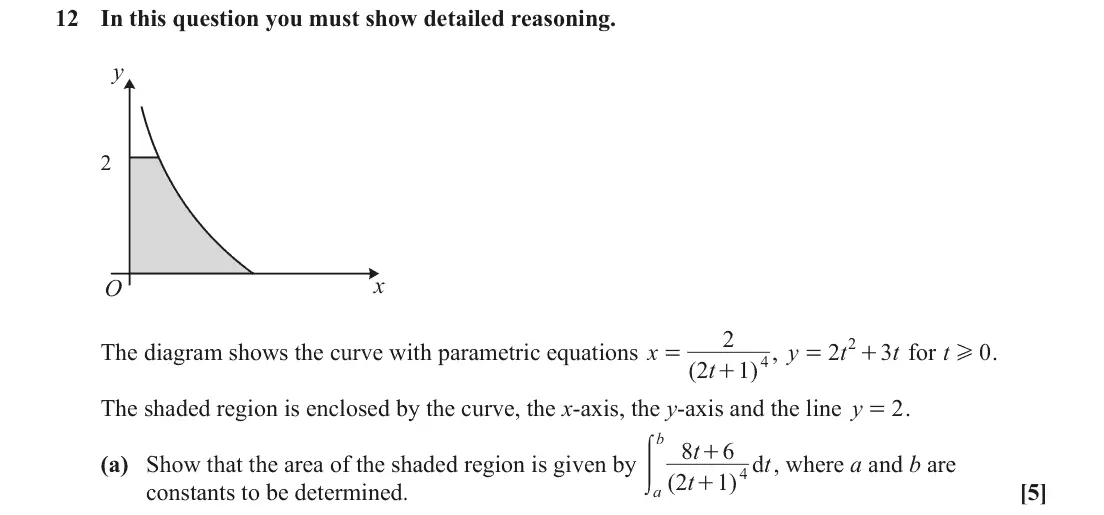
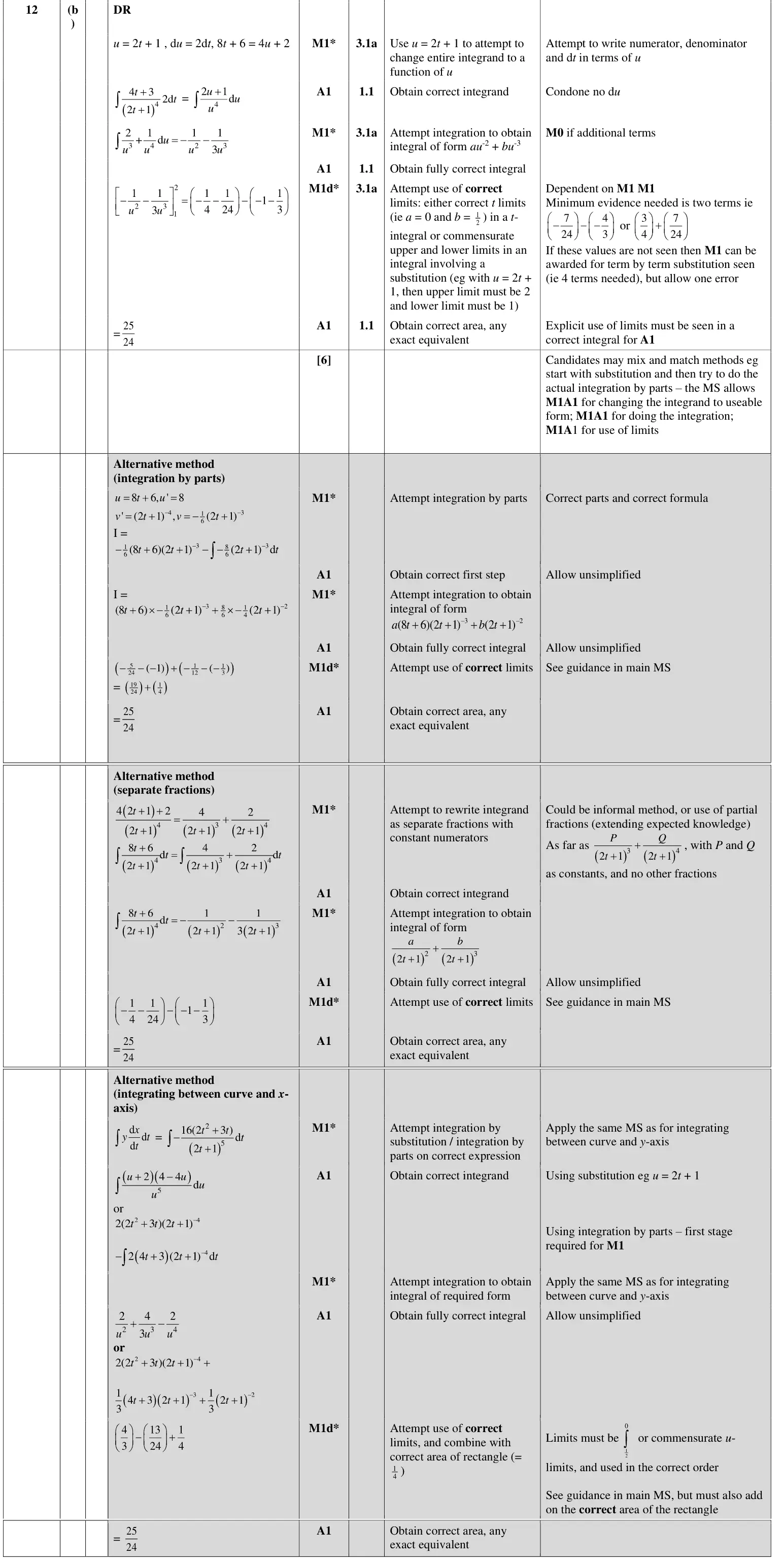
This question proved challenging for many candidates. There may be some indication that time management was a problem as there were a significant proportion of blank responses. However, there were many strong responses covering a variety of methods, most commonly substitution and integration by parts, and these were the most successful. Those not determining the correct limits from part (a) were unable to access the last two marks of this part. Some candidates attempted to use their knowledge on partial fractions but had mixed success in doing so. There were also many candidates that used a combination of methods, the most common being separate fractions and then integration by parts. This is a good and efficient solution to Question 12 (b).
Key points and common errors
u = 2t + 1: ∫(2u + 1)/u⁴ du = [−1/u² − 1/(3u³)] from 1 to 2 = 25/24
or by parts or separate fractions
limits must match the variable
June 2024 · Paper 3 · Q5(b)6 marksMedium
Show the start of this question
Mark scheme for this part
Examiner's comment
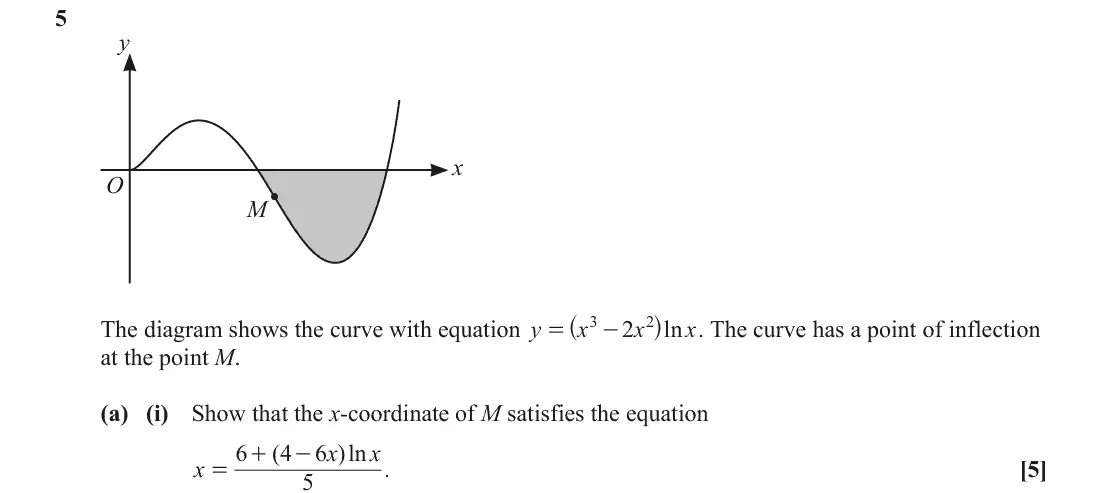
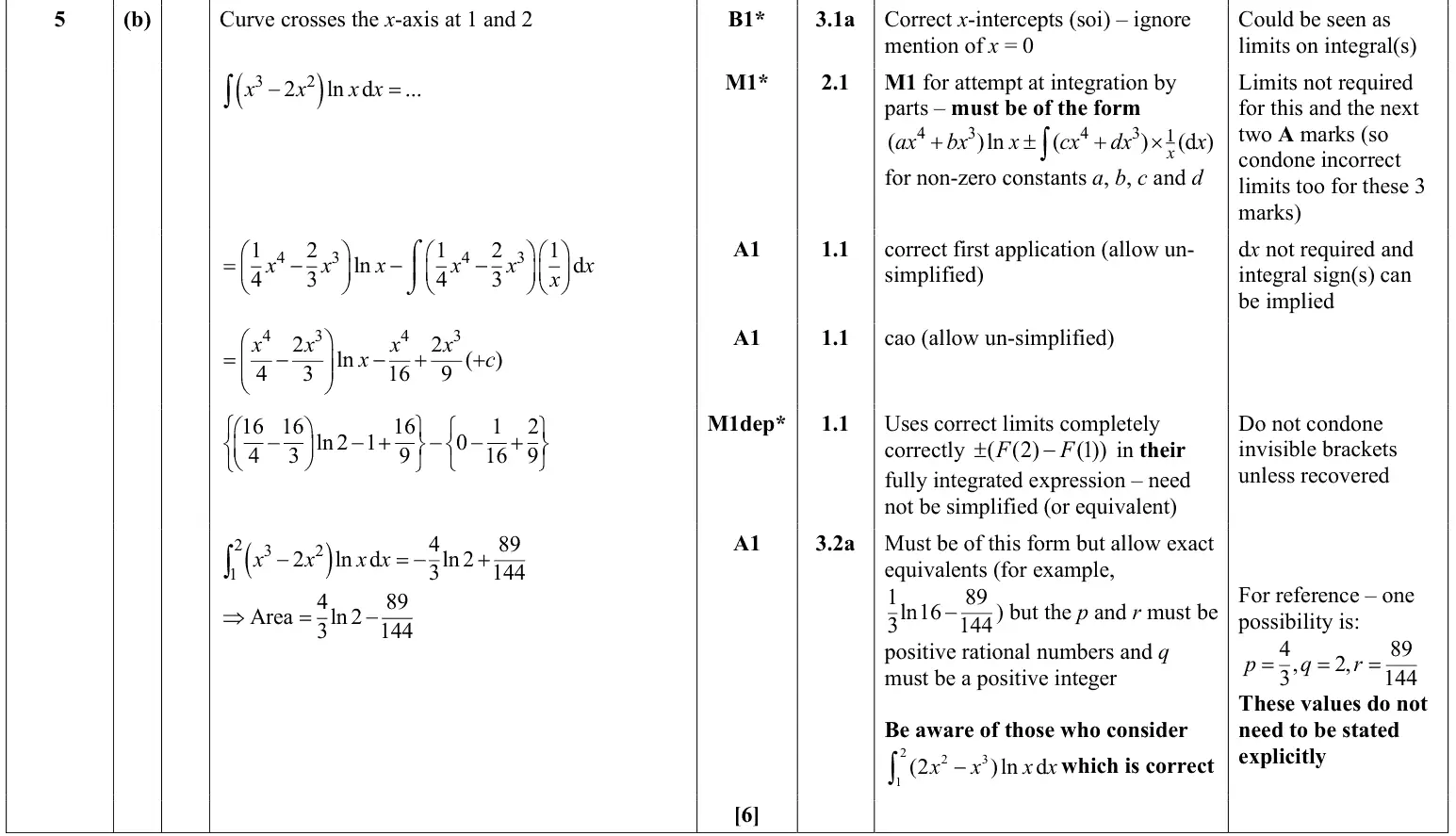
Most candidates correctly calculated the limits for the required area as 1 and 2 (although occasionally a lower limit of 0 was seen). Most candidates adopted the method of integration by parts when attempting to evaluate ∫(𝑥3 −2𝑥2)ln𝑥 d𝑥 and many were successful in obtaining the correct integrated expression. Those that attempted to use a substitution were generally unsuccessful. The most common errors in both the integration and when applying the limits were sign errors. Although many candidates correctly evaluated this integral as − 3 ln2 + 144, many did not realise that this was negative (as the shaded area was below the 𝑥-axis) and did not take the required modulus (even though the question made it clear what form the constants 𝑝, 𝑞 and 𝑟 should take).
Key points and common errors
limits 1 and 2 (x-intercepts)
by parts with u = ln x
integral = −(4/3)ln2 + 89/144 so area = (4/3)ln2 − 89/144
substitution unsuccessful
June 2024 · Paper 3 · Q12(c)6 marksHard
Show the start of this question
Mark scheme for this part
Examiner's comment
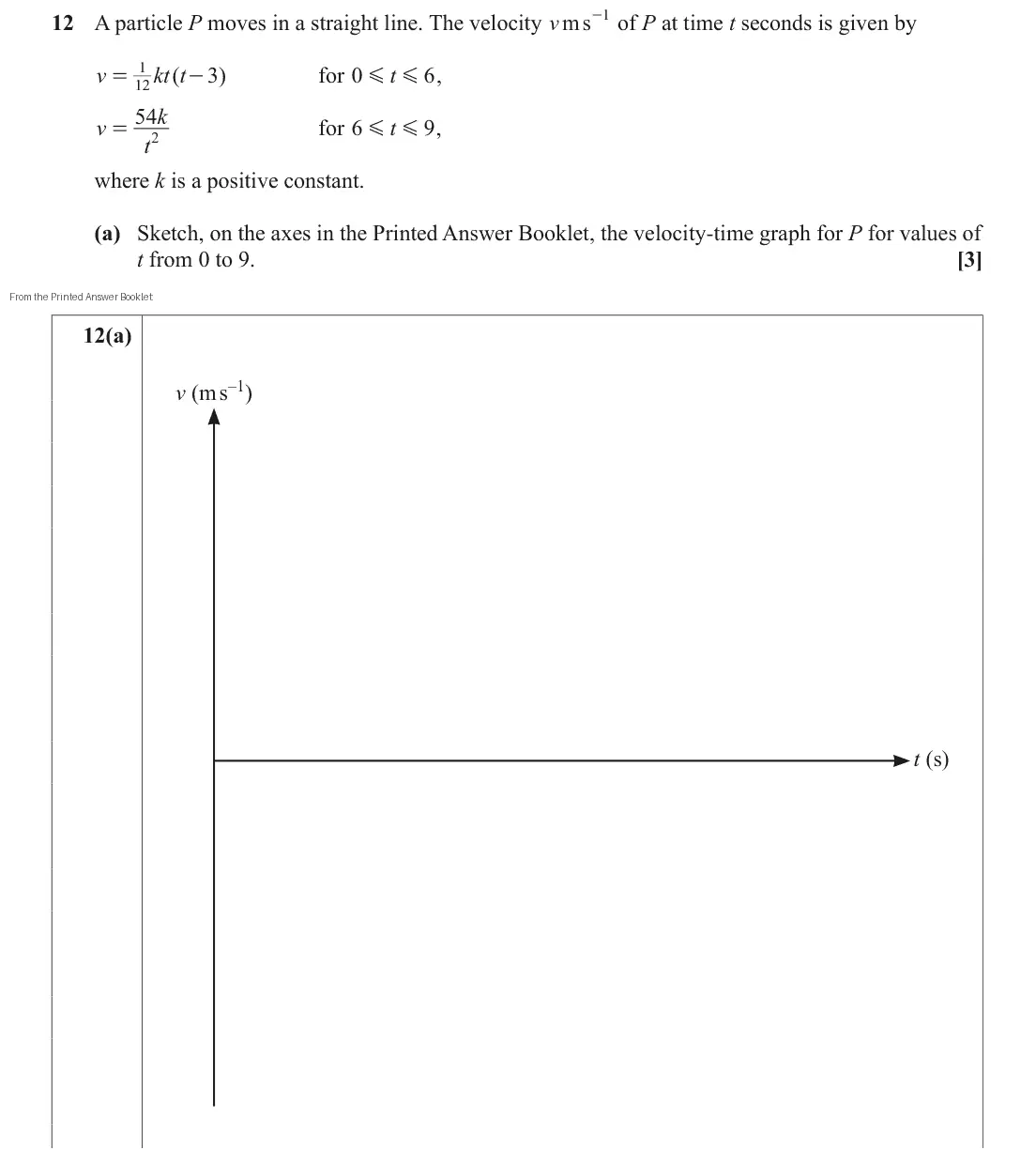
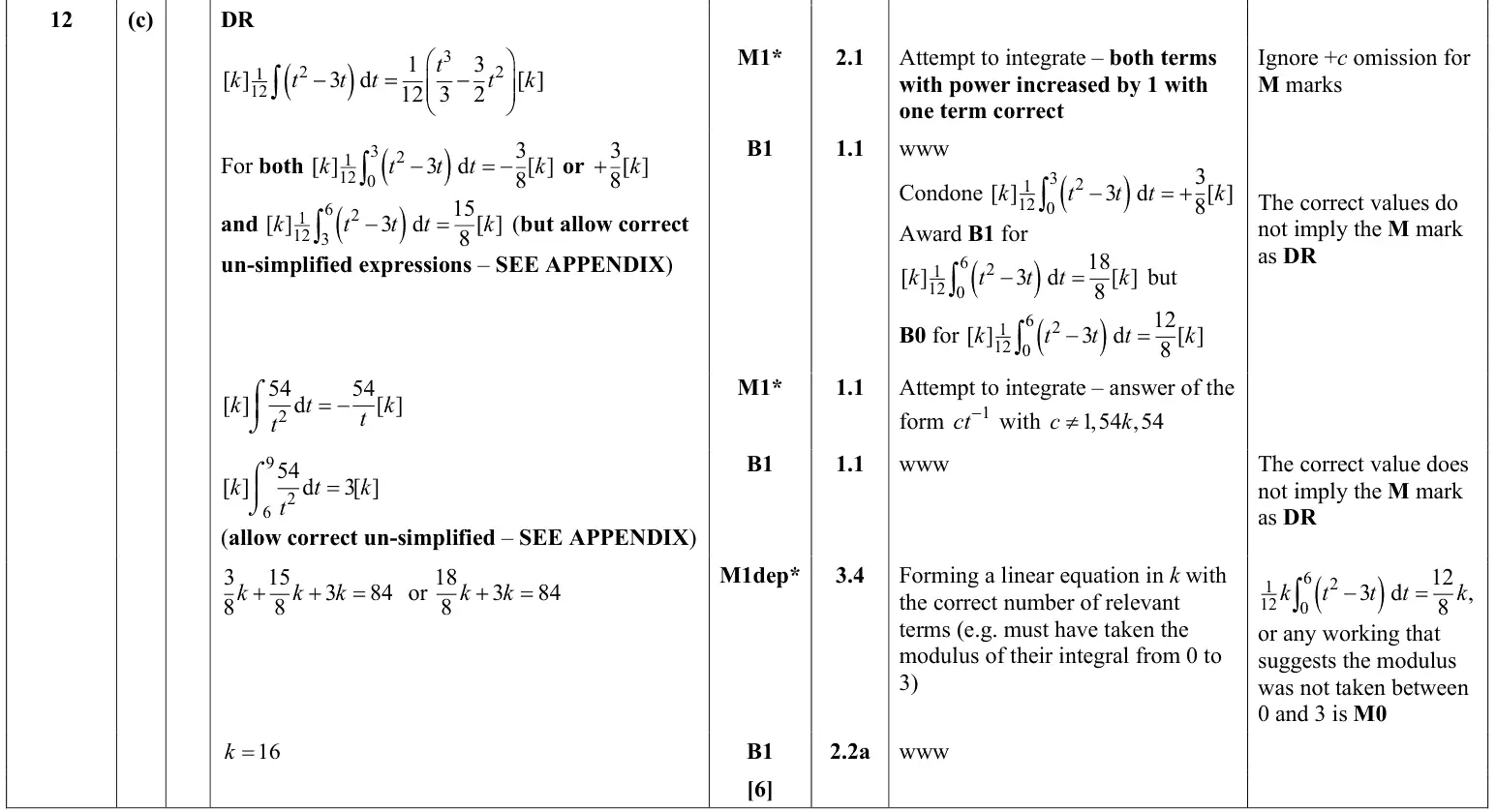
Many of the candidates who had drawn a correct velocity-time graph in part (a) did not realise the significance of the fact that part of this graph (between the times of 0 and 3) was below the 𝑡-axis and so therefore considered incorrect limits on their first integral i.e. ∫ . Some candidates seemed 12 𝑘𝑡(𝑡−3)d𝑡 to use the trapezium rule (or other non-calculus method) in this part. It was rare for candidates to set up the correct equation for 𝑘 as −∫ 12 𝑘𝑡(𝑡−3)d𝑡 12 𝑘𝑡(𝑡−3)d𝑡+ . + ∫ ∫ 𝑡2 d𝑡= 84 This candidate highlights the most common error seen by examiners in this part, which is considering the integral from 0 to 6 instead of considering the two integrals from 0 to 3 and from 3 to 6 separately. This response scored 3 of the 6 marks available.
Key points and common errors
distance: v < 0 for 0 < t < 3 so take the modulus: 3k/8 + 15k/8 + 3k = 84
k = 16
integrating 0 to 6 in one go gives displacement
June 2023 · AS Paper 1 · Q56 marksMedium
Mark scheme for this part
Examiner's comment
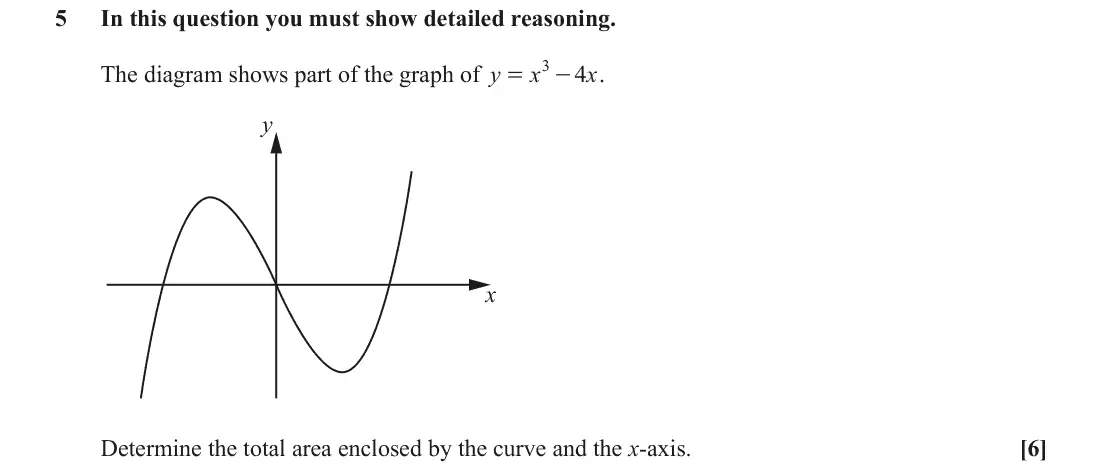
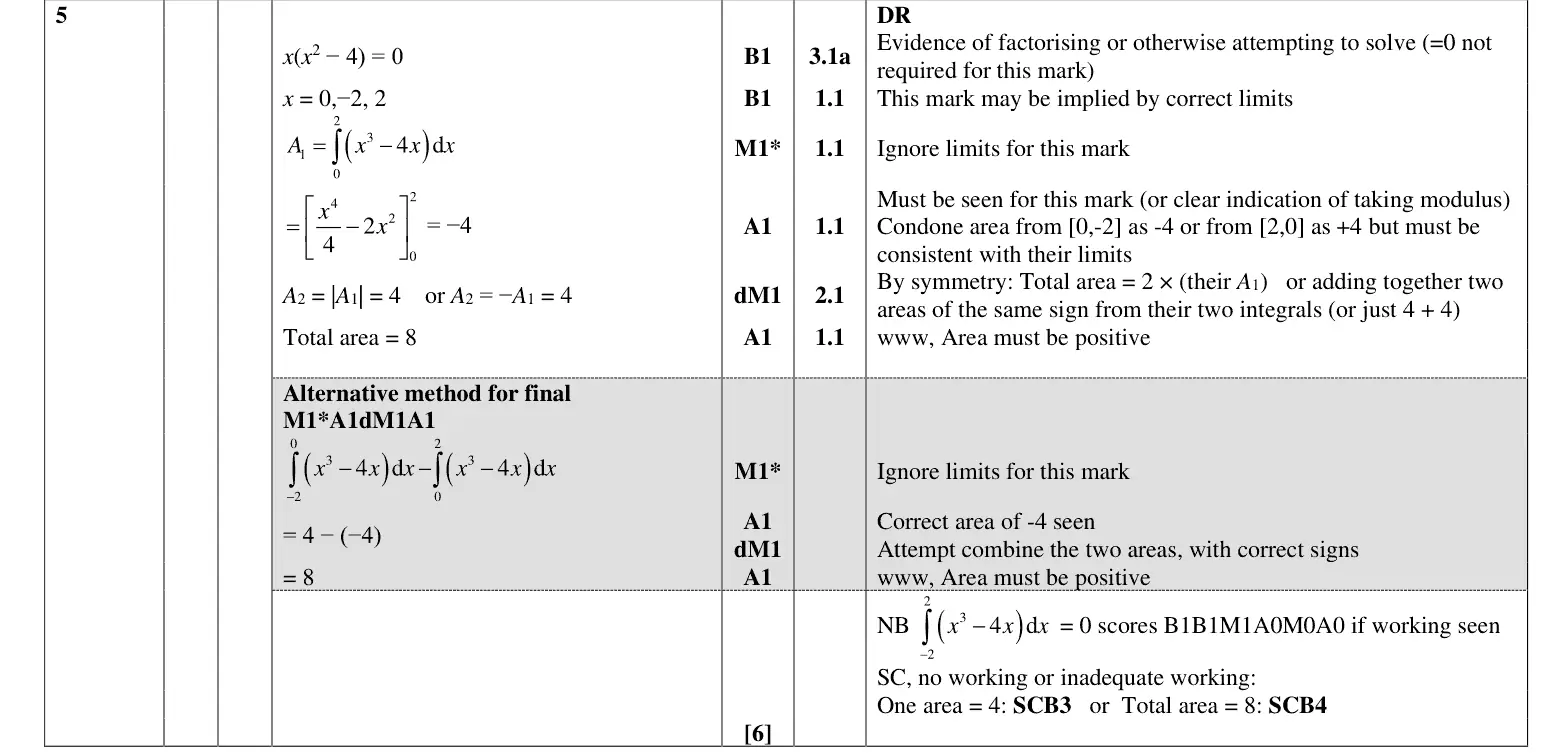
This was a ‘detailed reasoning’ question, so appropriate working throughout was required to gain full marks. Quite a number of candidates did not show any working when finding the roots, which meant that they could not be given the first B mark (in a ‘detailed reasoning’ question, some evidence of the method used is required). Some candidates showed a valid factorisation, but did not state the roots explicitly (because of the nature of this question, the second B mark was given if the roots were seen to be ‘used’ later, but candidates should be reminded of the importance of showing detailed reasoning). Candidates were required to show clear evidence of recognising and correctly handling the negative area for full marks. Some candidates switched the limits to ‘handle’ the negative area, which was permissible as long as their responses were consistent with their limits. Similarly for candidates who used modulus signs to ‘handle’ negative area (as long as it was clear what they had done). In general candidates should be encouraged to show all their working and clearly indicate negative areas, then explicitly handle (rather than going back and retrospectively adjust their working to remove or introduce - signs). The majority of candidates were good at showing the integrated expression but the substitution of limits was not always clearly shown. Centres should advise candidates to be careful not to write mathematically incorrect statements. In this case notation such as -4 = 4 or -8 = 8 was condoned, and the final M mark could be given for candidates who recognised the need to ‘match’ the signs of the area, (e.g. -4 + (-4) = -8), but the final A mark required a correct, positive answer from fully correct working. Relatively few candidates used the symmetry of the curve to find the other half area (which was an acceptable method as long as it was done clearly). A1= ∫൫x3 - 4x൯dx = -4 gives an area of 4 sq units below the x-axis. Simply changing a negative sign to a Care should be taken with the negative integral, e.g. a clear modulus sign used or comment that positive sign (A1= ∫൫x3 - 4x൯dx = +4) was penalised. consider the two areas separately and it was rare to see the single integral ∫൫x3 - 4x൯dx The main errors were dealing with signs in the integrals. Most candidates recognised the need to = 0 as an answer. This candidate has split the area correctly, but did not provide any working to support their roots (so could not be given the first B mark). They have correctly integrated the given expression and then handled the negative area correctly. Ideally we would have seen a more explicit recognition of the negative area (for instance showing –(-4) + 4 before the penultimate line), but this was sufficient for the remaining marks. This was awarded 5/6.
Key points and common errors
roots 0, ±2 by factorising (working required)
∫₀² (x³ − 4x) dx = −4
total area 2 × 4 = 8
∫ from −2 to 2 = 0 is not the area
June 2023 · AS Paper 2 · Q87 marksMedium
Mark scheme for this part
Examiner's comment
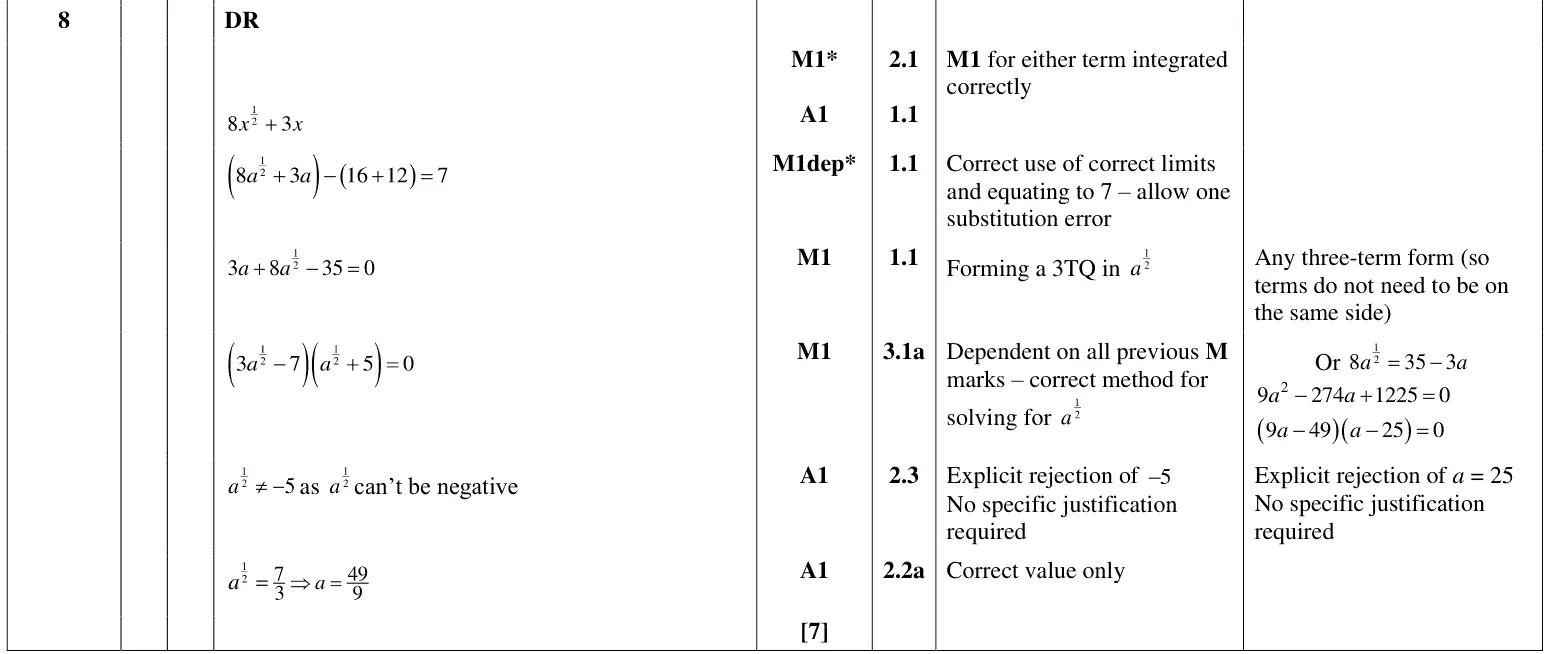
The majority of responses gained the first method mark, but there was some careless work with powers when dealing with 4x-½. Some candidates used 4x-1 or 4x½, which was costly. After integration, 2x½ + 3x spoiled some efforts. A few embarked on the question without integrating at all. The use of limits was generally good, with only the occasional candidate having the wrong order or adding terms. The majority of candidates that reached the ‘hidden’ quadratic did identify it, but as this is a DR question, we did want to see how this quadratic was solved; those who did it by calculator without showing working lost the last method mark (the ‘Assessment for learning’ comment above for Question 2 is relevant again here). We expected the final answer to be exact.
Key points and common errors
integrate to 8x^½ + 3x
(8a^½ + 3a) − 28 = 7
quadratic in a^½: (3a^½ − 7)(a^½ + 5) = 0
reject a^½ = −5 explicitly
a = 49/9
errors with 4x^(−½)
June 2023 · AS Paper 2 · Q10(c)3 marksMedium
Show the start of this question
Mark scheme for this part
Examiner's comment
Most candidates realised this part required v to be integrated, with many not using the calculator to do this. The most common error was to just do this with limits 3 and 0 (mirroring a similar error seen in Question 11(c) of the summer 2022 paper); this scored no marks. With this year’s question now giving future candidates an extra question of this type to practice on in mock exams, hopefully this type of error will be reduced in the future.
Key points and common errors
integrate 0 to 1.5 (45/8) and 1.5 to 3 (−9/8) separately
distance 6.75 m
a single integral from 0 to 3 scores nothing
June 2023 · Paper 1 · Q12(b)7 marksHard
Show the start of this question
Mark scheme for this part
Examiner's comment
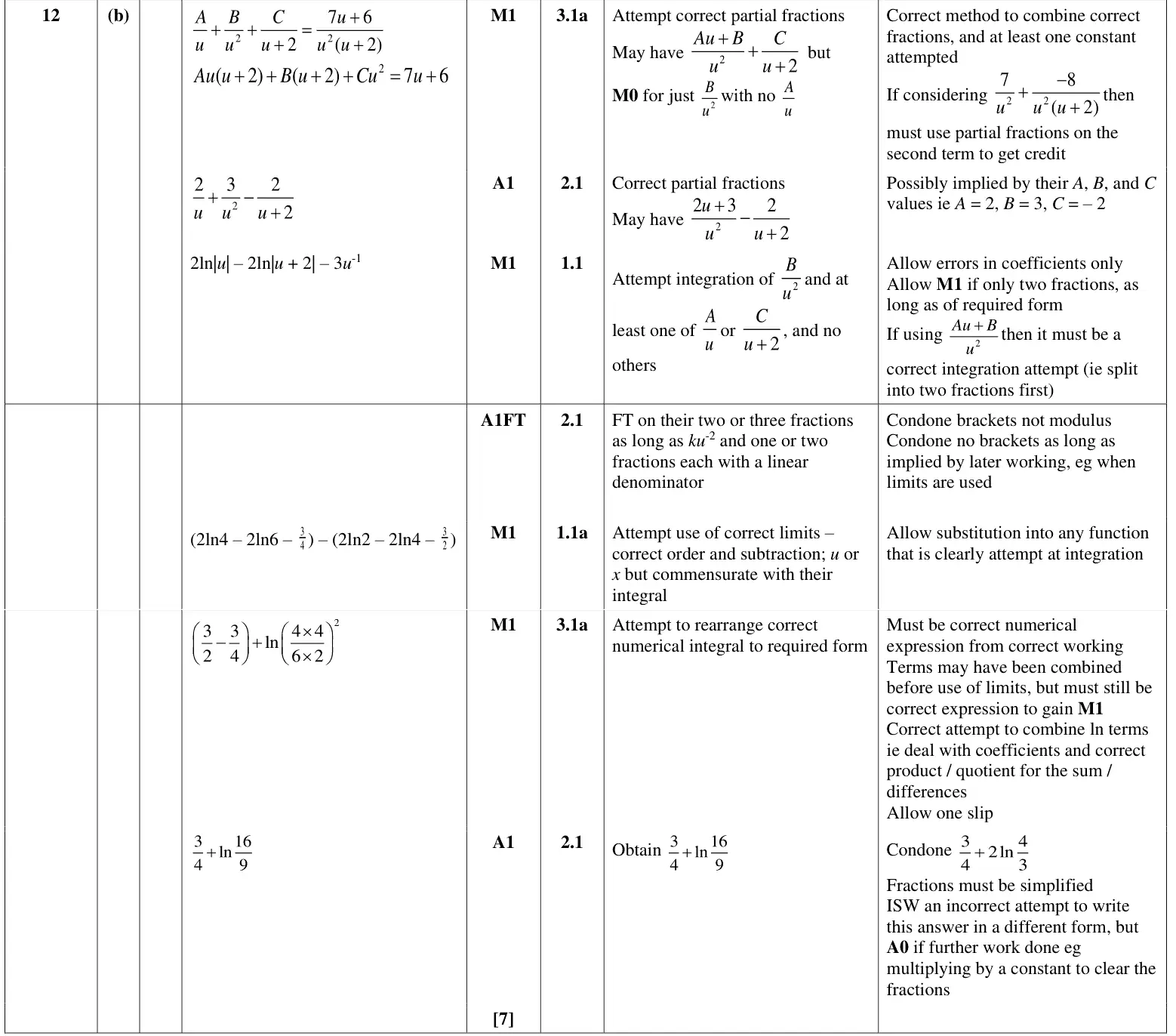
This question appears to have been very challenging for many candidates, with a variety of inappropriate integration techniques attempted. Candidates could still gain a method mark for attempting correct use of limits, but unfortunately some had given up before reaching this point. The factorised denominator should have indicated to candidates that using partial fractions would be a sensible strategy, and many did attempt to do so. The most common error was to not deal correctly with the repeated factor, but these candidates could still get further credit for integrating at least two fractions of the correct structure. However, a good number of candidates were able to provide fully correct solutions, successfully finding the partial fractions, using limits after integration and finally using laws of logs to manipulate their answer to the required form.
Key points and common errors
partial fractions 2/u + 3/u² − 2/(u + 2)
limits u = 2 to 4
3/4 + ln(16/9)
repeated factor often mishandled
June 2023 · Paper 2 · Q33 marksEasy
Mark scheme for this part
Examiner's comment
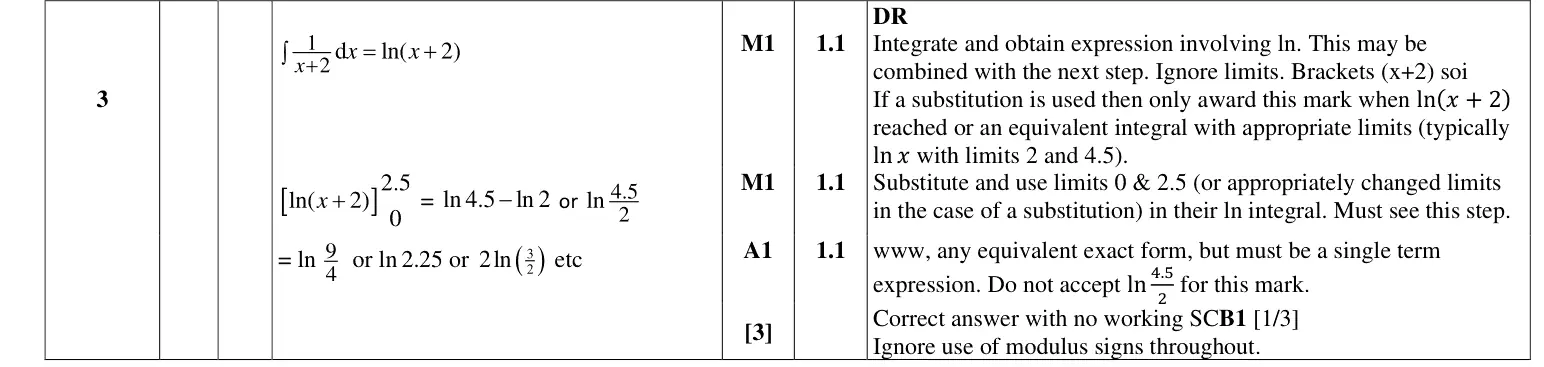
Most candidates answered this question well. A small number did not heed the ‘In this question you must show detailed reasoning’ instruction and used their calculator to compute the integral, giving an inexact answer, which could not be credited. Candidates needed to use log rules to combine and simplify their final answer into an exact form. Some candidates did not find the correct limits, which meant that they could only obtain the first M mark (if their integration was correct). A small number used a substitution, generally correctly, although this represented much more work than was required as this integral can be found directly. Detailed reasoning and exact answers ‘Detailed reasoning’ means that sufficient working must be seen to clearly justify the answer obtained. The use of calculators is permitted to check or verify solutions, but the algebraic working given must ‘stand alone’ and lead to the required answer. In Question 3, many candidates performed the integration correctly but then went on to use a calculator to give an inexact answer – even though the question specifically requested the ‘exact area’.
Key points and common errors
∫1/(x + 2) dx = ln(x + 2)
limits 0 and 2.5
ln 4.5 − ln 2 = ln(9/4) as a single exact term
calculator answers gain nothing
June 2023 · Paper 3 · Q5(b)6 marksHard
Show the start of this question
Mark scheme for this part
Examiner's comment
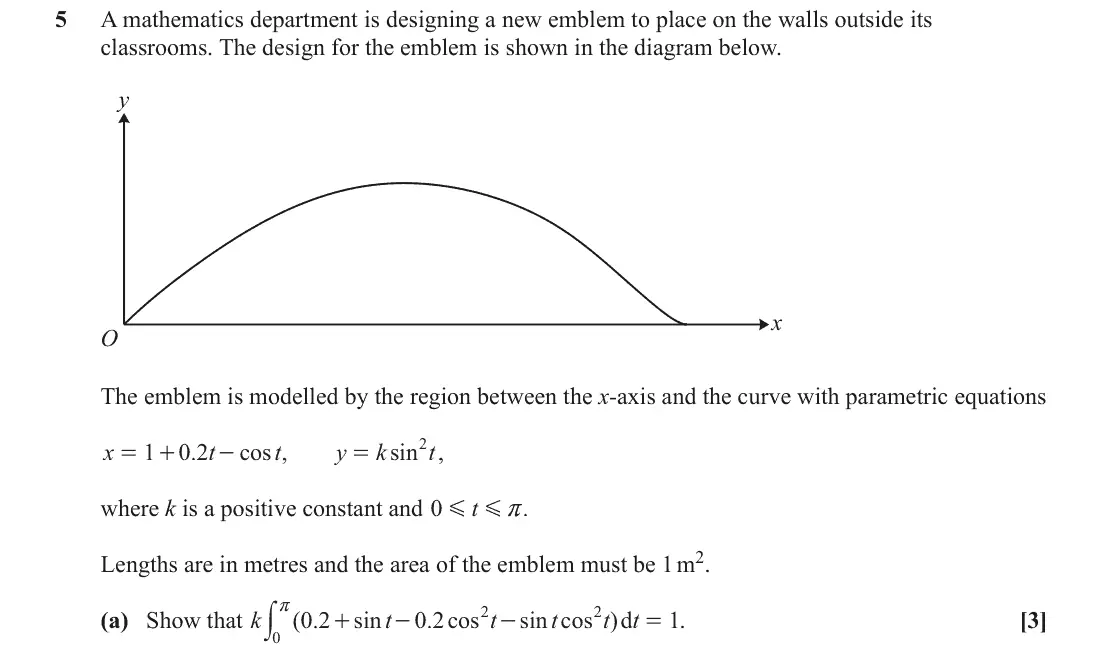
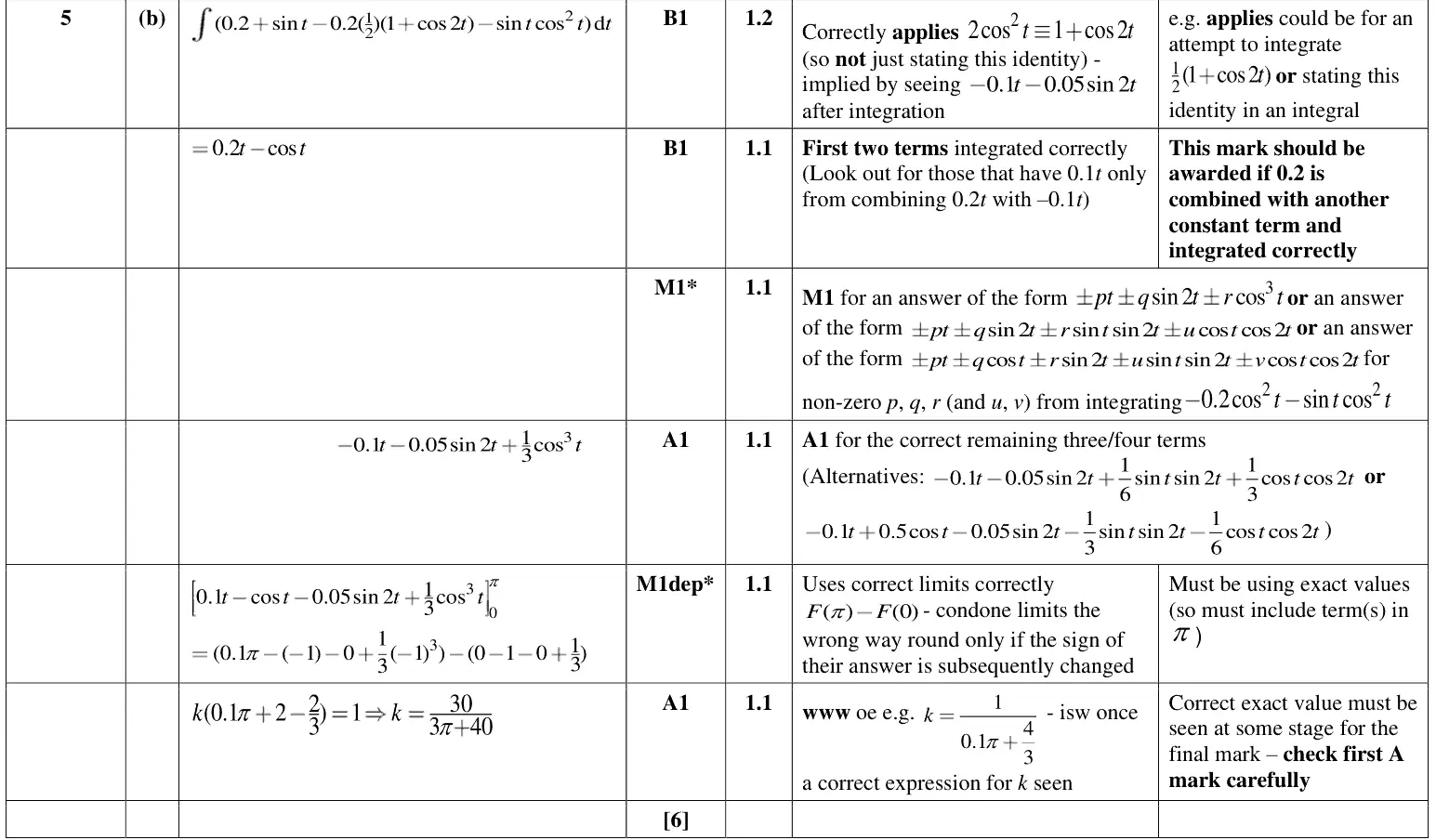
Although there were several ways of tackling this integral (to find the exact value of k) it was expected that candidates would deal with each term separately (and not attempt to combine terms together). The form of the integral given to the candidates in part (a) was meant to assist (rather than hamper) their attempts to solve this part. So, to that end it was expected that candidates would tackle the integral in the following way: ∫0.2 + sin𝑡𝑡 d𝑡𝑡= 0.2𝑡𝑡−cos𝑡𝑡 (integrate the first two terms immediately) ∫cos2𝑡𝑡 d𝑡𝑡= 2 ∫1 + cos2𝑡𝑡 d𝑡𝑡= 2 ቀ𝑡𝑡+ 2 sin2𝑡𝑡ቁ (use the standard double-angle formula to integrate cos2𝑡𝑡) 𝑛𝑛+1 (f(𝑥𝑥))𝑛𝑛+1 + 𝑐𝑐 from the formulae given on ∫sin𝑡𝑡cos2𝑡𝑡 d𝑡𝑡= − 3 cos3𝑡𝑡 (use the result ∫f ′(𝑥𝑥)൫f(𝑥𝑥)൯ 𝑛𝑛d𝑥𝑥= page 2 of the question paper) The small number of candidates who did integrate each term correctly usually applied the limits correctly too and obtained the correct value for k.
Key points and common errors
integrate term by term: 0.2t − cos t
cos²t = ½(1 + cos2t)
sin t cos²t integrates to −⅓cos³t (by inspection)
exact k = 30/(3π + 40)
June 2022 · AS Paper 1 · Q5(b)4 marksMedium
Show the start of this question
Mark scheme for this part
Examiner's comment
Many candidates did not carry out a second integration but substituted the limits into their answer to part (a). Some of those who used a correct method made an arithmetical error in obtaining the constant term. It is worth noting that this question required the ability to carry out a definite integral without the use of the relevant calculator function.
Key points and common errors
integrate the curve again: [x⁴/12 − x³/2 + 2x] from 1 to p = p⁴/12 − p³/2 + 2p − 19/12
many substituted limits into the answer to (a)
no calculator
June 2022 · AS Paper 2 · Q8(b)7 marksMedium
Show the start of this question
Mark scheme for this part
Examiner's comment
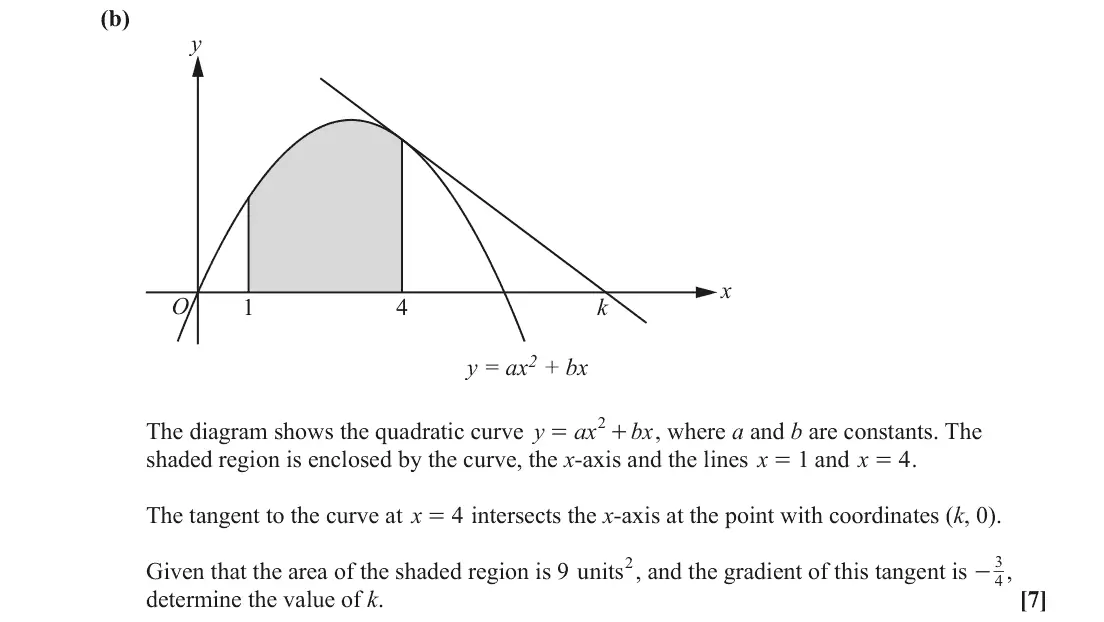
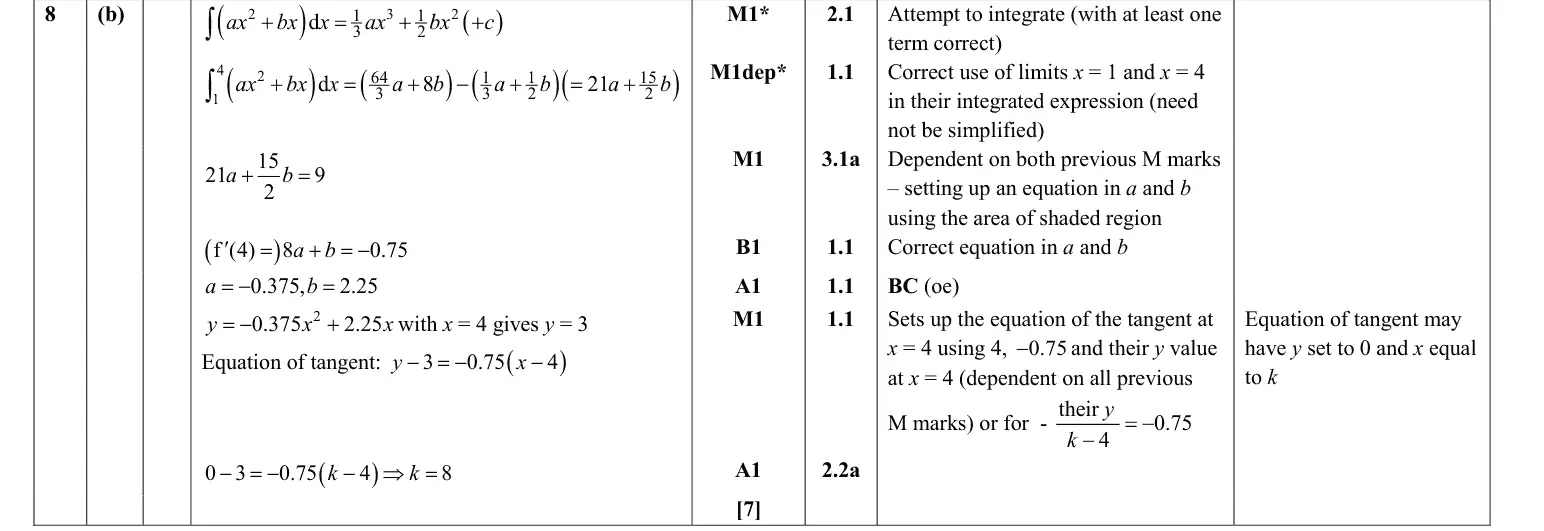
Many candidates earned the first 3 method marks here, most integrating correctly, a few making a sign error when evaluating the limits. Less successful was recognising where the second equation in a and b came from, and hence not finding their values. Those who managed this often produced a complete solution, but not all provided the correct method to find k. Some thought y = 2ax +b was the equation of the tangent. Only a few started this question by differentiating y = ax2 + bx rather than integrating it.
Key points and common errors
∫₁⁴ (ax² + bx) dx = 21a + 7.5b = 9
f′(4) = 8a + b = −0.75
a = −0.375, b = 2.25
tangent at (4, 3): y − 3 = −0.75(x − 4) gives k = 8
second equation often missed
June 2022 · AS Paper 2 · Q11(c)3 marksMedium
Show the start of this question
Mark scheme for this part
Examiner's comment
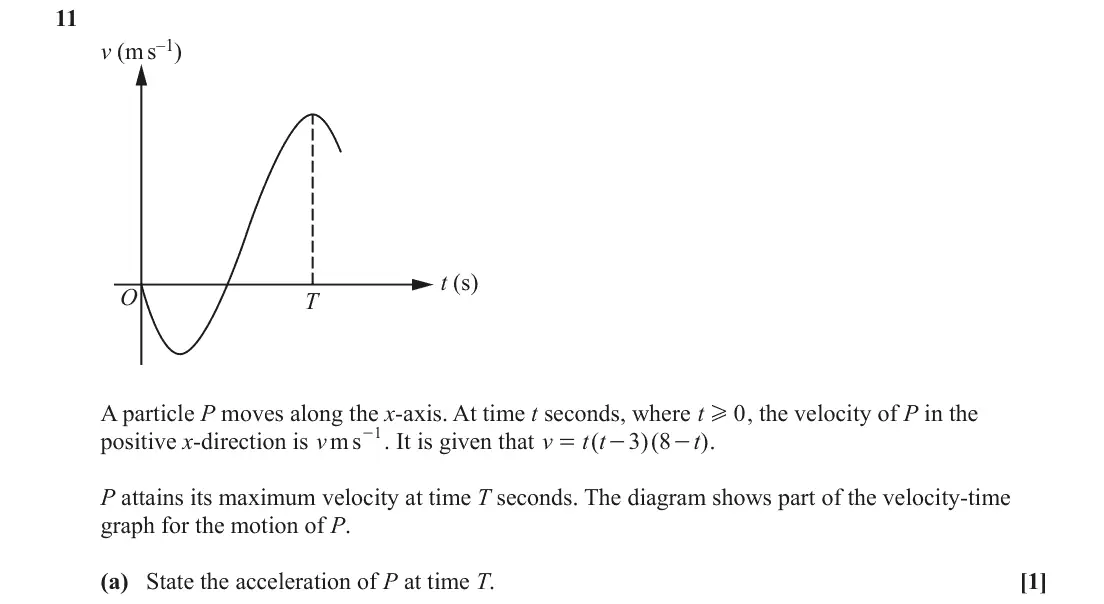
Most candidates realised this part required v to be integrated. Many did not use the calculator to do this despite the instruction being ‘Find’. The most common error was to do this with limits 6 and 0, but the combination of 6 and 4/3 and 4/3 and 0 was also seen. When doing definite integrals on the calculator it is wise, time permitting, for candidates to type in the relevant details twice to hopefully avoid careless errors.
Key points and common errors
split at t = 3 where v changes sign: 117/4 + 261/4 = 94.5 m
error integrating 0 to 6 directly
June 2022 · Paper 1 · Q97 marksHard
Mark scheme for this part
Examiner's comment
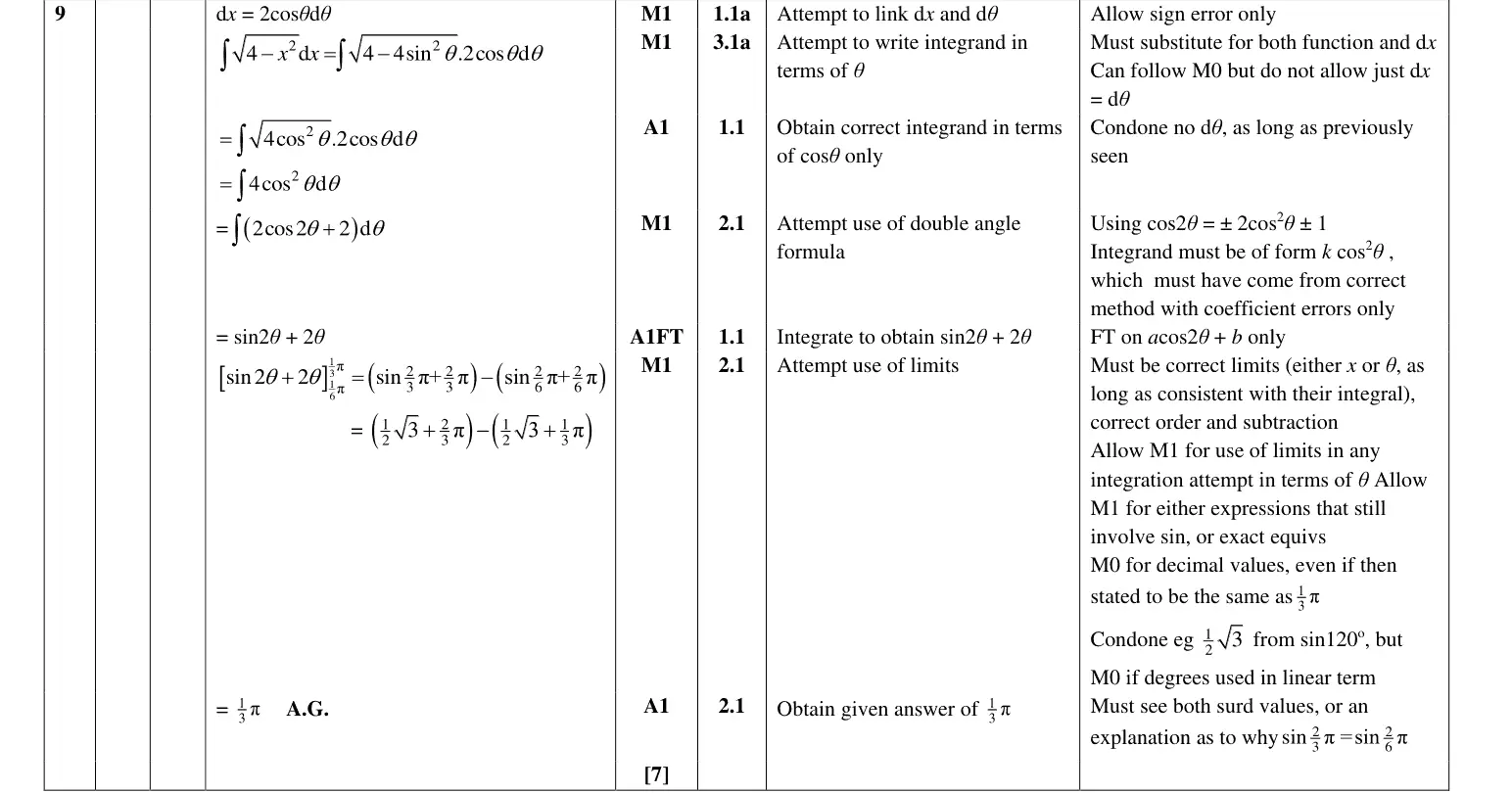
This proved to be a surprisingly challenging question, and the full range of marks was seen. The majority did attempt to use the given substitution, with only a few continuing to work in terms of x. Most appreciated the need to attempt the integrand in terms of θ, and attempted to do so. The most common errors were for an incorrect variable of u to be introduced, and for the simplification of the square root to be incorrect, with √(4 – 4sin2θ) becoming 2 – 2sinθ. Of the candidates who did obtain the correct integrand, most were able to select the correct identity and then usually produced a fully correct solution.
Key points and common errors
dx = 2cosθ dθ
√(4 − 4sin²θ) = 2cosθ (not 2 − 2sinθ)
∫4cos²θ dθ = sin2θ + 2θ via the double angle formula
limits π/6 to π/3 give π/3
exact values needed
June 2022 · Paper 2 · Q3(b)(i)3 marksEasy
Mark scheme for this part
Examiner's comment
This question was answered well by many candidates. Some correctly obtained 1 1 , but either −+ 2 1 a omitted the simplification (presumably not having read the question carefully) or made an algebraic error when attempting the simplification. A small number of candidates substituted the limits the wrong way round. Others substituted the limits, but then added instead of subtracting. Many candidates gave incorrect answers involving either (1 + a)−3 or ln(1 + x), and a few candidates attempted to use partial A B fractions (of the form + ) before integrating. 2 (1 + x ) (1 + x )
Key points and common errors
∫(1 + x)⁻² dx = −(1 + x)⁻¹
1/2 − 1/(1 + a) = (a − 1)/(2(a + 1)) as a single fraction
limits order
ln(1 + x) wrong
June 2022 · Paper 3 · Q68 marksEasy
Mark scheme for this part
Examiner's comment
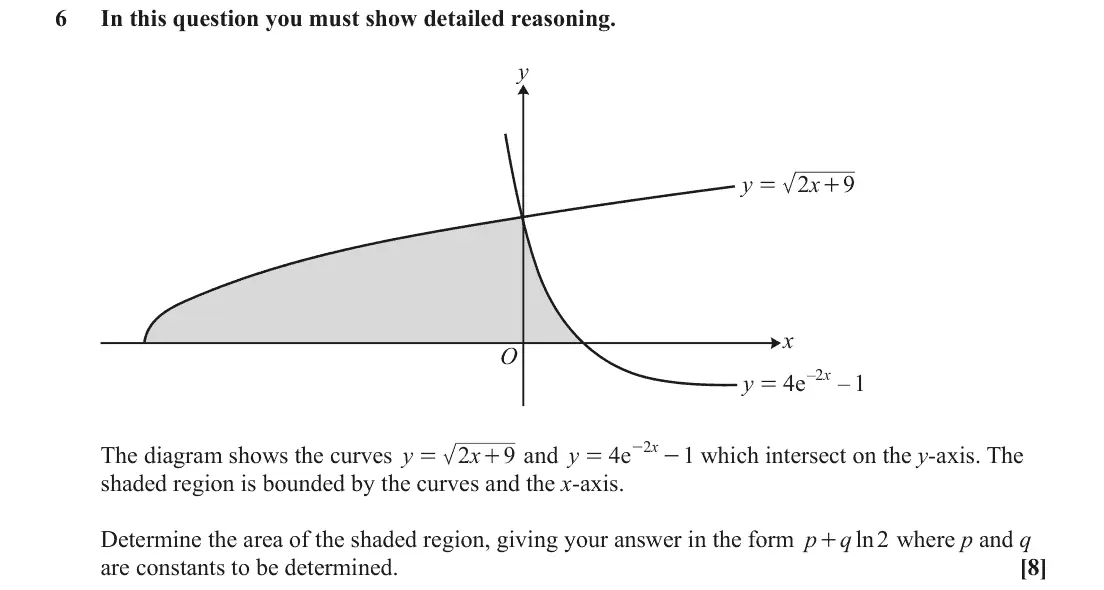
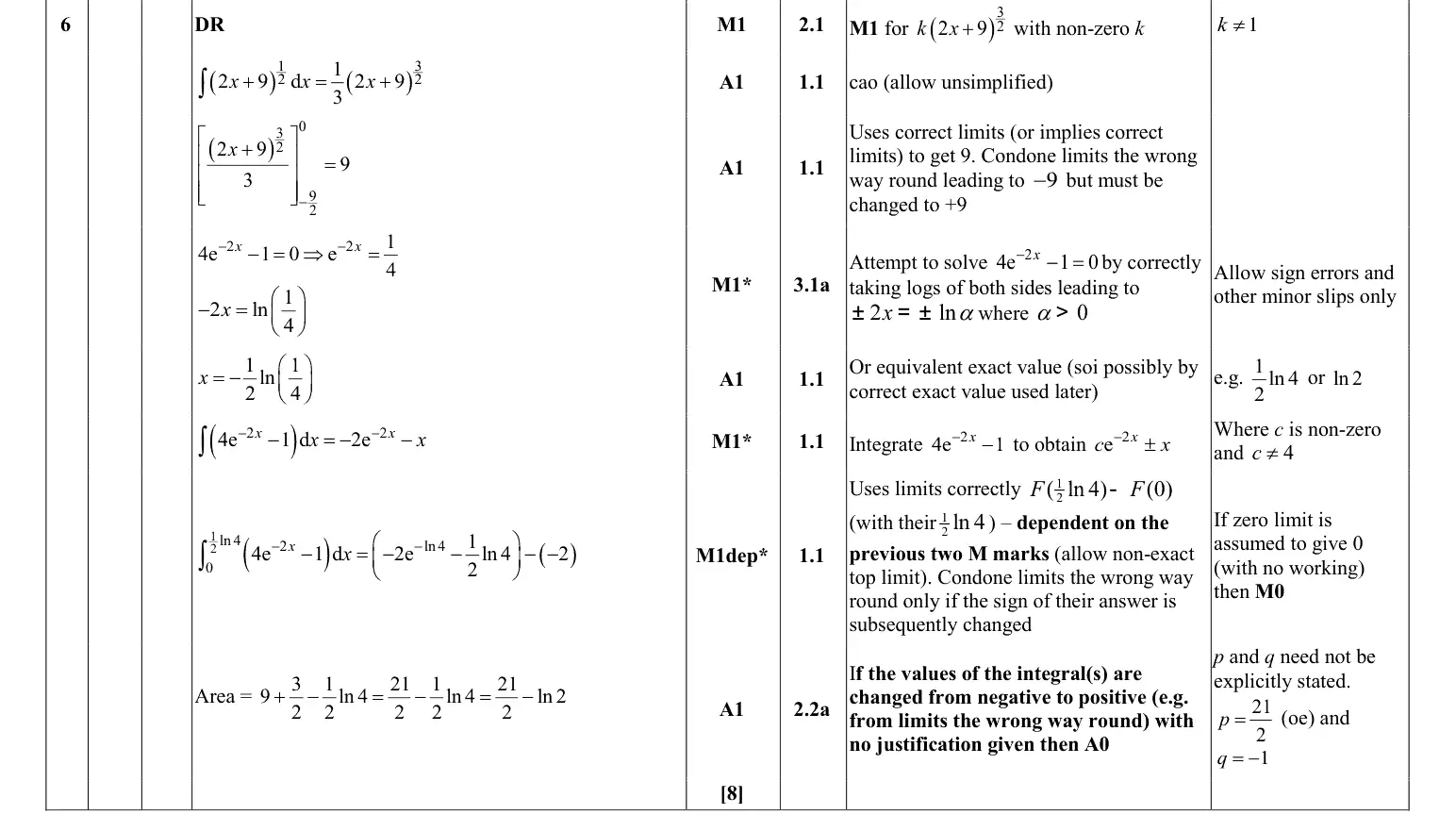
This question was answered extremely well with many candidates scoring all 8 marks for correctly determining the required shaded area of the given region. As this was a DR question it was not 0 2 ( ) + = acceptable to simply state that x 9 d x 9 or to apply the limits the wrong way round and then − to 9 without suitable justification. Some candidates struggled to solve the change a response of 9 −= 4e − 1d . x equation 4e 1 0 exactly or to find the required upper limit for the integral Furthermore, some had difficulty with evaluating this indefinite integral (it was common for examiners to report that this was often integrated to − 8e − x ). Many candidates struggled to evaluate − − accurately 2e x even though they had access to calculators which would have enabled them to check their response.
Key points and common errors
∫ from −9/2 to 0 of √(2x + 9) = 9
4e^(−2x) − 1 = 0 at x = ½ln4
∫(4e^(−2x) − 1) = 3/2 − ½ln4
area 21/2 − ln2
correct limit order needed under DR
Autumn 2021 · AS Paper 2 · Q8(c)5 marksMedium
Show the start of this question
Mark scheme for this part
Key points and common errors
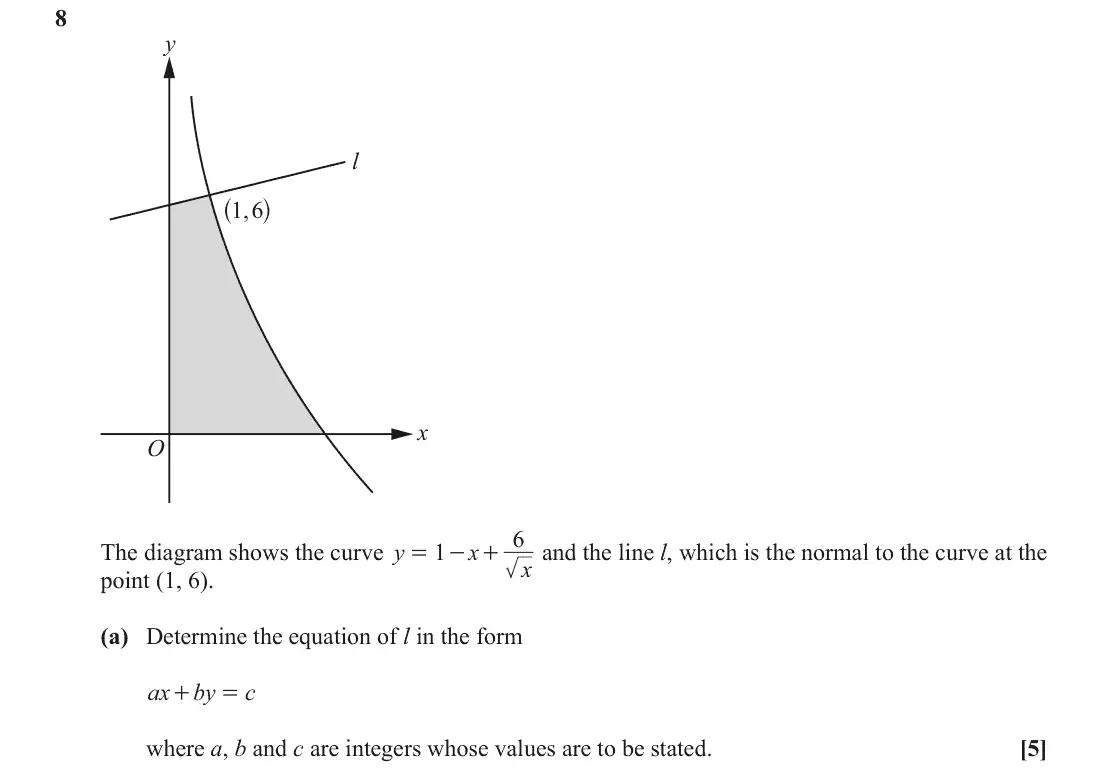
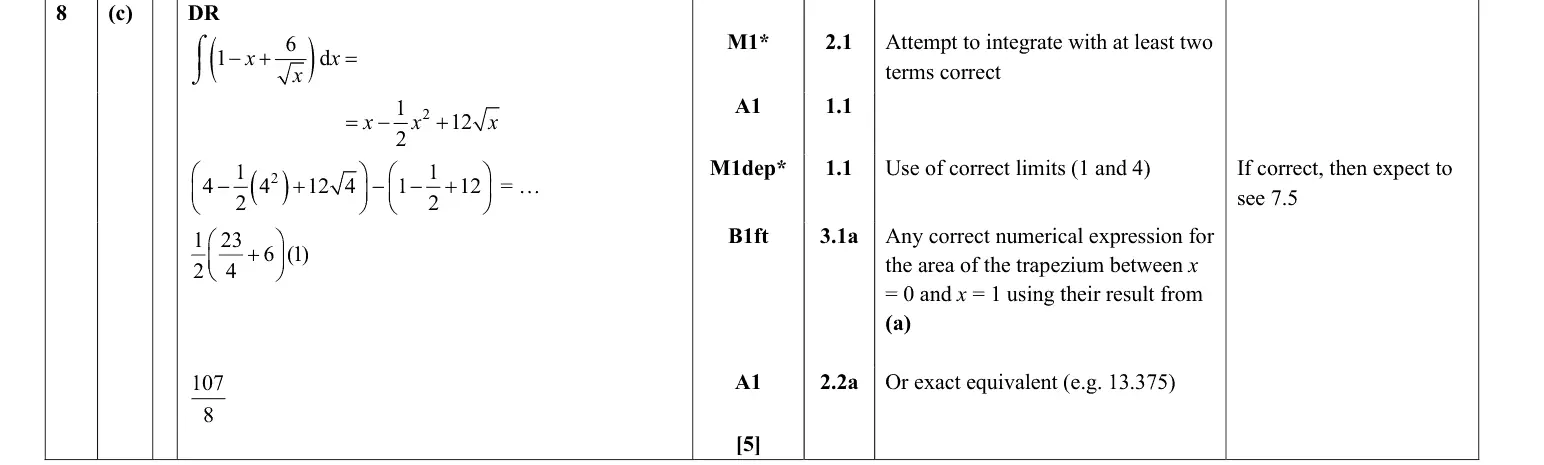
∫ from 1 to 4 of (1 − x + 6x^(−1/2)) dx = 7.5
trapezium from x = 0 to 1 under l: ½(23/4 + 6) = 47/8
total 107/8
Autumn 2021 · AS Paper 2 · Q127 marksMedium
Mark scheme for this part
Key points and common errors
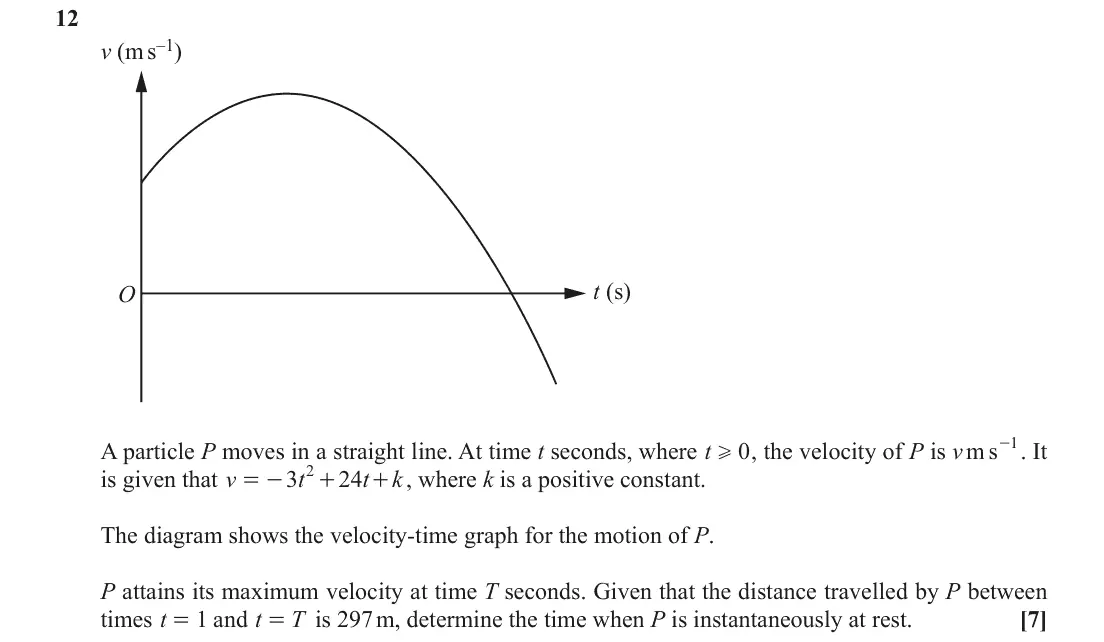
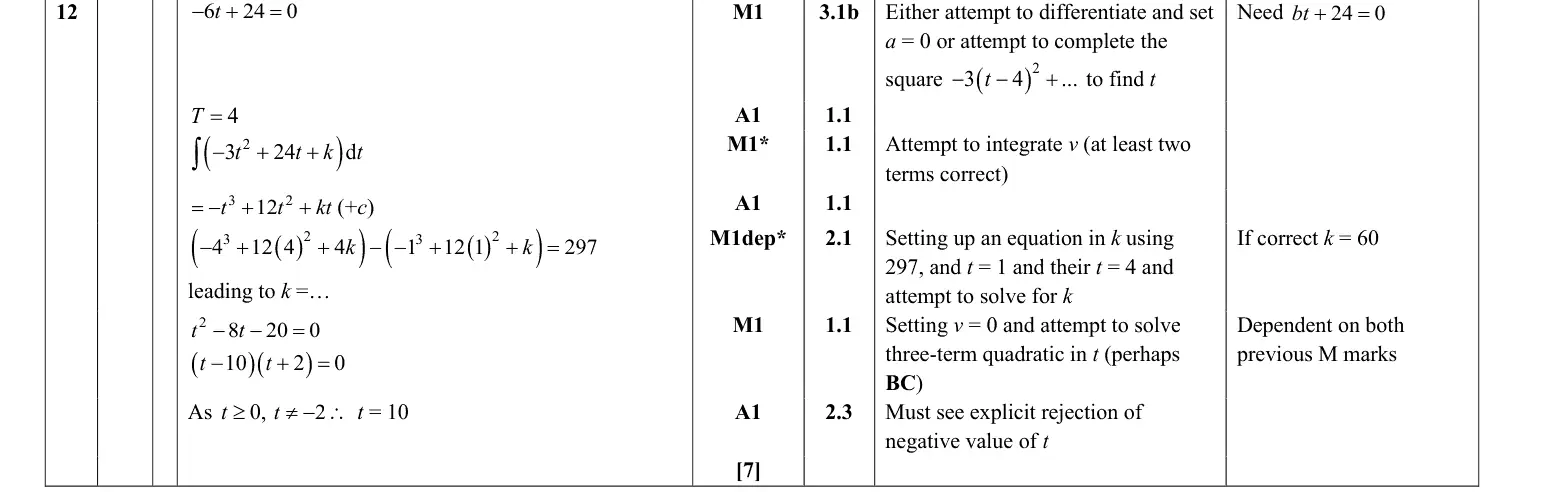
maximum velocity when a = −6t + 24 = 0, T = 4
s = −t³ + 12t² + kt
distance from t = 1 to 4 equals 297 gives k = 60
v = 0: t² − 8t − 20 = 0, t = 10 (reject −2 explicitly)
Autumn 2021 · Paper 3 · Q8(b)6 marksMedium
Show the start of this question
Mark scheme for this part
Key points and common errors
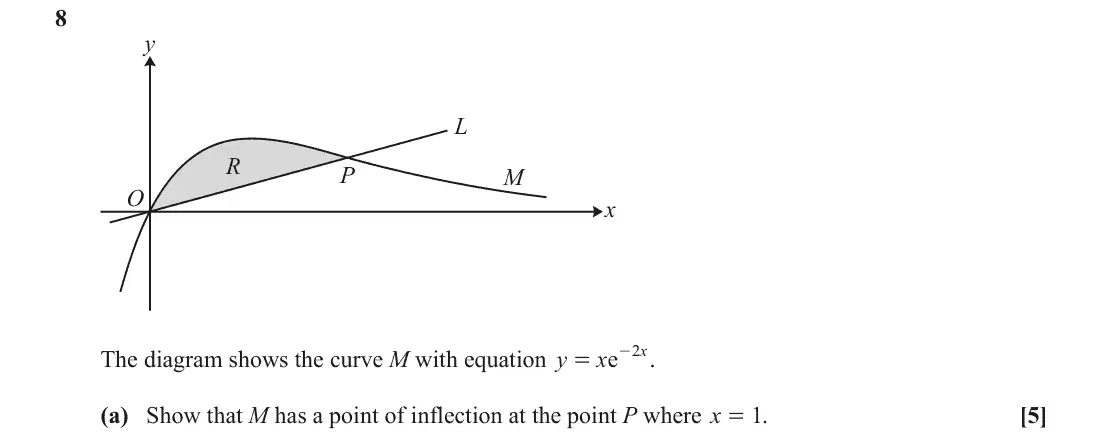
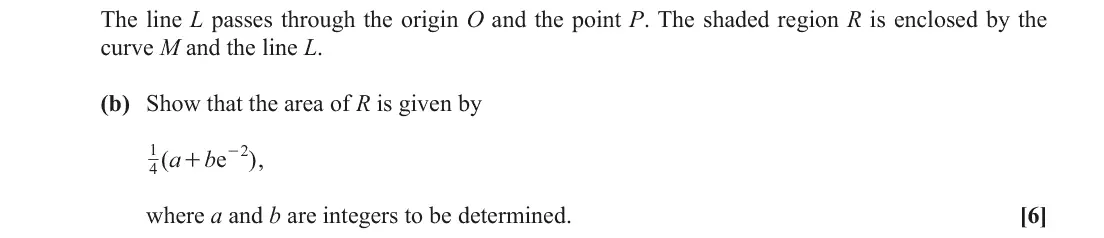
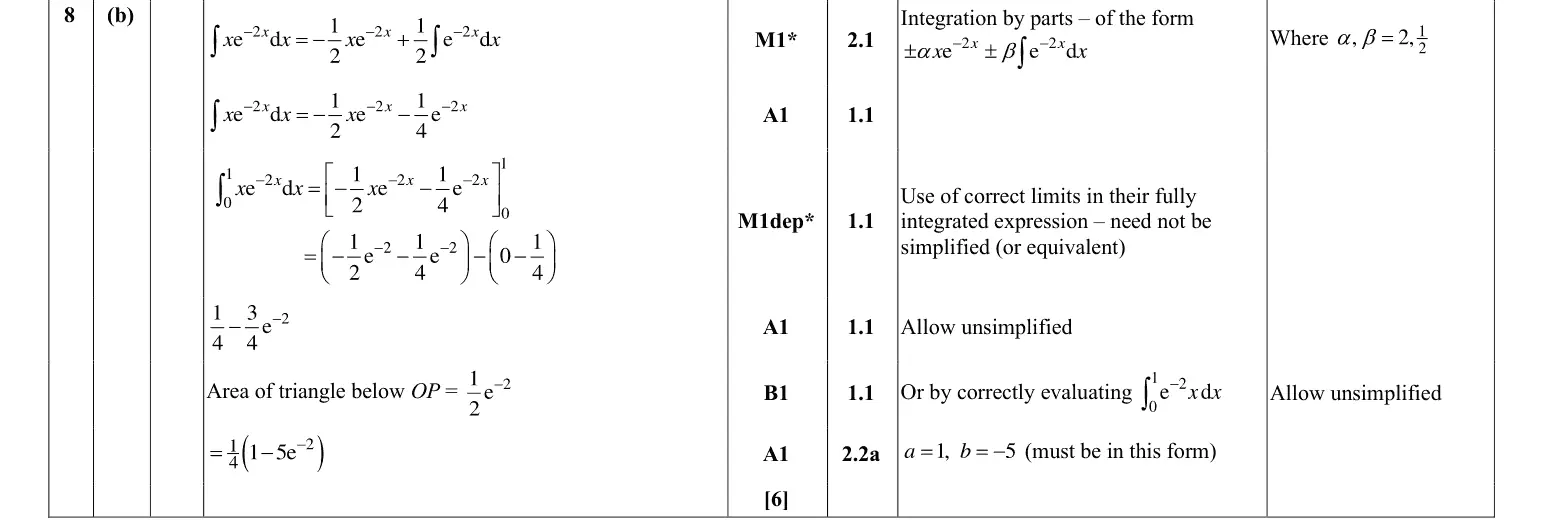
integrate xe^(−2x) by parts: ¼ − ¾e⁻² from 0 to 1
subtract triangle below OP of area ½e⁻²
¼(1 − 5e⁻²) so a = 1, b = −5
Autumn 2020 · AS Paper 1 · Q5(c)4 marksMedium
Show the start of this question
Mark scheme for this part
Key points and common errors
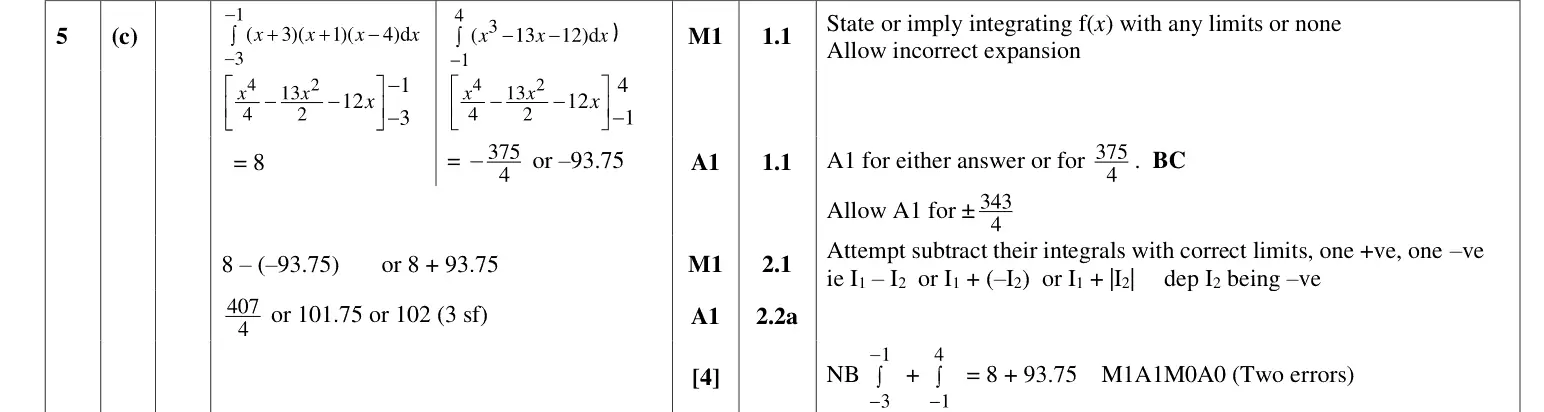
expand (x + 3)(x + 1)(x − 4) = x³ − 13x − 12
integrate −3 to −1 gives 8 and −1 to 4 gives −375/4
total 407/4 = 101.75
do not combine signed areas
Autumn 2020 · AS Paper 2 · Q10(c)3 marksHard
Show the start of this question
Mark scheme for this part
Examiner's comment
(Comment on Question 10 as a whole) Part (c) - Most just considered t = 0 to t = 4 without realising the importance of t = 3, even though (b) was almost always correct.
Key points and common errors
split at t = 3: 27/2 + 25/6 = 53/3 ≈ 17.7 m
integrating 0 to 4 directly gives 28/3
Autumn 2020 · Paper 1 · Q10(b)(ii)4 marksMedium
Show the start of this question
Mark scheme for this part
Examiner's comment
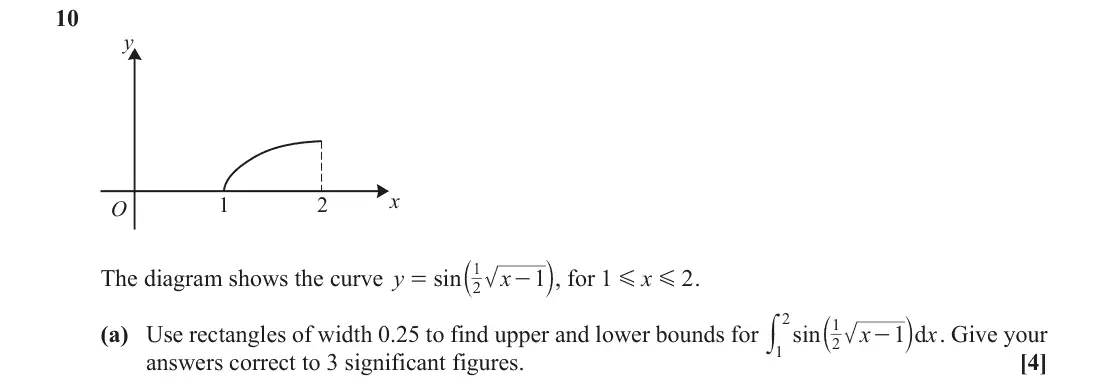
(Comment on Question 10 as a whole) It was apparent in Question 10 that many candidates were not familiar with the concept of using rectangles to establish upper and lower bounds. The most common error was to instead use the trapezium rule, often attempting to then establish bounds for their final answer. In part (b)(i) it was a given answer so sufficient detail was required, and in part (b)(ii) it was again a given answer so there had to be some evidence of the change of limits (assuming that candidates were now working in t) and also that the lower limit of t = 0 had been considered rather than just ignoring it.
Key points and common errors
parts: −4t cos(½t) + 8 sin(½t)
change limits to t = 0 and 1
lower limit must be seen to be considered
Autumn 2020 · Paper 3 · Q5(c)5 marksEasy
Show the start of this question
Mark scheme for this part
Examiner's comment
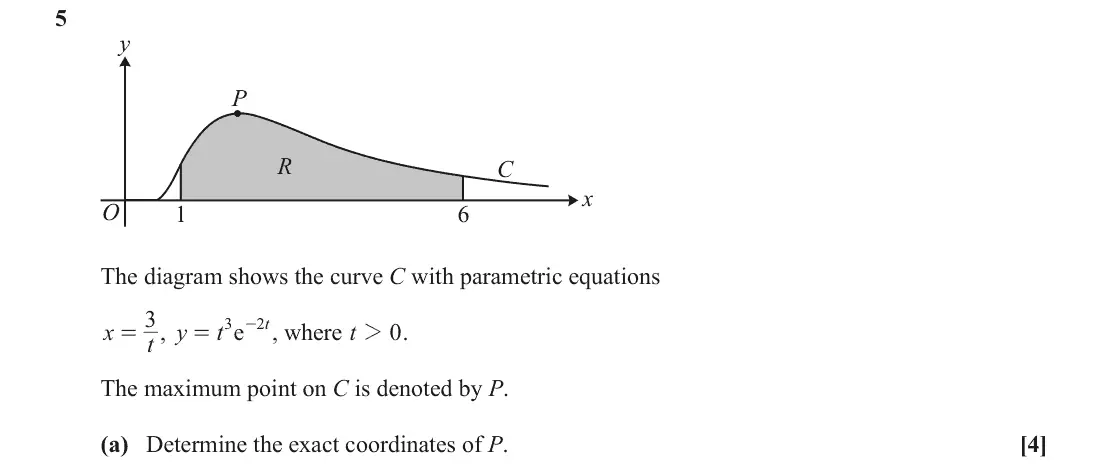
(Comment on Question 05 as a whole) Unless explicitly requested, candidates should avoid converting parametric equations into the cartesian form due to the complexity. d y In part (a) candidates only needed to determine where t = 0 . Unfortunately, some candidates made d errors in the denominator when finding d y x , and while this may not impact the numerical answer d obtained, there is a standard principle that answers obtained with wrong working will not gain full credit. The other issue with this question was that the ‘exact coordinates of P ’ was needed, those candidates that provided a decimal approximation would not gain full credit (unless the exact value had been seen as part of the working). The first issue with part (b) was that the limits were given on the diagram as x = and 1 , but the x = 6 integration was to be done with respect to t ; a number of candidates did not spot this. This was a ‘Show that’ question so the initial method mark was to find d x t and to show a clear attempt to use this in d d d x ∫ y t . The final accuracy mark was to rearrange into the given form. d t Part (c) involved using the formula given in part (b) to ‘Hence’ determine the area. Generally, this was done well, with candidates correctly giving their answer in ‘exact’ form in terms of e .
Key points and common errors
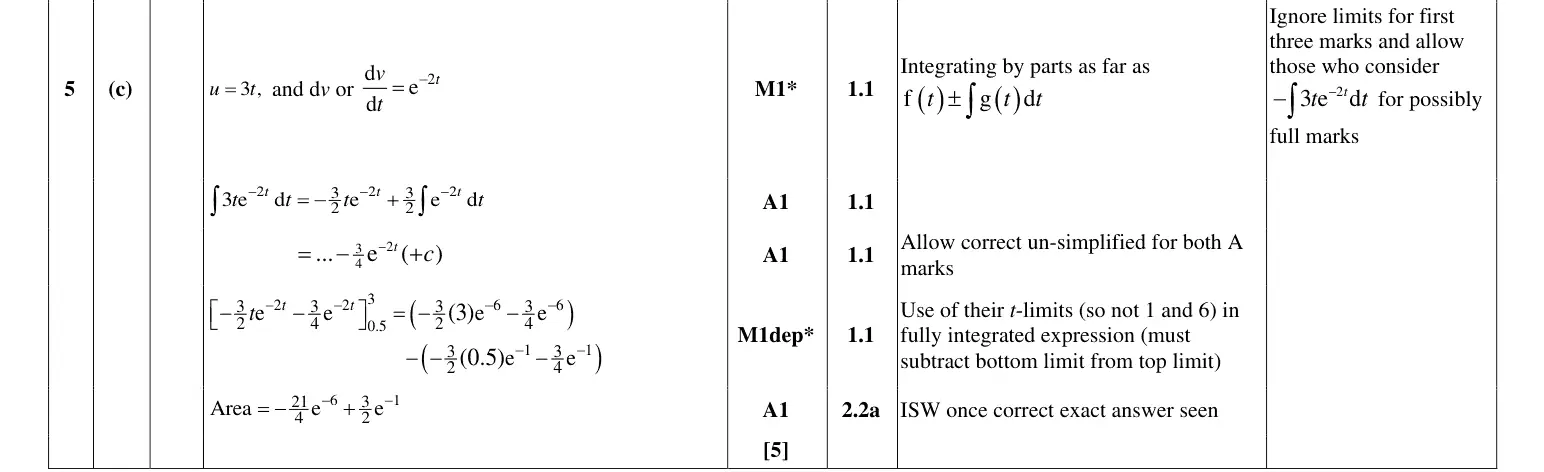
integration by parts on 3te⁻²ᵗ from 0.5 to 3
exact area (3/2)e⁻¹ − (21/4)e⁻⁶
Autumn 2020 · Paper 3 · Q8(c)2 marksMedium
Show the start of this question
Mark scheme for this part
Examiner's comment
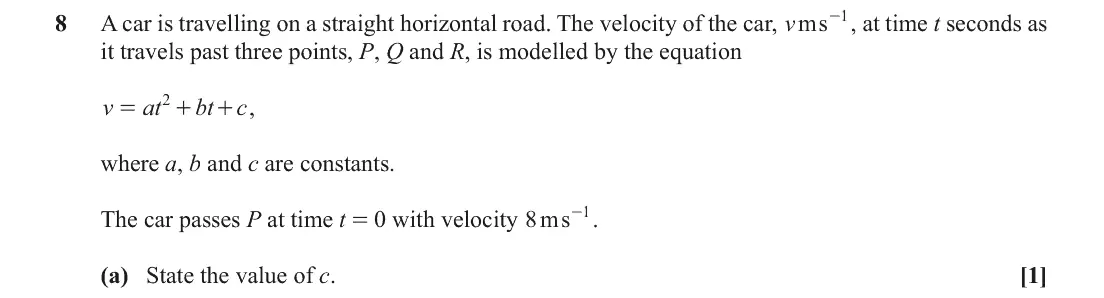
(Comment on Question 08 as a whole) This question was also completed well, although a significant number attempted to use the ‘suvat’ equations. Part (a) was answered correctly on almost 100% of the scripts. Part (b) was also answered well. Unfortunately, some candidates ignored the negative sign needed for deceleration, which meant only 3 out of the 4 marks were available. Part (c) was a ‘Find’ question, so an answer obtained directly from the calculator was expected, although some candidates did show a fully integrated expression first. Some candidates dropped marks when they used the incorrect limits and some attempted to use ‘suvat’, even if they had used calculus in the earlier parts.
Key points and common errors
∫₀¹⁸ v dt = 118 m
calculator acceptable
wrong limits or suvat used
June 2019 · AS Paper 2 · Q78 marksHard
Mark scheme for this part
Examiner's comment
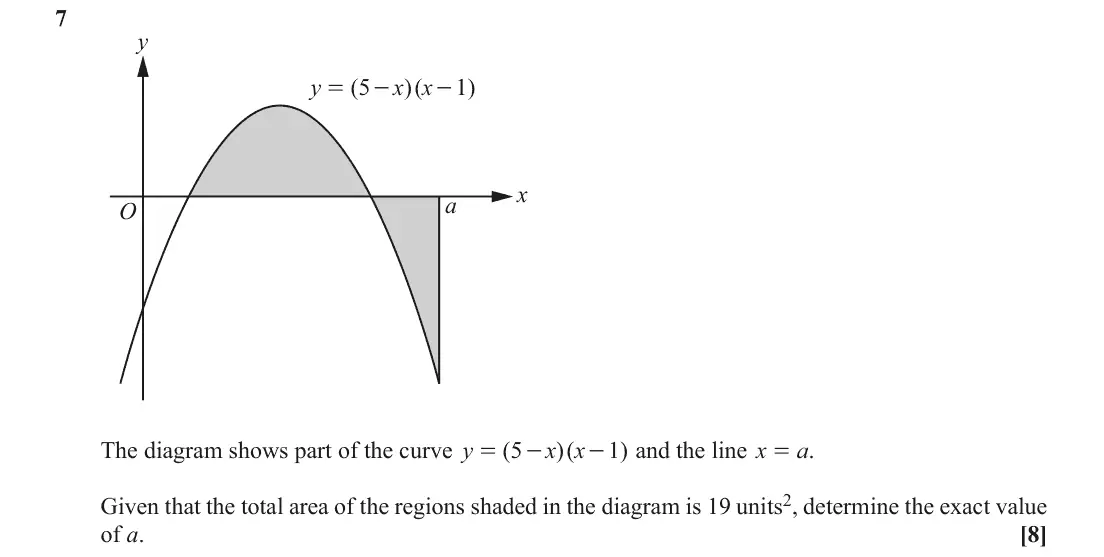
For a fully successful attempt, candidates needed to demonstrate an understanding that areas were both above and below the x-axis, with the sign consequences, and algebraic accuracy was vital. Although the integral between 1 and 5 could be done on the calculator, many did not do this and evaluated it incorrectly, often because ( 5 )( 1 ) was expanded incorrectly. Then the integral between 5 and a − x x − needed to be carefully done before putting everything together with the correct signs. Many cubics were wrong, so getting an exact solution proved impossible. Some obtained the correct cubic fortuitously from wrong working (which was penalised) but if all was fine by this stage we then wanted a clear explanation for the rejection of the negative root and an exact answer as requested.
Key points and common errors
area 1 to 5 is 32/3
region 5 to a is below the axis so take its magnitude
cubic a³ − 9a² + 15a = 0 gives a = (9 + √21)/2, reject (9 − √21)/2 since a > 5
expansion errors in (5 − x)(x − 1)
June 2019 · AS Paper 2 · Q10(b)3 marksMedium
Show the start of this question
Mark scheme for this part
Examiner's comment
The most common fundamental error here was to see an integral evaluated using the limits 0 and 10. There was no reason for candidates not to use the numerical integration function on their calculator, but more often than not showed the algebra. Without values for p, q and r found in (a) only B1 was possible.
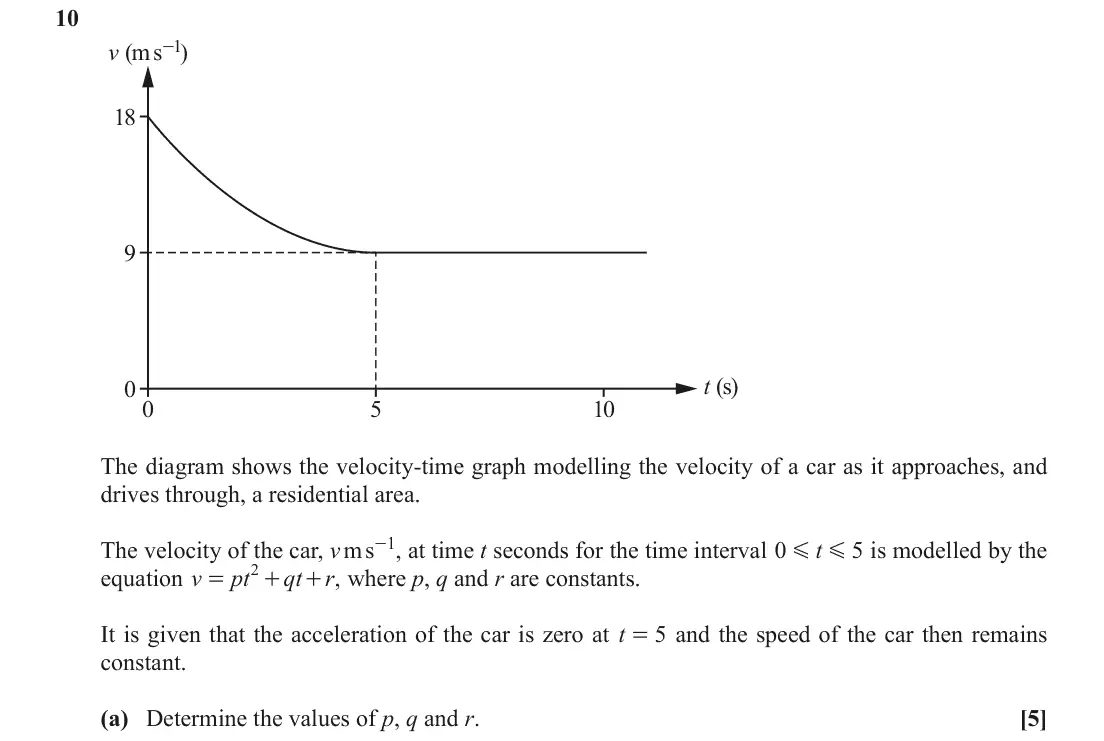
Key points and common errors
∫ from 2 to 5 of v dt plus 9 × 5 for constant speed: 75.24 m
integrating from 0 to 10 is wrong
June 2019 · Paper 1 · Q11(c)4 marksHard
Show the start of this question
Mark scheme for this part
Examiner's comment
Only the most able candidates appreciated that the requested area existed both above and below the x- axis and were able to devise an appropriate strategy. Other candidates did calculate the two areas separately, but then simply added them together rather changing the relevant signs before combining the two integrals. However the majority of candidates simply used the two limits in the integral; many of these were still able to gain a mark for rewriting ln0.5 as –ln2.
Key points and common errors
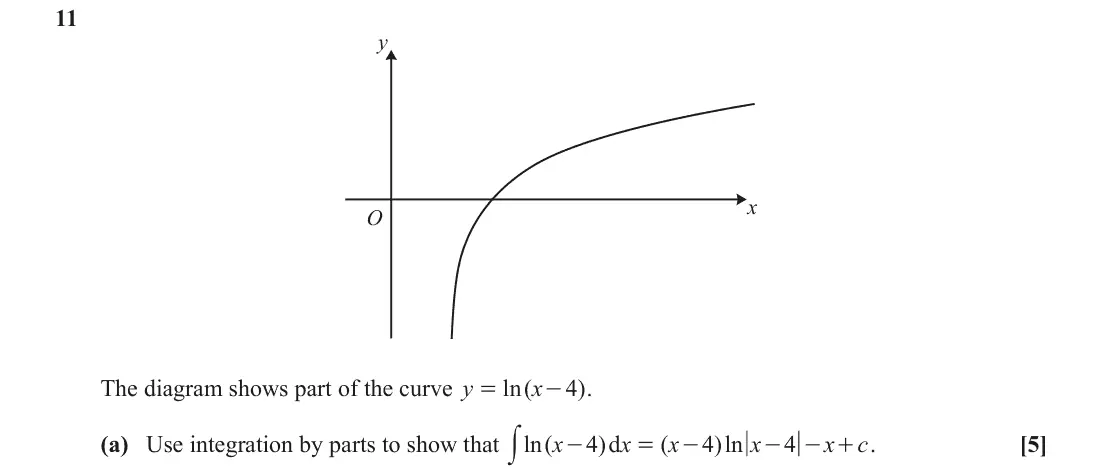
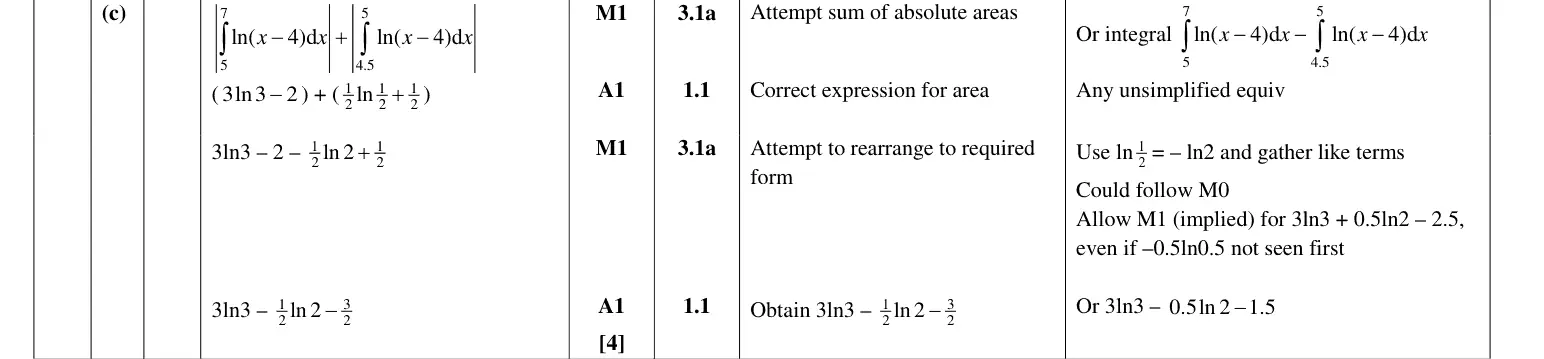
region is below the axis from 4.5 to 5 and above from 5 to 7
combine magnitudes: 3ln3 − ½ln2 − 3/2
the majority integrated from 4.5 to 7 in one go
June 2019 · Paper 3 · Q4(d)(i)1 markMedium
Show the start of this question
Mark scheme for this part
Examiner's comment
It was expected that candidates would evaluate this definite integral on their calculator and therefore write down the correct answer of 3 π far too many candidates used integration by parts or a substitution 4 , even though only 1 mark was available.
Key points and common errors
calculator: 3π/4 ≈ 2.356
integration by parts unnecessary for 1 mark
June 2018 · AS Paper 2 · Q89 marksMedium
Mark scheme for this part
Examiner's comment
There were some encouraging attempts at this question, with the integration done accurately. Sign errors sometimes lead to the wrong quadratic, but many realised there was a ‘hidden’ quadratic. This question asked for detailed reasoning so we expected to see some working to show how the quadratic solutions were obtained, either factors or some working with the formula or completing the square. A few candidates found F(8) – F(a) when integrating from 8 to a and some integrated from a to 8 from the start. Those who obtained a = 27 from their calculator with no justification/detailed reasoning scored zero, although if they checked by showing the integral from 8 to 27 was equal to 45, then the first three marks were possible. There was a significant minority of candidates that attempted to differentiate rather than integrate to find the area under the curve. Section B
Key points and common errors
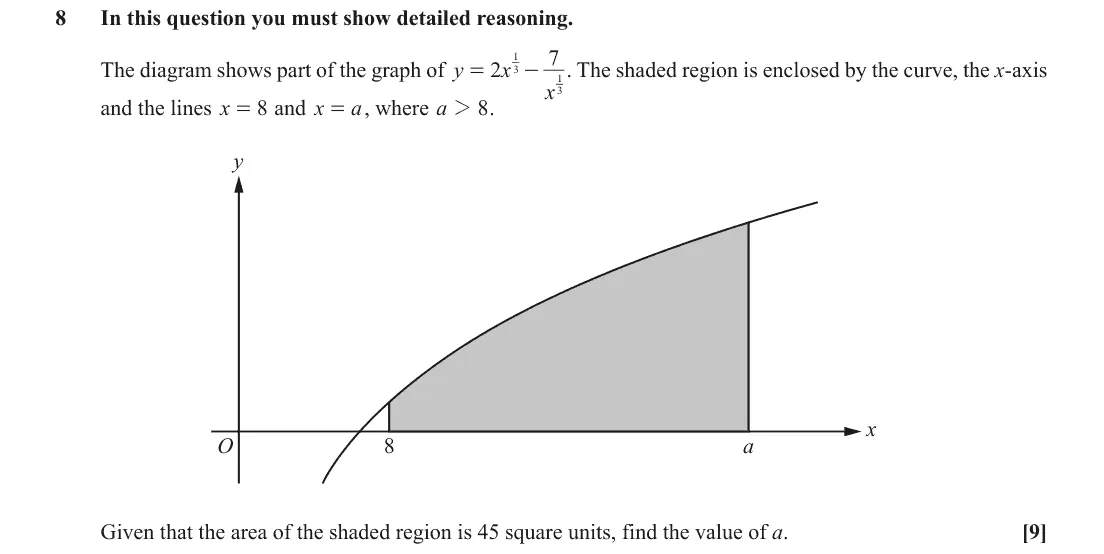
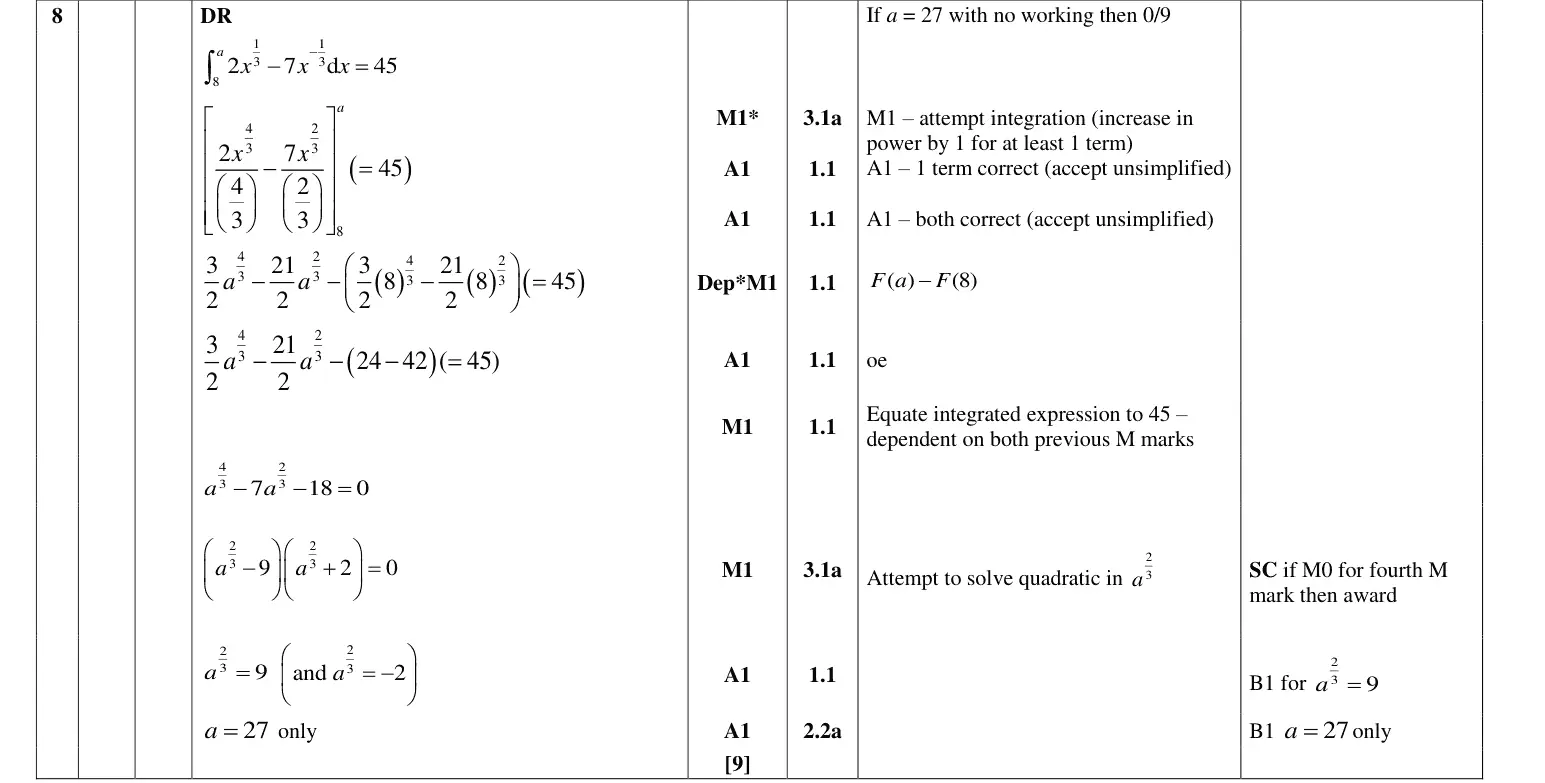
integrate to (3/2)x^(4/3) − (21/2)x^(2/3)
F(a) − F(8) = 45 gives a^(4/3) − 7a^(2/3) − 18 = 0, a quadratic in a^(2/3)
a^(2/3) = 9 so a = 27 only
calculator answer with no working scores 0
June 2018 · Paper 2 · Q77 marksMedium
Mark scheme for this part
Examiner's comment
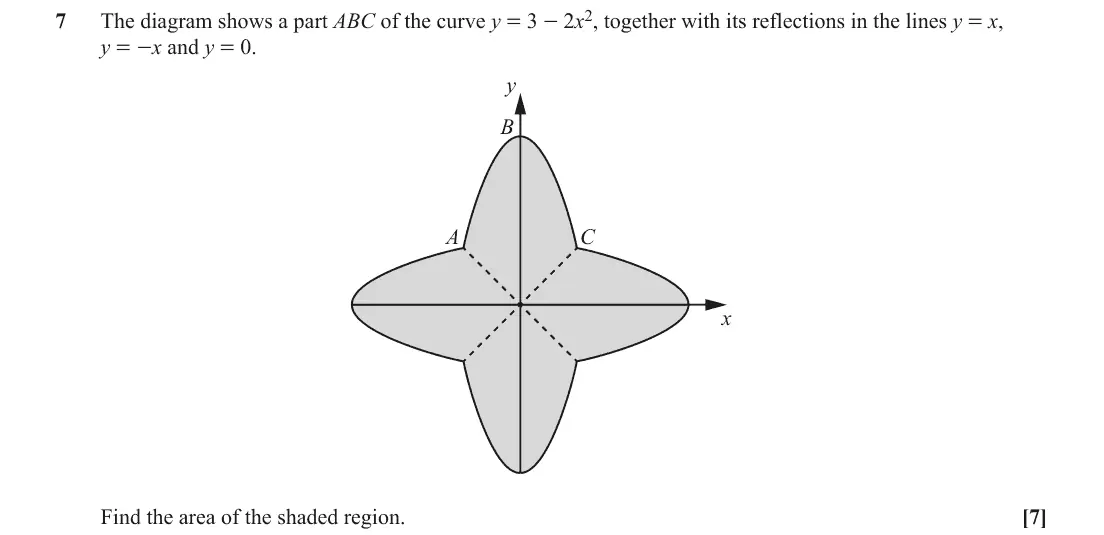
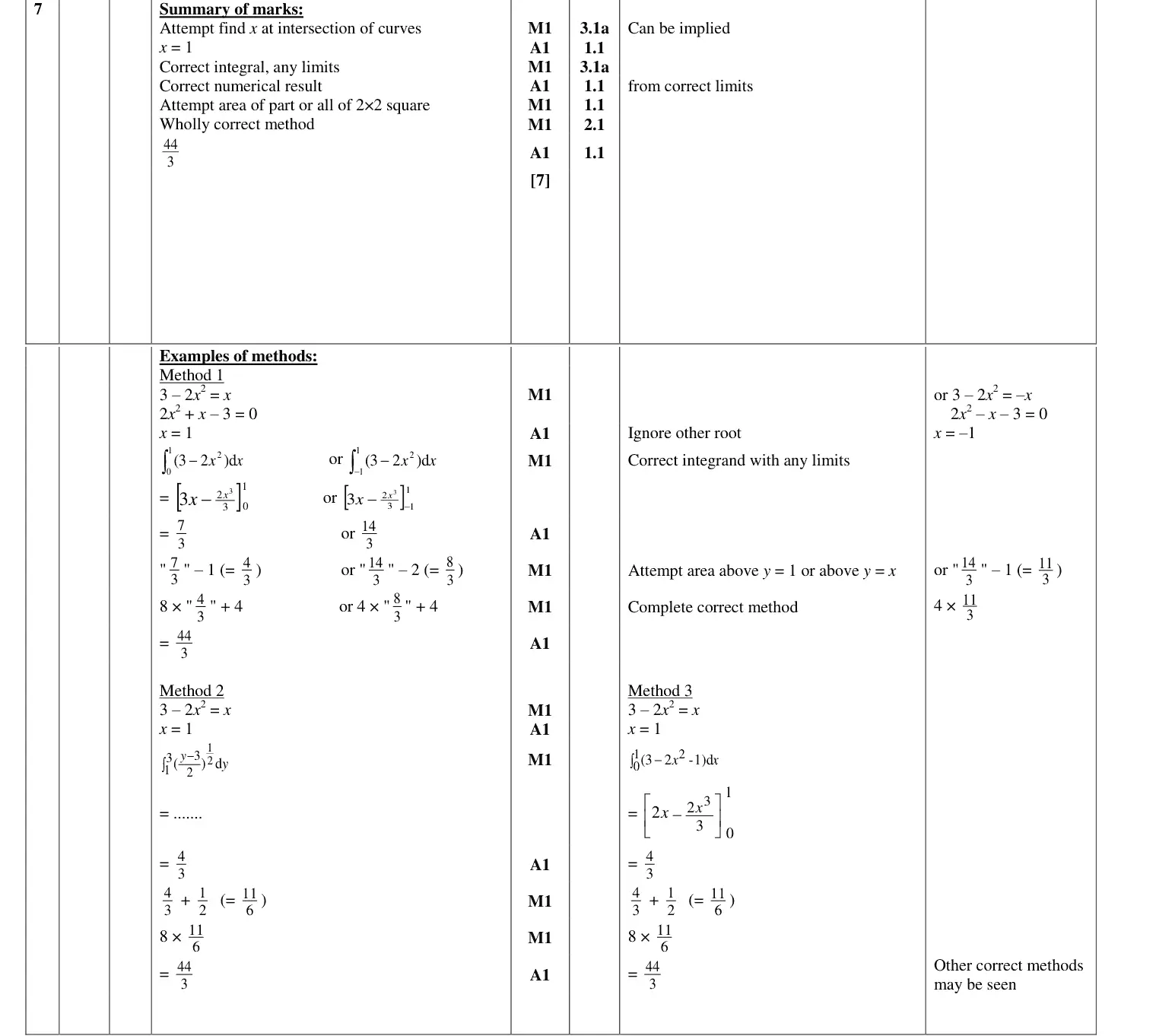
A large variety of correct methods were seen. Some were unnecessarily long. Examples of correct, although long, methods were these: 1. Find the inverse function in order to find the equation of the reflection of the given curve in y = x. Then solve this with the given function in order to find the point of intersection, C. xd . y 2. Rearrange the given function to make x the subject and then find ∫ Some candidates found the points where the given curve cuts the x-axis and hence integrated with incorrect limits. Many made mistakes in trying either to add or subtract all or part of the area of the middle square. 1 2 4 × ( 3 − 2 x − )1 d x + 4 ∫ Perhaps the neatest method was − 1 .
Key points and common errors
intersection 3 − 2x² = x gives x = 1
∫₀¹(3 − 2x² − 1)dx = 4/3
use symmetry: 8 × 11/6 = 44/3
wrong limits from the x-axis roots
errors adding or subtracting the central square
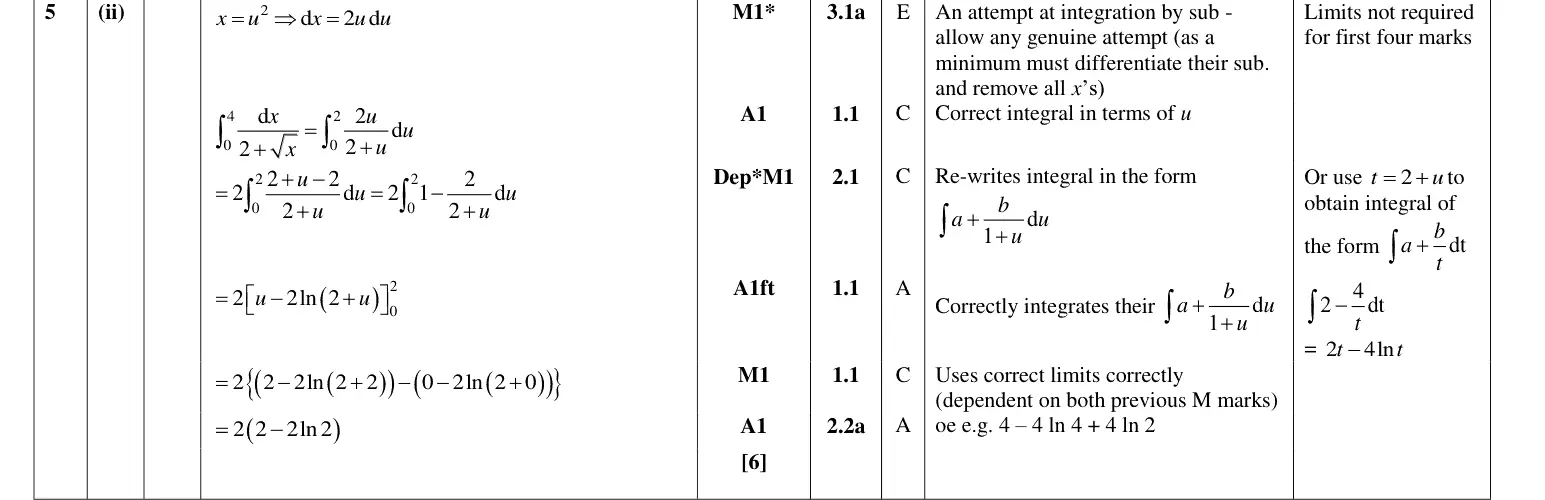
June 2018 · Paper 3 · Q5(ii)6 marksMedium
Show the start of this question
Mark scheme for this part
Examiner's comment
2 u ∫ While nearly all candidates used the substitution correctly and re-wrote the integral as d u many 2 + u could not deal with the resulting improper fraction in the integrand. The most successful candidates re- 2 u 2 u 4 + 2 u − 4 4 wrote u either by using long division or realising that = = 2 − u While examiners . 2 + 2 + u 2 + u 2 + noted that some candidates employed more extreme methods (for example, further substitutions and the method of integration by parts) these were usually unsuccessful.
Key points and common errors
dx = 2u du
∫₀² 2u/(2 + u) du
rewrite as 2∫(1 − 2/(2 + u)) du
2[u − 2 ln(2 + u)] = 4 − 4 ln 2
improper fraction caused difficulty
Find an A-level maths tutor
Stuck on this? Book a trial session with an A-level maths tutor.