1.05o Solve simple trigonometric equations in a given interval, including…
Section
1.05 Trigonometry
Level
Partly A level only
Statement
Be able to solve simple trigonometric equations in a given interval, including quadratic equations in sin θ, cos θ and tan θ and equations involving multiples of the unknown angle.
Guidance
e.g. sin θ = 0.5 for 0 ≤ θ < 360°; 6sin²θ + cos θ − 4 = 0 for 0 ≤ θ < 360°; tan 3θ = −1 for −180° < θ < 180°.
A-level only
Extend their knowledge of trigonometric equations to include radians and the trigonometric identities in Stage 2.
Around half of candidates received 4/4 marks in this question. The majority of candidates correctly applied the identity from (a) to reduce the given equation to tan3𝑥= 1 or equivalent, although quite a few provided unnecessary or unproductive working before reaching this step. The instruction ‘Hence’ means that the previous part’s answer should be used to solve this equation, and there is no need for candidates to repeat all or part of the proof from part (a). Despite the given range of values, some candidates only provided a single value for 3x and x, scoring A0A0.
Key points and common errors
tan 3x = 1 so 3x = 45°, 225°
x = 15°, 75°
around half fully correct
many gave only one value
June 2025 · Paper 1 · Q9(b)7 marksMedium
Show the start of this question
Mark scheme for this part
Examiner's comment
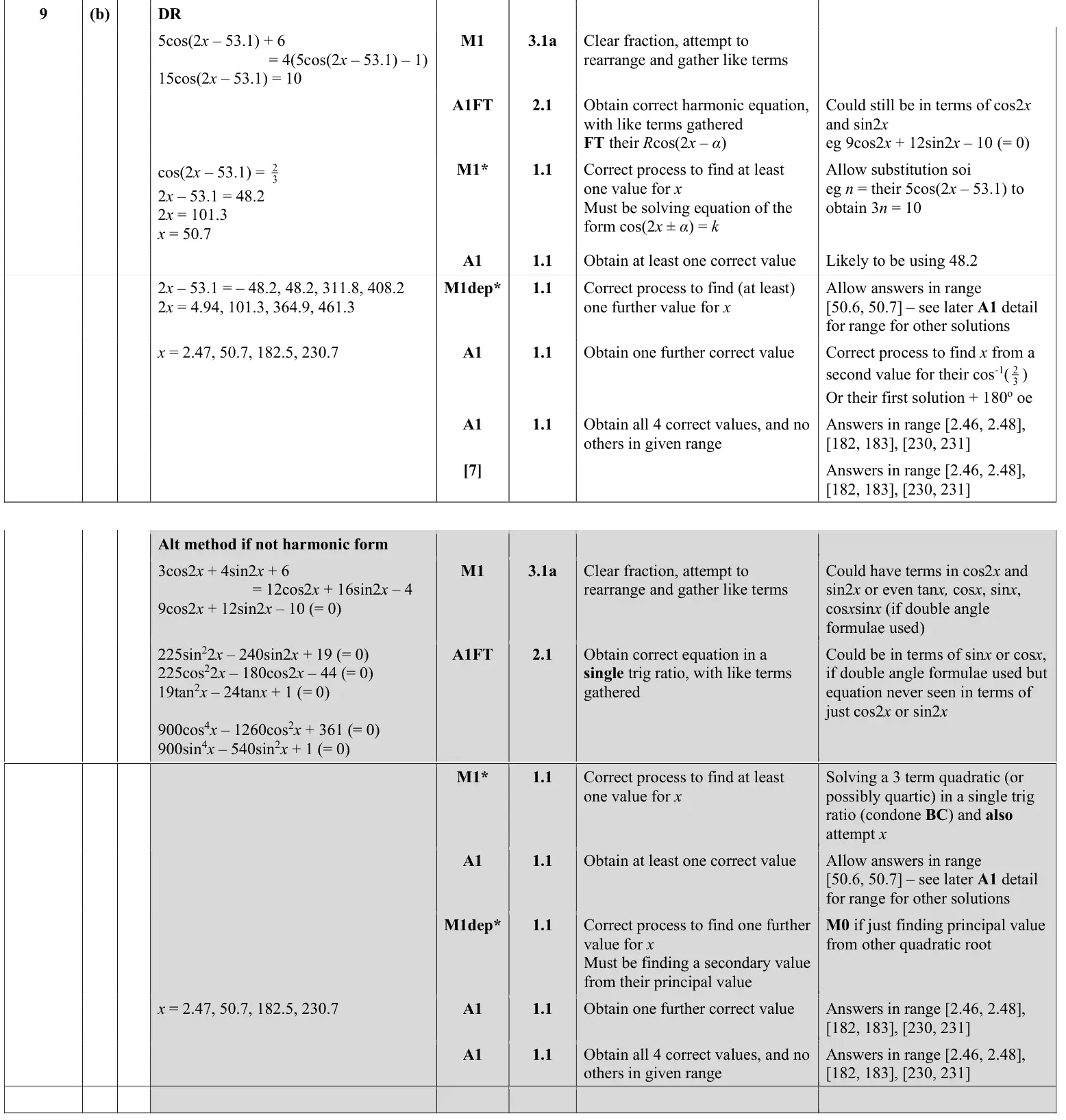
Many candidates used the harmonic form from the first part of the question to obtain a simplified equation that could then be solved to gain at least 6 of the marks available. Only the most astute candidates gained full credit for also including the smallest angle of 2.47o, as this was often either not attempted at all or not given to a sufficient degree of accuracy. This was a ‘detailed reasoning’ question, so candidates were expected to show convincing method to support their solution; simply using the calculator to quote the four expected values with no other working was not accepted. A surprising number of candidates did not recognise the connection with the previous part of the question and instead attempted to use double angle formulae and trigonometric identities. While some initial credit was often awarded, those attempting this method rarely made any further progress.
Key points and common errors
15cos(2x − 53.1°) = 10, cos(2x − 53.1°) = 2/3
x = 2.47, 50.7, 182.5, 230.7
smallest solution 2.47 often missed
calculator-only answers not accepted
June 2024 · AS Paper 2 · Q7(a)(ii)3 marksMedium
Show the start of this question
Mark scheme for this part
Examiner's comment
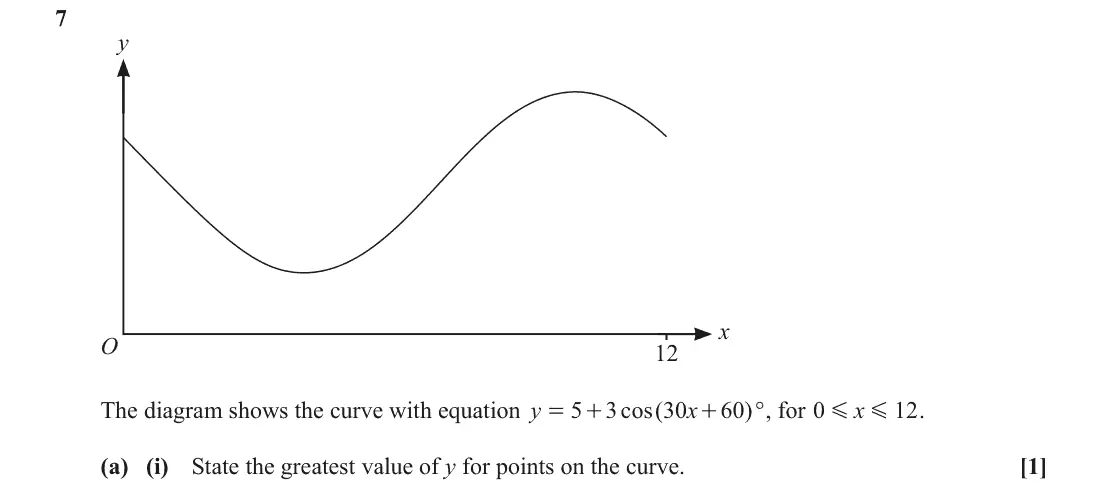
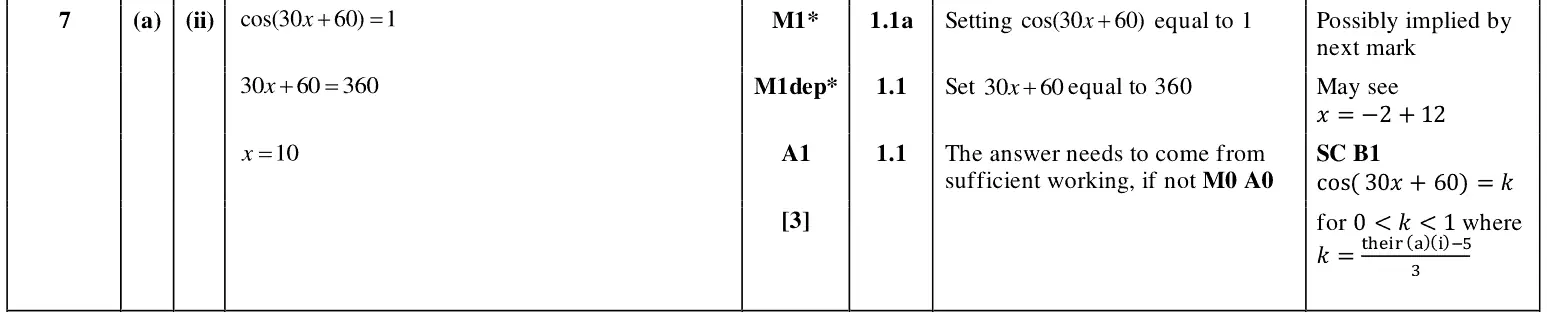
A lot of candidates obtained x = 10, many starting from the equation 8 = 5 + 3cos(30x + 60)° rather than just stating cos(30x + 60)° = 1 immediately. The command word ‘Determine’ indicated that we wanted to see justification of how x = 10 was obtained and sufficient evidence was required for full marks; a few just wrote x = 10 and were given M0. Some did not convincingly show the 360° idea and just got M1. The poorer efforts involved cos30x + cos60.
Key points and common errors
cos(30x + 60)° = 1 so 30x + 60 = 360
x = 10
working needed for 'determine'
June 2024 · AS Paper 2 · Q7(b)5 marksMedium
Show the start of this question
Mark scheme for this part
Examiner's comment
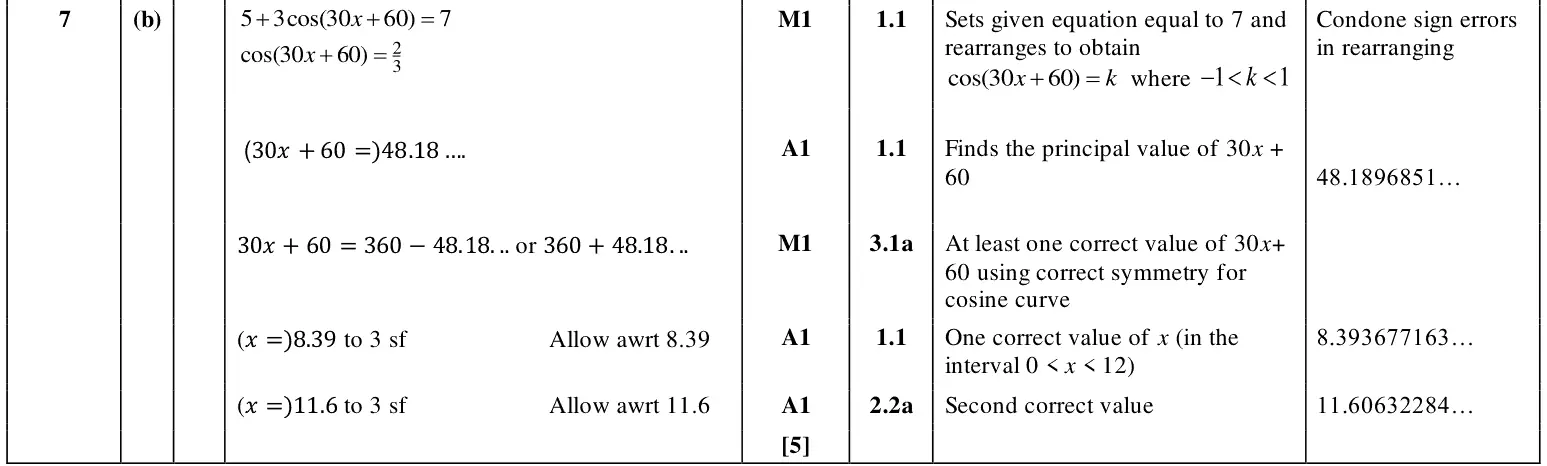
This part stated ‘Determine’ again, so we expected to see sufficient justification of results and typically it was provided. There were a fair number of fully correct solutions given, but final answers of x = −0.394 and x = 8.39 were also not unusual. x = 8.4 were given A0 unless a better value was seen in the 42 58 working; the ‘exact’ values of 5 and 5 (or equivalent) obtained from 312° and 408° respectively also both earned A0. Candidates should be encouraged to work to a sufficient degree of accuracy, given the front cover rubric. Again, efforts were seen involving cos30x + cos60.
Key points and common errors
cos(30x + 60)° = ⅔
principal value 48.19°
30x + 60 = 311.8° or 408.2°
x = 8.39 and 11.6 to 3 s.f.
June 2024 · Paper 1 · Q9(a)(ii)2 marksEasy
Show the start of this question
Mark scheme for this part
Examiner's comment
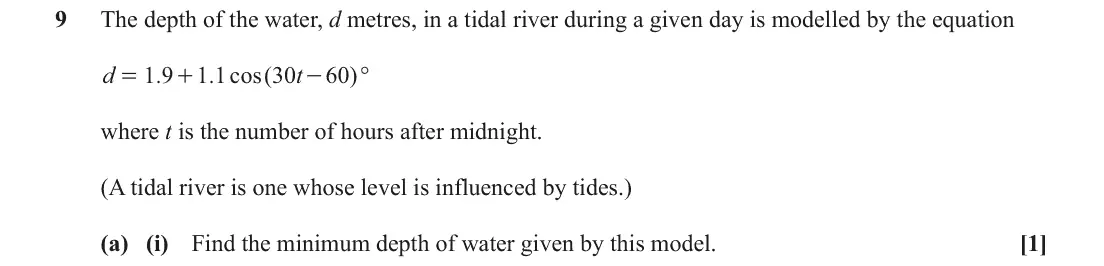
While most candidates correctly identified where the minimum occurred, and as a result obtained the correct answer of 8 hours, some candidates incorrectly set cos(30t ─ 60) = 0, resulting in the incorrect answer of 5 hours. Some also made errors when solving 30t – 60 = 180, with 30t = 120 and then t = 4 seen.
Key points and common errors
cos(30t − 60) = −1 so 30t − 60 = 180, t = 8
cos = 0 giving t = 5 is wrong
June 2024 · Paper 1 · Q9(b)5 marksHard
Show the start of this question
Mark scheme for this part
Examiner's comment
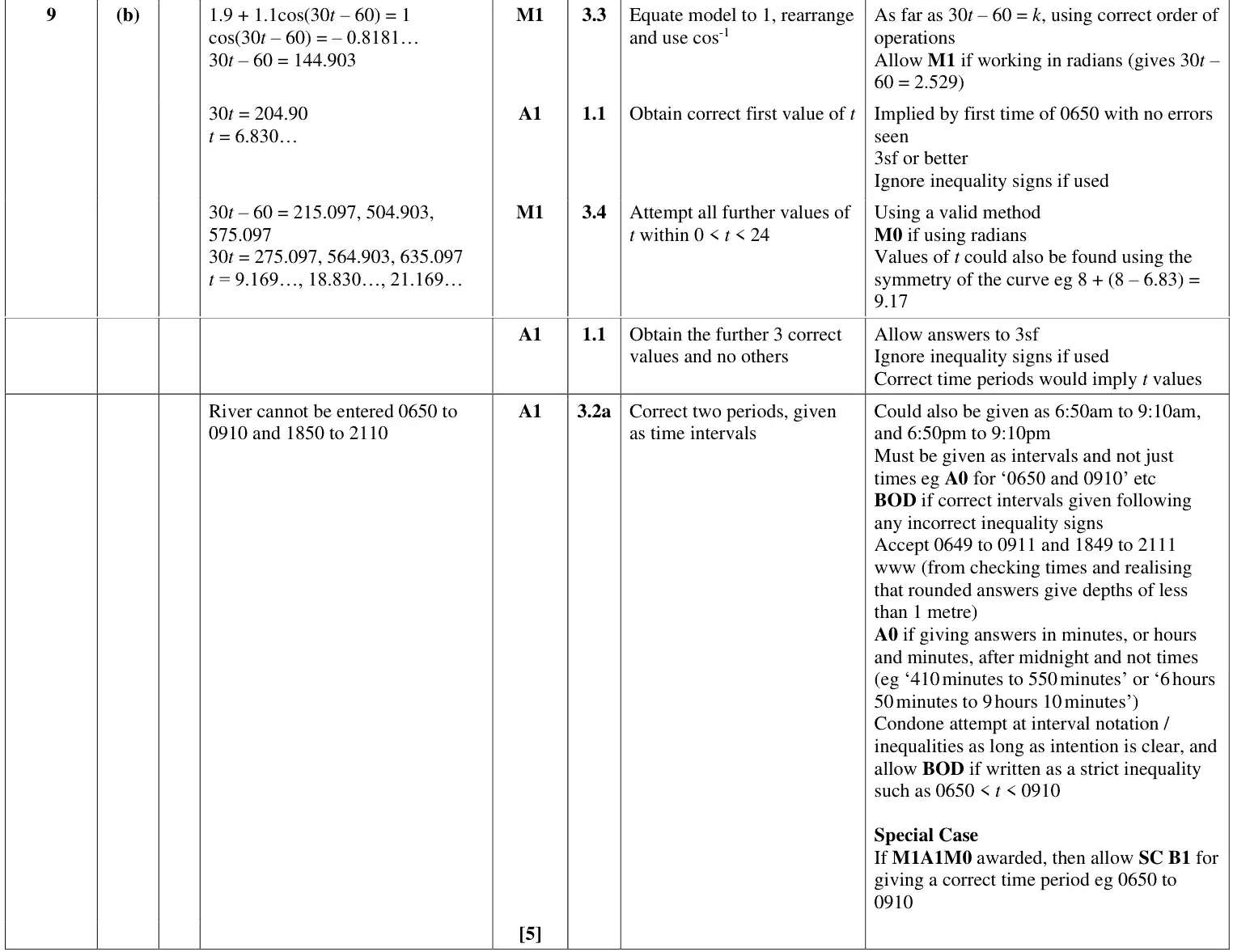
Most candidates scored the first 2 marks in this question, substituting d = 1 into the equation and rearranging to find the first value of t correctly. Many went on to find the second value of t. Very few candidates understood that this was a full day and that they should find all four values of t within the 24- hour period, with many giving only one period of time. Those who converted these values into times of the day and gave a single correct time period earned 3 out of the 5 marks. Some candidates completed the question, sometimes by using symmetry rather than all the values of t. Often candidates lost marks because they did not write their answers as ‘periods of time’ with many leaving their answers in minutes or hours/minutes after midnight. Key Point – Time The question asked for ‘periods of time during the day’. We were therefore looking for answers given as times of the day. For example. ‘The boat would be unable to sail between 6.50am and 9.10am’.
Key points and common errors
1.9 + 1.1cos(30t − 60) = 1 so cos = −0.818
t = 6.830, 9.169, 18.830, 21.169
periods 0650–0910 and 1850–2110
very few found all four values in the 24 hours
June 2024 · Paper 1 · Q11(a)2 marksHard
Mark scheme for this part
Examiner's comment
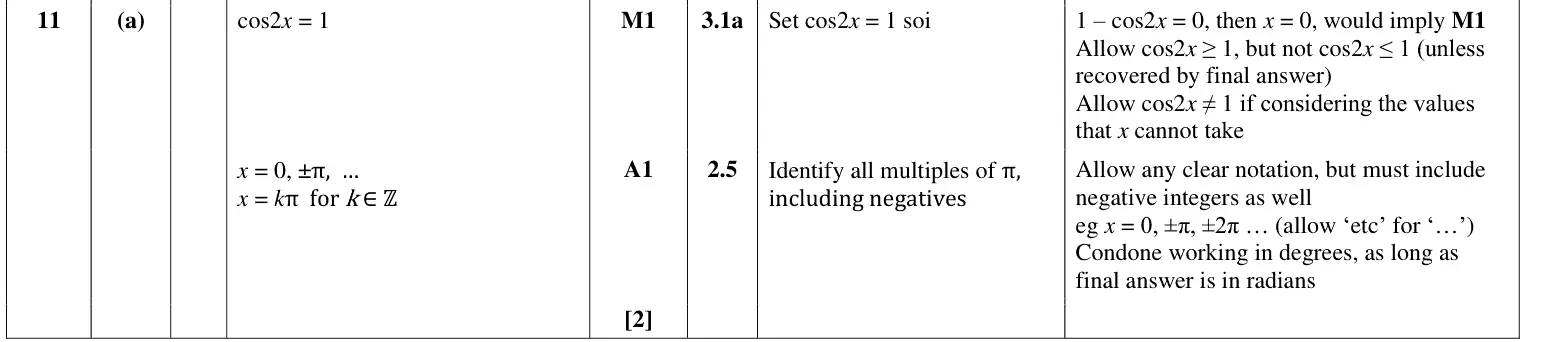
This proved to be a challenging question as although the vast majority recognised when the logarithmic function is undefined and related cos 2x to 1 in some way, very few were able to identify the full set of values. Candidates seem comfortable solving a trigonometric equation in a given range, so most simply proceeded to give an incomplete answer with negative values of x rarely considered.
Key points and common errors
ln undefined when 1 − cos2x = 0 (cannot be negative): cos2x = 1, x = kπ for all integers k including negatives
very few gave the full set
June 2024 · Paper 1 · Q11(b)4 marksMedium
Show the start of this question
Mark scheme for this part
Examiner's comment
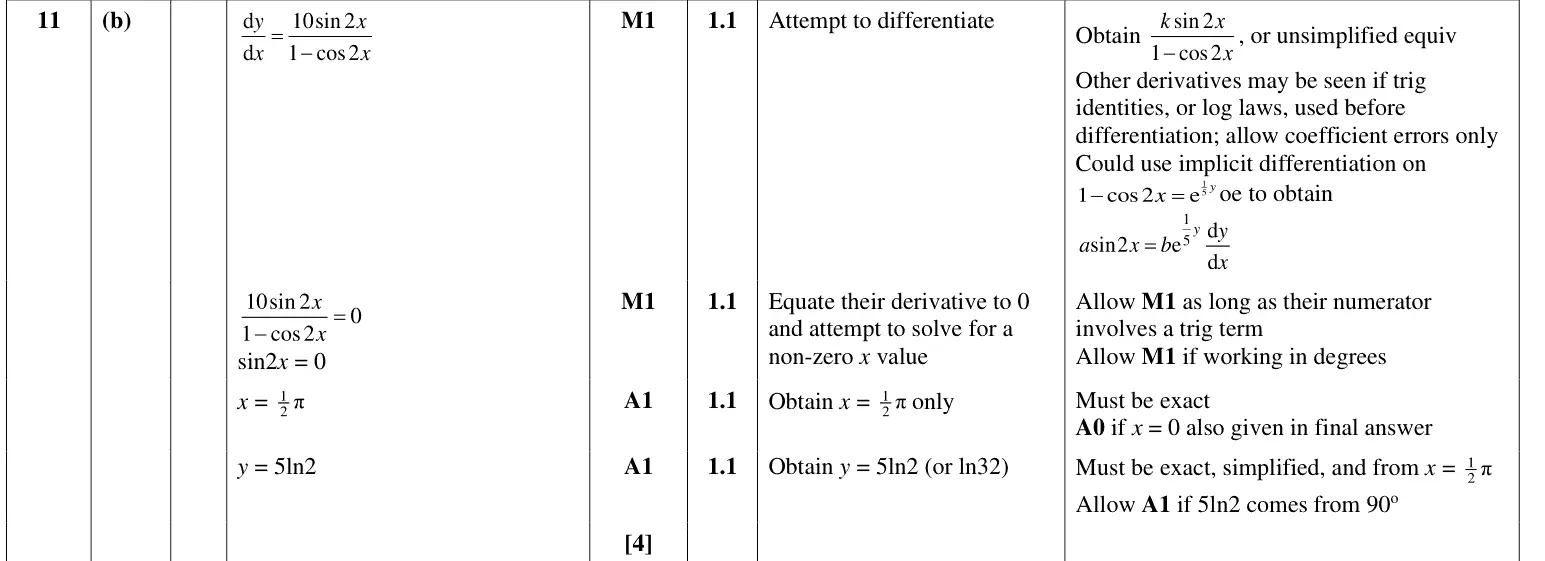
The differentiation of the logarithmic function was reasonably well done with the correct derivative often seen. Many did not produce a non-zero value for x when seeking the required stationary point. The most common incorrect answers given were 𝑥= 0 and 𝑥= 𝜋. The correct y-value often came from an incorrect x value and so was not given credit.
Key points and common errors
dy/dx = 10sin2x/(1 − cos2x)
sin2x = 0, smallest positive x = π/2
y = 5ln2
x = 0 or π common errors
June 2024 · Paper 2 · Q6(a)(ii)3 marksMedium
Show the start of this question
Mark scheme for this part
Examiner's comment
This question was fairly well answered, with many candidates correctly observing that cos 3𝜃= √2 2 and proceeding to solve. However, quite a few candidates (not heeding the DR instruction) jumped directly to solutions for theta without showing an intermediate step - this could only score a maximum of 2/3 marks (assuming all three solutions in the range were present). Candidates should be reminded that DR means that all steps in the working need to be clearly shown and that, while computation can (and should) still be offloaded to a calculator, the mark scheme will still reflect this. A small number of candidates only gave two of the required three solutions. Some candidates (perhaps from looking ahead to later parts of the question) attempted to find values of by another method (for instance, matching the roots of the equation in x as in part (c)). This was rarely successful but, in any event, could not be given marks because the question specified ‘Use this result…’ so the method starting with 3 needed to be seen.
Key points and common errors
cos3θ = √2/2 so 3θ = 45°, 315°, 405°
θ = 15°, 105°, 135°
DR: working must be shown
June 2024 · Paper 2 · Q6(c)2 marksMedium
Show the start of this question
Mark scheme for this part
Examiner's comment
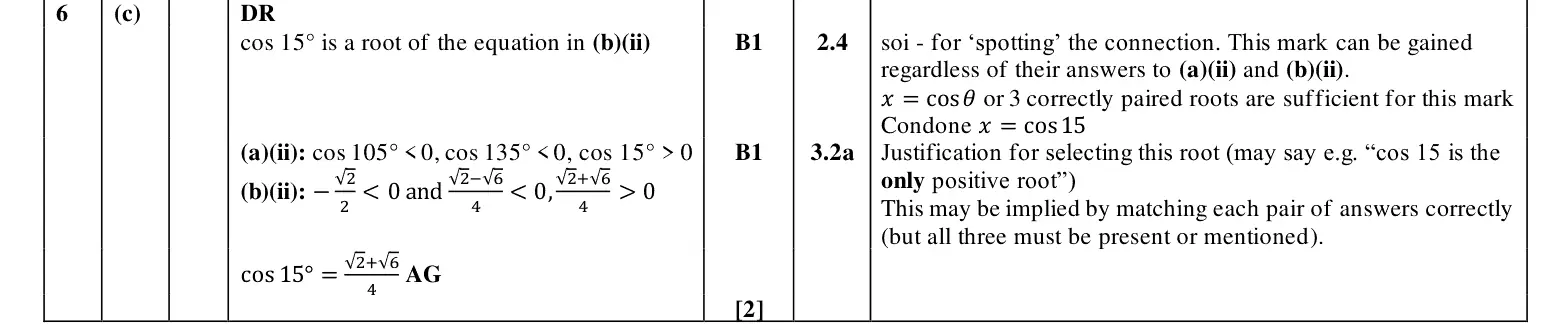
In this part candidates needed to (as guided by the question) deduce the connection between parts (a) and (b) and use this to reach the given result. For the first B1 mark, candidates needed to show that they had understood and used this connection - for instance by writing 𝑥= cos 𝜃. For the second, candidates needed to unambiguously show that cos 15° = √2+√6 . As this response was given it was not enough just to write this statement down, candidates needed to show this - either by deducing that cos 15 must be the only positive root (because cos 105° and cos 135° are negative) or by explicitly matching each root for the equation in x with a value of from part (a). Many candidates did not do this with sufficient rigour, and so could not be given this mark. Candidates should be reminded that, where a response is given, they need to clearly demonstrate that they have reached this by providing clear working. Reading and following the sequence of the question carefully This was a structured question designed, with appropriate scaffolding, to guide students through several different approaches to related problems in order to demonstrate their knowledge of different techniques. While candidates can of course answer the questions in any order they choose, many candidates did not score as many marks as they could have because they did not follow instructions such as “Use this result” or “Hence” which direct the candidate to use a specific method.
Key points and common errors
x = cos θ links the two equations
select the only positive root to match cos 15°
June 2024 · Paper 3 · Q4(b)(i)4 marksMedium
Show the start of this question
Mark scheme for this part
Examiner's comment
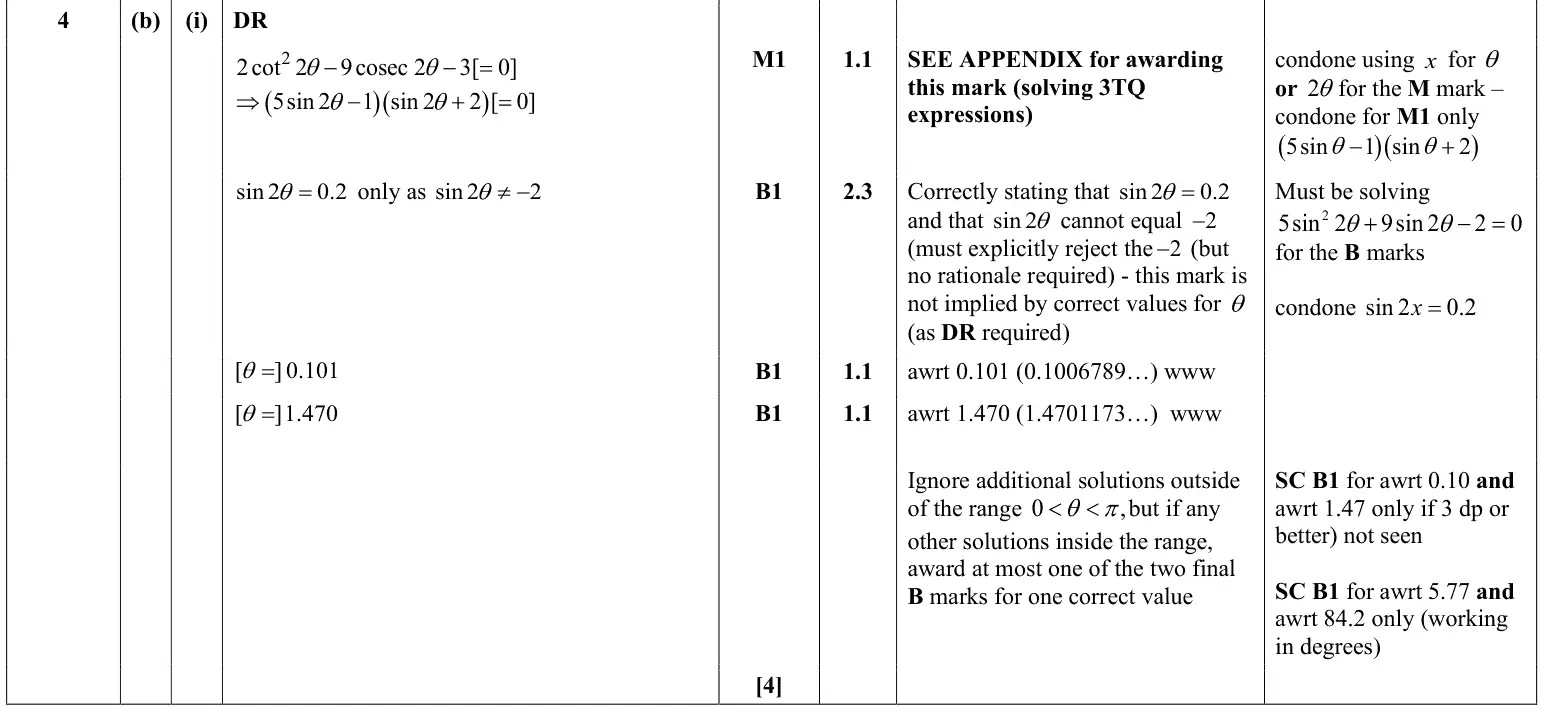
There were two main issues that candidates faced when answering this part. The first was that a good number did not appreciate that as this question required ‘detailed reasoning’. They either showed no method for solving the quadratic in sin2𝜃 or they gave no indication for why sin 2𝜃 could not equal −2. The other issue was that many candidates did not read the question carefully and instead solved the (simpler) equation of 2cot2𝜃−9cosec 𝜃−3 = 0 and so scored only the first method mark. Of those that did solve the correct equation most gave the first root (0.101) correct to the required 3 decimal places but did not give the second to the same degree of accuracy (with many just stating the answer as 1.47).
The majority of candidates were able to correctly manipulate this equation. However, of those who obtained the correct equation for the first M1, many either did not square root or forgot to consider more than one solution. Some missed the second solution in the given interval (achieving M1A0), while others gave additional solutions outside the interval.
Key points and common errors
tan²x = ½ so tan x = ±1/√2
x = 35.3°, 145°
common errors not square rooting or missing the second solution
June 2023 · AS Paper 2 · Q3(b)2 marksMedium
Show the start of this question
Mark scheme for this part
Examiner's comment
It was not unusual to see cos(150k) = 1 lead to 150k = 0 and confusion. Elsewhere, cos(150k) = 0 14 appeared too, from 14 = 0 and occasionally cos(150k) = -1 from sign errors. Those who had 0 m as their 15 answer in (a)(ii) got cos(150k) = 14 and often stopped there. Another error was candidates evaluating cos(150k) as 150cosk or kcos150.
Key points and common errors
first return to lowest point after one period: 150k = 360 so k = 2.4
errors: 150k = 0, treating cos(150k) as 150 cos k
June 2023 · AS Paper 2 · Q3(c)4 marksMedium
Show the start of this question
Mark scheme for this part
Examiner's comment
A correct response here required candidates’ value for k from (b), but those who were unsuccessful in (b) usually did not attempt this part. Candidates who had found a value for k were often able to pick up the first 2 marks here, but many found just one value for t and gave this as the final answer. Sign errors 5 sometimes led to cos(kt) = 14.
Key points and common errors
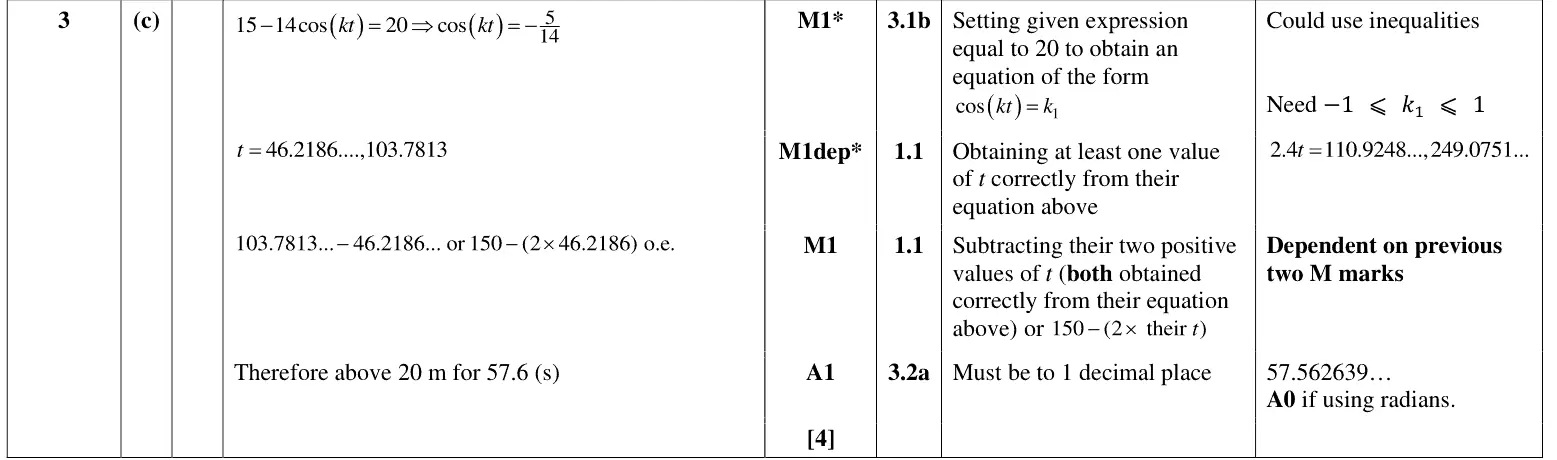
15 − 14cos(2.4t) = 20 gives cos(2.4t) = −5/14
t = 46.2 and 103.8
time above 20 m = 57.6 s (degrees, 1 d.p.)
many gave one value of t only
June 2023 · Paper 2 · Q5(a)(i)4 marksEasy
Mark scheme for this part
Examiner's comment
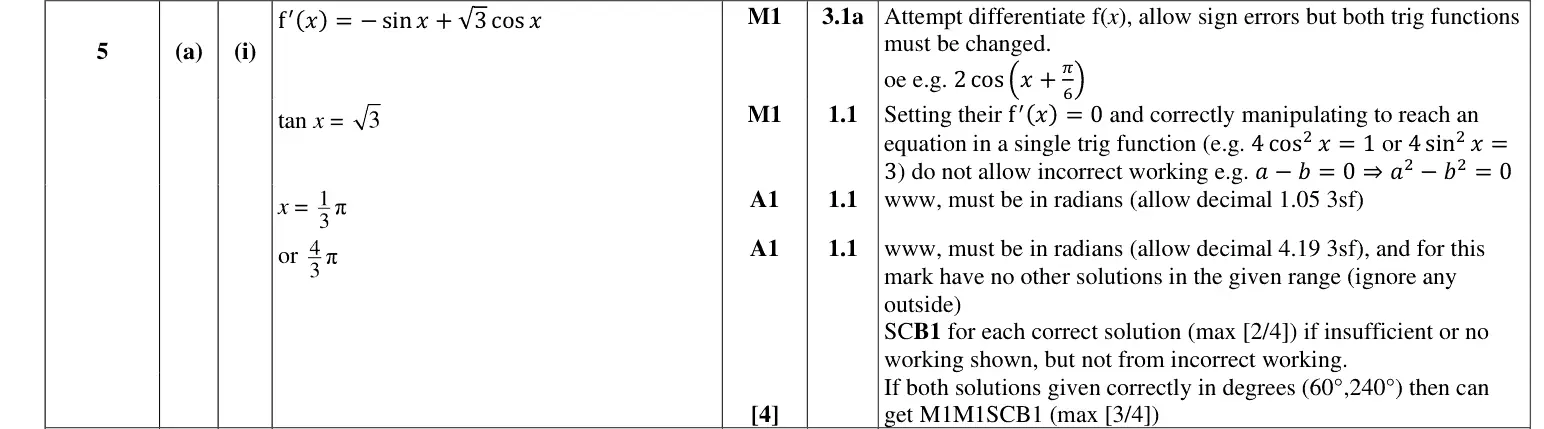
This question was generally well answered. Some candidates appeared uncertain how to differentiate the given expression, either making errors in differentiation or attempting to (unnecessarily) apply the product rule. Most candidates were able to set their derivative = 0 and obtain an expression from which values could be deduced. The entirety of Question 5 is Detailed reasoning which means that sufficient working is required to support all answers, throughout. There were fewer cases of ‘answers without working’ in this question - perhaps because most candidates tended to write down the expression and manipulate it directly. Although the differentiated expression resolves straightforwardly to tan 𝑥= √3, some candidates did not spot this and so chose to square in order to combine the terms. This was acceptable (as long as done correctly, some candidates wrote x – y = 0 followed by x2 − y2 = 0 which is not a correct step of working or squared the entire expression while omitting the ‘cross term’ which could lead to the correct solutions, from incorrect working), but candidates then obtained additional solutions which they needed to test and eliminate - many did not do so (or eliminated the wrong solutions) and lost the final A mark as a result. A small number of candidates used 𝑅cos(𝑥+ 𝛼) to combine the two terms first, which makes the differentiation more straightforward.
Key points and common errors
f′(x) = −sin x + √3 cos x
tan x = √3
x = π/3, 4π/3 in radians
product rule not needed
squaring introduces extra roots
June 2023 · Paper 2 · Q5(a)(ii)3 marksEasy
Show the start of this question
Mark scheme for this part
Examiner's comment
This was very similarly answered to part (a) (i), with most candidates reaching at least one of the required answers. Again, some squared their equation and then did not eliminate additional solutions within the range.
Key points and common errors
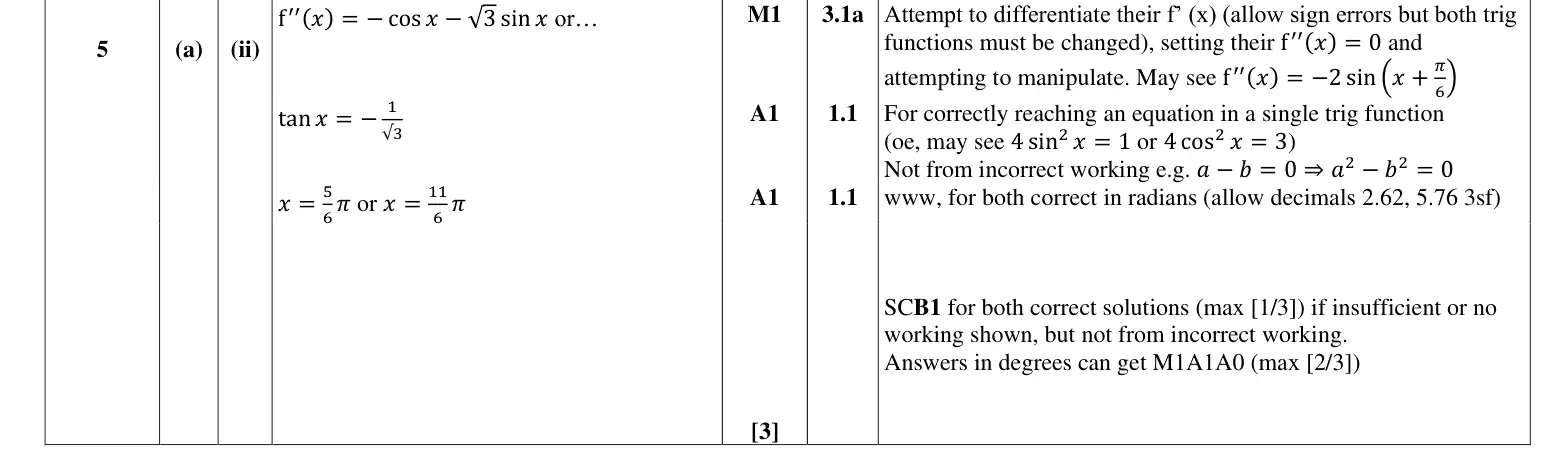
f″(x) = −cos x − √3 sin x
tan x = −1/√3
x = 5π/6, 11π/6
June 2023 · Paper 3 · Q2(b)2 marksEasy
Show the start of this question
Mark scheme for this part
Examiner's comment
Most candidates used the harmonic form from part (a) to obtain the correct value of x in this part. Occasionally candidates spent time finding further solutions that were not in the required range. Those candidates who ignored the advice of ‘hence’ and attempted to solve this equation by other methods where not penalised for not following the question request in this instance, however they were rarely completed the solution successfully. ‘Hence’ or ‘Hence or otherwise’ Candidates should recognise that where a question uses the word ‘hence’ they are best advised to start their solution based on the previous work. If ‘hence or otherwise’ is used then alternative (perhaps using Further Maths techniques) routes may be appropriate, although these may be more time consuming or complex.
Key points and common errors
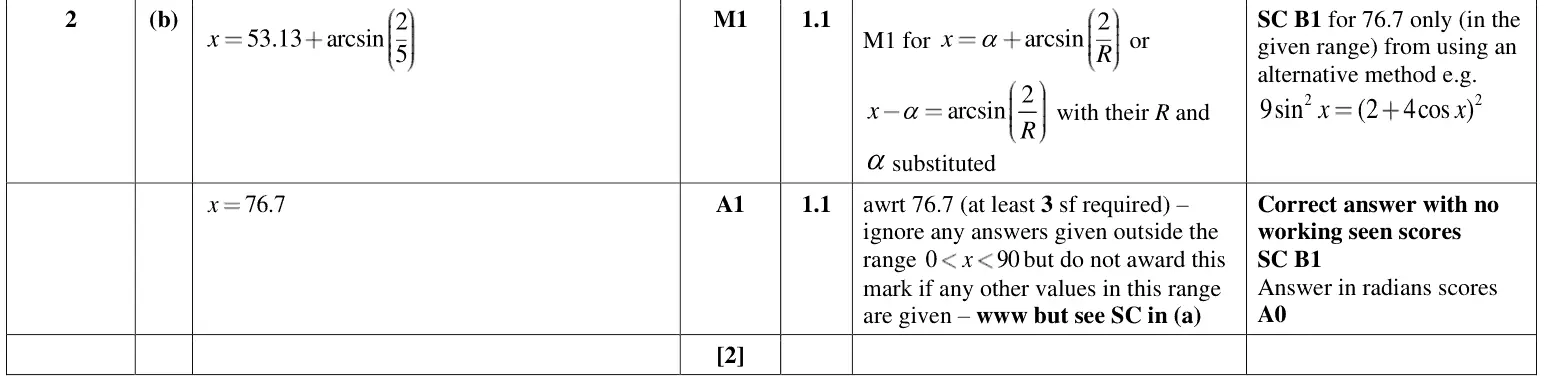
x − 53.13 = arcsin(2/5)
x = 76.7 only in range
other methods rarely completed
June 2023 · Paper 3 · Q6(a)3 marksEasy
Mark scheme for this part
Examiner's comment
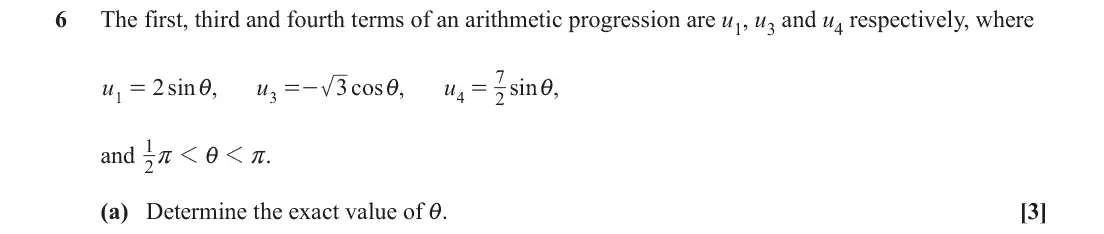
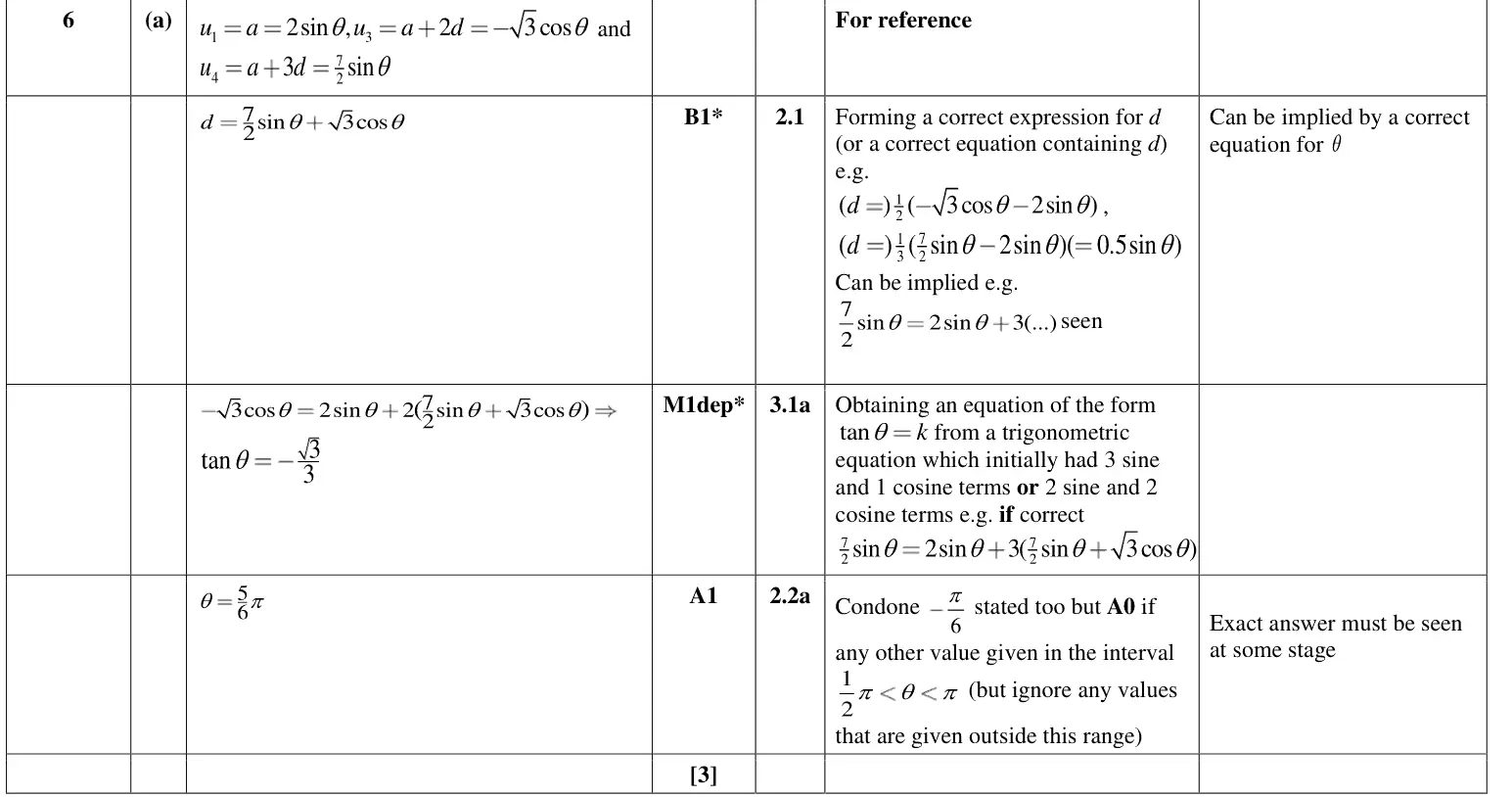
and cosine using the fact that 2(𝑢𝑢4 −𝑢𝑢3) = 𝑢𝑢3 −𝑢𝑢1. Most solved this equation correctly using tan and This part was answered particularly well with most candidates correctly setting up an equation in sine obtained the correct value of 𝜃𝜃. The most common error was to misread the question as giving the first three terms of an AP and not the first, third and fourth terms.
Key points and common errors
u₃ − u₁ = 2(u₄ − u₃) gives tan θ = −√3/3
θ = 5π/6 in the given interval
misreading as the first three terms
June 2022 · AS Paper 1 · Q4(a)3 marksEasy
Mark scheme for this part
Examiner's comment
This question was correctly answered by most candidates. Some candidates made a sign error. tan 3 Others found . A few correctly obtained 56.3o, but then either gave no other answer or gave the 2 correct 180 + 56.3o together with the incorrect 180o − 56.3o and/or 360o − 56.3o.
Key points and common errors
tan x = 3/2
x = 56.3° and 236.3°
no extra values such as 180° − 56.3°
June 2022 · AS Paper 1 · Q4(b)5 marksMedium
Mark scheme for this part
Examiner's comment
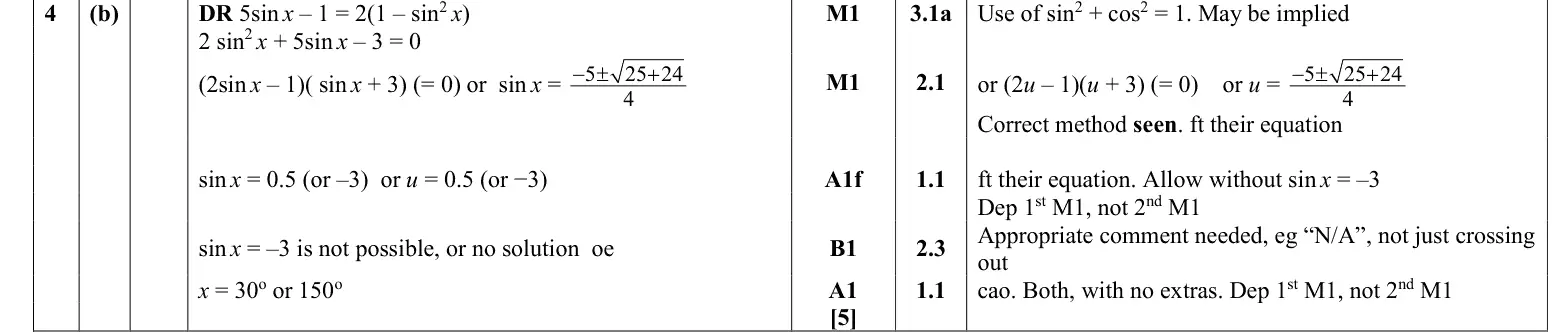
Many candidates used a correct method, gaining two method marks, but some made arithmetical or algebraic slips and so lost the two accuracy marks. Many candidates lost a mark because they omitted the working for the solution of the relevant quadratic equation. Others lost a mark because they did not indicate why they were rejecting the solution sin x = −3. Some candidates correctly used the identity + = sin x cos x 1 but appeared not to recognise that the resulting equation was a quadratic equation in sin x. Two examples of the subsequent incorrect work were as follows: 5sin x + 2sin2 x = 3 sin2 x = 3 7 and 5sinx − 1 = 2 − 2sin2x 4 = 2 − 2sin x. A few candidates attempted a solution without the use of the identity sin2 x + cos2 x = 1. These candidates did not make any progress.
Key points and common errors
use cos²x = 1 − sin²x: 2sin²x + 5sin x − 3 = 0
(2sin x − 1)(sin x + 3) = 0
reject sin x = −3 with a reason
x = 30°, 150°
working for the quadratic must be shown
June 2022 · Paper 1 · Q2(b)(ii)1 markEasy
Show the start of this question
Mark scheme for this part
Examiner's comment
Most candidates were able to identify the required connective and provide a corrected version of the statement. Some candidates instead attempted to include additional values on the right-hand side, but this had to be a fully correct general solution in order to gain credit, and others limited the domain in their solution.
Key points and common errors
sin x° = 0.5 ⇐ x° = 30°
a general solution is accepted only if fully correct
June 2022 · Paper 1 · Q4(c)3 marksHard
Show the start of this question
Mark scheme for this part
Examiner's comment
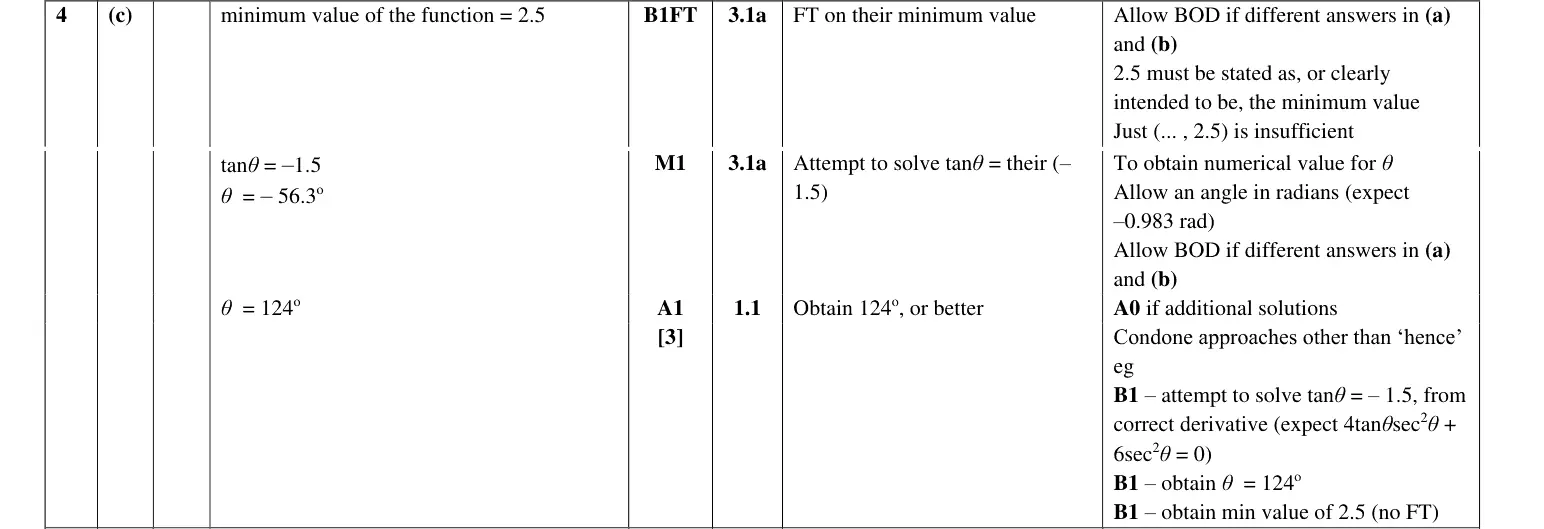
This final part of the question proved to be challenging, with a number of candidates not appreciating the link with work already done and struggling to make progress. A number did try to relate tanθ to their minimum point, with a common error being to attempt tan-1 of both the x and the y value. Despite the structure of the question making the two requests clear, quite a few candidates only attempted the angle and not the minimum value of the given function.
Key points and common errors
quadratic in tanθ: minimum 2.5 when tanθ = −1.5
smallest positive θ = 124° (not −56.3°)
error taking tan⁻¹ of both coordinates
both answers needed
June 2022 · Paper 3 · Q7(b)5 marksHard
Show the start of this question
Mark scheme for this part
Examiner's comment
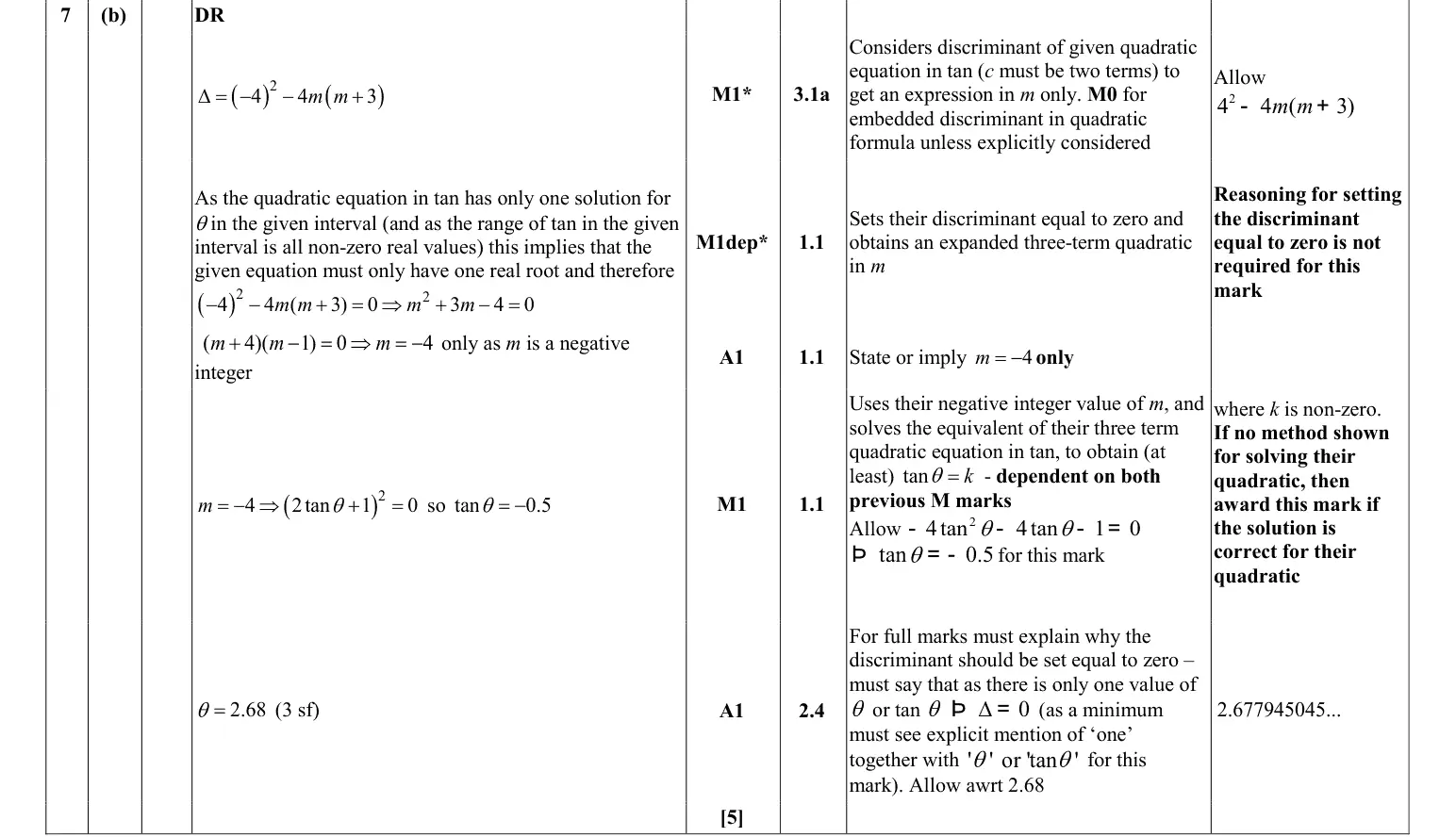
While it was pleasing that most candidates realised that the equation derived in part (a) was a quadratic equation in tanand hence they should consider the discriminant (of this equation) it was then disappointing how many candidates simplified the equation( ) ( ) − − + = 4 4 m m 3 0 to 16 − 4 m + 12 m = 0. Of those that did obtain the correct quadratic in m and hence found the corresponding value of as 2.68 (correct to 3 significant figures) many did not give suitable ‘detailed reasoning’ and therefore very few explained why the discriminant should be set equal to zero in the first place. This response scored 4 (of the 5) marks. Although the candidate has correctly found the value of they have not given the required ‘detailed reasoning’ of why they considered the discriminant of the quadratic equation in tan equal to zero and so did not score the final accuracy mark.
Key points and common errors
one solution in (0, π) so discriminant 16 − 4m(m + 3) = 0
m² + 3m − 4 = 0, m = −4
(2tan θ + 1)² = 0, θ = 2.68
must explain why Δ = 0
Autumn 2021 · AS Paper 2 · Q5(b)6 marksMedium
Show the start of this question
Mark scheme for this part
Key points and common errors
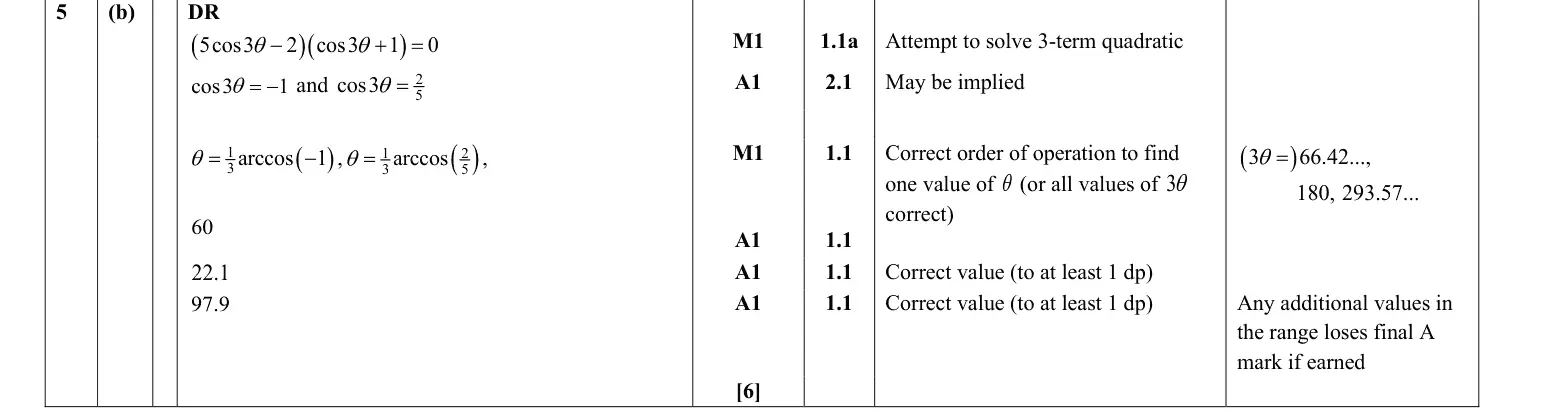
(5cos3θ − 2)(cos3θ + 1) = 0
cos3θ = −1 or 2/5
3θ = 66.42°, 180°, 293.57°
θ = 22.1°, 60°, 97.9°
divide by 3 after finding 3θ
Autumn 2021 · Paper 1 · Q8(c)5 marksMedium
Show the start of this question
Mark scheme for this part
Examiner's comment
(From the general report) In the final part of Question 4 one root of the cubic polynomial could not be further pursued to find a value for y, and a similar situation occurred in Question 8(c).
Key points and common errors
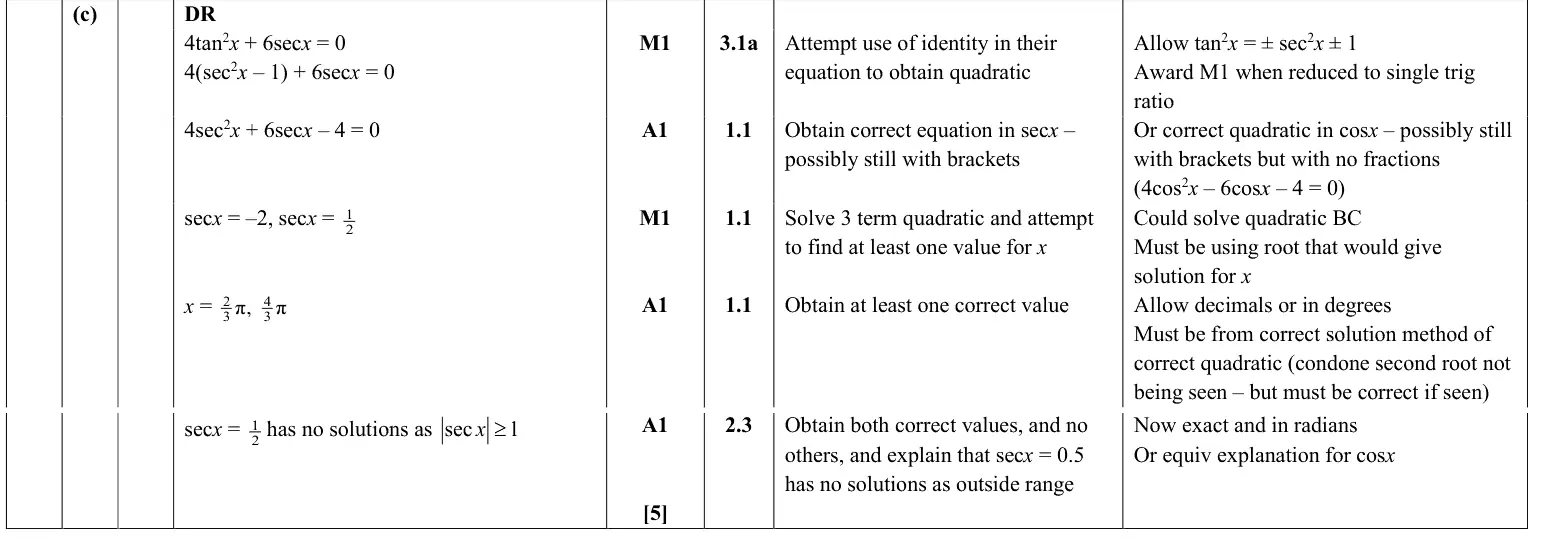
4tan²x + 6sec x = 0
use tan² = sec² − 1 to get 4sec²x + 6sec x − 4 = 0
sec x = −2 gives x = 2π/3, 4π/3
must explain sec x = ½ has no solution as abs(sec x) ≥ 1
Autumn 2021 · Paper 2 · Q4(e)4 marksMedium
Show the start of this question
Mark scheme for this part
Key points and common errors
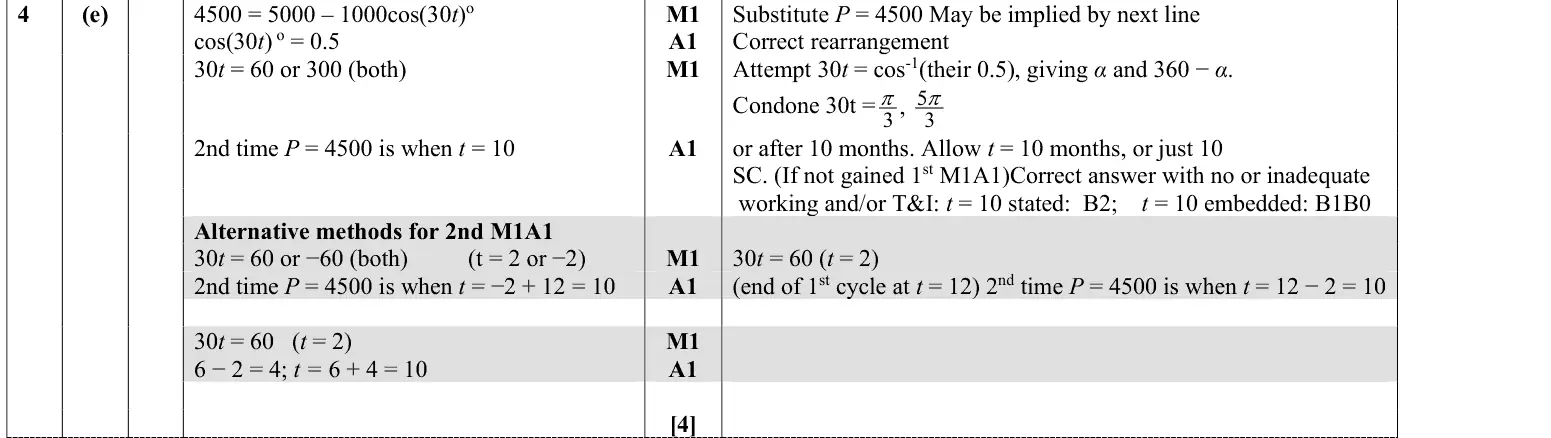
cos(30t)° = 0.5
30t = 60 or 300
second occasion t = 10 months
Autumn 2021 · Paper 3 · Q5(b)3 marksMedium
Show the start of this question
Mark scheme for this part
Key points and common errors
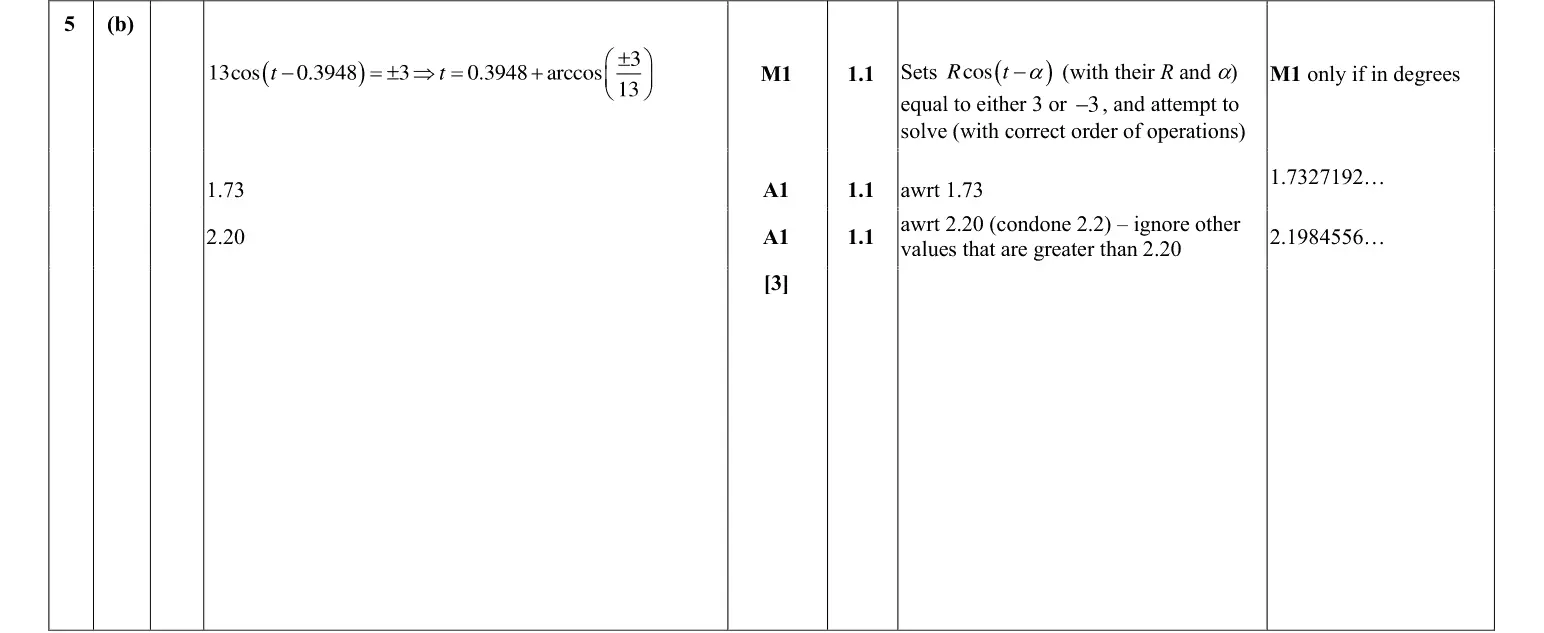
speed 3 means v = ±3
13cos(t − 0.3948) = ±3
t = 1.73 and 2.20
work in radians
Autumn 2020 · AS Paper 1 · Q3(a)5 marksMedium
Mark scheme for this part
Examiner's comment
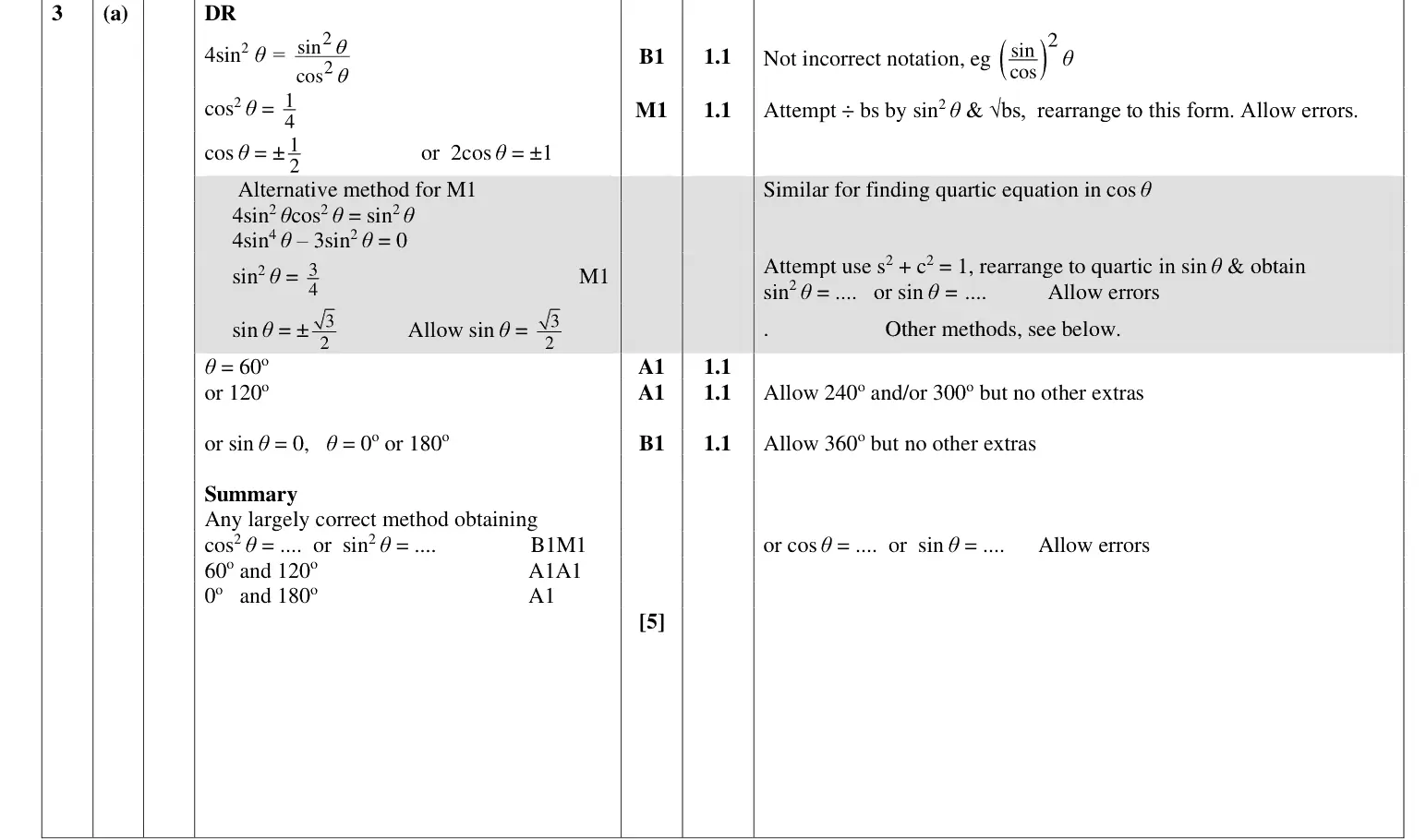
Most candidates made a good start by using tan θ = sin θ θ . However, the majority of candidates did not cos see that it was then possible to divide both sides by sin2 θ. These candidates went on to use sin2 θ + cos2 θ = 1, and obtained a quartic equation in either sin θ or cos θ. Although some candidates did this correctly, it took far longer, and gave greater opportunity for errors, than the more straightforward method.
Key points and common errors
tan²θ = sin²θ/cos²θ
divide by sin²θ: cos²θ = 1/4, θ = 60°, 120°
also sin θ = 0 gives 0°, 180°
dividing by sin²θ loses these roots
quartic route is longer
Autumn 2020 · Paper 2 · Q45 marksMedium
Mark scheme for this part
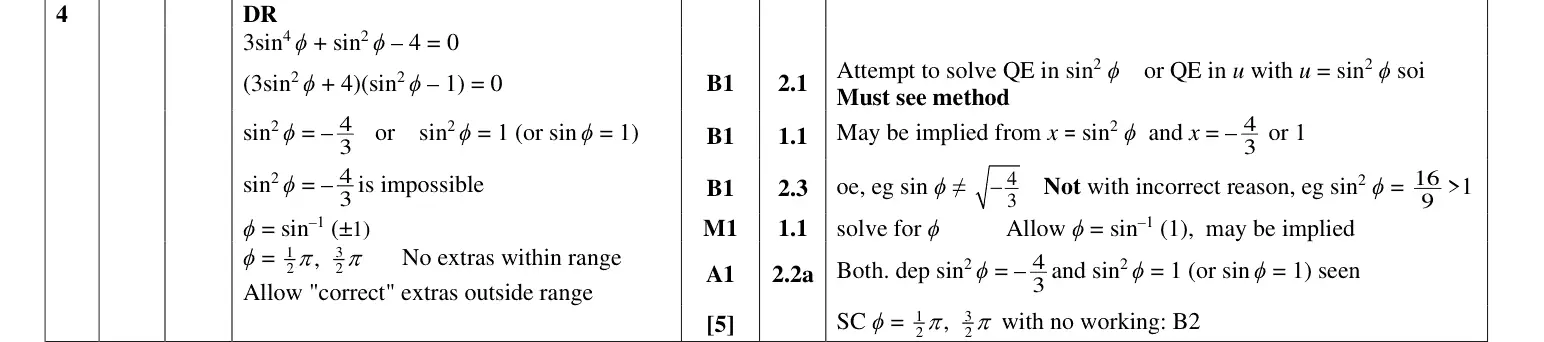
Key points and common errors
quadratic in sin²φ: (3sin²φ + 4)(sin²φ − 1) = 0
sin²φ = −4/3 must be rejected with a reason
φ = π/2, 3π/2
common error taking only sin φ = 1
June 2019 · AS Paper 1 · Q3(b)5 marksMedium
Show the start of this question
Mark scheme for this part
Examiner's comment
Most candidates recognised the significance of the word "hence" and used their response to the previous part. Most were successful. Many lost a mark, however, because they simply ignored the root sin θ = –3, without comment, or just placed a cross beside this response. Because of the "detailed reasoning" instruction, some explanation was required such as " sin θ only takes values between –1 and 1" or "sin θ = –3 is impossible". A few gave an incorrect explanation such as that sin θ = –3 is invalid because it is negative. A few candidates gave extra solutions such as 210o or 270o or 180o.
Key points and common errors
sin θ = 1 or 1/2 gives θ = 90°, 30°, 150°
must state sin θ = −3 has no solution with a reason
June 2019 · AS Paper 2 · Q6(b)5 marksHard
Show the start of this question
Mark scheme for this part
Examiner's comment
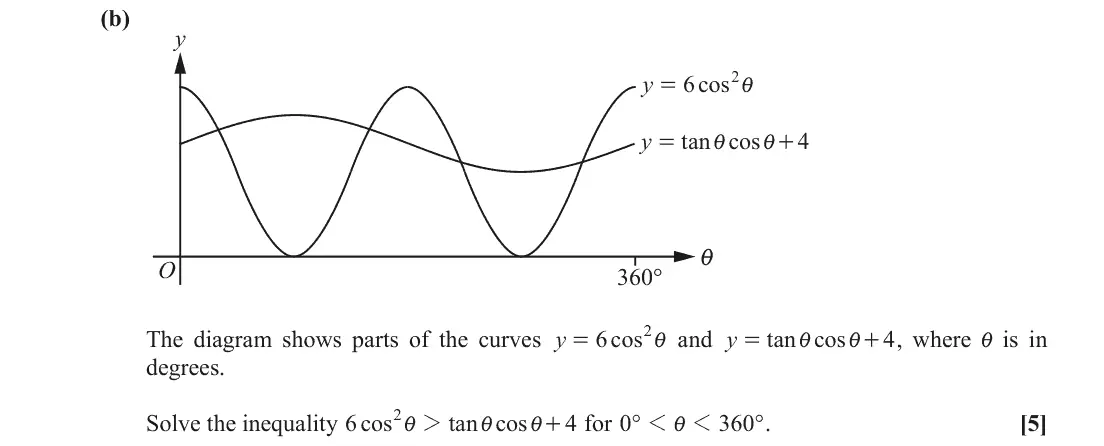
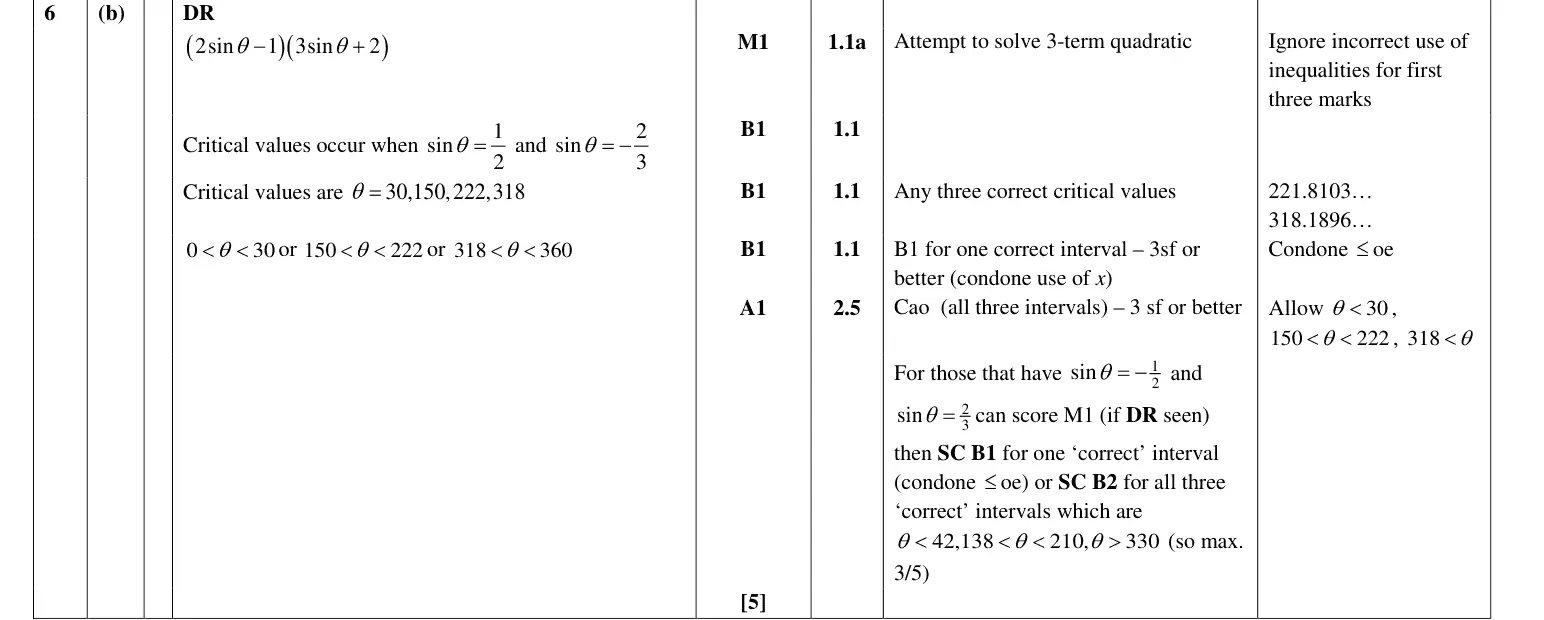
A fully correct solution was rare. Many candidates recognised the quadratic but just found values for θ and made no effort to relate them to the given graph and form inequalities. Because this is a detailed reasoning question we expected to see how the quadratic was solved and penalised those who just produced the two roots from their calculator. Often use of inequality signs was slack and recognising which quadrants angles need to be in was sometimes confused. Notice that the ‘detailed reasoning’ does not restrict the use of the quadratic solve function, in this exemplar the candidate has ‘Let sin θ = X ’ with 6 X + X − 2 = 0 and the substitution of the roots back in terms of θ to provide the required reasoning for this part of their answer. This candidate avoided any potential inequality pitfalls when identifying the required three regions by utilising the initial graph provided in the question. As in many cases, the subsequent marks are not achieved due to confusions with the inequalities.
Key points and common errors
(2sinθ − 1)(3sinθ + 2) = 0
critical values 30°, 150°, 221.8°, 318.2°
use the graph: 0 < θ < 30, 150 < θ < 222, 318 < θ < 360
many gave only the critical values
June 2019 · Paper 1 · Q9(c)2 marksMedium
Show the start of this question
Mark scheme for this part
Examiner's comment
Candidates were marginally more successful in identifying the greatest value of the function as opposed to the value of x where it occurred. While just writing down the greatest value was condoned, the ‘determine’ instruction meant that some justification was required for the value of x. A surprising number of candidates did not make the link between this part of the question and the form of the function found in part (a), with some resorting to calculus, use of their calculator or simply considering the function term by term. A good example of sufficient justification being given in response to the command word of ‘determine’ in the question.
Key points and common errors
greatest value √58 when 3x − 1.17 = 0, x = 0.389 (radians)
'Determine' needs a method
use (a), not calculus
June 2019 · Paper 1 · Q9(d)2 marksHard
Show the start of this question
Mark scheme for this part
Examiner's comment
This part of the question was less well answered, with the most common error being to assume that the least value of the function was 0 and then giving the associated value of x.
Key points and common errors
least value −√58 when 3x − 1.17 = π, x = 1.44
common error least value 0
June 2019 · Paper 3 · Q5(b)5 marksMedium
Show the start of this question
Mark scheme for this part
Examiner's comment
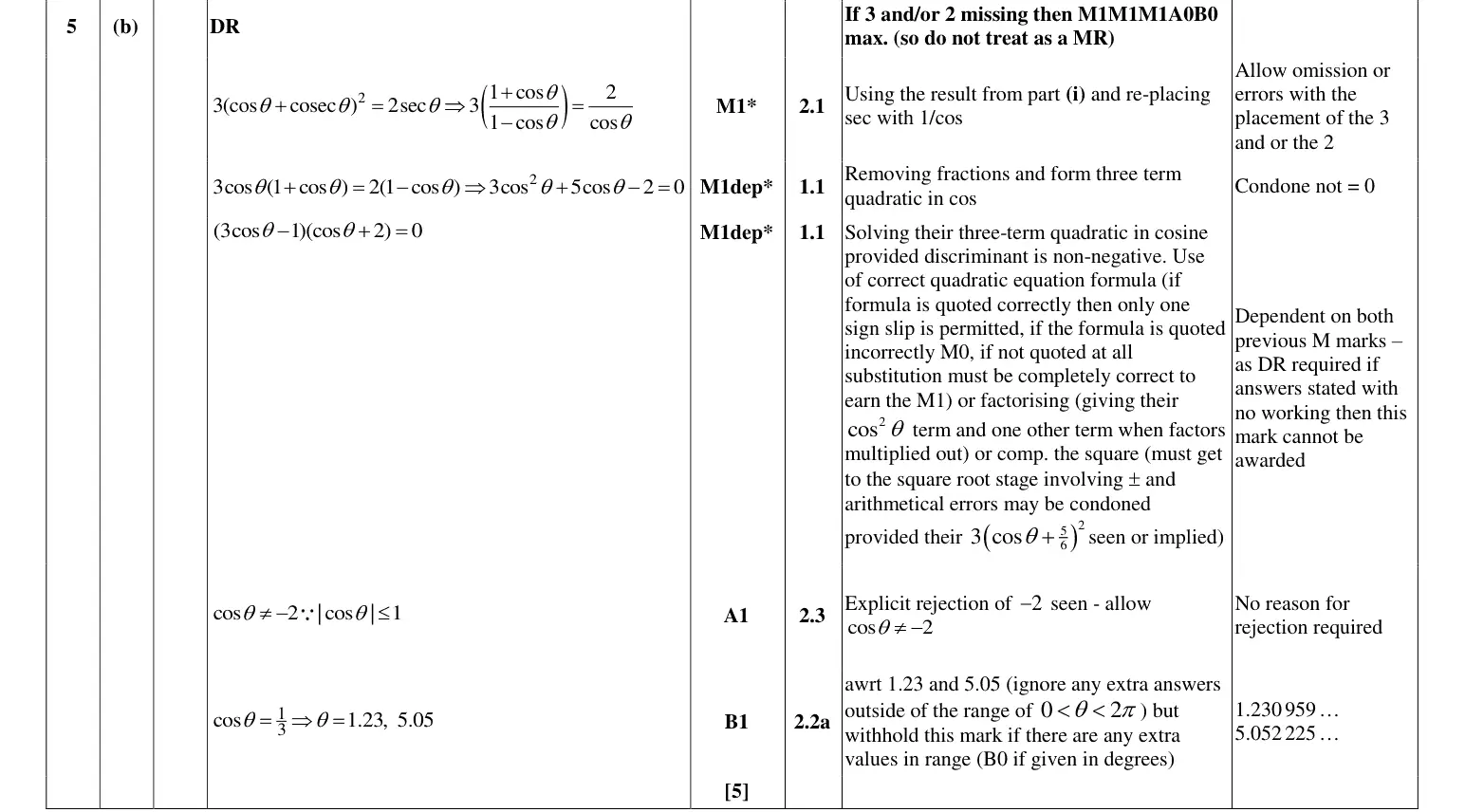
It was pleasing to note that most candidates used the result in part (a) to write down the required equation 1 + cos θ 2 3 1 = . It was, however, disappointing that many candidates either misplaced the 2 or the − cos θ cos θ 1 + cos θ 3 + 3cos θ 3 or believed that 3 1 = . Most candidates removed the fractions and obtained a − cos θ 3 − 3cos θ three-term quadratic in cosine, although mistakes with signs when collecting together the like terms was common. As this question explicitly asked candidates to ‘show detailed reasoning’ it was extremely disappointing that many went directly from the correct equation 3cos θ + 5 cos θ − 2 = 0 to cos θ = − 2 1 and cos θ = without any evidence of a correct analytical method. Examiners expected to see some 3 indication of the rejection of cos θ = −and although most candidates correctly stated 2 θ = 1 23 . some forgot about the other value in the interval (which was 5.05). quadratic equation in cosine so scored the first two marks. There is then a clear substitution method shown for how the ‘disguised quadratic’ has be evaluated. There is a mark for explicitly rejecting the -2 root. The sketch is not specifically needed, but hopefully has helped the candidate avoid a careless mistake in determining all the answers within the required range. factorised the quadratic directly in terms of cosθ . Again a nice sketch has be utilised to help identify the second solution. This response scored three of the five marks. The candidate obtained the correct quadratic equation in cosine so scored the first two marks. However, the candidate did not show detailed reasoning in how they have used the quadratic formula to obtain the values of 1 3 and 2 −; the third method mark and therefore the next accuracy mark could not be awarded. ( )( ) −± 5 5 − 4 3 − 2 Either showing the line cos θ = , or using substitution in the form 2 × 3 Let x = cos θ ∴ 3 x + 5 x − 2 = 0 ( )( ) −± 5 5 − 4 3 − 2 x = etc would have supported the detailed reasoning. 2 × 3 This candidate has been awarded the final B mark for the correct answers of 1.23 and 5.05. This response scored all three of the method marks, but the initial error with multiplying the fraction by 3 meant that the accuracy marks were lost. In general, candidates that opted for the use of the quadratic formula rather than factorisation seemed to make mistakes in the initial algebraic manipulation.
Key points and common errors
3(1 + cos θ)/(1 − cos θ) = 2/cos θ gives 3cos²θ + 5cos θ − 2 = 0
reject cos θ = −2
θ = 1.23, 5.05
misplacing the 3 or 2
sign errors
June 2018 · AS Paper 1 · Q3(i)3 marksMedium
Mark scheme for this part
Examiner's comment
Many candidates omitted sin θ = –0.5, usually obtaining 30o but not always 150o. Some of those who included sinθ = –0.5 only gave one of the two other answers. Some candidates found sin–1(0.25) = 14.5o. Some of these then found 14.52 or 14.5 .
Key points and common errors
sin θ = ±0.5: θ = 30°, 150°, 210°, 330°
sin θ = −0.5 often omitted
sin⁻¹(0.25) used
June 2018 · AS Paper 1 · Q3(ii)3 marksMedium
Mark scheme for this part
Examiner's comment
Most candidates obtained 3ϕ = 60o but not all included 3ϕ = 240o. A few started with tanϕ = and 3 hence ϕ = 30. Some thought that tan–1( 3 ) = 30o. Some gave extraneous answers obtained by, for example, (180o – 60o) ÷ 3. Others gave answers outside the given domain. Some gave answers in radians.
Key points and common errors
3φ = 60°, 240° (range 0 to 270°) so φ = 20°, 80°
240° often missed
extraneous answers or radians
June 2018 · AS Paper 2 · Q7(ii)5 marksMedium
Show the start of this question
Mark scheme for this part
Examiner's comment
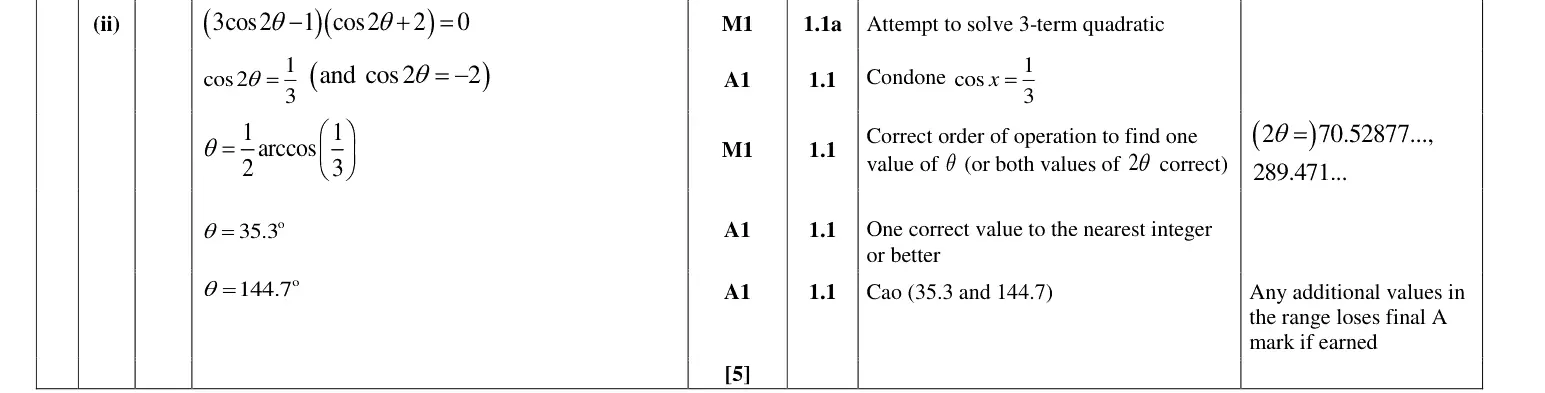
This part starts with the word ‘Hence’ and what we expect from this is clear in the Specification Document. Most did start by solving a quadratic, not always producing two angles in the end. To gain full credit the two angles had to be given correct to 1 decimal place as requested. 144.8ᵒ was not uncommon. Some did not grasp the significance of 2θ and left the answer as 70.5ᵒ.
Key points and common errors
(3cos2θ − 1)(cos2θ + 2) = 0 so cos2θ = 1/3 only
2θ = 70.5° or 289.5° so θ = 35.3°, 144.7°
leaving 70.5° as the answer
June 2018 · Paper 3 · Q6(ii)5 marksMedium
Show the start of this question
Mark scheme for this part
Examiner's comment
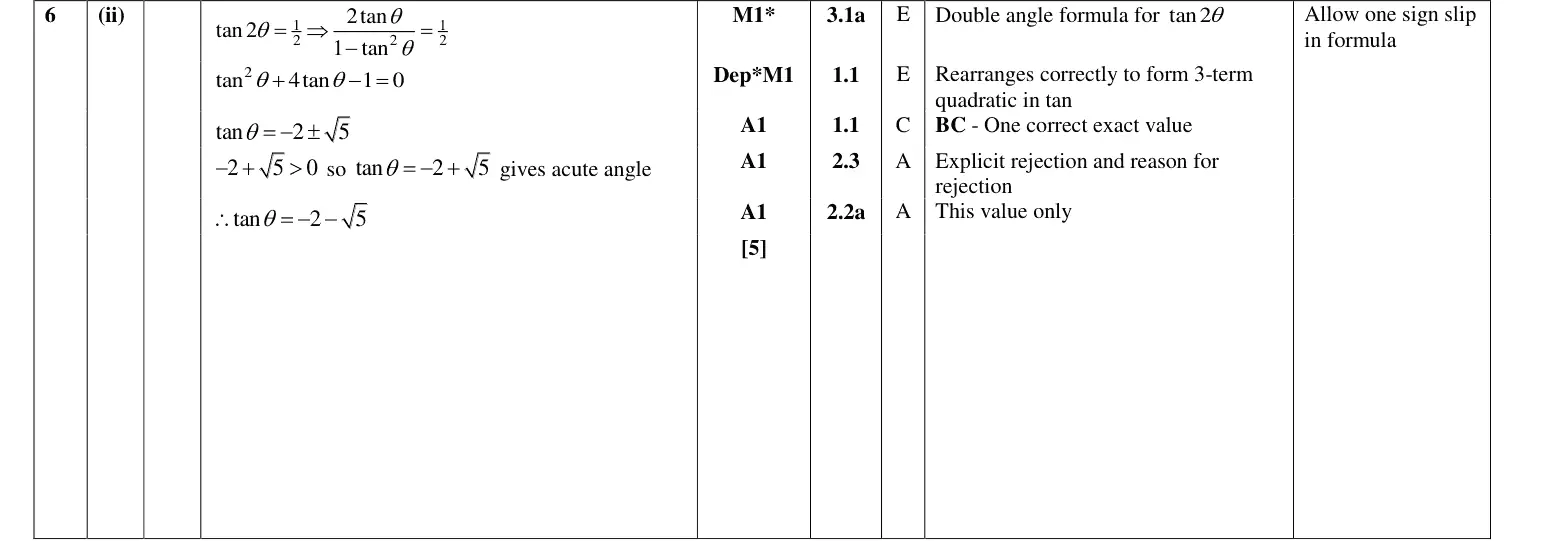
Many candidates did not read the question carefully and began their response by writing − 1 1 2 θ = tan ⇒ θ = ... even though the question specifically asked for the exact value of tan . Of θ 2 tan2 many derived the correct three- θ those candidates that used the correct double-angle formula for term quadratic in tan with most correctly stating that tan θ = −± 2 5.However, a significant proportion ended their response here and did not go on to determine the exact value of tan given that θ is an θ obtuse angle. A full solution needed the explicit realisation that since −+ 2 5 > 0 , tan θ = −+ 2 5 tan θ = −− 2 5. would not give an obtuse angle and therefore the only valid solution was
Key points and common errors
2t/(1 − t²) = ½ gives t² + 4t − 1 = 0
t = −2 ± √5
reject −2 + √5 (θ acute)
tan θ = −2 − √5
must not use inverse tan on a calculator
Find an A-level maths tutor
Stuck on this? Book a trial session with an A-level maths tutor.