Understand and use tan θ = sin θ / cos θ. Understand and use sin²θ + cos²θ = 1; sec²θ = 1 + tan²θ and cosec²θ = 1 + cot²θ.
Guidance
These identities may be used to solve trigonometric equations and angles may be in degrees or radians. They may also be used to prove further identities.
Mark scheme (whole question; this part is marked with the orange bar)
Examiner's comment
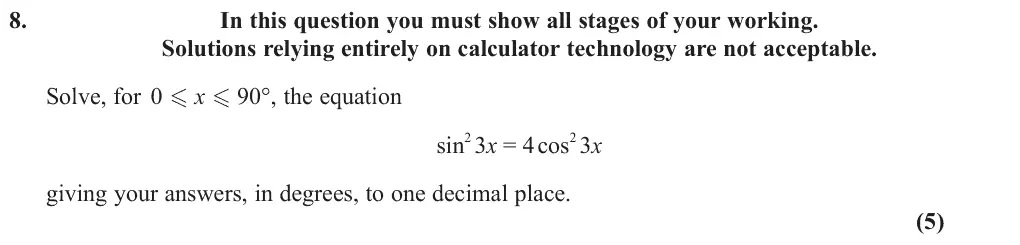
This question was designed to test candidates use of trigonometric identities and solving trigonometric equations and most candidates attempted this question, with a significant number achieving at least one mark. Only a small minority of candidates did not attempt this question. Most candidates were able to recognise the use of one of the three trigonometric identities. Errors were generally in substitution where some candidates used x instead of 3x. Where candidates correctly substituted the trigonometric identity correctly they usually rearranged to the correct format, thus gaining the first two marks. A common error from this point was to miss out the square rooting and use the arcsin/arctan/arccos with the constant, thus scoring no further marks. A small number of candidates square rooted, however did then not proceed to the required format by missing out the division by 3, scoring no more than two marks. For candidates who correctly square rooted and then solved for 3x, a large majority did not achieve the final A mark as they did not consider both roots and/or change the scale for the question. It was common for candidates to achieve one or two solutions, rather than all three. Only a very small number of candidates found, additional wrong solutions within the range provided. A few gave additional solutions outside the range although this was not penalised.
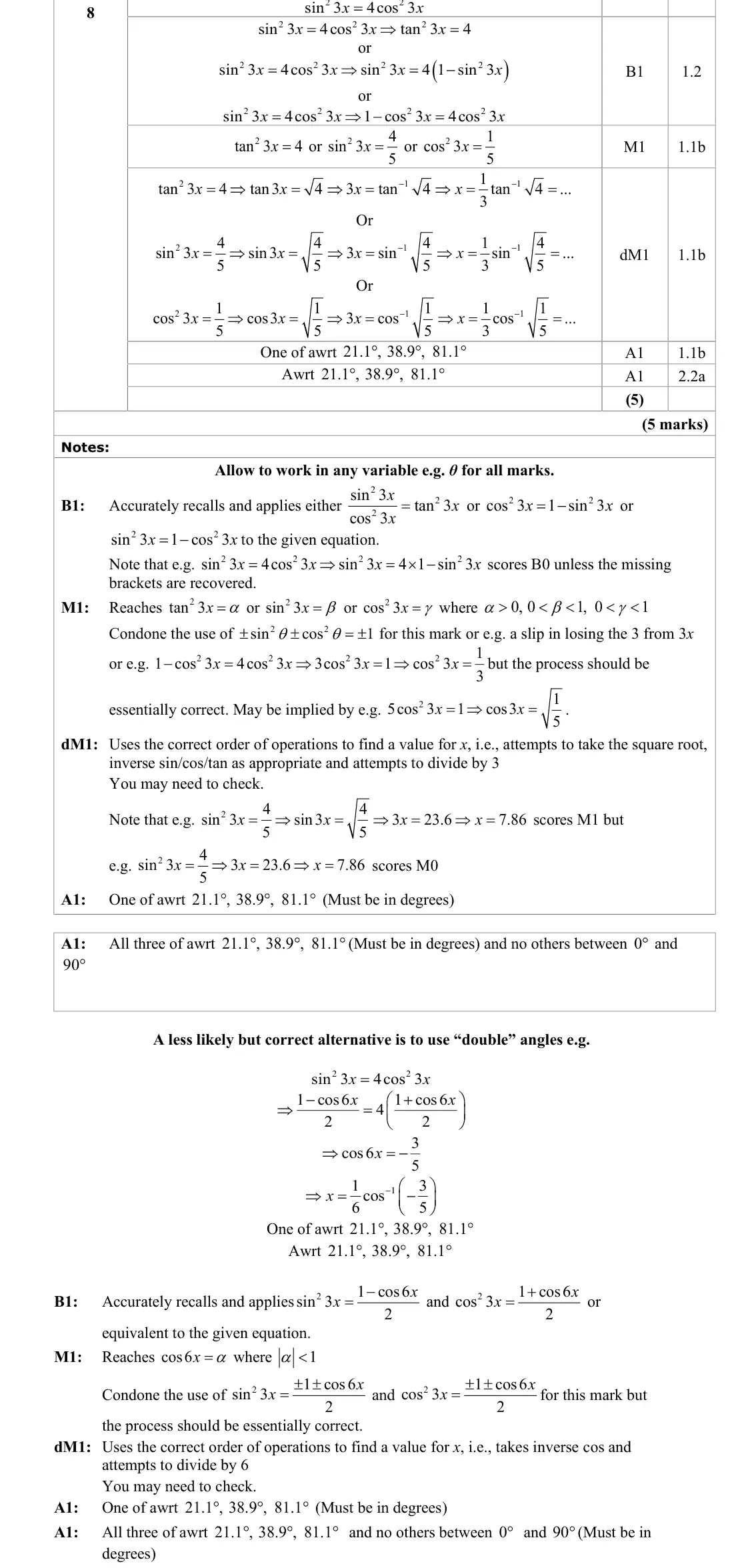
take the square root BEFORE inverse tan, then divide by 3
x = 21.1°, 38.9°, 81.1° and no others in 0–90°
using x instead of 3x
forgetting to divide by 3
June 2025 · Paper 1 · Q16(a)4 marks
Mark scheme (whole question; this part is marked with the orange bar)
Examiner's comment
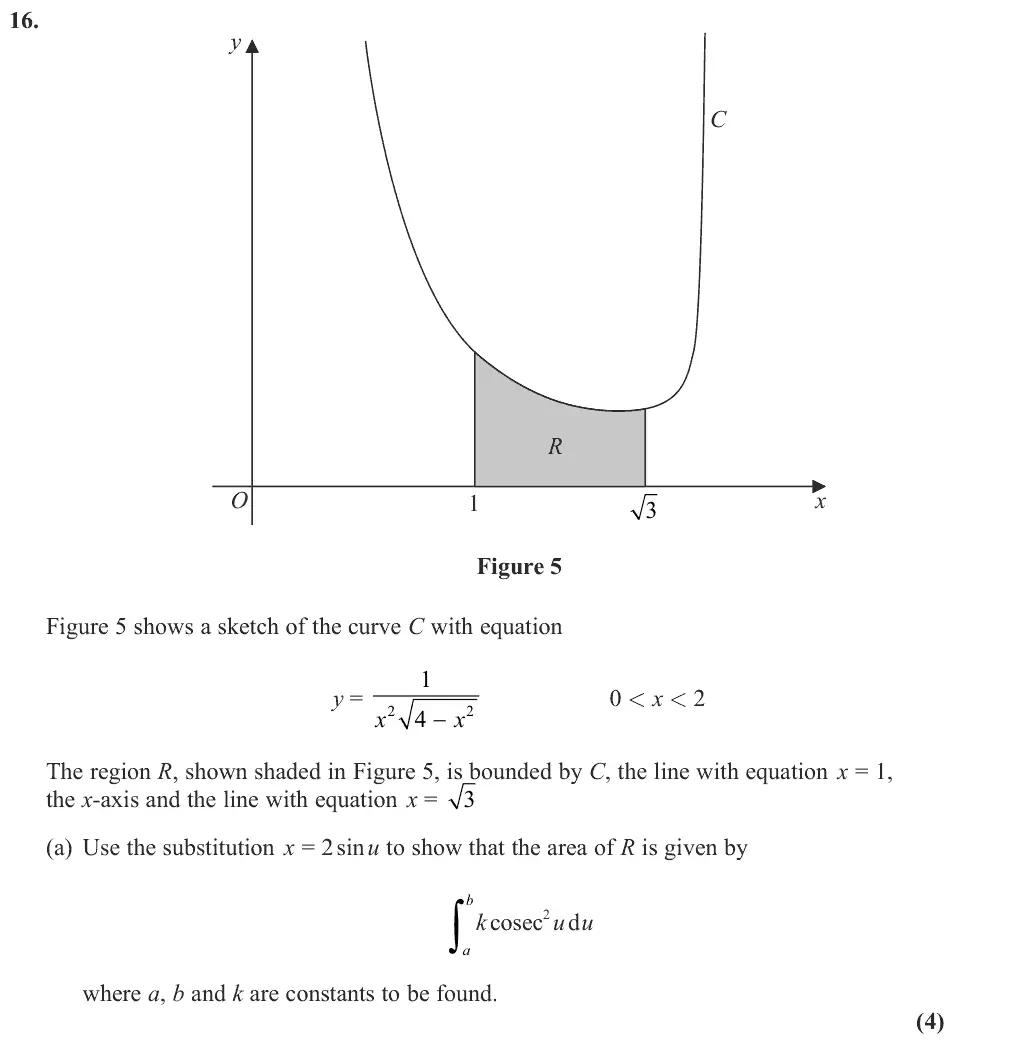
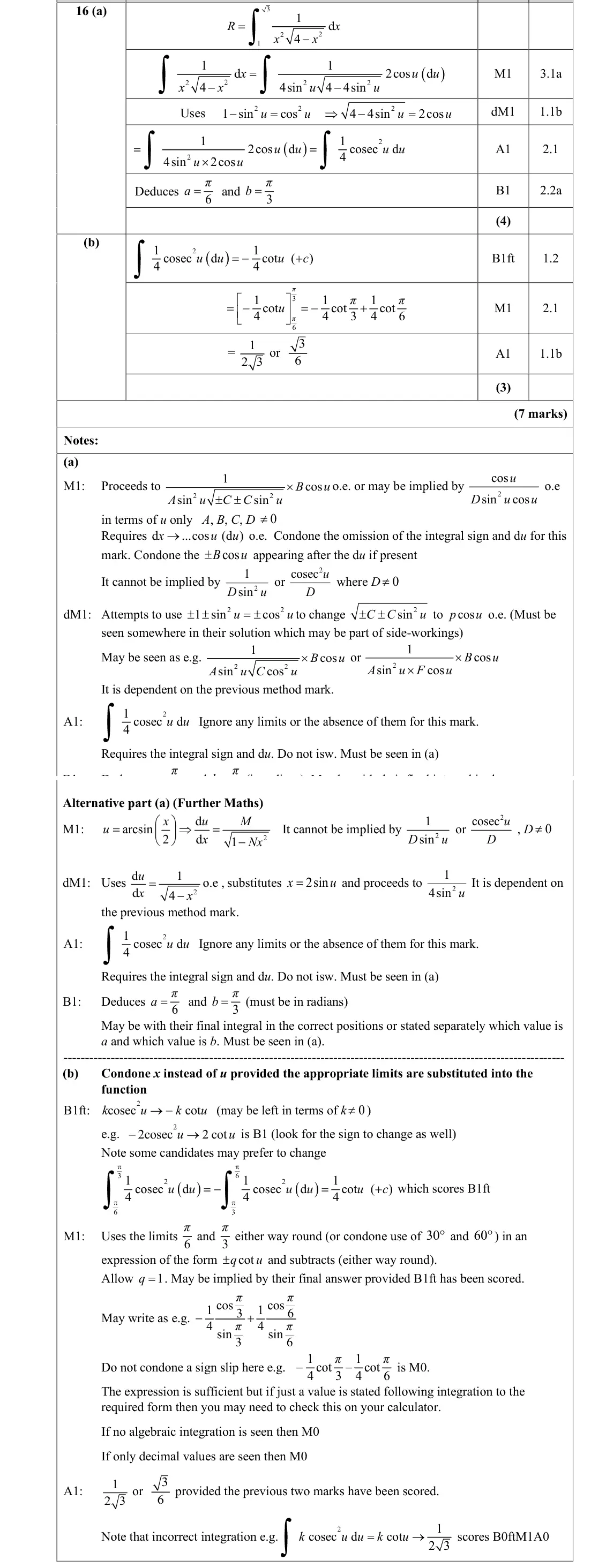
This proved to be a challenging question demanding good algebraic skills and attention to detail. For a final question on a paper, most made an attempt. In part (a), many responses did not successfully manage to fully substitute for all elements of the integral. The main issue was the correct substitution for dx. Responses commonly successfully substituted u in everything except the ‘du’, with some omitting it. Additionally, many did not achieve marks because they did not successfully substitute and achieve 2cosu in the denominator with others attempting to substitute d d 2cos u x u = . Many responses were not presented in a logical structure and did not gain marks because they did not bring together the elements of the substitution into a single expression which showed the progress of the substitution, the manipulation and simplification to the required result. This occasionally resulted in just amending to the result because they knew what the required form was but did not know how to get there. A large proportion did not spot the need to use the identity 2 2 sin cos 1 x x + = and often just square rooted all the values in the bracket achieving (2 2sin )x - . Some learners misapplied identities, using for example cos2x . Those who did use the identity correctly tended to go on to also gain the accuracy mark, but a few had 2 1 4sin u and ended with 2 4cosec u . Those who did compete the full substitution often did it in stages leaving the substitution for dx until the final stage of their proof which was condoned but should not be encouraged. A good proportion also changed the limits into angles in degrees and so did not gain the mark for changing the limits. The limits were often given as 30 degrees and 60 degrees, costing the final mark.
Common mistakes
substitute every part including dx = 2cos u du
√(4 − 4sin²u) = 2cos u using sin² + cos² = 1 (not √4 − √(4sin²u))
simplify to ∫ ¼cosec²u du
limits in radians π/6 and π/3, not 30° and 60°
June 2025 · Paper 2 · Q15(b)5 marks
Mark scheme (whole question; this part is marked with the orange bar)
Examiner's comment
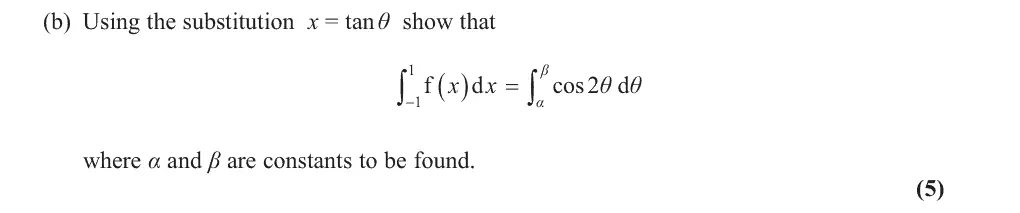
The final question, which involved differentiation, integration by substitution and trigonometric identities, provided challenge in dealing with the algebra but, given its layout, proved accessible. The majority of learners attempted at least part of this question with some success due to the restart opportunities available. In part (b), learners generally made a good start and seemed to be confident with the method of substitution. Most were able to score the first two B marks and the first M mark for an attempt at a complete substitution. For those that did not achieve the first M mark, it was almost always due to not dealing with the dx. However, the simplification to the required form using the trigonometric identities proved more challenging for many. Although there were many very neat and succinct solutions using various effective approaches, some responses expanded brackets unnecessarily, applied multiple trigonometric identities or worked with cumbersome fractions until they achieved something close to the required form. A small but noticeable number used degrees.
Common mistakes
limits −π/4 and π/4 (radians, not degrees)
dx = sec²θ dθ (dx must be replaced)
1 + tan²θ = sec²θ then cos²θ − sin²θ = cos 2θ
avoid unnecessary expansion
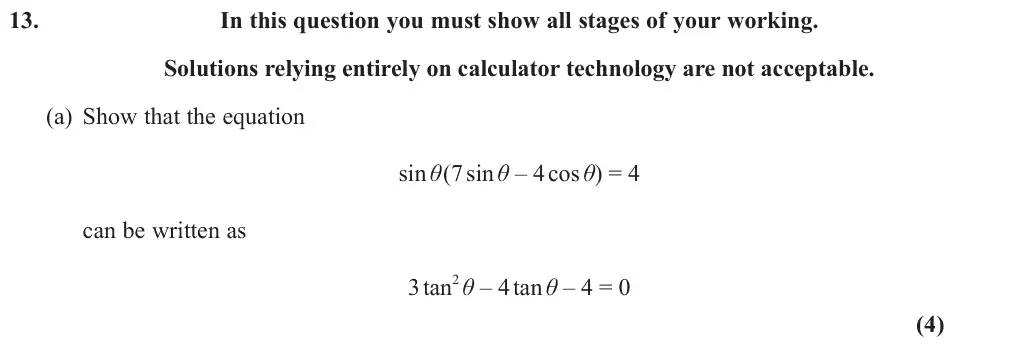
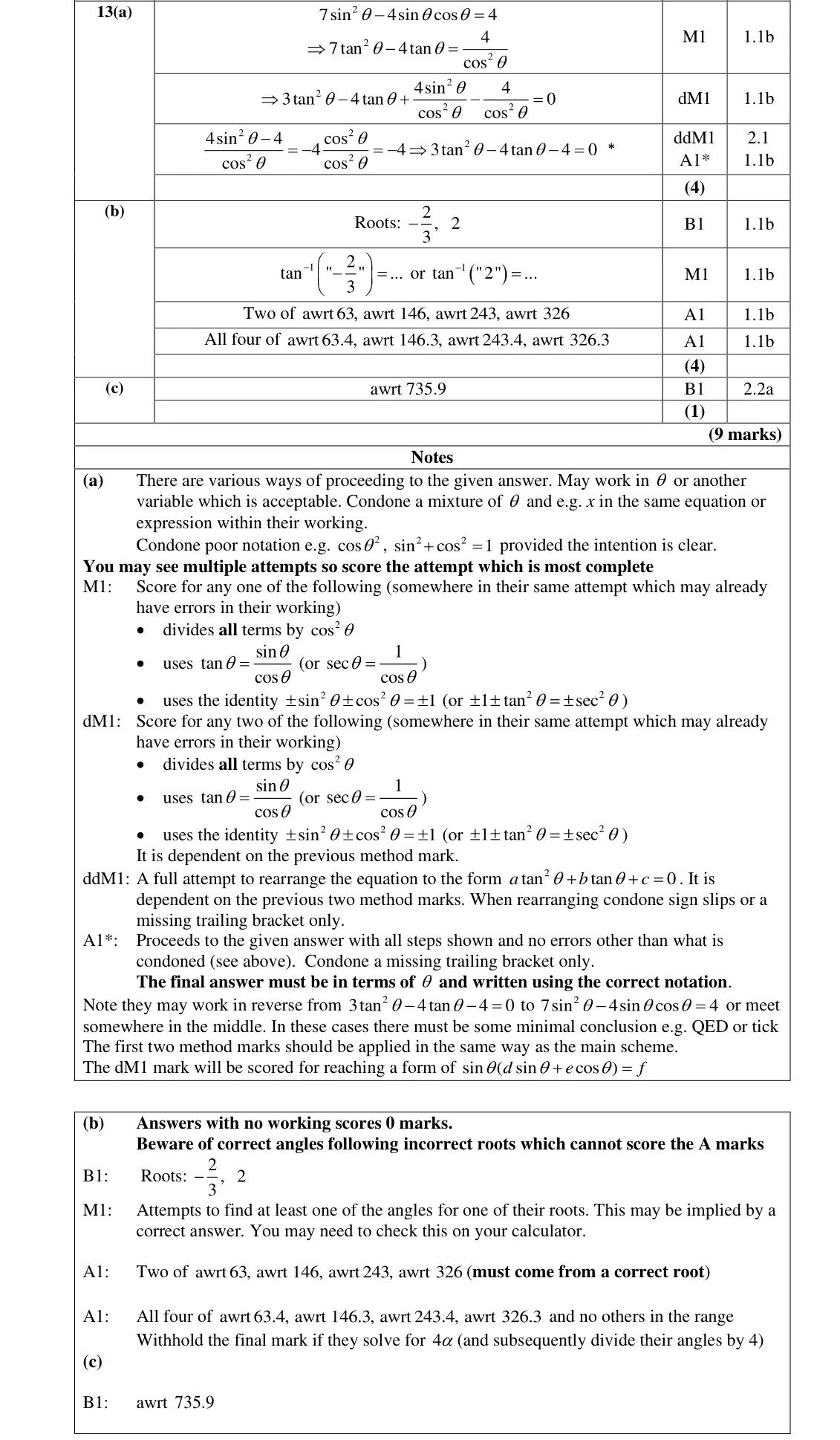
June 2024 · AS Paper 1 · Q13(a)4 marks
Mark scheme (whole question; this part is marked with the orange bar)
Examiner's comment
The trigonometric equation, again, demonstrated how candidates are usually successful in solving these types of equations, however, they often struggle with the manipulation to show a given result. Part (a) held one of the highest demands in the paper and showed a clear differentiation between the most capable mathematicians and those who were familiar with trigonometric identities but struggled to apply and manipulate them. Overall, this proved to be difficult for most candidates with quite a few gaining one or two marks but very few were able to gain all four marks. Multiple attempts were seen which showed good resilience but further evidenced the complexity of the question. Most candidates were able to gain the first M mark which usually was for using sin tan cos = , (even if this followed from incorrect work which was quite often) quite a few candidates attempted to divide by cos as they seemed to spot it would give them a tan in their working, however not many recognised the need to divide by 2 cos and those that did would often forget to divide the 4 on the right hand side by it as well; they also tended to replace 2 2 7sin cos with 2 3tan . Of the candidates who did manage to pick up the first two marks, many could not reach a 3TQ in tan and thus the required answer. The successful approaches would often start with using 2 2 sin cos 1 + = on the right-hand side and proceed from there or work backwards from the given answer.
Common mistakes
divide every term by cos²θ and use tanθ = sinθ/cosθ
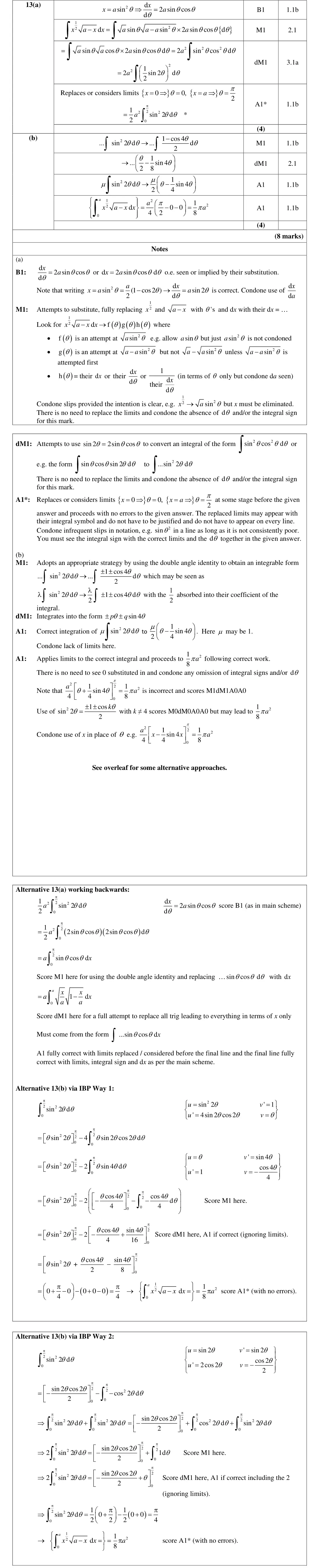
Mark scheme (whole question; this part is marked with the orange bar)
Examiner's comment
were available on both parts regardless of success in part (a) but many candidates who failed to prove the result in part (a) then went on to omit part (b) and missed out on this opportunity. However, it was not uncommon to see full marks in part (a) followed by no marks in part (b), and vice versa. Most candidates who attempted part (a) recognised the requirement to find d x and d attempted to do so, with varying levels of success. Those who differentiated successfully generally went on to substitute into the expression correctly and gained at least the first 2 marks. The flexibility in the first method mark made this accessible to d = most candidates who had tried at differentiation. appeared several d x 2 sin cos a times and benefited from the flexibility of the first method mark. The most common . In many cases the notation was 2 and cos a incorrect derivatives were 2 cos a particularly poor, although d x a was very generously condoned provided the right-hand d side was correct. Candidates struggled with the rearrangement of the integrand into the form required to successfully use the double angle formula. Many were not able to work with or simplify the square root terms successfully, and even those that did sometimes failed to recognise the need to use the double angle formula for sin 2 . A minority of candidates progressed correctly to the final answer, while some of those that achieved the final expression still lost the final mark for failing to address the limits, or for missing the d or the integral sign. For those who did not achieve the first method mark this was commonly due to careless copying or premature simplification such as - - 2 2 instead of . sin a a sin a a Those who recognised the requirement for using double angle formulae to integrate a squared trigonometric function were generally successful in part (b) of this question.
Common mistakes
dx/dθ = 2a sin θ cos θ
√(a − a sin²θ) = √a cos θ
sin²θ cos²θ = ¼ sin²2θ (rearranging the integrand is where most fail)
change limits to 0 and π/2
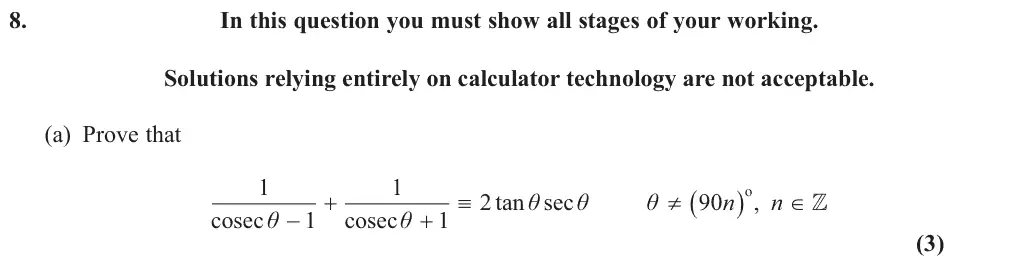
June 2024 · Paper 2 · Q8(a)3 marks
Mark scheme (whole question; this part is marked with the orange bar)
Examiner's comment
A significant number of candidates found this question challenging. In part (a) the first challenge candidates faced was combining the two terms to produce a single fraction. This was completed successfully by many candidates, either as a fraction in cosec or a fraction in sin . The second challenge was using trigonometric identities correctly. The majority used 2 2 sin cos 1 + = but the more successful candidates typically used 2 2 1 cot cosec + = . It was only a minority who managed to complete the proof successfully. It was possible to complete the proof starting either from either side of the identity, however, generally those candidates who started with the left-hand side were more successful. Few, if any, candidates gave a completely correct solution starting from the right-hand side and the majority only obtained the mark for using a correct Pythagorean identity. A small number of candidates used a “meet in the middle” approach with varying degrees of success. Notational errors were not widespread, but variables were sometimes missing, or indices misplaced resulting in the loss of the final mark. Many also lost the accuracy mark because they did not show all the necessary steps by proceeding to the given answer using sine and cosine.
Common mistakes
combine into one fraction 2cosecθ/(cosec²θ − 1)
use cosec²θ − 1 = cot²θ (or sin² + cos² = 1)
convert to sin and cos to reach 2tanθsecθ
no notational slips (cos²θ not cosθ²)
starting from the RHS rarely succeeded
June 2024 · Paper 2 · Q8(b)4 marks
Mark scheme (whole question; this part is marked with the orange bar)
Examiner's comment
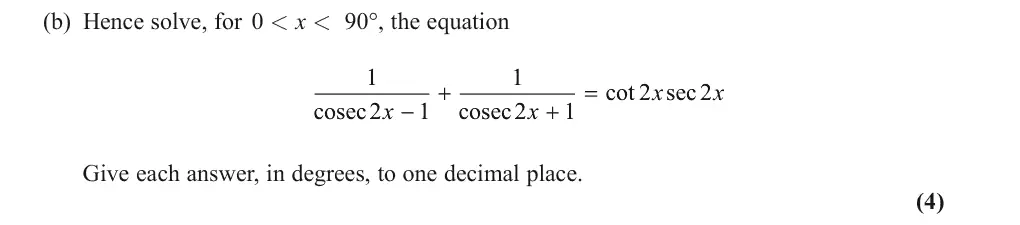
A significant number of candidates found this question challenging. In part (b), candidates that spotted the connection with part (a) tended to achieve at least 3 out of the 4 marks available. Those who failed to get the first line right with the variable of 2x on both sides but just substituted 2tan sec x x or even 2tan sec on the left-hand side gained no marks in this part. Candidates took a number of different approaches to solving the correct equation. The most frequent was to obtain 2 1 tan 2 2 x = but approaches involving 2 3sin 2 1 x = or 2 3cos 2 2 x = were relatively common. There were a few candidates who used the identity 2 2tan tan 2 1 tan x x x = - to reach a quadratic in 2 tan .x These attempts were usually successful. Some candidates stated that the square root of 1 2 is 1 4 which lost them the final two marks in this part. However, those candidates that did get to one of the correct equations could normally proceed to one correct answer (which was typically x = 17.6°). It was only a minority of candidates who gave both correct answers. The final mark was regularly lost because only one solution was identified, or candidates had incorrectly found 45 degrees by incorrectly solving sec2x = 0 and interpreting this as cos2x = 0 rather than being undefined. Most candidates that achieved marks in this part of the questions could correctly identify the order of operations to solve their equations although there were some candidates who struggled with this. For the final mark, a few wrote down 17.7 instead of 17.6 and some had extra answers in the given range and therefore lost the accuracy mark. A small minority of candidates did not show appropriate working in part (b), sometimes merely writing down the two correct answers to the given equation. The question explicitly asked for all stages of a candidate’s working as the answers can be found using a calculator. Hence candidates that gave the correct answers without appropriate working were not awarded any marks in this part of the question.
Common mistakes
replace θ by 2x: 2tan2x sec2x = cot2x sec2x
sec2x ≠ 0 (not 45° from cos2x = 0)
tan²2x = ½ (or sin²2x = ⅓)
x = 17.6°, 72.4° (both, 1 d.p., none extra)
answers without working score 0
June 2023 · AS Paper 1 · Q12(a)3 marks
Mark scheme (whole question; this part is marked with the orange bar)
Examiner's comment
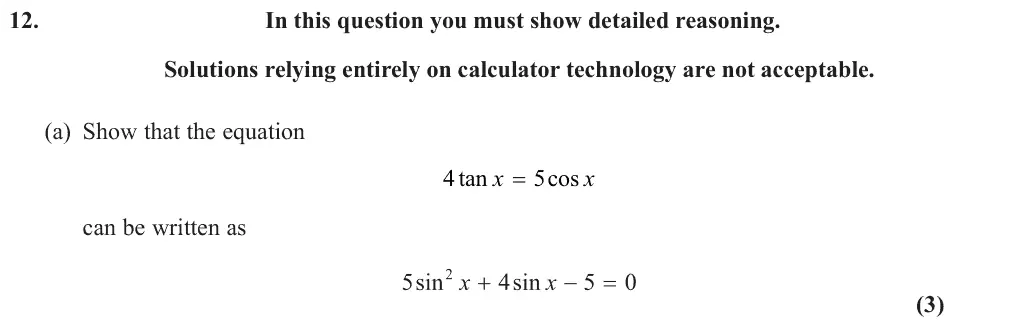
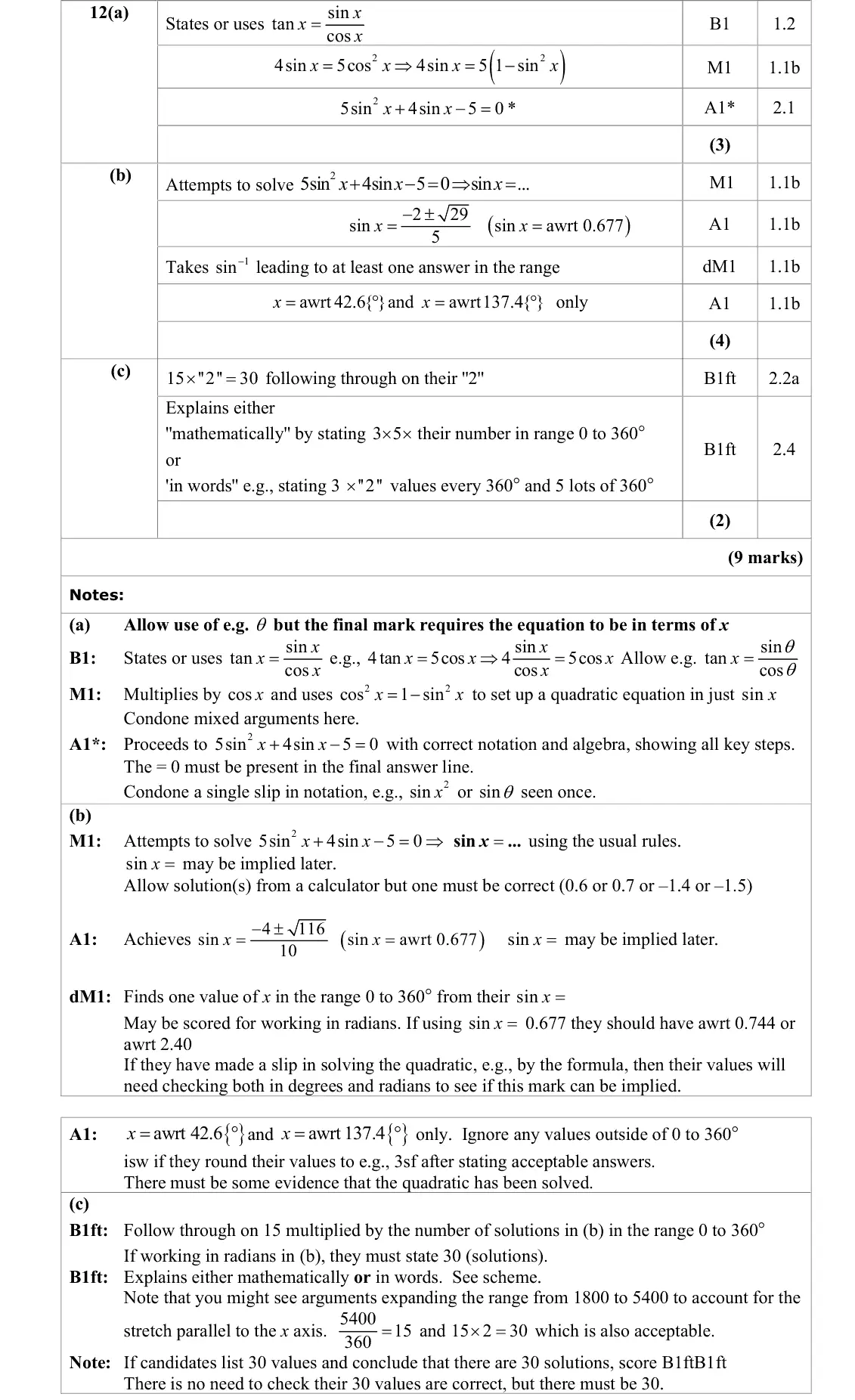
This question involving the use of trigonometric identities and solving a trigonometric equation was generally very well answered with the exception of part (c). There were very few blank scripts. Part (a) was generally well answered. The majority of candidates scored the first mark for correctly identifying sin tan cos x x x = . Two common errors were to either use sin 1 cos x x = - , or to include the number 4 in the denominator 4sin i.e., 4tan 4cos x x x = . Some candidates made errors in their notation (which was only penalised if it occurred more than once) with a few using 2 sin x . A small number started with the answer to try to work backwards, but this approach rarely scored full marks.
Common mistakes
tan x = sin x / cos x (not 4 tan x = 4 sin x / 4 cos x)
multiply by cos x and use cos²x = 1 − sin²x
show all steps and write "= 0" in the final line
June 2023 · Paper 2 · Q14(a)3 marks
Mark scheme (whole question; this part is marked with the orange bar)
Examiner's comment
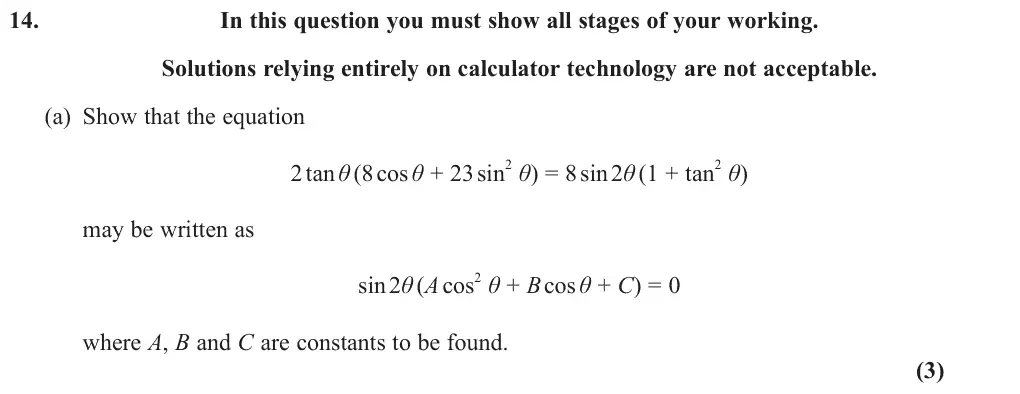
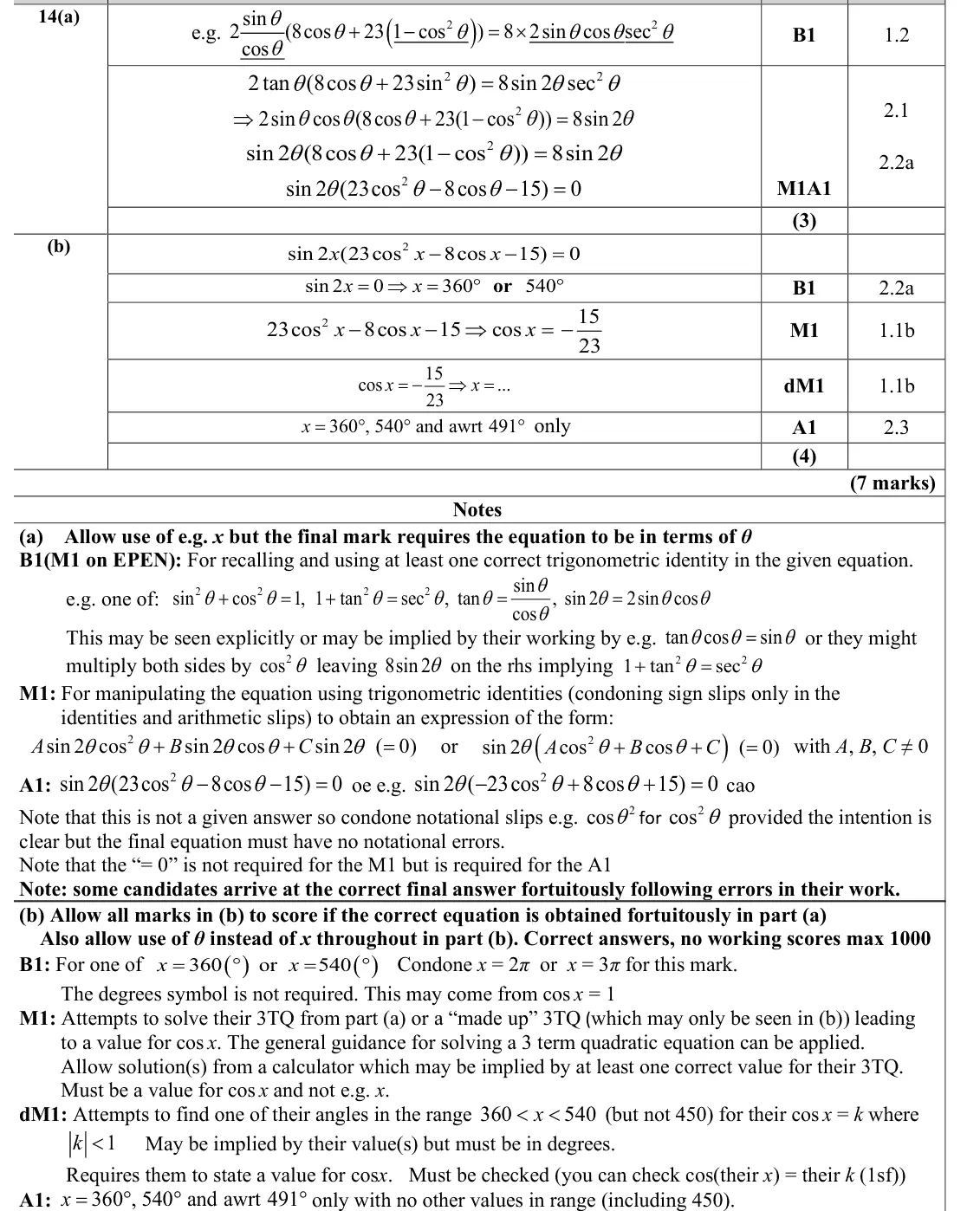
Part (a) was at least started by many but when students failed to make any progress towards the result, they tended not to attempt part (b). In part (a) the vast majority of candidates scored the first mark for using a correct trigonometric identity. The M and A marks were often both given or both lost, as candidates explored multiple manipulative steps to reach the final form for the equation. In many cases this involved expanding the brackets, using a substitution for sin 2 theta , but later putting back into sin 2 theta form i.e., undoing the manipulation that had been introduced. Whilst in many cases this resulted in the candidate getting there in the end, there were many examples of multiple attempts or unnecessarily long solutions. The most efficient methods did not involve multiplying out the bracket on the LHS which seemed to be the default first step for most students. A common mistake was to suddenly put the RHS equal to zero so it disappeared rather than being subtracted on the LHS. For those that were successful, there were a variety of approaches as well as variety in the number of steps required to reach the correct final form, with some methods considerably more efficient than others. Arithmetic errors were commonly seen in this question. Many successful candidates attempted to find a factor of sin 2 theta on both sides of the equation before proceeding to collecting these on the same side. Another typical successful method involved writing all the terms in terms of sin theta and cos theta , collecting all terms on the same side, and then taking a factor of 2sin theta cos theta . However, many candidates who expanded tended to forget terms when expanding or factorising, leading to an expression in an incorrect format. Replacing tan theta and sin 2 theta was usually handled well, as was replacing 1 + tan2 theta with sec2 theta and then 2 1 cos but many candidates didn’t follow the manipulation to the end and were unsure what to do with the sin 2 theta on the right hand side, so either left it on the right hand side and lost both the M and A marks, or moved it to the left but then incorrectly dealt with it when combined with the quadratic formed on that side.
Common mistakes
use tanθ = sinθ/cosθ, 1 + tan²θ = sec²θ, sin²θ = 1 − cos²θ, sin2θ = 2sinθcosθ to get sin2θ(23cos²θ − 8cosθ − 15) = 0
do not divide by sin2θ or drop the RHS
long unnecessary expansions
June 2023 · Paper 2 · Q153 marks
Mark scheme (whole question; this part is marked with the orange bar)
Examiner's comment
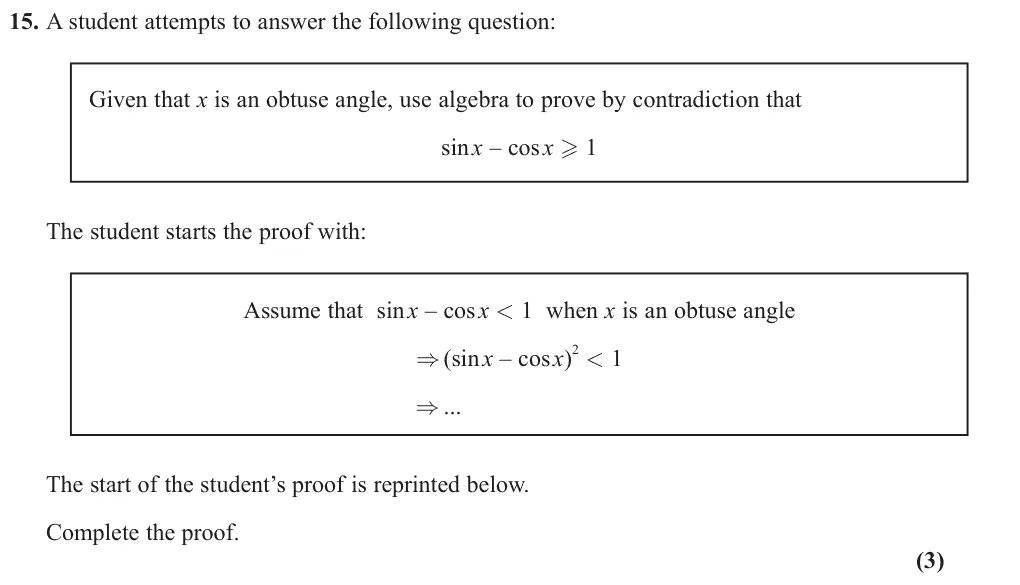
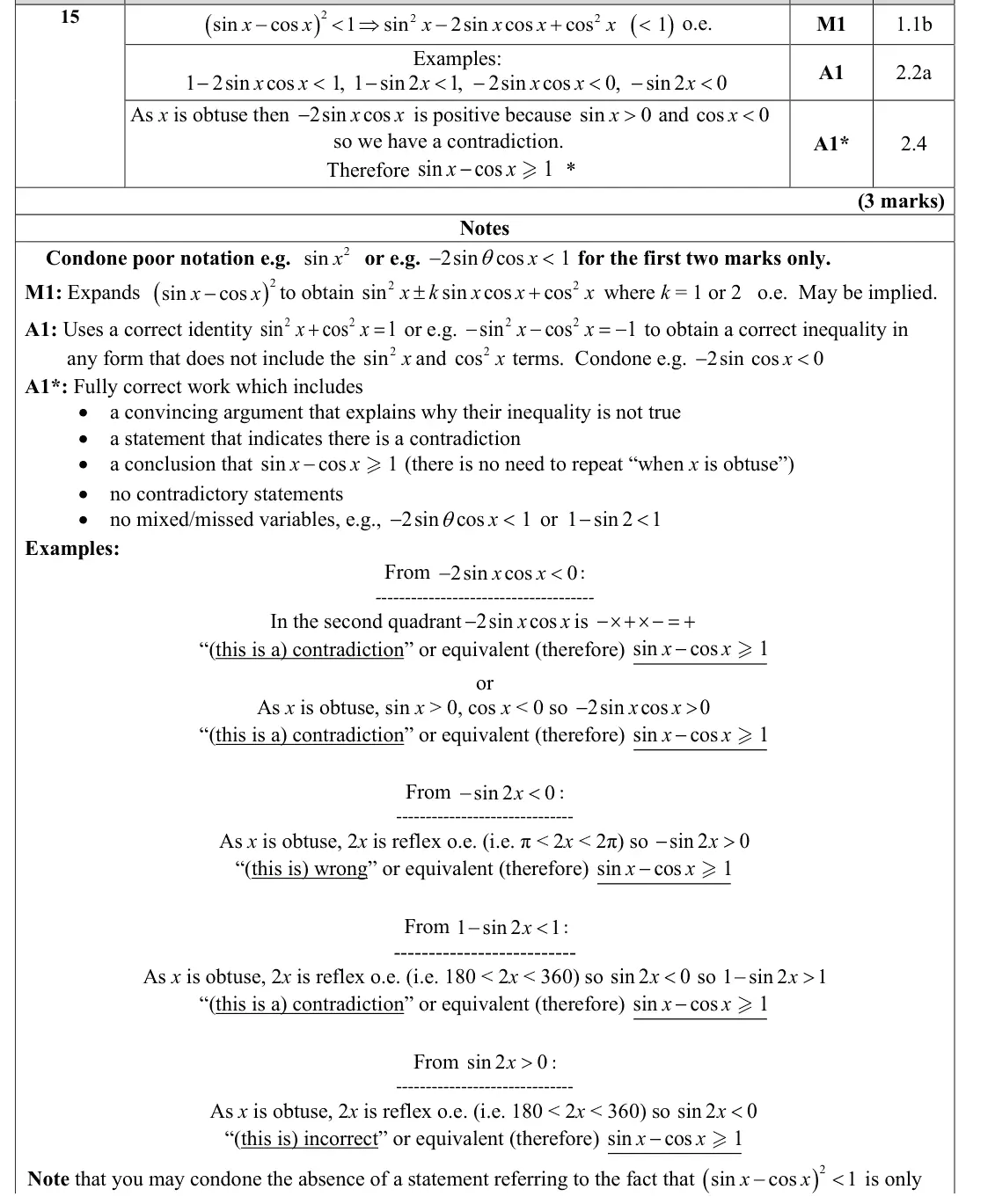
A number of candidates lost all marks on this question by not attempting any solution. Most candidates correctly expanded the given expression and used sin2 x + cos2 x = 1 to simplify and score the first two marks. A small number incorrectly used (sin x - cos x)2 = sin2 x - cos2 x, scoring no marks. Others attempted to substitute values of 90 and 180 into the given expression instead of using algebraic manipulation. Whilst most candidates scored the first two marks, only the very best were able to score the final mark, with most candidates failing to offer a convincing reason for a contradiction. Candidates who drew a graph of sin x and cos x or sin 2x to support their understanding tended to score well. Successful candidates typically explained that 2x must be between 180 and 360, and hence sin 2x must be negative, which is a contradiction with their inequality. Those that worked with sin x cos x were generally more successful in achieving this mark than those who chose to use sin2x. However, it was clear that not all students understood what an obtuse angle was. Another typical correct conclusion involved candidates stating if x is obtuse, sin x must be positive and cos x must be negative, leading to a negative product and a contradiction. Of those who were able to offer a reason for the contradiction, some still lost the final A mark for failing to then reach a conclusion that the original statement was true or because of errors in the proof such as missing x’s or mixed variables.
Common mistakes
expand (sin x − cos x)² = sin²x − 2sinxcosx + cos²x (not sin²x − cos²x)
use sin²x + cos²x = 1 to get −2sinxcosx < 0
obtuse so sin x > 0, cos x < 0 (or 180° < 2x < 360°, sin2x < 0): contradiction, so sin x − cos x ≥ 1
substituting 90° and 180° is not a proof
many did not explain the contradiction
June 2023 · Paper 3 (Mechanics) · Q5(b)5 marks
Mark scheme (whole question; this part is marked with the orange bar)
Examiner's comment
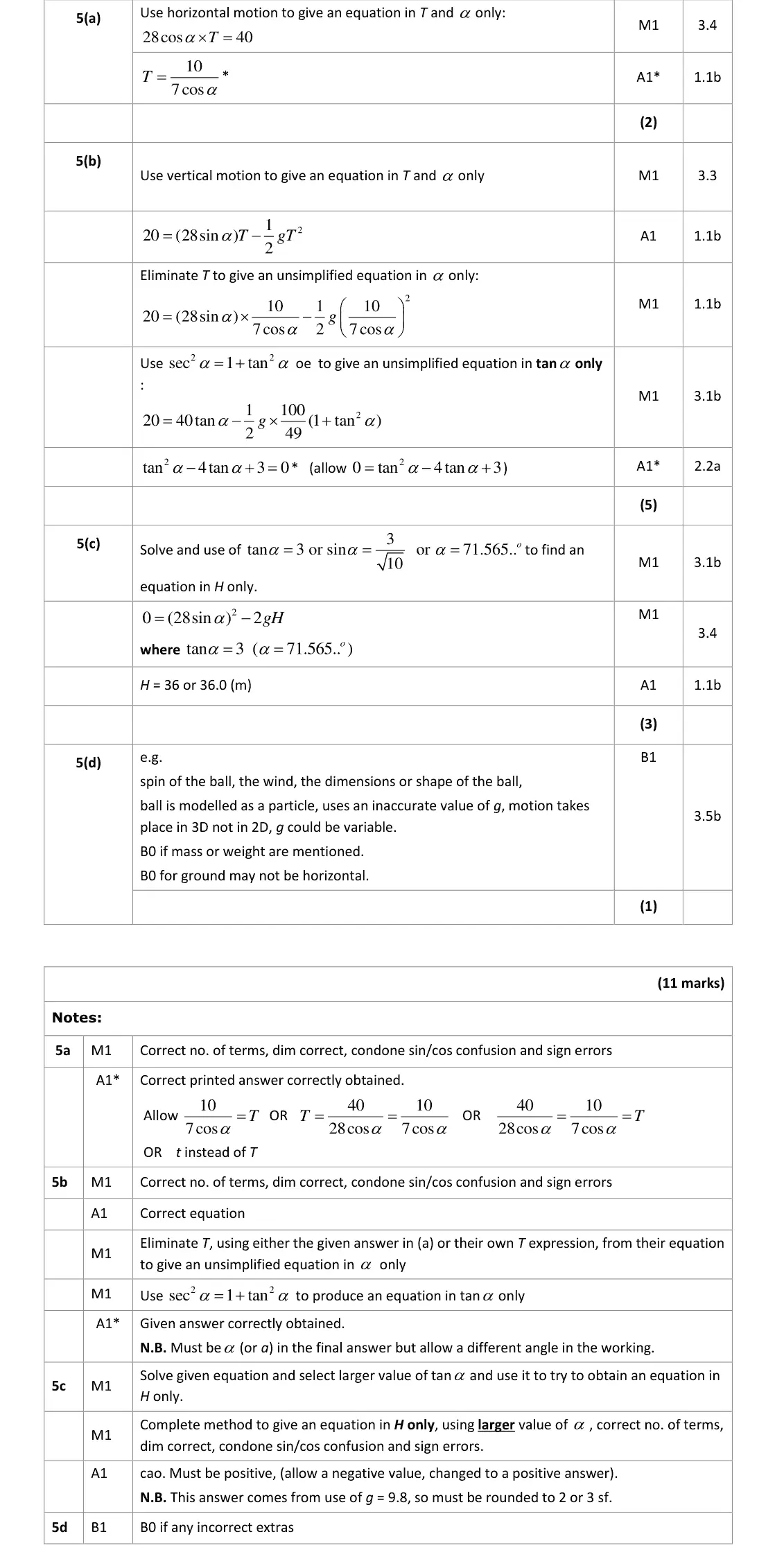
given result. The second part, however, provided a greater challenge and, although many realised that they needed to consider the vertical motion, a few did not know how to proceed, with some solving the given quadratic in tan alpha rather deriving it. However, many 1 = + 2 s ut at did make progress, using with a vertical distance of 20 although there were 2 occasional sign errors. They mostly then substituted the expression for T from part (a) to
Common mistakes
vertical motion 20 = 28 sin α T − ½gT²
eliminate T using (a)
use sec²α = 1 + tan²α to reach a quadratic in tan α
derive (not solve) the given equation and state it exactly
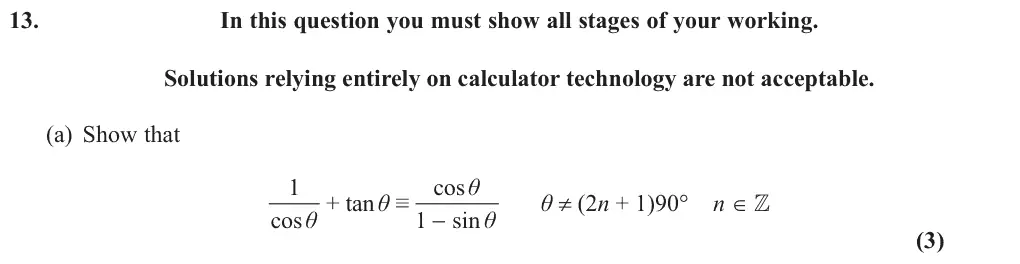
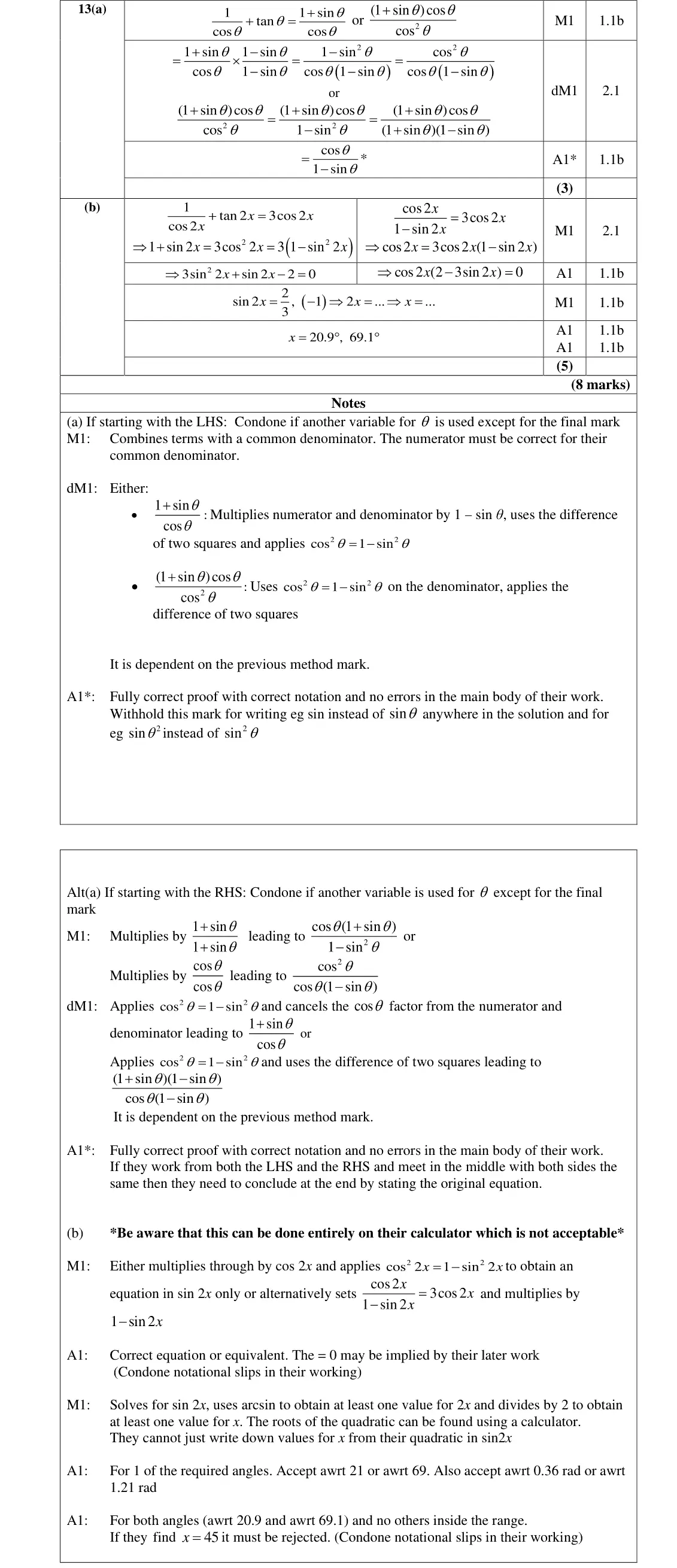
June 2022 · AS Paper 1 · Q13(a)3 marks
Mark scheme (whole question; this part is marked with the orange bar)
Examiner's comment
There were a number of completely blank responses to both parts of this question. This was either due to timing on the paper or possibly due to this topic not having been covered in sufficient depth due to disruption to learning. In part (a), most of the attempts started with the LHS. Many scored no marks at all but quite a few combined terms with a common denominator to achieve the first mark, usually 1 sin cos + . However, very few progressed from this with many using "identities" such as 1 sin cos + and cos 1 sin - to get to the RHS. Candidates should avoid approaches to this type of problem involving an identity where it is treated as an equation where possible.
Common mistakes
common denominator (1 + sin θ)/cos θ, multiply by (1 − sin θ) and use cos²θ = 1 − sin²θ (difference of two squares)
do not treat the identity as an equation or invent identities
notation sin θ not "sin", sin²θ not sin θ²
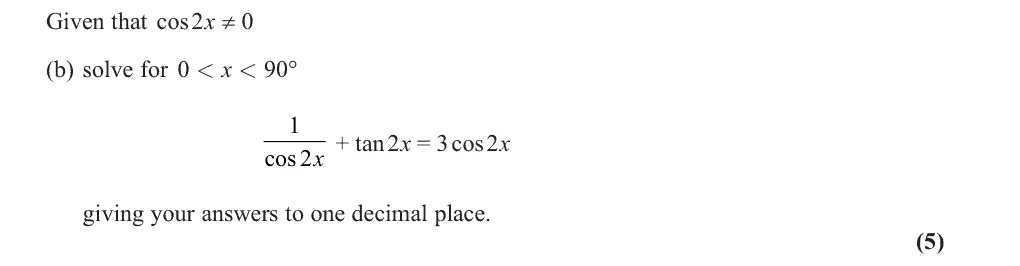
June 2022 · AS Paper 1 · Q13(b)5 marks
Mark scheme (whole question; this part is marked with the orange bar)
Examiner's comment
There were a number of completely blank responses to both parts of this question. This was either due to timing on the paper or possibly due to this topic not having been covered in sufficient depth due to disruption to learning. In part (b) it was pleasing to see candidates making an attempt although there were quite a few with nothing at all correct. These often had incorrect or irrelevant identities, resulting in equations which could not be solved for sin 2x, meaning that they could not access the last method mark. Those who did achieve 2 sin 2 3 x = (or -1) usually solved correctly to get, at least, one value of x, usually x = 20.9 and very often the second value too. Most who got to 11 this stage usually rejected any other values and scored full marks. Often, they had cancelled the cos 2x earlier in their working, so they did not have to reject the extra values at the end. Usually this should be avoided, although on this occasion the domain meant that this did not affect their final answer. It was pleasing to see that candidates had not tried to answer the question entirely by calculator by just stating the angles and the use of radians rather than degrees was not typically seen. Many did not recognise the relevance of part (a) and began this part from scratch, often successfully, even though they had not shown any relevant working for part (a).
Common mistakes
multiply by cos 2x and use cos²2x = 1 − sin²2x (or use (a) with θ = 2x): 3sin²2x + sin 2x − 2 = 0
sin 2x = 2/3 (reject −1 and x = 45° as cos 2x ≠ 0)
find 2x then halve: 20.9°, 69.1°
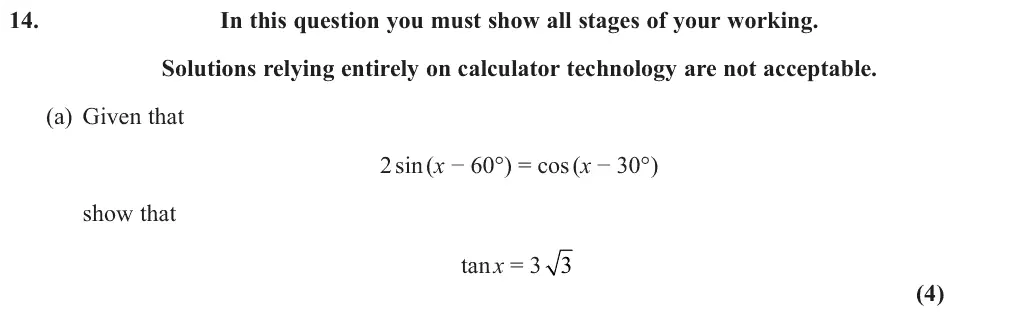
June 2022 · Paper 1 · Q14(a)4 marksMedium
Mark scheme (whole question; this part is marked with the orange bar)
Examiner's comment
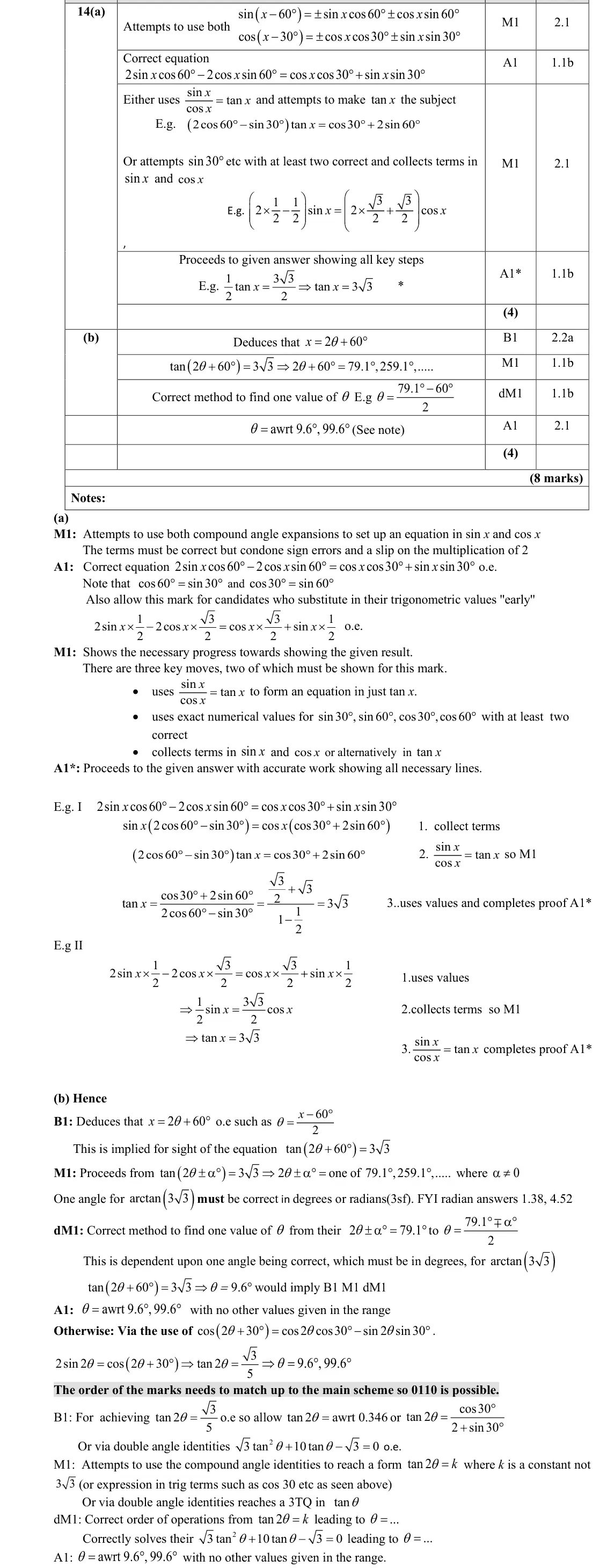
This question was another big discriminator. Good candidates found it familiar and accessible with some 25% scoring full marks. Strangely, for candidates who dropped marks, they seemed to be able to do either part (a) or part (b), but not both. For those candidates who attempted part (a) most recognised the need to use the compound angle expansions. Carelessness with the multiplication by 2, signs and use of the formulas was seen in a small minority of the scripts. Students who attempted to use sin (A+B) and cos (A+B) with a negative angle B, often introduced sign errors; it is clear that such a method is not to be recommended. Substituting exact numerical values was usually correct, however candidates occasionally fudged their working to get the given answer.
Common mistakes
expand both compound angles
exact values of sin/cos 30° and 60°
collect terms and use tan x = sin x/cos x
doubling slips and fudging to the given answer
June 2022 · Paper 2 · Q15(a)3 marks
Mark scheme (whole question; this part is marked with the orange bar)
Examiner's comment
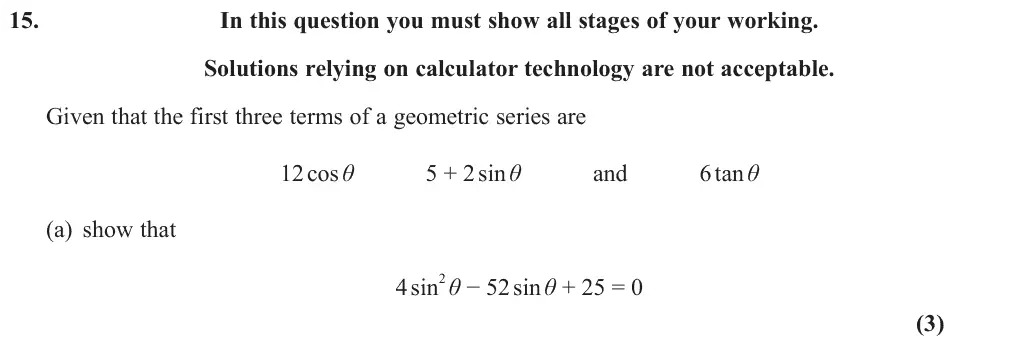
The majority of candidates found this question accessible and were able to score consistently throughout. Where marks were lost they were usually in parts (b) and (c). 12𝑐𝑐𝑐𝑐𝑐𝑐𝑐𝑐= 5+2𝑠𝑠𝑠𝑠𝑠𝑠𝑠𝑠 6𝑡𝑡𝑎𝑎𝑎𝑎𝑎𝑎 Part (a) was attempted successfully by most candidates, starting usually with 5+2𝑠𝑠𝑠𝑠𝑠𝑠𝑠𝑠. Candidates then successfully cross multiplied and used the was 6𝑡𝑡𝑡𝑡𝑡𝑡𝑡𝑡= 12𝑐𝑐𝑐𝑐𝑐𝑐𝑐𝑐ቀ 12𝑐𝑐𝑐𝑐𝑐𝑐𝑐𝑐ቁ 2 5+2𝑠𝑠𝑠𝑠𝑠𝑠𝑠𝑠 appropriate identity to reach the required result. Another starting point regularly seen . Errors in the proof were rare if candidates started from a correct statement. Occasionally the “ = 0” was carelessly missing. 𝜋𝜋 In part (b) most candidates correctly solved the equation either by factorising or using 6 rather than the required 5𝜋𝜋 5𝜋𝜋 calculator technology, but many reached the acute angle 6 . Others found a number of solutions but failed to identify 6 as the obtuse angle of 𝜋𝜋 required answer. A few candidates worked in degrees and again lost the accuracy mark. 6 in (b) then usually carried this error into (c) and 𝜋𝜋 Those who had obtained an angle of 6 in (c) often would reach 9൫1 + sqrt 3൯, but did not seem to worry that this did not match the required answer were in a position only to earn the method marks. Candidates using format given in the question. There were many attempts, however, to use the correct formula for the sum to infinity with appropriate values for the first term and the (often incorrectly) algebraic expressions for the sum to infinity involving ��𝜃, without common ratio. Some candidates unfortunately put effort into finding and rearranging 𝑎𝑎 1+𝑟𝑟 incorrectly as the formula substituting an angle in, gaining no credit, and others used for the sum to infinity. The most common mistake in (c) was failure to show the steps 3 ൰ straight into their calculators to obtain 9 -9 sqrt 3 losing the last two marks in -6 sqrt 3 where the denominator was rationalised. Many candidates clearly typed an expression 1-൬- sqrt 3 like the question.
Common mistakes
equate the common ratios (5 + 2sinθ)/12cosθ = 6tanθ/(5 + 2sinθ)
tanθ × cosθ = sinθ
"= 0" needed
June 2022 · Paper 2 · Q16(b)2 marks
Mark scheme (whole question; this part is marked with the orange bar)
Examiner's comment
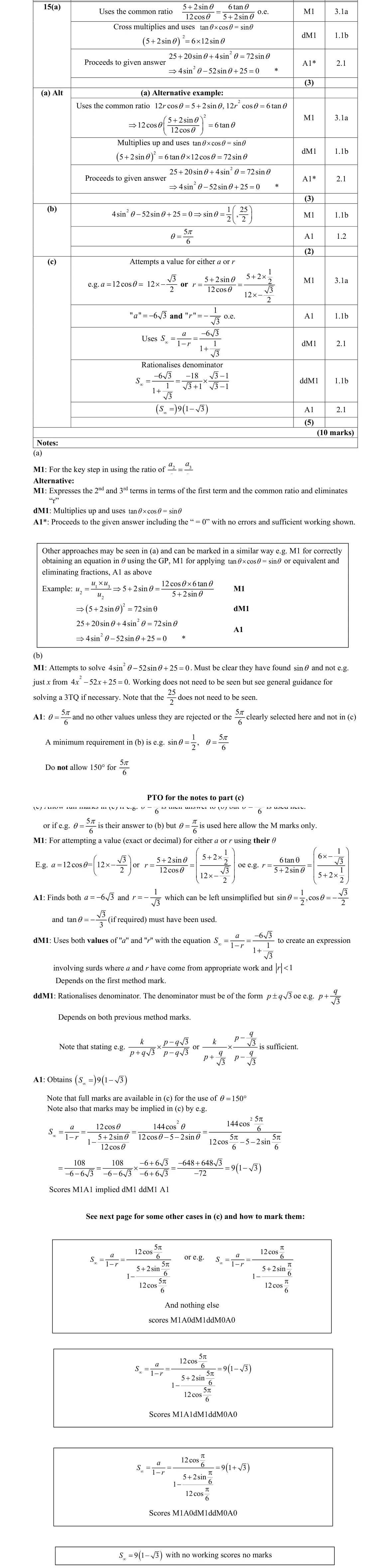
This question proved to be a good differentiator between candidates. It provided a challenge for many candidates but equally there were a number of accessible marks here. Most candidates attempted part (a), many attempted part (b) and at least partially attempted part (c), usually attempting to find the lower limit for k. There were, however, very few completely correct answers to this question and a substantial minority made no attempt at any part, perhaps having run out of time by the time they reached the last question on the paper. In part (b), there were a multitude of approaches seen and candidates were often at least partially successful. Most candidates recognised the need to begin with a trigonometric identity, usually sec2𝑡𝑡= 1 + tan2𝑡𝑡 and rearranged the expressions for x and y to obtain expression for sec2𝑡𝑡 and tan2𝑡𝑡 before substituting into the identity to obtain an equation in 𝑥𝑥 and 𝑦𝑦 which could in turn be rearranged to the required form. However, sometimes candidates took a far lengthier approach, beginning with e.g. sin2𝑡𝑡+ cos2𝑡𝑡= 1 and using 𝑥𝑥 and 𝑦𝑦 to find expressions for sin𝑡𝑡 and cos𝑡𝑡. An alternative and popular, though inelegant, method was to start from the target Cartesian equation and substitute in the trigonometric forms for 𝑥𝑥 and 𝑦𝑦 before rearranging to obtain an identity. Provided a conclusion was given, this approach was credited with both marks. Occasionally candidates used the equation for 𝑥𝑥 to obtain an expression for 𝑡𝑡 in terms of arctangent before substituting into the expression for 𝑦𝑦 which, if correctly done, was an acceptable approach. Several students just substituted the coordinates of points such as P into the given Cartesian equation, stating that they satisfied the equation. Such attempts did not constitute a proof and so gained no marks.
Common mistakes
use sec²t = 1 + tan²t with tan t = (x − 1)/2 and sec²t = (y − 3)/2
substituting a few points is not a proof
a conclusion is needed if working from the answer
June 2022 · Paper 3 (Mechanics) · Q5(b)4 marks
Mark scheme (whole question; this part is marked with the orange bar)
Examiner's comment
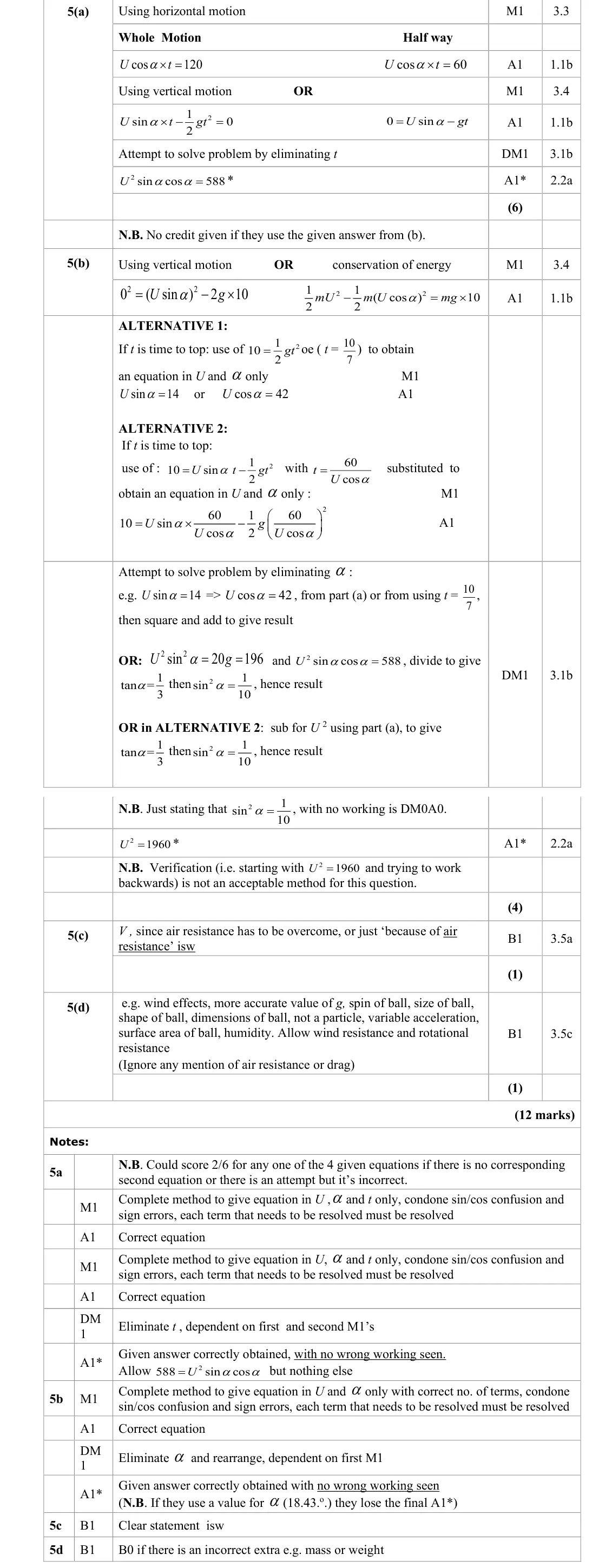
in the question. In the second part, many candidates correctly arrived at an equation in Usin alpha using v2 = u2 + 2as although a failure to resolve the vertical velocity giving U2 = 196 was not uncommon. Most were unable to progress further and so only gained 2 out of a possible 4 marks. For example, they just left it there or found the “correct” answer without any justification for the value of alpha . Some did not realise they could use the answer from part (a) and, of those who did, some struggled with the required algebra. Many who
Common mistakes
0 = (U sin α)² − 2g × 10 (not U² = 196 unresolved)
divide by the result of (a) to get tan α = 1/3 then exact sin²α = 1/10
using α = 18.43° loses the final mark
verification from U² = 1960 not accepted
Oct 2021 · AS Paper 1 · Q12(i)5 marks
Mark scheme (whole question; this part is marked with the orange bar)
Examiner's comment
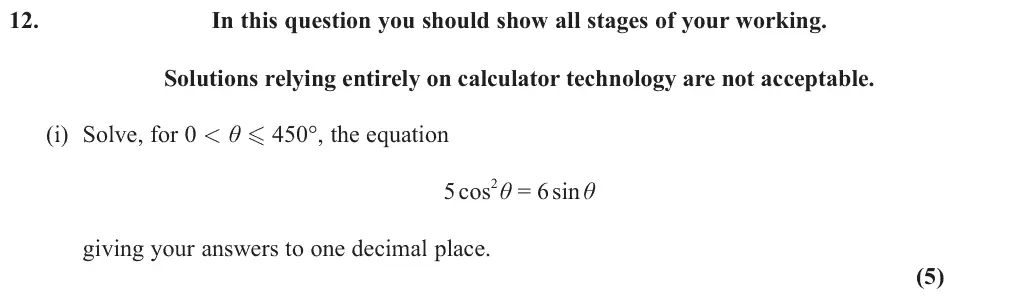
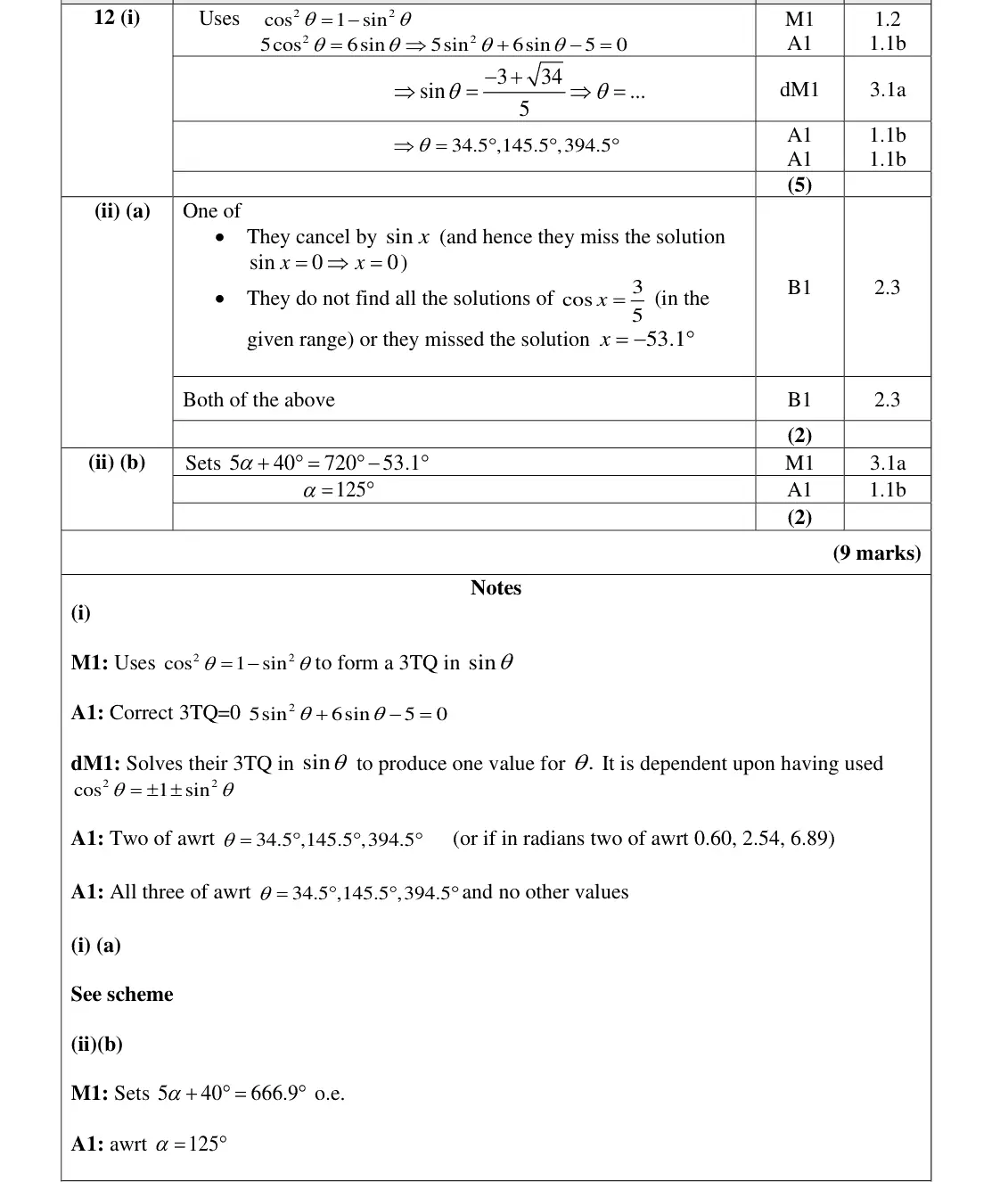
Candidates were usually able to make good progress on the first half of this question on solving trigonometric equations, but they tended to run into problems halfway through. It was rare for full marks to be scored, although most were able to score around half of the available marks. In part (i), nearly all candidates were able to proceed to the correct quadratic in sin , although the occasional candidate tried to incorrectly substitute sin into the right- = - 1 cos hand side of the equation. Most candidates were able to apply the quadratic formula and proceed to finding all three angles. Some found additional angles, which even if they are outside the range, prevent full marks from being scored. Most candidates seemed to opt for sketching trigonometric graphs to find the other angles as opposed to using the CAST diagram. Part (ii)(a) was poorly answered, however. Most candidates failed to score either mark, although those who did were usually able to make some reference to cancelling out sin x . Just stating that not all the angles had been found was insufficient explanation as to the errors made so candidates should be encouraged to provide greater detail if they are able to do so. Part (ii)(b) was attempted by most candidates, with many able to equate to the correct angle, rearrange and proceed to the correct answer. There were a number who equated to several angles, but either did not make their final answer clear, or did not rearrange to find the required angle. 8
Common mistakes
use cos²θ = 1 − sin²θ to get 5sin²θ + 6sin θ − 5 = 0
sin θ = (−3 + √34)/5 only (other root < −1)
θ = 34.5°, 145.5°, 394.5° in 0 < θ ≤ 450°
extra values outside the range lose the final mark
Oct 2021 · AS Paper 1 · Q12(ii)(a)2 marks
Mark scheme (whole question; this part is marked with the orange bar)
Examiner's comment
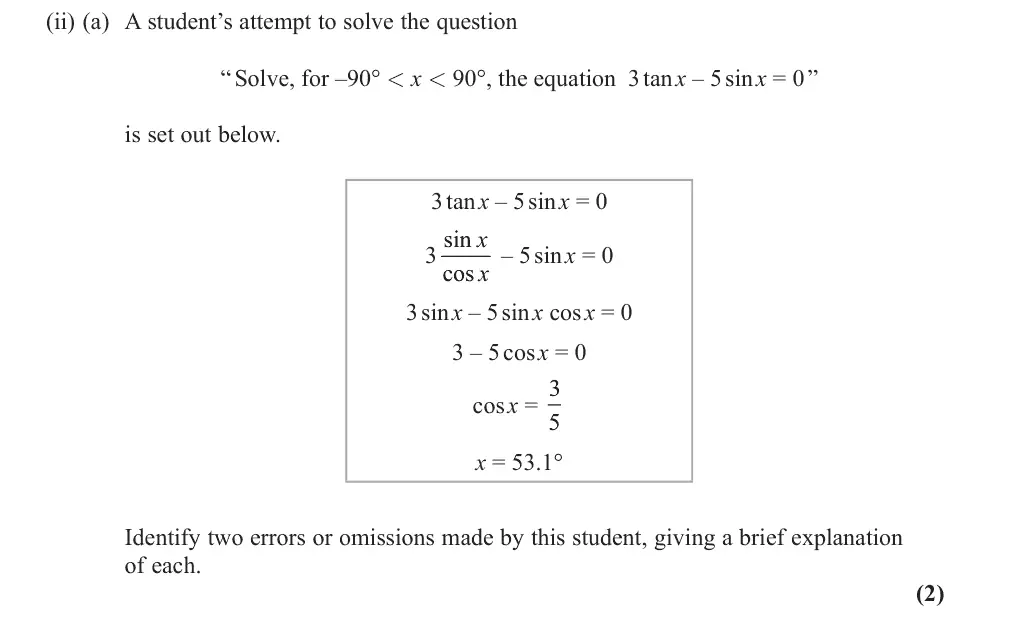
Candidates were usually able to make good progress on the first half of this question on solving trigonometric equations, but they tended to run into problems halfway through. It was rare for full marks to be scored, although most were able to score around half of the available marks. In part (i), nearly all candidates were able to proceed to the correct quadratic in sin , although the occasional candidate tried to incorrectly substitute sin into the right- = - 1 cos hand side of the equation. Most candidates were able to apply the quadratic formula and proceed to finding all three angles. Some found additional angles, which even if they are outside the range, prevent full marks from being scored. Most candidates seemed to opt for sketching trigonometric graphs to find the other angles as opposed to using the CAST diagram. Part (ii)(a) was poorly answered, however. Most candidates failed to score either mark, although those who did were usually able to make some reference to cancelling out sin x . Just stating that not all the angles had been found was insufficient explanation as to the errors made so candidates should be encouraged to provide greater detail if they are able to do so. Part (ii)(b) was attempted by most candidates, with many able to equate to the correct angle, rearrange and proceed to the correct answer. There were a number who equated to several angles, but either did not make their final answer clear, or did not rearrange to find the required angle. 8
Common mistakes
dividing by sin x loses sin x = 0, so x = 0 is missed
also missed x = −53.1° from cos x = 3/5 in the range
"not all angles found" alone is not enough
Oct 2021 · Paper 1 · Q10(a)4 marks
Mark scheme (whole question; this part is marked with the orange bar)
Examiner's comment
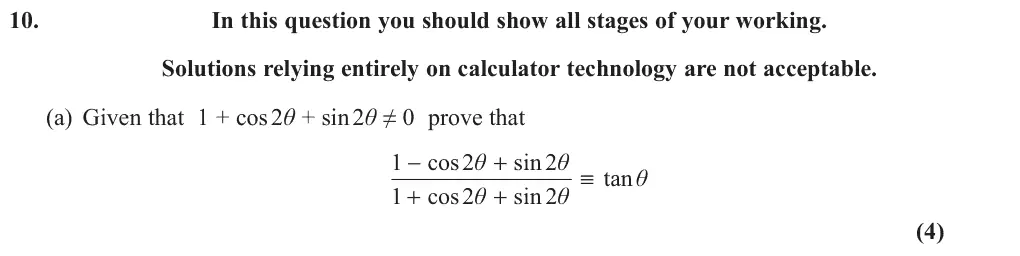
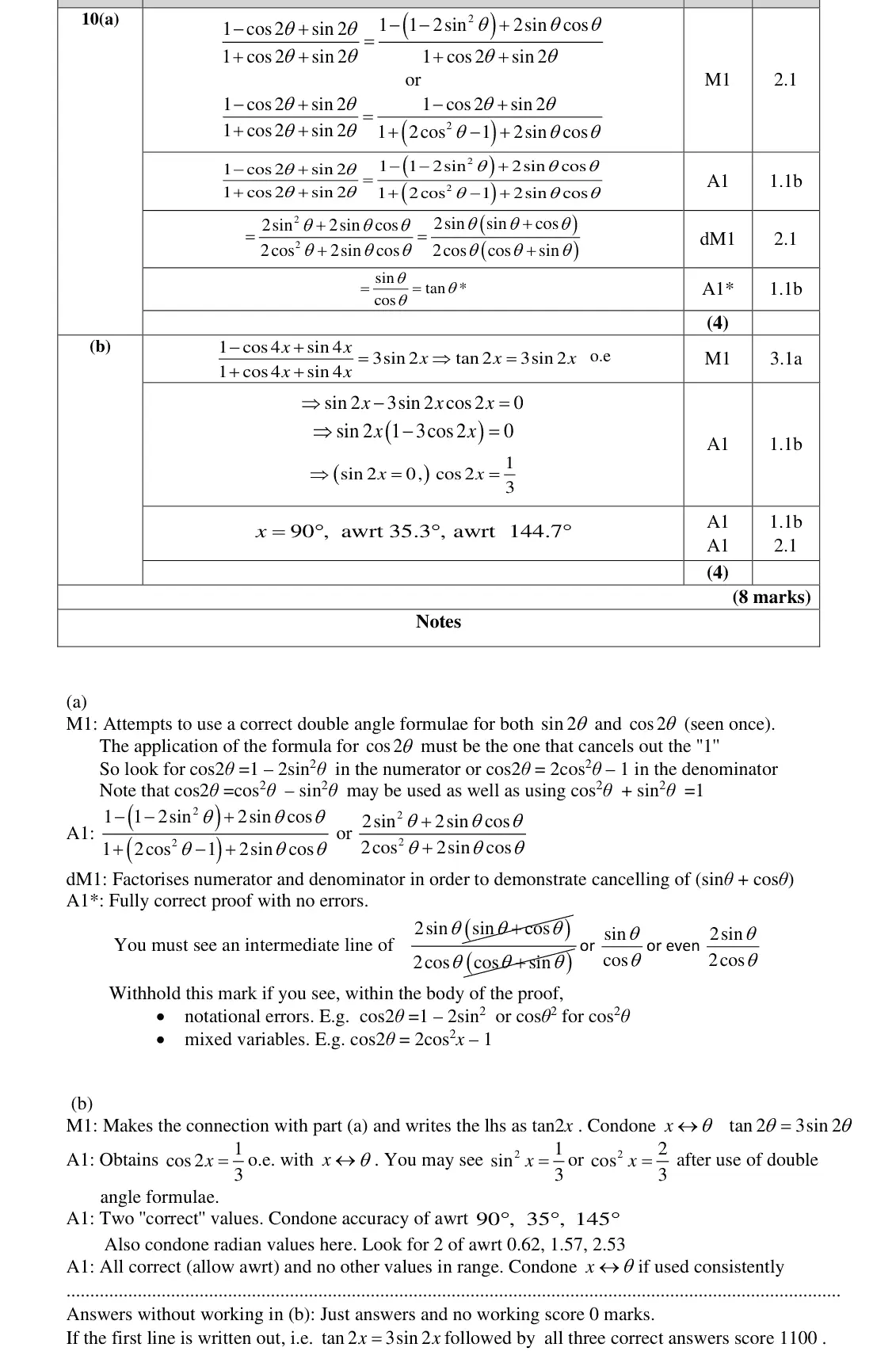
This was found to be another discriminating question. Those who were familiar with the topic made good progress yet there were many other attempts that scored no marks at all. Part(a) There were a significant number of fully correct solutions for this part, although some candidates did not achieve the stage where both the numerator and denominators of their fraction were factorised correctly with a common factor of ( sin theta +cos theta ). Another difficulty encountered by some, was how to use the different forms of the identity for cos2 theta in order to deal with, and remove, the presence of both “1’s ” in the fraction. Very few notational errors were seen, which was a pleasing improvement.
Common mistakes
choose cos 2θ = 1 − 2sin²θ on top and 2cos²θ − 1 below to remove the 1s
factorise to cancel (sin θ + cos θ)
no notation errors (cosθ², mixed variables)
Oct 2020 · AS Paper 1 · Q9(c)5 marks
Mark scheme (whole question; this part is marked with the orange bar)
Examiner's comment
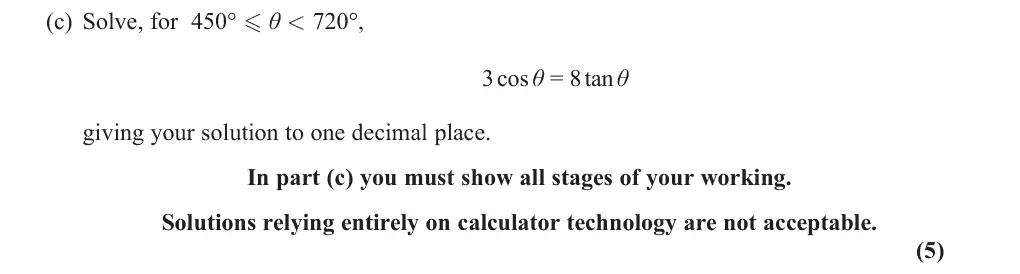
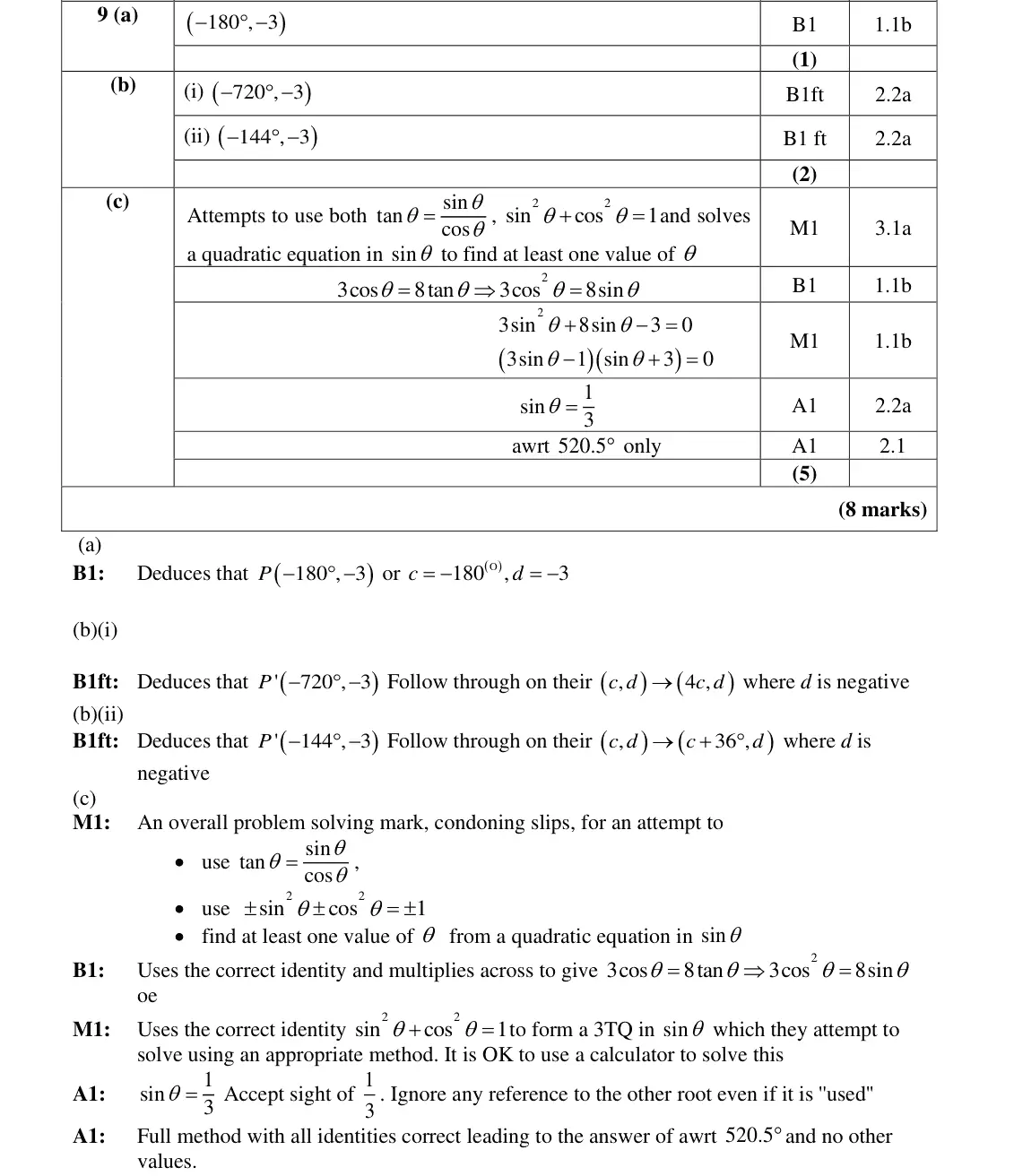
This question was attempted by most candidates with many being able to secure nearly all the marks in part (c). It was rare, however, for full marks to be scored overall, with most struggling with the transformations in part (b). Part (c) proved to be high scoring for many candidates, however, some did not recall the identities correctly and made little progress. In particular, candidates made errors with rearranging 2 2 sin cos 1 x x + = or missing the square from either or both terms. The given interval was unusual, although it was pleasing to see many of the candidates who proceeded to find a value for were able to find the one that was in the required interval. 9
Common mistakes
multiply by cos θ: 3cos²θ = 8 sin θ, then cos²θ = 1 − sin²θ
3sin²θ + 8sin θ − 3 = 0 gives sin θ = ⅓
only 520.5° lies in 450 to 720
Oct 2020 · Paper 1 · Q12(a)3 marks
Mark scheme (whole question; this part is marked with the orange bar)
Examiner's comment
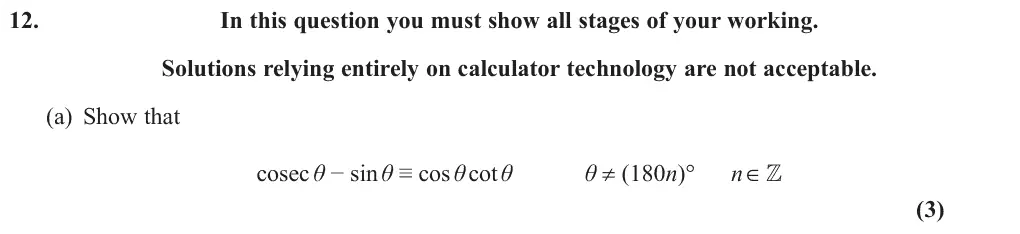
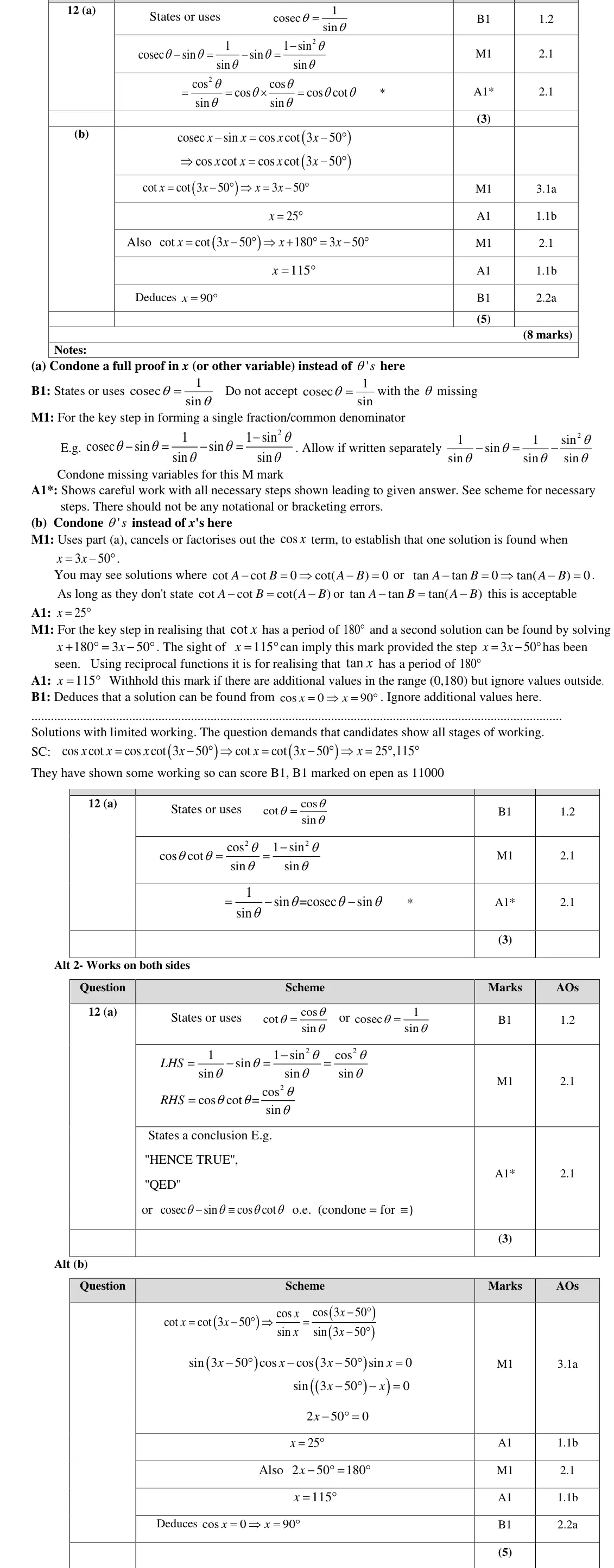
Part (a) was generally answered well and there were remarkably few solutions containing missing variables. On this occasion, candidates who started with the RHS fared better as those who worked from the LHS occasionally missed the required step between 𝑐𝑐𝑐𝑐𝑐𝑐2𝜃𝜃/sin𝜃𝜃 and cos𝜃𝜃cot𝜃𝜃, while those who worked from both sides would often get confused or, if they progressed correctly they simply failed to make the necessary conclusion.
Common mistakes
cosec θ = 1/sin θ, single fraction (1 − sin²θ)/sin θ = cos²θ/sin θ, then cos θ × cos θ/sin θ
show the step to cos θ cot θ
working on both sides needs a conclusion
Oct 2020 · Paper 1 · Q15(a)4 marks
Mark scheme (whole question; this part is marked with the orange bar)
Examiner's comment
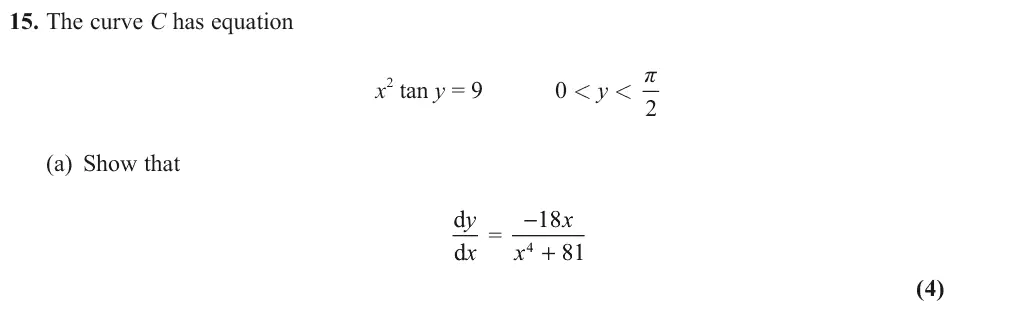
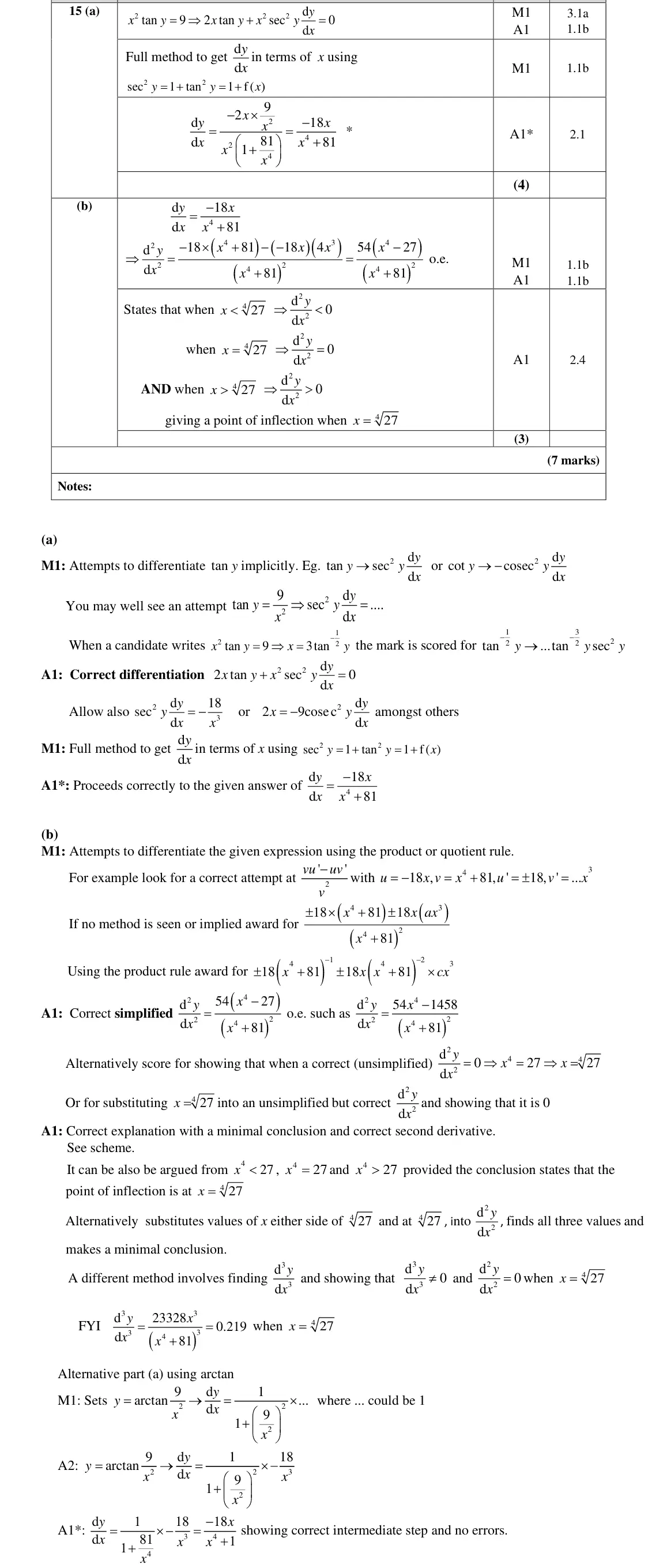
Although fully correct solutions to this question were very rare, many candidates were able to score marks from both parts. In part (a) the first two marks for the implicit differentiation were very accessible for the prepared candidate. Proceeding to the required result for the second two marks proved a little more challenging. Only high achieving students noticed the relationship could be 2 2 proven via the trigonometric identity 1 tan sec . y y + =
Common mistakes
implicit differentiation 2x tan y + x² sec²y dy/dx = 0
use sec²y = 1 + tan²y = 1 + 81/x⁴ to get dy/dx in terms of x only
Oct 2020 · Paper 2 · Q10(a)4 marks
Mark scheme (whole question; this part is marked with the orange bar)
Examiner's comment
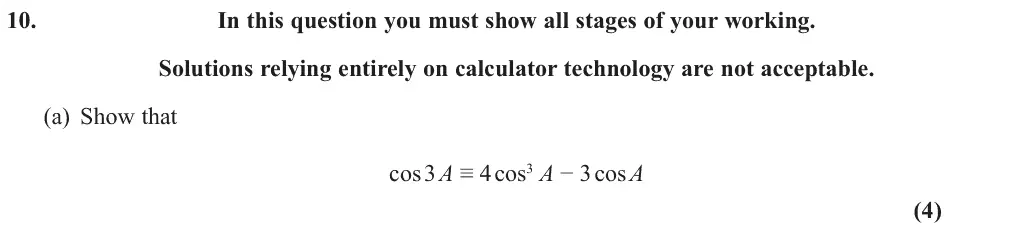
Many students were able to get started in part (a) with correct use of cos(2A + A) alongside the addition formula. Candidates who managed this, regularly went on to apply the double angle formulae correctly to achieve an expression in cosA only. Often circuitous routes were taken, most notably with the use of cos2A = cos2A - sin2A and then making a second substitution for sin2A (this sometimes resulted in bracketing and/or sign errors). A small number of candidates added a proof for the double angle formulae from the addition formulae even though this was unnecessary. A high proportion of students who managed to get the first mark went on to get at least 3 if not 4 marks in this part of the question. It was very much an all or nothing question with many only getting the first mark. A significant number presented their work in a way that was sometimes difficult to follow even if they did manage to score full marks.
Common mistakes
write cos 3A = cos(2A + A) and use the compound angle formula
cos 2A = 2cos²A − 1 and sin²A = 1 − cos²A
rigorous with no mixed variables or missing brackets
Oct 2020 · Paper 2 · Q10(b)4 marks
Mark scheme (whole question; this part is marked with the orange bar)
Examiner's comment
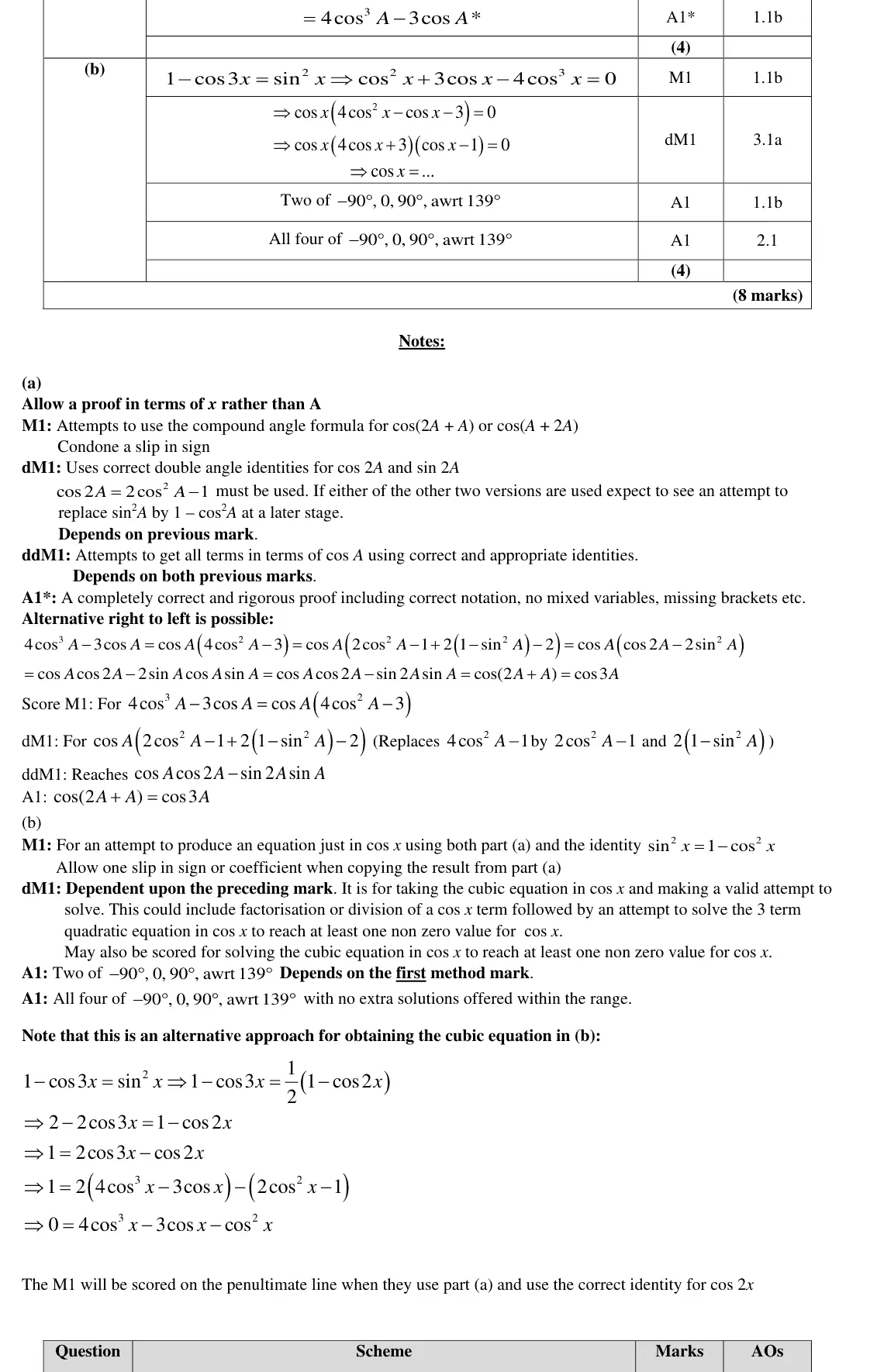
In part (b), it was common for candidates to achieve no marks for part (a) and then full marks for this part. Most of the students gained the first method mark and managed to produce an equation in cosx only. Mistakes were made with signs and brackets. In particular, candidates failed to write brackets around 4cos3x – 3cosx and hence would obtain an incorrect quadratic equation to solve. Several candidates ‘solved’ the cubic/quadratic equation using the polynomial equation function on their calculator and did not show any evidence of their working. Some incorrect equations led to complex solutions but most of these candidates still did not realise that they had made an error. A large number of candidates divided by cosx to simplify their expression but they failed to recognise this lost a solution and therefore were not awarded the final mark. A small number of candidates failed to gain any marks on this part as they replaced the right hand side with cosx but left the left hand side with cos3x and then proceeded to treat this as a cubic/quadratic. When candidates had identified the correct equation and solutions they were very good at finding all the solutions in the range. A large number who did get solutions did not include -90° or included 180° and therefore lost the final mark.
Common mistakes
brackets round 4cos³x − 3cos x
factor out cos x, do not divide by it (loses cos x = 0)
solutions −90°, 0°, 90°, 139°
include −90°, exclude 180°
June 2019 · AS Paper 1 · Q12(a)4 marksMedium
Mark scheme (whole question; this part is marked with the orange bar)
Examiner's comment
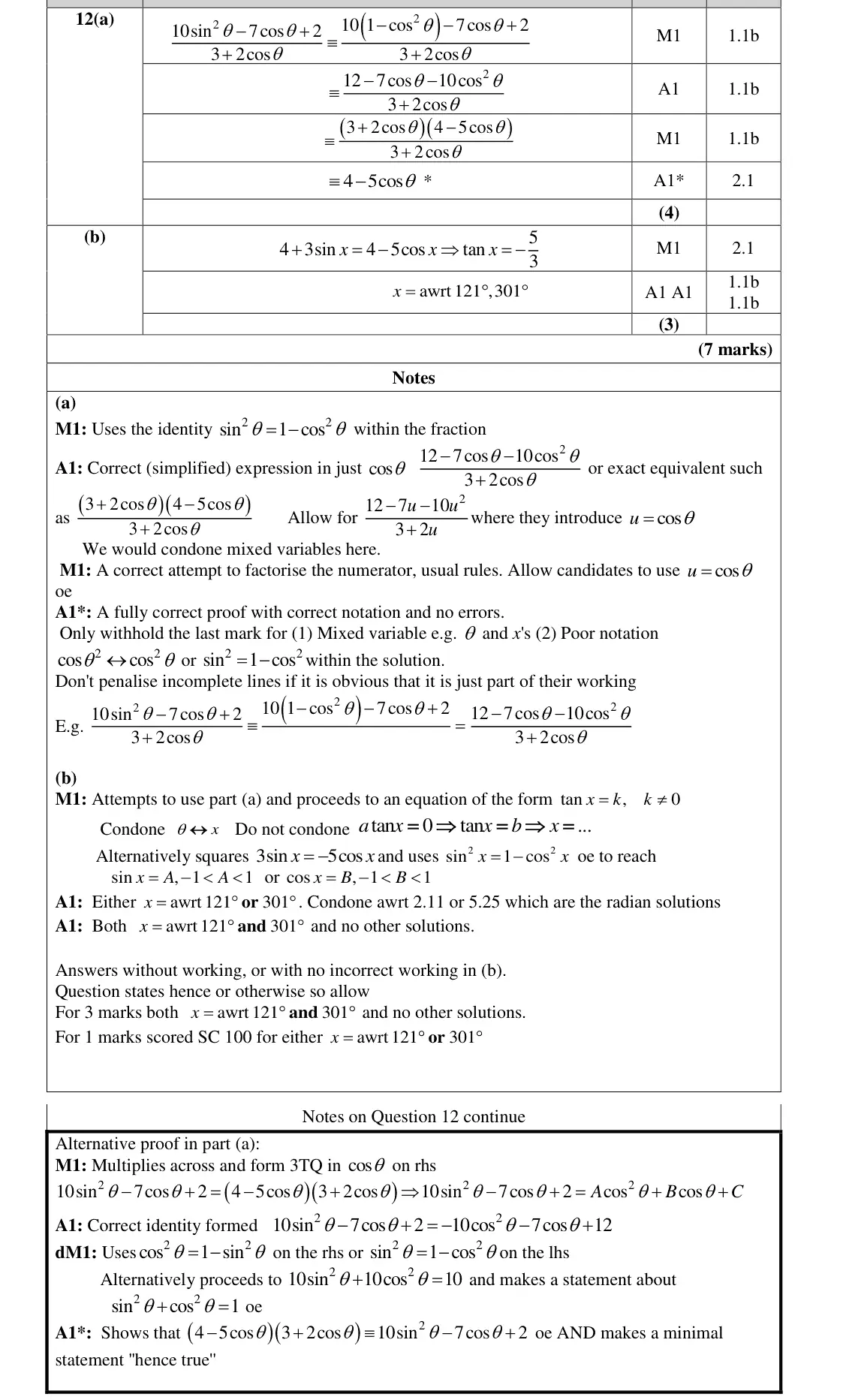
(a) This was a straightforward proof. Most candidates recognised the need to use 2 2 sin cos 1 but there were many instances where 2 10sin became 2 10 cos or the 7cos was adapted. There were many well written out proof however with few candidates being penalised marks for incorrect notation eg cos for cos or 2 sin for 2 sin .
Common mistakes
replace sin²θ by 1 − cos²θ (not 10sin²θ becoming 10cos²θ)
Mark scheme (whole question; this part is marked with the orange bar)
Examiner's comment
Part (b) was, on the other hand, very badly done. Many candidates failed to heed the use of the word ''Hence'' and started again wasting valuable time. Of those who did use part (a) failed to have a reliable method of solving 4 5cos 4 3sin x x with may failing to eliminate the 4's. Of those who did reach 5cos 3sin x x many had solutions that involved variations of 3 tan 0 5 x . Better candidates found the manipulation straightforward and proceeded to find both solutions without any difficulty. As a result this question was an effective discriminator.
Common mistakes
use (a): 4 − 5cos x = 4 + 3sin x so tan x = −5/3
x = 121°, 301°
avoid starting again
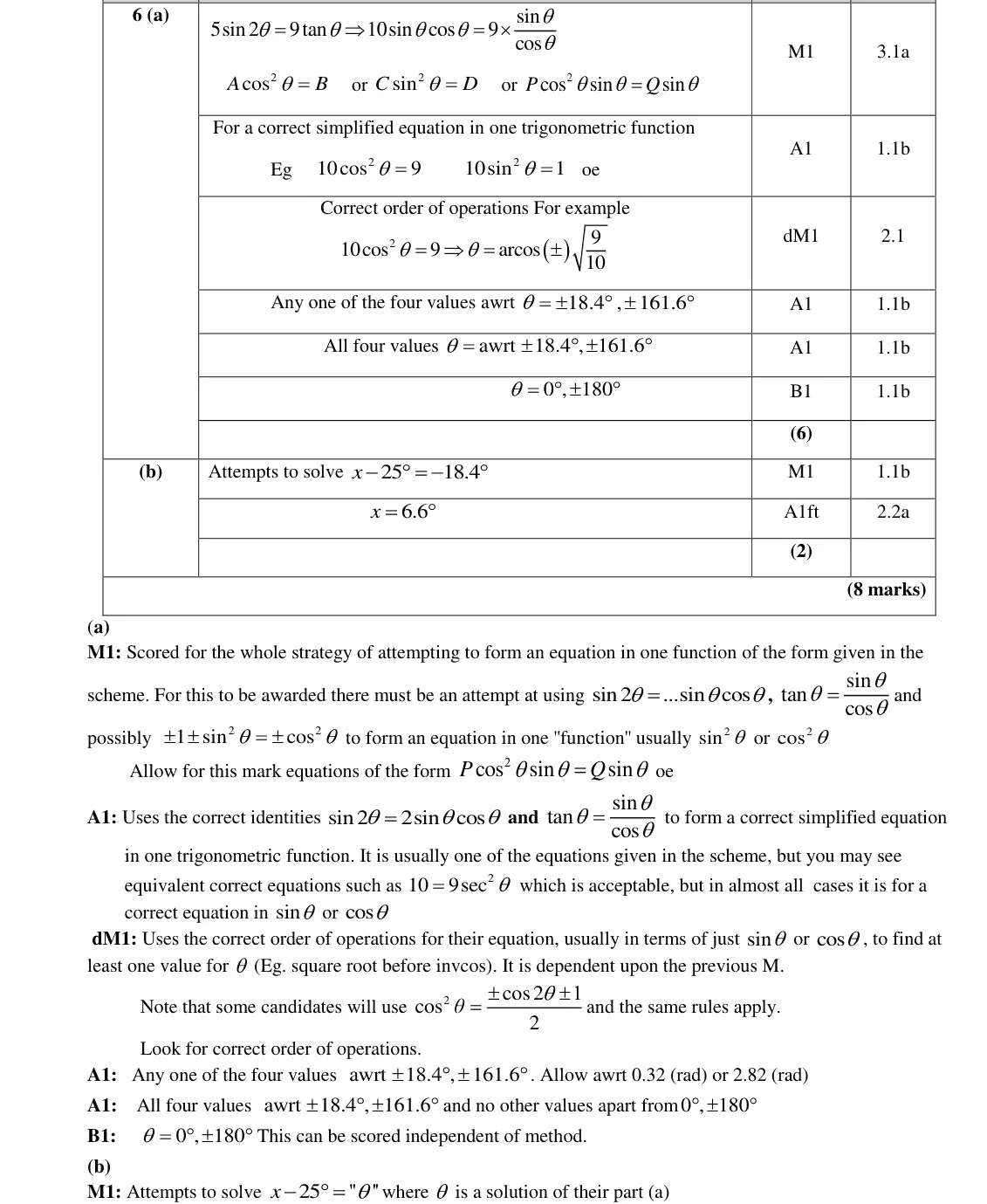
June 2019 · Paper 1 · Q6(a)6 marksMedium
Mark scheme (whole question; this part is marked with the orange bar)
Examiner's comment
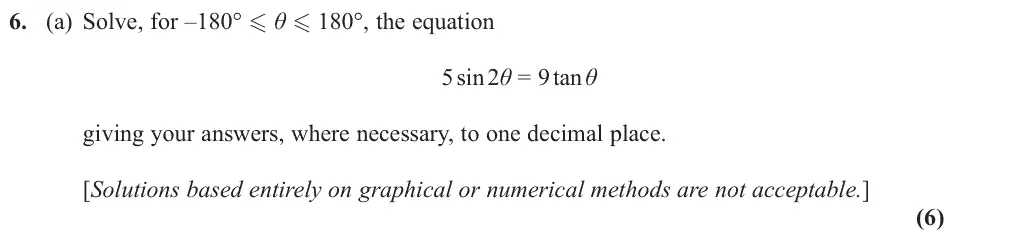
This was generally a well attempted question with most candidates able to score over half of the marks. In part (a) the correct identities were well known and efficiently used in order to obtain an equation in one function. Almost all candidates who reached this stage were then able to proceed to find at least one correct angle. It was clear from the graphs and diagrams sketched by most candidates that they had been taught to look for all angles in the required range and many were able to give all four of the angles needed. Only a minority of candidates identified 0, 180 as solutions to the equations. Most candidates divided through by sin or cos and failed to identify any of these values.
Common mistakes
sin 2θ = 2 sin θ cos θ and tan θ = sin θ/cos θ
10cos²θ = 9 gives ±18.4°, ±161.6°
dividing by sin θ loses 0° and ±180°
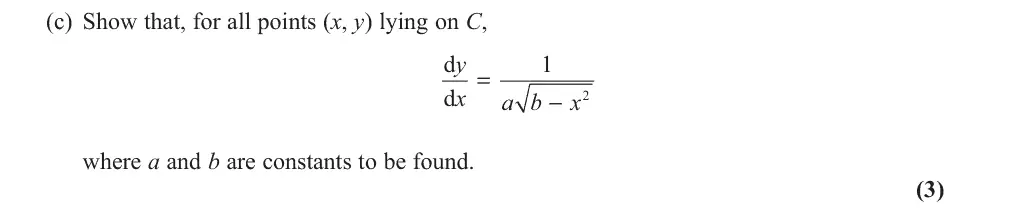
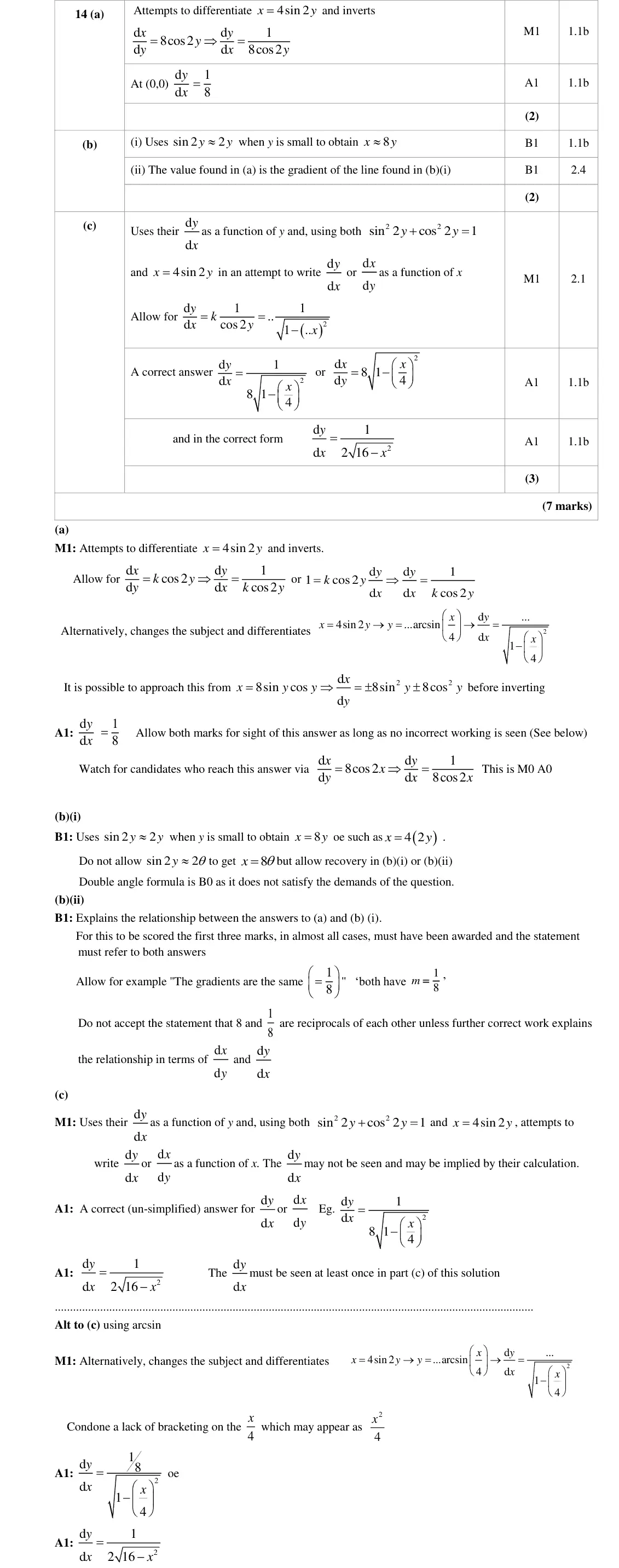
June 2019 · Paper 1 · Q14(c)3 marksHard
Mark scheme (whole question; this part is marked with the orange bar)
Examiner's comment
A number of candidates did not attempt this question. Whether this was due to lack of understanding or time constraints is unknown. Only a small percentage of candidates were able to secure full marks for part (c) and it was not uncommon to see the whole question left unanswered. This type of question was common on Core 3 and usually well answered.
Common mistakes
cos 2y = √(1 − (x/4)²) from sin² + cos² = 1
dy/dx = 1/(2√(16 − x²)), a = 2, b = 16
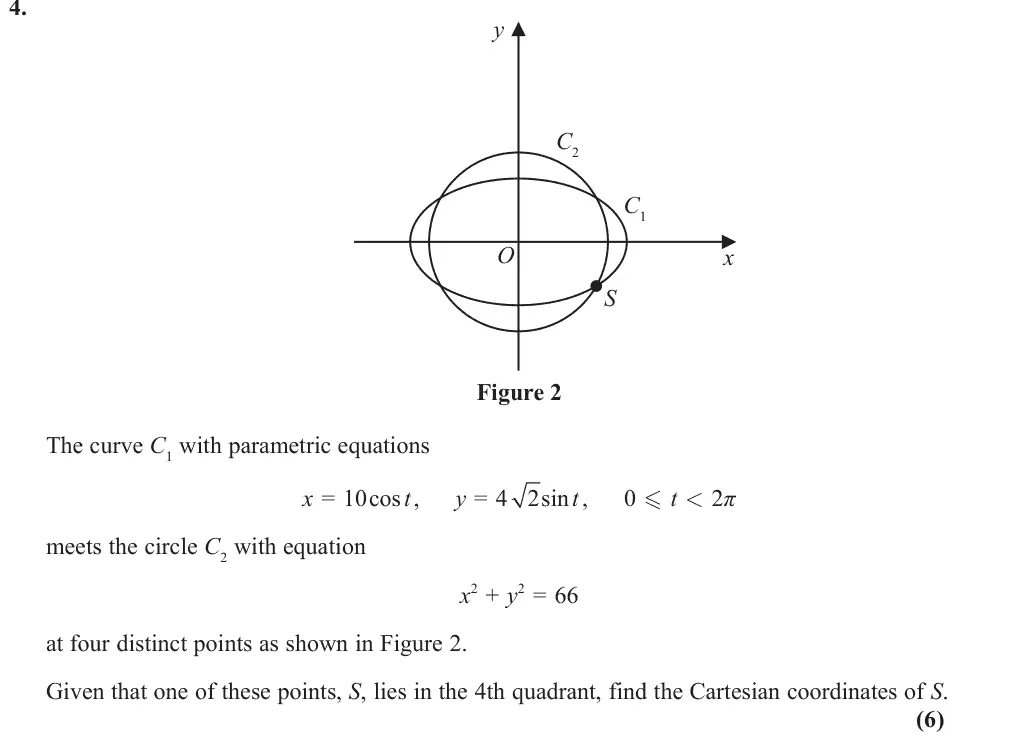
June 2019 · Paper 2 · Q46 marks
Mark scheme (whole question; this part is marked with the orange bar)
Examiner's comment
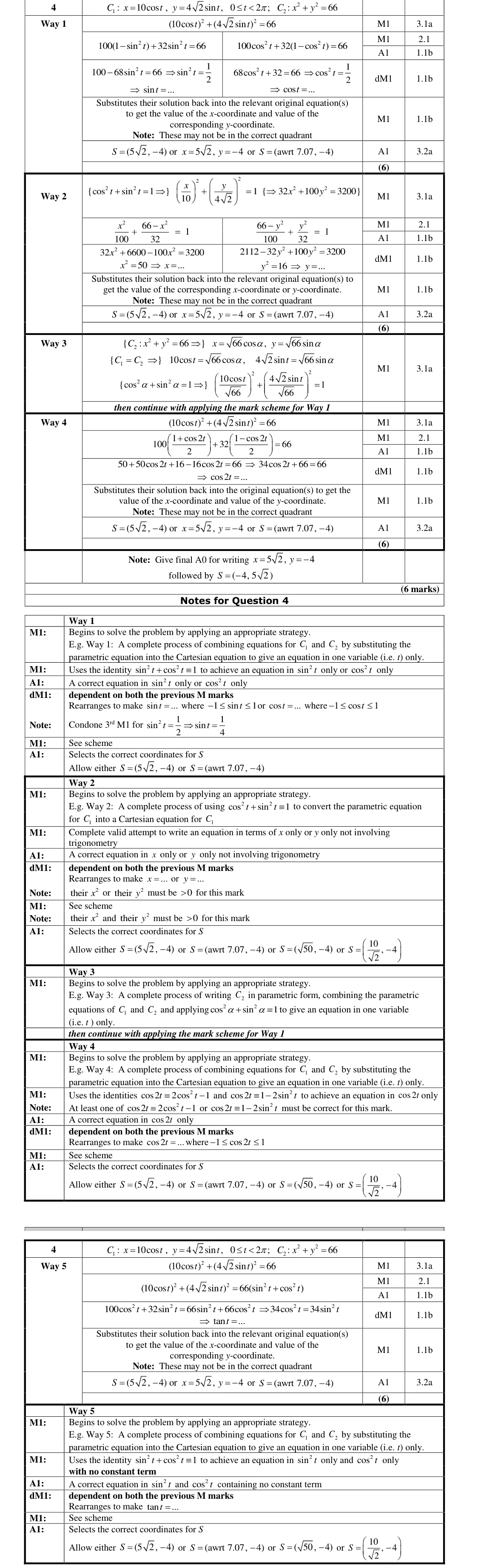
Q04 was well attempted by both medium ability and higher ability candidates. Lower ability candidates struggled to make progress, with most of them scoring no more than one mark. There were two common methods that were used by candidates. The first method, covered by Way 1 in the mark scheme, was the substitution of the parametric equations of 1 C into the Cartesian equation of 2 C to give an equation in t only; the trigonometric identity 2 2 sin cos 1 t t being used to obtain an equation in 2 sin t (or 2 cos t ) only, and a value for sint (or cos )t found. The second method, covered by Way 2 in the mark scheme, was the application of the trigonometric identity 2 2 sin cos 1 t t to the parametric equations of 1 C to give 2 2 1, 10 4 2 x y the Cartesian equation of 2 C being used to obtain an equation in 2x (or 2) y only, and a value for x (or y) found. A few candidates used a correct method of progressing from 2 2 (10cos ) (4 2 sin ) 66 t t to either 2 tan 1 t or cos2 0. t In all these methods, substituting back yielded their coordinates for S, with most candidates realising that 0 Sx and 0. Sy Some candidates incorrectly stated S as (5 2 , 4). In the first method, successful candidates used either 7 4 t or , 4 t and then applied symmetry to find the correct coordinates for S as either (5 2 , 4) or (7.07, 4). An area of concern centred around arithmetical slips or errors in elementary algebra. Examples of the former included 2 (4 2) becoming 8 or 64; 2 1 sin 2 t becoming 1 sin ; 4 t and 2 2 1 100 32 x y becoming 2 2 32 100 1 or 100 or 32. x y Examples of the latter included the invalid methods of 2 2 66 y x becoming 66 y x and 2 2 sin 1 100 x t becoming sin 1 . 10 x t Candidates who made no creditable progress included those who differentiated the parametric equations for 1 , C and those who obtained, e.g. 4 2 sin arccos 10 x y leading to 2 2 32sin arccos 66. 10 x x
Common mistakes
substitute the parametric equations into x² + y² = 66 and use sin²t + cos²t = 1 (or convert C₁ to x²/100 + y²/32 = 1)
(4√2)² = 32 not 8
S in the 4th quadrant is (5√2, −4), not (−4, 5√2)
June 2019 · Paper 2 · Q12(a)4 marks
Mark scheme (whole question; this part is marked with the orange bar)
Examiner's comment
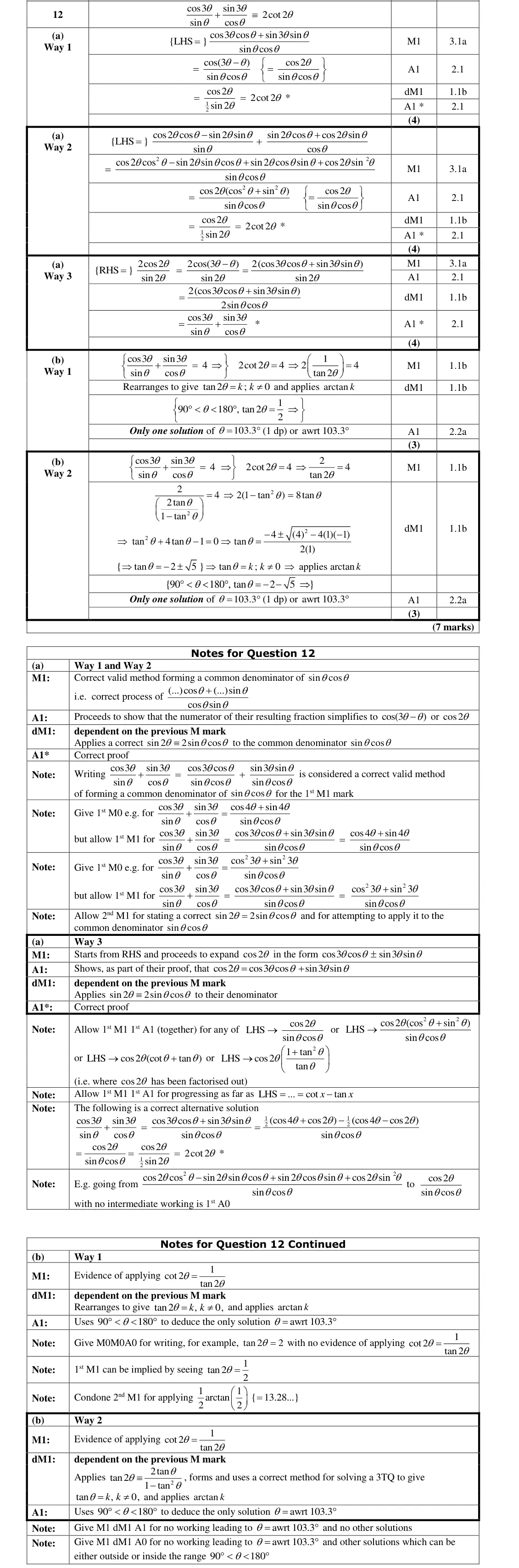
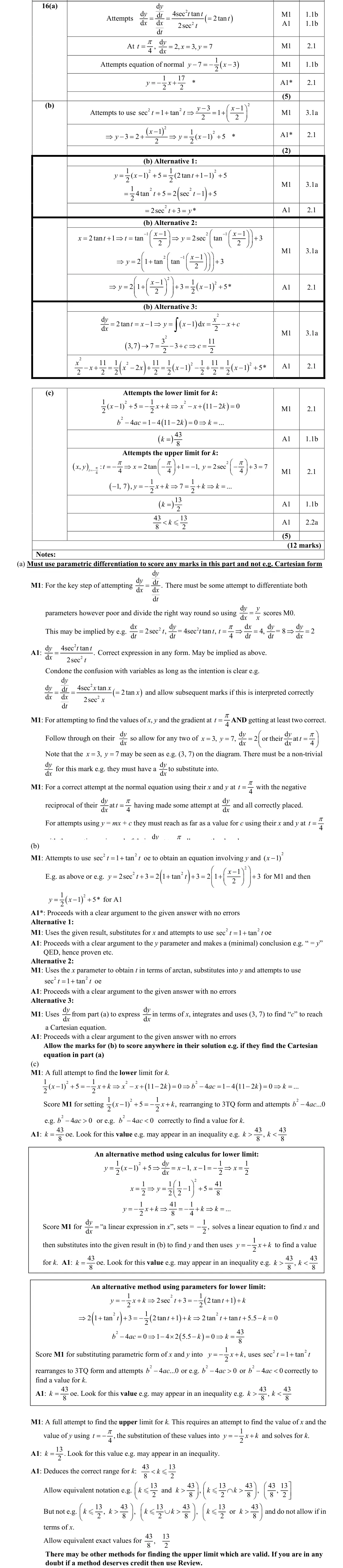
Q12(a) discriminated well between the higher ability candidates and it was possible for candidates of all abilities to gain access to Q12(b). In Q12(a), many candidates struggled to apply a complete strategy which would help them to make significant progress in proceeding from cos3 sin3 , via an sin cos 2 2 cos2 (cos sin ) intermediate stage of cos(3 ) , cos2 , or to the given sin cos sin cos sin cos result 2cot2 . Candidates who used Way 1, as described in the mark scheme, gained some credit for rationalising cos3 sin3 to give cos3 cos sin3 sin . Of those candidates sin cos sin cos 1 sin cos sin 2 who correctly applied to the denominator, only a few realised that 2 A common error in using Way 1 was to the numerator could be written as cos2 . 2 2 cos 3 sin 3 simplify cos3 sin3 or cos4 sin 4 . to give sin cos sin cos sin cos Way 2, as described in the mark scheme (and variations of this), was the most popular approach among candidates who completed the proof successfully. Candidates only started to access the marks for Way 2 when they combined their fractions by rationalising the denominator. Errors using Way 2 included the incorrect expansion of cos(2 ) or sin(2 ) , bracketing errors, manipulation errors or sign errors. They usually progressed as far as A few candidates started their proof from 2cot2 . 2 2(1 tan ) 2cos2 2cot 2 , 2cot 2 writing either or but could make no sin 2 2tan creditable progress until they applied a Way 3 method as described in the mark scheme. Some candidates spent a considerable amount of time attempting to write 3 3 4cos 3cos 3sin 4sin cos3 sin3 in terms of to give e.g. . sin cos sin cos candidates only started to access the marks for this method when they combined their fractions by rationalising the denominator. In Q13(b), most candidates used the result given in Q13(a) to deduce the equation 1 2cot 2 4. tan 2 , Most of these then attempted to solve and some obtained the 2 Common errors included attempting to solve tan2 correct answer 103.3 . 2 A few candidates obtained by . and finding more than one value for 103.3 2 2(1 tan ) 4. solving the equation 2tan
Mark scheme (whole question; this part is marked with the orange bar)
Examiner's comment
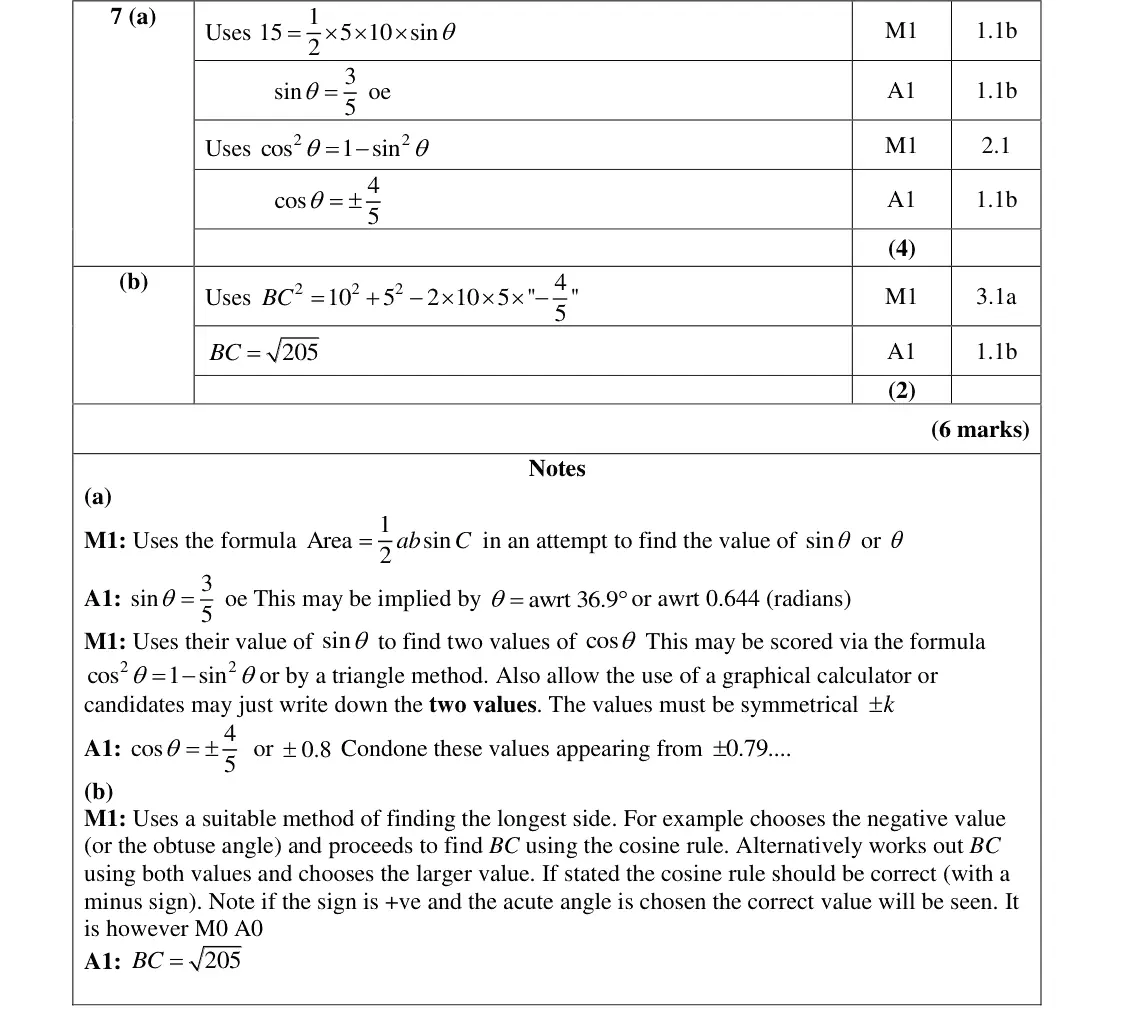
This proved to be a very demanding question. The idea of there being two values for or cos was lost on many students. Most students ignored the need for two values in (a) and hence in part (b), which involved choosing the obtuse angle, no marks could be awarded. In (a) almost all students were able to apply the area formula to achieve an acceptable answer for sin theta or theta . However, few then had a strategy for obtaining cos theta . Even those who produced the two correct angles often failed to find the values of cos theta . The use of cos2 theta + sin2 theta = 1 was quite rare. Another acceptable method was to sketch a right angled triangle and use trigonometric ratios. Perhaps because of the request for values for cos theta some students incorrectly quoted 1 cos 2ab C for the area.
Common mistakes
½ × 10 × 5 × sin θ = 15 gives sin θ = 3/5
then cos²θ = 1 − sin²θ gives cos θ = ±4/5 (two values: acute and obtuse angle)
many give only one value
½ab cos C is wrong
June 2018 · AS Paper 1 · Q12(a)4 marks
Mark scheme (whole question; this part is marked with the orange bar)
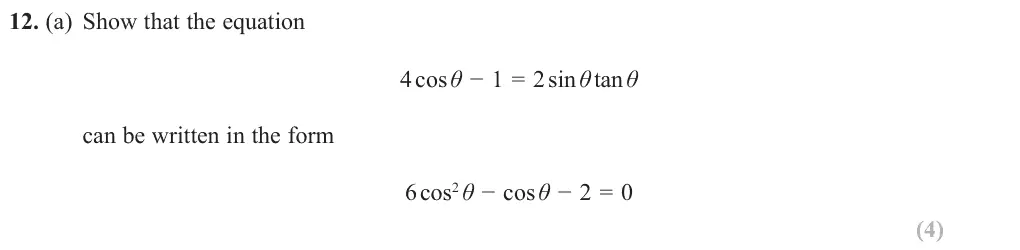
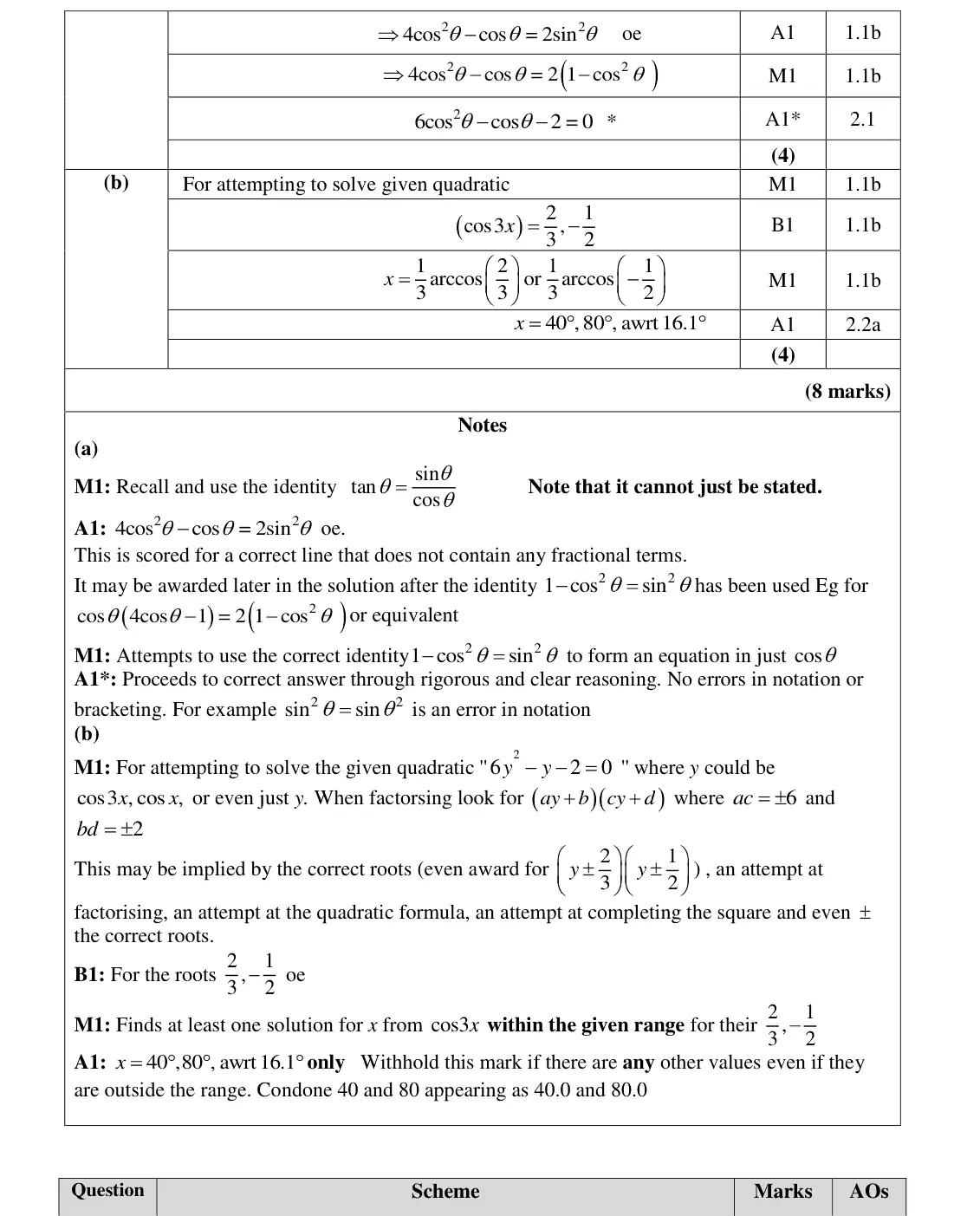
Examiner's comment
Overall this question was well done, with many students taking advantage of being able to attempt (b) without completing (a). The few who restarted unnecessarily in (b) lost valuable time in the examination. In (a) almost all students substituted for tan theta correctly, with just a few using the identity upside down or attempting some version of sin theta = tan theta cos theta . It was common for the first accuracy mark to be lost for 4cos2 theta – 1 instead of 4cos2 theta – cos theta after multiplication by cos theta . Whilst many correctly used sin2𝜃+cos2𝜃=1 it was disappointing to see sin𝜃+cos𝜃 =1 being quoted. The final mark was sometimes lost through bracketing errors or poor notation e.g. sin theta 2 for sin2 theta .
Common mistakes
tan θ = sin θ/cos θ
multiply through by cos θ (4cos²θ − cos θ, not 4cos²θ − 1)
use sin²θ = 1 − cos²θ (not sin θ + cos θ = 1)
notation sin²θ not sinθ²
June 2018 · Paper 1 · Q55 marks
Mark scheme (whole question; this part is marked with the orange bar)
Examiner's comment
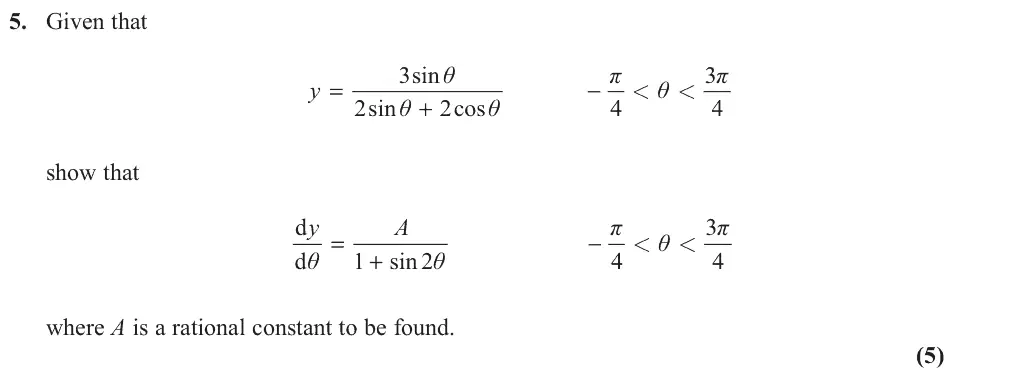
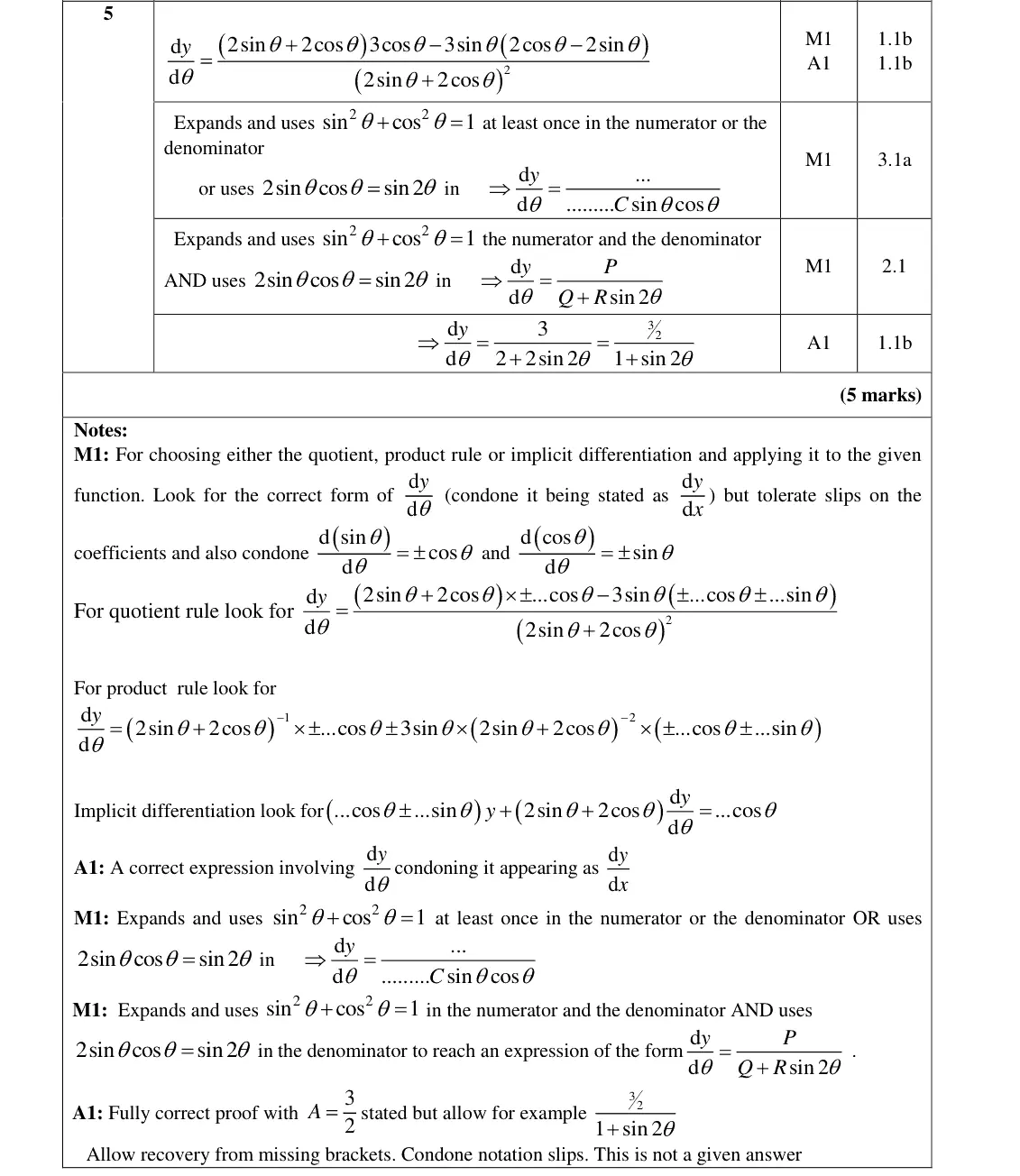
The majority of students knew to use the quotient rule in this question, although the slips on signs and bracketing in the terms of the numerator were commonplace. We would encourage all students to state the formula being used, with their expressions for ‘u’ ‘v’ ‘du’ and ‘dv’, to ensure that their method is made clear to examiners. Getting a correct derivative into the required form using trigonometric identities proved to be more challenging than the differentiation in this question. Students recognised the need to use the Pythagorean identity for sine and cosine to simplify their numerator and denominator but were less confident when applying the double angle formula for sine, and it was not uncommon for a final answer to be left as 3 2 2sin 2 , or for there to be errors in an attempt to write this fraction in the required form.
Common mistakes
quotient rule – sign and bracket slips in the numerator
use sin²θ + cos²θ = 1 in numerator and denominator and 2sinθcosθ = sin2θ
A = 3/2 (not left as 3/(2 + 2sin2θ))
June 2018 · Paper 2 · Q7(ii)5 marks
Mark scheme (whole question; this part is marked with the orange bar)
Examiner's comment
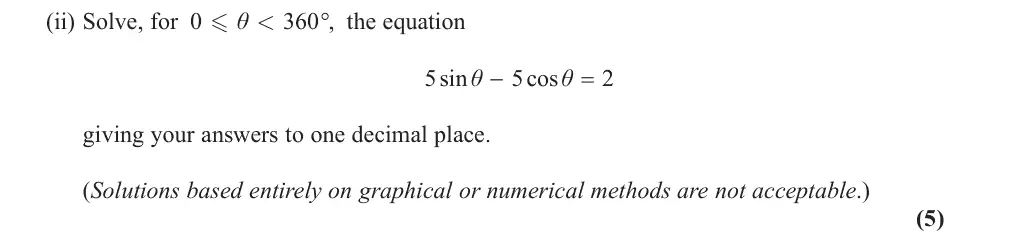
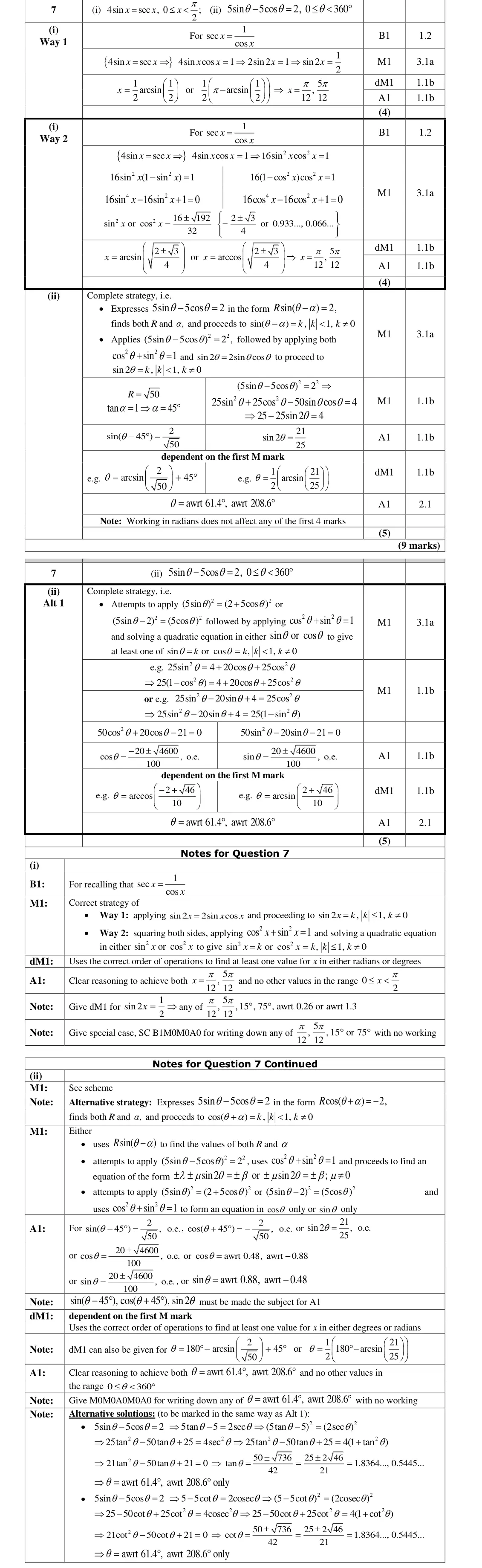
Part (i) was accessible to most students, whereas some students struggled to gain access to part (ii). 1 x In part (i), many students replaced secx with cos x and arrived at 4sin cos A few 1. x x with sin 4 ,x but most used the identity sin2 students replaced 4sin cos to x 2sin cos x x x 1 x sin 2 . give the correct Many students obtained both correct exact solutions in radians, 2 with only a few omitting the second solution 5 . 12 Some students made no attempt at part (ii) while a significant number of other students did not employ a correct strategy for solving 5sin The majority of students, 5cos 2. however, attempted one of several correct strategies. The most popular strategy was to and 2 2 cos sin 1 square both sides of the given equation and apply the identities 21 sin 2 . to achieve A second strategy was to square both sides of sin2 2sin cos 25 to achieve a quadratic equation 2 2 cos sin 1 and apply the identity 5sin 2 5cos in either cos or sin . In both of these strategies, extra (incorrect) solutions were generated as a result of squaring both sides of their equation. Only a few students rejected these extra A third strategy was to rewrite the 61.4 , 208.6 . solutions to leave the correct solutions 50 sin( 45 ) 2 50 cos( 45 ) 2, given equation as or even which were usually A few students applied other correct strategies which led 61.4 , 208.6 . solved to give to solving quadratic equations in either tan or cot .
Common mistakes
R sin(θ − α) with R = √50, α = 45°
squaring both sides creates extra roots that must be rejected
θ = 61.4°, 208.6°
June 2018 · Paper 2 · Q12(a)3 marks
Mark scheme (whole question; this part is marked with the orange bar)
Examiner's comment
This question discriminated well between students of all abilities with part (a) more accessible to students than part (b). In part (a), most students provided a proof which progressed from one side of the identity to the other by using methodical steps and correct trigonometric identities. There was no preference seen for starting their proof on a particular side of the identity. Some students manipulated both sides of the identity to give a common expression 2 2sin , with many providing some indication that their proof was complete.
Common mistakes
tan θ = sin θ / cos θ and sin 2θ = 2 sin θ cos θ
cos 2θ = 1 − 2sin²θ
show all steps to 2sin²θ
June 2018 · Paper 2 · Q12(b)6 marks
Mark scheme (whole question; this part is marked with the orange bar)
Examiner's comment
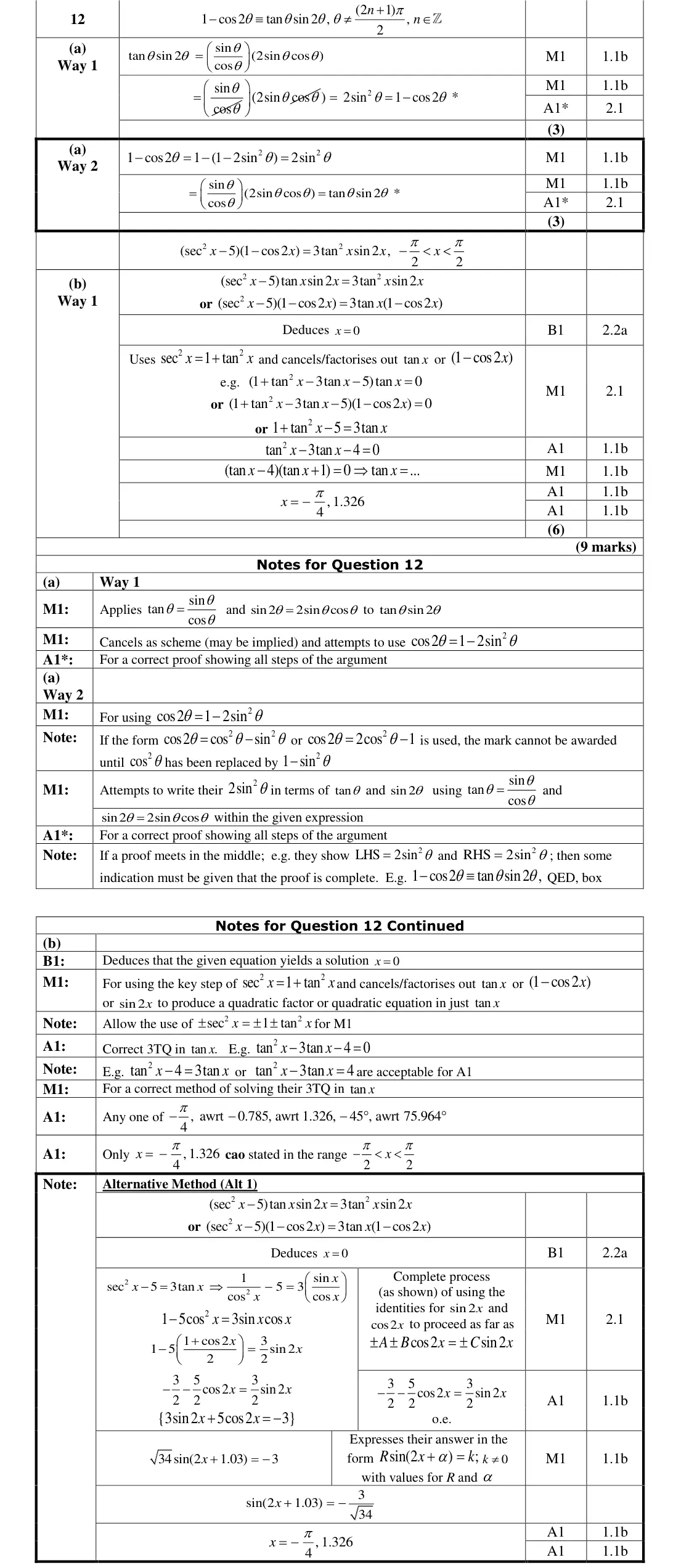
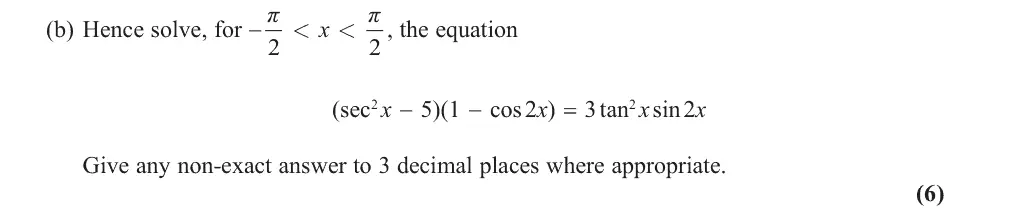
This question discriminated well between students of all abilities with part (a) more accessible to students than part (b). Part (b) proved to be discriminating, with some students not realising that they could use the result from part (a). Some students substituted 1 cos2x with tan sin2 x x and then proceeded to cancel tan sin2 x xfrom both sides, while other students substituted tan sin2 x x with 1 cos2x and then proceeded to cancel 1 cos2x from both sides. These two strategies together with applying the identity 2 2 sec 1 tan x x usually led to a 3-term quadratic in tan .x Most students used a correct method, usually by factorising, to solve their quadratic equation in tan x but only a few stated all three correct solutions. As a result of cancelling either tan sin2 x x or 1 cos2x from both sides of their equation, many students missed out the correct solution 0. x Those students who factorised out these terms were usually more successful in finding 0. x Some students did not give their other two solutions in the required form of the exact 4 x and 1.326 x to 3 decimal places.
Common mistakes
replace (1 − cos 2x) by tan x sin 2x (or vice versa)
factorise, do not cancel, so that x = 0 is kept
sec²x = 1 + tan²x gives tan²x − 3tan x − 4 = 0
x = −π/4 (exact) and 1.326
June 2018 · Paper 3 · Q10(b)9 marks
Mark scheme (whole question; this part is marked with the orange bar)
Examiner's comment
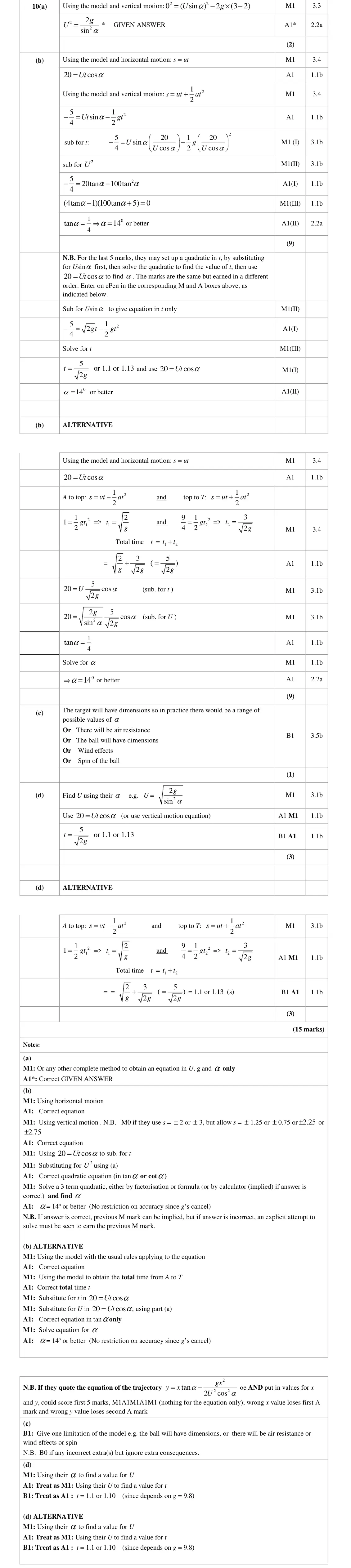
(b), most started with the valid strategy of using horizontal and vertical equations (s = ut + 1/2at2). Not all included the appropriate correct distance (-1.25) and there were occasional sign errors. By substituting for t and then for U (using the expression from (a)) it was possible to obtain a quadratic equation in tan alpha . Not all attempts were successful, with errors in simplification leading to equations with a variety of trig functions or else not quadratics. Alternatively, rather than substituting for t and U in the original equation, a quadratic in t could be found by an initial substitution for Usin alpha . The resulting value of t could then be used in ’20 = Utcos alpha ’ to find alpha . This method was seen successfully employed on occasion. Similarly, the motion could be split into two stages and the times to and from the highest points found. This approach was only very rarely seen. Some candidates made several attempts at this part of the question; it is worth remembering that if none are crossed out only the last most complete solution will be credited. Reference to air resistance was by far the most common correct response about the limitations of the model in part (c). Other valid comments relating to spin, dimensions of the ball and wind effects were
Common mistakes
20 = Ut cos α and −1.25 = Ut sin α − ½gt² (vertical displacement −1.25, not ±2 or ±3)
substitute for t and U² to get quadratic 400tan²α − 80tan α − 5 = 0 (or in t), tan α = 1/4, α = 14°
sign errors and simplification errors common
Find an Edexcel maths tutor
Stuck on this? Book a trial session with an Edexcel specialist.









![12. (a) Prove cos3 theta + sin3 theta theta theta { 2cot 2ș ș z (90n)°, n ] sin cos (4)](/img/JUN19_9MA002/JUN19_9MA002_12(a).webp)