Examiner's comment
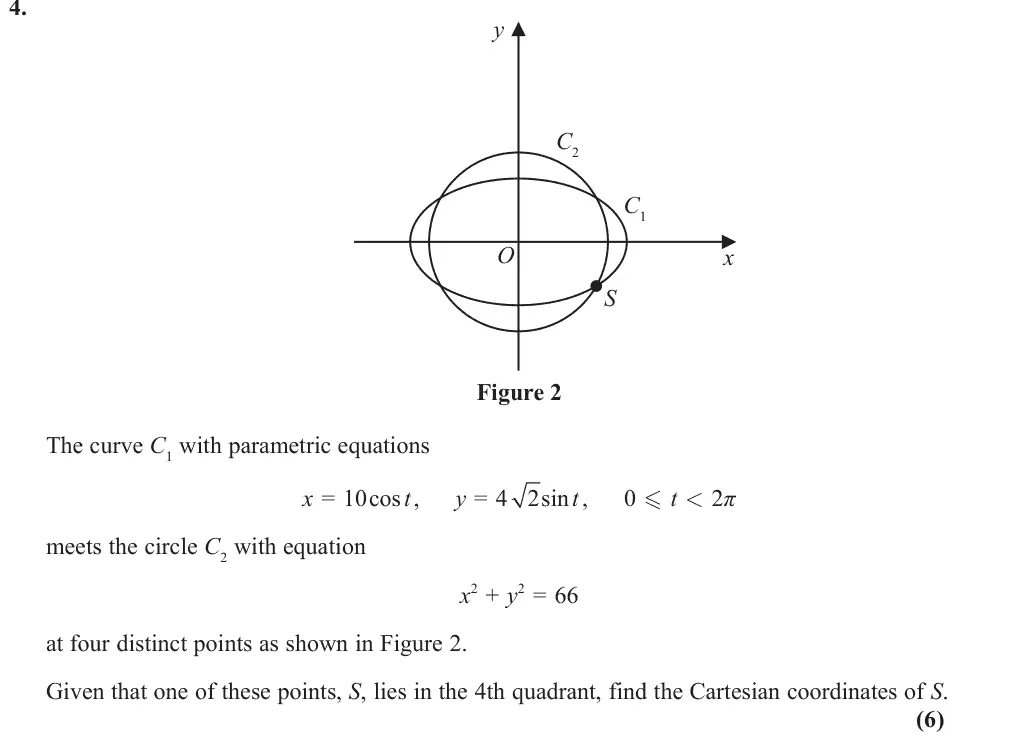
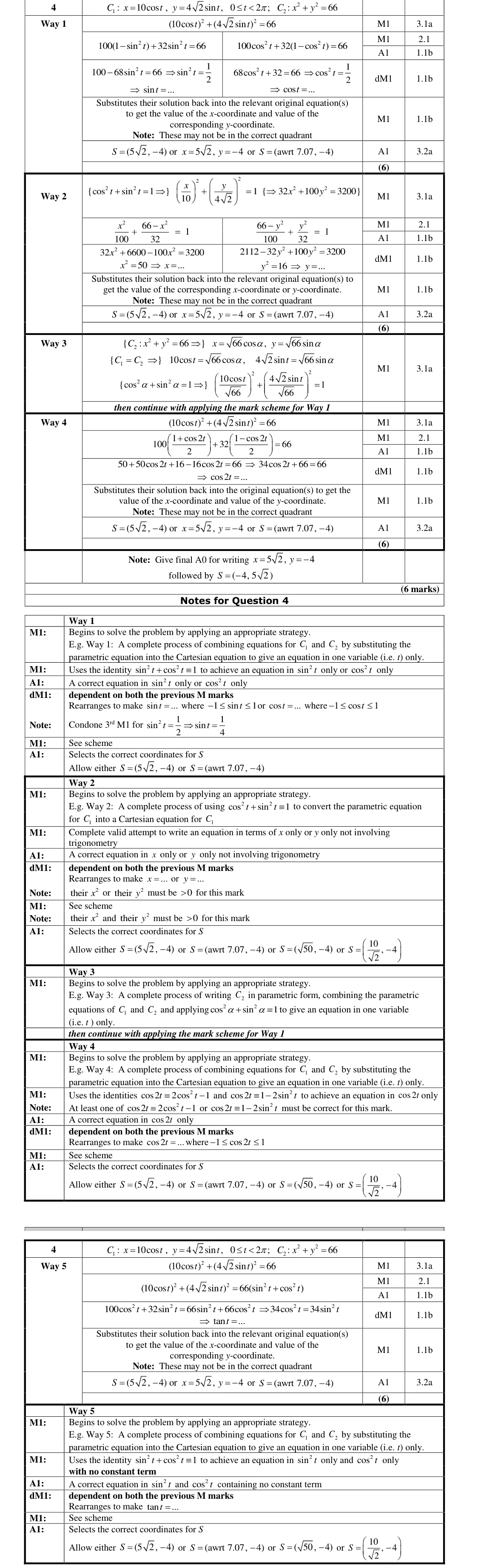
Q04 was well attempted by both medium ability and higher ability candidates. Lower ability candidates struggled to make progress, with most of them scoring no more than one mark. There were two common methods that were used by candidates. The first method, covered by Way 1 in the mark scheme, was the substitution of the parametric equations of 1 C into the Cartesian equation of 2 C to give an equation in t only; the trigonometric identity 2 2 sin cos 1 t t being used to obtain an equation in 2 sin t (or 2 cos t ) only, and a value for sint (or cos )t found. The second method, covered by Way 2 in the mark scheme, was the application of the trigonometric identity 2 2 sin cos 1 t t to the parametric equations of 1 C to give 2 2 1, 10 4 2 x y the Cartesian equation of 2 C being used to obtain an equation in 2x (or 2) y only, and a value for x (or y) found. A few candidates used a correct method of progressing from 2 2 (10cos ) (4 2 sin ) 66 t t to either 2 tan 1 t or cos2 0. t In all these methods, substituting back yielded their coordinates for S, with most candidates realising that 0 Sx and 0. Sy Some candidates incorrectly stated S as (5 2 , 4). In the first method, successful candidates used either 7 4 t or , 4 t and then applied symmetry to find the correct coordinates for S as either (5 2 , 4) or (7.07, 4). An area of concern centred around arithmetical slips or errors in elementary algebra. Examples of the former included 2 (4 2) becoming 8 or 64; 2 1 sin 2 t becoming 1 sin ; 4 t and 2 2 1 100 32 x y becoming 2 2 32 100 1 or 100 or 32. x y Examples of the latter included the invalid methods of 2 2 66 y x becoming 66 y x and 2 2 sin 1 100 x t becoming sin 1 . 10 x t Candidates who made no creditable progress included those who differentiated the parametric equations for 1 , C and those who obtained, e.g. 4 2 sin arccos 10 x y leading to 2 2 32sin arccos 66. 10 x x