June 2018: AS AS Paper 1: Pure Mathematics

100 marks · 31 question parts · Question paper, mark scheme and examiner's report on Pearson's site

Question by question

QTopicMarksDifficulty
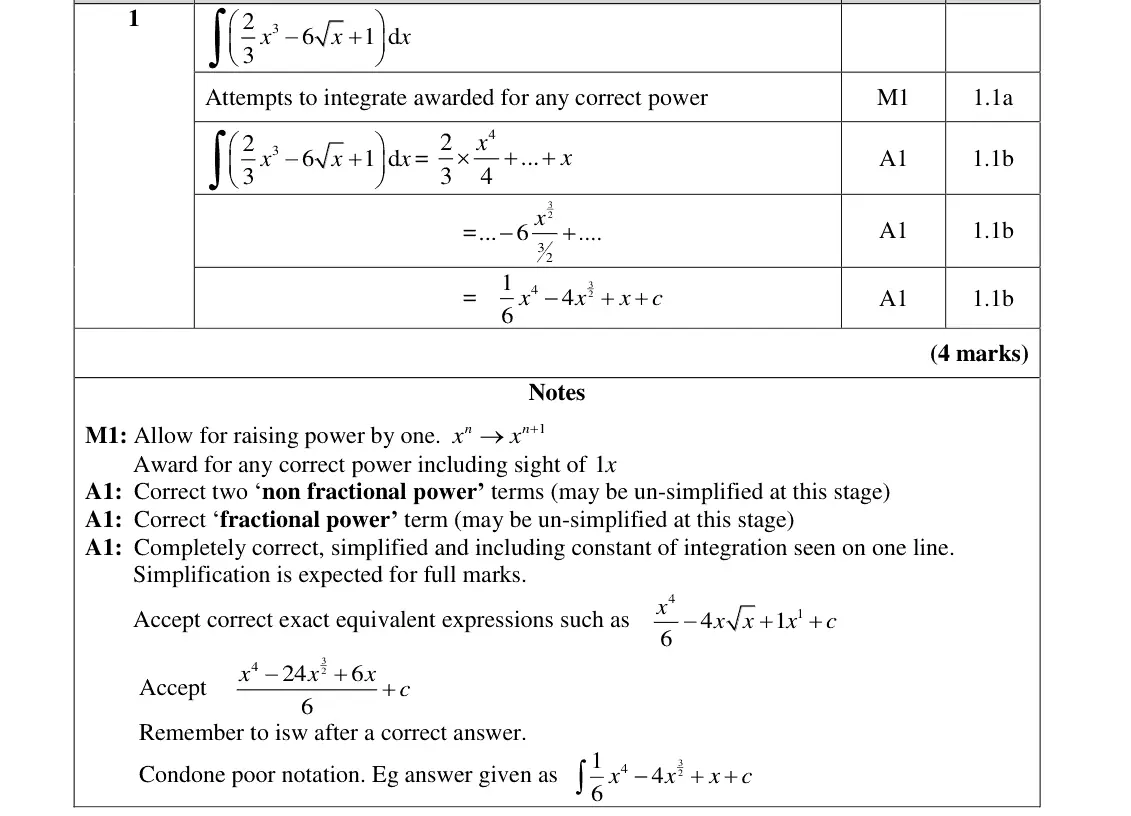
1 Integration: standard integrals, definite integrals and areas, Indices and surds 4 —
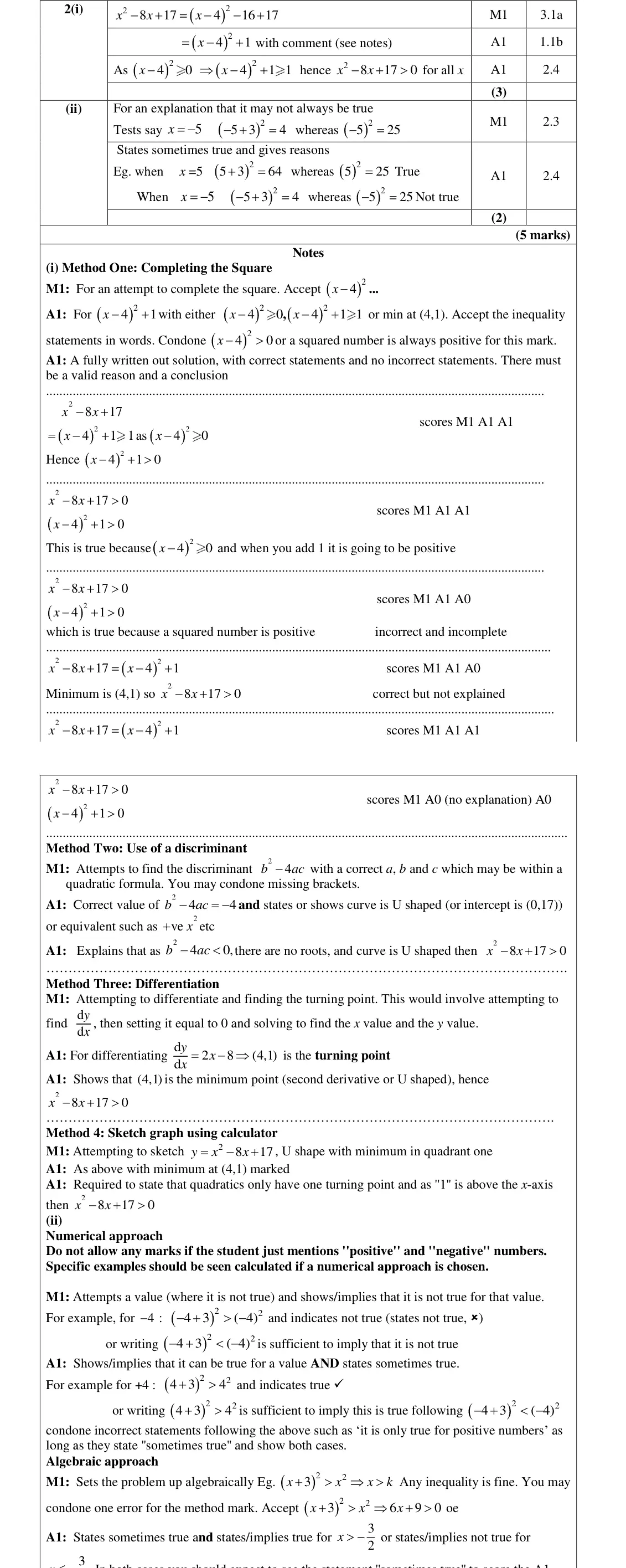
2(i) Quadratics and the discriminant, Proof, including contradiction 3 —
2(ii) Proof, including contradiction, Inequalities 2 —
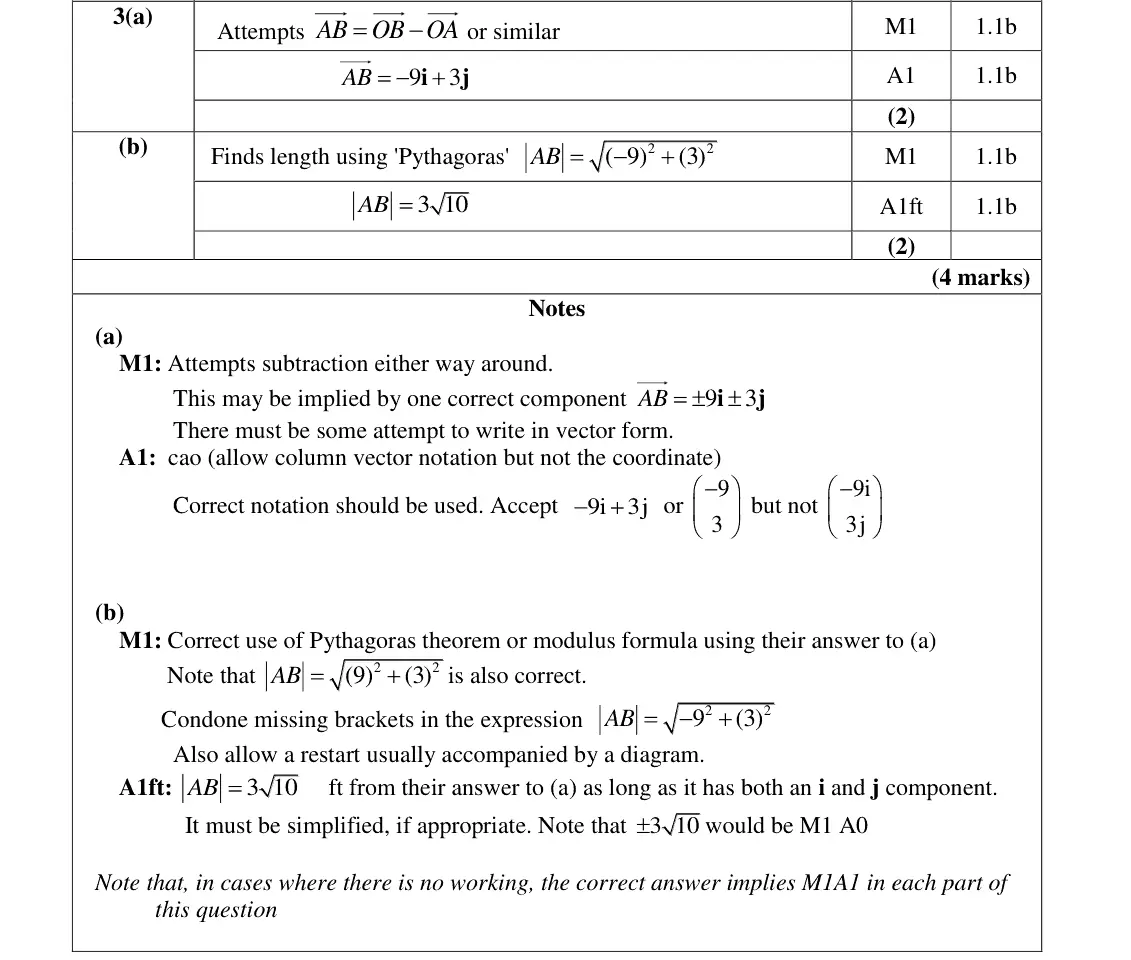
3(a) Vectors 2 —
3(b) Vectors, Indices and surds 2 —
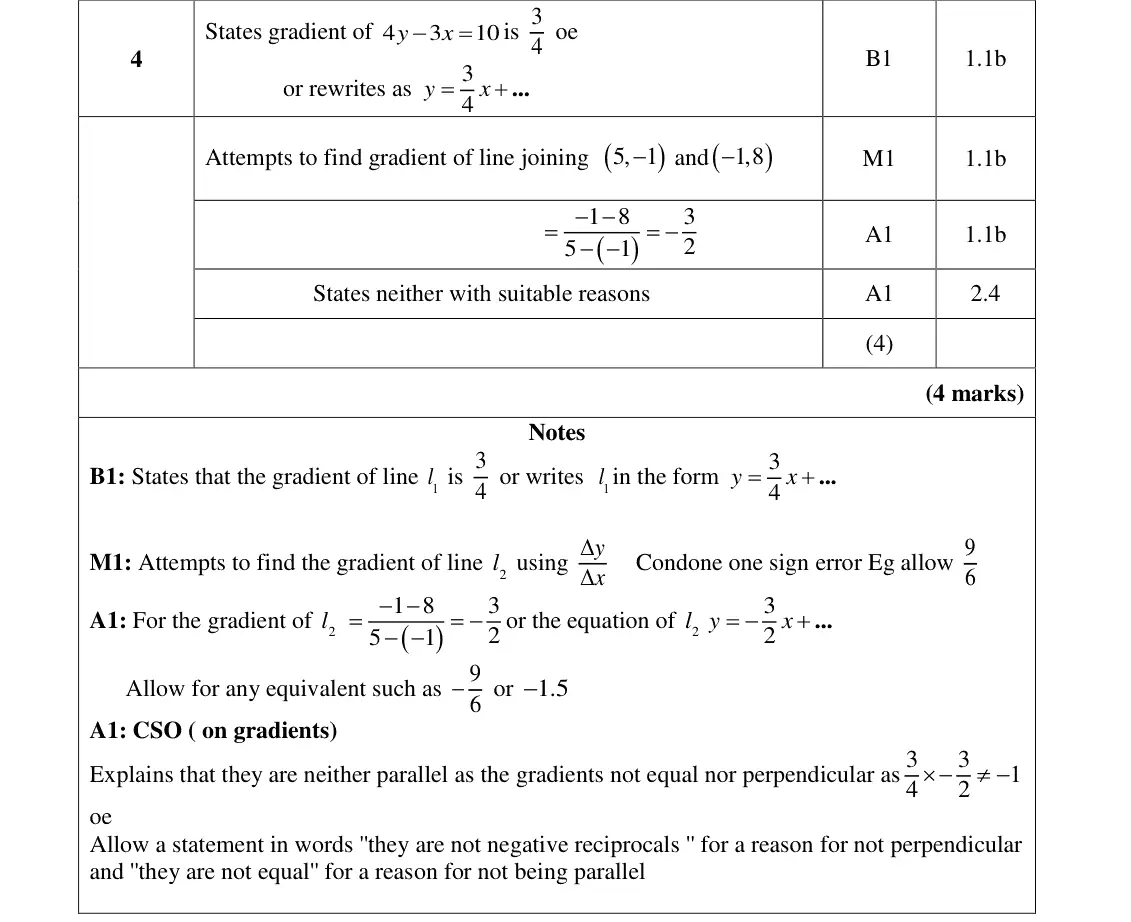
4 Straight lines 4 —
5(a) Exponentials and logarithms 2 —
5(b) Exponentials and logarithms, Indices and surds 3 —
6(a) Quadratics and the discriminant, Functions, composite and inverse functions, modulus 2 —
6(b) Inequalities, Quadratics and the discriminant, Functions, composite and inverse functions, modulus 3 —
6(c) Quadratics and the discriminant, Functions, composite and inverse functions, modulus 2 —
7(a) Trigonometric ratios, graphs, radians and the sine and cosine rules, Trigonometric identities and proofs 4 —
7(b) Trigonometric ratios, graphs, radians and the sine and cosine rules 2 —
8(a) Differentiation: first principles, gradients, stationary points, Indices and surds 6 —
8(b) Differentiation: first principles, gradients, stationary points 2 —
8(c) Functions, composite and inverse functions, modulus, Differentiation: first principles, gradients, stationary points 1 —
9(a) Algebraic methods: polynomials, factor theorem and division 2 —
9(b) Algebraic methods: polynomials, factor theorem and division 4 —
9(c) Graphs and transformations, Inequalities 3 —
10 Differentiation: first principles, gradients, stationary points, Proof, including contradiction, Algebraic methods: polynomials, factor theorem and division 4 —
11(a) Binomial expansion 4 —
11(b) Binomial expansion 2 —
11(c) Binomial expansion 2 —
12(a) Trigonometric identities and proofs 4 —
12(b) Solving trigonometric equations, Quadratics and the discriminant 4 —
13(a) Exponentials and logarithms, Exponential growth, decay and modelling 4 —
13(b) Exponential growth, decay and modelling, Exponentials and logarithms 2 —
13(c) Exponential growth, decay and modelling 2 —
14(a) Circles, Quadratics and the discriminant 3 —
14(b) Circles, Quadratics and the discriminant, Inequalities 6 —
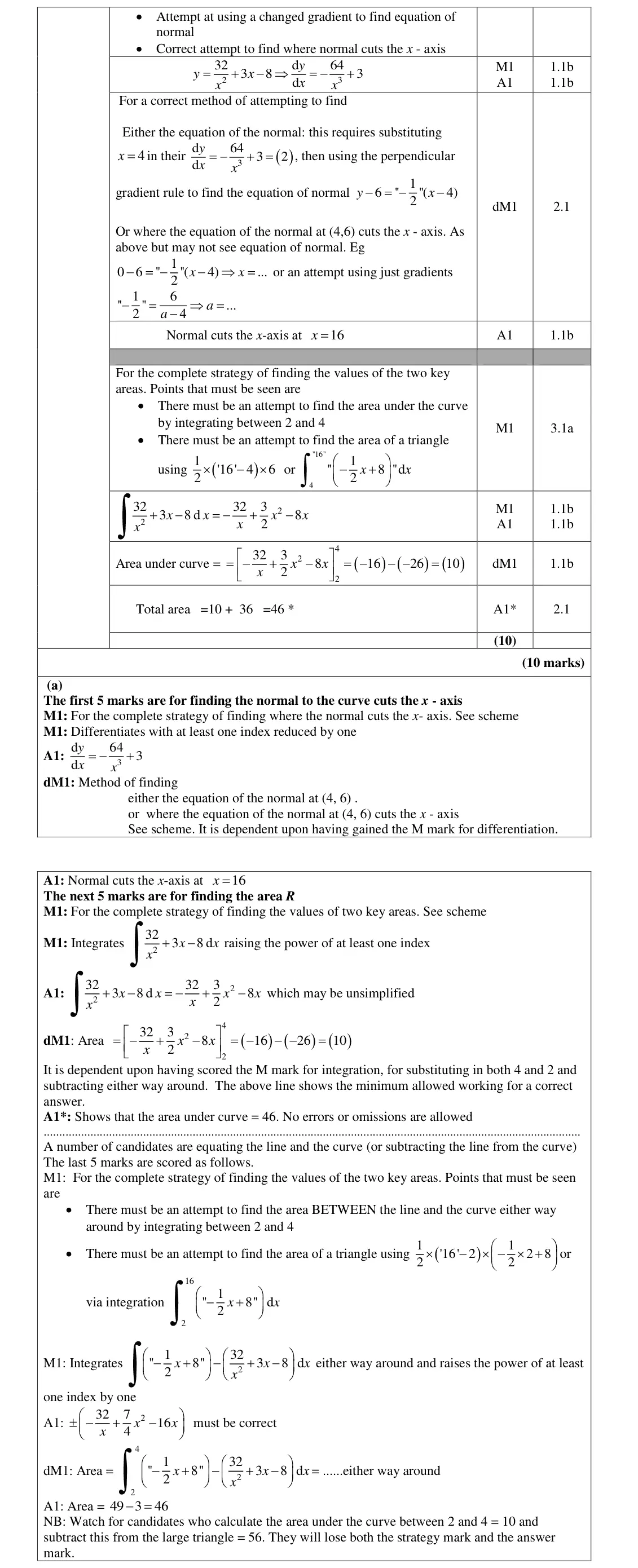
15 Integration: standard integrals, definite integrals and areas, Differentiation: first principles, gradients, stationary points, Straight lines 10 —

The questions

12(i)2(ii)3(a)3(b)45(a)5(b)6(a)6(b)6(c)7(a)7(b)8(a)8(b)8(c)9(a)9(b)9(c)1011(a)11(b)11(c)12(a)12(b)13(a)13(b)13(c)14(a)14(b)15
June 2018 · AS Paper 1 · Q1 4 marks integrationindices and surds
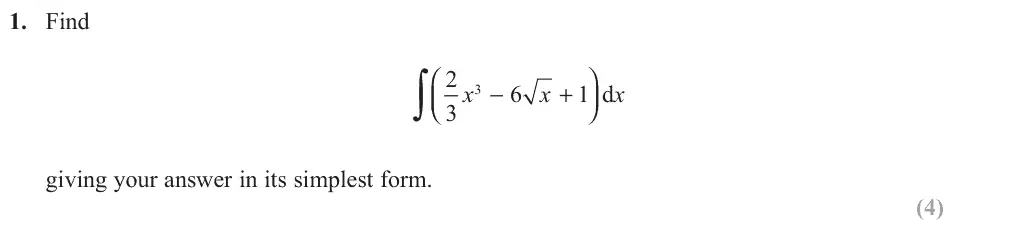
1. Find ⎛ ⎞ ∫ 3x x d x - + ⎝⎜ ⎠⎟ giving your answer in its simplest form. (4)
June 2018 · AS Paper 1 · Q2(i) 3 marks quadraticsproof
2. (i) Show that [࣠2 í 8x + 17 < 0 for all real values of x (3)
June 2018 · AS Paper 1 · Q2(ii) 2 marks proofinequalities
(ii) “If I add 3 to a number and square the sum, the result is greater than the square of the original number.” State, giving a reason, if the above statement is always true, sometimes true or never true. (2)
June 2018 · AS Paper 1 · Q3(a) 2 marks vectors
3. Given that the point A has position vector 4i í 5j and the point B has position vector í5i í2j, ĺ, (a) find the vector AB (2)
June 2018 · AS Paper 1 · Q3(b) 2 marks vectorsindices and surds
ĺ mu , (b) find mu AB Give your answer as a simplified surd. (2)
June 2018 · AS Paper 1 · Q4 4 marks straight lines
4. The line l1 has equation 4y í 3x = 10 The line l2 passes through the points (5, í1) and (í1, 8). Determine, giving full reasons for your answer, whether lines l1 and l2 are parallel, perpendicular or neither. (4)
June 2018 · AS Paper 1 · Q5(a) 2 marks exponentials and logs
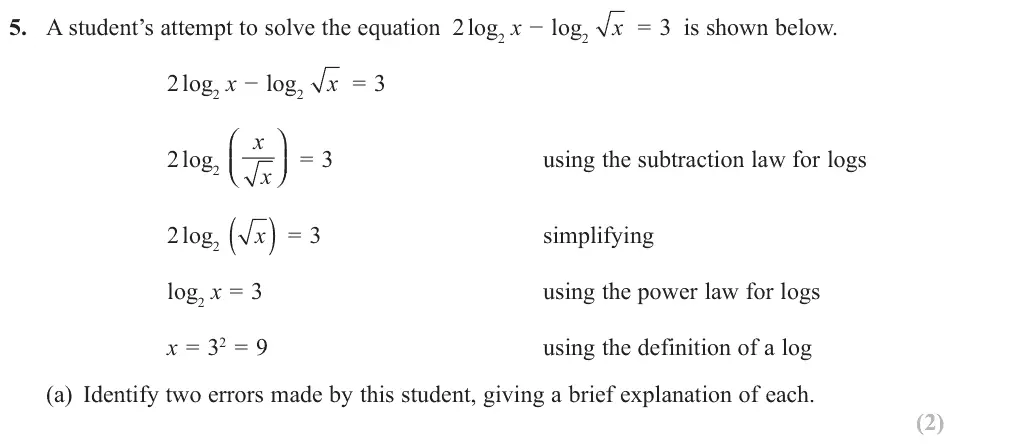
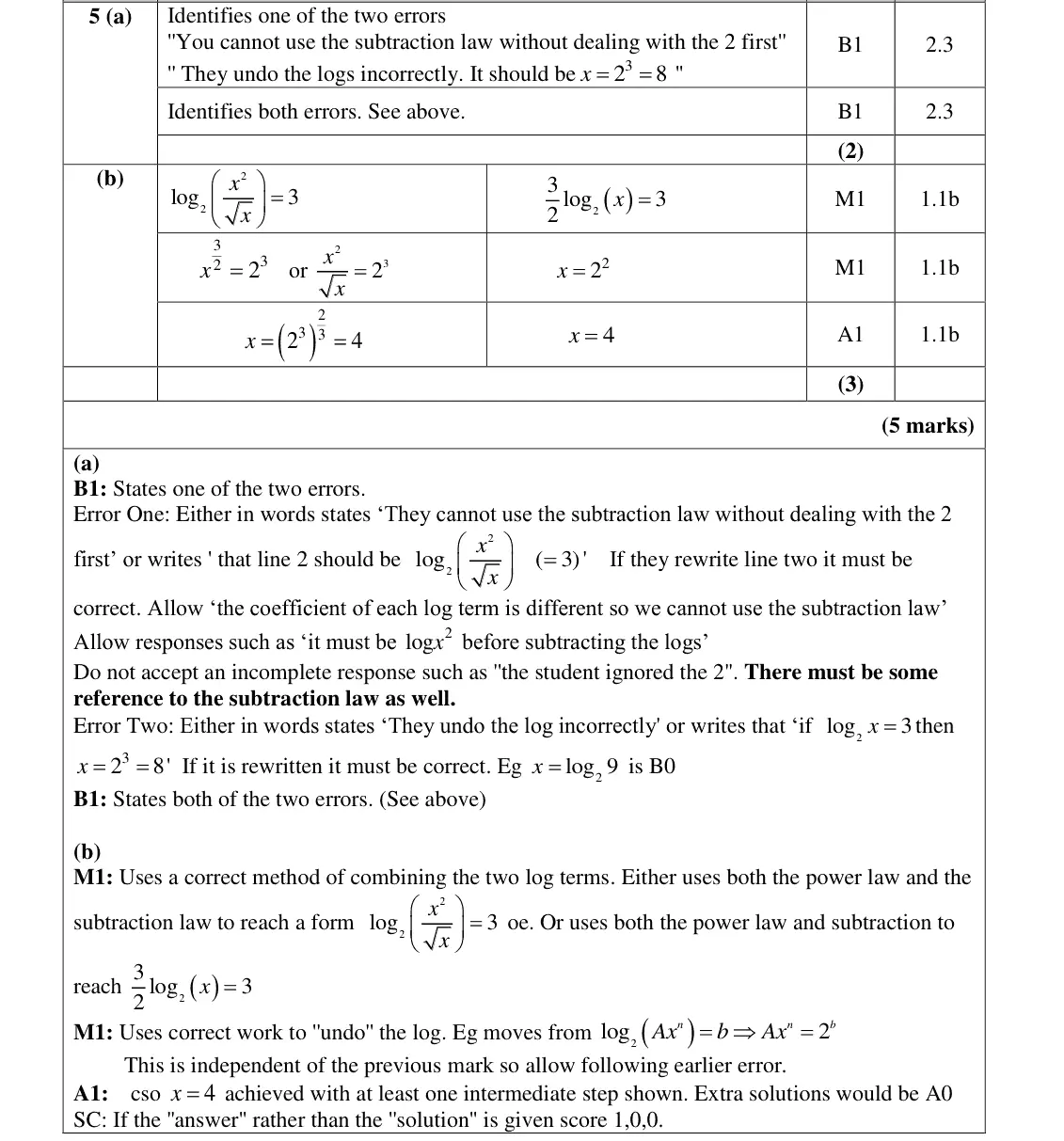
5. A student’s attempt to solve the equation 2 log2 x í log2 x = 3 is shown below. 2 log2 x í log2 x = 3 x ⎛ ⎞ 2 log2 ⎠⎟ = 3 using the subtraction law for logs ⎝⎜ x ( ) = 3 2 log2 x simplifying log2 x = 3 using the power law for logs x = 32 = 9 using the definition of a log (a) Identify two errors made by this student, giving a brief explanation of each. (2)
June 2018 · AS Paper 1 · Q5(b) 3 marks exponentials and logsindices and surds
(b) Write out the correct solution. (3)
June 2018 · AS Paper 1 · Q6(a) 2 marks quadraticsfunctions
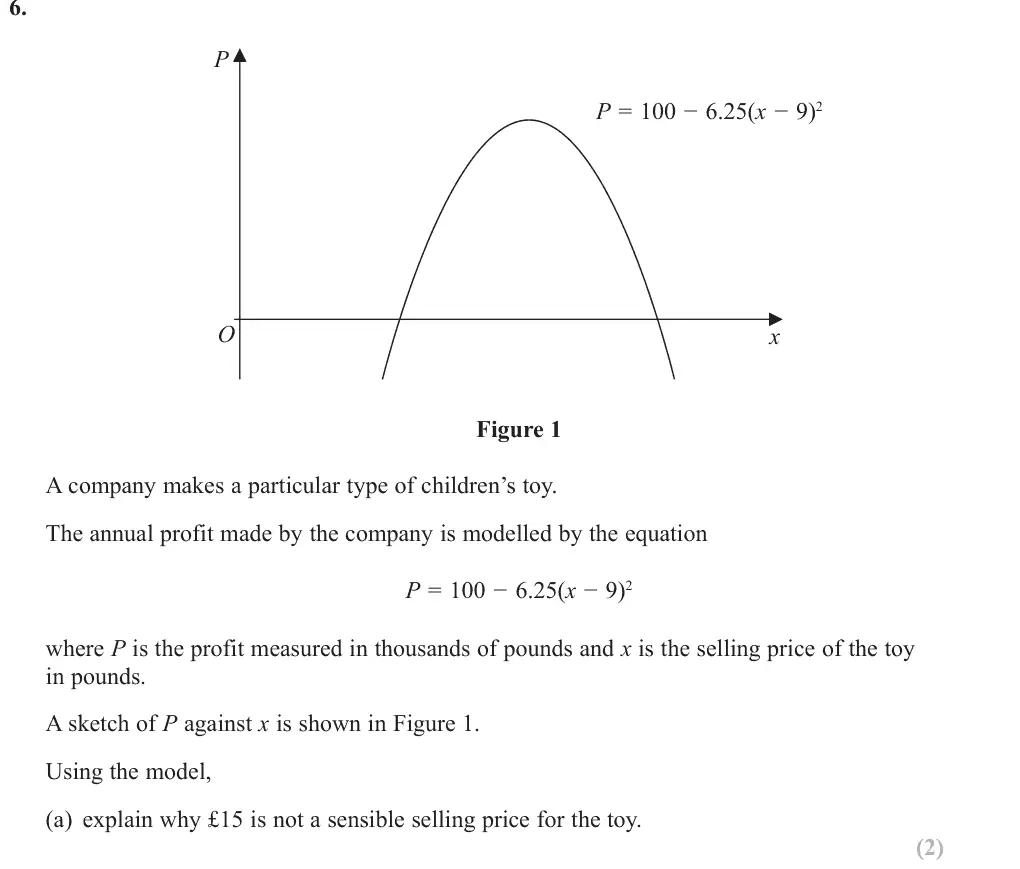
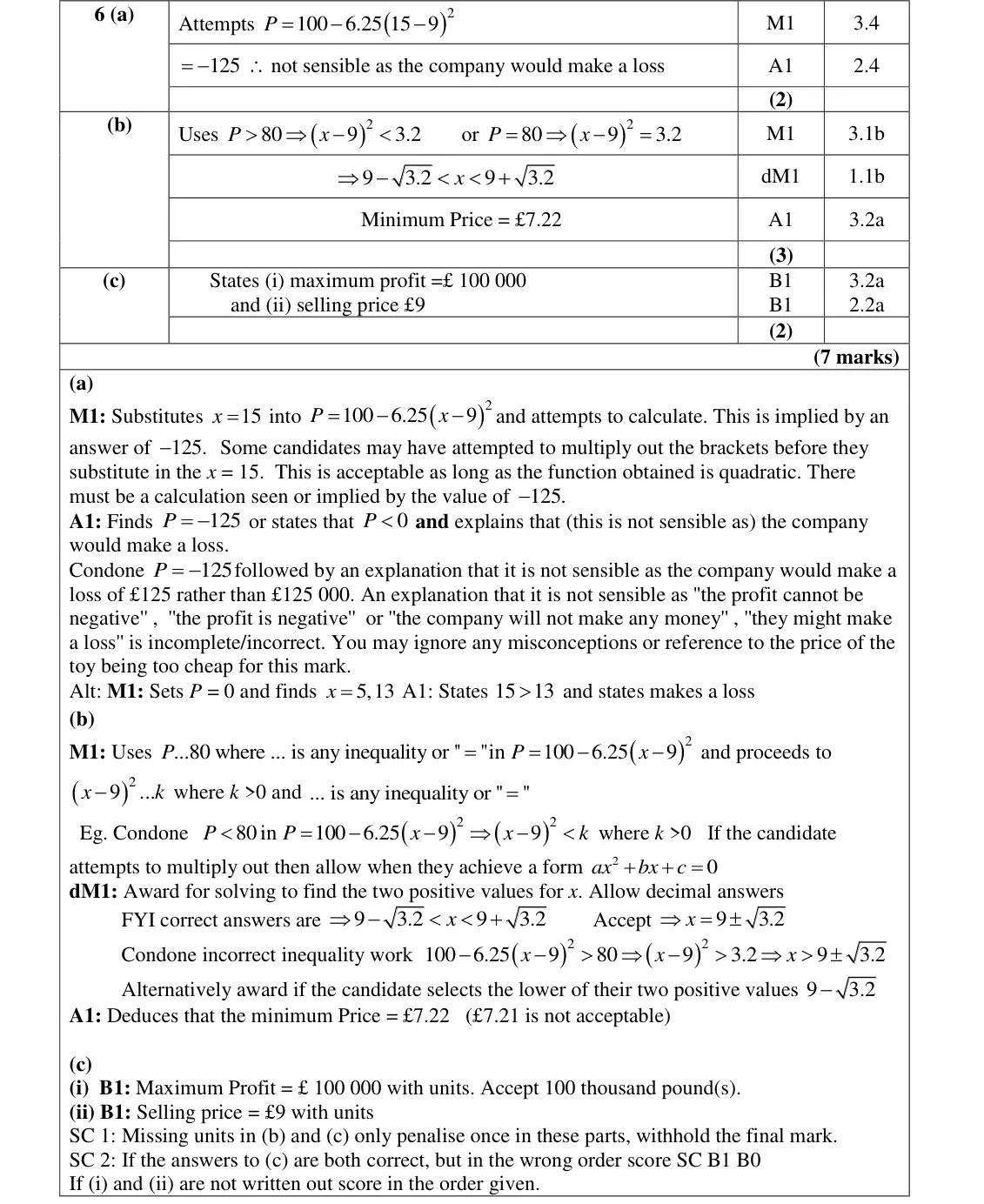
6. P P = 100 í 6.25(x í 9)2 x Figure 1 A company makes a particular type of children’s toy. The annual profit made by the company is modelled by the equation P = 100 í 6.25(x í 9)2 where P is the profit measured in thousands of pounds and x is the selling price of the toy in pounds. A sketch of P against x is shown in Figure 1. Using the model, (a) =explain why £15 is not a sensible selling price for the toy. (2)


June 2018 · AS Paper 1 · Q6(b) 3 marks inequalitiesquadraticsfunctions
Given that the company made an annual profit of more than £80 000 (b) find, according to the model, the least possible selling price for the toy. (3)
June 2018 · AS Paper 1 · Q6(c) 2 marks quadraticsfunctions
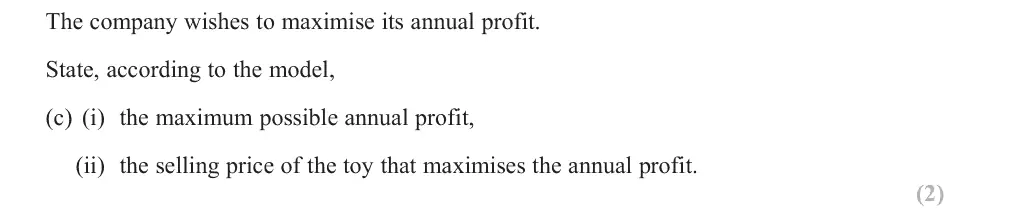
The company wishes to maximise its annual profit. State, according to the model, (c) (i) the maximum possible annual profit, (ii) the selling price of the toy that maximises the annual profit. (2)
June 2018 · AS Paper 1 · Q7(a) 4 marks trigonometric ratiostrig identities
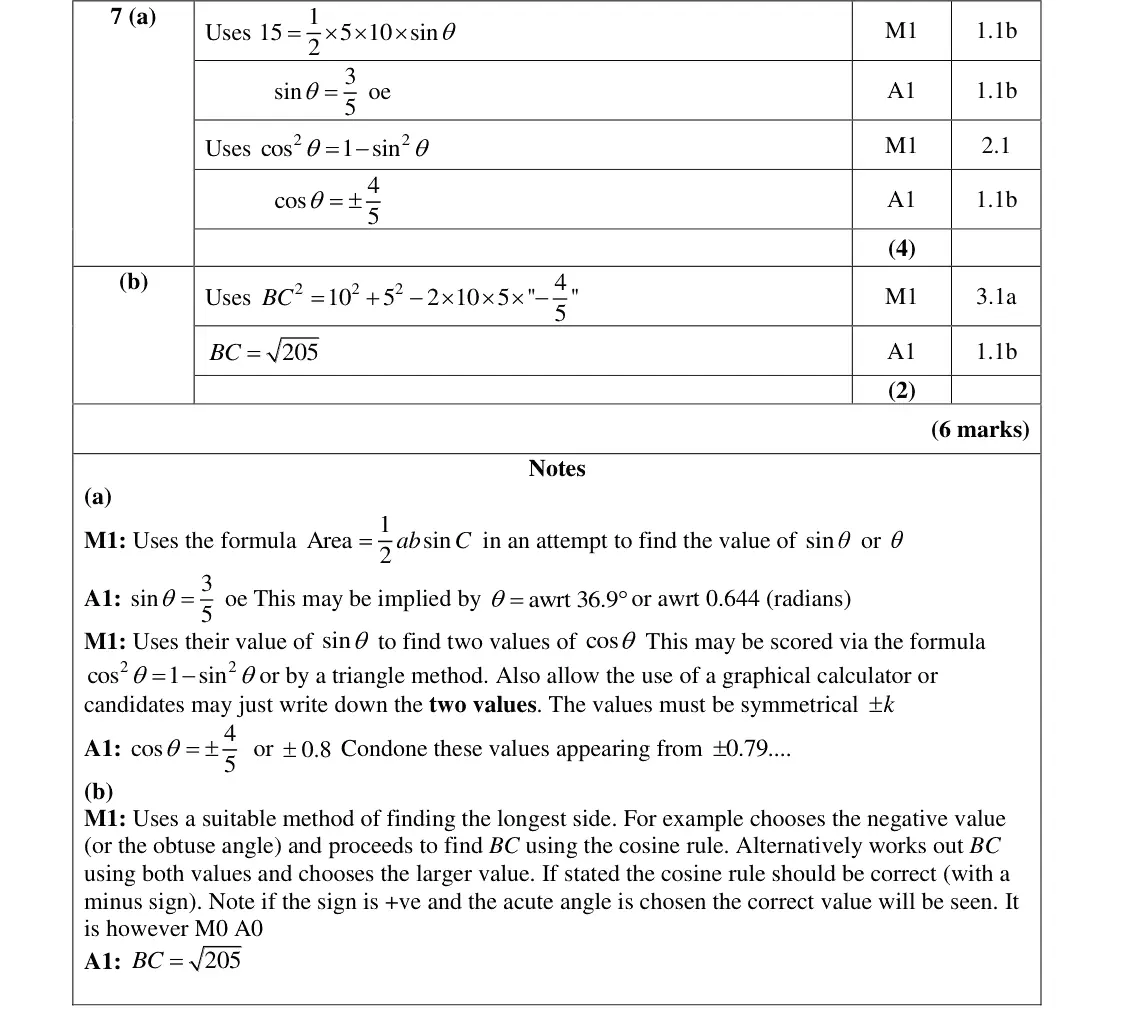
7. In a triangle ABC, side AB has length 10 cm, side AC has length 5 cm, and angle BAC = ș where ș is measured in degrees. The area of triangle ABC is 15 cm2 (a) Find the two possible values of cos ș (4)
June 2018 · AS Paper 1 · Q7(b) 2 marks trigonometric ratios
Given that BC is the longest side of the triangle, (b) find the exact length of BC. (2)
June 2018 · AS Paper 1 · Q8(a) 6 marks differentiationindices and surds
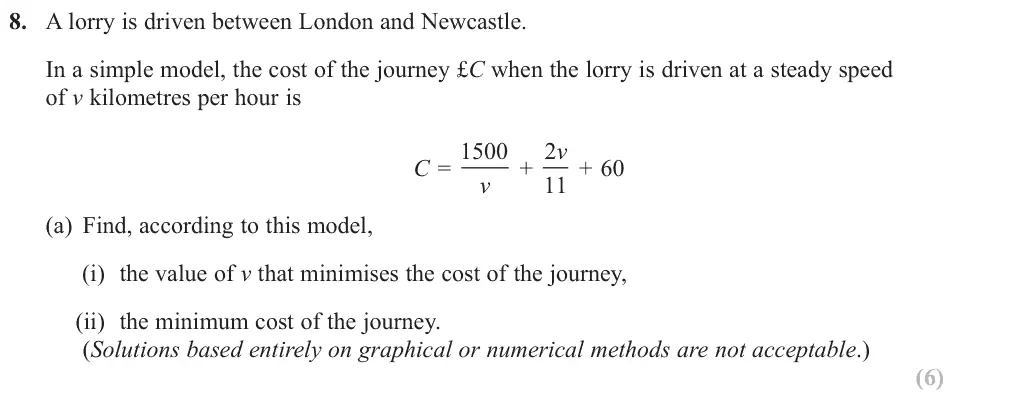
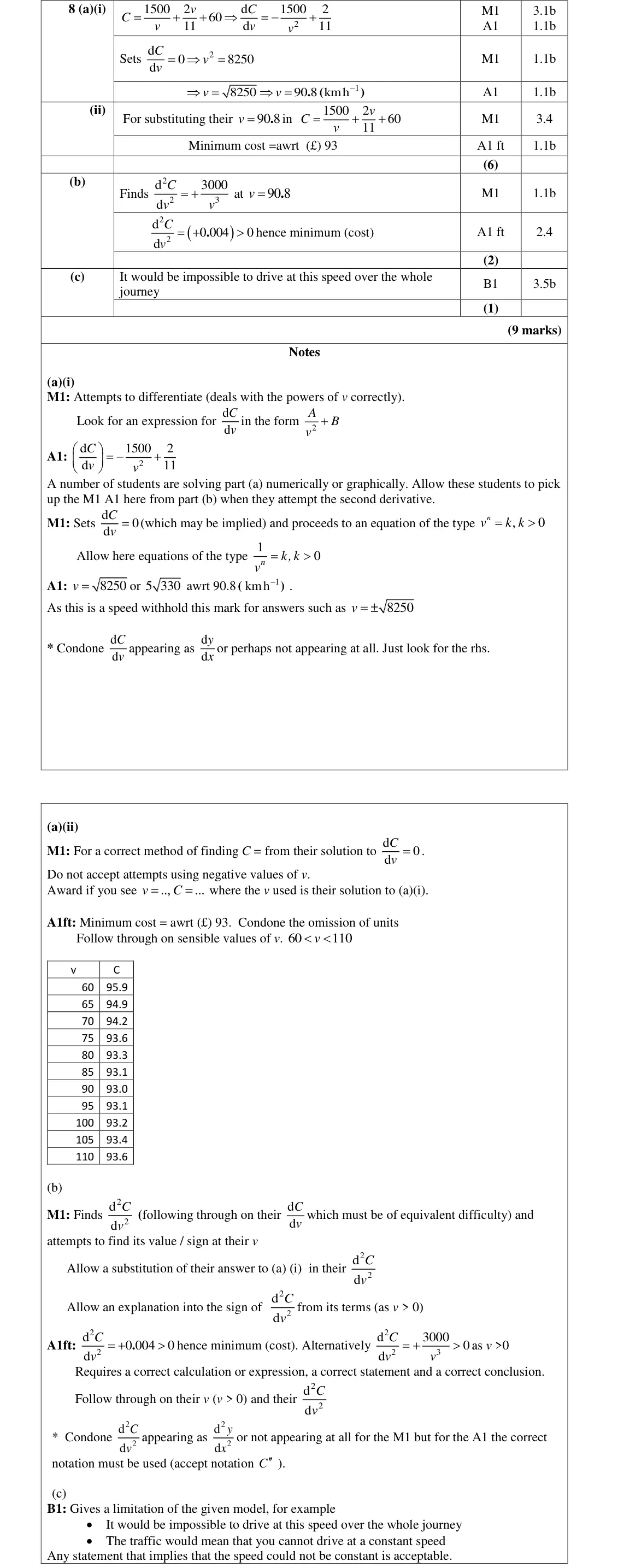
8. A lorry is driven between London and Newcastle. In a simple model, the cost of the journey £C when the lorry is driven at a steady speed of v kilometres per hour is C = 1500 + 2 v + 60 v (a) Find, according to this model, (i) the value of v that minimises the cost of the journey, (ii) the minimum cost of the journey. (Solutions based entirely on graphical or numerical methods are not acceptable.) (6)
June 2018 · AS Paper 1 · Q8(b) 2 marks differentiation
(b) Prove by using d C v that the cost is minimised at the speed found in (a)(i). d (2)
June 2018 · AS Paper 1 · Q8(c) 1 mark functionsdifferentiation
(c) State one limitation of this model. (1)
June 2018 · AS Paper 1 · Q9(a) 2 marks algebraic methods
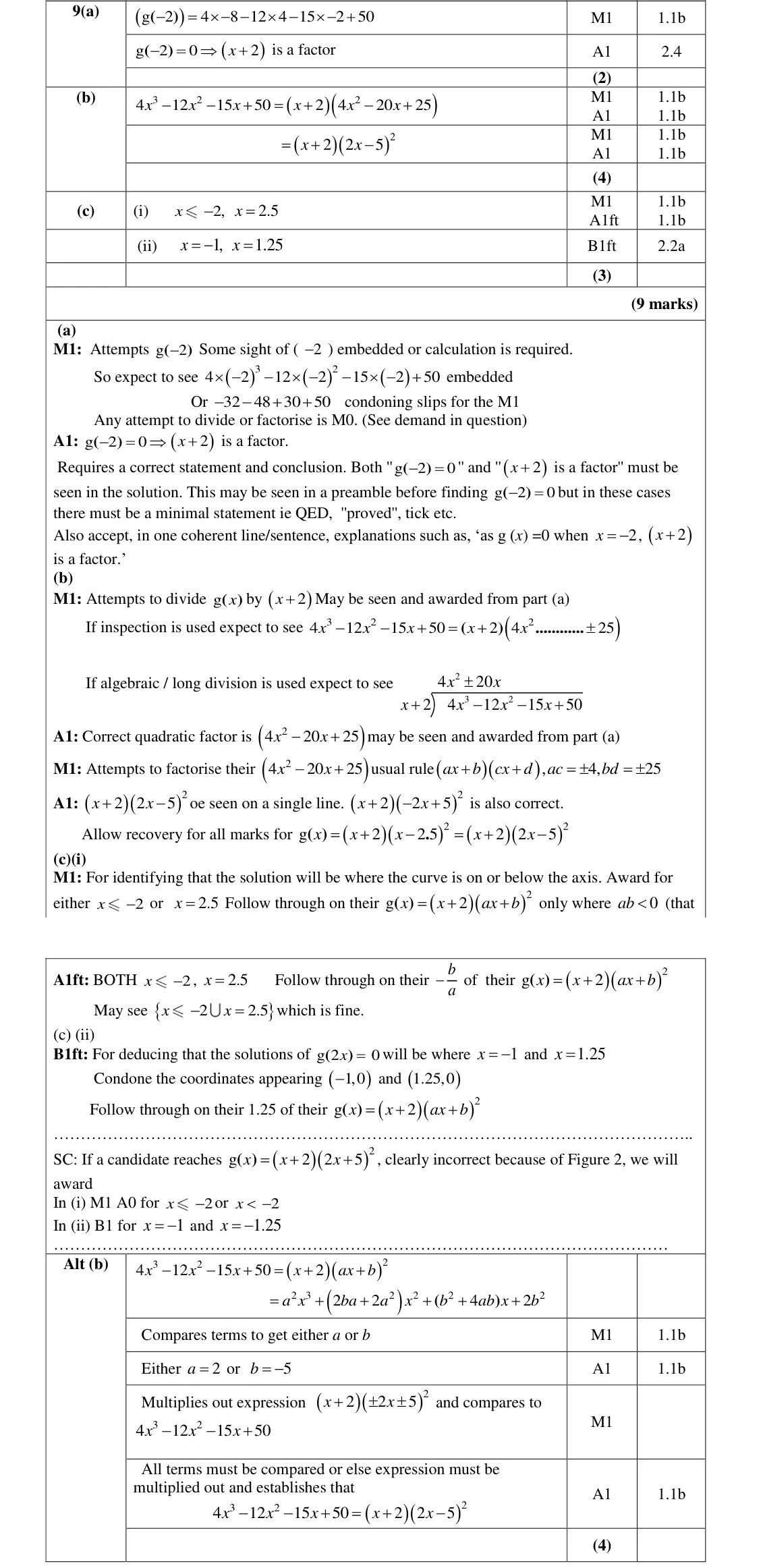
9. g(x) = 4x3 í 12x2 í 15x + 50 (a) Use the factor theorem to show that (x + 2) is a factor of g(x). (2)
June 2018 · AS Paper 1 · Q9(b) 4 marks algebraic methods
(b) Hence show that g(x) can be written in the form g(x) = (x + 2) (ax + b)2, where a and b are integers to be found. (4)
June 2018 · AS Paper 1 · Q9(c) 3 marks graphs and transformationsinequalities
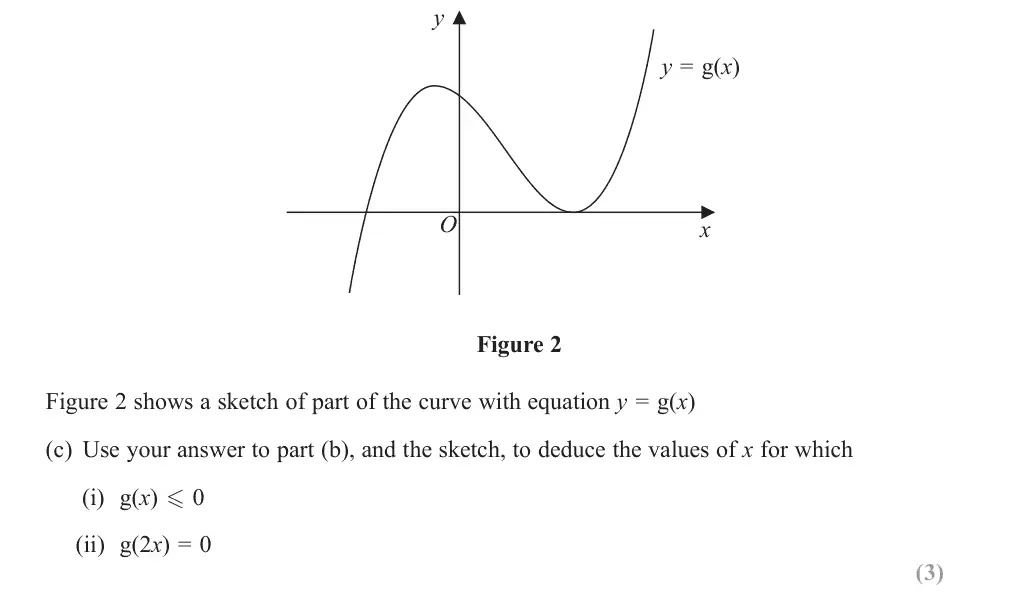
y y = g(x) x Figure 2 Figure 2 shows a sketch of part of the curve with equation y = g(x) (c) Use your answer to part (b), and the sketch, to deduce the values of x for which (i) g(x) - 0 (ii) g(2x) = 0 (3)
June 2018 · AS Paper 1 · Q10 4 marks differentiationproofalgebraic methods
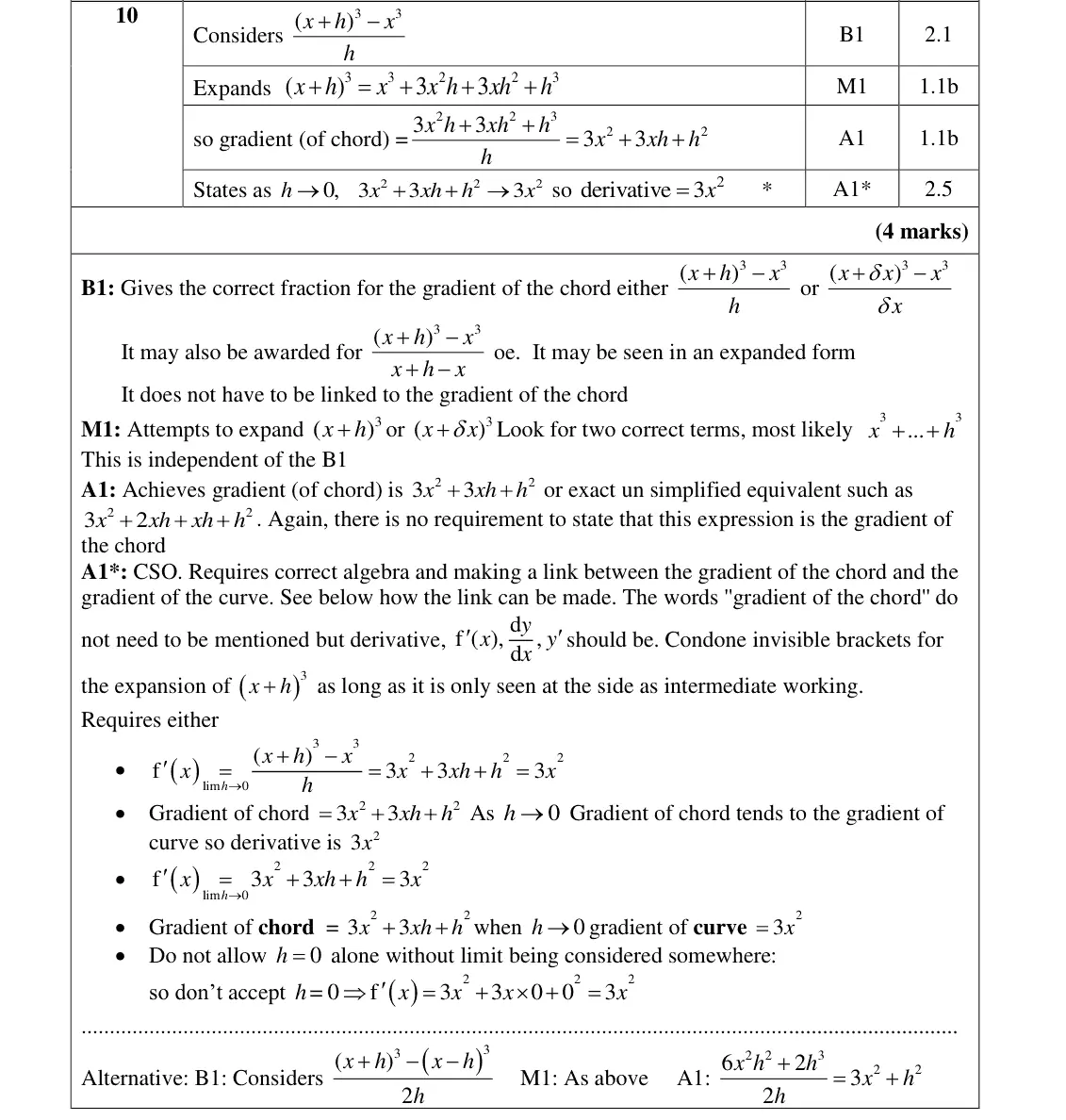
10. Prove, from first principles, that the derivative of x3 is 3x2 (4)
June 2018 · AS Paper 1 · Q11(a) 4 marks binomial expansion
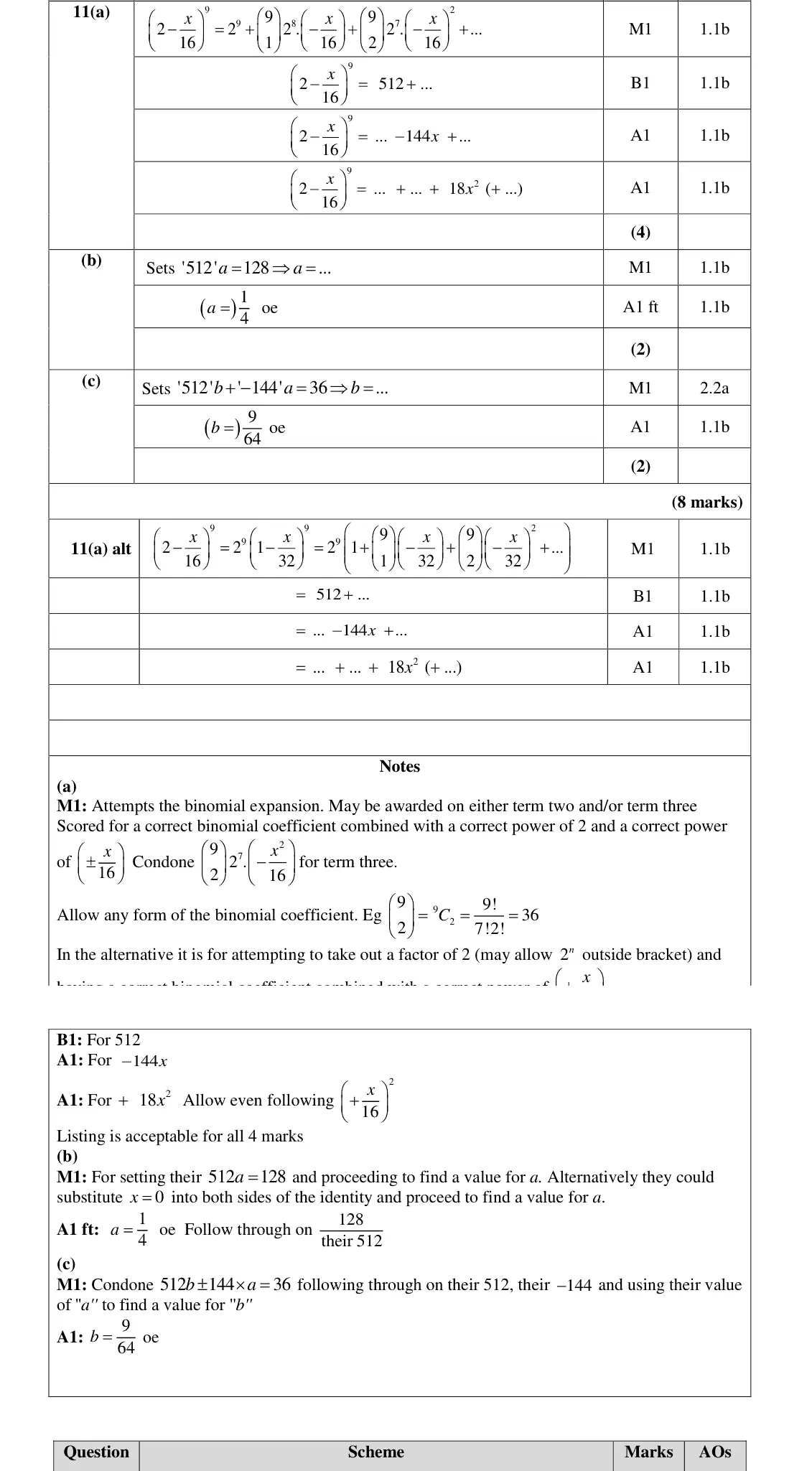
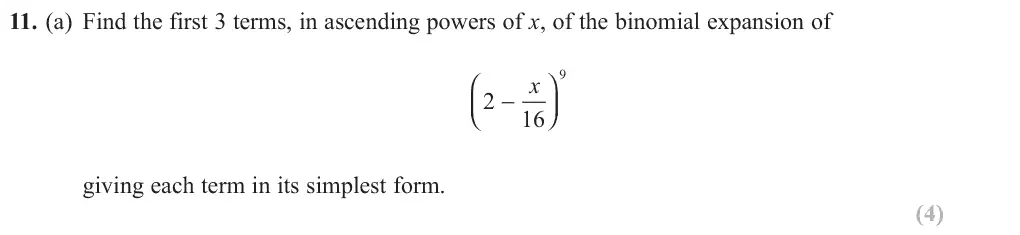
11. (a) Find the first 3 terms, in ascending powers of x, of the binomial expansion of x ⎛ ⎞ - ⎝⎜ ⎠⎟ giving each term in its simplest form. (4)
June 2018 · AS Paper 1 · Q11(b) 2 marks binomial expansion
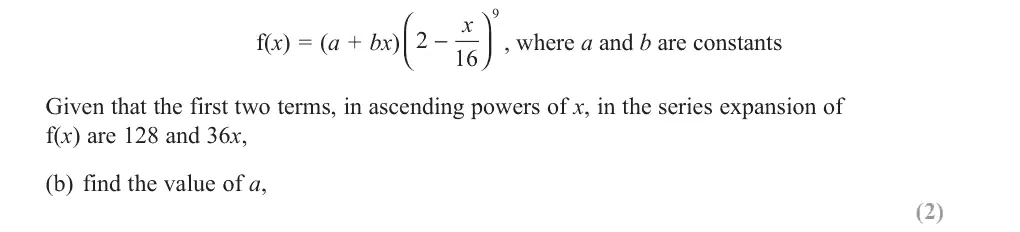
x ⎛ ⎞ f(x) = (a + bx) 2 - , where a and b are constants ⎝⎜ ⎠⎟ Given that the first two terms, in ascending powers of x, in the series expansion of f(x) are 128 and 36x, (b) find the value of a, (2)
June 2018 · AS Paper 1 · Q11(c) 2 marks binomial expansion
(c) find the value of b. (2)
June 2018 · AS Paper 1 · Q12(a) 4 marks trig identities
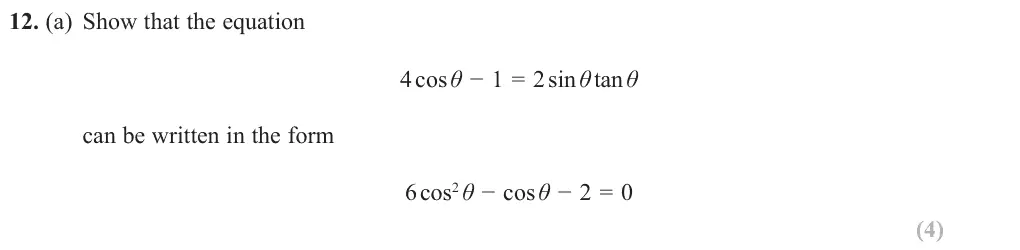
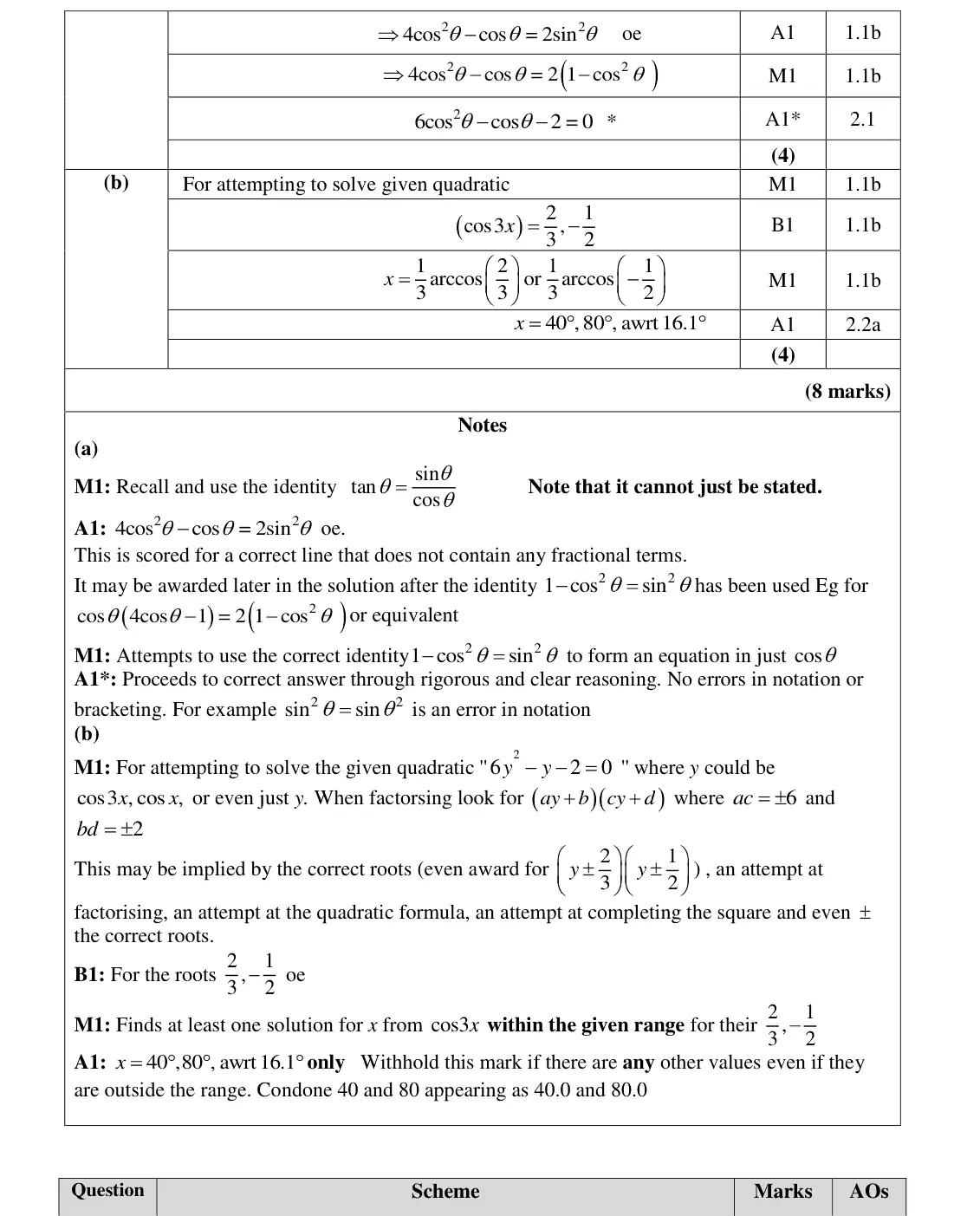
12. (a) Show that the equation 4 cos ș í 1 = 2 sin ș tan ș can be written in the form 6 cos2 ș í cos ș í 2 = 0 (4)
June 2018 · AS Paper 1 · Q12(b) 4 marks trigonometric equationsquadratics
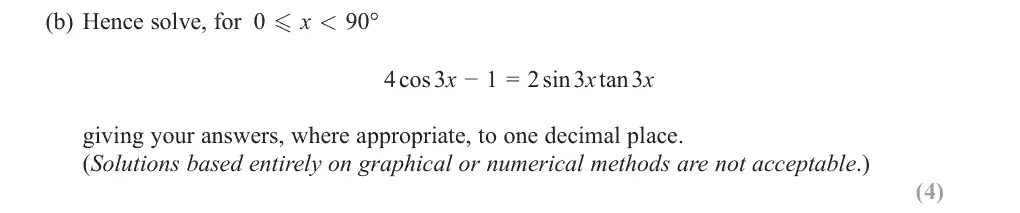
(b) Hence solve, for 0 - x : 90° 4 cos 3x í 1 = 2 sin 3x tan 3x giving your answers, where appropriate, to one decimal place. (Solutions based entirely on graphical or numerical methods are not acceptable.) (4)
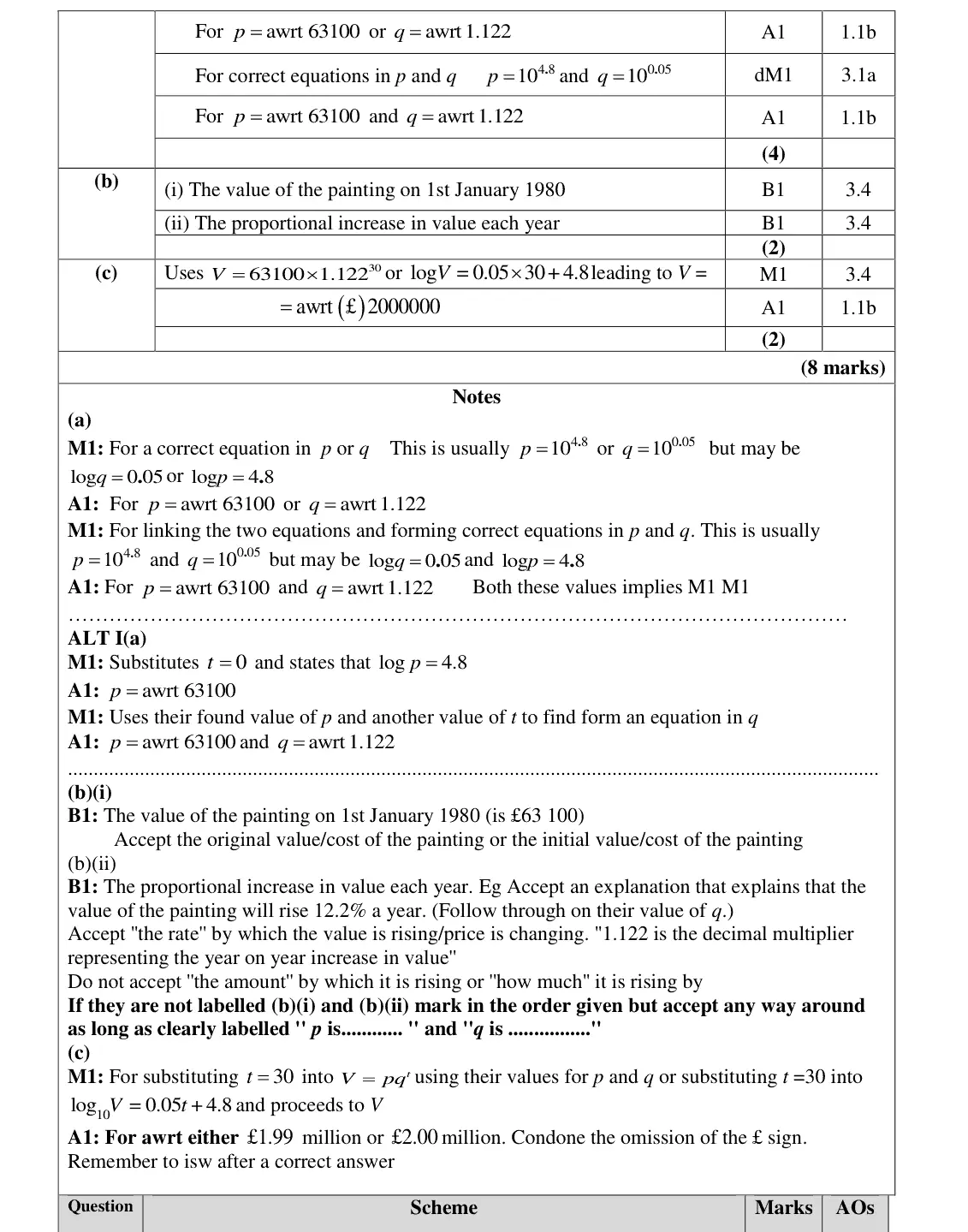
June 2018 · AS Paper 1 · Q13(a) 4 marks exponentials and logsexponential modelling
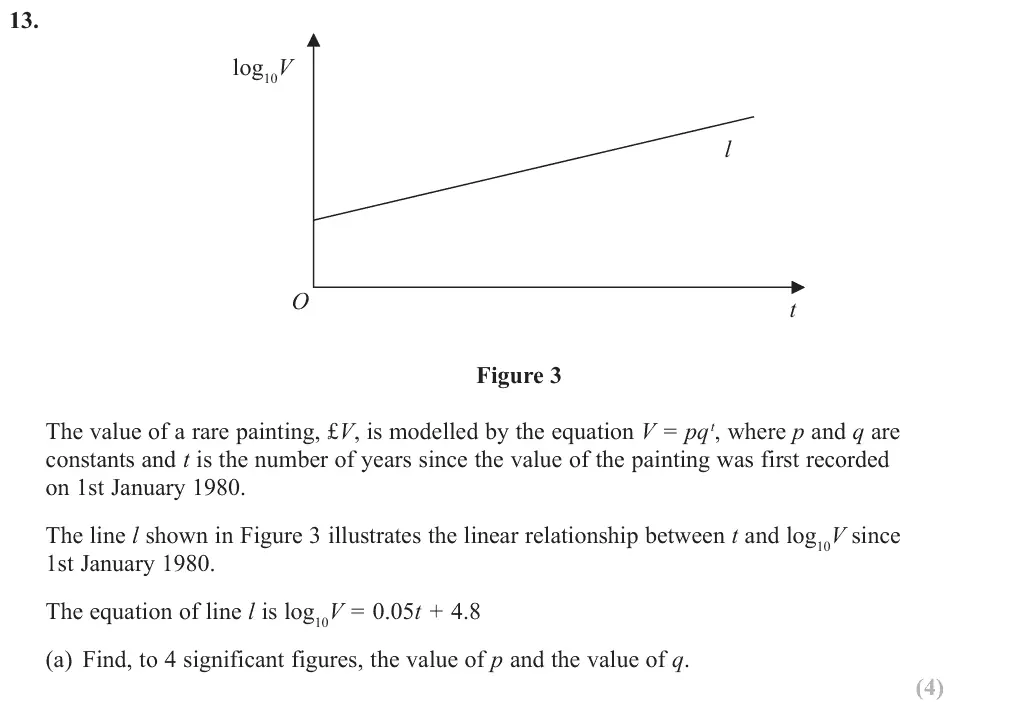
13. log10V l t Figure 3 The value of a rare painting, £V, is modelled by the equation V = pq௘t, where p and q are constants and t is the number of years since the value of the painting was first recorded on 1st January 1980. The line l shown in Figure 3 illustrates the linear relationship between t and log10V since 1st January 1980. The equation of line l is log10V = 0.05t + 4.8 (a) Find, to 4 significant figures, the value of p and the value of q. (4)
June 2018 · AS Paper 1 · Q13(b) 2 marks exponential modellingexponentials and logs
(b) With reference to the model interpret (i) the value of the constant p, (ii) the value of the constant q. (2)
June 2018 · AS Paper 1 · Q13(c) 2 marks exponential modelling
(c) Find the value of the painting, as predicted by the model, on 1st January 2010, giving your answer to the nearest hundred thousand pounds. (2)
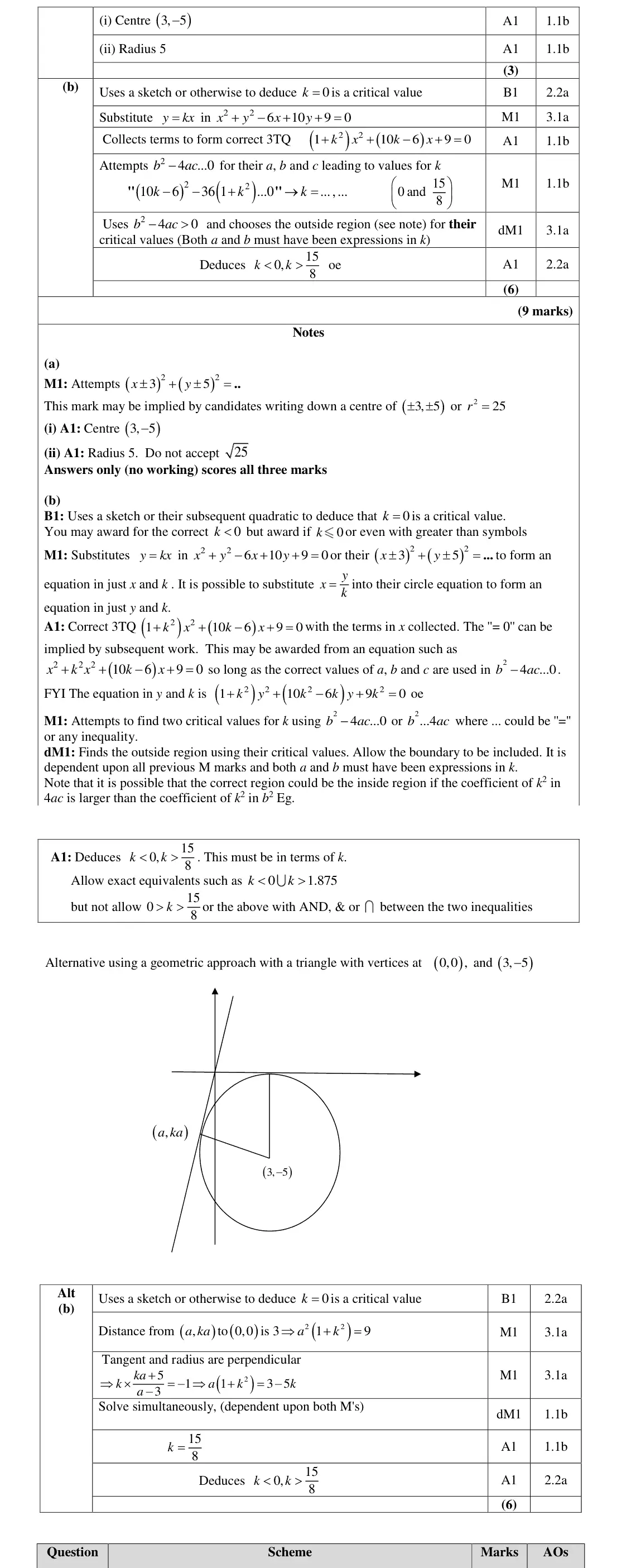
June 2018 · AS Paper 1 · Q14(a) 3 marks circlesquadratics
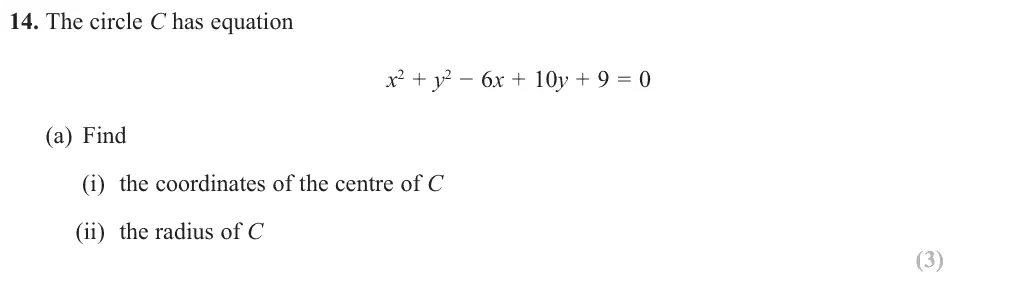
14. The circle C has equation x2 + y2 í 6x + 10y + 9 = 0 (a) Find (i) the coordinates of the centre of C (ii) the radius of C (3)
June 2018 · AS Paper 1 · Q14(b) 6 marks circlesquadraticsinequalities
The line with equation y = kx, where k is a constant, cuts C at two distinct points. (b) Find the range of values for k. (6)
June 2018 · AS Paper 1 · Q15 10 marks integrationdifferentiationstraight lines
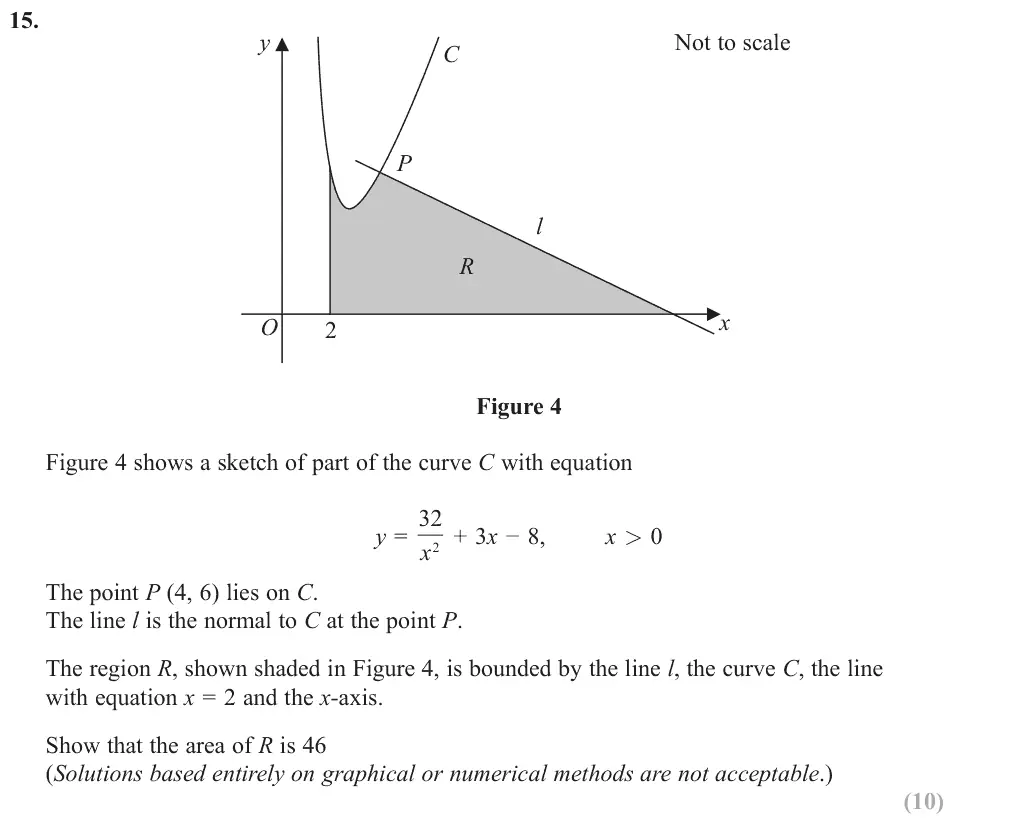
15. y Not to scale C P l R x Figure 4 Figure 4 shows a sketch of part of the curve C with equation y = 32 2x + 3x í 8, = = = = x < 0 The point P (4, 6) lies on C. The line l is the normal to C at the point P. The region R, shown shaded in Figure 4, is bounded by the line l, the curve C, the line with equation x = 2 and the x-axis. Show that the area of R is 46 (Solutions based entirely on graphical or numerical methods are not acceptable.) (10)

Find an Edexcel maths tutor

Want this paper marked and gone through with you? Message us.

Prefer email? Send an enquiry

If you are under 18, please include a parent's contact details. Enquiries go to enquiries@mathsaleveltutor.com and are deleted once handled.