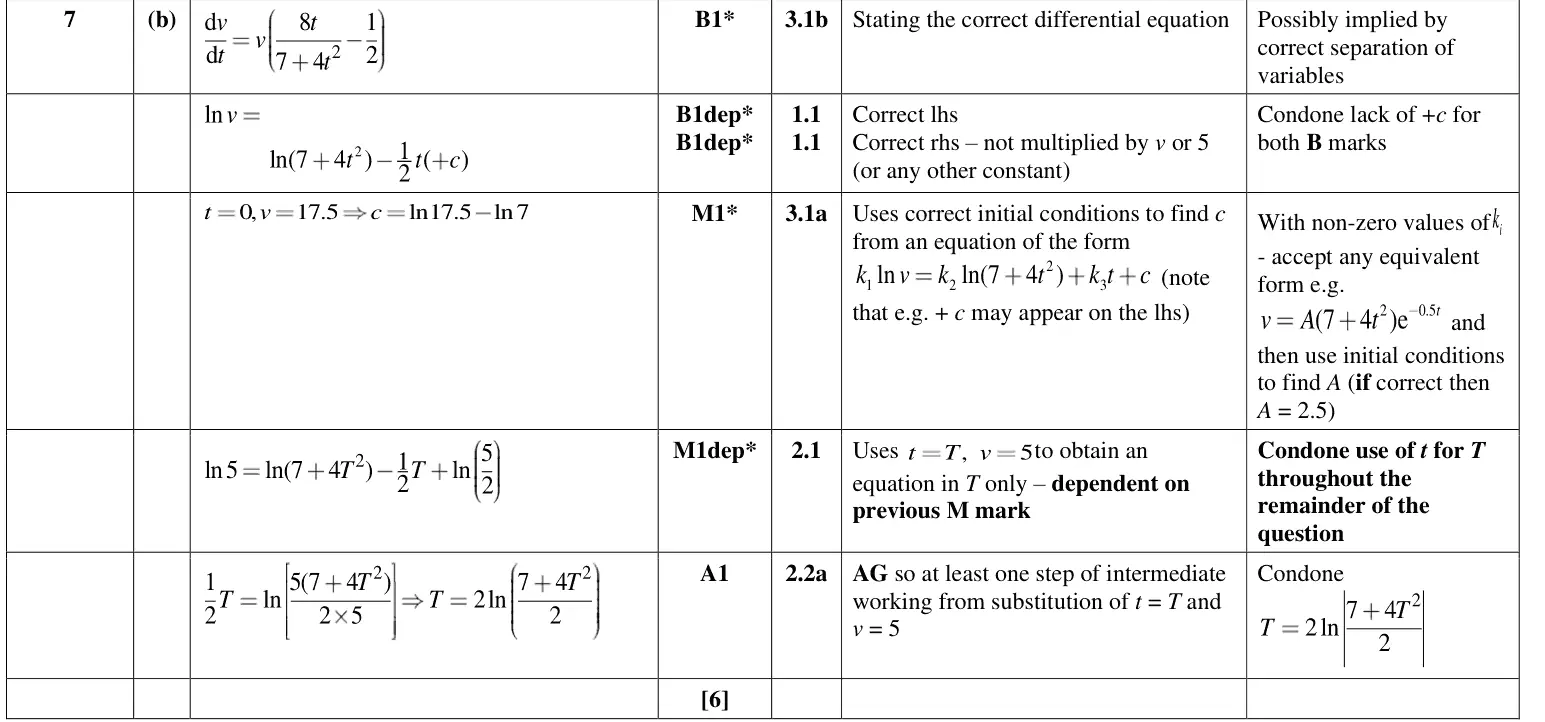
Mark scheme for this part

Examiner's comment
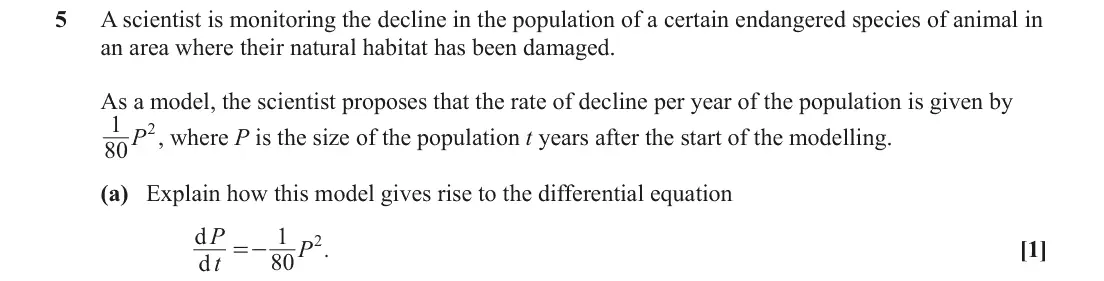
This part was generally well answered, with the majority of candidates providing a sufficiently clear explanation.
Key points and common errors
- link 'decline' to the negative sign
This part was generally well answered, with the majority of candidates providing a sufficiently clear explanation.
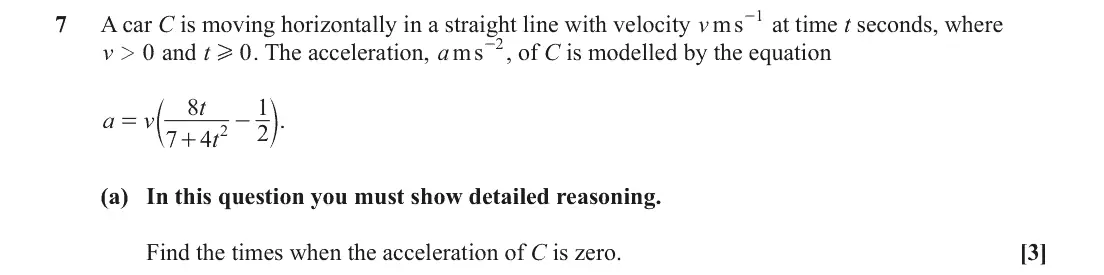

fact that 𝑎𝑎= d𝑡𝑡= 𝑣𝑣ቀ 7+4𝑡𝑡2 − 2ቁ usually separated the variables correctly and went It was surprising in this part how many candidates did not set up a correct differential equation using the d𝑡𝑡. Those that did write on to correctly derive the given result (using the results that 𝑣𝑣= 17.5 when 𝑡𝑡= 0 and 𝑣𝑣= 5 when 𝑡𝑡= 𝑇𝑇). f(𝑥𝑥) d𝑥𝑥= ln|f(𝑥𝑥)| is provided in the formulae at the attempt to integrate ∫ 7+4𝑡𝑡2 d𝑡𝑡 even though the result ∫ Some candidates, after correctly setting up the required differential equation were unsuccessful in their beginning of the assessment.
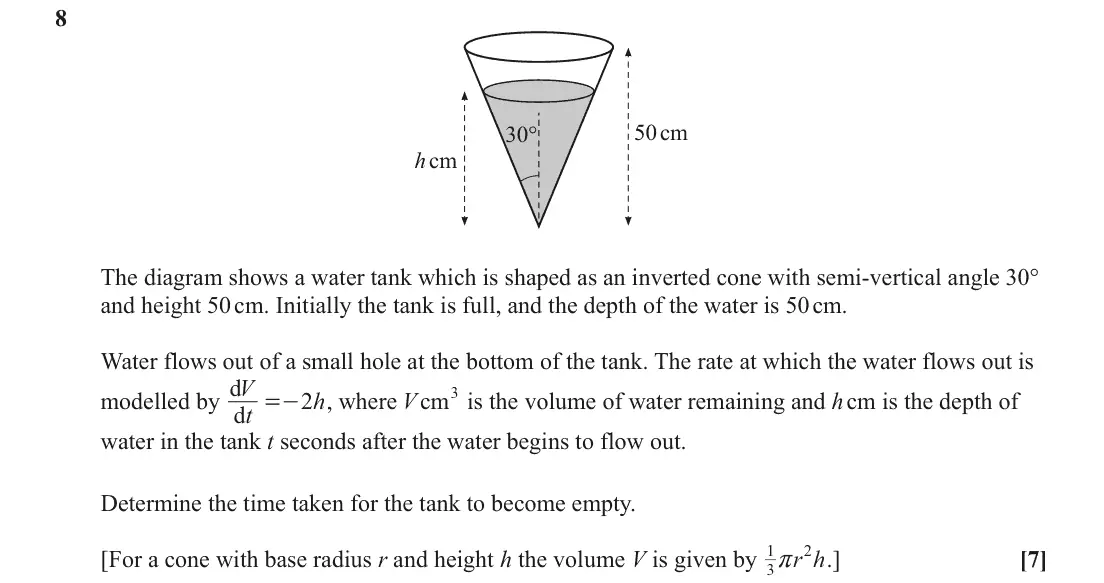
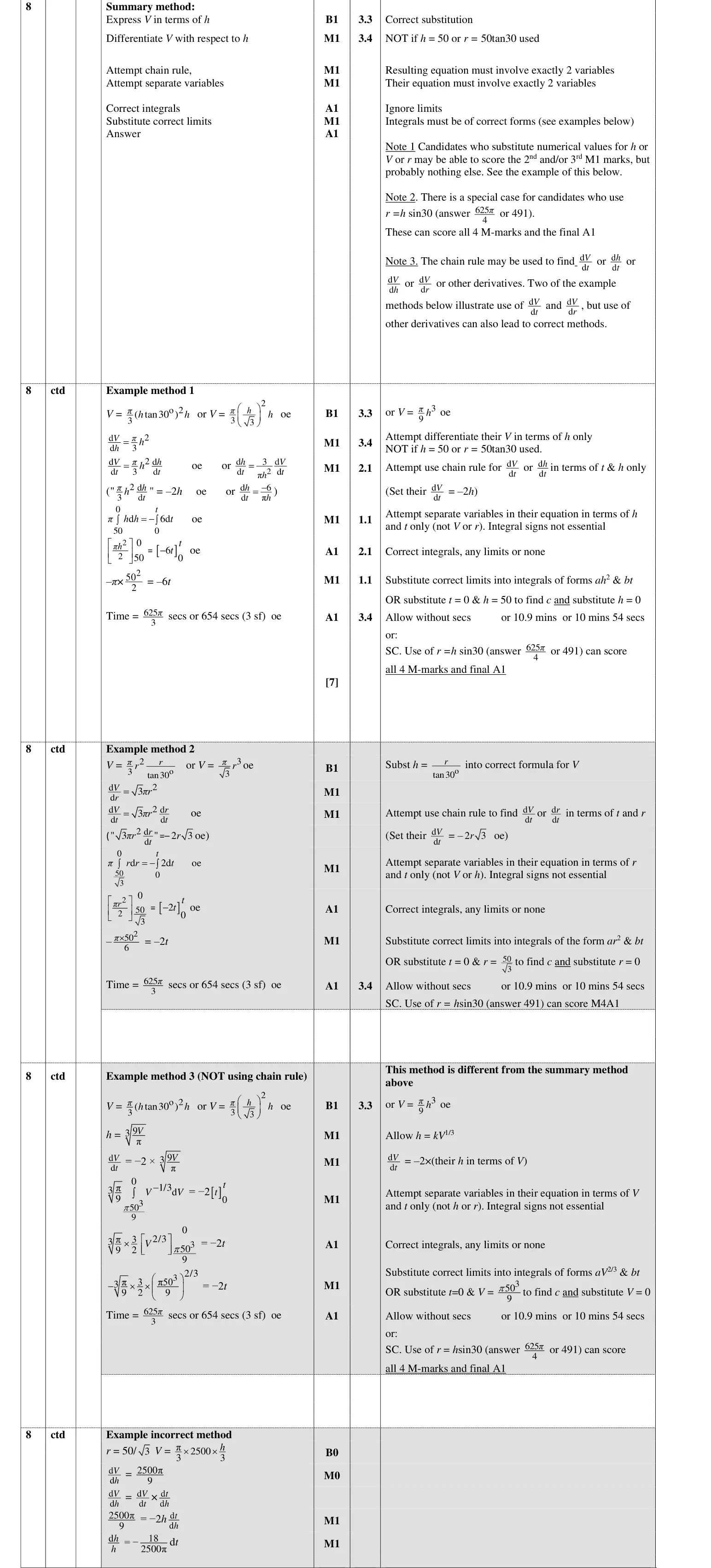
This differential equation question is of a fairly standard type, found in many text books. So one might reasonably expect candidates to be familiar with questions of this type. Despite this, responses were, on the whole, disappointing. In fact, about half the candidates scored 0 marks on this question. However, there were also a good number of excellent solutions. A few candidates thought that r = hsin 30°, but gave an otherwise completely correct solution. These candidates scored 5 marks out of 7. The main difficulty faced by candidates was that there were more than two variables involved (V, h, t and r). Most candidates obtained an equation in three variables, but then attempted to differentiate or integrate, treating one of the variables as a constant. For example: d V d V 1 2 1 3 πr2h ⇒ V = d r = 3 πrh (or d h = 3 πr2). d V h = −2t ⇒ dV = −2tdh ⇒ V = −2th. d Some candidates avoided this trap by using a numerical value for one of the variables, e.g. h = 50 or 50 3 3 r = , thus rendering their equation incorrect. Some candidates appreciated the need to use the chain rule but, while doing so, made one of the above d V d V d t d V d t 1 1 3 πr2 ⇒ h ⇒ d h = d t × d h , but d h = 3 πr2 = (−2t) × d errors. Thus a typical solution was as follows. 2 2 50 3 50 3 π d t 1 ∫ d h 2500 3 3 3 3 π = −2t d h ⇒ = −2tdt ⇒ 9 h = −2t + c. Then use h = 50 when t = 0 to find c and finally substitute h = 0 to find t. Finally, some candidates used a different, correct method that did not require the use of the chain rule. It did, however, involve some rather awkward substitution of a limit. This method can be found on the published mark scheme, Question 8, Example method 3.



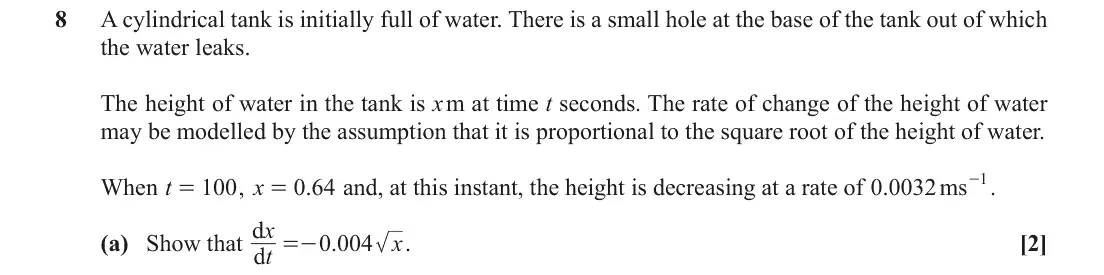
Most candidates were able to set up an appropriate model, with a fairly even split between those who used k and those who used –k, and then attempt to find a value for k. The more astute candidates appreciated that the height decreasing implied a rate of –0.0032, and could use this correctly to justify the given differential equation. The most common misconception was to omit the negative sign from 0.0032, with many not noticing that this resulted in value for k that was not consistent with the given answer.

(Comment on Question 13(i) as a whole) The majority of candidates could state a correct differential equation, including a coefficient of proportionality. The most common error was to have the equation as a function of t not of N. Candidates who had stated a correct equation in part (a) were usually able to rearrange and integrate correctly. They were then able to use the given boundary conditions to find a particular solution to the differential equation. Having got this far, a few candidates did not gain the final mark due to making errors when rearranging the equation to the requested form, such as square rooting term by term.
Stuck on this? Book a trial session with an A-level maths tutor.