1.07s Differentiate simple functions and relations defined implicitly or…
Section
1.07 Differentiation
Level
A level only
Statement
Be able to differentiate simple functions and relations defined implicitly or parametrically for the first derivative only.
Guidance
They should be able to find the gradient at a point on a curve and to use this to find the equations of tangents and normals, and to solve associated problems. Includes differentiation of functions defined in terms of a parameter using the chain rule.
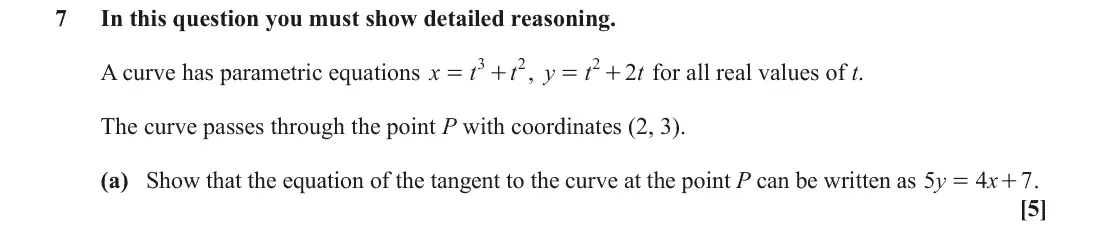
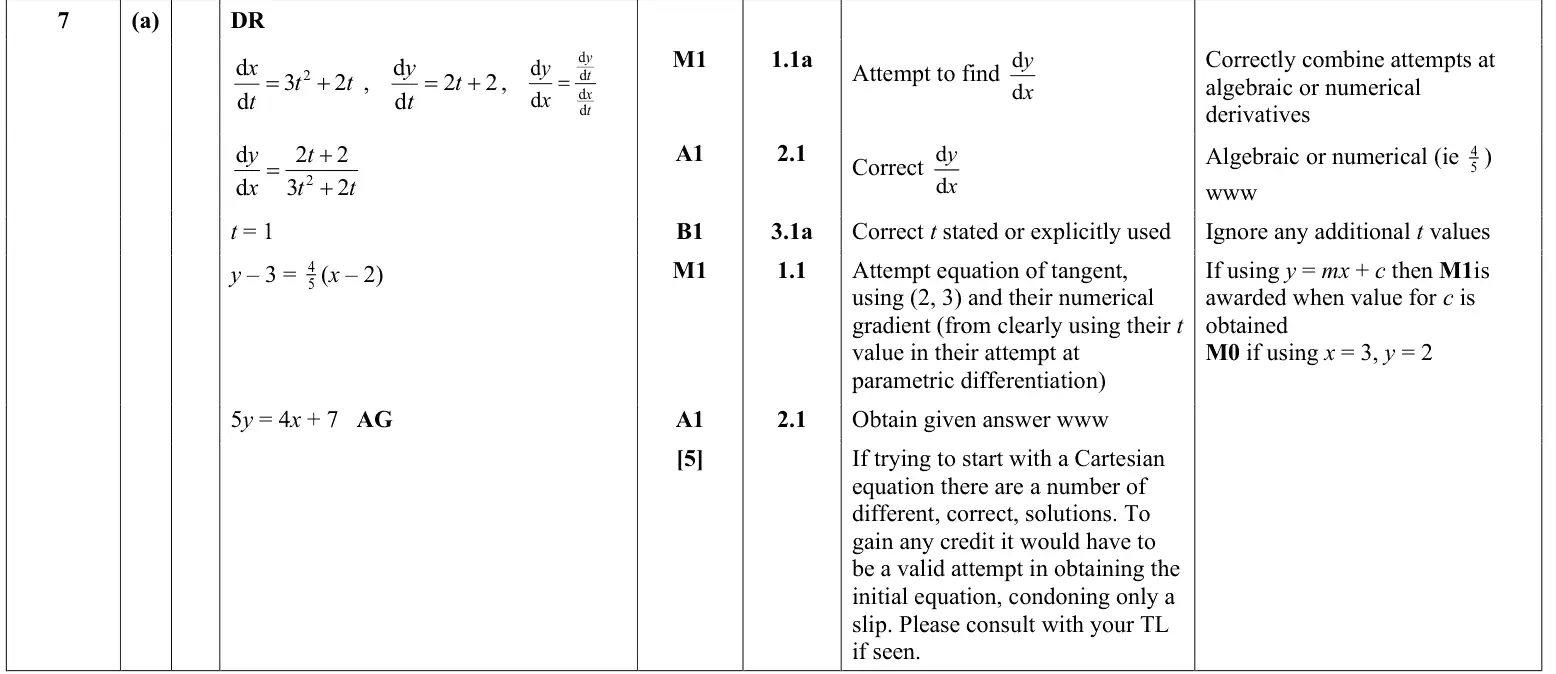
This part of the question was very well answered, with the majority of candidates gaining full credit. They were able to accurately use parametric differentiation to find an expression for the derivative. Candidates were then able to find the correct t-value using a variety of different approaches, and most also justified why any other t-values found were not valid. In ‘show that’ questions it is important that candidates show sufficient method so as to be convincing, especially when the answer is given. Most candidates did show explicit method of using the correct t-value in the correct derivative to obtain the correct gradient However some candidates attempted to work backwards from the given answer and they generally struggled to a provide any evidence that could gain credit. When attempting the equation of a tangent, candidates should be using a numerical gradient which did not always happen.
Key points and common errors
dy/dx = (2t + 2)/(3t² + 2t)
t = 1 at P, gradient 4/5
5y = 4x + 7
justify the t value
June 2024 · Paper 1 · Q12(a)5 marksHard
Mark scheme for this part
Examiner's comment
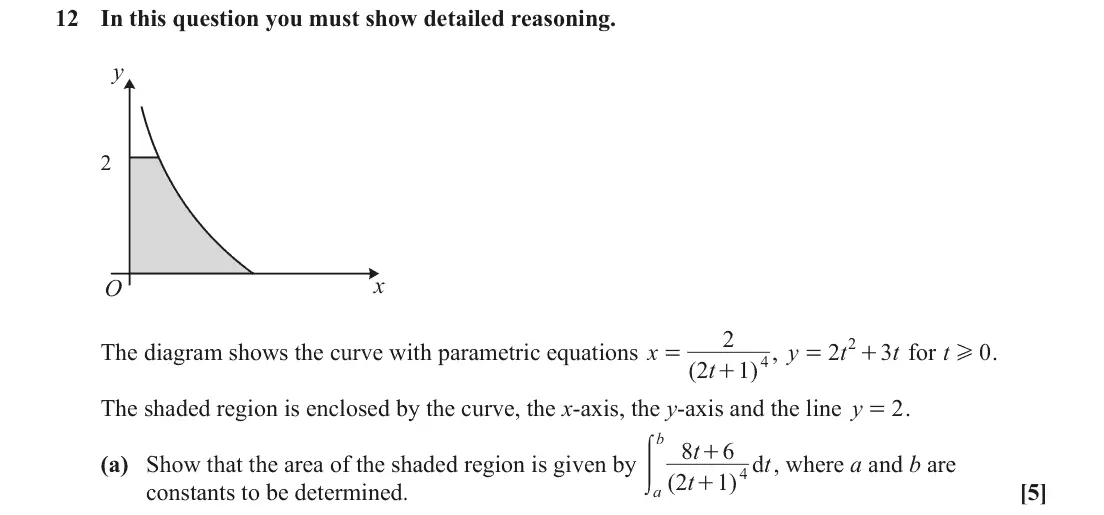
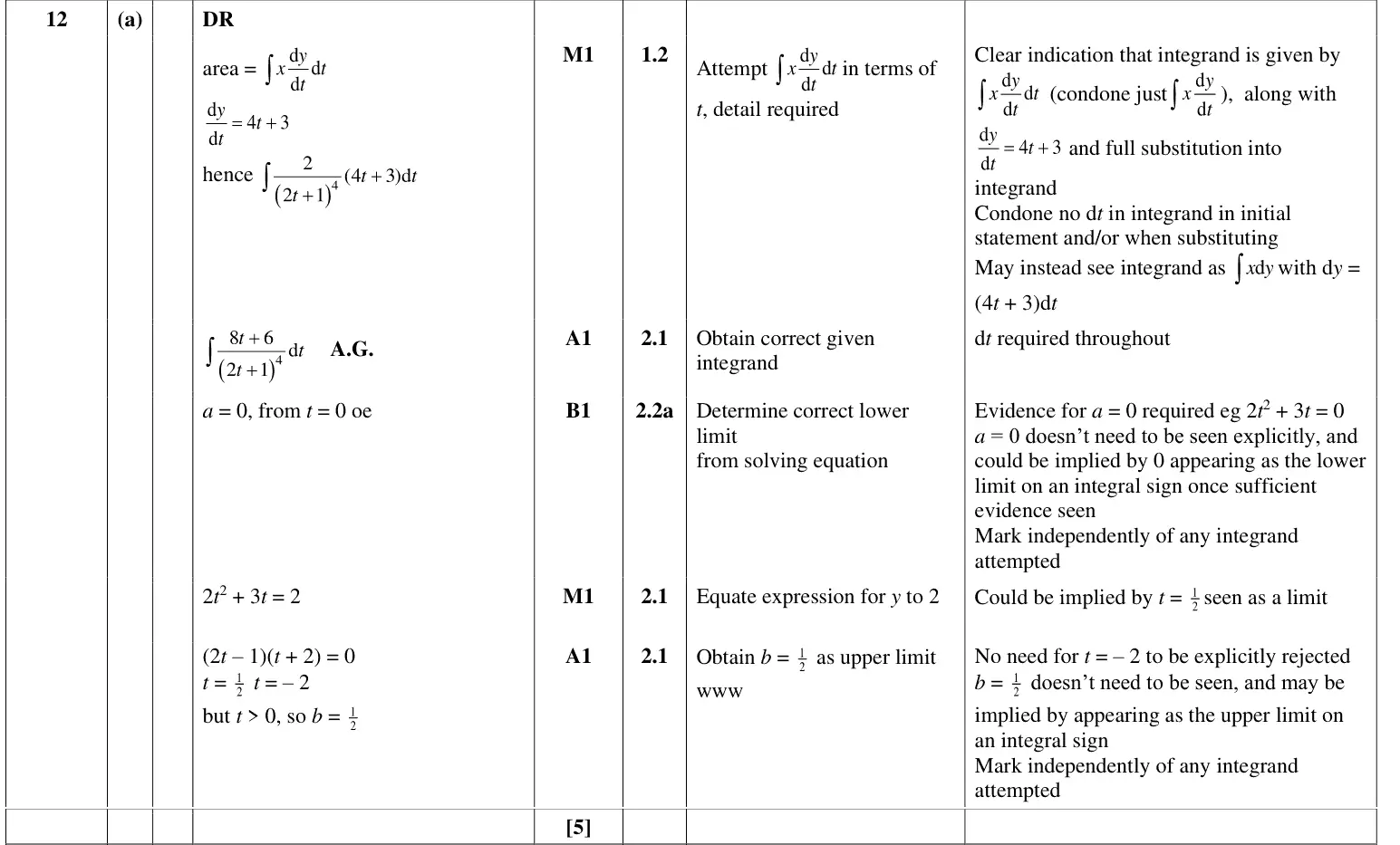
This question was challenging for most candidates to gain all the marks. Most candidates were able to achieve the method mark for equating the y equation to 2 to find the upper limit. These candidates often also equated y to 0 and solved both equations for t to find the correct limits, although the incorrect values from these equations were often chosen. Many candidates did not know how to find the area between a parametric curve and the y-axis and often set about forming the ∫𝑦 𝑑𝑡 𝑑𝑡, with little success in obtaining the given answer. Some candidates were able to work out how to arrive at the given expression inside the integral, but their reasoning was insufficient for the requirements of the question.
Key points and common errors
area to the y-axis = ∫x (dy/dt) dt with dy/dt = 4t + 3
a = 0 from y = 0
2t² + 3t = 2 gives b = ½ (t ≥ 0)
many used ∫y dx/dt dt
June 2024 · Paper 3 · Q77 marksMedium
Mark scheme for this part
Examiner's comment
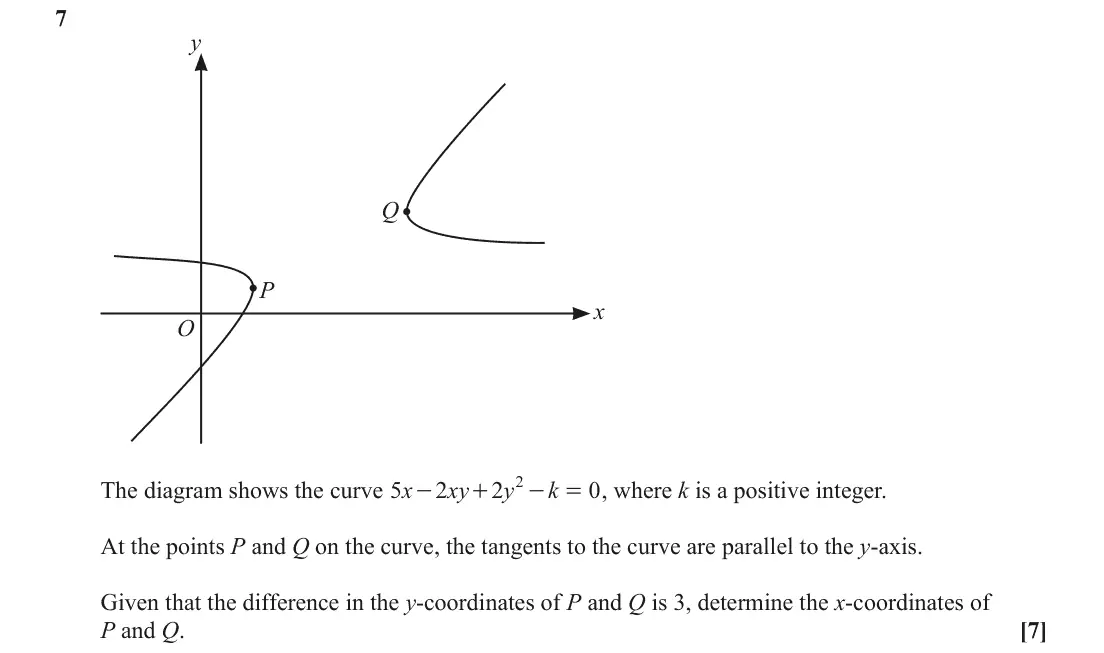
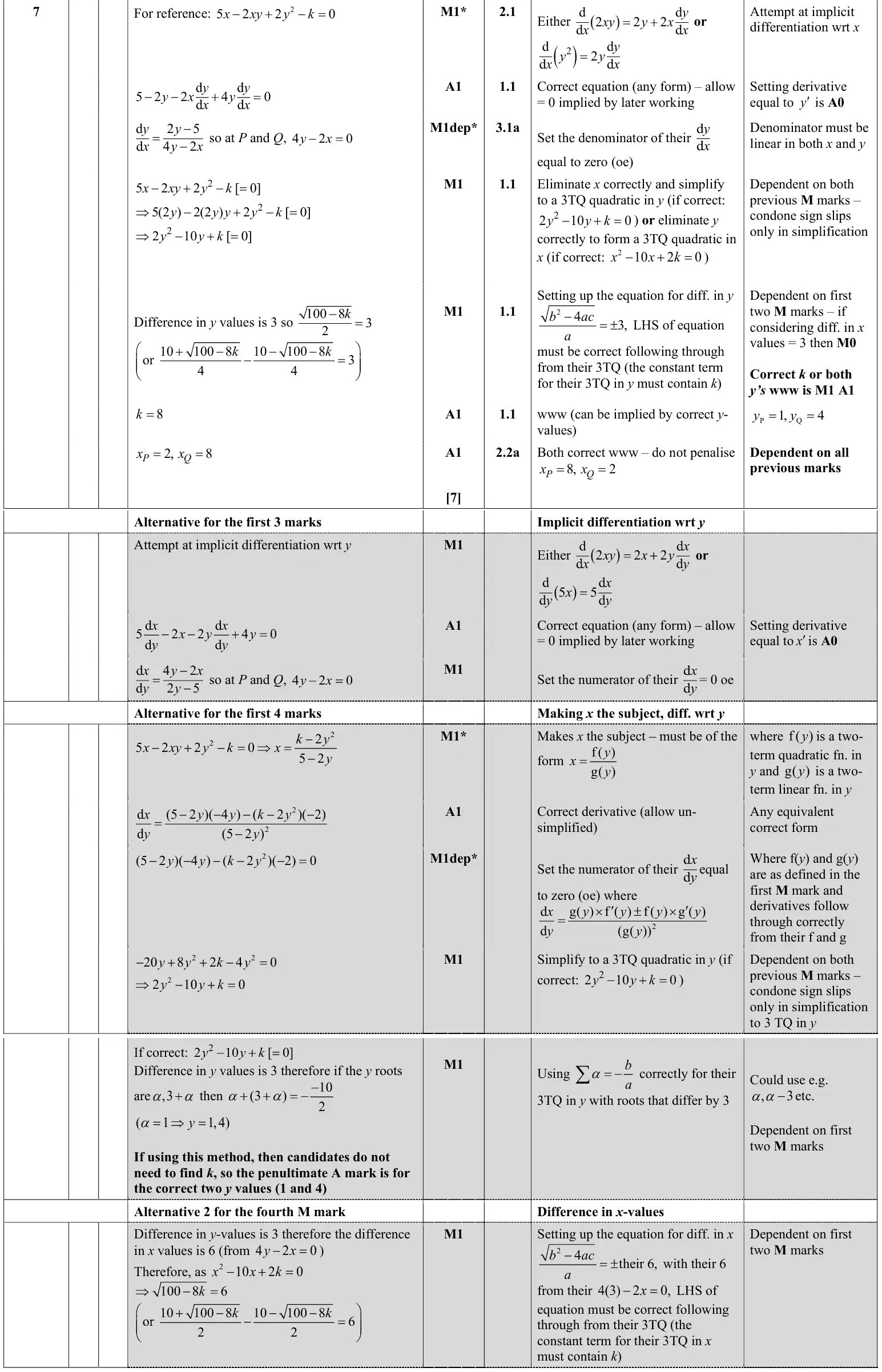
The vast majority of candidates made a good start to this unstructured problem and used implicit differentiation to correctly differentiate the given expression with respect to either 𝑥 or 𝑦. When errors occurred with this differentiation it was usually sign errors when differentiating −2𝑥𝑦 (using the product rule). Most candidates then found an expression for d𝑥 and were then almost equally split between either correctly setting the denominator equal to zero or incorrectly setting the numerator equal to zero. From there it was noted that while many candidates either obtained a correct quadratic equation in either 𝑦 (e.g. 2𝑦2 −10𝑦+ 𝑘= 0) or 𝑥 (e.g. 𝑥2 −10𝑥+ 2𝑘= 0) very few could use the given condition that the difference in the 𝑦-coordinates was 3 (or equivalently the difference in 𝑥-coordinates was 6) to find the correct 𝑥-coordinates of 𝑃 and 𝑄. This candidate scored 4 out of the 7 marks available for correctly differentiating implicitly and obtaining the correct relationship that 4𝑦−2𝑥= 0. They then went on to obtain a correct quadratic equation in 𝑥 but then did not make any further progress. This was relatively common as many candidates did not then realise how they could use the fact that the difference in the 𝑦 values was 3 to find the required 𝑥 coordinates. Section B Overview One general point with regard to the answering of certain mechanics questions should be made in this overview. This is that unless told otherwise the value that candidates should use for the acceleration due to gravity, g, is 9.8 and not 10 or 9.81 (and this value is stated explicitly on the front cover of the examination paper).
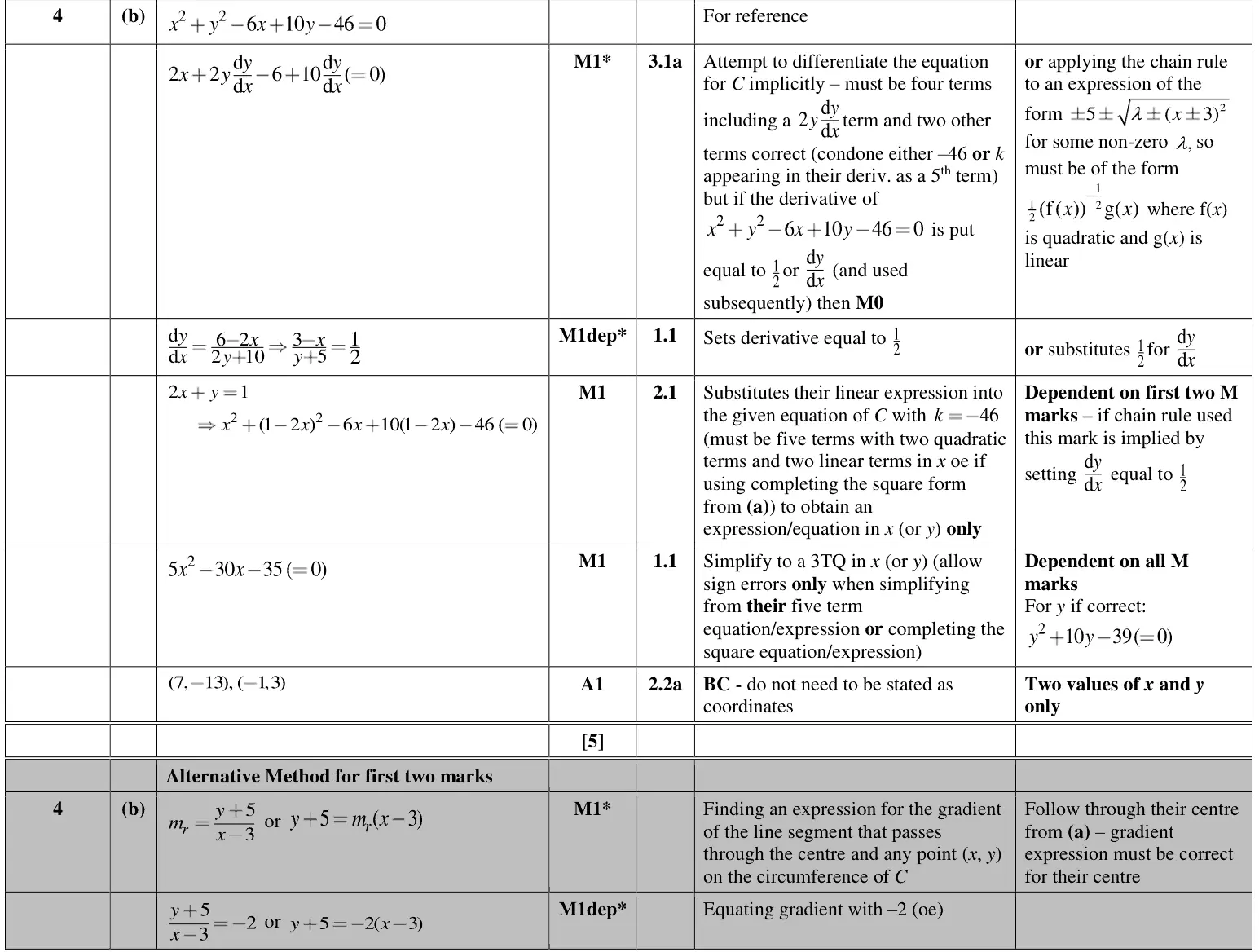
2 to obtain the linear equation 2𝑥𝑥+ 𝑦𝑦= 1. While some candidates, after deriving this The most common approach in this part was to differentiate the given equation for the circle implicitly d𝑥𝑥 equal to and set equation, made no further progress most correctly substituted this equation into the equation for C and solved the resulting three-term quadratic in x. While many obtained the correct x-coordinates as 7 and – 1 not all correctly obtained the corresponding y-coordinates. Candidates are reminded that when solving a pair of simultaneous equations with one linear and one quadratic equation, it is strongly advisable to find the second set of coordinates by substituting into the linear and not the quadratic equation.
Key points and common errors
implicit differentiation, set dy/dx = 1/2 to get 2x + y = 1
substitute into the circle: 5x² − 30x − 35 = 0
points (7, −13) and (−1, 3)
pair y-values with x correctly
June 2023 · Paper 3 · Q5(a)3 marksHard
Mark scheme for this part
Examiner's comment
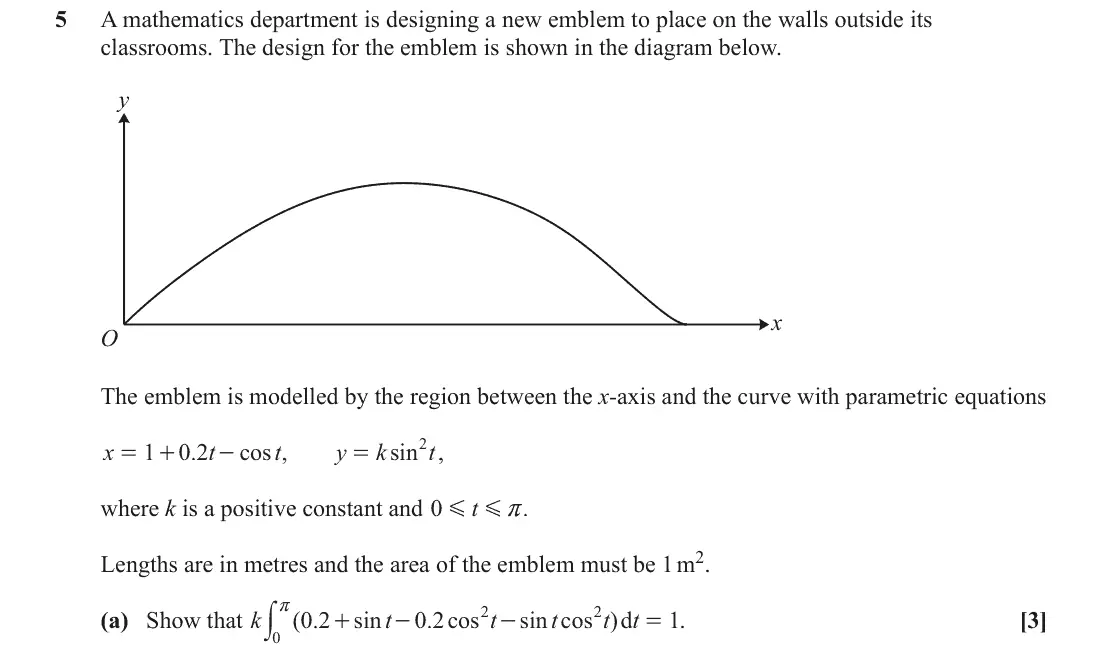
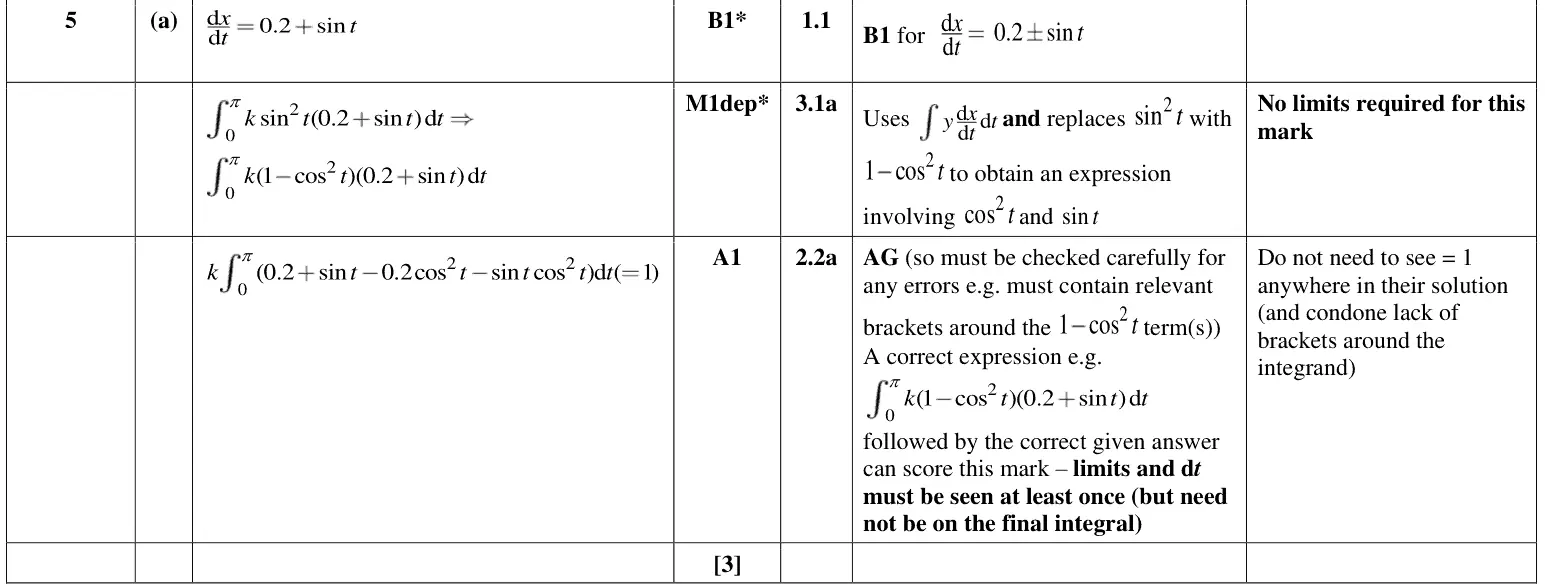
Candidates struggled with both parts of this question with examiners noting that many candidates gave the impression that they were unsure what either part of this question required of them. Some d𝑡𝑡 but only the most able could apply ∫𝑦𝑦 d𝑡𝑡d𝑡𝑡 correctly and derive the given result. candidates in part (a) made a correct start by finding the correct expression for
Key points and common errors
area = ∫ y (dx/dt) dt with dx/dt = 0.2 + sin t and limits 0 to π
replace sin²t by 1 − cos²t
reach the given integral with limits and dt
June 2022 · Paper 1 · Q78 marksHard
Mark scheme for this part
Examiner's comment
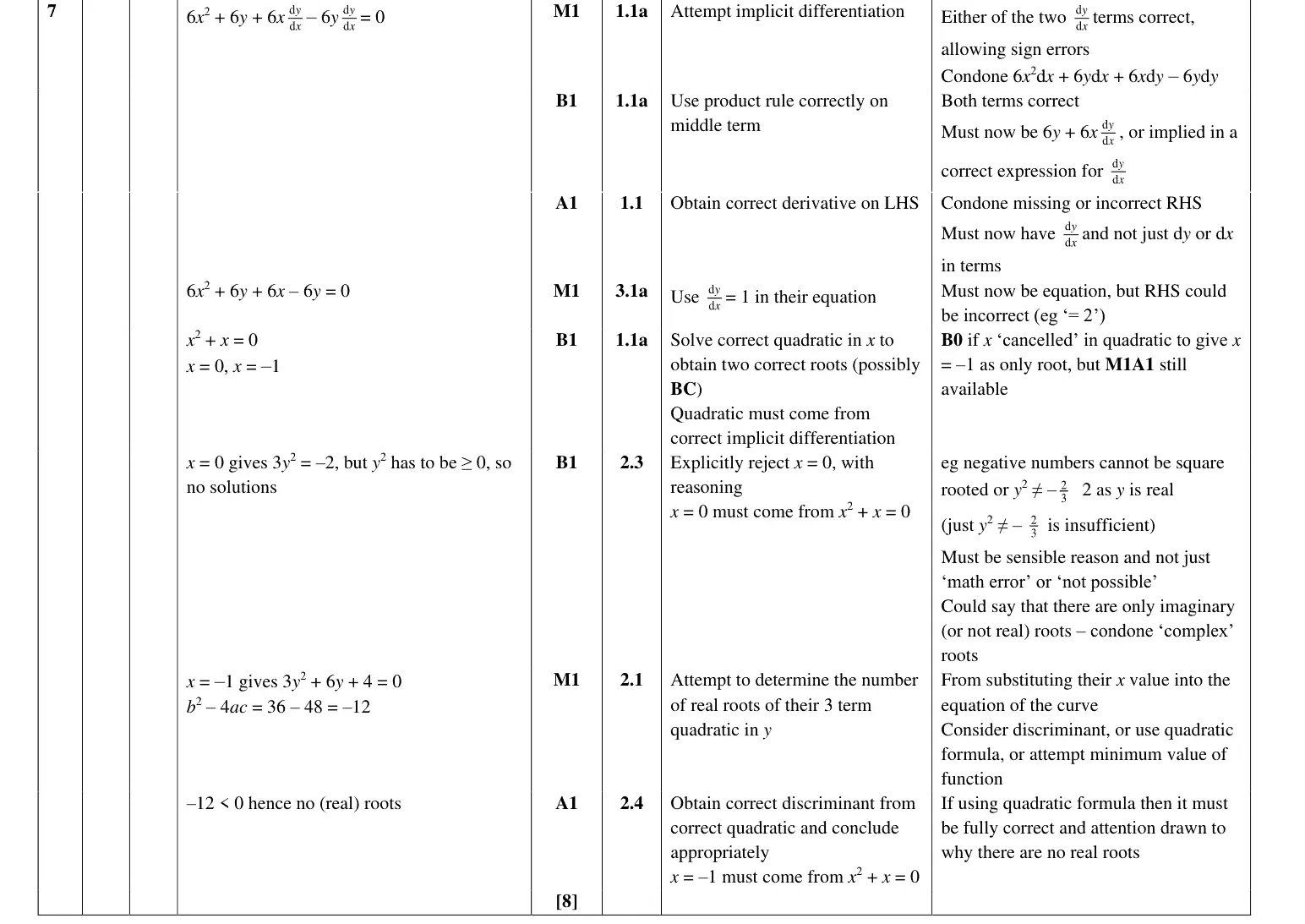
Most candidates could make progress on this question by recognising that it was an implicit equation and making a good attempt to differentiate it. The derivative was usually correct, but the modal mark on this question was 3 marks as many candidates were unsure as to how to then proceed. While a number did set the derivative equal to 1, a common error was to substitute y = x into their derivative. The correct quadratic of x2 + x = 0 was often seen, but there was often some uncertainty as to how to solve this and only the more able candidates were able to obtain both correct roots. Some candidates found just one of the roots by inspection and others, having obtained x2 = – x, observed that a square cannot be negative hence this equation has no roots at all. To gain full credit, examiners expected to see sufficient detail as to why neither root would yield solutions when substituted back into the original equation. While the substitution was seen, the explanations were often lacking in detail. Just stating that 3y2 = – 2 was impossible was not enough and, when considering x = – 1, it was not sufficient to just say that the ensuing quadratic had no roots; this needed to be demonstrated, most typically through considering the discriminant. compelling reasons whenever a solution is discarded. A good solution to Question 7, with clear reasons given as to why neither root will give a valid solution.
Key points and common errors
implicit differentiation with product rule on 6xy
set dy/dx = 1 (not y = x) to get x² + x = 0
x = 0 gives y² = −2/3 impossible
x = −1 gives 3y² + 6y + 4 = 0 with discriminant −12 < 0
June 2022 · Paper 1 · Q12(a)4 marksEasy
Mark scheme for this part
Examiner's comment
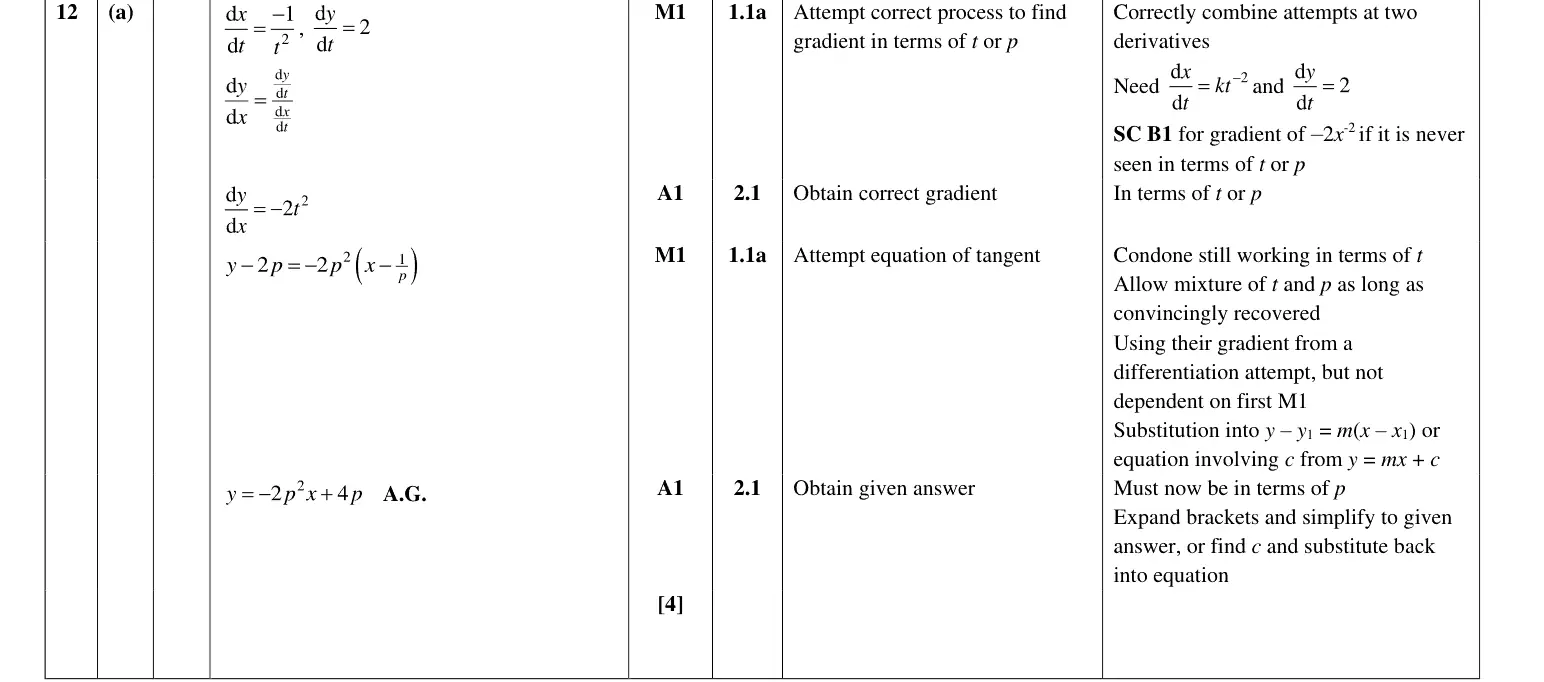
The majority of candidates gained full marks on this part of the question, and it was only a small minority that made no progress. The first 2 marks could be gained by finding a correct expression for the gradient, either in terms of t or p. Most candidates could then attempt the equation of the tangent, but a number struggled to use the same parameter consistently. With a given answer, there is an expectation that method is clearly shown, and most candidates did so.
Key points and common errors
dy/dx = (dy/dt)/(dx/dt) = −2t²
tangent at P: y − 2p = −2p²(x − 1/p) gives y = −2p²x + 4p
use one parameter consistently
June 2022 · Paper 1 · Q12(b)8 marksHard
Show the start of this question
Mark scheme for this part
Examiner's comment
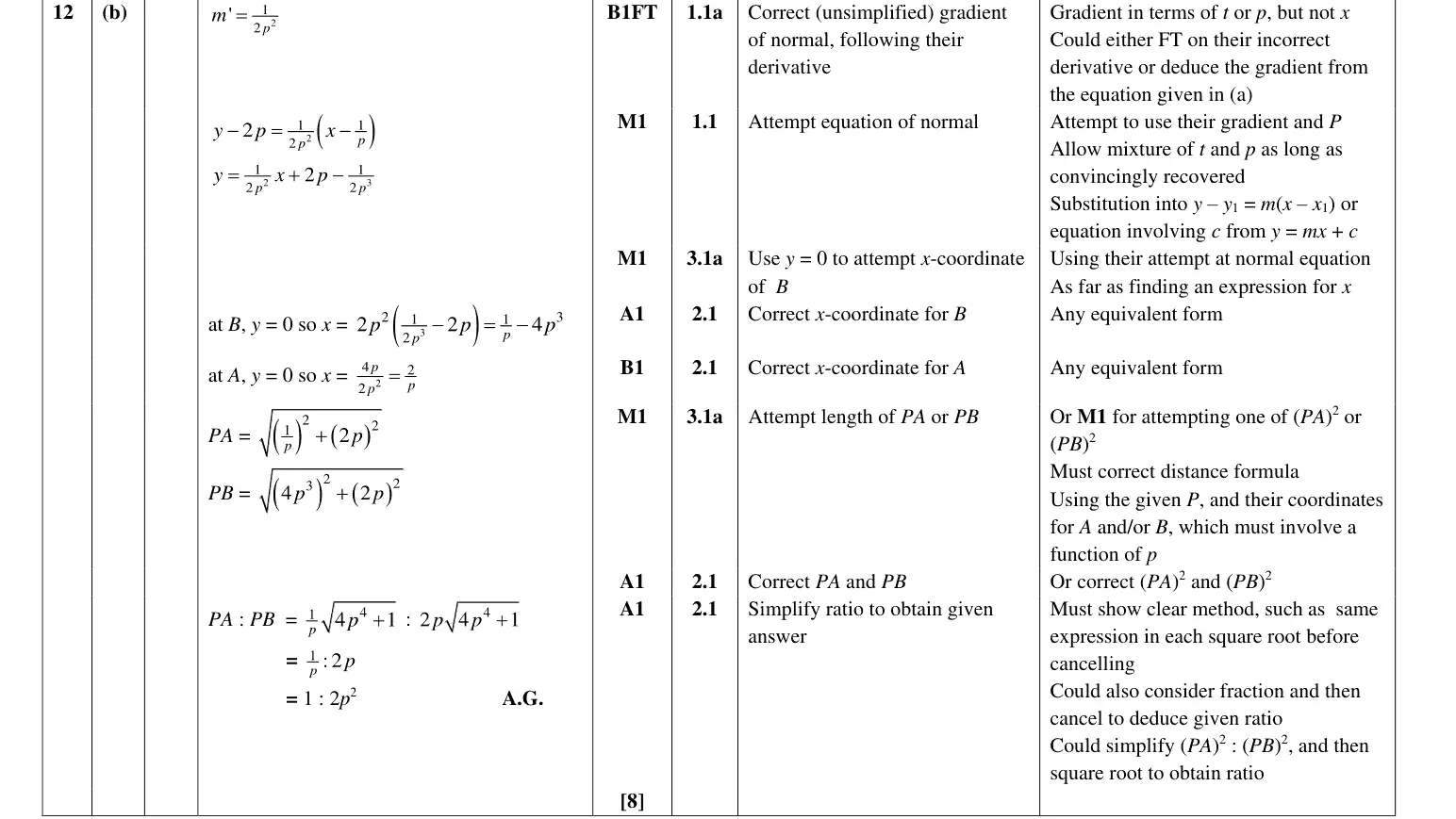
This proved to be a suitable challenging end to the paper, and fully correct solutions were in the minority. A number of candidates made no attempt at all at this part of the question, although it was unclear whether they were lacking inspiration or had run out of time. Of the remainder, most were able to make a reasonable attempt at finding the coordinates of A and B, though a number struggled with the algebraic manipulation required. Some candidates did not realise that it was the ratio of lengths that was required, and made no progress on the final 3 marks. When attempting the ratio, some candidates simplified both surds to a common factor, others attempted a division or demonstrated the veracity of the given answer, all with convincing use of algebra.
Key points and common errors
normal gradient 1/(2p²)
A at x = 2/p, B at x = 1/p − 4p³
PA = (1/p)√(4p⁴ + 1), PB = 2p√(4p⁴ + 1) so PA:PB = 1:2p²
ratio of lengths, not coordinates
Autumn 2021 · Paper 1 · Q9(c)4 marksHard
Show the start of this question
Mark scheme for this part
Examiner's comment
(From the general report) Question 9, covering aspects of parametric equations, proved challenging for a significant proportion of candidates. Question 9 highlighted confusion about when to use x = 0 or y = 0 when investigating the path of a particle defined parametrically.
Key points and common errors
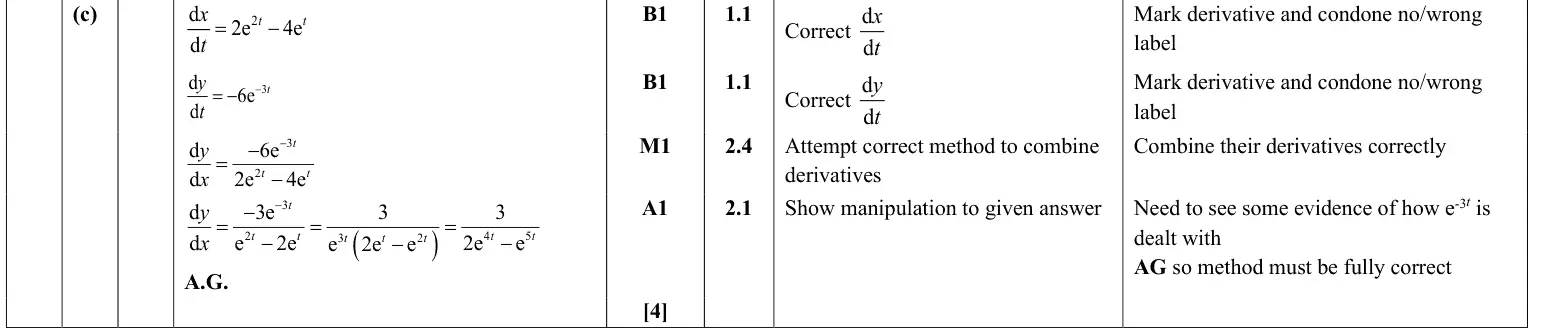
dx/dt = 2e^(2t) − 4eᵗ, dy/dt = −6e^(−3t)
divide
show how e^(−3t) is dealt with to reach the given form
Autumn 2021 · Paper 1 · Q9(d)3 marksHard
Show the start of this question
Mark scheme for this part
Examiner's comment
(From the general report) Question 9, covering aspects of parametric equations, proved challenging for a significant proportion of candidates. Question 9 highlighted confusion about when to use x = 0 or y = 0 when investigating the path of a particle defined parametrically.
Key points and common errors
parallel to y-axis when denominator 2e^(4t) − e^(5t) = 0
t = ln 2
(−1, ¼)
Autumn 2020 · Paper 3 · Q5(a)4 marksMedium
Mark scheme for this part
Examiner's comment
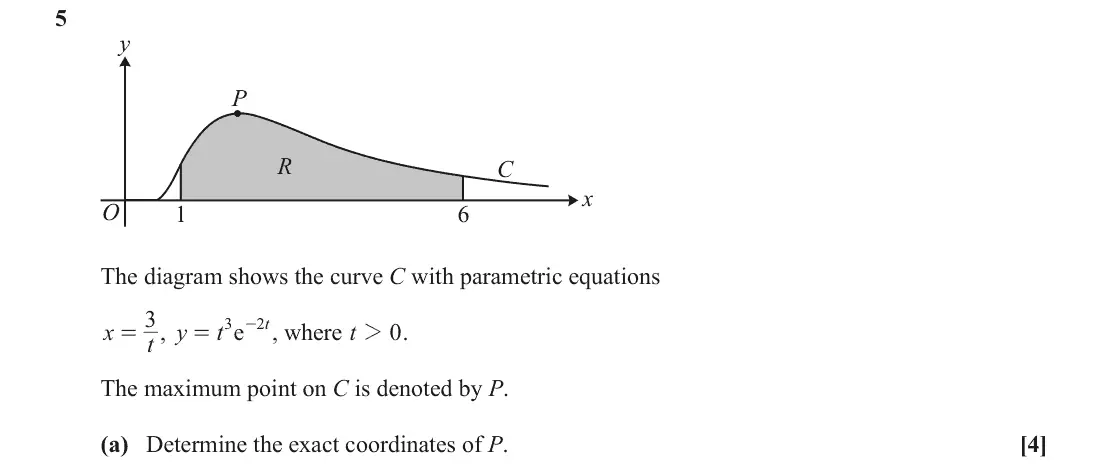
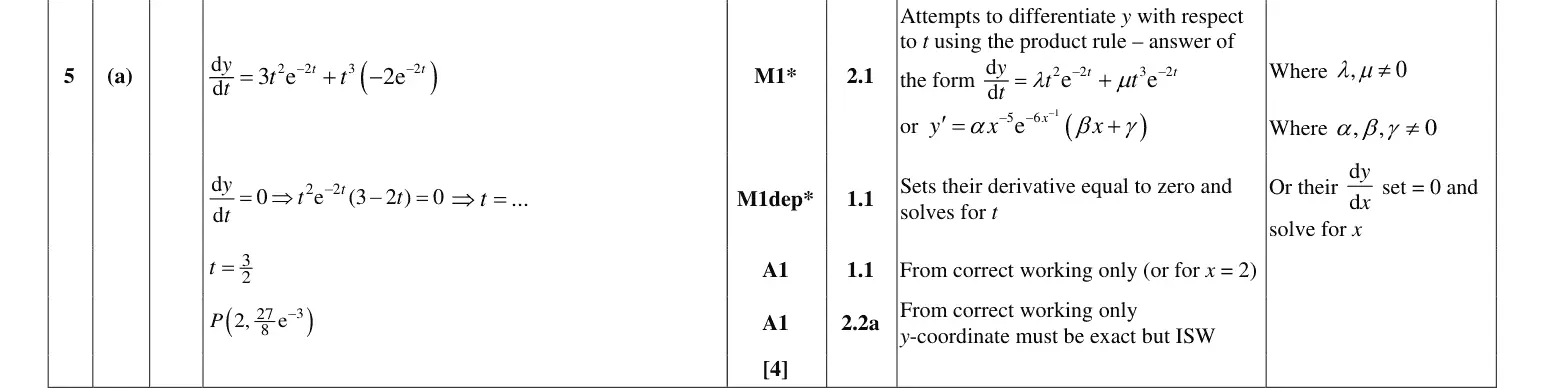
(Comment on Question 05 as a whole) Unless explicitly requested, candidates should avoid converting parametric equations into the cartesian form due to the complexity. d y In part (a) candidates only needed to determine where t = 0 . Unfortunately, some candidates made d errors in the denominator when finding d y x , and while this may not impact the numerical answer d obtained, there is a standard principle that answers obtained with wrong working will not gain full credit. The other issue with this question was that the ‘exact coordinates of P ’ was needed, those candidates that provided a decimal approximation would not gain full credit (unless the exact value had been seen as part of the working). The first issue with part (b) was that the limits were given on the diagram as x = and 1 , but the x = 6 integration was to be done with respect to t ; a number of candidates did not spot this. This was a ‘Show that’ question so the initial method mark was to find d x t and to show a clear attempt to use this in d d d x ∫ y t . The final accuracy mark was to rearrange into the given form. d t Part (c) involved using the formula given in part (b) to ‘Hence’ determine the area. Generally, this was done well, with candidates correctly giving their answer in ‘exact’ form in terms of e .
Key points and common errors
dy/dt = 3t²e⁻²ᵗ − 2t³e⁻²ᵗ = 0 so t = 3/2
P(2, (27/8)e⁻³) exact
no need to convert to cartesian
Autumn 2020 · Paper 3 · Q6(a)3 marksEasy
Mark scheme for this part
Examiner's comment
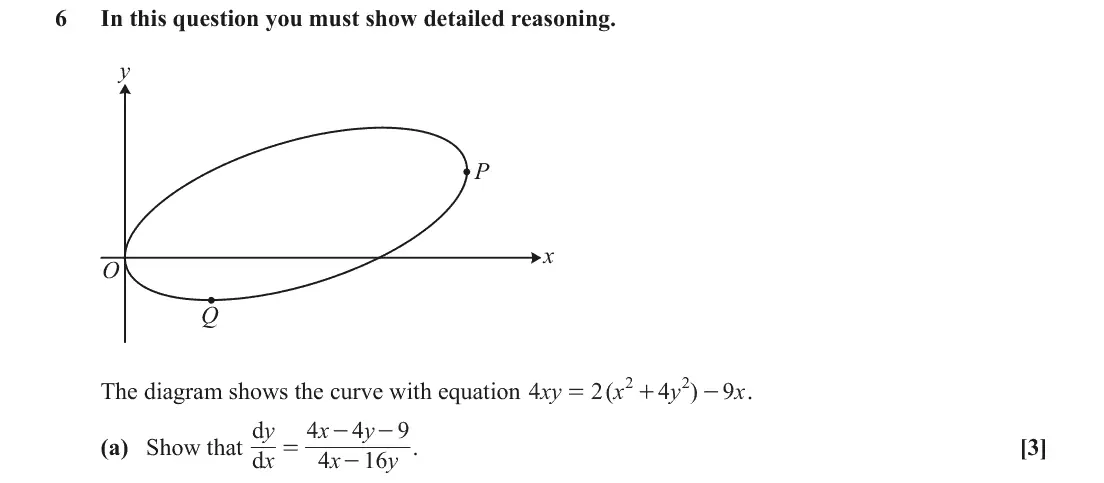
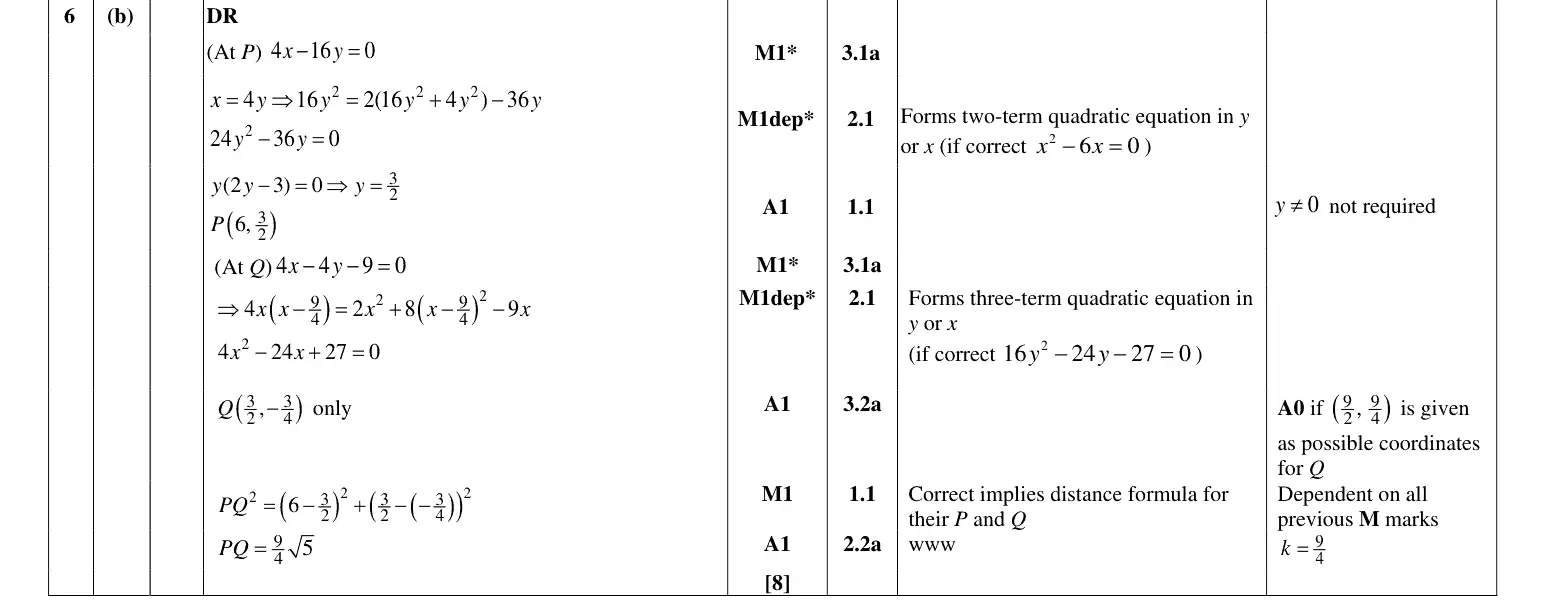
(Comment on Question 06 as a whole) This was the only ‘In this question you must show detailed reasoning’ on this paper. Examiners will be very focused on the individual steps of the calculation on these questions, signified by the ‘DR’ notation in the mark scheme. Part (a) was generally well answered, candidates appeared to be well prepared for this type of question. A common error was to start the mathematical argument with d y x = followed by the correct set of d differentiated terms with equals sign. Some candidates dropped marks due to careless algebra manipulation. In part (b), those candidates that recognised the correct gradients of the tangents at P and Q generally went on to use their values for the coordinates to find PQ and score many of the 5 method marks. However poor algebra manipulation cost accuracy marks. A number of candidates solved the quadratic equation generated to find Q, but then chose the coordinates 9 9 , . Candidates should use all information given in the question, including any sketched 2 4 d y curves. In this case, candidates were expected to recognise that the two results for x = 0 were valid, d but that the diagram indicated which horizontal tangent was to be used. Note that those candidates that used 9 9 , to find their PQ with no wrong working would have scored 6 out 8. There was not an explicit 2 4 mark given for discounting the unwanted quadratic solutions on this question, however it is good practice and may be penalised in other ‘DR’ questions.
(Comment on Question 06 as a whole) This was the only ‘In this question you must show detailed reasoning’ on this paper. Examiners will be very focused on the individual steps of the calculation on these questions, signified by the ‘DR’ notation in the mark scheme. Part (a) was generally well answered, candidates appeared to be well prepared for this type of question. A common error was to start the mathematical argument with d y x = followed by the correct set of d differentiated terms with equals sign. Some candidates dropped marks due to careless algebra manipulation. In part (b), those candidates that recognised the correct gradients of the tangents at P and Q generally went on to use their values for the coordinates to find PQ and score many of the 5 method marks. However poor algebra manipulation cost accuracy marks. A number of candidates solved the quadratic equation generated to find Q, but then chose the coordinates 9 9 , . Candidates should use all information given in the question, including any sketched 2 4 d y curves. In this case, candidates were expected to recognise that the two results for x = 0 were valid, d but that the diagram indicated which horizontal tangent was to be used. Note that those candidates that used 9 9 , to find their PQ with no wrong working would have scored 6 out 8. There was not an explicit 2 4 mark given for discounting the unwanted quadratic solutions on this question, however it is good practice and may be penalised in other ‘DR’ questions.
Key points and common errors
P: denominator 0 so x = 4y, gives P(6, 3/2)
Q: numerator 0 gives Q(3/2, −3/4) (reject (9/2, 9/4) using the diagram)
PQ = (9/4)√5
June 2019 · Paper 1 · Q5(a)4 marksEasy
Mark scheme for this part
Examiner's comment
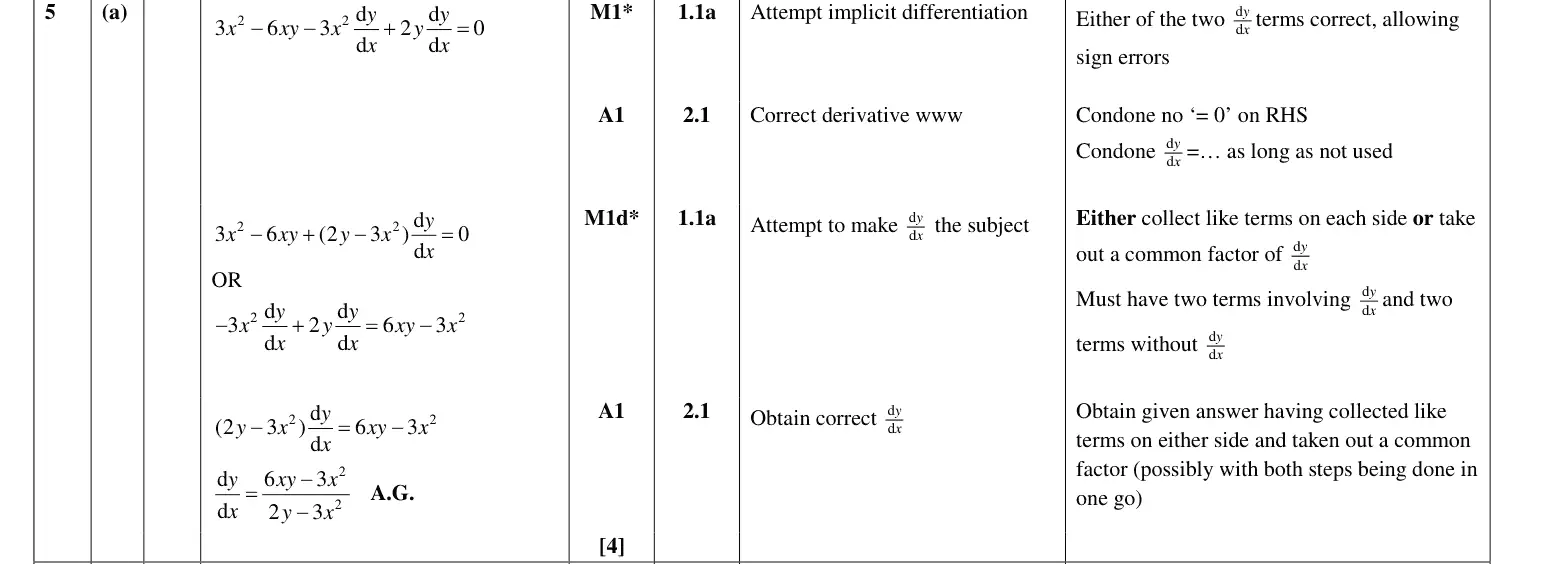
This question was very well answered, with many fully correct solutions seen. Candidates seemed familiar with implicit differentiation, and were then able to provide convincing evidence of how the given answer was obtained. The most common error was for the sign to be incorrect on the second term coming from the differentiation of –3x2y. It was clear that some candidates realised from their final answer that a sign error had occurred, and attempted to correct this, but did not always amend all of the relevant lines. When a candidate identifies that an error has occurred it can be better to delete this solution and start afresh so as to provide a fully convincing solution.
Key points and common errors
implicit differentiation, product rule on −3x²y (sign errors common)
collect dy/dx terms to reach the given answer
June 2019 · Paper 1 · Q5(b)4 marksEasy
Show the start of this question
Mark scheme for this part
Examiner's comment
This part of the question was also very well answered, with the majority of the candidates gaining full credit. The most successful candidates found a numerical value for the gradient of the tangent and from this found the gradient, and hence the equation, of the normal. Attempts to find the negative reciprocal algebraically tended to be less successful, and some candidates even used this algebraic expression in their equation of the normal.
Key points and common errors
dy/dx = 9 at (1, 2), normal gradient −1/9
x + 9y = 19
use a numerical gradient, not an algebraic one
June 2019 · Paper 2 · Q3(b)6 marksMedium
Mark scheme for this part
Examiner's comment
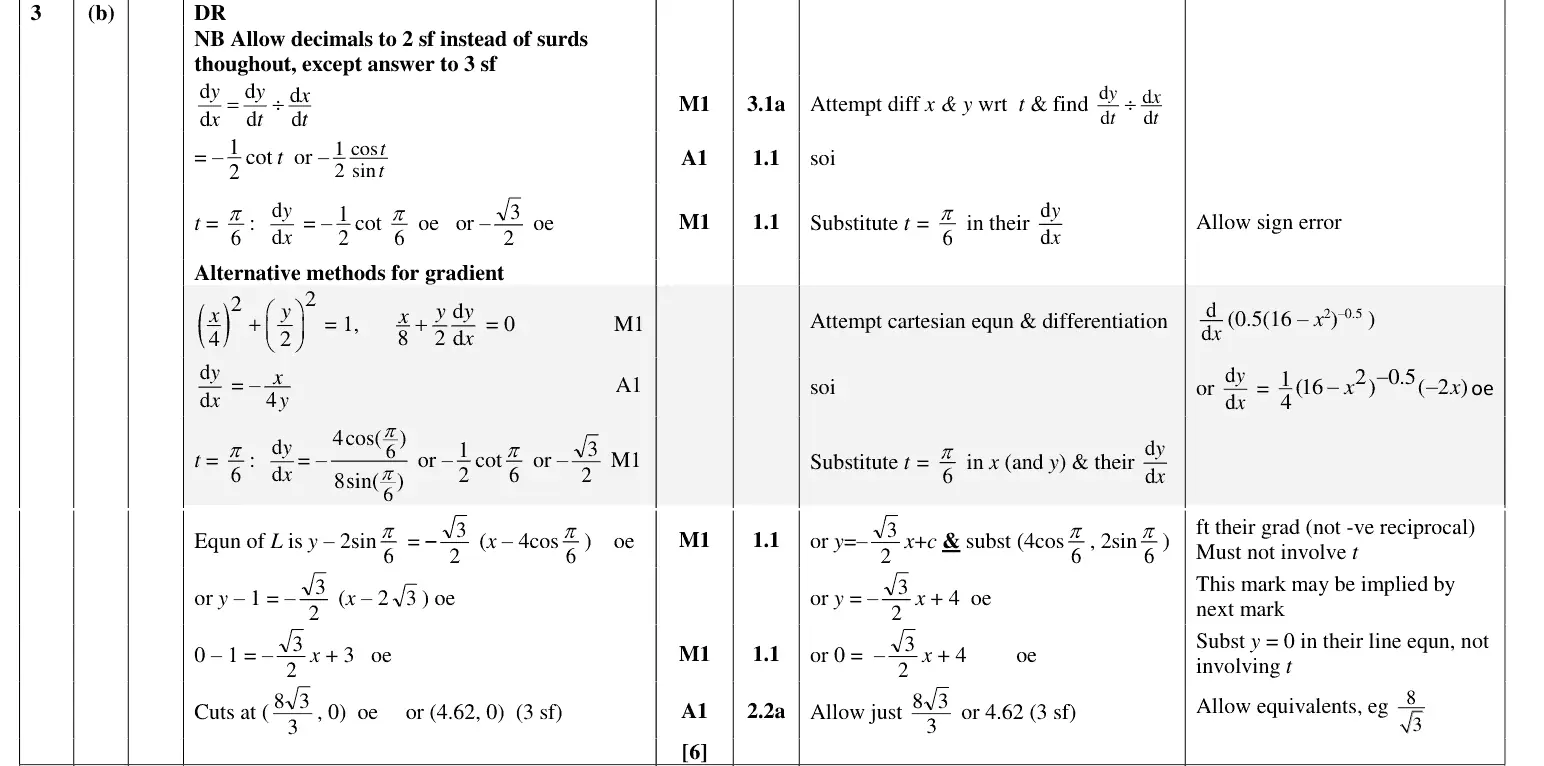
Most candidates recognised that the starting point was to find the gradient of the curve at the relevant point. Most of these successfully found d x by dividing d y y t by d x t . A few made errors while substituting d d d π t = , such as omitting the "–" sign. Many candidates carried out the next two steps (finding the 6 equation of the line and substituting y = 0) correctly. However, arithmetical errors were legion. It is worth noting that some candidates combined these steps into one, not giving explicitly the equation of the line before substituting y = 0. This is not incorrect and was not penalised, but it possibly led to more errors than would otherwise have occurred. It also certainly made the marking more difficult, and sometimes marks could not be awarded because candidates' working was not clear enough. Some candidates found the gradient of the normal and used this as the gradient of the tangent. π Some candidates retained "t " in their working until a late stage, only substituting t = at the end. This 6 led to working being more complex and confusing than necessary, and sometime led to errors along the way. A few candidates found the point where the curve cuts the x-axis, instead of where the line cuts the x- axis.
Key points and common errors
dy/dx = (dy/dt)/(dx/dt) = −½cot t
at t = π/6 gradient −√3/2
tangent through (2√3, 1)
cuts x-axis at 8√3/3
arithmetic errors common
June 2018 · Paper 1 · Q10(i)4 marksMedium
Mark scheme for this part
Examiner's comment
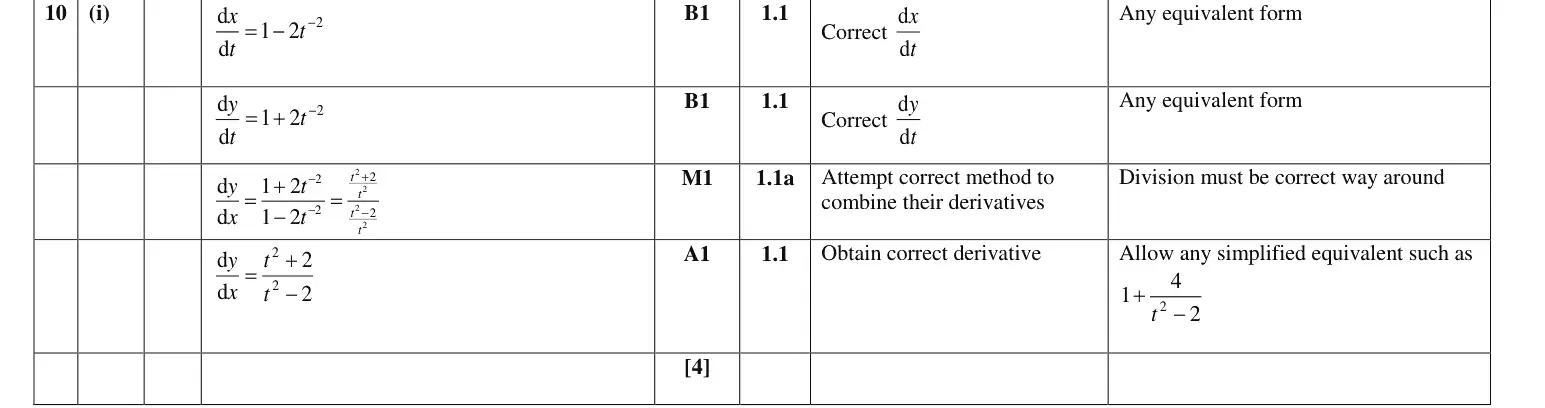
Most candidates gained at least 3 marks for obtaining a correct expression for the derivative, but the subsequent simplification proved to be more challenging. Candidates who worked with fractions tended to be more successful than those who worked with negative indices. The most common error was ‘cancelling’ just a single term in the numerator and denominator.
Key points and common errors
dx/dt = 1 − 2t⁻², dy/dt = 1 + 2t⁻²
dy/dx = (t² + 2)/(t² − 2)
common error cancelling single terms
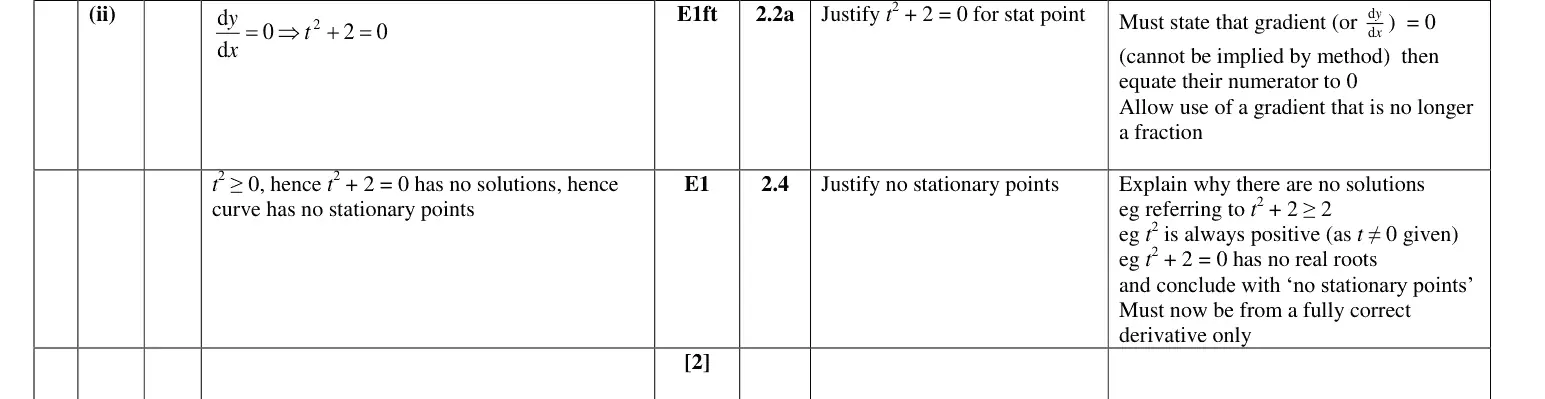
June 2018 · Paper 1 · Q10(ii)2 marksMedium
Show the start of this question
Mark scheme for this part
Examiner's comment
Whilst most candidates were able to attempt the correct method, many did not give sufficient detail of their reasoning. Rather than just equating the derivative to 0 examiners expected to see some justification for this, such as a statement that the gradient is 0 at a stationary point. Candidates were then expected to explain why the equation t 2 + 2 = 0 had no real roots before concluding that this meant there were no stationary points.
Key points and common errors
stationary point needs dy/dx = 0 so t² + 2 = 0
no real solutions since t² ≥ 0
justification required
Find an A-level maths tutor
Stuck on this? Book a trial session with an A-level maths tutor.