Understand and be able to use the laws of logarithms: 1. logₐ x + logₐ y = logₐ(xy); 2. logₐ x − logₐ y = logₐ(x/y); 3. k logₐ x = logₐ xᵏ (including, for example, k = −1 and k = −½).
Guidance
Learners should be able to use these laws in solving equations and simplifying expressions involving logarithms. [Change of base is excluded.]
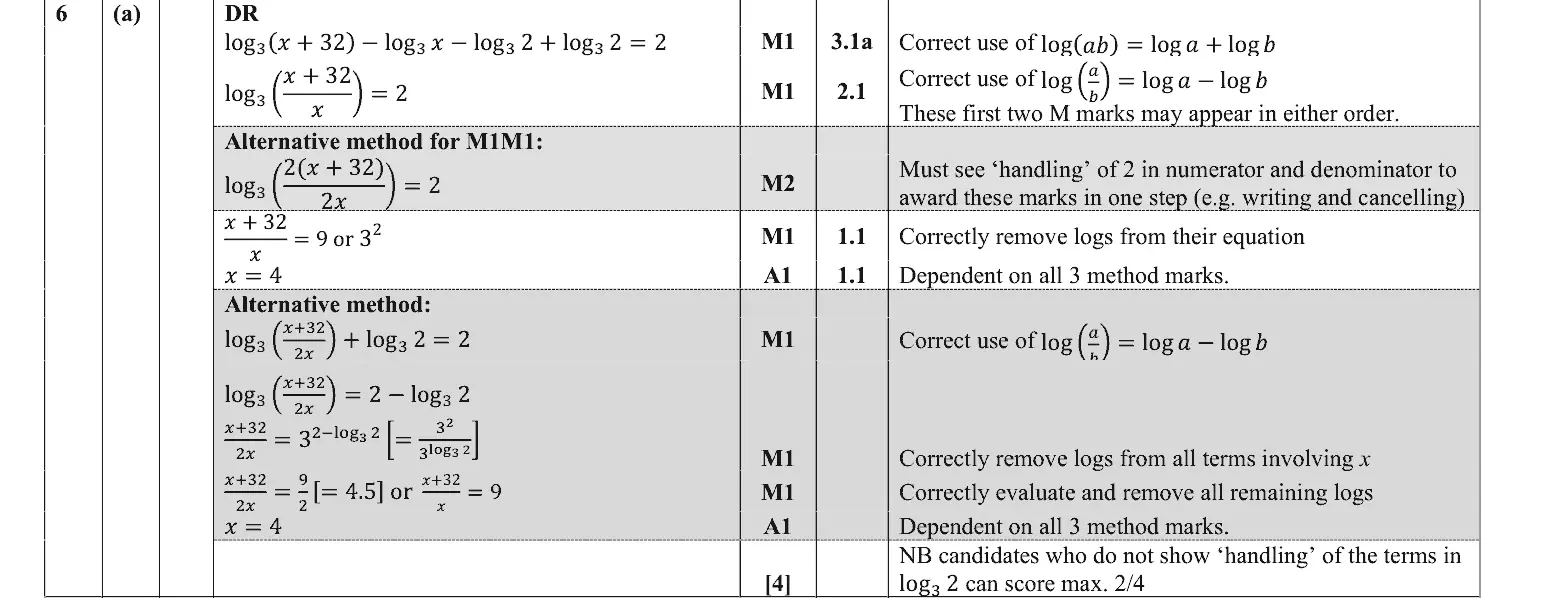
This challenging question was well answered by many candidates. As in Question 1, most candidates heeded the DR instruction and showed a good amount of working to demonstrate their work to simplify the log terms in the given equation. Some candidates combined all the log terms in a single step, which was permissible provided that it was clear and correct – specifically here this meant that candidates needed to show two in both the numerator and denominator so that it was clear that these terms had been ‘handled’ correctly. Quite a few candidates misremembered the relevant log laws and confused multiplication/addition, etc. leading to errors such as log3 32𝑥. Some candidates completed the first two simplifying steps correctly and then made an error in ‘converting’ the log terms, for instance giving the base as two rather than three. Some candidates incorrectly combined the last two terms to log 4𝑥. It was quite common to see the correct answer 𝑥= 4 from incorrect working, which was not credited.
Key points and common errors
log₃((x + 32)/x) = 2 after handling the log 2 terms
(x + 32)/x = 9 so x = 4
misremembered log laws
wrong base when removing logs
June 2025 · Paper 1 · Q12(b)7 marksHard
Show the start of this question
Mark scheme for this part
Examiner's comment
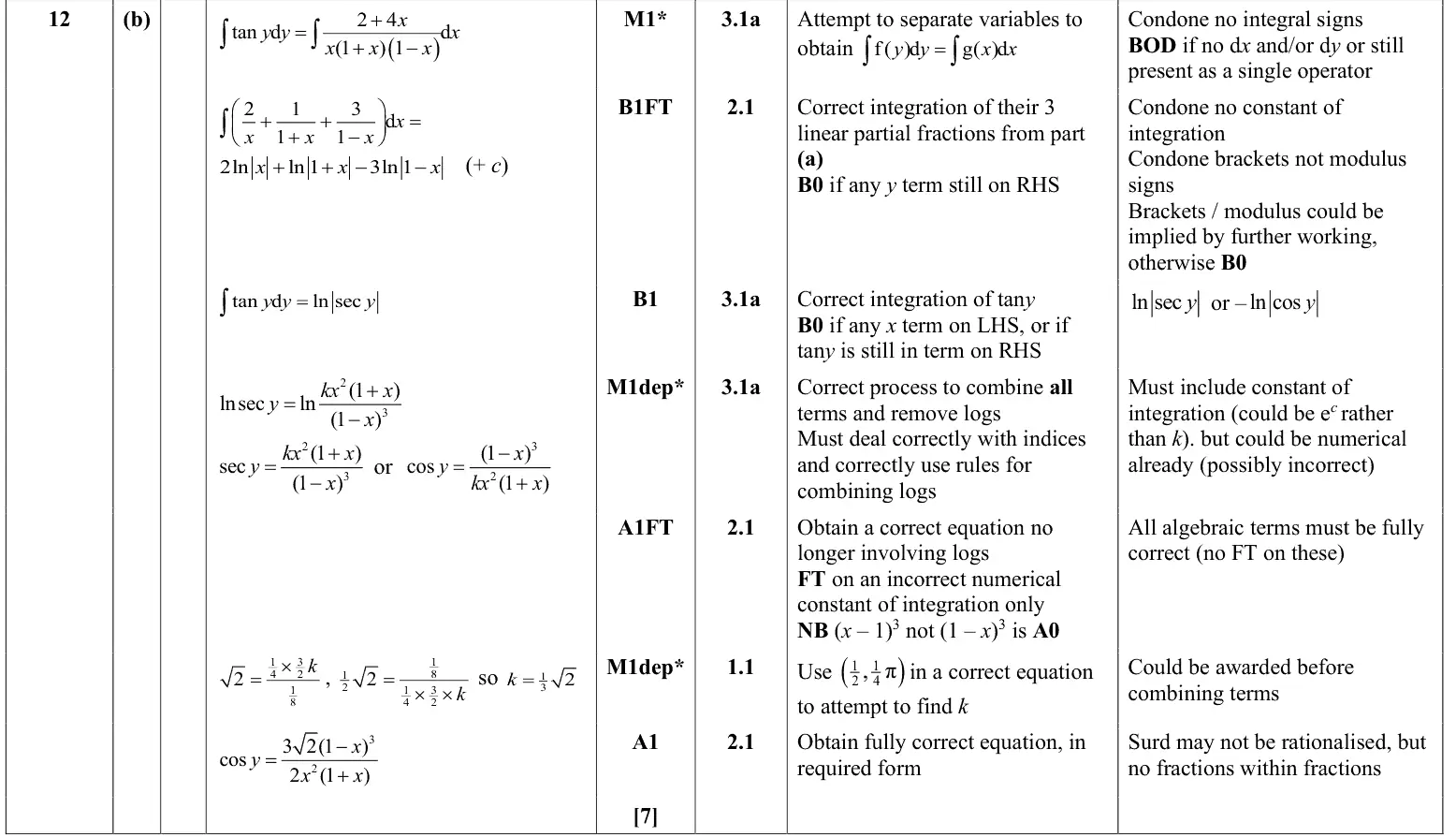
This question proved to be a suitably challenging final question, with only those candidates that had successfully completed the majority of the paper gaining full credit here. To gain the first mark candidates needed to identify that this was a differential equation with separable variables and attempt to do so; no credit was given for any integration attempts on an equation that still involved both x and y terms. Once variables had been separated, integrating tany is a standard specification statement (1.08h) yet this was not always done correctly; sign errors were common, as was finding the derivative and not the integral of tany. Candidates nearly always realised the need to use their partial fractions from the first part of the question, and could attempt integration of these, but there were often sign errors when integrating the fraction with the denominator of (1 – x). Further credit could still be gained for correctly combining all of their terms and removing logarithms; while many candidates could correctly combine the algebraic terms it was a common error to see the constant term still as +c even once logs had been removed. Of the candidates who had made reasonable progress with this question, most were able to attempt the required method but made slips in their working.
Key points and common errors
separate variables: ∫tan y dy = ln sec y
2ln x + ln(1 + x) − 3ln(1 − x) + c
combine logs
use (½, π/4) to find k
cos y = 3√2(1 − x)³ / (2x²(1 + x))
sign errors with tan y and with ln(1 − x)
June 2025 · Paper 2 · Q85 marksMedium
Mark scheme for this part
Examiner's comment
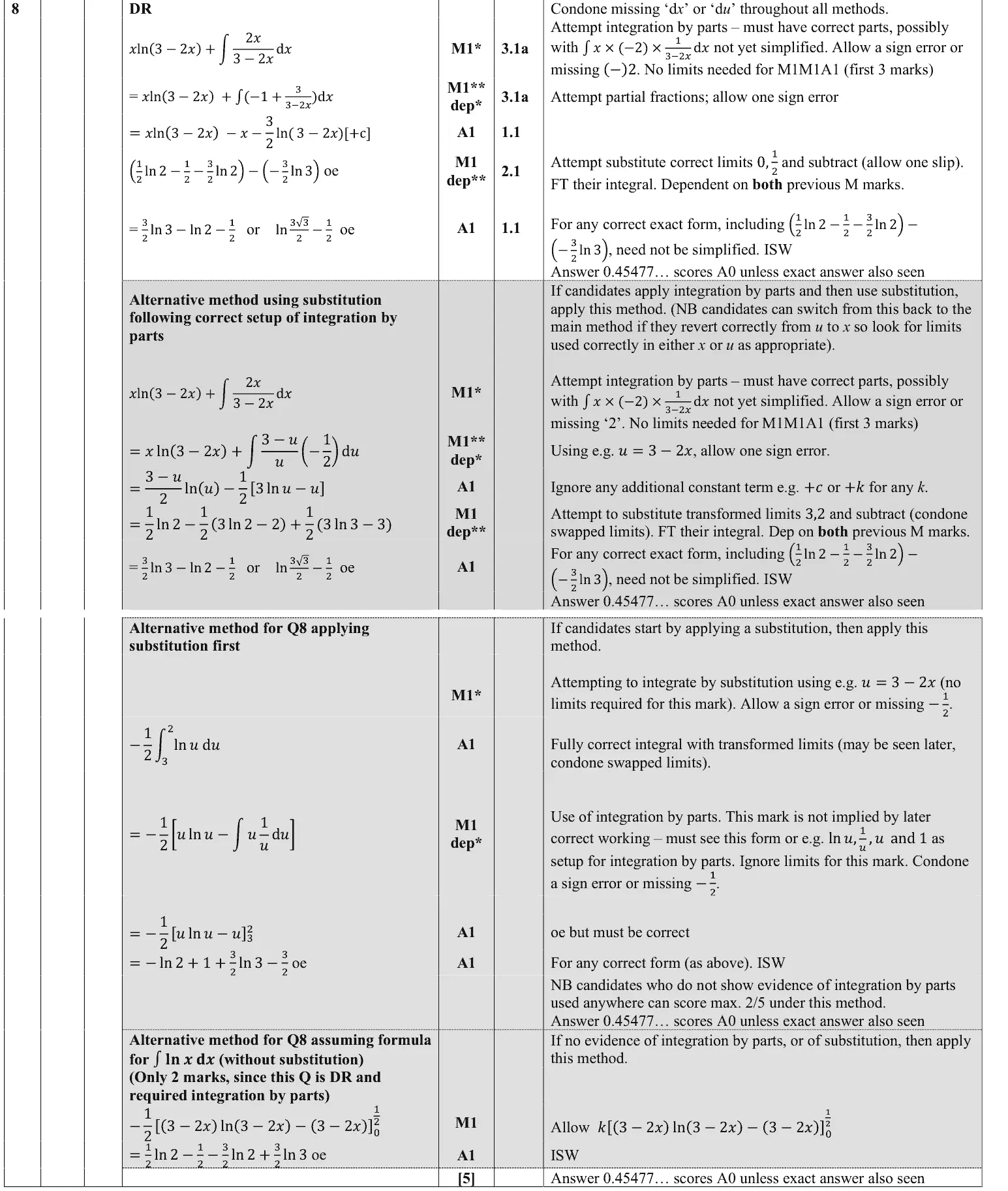
Many candidates scored at least 3 marks in this question, and some very good answers were seen, although a significant number of candidates made no progress beyond the initial setup (typically scoring M1 only). The question specified the use of integration by parts, so answers which did not use this technique anywhere could not score full marks (see the third alternative method in the scheme). Most candidates applied ‘by parts’ directly to the given integral and then proceeded via either partial fractions or substitution on the resulting second integral as shown in the first two methods on the scheme. A few candidates made an error in setting up their ‘by parts’ (resulting in an inconsistent statement). Some candidates, perhaps in trying to solve the resulting integral, went backwards by attempting ‘by parts’ again and undoing their initial setup – which normally resulted in no further progress being made. The second alternative method was quite often seen, with candidates starting by applying a substitution (which is a logical way to approach the given integral). Candidates still needed to demonstrate the use of ‘by parts’ in their working in order to be eligible for full marks– as shown in the scheme. In all methods, sign errors were very common – often meaning that the method marks were scored but one or both of the accuracy marks were not. For candidates who used a substitution, some did not ‘translate’ the limits at the point of applying the substitution. This was often recovered (especially for candidates who reversed the substitution later) and some candidates even chose to work in a mixture of variables (i.e. keeping the first term of the ‘by parts’ in x and substituting within the second integral to, e.g. u). The scheme was deliberately flexible to accommodate this, but candidates should be reminded that, when using a substitution on a definite integral, it is important that the limits are adjusted at the point the substitution is made so that the integral remains correct throughout. This is particularly important when working under a DR instruction – which means there is greater emphasis on fully correct working leading to the answer. In a few cases (whether from substitution or sign errors) candidates inadvertently recovered to the correct final answer, but the final mark could not be awarded for answers that arose from incorrect working. This is an excellent example of a fully correct solution to this question. This candidate correctly sets up the integration by parts and proceeds to use a substitution to evaluate the ‘new’ integral (as shown in the first alternative method on the scheme). They do this correctly and revert to the original form in x before applying the appropriate limits correctly, leading to the correct final answer, 5/5.
Key points and common errors
by parts with u = ln(3 − 2x), v = x
second integral by division or substitution
exact answer (3/2)ln3 − ln2 − 1/2
sign errors common
change limits when substituting
by parts must be used
June 2025 · Paper 3 · Q5(b)4 marksMedium
Show the start of this question
Mark scheme for this part
Examiner's comment
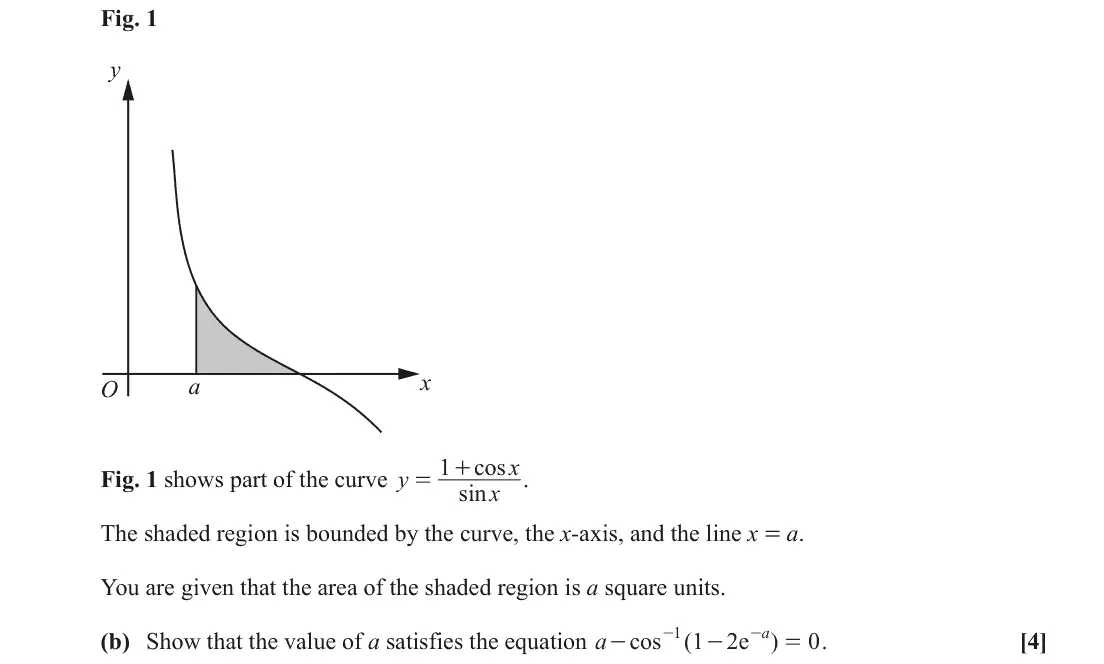
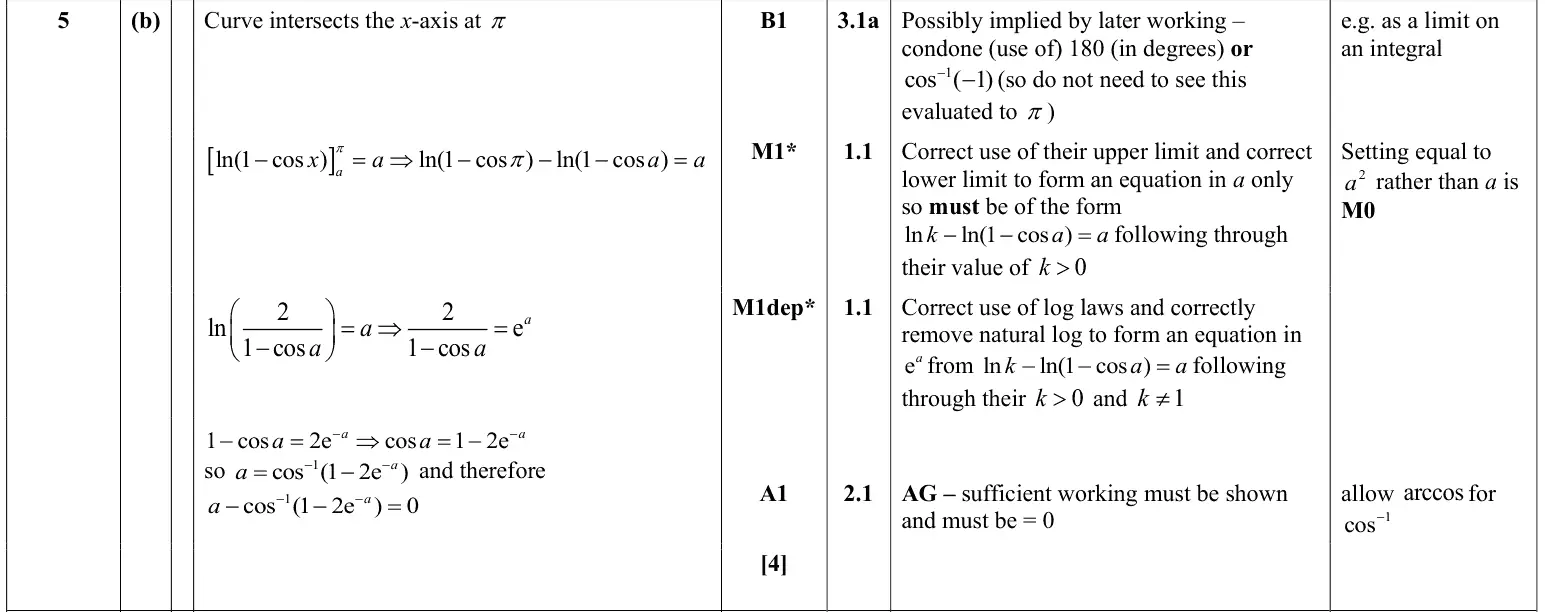
While many candidates correctly found that the curve intersected the 𝑥-axis at 𝜋, some struggled with applying the limits correctly to the given answer from part (a), and a number of candidates incorrectly thought that the shaded region had an area of 𝑎2. Of those that did correctly obtain the equation ln2 − ln(1 −𝑎) = 𝑎 many struggled with the associated log work required to get the answer in the given form with many incorrect replacing ln2 −ln(1 −𝑎) = 𝑎 with 2 −(1 −𝑎) = e𝑎.
Key points and common errors
curve meets the x-axis at π
ln 2 − ln(1 − cos a) = a
2/(1 − cos a) = eᵃ so a = cos⁻¹(1 − 2e^(−a))
area is a, not a²
June 2024 · AS Paper 1 · Q13 marksHard
Mark scheme for this part
Examiner's comment
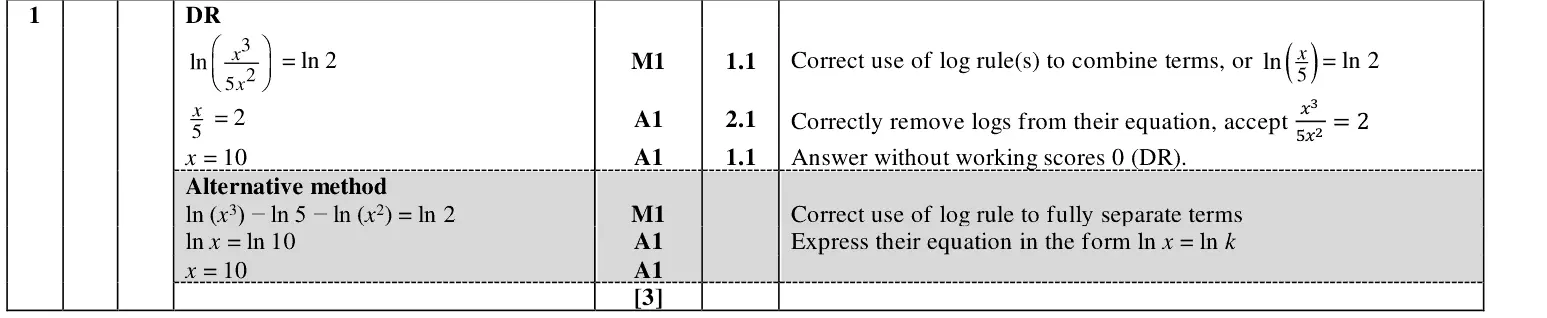
question challenging. Common errors include ln 5𝑥𝑥2 = 2 ln 5𝑥𝑥 and mixing up log rules for This question was only answered correctly by a minority of candidates – who seemed to find this subtracting/dividing. A number of candidates gave 𝑥𝑥= 0 as an extra solution without noting that the question specified 𝑥𝑥> 0 – on this occasion this was not penalised but in general candidates should specifically exclude solutions outside the given range. Candidates who attempted to combine terms were side correctly a small, but significant, number of candidates did not notice that ln 5 = ln 2 → 5 = 2 can be generally more successful than those who attempted to ‘split’. However, having combined the left-hand implied directly.
Key points and common errors
ln(x³/(5x²)) = ln 2 so x/5 = 2, x = 10
errors: ln 5x² = 2ln 5x, mixing up subtraction/division rules
answer without working scores 0
June 2024 · AS Paper 2 · Q5(b)3 marksHard
Show the start of this question
Mark scheme for this part
Examiner's comment
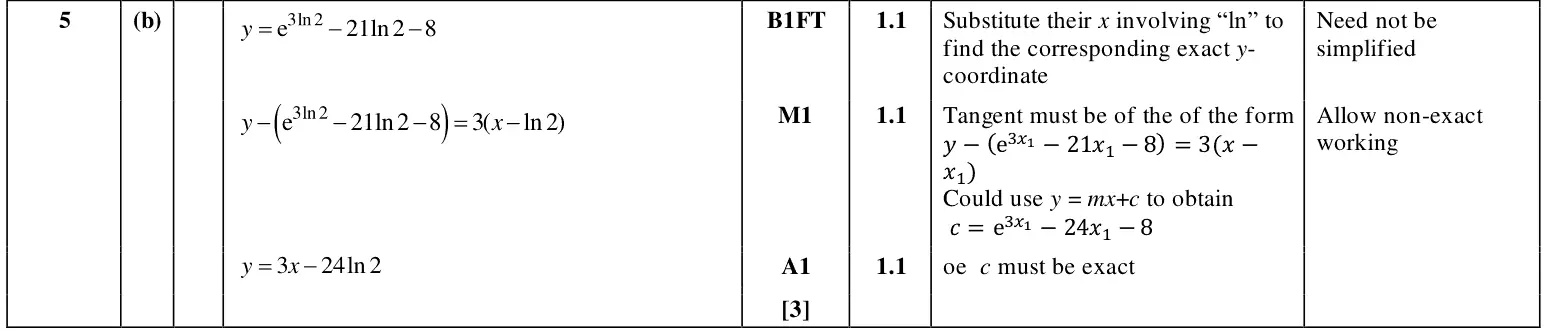
This part was not well done. Those who did not find an x in (a) made no progress. Those who had an x often responded with a decimal, ignoring the request for an exact c (particularly those who had 1 responded with 3ln8 in the previous part).
Key points and common errors
y = e^(3ln2) − 21ln2 − 8 = −21ln2
y = 3x − 24ln2
c must be exact
June 2024 · Paper 1 · Q6(c)4 marksEasy
Show the start of this question
Mark scheme for this part
Examiner's comment
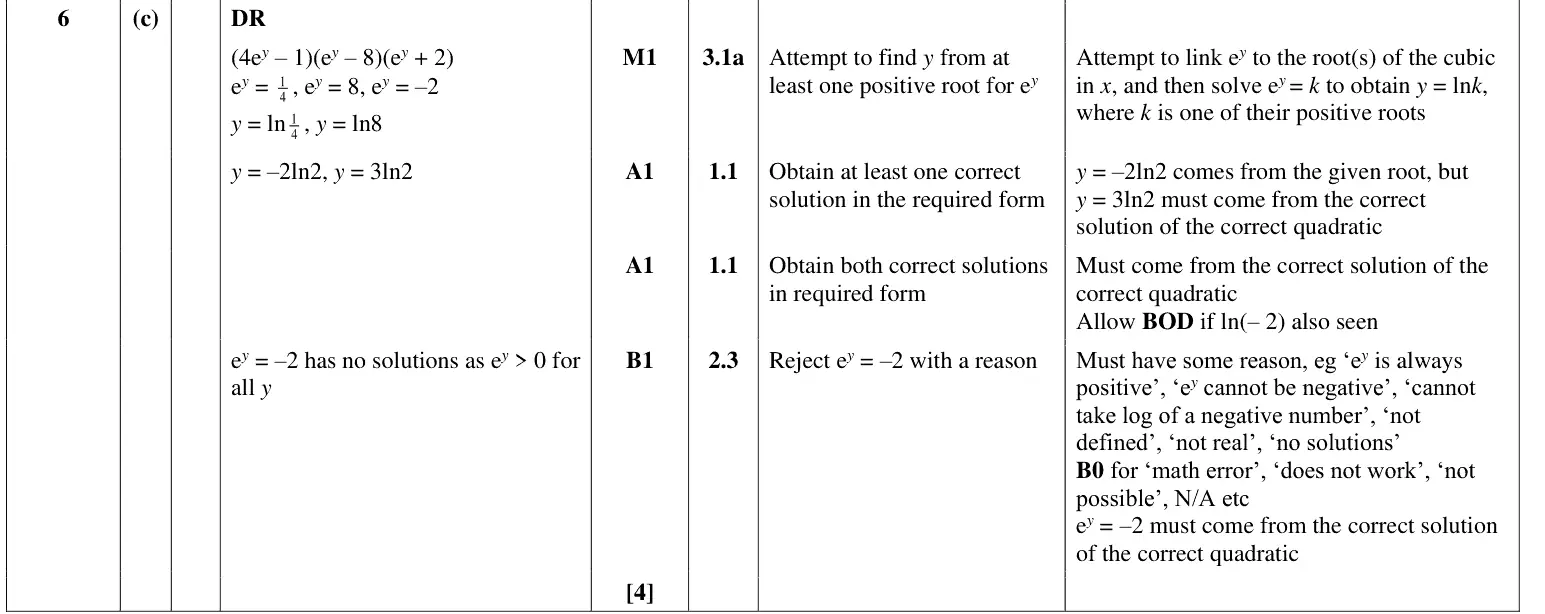
The question was very well answered with many candidates getting full marks on this question. Most candidates made the connection with the previous parts. The most commonly lost mark was the B mark for explaining why 𝑒𝑦= −2 did not result in a solution. It is important in detailed reasoning questions that candidates explain why rejected answers are not used; ‘not possible’ is not enough and incorrect statements like ‘negative logs are not possible’ are not given credit. Some candidates realised there was a connection to part (b) but unfortunately, thought it was an equation in 𝑒3𝑦 instead of 𝑒𝑦. This is a good solution to Question 6 (c), in that it provides clear evidence as to how the solutions are obtained and gives detailed reasoning on why one solution has been rejected.
Key points and common errors
x = e^y: (4e^y − 1)(e^y − 8)(e^y + 2) = 0
y = −2ln2, 3ln2
reject e^y = −2 since e^y > 0
'not possible' is not a reason
June 2024 · Paper 3 · Q5(b)6 marksMedium
Show the start of this question
Mark scheme for this part
Examiner's comment
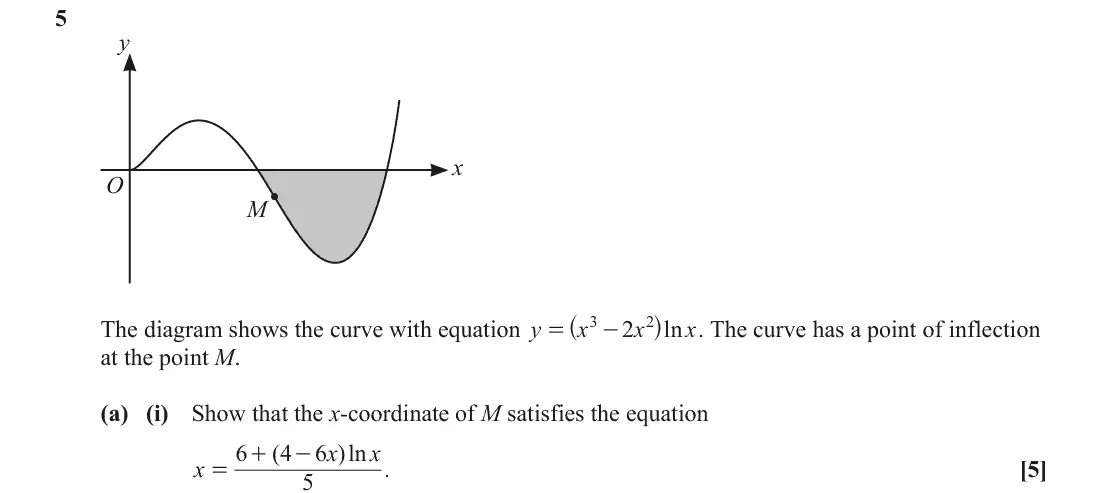
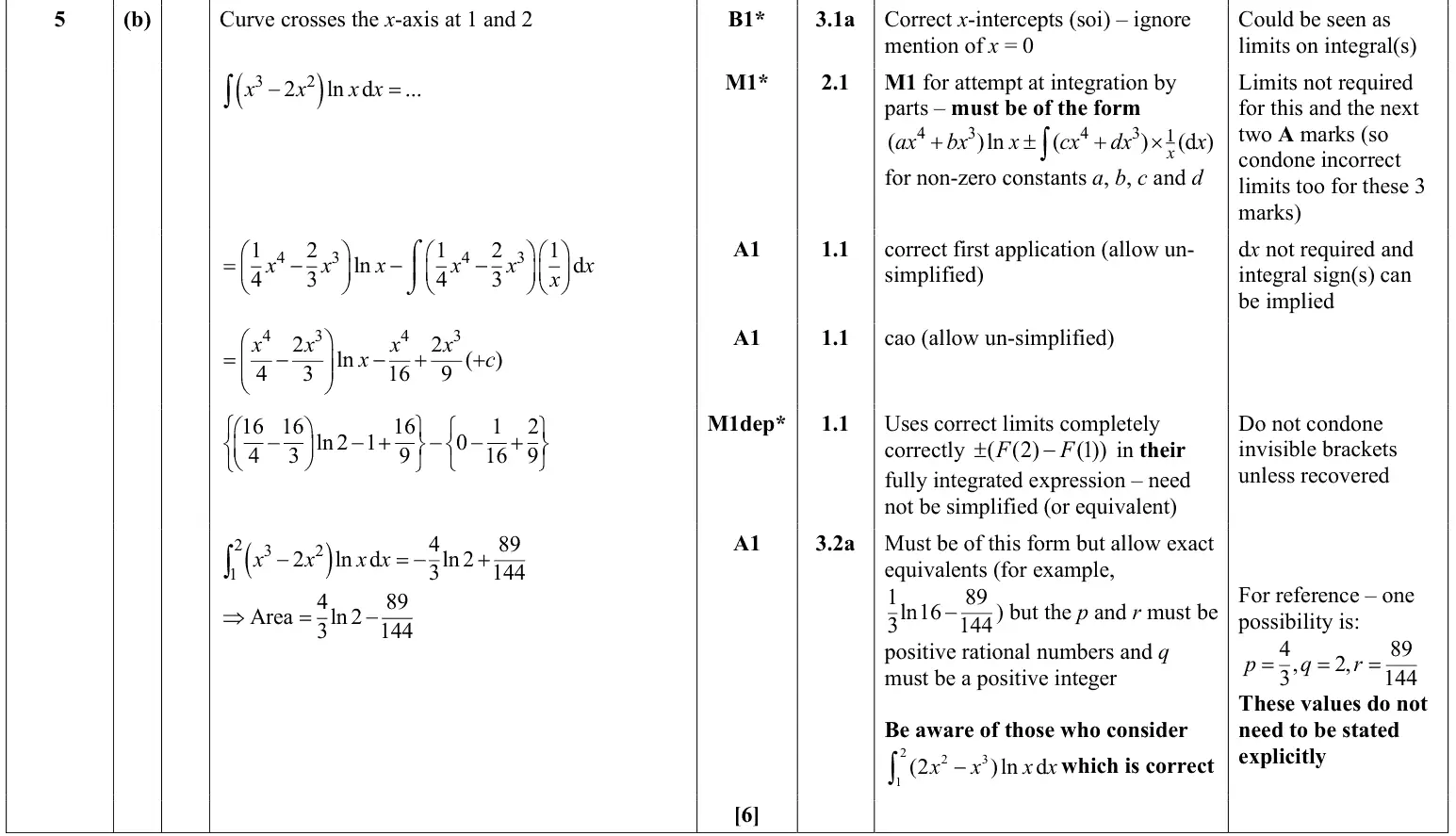
Most candidates correctly calculated the limits for the required area as 1 and 2 (although occasionally a lower limit of 0 was seen). Most candidates adopted the method of integration by parts when attempting to evaluate ∫(𝑥3 −2𝑥2)ln𝑥 d𝑥 and many were successful in obtaining the correct integrated expression. Those that attempted to use a substitution were generally unsuccessful. The most common errors in both the integration and when applying the limits were sign errors. Although many candidates correctly evaluated this integral as − 3 ln2 + 144, many did not realise that this was negative (as the shaded area was below the 𝑥-axis) and did not take the required modulus (even though the question made it clear what form the constants 𝑝, 𝑞 and 𝑟 should take).
Key points and common errors
limits 1 and 2 (x-intercepts)
by parts with u = ln x
integral = −(4/3)ln2 + 89/144 so area = (4/3)ln2 − 89/144
substitution unsuccessful
June 2023 · AS Paper 2 · Q5(b)3 marksHard
Show the start of this question
Mark scheme for this part
Examiner's comment
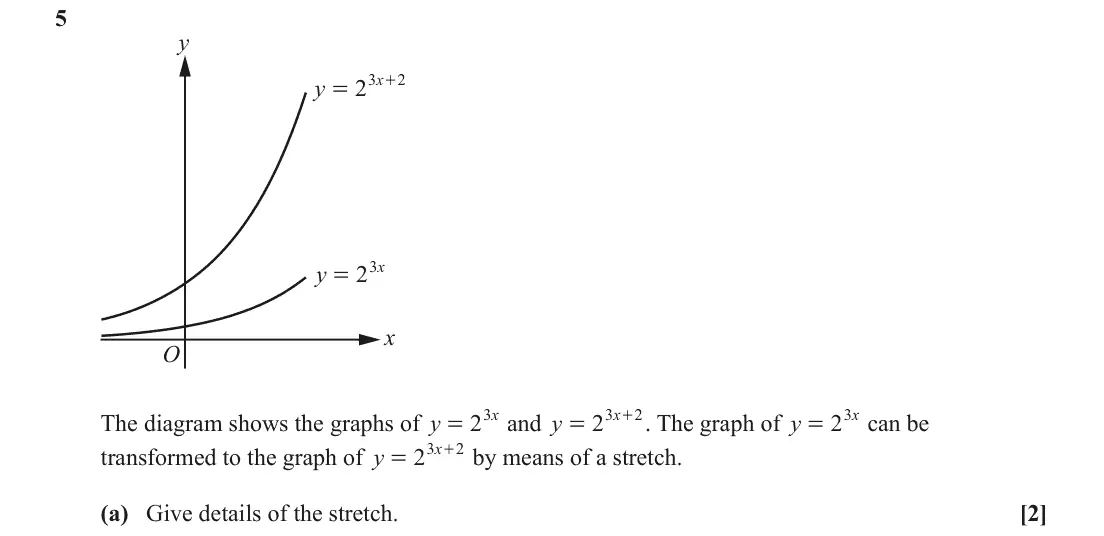
Most attempts gained 1 mark, for finding the correct equation in x. Using 23x+2 = 4(23x) to obtain the equation 23x = 12 was very rare. The exemplar below shows the typical next step in many solutions. Less successful efforts did not involve 36 at all. Taking logs like this was very prevalent and often led to the solution being abandoned quickly (presumably because x disappears). Incorrect use of the logarithm laws was frequent in this question.
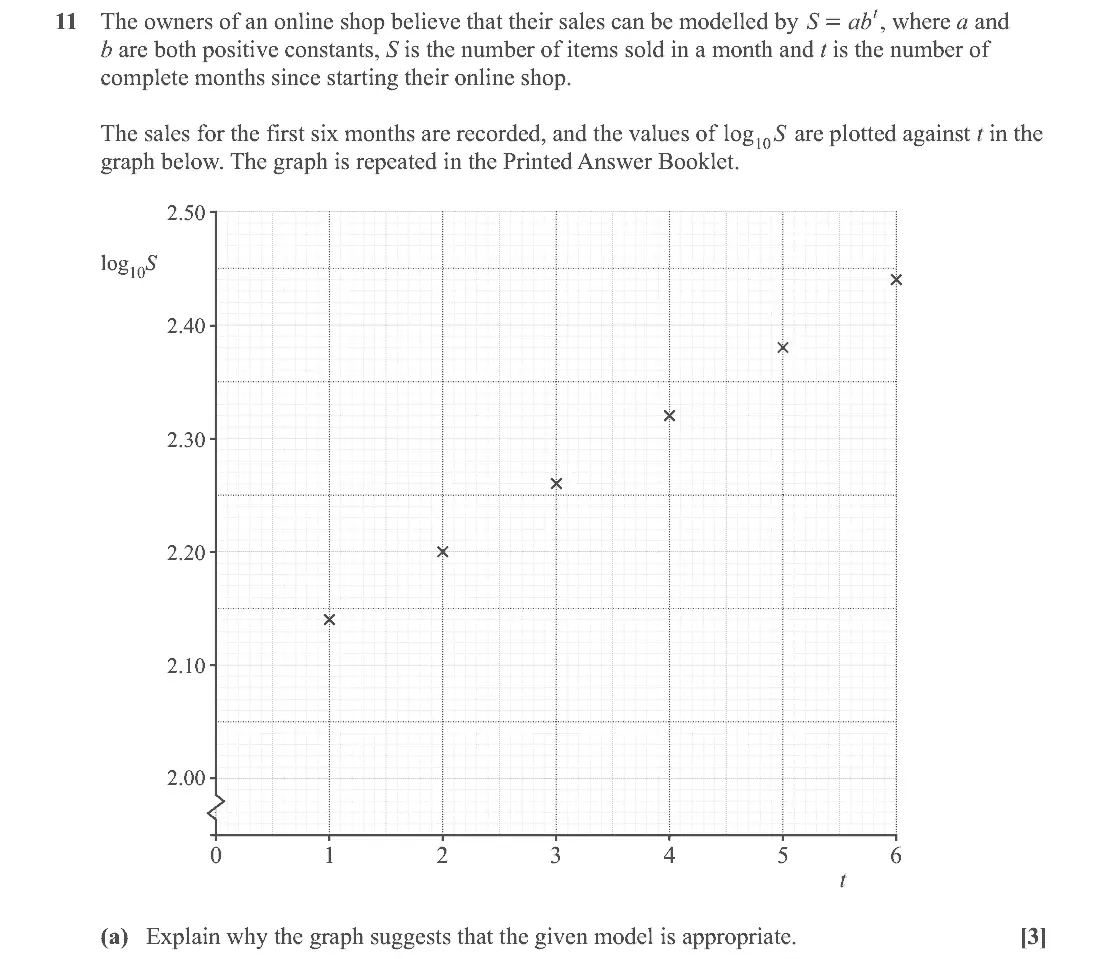
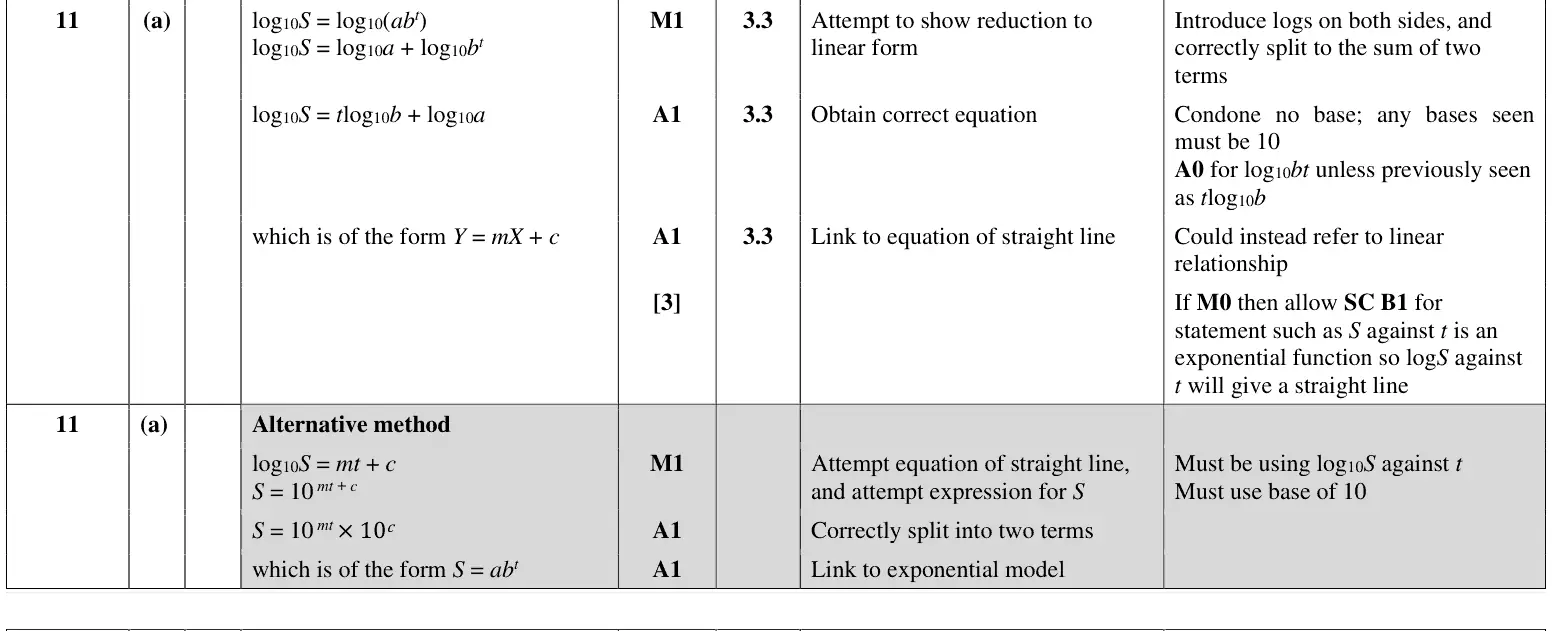
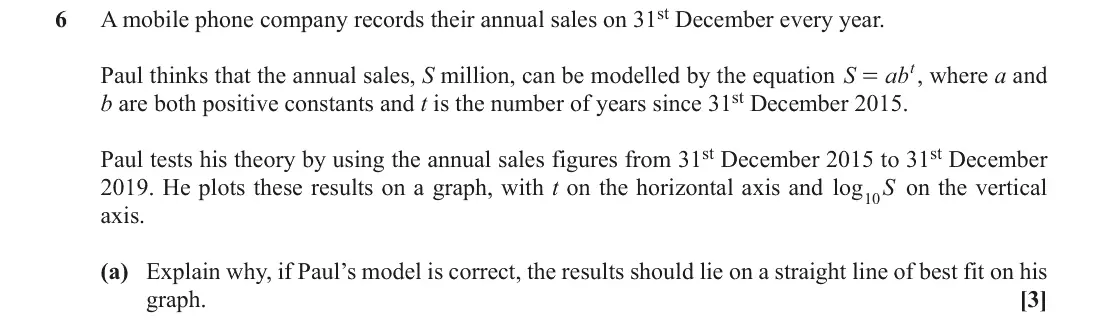
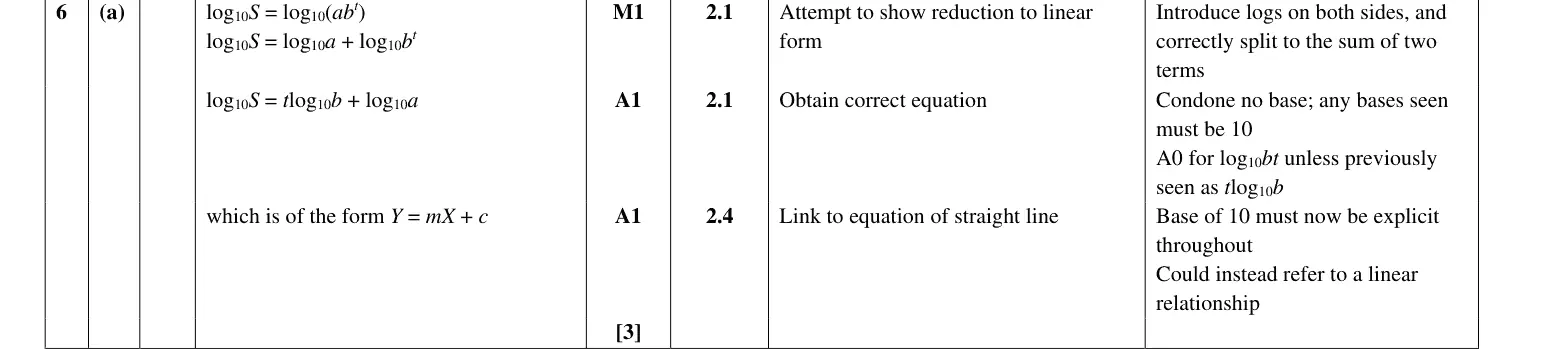
To gain full credit candidates had to show reduction to linear form, and relate this to the axes in the given graph. Many candidates were able to do so with sufficient detail, and others worked backwards from the equation of the straight line to show that removing logs did match the given exponential model. For less detailed solutions, there was one mark available for explaining that taking logs of an exponential model would result in a straight line. In weaker responses, candidates tended to just say that a line of best fit validated the model, without considering the axes, or gave explanations about why a business may increase their sales after opening.
Key points and common errors
log S = t log b + log a is of the form Y = mX + c
plotted points lie on a straight line
relate to the axes
June 2023 · Paper 1 · Q12(b)7 marksHard
Show the start of this question
Mark scheme for this part
Examiner's comment
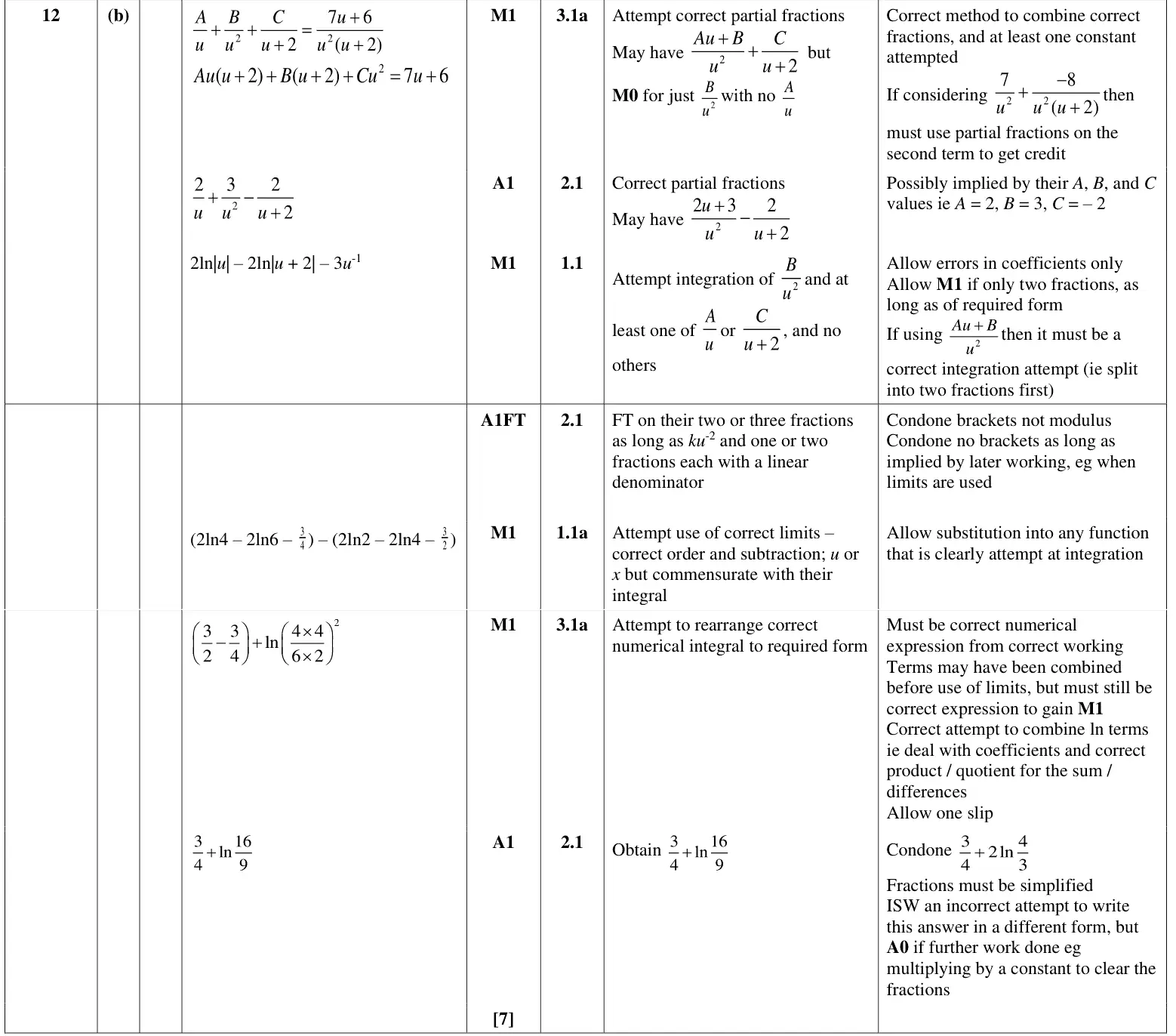
This question appears to have been very challenging for many candidates, with a variety of inappropriate integration techniques attempted. Candidates could still gain a method mark for attempting correct use of limits, but unfortunately some had given up before reaching this point. The factorised denominator should have indicated to candidates that using partial fractions would be a sensible strategy, and many did attempt to do so. The most common error was to not deal correctly with the repeated factor, but these candidates could still get further credit for integrating at least two fractions of the correct structure. However, a good number of candidates were able to provide fully correct solutions, successfully finding the partial fractions, using limits after integration and finally using laws of logs to manipulate their answer to the required form.
Key points and common errors
partial fractions 2/u + 3/u² − 2/(u + 2)
limits u = 2 to 4
3/4 + ln(16/9)
repeated factor often mishandled
June 2023 · Paper 2 · Q33 marksEasy
Mark scheme for this part
Examiner's comment
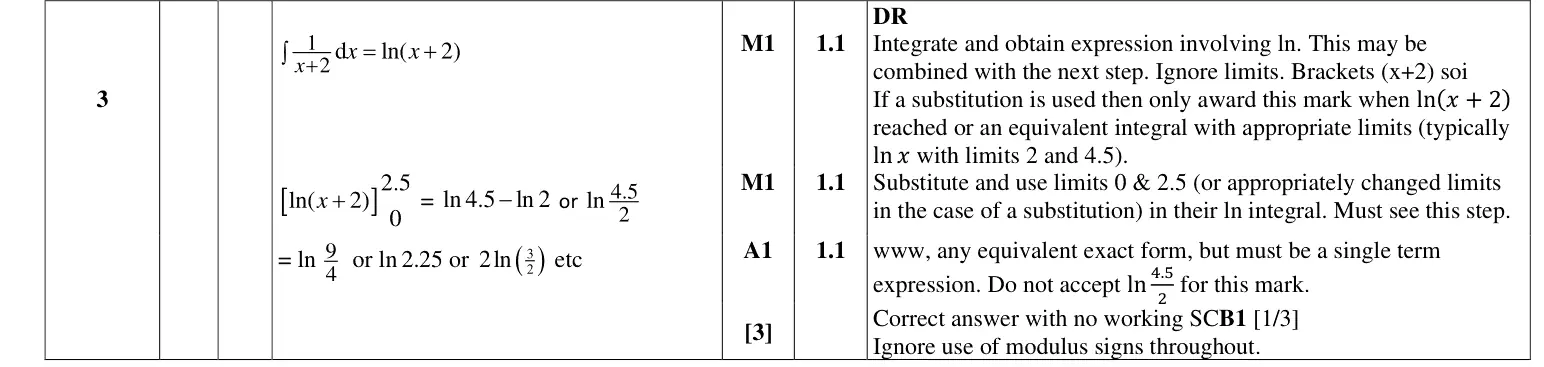
Most candidates answered this question well. A small number did not heed the ‘In this question you must show detailed reasoning’ instruction and used their calculator to compute the integral, giving an inexact answer, which could not be credited. Candidates needed to use log rules to combine and simplify their final answer into an exact form. Some candidates did not find the correct limits, which meant that they could only obtain the first M mark (if their integration was correct). A small number used a substitution, generally correctly, although this represented much more work than was required as this integral can be found directly. Detailed reasoning and exact answers ‘Detailed reasoning’ means that sufficient working must be seen to clearly justify the answer obtained. The use of calculators is permitted to check or verify solutions, but the algebraic working given must ‘stand alone’ and lead to the required answer. In Question 3, many candidates performed the integration correctly but then went on to use a calculator to give an inexact answer – even though the question specifically requested the ‘exact area’.
Key points and common errors
∫1/(x + 2) dx = ln(x + 2)
limits 0 and 2.5
ln 4.5 − ln 2 = ln(9/4) as a single exact term
calculator answers gain nothing
June 2023 · Paper 3 · Q13 marksMedium
Mark scheme for this part
Examiner's comment
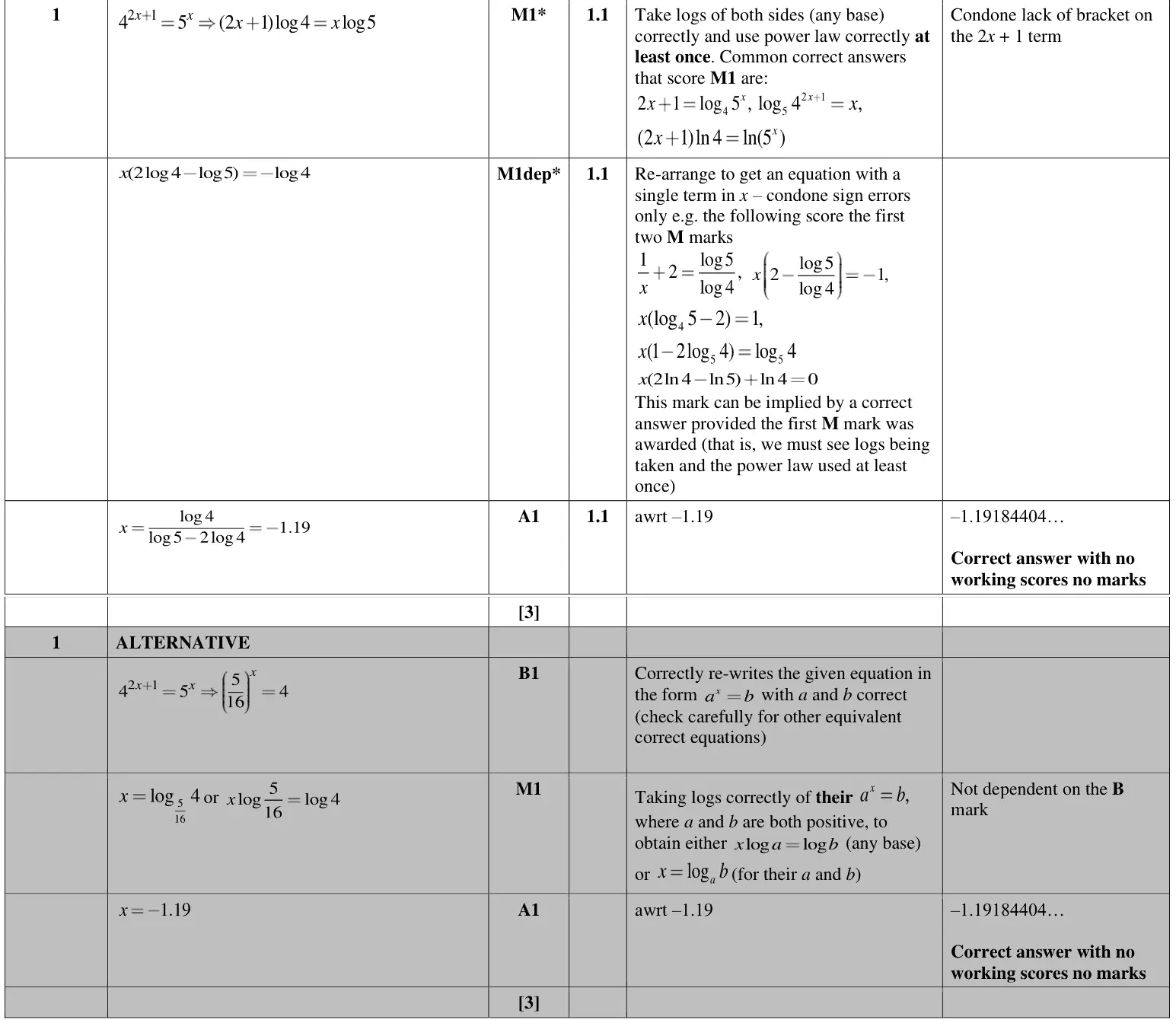
would appear to be a routine demand of using logs to solve an equation of the form 𝑎𝑎f(𝑥𝑥) = 𝑏𝑏g(𝑥𝑥). The Examiners noted that candidates’ responses to this question were mixed with many struggling with what most common error was to take logs of both sides with two different bases, e.g. (2𝑥𝑥+ 1)log54 = 𝑥𝑥log45. linear equation. A number of candidates left their answer in an exact form, e.g. 𝑥𝑥= For those candidates that did take logs correctly many then appeared to struggle to solve the resulting log5−2log4 and did not give the answer to 3 significant figures as requested.
Key points and common errors
take logs of both sides with the same base: (2x + 1)log 4 = x log 5
collect x terms
x = −1.19 to 3 s.f.
errors: different bases on each side, leaving an exact form
June 2023 · Paper 3 · Q7(b)6 marksMedium
Show the start of this question
Mark scheme for this part
Examiner's comment
fact that 𝑎𝑎= d𝑡𝑡= 𝑣𝑣ቀ 7+4𝑡𝑡2 − 2ቁ usually separated the variables correctly and went It was surprising in this part how many candidates did not set up a correct differential equation using the d𝑡𝑡. Those that did write on to correctly derive the given result (using the results that 𝑣𝑣= 17.5 when 𝑡𝑡= 0 and 𝑣𝑣= 5 when 𝑡𝑡= 𝑇𝑇). f(𝑥𝑥) d𝑥𝑥= ln|f(𝑥𝑥)| is provided in the formulae at the attempt to integrate ∫ 7+4𝑡𝑡2 d𝑡𝑡 even though the result ∫ Some candidates, after correctly setting up the required differential equation were unsuccessful in their beginning of the assessment.
Key points and common errors
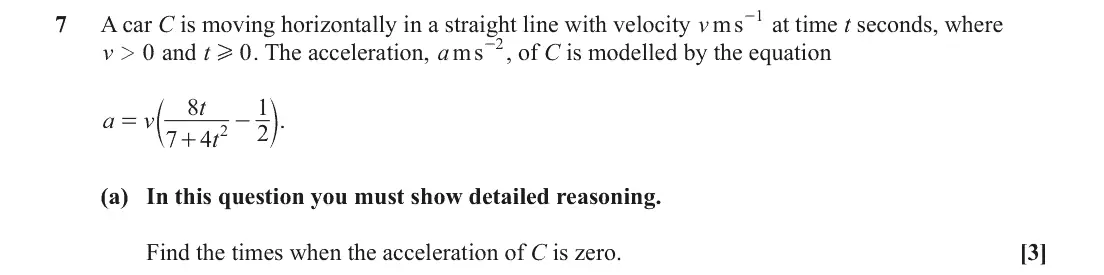
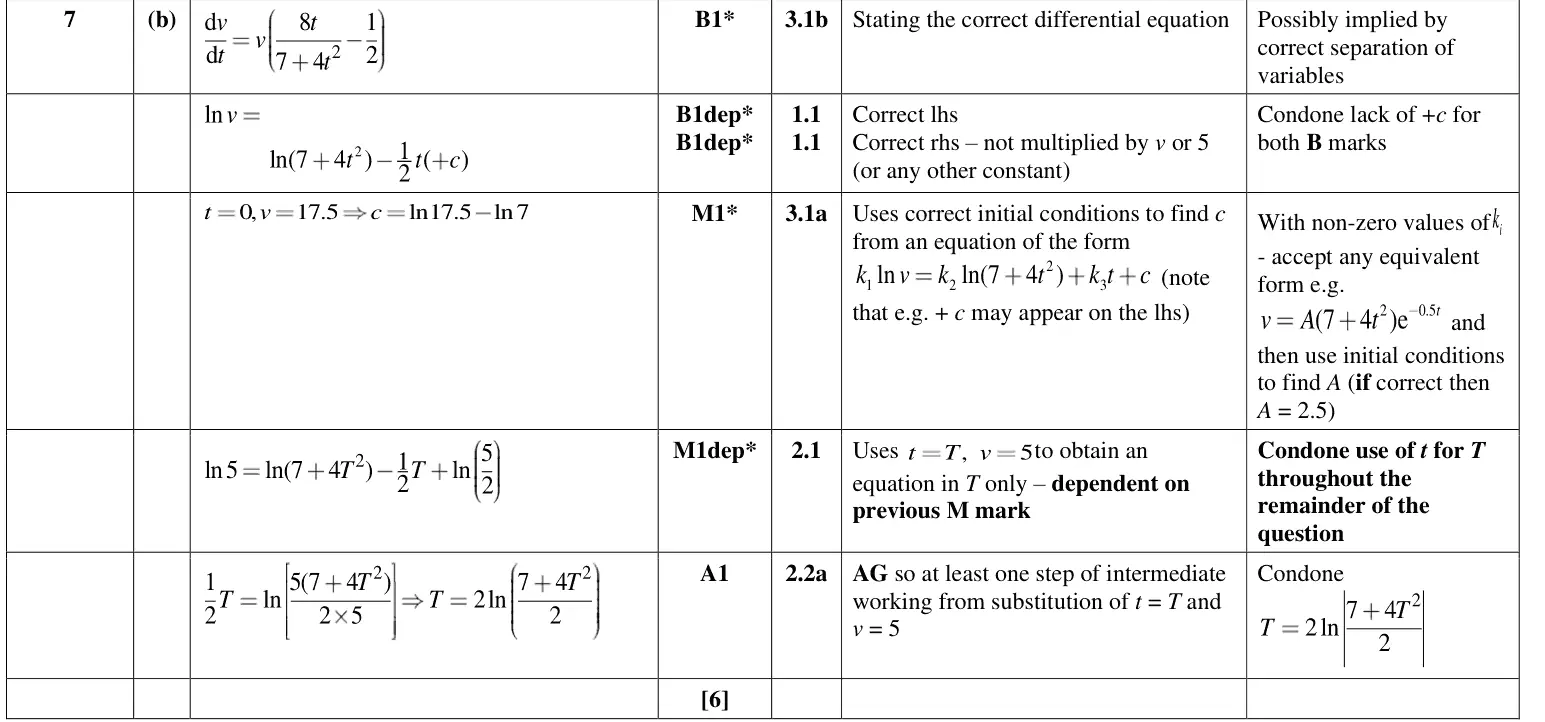
dv/dt = v(8t/(7 + 4t²) − ½)
separate: ln v = ln(7 + 4t²) − ½t + c
t = 0, v = 17.5 gives c
v = 5 at t = T gives the result
∫f′/f = ln f is in the formula book
June 2022 · AS Paper 1 · Q6(b)(i)2 marksMedium
Show the start of this question
Mark scheme for this part
Examiner's comment
Some candidates tried to answer this by taking particular values, or by drawing a graph. These did not score. Others took logs of both sides, but then made an error, such as log10 P = t log10 ka. However, many candidates obtained the correct equation and gave a good explanation as to why this was in the form y = mx + c .
Key points and common errors
log P = log k + t log a, which has the form y = mx + c
particular values or a graph score 0
error t log ka
June 2022 · AS Paper 2 · Q6(a)1 markEasy
Mark scheme for this part
Examiner's comment
There were many correct answers in this part, although we occasionally saw x = 2.
Key points and common errors
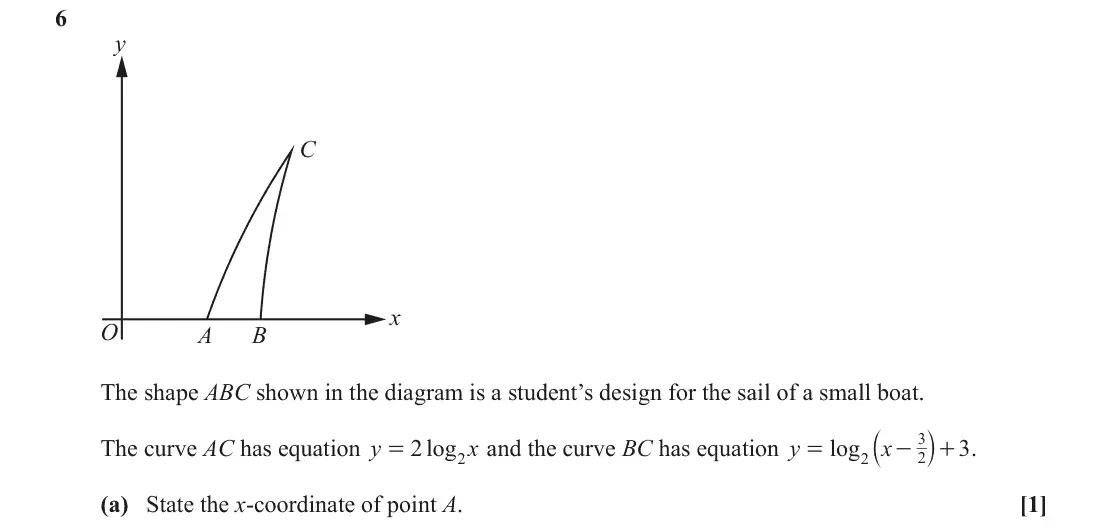
2 log₂ x = 0 so x = 1
June 2022 · AS Paper 2 · Q6(c)4 marksMedium
Show the start of this question
Mark scheme for this part
Examiner's comment
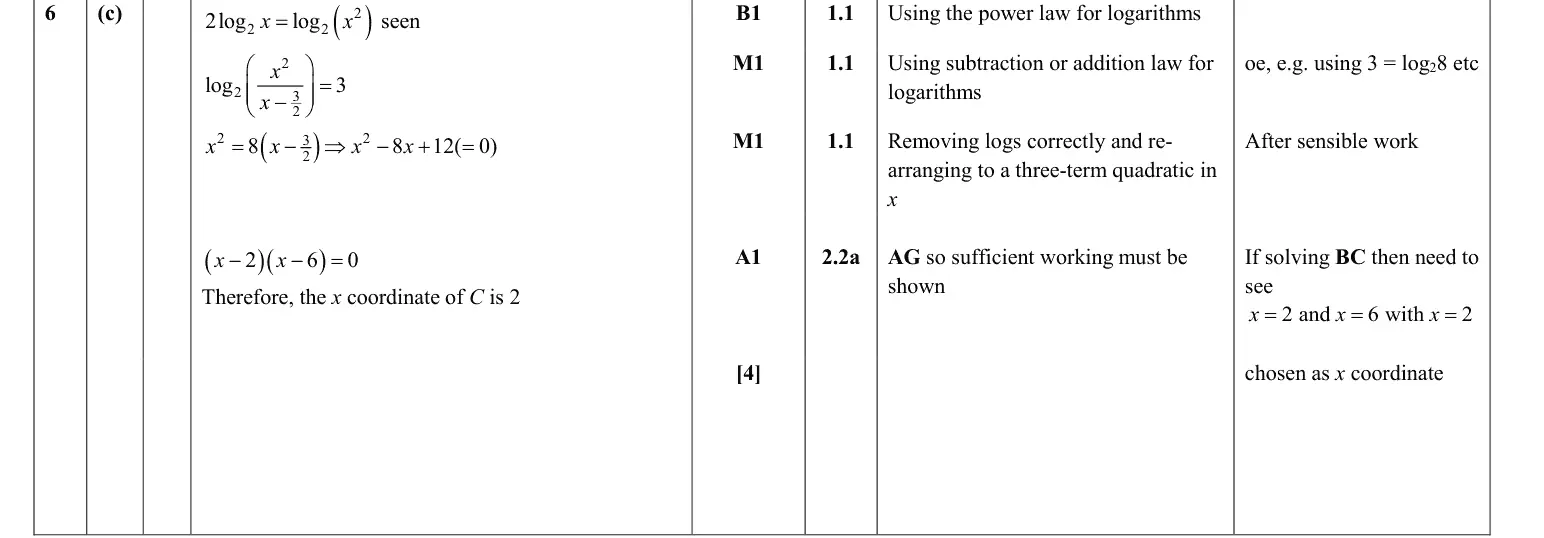
This proved more challenging than part (b), especially so when 2log2x was not recognised as log2x2 at 3 the start. The problem noted with log x − in part (b) inevitably reappeared. Again, however, there 2 were quite a few good solutions seen if the logarithm laws were understood. We expected x = 2 to be chosen as the required answer.
Key points and common errors
2 log₂ x = log₂ x²
log₂(x²/(x − 3/2)) = 3
x² − 8x + 12 = 0, x = 2 or 6, choose 2
harder when 2 log₂ x not recognised as log₂ x²
June 2022 · Paper 1 · Q5(b)4 marksEasy
Mark scheme for this part
Examiner's comment
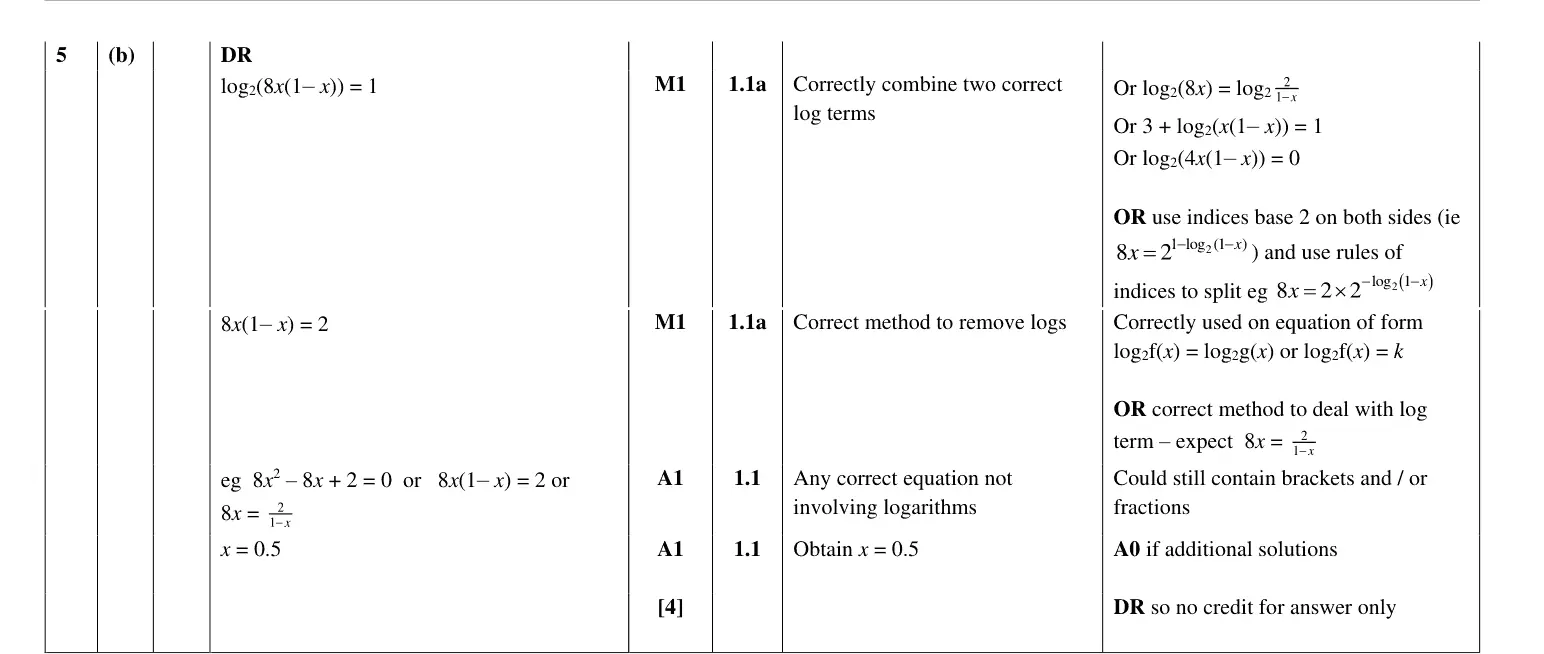
This question was very well answered, with many candidates gaining full credit. The most common approach was to first combine log terms and then remove the logs, and this was usually successful. Some candidates first introduced indices, base 2, on both sides but the subsequent simplification of the right-hand side proved to be problematic for some. Despite this being a ‘detailed reasoning’ question, some candidates went straight from the quadratic equation to stating the root. On this occasion this was condoned, but candidates would be well advised to make sure that sufficient detail is always provided in these types of questions.
Key points and common errors
combine: log₂(8x(1 − x)) = 1 so 8x(1 − x) = 2
8x² − 8x + 2 = 0 gives x = 0.5 (repeated)
show the solving
June 2022 · Paper 1 · Q11(b)3 marksHard
Show the start of this question
Mark scheme for this part
Examiner's comment
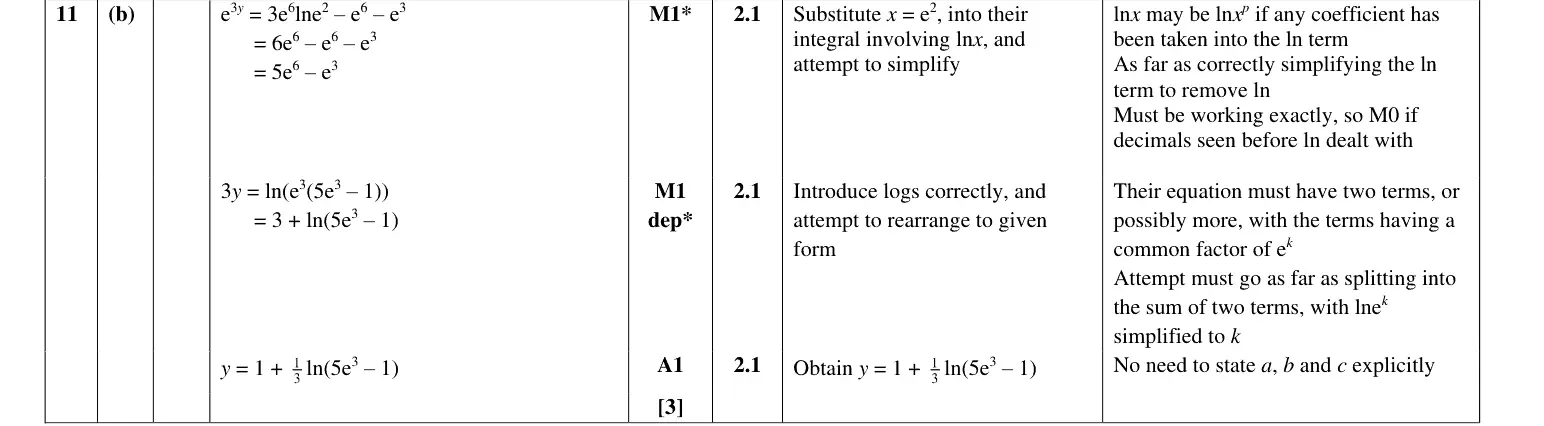
Many candidates were able to make an attempt to use x = e2, and simplify the ensuing expression which did require a term involving ln to still be present. Rearranging the expression to the given form proved to be more challenging and only the more astute candidates were able to attempt this, either by splitting into the sum of two terms or by taking out a factor of e3 and combining this with the exponential term.
Key points and common errors
x = e²: e^(3y) = 5e⁶ − e³ = e³(5e³ − 1) so y = 1 + ⅓ln(5e³ − 1)
work exactly
rearranging was the hard step
June 2022 · Paper 2 · Q3(c)4 marksMedium
Mark scheme for this part
Examiner's comment
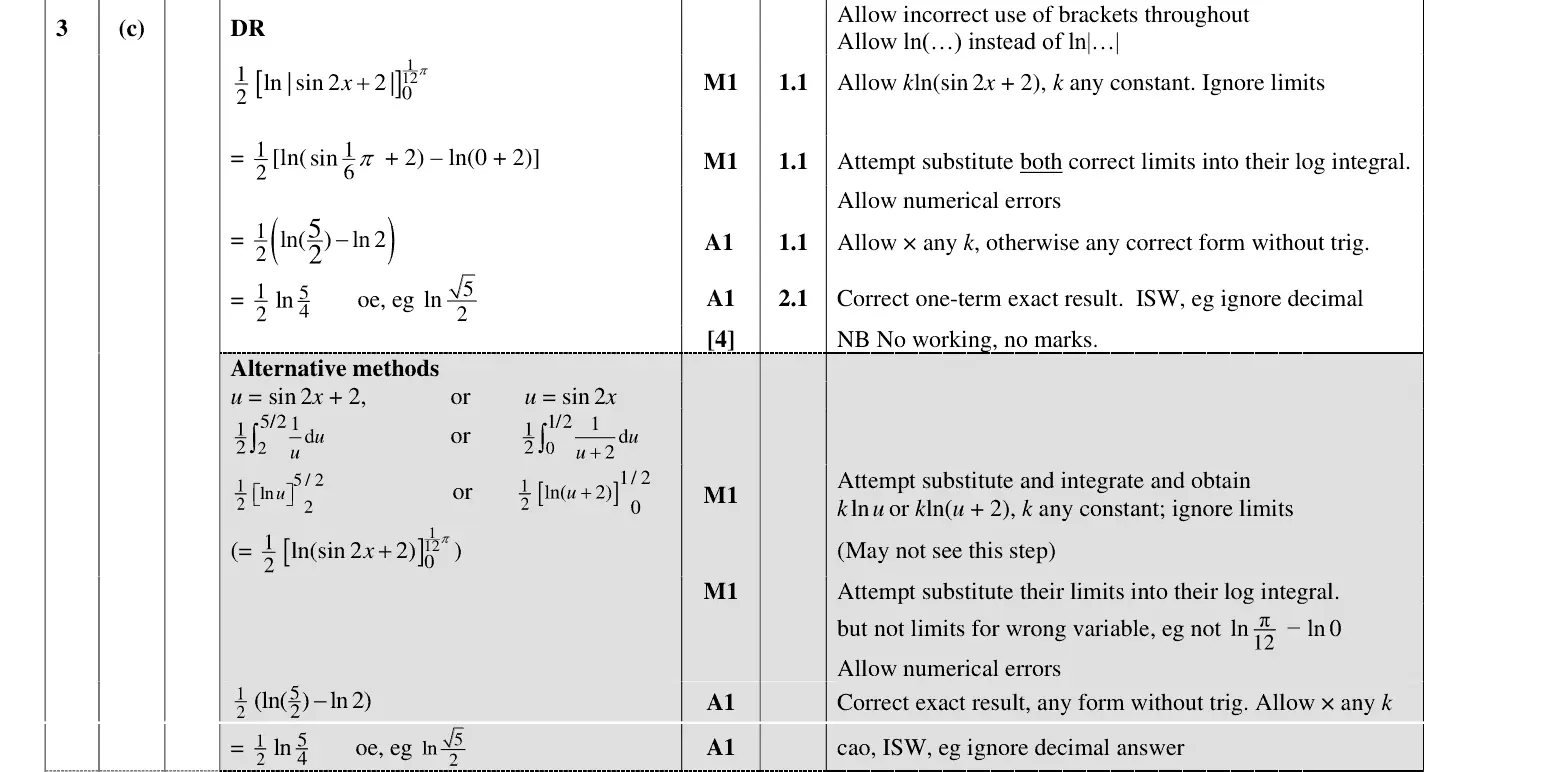
There were many neat and correct solutions. Many candidates used a substitution. However, many others used the more efficient method that comes from recognising that the numerator is k × the derivative of the denominator. Some candidates omitted “k” or had k = 2 instead of 1 2 . A few candidates correctly obtained ( ) 5 1 2 ln( ) 2 − ln 2 , but omitted the final step of simplification (presumably, as in part (a) (i), because they had not read the question carefully). Others used decimals, ignoring the word “exact” in the question. There were also some unsuccessful attempts at this question. Some candidates used the double angle formulae. Others attempted to use integration by parts on cos 2x × (sin 2x + 2)−1. A few rewrote the integrand as cos2 cos2 x x x + . None of these attempts yielded any marks. sin 2 2
Key points and common errors
numerator is ½ × derivative of denominator: ½ln(sin2x + 2)
limits 0 and π/12
½ln(5/4)
exact simplest form
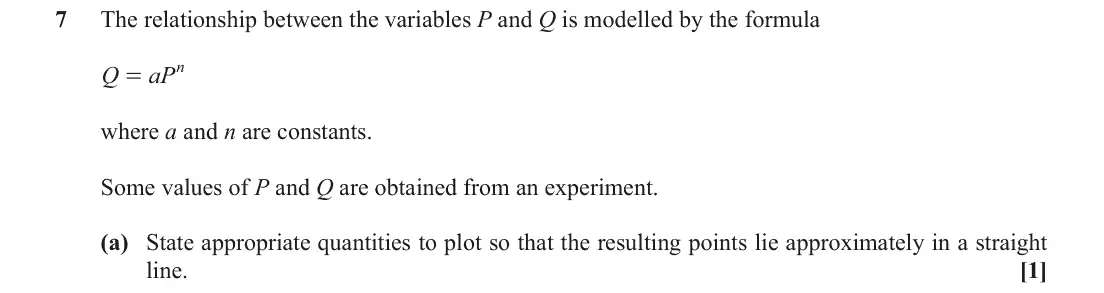
Autumn 2021 · AS Paper 1 · Q7(a)1 markMedium
Mark scheme for this part
Key points and common errors
plot log Q against log P (either way round)
Autumn 2021 · AS Paper 1 · Q7(b)2 marksMedium
Show the start of this question
Mark scheme for this part
Key points and common errors
log Q = log a + n log P compared with Y = mX + c
line of best fit
gradient is n when log Q is on the vertical axis
Autumn 2021 · Paper 3 · Q7(b)4 marksMedium
Show the start of this question
Mark scheme for this part
Key points and common errors
separate: ln(y − 2) = 3ln(x − 3) + c
(4, 3) gives c = 0
y = (x − 3)³ + 2
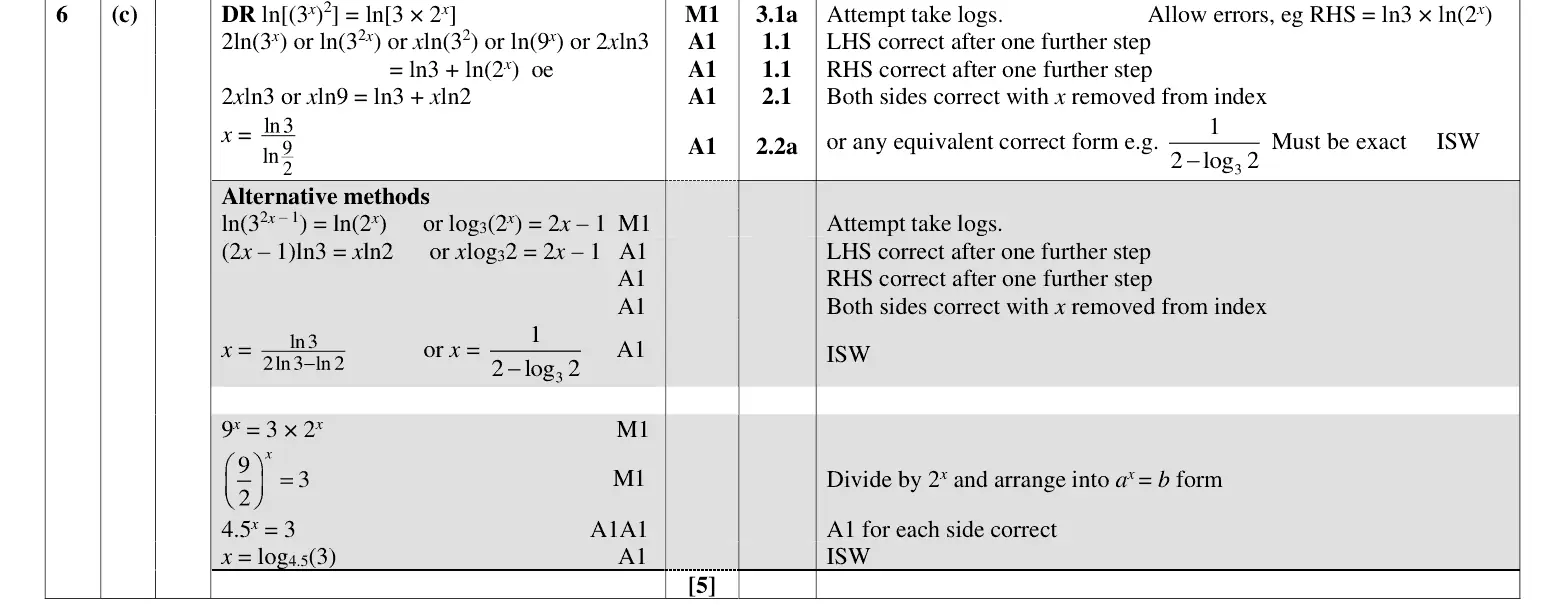
Autumn 2020 · AS Paper 1 · Q6(c)5 marksMedium
Mark scheme for this part
Key points and common errors
9ˣ = 3 × 2ˣ so (9/2)ˣ = 3, or take logs: 2x ln3 = ln3 + x ln2
x = ln3/ln(9/2) exact
Autumn 2020 · AS Paper 2 · Q4(c)(ii)2 marksHard
Show the start of this question
Mark scheme for this part
Examiner's comment
(Comment on Question 04 as a whole) Part (a) - Long division was seen here, ignoring the request for the factor theorem. This gained no credit because of the instruction ‘Use the factor theorem’. Note that only the statement f(½) = 0 so k = -37 was not enough working because of DR and AG. Part (b) - DR so evidence for the factorisation was required. Candidates that just quoted their answer, possibly obtained from the polynomial solve function on the calculator scored M0. Part (c) - Only candidates who did well on this paper seemed to understand what was required. NR was not uncommon.
Key points and common errors
sum = −ln(½ × 5/3 × 4) = ln(3/10)
Autumn 2020 · Paper 1 · Q6(a)3 marksMedium
Mark scheme for this part
Examiner's comment
(Comment on Question 06 as a whole) In the first part of Question 6 a number of candidates attempted a worded explanation as opposed to reducing the equation to linear form which is then linked to the equation of a straight line. A lack of precision resulted in some candidates not gaining full credit, as they neglected to indicate that they were using logs to base 10. In part (b) the expectation was that candidates would use the relevant parameters from their linear equation; an alternative, and equally acceptable, strategy was to identify coordinates of points on the straight line and use them in the given exponential equation; this is a good example of candidates who could not answer part (a) finding a method that still allowed them to attempt this part of the question. In part (d) any sensible reason that identified why the sales may not continue at the same rate was allowed, but a number of solutions were too vague to gain credit. Candidates were also given credit if they identified that extrapolation was unreliable.
Key points and common errors
log₁₀S = log₁₀a + t log₁₀b, of the form Y = mX + c
base 10 must be explicit
worded explanations alone fail
Autumn 2020 · Paper 1 · Q7(b)3 marksMedium
Show the start of this question
Mark scheme for this part
Examiner's comment
(Comment on Question 07 as a whole) The final part of Question 7 was another example of where candidates were expected to give clearly explained and sensible answers. Many could identify that there will eventually not be enough hours in the day, but finding a reason on a different theme for their second answer proved more problematical.
Key points and common errors
30 × 1.1^(X−1) > 30 + 15(X − 1)
divide and take logs base 1.1 to reach the given inequality
keep > not =
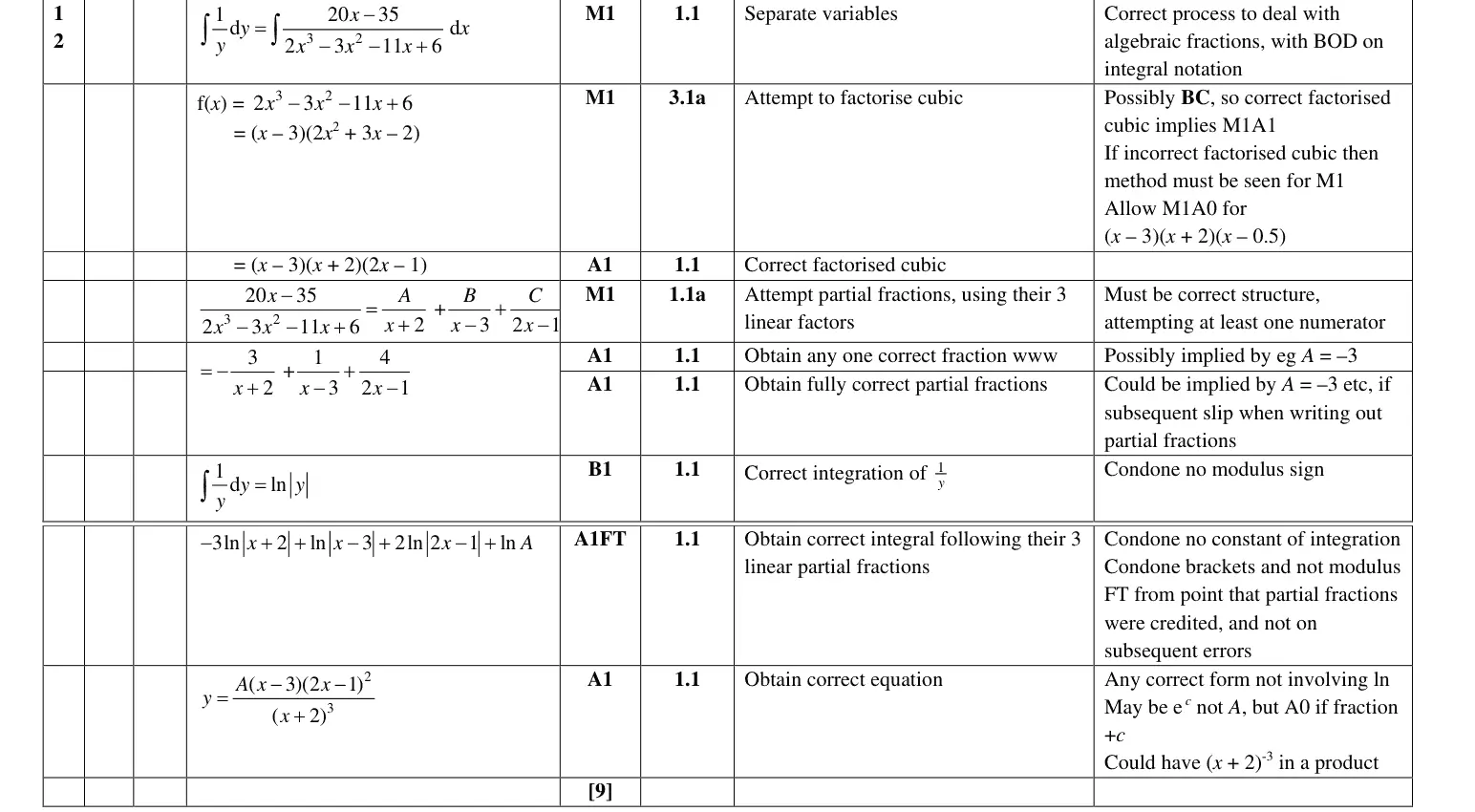
Autumn 2020 · Paper 1 · Q129 marksEasy
Mark scheme for this part
Examiner's comment
Question 12 was the final question on the paper and was generally well answered, with a number of candidates able to make good progress in this unstructured, multi-step question. As the question did not require ‘detailed reasoning’, calculator use to find the roots of the cubic denominator was acceptable. However, when then working backwards from the roots to the factors, it was fairly common to lose the lead coefficient of 2 with the expected factor of ( ) being given as ( ) 2 x − 1 x − 0 5. but with no compensation in the other factors. Candidates who took the longer method of identifying a factor, carrying out algebraic long division and then finding the other two linear factors were usually more successful. This demonstrates the need for candidates to know how to use the calculator functions effectively and accurately. The remainder of the question was generally well attempted, although only the most able candidates gained the final mark for correctly dealing with both the indices and the constant of integration when removing the logarithms to make y the subject. Common misconceptions One common misconception was commenting on the model in Question 7; a number of candidates commented on why the revision programme may be difficult for the student to implement (e.g. may get bored and not want to revise) as opposed to why it may not be realistic. Key teaching and learning points – comments on improving performance Candidates need to be aware of the command words that are used, and the implication for the detail in their solutions. ‘Determine’ was used in a number of questions and candidates should appreciate that this indicates that justification should be given; just stating the answer is unlikely to attract much, if any, credit. When commenting on the reliability of a model, or how realistic it may be, candidates are expected to give a sensible, specific reason; vague comments that refer just to ‘other factors’ are insufficient. It is essential that candidates are familiar with all areas of the specification; on this paper a number of candidates seemed less confident on topic areas that did not feature on the legacy 7890 specification, namely small angle approximations, proof by contradictions and upper and lower bounds. Guidance on using this paper as a mock When marking the mock examination, teachers should pay close attention to the additional guidance in the mark scheme to make sure that lack of sufficient detail in a solution is clearly identified and feedback given to the candidates as to what additional detail was required.
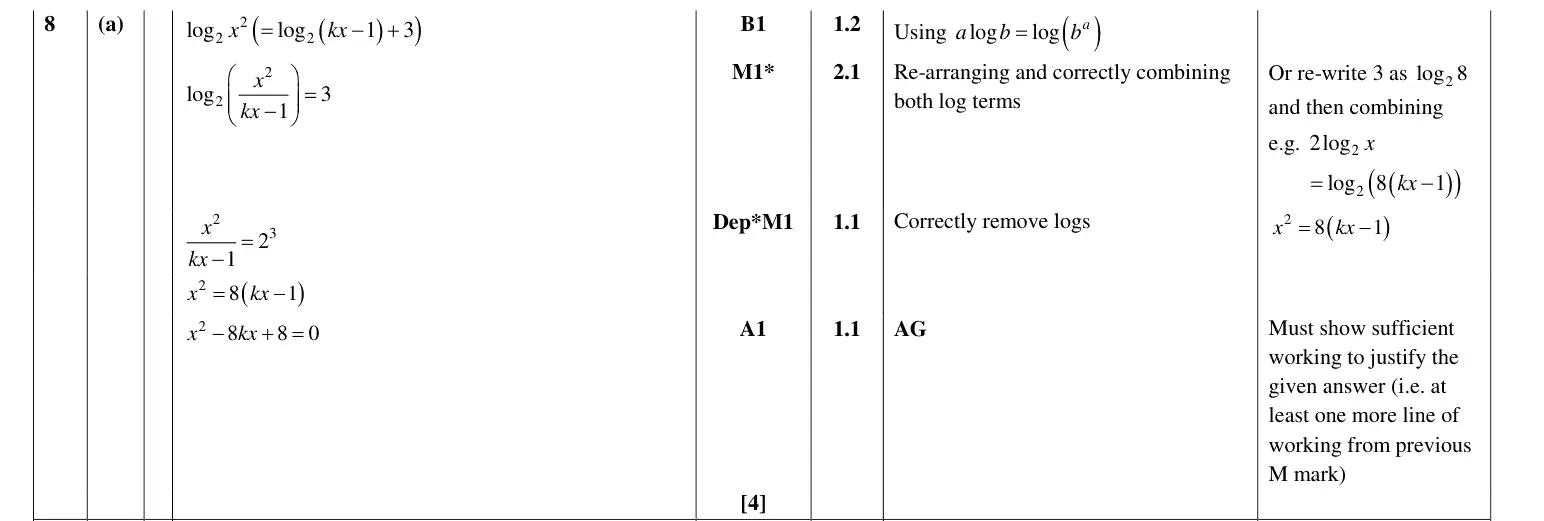
Many candidates here scored only one mark for log x . A confidence with using the laws of logarithms ( ) regularly stated. A few introduced 32 rather than 23. This was was not often seen, e.g. log x − kx + 1 ‘Show that’ question, with the answer given in the question, so we expected sufficient justification in the written response.
Key points and common errors
2log₂x = log₂x²
combine to log₂(x²/(kx − 1)) = 3 so x² = 8(kx − 1)
log(x) − log(kx − 1) errors and using 3² instead of 2³
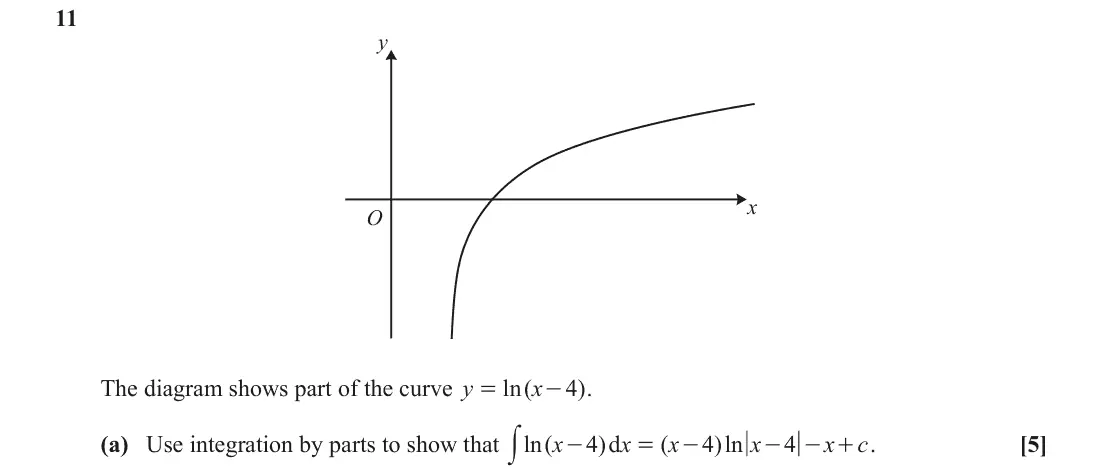
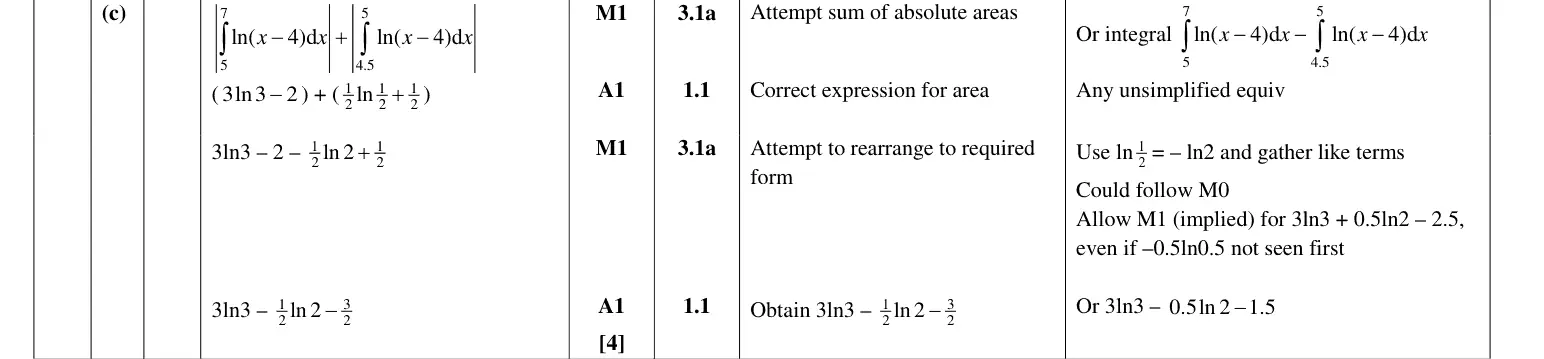
June 2019 · Paper 1 · Q11(c)4 marksHard
Show the start of this question
Mark scheme for this part
Examiner's comment
Only the most able candidates appreciated that the requested area existed both above and below the x- axis and were able to devise an appropriate strategy. Other candidates did calculate the two areas separately, but then simply added them together rather changing the relevant signs before combining the two integrals. However the majority of candidates simply used the two limits in the integral; many of these were still able to gain a mark for rewriting ln0.5 as –ln2.
Key points and common errors
region is below the axis from 4.5 to 5 and above from 5 to 7
combine magnitudes: 3ln3 − ½ln2 − 3/2
the majority integrated from 4.5 to 7 in one go
June 2019 · Paper 1 · Q12(b)4 marksMedium
Show the start of this question
Mark scheme for this part
Examiner's comment
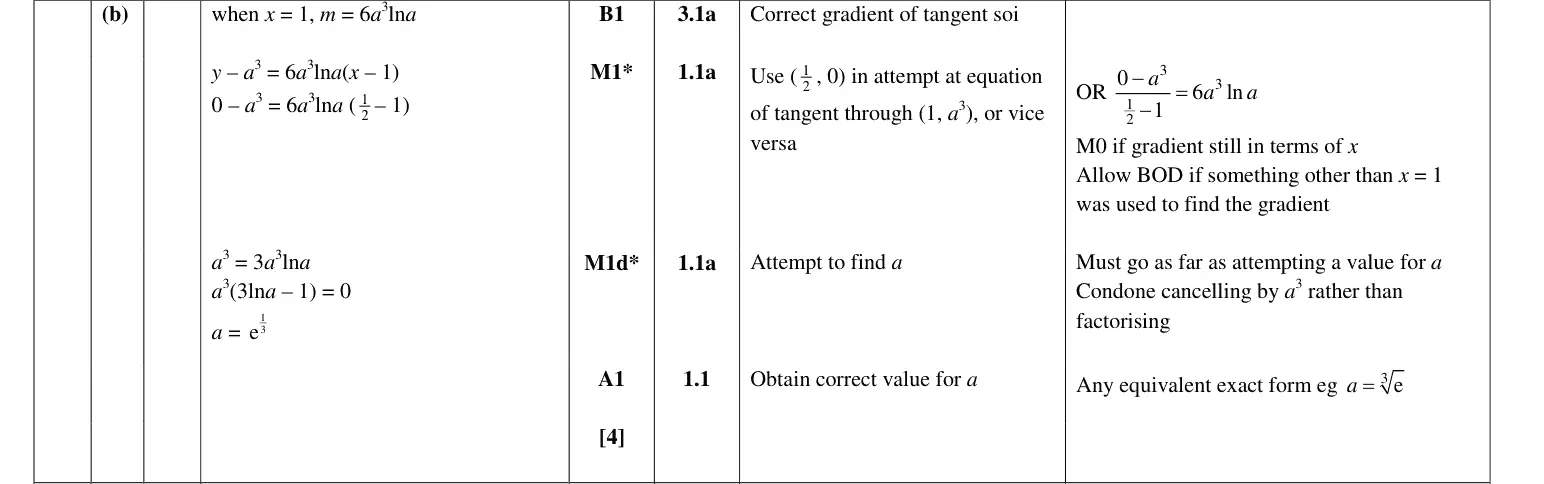
A number of candidates were able to make a good attempt at this question, producing fully correct solutions. The most common approach was to find a general equation for the tangent and then substitute in the given points, sometimes to give an equation that could be then solved and other times to set up two simultaneous equations. The less common, but more efficient, method was to use the two given points to find an expression for the gradient that was then equated to the derivative. Some candidates did not read the question carefully and used the wrong point when finding the gradient of the tangent, and others attempted to use both points in the derivative. A common misconception was to use the derivative in terms of x as the gradient rather than appreciating that a straight line must have a constant gradient.
Key points and common errors
gradient 6a³ln a at x = 1
tangent through (½, 0) gives a³ = 3a³ln a so a = e^(1/3)
using the wrong point for the gradient
June 2019 · Paper 3 · Q610 marksHard
Mark scheme for this part
Examiner's comment
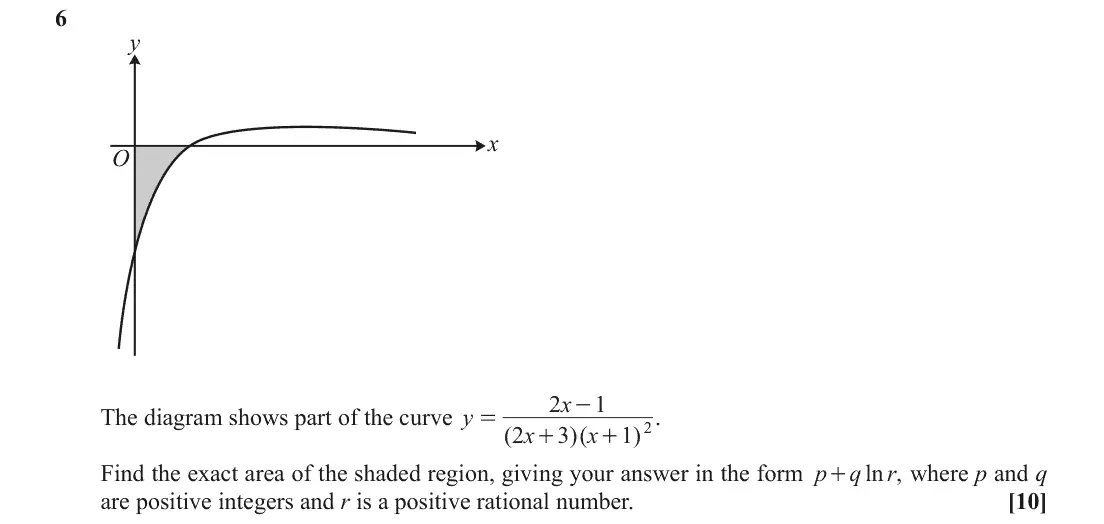
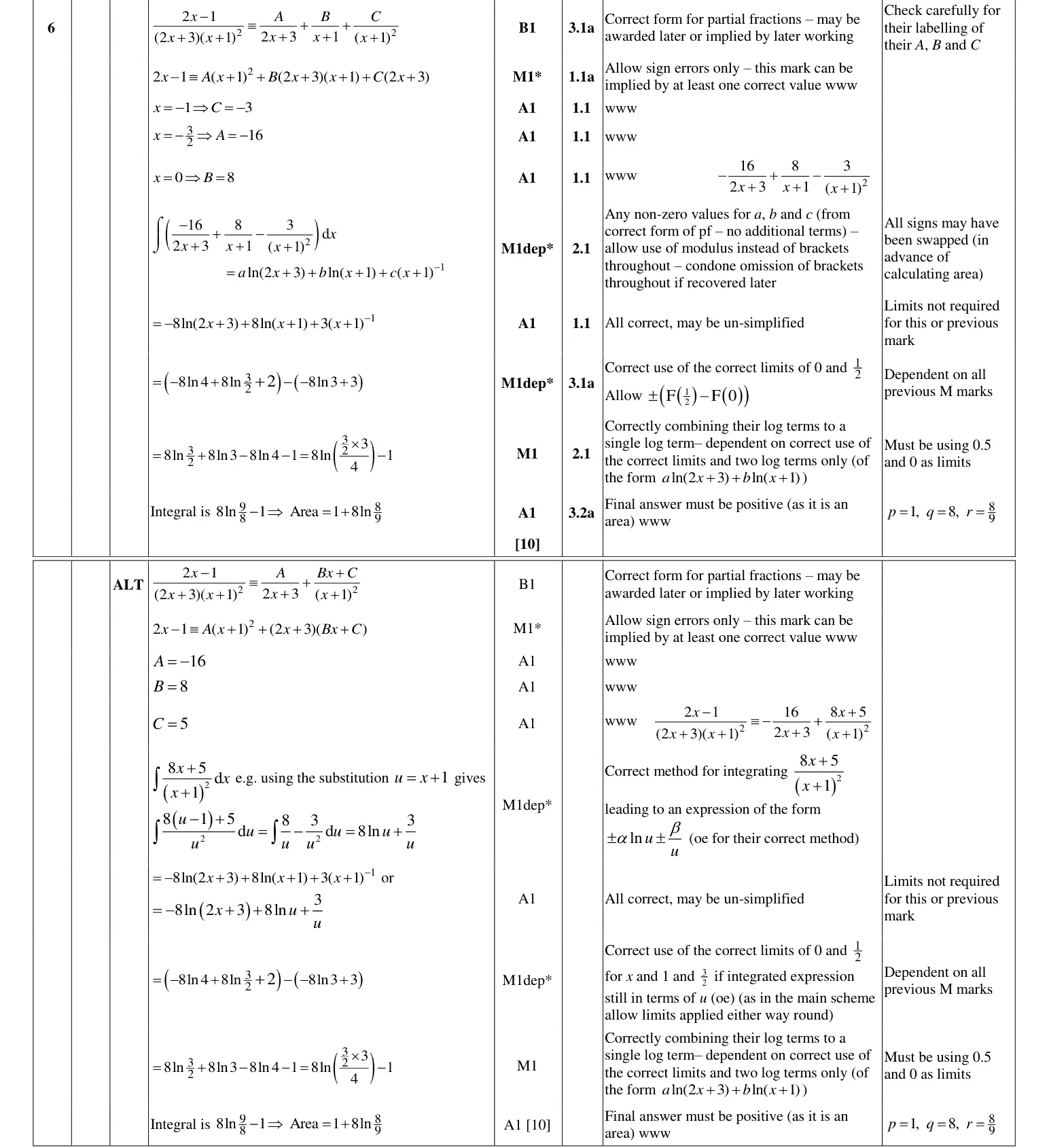
Many candidates made a good attempt at this question with most realising that to integrate 2 x − 1 A B C , partial fractions of the form + + were required, and many used a ( 2 3 )( 1 ) 2 x + 3 x + 1 ( 1 ) x + x + x + 16 8 3 correct method to obtain an answer of − + − (and so scored the first five marks in 2 x + 3 x + 1 ( ) x + 1 this part). It was the subsequent integration that most candidates found difficult with many believing that dx 1 all three integrated expressions involved the natural log function or that ∫ Of those = − . ( ) ( ) x + 1 x + 1 that integrated correctly and used the correct limits of 0.5 and 0 it was pleasing to note that many obtain a correct value for the integral as 8ln −. However, most candidates who had got this far did not 1 realise that this was not of the required form as stated in the question (and so therefore this was not an expression for the exact area of the shaded region). Only the most able of candidates realised that the area of the shaded region was in fact 1 + 8ln . This response scored the first nine marks. The candidate provided an almost perfect solution to the problem but due to the nature of their exact answer the candidate has not realised that their answer is negative (and therefore not the exact area of the shaded region). Even though the question explicitly said that the answer should be given in the form p + q r ln with p as a positive integer many candidates ( ) failed to realise that the required area was in fact 1 + 8ln .
Key points and common errors
A/(2x + 3) + B/(x + 1) + C/(x + 1)²: −16, 8, −3
∫3/(x + 1)² is not a log
limits 0 to ½
area 1 + 8ln(8/9) as a positive value
June 2018 · Paper 1 · Q1210 marksMedium
Mark scheme for this part
Examiner's comment
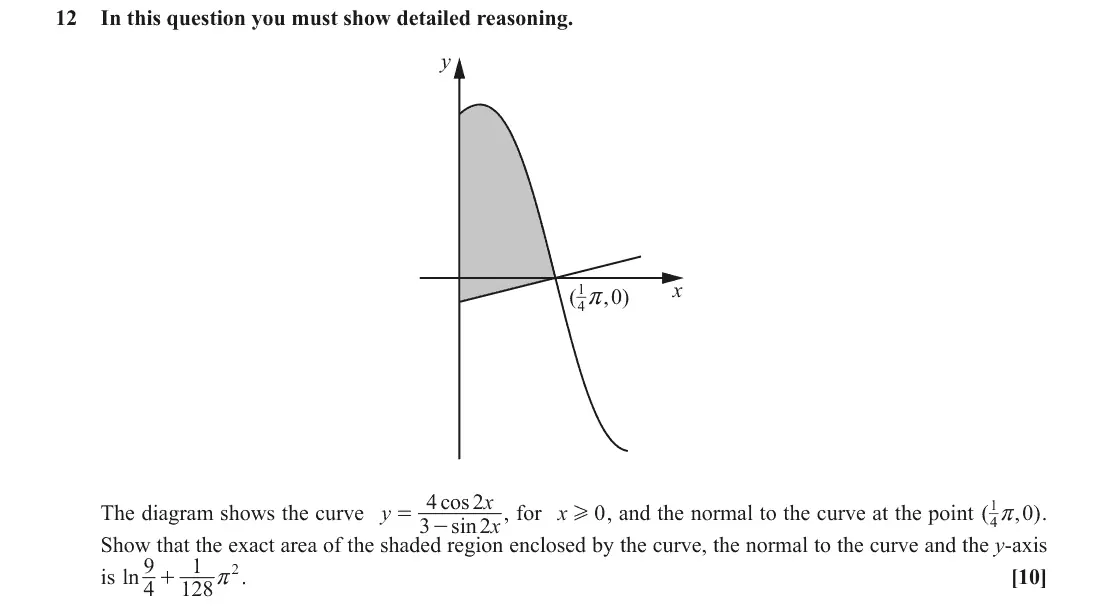
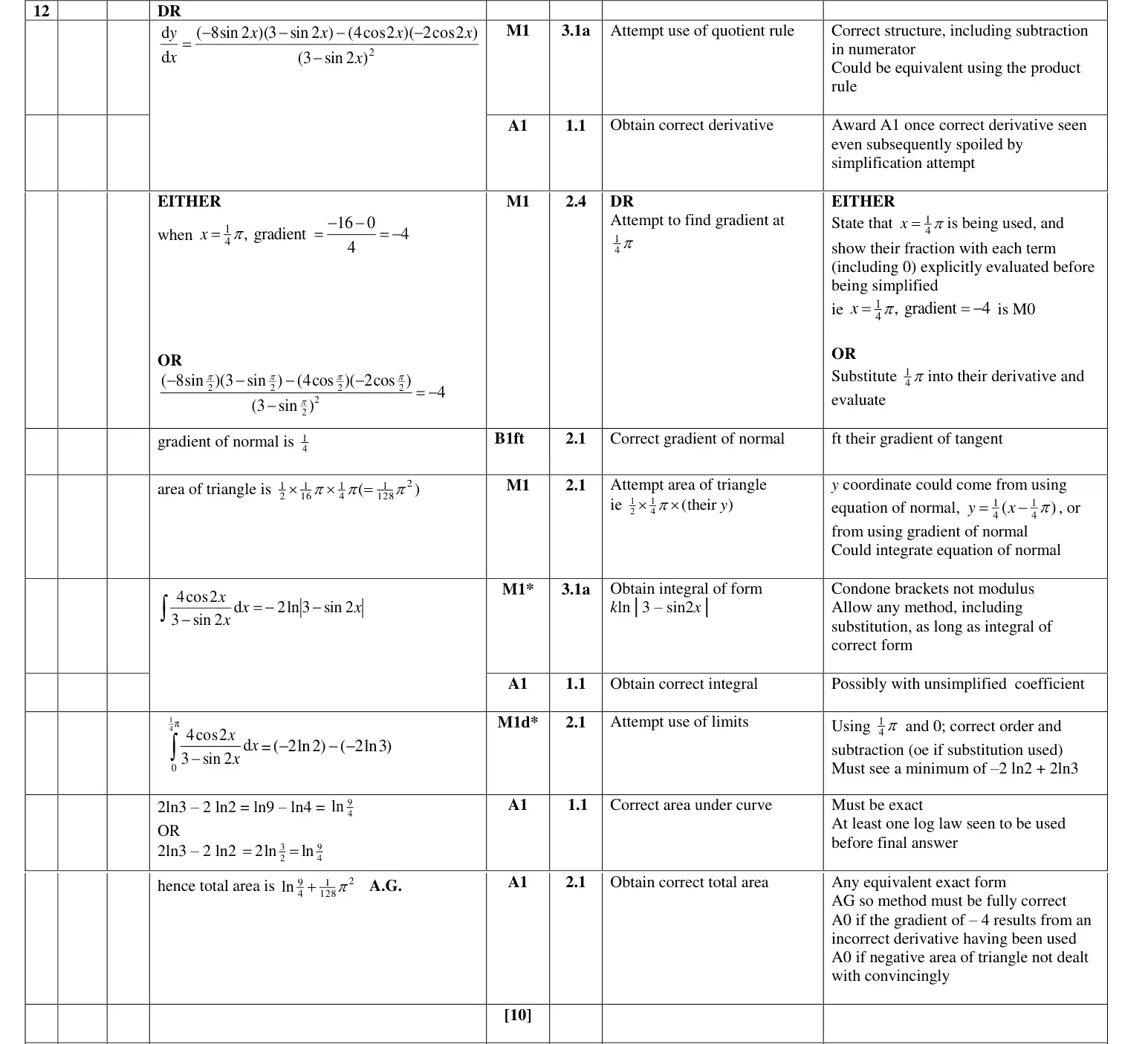
This was a question requiring detailed reasoning, so candidates were expected to show sufficient evidence of method throughout which not seen on all scripts. Candidates were generally successful when using the quotient rule to find the gradient of the curve. They were then expected to show evidence of finding the gradient at the given point; whilst some showed clear detail, others just stated the gradient with no justification. There were a variety of methods seen when finding the area of the triangle; the most common was to find the y intercept from the equation of the normal whereas others used integration. Some candidates identified that the 128π in the given answer must be the area of the triangle and attempted to fudge their answer to obtain this, in some cases deleting correct work and replacing it with a solution that was now worth less credit. Most candidates were able to correctly integrate the equation of the curve, some by inspection and others by using a substitution of their choosing. The limits were usually used correctly, but not all candidates provided sufficient evidence of use of logarithms before the appearance of ln 9 4 . This response gained full credit for a correct solution with sufficient justification seen throughout. The derivative is correct, and there is clear evidence of substitution to find the gradient at x = 1 4 π . Had the gradient of – 4 just been stated, but with no evidence, then this would have been penalised. The equation of the normal is used to find the intercept on the y-axis, and this is used to find the area of the triangle. The integration is also correct and limits are used correctly. There is then clear evidence of at least one log law being used to obtain the correct area under the curve. The two areas are then summed to justify the given answer.
Key points and common errors
quotient rule
gradient −4 at x = ¼π shown explicitly, normal gradient ¼
triangle area π²/128
∫4cos2x/(3 − sin2x) = −2ln(3 − sin2x)
area under curve ln(9/4)
handle the triangle below the axis convincingly
June 2018 · Paper 2 · Q6(ii)2 marksHard
Show the start of this question
Mark scheme for this part
Examiner's comment
− = 0 Many candidates just stated or implied that , either without proof, or by using their calculator and decimals. These candidates scored no marks, because of the "detailed reasoning" instruction.
Key points and common errors
ln4/4 = 2ln2/4 = ln2/2 using log laws
decimals from a calculator score nothing under DR
June 2018 · Paper 3 · Q5(ii)6 marksMedium
Show the start of this question
Mark scheme for this part
Examiner's comment
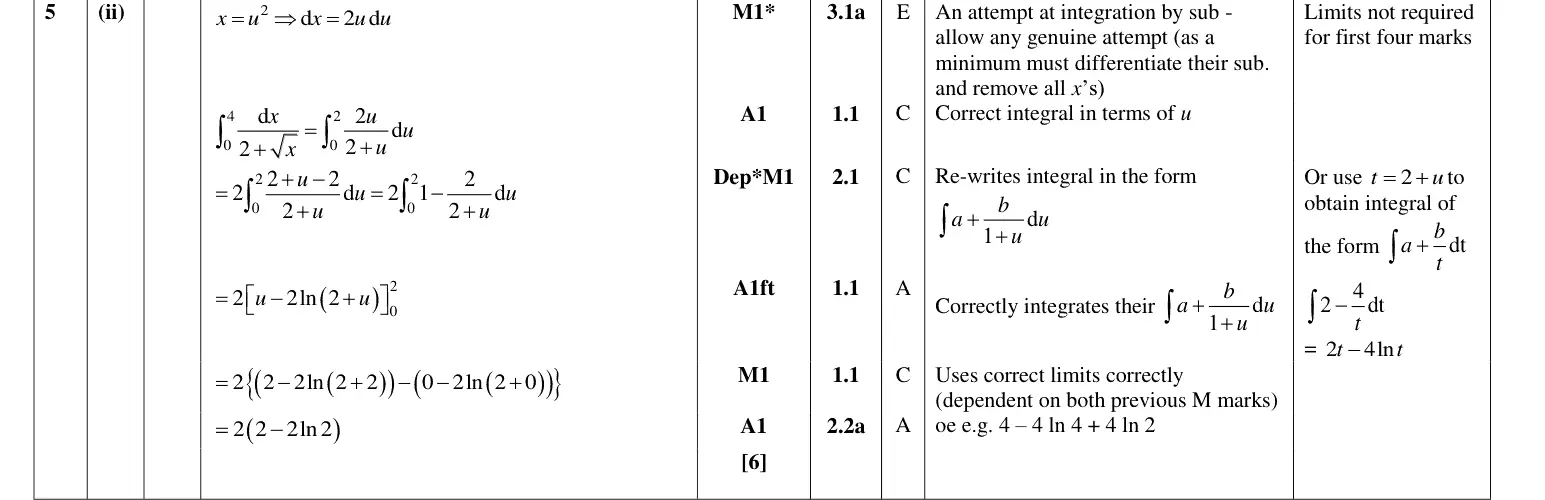
2 u ∫ While nearly all candidates used the substitution correctly and re-wrote the integral as d u many 2 + u could not deal with the resulting improper fraction in the integrand. The most successful candidates re- 2 u 2 u 4 + 2 u − 4 4 wrote u either by using long division or realising that = = 2 − u While examiners . 2 + 2 + u 2 + u 2 + noted that some candidates employed more extreme methods (for example, further substitutions and the method of integration by parts) these were usually unsuccessful.
Key points and common errors
dx = 2u du
∫₀² 2u/(2 + u) du
rewrite as 2∫(1 − 2/(2 + u)) du
2[u − 2 ln(2 + u)] = 4 − 4 ln 2
improper fraction caused difficulty
June 2018 · Paper 3 · Q5(iii)2 marksEasy
Show the start of this question
Mark scheme for this part
Examiner's comment
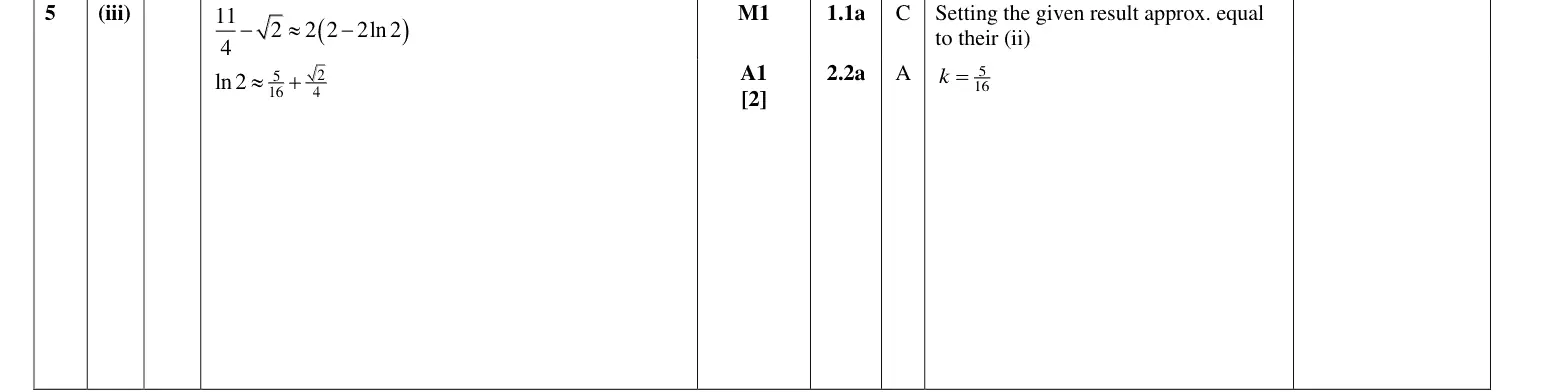
While some, who had struggled with part (ii), left this part blank the majority of candidates equated their answers to parts (i) and (ii) with nearly all who were successful in part (ii) correctly determining that = 5 k . 16
Key points and common errors
11/4 − √2 ≈ 4 − 4 ln 2 gives ln 2 ≈ 5/16 + √2/4, so k = 5/16
Find an A-level maths tutor
Stuck on this? Book a trial session with an A-level maths tutor.