Mark scheme for this part

Examiner's comment
This was a ‘Show that’ question so we expected fully accurate working.
Key points and common errors
- eˣ = 1 + 2eʸ substituted: 2(1 + 2eʸ) + 3e^(2y) = 41 gives 3e^(2y) + 4eʸ − 39 = 0
This was a ‘Show that’ question so we expected fully accurate working.

Most candidates were able to gain this mark by stating the correct scale factor.

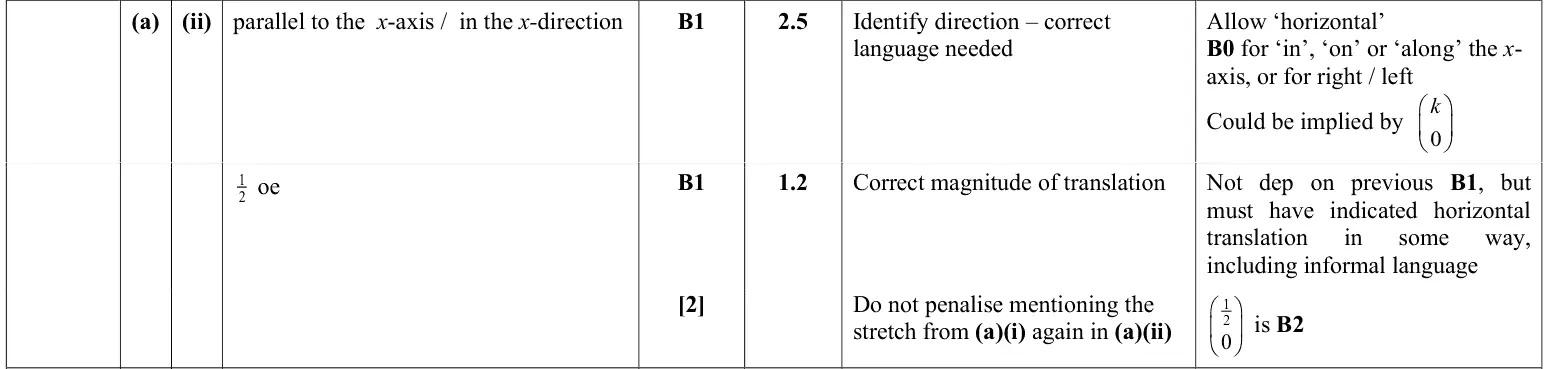
One mark was available for identifying the correct direction of the translation, using the expected mathematical terminology; this could also be implied by stating a vector for the translation with a y component of 0. Most candidates were able to gain this mark, usually through their vector statement, as long as this was not contradicted by their worded statement (e.g. stating that the translation was ‘vertical’ but giving a vector with a y component of 0 is ambiguous and thus B0). Identifying the magnitude of 0.5 proved to be more challenging, and only the most able candidates gained both of the marks available.

This part of the question proved to be more challenging, with just less than half of the candidates gaining the mark available. Those who were successful appreciated the need to rewrite the given equation in the form y = aebx, so as to address the information given in the question, and could then identify the magnitude of the stretch in the y-direction, giving the answer in an exact form.
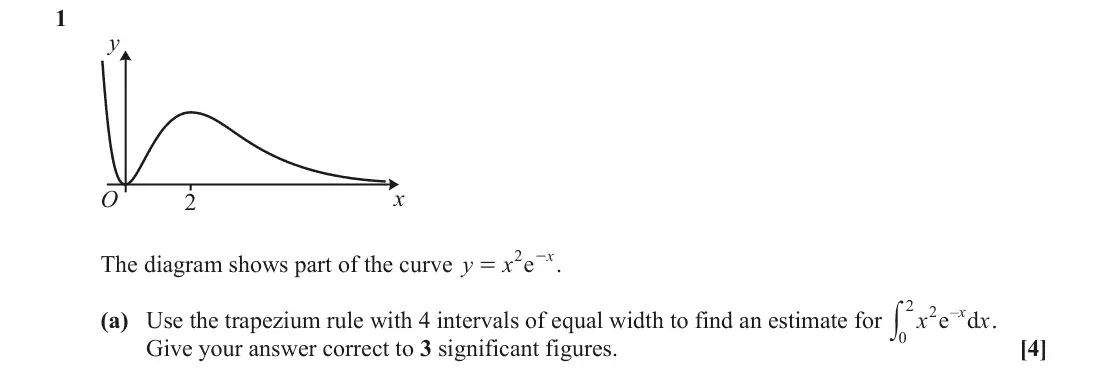
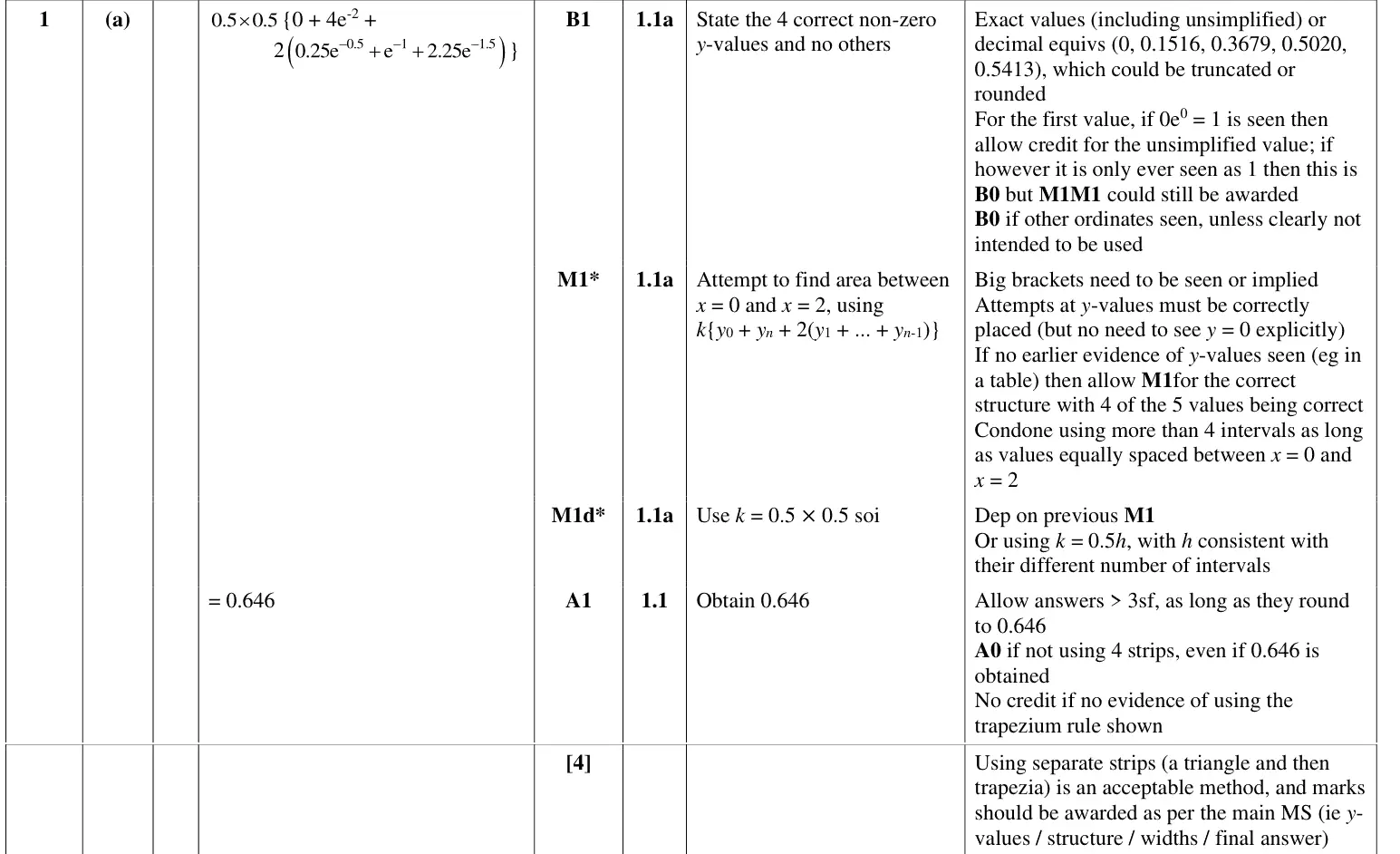
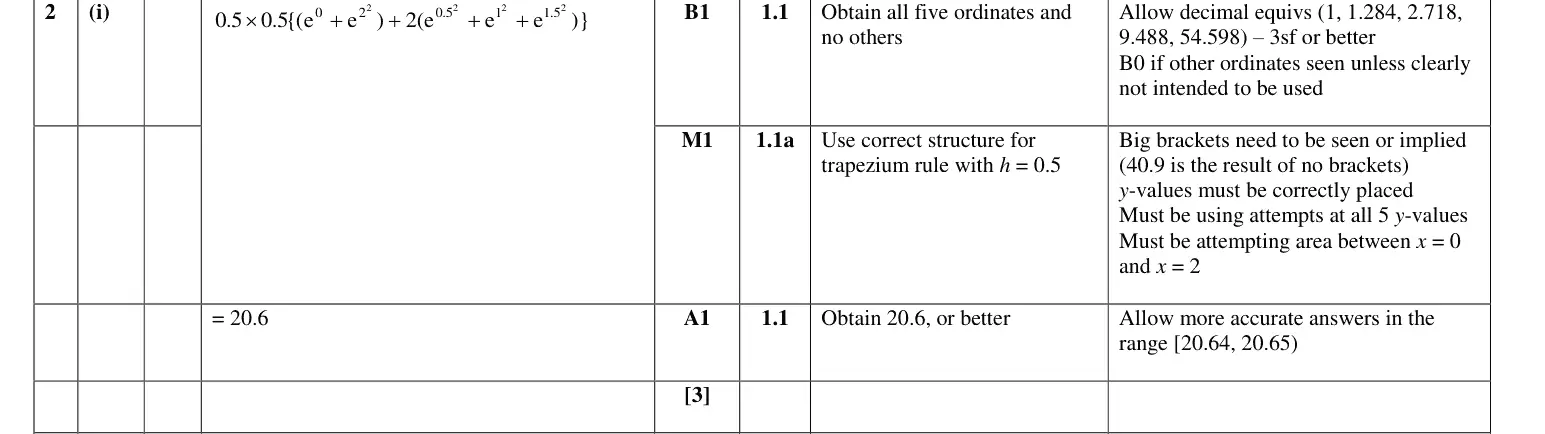
Most candidates made a good attempt at this question and achieved full marks. Those who lost marks often missed out brackets in their formula. Some candidates had used 1 as their first y-value rather than 0. Some omitted 0 completely, leading to them incorrectly approximating the integral between 0.5 and 2 with 3 intervals. A small number were not able to access this question, using either x-values or incorrect y-values placed incorrectly in the formula.



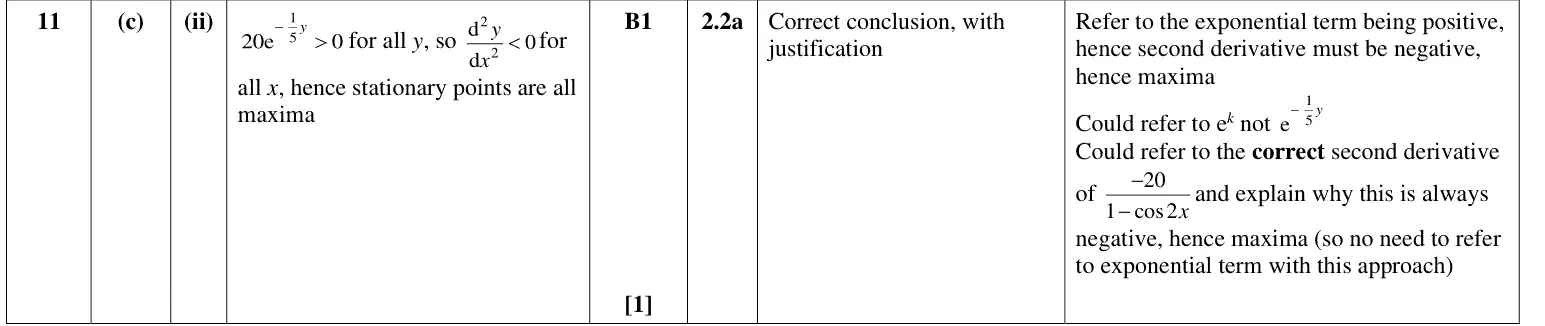
This was not well answered and was often left blank. Quite a few candidates who deduced that the stationary points must all be maxima did not give sufficient reasoning.
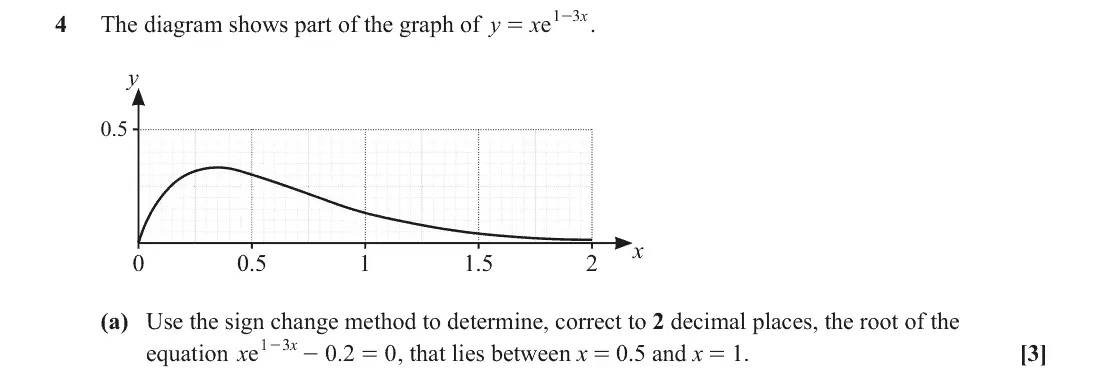
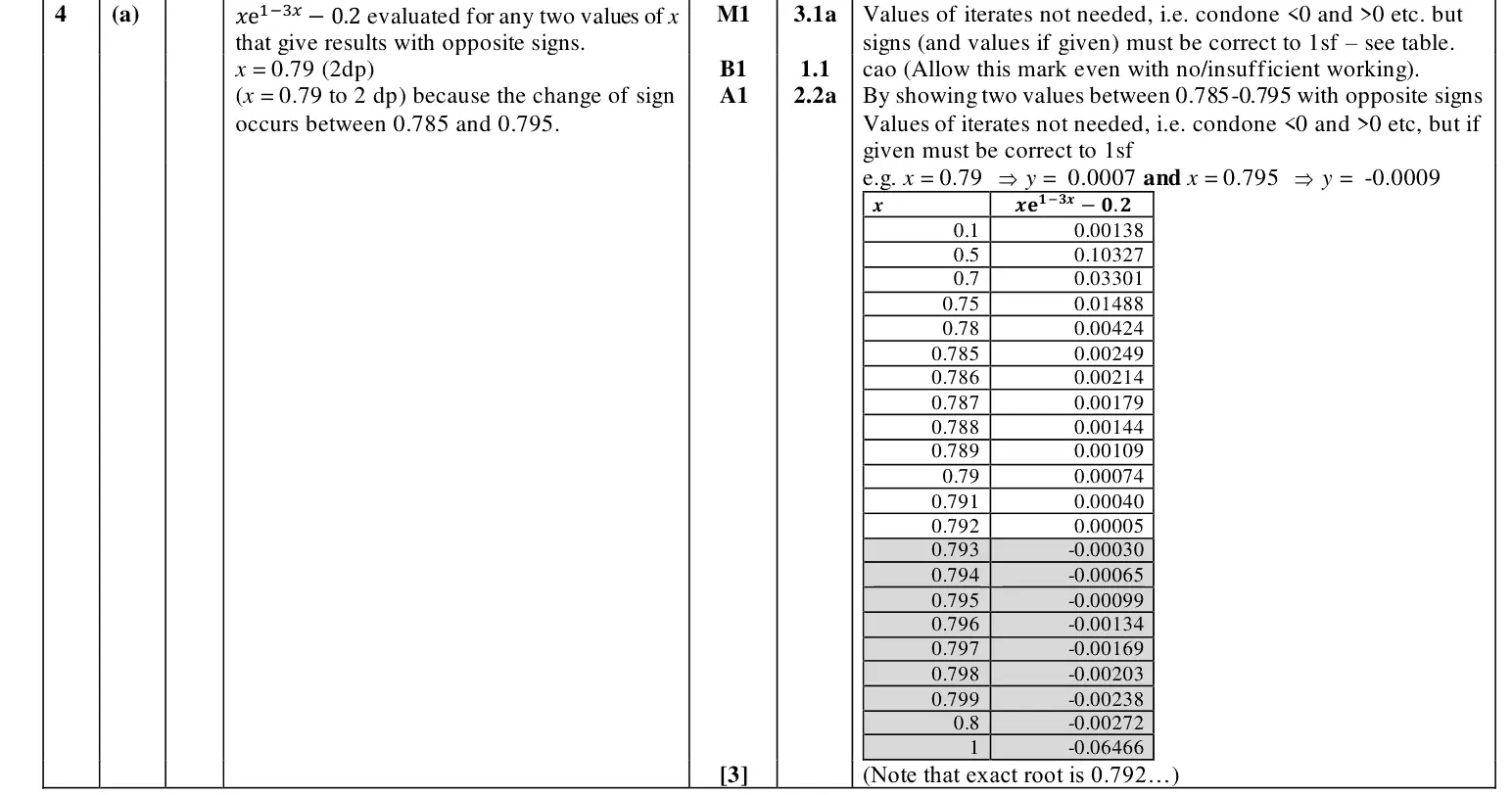
A minority of candidates scored all 3 marks in this part, although many candidates scored at least 1 and often 2. Most candidates correctly substituted 0.5 and 1 into the given expression to show a change of sign within the given interval, although quite a few stopped at this point (which could only score M1). Many candidates gave the correct value x=0.79 to 2dp - and this is an excellent example of a question where a calculator can be used effectively to verify a solution (or to give an idea of where to ‘look’ for the root). However, this root alone could only score B1. In order to achieve the final accuracy mark (and demonstrate that this is the correct root to 2dp) candidates needed to show a change of sign using a pair of iterates within the interval [0.785,0.795] with opposite signs, which very few did. Quite a few candidates gave a collection of iterates and claimed that led them to this conclusion but could only gain credit for two correct iterates in that interval. Note that informed choices of iterates, e.g. 0.79 and 0.793 could be credited, as could the boundary values of 0.785 and 0.795. Some candidates used Newton- Raphson to obtain an initial value (which is of course acceptable, but earned no credit on its own as the question specified a sign change). Candidates did not need to write down the value of the expression for their iterates, but if they did it needed to be correct to 1sf - some made a place value error when copying. This is a (typical) example of a candidate’s response where they have made a very good attempt at their sign change, with many correct iterates and the correct value to 2dp given. However, their iterates do not fully justify the solution to 2dp (there is only one in the range [0.785,0.795] and their explanation ‘closer to’ is not sufficient) so this response scores M1B1A0 for a total of 2/3.
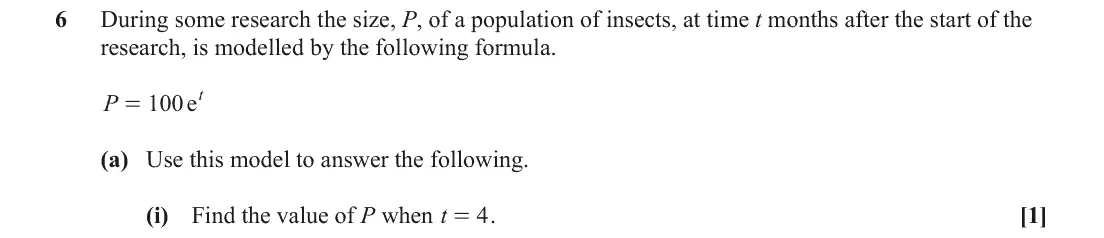
This question was answered correctly by almost all candidates.

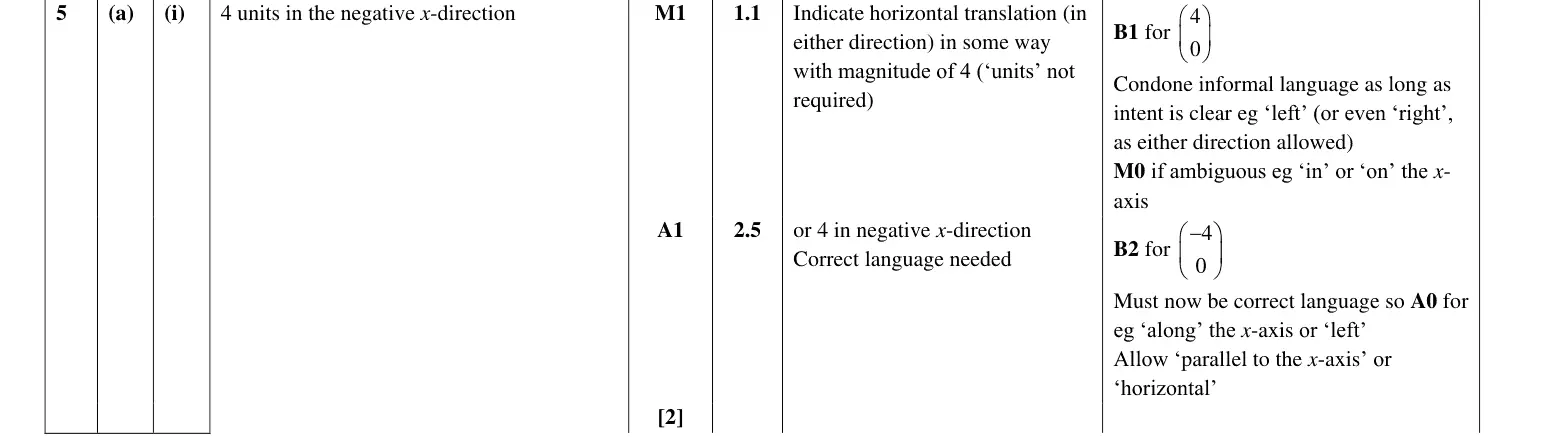
Most candidates could identify that a horizontal translation of 4 units was required, and also that it would be in the negative x-direction. To gain full credit, mathematically correct language was required but ambiguous statements such as ‘in’ the x-axis or informal ones such as ‘along’ the axis were all too common. The most successful approach was to state the correct column vector, thus avoiding the need for any additional description.

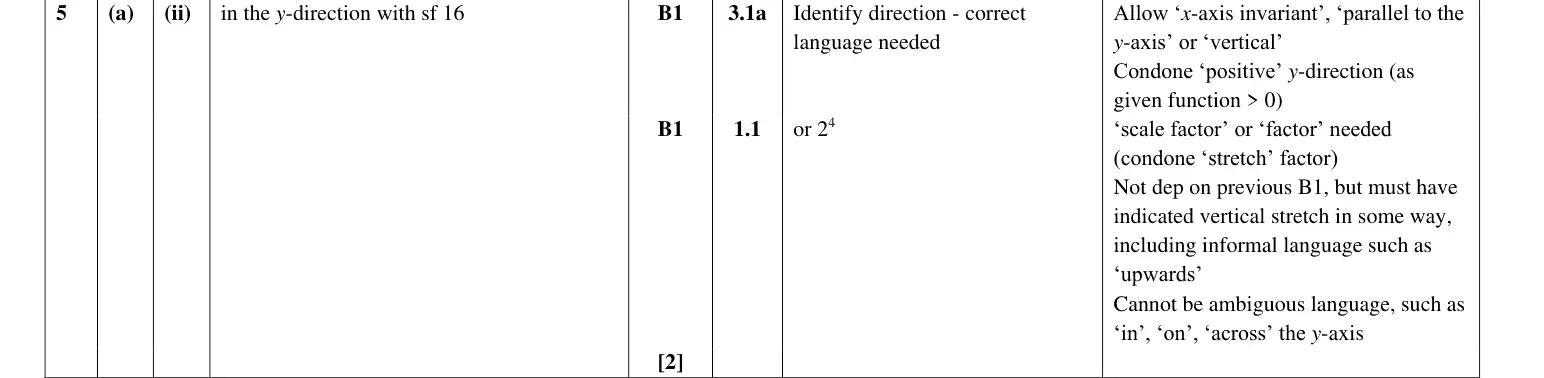
This part proved to be more challenging, with around half of the candidates being able to identify both the correct direction and the correct scale factor. Once again, incorrect language was all too common.

(From the general report) Question 9, covering aspects of parametric equations, proved challenging for a significant proportion of candidates. Question 9 highlighted confusion about when to use x = 0 or y = 0 when investigating the path of a particle defined parametrically.

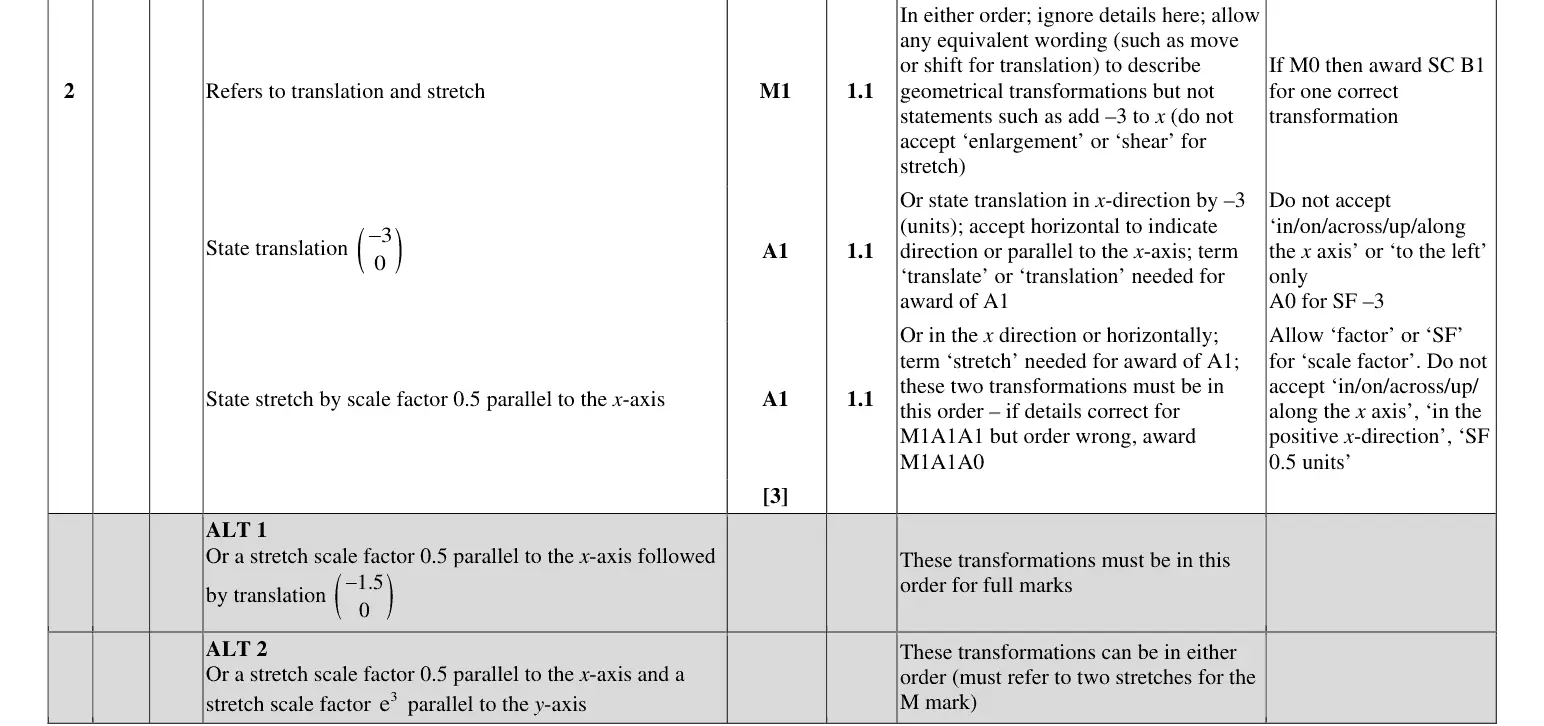
Although the majority of candidates demonstrated a clear understanding of the process of transformation there were very few who scored full marks, with most scoring 2 out of the 3 marks available. Some lost a mark for imprecise language, while others had the order of the transformations in the wrong order.

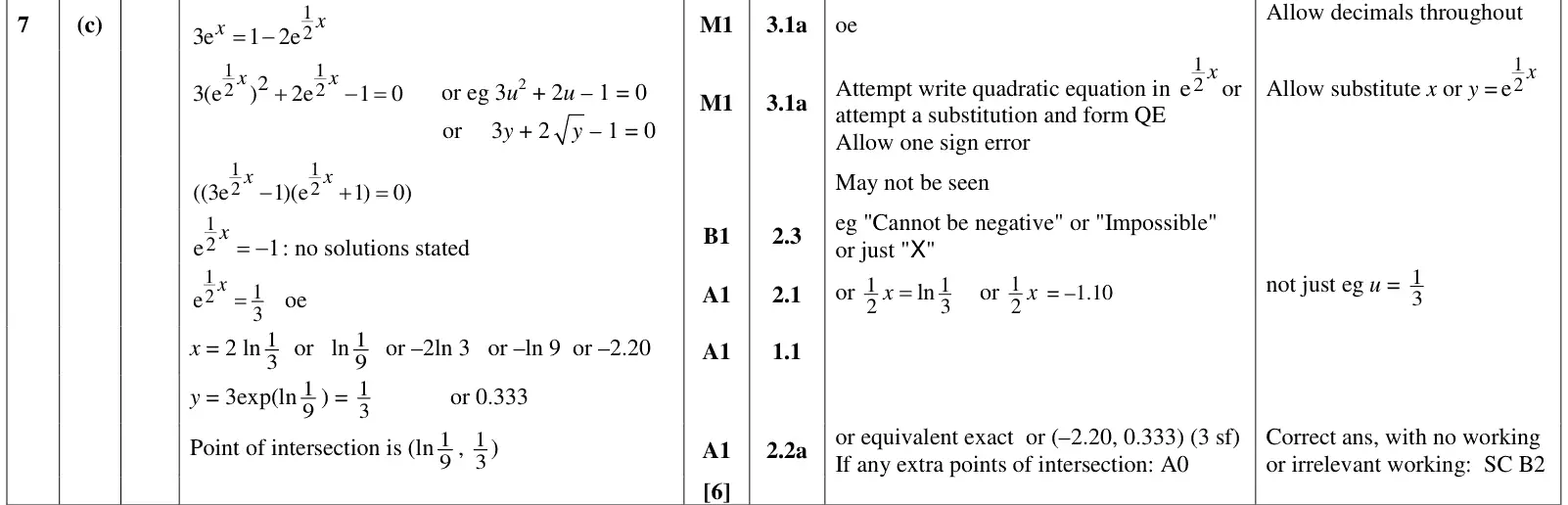
Erratum notice 1 2e x , but then proceeded to attempt to The majority of candidates wrote a correct equation, 3ex = 1 – 2 take the logarithms of both sides. Their attempts were invariably incorrect. A few candidates wrote a correct first equation but then attempted to combine the exponential terms, obtaining equations such as 3 5e x = 1. 2 Some candidates recognised the "hidden" quadratic equation. Of these candidates, some did not 1 x 2e x – 1 = 0 and generally succeeded. However, many 1 2 2 substitute, but obtained the equation 3 (e ) + 2 e x , often made errors such as obtaining 2u2 + 3u – 1 = 0 or 1 who substituted, for example u = 2 (3u)2 + 2u – 1 = 0. 1 e x = 1 The correct method leads to 2 3 or –1. To gain full marks candidates had to indicate in some way 1 e x = –1 has no solutions. that the equation 2 Some candidates used a graphical calculator either from the start or after abandoning the incorrect logarithm method. In some cases, correct responses were seen, but preceded by incorrect working. Because the command word in this question is "Determine" rather than "Find", answers obtained in this way, without working equivalent to that shown in the mark scheme, were not given full credit. They scored 2 marks (out of 6 marks), if correct to 3 significant figures The best solutions worked with exact values, expressed in terms of e. Working in terms of decimals was accepted, but the final response needed to be correct to 3 significant figures. It is worth noting that similar questions in the future might explicitly require candidates to work with exact values and in such questions, working and/or responses in terms of rounded decimals would be penalised.
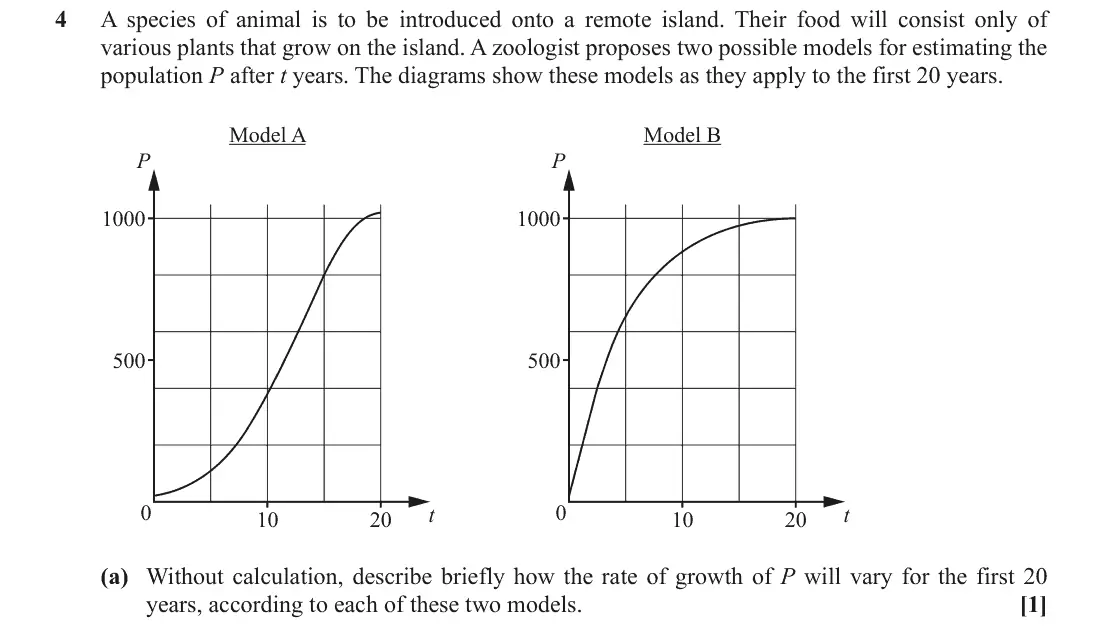
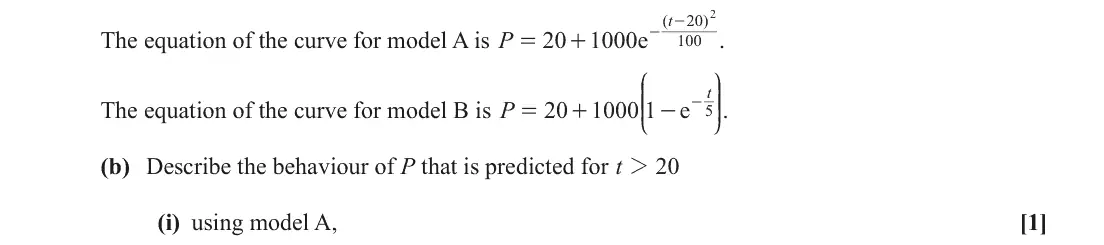
This part (and the next) depend on an ability to interpret the relevant equation involving an exponential function. Some candidates were able to interpret the equation correctly without quoting particular values of P. Others calculated values but were unable to give a proper interpretation. In some cases, candidates' answers to this part fitted the next part, and vice versa, suggesting a misunderstanding of the two equations. Some examples of inadequate or incorrect answers were as follows. P will decrease. P decreases exponentially after t = 20. P tends to zero. P will grow exponentially. The population will grow to about 1000 and then drop. P will tend to 1020. P will grow, but very slowly. The curve will be a reflection of the given curve. A good succinct answer is as follows: After t = 20 P will decrease, tending to 20.

Some of the comments on the previous part apply also to this part. Some examples of inadequate or incorrect answers were as follows. The growth of the population will slow until it stops. P will rise but increasingly slowly. P will increase. P will increase exponentially. P tends to 1000. The population is at a fixed number. P will decay exponentially. P will decrease and tend to 20. A good succinct answer is as follows: After t = 20 P will continue to increase, tending to 1020.

This question was also very well answered, with many fully correct solutions seen. The most successful candidates started by identifying the relevant x values, used exact y values rather than decimal approximations and made effective use of brackets.
Stuck on this? Book a trial session with an A-level maths tutor.