1.05h The definitions of secant (sec θ), cosecant (cosec θ) and cotangent…
Section
1.05 Trigonometry
Level
A level only
Statement
Understand and be able to use the definitions of secant (sec θ), cosecant (cosec θ) and cotangent (cot θ) and of arcsin θ, arccos θ and arctan θ and their relationships to sin θ, cos θ and tan θ respectively.
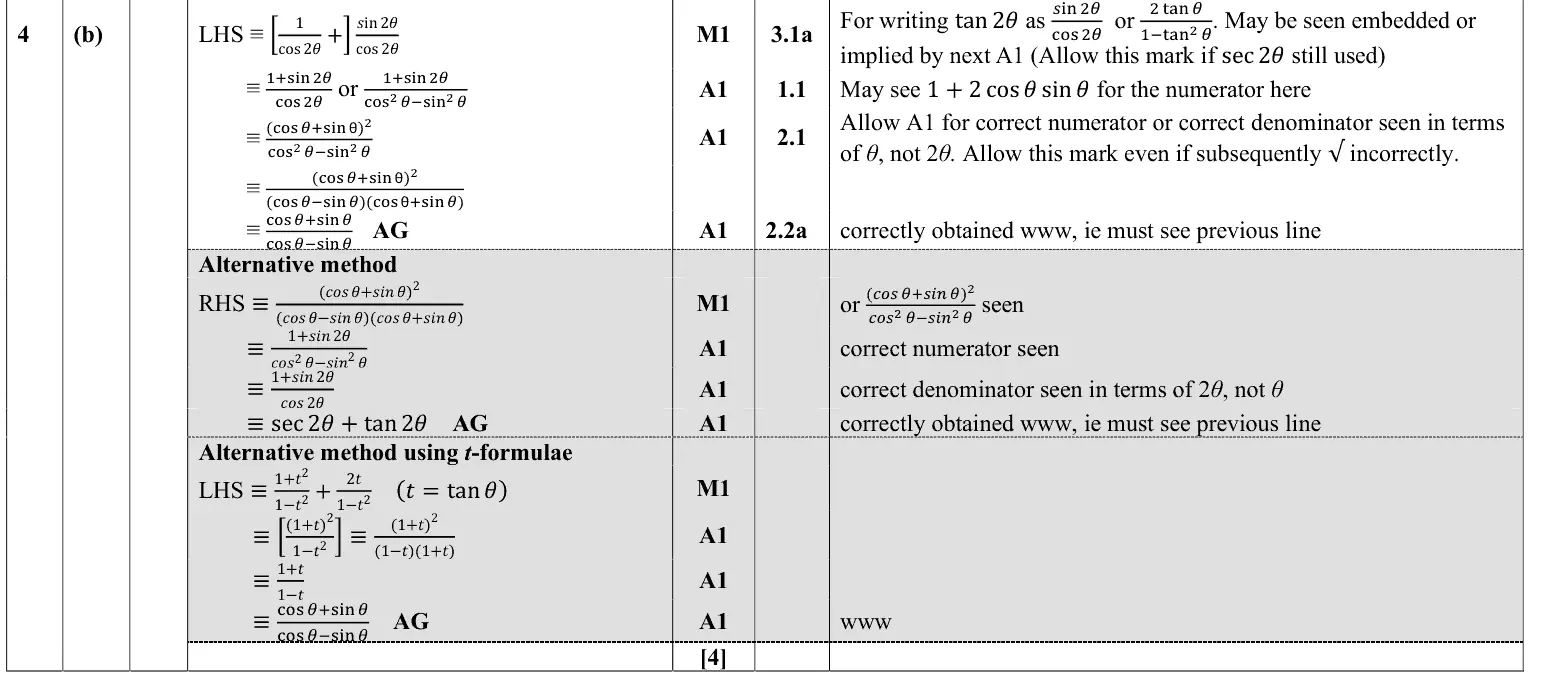
This part was also well answered by most candidates, with many scoring at least 3 of the 4 marks available. Most candidates started well, noticing that they needed to use an identity to write tan 2𝜃 in terms of sin 2𝜃 and cos 2𝜃 or to turn the statements in 2𝜃 into expressions in 𝜃 only. As noted above, some proofs were insufficiently rigorous. The scheme documents several different approaches (although others were seen and credited if correct and complete). The most common omission was not showing how (in the main method on the scheme) line 3 leads to the RHS of the given identity by factorising the denominator as a difference of two squares. The question included the instruction ‘hence or otherwise’ – most candidates identified that the identity from part (a) would be helpful although some candidates inadvertently proved this again as part of their work in this part.
Key points and common errors
write sec2θ + tan2θ as (1 + sin2θ)/cos2θ
use (a) for numerator and cos²θ − sin²θ as difference of squares
must show the factor cancelling
June 2025 · Paper 3 · Q5(b)4 marksMedium
Show the start of this question
Mark scheme for this part
Examiner's comment
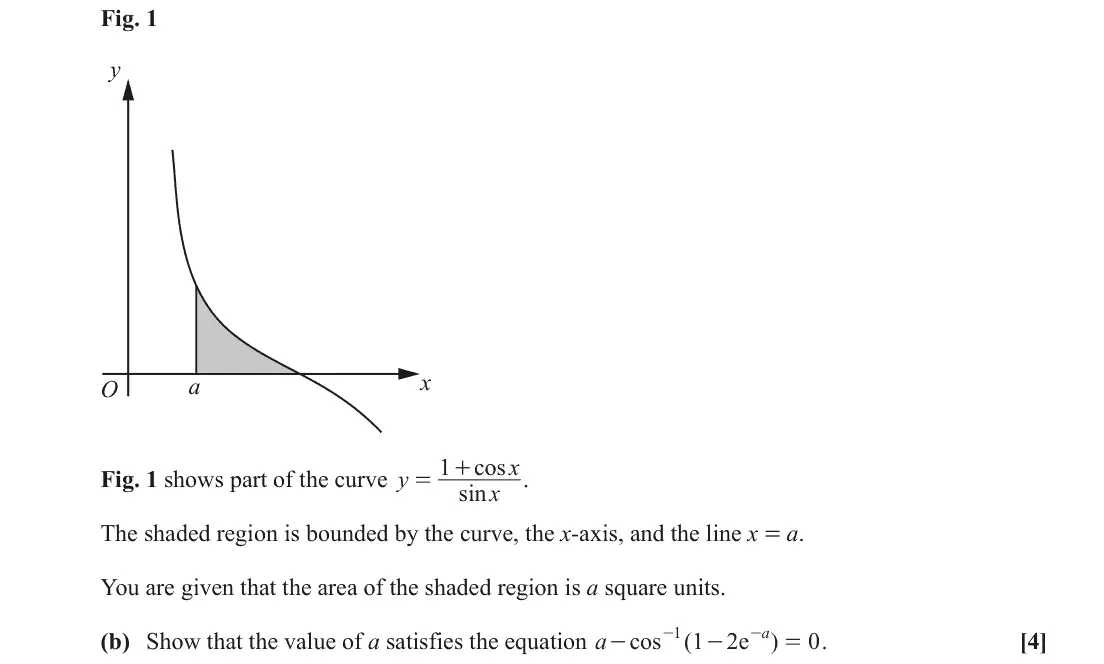
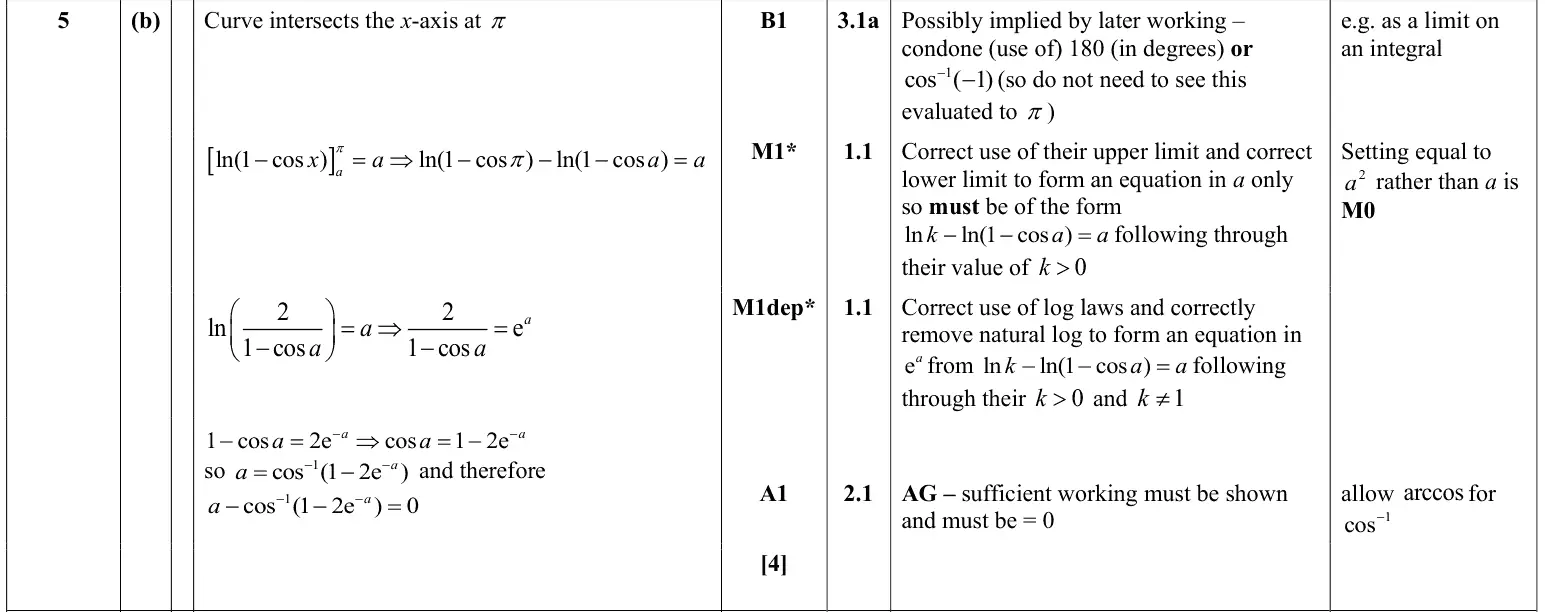
While many candidates correctly found that the curve intersected the 𝑥-axis at 𝜋, some struggled with applying the limits correctly to the given answer from part (a), and a number of candidates incorrectly thought that the shaded region had an area of 𝑎2. Of those that did correctly obtain the equation ln2 − ln(1 −𝑎) = 𝑎 many struggled with the associated log work required to get the answer in the given form with many incorrect replacing ln2 −ln(1 −𝑎) = 𝑎 with 2 −(1 −𝑎) = e𝑎.
Key points and common errors
curve meets the x-axis at π
ln 2 − ln(1 − cos a) = a
2/(1 − cos a) = eᵃ so a = cos⁻¹(1 − 2e^(−a))
area is a, not a²
June 2025 · Paper 3 · Q5(d)2 marksEasy
Show the start of this question
Mark scheme for this part
Examiner's comment
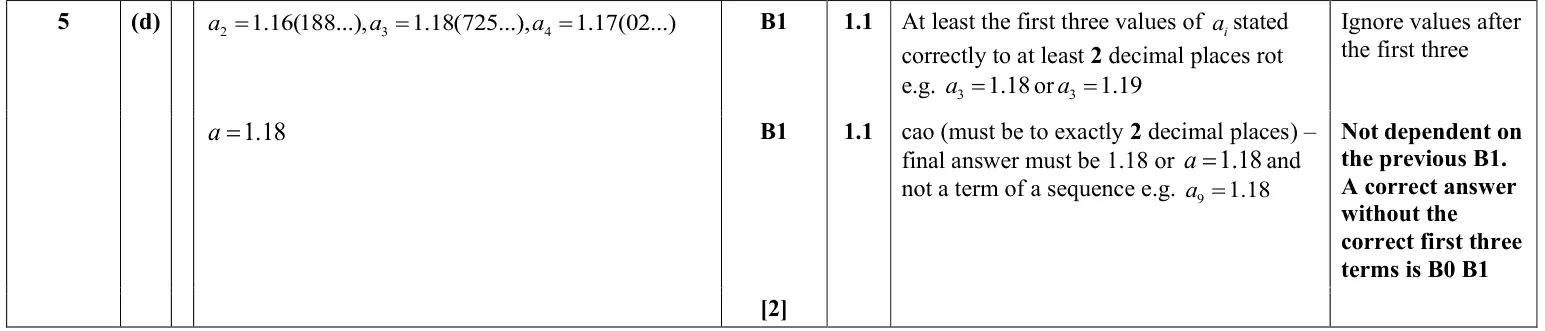
This part was answered extremely well with most candidates using the given iterative equation and showing sufficient iterations to obtain the correct value of 1.18 for the value of a. Occasionally, some candidates gave answers which implied that their calculator was set in degrees or did not give the answer to the required 2 decimal places.
Key points and common errors
a₂ = 1.1619, a₃ = 1.1873, a₄ = 1.1702 …
a = 1.18 to 2 d.p.
radians
June 2025 · Paper 3 · Q6(b)4 marksHard
Mark scheme for this part
Examiner's comment
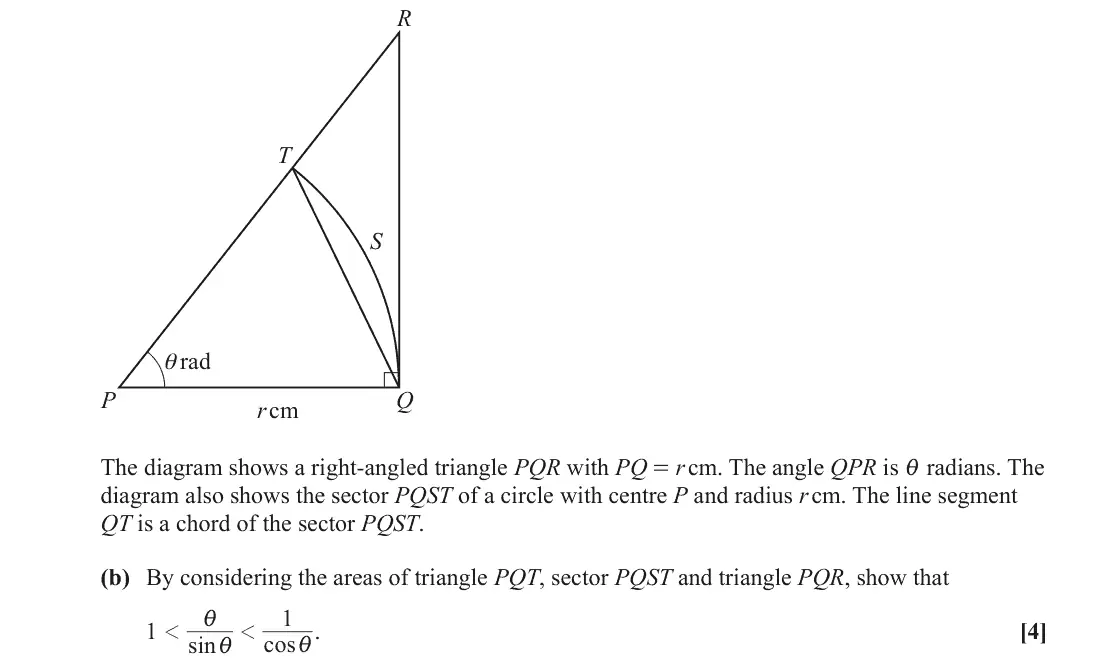
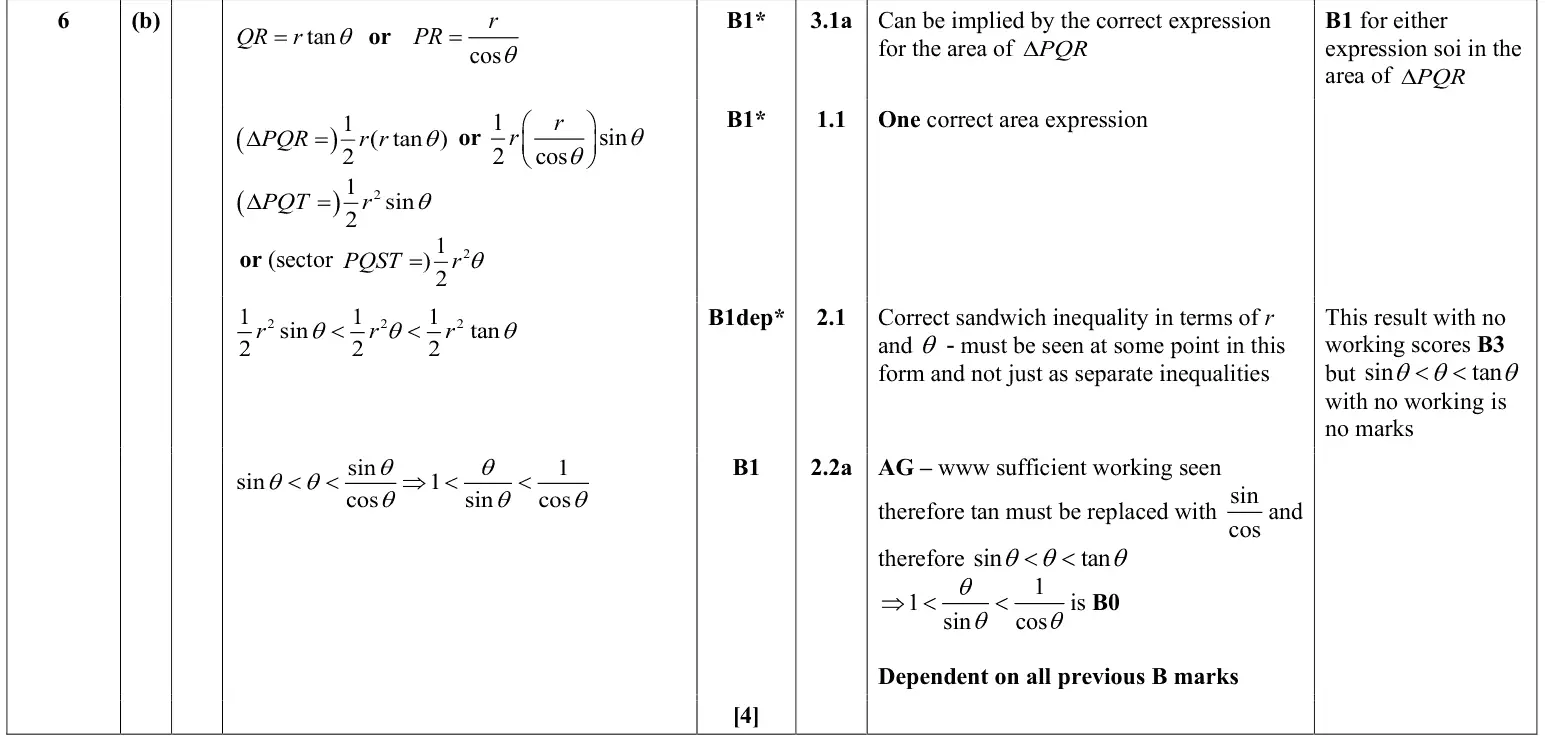
While most candidates scored at least 1 mark for correctly stating the area of sector PQST or the area of triangle PQT many struggled with finding the area of triangle PQR with many not realising that 𝑄𝑅= 2 𝑟2𝜃 for the area of a sector of a circle 𝑟tan𝜃. Very few candidates referred directly to the formula 𝐴= with 𝜃 measured in radians, with many either quoting incorrect formulae or having to convert from a corresponding formula with the angle given in degrees. Of those that did have a correct inequality, e.g. 2 𝑟2 sin 𝜃< 2 𝑟2 tan 𝜃 most then went on to correctly derive the given answer (although some did 2 𝑟2𝜃< not show sufficient working or justification for why cos 𝜃). sin𝜃=
Key points and common errors
QR = r tan θ
½r² sin θ < ½r²θ < ½r² tan θ
divide by ½r² sin θ to get 1 < θ/sin θ < 1/cos θ
sector area needs θ in radians
June 2024 · Paper 3 · Q4(a)3 marksMedium
Mark scheme for this part
Examiner's comment
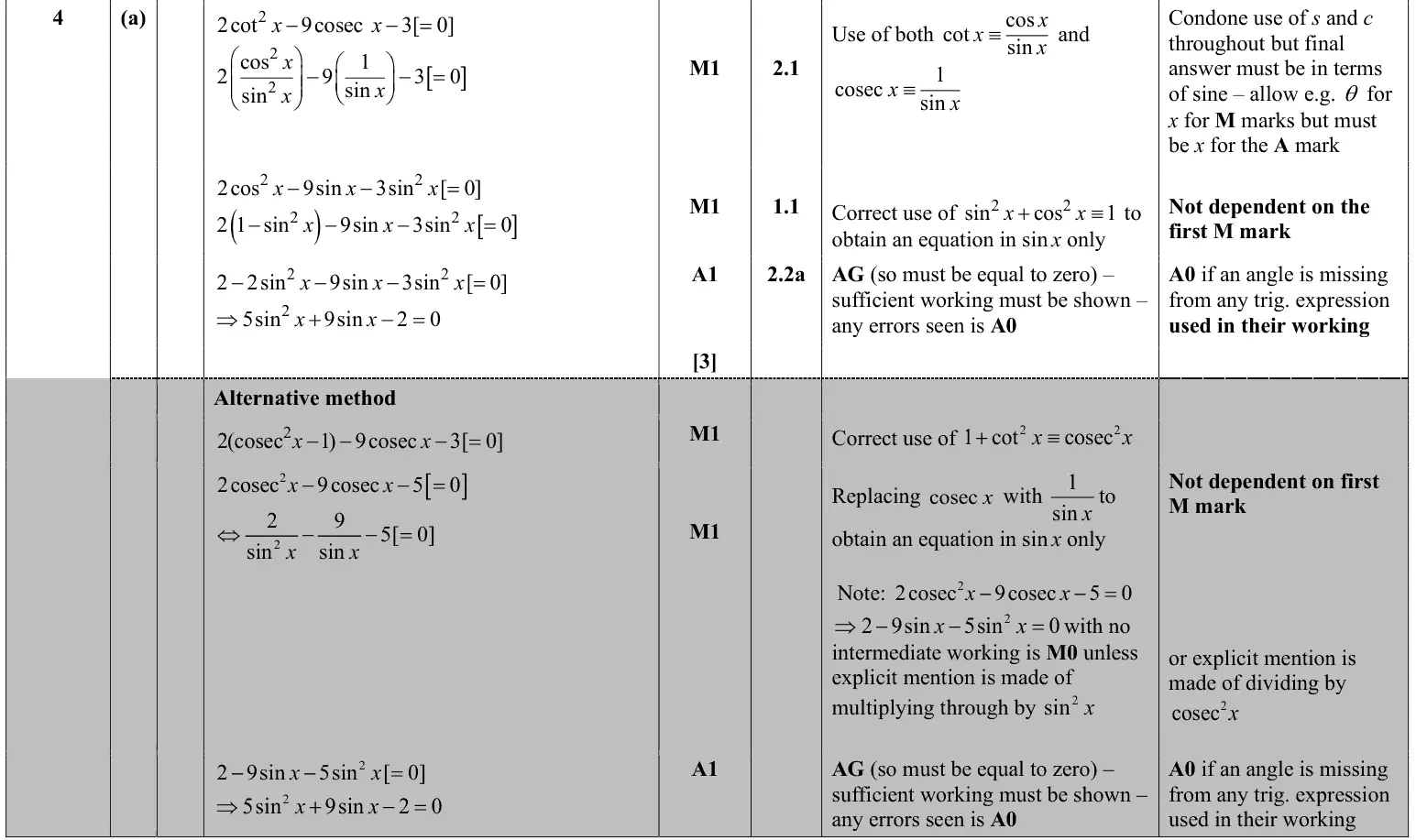
Candidates were almost equally split between the two possible methods to derive the given result. The first method was to re-write the given equation (using cot 𝑥= sin𝑥 and cosec 𝑥= sin𝑥) as 2cos2𝑥− 9 sin 𝑥−3sin2𝑥= 0 and then use the result that cos2𝑥= 1 −sin2𝑥 to obtain the required equation in sine. The second method was to use the identity 1 + cot2𝑥= cosec2𝑥 to obtain 2cosec2𝑥−9cosec𝑥−5 = 0 and then use cosec𝑥= sin 𝑥 to obtain the given result. The only issue that examiners reported with the second method was that a number of candidates gave no indication of how they went directly from 2cosec2𝑥−9cosec𝑥−5 = 0 to 2 −9 sin 𝑥−5sin2𝑥= 0 which considering this was a ‘show that’ question meant that full credit could not be given. Furthermore, as this was a given answer all working needed to be correct as any errors seen meant that the final accuracy mark could not be given.
Key points and common errors
cot x = cos x/sin x and cosec x = 1/sin x, then cos²x = 1 − sin²x
or 1 + cot²x = cosec²x
given answer so '= 0' and full working needed
June 2024 · Paper 3 · Q4(b)(i)4 marksMedium
Show the start of this question
Mark scheme for this part
Examiner's comment
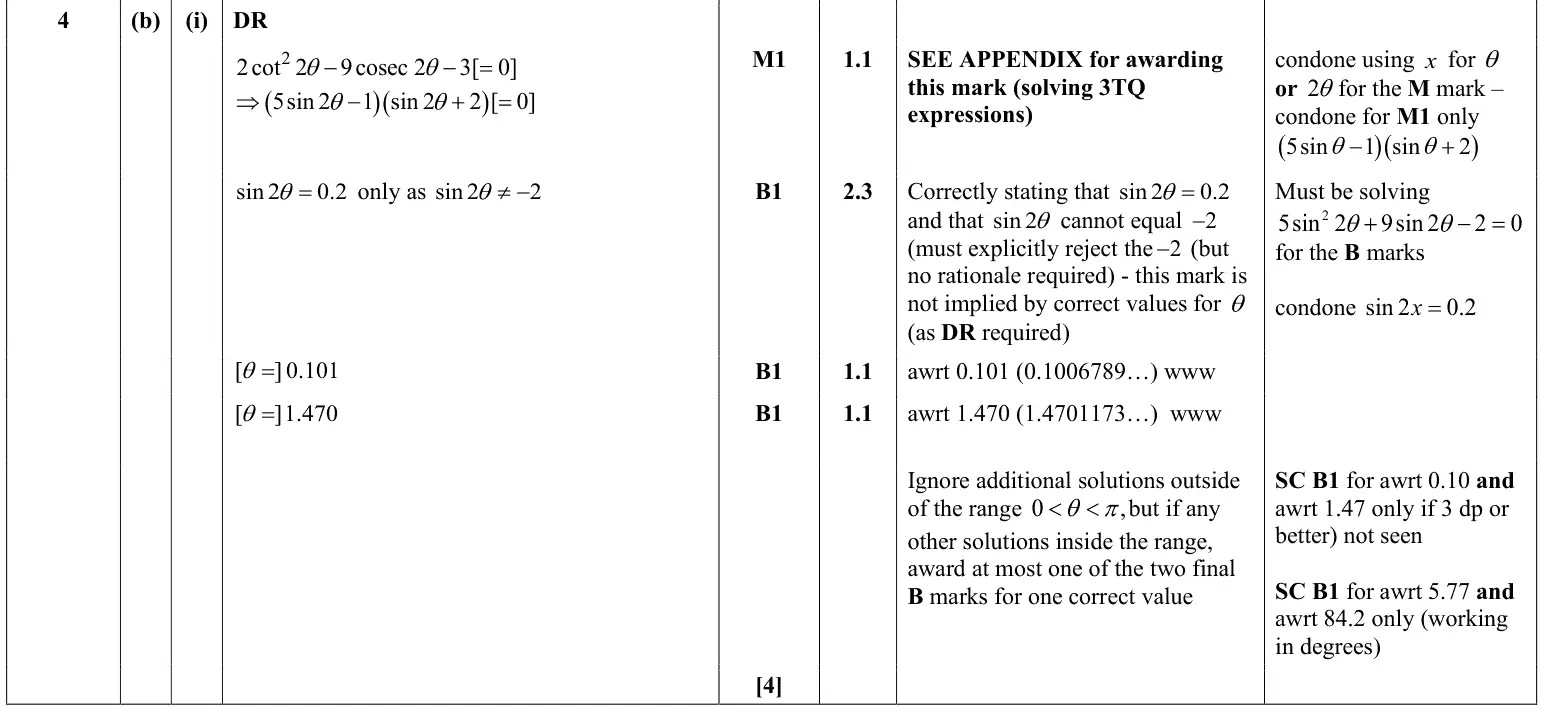
There were two main issues that candidates faced when answering this part. The first was that a good number did not appreciate that as this question required ‘detailed reasoning’. They either showed no method for solving the quadratic in sin2𝜃 or they gave no indication for why sin 2𝜃 could not equal −2. The other issue was that many candidates did not read the question carefully and instead solved the (simpler) equation of 2cot2𝜃−9cosec 𝜃−3 = 0 and so scored only the first method mark. Of those that did solve the correct equation most gave the first root (0.101) correct to the required 3 decimal places but did not give the second to the same degree of accuracy (with many just stating the answer as 1.47).
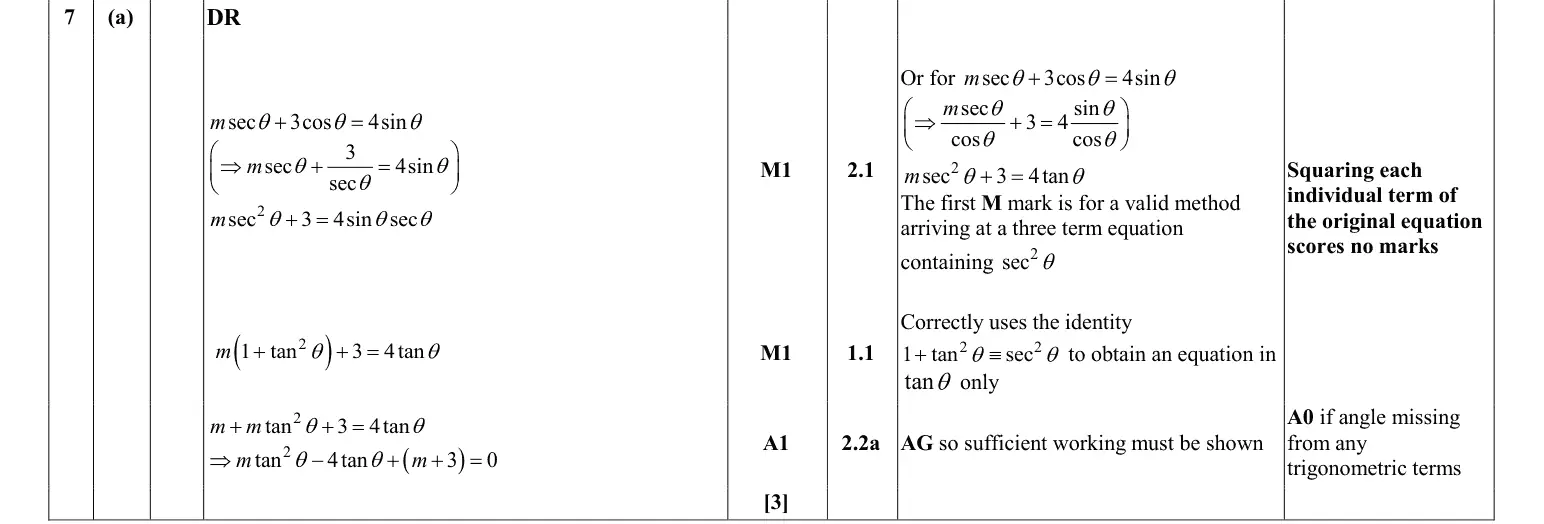
It was pleasing that many candidates seemed to answer this part with ease. The most successful responses started by dividing each term by costherefore obtaining m sec + 3 = 4tan . From here most candidates correctly applied the identity 1 + tan sec and obtained the given response. The most common incorrect method seen by examiners was to take the given equation and replace it with + = m sec 9cos 16sin .
Key points and common errors
divide by cos θ: m sec²θ + 3 = 4tan θ
use sec²θ = 1 + tan²θ
squaring terms is invalid
Autumn 2021 · Paper 1 · Q8(b)(i)2 marksMedium
Show the start of this question
Mark scheme for this part
Key points and common errors
sec 0.6 = 1.2116 then 2tan(1.2116) = 5.3269
at least one interim value needed
radians
Autumn 2021 · Paper 1 · Q8(c)5 marksMedium
Show the start of this question
Mark scheme for this part
Examiner's comment
(From the general report) In the final part of Question 4 one root of the cubic polynomial could not be further pursued to find a value for y, and a similar situation occurred in Question 8(c).
Key points and common errors
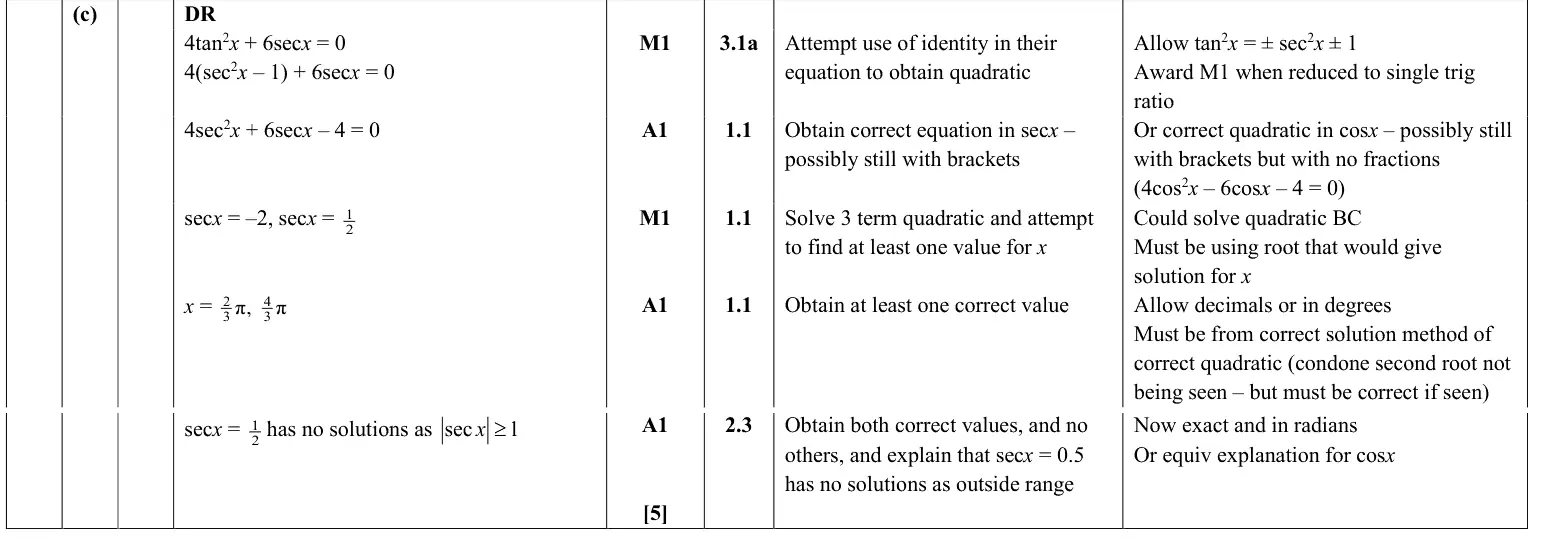
4tan²x + 6sec x = 0
use tan² = sec² − 1 to get 4sec²x + 6sec x − 4 = 0
sec x = −2 gives x = 2π/3, 4π/3
must explain sec x = ½ has no solution as abs(sec x) ≥ 1
Autumn 2021 · Paper 3 · Q6(a)2 marksHard
Mark scheme for this part
Examiner's comment
(Comment on Question 06 as a whole) It was clear that many candidates struggled with this question even though it was relatively routine in nature. The notation, arcsin, clearly confused some candidates even though it is given in the specification.
Key points and common errors
f(0.5) = −0.25 < 0 and f(0.6) = 0.848 > 0
state change of sign and conclusion
radians
Autumn 2021 · Paper 3 · Q6(b)2 marksHard
Show the start of this question
Mark scheme for this part
Examiner's comment
(Comment on Question 06 as a whole) It was clear that many candidates struggled with this question even though it was relatively routine in nature. The notation, arcsin, clearly confused some candidates even though it is given in the specification.
Key points and common errors
arcsin(2x − 1) = x²/6 so 2x − 1 = sin(x²/6)
p = ½, q = ½, r = 1/6
arcsin notation confused many
June 2019 · Paper 3 · Q4(a)3 marksMedium
Mark scheme for this part
Examiner's comment
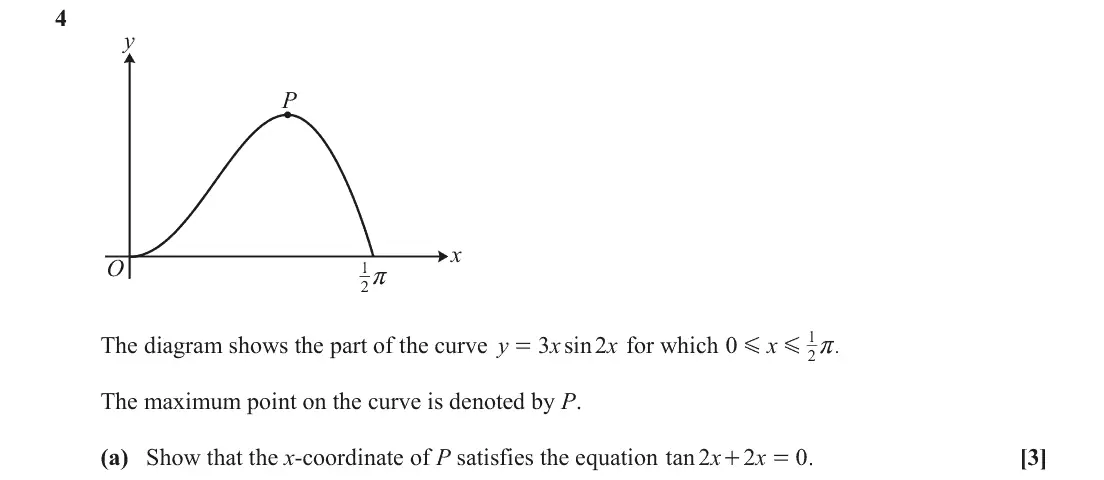
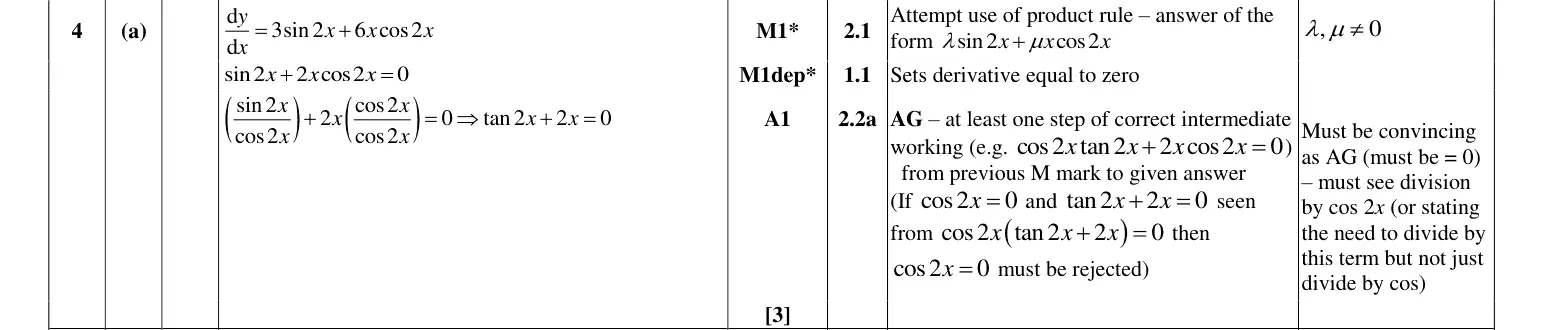
While most candidates differentiated y correctly (using the product rule) and obtained 3sin2 x + 6 cos2 x x = 0 many candidates did not show enough working to convince examiners that they had derived and not simply stated the given result. For example, sin 2 x + 2 cos 2 x x = 0 ⇒ tan 2 x + 2 x = 0 scored A0. sin2 x But sin2 x + 2 cos2 x x = 0 ⇒ + 2 x = 0 ⇒ tan2 x + 2 x = 0 scored A1. cos2 x
Key points and common errors
product rule: 3sin2x + 6xcos2x = 0
divide by cos 2x explicitly to reach tan2x + 2x = 0
insufficient working
June 2019 · Paper 3 · Q4(b)4 marksHard
Show the start of this question
Mark scheme for this part
Examiner's comment
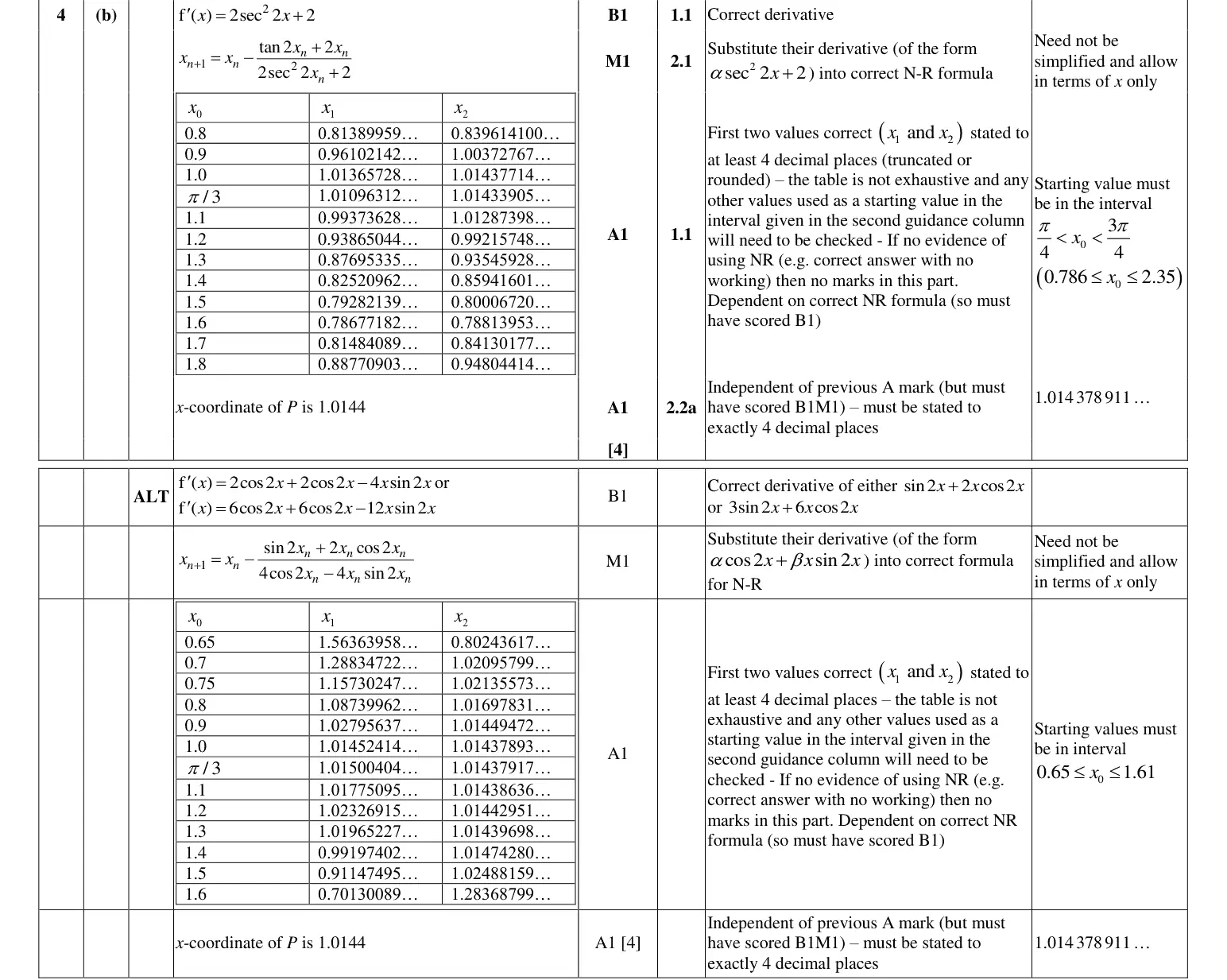
It was extremely disappointing that so many candidates did not realise that this part was asking candidates to apply the Newton-Raphson method to find a solution to the equation given in (a) with many thinking (by their choice of ( ) f x ) that instead it was asking them to solve 3 sin2 0 Of those x x = . / ( x ) candidates that correctly realised that ( ) f tan2 2 and hence f 2sec 2 2 most went on x = x + x = x + to correctly apply the Newton-Raphson formula with a suitable starting value and obtained the x-coordinate of P as 1.0144.
Key points and common errors
f(x) = tan2x + 2x, f′(x) = 2sec²2x + 2
suitable x₀ near 1
x = 1.0144
many wrongly used f(x) = 3x sin2x
June 2019 · Paper 3 · Q5(a)4 marksMedium
Mark scheme for this part
Examiner's comment
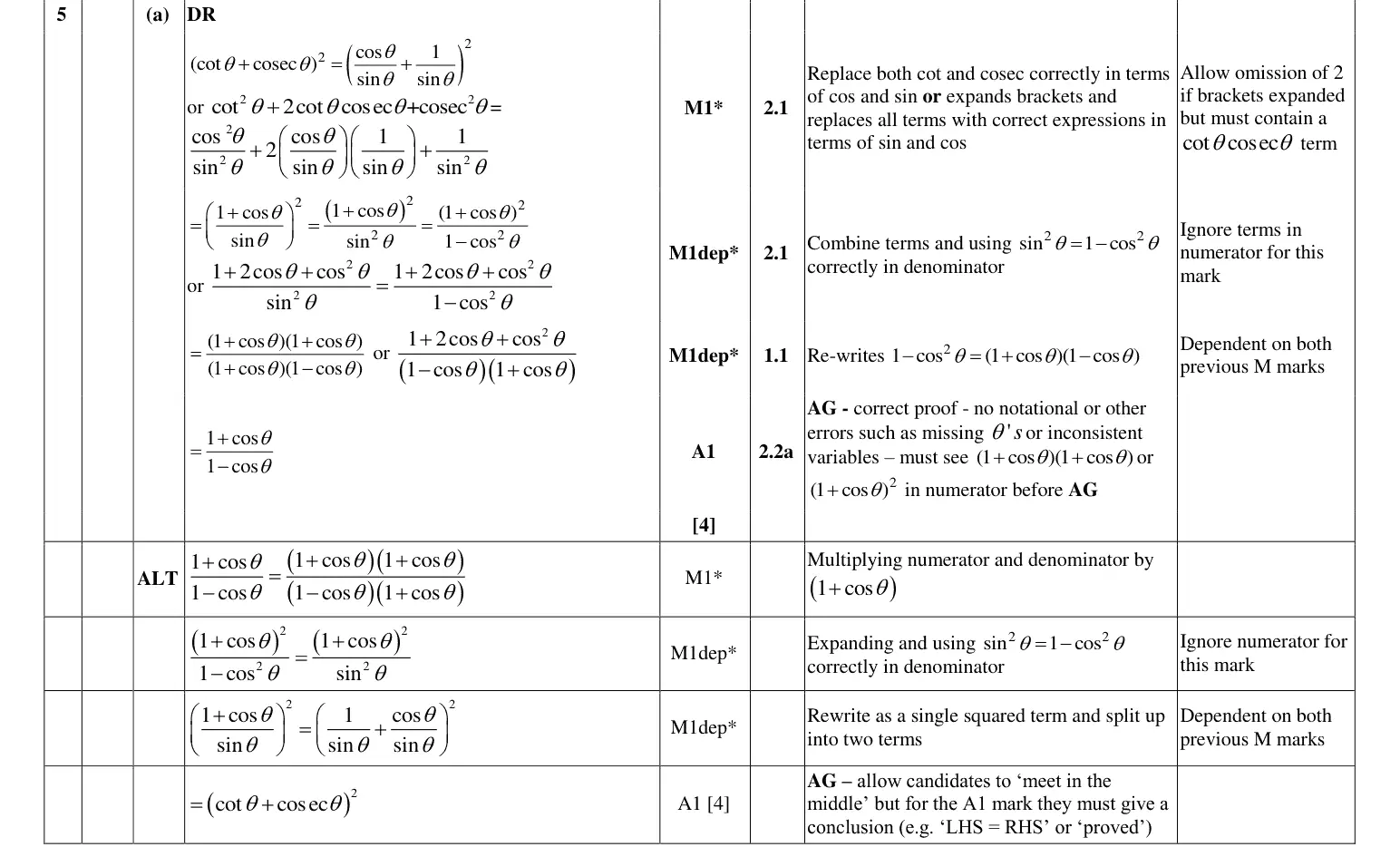
There were many ways of tackling this proof, but the most efficient method was to realise that the right- hand side only contained cosines and so therefore it would be prudent to re-write the left-hand side as cos θ 1 ( ) cot θ + cosec θ = + , combine the two fractions and then use the fact that sin θ sin θ θ to obtain ( ) 1 + cos θ sin θ = 1 − cos . For many candidates who got to this stage some did not show 1 − cos θ sufficient working and simply wrote down that ( ) 1 + cos θ 1 cos + θ = without showing the intermediate 1 − cos θ 1 − cos θ ( ) 1 + cos θ step of Those candidates who started by trying to work from the right to left-hand . ( )( ) 1 + cos θ 1 − cos θ side or began by expanding ( ) cot θ + cosec θ as cot θ + 2cot θ cosec +cosec θ θ were not usually successful.
Key points and common errors
write cot θ and cosec θ in sin and cos: (1 + cos θ)²/sin²θ
sin²θ = 1 − cos²θ = (1 − cos θ)(1 + cos θ)
intermediate cancelling step must be shown
June 2019 · Paper 3 · Q5(b)5 marksMedium
Show the start of this question
Mark scheme for this part
Examiner's comment
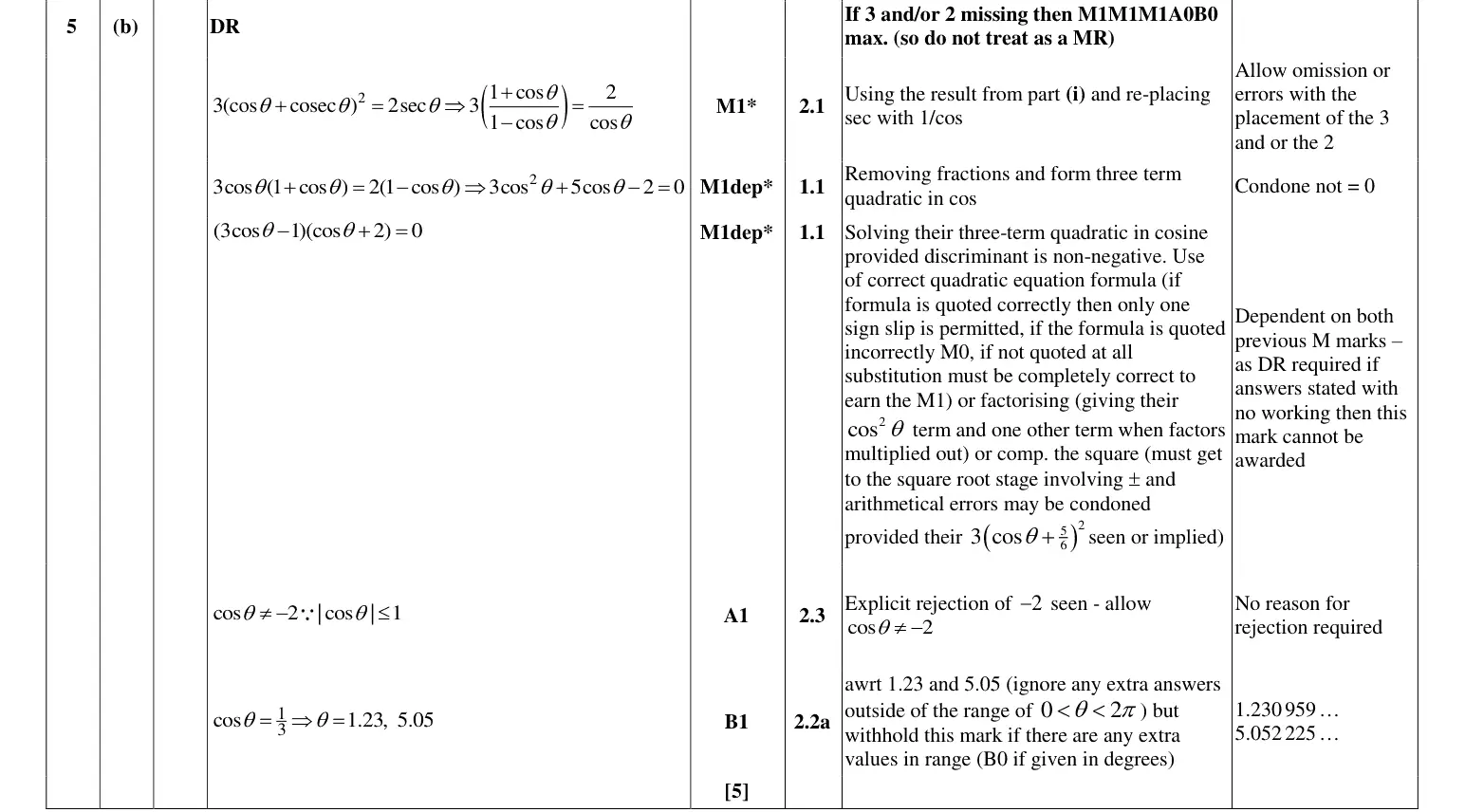
It was pleasing to note that most candidates used the result in part (a) to write down the required equation 1 + cos θ 2 3 1 = . It was, however, disappointing that many candidates either misplaced the 2 or the − cos θ cos θ 1 + cos θ 3 + 3cos θ 3 or believed that 3 1 = . Most candidates removed the fractions and obtained a − cos θ 3 − 3cos θ three-term quadratic in cosine, although mistakes with signs when collecting together the like terms was common. As this question explicitly asked candidates to ‘show detailed reasoning’ it was extremely disappointing that many went directly from the correct equation 3cos θ + 5 cos θ − 2 = 0 to cos θ = − 2 1 and cos θ = without any evidence of a correct analytical method. Examiners expected to see some 3 indication of the rejection of cos θ = −and although most candidates correctly stated 2 θ = 1 23 . some forgot about the other value in the interval (which was 5.05). quadratic equation in cosine so scored the first two marks. There is then a clear substitution method shown for how the ‘disguised quadratic’ has be evaluated. There is a mark for explicitly rejecting the -2 root. The sketch is not specifically needed, but hopefully has helped the candidate avoid a careless mistake in determining all the answers within the required range. factorised the quadratic directly in terms of cosθ . Again a nice sketch has be utilised to help identify the second solution. This response scored three of the five marks. The candidate obtained the correct quadratic equation in cosine so scored the first two marks. However, the candidate did not show detailed reasoning in how they have used the quadratic formula to obtain the values of 1 3 and 2 −; the third method mark and therefore the next accuracy mark could not be awarded. ( )( ) −± 5 5 − 4 3 − 2 Either showing the line cos θ = , or using substitution in the form 2 × 3 Let x = cos θ ∴ 3 x + 5 x − 2 = 0 ( )( ) −± 5 5 − 4 3 − 2 x = etc would have supported the detailed reasoning. 2 × 3 This candidate has been awarded the final B mark for the correct answers of 1.23 and 5.05. This response scored all three of the method marks, but the initial error with multiplying the fraction by 3 meant that the accuracy marks were lost. In general, candidates that opted for the use of the quadratic formula rather than factorisation seemed to make mistakes in the initial algebraic manipulation.
Key points and common errors
3(1 + cos θ)/(1 − cos θ) = 2/cos θ gives 3cos²θ + 5cos θ − 2 = 0
reject cos θ = −2
θ = 1.23, 5.05
misplacing the 3 or 2
sign errors
Find an A-level maths tutor
Stuck on this? Book a trial session with an A-level maths tutor.