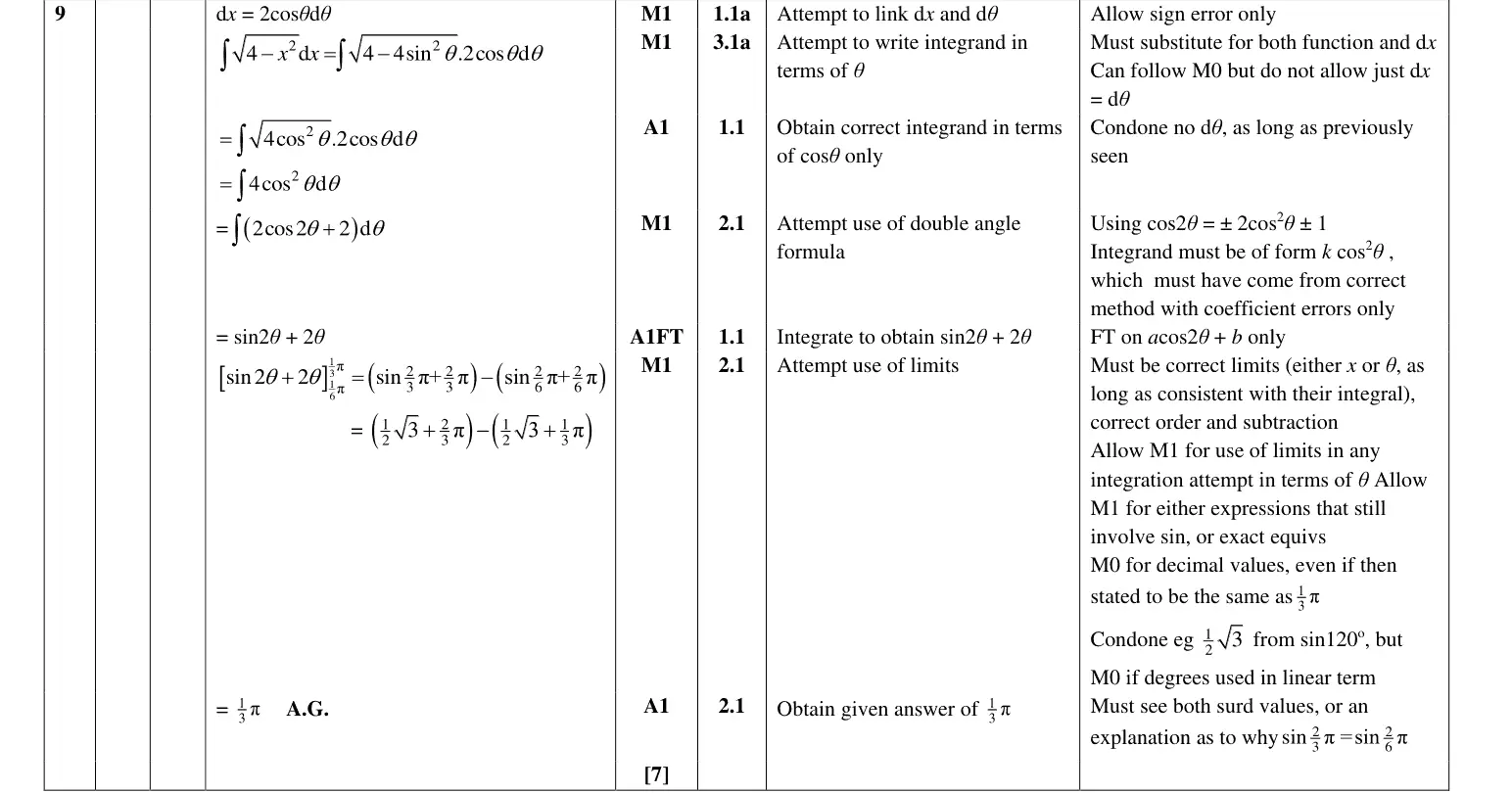
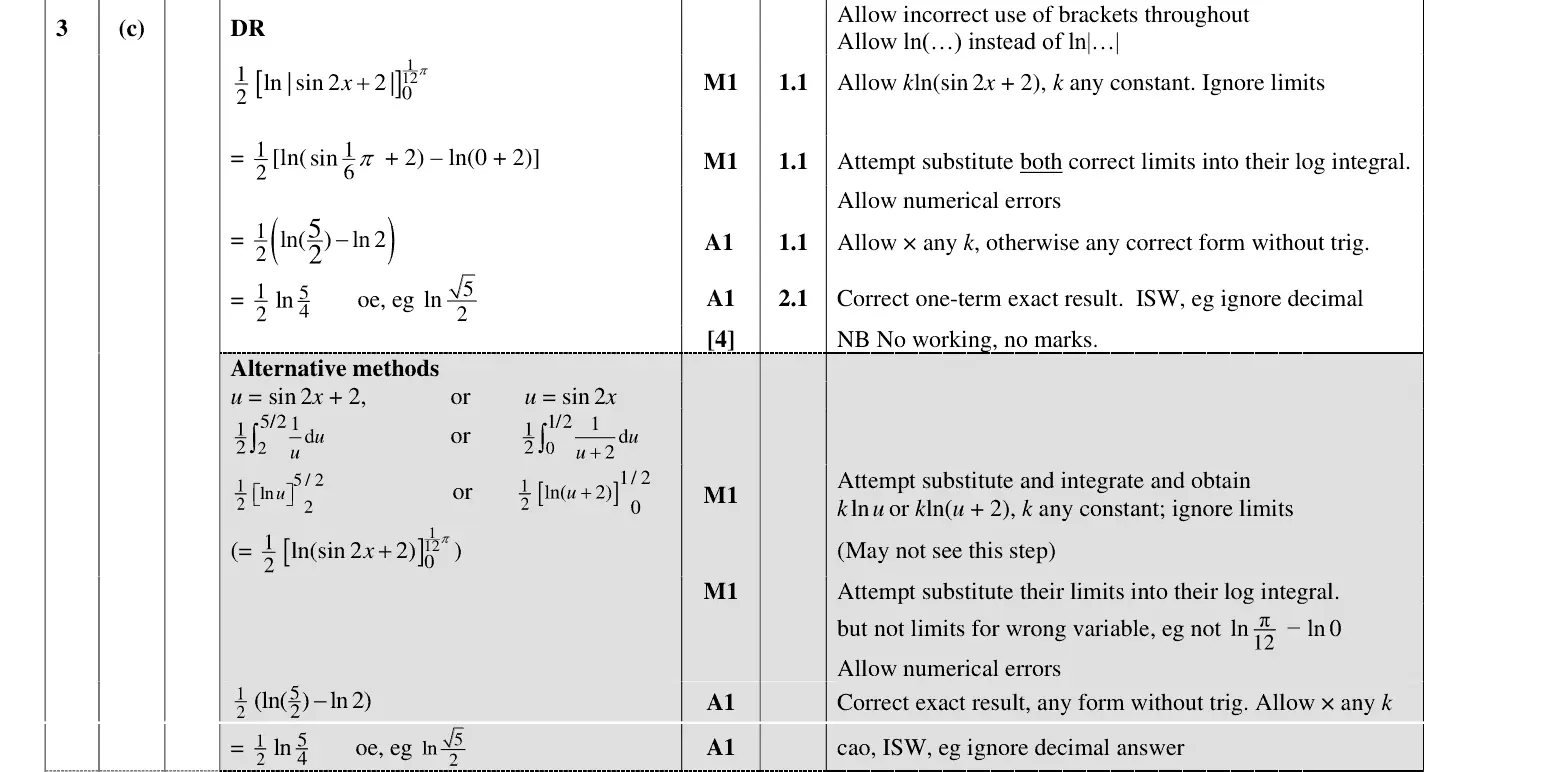
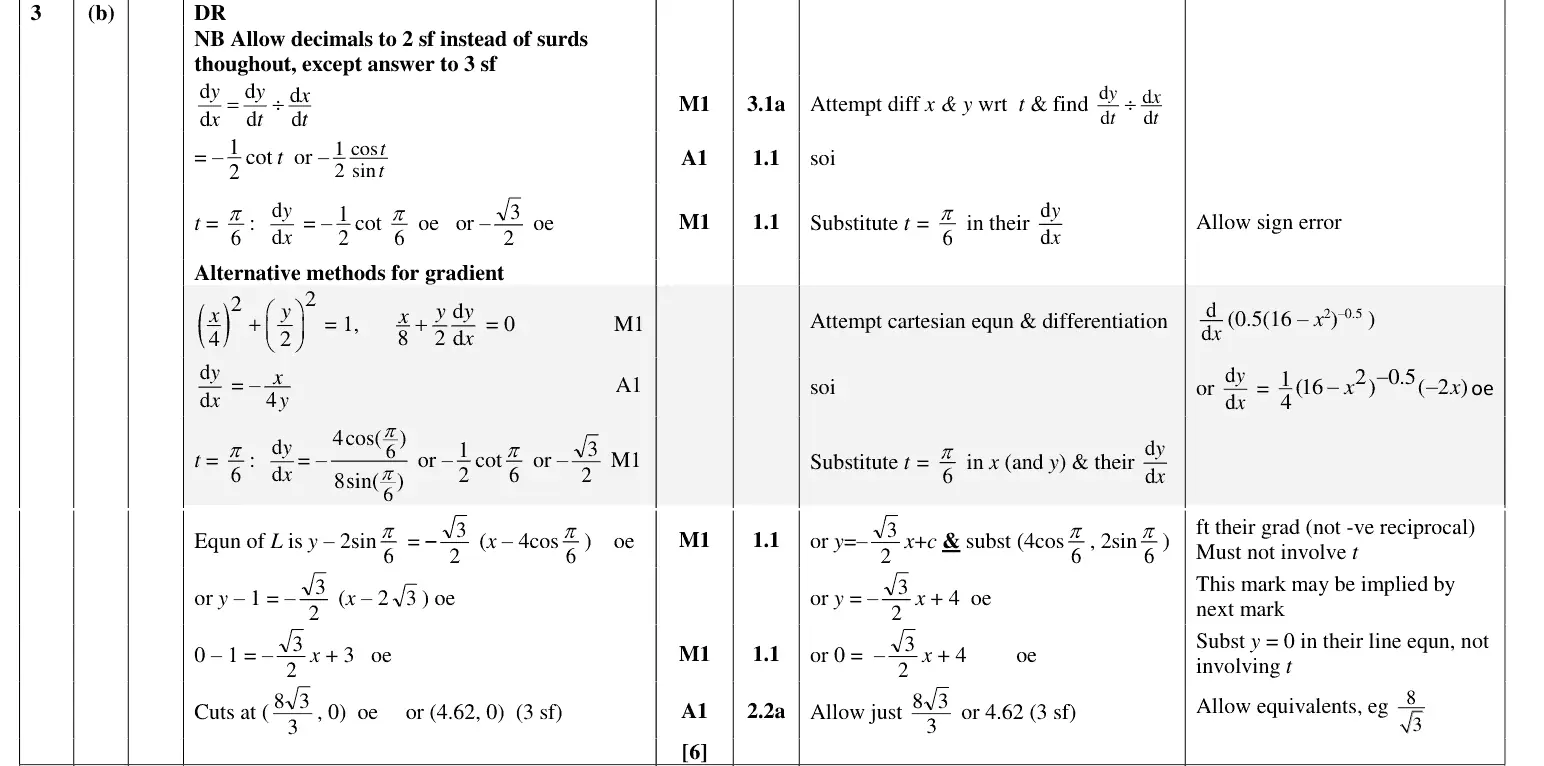
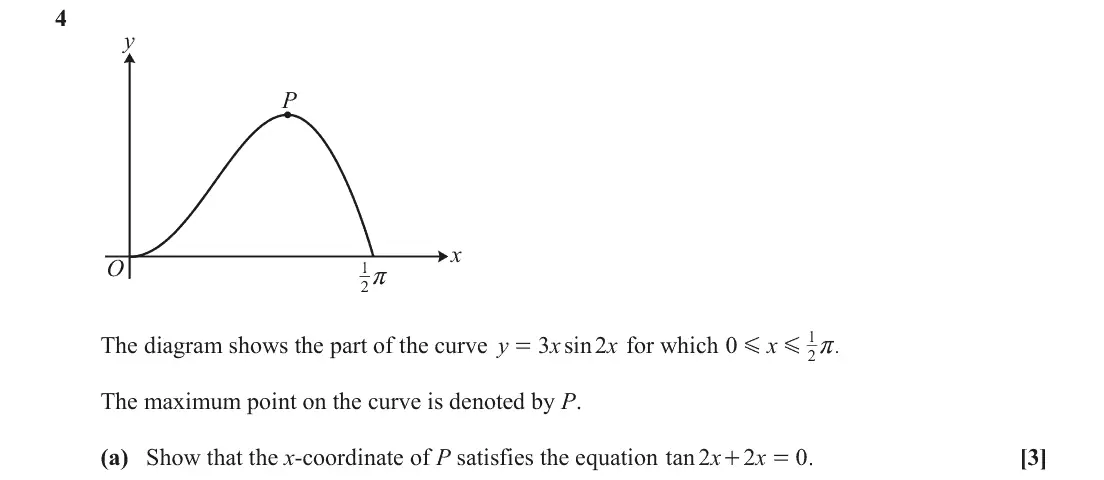
Mark scheme for this part
Examiner's comment
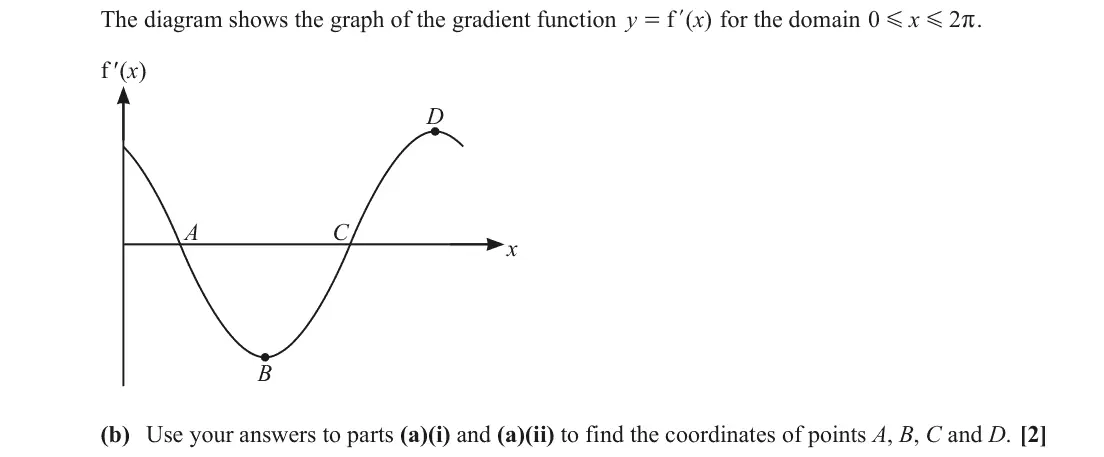
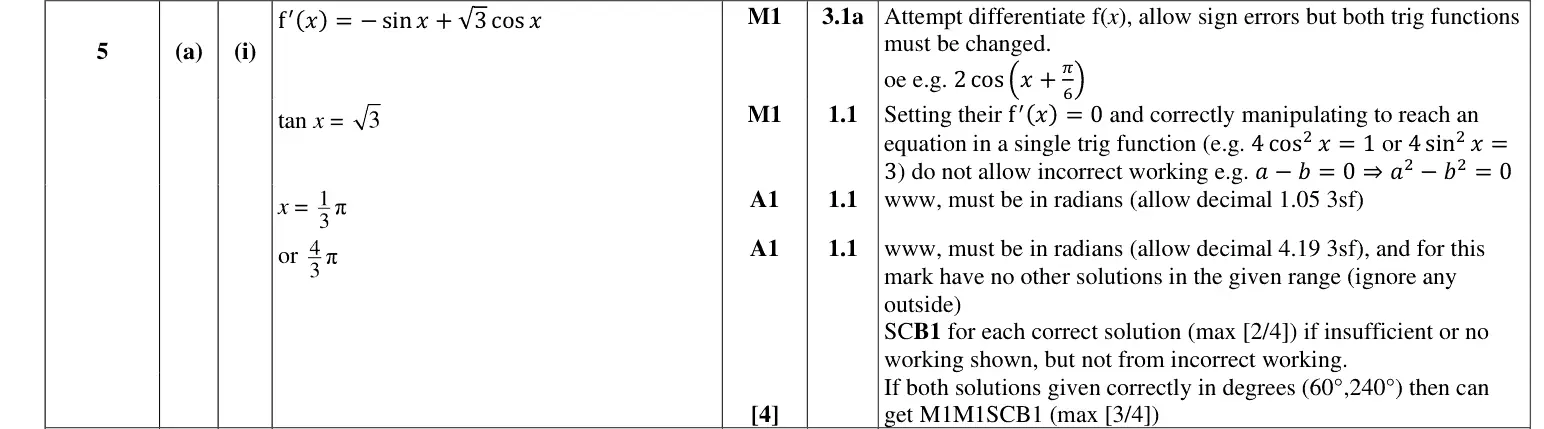
This question was generally well answered. Some candidates appeared uncertain how to differentiate the given expression, either making errors in differentiation or attempting to (unnecessarily) apply the product rule. Most candidates were able to set their derivative = 0 and obtain an expression from which values could be deduced. The entirety of Question 5 is Detailed reasoning which means that sufficient working is required to support all answers, throughout. There were fewer cases of ‘answers without working’ in this question - perhaps because most candidates tended to write down the expression and manipulate it directly. Although the differentiated expression resolves straightforwardly to tan 𝑥= √3, some candidates did not spot this and so chose to square in order to combine the terms. This was acceptable (as long as done correctly, some candidates wrote x – y = 0 followed by x2 − y2 = 0 which is not a correct step of working or squared the entire expression while omitting the ‘cross term’ which could lead to the correct solutions, from incorrect working), but candidates then obtained additional solutions which they needed to test and eliminate - many did not do so (or eliminated the wrong solutions) and lost the final A mark as a result. A small number of candidates used 𝑅cos(𝑥+ 𝛼) to combine the two terms first, which makes the differentiation more straightforward.
Key points and common errors
- f′(x) = −sin x + √3 cos x
- tan x = √3
- x = π/3, 4π/3 in radians
- product rule not needed
- squaring introduces extra roots