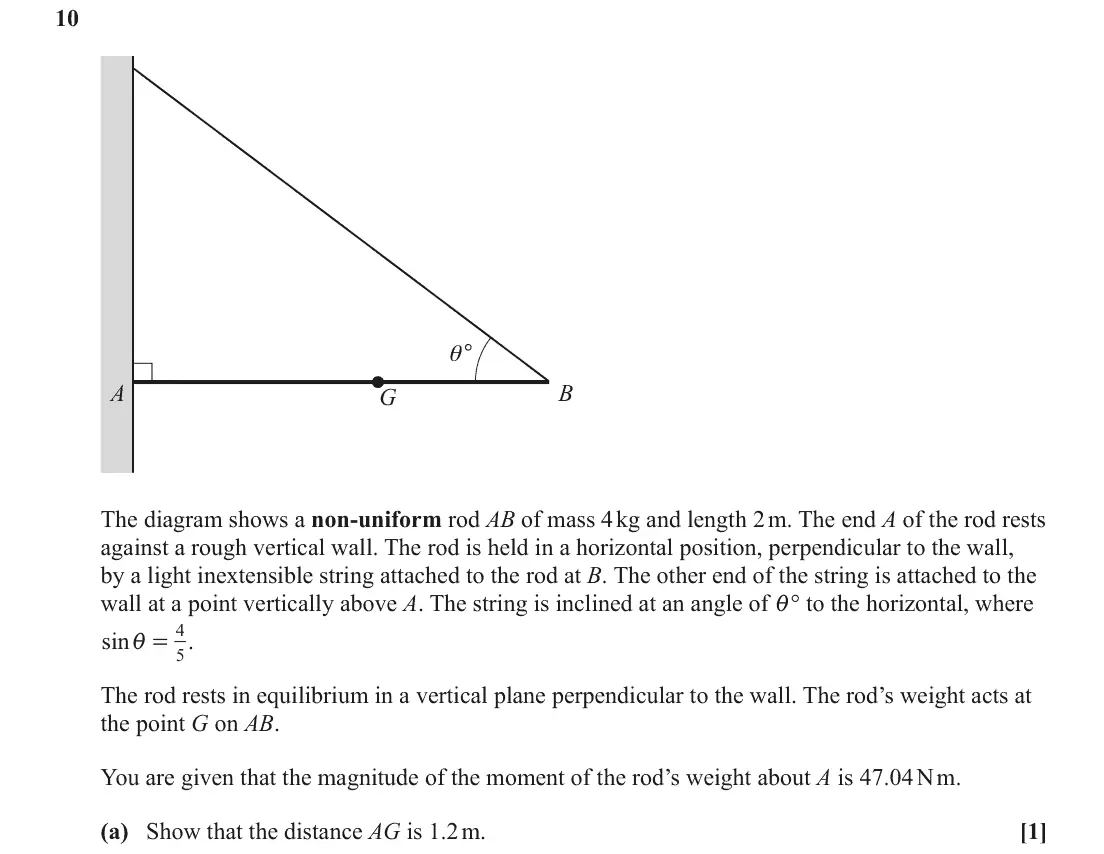
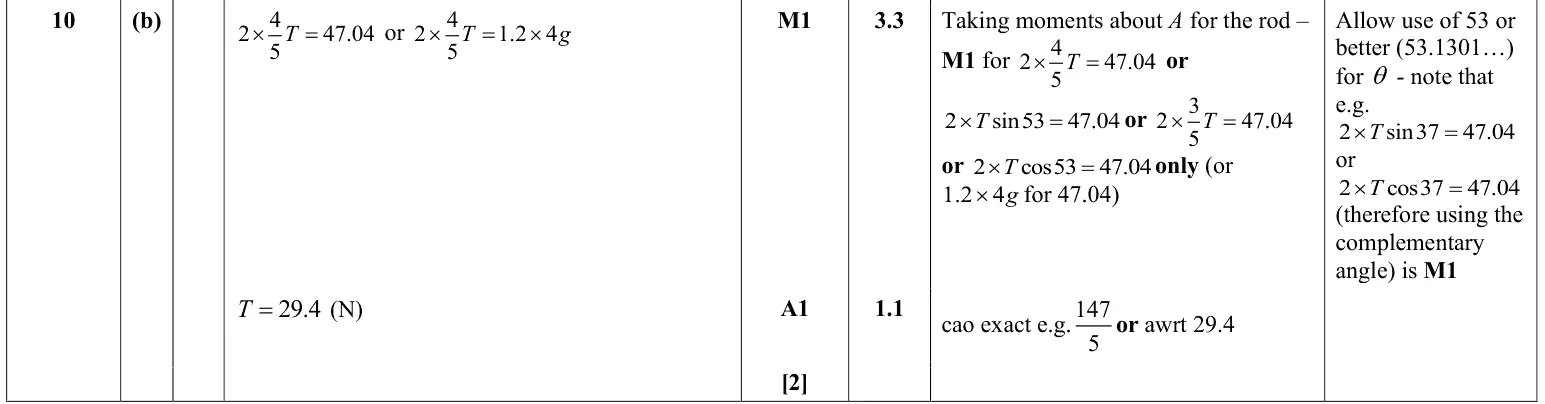
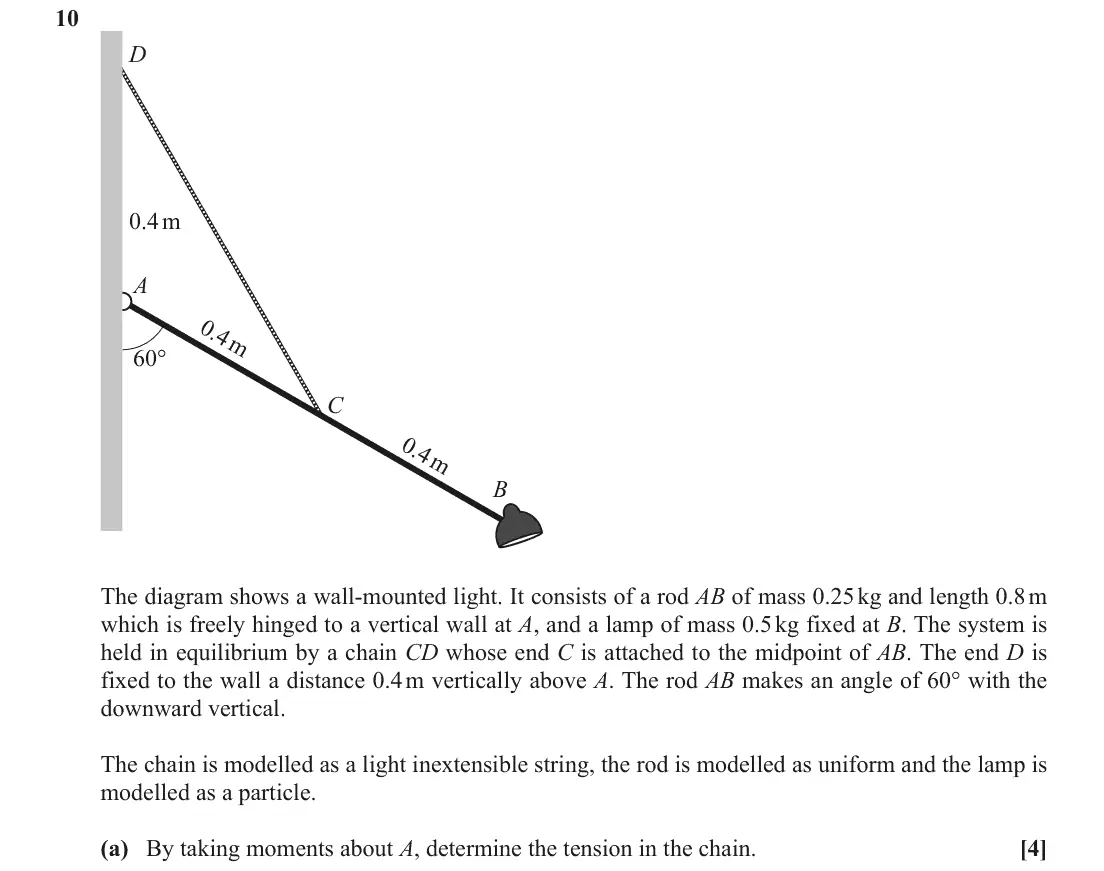
While most candidates seem to realise that the most effective way of finding the tension in the string was to take moments about A, many forgot to include a distance or used a wrong angle.
Key points and common errors
moments about A: 2 × T × 4/5 = 47.04 so T = 29.4 N
missing distance or wrong angle
June 2025 · Paper 3 · Q10(c)5 marksMedium
Show the start of this question
Mark scheme for this part
Examiner's comment
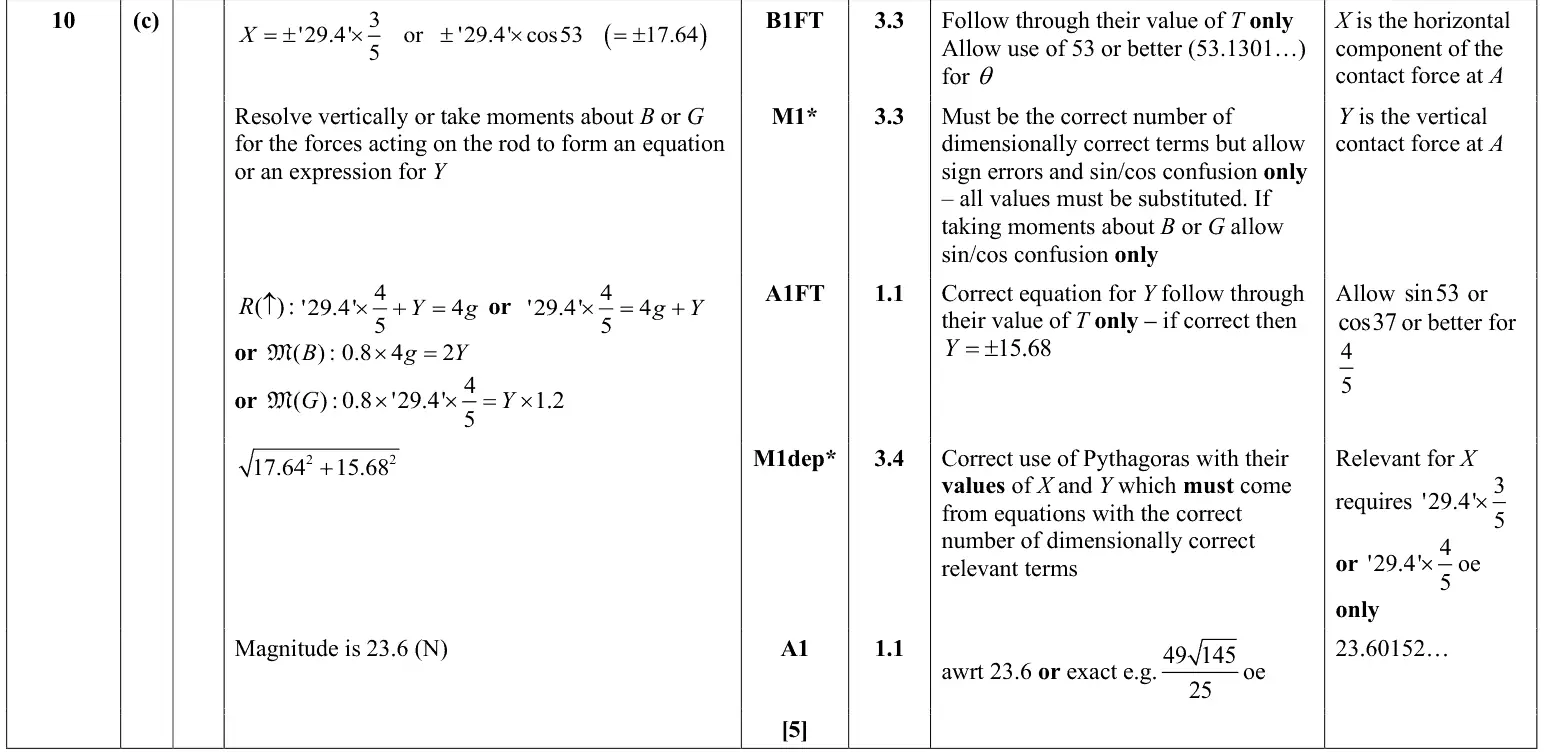
There was a common misconception in this part that the ‘magnitude of the contact force exerted on the rod by the wall at A’ referred only to a force with a horizontal component at the wall and not a vertical component too. Some candidates attempted to take moments again (most commonly about either points G or B) but these attempts were usually not as successful as those who resolved vertically and horizontally (and then completed the problem by used Pythagoras).
Key points and common errors
horizontal X = 29.4 × 3/5 = 17.64
vertical Y = 4g − 29.4 × 4/5 = 15.68
magnitude √(X² + Y²) = 23.6 N
contact force has a vertical component too
June 2025 · Paper 3 · Q12(a)6 marksMedium
Mark scheme for this part
Examiner's comment
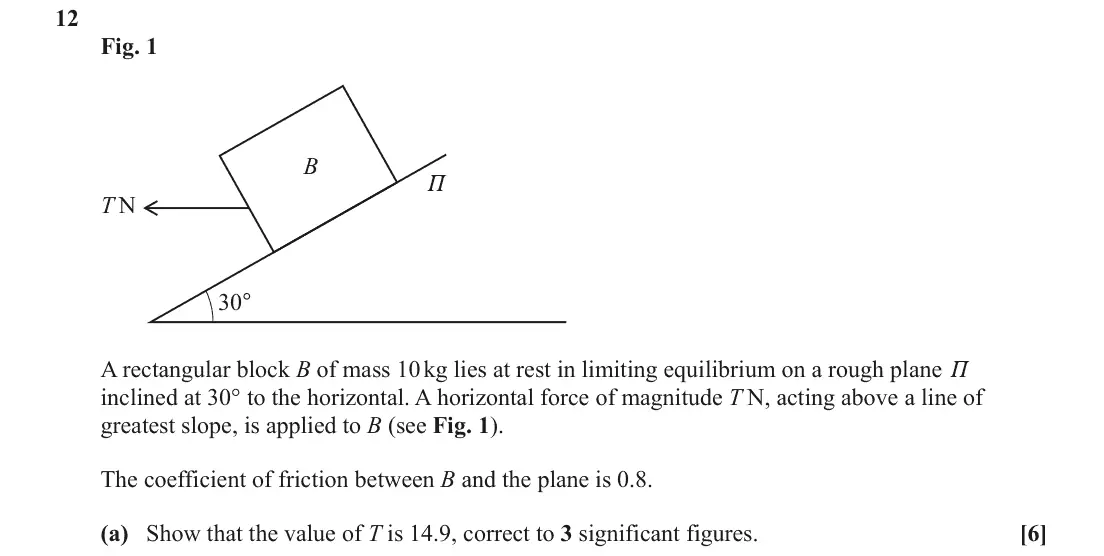
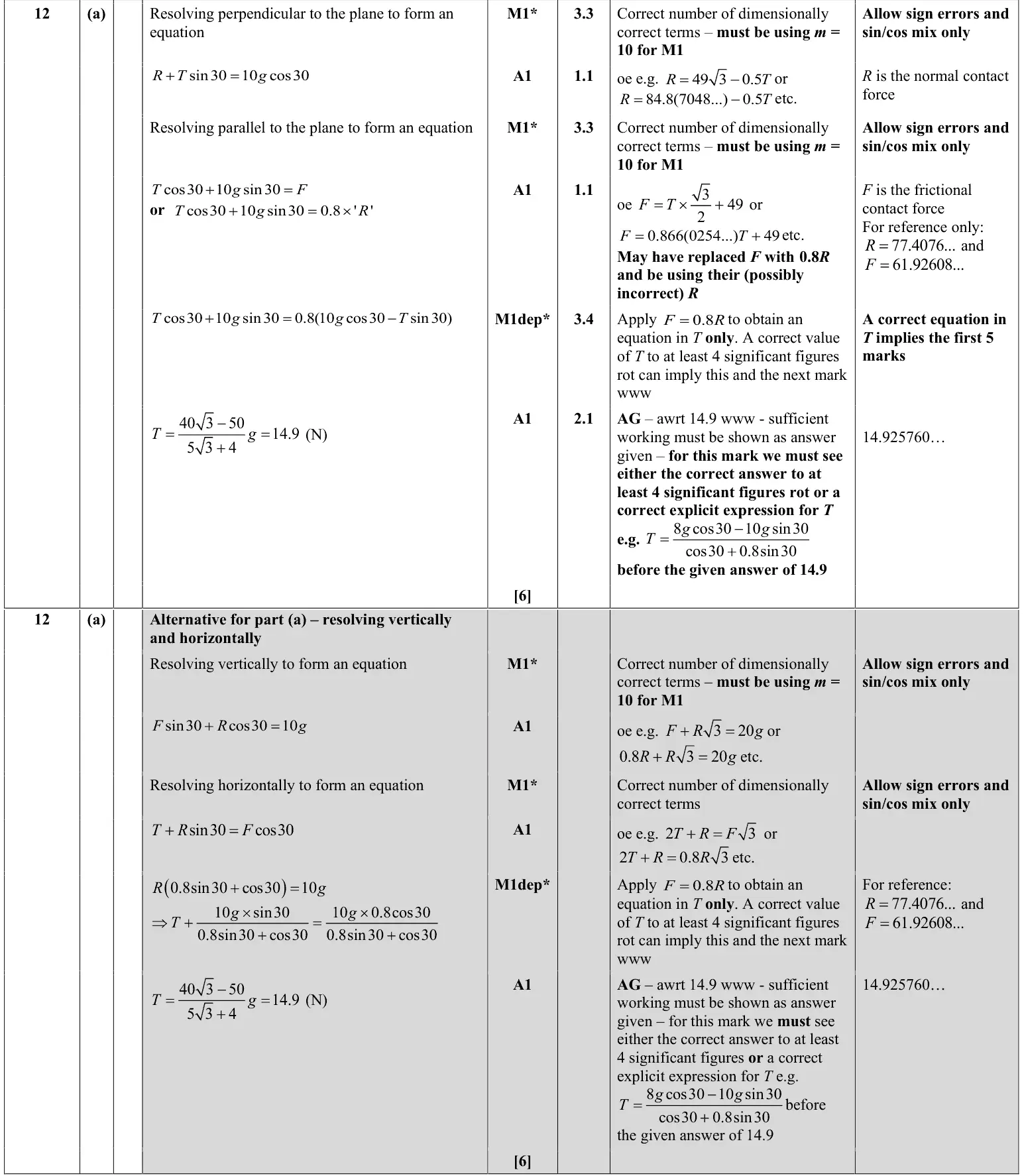
Most candidates attempted to resolve parallel and perpendicular to the plane for B, but they were not always successful. Aside from the usual sin/cos confusion and sign errors a number of candidates stated the correct expression for the friction component, namely, 𝑇cos30 + 10𝑔sin30 but incorrectly stated the normal contact force as 10𝑔cos30 only. Those candidates that annotated the copy of the diagram in the answer space were less likely to make mistakes with the components of each force. Those candidates who did resolve in both directions correctly usually went on to apply 𝐹= 𝜇𝑅 correctly and obtained a correct expression (and hence value) for T. While some candidates attempted to resolve vertically and horizontally (rather than perpendicular and parallel to the plane) these responses were rarely as successful. Furthermore, as this part was a ‘show that’ style question, examiners needed to see either the correct answer to at least 4 significant figures or a correct expression for T before stating the given answer of 14.9. The candidate has correctly resolved parallel and perpendicular to the plane and correctly applied 𝐹= 𝜇𝑅. However, to be awarded full marks, as this part was a ‘show that’, examiners needed to see either the correct answer to at least 4 significant figures or a correct expression for T before stating the given answer of 14.9.
Key points and common errors
perpendicular: R + T sin 30 = 10g cos 30
parallel: T cos 30 + 10g sin 30 = F
F = 0.8R
T = 14.9 to 3 s.f.
normal reaction must include the T component
June 2024 · AS Paper 1 · Q2(c)2 marksEasy
Show the start of this question
Mark scheme for this part
Examiner's comment
This was generally well answered, with most candidates taking the direct route shown in the scheme. A few candidates used the cosine rule, which was more onerous. Many candidates were able to obtain the correct angle of 56.3o but a few candidates stated the angle as 33.7o.
Key points and common errors
tan⁻¹(3/2) = 56.3°
33.7° is the angle with the y-axis
June 2024 · Paper 3 · Q11(a)4 marksHard
Mark scheme for this part
Examiner's comment
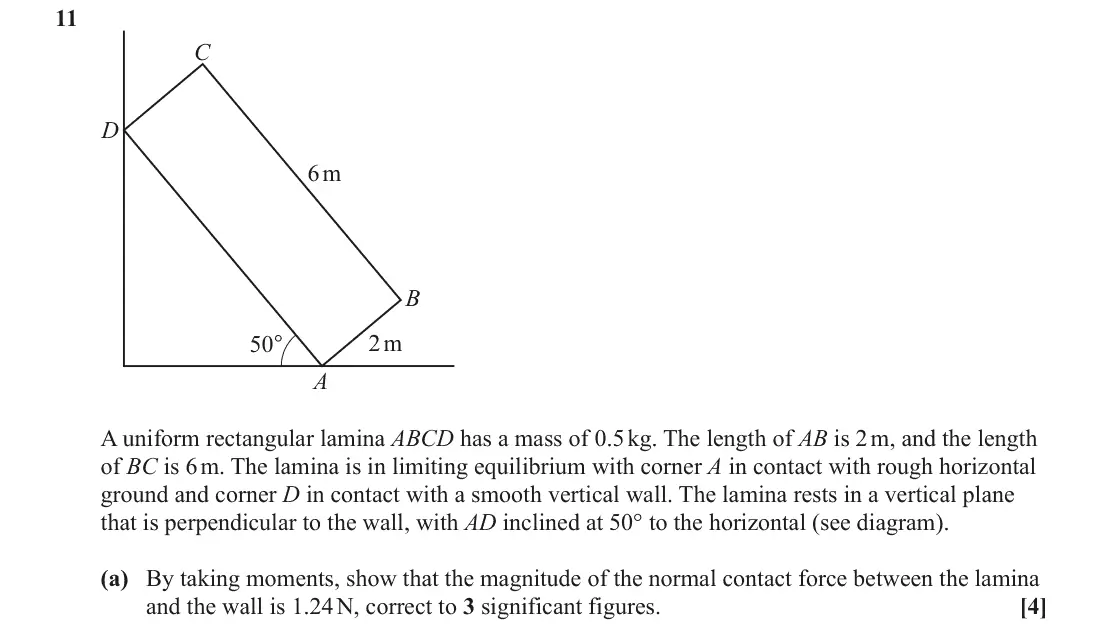
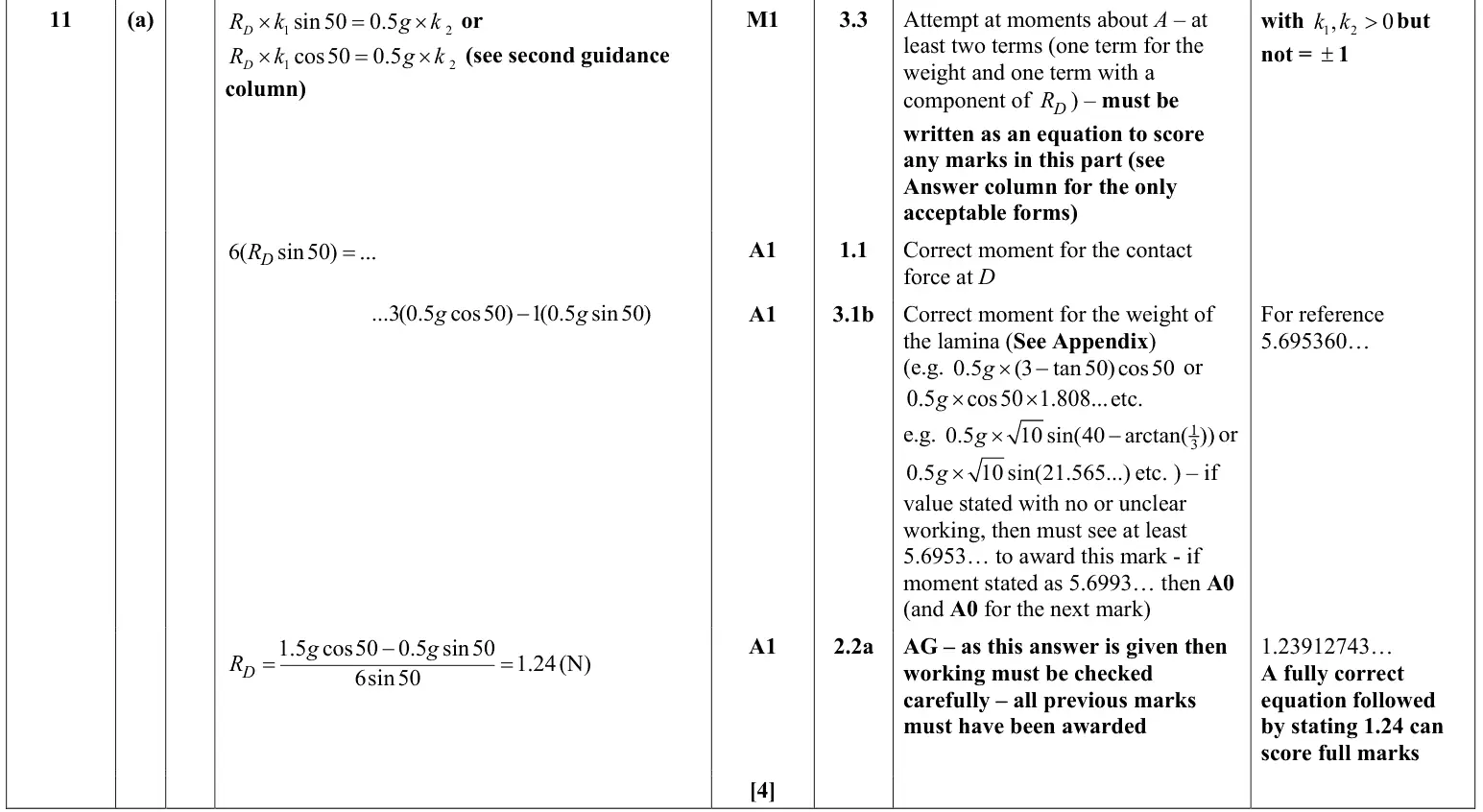
Although most candidates realised that the way to find the magnitude of the normal contact force acting on the lamina at 𝐵 was to take moments about point 𝐴, many struggled with the corresponding geometry of the situation. Although most correctly realised that the expression for the moment of the normal contact force was given by 𝑅𝐷× (6sin50), almost all could not deal correctly with the corresponding moment for the weight. The most efficient way of considering this moment was to resolve the weight in directions parallel and perpendicular to the sides of the lamina (and hence obtain the moment as 3 × (0.5𝑔cos 50) −1 × (0.5𝑔× sin50)).
Key points and common errors
moments about A: R_D × 6sin50 = 0.5g(3cos50 − sin50)
R_D = 1.24 N
the moment arm of the weight was the main difficulty
June 2023 · AS Paper 1 · Q87 marksHard
Mark scheme for this part
Examiner's comment
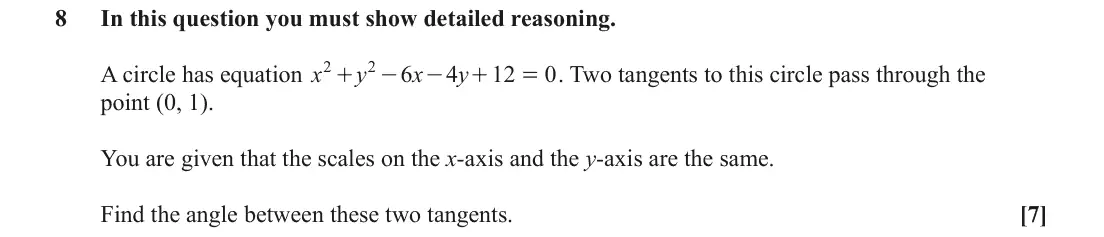
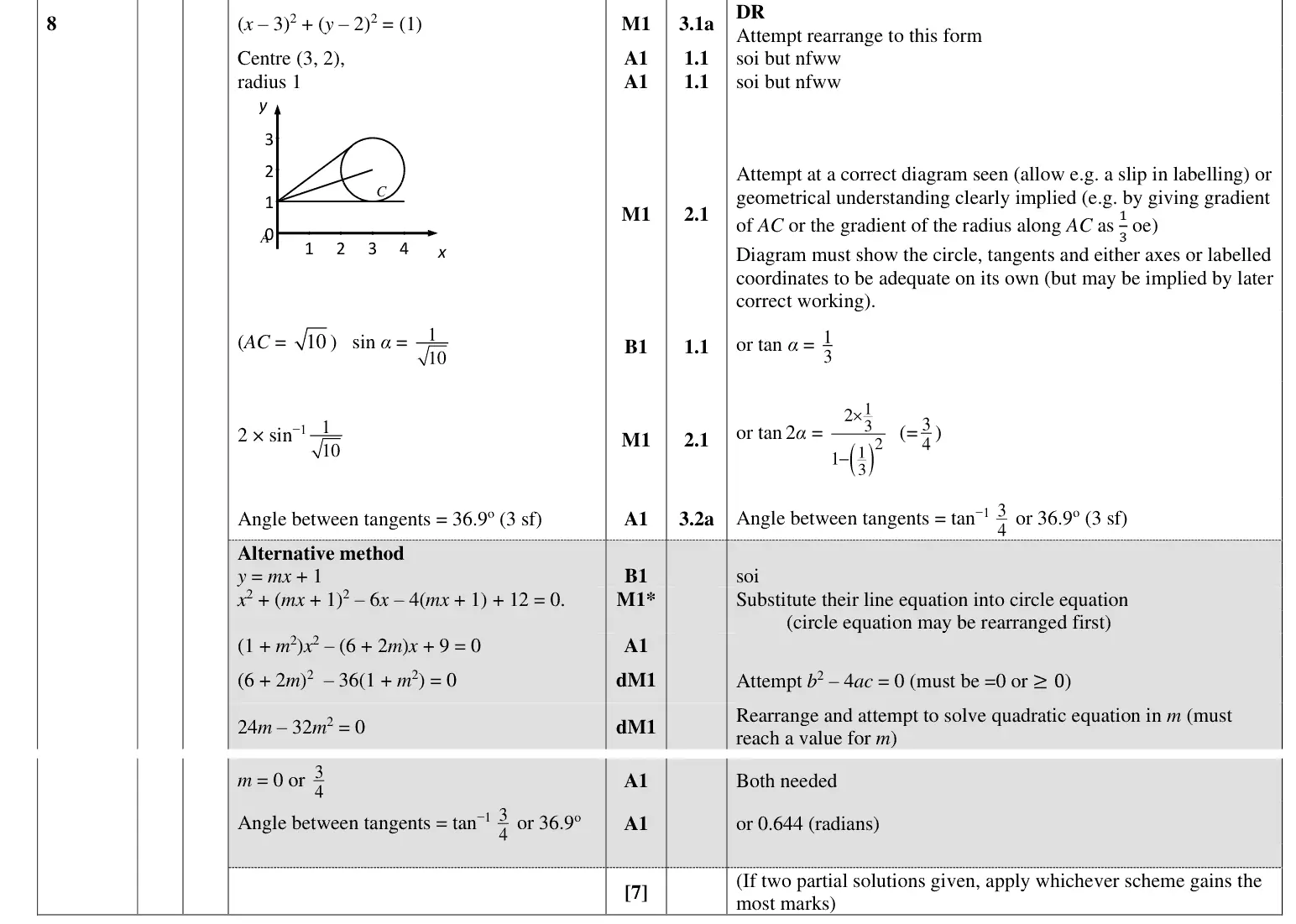
The scheme’s first method (finding the centre of the circle and applying coordinate geometry) was most common. Many candidates made a good attempt at completing the square in x and y to find the centre and radius of the circle (although there were quite a few errors, e.g. concluding that the centre was (-3, - 2) or (2, 3)). Many of these candidates then did not draw a correct diagram, often assuming that (0, 1) was on the circle and looking for a tangent through this point. Around half of candidates were able to show sufficient geometric understanding to achieve the middle M mark, but very few then went on to provide a complete solution using trigonometry to calculate the required angle. Fewer candidates attempted the alternative algebraic method, of using y = mx + 1 as the equation of the line through (0, 1) and attempting to find the values of m that resulted in this being a tangent to the circle. Those who did however were generally more successful, substituting in correctly and recognising the need to use the determinant. This is an example of an excellent response to this question. The erroneous gradient of 5 was ignored because the candidate then restarts their attempt in the final 3 lines. This candidate has drawn an adequate diagram (albeit not fully labelled) and then gone on to show correct geometrical understanding with their final triangle, which has allowed them to compute the required angle.
Key points and common errors
complete the square: centre (3, 2), radius 1
diagram
sin α = 1/√10
angle 2α = 36.9° (or tan⁻¹(3/4))
alt: discriminant of line and circle gives m = 0 or 3/4
many assumed (0, 1) was on the circle
very few completed
Autumn 2021 · Paper 1 · Q10(a)(i)1 markMedium
Mark scheme for this part
Examiner's comment
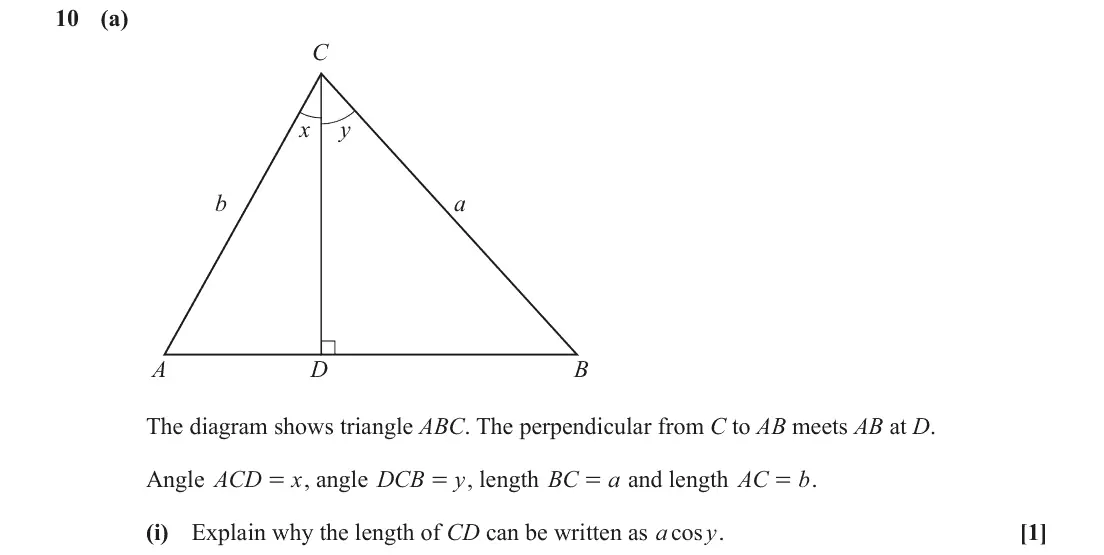
(From the general report) Some structure was given at the start of Question 10(a) to support candidates in making progress through the geometric proof of the trigonometric identity.
Key points and common errors
right-angled triangle BCD: cos y = CD/a
Autumn 2021 · Paper 1 · Q10(a)(iii)4 marksMedium
Show the start of this question
Mark scheme for this part
Examiner's comment
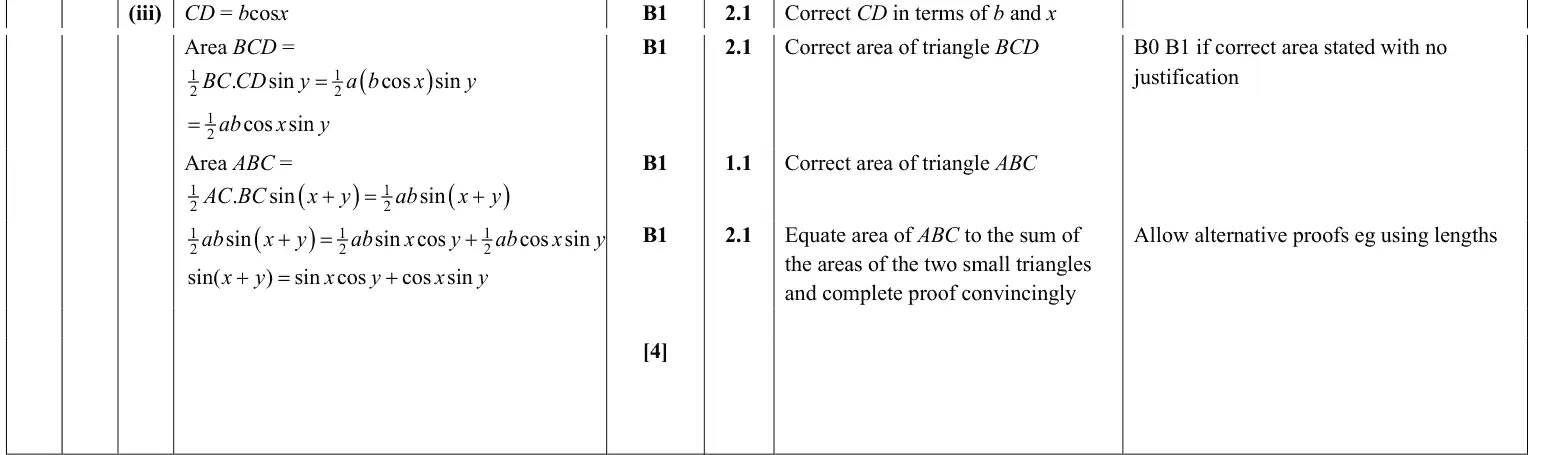
(From the general report) In Question 10(a)(iii) the more successful candidates clearly identified which lengths, angles and triangles were being considered.
Key points and common errors
CD = b cos x
area BCD = ½ab cos x sin y
area ABC = ½ab sin(x + y)
equate area ABC to sum of the two triangles
clearly identify lengths, angles and triangles
Autumn 2021 · Paper 3 · Q10(b)5 marksMedium
Show the start of this question
Mark scheme for this part
Examiner's comment
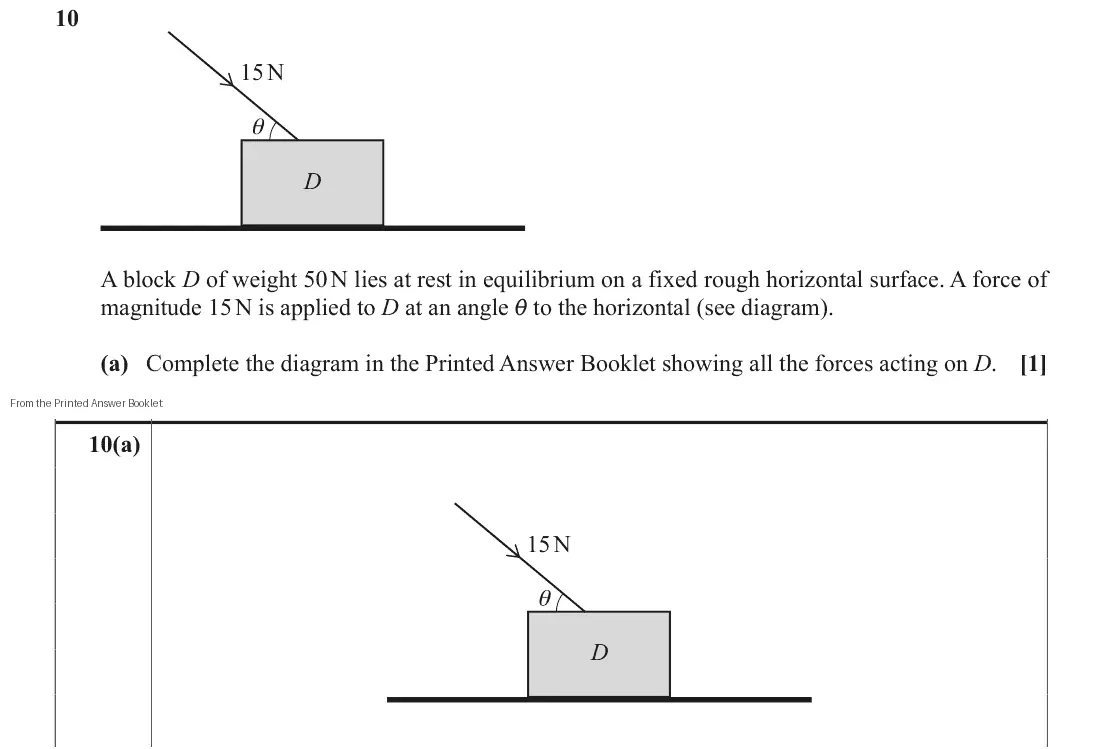
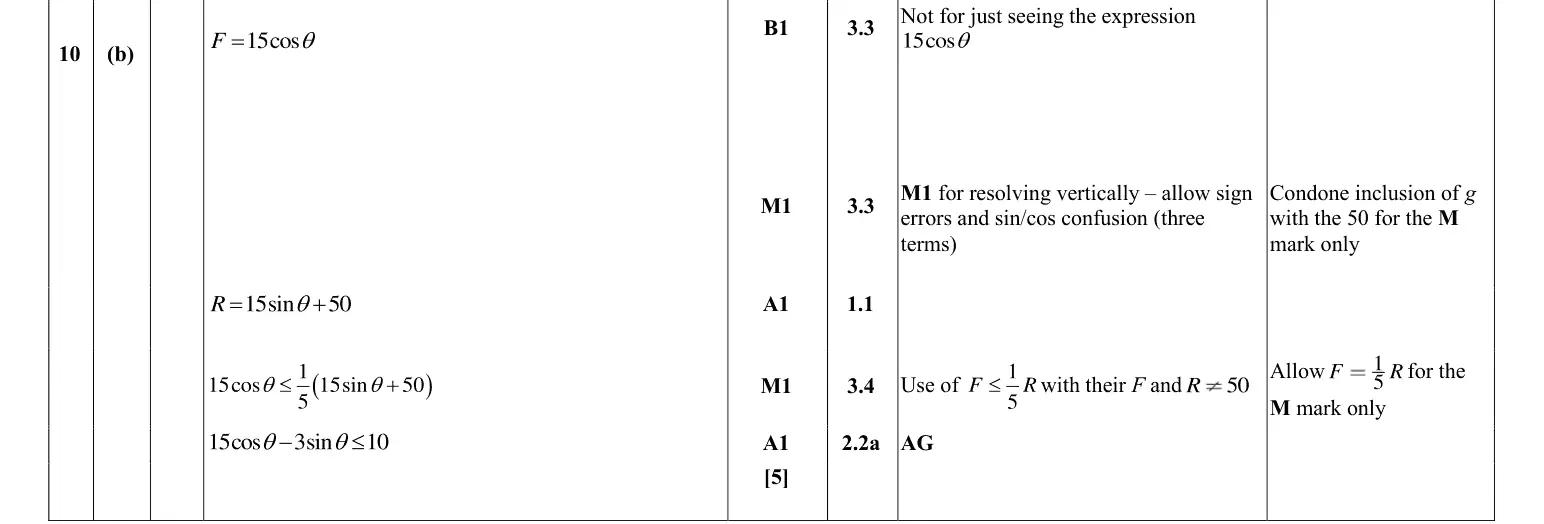
(From the general report) Themes in candidate responses in Section B Question 10(b) Misconception It was clear that in this question candidates had the misconception that as the ‘show that’ contained an inequality that this meant that the magnitude of the frictional contact force F was either F 15cos or F 15cos . As the block was at rest, the forces acting on the block horizontally were in F 15cos . balance and therefore As the block was not in limiting equilibrium then F 0.2 R and the normal contact force R could be found by R 15sin 50. resolving vertically (and if done correctly was given by ) Question 12(b) This was found to be the most demanding part of the paper.
Key points and common errors
F = 15cos θ (equality, not inequality)
R = 50 + 15sin θ
F ≤ 0.2R gives 15cos θ − 3sin θ ≤ 10
common misconception putting the inequality into F
Autumn 2021 · Paper 3 · Q11(a)3 marksMedium
Mark scheme for this part
Key points and common errors
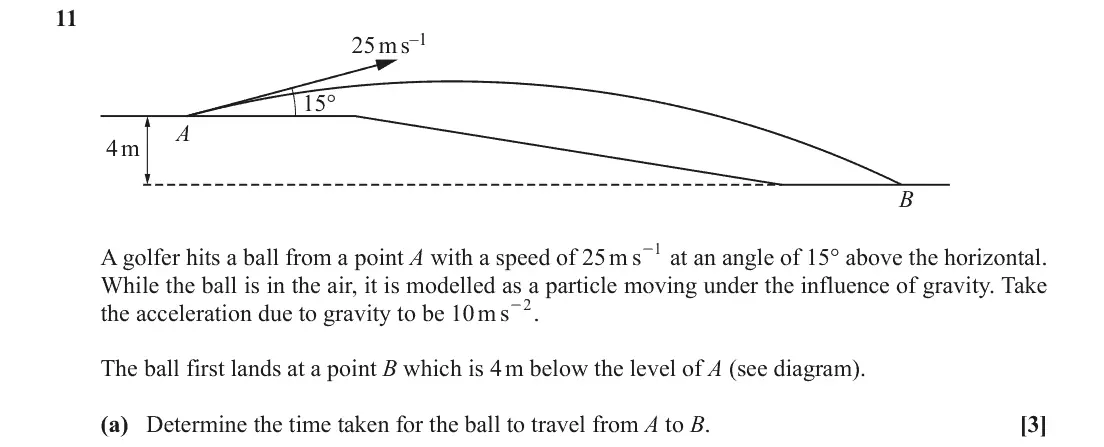
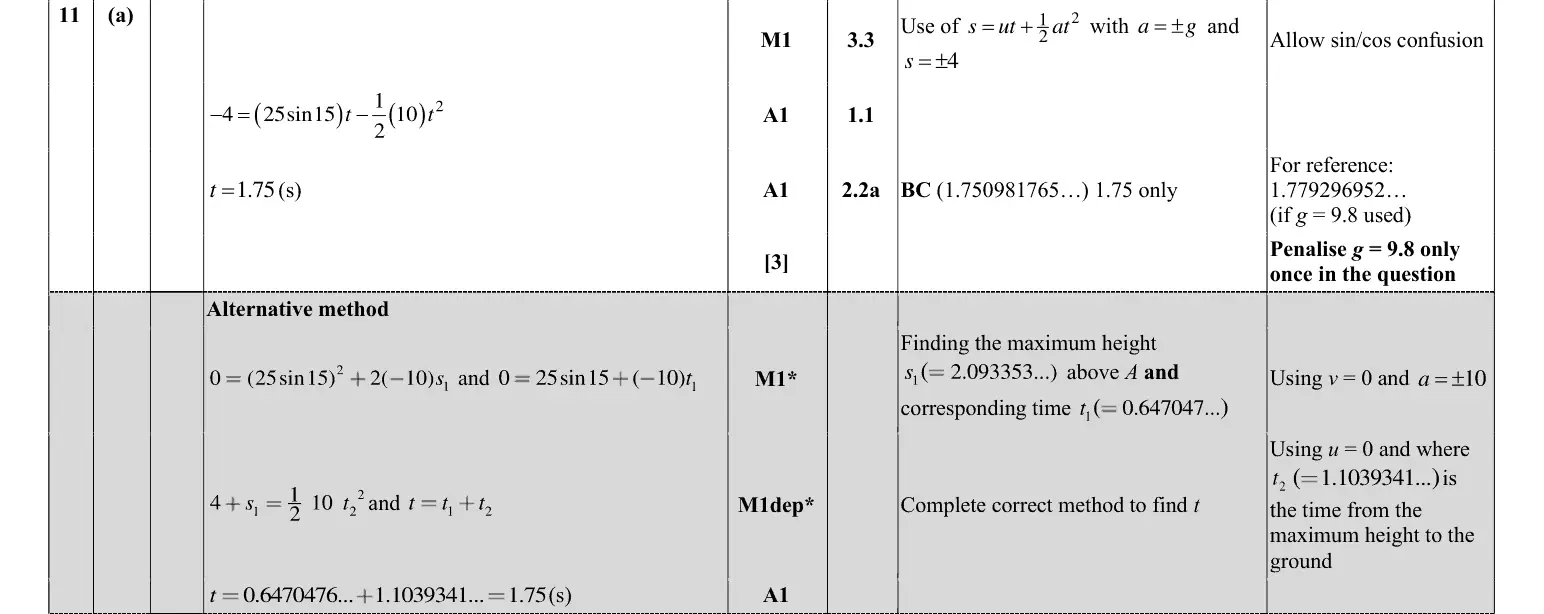
vertically −4 = 25sin15° t − 5t²
t = 1.75 s
g = 10 as given
Autumn 2021 · Paper 3 · Q11(c)4 marksMedium
Show the start of this question
Mark scheme for this part
Key points and common errors
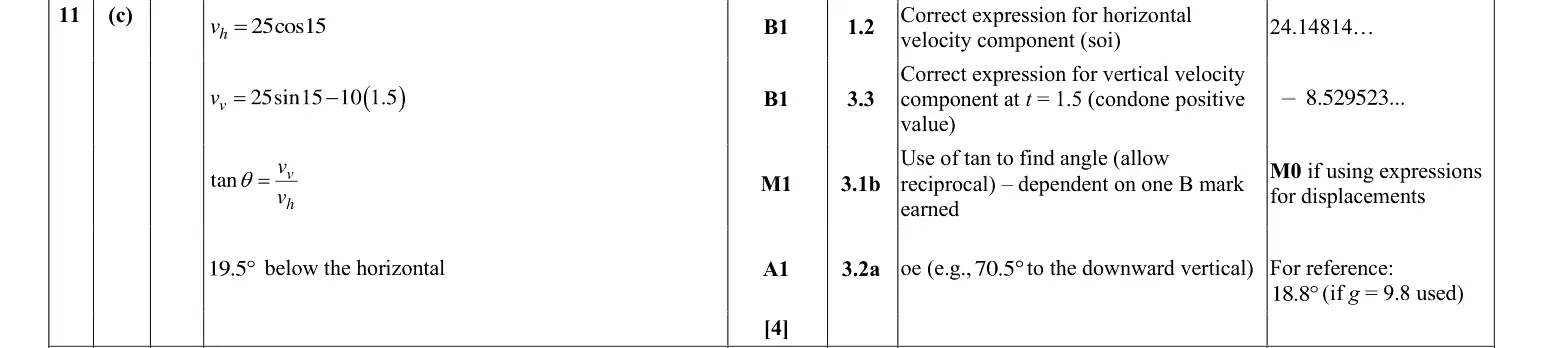
v_h = 25cos15°, v_v = 25sin15° − 15 = −8.53
tan⁻¹ gives 19.5° below the horizontal
using displacements gets M0
Autumn 2020 · Paper 3 · Q10(b)(ii)2 marksMedium
Show the start of this question
Mark scheme for this part
Examiner's comment
(Comment on Question 10 as a whole) A significant number of candidates did not follow the instruction to take moments about point A in part (a). It was also common to see candidates use mass rather than weight or miss some of the terms. Mixing sine and cosine was also common. In part (b) (i) it was mathematically easier to work with vertical and horizontal components of the force exerted on the rod at A rather than components parallel and perpendicular to the rod. Candidates that picked up marks on this question generally provided an annotated sketch with some degree of success. Part (b) (ii) was generally answered well by those that attempted it from their work on part (b) (i). However, of those, a few did not score both marks due to not clearly indicating what their angle was measured from (below the horizontal or measured from the downward vertical).
Key points and common errors
tan θ = Y/X: 46.1° below the horizontal
say what the angle is measured from
Autumn 2020 · Paper 3 · Q11(d)4 marksHard
Show the start of this question
Mark scheme for this part
Examiner's comment
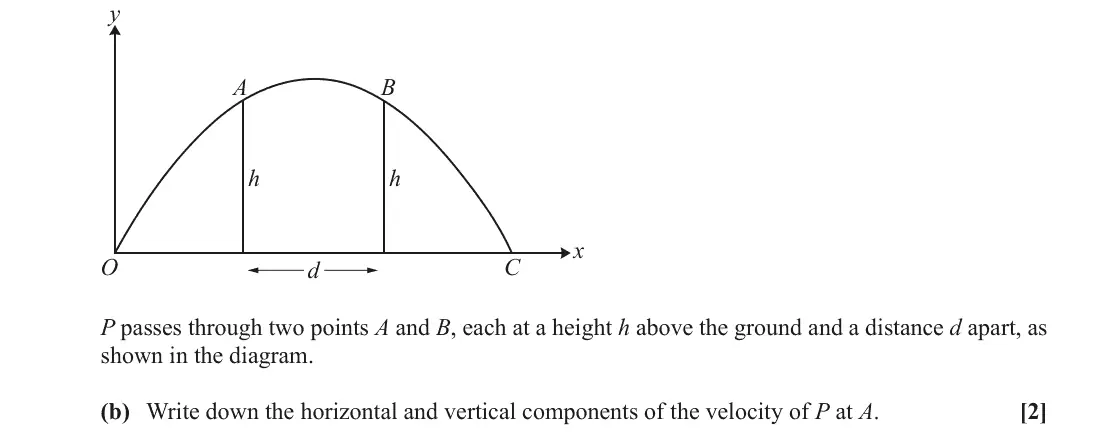
(Comment on Question 11 as a whole) Some candidates struggled with the algebraic format of this question. Those that set out their ‘suvat’ equations clearly distinguishing horizontal and vertical components were more success. Of those candidates that made a good attempt at part (a), a few dropped marks by only calculating the horizontal distance travelled to get to the maximum height – a valid method but which was only 1 2OC . Some otherwise excellent attempts to part (b) had answers in terms of an introduced variable T (or similar); this could only be given full marks if T was explicitly defined as part of the solution. Part (c) and part (d) proved the most challenging, with only the most able candidates making any meaningful progress. Both parts required careful notation to avoid confusing terms. For example, in Vertical component of velocity part (d) some candidates recognised tan θ = but the working Horizontal component of velocity suggested they used values at O rather than A. Guidance on using this paper as a mock This paper has a good range of questions on Pure and Mechanics and while overall there was a nice gradient on demand, it should be noted that Question 2 proved more challenging for this cohort than was expected with respect to its position on the paper. Section A Pure Section B Mechanics Mensuration in non-right angle triangles. Constant acceleration problem using vectors. Curve transformations. Investigate linear motion of particle with variable acceleration. Inverse and compound functions. Particles connected by pulley system involving rough slope. Investigating ln curves using calculus and Moments problem involving rod held in numerical methods. equilibrium. Investigating gradients and enclosed areas of Investigating flight of a projectile over level curves defined parametrically. ground. Investigating curves using implicit differentiation.
Key points and common errors
tan θ = v_A/u_A = ½ at A (not at O)
eliminate U: V = ½√(g(8h + d))
only the most able made progress
June 2019 · Paper 3 · Q9(a)4 marksMedium
Mark scheme for this part
Examiner's comment
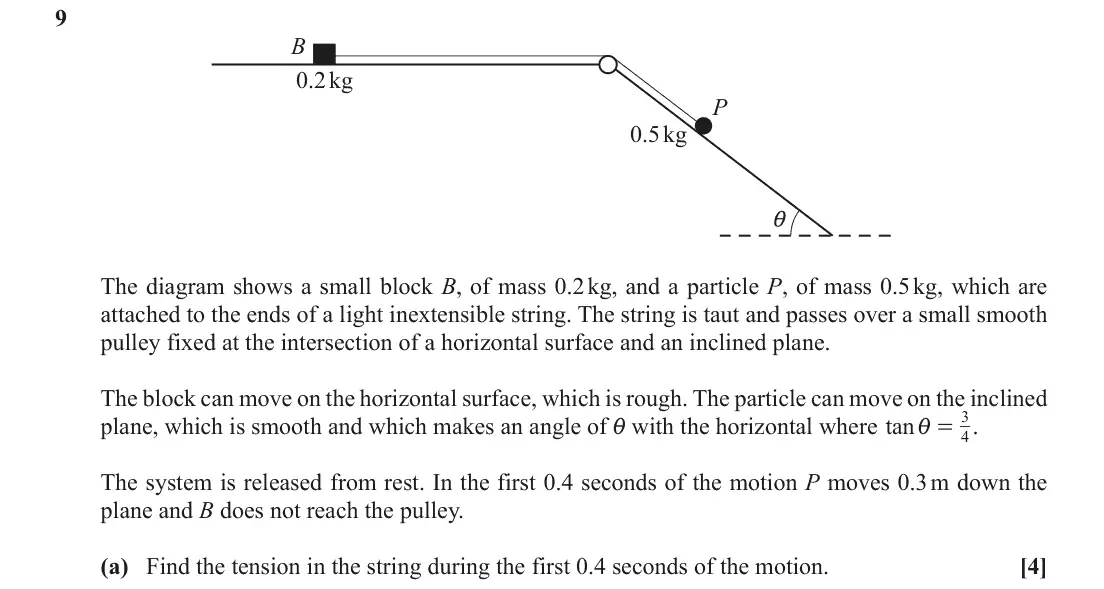
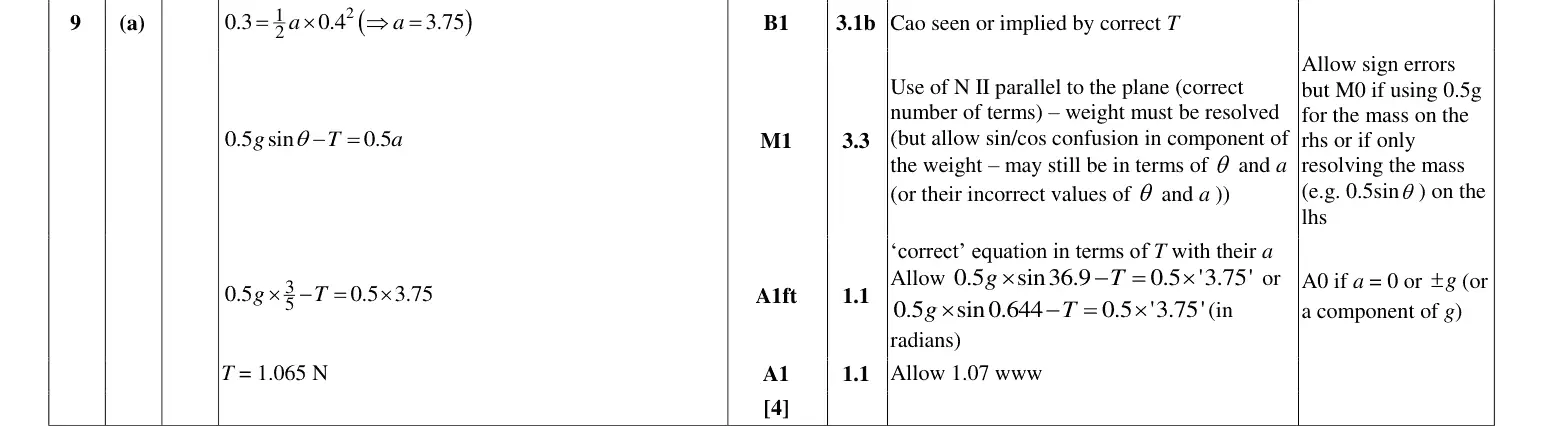
Examiners noted that it was rather surprising that while many candidates could correctly apply Newton’s second law for particle P and obtain a correct equation of the form 0 5gsin . θ − T = 0 5 . a , a significant proportion failed to calculate the acceleration correctly as 3.75 with many believing that the acceleration was 0.75 (which came from incorrectly dividing 0.3 by 0.4). It was pleasing though to note that many candidates used the correct exact value of sinθ = instead of needing to work out θ as 36.869…
Key points and common errors
0.3 = ½a(0.4)² so a = 3.75 (not 0.75)
sin θ = 3/5
N2 for P: 0.5g sin θ − T = 0.5a, T = 1.065 N
June 2018 · Paper 3 · Q10(iii)(a)3 marksMedium
Show the start of this question
Mark scheme for this part
Examiner's comment
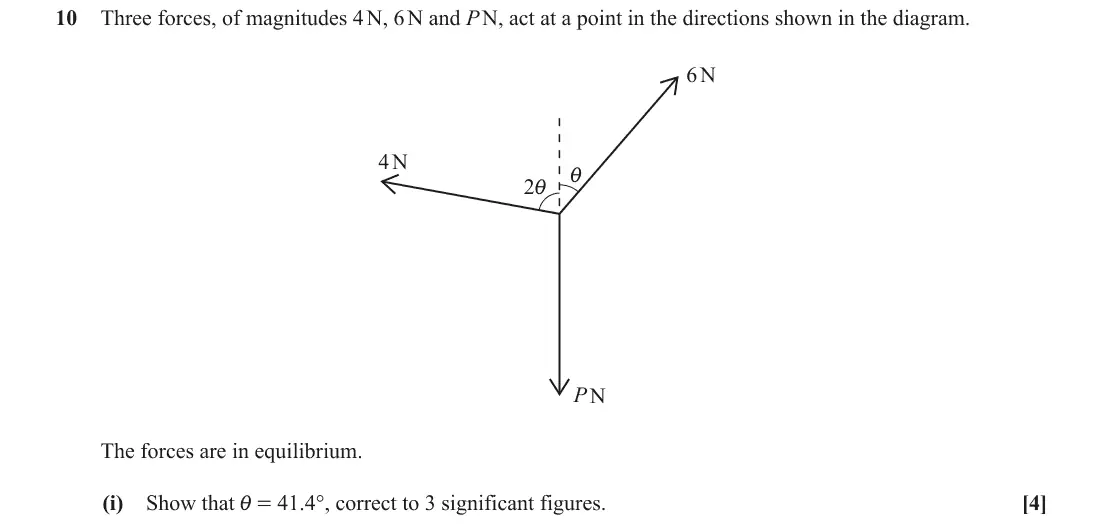
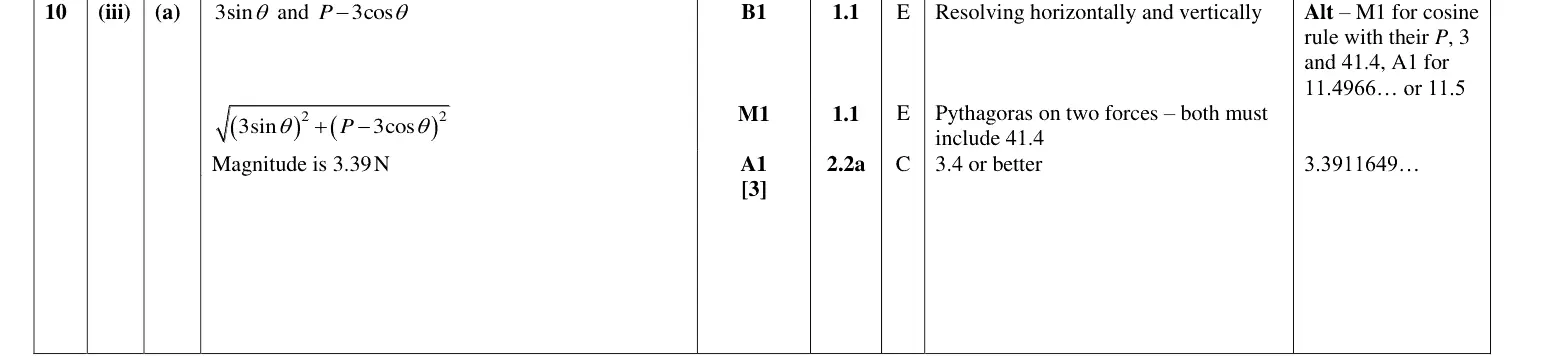
(Comment on Question 10(iii) as a whole) While nearly all candidates understood the method for finding the magnitude of the resultant of the two remaining forces it was generally those candidates who resolved horizontally and vertically and then applied Pythagoras who were the more successful. Examiners noted that those candidates who attempted to form a triangle of forces and then use the cosine rule were generally not as successful making errors with the correct placement of the required lengths (representing the magnitudes) on the sides of the triangle. When giving the direction of a force candidates are reminded that giving just the angle is insufficient. Candidates are strongly advised to draw a diagram (with an arrow on the resultant and/or the components) and to state that their angle is either ‘below/above the horizontal’ or ‘to the upward/downward vertical’.
Key points and common errors
components 3 sin θ and P − 3 cos θ
magnitude √((3 sin θ)² + (P − 3 cos θ)²) = 3.39 N
resolving then Pythagoras more successful than a triangle of forces
June 2018 · Paper 3 · Q10(iii)(b)2 marksMedium
Show the start of this question
Mark scheme for this part
Examiner's comment
(Comment on Question 10(iii) as a whole) While nearly all candidates understood the method for finding the magnitude of the resultant of the two remaining forces it was generally those candidates who resolved horizontally and vertically and then applied Pythagoras who were the more successful. Examiners noted that those candidates who attempted to form a triangle of forces and then use the cosine rule were generally not as successful making errors with the correct placement of the required lengths (representing the magnitudes) on the sides of the triangle. When giving the direction of a force candidates are reminded that giving just the angle is insufficient. Candidates are strongly advised to draw a diagram (with an arrow on the resultant and/or the components) and to state that their angle is either ‘below/above the horizontal’ or ‘to the upward/downward vertical’.
Key points and common errors
tan α = (P − 3 cos θ)/(3 sin θ)
54.2° below the horizontal
direction must be described
Find an A-level maths tutor
Stuck on this? Book a trial session with an A-level maths tutor.