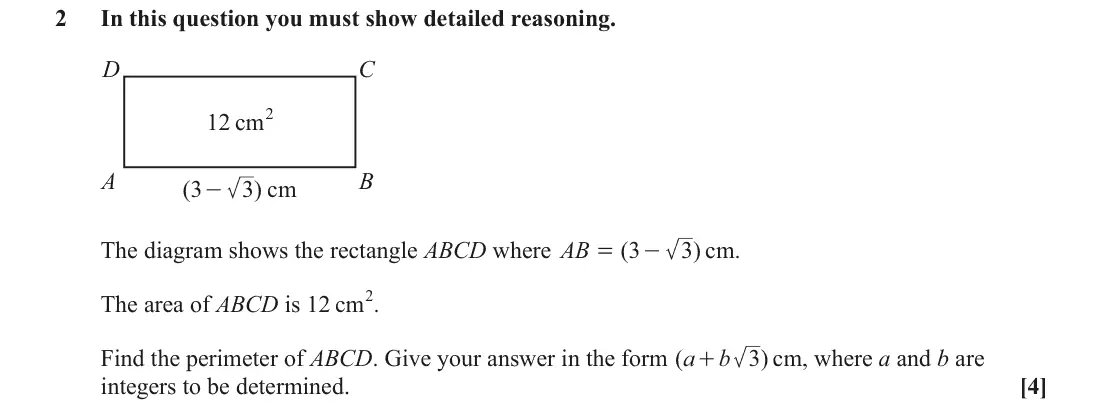
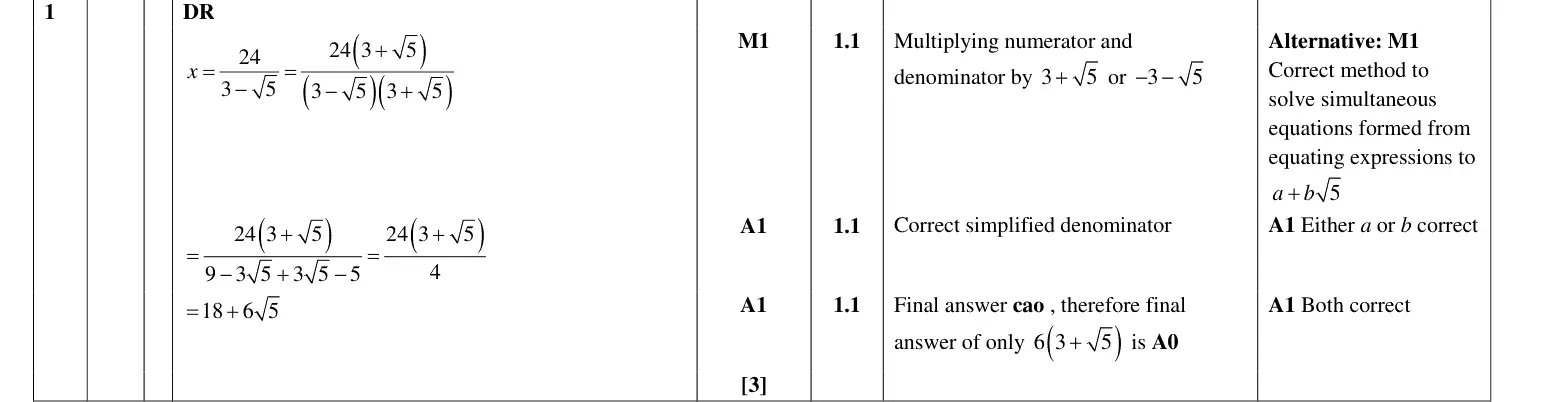
This was the first of the three DR questions, so candidates need to be aware that sufficient working and explanation of methods is required. This means they need to consider calculator use carefully – calculators can be used to check or support working but candidates should consider writing down calculations for each step. Exemplar 1 and its commentary illustrate a common deficiency. The methods needed here were well understood, with many solutions obtaining 18 + 2√3. A few candidates had responses that went no further than the value for BC , seemingly forgetting to find the perimeter. Use of 122 for the area was seen. This solution, seen quite frequently, scored B1 M0 M1 A0 only. DR requires, to quote the Specification, a solution which leads to a conclusion showing a detailed analytical method.’ Here we wanted to see the working for the rationalisation of the denominator, refer the mark scheme for details, and it is not given here. 6 + 2√3 comes from the calculator. Hence M0 and A0.
Key points and common errors
BC = 12/(3 − √3)
rationalise: 6 + 2√3
perimeter 2(3 − √3) + 2(6 + 2√3) = 18 + 2√3
calculator steps must be written out
June 2025 · Paper 1 · Q1(a)1 markEasy
Mark scheme for this part
Examiner's comment
This proved to be a straightforward start to the paper, with the vast majority of candidates stating a correct expression.
Key points and common errors
2x^(−1/4)
fourth root as power ¼, reciprocal gives negative index
June 2025 · Paper 1 · Q1(b)2 marksEasy
Show the start of this question
Mark scheme for this part
Examiner's comment
This was also very well answered. The more successful approach was to first write the expression in brackets in index form, and then cube this, whereas others first expanded the brackets and then attempted to combine terms. Candidates nearly always obtained the correct power of x, but some forgot to also cube the 5.
Key points and common errors
write x√x as x^(3/2) first, then cube: 125x^(9/2)
forgetting to cube the 5
June 2025 · Paper 1 · Q1(c)2 marksEasy
Show the start of this question
Mark scheme for this part
Examiner's comment
This was another routine question on manipulating surds. The more successful candidates first combined the two expressions as a single surd before simplifying, and this inevitably resulted in the correct answer. Candidates who attempted to initially simplify the two surds separately tended to be less successful.
Key points and common errors
combine as √(16x⁸) = 4x⁴
simplifying the surds separately less successful
June 2025 · Paper 2 · Q58 marksEasy
Mark scheme for this part
Examiner's comment
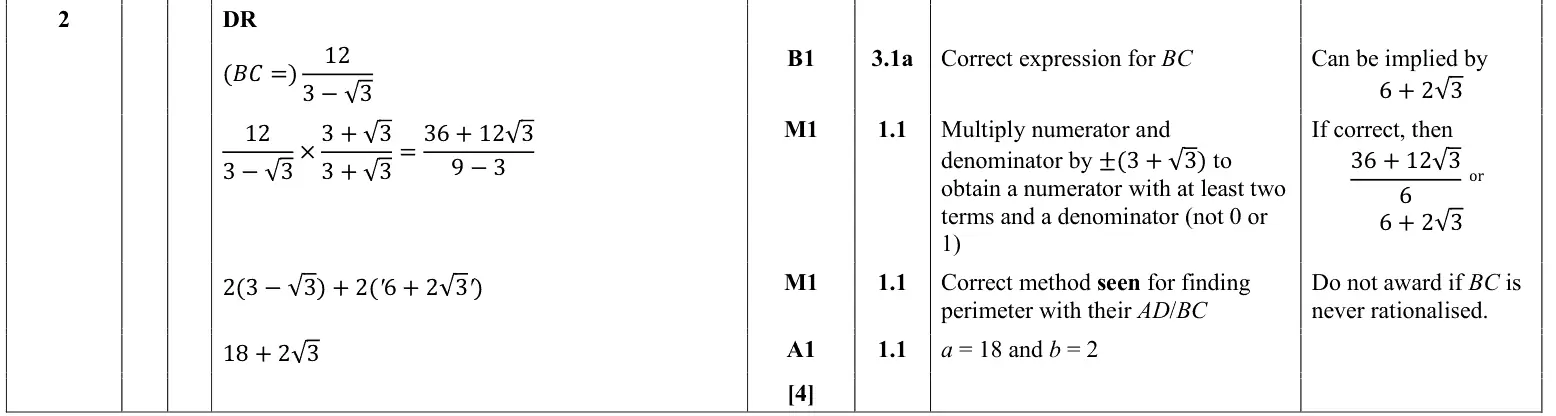
This problem-solving question was well answered by most candidates, with many fully correct responses seen. Candidates first needed to deduce the centre and radius of the circle from the given information to score B1 (which was generally done well, although some candidates wrote down 10 and misinterpreted this as the radius rather than the diameter). The next step was to write down a cartesian equation for the circle for M1 (the most common error here was forgetting to square the radius), and solve this simultaneously with the line equation by substitution for x or y. Most candidates proceeded well to obtain a quadratic in x or y and solve this to find the coordinates of the two points of intersection, although quite a few incorrectly factorised the quadratic. Most candidates who obtained two points correctly used coordinate geometry to calculate the distance between them. Most candidates heeded the DR instruction and showed an appropriate amount of working in this question. The alternative method shown in the scheme was only occasionally seen. This candidate has identified the correct parameters for the circle and setup the equation correctly, substituting appropriately to reduce to a 3-term quadratic in y only (scoring B1M1M1M1). However, they obtain a quadratic with a sign error (the scheme allowed ‘one error in the terms’ for the method mark) so do not find the correct coordinates of the points of intersection (A0A0). They go on to compute the distance between these (M1) but do not obtain the correct final answer because of their earlier error (A0). This is a good example of a candidate who has shown their method in full (as required by DR) and scores the majority of the marks in this question despite making an error.
Key points and common errors
centre (0, 1), radius 5 (not 10)
substitute line into x² + (y − 1)² = 25
A(4, 4) and B(0, 6)
AB = 2√5
errors forgetting to square radius, factorising
June 2024 · AS Paper 1 · Q35 marksHard
Mark scheme for this part
Examiner's comment
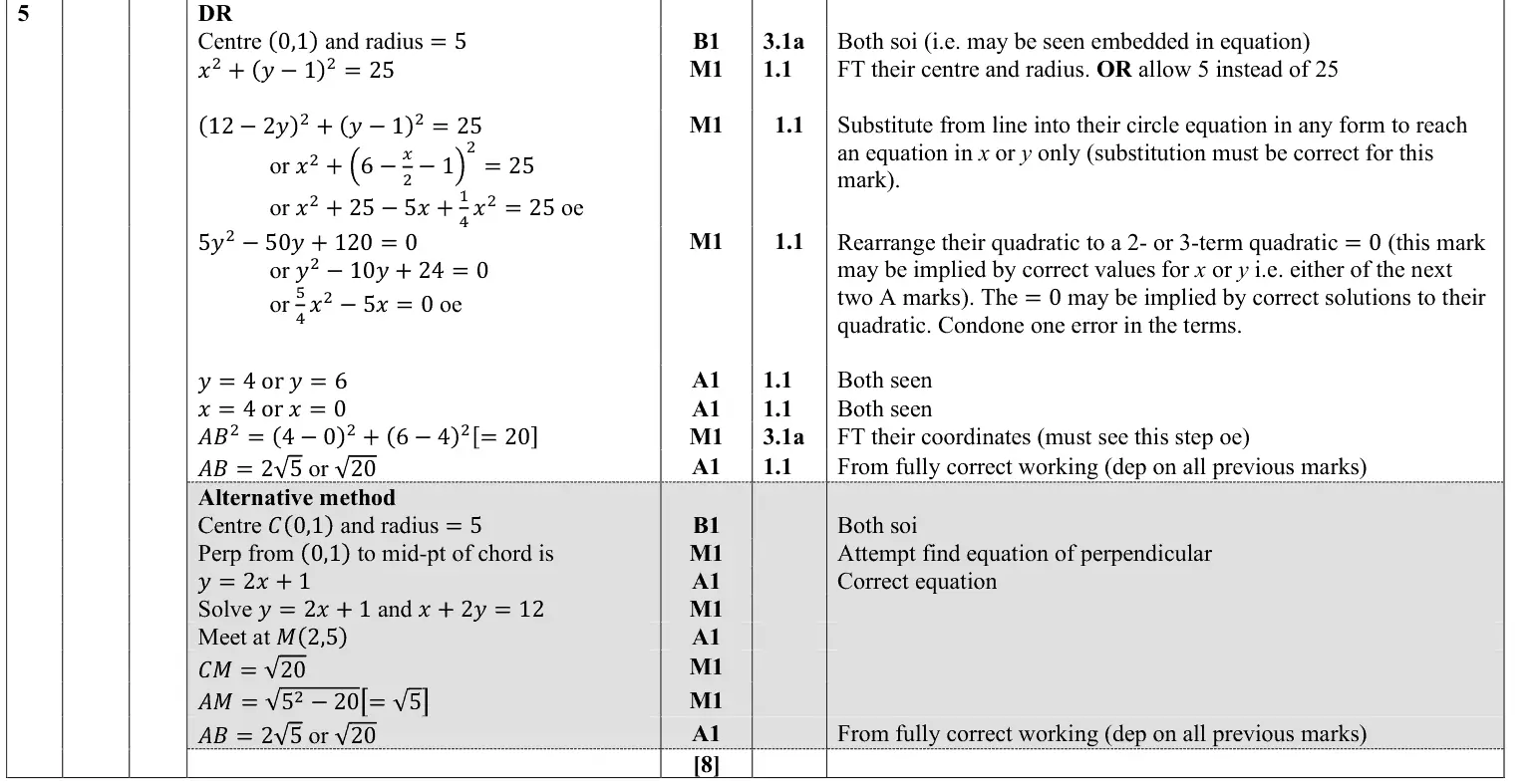
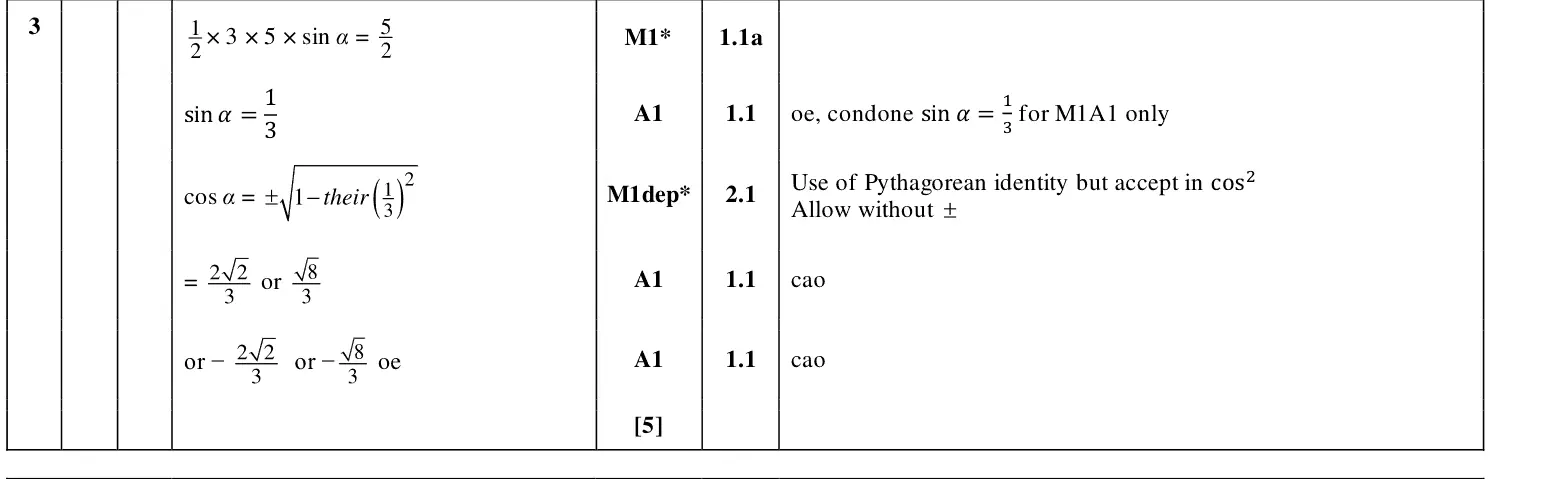
2 𝑎𝑎𝑎𝑎sin𝐶𝐶 to form an equation in alpha, although some The majority of candidates correctly applied both common). Of those who had the equation correct, most reached the equation sin𝛼𝛼= candidates made errors when recalling this formula (writing cos instead of sin, or omitting the ½ were 3 but very few proceeded correctly beyond this point. Noting that the instruction on this question was ‘Determine’ and their calculator to find an (inexact) value for cos (sin−1 ቀ 3ቁ). Some candidates used a triangle with that exact answers were required, none of the final three marks could be given to candidates who used opposite side 1 and hypotenuse 3 to correctly deduce the required answer. This is a typical example of a candidate who has completed the first few steps in the working correctly, but then uses their calculator to obtain an inexact pair of values, scoring M0A0A0 for the final three marks.
Key points and common errors
½ × 3 × 5 sin α = 5/2 so sin α = ⅓
cos α = ±√(1 − 1/9) = ±2√2/3 (acute and obtuse)
very few progressed beyond sin α
exact working required
June 2024 · AS Paper 1 · Q7(b)4 marksHard
Show the start of this question
Mark scheme for this part
Examiner's comment
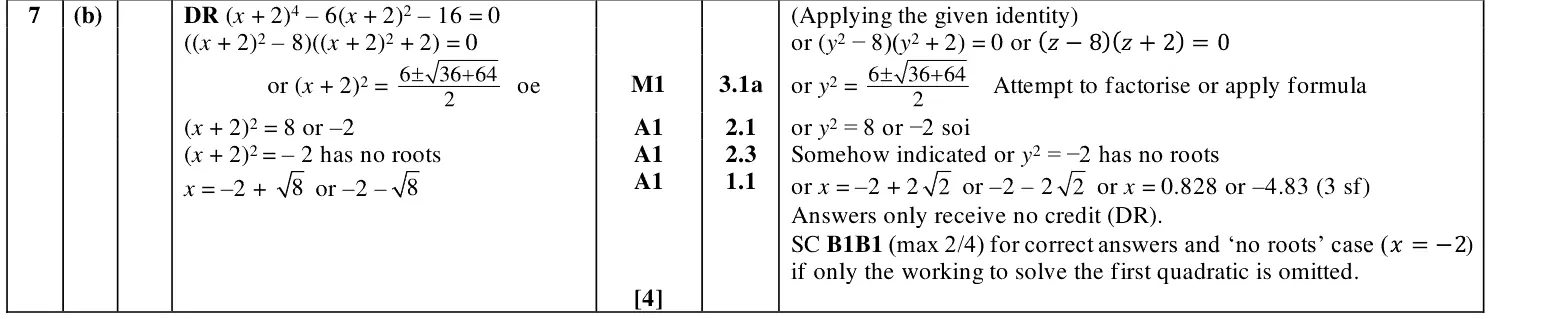
Many candidates did not appear to know how to approach this question, despite the LHS of the equation being in identical form to the identity given in part (a). Some attempted long division without applying the given identity, which was not fruitful. Candidates should be reminded that the instruction ‘Hence’ means that the result from the previous part must be used (and, as in this case, it is helpful to do so). A number of candidates (not noting the Detailed Reasoning instruction) gave the solutions without working (from their calculator) or ‘retro-fitted’ incorrect working to try and justify these. Neither could be credited. As a reminder, the Detailed Reasoning instruction means that all steps in the working must be shown, and that calculators may be used to check or verify results only. Candidates who attempted an analytical method were generally successful, with relatively few errors seen – a few candidates did not provide state that the (𝑥𝑥+ 2)2 = −2 case leads to no solutions, and a few made an error generating false extra sufficient justification of the quadratic form (and were marked under the Special Case), others did not solutions.
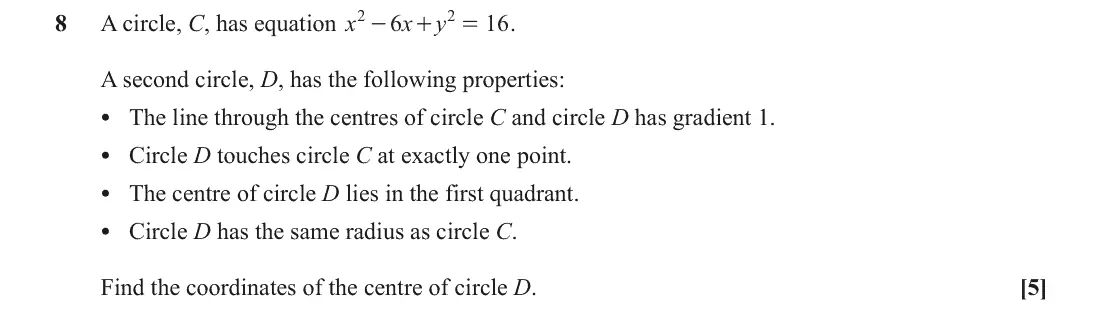
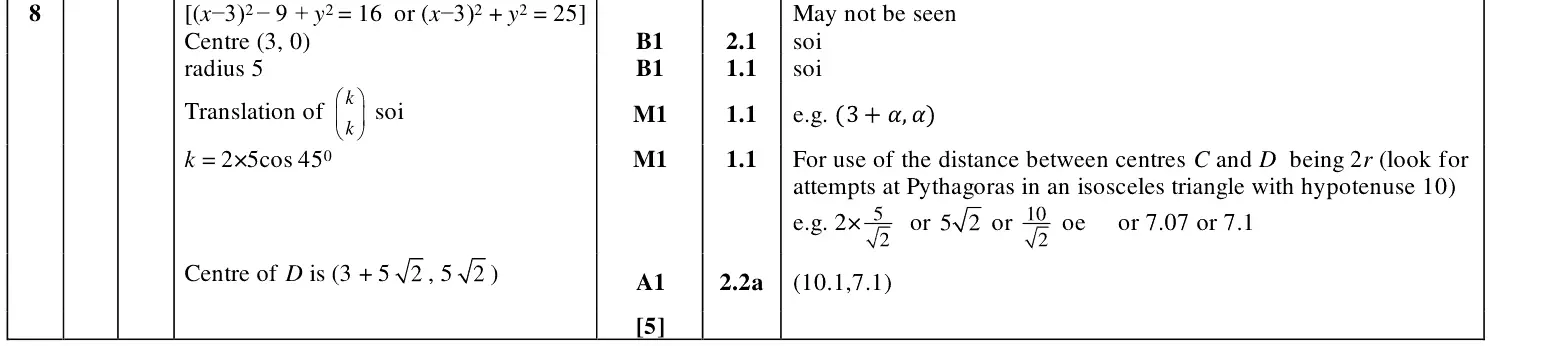
Most candidates successfully completed the square to correctly obtain the centre and radius of circle C (although a number did not do so in full and assumed that the radius was 4). Many candidates correctly interpreted the ‘gradient 1’ statement and deduced an equation of the line between the two centres, although often did not progress this into the deduction about the difference in the coordinates of the centre of D being 3. Fewer candidates used the other information to deduce that the distance between the two centres was 2r (=10), but those who did were then able to apply Pythagoras, or trigonometry, to compute the x- and y- change.
Key points and common errors
complete the square: centre (3, 0), radius 5 (not 4)
centres lie on a line of gradient 1 and are 2r = 10 apart
translation (k, k) with k = 5√2
centre D (3 + 5√2, 5√2)
June 2024 · AS Paper 1 · Q95 marksHard
Mark scheme for this part
Examiner's comment
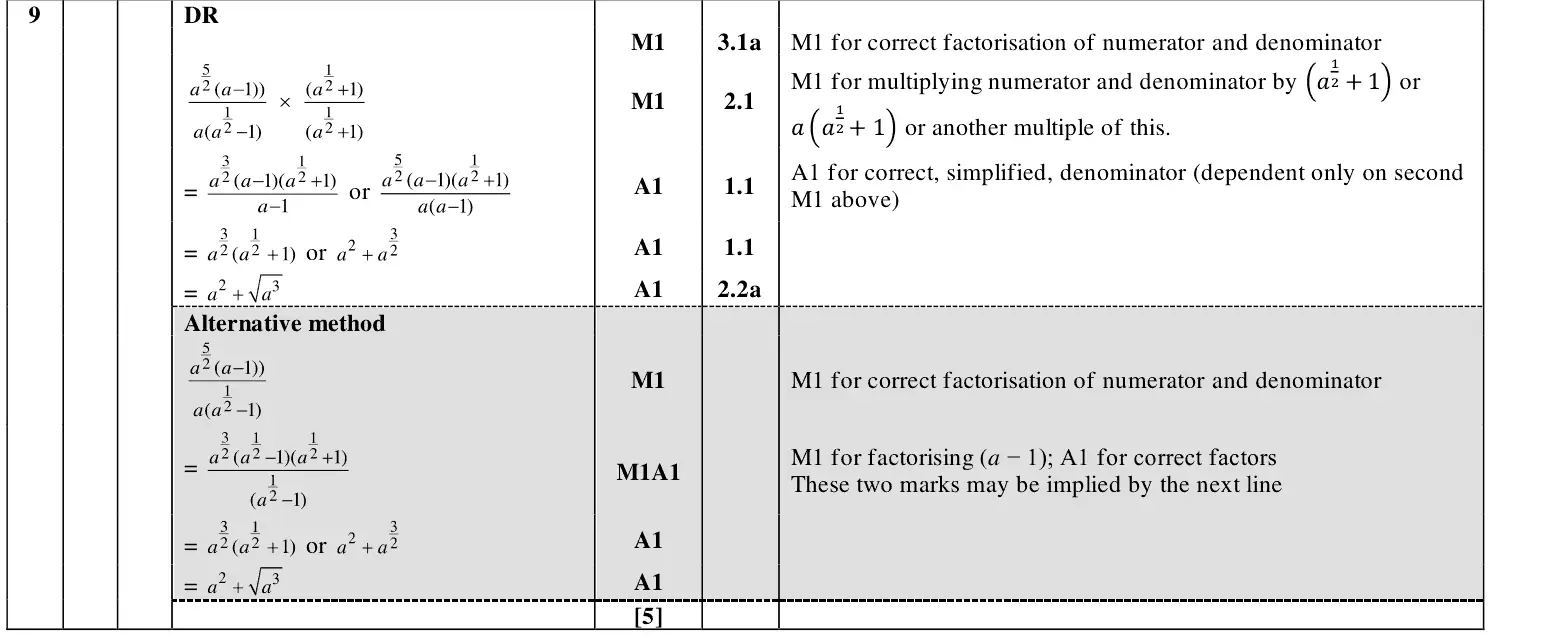
Very few candidates obtained more than 1–2 marks on this question. Some candidates were able to correctly ‘rationalise’ the denominator and simplify to the required form but rarely progressed beyond there (typically because they did not spot the common factor that allowed simplification). Many candidates attempted to find a shortcut to the given form, which was rarely successful. Trying to complete multiple steps of working in one go will often lead to mistakes. Unusually in this case, dividing the first term in the numerator by the first term in the denominator (and again for the second terms) happened to give the final answer, but clearly this incorrect method could not be credited. Candidates should be reminded that it is best practice to be showing full working at every step. The alternative method from the mark scheme was seen relatively rarely but, when attempted, was often correct. This candidate has made an incorrect attempt to simplify the given expression, and then divided the first term in the numerator by the first in the denominator (etc.) to obtain an answer of the correct form, but from wrong working. This is incorrect work and so was not credited, scoring 0. Section B Most candidates scored well in the first questions of the Statistics (Section B), however candidates obtained fewer marks in Q12.
Key points and common errors
factorise a^(5/2)(a − 1)/(a(a^(1/2) − 1))
multiply by (a^(1/2) + 1) or factorise a − 1
= a^(3/2)(a^(1/2) + 1) = a² + √(a³)
shortcuts rarely successful
June 2024 · Paper 2 · Q6(b)(i)1 markEasy
Mark scheme for this part
Examiner's comment
Almost all candidates scored the B1 mark for this question, correctly multiplying out. Candidates should be reminded (especially in a DR question) to make sure that their working clearly leads to the given response. A small number of candidates lost this mark following correct work because they did not give a conclusion. Ideally candidates should demonstrate that their multiplied-out form simplifies to the given response (and write this out) although in this case an equivalent statement such as ‘QED’ or ‘Shown’ was condoned. Detailed Reasoning Candidates should be reminded that the instruction ‘In this question you must show Detailed Reasoning’ sets a higher bar for the level and detail of working that will be required to support responses. It is an explicit instruction to candidates to demonstrate that they have fully understood the method that leads to the answer by showing all the steps, and credit will not normally be given for responses that are unsupported by correct working in these questions. A full list of command words can be found on pages 10-15 in the specification. There is also a command words poster that can be printed and displayed in the classroom.
Key points and common errors
multiply out fully and reach the given cubic
June 2024 · Paper 2 · Q6(b)(ii)2 marksEasy
Show the start of this question
Mark scheme for this part
Examiner's comment
This part was also well answered, with almost all candidates deducing the first root of 𝑥= −√2 2 . Many candidates went on (e.g. using the quadratic formula) to find the other two solutions correctly. Some candidates made sign errors (e.g. applying +/- to the wrong term). In some cases, candidates’ writing meant that their solutions were ambiguous: for instance writing or implying ± √2+√6 (when in fact the +/- should apply to the √6 only. Candidates should be reminded to make sure (especially in a DR question) that their responses are clearly written using correct, unambiguous notation.
Key points and common errors
x = −√2/2 from the linear factor
quadratic formula for (√2 ± √6)/4
June 2023 · AS Paper 2 · Q24 marksMedium
Mark scheme for this part
Examiner's comment
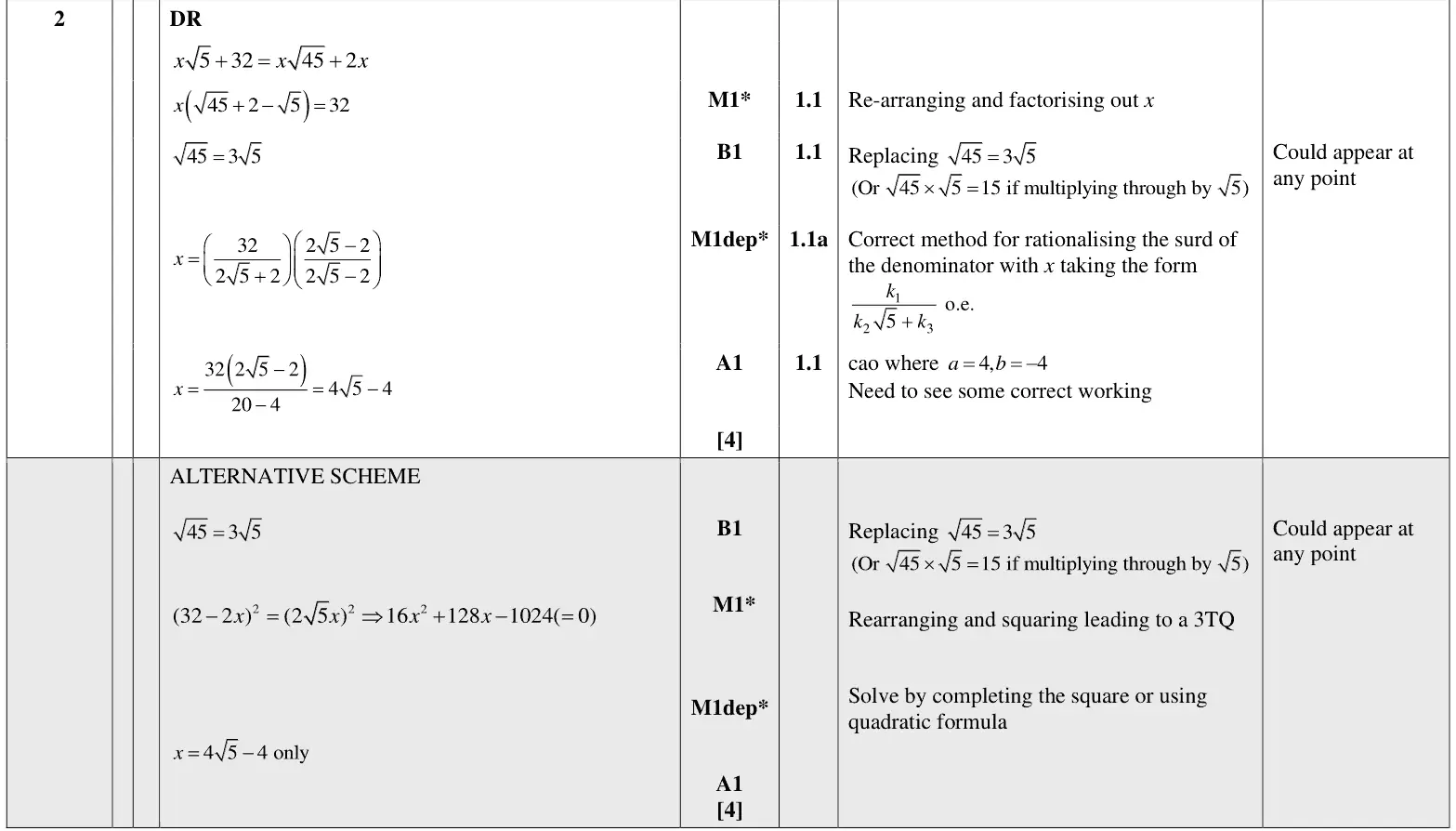
Many candidates gained the B1 mark. Some solutions then floundered because the need to factorise out x was not understood. Those who did this however usually reached the correct answer, but it was important to show how this was achieved (note the comments below); the rationalising process needed to be clear and we expected to see some working before the final answer. The alternative scheme was rarely seen. This exemplar illustrates the point raised above. The candidate does not indicate how they have reached ‘x = -4 + 4√5’ from the preceding line, which is not sufficient for the M1dep* to be given.
Key points and common errors
√45 = 3√5
factorise out x: x(2√5 + 2) = 32
rationalise the denominator to get 4√5 − 4
rationalising must be shown
June 2023 · Paper 1 · Q2(a)(i)2 marksEasy
Mark scheme for this part
Examiner's comment
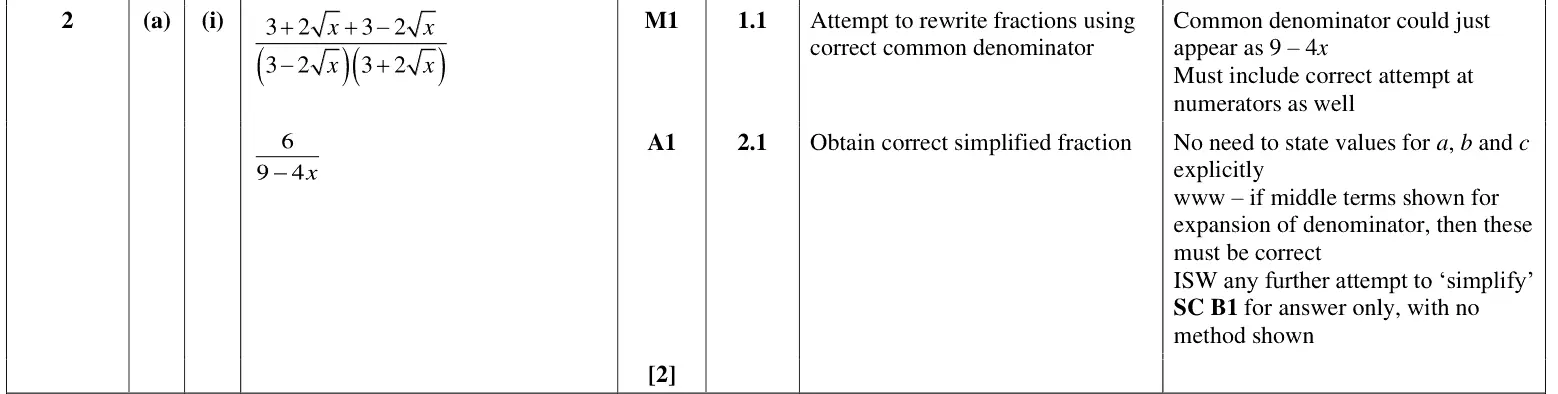
The majority of candidates were able to provide a fully correct solution, which included sufficient detail as indicated by the command words of ‘show that’ and ‘determined’.
Key points and common errors
common denominator (3 − 2√x)(3 + 2√x) = 9 − 4x
6/(9 − 4x)
June 2023 · Paper 1 · Q2(a)(ii)2 marksEasy
Show the start of this question
Mark scheme for this part
Examiner's comment
Candidates who had found the correct expression in part (a) invariably scored both marks in this part of the question. Those with an incorrect expression could still pick up the method mark, as long as their fraction was of the required form.
Key points and common errors
6/(9 − 4x) = 2 gives 8x = 12, x = 3/2
June 2023 · Paper 2 · Q4(b)3 marksHard
Show the start of this question
Mark scheme for this part
Examiner's comment
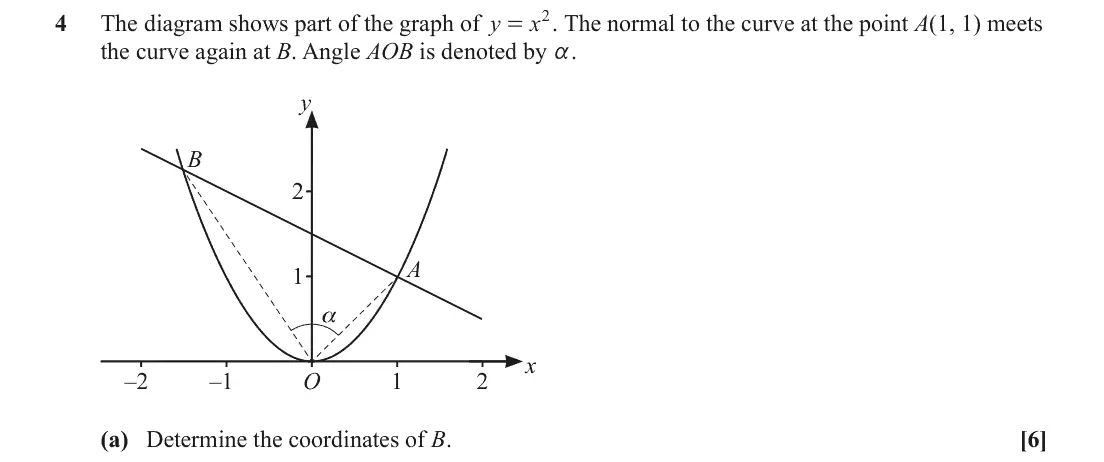
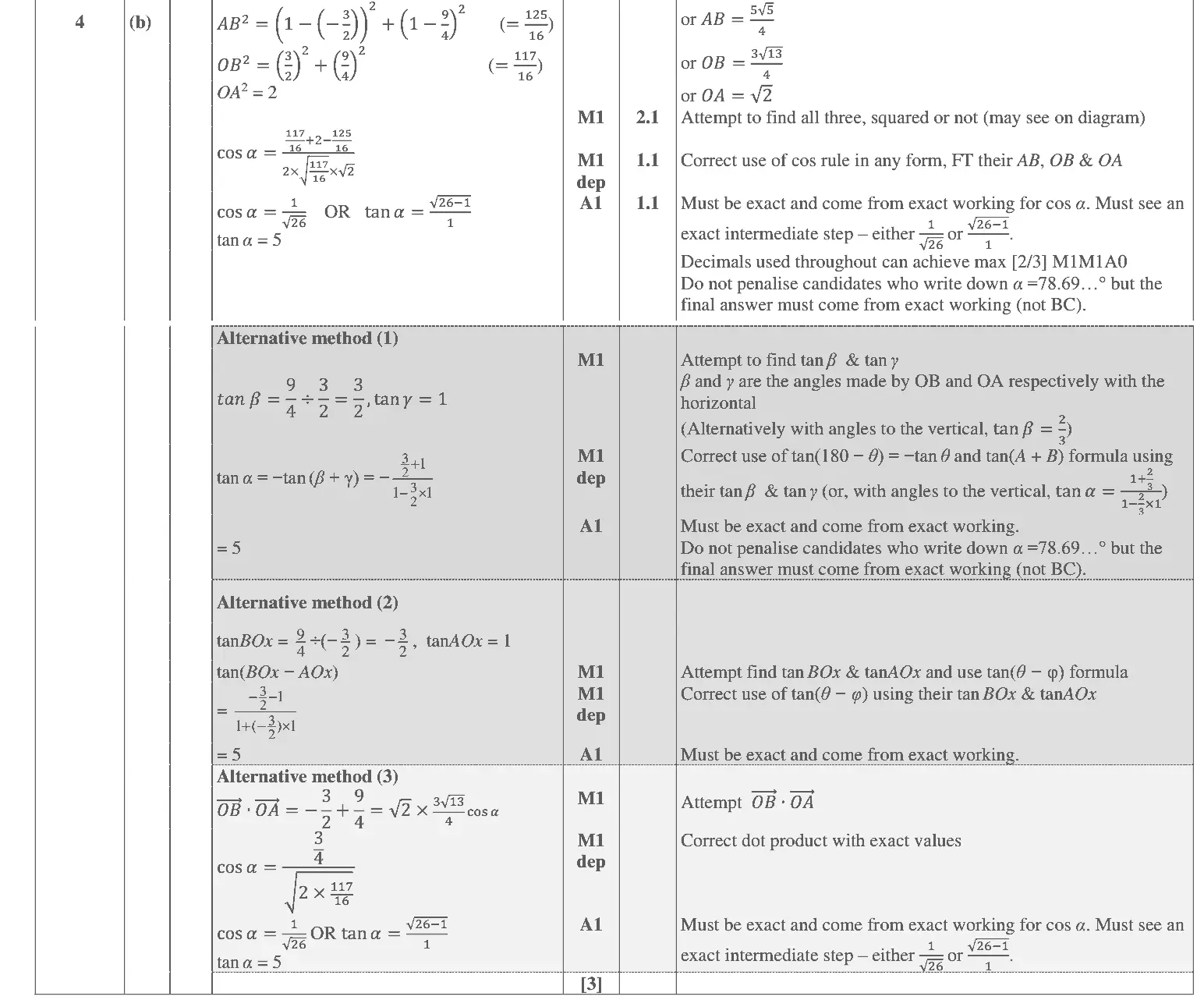
This challenging question was not well answered. Many candidates either used their calculator (to compute inverse tan, add the angles together and then ‘re-tan’) which was not appropriate for ‘Determine’ as they then provided inexact working which did not lead to tan α = 5 exactly. Alternatively, a number of candidates misinterpreted the angle and assumed that BAO=90°, when it isn’t (the line is normal to the curve, not the line OA). The main method in the scheme, using the cosine rule, was most common, although many candidates made a slip in computing one of the lengths. A small number of candidates used the (more direct) method given in the scheme as Alt 1, but on both methods candidates sought shortcuts without showing exact working, which meant they could not be credited. As in Question 3, the ‘exact’ instruction in the question is critical here. An inexact answer that rounds to 5 was not sufficient, exact working that leads to an exact answer was required. However, this is a good example of a question where some candidates made good use of their calculator to check their solution (having found it using exact working) by computing α = 78.69…° This candidate (who obtained full marks) is an example of sufficient exact working being shown, together with the (calculator-obtained) value that has been used to verify their solution. Although included in the flow of the working here, the computation of α does not undermine their correct, exact, working for cos α.
Key points and common errors
find OA, OB, AB and use the cosine rule (or tan(A ± B))
cos α = 1/√26 so tan α = 5 exactly
calculator angles not exact
BAO is not 90°
June 2023 · Paper 2 · Q6(a)7 marksHard
Mark scheme for this part
Examiner's comment
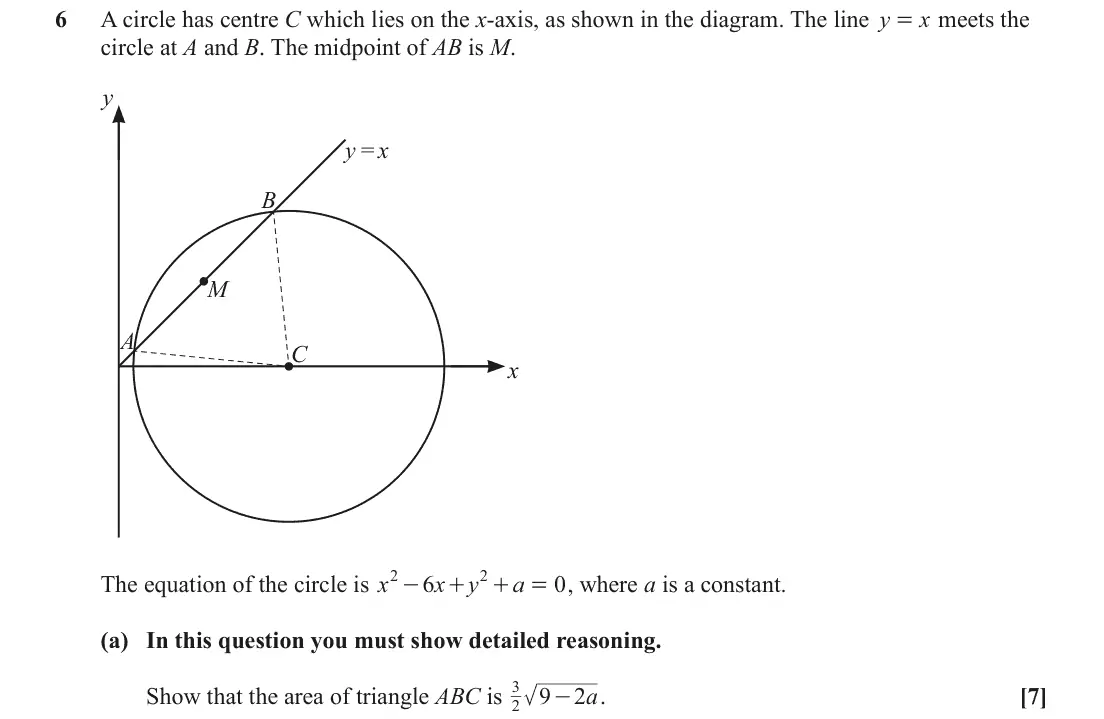
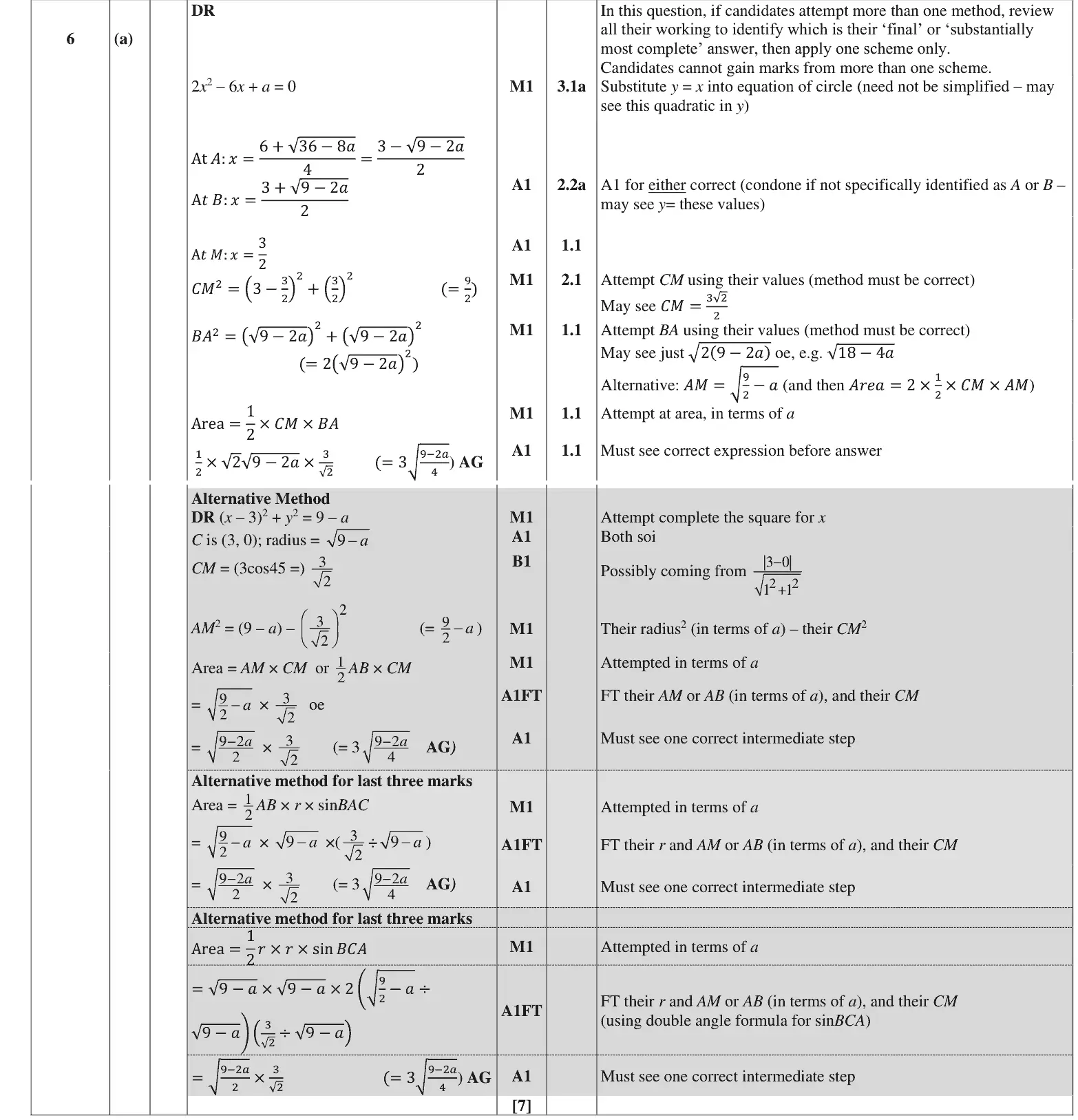
Many candidates appeared to find this question very challenging. A good number of candidates were able to obtain the first 1-2 marks by either attempting to complete the square or substitute in y = x and solve for one or both coordinates of the points of intersection A and B. Many candidates started with the alternative method (attempting to complete the square) and then reverted to the main method. Those candidates who proceeded beyond that first stage generally went on to successfully reach (or almost reach) the given answer - deducing the coordinates of M and finding two of the required lengths to allow them to form an expression for the area of the triangle. Many of these correctly handled the length of AB and were able to write down a correct expression for the required area. There was (despite the Detailed reasoning instruction) some evidence of candidates attempting to reverse-engineer the given result from ‘similar-looking’ terms in their expressions. A small number of candidates provided elegant alternative solutions, such as finding the area of triangle OBC and subtracting OAC, or (more commonly) finding CM and either AM or BM, then using 2x the area of triangle ACM or BCM.
Key points and common errors
substitute y = x: 2x² − 6x + a = 0
M has x = 3/2
CM = 3/√2 and AB from the roots
area = ½ × AB × CM = (3/2)√(9 − 2a)
June 2023 · Paper 3 · Q10(b)4 marksEasy
Show the start of this question
Mark scheme for this part
Examiner's comment
determine that 𝐑𝐑= 2𝐢𝐢−6𝐣𝐣. Most then went on to correctly apply |𝐅𝐅| = 𝑚𝑚|𝐚𝐚| and found the correct value This part was answered well with most candidates using the given value of a to then find b and hence of m.
Key points and common errors
b = −8 so R = 2i − 6j
magnitude √40 = m × 5√10 so m = 0.4
June 2022 · AS Paper 2 · Q24 marksMedium
Mark scheme for this part
Examiner's comment
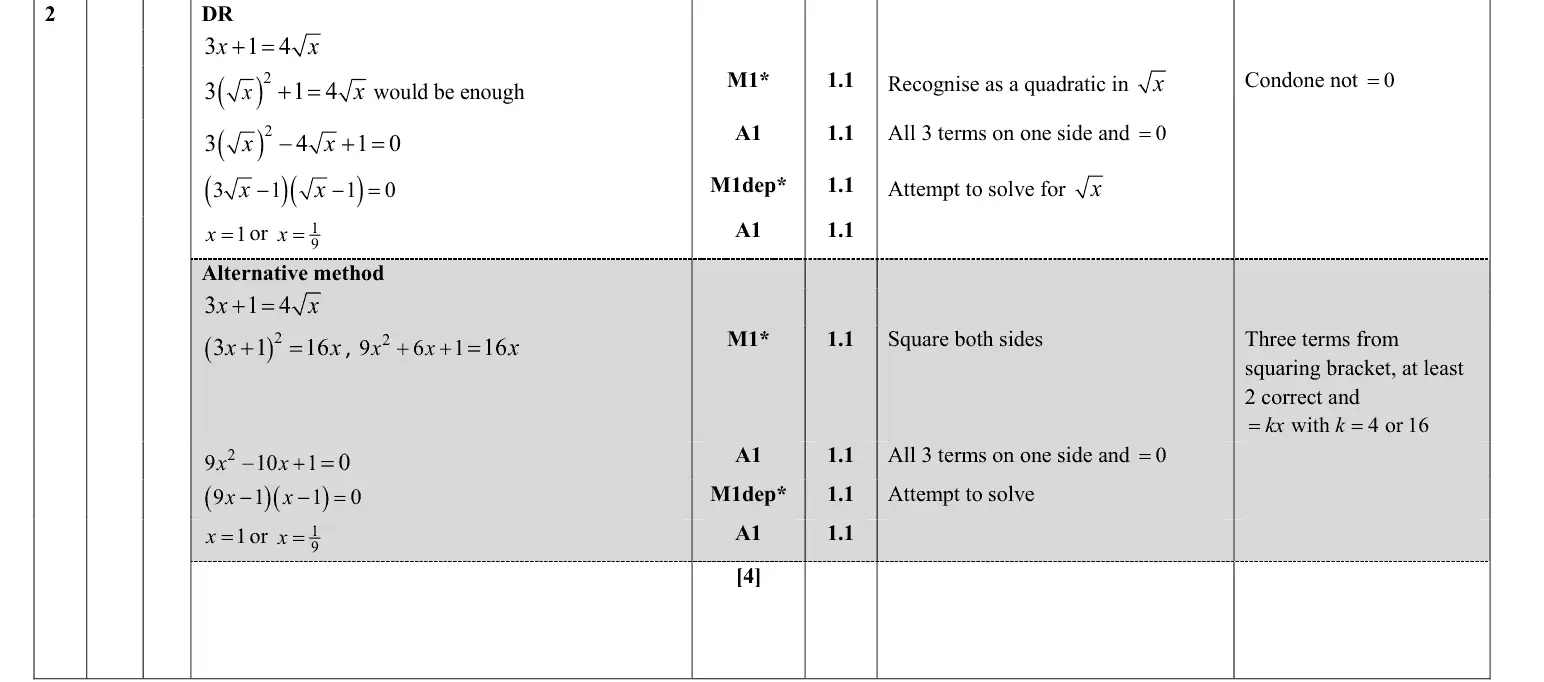
This question starts with the instruction ‘In this question you must show detailed reasoning’. This should be a warning to candidates to show sufficient evidence and detail in their solution. In this question candidates were therefore expected to show the method for solving the quadratic equation, not simply the roots stated from calculator work. The method using the ‘disguised quadratic’ was more popular, with the correct values of x appearing quite often. Some candidates, however, did not provide values for x by squaring their quadratic solutions, instead taking the square root of them. In the alternative method, (3x + 1)2 = 9x2 + 1 was not uncommon, likewise forgetting to square the 4 on the right-hand side of the given equation. The guidance in the mark scheme shows what we expected from candidates after their attempt to square before we allowed credit. This exemplar illustrates well the point raised under ‘Assessment for learning’. The quadratic equation here has seemingly been solved by calculator, (BC) and this is not sufficient in this question. Only the first 2 marks were given. Note the introduction of +/- in the final answers.
Key points and common errors
quadratic in √x: (3√x − 1)(√x − 1) = 0 so x = 1 or 1/9 (square, not square root)
or square both sides: 9x² − 10x + 1 = 0
method of solving must be shown
(3x + 1)² errors
June 2022 · AS Paper 2 · Q7(a)5 marksMedium
Mark scheme for this part
Examiner's comment
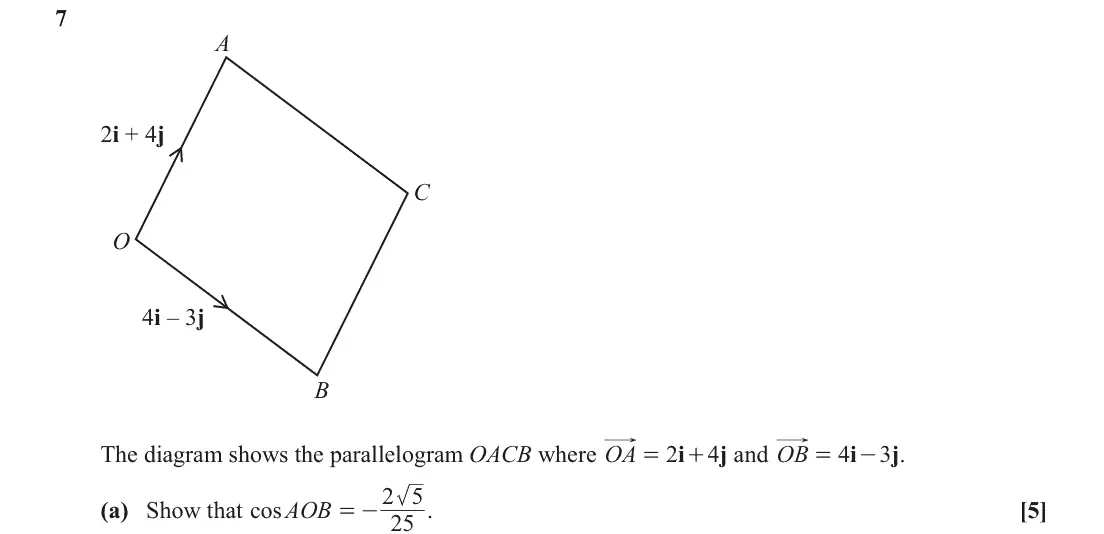
IOAI and IOBI were correctly found by many, and often less successful attempts could obtain AB and its length. Most realised the triangle AOB was not right angled and attempted the cosine rule. It is good practice for candidates to be in the habit of showing surd simplification even if the calculator is used to do the relevant work. Exact working was expected for full credit. Those who just used AOB = tan-1(4/2) + tan-1(3/4) to get 100.3° and their calculator with this to try and show the given result scored 0 marks.
Key points and common errors
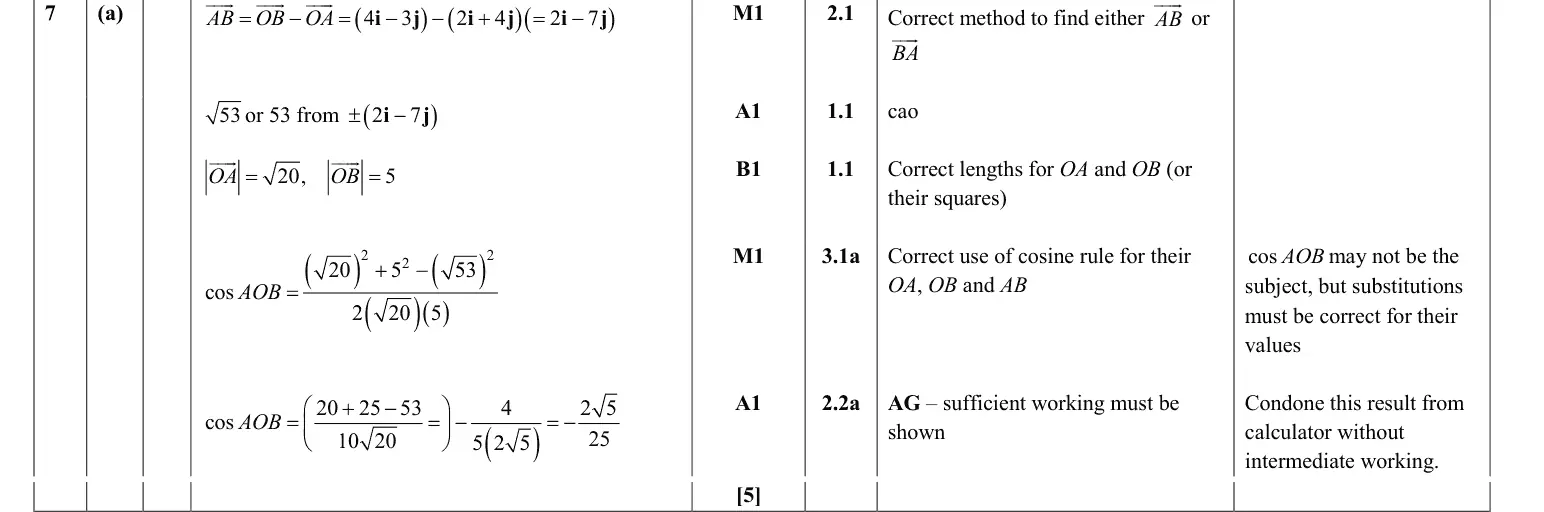
AB = 2i − 7j so AB = √53, OA = √20, OB = 5
cosine rule with exact surd working gives −2√5/25
using tan⁻¹ angles and calculator scores 0
June 2022 · AS Paper 2 · Q7(b)2 marksHard
Show the start of this question
Mark scheme for this part
Examiner's comment
Many candidates did not seem to understand what exact value meant as far as an acceptable solution was concerned. So often we saw sin100.3° given as a decimal only. Exact working was uncommon. Candidates should be reminded of what is required when an exact value is requested in a question. See section 2d of the specification for a list of command word explanations.
Key points and common errors
sin²AOB = 1 − cos²AOB = 121/125
sin AOB = 11√5/25 exact
decimals only gain nothing
exact working uncommon
Autumn 2021 · Paper 1 · Q10(b)5 marksMedium
Mark scheme for this part
Key points and common errors
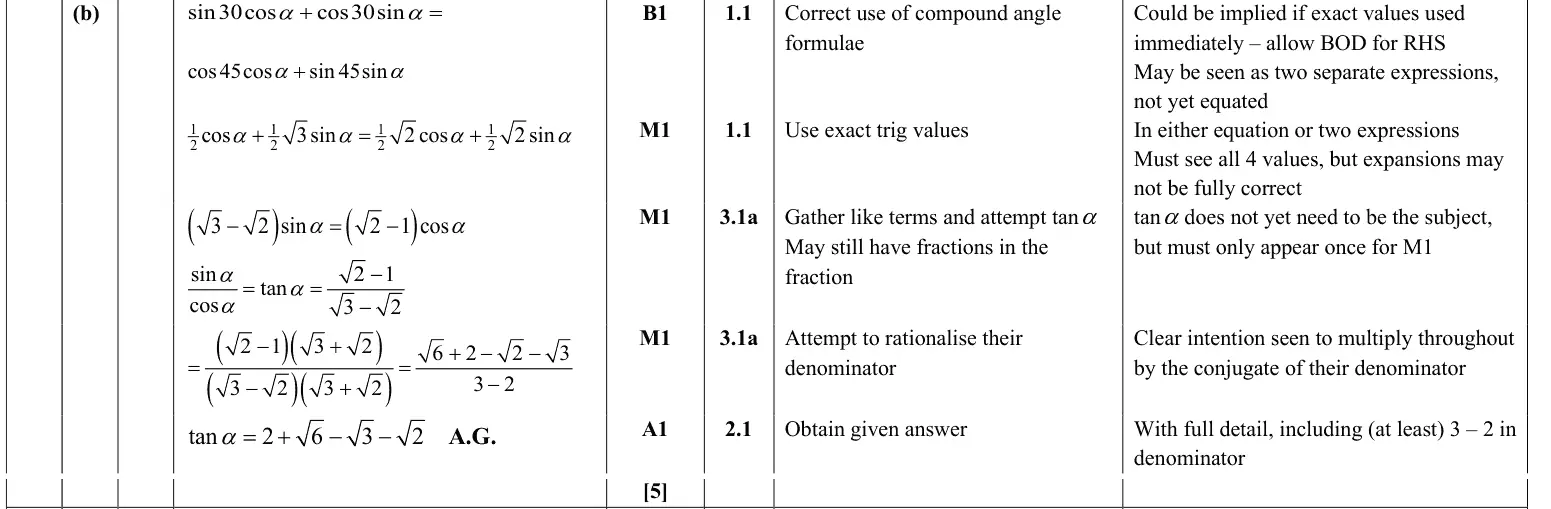
expand both compound angles and use exact values
collect to tan α = (√2 − 1)/(√3 − √2)
rationalise the denominator to reach 2 + √6 − √3 − √2
Autumn 2020 · AS Paper 2 · Q7(a)6 marksHard
Mark scheme for this part
Examiner's comment
(Comment on Question 07 as a whole) Part (a) - V = 2x2y was seen and often the required result for the surface area was incorrect, although many candidates managed to find at least 3 correct faces and gain M1. Replacing y in V and the subsequent rationalising was rarely seen. Part (b) - M1 A1 earned, with k often used, but few completed. Full credit could have been gained here even if no k had been obtained earlier. Second derivatives appeared sometimes. Part (c) and (d) were commonly not attempted.
Key points and common errors
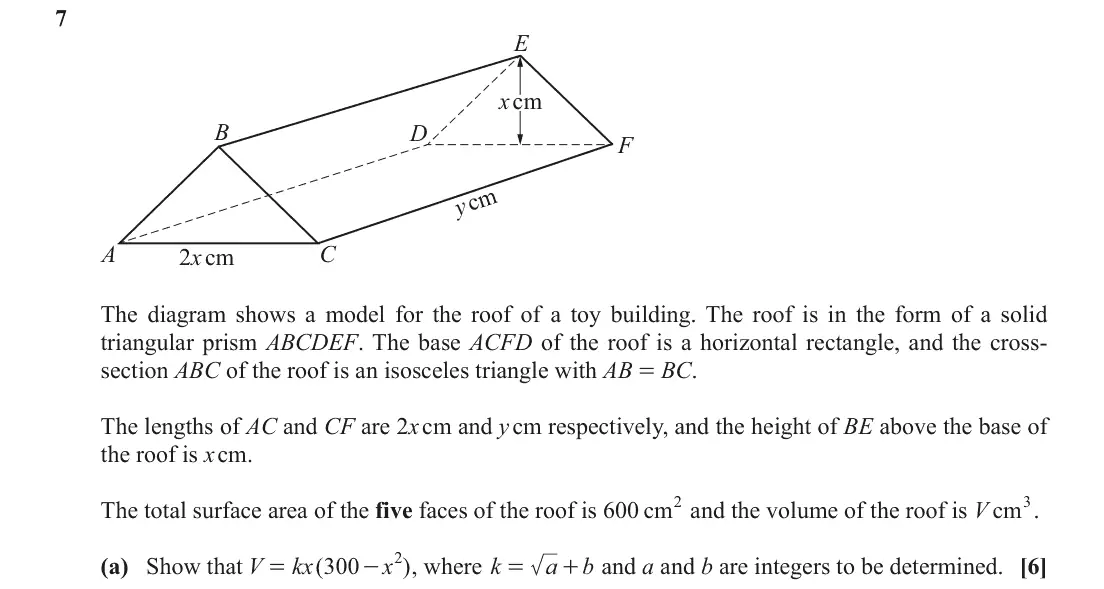
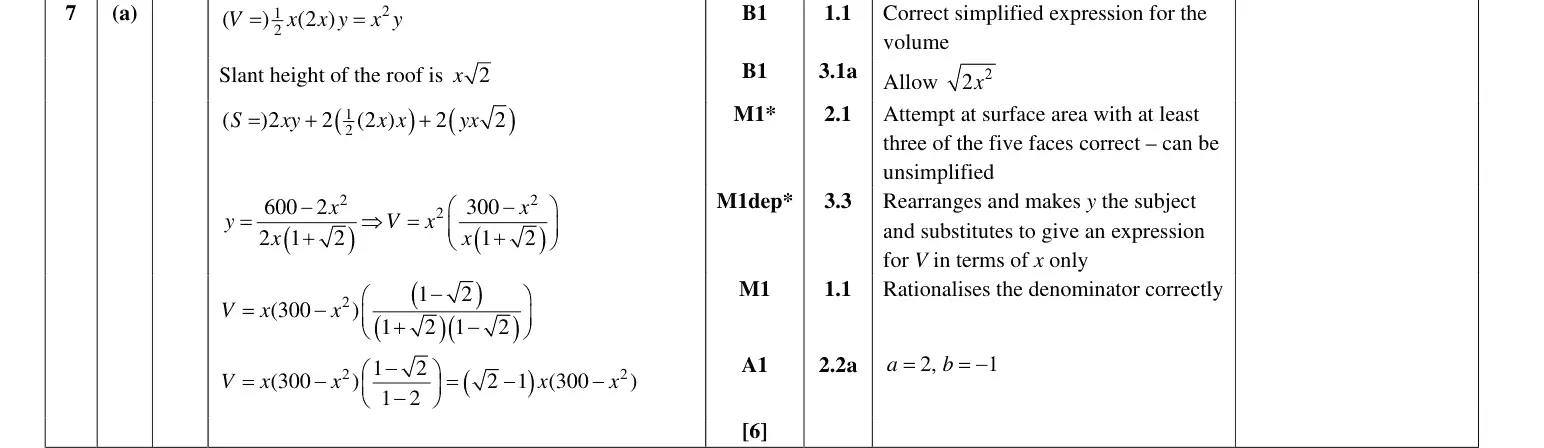
V = x²y
slant height x√2
S = 2xy + 2x² + 2√2xy = 600
substitute y and rationalise: V = (√2 − 1)x(300 − x²), a = 2, b = −1
rationalising rarely seen
Autumn 2020 · Paper 1 · Q2(a)2 marksMedium
Mark scheme for this part
Key points and common errors
combine as a single surd √(36a⁶) = 6a³
June 2019 · AS Paper 2 · Q13 marksMedium
Mark scheme for this part
Examiner's comment
This question required detailed reasoning so candidates were expected to show full working to indicate how their final answer had been obtained. The answer needed to be in the form requested. Those who went straight to the answer without intermediate steps had clearly just used their calculator and scored 0/3. Candidates need to be aware that detailed reasoning questions will want substantial evidence of methods. This candidate has made clear each step of their solution for full credit.
Many candidates answered this question correctly. A few made a correct first step, for example 3 , but could not continue correctly. Some candidates gave the correct answer with no working or with incorrect working. These scored no marks.
Key points and common errors
3^(7/2) = 3³√3 = 27√3
an intermediate step must be shown (DR) or no marks
June 2018 · AS Paper 1 · Q1(ii)3 marksEasy
Mark scheme for this part
Examiner's comment
Many candidates answered this question correctly. A few made a correct first step, multiplying numerator and denominator by 1 + 2 , but made a subsequent error. Some candidates gave the correct answer with no working or with incorrect working. These scored no marks.
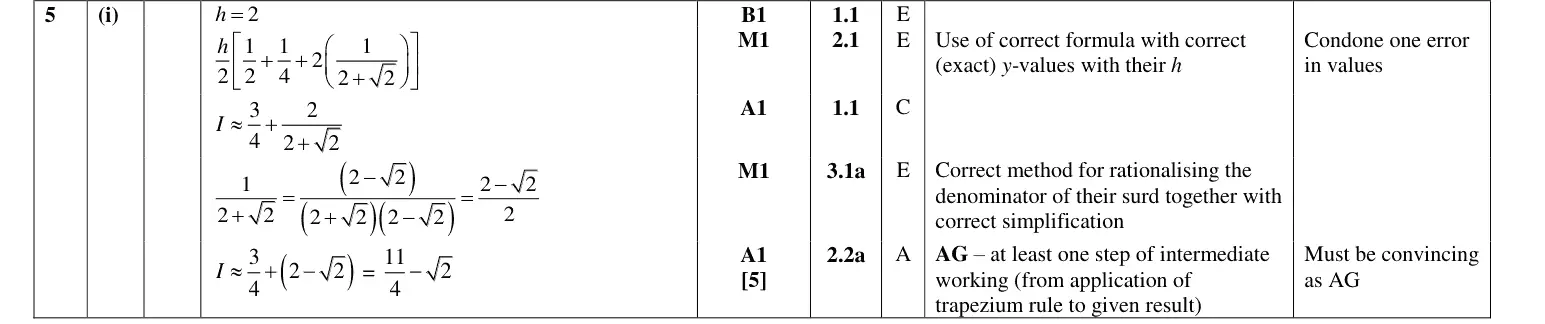
Candidates found this part extremely accessible and nearly all correctly derived the given result. Candidates are reminded though that in ‘show that’ questions suitable working must be shown and 2 1 1 1 11 statements such as + + 2 = − 2 are generally not acceptable. 2 2 4 2 + 2 4
Key points and common errors
h = 2, ordinates 1/2, 1/(2 + √2), 1/4
rationalise 2/(2 + √2) = 2 − √2
reach 11/4 − √2 with working shown
June 2018 · Paper 3 · Q6(ii)5 marksMedium
Show the start of this question
Mark scheme for this part
Examiner's comment
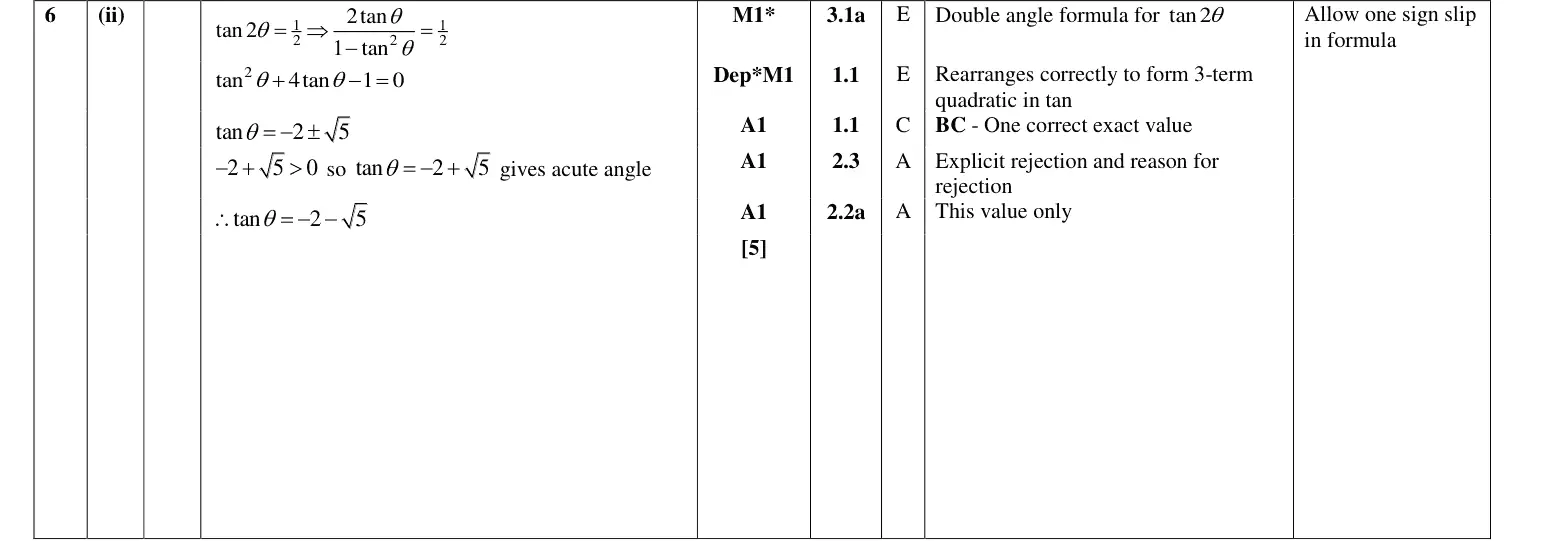
Many candidates did not read the question carefully and began their response by writing − 1 1 2 θ = tan ⇒ θ = ... even though the question specifically asked for the exact value of tan . Of θ 2 tan2 many derived the correct three- θ those candidates that used the correct double-angle formula for term quadratic in tan with most correctly stating that tan θ = −± 2 5.However, a significant proportion ended their response here and did not go on to determine the exact value of tan given that θ is an θ obtuse angle. A full solution needed the explicit realisation that since −+ 2 5 > 0 , tan θ = −+ 2 5 tan θ = −− 2 5. would not give an obtuse angle and therefore the only valid solution was
Key points and common errors
2t/(1 − t²) = ½ gives t² + 4t − 1 = 0
t = −2 ± √5
reject −2 + √5 (θ acute)
tan θ = −2 − √5
must not use inverse tan on a calculator
Find an A-level maths tutor
Stuck on this? Book a trial session with an A-level maths tutor.