3.02i Model the motion of a projectile as a particle moving with constant…
Section
3.02 Kinematics
Level
A level only
Statement
Be able to model the motion of a projectile as a particle moving with constant acceleration and understand the limitation of this model.
Guidance
Includes being able to: 1. Use horizontal and vertical equations of motion to solve problems on the motion of projectiles. 2. Find the magnitude and direction of the velocity at a given time or position. 3. Find the range on a horizontal plane and the greatest height achieved. 4. Derive and use the cartesian equation of the trajectory of a projectile. [Projectiles on an inclined plane and problems with resistive forces are excluded.]
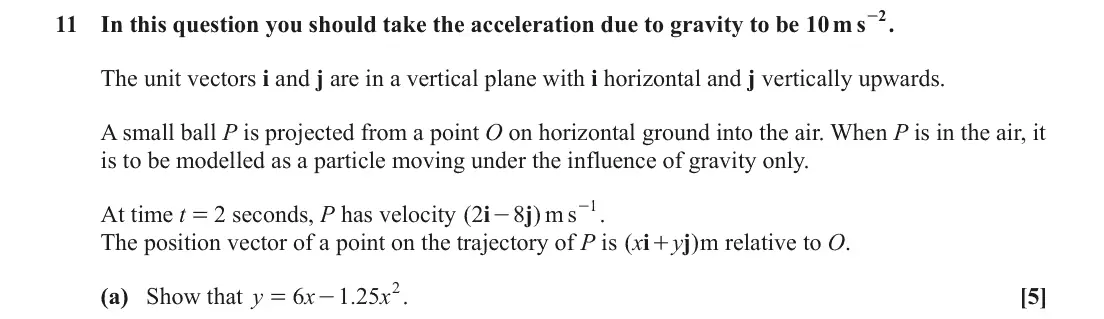
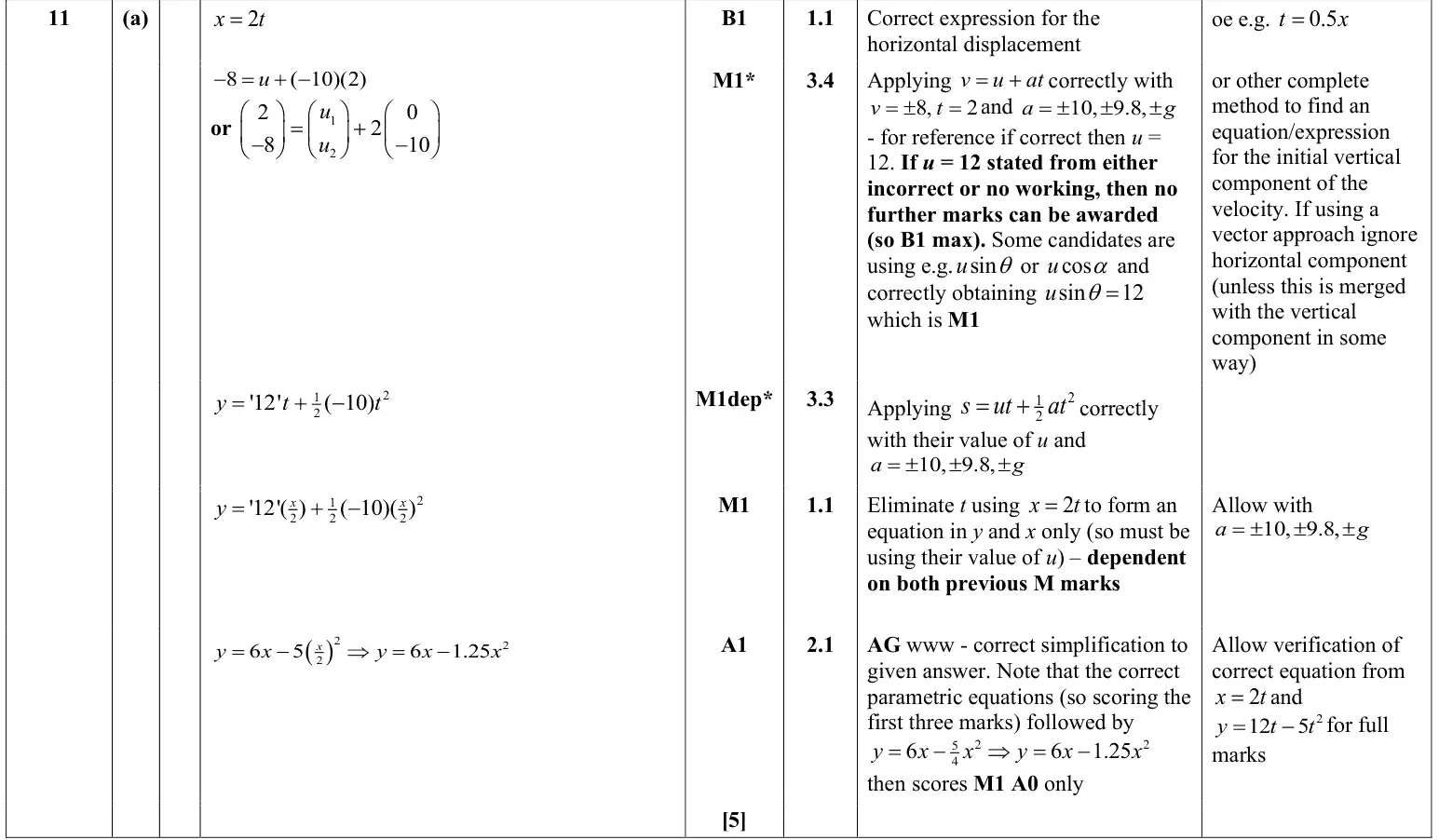
Candidates found this part very demanding with many making little progress beyond stating that 𝑥= 2𝑡. Of those that realised that the initial vertical component of velocity could be found by applying 𝑣= 𝑢+ 𝑎𝑡 with 𝑣= −8, 𝑎= −10 and 𝑡= 2, most were successful in obtaining the given cartesian equation by applying 𝑠= 𝑢𝑡+ 2 𝑎𝑡2 vertically and then eliminating 𝑡. Even though the question made it very clear that in this question candidates should use 𝑔= 10, many still used a value of 9.8. It must also be noted that examiners found some candidates’ work extremely hard to follow (throughout the entirety of this question) due to poor notation when it came to dealing with vector and scalar quantities with statements such as 2𝐢−8𝐣= 𝑢+ 2(−10) being sadly all too common.
Key points and common errors
x = 2t
v = u + at vertically: −8 = u − 20 so u = 12
y = 12t − 5t²
eliminate t to get y = 6x − 1.25x²
June 2025 · Paper 3 · Q11(b)3 marksMedium
Show the start of this question
Mark scheme for this part
Examiner's comment
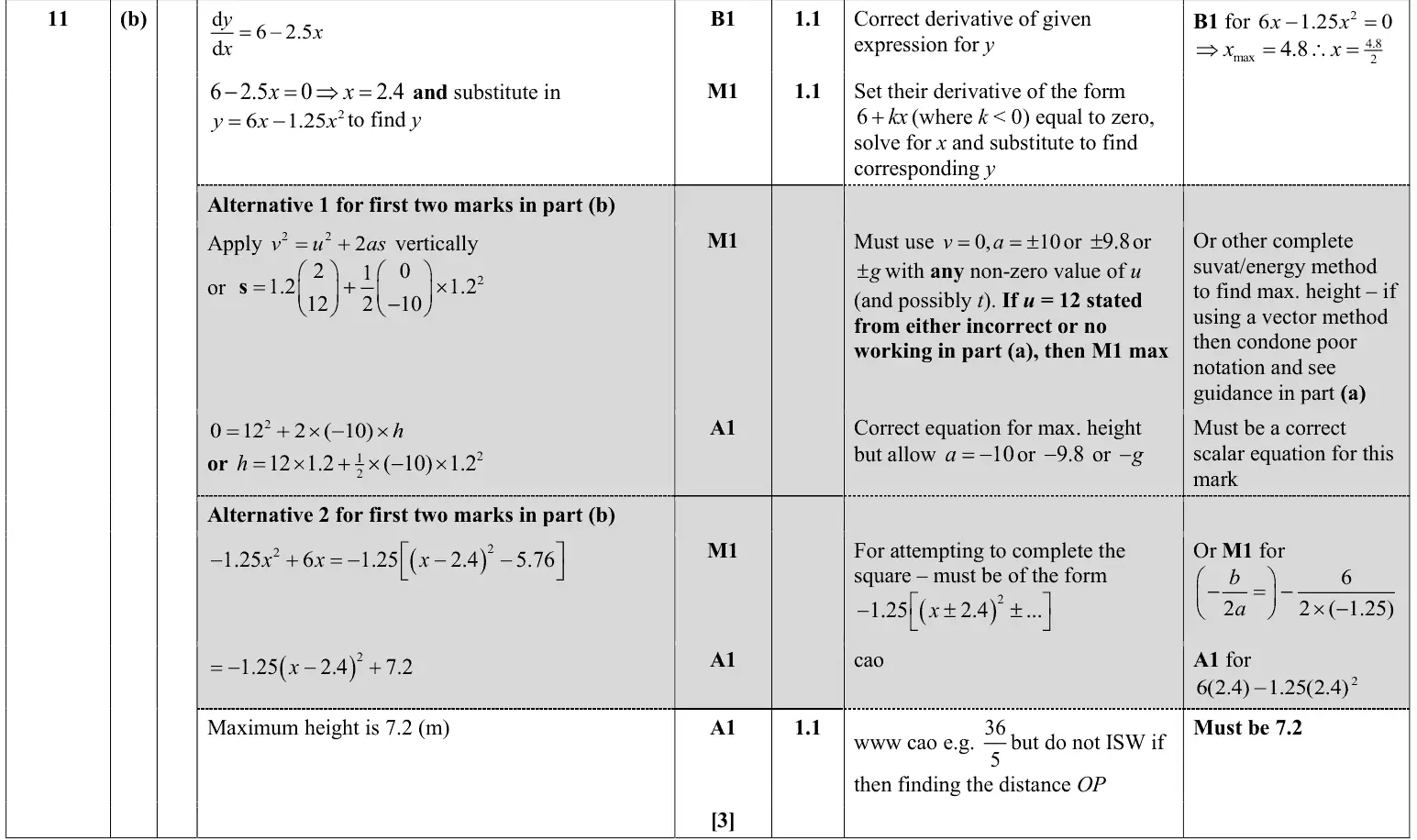
It was surprising how many candidates did not use the given result from part (a) and instead went back to the suvat equations to find the maximum height of P above the ground during its motion. Of those that did use the equation from part (a), those that used calculus rather than completing the square were far more successful.
Key points and common errors
dy/dx = 6 − 2.5x = 0 at x = 2.4
max height 7.2 m
use the given equation rather than restarting
June 2025 · Paper 3 · Q11(c)5 marksMedium
Show the start of this question
Mark scheme for this part
Examiner's comment
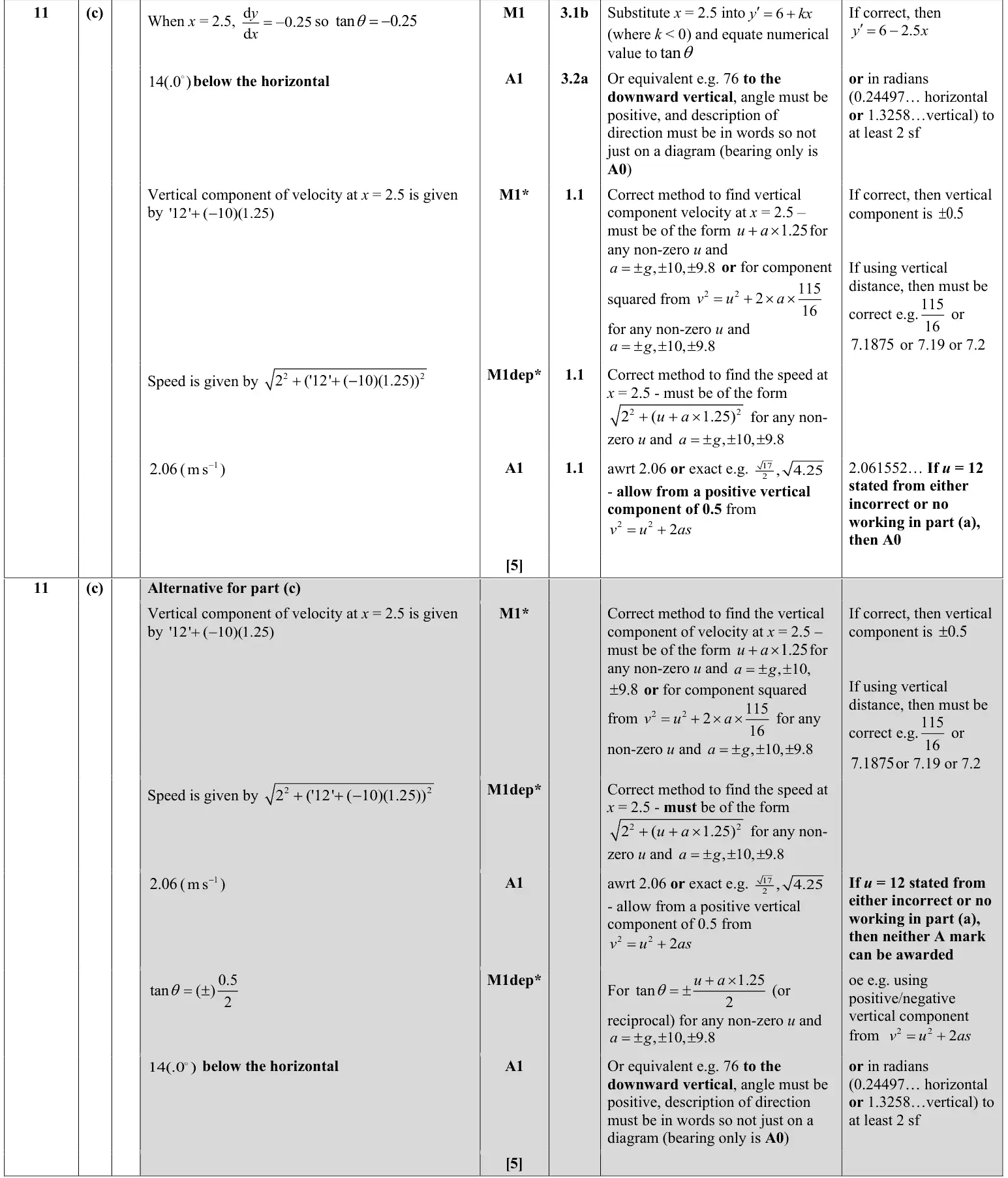
The responses to this part were mixed with many candidates believing that both the speed and direction of motion could be found by considering the vertical and horizontal displacement of P when 𝑥= 2.5. Of those that did use the velocity components many did not give sufficient detail when it came to the direction of motion; an angle alone was not sufficient as it needed to be clear if the angle was below or above the horizontal (or equivalently to the upward or downward vertical).
Key points and common errors
gradient at x = 2.5 is −0.25 so direction 14° below the horizontal
vertical velocity 12 − 10 × 1.25 = −0.5
speed √4.25 = 2.06 m/s
displacement gives neither
direction needs 'below the horizontal'
June 2025 · Paper 3 · Q11(d)1 markEasy
Show the start of this question
Mark scheme for this part
Examiner's comment
This part was generally answered well with most candidates correctly stating that the maximum height would be less than the value found in part (b). Surprisingly some candidates explained in detail what impact air resistance would have on all aspects of the ball’s motion but did not explicitly say how it would affect the maximum height.
Key points and common errors
with air resistance the maximum height would be less than 7.2 m
must state the effect on the height
June 2024 · Paper 3 · Q13(b)6 marksMedium
Show the start of this question
Mark scheme for this part
Examiner's comment
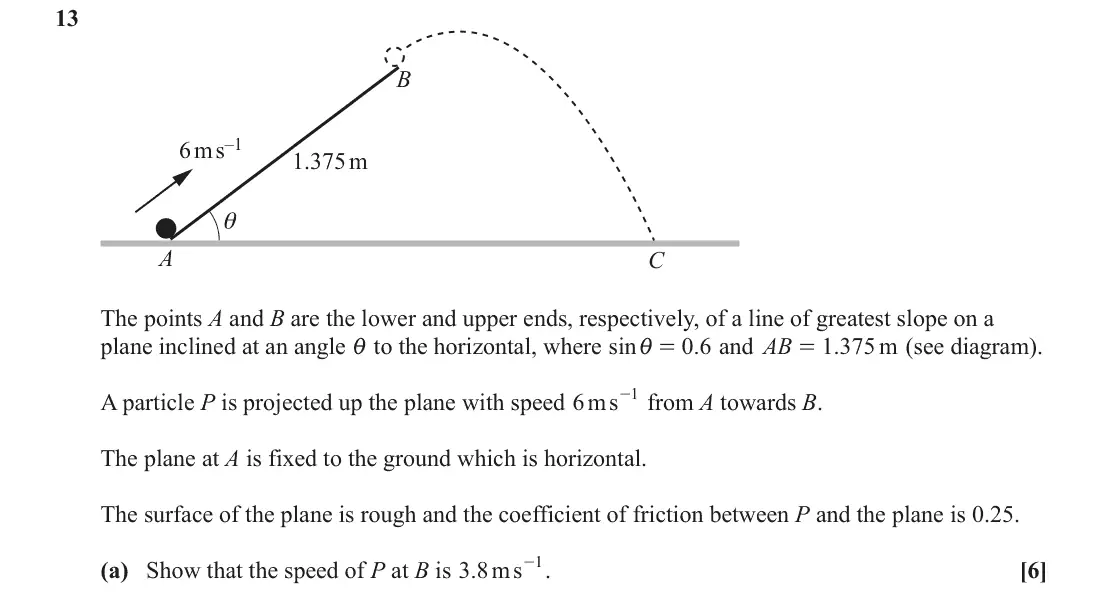
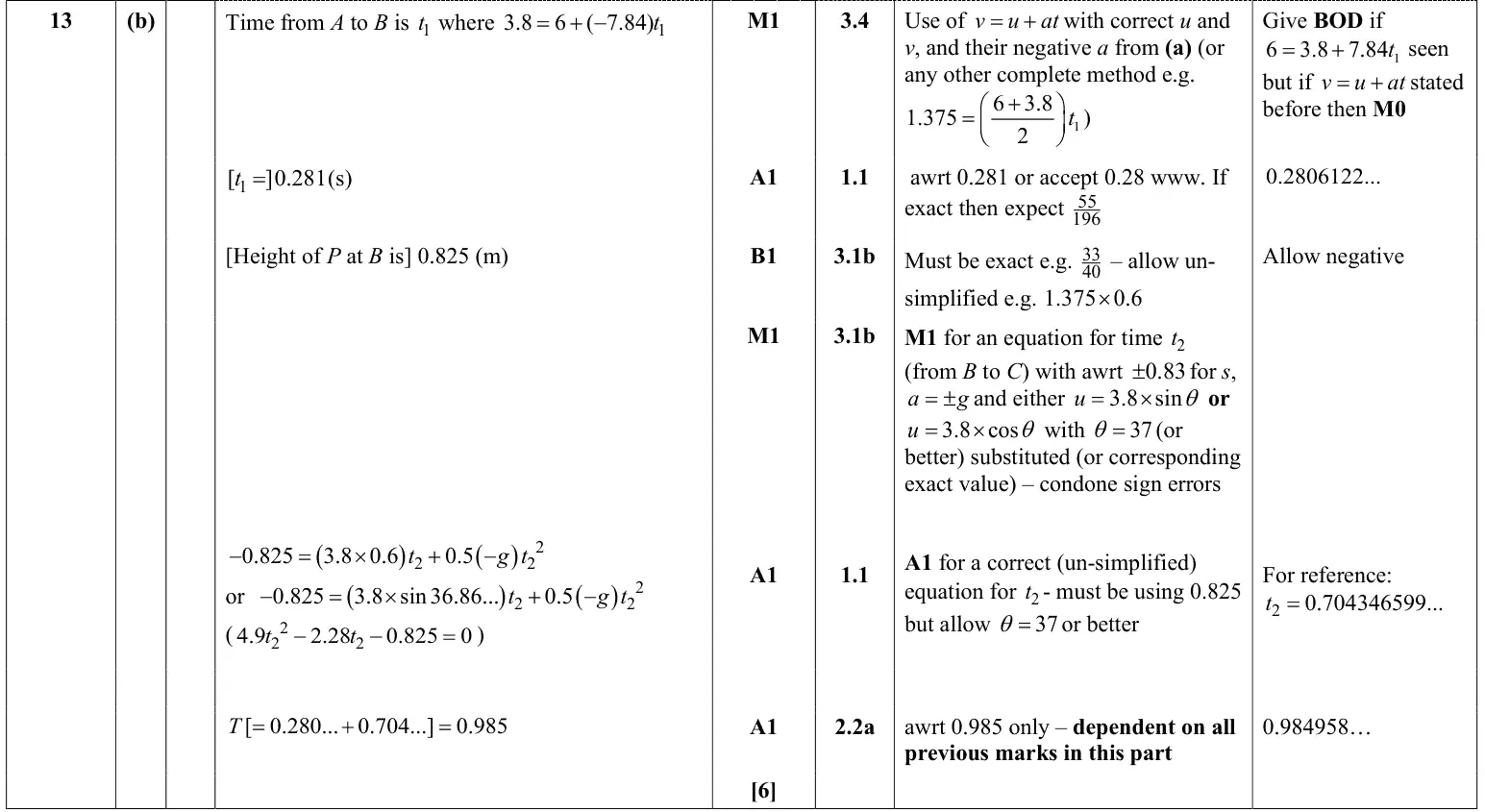
It was pleasing to note that many candidates correctly worked out the time of flight from 𝐵 to 𝐶 using the given value of 3.8 and managed to correctly set up the equation −0.825 = (3.8 × 0.6)𝑡+ 2 × −𝑔× 𝑡2 although occasionally sign errors appeared in this equation (as did the lack of a component with the 3.8 at the point where the particle became a projectile). It was clear that many candidates did not read the question carefully and gave the value of 𝑇 as the time of flight only from 𝐵 to 𝐶 instead of the correct time of flight from 𝐴 to 𝐶 (and so therefore scored only 3 of the 6 marks available in this final part).
Key points and common errors
A to B: 3.8 = 6 − 7.84t₁, t₁ = 0.281
B is 0.825 m high
−0.825 = (3.8 × 0.6)t₂ − 4.9t₂², t₂ = 0.704
T = 0.985 s
include the time on the slope
June 2023 · Paper 3 · Q12(a)3 marksEasy
Mark scheme for this part
Examiner's comment
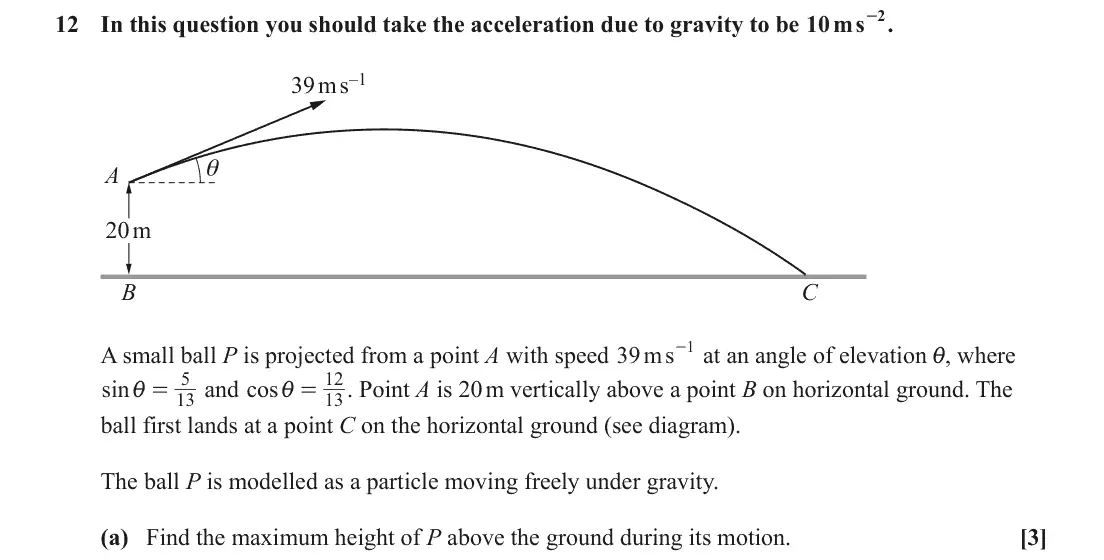
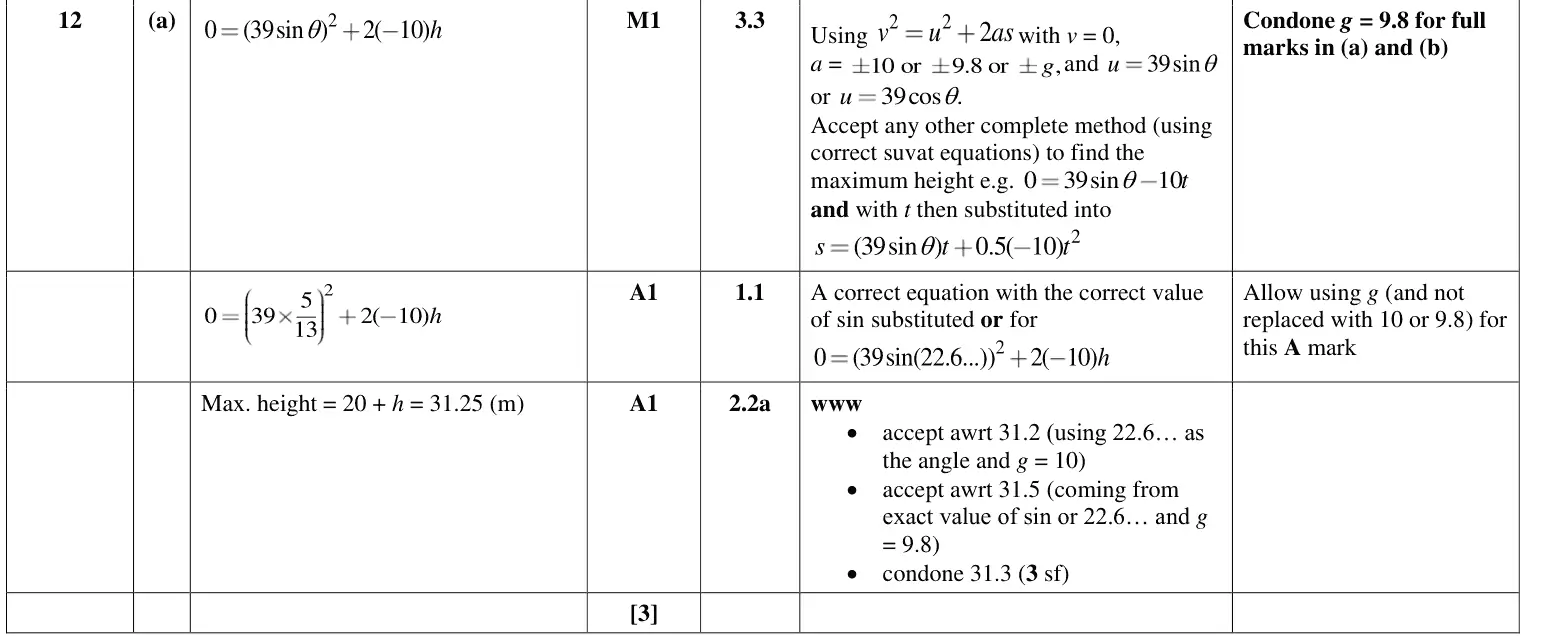
𝑣𝑣2 = 𝑢𝑢2 + 2𝑎𝑎𝑎𝑎 with 𝑣𝑣= 0, 𝑎𝑎= −10 and 𝑢𝑢= 39sin𝜃𝜃. The most common errors were using 𝑢𝑢= 39 or This part was answered extremely well with most candidates taking the direct route of applying 39cos𝜃𝜃, using 9.8 for g, or only working out the vertical distance from A to the max. height (and so forgetting to add the distance of 20 from A to B).
Key points and common errors
vertical: 0 = (39 × 5/13)² − 20h gives h = 11.25
add 20 m: 31.25 m
errors u = 39, g = 9.8, forgetting the 20 m
June 2023 · Paper 3 · Q12(b)3 marksEasy
Show the start of this question
Mark scheme for this part
Examiner's comment
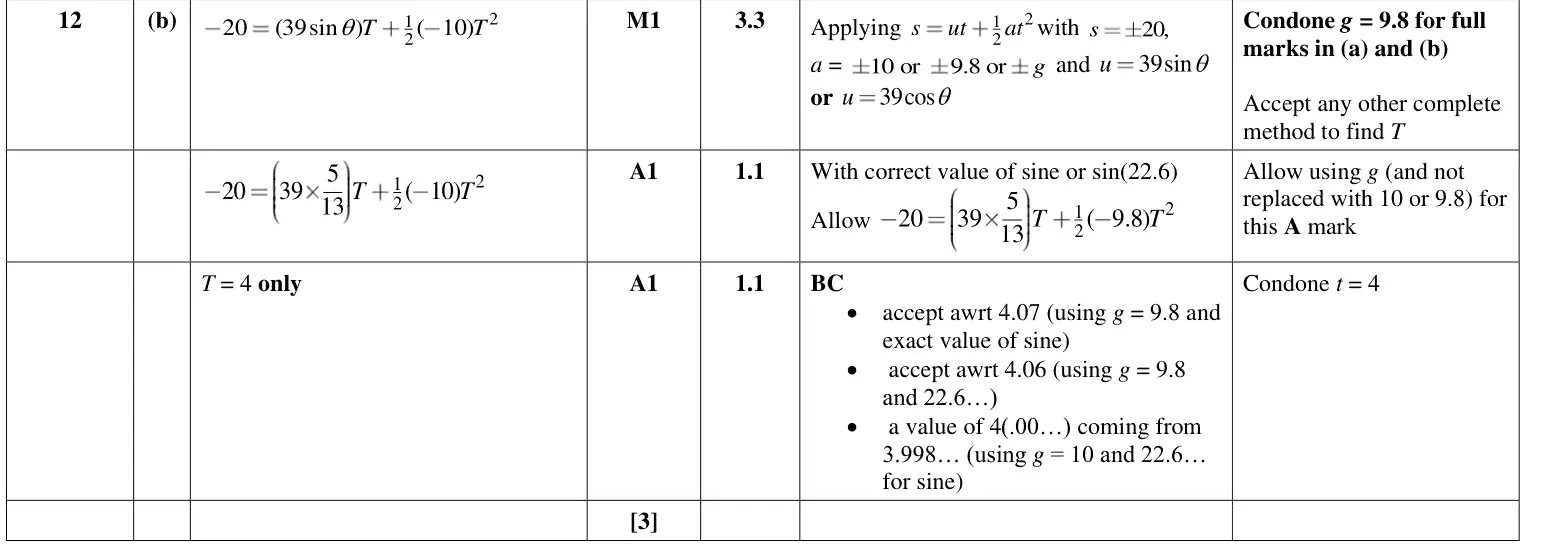
Similarly to part (a) this part was answered extremely well with most candidates correctly applying 𝑠𝑠= 𝑢𝑢𝑡𝑡+ 2 𝑎𝑎𝑡𝑡2 with 𝑠𝑠= −20, 𝑎𝑎= −10 and 𝑢𝑢= 39sin𝜃𝜃 and then correctly using their calculator to find the required value of 𝑇𝑇= 4. The errors mentioned in part (a) were commonly seen in this part too.
Key points and common errors
−20 = 15T − 5T² gives T = 4 only
June 2023 · Paper 3 · Q12(c)1 markMedium
Show the start of this question
Mark scheme for this part
Examiner's comment
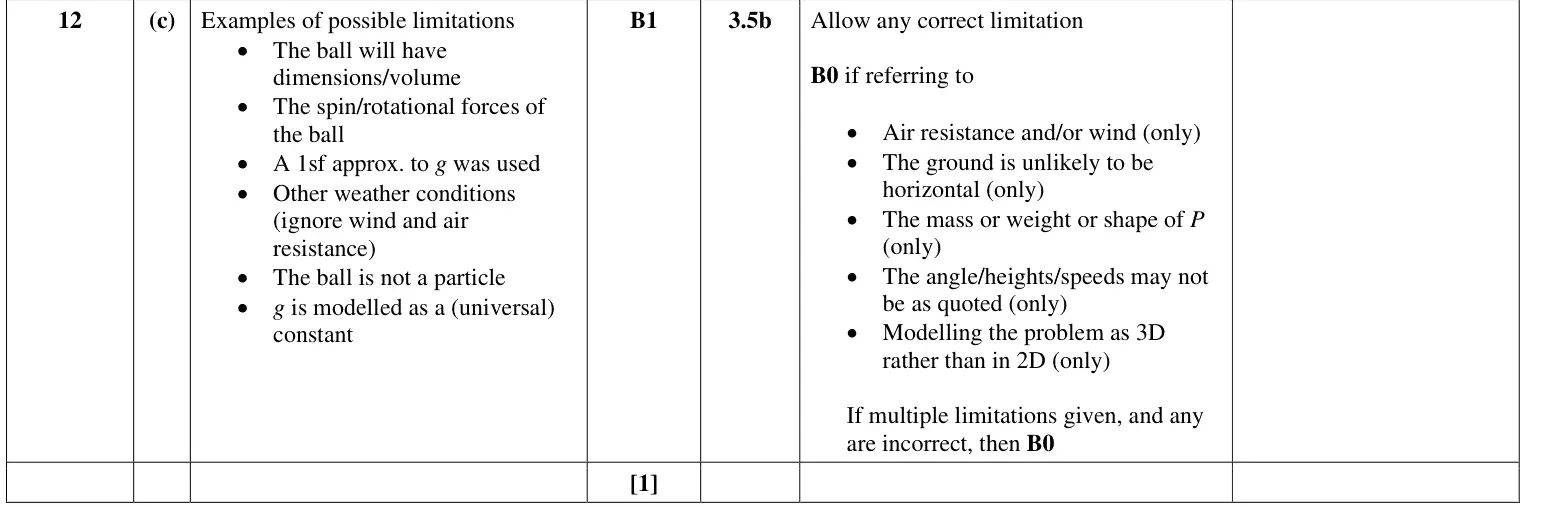
Although there were many suitable correct answers seen by examiners (for example, using a more accurate value of g, considering the dimensions or spin of P, etc.) the most common incorrect responses were those that referred to the mass or weight or shape of P (and in some cases mentioning air resistance, wind or the fact that the ground may not be horizontal).
Key points and common errors
e.g. the ball has size (not a particle), spin, g not exactly 10
not air resistance, wind, mass or shape
June 2023 · Paper 3 · Q12(d)6 marksMedium
Show the start of this question
Mark scheme for this part
Examiner's comment
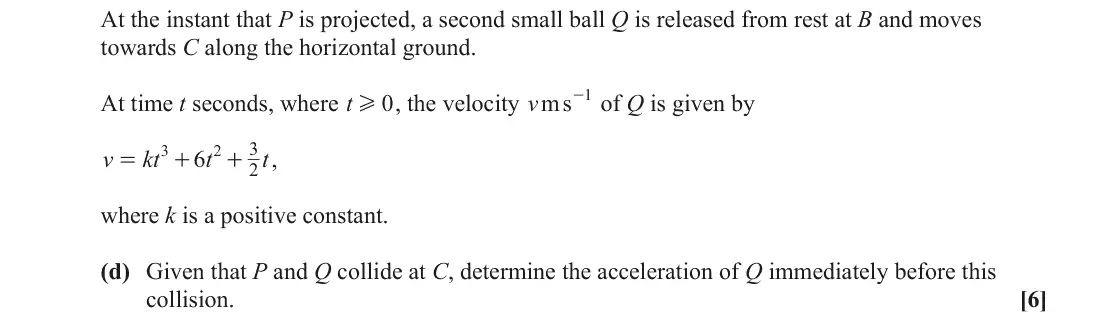
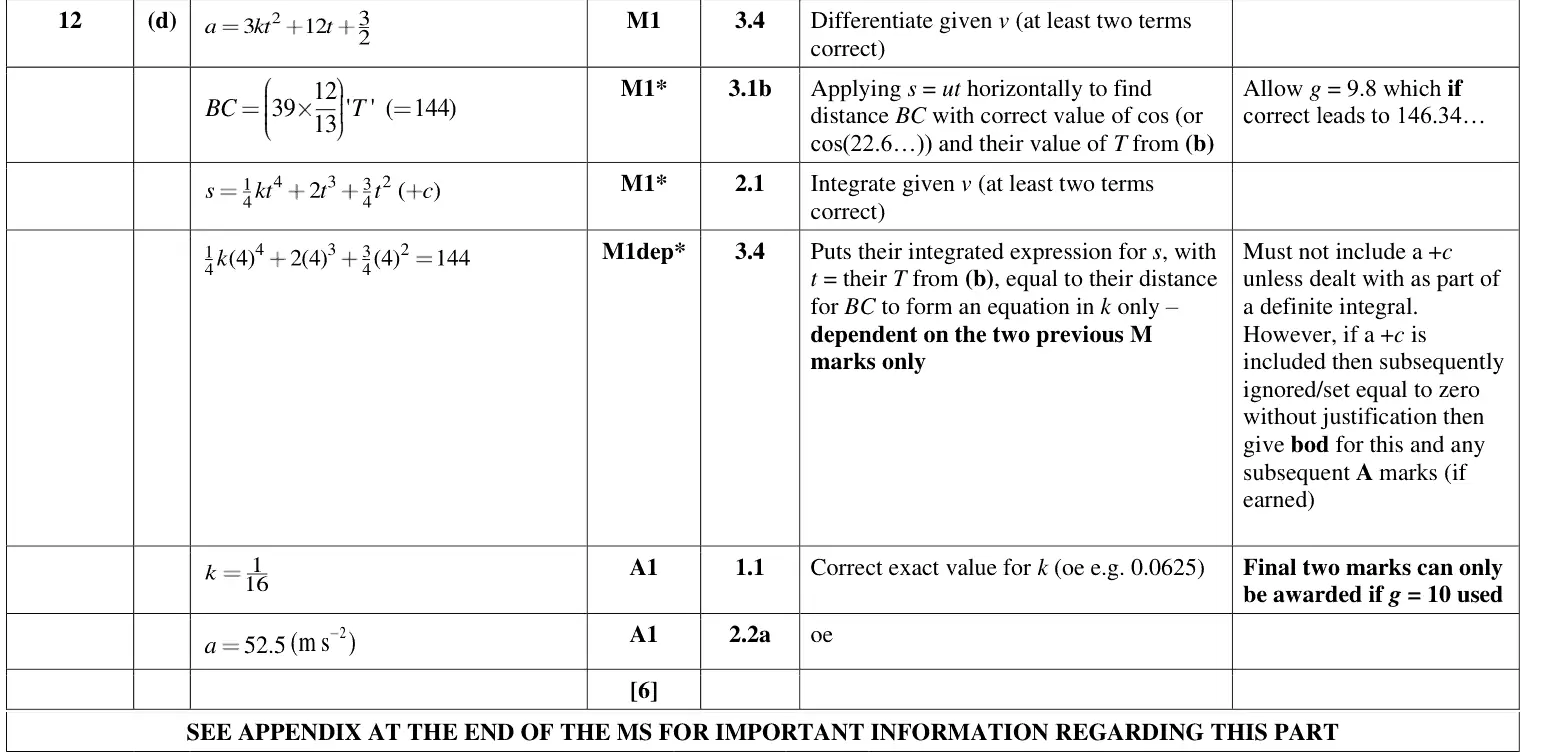
The responses to this part were mixed with some candidates making little progress apart from differentiating the given expression for v to obtain an expression for a in terms of t. Those candidates who realised that they had to use the value of T found in part (b) to find the horizontal distance BC and then integrate to set up an equation to find the value of k were usually successful. Although not penalised in the first two parts of the question, using an incorrect value of g meant that neither of the 2 accuracy marks (for finding k and then the required acceleration) could be awarded in this part. It was surprising how many candidates used equations for constant acceleration in this part to model the motion of Q.
Key points and common errors
BC = 39 × 12/13 × 4 = 144
integrate v: ¼kt⁴ + 2t³ + ¾t² = 144 at t = 4 gives k = 1/16
a = 3kt² + 12t + 3/2 = 52.5 m s⁻²
final marks need g = 10
June 2022 · Paper 3 · Q13(a)3 marksEasy
Mark scheme for this part
Examiner's comment
Overall, the responses to this final question were mixed with a number of candidates leaving many of the parts completely blank. However, this first part was answered well and for those that began by applying = + both horizontally (with s = x and a = 0) and vertically (with s = y and a = -g) the required s ut 0.5 at show that usually followed.
Key points and common errors
x = Ut, y = Vt − ½gt²
eliminate t to get 2U²y = 2UVx − gx²
June 2022 · Paper 3 · Q13(b)5 marksHard
Show the start of this question
Mark scheme for this part
Examiner's comment
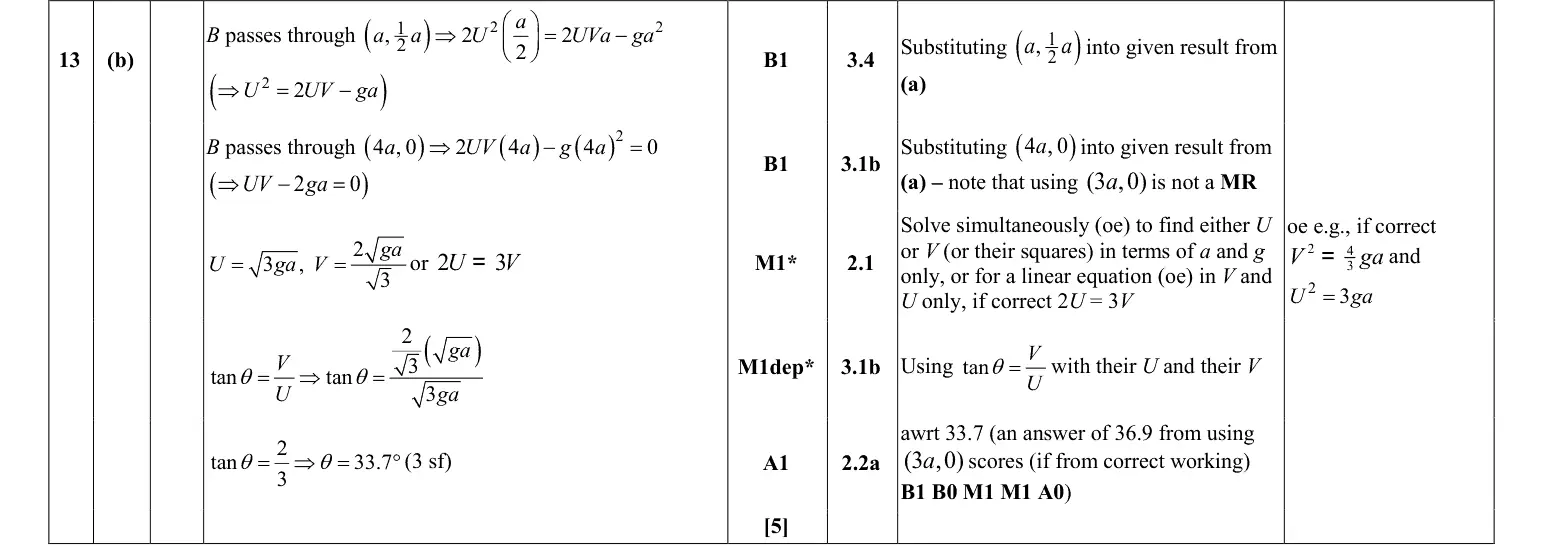
Many candidates did not realise the significance of the given response in part (a) of the question in answering part (b) of the question. It was also clear that most candidates did not read the question carefully. Most candidates took the point of the ball hitting the ground as at a distance of 3a from O rather than 4a. Of those that did realise the significance of the equation given in part (a) and that the ball passed through the points ( a and ( ) ) a ,0.5 4 ,0 a only the most able could find suitable expressions for U V and/or V and use tan = to find the correct angle of projection as 33.7 degrees. U
Key points and common errors
B passes through (a, a/2) and lands at (4a, 0), not (3a, 0)
U² = 3ga, V = 2√(ga/3)
tanθ = V/U = 2/3
θ = 33.7°
June 2022 · Paper 3 · Q13(c)2 marksHard
Show the start of this question
Mark scheme for this part
Examiner's comment
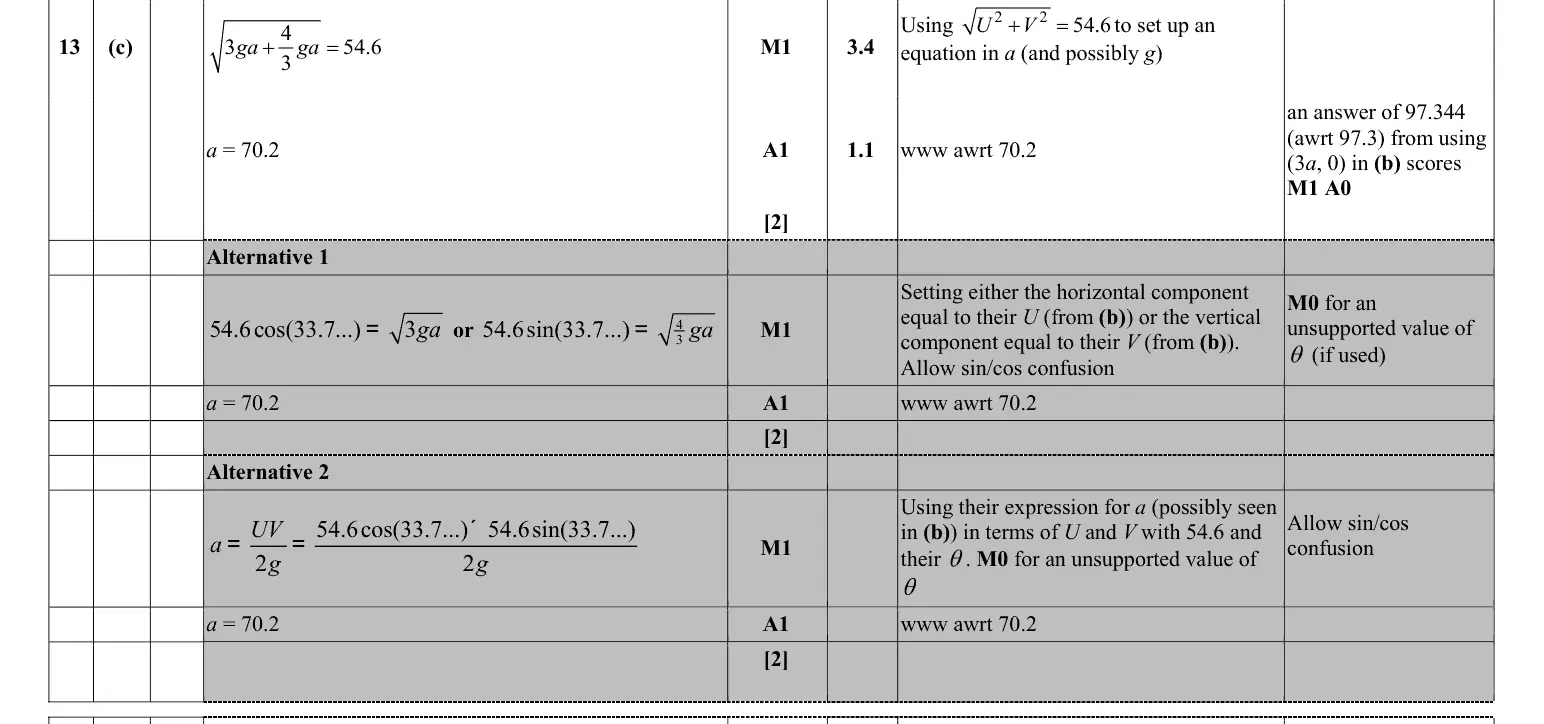
Only some candidates attempted (and correctly answered) this question with the most common method UV a = being to use the result that even though the result that + = was slightly more U V 54.6 2 g efficient.
Key points and common errors
U² + V² = 54.6²: 3ga + 4ga/3 = 54.6²
a = 70.2
June 2022 · Paper 3 · Q13(d)3 marksMedium
Show the start of this question
Mark scheme for this part
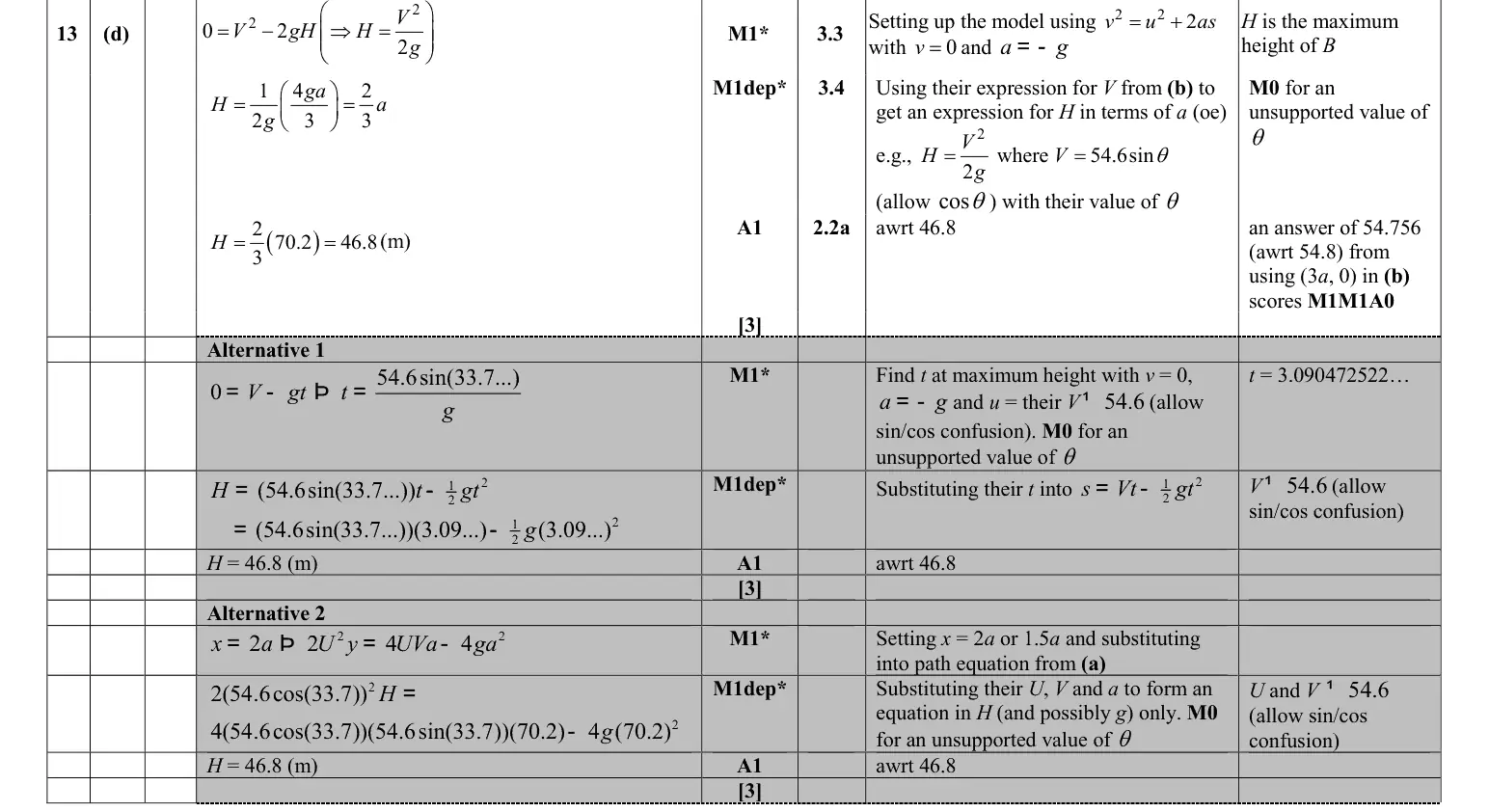
Examiner's comment
v = 0 Of those that attempted this question the most common method was to use v = u + 2 as with and a = − g . From here candidates were evenly split between those that used an expression for V from (b) 4 ga V = 54.6sin with being the angle found in (b). (which if correct was V = ) or those that used 3
Key points and common errors
0 = V² − 2gH
H = 2a/3 = 46.8 m
June 2022 · Paper 3 · Q13(e)1 markMedium
Show the start of this question
Mark scheme for this part
Examiner's comment
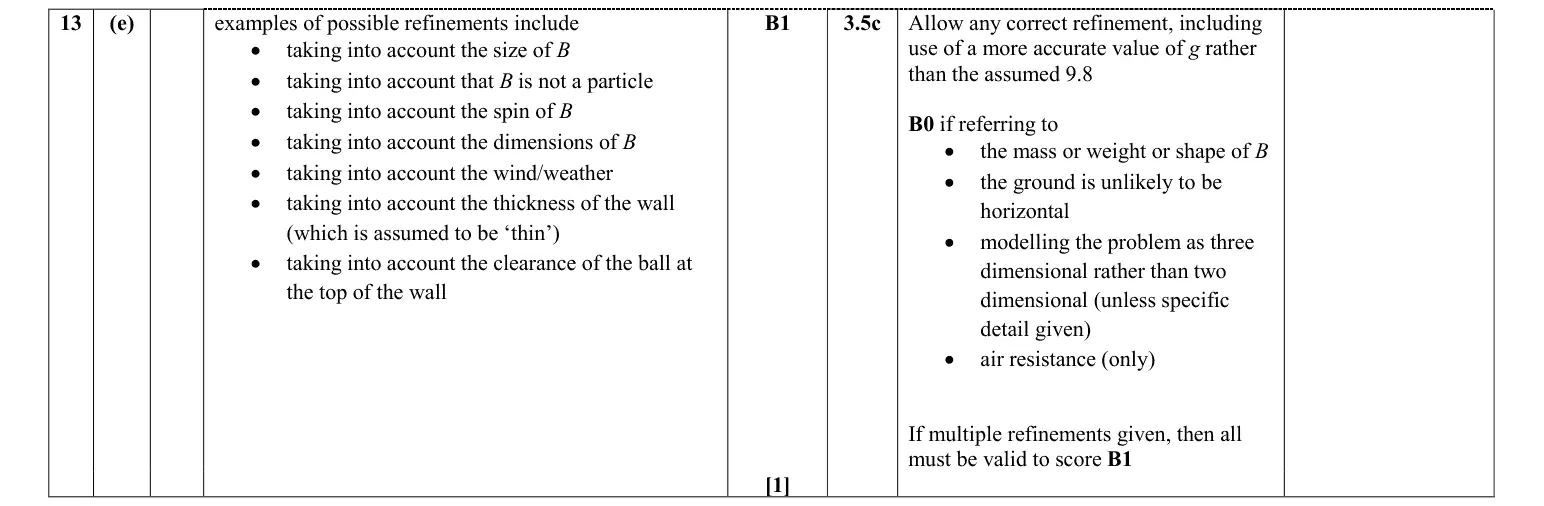
Many candidates who had left the previous parts of the question unanswered did attempt this final part. Although there were many suitable correct responses seen by examiners (for example, using a more accurate value of g, considering the dimensions or spin of B, etc.) the most common incorrect responses were those that referred to the mass or weight or shape of B.
Key points and common errors
e.g. size or spin of B, wind, thickness of wall, more accurate g
mass, weight or shape of B gains nothing
Autumn 2021 · Paper 3 · Q11(a)3 marksMedium
Mark scheme for this part
Key points and common errors
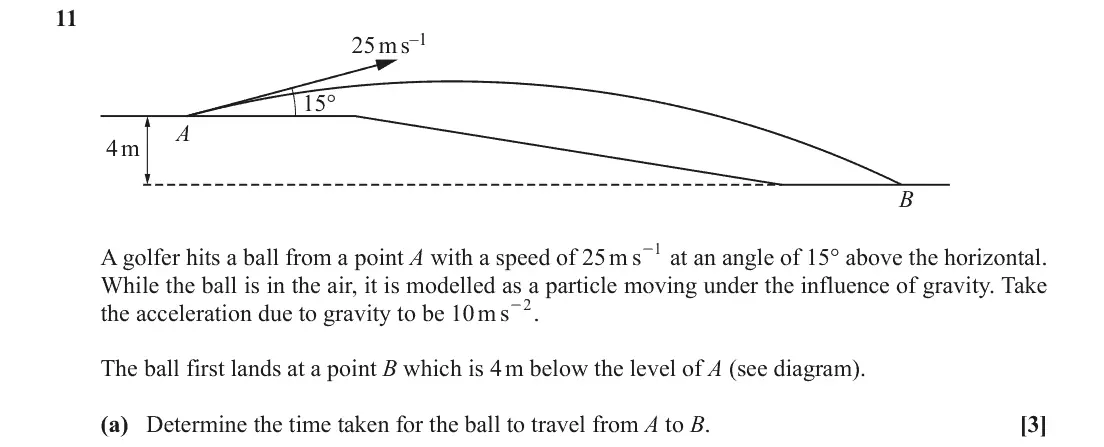
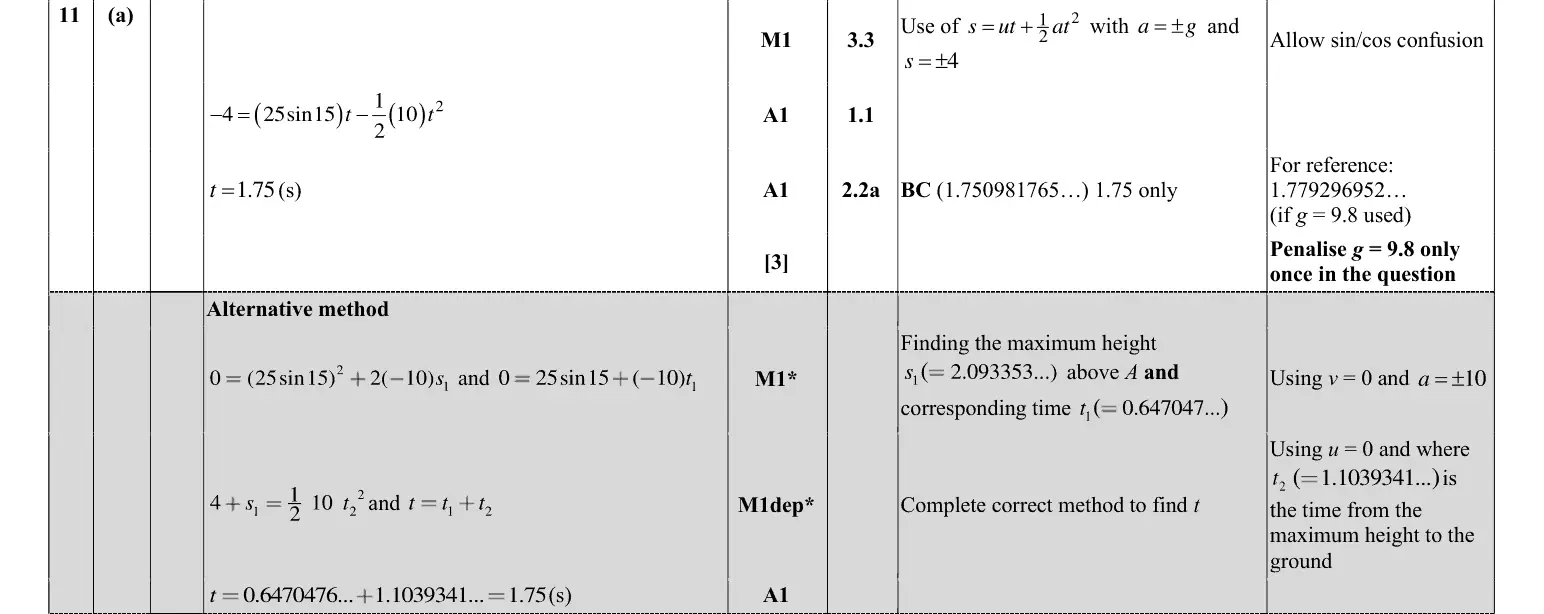
vertically −4 = 25sin15° t − 5t²
t = 1.75 s
g = 10 as given
Autumn 2021 · Paper 3 · Q11(b)2 marksMedium
Show the start of this question
Mark scheme for this part
Key points and common errors
horizontal distance 25cos15° × 1.75 = 42.3 m
Autumn 2021 · Paper 3 · Q11(c)4 marksMedium
Show the start of this question
Mark scheme for this part
Key points and common errors
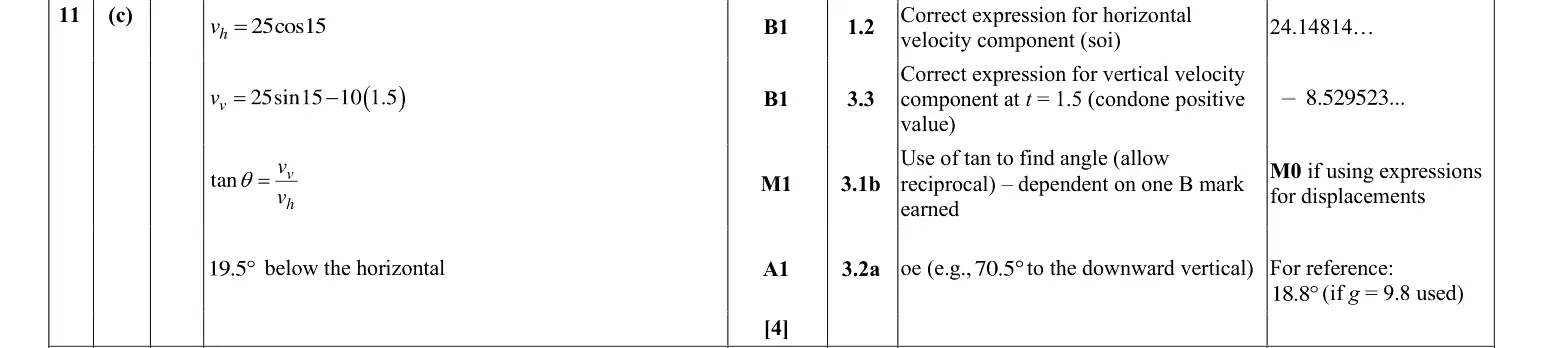
v_h = 25cos15°, v_v = 25sin15° − 15 = −8.53
tan⁻¹ gives 19.5° below the horizontal
using displacements gets M0
Autumn 2021 · Paper 3 · Q11(d)1 markMedium
Show the start of this question
Mark scheme for this part
Key points and common errors
e.g. inaccurate g, wind, backspin
air resistance is not accepted since it would shorten the distance
Autumn 2020 · Paper 3 · Q11(a)4 marksMedium
Mark scheme for this part
Examiner's comment
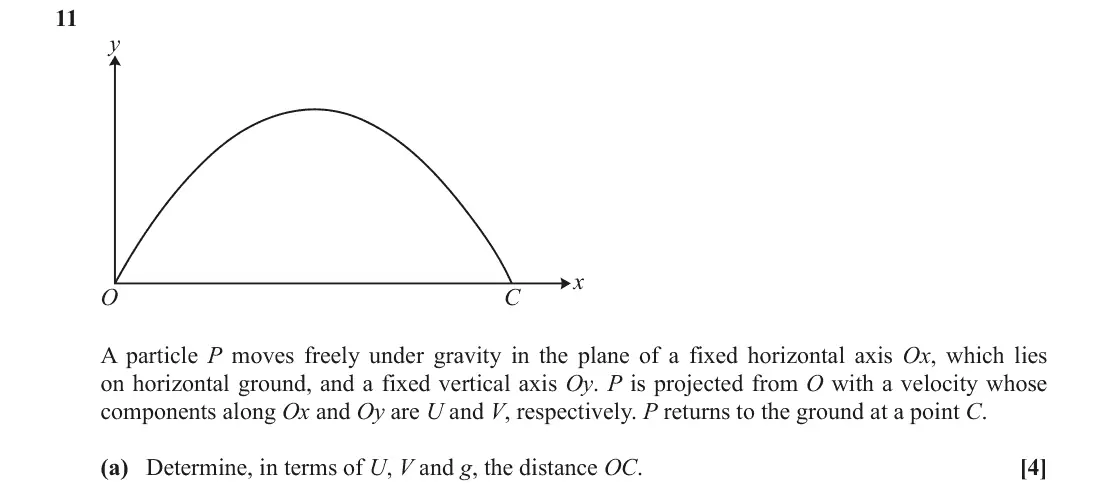
(Comment on Question 11 as a whole) Some candidates struggled with the algebraic format of this question. Those that set out their ‘suvat’ equations clearly distinguishing horizontal and vertical components were more success. Of those candidates that made a good attempt at part (a), a few dropped marks by only calculating the horizontal distance travelled to get to the maximum height – a valid method but which was only 1 2OC . Some otherwise excellent attempts to part (b) had answers in terms of an introduced variable T (or similar); this could only be given full marks if T was explicitly defined as part of the solution. Part (c) and part (d) proved the most challenging, with only the most able candidates making any meaningful progress. Both parts required careful notation to avoid confusing terms. For example, in Vertical component of velocity part (d) some candidates recognised tan θ = but the working Horizontal component of velocity suggested they used values at O rather than A. Guidance on using this paper as a mock This paper has a good range of questions on Pure and Mechanics and while overall there was a nice gradient on demand, it should be noted that Question 2 proved more challenging for this cohort than was expected with respect to its position on the paper. Section A Pure Section B Mechanics Mensuration in non-right angle triangles. Constant acceleration problem using vectors. Curve transformations. Investigate linear motion of particle with variable acceleration. Inverse and compound functions. Particles connected by pulley system involving rough slope. Investigating ln curves using calculus and Moments problem involving rod held in numerical methods. equilibrium. Investigating gradients and enclosed areas of Investigating flight of a projectile over level curves defined parametrically. ground. Investigating curves using implicit differentiation.
Key points and common errors
time of flight 2V/g from 0 = Vt − ½gt²
OC = 2UV/g
error using the time to maximum height only
Autumn 2020 · Paper 3 · Q11(b)2 marksMedium
Show the start of this question
Mark scheme for this part
Examiner's comment
(Comment on Question 11 as a whole) Some candidates struggled with the algebraic format of this question. Those that set out their ‘suvat’ equations clearly distinguishing horizontal and vertical components were more success. Of those candidates that made a good attempt at part (a), a few dropped marks by only calculating the horizontal distance travelled to get to the maximum height – a valid method but which was only 1 2OC . Some otherwise excellent attempts to part (b) had answers in terms of an introduced variable T (or similar); this could only be given full marks if T was explicitly defined as part of the solution. Part (c) and part (d) proved the most challenging, with only the most able candidates making any meaningful progress. Both parts required careful notation to avoid confusing terms. For example, in Vertical component of velocity part (d) some candidates recognised tan θ = but the working Horizontal component of velocity suggested they used values at O rather than A. Guidance on using this paper as a mock This paper has a good range of questions on Pure and Mechanics and while overall there was a nice gradient on demand, it should be noted that Question 2 proved more challenging for this cohort than was expected with respect to its position on the paper. Section A Pure Section B Mechanics Mensuration in non-right angle triangles. Constant acceleration problem using vectors. Curve transformations. Investigate linear motion of particle with variable acceleration. Inverse and compound functions. Particles connected by pulley system involving rough slope. Investigating ln curves using calculus and Moments problem involving rod held in numerical methods. equilibrium. Investigating gradients and enclosed areas of Investigating flight of a projectile over level curves defined parametrically. ground. Investigating curves using implicit differentiation.
Key points and common errors
horizontal U
vertical √(V² − 2gh)
an introduced time must be defined
Autumn 2020 · Paper 3 · Q11(c)3 marksHard
Show the start of this question
Mark scheme for this part
Examiner's comment
(Comment on Question 11 as a whole) Some candidates struggled with the algebraic format of this question. Those that set out their ‘suvat’ equations clearly distinguishing horizontal and vertical components were more success. Of those candidates that made a good attempt at part (a), a few dropped marks by only calculating the horizontal distance travelled to get to the maximum height – a valid method but which was only 1 2OC . Some otherwise excellent attempts to part (b) had answers in terms of an introduced variable T (or similar); this could only be given full marks if T was explicitly defined as part of the solution. Part (c) and part (d) proved the most challenging, with only the most able candidates making any meaningful progress. Both parts required careful notation to avoid confusing terms. For example, in Vertical component of velocity part (d) some candidates recognised tan θ = but the working Horizontal component of velocity suggested they used values at O rather than A. Guidance on using this paper as a mock This paper has a good range of questions on Pure and Mechanics and while overall there was a nice gradient on demand, it should be noted that Question 2 proved more challenging for this cohort than was expected with respect to its position on the paper. Section A Pure Section B Mechanics Mensuration in non-right angle triangles. Constant acceleration problem using vectors. Curve transformations. Investigate linear motion of particle with variable acceleration. Inverse and compound functions. Particles connected by pulley system involving rough slope. Investigating ln curves using calculus and Moments problem involving rod held in numerical methods. equilibrium. Investigating gradients and enclosed areas of Investigating flight of a projectile over level curves defined parametrically. ground. Investigating curves using implicit differentiation.
Key points and common errors
time A to B is d/U
vertical: v_A − ½gT = 0
d = (2U/g)√(V² − 2gh)
only the most able made progress
Autumn 2020 · Paper 3 · Q11(d)4 marksHard
Show the start of this question
Mark scheme for this part
Examiner's comment
(Comment on Question 11 as a whole) Some candidates struggled with the algebraic format of this question. Those that set out their ‘suvat’ equations clearly distinguishing horizontal and vertical components were more success. Of those candidates that made a good attempt at part (a), a few dropped marks by only calculating the horizontal distance travelled to get to the maximum height – a valid method but which was only 1 2OC . Some otherwise excellent attempts to part (b) had answers in terms of an introduced variable T (or similar); this could only be given full marks if T was explicitly defined as part of the solution. Part (c) and part (d) proved the most challenging, with only the most able candidates making any meaningful progress. Both parts required careful notation to avoid confusing terms. For example, in Vertical component of velocity part (d) some candidates recognised tan θ = but the working Horizontal component of velocity suggested they used values at O rather than A. Guidance on using this paper as a mock This paper has a good range of questions on Pure and Mechanics and while overall there was a nice gradient on demand, it should be noted that Question 2 proved more challenging for this cohort than was expected with respect to its position on the paper. Section A Pure Section B Mechanics Mensuration in non-right angle triangles. Constant acceleration problem using vectors. Curve transformations. Investigate linear motion of particle with variable acceleration. Inverse and compound functions. Particles connected by pulley system involving rough slope. Investigating ln curves using calculus and Moments problem involving rod held in numerical methods. equilibrium. Investigating gradients and enclosed areas of Investigating flight of a projectile over level curves defined parametrically. ground. Investigating curves using implicit differentiation.
Key points and common errors
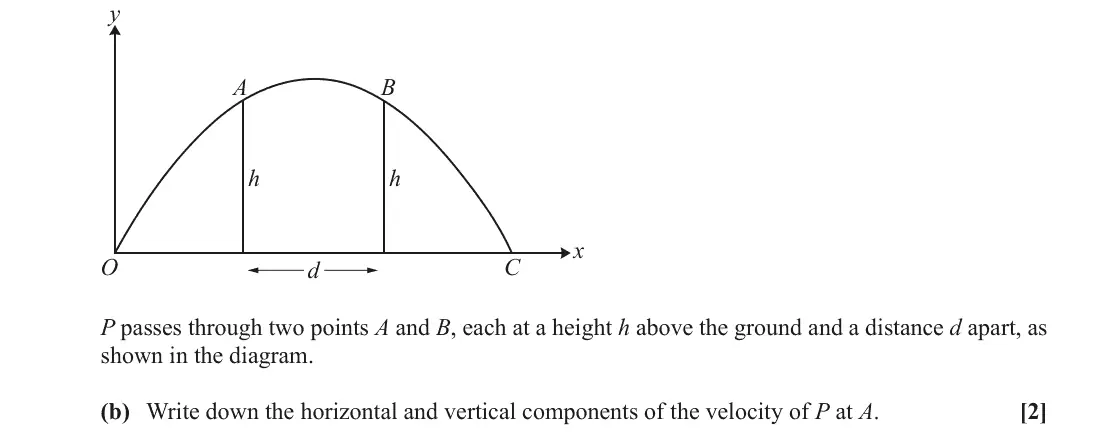
tan θ = v_A/u_A = ½ at A (not at O)
eliminate U: V = ½√(g(8h + d))
only the most able made progress
June 2019 · Paper 3 · Q8(a)1 markEasy
Mark scheme for this part
Examiner's comment
Most candidates correctly found the horizontal distance of P from O when it hits the ground as 4d.
Key points and common errors
horizontal distance = (5/3)d × 2.4 = 4d
June 2019 · Paper 3 · Q8(b)2 marksMedium
Show the start of this question
Mark scheme for this part
Examiner's comment
Candidates were evenly split between those who correctly used with and s = ut + at s = 0 ,a = − g t = 2 4 . , and those who used v = u + at with v = 0 ,a = − g and t = 1 2 . . Where errors occurred it was usually in mixing up these two methods, for example, some candidates applied v = u + at with v = 0 ,a = − g and t = 2 4 . .
Key points and common errors
s = 0 at t = 2.4 or v = 0 at t = 1.2: U = 11.76 m/s
mixing the two methods
June 2019 · Paper 3 · Q8(c)3 marksMedium
Show the start of this question
Mark scheme for this part
Examiner's comment
Those candidate who realised that it took 0.6 seconds for P to reach the wall (which came from the fact ( ) that d = d t ) usually went on to apply s = ut + at correctly to find the height of the wall. The most common error was believing that the time it took P to reach the wall was either 1.2 or 2.4 seconds.
Key points and common errors
time to wall t = 0.6 s
h = 11.76(0.6) − 4.9(0.6)² = 5.29 m
using t = 1.2 or 2.4
June 2019 · Paper 3 · Q8(d)4 marksHard
Show the start of this question
Mark scheme for this part
Examiner's comment
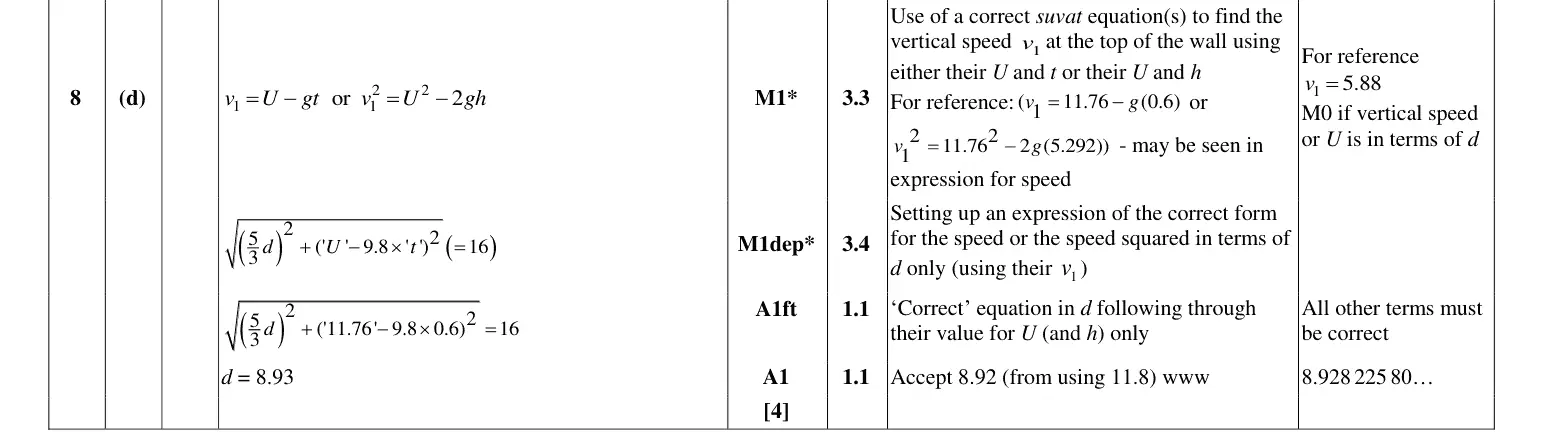
The most common misconception here was to use the result from part (b) together with v = 16 in the equation v = u + 2 as instead of realising that the vertical component of the speed, v , at the top of the wall had to be worked out first before then using the equation ( ) 16 and solving to find the d + v = value of d.
Key points and common errors
vertical speed at wall 11.76 − 0.6g = 5.88
((5/3)d)² + 5.88² = 16²
d = 8.93
using 16 directly in v² = u² + 2as
Find an A-level maths tutor
Stuck on this? Book a trial session with an A-level maths tutor.