3.02a The language of kinematics: position, displacement, distance…
Section
3.02 Kinematics
Level
AS & A level
Statement
Understand and be able to use the language of kinematics: position, displacement, distance, distance travelled, velocity, speed, acceleration, equation of motion.
Guidance
Learners should understand the vector nature of displacement, velocity and acceleration and the scalar nature of distance travelled and speed.
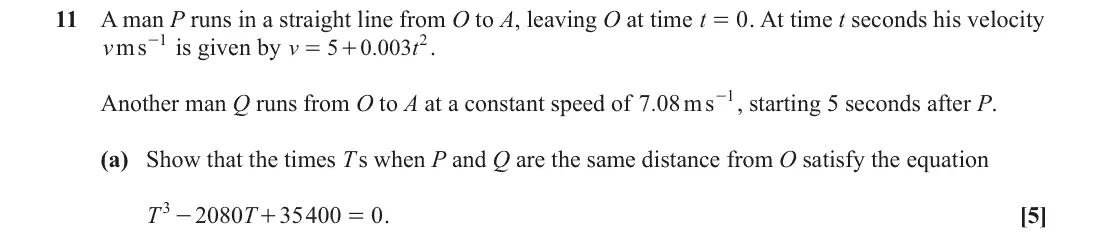
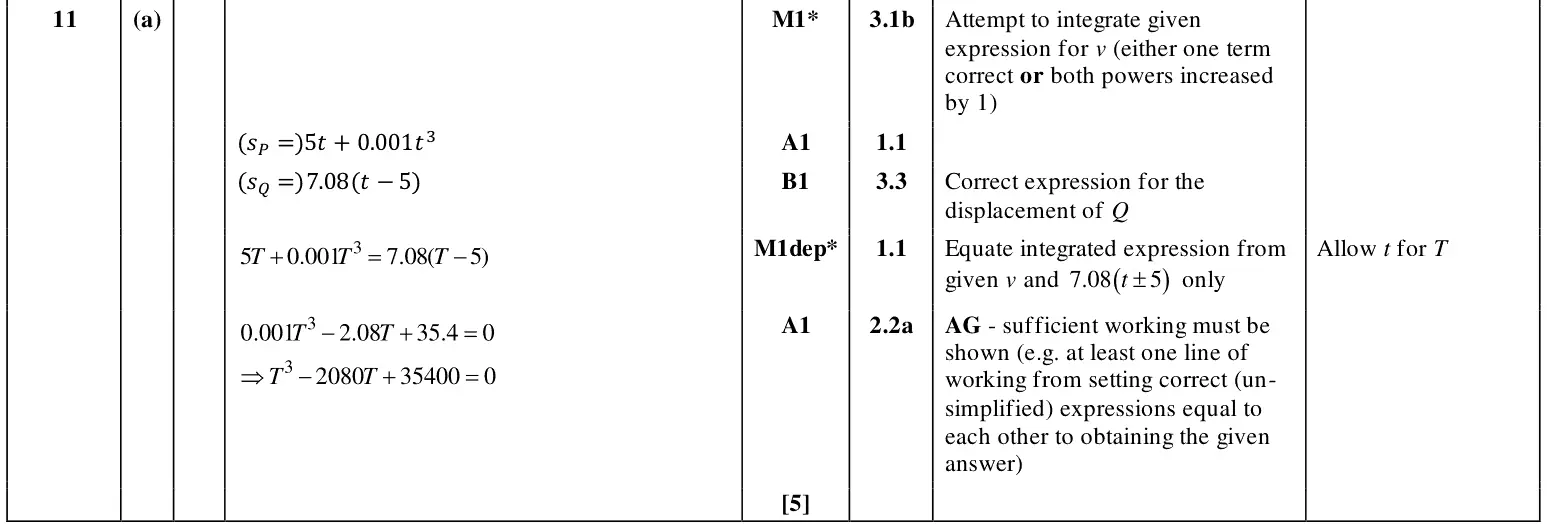
The need to integrate to find sp was appreciated by many and often these were the only 2 marks given. A few tried sp = vt. For Q, sQ = 7.08t was more common than the correct result. Because the final answer was given, examiners looked for a convincing argument leading to it; a sudden appearance of 35.4 in the working that looked as if it had been worked back from the given answer could not be given marks. For the final mark we wanted to see exactly what was given on the question paper (correctly obtained), so T rather than t and ‘= 0’.
Key points and common errors
integrate v: s_P = 5t + 0.001t³
s_Q = 7.08(t − 5)
equate and multiply by 1000 to reach the given cubic with T and '= 0'
June 2023 · AS Paper 2 · Q9(a)1 markEasy
Mark scheme for this part
Examiner's comment
The vast majority of responses were correct.
Key points and common errors
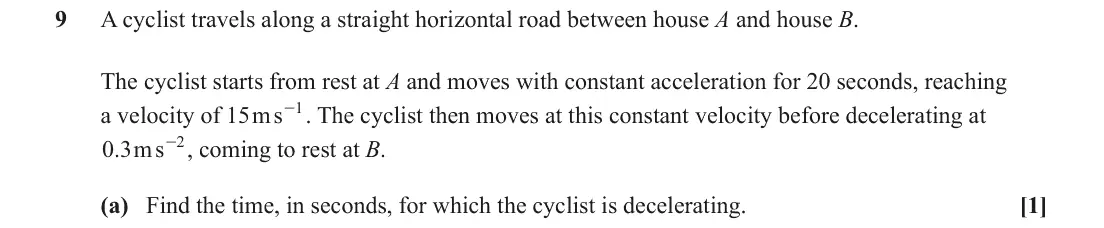
15/0.3 = 50 s
June 2023 · AS Paper 2 · Q10(c)3 marksMedium
Show the start of this question
Mark scheme for this part
Examiner's comment
Most candidates realised this part required v to be integrated, with many not using the calculator to do this. The most common error was to just do this with limits 3 and 0 (mirroring a similar error seen in Question 11(c) of the summer 2022 paper); this scored no marks. With this year’s question now giving future candidates an extra question of this type to practice on in mock exams, hopefully this type of error will be reduced in the future.
Key points and common errors
integrate 0 to 1.5 (45/8) and 1.5 to 3 (−9/8) separately
distance 6.75 m
a single integral from 0 to 3 scores nothing
June 2022 · AS Paper 2 · Q11(c)3 marksMedium
Show the start of this question
Mark scheme for this part
Examiner's comment
Most candidates realised this part required v to be integrated. Many did not use the calculator to do this despite the instruction being ‘Find’. The most common error was to do this with limits 6 and 0, but the combination of 6 and 4/3 and 4/3 and 0 was also seen. When doing definite integrals on the calculator it is wise, time permitting, for candidates to type in the relevant details twice to hopefully avoid careless errors.
Key points and common errors
split at t = 3 where v changes sign: 117/4 + 261/4 = 94.5 m
error integrating 0 to 6 directly
June 2022 · Paper 3 · Q12(a)2 marksMedium
Mark scheme for this part
Examiner's comment
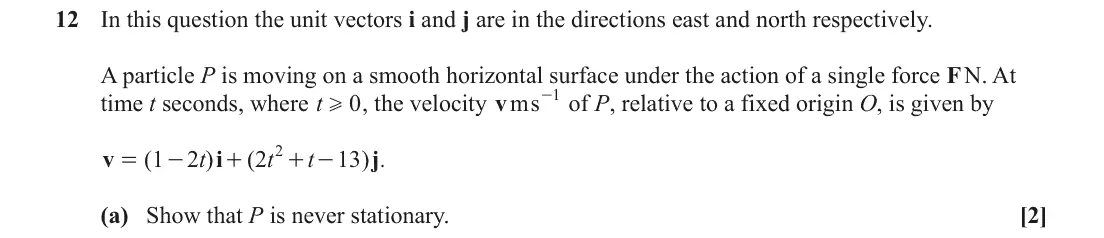
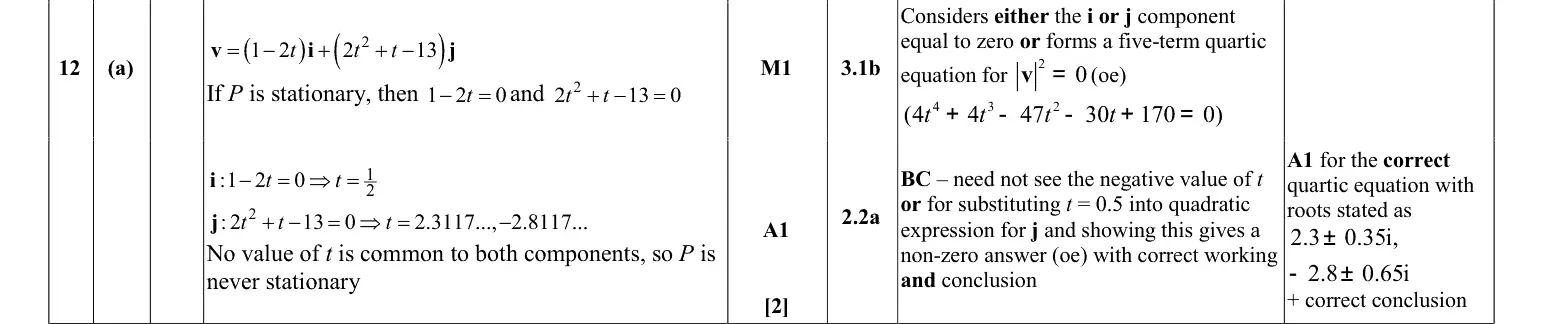
The most common way of showing that P was never stationary was to solve either 1 2 − t = 0 or 2 t + − t 13 = 0 and show that the value of t from one equation was not consistent with the value(s) of t from the other equation. Those candidates who instead decided to find an expression for the speed of P at time t (which in most cases was a 5-term quartic equation) were rarely successful in either deriving this equation correctly or articulating their findings when they attempted to solve it.
Key points and common errors
i component zero at t = 0.5 but j component zero at t ≈ 2.31
no common t so never stationary
Autumn 2021 · AS Paper 2 · Q10(d)3 marksMedium
Show the start of this question
Mark scheme for this part
Key points and common errors
distance = area under graph = 75 + 640 + 225 = 940 m
average speed = 940/150 = 6.27 m s⁻¹
Autumn 2021 · Paper 3 · Q5(b)3 marksMedium
Show the start of this question
Mark scheme for this part
Key points and common errors
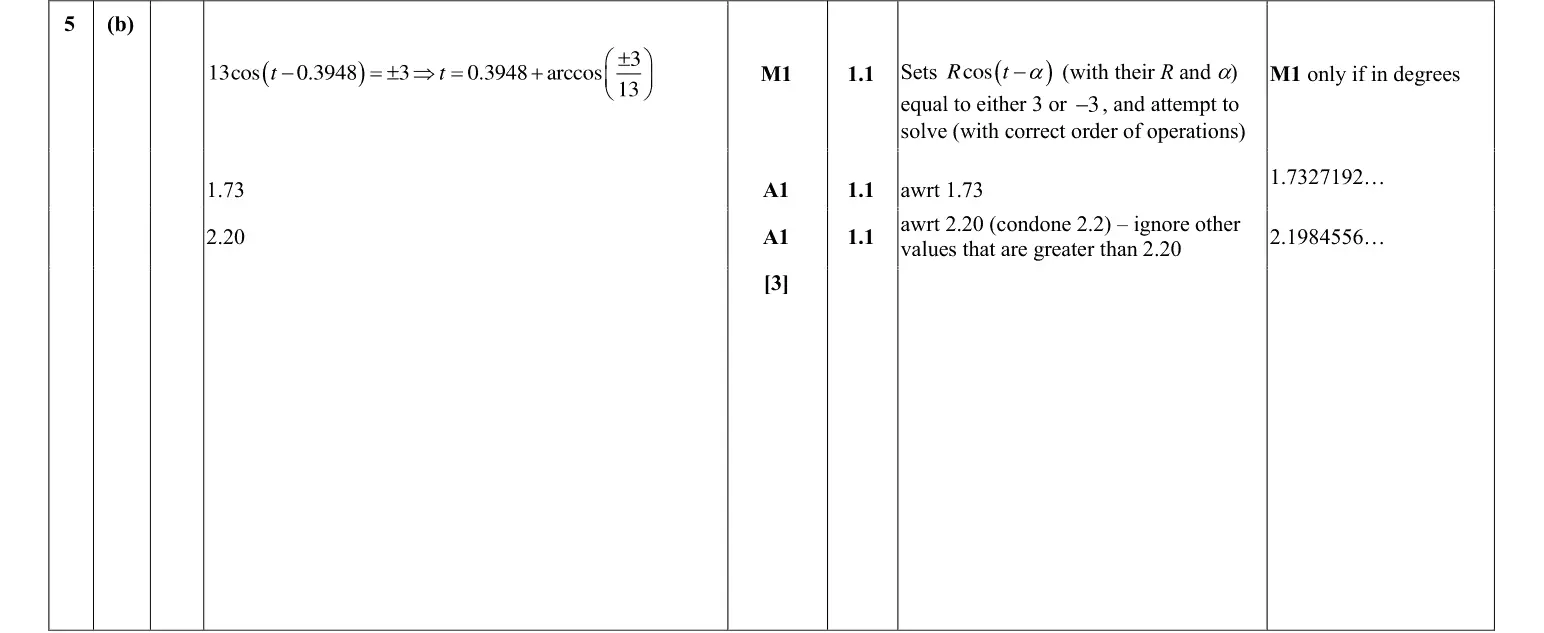
speed 3 means v = ±3
13cos(t − 0.3948) = ±3
t = 1.73 and 2.20
work in radians
Autumn 2021 · Paper 3 · Q11(c)4 marksMedium
Show the start of this question
Mark scheme for this part
Key points and common errors
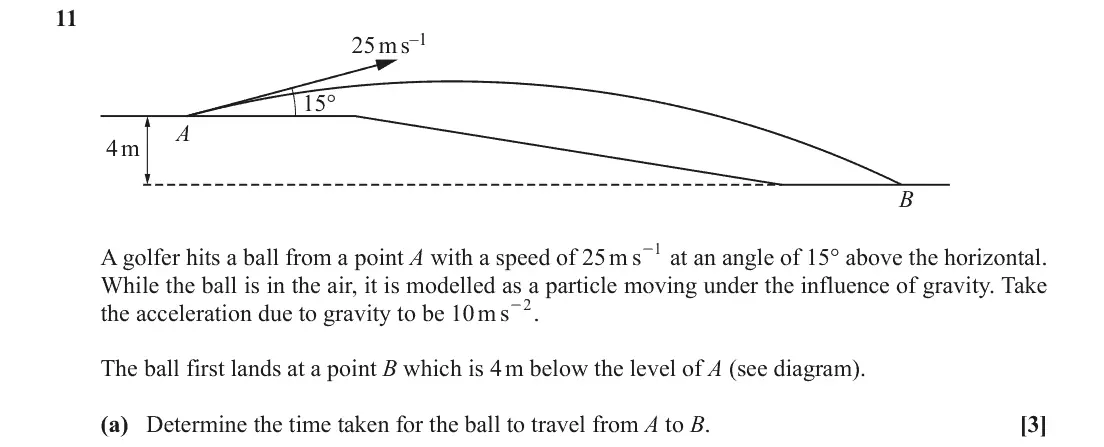
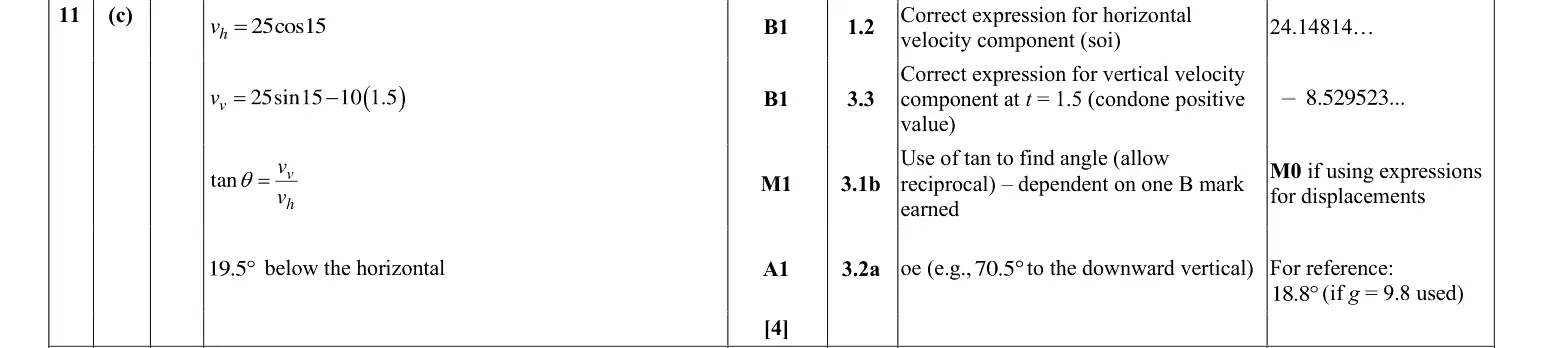
v_h = 25cos15°, v_v = 25sin15° − 15 = −8.53
tan⁻¹ gives 19.5° below the horizontal
using displacements gets M0
Autumn 2020 · AS Paper 2 · Q10(a)2 marksMedium
Mark scheme for this part
Examiner's comment
(Comment on Question 10 as a whole) Part (c) - Most just considered t = 0 to t = 4 without realising the importance of t = 3, even though (b) was almost always correct.
Key points and common errors
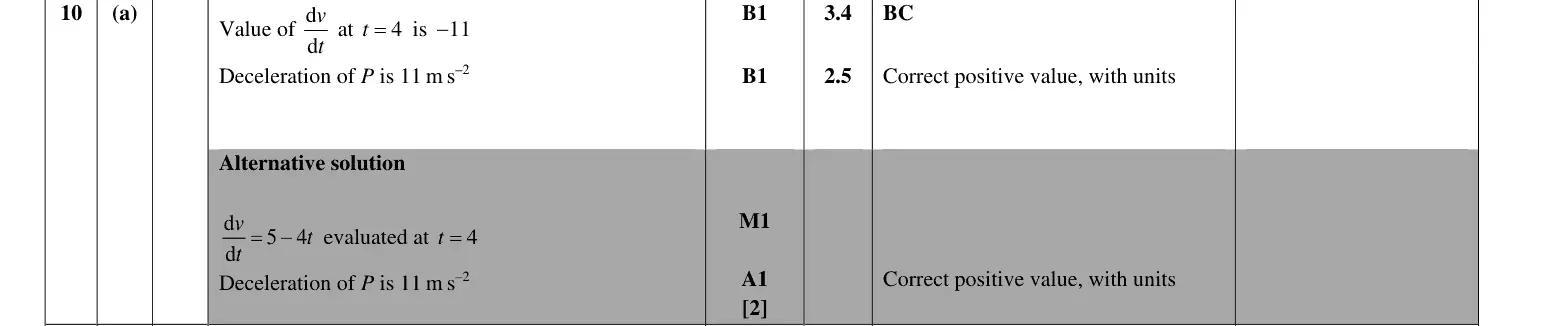
dv/dt = 5 − 4t = −11 at t = 4
deceleration 11 m/s² as a positive value
Autumn 2020 · AS Paper 2 · Q10(b)1 markEasy
Show the start of this question
Mark scheme for this part
Examiner's comment
(Comment on Question 10 as a whole) Part (c) - Most just considered t = 0 to t = 4 without realising the importance of t = 3, even though (b) was almost always correct.
Key points and common errors
v = 0 at t = 3 (reject −½)
Autumn 2020 · AS Paper 2 · Q10(c)3 marksHard
Show the start of this question
Mark scheme for this part
Examiner's comment
(Comment on Question 10 as a whole) Part (c) - Most just considered t = 0 to t = 4 without realising the importance of t = 3, even though (b) was almost always correct.
Key points and common errors
split at t = 3: 27/2 + 25/6 = 53/3 ≈ 17.7 m
integrating 0 to 4 directly gives 28/3
June 2018 · AS Paper 2 · Q11(i)(a)2 marksMedium
Mark scheme for this part
Examiner's comment
(Comment on Question 11(i) as a whole) To gain full credit in this part examiners expected to see u = -4 in the working as well as 4 appearing. Whilst s = ½(u + v)t was widely used, sign fudging was seen. Explanations clearly distinguishing between velocity and speed were unusual. Once again the necessary methods were widely used, with v = u + at the equation used most. This was often done with u = 4, candidates not realising the importance of the minus sign. Those who used the equation s = vt - ½at2 avoided this consideration here.
Key points and common errors
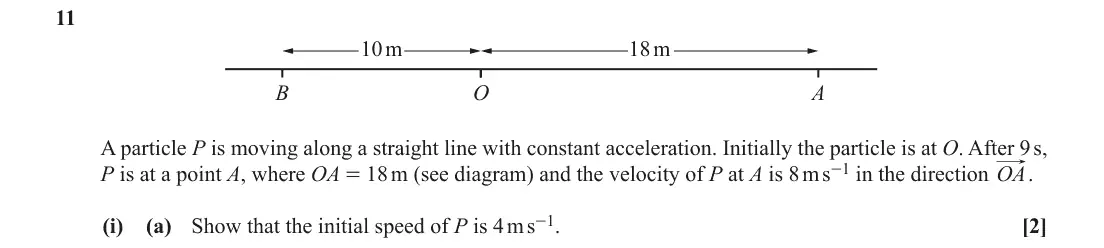
s = ½(u + v)t: 18 = ½(u + 8) × 9 gives u = −4, speed 4
the sign must be seen, distinguish velocity from speed
June 2018 · AS Paper 2 · Q11(ii)4 marksHard
Show the start of this question
Mark scheme for this part
Examiner's comment
This part proved to be a challenge and, although there are various ways of solving the problem, candidates did not always make their intentions easy to follow. Were they considering the motion from O or B? Some even appeared to be considering A. Those trying s = ut + ½at2 once again had sign difficulties, with u = 4 and/or s = 10 used quite widely.
Key points and common errors
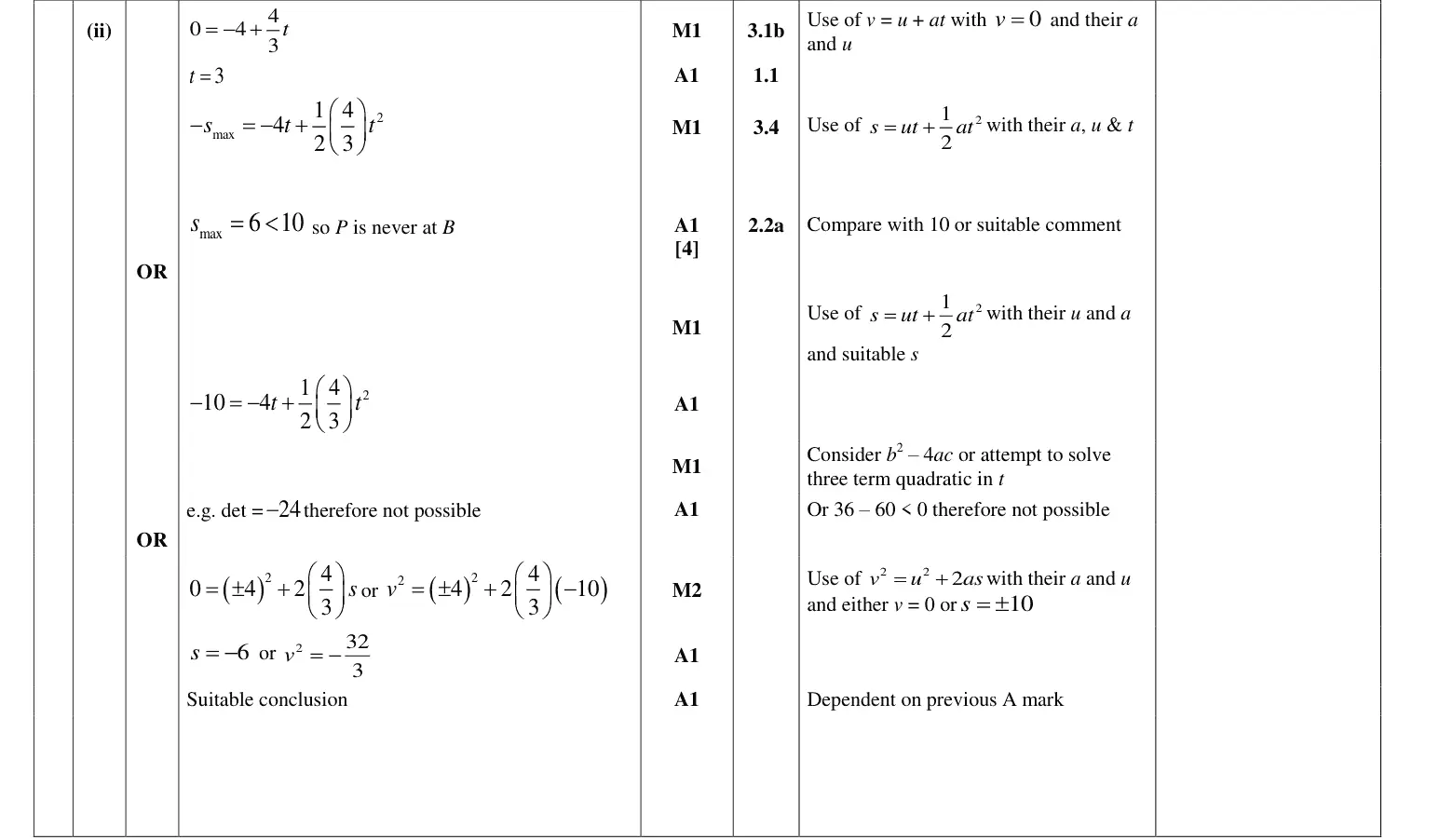
P stops when t = 3
furthest point is 6 m from O on the B side, and 6 < 10 so never at B
or −10 = −4t + ⅔t² has no real roots
sign errors with u and s
Find an A-level maths tutor
Stuck on this? Book a trial session with an A-level maths tutor.