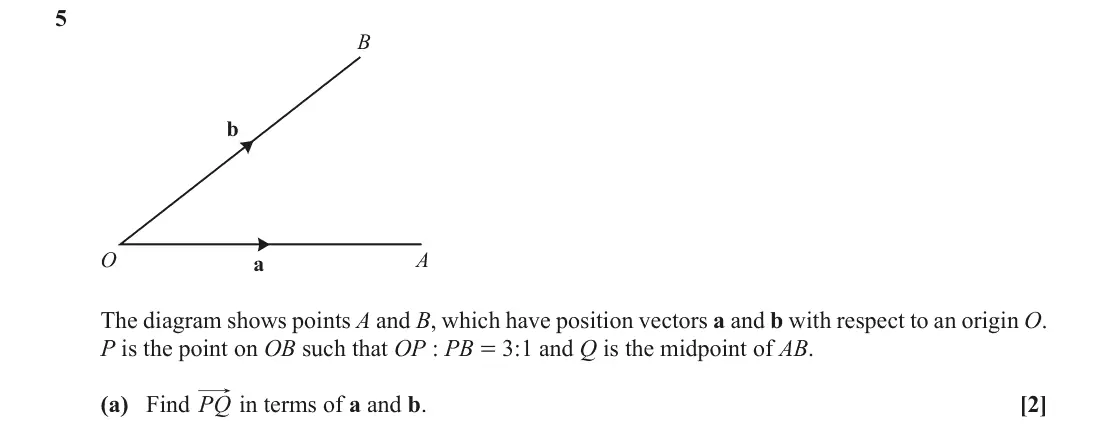
1.10d Add vectors diagrammatically and perform the algebraic operations…
Section
1.10 Vectors
Level
AS & A level
Statement
Be able to add vectors diagrammatically and perform the algebraic operations of vector addition and multiplication by scalars, and understand their geometrical interpretations.
Guidance
i.e. Either a scaling of a single vector or a displacement from one position to another by adding one or more vectors, often in the form of a triangle of vectors.
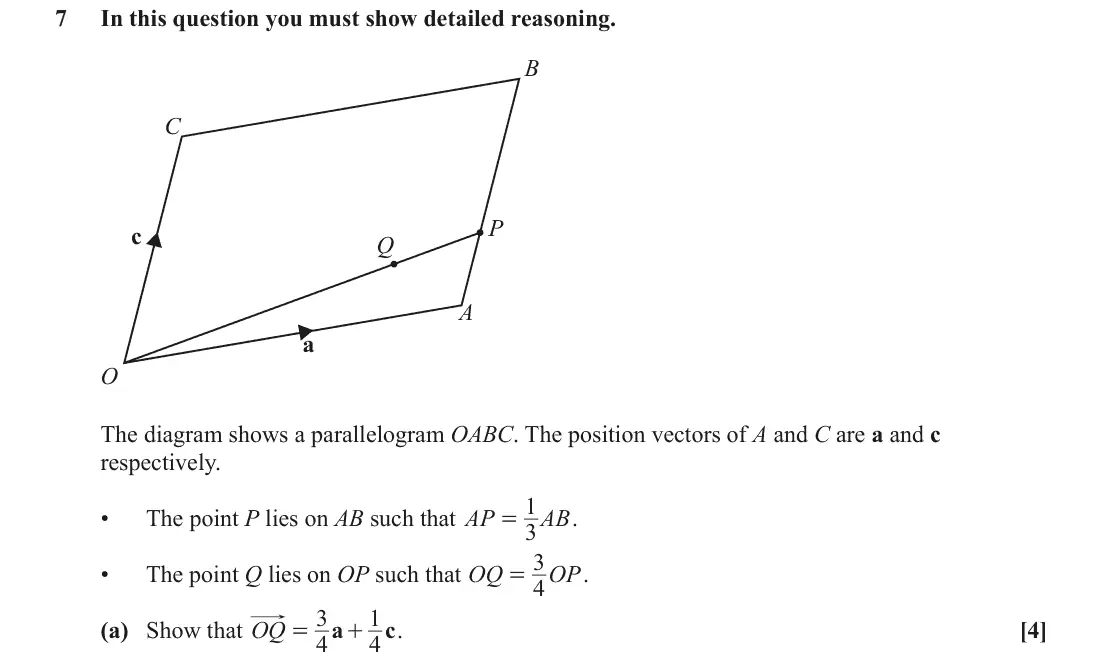
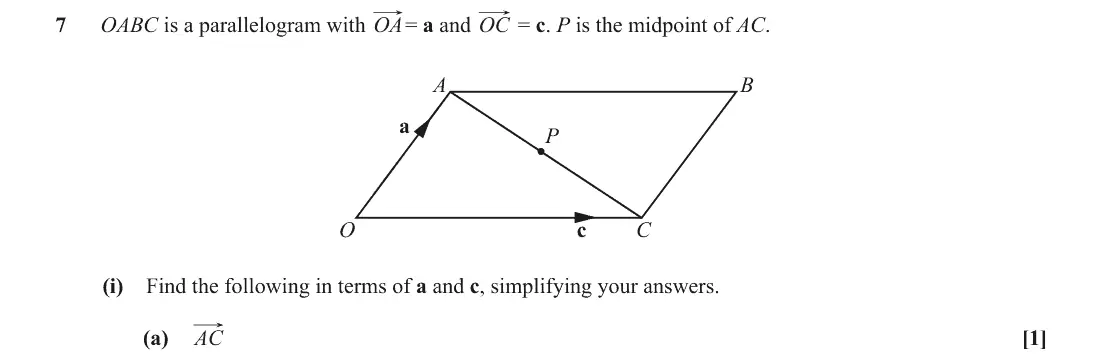
Most candidates made a good attempt at this part, with many scoring 3 or 4 marks. As shown on the scheme, candidates needed to find a vector expression for 𝑂𝑃⃗⃗⃗⃗⃗ in terms of the given vectors a and c, and then use the given fact 𝑂𝑄⃗⃗⃗⃗⃗⃗ = 4 𝑂𝑃⃗⃗⃗⃗⃗ to reach the answer given. Many candidates chose to combine these two steps, which was acceptable provided that sufficient working was shown. Some candidates used the path OAPQ or considered that 𝑂𝑄⃗⃗⃗⃗⃗⃗ = 𝑂𝑃⃗⃗⃗⃗⃗ −1 4 𝑂𝑃⃗⃗⃗⃗⃗ , either of which could lead to the correct result if completed in full. As this was a ‘show that’ question the DR instruction serves to remind candidates that they needed to show their working in full. The scheme was quite accommodating of candidates who skipped intermediate steps, but nonetheless some candidates did not show a convincing demonstration of the given answer. Some candidates appeared to be trying to ‘work backwards’ based on the fractions in the given expression, but this was typically unsuccessful. Throughout Q7, some candidates’ working was not sufficiently clear as to which vector on the parallelogram they were attempting to find. Candidates should be encouraged to set out their working clearly and label vectors correctly (using the vertices of the figure) so that it is clear what they are trying to show in each step.
Key points and common errors
OP = a + (1/3)c
OQ = (3/4)OP = (3/4)a + (1/4)c with the intermediate step shown
June 2025 · AS Paper 1 · Q7(b)3 marksHard
Show the start of this question
Mark scheme for this part
Examiner's comment
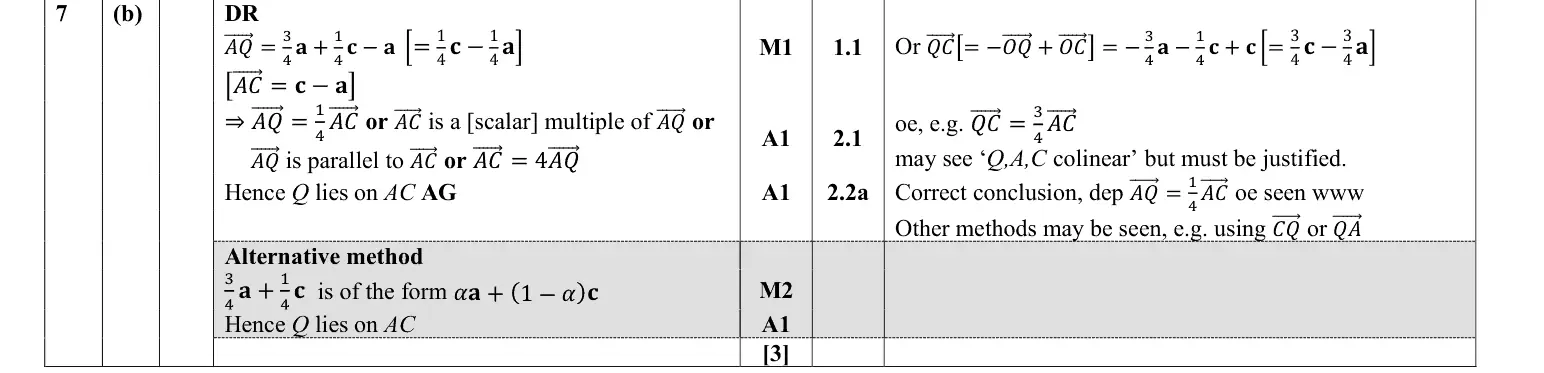
Most candidates started well here, finding a vector expression for 𝐴𝑄⃗⃗⃗⃗⃗ or 𝑄𝐶⃗⃗⃗⃗⃗ , etc. and scoring M1. However, many candidates then did not score either A mark by either trying to state that this first line is sufficient to prove the required fact, or by demonstrating that 𝐴𝑄⃗⃗⃗⃗⃗ + 𝑄𝐶⃗⃗⃗⃗⃗ = 𝐴𝐶⃗⃗⃗⃗⃗ (which is true, but not sufficient to prove that Q lies on AC). On this occasion, the scheme condoned statements which omitted the word ‘scalar’ or used less precise wording, but candidates should be reminded that – especially in a DR question – they should expect to show that the given fact meets all of the requirements. Strictly, to show that Q lies on AC via this method requires that 𝐴𝐶⃗⃗⃗⃗⃗ is a scalar multiple of 𝐴𝑄⃗⃗⃗⃗⃗ and that these two vectors share a common point (A). The latter point was not required but candidates did need to state a clear conclusion to demonstrate understanding of what they have shown. The alternative method was rarely seen.
Key points and common errors
AQ = (1/4)c − (1/4)a = (1/4)AC, a scalar multiple with A common, so Q lies on AC
showing AQ + QC = AC is not enough
clear conclusion needed
June 2024 · AS Paper 1 · Q2(a)1 markMedium
Mark scheme for this part
Examiner's comment
Most candidates seemed to know what to do here, but many gave the coordinates of the midpoint (0.5,4) ሬሬሬሬሬ⃗) and or giving an attempt at AB or ½ AB rather than the midpoint. the vector 𝐴𝐴𝐴𝐴 rather than a vector, which was not an acceptable answer. Common errors include -1.5i+j (from halving
Key points and common errors
0.5i + 4j as a vector
coordinates (0.5, 4) not accepted
½AB is not the midpoint
June 2024 · AS Paper 1 · Q2(b)3 marksEasy
Show the start of this question
Mark scheme for this part
Examiner's comment
This was generally well answered. As this was a ‘Find’ question marks could be gained without working their method in full. Most candidates were able to reach the required answer, but often their vector 𝐴𝐴𝐴𝐴 ሬሬሬሬሬ⃗ (provided the answer was not from incorrect working), but candidates should still be encouraged to show ሬሬሬሬሬ⃗ as 3i −2j. The was unclear and potentially inaccurate. Many candidates indicated ‘3i’ and ‘2j’ or gave 𝐵𝐵𝐵𝐵 method mark could not be gained for finding the magnitude of an irrelevant vector (e.g. those given in the question).
Key points and common errors
AB = −3i + 2j
√(3² + 2²) = √13 exact
June 2024 · AS Paper 2 · Q9(a)2 marksEasy
Mark scheme for this part
Examiner's comment
There were a lot of correct answers to this question. Marks were lost by some for simple arithmetical errors or for using F1 + F2 = F3.
Key points and common errors
F₁ + F₂ + F₃ = 0 gives F₃ = (2, −3) N
using F₁ + F₂ = F₃ is wrong
June 2024 · AS Paper 2 · Q9(b)2 marksEasy
Show the start of this question
Mark scheme for this part
Examiner's comment
This question was also well attempted, with many correct answers. The most common error was to use 8i + j = 2.5a. Also sometimes given was √62 + 42 = 2.5a, with no vector equation.
Key points and common errors
resultant (6, 4) = 2.5a
a = (2.4, 1.6) m s⁻²
must use the full resultant
June 2023 · AS Paper 1 · Q2(a)(i)2 marksMedium
Mark scheme for this part
Examiner's comment
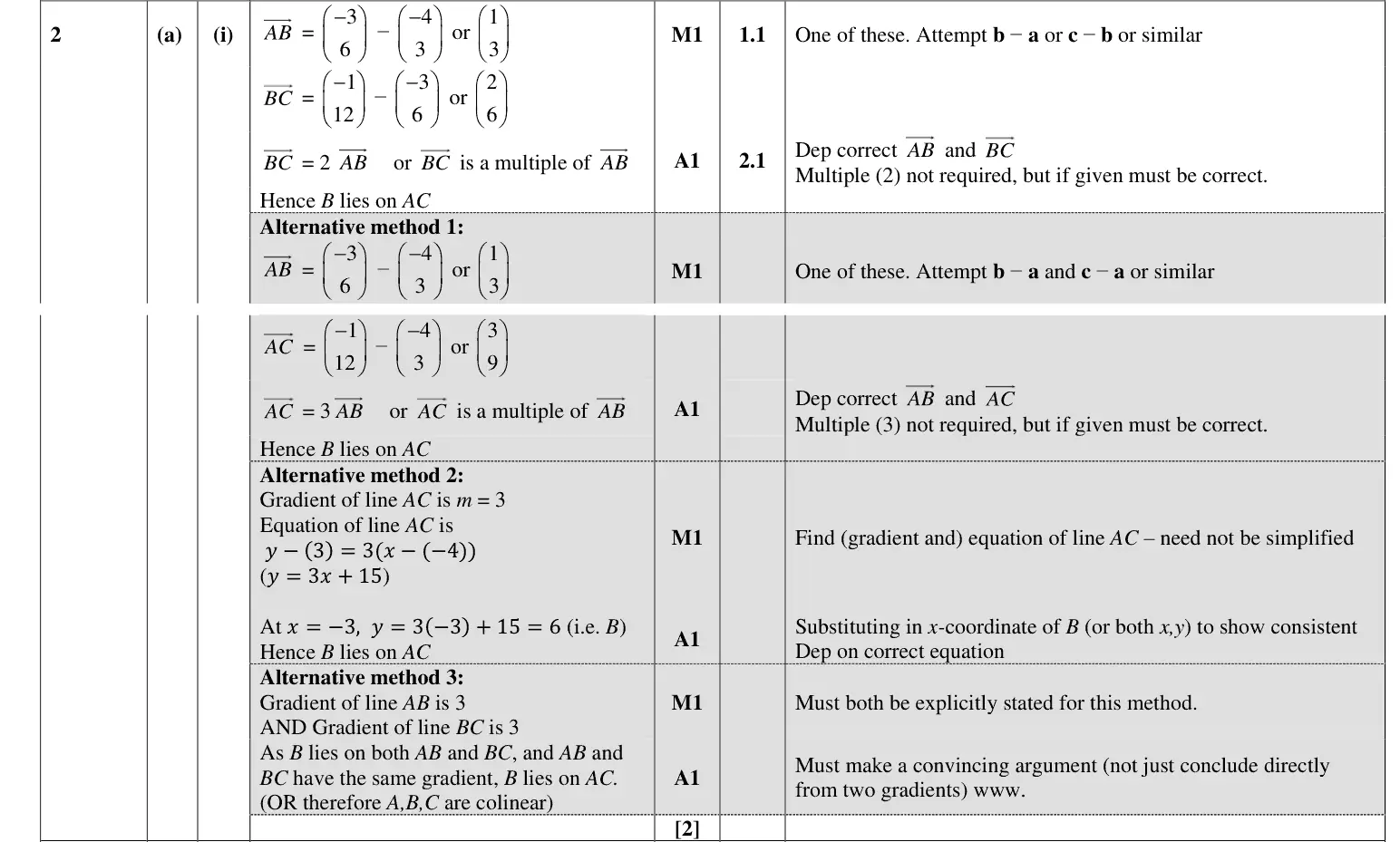
Many candidates chose to approach this question in a ‘non-vector’ method, using standard coordinate geometry, which was permitted (but required appropriate rigour). For example, finding the equation of ሬሬሬሬሬ⃗ and BC ሬሬሬሬሬሬ⃗ ) then showed that AC ሬሬሬሬሬሬ⃗ = AB ሬሬሬሬሬ⃗ + BC ሬሬሬሬሬሬ⃗ and claimed this the line between A and C, then showing that B satisfies the equation of that line. A number of candidates found two of the required vectors (e.g. AB proved that B lies on the line AC (which it doesn’t prove). A method stating two gradients could only be credited if candidates showed that the gradients of AB and BC were 3 and stated that B was a common point (showing that, for instance, AB and AC have the same gradient and share the point A does not prove that B lies on the line [segment] AC). Many candidates confused x and y when attempting to find a gradient. Centres should encourage students to be familiar with vector manipulation, as this was the most straightforward way to answer this question.
Key points and common errors
AB = (1, 3), BC = (2, 6) = 2AB so B lies on AC
AC = AB + BC does not prove it
June 2023 · AS Paper 1 · Q2(a)(ii)1 markMedium
Show the start of this question
Mark scheme for this part
Examiner's comment
ሬሬሬሬሬ⃗ and AB. Many candidates left responses in the form of a ratio of vectors rather than This was reasonably well answered, but some candidates did not appear to recognise the difference in notation between AB lengths. Candidates who had not computed the vectors AB and BC needed to do so in this part. Some candidates made an error in comparing vectors, or gave the ratio the wrong way around (which could not be credited unless they specified the ratio as BC : AB). Only ratios in the form p : q were acceptable here (a ‘ratio’ of vectors could not be credited).
Key points and common errors
AB : BC = 1 : 2
must be a ratio of lengths not of vectors
June 2023 · AS Paper 1 · Q2(c)2 marksHard
Show the start of this question
Mark scheme for this part
Examiner's comment
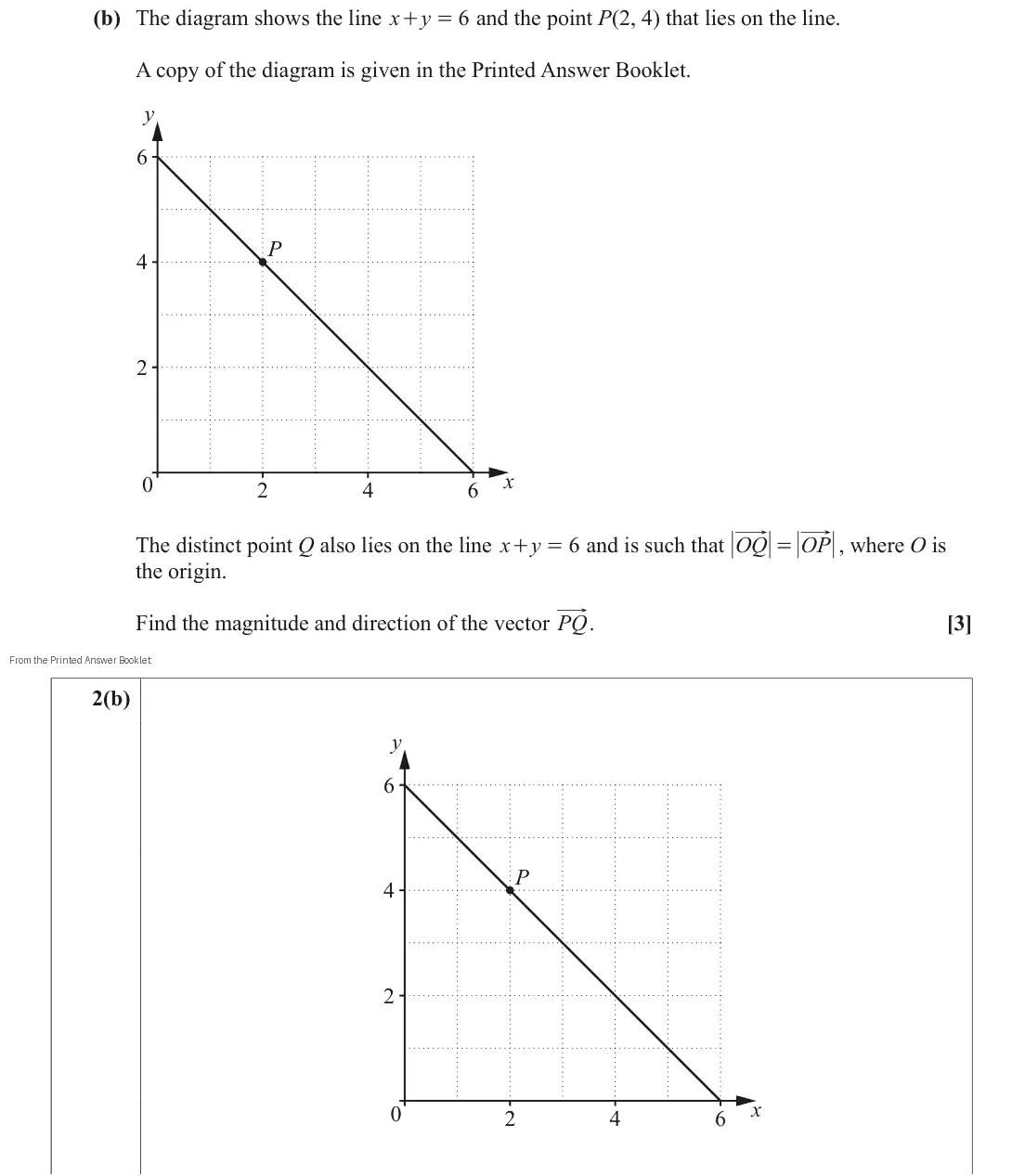
Many candidates omitted this part, and relatively few candidates achieved one or both marks (including those who had obtained full or nearly full marks across parts (a) and (b)). Many appeared to not have understood the request in the question and computed some related vectors or magnitudes without reaching the required vectors for R. Again use of the diagram appeared to correlate with success. The command words ‘Write down’ indicates that very little algebraic working was required. Those candidates who found the gradient of OP (i.e. 2) and then the corresponding perpendicular gradient (i.e. -0.5) and drew a line of this gradient through P were most likely to produce the correct answers. Those who tried to rely on algebra and use the distance formula would often get stuck by not realising they needed to substitute the equation of the line through P (y = -0.5x + 5) to get their final answers. Some candidates did not give their responses in the required form (position vectors) and gave the co- ordinates of R instead.
Key points and common errors
PR perpendicular to OP = (2, 4) with half its length: R = (4, 3) or (0, 5) as position vectors
many omitted
relatively few scored
June 2023 · Paper 1 · Q4(c)2 marksHard
Show the start of this question
Mark scheme for this part
Examiner's comment
This part of the question proved to be unexpectedly challenging, and only the most able candidates gained both marks. Many candidates seemed unsure as to how to find the midpoint, with 3i + 3j most typically being given as the position vector of M. The more successful candidates made good use of a sketch diagram.
Key points and common errors
M = 4i + 4j
MD = 2BM gives D = 6i + 2j
many gave M as 3i + 3j
a sketch helps
June 2023 · Paper 3 · Q10(a)3 marksMedium
Mark scheme for this part
Examiner's comment
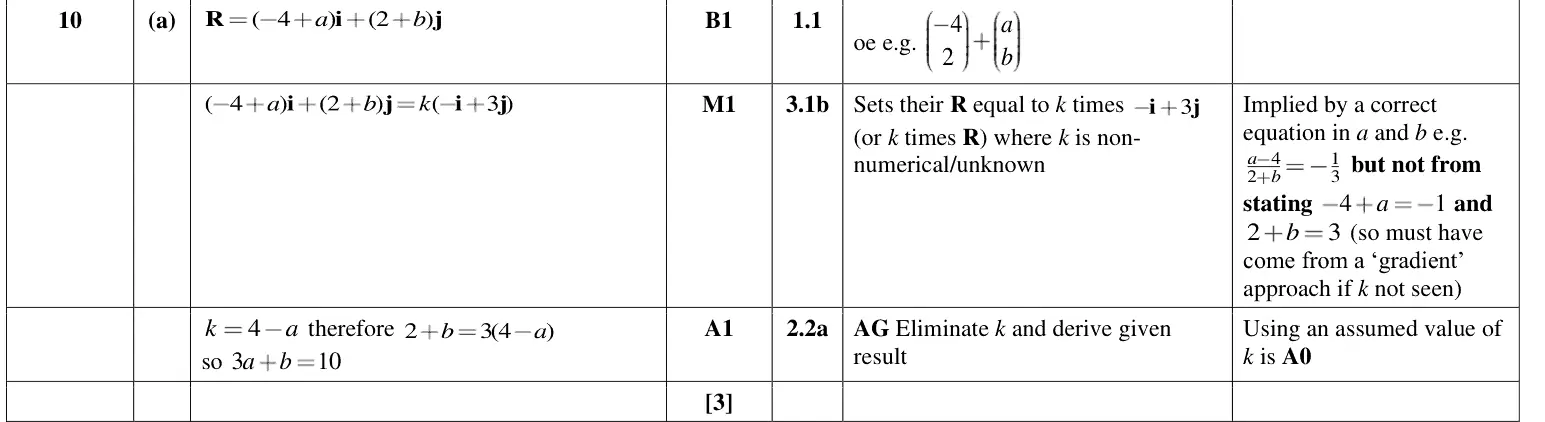
There were two common errors in this part. The first was the incorrect assumption that the resultant of the two forces was found by subtracting rather than adding the two horizontal forces together (possibly the resultant of the two forces equal to −𝐢𝐢+ 3𝐣𝐣 and not a multiply of this vector. Those that did state that candidates were confusing ‘resultant’ vector with ‘direction’ vector). The other common error was setting ቀ−4 + 𝑎𝑎 2 + 𝑏𝑏ቁ= 𝑘𝑘ቀ−1 3 ቁ usually eliminated k and derived the given result correctly.
Key points and common errors
R = (a − 4)i + (2 + b)j = k(−i + 3j)
eliminate k to get 3a + b = 10
errors: subtracting the forces, setting R equal to −i + 3j itself
June 2022 · AS Paper 2 · Q7(a)5 marksMedium
Mark scheme for this part
Examiner's comment
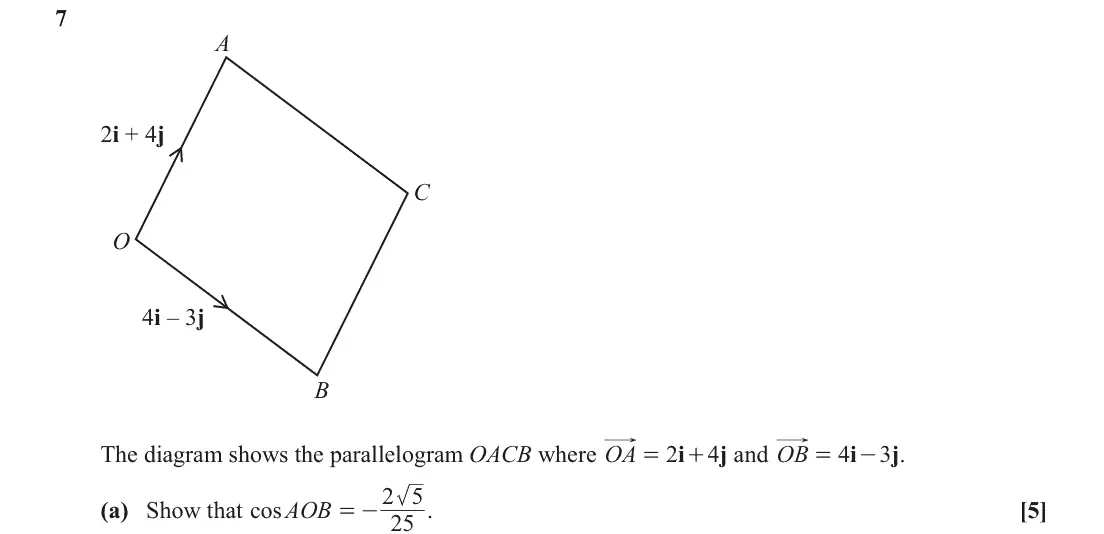
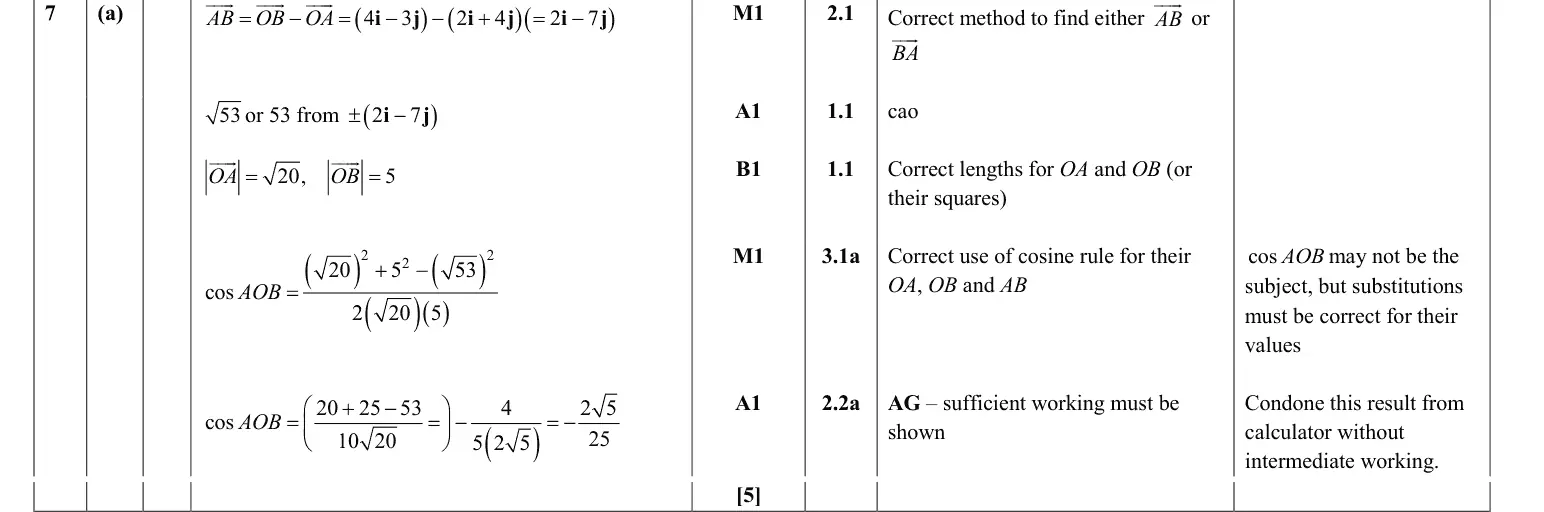
IOAI and IOBI were correctly found by many, and often less successful attempts could obtain AB and its length. Most realised the triangle AOB was not right angled and attempted the cosine rule. It is good practice for candidates to be in the habit of showing surd simplification even if the calculator is used to do the relevant work. Exact working was expected for full credit. Those who just used AOB = tan-1(4/2) + tan-1(3/4) to get 100.3° and their calculator with this to try and show the given result scored 0 marks.
Key points and common errors
AB = 2i − 7j so AB = √53, OA = √20, OB = 5
cosine rule with exact surd working gives −2√5/25
using tan⁻¹ angles and calculator scores 0
Autumn 2021 · AS Paper 1 · Q4(a)2 marksMedium
Mark scheme for this part
Key points and common errors
2(6, −3) − 3(−1, 2) = (15, −12) or 15i − 12j
Autumn 2021 · AS Paper 1 · Q4(b)5 marksMedium
Show the start of this question
Mark scheme for this part
Key points and common errors
parallel to y-axis so x-component 6r − s = 0, s = 6r
magnitude (9r)² = 9 gives r = ±1/3
pairs r = 1/3, s = 2 and r = −1/3, s = −2 correctly paired
Autumn 2021 · Paper 2 · Q9(a)4 marksMedium
Mark scheme for this part
Examiner's comment
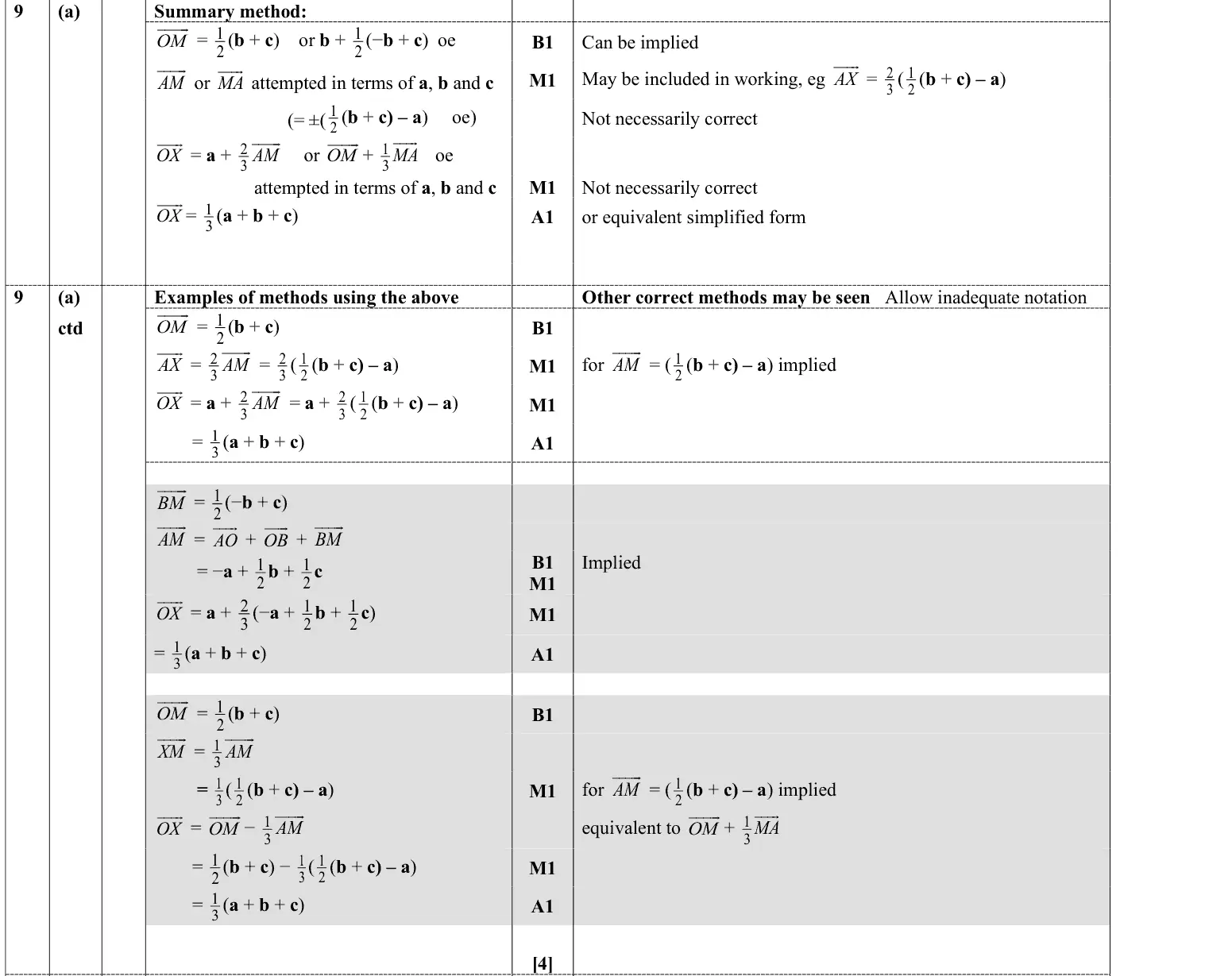
(From the general report) Question 9(a): Some candidates attempted ’lengths’ of vectors, rather than 1 2 2 vectors themselves.
Key points and common errors
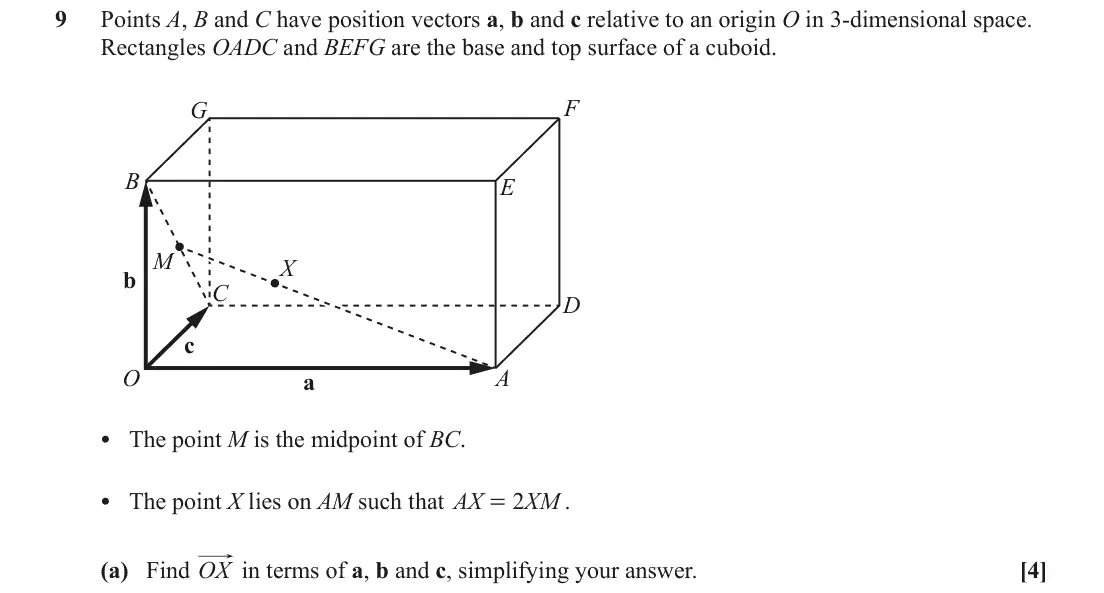
OM = ½(b + c)
AM = ½(b + c) − a
OX = a + ⅔AM = ⅓(a + b + c)
some worked with lengths instead of vectors
Autumn 2020 · AS Paper 1 · Q2(a)2 marksMedium
Mark scheme for this part
Examiner's comment
(Comment on Question 02 as a whole) Many candidates answered the first part correctly although, in some cases, the working was difficult to decipher. Some candidates did not appear to understand vectors, and in particular, addition and subtraction of vectors. In part (b) many were confused about the gradients of perpendicular lines.
Key points and common errors
AB and BC in the same direction (ratio of components) or line y = −x/2 + 5/2 through (p, 1)
p = 3
working often hard to follow
Autumn 2020 · AS Paper 2 · Q83 marksMedium
Mark scheme for this part
Examiner's comment
(From the general report) Section A is Pure Mathematics (Questions 1-7), allocated 50 marks and Section B is Mechanics (Questions 8-11), allocated 25 marks.
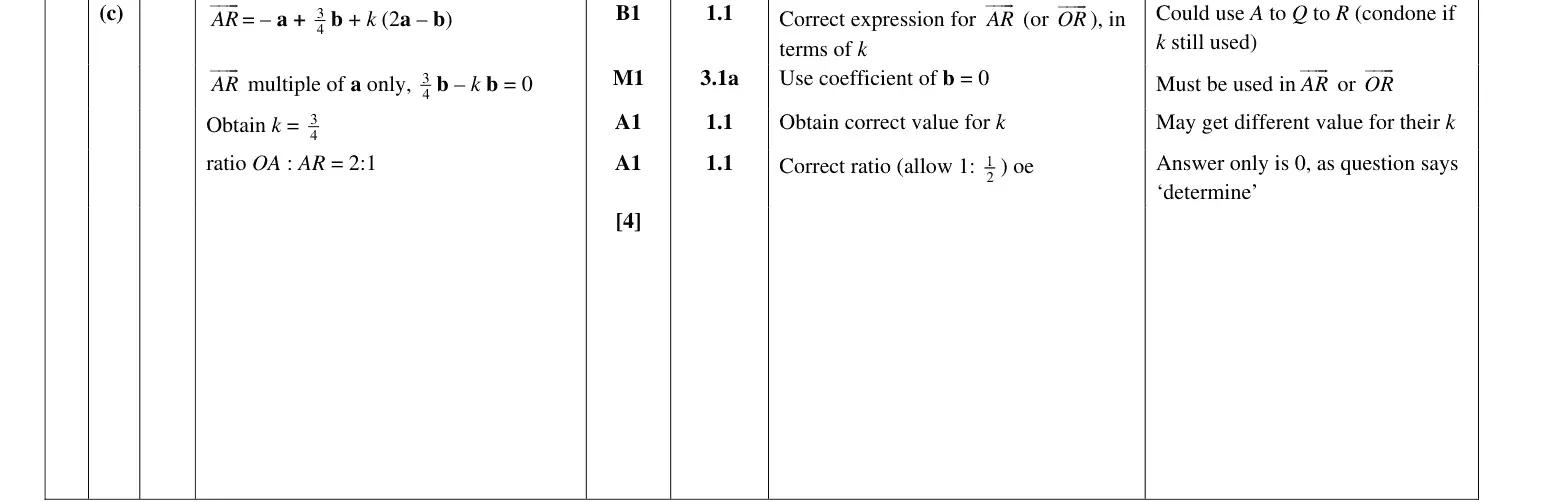
AR = −a + ¾b + k(2a − b) must be a multiple of a only so k = ¾
OA : AR = 2 : 1
method needed for 'determine'
Autumn 2020 · Paper 2 · Q7(b)1 markMedium
Show the start of this question
Mark scheme for this part
Examiner's comment
(From the general report) Common misconceptions Misconception In answering Question 7 (about vectors) some candidates appeared not to appreciate the different significances of a, a and A.
Key points and common errors
position vector of the midpoint of AB
refer to A and B not a and b
June 2019 · AS Paper 2 · Q5(a)1 markEasy
Mark scheme for this part
Examiner's comment
Very well attempted.
Key points and common errors
midpoint of AC is (4, 3) so k = 3
June 2019 · AS Paper 2 · Q5(c)2 marksHard
Mark scheme for this part
Examiner's comment
This was found to be more challenging. Many had no idea how to start or produced a wrong value of k with no evidence of how it had been obtained, but those who made sensible attempts used either gradients or vectors. For those using gradients (more common), some seemingly used perpendicularity. Attention to detail was important. A common issue throughout this paper involved marks dropped due to careless notation. This candidate 1 has shown sufficient working for the method mark, but having correctly found m = − , went on to use 4 1 m = and so dropped the accuracy mark. 4
Key points and common errors
trapezium needs one pair of parallel sides: AB parallel to DC gives k = 16/3 (or k = −½ or 5/4 from other pairs)
show the gradient or vector working
perpendicularity is wrong
June 2019 · AS Paper 2 · Q92 marksEasy
Mark scheme for this part
Examiner's comment
This was generally very well answered.
Key points and common errors
sum of forces is zero: F = (−9, 1) N
June 2019 · Paper 1 · Q2(c)2 marksMedium
Show the start of this question
Mark scheme for this part
Examiner's comment
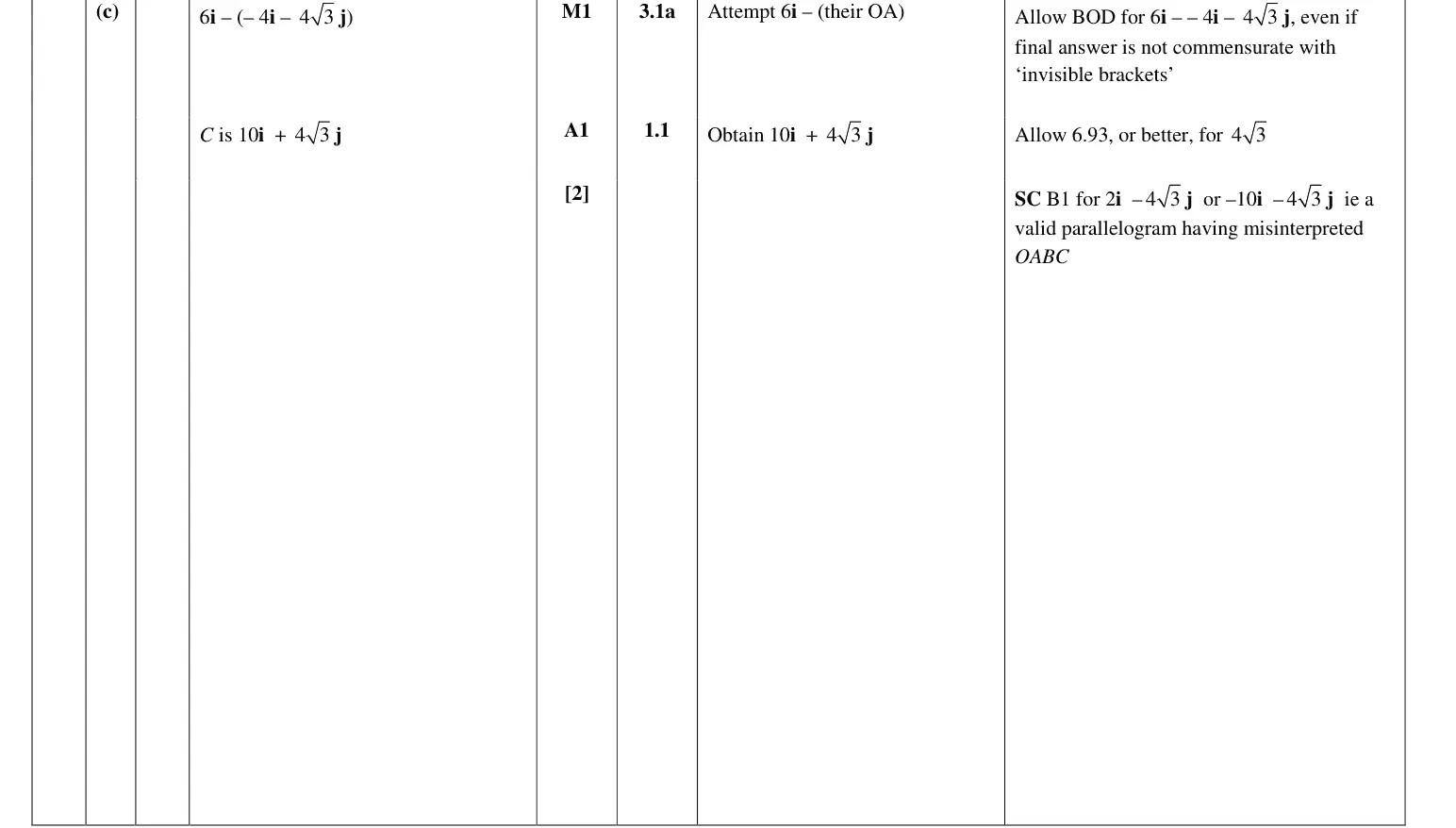
Many candidates seemed unfamiliar with the labelling convention for a polygon, and placed the point C such that the parallelogram being considered was actually OACB. The more successful candidates made good use of a diagram, with clear calculations to justify the relevant vectors that were being found.
Key points and common errors
OABC order: OC = OB − OA = 10i + 4√3j
many placed C to give OACB instead
June 2019 · Paper 3 · Q10(c)3 marksHard
Show the start of this question
Mark scheme for this part
Examiner's comment
This part discriminated well with many candidates making little progress apart from substituting t = 1 into their expression from part (b). Those candidates who realised that one way to find q was to equate a scalar multiple of their displacement vector (evaluated at t = 1) to 2 i − 8 j were usually successful in first finding the scalar multiple and hence the value of q.
Key points and common errors
t = 1: s = −½i + (1 + q)j
must be a scalar multiple of 2i − 8j
k = −4, q = 1
June 2018 · AS Paper 1 · Q7(i)(a)1 markEasy
Mark scheme for this part
Examiner's comment
(Comment on Question 07(i) as a whole) Almost all candidates answered this question correctly. 1 (c – a). Most answered this question correctly. A few made a sign error, for example c + 2
Key points and common errors
AC = c − a
correct vector notation
June 2018 · AS Paper 1 · Q7(i)(b)2 marksEasy
Show the start of this question
Mark scheme for this part
Examiner's comment
(Comment on Question 07(i) as a whole) Almost all candidates answered this question correctly. 1 (c – a). Most answered this question correctly. A few made a sign error, for example c + 2
Key points and common errors
OP = a + ½(c − a) = ½(a + c)
sign errors
June 2018 · AS Paper 1 · Q7(ii)4 marksMedium
Show the start of this question
Mark scheme for this part
Examiner's comment
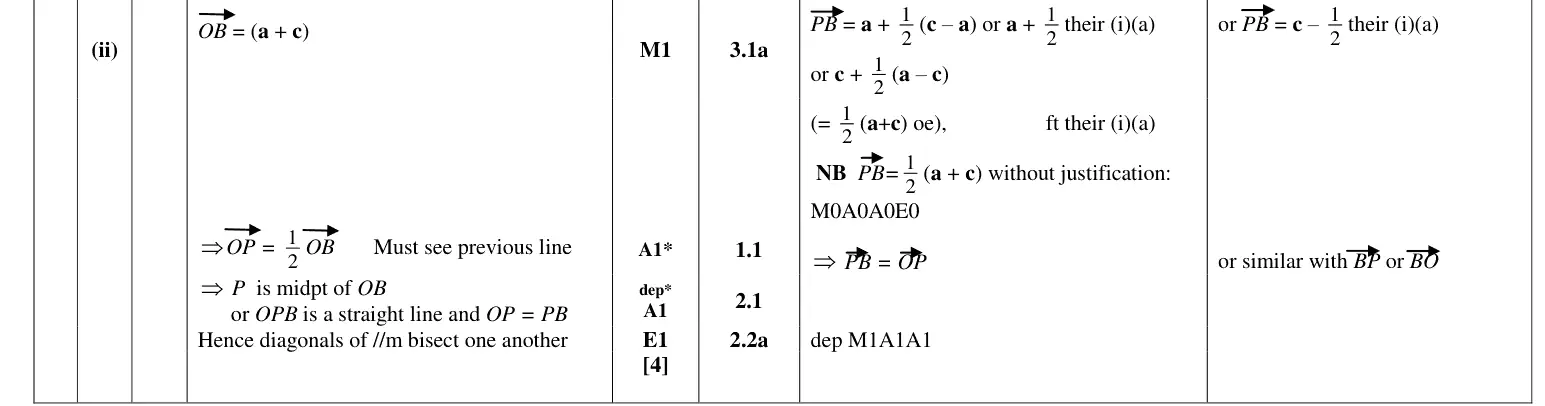
This question proved challenging for a significant majority of candidates. Many assumed the result by 1 (c + a), instead of deriving this result. Some candidates considered starting with, for example, PB = 2 the modulus of some vectors. Some candidates seemed unaware of the meaning of the word "bisect”, in some cases confusing it with "perpendicular". Thus many wrote that a + c is perpendicular to a – c, and that this somehow proves that the diagonals bisect one another. Perhaps the majority of candidates did not know how to start answering this question at all. An example of a candidate's solution that suggested they had no understanding of proof by vectors was as follows: "BO = AC. As they are the same length it means they would both meet in the centre, hence meaning they bisect one another."
Key points and common errors
OB = a + c so OP = ½OB
P is the midpoint of both diagonals
PB = ½(a + c) needs justification
June 2018 · Paper 2 · Q2(ii)1 markMedium
Show the start of this question
Mark scheme for this part
Examiner's comment
A surprisingly large number of candidates simply halved their answer to part (i). Perhaps they did not understand the concept of a "position vector".
Key points and common errors
midpoint (−1, −1.5, 3.5)
many simply halved the length from (i)
June 2018 · Paper 2 · Q2(iii)3 marksMedium
Show the start of this question
Mark scheme for this part
Examiner's comment
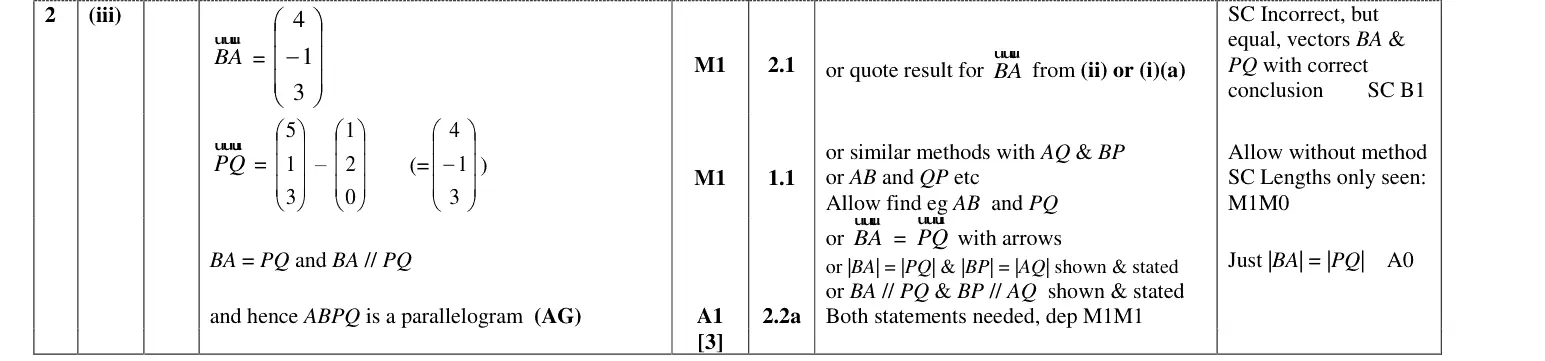
Only a minority of candidates answered this question in the most efficient way, using the vector forms of one pair of sides. Many found the vector forms of both pairs of sides. Then they commented either that both pairs consisted of two parallel lines, or they found the lengths of all four sides and commented that both pairs consisted of lines of equal length. Some candidates found the vector form for two opposite sides and then stated that because these two sides are parallel, ABPQ is a parallelogram. A few candidates made sign errors while finding vectors. Some did not use correct vector notation. Some candidates (quite reasonably) replaced the column vector notation by the i, j, k notation. Some candidates discussed the "gradients" of opposite sides.
Key points and common errors
BA = PQ = (4, −1, 3) so one pair of sides equal and parallel
showing only parallel sides, or only equal lengths, is not enough
vector notation
Find an A-level maths tutor
Stuck on this? Book a trial session with an A-level maths tutor.