1.10c Calculate the magnitude and direction of a vector and convert…
Section
1.10 Vectors
Level
AS & A level
Statement
Be able to calculate the magnitude and direction of a vector and convert between component form and magnitude/direction form.
Guidance
Learners should know that the modulus of a vector is its magnitude and the direction of a vector is given by the angle the vector makes with a horizontal line parallel to the positive x-axis. The direction of a vector will be taken to be in the interval [0°, 360°). Includes use of the notation |a| for the magnitude of a and |OA→| for the magnitude of OA→. Learners should be able to calculate the magnitude of a vector (x, y) as √(x² + y²) and its direction by using tan⁻¹(y/x).
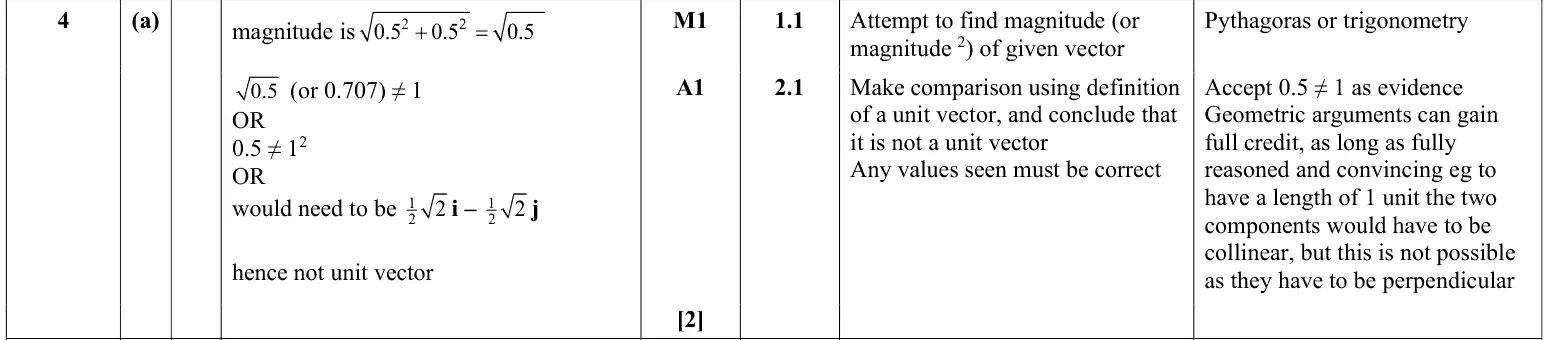
Candidates seemed familiar with the command word ‘determine’ and usually provided sufficient detail in their solution. Most candidates were able to correctly find the magnitude of the given vector and then conclude appropriately. To gain full credit candidates were expected to explicitly compare the correct magnitude of the given vector to 1, which some omitted to do.
Key points and common errors
magnitude √0.5 ≈ 0.707
must explicitly compare with 1 and conclude
June 2025 · Paper 1 · Q4(b)2 marksMedium
Show the start of this question
Mark scheme for this part
Examiner's comment
Most candidates gained 1 mark for calculating a relevant angle, most typically 45o. However many candidates did not seem familiar with the definition of the ‘direction’ of a vector as given in the specification. Giving the answer as a bearing from the vertical axis was one of the more common misunderstandings, as was giving a negative angle as opposed to the (0o, 360o) convention.
Key points and common errors
direction measured from positive x-axis in [0°, 360°): 315°
−45° or a bearing loses the mark
June 2025 · Paper 3 · Q11(c)5 marksMedium
Show the start of this question
Mark scheme for this part
Examiner's comment
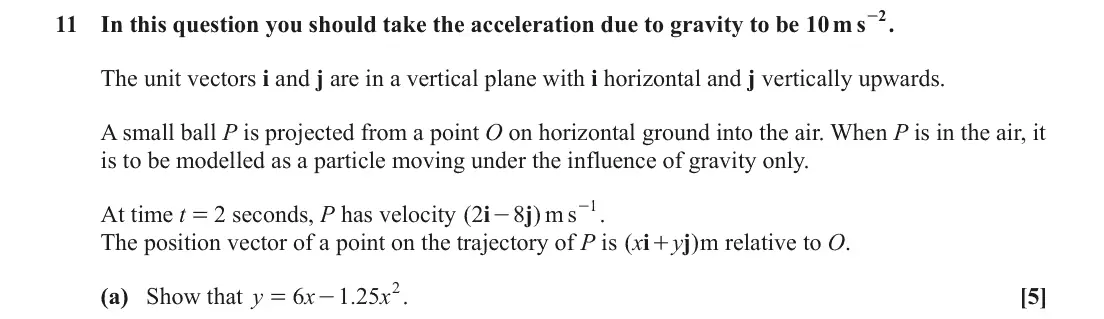
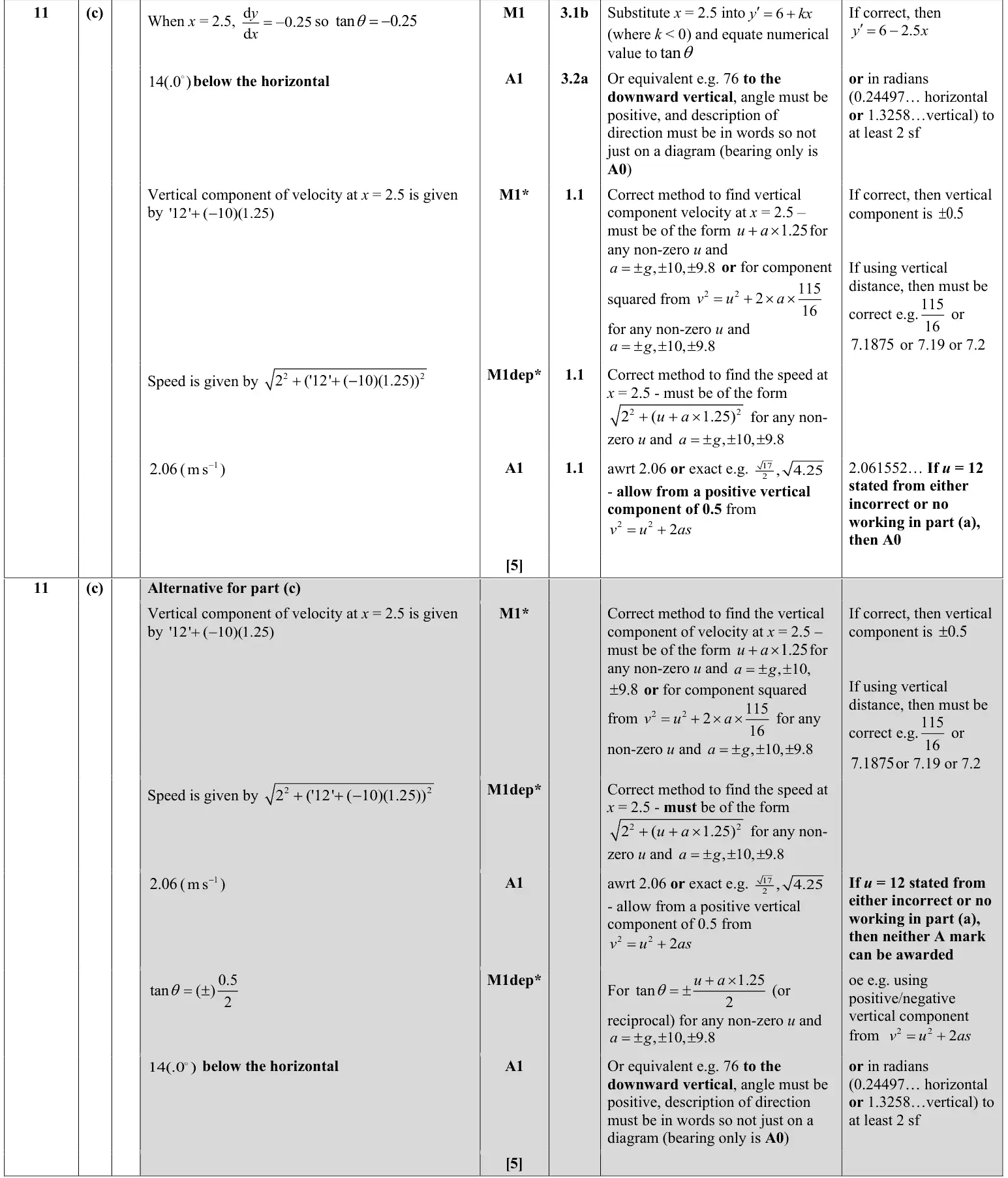
The responses to this part were mixed with many candidates believing that both the speed and direction of motion could be found by considering the vertical and horizontal displacement of P when 𝑥= 2.5. Of those that did use the velocity components many did not give sufficient detail when it came to the direction of motion; an angle alone was not sufficient as it needed to be clear if the angle was below or above the horizontal (or equivalently to the upward or downward vertical).
Key points and common errors
gradient at x = 2.5 is −0.25 so direction 14° below the horizontal
vertical velocity 12 − 10 × 1.25 = −0.5
speed √4.25 = 2.06 m/s
displacement gives neither
direction needs 'below the horizontal'
June 2024 · AS Paper 1 · Q2(b)3 marksEasy
Show the start of this question
Mark scheme for this part
Examiner's comment
This was generally well answered. As this was a ‘Find’ question marks could be gained without working their method in full. Most candidates were able to reach the required answer, but often their vector 𝐴𝐴𝐴𝐴 ሬሬሬሬሬ⃗ (provided the answer was not from incorrect working), but candidates should still be encouraged to show ሬሬሬሬሬ⃗ as 3i −2j. The was unclear and potentially inaccurate. Many candidates indicated ‘3i’ and ‘2j’ or gave 𝐵𝐵𝐵𝐵 method mark could not be gained for finding the magnitude of an irrelevant vector (e.g. those given in the question).
Key points and common errors
AB = −3i + 2j
√(3² + 2²) = √13 exact
June 2024 · AS Paper 1 · Q2(c)2 marksEasy
Show the start of this question
Mark scheme for this part
Examiner's comment
This was generally well answered, with most candidates taking the direct route shown in the scheme. A few candidates used the cosine rule, which was more onerous. Many candidates were able to obtain the correct angle of 56.3o but a few candidates stated the angle as 33.7o.
Key points and common errors
tan⁻¹(3/2) = 56.3°
33.7° is the angle with the y-axis
June 2024 · Paper 2 · Q24 marksEasy
Mark scheme for this part
Examiner's comment
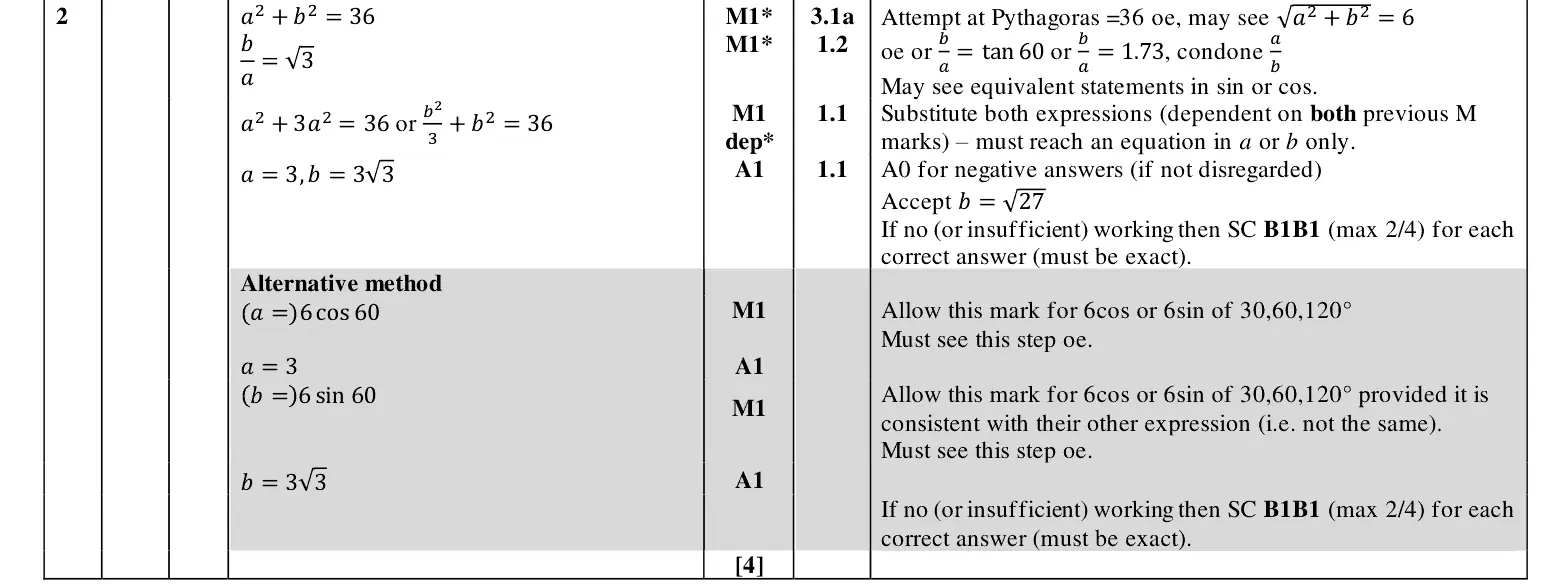
This question was well answered by most candidates. The alternative method using cos and sin was most popular, with many candidates immediately writing down the two correct expressions for a and b as required and calculating the values correctly. A small number of candidates gave a and b the wrong way around or did not label them (neither of which could be given accuracy marks). Of those who used the main method (Pythagoras, etc.), most of the responses were successful, but quite a few candidates made an error when combining their two expressions to solve (for instance, square rooting both terms separately). There were others that used a mixture of both methods, which was acceptable provided sufficient working was shown (noting the ‘Determine’ instruction).
Key points and common errors
a = 6cos60° = 3, b = 6sin60° = 3√3
must be exact
A0 for negative values
June 2024 · Paper 3 · Q8(b)4 marksMedium
Show the start of this question
Mark scheme for this part
Examiner's comment
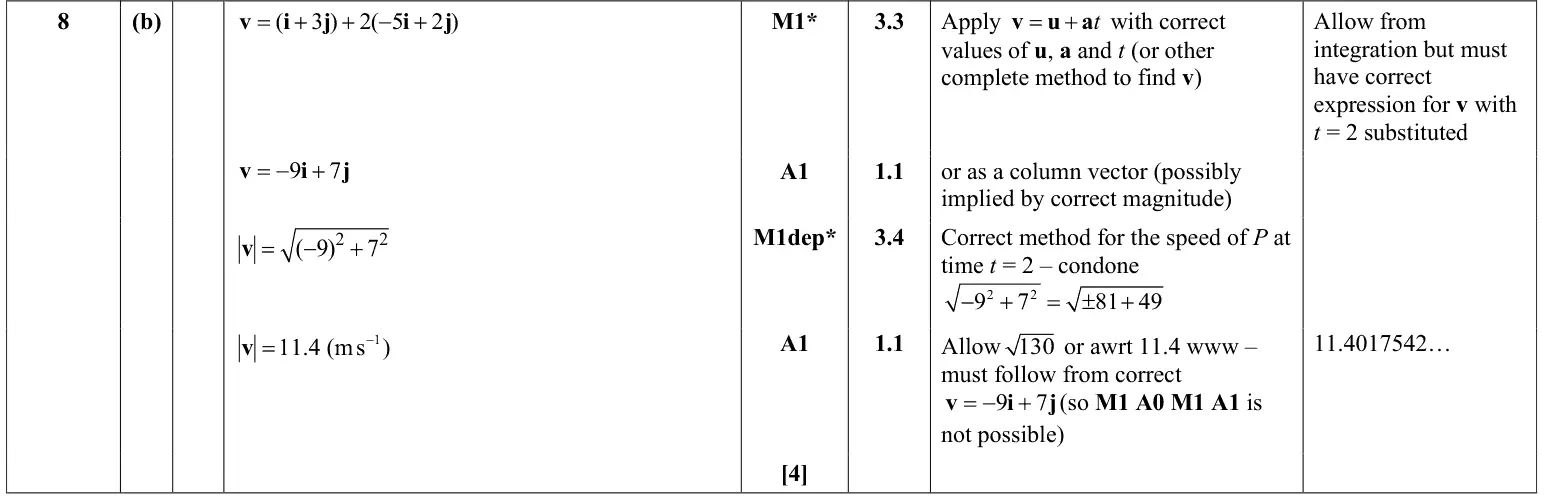
Most candidates correctly applied 𝐯= 𝐮+ 𝐚𝑡 to obtain the velocity vector for 𝑃 as −9𝐢+ 7𝐣. Many candidates left their answer as a vector and did not find the corresponding speed as directed. In this case the number of marks available should have been a strong indication of the amount of work required. Furthermore, a number of candidates attempted to use a vector form of 𝑣2 = 𝑢2 + 2𝑎𝑠 but most did not apply |𝐯|2 = |𝐮|2 + 2𝐚∙𝐬 correctly (not realising that each term of this equation was a scalar).
Key points and common errors
v = u + at = −9i + 7j
speed √130 = 11.4 m s⁻¹
many left the answer as a vector
June 2024 · Paper 3 · Q9(a)6 marksMedium
Mark scheme for this part
Examiner's comment
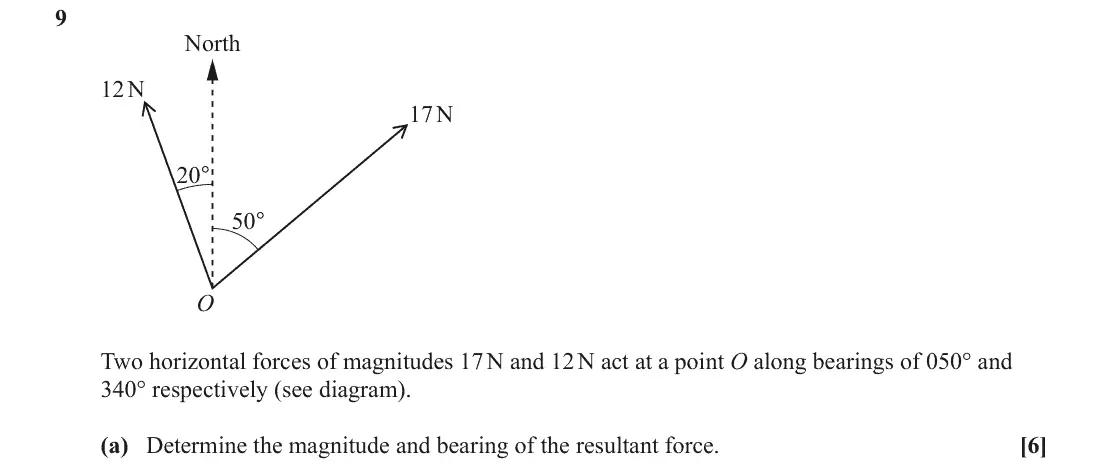
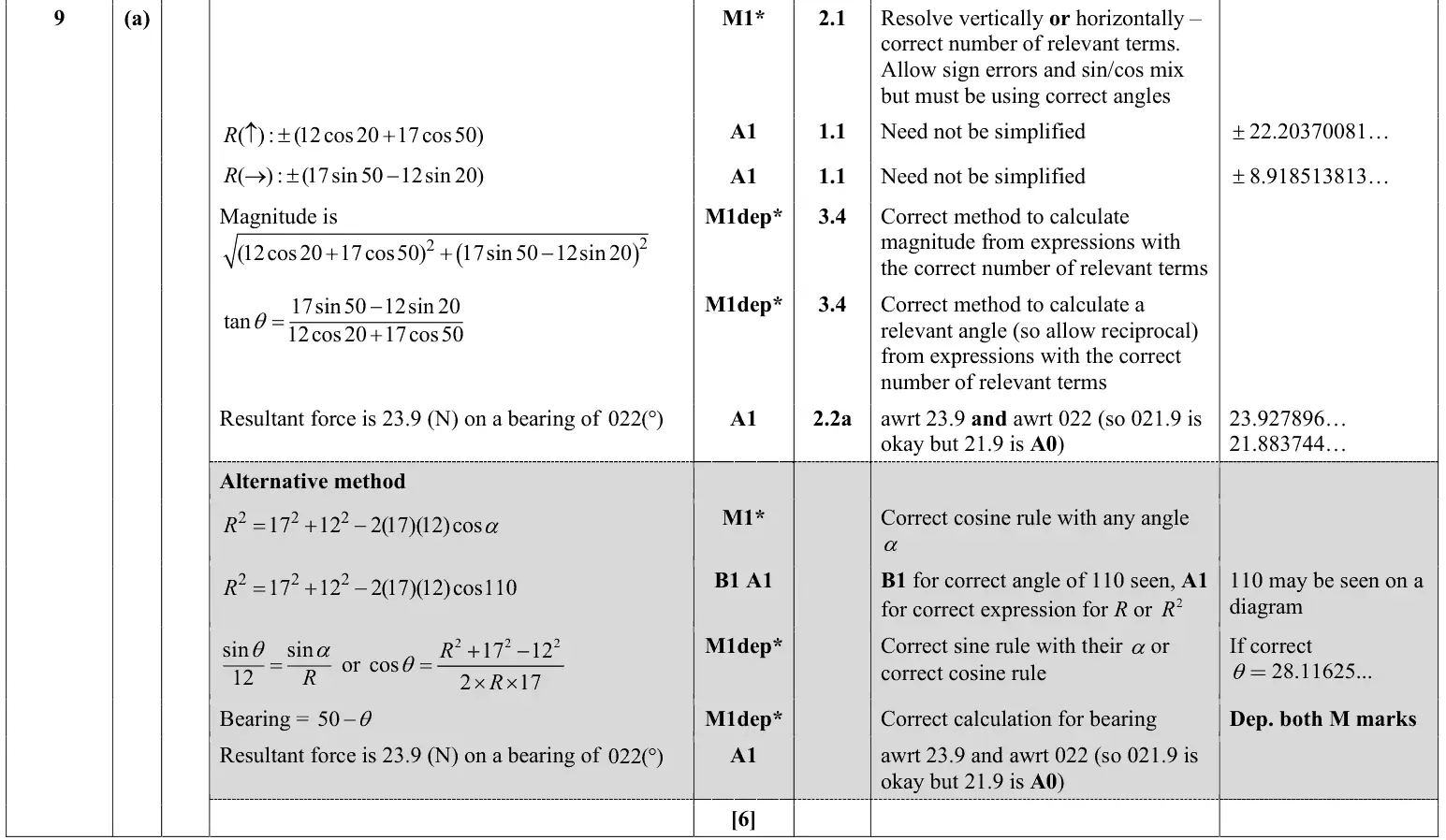
Most candidates resolved in a northerly and easterly direction in their attempts to find the magnitude and bearing of the resultant force (although attempts using a triangle of forces and the sine/cosine rules were just as successful). While many resolved correctly there were the usual sin/cos confusion and sign errors. It was surprising how many candidates, who found the magnitude correctly, did not find the correct bearing (and many who did not give the bearing in a correct three-figure form even though an example of a three-figure bearing was given in the question).
Key points and common errors
resolve N: 12cos20 + 17cos50 = 22.20
E: 17sin50 − 12sin20 = 8.92
R = 23.9 N on bearing 022°
or cosine rule with 110°
many found the magnitude but not the bearing
June 2023 · AS Paper 1 · Q2(a)(ii)1 markMedium
Show the start of this question
Mark scheme for this part
Examiner's comment
ሬሬሬሬሬ⃗ and AB. Many candidates left responses in the form of a ratio of vectors rather than This was reasonably well answered, but some candidates did not appear to recognise the difference in notation between AB lengths. Candidates who had not computed the vectors AB and BC needed to do so in this part. Some candidates made an error in comparing vectors, or gave the ratio the wrong way around (which could not be credited unless they specified the ratio as BC : AB). Only ratios in the form p : q were acceptable here (a ‘ratio’ of vectors could not be credited).
Key points and common errors
AB : BC = 1 : 2
must be a ratio of lengths not of vectors
June 2023 · AS Paper 1 · Q2(b)3 marksHard
Mark scheme for this part
Examiner's comment
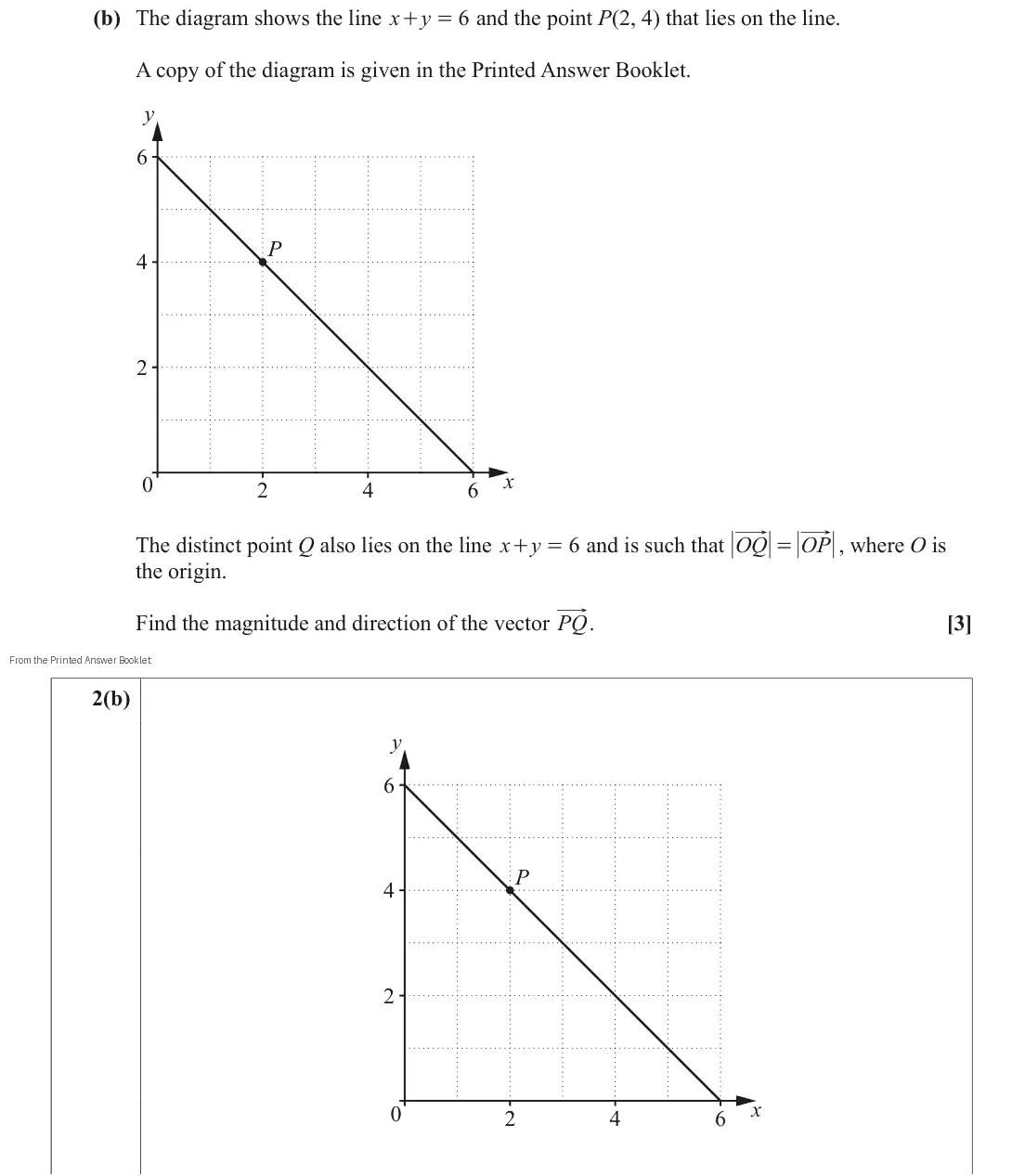
ሬሬሬሬሬሬ⃗ or OQ ሬሬሬሬሬሬሬ⃗ instead of PQ ሬሬሬሬሬሬ⃗ as required. Many candidates were able to correctly identify the point Q as (4, 2). Some candidates misread the question and gave the magnitude of OP ሬሬሬሬሬሬ⃗ (as -45° or 315°); in general candidates Relatively few candidates correctly computed the direction of PQ should know that the term ‘direction’ in questions relating to vectors means ‘compute the anti-clockwise angle to the positive x-axis’. Note that 135° could only be credited if specified as a bearing. Candidates who made use of the diagram in the answer booklet (while not required) were more likely to achieve 2 or 3 marks on this question.
Key points and common errors
Q = (4, 2) by symmetry
magnitude of PQ = 2√2
direction −45° or 315° measured anticlockwise from the positive x-axis
relatively few got the direction
June 2023 · Paper 2 · Q2(a)1 markMedium
Mark scheme for this part
Examiner's comment
Many candidates found the vector OP correctly but did not go on to give the required expression for the length. A few candidates muddled the 6 and 8. Almost all candidates gave the answer as 10k which was permitted, even though strictly the correct expression is 10|k| since length cannot be negative.
Key points and common errors
OP = k(6, 0, 8) so length 10 × modulus of k (10k allowed)
many found the vector but not the length
June 2023 · Paper 3 · Q84 marksMedium
Mark scheme for this part
Examiner's comment
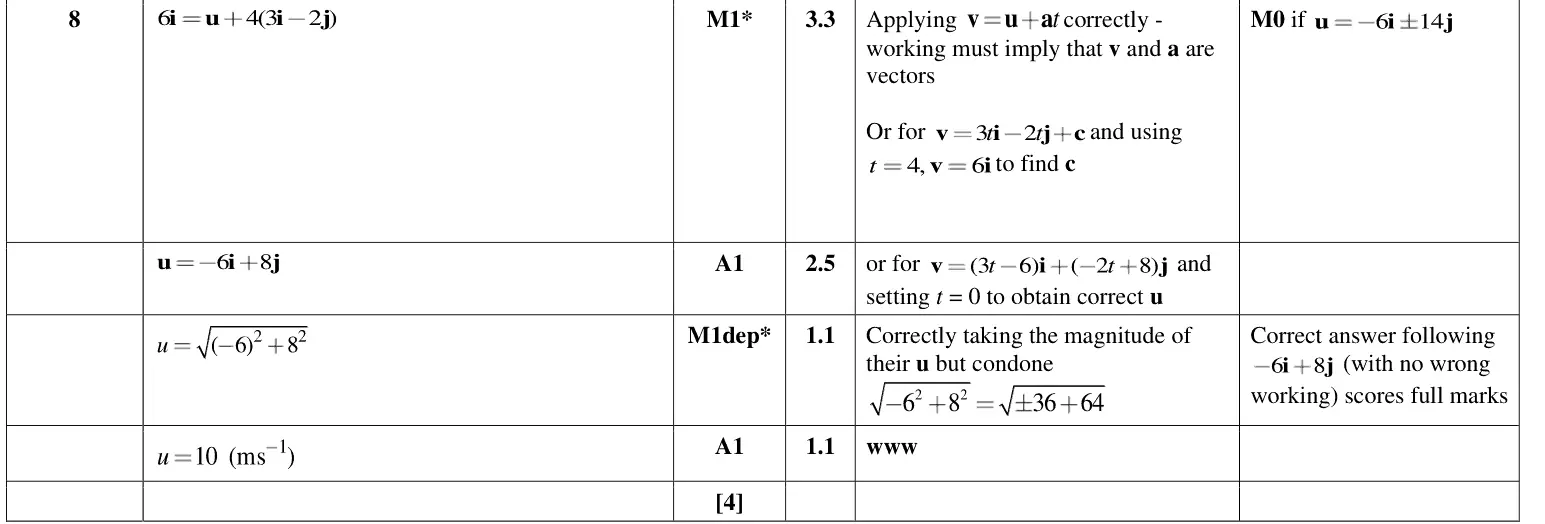
Most candidates correctly applied 𝐯𝐯= 𝐮𝐮+ 𝐚𝐚𝑡𝑡 to obtain the initial velocity vector for P as −6𝐢𝐢+ 8𝐣𝐣. Sadly, many candidates left their answer as a vector and did not find the corresponding speed as directed. In this case the number of marks available should have been a strong indication of the amount of work required.
Key points and common errors
v = u + at with vectors: u = 6i − 4(3i − 2j) = −6i + 8j
speed = √(36 + 64) = 10 m s⁻¹
many stopped at the vector
June 2023 · Paper 3 · Q10(b)4 marksEasy
Show the start of this question
Mark scheme for this part
Examiner's comment
determine that 𝐑𝐑= 2𝐢𝐢−6𝐣𝐣. Most then went on to correctly apply |𝐅𝐅| = 𝑚𝑚|𝐚𝐚| and found the correct value This part was answered well with most candidates using the given value of a to then find b and hence of m.
Key points and common errors
b = −8 so R = 2i − 6j
magnitude √40 = m × 5√10 so m = 0.4
June 2022 · AS Paper 2 · Q7(a)5 marksMedium
Mark scheme for this part
Examiner's comment
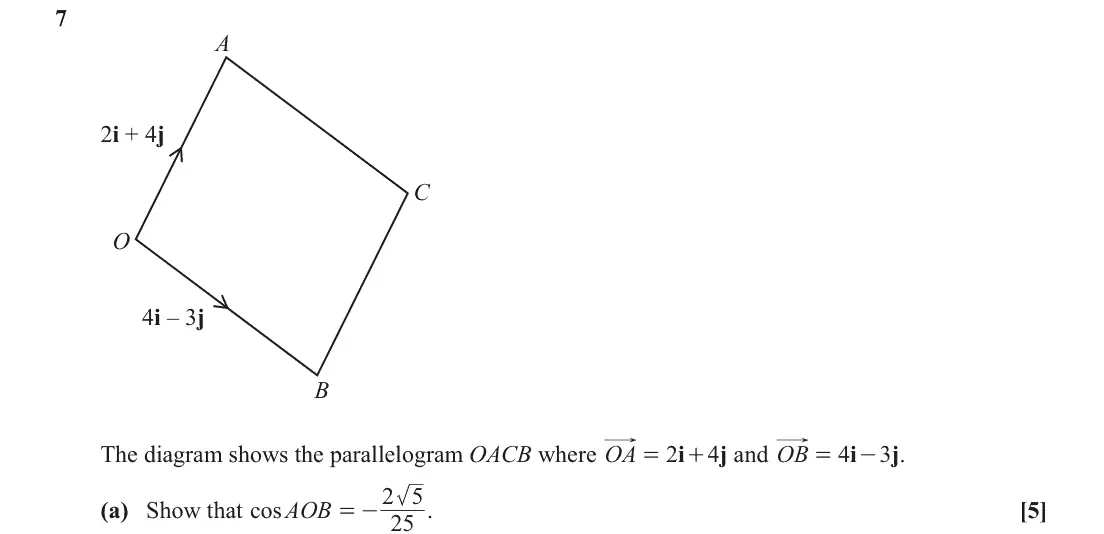
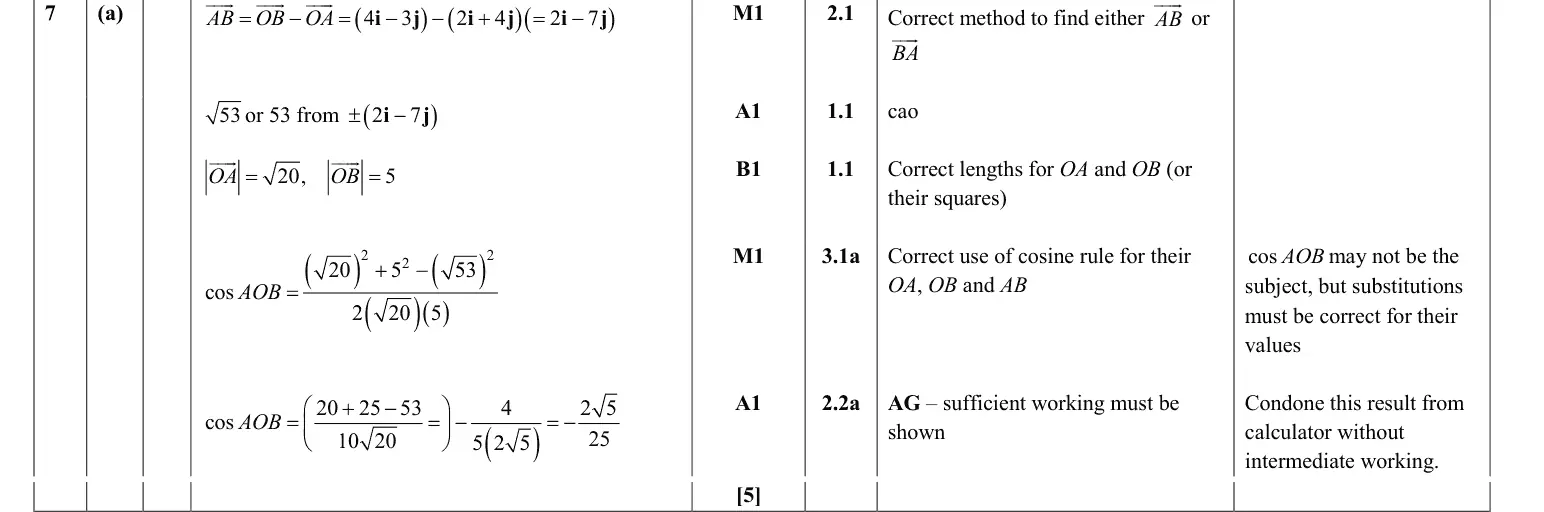
IOAI and IOBI were correctly found by many, and often less successful attempts could obtain AB and its length. Most realised the triangle AOB was not right angled and attempted the cosine rule. It is good practice for candidates to be in the habit of showing surd simplification even if the calculator is used to do the relevant work. Exact working was expected for full credit. Those who just used AOB = tan-1(4/2) + tan-1(3/4) to get 100.3° and their calculator with this to try and show the given result scored 0 marks.
Key points and common errors
AB = 2i − 7j so AB = √53, OA = √20, OB = 5
cosine rule with exact surd working gives −2√5/25
using tan⁻¹ angles and calculator scores 0
June 2022 · Paper 3 · Q12(c)5 marksHard
Show the start of this question
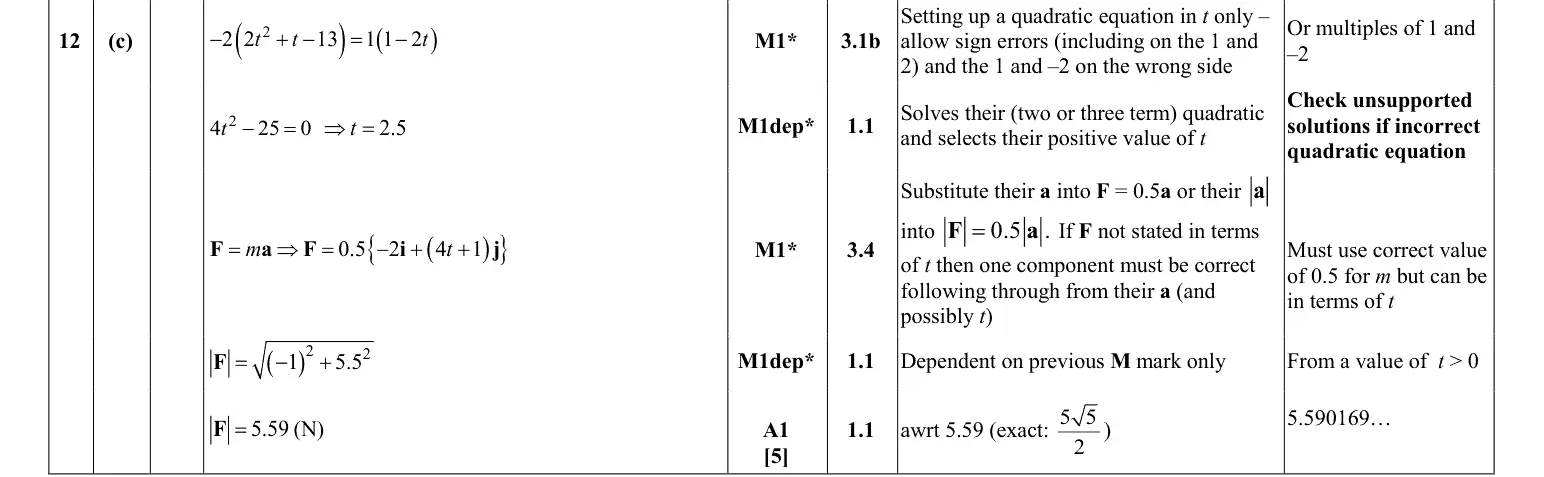
Mark scheme for this part
Examiner's comment
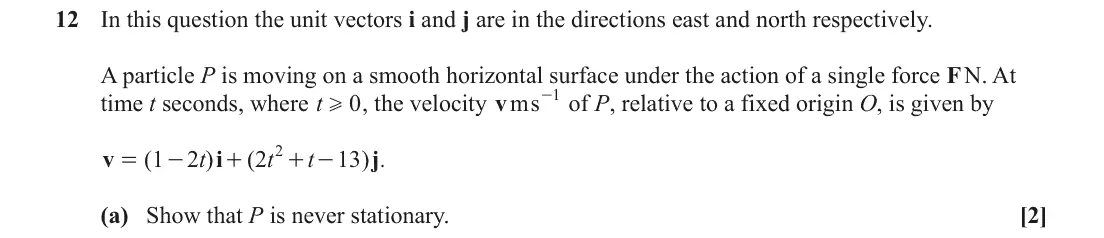
How to deal with ‘…moving in the direction of the vector 2 − i + j ’ was not well known by most candidates (and it would seem that many candidates did not realise that the direction of motion of P is governed by the corresponding velocity vector and not the displacement vector). For those candidates who did realise − − 2 1 2 t = that k for some constant k most usually went on to find the correct value of t as 2.5. + − 1 2 t t 13 In comparison, the vector expression for F (and corresponding magnitude) were much better known by candidates and even if they did not obtain the correct value of t they could still access some marks for their knowledge of these results.
Key points and common errors
direction of motion is the velocity: (2t² + t − 13)/(1 − 2t) = −1/2 gives 4t² = 25, t = 2.5
F = 0.5a
magnitude 5.59 N
June 2022 · Paper 3 · Q12(d)5 marksMedium
Show the start of this question
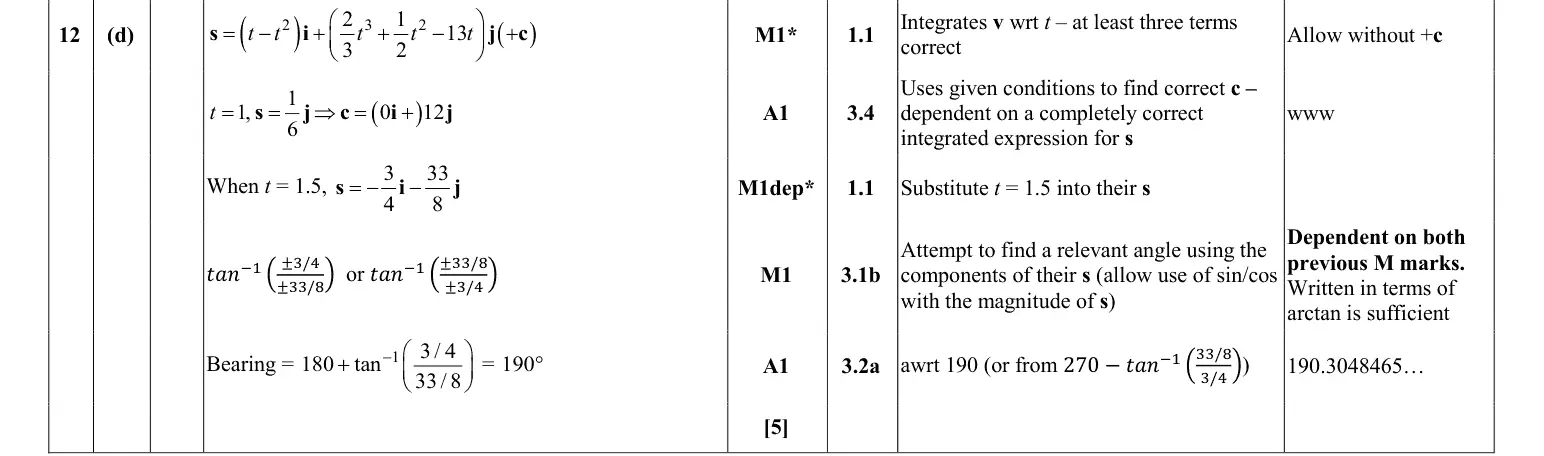
Mark scheme for this part
Examiner's comment
This question was much better answered than part (c) with many candidates correctly integrating the velocity vector to obtain the corresponding displacement vector. Some candidates did not include a vector constant of integration (and some just automatically assumed that it would be a zero vector). 3 33 However, many correctly found the displacement at time 1.5 as − − j and although many used the i 4 8 tan ratio to work out a suitable angle only some correctly found the required bearing.
Key points and common errors
integrate v with vector constant
c = 12j from s(1) = j/6
s(1.5) = −3/4 i − 33/8 j
bearing 190°
Autumn 2021 · AS Paper 1 · Q4(b)5 marksMedium
Show the start of this question
Mark scheme for this part
Key points and common errors
parallel to y-axis so x-component 6r − s = 0, s = 6r
magnitude (9r)² = 9 gives r = ±1/3
pairs r = 1/3, s = 2 and r = −1/3, s = −2 correctly paired
Autumn 2020 · Paper 3 · Q7(a)4 marksEasy
Mark scheme for this part
Examiner's comment
(Comment on Question 07 as a whole) This was perhaps the best answered question on the paper. Unfortunately, marks were dropped in both parts where candidates gave an answer for velocity when speed was requested or for distance when displacement was requested. A significant number of candidates attempted this question using calculus; while valid, the responses were more likely to include arithmetic errors.
Key points and common errors
v = u + at = −5i + 12j
speed 13 m s⁻¹ (a speed not a velocity)
June 2019 · Paper 1 · Q2(a)(i)1 markHard
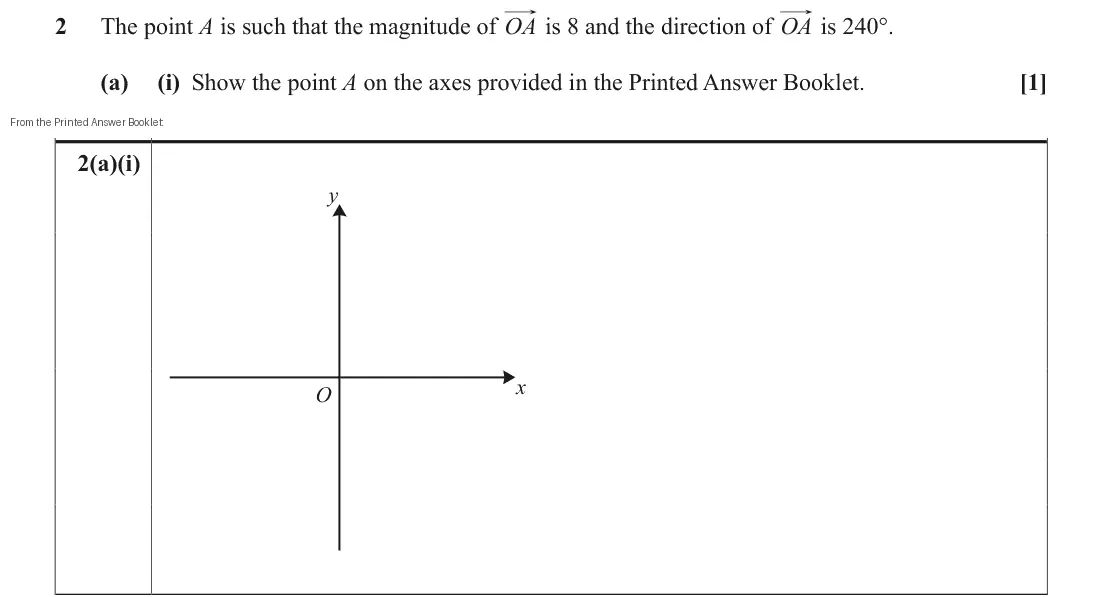
Mark scheme for this part
Examiner's comment
This proved to be a challenging question; while candidates appeared to be familiar with the term ‘magnitude’ they were less certain about the ‘direction’ of a vector and many treated it as a bearing, taking it clockwise from the y-axis. Candidates should make sure that they show sufficient detail on any sketch; in this question both the length of OA and a relevant angle were expected to be labelled.
Key points and common errors
direction measured anticlockwise from the positive x-axis, not a bearing
A in the third quadrant with length 8 and an angle labelled
June 2019 · Paper 1 · Q2(a)(ii)3 marksMedium
Show the start of this question
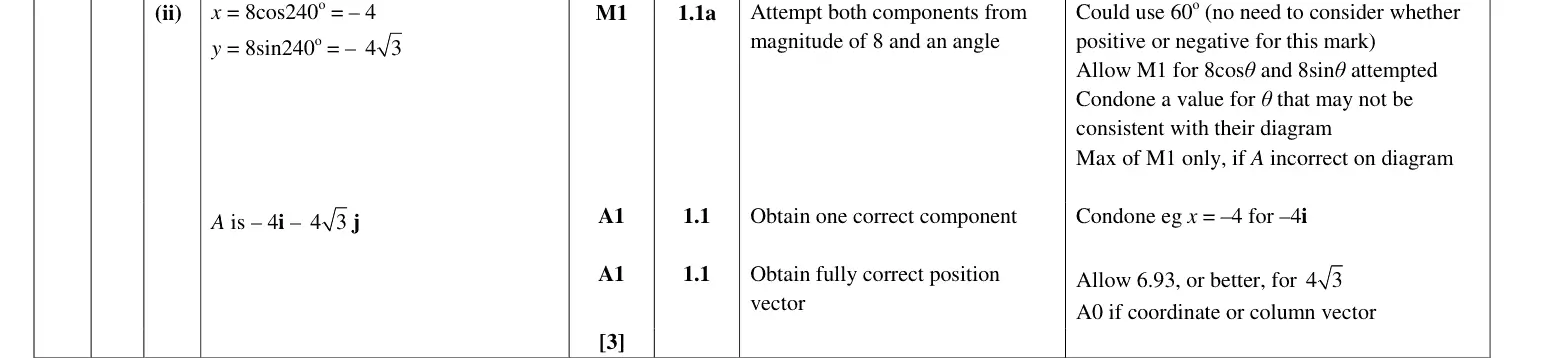
Mark scheme for this part
Examiner's comment
Most candidates were able to make some attempt at finding the components of the position vector, with some using basic trigonometry and others setting up, and solving, simultaneous equations using Pythagoras’ theorem and invtan. However, the incorrect positioning of the point A in the previous part of the question inevitably limited the marks gained in this part for many of the candidates.
Key points and common errors
8cos240° = −4, 8sin240° = −4√3 so −4i − 4√3j
marks limited by a wrongly placed A
not a coordinate or column vector
June 2019 · Paper 3 · Q8(d)4 marksHard
Show the start of this question
Mark scheme for this part
Examiner's comment
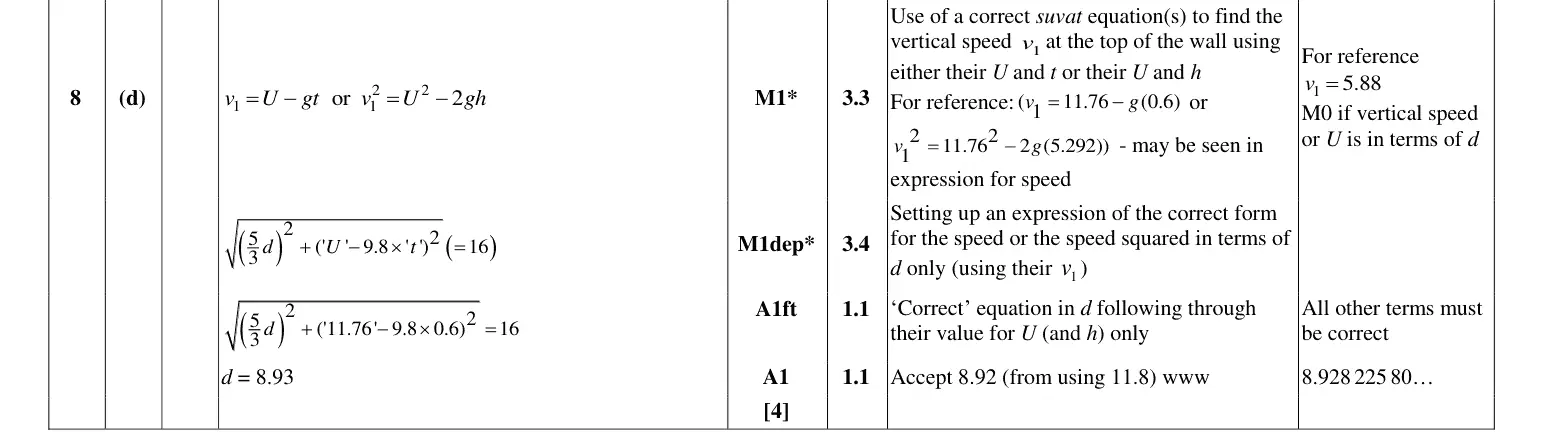
The most common misconception here was to use the result from part (b) together with v = 16 in the equation v = u + 2 as instead of realising that the vertical component of the speed, v , at the top of the wall had to be worked out first before then using the equation ( ) 16 and solving to find the d + v = value of d.
Key points and common errors
vertical speed at wall 11.76 − 0.6g = 5.88
((5/3)d)² + 5.88² = 16²
d = 8.93
using 16 directly in v² = u² + 2as
June 2019 · Paper 3 · Q10(a)6 marksMedium
Mark scheme for this part
Examiner's comment
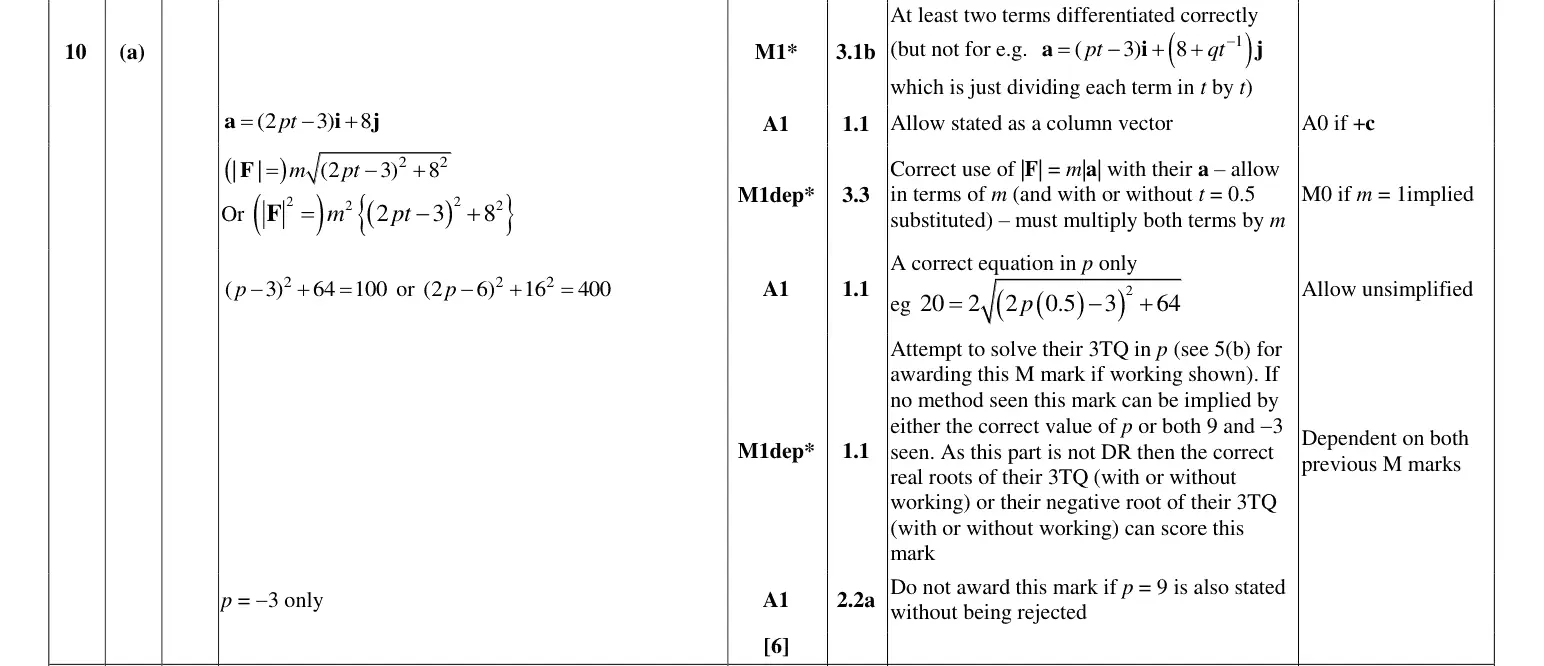
( ) Nearly all candidates correctly differentiated v and obtained a = 2 pt − 3 i + 8 j Unfortunately many . candidates then made careless slips in applying F = m a to obtain an equation in p only with the most common errors being forgetting the mass completely or only multiplying the i component by the value of m. Candidates are one again reminded to read the question carefully as while many had a correct equation in p e.g. ( p − 3 ) + 64 = 100 many solved and gave the positive root even though the question specifically said that p was negative. This response scored the first five marks. An almost perfect response let down by the fact that the candidate did not read the question carefully enough and assumed that the value of p could not be negative.
Key points and common errors
a = (2pt − 3)i + 8j
F = 2a with magnitude 20 at t = 0.5
(p − 3)² + 64 = 100
p = −3 only since p < 0
forgetting mass
June 2018 · AS Paper 2 · Q94 marksHard
Mark scheme for this part
Examiner's comment
This question proved to be challenging for the majority of candidates. The need to find the magnitude of the acceleration was not well understood. For those who did use it, algebraic and numerical errors sometimes marred the solution. (±)10 = 2(3(2t – 5)i + 4j) was common, even when the correct methods then followed, but in many cases equations like 10 = 12t – 30 were used. A number of candidates ignored the mass and F = a pursued.
Key points and common errors
F = ma with magnitude: 2√(9(2T − 5)² + 16) = 10 gives 2T − 5 = ±1 so T = 2 or 3
magnitude of acceleration was often ignored
F = a ignoring mass
Find an A-level maths tutor
Stuck on this? Book a trial session with an A-level maths tutor.