1.04a The binomial expansion of (a + bx)ⁿ for positive integer n and the…
Section
1.04 Sequences and Series
Level
AS & A level
Statement
Understand and be able to use the binomial expansion of (a + bx)ⁿ for positive integer n and the notations n! and ⁿCᵣ, ₙCᵣ or (n r), with ⁿC₀ = ⁿCₙ = 1.
Guidance
e.g. Find the coefficient of the x³ term in the expansion of (2 − 3x)⁷. Learners should be able to calculate binomial coefficients. They should also know the relationship of the binomial coefficients to Pascal's triangle and their use in a binomial expansion. They should also know that 0! = 1.
Most candidates scored 2/2 marks here. Common errors included writing 2𝑥7 instead of (2𝑥)7 or giving the wrong combination. Candidates should be reminded that the Binomial series is given in the formula table on page 2 of the Question Paper. This is a good example of a question where correct use of a calculator provides an efficient route to the answer.
Key points and common errors
⁹C₇ × 2⁷ × 3² = 41472
errors 2x⁷ for (2x)⁷ or wrong combination
June 2025 · AS Paper 1 · Q5(b)(i)1 markEasy
Mark scheme for this part
Examiner's comment
This question was generally well answered. Most candidates appeared to identify the link to the symmetry of the Binomial expansion, but some candidates did not note the word ‘consecutive’ and gave another pair. Common errors included 9 and 10, or 11 and 12. No calculation was required. Note that strictly the question said, ‘state the powers of x’ so the answer should have been ’10 and 11’. Many candidates gave instead 𝑥10 and 𝑥11 or similar, which the scheme allowed on this occasion.
Key points and common errors
symmetry of ²¹Cᵣ: powers 10 and 11 (consecutive)
errors 9 and 10, 11 and 12
June 2025 · AS Paper 1 · Q5(b)(ii)2 marksMedium
Show the start of this question
Mark scheme for this part
Examiner's comment
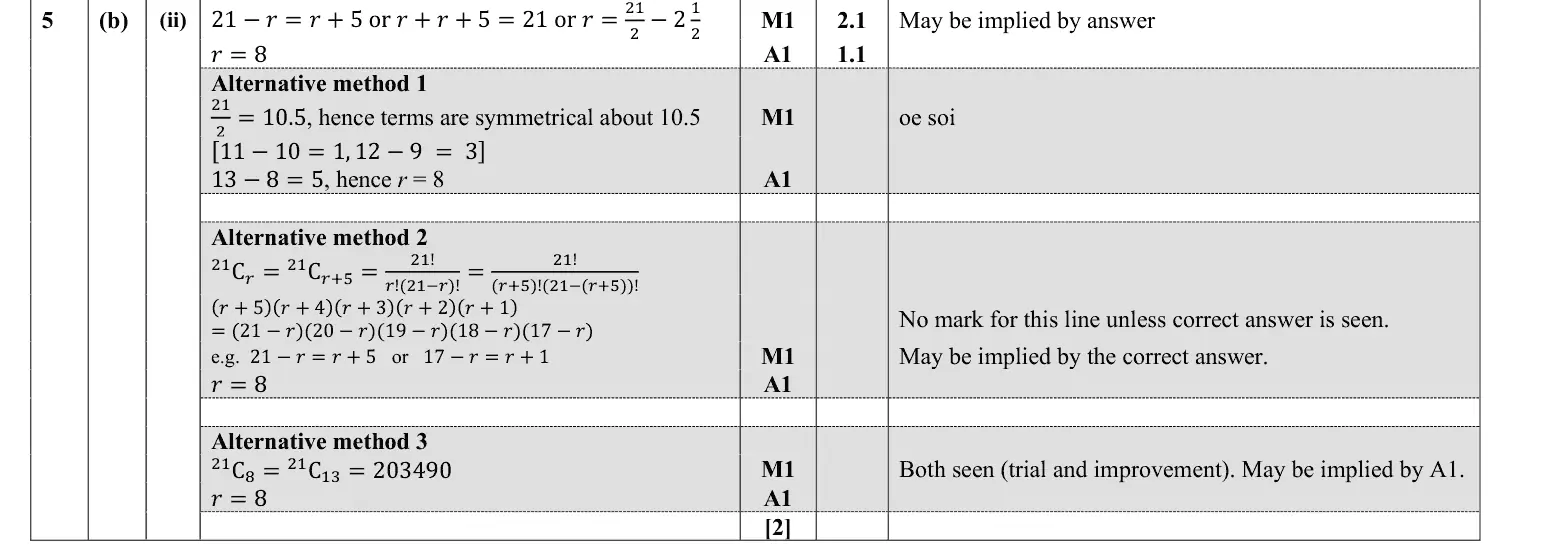
Many candidates obtained the correct answer 𝑟= 8, often using a calculator (and, presumably, some trial and improvement) to find two values with equal coefficients. The question command was ‘Find’ so no working was required for full marks, but for those candidates who didn’t reach the correct answer, creditable working was rarely seen. Candidates should be encouraged to write down what they know, and interpret the question – for instance, here, translating the information in the question by substituting into two Binomial coefficients, equated, would have been sufficient for the M mark.
Key points and common errors
²¹Cᵣ = ²¹Cᵣ₊₅ so r + (r + 5) = 21, r = 8
show the equated coefficients
June 2024 · AS Paper 1 · Q4(a)1 markEasy
Mark scheme for this part
Examiner's comment
Most candidates answered this correctly, although quite a few misinterpreted the question and attempted to give the coefficient rather than the term in b5 (giving either 792 or 792a7). Some candidates selected the wrong term, or an incorrect term – for instance writing a8b5 or a8b6. The coefficient 924 was often seen.
Key points and common errors
¹²C₅a⁷b⁵ = 792a⁷b⁵
the term, not just the coefficient
June 2023 · AS Paper 2 · Q4(a)3 marksEasy
Mark scheme for this part
Examiner's comment
This question was answered well. The binomial series is included on the formulae sheet and this was no doubt of benefit to candidates, with many having at least two correct terms. The question said, ‘Find and simplify…’, so examiners expected to see the terms simplified and answers such as 240/9k2x2 scored A0 (this term was the one that candidates most often struggled to simplify, with 80k2x2, 80kx2 and 80/3kx2 seen). Occasionally the three terms were given in descending powers of x.
Key points and common errors
64 + 64kx + (80/3)k²x²
terms must be simplified
using kx instead of kx/3
June 2023 · AS Paper 2 · Q4(b)3 marksHard
Show the start of this question
Mark scheme for this part
Examiner's comment
This part of the question proved more challenging. Many candidates obtained the two term coefficient of x2 in the correct way, but this was then set equal to k or 0 rather than 3 × their constant term from (a). Note that those having k rather than k2 in the x2 term in (a) could not get a three term quadratic in k. The request for an exact value for k was well adhered to.
Key points and common errors
x² coefficient of (3 − 4x)(…) is 80k² − 256k
set equal to 3 × 64 = 192: 5k² − 16k − 12 = 0
k = (8 + 2√31)/5 exact, positive root only
equating to k or 0 is wrong
June 2023 · Paper 1 · Q8(c)4 marksEasy
Show the start of this question
Mark scheme for this part
Examiner's comment
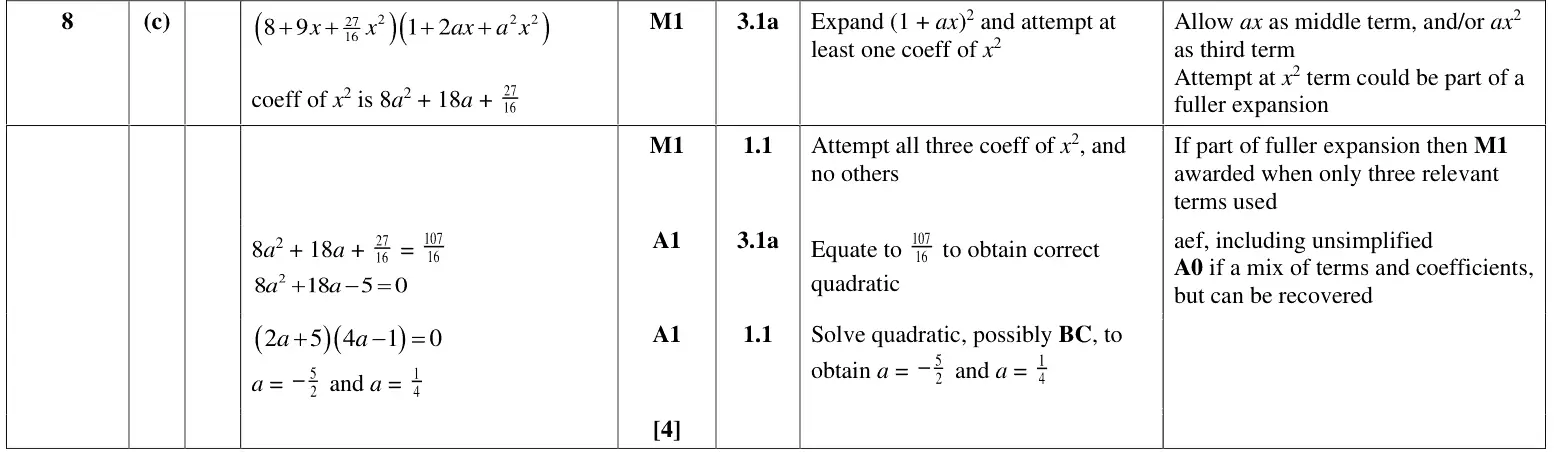
This part of the question was also very well answered. Most candidates were able to gain at least 2 marks for attempting three relevant terms from the product of their expansion with their attempt at (1 + ax)2. While detailed methods were more common, the wording of the question did allow candidates to solve the resulting equation on their calculator, but it was only a minority that did so.
Key points and common errors
coefficient of x² is 8a² + 18a + 27/16 = 107/16
a = −5/2 or 1/4
June 2023 · Paper 2 · Q9(b)(i)1 markMedium
Show the start of this question
Mark scheme for this part
Examiner's comment
Many candidates were able to give this expression for the standard Binomial probability correctly (often with follow-through using their values from part (a)). Some candidates omitted the combination term or gave the general expression without values substituted in, which was not enough for the mark.
Key points and common errors
²⁰Cₓ (1/3)ˣ (2/3)^(20 − x)
values must be substituted
coefficient often omitted
June 2022 · AS Paper 1 · Q12 marksMedium
Mark scheme for this part
Examiner's comment
Some candidates lost the minus sign. Many candidates wrote out all the terms. Others wrote just the terms up to x3. Many candidates wrote the correct term, −720x3 but then gave, as their answer, just the coefficient −720. Some did not cube the 2. A few seemed unfamiliar with the binomial expansion and attempted to find (3 − 2x)5 by repeated multiplication of brackets.
Key points and common errors
⁵C₃ × 3² × (−2x)³ = −720x³
give the term not just the coefficient
lost minus sign
not cubing the 2
June 2022 · Paper 1 · Q6(a)4 marksEasy
Mark scheme for this part
Examiner's comment
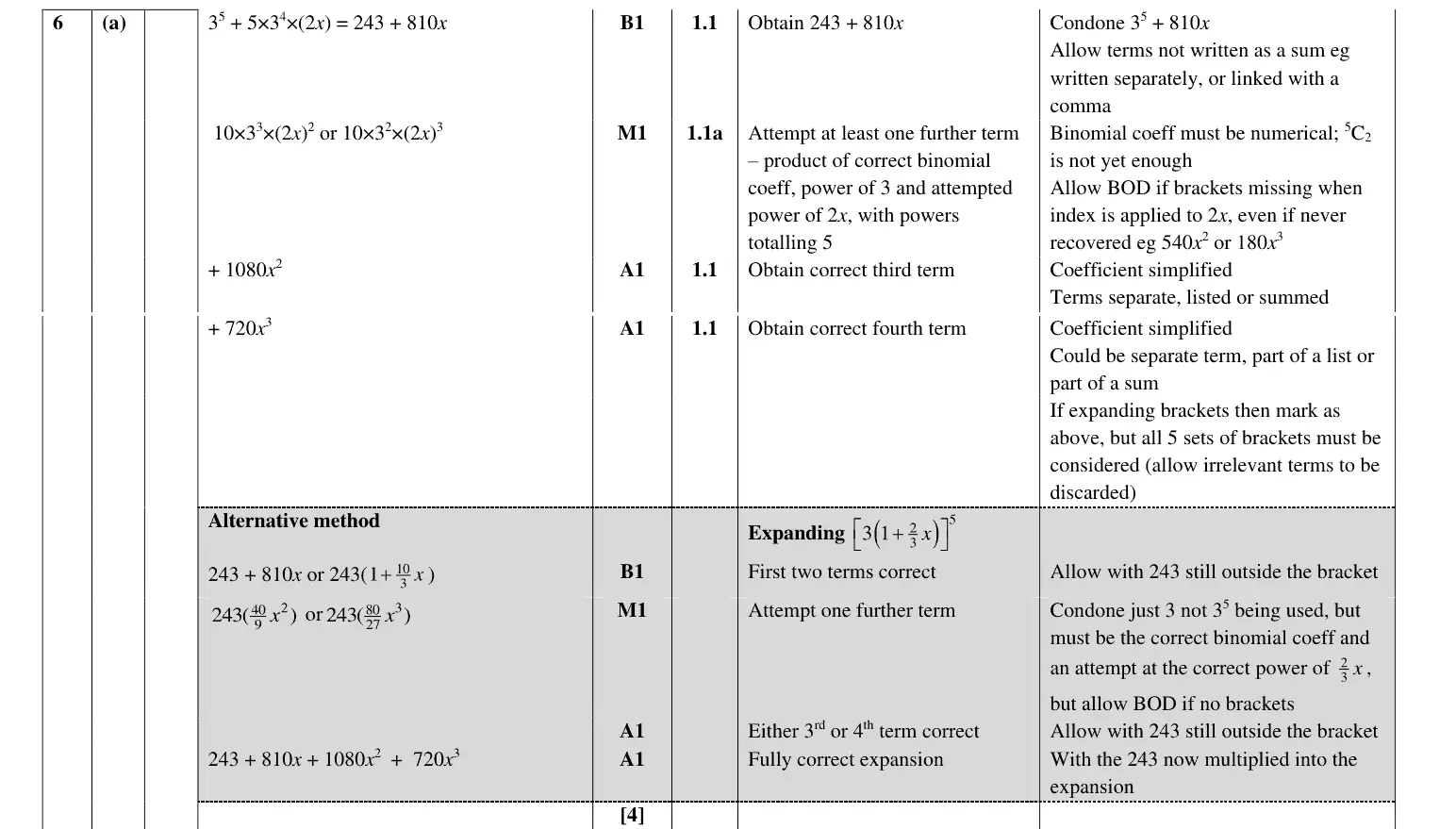
This proved to be another question that was very well answered, with fully correct solutions being very common. The more successful approach was to simply to use the binomial expansion of (a + b)n, as provided in the list of formulae at the start of the paper. A surprising number of candidates instead decided to first reduce it to the form (1 + x)n, which could then cause problems with the factor being taken out often seen as just 3 and not 35. Candidates should consider what strategy is most appropriate for the question posed.
Key points and common errors
243 + 810x + 1080x² + 720x³ using the (a + b)ⁿ formula
taking out 3 instead of 3⁵
June 2022 · Paper 1 · Q6(b)4 marksHard
Show the start of this question
Mark scheme for this part
Examiner's comment
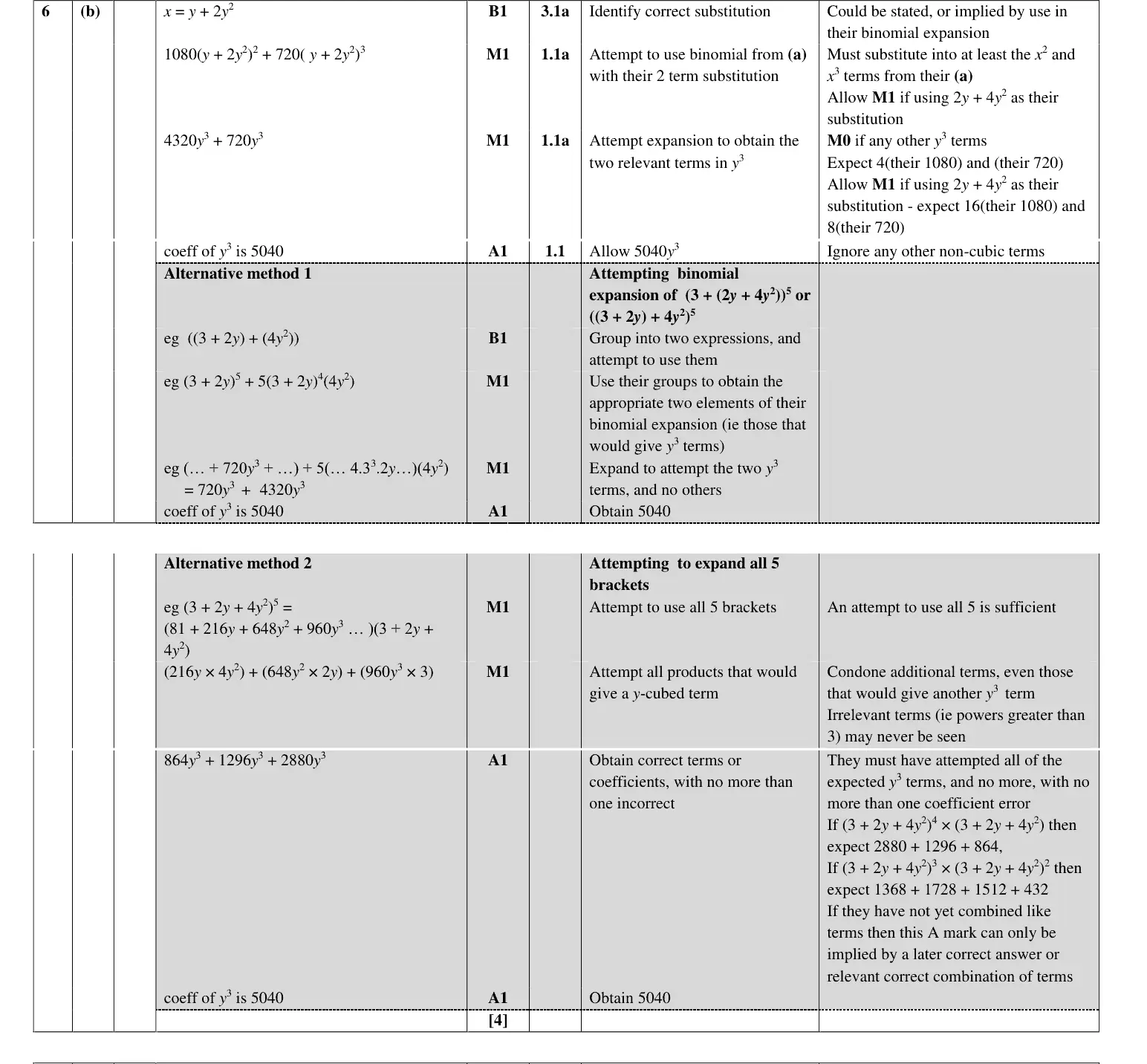
This second part of the question proved to be much more challenging. Some candidates, guided by the word ‘hence’, did attempt to link the two parts of the question with the most common error being to use x = 2y + 4y2; this could still gain 2 of the 4 marks available. Other sensible attempts included splitting the three terms into two groups and attempting to use another binomial expansion, or attempting a combinatorics method having identified how y3 terms could be created. Attempts involving the manual expansion of all 5 brackets were rarely complete or successful.
Key points and common errors
substitute x = y + 2y² into the x² and x³ terms: 4320y³ + 720y³ = 5040
common error x = 2y + 4y²
expanding all five brackets rarely works
Autumn 2021 · Paper 2 · Q14(d)5 marksMedium
Show the start of this question
Mark scheme for this part
Key points and common errors
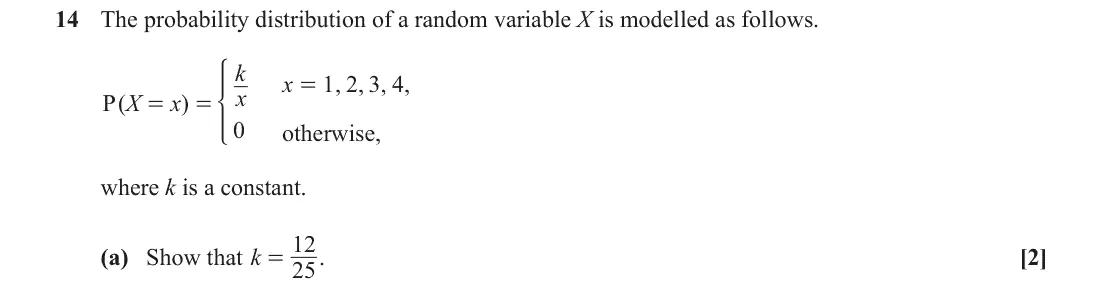
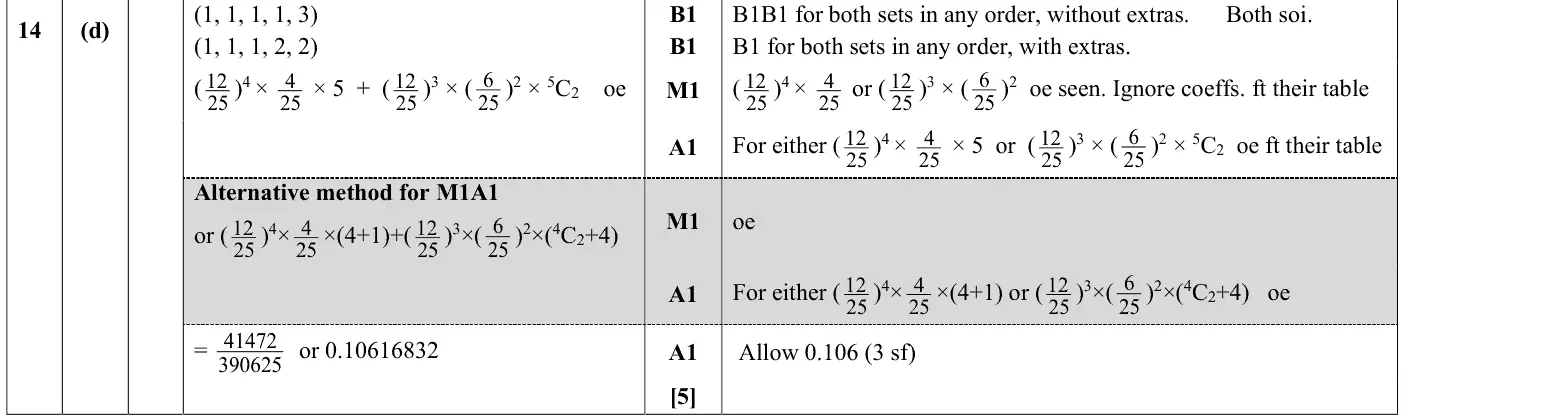
sets {1,1,1,1,3} (5 orders) and {1,1,1,2,2} (⁵C₂ orders)
(12/25)⁴(4/25) × 5 + (12/25)³(6/25)² × 10 = 0.106
Autumn 2020 · AS Paper 1 · Q4(a)1 markMedium
Mark scheme for this part
Key points and common errors
1 + 4x + 6x² + 4x³ + x⁴
Autumn 2020 · AS Paper 1 · Q4(b)4 marksHard
Show the start of this question
Mark scheme for this part
Examiner's comment
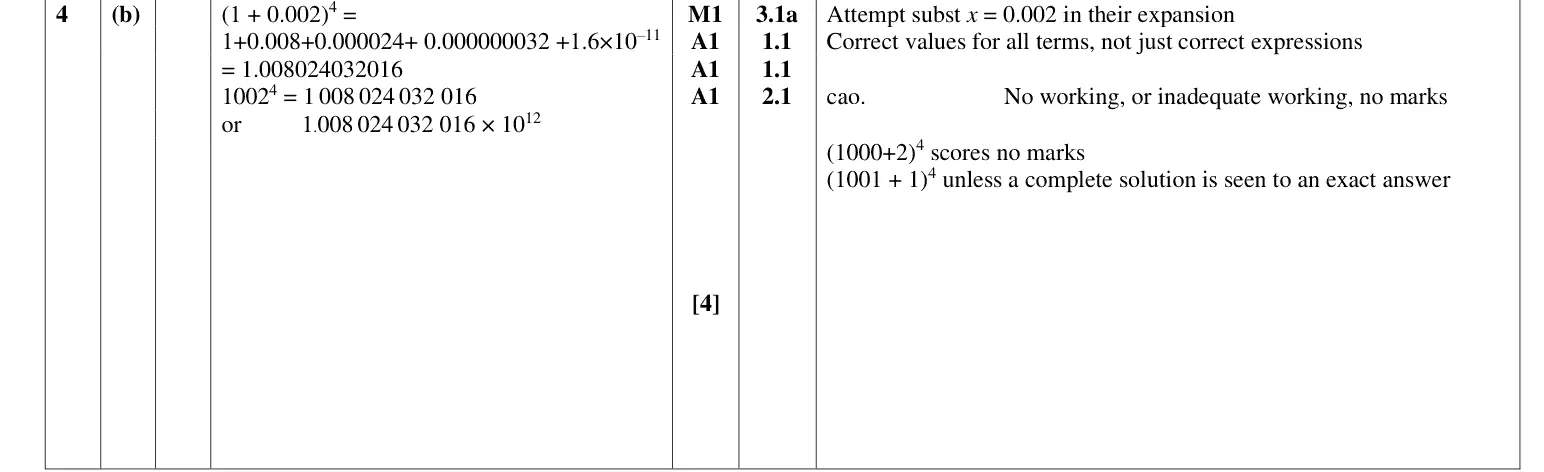
Almost no candidates realised the need to use (1 + 0.002)4. Most tried to use (1 + 1001)4.
Key points and common errors
1002⁴ = 10¹²(1 + 0.002)⁴
x = 0.002
1 008 024 032 016 exact
(1 + 1001)⁴ or (1000 + 2)⁴ do not use the expansion
June 2019 · AS Paper 2 · Q4(a)3 marksEasy
Mark scheme for this part
Examiner's comment
The expansion method was done well in general, although a few used ( 5x rather than ( ) ) − 5x . 5 A few unnecessarily tried to rewrite as 2 1 − with mixed success. 2x
This part was found to be much more challenging. We wanted to see evidence of the expansion of ( ) 1 + ax and the multiplication to give two relevant terms in x , then connected to the given 48, but this requirement was not always recognised.
Key points and common errors
(1 + 2ax + …)(32 − 400x + …): x coefficient 64a − 400 = 48 so a = 7
show the two contributing terms
June 2019 · Paper 1 · Q66 marksMedium
Mark scheme for this part
Examiner's comment
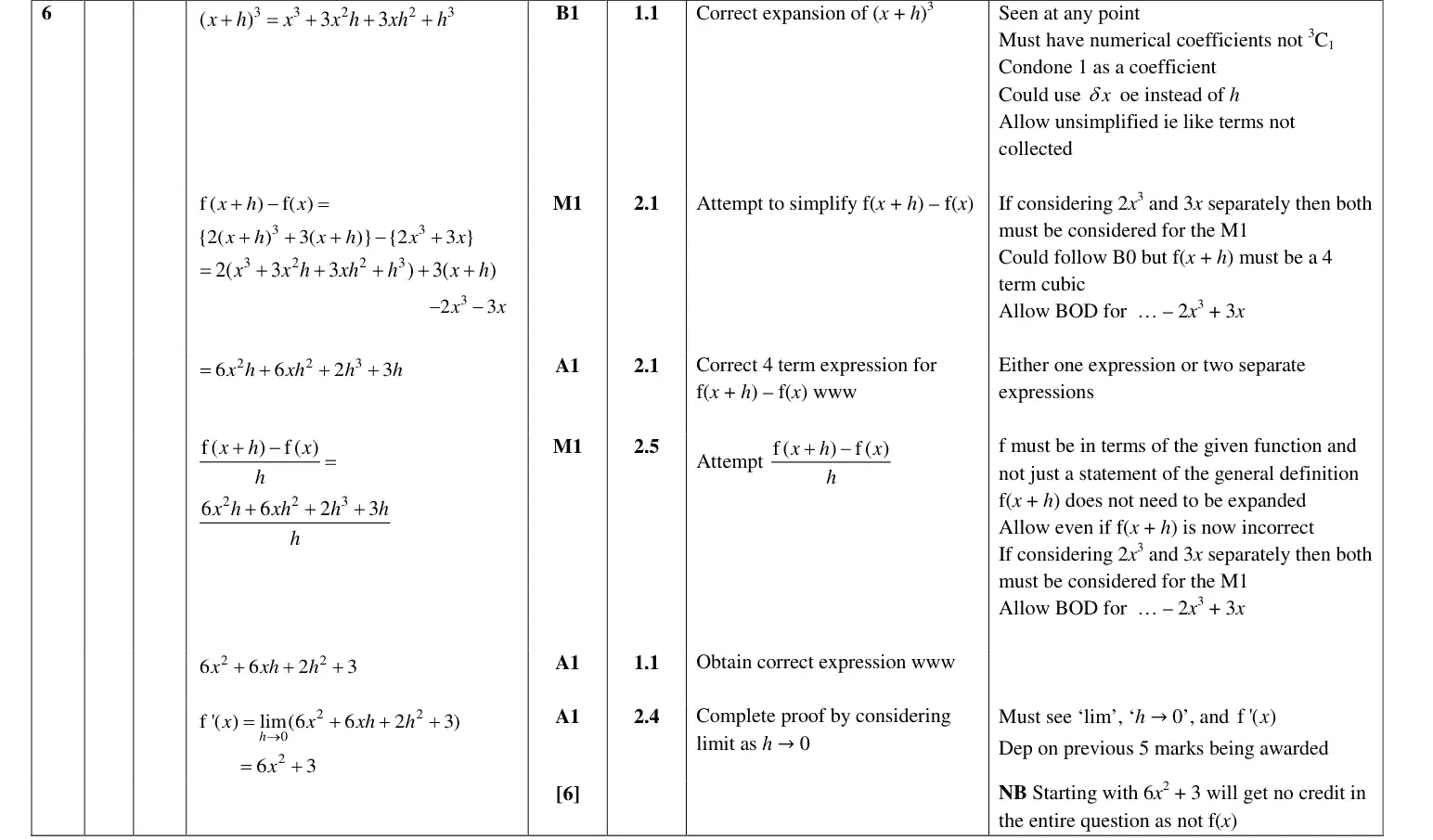
Most candidates seemed familiar with the process of differentiation from first principles, quoting the formula from the question paper and attempting to apply it to the given function. The best candidates made effective use of brackets and used a new line for each step of their solution rather than attempt to do too much in one go. The expansion of (x + h)3 was usually correct, although many candidates elected to expand three brackets rather than apply the binomial expansion. When the expansion was multiplied by 2, it was quite common to see some incorrect coefficients, especially in the solutions of those who had expanded three brackets and not then collected like terms. The other common error was due to not using brackets when introducing –(2x2 + 3x) in the numerator, resulting in the 3x being of the incorrect sign. Some candidates appeared not to notice and cancelled +3x with another +3x, whereas others did realise that there was an error and attempted to correct it, but this was not always applied to every line of working. Candidates who had a correct simplified expression were usually able to complete the proof by explicitly considering the limit as h tended to 0. Each step in this proof is clearly detailed, and only one step is made on each line which makes the proof convincing and easy to follow. The candidate uses correct notation throughout, including explicit consideration of the limit as h tends to 0. The candidate gains the first mark for setting up the correct expressions and gains a second mark for the correct binomial expansion. On the third line it seems that the cancelling by h has occurred before the numerator has been simplified so no further credit is given. This is an example of trying to do too much in one go.
Key points and common errors
(x + h)³ = x³ + 3x²h + 3xh² + h³
f(x + h) − f(x) = 6x²h + 6xh² + 2h³ + 3h
divide by h and use lim h → 0 with correct notation
coefficients slip when multiplying by 2
June 2019 · Paper 2 · Q2(a)1 markEasy
Mark scheme for this part
Examiner's comment
Most candidates answered this correctly, although a few omitted the "–" sign.
Key points and common errors
⁸C₅ 3³ (−2)⁵ = −48384
minus sign omitted
June 2018 · Paper 2 · Q13(ii)3 marksHard
Show the start of this question
Mark scheme for this part
Examiner's comment
Some candidates appeared not to understand the definition of Tr and Tr+ 1. Many candidates omitted the relevant powers of 0.85 in their expressions for Tr and Tr + 1. Some wrote the correct expressions for both Tr and Tr+ 1, but were unable to find any common factors to cancel. Many attempted to expand the given binomial expression, but did not include a general term. Some candidates "fudged" the answers giving, for example, Tr = 0.85(r + 1) and Tr + 1 = 0.15(50 – r) etc.
Key points and common errors
Tᵣ = ⁵⁰Cᵣ 0.15ʳ 0.85^(50−r)
cancel factorials to (r + 1)/(50 − r) × 0.85/0.15
many omitted the powers of 0.85
June 2018 · Paper 3 · Q4(ii)6 marksMedium
Show the start of this question
Mark scheme for this part
Examiner's comment
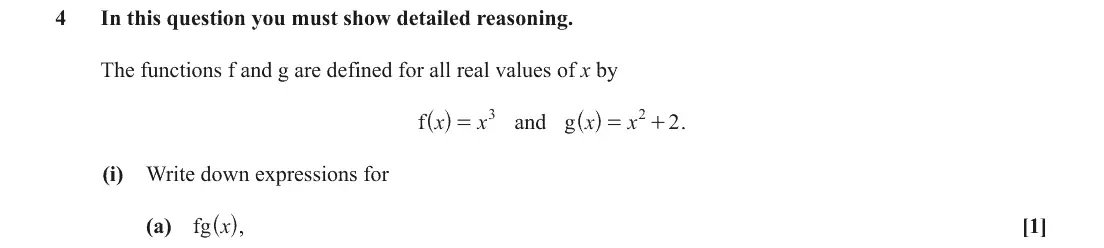
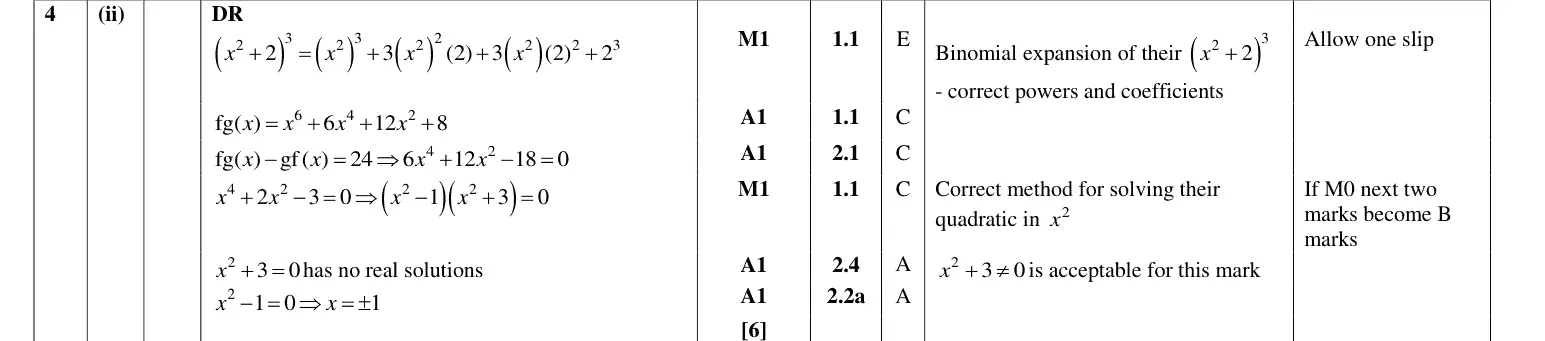
There were a significant number of candidates that did not employ correct bracketing and mistakenly wrote( ) rather than( ) ( ) ( ) x + 2 − x + 2 = 24 x + 2 − x + 2 = 24 ⇒ x + 2 − x − 2 = 24 . The majority of candidates went for expanding ( ) x + 2 by writing out the bracket three times rather than using the binomial expansion of ( a + b ) . While the majority rearranged their quartic into the form ( ) + 6 x 12 x − 18 = 0 there were a number of candidates did not show sufficient working in solving this quartic, even though the full question required detailed reasoning. Finally, it is expected at this level that as part of the detailed reasoning candidates should justify why x + 3 = 0 did not provide any solutions.
Key points and common errors
expand (x² + 2)³ = x⁶ + 6x⁴ + 12x² + 8
brackets needed when subtracting gf(x)
6x⁴ + 12x² − 18 = 0
(x² − 1)(x² + 3) = 0
reject x² = −3 explicitly
x = ±1
Find an A-level maths tutor
Stuck on this? Book a trial session with an A-level maths tutor.