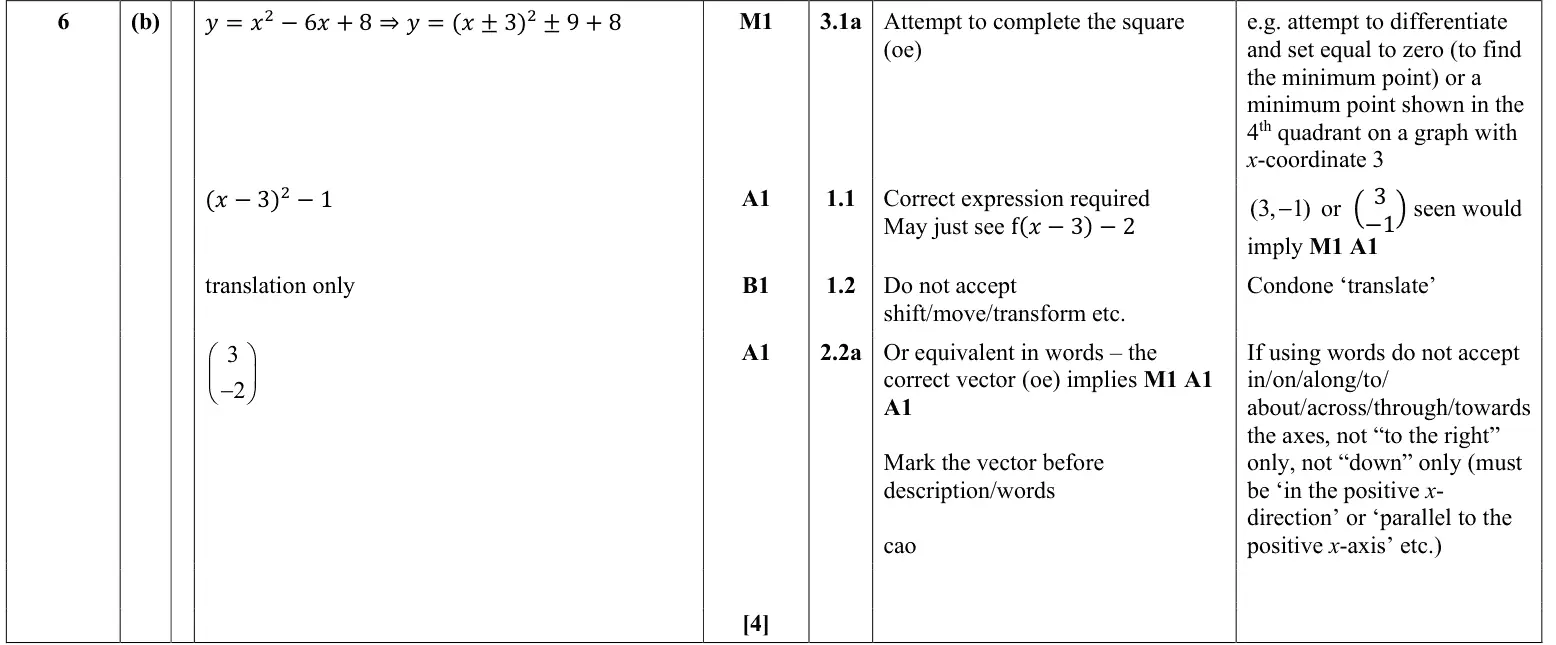
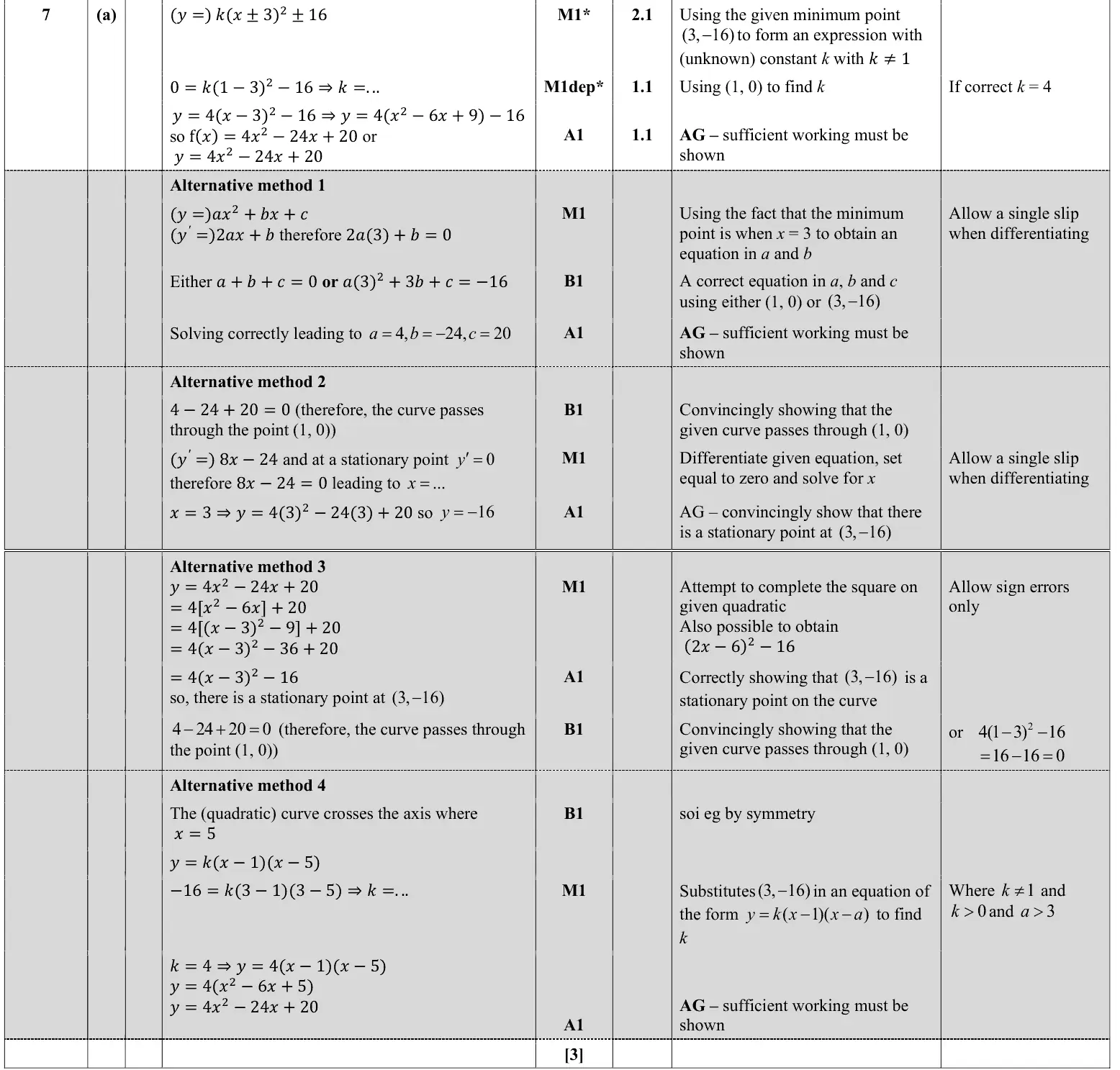
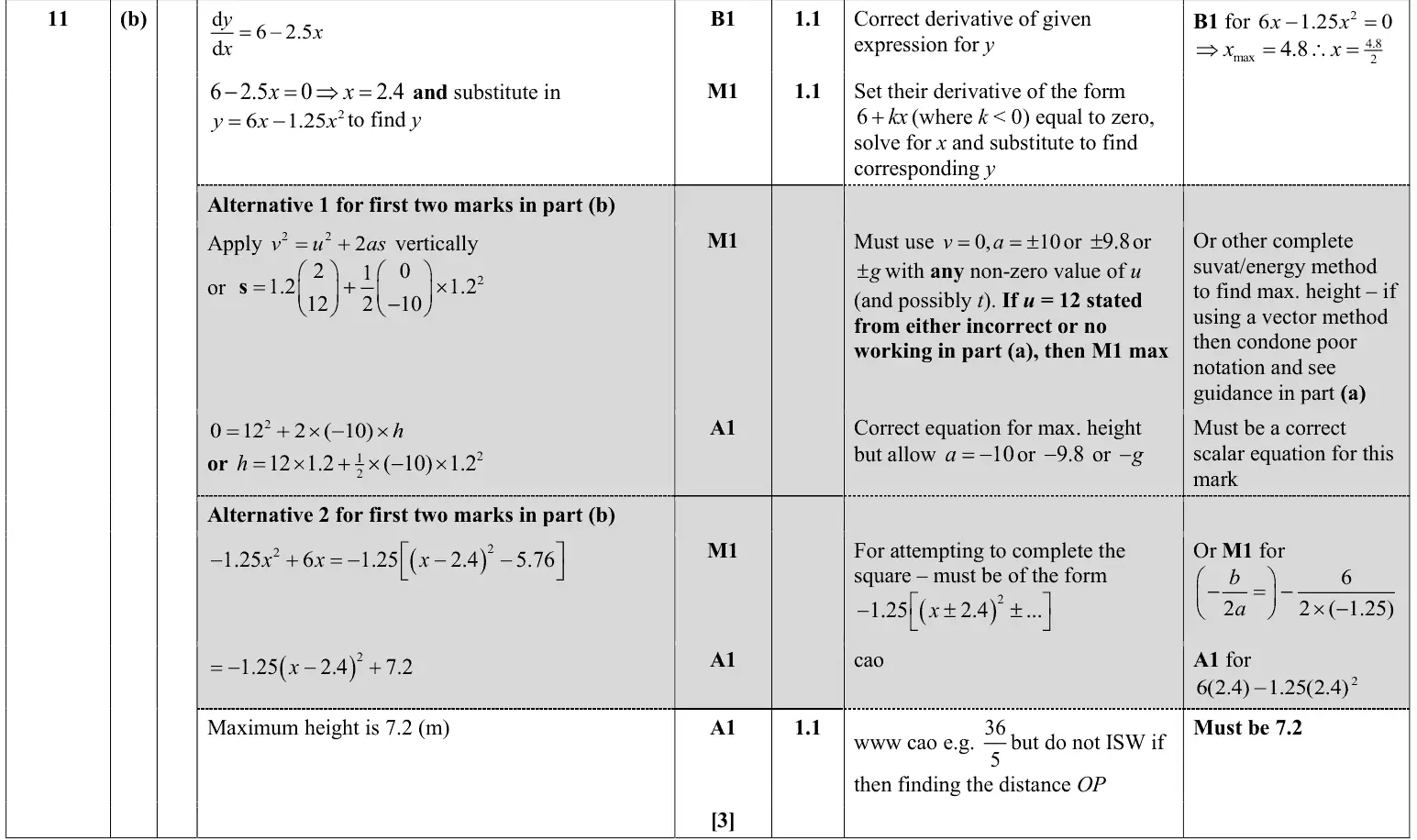
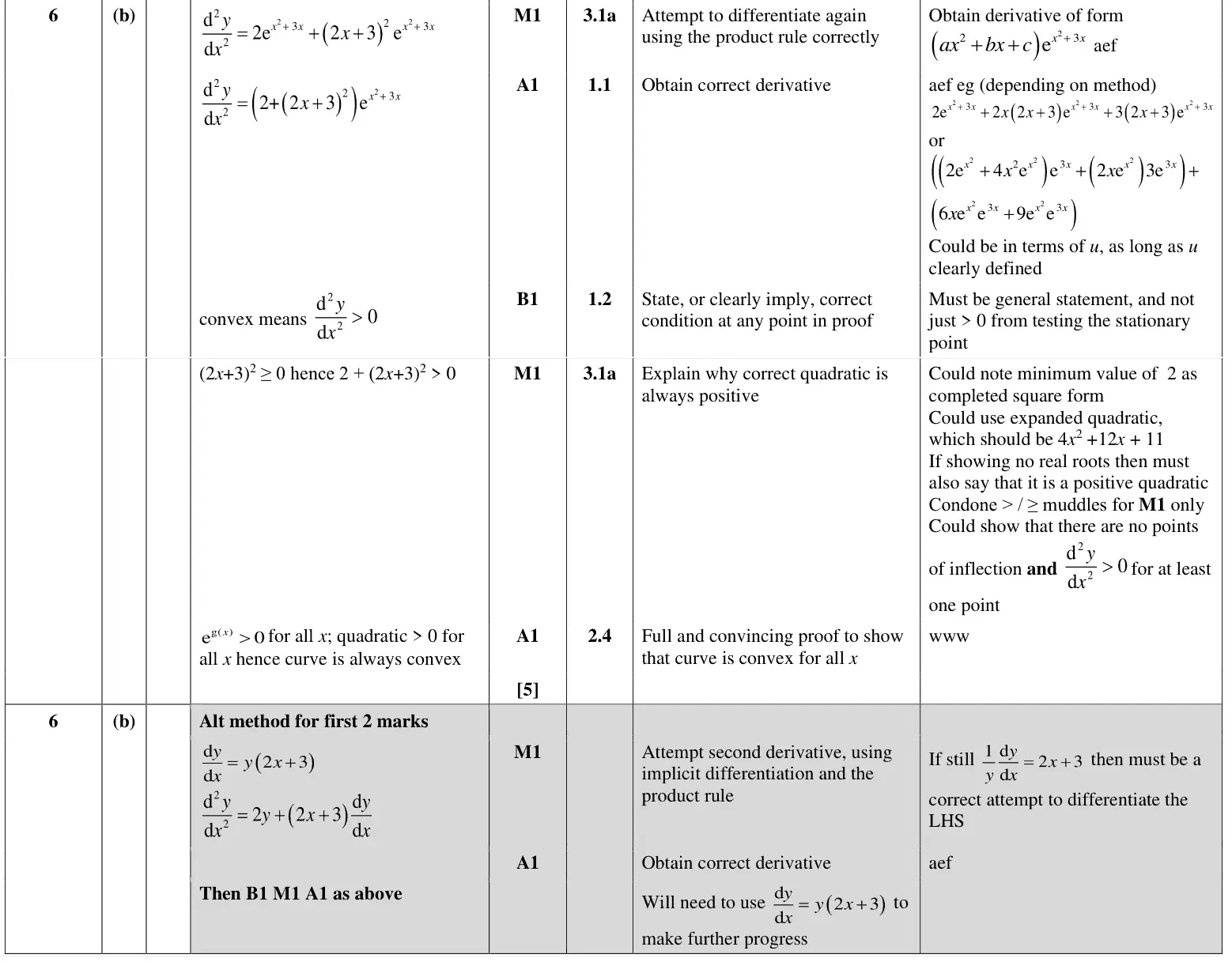
Mark scheme for this part

Examiner's comment
This question was correctly answered by the majority of candidates.
Key points and common errors
- (x − 3)² − 9
This question was correctly answered by the majority of candidates.

Perhaps completing the square was the most common route, but considering how the minima transformed was also prevalent. Move, shift and transform rather than translate still appear as explanations of the transformation but it was pleasing to see a vector being used regularly to describe the translation. Some gave a y component of – 1 rather than – 2 and occasionally the transformation of y = x2 - 6x + 8 to the curve y = x2 + 1 was given. Candidates should be encouraged to show how they reach their conclusions in transformation questions as some responses did not have much supporting evidence. In these instances, if the final answer is incorrect, it can difficult for examiners to follow the working in order to give credit. Many of those who struggled with this question used -6x + 7 somehow to explain the transformation.
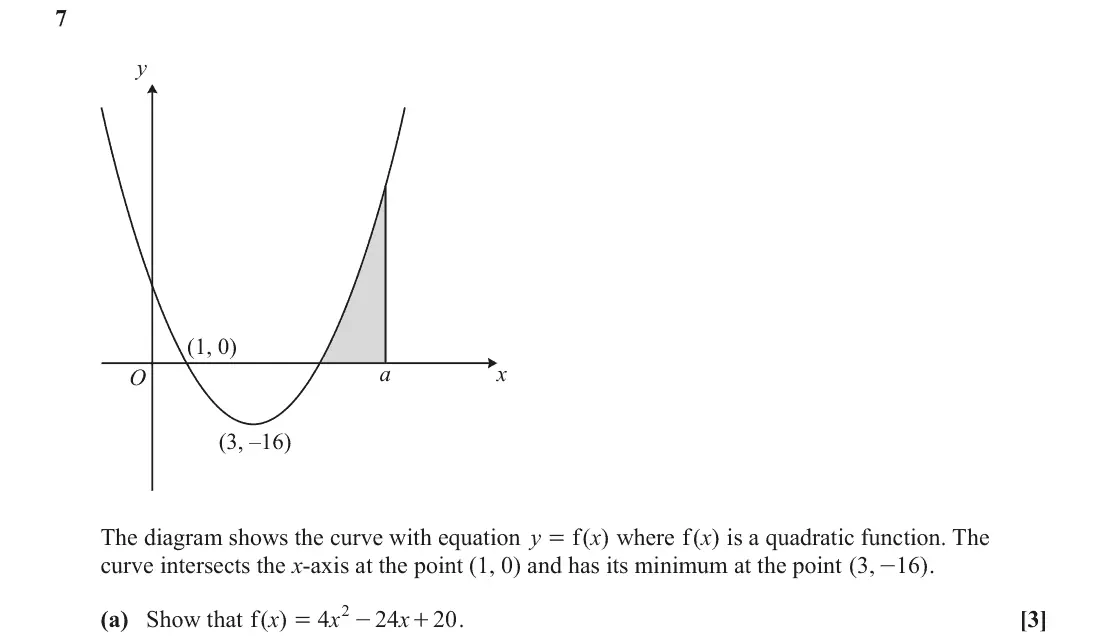
There were many different approaches to this part, as highlighted on the MS, and all were seen. It was another ‘Show that…’ so again we expected sufficient evidence whichever route was taken.

This part was answered extremely well with most candidates scoring at least 2 marks for expressing the given quadratic as 3(𝑥−2)2 + ⋯. The most common error was the lack of a suitable bracket so often leading to a value of 13 for c rather than the correct 5. Unfortunately, some candidates gave answers that were not in the form requested (so missing the squared off the bracket or including the squared inside the bracket).

Most candidates stated the coordinates of the minimum point correctly as (2, 5) (either from using their answer to part (a) or restarting in this part). Others gained the mark here on the follow through from their completed the square form seen in part (a). The two most common errors seen were (−2, 5) and (2, −5).

Many candidates struggled to realise that the equation of the normal to the curve at its minimum point was equivalent to asking for the equation of the line of symmetry. Many candidates unsuccessfully attempted to use the result 𝑦−𝑦1 = − f′(𝑥1) (𝑥−𝑥1) to find this equation (even though the command was to ‘state’ and there only being 1 mark available). The most common incorrect answer seen by examiners was 𝑦= 5 (which was the equation of the tangent to the curve at its minimum point).
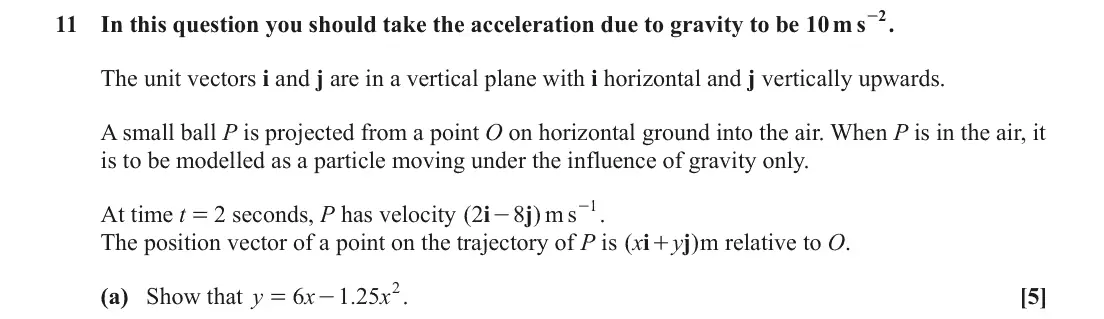

It was surprising how many candidates did not use the given result from part (a) and instead went back to the suvat equations to find the maximum height of P above the ground during its motion. Of those that did use the equation from part (a), those that used calculus rather than completing the square were far more successful.

This was well done, with many candidates given 3 marks. The most common errors involved c, with −16 -43 + 5 = −11 as perhaps the most frequent. 3 occurred too. A few responses used (x + 12)2 or (x + 8)2.

Most candidates were aware that the second derivative was required, and could make some attempt to find this, but the differentiation proved too challenging for many. Some candidates started the entire question by first splitting the given equation into the product of two exponential terms. When using this approach, the first derivative was usually correct but the second derivative rarely so. Most candidates gained a mark for identifying that the second derivative was always positive for a convex curve, and could attempt to show this. However, only the most able candidates were able to provide a convincing justification for this. To gain full credit candidates had to make mathematically correct statements throughout, so vague statements regarding ‘squares always positive’ could not be credited for the final mark. At the start of the solution the candidate gained a mark for stating the condition for the curve to be convex. They also gained 2 marks for a correct second derivative, with method clearly shown. They then attempted to show that this is always positive, but there was an error with the inequality sign; it should be (2x + 3)2 ≥0. They were still given the method mark for their attempt, but not the accuracy mark.

This question was generally well answered by the majority of candidates. A small number of candidates made an error in completing the square. Some candidates went on to mis-state the values of a or b (without regard to the given form, e.g. stating a = −4), but this subsequent working was ignored if the completed square form was given correctly.

This question was much less well answered than (a) (i), even by candidates who had part (i) correct. Many misunderstood the request for ‘the minimum value’ and gave the minimum point (4,-5) - which was accepted, provided it was correct from their completed square form. Many candidates gave 4 (the x- value at which the minimum occurs) which on its own was not sufficient.

Although some candidates may have been able to deduce that k = −5 is the required value, the question stated ‘Determine’ which meant that some working or reasoning was required. The most common method was to use the discriminant, setting b2 − 4ac = 0 and, where attempted, this was generally well done. Some candidates made an error in solving and obtained k = 5, other candidates confused this with the range of values of k for which there were any real roots, and lost the final mark by using > instead of =. Unless candidates went on to finish with a statement of equality k = −5 this could not obtain the final accuracy mark.

Nearly all of the candidates gained full credit on this question. The most common error was forgetting to multiply their – 1.52 by their 2 when attempting the constant term.

Once again, this part of the question was nearly always correct. Some candidates used their completed square form from the first part, whereas others made a fresh attempt, often involving the use of calculus. Some candidates simply wrote down the correct answer, despite part (a) being incorrect, possibly from use of calculator functions.

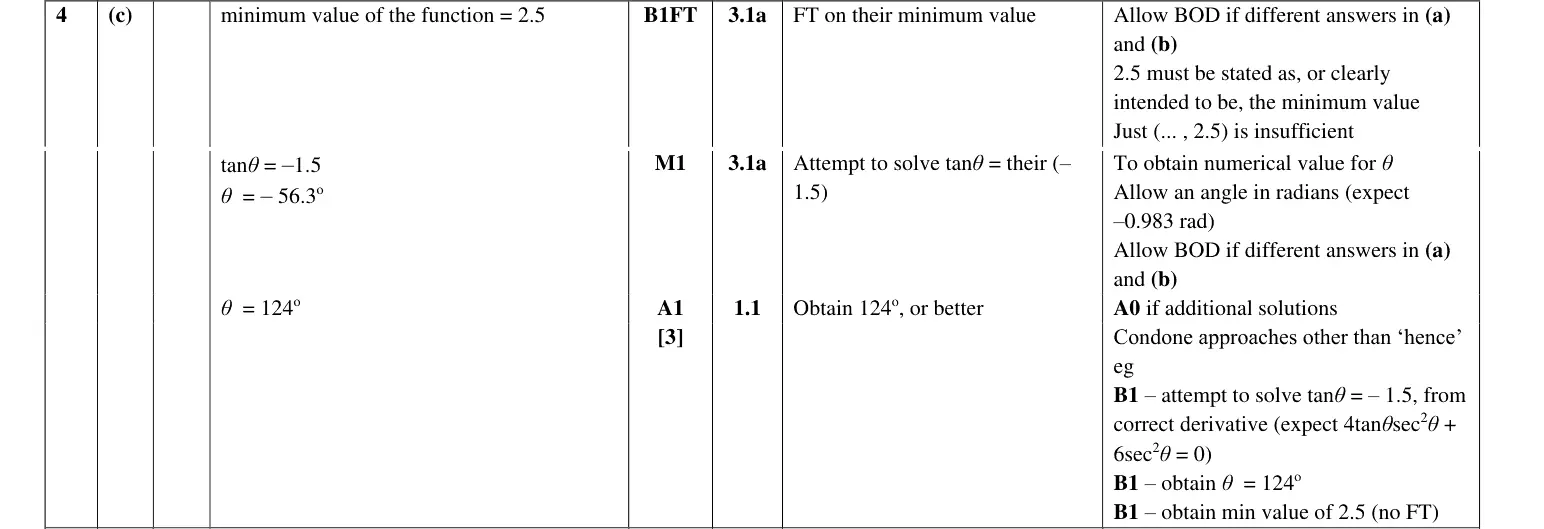
This final part of the question proved to be challenging, with a number of candidates not appreciating the link with work already done and struggling to make progress. A number did try to relate tanθ to their minimum point, with a common error being to attempt tan-1 of both the x and the y value. Despite the structure of the question making the two requests clear, quite a few candidates only attempted the angle and not the minimum value of the given function.

(Comment on Question 05 as a whole) Part (b) - The translation was not well done or just ignored.

(Comment on Question 05 as a whole) Part (b) - The translation was not well done or just ignored.



(Comment on Question 11 as a whole) Part (a) - s = 16t used – the need for t – 1.5 was generally not understood. This then led to t = 0 and t = 8 from a two term quadratic and thus gained only M1 A1. Candidates did not seem to realise that t = 0 could not be one of the required times given the problem. t + 1.5 was seen in some working. Part (c) - Most candidates made no useful progress with this part. Common misconceptions Key teaching and learning points – comments on improving performance The following, some of which have been mentioned in previous reports, remain pertinent. 1. Candidates should understand the implication of the ‘In this question you must show detailed reasoning’ instruction. Generally, this means examiners will expect to see how results have been obtained. So, for example, in Question 6 on this paper the method for solving the simultaneous equations was expected and those just doing it on the calculator earned M0 for this skill. 2. BC – a result achieved ‘by calculator’ – can encourage candidates to show little, if any, evidence of how their answer has been produced. To be fair, where this appears on the mark scheme (in Question 10) candidates generally adopted the ‘old-fashioned’ algebraic route but no doubt this will change over time. Inevitably examiners will find it difficult to know where an incorrect answer, presented alone, has come from and it may be hard to credit. It may be wise to encourage candidates to provide some evidence of what they are doing, especially in cases where more than one mark is available. 3. The front cover instructions state ‘Give non-exact numerical answers correct to 3 significant figures unless a different degree of accuracy is specified in the question.’ This should be stressed – some final answers were correct to 2 significant figures only. This may result in a loss of accuracy marks. 4. A question may require units in an answer to gain full credit. It is best to make candidates aware of this and urge them to always include units in answers where relevant. 5. The front cover instruction state ‘When a numerical value is needed use g = 9.8 unless a different value is specified in the question’. This now seems to be well recognised. Guidance on using this paper as a mock This paper covers the following topics : Cosine rule, ½absinC with area of a segment, curve sketching and interpretation of the algebraic solution of an equation graphically, finding the normal to a curve, the factor theorem and factorisation, quadratic functions and graphical transformations, properties of the circle and the circle equation, a maximisation problem with rationalising and algebraic manipulation, use of the laws of logarithms, forces in vector notation in equilibrium, Newton’s second law, variable acceleration and suvat equation use. The Pure section introduces the calculus and various other ideas which require a secure grasp of basic algebra and in the Mechanics section students need a sound understanding of kinematics with both uniform and non-uniform acceleration and Newton’s laws.


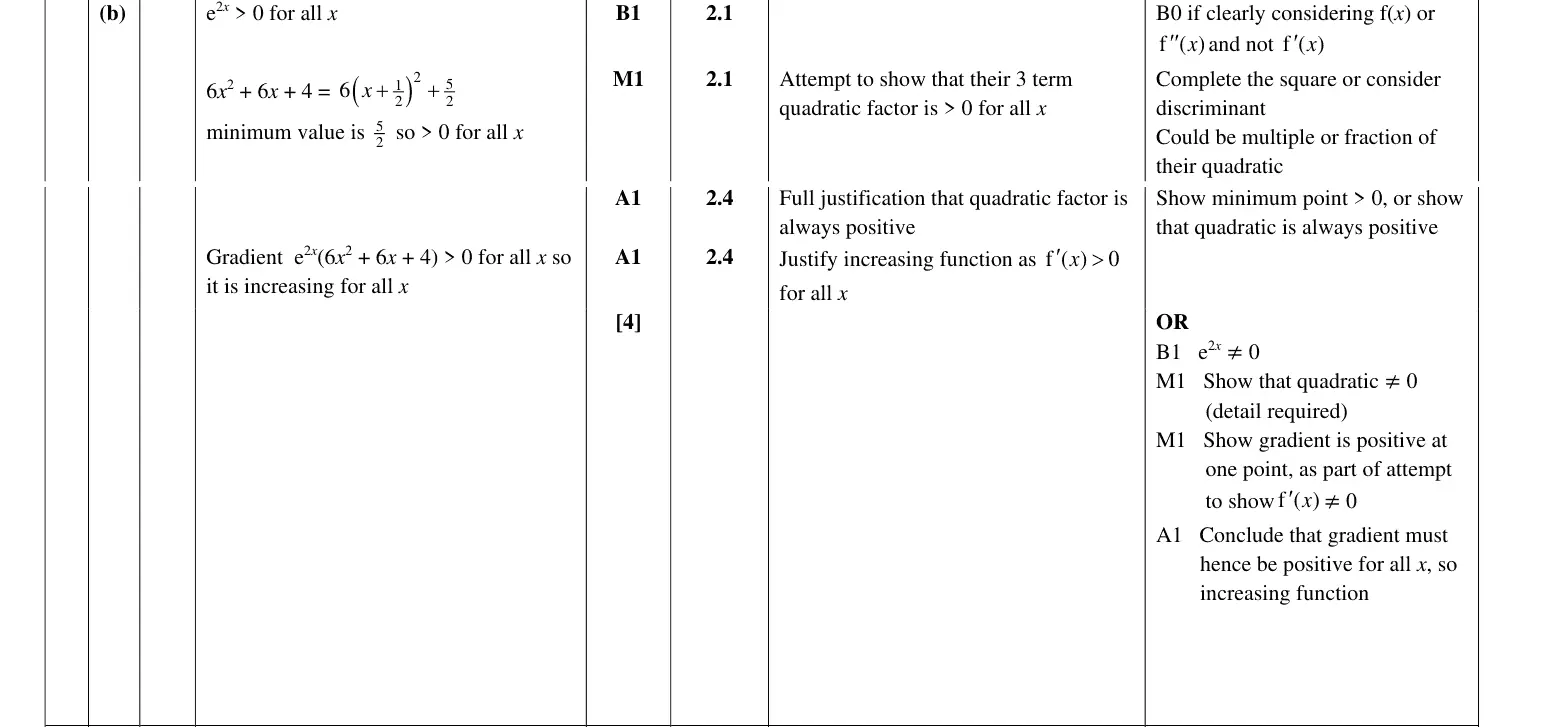
(Comment on Question 08 as a whole) The second part of Question 8 proved to be challenging; some candidates did not seem familiar with the definition of an increasing function and were unsure how to proceed whereas others stated that the first derivative needed to be positive, but then continued by considering the second derivative instead. Of the minority who attempted the correct method, many gave vague statements such as ‘the quadratic is always positive’ but with no evidence to support this. In a ‘show that’ question, sufficient detail must be provided so as to be convincing. Equally, statements must be fully correct so stating that e x is never negative lacks the required precision.

(Comment on Question 03 as a whole) There were some excellent responses to this question, although some candidates dropped marks for errors in the notation used. Those candidates that used completing the square in part (a) were generally more successful than those that used calculus. A significant number did not gain the final accuracy mark due to incorrectly stating 9 9 rather than correctly stating the range of the function ( ) x ≥− f x ≥− . 2 2 Some candidates appeared to misunderstand the concept of range, finding the roots by factorising to ( ) 2 x x + 3 to then incorrectly conclude that 3 x ≥ In part (b) there were unfortunately a number of vague answers provided starting ‘It is …’. Examiners cannot be expected to know what the ‘it’ is that the candidate is talking about; answers need to be explicit, either in words or as part of an annotated diagram. ( ) Most candidates started part (c) successfully and found the expression for g a . Some candidates introduced errors, or just wasted some exam time, producing an initial algebraic form for the composite f g x rather than substituting their numerical answer to ( ( ) ) into ( ) function g − 2 f x . Part (d) included the request to give their final answer in set notation. The ‘Determine’ request meant that the method mark was for clear and accurate algebraic manipulation into the standard three term quadratic. There is an assumption that candidates would solve quadratic equations by inspection or by using the solve function on their calculator, the command word just signals that the mathematical argument must be evident. The majority of candidates scored these initial 2 marks, but a significant number struggled with giving their result in correct set notation format.

This was frequently well done, with errors in r being most common, e.g. ( ) 5 x − 2 − 4 + 3 . We occasionally had attempts involving ( ) x − 10 .

‘State’ here really should indicate to candidates that the answer can just be written down from what they have already done, but many resorted successfully to differentiation.

‘State’ again, with the same implication as in 2(c). This part was the least successful. A significant number of candidates found the tangent y = − 17 rather than the requested normal x = 2 .

The more able candidates appreciated that the domain had to be restricted as f(x) had to be a one to one function, and were able to write down the value of k with ease. However, many candidates seemed unsure as to how to proceed, with the most common error being to solve f(x) = 0.

This was done very well. Candidates seemed to be very familiar with completing the square. The most common simple numerical error was to have c = 8.75. (2x – 3)2 + 2 was seen occasionally.

Many candidates did this by evaluating the discriminant rather than using the result they had just obtained. ‘State’ indicates neither working nor justification is required (cf Specification Document).

This part proved less successful. Many candidates were not able to start an argument. Some attempted to evaluate b2 – 4ac but this was rarely done accurately. Those who recognised how to use the given form of the equation made the most progress, occasionally confusing the r > 0 and r < 0 cases.

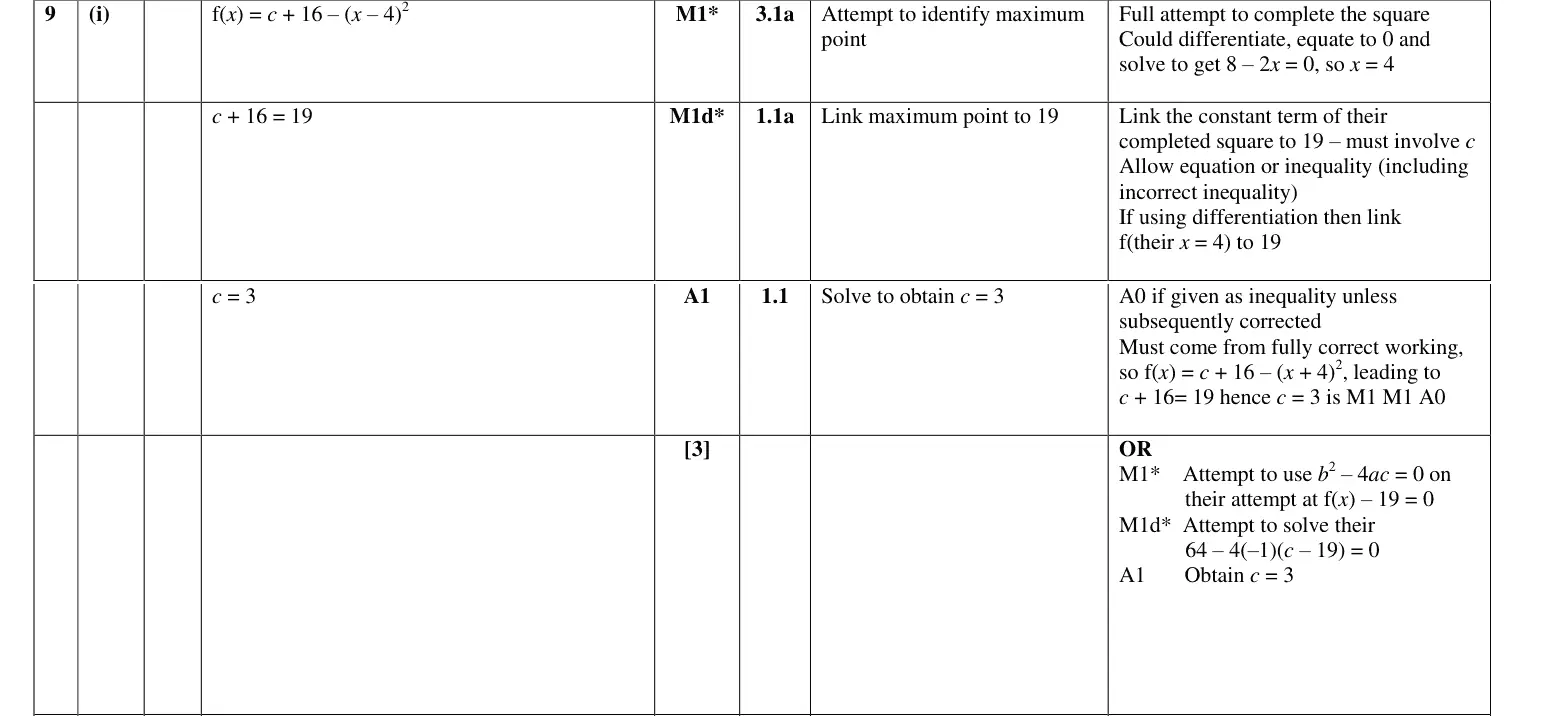
Many fully correct solutions to this question were seen, with candidates employing a variety of different methods. The most common approaches were to write f(x) in completed square form and equate the maximum value to 19, or to use differentiation to identify the maximum point. Some candidates attempted rearranged to obtain f(x) – 19 ≤ 0 and attempted to use the discriminant, but only the most able identified that the condition for repeated roots should then be used.

Most candidates answered this correctly. A few found a and b correctly but made an error in finding c. This most frequently came from an incorrect first step such as 2(x – 3)2 + 11.5 – 9 or 2(x – 3)2 + 23 – 9.

Most candidates answered this correctly. Some of those who discussed the turning point lost a mark because they merely stated that it is a minimum, rather than showing that this is so.

This question was very well answered.
Stuck on this? Book a trial session with an A-level maths tutor.