June 2024: Paper 3 Section B: Mechanics

50 marks · 18 question parts · Question paper, mark scheme and examiner's report on Pearson's site

Question by question

QTopicMarksDifficulty
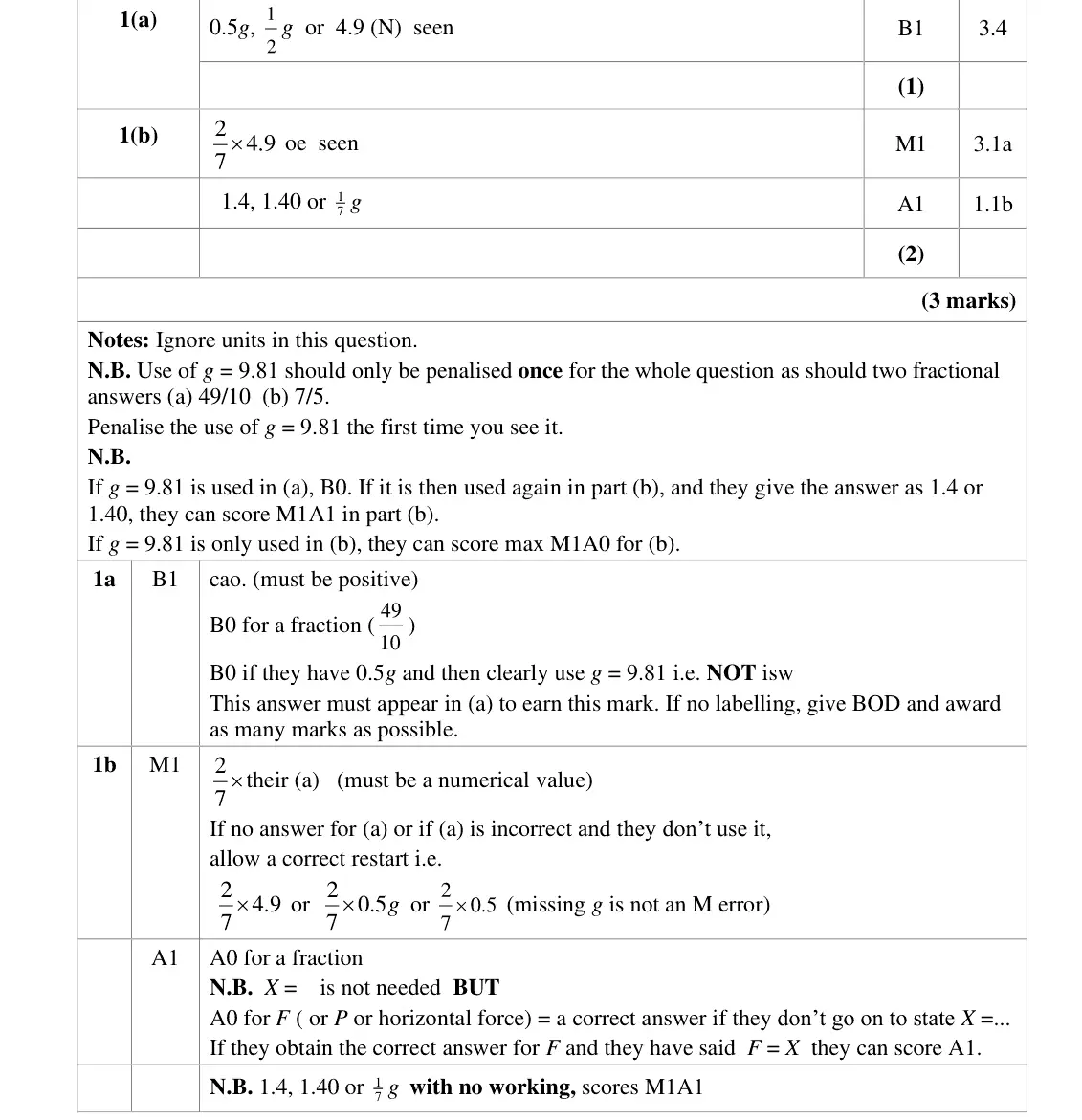
1(a) Forces, Newton's laws and connected particles 1 —
1(b) Friction, resultant forces and motion in a plane, Forces, Newton's laws and connected particles 2 —
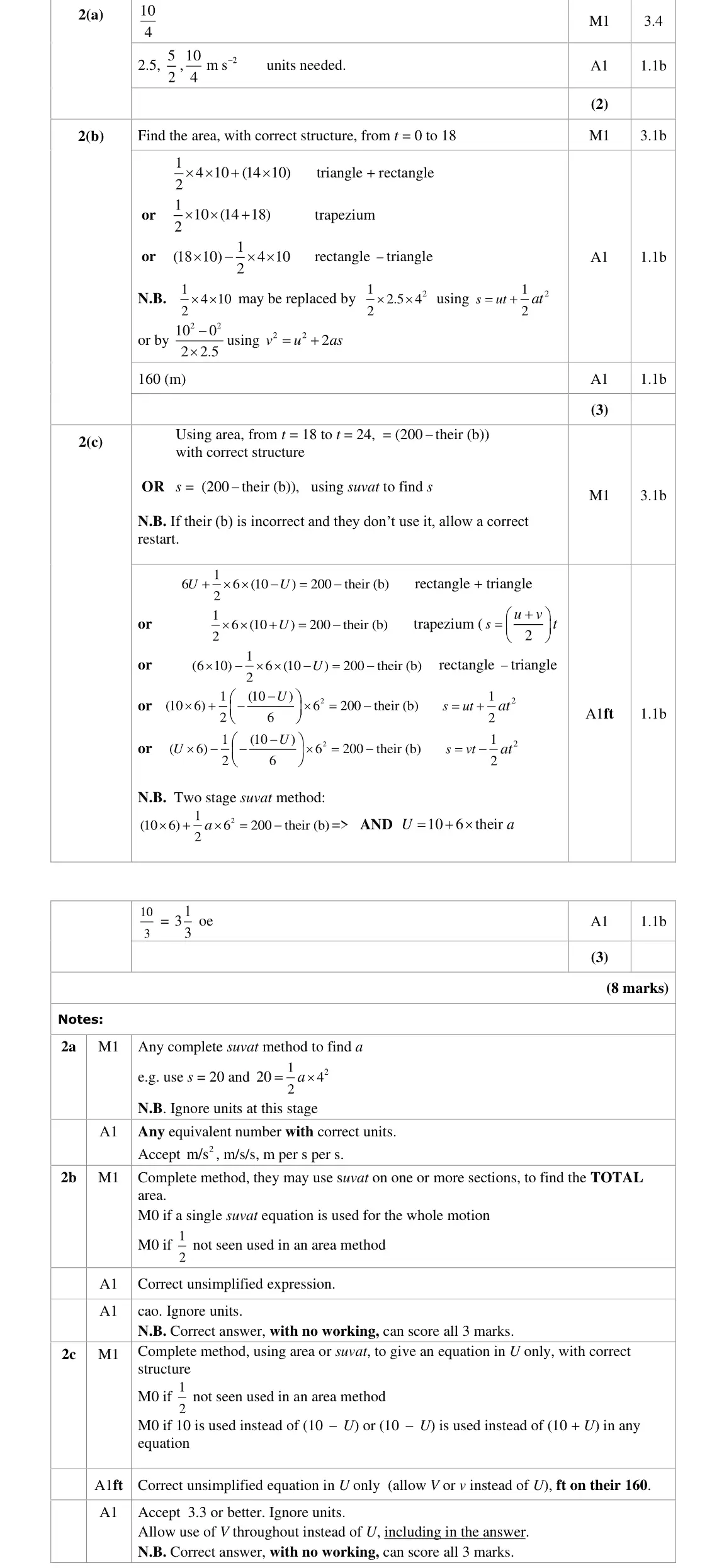
2(a) Kinematics: language and graphs, Constant acceleration (SUVAT) 2 —
2(b) Kinematics: language and graphs, Constant acceleration (SUVAT) 3 —
2(c) Kinematics: language and graphs, Constant acceleration (SUVAT) 3 —
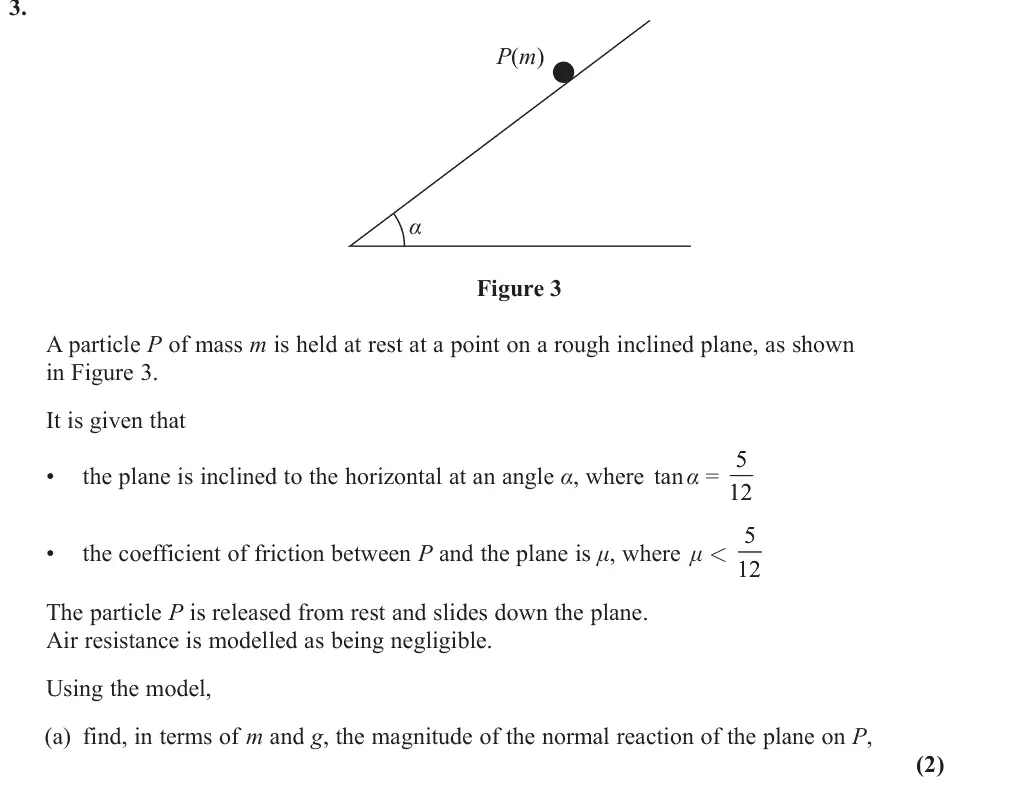
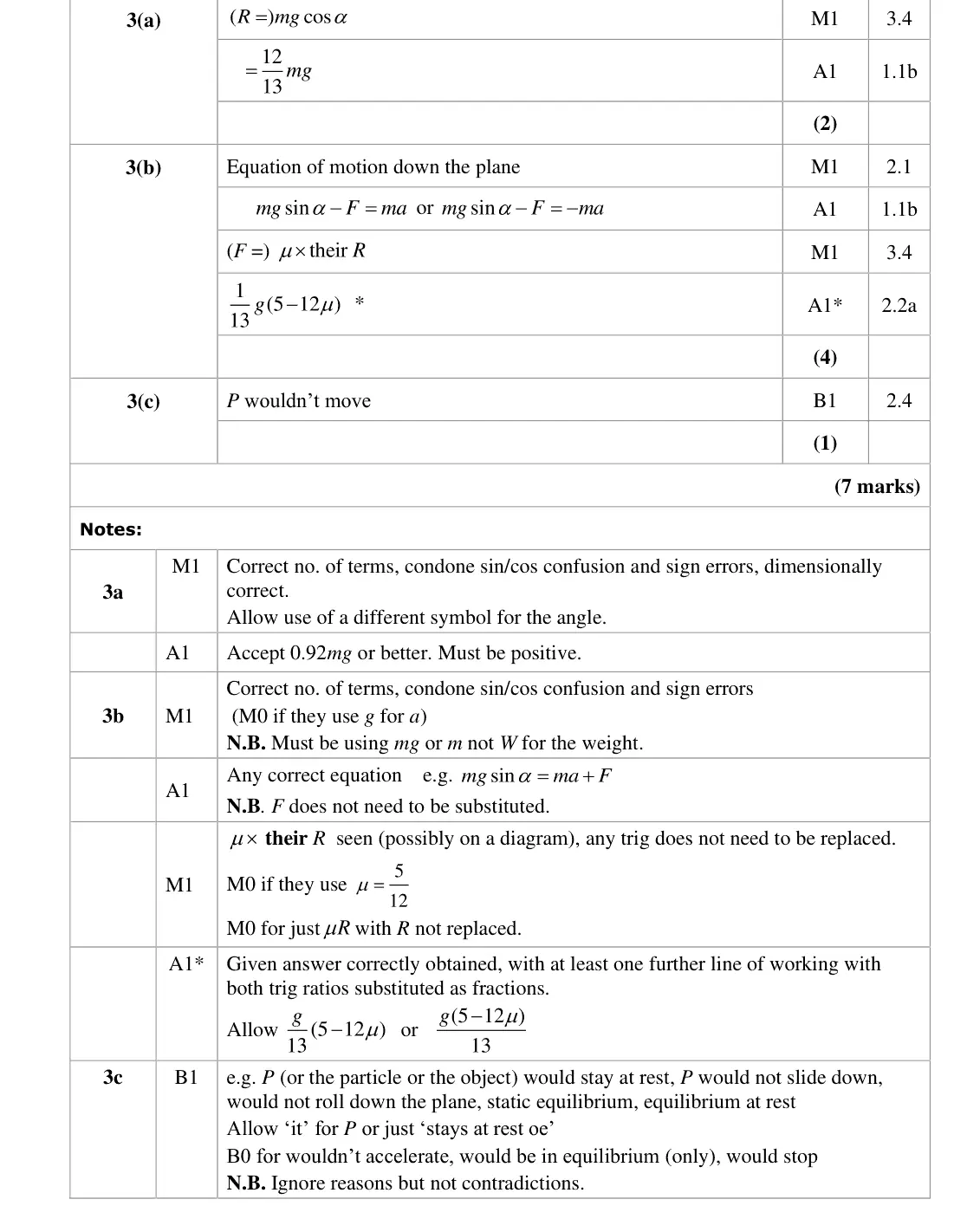
3(a) Forces, Newton's laws and connected particles, Trigonometric ratios, graphs, radians and the sine and cosine rules 2 —
3(b) Forces, Newton's laws and connected particles, Friction, resultant forces and motion in a plane, Trigonometric ratios, graphs, radians and the sine and cosine rules 4 —
3(c) Friction, resultant forces and motion in a plane, Forces, Newton's laws and connected particles 1 —
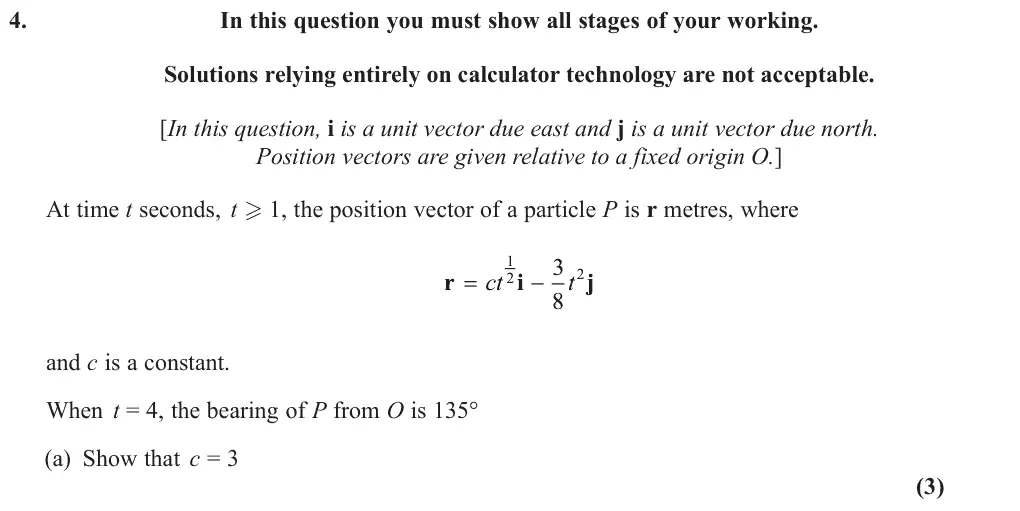
4(a) Kinematics: language and graphs, Vectors, Trigonometric ratios, graphs, radians and the sine and cosine rules 3 —
4(b) Variable acceleration, Kinematics: language and graphs, Vectors, Differentiation: first principles, gradients, stationary points 4 —
4(c) Variable acceleration, Vectors, Indices and surds, Differentiation: first principles, gradients, stationary points 4 —
5(a) Projectiles, Constant acceleration (SUVAT), Trigonometric ratios, graphs, radians and the sine and cosine rules 6 —
5(b) Projectiles, Quadratics and the discriminant 2 —
5(c) Projectiles, Quadratics and the discriminant, Differentiation: first principles, gradients, stationary points 2 —
5(d) Projectiles 1 —
5(e) Projectiles 1 —
6(a) Moments, Trigonometric ratios, graphs, radians and the sine and cosine rules 3 —
6(b) Forces, Newton's laws and connected particles, Friction, resultant forces and motion in a plane, Moments, Simultaneous equations, Trigonometric ratios, graphs, radians and the sine and cosine rules 6 —

The questions

1(a)1(b)2(a)2(b)2(c)3(a)3(b)3(c)4(a)4(b)4(c)5(a)5(b)5(c)5(d)5(e)6(a)6(b)
June 2024 · Paper 3 (Mechanics) · Q1(a) 1 mark forces and newtons laws
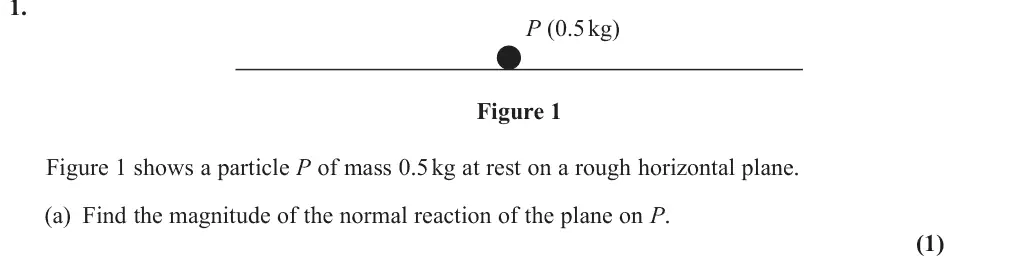
1. P (0.5 kg) Figure 1 Figure 1 shows a particle P of mass 0.5 kg at rest on a rough horizontal plane. (a) Find the magnitude of the normal reaction of the plane on P. (1)
June 2024 · Paper 3 (Mechanics) · Q1(b) 2 marks friction and forces in a planeforces and newtons laws
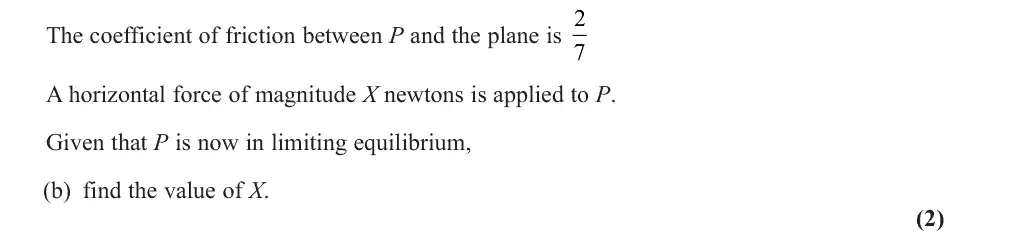
The coefficient of friction between P and the plane is 2 A horizontal force of magnitude X newtons is applied to P. Given that P is now in limiting equilibrium, (b) find the value of X. (2)
June 2024 · Paper 3 (Mechanics) · Q2(a) 2 marks kinematicsconstant acceleration
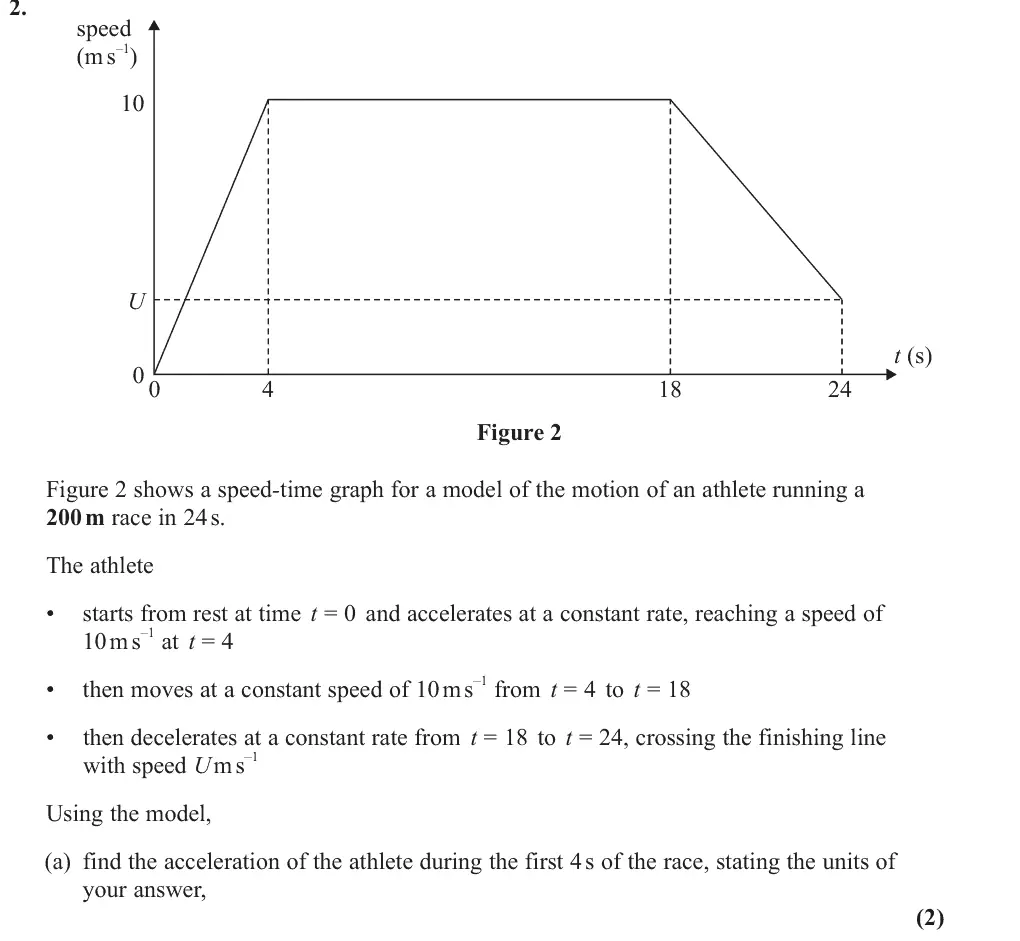
2. speed –1) (m s U t (s) Figure 2 Figure 2 shows a speed‑time graph for a model of the motion of an athlete running a 200 m race in 24 s. The athlete • starts from rest at time t = 0 and accelerates at a constant rate, reaching a speed of –1 at t = 4 10 m s –1 from t = 4 to t = 18 • then moves at a constant speed of 10 m s • then decelerates at a constant rate from t = 18 to t = 24, crossing the finishing line –1 with speed U m s Using the model, (a) find the acceleration of the athlete during the first 4 s of the race, stating the units of your answer, (2)
June 2024 · Paper 3 (Mechanics) · Q2(b) 3 marks kinematicsconstant acceleration
(b) find the distance covered by the athlete during the first 18 s of the race, (3)
June 2024 · Paper 3 (Mechanics) · Q2(c) 3 marks kinematicsconstant acceleration
(c) find the value of U. (3)
June 2024 · Paper 3 (Mechanics) · Q3(a) 2 marks forces and newtons lawstrigonometric ratios
3. P(m) alpha Figure 3 A particle P of mass m is held at rest at a point on a rough inclined plane, as shown in Figure 3. It is given that the plane is inclined to the horizontal at an angle alpha , where tan alpha = 5 • the coefficient of friction between P and the plane is μ, where μ < 5 • The particle P is released from rest and slides down the plane. Air resistance is modelled as being negligible. Using the model, (a) find, in terms of m and g, the magnitude of the normal reaction of the plane on P, (2)
June 2024 · Paper 3 (Mechanics) · Q3(b) 4 marks forces and newtons lawsfriction and forces in a planetrigonometric ratios
(b) show that, as P slides down the plane, the acceleration of P down the plane is 13 g(5 – 12μ) (4)
June 2024 · Paper 3 (Mechanics) · Q3(c) 1 mark friction and forces in a planeforces and newtons laws
(c) State what would happen to P if it is released from rest but μ 5 (1)
June 2024 · Paper 3 (Mechanics) · Q4(a) 3 marks kinematicsvectorstrigonometric ratios
4. In this question you must show all stages of your working. Solutions relying entirely on calculator technology are not acceptable. [In this question, i is a unit vector due east and j is a unit vector due north. Position vectors are given relative to a fixed origin O.] At time t seconds, t 1, the position vector of a particle P is r metres, where r ct i t j and c is a constant. When t = 4, the bearing of P from O is 135° (a) Show that c = 3 (3)
June 2024 · Paper 3 (Mechanics) · Q4(b) 4 marks variable accelerationkinematicsvectorsdifferentiation
(b) Find the speed of P when t = 4 (4)
June 2024 · Paper 3 (Mechanics) · Q4(c) 4 marks variable accelerationvectorsindices and surdsdifferentiation
When t = T, P is accelerating in the direction of (–i – 27j). (c) Find the value of T. (4)
June 2024 · Paper 3 (Mechanics) · Q5(a) 6 marks projectilesconstant accelerationtrigonometric ratios
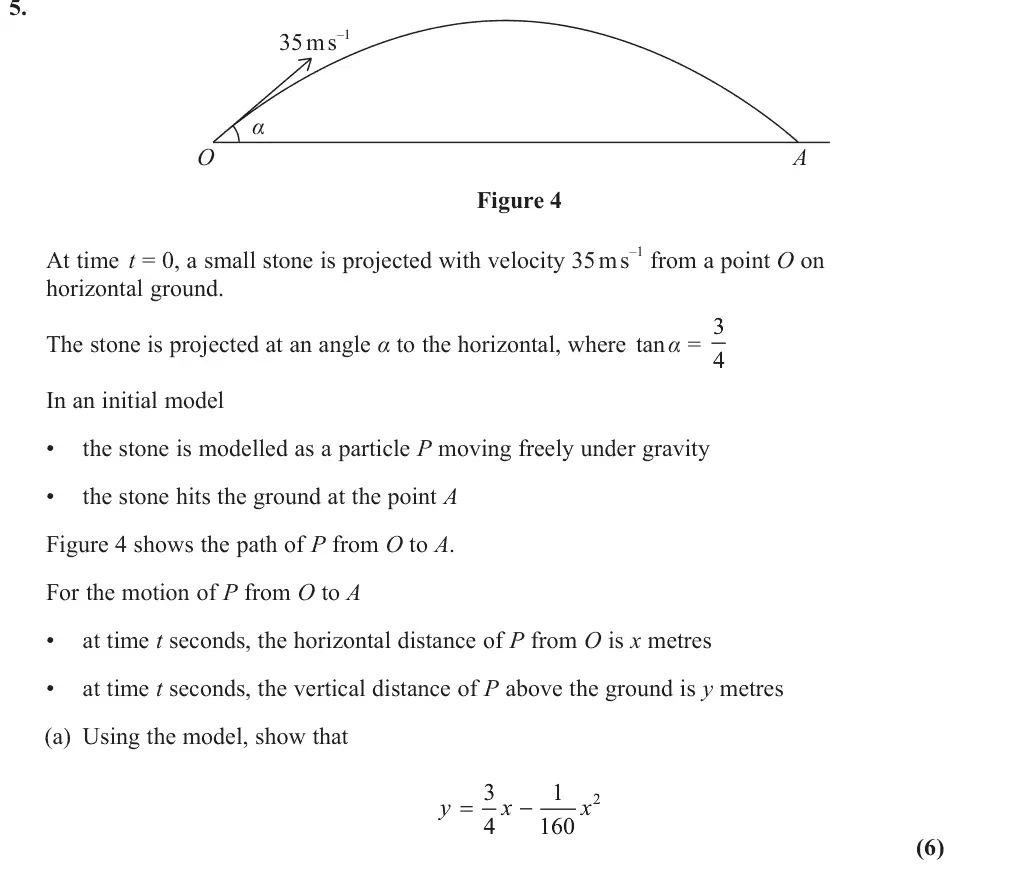
5. 35 m s –1 alpha A Figure 4 At time t = 0, a small stone is projected with velocity 35 m s –1 from a point O on horizontal ground. The stone is projected at an angle alpha to the horizontal, where tan alpha = 3 In an initial model • the stone is modelled as a particle P moving freely under gravity • the stone hits the ground at the point A Figure 4 shows the path of P from O to A. For the motion of P from O to A • at time t seconds, the horizontal distance of P from O is x metres • at time t seconds, the vertical distance of P above the ground is y metres (a) Using the model, show that y x x (6)
June 2024 · Paper 3 (Mechanics) · Q5(b) 2 marks projectilesquadratics
(b) Use the answer to (a), or otherwise, to find the length OA. (2)
June 2024 · Paper 3 (Mechanics) · Q5(c) 2 marks projectilesquadraticsdifferentiation
Using the model, the greatest height of the stone above the ground is found to be H metres. (c) Use the answer to (a), or otherwise, to find the value of H. (2)
June 2024 · Paper 3 (Mechanics) · Q5(d) 1 mark projectiles
• The model is refined to include air resistance. Using this new model, the greatest height of the stone above the ground is found to be K metres. (d) State which is greater, H or K, justifying your answer. (1)
June 2024 · Paper 3 (Mechanics) · Q5(e) 1 mark projectiles
(e) State one limitation of this refined model. (1)
June 2024 · Paper 3 (Mechanics) · Q6(a) 3 marks momentstrigonometric ratios
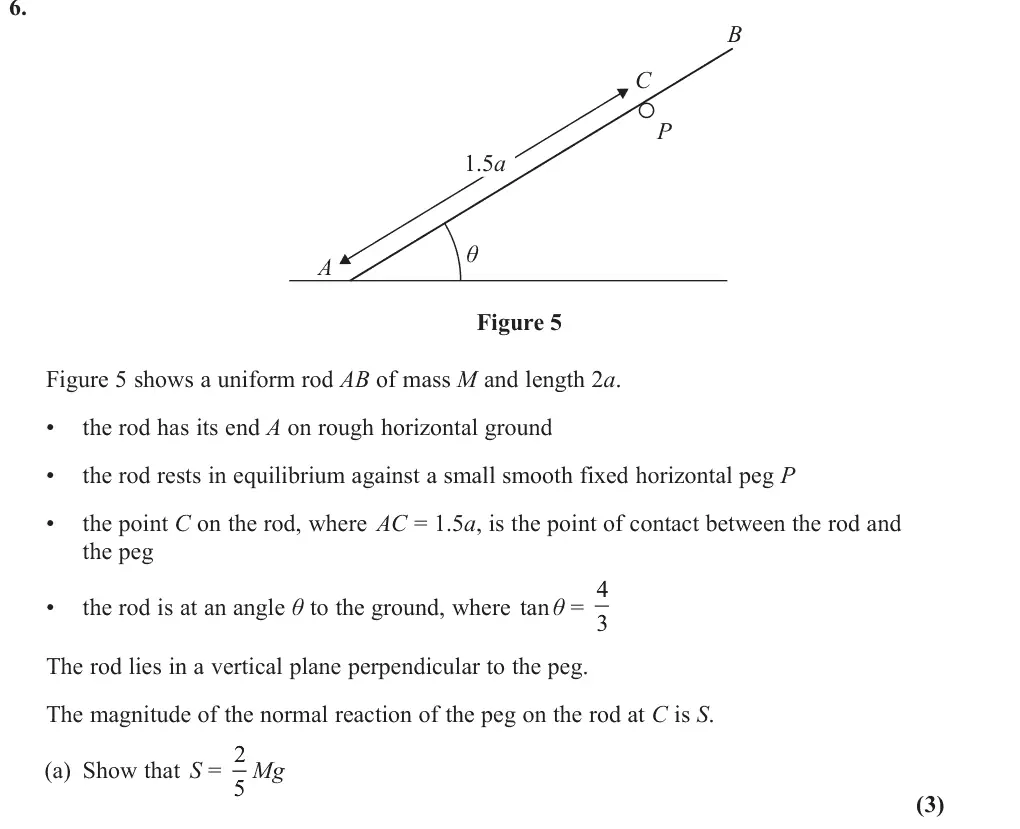
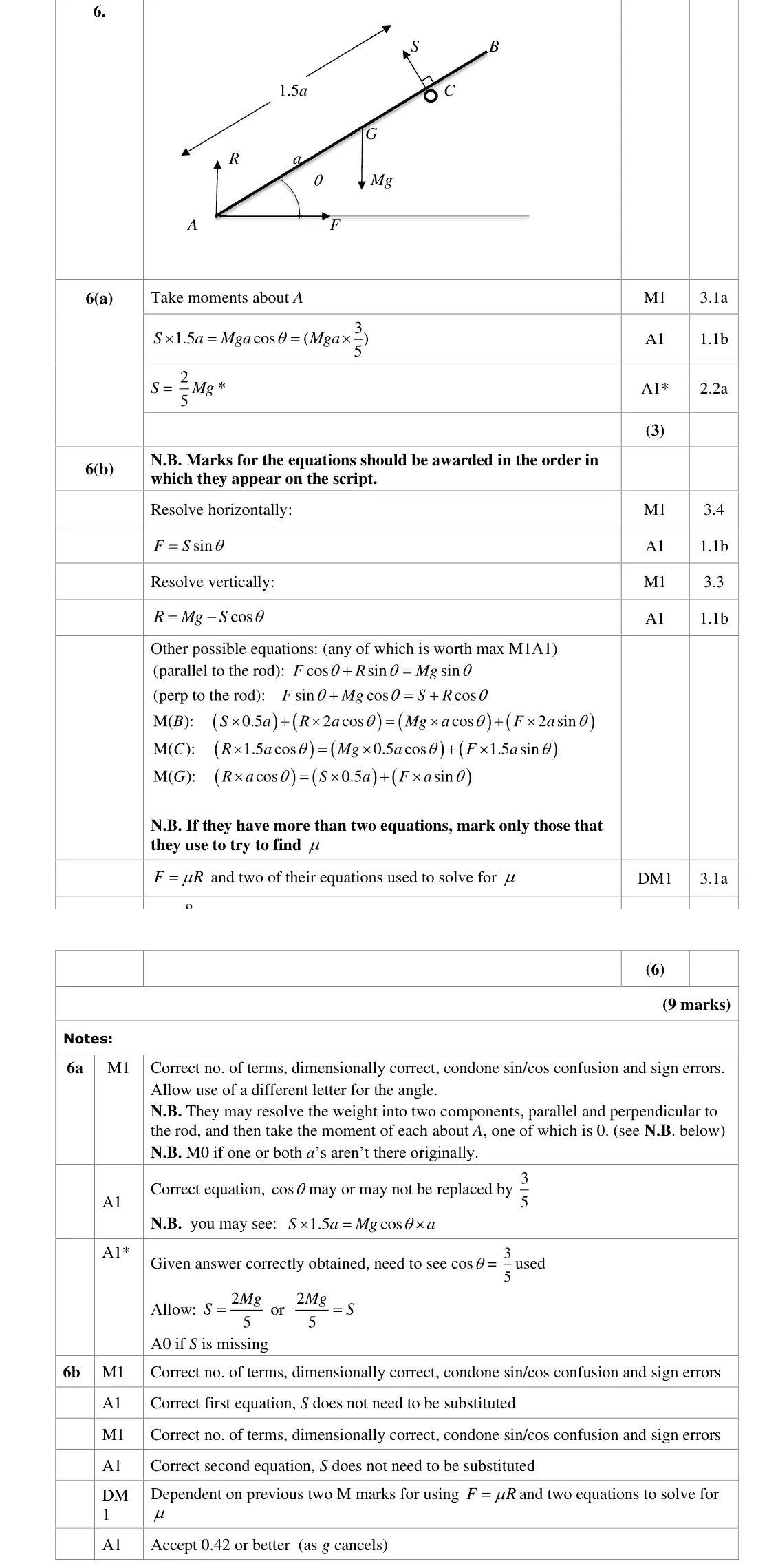
6. B C P 1.5a theta A Figure 5 Figure 5 shows a uniform rod AB of mass M and length 2a. • the rod has its end A on rough horizontal ground • the rod rests in equilibrium against a small smooth fixed horizontal peg P • the point C on the rod, where AC = 1.5a, is the point of contact between the rod and the peg the rod is at an angle theta to the ground, where tan theta = 4 • The rod lies in a vertical plane perpendicular to the peg. The magnitude of the normal reaction of the peg on the rod at C is S. (a) Show that S = 2 5 Mg (3)
The coefficient of friction between the rod and the ground is μ. Given that the rod is in limiting equilibrium, (b) find the value of μ. (6)

Find an Edexcel maths tutor

Want this paper marked and gone through with you? Message us.

Prefer email? Send an enquiry

If you are under 18, please include a parent's contact details. Enquiries go to enquiries@mathsaleveltutor.com and are deleted once handled.