June 2023: Paper 3 Section B: Mechanics

50 marks · 21 question parts · Question paper, mark scheme and examiner's report on Pearson's site

Question by question

QTopicMarksDifficulty
1(a) Constant acceleration (SUVAT) 1 —
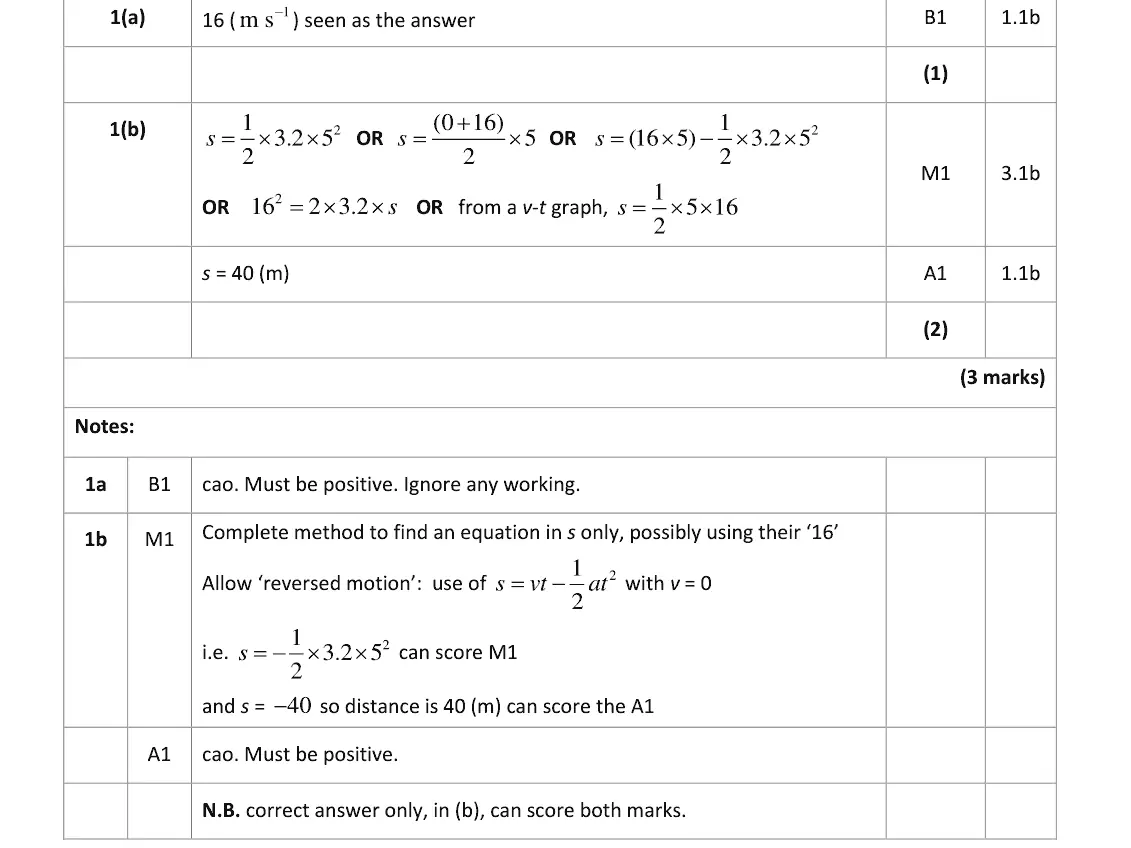
1(b) Constant acceleration (SUVAT) 2 —
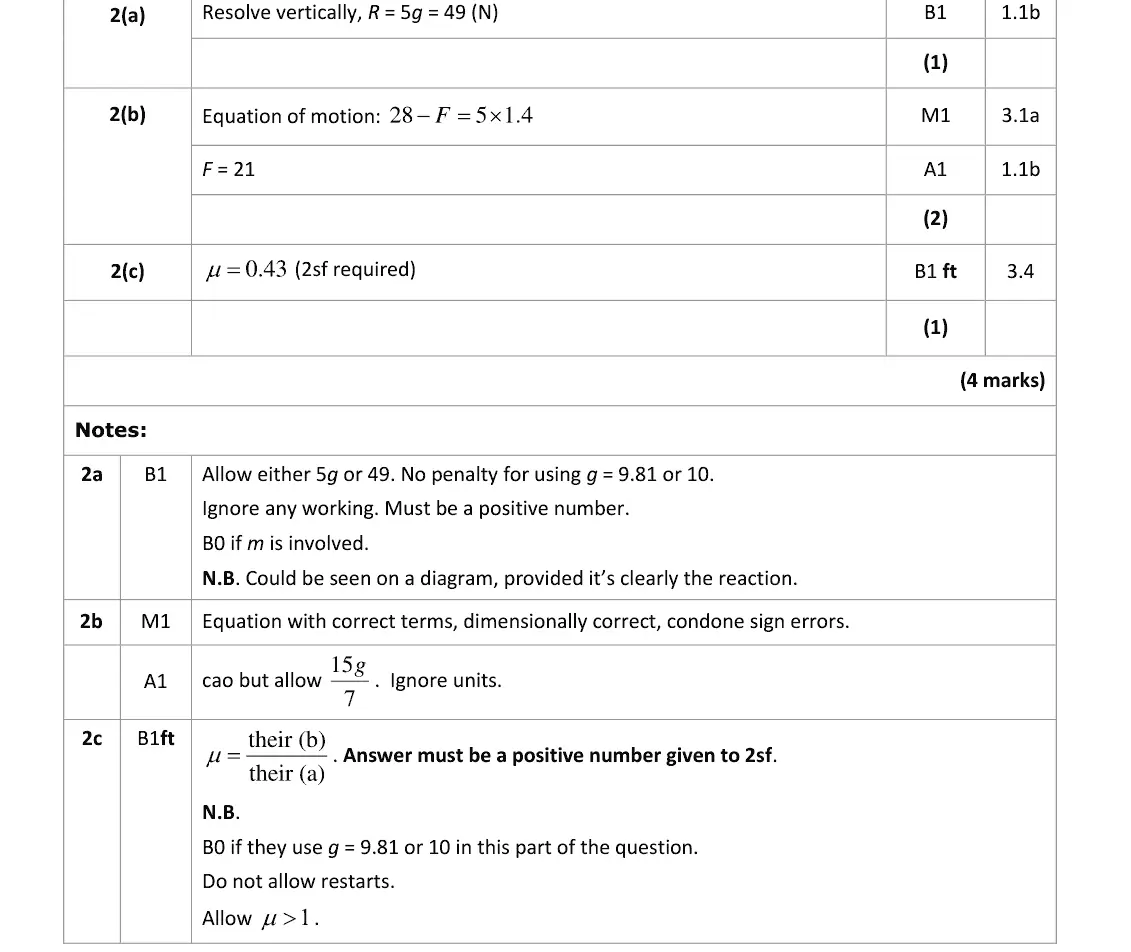
2(a) Forces, Newton's laws and connected particles 1 —
2(b) Forces, Newton's laws and connected particles 2 —
2(c) Friction, resultant forces and motion in a plane 1 —
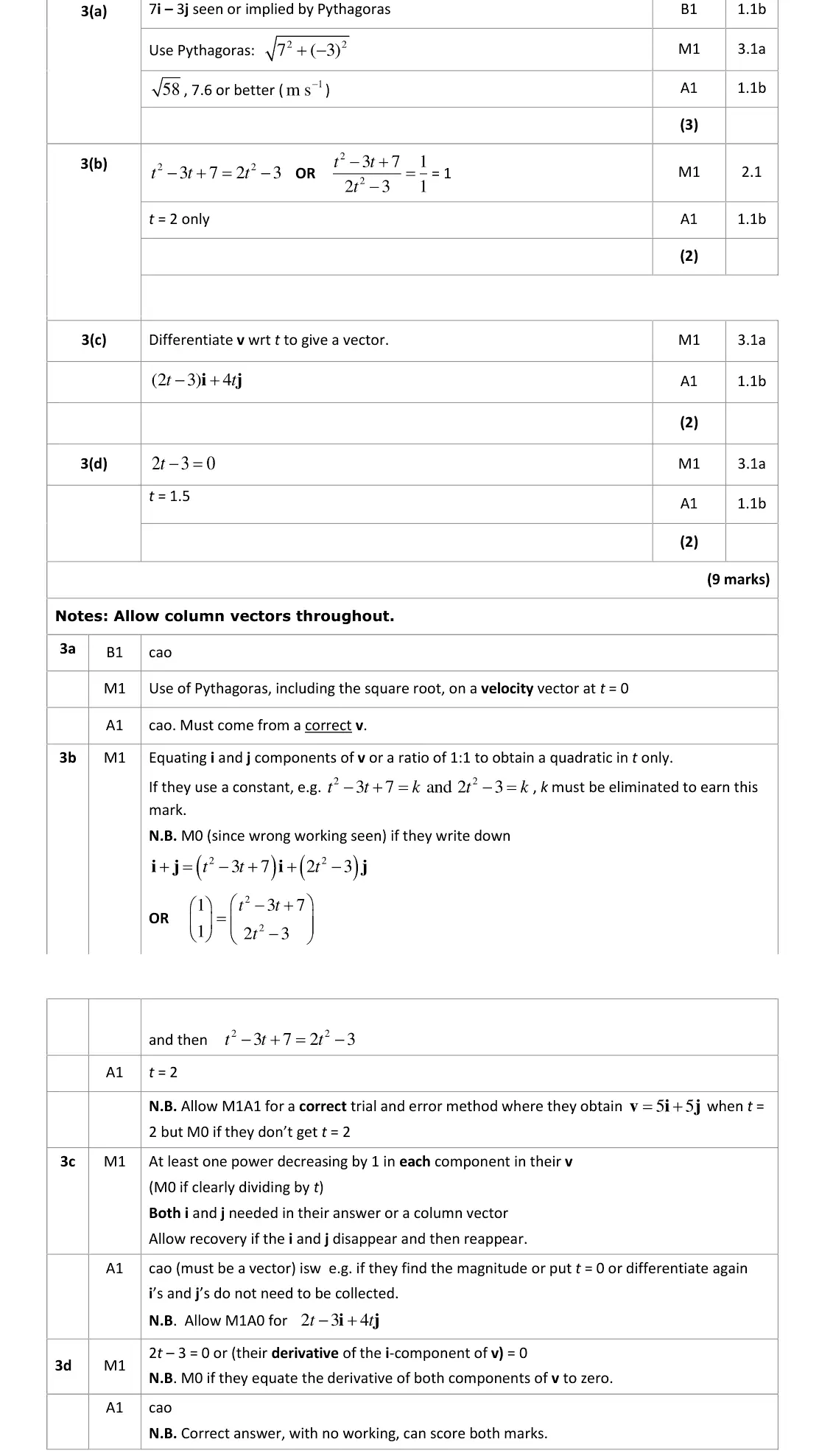
3(a) Kinematics: language and graphs, Vectors 3 —
3(b) Kinematics: language and graphs, Vectors, Quadratics and the discriminant 2 —
3(c) Variable acceleration, Differentiation: first principles, gradients, stationary points 2 —
3(d) Variable acceleration, Vectors 2 —
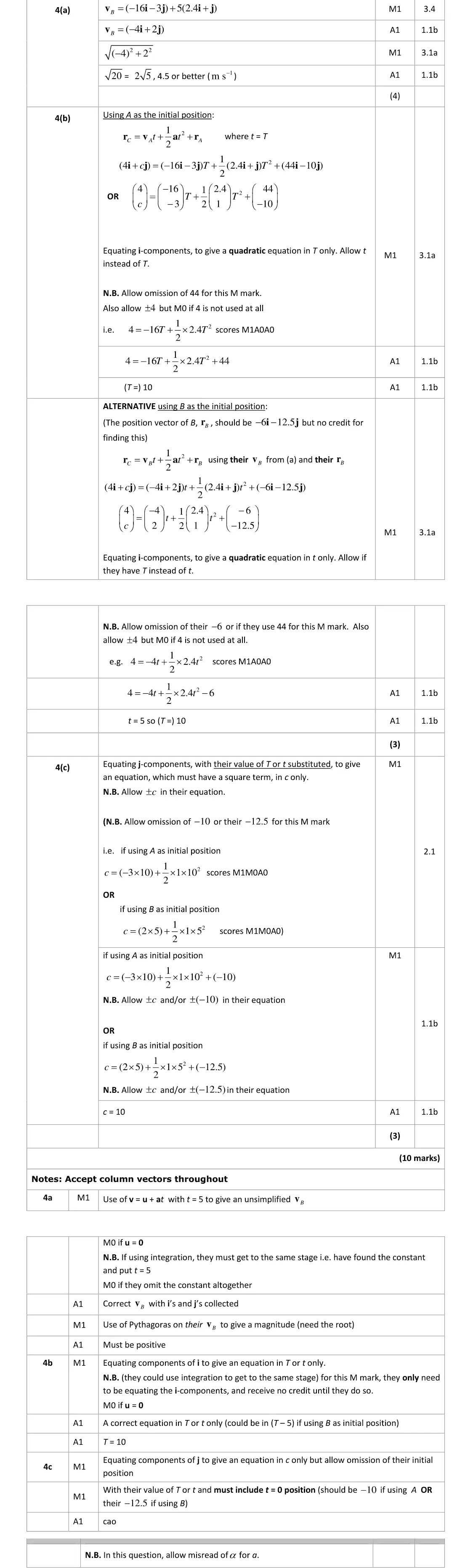
4(a) Constant acceleration (SUVAT), Kinematics: language and graphs, Vectors 4 —
4(b) Constant acceleration (SUVAT), Quadratics and the discriminant 3 —
4(c) Constant acceleration (SUVAT) 3 —
5(a) Projectiles, Trigonometric ratios, graphs, radians and the sine and cosine rules 2 —
5(b) Projectiles, Trigonometric ratios, graphs, radians and the sine and cosine rules, Trigonometric identities and proofs 5 —
5(c) Projectiles, Quadratics and the discriminant, Solving trigonometric equations 3 —
5(d) Projectiles 1 —
6(a) Friction, resultant forces and motion in a plane, Forces, Newton's laws and connected particles 1 —
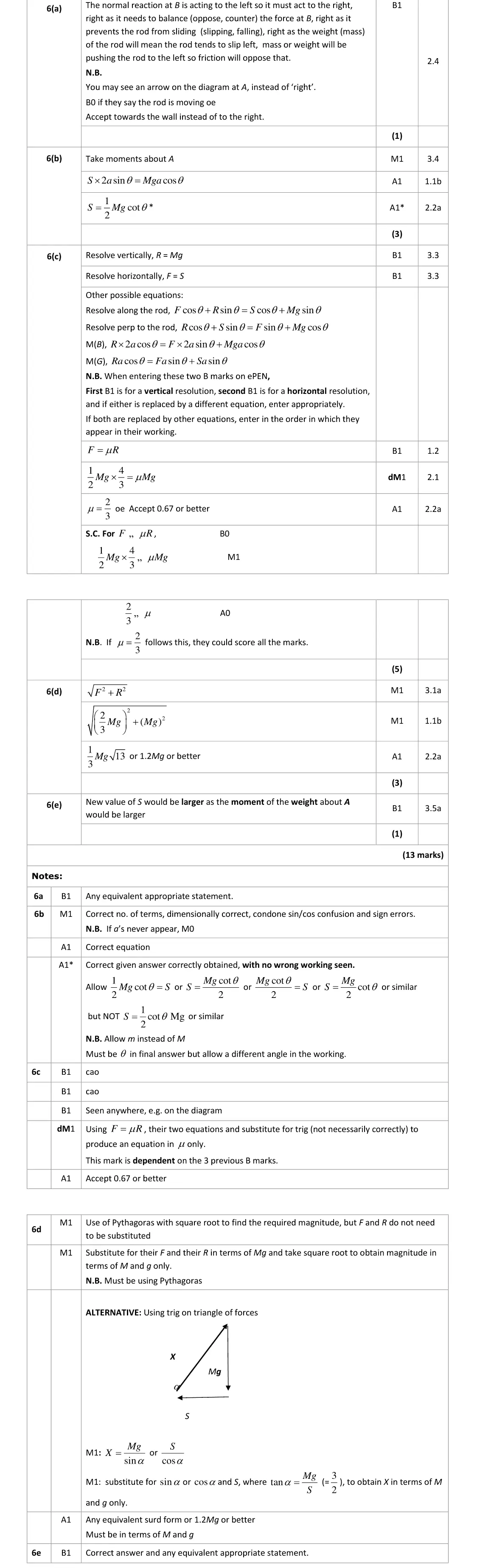
6(b) Moments, Reciprocal and inverse trigonometric functions 3 —
6(c) Friction, resultant forces and motion in a plane, Forces, Newton's laws and connected particles, Trigonometric ratios, graphs, radians and the sine and cosine rules 5 —
6(d) Friction, resultant forces and motion in a plane 3 —
6(e) Moments 1 —

The questions

1(a)1(b)2(a)2(b)2(c)3(a)3(b)3(c)3(d)4(a)4(b)4(c)5(a)5(b)5(c)5(d)6(a)6(b)6(c)6(d)6(e)
June 2023 · Paper 3 (Mechanics) · Q1(a) 1 mark constant acceleration
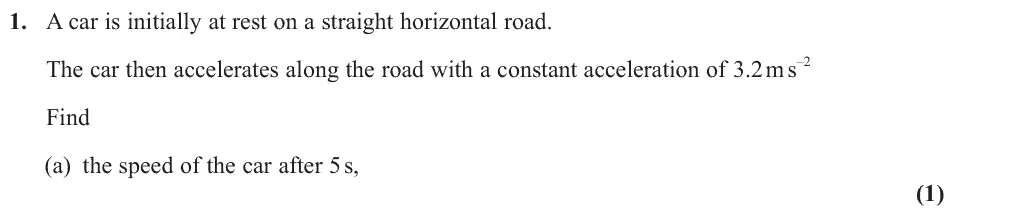
1. A car is initially at rest on a straight horizontal road. The car then accelerates along the road with a constant acceleration of 3.2 m s –2 Find (a) the speed of the car after 5 s, (1)
June 2023 · Paper 3 (Mechanics) · Q1(b) 2 marks constant acceleration
(b) the distance travelled by the car in the first 5 s. (2)
June 2023 · Paper 3 (Mechanics) · Q2(a) 1 mark forces and newtons laws
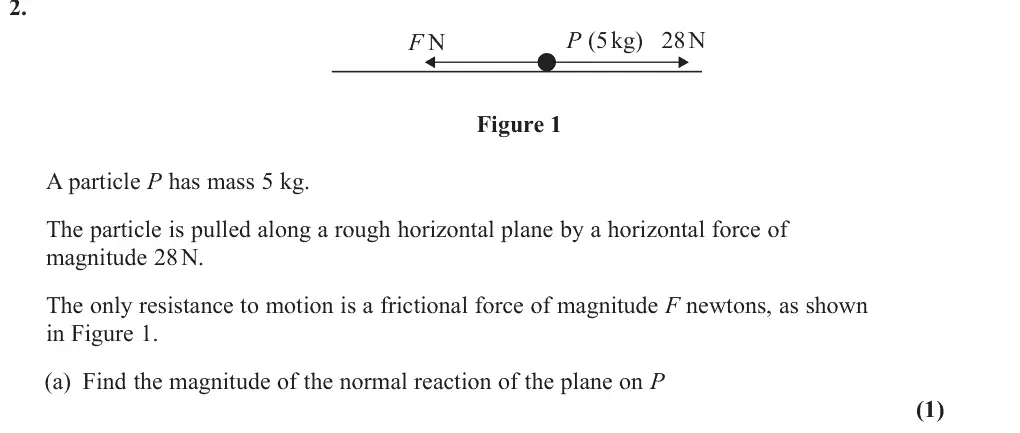
2. F N P (5 kg) 28 N Figure 1 A particle P has mass 5 kg. The particle is pulled along a rough horizontal plane by a horizontal force of magnitude 28 N. The only resistance to motion is a frictional force of magnitude F newtons, as shown in Figure 1. (a) Find the magnitude of the normal reaction of the plane on P (1)
June 2023 · Paper 3 (Mechanics) · Q2(b) 2 marks forces and newtons laws
–2 The particle is accelerating along the plane at 1.4 m s (b) Find the value of F (2)
June 2023 · Paper 3 (Mechanics) · Q2(c) 1 mark friction and forces in a plane
The coefficient of friction between P and the plane is μ (c) Find the value of μ, giving your answer to 2 significant figures. (1)
June 2023 · Paper 3 (Mechanics) · Q3(a) 3 marks kinematicsvectors
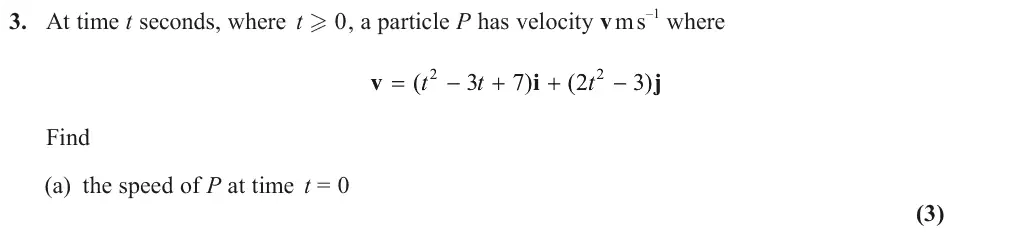
3. At time t seconds, where t 0, a particle P has velocity v m s –1 where v i j t t t ( ) ( ) Find (a) the speed of P at time t = 0 (3)
June 2023 · Paper 3 (Mechanics) · Q3(b) 2 marks kinematicsvectorsquadratics
(b) the value of t when P is moving parallel to (i + j) (2)
June 2023 · Paper 3 (Mechanics) · Q3(c) 2 marks variable accelerationdifferentiation
(c) the acceleration of P at time t seconds (2)
June 2023 · Paper 3 (Mechanics) · Q3(d) 2 marks variable accelerationvectors
(d) the value of t when the direction of the acceleration of P is perpendicular to i (2)
June 2023 · Paper 3 (Mechanics) · Q4(a) 4 marks constant accelerationkinematicsvectors
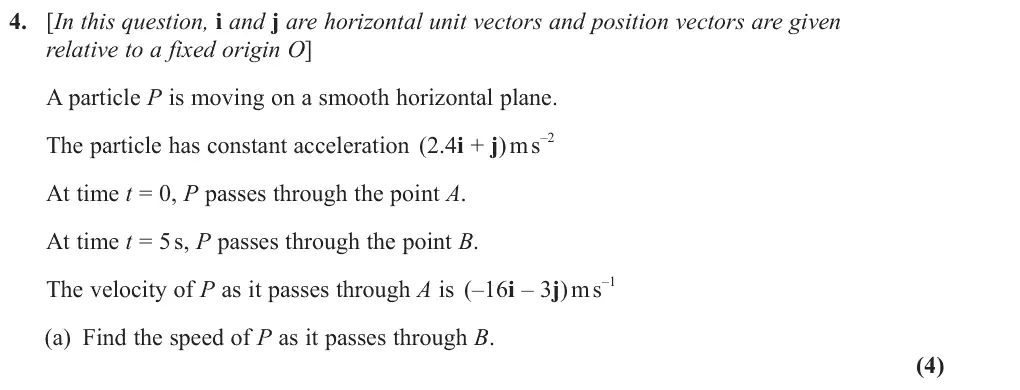
4. [In this question, i and j are horizontal unit vectors and position vectors are given relative to a fixed origin O] A particle P is moving on a smooth horizontal plane. The particle has constant acceleration (2.4i + j) m s –2 At time t = 0, P passes through the point A. At time t = 5 s, P passes through the point B. The velocity of P as it passes through A is (–16i – 3j) m s –1 (a) Find the speed of P as it passes through B. (4)
June 2023 · Paper 3 (Mechanics) · Q4(b) 3 marks constant accelerationquadratics
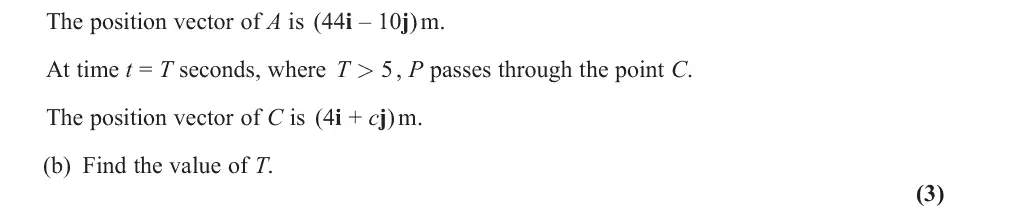
The position vector of A is (44i – 10j) m. At time t = T seconds, where T > 5 , P passes through the point C. The position vector of C is (4i + cj) m. (b) Find the value of T. (3)
June 2023 · Paper 3 (Mechanics) · Q4(c) 3 marks constant acceleration
(c) Find the value of c. (3)
June 2023 · Paper 3 (Mechanics) · Q5(a) 2 marks projectilestrigonometric ratios
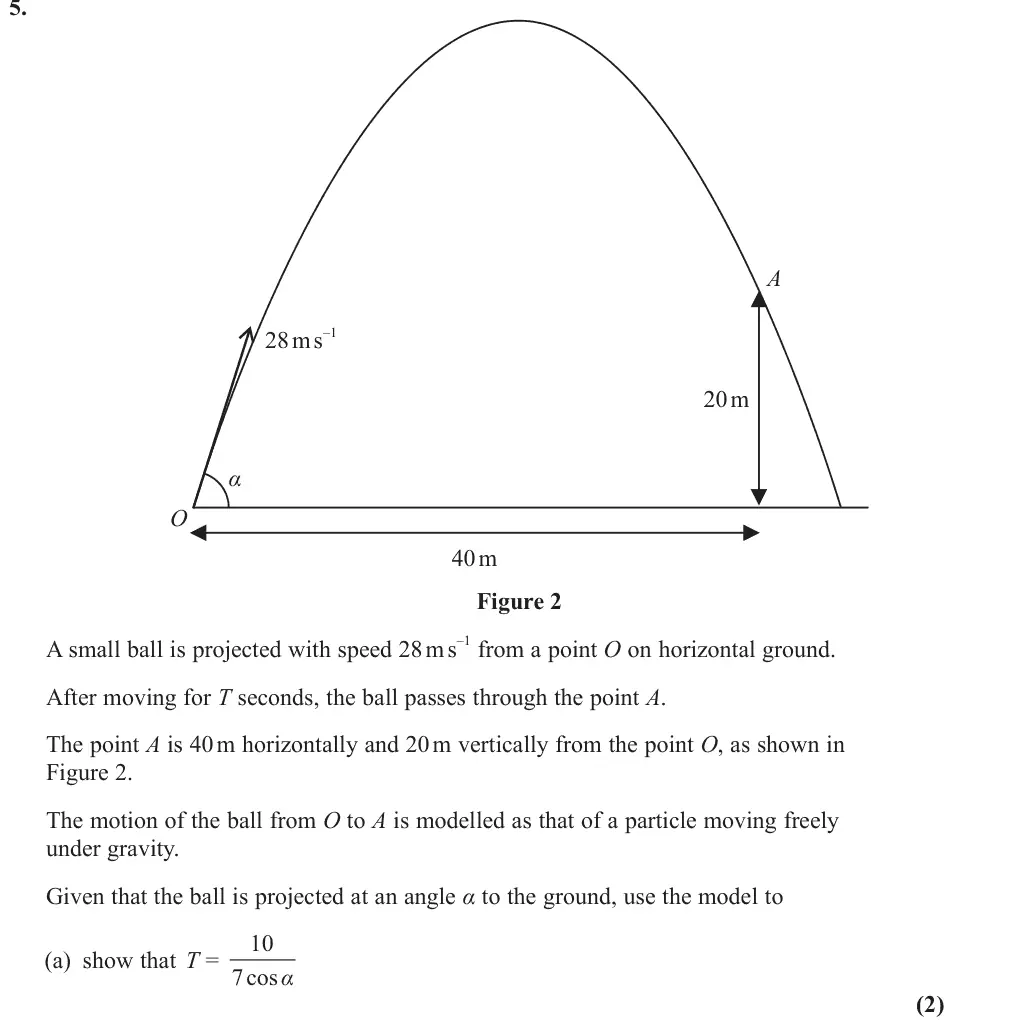
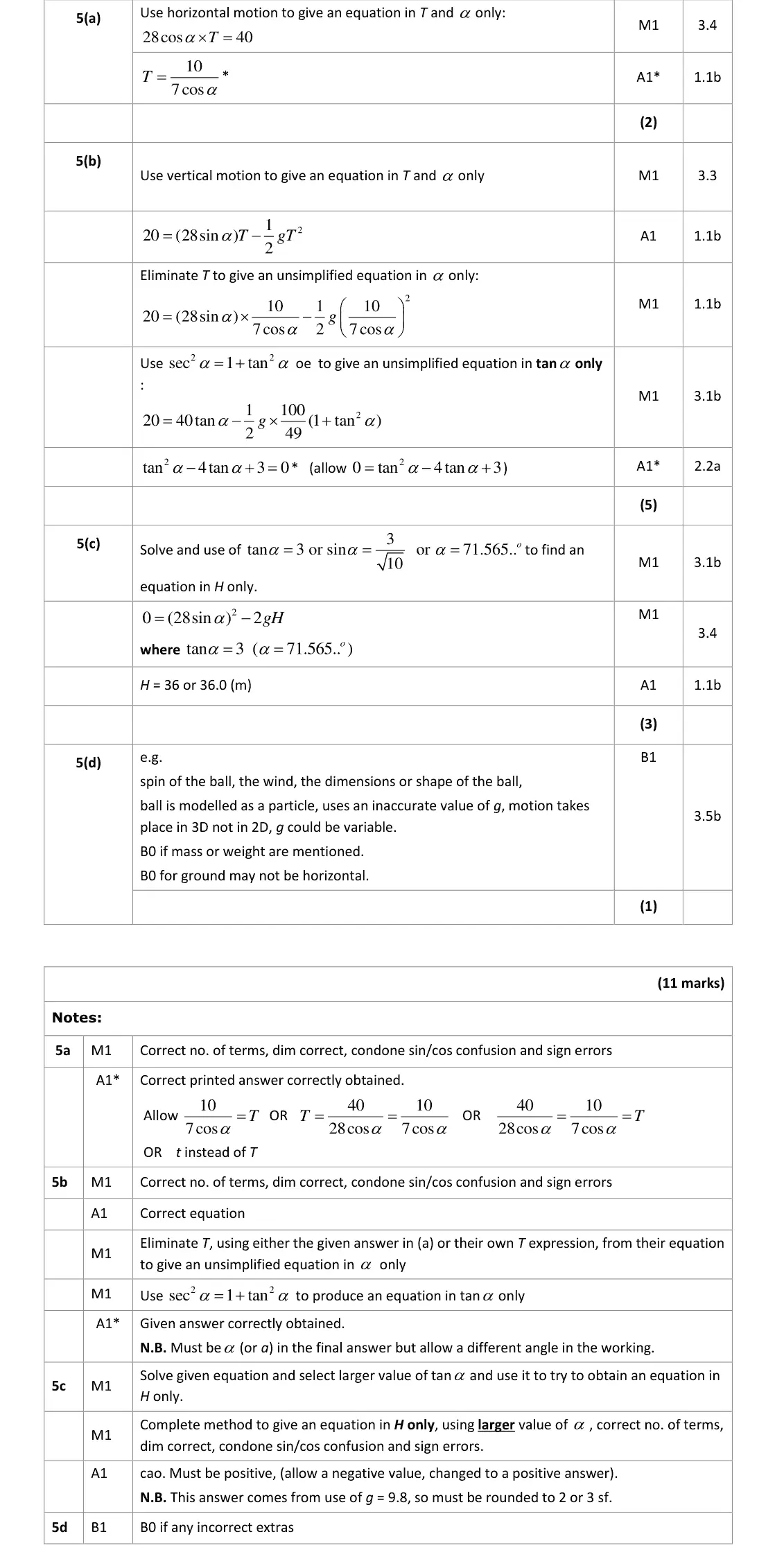
5. A –1 28 m s 20 m alpha 40 m Figure 2 –1 from a point O on horizontal ground. A small ball is projected with speed 28 m s After moving for T seconds, the ball passes through the point A. The point A is 40 m horizontally and 20 m vertically from the point O, as shown in Figure 2. The motion of the ball from O to A is modelled as that of a particle moving freely under gravity. Given that the ball is projected at an angle alpha to the ground, use the model to (a) show that T = 7cos alpha (2)
June 2023 · Paper 3 (Mechanics) · Q5(b) 5 marks projectilestrigonometric ratiostrig identities
2 alpha – 4 tan alpha + 3 = 0 (b) show that tan (5)
June 2023 · Paper 3 (Mechanics) · Q5(c) 3 marks projectilesquadraticstrigonometric equations
(c) find the greatest possible height, in metres, of the ball above the ground as the ball moves from O to A. (3)
June 2023 · Paper 3 (Mechanics) · Q5(d) 1 mark projectiles
The model does not include air resistance. (d) State one other limitation of the model. (1)
June 2023 · Paper 3 (Mechanics) · Q6(a) 1 mark friction and forces in a planeforces and newtons laws
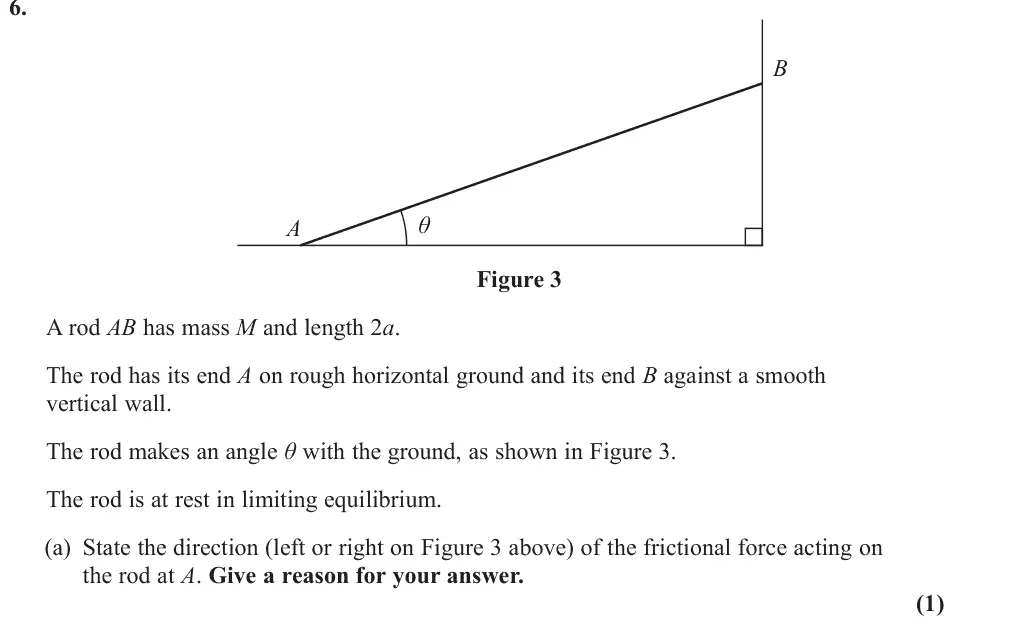
6. B theta A Figure 3 A rod AB has mass M and length 2a. The rod has its end A on rough horizontal ground and its end B against a smooth vertical wall. The rod makes an angle theta with the ground, as shown in Figure 3. The rod is at rest in limiting equilibrium. (a) State the direction (left or right on Figure 3 above) of the frictional force acting on the rod at A. Give a reason for your answer. (1)
June 2023 · Paper 3 (Mechanics) · Q6(b) 3 marks momentsreciprocal trig functions
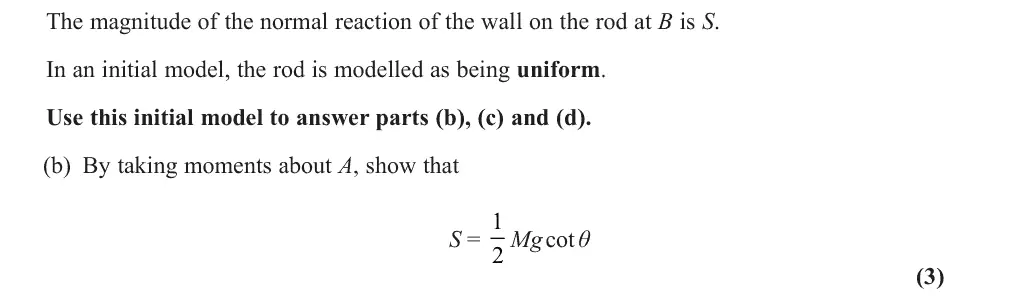
The magnitude of the normal reaction of the wall on the rod at B is S. In an initial model, the rod is modelled as being uniform. Use this initial model to answer parts (b), (c) and (d). (b) By taking moments about A, show that S = 1 2 Mg cot theta (3)
June 2023 · Paper 3 (Mechanics) · Q6(c) 5 marks friction and forces in a planeforces and newtons lawstrigonometric ratios
The coefficient of friction between the rod and the ground is μ Given that tan theta = (c) find the value of μ (5)
June 2023 · Paper 3 (Mechanics) · Q6(d) 3 marks friction and forces in a plane
(d) find, in terms of M and g, the magnitude of the resultant force acting on the rod at A. (3)
June 2023 · Paper 3 (Mechanics) · Q6(e) 1 mark moments
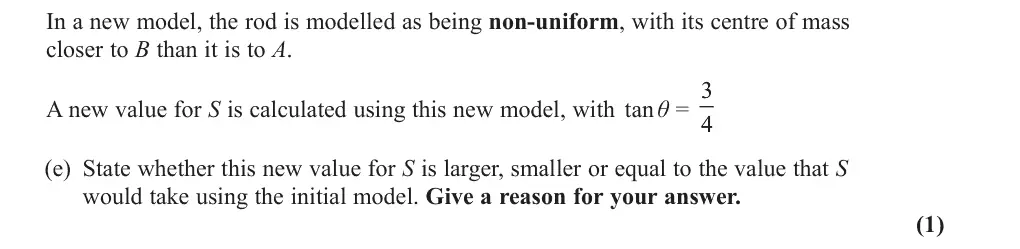
In a new model, the rod is modelled as being non-uniform, with its centre of mass closer to B than it is to A. A new value for S is calculated using this new model, with tan theta = (e) State whether this new value for S is larger, smaller or equal to the value that S would take using the initial model. Give a reason for your answer. (1)

Find an Edexcel maths tutor

Want this paper marked and gone through with you? Message us.

Prefer email? Send an enquiry

If you are under 18, please include a parent's contact details. Enquiries go to enquiries@mathsaleveltutor.com and are deleted once handled.