Examiner's comment
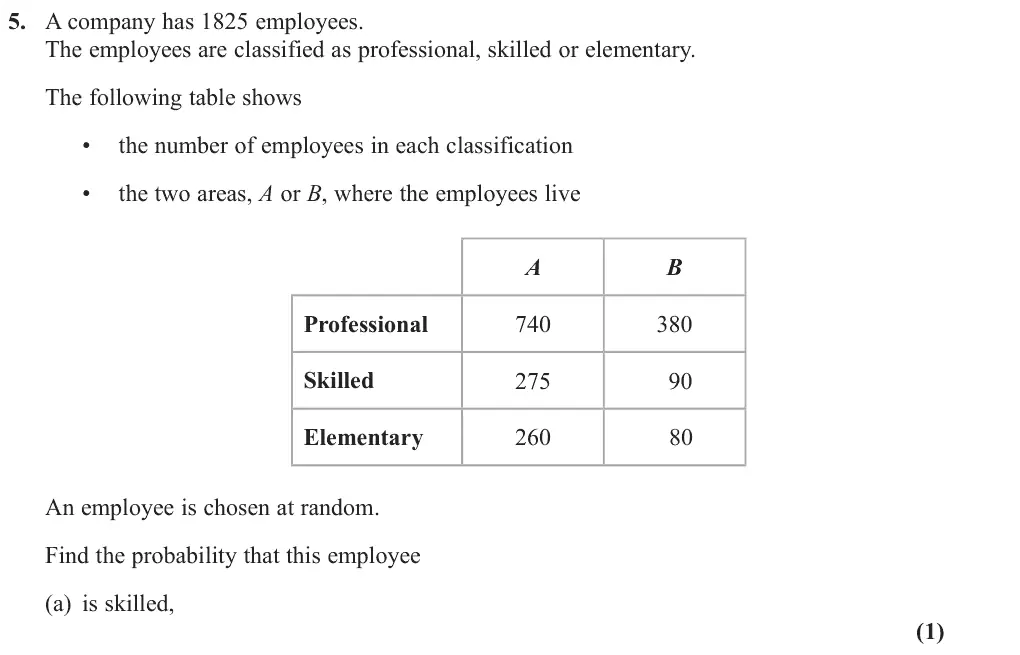
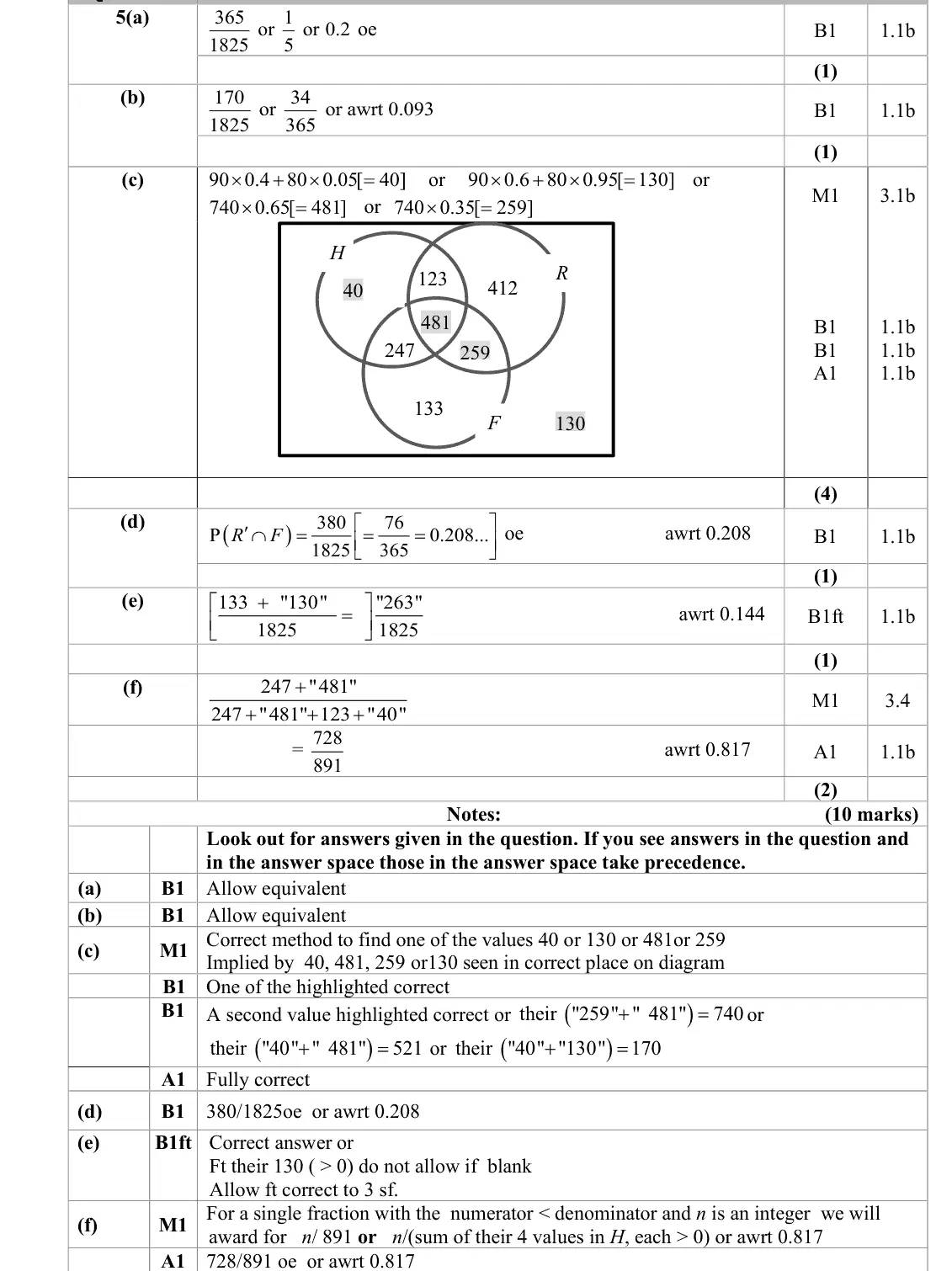
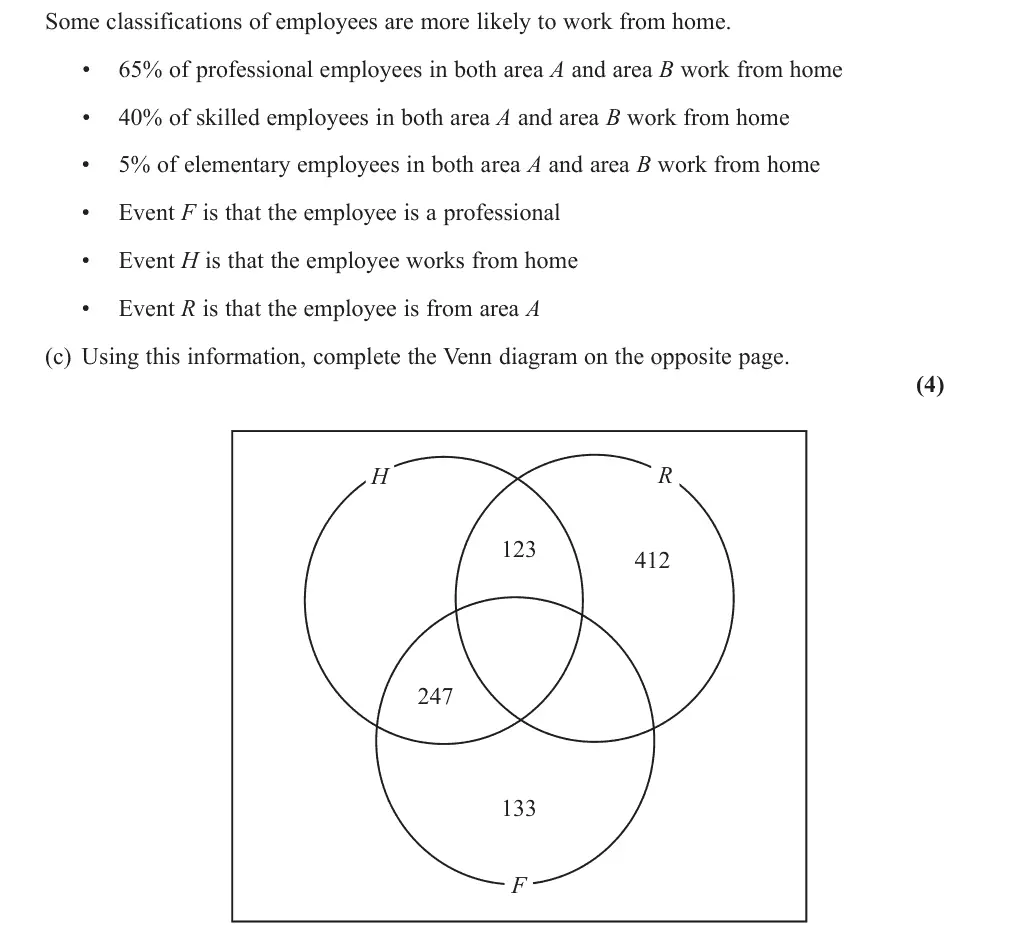
Part (a) was well answered with most students able to gain the mark for a correct answer. A simplified fraction or the correct decimal value was often seen. Whilst the majority of students continued to score well in part (b) the most common incorrect answer came from students who thought the question was conditional, giving 170 550 , i.e. the probability of not being a professional given they live in area B. Some students attempted a product of probabilities assuming independence, which was not given and not correct. In part (c) there was mixed success in the interpretation of the information given in the question with only about half of students getting the Venn diagram completely correct. Some correct diagrams followed minimal working whilst others filled at least a page. A ′∩′∩ ′ blank. The method mark was common omission was to leave the region H R F most commonly given when implied by one correct value in the Venn diagram, rather than for the student’s working, which was commonly unclear. Some working indicated incorrect use of the given percentages. Where only one value was correct in the Venn diagram it was usually the 481 or 259, for ‘professionals from area A’. When none or only one of the four correct values was seen many students benefited from being able to achieve 1 mark for the sums of certain pairs of values in their diagram. There were a number of students who simply abandoned the Venn diagram which often resulted in no attempts being made at the remaining parts of the question. Part (d) had a mixed response with many correct answers. This part could be answered independently of whether or not (c) had been attempted and it was good to see most students doing so successfully through mark could only be scored by students who had some value in the region 𝐻𝐻′ ∩ 𝑅𝑅′ ∩𝐹𝐹′ so that this value could be added to the 133 in their calculation. A common Whilst many realised the 133 given in the Venn diagram was required, the follow- non-scoring answer of 133 1825 was often seen. Most students realised that part (d) was a conditional probability question with many taking the simpler approach of using numbers rather than probabilities in their ratio. Those with a correct Venn diagram usually scored both marks here. As is often the case, a noticeable number of students had the incorrect event, namely F, as the denominator in their probability expression rather than H.