3.03n Solve problems involving simple cases of equilibrium of forces on a…
Section
3.03 Forces and Newton's Laws
Level
AS & A level
Statement
Be able to solve problems involving simple cases of equilibrium of forces on a particle in two dimensions using vectors, including connected particles and smooth pulleys.
Guidance
e.g. Finding the required force F for a particle to remain in equilibrium when under the action of forces F₁, F₂, ... For stage 1 learners, examples can be restricted to problems in which the forces acting on the body will be collinear, in two perpendicular directions or given as 2-D vectors.
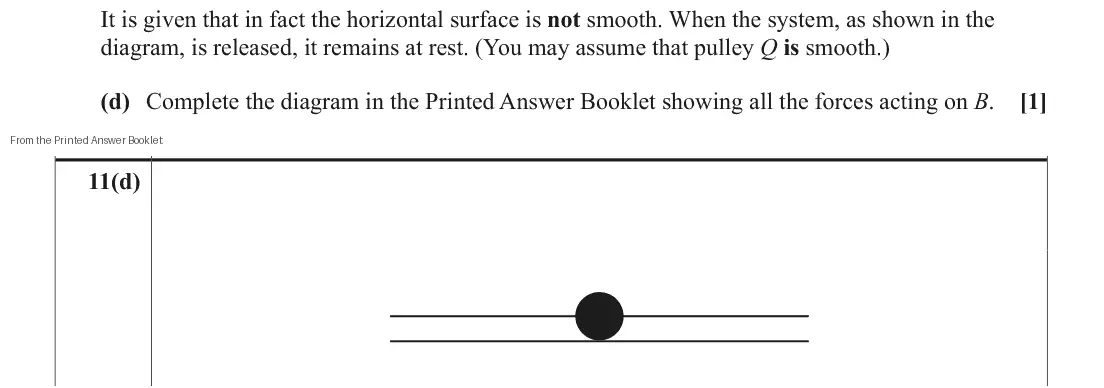
This question part was not well done by many candidates. The most common incorrect answer was 4.9N, coming from the difference in the tensions in (a) – the new situation did not seem to be grasped by most candidates.
Key points and common errors
in equilibrium the tensions are 3g and 2g so friction = 3g − 2g = g (9.8 N)
4.9 N from part (a) tensions is wrong
June 2024 · AS Paper 2 · Q9(a)2 marksEasy
Mark scheme for this part
Examiner's comment
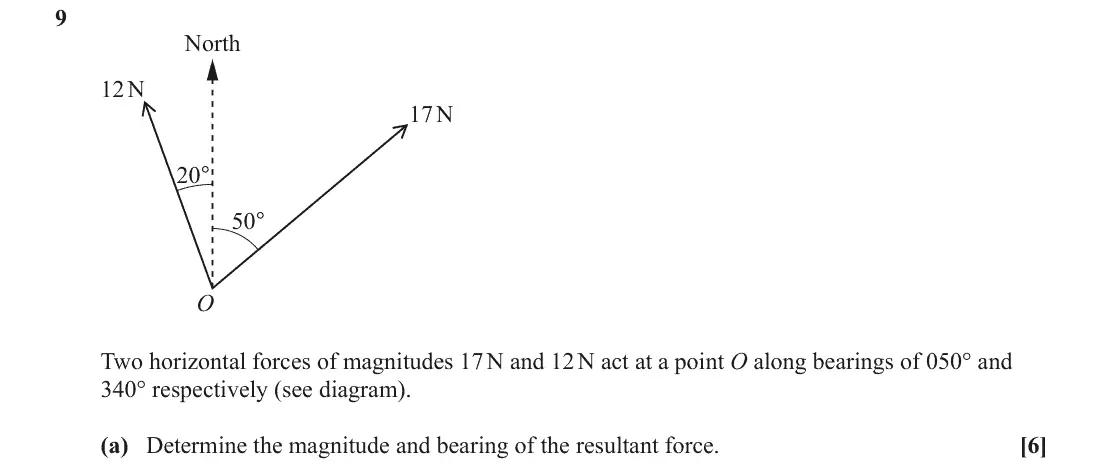
There were a lot of correct answers to this question. Marks were lost by some for simple arithmetical errors or for using F1 + F2 = F3.
Key points and common errors
F₁ + F₂ + F₃ = 0 gives F₃ = (2, −3) N
using F₁ + F₂ = F₃ is wrong
June 2024 · Paper 3 · Q9(b)2 marksEasy
Show the start of this question
Mark scheme for this part
Examiner's comment
Most candidates recognised in this part that the magnitude of F would be the same as the magnitude of their resultant force in part (a) and that the bearing would be a difference of 180 from their answer to part (a).
Key points and common errors
F is equal and opposite to the resultant: 23.9 N on bearing 202°
June 2022 · AS Paper 2 · Q12(a)1 markHard
Mark scheme for this part
Examiner's comment
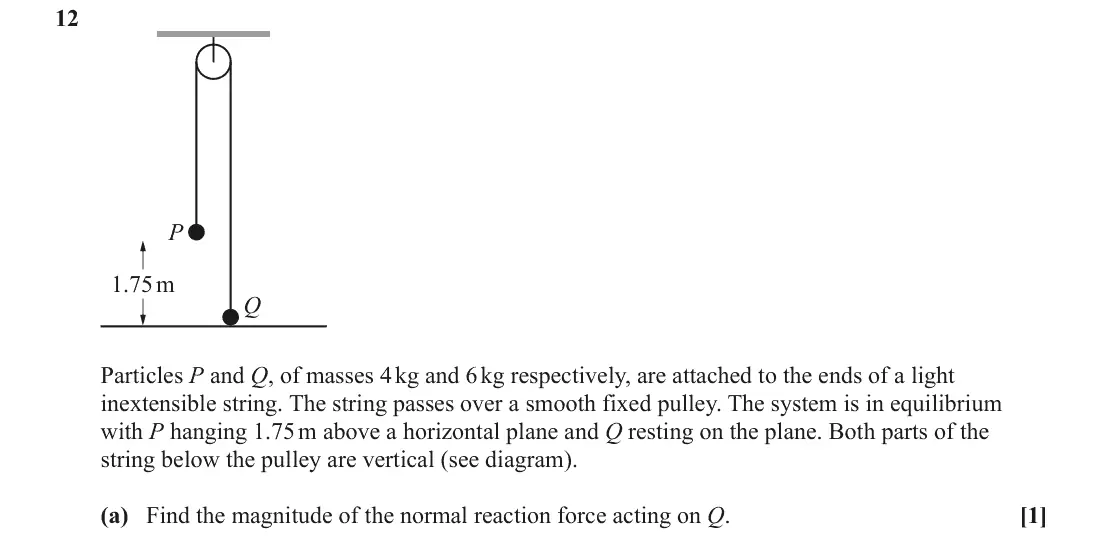
Correct answers were rare here, with 6g the value generally given.
(From the general report) Question 9 states constant acceleration so ‘suvat’ can be used, whereas Question 13 has a variable force term so calculus must be used.
Key points and common errors
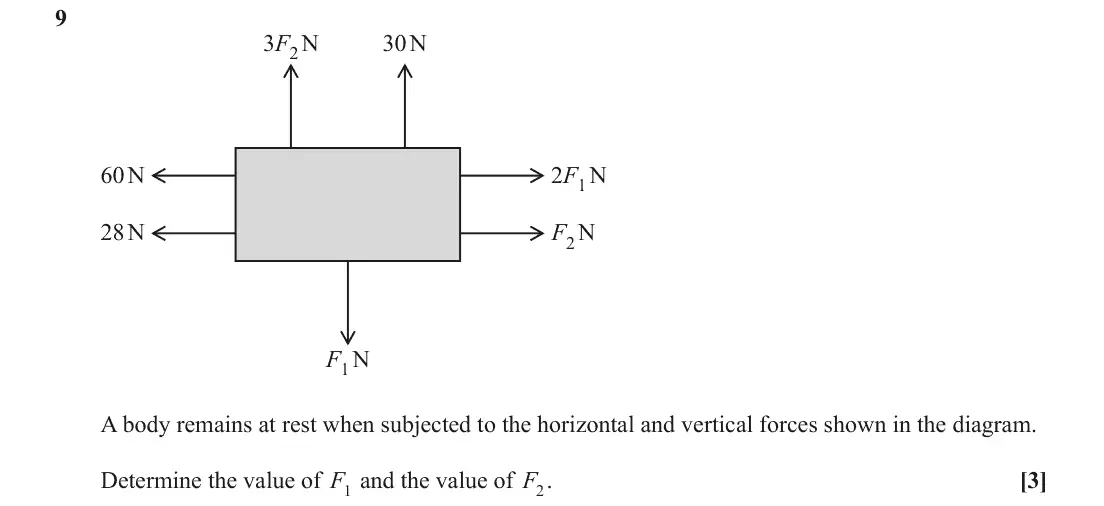
resultant (4t − 8)i + 6((2t − 1)² − 9)j = 0
t = 2 only
Autumn 2020 · AS Paper 2 · Q83 marksMedium
Mark scheme for this part
Examiner's comment
(From the general report) Section A is Pure Mathematics (Questions 1-7), allocated 50 marks and Section B is Mechanics (Questions 8-11), allocated 25 marks.
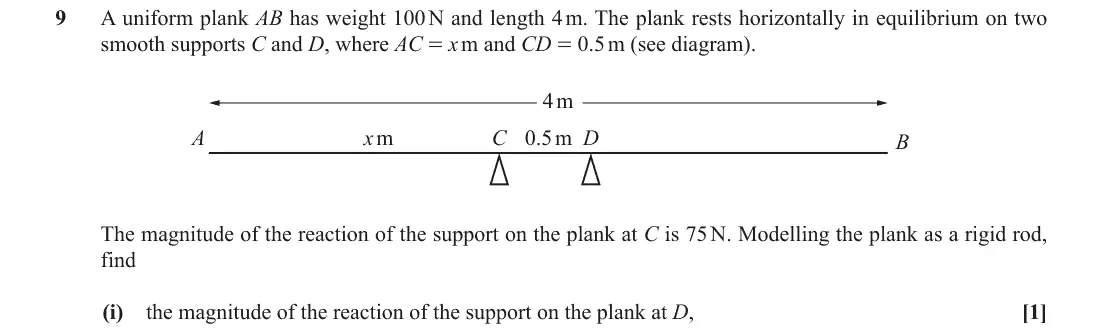
Nearly all candidates correctly stated that the magnitude of the reaction of the support on the plank at D was 25 N
Key points and common errors
resolve vertically: 100 − 75 = 25 N
June 2018 · Paper 3 · Q10(i)4 marksMedium
Mark scheme for this part
Examiner's comment
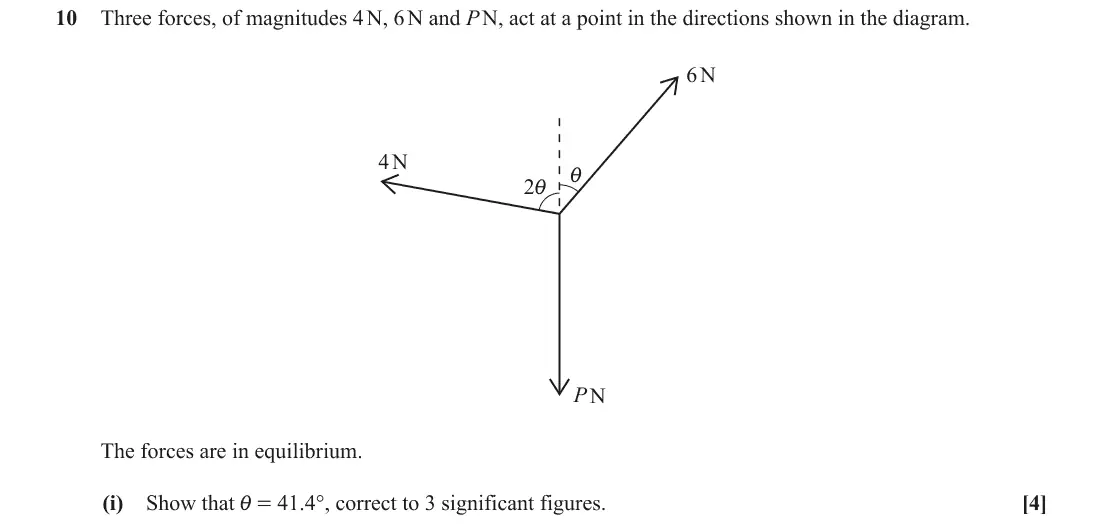
For those candidates who correctly resolve horizontally and stated that 4sin2 θ = 6sin θ most went on to show with sufficient detail the required given answer. The most common errors, as expected, were those that did not deal correctly with the two different angles or those that had the standard confusion with sine and cosine when resolving forces.
Key points and common errors
resolve horizontally: 4 sin 2θ = 6 sin θ
double angle: 8 sin θ cos θ = 6 sin θ so cos θ = 3/4
θ = 41.4°
sin/cos confusion and mixing the two angles
June 2018 · Paper 3 · Q10(ii)2 marksEasy
Show the start of this question
Mark scheme for this part
Examiner's comment
This part was answered extremely well with the majority of candidates correctly resolving vertically and obtaining P = 4cos2 θ + 6cos θ ⇒ P = 5 .
Key points and common errors
resolve vertically: P = 4 cos 2θ + 6 cos θ = 5
Find an A-level maths tutor
Stuck on this? Book a trial session with an A-level maths tutor.