3.02g Extend the application of differentiation and integration to two…
Section
3.02 Kinematics
Level
A level only
Statement
Be able to extend the application of differentiation and integration to two dimensions using vectors: x = f(t)i + g(t)j, v = dx/dt = ẋ = f′(t)i + g′(t)j, a = dv/dt = v̇ = d²x/dt² = f″(t)i + g″(t)j, x = ∫v dt and v = ∫a dt.
Guidance
Questions set may involve either column vector or i, j notation.
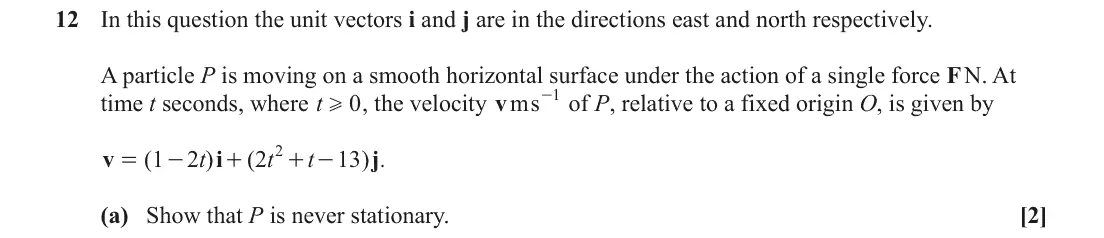
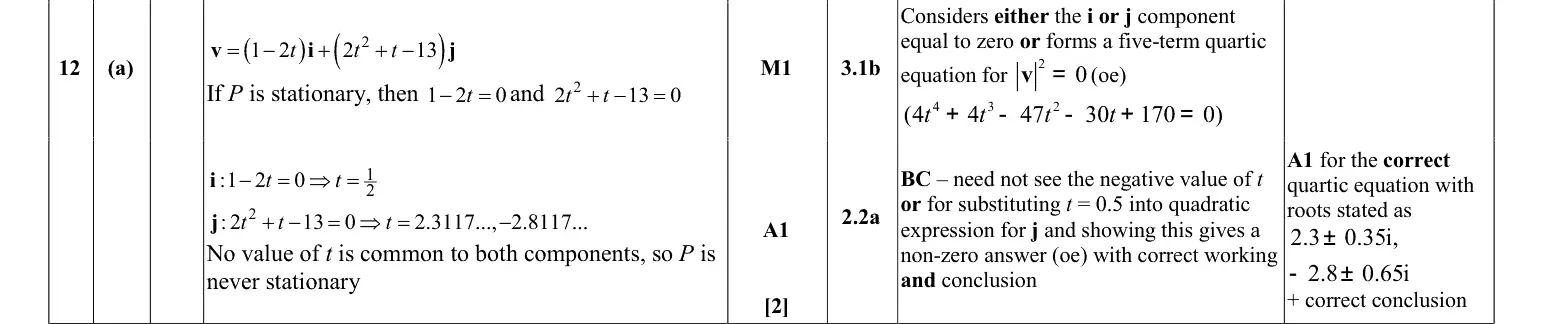
The most common way of showing that P was never stationary was to solve either 1 2 − t = 0 or 2 t + − t 13 = 0 and show that the value of t from one equation was not consistent with the value(s) of t from the other equation. Those candidates who instead decided to find an expression for the speed of P at time t (which in most cases was a 5-term quartic equation) were rarely successful in either deriving this equation correctly or articulating their findings when they attempted to solve it.
Key points and common errors
i component zero at t = 0.5 but j component zero at t ≈ 2.31
no common t so never stationary
June 2022 · Paper 3 · Q12(b)1 markEasy
Show the start of this question
Mark scheme for this part
Examiner's comment
This question was almost always answered correctly by differentiating the expression given in the stem to part (a). Only occasionally did examiners report cases of candidates using either constant acceleration formulae or integration.
Key points and common errors
a = −2i + (4t + 1)j
June 2022 · Paper 3 · Q12(c)5 marksHard
Show the start of this question
Mark scheme for this part
Examiner's comment
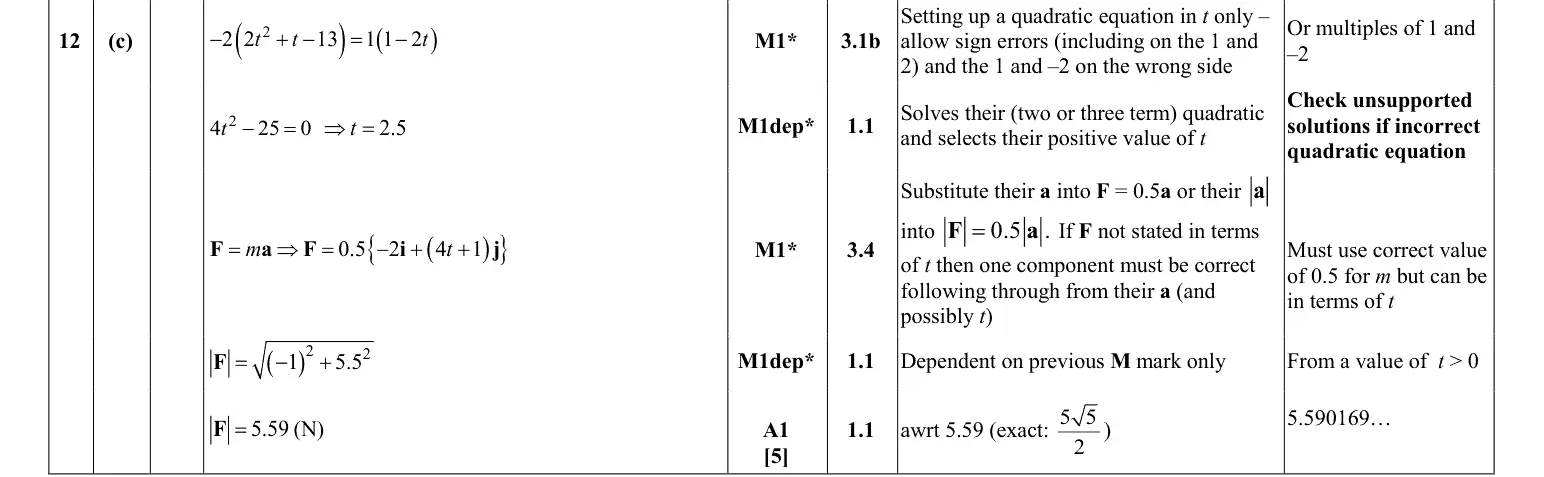
How to deal with ‘…moving in the direction of the vector 2 − i + j ’ was not well known by most candidates (and it would seem that many candidates did not realise that the direction of motion of P is governed by the corresponding velocity vector and not the displacement vector). For those candidates who did realise − − 2 1 2 t = that k for some constant k most usually went on to find the correct value of t as 2.5. + − 1 2 t t 13 In comparison, the vector expression for F (and corresponding magnitude) were much better known by candidates and even if they did not obtain the correct value of t they could still access some marks for their knowledge of these results.
Key points and common errors
direction of motion is the velocity: (2t² + t − 13)/(1 − 2t) = −1/2 gives 4t² = 25, t = 2.5
F = 0.5a
magnitude 5.59 N
June 2022 · Paper 3 · Q12(d)5 marksMedium
Show the start of this question
Mark scheme for this part
Examiner's comment
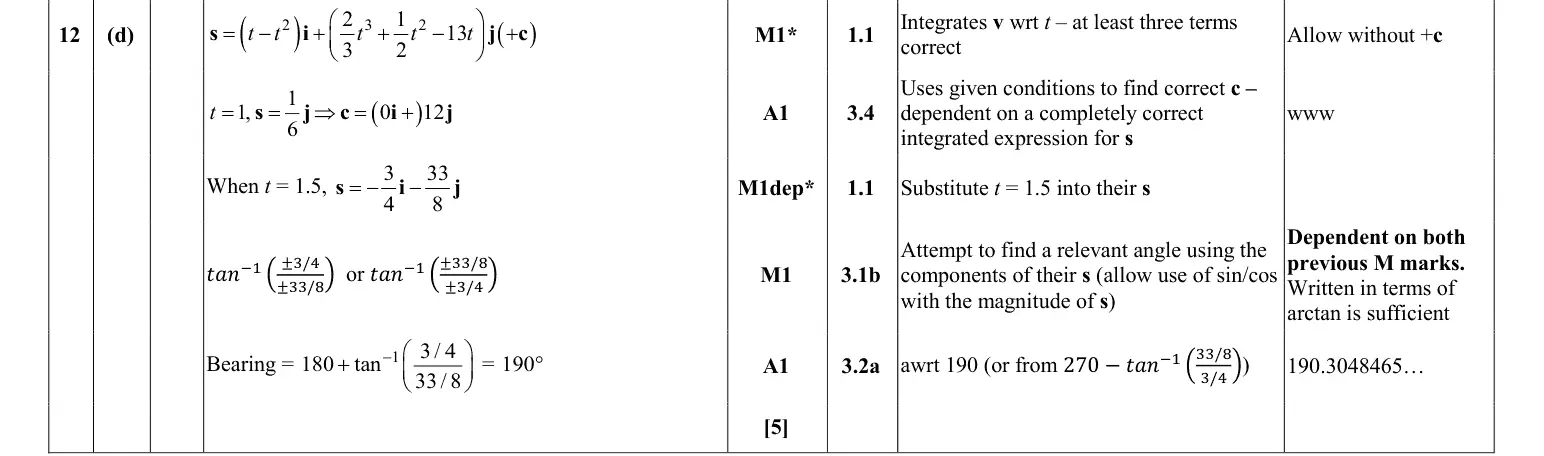
This question was much better answered than part (c) with many candidates correctly integrating the velocity vector to obtain the corresponding displacement vector. Some candidates did not include a vector constant of integration (and some just automatically assumed that it would be a zero vector). 3 33 However, many correctly found the displacement at time 1.5 as − − j and although many used the i 4 8 tan ratio to work out a suitable angle only some correctly found the required bearing.
Key points and common errors
integrate v with vector constant
c = 12j from s(1) = j/6
s(1.5) = −3/4 i − 33/8 j
bearing 190°
Autumn 2021 · Paper 3 · Q13(b)6 marksMedium
Show the start of this question
Mark scheme for this part
Examiner's comment
(From the general report) Question 9 states constant acceleration so ‘suvat’ can be used, whereas Question 13 has a variable force term so calculus must be used.
Key points and common errors
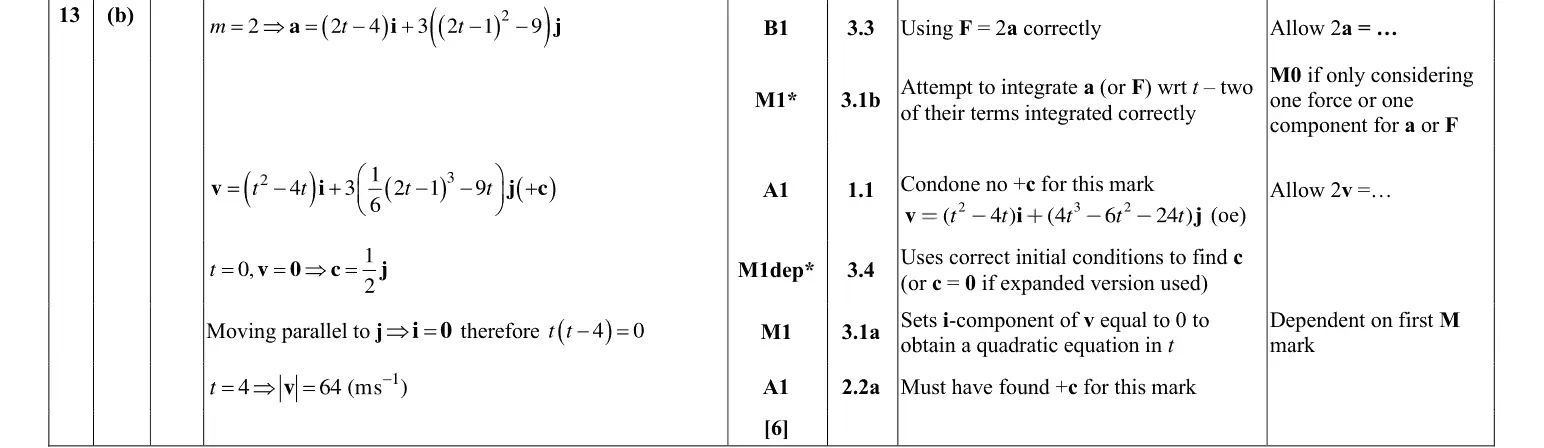
a = F/2
integrate for v with constant from v = 0 at t = 0
moving due north means i-component zero: t = 4
speed 64 m s⁻¹
variable force so calculus not suvat
Autumn 2021 · Paper 3 · Q13(c)5 marksMedium
Show the start of this question
Mark scheme for this part
Examiner's comment
(From the general report) Question 9 states constant acceleration so ‘suvat’ can be used, whereas Question 13 has a variable force term so calculus must be used.
Key points and common errors
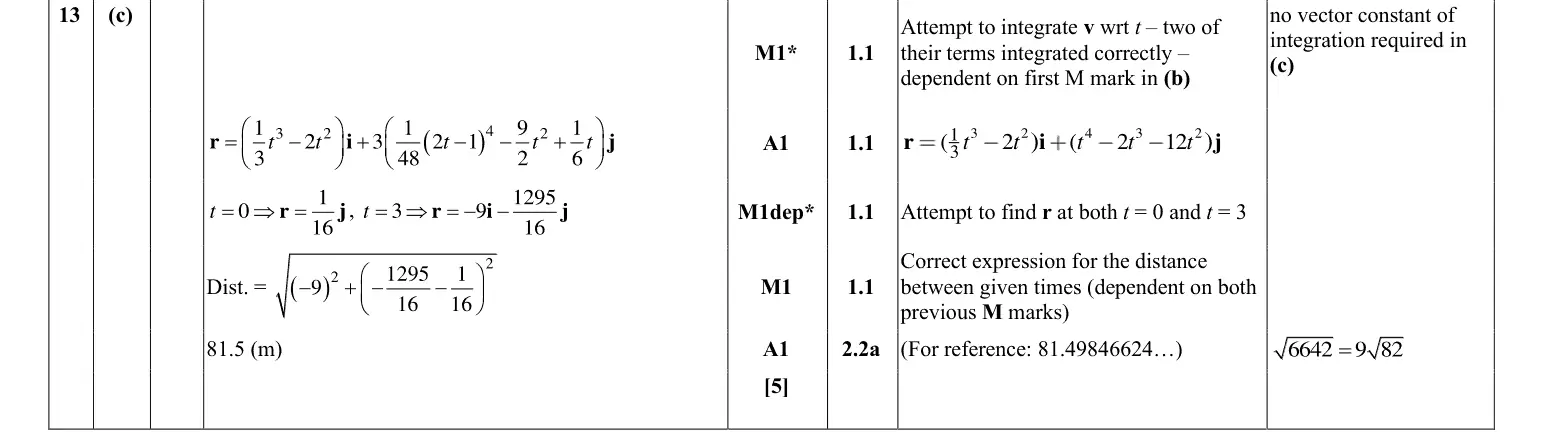
integrate v for r
evaluate at t = 0 and t = 3
distance √6642 = 81.5 m
June 2019 · Paper 3 · Q10(a)6 marksMedium
Mark scheme for this part
Examiner's comment
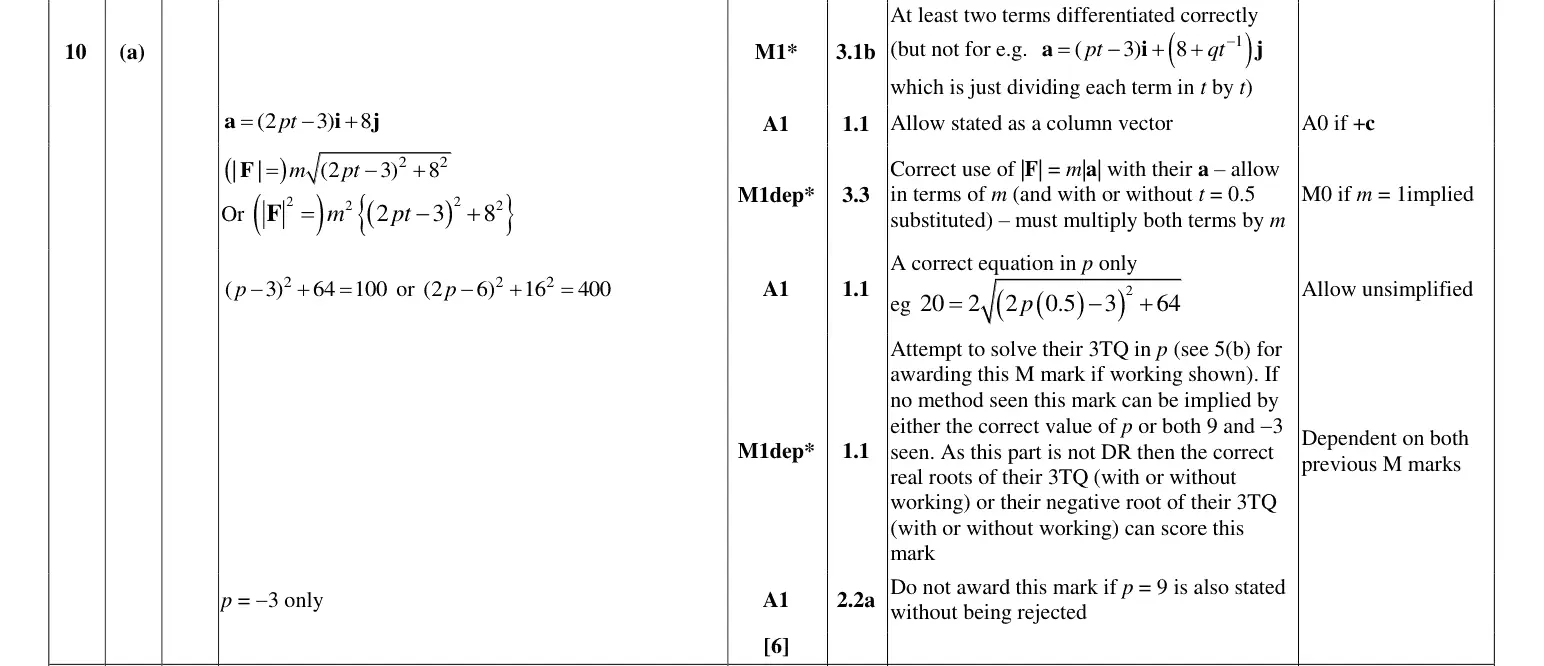
( ) Nearly all candidates correctly differentiated v and obtained a = 2 pt − 3 i + 8 j Unfortunately many . candidates then made careless slips in applying F = m a to obtain an equation in p only with the most common errors being forgetting the mass completely or only multiplying the i component by the value of m. Candidates are one again reminded to read the question carefully as while many had a correct equation in p e.g. ( p − 3 ) + 64 = 100 many solved and gave the positive root even though the question specifically said that p was negative. This response scored the first five marks. An almost perfect response let down by the fact that the candidate did not read the question carefully enough and assumed that the value of p could not be negative.
Key points and common errors
a = (2pt − 3)i + 8j
F = 2a with magnitude 20 at t = 0.5
(p − 3)² + 64 = 100
p = −3 only since p < 0
forgetting mass
June 2019 · Paper 3 · Q10(b)4 marksEasy
Show the start of this question
Mark scheme for this part
Examiner's comment
This part was answered extremely well with many candidates correctly realising that they had to use integration to find an expression for the displacement in terms of t. However, many ignored the vector constant of integration that would arise from the corresponding indefinite integral and some incorrectly integrated q as 2 q instead of as qt.
Key points and common errors
integrate v and use s = 2i − 3j at t = 0: s = (−t³ − 3t²/2 + 2)i + (4t² + qt − 3)j
vector constant omitted
integrating q as q²
June 2019 · Paper 3 · Q10(c)3 marksHard
Show the start of this question
Mark scheme for this part
Examiner's comment
This part discriminated well with many candidates making little progress apart from substituting t = 1 into their expression from part (b). Those candidates who realised that one way to find q was to equate a scalar multiple of their displacement vector (evaluated at t = 1) to 2 i − 8 j were usually successful in first finding the scalar multiple and hence the value of q.
Key points and common errors
t = 1: s = −½i + (1 + q)j
must be a scalar multiple of 2i − 8j
k = −4, q = 1
Find an A-level maths tutor
Stuck on this? Book a trial session with an A-level maths tutor.