1.06g Solve equations of the form aˣ = b for a > 0
Section
1.06 Exponentials and Logarithms
Level
AS & A level
Statement
Be able to solve equations of the form aˣ = b for a > 0.
Guidance
Includes solving equations which can be reduced to this form such as 2ˣ = 3^(2x−1), either by reduction to the form aˣ = b or by taking logarithms of both sides.
This question was very well answered by the majority of candidates. Many candidates gave quite lengthy working (often including logs) before obtaining the required linear equation in z, which scored the M1. In this case, the mark scheme allowed candidates to leave numerical (i.e. not in z) log terms in the final step before their answer so, e.g. 𝑧= was acceptable for the M1. However, in general candidates should show a complete method where the DR instruction is given.
Key points and common errors
16 = 2⁴ so 3z − 10 = 4, z = 14/3
June 2025 · AS Paper 2 · Q8(b)5 marksEasy
Show the start of this question
Mark scheme for this part
Examiner's comment
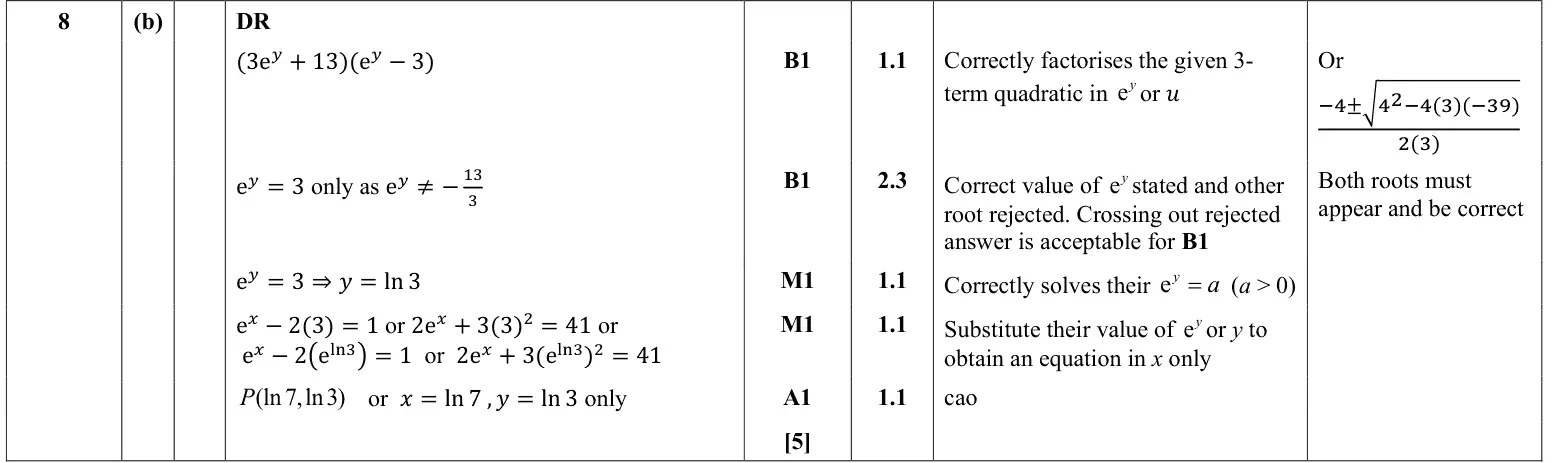
This was the third DR question. The given equation was widely recognised as a quadratic and well solved (see note below). The negative root was often rejected with a good reason provided. We expected exact answers to be seen for full marks. Those who did not use a quadratic tended to write things like ln(3e2y) + ln(4ey) = ln(39) and not make any further progress.
Key points and common errors
quadratic in eʸ: (3eʸ + 13)(eʸ − 3) = 0
reject eʸ = −13/3 with reason
y = ln 3, eˣ = 7 so P(ln 7, ln 3) exact
logging term by term fails
June 2025 · Paper 2 · Q2(b)2 marksEasy
Show the start of this question
Mark scheme for this part
Examiner's comment
This part was very well answered. Most candidates showed at least the required step of working and wrote down the correct, exact answer (although the decimal equivalent could also be credited). A few candidates appeared unsure as to whether they were taking log10 or ln – which was sometimes recovered but often led to an incorrect answer.
Key points and common errors
take ln of both sides: 3y = ln 2, y = (1/3)ln 2
confusion between log10 and ln
June 2025 · Paper 3 · Q3(c)3 marksMedium
Show the start of this question
Mark scheme for this part
Examiner's comment
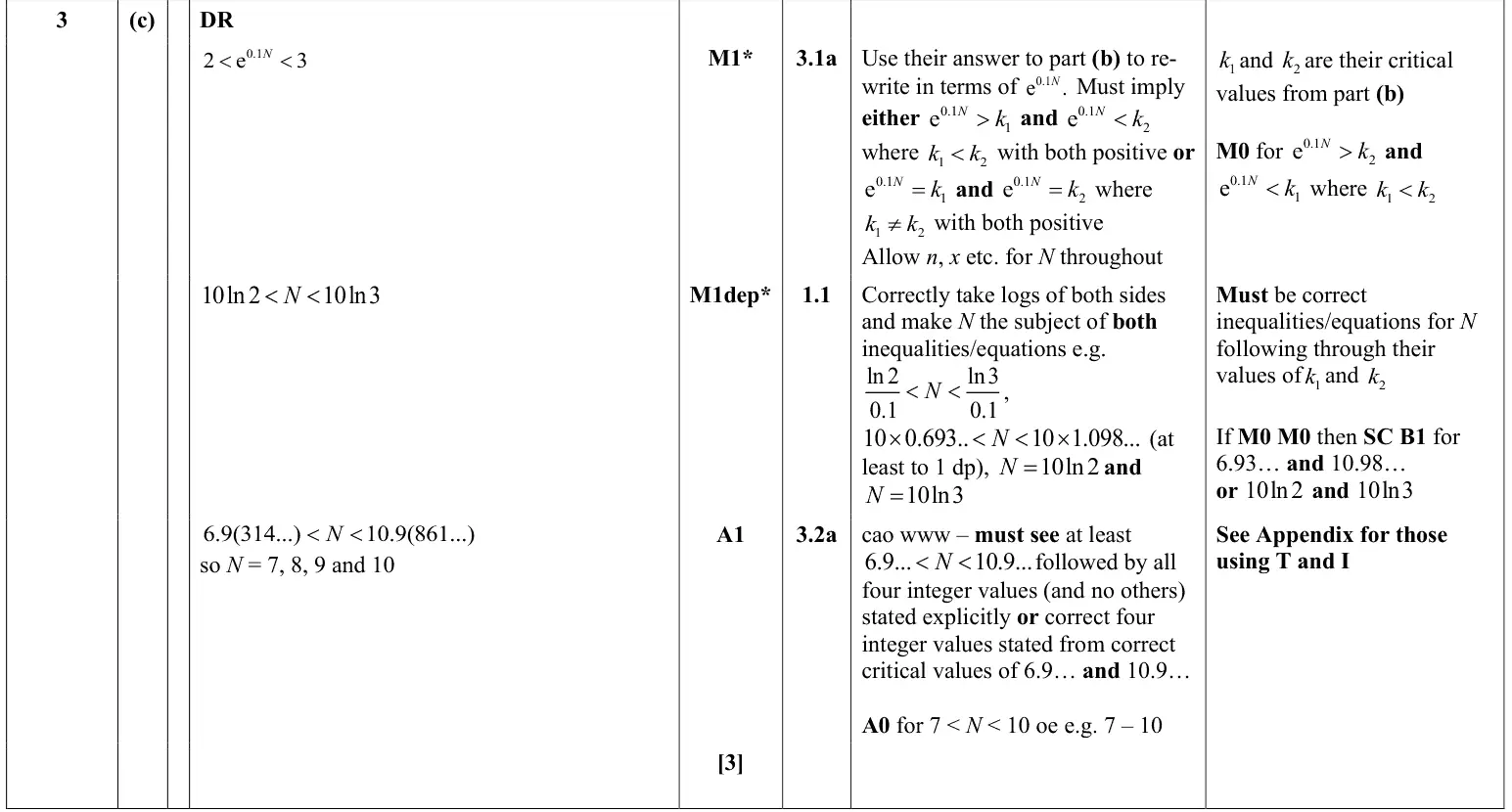
Although most candidates realised that importance of their answer to part (b) and started by stating that 2 < e01.𝑁< 3, many re-started in this part or did not see the significance of the previous part. While many candidates correctly stated that 10ln2 < 𝑁< 10ln3 many did not read the question carefully and either left this as their final answer or gave an answer in a form that did not make it explicitly clear what positive integers satisfied the given inequality (e.g. an answer of 7 ≤𝑁≤10 was far too common). Finally, as this question required detailed reasoning (DR) many went straight from 10ln2 < 𝑁< 10ln3 to N = 7, 8, 9 and 10 without first showing the critical values of 6.93… and 10.98….
Key points and common errors
replace x by e^(0.1N): 2 < e^(0.1N) < 3
10 ln 2 < N < 10 ln 3 i.e. 6.93 < N < 10.99
integers N = 7, 8, 9, 10
many stopped at the log inequality
June 2023 · AS Paper 1 · Q4(a)2 marksEasy
Mark scheme for this part
Examiner's comment
This was well answered by the majority of candidates, with most being able to correctly take logs of both sides and reach the required answer. Note that as a ‘Determine’ question some working was required and most candidates followed this instruction adequately. Quite a few candidates rounded incorrectly (giving 0.767 or 0.77 as their final response), but most of these had reached an exact form in their working first so few lost marks for this error.
Key points and common errors
3x = ln 10, x = (1/3) ln 10 = 0.768
rounding errors
June 2023 · AS Paper 2 · Q5(b)3 marksHard
Show the start of this question
Mark scheme for this part
Examiner's comment
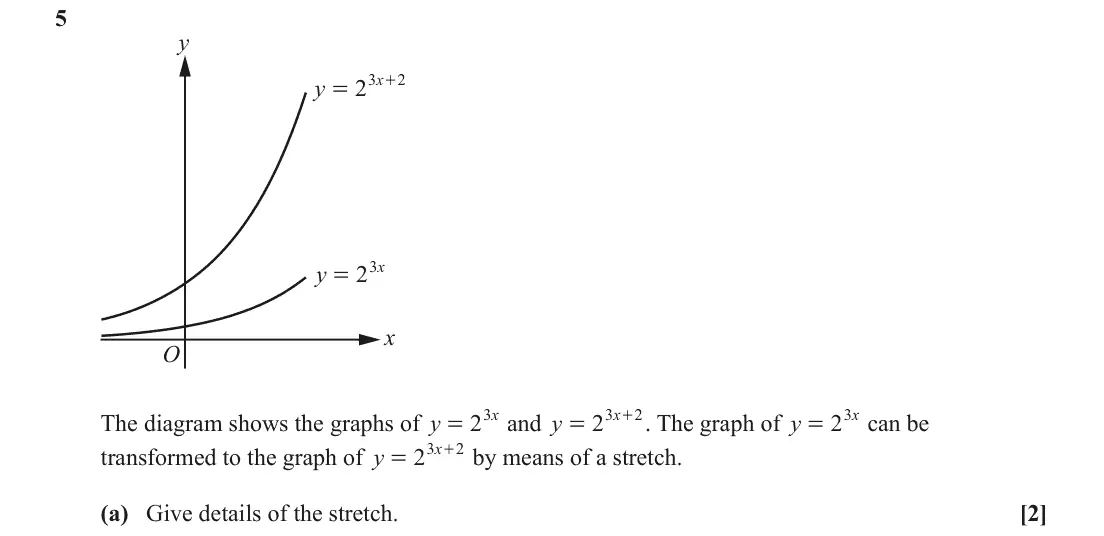
Most attempts gained 1 mark, for finding the correct equation in x. Using 23x+2 = 4(23x) to obtain the equation 23x = 12 was very rare. The exemplar below shows the typical next step in many solutions. Less successful efforts did not involve 36 at all. Taking logs like this was very prevalent and often led to the solution being abandoned quickly (presumably because x disappears). Incorrect use of the logarithm laws was frequent in this question.
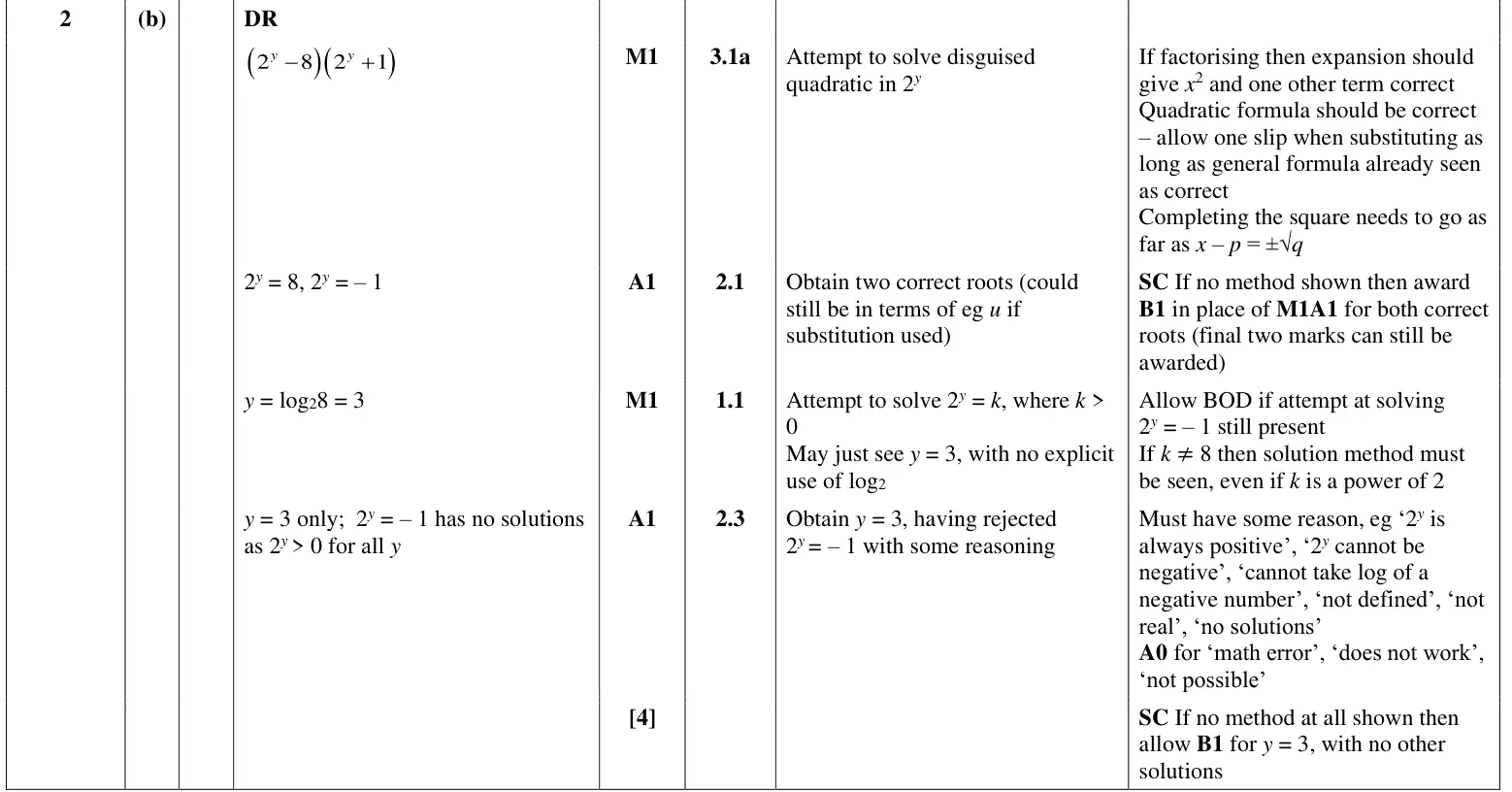
Most candidates could identify this as a disguised quadratic and make a good attempt to solve it, either directly or by using a substitution. As it is a ‘detailed reasoning’ question candidates were expected to show explicit detail of their solution method, and the majority did indeed do so. In addition to obtaining the correct root of y = 3 candidates also had to explain why 2y = −1 would yield no further roots. This was generally done well, although some candidates need to take more care with their use of mathematical language; saying that logs cannot be negative is not the same as saying that the log of a negative number cannot be taken. A common misconception was the belief that the equation was actually a disguised cubic, from the misapplication of the order of operations.
Key points and common errors
disguised quadratic (2ʸ − 8)(2ʸ + 1) = 0
y = 3 only
reject 2ʸ = −1 as 2ʸ > 0 (not 'logs cannot be negative')
June 2023 · Paper 1 · Q11(d)(i)4 marksHard
Show the start of this question
Mark scheme for this part
Examiner's comment
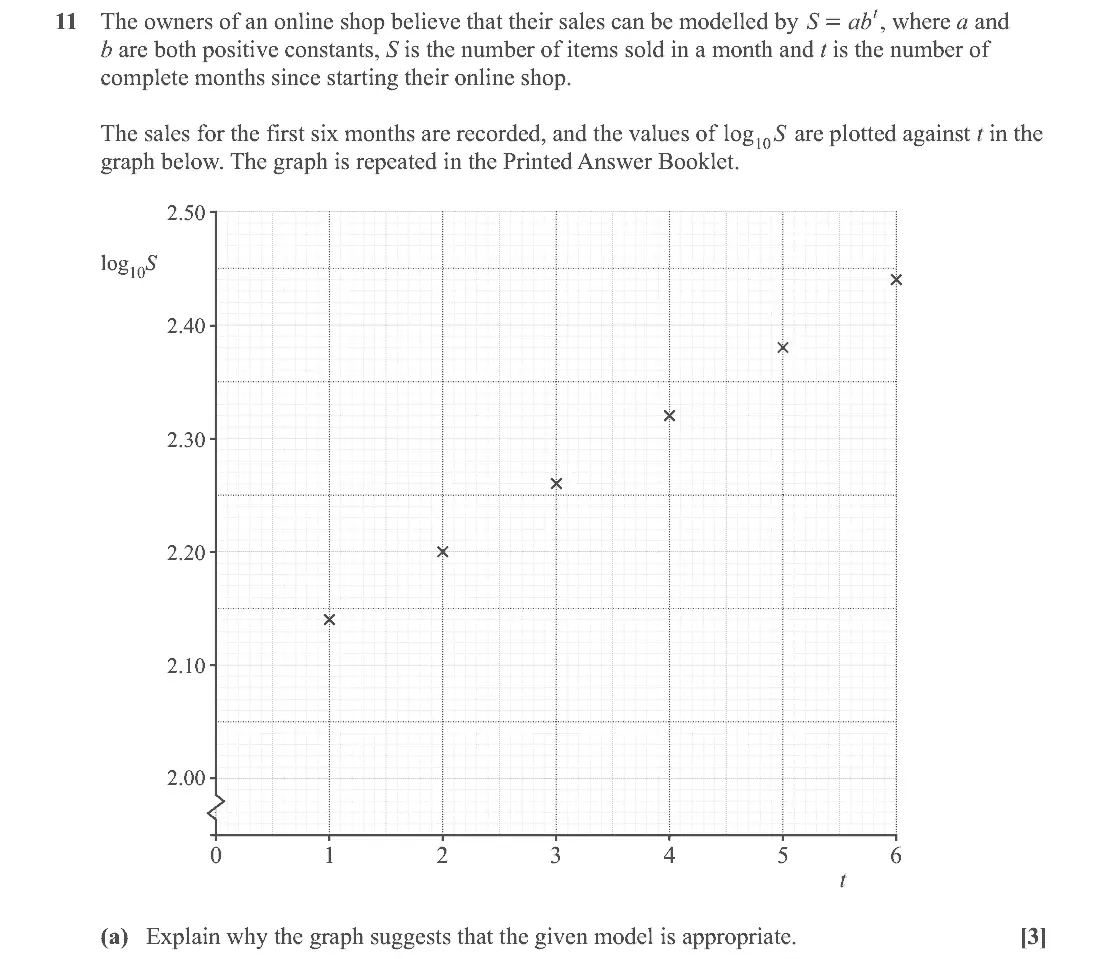
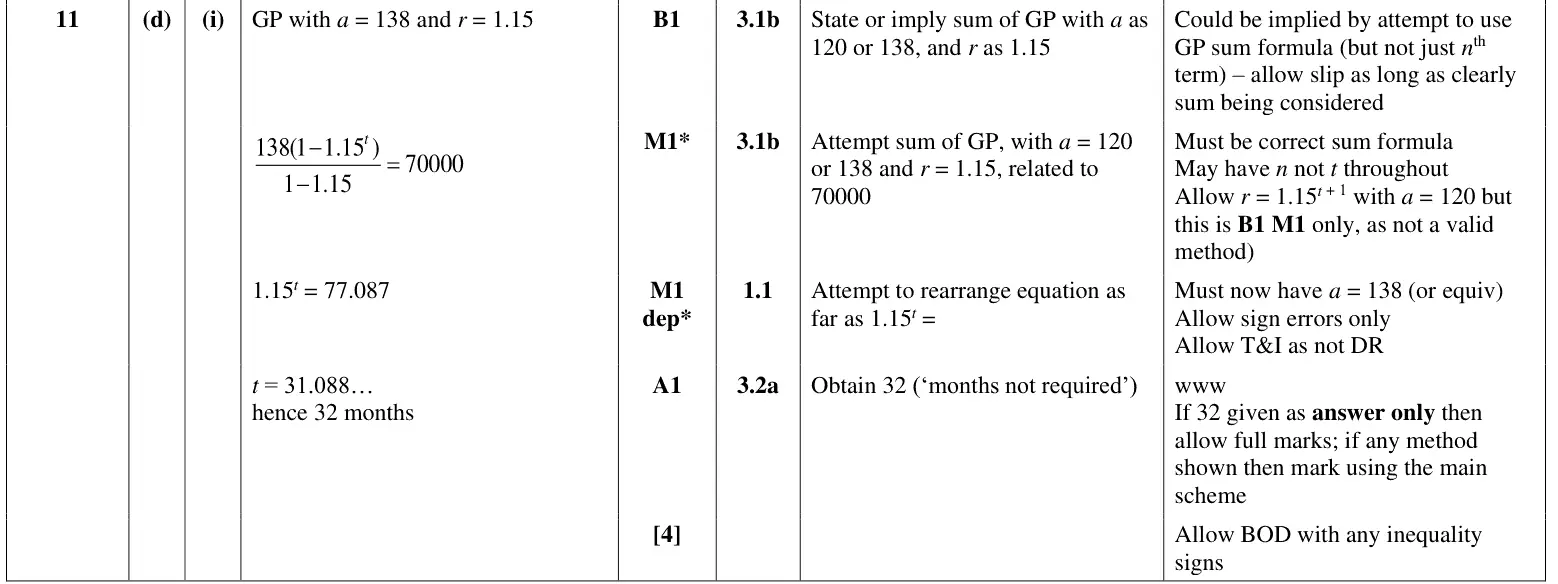
The two equally common approaches were to either equate the monthly sales to 70000 or to consider total sales, using the sum of a GP but with an initial value of 120. Only the higher scoring candidates realised that the first value in the GP should be 138, and these candidates invariably solved the equation correctly to gain full marks.
Key points and common errors
sum of GP with first term 138 (not 120) and r = 1.15
1.15ᵗ = 77.087
t = 31.09 so 32 months
June 2023 · Paper 3 · Q13 marksMedium
Mark scheme for this part
Examiner's comment
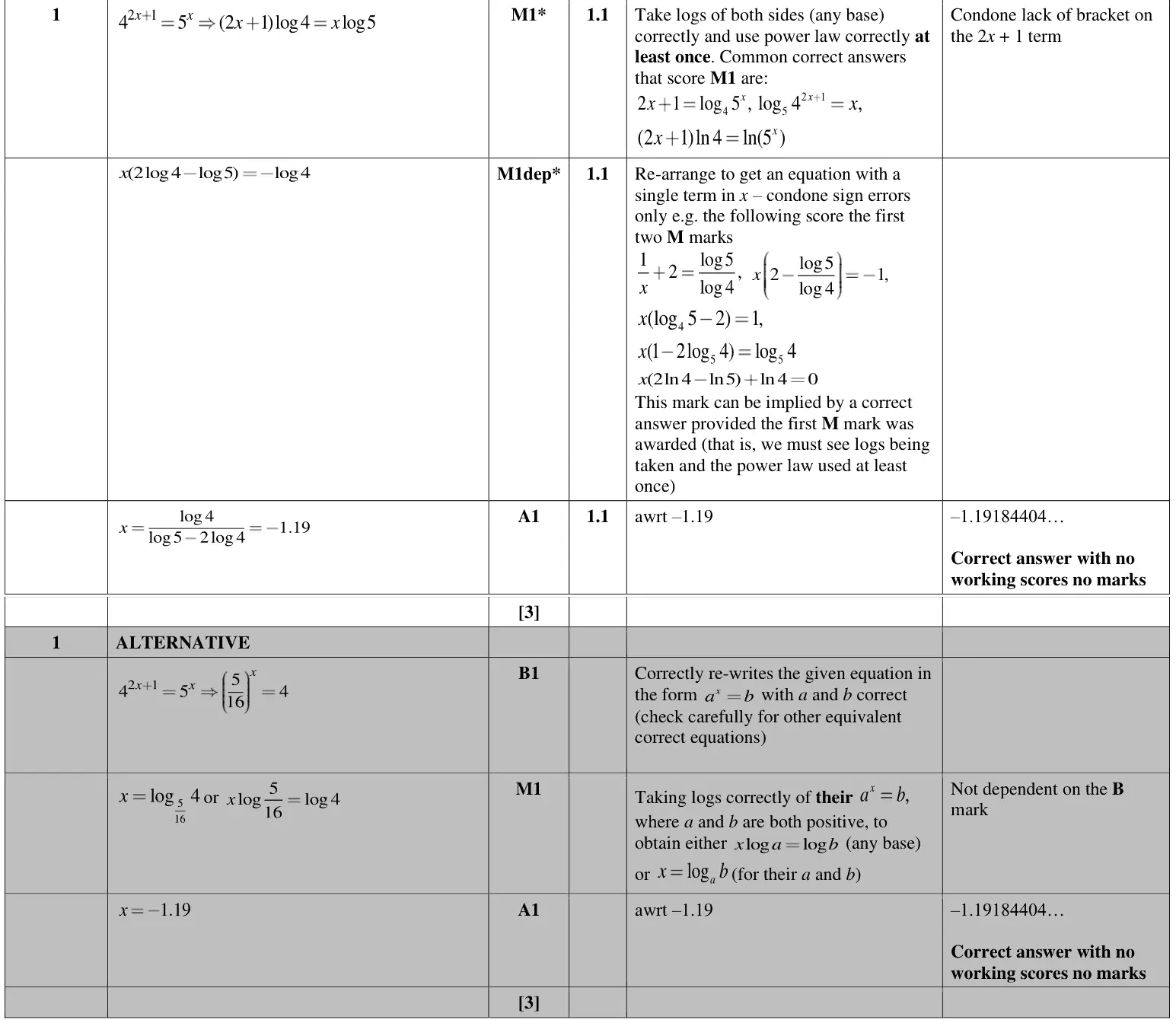
would appear to be a routine demand of using logs to solve an equation of the form 𝑎𝑎f(𝑥𝑥) = 𝑏𝑏g(𝑥𝑥). The Examiners noted that candidates’ responses to this question were mixed with many struggling with what most common error was to take logs of both sides with two different bases, e.g. (2𝑥𝑥+ 1)log54 = 𝑥𝑥log45. linear equation. A number of candidates left their answer in an exact form, e.g. 𝑥𝑥= For those candidates that did take logs correctly many then appeared to struggle to solve the resulting log5−2log4 and did not give the answer to 3 significant figures as requested.
Key points and common errors
take logs of both sides with the same base: (2x + 1)log 4 = x log 5
collect x terms
x = −1.19 to 3 s.f.
errors: different bases on each side, leaving an exact form
June 2022 · Paper 2 · Q1(c)2 marksEasy
Mark scheme for this part
Examiner's comment
This question was well answered by most candidates. A wide variety of methods was seen, some involving logs, others involving manipulation of indices. Some candidates omitted the ± in their answer. A few candidates showed lacking understanding of logs, such as x2 − 7 = ln 1 243 , or of indices, such as 1 2 1 x = . 7 243 3
Key points and common errors
1/243 = 3⁻⁵ so x² − 7 = −5
x = ±√2
± often omitted
June 2022 · Paper 2 · Q45 marksMedium
Mark scheme for this part
Examiner's comment
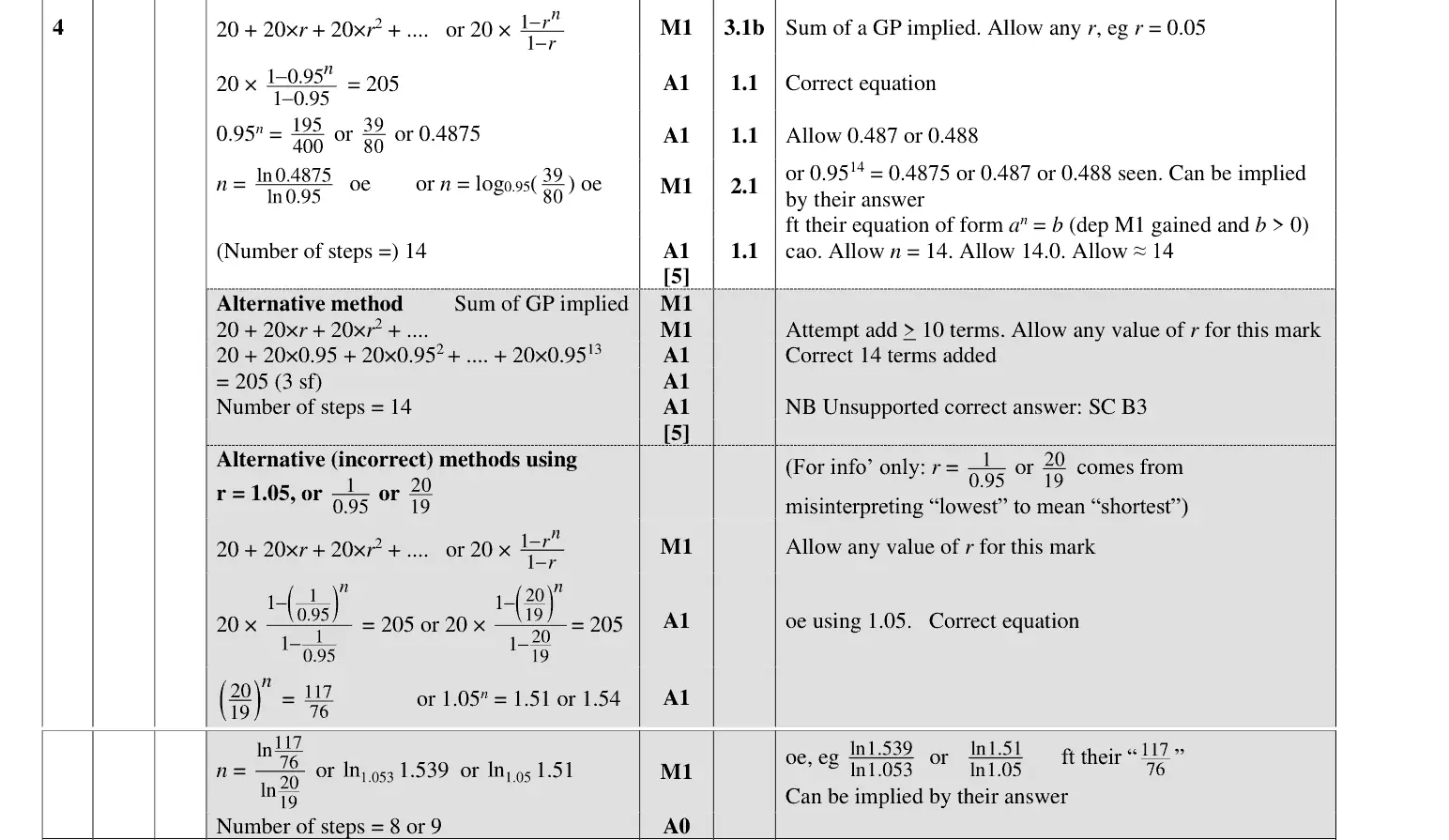
Almost all candidates recognised the need to consider the sum of a geometric progression. (Although a few used either the formula for the nth term of a GP or the formula for the sum of n terms of an AP.) In most cases, there was some good algebraic manipulation, including the use of logs to solve an equation such as 0.95n = 39 80 . There were two common errors. Firstly some candidates used r = 1.05 (representing 1 increasing, rather than decreasing, heights). Others used r = 0.95 (resulting from a misreading of the word “lowest” in the question to mean “shortest”). Candidates who made either of these errors, but whose working was otherwise correct, scored 4 marks out of 5. A more serious error was to use r = 0.05. Candidates who made this error could only score one mark for recognising a geometric progression.
Key points and common errors
sum of GP with a = 20, r = 0.95: 20(1 − 0.95ⁿ)/0.05 = 205
0.95ⁿ = 0.4875
n = 14
errors r = 1.05 or 1/0.95
Autumn 2021 · Paper 1 · Q4(c)3 marksMedium
Show the start of this question
Mark scheme for this part
Examiner's comment
(From the general report) Common misconceptions Candidates should appreciate that merely discarding a value that cannot be pursued is not sufficient; a reason is also required e.g., in Question 4(c) 2y = -2 has no solution as 2y is always positive.
Key points and common errors
recognise x = 2^y
y = −1 and y = log₂3
must give a reason for rejecting 2^y = −2 (2^y > 0 for all y), not just discard it
Autumn 2020 · AS Paper 1 · Q6(c)5 marksMedium
Mark scheme for this part
Key points and common errors
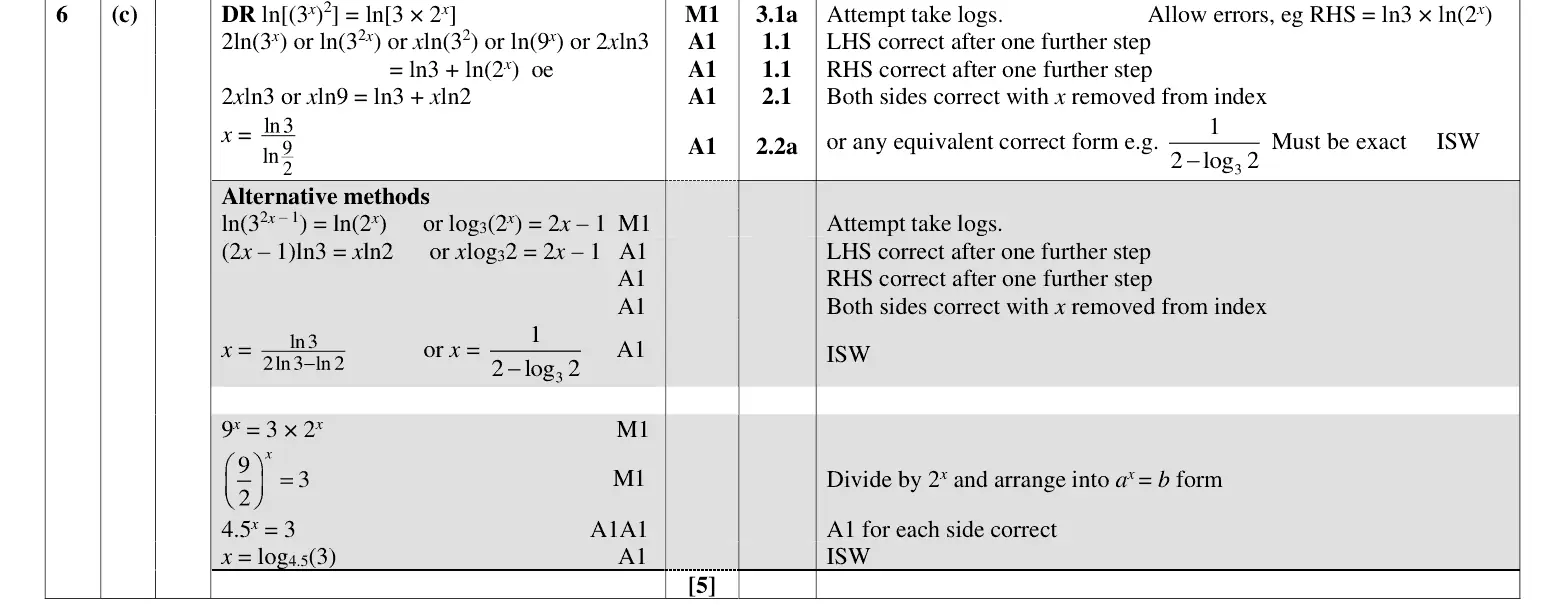
9ˣ = 3 × 2ˣ so (9/2)ˣ = 3, or take logs: 2x ln3 = ln3 + x ln2
x = ln3/ln(9/2) exact
Autumn 2020 · AS Paper 2 · Q4(c)(i)2 marksHard
Show the start of this question
Mark scheme for this part
Examiner's comment
(Comment on Question 04 as a whole) Part (a) - Long division was seen here, ignoring the request for the factor theorem. This gained no credit because of the instruction ‘Use the factor theorem’. Note that only the statement f(½) = 0 so k = -37 was not enough working because of DR and AG. Part (b) - DR so evidence for the factorisation was required. Candidates that just quoted their answer, possibly obtained from the polynomial solve function on the calculator scored M0. Part (c) - Only candidates who did well on this paper seemed to understand what was required. NR was not uncommon.
Key points and common errors
equation is f(e⁻ᵗ) = 0 so e⁻ᵗ = ½, 5/3, 4
t = −ln(½), −ln(5/3), −ln 4
Autumn 2020 · Paper 1 · Q6(c)3 marksMedium
Show the start of this question
Mark scheme for this part
Examiner's comment
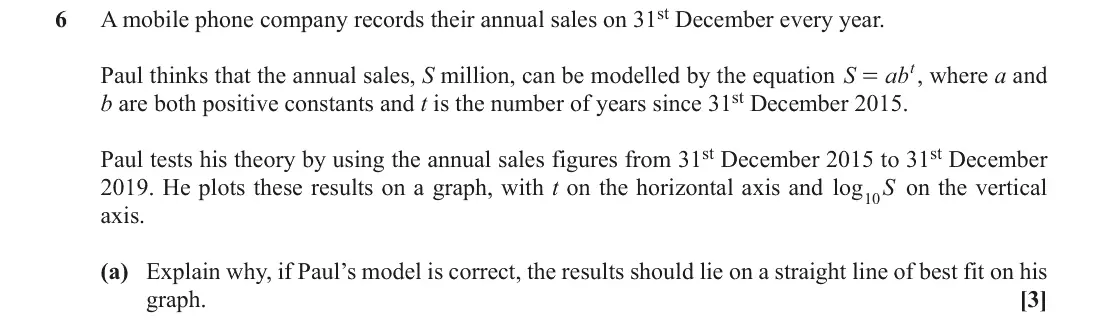
(Comment on Question 06 as a whole) In the first part of Question 6 a number of candidates attempted a worded explanation as opposed to reducing the equation to linear form which is then linked to the equation of a straight line. A lack of precision resulted in some candidates not gaining full credit, as they neglected to indicate that they were using logs to base 10. In part (b) the expectation was that candidates would use the relevant parameters from their linear equation; an alternative, and equally acceptable, strategy was to identify coordinates of points on the straight line and use them in the given exponential equation; this is a good example of candidates who could not answer part (a) finding a method that still allowed them to attempt this part of the question. In part (d) any sensible reason that identified why the sales may not continue at the same rate was allowed, but a number of solutions were too vague to gain credit. Candidates were also given credit if they identified that extrapolation was unreliable.
Key points and common errors
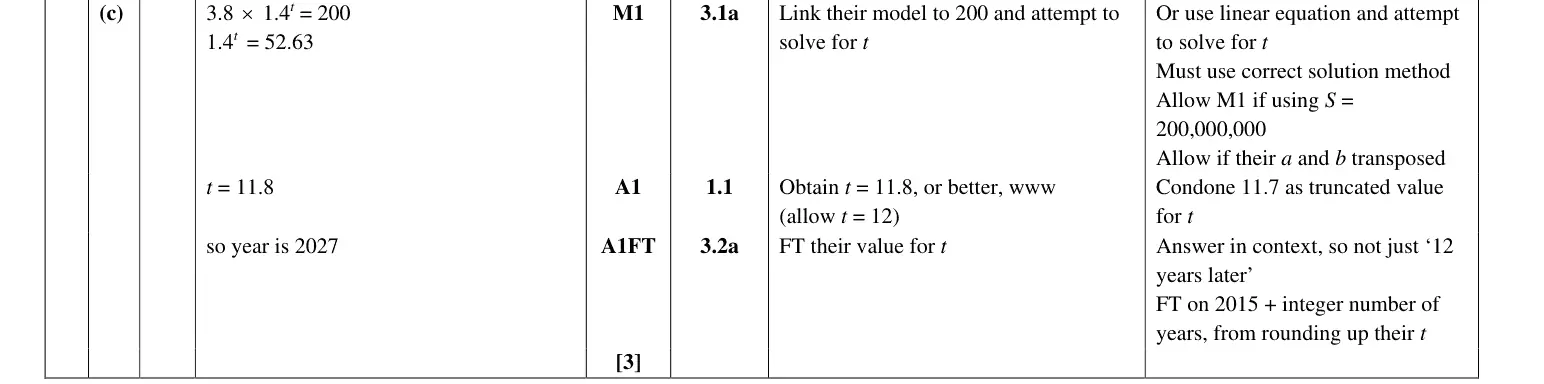
3.8 × 1.4ᵗ = 200 gives t = 11.8
year 2027 in context, not just '12 years'
Autumn 2020 · Paper 1 · Q7(b)3 marksMedium
Show the start of this question
Mark scheme for this part
Examiner's comment
(Comment on Question 07 as a whole) The final part of Question 7 was another example of where candidates were expected to give clearly explained and sensible answers. Many could identify that there will eventually not be enough hours in the day, but finding a reason on a different theme for their second answer proved more problematical.
Key points and common errors
30 × 1.1^(X−1) > 30 + 15(X − 1)
divide and take logs base 1.1 to reach the given inequality
keep > not =
June 2019 · Paper 1 · Q78 marksHard
Mark scheme for this part
Examiner's comment
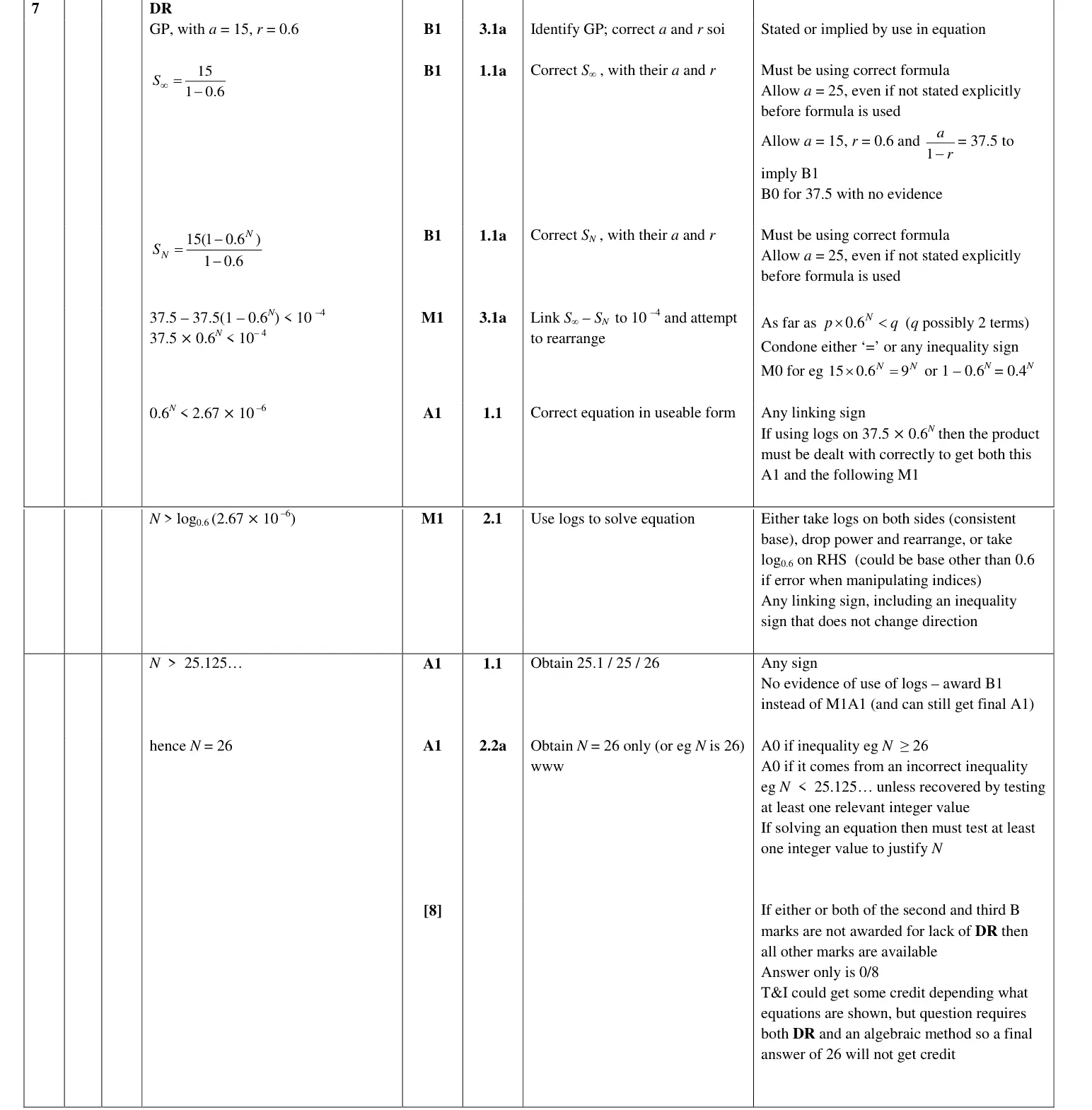
Most candidates were able to gain some credit on this question, but fully correct solutions were in a minority. The most effective method was to start by writing out the first few terms of the sequence, to allow the first term and common ratio to be identified. These values could then be substituted into the relevant formulae, and the inequality rearranged to useable form. Candidates were generally able to make a good attempt at this, but sign errors were relatively common. In this ‘detailed reasoning’ question, there was an expectation that the use of logarithms to solve the inequality would be explicit and this was nearly always the case. Candidates then had to conclude by stating the correct integer value of N, a step that some omitted and concluded with a decimal answer. The final answer had to be fully justified by correct use of inequalities throughout (which was often not the case with log0.6 involved), or by testing at least one relevant integer value. The most common misconception was to assume that the first term of the sequence was 25, with no check of n = 1.
Key points and common errors
GP with a = 15, r = 0.6
S∞ − S_N = 37.5 × 0.6^N < 10⁻⁴
logs give N > 25.1 so N = 26
inequality reverses on dividing by log 0.6
trial and improvement scores nothing
June 2018 · Paper 1 · Q7(ii)3 marksEasy
Show the start of this question
Mark scheme for this part
Examiner's comment
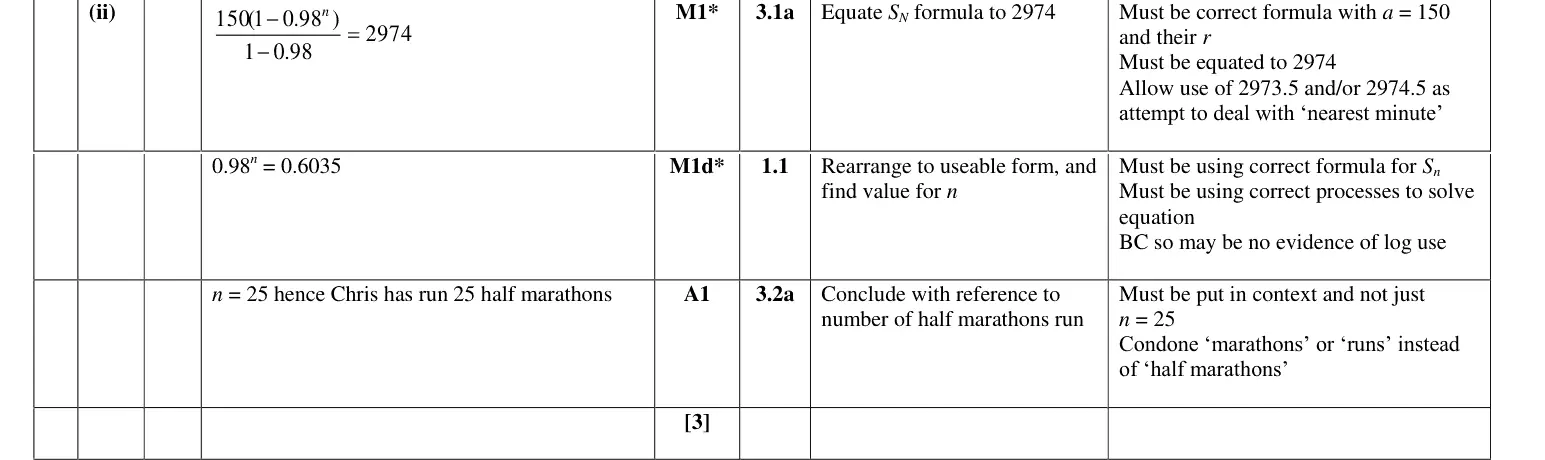
Candidates could correctly equate the expression for the sum of n terms to 2974, and most were able to solve this equation. Most candidates showed a clear mathematical justification even though there was no specific command in the question requiring this level of detail for full credit. Once again, the final answer was expected to be given in context.
Key points and common errors
150(1 − 0.98ⁿ)/(1 − 0.98) = 2974
0.98ⁿ = 0.6035
n = 25 half marathons, answer in context
Find an A-level maths tutor
Stuck on this? Book a trial session with an A-level maths tutor.